The blog for Mets fans
who like to read
ABOUT US

Faith and Fear in Flushing made its debut on Feb. 16, 2005, the brainchild of two longtime friends and lifelong Met fans.
Greg Prince discovered the Mets when he was 6, during the magical summer of 1969. He is a Long Island-based writer, editor and communications consultant. Contact him here.
Jason Fry is a Brooklyn writer whose first memories include his mom leaping up and down cheering for Rusty Staub. Check out his other writing here.
Got something to say? Leave a comment, or email us at faithandfear@gmail.com. (Sorry, but we have no interest in ads, sponsored content or guest posts.)
Need our RSS feed? It's here.
Visit our Facebook page, or drop by the personal pages for Greg and Jason.
Or follow us on Twitter: Here's Greg, and here's Jason.
|
by Greg Prince on 20 August 2010 3:07 am The Mets have been receiving some mighty fine starting pitching lately. Yet has it occurred to anybody they might coincidentally be on the wrong end of the same? That it just so happens that the Astro, Phillie, Rockie, Brave, Diamondback, Cardinal, Dodger, Giant, National and Marlin moundsmen have all been on a roll at the exact moment the Mets batters crossed their respective paths?
I hadn’t considered that, but perhaps that’s the answer as to why the Mets since June 28 — the night the Mets began transforming their season of promise into a festival of 4-3 grounders — haven’t hit much, haven’t scored much and have won very little.
Couldn’t be they are just totally and completely inept at one of the key elements of the game.
Nah, that can’t be it. Must be the opposing pitching being absolutely on fire.
Glad I figured that out, ’cause otherwise I’d thing we’ve got here is a group of three-tool players. They can throw, they can field and they’ve run practically unimpeded into severe mediocrity. But they can’t hit — and don’t even begin to dream about them hitting with power.
Jerry Manuel starts the kids, the kids don’t hit. Jerry Manuel starts (or perhaps showcases) the vets, the vets don’t hit. Sometimes the morose Met hitting is compensated for by the vibrant Met pitching. Far more often, it is not.
But again, that’s probably because everybody else’s pitchers are unconscionably hot.
Take the latest Met loss, from Thursday night. Bud Norris stuck out ten fewer batters than he did in his last start, against Pittsburgh, but gave up three fewer hits in just as many innings. Bud Norris, 5.23 ERA notwithstanding, is on a bit of a roll. If we’re going to give credit to Pat Misch for six splendid shutout innings before Carlos Lee pounded his final delivery into Misch patties, we’ve got to figure Norris is doing something right.
And what about that Brett Myers? He’s a proven commodity. He gave up the same two runs in seven innings Wednesday Norris gave up Thursday. That’s some pitching, right there with R.A. Dickey’s in the same game. Oh, and Tuesday…is it that the Mets struggled to score three runs off Nelson Figueroa and three relievers none of us who abstain from fantasy leagues have ever heard of? Or are Figueroa (fighting off vicious migraine-like symptoms, no less), Jeff Fulchino, Mark Melancon and Wilton Lopez just that overwhelming? Maybe they’re every bit as fearsome as just about every other starter and reliever the Mets have encountered since touching down in San Juan and selflessly distributing their bats to the local children as gifts from the mainland.
The Mets occasionally lose to a really good pitcher. They sometimes lose to pretty good pitchers. They have been known to succumb to OK pitchers with better backgrounds than their recent performances would indicate. They also don’t do much against pitchers generally classified as undistinguished or not especially talented.
But maybe they all got hot in accordance with the Met schedule. Maybe nearly every pitcher the Mets have faced for a span of 46 games, of which the Mets have lost 29, is sharp as a tack on the night or day the Mets oppose him.
Sure, that could be it.
***
Saturday night, 8 o’clock, Shea Stadium returns to Flushing one more time. The Last Play at Shea will have its world premiere on the big screens at Citi Field. I saw the movie at the Tribeca Film Festival in April — twice — and can recommend it as well worth the $10 price of admission (plus the $2 “service charge” if you order through the grubby hands of mets.com). I’m a bit biased since I’m in it for maybe 10 seconds and I contributed some historical research at the filmmakers’ request, but I’m mostly biased because it’s an immense documentary pulling together the intertwined legends of the stadium, the ballclub that played there, the musician who serenaded it last and the Metropolitan Area in which it all took place.
Check out the details here; swing by Section 326, Row 8 before showtime to say hi.
by Greg Prince on 19 August 2010 5:16 am We should have known a Mets win was in the bag shortly after Geoff Blum spoiled R.A. Dickey’s bid for a second consecutive complete game victory with one out in the ninth inning. That may not have seemed like the moment for Mets fan self-confidence, but if I had done my homework, I might have divined precedent dictated the outcome.
Blum’s bomb to right-center at Minute Maid Park tied the score at two and broke our Dickey-loving hearts, sure. But once R.A. departed and Hisanori Takahashi took us to the tenth, the game was clearly tilting our way. How do I know that? By doing my homework after the fact.
See, the last extra-inning game at Minute Maid Park in which Geoff Blum homered was an Astro loss. Unlike Keith Hernandez’s dad, I’m by no means a Houston buff, yet I do know one thing well about Geoff Blum: he hit the latest home run in World Series history. It was at Minute Maid Park, it took place in extra innings and the Astros lost….in fourteen, no less.
The circumstances were a little different five years ago than they were Wednesday night.
October 25, 2005 had become October 26, 2005. The Astros were hosting the White Sox in Game Three of that year’s World Series (an exquisitely tense World Series that is never mentioned as one of the best because it was a sweep). It was 5-5 in the top of the fourteenth, two out. Geoff Blum, a former Astro, was up for the White Sox, having been inserted into the game a half-inning earlier in a double-switch. Blum had not batted in the World Series to that point. The journeyman infielder’s only postseason plate appearance occurred in the first game of the American League Division Series — following at-bats by two players whose names will warm Mets fans’ hearts: Willie Harris and Timo Perez — and he’d popped up. Geoff Blum was no more than a fringe player for the ’05 White Sox, the kind of guy who stays on the bench until the bottom of the thirteenth.
But in the top of the fourteenth, with two out, Geoff Blum faced Ezequiel Astacio and delivered a fringe benefit for the ages: he lifted a fly ball that just kept carrying down the right field line at Minute Maid until it was gone.
Chicago 6 Houston 5. The White Sox scratched out one more run on a pair of singles and a pair of walks and then withstood a brief flurry in the bottom of the fourteenth (Mark Buehrle, Ozzie Guillen’s ninth pitcher of the night/morning, came in Mike Pelfrey-style and recorded the final out) to win 7-5 and take a three games to none lead at 1:20 AM Central Daylight Time, just nine minutes shy of five hours played. They became world champions one night later.
Geoff Blum…it’s safe to say I hadn’t thought about him very much since October 26, 2005 when I was an ad hoc White Sox fan, based primarily on their not having won a World Series since 1917. Back then, I was thrilled by his sudden burst of power. Wednesday night, watching him ply his intermittent long ball talent again in Houston didn’t do nearly as much for me.
Until he launched his game-tying homer off Dickey, his first of the season, I wouldn’t swear I was conscious that Geoff Blum was still an Astro. Or had become an Astro for the second time in 2008. Or was “active” in the major league sense of the word. Honestly, the last thing I specifically remember Geoff Blum doing was homering off Steve Trachsel in 2006 on the night everybody else remembers as the night Mike Piazza returned to Shea Stadium as a Padre. Geoff was in his second San Diego tour — he seems to have a built-in homing device for his old teams. I gave a standing ovation to Mike Piazza and a respectful one to Mike Cameron in recognition of their meritorious Met service; when Blum took Trachsel deep in the second inning, I applauded real softly, as if it was the middle of the night the previous October and I didn’t want to wake anybody. The Mets went on to beat Piazza and the Padres, which was the main goal of the evening, and Blum receded into my subconscious for the next four years.
Too bad he came back to mind so strongly in the ninth last night. Too bad Dickey couldn’t finish his own win or win his own game (I will cop to prematurely putting it in the mental books with two outs to go, which is a breach of Mets fan conduct far worse than not terribly minding Geoff Blum homering off Steve Trachsel). Too bad anybody who is entranced by the 2010 Mets was compelled to stay up an extra five innings for the satisfying conclusion.
Yet a few ultimately good things happened as a result of Blum awarding us bonus baseball.
We saw what our starless bullpen — Takahashi, Parnell, Dessens and Acosta — could do when it absolutely had to. They were as good in relief as Dickey was starting, and Dickey was wonderful starting.
We saw that not having to designate one reliever as a “closer” and insisting he warm up umpteen times in advance of a road save opportunity that may never arrive doesn’t preclude an effective ending.
We saw Jose Reyes reach base a fourth and fifth time, and when Jose Reyes reaches base a lot, the Mets win. (FYI: the more Mets who reach base a lot, the more the Mets win.)
We saw Angel Pagan break his endless ohfer in the tenth and Ike Davis do the same in the thirteenth.
We saw a game in which Pagan, Davis and Ruben Tejada (his ohfer mercifully slain in regulation) each collected a base hit for the first time since July 11.
We saw the Mets score a go-ahead run without a base hit. Their big fourteenth-inning rally consisted of a walk, a bunt, a steal, a walk, an intentional walk and a fly ball. What the hell, a run is a run, especially after midnight.
And, when the Mets at last won, I could find myself thinking, “Hey, fourteenth inning, Minute Maid Park, Geoff Blum homered, Astros came out on the losing side…gosh, this feels sort of familiar.”
***
A few recommendations to fill the hours before tonight’s Minute Maid finale, the final game of the season scheduled to start later than 7:10 PM.
• Jerry Izenberg of the Star-Ledger, one of the great sports columnists in the history of the medium, appreciates Bobby Thomson and shares with us what it was like to be a young man who loved the New York Giants. (Thanks to Mets Police for the link.) May they someday write as many nice things for Geoff Blum in Chicago as they have for Bobby Thomson around here. Come to think of it, may we continue to write nice things about R.A. Dickey every fifth day for many years to come.
• Speaking of teams that no longer exist but touch the heartstrings nonetheless, try to catch or record MLB Network’s reairing of Triumph and Tragedy, a neat history of the not-so-neat downfall of the Montreal Expos, Friday at 4:00 PM. Slim pre-Met Rusty Staub and a mini-division clincher by the ’81 Expos at Shea are a couple of the highlights of parochial interest.
• Speaking of franchises run by people who don’t exactly seem to have their fans’ best interests at heart, you must read Matt Artus’s report on the focus group the Mets recently convened to learn what they could have learned from any number of blogs: that Mets fans are convinced the people running the franchise don’t exactly have their best interests at heart. Matt, per his site’s name, is Always Amazin’, but this piece is particularly resonant.
• Speaking of leadership that never swerves from a path that leads its followers smack into a wall, it’s a good time to descend into the Sports Illustrated vault and revisit Tom Verducci’s autopsy of the 1993 Mets. (Thanks to It’s Mets For Me for the link.) The real takeaway from this article is that two Met constants have stayed in place over these past seventeen years: a Wilpon at the helm and a certain after-the-fact arrogance about how things are going to be different this time. Whatever the era that has gone irretrievably awry, I am forever left with the sense that the Mets powers that be can’t be bothered to lock a barn door at night, but worry terribly how they will be perceived should a horse be seen trotting down the highway the next morning.
• Speaking of Mets matters that never go exactly right, R.A. Dickey’s surrendering of one hit last Friday led ESPN New York’s relentless Mark Simon to examine in-depth a most Metsopotamian phenomenon. The tally now stands at Mets One-Hitters 35 Mets No-Hitters 0.
• Speaking of Met pitching, specifically the ongoing absence of a certain high-profile closer via circumstances that weren’t exactly baseball-related, check out WFAN’s audio section to hear the podcast of Tony Paige’s lengthy interview with Duaner Sanchez. I’d actually been thinking about the Sanchez Disaster in the wake of the K-Rod Debacle. The cab accident that did in Duaner’s 2006 season (and maybe the entire team’s) was of course not his fault, but it’s always been murmured, “Why was he out so late looking for ‘Dominican food’?” With Paige, Sanchez — currently pitching for the Sussex Skyhawks of the Can-Am League — said he was not out late as everybody assumes. His version is he got in the Miami taxi of doom at 9:25 PM and returned to the team hotel from the hospital at 2:00 AM, yet “he was out at two in the morning” is what became the legend. What he claims may be the case, and the popular conception may deserve correction, but I find it ironic Duaner Sanchez chose to clear the air about his alleged penchant for nocturnal wandering as an in-studio guest on an overnight radio show.
• We’re not speaking of Charlie Hangley but maybe we should be, because our own CharlieH is once more working the other side of the Comments section. The former Serval Zippers chronicler and eternal Friend of FAFIF has unveiled My Entire Team… to an anticipant Metsosphere. Best of luck to one of the good ones.
***
Finally, apropos of nothing except for what I heard after listening to Tony Paige wrap up his conversation with Duaner Sanchez…
John Sterling only reaches my eardrums when one of his calls is featured on a WFAN update, but I’m never, ever not incredulous that he continues to reign, after 22 seasons, as the flagship radio voice of a team that fancies itself the gold standard of its sport. The clip I just heard was his call of a Curtis Granderson home run, featuring him singing, “The Grandy man can!” It may not read as the worst of Sterling’s forced and tired self-serving shtick, but the singing surely puts it over the top.
Thus I feel compelled to ask a fairly obvious question: Who with functioning eardrums — Yankees fan, Yankees hater, accidental listener who thinks Traffic and Weather Together on the Eights is a moment away — can possibly stand listening to John Sterling?
I don’t ask this to touch off a therapeutic round of Yankee-bashing. Baseball fans, regardless of affiliation, have to really love the game enough to witness it through a radio. TV, even if you’re not fond of the announcers, comes with a built-in override option: just turn down the sound; you can still watch. That won’t work with radio. It’s all about the announcer, a person on whom you rely to be your reporter, your analyst, your guide, your companion and your eyes. When those multiple roles are muffed, your experience a fan is truly diminished.
The only thing I could imagine relying on John Sterling for is an alibi. “Sure I went on that shooting spree, your honor, but you gotta understand — my car radio was stuck on 880 and he started singing…not just announcing but singing!” I mean, really, who actually likes this guy?
by Jason Fry on 17 August 2010 11:28 pm At least Jerry played the kids.
There really isn’t a lot else to say about this one — Johan Santana spotted the Astros a three-spot while searching for his changeup in an ugly first inning, ripped a double past the third baseman instead of bunting, David Wright hit a home run, and Ike Davis started a nifty double play. Four moments that are already receding into the distance in a game that wasn’t very memorable, in a season fading to black.
Regarding Frankie Rodriguez, for posterity I’ll note that he was placed on the disqualified list, meaning the Mets won’t pay him while he’s injured and may seek to void the rest of his contract. As someone with an irrational hatred of K-Rod, I wish the Mets the best of luck with that, while assuming it won’t work. I fully expect K-Rod to be in St. Lucie, with mid-February a tedious succession of stories about how he has regrets but has grown and matured and is eager to take his newfound maturity onto the field. In other words, he’ll have endured some anger-management dumbshow and learned to make a display of scripted contrition at least 30 times.
So what’s left for 2010?
The best scenario, in my mind, would go something like this: The Mets realize they can contend in 2011, but not if they continue to waste roster spots and at-bats on players who offer veteran qualities but no particularly useful baseball skills. Jerry Manuel is excused in early September in favor of Wally Backman, still basking in the glow of the Brooklyn Cyclones’ first New York-Penn League crown. The kids get the bulk of the playing time for the rest of the year. Omar Minaya is reassigned in favor of a GM who will approach the offseason with something resembling a coherent plan. The Wilpons note the plummeting attendance at Citi Field and their team’s irrelevance and make a hard, expensive decision aimed at showing fans they are willing to admit mistakes, determined to put the best possible team on the field, and know they need to demonstrate that the team is on firm financial ground: Luis Castillo and Oliver Perez are released.
Since the chance of all that happening is pretty much zero, what can we realistically look for in terms of solace? Well, R.A. Dickey starts tomorrow, and watching our intrepid knuckleballer and wordsmith is always a pleasure. There’s the continuing development of Angel Pagan and Jon Niese, two question marks turned exclamation marks. There’s hope for more of the early-season Mike Pelfrey. There’s hoping that Ike and Ruben Tejada and Josh Thole and maybe Fernando Martinez go into October with some successes under their belts and lessons learned. (And while we’re at it, Bobby Parnell should be closing whatever there is to close.) There’s hoping that Carlos Beltran and Jason Bay can extract some positives from lost seasons, as they’ll be needed next year.
What else? Well, who knows? Perhaps Dickey will have the knuckleball dancing one of these nights, and this time there won’t be an enemy pitcher with a single well-placed hit. (It’s gotta happen eventually, right?) Perhaps F-Mart can announce himself with a three-homer game, or Tejada can open eyes with a 5-for-5 night. Perhaps we get to play spoilers — I remember 2004 with shudders, but say “Victor Diaz, Craig Brazell and the Cubs” and you’ll see a silly grin on my face.
And amid our anger and dismay, let’s not forget this: There are 43 more baseball games left to watch. That’s a hell of a lot better than anything that 43 days of fall and winter will have to offer.
by Greg Prince on 17 August 2010 2:57 pm Bobby Thomson, a true New York sports icon and author of the most famous home run in baseball history, passed away last night. He was 86. As far as I can tell, nobody ever said a bad word about the man.
What follows is something I wrote a few years ago about an afternoon I spent in the presence of this genuine Giant a few years before that.
***
All right. This is who I wanted to be. This is who I said I was but for the timing of my birth. Here’s my chance.
It is not October 3, 1951 at the Polo Grounds. I was too late for that. Instead, it’s fifty years hence, no coincidence. It’s the fiftieth anniversary of The Shot Heard ’Round The World. These people I’m joining today for lunch in Little Italy, they are real, actual New York Giants fans. They lived through it. They didn’t just read about 1951. They remember it, relish it, revel in it the way I retreat into 1969 or 1986 at least once a day each.
These are my people. They are me once removed. I asked for it. Now I must go sit among them.
I’m not really here to see them. Technically, the star attraction on 10/13/01 is the man who made 10/3/51 famous. The New York Giants Historical Society, organizers of the event (and a group of which I am a paying member), has convinced Bobby Thomson himself to be the guest of honor at Forlini’s Restaurant. Bobby Thomson is just shy of 78 years old in mid-October 2001. How many times has Bobby Thomson told his Shot Heard ’Round The World story? Multiply his age by the year and then maybe you’d be close. He tells it because there’s always somebody who wants to listen.
I feel like a bit of a camp follower, a Jint-sniffer. These people who are here, all who have decades on me, this is their memory. For me, it’s merely my ideal. But I paid my admission and I carry my torch. Other than children or grandchildren of the elders, I am, at the not-so-tender age of 38, among the youngest NYG fans in attendance.
But what the hell? Bobby Thomson isn’t just their Giant. He’s our Giant. He’s my Giant. A Giant among Giants from when the Giants were giants among baseball-playing men. Does anybody else with a homer of his own carry as much cachet? Carlton Fisk? Kirk Gibson? What did they hit? Yeah, the Carlton Fisk home run. The Kirk Gibson home run. Bobby Thomson hit a home run that has a name that isn’t merely eponymous.
When my sister was in high school studying American history and I was in elementary school, I asked her to quiz me to see if I knew any of it. OK, she said, what’s The Shot Heard ’Round The World? “Bobby Thomson’s home run that beat the Dodgers for the pennant at the Polo Grounds in 1951!” I precociously answered. She rolled her eyes and mentioned something about Concord and Lexington. We were both right. But anybody from Concord and Lexington getting his own luncheon lately?
This could have been something else. This could have been the umpteen-thousandth pairing of Bobby Thomson and Ralph Branca. They made history together in a way that Fisk and Pat Darcy or Gibson and Dennis Eckersley didn’t quite. They were hitter and pitcher, New York and Brooklyn, nice guy and nice guy when they got to know each other and show up at golf tournaments and Kiwanis dinners and the like. Usually, Bobby Thomson doesn’t take a bow by himself. Fifty years later, he doesn’t like to gloat. He even took Branca off the hook by declining to attend a planned ceremony (scrubbed in the aftermath of 9/11) at Pac Bell Park in San Francisco to commemorate the fifty years. He didn’t want to embarrass his old friend.
But the people who run the New York Giants Historical Society had other ideas, which is one of the reasons I claimed a kinship with them. They’ve had enough of the Brooklyn Dodger legacy. They don’t want to honor a Dodger, not even incidentally. This, they explained to Bobby, would be family. The Giants fans and the Giants hero. Bobby, who lives in Jersey, relented and came alone.
Nobody missed Ralph Branca.
Funny thing, baseball in the past as viewed in the present. We had just finished absorbing a spate of all-century teams and lists and such, and each of them was led by Babe Ruth. It was pointed out by a few old-timers and SABR types that every similar survey regarding the best player ever, taken throughout the actual twentieth century while it was in progress, named Ty Cobb as the greatest player. Ruth? Great. Cobb? Greater. By 1999, Ruth had surpassed Cobb. Neither had swung a bat in competition since 1935.
That fifty years had passed since the Giants won the pennant (the Giants won the pennant!) hadn’t impacted the need to reconfigure their story for a new generation. What was going to be a grand golden anniversary was tarnished in Giant eyes early in 2001 when the Wall Street Journal published a lengthy investigative piece uncovering the likelihood that the 1951 Giants (gasp!) stole signs as they furiously made up ground on the 1951 Dodgers.
It was a wonderful story written by Joshua Harris Prager. It started on the front page and jumped to most of another. I thought it terrific because even though it lent credence to the sign-stealing rumors that apparently had been circulating since Branca’s pitch cleared the left field wall (big deal, I decided; what ain’t caught ain’t illegal), it brought back to life the greatest home run (Giants down 4-2 in the bottom of the ninth of the deciding sudden-death playoff game as Thomson steps up with one out, two on and nothing less than the flag at stake) at the end of the greatest pennant race (Giants surge from 13½ back to tie the Dodgers, both teams playing in the same city) in the history of baseball. What a splendid way to grab people’s attention.
My colleagues in the New York Giants Historical Society didn’t see it that way. The first issue of the Giants Jottings newsletter that was mailed after Prager’s story blasted it. Blasted the reporter. Blasted the Journal. Blasted backup catcher Sal Yvars for confirming the main point of the article — that a series of elaborate Polo Grounds bells and whistles were put into motion at Leo Durocher’s behest so the Giant batters would know what the next pitch would be. We’ve all heard Sal Yvars spout this nonsense for years, was the Jottings party line. Ignore him. He’s Judas.
But the Journal has more juice than Jottings. HBO did a fiftieth-anniversary documentary and the sign-stealing became a major plot point. Several NYGHS members were interviewed for the film and they were none too happy with the result. Again, the documentary was well done and even-handed. Anybody who wasn’t there for 1951 (which would be most of us in 2001) learned a lot. But the Jottings editorial board railed against it, too.
Editorial judgment aside, I had to admire that as well. As a Mets fan in millennial New York, I’d had enough of being told I was living in a Yankee town. The New York Giants fans had been getting the same treatment on a historical level vis-à-vis the Brooklyn Dodgers (that’s who everybody loved and everybody pined for) since 1957. Why shouldn’t they skew every issue to fit their mildly paranoid world view? Nobody got any signals, everything was on the up and up, the Giants were clean-living churchgoers, the Dodgers heathens and probably a little red.
Works for me.
Bobby Thomson, who sheepishly denies getting any ill-gotten signs, packs Forlini’s this Saturday afternoon. It’s about a month since September 11. We are within walking distance of Ground Zero. Bobby himself was there. He and Ralph (who feels Prager’s sign-stealing scoop removed the blown-pennant onus from him for the rest of eternity) shook hands there the other day to lift the spirits of the workers. That was after they were called on to ring the New York Stock Exchange opening bell. They’re still big men in the Big Apple, no matter that relatively few New Yorkers in any given setting would have first-hand knowledge why. Hell, I wasn’t there, yet I’m thrilled to have a chance to see Bobby Thomson.
This is Jintstock. This is as close to a New York Giants game as I am ever going to get. Yet I feel strange. I’m an intruder of sorts. I’ve read books. I’ve worn black and orange caps and t-shirts and jerseys. I’ve collected pictures and bookmarked Web sites devoted to their ballpark. The year before, I dragged my wife uptown just so we could stand once where the Polo Grounds once stood. I joined the demographically incompatible New York Giants Historical Society and even wrote an article for Giants Jottings (which was held in perpetuity after the sign-stealing scandal ate up space). I had been waiting almost thirty years for a chance to feel a part of the team that I was sure was ancestrally mine.
But it’s not my team. Not really. Don’t get me wrong. I still carry the feeling for the Giants, but I am an intruder. Today, October 13, 2001, is for these other people sitting here. For the New York Giants fans who are now over 60, over 70, over 80. Who grew up with Carl Hubbell or Mel Ott or Bobby Thomson and had them all taken away from them. This is their day. I’m just here to watch and learn.
Nobody minds me, but somebody asks me what I’m doing here. So I pull out the line I’ve been waiting to use all my baseball-watching life.
“Well,” I say. “I’m a Mets fan in my heart, but a Giants fan in my soul.”
The guy who asked looks slightly confused. “I don’t know what that means,” he says, “but it sounds good.”
That’s all right. It’s not about me. It’s about them. It’s about a movement that one of the sons of the members has started to get Mayor Giuliani to rename a portion of Harlem River Drive after Mel Ott. Hizzoner, the big Yankee fan, pushed through a designation of a chunk of the West Side Highway as the Joe DiMaggio. Ott deserves the same, we are told. The city must act now! There is general nodding. I hesitate to articulate what I am thinking, that a month ago our city was attacked and there’s a gaping, smoking hole not too many blocks from here. Maybe Mel Ott can wait a little while, y’know?
Before Bobby Thomson speaks, our master of ceremonies, an old guy (of course he’s an old guy; everybody here is old) asks if anybody would like to say anything. He has several takers.
This is what I learn is on the minds of New York Giants fans in 2001:
• The Dodgers stank.
• The Dodgers were a bunch of crybabies.
• October 3, 1951 was the happiest day of my life.
• I was so happy we could stick it to those arrogant Dodger fans.
• It was so sweet to “break the Brooks’ balls”.
The Giants have their codgers and their codgers still have it in for the Dodgers. Beautiful!
And they have gratitude for Bobby Thomson. It is always “thanks to you, Bobby” that they remain forever on cloud nine. They love this man. He not only gave them something to thrill to fifty years ago, he keeps giving them something to dwell on blissfully every day that they have left on this earth. Thank you, Bobby Thomson.
With that, Bobby Thomson takes to the microphone. He is as humble as advertised. Even if he has done some variation on this thousands of times, he appears touched. These are his people and nothing but his people. No, Ralph Branca does not belong here. This is Bobby’s show.
And Bobby gives us what we came for. Bobby Thomson relates how nervous he was on October 3, 1951 in that ninth inning. How bad he felt about a baserunning blunder of his that took the Jints out of an inning earlier in the game. How he was gonna be the goat who cost his team the pennant. How he was so focused on his pending at-bat in the ninth inning that he didn’t notice in the middle of a Giant rally that the Dodgers had changed pitchers from Newcombe to Branca, who he homered off in Game One of that three-game series.
“I told myself,” Bobby tells us, “give yourself a chance to hit.”
That’s all anybody could ask. After taking strike one, Bobby determined his chance was at hand. He took his chance. He swung. The rest is truly history.
What a story. What a man. No wonder these people love him. I now love him, too. Not just in the abstract but for being the way he continues to be.
When he’s done speaking, he’s presented with a gift certificate for a golf store in Jersey that somebody found out he frequents. He says he wants to donate it to charity. No, he’s told, it’s for you. C’mon Bobby, you deserve it. He mumbles some thanks. He seems just what he didn’t want Ralph Branca to be. He seems embarrassed.
Then he seems crowded. His fans, in their 60s, their 70s, their 80s, their late 30s, seek his hand and his autograph. I have brought with me a digital camera, a Sharpie and a copy of The Giants Win The Pennant! The Giants Win The Pennant!, his memoir. I don’t want to bother the man. He needs a cane to get around and this has probably been a tiring day. But if not now, when? Fair enough.
Mr. Thomson, I say, would you mind…for the fiftieth time on the fiftieth anniversary, Bobby Thomson poses with a fan for a snapshot and signs something. I don’t have time to turn the page, so he signs the cover of the book. It’s a paperback so it’s a little schmeary, but there it is. Bobby Thomson’s signature on something of mine.
A special edition of Giants Jottings captures the luncheon for posterity. “Magically,” the Society newsletter reports, “we were all 50 years younger.”
Don DeLillo didn’t do so bad himself. In the 1990s, the author had made the ball (which was never tracked down to anybody’s satisfaction) that became The Shot Heard ’Round The World the trigger-object of his highly acclaimed novel, Underworld. DeLillo wrote that the kids playing hooky at the Polo Grounds on 10/3/51 would become “the gassy old men leaning into the next century and trying to convince anyone willing to listen, pressing in with medicine breath, that they were here when it happened.”
They were. And I was willing to listen.
by Jason Fry on 17 August 2010 2:27 am Checking in on the Mets from afar — There was only hit, and it was by Hamels? K-Rod did what? — while bouncing around between Florida and Rhode Island and various airports, I didn’t quite realize how mad I was at them. Until I sat down to watch an otherwise anonymous, playing-out-the-string game in Houston and realized I was seething before first pitch.
I wasn’t mad at the actual Mets, really, with the exceptions of ones who assault people outside of the family room. Rather, I was mad at the inept organization that keeps shoving lousy baseball at us and thinking that Shake Shack and Mr. Met make it OK.
I devoutly hope the Mets can wiggle out of their contract with K-Rod, though I’m not going to get up on my high horse about it, since it’s no secret that I loathe his childish histrionics and his general crappiness and would like nothing more than to excise him from the roster. But the news that the Mets are in fact trying to do that just reminded me of how stupid his contract was in the first place, particularly the obscene vesting option that Omar Minaya seems to issue as often as he does fumble-tongued bromides. (Hey, maybe Oliver Perez and Luis Castillo have relatives they can be induced to assault?)
Then there was the presence in the lineup of names such as Hessman, Castillo, Blanco and Francoeur — evidence that Jerry is up to his old tricks again.
Adam Rubin nailed this one pretty good at ESPN New York: Jerry Manuel’s lineup tonight was not in the best interests of the Mets. This limp, sad team is dead and buried for 2010, and the priorities have to shift to further developing the promising kids on the roster — Davis, Thole, Niese, Tejada, F-Mart — for 2011. Viva Mike Hessman and all, but there is nothing about him to discover that’s of conceivable long- or medium-term interest to the Mets. The same goes for Henry Blanco and Jeff Francoeur, while Castillo only remains on the roster because of the Mets’ dogged refusal to accept the concept of sunk costs. Yes, Ike Davis has had a tough second half, but it’s the kind he has to learn from. Yes, Ruben Tejada’s bat isn’t ready for the big leagues — but so goes a rough apprenticeship. Jon Niese was pulled from the game with 100 pitches thrown, relatively few of them stressful, in favor of a tomato can named Elmer Dessens who did his damnedest to lose.
Every game given to retreads instead of rookies is a game stolen from their futures and that of the ballclub, one that slows down the transformation of the Mets into a team worth watching again. This is the same thing Jerry pulled during garbage time last year, sending out Fernando Tatis for game after game while Nick Evans rotted on the bench. I’ve given up screaming about Jerry’s in-game cluelessness, because it’s not like Omar can call down and order Jerry to stop bunting or get an obviously ineffective Manny Acosta the hell off the mound before it’s too late. But what Jerry’s doing now is the kind of negligence that can and should be checked. Tonight as in 2009, it seems like Jerry is concerned with putting lipstick on a pig of a season and making his own record look better. An understandable impulse, but one that has to be reined in by a responsible front office. Unfortunately, there’s been no evidence of such a thing in these parts for a long, long time.
And it leaves me in a dark place as a Mets fan. I’ve been there a few times before, and it’s ugly and no fun. I got there when the horrid Roberto Alomar was backpedaling through vague pivots and Rey Sanchez was blaming losses on rookies, and when Jason Phillips was staggering around first base — stretches of games during lost seasons in which my fury at the pathetic shabbiness of the product on the field overwhelmed my lifelong loyalty and curdled my fandom into a desire for revenge. Games in which I watched the Mets stumble around and waited for the release that would come from being able to spew disappointment and rage at them.
That’s what I was feeling last night, and I recognized it when Niese didn’t bat for himself in the eighth: Jerry had done something I disagreed with, and I found myself grinning, though I suspect it was more like baring my teeth. After which, of course, the Mets somehow won. Yes, they did — which will startle someone reading this post years from now who got to this point figuring they must have lost 22-0. No, in fact a cursory glance at this game would show a lot to like: Niese was marvelous, David Wright and Hessman were superb in the field, and Hisanori Takahashi closed out the Astros 1-2-3 in the ninth and was (presumably) not accused by anyone of assault afterwards. Hell, the Mets even signed top draft pick Matt Harvey, and presumably for more money than that awful gasbag Bud Selig wanted them to spend.
But once you’ve reached poison time, positives like this barely register. Instead, you figure Harvey will reach the big leagues throwing 92 at best and having been ordered to scrap successful pitches. Instead, you note that Dessens was pounded by everybody but the batboy, and saved only by his fleet outfielders. You note that Pedro Feliciano got the win despite a body of work that consisted of committing an absurd error on a comebacker and giving up a long drive into the gap. You note that the Mets went ahead on a wild pitch, one that Jeff Francoeur naturally swung at. And then you think about Jerry and Omar and the Wilpons and the whole sad mess and you go back to seething, and wish that you could just fast-forward until enough time has passed for the poison to drain and fandom to be a good thing again.
by Greg Prince on 16 August 2010 6:43 pm There are two relief pitchers we’ve written about quite a bit in 2010. One is the incumbent closer, whose recent actions have gotten everybody’s attention. It also appears to have gotten him a torn ligament. Francisco Rodriguez, anger management candidate and apparent genius, messed up his right thumb while (allegedly) messing up his girlfriend’s father’s face. Probably out for the year — not for disciplinary reasons but because he (allegedly) got into a one-sided fight.
Oh brother.
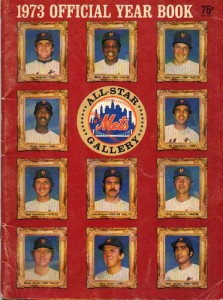 Turning to happier closer thoughts, you can watch Tug McGraw rise from star reliever to absolute icon when SNY airs Mets Yearbook: 1973 Tuesday night at 7. It ain’t just Tug, of course. It’s the whole team riding a late-season wave of crackling emotion, stellar starting pitching and incredibly timely hitting over a mediocrity-backed division until it qualifies for the postseason the day after the schedule was supposed to be at its end. Of course the Mets weren’t through then, either, as they slugged their way past Cincinnati (when we liked the idea of Mets fighting) and almost (sigh) past Oakland. Turning to happier closer thoughts, you can watch Tug McGraw rise from star reliever to absolute icon when SNY airs Mets Yearbook: 1973 Tuesday night at 7. It ain’t just Tug, of course. It’s the whole team riding a late-season wave of crackling emotion, stellar starting pitching and incredibly timely hitting over a mediocrity-backed division until it qualifies for the postseason the day after the schedule was supposed to be at its end. Of course the Mets weren’t through then, either, as they slugged their way past Cincinnati (when we liked the idea of Mets fighting) and almost (sigh) past Oakland.
Much went on in that legendary 1973 stretch drive, but most resonant is the battle cry it left behind for the ages: YOU GOTTA BELIEVE! Tune into SNY at 7 PM tomorrow and find out why.
And as long as you’re considering the legacy of Tug McGraw, consider the efforts of FAFIF reader Sharon Chapman, who is running in this year’s New York City Marathon with Team McGraw to help raise funds for the Tug McGraw Foundation to help them in their ongoing fight against brain tumors. You can contribute those Amazin’ly worthwhile efforts here.
Image courtesy of “Mario Mendoza…HOF lock” at Baseball-Fever.
Also, from 1973’s great nephew, 1999, Ted Berg visits with a latter-day Mets avatar of Belief, the all-too-soon departed Melvin Mora. Watch it here.
by Greg Prince on 16 August 2010 11:21 am Two sure signs we’re on the wrong side of summer:
1) My friend Chuck, Illinoisan by employment but New Yorker by heart, called me Saturday, as he will when he’s in time-killing/errand-running mode. He was in a mall somewhere in the Midwest, taking his daughter back-to-school shopping. Back-to-school already? I asked. How early do they go back to school there? Then I considered the middle of August isn’t all that far off from school, not even here.
2) The conversation turned, within a minute or two of pleasantries, into an extended Met update for the benefit of those who no longer live in New York and don’t necessarily check in with certain blogs as often as they should. After receiving the latest state of the dysfunctional union report, Chuck took a measured tone:
“You shouldn’t give up,” he said. “Anything can happen.”
And that, even more than sales on sweaters and loose leaf binders, is the surest sign to me that autumn is lacing up its running shoes and preparing to grab the baton from a faltering summer — because even across a thousand miles and a digital phone connection that doesn’t include video conferencing, I can see Chuck suppressing a smirk. He does this every hopeless year right around this time, poking at me with a proverbial stick to see if I’ll swipe at it. He tried it in late August of 2003, the weekend after the last-place Mets had swept a surprisingly competent set of games against the first-place Braves and were maybe, just maybe on the cusp of creeping toward the outer edge of the box in the paper where they list the Wild Card contenders.
“You shouldn’t give up,” he said then, too, innocent as a slice of room-temperature apple pie. “Anything can happen.”
I paused to think about the 2003 Mets’ chances of pulling off a miracle to beat all miracles. And then I considered the source of those seemingly encouraging words — my best friend since college, yes, but someone who carries a playful manipulative streak longer than anything Mike Vail ever put together hittingwise.
“Fuck you,” I said almost seven year ago.
Chuck broke up in hysterics.
I didn’t repeat in 2010 what I told him in 2003, because I knew his faux keep-the-faith message was coming. No, I said calmly on Saturday, anything can’t happen.
Soon after our call ended, I was on a train bound for where anything couldn’t happen and, rest assured, it didn’t. The Mets lost bloodlessly on Saturday. Their signs were even less vital Sunday as they lost yet another must-win series. They are now some distressingly large amount of games out of first place in the N.L. East and nearly as many in the Wild Card race. I don’t buy the papers anymore, but I’m guessing that if they haven’t dropped from the box of contenders by now, they will soon.
That’ll happen some Augusts. It’s happened this August, just in time for those back-to-school sales and back-to-reality lifechecks. The summer ends too soon while the season ends too soon after summer, no matter how long the season is extended. The Mets’ season won’t be extended at all. We’re now in that transition mode between wanting to hang on to baseball for as long as we can and wishing the baseball we’re seeing would please go away already.
Saturday afternoon I didn’t want it to end. Chuck could bait me about the Met disarray, but I had a game to get to. I had people to meet at the Apple — Jeff, at last up from D.C. after months of our talking about it, along with his son, Dylan, and Dave, Jeff’s buddy from Brooklyn. We’d set this date at the height of the Mets’ 2010 competitiveness. Not that it mattered to a couple of lifers, but it was assumed that this would be a big game. And of course it was a big game: it was the first game Jeff and Dylan would be seeing at Citi Field all season. It wasn’t a big game in any other sense, however. As I said, some Augusts just work out that way. Couldn’t do anything about the standings, but I could still look forward to spending a night with the Mets and with people I like.
Funny thing about me and Citi Field. As much as I’ve analyzed it and criticized it, I’ve grown mighty proprietary of it, never more so than early Saturday evening. None of the guys I was meeting had yet seen the Hall of Fame and Museum, so I enthusiastically began pointing out highlights once we entered: here’s the ball Mookie hit; there’s the plaque that doesn’t quite get Doc’s term of service right; listen for this part of the narration on the video, it’s particularly good; oh, and take a look over here!
I was the same way after we left the museum and then the store (where Mets fans registered their disgust with the current regime by purchasing $28 t-shirts and such). Our tickets were Field Level, but they allowed us access to Excelsior. Hey, c’mon, I gotta show you Caesars Club — we don’t have to stay there, I just wanna show you what it is. I was like that up and down all the escalators and staircases and throughout the concourses.
I’m taking the official Citi Field tour in a couple of weeks. I’m not sure why I’m not guiding it.
The sole Met highlight of the error-strewn game itself was when a beachball made the rounds in the seats below us. It was harmless good fun until it finally occurred to somebody in orange and blue that the ball was red and white and emblazoned with a “P,” requiring it to meet a sudden but timely death. We still couldn’t do anything about the standings or the scoreboard, but we cheered the proactive move on the part of our patriotic Mets fan brother in the slightly fancier seats. His popping the beachball reminded me of Benjamin Franklin reporting excitedly to Thomas Jefferson in 1776 of “a ragtag collection of provincial militiamen who couldn’t drill together, train together or march together, but when a flock of ducks flew over, and they saw their first meal in three full days, Sweet Jesus could they shoot together!”
The Mets were ultimately deflated, but our spirits remained high as we parted ways on the Super Express Saturday night. I was so happy to have seen Jeff, so happy to have been at Citi Field, so happy to have been around baseball and beachballs that I hated to admit that it would all end soon enough.
It always does.
As I waited for my eastbound train at Woodside, the slightest pre-September chill wafted by. Summer was still technically in effect, but the season was giving its seven weeks notice. This is a Mets team scuffling to maintain its self-ballyhooed Home Field Advantage, which is now adds up to a not-so-advantageous 8-10 at Citi Field since July 5. They’re barely grasping .500 overall. They never win a series on the road. They rarely offer any kind of hitting support for their valiant battalion of starting pitchers. They wouldn’t even do Pat Misch the courtesy of playing defense on Saturday. No, this is not a Mets team that merits “anything can happen” consideration.
The only thing that could happen after Saturday night was Sunday night. It rained on and off. Citi Field sounded dead the first few innings on radio. It looked even deader on TV, at least while Mad Men was in commercial. I saw the starting lineup and was struck by what an amorphous blob of players the Mets had become. Mostly youngsters, which is supposed to give us hope, but lately has given us nothing. Sprinkled between them, a couple of veterans who have to play every now and then if just to keep them theoretically sharp. Some of these starting Mets were vital in spurring the team into surprising contention in May and June. Now, in mid-August, the whole bunch was receding from view.
Baseball season is both too short and honestly long enough. How is it that Opening Day wasn’t just last week? How is it that a quarter, a third, half and now just about three-quarters of the season have flown by? It goes too quick. Yet it’s interminable. It’s been long enough for Ike Davis to emerge as a budding star and then show us how far he has to go to develop consistent offensive skills. It’s been long enough for Angel Pagan to establish himself as the batting order’s bulwark and for opposing pitchers to adjust to all of Angel’s improvements. It’s been long enough for Mike Pelfrey to find himself, lose himself and grope around in the dark for a piece of his April self all over again.
There isn’t enough of the Mets if you salivate over spring and luxuriate in summer and treat every trip to their imperfect ballpark like you might an invitation to the chocolate factory when you were five. Nevertheless, there’s more Mets than you can stand when they’re drearily getting their own beachball burst again and again on too many nights like Sunday. You can only take so much of detesting watching what you’re pretty sure you love.
I’m not a fan of Sunday night baseball. I’m not a fan of autumn’s encroachment. And I’m not a fan of giving up on the Mets. Ten out in the East…eight out for the Wild Card…anything can happen. But at this stage of the season, it usually doesn’t.
Tim Kurkjian of ESPN has, at last, given up on an anachronistic baseball obsession of his own. Recommended reading here.
by Greg Prince on 15 August 2010 2:00 pm Lost, perhaps, in the euphoria over R.A. Dickey’s one-hitter on Friday night was the astounding arrival of Mike Hessman into the land of triples. As noted previously, Hessman’s first four Mets hits have been a veritable cycle: a double in his first start; a single the next day; a home run eight days later; and then the temporary home run that was permanently downgraded by one base eight days after that.
It only took eleven games, 29 plate appearances and one wack-ass video review to give Hessman one of the strangest quasi-cycles in Mets history. The man with the most minor league home runs among active professional ballplayers is having quite a ride. On August 6, he became the 69th Met to hit exactly one Met home run. On August 13, three umpires conspired to keep him the junior member of that particular club.
As far as the bizarre accomplishment of producing a single, a double, a triple and a homer as your first four Met hits, that’s got to be unprecedented, right?
Right?
If you think so, you haven’t met Jim Tatum, 1998 Met and — depending on how you view things — the proto-Hessman or the über-Hessman.
I learned from Elias via ESPN that Tatum was the last player to pull off the veritable cycle to begin his Met career, yet Tatum had the elegance to do it in order: a single in his fourth game; a double in his fifth game; a triple in his ninth game; and a walkoff home run to beat the Astros in his eleventh game.
A natural! And in a span of only thirteen plate appearances at that.
But that’s hardly the end of Jim Tatum’s Odyssey of oddity as a Met. Though he struck out a ton (once every three plate appearances) and didn’t hit very much in general (.180 average in 50 AB’s), he sure did sort of make his hits count.
Let’s put it this way: How many players in the trackable annals of the major leagues — since 1920 — have had as many as 50 plate appearances in a season, registered as many as nine hits, produced more extra-base hits than singles AND more triples than doubles?
According to Baseball Reference, one is the answer. And The One is Jim Tatum. In 1998, his only Met season, Tatum chalked up four singles, one double, two triples and two homers.
More XBH than 1B; more 3B than 2B. Even for a fairly limited sample, nobody does that. Nobody but Jim Tatum in his 35 games as a New York Met.
Anybody else want to join Mike Hessman and Jim Tatum (who both wore No. 19 as Mets) in a little triple-based weirdness? Remember, triples are the hard hits to get. Even in these days of Citi Field, they’re not supposed to be more common than doubles, and only noted Lance Johnson-type speedsters are supposed to get them significantly more than they do homers. At worst/best, they should hit eight triples and eight doubles in the same season with at least one homer…which describes Mookie Wilson’s 1981 to a tee. By going 8 2B/8 3B/3 HR, rookie Mookie became the only Met with at least that many triples and no more than that many doubles while also homering a little.
Try telling what you’re not supposed to do to Cory Sullivan, unlamented 2009 Mets alumnus. Last season, the worst season of all time by most Met-rics, Cory stood out, in his way, as a triple-loving, homer-hating, double-despising machine. Well, maybe it wasn’t as dramatic as all that, but he did hit five triples, two doubles and two homers.
Meaning? Meaning Cory Sullivan became the only Met with as many as nine extra-base hits in a season AND more triples than doubles and homers combined.
The only other Met in his, er, class? My blogging partner’s childhood favorite, Mike Phillips. In 1976, the utility infielder who cycled that season for real had more triples (six) than he did doubles (four) OR homers (four). It wasn’t quite Sullivan, but it was a bit more than Gilbert.
That’s Shawn Gilbert, one homer, but no triples or doubles in 32 games as a New York Met in 1997 and 1998.
Somewhere between Mike Phillips and Jim Tatum lies the unlikely Met career of Billy Baldwin. Baldwin was Phillips’ teammate late in the 1976 season. Promoted from Tidewater after coming over as the throw-in with Mickey Lolich in the dreaded Rusty Staub trade, Baldwin made hard-to-fathom history of his own.
On September 24, he came up as a pinch-hitter in the bottom of the ninth and ended what had been a 3-3 game between the Mets and Cubs by homering to beat former two-time 20-game winner Joe Coleman. It would be Baldwin’s only Met homer (earlier that same month, Coleman surrendered the only Met homer ever struck by Leo Foster; he must have liked being a two-timer).
OK, Baldwin is hot, so Joe Frazier inserts him in the lineup on September 25. What does he do? He triples in his first at-bat, doubles in his second at-bat and singles in his third at-bat. Billy Baldwin thus accomplished the Two-Day Reverse Natural Cycle: homer, triple, double, single. When all was said and done for Baldwin in the Bicentennial year, he had finished his Met career with exactly one of each kind of extra-base hit.
Three other Mets can say that: David Newhan (Lord, he was useless), Pat Tabler (also useless, but not here as long as Newhan) and, of course, Mike Hessman — though Hessman hopes there are more two-, three- or four-baggers in his blue and orange future. Dude’s batting .167.
We couldn’t leave the subject of Hessman and triples without a little Mets fan pathos. You might recall that after Mike’s home run was diminished to a leadoff triple Friday, he was not driven in from third, which left the score dangerously tied, as Cole Hamels was just about as effective as R.A. Dickey Friday night (to say nothing of just lethal enough with a bat). Not driving in a runner who had led off an inning in a tie game with a triple brought back memories of one of Metsdom’s most haunting dates, September 24, 2008.
While Billy Baldwin celebrated the 32nd anniversary of his walkoff blast the Mets commemorated it by again playing the Cubs at Shea and by again going to the bottom of the ninth tied. Bobby Howry surrendered a leadoff three-base hit to Daniel Murphy (whose t-shirt you can get a good deal on at the Citi Field team store). My goodness, we were excited out there in the Picnic Area! We get this win, it will be huge in our dual races versus Philadelphia for the division lead and Milwaukee for the Wild Card.
Murphy on third, nobody out, tie game…all we need is a fly ball.
Well, you know I’m not bringing this up (again) to relive the triumph of the moment. David Wright struck out, Howry intentionally walked Delgado and Beltran, Church grounded to second and Castro struck out.
Not that it still haunts me.
Anyway, I got to wondering, what with Hessman’s jury-rigged triple and all so top of mind, how common is that sort of thing? I did a little checking (a little?) and divined the following:
Post-9/24/08, the Mets have five times begun an inning in a tie game with a leadoff triple. Three times they scored the tripler, most notably two weeks ago when Jesus Feliciano chugged to third against the Diamondbacks to open the bottom of the ninth. Jose Reyes hit a short fly ball that Feliciano didn’t tag on, but after the ol’ double intentional walk to Pagan and Wright, the ghost of Carlos Beltran arose and hit a long-enough fly ball to score Jesus and win the game.
It was only two weeks ago, but it seems lost to the mists of time. Feliciano came home, we won…who remembers? Murphy didn’t come home nearly two years ago, we lost…who can forget?
For the record, there was a game at Citi Field in September 2009, almost a year to the day since Murphy was stranded at third in the future Citi Field parking lot, when Murphy led off another inning with a triple and he did score. No kidding: Josh Thole brought him home on an infield hit. The Mets were a million games out of first at the time. And the inning in question was the second inning. You’re excused for forgetting it ever happened.
Jose Reyes led off the home half of the first on June 23 of this year with a triple in a scoreless game and wasn’t brought home. Didn’t matter — the Mets beat Jeremy Bonderman and the Tigers easily. Ten days later, Alex Cora led off the top of the eighth at Washington with a triple and was brought home by none other than David Wright. It put the Mets up by a run, which looked huge at the time. The Mets would go on to score three in that eighth inning.
But y’know what? It wasn’t huge enough. That was the notorious Stephen Strasburg game, the one R.A. Dickey was in line to win until Bobby Parnell (a little) and Frankie Rodriguez (a whole lot) conspired to give it back.
Then, Friday, Hessman, trotting around the bases, then being ordered to trot back one, then standing at third as Jeff Francoeur struck out and Henry Blanco struck out and Ruben Tejada was intentionally walked and R.A. Dickey tapped out to the pitcher. Tie game still. Yet eventually a win…a one-hitter win…a one-hitter win when R.A. Dickey was the star of the show and Mike Hessman was, per usual, something else.
by Greg Prince on 15 August 2010 5:00 am You know, I would have canned the K-Rod entrance music for one night.
It had occurred to me Francisco Rodriguez might pitch at this game I was going to Saturday, but caught up in the Mets’ passive resistance movement (passing on scoring, resisting ground balls), I’d sort of forgotten he was back. But then, suddenly, it’s the top of the ninth, and the main video monitor heats up, and “Sandungueoso” stirs and the bullpen gate swings open and all at once Francisco Rodriguez from all those breathless tabloid stories is Frankie the Met closer again.
There was nothing to close — just a can of worms to open.
As it dawned on however many of the 39,000 in attendance still on hand who was entering the game, I could feel a tangible pause in the air. “Look,” I could hear us think. “It’s him.”
And then?
Boos, mostly…though a few people stood and applauded as if he had persevered through a difficult personal ordeal — which one could say he had, if one were to apply a very generous reading of the circumstances. Certainly there were more boos than I’d ever heard for Francisco Rodriguez at Citi Field. Sure, we instinctively tense our bodies when he’s announced into a game and we cringe in agony as soon as he goes to ball one on his first batter, but really, Rodriguez has never been received as unpopularly live as he is in online and talk radio settings. This was a new sensation, Rodriguez booed before endangering a lead.
Yet it wasn’t endless and it wasn’t vicious — though it’s hard to think of a “boo” as vicious compared to whatever Rodriguez allegedly did to the father of his girlfriend/common-law wife. It felt a little obligatory, actually, as if the crowd knew it shouldn’t approve of his actions. But it also didn’t keep up. I think if Mets fans who paid to be at a Mets game they still hoped the Mets would win really couldn’t stand the sight of a Met who had been officially charged with third-degree assault just two days earlier, he would have been castigated for a lot longer than the time it took him to jog from the pen to the mound. Once he began his warmups, the mass attention moved on to whatever the next between-innings time-filler was.
I’m pretty sure David Wright, stand-up guy of stand-up guys who punches nothing more than a clock, was booed more for his two-run error than Francisco Rodriguez was for his (alleged) third-degree assault. Likewise, I saw one tough guy a few rows behind the Met dugout shout his head off at Luis Castillo after Castillo’s predictably weak pinch-hit grounder in the eighth. Maybe he shouted at Rodriguez, too, but I didn’t notice.
After the warmups, it was uncharted territory between the crowd and their closer. When the Phillies hit the ball hard, the boos revived — definitely stronger than you get for your typical K-Rod leadoff baserunner. When the inning ended without any runs scored, there were few boos. Instead, there was applause after the third out, though I’m pretty sure that was directed primarily toward Carlos Beltran’s nice running catch of Raul Ibañez’s fly ball.
While innocence until guilt is proven is a cornerstone of the American way, I found it a little disturbing that Francisco Rodriguez was back at work so soon after he caused what we can clearly call a major disturbance where he works. He’s a free man, which is fine if that’s what the judge decided he should be for now, but it’s a little ludicrous that his employer couldn’t take pronounced punitive steps against him considering the ruckus he raised flared right there on the premises of their physical plant.
Cap tip to the Major League Baseball Players Association for negotiating so effectively on behalf of its membership, but what a lousy message it sends that an action like Rodriguez’s is what they implicitly defend. A court of law will decide what kind of wrongdoing occurred outside the Met family room, but from a sheer public relations standpoint, an undeniable mess was left behind because Francisco Rodriguez couldn’t control his temper. You make a mess at work, there are usually specific consequences outlined in a human resources manual somewhere.
It can be disingenuous to apply “real life” to professional sports considering how utterly unreal professional sports are, but it doesn’t seem too terribly far-fetched that if an employee engages in an (alleged) assault on company grounds, that it might instigate, at the very least, a thorough investigation and some form of discipline. It’s not unreasonable to expect the employer to have that kind of recourse.
Yet if the Mets wanted to shelve Rodriguez for more than a two-day stay on the Restricted List — and it sure seems they did — they couldn’t. Again, kudos to the Players Association’s iron fist. It packs quite the punch, and there’s nothing alleged about that.
Francisco Rodriguez returning to uniform, let alone game action, on Saturday after being arrested Wednesday reminded me of the 1993 suspension by Major League Baseball of Cincinnati Reds owner Marge Schott after she made a series of ugly racial and ethnic remarks. Those who reflexively snort about the tyranny of “political correctness” had their usual field day in criticizing the decision, but I thought those people missed the point. Schott needed to be suspended not strictly because she said idiotic/insensitive things about people of African-American, Japanese and Jewish descent, but because she was an embarrassment to the baseball industry — Marge Schott was simply bad for business. You don’t let someone like that serve as a spokesperson for your product if you are at all concerned about attracting the widest possible audience to your product.
Francisco Rodriguez’s alleged misdeeds were of a different nature than Marge Schott’s, but there’s no good be to had at this moment from featuring him as one of your nominal star attractions. Carlos Peña is the one who literally suffered the most from this incident, but on an another level, the Mets were victimized. They have a huge investment in the K-Rod brand. I don’t know how many fans come to Citi Field specifically to root for Frankie Rodriguez, but he’s part of the overall package. He’s the bottom of the ninth inning if things are going well. As such, the Mets have taken it upon themselves to nurture Rodriguez — making sure they don’t go too many days without using him; treating his entrances into games as events; pretty much looking the other way every time, prior to this week, when he engaged in a loud disagreement with someone.
In the main team store before Saturday night’s game, there was still plenty of RODRIGUEZ 75 merchandise to be had. It wasn’t exactly in the front window — in fact, a rack of his jerseys was subtly covered up by some less controversial Metwear — but it’s there, and it’s not marked down to MURPHY 28 priced-to-move lows. I saw quite a few RODRIGUEZ 75 jerseys and t-shirts in the stands. Maybe there was irony attached to the choice, but I kind of doubted it. There are always quite a few RODRIGUEZ 75 jerseys in the stands.
Francisco Rodriguez wasn’t exactly the toast of Citi Field in his first season and two-thirds, but he was deployed in a high-profile role, and more than a few Mets fans bought into the K-Rod brand. Memorable blown saves notwithstanding (and the worst of them seem to happen on the road), I’ve never picked up on a virulent anti-Rodriguez vibe at the ballpark. If he hasn’t exactly been beloved, he was about as warily supported/tolerated as his predecessor Billy Wagner was once we got past the initial euphoria of “Wow, we got K-Rod!” (a similar honeymoon period was applied to Billy and it, too, more or less evaporated). He may have set eyes rolling and incited comparisons to previous closers of whom we eventually had our fill, but Francisco Rodriguez was never, before Wednesday, treated or greeted like Armando Benitez at the depths of Armandomania.
And now? From a practical standpoint, the Mets have a pitcher to whom they’re paying a boatload of money, someone they couldn’t keep suspended, someone they ultimately rely on to win games. They’re already burying one pitcher deep in their bullpen because of contractual niceties, they simply cannot hide two. They either have to figure out a way to cut ties with Francisco Rodriguez because they are appalled by his behavior — as if allegations of hitting the father of the girlfriend aren’t bad enough, there are allegations of incidents of domestic violence toward the girlfriend herself in California and Venezuela — or they are stuck with him.
Or, perhaps, they believe that a combination of stated contrition and anger management will have a redemptive effect on a wayward soul who, if nothing else, is nice to small dogs. Jeff Wilpon and Omar Minaya liked Francisco Rodriguez enough to sign him to a three-year, $37 million dollar deal (with an easily vesting option for another year) a mere 20 months ago. They must have seen something in him besides saves to invest that much money and that much faith in someone who has never come off as what you’d call mild-mannered.
When this story broke, I thought two things:
1) Violence like that which was reported is absolutely inexcusable, but family dynamics are an entanglement one shouldn’t try to pry apart from a distance.
2) K-Rod had retired 28 of his previous 31 batters — damn, why did this have to happen when he was FINALLY going good?
If there had been some story on the news the other day about a random fellow going after his girlfriend’s father in a rage, I would have shaken my head, wondered what this world was coming to, and changed the channel. It’s crass, but it’s true: The only reason I care about Francisco Rodriguez’s family dynamic or his journey through the criminal justice system or the way his employer handles its relationship with him is because he’s a New York Met…and because I’m not necessarily sold on the idea that a bullpen-by-committee can routinely nail down the final three outs of games the Mets are leading by three or fewer runs.
Saturday night, that wasn’t what was going on. Francisco Rodriguez wasn’t coming in for a save. He was just trying to shake off the rust. He hadn’t pitched since Tuesday and he hadn’t been just another pitcher since Wednesday. So they played his song. They flashed his image. He made his jog. Most booed. A few applauded.
I did neither. I just watched.
by Greg Prince on 13 August 2010 10:02 pm There was a home run that became a triple that became an extended farce of a video review session that became a nagging left on base. There was, at last, a double followed by another double and those became a run. There was a no-hitter that unfortunately became a one-hitter, but ultimately stayed a one-hitter as well as another complete game shutout.
That’s a lot of baseball packed into two hours and nine minutes. Minus one bad overturned call and one achingly sinking line drive, it’s all we could have asked for.
No one has to tell R.A. Dickey to “man up,” that’s for sure. That man is ready for anything. Friday night he was ready to follow up his worst Met outing with his best Met outing, maybe the best Met outing Citi Field has ever seen. It was certainly as efficient an outing as any pitcher could unfurl.
It was, considering the absence of a designated closer, definitely just what the Dickey ordered.
R.A. allows just one baserunner via walk for five innings. Then Cole Hamels gets a hit with one out in the sixth. We knew it was nauseating as soon as it fell in. What we couldn’t have known was Hamels wasn’t too many minutes removed from joining then-Cardinals Ray Sadecki (1966 off Jack Hamilton) and John Curtis (1974 off Jon Matlack) plus Rockie Chin Hui-Tsao (2003 off Steve Trachsel) as the only opposing pitchers to register the sole besmirchment in a Met one-hitter. Oh well, a pitcher is a hitter as long as he’s got a bat in his hands, and Hamels is quite a pitcher besides; he went all eight innings that the Mets batted, making this the fifth dual complete game in which a Met starter has engaged in the past fifteen years.
But really, was anybody else on the field as long as R.A. Dickey was on the mound twirling those nasty knucklers? Didn’t feel like it. He got some nice defense early. He stayed in a groove from first to last. It was his show. At the moment, it’s his world, and we’re all just kvelling in it.
Naturally you can’t simply rely on a Met starter to throw a gem of a shutout and expect to win. For that, you need at least one Met run, and the Mets and the umps both seemed determined to avoid that total. Mike Hessman hit his second Met home run — goodbye list! — until inconclusive replay evidence mysteriously refashioned it a triple — hello again list! (Mike Hessman’s first four Met hits, spread over eleven games, have been a double, a single, a homer and now a triple…how’s that for a cycle?) I’m still fuming at the three men in blew who reduced Hessman’s blast to a three-bagger, but I’m angrier at whatever dope stuck his arms over the left field wall and cast doubt on the entire process. It was a home run. Even if it wasn’t a home run, there was no video that made that clear it wasn’t after it was ruled that it was. Video replay remains an odd duck in the baseball pond, but it’s still better than just guessing.
Jeff Francoeur and Henry Blanco each were granted an opportunity to make it all good by driving Hessman home from third, but they chose passive resistance instead. So much for the one run Dickey needed. Fortunately, Wright finally hit a ball with enough distance to get him as far as second and Beltran woke up to do the same. That made it 1-0 after six, and Dickey made it cruisingly through nine.
Two hours and nine minutes, and that’s with seven or eight minutes devoted to getting the home run call wrong. Amazin’! Back-to-back complete game shutouts during the two days of Francisco Rodriguez’s suspension. Doubly Amazin’! No-hitter steered clear of every single game since 1962. We know how that goes, particularly when one lousy ball lands safely, but the part where their one hit doesn’t kill you and your one run puts you over the top…that’s as Amazin’ as we needed to be on a night like this.
One-hitter mania here from ESPN’S Mark Simon.
|
|