The blog for Mets fans
who like to read
ABOUT US

Faith and Fear in Flushing made its debut on Feb. 16, 2005, the brainchild of two longtime friends and lifelong Met fans.
Greg Prince discovered the Mets when he was 6, during the magical summer of 1969. He is a Long Island-based writer, editor and communications consultant. Contact him here.
Jason Fry is a Brooklyn writer whose first memories include his mom leaping up and down cheering for Rusty Staub. Check out his other writing here.
Got something to say? Leave a comment, or email us at faithandfear@gmail.com. (Sorry, but we have no interest in ads, sponsored content or guest posts.)
Need our RSS feed? It's here.
Visit our Facebook page, or drop by the personal pages for Greg and Jason.
Or follow us on Twitter: Here's Greg, and here's Jason.
|
by Jason Fry on 5 April 2010 11:51 pm Every year I swear I’m done with seeing Opening Day live — it’s generally miserable weather and I’m so wired that the wisest thing is for me to work out my neuroses sitting at the computer and on the couch. But every year I hear the siren call: The Mets are back, doing their jobs to the best of their ability, and I should do my job by being on station to hoot and holler.
And so it was that I yielded to temptation: two seats in the Pepsi Porch, which last year emerged as one of my favorite places at Citi Field to see a game. It’s quirky without forcing the issue, offers a view I never saw at Shea, and is its own little micro-park with bathrooms, beer, food, and places to stand. Having committed, I was left to wait anxiously for some kind of read on the weather.
Sometimes, if you’re very, very lucky, you get an unseasonably warm Opening Day. Twelve years ago Greg and I got one of those, sitting in the mezzanine at Shea on March 31 for the Mets and the Phillies. The weather was borrowed from July; the game seemed destined to end in August, and neither of us minded at all, kicking back in 80-degree weather until Bambi Castillo beat the Phils with a scratch single in the 14th inning. (Greg remembers here.)
Most of the time, though, you’re not that lucky. The weather scrapes its way into the 50s, everyone is so bundled up that if you move too vigorously you move your neighbor’s outermost layers, and he then moves his neighbor’s, and so on down the line. Beer is reserved for diehards, cocoa and coffee become the coin of the realm, and depressingly often it’s a rainout anyway — or a game that a sensible person would have decided should be a rainout.
A week ago the forecast for Monday was somewhere between indifferent and bad. Too far out for a definitive forecast, I grumbled. This is what I always do in this situation. Usually the forecast is on the money.
Not this time, though. Instead, we got the kind of day you’d like to bottle and uncork in old age, a game that leaves perfectly sober grown-ups staggering around like drunks with happy smiles on their faces. I arrived at Citi Field with doubts about the 2010 Mets, but no doubt whatsoever that I was lucky to be a part of this Opening Day, however it turned out. And I was relieved to realize that I was eager to see our summer home again.
Yes, relieved. Because my relationship with Citi Field had proved a bit, well, complicated in 2009.
I liked a lot of things about Citi right away. I liked the way fans circulated around field level before heading up to their seats, and how I’d almost always run into fans or bloggers I knew. I liked the food, of course, and the big food court atop the Promenade, and the bridge in center field, and the Pepsi Porch, and the experience of exiting the park through the rotunda and making my way across the plaza to the subway.
Moreover, I’d never had any affection for Shea, and it irritated me to see my friends’ memories turning misty-colored and beginning to smooth away Shea’s many problems. The Dallas police ads above the urinals in the sludgy lakes that passed for bathrooms? The relentlessly horrible food? The grinding rudeness and incompetence displayed by nearly every Shea worker a fan encountered? I remembered all of it. I missed none of it.
But Citi Field came with imperfections and oversights that made the place hard to defend and difficult to love.
There were the swathes of seats from which you lost sight of not one but two outfielders, and the Mets’ nonsensical attempts at spinning this into some side effect of geometry that we were too stupid to understand. When I visited Coors Field, the first thing I did was march up to the cheapest seats in left and right, look down and fume. The seats weren’t horribly high, and I could see 99.999% of the field — at Citi the announcers lose sight of fair balls. Last April, as the extent of the sightline woes became clear, it boggled the mind that someone could have let this happen. It still does.
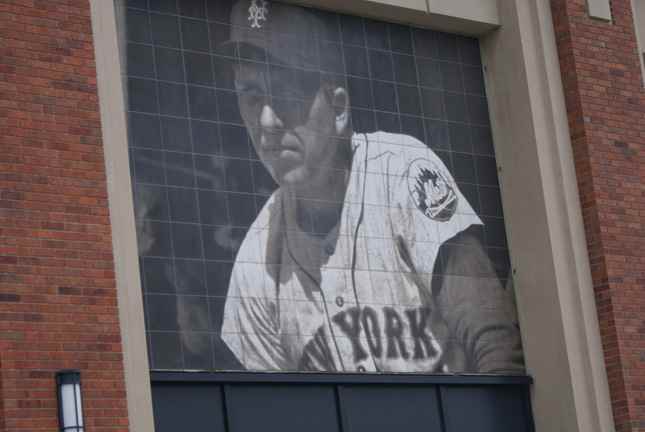
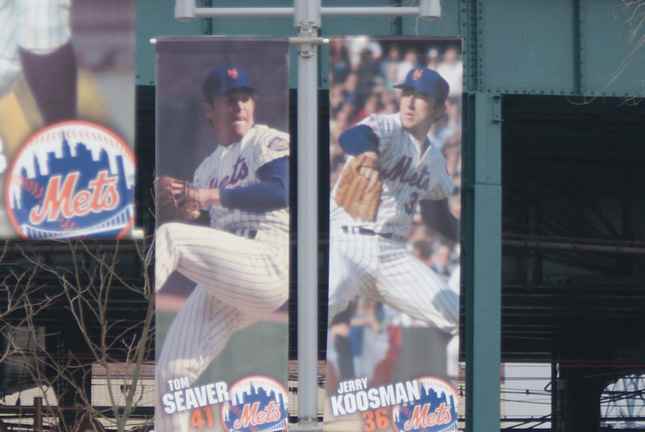
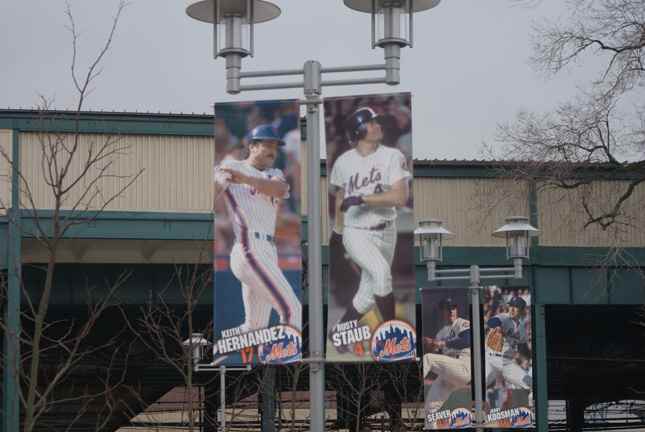
Then there was the fact that Citi Field seemed almost embarrassed about being associated with the Mets and their decades as the raffish, rude, occasionally ragged little brothers of New York baseball. In escaping the sour murk of Shea, the architects of Citi went too far in the other direction, toward bland and sterile. Most of the pieces of Met history that hadn’t been sold off were tucked away in corners. The images of players outside the park (and eventually inside) were presented in Ken Burns sepia, a poor fit for a jet-age, technicolor team. Without the Mets (and New York Giants) as a counterbalance, the salutes to Jackie Robinson and Ebbets Field came off as slavish devotion. There were too many blank expanses of brick and concrete that cried out for some Metsing up.
The Mets eventually stopped making excuses and started fixing things, and I kept reminding myself and anyone who would listen that most of these problems would be relatively easy to put right. But by then the year was a disaster, and our suspicions about the park had spread to the baseball-operations department and ownership. By the end of the year I was sick of defending Citi Field and, frankly, sick of the defenseless Mets. They were horrible to watch, and good tacos and clean bathrooms couldn’t fix that. I thought of the Mets every day during the offseason, of course, but it was for minutes a day, not the hours of years past. And I rarely thought of Citi Field at all.
Like I said, a complicated relationship.
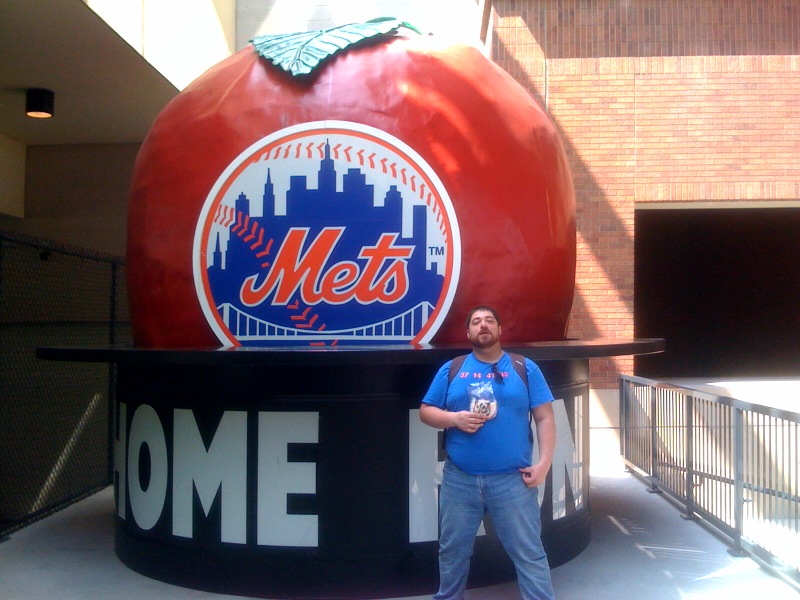
So I happy to hear that the bullpens were being reconfigured. I found myself smiling when I heard that the old apple had been removed from Citi’s equivalent of a back hallway and installed right in front of the stadium — an unexpected stroke of genius. I heard that things were being renamed and repainted. That images of Gil Hodges and Tom Seaver were being literally set in stone. That great moments were joining fan exhortations along the walkways. And that the Mets had a real Hall of Fame and museum now — something they’d never had before — and folks I trusted gave it rave reviews.
I still haven’t visited the museum (it was horribly crowded early and then I had a game to soak in), but I’m happy to say that yes, a lot of other things about Citi Field are much improved. The plaza outside the rotunda now feels like a celebration of the Mets, and in glorious, gaudy color no less. The greatest moments make you want to linger among the bricks and remember. Even from outside, the museum feels like the counterweight the rotunda lacked in its first incarnation — particularly when you climb the stairs and encounter the day’s Mets lineup. This is as it should have been in the first place: The Brooklyn and Dodger past giving way to the Queens and Met present. And there are nice surprises, like the peekaboo window into the stadium control room.
But it’s the littlest touches that help the most: the replica Mets baseball cards you encounter, the orange and blue paint in the stairwells, the plaque for Bill Shea that adorns the newly christened Shea Bridge, and the bathroom floors that are now pointillist blue, orange, white and black. Seriously, the bathroom floors are an improvement. We’re Mets fans, why wouldn’t we have bathroom floors in goofy Mets colors?
Granted, it also helps that we’re now no longer tourists at Citi, trying to figure out where to go and what clubs will admit us. But the Mets have come a long way, making efforts big and small. I’d urge them to keep going — to fill those remaining brick walls with pictures and artifacts and Did You Know? factoids — but the baseline is good. Citi Field feels like our place now.
I walked around happily for a half-hour, taking all this in, and then found my seat. After a bit Greg joined me and then the Mets … well, the Mets gave us everything we could have asked for. Opening Day is just one game, but the Mets couldn’t have drawn up a game more perfectly designed to reassure us. David Wright waited all of zero at-bats to bang a home run off Josh Johnson, the baseball touching down in the right-field district that seemed destined last year to be called Utleyville. Johan Santana made me feel silly for worrying about his spring, tormenting the Marlins (particularly Cameron Maybin) with his entire arsenal. The new guys delivered: Jason Bay hit 2010’s first Citi Field triple, Rod Barajas (who makes Ramon Castro look like a gazelle) roped one over Maybin’s head for a double, and Gary Matthews Jr. was flawless in a center field made treacherous by sun and swirling wind. Meanwhile, the 2010 Marlins were playing like the 2009 Mets. That was welcome too.
Greg and I spent the second half of the game amiably arguing about which numbers ought to be retired, cheered K-Rod through his inning, and trooped down a repainted back stairwell on our way to field level, the rotunda and the train. Marching down the stairs amid choruses of “LET’S GO METS!” I remarked to Greg that OK, I did find the stairs a less dramatic setting for triumphant chants than Shea’s scissored ramps had been.
“I don’t think I ever heard chants like this here last year,” Greg replied, and I nodded. A little bit sadly, but then I shrugged and let it go. That was 2009. This was just one day, and one win from a flawed Mets team, but it’s 2010. Things are already different.
by Greg Prince on 5 April 2010 9:04 am That sound you hear is untold millions of mild-mannered citizens rushing into proverbial phone booths (good luck finding a phone booth) and emerging cloaked in their true identities as…
METS FANS!
Slower than the 7 local…
More gullible than a herd of puppies…
Able to to be sated by the coming of Opening Day…
Yes, we’re putting on our blue capes and our orange tights and we’re ready to take flight into another baseball season, even if the last one flew into us, even if the prognostications for this one have us barely getting off the ground, even if P.A. announcer Alex Anthony will be calling out, prior to 1:10 this afternoon, “On Cora! On Jacobs! On Matthews, Junior!”
So what if Omar Claus left holes in our stockings? So what if under the tree, instead of a new starting pitcher, we got the same old lumps of coal capable of producing scarily smoking ERAs? And so what if only half of our 0-0 record looks convincing right now?
Look at the bright side. Look at Santana Claus (and hope he can still shoulder the load). Watch him throw to the wise elf Barajas and try to hope Josh Johnson won’t be the Grinch who steals Opening Day. There are countervailing forces at work, according to ESPN’s Mark Simon: the Mets are generally merry when the season starts (31-9 since 1970; 17-2 the last 19 times the true Opener came to Queens), but Johnson has a tendency to ruin everything every time he gets in our way (7-0 vs. the Mets). The clash of titanic trends will yield a result that is, as of this morning, unknowable. The fun part — before it happens, anyway — getting to know it.
Something’s gotta give, and it will be us, the people who have been sagging and dragging for months on end. We’re out of our phone booths now and we are METS FANS! once again. We are putting 2009 behind us at least until the first Met falls down. We are filing away the non-trades and non-signings of the Hot Stove League. We now know that both the Ides of March as well as the aights of March (as in “aight, intrasquad workout highlights are on!”) are immaterial. It’s April 5, Opening Day, and Opening Day is a both a continuation of only that which is is good and a break from all that was bad. It’s all good for now. It’s all merry for now. It’s all happy for now.
Happy New Year, METS FANS! It’s good to be up and soaring with you once again.
by Greg Prince on 4 April 2010 3:55 pm I have seen the past, and its name is the Mets Hall of Fame & Museum.
To all who thought the Mets loathed their own history, their self-hatred has come to a merciful end. To all who thought the Mets didn’t listen to their customers, their hearing tests came back with belated flying colors. To all who thought the Mets could screw up a one-car funeral, don’t assume they can’t present a vibrant memorial after the fact.
The Mets Hall of Fame & Museum answers just about all of our desires in the realm of Met legacy. Granted, it doesn’t do anything about the pitching and the injuries and the general murkiness that surrounds the season ahead, but it does take care of what came before and it does so with grace and style. The space is airy, the vibe is lighthearted, the density of display is impressive. You know you’re in the Mets’ ballpark when you’re in the Mets Hall of Fame & Museum. You know there’s a team with a half-century of heritage that has been hauled out of storage to shine in the sun. You know the organization that you were convinced wanted nothing to do with you has awakened like Ebenezer Scrooge on Christmas morning and, having seen the error of its ways, is sending out plump turkeys instead of begrudgingly flipping us the bird.
God bless us all, everyone!
I’m a wee bit giddy from this experience because I had a hard time believing it might happen, the admonition that You Gotta Believe notwithstanding. It’s just so unlike the Mets to celebrate the Mets…to go all the way in celebrating the Mets. They began to rehabilitate their image last summer with a few Nikon-sponsored murals, but you had the sense they were affixed to the Citi Field walls with spite. Not this venue, though. This thing is the real deal. This thing shows off the artifacts, the trophies, the uniforms, the pictures…everything.
The Citi Field of April 2009 acted as if it invented the Mets from old Dodger dust and implied that the purpose of the Mets all along was to give Ebbets Field a chance to reincarnate. The Polo Grounds didn’t exist in this new history. Shea Stadium didn’t exist in this new history. Just cold, hard commerce in the form of a few private clubs and a slew of ugly ads. Boy did I dislike that Citi Field.
The new Citi Field, which you can call Mets Ballpark and be accurate, acknowledges it had other ancestors. It acknowledges the other two Mets Ballparks and tells a rich, textured story of who played in them and why they mattered. It’s not just the HOF&M, either. It’s the parade of color banners outside. It’s the beloved original Apple on the Plaza. It’s Shea Bridge. It’s the Stengel, Seaver and Hodges entrances. It’s the oversized vintage baseball cards (including one for Bernard Gilkey!) on the Field Level concourse. It’s those plaques within the brick formations. It’s the new actual Hall of Fame plaques. It’s the loving treatment of each postseason appearance. It’s a handful of implicit and explicit nods to the (gasp!) New York Giants. It’s the blue and orange speckles on the restroom floors. It’s “Meet The Mets,” the 1963 version (both verses), playing happily as you enter the Rotunda. It’s the Mets not worrying that other teams have histories that encompass more medals and fancier ribbons. Management has accepted the idea, at last, that we don’t care that it hasn’t all been one long glory ride from 1962 to the present. We just wanted the ride acknowledged. And now it has been. The Mets aren’t wallflowers at their own dance anymore. They’re calling the tune and it sounds better than I could have fathomed.
Today’s visit, possible via the workout opened to season ticket and plan holders (thanks to Team Chapman for the invite), was about being stunned and gratified. Future visits will entail further exploration and yield, no doubt, some more ideas on how to maintain and extend this sudden burst of excellence. Now that we’ve got this place, I want it to flourish. At this moment, however, I just want to think about what I saw and see it again.
Congratulations to all who made the Mets Hall of Fame & Musuem a gorgeous and brilliant reality. Let it be said that on Easter Sunday 2010, Mets history was truly resurrected.
Full disclosure: I had a hand in writing the script for the video you’ll hear Gary Cohen narrating as you tour the museum, having worked with Little Guy Productions on crafting its first draft, but I otherwise had nothing to do with the planning of this beautifully executed facility.
Two other rave reviews worth reading, from Mets Police and MetsGrrl.
by Greg Prince on 4 April 2010 4:50 am I wish I could remember the young man’s name. I remember his age, 15. I met him last summer on an Amazin’ Tuesday at Two Boots. Big Mets fan, big fan of the blog, he said. Within a few minutes of introducing himself, he was excitedly explaining to me why the Mets would be in very good shape in a year or two, rattling off the names of the prospects who were all going to come up to the majors and create a stellar lineup and solid rotation behind and around Wright, Reyes, Beltran and Santana.
Sounded good if unlikely to me. Actually, it sounded like something I would have come up with when I was 15 or anytime the Mets were down and I had a copy of The Sporting News handy. The Sporting News was the only vehicle that delivered minor league statistics when I was a kid. All I had known about Tidewater before The Sporting News was it was where Buzz Capra was constantly being sent to and from. With The Sporting News, I could see who we had, who I could look forward to and what I could expect out of them week after week.
This would explain why I, at the age of 12, spent the summer of 1975 fixated on Roy Staiger, our All-Star third baseman of the future. Roy drove in 81 runs at Tidewater in ’75, most on the Tides — most in the International League and two more than Mike Vail. I was fixated on Vail, too, as he batted .342 at Triple-A, another league-leading stat (three points better than the runnerup, a Pirate farmhand named Willie Randolph). And Craig Swan got my attention for going 13-7 with a 2.24 ERA, but Swan had already been a Met in ’73 and ’74, so he wasn’t nearly as interesting to me as Bill Laxton, who was 11-4, 2.49.
All of these were fantastic numbers. By my reckoning, we could count on each of these fellows to be permanent Mets before long, driving in runs, batting .300, winning significantly more than losing. Add them to Seaver, Koosman, Matlack, Kingman, Staub, Millan, Unser…ohmigod, we are going to be so great in 1976!
Of the four Tides whose cause was my own in 1975, Craig Swan came up to stay and had a very nice sub-Seaver career as a Met ace in admittedly very sub-Seaver times. Mike Vail had a late August and September worthy of cult status, not much thereafter. Bill Laxton was traded with Rusty Staub to Detroit that December for Mickey Lolich and Billy Baldwin, thereby renting asunder my dream roster; I began projecting loftily for Baldwin, but Lolich was beyond my power of positive long-term thinking.
Roy Staiger, probably unfairly, remains my default failed Met prospect for all times. His tidy Tideness notwithstanding, Staiger was an unproven commodity in whom I invested my 12-year-old trust. He repaid me by batting .226 and driving in 37 runs in a Met career that spanned 483 plate appearances in parts of three Met seasons. The Mets traded Wayne Garrett to the Expos in 1976 so Staiger could blossom at third base. Instead, he wilted and was replaced by Lenny Randle in 1977. He’d be swapped to the Yankees for Sergio Ferrer. Sergio Ferrer is my default Met reserve who rarely plays and never hits for all times, but that’s another story.
The story with Staiger (who I’m sure would have preferred to have become the third baseman GM Joe McDonald and I hoped he would be) is that you almost never know with prospects. Examining them has become a far more sophisticated science since 1975. Nobody has to wait a week to track their progress, and there’s more to projecting their futures than batting averages and ERAs. Yet I stand by my Staigering: I don’t believe any Met prospect is going to do anything until he does it for the Mets and does it for a while.
The only prospect who interests me is the one who turned out to be the real deal in hindsight. I don’t care how good looking this player or that looks at Single-A, Double-A or in Rookie League. OK, I care a little, but not that much. I’ve been Staigered far more than I’ve been Strawberryed in my fandom. I’ve been promised rotations of Rick Ownbey, Scott Holman and Jeff Bittiger. My outfield right this very minute is supposed to include some combination of Lastings Milledge, Carlos Gomez and Fernando Martinez. (I’m consciously disregarding Ownbey’s and Gomez’s roles in historic trades that brought us Keith Hernandez and Johan Santana, respectively, since they were supposed to be our future stars, not somebody else’s unfortunate misjudgments.)
I’m delighted that the Opening Day roster will include two twenty-year-old phenoms in Jenrry Mejia and Ruben Tejada. It’s not that I automatically worship at the altar of youth the way my blogging partner seems to (until certain youths grow prematurely old and definitively one-dimensional), and it’s not that I was doing as my 15-year-old friend or 12-year-old self was and counting heavily on their development before this spring. I was barely aware of either of them, to be quite honest. I’m barely aware of most Met prospects beyond a handful at any given instance. Yet I’m delighted now.
Part of my enthusiasm is a desire to see some talent on display after retreads filled in for fill-ins across 2009. The greater part is not wanting to indulge the suspense involved in waiting for prospects who are considered on the cusp. There’s a compelling case for not rushing Mejia, but I’m not interested in making it. Not rushing him because why? Because we’ll derail his development? How often do we develop a pitcher? Whether we take our time with some golden arm or challenge a kid to step up, what have we gotten exactly?
Mike Pelfrey is what we’ve gotten — exactly. We’ve developed no other long-term starting pitchers for ourselves in the past decade, no matter at what level we leave them or to what level we elevate them. Mike Pelfrey is still learning after two full seasons in the majors and two partial seasons before that. I’m still not all that impressed by Pelfrey, whose main attributes, I’ve come to believe, are his height and his age. He’s 6′ 7″ and in a year has an excellent chance of being 27. It’s a little early, meanwhile, to come to even preliminary conclusions about 23-year-old Jon Niese (eight big league starts, four awful, three good, one gruesome injury presumably healed). Could have Pelfrey been further along by now with another dozen or so Triple-A starts? Might Niese benefit from three more months in Buffalo?
I don’t know and won’t pretend to. I won’t pretend to know whether Mejia, a starter in the Florida State and Eastern leagues a year ago, can be an effective reliever against the Marlins and Nationals this week. But I’m more interested in finding out what he’ll do in April 2010 than penciling him into some nebulous future that may never arrive. I’m not normally so Live For Today, but the more I watch the Mets, the more I’m convinced there is no tomorrow. There is no ideal Next Year when all the prospects will be ready and healthy are raring to take the National League East by storm.
It never works that way. It just doesn’t. It almost never did. Thus, when somebody impresses the brass as Mejia has this spring, I’m not in the mood to wait for them to really hone their skills — as if it were my call to make, which it’s not, which in turn leaves me free to be intermittently cavalier with the careers of 20-year-olds.
If Mejia is truly the immediate stud the only manager we have thinks he is, then let’s see what he’s got. It’s not unprecedented to start a season with a kid who crashes Spring Training ahead of schedule. We did it with 19-year-old Dwight Gooden in 1984, and it worked. We did it with 23-year-old Tim Leary in 1981, and it was lethally cold. There went Leary’s right elbow. So it doesn’t always work. Sometimes it works for a while, as was the case with 23-year-old Joe Smith in 2007. Sometimes it works eventually, à la the 21-year-old Neil Allen who didn’t succeed as a starter in early 1979 but worked out splendidly as closer by midyear.
If Mejia comes up, throws his electric stuff, retires division rivals, a star will be born. If Mejia comes up, finds his stuff isn’t enough, gets lit up, he can go back down (the weather looks good and we have no dates at Wrigley in April). Either way, I’ll go by what I see, not what somebody’s telling me. Sometimes I read the Mets farm system is barren. Sometimes I read it’s underrated. Sometimes I read breezy assessments based on which way the wind is blowing, as with what Jon Heyman wrote on SI.com last week:
The Mets’ minor-league system looks a lot better now than most realized last year, when so-called experts rated it near the bottom. Those ratings will need to be re-evaluated now that five young Mets looked very good or better this spring.
Which means what exactly? Heyman cites Mejia, Tejada, Niese, Martinez and Ike Davis because they all had good camps. But they were all here last year. Was Heyman shooting down unflattering portrayals of the Met system in 2009 or did he just happen to be passing through Port. St. Lottery when they were all having a good day?
If Mejia is blowing away hitters, Tejada is supplanting Cora (pending the return of Reyes), Davis is soon settling in at first, Niese is progressing with every start and F-Mart is back and throwing to the right base, we’ll have a great system. If none of them truly makes it — and nobody else down there picks up the slack — then it’s not a very good system. Produce players who play well for the Mets…that’s what the Met farm system is for (that and fleecing Whitey Herzog in 1983). Ratings and rankings for the farm system’s sake are immaterial. Until Met minor leaguers become and endure as quality Met major leaguers, it’s all primordial ooze to me.
Speaking of ooze, the Mets fan heart has to ooze empathy for Nelson Figueroa, that rare Met player who’s truly one of us — a Mets fan. Kevin Burkhardt interviewed him the other day within the context of making the Mets Opening Day roster, which seemed quite certain based on his mostly outstanding spring, his out-of-options status and the embarrassment of pitching riches we’re not exactly wallowing in. Figueroa, a professional since 1995 but never once on a big league Opening Day roster, lit up at the possibility, musing about watching Mets openers on TV when he was growing up, even remembering how the Shea P.A. would play “Celebration” to mark a Met win. I never heard a Met sound so enthusiastic about taking his place on the first base foul line as I did Nelson Figueroa.
Now he won’t, having been passed over for, essentially, Fernando Nieve. In the same vein that Figueroa, 36 come May, didn’t do anything to deserve getting cut, Nieve, 27, did nothing but impress last season before a leg injury ended his 2009. Nieve wasn’t so hot this spring (same 4.61 ERA as Figueroa’s but Nelson’s damage mostly came in one bad outing), but he, too, lacked options. Met thinking — oxymoronic as that phrase may strike us — was Fernando was more likely to be nabbed on waivers. Only one long man could survive, and it was Nieve.
As Figueroa figures out his next move, perhaps to Japan, I find myself wondering about him as an alternate-universe Mets fan. What if Nelson from Brooklyn had never signed a pro baseball contract? What if he had remained “just” one of us? I wonder how he’d feel about his favorite team favoring experience over potential at some positions and valuing potential over experience elsewhere. Would Figgy be blogging that it’s a mistake to keep Mejia? To take Catalanotto over Carter? To depend on Jacobs — 32 homers two years ago — instead of Davis for the two to six weeks Murphy’s supposed to be out? Would Figueroa the fan be sentimentally distraught that Figueroa the pitcher got the axe or would he be coldly discerning numbers that indicate we’d gotten the best we were ever going to get from that guy and that it’s time to move on? Or would he say succinctly, “Screw sentimentality, this guy can still pitch”?
Best of luck to real-life Nelson Figueroa…unless he signs with the Phillies, in which case his inner Mets fan will understand that we wish him mostly the worst.
by Jason Fry on 3 April 2010 12:45 pm This falls under the heading of Things I’d Dearly Like to Be Proved Wrong About, but I suspect the dominant storyline of the 2010 Mets will be how long it takes even the most optimistic among us to concede that the team isn’t going anywhere.
Imagine I could erase all memory of 2009 baseball from your brain. (If I could offer such a gift, dear friends, I promise I would.) From this fresh, clean perspective, survey the goings-on in Port St. Lucie over the last six weeks. Your reaction probably would be something like this:
- Oh God, Jose Reyes didn’t get any kind of decent spring training! He’s going to have to get his timing and hone his swing throughout April!
- No Beltran until at least mid-May? AUGGHH! And what’s with the screwy way they handled his injury? It almost feels like he doesn’t trust them!
- Johan Santana’s location has been consistently awful. I am really worried.
- John Maine has been horrible. He’s been beaten like a kettledrum out there.
- Oliver Perez looks like he’s in good shape, but he’s been horrible and wild and distracted.
- Mike Pelfrey has been horrible. I don’t know if he’s scared of his own defense or just can’t figure it out, but it’s bad.
- Why on earth are we turning this kid Mejia into a reliever when he’s got the makings of a front-line starter?
- Why do we think Mejia’s ready when his most-recent numbers against real competition give every indication he isn’t?
- Was Mike Jacobs put on this roster for any other reason than the old Neanderthal standby that he’s been on big-league rosters before? He can only do one thing at the plate and nothing in the field.
- If people are going to be put on rosters solely because they’re veterans, why are we jettisoning a useful pitcher like Nelson Figueroa?
And you know what? You’d be right. It’s only in comparison to the scorched-earth disaster that was 2009 that 2010 spring training doesn’t look like a disaster in its own right. The Mets’ plan for the offseason was either bizarre or not worthy of the name, the starting pitching looks so thin you can see through it, the relief corps consists of Pedro Feliciano and guys who are either unknown quantities or depressingly known ones, two core offensive players will start the season on the shelf, and there are already signs that the decision-makers are looking at short-term fixes even if those create long-term problems. (I love Jenrry Mejia. He shouldn’t be here.)
The 2010 Mets look like a disaster in the making. At this point it’s useless to carp that it didn’t have to be this way, so I will resolutely fix my gaze ahead, to where the view is no more encouraging. I’ll give it until about May 15 before towels start getting thrown in, and June 15 before the incurable optimists experience a medical breakthrough.
This isn’t to say that all is lost. There were some bright green shoots in spring training that give me real hope for 2011, if they’re properly nurtured. We know about Mejia. If Ike Davis and Josh Thole stay on track, they could be ready to take their places in the starting lineup near the end of this season. I’m excited to see a full season from Jon Niese, and to figure out if Angel Pagan is a late (though not too late) bloomer. Ruben Tejada could some quickly. Fernando Martinez had a great spring, and has been through the glare and disappointment of New York and emerged alive. And 2011 needn’t just be a youth movement. Santana, Beltran, Wright, Reyes and Bay will all still be here. Carl Crawford, Josh Beckett, Tim Hudson and Cliff Lee will be free agents at the end of this season. Looking short-term, I have little hope. Looking just a little farther down the road, I have a fair amount.
And looking at the really short-term, I’m giddy. The last couple of days have seen me fidgeting and wishing it were time to get on my gear and head for the 2/3 which will take me to the 7. Despite all of the above, I can’t wait until Monday. Or even Sunday, though I could do without an instant serving of Yankees-Red Sox. Even if you like those teams, why start this way? Can you imagine a Bud Selig dinner party? Hi, welcome, don’t even take your coat off yet BECAUSE THIS EVENING MUST BEGIN WITH CRAMMING HALF A RIB ROAST DOWN YOUR THROAT!
But come Monday, I want to see the apple in its new home. I want to see the new banners. (In color, no less!) I want to eyeball the new friezes for Casey and Gil, and the (now-corrected) plaques for great moments, and get a look at the Mets museum, and see if the stairwells are painted, and see if there are new miscellaneous touches that say “this is the home of the Mets.” I want to see if McFadden’s is worth adding to my routine. I want to see familiar faces. I want to make that can’t-go-wrong choice between Shake Shack and Taqueria. I want to chat with my co-blogger and not have to ask him what’s going on, because the answer will be happily obvious. I want to hear the National Anthem and see red-white-and-blue bunting and then let myself get too excited for baseball and then relax back into it. There will be plenty of time to feel doomed. It’ll wait a bit.
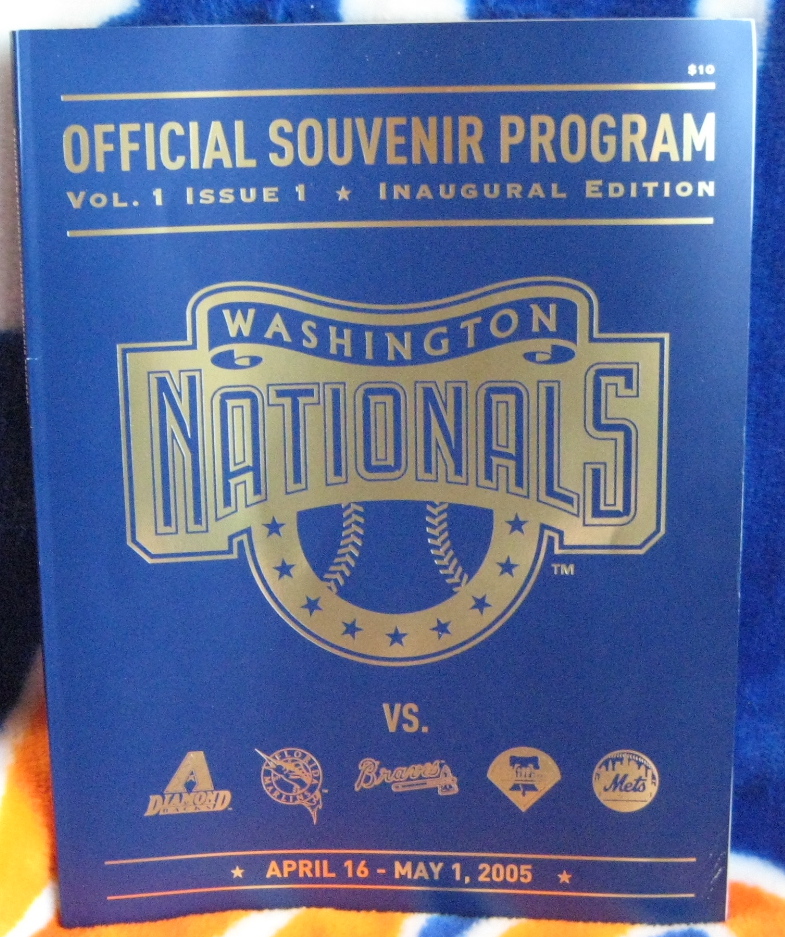
by Greg Prince on 2 April 2010 7:38 pm Welcome to Flashback Friday: Take Me Out to 34 Ballparks, a celebration, critique and countdown of every major league ballpark one baseball fan has been fortunate enough to visit in a lifetime of going to ballgames.
BALLPARK: RFK Stadium
HOME TEAM: Washington Nationals
VISITS: 1
VISITED: April 29, 2005
CHRONOLOGY: 29th of 34
RANKING: 30th of 34
I’m grading on a curve here, a fairly generous curve. On most counts, there is no way RFK Stadium was any better than any place I’ve been to see a ballgame. Except for eschewing a roof, a carpet and optional currency exchange, it wasn’t necessarily better than the facility it unwittingly succeeded, ol’ No. 34 on the countdown, Olympic Stadium. But the curve is in effect here for a good reason: RFK was taking a long nap when it was nudged awake to host its first major league ballgames in 34 seasons. For something that was so somnambulant for so long, RFK served its temporary purpose remarkably well.
Don’t get me wrong. The place was a dump. I don’t mean in that Shea “it’s a dump, but it’s our dump” lovable way, either. I wouldn’t have been surprised if it was used for a tire fire when it wasn’t being used for baseball. It was dark, it was cramped, it was MacArthur Park come to life: someone left this cake out in the rain, the sweet green icing was long melted and it showed.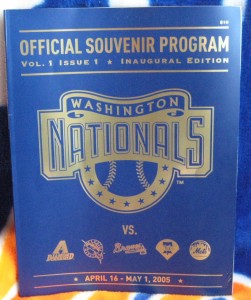
But it came to life in 2005 when the Expos became the Nationals, and you’d be surprised how beautiful a “dump” can be when it’s got baseball and baseball fans.
No you wouldn’t. You went to Shea.
The Shea-RFK connection was generational and utilitarian. They were the first intentional multipurpose stadiums built, RFK — then D.C. Stadium opened for football in ’61 and baseball in ’62, two years before Shea played host to the Mets and Jets. (Candlestick Park debuted in 1960, but the 49ers resisted its charms until 1971.) With the Redskins skedaddled to Maryland in 1997 and the Senators, of course, transplanted to Texas a quarter-century earlier, nothing but MLS soccer was regularly scheduled at RFK for nearly a decade in advance of the Nationals landing. The Mets, meanwhile, kept using Shea.
By the 21st century, Shea, however dowdy one considered it, was lived-in. RFK had been all but abandoned (no offense, D.C. United fans). The seats, for example, were faded from years of sun with no butts to shield them. Lighting had never been upgraded in the concourses. Everything was so…concrete. The flourishes meant to cheer up Shea, the Vet and other allegedly outmoded stadia that endured while the stylish retro parks were rising had completely missed RFK upon its return to baseball in 2005. MLB as owner of the otherwise orphaned Nationals wasn’t going to upgrade more than necessary for what was foreseen as a short stay…and doing what was necessary required $18.5 million of heavy lifting.
The backdrop to the playing field was a little cheerier, as it should have been given the joyous occasion of having a team again. I liked the long list of great Washington sportsmen (clunky but unique) beyond the outfield fence. I liked the DC clock. I liked that they made what they could green. RFK did a very good impression of a ballpark in spots.
The Nats were not an expansion club, but there was that new team smell to the fan base. Stephanie and I arrived in the Union Station Friday afternoon, a few hours before gametime. As we walked to our hotel, we saw several Nats caps (home and away models). My Mets cap brought a few “going to the game tonight, huh?” inquiries. The Nats were 11-11 heading in, same as the Mets — not exactly the kind of matchup you’d figure would have a city on edge, but Washington hadn’t had a Friday night ballgame to attend since September 17, 1971, so why not be excited?
I’d made probably more than a dozen visits to D.C. over the years for business purposes, but I was oh boy! excited, too. All those trips to town and — with one Baltimore detour exception — no baseball on the agenda. I accepted it as perfectly normal before. In hindsight, it was positively unAmerican that America’s capital lacked the National Pastime. I still felt bad about Montreal losing the Expos, but this part of it, baseball in Washington, was the right thing to have.
We walked back to Union Station and boarded the Metro that would take us to whatever connections took us to RFK. There were more baseball-bound passengers per capita on the Red line to the Green line to the Blue line to the Stadium-Armory stop than there seemed to be most Friday nights on the 7 (at least pre-2005). Lots of those W caps. Not a few NY caps for our side, too; we befriended a fellow in a KINGMAN 26 jersey on the return trip. This was the Mets’ first game ever in Washington. We had fellow pilgrims.
It indeed took a pilgrimage to get to RFK. Changing trains twice wasn’t that big a deal, but the famously efficient Metro seemed to chug along forever. Then marching from the station to the stadium was a whole other dreary journey through space and time. RFK pulled off the neat trick of being reachable by regular mass transit without feeling particularly accessible. Then again, it was a 34-year trek through the wilderness, so what’s another fifteen or twenty minutes?
A third kind of cap evinced itself among the National and Met brands, that of the Montreal Expos. Enough weird M’s to be noticeable. There were still some Exponents hanging on to whatever was left of what had been their team. It must have been a bit like the Giants fans who traveled from New York to Philadelphia for a fix in 1958. I was still publicly mourning the demise of the Expos, so when I saw a Montreal loyalist, I tried to give him the thumbs-up, let him know I was with him in spirit if not for the same team as him.
He told me to go fuck myself, believing I was mocking him. I guess something was lost in the translation between my Mets cap and my thumb going up. If I’d just lost my team seven months earlier, I’d be touchy, too.
I let the Ex-pat be as we burrowed at last into RFK. Dark and dank as it was, there was a surge of electricity when we saw the field. It was a baseball game, complete with Mets and 30,000 people. Many were fans who overreacted to every pitch, swing and bounce. I found the first-month enthusiasm invigorating — even if the bouncing felt a little unsafe when the P.A. played Jump Around by House of Pain during the seventh-inning stretch and the upper deck turned into a trampoline. In the fifth, when I was up seeking a pretzel-like snack when Liván Hernandez homered (which the program warned he might do). A buzz went through the dim hallways and a crowd gathered around a lone monitor. “Hey! Our pitcher hit one out!” This was giddy innocence on display, and if a dump couldn’t dampen their spirit, more power to them.
Sadly, the crowd included four dopes who had tickets because they had tickets, probably a circumstance of Washington having a surfeit of climbers. We were in seats graciously sent to us by my friend Jeff’s Uncle Frank, an area Cubs fan who decided to buy a season subscription in the name of supporting his new local team. I feared for Uncle Frank’s sanity if the quartet behind us would wind up behind him. They were twentysomethings who talked nonstop for nine innings about the tricks and travails of their law office. At that moment, I wanted to kick them Outside the Beltway.
Back on the field, the park was cavernous for the Mets (who were in a nasty hitting slump at the time) and couldn’t hold the Nats, whose balls were jumping off of bats like House of Pain was in effect, y’all. A homer for Liván. A homer for home team catcher Brian Schneider. Another for their right fielder Jose Guillen. All of them off Met starter and loser Jae Seo. A monumental night for Washington, less Seo for the team from New York.
“Ha! We beat you!” was a common reaction we got on the way out and on the Metro back. Let ’em have their moment, I magnanimized. It’s April and they don’t know that their team isn’t going anywhere (though, to be fair, the Nationals would be in first place as late as July 25). I didn’t like losing, but I didn’t altogether mind the teasing. They waited, they earned it. They’d wait a few more years for a modern facility. As indicated, the concessions left everything to be desired. The “team store” was stuffed into a trailer in the parking lot. Not a problem. The point wasn’t that there wasn’t a store. The point was that there was a team.
It was good enough as temporary encampments go. It was RFK Stadium.
by Jason Fry on 2 April 2010 2:21 pm Let’s get this out of the way: Emma Span is a Yankee fan. This means that even though she seems like a very nice person (we’ve drunk beers together and spent an enjoyable subway ride talking baseball, sportswriting and book publishing), I wonder if I could really trust her in a foxhole, and fear that on some level her soul is dead.
But I’m going to let that ride. Because she has written a book that’s funny, heartfelt and wonderful — unfortunate allegiance and all. Opening 90% of the Game Is Half Mental, I nodded at the well-chosen quote from Roger Angell, then smiled at something in the third paragraph, then laughed out loud. I decided I would rearrange my schedule to read a couple of chapters. Halfway through the first one I’d chucked the schedule entirely, because I knew I wasn’t going to stop reading until I was out of book. By the time I got to the last couple of chapters, I was forcing myself to slow down, because I was sad that I was coming to the end. That’s about the highest compliment I can pay a book, and this one more than earns it. It’s that good.
She’s clear-eyed about the Yankees, not missing the loathsome sense of entitlement of a lot of their fans, the basic unfairness of the baseball deck being stacked for them, and their general Olympian air. Here’s her eventual acceptance of the new Yankee Stadium:
Yes, it’s too big, too proud of itself, pompous and over-the-top in places, the embodiment of the unhinged free market. But let’s face it: a lot of the time — and I say this with love — so are the Yankees.
Minus the “with love” part, that’s pretty much how I’d describe the Yankees too.
But this book isn’t just about the Yankees. It’s about the Mets too, and baseball in general. And Span gets the Mets. She admits to a sneaking fondness for them that comes off neither as patronizing pat-the-little-brother-on-the-head stuff nor as civic-robot rah-rah. Her discussion of “Our Team, Our Time” is hilarious and gets that the Mets have always had a weakness for dimwitted marketing, from Homer the Beagle to Mettle the Mule to, well, Dave Howard. And see if this doesn’t get to the raggedy but real heart of Shea Stadium:
What I liked about Shea, though, is that precisely because of all the many things wrong with it, there was really only one reason to go. It wasn’t much of a tourist attraction; it wasn’t a particularly big draw for businessmen or women trying to impress colleagues and clients; it wasn’t an architectural treasure or a hip place to be seen. And that’s what worked about it, perversely: you went to Shea only if you loved the Mets.
She’s smart and unsparing about being a sportswriter in the locker room (she covered the Mets and Yankees for the Voice), and best of all she’s wry and unafraid when writing about herself. Her book is funny, honest, wise and ultimately moving. As we say around these parts, it would make an excellent addition to your baseball library — or any library, for that matter.
I know, you’re still stuck on the Yankee-fan thing. Well, she admits that after enduring Derek Jeter’s book she wanted to kill him with a shovel. That has to count for something, right?
by Greg Prince on 1 April 2010 9:42 am The truth is this season’s beginning does not loom promisingly. Daniel Murphy starts the season on the DL, which we were not expecting. Jose Reyes starts the season on the DL, which we were expecting but were also beginning to believe was just a bad dream. Carlos Beltran will spend at least a month on the DL, possibly more; I say possibly more because reports of his progress have been generally optimistic, and if we’ve learned anything in the past year, it’s to not take seriously generally optimistic prognostications regarding Mets and their healing.
None of the starting pitchers is outwardly ill, though I might want to rush their spring ERAs to an emergency room near St. Lucie.
For happier truths, I’ve looked closer to home, to where the games will be played, which I must say is a nice change from 2009. All the sprucing up of Citi Field has been getting me excited for my return to the scene of the ’09 crime because the Mets seemed to have gotten the message that their ballpark should look like their ballpark. In the last several weeks we’ve heard about a new museum, a dozen “great moments” commemorative brick plaques (many of them accurate), VIP entrances that live up to the designation, player banner after player banner…all the stuff that — as the cliché goes — makes a house feel like a home.
Best of all, I thought, there was the Apple. The real Apple. The Apple that bobbed up and down in right center field at Shea from 1981 to 2008. The Apple that seemed destined for the scrap heap with the destruction of Shea Stadium. The Apple that Mets management, in its ever wavering commitment to team history, shoved in the Citi Field basement known as Bullpen Plaza when the new joint opened.
Yes, that Apple. That Apple remained a shrine in spite of management’s ambivalence toward it. They wanted us to forget the past and stare at the big, shiny, electromagnetic replacement they installed just beyond the unreachable center field wall of Citi Field. It was supposed to rise for home runs in 2009, which meant it wasn’t seen doing anything very often (and, memorably, missed its calling when the Mets shocked its system by homering in consecutive at-bats last July). That apple was not the one we loved. The one we loved was down in that basement, attracting thousands of visitors, serving as backdrop for countless pictures, keeping the Mets fan faith when all around us was otherwise going bad.
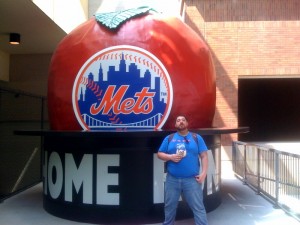 Real fans kept Faith with the well-hidden Apple in 2009. Thus, when eyewitnesses with cameras caught the image of the Apple — and its trusty top hat — being hauled from the desolate Bullpen Plaza to smack in the middle of what they were proudly calling Mets Plaza, I decided this was it…the Mets really get it. They’re not hiding our history anymore. They’re letting everybody who comes off the subway and is headed toward the Rotunda see what we’re all about. We’re a little kitschy, we’re a little sentimental, maybe we’re kind of silly, but we’re open about it. We have our Apple and we’re proud of it, damn it, let the fiberglass fall where it may.
Dave Howard, head of Met business operations, was properly ebullient in explaining the respositioning to Newsday:
“It’ll be a very iconic meeting point. It’s something we were happy to do . . . It’s going to be great, and very visible.”
I had judged the Mets too hastily. Twice. First I judged them too hastily in thinking they’d never show any pride in something as Metsian as the Apple. Then, apparently, I judged them too kindly.
It turns out no Met deed goes unpunished.
You know why the Apple is suddenly out front? Because the Mets made a deal. They made a deal for all of Mets Plaza, and the Apple is only the beginning.
Nobody said commerce isn’t part of the Major League Baseball equation. We understand that. We started the spring watching Angel Pagan warily circle fly balls at Tradition Field (which had nothing to do with tradition and everything to do with a land investment company) and we end it watching him do the same at Digital Domain Park. We know about the dollar signs attached to the Citi Field sign as well as the strings attached to the Citigroup name. And yes, I know the Apple was never a pure act of whimsy, that rather it was the byproduct of a Della Femina ad campaign designed to convince New Yorkers that The Magic was Back at Shea. But at least that was rooted in genuine Metsdom. Mets magic was dormant going into 1980, but it was real enough in 1969 and 1973. When the Mets constructed a top hat in ’81 and inscribed it with the words Mets Magic, daring sluggers like Kingman and Mazzilli to pull an Apple from its depths…well, like I said, it was silly, but it spoke to us.
What they’re doing on the eve of Opening Day merely insults us.
It was easy to miss in the flurry of dispatches about the Mets offering gluten-free foods via Kozy Shack and crabcake sandwiches at Catch of the Day, but the Mets, per usual, are stepping all over their own menu of good news by selling the naming rights to Mets Plaza.
What am I saying? There is no more Mets Plaza. It will instead be known by the mellifluous moniker of Metropolitan Gardens Brought to You by FreshDirect®, the Smartest Way to Shop for Food.
As Moises Alou might have said to his Uncle Jesus, is nothing sacred?
FreshDirect may be a fine company. I see their trucks around. Some dicey labor issues aside, they are generally spoken of in positive terms. But that doesn’t mean I want them all over my baseball experience. Do I scatter my spare baseball cards all over their broccoli?
I don’t get it. I really don’t. I’m as much a fan of capitalism as the next American, but aren’t there any parameters for good taste? Did Jeff Wilpon really mean it a year ago when he told the New York Times, “In this economy, you don’t turn down sponsors. Anyone who’s willing to pay…” He didn’t have to finish the thought. Noting the presence of the Delta Sky360 Club, the Acela Club and the Caesars Club, the Times promised in March 2009, “The name game is not done, either.”
No, it wasn’t. Now it’s enveloping Citi Field in the form of a creeping sensory terror clunkily called Metropolitan Gardens Brought to You by FreshDirect®, the Smartest Way to Shop for Food. And the first thing it’s devouring is our Apple.
Is it even our Apple anymore? No, not really. It belongs to MGBTYBFDTSWTSFF. Think that’s a mouthful? You haven’t tasted anything yet.
One of the appealing elements of the Mets moving the Apple to what I thought was our courtyard was they were installing it in one of those planters that dot the plaza. An Apple, a planter…cute, right? But that’s the insidious part. It’s just the first step in covering the entire plaza…I mean Metropolitan Gardens Brought to You by Fresh Direct®, the Smartest Way to Shop for Food…with a field full of produce. Instead of one innocent Apple, we will be assaulted by a barrage of overgrown fruits and vegetables as we make our way to the ballgame. It’ll be like that episode of Gilligan’s Island when mutated beets and carrots start sprouting from radioactive seeds, except not nearly as hilarious.
This is what we’re down to: Mets marketing as ’60s sitcom. Same people must be writing the scripts, too, because the first thing the FreshDirect folks are insisting on, besides inflicting twenty-foot fruits and vegetables all over Metropolitan Gardens Brought to You by Fresh Direct®, the Smartest Way to Shop for Food, is giving everything an adorable Mets name keyed to the current roster/Disabled List. I guess they think if they put a blue and orange smiley face on their propaganda, we’re supposed to rush to our digital devices and sign up for their service.
First, though, you’ll find yourself fighting the urge to regurgitate the language they’re serving up.
According to the press release, we are going to meet “an exciting and nutritious cast of characters that Mets fans of all ages will want to embrace and ingest before and after games in Metropolitan Gardens Brought to You by Fresh Direct®, the Smartest Way to Shop for Food.” It may all being done in the name of encouraging us to eat our five vital servings of fruits and veggies daily, but honestly, I think I’m gonna be sick.
Might as well get the stepping up and meeting out of the way here:
• “The Captain of our FreshDirect® team is David Ripe, always looking out for his teammates with the Freshest, most Direct fruits and vegetables in the Metropolitan Gardens®!”
• “Nobody’s more appealing than Johan Banana, whose blazing PotassiumBall® is sure to strike out irritability, fatigue and boring breakfasts!”
• “Looking to speed up your salads? Insert Jose Radish at the top of your crispy lineup — or add him after the first two ingredients when he’s ready!”
• “Think brightening up that tuna sandwich is a ‘tall order’? Try a stalk of Mike Celery!”
• “The FreshDirect® Van may be the most efficient delivery vehicle imaginable, but a close second is the Sean Green Pepper submarine, racing to the surface with necessary nutrients and unpredictable fun for all!”
• “Get into a thick and hearty soup with a healthy helping of Oliver Pea Rez — your family will wonder what exactly is in there!”
• “A side dish that will take center stage more than you’d dream, Fernando Po Tatis can be a great source of fiber when sweet, mashed or boiled and served in the proper portions!”
• “You may not be thinking about him, but at some point, you’ll find yourself smacking your lips for the tasty treat that is Nelson Fig, an overlooked staple of smart eating for generations!”
• “Need a cabbage to get you through those middle-inning doldrums? Call Kiko Kale Hero and you’ll be the hero!”
• “There’s no telling what you’ll get when you bring Ryota Asparagashi to your table, but you just know it will be delicious!”
• “Is there a better way to fill in between meals than a slice of Frank Cantaloupenotto? We think not-oh!”
• “You don’t need your local grocer when you’ve got FreshDirect®, but if you have questions, you can always contact Gary Produce, Jr. — he’s got the experience to address your concerns!”
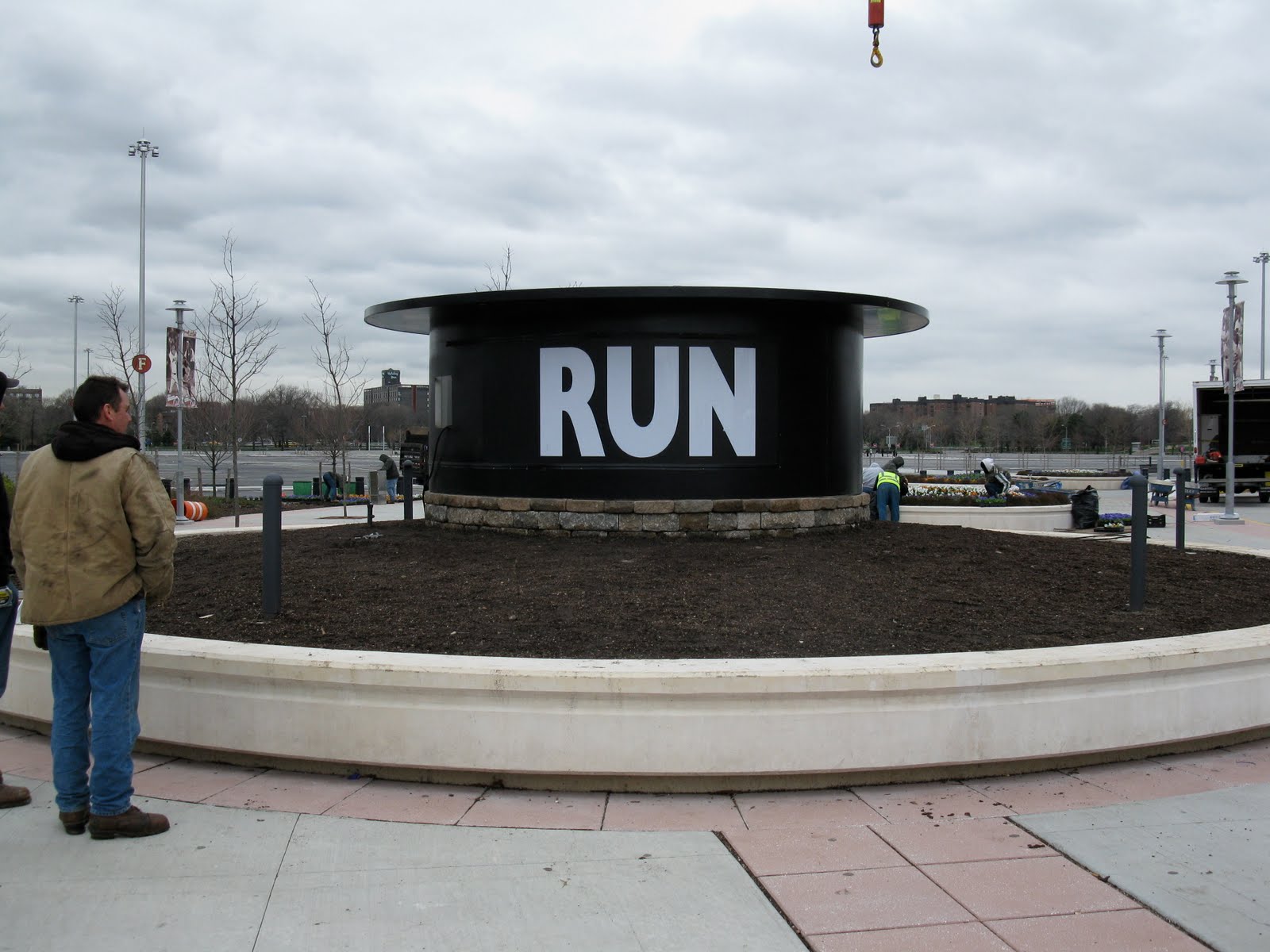
Oh, and the Apple? No longer the Apple, per se. Instead, it’s “our handy utility player Apple Cora!” They’re already taking HOME RUN off the hat to replace the name with the new one, which seems appropriate, since Alex Cora and home runs have never been seen together.
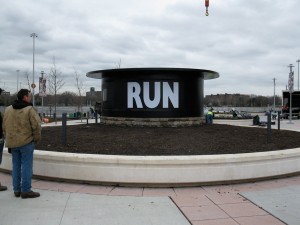 Make way for APPLE CORA. Of course they’ll all have hats now. Big top hats will be coming out of every planter in Metropolitan Gardens Brought to You by Fresh Direct®, the Smartest Way to Shop for Food, each identified by name, each containing a nightmarishly gargantuan fruit or vegetable. The top hat thing kind of lost its meaning when “Mets Magic” faded as an advertising device, but the Mets have never been stopped cold by logic before, have they?
All told, I have a feeling we’ll be longing for the Shea days of running a gauntlet of credit card hawkers and Newsday subscription come-ons just to get to Gate E more than we can imagine.
Will this overbearing sponsorship arrangement bring the Mets so much extra money that they’ll go out an sign a No. 2, 3, 4 or 5 starter next year if not this? Will the not-so-subliminal messages regarding nutrition sink into our Shake Shack-addled heads and bellies, thereby allowing us to live longer even if we’ll be cringing into our old age knowing this is the sort of thing the Wilpons will bringing us for decades to come? Are the Mets, in their own way, being patriotic by enthusiastically supporting the First Lady’s admirable Let’s Move campaign? Is this really not so bad if the Mets, as has been suggested by informed sources, win baseball games?
Who knows with this team and this ownership? I was looking forward to 2010. I guess I still am. Opening Day is April 5. Today is April 1. Even Metropolitan Gardens Brought to You by Fresh Direct®, the Smartest Way to Shop for Food, because it’s attached to baseball — no matter how perversely — is beginning to look good to me from here.
Heartbreaking photo of top hat with “HOME” already removed courtesy of Metsies and Other Musings.
A nice non-corporate baseball evening comes your way tonight at 7:30 at JLA Studios in Brooklyn when Gelf’s Varsity Letters series presents authors Lee Lowenfish, Emma Span and Christopher McDougall. Details here. FYI, JLA is in DUMBO, which is a geographic acronym and not a description of how the Mets run their organization.
by Greg Prince on 30 March 2010 3:24 pm It seems Kiko Calero and I shared a stadium twice last season, two games in late May when he pitched and I watched, yet I must confess I have zero recollection of him. It was too late in the action to be up and cruising for Daruma, hence all I can think is I was engrossed in conversation or so focused on the Met hitters he was facing (10 in 2 IP, none managing to score) that the presence of Kiko Calero simply escaped my notion.
I apologize to Kiko Calero. I apologize that he made zero impression on me even though he pitched for Florida against the Mets in six different games last season, and I watched all or part of every one of them. I apologize that he’s been in the majors since 2003, yet when the Mets signed him at the outset of Spring Training, my first thought was “who the hell is this?” I apologize for asking the same question in my head whenever his name crosses my mind, namely, “Isn’t Kiko Calero the tropical drink mix that sponsored those extraordinarily festive variety shows on Channel 47?” Finally, I apologize for thinking that all Kiko Calero has done this March is give up game-winning hits to marginal utility infielders…though to be fair, that’s exactly what he’s done the two times I’ve noticed him.
Kiko Calero, 35 years old, seven-season veteran, 67-game righthanded workhorse for the second-place Marlins, may make the Mets despite coming aboard late and wearing No. 94. When not surrendering home runs in the ninth to Ruben Gotay or Alberto Gonzalez in the tenth, he’s apparently been not bad. He is reportedly in the mix to make the Mets’ pen. Usually I hate that phrase, “in the mix,” but since I chronically confuse Kiko Calero with Coco López, it seems apropos.
Seasons have been known to turn on relief pitchers to whom I was paying scant attention in Spring Training, from Harry Parker in 1973 to Pedro Feliciano in 2006. Maybe Kiko Calero is that guy in 2010.
Or maybe not. A lot of relief pitchers parade in and out of our lives, some sooner than others (and some not nearly soon enough). This is why I get less caught up than the average fan in penciling in the roster that will start the season. I develop opinions in the course of a spring like anyone else, but my attitude is mostly get 25 guys into Met uniforms and we’ll take it from there. I don’t have that much confidence in Jerry Manuel’s observations on who belongs, but I have even less in mine and surely he has more of a vote on the matter than I do.
What saves us all is trial and error, even if some of that error takes place when games count. You don’t go from April to October with the same 25 guys. You don’t go from April to the end of April with the same 25 guys. Flux is the state of things in roster construction, now more than ever it seems.
Kiko Calero could be here to start the season. He could stay a while. He could stay a full year. Or he could be gone and not return before we know it. It wouldn’t be unprecedented. April may signify the fresh beginning for us as Mets beginnings, but in 39 episodes, it’s marked the end of a Met career. That is, 39 different players have made their final Met appearances in April, the month when everything is supposed to commence anew.
What a kick in their head.
This doesn’t count those who were cut in the waning days of Spring Training in those years when the grapefruit league extended into April (which is more years than not). It also doesn’t count the curious case of Pete Schourek who made the team out of St. Lucie in 1994, was carried north by perpetually besnarled manager Dallas Green, didn’t pitch in the opening series in Chicago and was then waived after three to make room for Doug Linton. Schourek would compile a 25-7 record with Cincinnati over the next two strike-shortened seasons. Linton seemed like a nice fellow, too.
Gotta be a bummer. You work all spring, you get the green light (or don’t get the red tag à la Major League), you’re a Met…and then, just like that, you’re not. You can play your last Mets game at any point, one supposes, but to do so in April must be what T.S. Eliot was talking about. Or was that the Elias Sports Bureau?
There are, in general, two kinds of April And Out Mets. There are the 16 who have been Mets before and their demise waited an entire winter to step right up and meet them; and there are the 23 for whom one April was it. Either way, there’s no denying the truism declared by the Buckinghams: to be exiled from the Mets in April is kind of a drag.
Unless it works out for you the way it did for Schourek. You could say the same for shortstop Tim Foli, who never got along particularly well with Met Aprils (or many other people, which helps explain the nickname Crazy Horse). In April 1972, Foli was part of the three-youngster package — Ken Singleton and Mike Jorgensen were the others — that brought Rusty Staub to New York. The season started late that year because of a players’ strike. Foli came back in 1978 but didn’t impress Joe Torre enough to ward off the onrushing Kelvin Chapman experiment in 1979. Chapman, who won a job in camp, was installed at second on Opening Day, moving superb defensive second baseman Doug Flynn to short, moving Foli to the bench.
If you can’t start for the impending 1979 Mets, maybe your days are inexorably numbered. Foli was traded to the Pirates for speedy Frank Taveras after a couple of weeks and clearly made the best of things. He solidified the Buc infield and was next seen holding down short for the world champions, Howard Cosell declaring Foli as “the glue” of the Fam-a-lee. Kelvin Chapman was next seen at Shea in 1984. Frank Taveras was seen in the interim waving at everything, including ground balls.
Crazy Horse is part of a subgenre of April And Out Mets: recidivist Mets who apparently overstayed their second welcome. Pitcher Ray Sadecki came home in 1977 only to leave home a little more than two weeks later. Pinch-hitter Marlon Anderson‘s first successful go-round as a Met was a fading memory in the first week of 2009, and he was let go in short order. Outfielder Brady Clark wandered through the non-Met desert for five seasons before his 2008 return; his fare thee well came April 22 two years ago. Reliever Pete Walker had two walk-ons as a Met, the second cameo coming to a close on April 20, 2002.
Pinch-runner Lou Thornton was a Lost Boy Found in 1989, but the Mets told him to get permanently lost on April 24, 1990, which was particularly hasty given that that season got off to a late start thanks to a Spring Training player lockout. Particularly horrible timing belonged to erstwhile starter Ed Lynch, who got to be a 1986 Met for exactly one April game after steadily hanging in there as the Mets eleveated from the depths of September 1980 to the precipice of glory. He was injured, then traded, then a Cub the night the Mets clinched against Chicago in September. He was not a happy ex-Met, telling Jeff Pearlman in The Bad Guys Won, “It was like living with a family the whole year and getting throw out of the house on Christmas Eve.” GM Frank Cashen went out of his way to favor Lynch with a World Series ring, which may be like getting your stocking stuffer around January 18, but at least it’s something.
The 1986 World Champion Met with the least claim on the title also said goodbye in April, albeit April 1992. Shortstop Kevin Elster was plagued by a bad right shoulder that wouldn’t get appreciably better without surgery. There went the last man to be added to the ’86 postseason roster. Another Met with ties to legendary times — quite different legendary times — who hit the road in April was catcher Choo Choo Coleman, Negro League veteran and one of the avatars of the absurdity of the ’62 Mets. Coleman kept catching even when Casey Stengel had seen enough, hanging around AAA long enough to bubble back up to the bigs in April ’66. After six games, he was sent down to Jacksonville where he caught a young pitcher named Tom Seaver. Choo Choo was still donning the tools of the Bubmeister for Tidewater while Tom Terrific was leading the Mets to the Promised Land in 1969.
Among other Mets for whom April wasn’t their only month but it was their last were:
• the relentlessly peripatetic pitcher Bruce Chen, ending his Met tenure in April ’02 (third team down, seven teams to go…and still counting);
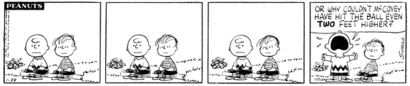
• the reluctantly historic Ralph Terry, throwing his final pitch in April ’67, 6½ years after Bill Mazeroski took him deep, but 4½ years after Willie McCovey, much to Charlie Brown’s consternation, took him not quite high enough;
• Grant Roberts, out in April ’04 a while after it was revealed he had been plenty high, and not necessarily in the strike zone;
• mini-Manny Victor Diaz, whose truncated Mets outfield career was permanently condensed in April ’06;
• infielder Larry Burright, who got to play in the first two games ever at Shea but was sent out before the Mets’ first win there in April ’64;
• and outfielder Andy Tomberlin, whose Met tenure ended while on the season-opening West Coast road trip in April ’97, meaning he missed the Jackie Robinson retirement ceremony, but also never had to wear the unlamented ice cream caps that debuted that very same night.
One other April And Out Met, “been here before” division, deserves most special mention, as he is a cult figure among those who know about him. On the day Tom Seaver returned to the Mets, April 5, 1983, he faced a Phillies lineup that included Joe Morgan, Tony Perez, Mike Schmidt and his opposite number, Steve Carlton. That’s five Hall of Famers in one ballgame. But for a penchant to bet, we’re pretty sure Pete Rose would have made it six. Immortals were the order of that magical Shea Opener.
Tom’s supporting cast included one former MVP (George Foster), one defending home run champ (Dave Kingman), one fellow 1973 National League pennant winner (Ron Hodges), three world champions to be (Mookie Wilson, Wally Backman and — through no fault of his own — Doug Sisk) and, arguably, the most trivial Met who ever lived.
Q: Who was in the Opening Day lineup for the Mets in 1983, drove in the winning run and never played for the Mets again?
A: Mike Howard.
Yes, good old…that guy. Howard, starting right fielder a month and a day before Darryl Strawberry came up, went 1-for-3, stroking a run-scoring single in the home seventh in support of Doug Sisk (Tom having exited after six). Mike not only never played for the Mets again, he didn’t bat in that game again. He was sent out to Tidewater, replaced in the lineup by Danny Heep, on the roster by Mark Bradley and in the annals of Metsdom by no one. Nobody else owned a piece of Opening Day the way Mike Howard did and was less rewarded for it.
April was the end of Mike Howard as a Met, but it wasn’t the whole of him. He was called up on September 12, 1981, doubled in his first plate appearance and reached on catcher’s interference in his last. Fourteen games in 1981 and 33 in ’82 couldn’t keep Mike Howard from an April exit, but it gave him other Met months on which to look back and reflect.
The same could not be said for the 23 Mets for whom it was all about April. Their first games, last games and, in some cases, only games came as they were just shaking the rust off. Maybe if they’d been allowed to stay until May, they may have met a kinder fate.
Maybe not.
When you’re starting a brand new team, it’s a shakedown cruise all the first month. Casey Stengel shook down his 1962 Mets and had every reason to not like what he saw. Four Mets in the vicinity of Originality made way for new members of the cast almost at once. The first to come and go was catcher Joe Ginsberg: two games, five at-bats, no hits, but only an 0-4 record for his team when he forever departed. Perhaps Joe — carrying the designation First Met To Play A Last Game — took perverse pride in thinking, “Big deal, they went 40-116 without me.”
Three later Met catchers — Rick Sweet in 1982, Mike Bishop in 1983 and Gustavo Molina in 2008 (of whom it must always be said, “no relation”) — would follow Joe Ginsberg’s early example and find themselves out at the plate in the Aprils of their disconnect.
Meanwhile, two other Original Mets who couldn’t be held responsible for too much of the mess they left behind, ex-Bum Clem Labine and journeyman Herb Moford, also were done in the bigs once they were done pitching for the 1962 Mets. Outfielder Bobby Gene Smith, on the other hand, found his way to the Cubs and Cardinals before the season was out and played in the majors as late as 1965 with the California Angels, where his peers included Jimmy Piersall, who ran out his hundredth homer as a backward Met (Casey didn’t care for that, either), and three men who’d be Mets much later to no positive effect whatsoever: Dean Chance, Jose Cardenal and, most notoriously, Jim Fregosi.
Fregosi, eternally recalled in Met lore as what you get when you give up on talent, played on the same Met team in 1973 with Rich Chiles, who is what you get — or got — when you give up your soul. It wasn’t as resonant in 1969 abandonment as Nolan Ryan (+3) for Jim Fregosi, but Tommie Agee for Rich Chiles (and Buddy Harris) wins Bob Scheffing no blue and orange brownie points. Chiles, a lefty-swinging outfielder, went 3-for-25 in April ’73. Then he went to the minors, disappearing from major leagues for three full seasons. By comparison, Jim Fregosi’s .233 in 146 games over two seasons was stalwart…but only by comparison.
Rule 5 infielder Bart Shirley may not have lasted all of April 1967, but he kept interesting company. He debuted one day after Tom Seaver and three innings after Jerry Koosman. Shirley bowed as a pinch-hitter for Kooz; alas, like Fear in the movie they made about Piersall, Bart struck out. Also, unlike Kooz and Seaver, he had no staying power. Wes Westrum gave Bart only a half-dozen April looksees before Bing Devine cut his losses and returned Shirley to the Dodgers.
April was no less cruel to the Met aspirations of Mac Scarce, who arrived as partial payment for yet another 1969 Met, Tug McGraw, and probably never believed his name would describe his Met experience: one game on April 11, 1975, one batter faced in relief, two pitches (to eventual ray of Shea sunshine Richie Hebner), one walkoff hit, one adios. Mac, thus, became the first of the April sect of Moonlight Graham Mets, but not the last. On April 13, 1977, Luis Alvarado would give the Mets an 0-for-2 in a 7-3 loss to the Cardinals. The Mets would then give Alvarado an airline ticket to Detroit. Others for whom the April Band-Aid approach (just rip it off in one game’s time) was deemed appropriate were two emergency starters who created full-scale disasters:
• Brett Hinchliffe, 2 innings pitched, 9 hits, 8 earned runs — but only one walk — against the Brewers, April 26, 2001.
• Chan Ho Park, 4 innings pitched, 6 hits, 7 earned runs — and two walks — against the Marlins, April 30, 2007.
Milwaukee fans weren’t done tailgating before Hinchliffe’s Met and major league careers were over. Park, somehow, righted himself, contributed to the division-winning Dodgers and pennant-winning Phillies the last two seasons and has since joined the defending champion Yankees. Only some good deeds go unpunished.
High hopes were a hallmark of the career of Ken Henderson. In 1965, as a 19-year-old Giant outfielder, he was tabbed (we are reminded by James Hirsch’s monumental current work) “the next Willie Mays,” which is always the kind of tag with which you want to saddle a kid. Henderson never turned into Mays, but he turned out all right, serving as a solid outfielder in San Francisco and a few other teams. In 1978, as a 32-year-old newly minted Met, Henderson was off to a reasonably promising start: not Willie Mays, but certainly a decent complement to Willie Montañez, who came over in the same four-way trade the previous December. The promise was never fulfilled, however. In Henderson’s seventh game, April 12, he crashed into Shea’s right field fence, did a number on his left ankle and that was that for K-K-Kenny and the Mets. He’d go on the DL and then to Cincinnati for Dale Murray, a reliever who made a lot of opposing hitters look like the next Willie Mays.
The rest of the April And Outs can be divided essentially two ways: Guys who didn’t get much of a chance to show they didn’t belong; and Guys who didn’t get much of a chance but proved they didn’t belong. The kinder category includes a man who stands to break from this pack any day now, Gary Matthews, Jr. An April pinch-hitter and an April pinch-runner, he was an April pinch-packer in 2002, but he stands ready to rectify his record should he stick with the Mets and stay ’til May. The same can’t be said for the Met who replaced Matthews, McKay Christensen. McKay didn’t stay ’til May, but last we heard, he expressed no regrets.
Three relatively recent righthanded relievers — Calero precursors, perhaps — got the heave-ho mysteriously quickly. Brian Rose put in three relief appearances in April 2001 and was in no way worse than the comparatively enduring Donne Wall; Mike Matthews‘ four decent turns out of the bullpen in April 2005 were overshadowed by one that was dismal and another that was dreadful and, ultimately, Mike’s coffin-nailer; and Darren O’Day, who was given the ball four times in April 2009, was victimized by a numbers situation and was soon off to Texas where he pitched quite brilliantly the rest of the year.
Then again, we saw enough off the bat, literally, from righty retread Jonathan Hurst in April 1994 (7 games, 12.60 ERA); novelty knuckler Dennis Springer in April 2000 (2 starts, 8.74 ERA); and sagging southpaw Casey Fossum in April 2009 (whose 2.00 WHIP and 3 of 8 inherited runners scored can be traced directly to being the first Met to wear No. 47 since another Met portsider thoughtfully left it steaming on the mound at Shea at the conclusion of the 2007 season).
One other lefty began and ended his Met career in the same April, though I’m not sure how to characterize him. Make no mistake: nobody except Willie Randolph wanted Felix Heredia on the 2005 Mets. King Felix I was what we had to take from the Yankees so we could get rid of crusty Mike Stanton…sort of a scaled-down unwanted lefty-for-unwanted lefty version of Mel Rojas for Bobby Bonilla. Heredia had had his moments as a Marlin, particularly on the ’97 champs, but was Bomber non grata by 2004. This didn’t make him the least bit attractive as a Met proposition in the spring of ’05, but Randolph put him on the team to start the season. The Metsosphere, then encompassing far fewer blogs, collectively groaned. WFAN grew staticky with calls to GET RID OF HEREDIA! After three appearances, he was shut down with an aneurysm in his left shoulder. Nobody except maybe the feral felines at Shea missed Felix Heredia.
Funny thing, though, is I can’t for the life of me figure out what Felix Heredia did wrong as a Met. Oh, he had sucked for the Yankees, which wasn’t what you’d call a résumé-grabber for Mets fans. And he tested positive for steroids after rehabbing in St. Lucie — the fault of supplements, his agent said. But those were before and after situations. While a Met in April 2005, Felix Heredia faced 10 batters and retired 8 of them. He gave up a hit in one appearance, a walk in another and allowed no runs in any of his outings. He inherited no runners, so that didn’t become a problem either. As best as I can recall, we expected the worst out of Felix Heredia and were collectively relieved to see him DL’d before it could actually occur.
In other words, we got all worked up over nothing. As 39 April And Out Mets could have told you, it’s been known to happen.
Special thanks to FAFIF reader ToBeDetermined for bringing up the Opening Day heroics of Mike Howard a couple of weeks ago and unwittingly spurring the research that became this article.
Appreciation as well to Justin Sabich of the New York Times‘ Bats blog for soliciting the 2010 thoughts of Jason and me, along with Sam Page of Amazin’ Avenue and Matt Cerrone of MetsBlog. Part Two runs today; Part One was posted yesterday.
by Jason Fry on 29 March 2010 11:35 pm At the end of Absence of Malice, the great 1981 newspaper movie, the reporter played by Sally Field finds the tables have turned on her, and sits numbly while a colleague runs through everything that’s happened for the story she’s been told to write. Her account is a proper recitation of the facts, but one that says nothing about intentions or bad luck or missed chances, and you see this play out on Field’s face as she listens.
“That’s true, isn’t it?” the other reporter asks.
“No,” Field says, then pauses, trapped. “But it’s accurate.”
That scene went through my mind when I read about the denouement of the affair of the plaque outside Citi Field commemorating Game 7 of the 1986 World Series. The plaque is part of a series that’s been added to the Fan Walk, our greatest moments set amid the expressions of belief purchased by fans. It’s a nice juxtaposition — official recitations of great events echoed by a surrounding chorus of fan memories. And it’s welcome evidence that Year 2 of Citi Field may see the addition of a lot of what was missing in Year 1, starting with a healthy dollop of Mets’ history in their own home.
So what’s the problem? As originally worded, the Game 7 plaque told us that “first baseman Keith Hernandez and third baseman Ray Knight delivered key hits, and Sid Fernandez earned the win with exceptional relief work.”
Well … not quite.
Sid relieved Ron Darling with two outs in the fourth and the Red Sox up 3-0. Dave Henderson was on second and Wade Boggs was due up. Sid walked Boggs — the only baserunner he would allow — and got Marty Barrett to fly to right. He then shut down the Red Sox in the fifth and again in the sixth, after which Lee Mazzilli pinch-hit for him with one out in the bottom of the inning. Maz singled. So did Mookie Wilson. Tim Teufel walked. Keith Hernandez drove in Maz and Mookie to make it 3-2, and Gary Carter’s RBI groundout tied the game. Roger McDowell worked a scoreless seventh; Ray Knight led off the bottom of the seventh with a home run, and the Mets were on their way.
The win, of course, goes to McDowell. And that’s what the updated plaque will say.
Kudos to Ken Belson of the New York Times for an excellent rundown of the plaque on the Times’ Bats blog — and for giving our blog pal Shannon Shark of the Mets Police center billing for his work calling attention to the issue and driving the awareness that helped get it fixed posthaste. As Shannon told Belson, this is about “making sure we teach our children correctly.” Amen to that.
But if ever there was an understandable mistake, it’s this one. Those of us who watched the Mets claw their way back into Game 7 remember that it was El Sid who calmed the waters and allowed a better story to emerge. Boston had battered Darling around; Sid’s deceptive deliveries and sneaky speed disrupted the Red Sox’s’s’s’s’s timing and got them thinking about lost momentum and missed chances. McDowell followed his spotless seventh with a ghastly eighth, yielding two singles and a double to make the score Mets 6, Red Sox 5 and bring Jesse Orosco in to face a raging conflagration.
Wins can be silly things. Starting pitchers sometimes get them when they give up runs by the bushel but last five innings because their mates are scoring runs by the double bushel. And relievers sometimes get them not because they were particularly competent, but because they were in the right place at the right time.
It’s unassailably accurate that Roger McDowell was the winning pitcher in Game 7. (Heck, you could look it up.) But is it true? That’s a little murkier.
(Speaking of the Times, Greg and I discussed the 2010 Mets this morning on the Bats blog, along with MetsBlog‘s Matt Cerrone and Amazin’ Avenue‘s Sam Page. Check back in tomorrow for Part 2 of the discussion. Thanks to Justin Sablich for including us!)
Update: And here’s Part 2.
|
|