The blog for Mets fans
who like to read
ABOUT US
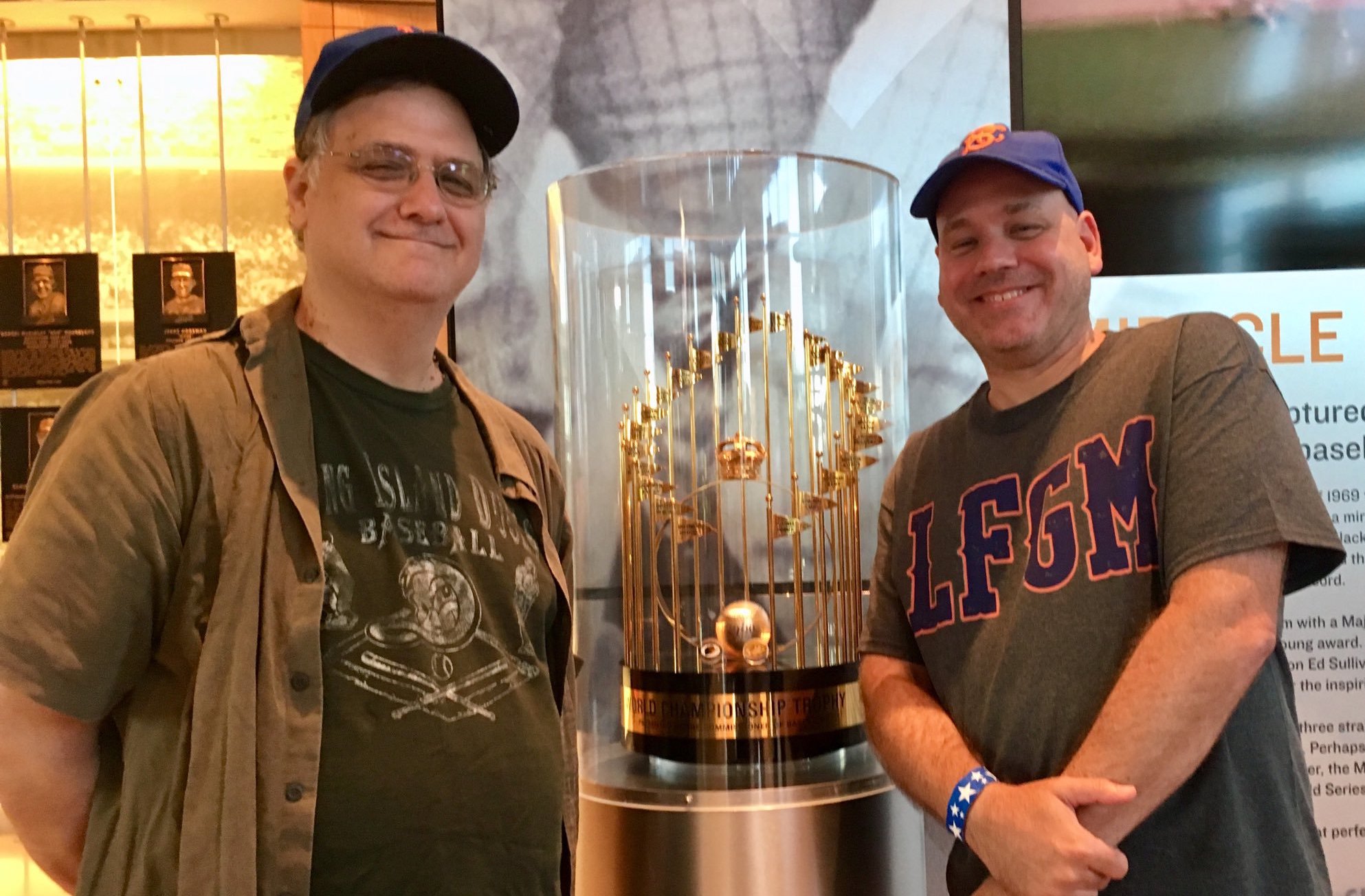
Faith and Fear in Flushing made its debut on Feb. 16, 2005, the brainchild of two longtime friends and lifelong Met fans.
Greg Prince discovered the Mets when he was 6, during the magical summer of 1969. He is a Long Island-based writer, editor and communications consultant. Contact him here.
Jason Fry is a Brooklyn writer whose first memories include his mom leaping up and down cheering for Rusty Staub. Check out his other writing here.
Got something to say? Leave a comment, or email us at faithandfear@gmail.com. (Sorry, but we have no interest in ads, sponsored content or guest posts.)
Need our RSS feed? It's here.
Visit our Facebook page, or drop by the personal pages for Greg and Jason.
Or follow us on Twitter: Here's Greg, and here's Jason.
|
by Greg Prince on 30 November 2009 8:57 pm 
What Shea Stadium was to the 1969 World Champion New York Mets as they were becoming the 1969 World Champion New York Mets,The Miracle Has Landed is for all of eternity. It is their home. You will not find a more thorough nor definitive collection of perspectives on and passions for this team of teams. Your friends from Faith and Fear contributed words and images, as did dozens of talented and devoted baseball chroniclers. In the parlance of Mets yearbooks, consider this the ultimate Revised Edition for 1969.
The Miracle Has Landed makes a beautiful addition to your baseball library or the baseball library of any Mets fan you care about. Honestly, this baby is a baseball library unto itself. Secure your copy today.
by Greg Prince on 30 November 2009 12:21 pm The Mets were meandering through their most arid major award season since 1993 — the last time no Met scored a single vote for MVP, Cy Young, Manager of the Year or Rookie of the Year nor nabbed a Silver Slugger or Gold Glove — when it appeared we’d have nothing more to sate our perilously low self-esteem than Luis Castillo’s fantastic seventh-place finish in voting for mlb.com’s National League Comeback Player of the Year balloting (six points behind the decreasingly heartwarming return of Philadelphia Phillie Pedro Martinez). Presumably impartial observers observed the Mets and decided they were as undistinguished individually as they were collectively.
But then, at last acknowledgement: Omir Santos snuck onto the 2009 Topps All-Rookie Team last week as its catcher, ahead of the Orioles’ Matt Wieters (who hit his first home run off Tim Redding in June). I’d all but forgotten the Topps All-Rookie Team existed, yet suddenly, it was like we existed again. A Met’s name appeared on something other than a DECLARED FREE AGENCY list.
It isn’t much. It really isn’t. You’d have to be staring at a baseball card in 2010 to remember it happened. I’m pretty sure this is the first time I’d seen evidence of the Topps All-Rookie Team other than by staring at one of its members’ cards. And the last time I can remember noticing a Met earning a little trophy next to his picture is Jon Matlack’s 1973 edition.
Santos, in a light year for freshman catchers, became the nineteenth Met* ever so honored; the first since Ty Wigginton made the squad as the 2003 third baseman; and only the third Met catcher so named. Todd Hundley in 1992 and Jesse Gonder in 1963 were the other receivers in what were also, one can quickly infer, light years for freshman catchers (Hundley was designated by Topps despite generating less offense than Dwight Gooden that season).
Making the Topps team, which covers both leagues, sounds sweet, but it doesn’t necessarily portend a damn thing for Omir or anybody. Hundley built on his fledgling credentials (.207 BA/.256 OBP/.316 SLG) and eventually became a record-setting home run hitter of sorts. Gonder eventually became a Milwaukee Brave. Wiggy was ousted from his position in ’04 by rookie David Wright, whose sparkling half-season at third was passed over by Topps in favor of a full year of Chad Tracy, yet David Wright was soon en route to blossoming while Ty Wigginton was clearly never going to be more than Ty Wigginton.
Several Mets Rookie of the Year candidates — guys who actually earned votes from the Baseball Writers when they were pups — were stiffed by Topps, including Ron Hunt (second place in ’63), John Milner (third in ’72), Steve Henderson (second in ’77) and Kevin Mitchell (third in ’86). Jose Reyes and Kaz Matsui each secured a single BBWAA third-place vote in ’03 and ’04, respectively, but won no love from Topps. Ron Hunt had the bad Topps luck to emerge the same year as another then-second baseman, Pete Rose. Reyes’s limited duty in 2003 didn’t stack up to the one standout year ever produced by recent Met Angel Berroa. With Topps, timing and competition are everything.
Congratulations to our very own Papel-popper for winning us something, anything. And best of luck to Omir Santos on building on his sorely adequate 2009. But to tell you the truth, I want more out of life than a default Topps All-Rookie catcher. I want more out of a Met rookie than hindsight and a pat on the back. I want to look forward to a Met rookie in the way I haven’t since the days of Reyes and Wright, maybe since the days of Strawberry and Gooden.
I’ve decided want to look forward to Ike Davis.
Oh, Mets prospects. You never seem to arrive, do you? The Mets used to send a few up here now and then. I don’t mean the stopgaps and the might-bes. I mean the can’t-miss and didn’t-miss. I mean the kind we sat around truly anticipating for a couple of years. We monitored his progress, we anticipated his arrival and we contacted one another immediately when his time came. They called up Darryl! They brought up Jefferies! Reyes is up!
Notice the word “up” in all that? That was what it felt like to have delivered unto us our can’t-miss kid. He raised our hopes, he heightened our confidence, he got us peeking above the horizon.
I miss can’t-miss. We haven’t had that since Wright. We’ve had the well-regarded and the promising, but they’re not the same. They didn’t burst onto the scene. They weren’t meant to stay…or they didn’t force the issue. In the five seasons since we’ve been doing Faith and Fear, we’ve been modestly to seriously tantalized by the promotions of:
• Lastings Milledge
• Mike Pelfrey
• Philip Humber
• Carlos Gomez
• Eddie Kunz
• Jonathon Niese
• Fernando Martinez
These aren’t all the rookies the Mets have recalled since 2005, but they’re the ones who were particularly hyped in advance. Not nice players, but potentially very nice players. Prospects all the way. Some came up and showed flashes. Some flickered more than flashed. Some stalled. Others were packaged and sent away to address immediate needs. The last couple, natch, have gotten hurt.
But none of them — not even Martinez, on whom the jury has to be considered out given his youth — carried that glittering seal of advance approval. Nobody was a sure thing, not the way we’d been all but guaranteed in the cases of Reyes and Wright and, long before them, Strawberry and Gooden. Sure, there’s folly in banking on anybody as a certainty — Gregg Jefferies required lots of maturing after his initial blast onto the scene faded…and let’s not get into Alex Ochoa — but you could have faith. More faith than fear, y’know? You read the reports on Reyes going into 2003 and you couldn’t wait. You heard the talk surrounding Strawberry twenty years before that and you drooled. Barring injuries (goodbye Payton, goodbye Pulsipher, goodbye Paul Wilson), you kept the faith.
I haven’t done that in ages where a Met prospect is concerned. I’ve kept marginal faith in guys I sensed were medium prospects. I don’t expect much out of Mike Pelfrey, so I avert disappointment that way. I was let down some by Lastings Milledge, but save for a little lightning his first couple of dizzying weeks, I didn’t expect a ton either. The others…if they were promoted by the Mets, I took them in stride.
I want to expect. I want to have a Met on the way up whom I look forward to penciling in a) to the everyday lineup and b) for substantial amounts of easily interpreted positive statistics. I want somebody to come up here and, after nearly a half-century of waiting, be a Met approximation of Albert Pujols.
A Met approximation of Albert Pujols (did you know we drafted a dozen players before the Cardinals picked Pujols in 1999? So did 28 other teams, I suppose, but still…) would be Darryl Strawberry or David Wright. Not the best player in the game, but still up there most years. I’d take another Straw, another David if I can’t have the best player in the game. I’d take expecting that and not being disappointed by what happens. It would beat expecting modestly and being let down gently.
Ike Davis is…how the hell would I know what he is? I didn’t spend a lot of time watching the St. Lucie or Binghamton Mets last season and I don’t spend a lot of time analyzing the ol’ farm system. I don’t believe in the ol’ farm system. The ol’ farm system produces very few Mets as a rule. The ones they produce…they get here when they get here. Or they don’t get here. I can’t get attached to anybody when they’re not yet a Met, unless someone’s giving me sensational motivation.
That’s where 22-year-old Ike Davis is suddenly coming in. I knew his father was a Yankee I particularly disliked (some quote in the paper circa 1981 honked me off, though I couldn’t tell you what it was anymore). I knew he was a first baseman. I knew he was a first-round draft pick in ’08, but so what? Ryan Jaroncyk was a first-round draft pick in ’95. Robert Stratton was a first-round draft pick in ’96. Geoff Goetz was a first-round draft pick in ’97. I’ve grown immune to the charms of Mets first-round draft picks. I’m experienced at doubting their lack of experience let alone development. But then, for some reason, Ike Davis’s name kept getting repeated as if he were a serious prospect. In 2009, he hit twenty homers and drove in 71 runs in 114 games. His OPS was .906. That was in Single-A and Double-A combined. Maybe this wasn’t just the Mets hyping and touting per usual. Maybe we had a genuine prospect on our hands worth the trouble of anticipating.
Next thing I know, he’s batting .341 in the Arizona Fall League. Again, Arizona Fall League is one of those things that doesn’t penetrate my see-it/believe-it ethos for youngsters. But more talk, more buzz. Ike Davis seems to be elevating into that prospect realm where few Mets get…where I’m anticipating their arrival.
Would Marty Noble be seeking Darryl Strawberry’s wisdom for Ike Davis if Ike Davis were not worth the trouble? Did they do this for Fernando Martinez? Or Jay Payton?
Mind you, I’m vulnerable. I’m vulnerable to suggestion these days, specifically the suggestion that a minor league Met could become a major league star…as a Met. I may have blithely dismissed the likelihood of the most recent spate of Milledges and Gomezes because we appeared to have a good ballclub whether they made it or not. It would have been nice to have had reinforcements, but we were contending without them contributing, so it was no biggie when they flamed out or fell short. But now we need something to believe in. We need to have faith. There’s not much that we know about that gives us that rock-solid feeling of “It’s gonna be fine.” There’s mostly nothing in that category.
Just like there wasn’t when Strawberry was about to blossom. Just like there wasn’t when Reyes was lacing up his spikes. It’s times like these that demand an Ike Davis. It’s times like these that have me casting away my doubt and craving an Ike Davis. It’s times like these when I can imagine a 2012 Topps Mets card with a little gold trophy signifying the best 2011 rookie first baseman in the game was — not by default but on merit — Ike Davis.
These times cry out for an Ike Davis. Whoever he is.
*Your Topps All-Rookie Mets: Al Jackson (LHP, 1962); Jesse Gonder (C, 1963); Ron Swoboda (OF, 1965); Cleon Jones (OF, 1966); Tom Seaver (RHP, 1967); Jerry Koosman (LHP, 1968); Ken Boswell (2B, 1968); Jon Matlack (LHP, 1972); Hubie Brooks (3B, 1981); Mookie Wilson (OF, 1981); Darryl Strawberry (OF, 1983); Dwight Gooden (RHP, 1984); Roger McDowell (RHP, 1985); Gregg Jefferies (2B, 1989); Todd Hundley (C, 1992); Jeff Kent (2B, 1992…though most of that, presumably, was based on his work with the Blue Jays); Jay Payton (OF, 2000); Ty Wigginton (3B, 2003); Omir Santos (C, 2009).
by Greg Prince on 30 November 2009 1:16 am In 2008, you’ll recall, the Mets let Willie Randolph dangle on the precipice of removal, take a flight to the West Coast, manage one game in Anaheim and then fired him (announcing it, infamously, after 3:00 AM Eastern time). It all seemed pretty shabby.
Not quite eighteen months later, the New Jersey Nets, off to a potentially historic bad start, have fired their head coach, Lawrence Frank, with one game remaining on a punishing West Coast trip. They are 0-16. If they go 0-17, they will tie the NBA record for worst start ever. Without knowing very much about the internal machinations of the Nets, other than they can’t be too terribly effective, I can’t tell whether this is merciful or overkill. Frank was once a successful coach, just as the Nets were once a leading franchise in the NBA Eastern Conference. He seems like the kind of guy who’d want one more chance to lead his team away from eternal notoriety. Tonight they play the Lakers in Los Angeles. Frank could have at least gone down fighting, going out as the guy who tried to halt history before it ate up whatever’s left of the Nets’ 2009-10 season.
On the other hand, at least now his name won’t be attached to the record loss if it occurs. He presumably gets to fly home on his own, apart from the players who have failed him…or the players who failed in concert with him…or the players who failed because of him. I have to confess that although I list the Nets as my favorite NBA team, that’s like choosing my favorite opera singer most of the time. I don’t really follow the league anymore, and my fealty to the Nets is mostly a matter of sentiment dating back to the ABA. Still, as the Nets have edged closer to 0-17, I’ve actually been watching them a little (even though that requires tuning in YES). I understand they’ve been saddled with injuries and lost a couple of close ones early on. But as I’ve watched them, they’ve just looked beaten. Frank has looked beaten. Hard to argue the dismissal of a coach with an 0-16 record isn’t justified.
But they had to off their coach of more than five years before he could maybe, just maybe go 1-16 as long as the Nets were ending their road trip anyway? Is his interim successor, Tom Barrise, that much of a sparkplug? Will the Nets players be so happy to be rid of Frank that they’ll be fired up and ready to go against the 12-3 Lakers? Then again, if this was inevitable (which it reportedly was), why not get it over with and put Frank out of his misery and on a plane home?
You can’t quantify taste, but this doesn’t taste right.
In 2008, the right thing to do would have been to have told Willie Randolph not to board that westbound flight, to not make him go through the motions of one more game as skipper if he was going to be done 24 hours later regardless. Omar Minaya claimed he had to sleep on it before definitively issuing Willie a return ticket to New York. There was also the issue of the Mets not wanting to fire their manager on Father’s Day. No matter how they did it, it would have stung. It stung that much more because how clumsily the Mets handled the matter.
The Nets, somehow, look even clumsier.
FOR THE RECORD: The Nets have indeed become the co-losingest team out of the gate in NBA history, going down haplessly to the Lakers Sunday night and joining the 1988-89 Miami Heat and the lockout-year 1999 L.A. Clippers in 0-17 infamy. The temp coach did not fire them up. On the bright side, you can be a lousy 3-14 team like the Knicks and show yourself as nothing special or you can be a landmark lousy team like the Nets and be really nothing special. Either way, they both make the Mets look downright semi-competent.
by Greg Prince on 27 November 2009 7:22 pm If I’ve learned anything from the returning Keith Hernandez these past few years that he has analyzed Mets games. it’s that ballplayers like to come up with new names for old things, particularly if they save the players some syllables. Thus, it was no surprise to me when I started hearing Keith make occasional reference to “fundies”…as in fundamentals.
Fundamentals: four syllables. Fundies: two syllables. Look how much effort a ballplayer saves in the shortening.
Keith gives me the idea that a ballplayer is more than happy to cut out syllables as well as steps. So much of their life is repetition repeated ad infinitum, from February to, if you’re lucky, November. It’s only human nature to now and then want to find shortcuts.
Unless you’re intent on playing ’til November.
The Mets, you may have noticed in 2009, were neither masters of the shortcut nor the fundamental. They couldn’t, wouldn’t and didn’t execute the little things and, as a result, fundie got broken up in to two even small words:
• Fun
• Die
Two small words describe what happened pretty aptly because the Mets wouldn’t commit to doing the little things that win ballgames. And the littlest thing of all erupted into the biggest play of the year in terms of encapsulating all that went wrong for them.
Faith and Fear in Flushing announces, with no joy whatsoever, that the Nikon Camera Player of the Year — the award bestowed to the entity or concept that best symbolizes the Met season gone by — is Two Hands.
As in “TWO HANDS!!” the aggrieved cry of Mets fans everywhere following the gaffe of all 2009 gaffes, Luis Castillo’s failed one-handed non-grab of Alex Rodriguez’s ninth-inning, two-out popup on June 12 at Yankee Stadium. It turned an 8-7 win into a 9-8 loss; it turned an assumption into an imperative; it turned us all into bench coaches.
TWO HANDS!! we would yell starting June 13 and keep yelling for the rest of the blighted season. We would yell it at Castillo and any Met who drifted toward or settled under a pop fly. If we didn’t yell it, we surely muttered it or thought it to ourselves. Castillo’s utter failure under the Subway Series glare — after not catching the ball, he didn’t throw it to the right base either — made us all wary of how the Mets played for the balance of 2009.
We should have been warier earlier. We should have taken to heart as more than just one of those things that no Met fielder consistently looked like he knew what he was doing from the time the season started. Mets baserunners were generally just as clueless. This predates the injury wave. The injuries were severe, to be sure, but I’d take a sound team of substitutes over a cavalier bunch of regulars any day. We’d have less talent, but more skill.
By the end, we were dealing primarily with alternates who didn’t pay attention to details. It was the worst of all worlds. It was the Mets of 2009.
Luis Castillo put up admirable offensive numbers one season after he was completely useless as a Met. He did not wither after June 12. Singling out his disastrous error is not intended as one more jab at him personally. This could be about Daniel Murphy falling down, Carlos Beltran not sliding, Jose Reyes watching a double assuming it was a homer, Fernando Martinez assuming he didn’t have to run at all when he had just been called up; David Wright slowing down between third and home to negate a run, Carlos Delgado not corralling a foul pop, Jeff Francoeur losing a ball in the lights, Jeremy Reed throwing wildly from first, Ryan Church not touching third, Angel Pagan not calling off Beltran, Emil Brown passing Castillo on the basepaths…these were professionals. Some of them were decorated professionals. They all made inexcusable, mindless plays. They all saved themselves the effort of thinking.
Everybody makes mistakes. Vapor lock is the term Keith used in his excellent diary of the 1985 season, If At First, to describe the most inexplicable kinds. One now and then is forgivable. It’s part of the human equation. But on the 2009 Mets, vapor locks just multiplied and spread. Everybody seemed to lock up. They didn’t, as a rule or as a unit, ever seem to unlock. They never seemed to understand just how bad they played. It wasn’t the 70-92 record that stands as galling. It’s how they got there.
The players did not use two hands in the literal or figurative sense. The manager and his coaches did not effectively drill into them the importance of two hands…or a brain, it seems. The Mets made fundamental mistakes early and they made fundamental mistakes often. I got the impression they barely noticed and weren’t bothered that their lack of fundies made the fun die so brutally.
They never grew any more aware, but I sure did and so did you. Every fan became a maven for fundamentals in 2009. If we didn’t full realize coming in to the year, by the end, we all understood the importance of two hands.
TWO HANDS!!
FAITH AND FEAR’S PREVIOUS NIKON CAMERA PLAYERS OF THE YEAR
2005: The WFAN broadcast team of Gary Cohen and Howie Rose
2006: Shea Stadium
2007: Uncertainty
2008: The 162-Game Schedule
by Greg Prince on 25 November 2009 9:02 pm The Mets used to regularly play Memorial Day doubleheaders, Independence Day doubleheaders and Labor Day doubleheaders, yet the holiday that launched them into the public consciousness was the one we celebrate tomorrow.
That’s right: the Mets are as much a part of Thanksgiving as stuffing, pumpkin pie and forced conversation you could do without.
Two months before they started limbering up in St. Petersburg and nearly four months before they began losing in earnest, the New York Mets made their debut at the Macy’s Thanksgiving Day Parade on November 23, 1961. There had only been actual Mets for about six weeks, since the expansion draft yielded 22 players of varying talents and primes who were slated to comprise the bulk of the Original Mets. Their real star, of course, was their manager. One year removed from not quite winning an eighth World Series in a dozen seasons for a particularly demanding employer, Casey Stengel had signed on to pilot the expansion Mets. Casey Stengel had been, was and would always be the personification of baseball in New York. He was a Dodger under Wilbert Robinson, a Giant under John McGraw, a Yankee who lorded it over the American League and now the best thing the nascent Mets had going for them.
What better first public relations move than to parade Casey Stengel before the adoring masses? And what better venue than the Macy’s Thanksgiving Day Parade of 1961? It already promised to be a star-studded procession: Connie Francis, Troy Donahue, Annette Funicello; Lionel Hampton; the maiden appearance of the Bullwinkle J. Moose balloon; the title vehicle from Car 54 Where Are You? getting a push from Fred Gwynne and Joe E. Ross; and NBC stretching its coverage of the event to an unprecedented two hours. Amid this great march of history came your 1962 Mets…maybe your 1961 Mets, if you want to be literal about it.
Gil Hodges was a part of it. So was Al Jackson. Billy Loes, the Brooklyn Dodger who once claimed to have lost a ground ball in the sun, was there. He was supposed to be a Met (meaning he was on the roster, not that somebody losing a ground ball in the sun was destined to be one of ours in 1962) but he’d retire before a single pitch would be thrown in futile anger. Monte Irvin joined Casey’s cadre as well. Irvin was never going to be a Met, but he had been a New York Giant, and the Mets were, in a very real sense, getting the band back together — a blue and orange supergroup, if you will. New York’s affection for the National League simmered on the back burner for four desolate years, so the expansion Mets were as welcome a sight in November 1961 as they would be in April 1962.
Thus, there was Casey, just one man in one car in the Macy’s display, but really — apologies to the cast of Bonanza, which technically led the cavalcade — the grand marshal of any parade in which he strutted his stuff. George Weiss thought it would be a sound idea to get Stengel in front of potential customers as soon as possible. Stengel, always happy to give the crowd a wave and a bow, didn’t disagree.
“I may be able to sell tickets with my face,” said the ever aware Ol’ Perfesser.
The first official pilgrimage for Mets fans would come April 13, 1962, uptown to the Polo Grounds. But should you check in on the Macy’s Thanksgiving Day Parade this Thursday morning, you might want to remember that 48 years ago, the same spectacle served as our Crossing of the Mayflower.
***
The modern-day turkeys who run the Mets want you to run out and buy a brand new 2010 jersey on Black Friday. They’ve even provided a handy, practically decipherable guide to an hourly discount program at the Citi Field team store…and nowhere else, if I’m reading it correctly. Then again, these are the people who load up their Sunday ticket plans with Thursday night games, so caveat Met emptor and all that.
If you want to be among the first to purchase a new “natural color” top, by all means buy it, wear it or give it in good health. But if you’re interested in getting a more satisfying bang for your fan buck, consider one or all of the following.
1) Tonight, Wednesday, at 8 o’clock MLB Network debuts its 1969 edition of the fine Baseball’s Seasons series. 1969 can only mean one thing, and it’s something of which we’ve yet to get enough. Retroactive cap tip to MLBN for airing all five games of the ’69 Fall Classic last Sunday, perhaps the most super Sunday ever. And SNY reairs the same games all Thanksgiving Day starting at noon, albeit with their trademark SpongeTech editing technique that makes almost everything they show slightly less enjoyable than it should be.
2) The Bible of the 1969 Mets, The Miracle Has Landed, has been released at last. It is as nearly as phenomenal as 1969 itself and an absolute must for your baseball library. Sanctioned by SABR, meticulously organized by Matt “Met” Silverman, authored by a gang of impassioned baseball fans, writers and bloggers (yours truly included) and augmented by no better image source than The Holy Books, it is the ’69 reunion to end all ’69 reunions. Every Met, every Met episode and every Met perspective from 1969 is incorporated in one substantial volume. It coincides with the 40th anniversary of that most Amazin’ year, but you’ll be reading it and referring to it as the Miracle turns 41, 42 and continues to age gracefully. On The Black‘s Kerel Cooper offers an insightful interview with Matt here.
3) Should you find yourself browsing an airport newsstand this weekend or happen to be anywhere where current magazines are sold, do yourself a favor and pick up the November 30 issue of The New Yorker and luxuriate in Roger Angell’s treatment of the 2009 season and postseason. No, the Mets aren’t featured players in the article, and yes, the Yankees are, but that’s not important. What is is that Roger Angell is the greatest baseball essayist who ever lived and that every yearly recap he offers is a gift to every baseball fan who loves to read.
Lines like…
Top and bottom, that inning required forty-four minutes, and it felt like a colonoscopy.
Observations like…
This columnar closing posture — he’s not twisted off to one side, like other pitchers, but driving forward, with the back leg still aloft, as his eyes follow the pitch — is classic, and reminded me strongly of some fabled pitcher from my boyhood. He looked a little dusty and work-worn out there, which may have contributed to this impression. I thought about Dizzy Dean or Lon (the Arkansas Hummingbird) Warneke, but they were righties.
Descriptions like…
…CC Sabathia’s sunny looks and pavilion-sized pants…
Word pictures like…
Damon plants his left foot in the box when he first steps in and swings his right foot away so that he’s facing the pitcher almost directly, with the bat in his right hand also pointing off to right. He’s surveying, you think.
And canny conclusions like…
This time, the Mets’ problems and psyche may require something more than better luck and the customary between-season signings and statements for them to reverse things — some fresh attitudes, and perhaps less conviction of their own wonderfulness.
…remind me, yet again, that sports’ first great proto-blogger still has a fastball worthy of Prince Hal Newhouser — a lefty like Cliff Lee.
***
The Mets give us myriad reasons to kvetch in their direction. But they also constitute a fabulous backdrop for the best year-round discussion I know, the one we’re in the middle of here virtually all the time. At the risk of enabling their future foibles, I’m thankful they give us all a reason to talk amongst ourselves as much as we do. Who knows? Maybe by this time next year, we’ll see members of the 2010 Mets riding in the Thanksgiving parade for the same reason they did in 1969, a month or so after they enjoyed an even more famous ride downtown. And maybe we’ll all be exponentially happier because of them. Maybe they’ll give us reason to kvell.
Probably not, but it’s late November 2009 and nothing bad has happened in those 2010 uniforms yet. On the Thursday the 1961-62 Mets rolled into Herald Square, they had yet to lose a game. Sometimes it’s nice to think about the Mets’ next game when they’re both idle and undefeated.
Need any further affirmation as to why you remain a Mets fan in spite of it all? I invite you to have a gander at Faith and Fear in Flushing: An Intense Personal History of the New York Mets, available as a swell holiday gift to yourself or a loved one.
by Greg Prince on 25 November 2009 9:00 pm 
The Macy’s Thanksgiving Day Parade of 1961 served as the coming out party for your New York Mets, led by their first and still most prominent face, Charles Dillon “Casey” Stengel.
Image borrowed with much appreciation from a great early-’60s Flickr photostream here.
by Jason Fry on 25 November 2009 2:04 pm Some folks will never forgive him for his Piazza-related tantrum, but this Paul Lukas bit nails everything that’s wrong with the current Mets regime (and what’s wrong is pretty much everything) in one succinct blast:
It’s all too much. The Bernazard thing, the vanilla stadium with the corporate name and the 37 price tiers, the GM who thinks it’s a good idea to call out a beat writer at a press conference, the bottomless pit of medical misdiagnoses — and I’m not even counting the on-field performance. I’m just talking about the most basic aspects of team ownership and stewardship. These guys aren’t just bad at it; they’re the definition of dysfunctional. If the Mets were their kid, Child Services would’ve whisked the team into foster care years ago.
Lousy way to say Happy Thanksgiving, but we’re Mets fans. We have to expect that our retro gravy will be lumpy and not really like the gravy we once knew and loved, and will cost more and get cold while we sit through a self-serving speech that’s stupefyingly inaccurate, and then we’ll choke on it and the family doctor will yell that we’re having a heart attack when even a half-blind resident could tell we aren’t and he’ll burn the crap out of us with those electric paddles, and while we’re recuperating and wondering what the hell happened, the guests we were told about will arrive but they won’t be young, interesting guests, they’ll be old, shuffling guests, and Mom will beam while looking a little desperate and say that everything will be great now, because they’ve got a lot of experience at Thanksgiving.
I’ll be in my room hiding. You can have my yams.
by Greg Prince on 24 November 2009 5:55 pm 
I’m with Jason on this, but more so. The Mets had a decent idea to revise their pinstripe uniforms and didn’t execute. This is what it will look like. The proof will be on the players, but it doesn’t match up to the wonderful unis worn on August 22 when Tom and his Terrific teammates took the field to commemorate their fortieth anniversary. It’s just…off. That horrendous drop shadow, which has puked all over Mets jerseys since 1998, is the main culprit.
Vetting Mets press releases has already preoccupied me too much of late, but I find curious the explanation that “the Mets created the retro uniform following research and positive responses to the jerseys the 1969 World Champion Mets wore during their 40th anniversary celebration in August.” This is the same organization that claimed fans don’t care about items like Old Timers Day. Don’t listen to what we said; listen to what we say.
I wonder what irregular they’ll sign to fit these new not-quite-right outfits.
by Jason Fry on 24 November 2009 5:14 pm Update: It’s official. I don’t believe the Mets that the natural color is from 1962.
It’s an open secret that next year the Mets will have a cream-colored version of the pinstripes uniform, though reports are all over the map about whether the white pinstripes will still exist and whether the annoying black drop shadow will remain in either or both.
Like a lot of things the Mets have done in the last year or so, most significantly the big new mostly but not completely great stadium they now call home, I want to like this but think it misses the mark by a small but frustrating degree. And again, I detect an unhappy whiff of trying to give the franchise some manufactured antiquity.
  The original Mets’ pinstripes were white — reappropriating the blue of the Brooklyn Dodgers and the orange of the New York Giants. Jet-age white, JFK Camelot white, moon-race white, pre-hippie Sixties white. A basic and enduring legacy of the Mets is that they’re the New Breed — the successors to the Dodgers and Giants, the Anti-Yankees, the team you’d root for by being funny and raucous and ironic instead of dour and demanding. The Mets were shiny and new, not some pre-aged franchise meant to feel like it had roots in the days of John McGraw and Connie Mack. (And in their early years, remember, they consistently outdrew the Yankees.) Yes, the first Mets clubs were an old-age home for a number of former Dodgers, Giants and Yankees — but with a couple of exceptions (Casey Stengel, irrepressible in any context) those players were sops to Joan Payson’s sentiments. The legends of the early Mets aren’t great players in their autumn years, but castoffs and never-to-be’s — Marv Throneberry and Hot Rod Kanehl and Choo Choo Coleman. They’re the players the early Mets were stuck with, rather than the imports the club thought would draw fans. The original Mets’ pinstripes were white — reappropriating the blue of the Brooklyn Dodgers and the orange of the New York Giants. Jet-age white, JFK Camelot white, moon-race white, pre-hippie Sixties white. A basic and enduring legacy of the Mets is that they’re the New Breed — the successors to the Dodgers and Giants, the Anti-Yankees, the team you’d root for by being funny and raucous and ironic instead of dour and demanding. The Mets were shiny and new, not some pre-aged franchise meant to feel like it had roots in the days of John McGraw and Connie Mack. (And in their early years, remember, they consistently outdrew the Yankees.) Yes, the first Mets clubs were an old-age home for a number of former Dodgers, Giants and Yankees — but with a couple of exceptions (Casey Stengel, irrepressible in any context) those players were sops to Joan Payson’s sentiments. The legends of the early Mets aren’t great players in their autumn years, but castoffs and never-to-be’s — Marv Throneberry and Hot Rod Kanehl and Choo Choo Coleman. They’re the players the early Mets were stuck with, rather than the imports the club thought would draw fans.
This is the same misconception that I objected to with the collages of Mets that appeared outside Citi Field before Opening Day and inside Citi Field late in the summer. I understand that the Mets wanted to create an old-style park that departed from Shea’s My Chevy Van aesthetics, and for the most part that was fine with me — I like the mix of brick, green seats, black walls and ironwork. But while applauding the Mets finally adding actual Mets stuff to the park, I don’t think the sepia images work — as I’ve written before, Tug McGraw and Lenny Dykstra and Turk Wendell were vivid, Technicolor players. I don’t want to see them through a nostalgic patina, any more than I want to hear, say, “Ashokan Farewell” after a loss. I love Ken Burns, but this isn’t the place for him.
Stripped of racing stripes and drop shadows and other fooferall, the pinstripes are a perfect Mets uniform, mindful of ancient baseball traditions yet mildly rebellious against them — the garish blue and orange atop the classic pinstripes almost looks like a graffiti version of the Yankees’ classically stodgy uniform. Put cream in the mix, though, and they look like manufactured nostalgia for an old-timer’s day. Bring the pinstripes back, but not as some faux imagining of what they might have been.
* * *
If that sounds conservative and retrograde, know that I often arrive at Citi in my black NEW YORK road jersey and a gray-and-blue Mets cap with the NY in stars and stripes. I like the black uniforms, just as I like hearing that an upcoming game will feature special, one-off uniforms.
I’m not against cream — I think it could be a great addition to the palette. But instead of adding cream to the pinstripes, why not take a page from the Giants and use it as a replacement for the white home uniforms? That would be a classic look but feel new instead of fake antique, and it would look a lot less busy than the cream pinstripes.
With that, can I revisit something that’s bugged me for years? I hate not knowing what uniform Charlie Samuels has picked out on a given day. Besides the fact that it ignores the very definition of “uniform,” there’s always a jarring moment when I’m listening to the radio and Howie Rose tells me what the Mets are wearing for the game. It makes you realize whatever image you had in your head of the Mets down there on the field was wrong, and it throws you right out of the narrative — until Howie fills you in, they’re Schrodinger’s Mets. That sense of randomness stopped being cute a long time ago. By now it’s just irritating and makes the Mets feel like they’re making it up as they go, a feeling there’s been entirely too much of in recent years.
I know the die is cast for 2010, marketing plans and budgets being what they are, so here’s a plea for the Mets to consider in 2011. It’s a predictable plan for what the Mets would wear, one that includes cream uniforms and enough variations that the marketing folks would have plenty to sell:
Home night games: White pinstripes and blue caps (burn those horrid two-tone caps).
Home day games: Cream uniforms and blue caps.
Weekend night games and holiday games: Black home uniforms and black caps.
Road night games: Gray uniforms and blue caps.
Road day games and holidays: Black road uniforms and black caps.
Switch those around if you like — cream unis can be for home night games, black road unis can be for road night games, etc. Just make it make sense.
To this, add a wildcard: Do whatever you want on commemorative days. I love Negro League throwback jerseys. I’m all for one-off throwbacks like the uniforms with the big NY. (Minus David Wright taking a fastball to the head.) Wear the New York-area agency caps on September 11th. Wear the racing stripes next time the ’86 Mets are honored. Wear stars-and-stripes uniforms on a day to salute veterans. Wear pink uniforms along with the pink bats and money for breast-cancer research on Mother’s Day. Heck, have Jeff McKnight Day and wear that horrible uniform with the tail for one game. By now the Mercury Mets would probably draw a nostalgic laugh (as long as the other team played along). Have fun with this stuff — we won’t mind, and we’ll open our wallets. But give us a baseline for experimentation. And leave alone what doesn’t need to be messed with.
(Images thieved from Metsblog and No Mas.)
by Greg Prince on 22 November 2009 3:27 am Earlier this week, esteemed FAFIF commenter Kevin from Flushing sent me a link to a video report out of Minnesota regarding the new Twins ballpark with the following warning:
“kick in the balls 23 seconds in”
I didn’t necessarily want a kick there or anywhere, but with a come-on like that, how could I not click? I did and, as promised, at 0:23, Jana Shortal of KARE-TV wound up and delivered. As the camera lingered over a wall devoted to an immense image of Kirby Puckett, she let loose with what caused Kevin and now me to cringe in agony:
“Reminders of past Twins greatness at every turn.”
Target Field is opening in April and it will not be shy about letting you know who plays there and, just as significantly, who played in the Metrodome and Metropolitan Stadium. Target’s the name on the front, but Twins is the clear subtext. In May 2009, more than ten months before a first pitch would be thrown at the new Minneapolis ballpark, the team announced the following:
The opening of Target Field will not only mark a new era of the Minnesota Twins, it will launch the 50th season of Twins baseball. The Minnesota Twins, in conjunction with the Minnesota Ballpark Authority, have unveiled their plans to recognize every Twins player since the inaugural season of 1961 on the Twins Tradition Wall, a dramatic piece of artwork that will be located on Target Plaza.
Here’s some more information on Target decor from the Minnesota Ballpark Authority:
All of the handles on the exterior gates are in the shape of the state of Minnesota. Pictures of players are highlighted in the signage on the concourse level. Hardwood murals of Kirby Puckett and Rod Carew are featured in atriums on the club level. A collection of all-time great lines from Twins broadcasts are etched in wood planks on the wall outside the radio and TV press box. The original flagpole from the old Metropolitan Stadium has been installed on Target Plaza.
In addition, the celebration sign in center field features the original Twins logo from 1961. The logo is two characters dressed in old-time uniforms — one from Minneapolis and one from St. Paul — and whenever a Twins player hits a home run, the sign will light up, making it look like “Minnie and Paul” are shaking hands across the Mississippi River.
If I were a Twins fan living in the vicinity of Target Field, I’d be plenty excited. If I were a fan of the Pirates or the Orioles or the Reds or the Cardinals or just about any team that has opened a new ballpark in the past twenty years, I’d simply nod reading that, knowing that that’s how you inaugurate your new place: by celebrating as much about your heritage as you can as you pave the way toward a hopefully stellar future.
As a Mets fan, I cringed in agony.
We know what the Mets didn’t do for the first year of Citi Field. We were assaulted by the lack of Metsiana for four months before we were granted a taste in the final third of the season with a few small murals on heretofore blank surfaces; with some overdue lightpole banners between the Rotunda and the subway; and with the seven postseason markers on the high left field wall, insignias that had been hidden from common view prior to August.
It was something, but it wasn’t enough. When you plan a ballpark for three years and wait until four months into the fourth year to get serious about your history, it’s going to take some time to even begin to approach enough.
I was reminded just last week how little the Mets’ history mattered to the Mets organization when I visited the park for the Ryder Chasin Bar Mitzvah. As pleasant a space as the exclusive Acela Club is — with brickwork and steelwork evocative of the rest of Citi’s theme park architecture — there was not one picture of any Met nor any hint of Met lore on the premises. No hint of Mets greats, Mets mediocrities, Mets anything. I wonder if Fred Wilpon meant for it to be called the Ace L.A. Club as a tribute to Sandy Koufax and something was simply lost in the translation. And as I sat by those glass windows in left (where I don’t expect to be sitting again for a long while) and took in the sweeping vista of the field, the signage, the stands…nothing screamed or even said Mets unless you squinted real hard. Citi Field was as bereft of team association in November as it was from April to October.
The Mets had grudgingly made noise in the direction of the right thing as part of their dreadful dog and pony show right after the regular season. The Mets also made the slightest peep about it when they dedicated the Jackie Robinson Rotunda, but only when the principal owner was asked and only when he answered the query as vaguely as possible. Thus, when I (as most New York sports fans were no doubt doing this fine Saturday afternoon) was watching the yet again bowl-eligible USF Bulls trample the Louisville Cardinals on SNY, you could have colored me a surprised shade of blue and orange when the news crawl announced the Mets would have a greater Mets “presence” at Citi Field in 2010.
My first thought was, “This is news?” I’ll bet it wasn’t news in Minnesota that the Twins were building their ballpark with a Twins presence, just as nobody was surprised when the current iteration of Yankee Stadium came with a Yankee presence or that the Nationals, with what little history they had, managed to gin up some National presence at Nationals Park. It’s what you do…unless you’re the Mets. Then it’s not what you do. Then it’s news when you actually do it.
My second thought, after being singed by my raging cynicism on this matter, was “well, good.” I put aside the Bulls and went to read the Mets’ news release; odd that they’d issue it on a Saturday, but it’s not like we stop being interested in the Mets during non-business hours.
The SNY crawl was borrowed from the awkward headline the Mets themselves issued:
Mets expand club presence at Citi Field
Kind of sounds like they’re going to be removing rows of seats and putting in more private clubs, doesn’t it? But that’s not what they mean…I don’t think.
Here’s the lede from the release:
FLUSHING, N.Y. — The New York Mets today announced plans to expand the presence of club history at Citi Field next season in a variety of ways including renaming areas of the ballpark after Casey Stengel, Gil Hodges, Tom Seaver and William A. Shea.
I’m really trying to resist the impulse to ask where this announcement was last November, and instead greet it with unalloyed enthusiasm this November. Last November and last season are over. The Mets are trying to make up ground. So let’s let them try. Here’s what they’re naming after their loftiest legends, the three men whose numbers have been retired for what they did while wearing Mets uniforms and the one New Yorker above all others who ensured there would be Mets uniforms:
The Mets will rename and visually theme Citi Field’s VIP entrances and outfield bridge after individuals who made an indelible mark on the club.
I can’t argue — nor would I want to — that Stengel, Hodges, Seaver and Shea aren’t Very Important People to us. How many fans will get to enjoy the upgraded VIP gates is unclear. I was able to use them a handful of times last year and noticed they were the only areas where, once inside their doors, you saw Met memorabilia. You saw yearbook covers and framed photos and all the stuff we who weren’t usually VIPs had been hollering for. Now, I’m inferring, users of those entries will get less of a hodgepodge and more of a Hodges podge while the bully security guards high on authority recklessly frisk them and randomly demand surrender of their bottles of water. I also assume (always dangerous, particularly in a Met context) the exteriors will be dedicated to the greats in question, so that should make for some nice photo-ops outside the park.
First Base VIP will be named after Hodges to honor the manager who led the Mets to their first World Championship in 1969. Third Base VIP will honor Seaver, the Hall of Fame pitcher and Mets leader in wins, earned run average and strikeouts. Left Field VIP will be named after Stengel, the first manager in Mets history.
Gil was a first baseman. Casey’s Stengelese seemed to come from out of left field. That leaves Seaver for third, and he did briefly lead the National League in triples early in the 1983 season. Whatever the alignment, it’s a nice gesture. One hopes there is more. A statue of each man, visible to all — even those on the outside consigned to non-VIP entrances — would be most appropriate.
The outfield bridge will be dedicated as Shea Bridge, honoring the legacy of the man who was the driving force to bring National League baseball back to New York after the departure of the Dodgers and Giants.
I called some time ago for that span to be named for Willie Mays, a Giant and a Met in New York and an immortal always. I’d love at least one damn iota of Citi Field to permanently acknowledge our Giant DNA amid all the Dodgerness, and I thought Willie’s career represented a great metaphor, bridgewise. That said, I’m not disappointed at the naming of the Shea Bridge, not at all. It’s a fine decision.
If it were up to me, 126th St. would have been christened Bill Shea Way on the hundredth anniversary of our founding uncle’s birth in 2007. Shea never owned the Mets, didn’t own the Stadium for which he became known and had no official ties to the organization. Yet he’s the baseball-loving attorney who moved mountains to get the National League back where it belonged. The Mets did well to “retire” his name before the final Shea Stadium Home Opener and I’m thrilled he’s going to get some of his due inside the ballpark that succeeded Shea Stadium. It means the Shea name stays alive and it also means, I believe, that the Mets are no longer insecure about acknowledging that they existed before 2009. I honestly think they were so hung up on Citi Field being Not Shea that it made perfect sense to them (and them alone) to ignore both the old yard and the great man when they opened the new place.
Excellent makegood. I look forward to a suitable plaque and explanation for all generations of who William A. Shea was and why we should appreciate what he did. Present it correctly and I will cross Shea Bridge with pride for the rest of my fan days.
Here’s the other big news, via the release, regarding club presence:
The Mets also have re-formed the Mets Hall of Fame Committee, and will increase the number of visuals commemorating great players and moments both inside and outside the ballpark. The Mets previously announced a 2010 opening of the Mets Hall of Fame & Museum at Citi Field.
Whoa! As Terri Nunn of Berlin implored Tom Cruise on the Top Gun soundtrack, take my breath away. Seriously. That’s as Very Important as it gets around here.
The Hall and the visuals are two separate issues, so let’s skip to the less breathtaking but still key aspect of appearance.
Next season, fans will be greeted by Mets colors as they approach Citi Field with full-color banners of Mets players on Mets Plaza in front of the Jackie Robinson Rotunda. Mets logos will be added on entry points to the parking areas and on the light poles in the parking lots. The addition of team colors will continue inside the ballpark with staircases painted with blue and orange and more Mets logos throughout the ballpark. Flowers in the gardens at Mets Plaza in front of the Jackie Robinson Rotunda will also be blue and orange.
OK, my breath is back.
This is so simple that a child running a major league team would have come up with this before 2009. Logos? Team colors? Blue and orange flowers? Parking areas not adorned (to borrow my wife’s line on this portion of the release) with Disney characters so you can remember that you parked in Lot Goofy? This took a year to come up with? This was something on which, as Dave Howard’s quote puts it, the Mets had to “hear our fans loud and clear”?
Whatever. I don’t know the cost of these augmentations, but imagine the public relations grief the Mets would have saved themselves in ’09 had all this pretty obvious stuff been installed while measuring the dimensions of the Jackie Robinson Rotunda and studying photos of Ebbets Field. If there’s any gladness to be had that it took the Mets drowning in a steady stream of complaints to do Team Image Basics, it’s that we’ll probably appreciate these items a little more now than we might have had they been where we (rightfully) expected them last season.
The most interesting promise here is the “full-color” banners. Jason’s brought up on occasion that what pictures there have been have been in black and white and that he didn’t think it was a proper Metropolitan look. Those current exterior banners are not bad by any means, but since when are we a black and white franchise? The Mets were conceived as a Technicolor production, particularly when they emerged into the future of 1964 next door to the World’s Fair. It’s one thing to pay a little homage to their forebears. It’s another to pretend the Mets are bathed in sepia. Full-color is the way to go. Good call.
And anything that makes the staircases feel less like an elementary school fire drill is welcome.
As for the Hall of Fame…here goes my breath again:
The centerpiece for Mets memorabilia will be the Mets Hall of Fame & Museum, located adjacent to the Jackie Robinson Rotunda and accessible from both inside and outside the ballpark. A re-formed Mets Hall of Fame Committee will evaluate potential inductees, and is comprised of a combination of media members with a long-standing connection to the club and Mets front office staff.
My breath is still not back. I am shocked and delighted that the too-long dormant institution will be figuratively unshuttered and physically created. The devil will be in the details, but the details we’ve been dealt are delightful, too. They’re almost shocking in how delightful they are, particularly this set of them:
Media members on the committee are: Marty Noble, the Mets.com beat writer who is entering his fifth decade covering the team; Gary Cohen, the New York native and voice of the Mets on SNY who has been a Mets broadcaster for 21 years; and Howie Rose, a Queens native and radio voice of the Mets on WFAN who has covered the team for 21 years on radio and television.
If you asked me to name the three traditional media members I’d want representing the best interests of Mets history, I’d name Noble and Cohen and Rose without blinking. You know Gary and you know Howie. They are a Mets Hall of Fame unto themselves every time they speak into a Met microphone. Among tenured everyday writers, Marty Noble is institutional memory personified. If you’re not as familiar as you should be with his work (he was a staple for us Long Islanders during his extended term with Newsday), check out Mets By The Numbers’ exclusive three-part interview with him from early 2008.
The Mets committee members are: Dave Howard, executive vice president, business operations who has been with the organization for 18 years; Jay Horwitz, vice president, media relations who just completed his 30th season with the team; Tina Mannix, senior director, marketing who has been with the Mets for nine years; and former Mets pitcher Al Jackson, a pitching consultant who is entering his sixth decade with the Mets. Chief operating officer Jeff Wilpon serves as ex-officio.
Al Jackson and Jay Horwitz, impeccably Met-credentialed as they are, strike me as great choices. Dave Howard, despite the quotes that have caused some of us the shakes, has a lot of experience with and a lot of passion for the Mets. Tina Mannix I’ve never heard of until now, but then again, Tina Mannix has probably never heard of me, so I’ll have faith that she’s up for the task (though marketing the team and selecting its Hall of Famers seem, on the surface, like disparate disciplines).
I can’t find a full list of the previous longstanding Mets Hall of Fame committee. I know it included both Bob Murphy and Ralph Kiner, along with all-time beat writer Jack Lang, Original Met official Bob Mandt and, in some capacity, Frank Cashen. There were several others, I’m pretty certain. It was a marvelous group, one that sadly couldn’t stay intact forever. The only thing that was substantially wrong with the Mets Hall of Fame selection process between 1981 and 2002 was that it was allowed to go intermittently and then indefinitely dark. Most of those named to the new committee could have been named as replacements on the old committee years ago. Nevertheless, I couldn’t be happier that the light has gone back on.
Wherever they establish it adjacent to the Rotunda (I can’t imagine the Mets will remove retail in deference to celebrating their history), I look forward to visiting the actual structure. Judgment is, per usual, reserved until it opens and we see what it shows us. One of the great disappointments I had at my beloved Shea was that the only manifestation of the Hall of Fame there was a pair of trophy cases in the lobby to the Diamond Club. It was a low bar I’d like to believe the Citi Field Mets are capable of clearing.
From the release once more:
“The re-formation of the Mets Hall of Fame Committee is central to our concerted efforts to better connect our present and future to our past,” said Wilpon. “It reinforces the organization’s and our fans’ shared desire to recognize our greatest players. With our 2010 opening of the Mets Hall of Fame & Museum at Citi Field, now was the time to bring this group together.”
That Jeff Wilpon is making the whole thing sound magnanimous is, of course, laughable. What “shared desire”? I personally have been desiring this publicly since 2005 and making detailed suggestions on its behalf since 2006. And I know I haven’t been the only one. Maintaining annual inductions into the Mets Hall of Fame has been our desire. Establishing a physical Mets Hall of Fame has been our desire. If management shared that desire, it would have been done by now.
It’s about freaking time that it has.
You know, when the Mets first started inducting Hall of Famers in 1981, it was partly an effort to distract the fans from the dismal baseball that had pervaded Shea for too long. When the Mets put up player banners throughout the concourses in 1994, it was partly an effort to distract the fans from the dismal baseball that had pervaded Shea for too long. When the Mets decorated the facing of the press level with photography that marked great moments and personalities from their past in 2003, it was partly an effort to distract the fans from the dismal baseball that had pervaded Shea for too long.
Sense a pattern here?
Do the Mets really have to sink to new depths to get some history up in here? Is that the tradition that’s made its way to Citi Field? If the Mets were coming off a good year in the standings and had a Halladay or a Holliday waiting in the wings for the holidays, would any of the flowers be replanted?
My breath is taken away as much by shock as by delight from this sudden devotion to a Mets Hall of Fame & Museum, but however it got here, here’s to doing it right. We know nothing is guaranteed where future Met performance is concerned, but they have every opportunity to finally nail their past.
According to the release, Hall of Fame “candidates will be evaluated on their impact on the field while in a Mets uniform, how they represented and affected the organization and their place in Mets history.” Just as “the Mets will announce further details about the Mets Hall of Fame & Museum in the coming weeks,” I’m sure we’ll all have a word or two to send the Mets’ way vis-à-vis doing it right.
Like the man said, shared desire.
|
|
 Comments closed | |