The blog for Mets fans
who like to read
ABOUT US

Faith and Fear in Flushing made its debut on Feb. 16, 2005, the brainchild of two longtime friends and lifelong Met fans.
Greg Prince discovered the Mets when he was 6, during the magical summer of 1969. He is a Long Island-based writer, editor and communications consultant. Contact him here.
Jason Fry is a Brooklyn writer whose first memories include his mom leaping up and down cheering for Rusty Staub. Check out his other writing here.
Got something to say? Leave a comment, or email us at faithandfear@gmail.com. (Sorry, but we have no interest in ads, sponsored content or guest posts.)
Need our RSS feed? It's here.
Visit our Facebook page, or drop by the personal pages for Greg and Jason.
Or follow us on Twitter: Here's Greg, and here's Jason.
|
by Jason Fry on 17 March 2023 1:00 pm Three thoughts on the Mets being unexpectedly and horrifically shorn of Edwin Diaz for the 2023 season:
1) Joe Sheehan got some grief on Twitter for saying that the loss of a “one-inning reliever” was “a bee sting, not an axe blow,” and while I wouldn’t have put it that way — losing Diaz is being stung by the whole goddamn nest at minimum — I do see his point. The Mets arguably have six stars/superstars: Pete Alonso, Francisco Lindor, Jeff McNeil, Max Scherzer, Justin Verlander and Diaz. If I told you that you had to lose one of those six for the entirety of 2023, whom would you choose? You’d hem and haw and look for a loophole of course, what with being a good person and all, but I bet once you were convinced there wasn’t another way out you’d pick Diaz, which is what Sheehan was pointing out. The Mets have added a lot of depth to their bullpen in the offseason and the gap between a good closer and a great one doesn’t strike me as that big when measured over a full season. The Mets will be a lot less fun without the lights going down and the strains of Timmy Trumpet starting up, but I’m not convinced they’ll be an order of magnitude worse.
2) I hate the WBC, OK? I hate it because I can barely tolerate spring training even without shipping off most of the players I know and forcing them to wear uniforms that look like interns designed them, and that was true before anyone important to me got hurt. I think ballplayers who are Mets ought to be Mets all the way (cue the Leonard Bernstein score), and when they’re not actively being Mets they should sit quietly and think about how to be better Mets. But I’m also aware that this is insane. Diaz didn’t blow out an elbow because he was overamped pitching for Puerto Rico in March; he blew out a knee because he’s human and the world is imperfect and shit happened. Gavin Lux just tore his ACL and is out for the season, an injury suffered in the kind of meaningless spring-training game our current situation tempts us to proclaim as invariably harmless. To bring the topic back to closers, in 2012 Mariano Rivera blew out a knee and missed the bulk of a season while shagging flies in the outfield during batting practice. (Believe it or not, bad shit also happens to that local team from that jumped-up beer league.) Ballplayers get hurt, sometimes badly, because they iron shirts while wearing them and stick forks in their eyes and get hungry at night in Miami and have nightmares about spiders and decide early October is an excellent time to trim the hedges. Shit happens, and I’m sorry if that’s not a cogent philosophy, but it’s a lot more accurate guide to life than most anything cogent philosophers have offered us in 3,000-odd years of trying.
3) Imagine for a moment that Diaz had been injured in March 2020, before [all that] happened. Good people would have immediately expressed that it was a terrible shame; people who needed to be reminded that they’re good would have snarked about addition by subtraction before the better angels of their nature tapped them, perhaps a little demonstratively, on the shoulder; and bad people would have said the things that bad people always say. Suffice it to say the reaction would have been different. Instead, the curtailed, artificial 2020 season was the start of Diaz’s rebirth in New York. It was the tentative, fanless start that led to a better 2021 and then the yearlong celebration that was 2022. Back in 2020 we were all ready to drive Diaz to the airport ourselves in exchange for a warm body and a bunch of sunflower seeds; now we’re in sackcloth and ashes over his impending absence. That’s a reminder, when we desperately need one, that being a Mets fan does not actually mean trudging along with a hissing and spitting black rain cloud over one’s head 24-7-. Good things do happen to us, redemption stories are sometimes written, and there really are second acts in Metsian lives. Let’s remember that as we’re mourning this blow.
Let’s remember that, and reflect that we have a lot deeper bullpen than in a year when we won 100 games, and think about how even a bunch of bee stings aren’t fun but usually aren’t fatal.
And if we can hold all that in our heads, why not go a step further?
Fuck it, let’s win it all anyway.
by Greg Prince on 16 March 2023 6:28 pm Prescience wasn’t required to sense it might happen and obliviousness didn’t necessarily obscure your senses if you were reveling in what was going on before it happened. I was between the top and the bottom of the ninth inning of the final game contested within Pool D of the World Baseball Classic, Puerto Rico playing the Dominican Republic Wednesday night. Puerto Rico had Edwin Diaz coming into pitch to preserve a three-run lead for the team representing his homeland. My affinity for Edwin Diaz has nothing to do with the fact that he’s a Puerto Rican and everything to do with the fact that he’s a New York Met. Since 2019, I have hoped Edwin Diaz would nail down saves. Since 2021, I have believed Edwin Diaz would nail down saves. In 2022, confidence morphed into certainty, with his entrance into any given game accompanied by scintillating ceremony underscoring just what a lock he had become. Diaz’s saves weren’t merely competitive necessities. They were events. They were reasons to almost not mind being ahead by three runs rather than four.
It’s outstanding that Diaz is about to pitch an inning even if it isn’t for the Mets, I decided Wednesday night, as long as he doesn’t get hurt. I thought this the way I might instinctively plan my journey on the edge of a crosswalk if no cars are coming in either direction, looking left, looking right, keeping alert to the possibility that a vehicle might appear from almost out of nowhere, and being ready to act accordingly in case it does. I’ve made it safely across every crosswalk I’ve ever encountered by routinely preparing for the worst.
Diaz came into the game for Team Puerto Rico, making me a Team Puerto Rico fan. The PA system at the ballpark in Miami blared his music during commercial break, but the producers of the broadcast airing the game understood they wouldn’t be getting the most out of an Edwin Diaz appearance if they didn’t indulge a version of the hubbub that exalts his entrance at Citi Field. Returned from the commercial, they showed him trotting in to “Narco,” and how excited it gets his fans, in this case those waving flags for Puerto Rico, but also any stray Mets fans who happened to be on hand, or, I suppose, fans of ritual and excellence.
No ritual is better in the contemporary game than Sugar coming in as Timmy Trumpet blows his horn. No reliever is better than Edwin Diaz, home or away. The announcers said as much. They talked about Diaz the way non-Mets announcers not long ago trumpeted Jacob deGrom or non-Nets announcers went on about Kevin Durant or, decades earlier, network voices describing NFL games emphasized no defensive player on the field was better, perhaps in the history of professional football, than Lawrence Taylor of the New York Giants. The Nets of the ABA weren’t on national television all that much, but when they were, such singular praise was heaped on Dr. J, Julius Erving, the way it was on TV and magazine covers and every kind of media extant when Dr. K, Dwight Gooden, and Tom Terrific, Tom Seaver, reigned supreme. When you root for a team and the consensus out there that one of your guys is the best at what he does, it delivers a chill straight up your spine. The good kind.
Seaver died in 2020; I’m still getting over it. Gooden tested positive for cocaine in 1987; I’m still getting over that, too. Erving had to be sold to Philadelphia to allow the Nets to finance their way into the NBA 47 years ago; I’ll let you know when I’m over that. LT’s long since retired. KD’s in Phoenix. DeGrom is a Texas Ranger. Wednesday night, I could still count Diaz in the realm of greatness I could call my own. His impact might not have been the same as those others, his presence in games limited to very specific innings on very specific occasions, but he has shot into their sphere. After 2022, he wasn’t part of the debate of who was best at his position. There was no serious debate. When it came to closers, there was Edwin Diaz and there was everybody else.
I was hyped up on “Narco”. I was hyped up on Team Puerto Rico vanquishing its regional rival, never mind that I had nothing against Team Dominican Republic. PR had Diaz, DR didn’t. I was hyped up on Diaz laying down a 1-2-3 ninth. Just don’t get hurt, and this will be a kick. Not a Mets kick, exactly, and not a game in the standings that mean anything to me, but a pretty good kick for the middle of March. But, needless to day, just don’t get hurt. That kind of kick we can do without.
Edwin and his unhittable slider recorded two quick strikeouts, needing only four pitches to retire Ketel Marte, seven to take care of Jean Segura. The third batter, Teoscar Hernandez, hung in there a little longer. Coaxed three balls out of Diaz, though one implied the home plate umpire could use an eye exam. Fouled off three in a row at one point. I was growing just a touch antsy, less from support of my momentary favorite WBC team and more wondering if everything was all right with Diaz. He doesn’t usually need this many pitches. Is he laboring? Then I reminded myself this was one at-bat in a non-Mets game, he was pitching with a lead, he had two outs and stop worrying, nothing unusual is going on here as long as he doesn’t get hurt.
On the tenth pitch of the at-bat, the twenty-first of the half-inning, Diaz froze Hernandez. Strike three. Out three. Reflexively I clapped the resounding clap of satisfaction. Edwin Diaz just sealed a win. I always clap for that. That it wasn’t for the Mets and that it wasn’t in a game that I’m conditioned to consider one that counts was irrelevant to my surge of adrenaline. It’s like the man himself said in the Super Bowl commercial when he confirmed that order for New York Mets tickets: Yes! The closer!
 There won’t be any Sugar answering on the bullpen phone, but somebody will pitch ninth innings. That was fun while it lasted, which is to say until I blinked. I and nobody else had any idea that if you didn’t clap for Edwin Diaz nailing down a save on Wednesday night, you weren’t going to clap for Edwin Diaz nailing down a save for a mighty long time. Because as soon as I unblinked, the announcers were saying something about Diaz being down on the ground amid the Team Puerto Rico celebration and something about him not getting up, and all I could hear after that was myself repeating one word over and over:
“WHAT? WHAT? WHAT?”
Entering Spring Training of 2023, I couldn’t imagine Edwin Diaz not nailing down saves for the New York Mets. My imagination is about to get a workout, and the chill up my spine isn’t pleasant whatsoever.
If you don’t know by now — and if you don’t, I envy you — Edwin Diaz tore his right patellar tendon in the aftermath of Puerto Rico’s victory over the Dominican Republic. Or is that Pyrrhic victory? If what happened to Diaz could have happened to anybody in that situation, the situation could have only happened in baseball in the middle of March if it happens in the WBC, because baseball success doesn’t usually spur celebration this time of year. One supposes an injury from which a player drops to the ground and can’t rise on his own power could happen turning this way or that, or crossing the street, or finishing stretching, or standing up awkwardly in his rented condo. But it happened in the WBC.
The sublime Tom Verducci wrote a column for Sports Illustrated Thursday morning, after Diaz’s injury became apparent but before his prognosis was announced, declaring, “The people who don’t like the World Baseball Classic generally fall into two buckets: general managers, who are paid to worry, and those who don’t truly love baseball” before lecturing his readers that, despite the mishap that we were about to learn had knocked Diaz out of regulation play for the season ahead, the WBC is great and fun and beneficial for baseball. Had Verducci been on assignment in Dallas on November 22, 1963, perhaps he would have filed copy the next day dismissing the concerns of a shocked nation and instructing us we shouldn’t be down on the beauty and majesty inherent in open-air presidential motorcades just because one was rudely interrupted.
The WBC, right until Team Puerto Rico’s celebration commenced, bordered on delightful when consumed in a vacuum. I was watching on and off. I was interested on and off. If Diaz (or Lindor or Escobar) wasn’t playing, I was more off than on, but I kept tabs. It surely wasn’t essential viewing. Not to me, not to Mets fans with no emotional skin in the game. The WBC is here every few Springs. You can curse its existence, but you can’t curse it out of existence. If nobody showed up to play in it or tuned in to watch it or paid their respective currency to wave a flag at it, maybe it would go away. But it’s here.
Diaz isn’t. There won’t be any trumpets blowing come this Opening Day or any day with Mets baseball in 2023. The torn patellar tendon timeline suggests eight months of recovery await. Unless the World Series is rained out a whole bunch, that means “get well, Edwin,” is all the cheering we can do for him. As for the fate of our potential presence deep into the next postseason, the realistic goal of the Mets who signed Diaz as soon as they could once last season ended, the Mets will still play nine-inning games, will still have leads of between one and three runs in some of those games’ ninth innings and will still need a pitcher to pitch those ninth innings. Somebody among the professionals employed by the New York Mets, currently or eventually, will emerge. He may not be “the closer,” but that will be the job at hand. Somebody’s music will play, some iteration of ceremony will materialize, some saves will be put in the books, some save opportunities will go awry. The Mets’ particular superpower of making their fans as sure as fans can be that we’re absolutely gonna hold on to win a close game will not be activated. Outs, however, will happen.
Uncertainty, too, but that’s baseball.
Take your mind off Edwin Diaz’s torn right patellar tendon with a new episode of National League Town. It’s about some good things that have come along in baseball through the years. I don’t believe the WBC is mentioned.
by Greg Prince on 14 March 2023 7:03 pm It’s mid-March. Spring Training is entrenched until it’s not. Games that don’t matter are the norm until they’re not. If a game is accessible on TV, great. If it’s not, well, it’d be cooler if it was, but, really, no biggie. Players of whom you’d barely heard a month ago are your constants until they fall off your radar for a while or perhaps for good. Something called the World Baseball Classic temporarily enchants or irritates you until it disappears from your consciousness for at least a quadrennium. Back in the Grapefruit League, if a game is tied after nine innings, there won’t be a runner automatically placed on second. Everybody will simply go home or go to dinner. It’s enough to make you shrug.
Spring Training hums along, give or take a finger or forearm or something else that suddenly feels off. If nobody gets hurt, nobody will complain too volubly. During the six months that commence in a couple of weeks, baseball is everything. During the month that follows, postseason baseball, if we’re lucky, is everything and more. Then come the months of preparatory activity for the next six-, ideally seven-month period of everythingness, even if those months when we’re waiting for that — November, December and January — we define mostly by baseball’s void. Those are the months when we shuffle through departures and arrivals and hang our tongues out in anticipation of mid-February, which we convince ourselves will certify baseball’s return. Baseball indeed comes back then, but more as a hint than a fact. It’s just more preparatory activity, except sporadically televised and with uniforms. By the time we get to mid-March, where we are currently, it’s been a month of that and the low hum has set in as if it’s here to stay. The low hum is not enough if you want more, and of course you want more. You start to think about such-and-such date in a couple of weeks and realize there’ll be a game that day that matters without qualification, and it better be on TV. Of course you want that.
But the low hum is enough for now, if not much longer. We have hit the spot when we can sense the actual return materializing beyond the horizon. The WBC will be over and forgotten. The transitory figures will resume their journeys peripheral to our view. A few innings for the starters will become most of the innings. The pitchers’ pitch counts will rise, as will the stakes for those still trying to impress. The injuries will be healed or, like Jose Quintana’s, registered on the injured list, a chronicling we’ll have to take seriously because Opening Day and its Opening Day roster will cease to be theoretical. Then again, the Opening Day roster is the roster for just one day.
In 1975, the Mets conducted an entire Spring Training and exhibition schedule in service to carefully inking rather than penciling in every player who would fill every conceivable role in advance of their Opener, at home, on April 8. Yet the club flew from Florida to New York and discovered that one of the injuries they hoped would heal, that pertaining to Cleon Jones’s right knee and affecting his calf, wasn’t all the way recovered. Cleon, a Met since 1963, would be retroactively placed on what was then known as the DL, meaning the Mets would start the season one brick shy of a full 25-player load. They’d thus need an extra Met ASAP, ideally an outfielder who could swing from the right side. It shouldn’t have taken a nationwide talent search to fill the role. They just conducted that entire Spring Training and exhibition schedule. What’s the point of the Grapefruit League if you can’t pluck one of those players who was about to plummet from your radar and place him on your roster?
As if everything is always that simple. After a month of diligent Florida maneuvering, the Mets considered what they’d seen at or proximate to Al Lang Field and turned their attention west to what had recently occurred in the foreign land known the Cactus League, hiring a player who excelled in Arizona; a player who had been playing against them as long as Cleon Jones had been playing for them; a player who just the other year was part of a successful effort to prevent a world championship from becoming theirs.
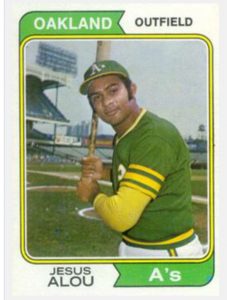 He helped the A’s over the Mets, but Alou would be forgiven. Before the 1975 baseball season was one week old, the Mets welcomed onto their roster Jesus Alou, most recently of the Oakland A’s. We saw him as an A in 1973, during the World Series we almost won, Alou having delivered a couple of key hits in the ALCS to help vault the Kelly Green, Wedding Gown White and Fort Knox Gold (Charlie Finley’s phrasing) into that Fall Classic. We’d seen Alou throughout his career in the National League, dating back to his debut on September 10, 1963, at the Polo Grounds, four days before Cleon himself broke in. Alous were not uncommon sights in the NL, as the Giants had corned the market on all three of them. Felipe had been up with San Francisco since 1958, Matty since 1960. If you became a baseball fan in the seasons that followed Jesus joining his brothers, you were acutely aware that in the sport you chose, there were inevitably three strikes, three outs and three Alous.
Once they were all ensconced within his realm, manager Alvin Dark couldn’t resist introducing them as a trio, pinch-hitting Jesus and Matty directly ahead of Felipe’s spot in the batting order in the eighth inning of their loss to the Mets — “it was like an old vaudeville telephone gag,” observed Harry Jupiter in the San Francisco Examiner — and later inserting each of them as one-third of his outfield for spells in three September blowout wins. This meant sitting Willie Mays, an act Giant skippers habitually resisted if a game’s outcome was in doubt. The last time Alou-Alou-Alou constituted the SF outfield was September 22, with the Mets visiting Candlestick and losing by eleven. Alou ended the game by catching Chico Fernandez’s fly to right.
To be specific, that was Jesus Alou, playing right, while Matty manned left and Felipe patrolled center. For a few weeks, you had to specify your Alous and their positions. In the ensuing offseason, Felipe would be traded to Milwaukee, and two winters later, Matty would be sent to Pittsburgh. Jesus, however, established himself as the Giants’ right fielder in 1964. According to the back of the 1967 Topps card where I made his acquaintance, “the San Francisco brass feels that Jesus has even more potential than his two brothers now in the majors,” though unlike Felipe (three times) and Matty (twice), Jesus never made an All-Star team. He did hit as high as .298 over a full season for the Giants, not bad for a) a converted pitcher and b) “the baby” of the family, which is how I saw him identified in an article when I was a kid and found it kind of curious that a grown man was referred to as a baby. I was also pretty taken by the youngest Alou’s first name. The first Jesus, any pronunciation, I ever knew of was Alou.
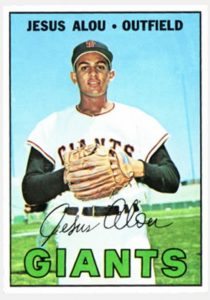 Baby Jesus? The Giants may have harbored all three Alous, but they also eventually let go of all three Alous. Jesus was exposed in the 1968 expansion draft and selected by Montreal. Montreal opted to include Jesus in a trade they had no idea would be the most consequential of 1969, the one that shipped Donn Clendenon to Houston for Rusty Staub. The consequence rippled from Clendenon’s refusal to go to Texas, which meant Donn was still hanging around in Quebec in June, perfect timing for the Mets to take off the Expos’ hands the veteran slugger who’d become their World Series MVP four months thereafter — and let us not overlook the foreshadowing inherent in mentioning Rusty Staub. None of that was of consequence to the youngest Alou, who would top .300 twice as an Astro and appeal to Oakland as a veteran pickup in 1973. Those A’s were always adding experience on the fly en route to crafting their surprisingly sturdy dynasty, chronically antsy owner Charlie Finley happy to make short-term deals and not have to pay anybody too much for too long. (Ex-Met Art Shamsky was a briefly a cog on the World Series-bound A’s of 1972.) Alou would play a pivotal role in ’73, stepping in to take over right field late in the season when Reggie Jackson encountered a hamstring injury and allowing Jackson to shift to center when Bill North got hurt shortly before the postseason. His contribution kept him with the A’s as they achieved their threepeat in 1974.
Come the spring of ’75, Jesus possessed two World Series rings but no guarantee he’d continue with the defending world champions despite hitting .586 against Cactus League pitching. Finley’s A’s relished speed in the form of pinch-running specialists. They already famously retained the services of Herb Washington, who literally did nothing but run for Oakland. They were now intent on adding the ultimately less-celebrated Don Hopkins to replicate Washington’s core competency. More speed off the bench meant less space for existing lumber. In other words, goodbye Jesus.
That amounted to a welcome development on the other side of the country, because the Mets had been keeping an eye on Alou. Bob Scheffing, who had been replaced as GM in the offseason, was scouting Arizona and believed in Jesus. Scheffing had a disciple in his successor as general manager, Joe McDonald, and Joe made Jesus an offer. Alou had thought about playing in Japan, where middle brother Matty had alighted with the intent of hitting for average and being compensated well for it, but this Dominican native decided he preferred playing ball in North America.
“We’ve made no promises,” McDonald said upon announcing the acquisition of Alou. “He knows he can be released again. We want him to pinch-hit.” Alou, in turn, was motivated: “I do not want to lose two jobs in a month-and-a-half. All I need is a batting practice or two, and I’m ready.” Jesus, the 32-year-old baby brother in baseball’s most famous troika of siblings since the DiMaggios, had been around, and didn’t require extensive preparation beyond knowing when the bus left for the ballpark. The veteran noted with pride to Daily News reporter Augie Borgi, “I have not missed a bus in seventeen years.”
Despite no Mets fan who diligently tracked Spring Training 1975 making out prospective rosters with the name “Alou” included, the career .279 hitter was suddenly one of ours as of the new season’s second series, in Pittsburgh, and he made his Met debut in the club’s seventh game, at St. Louis. He was a known quantity from a distance, if no more than a contingency ‘x’ factor plopped atop our meticulously considered personnel scheming and dreaming. Maybe we’d get a kick out of finally having an Alou on our side after taking on one or the other let alone all three at once for so long. As fans, we could make no promises, either.
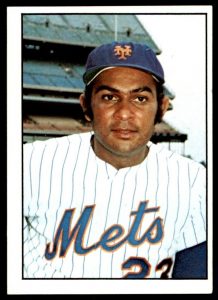 Pretty special as our pinch-hitting specialist. At some point, whatever thoughts McDonald might have maintained about Jesus’s tenuous grip on permanence dissolved. Ours, too. Alou, the first Met World Series opponent determined to make it up to us by joining our side, lasted the entire year and did exactly what the Mets signed him to do. They needed a pinch-hitter? They got someone who established himself as a true specialist. The righty came through time and again, going 14-for-40 for a .350 average as a pinch-hitter. With Ed Kranepool starting more than anticipated, Alou emerged as manager Yogi Berra’s primary pinch-hitter — Roy McMillan’s, too, once the first base coach replaced Berra. Not only did Alou outlast his first Met manager, he endured longer that season than Cleon Jones, who didn’t return from his springtime injury until late May, only to be released ignominiously in July. Alou’s solid ’75 in a niche capacity, not to mention amid a whirlwind of organizational turmoil, earned Jesus a Spring Training spot in 1976. Alas, a visa problem delayed his reporting to St. Petersburg (if only he could have hopped a bus from the DR) and the Grapefruit League success of another, younger pinch-hitting candidate — lefty Bruce Boisclair — resulted in the veteran’s release.
“Jesus is a nice fellow,” said new manager Joe Frazier, echoing what people throughout baseball thought of Alou, “But when [injured] Mike Vail comes back, we need the spot. We have kids with options. You can understand our position.” Alou had been around and got it. He pulled back from playing for a couple of years, but wasn’t done. Jesus returned to action with the Astros in 1978 and 1979. Baseball’s quintessential kid brother played until he was 37 and stayed in the game long after, most notably as Dominican Republic scouting director in this century for the Red Sox, to say nothing of his uncle-ing Mets reliever Mel Rojas (1997-1998), Mets outfielder Moises Alou (2007-2008) and Mets manager Luis Rojas (2020-2021). Jesus Alou, who died last week a little shy of his 81st birthday, lived a long and distinguished baseball life, a year of it as a Met, the entirety of it as one-third of an even more exclusive club.
Unless you were in the outfield for San Francisco on September 15, 17 or 22 of 1963. In that case, everybody you saw was just another Alou.
by Greg Prince on 12 March 2023 11:49 pm As we dim the lights and illuminate our memories, we ask you to direct your attention to the video board for a very special presentation as we unspool our annual montage saluting the Mets who have left us — in the baseball sense — since last Spring.
___
CARLOS JAVIER CORREA
Prospective Third Baseman
Pending Physical
Your team’s owner goes out and secures who he’s secured — let’s continue to pencil in Carlos Correa until notified something’s really wrong with his leg or his negotiations — to go with keeping who he’s kept and you owe it to yourself to look forward to Spring Training. You can’t buy a pennant, but you can certainly shop aggressively for one.
—December 27, 2022
(Reportedly signed with Mets, 12/21/2022; reportedly signed with Twins, 1/10/2023)
___
DEVEN SOMER MARRERO
Infielder
August 15, 2022 – September 10, 2022
A glimpse at the in-progress box score while fast-forwarding past commercials revealed a plot twist I hadn’t seen coming in Atlanta. Not the tally itself, now 13-1, but the participants. There was a catcher making his Met debut, Michael Perez. There was a shortstop making his Met debut, Deven Marrero. And, not altogether unpredictably yet still good for a WHA???, there was a pitcher making his Met debut, Darin Ruf. I missed the three up and three down Ruf recorded in the bottom of the seventh, which means I also missed the first instance of Perez (catching ball one) and Marrero (picking up a grounder en route to the second out) etching themselves into the annals as Mets No. 1,171 and 1,172, respectively. Ruf was already inscribed as Met No. 1,170 from his standard-issue hitting duties, but now he was the fifteenth position player in Mets history to pitch, marking the eighteenth instance in all of a Met position player toeing the rubber. Better Call Saul got paused.
—August 16, 2022
(Free agent, 10/9/2022; currently unsigned)
___
ALEXANDER “Alex” CLAUDIO
Relief Pitcher
September 7, 2022 – September 14, 2022
By the time he handed matters over to a cobweb-gathering Adam Ottavino and the fresh, violent left arm of Alex Claudio, the old wives’ tale of the Mets never scoring for Jake had gone upstairs to bed, at least for another five or six days. The Mets notched 17 hits, six of them doubles, none of them homers.
—September 8, 2022
(Free agent, 10/9/2022; signed with Brewers, 1/3/2023)
___
THOMAS MATHEW SZAPUCKI
Pitcher
June 30, 2021 – May 25, 2022
You couldn’t do much worse for Met pitching in any year than what the Mets got Wednesday from Peterson, Reid-Foley and, sad to say, Szapucki. Thomas neither pitched particularly well nor fielded his position with aplomb. The first Brave to score on the rookie’s watch came home when a potential rundown imploded because Szapucki didn’t think to pursue the dead-to-rights Dansby Swanson between third and home. That runner was inherited from Reid-Foley. The rest that scored between the time Szapucki escaped the fourth down, 11-2, and before succeeding pitcher Albert Almora, Jr. (you read that right) surrendered a three-run bomb to Ozzie Albies, which was posted to Thomas’s ledger. Luis Rojas had hoped to ride his spanking new southpaw clear to the end of the horror show. As a minor league starter, Szapucki was positioned to give the Mets length. But in the ninth, it was fair to infer he was feeling kinda seasick as the crowd called out for more.
—July 1, 2021
(Traded to Giants, 8/2/2022)
___
JOHNESHWY ALI FARGAS
Outfielder
May 17, 2021 – May 24, 2021
Did ya see how the bottom of the ninth between the Mets and Marlins began on Saturday? Jesus Aguilar lined a ball into the gap between center and right. It would take two kinds of Tommie Agee efforts to reel it in: the kind where Agee dove to rob Paul Blair and the kind where Agee hung on in his webbing to rob Elrod Hendricks. Those were two of the most stupendous catches in World Series history. Amid stakes admittedly a few hundred notches lower, Johneshwy Fargas incorporated the most breathtaking aspects of each to nab from Aguilar a leadoff double and, as Smith did minutes earlier, keep the score knotted at one. Running and diving and gaining proximity to the ball would have been impressive as hell. The ball ticking off the top of Johneshwy’s glove would have been reluctantly understandable. But, nope, Fargas was gonna have his scoop and lick it, too. As so-called ice cream cone catches go, this one melted in your mouth and made your eyes water with joy.
—May 22, 2021
(Released by Mets, 8/14/2022; currently unsigned)
___
YOLMER CARLOS SANCHEZ
Infielder
August 20, 2022 – August 25, 2022
It gets instinctively edgy in South Philadelphia when the ninth inning rolls around. The most elite of relievers wasn’t about to simply shoo away the dephlated Phillies. You could take all the precautions — gloveman Sanchez was in for Baty as the 183rd third baseman in Mets history — but you couldn’t avoid trouble. You just had to contain it.
—August 22, 2022
(Free agent, 10/11/2022; signed with Braves, 1/24/2023)
___
ROY EMILIO “R.J.” ALVAREZ
Relief Pitcher
August 16, 2022
Not R.A. Dickey and not Francisco Alvarez and not Robert Gsellman, though he kind of looked like him.
—January 29, 2023
(Free agent, 10/9/2022; currently unsigned)
___
ENDER DAVID INCIARTE
Outfielder
June 28, 2022 – July 13, 2022
As if Met defense could use the help — we’ll never turn down assistance — the club signed Ender Inciarte to a minor league contract. Inciarte now has a chance to become the Willie Harris of his day. Willie Harris, you’ll recall, took extra-base hits of all variety away from Met batters in the 2000s. Then he became a Met in 2011, not having the same impact for the Mets that he had against the Mets, but he was a pleasant enough veteran presence for a non-contending team. Inciarte used to rob us blind in the 2010s. Here’s Ender’s chance to make it up to us.
—June 20, 2022
(Free agent, 7/18/2022; currently unsigned)
___
YENNSY MANUEL DIAZ
Relief Pitcher
May 23, 2021 – September 13, 2021
Lugo sat for good after his one inning. Luis Rojas via Dave Jauss went to Yennsy Diaz to start the tenth of a 1-1 must-win game versus the Los Angeles Dodgers, with a runner automatically on second because that’s how Rob Manfred likes it. This Diaz hasn’t pitched enough in tight situations to make us nervous. This Diaz not having pitched all that much in tight situations is what made us nervous. No offense, Yennsy, but we know Seth Lugo. He’s not infallible, but we carry forth images of Six-Out Seth Lugo having gotten us through second innings with aplomb. We only knew in the tenth that Diaz wasn’t Lugo, and that it wouldn’t take much to score the Manfred on second. It didn’t.
—August 15, 2021
(Released, 08/08/2022; signed with Sultanes de Monterrey (Mexican League), 2/20/2023)
___
SAMUEL THOMAS HUNTER “Sam” CLAY
Relief Pitcher
August 20, 2022
Saturday brought three Met debuts […] with Clay joining R.J. Alvarez as a recent escapee from Met ghost status.
—August 21, 2022
(Free agent, 11/10/2022; signed with Diamondbacks, 12/12/2022)
___
MATTHEW WILLIAM “Matt” REYNOLDS
Infielder
May 27, 2016 – October 1, 2017
April 16, 2022
While we were deprived from December until March of major baseball doings, the Mets slipped minor league contracts to good old Matt Reynolds, the infielder who showed up to watch the 2015 postseason, then fill in quite a bit in 2016 and 2017 […] We love us some Recidivist Mets (the thus far 53 who’ve come, gone and come back, from Frank Lary in 1965 to Wilfredo Tovar last year), even if love, almost invariably, is less sweet the second time around.
—March 17, 2022
(Selected off waivers by Reds, 4/24/2022)
___
JORDAN MICHAEL MICHIRU YAMAMOTO
Pitcher
May 5, 2021 – May 23, 2021
Jordan Yamamoto (who seems like a really nice guy) had a rough second inning, featuring a couple of misplays he had a hand in, and five runs crossed the plate against him. He also has a sore shoulder. All of the above is enough to make a pitcher at least the No. 4 starter on the New York Mets this week. The Marlins let him go.
—May 23, 2021
(Free agent, 11/10/2022; signed with Dodgers, 1/24/2023)
___
ROBERT JOHN “Rob” ZASTRYZNY
Relief Pitcher
August 20, 2022
Zastryzny avoid[ed] ectoplasm as a 27th man, which may or may not be easier than navigating the heart of the Phillie order.
—August 21, 2022
(Selected off waivers by Angels, 8/25/2022)
___
TRAVIS ALLAN BLANKENHORN
Utilityman
June 2, 2021 – July 22, 2022
So many Smiths on this team. But only one Travis Blankenhorn, your roster replacement for Francisco Lindor. Batting in the top of the fourth for Smith — Drew — with two on, Travis, who’d almost hit one out on Saturday night, removed all doubt and hit one more than out on Sunday afternoon. It wasn’t just over the fence. It departed the entire PNC Park physical plant and flew into the Allegheny River. The breach of the initial barrier ensured a three-run homer, the first round-tripper of Blankenhorn’s career. Launching it so far that it departed dry land, well, that was just darn impressive. Most impressive was the Mets now trailed by two. Not six, not five, but two. If the Mets came back to win this game, which even Joe Namath wouldn’t have guaranteed, we’d have an anecdote to reference for the many times in our future when things would appear hopeless.
—July 19, 2022
(Free agent, 11/10/2022; signed with Nationals, 12/14/2022)
___
COLIN SCOTT HOLDERMAN
Relief Pitcher
May 15, 2022 – July 16, 2022
The only Met pitcher who escaped with a zero where it counted was the only Met pitcher we didn’t know would be in our sights when Sunday dawned. Colin Holderman, who planted himself on the organizational radar with a nifty Spring Training, replaced Tylor Megill on the roster when it was announced Megill was dealing with some right biceps inflammation, which is one of those maladies a fan repeats calmly while thinking, “WHAT?” […] Holderman held ’em in the top of the ninth.
—May 16, 2022
(Traded to Pirates, 7/22/2022)
___
ROBINSON JOSE CANO
Second Baseman
March 28, 2019 – April 29, 2022
Robinson Cano may yet escape the conversation he’s been assigned to since it became apparent the rest of the National League East wasn’t prioritizing the coming and getting of us. Because he has (deep breath) another four years on his contract, we don’t know for sure that Robbie is necessarily the stuff of Foy, Fregosi and the others who populate our cabal of eternal regret. On the other hand, he’s definitely, within the Mets Media Guide Page 394 context, of a caliber equal to Carter and Strawberry, Reyes and Beltran, Cespedes twice and Nieuwenhuis inexplicably. Y’know, Joe Foy once went 5-for-5 as a Met, driving in five runs and homering twice — the second time in the tenth inning — to beat the Giants at Candlestick Park. It doesn’t come up often when Foy’s name stirs in Met lore, but it did happen, just like that night Robinson Cano socked three home runs to crush the Padres.
—July 24, 2019
(Free agent, 5/8/2022; signed with Padres, 5/13/2022)
___
TRAVIS PAUL JANKOWSKI
Outfielder
April 7, 2022 – July 27, 2022
Travis Jankowski took over for Canha at first and took off when Jeff McNeil laced a pitch down the right-field line. Jankowski flew around second and steamed into the neighborhood of third, the precinct of the so far famously aggressive Joey Cora. Cora held him — which made me gasp in dismay, though the replay showed that to have been a good decision.
—April 26, 2022
(Free agent, 11/10/2022; signed with Rangers, 1/27/2023)
___
NATHAN CHARLES “Nate” FISHER
Relief Pitcher
August 21, 2022
If Fisher is returned to a farm club Upstate soon, it will be for roster crunch reasons only. We’ve seen how callup relievers who get used to what is considered excess are sent down the next day in favor of a fresher arm. Fisher was indeed used to an extent beyond what was probably projected. He pitched the fifth. He pitched the sixth before it was delayed by rain. He pitched the sixth after play resumed. He pitched the seventh. Nate Fisher not only ate innings and recorded outs, he permitted no runs in his major league debut. Oh, and he was out of baseball and working in the financial services industry not too long ago. (Shades of Todd Pratt managing a Domino’s between backup catching gigs.) Fortunately, the Mets made a wise Fisher investment when they signed the lefty in the offseason.
—August 22, 2022
(Free agent, 11/10/2022; signed with White Sox, 11/15/2022)
___
CHASEN DEAN SHREVE
Relief Pitcher
July 27, 2020 – September 27, 2020
April 10, 2022 – July 2, 2022
Carrasco gave way to Chasen Shreve, whose general effectiveness this season surely had a YA GOTTA BE SHREVE t-shirt on some clever entrepreneur’s drawing board. The garments went on backorder once Julio Rodriguez went deep (torpedoing the A-CHASEN METS iteration as well).
—May 16, 2022
(Released, 7/8/2022; signed with Yankees, 8/27/2022)
___
TYLER WESLEY NAQUIN
Outfielder
July 30, 2022 – October 5, 2022
Tyler Naquin is the first Met since Craig Paquette to have “qu” in the middle of his last name, the fourth overall. Jose Oquendo and Al Pedrique were the others. Tyler Naquin is better off with this nugget as his calling card rather than any of his statistics from down the stretch.
—December 29, 2022
(Free agent, 11/6/2022; signed with Brewers, 2/21/2023)
___
YOAN LOPEZ (Leyva)
Relief Pitcher
April 27, 2022 – August 6, 2022
Yoan Lopez came up and in on Nolan Arenado in the eighth inning of Wednesday afternoon’s almost incidental Mets loss to the Cardinals. Like what Shawn Estes threw in the greater geographic vicinity of Roger Clemens’s backside twenty years ago, Lopez’s pitch didn’t touch the batter he was facing. Unlike with Estes, Lopez’s pitch did what it was supposed to. It transmitted a message. We’ll see if anybody receives it.
—April 28, 2022
(Sold to Yomiuri Giants, 12/20/2022)
___
JACOB HUBERT “Jake” REED
Relief Pitcher
August 15, 2021 – July 7, 2022
We were halfway home after the lidlifter, a 3-1 success that felt in peril intermittently but never fell away. Trevor Williams upended my recently stated lack of faith by giving the Mets four shutout innings. Jake Reed walked a tightrope in the fifth, but somehow maintained a zero-laden toegrip. The Mets’ three runs, gathered in the second and third, held up. Nolan Arenado, villain from the Battle of Busch, was booed a lot. Yadier Molina was booed by me. I attempted to give him a “nice career, guy” round of applause as his retirement finally looms, but I still can’t stand him for 2006.
—May 18, 2022
(Selected off waivers by Dodgers, 7/13/2022)
___
MIGUEL ANGEL CASTRO
Relief Pitcher
September 2, 2020 – October 2, 2021
The bullpen always gets involved. When the bullpen gets involved, we get a little unhinged. Maybe more than a little. The bullpen is why 8-4 wasn’t fully convincing. Mind you, none among Miguel Castro in the seventh (3 hits, 1 run); Trevor May in the eighth (2 hits, no runs) and Jeurys Famila in the ninth (2 hits, 1 walk, 2 runs if only 1 earned) actually let the game slip into genuine danger. Perceptual danger, perhaps, which is enough agita for us at present. You can’t blame our collective psyche for sensing trauma when there’s barely trouble. Castro was a well being gone to two straight games — was it one game too many?
—April 7, 2021
(Traded to Yankees, 4/2/2022)
___
TERRANCE JAMAR GORE
Outfielder
September 1, 2022 – October 8, 2022
The Mets led, 5-3. They tried to add to it in the home eighth by pinch-hitting Vogelbach, who walked, then pinch-running latest Met and professional speedster Terrance Gore, who stole. Vogelbach and Gore could constitute a two-headed monster in this month of expanded rosters, though to size them up, they might be better described as Vogelbach-Plus.
—September 1, 2022
(Free agent, 11/10/2022; currently unsigned)
___
PATRICK ALAN MAZEIKA
Catcher
May 5, 2021 – July 31, 2022
[T]he bench was down to Mazeika and pitchers. Were he certifiably healthy, I would’ve opted for pinch-hitter Jacob deGrom. Mazeika had never had a major league hit, but he’d only made one major league out before. You never know if Patrick Mazeika can drive home a decisive run until you let him try. Luis let him try. Mazeika had himself a fierce AB. A couple of balls. A couple of foul balls. He would not go quietly. On the fifth pitch he saw from Crichton, he did one of the better things he could do. He put it in play and not directly at anybody. It went about, oh, maybe twenty feet, but Crichton’s attempt to field and throw it was about as successful as Lindor’s when McNeil got in Lindor’s way. The pitcher’s scoop to his catcher was off-target and Alonso, who isn’t much of a runner, scampered home. Pete’s a swell scamperer. For a moment, it was pure shirt-ripping joy at Citi Field. It was Patrick Mazeika, who was promoted twice last season, only to be sent back down without as much as a Hietpas helping of action, bare-chested and jubilant. He was an alternate site All-Star, a taxi squad sitter, an almost chimeric figure in hipsterish glasses and substantial beard. Now he was a walkoff RBI hero, same as Cabrera in 2016 in the heat of the last successful Met playoff push (“OUTTA HERE! OUTTA HERE!”); same as Shane Spencer in 2004 (who beat the Yankees on a similarly slight base hit); same as Esix Snead in 2002 (who also chose a game-ending swing — a homer — to record his first major league run batted in); same as Todd Pratt in the clinching game of the 1999 NLDS (the backup catcher protagonist the last time the Mets beat the Diamondbacks in ten innings at home).
—May 8, 2021
(Selected off waivers by Giants, 8/21/2022)
___
ADONIS MEDINA (Del Rosario)
Relief Pitcher
April 23, 2022 – September 3, 2022
Now Adonis had to deal with a runner ninety feet from tying things again, with the daunting task of Trea Turner awaiting him. Seriously, how do the Dodgers ever lose? This way: Nido’s mitt makes contact with Turner’s bat, resulting in catchers’ interference, which Dave Roberts argues for when it’s not immediately called. It peskily places the potential winning run on first, but also takes the bat out of Trea’s hands, which is the one place the Mets didn’t want to see it anyway. Turner takes off for second. Nobody minds that Nido doesn’t throw through. The task at hand is getting out Smith, he who homered to begin the eighth. Is it only the tenth? It feels like this game and this series have both been going on for a week or more. Maybe it’s the time difference. Medina didn’t check his watch. He listened for his PitchCom signal from his catcher — how modern — and brought his sinker to bear on one-and-two, striking out Smith. That made it three outs and the save of a 5-4 win that was always in grasp yet loomed as elusive.
—June 6, 2022
(Free agent, 11/10/2022; signed with Brewers, 12/5/2022)
___
MYCHAL ANTONIO GIVENS
Relief Pitcher
August 3, 2022 – October 9, 2022
A little prior to six o’clock, there was a ceremonial first pitch. A bit closer to six o’clock, there was a second ceremonial first pitch. And with six o’clock fast approaching, there was a third ceremonial first pitch. Since they were all ceremonial, we’ll let their eerily similar numerical designations slide. The fourth first pitch was delivered by Mychal Givens, who’d been gone so long, Buck Showalter apparently forgot that Givens is a reliever rather than a starter. Or, more likely, the skipper figured an inning as an opener was good practice for whatever Mychal might contribute in the days ahead now that he’s recovered from his secret IL ailment. The theme of Closing Day turned Closing Night seemed to be “why not?”
—October 6, 2022
(Free agent, 11/9/2022; signed with Orioles, 12/19/2022)
___
JAMES THOMAS McCANN
Catcher
April 5, 2021 – October 7, 2021
On the first pitch Diaz threw Blackmon, Story lit out for second. Cringing replaced confidence back in New York. Great, they have a runner in scoring position was my initial reaction, brewed with only the most natural ingredients of Rocky Mountain water, Moravian barley and Mets fan anxiety born of perennially porous defense. But what’s this in my mug? It’s James McCann — @McCannon33 to his tweeps — rising and throwing and gunning to second. And it’s Francisco Lindor, swiftly covering, catching and tagging. In a blink, Story is out and the game is over. A couple of extra blinks are required partly because replay review has to be fired up and partly because we are rubbing our eyes from a touch of disbelief. Yup, he’s out, and yup, we won a defensive struggle. We have a defensive lineup. We have gloves and players who know how to use them. And we finished off our Sunday on a play that rarely finishes off any Met day.
—April 19, 2021
(Traded to Orioles, 12/21/2022)
___
TREVOR JOSEPH MAY
Relief Pitcher
April 5, 2021 – October 9, 2022
Trevor May succeeded Lugo, resembling the May we heard so much about in his pre-Met incarnation (a little like Diaz the Mariner needing time to find a holistic comfort level in New York, perhaps). Trevor notched two Ks, then didn’t falter when Kyle Schwarber lifted a ball to center. It was caught by Brandon Nimmo, leaving the score Mets 1 Phillies 0. That’s also where Nola left it when he completed his eighth inning of almost spotless work. It occurred to me that if all went well, I’d just seen a complete game thrown by a pitcher on the losing side. We just needed all to go well.
—August 14, 2022
(Free agent, 11/6/2022; signed with A’s, 12/16/2022)
___
NICHOLAS RAYMOND “Nick” PLUMMER
Outfielder
April 15, 2022 – June 19, 2022
Despite Joe Girardi having aligned his Phillie defense into its victory formation, inserting Roman Quinn in center and moving starting center fielder Odubel Herrera to right to replace slugger and provisional star of the game Nick Castellanos, the Mets found their way into the proverbial end zone, leaning on heretofore unknown Nick Plummer to go deep. Plummer connected for his first major league hit and home run off Phillie closer Corey Knebel, as the leadoff blast, soaring decisively inside the right field foul pole and landing on the soft drink-sponsored porch, dramatically tied the back-and-forth Sunday night affair at four apiece. The proverbial whole new ballgame headed for extra innings once Knebel escaped further damage.
—May 30, 2022
(Free agent, 11/10/2022; signed with Reds, 2/4/2023)
___
JOELY RODRIGUEZ (Sanchez)
Relief Pitcher
April 9, 2022 – October 5, 2022
Joely had his moment, his biggest as a Met, even bigger than his contribution to the combined no-hitter, which was fun as hell, but not essential. Sustaining the Mets’ 5-2 lead between deGrom’s departure and the sounding of Edwin Diaz’s trumpets was critical. Not as critical as most everybody is toward Rodriguez’s continued endurance as a 2022 Met, but almost as critical. What happened? Only good. Rodriguez ended the sixth with a groundout of Olson, a lefty taking care of a lefty. If that was it for Joely’s day, even Ice Cube would say Sunday was a good day. But Buck kept leaning on Rodriguez. Austin Riley’s leadoff single to start the seventh could have been a bad sign, but data from the next six batters indicate it represented a false positive. Joely got pinch-hitter Acuña to fly out. Then he struck out William Contreras and Robbie Grossman. In the eighth, the lefty remained on. Ozuna swung to no avail at Rodriguez’s changeups. Same for personification of a kick in the shins Michael Harris. Adrianza made contact, but only to ground to Luis Guillorme at third. That’s two-and-a-third innings of scoreless relief from Joely Rodriguez, or the bullpen equivalent of Jacob deGrom going nine or Rob Gardner going fifteen. It was the middle relief stint of the year. It probably buys Rodriguez at least 24 hours of goodwill before the sight of him warming in the pen reflexively gives everybody hives.
—August 8, 2022
(Free agent, 11/6/2022; signed with Red Sox, 11/23/2022)
___
CHRISTOPHER MICHAEL “Chris” BASSITT
Starting Pitcher
April 9, 2022 – October 9, 2022
Do you savor sound starting pitching? How could you not embrace Chris Bassitt’s eight frames of zeroes? Appreciate redemption stories? You got Bassitt shaking off the recent uncharacteristic difficulties that had dogged him for a few starts. A fan of personal growth, are you? Bassitt explained after the game that he had failed to connect with his catchers, so he spent the prior week really getting to know Tomás Nido. Their newfound simpatico was apparent in the bottom line: no runs, three hits, one walk and a locked-in Chris. I’ve noticed Bassitt bounces off the mound after every strikeout or perceived third strike, whether it’s called or not. Like every time. I get the idea that Bassitt, even for a starting pitcher, likes his routine the way he likes his routine. Not everybody can be a Flexible Fred if he’s gonna be his best. Remember how Max Scherzer zoned in on his warmup process to such an extent that he left a Japanese diplomat standing off to the side of the mound, depriving the visitor of ceremonial first pitch honors? That’s starting pitchers for ya, sometimes. For Bassitt to take off his blinders and discern why everything wasn’t bouncing his way the way he himself bounces off the mound showed a pitcher getting the most out of his thoughts as well as his arm. Good for him. Good for Nido meeting him halfway or however much of the distance was necessary so they could constitute a team within a team. Mostly, good for us.
—June 15, 2022
(Free agent, 11/7/2022; signed with Blue Jays, 12/12/2022)
___
TREVOR ANTHONY WILLIAMS
Pitcher
August 12, 2021 – October 5, 2022
The Mets were up, 6-4, on Brandon’s bolt from the blue. We were definitely on the sunny side of the tight rope. Could eighth-inning specialist du nuit Trevor Williams keep us leaning toward life rather than the funeral pyre? Drew Smith was on the IL. Seth Lugo gave more than inning of himself in the last Subway Series thriller. Ottavino gave his all in the seventh. Holderman’s in Indianapolis. Williams? Why not? Eleven pitches. Three outs. Good call.
—July 30, 2022
(Free agent, 11/6/2022; signed with Nationals, 12/9/2022)
___
TAIJUAN EMMANUEL WALKER
Starting Pitcher
April 8, 2021 – October 4, 2022
No. 99, Taijuan Walker, pitched well. Less well than No. 45, Zack Wheeler, who used to work here. Less long than Walker wished. Tai went five. He could’ve gone six. Luis Rojas and the spreadsheets somebody sends him said he couldn’t. Bye Tai. Bye that additional inning of starting pitching that, by domino effect, might have prevented two bullpen runs and therefore made the ultimate difference. Or maybe Rojas, Jeremy Hefner and whoever presses “send” are right, and we just want to blame somebody. Walker finds a way to give up runs, too. This is the part where it must be noted that it didn’t really matter which Met pitched when because hardly any Met hit at critical junctures.
—September 18, 2021
(Free agent, 11/7/2022; signed with Phillies, 12/6/2022)
___
JONATHAN GREGORY “J.D.” DAVIS
Third Baseman-Left Fielder-Designated Hitter
March 30, 2019 – August 1, 2022
If it had to take nine pitches, so be it. And so it was. The ninth pitch. It was laced into the left field corner and it bounced over the orange line to signify ground-rule double, except somewhere between first and second, J.D.’s teammates were inhabited by the spirit of Todd Pratt c. 1999 and reduced Davis’s game-winning shot to a ground-rule single. But who cared about bookkeeping when the operative phrase there was “game-winning”? Indeed, Conforto scored the run that made the final tally Mets 4 Indians 3 and sent Davis immediately into the market for a new uniform top. I’m sure Michael, having had the shirt ripped jubilantly from his back two Fridays before, has some recommendations. Sometimes I get the feeling this is some other team we’re watching, specifically one whose highlights pervade MLB Network and associated digital platforms with its indefatigable nature and founts of talent. Since when do we have somebody like J.D. Davis and have him be ostensibly a supporting player?
—August 22, 2019
(Traded to Giants, 8/2/2022)
___
JACOB SETH LUGO
Pitcher
July 1, 2016 – October 9, 2022
Robinson may have inadvertently performed a public service by not beating out the double play, because had Mickey eyeballed a multitude of Metsies on the basepaths, he probably would have pinch-hit for Lugo. And honestly, what kind of idiot would do that with three outs to secure in the bottom of the ninth? Mickey, nobody’s fool too often in the course of a must-have game, let Seth bat for himself. It didn’t weigh too heavily on the course of events what our irreplaceable reliever might do in his first plate appearance of 2019, but it certainly crossed my mind that one fine evening in 2017, Seth Lugo hit a home run. Seth Lugo did not hit a home run at Coors Field on Wednesday afternoon, but he did line a very useful single into center field, scoring McNeil from first to increase the Mets’ lead to 7-4 and sprinkling the daily recommended amount of magic over this entire enterprise to make it feel as if destiny was not about to depart Denver without the Mets aboard its bus. C’mon, we need a little narrative in our life. We also needed three outs to have life. We had Seth Lugo and a three-run lead, so confidence wasn’t the problem it usually is.
—September 19, 2019
(Free agent, 11/6/2022; signed with Padres, 12/19/2022)
___
DOMINIC DAVID RENE “Dom” SMITH
First Baseman-Outfielder
August 11, 2017 – July 16, 2022
I’m not what you’d call religious, but I can be spiritual, and oh my god, after Dom Smith belted a three-run homer in the eleventh inning at Citi Field on Sunday, minutes after the Atlanta Braves had buried the New York Mets one final time in 2019, I saw the light.
—September 30, 2019
(Free agent, 11/18/2022; signed with Nationals, 1/3/2023)
***
And finally, for the Met who left us who merits more than a clip, a montage of his own…
___
JACOB ANTHONY deGROM
Starting Pitcher
May 15, 2014 – October 8, 2022
Gazed upon with Collector’s Cups half full, these are the days of Jacob deGrom and Rafael Montero, which produced two days of good sidebar news in a pair of senses. One, of course, is that two reasonably highly touted rookie pitchers were promoted and matched their hype, at least on an introductory basis. DeGrom exceeded it, actually, doing everything he could to win his debut. Not only did he throw seven innings and give up but one run — the product of shaky defense, mostly — but the kid ended the notorious hitless-by-pitchers streak at last. Jacob singled in the third and somewhere, I’d like to believe, Tom Seaver stood on first base snapping his warmup jacket shut as he looked to Eddie Yost to see if the hit-and-run was on. DeGrom also laid down a beautiful bunt, proving the young man was born under the sign of Chub Feeney…or at least the former National League president’s signature on a Spalding baseball.
—May 16, 2014
Summer and Jacob deGrom’s first big league win each arrived in good stead on Saturday. Summer, as the artificial-lemonade commercials used to tell us, is only here a short while. DeGrom, one hopes, will stick around so long that the length of his career will rival the length of his locks. Paradoxically, time of game for Jacob deGrom’s entry into the legion of Winning Pitchers was 2:38, much quicker than baseball usually takes in this century. That means one of the shortest games of the season occurred on the longest day of the year. Though we can all agree the crediting of individual wins isn’t the definitive metric by which to measure a pitcher’s effectiveness, a win is a win is a win. A win lasts forever. When young Jacob accepted a stream of congratulations from his teammates after the decision he’d been waiting his entire life went final, it wasn’t for improving his FIP.
—June 22, 2014
By the top of the ninth Sunday, while Pedro, Craig Biggio, John Smoltz and Randy Johnson ere soaking in their well-deserved adulation, I was decidedly going less than wild for what was becoming of a 2-0 Mets lead. It had been, to that moment, a beautiful day, the kind of day you tell people about down the road, that day Jacob deGrom not only outpitched his fellow All-Star Zack Greinke but personally drove in the run that halted Greinke’s consecutive scoreless innings streak. Usually “scoreless” and the Mets go hand-in-hand, but not like that. If you wanted a fastball that could cut glass…“y’know, razor sharp,” as Mark Wahlberg as Eddie Adams turning into Dirk Diggler would’ve put it…Jacob deGrom was your man. He was so bright and so sharp and so powerful for seven-and-two-thirds innings. Greinke was mostly Greinke, but that didn’t mean so much when we had deGrom, even if deGrom wasn’t permitted to display quite the extraordinary length that made Dirk Diggler famous in Boogie Nights. Jacob came out after his 113th pitch, following a performance that encompassed eight strikeouts, no runs, two hits and two walks.
—July 27, 2015
On the list of obstacles starter and winner Jacob deGrom needed to overcome, the Phillie offense placed fourth, behind 1) wanting to be on hand to accept the impending delivery of his first child, lest UPS leave it with a neighbor; 2) a lat muscle that tightened up after six innings of five-hit, no-walk, six-strikeout ball, but was described as not serious because slight Met aches are never anything to worry about, no siree, Bob; and 3) arctic conditions that made the 48 on Jake’s jersey an aspirational figure, once you factored in the wind chill. The Phillies, by comparison, were something you could confidently leave in the baby’s crib and not worry that any harm would come. They are, at this stage of their development, child’s play.
—April 9, 2016
When he signed with the Braves, Dickey could have entered nuisance territory, but New York and Atlanta have avoided reigniting their ancient rivalry. I’d reckon if a Mets fan had to grudgingly allow any ex-Met to prevail over the current Mets (give or take a Bartolo Colon), it would be R.A. Dickey. That is unless Dickey had the ill-timed fortune of facing Jacob deGrom, once considered an ace among aces, now indisputably the only ace in town. Jacob’s in his fourth season, and has rarely been any less than the second-best pitcher the Mets are packing. This year he’s been the best from start to almost finish. Rumors to the contrary, there is no Noah Syndergaard — he who is ours because Dickey was sent to Canada — on the active roster. Harvey wears a jersey with his last name on the back, but is otherwise unrecognizable from his brightest Dark Knight days. Nobody else answering to the description of ace, actual or potential, lurks within what can be referred to loosely as the Mets rotation. No Steven Matz. No Zack Wheeler. No, it’s just Jacob deGrom, and on Saturday night, it was Jacob deGrom going for his 15th win. Sorry, R.A. Our heart necessarily belonged to Jake. As did the ballgame, an easy win for the pitcher who came to the Mets with little fanfare and delivered big results. That description would apply to R.A. in his time, too, but that time was a while ago. There’s so little contemporary for Mets fans to get jazzed for. We had to be jazzed for Jacob going seven, giving up only one run and cruising to a 7-3 victory. Against a more randomly slotted Mets starter, we might have looked the other way and permitted ourselves a round of applause for Robert Allen had he shut down the 2017 Mets as he so often shut down the Mets’ 2012 opponents. But deGrom isn’t random. DeGrom is our reigning righthander of record.
—September 17, 2017
When a season of overall disappointment winds down, we Mets fans who seek out nights like Jacob deGrom’s final start can’t say what the next season will bring for the team, but we can isolate what has been most special about the season somehow still in progress, expressing our appreciation forcefully and reveling in it jubilantly. No question we’d go last night. No wonder we stood and applauded as long as we could. No wonder we remained giddy as we departed, arrival of that anticipated rain be damned. As with Jake getting batters out, it’s just what we do, it’s just how we are.
—September 27, 2018
Contrary to published reports, Frank Sinatra does not have a cold. He’s never been healthier. To clarify, I don’t mean the Frank Sinatra, but the closest thing contemporary baseball has to him. This iteration of Sinatra, whose right arm almost never delivers a false note, takes his particular stage every fifth day. Or night. Night and day, he is the one. The range. The phrasing. The elegance. The ability to make every number, from 48 to 1.70, his. You want more numbers to support this assertion that Jacob deGrom pitches like Frank Sinatra sang? Try a career-high 14 strikeouts in seven innings versus the Marlins on Wednesday night following 10 in six innings the last time he performed. Try 13 scoreless innings in these two starts (both victories) as an apropos encore to the way he ended his 2018 tour. Try 26 consecutive quality starts, tying a major league record that previously belonged solely to a legend named Bob Gibson. Try a 1.55 ERA over those 26 outings. Try 237 strikeouts in 185⅔ innings during this span, versus 34 walks. Try a 1.55 ERA from May 18, 2018, through April 3, 2019. It’s been a very good year. Every number is Jacob deGrom’s, and music would be nowhere without mathematics, but how about just sitting back and soaking him in? An evening with Jacob deGrom might as well be a night on the town with Frank Sinatra and friends providing the soundtrack. Tony Bennett, Mel Tormé, Sarah Vaughan…Jake is a pitcher straight out of the Great American Songbook.
—April 4, 2019
We watched Jacob dominate the Dodgers in the Mets’ first postseason game in nine years in 2015 and, four games later, we watched him persevere with lesser stuff and keep his and our team alive so they and we could win that Division Series and progress toward a World Series. We’ve seen Jacob deGrom regularly pitch brilliantly without support, suck up a plethora of undeserved NDs and Ls, and pitch brilliantly some more. We’ve seen him brandish every tool we associate with the most talented of position players. Jacob can, within reason, hit; hit with power; run; field; and, oh yes, he can throw. Four-seamers, sliders, changeups…he throws them all and he throws them to the dandiest of effect. Among the cohort of Met pitching prospects in which we used to lump him when we thought to lump him at all, he’s either outlasted or outclassed every one of his contemporaries. At the risk of once again incurring the wrath of the evil eye (kinehora!), he may be the first Met pitcher since Seaver neither encumbered nor defined by discernible flaws. We’re not swearing he’ll be spectacular, superb and scintillating without pause for the rest of his career. But we will testify that he’s been pretty much all that the entire time we’ve seen him in the 2010s. Jacob deGrom may have filtered into our consciousness through nothing more auspicious than a side entrance, but he’s where we start when we think about the Mets these days, and he’s where we finish when we think about the Mets in this decade.
—December 24, 2019
On August 28, 2015, in a game between the Mets and Red Sox at Citi Field, Mets ace Matt Harvey allowed only two hits over six innings, but Red Sox catcher Blake Swihart (2-for-4) ultimately upstaged his brilliance with an inside-the-park home run off reliever Carlos Torres. The ball actually left the park, but was mysteriously ruled to have done otherwise. Either way, the Mets wound up losing a game it felt like they should have won. On July 29, 2020, in a game between the Mets and Red Sox at Citi Field, Mets ace Jacob deGrom allowed only three hits over six innings, but Red Sox catcher Christian Vazquez ultimately upstaged his brilliance with a home run off reliever Seth Lugo. The ball was definitely out of the park, but earlier, deGrom had Mitch Moreland struck out, yet his pitch was mysteriously ruled a ball, and after that at-bat continued, Moreland snapped deGrom’s long-running scoreless streak. Either way, the Mets wound up losing a game it felt like they should have won. On too many nights to mention, deGrom deserved better than a no-decision in a game the Mets went on to lose. On July 29, 2020, deGrom deserved better than a no-decision, and the Mets went on to lose.
—July 30, 2020
The Nats came to bat 29 times at Citi Field against deGrom. They collected two hits, didn’t otherwise reach base, struck out fifteen times and never scored. Come to think of it, they were overmatched as well by deGrom the hitter. Jacob went 2-for-4 at the plate; broke a scoreless tie by driving in the only run he’d need; and scored two others, presumably to keep his legs limber. DeGrom the .545-average hitter — wisely slotted in the eight-hole Friday — is a delicious side dish: a testament to a competitor’s determination to be skilled at all facets of his craft and a counterpoint to all the folderol about the desirability of the DH on a team that lately has more bats than gloves. But that, like Brandon Nimmo’s oh-by-the-way homer and four-RBI night, was served up merely to complement the 6-0 Mets win. The main course consisted of Jacob deGrom the 0.31-ERA pitcher throwing what appeared to be the most effortless 15-strikeout shutout in human history. No doubt he invested effort in his outing. There’s preparation of a physical and mental nature. There’s work in the bullpen. There’s data from the analytics department. There are discussions with catchers and coaches. There is an inherent degree of exertion that comes with releasing from one’s right hand 109 pitches — 84 of them strikes — across nine innings. Yet he makes it look so damn easy.
—April 24, 2021
Eating at our seats whatever we could grab from the shortest available line outprioritized missing any bit of the starting pitcher warming up to Lynyrd Skynyrd. The starting pitcher. He came with the price of admission. He’s always worth it. He’s worth balancing a Cubano and a fistful of napkins on your lap. Jacob deGrom faced his first batter and did not strike him out. That made the first batter an anomaly, because after Oneil Cruz doubled to lead off the game, deGrom struck out essentially every Pirate in creation. Ryan Reynolds. Rodolfo Castro. Rennie Stennett. Cal Mitchell. Ke’Bryan Hayes. Arky Vaughan. Zack Collins. Sammy Khalifa. Jason Delay. Jason Thompson. Jack Suwinski. Mike Easler. Greg Allen. Lloyd Waner. Paul Waner. John Wehner. It was one big blur of black and gold and K. From one on and nobody out to begin the first through the end of the top of the fifth, Jacob deGrom faced fifteen Pirates and struck out thirteen of them. He and Tomás Nido were having themselves a fine game of catch. It was our privilege to bask in the breeze Jake instigated.
—September 19, 2022
The opt-out is out there. Jake’s been the greatest pitcher in the world for a long time while wearing No. 48, but this offseason he’ll be looking out for No. 1, and I don’t mean Jeff McNeil. The balance between never wanting to see Jake in any uniform but the Mets variety and figuring out his future value past his current age of 34 (he’s older now than David Wright was in the 2015 postseason, and David Wright in the 2015 postseason seemed positively venerable) is a balance to be struck when there’s no more Mets baseball to be played in 2022. At least a few innings remained when Jake exited after six in Game Two.
—October 9, 2022
Emotionally, which is where fandom comes in, I know I would cringe hard at Jacob deGrom buttoning another jersey over his shirt and tie and announcing that, though he’ll always cherish the memories he has as a Met, he and his family are grateful for this opportunity with this new team in this new city and he can’t wait to get out there and pitch for these great fans. It’s as likely to happen that way as it’s not.
—February 17, 2019
(Jacob deGrom filed for free agency on November 7, 2022; he signed with the Texas Rangers on December 2, 2022.)
by Greg Prince on 7 March 2023 2:52 pm I was looking forward to watching Jose Quintana pitch early this season, much as I looked forward to watching Shaun Marcum pitch early in 2013 and Carlos Carrasco pitch early in 2021, to name two offseason pickups who were waylaid en route to their Met debuts by Spring Training injuries. Quintana has a small stress fracture on his fifth rib on his left side. That means we’re naming a third offseason pickup waylaid en route to his Met debut by a Spring Training injury. What Quintana doesn’t have is a timetable to return. Marcum didn’t appear until late April of ’13, Carrasco not before July of ’21 was almost over.
Rotation depth in the person of David Peterson, Tylor Megill or whoever cares to step up just became more vital in 2023, just as it did when the Mets had to wait on Carrasco two years back and Marcum a whole decade ago. I really looked forward to Carrasco. I may be stretching it to say I looked forward to Marcum, because I don’t honestly recall being overly anticipant in advance of his debut, but I didn’t want him to be delayed in making the team, either. You get a new pitcher, you want to see his business arm in action.
Quintana carries another layer of appeal beyond what an experienced lefty coming off a fairly splendid season somewhere else might bring to a rotation: Jose is poised to become the latest member of a tribe we can call lost. In fact, I did refer to it as lost, as in Lost Boys Found, a Mets subgroup rounded up in this space at this time of year in 2010. The occasion for the virtual reunion then was the quasi-homecoming of Jason Bay, nominated as the avatar of the LBF crew. Lost Boys Found meant major league players who had up through the ranks in the Mets minors but had to leave the organization to first make the bigs. The cohort that was about to encompass Bay already counted among its prodigal veterans the likes of Jerry Morales, Endy Chavez, Angel Pagan and Nelson Figueroa at the top end, and…some other guys, let’s say. Let’s also say that if Jason Bay had lived up to his previous MLB notices upon becoming a Met, Jason Bay would have led the LBFs into Met lore. Instead, I think we’re good counting Bay as one among some other guys.
His small stress-fractured fifth rib willing, Jose will have his chance to live out every erstwhile Met farmhand’s dream and become a certified Met before long. That was presumably Jose’s aspiration when he signed with us as a youngster from Colombia at 17. The kid pitched in three games for the Mets’ entry in the Venezuelan Summer League in 2006. I was too busy watching Endy Chavez and the 2006 Mets to learn he had debuted, and too busy watching Endy Chavez and the 2007 Mets to notice he was released. There was a suspension in between, stemming, he explained a half-dozen years later, from “sports medicine” he was taking to aid a back injury. Whatever it was he’d ingested as a youngster from another continent, it was against minor league rules, and by 2008, Quintana was in the Yankees’ system. He’d make the majors with the White Sox in 2012, the All-Stars in 2016, and contribute to two postseason runs with the Cubs in 2017 and the Cardinals in 2022.
Seventeen years since he was a seventeen-year-old, he’s a Met. That’s a lot of wandering for a Lost Boy to do until he could be found. May the small stress fracture (small when it’s in somebody else’s rib) amount to a mere grain amid the sands of time where Quintana and the Mets are concerned. He and we have waited this long for him to be a Met. We can wait a little longer.
And as was no doubt uttered in some form or fashion in the springs when Marcum and Carrasco had to wait a little longer, next man up!
by Greg Prince on 21 February 2023 7:37 am PORT ST. LUCIE, Fla. (FAF) — The mind of veteran blogger Greg Prince reported to New York Mets camp Monday to prepare for its nineteenth season of observation, reflection and regular blogging output. It showed up just in time to meet the deadline for position players to check in at the East Coast complex that has been the site of Mets Spring Training since 1988.
“Yeah, I guess I took a while,” Greg’s mind told the assembled media gathered around the Mets dugout at Clover Park, where Greg’s mind clearly warmed to the idea of addressing a small crowd. “Maybe it just takes me longer to get going than it did when Greg first got into the game. Maybe I was perfectly content to let winter run its course for all it was worth. The weather hasn’t been too bad in New York, you know. Or maybe I’m the only one who won’t claim to be in the ‘best shape of my life’ this Spring.”
Greg’s mind, which rarely fails to amuse itself, began blogging on February 16, 2005, eighteen years ago last week. The anniversary is usually an occasion for commemoration on Faith and Fear in Flushing, where Greg’s mind is generally set well ahead of reporting date, but the milestone went unremarked upon this month.
“How about that?” Greg’s mind mused. “I can’t say I didn’t think about it, and I really did try to get Greg to write something about it, but, I don’t know…” With that, Greg’s mind trailed off.
In line with the enthusiasm evinced by the Mets players when they arrived at Spring Training, Greg’s mind said it, too, is raring to go (“I wouldn’t know how to process a Mets season if I wasn’t writing about it several times a week”) and definitely likes the club’s chances in 2023, even if the mind isn’t necessarily subscribing to the ‘World Series or Bust’ rhetoric that has attached itself to the team.
“Frankly, I don’t know what the hell that means,” Greg’s mind said, as it drifted toward a state of mild agitation. “Bust? Was last year a bust? No World Series, but a pretty fun year. I’m still residually bummed it didn’t go as far as we all thought and hoped it might, but that’s fandom. I still think about 2006 and 1999 and those types of near-miss years fondly even if my meandering middle-of-the-night reminiscences are inevitably tinged with regret. Yet we move on. If we can’t have fun without winning the World Series, why have we been looking forward to new seasons every year despite not winning a World Series in an eternity? So it’s not like I’m going to think eight months from now if we still haven’t won, ‘that was a bust.’
“Unless it really is a total bust. I’ve lost sleep to a few of those, too.”
The Mets haven’t won the World Series since 1986, and have only two such titles in their history, though that’s hardly news to Greg’s mind, which has been working out its historical muscles all offseason despite producing only sporadic content for Faith and Fear readers since the 2022 campaign ended with a National League Wild Card Series loss to the Padres. “I’m always training,” Greg’s mind explained. “Spring is just another time of the year for it. I’m diving into newspapers.com, going down stahead.com rabbit holes, just wandering — but wandering with a purpose.” What that purpose is, Greg’s mind admitted, isn’t always clear.
“I got excited by a game from 1974 just before reporting to camp,” Greg’s mind revealed. “I’m not going to tell you which one or put it in context right now, but that sort of thing happens regularly.” Asked why Greg doesn’t just write about a game that interests his mind as soon as Greg’s mind decides it’s a worthwhile subject, Greg’s mind insisted it’s not that simple: “I want to put it all together, not just think, ‘hey, look, it’s an old game,’ and to do that takes time. It takes focus and dedication.” Although the offseason provides plenty of opportunity unencumbered by the obligation to stay explicitly current, Greg’s mind said “a season in progress tends to focus a baseball fan’s mind, even a so-called baseball writer’s or historian’s mind.”
Nevertheless, Greg’s mind said it wouldn’t mind just following the muse of its research and ignoring whatever topic is fleetingly vexing the rest of “Metsopotamia” — Greg’s mind’s occasionally invoked term of art for the critical mass and culture of Mets fandom, or what most others are satisfied to reflexively label Mets Nation.
“Of course,” Greg’s mind chuckled, “then we’d have 2020 once more, and I don’t believe any of us really wants to be Burgess Meredith with ‘time enough at last’ due to a pandemic or worse.” The reference is from a Twilight Zone episode in which a put-upon man is left with his beloved books after a nuclear holocaust, the sort of allusion Greg’s mind favors and is willing to gamble doesn’t require a surfeit of elaboration.
Greg’s mind kept busy through the winter months thinking not only about the Mets but the other local sports teams he supports. “The Giants made the playoffs, that was nice,” Greg’s mind remembered. “Their one postseason win, over the Vikings, was while Greg was at a Nets game, but that actually made for a delightful cross-pollination of rooting interests, everybody at Barclays Center cheering when the Nets — who were winning at that moment — posted the final score from Minnesota. I don’t know if Citi Field will have an opportunity to do that for the Nets come the NBA playoffs” The Nets, Greg’s mind sighed, “are being the Nets again,” plagued by existential questions despite maintaining a competitive record. “I think about them quite a bit when I’m not thinking about the Mets. But I usually keep the Nets to myself.”
 Cross-pollination of rooting interests in evidence (baseball fandom implicit). The trades of Kyrie Irving and Kevin Durant constituted Greg’s mind’s favorite offseason food: the kind that’s for thought. “I know everybody thinks the ‘superteam’ bit was a total bust, to use that word, because there was no championship,” Greg’s mind said, “but although that was the goal, and the goal wasn’t reached, how could you not be absorbed by those interludes when everything seemed to be jelling? I still love that they went to a seventh game in the playoffs in 2021, the way I still love that the Mets went to a seventh game in 2006, regardless of the outcome that continues to eat at me. But maybe I’m just a different kind of mind that way.” Surprisingly, Greg’s mind also allowed it might have been more “satisfied” by what it got from Durant’s abbreviated tenure as a Net than Jacob deGrom’s nine seasons as a Met.
“Durant and deGrom were two of the best players I ever sat up and dwelled the night away over,” Greg’s mind said. “Durant’s biggest moment was tying Game Seven as time expired, his shoe being the only thing bigger than the shot when it barely touched the three-point line and they couldn’t beat Milwaukee in overtime. All due respect to what he meant in winning a pennant in 2015, DeGrom was at his most brilliant in 2018, 2019, when there were comparatively lower stakes for the Mets. Jacob elevated us, but he was all alone out there. Only last year did the team surrounding him begin to feel ‘super,’ and he wasn’t around for most of it. I’m missing them both from my immediate thoughts in particular ways, but I try not to say that out loud, at least not loud enough for KD to conceivably hear me in Phoenix or Jake wherever he is in Arizona en route to his perceived paradise in Arlington. Technically, I’m still mad at them for not wanting to be on my team anymore.”
Greg’s mind said it felt deGrom’s departure most deeply when the Mets released an online hype video, the kind that annually featured the presence of the two-time Cy Young winner as a primary come-on for potential ticket-buyers. “I’m still getting used to thinking in terms of Verlander and, yes, Scherzer as ‘my’ guys,” Greg’s mind acknowledged. “DeGrom had become my guy in the Gooden or Seaver sense, which is as much as I can give to a player. Now that’s over.”
Five weeks of familiarity honed by dispatches and footage from Florida should help develop an affinity within Greg’s mind for the Mets’ remodeled high-profile pitching rotation that also includes newcomers Kodai Senga and Jose Quintana, “no matter how endless taking seriously games that don’t count is going to start to feel in a few days,” Greg’s mind projected.
Ultimately, Greg’s mind assured the media, it always comes back to the Mets and baseball, even if Greg appears less than thoroughly engaged by the familiar routines of Spring Training. “Listen, I don’t take the concept of annual renewal lightly,” Greg’s mind said as it veered to the philosophical. “I get what this time of year means in the grand sweep of baseball. I’m not immune to it. It’s just that, geez, how excited is a person’s mind supposed to get over who might be the additional backup infielder or eighth arm in the bullpen, especially when you know how rosters churn? I like the clips from camp of players ambling in from the parking lot. I like the surge of adrenaline I get from the introductions to the first exhibition games broadcast or televised. I like the first look at the new guys in our uniform. But then, if I’m being honest, I’d like to get back to some game in 1974 or whenever, at least until Opening Day. I just have to focus myself, dedicate myself, stay within myself…or maybe step outside myself for a change.”
Nineteenth year or not, Greg’s mind added, “It’s good to be in Spring Training. I won’t say ‘this never gets old,’ because that implies ‘old’ is something to avoid. Old is a blend of experience, expectation and exceptions to what you’ve seen before or think you’ll see next. Every Spring is kind of the same and every Spring is absolutely different. I wouldn’t be reporting for a nineteenth Spring in a row if I didn’t absolutely feel that way.”
After dropping its Spring baggage, Greg’s mind planned on loosening up with a “brief concept post — you know, one of those things where instead of being direct and expository, you frame your points in a repurposed familiar format the reader isn’t automatically anticipating in the realm the reader suddenly encounters it. It’s theoretically entertaining and it doesn’t come off quite as self-important as an ‘I/me/my’ piece might, even if it really is thinly veiled first-person writing in a first-person written medium. When you’ve been doing this for eighteen years, you consciously or otherwise strive to thwart complacency when you can, both for the reader’s sake and the writer’s sake.”
Greg’s mind winked, “It’s an old blogger device, and I’m the mind of an old blogger.”
Greg’s mind requested anybody seeking a more traditional welcome to Spring Training check out the most recent episode of the National League Town podcast.
by Greg Prince on 16 February 2023 7:01 pm We look forward to the ballgame, though we would have done that without Tim McCarver’s help. Well, I shouldn’t speak for everybody. There’s a generation of Mets fans who were welcomed to Mets baseball by Tim McCarver the way I was welcomed to Mets baseball by Ralph Kiner, Bob Murphy and Lindsey Nelson on radio and television every single time there was Mets baseball. I don’t know that I would look forward to the ballgame as I do without those three having narrated my origin story. So OK, if you came to baseball and the Mets sometime between 1983 and 1998, there’s a very good chance you look forward to the ballgame in great part because the voice of Tim McCarver read off the list of participating sponsors on (W)WOR-TV or set the scene on SportsChannel.
If you had already matriculated as a student of Mets baseball prior to 1983, especially if your trio of instructors had been Kiner, Murphy and Nelson, you found yourself enrolled in grad school under Prof. McCarver. It was a whole new ballgame when Tim, accompanied by straight man Steve Zabriskie, showed up at Shea, sat next to Ralph, and started telling us what we were about to see. Never mind the sponsors. Here came the substance.
We look forward to the ballgame the way we look forward to the ballgame, and we consume baseball the way we consume baseball, I sincerely believe, because Tim McCarver made us look forward to the ballgame in a way no announcer before him did, and sixteen years of him guiding us through New York Mets games left us consuming baseball as we would forever more. He made us look for elements of a ballgame. He made us pay attention to every discipline: pitching, hitting, fielding, throwing, catching. He knew from catching. He’d been an All-Star receiver and the primary handler of a couple of first-ballot Hall of Famers in a career that spanned the end of the 1950s to the beginning of the 1980s. He surely knew his craft. But he knew so much more.
And he knew how to tell it and share it and bring us into the game, inviting us inside in a way that nobody who spoke to us to that point ever had. What was the meaning of a two-two count? Why was a middle infielder shading this way or that with a runner on first? Why, oh why, wasn’t the right fielder moving in if the batter wasn’t a power threat? McCarver’s trademark recurring criticism of Darryl Strawberry’s stubbornly deep defensive positioning notwithstanding, it occurs to me Darryl simply might have been showing his respect for an announcer who himself never came across as shallow.
Tim McCarver talked to us, and we listened. Tim McCarver talked to Ralph, and Ralph perked up. Ralph’s original on-air partnership with Bob and Lindsey was over by 1983. Nelson had moved on to San Francisco in 1979. Frank Cashen separated Murphy and Kiner like a teacher who didn’t want old pals sitting together in the back of the classroom. No more shifting hither and yon between audiences. One dedicated radio anchor, Murphy. One familiar voice tethered to TV, Kiner. Plus whoever happened to join them. In Ralph’s case, “whoever” didn’t work out well in 1982, his first season wholly detached from Bob. Ralph’s career, like the broadcasts in which he represented the vital tissue that connected past and present, needed a transfusion of future-facing blood.
Enter McCarver, the convivial, sophisticated retired player of recent vintage. Tim, quite clearly, adored Ralph. Ralph, quite clearly, took a shine to Tim. You could easily imagine them ordering a nightcap at their “libraries and museums” of choice during road trips. Steve, low-key amid two high-wattage personalities, played well off both of them. It was a booth on the rise ready to match the team it was about to have the pleasure of describing, and that we would have the privilege, as Mets fans, of experiencing — as if this was what Mets baseball was supposed to be all along.
Straw and Doc.
Mex and Kid.
Mookie and Lenny.
Knight and Hojo.
Wally and Teufel.
Ronnie and Bobby O.
Aggie and El Sid.
Jesse and Roger.
Davey and confidence.
Wins and more wins.
Ralph and Tim and Steve, with Bill Webb calling the shots.
Plus Murph and Thorne on the radio side.
It was the best of times. It was the best of sounds. On TV, especially when it was a Channel 9 night, it was baseball’s version of the Friars Club. A couple of all-time greats smoking cigars, holding court, spinning stories, laughing it up, and spreading the news that these Mets were the dominant team in this game. Kiner had us covered for the ’40s and ’50s and the Casey-Gil days and growing up in California before the war and his brushes with Hollywood glamour. McCarver’s insights stemmed from the ’60s in St. Louis, the ’70s in Philadelphia, coming of age in Memphis, keen eyes and wits suited for 1980s New York.
If we as fans tend to first-guess and analyze virtually everything before it happens, we learned that from Tim when Tim commenced doing that for our benefit…though Tim probably compiled a better guess-to-outcome ratio than the rest of us. If we as fans zero in on and articulate what was once widely considered little more than minutiae, we likely picked that up from Tim, too. (Viewers unquestioningly watched pitchers reach first base and don a jacket to protect their pitching arm from getting cold until Tim protested that, c’mon, it’s the middle of summer!) If we’re not shy about blending our view of life with our view of baseball, that’s also a Timmy trait that lives on. Staying on top of the action before Tim McCarver brought us Mets baseball meant knowing what the score was. Staying on top of the action after Tim McCarver brought us Mets baseball means heightened awareness of everything that touches this game we love and love to think about.
It’s Tim McCarver’s ballgame, and we’ve been reveling in it for forty years. Even with him now gone, we continue to look forward to the next game he’s brought us.
by Greg Prince on 11 February 2023 7:48 pm When Pitchers & Catchers™ report to Port St. Lucie, the pitchers will outnumber the catchers, as the pitchers outnumber everybody in camp and all players by craft. Each game begins with one man at every position and each position tends to remain manned by that same fellow from the first inning to the last — except for the one whose contingent dominates the earliest days of Spring. The very good Mets of 2022, theoretically featuring two of the greatest starting pitchers of the century; fortified by several contemporary standouts of the genre; and bolstered by talented arms in search of expanded utility, completed exactly zero games.
None from Scherzer.
None from deGrom.
None from Bassitt, Walker or Carrasco.
None from Peterson, Megill or Williams.
None out of the blue from Szapucki, Butto or Givens.
If we learned anything about Buck Showalter’s pitching philosophy, it’s that even in this era, when Sandy Alcantra throws six complete games and everybody faints that he didn’t fall apart, Buck’s not interested in shaking his starter’s hand between the mound and the dugout. The manager’s gonna take the ball from that pitcher’s hand or quietly pat his back on the bench long before such a camera-ready opportunity arises. You’d figure by accident there might have been one Met complete game last year. Then again, under detail-oriented Buck Showalter, nothing is accidental.
So although we will be dazzled by the combined presence of Max Scherzer and Justin Verlander, intrigued as hell by the arrival of Kodai Senga, assured by old pro Jose Quintana and comforted to recognize Carlos Carrasco (The Dean of the rotation, dating way back to the summer of 2021…unless you’re leaning on the longevity of projected sixth starter/2020 debuter David Peterson), we can’t take our eyes off the relief corps. The bullpen projects as our vital fluid. It will be vital and it will be fluid.
In 2022, while Buck was using 11 starting pitchers, he had warming up in the pen a nation of millions, for in modern baseball it takes a bullpen of millions to hold batters back. Perhaps because of the removal of the one-batter specialist from the list of approved tactics, we need not just a big pen, but a revolving door. Nobody’s coming in for just one batter unless there are two outs and that pitcher gets that batter and the manager has decided to change horses the next inning. Relief stints have grown longer. Relievers need rest. Thus spins the door.
Every year brings a whole new pen. The Mets will indeed welcome to camp all kinds of relievers who weren’t Mets last year.
• The fairly familiar, like decorated veteran David Robertson.
•The vaguely familiar, like erstwhile Marlins Jeff Brigham and Elieser Hernandez.
• The will-have-to-become familiar lest he be legally plucked, like Rule 5 pick Zach Greene.
• The perennial “big arms” still seeking to transform talent into a track record, like Long Island’s Own Stephen Ridings (LIOSR) and recent pickup Sam Coonrod.
• The inevitable lefty, like Brooks Raley.
• The equally inevitable post-surgery comeback candidate, like John Curtiss.
A few of the aforementioned are already part of a plan built on the totally familiar Edwin Diaz, Adam Ottavino and longest-serving Met reliever in sight Drew Smith (even if it often feels as if Smith has been getting recalled from Triple-A or coming off the IL every other fortnight since he was traded here for Lucas Duda) and might involve a stray starter, like Peterson, Megill, or a prospect who makes progress, like Bryce Montes de Oca, or a handy chap to have around, like Tommy Hunter or Stephen Nogosek. Some of these fellows we’ll come to trust. Others will make us shudder. At least two — Raley and Coonrod — I’ll have to convince myself to experience on baseball alone given the stances they’ve taken at previous postings. I just finished rooting through clenched teeth for Kyrie Irving to display his basketball brilliance on behalf of my basketball team’s potential advancement. Irving’s acumen made him almost worth it, but never quite. If Brooks Raley or Sam Coonrod have been referred to the Kyrie Irving of baseball, it hasn’t been because they’re among the best at their art form.
Not stashed somewhere inside the mystery box of chocolates that composes a bullpen ahead of Spring despite being mentioned periodically this winter is free agent Zack Britton. Britton’s had a splendid career, some of it with Buck Showalter. He’s proven he can pitch in New York. We understand implicitly that setup man money is no object to this ownership. What’s the obstacle?
Options. Britton doesn’t have any. informed sources report the Mets prefer the flexibility options allow. Dude throws a couple of innings that likely elbow him aside from pitching for a couple of days, that’s one less reliever at the ready. Solution? Option him! Send that dude down, bring this dude up. Rinse and repeat, as they say. You look at a bullpen that briefly sheltered as many one-game wonders as we had in 2022 — Nate Fisher, R.J. Alvarez, Sam Clay, Rob Zastryzny — and you can infer it wasn’t because of sudden rises and/or dips in faith and/or effectiveness. It was the cult of the fresh arm in action. Or maybe not in action, as recalled yet unused Connor Grey could attest sometimes happens. One absurdly early roster preview I read (you can call any of them a best guess in February) penciled in Nogosek less for his pretty decent ability or world-class mustache than the fact that he’s out of options. Like Rule 5 status, options can sometimes make decisions before a deliberative GM has finished weighing all possibilities.
***
Relievers have been designed to serve as fungible assets at any given moment. Occasionally, you’ll drop a veritable virtual penny and not bother to pick it up only to find out later it increased in value. Witness, as my friend Mike Steffanos of Mike’s Mets reminded readers recently, the Met stint of Darren O’Day. It wasn’t a long enough stint to be labeled a tenure: four games.
Four games can be plenty. In the 2015 National League Championship Series, four games provided enough time for the Mets to claim the pennant. In April of 2009, O’Day, a Rule 5 selection the previous winter, compiled three innings in four games, allowing three inherited runners to score but none that went on his account. Then he was placed on waivers in a dizzying episode of roster roulette. The Mets needed Nelson Figueroa to fill in for a spot start that would have otherwise been taken by Mike Pelfrey, who was dealing with a touch of right forearm tendonitis after he ushered in the Citi Field era by starting the Home Opening Night loss to the Padres. The front office gambled that it could shuffle O’Day to Buffalo for a couple of weeks. They lost their bet. O’Day was off to Texas on a waiver claim and ready to continue a major league career that lasted until last year.
Had O’Day not announced his retirement a couple of weeks ago, he was ready to assume the mantle of Longest Ago Met Still Active now that Oliver Perez is done pitching North of the Border and Joe Smith — if that is his real name — remains at free agent liberty. Smith will go into Mets history as the Last Met Standing from Shea Stadium, having pitched into August of 2022, whereas O’Day went on the IL in July and didn’t come off it the rest of the year, while Perez went home to pitch in Mexico after his second Diamondback engagement ended in April.
But O’Day called it a day, which means a) Justin Turner of the Boston Red Sox is your reigning LAMSA, having debuted as a Met in 2010; and b) we should hope the Mets are foresightful about handling their relief assets, lest they let another O’Day slip through their fingers.
“It’s always a tough call,” Jerry Manuel said about the designation for assignment that ostensibly left O’Day the soon-to-be-effective sidearmer by the curb for anybody who wanted him. “When you leave Spring Training, you expect to keep everything in place for a period of time, just to see where you are. You don’t expect to be making a lot of different changes and stuff like that. But that’s where we are and that’s the decision we made.” One wouldn’t be surprised to hear Buck Showalter say something very similar the first time a reliever who didn’t do anything egregious get DFA’d, whenever that comes. One might also tattoo the explanation to one’s brain the first instant one is tempted to get overly hung up on the composition of an Opening Day roster.
What “really bothered me about the botched decision on Darren O’Day,” Mike Steffanos wrote fourteen years after the fact, “was that it was a pattern of failure with the Mets in the 21st Century. Even as they struggled to develop bullpen arms from within the organization, there were some mighty poor decisions made with pitchers they actually had on their roster,” adding under-the-radar dismissals Dan Wheeler, Rafael Montero and Paul Sewald to his list of valuable arms given away. Then again, Mike acknowledges, “every club makes mistakes from time to time with personnel decisions.”
***
I can think of two clubs that had relief depth that would make late-innings mouths water, even if neither club’s brain trust could have fathomed just how much their combined relievers were on the precipice of accomplishing. Prescience, however, is even more rare than an infallible bullpen or front office.
Last October, when Hall of Famer Bruce Sutter died, I thought of Ralph Kiner framing the then Cubs reliever as an ultimate defensive weapon. If you knew Sutter was lurking out in the bullpen, you better be ahead by the seventh inning, otherwise you were pretty much doomed. With Sutter, Ralph said, “it’s a seven-inning game.” I don’t think I’d heard a relief pitcher’s dominance put in those terms before.
Upon his passing, I looked for statistical evidence of Sutter shortening games that matched my recollection, given that until he began to have arm troubles with the Atlanta Braves, I indeed remembered Sutter’s entry as the signal to hit the early psychological shower. “Here comes Bruce, I guess we’ve already lost.” Bruce Sutter predated the age of the one-inning closer. His managers didn’t wait for a lead in the ninth. Deploy him as soon as strategically amenable and reap the benefits; worry about his resilience tomorrow. Once in a while, a Met would shortsheet Sutter. Mookie Wilson hit a memorable (to me, anyway) home run to beat him a memorable (again, to me) game when the split-finger innovator was a Cardinal, and we definitely got to him at a critical juncture of the goofiest game ever, the 19-inning July 4-5 marathon at Atlanta. It might have been Sutter’s lack of invincibility that long night’s journey into morning, when he couldn’t preserve a ninth-inning lead, that signaled the Bruce who shortened games for the bulk of a decade was no longer regularly on call.
The box score I came up with to confirm Sutter’s effectiveness indicates the sort of shield the man could construct in order to thwart opposition offense. But I gotta tell ya: I stumbled into a whole lot more than the raw material for a paean to a single closer. It’s from Friday night, September 12, 1980, a Mets-Cubs game at Shea that lives today in the annals of obscurity, save perhaps in the home of a little-used career backup catcher not named Ron Hodges. There and maybe in particular precincts of Chicagoland, it might be known as the Mike O’Berry Game, and why shouldn’t it be? Mike O’Berry was what would be commonly understood as the hero of the game, snapping a fourteenth-inning 5-5 tie with a bases-loaded single that sent all three runners home, the third of them on an error charged to rookie center fielder Mookie Wilson. After O’Berry took second as the dust settled over the baserunning carousel, ex-Met Mike Vail stepped up and insulted the injurious by socking a take that! two-run homer to make it Vail’s Current Team 10 Team That Gave Up On Vail 5. The latter would not rally in the bottom of the fourteenth and absorb its thirteenth consecutive defeat.
Yup, the Magic was Gone by the second of week September for the 1980 Mets. I was gone from full attention to this game when it was underway, out to dinner with a friend I figured could use some cheering up or at least a distraction given that he had a parent in the hospital at the time and would otherwise have been sitting home alone. Later, if I’ve put the pieces of my memory and newspaper archives together correctly, we swung by the San Gennaro Feast in Island Park. That was more my friend’s scene than mine. He liked carnival rides. I liked the part where we were in the car with the Mets game on. The thirteen-game losing streak I remember sort of well (too well). The thirteenth that was lost in the fourteenth goes in the vaguely recalled file.
The next day’s coverage, such as it was about an outcome that involved a last-place club outlasting a next-to-last-place club and didn’t seem to have the Cub press contingent traveling to New York, focused to a great degree on O’Berry coming through when it mattered. “I was the right man at the right time,” O’Berry was quoted in an AP story. “With [Tim] Blackwell hurt, Thursday night was the first night I’ve played in three weeks or so. He had been playing really well and I haven’t had a chance to play back-to-back games. It felt good.”
A hindsight perusal at the box score feels good for a different reason. As noted, Mookie was in center for the Mets. Even if he “fumbled” O’Berry’s hit, you’re delighted 43 years later to see he was batting leadoff and reaching base twice — on walks — because that meant when he got to first, he was crossing paths with the Cub who played that position. Fella named Bill Buckner. Since it was the first Mets-Cubs game of Wilson’s young major league career, and batting practice fraternization between a September callup and a grizzled veteran seems unlikely, we can probably mark the bottom of the third on September 12, 1980, as the first meeting of Mookie Wilson and Bill Buckner. Perhaps they nodded at one another. Perhaps one was blasé and the other was nervous. Perhaps Buckner didn’t have a chance to size up Wilson other than to note he was suddenly on second base once he was balked over there. “Speedy guy,” Bill might have thought. Or with a batting crown within his grasp three weeks from the season’s finish line, the first baseman might have been anticipating his next time up. Buckner entered the evening batting .324. He’d finish the season with that same figure, three points ahead of St. Louis’s Keith Hernandez and five up on Hernandez’s teammate Garry Templeton. It would be Buckner’s lone batting title…and for the next six years as much of a calling card as Bill would carry around as he continued to pile up base hits.
Yet as much as one might tingle at the notion of Mookie Wilson, 24, introducing himself to Bill Buckner, 30, at a mostly deserted Shea Stadium (paid attendance: 8,053); and as much as an old Mets fan gets a kick out of noticing Alex Treviño, who literally never hit a home run in 733 Met at-bats, batting third for a try-anything Joe Torre, or rediscovering Joel Youngblood was considered the best possible option to hit cleanup (Joel entered September 12 with six homers and would total all of eight home runs in 514 ABs, but did sock sixteen the year before…and the Mets infamously totaled only 61 as a team in 1980); and as much as one nods in agreement upon seeing that a dozen losses in a row would compel Torre to bat for his starting shortstop Bill Almon in the sixth inning with Mike Jorgensen before a pitching change had him pinch-hit for the pinch-hitter with Jerry Morales (it more or less worked — Morales’s groundout scored Lee Mazzilli); as much as we are tempted to be content with the hitters and the hitting or lack thereof, we remember we were sent to this box score because we were looking for a representative Bruce Sutter outing.
***
We found that and so much more amid the pitching lines.
First off, the opposing righthanded starters have names that would resonate through time for the Mets fan who paid at least a little attention as the 1980s unfolded. They shared a first name and a dreaded characteristic. They would both ingrain themselves in our consciousness as Met-killers. One of them at the time was a Met, so like Vail and Dave Kingman (who’d bop a seventh-inning homer for the Cubs), we know there was some vengeful foreshadowing lurking in his Met tenure.
First, the non-Met named Mike. That would be Mike Krukow. Get a chill yet? In this century, Krukow is a well-regarded and well-loved announcer for the San Francisco Giants. In the 1980s, he was the recurring bane of the New York Mets’ existence. Krukow had been pitching against the Mets since 1976. He was just getting the hang of making life difficult for them. By 1989, when he’d make his major league tour complete after one year in Philly and the seven that would set him up as a future fixture in San Fran’s booth, Krukow posted a 22-7 lifetime record when facing the Mets. His ERA in those 44 appearance may not have been microscopic (3.69), but he sure found ways to win. In 1986, lest we take our invincibility too literally, this Mike went 4-0 in four starts in Mets-Giants games.
Krukow’s vexing dominance should have prepared us for the Mike who was waiting for us in the postseason, a Mike who bore a passing resemblance to the Mike who pitched on our behalf that desolate September night in 1980. Oh wait — it was the very same Mike: Mike Scott. His qualifications as a Met-killer don’t need regular-season stats to back them up. He shut us down completely in Game One of the NLCS as an Astro (some would say as a crooked extraterrestrial) and did basically the same in Game Four. You’re familiar with the Game Six that preceded the Game Six for which Mookie and Buckner are known. That Game Six marathon in Houston was, as legend insists, necessary for the Mets to win despite leading the series three games to two because if the Mets had lost it, Mike Scott would have his split-finger fastballs all scuffed and ready to go down the Mets’ throats in Game Seven. Good luck making the World Series with that hanging over your head.
We didn’t know any of that on September 12, 1980. Mike Scott was simply a young righty of some promise getting a start because the Mets were in fifth place and the Cubs were in sixth place and what possible difference did it make? Differences aside, another two similarities to consider. When their careers were over, both Mike Krukow and Mike Scott totaled exactly 124 major league wins, each of them able to point to 1986 as his professional apogee. Scott, prior to scaring the bejeesus out of Mets fans in October, earned the National League Cy Young Award on an 18-10 record, a 2.22 ERA, a no-hitter to clinch the NL West flag and a burgeoning aura of untouchability. Krukow finished ’86 at 20-9, enough to place in third in the same voting.
Also, in case you’re interested, Krukow had one major league save while Scott had three. Not that interesting? Maybe not, but saves are about to be the currency of the realm as we continue our trek through the pitching lines of September 12, 1980, so we might as well get some on the board. Don’t worry, we’re about to have plenty more.
***
A fourteen-inning game, unless we’re talking Marichal vs. Spahn on July 2, 1963 (the contest that went sixteen at Candlestick, settled only when Willie Mays took Spahn deep for a 1-0 Giants victory), implies relief pitching would have to be a factor. On that September night in 1980, boy was it ever. And boy, were the relievers good. I don’t mean that night. I mean as time went on.
Not that time doesn’t go on in a fourteen-inning game. The Mets and Cubs played for four hours and twenty-eight minutes to reach their 10-5 decision. I think I was home from the San Gennaro Feast in ample time to take in the conclusion.
The starting pitchers didn’t altogether indicate that a half-dozen seasons down the road they’d be considered two of the three most formidable pitchers in the senior circuit. Scott acquitted himself in what we’d eventually call a quality start: six innings, three earned runs on nine hits and two walks. Had he been even that fallible in 1986, it’s possible we’d have won that pennant in four games. Against our Mike, Buckner made the most of grounding into a double play, bringing in Ivan de Jesus from third in the first; Jose Figueroa, an outfielder trying to make the most of what turned out to be his only major league season, knocked in O’Berry from third in the third; and Krukow made clear the National League didn’t need no stinking DH when he drove home Jim Tracy from third.
Tracy would go on to manage three clubs of his own for all or part of eleven seasons between 2001 and 2012. In 1980, like so many of the players filling out this September spot on the schedule, he was getting his feet wet. He’d play 42 games in ’80 and 45 in ’81. The next twenty years would take him through the minors, to Japan, back to Triple-A, then the dugout in the Midwest League, the Southern League, the Eastern League and the International League, where his minor league managing earned him spots as a major league bench coach for Montreal and Los Angeles. He worked under Davey Johnson in 1999 and 2000 before taking over for the most recent (let’s not say last) manager to lead the Mets to a world championship. How much he was guided in handling a pitching staff by what he experienced on September 12, 1980, as he climbed the ladder would be mere speculation. But let’s speculate that he might have taken a few notes.
The aforementioned pinch-hitting decision Torre made, when he went Jorgensen for Almon, then Morales for Jorgy, was instigated when Cubs manager Joey Amalfitano pulled Krukow in the sixth. Up until then, their Mike wasn’t exactly mastering our Mets, but like Scott, he was holding his own. Rookie Hubie Brooks got Krukow for a run-scoring single in the second, bringing home Youngblood, who had stolen second (the fourteenth bag swiped for a cleanup hitter who stole more than he slugged). In the third, nominal RBI man Treviño grounded into a double play with nobody out, but it was enough to usher Wilson in from third. In the fourth, it was Brooks producing again, this time with a single to score Mazz.
It’s 3-3 in the sixth, three earned runs apiece on the starters’ ledgers. Krukow walks Youngblood, gives up a tie-breaking triple to Brooklyn’s own Lee Mazzilli. A one-out walk to Brooks and Torre’s decision to strike while the momentum is warm with Jorgensen forces Amalfitano’s hand. Amalfitano’s major league playing career spanned the 1954 Giants to the 1967 Cubs. He stayed in the game from the time he was done playing to just a couple of years ago. He didn’t manage in the majors for very long, but he coached forever then moved into a couple of different front offices. He was a valued member of the Giants organization until 2021, retiring just as he was about to turn 87. Today, he and Mays are among the ten living baseball players who can say they were New York Giants. You don’t stick around that long without learning some things and knowing some things.
On September 12, 1980, Amalfitano had learned enough to know that it was time to take out Krukow. What Amalfitano and nobody else — not even the eventually sainted Torre in the other dugout — could know was the caliber of relief pitching about to go on display at Shea.
***
With Torre having brought in lefty PH Jorgensen, Amalfitano countered with a lefty RP, Willie Hernandez, spurring Torre to call Jorgy back to the bench and insert righty Morales. Baseball chess! Chess might have seemed a better alternative to the 45,000 or so potential ticket-buyers who opted for other things to do with their Friday night, but this sort of thing is always worth the price of admission, particularly if it works out for your rooting interest. In the nearest term, it worked out for the Mets, with Morales’s grounder enough to provide the Mets with the run from third. When Mazz sprinted home, the home team led, 5-3. Pity on those of us who had chosen the East Bay Diner and the Ferris wheel afterward over a night out in Queens.
In the slightly longer view, Hernandez recorded an out while permitting a run; intentionally walked Jose Moreno, pinch-hitter for Scott (more chess!); and then struck out Mookie. The earned runs were Krukow’s. Hernandez at least got the Cubs out of the inning.
Willie Hernandez? If that name sounds familiar, it’s because Willie Hernandez had stardom ahead of him. The substantially longer term would be very kind to the southpaw. He’d have to leave Chicago. Like Krukow, he’d wind through Philadelphia. Like Krukow, he’d move on and scale new heights. In 1984, as the Detroit Tigers’ closer, he was essentially unhittable. The Tigers ran the AL East table all the way to a pennant and world championship. Willie’s 32 saves without a single one blown until the division was safely clinched drew raves. He made the first of three consecutive All-Star teams and was elected the American League Cy Young and the American League MVP. He also recorded the final outs of that year’s ALCS and World Series. Willie Hernandez, who pitched two-thirds of an inning and allowed an inherited run to score in a battle of more than nominal interest only to draft-position obsessives, would go on to post 147 career saves.
You didn’t know that amid a 5-3 Met lead inside a mostly empty Shea where all you cared about was not losing a thirteenth game in a row, and knowing it might not have moved you. Still, that’s a pretty good relief pitcher you just watched pitch in relief.
***
The Mets would counter with their own. One of the most wonderful things a young player can do in retrospect is emerge. Well, in 1980, Neil Allen emerged as a reliever who could end games. We were probably still referring to firemen rather than closers then, but whatever role Neil was filling, he was taking care of business. Back when the Mets were still winning games, in August, Neil was saving them without fail, converting four consecutive save opportunities in a little over a week just before the Mets fell off the competitive map in the NL East. He’d been the National League’s Player of the Week in early July and his 22 saves would land him fourth in the NL before the season was over.
Unfortunately, 22 was how many saves Allen had when September commenced. The Mets not teeing up save chances had much to do with that, but one that was within Neil’s statistical grasp got away. After Willie Hernandez got his men, Torre turned to Allen to do the same. The lead Scott bequeathed him was 5-3. It didn’t last. Allen walked Figueroa, retired Buckner, but then gave up Kingman’s two-run homer. It was only the seventh, but technically it was a blown save.
“I’ll take my chances with a two-run lead in the seventh inning with Neil Allen on the mound,” Torre said, figuratively standing in front of a young player who had not come through in the clutch. Joe indeed stuck by his 22-year-old with the live arm and Allen recovered enough to keep the game tied at five, punching out Tracy, grounding out second baseman Mike Tyson, and then throwing a spotless eighth. No, no more saves for Allen in 1980, but there’d be eighteen in strike-shortened 1981 and another nineteen the following season. Between ’80 and ’82, only two National League relievers piled up more saves than Allen. Neither of Neil’s peers in this category pitched for a team that consistently posted losing records.
***
A reliever who might have anticipated a career’s worth of similar frustration countered Allen’s effort in the eighth. Bill Caudill had come up to the sub-.500 Cubs in 1979 and persevered through a summer stuck in the basement in 1980. The Cubs would win only 64 games; Caudill would pitch in 72 overall. Chicago’s North Siders would be no more impressive in the two halves that composed 1981’s split season. Then he’d be traded in 1982 to an outpost that seemed to have studied futility at Cubs U. Bill was suddenly a Seattle Mariner. The Seattle Mariners had been stuck in a rut since their founding in 1977, not altogether uncommon for an expansion outfit, but not very cheering, either.
Yet Caudill heads to the Pacific Northwest and makes the best of a rainy situation. Inside the Kingdome, Caudill leads the Mariners to a fleeting fling with respectability. In late July, they’re three games above .500 and four games out of first place. Seattle had never seen anything like it. Nor had they experienced a closer like Caudill. Taking his promotion to closer and running with it, Bill not only posted big numbers — 12 wins, 26 saves — but he elevated his persona to a legitimate Character of the Game. In Seattle, Caudill transformed into the Inspector, as in Clouseau. His entry music was “The Pink Panther Theme”. He wasn’t shy about donning a Sherlock Holmes-type getup. He took a magnifying glass to the M’s bat rack in search of hits. He was having fun, the ballclub was having fun, and the fans were having fun. Caudill was also having the year that would turn around his career. The Mariners would fall out of the race and not return to contending until a kid named Ken Griffey, Jr., was all grown up, but Bill managed to match his saves total in 1983, increase it by ten after arriving in Oakland in 1984 (making his first All-Star team) and finally get to pitch for a first-place team in Toronto in 1985. Caudill would put 106 saves in the books by the time he was done pitching in 1987.
On September 12, 1980, Bill had exactly none on his ledger. But he did throw a scoreless seventh, brushing aside a first-and-second situation when he struck out Steve Henderson. In the words of Inspector Clouseau himself in the 1968 film of the same name, “You’ll soon be laughing at the other side of my face, my friend!” They’d smile in Seattle a couple of years down the road. At Shea this Friday night, what was left of the home crowd had cause to grimace.
***
When both Caudill and Allen were done with their respective evening’s work, the mound belonged to Dick Tidrow. Tidrow knew about pitching for high stakes. He was one of the stalwarts of the Yankees’ staff when the Yankees were breaking their delightful pennant and World Series droughts (all good things must end). Saved ten games as backup fireman to Sparky Lyle in 1976 and was the pitcher of the record on the winning side once Chris Chambliss socked his walkoff home run in Game Five of the ALCS; won five games in six starts down the stretch in ’77 after spending most of the season in a setup role; made 25 starts for the team that roared back from 14 down in ’78. There was a do-it-all aura surrounding Tidrow that was as familiar as his thick mustache. “I thought some years I did as good a job as Sparky or Goose [Gossage],” Dick told Vic Ziegel in Inside Pitch, not bothering with false modesty. “But it was in a different part of the game.” If you rooted against the Yankees in the late 1970s, you dreaded the specter of Tidrow. Though he had his slumps, you just assumed he’d figure out how to negotiate a tough inning.
The Cubs traded for him in 1979. They didn’t have much in the way of big games in which to deploy Dick, but they certainly had a long one on their hands in Flushing. It wouldn’t show up among either his 100 career wins or 55 career saves, but let the record show that on September 12, 1980, Tidrow finessed his way through the eighth (stranding the bases loaded when he grounded Treviño to second) and shrugged off a Cub error (Buckner’s on a Mazzilli grounder) in the ninth. Two scoreless innings. Definitely something to dread if you rooted for the Mets. Tidrow had been pitching in the bigs since coming up to Cleveland in 1972 and would keep pitching in the bigs until the Mets let him go in 1984. Like his Cub manager Amalfitano, he’d find a home in the Giants front office, where’d he’d be instrumental in developing the pitching that would bring three world championships to San Francisco in the 2010s.
If this game was growing long, maybe it figured, given the longevity that was to attach to so many of its participants.
***
The Met pitcher who came in after Tidrow entered would do some sticking around of his own, both immediately and in the distance. Jeff Reardon was another 1980 rookie, carrying that designation after his 1979 callup to Shea lodged him squarely on Torre’s radar (Reardon had the unusual distinction of technically making his debut in a game that happened more than two months before he arrived in a majors, retroactively penciled into the box score of a suspended June game when it continued come August). Reardon was pitching well enough in 1980 as a setup man to merit consideration as a closer, but the Mets had Allen emerging in that role. As Tidrow could have told him, there was value in setting up. Reardon was on his way to leading the Mets in appearances with 61 and finishing second on the entire staff in wins with eight — all out of the bullpen. Allen had that fourth-place finish in saves, while Reardon was earning a couple of points in Rookie of the Year voting. What Mets starters were lacking in victories (Mark Bomback’s ten led the rotation), Met relievers were making up for in promise.
If Reardon promised Torre he’d take the Mets as far as he could the night of September 12, throwing five innings of shutout relief made him as good as his word. Jeff hadn’t gone five in a game ever before. He wasn’t designed to go five. He was a reliever who had no hinges, which is to say we’re not talking about a swingman here. Reardon’s career would yield 880 appearances, all of them in relief. But when a game is tied in the ninth and you’ve already used your usual last line of bullpen defense, it’s a whole new ballgame.
It may not have been an unprecedented performance in Mets history — legendary marathon games occasionally poking their heads into franchise lore as they did — but Reardon doing what he did for how long he did it against the Cubs represents a unicorn outing. Consider that 23 times a Met has pitched five or more shutout innings of relief in a regular-season extra-inning game. One of those times, it was Larry Bearnarth going seven scoreless. That was in the 23-inning nightcap of the 32-inning doubleheader of May 31, 1964, a game where throwing seven innings in relief and giving up zero runs was overshadowed by another pitcher, the recently passed Hall of Famer Gaylord Perry, throwing ten scoreless innings in relief en route to the Giants’ 8-6 win (Galen Cisco, who pitched nine, took the loss). Perry wasn’t yet the formidable starting pitcher he’d grow into. He helped his own cause when he got comfortable throwing a spitter, which he wasn’t supposed to do, but it was extras and Perry decided he had to begin getting outs on a regular basis, both for the game’s sake and his career’s. According to Perry, this was the game…at Shea…against the Mets…when he threw protocol to the wind and let his moisture fly. Ten scoreless innings told him he should make the spitball a feature of his arsenal. He didn’t mention this curious little addition to his repertoire until he wrote a book about a decade later, by which time he was on his way to 314 wins in all when he finished beguiling batters in 1983. That game against the Mets in 1964 was only the seventh W of his career. Say what you will about flouting of the rules, but Gaylord and the spitter went pretty far.
There is no record of Bearnarth or any of the other Mets who went deep in extras while producing five or more zeroes resorting to such tactics.
Twenty-two times the Met reliever who accomplished all that could be asked under desperate circumstances had at least one major league start in his background. Bearnarth versus San Fran was actually throwing a scoreless five-plus extra-inning-game stint for the second time in his Met tenure; Larry was the winning pitcher after going seven scoreless against the Milwaukee Braves in 1963. He’d also done a little starting.
Tug McGraw, in case all you know about him is he shouted “You Gotta Believe” for a couple of months, unfurled ten such outings in extra-inning affairs between 1969 and 1973. He’d done his share of starting.
The last Met to produce an outing of this nature, Rick Reed in 1997, was doing what he could to help his floundering team on its season-opening California road trip, but he’d been a starter before he joined the Mets; he’d thrown a seven-inning start four days earlier in his Met debut; and he’d be a starter of renown for the rest of his Met days.
Danny Frisella, who manned innings 17 through 21 in the 24-inning loss at the Astrodome in 1968, had made starts.
Jerry Cram, who yeoman’d the typographically accurate 25-inning loss of 1974 to the best of his ability (8 IP, 0 R from the 17th to the 24th) had made a couple of starts as a Royal, albeit five years earlier.
If you want to expand our web to include Met relievers who pitched at least five scoreless innings in an extra-inning postseason game, you then also have the privilege of considering Roger McDowell’s five breath-holding, tie-maintaining innings chock full of zeroes from the Game Six before the Game Six, the one at Houston. In theory, Davey Johnson could trust McDowell for such an extended outing because he had seen him start games twice in 1985, with Roger going at least five innings both times. The first of them eventually turned into the eighteen-inning, ancient Rusty Staub all over the outfield win over the Pirates in which the fort was held by occasional starting pitcher Tom Gorman for seven shutout innings of relief.
Reardon was the only pitcher in this specific cohort who couldn’t rely on as much as muscle memory to go deep. Yet deep he went on September 12, 1980. It was bullpen depth like crazy on display that night.
It would be bullpen depth like crazy for Reardon for many days and nights ahead. GM Frank Cashen made a calculated decision in 1981 that with two young closer-caliber righties in his pen, he could afford to trade one for much needed pop. Thus came the swap of Jeff Reardon to Montreal for Ellis Valentine. The trade worked great for the Expos. Reardon took over as the Expos’ fireman, and Mets fans saw him on the Shea mound on the final weekend in ’81, nailing down the first (and only) postseason berth in Montreal history. Reardon was just getting started in relief. He’d go to Minnesota and record an even more noteworthy save, that of the seventh game of the 1987 World Series. In all, Jeff Reardon pitched in sixteen seasons, recording at least two saves in each of them. A lot more in the majority of them. Jeff retired with 367 saves, currently twelfth-most in relief annals.
That’s 67 more than the instigator of this examination, Bruce Sutter.
***
Sutter, you’ll remember, was the fireman who extinguished hopes before you ever got them up. I went looking for a representative line to match my recollection of what Kiner and other Met announcers would say about Bruce shortening games. This game doesn’t support that characterization. It wasn’t that kind of game. What this game required from the standpoint of most every reliever was extending. And that Sutter did. He picked up for Tidrow (reversing their usual order of appearance), setting down the Mets in order in the tenth, with a little fuss in the eleventh, then with no apparent difficulty in the eleventh.
Sutter was no secret. He began notching saves for the Cubs in 1976 and hadn’t much stopped, regardless that the Cubs of the era weren’t doing much winning. Nineteen Eighty marked the fourth of five consecutive All-Star selections. In 1979, he led all of baseball in saves with 37. It netted him the Cy Young Award. On September 12, 1980, he was already up to 26 saves for a team that had only 54 wins to its credit at that point. He’d wind up the year at 28 to lead the NL for the second of five times. In a little more than two years, he’d be earning the save of his life: Game Seven of the 1982 World Series, meaning that if you were among the few watching this Mets-Cubs game, you were seeing three different pitchers — Sutter, Hernandez and Reardon — who would close out three different World Series across the next eight Octobers.
You couldn’t have known that then, but you knew about Sutter. It wouldn’t have surprised you that in the upcoming offseason, he’d be sought in a trade by St. Louis, for whom Sutter would record that final World Series out and for whom he’d top out at 45 saves in 1984, at the time the single-season National League record by eight. Bruce broke a record shared by three relievers — one of them him. Injuries would curtail his career, but he hung in long enough to post 300 saves, third-most ever at the moment he threw his final pitch. He retired after the 1988 season. Sutter’s résumé, round number and reputation as split-finger pioneer endured long enough to vault him to Hall of Fame election in his thirteenth try, in 2006.
Thirty-eight of Sutter’s saves came against the Mets, the most he compiled versus any opponent. Eight of those were registered in 1980, so yes, the sight of Sutter really did indicate for the worst that a Mets game would soon be over. Yet, somehow, Sutter was neither the closer in the spotlight on September 12, nor — arguably — the most accomplished reliever to show his stuff this Friday night.
***
The Cubs did indeed ship Sutter to its archrival in the winter of 1980-81. Even with Buckner earning a batting title, Bruce stood out as the best player Chicago had, and therefore their most glittering trade chip. Like the Mets, they needed a bopper, and the Cardinals made their biggest offensive prospect, Leon “Bull” Durham, available. Others were thrown in, but Durham for Sutter was the crux of the trade. The Cubs had only so many games to save to begin with…and if they had save opportunities arise down the road, they could feel pretty good about tapping Tidrow in the interim (nine saves in the strike-shortened season) and, especially, the youngster they had waiting in the long-term wings to take on Sutter’s role. The Mets got a pretty good sneak preview themselves.
Enter, in the bottom of the thirteenth inning, succeeding Sutter (and Reardon, who had just completed his fifth frame), was another September callup in a game flecked with them: Lee Smith. He’d appeared in all of six games, all losses, since September 1. Again, these were the Cubs. There weren’t many wins on the line in September. This game, though, had been sitting on the table for inning upon inning. The thirteenth would be a good time for somebody to make not just an impression but get a win.
The Mets continued to attempt to make a dent in the scoreboard. They hadn’t crossed the plate since Willie Hernandez only partially extricated the Cubs from Mike Krukow’s sixth-inning jam. Dan Norman led off the thirteenth as pinch-hitter for Reardon and walked (Dan would join Jeff in the package that brought Ellis Valentine to New York eight-and-a-half months later). With the potential winning run on first, Torre instructed Wilson to sacrifice. Mookie did his part, bunting Norman to second. Amalfitano got out his chess set once more and let Smith know he should toss four balls to his catcher O’Berry, putting Mets second baseman Wally Backman on first to set up a double play. Lee didn’t get that to happen, but he came close enough, grounding Treviño to short and forcing Backman, then striking out Youngblood.
It would be appropriate after dropping so many great names in relief pitching into this retelling to next inform you the Met who took the mound in the fourteenth was Tug McGraw or John Franco or Edwin Diaz, but Tug was in Philadelphia, John was still at St. John’s, and how old do you think Edwin is? Nah, the bullpen is out of certified legends. Torre turned to Tom Hausman, who a New York deli man could have assured you was no chopped liver for most of 1980 — a damn reliable middle reliever in front of Reardon and Allen at the height of the Magic is Back summer — but September 12 wasn’t Tom’s night. He gave up those five runs at the hands of O’Berry and Vail, providing a bulging lead not likely to be surrendered by any opposite number.
It happened to be the Mets’ luck that Hausman’s opposite number in the bottom of the fourteenth remained this kid Lee Smith. Lee couldn’t best his counterpart among Lees, as Mazzilli singled to lead off the home fourteenth, but that would be that for the Met attack. Henderson struck out. Brooks grounded out. The Mets’ last, best hope was Mario Ramirez.
Apologies to the memory of Mario Ramirez, but if your last hope is the backup shortstop to the backup shortstop…Ramirez was in the game as a result of Torre having pinch-hit for Almon while regular shortstop Frank Taveras was serving a two-game suspension issued by the National League for an incident the week before in Los Angeles…and it probably bears mentioning that Frankie had in the interim gotten into a clubhouse fistfight with coach Joe Pignatano, so shortstop as a position is feeling pretty iffy in general…and that backup to the backup shortstop is a minor league callup batting .200 under the best of circumstances…and that backup to the backup shortstop is facing young Lee Smith, who is protecting a five-run lead with two out in the fourteenth with smoke and strength…
…you don’t really have a last hope, let alone a last, best hope.
Ramirez struck out. Smith had just recorded the first win of his career. The battery that accomplished what seemed impossible — ending this game — shook hands on its combined accomplishment and complimented one another for the wire service reporters who sent word back to the Chicagoland papers.
“My catcher deserves as much credit for the win as I do,” Smith said. “I probably will never forget Mike for this particular game, and if it wasn’t for him, we would still be playing.”
“He was throwing real well and had all the confidence in the world for a rookie,” O’Berry retorted. “We would have won the game eventually as hard as he was throwing.”
“I’m just trying to contribute something to the ballclub,” Smith added, as a humble freshman might. “Hopefully, I’ll make the team again next year.”
Lee didn’t have to worry. He’d be making teams for years to come. He’d be making them practically unbeatable at the ends of games, too. The righty would notch his first save on August 29, 1981, with the Cubs bringing him along slowly. Smith would let his fastball quicken the pace of his progress once he assumed closer responsibilities in 1982 with 17 saves. From 1983 through 1993, he’d never total fewer than 25 in a given year, reaching his personal best when he put up 47 in 1991, breaking the single-season NL record set by his 1980 Cub teammate Sutter. (The record is now held by Eric Gagne, who saved 55 for the 2003 Dodgers under the managerial auspices of Smith’s and Sutter’s 1980 Cubs teammate Jim Tracy.)
Like Bruce, Lee was destined to travel, though more so. Smith pitched for eight different major league team in a career that lasted until 1997. Also like Bruce, on the strength of a tower of saves and a sense of awe, his journey ultimately took him to Cooperstown, elected to the Hall of Fame on a 2019 veterans committee vote after the writers decided holding the all-time career saves record for thirteen years, from 1993 until Trevor Hoffman passed him with No. 479 in 2006 wasn’t quite the stuff of immortality. Smith, who ranks third in saves to this day, behind Mariano Rivera and Hoffman, grabbed the all-time lead himself when he saved his 358th game. The record-holder before Lee?
That would be Jeff Reardon.
***
I couldn’t swear that the Mets-Cubs game of September 12, 1980, encompassed the greatest assortment of relief pitching talent of any game ever played, but I wouldn’t bet against it. All told, if we include starters Scott and Krukow (remember them?), there were an eventual 1,535 saves on the mound that night, even if no save was recorded in this game. There were 738 pitching wins in action as well, including those 100 from swingman Tidrow and between 68 and 73 from four of the closers. Three of the relievers — Smith, Reardon, Sutter — notched at least 300 saves. Two more — Hernandez and Caudill — were good for more than 100. Allen had 75, but Neil’s numbers and ability jumped off the page enough to get the Cardinals interested in him the way they had once been infatuated at the prospect of acquiring Sutter. In 1980, the Cards gave up first baseman Leon Durham. In 1983, they gave up first baseman Keith Hernandez. There’s a little more to that trade’s backstory than inferring Whitey Herzog yearned so badly for more pitching that he willingly gave up his former MVP, but what do we care? Neil Allen gave us 69 saves, then Keith Hernandez.
In that respect, Neil was as valuable a reliever as any who pitched at Shea on September 12, 1980.
As long as were doing resonance, let’s remember Durham blossomed in Chicago, ultimately bumping Buckner from first base, making Bill available in a trade to Boston in 1984. But you don’t have to jump that far ahead to see what this fourteen-inning Mets defeat, the team’s thirteenth loss in a row, might be auguring. Before we can fast-forward through the dregs of the early Eighties and get to the Mets we would eventually know and love, let’s snap the losing streak.
The Mets managed to do that the very next afternoon, in a 4-2 win over Chicago, each team probably a little worn out from their late Friday night. Following Lee Smith’s example, Ed Lynch, yet another recently recalled rookie, posted his first career win, albeit as a starter. Ed went six innings. This time, Torre took pity on his main pen men and opted to give some play to young Roy Lee Jackson, who’d made one very shiny start in July (a 12-K shutout of the Reds), but had lately been consigned to stray innings. Jackson’s three scoreless for his first of 34 career saves — 33 of them would be in other uniforms — closed out the win and the skein. The Mets had drawn even fewer to Shea for the matinee than they had the marathon the night before, but they definitely attracted an appreciative crowd. Per Jack Lang in the Daily News, the 7,259 in attendance “stood in unison for an ovation in recognition of the end of the slump.”
“It was a nice feeling to shake a pitcher’s hand against after winning a game,” Torre said. He’d been deprived of the pleasure for two solid weeks at that point (don’t feel too bad for Joe; he’d be shaking Rivera’s hand ad nauseam between 1996 and 2007). “I haven’t been out there in so long, I wanted to stay out there.”
Just as ready to hang around the Shea scene was the center fielder who caught the final out. Mookie Wilson was already supplanting Lee Mazzilli in center. Hometown hero Mazz was now a first baseman because Mookie was a born center fielder. He was as significant as Lynch and Jackson were to steering the Mets toward the win column at last, beating out a bunt the Cub defender who attempted to field it mishandled to lead off the bottom of the first; proceeding to steal second ASAP; and scoring on Youngblood’s single. He’d also walk with the bases loaded in the fourth, not too shabby when you consider Wilson’s career batter’s box ethos of Thou Shalt Not Pass.
It wasn’t all roses for Mookie, though. When Lynch was still nursing a 1-0 lead, the center fielder, as Lang described it, “was charged with an error for holding the ball too long and then throwing weakly to second,” following a Cub single. The Chicago batter who headily advanced because the New York fielder couldn’t be bothered to field with a sense urgency came around to briefly tie the game. Years later, Wilson would reflect on that particular sequence for the News’s Vic Ziegel, calling it “the most embarrassing thing that ever happened to me. That runner taught me a lesson.” Forever after, clear to his final game as a Met in 1989 and his departure from playing in 1991, Mookie Wilson would always go hard.
That runner? Bill Buckner. By coincidence, that was also the name of the Cub who couldn’t pick up the ball Mookie hit in his direction in the first.
All those superb relievers, and we choose to close with Mookie and Buckner. Honestly, would a Mets fan have it any other way?
by Greg Prince on 6 February 2023 4:27 pm It is the late winter of Tommy Pham, described far and wide as a fourth outfielder when the Mets signed him for the upcoming season. Unnerving spate of rules changes aside, the outfield still contains only three positions. Nobody is every described as a fifth infielder. And second catchers are usually referred to as backup catchers. Who said Andy Rooney is no longer with us?
Tommy Pham is projected to be fourth-outfielding and righty-DH’ing, speaking of rules changes that still have me unnerved. Nonetheless, I wish to congratulate Tommy on joining the Mets, his sixth team, as he reaches his tenth major league season. I wouldn’t have guessed Pham had been around ten seasons, or perhaps that a career that began in 2014 and has continued to 2023 adds up to ten seasons. Didn’t Tommy Pham just come up to the Cardinals? It turns out Tommy Pham left the Cardinals in 2018. I wouldn’t have guessed Pham was on his sixth team, either. Last year the former Redbird played for the Reds and the Red Sox. Here’s hoping his color palette can tolerate the change.
I greet Pham’s arrival as I did tenuous incumbent righty DH Darin Ruf’s last summer, with undeniable “I’ve heard of him” enthusiasm. Ruf diligently drained me of every bit of that goodwill, but that was last year. He’s still here on the edge of this year and eligible to re-emerge à la Ray Knight in 1986 following the “can’t we just give him away?” vibe Knight earned in 1985. Turned out there were no takers and we were better off for it. When you have to reach back 37 Springs for your best-case precedent, you may not have a great case cooking, but it’s the late winter of Darin Ruf as well. Anything could possibly go.
Pham will wear 28, which was Ruf’s number. Ruf will wear 33, which was James McCann’s number. Jeff McNeil, meanwhile, will wear what has become, for keeps, Jeff McNeil’s number, 1, after earlier dalliances with 68 and 6. I don’t automatically associate McNeil with 1, but I’m going to have time to get used to it, assuming Jeff doesn’t make another numerical switch.
It is the late winter of Jeff McNeil, the reigning National League batting champ having agreed to a four-year extension with an option besides, though nothing of an opt-out nature that’s been all the rage in certain circles. The Squirrel socked away enough goodwill ahead of winter to position him as a Met the Mets wouldn’t want to live without. If he has any goodwill left over, perhaps he could loan a bit to Ruf. McNeil limping out of 2021 didn’t look like much of a bet to leave a phenomenal impression following 2022, yet now we’re thrilled to have him on hand through at least 2026 (say, not a bad recent precedent on which to lean).
We all love a Met who wins a batting title; a Met who doesn’t mind serving as an extra outfielder when not being an essential infielder; a Met who willingly matches money to mouth and mouth to money rather than merely paying lip service to loving being what he is where he is. “New York is my home,” Jeff declared upon making his extension official, with at least 50 million reasons to believe him supporting his assertion.
It is the late winter of Carlos Beltran, who once upon a time made us feel loved because he adored the deal his agent negotiated with the New York Mets. I don’t remember Beltran ever identifying New York let alone Flushing as his home unless he was filling out the “workplace address” line on a form, but funny how he keeps coming back. Played here for most of seven seasons. Rejoined as manager. Didn’t manage, but after a few years of laying relatively low, Carlos III is about to commence among us, this time with Beltran as special assistant to GM Billy Eppler. It won’t be as high-profile as when he was a superstar center fielder and no way can it be as fraught as when he had to jump ship after being named the ship’s skipper (Carlos having seen the signs), but a return is a return.
Carlos will learn some front office ropes with the Mets and maybe the front office will learn a few things from the player who wound down a twenty-year run as the avatar of universal esteem. His image could use an infusion of steam after his currency as veteran leader of the Astros was revealed as a two-sided coin lacking legitimate luster. Nobody said the man didn’t know his baseball, just that maybe he knew certain aspects of it a little too well and communicated it a little too shadily.
It is the late winter of Matt Allan, the Met pitching prospect trapped in physical rehabilitation limbo for most of his professional life. We drafted Allan fairly high in 2019, which is also the last year he pitched in an actual game. There was the COVID year with no minor league action; there was Tommy John surgery; there was rehab; there was ulnar nerve transposition; there was more rehab; and now we learn there’s been UCL revision, with more rehab ahead.
No 2023 on the mound for Allan, whose name may still be the first to flit about margins of the Mets fan consciousness when the concept of top pitching prospects is mentioned because a) he remains highly regarded in absentia; b) Met prospects who merit repeated mention haven’t been pitchers for quite a while. What can be said beyond “good luck” to a promising righty not quite 22 and “we look forward to your full health” by ’24?
It is the late winter of Keith Raad and Pat McCarthy, a couple of other minor league names, albeit with brighter immediate prospects ahead of them as they and their voices prepare to infiltrate our heads. Raad will take over for Los Angeles Angles TVcaster Wayne Randazzo, sliding into the WCBS booth alongside the You Gotta Have Heartiest announcer within earshot, Howie Rose. Raad was last heard calling Brooklyn Cyclones baseball. McCarthy, son of Mets radio alum Tom McCarthy, was working in Lehigh Valley for the Phillies’ IronPigs affiliate before being tabbed for what is most easily understood as the Ed Coleman role: pregame, postgame, fill-in. We wish them well as we once wished that heretofore Midwestern stranger Randazzo well.
Wayne turned out pretty well, making us forget over his eight seasons that he arrived in Queens with zero Met pedigree. He truly became part of the family and, alas, too highly sought to remain a veritable second banana in radio (though there are worse things than ripening within the Howie Bunch). My affinity for Randazzo will live on every time it looks like rain and I grab my Kane County Cougars 25th Anniversary cap, which I think of as my Wayne Randazzo cap. Wayne called KCC games in his pre-Met incarnation, something the thoughtful person who sent me the cap wasn’t necessarily thinking about when sending my way some minor league swag he’d come across. I started wearing that particular cap under threatening skies because I decided I didn’t care if it got all wet. But now that it’s my Wayne Randazzo cap, I’ve developed a transcendent fondness for it…unlike my deGROM 48 t-shirt, which I’ve opted out of active t-shirt rotation given that I can’t look at it and not feel disdain. Jake’s 48 goes to the retirement shelf of the closet, where it will wait for my pique to settle down and a ceremonial reason to be called on again.
Long Island’s Own Keith Raad (LIOKR) grew up a Mets fan and Pat McCarthy shared to social media a picture from the years he and his dad spent at Shea — the kid wore a Billy Wagner jersey — which amounts to a proverbial foot in the door to our goodwill. Our ears are open for the rest of their story.
It is the late winter of baseball movies, which are good viewing any time of year, but particularly when there are no baseball games. My five favorite films in the genre, as well as the five favorites of my podcast partner Jeff Hysen, are the subject of the newest episode of National League Town, to which I invite you to listen. We dedicated an episode to the newest selectees of the Mets Hall of Fame the week before. Give that one a listen, too.
It is late winter. How late? Next week will be Spring Training. Sounds pretty good.
by Jason Fry on 29 January 2023 1:43 pm Spring is here … oh wait it totally isn’t, it’s cold and barren and horrible out there. But spring will be here soon enough, believe it or not. Which means we’d better welcome 2022’s matriculating Mets, now proud members of The Holy Books!
(Background: I have three binders, long ago dubbed The Holy Books by Greg, that contain a baseball card for every Met on the all-time roster. They’re in order of arrival in a big-league game: Tom Seaver is Class of ’67, Mike Piazza is Class of ’98, Noah Syndergaard is Class of ’15, etc. There are extra pages for the rosters of the two World Series winners, the managers, ghosts, and one for the 1961 Expansion Draft. That page begins with Hobie Landrith and ends with the infamous Lee Walls, the only THB resident who neither played for the Mets, managed the Mets, nor got stuck with the dubious status of Met ghost.)
(If a player gets a Topps card as a Met, I use it unless it’s a truly horrible — Topps was here a decade before there were Mets, so they get to be the card of record. No Mets card by Topps? Then I look for a minor-league card, a non-Topps Mets card, a Topps non-Mets card, or anything else. That means I spend the season scrutinizing new card sets in hopes of finding a) better cards of established Mets; b) cards to stockpile for prospects who might make the Show; and most importantly c) a card for each new big-league Met. Eventually that yields this column, previous versions of which can be found here, here, here, here, here, here, here, here, here, here, here, here, here, here, here, here and here.)
The 2021 Mets featured 42 new players, smashing 1967’s de facto club record of 35 and nearly eclipsing 1962’s 45, notable because in ’62 every Met was a new Met. The 2022 team was relatively more exclusive, adding “just” 31 during a long, winding season that was exciting, occasionally thrilling, heartening and ultimately disappointing. (Though they did set a fairly obscure record, quite possibly noted only by me, in adding three ghosts to the roster of not-quite Mets.)
But enough preamble — time for the amble!
Starling Marte: Apparently chiseled out of granite, Marte brought the Mets the kind of swagger they hadn’t seen in some time, with everyone seeming to play at a slightly faster tempo in his presence. Though his numbers weren’t eye-popping, his excision from the lineup in September after taking a pitch to the hand coincided with the team’s descent from excellent to merely good, and his loss was glaring during that last disastrous showdown with the Braves. Wears a bejewelled Mickey Mouse pendant probably worth the GDP of a small country, which prompted some ingenious Met fan to make an oversized display head of Mickey Mouse with a Starling Marte pendant. Honestly that should have counted as the NL East tiebreaker instead of the statistical Manfred fuckery that did instead. 2022 Topps Update card.
Eduardo Escobar: Was hot early and late but either ineffective or injured in between. Still, Escobar won plaudits as a clubhouse mentor and esteemed teammate, something I’ve grown more wary of discounting just because it can’t be quantified, and his attention to the game and delight in it when things went well made him impossible to dislike. Had a very odd offseason as Carlos Correa wasn’t and then was and then wasn’t a Met, something the club will need to address. It seems unlikely to become a problem, though — one of the advantages of employing a player like Escobar is he’s seen it all before. Topps treated him very strangely, giving him an ersatz card in its Mets factory team set, otherwise ignoring him in the flagship line, and issuing the same Topps Heritage card for him in both series. (Monopolies are bad for product quality, kids.) I went with the team-set card.
Mark Canha: A successor to R.A. Dickey in that I wasn’t entirely sure he was a real person and not invented by some urban blue-state blogger who wished there were more players like Mark Canha. (Not that I know any bloggers like that.) But Canha was very real: a foodie who discussed NYC dining destinations over a headset mic while in the outfield and a UC Berkeley grad who went back to school during the pandemic to study public health. Apparently his arguments about politics and life with fellow former Athletic Chris Bassitt were quite something to witness; we didn’t get to eavesdrop on those, but we did get Canha’s horrified astonishment at Jeff McNeil’s dietary preferences (Lunchables were invoked), not to mention some epic celebratory expressions. Canha even arrived in the big leagues with a deadpan postgame interview repurposed from Bull Durham. That was enough to make me a Canha stan from the jump, but he was also a pretty good player, most emphatically when he beat the Phillies with a five RBIs’ worth of homers in August, the exclamation point on the most amazin’ win of a season that had plenty of them. Topps team set card because his non-Photoshopped flagship one was lame.
Adam Ottavino: A well-traveled veteran reliever, Ottavino won me over because his mental adaptation to that role struck me as perfect. Ottavino is paid to do one thing, which is to maneuver hitters into having to try and hit his frisbee slider. Generally they can’t, but it’s a slider, so the ones that don’t do what Ottavino wants them to do typically end up somewhere disastrous, and at the worst possible time. It’s a pitiless formula that will force even the least reflective man to confront profound existential questions, which might be why Ottavino always plied his trade with a mildly weary but mostly blank expression, like a gunfighter in a Sergio Leone film. Ottavino’s slider usually obeyed his commands and he had a great year, leading to another tour of duty with the Mets. But expect no change in demeanor: He’s a middle reliever, so he knows fortune remains fickle and the cosmos fundamentally malign. Topps Update card.
Travis Jankowski: “Late-inning center fielder” is a role the Mets have filled in serial fashion in recent years, and in 2022 they turned to the lank-haired Jankowski, a former Stony Brook star and fleet-footed Padre prospect turned suspect. Jankowski didn’t do much in the early going, broke his hand making a diving catch against San Francisco, missed two months, got claimed on waivers, collected a lone plate appearance as a Seattle Mariner, came back to the Mets on a minor-league deal, and didn’t appear in another big-league game. Even by the standards of a baseball journeyman, that’s a lot. He’ll go to camp with the Texas Rangers; I suppose I wish him the best. Topps Update card.
Max Scherzer: The $43 million man lived up to his billing, posting a 5.2 WAR and keeping the Mets not only alive but also flying high during Jacob deGrom’s inevitable absence. The unquantifiable was a revelation too: We knew about Scherzer’s nail-spitting competitiveness on the mound, having seen it up close so many times when he was in a Nats uniform, but watching it in sequence instead of isolation made it more impressive. I loved the way Scherzer would lead pitching strategy lectures in the dugout, invariably in the company of Bassitt but also with deGrom, the younger starters and the occasional wise catcher alongside him. I also loved what absolute shit he looked like in the dugout on days he pitched: drenched in sweat with his hair a bristly middle-aged guy horror. He looked like that because his brain only had room for thinking about how to get the next brace of enemy hitters out — he probably wouldn’t have noticed if he was on fire. Chronic oblique injuries took some of the luster off his numbers and two year-end misfires against the Braves and Padres made for an unfortunate ending, but I can’t wait to see Scherzer on the mound again next year, aiming his heterochromatic death stare at new unfortunates. Topps Update card in which he’s wearing one of those stupid blue tops.
Chris Bassitt: Bassitt won 15 games in his one-and-done season in New York, and I mourned his departure when he moved on to Toronto. (Did he dislike New York? I always wonder when these things happen.) Anyway, I loved his weird delivery, with the ball seeming to come out of nowhere like an ax getting chucked in a videogame featuring Viking berserkers; I loved his multitude of pitches; and I loved the slightly scary intensity he brought to his profession, as evidenced by the “grind you till you break” voiceover that the Mets played approximately 800,000 times. (Can we now admit the Mets bodega thing was a little weird?) Bassitt wound up as the Mets’ most reliable starter, and if the health of aged Hall of Fame pitchers doesn’t prove as robust as we hope in 2023 he’ll be more fondly remembered than he is now. Terrific Topps Update card showing off that violent motion.
Joely Rodriguez: Generally known around our house as Fuckin’ Joely, which wasn’t particularly fair but sure seemed to fit. Acquired from the Yankees for the equally frustrating Miguel Castro, Rodriguez struck out guys by the bushel and generally kept the ball on the ground, but also walked guys by the bushel. He was the most reliable lefty in the pen, a statement that came without qualifiers during a nice summer run and counted as damning by faint praise other times. (Recidivist Met Chasen Shreve started the year as the other pen southpaw, which I didn’t remember at all.) Rodriguez is now a Red Sock, with his duties to be assumed by Tampa Bay import Brooks Raley; Raley looks like a better bet on paper but he’s also a middle reliever, so light a candle. Rodriguez was a trading-card nightmare, with his 2020 Topps Total card (as a Ranger) proving unobtainable and his various minor-league cards annoyingly expensive. I eventually solved this problem by making a Joely Rodriguez custom card, something I bet no one else has ever done, because why the hell would they? It took me a long time, proving rather convincingly that I’d flunked the whole time=money thing. Fuckin’ Joely indeed.
Nick Plummer: A Cardinals prospect who never ignited, Plummer showed up wearing Darryl Strawberry’s No. 18 and gave us a Strawberry-esque moment at the end of May, collecting his first big-league hit by way of a game-tying ninth-inning homer in a game the Mets stole from the Phillies. Plummer went 3-for-4 against the Nationals the next day, with another homer … and here comes the record scratch, as those were his final hits for the season. I was in California that weekend and missed it all, to my mild resentment, but the person to really feel for is whatever poor schmo at Topps got very excited about the only two notable days of Plummer’s career, leading to year-end products being positively saturated with Nick Plummer Mets cards long after everyone had forgotten that Nick Plummer had been a Met. Anyway, Topps Update card.
Adonis Medina: Secured his first big-league save on June 5 against the Dodgers. That sounds like a random back-of-the-card factoid about a bit player … which isn’t wrong, seeing how Medina was designated for assignment by the Mets in early September and will pitch in Korea next year. But let’s go back to that save: After dropping the first two games in L.A., the Mets won the third game and then looked for a split of the series in the finale. They came from behind to take the lead in the eighth and handed the ball to Edwin Diaz, who got the Dodgers in order. But with Diaz having been used in the eighth, the Mets had to turn to Seth Lugo in the ninth, and Lugo let the Dodgers tie it up. The Mets took a one-run lead in the 10th, but now what? “What” turned out to be Medina, sent out to face Mookie Betts, Freddie Freeman and Trea Turner with a ghost runner on second. Yipes! Medina got a flyout from Betts, a groundout from Freeman (moving the ghost runner to third) … and Turner went to first on catcher’s interference, bringing up Will Smith. Medina fanned Smith and so secured a save, a split and a place in Mets history. How many times do you think he’ll tell that story in Korea? He’s probably telling it right now. Hell, it’s what I’d be doing. Syracuse Mets card.
Yoan Lopez: A Cuban defector who was put on waivers three times last March, Lopez recorded an ERA near six in 11 innings as a Met, but earned his teammates’ respect in his second inning of work, throwing high and inside to the Cardinals’ Nolan Arenado a half-inning after Genesis Cabrera hit J.D. Davis in the ankle. Exception was taken and there was a lot of pushing and shoving, punctuated by an amusing bit of color commentary from Ron Darling: “I personally wouldn’t have thrown at the head of Arenado … I would’ve hit him, though.” Released in December and signed on with the Yomiuri Giants. Topps Total card as a D’Back.
Colin Holderman: The name suggests he was born to be a middle reliever, and Holderman pitched well in two stints with the Mets after making his debut in mid-May. Well enough, in fact, that he caught the Pirates’ eye and became an acceptable return at the trade deadline for Daniel Vogelbach. Syracuse Mets card.
Ender Inciarte: Back in 2016, Inciarte rewrote the ending of a Citi Field game between the Mets and Braves, reaching over the fence with two outs in the ninth to turn a Yoenis Cespedes homer and a 6-4 Mets walkoff win into a sparkling defensive play and a heartbreaking 4-3 loss. I was in the park, and I remember feeling almost dizzy from a five-second journey in which ecstasy and jubilation turned into disbelief and dismay. Six years later, Inciarte collected one hit in eight ABs for the Mets, and if he made a good catch I don’t remember it. 2021 Topps Heritage card in which he is a Brave and smiling broadly. Is he thinking about that catch? You just know he’s thinking about that catch.
Daniel Vogelbach: The Mets’ big acquisition (ahem) at the trade deadline, Vogelbach did his part, proving a potent bat from the left side and becoming an instant fan and clubhouse favorite, chatting cheerfully with anyone in range in the dugout and showing an odd affinity (for a position player) for the company of pitchers. Though I despise the designated hitter, it at least provides a logical niche for a player like the husky, lead-footed Vogelbach, who’d otherwise be glued to first base with the range of a refrigerator the guys from a cut-rate appliance superstore claim they weren’t paid to actually bring into your apartment. In case you’re wondering, yes, of course Vogelbach was once a Milwaukee Brewer. Topps Heritage card.
Tyler Naquin: Acquired from the Reds to be a fourth outfielder with some pop, Naquin hit a couple of homers early but never really found his place in New York, let alone our hearts. So it goes sometimes. 2022 Topps card as a Red.
Mychal Givens: A favorite of Buck Showalter’s from Baltimore, Givens arrived from the Cubs at the trade deadline with fans complaining that he wasn’t the stud lefty reliever the Mets needed — hell, he wasn’t a lefty at all. It’s hard to blame Givens for that, but it was easy to blame him for other things: His first Mets outing was a disaster and subsequent ones weren’t much better. Givens settled in and acquitted himself tolerably after that, but by then none of us wanted to hear it. Returned to the Orioles for 2023, which was probably wise for all involved. 2022 Topps card as a Cub.
Darin Ruf: Well, that was a disaster. Ruf was bizarrely hapless after coming over for the Giants for a package built around J.D. Davis, hitting (if that’s the word) an anemic .152 with nary a homer and ending the season followed around by a chorus of weary boos. He’s still on the roster and pencilled in to be the other half of the DH platoon with Vogelbach for 2023, a plan that looked good on paper in 2022 but now seems DOA for all the obvious reasons. And yet there Ruf sits in previews and projections, a stubborn reminder that there’s work left to be done. 2022 Topps card as a Giant.
Michael Perez: In 2022, May was the start of Rosterpalooza, a bewildering injury-driven stretch that saw the Mets’ roster filled with callups and waiver-wire claims — Jake Hager! Cameron Maybin! Mason Williams! 2022 saw a mini-Rosterpalooza in August, as the Mets dealt with injuries to the bullpen and infield by importing guys you’d forgotten about or never heard of in the first place. Perez, a Pirates’ castoff, was brought in as a backup catcher and provided one memorable moment, a two-run single against the Phillies that started the Mets’ comeback in their wild 10-9 win on Aug. 21. Perez had no plate appearances the next day or any other but is still sort of around, signed to the kind of minor-league deal catchers can sign until their knees and other abused body parts wave a final white flag. Topps Heritage card as a Pirate.
Deven Marrero: A backup infielder who no longer bothers to unpack his bags when changing organizations, Marrero played briefly in August while the Mets struggled replace Luis Guillorme and Eduardo Escobar, adding six hitless ABs to his nomad’s ledger. One of those guys you’ll miss in a couple of years when playing one of those Sporcle roster quizzes. Hell, I’d probably miss him if I played one right now. A minor-league card on which he’s a (checking) Jacksonville Jumbo Shrimp.
R.J. Alvarez: Not R.A. Dickey and not Francisco Alvarez and not Robert Gsellman, though he kind of looked like him. My first sight of Alvarez was on a restaurant TV while we were vacationing on Long Beach Island, and I thought, “uh-oh, that’s supposed to be Taijuan Walker.” Nope, Walker was hurt and Alvarez proceeded to give up three earned runs in two and a third, the lone appearance he’d make as a Met. Uh-oh indeed. Syracuse Mets card.
Brett Baty: As the summer flew by, Mets fans started clamoring for the club to bring up Baty, who’d torched Double-A and was spanking Triple-A. And why not, since the accursed Braves had resurrected their seemingly flatlined season by summoning Michael Harris II, followed by Spencer Strider and Vaughn Grissom? (All three are now signed to team-friendly 50-year contracts.) The Mets finally gave the people what they wanted and called up Baty for the finale of a Braves series in which they’d dropped the first two. With his parents watching from the White Flight Stadium stands, Baty connected for a two-run homer on his first-ever big-league swing. Pinch-me moments are only moments, alas: Baty’s first big-league go-round was cut short by a thumb injury and inevitably less successful before that happened, with the game occasionally looking a little fast for him in the field. But it was a beginning to make you dream on what could come next. 2023 Topps Pro Debut card.
Sam Clay: The First Guy I Don’t Remember usually comes way before this point, so I’m not embarrassed. The record indicates Clay pitched the final inning of a blowout Mets win in the first game of a doubleheader, so I’m doubly not embarrassed. By then I was probably asleep on the couch with a book open but face-down on my chest, gently rising and falling. A minor-league card in which Clay is a Pensacola Blue Wahoo, whatever the fuck that’s supposed to be.
Yolmer Sanchez: See Deven Marrero. Minor-league card as a Worcester Red Sock, which at least is a semi-recognizable entity. Does anyone remember that Matt Reynolds was a 2022 Met? That was kinda weird.
Rob Zastryzny: This doesn’t reflect well on me, but I remember him because I was like, “there’s no fucking way I’ll ever spell that right.” Pitched a lone inning for the Mets and was then claimed off waivers by the Angels. Godspeed, uhh … Rob. Syracuse Mets card.
Jose Butto: An unfortunate byproduct of how THB Class of XXXX works is that it captures young players for posterity in their first go-rounds, and many of those young players aren’t ready for prime time or are still evolving. Butto was called up from Double-A and thrown to the wolves in Philadelphia, and the kindest thing one can say about his four-inning start and 15.75 ERA is we all thought it would go worse. (That was the 10-9 game the Mets won, so ha!) Butto has a fighting chance to become a mid-rotation starter, but in these annals he’ll always be the deer-in-the-headlights kid who spent a shaky 90 minutes learning tough lessons in the cauldron of Citizens Bank Park. But then baseball has no shortage of ways to teach you that the universe is unfair. Card as a Binghamton Rumble Pony. I know the derivation of that team nickname, but it’s still dopey.
Nate Fisher: There are one-game-and-done guys you forget about, and one-game-and-done guys who become cult heroes. The Mets turned to Fisher, an emergency call-up most of us didn’t realize was on the roster, in the middle of the same wild game against the Phillies that’s woven through so many of these capsule biographies. He held the fort with three scoreless innings, during which the Mets came back to tie the game courtesy of the first of Mark Canha’s homers. And yes, in 2021 he’d been out of baseball, working at the First National Bank of Omaha and coaching Little League. (He was a commercial lending analyst and not a teller or something, but he really was working at a bank.) Fisher was DFA’ed the day after his heroic stand, returned to Syracuse and will be a non-roster invitee for the White Sox in a couple of weeks. Should you spot him in an Arizona bar, he better not pay for his own beer. Binghamton Rumble Ponies card.
Terrance Gore: The Herb Washington of our era, Gore made his debut as a Met sporting one career RBI and three World Series rings. Furthered his unlikely legend with a trio of steals for the Mets; a fourth ring, alas, wasn’t in the cards. Gore is a free agent and an odds-on bet to show up on some contender’s roster next September, maybe even ours. 2020 Topps card as a Dodger. Yep, he’s got a ring with them.
Bryce Montes de Oca: A gigantic reliever with an injury history that would make Rasputin quail, Montes de Oca was a September call-up — which is a victory in itself — and contributed 3 1/3 so-so innings before (wait for it) getting hurt. He could stay healthy, harness his superb stuff and spend the next decade on big-league rosters, or he could never be heard from again. All things are possible, my child. Binghamton Rumble Ponies card.
Alex Claudio: I’m drawing a blank, though I do know he’s not Antonio Santos, a spring-training invitee who never reappeared. While we’re on that subject, pour one out for 2022 ghosts Gosuke Katoh, Kramer Robertson and Connor Grey, with an extra pour-out for Grey, who provisionally joins Billy Cotton and Terrel Hansen as players to appear on a Mets roster and never get into a major-league game. Grey is still in the organization, so keep your fingers crossed. Syracuse Mets card.
Mark Vientos: Another clamored-for prospect, Vientos replaced Starling Marte after his fateful HBP and acquitted himself unremarkably in his first big-league stint, with his first big-league homer as a highlight. His future is uncertain: He has no business playing the field, might be a sell-high trading chip, but the Mets need a righty DH … let me know how it all turned out come April. Syracuse Mets card.
Francisco Alvarez: Only a year ago I was watching Alvarez as a Brooklyn Cyclone and raving about him, telling anyone who’d listen that he played with a confidence bordering on swagger that drew your eye, and oh how the ball exploded off his bat. Alvarez torched Double-A alongside Brett Baty, held his own in Triple-A and was summoned for the end-of-September showdown with the Braves. It was a lot to ask and Alvarez didn’t deliver in that first series, though I was impressed that he gave away few ABs and noted he’d hit in some lousy luck. Back at Citi Field against the Nationals, he got a 12-3 curveball from Carl Edwards Jr. and sent it 439 feet into the night, striking a very accomplished post-launch pose before starting his trot. The near-term is unclear — occasional catcher, DH, more Triple-A seasoning — but oh boy is the medium-term wonderful to think about. Topps Pro Debut card.
|
|