The blog for Mets fans
who like to read
ABOUT US

Faith and Fear in Flushing made its debut on Feb. 16, 2005, the brainchild of two longtime friends and lifelong Met fans.
Greg Prince discovered the Mets when he was 6, during the magical summer of 1969. He is a Long Island-based writer, editor and communications consultant. Contact him here.
Jason Fry is a Brooklyn writer whose first memories include his mom leaping up and down cheering for Rusty Staub. Check out his other writing here.
Got something to say? Leave a comment, or email us at faithandfear@gmail.com. (Sorry, but we have no interest in ads, sponsored content or guest posts.)
Need our RSS feed? It's here.
Visit our Facebook page, or drop by the personal pages for Greg and Jason.
Or follow us on Twitter: Here's Greg, and here's Jason.
|
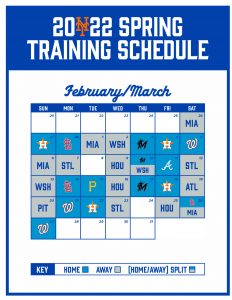
by Greg Prince on 2 March 2022 2:09 pm Counterfactually, the Mets are in West Palm Beach today playing the Nationals. It’s not much of a counterfactual to the reality we live in to conclude the Mets would be busy training their spring away a little south of St. Lucie given that the Mets sent out a preliminary Spring Training schedule last August marking FITTEAM Ballpark of the Palm Beaches as their planned whereabouts for March 2, 2022. The same preliminary schedule indicated the Mets were to have played every day since this past Saturday, meaning we would’ve seen them on television at least once; we might’ve heard them on radio; and we would’ve had a satisfying visual, aural and/or anecdotal glimpse of them taking on, for practice purposes, each of their Treasure Coast neighbors.
And we’d be growing sick of the whole thing after five games of the Grapefruit League slate because the Mets would have already been officially preparing for the 2022 season for about two weeks. Pitchers & Catchers & Third Basemen-Outfielders & everybody else would have reported; we’d have all praised their arrival to the highest heavens; and the practices prior to the practice games, too, would have lost their novelty after approximately five days.
Which doesn’t mean we wouldn’t have appreciated the whole Sunshine State spectacle despite its apparent pointlessness, for the point is baked in. By the second day of March — today — we would have had the routine of baseball hammered into us and therefore be set for the year ahead. The key to Spring Training is the repetition of Spring Training, in which weeks and weeks of mostly nothing have to happen in order to prepare us for six months that we collectively concur will be something. That’s what we’re in it for every Spring. We put up with Spring so we can be rewarded with summer and, if we’re lucky, fall.
 Yeah, right. Right now, we’re putting up with literal nothingness where Major League Baseball is concerned and we will be for the foreseeable future…though only if we feel ourselves putting up with it. Personally, I feel only a little put out by the news that The Lockout has clamped into institutionality. I would, like any baseball fan, prefer Spring Training to have magically appeared this February and March the way it magically appears every February and March, smoothing the path to Opening Day and the 161 games that, by natural law, are supposed to follow. Instead, The Lockout is the new routine. The owners of the thirty MLB clubs have locked out the players and decided to keep them locked out. Simultaneously, they are locking us out of our previously precious pointless routine and they’ve now confirmed they’ll lock us out of at least the first two series of our season.
Or their season. They view it as their ball. They’ve taken it and gone home. They don’t seem particularly upset about it. Rob Manfred couldn’t be bothered to suppress a grin in announcing the indefinite continuation of The Lockout. At least Bud Selig would have managed to look morose on the heels of frenzied negotiations that ultimately went nowhere. We can either stand around outside the proverbial gates of the Citi Fields of the mind and wonder wistfully when somebody will come along to open the ballpark for us, or we can think about something else. The Lockout makes you shrug. It is designed to make you shrug.
By instinct, I miss Spring Training. I will miss Opening Day for the same reason. I will miss the unfurling of the routine. Maybe the void the owners of the thirty MLB clubs and their hired commissioner have created will grow to a size that will envelop my emotions, and the lack of baseball will get to me and get to me bad. But it hasn’t really happened this time around. I guess I have other things to think about. I guess we all do. The so-called stewards of the sport don’t seem to care if we care, so why should we care? Even my instinct is shrugging.
I still love baseball, by instinct. Instinct carries us through March every March. Until this one. In the counterfactual universe of what we’ve come to routinely expect Spring Training to be, I’d be savoring our March maneuvers — Mets at Nationals today; Marlins at Mets tomorrow; then a weekend versus more Nationals and more Marlins — even as I was growing sick of them. That universe, however, presently sits light years from reality. The Lockout is what MLB has become in reality. MLB can keep its reality.
Call me when the gates reopen. I won’t be standing by.
by Greg Prince on 23 February 2022 4:26 pm Standard numerical milestone acknowledgements aside, the proper anniversary to fondly recall Gary Carter would have been the 8th. Gary Carter wore 8 and, presumably because he wore 8, cherished 8. Marty Noble told a story about visiting Gary Carter’s house during Spring Training and encountering a keypad in order to enter the property. Noble either forgot or didn’t have the five-digit code, so he guessed. He used 8-8-8-8-8. It didn’t work. Then he used four 8s and one other digit. That unlocked the gate.
In an ideal world, we wouldn’t need an anniversary to do this, certainly not the anniversary of a death, which seems antithetical to the enduring image we maintain of a vibrant and upbeat Gary Carter. We would just find ourselves thinking about Gary Carter because he was Gary Carter and take it from there. Yet here we are, in February of 2022, suddenly 10 years beyond the passing of the last Met to catch the final out of a World Series and, as has been the case since February 16, 2012, we find ourselves missing him.
Gary Carter’s Greatest Hits you can replay in your mind for yourself. This isn’t intended as an exhaustive cataloguing of the biggest blows our Hall of Fame catcher struck, rather a stream of consciousness that just happened to yield 8 things that have stayed with us about Gary Carter, 8 things — ups and downs notwithstanding — we still love about Gary Carter.
1. THE KVELLING BEGINS
As offseason gets go, I don’t know if any get the Mets ever got captivated us the way getting Gary Carter did, particularly when you consider the context. It’s the December after the Mets had upped their season win total from 68 in 1983 to 90 in 1984. We’re still high from having competed vigorously in our first full-fledged pennant race in a baseball generation. We’re convinced we’re momentum-fueled, ready to catch and pass the Cubs in 1985. All we need is…
All we need is Gary Carter! If we didn’t think quite so specifically, we were willing to identify the missing piece once it was delivered to us. We didn’t give up nothing, mind you. We gave up our longtime starting third baseman (turned recent shortstop) Hubie Brooks; our promising rookie backstop Mike Fitzgerald; an outfielder who’d hit .407 in a September callup, Herm Winningham; and one of our many talented pitching prospects, Floyd Youmans. Every one of those fellows would contribute to the Expos, yet the trade was a win for the Mets. Ninety wins plus Gary Carter and assorted other additions equaled CAN’T WAIT! for the next four months.
The first season of Gary Carter in New York came exceedingly close to meeting our expectations. The Cardinals replaced the Cubs as our archrivals, and they proved implacable foes, but what a race from Game 1 — which Carter secured with his tenth-inning walkoff home run — to Game 161. Mets fans had never been treated to quite this kind of marathon before, especially those every-fifth-days when it was Gooden pitching to Carter, Hernandez at first and Strawberry in right field. We’d never grouped four players of this nature together at the same time. Now we had them on a regular basis. Them and so many others, but especially them. The Mets grabbed first place early and took it back later, and even if they couldn’t hold on to it all the way to the end, what a ride on this quartet’s collective back it was. No wonder that when we got to Game 162, the only game we entered without a shot at first place, we stood and applauded their season and eagerly craned our necks for a glimpse of 1986.
In 1985, Gary taped his knees, swatted 32 homers, knocked in a hundred runs — right in line with his Canadian exchange rate — and constituted the difference between a team on the come and a team that was just about at its destination. A few smaller pieces would have to be added to make the championship puzzle a perfect fit, but it’s not wrong to consider Carter’s campaign as the pièce de résistance of building blocks once we knew we had something here. You needed a bat like Carter’s to keep climbing in the East. You needed a mitt like Carter’s to catch everything in sight. You needed a storehouse of knowledge like Carter’s to benefit a young pitching staff. Even the slightly older hurlers could benefit. One night in May, he guided Ed Lynch, 29, to his first complete game shutout. Gary being Gary, his instinct was to wrap his arms around his pitcher; Eddie opted for a handshake, as if throwing the best start of his middling career was something he did once a week. “I guess he doesn’t like to give hugs,” Carter said after the game with enough ebullience for the entire battery. “He turned me down. Said, ‘Just shake my hand.’ Eddie’s going low-key on us.”
That wasn’t a key Carter struck too often. Mets baseball itself was a pretty convincing advertisement for Shea’s cast of Rising Stars, yet having a face like Carter’s fronting the franchise couldn’t help but raise everybody’s Q rating. Gary’s smile was made for Madison Avenue as much as his game was ideal for Roosevelt Avenue. We loved Keith, but Hernandez could come off as a little dark. We embraced Darryl, but Strawberry was still getting comfortable as a public figure. Dr. K was ready to pitch in the spotlight more than Dwight Gooden was to have it shine on him. Gary Carter was experienced enough and enthusiastic enough to fill the role of Metropolitan Idol. Call that certain something he brought to New York value-added.
We weren’t yet inside the 1985 season when NBC, on its Sportsworld anthology program, attempted to do its part for famine relief by producing its own version of “We Are The World,” except with athletes standing in for singers. One snippet of one chorus was handled by new teammates Gary Carter and Darryl Strawberry, struggling for literal harmony but singing like they meant it on a practice field in St. Petersburg. We weren’t too far into the 1985 season when Channel 9 began offering a poster featuring catcher Gary Carter as a Norman Rockwell-type character, signing a baseball for a little kid and his dog (probably more for the kid than the dog). It was, I think, five bucks, proceeds going to the Leukemia Society of America; Gary had lost his mom to leukemia. In the moment it took me to wonder whether it was odd that somebody who hadn’t been on team for very long was now its literal poster boy, I sent in my check. Like Mets fans everywhere, I couldn’t live without Gary Carter, in whatever form he was available.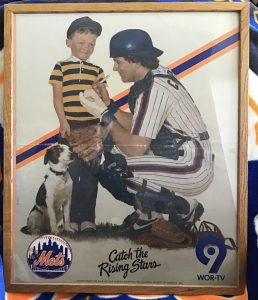
When that almost-made-it of a season was over, I came across the briefest of promos for WOR-TV’s premier property. In the middle of November, when we were all missing the Mets, Channel 9 ran a spot of a man leaning against a pillar in the Times Square station looking like he’s got a case of the Mondays. “Need a lift?” the voiceover asks. “Well, just remember.” The next voice belongs to Ralph Kiner: “Going, going, it is gone, goodbye! A three-run homer…” The image that raises the spirits down in the subway is Gary Carter rounding the bases after going deep off none other than Mike Scott (who, at that moment, was just a random Astro who used to be a Met). Our commuter in the commercial is summarily lifted and so are we. “Thanks for the memories, Mets,” the announcer ends it. We are all in on the gratitude en route to winter 1985-1986 when we close our eyes and think about Gary Carter.
2. HE WANTED TO PUMP US UP
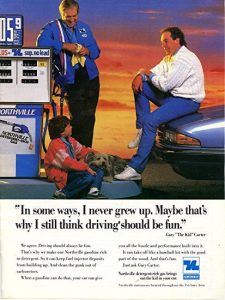
Gary Carter was in favor of cleanliness, as evidenced by his ubiquitous commercials for Ivory Soap. Gary Carter wanted you to be conversant in current events and therefore endorsed the selling of Newsday. And when you had to fill up your tank, for the sake of all that was good and holy, please patronize your local Northville Gasoline retailer, just like Gary Carter does.
Perhaps it’s because Northville was a new name in the market in the latter half of the 1980s that Gary Carter for Northville Gasoline is the Gary Carter endorsement I see in the billboard of my mind. You’d see an off brand of fuel here and there, but you just assumed they were fly-by-night. If you really needed gas, you had Amoco, Mobil, Exxon (previously Esso), Sunoco, Texaco, Gulf…you figured you knew the major players. They were the same players who’d been around more or less forever. Then, out of nowhere, there are Northville stations dotting the Long Island landscape, and if we’re not sure they’re viable, we have Gary Carter confirming that they must be OK or he wouldn’t roll his automobile up to one of their islands.
 The only other thing I remember about Northville is that Howard Stern custom-read ads for them every morning for a while, which made for strange implicit bedfellows. Howard knew nothing about sports, nothing about baseball, nothing about the Mets, but somehow Gary Carter grabbed his attention. He’d caught enough of Carter’s celebratory clubhouse testimony as the champagne flew in the fall of 1986 to produce a convincing Gary Carter impression. The only other thing I remember about Northville is that Howard Stern custom-read ads for them every morning for a while, which made for strange implicit bedfellows. Howard knew nothing about sports, nothing about baseball, nothing about the Mets, but somehow Gary Carter grabbed his attention. He’d caught enough of Carter’s celebratory clubhouse testimony as the champagne flew in the fall of 1986 to produce a convincing Gary Carter impression.
From K-Rock the morning after the World Series had been won, to the best of my recollection:
ROBIN QUIVERS: Is there anybody you want to thank?
STERN AS CARTER: I want to thank Jesus.
ROBIN: Anybody else?
STERN: I want to thank the Easter Bunny.
Howard was always gonna be Howard and Gary was always gonna be Gary, and even if the two never met as far as I know, well, they both swore by Northville Gasoline. They just swore in different manners. It wouldn’t have been New York in 1986 without either of them.
3. WHAT’S THE ‘BIG’ IDEA?
A press invite fell into my hands in August of 1987 for the release of a hot new videocassette: Think Big, a VHS production that would have its coming-out party at Shea Stadium prior to a Mets-Phillies game. Somewhere down the left field line of the Mezzanine concourse, an area was roped off, refreshments were offered and, without fanfare, Gary Carter magically appeared in full uniform. No shin guards, but the pants and the jersey, maybe the cap, if memory serves (it doesn’t always). The PR people didn’t much choreograph his drop-by. He just showed up, dutifully, and a crowd formed around him. I don’t remember if the questions were Think Big-related or standings-related. I was too in awe of the idea that Gary Carter could be bothered to ascend several flights from where he’d soon have business behind the plate and in the six-slot of Davey Johnson’s batting order. Other than filming his street-clothes cameo on a Shea ramp for the Let’s Go Mets music video the previous summer — “go ahead, Doc” — I found it hard to fathom Gary Carter would materialize where regular people gathered. His Think Big co-stars Mookie Wilson and Roger McDowell also made the trip in their game togs, but I spotted Carter before I noticed them, and once you realize you’re standing next to Gary Carter decked out in his Mets uniform, nobody else seems quite so impressive.
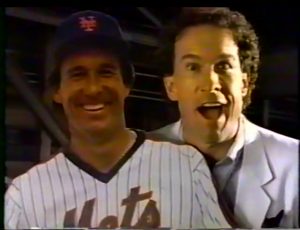 Think Big is best described as a motivational tape for kids. In the plot, Gary, Mookie and Roger urged the youngsters to, well, think big. Gary strummed a baseball bat like it was a guitar, approvingly watched from the warning track as a fly ball flew over the outfield fence (it was supposedly hit by one of the kids a few feet away, so it’s not like it added points to one of his pitchers’ ERAs) and dispensed world championship encouragement. “Think about what you’re not doing that you could be doing. ‘Think big’ is like trying to do better than your best,” Kid explains to actual children who are flummoxed by a computer that appears dead-set on ruining baseball…which perhaps indicates how prescient Think Big was. Think Big is best described as a motivational tape for kids. In the plot, Gary, Mookie and Roger urged the youngsters to, well, think big. Gary strummed a baseball bat like it was a guitar, approvingly watched from the warning track as a fly ball flew over the outfield fence (it was supposedly hit by one of the kids a few feet away, so it’s not like it added points to one of his pitchers’ ERAs) and dispensed world championship encouragement. “Think about what you’re not doing that you could be doing. ‘Think big’ is like trying to do better than your best,” Kid explains to actual children who are flummoxed by a computer that appears dead-set on ruining baseball…which perhaps indicates how prescient Think Big was.
There’s also an unfortunate attempt to mimic Pee-wee Herman. By voice, I mean.
Gary carries his burden of being a good example obligingly here, as he did in most of his off-field appearances. I continually got the sense he took his role-modeling seriously, that if he was going to be a superstar ballplayer, a superstar ballplayer owed it to his fans to be what he thought a superstar ballplayer should be. Superstar ballplayer Gary Carter, therefore, is gonna get those kids thinking big. I can’t help but believe that if Gary Carter had been in Revenge of the Nerds, he would have persuaded his fellow jocks to cool it with the taunting and instead put on a clinic down at the local elementary school.
As an accredited journalist, I received a copy of Think Big upon checking in for the event. I brought it home and watched it with my mother. Or tried to. I gave up about five minutes in. My mother got a huge kick out of it. Also, the Mets won that night, 5-3, with Carter going 1-for-3 with a sac fly and guiding Doc Gooden and McDowell through a combined 10-hitter. So, yeah — think big.
4. YOU DO NOT MESS WITH THIS KID
The Gary Carter we got turned 31 just prior to his Met debut. It probably didn’t occur to us how old that was in catcher years. Gary played like it didn’t occur to him either. With all due respect to Think Big, the greatest video production the Mets ever put together was No Surrender, the 1985 highlight film that ran regularly on SportsChannel during rain delays in 1986. It was so enchanting that I rooted for the tarp to remain on the field for at least half-an-hour just to view it again. No Surrender, which was bowdlerized for music rights reasons once SNY’s Mets Yearbook series got ahold of it, was state-of-the-art for MTV-era sports storytelling. Not only did Tim McCarver narrate and not only did it follow the ’85 Mets chronologically (something grand old team highlight films basically never did), but it packed music-video treatment upon music video treatment, clearance fees be damned.
The falling Cubs are shown “No Mercy” in June by both the surging Mets and Nils Lofgren. Keith Hernandez is “The Warrior,” as in Scandal featuring Patty Smyth. Doc gets Buffalo Springfield’s “For What It’s Worth”: “What a field day for the heat.” Damn. Gary’s winning sequence was scored by “Messin’ With the Kid,” a Blues Brothers track. Not too on the nose, eh? But what made it sing, beyond the title, was the montage. There’s Gary hitting, there’s Gary smiling, there’s Gary politely but firmly giving an earful to an umpire, but mostly there’s Gary catching the hell out of his position.
Two clips stand out:
1) Carter not only blocking the plate and putting a locomotive of a tag on the Pirates’ Doug Frobel, but then pushing him aside with as forceful a go away, kid, you bother me move as W.C. Fields ever managed. Gary doesn’t have time for Frobel. He’s got to look the runner back to first. The play is from the 18-inning game in late April when Gary’s already dealt with one onrushing runner (George Hendrick) and has innings to go before he sleeps. He may have excited because of what he did as a hitter, but we were reminded that day that we had ourselves a catcher.
2) In early June, the Cardinals are running wild, which is a problem for the National League East in general and the Mets most of all. In the third inning of the opener of a Sunday doubleheader at Shea, Vince Coleman steals third and Willie McGee steals second in one fell swoop. This was when it was often said the only gap in young Dwight Gooden’s arsenal was an ability to keep base thieves honest (because he had so few runners to practice holding). Next thing we knew, a ball was getting away from Carter and Coleman decided to bolt for home. Carter, in “Messin With the Kid,” turns into a deli man who comes out from behind the counter to determine who’s causing all this ruckus. With his chest protector as his apron, Mr. Carter grabs that loose ball and chases Coleman all the way back to third. Almost all the way, because veteran Gary in his equipment runs down swift rookie Vince and tags him out.
Warning to baserunners everywhere: you do not mess with this catcher.
5. THEY LIKE EACH OTHER, THEY REALLY LIKE EACH OTHER
Those Mets of Carter and Hernandez if you were going alphabetically, or those Mets of Hernandez and Carter if you were going chronologically, made you care about them beyond their batting or earned run averages. They dripped with personality and they were covered as competitively as they played. The “media” wasn’t a monolith, but all outlets in those days kept extreme tabs on those Mets. Even the junior media.
One Sunday in the summer of 1985, Kidsday, the Newsday section that you’d think was named for Carter but was specifically geared to and more or less produced by children, featured a Q&A with Keith Hernandez. The celebrity Q&As, as interpreted by my friend Fred, usually went something like this:
Q: How are you?
A: I’m really depressed.
Q: What’s your favorite color?
A: Green.
The only specific I remember from the Hernandez interview was the Kidsday staff asking him who were his best friends on the team. Keith named probably at least half-a-dozen Mets, and then, as if he’d realized he’d committed a faux pas, added something to the effect of “I should probably also mention Gary Carter.”
Despite being well out of the Kidsday demographic, I was relieved to have it confirmed that Keith liked Gary, or at least that Keith thought it important to strongly imply he liked Gary. I already assumed Gary liked Keith, because, given all the commercials he did, I figured Gary liked everything. It was important to me that our Veteran Leaders were in sync. I wasn’t naïve enough to believe everybody always liked everybody on my team, but I wanted to believe it. We’d heard that the Expos had had their fill of Carter, but to me that only revealed a deficiency of character on Montreal’s part.
“Camera Carter,” as far as I was concerned, was left north of the border. When, per Noble, George Foster dug up the derogatory nickname while Gary was “doubled over in pain,” his teammates’ reaction was, in essence, “not cool, George.” Noble, writing for Newsday down the stretch in ’85, conceded some of his New York teammates processed Gary’s style as “a little much,” but they “admire his motivation, effort and ability to play despite injury and pain, to say nothing of his talent.”
The vibe remained valid three years later. After he was traded to Minnesota, Wally Backman submitted to an exit interview with Mike Lupica in the Daily News. This was December 1988, the beginning of the end of an era in Flushing. “Gary’s always gonna be a leader in the sense that guys on the team can look up to him,” Backman said, “the way he carries himself on and off the field. Doesn’t matter if you’re a kid or a veteran. I’ve never heard him say a bad word about anybody. He’s just getting older.”
By then, Hernandez and Carter had served a season as co-captains, a year after only Keith wore the C (a letter neither of them wore once they both shared it). It was pretty clear even to a fan reading the papers and listening to pre- and postgame comments that Carter wasn’t crazy about being initially overlooked in 1987. And in his 1993 autobiography The Gamer, he was still a little sore about it. In the moment, to me, Keith was Keith, and Gary came later, so how could Carter argue with Davey’s decision?
“I think Gary may have been a little taken aback by the fact that it was so blatantly obvious who most of the players looked to for leadership,” Mookie Wilson wrote with Erik Sherman in 2014. “Gary may have been the final piece in making us a championship-caliber team, but Mex was our general.”
Yet even in a situation like that, much as when Gary let it be known between the lines he was a little miffed he wasn’t getting more MVP support in 1986; or when he was dropped out of the high-profile cleanup spot; or when he wasn’t a first-, second- or any-ballot Hall of Famer until the sixth time the BBWAA considered his candidacy, I sort of appreciated No. 8 looking out for No. 1. There was an insecurity to Carter that felt palpable from a distance. Maybe it registered as unseemly for such an acknowledged superstar to worry aloud about these ancillary matters, but it was human. Maybe Gary somehow sensed he wouldn’t be around long enough to appreciate the honors that he was sure should have been coming his way. Maybe he had a touch of Billy Joel’s “Big Man on Mulberry Street” in his soul.
“What if nobody finds out who I am?”
6. LONG-TIME IDOL, FIRST-TIME TARGET
Did Gary Carter found WFAN? Not exactly, but he did position himself squarely within the station’s first batch of content. What is sports talk radio if not a forum for debating whether a hometown player is to be venerated or vilified?
Sports talk radio, which had been around in chunks for years, became institutionalized on July 1, 1987, when 1050 AM switched from country music to a format that sounded too good (or bizarre, depending on your perspective) to be true. WHN became WFAN, and WFAN became the home of saying to others what you might have only been saying to yourself all this time. Previously if sports fans wished to be heard by more than a few people at once, they had to buy a ticket to a stadium and express themselves loudly. That’s what had been going on at Shea in 1987. With the Mets having fallen off the pace of 1986, relatively few were in the mood to venerate the defending world champs.
As Jim Lampley, WFAN’s first-ever host, put it shortly after 3 o’clock that afternoon of July 1, “to read the sports sections of this morning’s New York newspapers, you might’ve thought it was October 1,” given the urgency attached to the pennant race the Mets were huffing and puffing to get themselves back into. Patience was less a virtue than missing in action. Gary Carter, he who hit 24 home runs and drove in a team-record 105 runs for the Mets in the regular season the year before — and he who delivered one enormous swing after another in the postseason that certified all of us as champions in our hearts — was getting booed. Not by everybody, but by a vocal percentage of the Shea Stadium throng. On June 29, two nights before the dawn of WFAN, Gary stepped up to the plate in the bottom of the eleventh. The Mets trailed the first-place Cardinals, 8-7, in a Monday Night Baseball showdown that despite transpiring with more than a half-season to go sure as shootin’ felt must-win.
The bases were loaded. There were two out. The Gary Carter of 1985 and 1986 would have conjured a way to at least tie the game and win the crowd. The Gary Carter of 1987 struck out and lost both. Technically, the Mets lost the game as a team, all of them falling 7½ back of the division lead. But the last guy not making contact tends to grab a ballpark’s attention.
In other words, boooooooo.
Two nights later, on the rainy Wednesday night the FAN took flight, the home crowd tried to work out its feelings toward its catcher. In the third inning, after Carter grounded out and left Tim Teufel standing on third, he was booed some more. In the sixth, Carter homered. That rated cheers — and elicited a half-hearted curtain call response from the feistiest fist-pumper who ever took a bow. In the seventh, Carter homered again. Giving the people what they wanted proved popular. More cheers. A heartier curtain call. In the eighth, up for a third consecutive inning, Carter did not homer. He struck out with runners on the corners, but the Mets by then were ahead by four runs. Chastened, perhaps, the fans who remained late through the rain, stood and applauded him.
Carter’s teammates weren’t happy at how he’d been getting treated prior to the home runs. Hernandez: “I could tell he was obviously hurt by it.” Howard Johnson: “You could it tell it bothered him.” The manager believed the fans were spoiled by success, Kid’s and the club’s. “We all know that now that we’ve demonstrated a certain amount of excellence,” Davey Johnson said, “when we don’t give it to them, they’re going to be unhappy.”
Unhappiness wasn’t Gary Carter’s brand, so he put on the best face possible after the 9-6 must-win win (every win was a must in 1987) he personally powered over the Mets’ gleaming new flagship station. “I’d have to say that’s the first time in my career that’s happened,” Carter said. “It’s a case of, ‘What have you done for me lately?’ They have every right to cheer and boo. What it means more than anything else is that they care.” And that memories in New York could be as long as the average length of a phone call to 1 (800) 635-1050.
7. WHEN THE TENT COMES DOWN
The story coming out of the Mets-Braves game in Atlanta on Monday night, May 1, 1989, was Doc Gooden’s left ankle. The mound was muddy, the footing was treacherous and the worry was about a pitcher who slipped. On July 4, 1985, which famously became July 5, 1985, at Fulton County Stadium, Davey Johnson pulled Gooden under dangerous conditions, lest his ace pitcher in the midst of a historic season go into his windup and wind up with an injury.
Not quite four years later, the Mets were cautious but maybe not abundantly so. The ankle (as well as the rest of the pitcher) was brought to the dugout after its muddy mishap in the seventh inning for taping. Satisfied he was good to go, Johnson sent Gooden back to his office to complete a little more business. Doc finished the seventh, started the eighth, gave way to Roger McDowell and picked up his fifth victory versus no defeats in a 3-1 Mets win.
Doc’s ankle would be of tangible concern in the aftermath of Monday night, but Gooden wouldn’t miss his next turn and his pitching looked more than good enough. To the naked eye, the big story of May 1, 1989, would come and go.
The naked eye had no idea what the big story of May 1, 1989, was. The naked eye had to sift through Baseball-Reference after becoming curious decades later regarding a question that crossed the eye’s mind when mulling the magnificence of a Mets team that featured four tentpoles like it never featured before and would never feature again:
When was the last time the Mets started a lineup that was comprised 4/9ths of The Big Four, a.k.a. Gary Carter, Keith Hernandez, Darryl Strawberry and Doc Gooden?
You just read the answer.
I don’t know if anybody else refers to that specific quartet as The Big Four. I’ve never seen it. I never thought it until a couple of years ago. It fits, though. Kid. Mex. Straw. Doc. If the mid-1980s Mets were the marquee, those were the names above it. They were stars. They were superstars. They were megastars. Keep upping the descriptive ante. By reputation, performance and aura, they’d match it.
The Big Four came to be in a box score sense on April 9, 1985, that most magical of Mets Opening Days, Carter’s first game for New York. Gary had been big in Montreal. A big star with a big following (Rue Gary-Carter graces that city’s thoroughfares today). Maybe he wouldn’t be as big in New York in terms of putting up in-his-prime numbers — and maybe New York was too big for a single individual to dominate — but because he was undeniably big in New York, Gary Carter was about to be bigger than ever. Same for Keith Hernandez, a multitime everything in St. Louis, but a celebrity driving in the clutchest of runs in Queens. As for Darryl Strawberry and Dwight Gooden, their limit was the sky when 1985 commenced, and the sky just kept inching higher.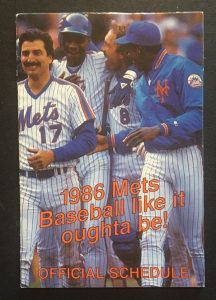
Gary signed with the Mets for five seasons, a time span during which the other components of The Big Four were under contract, so you could say their reign together lasted five seasons. But more granularly, it spanned 79 regular-season games. That’s how many times Davey Johnson submitted a lineup card that was 44.44% covered by…
Hernandez 1B
Strawberry RF (CF a few times)
Carter C
Gooden P
…and, no, wise guy, the rest wasn’t covered by Garry Maddox.
The last time, No. 79, was an occasion that had zero fanfare to it. There was no reason it would. It was barely May. It was a Monday night in Atlanta when a Mets-Braves contest was bereft of inherent hostility. They were in the West. We were in the East. The two clubs hadn’t played a mutually meaningful game since the 1969 playoffs. The schedule called for the Mets to visit Fulton County. The rotation called for Doc to take the ball. The manager didn’t do anything special in writing down Keith’s last name to bat third, Darryl’s to bat fourth and Gary’s to bat seventh. Carter had hit .117 in April, so the seven-spot isn’t as shocking as it might appear if you’re picturing vintage Kid.
Nothing lasting forever probably didn’t need Gary Carter to illustrate its eternal truth, yet the end to something that seemed as if it had just begun was more in sight than we cared to admit heading into 1989. In 1987, he was booed. In 1988, he went three months between home runs, which would have been noteworthy given it was Gary Carter, but turned absolutely painful because the home run that awaited a follow-up was the 299th of Kid’s career and, boy, did he want that 300th. Come the NLCS in ’88, though both Carter and Hernandez each delivered in a couple of key moments, you couldn’t dispute Roger Angell’s assessment, written after the Mets lost the pivotal fifth game en route to losing the series to the Dodgers in seven: “The Mets…looked middle-aged on the field that afternoon and in their clubhouse as well.” At the time, Roger Angell was 68 years old, Carter 34, Hernandez about to turn the same…half of Angell’s longevity to date. The man recognized middle-aged when he saw it. (Roger’s 101 now if that makes you feel any younger.)
When we traded for him, Gary was 30, fluffily curled and coming off one of his best seasons in a career that was stocked with best seasons. For arguably the most significant two-year stretch in franchise history, he was a legitimate differencemaker. You know all those big names the Mets tend to get when the team is at a crossroads and the names proceed to shrink rather than magnify under New York scrutiny? And the crossroads go awry? That wasn’t Carter in 1985 and 1986. He was a new paradigm: the superstar who stayed super helping to lead a good team to monumental greatness. If that’s Gary Carter’s Metropolitan story in toto, that’s fantastic.
It’s not the entire story. The entire story includes a denouement, to put it kindly. The rest of the story, however, despite precipitous statistical declines as he aged past 35, didn’t really dent his Met legacy. Gary Carter in his shrinking-perm stage is no more than ellipsis. Yet if you were there in 1987, 1988 and especially 1989, you couldn’t help but notice Carter’s prime wasn’t what it used to be. But he was still Gary Carter, and now and then there’d be a smattering of success that was straight outta ’85. I can still remember walking into a motel room in Tulsa, Okla., at the end of an August afternoon of business obligations, tossing aside my suit jacket and turning on CNN Headline News to learn that Gary Carter went 4-for-4 in Philadelphia, which tickled me half-a-continent from where I usually got giddy. Any Met going 4-for-4 was good news. Gary entered the day batting .116. That is not a misprint. He ended it batting .152. Also not a misprint. By 1989, you kept wanting to pin numbers like those on erratic typesetting.
Nope, the Mets of Carter and Hernandez and Strawberry and Gooden, even though we hadn’t realized it in May and still didn’t grasp it in August, were over. The next time Gooden pitched after the aforementioned game in Atlanta, Teufel gave Keith a blow at first (a lefty was pitching for Houston). The time after that, Gary’s right knee, unable to bend, was about to nudge him to the DL. Kid had last played May 9. Doc’s next start was May 12. Gooden, throwing to Barry Lyons or Mackey Sasser, went along having a dynamite season until late June, when his right shoulder sent him to the sidelines. Carter was still there. So was Keith, out since the third week in May with a broken right kneecap. Hernandez returned to the lineup on July 13. Carter played again on July 25. Neither was deployed as a regular. Doc’s season, save for a pair of September relief appearances, never regenerated. But he’d be back in 1990. So would Darryl, who skipped the ’89 All-Star Game with a broken toe; honestly, it hadn’t been a very stellar first half for the perennially elected Strawberry.
None of The Big Four was gone altogether from the Mets in 1989, but they no longer composed an elite unit within a juggernaut. It’s not like there hadn’t been a strong bench between 1985 and 1988 should another catcher, first baseman or right fielder have to be called upon; it’s not like the positions that didn’t belong to Carter, Hernandez and Strawberry weren’t manned skillfully; and it’s not like you weren’t getting your innings’ worth out of Darling, Ojeda, Fernandez and so on when Gooden was between starts. But the Big Four was where glamour lived, where excellence thrived, where you most fervently directed your passion.
After May 1, 1989, you never saw it again. Only hair styles can claim to be permanent, and they don’t last either.
Gary’s final turn at bat at Shea as a Met (he somehow willed three more seasons in three more stops from his perpetually barking body) was a thing of beauty, a double struck into the right field corner after he’d taken over behind the plate from Mackey Sasser. He and Keith were permitted last plate appearances in front of what was left of the diehard masses who celebrated their most every move for a few years less than a few years before. Keith’s AB produced a flyout that left his average at .233. Gary’s double raised his to .189. The statistics were hardly the point. The 18,666 in attendance reveled in a proper goodbye.
The Mets, ending their 28th season, had orchestrated few on-field farewells in their history. Maybe when Rusty Staub pinch-hit as 1985’s last batter. Rusty was 41. He probably wasn’t coming back but wouldn’t be definite about it on Closing Day after grounding out on what became the final pitch of his 23-season career. The club held a night for Willie Mays in 1973, and the occasion packed Shea, but (surprise, surprise) M. Donald Grant offered “no support for Willie’s retirement,” according to one of Mays’s advisers, and the planning for what became a star-studded, tear-welling pregame gala was left to Willie’s people. The fans never knew for sure if they were saying goodbye to Seaver or Koosman or Cleon or Buddy as the ’70s unraveled or, for that matter, Mookie or Lenny earlier in 1989. Hell, Joe Torre didn’t find an at-bat for lifetime Met Ed Kranepool in what loomed as Ed Kranepool’s final career home game…on Fan Appreciation Day in 1979.
Carter and Hernandez at least got to tip their caps on the way out and the gesture returned from the stands. They and their deeds had been too big to ignore. Shortly after the schedule played out in Pittsburgh, the co-captains also shared a press conference at Shea. The Mets would be re-signing neither man, but they provided them the space to have their say in the old Jets locker room.
Mex: ”It’s sad because these have been six-and-a-half great years, and I’ll always be a New Yorker and a New York Met. But then come the cold realities. You can’t retire at 65 in baseball.”
Kid: “I can still play this game, and I know there’ll be an opportunity out there. But these have been five great years. I heard the cheers and I heard the boos, and I like the cheers a lot more. Maybe I’ll hear more of them.”
“Privately,” Tom Verducci summed in Newsday, “it was Hernandez who pumped up his teammates and gave the Mets their swagger. but publicly, it was Carter who created the aura of arrogance that the club came to feed on,” an aura that had evaporated as 1989 closed. It was bracing how quickly 1986 had become the past. The Mets had been peeling off their championship players with disturbing alacrity since they let Ray Knight walk and traded Kevin Mitchell to San Diego. With Carter and Hernandez thanked for their service and directed to the exit, the World Series roster of 24 would be almost two-thirds gone by the turn of the decade.
“Somebody will have to lead the Mets into the ’90s,” Keith observed. “And it’s not going to be Gary or me.”
8. FAITH AND KID IN FLUSHING
On December 12, 1984, two days after we discovered who was going to co-lead the Mets for the balance of the ’80s, Gary Carter stood at a podium in the Diamond Club at Shea Stadium and announced, “I’ve saved the ring finger on my right hand for a World Series ring.”
On October 27, 1986, the Mets won the World Series, the last out recorded on a swinging strike three that landed into the mitt of Gary Carter.
On April 7, 1987, Gary Carter was presented with his World Series ring.
On August 12, 2001, the Mets prepared to induct Gary Carter into their Hall of Fame, their first such selection since Keith Hernandez was presented with a sculpted likeness of his own four years earlier. Evocation of 1986 represented a rare bright spot on the premises. Two-Thousand One had been a dreary season to that point. The Mets sat 10½ games out of first place and weren’t a factor in the Wild Card race. They’d recently made three trades subtracting four players — Todd Pratt, Turk Wendell, Dennis Cook and Rick Reed — who had helped them to the postseason in 1999 and 2000. It felt akin to where the Mets had been in 1989, except there was no relatively recent world championship in our rearview mirror. The Mets were still waiting to pick up where they left off when Carter, cradling the sinker Marty Barrett couldn’t touch, embraced Jesse Orosco. It was no wonder that when GM Steve Phillips inserted himself into the Hall festivities, he was vigorously booed. Guest of honor notwithstanding, we were in a bad mood that Sunday afternoon.
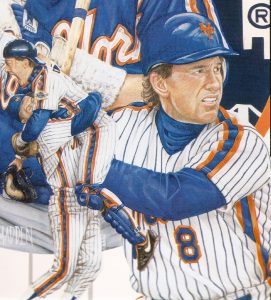 Against this sullen backdrop, who could light our world up with his smile? None other than the Kid who made good on a promise of ultimate success once before. I couldn’t see his right finger from where I sat in Mezzanine, but I had to believe it still sported that ring he was determined to win. Against this sullen backdrop, who could light our world up with his smile? None other than the Kid who made good on a promise of ultimate success once before. I couldn’t see his right finger from where I sat in Mezzanine, but I had to believe it still sported that ring he was determined to win.
“Keep cheering for them,” Carter encouraged us as he pointed to the Mets’ dugout. “They’re gonna win another championship. I guarantee it.”
Since he didn’t specify a date, I’m gonna keep believing in Gary Carter.
by Greg Prince on 16 February 2022 11:05 am This is a nominally festive occasion. Faith and Fear in Flushing turns 17 today. The team we cover recognized this milestone by announcing they will retire No. 17 this season and reinstate Old Timers Day so the authors of this blog will feel right at home.
All that the Mets and their MLB franchise brethren need to do to make our little celebration complete is some confirmation that there will be a season. My in-box keeps receiving invitations to buy tickets, whether in packages or individually, and I’ve been assured if I pick the right date and show up early enough, I’ll be handed a must-have bobblehead or three, but there’s nothing ever mentioned about the players who might be termed New Timers. No Canha. No Escobar. No Marte. No Scherzer. They seemed so happy to tell me about those fellas when they signed them. Now I’m having a hard time remembering what they were signed to do.
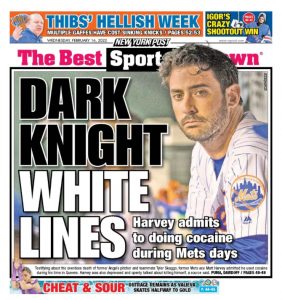 Bad news on the doorstep, indeed. “Bad news on the doorstep,” an American Troubadour once observed of a February that made him shiver. We’ve got a bunch of that in baseball terms and a dollop more in human terms. (When it snows, it pours.) All we can do for Matt Harvey, whose use of cocaine came to light in the trial of Eric Kay regarding the former Angel employee’s culpability in the death of pitcher Tyler Skaggs, is wish him the best where his day-to-day is concerned, particularly after Terry Collins chimed in regarding Harvey’s state of mind back in the day.
All we can do for baseball is wish it gets going.
It’s the middle of February. The wintry afternoons have grown longer. The Super Bowl has completed its brutal business. Those milestones we take as signs of impending Spring with a capital “S” have done their part. Our thumbs, index fingers and middle fingers are clutching our pencils to check the next rite of February off our oh boy! list. Yet the pitchers aren’t throwing to the catchers. The catchers aren’t throwing to the pitchers. The pitchers, the catchers and their colleagues who play the other positions are locked out by the owners and nobody seems to have a clue to the combination of the lock. The jumping-off point for another season of baseball, like the negotiating of a collective bargaining agreement, is stalled. Not a soul has declared he is in the best shape of his life. Thus, the companion occasion that we mark in this space every February 16, the anniversary of the founding of Faith and Fear, is missing a bit of its boisterousness. Maybe more than a bit. Definitely more than a bit. Everything we look forward to as Mets fans…
• the fresh acquisitions loosening up for the first time in orange and blue under the St. Lucie sun;
• the key holdovers making pronouncements about how this year will be better than the last;
• the manager doing things differently than they’ve been done around here and hearing repeatedly why it’s just the tonic this organization has needed for too long;
• every Met’s move being tracked and tweeted as if we can’t survive another second without a handle on how Luis Guillorme’s first ten swings in the cage appeared to the naked eye;
• and we the fans lapping every last bit of it up for at least a quarter-hour until we declare we’re already tired of Spring Training
…isn’t happening.
Boo, obviously.
Nonetheless, it is our anniversary — our seventeenth (the mustache anniversary). Faith and Fear in Flushing commenced to blogging on 2/16/2005 because Jason and I were excited that Pitchers & Catchers & Beltran & all the Mets were arriving in our lives for the next seven or eight months, and we were so excited we simply couldn’t keep our enthusiasm to ourselves. We shared it and just kept sharing it for the next seventeen years. Same for our Met-related dismay, which has tag-teamed with the enthusiasm for seventeen Springs turned seventeen seasons. In the midst of a lockout, we’d probably have to work our way up to dismay from disgust, though disgust has been part of the ongoing discourse as well. Seventeen seasons blogged. Ten losing records. Fourteen MLB postseasons proceeding without Met participation. A little disgust was bound to seep in.
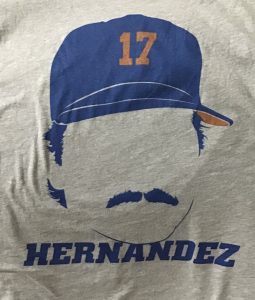 Happy mustache anniversary to us. Yet there is always, at least in theory, one more Spring. One more Spring than seasons, even. Seventeen seasons? Eighteen Springs! We’re back perennially come mid-February regardless of reasons to have been repelled. How many games did the Mets lose last year? Several more than they won. When they were done losing the last of them, we didn’t know precisely who would compose the 2022 Mets, only that eventually we’d bundle up and calculate the number of days until we could informally meet the lot of them. Why am I looking at pictures of Gary Gentry, Doug Sisk and Bobby Parnell in my social media feeds? Because it’s 39 days to Pitchers & Catchers!
The ritual counting down fizzled out weeks ago. The locking out continued. When I turned my officially licensed Mets calendar to February, I was greeted by an image of Taijuan Walker pitching from the stretch. I had to pause and think, a) “Who is that?” and b) “Oh right, Taijuan Walker…man, I have not thought of that guy all winter.” Nothing personal vis-à-vis Taijuan Walker. I’ve barely thought of any active Met since the owners opted to lock out the players. As happy as I am that the Mets have scheduled a number retirement, an alumni reunion and three bobblehead giveaways reflecting the approximate likenesses of their three TV announcers, the current iteration of Mets baseball being out of sight/mind has altogether defierced the urgency of mid-February. And I’ve still not thought much about Taijuan Walker.
***We blogged about 42 players who made up the 2005 Mets in our first season. Last week, that particular team suffered its first brush with mortality with the passing of Gerald Williams from cancer at age 55 (Pedro Feliciano, who died last year, was in Japan in ’05). The Mets had Williams at the end of his career, bringing him onto the club in June of 2004 and recalling him from Norfolk the following summer. Looking at his numbers more or less confirms what I remember about his on-field performance. He batted .233 in each of his partial seasons.
The numbers, however, were only numbers. The person was a different story. It always was with Gerald Williams, even if a fan shaking his head at an outfielder in his late thirties getting 160 plate appearances opted to concentrate on the numbers. “Why is Ice Williams up in this situation? Why is Ice Williams even on this team? What kind of rebuild is this?”
It could be that the people who made personnel decisions — even if there was a case to be made against their judgment based on the period’s broader results — understood a little more what constitutes a team than I did. Gerald Williams, long after his professional peak, was a good guy to have around. When the Mets had better options to start in left, center or right, he filled in around the margins. When the Mets of ’04 and ’05 were strapped for bodies, he was relied on to produce in something resembling the fashion he had from 1992 forward. Sometimes he did. When Carlos Beltran and Mike Cameron slammed into one another in pursuit of a fly ball in San Diego and neither could get back on his proverbial horse before the road trip moved on to Los Angeles, Gerald Williams stepped up for a few days. In one game, he homered, doubled, stole third and brought home an insurance run to support a Jae Seo-Braden Looper combined five-hitter. It was vintage Williams, reminiscent of the seasons when the man whacked as many as 21 homers, drove in as many as 89 runs and was good for as many as 23 steals (Willie Randolph used a pinch-runner ten times in 2005; nine times the runner was Williams).
We might have noticed Gerald when he was one of two Williamses on the youthful Yankees and it wasn’t certain whether he or Bernie was going to be the bigger deal. We surely noticed Gerald when he led off the bottom of the eleventh inning of the sixth game of the 1999 National League Championship Series by doubling off Kenny Rogers…and trotted home minutes later after Rogers threw a dozen balls, intentional and otherwise. If we were tuned into the likes of SportsCenter, we couldn’t miss Gerald and his future Met teammate Pedro Martinez going at it when Williams was a Devil Ray and Martinez was a Red Sock. The pitcher hit the hitter to lead off a game in 2000. The hitter did not take kindly to the free base and a brawl ensued. Gerald Williams experienced a great deal of living and a great deal of baseball by the time he became a Met.
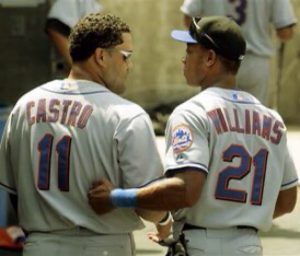 Gerald Williams: more than a .233 hitter. We saw a guy who hit .233 for us and predictably wondered why we couldn’t have somebody with more future in his toolkit. His teammates saw something different. Deep in the FAFIF archives, I rediscovered something I wrote in June of ’05 typical of the modicum of thought I’d given to the value in maintaining a spot for 38-year-old Gerald Williams.
Turns out Gerald Williams is good in the clubhouse. Doug Mientkiewicz said so on Mets Extra, pointing out how Geriatric Gerald was exercising all kinds of great influence on Jose, which obviously paid off in Philadelphia Tuesday night. Well, I thought, maybe that’s worth something, if not an entire roster spot.
Ed Coleman, who likes to agree with whoever’s talking into his microphone, concurred with Minky. “Right,” said Ed. “Last year, Gerald was riding Floyd and Cameron all the time.”
I was glad the Mets, who had been reeling for most of the previous couple of weeks, won. I was glad a connection was discerned between the presence of a veteran and the emergence of a youngster. Jose Reyes recorded two singles and a triple, scored a run and stole a base. The box score indicates all Williams did that night was replace Cliff Floyd on defense in the ninth. Yet I was trying my best to be a realist. Gerald Williams is a guru? That’s great. “So make him a coach,” I concluded.
Maybe they should’ve. Or maybe I didn’t know what I was talking about (wouldn’t have been the last time). The player-to-player dynamic and how it plays out in the short- and long-term is one of those things you likely have to witness to grasp, and even then, you’d only be an observer. The note I made about Ed Coleman remembering Williams’s relationship to his teammates a year earlier came back to me when I read what Mike Cameron, who, like Williams, wouldn’t be a Met after 2005, had to say after Gerald’s death.
“He got me through my first year in New York. He was always so positive. I struggled the first half of that season, but he stayed with me and never let me get frustrated. He was a special guy. He would take care of you as a teammate and give you good advice where to go after a game or where not to go. It’s hard to go out and just perform without a support system and he was one of those guys who provided it. He helped make it easy for you. You really appreciate somebody who does that. […] Especially in places like New York and Boston, you need veteran guys. He made a difference for me, and I know the same is true for a lot of other players.”
I’m seventeen years older than I was in 2005. I’m still working on wiser.
by Greg Prince on 9 February 2022 11:34 am Look at Dan Napoleon
And you might notice
The last name’s the first name
Just like Amos Otis
Like Ed Charles, Frank Thomas
Charlie Neal
Or Kevin Mitchell
But not Rod Kanehl
—Dick McCormack
On May 11, 1969, the New York Mets woke up in as good a situation as they’d ever enjoyed after 28 games: 13-15, a mark they’d reached previously only in 1963, good for third place in the newly carved National League East. Tom Seaver had just beaten the Astros, 3-1, to raise his record to 4-2 and lower his ERA to 2.08. Cleon Jones, having smacked his fifth homer of the young season, lifted his batting average to .402. Historically speaking, even without the benefit of 1969 hindsight soon to come, things were unquestionably looking up.
Yet to Red Foley in the Daily News, not much had changed since 1962. In that Sunday morning’s edition, Foley dwelled on the one constant that hadn’t budged since the Mets’ founding. They were still sorting through third basemen. “For the Mets, who’ve gone from A to Z trying to populate it,” Foley wrote, “third base has been a headache, the kind for which the boys at Excedrin don’t even have a number.”
If you watched enough television in the late 1960s, you got the reference. If you’d watched the Mets during their first decade, you understood the malady Foley was diagnosing. “If there’s a bromide for this lingering cranial pain,” Red elaborated, “you can bet your aspirin that managers Casey Stengel, Wes Westrum and Gil Hodges haven’t heard of it. They’ve tried a total of 40 brands and haven’t gotten to first base, let alone third, in the antidote league.”
Foley went on to giddily list all of the remedies that had purportedly failed, from “that memorable spring evening in St. Louis, when Don Zimmer became the foundation sire for the lengthening line of Met third basemen,” through all those “third basemen who conjure thoughts of those past days and nights when the Mets celebrated rainouts as moral victories” and up to the quartet that had thus far attempted to man third in ’69. “Now,” Foley concluded without giving an inch to the possibility that things maybe were turning a corner, “seven years and 1,163 games after Zim launched the hot corner odyssey, Rusty Garrett, Ed Charles, Amos Otis and Kevin Collins are helping extend the string that for too many has stretched from here to oblivion.”
Forty third basemen in just over seven seasons? Yikes! That sounds like a lot! But was it? Or was it just one of those Met myths that took hold in the earliest days and couldn’t be shaken? Thanks to Baseball-Reference, we can do some comparison shopping. Between 1962 and 1968, spanning all those tenth- and ninth-place finishes, here are how many third basemen each National League franchise employed.
Cubs: 14
Cardinals: 14
Giants: 16
Reds: 17
Pirates: 17
Phillies: 21
Braves: 22
Astros: 27
Dodgers: 27
Mets: 39…with 1969 rookie “Rusty” Garrett (also known as Red, more commonly as Wayne) making it 40
So yeah, the Mets used a lot of third basemen. Certainly a lot more than everybody else. A few amid those growing-pains campaigns were bound to wander in from the outfield.
***The first time Casey Stengel gave up on Don Zimmer as his Original third baseman, benching him for six of eight games in late April and early May of 1962, the Ol’ Perfesser turned to Felix Mantilla to start, whether he had conviction about the former Milwaukee Brave or not. Mantilla recalled once having his starting status determined by whether he or Rod Kanehl looked better catching pregame popups hit to them by coach Solly Hemus. “Stengel,” George Vecsey wrote in 1970’s rags-to-riches tale Joy in Mudville, “seemed to have less patience with Mantilla than any other player, once benching him after he made four hits in a game.”
Maybe Casey missed the best the Mets’ first Felix had to offer. According to Mantilla, the legend of the manager maybe not keeping both eyes on every game was more than myth. “People used to ask me if Casey Stengel used to go sleep in the dugout,” the 1961 expansion draftee told journalist Danny Torres in 2019, “and I said that was the truth.” One day versus the Phillies at the Polo Grounds, Mantilla swore innings one through seven went blank on Casey’s scorecard: “The guy was taking a big-time snooze […] God’s truth.”
It’s probably also true that anyone paid to watch the 1962 Mets every night and day might need to briefly escape to dreamland now and then.
However groggily decisions might have been made sometimes, Casey didn’t fully shut his eyes on what Felix — a man of “lusty good humor” in Vecsey’s estimation — could give him. After the Mets altogether gave up on Zimmer by trading him for Cliff Cook; after Stengel gave up on Cliff Cook by replacing him at third with Frank Thomas; and after Stengel gave up on Thomas as a third baseman and sent Frank back to left field, the manager turned again to Felix Mantilla. Nine Mets in all played third base in 1962. Mantilla was as close to a regular occupant of the Hot Corner as the club could claim. He put in 95 games at third, starting 88 of them and gave the Mets 141 games of baseball in all. The Opening Night shortstop in St. Louis settled in at third as well could be expected, finishing with a solid batting average of .275 and rating sixth among third basemen in double plays turned. It’s an esoteric stat, but considering 120 games were lost, it has to represent a feather in the 1962 Mets’ cap.
At bat, Mantilla was “drilling line drives in every direction,” Vecsey wrote, “but his fielding was a problem. Mets fans liked to imitate him, crouching forward, then rocking back on their hells, waving their left hands casually at the imagined baseball. That was Mantilla playing a hard grounder.”
Perhaps Mantilla, the first Puerto-Rican Met (more than a decade before kids coming upon his name in book’s like Vecsey’s did a double-take and thought, “doesn’t he mean Felix Millan?”) could have found his third base groove and slowed the door already revolving at the position had his services been retained for 1963, but Felix’s strong bat represented enough of a trade chip to land three players from the Red Sox in December of ’62: Tracy Stallard, Al Moran and Pumpsie Green. Two, Moran and Green, were about to become Mets third basemen. But neither was sent to play the outfield. Here in the land of OF-3B/3B-OF, that disqualifies us from saying much more about them.
As we roll like a 38-hopper into the second part of our series on players maybe not playing the position for which they were best suited, we’ve already said more than we planned about Mantilla, who somehow never played outfield as a Met despite seeing 155 games’ worth of action between left, center and right as a Brave, a Red Sock and an Astro in a career that lasted until 1966. He earned a World Series ring for Milwaukee four years before becoming a Met and made the AL All-Star team three years after leaving the Mets. “Mantilla,” Lenny Shecter wrote in his own fond post-1969 look back at the newly crowned champs’ humble beginnings Once Upon the Polo Grounds, “told the world that leaving the Mets was like being ‘pardoned from the electric chair’. He also said that the Mets were the worst team he had ever played on,” professionally or otherwise.
“He may have been right,” Shecter allowed, “but one of the reasons they were so bad was the way Felix Mantilla played the infield.” And Shecter may have been right, but Mantilla, the second player the Mets ever sent up to bat, turned 87 last July. That one year in New York losing all those games certainly didn’t kill him. Perhaps it made him stronger.
Not much strengthened the Mets as they entered their second season, and the third base door continued to spin. Charlie Neal, the primary second baseman from ’62, was tabbed to open the franchise’s sophomore season at third. He didn’t last there or at the Polo Grounds (like Zimmer the year before, he was traded to Cincinnati). Ted Schreiber became the tenth third baseman in Mets history as the Mets were losing their 125th game ever — falling to 0-5 en route to starting 1963 0-8. Ted’s Met highlight would come at year’s end when he grounded into the double play that ended the final National League baseball game the Polo Grounds ever hosted. In between, he’d conclude, “Casey didn’t want me.”
Chico Fernandez, acquired from Milwaukee in May, gave third a brief whirl. Larry Burright put in one inning at third, though Burright admitted in an interview many years later that “I’d never played third base before,” but Casey asked him to, so he tried it (after which, Casey told him, “go pinch-hit for Snider,” despite Burright already being in the game). Moran, mostly a shortstop, had his 3B cameo in May, the same week Ron Hunt commenced to moonlight at third. Hunt’s bright future, however, was mainly at second.
***All of this brings us to the Met Stengel selected to try out at third base in June. He was discovered in the outfield, playing what he usually played. Yet once you’ve gone through 14 would-be third basemen in a little more than eight months of existence, you’re gonna seek solutions wherever they might be found.
When the Mets chose Jim Hickman in the expansion draft, he had just completed a six-season hitch in the Cardinal chain. From 1957 through 1961, he’d played nothing but the outfield. When he made his major league defensive debut on April 14, 1962, it was in center. Because Opening Night CF Richie Ashburn’s wheels had only so much tread left on them, it would be Hickman who would eventually emerge as the closest thing Stengel could call an everyday starting center fielder. By Baseball-Reference’s reckoning, at no point in the minors nor in the majors entering 1963 had Hickman played third base.
So why not try him there? What did the Mets have to lose? More games? Please. The Mets were 25-42 on June 19 when the OF was first shifted for a couple of frames to 3B. As for Hickman, he was still pretty young (27) and still pretty promising (13 home runs in 1962) if not yet fully formed. Jim led ’62 team with 96 strikeouts, too many of them of the called variety for his manager’s liking. “Oh, you can’t improve your average,” Stengel felt compelled to remind him via ditty (per Vecsey), “with your bat upon your shoulder.”
The Mets improving their record with Hickman upon third base became the idea of the month after the Tennessean tested out the left side of the infield during an in-season exhibition versus their top farm club. “I know some of our players were a little afraid they were going to be left in Buffalo,” Casey cracked about the trip to the shores of Lake Erie. The stopover wasn’t only about maintaining healthy minor league relations and stoking major leaguers’ anxieties. Dana Mozely reported for the Daily News that Hickman “handled everything that came near him flawlessly and revealed a super arm. Everything he threw was a swift strike.”
Mozely may have been breathless in his assessment, but Stengel was circumspect. “I’ll think it out,” Casey said. “I’ve got to try ways to get more long-distance hitting in our lineup. Putting Hickman at third might help. Of course, we don’t know yet how he’ll do when they put on the bat play.” Either “the bat play” has since gone out of style, or Stengel actually said “the bunt play” (time spent with a Newspapers.com subscription indicates Daily News typographers of the day would have fit right in with the 1963 Mets’ defense).
When Stengel became game, Hickman had little choice but to do the same. A stiff upper lip went hand-in-glove with where he was taking his leather. The center fielder from April and May, who detoured to left and right much of June, got his first start at third on July 7. A month later, after he’d produced the first cycle in Mets history, he answered in the affirmative when Newsday’s Stan Isaacs asked him if playing third base was making him a better hitter.
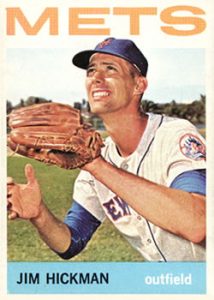 Early Mets had to be on the lookout for someone sending them to play third. “Well,” Jim reasoned, “I have been hitting a lot better in the last couple of weeks. I like third base. It [doesn’t] seem like I get as tired as I do playing the outfield. What takes it out of me in the outfield isn’t the playing, but the running back and forth between innings.” Stengel more or less shook his head at his OF-3B’s thought process: “He wasn’t tired when he knocked in all those runs earlier in the year.” But the Ol’ Perfesser theorized that if Hickman learned to properly shift his feet in the batter’s box, “he can make a living here as a third baseman. We been looking for a third baseman who can hit .260 and knock in 75 runs.”
Roger Craig was looking for anybody at any position to get him a big hit, and two days after Jim singled, doubled, tripled and homered in support of Tracy Stallard, Hickman did his ace pitcher teammate a solid. Craig was riding an eighteen-game losing streak. Good-luck totems fans sent him didn’t help. Counterintuitively switching his uniform number to 13 didn’t help. What — or who — helped was third baseman Jim Hickman lofting a walkoff home run to deliver Craig from a nineteenth consecutive loss. No 3-20 pitcher was ever so happy.
“The first thing I had in mind,” Craig said, “was to make sure he touched home plate. I’d have tackled him to make him do it if I had to.”
Over time, you likely would have had to have tackled Jim Hickman to keep him at third base when the Mets were in the field. Despite his brave words to Isaacs, he wasn’t really cut out to play third, possibly because he was an outfielder. “There are often drawbacks to that type of scenario,” none other than Frank Thomas averred in 2005 when asked to remember his and Hickman’s attempts to convert from the outfield. The numbers Casey wanted out of Jim weren’t there in 1963, with a .229 average and 51 RBIs his final totals. No Met homered more (17), but no Met struck out more (120). Despite not being sent to third regularly until July, Jim made the sixth-most errors in the National League at the position (though, like Mantilla in ’62, he ranked among the league leaders in double plays turned by a third baseman, which perhaps will happen when you play for a team that allows more than its share of baserunners).
More than four decades after Jim Hickman gave third base his best shot, he remembered for Bill Ryczek in The Amazin’ Mets, 1962-1969 that “they stuck me over there and it was tough. Heck, I was half scared to death. I wasn’t a natural third baseman and I just didn’t know what to do over there.” By Spring Training of 1964, Frank Thomas was again being talked up in the papers for third base and Pumpsie Green was getting a long look of his own. Jim moved back to the outfield as the Mets moved into Shea Stadium, and except for occasionally filling in, was done as a third baseman. Before he’d be done as a Met, he’d pile up the most home runs and runs batted in in Mets history — 60 and 210, respectively, over the franchise’s first five seasons, preceding his trade to Los Angeles.
***Once Stengel became certain Hickman wasn’t his third baseman, somebody was going to have to be, and it was neither Thomas (stationed in left or sometimes at first until his trade to Philadelphia in August) nor Green (sent to Buffalo, never to return to New York). Hunt started Opening Night in Philly, but that was a temp job; he’d be back at second before the paint dried at Shea. Rod Kanehl was granted a few starts, but utility demanded Hot Rod stay ready to play anywhere. The answer came in a swap with the White Sox. The Mets sent Chico Fernandez to the South Side in exchange for Charley Smith. Charley didn’t have to convert, at least not by 1964. He’d been a shortstop in the Dodger system before shifting a few yards to his right. Smith had been playing primarily third in the majors since 1961, first for L.A., then Philadelphia, then the Pale Hose.
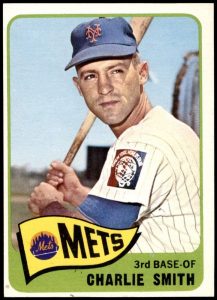 Card-carrying Charley (or Charlie) Smith gave the Mets a fair shake at 3rd BASE. The man was a pro on a team often accused of being stocked with amateurs. In 1964, Charley socked twenty homers, the most by a Met since Thomas in ’62 (and the most until Tommie Agee in 1969). He also surpassed Hickman for the team strikeout lead and placed fourth in the NL in 3B errors. “Streaky” was how Vecsey described him, and it couldn’t have been surprising that, after hitting fewer homers and striking out even more (123 times) in ’65, Smith would be sent to his fifth club. Charley’s Met legacy, for our purposes, was Topps initiating him as a card-carrying member of the 3B-OF club in 1965. Charley played left field thirteen times in 1964; he played short in seventeen games. Maybe the Topps photographer dropped by Shea on one of those relatively rare LF instances and made sure to tell somebody back at the office that a “3rd BASE-OF” designation was in order. However it happened, Topps didn’t bother to print Smith’s first name in line with his preference. They had him as “Charlie” (then again, this is the same company that kept labeling Roberto Clemente “Bob”).
Smith was traded after the ’65 season with Al Jackson to the Cards for the quintessential “real” third baseman: Ken Boyer, barely a season removed from his MVP campaign for the ’64 Cardinals and with five Gold Gloves in his trophy case. Boyer, 34, was the essence of an accomplished veteran…which basically meant he was old, or at least baseball old. “Shopworn” was Vecsey’s descriptor. The Mets had gone the accomplished veteran route plenty since their founding. This is not to say Ken didn’t give the Mets an honorable year-and-a-half. In 1966, only Ron Santo made more assists among NL third basemen. Maybe the most valuable element Boyer gave the Mets was stability. For the first time, the Mets had a third baseman who finished in the top five in games played at the position…and for the first time, the Mets finished in a place above tenth.
The smattering of accomplished veterans the Mets brought in elevated the Mets to ninth place, but they weren’t long-term solutions. Neither, come to think of it, was the manager who steered them out of the basement. Wes Westrum had replaced Casey Stengel in the summer of ’65 after one of Casey’s 75-year-old hips gave out. Westrum went from interim to permanent to resigned in a little over two years. By the time Boyer was traded to the White Sox on July 22, 1967— and despite both Smith and Boyer having lent third base a hint of dependability for more than three seasons — the all-time meter on Met third basemen was up to 34. Before 1967 ended, by which time Salty Parker briefly replaced Westrum in the dugout and Gil Hodges could be heard driving up from Washington, the count had reached 38. Thirteen of those fellows had also seen outfield action as Mets.
The thirteenth among them would go down as the most misassigned Mets OF-3B yet…and probably ever.
***Time was to reveal that in 1969 the Mets had the exact right platoon to cover third base. They had a veteran, righty-swinging Ed Charles, acquired from the Kansas City Athletics in 1967, two months before Boyer was sent to Chicago. They had a freshman, lefty-batting Wayne Garrett, snatched from the Braves in the 1968 Rule 5 draft. Together, like pairs of Mets at half of the positions Hodges filled in depending on the arm with which the opposing club’s pitcher threw, it worked. The Glider and Red combined to function as a world championship third baseman.
Who’da thunk it? Probably not anybody who’d been watching the Mets for the seven seasons prior to Spring Training of 1969, not even the positive-thinking Hodges. Before it became clear Charles had a year of sheer poetry left in him and that 21-year-old Garrett might be more than prosaic in alternating with the 36-year-old, the Mets thought deeply of turning to another youngster to fill what was still considered their lingering hole.
Meet Amos Otis, the product of what could have gone down as one of the best moves the Mets ever made. On November 29, 1966, the Mets casually plucked young Otis, then a lad of 19, from the Red Sox farm system in the minor league draft. Much as the Orioles took Paul Blair from the Mets in the 1962 draft of first-year pros and then made the Mets regret the oversight while Blair piled up Gold Gloves and postseason appearances, the Mets could have filled the Red Sox with remorse.
In high school, Otis — who like Cleon Jones and Tommie Agee hailed from Mobile, Ala. — had played every position (“I was a jack-of-all-trades”), but primarily shortstop. For the Red Sox, he was tried at first, third, short along with the outfield. As a Met callup late in ’67, he’d get a fleeting glance at third, six days after Joe Moock got his. By 1968, at Triple-A Jacksonville, the Mets used Otis mostly as their center fielder. He flourished in all facets of his game, batting .286, swatting fifteen homers and stealing twenty-one bases.
By the spring of 1969, the Mets were committed to Agee as their center fielder. Agee endured a seasonlong slump in ’68, but Hodges believed in him, so much so that he vehemently disagreed with player personnel director Whitey Herzog’s brainstorm that Agee should move to right to clear space for Otis in center. “Jim McAndrew recalled that was the only time he ever saw Hodges and Herzog argue,” Mort Zachter noted in Gil Hodges: A Hall of Fame Life.
What Hodges believed about Otis, who’d earned All-Star accolades in the previous fall’s Florida Instructional League, was that the youngster could become the third baseman that would hush Red Foley and his army of skeptics. Not necessarily on board with the plan? Otis himself. When asked during Spring Training what was giving him trouble as he tried to learn third, this kid didn’t kid around: “Everything.” The player reasoned the Mets “made me an outfielder. They thought with my speed I’d be more of an asset in the outfield.” Then again, as Jack Lang pointed out in the Sporting News, Hodges was “up to his elbows in outfielders,” with Jones, Agee and Ron Swoboda each already penciled in as starters in March.
 Amos Otis with fellow Mobile major leaguers Tommie Aaron, Cleon Jones and Tommie Agee. If only the kid could have stayed in the Shea picture. Otis’s talent, minor league track record and assumed potential at more than one position attracted outside interest. The Braves dangled veteran catcher Joe Torre, a New Yorker with the kind of heavy bat the Mets were always lacking. Atlanta asked for a package of Nolan Ryan, Jerry Grote and Otis. GM Johnny Murphy demurred. “Otis,” he said, “is one of our untouchables.”
The response led to a bit of snickering that the Mets, whose 89-loss campaign in ’68 represented their high point to date, had untouchables — plural — but management sensed all that Youth of America the organization had been developing with a straight face since the days of Stengel was on the verge of paying off. And 1969 was about to prove them right.
But wrong about third baseman Amos Otis, at least when it came to what to do about him in the immediate future. Hodges carried the rookie north and started him three times in a row in April at third base. Dick Young snarked he was “the untouchable who finally became playable”. In what amounted to an abbreviated audition, Otis handled seven chances, made one errant throw to first, was credited with three assists…and then never again saw third base, except as an infrequent baserunner. “Third base,” Young concluded from scant evidence, “was strange for him.”
Amos received less and less playing time anywhere as the season wore on, fading from Hodges’s plans as the Mets otherwise shocked baseball with eptitude and competence. His average fell below .200 by mid-June, at which point he became the odd man out to make room for Donn Clendenon, acquired from Montreal for four Youths of America now deemed expendable; one of them was now erstwhile Met third baseman Kevin Collins. Otis spent the summer at Tidewater (batting .327), and wasn’t recalled until September, by which time his status as an extra outfielder was hardly a matter of primary concern for a band of miracle workers headed for the playoffs.
Garrett had a huge NLCS to help secure the pennant. Charles was the sparkplug of what proved the winning rally in Game Two of the World Series. Neither had posted dynamite numbers during the regular season — neither of them hit as high as .220 — but they were sure-handed enough, steady enough and ultimately the epitome of clutch. Just as nobody saw the Mets going all the way months earlier, it would have been tough to guess that the minor leaguer the Braves gave away and the old man who was viewed as hanging on would meld into the answer at third base for a team that never had an answer at third base.
Old habits, however, died hard. The world champion New York Mets, wrote Leonard Koppett in the revised version of his essential team history The New York Mets, still weren’t satisfied: “There just didn’t seem to be much future in filling third base with a Garrett-Charles platoon.” They released Charles. They invested minimal faith in Garrett. And they traded Amos Otis for Joe Foy.
Foy won a pennant with the Red Sox in 1967 and led the expansion Royals in RBIs in 1969. Kansas City nonetheless decided he wasn’t a building block, just as the Mets had deemed Otis a replaceable part. The Mets wanted an experienced third baseman who could hit and the Royals salivated at tapping Otis’s potential. Some deals prove win-win. This wasn’t one of those deals. Save for a 5-for-5 afternoon in San Francisco that he capped off with a tenth-inning, game-winning home run, Foy fizzled miserably for New York. Joe would be gone from the Mets following 1970.
Otis would make an impression in his new home right away and stick around for a very long time. “Incredibly underrated, and accomplished in all facets of the game: hitting, baserunning, and fielding,” Rob Neyer, a Royals fan from childhood, wrote in 2003’s Big Book of Baseball Lineups of the man who came to be known affectionately in K.C. as A.O. He made the American League All-Star team in his first Missouri summer, tipping his cap at the same Midsummer Classic as none other than Jim Hickman, who’d been reborn splitting time between left and right field for the Cubs when not spelling aging Ernie Banks at first. In the twelfth inning, it was Hickman who singled to center with Pete Rose on second, and it was Otis who fired home to Ray Fosse, only to see his throw rendered immaterial once Rose barreled over the catcher. The play is remembered for the baserunner and the backstop, but it was two Mets third base refugees who put the action in motion. After leaving the Mets, they’d each been stationed where they could be most comfortable and they had reached the spotlight, having succeeded at the sport’s highest level.
For Hickman, 1970 was the high point of a big league tour that wound through 1974. “Hickman was a youngster with a lot of potential in 1962, and he did a good job for us in the outfield,” Frank Thomas reflected in 2005. “He struck out a lot and made occasional errors in the field for which the fans sometimes got on him, so it was tough on Jim because he was only 25 or so years old. Casey tried to nudge him to improve with not-so-subtle hints in the dugout, and it would get to Jim, but Casey was just trying to help him develop. I think Casey’s methodology eventually got through to Jim because he went on to a nice career.”
Gil Hodges and Casey Stengel didn’t seem much alike, but Hodges, too, had great success getting through to the players he managed. The 1969 world championship and the testimonials that have rung through the corridors of time tell us Gil, in his quiet way, was a master communicator. Otis, though, was immune to Hodges’s motivational methods, however they manifested themselves. After Hodges, as manager of the National League All-Stars in 1970, crossed paths with Otis and extended his best wishes, Otis remarked, “That was half as much as he talked to me during my whole time with the Mets last year.”
No longer asked to play a defensive position outside the outfield, Otis lasted with the Royals through 1983 and then played part of another year for Pittsburgh. He made five All-Star teams, won three Gold Gloves, earned MVP votes in five separate seasons and went to the playoffs five times, thrice under Royals manager Herzog. He’d finish up with 2,020 hits, 193 homers and 341 steals. Bill James, a Royals fan before taking a front office job with the Red Sox, rated Amos Otis the No. 22 center fielder of all time in his 2001 Historical Baseball Abstract, terming him “strong, quick, fast, extremely graceful, and smart.”
Indeed, Otis was smart enough to wonder in an interview with Baseball Almanac in 2006, regarding his stint with the Mets, “I was one of the fastest players on the team, so why did they want to put me at third base?”
The Mets wouldn’t send one of their third basemen to the All-Star Game as a third baseman until nearly twenty years after Hickman and Otis first made it there as outfielders…and before long, they’d send that third baseman to the outfield. But that’s a ways off. In our next installment of OF-3B/3B-OF, we do meet a couple of other future All-Stars: the slugging outfielder whose awesome power was a fit in theory — but only in theory at third base; and another outfielder the Mets spent another spring pushing to third base only to have the outfielder push back.
THE METS OF-3B/3B-OF CLUB
The Ill-Advised Tradition Continues (1963-1969)
5. Jim Hickman
Mets CF Debut: April 14, 1962
Mets 3B Debut: June 19, 1963
6. Johnny Stephenson
Mets 3B Debut: April 26, 1964
Mets LF Debut: May 16, 1964
7. Charley Smith
Mets 3B Debut: April 24, 1964
Mets LF Debut: August 17, 1964
8. Danny Napoleon
Mets 3B Debut: April 24, 1965
Mets LF Debut: May 22, 1965
9. Chuck Hiller
Mets RF Debut: August 14, 1965
Mets 3B Debut: August 22, 1965 (Game 1)
10. Gary Kolb
Mets LF Debut: April 21, 1965
Mets 3B Debut: September 1, 1965 (Game 2)
11. Tommie Reynolds
Mets LF Debut: April 11, 1967
Mets 3B Debut: April 29, 1967
12. Phil Linz
Mets 3B Debut: July 19, 1967 (Game 1)
Mets LF Debut: August 8, 1967
13. Amos Otis
Mets 3B Debut: September 7, 1967
Mets CF Debut: September 8, 1967 (Game 2)
14. Jerry Buchek
Mets 3B Debut: April 23, 1967 (Game 2)
Mets LF Debut: June 11, 1968
by Greg Prince on 7 February 2022 1:35 pm If you’re up on your Met lore, you know that you could just as easily be up on your Meadowlark lore had Joan Payson foisted her first choice for a team name on the new National League ballclub she was bankrolling. Mrs. Payson liked Meadowlarks and who are we who are native to the Flushing Meadows region to say we wouldn’t have enjoyed the avian identity? When baby names were being weighed sixty-one years ago — time, like the meadowlark itself, really tends to fly —The Sporting News reasoned one prism through which to view Mrs. Payson’s pet pick was that “everything’s a lark” for “New York men-about-town,” a.k.a. presumed ticket-buyers prowling the Metropolitan Area.
Whatever the team was about to be called (and the media fix was pretty much in for Mets, Mrs. Payson’s personal preferences notwithstanding), all concerned understood the town in question was a National League town. There wouldn’t have been much ado about naming an expansion team had there not been a need to expand. And, oh, was there a need to expand. New York went from two National League teams to none in a veritable blink. For four seasons, former fans of the Giants and former fans of the Dodgers were left to make like ex-Giant and future Met hitting coach Rogers Hornsby: stare out the window and wait for spring. Except in this case, spring was metaphorical. It had been endless winter since the fall of 1957. Baseball needed to come back to town in National League form. No substitutes, no matter how conventionally successful they appeared from a distance, were to be accepted.
You know the basics of the rest. The National League expanded into New York, a town it never should have departed; the Mets took the field as the Mets in 1962; and, save for the occasional management lockout of players/middle finger to fans, we’ve been entranced by the Mets ever since.
 A lark for those native to the Flushing Meadows region. All of which is my way inviting you to have a listen to a new Mets podcast I’m a part of called National League Town, a celebration of Mets Fandom, Mets History, Mets Life. Mets podcasting, richly populated by talented talkers as it is, may not have needed an expansion franchise, but my friend and fellow Mets devotee Jeff Hysen and I created one anyway. Well, he created it. Jeff also produces it; edits it; engineers it, emcees it; and puts it where people can hear it. I named it — and I think out loud about the Mets into the general vicinity of a microphone until Jeff presses pause on his end.
We’re still tweaking the format.
It’s a lark of sorts for this New York man-about-blog. Hopefully, as we go along, you’ll feel like you’ve grabbed a seat next to Jeff and me in Promenade some sunny Saturday afternoon as we go on about that season or that game or that moment that has suddenly leapt to mind. We’re in the midst of a several-part series on who we’d add to the Mets Hall of Fame. The short answer is basically everybody, but perhaps you’ll enjoy listening in on the details. We’ll probably veer into the present-day Mets once there are present-day Mets. Honestly, it’s the tangents you’ll want to stay tuned for.
Episodes of National League Town, with Long Island’s Own Greg Prince and Jeff Hysen, is searchable on all your favorite podcast platforms and accessible via this link.
by Greg Prince on 1 February 2022 5:48 pm If you’ve ever met me outside Citi Field to go to a game, I’ve probably added a minute or two to our entrance because I always insist on detouring to check on my brick, the one that reads:
OUR FIRST DATE
METS 8 GIANTS 3
MAY 15, 1987
The brick commemorates the first time my future wife and I went anywhere on purpose. We’d met four nights earlier on the Upper West Side, unplanned. It went so well that by the end of the evening, I heard myself asking her to Friday night’s game. Nearly 35 years later, we’re still going to games in Queens.
I wasn’t counting on meeting Stephanie in the middle of May 1987 and I wasn’t counting on meeting Jeff Innis the very same week. Technically, I never met Jeff Innis in the “Hi, my name is…” sense, but as fans, we don’t let niceties such as an actual introduction get in the way of us feeling familiar with our players.
Jeff Innis had been pitching in Tidewater the first half of that month and during the month before, making the tour we recognized as necessary to becoming a Met. Since 1983, he’d been in Little Falls, Jackson, Lynchburg, Jackson again, then Mecca’s waiting room: Tidewater. If all went well, you’d think, a 24-year-old Triple-A reliever carrying an ERA barely above 2 might be pitching for the defending world champions soon. Actually, all had to not go well for Jeff to get his chance. The gleaming trophy earned the October before was already losing a bit of its shine. The Mets were losing more than they were winning by mid-May and their DL contingent was growing. Sometimes things have to go wrong at large to go right for one individual.
Terry Leach is recalled by Mets fans on the scene in ’87 as the savior who picked up miles and miles of slack for all the pitchers who got hurt. It wasn’t until I looked it up that I was reminded Leach himself got hurt in ’87, absorbing a line drive off his right knee the night before I took Stephanie to Shea. So while we were engaging in that first date at Shea Stadium the brick next to where it used to stand commemorates, Jeff Innis was about to have plans made involving the same destination.
“It was the evening of May 15,” Jeff would remember for Zak Ford, curator of Called Up, a marvelous collection of stories from major leaguers focusing on the moment they became major leaguers, “and I had been pitching really well.” Yet it didn’t occur to the righty with the amazing, disappearing earned run average — even as “the Mets had two or three injuries happen all at once in their pitching staff” — that he was on the parent club’s radar. Jeff hadn’t gone to big league camp. I could have told him his name wasn’t bandied about among Mets fans as a prospect of note up in New York. Nothing personal, it’s just that in the aftermath of 1986, we weren’t too worried about minor league bullpen depth.
But, like Jeff told Zak, the Mets were getting pelted by injuries, like the one to Leach and another to Sid Fernandez, a knee sprain Stephanie and I witnessed chase El Sid from the mound with a no-hitter in progress (a situation I Metsplained to my date was kind of a big deal). All Jeff Innis knows, as a Tide in a motel room in Columbus, is if he’s called to see his manager Mike Cubbage, it must be bad news.
For Al Pedrique it was. Pedrique was the little-used backup infielder who was getting sent down to make room for Jeff Innis. For Innis, from Cubbage, the news was, “You’re going to the big leagues.”
On May 16, one night after my first date with Stephanie, I was back to doing things guys without dates do on a Saturday night. I was out in a bar with my buddy Joel and his buddy Rich and some girl I think Rich knew. It was loud. Jody Watley’s overplayed hit single “Looking For A New Love” was on the jukebox. “Ooh,” the girl with Rich blurted, “that’s my song!”
“You can have it,” I assured her.
On a muted TV, of more interest to most occupying our booth, were the Mets and Giants. We noticed a close game. Given the ambient noise (“I’m looking for a new love, baby, a new love, baby…”), we couldn’t follow it in detail and probably didn’t try, so I’m pretty sure we missed the major league debut of Jeffrey David Innis. Innis, naturally, remembered it very well.
The bullpen phone alert was “the loudest phone ring ever”; the bullpen coach yelling his name “scared me to death”; he couldn’t feel the ball in his hand as he warmed up because “I was numb”; and when Davey Johnson assigned him the ninth inning of a 4-4 game with more than 48,000 in attendance, “the lights were so bright.” Oh, and his first major league catcher is about to be somebody he might’ve seen in a few All-Star games, World Series games or commercials, Gary Carter.
Yet Innis settled down, settled in and pitched a scoreless ninth. The Mets didn’t take the lead in the bottom of the inning, and a storybook finish eluded Jeff. His second batter in the tenth, Jeffrey Leonard, took him deep, and if there’s a commemorative brick outside Citi Field marking the occasion, the score wound up being not as superb as the one etched into Stephanie’s and mine.
JEFF’S FIRST GAME
GIANTS 5 METS 4
MAY 16, 1987
It was just the first of many nights for Jeff Innis of the New York Mets. “Even though we lost the game and I got this loss,” he told Zack, “I thought it was an incredible night. I thought, ‘I’ve got this. I can do this.’”
For 288 major league games spread over seven seasons, Jeff’s vision proved accurate. Innis’s entire MLB career was a perfect circle overlaying his entire Mets career. He pitched only for us. Us and Tidewater until 1990, as Jeff, for a while, became the guy who’d get sent down when there was a roster squeeze — he was first optioned to make room for Doc Gooden’s return from drug rehab — but he inevitably got called back. His sidearm or submarine delivery (I’m still hazy on which is which) was fairly unique. The Mets had Terry Leach pitching like that and now they had Jeff Innis pitching similarly. The Mets would send Leach to Kansas City in 1989. They’d keep Innis.
 Jeff Innis needed a horizontal card to truly capture his delivery. One manager after another relied on Jeff. Johnson. Buddy Harrelson. His old minor league skipper Cubbage for a week. Jeff Torborg. Dallas Green. He’d be a small part of some good clubs and a bigger part of, truth be told, some dreadful clubs. Yet you never looked around as the Mets fell out of contention after 1990 and thought the problem was Jeff Innis. If anything, you breathed easily as he trotted in from the bullpen. “This may not be a competent organization”, you could hear yourself analyze, “but this will be a competent outing, because Jeff Innis is a competent relief pitcher.” It wasn’t something you found yourself believing often during Mets games in 1991, 1992 and 1993. If he was the guest pregame or postgame in those years, you paid attention. Jeff came across as friendly, thoughtful and a touch sly. Also, if a middle reliever was getting airtime, it probably meant he’d been pitching well.
When John Franco was inducted into the Mets Hall of Fame a decade ago and various teammates of his were introduced as part of the ceremony, I was moved to hearty applause when the name “Jeff Innis” was announced almost from out of nowhere. No Mets public address system had perked up with his name in nearly 20 years at that point. Innis worked his most when the Mets were at their worst, averaging 70 appearances per season during the darkest years. As you get older, you tend to appreciate those who showed up every day when the nights weren’t much to look forward to. I’ve developed a bizarre soft spot for the 1993 Mets in particular. Not their record (59-103) and not those whose antics made for a string of unbearable months — but contemplating those who plied their craft as best they could without making us cringe sometimes causes me to form a smile as wide as that unnecessary tail they wore under the word Mets on their jerseys that year.
Also, last place notwithstanding, I was happy sharing the Mets, bit by sometimes atrocious bit, with my bride. When I was in the process of writing something about 1993 for my Mike Piazza book a few years ago, I read a passage aloud for Stephanie. She heard the names: Jeff Kent, Bobby Bonilla, Anthony Young. I thought she might nod and tell me, uh-huh, that’s nice. Instead, she said it really brought her back…which, in turn, really brought me back. Good year for us, 1993. They’ve all been good years for us, but the summer of ’93 was a moment in time. Cohabitating since the spring of ’90 and wed in the fall of ’91, we had, consciously or otherwise, settled down and settled in, just like Innis once he warmed up on May 16, 1987. Driving around in the first car we bought together. Coming home to the first apartment we’d found together. Doting endlessly on our first pair of adorable kitties. And, in the realm of what was once novel about to become constant, many, many pairs of tickets to see the Mets squad that was about to become the sequel to The Worst Team Money Could Buy. The tickets had been my thirtieth-birthday present from my loving family who didn’t pay attention to the standings and wouldn’t have guessed that as 1993 approached — as much as I appreciated the gesture and especially relished the Opening Day ducats that were the veritable bow on the box — I wasn’t necessarily aching to make regular trips to Shea…not after 162 games of The Original Worst Team Money Could buy, the 1992 Mets (for whom, incidentally, I’ve yet to develop a soft spot).
But of course I used those tickets, no matter how often the Mets lost and inspired bad press in the process. The more I went, the more they lost, yet the more I went, the more I realized I couldn’t stay away. Before 1993, I was a Mets fan who went to Mets games intermittently or on special occasions, like maybe if I had a hot date. From 1993 forward, you knew where to find me if I hadn’t driven home in that car to be with my wife and those cats in that apartment. Somewhere, inevitably warming up amid all of that early 1990s living and rooting I was doing, was the sidearmer/submariner regularly coming out of the bullpen to pitch competently, then speak thoughtfully. He evolved from first Met demoted to a staple of Shea. Jeff Kent. Bobby Bonilla. Anthony Young. Jeff Innis. It used to be his town, too.
The Mets would move on from Innis after 1993. When 103 games get lost, Shea is bound to get shaken up. The club would mercifully turn its fortunes upward a few years later, perhaps diminishing the compulsion for anybody to mention Mets who were no longer Mets from when coming to see the Mets hardly guaranteed a heckuva day. By 2008, you could kind of understand that when the Mets were bringing back players from almost every era to “Shea Goodbye,” nobody other than Franco from those anni horribili was summoned to the field — and Franco didn’t really count as their representative, because Johnny endured long enough to win a pennant and have himself associated with better days. But as much as I understood the editorial choice the Mets were making, I quietly resented their de facto excision of history. I was here in 1973 and 1986 and 1999 and 2006, I thought, and I cherish the results and the Mets who brought them to be, but I was here a whole helluva lot in 1993, too, and, per the guy who in July played the last concert in this ballpark, I would not be here now if I never had the hunger.
We didn’t have a chance to clap once more for Jeff Innis at Shea. Our loss. Good for John including Jeff on his Hall of Fame night at Citi. Good for the Mets making Jeff a part of Fantasy Camp festivities since then. Good for Jeff Innis for making a wonderful impression on so many who did make his acquaintance in his years in baseball and years after baseball. When word spread last week than Jeff was terribly ill, it was a shock to those of us who only knew him from afar. When the news hit on Sunday that Jeff Innis had died from cancer at 59, all of us who were keeping the faith when he pitched so often felt we’d lost a constant in our lives. Never mind if we hadn’t seen him lately. Jeff Innis stayed with us.
***Nobody gave me tickets for Opening Day 1975 the way I was given tickets for Opening Day 1993. Hence, to see the Opening Day I can honestly say I looked forward to like I’d never looked forward to an Opening Day before, I had to make an executive decision. On April 8, I had to cut Hebrew School. I wasn’t going to be a rabbi and I was secure that I’d accrued enough points to merit a Bar Mitzvah the following January.
Because we had a very cool sixth-grade teacher, our class in shall we say regular school was treated to a glimpse of the first inning. That taste, however wasn’t sufficient to sate me for the balance of the afternoon. “I’m not going to Hebrew School today,” I said to my easily persuadable companion and fellow Mets fan Jeff Mirrer as I convinced him to stop at my house when we were supposed to be walking from the bus stop to the temple. “This is Opening Day.” We sat down in front of my parents’ recently purchased color television (the first one we ever had), changed the channel to 9, and lived the dream. Let those schmendricks conjugating verbs in another language find out the score on the 6 o’clock news. We have reached The Promised Land! We are inside The Baseball Season
Aiding my boldness immeasurably was my mother not being home to rescind my executive decision.
Missing Opening Day 1975, from my 12-year-old perspective, would have been a shonda, specifically after the offseason that preceded it. Nineteen Seventy-Four was the first irredeemably crummy year I’d ever experienced as a Mets fan. Once its 91st loss was in the books and its final ember was extinguished, that winter’s Hot Stove had to start flickering ASAP. New GM Joe McDonald got to work so quickly, that he made trades reflected in the following year’s Topps set.
Unlike ’74 and ’76, Topps didn’t have TRADED cards in ’75, but they did have some ace airbrushing interspersed throughout what collectors call the base set. If you gave Topps’s artists enough lead time, they’d account for new destinations. On October 22, 1974, the Mets made a trade with the Pirates. We gave them Duffy Dyer, our stalwart backup catcher who’d been our stalwart backup catcher for as long as I could remember us having a backup catcher, and in return they gave us Gene Clines. Thus, when we opened packs that spring, there was every chance we’d pull from within Gene Clines already dressed and identified as a New York Met.
 Airbrushed into actuality, having Gene Clines identified as a Met. That and all it indicated, no offense to stalwart Duffy, was refreshing. I was aware of Gene Clines as a Pittsburgh Pirate and I was in something approximating awe of Gene Clines as a Pittsburgh Pirate. He didn’t play all that regularly for them, loaded as they were with outfield talent, but when he did, he showed himself to be the kind of player we never seemed to have. “Clines has tremendous speed and a hitting history,” McDonald said when he made the trade, further promising Gene “will get the chance to play”.
My assessment of Clines probably had more than a little to do with his hitting Met pitching very successfully — between 1970 and 1973, he batted .333 and on-based .426 versus us — and with whom he’d been breaking in and breaking through during that stretch. The Pirates were postseason regulars in the first half of the 1970s. Except for 1973, you could count on them being in the playoffs, yet despite being a division rival, they never wore out their October welcome, at least not with me. I won’t say I loved that team, but I liked them as much as I could with having to face them 18 times per year. Roberto Clemente until his humanitarian mission ended in a plane crash. Willie Stargell pounding so many homers that one summer I’d take swings in my backyard pretending I was vying with him for the league lead (he wound up with 48 to my 35, but I quit swinging by August). Manny Sanguillen with the strong arm and the big grin. Al Oliver eternally overlooked as a hitter. Bob Robertson owning the 1971 NLCS. Steve Blass before he lost the strike zone, nailing down that World Series. Dock Ellis didn’t strike out batters the way Tom Seaver did yet still won as many as 19 games in a season. Even Richie Hebner seemed no worse than a benign presence from a distance.
And now we could have one of those Pirates? Wow!
Clines, despite his ability to hit and run, could win only so much playing time in Pittsburgh. Power-hitting Richie Zisk was on the premises. Dave Parker was on the way up. Clines’s status stagnated with the almost-perennial NL East champs. In his 2021 memoir Cobra: A Life of Baseball and Brotherhood, written with Dave Jordan, Parker revealed Clines’s clubhouse nickname was Angry. It was bestowed with affection, but it had more than a patina of honesty to it. Gene was not happy not getting into games.
The trade to New York could change all that. “Ol’ Angry would at last be getting a real chance to start,” Parker exulted on behalf of his friend and roomie. “Clines was thrilled to tears about leaving the Pittsburgh outfield log jam.” Gene was a young veteran by the time Dave was promoted in ’73 — Clines’s stint on the DL opened up a spot for Parker — but a veteran nonetheless. “He was a good teammate, a great roommate on the road, and someone who taught me stuff like which room service items wouldn’t get cold on the trip up the elevator.”
Unfortunately, the elevator stalled at Shea Stadium, where Gene envisioned putting his defensive skills to good use in center. The winds could be tricky. The acreage was expansive. But Clines had the credentials to take on the challenge. Except the Mets acquired another center fielder that same offseason, a very good one named Del Unser, giving up Tug McGraw to get him (in a package that also brought John Stearns to New York). The deal for Del transpired during the Winter Meetings, after Topps could have airbrushed Unser into his proper clothing. Nonetheless, he was in a Mets uniform on Opening Day, same as Clines, and I was excited to see them both.
Cutting Hebrew School was totally worth it, even if I couldn’t translate that sentence into Hebrew without the help of Google. With the newcomer outfield of Clines in left, Unser in center and Dave Kingman in right — Rusty Staub was out with a sore thigh — the Mets topped Unser’s old team from Philadelphia, 2-1. Kingman homered. Brooklyn’s own Joe Torre, brought over from St. Louis after years of rumors that he’d experience a homecoming, drove in the winning run in a walkoff, delivering the W for incumbent ace Seaver. All these terrific new Mets joining forces with Tom Terrific and several favorites who weren’t traded away — it was the Opening Day fruition of a winter’s worth of dreams.
Gene batted leadoff that afternoon, walking to commence the National League season in New York and instigating a balk from Steve Carlton to move to second. The Mets left him on third. He was 1-for-1 fielding fly balls in left. The Mets won. He was a part of it. Those of us watching on TV instead of being elsewhere were elated. Gene Clines and the Mets appeared ready for big things.
To borrow a phrase Parker enjoyed invoking in Cobra, not gonna lie — 1975 didn’t really work out that great for the Mets and not at all for Clines. He got even less playing time in Flushing than he did in Pittsburgh, batting .227 and making little impact in the outfield or on the basepaths. The culture he encountered was disappointing, too, different from what he encountered previously and different in ways a 12-year-old fan on Long Island who didn’t have to think about these things might not have comprehended. On September 1, 1971, Clines was part of a lineup for the Pirates that consisted of nine players who were either African-American or Latin-American. It had never happened in the National League or American League before. It shouldn’t have been remarkable. It figured it would happen in Pittsburgh, where players of all backgrounds were warmly welcomed beyond lip service. There was “a spiritual mission” to the way those Pirate teams were constructed and operated, according to Parker, “and I’m not just talking about one game in ’71.” GM Joe Brown and manager Danny Murtaugh ran an outfit that “had our backs all the way.”
At the end of the decade, when the Pirates were on the verge of their next world championship, Parker took stock of the Bucs as they departed Spring Training: “Pops Stargell was leading nine brothers, eight white dudes, three Panamanians, a Dutchman, a Mexican, a Dominican, and [Phil] Garner in a cowboy hat. It was a damn general assembly of baseball.” That’s the way the Pirates rolled throughout the ’70s. If you step back from your baseball allegiances, you can’t help but adore that ethic, and you can’t blame somebody for missing being subject to that vibe. When Clines visited with his former teammates on a road trip to Pittsburgh in ’75, Gene confided in Dave, “I was sitting in the dugout today, and I saw you boys across the field laughing and having a good time. No one’s helping the rookies in New York. They treated Cleon like shit. It’s just me and Milner and Tom Hall. They don’t talk to us at all. No one’s lookin’ out for anybody. No one.”
Topps printed an official Mets card for Clines in the 1976 set, but that owed to the trade that sent him away from Shea happening too late to fit the company’s production calendar. Our erstwhile extra outfielder stayed with the Rangers for a year, then went to the Cubs for three. His playing career ended in 1979, but his career as a respected baseball man went on and on, instructing and advising for a half-dozen organizations. Gene mentored a couple of budding Hall of Famers in Seattle (Ken Griffey and Edgar Martinez) and was the hitting coach in San Francisco when they reached the World Series in 2002.
Gene Clines died on January 27 at the age of 75, three days before Jeff Innis. Proximity in passing is the reason they share this column. Their lives in baseball and their times as Mets are why a Mets fan is moved to remember them a little. That’s all right. There are worse reasons to remember people.
by Greg Prince on 27 January 2022 2:54 pm After the Major League Baseball lockout ends; after Spring Training goes through its motions; once the regular season begins; and whenever Eduardo Escobar takes the field at third base in 2022, he’ll achieve a Met milestone instantly recognizable to viewers of An Amazin’ Era, the videocassette that commemorated the franchise’s 25th-anniversary. Pending unanticipated roster moves and managerial prerogative, Escobar projects as the 179th man on third in Mets history, or 100 beyond the total as it stood when the ballad “79 Men on Third for the Mets” lit up the celebratory VHS the Mets released in 1986. As a refresher, Dick McCormack’s ditty went a little something like this:
Well, the Mets are really rockin’ that ball
But they can’t keep a man on third at all
Like Drake and Chacon
Fernandez, Ramirez
Pfeil and Graham
Maddox, Martinez
It’s a brilliant composition, albeit reflective of a less than sparkling heritage. The Mets had their problems keeping a man on third — not to be confused with their problems getting a man to third — and for the better or perhaps worse part of a quarter-century, they were regularly groping for solutions. For example, the 79th man on third for the Mets was Tim Teufel, who despite not really being a third baseman, was given a whirl at the hot corner on April 12, 1986, three games into what became A Year to Remember (speaking of classic video productions). Kudos to McCormack for staying alert to Met box scores and having the quantity current for when An Amazin’ Era screened for the press on July 8 of the Mets’ 25th annum.
The Mets being the Mets, even in their most spectacular season, rendered McCormack’s cataloguing out of date within two weeks. On July 22, the Mets deployed their 80th man on third, a fella named Gary Carter. Bright-eyed observers will recognize the occasion instantly. A clip of Carter playing third has made the social media rounds of late because it’s an example of the defensive handiwork of the finest first baseman the Mets have ever called their own and the holder of the most recently retired number in Mets history, Keith Hernandez. No. 17 got himself up in the face of Reds batter Carl Willis. Willis, a pitcher, had been called on to bunt. Bunting to Hernandez was rarely productive for the team on offense. Keith fielded the ball, flung it to third baseman Carter, who effected a forceout where he was stationed for the second time in his big league career, and relayed it to Teufel, second baseman covering first. Score it 3-5-4, with a Hall of Fame catcher manning the middle of a double play that kept a twelfth-inning tie knotted tightly.
Two innings earlier, Carter became the 80th third baseman in 24½ years of Mets baseball amid what manager Davey Johnson called “the strangest game I’ve ever been involved in,” and Davey managed the Mets a year earlier through a 16-13 19-inning jaunt to daylight in Atlanta. As you likely remember or have had mentioned to you at some point in your Met-loving life, July 22, 1986, was one of those nights (there were four) when the 1986 Mets got into a fight and a night when they experienced multiple ejections. With the bench depleted, Kid had to defend a spot he hadn’t visited as anything but a baserunner since August 8, 1975. Plus Jesse Orosco played right field and Roger McDowell played right and left field, in addition to both of them pitching.
But we’re getting a little off the track here.
The point, to the extent we need one in the middle of a lockout, is Eduardo Escobar is likely to be the 179th man on third base for the Mets. But will he be the 81st member of another subset of Mets third baseman? A club of which Carter is a member? A club of which Carter might be a card-carrying member had his card been printed to reflect his particular accomplishment in this realm? Not too many of those 80 guys got cards.
I’m talking about Mets third basemen-outfielders. And Mets outfielders-third basemen. It probably makes a difference which position you place before the hyphen. For many years while the Mets were trying to keep a man on third, they’d look all over the diamond for a solution. Even to the outfield…though sometimes they’d have holes in the outfield and seek help internally…even from third base.
***Welcome, then, to the first part of the multipart Faith and Fear in Flushing series, OF-3B/3B-OF, which will set out to examine the Mets’ intriguing history of assigning outfielders to third base and third basemen to the outfield. I’ve assigned myself this topic because I couldn’t help but notice the surfeit of Mets who’ve been asked to be good at what feel to me to be — after all my years of watching the game — a pair of incompatible positions.
The similarities between third base and any of the three outfield positions appear fleeting at best. According to a reputable-looking coaching website, here are what high school third basemen should feature:
• A very strong arm
• Excellent reflexes
• Great defense, if not with as much range as a shortstop
• Power
The reflexes are the first thing that occur to me. Balls come at a third baseman, if he’s not in a shift (in which case all assumptions are inoperable), fast and at tricky angles. Line drives are somehow both common and total surprises. Diving to one’s right is a must. The arm needs to unleash clothesline throws to first. Range requirements depends on who’s batting. Power has nothing to do with defense, but, yes, third base is often where we look for slugging when our team comes up to bat.
Not that much of it sounds like the outfield. A strong outfield arm has different utility than a strong infield arm. The ball tends to be in the air longer (and higher) if it’s headed for left, center or right. Defense relies more on speed out there. Power, of course, is swell, depending on other assets and the rest of your lineup.
In high school, a player may still be finding his position. In the majors, you’d figure you’d have your expertise boiled down to suitability with a given outlet. Shortstops can slide over to second. Second baseman can trot over to third. A right fielder oughta be able to play left. An aging catcher, given his experience with a mitt, might later settle in at first. And in a pinch, almost anybody should be able to give you an inning almost anywhere. Pete Rose played all three bases plus the corner outfield spots, and you can bet it was for more than an inning.
Yet I can’t wrap my head around the OF-3B/3B-OF paradigm, not as a way of life.
This has fascinated me at a low level for as long as I’ve been a Mets fan, which is a long time, but isn’t quite as long as there have been Mets, which may explain the fascination. Between 1962, our founding, and 1969, when I started rooting, outfielders and third basemen doubling as third basemen and outfielders seemed to be normative. Upon my introduction to the game, I grasped quickly that every team sent nine men into the field. But why were the Mets less than secure about who they sent to play third?
I understood, thanks to Lindsey Nelson, Ralph Kiner and Bob Murphy regularly touching on it, that it was more than a fleeting concern. From the earliest days of my fandom, I got that the Mets hadn’t been satisfied with their third base situation from their earliest days. The first trade I remember was for a third baseman: Joe Foy, in the offseason following 1969. We’d traded Amos Otis to get him. Amos Otis became an All-Star center fielder in 1970, my first full season as a fan. It was mystifying to my seven-year-old mind that somebody considered among the best players in the game was also somebody the Mets gave up on despite perhaps needing somebody considered among the best players of the game. More mystifying was learning the Mets had tried to make Amos Otis a third baseman.
But that (an episode we’ll dig into in a future installment of this series) was hardly the first time they attempted to pull the OF-3B conversion, nor the first time it didn’t take. You can go back to practically the beginning of the Mets to find dissatisfaction on third and an outfielder being tabbed to make it go away.
***The very first third baseman in Mets history was, rather famously, Don Zimmer. Here’s Casey Stengel’s detailed Spring Training 1962 take on why Zimmer would be his third baseman:
“Well, now you’re gettin’ down to Mister Zimmer. Mister Zimmer’s been handicapped five or six times in life because he was injured, but he never gives up. He’s a boy that don’t die. Now ya gotta have that spirit and ya gotta have somebody that won’t give up and plays ’til the ninth inning. If they’ll play ’til the ninth inning, then ya just beat a team six to five, instead of gettin’ beat five to four. Now if you can win six to five, you’re better off than losin’ five to four. Now if I can get the teamwork now, to go with those men that are on that infield, we oughta find some method in which we can come out winning a number of games that otherwise their records will not stand. We don’t care what their records were last year. It’s what’re ya gonna do when we ring the bell Opening Day.”
The above was Casey’s response to Lindsey Nelson’s query, posed during Channel 9’s season preview show, “Now what about third base?”
There’s no denying it’s better to win, six to five, than it is to lose, five to four. Alas, by the time the Mets achieved their initial 6-5 victory, over the Cubs in thirteen innings on May 15, Don Zimmer was no longer the Mets third baseman. Casey started Zim the first nine games of the year, all of them losses. Don’s batting average slipped below .100, part of an 0-for-34 skid that cost him his starting assignment as well as his roster spot. On May 6, the Mets traded Zimmer — a 1961 National League All-Star — to the defending NL champion Reds for Cliff Cook. Zimmer’s final totals as a Met: four hits, three errors and another fifty-plus years in baseball to exude that “spirit” even an .077 batting average couldn’t extinguish.
Cook was acquired to take Zimmer’s place at third base and, if the position wasn’t to his liking (or Cook wasn’t to the position’s liking), make a little history of his own as the first card-carrying member of the Mets OF-3B/3B-OF club. Let us distinguish card-carrying from those credentialed only by experience. The first third baseman-outfielder the Mets ever harbored was one of the signature players of their first team, Hot Rod Kanehl. The scrappy Mets utilityman who would create the template for all scrappy Mets utilitymen to come first played third base on April 21, in relief of Zimmer after a pair of pinch-hitting substitutions led to no runs, and then debuted in left field late in the April 29 doubleheader opener, a game the Mets were winning by eight runs after six innings. With Hot Rod showcasing his versatility, the Mets maintained their 8-0 lead and Al Jackson notched the very first shutout victory the Mets ever had
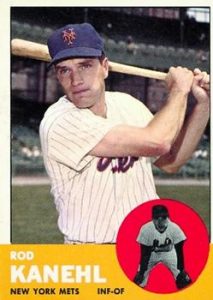 INF-OF Kanehl was too versatile to be pigeonholed. So why doesn’t Rod Kanehl rate a card for being a 3B-OF? Two reasons:
1) He was doing his utilityman job. Utilitymen who followed in Hot Rod’s fast footsteps — a cohort encompassing the likes of more than two dozen Mets spanning Rick Herrscher later in 1962 to Jack Reinheimer toward the end of 2018 — played third base and the outfield as asked because it’s what they were on hand to do. Teddy Martinez in the ’70s. Bob Bailor in the ’80s. Chico Walker in the ’90s. Heir to the Kanehl legacy Super Joe McEwing in the 2000s (“That was my life. That was my career. That was my job. I took extreme pride in that, being prepared for every situation,” McEwing told me in 2020 when I asked him about various facets of his utilitarianism.) You need a guy who can fill in at third base and somewhere within the outfield if you’re going to succeed. In 2016, the last year when the Mets made the postseason, the team had, depending on your yen for categorization, three or four of those guys: Eric Campbell; Kelly Johnson; Ty Kelly; and Matt Reynolds. The Mets’ recent signing of Reynolds to a Recidivist Met minor league deal may indicate, as much as the contracting of Escobar, Starling Marte, Mark Canha and Max Scherzer, that happy days will be here again soon.
2) I don’t issue the cards. Topps does. Several years ago, when I first began pursuing my OF-3B/3B-OF curiosity, I checked with Faith and Fear’s keeper of The Holy Books, my blog partner Jason Fry, and asked him to tell me how many among the thousand-plus Mets who had played as Mets to that point could claim Topps cards that identified them as Mets and labeled them as a third baseman-outfielder or outfielder-third baseman. Jason kindly perused his albums and answered me: four Mets as of 2016.
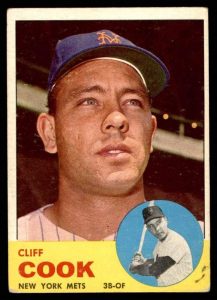 Cook carried his glove to right and carries his 3B-OF card to this day. The first of them was Cliff Cook. His card is No. 566 in the 1963 set. He was a 3B-OF by Topps’s reckoning. That wasn’t necessarily the idea when he became a Met. After the Mets shipped Zimmer to Ohio and hoped for the best (not anticipating their hopes would be dashed by their new acquisition’s bad back), Cliff got his share of reps at third, starting 16 times in a 31-game span. He batted .216 as a third baseman, .208 overall. It was better than Zimmer. Low bar, but it was vaulted.
Even the 1962 Mets aspired higher from their hot corner and they looked up the line for their next solution. Left fielder Frank Thomas became third baseman Frank Thomas on June 17 against the Cubs, which meant third baseman Cliff Cook was almost simultaneously becoming right fielder Cliff Cook. The latter transformation impressed Topps more than it did the Mets, because by the latter half of July, New York’s Cliff Cook, who batted .207 in his new role, became Syracuse’s Cliff Cook. The Mets may not have been attached to their second 3B-OF — they gave up only an .077 hitter to get him — but Thomas was another matter.
Frank Thomas, flashing the power that would earn him 2022 induction into The Casey Stengel Vestibule of the New York Mets Hall of Fame, was already the Original Mets’ preeminent slugger, having knocked 13 homers over various walls in the Mets’ first 36 games. By comparison, Roger Maris had socked only eight balls out of yards after 36 games in 1961. Maris, en route to 61 home runs, mashed alongside Mickey Mantle, who would go on to 54. Stengel’s new kids in town didn’t have a companion slugger to take advantage of the Polo Grounds’ dimensions the way Thomas did, let alone the distances over fences elsewhere in the National League. As long as Thomas’s bat got its swings, maybe it didn’t matter where his glove wound up.
In the bottom of the first, following Thomas’s transformation into the first Met outfielder to become a Mets third baseman in the top of the frame, Lindsey Nelson broke the defensive decision down for Mets fans listening over WABC:
“And Frank Thomas is coming up, Frank Thomas, who is playing third base today in the lineup for the New York Mets. During his major league career, Frank Thomas has seen a great deal of action at third base. Pittsburgh Pirates used him there a great deal. Cincinnati Reds used him there. So this is not exactly a new position for him, though it’s the first time he’s played it for the New York Mets.”
Honestly, Lindsey seemed a little surprised that Thomas had been playing third for half-an-inning and maybe was trying to convince himself that this was a positive development. True enough, Thomas did have some experience at third base. As he told it in his 2005 memoir Kiss It Goodbye! The Frank Thomas Story, Frank’s first transition to third, in 1956, represented quite the to-do in Pittsburgh. The Pirates, for so long the doormat of the National League, had just moved into first place. Their stay was brief, but it was a much-needed jolt to the club’s self-esteem. Within two years, the Pirates would finish second in the NL, and two years after that win the pennant. Intrinsic to Pittsburgh’s rise was finding a full-time slot in the outfield for this kid the Buccos had drafted from Brooklyn following the 1954 season, a youngster named Roberto Clemente. Thomas, the everyday left fielder, essentially volunteered to break the logjam but removing himself from it.
One early June afternoon at Wrigley Field, “I played a position other than outfield for the first time in my career,” Thomas wrote, but the change didn’t come without warning. Manager Bobby Bragan had tried to persuade Frank to try third. The incumbent left fielder’s response: “At 320 feet out, I’m as close to those batters as I want to be.” Eventually, Bragan convinced Thomas he was natural born third base material. Frank had a knack for making barehanded catches (ask Willie Mays), and “anyone who can do that,” his manager told him, “is cut out to be a third baseman.”
Confident that his hitting wouldn’t suffer, Thomas agreed to try his hand — both of them — at third. Not only was a spot for Clemente opened up, but maybe a hole in the infield would be plugged. Presaging the situation that would surround him as a Met, Thomas recalled, “We had been having trouble all season finding a suitable third-sacker, and I was the tenth player to play there up to that point in the year,”. It was June 5, mind you. The Pirates even tried Clemente there once. “I was ready to make the switch if [Bragan] thought it would help the team.” In his memoir, Frank remembered the Pirates and himself playing well after he took on the new challenge, with none other than one of the all-time third base greats, Pittsburgh’s own Pie Traynor, going on local radio to praise his defense.
The record indicates third base may not have been Frank’s forte, certainly not upon manning a brand new position. Despite not taking over third until the season was more than forty games old, Thomas finished second in the National League in most errors committed by a third baseman. Somewhat established at the hot corner, he led the circuit in that dubious department in 1958. He could still hit, though, with 35 homers in ’58 forgiving his 29 miscues. After the Mets arranged to acquire Frank from Milwaukee, Stengel was happy to ink him into his batting order — and plant him in left field. With the 1961 Braves, who had Eddie Mathews, Thomas didn’t play third at all.
But this was 1962 and these were the Mets and best laid plans rarely remained undisturbed. Prior to June 17, the Mets had employed five different third basemen. Not ’56 Pirates-level, but close enough. Also, unlike in 1956, Thomas wasn’t concerned with his fielding getting in the way of his hitting. The man who’d go on to set the franchise’s single-season standard for home runs was wandering through a power desert, going homerless since May 25 and losing more than 40 points off his batting average in the process. And there was a personnel glut unfolding in the Met outfield, with the club having just acquired an old Stengel favorite, Gene Woodling, who, unlike Clemente in Pittsburgh six years before, was at the end of the line, but he needed a place to play regardless.
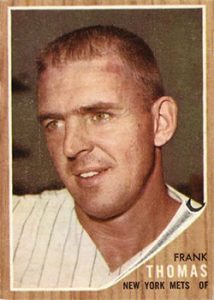 Thomas wasn’t acquired to play third, yet there he found himself. Around this time, Joe King offered several observations in The Sporting News that seemed to capture the plight of the Mets in their third month, when neither a stop in Texas to take on their fellow expansioneers the Colt .45s nor a taste of home cooking could rouse them from their recent losing ways.:
• “Casey had hitting for a few weeks, but Frank Thomas recently went 22 games without a homer and team run production sagged woefully.”
• “Then there was a time when Stengel felt that he had achieved a reliable, although modest defense. The Mets were not kicking the ball around at the start. This, too, was an illusion. The fielding crackup commenced in the finale at Houston and continued as the June home stand opened.”
• “No one summed it up better than Stengel: ‘I tell myself that it can’t be getting any worse, but it is.’”
• “If the Mets had a crew of kids with a year’s experience in the minors, it might be refreshing to play ’em for the remainder of the season. However, they do not have the men to achieve this renovation.”
And, the kicker:
• “Cliff Cook developed a strikeout seizure on the trip.”
So why not ask Frank to dig his third baseman’s glove out of storage? The man himself was willing and got himself ready. “To come in and play the infield,” he told the Crane Pool Forum in 2005, “you have to learn a lot of new things. I used to take 150 ground balls a day in order to improve myself there, and for the most part I feel like I did a good job.” In the first game the Mets put Thomas at third, he handled everything hit at him. Here’s Ralph Kiner describing all of it:
“Lefthander with a curveball, it’s hit down to third base. Frank Thomas there, up with it, over to first base in time for out number two. Frank Thomas, handling his first chance successfully at third base. Gene Woodling was put in left field, and Casey Stengel, in order to get more power in the lineup, moved Frank into third. He has played there before. He was originally converted to third base while playing for the Pittsburgh Pirates.”
Ralph sounded less incredulous about the switch than Lindsey had. Perhaps it was an ex-Pirate thing. Either way, that third-inning grounder Ron Santo hit to Thomas was it for third base opportunities in that June 17 doubleheader opener. If it didn’t go down as a momentous moment in early New York Mets history, it might be because it was a wee bit overshadowed by a couple of other developments that occurred in the same game. Lou Brock, then a Cub center fielder one day from turning 23 years old, launched a home run to the center field bleachers at the Polo Grounds. You may have heard about it from the oft-asked trivia question that has a pretty brief answer. Hardly anybody had ever gone that deep in that ballpark, nearly 500 feet from home plate. Those bleachers might as well have been in Yankee Stadium, across the Harlem River. But Brock reached them on June 17, 1962. As did Hank Aaron for the Milwaukee Braves on June 18, 1962. Before such a thing as Met opponents existed, only two players — Joe Adcock and Luke Easter — had done it. Now it had been done twice in two days.
While this was a noteworthy baseball achievement, that’s not the main reason the opening game of the June 17, 1962, resonates in Met annals. No, we remember that particular date because it was the day Marv Throneberry tripled in two runs off Cubs starter Glen Hobbie only to be told he hadn’t tripled at all because he hadn’t touched first base (or second) on his way to third. When one of your announcers — Nelson — has reason to inform you, “Hobbie comes off the rubber and throws over to first base,” leaving umpire Dusty Boggess no choice but to call Marv “OUT at first base on an appeal play!” and your momentarily heroic baserunner has to trot off of third and back to the dugout, you tend to forget everything else that happened.
The Mets lost, 8-7. Frank Thomas also started at third base in the nightcap, with Cliff Cook in right field. Thomas made an error that led to an unearned run in a game the Mets lost, 4-3. Frank started the next three games after that at third. After those five in a row, he’d be back in left field mostly, at first base occasionally, with only five more starts at third, none after July 8. His homerless drought ended in late June. Frank would finish the season with 34 longballs, most in a Mets campaign by anybody until Dave Kingman came along in 1975. The record also shows four errors in ten games at third base in 1962, plus one in one game when he played two innings at third in 1963, a year the Mets would be on to their next evanescent OF-3B solution.
In the next installment of OF-3B/3B-OF, we meet the next outfielder who wasn’t the answer at third; the next third baseman who carries a card that said he could play the outfield; and the youngster who preferred not to be blessed with versatility.
THE METS OF-3B/3B-OF CLUB
Founding Members (1962)
1. Rod Kanehl
Mets 3B Debut: April 21, 1962
Mets LF Debut: April 29, 1962 (Game 1)
2. Frank Thomas
Mets LF Debut: April 11, 1962
Mets 3B Debut: June 17, 1962 (Game 1)
3. Cliff Cook
Mets 3B Debut: May 8, 1962
Mets RF Debut: June 17, 1962 (Game 2)
4. Rick Herrscher
Mets 3B Debut: August 2, 1962
Mets RF Debut: August 7, 1962
by Greg Prince on 25 January 2022 10:22 pm David Ortiz is in the Hall of Fame, which is great for David Ortiz and, I believe, splendid for baseball. Big Papi was a big star with big numbers who came through in big situations. That’s a Hall of Famer in my mind. Everybody else on the just-revealed Baseball Writers Association of America ballot isn’t in the Hall of Fame, a result which is a matter for debate. I know it is because MLB Network filled hours with debate over their exclusion. I’m not that invested in any particular player’s absence, but at least the announcement gave those of us marooned on Lockout Island something to talk about. Kudos to Billy Wagner, Gary Sheffield, Jeff Kent and Bobby Abreu for logging check marks on more than 5% of votes cast. None came close to going in and none will “go in as a Met” should any of them go in at all, but it’s always nice to be reminded of good players who wore the Mets uniform.
Especially when the Mets uniform was new.
I’ve been thinking for a while now that what the New York Mets Hall of Fame really needs is a Casey Stengel Wing, though for a space that’s already physically compressed, a wing would have to be more figurative than literal. Instead, allow me to welcome one and all to The Casey Stengel Vestibule, an anteroom designed to lead us into our Hall with affection for and attention to a few of those who made the Mets the Mets in the first place…even if first place couldn’t have been further from where those first few sets of Mets finished. We could also dub it Casey’s foyer, which via British pronunciation rhymes with oy vey (my mother liked to say foy-ay), but in the United States rhymes with lawyer and thus might be mistaken for a player acquired in a trade that turns out even worse than the one that cost us Amos Otis. “Getting Joe Foy was a misstep, but this deal? It’s even Foyer.” So let’s go with vestibule. It’s a word classic enough to be compatible with a namesake who first drew breath in the Nineteenth Century.
What building material are we working with here? Let’s say The Casey Stengel Vestibule will be constructed from context. Our aim is to provide an opportunity to pay tangible tribute to Mets who came to prominence in the earliest days of the franchise; Mets who achieved some feats that live on in legend all these decades later; Mets who did the best they could under trying competitive circumstances; Mets who fomented a legacy and loyalty from which everything we as fans embrace stems; and Mets who the Mets Hall of Fame process has, to date, ignored.
The Mets Hall of Fame was founded in 1981. The first several classes of inductees mostly recognized figures associated with the beginnings of the Metropolitan Baseball Club of New York, yet skipped over the players who composed said ballclub. Once that first wave was properly recognized and our HOF commenced looking at the fellers on the field, it implicitly dismissed the first few Met years. Ed Kranepool, whose Met career began in 1962, is in, but he’s honored for his longevity in general and his contributions to 1969 and 1973 specifically. Cleon Jones, whose Met career began in 1963, is in, but the story his Hall plaque tells is similar. It’s understandable to a certain extent that when it came time to certify players as Met-immortal, the instinct was to put the losing years in the rearview mirror the way the ’69 Mets did under Gil Hodges.
Bud Harrelson and Rusty Staub were the first persons enshrined as players in 1986 (Hodges was inducted in 1982 for his managerial magic); Tom Seaver followed in 1988; Jerry Koosman had his day in 1989; then Kranepool in ’90, Jones in ’91, Jerry Grote in ’92 and Tug McGraw in ’93 before NYM HOF inductions came to focus mainly on later Met successes — after which HOF inductions tended to vanish. Yet 1969 wouldn’t be 1969 as we know it had 1962 not been 1962 as we know it. The distance scaled between 40-120 base camp and the 100-62 mountaintop represents an unforgettable journey. The individuals who traveled its first steps, despite the stumbles, ought not be forgotten.
Especially with that context we’re building with. It’s a vestibule to the Mets Hall of Fame I’m proposing, not the College of Cardinals. I’ll give you a “small Hall” for Cooperstown if you insist. I don’t understand being exclusionary for the one adjacent to the Jackie Robinson Rotunda. We decide what is sacred to us. The embryonic and infant Mets qualify. Their status transcends standings. They formed the mythic foundation of all we root for. Those who succeeded a little when succeeding at all was precious deserve to be treated as Met success stories.
Should the actuarial tables be on your side, return to this space or one similar to it in another sixty years and 1969 will likely appear chronologically indistinguishable from 1962. Should the Mets endure to a 120th anniversary (assuming MLB resolves its lockout by then), I’d guess everything that spans the 25th anniversary patch worn in 1986 will casually constitute “the early days” of the Mets. Maybe we don’t have to wait for 2082 for precision of perspective to diminish. Maybe anything that happened before you were born or became a fan is all one big garble of “Then” to you. But we are fortunate in 2022, as we commemorate the Mets’ 60th anniversary, to still be alive in a time when 1962 lingers on within the parameters of collective living memory. True, you have to go back a ways to claim you made your way to the Polo Grounds or tuned into WABC or Channel 9 for any of the frequent defeats or cherished victories, but as ancient history goes, it really wasn’t that long ago. Not as many Mets who played in Manhattan are with us as there used to be, but a bunch remain. The same can be said for the players who came along as Shea Stadium opened and the Mets began to tentatively find their Flushing footing.
From the vantage point of 2022, Casey’s days shimmer. Never mind the long-term basement rental. We who grew up on the tales of the ’62 Mets and the ’63 Mets and the ’64 Mets and the ’65 Mets — teams already in the past when we jumped on the bandwagon, yet ever-present in the Metsian conversation to which Lindsey, Ralph and Bob invited us regularly — relished grasping where we had come from. If we didn’t necessarily miss a world in which the Mets winning a World Series was unimaginable, we nevertheless knew we’d missed out on something special. We missed out on 452 losses in four years, but we also missed digging in our heels and determining not only were we gonna be fans of this loopy outfit, but we were gonna stay fans and become bigger fans.
Hail to the fans who took a look at what those first four seasons yielded and asked, “Where can I get more of this?” It was after the unused National League Town receipts generated by expired Giant or Dodger fealty had been cashed in. It was after the irony of pulling for the worst ballclub ever had run its course. By the end of 1965, it was after Casey himself had carried the Met Mystique has far as he personally could. Casey’s number was retired that September. Casey’s likeness was committed to a bust when the Mets Hall of Fame was inaugurated sixteen Septembers hence. Tales of Casey’s wizardry — with people, with baseball, with English — captivate us to this day. Despite the institutional amnesia that plagued the organization prior to the spasm of Cohen-instigated, Showalter-blessed historical awareness currently and delightfully permeating Seaver Way, the Casey Stengel aura has never been fully filed away in a drawer somewhere.
But he alone didn’t create the Met Mystique. Joan Payson, George Weiss, Bill Shea…they’re all in the Mets Hall of Fame, too, same as our first trio of announcers, and all were worthy picks, but what these most valuable non-players gave us was the infrastructure. It was the players who had to do the heavy lifting of filling it in, even if sometimes what got lifted also got dropped. There were myriad Mets who sent the New Breed scurrying to its bedsheets before a single banner fluttered within a mile of a pennant race. The absence of their ranks from the Mets Hall of Fame makes the joint feel like one has entered the Banner Day contest with a blank placard.
Thus, The Casey Stengel Vestibule, dedicated to the players who got our foot in the door and kept it there until all of us together, Mets and Mets fans, could grow formidable enough to kick it in.
The National Baseball Hall of Fame selected five players for its first class in 1936. We can humbly start with the same quantity. My five selections for the first class of The Casey Stengel Vestibule of the New York Mets Hall of Fame, ideally inducted amid the franchise’s 60th-anniversary celebration during Old Timers Weekend this August, are, in alphabetical order:
JOE CHRISTOPHER
Outfielder, 1962-1965
The first Met to hit .300 as a true everyday player, achieving his milestone over 154 games and 543 at-bats in 1964, when Joe led the club in doubles, triples, total bases, runs batted in and runs scored.
ROGER CRAIG
Starting Pitcher, 1962-1963
Threw the very first pitch in New York Mets history, having been named Opening Day starter in 1962, an honor Roger would earn again in 1963 after becoming the first Met to compile double-digit victories in a single season.
JAY HOOK
Starting Pitcher, 1962-1964
Posted the first win in franchise history, a complete game triumph at Pittsburgh on April 23, 1962. Jay followed it by starting the first home win in Mets history on April 28 and notching the Mets’ second route-going road win on May 8.
RON HUNT
Infielder, 1963-1966
The first Met to start an All-Star Game, manning second base for the National League at Shea Stadium in 1964, the first of Ron’s two Midsummer Classic selections. Dueled Pete Rose for Rookie of the Year honors in 1963, finishing as runner-up in BBWAA voting.
FRANK THOMAS
Outfielder, 1962-1964
The premier slugger of the Original Mets, belting 34 home runs, establishing a standard that would last for 13 seasons. While placing sixth in the 1962 NL home run derby, Frank drove in 94 runs, another club record that would stand until the following decade.
There’s more to be said for each of the above, no matter that whatever was said about them during their Met tenures was uttered against the backdrop of the second division. Acknowledging shortcomings and circumstances is part and parcel of revering the early Mets, or the Mets of any less than brilliant stretch. They lost a lot? They survived. You might even say they flourished, taking turns as genuine fan favorites. It says something for our tribe that we threw ourselves into embracing players who could win only so much on our behalf. It says something about the players that they inspired the amount of adoration they did.
The Mets of those first few years may have lost more than their share of games, but the hearts they won are still being counted.
All five Vestibuleans are still with us. I will admit a bit to prioritizing the living for immediate induction when the living are currently in their eighties and nineties. I’m also in favor of honoring Mets from the Casey Stengel Era who have left us, squaring our historical account and giving their descendants a day to remember once the Vestibule establishes itself and the Mets tend to their Hall of Fame annually. But this summer, let’s take care of those players who have a chance to experience it and enjoy it. Hopefully each gentleman among our plaqueworthy pack — they shall carry the same status as everybody previously inducted in the Hall, from Payson and Stengel in ’81 to Alfonzo, Darling and Matlack in ’21 — can join the long overdue Old Timers festivities at Citi Field this summer, accepting our appreciation and tipping their cap. If they can’t be there physically, they can know their team and their fans haven’t forgotten how they helped build this thing we love, win or lose.
by Greg Prince on 21 January 2022 4:46 pm Meat Loaf’s baserunner protagonist in the middle of “Paradise By The Dashboard Light,” this kid who really makes things happen out there, was probably helped along by his third base coach. Maybe not as he was rounding first and trying for second, because it’s on the runner to pick up the center fielder bobbling the ball, but you’d have to think he was given a steal sign — or at least not given the stop sign — when he got that jump (“what a jump”) and took third. And the batter who followed him had to have read a sign for the suicide squeeze for it to have been executed as seamlessly as it was. Not that we know for sure if the runner beat the play at the plate. “Holy cow,” broadcaster Phil Rizzuto breathlessly opined, “I think he’s gonna make it,” but instant replay wasn’t available as the song moved along to other action.
Aside from invoking the 1978 epic hit single in tribute to Mr. Loaf, who died Thursday at the age of 74, we bring up “Paradise By The Dashboard Light” here because the coaches in the song not only go unnamed but unremarked upon. It’s hard to imagine this boy who could really fly wasn’t paying attention in the heat of the moment to the signals he was getting, nor could we fathom that he’d ever have gotten up to bat in such a pressure cooker of a situation had he not been coached thoroughly as he was coming up the chain to be ready for his moment.
Even in baseball as metaphor (because the play-by-play Meat Loaf drafted the Scooter to do didn’t show up in any box score, wink-wink), the coaching is implicit. Most of the time, when viewed from a distance, it’s barely that.
Today, the Mets announced the composition of their coaching staff for 2022. Some of these names had made the rounds weeks ago, but now they’re official. Welcome aboard some highly qualified professionals you probably won’t hear about let alone think about again until something goes wrong or everybody’s dissatisfied.
• Bench coach Glenn Sherlock (a coach in these parts a few years ago)
• First base coach Wayne Kirby (a 1998 Met)
• Third base coach Joey Cora (brother of a 2009-2010 Met)
• Bullpen coach Craig Bjornson (who seems to enjoy the camera)
• Hitting coach Eric Chavez (we’ll forgive him previous place of employ)
• Assistant hitting coach Jeremy Barnes (formerly the Mets’ Director of Player Initiatives, a key component of the Department of Euphemisms)
Buck Showalter will remind reporters now and then that when a good play is made or a player gets on a hot streak that somebody who otherwise goes about his business quietly has been working hard with so-and-so and it’s really paying off. Sherlock gave Showalter a great suggestion. Kirby positioned the fielders just right. Cora took a chance that paid off. Chavez or perhaps Barnes has spent hours in the cage with somebody who’s no longer in a slump. Bjornson meshes well with pitching coach Jeremy Hefner, the lone holdover from the Rojas regimelet (it wasn’t much of a regime) and maybe he keeps the guys in the pen loose. If we pay attention, we’ll take note of these brief notices and feel good about these coaches between pitches.
Then we’ll forget about them almost completely until a runner is thrown out or a slump doesn’t end or an error is committed by a fielder who was standing there rather than there. Why didn’t Sherlock warn Showalter? How come Cora sent or didn’t send that leadfoot/speedster? What does Bjornson do around here anyway? What we don’t see we don’t see. What we think tends to be influenced by what do see or hear, and usually we won’t see or hear much from Buck’s brain trust.
Then, likely when we’re fuming about Met things in general, they’ll be gone from the Citi Field scene, damaged collaterally by a little too much losing, hopefully after an ample amount of winning. Like Jeremy Accardo, who is no longer assistant pitching coach; or Ricky Bones, who is no longer bullpen coach; or ex-first base coach Tony Tarasco; or ex-bench coach Dave Jauss; or ex-third base coach Gary DiSarcina; or Brian Schneider, who you might remember as a catcher for the Mets for a couple of years a while back but you probably have already forgotten coached catchers and coordinated otherwise just last year. The only reason we knew Hugh Quattlebaum — still in the organization but no longer the hitting coach — was because Chili Davis was let go. Davis received more than a modicum of attention for the reason coaches do: by serving as sacrificial lamb. The rest of the 2021 coaches, not all of whom were mentioned in this paragraph, were swept out with the Rojas tide, as if they all suddenly misplaced their savvy simultaneously.
All these new guys who are replacing them no doubt know their baseball. In the end, it won’t save them when somebody has to go.
by Greg Prince on 11 January 2022 8:11 pm Keith Hernandez filled the hole between the two and four spots in the batting order for seven Met seasons. He filled holes between himself and either the first base line or the second baseman on balls that seemed destined for the outfield. He filled the hole in the knowledge base of one promising young pitcher after another before there was an All-Star catcher on the premises to guide them. He filled in who knows how many teammates on what to look for, what to think, how to be. Although it hasn’t been in uniform, he’s long filled a seat in baseball’s best booth with a proprietary blend of élan and absurdity. And now, finally, he fills a gaping void in Mets history.
Keith Hernandez’s No. 17 will be retired on July 9. With its official removal from circulation and its elevation above the left field stands, the 1986 New York Mets, the winningest team this franchise has ever known, will be represented at the highest level of consecration an organization can bestow.
It was strange that Keith’s 17 went unretired for more than three decades because, well, he’s Keith Hernandez. He transformed the Metropolitans upon his arrival and we view an entire decade for the better largely because of his impact. No number ceremony for Keith and none for anybody associated with 1986 was equally bizarre. Six members of our last world champions have been inducted into the Mets Hall of Fame along with their manager and general manager — Keith received his bust in 1997 — but not a soul responsible for the 108 regular-season victories had his digits totally and completely immortalized in the 35 years that followed their World Series celebration. Hell, Keith was the 17th-most recent Met to wear 17, which is to say 16 Mets have worn it since Keith, and that’s with nobody wearing it after Fernando Tatis in 2010.
The non-retirement of 17 and its continual random assignment made for a pretty dependable running gag in the SNY booth. Show the Mr. Koo clip (there’s only one) and Keith might let out a harumph. But after a while, fun was fun. How on Bill Shea’s green earth was 17 one of those numbers that any Graeme, Dae or Lima might take the mound in? Even Tatis the elder, a legitimate major league hitter during his Flushing residency, was a stretch. Keith Hernandez had to watch No. 17 in action on the back of anybody who wasn’t Keith Hernandez? While 1986’s hole went unfilled?
Enough of that, at last. We got Keith Hernandez in 1983. Keith Hernandez gets his number retired in 2022. Time lapse notwithstanding, it’s almost a good a deal as that June night we sent Neil Allen and Rick Ownbey to St. Louis in exchange for one of the best things that ever happened to us.
|
|






