The blog for Mets fans
who like to read
ABOUT US

Faith and Fear in Flushing made its debut on Feb. 16, 2005, the brainchild of two longtime friends and lifelong Met fans.
Greg Prince discovered the Mets when he was 6, during the magical summer of 1969. He is a Long Island-based writer, editor and communications consultant. Contact him here.
Jason Fry is a Brooklyn writer whose first memories include his mom leaping up and down cheering for Rusty Staub. Check out his other writing here.
Got something to say? Leave a comment, or email us at faithandfear@gmail.com. (Sorry, but we have no interest in ads, sponsored content or guest posts.)
Need our RSS feed? It's here.
Visit our Facebook page, or drop by the personal pages for Greg and Jason.
Or follow us on Twitter: Here's Greg, and here's Jason.
|
by Jason Fry on 26 September 2021 10:40 pm On Sunday, a day after being eliminated from a chance at a playoff berth, the Mets were eliminated from a chance of being mathematically average. They have lost 82 games, meaning the best possible outcome for their season is a record of 80-82, and anyone who thinks they can manage that should please report to the nearest asylum for immediate intake.
The Mets also got to watch the Milwaukee Brewers — an actually good baseball team — clinch a division title. I assume they watched that celebration and it hurt to witness what not so long ago could have been theirs — however disappointed I am in the 2021 season, I don’t think they quit or lacked the will to win or were missing a certain fire in the belly or whatever Just So Story is trotted out to explain a team’s failure to be what its members and fans wanted it to be. The Mets are world-class athletes and ferocious competitors, and if desire were all that determined playoff races, there’d be four- and five-way ties all over baseball. They just weren’t good enough, and we’ll have all winter to debate whether the not good enough was a product of conception, execution, fortune or some mixture of those things.
I, however, didn’t see any of that. I watched the first inning, with Francisco Lindor homering for a 1-0 lead. I watched Carlos Carrasco immediately give that lead back by serving up a two-run shot to Willy Adames. I watched the Mets fall three more runs in arrears the next inning.
And then I stopped watching.
It was a beautiful day in Brooklyn. My wife and I walked around, explored a neighborhood we’d never visited, found an Italian place that made a pretty good spritz, went grocery-shopping, talked family logistics and potential vacations, and just enjoyed the sunshine and each other’s company. I didn’t think about the Mets, and that made me a lot happier than I’d been when they were front and center.
And when I finally did check, 5-1 had become 8-4. Which elicited two reactions:
Wow, they somehow scored three more runs?
Mathematically speaking, 8-4 is exactly the same as 5-1.
As I admitted on Friday, I’m done with this incarnation of the Mets. We have broken up, and they need to go away and return chastened and sufficiently changed so that I’ll feel like my affections might not be wasted this time and give them a clean slate.
Thankfully, baseball has a mechanism that accomplishes exactly that — it’s called the offseason. It’s just arrived a little earlier than usual on my personal calendar.
by Greg Prince on 26 September 2021 8:32 am The hardest-to-ignore streak extant in Metsdom met its most stubborn if most obscure in Milwaukee Saturday night. Both involved losing.
The one you can’t miss measures five. For the fifth consecutive season, the New York Mets will not be going to the playoffs. They will not enter the postseason as a Wild Card and they will not represent the National League East as its division champion. They will, as they have at the end of every season since 2017, go home. Their streak of not reaching every team’s nominal goal is not the longest in the majors, but it has suddenly become long. The back-to-back playoff years of 2015 and 2016 have grown distant. In 2022, we’ll be six years removed from our last visit to at least one additional October date. That’s as long as we went between postseasons on the journey from the heights of Bobby Valentine in 2000 to the peak of Willie Randolph in 2006, with traffic en route slowing to a crawl on the Art Howe Bridge.
It’s long enough. It’s not episodic anymore. It’s chronic. Others are or will be in. We won’t. This has been glaringly apparent for weeks. It went official late Saturday afternoon when the Phillies beat the Pirates, rendering whatever the Mets did against the Brewers Saturday night altogether meaningless from an aspirational standpoint.
Date of death, on the Metropolitan calendar, can be expressed as somewhere between Game 153 and Game 154. MLB business closed on Friday night with the 73-80 Mets still faintly alive. By comparison, the Mets were totally out of it after 146 games in 2017, 150 games in 2018 and a hearty 158 games in feisty 2019. Last year, in the moribund 60-game season in which eight teams in each league were invited to a contingency tourney, they were eliminated in their 58th game.
They took the field for Game 154 of 2021 expired. They took the field for Game 154 of 2021 anyway. They played the kind of game mathematically eliminated teams play, losing, 2-1, to the Brewers, a team that has already qualified for the postseason and should be clinching first place any day now, perhaps this afternoon; the Cardinals never lose, but the Brewers do have one more game left with the Mets.
Rich Hill, picked up for a pennant race that coincidentally shriveled soon after his arrival, pitched pretty well. He didn’t win, because as a Met Rich Hill literally never wins. Eleven starts, no victories. In his eleventh start, Rich gave up only two hits, but walked four. One of the hits drove in two of the walks, accounting for Milwaukee’s two runs. The Mets got one of them back on a Javy Baez RBI single. Wisconsin boos Baez every time he shows his old Chicago face. Javy succeeds for New York nonetheless. It’s nice to feel some pulse from somebody on this team. Hill’s had one. The 41-year-old hurler even bunted his way on in the fifth and advanced to second before being stranded there, just like a real Met batter turned baserunner. Then Hill went back to the mound, threw a scoreless frame and departed unrewarded, just as we will after Game 162.
Four Met relievers showed good stuff as the game went on. Aaron Loup (0.98 ERA) in the sixth. Trevor May in the seventh. Seth Lugo in the eighth. Jerry Blevins in the booth. Jerry retired shortly after this season started, resisting the pull of the alternate site. The Mets had their main lefty in Loup and Blevins decided the chances of a second getting a call weren’t worth the trouble of staying warm in Syracuse. WCBS, however, found it could use another voice and got the old southpaw up. As Ed Coleman’s guest analyst, Jerry came across as he has ever since we got to know him a little in 2015: friendly, funny, savvy, a cut above.
The Mets were a cut below in their penultimate game in Milwaukee. The Mets are always a cut below in their penultimate game in Milwaukee. The streak of not making the playoffs you can’t help but notice, especially if you plan on tuning into 880 AM the week after next expecting to hear Mets baseball. The other streak, the obscure one, lurks only for the vigilant. In 2009, the Mets played a three-game series at Miller Park. They lost the second — or second-to-last. That strain of performance has held up for more than a decade. Every series the Mets played at Miller Park in 2010s, whether it ran three games or four, they lost its penultimate game. The last time, on a Saturday night in May of 2019 when I struggled to stay vigilant, the second-to-last game required 18 innings and 322 minutes to lose, 3-2. The next afternoon I prepped for a colonoscopy. The experiences were similar.
After no trips to the Midwest in short, regional 2020, the Mets finally returned to Ueckerville in late 2021. The ballpark is now named for an insurance outfit. The Mets dutifully renewed their policy of always losing before packing, though this time they completed their Saturday night futility in a swift 3:16. This is the first series Rich Hill has pitched in Milwaukee as a Met, the first series played as a Met there by Javy Baez and Aaron Loup, the first series managed there by Luis Rojas. The faces change. The Mets don’t, not in twelve consecutive penultimate games at the same venue. That’s more consecutive penultimate Milwaukee losses than there’ve been non-wins for Rich Hill in Rich Hill starts. It’s just twelve games spread over thirteen seasons, but it strikes me as astounding.
From a broader perspective, the Mets not making the playoffs over five consecutive seasons…well, that’s less astounding. And that’s a bummer.
by Jason Fry on 25 September 2021 9:55 am In the top of the first against the playoff-bound Brewers Friday night, the Mets saw 39 pitches from Eric Lauer, were at bat for 20 minutes … and somehow scored one run. There’s a microcosm of their season: inefficient, unlucky, infuriating even when they manage to do something positive.
In the bottom of the first against the playoff-bound Brewers Friday night, Tylor Megill‘s sixth pitch was a four-seamer without much steam or movement. Kolten Wong hit it over the fence, erasing the Mets’ lead in a heartbeat and giving you the distinct impression that it was going to be a long night. There’s another microcosm of the season.
Megill’s exceeded his previous workloads by a fair amount, the arm’s come up a little short, and now the confidence looks like it’s eroding too. (See also: Taijuan Walker.) Yet he’s still out there for some reason — stubbornness, neglect, the lack of any better plan. He gave up back-to-back homers in the third to Willy Adames and Christian Yelich and was done after four. Meanwhile, the Mets let Lauer find his footing and did nothing else against him, trudging through yet another dreary loss against a team whose class they clearly aren’t in.
(You know what might keep me more invested as garbage time creeps along? A peek at a September call-up or two. But as Greg chronicled earlier, MLB — in its ever-infinite wisdom — has now taken away that small pleasure too. I get the problem with playoff contenders having to fight through waves of fire-armed relievers for whom scouting reports are scanty. But why not tell teams they can call up the entire 40-man roster but only dress 28 for each game? Toss bathwater, dry off baby.)
Anyway, this leads to the third microcosm of the season: After Pete Alonso struck out in the sixth, I turned off my TV. I’ll head to Citi Field one more time next week and watch the games when they’re in front of me and life isn’t in the way, but my personal elimination number? It’s been reached.
by Greg Prince on 24 September 2021 12:53 pm What the Mets could use right now is another Ed Kranepool, another Cleon Jones, another Bud Harrelson, not to mention another Nolan Ryan, another Ken Boswell, another Duffy Dyer. Maybe another Lee Mazzilli, another Mookie Wilson, another Wally Backman. Throw in another Ron Darling, another Kevin Mitchell, another Kevin Elster. Hell, even another Doug Sisk (there, I said it).
The Mets, shooed from contention as they’ve been, could always use a boost of talent. The aforementioned 13 players were the MLB equivalent of FDA-approved boosters in their day. Each of them was called up to the Mets in some September to make their major league debut. Eventually, each of them became a World Champion Met, populating an October roster at Shea Stadium.
Their collective success could be like one of those commercials for the Boy Scouts in which Hank Aaron and Gerald Ford, among others, implied that getting started in scouting as a kid would lead to big things as an adult. But I’m not necessarily asking for a 1969 or 1986 payoff. I’d be happy with Steve Dillon, who came up to the Mets with Cleon Jones, in September of 1963; with Shaun Fitzmaurice, who came up to the Mets with Nolan Ryan, in September of 1966, with Scott Holman, who came up with Mookie and Wally (and Hubie Brooks), in September of 1980.
September big league callups and their subsequent big league debuts informed the lifeblood of the waning Met weeks most every September between 1962 and 2019. It didn’t matter if it was a big prospect (Gregg Jefferies’s first cup of coffee was in September 1987, a year before he returned to make his splash). It didn’t matter if the coffee was bound to be sipped in a sec and never refilled (Rich Puig went 0-for-10 with a walk in September 1974 before never being heard from again). It didn’t matter if that initial September slurp waited until early October (Randy Myers first saw action in the eghth inning of Game 162, October 6, 1985; Joe Hietpas became his spiritual batterymate in the ninth inning of Game 162, October 3, 2004). The point was new blood; fresh blood; lifeblood!
We don’t get that blood anymore. When MLB and the MLBPA agreed on expanding the everyday rosters from 25 to 26, they also decided the September rosters, instead of being allowed to comically bloat into the 30s and theoretically as high as 40, would be capped at 28. This would make managing more manageable, keep the clubhouses closer to capacity, align opposing dugouts so one team didn’t pack 37 players and the other didn’t travel with 29. It made all the sense in the world.
To which I say to sense, BOOOOOOO!!!!!
I LOVED those September callups. I LOVED that influx of new faces. I LOVED thinking in seasons like this one, OK, once we’re mathematically eliminated and we’re not playing anybody for whom the outcome desperately matters, we can fill the lineup with these new kids. Not so much to “see what they can do,” which I always thought was a little overstated, but just to have some novelty to root for and, later in my life, blog about. I’ve looked at Miguel Cairo enough by September of 2005, let’s get a couple of paragraphs going on Anderson Hernandez. Enough with the Brian Schneider in September of 2009, bring on Josh Thole for my snap judgment. Hey, 2011 has been a long year; now that it’s September, can we have a glimpse of Stinson (Josh), Satin (Josh) and Schwinden (Chris)?
We could. That’s how it worked. You’d get a gander at the guys you got in trades — Dan Norman for (gulp) Tom Seaver in 1977, Victor Diaz for Jeromy Burnitz in 2004. You’d get to slot next year’s rotations this year — Walt Terrell in 1982 for 1983, Dillon Gee in 2010 for 2011. Or you’d get the random Met callups or who would remain random Mets forevermore. Greg Harts: three plate appearances in September 1973; Jesse Hudson: a single game pitched in September 1969; the immortal Al Schmelz in September 1967, who needed neither innings nor results to plant a flag in the psyches of obsessive Mets fans not yet born.
The first fastball fiend to come firing out of Fresno came up in September of 1965: Dick Selma, nineteen months ahead of his pal Tom Seaver. One of the great center fielders of the 1970s, Amos Otis, came up in September of 1967, never mind that he became one of the great centerfielders of the 1970s in a Kansas City Royals uniform. We were introduced to Leroy Stanton in September of 1970 and Frank Estrada and Don Rose in September of 1971. Perhaps September 1966 callup Nolan Ryan had a chat around the batting cage with the three youngsters at some point. Perhaps a scout for the California Angels saw them gathered together and thought, “What it would take to get them as a group?”
Craig Swan’s twelve solid seasons in orange and blue started with a September 1973 debut. Bruce Boisclair’s legend as Bruce Boisclair began with a September 1974 callup. Alex Treviño was promoted in September of 1978; by 1982, the Mets would make him the centerpiece of a trade to get George Foster, a very big deal at the time.
Your current Mets have some roots in classic September callups. Jeurys Familia made his debut on September 4, 2012. Tomás Nido made his on September 13, 2017. Familia would set the club record for saves, clinch postseason berths and series and make an All-Star team. Nido seems like a heckuva nice guy. They were part of a grand tradition. Greg Goossen, who in ten years had a chance to be thirty! Les Rohr, the franchise’s first No. 1 draft pick! Joe Nolan, who I remember catching every single day once he joined our roster, but caught only three games after making his debut on 9/21/72, yet made quite an impression on my nine-year-old mind! Joe Nolan didn’t last with the Mets, but he carved out a backup catcher niche in the bigs until 1985, winning a World Series ring with the Orioles in 1983. But I’ll bet Joe Nolan remembers the 21st night of September.
On September 4, 2019, Sam Haggerty made his major league debut as a New York Met. He would pinch-run for us eight times, score twice, hit not at all (0-for-4) and effectively end an era. Haggerty was, by my count, the 131st expanded-roster callup to make his major league debut with the Mets. Ed Kranepool was the first, in 1962. There were none in 2020. There’ve been none in 2021. Oh, the roster did expand from 26 to 28, but c’mon. It’s not the same. Nobody debuted last September or appears about to this September. We’ve been shuffling players twixt and tween taxi squads, alternate sites and Syracuse so often this year, the coming and going no longer carries that implicit Bobby Morse grin of impetuous youth. If it happens all year round, what’s left for September?
Where are the John Milners and Lucas Dudas, bound to slug their way into our hearts for years to come? Where are the Esix Sneads and Travis Taijerons, on hand to take one game-winning swing and effectively vamoose? Where’s the next Jon Niese, which I grant you is something you’ve never asked yourself since the last Jon Niese, but no Met pitcher started more games overall in the first two decades of this century. Niese got his first start, his first taste, in September 2008, amid a playoff push. Dave Magadan made himself intrinsic to the telling of a division-clinching on September 17, 1986, going three-for-four ten days after his MLB debut and mere innings before clearing a path for Keith Hernandez — who insisted on being at first base for the moment the NL East title became official — to get trampled by onrushing fans. Butch Huskey landed in Houston in time to be no-hit by Darryl Kile along with his fellow September 1993 Mets (but they, unlike Butch, had practice not hitting). Timo Perez started running in September 2000, even if he took an ill-timed pause in October 2000. Alex Ochoa displayed all five tools in September 1995. Mike Glavine showed off the rarely evidenced sixth tool — nepotism — in September 2003.
So many players’ stories began as September callups. So many players’ stories were they’re being September callups. Nowadays, it’s neater and trimmer and we don’t do that anymore. It was more fun when we did.
by Greg Prince on 23 September 2021 1:04 pm In Lost in America, after Julie Hagerty as Linda Howard gambles away the family nest egg at the Desert Inn, her husband David — Albert Brooks — tries to convince the casino manager, played by Garry Marshall, that the house should really give them their money back. We’re not really Las Vegas people is the crux of David’s argument, putting aside the inconvenient fact that they are people in Las Vegas. Marshall’s character indulges Brooks’s for a while, right up to the point where David, an advertising agency veteran, excitedly suggests the casino would reap a public relations bounty by featuring the return of the Howards’ funds in an ad campaign, geared to positioning the Desert Inn as a “Christmas place to be”. With that, the casino manager expunges any trace of a smile from his face and announces, “We’re finished talking.”
I could hear Garry Marshall telling the Mets, and by extension me, the same thing during the first night of their visit to Boston. How many games are we behind Atlanta? How far out are we for the Wild Card? What if we come back here, sweep tomorrow, go to Milwaukee and stay hot, all while the Braves and Phillies begin to lose? Wait, hear me out, I have an idea that just might work!
“We’re finished talking.”
Fenway Park was the Mets’ Desert Inn, as close as they had to a definitive last stand in 2021. It was not a pennant race place to be for the team in gray pants (as opposed to the one in yellow shirts). It probably wasn’t going to be regardless of the outcome of the two-game Interleague set, but there had been, until summer was turning to fall, no indisputable expiration date to their status as a contender. You could still throw ditzy scenarios at the wall because the teams in front of them hadn’t completely escaped our sights and we hadn’t completely disintegrated. As recently as Sunday the Mets won a baseball game — against a team ahead of them no less! Sure, we’d been swept by St. Louis in alternately agonizing and embarrassing fashion the week before, and the Cardinals are suddenly unstoppable, but we took the finale from the Phillies, so if we could pass them, and just pull to within three of the Braves when we go to Atlanta, the Braves aren’t so great.
Yes, throw ideas at the wall, at least until the wall is 37 feet tall, as it is in left field at Fenway. Then just run into it. The Mets lost Tuesday night. They were demolished Wednesday night. Chris Sale. Kyle Schwarber. The Monster. The calendar. Everybody and everything took their measure, 12-5. Once the Mets had dutifully completed yet another 210+ minutes of meandering through their motions, there was no reason to check the Braves-Diamondbacks score unless motivated by bystander’s curiosity. What the Braves, the Cardinals, the Phillies do is no longer intrinsic to our agenda. Not that we have much of an agenda left. Even the perfunctory postgame media questions that have led with the polite supposition that “you’re not giving up, of course” morphed into courtesy nods toward the 73-79 Mets wanting to “finish strong” before getting real.
“The Mets,” Roger Angell has written, “offered almost innumerable late-summer chances to move up to the lead in their division, lost most of their crucial games.” Roger Angell wrote that in 1975. Roger Angell recently turned 101. Roger Angell is a strong finisher. The Mets weren’t in 1975 and I don’t suspect they will be now. Our record, if not dampened by rainouts, will fall somewhere between 73-89 and 83-79. It will take a heckuva strong finish to reach the nominal winner’s circle of 82-80 (where we landed in what Angell termed “disappointing” ’75). Connoisseurs of the unprecedented might want to keep an eye on 75-87, 76-86, 78-84, 80-82 and 81-81; each is a record the Mets have never put in the books. Or feel free to go on a 10-game winning streak and deliver us the most respectable line possible for our all-time ledger. A team that spent three months in first place ought to have a winning record. I didn’t think it would require a strong finish to ensure one.
The one number I’m proudest of here in the fourth week of September is not the 35 homers launched by Pete Alonso or the 1.00 ERA compiled by Aaron Loup, but 10. I’ve been to 10 games in 2021. The tenth was Sunday night, marking the 24th consecutive season — excepting ineligible 2020 — that I’ve reached double-digits in home attendance. I didn’t think I’d see as many as 10 games in 2021. I didn’t know if I’d see one game in 2021, what with the world being what it was last winter and not being a sure thing as we arrive in autumn. But there I was, in late June, at my first game of the season, and there I was again, in middish-September, taking in my tenth. Going to games in 2021 had become close enough to routine that I didn’t insist I had to write about it immediately thereafter.
Stephanie and I went on Sunday night because there was no game on Sunday afternoon, thanks to ESPN. I’d love to tell you we schlepped to Flushing simply to avoid A-Rod and Vasgersian, but we’ve gone on the final Sunday of the season every season in which the gates are opened since 2012. Often it coincides with the shuttering of the season or home slate. Usually it’s in daylight, sometimes with dinner in Jackson Heights afterward. In 2020, none of this was available to us. In 2021, no matter how miff-making our team has been, we were willing to let them miff us up close again. The Mets weren’t altogether out of it by Sunday, but they were spotted gathering at contention’s exit.
Still, we were on hand, because despite the hassles and indignities…
• young loud dolts on the LIRR giving off that “my dad’s got a dealership” energy;
• a 7 that had to wait around at 74th St. for hitchhikers to be cleared from the roof;
• digital tickets that wouldn’t load properly at the Rotunda’s doorstep;
• a QSR code masquerading as a magnetic schedule substitute and passed off as a premium;
• and a strained back that needed to be soldiered through (not mine, either; my wife, who insisted on going, is more of a Mets diehard than she is generally given credit for)
…we like going to the final Sunday game at Citi Field every year. We like our tradition. We like our team even when we can’t stand their results, though Sunday they did us a solid and won for us. They probably won for themselves, but let’s pretend they dedicated the win to the couple in 326.
After they schlocked up all over Fenway Wednesday night, I thought we might be best served had the Mets arranged to stay over in Boston, face a pitching simulator or some such marvel of virtuality in the wee hours, and register their remaining 258 outs with nobody else being bothered by their inevitable futility. Two-hundred fifty-eight outs are all that’s left to our 2021, give or take unforeseen oddities (never count out unforeseen oddities). The Mets are to play eight regulation-size games and two Manfred-minis between this Friday night and next Sunday afternoon, meaning a mere 86 innings remain in this thing you may not remember us looking forward to six months ago, but we did. There might be wins. There might be more wins than losses. There will be, however, no finishing strong, not when we’ve been effectively finished off in advance of the last three series.
Big talk from me about wanting these final games, innings and outs to be over and done with, but not in my heart. I’ll keep watching. I’ll keep listening. I’m going to a football game this Sunday afternoon — a good friend invited me, and there’s a bit of a tradition there, too — but I’m bringing a radio to sneak listens to a baseball game between downs. As if the Mets haven’t given us a surfeit of downs. Four nights later, I’m pretty sure I’ll be at my eleventh baseball game of the year, sans distractions in my ears.
I’ll let go of this season when there’s no more season to hold onto. The Mets don’t have to be good. They just have to be there.
by Jason Fry on 21 September 2021 11:24 pm Once again, it’s sand in the hourglass time — the last few grains, the regret about what could have been, the wanting it to just be over, and the reminding yourself that as soon as it is you’ll want a little more. The Mets have become the old joke about the food being terrible and coming in such small portions, which would be funnier if every meal didn’t last three and a half hours, so that by the two-thirds mark everyone’s talked out and just slumped in their seats waiting to be told they can go.
The Mets lost to the Red Sox, who defeated both their opponents and the yellow and blue alt-uniforms that made them look oddly like their own vendors. It was a very 2021 Mets game: an impressive start, a record-scratch moment in which they remembered who they were, and not much of note after that. Marcus Stroman looked good early, with both his joy for the game and his swagger on display as he escaped a bases-loaded, nobody-out jam. The Mets then loaded the bases with nobody out themselves, as Eduardo Rodriguez lost the strike zone. J.D. Davis walked to force in a run and Michael Conforto smacked a single through the infield to bring in Javier Baez and set up a big inning.
Except Gary DiSarcina turned it into the incredible shrinking inning when he inexplicably waved Pete Alonso home. The distance between Alonso and home when Kiké Hernandez’s throw arrived in Christian Vazquez‘s mitt? Let’s just say the Mets are closer to a playoff spot than Pete was to scoring. Alonso was out, the rest of the inning fizzled, and the Red Sox stomped on Stroman, scoring six unanswered runs.
The rest was unimportant: Alonso hit a solo homer, old friend Hansel Robles came in and did not do Roblesian things, and there were a lot of shots of the 7 Line Army looking morose.
So it goes as the grains of sand slip away — a momentary wondering what’s gone wrong for Brad Hand, a sigh at Conforto’s continued woes, a brief flush of rage at the idea that Hugh Quattlebaum has anything to smile about. All evanescent stuff, no sooner experienced than gone again. The games are the same, a depressing smear, and we won’t miss them when they’re gone, except for the fact that of course we will.
by Jason Fry on 20 September 2021 7:57 am On Sunday night Edwin Diaz — he of the electric arsenal and its sometimes self-electrocuting results — stood on the mound and stared in at Bryce Harper, probably the league’s MVP and a longtime thorn in the Mets’ side who seemed about the dimensions of a redwood just then. Two outs in the ninth, 3-2 Mets lead, tying run on first.
Diaz threw a fastball, one that caught a lot of plate, Harper connected, and imagine if this game had actually mattered.
If you’re a Phillies fan, it did — they were just a game behind the Braves, and like the Mets, Atlanta has found first place in the National League East to be a crown that sits uneasy. But for us Mets fans, not so much. There was the spring’s injury-plagued failure to achieve escape velocity, early summer’s scuffles and stumbles, August’s plummet and now September’s irrelevancy. When I went to Rome two Fridays ago, the Mets had at least a puncher’s chance of clawing their way back into the division race or chasing down the second wild-card spot; by the time I returned on Saturday, carrying extra pounds and memories of having seen a lot of astonishing art, the Cardinals and Phillies had turned the calendar to 2022.
What was left was a sort of afterimage of contention, marked by the weekend’s games winding up on Fox and ESPN. Saturday’s was a dud, but Sunday night’s game belonging to a national crew was doubly too bad, because it deserved Gary Cohen and Co. instead of ESPN’s broadcast. That was chiefly a showcase for Alex Rodriguez continuing to road-test his eyes/iPad aphorism (it’s not working, A-Rod) and vaguely grouse about players not being robots. As Mets fans, we at least deserved our hometown chroniclers, who would have had a lot to say about Rich Hill‘s canny though abbreviated start; the moment of Harperesque daring/Mets passivity that let the Phils steal their first run; the Mets’ inability to solve Kyle Gibson‘s curveball until Dom Smith caught one and smacked it into the corner to the tie the game; Aaron Loup staring down first Harper and then J.T. Realmuto, with the latter confrontation having not exactly been the plan; Jeff McNeil‘s homer that put the Mets ahead and made us mourn what could have been; Harper’s temporarily game-saving catch on a little duck snort by Kevin Pillar; and finally Diaz’s uncertain navigation of the ninth’s typically troubled waters.
That’s a lengthy chronicle, because it was a damn good game — tidy except when it wasn’t, and marked by riveting confrontations and an appropriately tense endgame. It was all there in the moment that followed Harper connecting: Bryce’s eyes following the ball on an arc to left, first with hope and then with dull dismay; Diaz pointing skyward, but not exactly with the instant confidence accorded a lazy pop-up (or a game-ending homer surrendered by Hansel Robles, but that’s a post for a previous season); and finally McNeil cradling the ball a step from the warning track for the final out.
There’s still some beauty in those afterimages — a last couple of weeks of baseball to squeeze in before playoffs that will go on us without us and then winter’s staring out the window and urging the calendar along. I want to see 13 RBIs for Pete Alonso, a cameo for Noah Syndergaard (and maybe Jose Martinez, because why the hell not), and some more positive signs from Michael Conforto and McNeil and other MIA Mets. Maybe I’ll get those things and maybe I won’t — baseball parcels out its rewards as it sees fit, and it’s singularly uninterested in your wishlist or anyone else’s. Whatever happens, even the dregs of a lost season offers some moments to enjoy. Here’s to two more weeks, and whatever those moments prove to be.
by Greg Prince on 19 September 2021 11:48 am During one of the many, many, many one-run losses that have defined the blur of futility that has smothered the illusion of a pennant race in these parts, I asked my friend of nearly 30 years Rob Emproto how things were going with his band. It’s not really “his” band, but it’s not like I know anybody else in Illusion: Tribute to Women Who Rock! That’s the band’s name. They’re set up sort of like classic Heart, with a couple of ladies vocalizing powerfully up front and a few guys jamming in support — though Heart is somehow not among the many, many, many fine acts whose music they cover. Rob, their bassist, had posted a couple of notices of upcoming performances on Facebook since joining Illusion a year earlier, all of them way the hell out in Suffolk County, a geographic framing reflecting my Nassau County view of the world. Hey, I said, if you ever play closer to where I live, I’ll definitely come see you.
They were, in fact, about to make their Near Me debut, on Saturday night, September 18. Near Enough, anyway. I knew the general area if not the venue. It’s roughly between where I live and where I grew up, a span constituting not too many miles. I knew I could reach it by relatively short drive. Few drives, however, no matter how short on the odometer, come at me without stress. Because the vicinity was familiar, I knew the trip would include certain stretches of road that inevitably have me gripping the steering wheel with anxiety. I’ve been gripped by driving anxiety almost as long as I’ve known Rob, though I don’t blame him.
Because summer is going the way of a certain baseball team’s postseason chances, I understood it would be twilight as I journeyed to the site, and I really don’t love driving at twilight. I was a little concerned with the idea of sitting inside somewhere with other people in 2021. Not that much (that’s what the vaccine is for), but a little (that’s what the variant is for). Also, though the band is what you’d call mature, it’s still ROCK ‘N’ ROLL! When I was 18, I found being inside a club listening to loud music a little offputting. I’m 58. I haven’t done it in ages. I couldn’t imagine it having become “my scene” in absentia. And I’d be doing it on my own, since Stephanie, despite her fondness for Rob and the catalogues into which Illusion delves, prefers lower volumes. All things being equal, I prefer quiet Saturday evenings at home with my wife. I’m not that outgoing, and I’m not much for going out
So there was a quite a bit that could have held me back from going to see my friend of nearly 30 years Rob Emproto play in his band. But the one thing that didn’t was the idea that I’d mostly miss watching the Mets play the Phillies. It occurred to me, but I brushed it aside as a non-concern. For one night, I chose watching Rob play the bass. Besides, as long as I heard a little Mets on the way there and (knowing how long games run) on the way back, I decided I’d get the gist.
I wound up getting the gist all over me. A few hopefully not rude glances at my phone between songs and a longer glare between sets told me what I knew in advance: that by missing the Mets, I wasn’t going to be missing anything.
En route, I heard Ed Coleman suggest Carlos Carrasco would be all right if he could avoid giving up a first-inning home run. Two batters in, Carlos Carrasco gave up a first-inning home run, to Jean Segura. It was 1-0 when I parked on a side street. It was 2-0 by the first Linda Ronstadt cover, courtesy of Segura continuing to pay tribute to Pat Burrell; Met-killers indeed travel to the beat of a different drum. Intermission closed on a Bryce Harper two-run double that made it 5-1 in the seventh and the Phillies out of all but theoretical reach.
Illusion’s performance was a real money’s worth affair, starting a little after eight and lasting past 10:30, with the sense that if they’d been permitted, they would have kept going. The game, whose first Fox pitch was thrown in the neighborhood of 7:15, was still in sludgy progress as I returned to my car. Brandon Nimmo homered to create the illusion of a close contest as I pulled away. Jeurys Familia came on to pitch several blocks later. Both Ed and guest analyst Terry Collins pronounced the fallen closer’s first name “Juhroose”. He’s still Jay-uh-reese to me.
Familia threw a scoreless eighth. Perhaps the presence of his former manager inspired Jeurys to echo his former effectiveness. Neither Collins nor Coleman nor a Fireworks Night crowd of better than 33,000 inspired the Mets to complete a comeback from down 5-3 to the Phillies, a score that didn’t tick final until I was home — time of game, 3:35. Nobody at Citi Field had a better time than those of us who gathered to watch and hear Illusion. The band was hot. Their selections were inspired. They covered every era within their oeuvre, from Jefferson Airplane in the 1960s to Elle King in the 2010s. They did my favorite Pat Benatar number, “All Fired Up,” particular justice. Benatar’s from Suffolk. We were in Nassau. It was a transcendent Long Island Women Who Rock! moment.
Rob was a revelation. I’d never heard him play before. I’d never heard him sing before. He stepped up for a few lines of dueting via the Tom Petty portions of “Stop Dragging My Heart Around”. Ohmigod, Rob sings! He did a little spontaneous stage banter as well. It didn’t make him the Brandon Nimmo of the band, exactly, but he projected a genuinely warm presence. I don’t mean to sound shocked, because Rob is a genuinely warm person, but he’s usually content to cast a shadowy figure. It’s an essential part of my friend the bassist’s charm, like the Nimmo smile is part of Brandon’s.
I saw a fantastic show Saturday night. Nothing else of consequence was missed.
by Greg Prince on 18 September 2021 3:11 am If you choose to watch the Mets generate yet another one-run loss, you could do worse than to take it in from up on Carbonation Ridge. That’s the Citi Field section sponsored by a major soft drink concern. When the sponsor pays me to identify it by brand name, I’ll give them a plug.
The Mets pay me in aggravation for my devotion. As if I wouldn’t be hopelessly devoted to their cause for free. At least they made the weather nice Friday night and the perspective from the aforementioned right field corner alluring. When it’s not too hot, too sunny or too windy, I like it up there on the Ridge. I haven’t sat in those seats in many a season, probably because it’s usually too hot, too sunny or too windy. Citi Field suddenly has many a season behind it. Friday night was my 285th game in the “new” ballpark. My record within is 160-125. After 285 games at Shea Stadium, my record there was 160-125. You can’t plan numbers like that.
My record (technically the Mets’ with me in attendance) was saddled with its latest defeat because, well, the Mets don’t seem very good. They didn’t seem very good versus the Cardinals when I watched them on TV earlier in the week and they didn’t seem any better versus the Phillies when I watched from above on Friday. I had nice weather and I had my buddy Dan, who invited me to join him for the aggravation. Aggravation with somebody whose company you enjoy is better than aggravation in a vacuum.
Up on Carbonation Ridge, our fellow Mets fans, without provocation, yelled at Bryce Harper that he sucked. We didn’t join them in loudly and beerily expressing that sentiment, but we did add our voices to a couple of rounds of “Lets Go Mets!” that rose organically. “Let’s Go Mets!” is so invigorating when the scoreboard doesn’t cue the crowd. Just because these things were said, however, didn’t make them so. Bryce Harper, in terms of baseball skills, doesn’t suck. The Mets, in terms of going anywhere, aren’t.
The Mets wore black because that’s now what they do on Fridays at home. I unearthed my black cap from 1999 and ensembled it with a black t-shirt commemorating the address of Shea. I’m a team player. Pete Alonso dreamed of 40,000 black-clad Mets fans creating a blackout effect. No such thing came close to occurring, not even with the complimentary distribution of 20,000 black ALONSO 20 t-shirts. No blackout.
The offense was on brownout, if that helps.
On the out-of-town scoreboard, perhaps in the spirit of a black background, there was a score that went unidentified all night. It indicated No. 99 pitched versus No. 45 for the first several innings. The pitching column was lit and the score was lit, but the spot where the teams are supposed to be posted wasn’t. I went around the majors and couldn’t divine whose game it was tracking. Dan finally figured out it was OUR score — PHI @ NYM — except without the teams being specified. It was right there in the middle of the elsewhere in the National League action despite not being out of town. When you’re a Mets fan, you forever find yourself thinking, “That’s one of the strangest things I’ve ever seen.” Also when you’re a Mets fan, you need to maintain a high bar for strange things lest you wonder why everything around you is forever unhinged. Still, a phantom out-of-town score that reflected the in-our-face game yet refused to tell us exactly that’s what it was…it was, in context, one of the strangest things I’ve ever seen.
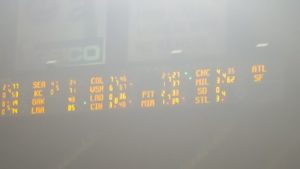 Phantom of the Scoreboard. No. 99, Taijuan Walker, pitched well. Less well than No. 45, Zack Wheeler, who used to work here. Less long than Walker wished. Tai went five. He could’ve gone six. Luis Rojas and the spreadsheets somebody sends him said he couldn’t. Bye Tai. Bye that additional inning of starting pitching that, by domino effect, might have prevented two bullpen runs and therefore made the ultimate difference. Or maybe Rojas, Jeremy Hefner and whoever presses “send” are right, and we just want to blame somebody. Walker finds a way to give up runs, too.
This is the part where it must be noted that it didn’t really matter which Met pitched when because hardly any Met hit at critical junctures. The three Met runs in this 4-3 loss struck Dan and me as reaching the ceiling of Met potential. We found it within us to marvel at Javy Baez (one RBI), feel relief for Michael Conforto (one RBI) and cheer wildly when Kevin Pillar (one RBI) was ruled safe rather than out upon further review when he stretched a single into a double. Chaka Khan and we being told something good via the headsets connected to Chelsea was the highlight of the evening. Plus the weather. And the view. And the nine innings/four hours I got to spend with Dan for the first time since 2017. Oh, and a pregame sausage and onions — hold the peppers. I have one of those a year. Two at most. But none since 2019. Maybe 2018. Many a season at Citi Field. Often it’s what doesn’t show up in the box score that keeps a fella coming back for more.
Hold the aggravation.
by Greg Prince on 16 September 2021 1:00 pm You can still do the math, but at this point of this season, a Mets fan doesn’t need to be Yakov Smirnoff to understand the math does YOU. However many games behind the Cardinals for the Second Wild Card. However many-and-a-half games behind the Braves in the NL East. The numbers are conceivably small enough to not totally and completely give up, at least over at the Supreme Optimists Club. The Regular Optimists Club is poring over draft position.
Wednesday night the 2021 Mets gave all but the hardiest diehards permission to throw in the towel — hurl it into Flushing Bay at as high a trajectory as possible, lest the likes of Lars Nootbaar leap at a nearby wall and grab it. Nootbaar, if you weren’t watching the game closely (and I admittedly wasn’t, opting instead to linger inside 1986 for one more blissful evening), indeed leapt at the right field fence and robbed Pete Alonso of a three-run seventh-inning homer that, had it eluded the grasp of heretofore unfamiliar Redbird, would have cut the Cardinals’ lead from 8-4 to 8-7. St. Louis went on to win, 11-4, finishing off a series sweep and rendering the Mets’ playoff chances barely visible. Without that catch, St. Louis would have gone on to win, 11-7, also finishing off a series sweep and also rendering the Mets’ playoff chances barely visible. I can’t prove the Mets would have lost regardless of the exploits of Lars Nootbaar. I just know it’s true.
The Four Horsemen of the Metspocalyspe — pessimism, skepticism, cynicism and fatalism — had been held in abeyance for as long as they could be this summer. Through the injuries. Through the one-run losses. Through the runners stranded. Through the manager who managed in order to win some game other than the game directly in front of him. Through every glaringly obvious sign that this had slowly but certainly stopped being our year. Not beating the Pirates. Not beating the Braves. Not beating the Phillies. Not beating the Dodgers. Not beating the Giants. Not beating the Marlins. Not beating the Cardinals. That’s a pretty convincing spate of signs. Together they spell out S-T-O-P at the intersection of You Gotta and Believe.
We hold out hope because it’s how we’re wired. We hold off hopelessness because a state of hope is a far more preferable place to reside. We indulge in mathematical reality only when we must. Alas, reality refuses to any longer indulge us.
|
|






