The blog for Mets fans
who like to read
ABOUT US

Faith and Fear in Flushing made its debut on Feb. 16, 2005, the brainchild of two longtime friends and lifelong Met fans.
Greg Prince discovered the Mets when he was 6, during the magical summer of 1969. He is a Long Island-based writer, editor and communications consultant. Contact him here.
Jason Fry is a Brooklyn writer whose first memories include his mom leaping up and down cheering for Rusty Staub. Check out his other writing here.
Got something to say? Leave a comment, or email us at faithandfear@gmail.com. (Sorry, but we have no interest in ads, sponsored content or guest posts.)
Need our RSS feed? It's here.
Visit our Facebook page, or drop by the personal pages for Greg and Jason.
Or follow us on Twitter: Here's Greg, and here's Jason.
|
by Greg Prince on 17 February 2021 2:38 pm Welcome to the first chapter of Faith and Fear’s historical countdown of the The Top 100 Mets of the 2000s. A full introduction to what we’re doing is available here. These are the more or less best Mets we rooted for as Mets fans during the decade FAFIF came to be. In honor of the 16th anniversary of our February 16, 2005, founding, we thought it would be fun (or at least not too painful) to revisit these guys and recall a little something about them.
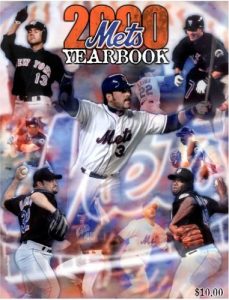
100. LUIS CASTILLO, 2007-2009
Also a Met in 2010
Luis Castillo was a .302 hitter across 142 games in 2009, and if you gloss over Luis’s 51st game of that year, June 12 at Yankee Stadium…specifically that game’s bottom of the ninth, when the three-time Gold Glove second baseman never quite settled under a two-out pop fly with runners on first and second who took the job description of “runners” literally…and if you forget that Luis attempted to grasp that pop fly with one hand, dropped it, and allowed those two runners to score, turning a nervous 8-7 Mets lead into a grisly 9-8 Mets loss…well, you might remember Luis Castillo hit .302 across 142 games in 2009. But that’s not what you remember when you think of Luis Castillo, is it?
99. FERNANDO NIEVE, 2009
Also a Met in 2010
The afternoon after Luis Castillo failed to use two hands to secure a third out in perhaps the most embarrassing Subway Series humiliation since the Mets began playing the Yankees for real in 1997, Fernando Nieve emerged from the bullpen to make his first start of the season and rescue Metsopotamia’s self-esteem from the abyss. Six-and-two-thirds innings of two-run ball steered the Mets toward a much-needed 6-2 win in the Bronx, and furnished an even more-needed reminder that tomorrow is inevitably another day.
98. CORY SULLIVAN, 2009
Citi Field was ushered into existence as a great park for triples, therefore a perfect park for perennial leadoff hitter Jose Reyes. Yet nobody presented more compelling evidence that the dimensions could create a little old-time basepaths excitement than Cory Sullivan, an erstwhile Rockies outfielder who joined the injury-riddled Mets in July and ran relatively wild, posting five three-baggers in a 32-game span. With Reyes confined to the DL, Citi Field seemed to have been built specifically for Sullivan, who finished second on the club in triples in less than half-a-season on the roster. Sullivan, however, ran to Houston as a free agent in the offseason following 2009 and never played at Citi Field again.
97. ROBERTO ALOMAR, 2002-2003
The phrase “won the offseason” never resonated more strongly than in December of 2001 when the Mets pulled off what appeared to be a heist, trading for surefire future first-ballot Hall of Famer Robbie Alomar. Alomar was a huge part of winning teams in Toronto, Baltimore and most recently Cleveland. Though he was heading into his age 34 season, he’d shown no signs of slowing when he was 33, having hit .336 in ’01 with 20 homers, 30 steals and well over 100 runs scored. None of the players given up to get him — including megahyped outfield prospect Alex Escobar— would come back to substantively haunt the Mets. For good measure, Alomar had fond childhood memories of Shea Stadium, with his dad Sandy having played for the Yankees there the two seasons Yankee Stadium was being refurbished (after playing briefly for the Mets before Robbie was born). We’re talking about the perfect offseason trade here, except for one stubborn detail: Roberto Alomar was a bust as a Met. Perhaps no high-profile Met acquisition was more disappointing. His range disappeared. His hitting evaporated. He fought for what appeared to be a silly reason with one of his teammates (Roger Cedeño, who reportedly teased him over what young Alomar looked like on his rookie card). After a dozen consecutive All-Star seasons, not even Alomar’s AL reputation could win him election to the NL squad. He fell far and fast and was traded by the middle of 2003, the second consecutive season when Alomar’s Mets had inverted from promising in winter to unwatchable by summer. Robbie did play almost every day, did collect his 2,500th hit in a Mets uniform, and “NEW YORK, N.L.” does appear on his Hall of Fame plaque, but the sour aftertaste of his term in Flushing doubtlessly contributed to pushing his election off to a second ballot. Elaborated no-voter Marty Noble in 2010, “During his 222-game tour with the Mets, Alomar repeatedly spit in the face of the game by playing with conspicuous apathy.”
96. ANDERSON HERNANDEZ, 2005-2007; 2009
Man, could this kid play defense. Enough so that after his widely craved late-season 2005 promotion from Norfolk revealed his second base skills, his slow-to-connect bat (0-for-17 before a single in the ninth inning on Closing Day) was overlooked or at least forgiven. Penciled into lineups alongside David Wright (22), Jose Reyes (22) and Mike Jacobs (24), Anderson Hernandez, a month shy of 23 upon his arrival, was going to be part of a tantalizingly youthful infield that would catapult the Mets to full contention in 2006. Anderson proceeded to play his role as directed, flying through the air with the greatest of ease as the ’06 Mets elevated themselves above the NL East pack by mid-April. Unfortunately, Hernandez’s glove, as well as the rest of him, was put on the shelf by a bulging disc in back, something you wouldn’t intuit would sideline an athlete so young. Anderson wound up missing the bulk of that Eastern Division championship season and was never the Mets’ everyday second baseman again. Oh, but how he could field when he was.
95. NELSON FIGUEROA, 2008-2009
With the eighteenth pick of the thirtieth round of the 1995 amateur draft — the 833rd pick overall — the New York Mets selected Nelson Figueroa, righthanded pitcher from Brandeis University. Born and raised in Brooklyn as a Mets fan, this draft pick was a story set to write itself. Nobody, however, would have guessed it would be a longform story, as Figgie would pass through five other major league organizations, endure labrum and rotator cuff surgery, miss an entire professional season, tour Mexico and Taiwan in an effort to regain notice, and require thirteen years before making his Mets debut. Was it worth the wait? Considering it took place at Shea Stadium in front of at least a hundred friends and family members, involved a perfect game bid of 4⅔ innings, and resulted in a win for the 33-year-old journeyman, one would have to say it was. Nelson was certainly satisfied. “It was everything I dreamed it would be,” he said that April night in 2008. “To come back in baseball and pitch for my hometown team, this journey has been incredible. It’s storybook-like.” Though the rest of Figueroa’s story in Flushing lacked plot development nearly as compelling (he went 6-11, starting 16 games over two seasons), his final Mets chapter put a bold period on his stay, as he shut out the Astros on a four-hitter in Game 162 of 2009.
94. DAVID CONE, 2003
Also a Met from 1987-1992
David’s 21st-century Mets stint was pure anaConeism. He’d been gone from the Mets for more than a decade and had embedded himself in New York baseball lore more for his world champion American League exploits when he was convinced by a couple of similarly venerable pitchers, John Franco and Al Leiter, to come out of one-year retirement and come to Port St. Lucie to give baseball one more throw. Lo and behold, the 20-game-winner from 1988 had enough left to make Art Howe’s rotation and start the season’s fourth game. Anachronistic or not, 40-year-old Cone turned back the clock that frosty Friday night, blanking the Expos for five innings, ending his Mets return with a flourish out of a storied Flushing past, striking out Vladimir Guerrero with two runners on to put a Conehead on his return engagement. By May, David would re-retire, assigning his Mets presence once and for all to the past.
93. SHAWN ESTES, 2002
On June 15, 2002, Shawn Estes threw seven dominating innings, shutting out the hated Yankees at Shea Stadium while striking out eleven of them and, for good measure, whacked a two-run homer off despised visiting starter Roger Clemens. All of it culminated in an 8-0 thrashing that under 99 of 100 circumstances would have totally delighted every Mets fans in existence, especially considering Clemens also gave up a home run to his personal nemesis (and vice versa) Mike Piazza. But this was the hundredth circumstance, the one that had the Rocket showing his ample ass at the plate against the Mets for the first time since he threw a bat handle at Piazza in the 2000 World Series. Mets fans had been yearning for revenge against Clemens ever since. The chance to get even fell into the left hand of Estes, a starter in good standing for the 2000 San Francisco Giants and, as such, completely detached from the furies of two Octobers earlier. Estes threw in the general direction of Clemens’s backside anyway. He missed. Nobody of a Met stripe was happy. The 8-0 win was thus viewed as consolation rather than conquest. Moral? No good deed goes unpunished (and vice versa).
92. ERIC VALENT, 2004-2005
Eric Valent had singled in the second inning at Olympic Stadium on July 29, 2004. He doubled in the third and homered in the fifth. One particular type of base hit shy of the cycle, Valent unwittingly channeled the spirit of Alexander Hamilton as eventually channeled by Lin-Manuel Miranda. Eric Valent was not throwin’ away his shot. Sure enough, when he lined a Roy Corcoran pitch down the right field line at the Big O, Eric took his shot, and it was as big as the one Billy Joel had written about a quarter-century earlier. First base? Not big enough. Second base. Still not big enough. Third base? That’s the shot Valent was taking. He ran and ran and never stopped until third base was in sight…and he made it, collecting the eighth cycle in Mets history. Sure as shootin’, it was worth a shot.
91. ROBINSON CANCEL, 2008-2009
Talk about keeping your powder dry. Robinson Cancel played in fifteen games for the Milwaukee Brewers in 1999 and then spent the next eight seasons in the minors, affiliated and otherwise. He re-emerged a major leaguer in June of 2008 with the Mets, who at the time groped for anybody who could give them a quality at-bat. In the nightcap of an Father’s Day makeup Interleague doubleheader, Robinson pinch-hit for Pedro Martinez and introduced himself as the Texas Rangers’ daddy, stroking a tiebreaking two-run, sixth-inning single to center that proved the difference in a critical 4-2 Mets win. It didn’t save Willie Randolph’s job — he was fired as manager late the next night in Anaheim — but it did serve to keep Cancel’s number handy should the Mets need another big AB later in the season. On September 25, Randolph’s successor Jerry Manuel started Robinson behind the plate as the Mets pursued a playoff spot. Once again, Cancel culture prevailed, this time in the eighth when Robinson singled home another Met reclamation project, Ramon Martinez, with the run that knotted the Cubs at six. The Mets would win an inning later, forging their final Shea Stadium walkoff triumph. For someone who showed up in big league box scores approximately every decade, Robinson Cancel certainly knew how to make his appearances count.
by Greg Prince on 16 February 2021 4:44 pm Today is the sixteenth anniversary of the founding of Faith and Fear in Flushing, which puts our start date at February 16, 2005, which isn’t exactly news. It was news to Jason and me sixteen years ago today, but the outer world of Mets fans who liked to read wouldn’t instantaneously discover us. That took at least a week. Of course when you write something called a blog, you’re always being discovered by somebody for the first time…which is a nice way of saying most people out there who might enjoy what you’re doing have likely never heard of you, but you keep doing it for sixteen years and then some because you really enjoy doing it.
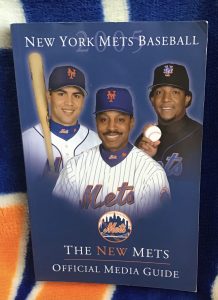 When the Mets fancied themselves as New and our brand of media did, too. Like I said, no news there via a sixteen-year-old scoop, but I did recently notice something specific about the Metsian moment when we launched. It was right in the baseball-middle of the decade known popularly as the Aughts, though I never went for “the Aughts” as a name. I called them “the Ohs,” though I don’t think anybody else did. I’m willing to go with the 2000s, the caveat being that for Mets baseball purposes, they commenced at the beginning of the 2000 season and ended at the conclusion of the 2009 season. If you’re one of those “but there was no year zero” pedants who revels in pointing out decades and centuries can’t possibly begin in a year ending with an oh or an aught, please save that hardy decennial nitpick for January 1, 2030, when we’ll briefly entertain and reject it again.
February 16, 2005, meant five Met seasons of the 2000s had been played and five Met seasons of the 2000s had yet to occur. We were apparently taken enough by what we had experienced in the first five — 2000 through 2004 — to want to share with an audience larger than just us what we thought as the beginning of the next five crept into view. Not that the previous five seasons represented the best five-season span in Mets history. No five-season span in the past thirty years can be said to have constituted the best five-season span in Mets history. But for five seasons, those five seasons were ours. Jason and I went to a load of games together from 2000 to 2004, listened to or watched on radio or TV just about all the rest of them, and wrote to each other not a few words based on what we’d seen.
For the record, the 2000 Mets won a pennant and their next four successors did no such thing. Relatively few bursts of Met competence sustained themselves from 2001 to 2004, though there were some good days and nights in there, enough to keep us coming back long enough land here on 2/16/2005 and take it from there. In the latter half of the 2000s — 2005 through 2009 — there was some semblance of lasting Met success, certainly enough to make us want to keep going to games, listening to them, watching them and, without pause, writing about them. The Mets would fall apart as late as possible in a few of those years before dropping the pretense altogether and coming completely apart several dreadful months before the baseball decade ended.
Win or lose, it was all blogworthy for a couple of Mets fans who like to write, and so we have continued on, currently blogging inside of a third calendar decade. The 2020s have yet to really take shape (let’s hope). The 2010s we covered with due hindsight when the 2020s loomed as the immediate if incredibly unknowable future. That leaves us the 2000s.
Leaves the 2000s for what? Why, for a full-fledged Faith and Fear in Flushing retrospective of its birth decade: The Top 100 Mets of the 2000s, considering the 275 players who played as Mets between March 29, 2000, and October 4, 2009, and ordering what we shall refer to the “best” of them from 100 to 1, countdown (or countup) style.
The parameters follow what we did at the tail end of 2019. Rankings will be based on recollections and research, leaning on impressions and accomplishments more than stone statistical rigor. We’ll take into account what a player did and if it made us as Mets fans sit up and take notice for at least a spell, maybe no longer than a given day or night during the 2000s. Worth noting in this process: thirty Mets from that decade began their Met tenures prior to 2000, while 29 others continued as Mets after 2009, but we’re not allotting points based on anything anybody did before the decade in question kicked in or after the last of it was put in the books; apologies to my fellow 1999 aficionados.
Also, we’re not actually “allotting points”. Plenty of thought’s gone into this exercise, but there is no discernible formula at work. Take the rankings as seriously or as frivolously as you like. Just try to not be one of those sour sorts who insists everybody sucked then, sucks now and will suck forevermore. That sort of response is truly a bummer.
Happily, I can tell you with conviction that the 2000s crew brought more depth to the historical table than the Gang of 247 we reviewed from the 2010s. When I put together the 2010s series, I was continually disturbed at how high waves of mediocre Mets rated, gaining their given spot mainly because there was hardly anybody of substance to stick them behind. So while I can’t promise you a complete escape from obscurity nor immunity from unintended repressed-memory chills in the lower rungs of the forthcoming countdown, I do believe we have generally stronger Mets to look back on in something less than anger. They’re strong enough to have survived the test of time and wind up getting talked about in the preseason portion of 2021.
We’ll make space as well to talk about the state of the contemporary Mets; the Pitchers & Catchers scheduled to report imminently; the blur of Villars, Pillars and ILs; and who’s gonna make the however-many man roster in advance of Opening Day of the 60th (!) season of New York Mets baseball. Our heads remain, for a seventeenth consecutive Spring Training, mostly in the year at hand, even if our hearts steer us back to the many, many Mets who’ve driven us to the cusp of what’s next.
For FAFIF, the decade of the 2000s is what got us here and got us going. Starting tomorrow, we’ll visit with a hundred of the Mets from then and maybe recall what all the fuss was about.
by Greg Prince on 14 February 2021 12:54 pm When Joey Lucchesi, acquired from the Padres on January 19, Inauguration Eve, makes his first appearance as a Met, he will become the first Met to go by Joey. That’s a legitimate choice. Just ask Joey Votto, Joey Bishop or David Geddes, who took “Run Joey Run” to No. 4 in 1975. Just ask Joe Biden, whose folks, per the 46th president’s recurring recollections, tended to address their eldest son as Joey. Biden took “Run Joey Run” to heart, running for office so long and so often he was elected president after the most recent of those runs. Let that be a lesson for all you kids out there.
Pending acting GM Zack Scott’s tinkering, Joey Lucchesi enters 2021 with a solid chance to be No. 5 in his new club’s rotation. And on the day a fifth starter pitches, he might as well be No. 1. Yet eighteen Mets before Joseph George Lucchesi decided to go with Joe. Just Joe. Simple in its elegance. Elegant in its simplicity. And since January 20, Inauguration Day, unimpeachably presidential. Joseph Robinette Biden, Jr., you might have heard, is our first of 46 chief executives to go by Joe.
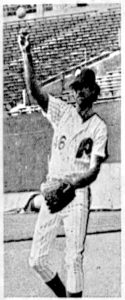 Joe Biden wearing No. 46 at a Congressional baseball game proved prescient. The Phillies part is a symptom of where he’s from. With Presidents Day weekend in progress, our Metsian instinct is to tip our caps to the likes of Claudell Washington, Gary Carter, Stanley Jefferson, several Jacksons and a few other Mets who share presidential last names. This February, however, we decided to go in a different direction. Thus, while we’re (ahem) bidin’ our time ahead of Spring Training, settle in for some nonpartisan fun with a few Met presidential first names of note.
We — the USA — started with a George as president, Mr. Washington in 1789. The other we — the Mets — had our first George in 1964: outfielder George Altman, a certified One-Year Wonder at Shea. He’d twice been an All-Star for the Cubs, who traded him to the Cardinals, who traded him to the Mets (with Bill Wakefield for Roger Craig). After batting .230 with nine homers, the Mets circled him back to the North Side of Chicago (for Billy Cowan). The Father of Our Georges would give way to three other Met Georges: George Stone, George Theodore and George Foster. Four others if you count George Thomas Seaver…and why wouldn’t you?
The Mets came to be under the presidency of John Fitzgerald Kennedy, popularly referred to, as Johns will be, as Jack. The first Met Jack came along the same season as the first Met George: Jack Fisher, who threw the very first pitch at Shea Stadium, April 17, 1964, with Altman around in right. Like JFK, Jack Fisher was born a John: John Howard Fisher. I don’t recall his being referred to as JHF, though he did pitch at a jauntily high frequency, starting 133 games between 1964 and 1967. Jack Fisher set the record for most starts in a single season by a Mets pitcher, with 36 in 1965. His mark has been matched since only by GTS.
The subsequent Jacks dealt onto Mets rosters were, in chronological order, Hamilton, Lamabe, DiLauro, Aker, Heidemann, Egbert, Leathersich and Reinheimer. I find it curious that three dozen years passed Heidemann’s last Met game in 1976 and Egbert’s sole Mets game in 2012. Among them, however, the Jacks of relatively contemporary vintage — relievers Egbert and Leathersich and utilityman Reinheimer — didn’t start as many games for the Mets as Fisher started in his least busy campaign.
Jacks may breeze into and flit out of style, but our Met Joes have always known how to spread themselves out. From the 1960s to the 2010s, there’s been at least one Joe to play for the Mets in each decade. Why, we began 1962 with a Joe among the Original Mets, Joe Ginsberg. The veteran catcher earned a spot on the Mets’ first active roster, which enabled him to become the very first ex-Met. His last game, for us or anybody, was our fourth as a franchise.
Easy come, easy Joe. The Mets had another Joe almost from the word go, Joe Christopher. His 1962 may not have been much (.244/.338/.362), but Christopher blossomed as the eventual everyday right fielder and fan favorite in 1964 (.300/.360/.466). Before 1962 was over, the Mets added their third Joe and second so-named catcher, Joe Pignatano. Later generations became intimately familiar with Piggy from his tending relievers and tomatoes as bullpen coach. His most memorable Met at-bat was the last of his career, a 4-6-3 triple play in the 120th loss of that first Joe-laden year.
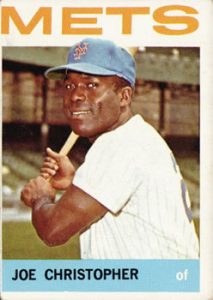 Joe Christopher posed well in Manhattan but got hot in Queens. The Sixties would give us six Joes in all, with Joe Hicks, Joe Grzenda and Joe Moock rounding out the sextet. The Seventies dawned with the third baseman projected to slam shut the Mets’ infamous hot corner revolving door, Joe Foy. Ah, but did you ever try to slam a revolving door? Foy, like Hicks, Grzenda —à la Biden, a Joe born in Scranton — and Moock, only played in one Met season. His 1970 contained one amazing game: a 5-for-5 explosion at Candlestick Park that encompassed two homers, a double, five ribbies and the tenth-inning dinger that made the Mets victorious. This left 98 other games less shall we say explosive except for the trade that brought him to Shea blowing up in the Mets’ face. Foy was obtained from Kansas City in exchange for Amos Otis, who went to five All-Star Games as a Royal and gathered nearly 2,000 hits for KC across fourteen seasons.
The Mets haven’t tried their luck with either an Amos or an Otis since.
Joe Nolan caught in three games for the Mets in September and October of 1972 and pinch-hit in another. While he wasn’t garnering much support for playing time from Yogi Berra, another Joe was proving more appealing to his intended audience down in Delaware. Joe Biden and Joe Nolan showed up in the big leagues right around the same time. Biden would be elected to the Senate that November. Nolan would spend 1973 and 1974 in the minors before resurfacing with Atlanta and commencing one of those stalwart backup catcher careers that used to seem common, playing in eleven seasons, only once starting more than half of his team’s games. He’d earn a World Series ring with the Orioles in 1983, about the time savvy political types began sizing up Biden, then in his early forties, as potential presidential timber. He considered a run for 1984 before demurring and deciding to stay in the Senate, where he’d soon begin serving a third term.
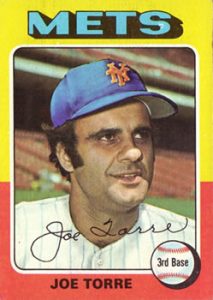 Joe Torre would need more time to airbrush himself into a World Seies. Joe Torre had been in baseball since before there were Mets — he debuted as a Milwaukee Brave in September of 1960, during Joe Biden’s senior year of high school — and would wait forever to get what Joe Nolan earned as an O and what Joe Pignatano received as a coach in 1969. When the former MVP came to the Mets in 1975, a half-dozen revolving door spins since Foy at third base, it was reasonable to imagine the Brooklynite would play a role on a world champion in New York. Indeed he would…but in the Bronx as a manager more than twenty years later.
In the mid-1980s, a few years after Torre was asked to stop managing in Flushing, the Mets had grown a lot closer to reaching one of those tantalizing World Series. To perhaps put them over the top, they brought in another local Joe, lefty Joe Sambito. Like Torre, Foy, Pignatano and Ginsberg, he was born within the five boroughs. From 1979 to 1981, he was one of the best closers in the National League, playing a key role in the Astros’ rise to prominence. Then he got hurt, winding up on the Mets for a spell in 1985. His brief tenure is recalled mainly for his having pitched in the infamous 26-7 Mets loss at Veterans Stadium when he gave up eight earned runs in three innings.
Sambito didn’t pitch for the Mets again. Whence next they saw him, it was during the 1986 World Series. Joe was a reliever for the Red Sox. In a third-of-an-inning, he posted an ERA of 27.00. Unlike that night in Philadelphia, Mets fans weren’t complaining.
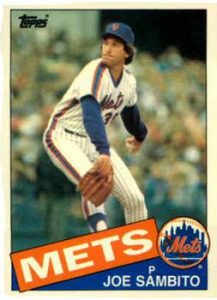 Joe Sambito’s pitching was more popular at Shea once it was no longer for the Mets. One (or one who wasn’t Joe Sambito) wishes time could have stood still as the 1986 World Series concluded. But time does what time will do, and time was flying. Joe Biden had run briefly for president in the late 1980s. He chaired the Clarence Thomas hearings in the early 1990s. Neither event went great for him. In 1992, as a different youthful political star born in the 1940s was winning the White House, the first Met born in the 1970s was taking the field, righthanded pitcher Joe Vitko. A native of nearby Somerville, N.J., Joe broke the decade barrier by throwing a scoreless ninth inning versus the Expos at Shea on September 18. He also gave up his first hit to a future Hall of Famer, Larry Walker. Yet there was no reason Vitko, 22 and the only Met Joe to come along while George H.W. Bush was president, couldn’t have dreamed Cooperstown dreams of his own.
Alas, Vitko’s threw his final big league inning on September 28, 1992, five weeks before Bill Clinton, 46, was elected our 43rd president, three months before Joe himself turned 23 years old. So Joe Vitko from New Jersey would be gone from Shea in the season that followed his debut, but Joe Orsulak from New Jersey would arrive. The Parsippany Kid, if you will, proved a valuable lefty bat for a Met club that had little else worthwhile in 1993 and stuck around as the Mets began to refind their footing before and after the 1994-95 strike. My fondness for Joe Orsulak has been duly noted.
(Also worth duly noting: the second Met born in the 1970s was Bobby J. Jones, who had a far longer run than Joe Vitko…and whose middle name is Joseph, and whose middle name can’t be spelled without J-o-e. It’s worth duly noting because Friend of FAFIF Mark Simon just published a splendid SABR Biography of the only Met to throw a post-season one-hitter, a profile you can access here. I really like the part about why Jones strove to remain calm when the cameras were on him.)
I’m mostly agnostic on Joe Crawford, lefty pitcher for the 1997 Mets, but I’m perpetually gaga for the 1997 Mets, so even the slightest of 1997 Met achievements warms my cockles no end. On August 21, Joe took a spot start, opening a twi-night doubleheader by defeating the Dodgers with six innings of three-hit ball. Consider my cockles warmed.
Joeficionados refer to the 2000s as the Joenaissance, starting with the 2000 season. BUT, before we get to the turning point, let us pay homage to a pair of throwbacks, the two most recent Met catchers named Joe.
When he came up as a 29-year-old newbie for two pinch-hitting appearances and two half-innings of catching over two nights in Houston (August 5-6, 2003) before completely disappearing from the MLB radar, you might have confidently said Joe DePastino couldn’t have had a shorter big league or Met career. Yet you would have been wrong. True, DePastino’s stay was brief and hard-earned — he’d been in pro ball without a sniff since before Joe Vitko was a Met more than a decade earlier — but seeing this Joe make it for a minute meant you hadn’t seen all such a story had to offer.
A year later, at the very end of the 2004 season, Art Howe — the same manager who gave DePastino his break — granted a line in a box score to Joe Hietpas. In the top of the ninth inning of Game 162, with the Mets well in front, Howe sent Hietpas into catch Bartolome Fortunato for five batters. Hietpas himself never had the pleasure of standing at the plate at Shea or any other stadium above Triple-A. By 2005, he was in the minors again. By 2006, he was a pitcher. In 2020, he was A Met for All Seasons, if only a player for a moment.
If a discreet gentleman were to choose a nom de plume to write on an HOURLY RATES motel guest register, “Joe Smith” might be the first generic entry to spring to mind. Ah, but Joe Smith, a sidearming righty reliever proved a long-term renter, if not on the Mets, then in the majors. Smith surprised by making the Mets staff out of Spring Training in 2007 at age 23. While six-term senator Joe Biden was planning a second presidential run, Joe Smith was becoming a primary option out of the pen for Willie Randolph, pitching in 54 games as a rookie. A year later, Biden was out of the race for his party’s nomination, but Smith made the Mets’ ballot 82 times. Young and possessing an unorthodox delivery, Joe was that rare Met reliever whose reputation wasn’t destroyed by the general bullpen implosion that helped close down Shea. Come December of ’08, Joe Smith was traded to Cleveland. That was one month after Joe Biden was elected vice president of the United States and one month before Biden took the oath of office alongside Barack Obama
Quite the interregnum for both Joes. Smith would stick around getting outs everywhere through the fall of 2019, when he’d pitch in his first World Series, as an Astro. Five years earlier, another Joe played in the Fall Classic, but as a rookie. Joe Panik, a product of the nearby Hudson Valley, made himself essential to the essential to the even-year San Francisco Giants dynasty of the first half of the 2010s. While Smith was preparing for the final postseason during which nobody’d ever heard of COVID-19, Panik was trying to help the Mets make a late playoff push by becoming the eighteenth Met Joe ever and the only Met Joe of the decade. Panik played well in a limited role, but the Mets didn’t roll into October. In 2020, Joe Panik was a Blue Jay and has signed with Toronto to be one again. During the same pandemic-shortened season, Smith sat out due to family health concerns, but looks forward to returning to pitching for the ’Stros in 2021. As of this cusp-of-Spring Training writing, he is the only Shea Met still signed to a big league contract, though Ollie Perez’s left arm remains eternally available.
 Shea Stadium is no longer around. Joe Smith is. Oh, and Joe Biden is president, a few weeks after his inauguration, having spent his first Presidents Day weekend ensconced at Camp David (named in honor of David Wright, of course) and running the executive branch in the aftermath of the virtual Queens Baseball Convention, whose special online guest was the chronologically fourteenth Joe to play for the Mets, Joe McEwing.
As noted above, McEwing was the Joe to usher in the Met Joenaissance. Upon his trade to the Mets in 2000, you might say he symbolically ushered out the previous century. To get this Joe, the Mets had to give up the only active major leaguer who had been a Met in the 1970s, never mind the only active major leaguer who had literally saved the Mets’ most recent world championship.
On December 10, 1999, the Mets swapped lefty specialists with the Baltimore Orioles, sending Chuck McElroy down Biden’s beloved Amtrak corridor for Orosco. Orosco at that point had been on the MLB scene for some twenty years. He pitched for the Mets when the Mets still had Ed Kranepool, who came up to the Mets before The Jetsons forecasted life in the 21st century. Jesse was going to pitch for the Mets in that very same suddenly arrived future. We wouldn’t have flying cars in the year 2000, but we would have the same lefty who tossed his glove in the air on October 27, 1986, maybe giving us cause to celebrate anew.
Except the Mets traded the dream of Jesse Orosco in the 21st century to St. Louis for bench depth. At the time, I was disappointed from a storyline standpoint. Over the next five years, I’d come to value Joe McEwing’s versatility. No Joe made it into more games as a Met than McEwing. He played in 502 of them from 2000 to 2004. Few Mets played more positions as a Met. Super Joe didn’t pitch and catch. He did everything else. He played every infield position, every outfield position, pinch-hit and — this is the part I love — pinch-ran. I mean he really pinch-ran.
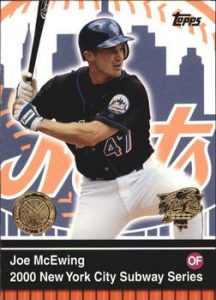 Joe McEwing was ready to run, Joey, run, regardless of the time of year. Just as no Joe has played more games as a Met than McEwing, no player has pinch-run as a Met more than the Bristol, Pa., native. Sure, you probably recall him for his turning into a slugger at the sight of Randy Johnson, but did you know how often Super Joe insinuated himself into games for speed’s sake?
I’ll be happy to tell you. Joe McEwing pinch-ran 56 times in regular-season play between 2000 and 2004, topping the longtime previous franchise recordholder, Rod Kanehl by four. Super Joe. Hot Rod. Third place, incidentally, belongs to a pitcher, Little Al Jackson. You can’t say serious pinch-runners defy descriptions. In the postseason, McEwing was doing his thing as well, taking somebody else’s base eight times; no other Met has pinch-run in the playoffs/World Series more than twice.
During baseball’s hiatus last May, the Irish American Baseball Society hosted a Zoom call with Joe McEwing, who would have been coaching White Sox players at that time of year most years. For a few well-worth-it bucks, you could sit in, listen, ask a question, maybe learn something you didn’t know about playing baseball. With no game to watch, I signed up, raised my virtual hand and asked Joe to explain how a player sitting on the bench gets the most out of going into the game to run for somebody else.
Joe answered me in detail.
That’s what I took a lot of pride in. That started at 12:30 in the afternoon, with my pregame preparation.
If I wasn’t in the lineup. I was preparing mentally and physically for whatever was possibly gonna happen during that game.
Whether it was pinch-running, defensive replacement, pinch-hitting. I was an individual who hated missing outs during a game, but I had to be prepared for every situation, ’cause I never knew when I was gonna be called upon.
It could be the first inning, could be the seventh inning, could be the fifth inning, could be the ninth inning.
So in between innings, as soon as the third out was made, if I wasn’t playing that day, I’d go run sprints in the hallway. And then I would take a few swings off the tee under beautiful Shea Stadium — trying to miss rats that were coming out — then throw a few balls into the net, then head back to the dugout, then watch the next half inning.
Go back up, run sprints, take a couple swings again, just so I was mentally and physically prepared for any situation that was gonna happen during the game.
The thing about it was I observed so much throughout a game that I didn’t want to miss an out, I didn’t want to miss a pitch. Those two-and-a-half, three minutes between, I maximized every second of it.
It’s more mentally and physically exhausting not playing than it is playing.
Followup for Coach McEwing (and not about the rats of Shea): Was it different being a pinch-runner versus getting on base as, shall we say, your own hitter?
That all starts at 12:30. You’re breaking down video of every single guy on the mound: the starter, every guy in the bullpen. His times to the plate. His moves. Does he have quick feet? Is he hard coming over? Does he have any tells? Does he tip when he’s going to the plate? Or with head movements? Or whatever when he’s coming over. And you try to take advantage of every single situation because 90 feet mean a ballgame.
If you’re reading that ball in the dirt, you’re taking that base, now you’re in scoring position. You’re stealing that base, now you’re in scoring position to put your team in a better position to be successful.
As for the challenge of coming in cold rather than having been in the game the entire time, Super Joe explained, “That was my life. That was my career. That was my job. I took extreme pride in that, being prepared for every situation.” The preparation, he concluded, earned him a substantial career in the big leagues.
One could choose to say something similar about another Joe born in Pennsylvania who was (ahem again) bidin’ his time preparing for his next chance and was eventually called on in a pinch to do a job, but I aimed to be nonpartisan with this feature.
Happy Presidents Day, everybody!
by Greg Prince on 13 February 2021 6:46 pm Recently, as in a day or two before a revised Spring Training schedule embedded with a pod of Marlins, Nationals, Cardinals and Astros was issued and my mood instinctively if temporarily brightened, I was feeling pretty nihilistic about the whole Mets baseball thing. “Can you imagine them trading…?” I asked myself about pretty much every player, and I decided I could. Tacitly approving the trading or letting walk as a free agent just about any Met I’d normally throw the bulk of my sentiment in front of so as to prevent his wrenching departure was a new emotional sensation for me, though I honestly wasn’t feeling much emotion. I’m told we nihilists rarely do.
Yeah, sure, hypothetically trade whoever if you think so. Make the team better. Don’t make the team better. What’s the point? Not endorsing anybody’s expulsion from Met ranks, not advocating immediate action, just deciding I could live without most any given current Met if I absolutely had to (not that various GMs ever seek my blessing). My lone, unmovable exception was Jacob deGrom…“and maybe Seth Lugo”.
Twenty-four hours into tentatively shaking off the crust of winter with the realization that camp is about to open, I had my “maybe” snatched away, at least in the short term. Seth Lugo, the sole fully dependable Met reliever of the latest pennus horribilis period, is out for a while with an inflamed elbow whose bone spur “broke off,” which sounds terrible, if not as bad as the official diagnosis that he has a “loose body” in there. For Seth’s sake, let’s hope the body is no larger than Freddie Patek’s.
Well, next thing ya know, ol’ Seth is David Altchek-bound, getting that pesky body surgically removed, which means six weeks until Lugo sees his curveball’s shadow. That brings us to the cusp of Opening Day, indicating Seth will have his very own extended Spring Training before we see him when we see him. One could project a timetable for competitive pitching, but as one who was silly enough to decide “maybe” I couldn’t do without him, I shall decline that option. Recover safely and speedily, No. 67.
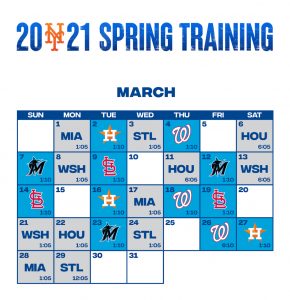 We don’t get any Lugo, but we get loads of Marlins real soon. The Mets’ bullpen without Lugo — which was what the Mets had the latter portion of last year when Seth talked his way into the mostly vacant starting rotation — now becomes something less than a confidence-inspiring destination. Granted, except for approximately two weeks in 2006 when Wagner, Sanchez, Heilman, Bradford, Feliciano and Oliver had it goin’ on in sync, that’s been the standard 21st-century state of affairs. Seth Lugo’s right arm has been a veritable security blanket to which our angst would cling; we were all Linus contentedly sucking our thumbs when he entered to pitch. Without Seth, the depth we might have been thinking upon counting is mostly numerical and reputational.
Lotta guys. Lingering doubts. Edwin Diaz is again slated to tease us with his talent and subsequently destroy our faith in a ninth inning coming to a ballpark near us (unless it’s the seventh inning of a Manfred-rigged doubleheader). Brad Brach was squeezed out for 40-man reasons, though the same basic subtraction could have been accomplished by excluding any among several other holdover relievers who’ve not lived up to our middling hopes. Newcomers Trevor May and Sam McWilliams I’m relatively high on mostly because I’ve never seen either blow a Mets lead.
The fact that I’m fretting how we’re gonna fill Lugo’s innings is a perversely good sign. It means I’m looking forward to 2021, albeit in a sleep with one eye open, gripping my pillow tight fashion. Wintry mix in New York notwithstanding, Spring is practically in the air.
by Greg Prince on 9 February 2021 4:38 pm Boys, gather round. I’ve got something important to say. For those of you who haven’t met me yet, I’m here to show you how to win. Don’t feel bad that you’ve got to hear it from me. Nobody you know was going to tell you. They’re too polite.
You haven’t won because of your surroundings. You haven’t won because of New York. New York hasn’t built a winner in nearly a decade. It doesn’t have to be that way, but it’s become that way. It ain’t nature. It’s nurture. And from what I can tell, we’re nurturing a generation of overly humble kids in these parts. Of course they’re humble. They’re growing up without a championship team. This is dangerous to our future.
Me? I came here from Chicago. We won in Chicago. I won in Chicago. I could call it “the Chicago way,” but this isn’t necessarily about Chicago. But I did play in a World Series there. I played in a World Series and I won a World Series. Scored the tiebreaking run in the tenth inning of Game Seven. I’ll pass my ring around later so you can get a good look since I guess none of you have ever seen a real recent one up close.
Yeah, I see you Frankie Lindor. You and the Tribe played good in that World Series. We played better. We won. But at least you’ve been around winners. You were in Cleveland. Cleveland’s had a champion. Just like we did in Chicago.
My name? I’m Albert. Albert Almora. Albert Almora, Jr., to be precise. You think I’m here to give you defensive help, but I’m really here to deliver a much-needed psychological assist. My name may say “junior,” yet vis-à-vis all of you, you might say I’ve got seniority. I’ve won a World Series. Anybody else here who can say that?
You? J.D. Davis, right? You’re flashing your ring at me? Put it away, son. You weren’t on the World Series roster in Houston, were you? No, I didn’t think so. Still, you were around winners. You’ve been in Houston. However they did it there, they won.
The rest of you, you’re from New York. You guys never win anything. It’s sad.
What’s that? 1969? 1986? How old do you think I am? Never mind ancient history. I did my homework. I know nobody in New York has won anything since Super Bowl XLVI. That’s right, I speak Roman. You know how long ago Super Bowl XLVI was? That’s IX years ago. New York has been nowhere since then.
Chicago — my Cubs, in particular, but also the Blackhawks — has been a champion. Cleveland — the Cavs — has been a champion. Houston — the Astros, trash cans and all — has been a champion. You know Tampa Bay, which is technically a body of water, has won two since last summer. And Los Angeles, which you guys in New York like to make fun of for subpar pizza. They won two, too.
You got the pizza, but you can’t get even a taste of the pie you know you crave. Damn, guys.
Since New York last won anything, Philadelphia won a Super Bowl. They’re right down the Turnpike. Seattle won a Super Bowl. They did it across the river, in the Meadowlands. New England won a bunch and New England isn’t even a city. Neither is Golden State, but they won multiple NBA titles. Just ask Kevin Durant. Like I’ve come here to help Flushing figure out how to win, he went to Flatbush to help them figure out how to win.
That’s right, me and Kevin Durant and, for that matter, Kyrie Irving are champions, spreading the gospel, each of us in our own way You’re not. Not yet. Aw, little old New York, however many million stories in the Naked City and not a single one about winning a championship since Barack Obama’s first term. Five boroughs, no dice.
All kinds of cities and markets have gotten trophies and hosted parades. We had a great one in Chicago. You want me to tell you about it? No, you don’t. You want to have one for yourselves.
Guys, seriously, almost everybody somewhere else has a ring since February 5, 2012. You got, what, nine teams around here, counting the ones in Jersey not near Philly? Hell yes, count the ones in Jersey. The Hudson ain’t that wide.
Giants: 2011 season.
Yankees — and I know we don’t like them: 2009 season.
Devils: 2002-2003 season.
Rangers: 1993-1994 season.
Us, the Mets: 1986 season.
Islanders: 1982-1983 season.
Nets: 1975-1976 ABA season.
Knicks: 1972-1973 NBA season.
Jets: Oh my god, you have to go back to the AFL and the 1968 season.
Whatever happened to braggin’ rights? More like humility rights. “After you, Philadelphia. After you, Foxboro.” Good lord.
Like I said, I, Albert Almora, Jr., do my homework and I know it’s been joyous elsewhere since 2/5/12 while the Canyon of Heroes has been a vacant lot. A Stanley Cup and a World Series in Washington. NBA titles in Miami, near where I was born. An NBA title in Toronto. Maybe that’s why George Springer went there instead of here. The San Francisco Giants, who used to be from New York, but they saw the writing on the wall and headed west for two World Series since anybody in New York last got to come to the championship picnic. Shoot, the Kansas City Chiefs won the Super Bowl last year and the Kansas City Royals beat you in the World Series that time. Anybody here from then? Jake? Scooter? Thor? Jay-uh-reese?
Man, you should be showing me your rings. But you lost to small-market Kansas City. It’s no contest on population or pizza, but they got recent rings and New York doesn’t.
Well, that ends this fall if we want it to. That’s my message to you, my new New York Mets teammates. We have a chance to make history. In Chicago, I was a part of making history. Not continuing history, but making it. We waited a hundred-something years on the North Side. We — and I’m gonna say “we” ’cause I’m one of you now — have been waiting 35 years in Queens. That’s almost four times as long as the Metropolitan Area’s been waiting for somebody/anybody to be champions. It gets longer and longer the more I think about it. It gets sweeter and sweeter thinking it’s gonna be us.
Listen, we on the Mets can’t help it if Durant and Irving get the Nets there, or if somehow the Knicks or one of the hockey teams beats us to it. That’s the schedule. But whether New York is still in that championship drought from IX years ago or it isn’t come summer, I say we get roamin’ to October the minute we have our first protocol-protected workout and make winning it all our goal. Never mind the candy-ass seven-inning doubleheader, runner-on-second extra-inning rules. Never mind Tampa Bay or Los Angeles or any of these other places. We’re New York motherbleepin’ City. We’re the New York motherbleepin’ Mets.
A little humility is good for the soul. But fellas, we’ve had more than our share. Enough with being a little too humble. Let’s be the Big Apple again.
The Big motherbleepin’ Apple with a motherbleepin’ championship trophy.
by Greg Prince on 5 February 2021 4:14 pm The Mets have been turned down by the National League Cy Young Award winner. To invert the 5th Dimension, I should be unhappy, but all I do is shrug.
True, I was as much on tenterhooks over the marquee free agent pitching decision of the offseason as any Mets fan, even once I realized I didn’t actually know what a tenterhook was. Nevertheless, I didn’t particularly want the weirdness of Trevor Bauer on my team. Weirdness can be wonderful. His is offputting. Plus the track record seems slight compared to the heft of the contract he was demanding. The Mets nonetheless threw a weighty offer at him. He chose the Dodgers’ version. Good for him. Very good for him.
I’ve decided not to count Steve Cohen’s money or care about competitive balance penalties. Yet paying one dude who isn’t the undisputed best at his position in baseball — not the best available, but the actual no-doubt best — an unimaginable amount to maybe stretch out what he did over fewer than a dozen starts to close to three times that…in New York…while parading around his own brand of weirdness…while consciously or otherwise trying to live up to the unimaginable amount…and then, if he really succeeded, potentially walking out ASAP because a clause said he could…
It didn’t sit right. Granted, budding codgers like me use phrases like “it didn’t sit right” while grumbling they don’t print pocket schedules in copious quantities anymore, but it didn’t. Never had a great feeling about Trevor Bauer joining the Mets. Now I’m eligible for having pangs of regret should he somehow prove a bargain. I’ll take that chance.
Extend Lindor. Extend Conforto. Fill a couple of vacancies, vaccinate the roster when permissible and play ball.
by Jason Fry on 2 February 2021 12:15 pm So 2020 was a … strange year, on the baseball field and everywhere else. (You might have noticed.) A global pandemic forced a jury-rigged, stop-start 60-game baseball season, which the Mets proceeded to botch, passing up perhaps the easiest path to the playoffs ever available. Even beyond that, though, 2020 was what we now know was the last year of the Wilpon era, with the usual roster heavy on retreads and castoffs and prospects turned suspects.
2021 is likely to be another incomplete, at least somewhat experimental baseball season, but it already promises to be a very different one in terms of payroll, philosophy and — one hopes — results. And that’s made 2020 already feel like it’s a long time ago.
But we have our duties regardless, and among them is welcoming another class of matriculating Mets to The Holy Books!
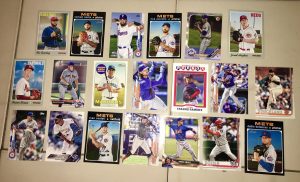 Background: I have a trio of binders, long ago dubbed The Holy Books (THB) by Greg, that contain a baseball card for every Met on the all-time roster. They’re in order of arrival in a big-league game: Tom Seaver is Class of ’67, Mike Piazza is Class of ’98, etc. There are extra pages for the rosters of the two World Series winners, the managers, ghosts (we got a new one this year), and one for the 1961 Expansion Draft. That page begins with Hobie Landrith and ends with the infamous Lee Walls, the only THB resident who neither played for the Mets, managed the Mets, or got stuck with the dubious status of Met ghost. Background: I have a trio of binders, long ago dubbed The Holy Books (THB) by Greg, that contain a baseball card for every Met on the all-time roster. They’re in order of arrival in a big-league game: Tom Seaver is Class of ’67, Mike Piazza is Class of ’98, etc. There are extra pages for the rosters of the two World Series winners, the managers, ghosts (we got a new one this year), and one for the 1961 Expansion Draft. That page begins with Hobie Landrith and ends with the infamous Lee Walls, the only THB resident who neither played for the Mets, managed the Mets, or got stuck with the dubious status of Met ghost.
If a player gets a Topps card as a Met, I use it unless it’s a truly horrible — Topps was here a decade before there were Mets, so they get to be the card of record. No Mets card by Topps? Then I look for a minor-league card, a non-Topps Mets card, a Topps non-Mets card, or anything else. That means I spend the season scrutinizing new card sets in hopes of finding a) better cards of established Mets; b) cards to stockpile for prospects who might make the Show; and most importantly c) a card for each new big-league Met. At the end of the year I go through the stockpile and subtract the maybe somedays who became nopes. (Lots of nopes — tough business, baseball.) Eventually that yields this column, previous versions of which can be found here, here, here, here, here, here, here, here, here, here, here, here, here, here and here.)
Still here after all that? Hell, it’s winter — where would you go? Well then:
Andres Gimenez: One of the brightest spots of 2020, Gimenez is now an employee of the Cleveland Soon-to-No-Longer-Be-Indians. (See what we mean by 2020 seeming like a long time ago?) Gimenez arrived earlier than expected and immediately paid dividends, quickly endearing himself to us as one of those players whom you can rely on to do the right thing without needing to think about it. And he showed good range and hands at all three infield skill positions, making him essentially the opposite of a decade or so of Mets. The Mets traded that potentially bright future, but in return they got back Francisco Lindor, a bona fide superstar with a chance to become a franchise cornerstone and New York icon. That’ll work! Some crummy Bowman card, but he has a ’21 Topps card on deck.
Jake Marisnick: A plus center fielder, Marisnick showed flashes of also being a decent hitter in Houston, and essentially stepped into Juan Lagares’ role in New York, complete with the limitations and questions we’d had about Lagares. (The Mets, entertainingly, then brought Lagares back. With his No. 12 adorning the back of Eduardo Nunez, Lagares wore 87 for a single game, then switched to 15. The head, it spins.) We never got a verdict on Marisnick because he was mostly hurt; now he’s a free agent. A dollop of extra credit for being the Mets’ “wet guy,” though one could argue the optimum number of wet guys per club is zero. Got a cool 2020 Topps Update card out of the whole affair, at least.
Dellin Betances: Gigantic former Yankee power reliever returned to duty across town and demonstrated he wasn’t fully recovered from the injury woes that wrecked his 2019. (Here’s a reminder that you should be much more worried about hearing a pitcher has a bad shoulder than that he has a bum elbow.) Importing him was a familiar Wilponian gambit: “Let’s give this recuperating player a key role because if the healing process goes really really well he’ll be a bargain.” How many times did the Mets try this gambit post-Madoff? How many times did it work? Betances will be back, and hopefully useful this time. Got a terrible horizontal card in Topps Update, and if you’ve read this column before you’ll be familiar with my warnings that horizontal baseball cards lead to drug abuse, Satanism and spontaneous combustion. Subbed that horror for a nondescript but properly vertical Topps Heritage card.
Eduardo Nunez: Useful veteran coming off year wrecked by injuries … see above and sigh. Nunez, predictably, got all of two ABs for New York, though hey, he was 1-for-2. Got a groovy Topps Update card in which he’s wearing shades. It’s the little things. Sometimes it’s only the little things.
Hunter Strickland: Annoying Giants blowhard saw his career hit the skids a few years back, a career tumble that culminated with his washing out with the Nats in the run-up to the 2020 season. Except it didn’t culminate with that, because the Mets plucked Strickland off the scrap heap, dusted him off and marveled that someone had discarded a perfectly good reliever. Strickland soon disabused them of this notion and was quietly returned to the scrap heap where he should have stayed in the first place. Perhaps this is as good a place as any to stop and sigh with relief that our baseball team is (presumably) done behaving like it’s in the rag trade. Some stupid old Giants card.
Rick Porcello: The Mets imported Porcello and Michael Wacha for the back of their rotation (which should have still included Zack Wheeler, but that’s another post), only to wind up needing more from both of them when Noah Syndergaard’s elbow exploded and Marcus Stroman opted out. Porcello seemed like a reasonable gamble, having won a Cy Young award in 2016 and pitched capably in 2018, but he’d interspersed those campaigns with dreadful 2017 and 2019 seasons. Porcello grew up as a Mets fan and seemed like a good guy in the clubhouse, but he was terrible outside of it, giving up hits by the bushel and forcing the bullpen to do things it couldn’t do. He gets a Topps Heritage card — the ’20 Heritages recycled the 1971 design, which is far from my favorite but seemed perfect for such a deeply strange year.
Michael Wacha: Like Porcello, Wacha brought a track record of past success and an iffy future to a present-day gig at the back of the rotation. Like Porcello, the Mets wound up asking more of him than was wise or arguably fair. Like Porcello, he largely didn’t deliver, giving up an ungodly number of home runs. Wacha’s only 29, but fixing whatever’s wrong with him is now somebody else’s problem. Topps Heritage card in which he’s in the same pose as Porcello, appropriately enough.
Chasen Shreve: A skinny reliever who looked like he’d been living under a bridge, Shreve was a nice surprise in an underwhelming bullpen, dominating lefties and holding his own against righties. The Mets non-tendered him after the season, which seemed a bit mean, but then middle relievers are spaghetti thrown against a wall, and one year’s success or failure often says little about the next year’s. Ask Brad Brach — or a hundred other guys — about that. 2019 Topps Heritage card in which Shreve is a Cardinal, clean-cut and unrecognizable.
David Peterson: He shouldn’t have been in the rotation at all, and wound up leading the club in wins. 2020, wooo! Peterson was pressed into service when the rotation was undone by Wilponian gimcrackery, injuries and opt-outs, and opened eyes in his debut against the Red Sox, showing poise beyond his years and battling his way to a victory. He continued to impress all season, riding a plus slider and a brainy approach to pitch selection and location. He’ll be asked to do less in 2021, which is both wise and the kind of thing that wouldn’t have happened under the previous regime. Old Bowman card in which his Mets uniform is a Photoshop job. A week from now he’ll have a ’21 Topps card. (Please don’t let it be a horizontal.)
Brian Dozier: A former star with the Twins and a useful piece with the Nats, Dozier showed very little with the Mets, was shoved aside by a resurgent Robinson Cano, and was soon off the roster. Years from now you’ll take a Sporcle quiz about Mets second basemen and Dozier’s line will still be blank when time expires. When his name materializes, you’ll shrug and agree you had no chance at that one. Old Nats card.
Ryan Cordell: A defensive specialist who’s never learned to hit a breaking ball, Cordell didn’t do much with the Mets but somehow got a Topps Heritage card. Every year there’s a guy who inexplicably gets a baseball card, which as an OCD card-collecting doofus I welcome despite the attendant bewilderment.
Franklyn Kilome: A tall, skinny kid with a live arm, Kilome came over from the Phillies in the Asdrubal Cabrera trade. He was damaged goods when he arrived, missing the entire 2019 season due to Tommy John surgery. Oh, those wacky Wilpons! Kilome pitched well in his first outing but after that was consigned to irregular mop-up work — the dreaded Mike Maddux role. It didn’t go well — it didn’t go well at all — but it’s not fair to judge him for that. Hopefully we’ll have something kinder to say in the future. Old Bowman card, Photoshopped uni.
Jared Hughes: Famous for sprinting in from the bullpen, to the apparent annoyance of former teammate J.T. Realmuto, who will not be a Met so fuck him. I said “famous” but OK, I didn’t remember the sprinting until I Google’d Hughes, which I did because I recalled nothing about him except that he was not, in fact, the same guy as Chasen Shreve. (Not only is he his own discrete person, he’s also right-handed.) Pitched pretty well, now a free agent, middle relievers, spaghetti against the wall, etc. Topps Heritage card in which he looks like Chasen Shreve, which is just mean.
Billy Hamilton: Famously fast center fielder and base stealer arrived in a minor trade with the Giants, hit .045 and made a horrific base-running error in a tight game against the Phillies, after which his services were no longer required. A boisterous cheerleader from behind the dugout rail, for whatever that’s worth. 2020 Topps Update card … in which he’s a Giant.
Ali Sanchez: Young, defense-first catcher got a call-up amid Wilson Ramos’s various woes and Tomas Nido testing positive for COVID. He didn’t make much of the chance, but he did collect his first big-league hit, and he only just turned 24. Speaking of young catchers, pour one out for Patrick Mazeika, who logged time on the Mets’ roster but never got into a game. He’s 27 and hit .245 in Double-A in 2019, making you wonder if 2020 was the closest he’ll ever get. For now, Mazeika’s the 10th “ghost” in Mets history and the third without a big-league appearance for any other team. Here’s hoping for another sighting of both young receivers; for now, Sanchez gets a Topps Heritage Minors card as a Rumble Pony. Whatever the hell that is.
Ariel Jurado: Beefy Rangers castoff was imported for a spot start against the Orioles, got destroyed, and was never seen again. Jurado has three total Topps cards — an Update card and two team factory-set issues. This would be quirky if he’d sported an ERA a third the size of what he did; since he didn’t, it’s annoying.
Miguel Castro: A flamethrower who could be a valuable setup guy or even a closer if he could throw strikes more consistently, which might augur future success and might augur nothing but further muttering, seeing how you could have said the same thing about several thousand pitchers in baseball history. Castro’s on his fourth organization and the Orioles gave up on him, which ought to tell you something; on the other hand, he only just turned 26, so keep hope alive! Skinny to the point that every time he came into a game I wanted the trainer to bring him a cheeseburger. Rockies card from a while back.
Robinson Chirinos: A part-timer until his mid-30s, Chirinos found his groove when most catchers with his CV would have feared becoming unemployed, putting up three years with double-digit homers from 2017 through 2019. That was enough for the Rangers to give him a one-year deal at nearly $6 million with an option for 2021, but Chirinos never got untracked and wound up with the Mets, where things didn’t go much better than they had in Texas. My goodness but catcher turned into a black hole in 2020, didn’t it? Don’t forget the Mets also brought Rene Rivera back! Topps Update Rangers card sporting an INAUGURAL SEASON tag for Globe Life Field, which hosted the World Series despite the Rangers not being involved. And you thought our year was weird.
Erasmo Ramirez: A rotund 30-year-old, Ramirez was serviceable for a stretch with Seattle and Tampa Bay but fell off a cliff in 2018. The Mets signed him to a minor-league deal, brought him up in September and probably wished they’d done so earlier, as he proved one of the bullpen’s more reliable arms down the stretch. Alas, he’s now an employee of the Detroit Tigers. Hey, spaghetti against a wall. Pawsox minor-league card scrounged up on eBay.
Guillermo Heredia: His first hit with New York was a home run; afterwards, he talked about how Robinson Cano had been a father figure for him since he came to the U.S. from Cuba, which makes you wonder how he took a certain bit of offseason news. Cano has taken a wrecking ball to his reputation and his Cooperstown chances, but Heredia’s the most recent in a long list of guys who said glowing things about him as a teammate and mentor. Damn shame, that. Anyway, Heredia’s signed on for another tour of duty in 2021, and has the speed and glove to be a perfectly serviceable fourth outfielder. Topps Heritage card as a Mariner.
by Greg Prince on 2 February 2021 12:20 am It wasn’t that long ago, yet it was long enough ago that it was a face-to-face conversation (remember those?). The topic was Met managers of very recent past and very near future. Mickey Callaway was ex-manager of the Mets by then. The person I was talking to was somebody whose observations I appreciated as earned and accurate. When the topic turned to Callaway, I prefaced my own impression — that he wasn’t particularly well-suited to the job from which he’d been removed — with the caveat “I’m sure he was a nice guy,” because, frankly, Callaway seemed nice enough on radio and TV when not trying to explain away losses, and, also frankly, I didn’t want to come off as somebody simply piling on a guy who nobody seemed all that sad to see go. Mostly, it’s one of those things you say before saying something worse about somebody.
This person, who would have known a lot more than I did about what kind of guy Mickey Callaway was, looked at me as if I were the DiamondVision version of Mercury Mets leadoff hitter Rickey Henderson, which is to say like I had a third eye embedded in my forehead. C+C Music Factory had a song for situations of this nature, the one about things that make you go “hmmmm…”
There wasn’t much elaborating to go with the look and I didn’t ask for any. As noted, Callaway was no longer the manager, and, besides, I wasn’t exactly digging for dirt, just taking part in a friendly chat, so I didn’t pursue what this person really thought or what might have been at the root of the reaction. But I left the conversation thinking Mickey Callaway might not have been such a nice guy.
On Monday night, the Athletic reported Callaway “aggressively pursued at least five women who work in sports media, sending three of them inappropriate photographs and asking one of them to send nude photos in return.” It’s pretty damning stuff, extending back to Callaway’s years with Cleveland, threading through his tenure managing the Mets, and continuing in Anaheim. You can read the story by Brittany Ghiroli and Katie Strang here. The Angels, who currently employ Callaway as their pitching coach, said they “will conduct a full investigation with MLB,” which seems like a reasonable immediate next step to announce when a story like this breaks.
It also seems reasonable to admit I have no idea who is or isn’t a nice guy at first or maybe thousandth distant glance, certainly not if I have no first-hand experience with the person in question — even if it’s a person I want to think of as a nice guy mainly because he’s a Mets guy.
When the Mets hire for a high-profile position somebody with whom I have little if any familiarity, I tend to lean to the benefit of the doubt. I read the initial profiles, watch the introductory press availability, pick out the encouraging aspects and write something upbeat. I prefer to think whatever the Mets are doing isn’t a bad idea. Hiring Mickey Callaway seemed like not a bad idea. Hiring Jared Porter seemed like not a bad idea. People presumably in the know spoke highly of both of them. Callaway was said to be a ready-made manager, Porter an ideal GM. Porter is out of baseball — and I would guess Callaway will be soon — because of the things nobody felt secure speaking of publicly.
Porter was the Mets’ problem until they disassociated themselves from him quickly. Callaway is not directly the Mets’ problem in 2021, but it didn’t take Woodward and Bernstein to ascertain that, like Porter, he was hired by Sandy Alderson. We learned in the aftermath of the Porter revelation that “did you ever engage in harassing behavior toward a female reporter?” was not a question that was asked in the hiring process. If it wasn’t asked of Porter in 2020, it likely wasn’t asked of Callaway in 2018. That the subject apparently needs to be broached in baseball — or any field — is incredibly sad. That people trying to do their job have to put up with the kinds of come-ons that Porter and allegedly Callaway considered fair game…well, yeech.
Not nice is an understatement. Consider the benefit of the doubt suspended for the foreseeable future.
by Greg Prince on 31 January 2021 5:36 pm It’s a summer night in 2008. Utilityman Marlon Anderson has gone on the 15-day DL with a strained hamstring. To replace him, the Mets, in Houston, look to their geographically proximate Triple-A farm club in New Orleans and call up from the Zephyrs infielder/outfielder/hitter Daniel Murphy. His first plate appearance, versus Roy Oswalt, results in a single. Twenty at-bats into his major league career, he’s a .500 hitter. At the end of his abbreviated rookie season, his average is .313. He has played in 26 games at Shea Stadium, all of them with the pressure of a playoff race falling on his inexperienced shoulders. After 2008, Daniel won’t ever play at Shea again and will wait a long time to chase anything resembling a pennant.
The infielder/outfielder/hitter drops one of his identifying descriptors pretty quickly, as quickly as he drops a fly ball in left. The glove of Daniel Murphy — “Murph” to us, even if you’d think such common shortening was permanently proprietary to legendary announcer Bob Murphy — is confined to the infield as 2009 gets rolling. He’s not really a natural there, either. What Murph does is hit. Not .500; not .313; not enough to forgive his shaky fielding and iffy instincts when he’s a sophomore, but he settles in. Citi Field is new. Few can swat homers over its comically far and tall walls. Murph leads the Mets in dingers with a dozen.
If he’s not gonna be our third baseman (we have David) and he’s not gonna be our first baseman (we’ll have Ike), Murph has to be something. He played a little second at Binghamton. He’ll play a little more at Buffalo in 2010. Get the hang of the position and come back to the bigs. Except he gets wiped out by an opposing baserunner and what was going to be his third year is wiped out with him. But an idea has been hatched and, come 2011 (after the incredibly ill-advised Brad Emaus experiment implodes on contact), Murph is indeed the Mets second baseman of the present. Sometimes. He plays everywhere on the infield as needed. David Wright misses time. Ike Davis misses more time. Murphy’s a third baseman some days and a first baseman others. One Sunday when he’s a second baseman, he takes a spike to the knee and finds another season prematurely ended. Double plays have become double jeopardy. Before 2011’s over, however, Murph’s hitting .320 on August 7.
Once recovered, the Golden Age of Murph is at hand. For three seasons, Daniel plays almost every day, usually at second. Tim Teufel works him into a state of defensive adequacy. Murphy plays on the edge of the grass, where it’s safest, as with training wheels. When nobody’s looking, he steals bases, successful on 46 of 56 attempts from 2012 to 2014. Sometimes he gets himself thrown out running any which way but wise. But he keeps hitting, to a composite tune of .288. In 2013, he’s the only Met position player to not miss time and finishes second in the National League in hits. In 2014, he alone represents the Mets at the All-Star Game. Is Daniel Murphy a star? Not really, but there isn’t much glitter to these perennially languishing Mets. They win 74, 74 and 79 games. Somebody has to hold our interest when the more fascinating among the Met pitchers are idle. It’s the ability to keep us going that makes this Murph’s Golden Age.
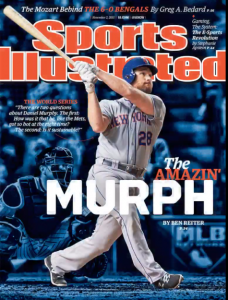 Most Valuable Murph. Then comes 2015, with its autumn nights in particular. The Mets are still playing, having captured the division title they missed when Murph was a rookie and Shea was condemned to the wreckers. He’s had a good year. He’s about to have an epic postseason. He and the pitchers defeat the Dodgers. He and his sweet lefty power stroke combine to crush the Cubs. Don’t let Murph hear you say that, though. In every postgame interview session — where Murphy’s presence is dictated by his in-game performance — he namechecks 24 teammates before he mentions any of his seven homers, including the six he bashed in consecutive NLDS and NLCS games. He’s humble. He’s real. He was real in Spring Training, too, when he kind of put his foot in his mouth (something about “lifestyle”), but you couldn’t say he wasn’t being his version of real then as well.
It’s also the real Murph who appears in the World Series, the one who was never extraordinarily comfortable at any position other than hitter. Since 2008 he’s made some crazy good plays wherever he’s been asked to station himself, but the routine ones have had a tendency to bedevil him. One in particular, a grounder in Game Four, contributes directly to a win becoming a loss. Just about everybody on the Mets contributes across five games to a potential world championship transforming into a “nice try, fellas.” Murph the NLCS MVP doesn’t register as remotely valuable versus Kansas City. Except for the crowds, it might as well be some night at Citi Field in the depths of 2013. Like Ray Knight and Mike Hampton, Daniel doesn’t play a single regular-season Mets game after winning individual postseason honors. Earning a trophy for yourself in October seems to be the quickest ticket out of Flushing.
As a Washington National in 2016 and 2017, Murph becomes Ryne Sandberg against everybody and Stan Musial against the Mets. It might not have been the worst idea to let him walk. It becomes the worst actuality, but back on that night in 2008 when the Mets simply need to replace Marlon Anderson, who would guess the 23-year-old minor league callup without an obvious position is going to help define an entire era of Mets baseball? He is going to embody the blah years and personify a joyous if transitory vault into the stratosphere. He is going to be Murph of the Mets, and when he announces, at the age of 35, that he’s retiring ahead of the 2021 season, we’ll put aside his stints with the Nationals, the Cubs and the Rockies and recall him primarily as Murph of the Mets. He was ours. He still is.
Daniel Murphy goes down as the last active position player who played for the Mets at Shea Stadium; two relievers endure as major leaguers as the next Spring Training approaches. Joe Smith, who dates to 2007, is still an Astro. Ollie Perez, veteran of 2006, is still a free agent, but maintains the ability to throw with his left arm, so he’s probably good to go for the year ahead. Shea’s long gone. The first generation of Citi Field Mets have commenced their collective fade into memory. The Longest Ago Met Still Active who didn’t play at Shea is Justin Turner. LAMSAs keep coming from later.
Murph keeps speaking well of his Met teammates. In discussing his decision to stop playing — having become a player of enough stature to “retire” rather than just not get an offer — he remembers the company of others rather than his own accomplishments. To SNY’s Andy Martino, he says of deGrom and Duda, Familia and Lagares, Tejada and Flores, “We all grew up together. We did life together,” a quintessentially Murph framing of rising and eventually succeeding as a Metropolitan. Those are your 2015 National League champions. They, too, grow temporally distant. That happens in baseball.
So does, if you’re lucky, the occasional Murph, someone whom a stubbornly engaged fan might notice, amid the persistent mediocrity his team churns out, making himself over “from sub to grinder to hero…continu[ing] to sandwich base hits”. You could do worse than to order the Daniel Murphy, side of fundamentals angst notwithstanding. As a hitter, he was one of the best at his position. As a Met, he is one of the characters you don’t forget.
 Greetings from the Mets to a Met. I joined Mike Silva’s Talkin’ Mets podcast to delve a little more into Murph. You can listen here (I come on around the 26:00 mark).
by Greg Prince on 28 January 2021 4:53 pm We need not mourn the departure of Long Island’s Own Steven Matz, traded to Toronto for younger pitchers Sean Reid-Foley, Yennsy Diaz and Josh Winckowski on Wednesday night. Nor need we celebrate his deletion from Met ranks. Sending Steven packing was just something that needed to be done.
Still, Matz, soon to turn 30, was no ordinary lefty coming off an 0-5, 9.68 ERA shortened season. He was one of us, from around here, having grown up with an affinity for the team we love before he ever pitched in its uniform. Steven couldn’t have started stronger, just as he couldn’t have ended worse. In between, he settled in as a familiar if ultimately frustrating figure. We wanted him to pick up where he left off on June 28, 2015, the first time we made his acquaintance. After seven-and-two-thirds innings we were standing in tribute to his maiden major league voyage and showering him with grateful applause. We’d done that multiple times that fun Sunday as he was not only defeating the Reds from the mound, but beating them silly with his bat.
When you get to the Blue Jays, Steven, maybe don’t set your bar so high.
LIOSM couldn’t follow up his first appearance with many remotely as scintillating, but I found his Met presence over time comforting. He was one of the last remaining 2015 National League champions. He was, in case you hadn’t heard, a local product. He was never unpleasant to listen to after games, lose or win. He supported causes it wouldn’t occur to you to oppose. There’s something to be said for your team having a foundation of players who are always there, who you don’t have to get used to, who you have absolutely nothing against when he’s not contributing to another defeat.
I liked Steven Matz a lot, albeit not enough to want him here forever. Not after 2020. Maybe not after six seasons that ceased amounting to much. Peering ahead to 2021 when I began mentally constructing April rotations — deGrom, Stroman, Carrasco, Peterson, maybe this Lucchesi fellow from San Diego — I realized I was already forgetting Matz before he was gone. That’s not a good sign for continued longevity.
All told, we probably got just the right amount of the lefty. Six years is plenty. Throwing key innings en route to a pennant was enormous. Occasional bursts of brilliance reminding you that maybe he will live up to the potential we projected for him presented an adequate case for preserving his parking space. Steven was a made Met for a while, intrinsic to the starting five we idealized in the middle of the 2010s. We’re the Mets. We grow pitchers. We grew or at least nurtured, in order of their debuts, Matt Harvey, Zack Wheeler, Jacob deGrom, Noah Syndergaard and Steven Matz. By the time we gathered them together on one active roster for consecutive outings, the dream dissipated before our eyes.
Harvey, first up in 2012, was altogether done as a Met by 2018. Wheeler couldn’t help himself from taking the money and running to Philadelphia after 2019. Syndergaard’s elbow isn’t yet out of the shop from 2020 Tommy John surgery. Matz? Seemed dependable more than he could actually be depended upon, but nobody ever said the theoretical Five Aces were created equal.
Jacob deGrom’s still pretty good, however.
My one fear as extremely sympathetic Steven Matz scuffled was I would come to turn on him as I did on his inconsistent southpaw predecessor in Met clothing, Jon Niese. They are the only two fully homegrown lefthanders to start more than a hundred games for the Mets over the past four decades. For a while there, Niese was foundational, too. To be fair, I didn’t necessarily diminish my simpatico for Jon, because I was never particularly attached to him to begin with. Also to be fair, Niese was never really framed in golden terms — anybody really salivate at the notion of Niese, Pelfrey and Gee anchoring our future? — so you couldn’t honestly grow overly indignant when he proved to be mostly middling. He showed up one day, seemed kind of OK some days, got paid to get better and, well, didn’t.
It’s hard to remember that Jon Niese was a 2015 Met, just like most of the Aces. He started 29 games that championship season — as many as Harvey, one fewer than deGrom and nearly two-dozen more than Matz. I found it surprising that Niese and Bartolo Colon (a staff-leading 31 starts) were shunted aside to long relief that September to assure that the Mets’ postseason rotation would be all about the kids. By then, despite yeoman service dating to the last days of Shea, I was done with Niese. He was Toby Flenderson to my Michael Scott and I just wanted him to stop being the way that he was.
When I wished to express my dismay with lefty Matz, I would compare him, either in print or in my head, to lefty Niese. Now you don’t want to me referring to you as STEVEATHON, do you? Niese started 179 games as a Met and compiled an ERA a tick below 4. Matz gave us 107 starts and an ERA of 4.35. So maybe Matz actually wasn’t as good as Niese, yet my fear never came to fruition. I never turned on Matz. Yet I haven’t wrapped a black armband around any of the sleeves on my 2015 commemorative t-shirts.
Matz’s final appearance as a Met came in relief on the last day of last season. He pitched three innings, gave up three earned runs and lowered his earned run average as a result. Think about that: you give up a run every inning and it technically qualifies as one of your better days.
Those are the days that need to end, my friend. Or be taken to Toronto the minute border restrictions are lifted. Thank you for the first day, Steven, and scattered nights along the way. When you come by again, we’ll stand and applaud from wherever we are.
|
|