The blog for Mets fans
who like to read
ABOUT US

Faith and Fear in Flushing made its debut on Feb. 16, 2005, the brainchild of two longtime friends and lifelong Met fans.
Greg Prince discovered the Mets when he was 6, during the magical summer of 1969. He is a Long Island-based writer, editor and communications consultant. Contact him here.
Jason Fry is a Brooklyn writer whose first memories include his mom leaping up and down cheering for Rusty Staub. Check out his other writing here.
Got something to say? Leave a comment, or email us at faithandfear@gmail.com. (Sorry, but we have no interest in ads, sponsored content or guest posts.)
Need our RSS feed? It's here.
Visit our Facebook page, or drop by the personal pages for Greg and Jason.
Or follow us on Twitter: Here's Greg, and here's Jason.
|
by Greg Prince on 1 May 2020 3:19 pm Welcome to A Met for All Seasons, a series in which we consider a given Met who played in a given season and…well, we’ll see.
“Fuck, 33, too soon.”
“No, dying in thirties is tragic. As is forties. Sympathy dissipates from there. Fifties is ‘such a shame’. Sixties is ‘too soon’.”
“Seventies: ‘a good run’.”
“And eighties, ‘a life well lived’. Nineties?”
“That’s a fucking helluva ride.”
—Axe and Wags, Billions
Where would have the Mets been last year without Pete Alonso? Or Jacob deGrom? Or Jeff McNeil? Or Seth Lugo?
I don’t know. Nobody does. Yet we impose that hypothetical upon the actual regularly as a compliment to any Met we think made a positive impact on our team’s fortunes. I’m not sure what purpose it serves. Why shouldn’t have we had the players who helped the Mets be better than they presumably would have been without them? The Mets secured the services of those players via legally recognized contractual processes. While it’s possible the parties might not have reached a mutually satisfactory agreement and therefore Alonso or deGrom or whoever wouldn’t have worn the uniform of our choosing, that didn’t happen.
Every Met who’s been a Met has been a Met when he’s been a Met. (Got that?) Musing that we would have been worse off had we not had a given Met at a given time seems a fatalistic offshoot of the dreaded “this is why we can’t have nice things” self-flagellation to which we too often reflexively resort when things don’t go as nicely as we’d prefer.
We can have nice things. We can have the players who do nice things. We might not maintain the exact aggregation necessary to achieve our hopes and dreams in this season or that, but let’s enjoy what we get when we get it (whenever we next get anything of a baseball nature). Let’s not assume every Met who performs optimally for us is a clerical error waiting to be rectified by a vengeful karma last seen wearing a Nationals cap.
Where would have the Mets been without Donn Clendenon in 1969? Again, I don’t know. Nobody does. What we do know is that the Mets started 1969 with neither Donn Clendenon nor the slightest track record of success and that they ended 1969 with both Donn Clendenon and a world championship. If you wish to conclude that there is a direct correlation between the presence of the title and the presence of the slugging first baseman, go ahead. Clendenon was, chronologically speaking, the final member of the World Series roster to become a Met. Most of the 1969 Mets who made it to October were Mets before 1969. They didn’t win us any world championships before Clendenon came along, did they? Ergo, all that ticker tape must’ve sprung from Donn’s big bat.
That’s an awfully superficial way of determining a player’s intrinsic value to a ballclub. Still it’s tempting. The 1968 Mets had a whole bunch of their future champions already on board…yet lost 89 games. Plenty of 1969 Mets were 1967 Mets…but the 1967 Mets lost 101 games. Cover one eye, squint with the other and you can convince yourself that all the Mets of the late ’60s needed to transform themselves dramatically was Donn Clendenon donning orange and blue.
It was dramatic enough that Clendenon was traded for on June 15, 1969, in a deal that sent one fairly established major leaguer (utilityman Kevin Collins) and three minor leaguers of varying levels of promise (pitchers Steve Renko, Jay Carden and Dave Colon) to Montreal. It was additionally intriguing because Clendenon, a veteran of eight seasons with Pittsburgh, had rejected an earlier trade, in January, one that would have shipped him off to the Astros from the expansion Expos. Donn had been around long enough to know that he didn’t want to play for Houston manager Harry Walker and, unlike most ballplayers, he had an imminent and appealing career option outside baseball. Clendenon didn’t have to be an Astro when he knew he could be a Scripto (an executive for the pen company, that is). Montreal, which had drafted Clendenon from the Pirates, made other arrangements with Houston — allowing them to keep the erstwhile Astro they wanted, Rusty Staub — and held on to their ex-Buc a few months longer than planned.
The Mets had always angled to trade for a big bat of Clendenon’s caliber. They were just never successful at it. The best they could come up with was a bat that had been big — Ken Boyer in advance of 1966; Tommy Davis ahead of 1967; someone who’d put up some really fine numbers a while back and if he could regain some of that MVP-type form in New York, well, incremental improvement is better than none for a team that had yet to prove remotely competitive. The Mets were never successful enough for any trade to seem all that vital in the moment. The best they could do on the market was trade for what amounted to future considerations: prying loose 23-year-old Jerry Grote from the Astros in 1965 plugged a longstanding catching hole; landing 25-year-old Tommie Agee from the White Sox in 1967 accomplished the same end for center field. In a best-case scenario, both young men served as legitimate building blocks for a team that maybe someday wouldn’t be an automatic bet to finish in the second division, yet neither Grote nor Agee was acquired with an eye on climbing into first place at the very next conceivable opportunity. There was no conceivable first-place opportunity looming for the Mets in 1966 or 1968. Hallucinogenic drugs might have been gaining popularity in certain circles, but Harry M. Stevens didn’t sell them at the Shea concessions.
The exchange of players from June 15, 1969, however, transpired in a whole other beautiful world, one where Mets general manager Johnny Murphy could look at the roster he and his predecessors had been crafting when no one was taking them seriously and realize they were at last at the juncture when that mythic big bat could make a meaningful noise. Enter the strong, long and lanky Clendenon, albeit a couple of years removed from his most muscular production (28 home runs, 98 runs batted in and a .299 average in 1966 — adding up to an OPS+ of 141, not that anyone knew what the hell that was then). But the 1969 Mets, while they craved a legitimate cleanup hitter, didn’t necessarily have to have a superstar; nor were they willing to give up too much of their awesome young pitching to nab one. They needed someone who’d been around the league, someone who could get around on a fastball, and someone who would be OK playing sometimes. They needed a dependable right-handed hitting first baseman to complement their perennially developing lefty-swinging incumbent Ed Kranepool. Kranepool was 24. Clendenon was a month from 34. Between them, they averaged out as a 29-year-old switch-hitter, forging an ideal everyday player within Gil Hodges’s platoon of platoons.
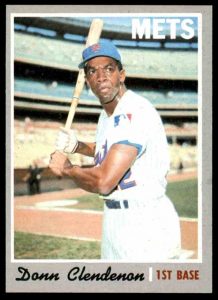 Strong, long, lanky and just what a growing team needed. The second-place Mets of mid-June 1969 were 30-26, better than they’d ever been after 56 games…and 8½ games behind the first-place Cubs. That only sounds like a large margin until you realize the Mets had never been far enough above .500 or near enough to first place to realistically measure themselves against lofty goals or stiff competition. Finishing in ninth place a couple of times seemed pretty heady stuff. But 8½ games out with more than a hundred games remaining and no one sitting between them and the team at the top constituted a legitimate shot. In 1969, the Mets were taking it. And they were taking Clendenon for the win.
You basically know what happened. I already gave away the ending. Donn Clendenon joined the Mets, and the Mets won the World Series. Clendenon’s impact was most helpful if not quite Cespedesian in its immediacy. Despite Donn delivering the kind of big hits befitting a big bat, the Mets of August 15 were actually farther from first place — 9½ out and in third — than they were two months earlier. But they were carrying a winning record, 62-51. They were unquestionably alive.
Then, in a hurry, they were alive and well and damn near unstoppable, racing up to and past the Cubs in what amounted to a blink. On September 24, with Donn Clendenon belting two home runs, the Mets beat the Cardinals to clinch the National League East. On October 16, with Donn Clendenon launching his third home run of a five-game set, the Mets beat the Orioles to win the World Series. Somewhere between showers of champagne, Donn was informed he had been named the MVP of the Fall Classic.
He hadn’t been a Met a year before. He hadn’t been a Met until four months before. Now he was certified most valuable, with the ultimate “nice thing” of its time, a 1970 Dodge Charger, to prove it. So, yeah, you can argue that for all the critical contributions made by every 1969 Met, they wouldn’t have gotten where they were going without Donn Clendenon grabbing the wheel.
But why would you want to think that we wouldn’t have had Donn Clendenon? Or any of the 1969 Mets?
***On September 17, 2005, the concept of “without Donn Clendenon” became literal when the MVP of the 1969 World Series died at the age of 70. In a way, it represented the second milestone moment Clendenon gave me in my life as a Mets fan. The first was that Thursday afternoon he put the Mets on the board in Game Five versus Dave McNally. I can’t say I would have stopped being a Mets fan had they not won the World Series for me when I was six (and had been a Mets fan not even as long as Donn had been a Met), but it seems safe to infer that once they became champs, I was all in forevermore.
Donn’s death was something else. Obviously, it was sadder. Are there ballplayer passings that aren’t? When we separate the occupation from the humanity, it’s depressingly logical that everybody eventually dies. That’s biology, though maybe it’s chemistry. I barely made it through biology and avoided taking chemistry. But a human who you know as a ballplayer…as a ballplayer from when you were a kid…even if it’s decades removed from when you were a kid and he was playing ball…I can’t say he’s not supposed to die, but it’s at odds with everything you love about loving ballplayers.
Donn Clendenon certainly wasn’t the first ballplayer from my youth to pass on, nor was he the first of the 1969 Mets to leave us permanently, but he was the first to go when I had this platform. We started Faith and Fear in Flushing in February 2005. When I learned Clendenon was dead, it was pure instinct for me to sit down at this very spot and remember him in pixelish print. I can’t imagine it would have occurred to me not to.
That’s been my self-assigned role ever since, sharing a few hopefully appropriate words on behalf of the deceased after a respectful moment of silence. A Met — technically “a former Met,” but once a Met, always a Met — dies, I try to make sure I have something to say on this blog about him. Same for any Met figure and often for others in baseball. But definitely when it’s a Met who shaped what it meant to root for the Mets, especially when it’s a Met whose name evokes the Series from when I was six and the summer from when I was seven. Donn Clendenon hit home runs two of the three times the Mets captured titles in 1969. He spent all of 1970 driving in runs: 97, for a new club record. He was at the core of my formative experiences.
May my science teachers forgive my perpetual difficulties absorbing their lessons, but someone who does that for a kid is not supposed to die, or at least not die so soon. Not that I can pinpoint where 70 falls on the spectrum of too soon. Do 70-year-olds rate the condescending “70 years young” treatment, or does that kick in when a person has made it to 80? I kind of remember that when I sat down to memorialize Clendenon, it felt a little different from what I’d been moved to write in other forums when John Milner, Tommie Agee and Tug McGraw died, to name three other Mets from when I was a kid. Milner was 50; Agee, 58; McGraw, 59. I was somewhere between 37 and 41 when they died. I could tell they were too young to go.
I was 42 when Donn Clendenon died at 70. Seventy, from the perspective of my early forties, seemed maybe (maybe) a little less cruel from an actuarial standpoint, but who was I to say? We the living can be haughty in making such appraisals. I did know that I found it was inherently surprising that the eternally young 1969 Mets had a 70-year-old alumnus. These days every living member of the 1969 Mets is at least 70 — and I’m fifteen years older than I was in 2005.
Without Donn Clendenon, am I quite the Mets fan I am today? I don’t know. But I know Donn Clendenon became the Mets’ big bat when I was six, and here I am, 57 years old/young, and I’m a Mets fan still.
For an in-depth examination of the remarkable life of Donn Clendenon, I highly recommend the SABR biography Ed Hoyt authored. You can find it here.
PREVIOUS METS FOR ALL SEASONS
1982: Rusty Staub
1991: Rich Sauveur
1994: Rico Brogna
by Greg Prince on 29 April 2020 5:26 pm If you’ve ever watched me try to make an eastbound LIRR connection at Jamaica while my intended train is pulling away, you already know I’ve never been any kind of a runner. Nevertheless, I’ve run into a most fascinating box score by way of a game story from 28 years ago, which gives me a good excuse for introducing an occasional series that will “run” here from time to time, The Pinch-Running Files. You know what pinch-running is, but do you ever really think about it? Trust me, I have.
What is a person doing thinking about pinch-running? Better question: what is a person doing reading game stories from 28 years ago, other than seeking any engaging port in a quarantine? For this diversion from baseball-nothingness, I thank a fellow Mets fan on Twitter who goes by the handle of @SportsSightings. The account was initially devoted to pictures of ballplayers in the “wrong” uniform — Mike Piazza as a Florida Marlin, that sort of thing — but lately it’s been dedicated to dutifully keeping day-by-day tabs on the 1992 Mets.
Why the 1992 Mets? Because, @SportsSightings explained a couple of months ago, 1992 is running on the same calendar track as 2020. Their season opened on Monday, April 6. This year, April 6 was a Monday (even if no season has opened). That’s my kind of reasoning. Plus, you can’t beat, for either notoriety or infamy, the 1992 Mets, eventually immortalized as the title subjects of beat writers Bob Klapisch’s and John Harper’s The Worst Team Money Could Buy. Revisiting that veritable car crash of a campaign in detail not as it looked in the rearview mirror but as it slowly grows more and more gruesome is an experience that defies the averting of eyes.
On Friday, April 24, 1992, when we had no more than an intuitive inkling that the 1992 Mets were destined to fester in memory as “the 1992 Mets,” the Mets lost in Philadelphia, 4-3. I’d love to tell you I remember the game. I don’t. For what it’s worth, I remember the 1-0 game of the day before, Thursday, April 23, 1992. That one went thirteen innings at Shea and ended only when, with the bases loaded and zeroes proliferating, Juan Agosto didn’t so much plunk Daryl Boston as gently deposit a pitch inside his uniform top. It was all very genteel, right down to Boston plucking the ball from his shirt and handing it to home plate ump Mike Winters before heading to first as pinch-runner Rodney McCray trotted in with the winning run.
(“Pinch-runner Rodney McCray.” Remember that name and job description. It will come up again and again.)
April 23 was a triumph for fabric, not to mention the cliché about balls getting lost in white shirts. Most importantly, it was the fourth consecutive victory for the water-treading Mets, whose expected dominance of the National League East was taking its sweet time rising above sea level. The chemistry wasn’t exactly right for the 1992 Mets (to put it mildly), but high-priced talent seemed likely to cash in eventually. Following three starts that set his ERA at 13.15, Bret Saberhagen threw his first Cy Young-caliber start in the Daryl Boston shirt game: 9 IP, 0 BB, 5 H, 7 SO and nary a run allowed. Coming directly after wins started by Sid Fernandez, Dwight Gooden and David Cone, Sabes’s resurrection indicated the rotation might live up to its hype. Factor in the 3-4-5 hitting of Bobby Bonilla, Howard Johnson and Eddie Murray that was bound to heat up, and what were the chances that Jeff Torborg’s team wasn’t finally taking off?
On Friday night the 24th at the Vet, projected Met ascent got stuck in flight. Anthony Young started and provided quality. Six innings, three runs, the very definition of a quality start, at least minimally. Young’s luck was establishing itself as such that Klapisch in the News reported Veterans Stadium’s artificial turf aided and abetted each Phillie tally. Get some grass in Philadelphia and maybe AY succeeds Saberhagen’s scoreless line with one of his own. Meanwhile, Danny Cox, better recalled as a vexing Cardinal from the ’80s, yet sighted here in Southeastern Pennsylvania crimson, kept the Mets off the board until the sixth when HoJo, starting in center field for a spell, homered.
Young left after six, trailing, 3-1. The score remained the same into the eighth when the Mets got simultaneously patient and aggressive. Facing future teammate Barry Jones (we’d scoop him up in August), Bonilla walked on a full count. Bobby Bo then had an idea about stealing, which is an interesting impulse because Bobby Bonilla was not signed to a five-year, $29 million contract for his base-swiping proclivities; feel free to insert your own “he’s still stealing money” witticism here. From his debut in 1986 through 1991, the erstwhile Pirate star had stolen 28 bases…and been caught stealing 30 times. If 30 times you don’t succeed and your getting thrown out more than half the time, try, try again, apparently. To be fair to Bobby Bo — which, admittedly, is no fun — he was safe the previous Friday night in Montreal in his only 1992 stolen base attempt.
So, with HoJo batting and taking two balls, Bonilla generates a lead off first. Mitch Williams, who’s replaced Jones, proceeds to pick Bobby off, but the throw gets away and Bobby scoots to third. Now it’s Williams who finds himself taking a Met to three-and-two, and once again a Phillie pitcher gives up a walk. HoJo, a three-time 30-30 man, soon darts for second while Murray bats and chalks up his seventh steal of the season. Eddie’s eyes grow big at a situation ideal for an accomplished RBI collector. The former Oriole and Dodger sends a ball to what Baseball-Reference identifies as “Deep 1B,” though Klapisch in the newspapers.com-generated News clip graciously provided by @SportsSightings said it landed in the right field corner. What was it Becker & Fagen said in “Barrytown”?
“I just read the Daily News and swear by every word.”
Wherever the ball went, it constituted a two-run, game-tying double for Murray. Mets 3 Phillies 3.
The Mets would continue to blend aggressiveness with patience in an effort to grab the lead and their fifth consecutive win. Torborg inserted McCray to pinch-run for Murray. Can ya blame him? McCray was far faster than Murray. Besides, what’s the use of having wheels in the garage if you’re not gonna take them out for a spin? Dave Gallagher grounded to short. McCray, with the play in front of him, lit out for third. As ducks go, you’d seen livelier ones. Rodney was out, Dave was on first.
Patience, Mets. It got you this far. Todd Hundley walked on the third full count of the inning, pushing Gallagher to second. Dave Magadan, always on the lookout for a base on balls, struck out looking. Charlie O’Brien came up to pinch-hit for reliever Paul Gibson. Eschewing patience, the Mets opted to double-steal. It worked! Gallagher was on third, Hundley was on second. Now all the Mets needed was for Charlie O’Brien to replicate Eddie Murray.
Instead, O’Brien grounded to second to end the visitors’ eighth (though Klapisch reported it took a nice play from Mickey Morandini to effect the putout). In the bottom of the inning, Wally Whitehurst came on to pitch, replacing Gibson, who’d replaced Young. Because Murray had been lifted for speed, Bonilla moved from right field to first base. And because he had access to and documented experience with a glove, pinch-runner Rodney McCray stayed in to play right. The Phillies went down in order.
The order would be in the Mets’ favor in the ninth because they’d be batting from the top of it. The table-setters were up: second baseman Willie Randolph and shortstop Dick Schofield. Who would you want up more than your leadoff man and the guy in the two-hole? Alas, Randolph grounded to short and Schofield’s plot to get on by bunt was foiled by a 1-3 forceout.
OK, so table-setting didn’t work. That’s all right, because the main courses were about to be served — the meat of the order. Bonilla singled. HoJo singled, sending Bonilla to third. This is the kind of run-producing meal Murray had been feasting on since 1977.
Ah, but wait a minute. Murray was lifted in the eighth. McCray was batting in his spot. It was news that McCray was batting in any spot. To this point in the 1992 season, Rodney McCray may as well have been Herb Washington, the speedster Charlie Finley placed on the Oakland A’s roster in the 1974 and 1975 seasons despite Herb Washington not being a baseball player. Washington, a track star in college who hadn’t played baseball since high school, was the majors’ only designated runner, pretty much the only pinch-runner anybody thinks about more than fleetingly, save maybe for Dave Roberts in Game Four of the 2004 ALCS. No, “designated runner” was not actually a position, but that was Herb’s role. He pinch-ran and did nothing else for the Athletics.
McCray was capable of doing more than that for the Mets. We knew he was because, as mentioned above, there was documentation. If baseball fans knew Rodney McCray’s name heading into 1992, it was because they had seen The Highlight. In the summer of 1991, Rodney, then a Triple-A Vancouver Canadian, chased a fly ball, one hit by Portland Beaver Chip Hale. The future Mets coach whacked a ball to deep right. McCray didn’t catch it, but it wasn’t for lack of trying. Rodney’s effort took him, literally, through a wall and what coach doesn’t love a player who’ll run through a wall, brick or otherwise? The kid — 27 at the time, but playing with youthful abandon — sprinted straight through Portland’s wooden right field fence, the section emblazoned with an ad for FLAV-R-PAC. The clip immediately became a sensation on SportsCenter, George Michael’s Sports Machine and videotape-going anchors’ sportscasts across North America. CNN, which used to cover sports, declared the wallbuster its play of the year.
Pretty good for a non-catch, but not so good that when the Mets signed him as a free agent that they envisioned the erstwhile White Sox farmhand patrolling the pasture for more than a stray inning here or there. Nor was it so good that he would be encouraged to much follow up on the two hits and one walk he recorded in two brief stints in Pale Hose under Torborg in ’90 and ’91. For the Mets, McCray was going to be, at most, a weapon tactically deployed. He was speed off the bench, something Jeff — a veteran of those go-go Dodger clubs of the mid-’60s — valued more than any Mets manager since, and most every Mets manager before him.
Sure, Al Harazin anted up for Bonilla and Murray in his first offseason as GM, providing on paper (when combined with Johnson) uncommon pop in the middle of the Met order. But Jeff Torborg’s actions said what he really wanted to do was run. What he really wanted to do was pinch-run. He must have. According to Baseball-Reference and my desire to peer deep within its soul, Torborg used pinch-runners 72 times in 1992.
Is that a lot? Historically speaking from a Mets standpoint, it is. Consider that Casey Stengel used 86 pinch-runners the first year there were Mets, in 1962, and then, over the next 29 years, no Mets team used more than 63. The season before Torborg arrived, under Bud Harrelson and Mike Cubbage, the Mets deployed pinch-runners 38 times. In 1993, the year Torborg was bounced in May in favor of Dallas Green, the Mets inserted all of 17 pinch-runners. The total has ebbed and flowed ever since, but no Mets team to come along during the rest of the ’90s or in this century has come close to Torborg’s 72.
Perhaps it was because, for all the hip hooray and ballyhoo attendant to the construction (and subsequent meltdown) of the 1992 Mets, Torborg’s Mets were packed with pinch-running types. You hear “1992 Mets” and you think Bonilla, Murray, Saberhagen and a galaxy of stars in perilous flicker mode. But listen closely and you’ll hear the sound of players lacing up their spikes and stretching urgently, ready to go in at a moment’s notice and hoof it like HoJo had collaborated with Roger McDowell on a hotfoot. Sixteen Mets pinch-ran in 1992. For several, pinch-running amounted to a core competency.
D.J. Dozier (4 pinch-running appearances).
Pat Howell (5).
Bill Pecota (11).
Junior Noboa (12).
And, yes, Rodney McCray.
McCray, on the roster in April because Vince Coleman went on the disabled list (as was his wont), would play in eighteen games as a Met. In fourteen of them, he entered as a pinch-runner, sometimes sticking around immediately thereafter to play the field, sometimes simply sprinting straight back to the bench or perhaps into the clubhouse, his core competency spent, his day undeniably done. Four times he came on strictly for defense, inevitably in relief of big-boned Bonilla. Rodney not only never started for the Mets, he never played between the first and seventh innings. Thus, getting to bat in Philadelphia on April 24 was a big moment for him. It was his first plate appearance as a Met despite it being his sixth game. Should he come through with runners on first and third, it could open Torborg’s eyes. If he gets the base hit that gives the Mets the lead, especially if they hang on to win, his manager might look at him differently. Now McCray isn’t just a pinch-runner. He’s a big league hitter. He’s a clutch RBI man. He’s got more tools than previously estimated by scouts and other professional observers. We know he runs well. We know he runs through walls. Now, if he can get his pitch from Mitch Williams…
Just as Rodney McCray’s baseball career potentially hangs in the balance, who should come rumbling down the line from third base but the man for whom Rodney has been caddying, Bobby Bonilla? Yup, it’s Mr. Gets Thrown Out Every Other Time He Tries Stealing thinking he’s gonna steal home.
Intriguing thought, but not prescient. Williams’s pitch arrived in plenty of time for Darren Daulton to tag Bonilla for the third out. The top of the ninth is over, the game is tied, and left standing at the plate, appearing there yet not officially, is Rodney McCray. That’s how it goes down in the box score. Or doesn’t go down. The agate type of 4/24/92 indicates a pinch-runner/right fielder who never batted. It’s only because of Klapisch’s Daily News story from newspapers.com that @SportsSightings shared that I know McCray’s non-appearance happened.
With two out, Howard Johnson on first and Bonilla on third, the Mets failed in baseball’s boldest play. Bonilla broke for the plate just as Mitch Williams began his windup to Rodney McCray. Bonilla was thrown out, ending the inning.
Baseball-Reference’s line-by-line description for the game confirms this phantom PA in Pa., noting that after Williams ran the count to one-and-one, “Bonilla Caught Stealing Hm (P-C); Johnson stays at 1B.”
And McCray stays out in the netherworld of having batted without having batted. Twenty-nine million dollars wasn’t enough for Bobby Bo. He had to take Rodney McCray’s only official plate appearance to date in 1992, too, McCray’s only official plate appearance as a Met to that point.
To that point. No, there is no solace or redemption or payoff to Rodney McCray’s night on April 24. Not only doesn’t he get to hit or even walk in the top of the ninth, he doesn’t get the team-first satisfaction attached to congratulating another Met for winning the game in extras, let alone get another chance for himself. In the bottom of the ninth, the Phillies loaded the bases versus Whitehurst, setting up Dave Hollins as the hero. The third baseman, gaining traction in what would be his breakout season (27 HR, 93 RBI), delivered a single past first baseman Bonilla to score future Met Jim Lindeman and give the home team the victory, 4-3.
McCray, however will have his moment at the plate eventually. It will take two weeks, another nailbiter, and a soaked Shea. On May 8, a rainy Friday night in Flushing, Torborg will mostly run through his bench against the Dodgers, bringing him to the bottom of the ninth in a 3-3 game and limited options; his last reserve, other than pitchers, is O’Brien, and old catcher Torborg doesn’t want to burn Charlie’s bat and thus lose his mitt, lest the Mets go to extras and something happens to Hundley (the Mets carried a third backstop, Mackey Sasser, but he’d already pinch-hit). Rodney, in his sixteenth game as a Met and the twelfth he’s entered as a pinch-runner, comes up in the order and comes up for real. The bases are loaded. There are two out. It’s the second time he’s stood in against a pitcher all year…but officially the first. As long as Junior Noboa, the baserunner on third, doesn’t try to pull a Bonilla and attempt to steal home, this one will count.
Rodney makes it count. Versus L.A.’s Tim Crews, he makes contact, pushing a grounder past a drawn-in infield. Noboa scampers home. McCray sprints to first. The other runners — Bonilla being one of them — run the ninety feet required of them to prevent a revisitation of Merkle’s Boner. There is no doubt about it. The Mets have won, 4-3, thanks to Rodney McCray, who is now a certified big league hitter, clutch RBI man and walkoff winner before the term is in common use. He’s a 1.000 hitter.
Further, he remains a 1.000 hitter, because Rodney McCray plays twice more as a Met, pinch-running both times and staying in for defense on each occasion. On May 8, he makes us believe that maybe the “1992 Mets” will stand for something joyous. On May 18, his heroics ten days old and a week removed from his last activity, he’s optioned to Tidewater. He’s yo-yo’d later in May, never getting in another Mets game before being dispatched back to Tidewater. On June 11, the Mets, rapidly going nowhere en masse, unconditionally release him from their disheveled organization.
And that’s it. That’s the major league career of Rodney McCray, the guy who ran through that wall in that highlight. His final pro ball stops, in 1993, are with the Sultanes de Monterey in Mexico and the Thunder Bay Whiskey Jacks in Canada. That means he ended his final big league season by batting 1.000, slugging 1.000 and reaching base at a clip of 1.000. It’s kind of perfect.
Kind of.
For while we who engage in Metsian minutiae have long admired McCray for his membership in an exclusive club of a half-dozen Mets who made the most of their lone Met plate appearance by registering a base hit — the other five are pitchers Ray Searage (winning percentage 1.000, for that matter), Eric Cammack (he tripled in 2000) and Buddy Carlyle and catchers Dave Liddell and Gary Bennett — we now must also bemoan that, quite frankly, Rodney got robbed. He had a second plate appearance swiped from him by Bobby Bonilla. Bobby Bo couldn’t steal home, but he could steal this.
And, what of it? The man does have a pair of calling cards that few can claim. Rodney told the Mets Insider blog this past December, in advance of his scheduled coaching stint at the club’s most recent fantasy camp, “A lot of players don’t have things to hang their hats on when they retire. I have two things: the crash and my 1.000 career batting average as a Met.” The Highlight is The Highlight. But The Average? Had McCray really and truly batted in Philadelphia on April 24, 1992, he might not have gotten that big hit the way he did on May 8 at Shea. He’d be 0-for-1 in the interim, no better than 1-for-2 in the semi-knowable universe. We don’t know what all would have played out. Rodney McCray, pinch-running specialist with a .500 average, before being sent down? Rodney McCray, with an .000 average, sent down maybe on April 25 because Torborg, who loved being aggressive with pinch-runners, maybe loses patience with a player he’s decided can’t do anything but pinch-run? Rodney McCray not being spoken of eternally by the likes of Mark Simon and me in hushed trivial tones because he’s not in the 1.000 club and not the only Met to win a game in his only Met plate appearance?
I don’t know, but it seems if you come to the plate, it should state for the record that you appeared. Officially, I mean.
by Jason Fry on 28 April 2020 4:56 pm 1976 was the first year I collected baseball cards.
I’d peruse rack packs — three blisters of cards, the top and bottom player in each blister visible through the plastic — at the local stationery store or McCrory’s at the Smith Haven Mall. I was searching for the maize-and-blue banners that, at least in 1976, denoted the New York Mets. Such searches were often frustrating and sometimes futile. I remember dissolving into tears the night my best friend’s brother somehow pulled a Tom Seaver from his first rack pack and a Mets team card from his second, while I was flipping through yet more Don Hoods and Nyls Nymans and OH BOY YET ANOTHER MIKE ANDERSON TRADED CARD. Then Robert wouldn’t trade me either of those Mets cards. Not for that near-perfect ’76 Johnny Bench I’d found, and in fact not for my entire stack.
The fronts of those ’76 cards were the main attraction, but I soon figured out that the real treasures were on the backs. That’s where my baseball education began. First came the agate type of career stats, which revealed that the current crop of Mets had pasts, some of which were long and complicated. Jesus Alou and Rusty Staub had been playing baseball since 1963, an impossibly long time ago, and they hadn’t always played for the Mets. Alou had been a member of the Giants, the Astros and the A’s, while Staub had played for an outfit called the Colt .45’s, who no longer seemed to exist. And Ed Kranepool had been around even longer than that — he’d been a Met in 1962, which I already knew was the first year there was such a thing as a Met.
That meant Ed Kranepool’s little cardboard rectangle somehow encompassed the entire history of the Mets. That was a mind-blowing idea for a seven-year-old, and one that encouraged further exploration — even if it also created some unrealistic expectations. Kranepool had hit 14 homers and hit .280 in 1971; surely he’d figure out how to do that again. Tom Hall had been around for a long time and had a 3.21 career ERA, which I’d learned was good. Why wasn’t he talked about all the time, now that he was a Met? Skip Lockwood had posted a 1.56 ERA, and not a million years ago but in 1975, and as a Met. Why hadn’t I known this? Lockwood was a superstar, but no one seemed to mention it.
 Herein lies a story. Many stories. The flip side of that idea was that some guys I knew were part of the Mets pantheon didn’t seem to be all that good, at least not when measured by the backs of their baseball cards. Six ’69 Mets remained Mets in good standing in the ’76 card set. The statistical merits of Tom Seaver and Jerry Koosman were obvious, even to a young newcomer. But the cardbacks of Kranepool and Wayne Garrett and Bud Harrelson suggested they were rather pedestrian players, which I knew couldn’t be true because they were Miracle Mets. There was a puzzle here, one I had to figure out.
And there was evidence that baseball was far bigger than I’d guessed. Take the back of Craig Swan‘s card. It showed a baffling progression of career stops: Memphis, Tidewater, Mets, Tidewater, Mets, Tidewater, Mets. What was Tidewater, and why did Swan keep returning there? Mike Vail‘s card was even stranger, beginning with something called the Sar. Cards and moving on to Modesto, Ced. Rap. and Arkansas. What could “Ced. Rap.” possibly mean?
And, as if that weren’t enough, some cards talked about other players and places and impossibly long-ago years. The backs of ’76 Mets cards taught me that Christy Mathewson had hurled (great word, that) three shutouts in the 1905 World Series, that Joe Sewell had fanned only four times in 608 at-bats in 1925, and that Connie Mack had been manager of the Philadelphia A’s for 50 years. That last one came complete with a little cartoon showing a man in civilian clothes. Connie Mack? Philadelphia A’s? There was so much I didn’t know, but it wasn’t intimidating when taken one cardboard slice at a time. It was intoxicating.
I quit collecting baseball cards in ’81, then returned to it a few years later, essentially by accident. That kicked off a slow-motion, decades-long landslide: collecting all the Topps Mets cards; collecting all the Mets cards from any manufacturer; collecting all the Topps cards for players who’d been Mets at one point or another; collecting minor-league cards for Mets who’d never gotten a big-league card; making my own custom cards for the nine Mets who’d never had so much as a minor-league card; and making customs for pre-1987 Mets who’d never had a Topps Mets card, as well as extras overlooked by Topps for various reasons. All of those cards led to The Holy Books, three binders that include everyone to play for the Mets in order of matriculation, as well as ’61 expansion pick and Met-on-paper Lee Walls, the managers (full and interim), and the nine “ghosts” who were on the active roster as Mets but never played for the club.
Over time I became more and more intrigued by the marginal players in Mets history, the third catchers and fifth outfielders, the soon-to-be-discarded long men and Plan D spot starters. What struck me was that their major-league summaries on cardbacks or in MLB databases described brief careers when the reality was often the opposite. Those weeks or days or minutes of big-league life were like icebergs, bright points visible at sea that told you nothing about how much invisible mass was below the waterline.
Take Blaine Beatty, who pitched in two games for the ’89 Mets and five more for the ’91 club. Beatty began his pro career in 1986 as an Orioles farmhand, making his ascent to the big leagues a pretty rapid one. He last pitched in the big leagues on Sept. 30, 1991; that winter the Mets traded him to the Expos for another blink-and-you-missed-him player, Jeff Barry. Beatty never pitched in the big leagues again, but his career wasn’t over. He kept playing until 1997, compiling this post-MLB itinerary: Indianapolis Indians, Carolina Mudcats, Buffalo Bisons, Chattanooga Lookouts, Carolina Mudcats (reprise), Calgary Cannons, Mexico City Red Devils, and the Gulf Coast League Pirates. Those two lines of big-league stats obscured 11 years of baseball, played in nine U.S. states and three countries.
Or take Ray Daviault, lifelong Quebecois and momentary ’62 Met. Daviault’s career path was the opposite of Beatty’s: He started playing pro ball in 1953, when he was 19 and spoke only French. His road to the Polo Grounds included these stops: Cocoa, Fla. (Florida State League); Hornell, N.Y. (Pony League); Asheville, N.C. (Tri-State League); Pueblo, Colo. (Western League); Macon, Ga. (South Atlantic League); Montreal (International League); Des Moines, Iowa (Western League again); back to Montreal; back to Macon; Harlingen, Texas (Texas League); Tacoma, Wash. (Pacific Coast League); and Syracuse, N.Y. (International League again) And then, finally, the Polo Grounds. Daviault pitched in Buffalo in ’63, his third stint in the International League, then hung up his spikes at 29.
And finally, there’s the man who introduced me to the concept of the baseball waterline, and was my first card-collecting white whale.
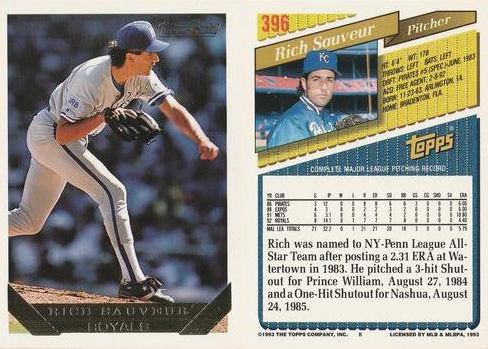
Rich Sauveur pitched 3 1/3 innings for the Mets in June 1991, racking up a 10.80 ERA. My only memory of him is seeing his name on the transaction wire while working in the newsroom of the Fresno Bee; I don’t think I ever saw him pitch in an actual game. But he possesses one of the odder baseball resumes in the history of the game.
Sauveur made his big-league debut on July 11, 1986 at Candlestick Park as a Pirate and appeared in three games that year. He next turned up as a 1988 Montreal Expo, appearing in four games. Then, three years later, he recorded his six games with the Mets. In 1992, he was a Royal for all of eight games. That was it until 1996, when he appeared in three games for the White Sox. Four years after that, he was back at the age of 36 for 10 games with the A’s.
Six teams and six seasons over 10 years. But that’s only what’s visible above the waterline.
Sauveur made his pro debut as a 19-year-old for the Pirates’ New York-Penn League affiliate in Watertown, N.Y., the first stop on this gloriously Daviaultesque travelogue: Nashua, N.H. (Eastern League); Woodbridge, Va. (Carolina League); back to Nashua; Honolulu, Hawaii (Pacific Coast League); Pittsburgh; Nashua again; Harrisburg, Pa. (Eastern League); Indianapolis, Ind. (American Association); Jacksonville, Fla. (Southern League); Montreal; Indianapolis again; Miami, Fla. (Florida State League); Norfolk, Va. (International League); New York; Omaha, Neb. (American Association); Kansas City; Villahermosa, Mexico (Mexican League); Indianapolis again (this time for a shockingly stable three seasons); Nashville, Tenn. (American Association); Chicago; Des Moines, Iowa (American Association); Nashville again (now a truly far-flung outpost of the Pacific Coast League); Indianapolis yet again; Nashville yet again; Sacramento, Calif. (Pacific Coast League); and Oakland.
(You’ve probably figured out by now that Sauveur is left-handed.)
Sauveur last threw — or lets say “hurled,” like Christy Mathewson did — a pitch in anger in 2000, but he’s still in baseball. Last year he was a pitching coach for the Diamondbacks’ Arizona League affiliate. He’s been a pitching coach for 15 years, and three different organizations. That’s a logical second life for an almost cosmically bizarre baseball career. Consider that Sauveur pitched in three different decades but didn’t lose his rookie status until his sixth and final year in the majors. Or that he’s the only player in baseball history to pitch for six big-league teams without recording a win.
He’s also the unwitting poster child for a misfit era of card collecting.
Baseball cards exploded in popularity in the late 1980s, with Topps and its competitors first saturating and then oversaturating the market with product boasting supposed innovations. The most notable of these was the dreaded insert card. Inserts are rare cards seeded randomly into packs of regular cards. They now include autographs, jersey swatches and even cross-sections of bats, but back then they were a little simpler. One of Topps’ early experiments came in 1992, with Topps Gold, which added gold accents and lettering to the regular cards.
Topps’s dilemma: what to do with the checklist cards? Since no one on Earth wanted a gold checklist card, Topps decided to replace them with cards that hadn’t appeared in the regular set. Today, Topps would just make additional cards for the marquee players, but it didn’t do that for the first three years of the Topps Gold era. Instead, the substitutes were fringe big-leaguers, 26th men on rosters passed up for the regular set. I had no idea Topps had done this until the day I stumbled across a 1992 Topps Gold card of less-than-immortal Met Terry McDaniel. As a Mets completist, I needed that card — and cards for the other checklist substitutes. Even if they weren’t Mets, they might have been Mets earlier in their careers, or might show up on the roster one day in the future.
Skip ahead a year, and enter the 1993 Topps Gold Rich Sauveur. It’s #396, a replacement for Checklist 3 of 6 in the regular set. It’s Sauveur’s lone big-league card, on which he’s a member of the Kansas City Royals.
A 1993 Topps Gold Rich Sauveur isn’t impossible to find in the eBay era — according to the Trading Card Database, its median sales price is 19 cents — but eBay didn’t exist back then. At the time, I collected by making the rounds of baseball-card shows around Washington, D.C., zooming in my little red Honda CRX from Laurel, Md., to Leesburg, Va., becoming familiar with Elks Clubs and armories and third-rate hotels.
I also became familiar with baseball-card dealers, and in the early 1990s there were essentially two kinds.
The first kind were lifers, older men or couples who lived in sagging houses out in the sticks whose cellars and attics and rec rooms were crammed with baseball cards. They were fans of the game and collectors at heart, variously grumpy or sweet but always OCD. At shows they’d be surrounded by stacks of card storage boxes, filled with thousands of common cards they’d hauled to the show in the back of a station wagons or a van. They knew players and they knew cards, and they’d let you look for as long as you needed to amass a stack of cards, which usually cost a couple of bucks. And if they didn’t have a card you were looking for, the best of them would promise to exhume it from their holdings and bring it to the next show.
The other kind of baseball-card dealer? Antimatter to their matter. They were people who’d started selling cards because they were hot commodities. Most of them were semi-employed misfits, the kind of serial, darting-eyed grifters who are always hot to make a fortune but dislike the idea of actual work. Today they’re hawking Purell and N95 masks; back in the day they arbitraged Beanie Babies … or baseball cards. At a show, you could spot their tables from two rows away — they invested in fancy metal cases with black fabric linings and glass tops that could be tipped up at an angle to become displays. They almost never brought storage boxes, because to them common cards were by-catch. They’d stand behind their perimeter of display cases, curating their rainbow of gaudily priced inserts, glossy price guide in hand. Few of them knew baseball or liked it, an opinion they’d share freely if asked and sometimes even if not.
Here was my problem. The baseball-card lifers detested inserts, because they flew in the face of tradition and attracted buyers who didn’t care about cards or the game any more than the price-guide chiselers did. If the lifers had Topps Gold cards, they were either mixed in with the other commons or in a box somewhere back at the house. But the grifters didn’t care about Topps Gold either, because they were too low-end to be rare or valuable. There were five or six random scrubs in that set who’d replaced the checklists? Who knew or cared?
I couldn’t find a 1993 Topps Gold Rich Sauveur in 1993. As winter turned to spring in 1994, it seemed unlikely that I ever would. I kept trying, though, spending hungover Saturdays pawing through boxes of cards and having deeply stupid conversations like this one:
“Hey, got any 1993 Topps Golds?”
“Yeah, right here.”
“These are ’94s.”
“Oh. I’ve got a holographic insert Barry Bonds for $20.”
“No thanks, I don’t collect those. I’m looking for a ’93 Topps Gold, one of the cards that replaced the checklist cards.”
“The what? What player you looking for, buddy?”
“Rich SO-ver. It looks like SAU-vee-UR.”
“Never heard of him. Tell you what, I can go $18 on the Bonds.”
Lather, rinse, repeat. It got old.
Until one Saturday pretty much like every other one. I’m at a card show in a sad hotel in Alexandria, Va., one I’d debated not bothering with. It’s in one of those half-ballrooms, with the accordion divider separating the couple of dozen card-dealer tables from the quarterly meeting of the Northern Virginia Chapter of Actuaries. I pay my $2, walk in, scan the room with my by-now-practiced eye and know immediately that I should have stayed home. There are barely any tables with storage boxes — just the usual tipped glass cases maintained by the price-guide set.
I circle the perimeter anyway, because it’s 40-odd minutes back to Bethesda. At one of the tables, I do a double-take. Clipped to the tilted-up display case is a 1993 Topps Gold card. And it’s … Rich Sauveur. The card I’ve been searching for. The one nobody else seems to know exists.
This makes zero sense — Rich Sauveur’s up there alongside the Griffeys and Thomases and Bondses. I talk with the couple whose table it is and they strike me as typical nouveau card speculators. I keep it casual, because there’s only one possible explanation for the sudden elevation of Rich Sauveur to insert-card glory: these people believe this anonymous checklist-replacement card is worth far, far more than it actually is.
But then I do a little math. Suppose they’re overvaluing their Rich Sauveur card by 100X? If so, it should cost me about $5. Am I willing to pay $5 to stop searching hotel ballrooms for Rich Sauveur? I am so, so willing to do that.
“Hey, Rich Sauveur,” I say casually.
The response is not what I expected: “Oh, you know Rich? He’s our neighbor! Rich is a great guy!”
Huh. Still, baseball players do have neighbors, right? We chat about all things Rich Sauveur for a few minutes, a conversation to which I bring relatively little, and then I ask how much they want for the card.
Dead silence.
“Oh, it’s not for sale,” the man says.
“What do you mean it’s not for sale?”
“It’s not for sale,” he says, and I notice his wife has gone stiff and silent.
“I’ve been looking for that one for a while,” I say. “It’d sure be nice to scratch it off the list.”
“Like I said, it’s not for sale.”
At this point I’m actually dizzy. I seem to have fallen through a rip in the space-time continuum, finding myself in a bizarre dimension that obeys the laws of neither physics nor commerce, and from which it’s possible I’ll never escape. It’s all I can do not to scream at these people. Why would you bring a baseball card that’s not for sale to a baseball-card show, the only purpose of which is to sell baseball cards? Why would you … why would … why why why why why why why.
Desperate, I offer them $10. No sale. In fact, they unclip their neighbor’s card from their fancy display case, put it away, and ask me to leave.
Annnnnd scene.
At the time, that story was a yarn about a weird era of card collecting and an OCD quest gone comically wrong. And hey, it still is, But now it’s also a reminder to me of all that you can find below baseball’s waterline. A single card and a couple of lines of stats can be head-scratching or entertaining or both, but provide scant summary for decades of hard work and perseverance and dogged love for a game that makes no guarantees about loving you back.
The postscript, which I swear is true: A week after the Alexandria debacle, I trudged into an equally unpromising card show in Beltsville or Silver Spring or somewhere like that and almost immediately found not one but two 1993 Topps Gold Rich Sauveurs. The guy said they were a quarter each, but sold the pair to me for a dime.
Read more A Met for All Seasons posts.
by Jason Fry on 23 April 2020 10:39 am My Mets fandom begins with Rusty Staub.
My first Mets memory is my mother leaping up and down in our house in East Setauket, N.Y., yelping “Yay, Rusty!” Though that undersells it, actually — that moment is my first memory of anything that I can connect with an actual person or event, as opposed to one of those vague childhood impressions you suspect your brain cobbled together with an assist from old stories and photos. “Rusty, my mom, the Mets” is the earliest point I can recall in which there’s a me interacting with everything that wasn’t me.
And that’s all I recall. The heroic act that had my mom so worked up is beyond reconstruction, except for an educated guess that it happened in 1973 or 1974. The rest of the memory, I suspect, has been filled out and embellished over time. But I think I recall first being a little worried that something had caused my mother to lose her mind and start gamboling about like some crazed faun, and then keenly interested that such things existed. Whatever it was, I wanted in, because it looked like fun.
“Yay, Rusty!” Maybe I could yell that too. And so I’ve spent most of the next 45-odd years doing just that.
If you start young enough, like I did, a first favorite player can be an odd thing. I remember very little of Staub in his first go-round as a Met — nothing about his arrival in April 1972, right on the heels of Gil Hodges‘ sudden death; or about how a broken hand short-circuited his first season in orange and blue; or about his heroics in the fall of ’73; or about his becoming the first Met to crack the 100-RBI mark in ’75. I know about those things, but any firsthand accounts of them have been erased. I can’t reconstruct his batting stance from WOR broadcasts, or recall a day cheering for him at Shea, surrounded by sketchy ’70s people with mustaches and cigarettes and paper cups of bad beer.
So what do I remember?
Three things.
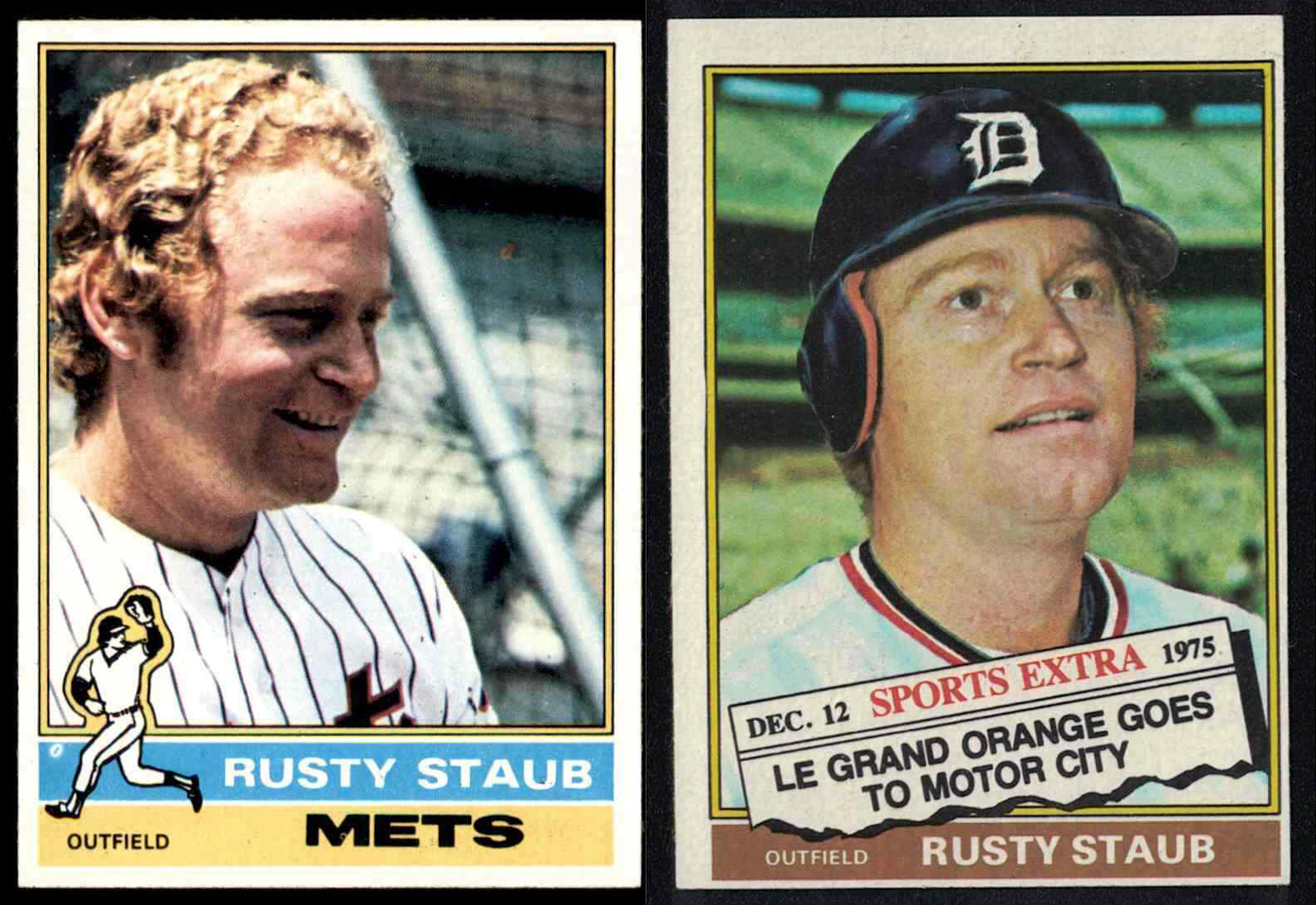
The first is Staub’s baseball card from 1976, the inaugural year I collected. (Which is why, on some level, the Mets’ colors will always register with me as Michigan maize and blue.) It’s a BHNH photo, which is Topps-speak for “big head no hat,” but a rare worthwhile one, because it showcases Staub’s famous and fabulous mane of red-gold, seemingly molten curls.
 Danger, heartbreak dead ahead. That hair fascinated me, as did the name Rusty. Kids I knew were named Mike or Melanie, Jennifer or John — or sometimes Jon, just to be confusing. I didn’t know anybody with a name as interesting as Rusty, and was intrigued by the Baseball Encyclopedia’s revelation that Staub’s real name wasn’t Rusty but Daniel Joseph Staub. By the way, Daniel Staub is a terrible baseball name, squat and pedestrian, but Rusty Staub is a wonderful baseball name, half fanciful/friendly and half brusque/no-nonsense. It really is the little things.
Anyway, the name was the second thing. How did that work? Had his parents given him the alternate name Rusty? If so, why hadn’t mine given me a wonderful parallel identity? Or — and this was where the foundations of the world really got wobbly — had Daniel Staub named himself that? Could you do that? Maybe you could, if you were brave and audacious enough — if you were a hero. Which Rusty Staub plainly was. He was my favorite Met, after all.
The third thing I remember about my favorite player was the day he was sent away, to a possibly fictional place called Detroit. That was in December 1975. I don’t remember how I found out, but I do remember shock, fury and desolation. How could this happen? How could the people who ran the Mets yet somehow weren’t Mets themselves — and there was a new and disturbing idea — be allowed to do such a terrible thing? Someone should stop them. I didn’t know if that someone was the president, or Batman, or one of my parents, but the need was glaring and obvious and the fact that the world kept on blithely turning in the face of such an injustice struck me as obscene.
I briefly declared that I was a Tigers fan, which didn’t stick — the Tigers played in some other state and in some other league, which meant they might as well have conducted their business on Mars. But I clung to Rusty’s 1976 traded card (“Le Grand Orange Goes to Motor City,” two terms that were likely mysteries to me), and then to his ’77 Tigers card, an action shot with a shouted crimson A.L. ALL STARS banner along the bottom. That shout, it was obvious to me, was directed at M. Donald Grant, the evil man who was ruining the Mets, and I imagined thrusting my well-loved ’77 Rusty into his face, after which he’d tremble and break down and apologize for exiling Rusty and then for his other crimes. Then he’d go away forever.
Rusty might have been exiled, but no one could take away my most prized possession — a Rusty Staub signature baseball mitt, with his loopy but somehow fussy autograph on the thumb. Therein lay a story. There was no signature Rusty Staub baseball mitt on the market — Staub had a contentious relationship with licensing, which is most likely why he’s MIA from the ’72 and ’73 baseball-card sets. Failed by commerce, my parents fell back on ingenuity. They bought a generic kid’s mitt and a leather-burning tool, and carefully copied Staub’s signature from one of my baseball cards. My mother was certain I’d see through the subterfuge immediately — facsimile signatures weren’t normally thin and brown and faintly redolent of burnt cowhide — but I was innocent in such matters, and none the wiser. I loved my Staub glove and used it avidly though ineptly until even I had to admit it no longer fit. Years later, when I finally found out the truth, I loved it even more.
Staub had a second go-round with the Mets, returning for the 1981 season. Unfortunately, what should have been a joyous homecoming barely registered with me. 1981 was when I fell away from the faith, my interest in baseball eroded away by the strike but also by new pursuits. I was glad Staub was back, but I couldn’t tell you anything he did in ’81, ’82 (the year for which I picked him in A Met for All Seasons is a shrug and placeholder for me) or ’83. Luckily for me, though, he was still around in 1984, when Dwight Gooden brought me back into the fold.
The Staub of ’84 and ’85 was a very different player than my childhood idol — “an athlete and a chef, he looked more like a chef,” in the words of the great Dana Brand. He was basically sessile by then, a ZIP code crammed into mid-80s Mets motley and limited to pinch-hitting. But while he had become a player who only did one thing, he did it exceedingly well. You could almost see him thinking in the on-deck circle and at the plate. Physically he was still, almost a statue in the batter’s box, but mentally he was hard at work, arranging the at-bat so that he’d get the pitch he wanted in the count he wanted. Which he usually did.
He also fed my growing hunger to understand everything that went into excellence on the field. I’d learned the basics of Staub’s life and career as a kid, putting it together from the back of baseball cards and Baseball Digest features. But in the mid-80s I began devouring behind-the-scenes books and articles, and he was a powerful presence in them as well. He was Keith Hernandez‘s superego, the man whose disappointment seemed to sting Keith where he’d brush off the reactions of others, and a self-possessed veteran who’d teach any young player wise enough to listen not only about baseball but also about life, particularly life in the big city. I learned about the book he kept on pitchers, his almost supernatural ability to detect their tells, and that he shared his insights not indiscriminately but with players he thought had earned them.
Staub retired at the end of ’85, and for me the fly in the ointment of 1986 was that he wasn’t there to get a ring as a World Champion — if baseball had stayed with 25-man rosters, would that last roster spot have been Rusty’s? But though he’d retired, he never really went away. He was a Mets color guy for a time, and honesty compels me to observe that as a broadcaster he was a helluva ballplayer. After that he was an éminence grise — or, properly, an éminence orange — showing up now and again for broadcasts and stadium events.
I was old enough now to appreciate the sweep and scope of an extraordinary career and life. Staub debuted with Houston in ’63 as a 19-year-old, but he’d been a Colt .45 before the team ever played a game, drafted in the fall of 1961. He’d collected 500 hits for four different clubs — the Astros, Expos, Mets and Tigers. (Plus 102 for the Rangers, for 2,716 in all.) He was the second player to hit a home run before he was 20 and after he was 40, joining fellow Tiger Ty Cobb. (Gary Sheffield and Alex Rodriguez would later join their club.) He almost singlehandedly won the ’73 NLCS for the Mets, hitting three homers in four games, helping calm a bloodthirsty Shea crowd that wanted to murder Pete Rose, and making a superb catch while smashing into the outfield wall. That collision wrecked his shoulder, leaving him unable to throw; somehow he still hit .423 in the World Series.
And he was just as interesting off the field. He’d been an activist for himself and for players in general before the Messersmith-McNally decision, with his outspokenness and daunting intelligence precipitating his departure from the Astros years before it led to his trade from the Mets. Traded to the Expos (another team yet to play a game), Staub found himself frustrated that he couldn’t understand young fans who addressed him in French. So he learned the language, an effort that made him beloved in Montreal. And he loved Montreal back, embracing the city’s culture and love of wine and food. He loved New York with similar fervor, opening restaurants and starting charities, raising millions for food banks and children of police officers and firefighters who’d died in the line of duty.
Rusty also kept popping up in my day-to-day life. In September 2004 I ran the Tunnel to Towers race through the Battery Tunnel to the World Trade Center site, and perked up before the race when I realized Staub was one of the dignitaries called on to say a few words. Afterwards, I spotted a familiar figure walking by himself down West Street. Was that really him? It really was. I froze, then got up my courage and ambled over to him, only to discover I was more nervous than I’d realized. Rusty, no fool, never broke stride as I peppered him with inanities. When I finally managed to say what I should have said in the first place — that he’d been my favorite player as a kid and I’d just had to tell him that — he thanked me and said that meant a lot.
I immediately regretted not telling him the story about the glove, and so was surprised and delighted to catch sight of him a few months later in the San Francisco airport. This was my chance! Before I could close to “Hey Rusty!” range, though, he sensed danger and made a neat sidestep into the men’s room. That was enough to check my enthusiasm; I decided to let Rusty be.
And so I did. He kept popping up anyway — a couple of months after that I was in New Orleans and wound up riding to the airport with a cabbie who’d played high-school ball against him and his brother Chuck, and regaled me with stories about both of them. (One more Rusty factoid: Ted Williams flew down to New Orleans to recruit him personally.) I gave the cabbie a ludicrously large tip, pleased by yet another Rusty encounter, even if this one was once removed.
Staub died on March 29, 2018, and at first it seemed incomprehensible that my first favorite player could be gone — and on Opening Day, no less. But in mourning his death, I realized that through sheer dumb good fortune, my first favorite had been a perfect choice. He’d been a Met when I was a child who just wanted to hoot and cheer, one who came with a cardback full of interesting factoids to memorize and recite. He’d returned to the Mets when I was a teenager fascinated by the mental aspect of baseball and its hidden workings. And he’d stuck around as an alumnus when I was an adult curious about interesting lives and currents in the game’s history. He was gone, tragically, but he’d never be forgotten, not by me. How could he be? After all, he’d been there from the beginning.
Read more A Met for All Seasons posts.
by Greg Prince on 21 April 2020 1:08 pm Starting today and slated to appear in this space every Tuesday and Friday in the weeks and months ahead is a new Faith and Fear in Flushing series: A Met for All Seasons. In it, Jason and I will consider a given Met who played in a given season and…well, we’ll see.
Here’s the background: We conducted a draft nine years ago when a semblance of this concept first occurred to us; one of us would do this player for this year; the other of us would do that player for that year; and so on. The “so on” became nothing except for an occasional “hey, remember that thing we were gonna do?” Luckily, we’d each saved our draft lists. Thus, a little while ago, once we realized we weren’t going to be busy recapping games for the foreseeable future, we extended the draft eligibility period, held some supplemental rounds, implemented a compensation pool (allowing us to replace any selections we’d rethought since 2011, given that it worked so well for the White Sox in 1984) and certified our choices.
Now, after nearly a decade of talking and not talking about it, we each have thirty players bearing the banner for a particular year and will set out to explain, to some extent, why we chose who we chose and what they mean to us as Mets fans. Some weeks I’ll go Tuesday and Jason will go Friday; some weeks it will work the other way around. (Coincidentally, Jason and I once went in on a Tuesday/Friday ticket plan.) The seasons we’re covering are 1962 through 2021, the last couple encompassing an air of mystery or perhaps optimism. The Mets we’re talking about will be revealed in due time. We’d like to think they represent a decent cross-section of the Met experience over the nearly sixty years there’ve been Mets, but maybe we just picked players we wanted to write about. The order in which they’ll appear is non-chronological.
For example, I’m starting with 1994 and my Met for that season is Rico Brogna.
Rico Brogna is my Met for 1994 as a person, I suppose, but probably more as an idea. I think I’m going to find out as we do this that I tend to think of ballplayers as ideas as much as I do people. I have it on good authority — hell, I’ve witnessed it for myself — that ballplayers are people, too. We probably forget that from time to time, considering we only know of these people because they are ballplayers. That’s generally good enough for us, the fans.
We’re people as well, but we’re talking baseball here.
I immediately think of Rico Brogna when I think of the 1994 Mets season because of the idea he represented to me coming out of that strike-shortened year. Rico Brogna was who and what I wanted to come back. He’d brought me hope and I figured he could only deliver more. I was going to hold tight during absent August, silent September, ohfer October, the long, even colder winter, and the farce spring when MLB lured replacement players to wear their clubs’ uniforms in games that didn’t count, threatening to keep them around for games that did. By April 26, 1995, the latest the Mets have ever opened a season (until 2020, if they open one at all), I should have been fed up with baseball, which didn’t even have the dignity to be around for months on end to let me be fed up with it.
Instead, I kept hanging tight, waiting for Rico and welcomed back the whole package, lock, stock and Brogna. Twenty-five years later, deep in a void that superficially recalls the lack of baseball wrought by the 1994-1995 strike, I can’t say it was Rico Brogna the person or even Rico Brogna the player I wanted. I wanted Rico Brogna the idea.
Rico Brogna debuted as a Met on June 22, 1994. I had never heard of him despite his having been a first-round draft pick of the Detroit Tigers in 1988. He came up to majors four years later, played nine games, and returned to Triple-A Toledo for another year. I missed it when the Mets traded their own former first-rounder, Alan Zinter (1989), for Brogna four days before Opening Day 1994. The Mets were busy that week. They picked up David Segui on March 27, Jose Vizcaino on March 30. So overcome with joy that the 1994 Mets would be even more materially different from the nightmare 1993 Mets, I guess I didn’t squint all the way to bottom of the transactions box for March 31 to see this extra move.
With Vizcaino at short, Segui at first and Brogna assigned to Norfolk, the post-apocalyptic Mets got off to a modestly brilliant start in 1994. Anything that wasn’t indicative of another 59-103 record would have struck me as modestly brilliant. The Mets swept their first three in Chicago, returned to Shea for their Home Opener with a winning record and levitated themselves four games over .500 after 32 games. In New York in May 1994, with all five winter sports teams having made the playoffs — and the Knicks, Rangers and Devils all legitimately carrying championship aspirations — it felt like nobody outside the hardest core of Mets fans was paying attention. But I was, and I was delighted that the Mets were, after a three-year dip in fortunes, kind of OK again.
The high times of 18-14 didn’t last, but I was slow to get the memo. I didn’t want to read it. I was convinced the Mets were pretty good. Alas, the dark side of .500 beckoned for keeps in early June. Fifth place in the newly aligned National League East, which is to say the basement, loomed as our summer home. I didn’t maintain any allusion we could keep up with the Expos or Braves or anybody else vying for the new Wild Card, but I just liked that the 1994 Mets weren’t the 1993 Mets anymore. I wanted them to quit reminding me a year hadn’t passed since they were the 1993 Mets.
The Rangers won the Stanley Cup on June 14. The Knicks took the Rockets to the seventh game of the NBA Finals on June 22. In between, David Segui went on the 15-day disabled list, necessitating the promotion from Norfolk of Rico Brogna. I know which one of those sports stories resonates most for me now, but like I said, I didn’t know anything about Rico Brogna then. I was only getting used to him replacing Segui on June 28 when word came down that Dwight Gooden — who’d pitched Opening Day in Chicago and still reigned at least titularly as ace of the Mets’ rotation — tested positive for cocaine and was about to be suspended, just as happened in 1987. Doc, my favorite player ever since he first emerged as breathtaking Dr. K, went through rehab seven years before and was welcomed back as if not a hero, then definitely as family. In 1994, he was essentially kicked out of the house. There was little in the way of acknowledging addiction as a disease, just disbelief that this was happening a second time, how could anybody with so much to lose be addled enough to lose it? Yup, the Mets were finally getting headlines.
On the night the news of Doc’s KO broke, Rico Brogna started his third consecutive game for the Mets and, for the third consecutive game, recorded a pair of hits, including his first National League home run. The Mets lost, falling ten below .500 for the first time in 1994, but Rico raised his average to .333.
Without meaning to, Rico Brogna filled the opening for my favorite player before I had time to place a classified. Doc wasn’t around. Rico was. I learned about him. He was 24, born in Massachusetts, but grew up to become the pride of Watertown, Conn., from whence he was drafted. Played high school football well, we heard. Became buddies with the pitcher called up to take Doc’s spot in the rotation, Jason Jacome (pronounced hock-a-me). They were spotted palling around on a West Coast trip, the two new guys grabbing tenuous hold of the steering wheel for a franchise that had once more lost its way. In 1984, it was Gooden joining forces with Strawberry. In April it was Segui and Vizcaino. Now it was these two newest newcomers, 24-year-old Rico, 23-year-old Jason, a couple of lefties from out of nowhere. On July 7, in his second start, Jacome shut out the Dodgers, lifting the Mets to their sixth win in eight games since the night Doc was disappeared. Segui was back from the DL, but was planted for the time being in left field. A good glove man through his career, David was nonetheless Wally Pipped.
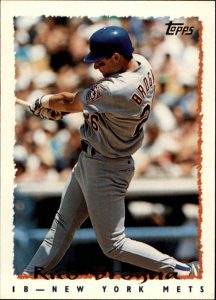 When baseball returned, Rico would be back with it. It would take a little while for Rico Brogna to settle in as a new age Lou Gehrig. There was a bit of slumping in California, but the Mets came home and the bat reheated. Rico’s average rose over .300 to stay. The Shea PA played “Rico Suave” when he’d get a big hit, briefly leading me to believe Brogna was Latino. I wasn’t corrected in this conception until some guy behind me at a game told his companion, “Brogna — that’s the Italian kid.” I didn’t care what Rico Brogna was other than that he was the Mets’ first baseman.
On July 25, a Monday night (I don’t have to look up the date or day), Rico Brogna exploded fully upon the Metropolitan-American consciousness, certainly the slice that was attempting to tune into The Baseball Network. The Baseball Network is hard to explain all these years later. It was hard to explain in 1994. Eschewing the “Game of the Week” motif as hopelessly outdated, MLB decided to have what amounted to a series of nationalized regional telecasts, with in-market exclusivity for particular games, which meant on a given weeknight, maybe you saw your favorite team, maybe you didn’t, no matter that they were all scheduled to play, no matter that cable networks existed in summertime to show baseball games. Sometimes New York got the Mets, sometimes it got that other New York team. And if the first-place Yankees ridiculously took TV precedence, the Mets were confined to radio. Got all that? Also, though these games aired on ABC, they were not announced by, say, Al Michaels. You got an announcer from one team and an announcer from another team and that was your crew. Actually, that was a pretty decent feature. Suddenly Bob Murphy was sometimes doing TV. On July 25, with the Mets in St. Louis and somehow rating preferential treatment back home on Channel 7, it was Gary Thorne, at this point part of the WWOR-TV booth, and Al Hrabosky.
They wound up co-hosting, live from Busch Stadium, The Rico Brogna Show. With as much spotlight as the 1994 Mets were going to garner, the young man from Connecticut raised his and therefore our profile. Brogna sizzled in St. Loo, going 5-for-5, making him the first Met to register five hits in one game in six years. His biggest hit was a two-run double that keyed a five-run fifth, giving Bret Saberhagen all the support he needed to cruise to a complete-game 7-1 win. Rico came into the game batting .333. He came out of it batting .377.
“I guess he’s what you would call a manager’s delight,” Saberhagen marveled. “It’s probably a night that I’ll remember for quite a while,” Bret’s first baseman allowed, humbly adding, “Some of the balls found some holes.”
Yes, sir, the 1994 Mets were rising like the mighty Mississippi. At least to me they were. They escaped the cellar. Saberhagen had made the All-Star team by walking basically nobody. Second baseman Jeff Kent showed he could hit a ton if not field quite as much. Vizcaino was a genuinely reliable all-around shortstop. Jason Jacome was en route to a winning record and the Mets began flirting seriously with one of their own. And Rico Brogna? He had, in my mind in about a month, ascended total obscurity to next big thing to biggest thing there could be, albeit on a limited scale.
Two-and-a-half weeks later, it all stopped, because the owners wanted to institute a salary cap and the players wanted no such thing and no compromise was forthcoming. On August 11, all the baseball on all the channels went dark and stayed dark. The blackout remained in effect clear through what was supposed to be the postseason, an affair that wasn’t remotely likely to include the 55-58 Mets, but I wasn’t aiming my sights that high one year after 1993. The previous August, former Cy Young winner Saberhagen was known mostly for blasting bleach at reporters, and former stolen base champ Vince Coleman was living down his contretemps that involved tossing powerful firecrackers at fans in the Dodger Stadium parking lot. Bobby Bonilla had been making threats, Eddie Murray snarled his hellos and everybody was stuck in a seventh-place snit. It was enough in August of 1994 that the fresher-faced third-place Mets were closing in on .500. It would have been great had they been granted the opportunity to reach it and hover above it.
After 113 games, almost .500 would have to do. I had that to cling to — that and seven home runs, twenty runs batted in and a .351 batting average I hadn’t anticipated in the slightest out of that fine young man from Watertown in his first 39 games as a Met. I had an idea of what Rico Brogna could do. I had an idea that Rico Brogna would keep making the Mets better. It would have to tide me over until whenever there’d again be baseball.
And it did.
by Greg Prince on 19 April 2020 4:12 pm This Sunday afternoon in New York has been sunny if chilly and breezy. Tonight will be chillier, probably as breezy and a whole lot darker. If this Sunday afternoon were a Sunday afternoon as originally conceived, I’d be sitting around complaining there’s no Mets game on because it’s being held in abeyance for Sunday Night Baseball.
That would be a great complaint to make right now.
I’m still sort of tracking the 2020 Mets schedule despite it having been rendered inoperative by prevailing circumstances, thinking to myself every day or two that if the Mets were playing, this is where they’d be playing and this is what might be going on. In doing so, I’ve gone through an array of phantom-limb sensations.
Opening Day.
The gaping off-day void that follows Opening Day.
The probable first rainout.
The inevitable first loss (because you can’t win ’em all).
The disbelief they’d be playing in this weather.
Knowing in my bones that the Mets would be not so great, not so bad and that the emerging effect would register as not so satisfying.
The trip to Washington, where our resentment levels would have risen about as high as their championship flag.
The trip to Houston, where there’d have been ONE pre-series storyline and it wouldn’t be Jake Marisnick’s triumphant return.
The trip to Milwaukee, when I would have mentioned, as I do upon every trip to Milwaukee, that the Mets always lose their second-to-last game in Beertown.
The well-meaning Jackie Robinson Day mandate that every player on every team don 42 and the slight chuckle the invocations of Ron Taylor, Ron Hodges and Roger McDowell still elicit annually.
Disdain for Saturday night home games in April.
Disgust for Sunday night games anywhere anytime.
It’s almost as if we don’t need a season to be fans. But we do. For although there is much about absorbing baseball that is familiar enough to perform by instinct, there’d be something going on these first few weeks of 2020 that we couldn’t know about.
I can’t tell you what it was or is or would have been. Finding out what is why we keep coming back. If every season was a simple recycling of occasions and themes, the computer simulations I’ve mostly avoided would do. But the unknown is what you can’t program, no matter how sophisticated your software. You can imagine your head off (surely you have time to do so), but during a baseball season, the most unlikely or outrageous outcome you can imagine is no match for the thoroughly mundane that constitutes the fiber of our existence. We need that low hum of grounders to short and fouls into the crowd. It’s from the swelled ranks of the totally expected that one unanticipated aberration rises up and grabs our attention. Next thing we know, something we didn’t see coming lodges in our consciousness. Suddenly it’s a part of how we view baseball from here to eternity.
To borrow a phrase coined by my friend Sharon when I was crafting the original Happiest Recap series in 2011 (most Amazin’ first game of a season, most Amazin’ 137th game of a season and so on), I adhere to the Metropolitan Calendar more than the Gregorian one the rest of society uses. When retracing Met steps — for example their record at a certain juncture of a certain season — I like to think in terms of where they were after ‘x’ number of games rather than where they were on such-and-such a date. Comparing records after ‘x’ number of games gives me a comparable playing field. The Mets have opened seasons on March 28, April 26 and sixteen dates in between. On April 26, 2019, when the Mets had been playing for close to a month, their record dipped to 13-12. On April 26, 1995, the Mets were freezing in Denver, saddled with a mark of 0-1 following the finally resolved baseball strike of the previous summer, autumn and winter and, at last, Opening Night at brand new Coors Field. You can see why I might find limited utility in contrasting what those two editions of the Mets were up to on April 26.
Beyond exactitude issues, I’m rather fatigued by “This Date In…” reminders. I have been for about a decade. I used to love being reminded — and reminding others — that on this date in some past year something Metwise happened and, say, wasn’t that something we haven’t thought about in a while? Because such information is so readily searchable, you can’t scroll six socially responsible feet on your feed of choice without being inundated with this or that having happened this or that many years ago. It was more fun when it wasn’t as easily accessed, which is to say it was more fun when it was left to people with unusual capacity for retaining day & date details (ahem) to the reminding, whether or not anybody else was in the mood to be reminded.
Nevertheless, I’ve picked up on a couple of those helpful reminders over the past couple of days and I’m glad I did, not so much for the facts that have resurfaced, but to realize that with every game and every swing and every pitch, we get new facts. On April 17, 2010, we received a torrent of them because the Mets and Cardinals played twenty innings that weren’t technically endless but essentially were. On April 19, 2013, we calibrated our common tongue to incorporate the wonders of how we reacted to our young and promising ace outpitching somebody else’s young and promising ace. That was the night we chanted, with all relevant evidence tilting in our enthusiasm’s favor that HAR-VEY’S BET-TER! On that night precisely seven years ago, there was no disputing our assertion was anything but fact, just as on the afternoon into evening of ten years and two days ago, there was no escaping the sense that there’d be no escaping a game that would never end.
Maybe you remember what happened the game before or after the Mets beat the Cardinals in twenty innings or the game before or after Matt Harvey overwhelmed Stephen Strasburg. Probably you don’t. That’s all right. You probably remember the two games in question, though. They became an element of your fandom. Maybe not the most definitive or compelling elements, but they’re there. You might not recall the exact dates or even the seasons they occurred without a nudge, but somewhere in the back of your mind, the games or at least the takeaways from them are there. Sometimes, as on April 17, 2010, games seem to stretch beyond their reasonable parameters. Sometimes, as on April 19, 2013, pitchers get us so excited that we don’t only want to watch them with awe, we need to describe them aloud.
And those were only two games among 162 games in their respective seasons among who knows how many thousands you’ve experienced through your life? If April of 2010 hadn’t included a slate of Mets games, you wouldn’t have a specific point of reference involving a twenty-inning win at Busch Stadium in which Tony La Russa resorted to pitching position players and Jerry Manuel warmed up Francisco Rodriguez enough so that K-Rod threw the equivalent of a complete game in the bullpen. If April of 2013 had proceeded without the Mets, you wouldn’t remember that there was a span of weeks when everybody talked about Matt Harvey as the next Tom Seaver and it was rarely interpreted as hyperbole.
So much to glean from two memorable baseball games ten and seven years later. So much to glean at the time from the now forgotten baseball games surrounding them. So much to inform our perspective as we roll along. So much to reach back and touch for a few minutes when there’s nothing of a similar nature emerging to engage never mind not depress us. It’s all a part of our baseball fandom.
This April we’re not adding to it, which is a real shame, if merely incidental to the larger picture painted by these unfortunate days.
Without new baseball, I’ve reveled, to a point, in the old baseball broadcast by outlets whose archives are a seemingly shallow blessing. Listen, if you want to air The First No-Hitter in New York Mets History and I happen to notice it’s on, I will greet its closing moments with a substantial semblance of the rapture I experienced and expressed on June 1, 2012. But don’t expect me to make a night of it when you have aired The First No-Hitter in New York Mets History so many times that the total outpaces the viewer’s ability to count, maybe find another game to show.
SNY has been running an online survey in an effort to determine what Mets fans think is the greatest game of the last decade. They are providing a list of five choices — the no-hitter; Wilmer’s tears of joy; David’s return to the lineup wherein eight Met home runs were hit; the 2015 division clincher; and David’s farewell — and will televise them in ascending order this Monday night through Friday night, five through one. All five have been shown repeatedly. All five have been repeated repeatedly. Then they went into reruns and were rerun rerunnedly. After which, they went into a rotation so heavy that MTV c. 1983 was embarrassed that a cable channel could play the same few hits over and over and over.
Maybe find another game to show? Definitely find another game to show. We are hungry like the wolf to watch something besides the same dozen games in a loop.
Show the last game the Mets played before they’d ever had a no-hitter.
Show the first game the Mets played after they’d finally had a no-hitter.
Show David Wright going two-for-four with a double amid Jon Niese going six innings giving up four runs to whoever, it doesn’t matter.
Delve into that SNY library and do what you did for the first week or two of the great postponement. The network aired every 2019 win it aired last year, not just the so-called classics. Pete Alonso didn’t necessarily homer. Jacob deGrom didn’t necessarily toss eight scoreless. Nobody’s shirt was necessarily giddily detached from anybody’s sweaty torso. It was just one baseball game after another and it was quietly exhilarating amid a silent spring. We didn’t require additional suspense or intrigue. I didn’t require it be a Mets win, but I can understand if others aren’t so expansive to their approach to rewatchables.
I hoped that once SNY got done with the wins from 2019, they’d cue up the wins from 2018, then 2017 and keep going clear back to 2006, the first year there was SportsNet New York. Perhaps, if it didn’t require anybody to endanger their health or cross constricting contractual boundaries, they could arrange to pop on Mets games that predate SNY. This topic usually quickly descends into “SHOW THE JIMMY QUALLS GAME!” or some other vintage fare that one can be pretty sure doesn’t exist on tape or film fifty-one years later. I’m all for wish-listing, but I’ll be reasonable here. I’m not asking for video miracles. I’m asking for Brian Bannister and Moises Alou and Cory Sullivan and maybe a little Josh Satin. If a digital treasure chest of Fran Healy wishes to spill its secrets regarding Shane Spencer settling under a can of corn or Esix Snead coming into run with blazing speed, wonderful. Anything older, fantastic. Anything, really.
Nobody has to be walking off. Nobody has to be nailing down a Cy Young. Just fill the rest of our April with what we don’t have in front of us, and then do it again in May and June and we’ll let you know when you can stop.
by Greg Prince on 11 April 2020 6:27 pm Major League Baseball, assessing myriad proposals, has discussed a radical plan that would eliminate the traditional American and National Leagues for 2020, a high-ranking official told USA TODAY Sports, and realign all six divisions for an abbreviated season. […] The plan would have all 30 teams returning to their spring training sites in Florida and Arizona, playing regular-season games only in those two states and without fans in an effort to reduce travel and minimize risks in the midst of the COVID-19 pandemic. The divisions would be realigned based on the geography of their spring training homes. […] Financially, it could be a huge boon for the TV rights holders. You could have a captive TV audience the entire day. […] The DH would likely be universally implemented as well.
—Bob Nightengale, USA Today, April 10, 2020
“We will not have sporting events with fans until we have a vaccine,” says Zach Binney, a PhD in epidemiology who wrote his dissertation on injuries in the NFL and now teaches at Emory. Barring a medical miracle, the process of developing and widely distributing a vaccine is likely to take 12 to 18 months. […] O.K., but what about empty stadiums? “The idea of a quarantined sports league that can still go on sounds really good in theory,” says Binney. “But it’s a lot harder to pull off in practice than most people appreciate.”
—Stephanie Apstein, Sports Illustrated, April 10, 2020
Yes, we all need a room of our own.
—Billy Joel
Seen the leagues go on hiatus
I saw the teams try quarantine
’Cause life went still across the USA
We all wore facial masks
And tried hard not to breathe
They schemed a scheme to restart playing
And broadcast content good to go
They shoved the DH in
Remade divisions
Like in MLB The Show
I’ve seen the leagues go on hiatus
I saw no people in the seats
At first it sort of seemed to make some sense
We’d see it from our homes, just watching on TV
They opened parks around St. Lucie
Like stuck inside an endless March
No fans allowed in there
The owners didn’t care
They had some programming to stream
I’ve seen the leagues go on hiatus
I saw the Mets play ’til late fall
DeGrom and Ramos formed a battery
Robotics called the strikes
And electronic balls
They tried creating stringent guidelines
Confining most all personnel
They said cameras could stay
Shooed families away
Pretending all of this was swell
Our ancient leagues, before hiatus
Gave us the game we came to know
They didn’t haul the sport to Florida
And turn the stadiums into a studio
Perhaps soon we won’t remember
This awful godforsaken year
I hope that once we’re fine
Then we can take in nine
Where all can gather without fear
by Greg Prince on 6 April 2020 4:10 pm As of tonight’s off night, per the current non-operative schedule, the 2020 Mets would have played eight games already. They were slated for nine, but the second of them, on Saturday, March 28, would have been rained out. I can’t prove that — I can’t prove anything where the 2020 Mets are concerned — but it rained all day in New York two Saturdays ago, and not even the large gate attached to a Pete Alonso Bobblehead Day seemed likely to pull the tarp from Citi Field’s diamond. In context, the rainout would have caused consternation and chaos in modest doses. Context ain’t what it used to be.
So let’s say the Mets would have played eight games by now. Let’s figure BobblePete would have found a makeup day to nod agreeably. Let’s assume, which you can never do in normal times, whatever those are, that the pitching would have been pushed back to a point, meaning the optimal utility of Jacob deGrom, whose Bobblehead Day dawned dry enough to play on March 29, didn’t get leapt over during the season’s second week, which, if you’re not scoring at home (though you’re likely doing everything else there), was just last week. I know, I know; who can tell anymore?
DeGrom in the Opener. Stroman that succeeding Sunday, which was three days later. Then Porcello, Matz and I gotta believe deGrom again, because you don’t want him sitting and waiting for a week. Wacha in Washington for their disgusting flag-raising and so forth. Then it’s another day off, followed by Stroman on Saturday, going on five days’ rest and, I guess, Porcello Sunday, a.k.a. yesterday. We arrive in Houston, packing righteous indignation and who to pitch? You can use deGrom on proper rest tomorrow or you can keep Matz from going altogether stale.
You’d use deGrom, right?
I don’t know who Rojas — and the calls Rojas would have gotten from Van Wagenen that Rojas would already be getting a little edgy from — would have chosen. I don’t know what would have happened in the eight games the Mets would have played by now. Without indulging in the well-meaning simulations out there that I can’t bear to look at, I have a hunch the Mets would be somewhere between 3-5 and 5-3 after eight games. It’s just a hunch. The Mets haven’t been 5-3 after eight games since 2017, 3-5 since 2016 or 4-4 since way back in 2011 (I’ve lived long enough that 2011 now qualifies as “way back”). It just feels right that these Mets would be settling in somewhere between a little better than .500 and a little worse than .500.
I could be wrong. I could be absolutely wrong. The Mets were 7-1 two years ago, 6-2 last year. They’ve never been 8-0, but there are six instances of them being 2-6 (most recently way back in 2010) and three times when all they had was one or zero wins. But I’m a little too hypothetically optimistic to think they’re as bad as they were in 1962, 1963, 1964 or, for that matter, 2010. Just call me wide-eyed. Or Zoom me any adjective you like.
Scenarios:
The Mets are 3-5. We are healthily panicked, just ill at ease enough to fit the circumstances. Three wins and five losses after eight games is not a good look. We are reminding ourselves multiple times a day that there are still 154 games remaining, and even if somebody among Washington, Atlanta, Philadelphia and Miami (hey, you never know) is off to a 7-1 launch, well, there are still 154 games remaining. After losing five of eight to start the season, we are trying to not doubt Luis. We are trying to not doubt whichever element of the staff, starting or relieving, we deem culpable for 3-5. We’ve probably called for and will receive by tomorrow night some change to the batting order and maybe somebody who’s been mostly glued to the bench entering the lineup. Just a scheduled off day for Cano, Luis will say. Just letting Amed clear his head, maybe. Say, how’s Conforto’s oblique, anyway?
The Mets are 4-4. We’re not thrilled, but we’re not overtly hostile. Four wins and four losses after eight games is what our record says it is. It’s OK. It’s not great, because we’ve already experienced the agony of defeat four times, and that’s three times too many. Jason or I wrote that first “so we won’t go 161-1” column and we all ingested easily enough the reality that there are a third you win, a third you lose, et al. But a team we fancied jumping up to immediate playoff contention muddling along doesn’t strike us as a an adequate break from the blocks. Somehow 4-4, doesn’t feel 125 percentage points better than 3-5. Not much of a sample size there from to which to judge, of course. Then again, we have zero sample size in actual 2020, so I’d take 4-4 over 0-0 ASAP as long as nobody spreads or catches anything from it.
The Mets are 5-3. That’s not bad. That’s more than not bad. But if we’re 5-3, why aren’t we 6-2? You know if McNeil had gotten that base hit with the sacks full, we’d be 6-2. You know Alonso is gonna finally belt one and more will follow once he loosens up, and it’s pretty good that we’re pretty good with the Polar Bear obviously trying a little too hard. Familia’s weight loss has made a difference. Brach may be the secret weapon. And what about that running grab Marisnick made? Luis putting him in for defense really paid off. Still, it feels like they could be better than 5-3. But we shouldn’t be complaining. It’s just eight games.
If only.
by Greg Prince on 1 April 2020 3:09 pm EDITOR’S NOTE: To help us through these troubled times, today we dig into the Faith and Fear archives and share posts that some of our longtime readers might get a kick out of seeing again or our newer readers might enjoy checking out for the first time. This one originally ran on November 10, 1980, part of an annual series we still publish to this day.
So, when did you know or at least have an inkling? That day in May when we blew one to Cincinnati only to suck it right back? A couple of weeks later when we went into shall we say overtime to skate away with a cup of satisfaction? You couldn’t deny it come the middle of June. By then, it was obvious. It poked its head into our faces most of the rest of summer, and even peeked out at us from behind clouds as September closed.
But you knew it was there. You could practically feel it in your hands. You could hold it close to your bosom, certainly in your heart. In your head, maybe you were never so sure, but this isn’t about the head. It was only a little about cold, hard statistics.
It was all around us, though. It defined us. We embraced it and embodied it. Hell, we were “we” again, and it made us want to go “wheeeeee!”
That’s why Faith and Fear in Flushing has selected The Magic as the Manufacturers Hanover Trust Mets Player of the Year — an award dedicated annually to the entity or concept that best symbolizes, illustrates or transcends the year in Metsdom — for 1980. The Magic was, indeed, Back. And if it wasn’t “better than ever,” it made things around here as good as it could have possibly gotten under the circumstances.
You know The Magic. You were introduced to it by brand name in April, via a series of newspaper ads, and you’re pardoned if the first thing you did was smirk. “The Magic is Back,” they said. “What Magic?” you asked. Weren’t these the same Mets we suffered through in 1979, give or take Richie Hebner for Phil Mankowski and Jerry Morales? We were supposed to be excited that Abner Doubleday’s great, great, grandnephew or whatever he is bought the team? That the guy who ran the Orioles when we beat them in legitimately Mets-magical 1969 was the new GM? Really…what Magic?
The ads said something about the “New Mets” being “dedicated to the guys who cried when Thompson connected with Branca’s 0 and 1 pitch” (and, yes, the ad misspelled Bobby Thomson’s last name; consult the Baseball Encyclopedia, why don’tcha?). I don’t know what ancient Brooklyn Dodger complaints have to do with the New Mets (and doesn’t our orange “NY” imply maybe some Mets fans have fond Giant memories?). At first glimpse, it was a swing and an I don’t know what. The TV commercials were a little on the weird side, too. Whistling “Take Me Out to the Ball Game” and reminding us that long ago the Mets were good.
This was the Magic were selling?
Yet you can’t say the Madison Avenue phrasing didn’t catch on. The back page of the Post, over a picture of a mostly empty Shea Stadium snapped while the Mets and Expos were busy playing, captured the early reaction to the campaign: MAGIC GARDEN. Ha-ha. Let the record show that the Mets defeated Montreal, 3-2, in front of 2,052 souls on the afternoon of April 16, no matter what the Post wanted to poke fun at. I listened to that game on the radio. I would have been there had it been possible. So would have you. We didn’t need selling. At most, we needed a ride.
Let the record also show that that game was our first come-from-behind win of the year. It wasn’t a terribly dramatic comeback. We were down, 1-0, to Bill Lee when we cobbled together four singles in the third to create three runs (and then not blow it). It was a 1980 Mets kind of rally, more effective than showy, yet it showed anybody who was watching or listening that maybe the Mets didn’t have to stay buried when behind — and that they could be good company.
Still, The Magic was mostly a punch line. The Mets were telling people it was Back when the baseball part of the equation (the 1980 version, not 1951 or whenever) wasn’t cooperating. On April 16, we were 3-3. By May 13, we were 9-18 after losing in Cincinnati. Final score: Reds 15 Mets 4. The Reds scored eight runs in the fifth inning. Ray Knight hit a pair of home runs…in that inning. Ken Griffey hit one, too. Going to the library and looking up those box scores all these months later makes for a frightening experience, and that’s before glancing at the covers of Time, Newsweek and U.S. News & World Report. Never mind the hitting or lack thereof. Who gives up fifteen runs to the Reds? Burris. Pacella. Kobel. Bomback. Glynn. Hausman. Weren’t we a team always known for our pitching?
You wouldn’t have guessed things were about to get better. You wouldn’t have been thinking about The Magic, either. Maybe you still weren’t the day after, not in the bottom of the ninth, when — with Craig Swan on the hill and a 6-2 lead feeling as secure as Linus Van Pelt does when clutching his blanket — it all began to slip away again. Driessen doubles. Knight singles him in. Reardon enters and, not too many pitches later, Harry Spilman blasts a three-run homer to tie it at six.
Harry Spilman? Good grief!
Before we could all line up at Linus’s sister Lucy’s booth with our nickels out for Psychiatric Help, the Mets of all people gave us aid and comfort in the top of the tenth. John Stearns doubled. Jerry Morales (thanks, Hebner) singled. We led, 7-6. Then Jeff Reardon made up for that messy ninth-inning Spil by quickly picking up for his mistake. by retiring three dangerous Reds — Concepcion, Foster, Driessen — with a bounty of tidy relief. It felt like a save, because the Mets had saved their dignity, but rules are rules, so Jeff was awarded the vultured win. Somewhere, Phil Regan smiled.
Can you feel the excitement? Only in retrospect, for the Mets were 10-18, and a good day in Cincinnati maybe gets you to Columbus. But it’s November now, and we have the benefit of hindsight. We know The Magic was bubbling under the surface. Or the ice, if you will. On May 24, like any good Long Islander, I was switching back and forth between the sixth game of the Stanley Cup Finals on Channel 2 and the thirty-sixth game of the Mets season on Channel 9. They both went into extras. They both wound up 5-4 in favor of New York. Admittedly, what was going on in Uniondale was a bigger deal than the events unfolding in Flushing — the Islanders had finally won a Stanley Cup — but if you couldn’t see the parallels between Bobby Nystrom scoring at 7:11 of overtime and Elliott Maddox driving in Lee Mazzilli in the tenth inning, well, you just weren’t trying.
But the Mets were. They were trying and they were succeeding. Maybe the crowds at Shea could only fill half of Nassau Coliseum, but word was getting out that the Mets were not only not always losing, but they were making a little bit of a habit of winning. That Saturday we beat the Braves in ten came after a Friday night when we beat them in nine and before a Sunday when we shut them out in regulation. We swept a three-game series! Since when do we sweep three-game series?
Since when do we speak in terms of “we”? Have we always been so first-person pluralistic about our team, or did we take a hiatus sometime after 1973? Let William Safire track trends in language. In 1980, we felt anew that the Mets were ours.
That was The Magic in action in ways you couldn’t see. Soon, however, we’d have plenty of evidence in ways we could reach out and touch like the phone company only wishes we would (when we’re not busy calling Sportsphone for Mets updates, that is). Soon, The Magic was on the line. You couldn’t put it on hold any longer. And calling in from Hollywood, it was Casey Kasem to tell us that climbing the charts was the song about to serve as soundtrack for our surge.
You have to believe we are magic
Nothin’ can stand in our way
“Magic” by Olivia Newton-John entered Billboard’s Hot 100 on May 24, the same day Maddox and Nystrom cast their respective spells on the Braves and Flyers. It would hit American Top 40’s airwaves on June 14. By then, the Mets would be reaching for the stars and we’d have trouble keeping our feet on the ground.
Ah, June 14. We’ll get to that soon enough, but let’s enjoy the ride that lifted us there for a moment or two. Let’s remember what it was like to take off toward a place that felt at once both familiar unattainable. Let’s linger at Shea for a week-and-a-half. Was it a real-life Xanadu (the mythical destination, not that awful movie)? Was it a slightly less suds-intensive version of Schaefer City (surely we were sitting pretty)? Or was it enough that it was Shea Stadium? Whatever it was, we hadn’t had that spirit there since 1969.
June 5: Swannie throws nine innings of one-run ball. Swannie, how we love you, dear old Swannie, but we and the Cardinals are tied at one. In the bottom of the inning, against George Frazier, Steve Henderson — remember that name — singles. He steals second. Joel Youngblood walks. Alex Treviño bunts and reaches. The bases are loaded. Doug Flynn is supposed to be up, but Joe Torre sends Mike Jorgensen in to pinch-hit. Jorgy singles to win the game. Jorgy, we love you, too!
June 6: We’re down, 1-0, in the second facing Bert Blyleven and the Pirates. By the time it’s the third, we’re up, 8-1, and Blyleven is no longer pitching. The defending world champions didn’t make any errors and we didn’t hit any home runs, but we scored eight runs in an inning en route to winning, 9-4. Olivia Newton-John may have been onto something.
June 7: The Pirates are up, at various times, by scores of 2-0, 4-1 and, most distressingly, 5-4, distressing because that last score is in the middle of the eleventh inning. Grant Jackson is on for the save. Instead, he grants us a stay of execution with a single and a walk. Chuck Tanner takes out Jackson and brings back Blyleven from the night before. Blyleven again gets his team in Dutch. Youngblood doubles home Treviño to tie the game and, after an intentional walk to Maddox, Doug Flynn is again pinch-hit for. Doug’s a Gold Glove second baseman for sure, but let’s say Torre knows his bat. The pinch-hitter is Ron Hodges, whose spirit we’ve had here since 1973. Ron awakens it long enough to single to right and bring home the winning run.
June 8: This time, in the first game of our Banner Day doubleheader, we jump in front. This time, Mike Easler hits two home runs to put us behind (like this is news?). Yet another time, we roar from behind. In the seventh, it’s Frank Taveras driving in Doug Flynn (sometimes Joe lets him hit) and Henderson brings home two more. In a Flushing flash, Ed Glynn comes on to put away the Pirates in the eighth and ninth. Put that on your banner, Buccos!
June 10: We didn’t sweep the aforementioned twinbill, but we had something more definitive in mind for the week ahead. The Los Angeles Dodgers came to town and got rained out on Monday. They’d get used to felling all wet. This night, a Tuesday, saw the former Brooklynites give back a four-run lead they’d built on three home runs in the fourth (Pat Zachry didn’t care for the power display and knocked down Ron Cey; we’ve all felt like knocking down Ron Cey at one point or another). The Mets evened matters up with three singles, two walks and two sac flies. And, perhaps, The Magic. It’s OK to invoke it in the early innings and long as some is left in store for later. In the bottom of the sixth, Doug Flynn drove in what proved to be the winning run of a 5-4 Met victory. Is it The Magic that got into Dougie’s Louisville Slugger all of a sudden or was it just hard-earned confidence from his manager?
“Magic?” Torre had rhetorically responded to reporters a couple of days before. “I’ve told you all before that’s just for public relations. I don’t care what they do upstairs. If we keep playing like this, that’s all I care about.”
June 11: The Mets keep playing like this. That’s all we care about. Treviño and Swan knock in runs with singles. Baker and Garvey get even with homers. We went to the tenth, loaded the bases and this is for the guys who cried when Jorgensen connected with Rick Sutcliffe’s last pitch. Tears of joy in Brooklyn and all nearby precincts these days, no doubt. Queens product Jorgy (a Frances Lewis graduate, you know) launched a grand slam to win the game, 6-2. Upstairs, downstairs, all round the Shea, everybody’s coming down with Mets fever.
June 12: Monday’s rainout was made up for on Thursday night. With no advance sale to speak of, you’d assume another MAGIC GARDEN sized crowd. But that’s only if you’d been snoozing since the middle of April. This was June. This was the month of The Magic. If you doubted it, you weren’t among the 19,501 — it would have sold out the real Garden — who witnessed the Mets taking it the Bums one more time. Of course the Mets fell behind (5-0). Of course the Mets came back (6-5). This is how The Magic works. Not quite 20,000 sounded like about three times that many. “The fans help,” Torre said. “I haven’t seen crowds like this since I came in here with another club.”
He ain’t seen nothing yet.
June 14: Flag Day. Wave it high. Wave it proud. That’s what we can imagine doing with a flag we’ll win someday. We imagine such a lofty goal and valuable piece of cloth because of nights like that of Saturday, June 14. It’s a date which will live in the opposite of infamy. I would bet all the nickels we no longer had to pay Lucy for counseling that we will remember June 14, 1980, for decades to come…that if I bring it up to you, I don’t know, some chilly spring day forty years from now when maybe things in the world aren’t going as we wish, its events will still feel as fresh and hopeful as it did when they transpired.
We talk a lot here about June 14, 1980. Why wouldn’t we? As this past season progressed, it was the cloud we floated on when maybe The Magic wasn’t so visible and it was the force that elevated us when we were down in the dumps. It was a more reliable conveyor of our upward aspirations than the escalators at Shea were (will those stupid things ever be fixed)? But because June 14, 1980, is our orange & blue-letter date, it’s worth diving back in yet again.
Remember that entering that Saturday night, we were 26-28. That was because after coming back on the Dodgers on June 12, we had edged to within a game of .500 at 26-27. This itself was a dream almost come true. No flags are issued for .500, but c’mon. You know where we’d been lately. 64-98. 66-96. 63-99. When Torre told Dave Anderson in the Times before the season began, “I think this club could play .500 ball if everything goes right,” it could have been chalked up to lip service (just call him Joey Chapstick). We’d lost 99 games the year before and improved our immediate prospects with Phil Mankowski and Jerry Morales, albeit subtracting frigging Hebner in the process. After reaching 3-3 on April 16 in front of that small gathering versus Montreal, the lip service read as delusion. Yet nearly two weeks into June, Torre was almost right. We were almost .500.
On June 13, we fell back slightly when Vida Blue outpitched Ray Burris and the Giants beat us, 3-1. (“I didn’t encounter any Mets magic,” the long-ago Oakland phenom sniffed.) Close, but no cigar. It would become a theme, but we didn’t know it yet. All we knew was we had gotten a taste of winning, and it would sure be nice to take regular bites. Toward that end, Frank Cashen, the old Oriole general manager who decided he needed a challenge and thus became ours, finally made a move. He got us Claudell Washington during that June homestand. Not a bad idea, given Washington’s ability to occasionally hit a home run. Jorgensen’s grand slam notwithstanding, we didn’t do very much of that…or didn’t you read that insulting little box every morning in the Daily News? No, we were no match for Roger Maris. Mike’s big shot off Sutcliffe was our twelfth home run of a season that was already a third gone. You don’t have to be Roberto Duran or Sugar Ray Leonard to know that’s a few pounds shy of lightweight.
Were the Mets concerned they couldn’t punch above their class? Not when they had The Magic at their back. No less a reliable source than Steve Henderson, who was batting .340 — yet had confined his slugging thus far to doubles and triples — dismissed the notion that a lack of power constituted a Met drawback. “Home runs,” Hendu declared, “are overrated.”
On Saturday night, June 14, the Mets tested their offensive theories against John Montefusco and the Giants before 22,918 at Shea. If anything appeared provable, it was that maybe Mets Magic was overrated, or at least Northern California teams were less susceptible to it than their rivals who’d transplanted themselves to the south twenty-two years earlier. Montefusco was having just as easy a go of things as Blue had. The Mets’ hit count versus the Count was easy to count through five innings. They had zero…which is just about what Mets starter Pete Falcone had in the way of stuff. The Giants jumped our Brooklyn boy for four in the first (three on a Rennie Stennett home run) and another in the second before Torre pulled Pete in favor of Mark Bomback. The man known as Boom-Boom — an unflattering reference to his penchant for surrendering the long ball — mostly tamed the Giants, but did give up an additional run in the fifth, deepening the Mets’ deficit to 6-0 by the time they batted in the home sixth.
The Mets guaranteed they’d avoid being no-hit when Flynn led off with a single. They guaranteed they wouldn’t be shut out when Washington drove in Flynn from third to make it Giants 6 Mets 1. Doug had arrived on third after a one-out error by Stennett and a bunt base hit from Taveras. That’s how we were building our runs in June 1980.
Glynn replaced Bomback in the seventh and kept the Giants off the board for another two innings (all the better to increase hot dog sales). In the bottom of the eighth, another Met rally that would meet Henderson’s approval was generated. Mazz singled to center. Taveras scratched out an infield hit. A Washington grounder forced Frankie at second, but moved Lee to third. Henderson hit one to short and beat the play at first as Mazzilli scored. Another homerless uprising, another run. Giants 6 Mets 2. Reardon pitched a scoreless ninth, giving the Mets one last chance in the bottom of the inning.
With Greg Minton having replaced Montefusco, the Mets didn’t get off to an auspicious start when Elliott Maddox grounded out to shortstop Johnnie LeMaster. But Flynn bunted his way on. Another grounder to LeMaster, this one by Jose Cardenal, moved Flynn to second. Doug was in scoring position, but there were two out. Mazzilli singled up the middle to score Flynn and cut the Giants’ lead to three runs. Minton then walked Taveras before allowing a single to Washington (so new to the Mets that his No. 15 uniform conspicuously lacked a last name). Mazz came home on the hit and suddenly it was a 6-4 game.
Giants manager Dave Bristol had seen enough of Minton and brought in Allen Ripley, the former Red Sock. Do you remember Ripley from before June 14? Ripley was essentially the sixth starter in Don Zimmer’s five-man rotation during the 1978 season when pitching-rich Boston held such a large lead in the American League East that — believe it or not — Zimmer bemoaned having little opportunity to use the rookie righty. Despite some flashes of promise, Ripley was sent down midsummer and wasn’t around for the Sox’ epic collapse. After not impressing in the second half of ’79, Boston sold him to the Giants just before the 1980 season commenced. A 5-0 record at Phoenix of the Pacific Coast League won him a promotion to the big club in late May. Bristol had used him out of the bullpen three times in the previous three weeks before calling on him to face the next Met batter, the guy who had no use for home runs, Steve Henderson.
I know it never leaves our consciousness, but let’s have a recent ancient history lesson. June 14 was one night shy of the third anniversary of June 15, 1977. Talk about days of infamy. Henderson became a Met that night. So did Flynn, Zachry and perennial prospect Dan Norman. They were acquired for merely the best player we ever had, Tom Seaver. (Cashen gave up Jesse Anderson to get Claudell Washington, so he’s already ahead of Joe McDonald in the GM category.) It was the Seaver trade as much as anything that depleted all remaining reserves of magic from Shea’s confines. The breach of faith in trading a pitcher known as The Franchise is what drove attendance to historic lows in the late ’70s, though the undeniably dismal play of the home team didn’t provide any great advertisement for rushing to Flushing.
Nevertheless, there is no guilt by association for Henderson, who earned our admiration with an outstanding partial rookie campaign in ’77 (he finished second to Andre Dawson in N.L. Rookie of the Year balloting despite playing only 3½ months) and his all-around hustle. We may still miss Tom Terrific, but neither that fact — nor Hendu’s complete and total lack of home runs through a third of the 1980 season (with none since July 13, 1979) — stopped us from rooting hard for Stevie Wonder.
Henderson, who had struck out three times against Montefusco before singling to LeMaster in the eighth, stepped in against Ripley. Ripley started him off with a curve, which fooled Steve for strike one. Hendu called time to gather his thoughts. He was looking fastball and berated himself for feeling “tight” and not concentrating properly.
Ripley gave him something to concentrate on: a fastball under his chin, one that knocked him off his stride, but focused his energies completely. “I try to keep my temper,” the left fielder said, implicitly teaching Ron Cey a thing or two about baseball decorum, “but when somebody does something like that to me, throwing too close, I sort of turn into a monster.”
Sort of? One can judge by the results just how monstrous Steve Henderson can get when two pitches later, on a two-and-one fastball, he unleashed the fury within.
Or was it The Magic?
I can’t tell you how, but I managed to track down recordings of what what happened next sounded like on both the radio and TV. I think they usually erase these things, but I got lucky.
Bob Murphy, on WMCA:
“Steve Henderson takes a deep breath, trying to relax himself in a very tense spot. Ripley makes the one-second stop at the belt. And the pitch. And a high fly, to right field, it’s very deep, going back…it may go…”
Steve Albert, on Channel 9:
“It is going…it iiiissss…”
Murphy:
“HOME RUN!
Albert:
“GONE! THE METS WIN! The Mets have won! Unbelievable!”
Murphy:
“The Mets have won the ballgame!”
Albert:
“What an incredible finish! The Mets win seven to six on a three-run homer with two out in the bottom of the ninth by Steve Henderson! Here’s another look, off Allen Ripley, to right-center field! And into the bullpen!”
“Listen to the crowd!” Murph advised after a 21-second pause to let the mass ecstasy pour through the AM speakers.
“They’re carrying Steve Henderson off the field on their shoulders. Five runs in the last of the ninth inning. A three-run homer by Steve Henderson landing in the right field bullpen. The Mets defeat the Giants seven to six. They were behind six to nothing!”
Albert, delighted to note Henderson’s opposite-field home run was caught by reliever Tom Hausman, added that the Mets “have come from behind once again, for the seventh time on this homestand, to win a ballgame!”
Noise still surrounded Bob on the radio, but like Hendu, Murph hung in there:
“Crowd clamoring for Steve Henderson! They’re demanding Henderson come out and take a bow! The crowd STANDING and CLAMORING. They want Steve Henderson. They want him to come out for a bow. Steve did not have a home run ALL year long. Playing in his forty-fifth ballgame of the year, two outs in the last of the ninth inning, the tying runs on first and second, the pitch by Allen Ripley, Henderson hit it, HIGH into the air, DEEP to right field, it just kept carrying, over the right field wall and into the bullpen. The most dramatic win of the year for the amazing New York Mets. Yes, the MAGIC is back.”
Whether we were at Shea on Saturday night, June 14, or not, we stood. We clamored. “They’re waiting for Steve Henderson to come back out,” Albert reported as the WOR-TV cameras focused on the Mets’ dugout. “Fred Wilpon, the president, just went into the clubhouse. It is delirium, pandemonium…here he comes!”
Henderson, that was. Not Wilpon, who, if you haven’t bothered to notice, is Nelson Doubleday’s minority partner (and the guy who seems to be the source of that well-advertised fetish for the Brooklyn Dodgers; no wonder he was thrilled the Mets beat the Giants). The slugger with one home run on the season took what amounted to a Broadway-style curtain call, slapping the club president’s hands in the air at its conclusion. A high-five, the kids call it.
Just “another magical moment here at Shea Stadium,” in Albert’s estimation.
Thanks to Stevie Wonder, everything was alright, uptight, clean out of sight, just like that fastball from Ripley. “I knew it was out,” Henderson said after belting the Mets’ thirteenth home run of the season, “and I loved it.”
“The ones over the Pirates and Dodgers were nice,” Flynn appraised the recent spurt of dramatic wins, “but this one was unbelievable.” As for the crowd and all their clamor, Torre said, “It’s really revving people up. Nobody left the park, even when they’re behind by six runs.”
Nobody left Saturday night, but seemingly everybody in town showed up Sunday afternoon. The Magic, after that 7-6 startler, was contagious. Because of ongoing stadium refurbishments, large chunks of seating were unavailable to potential paying customers. The homestand finale (a 3-0 loss to Bob Knepper) was played to a sellout crowd of “only” 44,910. So compelling were the Mets that management issued a public apology to the more than 6,000 people who had to be turned away from Shea’s gates because there were simply no more tickets to sell.
“We have a long way still to go,” that nice fellow Wilpon said, “but two months ago, I never anticipated that we’d get the public’s attention to this degree.”
Fred must not have thought much of the very marketing campaign he OK’d, but after Steve Henderson’s walkoff wizardry, nobody dared bring suit against the Mets for false advertising.
Eight days passed before the Mets won again. It would take three home runs from Washington in Los Angeles to ensure they’d break a vexing losing streak that pulled them far from the brink of .500, but The Magic would rear its beautiful head again before long. If nothing quite conjured the mystical properties of June 14, we’d come close. We took four consecutive one-run victories in late June, the last three of them from the eventual world champion (grrr…) Phillies. We’d wake up on the Fourth of July trailing the first-place Expos by only 4½ games, and we’d stand tall for America by taking two of the next three from the Canadians. We’d keep edging near .500, finally reaching the plateau of plateaus in Atlanta on July 15, reaching 42-42…and do it again on July 17 at 43-43. We’d brawl a little (just ask the Expos and Braves) and we’d keep fighting, often from behind.
In all, we won 31 games in come-from-behind fashion. That’s part and parcel of The Magic, I suppose, though it can’t help but make a Mets fan nervous. After back-to-back wins over the Astros, each of which were woven in the eighth inning at Shea, to start August, Steve Albert said, when we fell behind the next day, something to the effect that it was only fitting the Mets do it this way. I told Steve Albert, through the TV, to not say such foolish things (the Mets lost).
Still, Steve Albert’s overused word, scintillating, was an adjective that fit clear into mid-August. We were pitching. Not just Swan and Zachry, but Burris and Bomback and Pacella with the hat falling off and Roy Lee Jackson emerging from basically nowhere. We were relieving as if the Mets bullpen was a source of strength: Allen, Reardon, Hausman. We never did get around to homering much — 61 for us, 61 for Maris — but we were an exciting bunch. Mazzilli ran. Taveras ran. Flynn fielded. Youngblood threw. Stearns was Stearns until he got hurt. I’ll always love Steve Henderson.
On August 13, as “Magic” by Olivia Newton-John sat for an extended stay at No. 1 on Billboard, we — the Mets — were 56-57. We’d been taking care of the Cardinals and Pirates on the road and were coming home to take on the Phillies just 7½ games from the top of the division. Granted, it was from the vantage point of fourth place and normally you wouldn’t think any of that looked close. But we’re not normal. We’re Mets fans. We remember the Mets were 9½ out in the middle of August in 1969. We remember the Mets were in sixth place at the end of August in 1973. We were primed for The Magic all along. We were about to make it sing.
You had to believe in magic. Nothin’ could stand in our way. Except for the Phillies — who would sweep the next five games from us in depressing Boston Massacre fashion — and, as much as I hate to admit it, our own lack of depth and general shortcomings. In early July, when we got close to enough to first to start making playoff arrangements in our head, I believed. In the aftermath of what turned into a horrid 11-38 finish and eerily similar to the previous few years 67-95 record, I can see I was sort of crazy.
But what was it Tug McGraw said? Not that part about telling New York we could take that championship he won with the Phillies and “stick it” (I forgive him his excitability). No, Tug said in 1973 that we gotta believe. Actually, he said “you gotta believe,” but he and we were in it together, and seven years later, we as Mets fans remain perpetually in such a state.
I was still there, together with the Mets, definitely in spirit if not at Shea, on September 29 (paid attendance 1,787) and September 30 (1,754). Those are dates that may not glimmer into the future as June 14 feels destined to, but they were worth spending time in Metwise. On the 29th, down 5-4 in the tenth, Youngblood cranked Met home run No. 59 in Met game No. 157, a two-run job off old friend Grant Jackson, to sink the Pirates, 5-4. On the 30th, after being behind 2-1, Jorgensen and Treviño each pushed a run across the plate in the seventh, supporting Falcone on his way to a complete game 3-2 win.
If we’re still cheering on behalf of the likes of Youngblood, Jorgensen and Treviño when late September isn’t so empty at Shea, that would be swell. But what I really like about revisiting those late-season box scores at the library is the presence of the literally new Mets. The newest at any rate: Mookie Wilson; Wally Backman; Hubie Brooks. Ed Lynch and Scott Holman came up and pitched some in September. Mike Scott is still young. Jesse Orosco is allegedly getting it together at Tidewater. Way down in the minors, we’ve got Darryl Strawberry, the No. 1 pick in the nation with a name that will never not be best in show. We don’t have to get too far ahead of ourselves here, but The Magic doesn’t only have to be about 1980, our wins not just the residual echoes of week-and-a-half in June.
Before Airplane! implied disco was dead, Cheryl Lynn had a big hit last year with “Got To Be Real,” and we do. We’re not necessarily one Dave Winfield or one Don Sutton from reversing 67-95 (sign both free agents, and maybe we can talk). We do need some more pop, probably. And pitching (seriously, weren’t we a team always known for our pitching?). Shea may have been refurbished in a year, but Rome wasn’t built in a day. We gotta hope Cashen knows what he’s doing and Doubleday and his buddy Wilpon don’t get in the way à la Steinbrenner. Someday soonish, when we face reality, we gotta believe it will take on the shape of Shea in June, when The Magic was real.
That kind of reality. What a concept.
Until then, I’ll wear my “The Magic is Back” t-shirt, pin it with my “The Magic is Back” button and proudly display my “The Magic is Back” bumper sticker. If the best of The Magic is what the Mets are selling, on this day or any day, then, my fellow Mets fans, we oughta be buying.
FAITH AND FEAR’S PREVIOUS MANUFACTURERS HANOVER TRUST METS PLAYERS OF THE YEAR
1962: Case Management
1963: The Old Yard
1964: Carousel of Progress
1965: Impatience
1966: Escalation
1967: The Rohr of the Crowd
1968: Heart
1969: The Miracle Workers
1970: Splashdown
1971: Voices of Our Generation
1972: Aches and Pain
1973: This Way Again
1974: Disbelief
1975: New Standards
1976: After Race Delight
1977: Dissolution, Disillusion, Desolation
1978: All the Trimmings
1979: 1969
by Greg Prince on 31 March 2020 11:46 am Having grown up with Tom Seaver as a mortal lock to take the ball Opening Day after Opening Day, I always took it on faith that the other team was sending out to face us the closest thing they had to Tom Seaver…with the caveat that there’s only one Tom Seaver. Some opponents understood the gravity of the situation and gave us the respect we were due (even if that might not have worked to our advantage). Some opponents’ staffs lacked Seaverian gravitas but they dutifully offered up the best pitcher they could present. Some managers messed around with matchups or were messed around with by weather. Injuries coming out of Spring Training might have also played havoc with best laid plans.
When I think about Mets Opening Days, I think of Seaver. I think of Gooden. I think of Santana and every Mets starter from Roger Craig and Al Jackson to Noah Syndergaard and Jacob deGrom. Given time to think deeper on the subject lately, I found myself thinking about the other side of Opening Day. We know who’s pitched for us. Are we particularly conscious of who’s pitched for them?
I am now. Having spent a chunk of the copious baseball void during the runup to and aftermath of Fauxpening Day 2020 sorting through box scores and memories, I am now prepared to loosely rank each of the 48 pitchers who’ve started a season — or split season — against the Mets. On a couple of those occasions, the Mets were starting a season when the other team (the same team 35 years apart) wasn’t, but from our perspective, it was Opening Day, so the pitcher in that kind of case gets sucked into our exercise.
Rankings are rendered in good faith, though I can’t swear it won’t get a little arbitrary along the way.
1. Steve Carlton, Phillies: 1973-1975, 1982-1983
Nobody pitched more often against the Mets to start a season. Four times Carlton was Seaver’s direct counterpart (the other time he matched up against another former Cy Young winner, Randy Jones). Four times he lost. The one time his team won, he had already departed as the pitcher of record on the losing side. Nobody lost more to the Mets in general. This first-ballot Hall of Fame inductee, who went in two years after Tom, was the ideal Opening Day foe in that he personified the concept of ace, yet we inevitably overcame his impressive credentials. That Silent Steve was hard to like made defeating him all the more satisfying.
2. Don Drysdale, Dodgers: 1965
Like Seaver and Carlton, Drysdale was a Hall of Famer in the making. Unlike Carlton, he refused to serve as an episodic easy mark. Big D came to Big Shea and toyed with the Mets for a complete game four-hitter, indicative of how he (and almost everybody) handled the early Mets as a rule (24-6, 2.24 ERA).
3. Juan Marichal, Giants: 1968
The Mets were in the midst of conquering Marichal (Cooperstown Class of ’83) for their very first Opening Day win. It would’ve been Seaver’s, too, in his first such assignment, at Candlestick. The visitors led, 4-2, heading to the bottom of the ninth, with Juan already gone for a pinch-hitter after eight. All Seaver had to do was get by Willie Mays, Willie McCovey and Jim Ray Hart. That’s a lot to ask of any ace. Just enough went wrong to force Gil Hodges to remove Tom with one out, one run in and one runner on. Danny Frisella came in and couldn’t save Seaver’s bacon. The Mets would lose, 5-4, with no-decisions allotted for each stellar starter. Marichal went on to win 26 games in 1968, the fifth of six seasons he’d rack up more than twenty wins. Somehow, the Dominican Dandy never received a Cy Young.
4. T#m Gl@v!ne, Braves: 2001
F*ck this guy, one is tempted to say before moving on, but we have to spend a moment with T#m as he is the only pitcher to have started for and against the Mets on Opening Day. You might have thought he was working against us in 2003, when he gave up five earned runs on eight hits and four walks over three-and-two-third frigid innings at Shea. His effort on behalf of his New York employer was stronger in the Openers of 2004, 2006 and 2007. But this is about that one time he matched up against the Mets to get our season going, April 3, 2001. It was Opening Night for us at Turner Field, but it was only the Home Opener for the Braves. Atlanta had been in Cincinnati a day earlier, Cincinnati being the kind of town that marches to its own Opening Day drum. By the time the Mets arrived at our favorite ancient burial ground, Gl@v!ne must’ve been tired, as we nicked him for two in the first. He and Al Leiter dueled to a 2-2 deadlock into the eighth. The future Manchurian Brave left with Benny Agbayani on. John Rocker would let him score on Robin Ventura’s ensuing two-run homer. It would be swell to report either Gl@v!ne or Rocker took the loss. That honor would go to Kerry Ligtenberg, after John Franco and Turk Wendell gave up the 4-2 lead but Robin got it back in the tenth.
5. Max Scherzer, Nationals: 2015, 2019
Scherzer, on track as we speak to join Seaver, Carlton, Drysdale, Marichal and Gl@v!ne in the Hall of Fame, has an uncanny knack for pitching like the Mets can’t touch him, though sometimes they do. The Mets eked out just enough offense to triumph over Mad Max in the pair of Openers when they faced him, including his first National League start five years ago. The Nats’ ace’s next start was to be last week, against us again. He and every other ace will just have to wait.
6. Curt Schilling, Phillies: 1998
Sociopathic in his post-career tendencies, but a helluva pitcher in his day, a segment of which arrived March 31, 1998. Schilling’s line versus the Mets in the most anticipated Opener of the post-Gooden, pre-Piazza era was as scintillating as the nearly 90-degree weather in Flushing: 8 IP, 2 H, 1 BB, 9 SO and no runs. Bobby Jones wasn’t quite as impressive but essentially as effective. This was the scoreless tie that went to the bottom of the fourteenth before Alberto Castillo could push across the only run of the afternoon-turned-evening. One can only imagine what Schilling might’ve tweeted that night.
7. Rick Reuschel, Cubs: 1979-1981; Pirates: 1986
Something about this guy screamed “YEOMAN!” Reuschel didn’t overwhelm (a mere 5.1 strikeouts per nine innings pitched across nineteen seasons), but he did get outs. Against the Mets on four Opening Days in two different uniforms, however, Rick wasn’t terribly fortunate, as the Mets pinned four defeats on him. The first three outings were against Mets clubs nearly as bad as Reuschel’s Cubs. The fourth, when he’d transitioned to the Pirates as they were — to put it charitably — going through some changes, came against the 1986 Mets just as that was about to imply unbeatable.
8. Larry Jackson, Cardinals: 1962
The first pitcher to face the Mets set the tone for the year and years ahead. In terms of 1962, it was an 11-4 loss (complete game eight-hitter) dealt to the new team from the east. In terms of Jackson’s career, he’d emerge as a Met-killer so brutally efficient that Pat Burrell must look at his stats in envy. Larry versus the Mets through 1968: 21-2, 2.24 ERA. The first year Jackson didn’t pitch was the year the Mets won the World Series. Coincidence?
9. Edinson Volquez, Padres: 2013; Royals: 2016
We beat him and his Padres at home in 2013 three years before losing to him and Royals on the road in 2016. In between, there was the little matter of Volquez starting a pair of World Series games in which he was no-decisioned (like that helped). Volquez gets Top 10 treatment here for being the only pitcher besides Reuschel to be sent out to face the Mets on Opening Day for more than one team.
10./11./12. The Rest of the Steves: 1970, 1976, 1978, 2014
Steve Blass was the first opposition starter whose team lost to the Mets on Opening Day, getting no-decisioned as the Mets went on to win in eleven innings at Forbes Field as defending champs (thereby winning an Opener only after they won a World Series). The righty was a season away from closing out a Fall Classic of his own and a couple of campaigns more from completely losing the plate. Steve Rogers was one of those solid starters who never quite got fully appreciated outside Montreal. He acquitted himself fine in two Opening Day starts versus the Mets during that nine-year span when the Mets literally never lost on Opening Day. More notably in Quebec, he gave up the pennant-deciding home run to Rick Monday in 1981. Any chance to taunt Stephen Strasburg that HAR-VEY’S BET-TER on Opening Day 2014 went by the wayside as our ace had already stepped aside for a year of Tommy John rehab. Strasburg struck out ten Mets at Citi Field but trailed, 4-3, when he was pinch-hit for in the seventh. The Mets would lose in ten.
13./14. The First-Timers: 1969, 1993
Roger Craig started the Mets’ very first game, in 1962. Twice the Mets have faced somebody else’s Craig. In 1969, it fell to veteran righty Mudcat Grant to carry the Expos’ unsullied banner into battle against none other than Tom Seaver. The former 21-game winner was knocked out in the second inning, but Montreal rallied for a legendary 11-10 win (legendary for how so few of the Mets’ next 161 games were anything like it). Twenty-four years later, the Original Rockies tumbled into Shea on the shoulders of David Nied. Whereas Grant, 33, was pitching in the 394th game of a career that stretched back to 1958, Nied was that rarest of species: a rookie Opening Day starter. Made sense that a new team might want to go with youth. Nied was the Rox’ first pick in the 1992 expansion draft, plucked from the Braves after six appearances for the NL champs. At the outset of 1993, the 24-year-old wasn’t quite a match for Doc Gooden. Whereas Mudcat would start or relieve 571 times in his career, Nied’s promise was curtailed by injury. The kid pitched in only 52 games and was through by 1996.
15. Josh Johnson, Marlins: 2010-2011
Kind of the Steve Rogers of his truncated day in that he was really good and only intermittently noticed. Injuries got the best of Johnson, eventually, though not before he provided the teal opposition on consecutive Opening Days: a loss to Johan Santana at Citi Field, followed by a win over Mike Pelfrey at whatever the hell where the Marlins played was called in 2011.
16. Kerry Wood, Cubs: 2003
Through breath visible from muttering regarding the inauspicious Met debut of T#m Gl@v!ne, perhaps it was easy to overlook who was mowing down the Mets in the 15-2 defeat that got 2003 rolling immediately downhill. Wood pitched five innings, took his 6-2 lead to the presumably heated visiting clubhouse and enjoyed the remainder of what became the Cubs’ 15-2 Opening thrashing. Kerry’s greatest day came five years earlier, when he struck out twenty Astros, but the rest of his ’03 was pretty decent, too, seeing as how it culminated in a trip deep into the postseason, if not deep enough to suit North Side tastes. Despite injuries continually haunting him, Wood lasted until 2012.
17. Ernie Broglio, Cardinals: 1963
He could be known for the two-hit shutout at the Polo Grounds that suggested 1963 wasn’t gonna be a whole lot more fruitful for the Mets than 1962 had been. He could be known for having won 21 games in 1960 and 18 in ’63. He could be known for being trusted with the Opening Day assignment once more in ’64, edging Bob Gibson for the honor. Instead, Ernie Broglio is known not as a Cardinal stud, but the guy the Cubs wanted so badly that they traded outfielder Lou Brock to get him. Brock collected more than 3,000 hits, stole more than 900 bases and was voted into the Hall of Fame on the first ballot. Broglio…wasn’t.
18. Mario Soto, Reds: 1984
Good lord, this guy was intimidating. Soto’s seven-hit complete game took the fun out of the one time the Mets were the visitor to Riverfront Stadium to start the major league season back when that was a thing. To be fair, Mike Torrez (1.1 IP, 6 ER) didn’t make it a great day, either.
19. Mike Krukow, Cubs: 1981.2
Wore Met hitters on his watch chain, as Bob Murphy liked to say. Krukow went 22-7 against us between 1976 and 1989. He was a good choice to thwart our second-season ambitions on August 10, 1981, going six innings and allowing only a run on two hits at Wrigley on the one and only ReOpening Day in Mets history. The game went crazy in extras, so Krukow took an ND.
20. Dennis Martinez, Expos: 1988
El Presidente could veto the Mets’ hopes any day, but the only time the Mets opened their season in Montreal, it was their bats that proved unimpeachable. New York produced six home runs, the strongest of them from Darryl Strawberry, who launched one that was destined for the North Pole until the ring around the roof of the Big O got in the way. Martinez gave up three of the dingers, then got on with his career revival in splendid fashion. In 1991, he pitched a perfect game. In 1998, at age 44, he competed in the playoffs for the Braves.
21./22./23./24./25. Future Considerations: 1964, 1972, 1977, 2006, 2009
Give or take enmity for a real rival, (see No. 4), maybe take it easy on the next Opening Day starter you see face the Mets, because someday you may see that pitcher face somebody else on behalf of the Mets. Six times the Mets’ opposition was a pitcher who’d later pitch for the Mets. One was Gl@v!ne. The other five will have their names spelled traditionally.
• In 1964, the Phillies sent out not Jim Bunning or Chris Short, but Dennis Bennett. Before 1964 was over, Gene Mauch mostly sent out Bunning and Short versus all comers, speaking of collapses, but when the season was new, Mauch put his faith in Bennett and went unrewarded; the lefty lasted fewer than five (the Mets lost, anyway). Bennett’s claim to Met fame came in his first start for New York in 1967, though the fame was rather incidental — he was the starting pitcher the afternoon The Odd Couple filmed its triple play scene at Shea.
• Dock Ellis was hardly the focus of the sad Opening Day at Shea in 1972 when the Mets, the Pirates and the baseball world mourned the passing of Gil Hodges. Most of the rest of his career, Dock was tough to take one’s eyes off of, whether he was intentionally plunking three Reds to begin a game; throwing a no-hitter under the influence of LSD; or not minding who saw him wearing curlers in his hair. By the time the Mets picked him up, in 1979, his legend was secure, though his right arm had little left.
• The workmanlike Ray Burris started and lost versus Tom Seaver on Opening Day 1977, a game that had to be played in broad daylight given that it was taking place at premodern Wrigley Field. Sun or something like it would have come in handy when Ray met the Mets at Shea three-plus months later. Seaver was gone and so was all semblance of light. This was July 13, the night of the New York City blackout. Burris was on the mound for the Cubs, Lenny Randle was at the plate for the Mets and, come the sixth, nobody could see anything. When the action of July 13 was unsuspended on September 16, Burris was “still” on the mound for Chicago. He wound up winning a complete game that took two months to finish. Ray would do a decent job as a Met in 1979 and 1980, with Con Edison not getting in the way whatsoever.
• Livàn Hernandez knew a good milestone when he saw it. First Marlin to win an NLCS MVP award. First Marlin to win a World Series MVP award, too. First National to throw a pitch that counted. First National to start on Opening Day two years in a row, which takes us to his presence at Shea Stadium on April 3, 2006. He’d wind up losing the first game telecast on SNY, but would come back to Queens under friendlier circumstances in 2009 — throwing the first Met pitch (albeit one that didn’t count) in Citi Field’s inaugural major league exhibition versus the Red Sox. He’d also throw a passel of pitches during the season ahead, including 127 on May 26 for the first home team complete game victory in the new ballpark.
• For a couple of seasons, Aaron Harang was a force for the Reds, winning sixteen games apiece in 2006 and 2007. In 2008, he was basically the opposite, losing seventeen, with only six wins and an earned run average pushing five (lest you think he was modeling hard luck for teenager Jacob deGrom). Nevertheless, Dusty Baker judged him the best option to start the 2009 season with the Mets in town. Harang wasn’t terrible in defeat, which, after a pitcher has gone 6-17, is high praise. Four years later, Aaron was what you’d call available, which was good enough for the injury-riddled 2013 Mets. Bereft of starting pitching down what passed for the stretch, Terry Collins asked Aaron to make four September starts. He was, yet again, not terrible.
26. Paul Wilson, Reds: 2005
Nine years had passed since Wilson’s debut as one-third of star-crossed Generation K. It felt like nine decades for the only former Met to start against the Mets on Opening Day. Most eyes back in New York were on Pedro Martinez, which was usually how it went in 2005, but Wilson filed away a quality start for homestanding Cincy: six innings, three earned runs. The second “P” in “IPP” (Izzy, Pulse & Paul, in case you weren’t haunting AOL Met boards c. 1995) would be no-decisioned, thanks to Braden Looper’s timely relief work. Wilson’s arm miseries essentially ended his career eight starts later. His last time on a major league mound came at Shea on May 16. He gave up six earned runs in five-and-a-third innings.
27. Doug Drabek, Pirates: 1990
Starters on Mets Opening Day who have used the first game of the year to initiate a successful Cy Young campaign include Tom Seaver, Dwight Gooden, Jacob deGrom, Steve Carlton and this guy. This guy started against the Mets, however, on Opening Day at Shea, an event delayed by the lockout that kiboshed much of Spring Training. Drabek was ready for action on April 9, even if Gooden may not have been. The Bucs crushed the Mets, 12-3. Doug was on his way to the 22-6 mark that would earn him pitching hardware and help the Pirates to the first of three consecutive NL East titles, dammit.
28. Chris Carpenter, Cardinals: 2007
The pins in the Fredbird voodoo doll were meant metaphorically on Opening Night. Sure, we wanted to take a little one-season-removed revenge on St. Louis in St. Louis as they commemorated the 2006 world championship that was supposed to be ours, and yeah, we didn’t mind scoring five runs off Carpenter over six innings en route to a 6-1 Sunday Night Baseball victory that was intended to serve notice that 2007 was totally gonna be our year. But then Carpenter felt something in his right elbow and was out for the rest of ’07 for Tommy John surgery and rehab. Sorry about that, Chris. We wanted to hurt you, not, you know, hurt you.
29. Terry Mulholland, Phillies: 1991
You see the name “Terry Mulholland,” and maybe you think of him tossing his glove with the ball in it to first base to retire Keith Hernandez in 1986, the smart play for a pitcher who couldn’t remove the Rawlings from the webbing fast enough. Maybe you think of the first pitch Mulholland threw on June 30, 2000, to Mike Piazza, a delivery Mike sent sizzling above the left field fence to cap a ten-run inning for the ages (throwing his glove might have worked better). Perhaps you think of a journeyman’s journeyman who more or less replicated Steve Miller’s travelogue from “Rock’n Me,” as he plied his craft at various times in Phoenix, Arizona; all the way to Tacoma’s sister city of Seattle; Philadelphia; Atlanta; L.A. Do you think of Terry Mulholland as an Opening Day starter? Well, think of him as Doc Gooden’s opposite number on Opening Day 1991. He lost, 2-1, but kept on rock’n batters, baby, until 2006.
30. Mike Morgan, Cubs: 1994
In the realm of “I’ve been everywhere, man,” Mike Morgan had already been an A, a Yankee, a Blue Jay, a Mariner, an Oriole and a Dodger when he joined the Cubs in 1992. The righty who got rolling in Oakland at age 18, in 1978, got the ball to start 1994 at Wrigley. It didn’t go well for the veteran, who gave up six runs in four innings to the Mets. It also went largely unnoticed, as Tuffy Rhodes cranked three home runs off Doc Gooden in what became an uproarious 10-6 Mets win. Morgan didn’t have much of a season in ’94, going 2-10 before the strike shut things down, but he got back to having an impressive-as-hell career, adding five teams to his résumé and keeping at it into the twenty-first century.
31./32. One-Hit Wonders: 1996, 2017
On July 3, 1994, Andy Benes absolutely put the Mets away in San Diego, shutting them out on one hit and one walk, striking out thirteen in the process. On June 19, 2016, Julio Teheran did basically the same thing, tossing a one-hitter of his own at Citi Field, with seven strikeouts and zero walks. With outings like those rattling around our collective subconscious, who wants to start a season facing these spiritual descendants of Larry Jackson? On Opening Day in 1996, the Mets drew Benes and his new team, the Cards. Andy wasn’t as stifling as he’d been two seasons earlier, but he pitched well enough to win and, in fact, left after six with a lead. That wound up the day Rey Ordoñez threw Royce Clayton out at home with a fling from his knees, so nobody much remembers Benes’s role. Tackling Teheran, a modern-day Met-killer in the mid-2010s, was the unwanted assignment on Opening Day 2017. Julio looked a lot like the king of Corona in Flushing that afternoon: six innings, four hits, no runs, essentially matching Noah Syndergaard’s performance. Fortunately for the Mets, he had thrown 96 pitches, which meant a seventh-inning trip to the Atlanta pen, where all hell helpfully broke loose in the Mets’ favor. Lesson? Not every nightmare comes true on Opening Day.
33. Joaquin Andujar, Cardinals: 1985
Andujar’s status as Cardinal ace and tough customer would undergo some changes before 1985 was out. John Tudor would assert himself in the St. Louis pecking order and Joaquin would lose his composure along with the final game of the World Series and get himself traded to Oakland by December. But on Opening Day, Andujar was coming off a twenty-win season and slotted into the April 9 narrative as a worthy foe to Dwight Gooden in Dr. K’s first Opening Day start and, not incidentally, Gary Carter’s Mets debut. The Cardinal righty would go on to win 21 games in 1985. This wouldn’t be one of them. The Mets scored five off the veteran on a chilly Shea afternoon that would take ten innings (and Carter) to settle.
34. Alex Fernandez, Marlins: 1999
Heartwarming comeback stories lose a little of their capacity to inspire when you’re on the wrong end of one. On Opening Day 1999, the Mets watched Alex Fernandez return from a year lost to the rotator cuff injury that had kept him out of the 1997 World Series. The Miami native thrilled his hometown supporters with five innings of one-run ball that lifted Florida to a 6-2 win over former Fish Al Leiter. The ensuing season turned out to be the last full campaign for the righthander. He’d have to step aside for another surgery in the middle of 2000 and announce his retirement in 2001.
35. Bill Swift, Rockies: 1995
Throwing the first pitch in the history of Coors Field seems about as vital a task as collecting paid admissions at Woodstock. You’re going to be rather superfluous to the proceedings about to follow. In August of 1969, deluged by peace & music pilgrims, Woodstock quickly became a free concert, and on April 26, 1995, the Colorado Rockies’ new ballpark hosted a run-scoring free-for-all amid high elevation and higher-octane offense. Swift, two years removed from winning twenty-one games as a San Francisco Giant, held the fort admirably at first, but after six innings, his stats served as precedent for waves of pitchers who would go through the Coors ringer: five runs, ten hits, yet not necessarily in line for a loss. Despite surrendering a grand slam to Todd Hundley a half-inning before being pinch-hit for, Swift figured as the pitcher on the winning side. That wouldn’t last, though the Mets didn’t ultimately benefit. Rockies won in fourteen, 11-9.
36. Bob Veale, Pirates: 1967
When one considered the Pittsburgh Pirates over a span of a couple of decades, one thought of Clemente, then Stargell, then Parker. They were all MVPs for a franchise eventually known as the Lumber Company. The pitching might have gotten a little lost in the shuffle where the Allegheny and Monongahela meet to form the mighty Ohio. Bob Veale, however, you could make out just fine. In the middle of the 1960s, Veale could be counted on to land among the National League’s strikeout leaders. The hard-throwing lefty finished first in the category in 1964, second to Sandy Koufax in 1965 and third in 1966. The last two of those years he was an All-Star. No wonder he was Harry Walker’s choice to start Opening Day 1967 at Shea Stadium. The wonder in retrospect is why Wes Westrum didn’t counter with a budding strikeout artist of his own, someone who would lead the senior circuit in K’s five times. To be fair to Westrum, that pitcher, 22-year-old Tom Seaver, hadn’t yet thrown a single pitch in the major leagues. Instead of leaning on his promising rookie, the Mets’ manager opted for veteran experience, going with ex-Buc Don Cardwell versus Veale. Veale prevailed, giving Walker eight innings and the Pirates a 5-3 victory. (Seaver would pitch the second game of the season for the only time in his Mets career.)
37. Russ Ortiz, Braves: 2004
Greg Maddux was a Cub. T#m Gl@v!ne was a Met. John Smoltz was a closer. All the usual suspects the mind’s eye would conjure to start a Braves season were unavailable on April 6, 2004, but in real time, it made all the sense in Georgia for Bobby Cox to call on Russ Ortiz. The righty wasn’t exactly without credentials. He’d been not only a division champion Brave in 2003, he’d been their leading winner, racking up twenty-one victories. Russ was Atlanta’s Game One starter versus the Cubs in the NLDS and won Game Four to extend the set to a deciding fifth game (where, per usual in this century, they’d lose). Ortiz’s postseason experience wasn’t limited to the Braves. If anybody associates anything with Russ Ortiz, it’s his leaving the mound in the seventh inning of Game Six of the 2002 World Series with a 5-0 lead over the Angels, and Giants manager Dusty Baker theatrically handing him the ball as a souvenir of what is about to be the clinching contest of San Francisco’s first-ever world championship. The Angels smashed that tableau in a hurry, with the righty an innocent clubhouse bystander. By the time Ortiz took the Turner Field mound to face the Mets to begin 2004, Russ had experienced quite a career. By the time Ortiz had thrown one pitch in ’04, he trailed, 1-0, as Kaz Matsui belted it out of sight. Ortiz would exit Opening Night in the third inning with the bases loaded and behind by three runs. The Braves would not rally to his defense in the Mets’ 7-2 win.
38. Joe Magrane, Cardinals: 1989
In 1988, the year Jacob deGrom was born, a righthanded pitcher led the National League in earned run average despite a deceptively unimpressive won-lost record. Talk about foreshadowing. Joe Magrane went 5-9 in ’88, but his 2.18 ERA outpointed everybody, including Orel Hershiser, who finished the year on a 59-inning scoreless streak. Maybe Magrane’s luck would change in 1989. The Cardinals went about finding out by sending him to the mound at Shea to start Opening Day. With seven runs allowed in fewer than four innings, Joe couldn’t blame bad luck for the loss he’d take. At least it didn’t foreshadow his season. Magrane would go 18-9 in ’89 and fashion another ERA under three.
39. Jose DeLeon, Cardinals: 1992
The first time the Mets faced Jose DeLeon, in the nightcap of a Banner Day doubleheader in 1983, the Pirates rookie nearly no-hit them. He got to the bottom of the ninth with one out before Hubie Brooks singled. As Mike Torrez had been keeping the Buccos off the board at Shea himself — he tallied eleven scoreless frames — DeLeon’s effort went for naught. The Mets would win memorably in twelve, scoring the only run of the game when Mookie Wilson hustled home on from second on a would-be double play grounder. Jose certainly projected as a comer, but the road ahead proved bumpy. In 1985, he lost nineteen games. In 1990, he lost another nineteen games. Yet on Opening Night 1992 at Busch Stadium, he was Joe Torre’s choice to begin the season. You can’t say baseball doesn’t promote second acts. DeLeon did well against the Mets: 7 IP, 4 H, 2 BB, 6 SO, 1 ER. Alas, it was another superb performance that fell away in the face of extra-inning Met magic, with Bobby Bonilla homering off Lee Smith in the tenth and DeLeon taking another no-decision.
40. Carl Morton, Expos: 1971
At a glance, the 1970 Expos didn’t have much going for them. Sure, there was Rusty Staub (30 HR, 94 RBI), but the second-year club wound up in last place, albeit with “only” 89 losses, versus the 110 that weighed them down in ’69. But if you look closer, you’ll find a remarkable rookie season from Carl Morton, an 18-game winner for a cellar dweller. That’s the kind of promise a young team yearns to build on. That’s the kind of pitcher you hand the ball to Opening Day the next year to show his stuff against the best in the business. Morton was indeed the Expos’ starter to start ’71, and he definitely had an aspirational figure to match up against at Shea in Tom Seaver. The only thing he didn’t have was cooperative weather (though playing home games at Parc Jarry should have prepared him for inclement conditions). In rain and wind that shortened the game to five innings, Morton lost to Seaver, 4-2. Carl would move on to the Braves later in the 1970s and put up some good numbers. Tragically, he died of a heart attack in 1983 at the age of 39.
41. Tommy Hanson, Braves: 2012
Entering his rookie season of 2009, Tommy Hanson was Baseball America’s No. 4 prospect and listed in the Top 20 by Baseball Prospectus. An 11-4 freshman campaign, featuring an ERA of 2.89, indicated promise being fulfilled. When Opening Day 2012 rolled around at Citi Field, it was Hanson who was called on by the Braves to duel Johan Santana. For five innings, it was an even exchange of zeroes. In the sixth, the Mets got to Tommy on a walk and two singles, the second of them, from David Wright, producing the only run of the game. Hanson was removed trailing, 1-0, the score by which he’d take the loss. Still, 2012 looked all right on paper, with Hanson going 13-10. He’d be traded to the Angels in the offseason, pitch one more season in the majors and then bounce around the minors for three organizations, trying to come back from a shoulder injury. On November 9, 2015, Hanson, 29, died from what were deemed “delayed complications of cocaine and alcohol toxicity”.
42. Jon Lieber, Cubs: 2000
Many pitchers might say they’d travel halfway around the world for a W. Jon Lieber became the first to actually do it. On March 29, 2000, Lieber opposed Mike Hampton in Major League Baseball’s initial stab at starting a season in Japan. It worked out better for Lieber’s Cubs than it did Hampton and the Mets. While Mike couldn’t quite find his footing on the Tokyo Dome mound, Lieber persisted and prevailed, allowing just one run on five hits in seven early-morning innings (prime time in Japan). A year later, Lieber would be a twenty-game winner without ever having to leave North America.
43. Carlos Martinez, Cardinals: 2018
A two-time All-Star before he turned 26, Carlos Martinez earned the honor of opening the 2018 season at Citi Field. The honor, it turned out, was all Mets. New York accepted six walks from Carlos, added four hits and took an insurmountable lead before the fifth inning was over. By then, the righthander was done for the day. By August, in deference to shoulder problems, he was in the Cardinal bullpen, where he has remained ever since.
44. Joey Hamilton, Padres: 1997
Joey Hamilton, in the midst of his perfectly serviceable ten-year career (74-73, 4.44 ERA), did not get off to a good start in 1997, giving up four runs on eight hits and six walks to the Mets in six innings. Something would have had to have gone terribly wrong for the Mets to have not won their only Opening Day game to date in San Diego. Something did. It was called the bottom of the sixth and it yielded eleven runs off four Mets pitchers. By that point, Hamilton didn’t have to be good, he just had to be there.
45. Denny Lemaster, Braves: 1966
Lemaster was not the Braves’ Opening Day starter in 1966. He didn’t start until the fourth game of his team’s season, which marked the first road game in the history of the newly transplanted Atlantans. The Braves’ opponents, the Mets, were a different story. They were a rainy story in Cincinnati, where they were slated as the visitors for the traditional Crosley Field opener on Monday, April 11. But in poured in southern Ohio, and the cats and dogs just kept coming down in buckets as the week went on. The Mets couldn’t play at all until their regularly scheduled Home Opener on Friday, April 15, which is the latest a Mets season has ever started, save for years affected by strikes or, pending further developments, pandemics. Either way, Lemaster, a righty who had won seventeen games for the then-Milwaukee Braves in 1964, left the Mets high and dry, giving up only one earned run in eight-and-a-third innings for the 3-2 victory.
46./47. What the Buc?: 1987, 2002
Let’s be clear: a major league career, let alone one that lasts, is nothing to dismiss lightly. Those of us who watch baseball would, at least in theory, give our left arms to play baseball at the highest level in the world. That disclaimer out of the way, how on earth did the Pittsburgh Pirates on two Opening Days fifteen years apart deign to start seasons behind Bob Patterson and Ron Villone? Other than not having loads of viable alternatives and counting on their respective left arms to neutralize Mets clubs that always seemed susceptible to southpaws, it’s hard to frame these guys as “Opening Day” starters in the mold of Seaver, Carlton or, for that matter, Joey Hamilton. Patterson, a rookie with a couple of cups of coffee behind him as of Opening Day 1987, was thrown into intimidating surroundings. The Mets were raising their 1986 World Champions flag and handing out their hard-won World Series rings. Bob’s first inning was rough, culminating in Darryl Strawberry’s three-run homer (lefty vs. lefty matchup notwithstanding). Patterson did OK overall, though, lasting six and giving up no more runs in what became a 3-2 Pirate loss. Villone’s moment in the Shea sun, on Opening Day 2002, wasn’t quite as fraught with symbolism, but the Mets were trotting out Roberto Alomar and Mo Vaughn for the first time, which was supposed to be a great thing. Ron, a New Jersey native whose 5.89 ERA the year before left him unsigned until mid-February, gave up four runs over five innings and absorbed the 6-2 defeat. Villone’s career spanned 1995 through 2009. Patterson first pitched in 1985 and continued pitching until 1998. Both were Opening Day starters in games countless Mets fans couldn’t wait to see. How many people can say that?
48. Mark Hendrickson, Marlins: 2008
Opening Day 2008: Johan Santana debuting to universal anticipation for the Mets, and opposing him for the Florida Marlins…Mark Hendrickson? My reaction at the time was, “HUH?” Hendrickson had been in the majors since 2002, had won in double-digits for dreadful Tampa Bay clubs in 2004 and 2005, and pitched against the Mets for the Dodgers the summer before, yet I was still in a state of “HUH?” when I saw Mark Hendrickson was the opposition for us and Johan a dozen years ago. Twelve years later, with baseball and everything else except a virus at a standstill, I’m grateful SNY is showing edited versions of old Opening Days on what was supposed to be the new Opening Day. I greet the 2008 Opener from Dolphins Stadium with fresh enthusiasm (the first recorded instance of any Mets fan evincing an iota of nostalgia for the ol’ Soilmaster Sack). There are Gary, Keith and Ron looking surprisingly younger. There’s Johan, carrying with him dreams of converting last September’s dismay into this season’s redemption. There, in various stages of their prime, are Reyes and Wright, Beltran and Delgado, even a little hope invested in Schneider and Church. And on the mound, for the Marlins…Mark Hendrickson. And despite having lived this Opening Day once before quite happily (we did win it, after all), my reaction at this time, in 2020, is, “HUH?” I didn’t really grasp who Mark Hendrickson was the first time and I apparently failed to commit him to memory thereafter. It’s reassuring in troubling times to know some things never change. (Also, I’m pretty sure I’ve spent the past decade vaguely certain Jeremy Hellickson was Mark Hendrickson, or that perhaps both were close relatives of Todd Hollandsworth.)
|
|