The blog for Mets fans
who like to read
ABOUT US

Faith and Fear in Flushing made its debut on Feb. 16, 2005, the brainchild of two longtime friends and lifelong Met fans.
Greg Prince discovered the Mets when he was 6, during the magical summer of 1969. He is a Long Island-based writer, editor and communications consultant. Contact him here.
Jason Fry is a Brooklyn writer whose first memories include his mom leaping up and down cheering for Rusty Staub. Check out his other writing here.
Got something to say? Leave a comment, or email us at faithandfear@gmail.com. (Sorry, but we have no interest in ads, sponsored content or guest posts.)
Need our RSS feed? It's here.
Visit our Facebook page, or drop by the personal pages for Greg and Jason.
Or follow us on Twitter: Here's Greg, and here's Jason.
|
by Greg Prince on 14 November 2018 10:34 pm First you noticed the last name, specifically its unorthodox spelling, and you made puns because it’s what you do with a last name that looks different. Then you got a load of the hair, particularly its length, and you couldn’t help but get tangled up in that because it, too, looked different. Eventually, you got used to the name and the hair (before much of it disappeared) and you focused fully on the pitcher who needed nothing else unorthodox as a calling card because he already brought to bear something different from all his contemporaries.
He pitched better than every single one of them.
Within the National League, that was made clear Wednesday when the Baseball Writers Association of America displayed uncommon, nearly unanimous wisdom and voted Jacob deGrom the 2018 Cy Young Award, making it six Cys for the Mets in their history (three for Tom Seaver, three for everybody who isn’t Tom Seaver). Given that the New York Mets compose one-fifteenth of said senior circuit, it follows that the best in the league is the best on his team and, sure enough, we certify that here and now.
To the surprise of absolutely nobody who might have given the matter the slightest passing thought, Faith and Fear in Flushing proudly announces that the winner of the Richie Ashburn Most Valuable Met award for 2018 is — for the second year in a row and the third overall — Jacob deGrom.
Since the inauguration of our little token of recognition, no incumbent MVM has ever been re-elected, but since we began covering the Mets on a going basis in 2005, no player has so dominated the Metscape without interruption. If we stick with the politico lingo, consider deGrom the dark horse victor in a spiritually low-turnout contest in 2014; the default nominee who ran unopposed in 2017; and, in 2018, our winner by acclamation.
Though the Mets as a whole barely made it past the New Hampshire primary phase of the past season, a few theoretical vote-getters dotted their ticket. Brandon Nimmo often gave us reason to grin like Brandon Nimmo; Zack Wheeler corralled his potential and processed it into long-projected success; and if we could smush them together, a second baseman we’d dub “Asdrubal McNeil” would pass as a worthy if belated successor to Edgardo Alfonzo. Honorable mention cap tips can be directed as well toward Michael Conforto and Amed Rosario for finding their respective grooves in the latter stages of the second half.
But deGrom was the one Met who transcended all of Metsdom, a situation that registers as both feature and bug of 2018. If there were more Mets like Jake, the Mets would have been a lot better. Not that Jakeishness is easily passed around the dugout like sunflower seeds, but teams can have more than one transcendent player in captivity at once. I’m sure I’ve seen it.
Yet somehow, especially since there is nothing that can be done about it now, there was something sort of beautiful about the stubbornness of the futility with which the 77-85 Mets surrounded their ace. They wouldn’t pitch in? He’d just pitch better. They lost 18 of his 32 starts? He retained his composure. They sank into the second division? He was first class. In this age of player agents morphing into general managers, imagine Jerry Maguire as Brodie Van Wagenen last winter furiously typing up an iconoclastic mission statement through the night for his client and his client’s team to follow:
Fewer baserunners. Less winning.
Not a formula designed to show us the pennant, but this moment was (to again paraphrase Mr. Maguire) the moment of something real, and fun, and inspiring in this godforsaken season.
Well, maybe not fun with the team losing so much, but definitely real and surely inspiring.
• Twenty Eighteen was the moment during which Jacob deGrom compiled an earned run average of 2.13…in the eighteen starts of his that the Mets lost.
• It was the moment during which the Mets scored no more than two runs in seven of deGrom’s starts. DeGrom posted an earned run average of 1.87 in those same seven starts…and the Mets lost every one of them.
• It was the moment during which five consecutive Jacob deGrom starts yielded 36 innings pitched, five earned runs allowed…and zero Mets wins.
On and on it went like this, from March 31 through September 26, encompassing 32 starts, or approximately one every five games. Despite a barking back that cost him the Opening Day assignment he’d earned through four prior years of superb service. Despite a non-existent rain delay that managed to keep him idle for more than a week in September. Despite the disabled list detour when a briefly hyperextended elbow sent us into hyperextended panic. Despite a veritable shoeless dance across hot coals that followed the DL visit: a first inning in Philadelphia that loaded the bases, required 45 pitches yet resulted in no runs. Not taking any chances after the elbow scare, Mickey Callaway pulled deGrom as soon as he emerged with his bare feet intact. Not singed in the least from his brush with fallibility, Jacob returned to regular rotation duty ASAP, never again lasting less than six innings in any of his succeeding 24 starts, never surrendering more than three runs in a single outing, only once leaving a game while a Mets defensive inning remained unresolved.
Perhaps Callaway learned a little about managing his star if not everybody else on his roster. Leave Jake in as long as you can, Mickey. Your team may not win in the end, but you’ll never do any better before the score goes final.
Twenty-nine of thirty BBWAA voters were suitably impressed by deGrom’s performance — more so than deGrom ever seems by himself. According to Baseball-Reference’s calculations, no National League player at any position, including pitcher, posted a higher total WAR in 2018. Jake finished first in earned run average; second in walks and hits to innings pitched; third in hits per nine innings and walks per nine innings; second in strikeouts per nine innings, innings pitched, situational wins saved, strikeouts and strikeouts-to-walks ratio; and first in fewest home runs per nine innings, adjusted ERA+ (by a lot), fielding independent pitching, adjusted pitching runs, adjusted pitching wins, base-out runs saved, win probability added and base-out wins saved.
Some of that needs no explanation. Some of it could probably use a little statistical elaboration. All of it means Jacob deGrom had it goin’ on.
No. 48 with the long locks and the and the small “de” before “G” may have been a surprise when he strolled onto the scene via side entrance in 2014 — he’s not really the type to burst — but by 2018, we shouldn’t have been shocked he’d be a Cy Young contender. Rookie of the Year in ’14. All-Star in 2015. Handed the ball to commence the first Met postseason in nine years. A one-hit shutout highlighting ’16. Fifteen wins for a team that garnered only 70 in ’17, back when we paid attention to how many of those a pitcher was credited with. Jacob deGrom was, by any standard, one of the best around before 2018.
Then he ascended to a whole other level, pitching on a plane that overshadowed the Scherzers, the Nolas and anybody else you cared to identify as one of the best around. Long after the daily grind of the Mets season remained must-see viewing for anybody save the diehardiest of the diehards, Jacob turned every start into a hotly anticipated deGrom Bowl and left you feeling privileged that you got to watch. He did it with run support that would have had to have increased to be described as minimal and he did it with peerless consistency.
DeGrom persevered from beginning (5.2 IP, 4 H 1 BB, 7 SO, 1 ER in his first effective if unremarkable start to defeat the Cardinals) to end (8 IP, 2 H, 0 BB, 10 SO, 0 ER in his season finale, when every pitch was a Cy-building cause, utterly silencing the Braves). Closer to the beginning than the end we knew something was up, perhaps because his ERA stayed down as his win total grew stagnant. On May 18, deGrom lowered his world-beating earned run average to 1.75 and raised his won-lost record to 4-0. By the time his next win rolled around, on June 18, his ERA checked in at 1.51. In between, Jake was all but untouchable, yet absorbed a pair of losses and three no-decisions. And after the aberrant 12-2 victory at Colorado in mid-June, the drought resumed: 2 Ls, 2 NDs, 3 Ls…and an earned run average that ballooned clear to 1.85.
There was no question he’d be an All-Star (the only Met selected). His Cy Young candidacy was presumed before the first half was done, though his primacy was no sure thing. We were still grappling with the idea that a 5-5, 5-6, 5-7 pitcher could compete with rivals who were into double-digits before the Fourth of July. Scherzer notched his tenth win on June 1 (10-1). Nola got there on June 28 (10-2). As late as September 16, Jacob deGrom was a sub-.500 pitcher…in language we used to use.
Besides retiring nearly every batter he faced, deGrom smashed a paradigm that had held sway for more than a century. Jake wasn’t the first starting pitcher to make us re-evaluate the efficacy of the win, but nobody so definitively knocked the W down to lower-case in common perception. At the break, it had to be argued that a pitcher whose season was indifferent to wins and losses was worthy of consideration as the league’s top pitcher. As the year wound down, the fact that Scherzer and Nola were, respectively, eight and seven wins ahead barely resonated.
The Mets found it within themselves to score four runs in deGrom’s penultimate start to boost him to 9-9 (Jacob reached .500 on September 21, the same date the 1973 Mets did, when they also climbed into first place) and three in his last to push him over the hump at 10-9. If 1.70 and everything else didn’t say enough, now he was what previous generations called a winning pitcher. “There,” Jake might have been saying, as if putting on a coat and tie to quell a parent’s nagging, “you happy?” He knew a season like this wasn’t about superficial niceties. It was about what you did and who you were.
And in 2018, he did and was the best.
Since we’ve said something similar twice in the previous four years in conferring MVM honors on Jacob deGrom, maybe we need to expand his horizons. Let’s look into two contexts and see where we can further fit Jake.
MET OF THE 2010s
If you haven’t noticed, we’re about to close out a decade. Mets fans should know you can’t write a ten-year history too far in advance. The 1969 Mets blew up perceptions about what kind of Sixties the franchise enjoyed and the 1999 Mets altered the narrative of the Nineties. If the 2019 Mets upset expectations and win it all (or a substantial chunk of it), and if…
• Michael Conforto has an MVP season;
• or Yoenis Cespedes pulls a Heaven Can Wait and stumbles into a healthy body that will steer him back to his August 2015 incarnation;
• or some heretofore unknown free agent appears in Flushing and puts up a string of statistics that evoke Barry Bonds, Hack Wilson and Rogers Hornsby
…while Jacob deGrom takes the theoretical world championship year off, then the question of who the Met of the 2010s is will be up for a shred of debate. Otherwise, there will be no debate. A triple Ashburn winner with a Rookie of the Year award, a Cy Young, at least two All-Star appearances and a key role on a pennant-winner etched into his five-going-on-six-season Met ledger is going to be nearly impossible to beat. DeGrom’s blend of longevity and excellence looms as unmatched for the seasons encompassing 2010 through 2019.
But no need to get ahead of ourselves. We can do the 2010s when the deGrom decade is over. It definitely looms, however, as the deGrom decade. Or deCade if you still dig that sort of thing.
ONE OF THE TOP METS PITCHERS EVER
You may recall and perhaps revile the ESPN telecast of August 13, when the Mets visited the Bronx to make up a rainout against the Yankees. Keith Olbermann held court as de facto play-by-play announcer. While deGrom was on the mound striking out twelve and putting to rest the silly notion that any pitcher anywhere else in New York was his equal (Luis Severino gave up four runs in four innings before exiting), KO basically hosted a chat show with a ballgame in the background. It’s only the Subway Series, Keith. Even for an Olbermann acolyte like me, the experiment offered a mixed bag. Some of his patter was irrelevant, some of it was self-indulgent, but, because he’s KO, plenty of it was intriguing.
The most compelling element of his conversation with Tom Verducci and Eduardo Perez, amid a strained appraisal of who the best Mets ever were, was Olbermann’s incidental mention of Jacob deGrom as a Top Five Met. He didn’t trumpet it with Olbermannian gravitas; he just kind of dropped Jake’s name in, somewhere behind Seaver. You could have missed it if you were busy being aghast that he was dismissing Piazza altogether because he tended to think of Mike as a Dodger.
Until KO brought it up, it had never occurred to me to think of deGrom within the realm of Greatest Mets, probably because his arrival seemed so recent and his story was still unfolding. Yet in the middle of his fifth season, when he was hyperextending his unhittable spurt and elbowing aside all competition, perhaps the time had arrived to give it some thought.
There’s never any mystery to No. 1 Met of All Time. By any measure, it’s Tom Seaver. It’s been Tom Seaver since 1967 and, though somebody else needs to come back and confirm this assertion 49 years from now, it will be Tom Seaver in 2067. If a future Met wishes to surpass Seaver, he is welcome to excel.
When I last fully contemplated the matter, as the Mets were turning 40, I was convinced Keith Hernandez had edged out Mike Piazza for No. 2. David Wright didn’t come along until the Mets were in their forty-third season. Now he might be No. 2. Or it might still be Hernandez. Or it could be Piazza, no matter what Olbermann thinks. Piazza played a few more years after my initial rankings, cemented his status as an icon, and was elevated to Seaverian status when he went into the Hall of Fame as a Met and had 31 raised above Citi Field adjacent to 41. Yet Wright, as we were reminded intensely in September, is the only Great, Great Met to stay a Met and nothing but a Met for his entire long career (no offense, Eddie Kranepool). And he’s David Wright. Then again, Keith Hernandez, as the script of “The Boyfriend” clarified, is Keith Hernandez, the only position player among these three Great, Great Mets to lead — and I mean lead — the Mets to a world championship.
Two through Four is a fascinating exercise, one that isn’t the point here. The point is deGrom. I don’t think he’s quite at the Keith-Mike-David level. He’s not Darryl-Doc Great, Great Met great, either, not yet. He hasn’t endured like Jerry Koosman, who was outstanding early, outstanding late and clutch when it counted like crazy.
I’ve named seven Mets whom I don’t think Jacob deGrom can be ranked above at present, three of them pitchers. Let’s stay with pitchers, since that’s what Jake is. Let’s accept that Seaver is beyond comparison within the Met universe; and that Gooden was not just spectacular for a couple of years but solid for a long while; and that Koosman, despite not wearing the ace title until Seaver was exiled, was front-of-the-rotation material for more than a decade. I’m comfortable with them as my Top Three Mets Pitchers.
Is Jacob deGrom, five seasons in, already the best or greatest or most accomplished — however you wish to phrase it — Mets pitcher who isn’t one of those three?
I’m not sure he is, but I’m also not sure he isn’t. DeGrom’s Mets career to date — with plenty more to come, we hope — shines no less bright than those attached to arms we’ve long revered.
Sound the roll call… Matlack. Swan. Darling. Fernandez. Ojeda. Cone. Jones. Reed. Leiter. Martinez. Santana. Dickey. Plus a handful of others who stuck around meritoriously without generating much reverence. DeGrom fits in fine with this crew. He slots above several already and seems en route to topping all of them. For what it’s worth, he’s also outlasted or outstripped everybody who’s pitched in the same rotation as him, regularly taking the ball with noticeably less self-imposed drama than a couple of them. Superhero personas are entertaining as all get out as long as you get outs. But sometimes you don’t mind a starting pitcher who bypasses phone booths on his way to the mound and requires no costume flashier than a Mets uniform.
He’s not a bird. He’s not a plane. He’s Jacob deGrom. Pitching doesn’t get any more super than that.
FAITH AND FEAR’S PREVIOUS RICHIE ASHBURN MOST VALUABLE METS
2005: Pedro Martinez
2006: Carlos Beltran
2007: David Wright
2008: Johan Santana
2009: Pedro Feliciano
2010: R.A. Dickey
2011: Jose Reyes
2012: R.A. Dickey
2013: Daniel Murphy, Dillon Gee and LaTroy Hawkins
2014: Jacob deGrom
2015: Yoenis Cespedes
2016: Asdrubal Cabrera
2017: Jacob deGrom
Still to come: The Nikon Camera Player of the Year for 2018.
by Greg Prince on 2 November 2018 4:02 am We should all be able to introduce ourselves amid resounding employer-generated fanfare when changing careers the way Brodie Van Wagenen did as he left superagenting and shifted into hopefully super general managing. We should all have the kind of top shelf opportunity available to us when we tire of succeeding in our previous career.
If Van Wagenen is pretty good let alone super as Mets GM, it won’t seem weird that this is what he’s doing or that he’s doing it for us. If Van Wagenen is miscast in his new role, the results will transcend the weirdness. For now, it’s still weird. If we’d heard of Van Wagenen prior to his appointment as general manager, it was as somebody trying to put the lucre in lucrative for his baseball-playing clients, negotiating on behalf of individual Mets and prospective Mets with the Mets organization. Now he personifies the Mets organization and we will perceive him as we perceived Sandy Alderson, Omar Minaya and all their predecessors. Many contribute to the construction of a baseball team. We focus on one man. Sandy’s gotta make a move. Omar’s gotta go. What on earth is everybody from George Weiss to Jim Duquette thinking?
What all those fellas had in common was they had been GMs for somebody else, or assistant GMs for the Mets, or some kind of executive within the infrastructure that pieces together a baseball team. Van Wagenen has been in baseball, but organization-adjacent. Think about those medical salespeople you see flitting in and out of doctor’s offices while you wait to be called into the examining room. Now think about that slickly coiffed salesperson suddenly greeting you on the inside, telling you to turn and cough.
Not a perfect analogy. There is none. It is weird. Yet it doesn’t strike me as unreasonable that the guy who brings the latest in high-end baseball personnel to the reception window of a baseball organization has framed himself for that organization as the latest in must-have material. I’ve sold you on pitchers. I’ve sold you on hitters. Now for something completely different, let me sell you on me…
It apparently worked on the Wilpons like Lyle Lanley’s promise of municipal makeover via monorail worked on Springfield. Brodie Van Wagenen sold himself to the Mets. The weirdness will take care of itself one way or another. I hope it takes care of itself with parades on top of pennants. I have no idea if it will, but that would be the optimal outcome of the Van Wagenen wager. The Mets are betting on articulateness, connectedness and intelligence piling high and deep enough to cover any gaps in job-specific experience.
There’s something to be said for articulateness, connectedness and intelligence. There are many current, former and deputy general managers out there. Most of them guide or have guided baseball teams that haven’t won championships. Thirty organizations, one championship per year…that leaves behind a lot of coulda-beens and wanna-bes not to mention used-to-bes. There’s only so much ultimate winning to go around, no matter how hard you try to cultivate it. There are, no doubt, many fine front offices dotting the baseball landscape, yet the only one anybody’s writing odes to this week belongs to the Red Sox. Last year it was the Astros who could do no wrong; the year before that, the Cubs. Reach any further back, and you’re no longer winning. You won. Past tense.
I’m capable of taking a certain degree of comfort in what has been won whenever it was won. Sandy Alderson’s tenure as general manager may or may not have been splendid on the whole, but 2015 sated me where his track record is concerned. Getting to that World Series recontextualized the miserable seasons he oversaw as growing pains. Whatever came after, as in 2017 and 2018…hey, lay off Sandy, he got us to the World Series! Still, we ended the Alderson Era bogged down in misery. I’m aware 2015 occurred. I will always appreciate 2015 (and 2016). But I know the approach of 2019 puts ever greater distance between the resounding victories from then and the lesser circumstances defining now.
Did Alderson and the operations he helmed until late June leave us in a worse place than we were in when Alderson succeeded Omar Minaya in the autumn of 2010? It’s hard to say. The 2015 World Series really did include the New York Mets. So did the 2016 postseason. They were great years. Alas, the tickets that admitted us to those festive falls won’t scan anymore. Everything’s been on the fritz since Conor Gillaspie took Jeurys Familia distressingly deep. Something completely different might very well be the order of the day.
Upon his introduction, as he attempted to transition from weird choice to impressive as hell, Van Wagenen invoked the c-word: culture. The man who has never run a baseball organization stressed that what this one needs most, besides an injection of him, is a changed culture. “A winning culture.” “A culture of positivity.” So much culture that Free Yogurt Friday will henceforth anchor the promotional schedule. Mickey Callaway emphasized culture when he was hired to manage in 2017. Boy George didn’t talk up culture as much as fresh Met management does — and he was in Culture Club. I guess it’s not much of a selling point to come into a troubled situation and declare an intention to relentlessly stay the course. In Van Wagenen’s case, I wonder if he was pointedly interpreting the whispers of his erstwhile Met clients that Brodie, dude, everything here is really effed up; or if he found himself practically tripping over sluggards and layabouts in the hallways when he returned for a second interview; or if he was just slinging the usual BS that gets slung at how-do-ya-do press conferences.
I honestly don’t know what “culture” means in the context of building a baseball team that consistently wins far more often than it loses, perhaps because I’ve had so little recent experience closely following a baseball team that does that. I don’t remember a word about the Mets’ awesome culture in 2015. I mostly remember Alderson trading for Van Wagenen’s client Yoenis Cespedes. A far more winning and positive culture developed once we stopped depending on Eric Campbell and John Mayberry, Jr., for RBIs. There was probably some pretty decent culture clicking on all cylinders for a while to catapult us from crummy when Alderson got here to the World Series once Alderson put down roots. The warranty on the gears must have lapsed later.
Engineer all the culture you can, Brodie. Or get lucky and reverse-engineer the story after the fact. I don’t really care how the Mets get better as long as the Mets get markedly better fairly soon and don’t fall apart shortly thereafter. Win like the presently irreproachable Red Sox did by getting good, then staying good, then escalating to magnificent. Or win like the Astros or Cubs did, by giving into temporary grimness in the name of eventual greatness. Or do whatever the Royals did, besides beating the Mets. Bulk up the analytics. Use an abacus. Meaningfully increase the payroll. Spend sparingly but wisely. Collaborate so everybody’s core competencies are activated, actualized and optimized — ask the usher who jealously guards field level seats during rain delays for his theories on defensive positioning; he’s pretty good at keeping anybody from advancing. Or puzzle it out all by yourself while you’re stuck on the LIE and give yourself a bonus and title bump for every World Series captured.
There were other more traditional candidates for GM. Even the relatively unorthodox candidates were run of the mill compared to Van Wagenen. It’s no longer about who wasn’t picked, though. It’s not even about the fellow who was. We’ll trust in Brodie because we have to. We trusted in Sandy. We trusted in Omar. Sometimes it worked. Sometimes it will work again.
Sometimes it won’t. Mets Fan Culture hasn’t yet fully suspended reality-based rooting. Cynicism, skepticism, pessimism and fatalism have become as formidable a rotation for us as deGrom, Syndergaard, Wheeler and Matz (along with Vargas, who is capable of blending in with either quartet). Two years when most everything went wrong will explain hesitation to all out embrace the uncertain like it’s a sure thing. Plus six years when little went right prior to the sunny interregnum of 2015 and ’16. Plus not winning The Big One for nearly a third-of-a-century. Plus, until and unless proven otherwise, the owners who hired the new GM. General managers enter and exit. Somehow the culture keeps requiring transformation. Go figure.
Better yet, go Mets. “I want to give Mets fans hope,” BVW said by way of LGM in a tidy Twitter video. “I want to create optimism. I want to change the narrative that this franchise doesn’t succeed. I want them to believe we’re going to succeed now and every year to come.” I’m not hip to how Brodie’s negotiations usually proceed, but I’ll make a proposition to him: we’ll believe a little now, you succeed a little soon and we’ll both do our best to ramp up exponentially from there.
Do we have a deal?
by Greg Prince on 30 October 2018 12:47 am On Van Wagenen’s Eve, when all we Whos in Whoville gathered around the great big archetype and tried to divine how exactly a superagent morphed overnight into a general manager, we reflected briefly on how we stayed engaged by Metsless baseball for the better part of a month.
We hailed the conquering Red Sox as they just kept conquering. Down go the Astros! Down go the Dodgers! Up goes another Commissioner’s Trophy on the shelf at Fenway, the fourth in fifteen years! Little known fact: it wasn’t always that easy to win the World Series in Boston.
We played the world’s tiniest violin on behalf of Chase Utley and the Dodgers, losers of consecutive World Series, both years at home, this year going down in five, two games sooner than the year before, this time with Utley left off the active roster, but he was still around, so no wonder our violin is so tiny. Six division titles in six seasons for these Dodgers, yet no grand prize since 1988 (if they didn’t want 1988 to hang over their heads for thirty years, they shouldn’t have beaten us thirty years ago). Little known fact: it’s not that easy to win your division every year.
We fell in briefly with the Milwaukee Brewers during their NLDS triumph and NLCS heartbreak. I did, anyway. Less the Brewers than their broadcasts, led by Mr. Baseball, Bob Uecker. It should be a widely known fact that Ueck, butt of his own jokes on the national scene for decades, is an outstanding play-by-play man. Different from what we’re used to around here, but a delight from a distance in an October when we had nothing around here. Uecker rooted hard for his Brewers without being unreasonable to their opponents. I listened so much to Ueck and sidekick Jeff Levering that I grew wise to their tics: which fly balls were headed out of Miller Park, which were mere cans of corn, which cans of Miller beer would go great with a Usinger’s or a Johnsonville or a Sheboyagan brat. Brewers radio is nothing if not a sausage party.
At one point, spanning September and October, the Crew (as Ueck unfailingly referred to them) won a dozen in a row and earned all of Wisconsin free hamburgers. Yet despite all the meat in the air, the Brewers could only go so far. At the end of NLCS Game Seven in Milwaukee, the one that sent L.A. to the pennant, Ueck transmitted less enthusiasm for the final out than Howard Cosell probably did when asking to be passed the ketchup. It was an honest reaction. Why should you be happy when your season is over?
Or when baseball ends altogether, as it has for the rest of us, from Southern California to New England? The postseason was a baseball bacchanal if you gave yourself over to it. The teams that kept going reminded me of what Crash Davis said of the women you meet when you make the big leagues. They all had long legs and brains. Hanging with the Brewers and the Dodgers in the NLCS and the Astros and the Red Sox in the ALCS and then pulling all-nighters in the World Series brought me into extended contact with the kind of baseball I didn’t experience much as a Mets fan this season. These teams were in another league, on another plane. With the possible exception of Manny Machado (who built himself into a Pete Rose-style villain, save for the Hustle branding), everybody was out to win at all costs. That included the managers, who kept seeking every edge, analytical, sensical and otherwise. These teams played well into morning if they had to. It was all we could do to stay awake. It was to our detriment if we went to sleep.
The bacchanal ceased Sunday night when Chris Sale struck out Machado with two out in the bottom of the ninth, the Red Sox leading the Fall Classic by two and Game Five by four. Sale was pitching relief. David Price had started, though he wasn’t scheduled to. Sale was. Or so we thought. Price had been a bad bet in the postseason. Or so we thought. We were mistaken. We were mistaken about many standard assumptions during this postseason. We were mistaken if we thought (as I did) that the Red Sox weren’t necessarily world championship material. I should have known 108 wins don’t lie. It’s a good number to take into postseason. The Mets played the Sox hard in September, winning one and nearly taking another. Maybe that’s why I didn’t think they were unbeatable.
Yet they more or less were, and I was happy for them. When that last out was made, I was low-grade giddy, not so much out of any affinity for the Red Sox (I gave myself over to their fate in 1978 and never again) but just because watching a baseball team celebrate felt right. Pour champagne. Pour beer. Fire up the grills in the parking lot, per Uecker. Congratulate Alex Cora with oomph he never encountered during his two seasons as a Met. Give Justin Turner another atta boy, just like those he received for giving it his all during his four non-championship seasons as a Met. Keep a light on for Curtis Granderson, whose last chance for a world championship was likely snuffed out when the Brewers tapped out. Tip a cap toward the Astros, who I thought would continue to defend a world title indefinitely, but like I said, I was mistaken.
It was good to be inundated by baseball despite my baseball team having stopped playing baseball at the close of September. Like young Ed Charles when Jackie Robinson’s train pulled out of town, I put my ear to the tracks to hear what I could. Metaphorically I did, at any rate. Whatever passed for a bulletin, I devoured. Jacob deGrom was named to multiple postseason All-Star teams. Noah Syndergaard and Robert Gsellman traveled to Europe and attended a soccer match. Brandon Nimmo was spotted on the sidelines at a Jets game. Lenny Dykstra pleaded not guilty in Elizabeth. Ty Kelly filed for minor league free agency. Syracuse officially became our Triple-A affiliate. Endy Chavez made an Endy Chavez catch in Venezuela. Daniel Zamora became a dad. Pat Mahomes’s son became a star.
And, as the Red Sox were drying off and flying east, we got ourselves a general manager. Many a name was bandied about. Many a provisional archetype was constructed. The older guy. The numbers guy. The agent guy. Ultimately, it was that last one, personified in real life by Brodie Van Wagenen, who emerged as the actual GM. The Mets announced it Monday and will introduce him Tuesday. We have no idea what he’ll do and how we’ll do because of what he does, but he’s here, meaning the hot stove flickers to life in earnest and a new era is at hand. The Van Wagenen Era commences even as it overlaps with other ongoing eras that won’t necessarily cease because Brodie’s come to Flushing. This stuff never categorizes itself quite that neatly.
But what fun to begin to put the pieces together all over again. Goodbye baseball for 2018. Hello baseball for 2019. It’s so nice to have you back where you belong.
by Greg Prince on 10 October 2018 9:40 am A happy and healthy Elimination Day to you and yours. Some sects observe this most joyous holiday as part of a larger Autumnal Festival of Sheadenfreude, a vicarious celebration of the October shortcomings of others near and not so dear to us, recognizing as sacred blessed events emanating from outcomes directly demoralizing a plurality of parishioners in Washington, Philadelphia or, as is merrily the case this year, Atlanta. In ancient times, the ritual reveling in the baseball misfortune of others extended as far west as St. Louis. I understand some orthodox practitioners of the faith still symbolically re-enact the Smiting of the Cardinals by taking out chicken from Popeyes while directing epithets toward Whitey Herzog. They get some looks from the cashier, but their hearts are surely pure.
No matter how pious or secular, observance of Elimination Day is a personal matter, yet it seems only proper for one and all to express a Green Monster-sized thank you to our spiritual brethren the Boston Red Sox for making its arrival timely and definitive. A shoutout of gratitude as well to those Mets fans who visited Fenway Park in September and strongly suggested defeating the New York Yankees in the American League Division Series would be an excellent way to consecrate the 2018 postseason. Perhaps the 108-win Red Sox would have figured it out for themselves, but a little amen corner of “YANKEES SUCK” coming from a third party never hurts.
Congratulations as well to our fraternal twins, the transplanted and better off for it Houston Astros, who were poised to serve as our backstop and failsafe had anything gone awry in the Northeastern portion of the ALDS. The former Colt .45s — sired, like us, by a Senior Circuit expansion decision 58 falls ago — were poised to tie up any loose ends that would have dangled over October and made it a messier month than necessary. Because it hasn’t happened in so long, you might not remember what New York can be like when the Yankees qualify for never mind prevail in the World Series. It wasn’t pretty then, it wouldn’t have been pretty now. Huzzah for the Houstonians even as we send our best to the Bostonians. Either one will make a formidable opponent for the winner of the National League tournament, which has thus far produced an appealing finalist from the Team We Don’t Mind bracket (Milwaukee over Colorado) to go up against an appalling combatant from the Team We Can’t Stand side of the board (Los Angeles over aforementioned Atlanta; too bad the Braves and Dodgers both couldn’t lose).
Once the local baseball postseason was resolved to the satisfaction of decent folk from Toms River to Riverhead, the New York Metropolitan Area’s major sports league championship drought reached 2,437 days, the driest it’s been in these parts since our forebears waited on John McGraw’s Giants to reclaim their throne nearly a century ago. We can handle our one-ninth share of the civic shame, grateful that the streak was not snapped by the most overbearing hands imaginable. Maybe Super Bowl LIII will represent our regional salvation. Perhaps lightning in an NHL or NBA bottle will be captured come June. As long as we’re dreaming, Next October in Flushing sounds ideal.
Until then, we are simply thankful for the blessings bestowed by an expeditious Elimination Day. Dodgers at Brewers; Red Sox at Astros; Yankees at liberty. We’re Mets fans. We’ll take what we can get.
by Greg Prince on 1 October 2018 4:17 pm The baseball season ended Sunday, you might have noticed. Maybe you didn’t if you’re one of those people who insists you stopped watching the Mets by June, a good month to have looked away, I suppose. I never stopped looking, never stopped noticing, never stopped doing all the things implicit in the act of Mets fandom. I never shake those feelings we are inhabited by all through winter, the ones that have us counting down to the various iterations of Spring, the ones that lead us so gratefully to Opening Day.
Spiritually, I have 162 of those. Maybe not on the same scale of “oh boy, at last the Mets are playing,” but the thread extends six months in my mind. Excited that 7:10 is coming, that 1:10 is coming, that prior to Game 162 3:10 is coming.
It came and then it went. Now it is gone. Seventy-seven wins of it, eighty-five losses as well. The latter outweighing the former is never a good sign. You want Column W to overwhelm Column L. The Mets piled their losses inequitably. There were too many of them casting shadows from their May and June accumulation to make the relative plethora of late-season victories mean very much in the scheme of things. Sort of like the shadows you get at Citi Field from the light stanchions in the middle innings when you start a game at 3:10 at the end of September.
But never mind the scheme and enjoy the things. That’s the only way to navigate a 77-85 season as it is ending. That’s how I felt Sunday bearing in-person witness to the Mets’ seventy-seventh win. I never turn my nose up at the last game of a fairly lousy year. Or any year.
I embrace Closing Day every season. I have attended Closing Day — final regularly scheduled home game, that is — for 24 consecutive seasons, 26 in all. I’m not nearly as stringent about Opening Day. Opening Day is fantastic, but there’s a parade of days behind it. Closing Day couldn’t be more literal, save maybe for seasons that choose a “post” instead of an “off” as its defining suffix.
Twenty Eighteen wasn’t one of those seasons. Viewed most favorably, the totality of 2018 landed at the outskirts of OK. Could have been worse. Seriously. It was a lot worse in the first half after the fever dream of the first two weeks wore off. Then there was some muddling along until a lunge at competency proved semi-successful. The video board at Citi Field informed us Sunday that the Mets had won their most September games in thirty years. If only that, like 11-1 out of the gate, had been the objective.
We’ll leave firming up our sagging midsections for another season, hopefully the very next one. For now, it’s enough that the 2018 baseball season simply was. It was every night and every day, even when it rained. Especially when it rained. For my own edification, I kept track of many numbers and observations this season — as if writing a second, not particularly punctuated blog — and one of the strands of data I noted to myself was how many and long the rain delays were. They were often long (an epic 5:35 on September 12) and they were definitely many (twenty-one different games affected, including one that paused unofficially for eighteen minutes on May 16 so the mound could be doused with drying agent). I can’t compare it to other years, since it never occurred to me to keep track before, but I can tell you that in 2018, the Mets waited out more than 25 hours of baseball-averse weather before tarps came off fields or other arrangements were agreed upon. That doesn’t count the couple of occasions when it was decided in advance that baseball couldn’t be played in such weather. That actually happened, too.
Yet the games went on, all 162 of them. Rain didn’t stop them. Life didn’t stop them. Careers winding down didn’t stop them. It struck me how relentless baseball is about completing its business during the 160th game, the first in David Wright’s career since May 27, 2016 (a date that, like No. 5, we can now retire), the second-to-last he would play. Wright coming back to materially participate in a box score was a huge deal to us, suddenly the story of the season, right up there with Jacob deGrom seeking and sealing his Cy Young. SNY stayed with its telecast, ignoring a commercial break, just so we could watch Wright travel the last steps in his long journey from stubbornly disabled, to feasibly rehabilitated, to properly stretched, to the dugout, to the on-deck circle, to the plate to lead off the home fifth. Batting for the eternally winless Paul Sewald, David swung at the first pitch he saw in 28 months, grounding it to Marlins third baseman Brian Anderson, who threw it to not yet vilified first baseman Peter O’Brien for the first out of the inning.
It was the most intensely applauded 5-3 in Flushing since October 16, 1969, when the Mets beat the Orioles by that tally to claim a world championship. David had done it. He had won his own personal World Series. He had made it back. He had it in him to be a part of baseball once or twice more. Wherever we watched from, we recognized it and we embraced it and we celebrated it.
Then the TV cameras trained their attention on Brandon Nimmo, who was up next. Our announcers followed in kind. There was a game that had to be played. Nimmo was batting; Rosario was on deck; the Mets were trailing, 3-1; Drew Gagnon was getting warm in the bullpen. Not even the Captain could order baseball to a full stop.
Only Closing Day can do that. Our baseball kept going until it couldn’t on Sunday. In that moment when you don’t want it to go away, naturally it took off as swiftly as it could. Game 162 was the fastest of the Mets’ season, taking only two hours and ten minutes. No rain delays, just one replay challenge. It would have been nice to have challenged baseball to have stuck around a little longer in Queens, but I don’t think that’s how the rule works.
We cheer nothing as hard as we cheer David Wright these last few days (he continued to be received warmly in DNP territory on those couple of instances when CitiVision featured him), but we do cheer excellent, efficient pitching with uncommon conviction. That’s what we got from Noah Syndergaard on Sunday. Nine innings, no runs. That hardly ever arises from the arm of a starting pitcher anymore, but when it does, there’s a decent chance it’s happening on Closing Day. Nelson Figueroa gave us a Closing Day shutout in 2009. Miguel Batista did the same in 2011. Those games were also over far too soon, yet you couldn’t have in good conscience recommended they go on further. We’re Mets fans who show up at the bitter end. Of course we want the most there is to cheer, even if it comes from pitching that shortens our final precious minutes in the ballpark.
There wasn’t much to cheer from the offense. The Mets totaled only four hits versus Miami, but two of them produced one run, enough for Noah, whom I’ve decided to no longer reference by his comic book name because I think he pitches better when I don’t. Noah threw two complete games in September. That’s plenty superheroic for baseball.
The afterglow of David’s farewell Saturday bathed another less spectacular adieu in a generous light Sunday. Ideally, David Wright and Jose Reyes might have left the playing field for good in tandem, each and both rating a simultaneous monumental bon voyage from a stadium packed to its gills with Mets fans. But since when does Mets fandom unfurl as ideal? The ideal of No. 5 + No. 7 = 4EVA took a right turn into the dugout on September 28, 2011, the Closing Day Batista threw his shutout. It wasn’t that Reyes departed that Game 162 in the first inning to preserve his batting crown. It wasn’t even the way he did it, vamoosing from the action before anybody quite comprehended what happened. It was leaving the Mets altogether, following the money to Miami.
That wasn’t bad business on Jose’s part. It wasn’t like the Mets were negotiating hard to maintain the services of one-half of the best position-player duo they ever developed. But it did change the equation. Among many other things, it guaranteed that what David Wright did — pursing an entire stellar baseball career as nothing but a New York Met — would be without parallel and go down without precedent. Reyes’s journey went wayward. So did Wright’s, really, but for reasons far more out of his control. David stuck to one uniform. Jose went on a more typical tour of big league changing rooms. Maybe it made him appreciate being a Met more than he had when free agency’s lucrative siren song beckoned, because he sure seemed happy to be back when he finally returned.
Jose’s final season as a Met, perhaps as a big leaguer, was mostly miserable. In the end, he got more or less what he merited. Saturday night, the franchise’s all-time shortstop — leader in stolen bases and triples probably forever more — enthusiastically adopted the role of lovable sidekick to the Captain. It wasn’t his night, but he was intrinsic to its magic. Nobody else should have been at short when Wright said goodbye to third. Nobody else should have received the first and most meaningful on-field hug. Nobody else did, and I’m glad.
Sunday afternoon, Jose’s sendoff was more muted, less universally recognized and saluted. No press conference declared it in advance, but word got out in the morning. The choreography was better than it was when he went out in 2011, 148-point difference in batting average notwithstanding. Once more starting at short. Once more in the leadoff position. Once more into the dugout after running to first, though this time sans bunt or base hit. One final musical cue for “HoZay…” One final leap from the dugout and wave to a crowd that was more than polite, less than adoring. Then, as with the demands of Friday and even Saturday, the game went on. Nothing quite up to what Wright got as goodbye. There was only one Wright. There’s also only one Reyes. I’m glad we had both.
I’m also glad I invested in my 24th consecutive Closing Day, not to mention my 50th consecutive season. I entered Metsdom somewhere late in the summer of 1969, liked what I gleaned it was all about, and decided on the spot to stick around without end. Even when seasons end. Even when ballparks end. This year made ten years without Shea Stadium. Citi Field turned into our natural home so gradually I didn’t even notice. Well, that’s not quite accurate. I did kick and scream a lot in 2009 and didn’t really calm down until 2015, but here I am, my antennae still tuned toward more or less the same address. I have my ups and downs at the ballpark like any fan. My record was 7-11, which seems reasonable when set against the Mets’ overall Citi Field record of 37-44. I could have had better luck, but so could have the Mets.
My one revelation on Sunday regarding trying to enjoy a Mets game to its fullest at a place other than Shea is how this place is all about the between-innings upsell. It’s not enough that I bought a pair of tickets to sit inside Citi Field and heartily support your main product. I should find out about special premium seats. I should ask into season ticket packages. If I buy this many tickets, I get a replica jersey. If I buy this many more tickets, I get an authentic jersey. I should be impressed by perks. Look at all those people and their perks perking. That could be me if I ante up. It won’t be me if I don’t. I don’t know that this is any different from any other year, but after eighteen games encompassing eleven losses subject to the between-innings upsell, it finally got on my nerves.
Just when the Mets didn’t, too, apparently the result of that competent September, if not much of a non-deGrominant nature before it. The 2018 Mets Reyes is leaving are literally no better than the 2011 Mets Reyes left. Mickey Callaway’s first edition compiled the same record as Terry Collins’s. Collins ended his initial campaign in our midst fighting off tears in trying to explain why it was important to let Reyes come out for a pinch-runner. Callaway seemed emotional, too, in his postgame media meet, but in a different way. He’d been given a provisional vote of confidence by Jeff Wilpon earlier in the day, something to the effect of, “gosh, Mickey, ownership likes you, but it’s not up to us whether you’re back next year,” which may be a first in baseball annals. True, the new GM (we’re not close to having one yet) shouldn’t be saddled with a field manager he doesn’t want, but leaving Callaway hanging after the best if not exactly most meaningful September since 1988 seems atonal.
Callaway swore he’d be on board with whatever the fates had in store for him. He’s part of the Mets, he said, and he’ll do whatever’s best for the Mets, even if that means not being manager of the Mets…which would imply he won’t be part of the Mets anymore, but let Mickey have his emotions and his moment. It could have gotten a whole lot worse after June and it didn’t.
So I don’t know for sure who will manage the Mets in 2019 or who will call the shots in the front office (besides Jeff Wilpon). I can only partly ascertain who will compose the team they are running and I am following. All I can do is keep watching, keep listening, keep going and keep track for my own edification and maybe your engagement. Twenty Eighteen completes fourteen seasons of Faith and Fear in Flushing, though unlike the magnetic schedule, we don’t reach an end. I’ll be here all winter, winter in our vernacular having begun at 5:20 PM Sunday.
But this is the end of our more or less daily habit, which is as much of a shame in my mind as not having 7:10 and 1:10 and assorted other oddball starting times. The Mets have played 2,268 regular-season games since April 4, 2005, and some combination of Jason and I have written a recap of every one of them. The Mets’ record since we joined the beat is 1,134-1,134. Win some, lose some, rinse and repeat.
Nah. Just as I concluded immediately in September of 1969 and again in April of 2005, this right here is a winning formula. I no longer remember what it is to root for the Mets without blogging about the Mets. I do, but I can’t relate to it. Sometimes during this season, I’ll admit to you, I’ve felt like I’m talking to myself in this space (“does anybody else really care that the Mets were delayed by rain a total of more than twenty-four hours?”), but I keep talking, keep writing and assume kindred Met spirits are consuming if not always directly responding. Writing about the Mets on a daily basis may resonate more when the Mets win, but I honestly can’t say I find the act of writing about the Mets less rewarding when they lose. I love doing this, win or lose. If you were with us this whole season now completed or just came back around at the end, I love that you’ve sought us out.
Thank you for the company. See you this offseason. Hell, we’re already there.
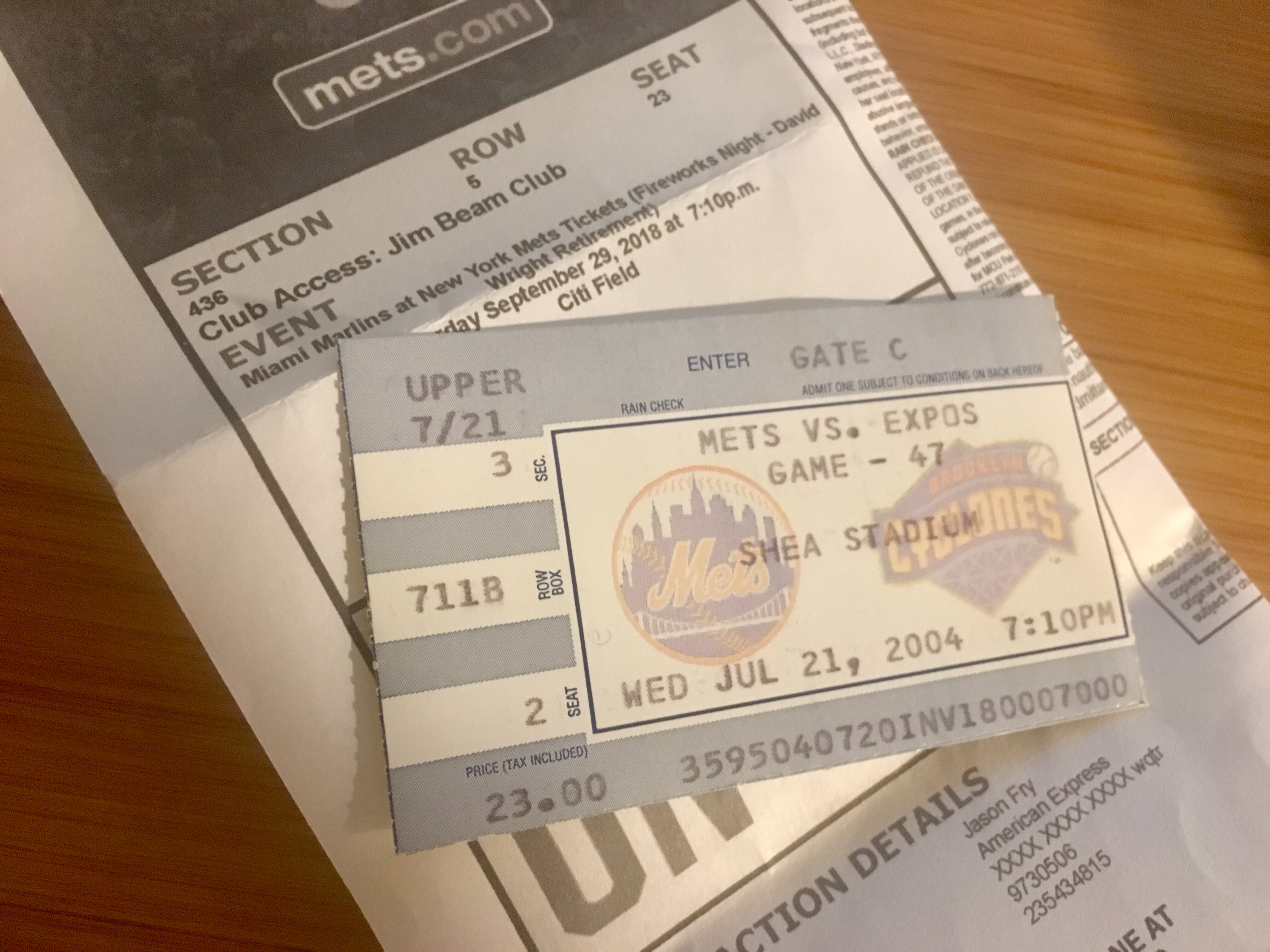
by Jason Fry on 30 September 2018 4:06 am July 21, 2004 was a hot and sticky day in New York, with the temperature in the high 80s and a night that didn’t promise to be much more comfortable. The Mets were bumping along around .500, and sort of battling for a National League East that no team particularly seemed to want to claim. That night at Shea they were scheduled to play the Expos, who’d escaped contraction but been reduced to Major League Baseball’s wards and were widely expected to be moved out of Montreal as soon as could be arranged.
None of that was particularly compelling, but I was going, because the Mets had called up a third baseman billed as their brightest hitting prospect in years, a Virginia kid named David Wright. The Mets had drafted Wright as compensation for Mike Hampton becoming enamored of the schools in Colorado and he’d torn up minor-league pitching, first at Binghamton and then at Norfolk. He had nothing left to prove down there; it was time to see what he could do under the bright lights.
I talked my friend Tim into going and secured seats behind home plate in the upper deck. They were the red seats, but boxes — not too far from the field and set apart from the upper reaches of Shea, which during sparsely attended games belonged to smokers, drunks, weirdos and guys who’d come to the park hoping to find someone to fight. My seat cost $23.
Wright fielded a grounder in the first, throwing over to Ty Wigginton, whose job he’d taken, to retire Jose Vidro. In the second he came to the plate for the first time in the big leagues. That first at-bat wasn’t what he’d hoped for during all those nights dreaming about what might be: he was retired on a pop-up in foul territory, with Expos catcher Brian Schneider making a nifty catch that ended with him flipped over the dugout railing. Wright made outs in his other three at-bats as well: a groundout, a pop to short and a fly ball to right. The Mets won by a single run.
Not a debut heavy on fireworks, but as Tim and I left Shea I made sure to tuck my ticket stub deeper in my pocket. When I got home, I filed it in a cubby of my desk instead of tossing it in with the recycling. Everything I’d heard and seen had convinced me this player would be special.
 And he was. That’s understating things rather dramatically. Wright quickly developed into a precocious hitter who was never out of an at-bat, combining a jeweler’s eye for the strike zone with superlative natural gifts and an indomitable work ethic. Within a couple of years, he’d become the face of the franchise, and I knew that one day I’d clear my calendar to see his final game, and then again to see the Mets retire his number 5. That number had belonged to some illustrious Mets over the years: Ed Charles wore it dancing near the mound as Jerry Koosman jackknifed into Jerry Grote‘s arms, Davey Johnson had it on his back while out-scheming Whitey Herzog and John McNamara and everyone else, and John Olerud had donned it as part of the Best Infield in Baseball. But all of that was in the past — 5 belonged to David Wright now, and would never belong to any other New York Met. And he was. That’s understating things rather dramatically. Wright quickly developed into a precocious hitter who was never out of an at-bat, combining a jeweler’s eye for the strike zone with superlative natural gifts and an indomitable work ethic. Within a couple of years, he’d become the face of the franchise, and I knew that one day I’d clear my calendar to see his final game, and then again to see the Mets retire his number 5. That number had belonged to some illustrious Mets over the years: Ed Charles wore it dancing near the mound as Jerry Koosman jackknifed into Jerry Grote‘s arms, Davey Johnson had it on his back while out-scheming Whitey Herzog and John McNamara and everyone else, and John Olerud had donned it as part of the Best Infield in Baseball. But all of that was in the past — 5 belonged to David Wright now, and would never belong to any other New York Met.
It was on Wright’s back for a lot of memories. There he was, willing a drive to center over the head of Johnny Damon at Shea. And drenched in champagne next to Jose Reyes, the other young star we became used to seeing to Wright’s left. It was on his back as he flew through the air one night in San Diego, coming down with a ball in his bare hand.
Not all of those memories were happy ones. Wright wore 5 as the Mets shut down Shea in a sendoff turned funeral, and in a new park whose dimensions might as well have been engineered to undermine him as an offensive force. He was wearing it when he took a fastball to the head, and when he went sprawling in the dirt to tag a runner at third, and as his body started to balk at his commands and betray him.
But he was wearing it again the night he returned in Philadelphia and announced himself with a missile into the upper deck on the third pitch he saw. He was wearing it when he crossed the plate in D.C. and flung his fist out in exultation. He was wearing it as the Mets obliterated the Cubs in Wrigley, and when he christened Citi Field as a World Series venue with a home run.
Yeah, he was special all right — off the field as well as on. We heard innumerable stories about Wright’s kindness and fundamental decency, and for every one we learned about we knew that there were two or three more that had remained private. There was Max Rubin, the kid with Down Syndrome who asked Wright to hit a home run against the Yankees, to which David replied “I’ll try” and then did just that. After the game Max gathered Wright up in a hug, radiant with happiness — and then the camera pulled back to show that Wright’s smile was even bigger.
Or there was the story that was my favorite, because it was such a small thing: an affectionate portrait of Jay Horwitz revealed that the Mets PR legend had chronic trouble with email addresses, and his careless autocompletes meant Wright routinely got messages intended for a Horwitz colleague with a similar email address. All of which Wright dutifully ensured wound up where they belonged. What multimillionaire athlete does that? Heck, you probably have someone in your office who doesn’t care enough to do that.
Before this week, we’d last seen Wright on a baseball field in May 2016. Every so often we’d get an update, and they were unrelentingly grim: a surgery, a period of enforced inactivity, all of them accompanied by Wright insisting that this was not the end and he was optimistic. We learned how hard he worked to fight his body to a draw, and how a draw wasn’t possible. He became a baseball Job, and though we’d learned never to bet against David Wright, we all sensed that there were some obstacles not even David Wright could overcome.
And so, simultaneously cruelly and mercifully, an endgame was crafted — a pair of cameos, an orchestrated farewell. Saturday night’s game became a sellout within a couple of hours of the plan’s announcement. The date I’d imagined as part of some distant hazy future — often I’d pictured it including my son Joshua, impossibly grown up and playing hooky from college — had arrived, far earlier than it should have and with a fair amount of bitter mixed in with the sweet.
But I knew I had to be there. I’d been there at the beginning, after all. And after David Wright had brought me so much joy, how couldn’t I be there at the end?
As it happened, my companion wasn’t Joshua but Emily. We arrived nearly an hour before game time, wary about how prepared the Mets would be for a packed house, and found ourselves amid throngs of people wearing WRIGHT 5 shirts, some of them carrying placards — to use a term I’ve only ever heard used by flight attendants and Casey Stengel — expressing thanks, love and devotion. (Let it be noted that Citi Field was fully staffed and running far more efficiently than most nights, though the cupboards were bare of food and drink by the late innings.)
We watched from the Promenade as Wright’s pregame gamboling in the outfield drew standing ovations and as he scooped up a first pitch from his daughter Olivia Shea before scooping her up as well. We stood and yelled and clapped as he ran out to his position alone, then was joined by his teammates. We looked at the big screen to see the joy on his face and that of Reyes as the two embraced — my feelings about Reyes are now complicated, to say the least, but his delight in playing beside his friend was genuine and impossible to resist. We rose again as Wright came to the plate for this first at-bat, and marveled at the patience he showed in working out a walk. We cheered madly when he fielded a grounder and threw sidearm for a putout at first. And there we were on our feet again when he led off in the fourth.
The second pitch from Miami’s Trevor Richards was a high fastball; Wright swung and popped it up outside first. I tried to will it into the seats. So did 44,000 other people. It was not to be — the ball came down in Peter O’Brien‘s glove. Wright smiled a little sheepishly, though you could see he was ticked, and headed for the dugout.
He was back at his position for the top of the fifth, and I let myself dream. I imagined that after the foul out he’d told Mickey Callaway that he was moving around fine out there and Mickey had asked him if he wanted one more at-bat. I didn’t need to wonder what the answer would have been. So I was reluctant — unwilling, almost — to register that Callaway had left the dugout and stopped near home to speak with the umpire.
That had been the plan, and there would be no reprieve. Wright hugged his teammates and waved, while the Mets and Marlins both clapped, and then he vanished into the dugout. And I realized what had pierced me most deeply that night wasn’t the highlights of heroic days, but the tiny little things that would never make a YouTube clip.
I could queue up Wright scoring in Washington or homering in Philadelphia whenever I wanted. But it would be harder to find a recording of all his little mannerisms, which I’d committed to memory years ago and could recognize even from a distant vantage point. The way he came in on a grounder, eyeing it like it was prey, or scuffed the dirt near third with his feet in a bit of nervous, meticulous grooming. The way he’d reseal his batting gloves before arriving at the plate, then raise his bat like a knight with a broadsword, exhale deeply, and get to work. Even the way he’d loosen up in the outfield before the game started, arms swinging and feet shuffling. Those were the things that crushed me on Saturday night — instantly recognizable tics and tells I’d seen a thousand times, come to take for granted, and realized I would never see again.
Wright left the field in the fifth, as planned, and the Mets and Marlins played on and on and on, a scoreless game that ground along in low gear until the Mets won by a single run. We saw the video tribute the Mets had produced — typically, it was both good-hearted and overproduced — and then Wright himself returned for a few words. He was impeccably gracious, of course — thanking all of us for coming out to thank him. He was competitive, of course — his first words were satisfaction that his team had won. And best of all, he seemed at peace with an ending he had fought so hard to avoid.
And then he went back into the dugout, followed by the camera. Looking from the big board to the field, I could just spot the white square of his jersey, then a bit of his shoulder. I looked back at the video board and there he was, making his way down the dugout, until he reached the steps, and then he was gone. He was gone and it was time to go home.
Wright’s final at-bat wasn’t what he’d hoped for during all those days of grueling rehab work in St. Lucie: he was retired on a pop-up in foul territory. But everything that came before, between that hot July night back in 2004 and that cool September evening in 2018? It was special. That’s understating things rather dramatically. And as Emily and I left Citi Field, beneath the glow of fireworks, I made sure to tuck my printed ticket deeper into my pocket.
by Greg Prince on 29 September 2018 2:26 pm Closing Day beckons, a day for one David above all to be noticed, to be sure. I assume, anyway. I know David Wright is not supposed to play after what’s billed hard and fast as his final game tonight. Regardless, I will sit where I usually sit on Closing Day and hope for a change of heart, perhaps an ease of back. “Hey, Skip,” I’d like to imagine Wright informing Mickey Callaway, “I can pinch-hit if you need me,” and Callaway doing the Wright thing. That would be sweet.
It will also be unlikely, which I reluctantly accept. David getting into one going on two games at the tail end of his career — a career that didn’t necessarily appear guaranteed to receive a tail end — has been enough to behold.
There’s another David, though, a David I know won’t be there Sunday, which is a shame. To be fair, I don’t know, even if circumstances had allowed it, that he would have been. One Closing Day he was, though. It was a surprise and a delight and, as it turned out, the last time I saw him at Citi Field, the place I embrace seeing just about everybody who means anything to me.
David Roth (not to be confused with the Deadspin writer of the same name) was my friend-in-law. That’s the phrase that would best describe our relationship to one another. Friend of a friend would also do, but that sounds a little too far removed. The friend who was our conduit was Jeff Hysen. Jeff knew David for decades, dating back to when they both worked for the City of New York during the Koch administration. Then Jeff moved to take a job in D.C., but the two of them (Jeff and David, not Jeff and Ed Koch) stayed close and grew closer. I assume that’s what happened. I didn’t meet Jeff until 2007, but distance has never meaningfully separated us either.
Jeff, up from Maryland for a weekend eight years ago, arranged for us all to go to a Mets game together. David and I shook hands by the Home Run Apple. He seemed nice enough. The Mets lost to the Phillies. That seemed typical for 2010. The highlight, so to speak, was Frankie Rodriguez returning from suspension after punching a man described in press accounts as his father-in-law. Given that Rodriguez wasn’t married to the guy’s daughter, they weren’t technically related, just as David and I weren’t. Still, they were connected (if not thrilled with one another). Anyway, some fans cheered Frankie Rodriguez upon his return. Not a lot, but enough, which hit me as atonal. That’s what I remember most about that game. That and David wearing a Shea Stadium Final Season pin on his golf shirt. Nice touch, I thought.
A few weeks later, I learned far more about David than I would have expected or, given the context, wanted. Jeff relayed to me the shocking news that his friend of his I’d just met, while on vacation out west, had been felled by an aneurysm. Felled? Is that the right word if something doesn’t kill you right away? Maybe struck? Does an aneurysm strike, like a high, inside fastball? The nomenclature doesn’t matter. The aneurysm did. The diagnosis that followed revealed a malignant brain tumor. David, as Jeff explained it, was close to death.
But still alive. And kicking.
“When the Colorado doctor saw that he was from New York,” Jeff told me, “he asked if he was a Yankees fan, and David, despite his condition and pain, objected and said that he was a Mets fan.”
It was too heavy a situation to invoke the bromide about whatever doesn’t kill a Mets fan makes a Mets fan stronger, but David Roth in 2010, sort of like David Wright in 2018, made a sensational comeback. Cancer remained a fact of his life, but so did his life. Intermittently over the next half-dozen years I’d see David out and about, almost as if nothing terrible had happened to him. Usually I’d see David because Jeff was around. Jeff’s a comedian when he isn’t a lawyer (he’s funny being both). His Manhattan comedy dates would bring David and me into the same dimly lit clubs, straining to politely laugh at the other comics while we waited for our shared pal to go on. Jeff’s desire to once in a while commune with his ballclub put us in recurring proximity as well. I’d see David at games with Jeff. I’d see David at QBC with Jeff. While I was moderating another panel, they sat through a deep dive on uniforms and uniform accessories that introduced them to the term squatchee. That’s the thing on the top of a baseball cap…as if David didn’t already know enough about what goes on inside a head.
A few times David and I engaged without Jeff present. We were all supposed to go to a game in 2014, but Jeff had a family matter, so David and I and one of Jeff’s comedy colleagues sat Jefflessly in Promenade together, shivering as the Mets outlasted the Marlins. A transportation specialist (David continued to work for a city agency), a comic and a scribe, all of whom who knew each other without really knowing each other; the friends-in-law, directed by Jeff Hysen. The weirdest part about it was it wasn’t really weird. We all rooted for the same team and we all knew very well a really good guy.
David came to one of my book events with Jeff and another without Jeff, which I thought was the menschiest of moves since, though his identification with Mets fandom was as strong as his will to live, he wasn’t really that big a day-by-day fan. Not big enough, for example, to have noticed that Mookie Wilson had been coaching first base throughout 2011. I learned of that slight gap in his Met knowledge on September 1 of that year. David and I were together in Queens, sans Jeff, but with David’s wife Bonnie (wearing a still-fashionable black WRIGHT 5 jersey), David’s friend Roger, Roger’s son Josh and my photographer friend Sharon. In the moment, that day represented a pinnacle of Mets fandom for all of us. We were on the field at Citi Field, present for batting practice. The long story is detailed and illustrated, but in essence, Roger had climbed a very tall mountain in the name of David to help raise funds and awareness for Team McGraw, part of the Tug McGraw Foundation, an organization dedicated to fighting brain cancer, a group in which Sharon was involved. I was on hand simply to stand back and supplement with words what Sharon was taking care of with pictures.
It was such a great late afternoon watching all these people having a ballpark experience to which relatively few are treated. The whole deal was engineered by a couple of terrific stalwarts of the Mets communications department, one of them Shannon Forde, who’d worked there a long time by then. A year later, Shannon would be diagnosed with breast cancer. She’d soon be back around the ballpark as much as possible, still doing great things for people, before dying in 2016.
What is it one of the Team McGraw honchos liked to say in his blog posts? Oh yeah: “Cancer sucks.”
The last time I saw David Roth was the last time I saw David Wright. Not the same space but on the same day, May 21, 2016, the Saturday when David Wright lashed a game-winning hit to beat the Brewers at Citi Field. That’s the game when Sharon and her husband Kevin invited Stephanie and me to join them and a plethora of other friends to sit in the M&M’s Sweet Seats, a perch from which we would not have dreamed of departing prior to Wright’s ninth-inning RBI unless we had something else pulling us away. Alas, we did. Jeff was performing at Broadway Comedy Club somewhere in the middle innings in the West Fifties. We tried to split the difference, get some of the game in, apologetically bolt in time for Jeff’s set.
We missed Wright’s walkoff hit because we left early and we missed Jeff’s killer bits because we didn’t leave early enough, arriving at Broadway after he’d dropped the mic. But we did hang out somewhere off from the main room for quite a while with Jeff, who was in cooldown mode. It was an odd logistical situation in that Jeff’s wife Sue was still at a table deep inside the club, beyond the reach of hand signals, which meant we couldn’t all leave ASAP. David was there, too, at a table near the stage and spotted Stephanie and me. He helpfully tried to guide us to join him. We had to make like then third base coach Tim Teufel and give him the stop sign because though we’d only just shown up, we didn’t want to sit down and subject ourselves to a two-drink minimum, given that Jeff was done joking. (Also, we had a Mets game to follow by phone.) David politely hung in there with the other acts for a spell before joining us during a comic changeover. Jeff would arrange Sue’s release by text and eventually we’d all get something to eat.
I didn’t know our postshow dinner at a nearby diner would be the last time I’d see David Roth. At some point in the relatively near future, cancer — which generally fails to take offense at the insulting things well-meaning people say about it and therefore continues to suck — made itself felt again. On a rainy day this past spring, Jeff came up from Maryland to visit David at a hospice facility in Brooklyn. Later, at Jeff’s behest, we tried to collaborate on a couple of bits based on some awful commercial he kept seeing on TV while David napped and what Jeff’s Uber driver said to him about praying to Allah for his friend’s recovery. None of what we came up with was hilarious, but Jeff had lost his mother at the outset of the 2018 baseball season and now his best friend was in his final months. When attempting to withstand an ongoing emotional onslaught, laughing surely beats the alternatives.
On the First of September, seven years to the day we were on the field for batting practice, Jeff, himself out west to see his son and the Mets, roughly in that order, learned David had died. A few days later he eulogized him at a synagogue in Brooklyn. Jeff’s theme was not only were he and David like brothers, but they were often mistaken for brothers. At his very first comedy show, when Koch was still mayor, the MC doing what is known in the business as crowdwork picked on David, basing his shtick on that very understandable sibling assumption. As Jeff explained in his eulogy, his actual brother was sitting at the same table as David, but Jeff and David probably looked more alike than the two Hysen boys did.
The MC asked David of Jeff, “Is he funny at home? Are you proud of him?” David, never breaking character from his seat, replied, “Yes, he’s funny at home. Yes, we’re proud of him.” No wonder the MC proceeded to point at David and introduce Jeff as “this guy’s brother”.
The Mets were also invoked in the eulogy. No mistake there.
Tomorrow I’ll be at the ballpark, in Excelsior, Section 327, more or less where Stephanie and I were sitting three years ago on Closing Day. On October 4, 2015, the Mets chalked up their 90th and final win of the regular season, 1-0. When it was over, David Wright grabbed a microphone, thanked us for our support and promised that the team would do its best to beat L.A. I go to Closing Day every year, but I mention that one now because in the middle of that game, as Stephanie was off on a concessions mission and Terry Collins was rapidly changing pitchers in order to keep his staff sharp for the upcoming playoffs, I received a text. Or was it a call? Honestly, I don’t remember anymore. Whichever mode of communication was being deployed, I do remember that the deployer was David Roth, letting me know he and a friend who wasn’t Jeff were also at the ballpark, could they come by to where I was and say hi? David knew I’d be at Citi Field from Jeff, though it’s not like anybody really needs inside information to ascertain my whereabouts on Closing Day.
Sure, I told him, though I warned him that my being in Excelsior might mean security would hassle them, given that they were sitting in Promenade, and Promenade tickets are not recognized as valid visas for passage by the gatekeepers of certain other sections. Undeterred, David followed my directions and headed for the Excelsior entrance in left field. I got up to meet him and his friend and chat for a few minutes. I don’t remember what we talked about. We talked about the Eastern Division champion Mets, presumably, since they were the ones playing in front of us. It wasn’t a long or deep conversation, but I do remember I was touched that he thought enough of me to go out of his way there to say hi.
It’s only right I take a moment here to say bye.
by Jason Fry on 29 September 2018 1:43 am The highlight of Friday night’s meaningless Mets-Marlins game? It was a first-pitch groundout to third.
LOLMets and all that, but those of us who were there to see it were thrilled — because those 10 or so seconds represented the return of David Wright to the place he is most fully himself, the place he belongs, and the place that, for all that, he will never get to be again after Saturday night.
That’s a lot to unpack, whether it’s in a sentence, in the air of a stadium during the night game, or in a Mets fan’s heart. But I’ll try.
I read about the plan for Wright’s farewell Friday afternoon: that he’d be the Mets first pinch-hitter that night, then start at third Saturday and get a few innings and a couple of at-bats. After which, nothing.
“Nothing” isn’t right there. Wright will be a dad and a husband and a son and a friend and a neighbor and a lot of other things that we have to remember are infinitely more important than baseball games. But the baseball player part of his life will be over, for him and for us.
Over, but not quite yet. Still, when I heard Wright would be pinch-hitting Friday, I sped over to StubHub and made sure I would be there. The pinch-hitting assignment was a dress rehearsal of sorts, a chance for Wright to calm his nerves so he could enjoy Saturday more. That was a good idea — from everything he’s said, he needed it. And frankly, given the emotional tonnage on the way Saturday, so did I.
And I also thought of it as insurance. As Wright has explained stoically and ruefully and patiently, he has relatively good days where only one part of his body hurts and must be negotiated with, and he has bad days where everything hurts and nothing is going to work. Now, I can’t imagine what combination of ailments would have to arise to keep David Wright from his Saturday curtain call. But once upon a time I also couldn’t imagine a cascade of cruelty that would deprive this player, of all players — this man universally praised as a genuinely thoughtful and decent person — of the game he has loved so much for his entire life.
So just in case, I was going to be there.
All right, there were secondary reasons too. I was keenly aware that the Mets’ season was all but gone, and that soon “go see a baseball game” wasn’t going to be an option no matter how badly I needed it to be. It was a nice night after a grim rainy morning. And tickets were cheap and I wanted a chance to take in a game from behind the new expanse of netting installed to protect fans. (On Saturday night Emily and I will be in more danger from low-flying planes than foul balls.)
Put all that together and there I was a few rows behind the Marlins’ dugout as play began, looking out at the Mets in their dumb blue tops (please tell me Wright’s final appearance will at least be in a real uniform) and squinting quizzically at that protective netting. I tried to play devil’s advocate by convincing myself it annoyed me, but failed to do so. From my vantage point, it was invisible when looking at the batter and easily ignored when looking elsewhere. I can’t say the same about the lower stretches of netting protecting the outfield lines, on the other hand — that material is thicker, with what struck me as an annoying number of poles. Maybe at the end of the next lousy season I’ll go sit in those seats.
Anyway, with my net-inspection mission complete and a spicy chicken sandwich consumed, I and the fairly decent-sized crowd got down to the business of waiting for someone to pinch-hit.
That was a new one for me, and I suspect for everyone else. With Corey Oswalt on the mound, I figured the moment would come fairly early — hopefully in the fifth, after Oswalt had qualified for a win. That didn’t happen — Oswalt was fairly obviously out of pitches by the bottom of the fourth, and my eyes and lots of other people’s went to the scoreboard, where he was scheduled to hit fifth.
Possible? Maybe, particularly after a Dom Smith single. And indeed, with two out Kevin Plawecki strolled to the plate and all attention went to the on-deck circle, where that was indeed Wright limbering up — a sight whose bland ordinariness turned it piercing.
Plawecki grounded out and we had to wait — wait, it turned out, for the dogged and doomed Paul Sewald to do Sewaldian things that put the Mets in a 3-1 hole. And then it was time. We stood and we clapped and we cheered and we yelled, and I tried not to think of how quickly this was all going away.
In the end the drama was far more about anticipation than action: Wright swung at Jose Urena‘s first pitch and smacked it to third, a grounder whose velocity you could feel grow in the telling even before it cleared the grass. It wasn’t hit hard. It was a mildly tough hop, the kind of play a good third baseman is forgiven for not making but really should make.
Brian Anderson made the play and then we were left with half of a baseball game that had become ostentatiously and almost offensively pointless. It was like hanging around a wedding after the bride and groom have left, if you’re ever invited to a wedding where the bride and groom decamp during the fish course, take the band and the bartenders with them, and nobody gets cake.
The Mets made various errors, Jose Lobaton got to hit (twice!), and a parade of interchangeable young Met relievers who will be forgotten by 2021 were interchangeably terrible. I sat there and used my AMAZIN’ giveaway t-shirt (which should have said UNDERWHELMIN’, since it looks like an intern designed it on the first half of his lunch hour) to play peek-a-boo with a baby in the row in front of me, the Mets lost, and then I went home.
Could I have done that earlier? Yes, with no discernible difference in my evening. (Granted, I would have missed seeing Jack Reinheimer in the flesh.) But I didn’t and I knew I wouldn’t. I don’t go in for fire-and-brimstone Thou Shalt Not Leave a Ballgame Early doctrine, but I think I’ve always had a reasonably compelling reason for departing — spousal illness, toddler meltdown, truly awful weather, etc. When your team’s season has shrunk to 60-odd outs and six-odd hours, there are no reasonably compelling reasons.
When that’s all that’s left, you sit there. So what if it was 8-1? Every baseball-free day of every stupid winter is like being down 8-1, and good luck getting excused that duty. I sat there, and I’ll be sitting there again tomorrow — all too keenly aware of what I’ll never get to see again.
by Jason Fry on 28 September 2018 12:11 pm Jason Vargas headed into winter in style Thursday night, allowing three hits and no runs over seven innings as the Mets beat the Braves. In fact, Mets starting pitchers allowed the Braves exactly zero runs in the two teams’ final series of the year.
Asterisk time! Vargas may have shaved nearly three runs off his ERA after finally finding a rhythm in August, but that ERA still ended up at 5.77. With a division title captured, the Braves were resting their regulars and their mental faculties before the next game that matters. The Mets’ four runs all came on home runs by Devin Mesoraco and Kevin Plawecki, yet you won’t find 2019 spring training thick with suggestions that Jerry Grote, Gary Carter and Mike Piazza make room in the pantheon.
But consolation prizes are still prizes, even if they’re not the ones that brought you to the fair. The Mets’ bedrock strength — which might lead them to a 2019 title and might lead them to halfheartedly chase the illusion of one — is their starting pitching, and every indication that the starting pitchers could be healthy and on point next spring is a reason to hope.
I collected one of my desired consolation prizes when Jacob deGrom ended his season with a flourish on Wednesday night before me. Greg and the rest of a small but rapturous crowd — the baseball descendants of the hardy faithful who showed up at the end of 2012 to see R.A. Dickey seek and attain a 20th win. (Followed by a Cy Young, but let’s not get ahead of ourselves.) I’ll be in the park Saturday night to see David Wright say farewell, a bittersweet consolation prize, to be sure, but one I immediately knew I needed for so many reasons, starting with the fact that 14 summers ago I discarded my plans and hurried to Shea Stadium because Wright was making his long-awaited debut and I had to be there. And I have one more consolation prize in mind, one that’s neither secured nor scripted and so will go unmentioned.
Another consolation prize, now that I think about it, has already been delivered. The Mets were bad in May and really bad in June, sinking their season. (Perhaps you’ve heard.) But their revived, reignited play in August and September has cushioned the blow, and as the season dwindles to nothing I find myself, to my surprise, wanting more. That hasn’t been true in previous wrecked seasons — it’s often been a mercy to be spared further bad decisions and ownership double-talk and losses, losses, losses. But this season has redeemed itself. These Mets aren’t winning anything, and their last packed house is a sellout for the saddest of reasons, but I’ll miss them when they’re gone. And I’ll make room on my shelf for that.
by Greg Prince on 27 September 2018 12:09 pm Like Red on the bus to Fort Hancock, Tex., in The Shawshank Redemption, I found I was so excited at Citi Field as the Mets game wore on Wednesday night, I could barely sit still or hold a thought in my head. I think it was the excitement only a Mets fan could feel, a Mets fan at the end of a long journey whose conclusion is certain.
We knew our team wasn’t going anywhere in the traditional sense. We’ve known that for months. Yet we were rolling along, late in an otherwise lost season, clinging to a purpose all our own: meeting our friend Jake in Zihuatanejo, where we hoped to find him buffing and polishing his Cy Young Award.
We hoped. And we made it, I’m pretty sure.
If we can keep two thoughts in our head, it’s that 1) you can keep the Mets’ 2018; and 2) they can’t take Jacob deGrom’s 2018 away from us. A great individual campaign executed as part and parcel of a team’s quest for greater glory doesn’t take much understanding. As illustrious as Doc Gooden’s oft-referenced 1985 was, you almost didn’t fully appreciate it while it ensued because you always kept one eye on the out-of-town scoreboard to track what the Cardinals were doing. Doc was other-worldly, no question, but so were Gary Carter and Keith Hernandez and Darryl Strawberry, and we didn’t limit our immersion in what they and their teammates were doing to one night out of every five.
By contrast, Jacob pitching practically on his own has represented a phenomenon in a vacuum. Four nights out of every five, no disrespect to any other Met starting pitcher of the moment, we’re just slobs on the couch looking up from our phones from time to time. On the fifth night — culminating in the fifth-to-last night of 2018, as it turned out — we’re puttin’ on our top hat, tyin’ up our white tie, brushin’ off our tails. We’re the belle of the ball, the toast of the Met Gala. Everybody playing in deGrom’s orchestra strives to look sharp and tries to hit notes higher than they are accustomed to reaching. They don’t want to let down their conductor. Neither do we.
One could imagine the post-fete dialogue as we temporary Cinderellas return to our humdrum existences.
“Where’ve you been?”
“At the Mets game. It was magical!”
“The Mets? Don’t they suck?”
“Not when deGrom is pitching.”
“So they won?”
“Not necessarily.”
You’d have to be a Mets fan, a Mets fan in 2018, to understand. You’d have to be a Mets fan to understand what it means to show up on a late September night, threat of rain in the forecast, to sit outside and treat the 158th game the fourth-place Mets were mandated to play as if it was the 32nd game of a six-month World Series. We had to make Jake’s going-away party the best it could be. We knew Jake would. We didn’t know if he would win or if the Mets would win, but we knew there was no way any of us could lose.
Jacob deGrom has spent 2018 redefining for us what a great season looks like. If you’ve grown up reciting sets of numbers like 25-and-7 and grown older pairing it with 24-and-4, you’ve trained yourself to reflexively dismiss plebian digits like 10-and-9. Or 9-and-9. Or 8-and-9. Yet in 2018, as informed as our habits may have been by the successes of Seaver and Gooden at their winningest, we learned how much beauty can blossom if you have the sense to peek beyond the most obvious, least revealing numerals.
Nothing about deGrom’s already resplendent season was going to look substantively different whether or not Jake “beat the Braves” on Wednesday night. We still use that kind of language. He beat them; they beat him. One man versus nine batters, as if the game is designed for the pitcher to control every possibly outcome, including that which is memorialized in the standings every morning. As silly as it sounds, we’ve institutionally bought into it forever. Even if we let our logic flag fly in theory, we’d rally around the W’s if there were enough of them for a couple of minyans. Six Septembers ago, when the Mets were similarly closer to last place than first, we flocked to Citi Field to urge R.A. Dickey on to his 20th win. It’s not like we didn’t already know wins were of limited utility in measuring the full effectiveness of a pitcher, but we finally had somebody sitting on 19 of them and, goddammit, we wanted that 20th for him and us.
This September, within the context of deGrom and the Cy we seek in his name, 10 sort of became of the new 20 — though even that formulation is a reach. We knew when Jake’s won-lost record was 8-9 that it didn’t reflect his truth. How would 10-9 somehow certify that the best pitcher in the sport had gotten exponentially better over a span of less that two weeks? It wouldn’t, but superficiality doesn’t probe that deeply. We wanted Jake to have the best possible record, no matter how ultimately pointless a pitching metric “record” is.
For generations we dwelled unquestioningly in the valley of decisions. Wins. Losses. No-decisions either desperately bargained for or grudgingly accepted as the cost of doing business. It’s been the hardest of habits to break. I don’t know that we’ll ever fully rid ourselves of the inclination to overvalue the W’s and cringe too hard at the L’s. As long as the former is available, we will want them for our pitchers. As long as the latter loom as possibilities, we will recoil at their intrusion. And we’ll still treat no-decisions as fickly as we can, welcoming or resenting them on a purely situational basis.
Jacob deGrom is a winner in practically every inning he pitches, the victor in virtually every mano-a-mano in which he’s engaged. Evaluating him by the game seems inadequate. Seaver and Gooden and others threw great games. DeGrom prevails batter after batter after batter. You’re surprised when somebody reaches base. You’re shocked when anybody comes around to score. In the universe he has created, the aberration upsets your soul. The stray RBI hit stands out as the act of a vandal. Madison Bumgarner, Lewis Brinson, Brock Holt…they might as well have been the Scioscias and Pendletons of the sputtering summer of 2018. They didn’t knock the Mets perilously off stride amid a pennant push. They didn’t rewrite the narrative of a would-be world champion.
No, they had the temerity to tick Jacob deGrom’s earned run average ever so slightly upward. When that would happen, we were all Ralph Branca burying our face in the nearest cement staircase.
Yet not for long, because Jake was resilient, taking on another batter and another inning and emerging victorious in those encounters. It showed up everywhere in the box score except maybe where they print the W’s…which should be marked as a loss for the win, because it simply doesn’t reflect the greatness of deGrom.
Wednesday night was for the fans who hadn’t had enough of the 2018 Mets and couldn’t get enough of 2018 Jacob deGrom. Those of us who showed up at Citi Field (a dedicated cohort that included Jason and me if not tens and tens of thousands of others) received an evening that reflected accurately everything that has made deGrom synonymous with greatness. There was a Brave base hit to begin the game. There was another to begin the second inning.
And that was it where Brave hitting not to mention walking was concerned. One Brave got to first on a wild pitch and misguided heave after a strikeout, but he didn’t stay long. Jacob, ever the maestro, saw the runner, Ronald Acuña, had rounded first as the ball Devin Mesoraco flung had trickled away. The pitcher directed Jeff McNeil to throw to first, where Dom Smith tagged him out, thus transforming the evening’s only audible groan into a cheer.
Jacob struck out ten Braves in eight innings. The tenth was the thousandth of his career, which seemed to make the pitcher uncommonly happy. Good for him — he should be happy enough so that we can pick up on it. What Jay Bruce said about deGrom after his previous start, that he’s “very, very boring in the best way possible,” extends to his answers about how very, very excellent he is in the best way possible. Jake’s affable as all get out, cooperating to the fullest extent of politeness with every inquiry of what it was like out there tonight, et al, but his responses generally don’t change speeds like his pitches do. Yes, he felt good. Sure, he’d like to have won. No, he can only control so much and looks forward to his next start.
I didn’t realize until the video boards flashed the bulletin that Jake had been one strikeout away from 1,000 when he fired the last of his 2018 pitches past Ozzie Albies. He sure knew, though. No. 1,000 brought the biggest smile I’ve seen from him since he lowered Daniel Murphy’s chair while Murph attempted to address the media at Dodger Stadium during the 2015 NLDS. He was sneaky fast after the game that night, just as he was overwhelming during the game that preceded it.
Jake was a really good pitcher in 2014 and 2015, pretty darn beguiling even when dogged by injury in 2016. He was among the best anywhere in 2017. And he’s gotten better. He was more or less at the top of his craft by the All-Star break and has improved since then. Not only was it fitting that he walked off the mound for presumably the final time this year on a strikeout that left Albies looking at air, it was apropos that the called strike three made it twenty consecutive batters making an out. DeGrom may have been one start away from throwing a perfect game. Or one month away from throwing a perfect month.
For a change of pace, he had help. McNeil didn’t require deGrom pointing which way to go in the seventh when on the hardest-hit Brave ball of the night, off the bat of the perennially treacherous Ender Inciarte, Jeff dove into the middle of the diamond and snagged the closest thing Atlanta would manage to a base hit post-second inning. And two Mets — Smith and Michael Conforto — conjured actual offense. Conforto doubled down the right field line in the sixth and Smith singled him home for a 1-0 lead. In the eighth, Conforto rearranged the deck chairs on the Citi Pavilion, the branded seating area just south of Shea Bridge. One out later, Smith went opposite field for another solo homer.
It was 3-0, Mets, yet the crowd soon expressed its displeasure. Not for the score but for the on-deck circle, where Bruce stood instead of deGrom. One-hundred ten pitches were in the books. We’d see no more of Jacob on the mound. When the perfectly likable and usually effective Seth Lugo came trotting out of the bullpen in advance of the ninth, we booed. Nothing personal, Seth. Surely you understand.
Three outs later, we and Jake got his 10th win of the season. A perfect 10th. Incidental to the other numbers, to be sure. The strikeout total had topped out at 269, one more than Doc K’d in 1985, fourth-most in Mets history. The ERA had plunged to 1.70, six-hundredths less than Tom posted in 1971, second-best in Mets history. It took me a while to realize why 1.70 seemed so familiar. It eventually registered that 1.70 was Tug McGraw’s ERA in 1971 and 1972, the seasons that established him as one of the best relievers in the league, the seasons that made his struggles through most of 1973 so unbelievable. Tug put up his twin 1.70’s a little bit at a time, albeit with a workload that a modern closer couldn’t comprehend: 111 IP in ’71, 106 IP in ’72. Over two seasons and 217 innings, in 105 appearances (one of them a start), Tug could hardly be touched.
Jacob deGrom threw exactly that many innings in 2018, 217. After that one game on May 2 when he left after four with a hyperextended elbow (and we all hyperventilated) and the game after that when he test-drove the elbow for one excruciatingly stressful inning (45 pitches, three walks, no runs), he never stayed out there less than six innings. Just one complete game, which is a shame for the romantics among us, but in contemporary baseball we understand how closely managers and coaches count pitches. During eleven August and September starts, Jacob never threw fewer than 98 of them. The earned run average that dazzled at 1.68 in advance of the All-Star break barely budged.
We’ve got stats in our eyes when it comes to Jacob deGrom. The Mets media department transmitted a sheath of notes attesting to his achievements a little more than half-an-hour after the ink had dried on them. Some, but not all, are…
• Three runs or fewer allowed in 29 consecutive starts
• 24 consecutive quality starts
• Allowed one or no runs in 18 starts
• ERA of 0.88 in six starts versus the division champion Braves
• Only season in modern major league history to encompass at least 260 strikeouts, 50 or fewer walks, 10 or fewer home runs allowed and a sub-2.00 ERA.
And so on.
The statistics do neatly encapsulate his case for the Cy Young, if that’s your priority. Who are we kidding? Of course we want it for him and us, and it seems highly likely he’ll be collecting it come November. What’s at least as rewarding as any award, however, is the feeling we got from Jacob deGrom pitching. Anytime, any start, but especially Wednesday night in his last start if you were at Citi Field.
It wasn’t just the season Jake had. It was the season the Mets had. One of those seasons. You didn’t need a reason to remain on top of things in 1969 when Tom was going 25-7 and the Mets were en route to 100-62 and so much more. You didn’t need to explain yourself to yourself as Doc was building up to 24-4 in service to the Mets pulling up just short of a division title at 98-64. Empty seats were the exception in those Septembers. This September, they are in abundance. Even last night they were plentiful. But those of us filling the minority of Citi’s chairs…we got it. We got Jake. We got what it means to have one Met excel regardless of what the other Mets have been doing.
Conforto. McNeil. Rosario. Nimmo and, on a good night, Smith. If you squint, you can almost make out a team around Jake. Don’t look too closely at center field or third base. Imagine a catcher who can do more than receive. Dream of a bullpen you aren’t by instinct moved to boo. Yet the Mets have been getting incrementally less bad as a rule. No longer does it seem Jacob and the rest of the rotation would be better off hiring their own hitters and taking off on a barnstorming tour. No longer does Jake necessarily resemble a Big Brother graciously volunteering his time with the neighborhood kids, stepping off the rubber and watching them try their best despite knowing that they’ll never really get the hang of the sport he mastered many moons ago.
When a season of overall disappointment winds down, we Mets fans who seek out nights like Jacob deGrom’s final start can’t say what the next season will bring for the team, but we can isolate what has been most special about the season somehow still in progress, expressing our appreciation forcefully and reveling in it jubilantly. No question we’d go last night. No wonder we stood and applauded as long as we could. No wonder we remained giddy as we departed, arrival of that anticipated rain be damned. As with Jake getting batters out, it’s just what we do, it’s just how we are.
|
|