The blog for Mets fans
who like to read
ABOUT US
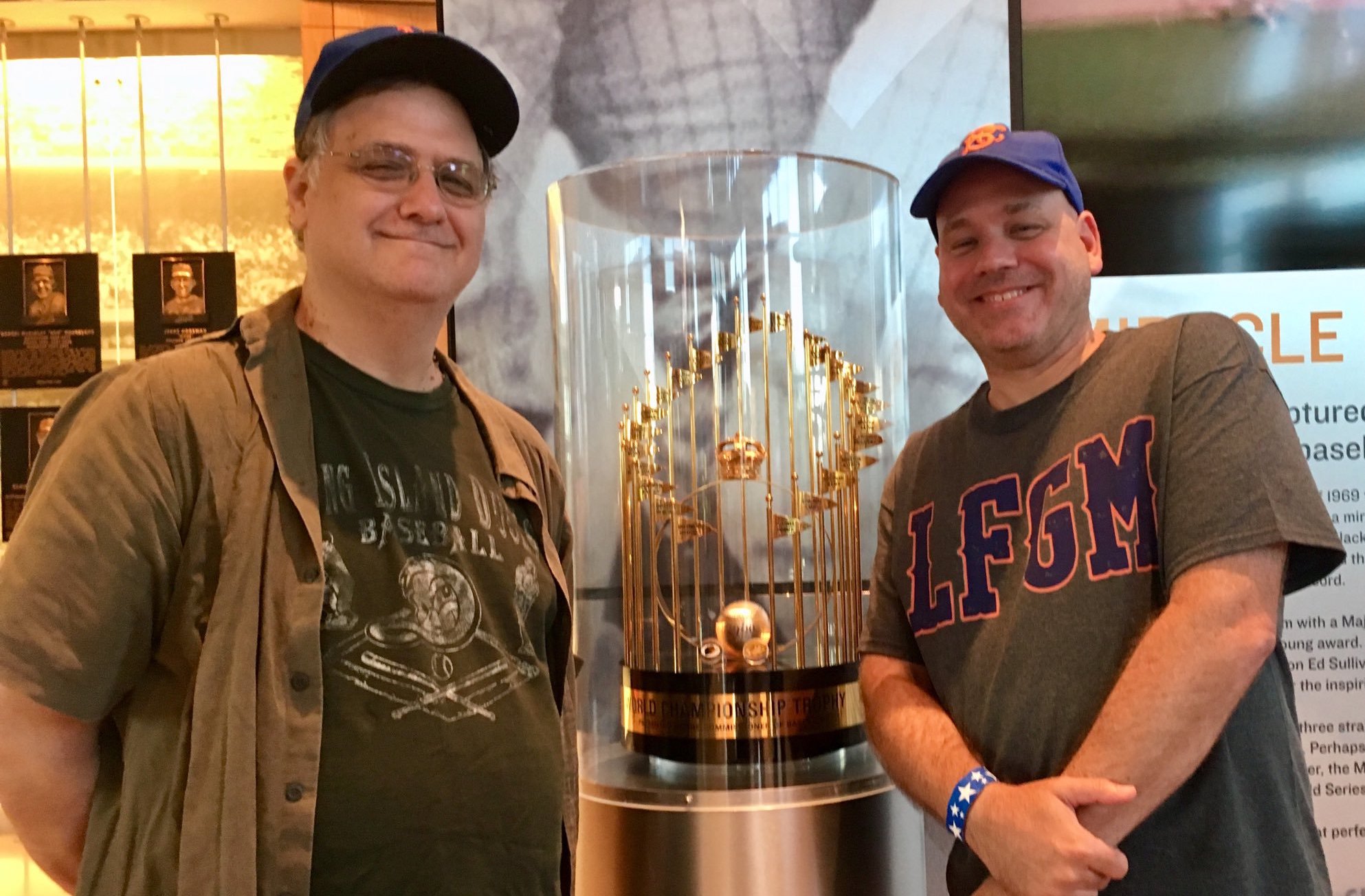
Faith and Fear in Flushing made its debut on Feb. 16, 2005, the brainchild of two longtime friends and lifelong Met fans.
Greg Prince discovered the Mets when he was 6, during the magical summer of 1969. He is a Long Island-based writer, editor and communications consultant. Contact him here.
Jason Fry is a Brooklyn writer whose first memories include his mom leaping up and down cheering for Rusty Staub. Check out his other writing here.
Got something to say? Leave a comment, or email us at faithandfear@gmail.com. (Sorry, but we have no interest in ads, sponsored content or guest posts.)
Need our RSS feed? It's here.
Visit our Facebook page, or drop by the personal pages for Greg and Jason.
Or follow us on Twitter: Here's Greg, and here's Jason.
|
by Greg Prince on 19 May 2018 2:19 am “Give it a listen. What do you hear?”
“‘DeGrom.’ Definitely ‘deGrom.’”
“You’re crazy. It’s ‘Conforto.’ Listen…‘Conforto.’”
“You’re the one who’s crazy. Can’t you hear the pitching? Seven innings. Thirteen strikeouts. No walks. ‘DeGrom.’”
“No way, it’s all hitting. You listen: four-for-four, a couple of RBIs. ‘Conforto.’”
“‘DeGrom.’ Plain as day.”
“Excuse me, I don’t mean to interrupt, but are you guys doing that thing where everybody hears something different?”
“Yeah. Except I hear it right and my friend here hears it wrong.”
“Says you. DeGrom!”
“Conforto!”
“Here’s the thing, fellas. I think you’re supposed to hear them both at the same time.”
“WHAT?”
“It’s not just about pitching, though deGrom mowing down the Diamondbacks and paving the way for a 3-1 Mets victory Friday night in a crisp 2:36 was sublime. And it’s not just about hitting, though Conforto breaking out made sure the great starting pitching — and equally good relief — wouldn’t go to waste. C’mon give it another try. You, the guy who only heard deGrom, listen again. What do you hear?”
“I hear ‘deGrom.’ DeGrom drowns out everything.”
“C’mon, listen harder.”
“DeGrom. I’m not changing my answer.”
“What about you, Conforto guy? Use these Q-tips, clear out the wax and try again.”
“Conforto. And my ears are fine.”
“Forget it. There’s no getting through to either of you.”
“Hey, you guys are doing that deGrom/Conforto thing? I heard about that. Can I play, too?”
“Sure. Maybe you can break the tie. Honestly tell us what you hear.”
“I hear…I hear ‘Lagares.’”
“Lagares? Everybody hears either deGrom or Conforto. How the hell do you hear Lagares?”
“It’s all I can hear. That and a faint yowl of agony. Wait, I think there’s something else in there.”
“What?”
“A gaping hole where there should be an additional major league outfielder.”
“You can hear all that?”
“My audiologist says I process sounds on a very finely tuned frequency.”
“Meaning?”
“Meaning I hear mostly defense — or the lack thereof.”
“Ooh, you guys are doing that everybody hears something different thing. I want in!”
“Why not? What, pray tell, do you hear?”
“Chaos!”
“Chaos? What the fudge does that sound like?”
“It’s Lagares going on the DL for the year for what was supposed to be a sprain, it’s having no suitable replacements for him, it’s Cespedes not immediately going on the DL when we all knew that’s where he was ultimately headed, it’s the free agent innings-eater never lasting more than four innings, it’s the Mets batting out of order, it’s weeks of minor league catchers, it’s failing to put back-to-back wins together for more than a month…”
“You hear all that?”
“I heard it on the way over. I was listening to the pregame show.”
“That’s not how this is supposed to work.”
“Nothing’s ever how it’s supposed to work with the Mets. That’s what makes them them not just chaotic, but dysfunctional.”
“Conforto’s functioning fine. Except for the long slump until now.”
“DeGrom’s functioning flawlessly. Except for the hyperxtended elbow.”
“Right. And Lagares won a Gold Glove four years ago and basically hasn’t been heard from since, and won’t be heard from again. Just like d’Arnaud. Just like Swarzak. Just like…say, anybody heard from T.J. Rivera lately?”
“Who?”
“Exactly.”
“Pardon me, I’ve overheard what you’re doing. Do you mind if I have a listen?”
“Everybody else has, go ahead.”
“Ooh, I hear winning record, bunched up divisional race, three-quarters of a season remaining, maybe not everything going wrong for the Mets despite everybody being determined to believe otherwise.”
“That’s because of deGrom.”
“Conforto!”
“DeGrom!”
“Lagares!”
“Chaos!”
“Dysfunction!”
“Actually, I hear rain is in the forecast.”
“Yeah, I heard that, too.”
by Jason Fry on 18 May 2018 11:34 pm Earl Weaver, a wise man, once cracked that momentum is the next day’s starting pitcher. Games take the form of stories as they unfold, but all those stories start with the guy on the mound. If he’s got his full arsenal, recent frustrations and failures are likely to dissipate. If he’s got nothing, a run of positive outcomes will likely come to a screeching halt.
Fortunately for the shooting-at-their-own-feet Mets, Jacob deGrom had everything working Friday night, most notably a fastball with movement and bite, one that seem to grind up Diamondback bats and batters. Paul Goldschmidt looked particularly helpless, lost in one of those fogs during which a hitter can’t remember ever doing anything positive, but no Diamondback looked excited to be in the batter’s box. DeGrom did his job and more — I didn’t think it was a particularly good idea to send him back out for the seventh given recent events, but he struck out Alex Avila with a runner at third and one out, then retired Jarrod Dyson to walk off the mound to much-deserved applause.
The Mets, meanwhile, seemed determine to do as little as possible against Zack Godley, who had little feel for the location of his breaking ball. But with deGrom good as he was, a little was a lot. Michael Conforto went 4-for-4, a breakout that was really the BABIP Gods finally smiling on him: Conforto, you may recall, was robbed of two hits in Wednesday’s soakfest.
Conforto shaking off the rust of his freak shoulder injury and curtailed spring training would be a much-needed jolt for a flat, injury-riddled club that’s been shorn of Yoenis Cespedes and Todd Frazier, is getting nothing from Jay Bruce, and just lost Juan Lagares for the year. Lagares’s erasure left Mickey Callaway talking about Wilmer Flores and Jose Reyes as outfielders, which sounds like a terrible idea even by Metsian standards; more likely is that the job will go to Ezequiel Carrera, just signed to a minor-league contract along with infielder Christian Colon.
Carrera did nothing in the Braves’ system this year and is now on his third organization of the calendar year, but he did hit .280 with 10 steals for Toronto last year, and is certainly a better idea than witnessing Wilmer Flores aiming a terrified look heavenward while staggering around in left field. (It’s even a homecoming of sorts — Carrera began his professional career as a Met farmhand way back in 2005, departing in 2008 in a deal that was more Roman orgy than baseball transaction, involving three teams and 11 players.)
So the Mets got a stellar pitching performance, hit enough, didn’t take the field wearing uniforms that made you want to flush your eyes with lye, and won in a tidy two and a half hours. That will do nicely … at least until tomorrow night, when they continue their thrilling, monthlong quest to win two games in a row.
Steven Matz will be your starting pitcher. For a read on the momentum, check back in 24 hours or so.
by Jason Fry on 18 May 2018 5:18 pm X-rays were negative but he may not play Friday. He’s day-to-day, which in these parts is known as foreshadowing with a side of foreboding. Cue the uneasy minor-key music, buckle up, and if you’re a believer, say a prayer for Lagares.
Well, this doesn’t seem so funny any more. Juan Lagares likely out for the season with a … wait for it … hyperextended big toe and ligament damage.
BURN IT ALL DOWN.
by Jason Fry on 17 May 2018 1:13 pm Absent a perfect, um, storm of unfortunate factors, Wednesday’s matinee would never have been played.
It was a miserable day in New York, a gloomy, continuous soak. But the Mets and Blue Jays had only two scheduled meetings here, and while the Mets had an off-day Thursday, the Jays did not. That left both clubs out in the elements, with the umpires gloomily hunkered down in the rain, occasionally joined by doggedly laboring groundskeepers and managers and players checking in to wonder WTF and being told essentially, This TF.
You understood the why behind This TF, but it was a forest-for-the-trees why, an argument that began with demanding you accept an absurd premise. This game should have been moved to Toronto, or held in abeyance to see if its outcome mattered to either of the mediocre outfits involved. But absurdity was the order handed down from on high, and so the Mets and Blue Jays played in front of a few hundred fans who I can only assume were there because they were visiting from Toronto or had lost bets. I love baseball — I really really really love it — but I can’t imagine anything that would have convinced me to spend the afternoon sitting out at Citi Field watching that.
At least J.A. Happ had fun. The Jays pitcher was on base three times while allowing only two Met baserunners, which is quietly kind of amazing in an I-wish-it-hadn’t-happened way. The Mets might have made a better offensive showing of it if not for the presence of Kevin Pillar, who was out there in center doing Juan Lagares-like things. Lagares did a Kevin Pillar-like thing of his own in the ninth, running down a drive to center from Gio Urshela and banging his big toe into the fence. X-rays were negative but he may not play Friday. He’s day-to-day, which in these parts is known as foreshadowing with a side of foreboding. Cue the uneasy minor-key music, buckle up, and if you’re a believer, say a prayer for Lagares. (The Mets did at least finally come to their senses and put Yoenis Cespedes on the DL — how depressing is it that that can be considered progress?)
As for Zack Wheeler, he was good until he wasn’t, with the “wasn’t” following an 18-minute stoppage in the third inning during which an army of groundskeepers essentially blanketed the infield in Diamond Dry. Wheeler’s crumbling afterwards was blamed on the long spell of inactivity, but I can’t get too worked up about it. Wheeler losing it isn’t a new phenomenon, he was apparently offered the chance to throw more than the usual between-innings warm-up pitches but passed on it, and the absurdity was his being out there in the first place.
Anyway, he got pounded and so did the reliably hapless A.J. Ramos (there’s a joke in there somewhere about Happ, A.J. and J.A. but this stupid game doesn’t deserve the effort of landing it), and the only item of interest left as the Jays collected their first-ever win in Flushing was the arrival of Buddy Baumann, who escaped weirdo ghost status and spared me years of explanations and arguments by pitching the eighth. Baumann looked good in his first inning of work but terrible in his second, establishing beyond a shadow of a doubt that he’s suited to be a member of this ridiculous, ramshackle franchise.
by Greg Prince on 16 May 2018 3:56 am The deluge prior to Tuesday night’s game between the Mets and their infrequent visitors from the north rattled trees and plans. The deluge during the affair, on the other hand, was an offensive blessing. Runs rained down on Citi Field, almost all of them in the bottoms of innings, which is how we prefer they land upon our soggy but efficiently draining home turf. The weather kept the show from starting until nearly an hour-and-a-half had passed beyond its originally intended curtain, but the Mets’ suddenly lively bats made the delay worthwhile — while the atmospheric commotion did not disturb in the least the Toronto Blue Jays’ established migratory patterns.
The Jays come to Queens, the Jays lose in Queens. Tuesday the Jays gave up twelve Mets runs and lost to the Mets in the greater Shea area for the twelfth time since 1997. You’d think somebody would arrange to schedule these guys more often, but no point in putting too much stress on the Blue Jay that diplomatically lays its golden egg in our nest.
After such a scary late afternoon and early evening of thunder and lightning and assorted precipitation-related mishegas, we got a beautiful night, both in terms of calm skies and busy basepaths. I wouldn’t necessarily recommend an 8:36 PM first pitch, but there was something almost civilized about the improvised start time for this ticketholder. I took a later and mellower train than normal; I ogled a rainbow in the vicinity of Woodside (every sophisticated New Yorker whips out a phone and records the phenomenon for posterity); I found security delightfully less handsy than I’m accustomed to. When I climbed the steps of 509, my choice of rows awaited me. Every seat was damp, but I had the foresight to pack paper towels.
The Mets had the foresight to pound out sixteen hits, several of them in bundles, leading to multiple clusters of runs. The Mets really did score twelve and they really did give up only two. That adds up to winning baseball across leagues, across borders and at home for a change. The Mets hadn’t won in their own ballpark since April 17. They hadn’t won in front of this particular fan since last September. We all got what we came for. Maybe not the Jays, but they’re welcome anytime anyway.
It was good to stand for “O Canada,” something I don’t think I’ve done in public since the Expos ceased to exist. It was good to notice the Maple Leaf flying, however limply, from one of the right field flagpoles. It was good to see Curtis Granderson once more. The Mets played him a returning-hero video and we gave him a couple of richly deserved standing ovations. I don’t know how the Blue Jays felt about seeing Noah Syndergaard, the pitching prospect they gave up in 2012 in the name of Going For It. We gave them R.A. Dickey. Dickey was pretty decent for them, but Thor was young and limitless. He still has potential, some of which has yet to be delivered upon. You looked up in the first and Noah struck out the side. You looked up in the fifth and Noah was past a hundred pitches. Whatever the context of his remarks passed along by the Post’s Mike Puma, Dave Eiland wasn’t altogether off base when he suggested Syndergaard has “yet to do a whole lot at the major league level”.
No doubt the Jays prefer Noah was doing it for them. Even with their former minor league pitcher still grasping for optimal efficiency in 2018, they only reached him for two runs in five innings. The Mets were altogether on base the rest of the time, giddily rounding many of them in rapid succession. A five-run fourth; a three-run fifth; a three-run eighth. Yes, the Mets.
Everybody did something that made coming out in the rain the wise choice. With Michael Conforto sitting versus lefty Jaime Garcia and Yoenis Cespedes’s quad/hip flexor floating unmoored within the mysterious confines of Mets injury protocol purgatory, Juan Lagares emerged from under wraps to knock out four hits, including a triple, and drive in three runs. He even stole a base, which is something Mets are usually too polite to try. Former and perhaps future phenom Amed Rosario was legitimately phenomenal, chipping in three hits, featuring a double that was nearly a homer, but whatever didn’t go out on Tuesday simply kept the carousel spinning. Devin Mesoraco, he of the Devin Mesoraco Trade, homered and scored four times. Luis Guillorme notched his first career RBI. Noah drove in a pair of runs, or as many as he allowed. Seth Lugo didn’t drive in any runs, but he was nearly perfect for three innings of relief.
Baseball should always be so civilized.
The only drawback to the late hour was it eventually cost me my compadres. This outing was organized by Met Maven First Class Matt Silverman, but he had to bolt after seven innings, as he lives about as far as a Mets fan can live from Citi Field while still saying he lives somewhere remotely in the vicinity of Citi Field. The other half of our contingent was the intrepid Uni Watch team of Paul Lukas and Phil Hecken (credit to them for noticing the Mets’ starting infield of Flores, Cabrera, Rosario and Reyes represented four shortstops manning four different positions). They were gone by the fifth in deference to Paul’s stubborn head cold. For a moment, around the eighth, left to my own devices in a mostly deserted Promenade, I thought, well, should I go, too?
Then I realized my own devices are set to being at a Mets game, especially when the Mets are wining by a lot and in the process of adding to their advantage. Of course I stayed. I stayed until Jacob Rhame recorded the final out and Ace Frehley confirmed we were back…BACK in the New York groove, a helluva place to be. The Blue Jays may beg to differ, which would explain why they come around so rarely.
by Greg Prince on 15 May 2018 4:00 pm Let us suppose there is no more definitive sample of a manager’s effectiveness than his first 37 games in a new job. Let us make this dubious supposition because the current manager of the New York Mets, Mickey Callaway, has managed 37 games in what is still his new post and there’s nothing else definitive by which to judge his performance to date. There’s observation and anecdote and a sense that maybe he’s gonna be really good or maybe he’s not, but none of that shows up in the standings. The standings are all that show up in the standings.
So how is Mickey doing when measured against the other 37-game wonders in Mets history? As Mark Knopfler of Dire Straits said of Harry with the daytime job in “Sultans of Swing,” he’s doing all right. That’s based on Mickey’s record across this definitive 37-game stretch, a span 18 of his 20 fellow Mets managers managed to put on the board before managing further. The board was more compressed for interim skippers Salty Parker (15 games) and Mike Cubbage (7 games). Like Harry from the aforementioned Sultans, they don’t make the scene.
Your perusal of the standings will tell you that after 37 games, Mickey Callaway has guided the Mets to 19 wins and 18 losses. They were all his responsibility if neither wholly his doing nor fault. When the definitive sample was 12, maybe 14 games, there was no reason to not crown Callaway the sultan of managing. No Met manager had ever led the Mets to as good a start as he had at that tender juncture of a first season; no Met manager had ever introduced himself so well, regardless of when in a given schedule he had commenced his tenure.
The Mets were 11-1, then 12-2. Lately they’ve been less than that. That’s why you can’t form definitive judgments after 12 or 14 games. That’s why you need 37 games, at least when all you have is 37 games. The Callaway Mets, at 19-18, aren’t as impressive as they were. Mickey Callaway now officially has good old days to look back on wistfully. Some Mets managers, as they had just gotten going, had even better old days to remember. For a few, it could be said definitively that they never received better new days beyond them.
Based on those ever so helpful standings, the best First 37 Games manager among all Mets managers was Buddy Harrelson. Harrelson replaced the most successful manager the Mets had ever had, Davey Johnson. That’s counting beyond 37 games in Johnson’s case. In Harrelson’s case, 37 games was ideal. Certainly the Mets were, running up a record of 28-9 after Davey finished his heretofore brilliant Met career at 20-22 and out in 1990. Frank Cashen fired a guy who had never won fewer than 87 games across any of his six full seasons because his team was stumbling along after 42 games.
Using 42 games to draw so significant a conclusion? That’s crazy.
Using 37 games to draw any kind of conclusion? That’s what we’re doing here, and for 37 games, Buddy was exactly what the Mets needed. He was the freshest breath of air an in-season managerial change ever wrought. The air that was stale in the last days of Davey dissipated. Everybody was recharged. Everybody was resilient. Everybody was ready to play ball under Buddy. The Mets surged from seven out of first place to on the cusp of grabbing the lead. No manager has ever made his mark 37 games in the way Harrelson did.
The Mets’ tear wasn’t quite so torrid the rest of 1990. Harrelson did not steer the Mets to a division title. By the end of 1991, Cubbage was using his office. It’s almost as if you can only tell so much after 37 games.
Yogi Berra’s first 37 games as Mets manager were similarly impressive. He was thrust into managing the 1972 Mets under the worst circumstances imaginable, following the Spring Training death of Gil Hodges. Berra was handed a job nobody wished anybody but Gil still had, and he and his Mets responded amazingly. After 37 games, they were 27-10, five lengths ahead of the field. After 156 slightly strike-shortened games, however, the Mets were 83-73, because however good a manager Berra might have been, he wasn’t much of a doctor, and that’s what the injury-riddled 1972 Mets really could have used.
Unlike Harrelson, Berra made it through his second season as manager in style, with his 1973 club roaring from behind to capture the NL East and NL pennant. Even at their You Gotta Believe hottest, however, the Mets never played quite as well for Berra as they did when he first took over. Yogi was fired 109 games into the 1975 season, as strange as it seems to consider Yogi being treated like a regular manager and not Yogi Frigging Berra.
Remember Jerry Manuel? Remember his immediate impact on the Mets? It was ten years ago now, so maybe it’s not top of mind. Manuel was a Harrelson type of hire: on the coaching staff, chosen to replace an accomplished incumbent whose team was in the doldrums. Willie Randolph hadn’t accomplished as much as Johnson, but he was less than two seasons removed from helming the Mets to a postseason when he was nudged aside for Manuel in June of 2008. Had Randolph added an extra postseason berth to his résumé in 2007, he wouldn’t have gone anywhere. But ’07 was no ’06, and ’08 appeared to be going nowhere, thus the decision to give Willie the boot and Jerry a shot.
Jerry was an injection of adrenaline into the body Metropolitan. Where once we were sluggish, we were slugging. Where once were out of it, we were on top of it. When Randolph was asked to leave his place of residence, the Mets were a saggy 34-35. After 37 games of Manuel, the Mets were 23-14 as Jerrymen and in first place by a hair over the Phillies overall. The hair would thin out by September and the Mets would again just miss the postseason. In a familiar refrain, Manuel’s debut would overshadow all of his followups. When Jerry was let go after the 2010 season, there were no playoff appearances on his ledger, just a stubborn layer of regret.
Jeff Torborg was hired to overwhelm the regretful way Harrelson’s (and Cubbage’s) time in the managerial seat ended. The 1991 Mets went 77-84, the franchise’s first losing year since 1983. Torborg was going to usher winning back to Flushing. For 37 games, there was no more effective usher in any theater. The Mets were 21-16. Then the 1992 movie turned into a horror show and Torborg was, depending on your viewpoint, either helpless to keep the audience from vacating the cinema or one of the characters who made the whole thing scarier. Jeff lasted the full 162 games in 1992 (72-90), but only 38 more in 1993 (13-25).
Another 21-16 entry in our 37-game sweepstakes was Joe Frazier. His 1976 Mets galloped out of the starting gate, though truth be told, they had already broken down some from the pace they’d set at 18-9. Frazier’s reputation as the right leader at the right time fizzled as that particular presidential campaign year wore down. Upper management elected to dismiss him 45 games into 1977.
Are you thinking that a winning record in a Mets manager’s first 37 games is a sign of not so good things to come? Contrary evidence is at hand: Davey Johnson — the Mets manager we’ve already identified as most successful ever — got out to a 20-17 start in 1984, and everything would get only better with and around him for several seasons. Davey was the second Mets manager to have started 20-17. George Bamberger had the same record when he assumed the reins in 1982. Sadly, his case presents more evidence that a winning record in a Mets manager’s first 37 games is precisely a sign of not so good things to come. Bambi finished ’82 at 65-97 and resigned at 16-30 in ’82.
Nobody’s perfect. Barely shading middling should sometimes be viewed as progress. That’s what Willie Randolph did upon his ascent to Mets manager in 2005. At 19-18, he essentially blew away the blahs left over from the Art Howe era. At 19-18, Callaway hasn’t quite put the last days of Terry Collins behind us, but since we live in the present, and his 37-game record is the only one that is active, we prefer Callaway’s 19-18 to the 17-20 posted by Collins in 2011 or even the 17-20 compiled by Gil Hodges in 1968. Neither Terry nor Gil lit up the standings 37 games into their respective Met tenures, but good things were not beyond their grasp. For Hodges, they came the following year. For Collins, they’d have to wait a while.
For Bobby Valentine — who shares a birthday with Mickey Callaway, albeit exactly 25 years apart (the Met managerial equivalent of Adams and Jefferson both dying on the 50th anniversary of the signing of the Declaration of Independence) — there was no sign in his first 37 games of much good at all. To be fair, Bobby V’s first 37 games should probably be loaded down with asterisks since they bridged two seasons, one that was already in the toilet and the other that had yet to arrive in Flushing. Over the last 31 games of 1996, Bobby’s original Mets, bequeathed to him by Dallas Green, went 12-19. During the first six games of 1997, when the Mets were on an extended California road trip to start the season, they were 2-4. Add it up, and it doesn’t amount to much: 14-23.
Within a few weeks, though, things began to click, and Bobby was the manager of a surprise contender that finished 1997 at 88-74 and became a turn-of-the-millennium playoff staple. It’s almost as if a Mets manger’s first 37 games isn’t a reliable indicator of anything. Or, in Art Howe’s case, it tells you all you need to know, since Art’s first 37 Mets games gave us 16-21, and the rest of Art’s stay wasn’t appreciably more encouraging. Or, in the case of Joe Torre, 16-21 in the midst of 1977 was par for the course of what he’d deliver through 1981, but not a harbinger of Torre’s managerial career overall. He’s in the Hall of Fame, you know.
For the record, the rest of the records after 37 games were: Roy McMillan, 18-19 (and gone after his 26-27 interim stint wound down in 1975); Frank Howard, 15-22 en route to 52-64 en route to “thanks a bunch” for completing Bamberger’s unexpired term in 1983; Wes Westrum, 12-25 upon taking over for Casey Stengel in the summer of 1965; Casey Stengel, 12-25 upon inventing the Mets in 1962; and Dallas Green, 10-27 as he volubly if futilely attempted to clean up after Torborg while 1993 festered.
I’m having some fun with Callaway’s 37-game sample size because it’s all we’ve got for now. Weather permitting, we’ll soon have 38 and a whole new set of impressions. Mickey’s record is fine, if not mindblowing. Maybe we’ll give him a whole half-a-season before we begin definitively deciding what to make of him.
by Jason Fry on 14 May 2018 1:22 pm The plan was a good one: head down to Philadelphia for Saturday’s night game, for which friends had sweet tickets through a work event. I was excited to see Noah Syndergaard, our pals, the Mets, and to get another look at Citizens Bank Park, which back in the last years of Shea opened my eyes to how much better a modern park might make things.
Not so fast, said Mother Nature.
The radar was a sea of red to the west. We knew we didn’t need to hurry to be there for first pitch. Then came the rains — vengeful, Biblical rains. It didn’t take a baseball lifer to guess there would be no first pitch.
Ah well, so it goes.
But then it looked like Sunday’s game would vanish too.
This time, the weather-related havoc turned out not to be an entirely bad thing. The Mets and Phils were delayed long enough for Emily and I to take our seats in the front of the Megabus back to New York — we arrived (in radio terms) as the Mets had the bases loaded and one out against Aaron Nola in the top of the first. Alas, nothing came of it, and as the bus pulled out Jacob deGrom took the hill for the bottom of the first.
He was still there as our lumbering bus navigated central Philly traffic and construction.
He was still there as another round of passengers got their bags settled and arranged themselves on board.
He was still there as the bus headed across the Delaware River.
He was still there when we crossed into New Jersey.
It felt like he might still be there when the sun ran out of fuel, swelled and engulfed the Earth. That would probably interfere with the game even more thoroughly than a thunderstorm.
DeGrom was there for 45 pitches in all, a frustrating, quietly mesmerizing Verdun of a struggle. Like the Mets, the Phillies loaded the bases. Like the Mets, nothing came of it. DeGrom, incredibly, escaped without scoring a run. Except he didn’t really escape — that inning ‘s overwork ensured his departure.
The game then settled into a slow grind as our bus rolled up the turnpike, with Emily and I on an earbud each. It’s been a while since I was radio-only, and once again I found myself thankful for the presence of Josh Lewin. Lewin is still “the new guy,” but at this point that’s by default — somehow this is his seventh season calling games alongside Howie Rose. As has been the case since Lewin arrived in 2012, I appreciate his quirky sense of humor, his quick wit, and most of all how much he’s loosened up Rose. Howie is a treasure, but years of undistinguished radio partners had left him sounding cranky and bored by 2012. The new guy (sorry, it’s inescapable) has helped him shake off the rust, making his crankiness once again endearing. And there are few radio duos better at rising to a game’s occasion: that endless first inning brought out the best in them, as they kept track of pitches thrown, balls fouled off, remarked on the strange lack of action, eyeballed deGrom with his recent injury in mind, and searched for historical precedents.
It was a treat to listen to, though after that they didn’t have as much to work with. The game became a snoozy back and forth. Yoenis Cespedes (who arguably shouldn’t have been out there in the first place, given we all know how pushing him through a leg injury ends) connected for a home run in the sixth; Paul Sewald left a slider over the fat part of the plate in the bottom half of the inning for an enemy homer. 3-1 Phils.
Meanwhile, we were nearing New York — and I was worrying about my phone’s battery. We’d been at 47% when I got on the bus, with nary a USB port to be seen. I’d conserved power by resisting the temptation to check Twitter, email and other scores, so as our bus crawled through Mother’s Day traffic in Hoboken I wondered what percentage of phone and game remained.
The bus reached its New York stop with the Mets down to their final out and Asdrubal Cabrera at the plate as the tying run, facing Edubray Ramos, against whom he had done wonderful things before. Two strikes, and I dared to peek at my phone. Its battery counter read 2%.
I was hoping the Mets had enough game in them that I’d need more than that. If not, well, at least I’d see things through.
But that look proved fatal — it was Orpheus sneaking a glance over his shoulder. As Ramos got the sign, my screen went black. I didn’t know it at the time, but about a minute later, so did the Mets’ chances.
* * *
Longtime readers know that I’m semi-obsessed with Mets ghosts — guys who were on the active roster but never got into a game. Going into this season there had been nine of them, starting with Jim Bibby back in 1969 and running through Ruddy Lugo and Al Reyes in 2008. Two of the Met ghosts — Billy Cotton (1972) and Terrel Hansen (1992) — suffered the additional indignity of never getting to play in a big-league game for anybody.
Ghostdom can be a temporary thing. Corey Oswalt became one earlier this year, escaping when he was called up again and got into a game. Matt Reynolds spent the 2015 offseason as a ghost, with the additional asterisk of having been added to a postseason roster, before shedding his ectoplasm in 2016.
But I’ve never seen a ghost quite like Buddy Baumann.
Baumann — whose full name is the rather regal-sounding George Charles Baumann IV — was designated for assignment by the Padres at the end of April after pitching a third of an inning against the Rockies, during which he got, well, rocked and wound up suspended for being part of a brawl.
The Mets called him up for Friday’s game, but he had to serve the one-game suspension he owed MLB. Saturday’s game was rained out. Then Baumann was sent back down to make way for deGrom on Sunday.
Huh.
So is Baumann a ghost or not?
I’ve concluded that he is, though it’s a tentative, softly voiced ruling.
It’s a fact that as I write this, there was never a Mets game in which Baumann could have pitched. That would indicate he’s no more a ghost than, say, Justin Speier, who worked out with the Mets and even threw in the bullpen during a game, but was never on the active roster.
Yet while Baumann couldn’t have played, he was on the active roster. You have to be on the active roster to be suspended — that’s why his Met tenure began so oddly. He had to be activated so he could absorb the punishment of being inactive, or something like that.
Here’s hoping Baumann returns — besides clearing up the above, the Mets could sure use a second lefty. For now, he’s the most spectral ghost of all, the wandering soul who was here so he couldn’t be here.
by Greg Prince on 12 May 2018 11:53 am Choose one from among the applicable Met narratives:
a) the Mets can never do anything right;
b) the Mets rarely lose in Philadelphia.
The latter is more universally pleasing. Maybe not among the regulars at Citizens Bank Park, but that, unlike everything else lately, is not our problem. A typical for lately game, in which the Mets were going down to 1-0 defeat was interrupted by not one but two bolts of ninth-inning lightning Friday night, delivered consecutively by Michael Conforto and Devin Mesoraco, only one of whom you had in your Potential Met Heroics pool entering the week.
You might not have had Conforto, either, considering how Charlie Brownish he’d consistently looked swinging and missing last weekend against Colorado. Perhaps he’s finding his groove. Not only did his two-run homer off Hector Neris push the Mets from behind to ahead with one out in the ninth (two pitches after he sent one similarly far if a little foul), it elevated his road trip track record to 5-for-16. On the Mets’ most recent homestand, Conforto went 0-for-13. There was nowhere to go but up, and maybe Michael is heading there.
Mesoraco could have only wished to have been as lukewarm as Conforto was going into his Friday at-bat versus Neris. Devin, with whom we are now on a first-name basis, hadn’t gotten on base in eight at-bats as a Met and hadn’t taken part in a win at all for anybody in 2018. He’d played in eighteen games as a Red; the Reds lost all eighteen. The Mets lost the first two games in which Mesoraco had a hand. Meanwhile, Cincinnati took off on a winning streak without him (and with Matt Harvey, incidentally). Was the Mesoraco Effect gonna be a thing?
In one sense, it already was. Zack Wheeler threw his best start in ages on Wednesday with Mesoraco catching. Nobody much noticed since lineup card follies overshadowed everything in Metsopotamia, yet the only reason Mickey Callaway could fret that his D’OH! pas “probably cost us a game” was that Wheeler so effectively kept the Mets in that 2-1 ten-inning loss. The offense certainly didn’t. Asdrubal Cabrera’s first-inning double may have been wiped away by a clerical error, but all the “who bats third?” escapade likely deprived the Mets of was an additional LOB.
Mesoraco caught Wheeler for six uncharacteristically solid innings, which, unlike Cabrera’s double, did show up in the box score. Zack raved about Devin afterward, hinting perhaps that it does matter who does catch a pitcher. Maybe the chronically befuddled Steven Matz would have followed Wheeler’s effort with five fine innings sans Mesoraco (he was on his game in his previous start a week ago), but every little bit helps, and it now appears Devin is helping talented Met starters whose performance wasn’t living up to their curdled hype.
That, like the Mets’ near-invincibility in Philly, is a narrative we can deal with until it’s proven otherwise inoperative. We can also handle a touch of offense from our new catching savior, which he gave us in his ninth Met at-bat, the one in which he directly succeeded Conforto’s blast to right with one that rocketed to left. Suddenly, instead of moping over getting shut out at Citizens Bank, we were en route to a rousing 3-1 win.
Every postgame question I heard wondered of the Mets manager and his players what effect winning had on the outlook of the team. See, the Mets looked unhappy when they were behind and appeared happy when they surged ahead. Callaway, Conforto, Mesoraco, Matz and everybody else polled said yes, the scoring and winning represented a positive development. Good thing the Mets have a pack of intrepid journalists tailing them to discern their ever changing moods.
Like the Mets, I turned my frown upside down as results dictated. Not that I need a steady barrage of victories to love the Mets, but it certainly makes loving fun. I, like every sentient human, have no way of knowing whether prevailing dramatically one night will lead to more success, either immediately in Philadelphia (where the Mets are 42-17 since August 24, 2011) or in the ongoing season (in which the Mets are 19-17 since March 29, 2018). I do know it’s nice to get a break from all of us telling one another what a dumb, dopey franchise we root for and having that line of thinking repeatedly reinforced by those who don’t share in our emotional investment.
Losing happens. Sometimes more than winning, but even in and around winning. Gremlins once in a great while mysteriously move hitters’ names to unintended slots on lineup cards. Overly ambitious runners take one too many steps from first base and don’t dive back into the bag ahead of a pickoff attempt. Light towers shine menacingly in center fielders’ eyes. Pitchers who couldn’t get outs for us get outs for somebody else. Yet not everything is this week’s sign that the apocalypse is upon us. I understand concern. I understand a low hum of stress that can be construed as panic. I understand panic. A month or three from now, panic may retroactively seem an irresponsibly tepid reaction to all that was going wrong for the Mets in May and we never should have been fooled by that night in Philly when a couple of home runs turned out to be aberrations from doom rather than harbingers of delight.
But, for now, we have won a game we were all but slated to lose. Michael Conforto is Michael En Fuego. Citi Field is renaming its second-highest level The Meszanine. Nobody batted out of order. Our runner who got picked off did not cost us a game. Our center fielder who almost lost a ball in the glare recovered and caught it. Thor and Jake have the next two starts. Eleven of fifteen National League teams have attained between nineteen and twenty-four wins, and ours is among them.
Cheer up, fellow Mets fans. Friday Night Lightning might keep us electrified all the way to Monday. Clear eyes, full hearts, we didn’t lose.
by Jason Fry on 10 May 2018 11:44 am The Mets, who started out some long-gone season 11-1, are back to being the same shambling disaster we’ve come to know all too well.
Sudden, unexpected injuries to key players? Check.
Nagging, thoroughly expected injuries to other key players? Check.
Nagging injuries to key players with no corresponding DL stint, ensuring those maladies become something worse? Check.
Playing time given to older players who don’t warrant it? Check.
Roster spots wasted on guys who should be on the golf course? Check.
The result is a team in freefall, bearing all the grim stigmata of having broken through “flawed” on a one-way trip to “hopeless.” They’re still above .500, I know, but then a guy who just fell out of a 50th-floor window is still above ground level.
Flawed teams have one weakness — an anemic offense, a leaky bullpen, fragile starting, erratic defense — and if you’re a fan you imagine scenarios in which they patch up that problem (unlikely but hey, you can dream) or do everything else right (which actually happens sometimes).
Hopeless teams, on the other hand, have multiple weaknesses, which take turns coming to the fore and sabotaging a club. Watching baseball becomes like playing a slower, more depressing version of “Clue” — will the murder turn on runners left on base in the fourth inning, bad defense in the seventh, or bad relief pitching in the 10th?
That’s the 2018 Mets. They can’t hit or field, they can’t keep their starters in the rotation, and their relievers are either DFA-level bad, having lousy seasons, or on the DL. Wednesday’s game went down the toilet when A.J. Ramos gave up a walkoff home run in the 10th, but hey, he was just Col. Mustard with the wrench in the billiard room. If it wasn’t him it would have been someone else, in some fashion, sooner or later. (Still, can we please lock Ramos and Hansel Robles in a room and lose the key?)
Sigh.
The sigh is because the 2018 Mets are proving that the bad scenario above can, in fact, be worse. This next part won’t surprise anyone right now, but it’s important to record it for posterity, to be unearthed when the horrors of May 2018 have receded to some smudgy blur in memory.
Any team can be sabotaged by injuries, crap hitting, bad defense and crummy relief, but it takes a really remarkable team to make things worse by batting out of order.
The Mets did that Wednesday afternoon. Jim Riggleman noticed and walked out to the home-plate umps, removing Asdrubal Cabrera from second base, where he’d arrived after dumping a ground-rule double. That short-circuited a potential rally, if the term “rally” can be perverted by being connected to the 2018 Mets. (Bruce was out without seeing a pitch, with the putout credited to the Reds’ catcher, while Cabrera’s double never happened. It was nullified, which perhaps some kind person in MLB’s offices could do to this season.)
Oh, and the Mets lost by the not-coincidental-seeming score of 2-1.
The screwup wasn’t unique in Mets’ lore. The ’77 team got caught batting out of order by the Padres on April 29, with Roy Staiger phantom-retired by the catcher while Mike Vail‘s walk got wiped away. (It’s kind of fun spotting the dirty deed on Retrosheet’s play by play.) The Mets have caught opponents batting out of order three times, so at least we’re ahead in something. They caught the Pirates in ’67, the Expos in ’95 and these very same Reds (or rather, utterly different Reds except for Joey Votto) in ’08. (You can go down the rabbit hole here if you wish.)
I remember the last one and chortling at the sheepish look on the face of Dusty Baker, a manager I’d come to loathe for his destruction of young arms and general air of smugness. I’d forgotten the truly Metsian detail, however, which was that I’d stopped chortling after realizing that Willie Randolph had screwed up, noting the error by speaking up after David Ross flied out. Ross, given a second chance, singled.
(Batting out of order makes everyone’s head hurt. I’ve re-read the 2008 post above and the rule, and it still took me half an hour to process that it was indeed the luckless Bruce who should have been called out on Wednesday, not Wilmer Flores. )
Anyway, the ’67 and ’95 Mets were hot messes. The ’77 Mets and ’08 Mets were ticketed for collapses with sides of infamy. Doesn’t bode well, does it? Maybe this time around the villains will be all the Clue characters, with all the weapons, in each and every room.
by Greg Prince on 9 May 2018 7:49 am Technically, there’s no rule against using Jason Vargas and Hansel Robles in the same game, but that doesn’t mean a manager should be allowed to do it. Nevertheless, Mickey Callaway challenged common sense if not the letter of the law, and inevitable results ensued Tuesday night in Cincinnati. Vargas was characteristically horrible. Robles was predictably worse. Following the lead of their veteran starter and featured reliever, the Mets fell to the Reds, 7-2.
The offense, shorn of hamstrung and thus DL’d Todd Frazier, didn’t achieve much either — Luis Castillo of the not that Luis Castillos kept them off the basepaths until the fifth — but who noticed? Some nights the Mets’ hitting is so futile, their pitching is immaterial. Other nights it flips. The Mets are versatile that way.
Vargas seemed to have his best start as a Met 2.0, which is to say he gave up only four runs in four innings when it seemed he’d give up four runs in every inning. He was having trouble getting outs on the ground, in the air or with a baseball. The most impressive aspect of his performance was his ability to differentiate among the myriad at-bats in which he put runners on base when reporters asked afterward what went wrong. Robles, who was called up when Matt Harvey was designated for assignment on the premise that the Mets weren’t doing anything with that roster spot anyway, surrendered about as many runs as a person unintentionally could in a third of an inning. The laser beam home run he served up like a brimming bowl of Skyline Chili to Scooter Gennett got out of Great American Ball Park so fast that Hansel is only now raising his index finger toward its exhaust fumes.
While the fourth-place Mets were still the third-place Mets, they unloaded the aforementioned Harvey on the Reds in exchange for their injury-riddled former starting catcher, Devin Mesoraco. Everybody responded to the news with the same understandable knee-jerk Tom Seaver reference, though we should note the Mets have been trading in-season with the Reds since they sent Don Zimmer to Cincinnati on May 6, 1962, and received in exchange the second Bob Miller and the only Cliff Cook. Reds from Jesse Gonder to Jay Bruce have followed a similar eastbound trail to suddenly become Mets, though few quite as suddenly as Mesoraco, who was batting seventh in the originally posted Reds lineup Tuesday. Devin took BP with the Reds, struck out pinch-hitting for the Mets in the ninth and instantly became our best apparently healthy starting catcher. His presence couldn’t hurt. The same can’t be said of at least two of the pitchers he might catch.
As for Harvey, the most compelling similarity he shares with Seaver these days is they’ve both lived in Connecticut and soon they’ll both have lived in Ohio.
|
|