The blog for Mets fans
who like to read
ABOUT US

Faith and Fear in Flushing made its debut on Feb. 16, 2005, the brainchild of two longtime friends and lifelong Met fans.
Greg Prince discovered the Mets when he was 6, during the magical summer of 1969. He is a Long Island-based writer, editor and communications consultant. Contact him here.
Jason Fry is a Brooklyn writer whose first memories include his mom leaping up and down cheering for Rusty Staub. Check out his other writing here.
Got something to say? Leave a comment, or email us at faithandfear@gmail.com. (Sorry, but we have no interest in ads, sponsored content or guest posts.)
Need our RSS feed? It's here.
Visit our Facebook page, or drop by the personal pages for Greg and Jason.
Or follow us on Twitter: Here's Greg, and here's Jason.
|
by Greg Prince on 29 June 2017 9:17 am Don’t remind Ray Ramirez that Curtis Granderson is still out there, still playing, still hitting, still in one piece. Ramirez, or our conception of Ramirez as grim reaper of Met body parts, eventually gets everybody. He doesn’t get Granderson, though. Three-and-a-half years into a four-year contract, Grandy stands on two feet that he puts one in front of the other on his way to the outfield pretty much on a daily basis. If he isn’t starting, he is available to pinch-hit. You can’t always tell it from his throws, but his arms work, too. They can swing a bat and lately do to great effect. The parts between the limbs stay intact. The head is surely screwed on right.
Pending whatever damage I’ve done by deigning to mention his thus far indestructible durability, Curtis Granderson does not go down as New York Mets typically do. Not from Ramirez’s soul-harvesting alchemy, not from the ravages of time siccing themselves on a 14-season veteran, not from stubbornly torpid springs when his batting average wouldn’t qualify for welterweight competition. He was slashing .122/.175/.211 after two games in May. He has elevated to .235/.327/.473 with two games left in June. Grandy is up, and he is at ’em, and — when enough of his teammates meet him at the cross streets of Capable and Competent — he is helping the Mets win some games.
Curtis did that on Wednesday night in Miami. He helped the Mets immediately by not departing the batter’s box so quickly. Grandy lingered purposefully for nine pitches until working a walk from Jeff Locke. Nobody ever looks as satisfied by a base on balls as Granderson. You can feel him thinking, “I get to go to first now. This could be useful in so many ways.” He long ago deduced that a walk can be as good as a hit. For all we know, he might have been the one to have coined the expression.
How good was the walk Granderson took from Locke? Good enough to be exchanged for a run when Asdrubal Cabrera, hitting directly behind him, belted a ball out of sight to give Steven Matz a 2-0 lead that would grow into an 8-0 win. Matz nurtured his advantage for seven smooth innings. Jose Reyes, finally passing Ed Kranepool for second near the head of the all-time Mets hit parade (I would have preferred the leapfrogging take place in 2012), contributed two singles and a double. Brandon Nimmo was Le Grand Wyomingan, adding a couple of RBIs off the bench. And Grandy, who walked to first in the first, went deep to right in the seventh. It was his twelfth home run of the year, his eighth home run of the month, his fifth home run of the current road trip. He also long ago deduced that a homer is four times as good a walk.
Curtis got the Mets going the night before last with a leadoff home run. That the Mets didn’t keep going wasn’t his doing. He can’t always wrangle a minyan of Mets and lead them toward a happy recap. One Met can do only so much. Curtis has, however, done one thing remarkable on a remarkably consistent basis since becoming a Met in 2014, something nobody else in a Mets uniform has done in ages.
He stays active. Active in the baseball sense, not active in the “…and he takes Geritol” sense. Maybe he does take Geritol or calcium supplements or some other elixir that counteracts the effects of aging. In real life, Curtis is a young man of 36. In baseball terms, we call that old. When Curtis is in a funk, which usually coincides with months beginning with “A” and ending in “L,” we call him old. When Curtis unfunks, we see experience and don’t notice how long it took to compile it. Curtis doesn’t look any particular age these days. He just looks good.
More important, we don’t have to comb a chart other than the 25-man roster to find him. Four seasons, no DL. Now I understand merely writing the preceding sentence is the moral equivalent of tempting the wrath of the whatever from high atop the thing. Don’t worry, I’m going outside, turning around three times and spitting to ward off Ray Ramirez’s evil spirits as soon as I post. Superstition ain’t the way, except in baseball and a few other endeavors, but definitely baseball.
Nevertheless, I really do have to share a little insight I’ve gained through my Mets-fan compulsiveness. For many years, I’ve maintained a chart of every Met, which at the moment measures Richie Ashburn to Chase Bradford. It encompasses three vital statistics for each fellow to have worn the orange and blue in what Art Howe would call battle: when he was born; when he debuted as a Met; and when he played his last game as a Met. The last column is tricky for those still in our immediate midst, so I’ve developed a policy. At the beginning of a season, I mark as last game played the first game a player entered in the new year. If he goes on the disabled list, is sent to the minors or is otherwise provisionally removed from the 25-man roster (bereavement, family leave, suspension), I list his most recent game played as his last game played. Upon return, his first game back becomes his new “last game” and stays as such unless circumstances dictate otherwise. Vegas-shuttlers like Matt Reynolds and Rafael Montero have played a slew of last games this year. Once the season is over, when not staring out the window alongside Rogers Hornsby, I update the list with everybody’s most recent game as their last game. Winter bestows finality, no matter how temporary.
Richie Ashburn’s last game as a Met was 09/30/1962. That won’t change. Ed Kranepool’s last game (featuring his 1,418th and final hit) was 09/30/1979. That also won’t change, though if Tim Tebow can make it to Port St. Lucie, we shouldn’t rule anybody out. Robert Gsellman’s last game as a Met was 06/27/2017. Knock wood, that will change, but once Ray Ramirez got his hands on Robert’s left hamstring, Gsellman’s info required revision. Same for Neil Walker (06/14/2017) when he was assigned to the DL, same for Noah Syndergaard (04/30/2017), same for Jeurys Familia (05/10/2017), same for Tommy Milone, even (05/21/2017). When/if they come back, their next game will become their “last game”.
Curtis Granderson defies this granular level of bookkeeping. For Curtis, I type the date of Opening Day in the last-game column and I leave it until Closing Day because he stays. He doesn’t fall away in the fashion of his inevitably Ramirezized colleagues. Once, in his first year as a Met, he had to sit for a few games with some ache or pain, and I reflexively changed his “last game” notation. I just assumed he, à la every modern Met, was about to be officially disabled. Nope, he just needed a few days and then he was good to go.
The good going has continued uninterrupted ever since. There are gaps in Grandy’s production, but not his presence. You can’t say that about everybody. Actually, you can hardly say that about anybody. It’s to be admired when you see it, seeing as how you don’t see it all that much.
I spent twenty-some minutes talking about my book Piazza with Chris McShane for Amazin’ Avenue Audio. I hope you’ll listen in here.
by Jason Fry on 28 June 2017 11:04 am Thank goodness for Monday’s off-day, for it gave us another 24 hours to test the limits of mathematical optimism. Once the Mets were no longer playing the 2017 Giants, our dreams of seeing them ascend to contention were revealed for what they were and the audacity of hope crashed headfirst into the inevitability of nope. And, for approximately the 6,893,355th time since 1993, the wake-up call came from a not-good-but-better-than-us Marlins team in a near-empty stadium in Miami.
There was no shortage of things terrible and typical Tuesday night — mush-brained at-bats, poor fielding, inept relief, bad luck and ill health — but one sequence summed it up. To set the stage, in the top of the seventh the Mets had tied the game on a Travis d’Arnaud homer but saw a rally snuffed out thanks to a nifty, improvised play behind second base by new Marlins annoyance JT Riddle.
In the bottom of the inning came a flurry of mistakes that would prove fatal:
- The Mets continued to allow Neil Ramirez near a big-league roster, then compounded that bizarre decision by letting him pitch in a situation that mattered. Ramirez’s first act, predictably, was to walk JT Realmuto.
- Up came Riddle, the guy who’d made the good play to deny the Mets. He hit a one-hopper a step to Lucas Duda‘s left — not a routine play, but one a first baseman needs to make. Duda didn’t make it. The ball clanked off his glove, and instead of two outs and nobody on the Marlins had runners on first and third.
- Jerry Blevins came in to face Ichiro Suzuki, who slapped a ball into the 5.5 hole, two steps to Wilmer Flores‘s left. A good third baseman maybe dives and corrals it, helped by quick reflexes and sound instincts. It’s not news that Wilmer lacks both those things, but this was an extraordinary misplay even by his standards: his first step was towards third, away from the ball. What in the world was he doing? Who knows? At this point, what does it matter?
That essentially was it — the five minutes in which the Mets lost thoroughly and irrefutably.
I could linger on other moments that made you shake your head or stare into the void — there was the five-second period where the Mets lost a hit, a run that would have tied the game and Robert Gsellman to the disabled list — but you get the idea.
And yet you know what? This morning, a few hours removed from this latest debacle, I found myself feeling sorry for Wilmer, stumbling away from the ball he was supposed to field, and smiling at the memory of the four days where we’d decided the Mets were winning it all and just barely managed not to shout the good news from the baseball rooftops.
As Mets fans we get caricatured as a woebegone fanbase waiting for the roof to fall in again, and that’s not wrong. But it’s only half of it. The other half is we play three games against the Giants and spend one day playing no one and extrapolate from the lack of losses that we’re going back to the World Series. And whether we disguise it with silence or with irony, we fucking mean it. That’s the flipside of being a Mets fan: an inextinguishable, irrational hope that roars back to life at the tiniest opportunity.
Which reminded me, inevitably, of Anthony Young. By now you’ve read Greg’s fine tribute to AY. Hearing of Young’s death at a mere 51, I of course flashed back to the end of his 27-game losing streak and the removal from his back of what AY admitted wasn’t just a monkey but a whole zoo.
I was living in D.C. but back at my folks’ house in St. Petersburg, Fla., for reasons I now can’t recall. I had to step away from the game, for reasons I also now can’t recall, but set up the VCR to tape the end of it. In the long-ago world before phones and Twitter, all I had to do was not watch SportsCenter when I returned to the house sometime near midnight with no idea what had happened. Standing there in the darkened house, I rewound the tape to find out.
1993 was the year the Mets had a tail on the front of their uniforms and a kick-me sign on their backs — an utterly miserable campaign in which every light at the end of the tunnel was the next in a line of bigger trains. But not that night. You can see the final pitch from that night on YouTube, and watching it again I was happy to find my memory and history hadn’t diverged.
The Mets have — as usual — betrayed AY with some lousy fielding and other horrors, but then sprung to life against the newborn Marlins. Which brings us to Eddie Murray. Murray doubles down the line, sending Ryan Thompson streaking around the bases as the winning run.
The focus turns almost immediately from the jubilant Thompson to Young, who starts off on the edge of the celebratory scrum but quickly becomes its center. There’s Todd Hundley putting an arm around his shoulders, and gigantic Eric Hillman reaching down to offer what for him was a low-five. (Aside: Wow what a terrible team this was.)
Young at first looks slightly annoyed by the whole thing, which you can understand: the streak existed in large part because of buzzards’ luck and his teammates’ betrayals, and this win has as little to do with him as most of the losses did. But he can’t stay stone-faced, not with big, bluff Dallas Green coming over to fold an arm over him and the fans at Shea cheering madly. Which they really are doing — they’re going nuts for a pitcher who just ran his record for 1-13. Which is what I was doing that night, albeit on tape delay — I was running around my parents’ living room hurdling furniture and laughing like an idiot.
The cheers are genuine, and so Anthony Young finally throws his hands up and surrenders to them. It’s a little bit comic and, OK, maybe it’s even a little bit pathetic. But it’s heartfelt. It’s real. In that moment no one at Shea Stadium could think of anything better than being a fan of the New York Mets — the 35-65 New York Mets. And at least for a moment, I bet every one of them was certain the 1993 Mets would ride Anthony Young’s 15-13 campaign to end the year at 97-65.
Next time Wilmer Flores stumbles thisaway instead of thataway or Lucas Duda looks dolefully at the ball that should have been in his glove — which probably means tonight — I’ll make sure I remember that.
by Greg Prince on 27 June 2017 7:53 pm Anthony Young died today, Tuesday, at the age of 51, several months after being diagnosed with an inoperable brain tumor. When he pitched for us, we rarely referred to him as Anthony and basically never called him Young. He was AY to us. He was AY when L’s stuck to him like he and they were made of Velcro, and he was AY when a W blessedly stumbled into his portfolio. L’s and W’s were what we focused on when we focused on AY. We were men and women of letters with him.
I’m inclined to invoke scorer’s discretion and give him a parting W right now. AY had us on his side all the way through a career that, on the surface, shouldn’t have inspired excess affection. He was with us when the contemporary accumulation of Mets wasn’t extraordinarily likable, never mind lovable. But we liked AY a great deal. We looked past the L’s. He helped us see there can be far more to a person enmeshed in competitive endeavors than a bottom line can convey.
AY the person inspired rave-filled scouting reports, when he was playing and when he was retired. You could be given some leeway for grumpiness if you were caught in a vortex of undesirable outcomes. AY didn’t take it. He was, by all anecdotal and observational evidence, one of the good guys. The sadness of the final loss suffered by those closest to him speaks mournfully for itself.
AY the pitcher is inextricable from his record. He went 5-35 from his big league promotion in August of 1991 to his last Met outing in September of 1993. It doesn’t jibe with an ERA of 3.82, nor does it reflect 18 saves collected as a substitute closer. Yet that’s not the record we think of when we think of Anthony Young. No Mets fan who was around in 1992 and 1993 doesn’t know the record or at least the gist of it. No pitcher in the history of baseball had his name attached to more consecutive losing decisions. AY’s total reached 27 before the streak mercifully snapped.
It’s one of baseball’s oft-discussed and increasingly derided quirks that wins and losses are personally assigned to one man per game. Nobody ever talks about the winning second baseman or the losing left fielder. Only the pitcher, and it has to be the pitcher in the right or wrong spot and the right or wrong moment. Sometimes there’s no space for debate — one guy pitched really long and really well and the other guy pitched really badly from jump, and there’s your W and your L, put them in the books. Sometimes, however, a pitcher who winds up with one of those letters affixed to his name is extremely lucky or unlucky. To our custom of thinking, AY was usually the latter.
We understand the context. We didn’t and wouldn’t wish being known as the “loser” of 27 consecutive anythings on anybody (give or take a uniform). Yet associating Anthony Young with that word seemed wrong. Even the “unlucky” part didn’t fully fit. Anthony Young was a major league pitcher, given the opportunity to ply a unique skill again and again. It didn’t work out on a given day? He didn’t give up. Again and again he took the ball. Again and again something found a way to go awry. Again and again he was back on the mound, pitching well enough to earn the next chance. Surely his luck, as we conventionally conceive it, had to change.
Twenty-four years ago today, AY and I were at Shea Stadium trying to avert history’s tap on the shoulder. AY was sitting on 23 straight losses. I was sitting in Loge. He was trying to win. I was trying to root him toward that preferred result. No dice for either one of us. He pitched as he always did — professionally; and I rooted as I always did — faithfully. We each did what we could, yet we both absorbed another loss, the 24th straight for him, the new, unwanted standard. Not visible in that Sunday’s box score was we both gave it what we had and we were both back for more at the first available opportunity. It was as satisfying a transaction as AY and I could muster under the circumstances of 1993.
The streak ended a little over a month later. I strained to listen through static in Penn Station. My train was being called, but I had to wait, had to hear if the winning run was going to cross the plate. It did. The Mets beat the Marlins, by coincidence their opponent tonight, 5-4. Anthony Young was the pitcher of record on the winning side. There was a lot of cheering at Shea Stadium and a little in Penn Station.
AY won one game in 1993. The Mets won 59. Somehow, it was the best of times.
by Jason Fry on 26 June 2017 9:20 am Can we play the Giants for the rest of the year?
Let’s be clear about something: the Mets’ three-game sweep of San Francisco doesn’t mean they’re suddenly good. They’re just better than the Giants, for whom “can’t get out of their own way” would be a kind assessment. The Giants are having a once-in-several-generations cratering of a season, one that will be recalled with a snort, shrug or shudder in decades’ worth of broadcasts, season previews and blog posts. This is their summer of Roberto Alomar and Jason Phillips, the one that seems to take several years and then lingers maddeningly and eternally, like a dead thing under the house.
Still, that’s not to say Sunday afternoon’s game was worthy only of pity. Two performances stood out: those of Rafael Montero and Rene Rivera.
Theirs was the perfect pairing: the talented pitcher who can’t ever seem to get his head on straight and the pitcher whisperer who’s seen plenty of such problems. Montero has seemingly had about a billion chances, living through multiple exiles to various minor leagues and all but being branded soft and dishonest by his own employer, yet he won’t turn 27 until the offseason. Like Wilmer Flores, he’s been around so long that it’s easy to forget how young he still is, and to realize how much growing up in public he’s had to do.
Montero still wasn’t great — he was inefficient and occasionally lapsed into his trademark timidity, trying to gnaw at the edges of the strike zone instead of trusting pitches that are good enough to get big-league hitters out. But he was more than good enough, with 104 pitches carrying him nearly through six innings.
Rivera should get some of the credit — his value as a coaxer and cajoler of spooked hurlers has been apparent for some time. That’s a subtle thing, but there was no missing the two home runs he crashed over the fence, part of an unexpected offensive awakening that ought to be very good for Rivera’s future job prospects, as it’s likely that Travis d’Arnaud currently has his leg trapped in a Miami baggage-claim conveyer belt, has been pecked bloody by a maddened macaw, or suffered some injury even less likely than those two.
Points also go to Jay Bruce and Curtis Granderson, who get extra credit for not only contributing to a win but also making themselves look yet more attractive to some playoff-bound club. Granderson starts every spring looking like he’s overdue for the knacker’s yard but then suddenly plays like he’s two decades younger when actual summer arrives, an unlikely trick he keeps managing to pull off.
And points to Chase Bradford for becoming the 1,032nd player in team history instead of getting slotted into limbo as the prospective 10th Met ghost and third with no debut for anyone else. (If you think I’m overreacting to the latter peril, well, I’m sure Billy Cotton and Terrel Hansen thought they’d get another call-up too.) That’s a fate that would make even a 2017 Giant blanch.
by Greg Prince on 25 June 2017 8:26 am “Hey, Terry.”
“Yeah, Asdrubal?”
“Listen, I got an idea to get us going.”
“We could sure use one.”
“When I’m activated on Friday, put me at second.”
“Second? You sure? We didn’t even think of that. If we had, maybe we would have played you there while you were rehabbing.”
“Don’t worry about that. I’ve played plenty of second before. It’s no biggie. Here’s the thing, though — it’s not my idea.”
“What do you mean it’s not your idea? You just told me the idea. If it’s not your idea, whose idea is it? It’s not Dickie Scott’s idea. He would have told me on the bench while we were getting our asses handed to us in L.A.”
“No, Terry, it really is my idea.”
“Cripes, Asdrubal, I’m confused enough as it is by the time difference out here. I don’t know if it’s midnight or three in the morning, and every time I close my eyes, some frigging Dodger is hitting another home run. I was in the Dodger organization a lot of years, yet even I couldn’t take it anymore. Did I ever tell you I was in the Dodger organization? That’s where I met James Loney. Justin Ruggiano, too.”
“Yeah, you mentioned that last year.”
“I got a picture of me with Koufax in my wallet. Lemme get it out…”
“You showed it to me last trip, before I went on the DL. And the trip before that. I need you to focus, Terry.”
“Sorry, Asdrubal. What were we talking about? You don’t wanna play shortstop anymore? Why the hell not?”
“You tell the reporters moving me to second base is your idea, something about how it gives us the best chance to win, blah, blah, blah, and then I’ll pitch a fit.”
“What? You wanna pitch now? ’Cause we really could use a sixth starter.”
“Not pitch, Terry. Pitch a fit. Complain real loud, draw attention to myself, get a whole bunch of stories and tweets going.”
“Oh. Wait — why would ya wanna do that? This isn’t gonna be some bullcrap about migraines and models and MRIs you don’t wanna take. Are your hamstrings all right? I can’t keep track of what’s wrong with who anymore.”
“Trust me, Terry. I’ll say something about how I wanna get paid more to change positions and now I wanna get traded. Some real diva nonsense.”
“You’re Asdrubal Cabrera, the popular, respected veteran clubhouse leader. You’d never act like that. Who’s gonna buy any of this?”
“Gotta shake things up around here, Terry. Everybody’s too complacent. Everybody’s going through the motions. We need something to happen.”
“Hasn’t enough happened this year?”
“Not this. This is a whole other thing. I make a big stink about second base, all the heat and pressure is on me, then the rest of the guys relax, go out and play loose. One of the old guys in Cleveland taught me about it when I was a rookie. I think they made a documentary explaining it. It was called Major League. Or Major League II. Whichever one starred Albert Belle.”
“I don’t go to the movies during the season. I’m too busy trying to find a way to fit Granderson and Bruce into the lineup while not playing Conforto too much.”
“I can’t help you with the outfield, Terry, but this will take care of the infield.”
“Well, I’m frigging out of ideas, so, sure, you at second all pissed off about it for some reason. We’ll do that.”
“Thing is we gotta make it seem like I’m miffed at you, so you gotta play along.”
“Play along how?”
“Act all…you know, the way you do when reporters ask you stuff.”
“What do you mean the way I do?”
“Don’t sweat it. Just keep saying it’s gonna help the team and maybe throw in some of that jazz about how important communicating is.”
“Communicating is key, Asdrubal. I learned that in Anaheim. Cripes.”
“You’re a great communicator, Terry, but this time we gotta act like you’re not. We can get Sandy in on it and make a big show of having a meeting. Reporters love reporting there’s been a meeting.”
“Can’t I just write down the lineup and hit a few fungoes? I love fungoes. They’re so peaceful.”
“Terry, if it were that simple, we wouldn’t be buried in fourth place a million games out. We gotta do something.”
“Well, Asdrubal, you’re the popular, respected veteran clubhouse leader. Besides, nothing else has worked. Fine, I’ll put you in at second, ask Sandy to call up Rosario and…”
“No, you gotta keep Reyes in at short.”
“What? Why would we be doing this to keep a one-ninety-something hitter who barely covers any more ground than you — no offense…”
“None taken.”
“Why would we shift you to second just to have Jose at short? Jose looks stuck in the mud and we have this hot-shot prospect all ready to come up. He’s supposed to be the real deal.”
“Terry, man, you gotta have faith. I’ll play second, Jose’ll play short, the kid can come later, like after the break if we haven’t turned it around.”
“So now you’re the GM and the manager, too, huh? Want me to ask Jay to let you do his job while we’re at it?”
“Terry, I’m the second baseman. The disgruntled second baseman. And this is all your idea. Remember that. I know it sounds crazy, but it’s just crazy enough to work.”
“Cripes, why not? My contract is up at the end of the year anyways. They pay me either way before then. Anything else I gotta do, Mr. Popular, Respected Veteran Clubhouse Leader?”
“Yeah. It would help if we could play the Giants for a couple of days. They’re going really bad. Oh, and start deGrom on Saturday night. He’s going really good. That should get us two wins, and by then we’ll have so much momentum you can do something totally nuts like put Montero back in the rotation.”
“I was gonna do that anyway. Rafael’s been working on some stuff with Dan and I think he’s gonna surprise some people.”
“Sure, whatever. Thing is, we win at least a couple of games in San Francisco and we won’t necessarily be screwed until the next time we are.”
“I like it, Asdrubal. Nobody’ll believe this was the plan, but I like it.”
by Jason Fry on 24 June 2017 9:58 am Timing really is everything.
My kid and I got on a plane to Iceland a few minutes after the end of the Mets’ victory over the Cubs and returned a few hours before the first of their check-for-pulse efforts against the Dodgers. While overseas and four hours down the clock, I checked in on our stalwarts as arrival times and hotel Wi-Fi allowed.
I’ve done this on previous trips and there’s something equally wonderful and weird about sitting in the equivalent of late-afternoon daylight despite the clock showing it’s after midnight and watching baseball being played at night on another continent. You look from Gary Cohen’s face to Icelandic hillsides dotted with intrepid/foolish sheep and feel amazed to be part of the age of miracles and wonder.
But this time both miracles and wonder were in short supply, and my timing was terrible: I brought SNY up for one of the games against Washington and had just registered that it was 3-0 Washington when Wilmer Flores made an error, skulking back to his post as the score became 4-0. Like a rat who’d pushed a button and been shocked (not for the first or even the 101st time), I came to the conclusion that I’d seen all I needed to see of that particular game. And say what you will about the evils of jetlag, but it did replace six hours I would have spent suffering through miserable baseball in L.A. with relatively blissful shuteye.
Last night I arrived a bit late to my post because of an extended dinner, and braced for impact as I turned on the TV. For me, assessing what’s happening in a game I’ve joined in progress is often a slapstick affair. First my senses frantically collect information ranging from the score (generally obscured by some TV/cable status readout) and the inning to the tone of the announcers’ voices. Then my brain collates this data, often not particularly efficiently, until I’m fully caught up and manage to render a verdict of HA! or huh or [weary expletive].
This one started as a huh: I grasped that the Mets and Giants were tied 1-1 in the second, with Lucas Duda on second base. But then Lucas was steaming home on a ball slapped past eternal enemy Conor Gillaspie at third, a ball I realized had been hit by Seth Lugo. That was prelude to the Mets battering poor Ty Blach as Bruce Bochy watched stoically: Yoenis Cespedes annihilated a high fastball for a two-run homer and Wilmer Flores, Michael Conforto and Travis d’Arnaud all doubled, turning the huh into a definite and definitely much-needed HA!
(The craziest-ever moment of assessment: in late 2007 my plane touched down at JFK and I turned on my sports Walkman to find myself in the middle of the Jose Reyes–Miguel Olivo brawl. It was a long, busy time before Howie Rose was able to address that the Mets were up 9-0 and John Maine hadn’t allowed a hit. That was a lot to take in.)
Friday night’s game also featured the return of Asdrubal Cabrera, who collected three hits but had made headlines before stepping onto the field. Cabrera, displeased at being told he’s now playing second, asked for a trade. Cabrera’s pique mostly has to do with being surprised — he spent his minor-league rehab playing shortstop. Which is definitely a reason to be annoyed, and yet another example of the Mets fumbling basic communications with their players.
Left out of the conversation was the real reason Cabrera and every Mets fan should be annoyed: he’s being asked to move so the withered corpse of Jose Reyes can keep contributing four automatic outs per game. Jose was the only member of Friday’s starting nine to go hitless; he’s now hitting .191 with a no-that’s-not-a-typo .267 OBP. The only debate in Mets circles should be whether Jose is even worthy of a spot on the bench. (Spoiler: he’s not.) Pretending he’s an everyday player is negligence fueled by truly determined obtuseness, and that delusion will have consequences beyond a one-day media dustup.
* * *
I got my set of Topps Series 2 cards in the mail last week and found that the eBay seller had filled out the box with junk commons: a random assemblage of hockey cards, a bunch of Fleers and some hastily grabbed ’89 Topps cards.
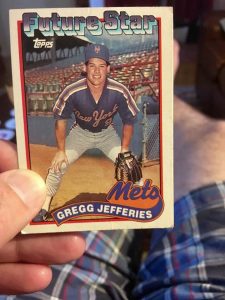 The latter were frankly more interesting than the graphically busy, statistically light 2017 Topps cards, so I separated them out and let myself stroll down memory lane with the likes of Jeff Blauser, Jim Clancy and Mike LaValliere. The latter were frankly more interesting than the graphically busy, statistically light 2017 Topps cards, so I separated them out and let myself stroll down memory lane with the likes of Jeff Blauser, Jim Clancy and Mike LaValliere.
And then I got to the card that made me go oof.
Gregg Jefferies‘ first full season was so hotly anticipated that Topps made his Future Stars card part of the box art. He was on the cover of every season-preview magazine and all but inducted into Cooperstown before Dwight Gooden and Joe Magrane squared off at Shea for Opening Day. Jefferies went 2-for-3 that day but also made an error; 1989 would see too much of the latter and not enough of the former, as well as friction with teammates and fans. Eventually the Mets decided a professional divorce was best for all involved; Jefferies went on to become a Royal, Cardinal, Phillie, Angel and Tiger, forging a career that was pretty good by most standards except the impossible ones that had preceded him. He was out of the game before his 33rd birthday.
“Life comes at you fast” is an old adage that’s been revived as a Twitter taunt. It’s true, of course — changes of fortune arrive in an eyeblink, rearranging everything. But it keeps being true even as the moment passes, with today’s controversy becoming ancient history before you quite realize what’s happened. So it was with Jefferies, who went from the front of the box to filler inside it in a couple of baseball generations.
I never used that ’89 Jefferies card in The Holy Books. The original reason was probably that it still stung too much. I’d been a huge Jefferies fan during his rocket ascent in late 1988, blew the budget on him in next year’s college fantasy league, and waited for a triumph that wasn’t to be. But that’s become a long time ago. Seeing a Jefferies rookie come back to me, I decided to keep it and slotted him in, between The Other Bob Gibson and Mark Carreon.
And you know what? He looks good there, waiting beneath his own personal marquee for a future he can’t know will never arrive.
by Greg Prince on 23 June 2017 6:51 am In case you didn’t stay up Thursday night, the Mets stayed down again in Los Angeles. They lost all four games they played there this week. They lost in such numbing fashion that when they appeared on the verge of losing in a fairly professional manner, it felt like victory. Then the professionalism seeped away in the seventh when, after Steven Matz had given them six fairly solid innings in service to a 3-3 tie, two of the better-reputationed members of the Mets bullpen turned the whole thing to mush.
Paul Sewald gave up the fifteenth Dodger home run of the series (a Brooklyn/L.A. record) on his first pitch, one whacked 433 feet to right by Joc Pederson, putting the home team ahead to stay. Logan Forsythe followed with a sharp single to center. Chris Taylor walked. Sewald in my mind had morphed into Dale Murray, the master of disaster from the 1979 Mets pen. I suppose Sewald could have been any dispenser of hits and walks you have blowing up an ERA in the recesses of your subconscious, but to me he was Murray. Maybe it was the oft-repeated cue that the Mets were on their way to being swept four by the Dodgers for the first time since 1979. Maybe it was that Dale Murray was terrible and so, at least on Thursday, was Paul Sewald.
With Justin Turner coming to bat, you braced for the worst. I did, I know, and I’d assume any Mets fan awake would. Turner’s slugging percentage against the Mets since joining the Dodgers is astronomical. Neil deGrasse Tyson is in awe of it. Somehow, Turner did not put the game away, as Sewald flied him to left instead of the moon. Exit Paul, enter Jerry. Jerry Blevins has been the Mets’ most consistent reliever all year. He was consistently used for two-and-a-half months. deployed practically every day. Lately he hasn’t been in evidence. Blevins is usually reserved for tight spots. The Mets had been loose in their losing all week until Thursday.
The assignment for Blevins was Cody Bellinger, the first baseman who isn’t on the All-Star ballot but should probably start, based on the numbers he’s generated all season against everybody, not just all week against the Mets. I was tempted to write in Bellinger when I decided to cast a token vote, but I don’t have nearly that much integrity to go out of my way to boost the electoral chances of somebody growing greater at my team’s expense. (I did, however, have enough integrity to resist clicking on behalf of almost every Met listed; I’m loyal, but I’m not undiscerning.) With anybody but Blevins in there, you’d assume it was about to be 7-3. I think Bellinger assumed it was about to be 7-3 — or should have been about to be 7-3 — when he made contact with Blevins’s second pitch, an offering that hung delectably in his happy zone. Bellinger just missed sending in into orbit and he knew it, spiking his bat in disgust that he let Blevins off the hook with a mere fly to right.
That meant two were still on, but two were out, and now all Jerry had to do was take care of Kiké Hernandez. Except Jerry walked Kiké to load the bases. Unfortunate, but probably no harm, no foul, because Dave Roberts opted to not pinch-hit for his next batter, reliever Pedro Baez. What’s the worst a reliever who’d batted one time previously in a four-year career could do against an accomplished veteran like Blevins?
From a Met perspective, standing and taking four pitches, every last one of them balls. Jerry Blevins walked Pedro Baez to force in the fifth Los Angeles run. Then Blevins walked the next batter, Austin Barnes, not a relief pitcher, to make it 6-3. It was the ninth walk Mets pitchers allowed, eight of them unintentional. For those who are fans of silver linings, a couple of strikes were involved in walk to Barnes.
Blevins gave way to Salas, who was tasked with facing aesthetic villain Yasiel Puig. I assumed the worst, but no, postmodern Fernandomania prevailed at Dodger Stadium, and the Mets stayed just close enough to allow you to hallucinate they could come back. I must’ve been getting very sleepy, because I thought I saw the Mets load the bases in the eighth for Michael Conforto. I know I was awake, however, because I definitely did see Conforto foul out on the very first pitch he saw. By then, Kenley Jansen was in the game, reminding me that when Terry Collins managed the NL All-Stars last summer, he eschewed the chance to use his own man, Jeurys Familia, in favor of Jansen, which meant the only National League team that didn’t have a player participate in the All-Star Game was the team whose manager was running the show.
Collins won’t be managing the All-Stars this July and under no fathomable circumstances will he be managing the All-Stars next July. What he’ll be doing by April of 2018, let alone early October of 2017, is a matter ripe for speculation. As this game ground on toward its inevitable 6-3 final, I thought back to another West Coast swing, from 1983. George Bamberger was the Mets’ manager when it began. He wasn’t when it ended. Bambi wanted out and resigned while in Los Angeles, explaining, “I probably suffered enough.” George quit when the Mets were 16-30. Since the last time Terry Collins had the chance to use Jeurys Familia in a game that counted, the Mets are 15-25. He gives no impression that he’d ever quit, but I wouldn’t rule out suffering getting the best of him.
“That’s one thing we have never done here in years,” Collins said after the Mets’ fourth consecutive loss to the same opponent, “We don’t walk guys and we don’t give up a lot of home runs. And right now, we’re doing both.” That’s as close to a cry for help as Terry will emit. The rest of us are letting out yawns. It’s not that we don’t care. It’s that we can only stay up for so much of this.
by Greg Prince on 22 June 2017 3:51 pm The phrase “hey you kids, get off my lawn,” when used to mock someone’s stodgier instincts, has always bugged me, and not just because of my edging toward the demographic with which stodginess is reflexively associated. My stance isn’t in defense of stodge. It’s the literal interpretation I can’t hack. If somebody has a lawn, why should that person have to allow it to be trampled on by interlopers of any age?
It’s a different story, I suppose, if you’re talking about your own kids. Your own kids are probably welcome on your lawn. Probably. Maybe you love your lawn enough that you have to make the call on a case-by-case basis.
Pete Flynn loved his lawn. Our lawn — but it was his to tend. He made it a field of dreams and, given that awesome responsibility, was entitled to insist it not be trampled into a nightmarish state.
Pete was with the Mets just about forever, from sometime in 1962 until the franchise had turned in a half-century of operation. The bulk of that tenure was spent as head groundskeeper at Shea Stadium, the heart of it in 1986, when those of us who’d only heard his name in passing during rain delays and such, heard from Pete Flynn directly.
His message: Get off my/our lawn.
This was the night of September 17, 1986, the night Mets fans had waited for since also just about forever. The Mets clinched the National League East that night. The title was a foregone conclusion all summer. The wait for the Mets to qualify again for anything beyond a high draft pick had been endless. Technically, it dated to 1973, but the years moved very slowly from 1974 forward. We just wanted to celebrate another day of clinching. It was nowhere in sight for an eternity. Then it was so close we could taste it. Finally, it was at hand.
The magic number was 1. The score was Mets 4 Cubs 2. The game was in the top of the ninth. There were two outs. Chico Walker grounded to Wally Backman. Backman flipped to Keith Hernandez. The Mets were champs. The Shea Stadium lawn represented, through informal institutional precedent, the spoils of victory. Mets fans piled on to it in 1969 with joyous abandon. Mets fans piled on again in 1973 with the abandon veering to the aggressive. Mets fans who remembered how it was done in the past went for it once more in 1986 — packing pent-up gusto and tubular tunnelvision. Here came the fans from Field Level. From Loge. From Mezzanine. From Upper Deck. From the outer reaches of the solar system from the looks of it. The Mets barely made it into the clubhouse. Some were scathed. The lawn was ravaged.
Pete Flynn was not happy. He let it be known that the fans who did this — not all almost-50,000 in the house, but more than enough to graze disastrously through the grass — did not deserve a winner. It was a harsh rebuke amid an evening of ebullience.
But he was right. The kids (and adults) should’ve stayed off his lawn. He and his crew were the ones who had to stay up all night to repair it, keeping at it the next morning, too, because the National League East champion Mets had another game to play against the Cubs early that afternoon. All of Pete’s sod and all of Pete’s men made it passable for another Mets win. The groundskeeper may not have thought we deserved a winner, but he made sure we had the chance to keep having one for the rest of that magical year, for the rest of September, for all of October.
The Mets became world champions on Pete Flynn’s lawn on October 27, 1986. The neighborhood kids were convinced to stay off it. The NYPD mounted patrol did the most obvious persuading, but I’d like to think Pete’s tone of disapproval resonated with its desired effect. Why would you want to get a good man like that mad at you?
For the rest of his groundskeeping career, until his passing on Wednesday at the age of 79, Pete Flynn was as famous as most Mets. He was the guy who shook his head and went to work after the first of three flags was won in that year to remember. The Mets wouldn’t again so easily win divisions, let alone pennants and World Series. Pete kept working, regardless. Pete was part of Shea. Pete was part of us. Pete enjoyed a well-deserved star turn for his long and meritorious service. He was featured in The Last Play at Shea, playing a supporting role alongside Paul McCartney. The two fellows from the UK shared a couple of car rides, the film noted. Pete drove the Beatles onto the field in 1965 and the Cutest among them onto the same field in 2008.
Pete came off as pretty adorable himself in that movie, but he was, in real life, a regular guy taking care of a significant lawn. I had the pleasure of a conversation with him once, well after 1986, well before 2008. A friend of a friend somehow got me to the cusp of the Shea field in advance of a DynaMets Dash so I could take part in something I never dreamed would be accessible to me. They didn’t have DynaMets dashes when I was a kid and I was never the kind to storm somebody else’s lawn, even in victory.
I can’t stress how far above the recommended age I was for the DynaMets Dash. I probably should have brought a note from my doctor. But there I was, in cahoots with another friend getting the same improbable opportunity, standing in that little staging area behind home plate, waiting for the Mets game to finish so my run of a lifetime could begin. That’s how it worked if someone was thoughtfully sneaking you ahead of the youngsters for your shot at rounding the bases.
I was there, my friend was there, our benefactor was there, members of the grounds crew were there and, yes, Pete Flynn was there. Introductions were made. Pete took a gander at my friend and me, oversized DynaMets Dashers to be that we were.
“Aren’t you two a little big for this?” Pete asked, gleam plainly visible in his smiling Irish eyes.
“No,” I replied with as much innocence as I could muster. “We’re just taking that stuff McGwire had in his locker.”
Pete Flynn laughed at something I said. That was about as good as getting to step foot on his lawn and run around his dirt. Before we could, though, we were explicitly told to be careful to not actually touch his grass. And you can bet we listened.
by Jason Fry on 22 June 2017 11:25 am One of the ads in regular Mets rotation right now is for rebranded cable company Spectrum, and features a pair of monsters under a little girl’s bed during the night. One monster is honked off about fees for some Spectrum competitor (I can’t remember which, because I don’t care) and complaining tendentiously and loudly about this state of affairs to his fellow boogeyman — loudly enough to wake up the child on the other side of the mattress.
It’s a funny concept, but it’s the little things that really make it work. Like the aggrieved monster getting so worked up that he can no longer articulate his roster of complaints, falling back on a helplessly frustrated, all-encompassing “it’s bad.” To which the other monster retorts: “you’re bad — at this!” They’re interrupted by the annoyed little girl, who tells them she can hear them, then throws her hands up when the complaining monster can’t let it go.
Last night those 30 seconds were vastly more entertaining than the three hours of dreadful, deeply boring baseball in which they were embedded. The Mets began the game with an uncharacteristic display of life as Curtis Granderson hit a leadoff homer, then had Rich Hill in their sights in the fourth inning, loading the bases with no one out for Jose Reyes.
You can probably guess what came next: Jose struck out. So did Gavin Cecchini. And so did Tyler Pill.The Mets had turned their golden opportunity into leaden reality. Womp-womp.
In the bottom of the inning a Logan Forsythe double gave the Dodgers the lead and a three-run homer from Yasiel Puig made the remaining innings academic, unless your tastes ran to watching Neil Ramirez do Neil Ramirez things. (If Neil were the boogeyman, the little girl from the ad would have doubled off the wall and gone back to sleep.)
Puig’s homer came with a side of stupid: he admired it and Cadillac’ed, Wilmer Flores took exception, Puig took exception to the exception, Travis d’Arnaud muttered something that was ignored, Puig had a between-innings colloquy with Reyes and Yoenis Cespedes and that was pretty much it until the postgame, when … you know what, I’ve wasted too much time on this one as it is. If you see a cloud that your inner Gossage needs to yell at, load up Google and knock yourself out.
Anyway, I was thinking about the monsters under the bed, the little girl on top of it, the Mets, us and who’s who.
My first thought was that the monsters are your recappers, trapped beneath the weight of a season gone awry and so besieged by terribleness that all we can do is sputter that “it’s bad.” But that doesn’t quite fit: we haven’t done anything wrong, except root for a team put on this Earth to suck the joy out of baseball.
Maybe the monsters are the Mets — because they certainly are bad at this, and going nowhere.
Yeah, that fits better. Which would mean the little girl is all of us, lying there witnessing failure when we should be sleeping. Like her, at this point all we can do is shrug and wait for morning.
by Greg Prince on 21 June 2017 12:49 pm The problem when your team has given up double-digit runs in ten different games in a season that is only seventy games old — and five times in a month that still has ten days to go — is keeping track of which of those losses is the worst. It’s tough, I suppose, to top (or bottom) the 23-5 farce at the hands of the Nationals from April 30, the one that featured three Anthony Rendon home runs, Kevin Plawecki’s pitching debut and Noah Syndergaard’s probable 2017 farewell. The lightning-quick burial of Tommy Milone by the Angels in a 12-5 romp on May 21 also springs to mind. Oh, and what about the Mother’s Day Massacre in Milwaukee, wherein a 7-1 midgame Mets lead dissolved into a 11-9 loss to the Brewers? Personally, I retain a sore spot for that flaming pile of baseball.
The Mets can pack plenty of pain into a defeat that doesn’t tilt the scoreboard quite so dramatically. There was 7-5 to the Braves on April 27, when Yoenis Cespedes strained a hamstring and Syndergaard turned down his employer’s gracious offer of an MRI. There was the afternoon of May 7, when Adam Wilk came and went at Matt Harvey’s inadvertent behest, leaving behind a 7-0 whitewashing by which to vaguely remember him. Way back when the Mets were a .500 ballclub, on May 10, you had the Mets carrying a 3-2 edge over the Giants into the ninth at home only to call it a day by losing, 6-5 — and then they lost the pitcher who lost the lead, Jeurys Familia, for the bulk of the year.
There was also a string of late and close losses to the Marlins in Miami that combined to tear out our then thick, luscious hair in the middle of April. And the wrong end of a three-game sweep in Arizona that ended with an eleventh-inning home run struck by a Diamondback (it doesn’t matter who anymore). And two consecutive nights playing down to and below the Padres. And the night Mr. Met’s finger pointed out how bad the Mets were. And the next afternoon when Mr. Met was proven correct yet again.
And so on.
You can see the problem. You’ve lived the problem. Your team, like mine, is 31-39, and you, like me, are moved to recall the exchange between manager and coach from Bull Durham (revised to reflect our bush league entry’s current statistical circumstances):
“What’s our record, Larry?”
“Thirty-one and thirty-nine.”
“Thirty-one…and thirty-nine. How’d we ever win thirty-one?”
“It’s a miracle.”
“It’s a miracle.”
As Met miracles go, this realization is as sad as it gets, which is to say as sad as Tuesday night’s 12-0 loss in Los Angeles, which, in the moment, I was convinced was the absolute worst Mets loss of 2017. Perhaps it was the onset of the summer solstice that helped convince me. With the start being late and the night being short, it was literally darkest before the dawn. The literal dawn, that is. Met-aphorically, there seems little danger the darkness will be lifting anytime soon.
Upon further review, I realize the competition is too complex to bestow such a weighty title as Worst Mets Loss of the Year so cavalierly. Maybe the relentless clobbering of Robert Gsellman & Co. at Dodger Stadium represents just another night at the ballpark. Maybe it embodied the new if depressing normal. After all, exactly a week before we lost, 14-3, and it barely registers within the realm of anything I’ve cited above. Yet as I was watching Dodger hit after Dodger hit; Dodger walk after Dodger walk; Dodger run after Dodger run; Dodger home run after Dodger home run; and Met after Met ceaselessly suck, I honestly couldn’t think of any 2017 Mets loss that was worse. Thus, I stand by my assertion.
Ninety-two games, however, remain scheduled. The committee to determine which Mets loss is worst this season shall remain open for nominations as necessary.
***
Much better news on the Mets front emerged Tuesday if you include news about Mets fans, and, as Mets fans, why wouldn’t we? Our dear friend Kevin Chapman went into the Hospital for Special Surgery and, contrary to popular belief where anything Metsian about that facility is concerned, he came out in one piece. With his shoulder socket expertly repaired (and his morale thoroughly supported by his loving wife Sharon), we look forward to his complete recovery and to seeing him — should the Mets miraculously cooperate — raise two good arms in victory real soon.
|
|






