The blog for Mets fans
who like to read
ABOUT US

Faith and Fear in Flushing made its debut on Feb. 16, 2005, the brainchild of two longtime friends and lifelong Met fans.
Greg Prince discovered the Mets when he was 6, during the magical summer of 1969. He is a Long Island-based writer, editor and communications consultant. Contact him here.
Jason Fry is a Brooklyn writer whose first memories include his mom leaping up and down cheering for Rusty Staub. Check out his other writing here.
Got something to say? Leave a comment, or email us at faithandfear@gmail.com. (Sorry, but we have no interest in ads, sponsored content or guest posts.)
Need our RSS feed? It's here.
Visit our Facebook page, or drop by the personal pages for Greg and Jason.
Or follow us on Twitter: Here's Greg, and here's Jason.
|
by Greg Prince on 20 June 2017 1:52 pm Zack Wheeler, 27; first major league appearance, June 18, 2013
His Monday night numbers of note: 2 IP, 7 ER, 8 H
What it means at this stage of his career: Nothing good, though “this stage of his career” doesn’t sync with the arithmetic that his major league debut was just over four years ago. We know Wheeler missed what should have been his third and fourth seasons and is only in his third season now. Perhaps a batting practice line or two was to be expected in his comeback campaign. He’s had two in a row after pitching for several starts like there’d never been anything wrong with him except a propensity to run up pitch counts. The saying that you have to get to some pitchers early if you want to get them at all seems to apply to Wheeler, but not for the usual complimentary reasons, for there has been no later for Zack of late. This might be an optimal time to pause him, except the Mets don’t have an optimal time in their rotation. Let’s hope Zack’s OK and that the Dodgers were simply hotter than hot when his pitches ran into their bats.
Rafael Montero, 26; first major league appearance, May 14, 2014
His Monday night numbers of note: 3.2 IP, 1 ER, 3 H, 2 BB, 5 SO
What it means at this stage of his career: Ah, who the hell knows? Rafael pitched a second consecutive competent long-relief stint inside of a week in his…I’m gonna say eighty-fourth trial with the Mets. His timing was keen in the short term, keeping the Mets sort of viable, and terrible in the slightly longer term, likely eliminating himself from a chance to start on Wednesday night. I’d say his back-to-back solid outings are encouraging, but I’ve probably said stuff like that before and I’m not prone to believe it based on the myriad mushy outings Montero has turned in during his other eighty-three trials. But he did earn the Bigelow Tease award for his role in getting our hopes up ever so marginally. We were down 7-0 and even the sleepy among us wouldn’t so quickly submit to the demands of our eyelids because we weren’t down more. (God, we’re dullards that way.)
Jose Reyes, 34; first major league appearance, June 11, 2003
His Monday night numbers of note: 2 HR, 3 RBI
What it means at this stage of his career: Some life remains detectable in the Mets’ temporary starting shortstop, previously the Mets’ default starting third baseman, theoretically the superutilityman of Spring Training chatter. Jose’s .198 average doesn’t speak very loudly, and I certainly expected to hear it say nothing versus Clayton Kershaw. Once it was 7-0, L.A., I expected a serious flirtation with a perfect game. The Dodger Stadium mound…the comps to Sandy Koufax…the Mets being the Mets…yet Jose broke it up to lead off the third by homering, and he pushed the Mets into nipping at the ace’s impenetrable advantage when he homered again in the seventh to close the gap to 8-6. Not that it did the Mets any good in the end, an end that would be spelled 10-6, Dodgers, but with Asdrubal Cabrera several days away and Amed Rosario’s ETA TBD, I was happy to see Reyes add to the numbers he’s been compiling since 2003, save for a gap between 2012 and 2015. He passed Keith Hernandez for sole possession of ninth place on the Mets career RBI chart (471) and he edged to within four of Ed Kranepool for second place on the Mets career hit list (1,414). I don’t know how much Mets baseball Jose has left, but I’d like him to do as much as he can with however much he can get his bat on.
Jay Bruce, 30; first major league appearance, May 27, 2008
His Monday night numbers of note: 1 HR, 1 RBI
What it means at this stage of his career: We as a people entered 2017 dismissing Jay as superfluous, yet who’s the only Met who has been power-hitting on their behalf regularly since this season started? Bruce has 19 home runs, five more than any other Met and 48 runs batted in, ten ahead of his nearest teammate. Tell me home runs are flying everywhere these days and school me about how RBIs don’t indicate as much as we grew up assuming they did, but home runs and runs batted in sure are helpful in the course of a game. Bruce, like Reyes, seems to have a talent for eliciting gophers out of Kershaw (as a Red he’d taken Clayton deep twice). That alone is impressive. So is his 131 OPS+, second on the team to Michael Conforto. For all the squeezing in of outfielders it was thought Terry Collins was going to have to do, Jay hasn’t surrendered right field nor a spot in the batting order.
Perhaps we shouldn’t be surprised. He’s been hitting balls out of ballparks since Shea Stadium stood. Our first exposure to him was directly following the 2008 All-Star Game. The Mets were in Cincinnati for a four-game set. Billy Joel was in Flushing, presenting The Last Play at Shea. On the night Paul McCartney jetted in to musically close the old place down at Billy’s behest, Bruce was letting it be against John Maine, hitting the seventh home run of his rookie season in his second game ever versus the Mets. The visiting New Yorkers lost, 5-2, snapping their contention-reviving ten-game winning streak and dropping them one game behind the fearsome Phillies for first place. A couple of handfuls of players from that box score of July 18, 2008, still roam the MLB earth or at least sit tight on its disabled lists: Reyes, Carlos Beltran, David Wright, Joe Smith, Brandon Phillips, Joey Votto, Edwin Encarnacion, Bronson Arroyo. Ken Griffey, Jr., is in the Hall of Fame. Carlos Delgado fell off the Hall ballot after one vote. We haven’t heard much lately from the likes of Maine, Fernando Tatis, Damion Easley or Met reserve turned Red shortstop Jeff Keppinger. Jay we know has walloped 253 more home runs since Billy and Paul said good night. If we do math, we know he’s on pace to pass Beltran and Todd Hundley for the Mets’ single-season home run mark of 41. “On pace” is tricky calculation — fairly easy to discern, not necessarily simple to maintain. Ten-year veteran Jay Bruce maintains a starting job based on consistent production. The Mets are in fourth with him, might be much closer to the no longer fearsome Phillies in fifth without him. Bruce is probably gone before 2018 comes around. Until further notice, let him be, let him be.
Gavin Cecchini, 23; first major league appearance, September 11, 2016
His Monday night numbers of note: 1 HR, 2 RBI
What it means at this stage of his career: Cecchini has started one game in the big leagues, and in it he homered off Clayton Bleeping Kershaw. That would be enough of a career for most of us. Cecchini probably would like more. He probably also projected more games and more starts by now when the Mets made him their first draft choice of 2013. He was eager and ready to go, I can say from personal observation, having been at the kid’s introductory press conference four years ago. The Mets were giddy with All-Star Game preparation fever and invited some bloggers into their lair (something they got out of the habit of doing by 2015). We met Cecchini and Kevin Plawecki, also chosen in that year’s first round. They seemed like fine young men, except for Cecchini revealing he liked wearing No. 2 out of appreciation for a certain shortstop who played in a nearby borough. Even Sandy Alderson groaned at that revelation.
The Mets sought attention for another youngster that night, 2011 first pick Brandon Nimmo. With enough online votes, Nimmo could join the Futures game that would be played ahead of the Midsummer Classic that Matt Harvey was a near-lock to start. They put Brandon on a conference call with us and he sounded like a young (younger) David Wright. Nimmo made that game — along with Montero and Noah Syndergaard — but not the majors until 2016. Nimmo had a pinch-hit last night, his first hit of this year. He had one homer all of last year. Plawecki’s been up and down across three years. Dom Smith was the club’s No. 1 pick in 2012 and he’s generally the second name we mention when we mention Met prospects most of us have barely seen. It’s 2017. These things can take a while and they carry no guarantees. Cecchini was a shortstop when he was drafted, was a second baseman in Terry’s lineup Monday night, will be something for somebody eventually, you’d figure. The Mets’ infield, despite its chronic aches, seems crowded. We’ll see if there’s space available for this still fine young man for whom I constructed the private nickname Gavin MacClout once he slaughtered a pitch from Kershaw. A guy who can say he homered off Clayton Kershaw practically the first chance he got shouldn’t have to ask too loudly for another opportunity.
by Greg Prince on 19 June 2017 11:13 am A pitcher homering is baseball porn, pure and simple. A pitcher pitching eight innings and giving up no earned runs is more exotic than it used to be, maybe more exotic than it oughta be. Which would you rather have?
You’d rather have both if you can, and we could on Sunday afternoon at Citi Field. Sunday afternoons at Citi Field this season have generally encompassed Mets starting pitchers barely lasting past The Star-Spangled Banner and the vast majority of taters being mashed by visiting chefs. On Father’s Day 2017, however, Jacob deGrom was big daddy to us all in every way, putting up all those zeroes from the mound and sending one baseball over the left field fence from the plate.
I was so excited when deGrom’s 379-foot fly ball off Joe Ross launched at an angle of 32 degrees and exited at a velocity of 95.1 miles per hour (someday those metrics will mean something to us) that I might have missed Commissioner Rob Manfred’s unilateral edict that the designated hitter was instantaneously abolished. The moment Jacob gave those fans in the M&M seats the sweetest of treats was the moment to act. “The DH?” Manfred could have elaborated. “Eff that noise! Did ya see deGrom go deep? Did ya see and hear the reaction? Pitchers hitting homers…effin’ A!”
Imagine the Mets had used a DH yesterday. Admittedly, it’s a Man in the High Castle type of premise designed to chill your spine, but play along. Yoenis Cespedes didn’t start on Sunday, so let’s say Cespy was the DH and he homered in the third inning as deGrom did to tie the score versus the Nationals at one. That would have been fine. That would have been dandy. But unless Yoenis’s theoretical home run whacked the gigantic floating M&M piñata squarely on the nose to release candy that melts in your mouth and not in your hands to children of all ages throughout the ballpark (which, by the way, is definitely something Citi Field should install), it would be one more early home run in one more 5-1 Mets win over Washington in Flushing. Granted, Met wins of any size over Washington anywhere seem the rarest of candy-coated goodies, but a home run by a guy who is designated to hit, on balance, is a relatively routine affair. It’s also an affront to all that is true and decent about baseball, but that’s another matter altogether.
DeGrom was razor-sharp in the less glamorous facet of his Sunday assignment: three hits and two walks over eight innings, the only run at his expense facilitated by shaky Met defense. His performance was praiseworthy and, after the Mets had lost three in a row to their ostensible archrivals, noteworthy, but it’s what an ace does. Or should do and, in Jake’s case, is doing again. If Cespedes was the designated pitcher and put up a line like that, it would be gargantuan. For deGrom, the emperor of afternoon baseball (1.71 ERA in 32 such career starts), it was another day in the sun: warm and welcome, but nothing you hadn’t seen before.
A home run from Jacob deGrom is something you hadn’t seen before. A home run from a Mets pitcher is something you see rarely. Jake’s was the 55th in 55½ years of Mets history, which makes it less of an infrequent happening than some other unicornish offensive occurrences. There have been roughly half as many Met inside-the-park home runs (27 — none by a pitcher), not quite a quarter as many Met three-homer games (13 — none by a pitcher), less than a fifth as many Met cycles (10 — none by a pitcher) and about one-eighth as many pinch-hits by pitchers (7 — all by pitchers). Met pitchers hit home runs 150% more often than Met lineups give birth to Unicorn Scores (though pitchers have surely lent a hand in delivering those 22 blessed events). Perhaps a feat accomplished on average annually shouldn’t seem so absolutely extraordinary, but have you ever not reacted wildly to a pitcher homering? The unlikely slugger doesn’t have to be Bartolo Colon for the home run to enchant you. When deGrom’s dinger cleared the 370 mark in left, I found myself applauding loudly enough at the TV upstairs that it attracted my wife’s interest from downstairs. She came up, poked her head in to where I was watching and let me know she saw it, too, affirming what a special bolt it was. Very few third-inning swings grab Stephanie’s attention. A pitcher homering grabs everybody’s attention.
The same pitcher cruising to a win from pitching almost an entire game is also good. A starter going that kind of deep carried us eight-ninths of the way to a much-needed victory. It just doesn’t carry us away like a pitcher going the other kind of deep. Every now and then in the course of a long season, our systems crave a lift like that. The rush eventually wears off, but it’s definitely healthier for us than M&Ms.
Thanks to Lori Rubinson of WFAN for having me on her show to discuss my book Piazza: Catcher, Slugger, Icon, Star on Sunday night. You can listen to about two-thirds of our conversation here. The other third must have been crushed by deGrom: pitcher, slugger, etcetera, etcetera.
by Greg Prince on 17 June 2017 9:18 pm I thought the Nationals would score at least nine runs on Saturday, probably more. They started with a single run in each of the first four innings, 44.44% of the way to what is known as a picket fence. The Mets couldn’t put up 97%-invisible netting fast enough to veil it.
Somehow, the Mets halted the Nationals’ forward progress on the fifth-yard line, for a while anyway. Eventually, Stephen Strasburg revealed himself as not quite as untouchable as his predecessors in the Washington rotation. Yoenis Cespedes (4-for-5 and a homer) swung the bat real well and ran unencumbered. Jay Bruce did some fine hitting, Jose Reyes showed some offensive life, Travis d’Arnaud delivered a pinch-single that kind of mattered. Up and down the order, the Mets worked some impressive at-bats, regardless of results.
Oh, don’t get me wrong. The Mets lost and did loads wrong to lose. But falling 7-4 instead of the approximately 12-2 I was anticipating, while not providing any cause for optimism in a standings sense, made the game a darn sight more watchable than I figured it would be. Seth Lugo hung in after burying his team. Jerry Blevins got one critical out. A couple of balls that I was sure were going to fly out of Citi Field as Nationals homers went foul. There was a scintilla of a chance of a comeback in the ninth.
It didn’t happen. And it augurs little to nothing for Sunday. But I didn’t feel like a total chump staying tuned to the end. So there’s that.
As for those special Father’s Day weekend uniforms, they achieved their goal of raising awareness, if, in fact, they are intended to raise awareness for bad taste.
by Greg Prince on 17 June 2017 6:40 am I heard myself stick up for Kenny Rogers and Timo Perez the other night. Yeah, they left their fingerprints all over two of the most notorious moments in Mets postseason history, but, I said, the Mets wouldn’t have gotten as far as they did without them.
Being so generous of spirit, you’d figure I’d apply the same retroactive mercy rule to someone who was a Met a lot longer, did a lot more as a Met, and was, in his checkered postseason time, the epitome of wouldn’t have gotten as far as we did without him.
Yet I don’t. It’s not conscious. I just haven’t effectively compartmentalized on his behalf. All the good stuff he did is apparently crammed into a mental storage locker somewhere off the highway. The one particularly gruesome thing in his past is present whenever he is.
I see Daniel Murphy, I see that error from Game Four of the 2015 World Series. I also see a Washington National who clubs the crap out of the 2017 Mets, but there are too many of those to keep track of. Murphy’s just doing his job, which, to judge by the curly W on his work clothes, is either hitting a ton at the expense of Met pitching or directing customers in the lengthy checkout line to the register at cosmetics that just opened. In the business sense, Murphy’s simply another Harper, Zimmerman, Rendon, Wieters or, to use the most trenchant example, Max Scherzer. Scherzer beat the Mets’ brains in on Friday night, dominating them for eight innings en route to a most convincing 7-2 victory. Unlike his teammates, Scherzer did his damage without a bat. The Mets did no damage. They also needn’t have bothered with bats.
As a rule, Murphy could leave his glove at home and nobody would notice the difference. On October 31, 2015, Daniel’s glove avoided contact with a ground ball that scooted directly underneath it. The acute case of grasplessness converted a tenuous lead into a demoralizing tie, nudging open the door for the loss that pushed the World Series three-quarters of the way into Kansas City’s annoyingly aggressive arms. The Mets had been up 3-2 in the eighth and down 2-1 in the series. Eric Hosmer grounded to Murphy with two on and one out. Next thing you knew: E-4 and 3-3. Next thing after that: 5-3; 3-1; doom harbingered.
Sitting in Promenade almost directly behind home plate, I had an excellent view of the miserable play, at least until all those EMTs came up to administer oxygen after all the air was sucked out of our section. Maybe that onsite sightline contributed to the indelibility of the debacle. It was such a definitive turning point, too. Hold that 3-2 lead and the Mets compress the Series down to a best-of-three. Give it up, as they did, then the margin for error disappears. And if there was anything we learned about Daniel Murphy between 2008 and 2015, it was if you gave him margin, he’d give you error.
That’s what I remember about him as a Met. His glove, or lack thereof, in a crucial moment.
Here’s what I don’t remember without a nudge: Daniel Murphy slugged us into that World Series. He slugged us into the National League Championship Series. Stole us there, too. For two rounds, he was the most brilliant hitter the Mets ever had in any October. He homered off practically everybody who ever won a Cy Young. He outwitted the Dodgers. He dismantled the Cubs. The M in MVP surely stood for Murphy.
It’s not like I’ve forgotten that. It’s just that I forget it when I see him. When I see him, I see someone who’s hit .393 against the Mets across 2016 and 2017…and someone who fielded .000 for the Mets at the most critical crossroads of their extended 2015. If I think hard, I remember a likable chap who was never a natural at any position but filled in everywhere as asked and generally hit well for years, if not like he does today.
I don’t think of the nightly autumnal home run barrage that powered the Mets to a pennant. I know it happened, I know I reveled in it, I just don’t think about it. Maybe it’s because my view of those clouts wasn’t as clear as it was for that miscue. Maybe it’s because losing stings more than winning satisfies. Maybe it’s because there’s no emotional upside in assigning pleasant memories to current Nationals.
I somehow remember the 1999 Mets won all of Kenny Rogers’s home starts (seven) prior to his revealing a disconcerting allergy to the strike zone away from Shea. I somehow remember all the runs Timo Perez scored in the 2000 NLCS (eight) before he developed an affinity for presumptuous trotting. I know they committed sins that ultimately and decisively outweighed their good deeds, but I can easily access the good deeds. I’m intensely granular when it comes to what individual Mets have done, for better or for worse.
Daniel Murphy did far more for the Mets in the fall of 2015 than he did to them, but that memory tends to elude me, kind of like a ground ball once eluded a second baseman’s glove at the worst possible instant.
If you like a good Piazza-oriented podcast — and who doesn’t? — I have two for you: me and Pete McCarthy from WOR here; me and Jay Goldberg from the Bergino Baseball Clubhouse here. My thanks to each of them for having me over to their respective venues.
by Greg Prince on 16 June 2017 1:32 am Thursday night found me at Bergino Baseball Clubhouse in Manhattan for my talk on Piazza: Catcher, Slugger, Icon, Star. It was a wonderful — or 31derful — time, and I thank proprietor and all-around ace human being Jay Goldberg for inviting and hosting me. I also appreciate all who showed up to listen in and add their two cents on the Mets of Mike and related topics. I hope some day or night soon finds you at Bergino, especially if you’ve never been. It’s as baseball a place as there is without an actual baseball game going on around you.
Actually, just before we got started on our program, there was a baseball game going on nearby, as Jay had the Mets on the Clubhouse TV just long enough for me to witness a few token pitches, thus allowing me to continue my nearly seven-year streak of witnessing at least a little of every game the Mets play. Then Jay clicked off the television and we traveled back to the Age of Piazza, with a detour to the Age of Seaver and some stops in between. Eventually, the TV came back on. I only glanced at the action while engrossed in a series of scintillating conversations and never really focused on any of it, but did manage to absorb a handful of images.
1) Robert Gsellman giving up runs. So he’s doing that again, huh?
2) Terry Collins and Ray Ramirez visiting Juan Lagares, and not at his beach house, but in center field, leading me to correctly assume the worst.
3) Gavin Cecchini striking out. Nice to have him back, I guess.
4) René Rivera homering. René has grabbed the bull by the horns when presented with playing time. Travis d’Arnaud is apparently allergic to bull’s horns.
When I left Bergino, we were losing, 8-2. On my way I home, I learned we lost, 8-3. Lagares, who’s been playing some of the best ball of his big league career, will be out a while with a thumb that deserves a figurative rather than literal break, but why should Juan be any different from Neil Walker, Matt Harvey, Josh Smoker…I was going to list all the Met disabled, but I don’t know if my computer can handle the stress.
Sandy Alderson issued an injury report pre-Lagares. Basically, everybody you figured was hurt is hurt; nobody is really getting any better; and quit asking about Amed Rosario, he’ll be brought up when he’s good and ready. Clarification: when Alderson is good and ready to bring him up. I’m mostly on the patience train where Rosario is concerned — it’s not like the organization’s plan is to have him top out at Vegas — but I’m beginning to believe we’re edging into “what’s the harm?” territory. Should Amed come up and bat under .200 and play less than airtight defense, then he’s already as good as the current shortstop. Highly touted rookies get chances. Sometimes they make the most of them. Sometimes they don’t immediately, they return to the minors for a spell, and they don’t necessarily suffer irreparable psychic damage. I’m willing to trust Alderson knows a little more about Rosario than I do, but my trust is growing fragile enough that it will have to sit out a few days and, if it doesn’t look any better by then, it’s gonna need an MRI.
The Mets missed an opportunity to pick up ground on the first-place club, which is too bad, since the first-place club was on the same field as them and it would be nice to keep them in the same universe. It might be an illusion to juxtapose these two entities as being in direct competition with one another for the same division title, but it’s the middle of June. Illusions should be allowed to bloom clear to July, if not longer.
You know about Piazza. You should know about Yells For Ourselves by Matthew Callan. It’s the 1999 and 2000 Mets framed in a unique style and context. Marvelously conceived, brilliantly executed, incredible fun. Get in on the ground floor of the Mets teams that circled the penthouse instead of the drain. Check out YFO here.
by Greg Prince on 15 June 2017 11:04 am Gladys Knight wasn’t wrong when she concluded, over radios everywhere as 1973 became 1974, that she really had to use her imagination to keep on keepin’ on. Yet her compadres the Pips couldn’t have been more right when they offered her this message of positive reinforcement:
You’re too strong not to keep on keepin’ on.
If you’ve been watching these Mets since April and you haven’t given up hope, you’ve probably really had to use your imagination. The statistics, the setbacks, the pervasive sense that anything that could go Mets would go Mets…staring down reality wouldn’t do you no good, double-negative notwithstanding. Per the lyrics Gerry Goffin penned with songwriting partner Barry Goldberg, darkness was all around us, blockin’ out the sun; emptiness had found us and it just wouldn’t let us go; and we had no choice but to make the best of (best of, best of) a bad situation.
On Wednesday night, the Mets faced several bad situations. Matt Harvey gave up home runs to the first two batters he encountered. His velocity on hiatus, he made due with offspeed stuff for four innings. One of his pitches, to Kyle Schwarber, crossed Shea Bridge when it came to it. The 467-foot shot seemed a death blow to the Mets’ slight chances in this particular rematch of 2015 NLCS combatants. The score was 4-1, Harvey couldn’t throw hard, and he wouldn’t stick around. Soon, Matt would join as out of action for the evening Neil Walker, the second baseman who attempted to bunt his way on in the third inning only to do something unspecified but obviously horrible to his left leg between home and first. An MRI awaited Neil and, if appearances weren’t deceiving, a trip to the DL, too, where he projects to keep company with his double play partner and t-shirt buddy Asdrubal Cabrera and Josh Smoker. Smoker was deployed for four innings during the previous night’s blowout, looked absolutely gassed at the end of his yeoman stint, and revealed in its wake a strained left shoulder.
Smoker was replaced on the roster by Rafael Montero, the pitcher who’ll never be mistaken for a Hallmark card, a Hallmark card billed as being what you send when you care to send the very best. Montero lands in our mailbox again and again postage due from Las Vegas. You toss him on the pile next to Neil Ramirez and wonder why you keep receiving so much junk. Meanwhile, nominally active were Yoenis Cespedes, except he is bubble-wrapped for his own protection every third night, and Michael Conforto, whose stiff back couldn’t possibly be a concern despite it preventing the Mets’ #WriteInConforto campaign from gathering much momentum. Michael, ostensibly the Mets’ best player if you take your cue from the club’s wishful All-Star hyping, didn’t start any of the three games against the defending world champions. As candidates who forget to visit Wisconsin might remind you, that’s no way to win an election.
The defending world champions aren’t accomplishing much amidst their breathlessly anticipated incumbency. The power — Anthony Rizzo and Ian Happ in the first, Schwarber in the Bullpen Plaza — was certainly on for the Cubs versus the Diminished Knight, but the part where they put their gloves on and attempted to catch baseballs vexed the heck out of them. Their visible discomfort with fundamentals was the Mets’ lone saving grace for a while. In the second, Kris Bryant fumbled a third out and allowed the Mets’ first run. Still, with Harvey unable to find the fifth one night after Zack Wheeler didn’t see the third; the Mets’ bench depleted to its splinters; and Schwarber presumably preparing to break ground on a condominium complex where the 126th Street chop shops used to stand, you’d have thought Chicago could get away with a few yips.
Chicago would get away with nothing, because the Mets…yes, these Mets…they’re too strong not to keep on keepin’ on.
The first sign that this wouldn’t be the night New York died was when the Mets loaded the bases in the bottom of the fourth en route to the floor of their order. Harvey was due up with one out, but Harvey was done. Terry Collins could have pinch-hit Cespedes here, except Cespedes’s rigorously timed leg-preparation routine didn’t sync with the sudden arrival of the critical juncture at hand. He could have pinch-hit Conforto here if the prospective People’s Choice had a back that would allow Michael to be ever so briefly written into the nine-hole. #NoDiceNotYet. With Walker already removed and Lucas Duda having entered the fray in his stead — T.J. Rivera shifting from first to second to take over defensively for Neil — René Rivera, the backup catcher, was left as Collins’s only conventionally conceivable pinch-hitting option. Yet Terry couldn’t conceive of using René here, and with decent reason. As Casey Stengel cannily suggested, if you don’t have a backup catcher, you’re reduced to praying a meteor doesn’t hobble Hobie Landrith (something like that; you could look it up).
So Terry opted for Steven Matz, pitcher, to pinch-hit in the fourth inning. The oddity was unorthodox enough to likely make Joe Maddon contemplate sending one of his catchers into pitch, but Collins wasn’t seeking genius credentials in this spot. No Mets pitcher had ever successfully pinch-hit any earlier than the seventh inning. Not too many Mets pitchers pinch-hit in general. When they do, the situation borders on desperate. Who has desperate situations in the fourth inning?
This team. Also, this team has a pitcher who has now successfully pinch-hit in the fourth inning. Matz generated a ground ball tailor-made to confound Cub fielding and then ran his Long Island ass off until he and it reached first base safely. Steven’s unlikely PH line in the box score thus encompassed an RBI, and the Mets were within two runs of the lead. Then they were within one when Juan Lagares — pretty good player you sort of forgot existed for a couple of years — lifted a sac fly.
This team. Too strong not to keep on keepin’ on. Seriously. Here came Paul Sewald, back to being a savior in relief, giving the Mets a scoreless fifth and sixth. Here came that Juan again, tripling in Curtis Granderson to knot the night at four in the bottom of the sixth. Here came Jerry Blevins, taking over for Fernando Salas with one on and two out in the seventh, striking out Rizzo. Here stayed ostensible lefty specialist Blevins for a mind-boggling frame-and-a-third, fooling Bryant the righty for the eighth inning’s second out and freezing righty pinch-hitter Willson Contreras for its third.
A ballgame tilting inexorably toward the Cubs and decidedly away from the Mets as recently as the top of the fourth hung in the balance as the bottom of the eighth commenced. When Granderson stepped to the plate to lead it off, he had 299 big league longballs to his credit. When he next saw the plate, he was stepping on it. Grandy took Carl Edwards, Jr., on a trip deep down the right field line and collected a milestone along the way, home run No. 300. It didn’t fly nearly as far as Schwarber’s, but it couldn’t have been any more effective in influencing the course of Wednesday events. The Mets — post-Walker, post-Harvey, post ipso facto undermanned and overwhelmed — were ahead, 5-4. The Mets portion of the Citi Field audience, ascendant at last, applauded enough to recalibrate Granderson’s steady businesslike demeanor from sportsmanlike to crowdpleasing. He took the quickest of Curtis Calls. It was Grandly deserved.
Keepin’ on begat more keepin’ on. Jose Reyes walked. Cespedes was carefully unwrapped for a pinch-single. Robert Gsellman pinch-ran for Yoenis in a sentence you didn’t expect to read as long as you lived. Edwards left. Hector Rondon entered. Reyes swiped third, nearing his own milestone with 498 bases stolen since June 15, 2003, fourteen years ago today. Gsellman resisted the temptation to add an SB notation to his fine print on the back end of Jose’s daring dash. But Robert would have the chance to trot in short order, for Duda took care of a three-run insurance premium payment, depositing it convincingly in the vicinity of where Grandy had recently dropped off his homer. The Mets led, 8-4, and chose to increase their coverage a little more. The Cubs may not have been the good hands people on Wednesday, yet the Mets wisely insured against a catastrophic slam by adding a fifth eighth-inning run on singles from Wilmer Flores, Jay Bruce and Rivera…T.J., that is. René remained in reserve. You can’t be too careful these days.
All that was left at 9-4 in the ninth was for Addison Reed, who’d been warming up when it was 4-4 in the eighth, to come in and throw more pitches than one would care for him to throw, nineteen in all. The Cubs loaded the bases, but unloaded none of them. The Mets won by five after trailing by three and refusing to wallow in the least. Normally, you’d term it the greatest of nights.
The Mets, you may have divined, aren’t normal. Sometimes the glass is half-full. Often the glass is chipped and a pitcher gashes an index finger picking it up to innocently take a sip and, next thing you know, Rafael Montero is booking his favorite seat on JetBlue. Sure, the Mets thrillingly won a game you wouldn’t have suspected they weren’t slated to lose. Just as sure: they’re still 8½ to the rear of the Nationals (and further behind the Wild Card bunch out west), and no, we don’t know how bad Walker’s leg is, nor can we be certain when we’ll see Conforto starting or Cespedes regularly. Oh, and Harvey — how did he diagnose his outing? “My arm was not working at all,” Matt cheerlessly reported afterwards. A doctor’s visit was scheduled. The next sound you heard was Montero creeping inevitably up the rotation depth chart.
You’ve really got to use your imagination to envision the 30-34 Mets rising to legitimate contention, yet they were the 25-33 Mets less than a week ago. The Washingtons, assumed by consensus to be as impregnable as the Chicagos, are coming to Flushing with a battered bullpen, a bruised psyche and a margin over the Mets that is 3½ games slimmer than it was last Friday. The Nats have lost five of six, the Mets have won five of six, and maybe you don’t have to press all that hard to think of good reasons to keep on keepin’ on.
Hope to see you at Bergino Baseball Clubhouse in Manhattan tonight at 7 to commemorate the 15th anniversary of Mike Piazza’s June 15, 2002, home run off Roger Clemens, some other Met anniversary involving some other Met Hall of Famer, and a little book-signing besides. If you can’t be there, please tell the Mets to resist the temptation to fall behind in the first couple of innings. I’d like to catch them from ahead for a change.
by Greg Prince on 14 June 2017 12:49 am We’ve not yet reached the longest day of the year, but Zack Wheeler was off the mound and in the clubhouse before literal darkness descended over Citi Field Tuesday night, so either it’s staying light later or the pitchers are growing short.
Or both.
Wheeler’s reign as undisputed Mets ace lasted one turn of the improved rotation, as he was shelled, shellacked, schlemieled, schlimazeled, what have you by the defending world champion Chicago Cubs in a stint that was both disturbingly brief (1.2 IP) and dragged on interminably (62 pitches). It was a Zack kind of an evening, except for the lack of nightfall and the part where Wheeler guts it out admirably for five to seven innings.
Joe Maddon shuffled the Cubs’ lineup and his alchemy produced its desired effect. First baseman Anthony Rizzo batted first and hit a leadoff homer. Second baseman Ian Happ, born the day the 1994 baseball strike began, batted second and belted a second-inning grand slam to raise Chicago’s lead to 6-1. The Mets’ aspirations toward a fifth consecutive victory pretty much walked off the job right there. Pitchers named Josh and Neil and another Josh were asked to soak up inning after inning after Zack was removed. Cub batters continued to spawn more runs. Jon Lester notched his 150th career win. He could’ve nailed down his 151st and 152nd if they’d let him.
Yoenis Cespedes left the game as a precaution against everything that could go wrong going wrong. Asdrubal Cabrera’s left thumb returned to the disabled list, taking the rest of Asdrubal with it. Michael Conforto’s back stayed stiff and was again kept out of harm’s way. Nobody else seemed to get hurt, though with this team you never can tell.
The final was 14-3, the lone Met bright spot being the re-emergence of the Topps card crate Gary, Keith and Ron dig out of their broadcast lair to make these recurring thrashings go down smoother. The Mets have never come back to win a game in which the announcers pluck cards at random and riff accordingly, yet once Topps time rolls around, my sole rooting interest is for lengthy plate appearances and baserunners galore, no matter who’s up. Fewer outs equals more cards, more cards equals more riffing.
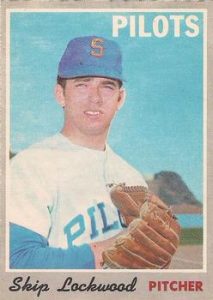 Skip and I hung out a lot when I was seven. My favorite find in this particular blowout treasure trawl was Keith’s 1970 Skip Lockwood, pictured then with the Seattle Pilots who were already the Milwaukee Brewers by the time the unassuming righty from the transferred franchise infiltrated my consciousness. By the end of the ’70s, Skip Lockwood would be the Mets’ closer and I would maintain a vested interest in securing his cardboard image. At decade’s dawn, when I was seven and first buying packs, I was inundated with 1970 Skip Lockwoods. Didn’t want ’em; got ’em anyway. When I wasn’t getting a Skip Lockwood, I was getting a Skip Guinn, yet it never crossed my mind to skip a chance to accumulate more cards, just as I never dreamed of skipping out on Tuesday’s night’s debacle. By the third inning, at which point it was Cubs 9 Mets 1, I was honestly thinking, “Oh boy, maybe they’ll do the cards tonight!” I was like a kid in a candy store, or, more precisely, “the candy store,” which is what we called Belle’s Luncheonette, the place where I committed dimes to packs, straining futilely to discern which ones might contain within them the stars who were destined to never appear.
I’d go through all those packs in hope of a Seaver or a Mays. I learned to accept the Lockwoods and the Guinns. I sat through a double-digit pasting forty-seven seasons later and I considered myself rewarded when Skip Lockwood appeared. And to think, the summer solstice is still a week away.
Spend a few innings with me this Thursday night at Bergino Baseball Clubhouse in Manhattan for a discussion of Mike Piazza, Tom Seaver and maybe Skip Lockwood. Details here.
Many thanks to WOR Sports Zone host Pete McCarthy for having me on to discuss Piazza. Listen to Pete before and after every Mets game on 710 AM. You never know who you’re going to hear.
by Jason Fry on 13 June 2017 8:23 am Jacob deGrom was good. He was really good.
Not so long ago, this wouldn’t have been a surprising thing to write. But it’s been a surprising season, to put it mildly.
The key to deGrom’s successful night was that he reintroduced his change-up to complement his fastball. In the postgame debrief, DeGrom passed along analysis from Dan Warthen that he’d thrown the change 4% of the time this year, compared with 20% in years past. Delve a little deeper into the postgame comments and you wound up in chicken-and-the-egg territory: deGrom had shelved the change-up because it kept floating up to the plate and getting hammered, and so worked on his mechanics to keep himself closed and restore the change-up’s bite. Which led to reclaiming the pitch. Or maybe it was the other way around.
But then pitching is often chicken-and-the-egg stuff, with mechanics and command and confidence all in the mix and solutions hard to tease out. Whatever Jake had been doing wasn’t working — he got mauled by the Brewers and then by the Rangers, and suddenly looked like the outlier with Zack Wheeler continuing to improve, Matt Harvey achieving better results and Seth Lugo and Steven Matz returning with debuts better than we’d dared imagine.
One run over nine innings — yes, that was a Met starter with a complete game — ought to take care of that narrative.
Flies in the ointment? But of course — this is still the Mets, after all. Seeing deGrom throw 116 pitches made me cringe, even if the last one was a 97 MPH fastball that erased Willson Contreras for the win. DeGrom hit 118 pitches in his turn as a fairy-tale hero against the Pirates, a number he’d only exceeded twice in his career, and that outing was followed by the two stinkers. Correlation isn’t causation, of course, but there’s no arguing the chronology.
Still, I’m inclined to forgive both deGrom and Terry Collins for this one. DeGrom clearly wanted an emphatic notice that he’s not the pitcher we saw slumped on the bench in Texas with a consoling managerial arm around his shoulders. A complete game would be a marker for the entire pitching staff, whose competition has turned healthy of late. And goodness knows the relief corps doesn’t need anything added to the odometer. (Jerry Blevins was unavailable and Addison Reed was iffy.)
On the other side of the ball, Asdrubal Cabrera declared himself not dead yet with a pair of home runs, and Jay Bruce chipped in another one — that’s 17 in what’s shaping up as a pretty interesting season for a Plan B outfielder that plenty of people (including me) wanted to leave by the curb in Port St. Lucie. Though Yoenis Cespedes came out of the game with leg issues, and Michael Conforto never got into the game with a sore back.
Cespedes’s leg issues, we’re told, have nothing to do with his balky and less-than-completely healed hamstring — this was a sore left heel. Oh, OK. On the one hand, I suppose that’s good because it’s not the hamstring but something else. On the other … it’s something else.
But that’s a pretty good description of this season, come to think of it. Accompany it with a smile, a groan or just an all-encompassing shrug, but it’s been something else.
* * *
Were you at Shea Stadium the night of the ’77 blackout? If you were, Patrick Sauer would like to talk with you for an article. He’s @pjsauer over on Twitter, or email him here. Thanks!
by Jason Fry on 12 June 2017 1:38 am Watching baseball is a fine way to spend an afternoon, but not quite as fine as watching the Mets finish taking three of four from the Braves with another fine pitching performance and relief that makes you exhale instead of rolling into a ball and the only sighting of Freddie Freeman one that involved Steve Gelbs and some earnest questions near the aromatherapy room.
Yeah, I’ll take that way of spending an afternoon any chance I can get.
For the second day in a row, the Mets welcomed back a prodigal pitching son with an uncertain elbow — and for the second day in a row our anxiety turned into relief and then glee as he looked better than good. This time the returnee was Seth Lugo, the Jason Isringhausen lookalike (seriously, it’s uncanny) who came out of nowhere last year to help lift the Mets to an unlikely wild-card play-in game. Lugo, partially torn UCL and all, rode his uncanny breaking ball, found the stride on his fastball after a couple of innings and held the Braves at bay much as Steven Matz did on Saturday.
For the second day in a row, the Mets’ defense wasn’t a killer with the game on the line. In the fifth, Matt Adams strode to the plate with the bases loaded, one out and the Mets up 2-1. (Actually Adams walked to the plate the same way he does most every at-bat, but “strode to the plate” is what you’re supposed to say at such a juncture, so there you have it. Matt Adams strode to the plate like a colossus and may or may not have said “Grrr.”)
Lugo got ahead 1-and-2 and threw a fastball at the knees and moving off the plate, which has been the conventional strategy in such situations for nearly a century for good reason. If Adams offered at it he was likely to chop it to the shortstop; if he took it, Lugo would have sped up his bat and got him looking outside as preparation for a breaking pitch on the inside corner.
The strategy worked … sort of.
Adams slapped it to short, but it was a hard one-hopper to the right of Asdrubal Cabrera, whose range has decayed precipitously this year the way everyone insisted it would last year. Today Cabrera had just enough range and corralled the ball on the infield dirt, with his momentum spinning him clockwise to face the outfield and then second. He reached into his glove, failed to get the handle on the ball, reached again, got it and shot-putted it to Neil Walker, who came across the bag, twisted and hurled a not-entirely-on-balance relay to first to Wilmer Flores, stretching about as far as Wilmer Flores can stretch.
It was just a hair too late, and the game was … oh wait, this is 2017 and first-base umpiring has become a collective shrug. (Actually this one was very close, but the point stands.) Relays were consulted, Mets and Braves peered at giant screens, baseball employees in Chelsea huddled, umpires stood around, the Freeze limbered up somewhere behind the outfield fence, and eventually Adams was called out.
It was a very close play whose very closeness ebbed and flowed through tiny factors: Cabrera’s direction of spin, Adams’s speed, Cabrera’s fingertips searching for seams, Wilmer’s stretching. Very close and just tipped enough to the Mets’ side of the ledger to be good news.
For the third day in a row, the Mets were locked in a close game late. This time the cavalry didn’t arrive: this time, Yoenis Cespedes batted with the bases loaded but popped the ball straight up.
That at-bat was also the Weird Terry Collins Decision of the Day, a streak we’ll settle for describing as prolonged. Cespedes was lurking on the Mets’ bench in the top of the ninth, but after Rene Rivera failed to get a bunt down, Collins let Jose Reyes bat — the same Jose who celebrated his 34th birthday by raising his OBP to a rollicking .261 and short-circuiting an inning by trying to steal third with a lefty up. Reyes golfed a little pop that Dansby Swanson grabbed over a sliding Ender Inciarte. Collins sent Curtis Granderson up to hit for Jerry Blevins, then decided that the arrival of lefty Ian Krol was the time to hit Cespedes for Michael Conforto, who’d had two hits off a lefty that same day and is a far better defender than Granderson, his replacement in left field. Of the three available pinch-hitting slots for Cespedes, Collins chose the one that made the least sense.
Anyway, the Mets had to do things the hard way, except Addison Reed made it look easy. He got Tyler Flowers on a routine fly ball, struck out young Johan Camargo and then faced Swanson, newly inaugurated as the latest in an excruciatingly long line of Braves tormenters.
Faced Swanson and struck him out.
All in all, not a bad long weekend in Atlanta.
by Jason Fry on 11 June 2017 4:29 am Even Mets fans get to have good days.
Honestly, Saturday’s doubleheader with the Braves was about as stress-free as a day dealing with the confounding, confounded 2017 Mets has been. You got drama in both games, with Robert Gsellman and then Steven Matz pitching marvelously but being largely matched by Atlanta competition. But then the drama went away — in the matinee it was Yoenis Cespedes making like Kanye, while the nightcap saw Jay Bruce ride to the rescue, with T.J. Rivera and Juan Lagares adding on to keep any Brave scoundrels at bay.
Heck, Steve Gelbs even let us know what was up with The Freeze.
The second game was accounted for in a crisp 2:41, which for modern baseball is like someone pushed the fast-forward button. Credit the pitchers: to go by his jumbo ERA, Matt Wisler only reserves his A game for starts against the Mets, but we’ve seen plenty of them. He used his big curveball to great effect until the fifth, when one of those big curves came up medium and sat obligingly on the plus part of Jay Bruce’s bat, vanishing into those weird office-cube-looking seats out in right field. Karma alert: it was a pretty good reproduction of the home run Bruce struck here more than a month ago, the one that winked out of existence when a driving rain turned an unofficial game into nothing.
Matz claimed he didn’t have his best stuff, but it looked pretty good to me — he was around the plate, aggressive, and let his defense do the work, which isn’t necessarily a wise strategy with this group but was effective for a day. Gary Cohen and Ron Darling — who have evolved into a terrific duo, by the way — noted that Matz has scrapped his slider, which he felt put a lot of strain on his arm. That was part of a discussion of pitching with pain, something that’s been a source of friction between Mets and Matz; it also struck me that Matz may be one of those brainy pitchers who’s better with fewer choices, something Darling would know about. With his fastball, curve and change-up Matz has plenty to get big-league hitters out, so if a slider puts undue strain on what’s proven to be a somewhat fragile arm, why bother with it?
Cespedes returned in the first game, though — where I have heard this before? — he’s still not running 100 precent. Matz made his 2017 debut a couple of hours later, and it was far more than we could have asked for. Seth Lugo returns later today. Zack Wheeler‘s been terrific of late; Matt Harvey‘s been pretty good; Jacob deGrom has enough of a track record that one can hope he’ll turn back into Jacob deGrom. No one can pull Noah Syndergaard out of a hat quite yet, but patience is a virtue, young Mets fans. Meanwhile Wilmer Flores is hitting everything in sight, Michael Conforto keeps finding walks even while hits prove elusive, and Bruce is quietly putting together a very good year.
Record-scratch time: All that still adds up to six games below .500 with the division and wild cards both steep and perilous climbs above us. The bullpen and defense remain execrable, Terry Collins keeps making bizarre decisions or not making obvious ones, and players who no longer merit it keep getting playing time. T.J. Rivera’s reward for his pinch-hit homer was to be sent down, with Jose Reyes and his no-that’s-not-a-typo .257 OBP inexplicably remaining on the roster.
But for a day that’s the caveat and not the headline. If didn’t let yourself dream a little after eight hours of consistently good news, live a little, willya? The Mets won, nothing bad happened, and dreaming is free.
|
|






