The blog for Mets fans
who like to read
ABOUT US

Faith and Fear in Flushing made its debut on Feb. 16, 2005, the brainchild of two longtime friends and lifelong Met fans.
Greg Prince discovered the Mets when he was 6, during the magical summer of 1969. He is a Long Island-based writer, editor and communications consultant. Contact him here.
Jason Fry is a Brooklyn writer whose first memories include his mom leaping up and down cheering for Rusty Staub. Check out his other writing here.
Got something to say? Leave a comment, or email us at faithandfear@gmail.com. (Sorry, but we have no interest in ads, sponsored content or guest posts.)
Need our RSS feed? It's here.
Visit our Facebook page, or drop by the personal pages for Greg and Jason.
Or follow us on Twitter: Here's Greg, and here's Jason.
|
by Jason Fry on 25 June 2016 1:05 am Well now. The Mets, baseball’s worst second-place, currently-qualified-for-postseason-play team, won a game that was alternately exasperating, entertaining, frightening, amusing, and mostly befuddling.
If you missed it, Steven Matz cruised through four innings, facing the minimum and watching as the Mets put up an eight-spot against punching bag Aaron Blair. At which point everything — no really, everything — went wrong. The Braves, that irritating pack of feral Tiny Ashes, went after the Mets’ Big Ash with forks, brooms, hot stoves, soap buckets, discarded nails and everything else they could find: the butcher’s bill was double, double (lost in the lights), double, single, fielder’s choice for an out, three-run homer, single, infield single (out reversed on review), single. That was it for Matz, who slunk off the mound and sought refuge beneath a towel in the dugout.
Enter Hansel Robles, alias the Mets’ latest Plan B. Once again Robles proved a superb rescuer, coolly retiring Jeff Francoeur and Nick Markakis to bring the nightmarish fifth inning to a close. It was 8-6 Mets somehow, though it felt like it was 80-6 Braves; eventually Robles would wind up with the right-guy-in-right-place-at-right-time official scorer’s win. It was thoroughly deserved — as it was when he followed Bartolo Colon to the hill.
But that was a few perils later. The ninth was theater-of-the-absurd stuff: Jeurys Familia allowed a leadoff single to Tyler Flowers and hit Erick Aybar, then faced Chase d’Arnaud with disaster not just lurking but leaping up and down. Which was when the Braves reminded us that we do not, in fact, have a monopoly on buzzard’s luck: d’Arnaud lined a bunt in the direction of Wilmer Flores‘s feet which Wilmer fell on top of, trapping it beneath his body. He scrambled to his feet, pursued by Familia and Travis d’Arnaud, AKA the batter’s brother, who hollered for him to stomp on third to force Flowers and throw to second to force Aybar.
Familia then struck out Jace Peterson, except the ball squirted past the Met-affiliated d’Arnaud, who scampered after it and made a desperate heave towards the infield side of first, a ball seemingly destined to be corralled along the right-field foul line by Curtis Granderson as the Brave-affiliated d’Arnaud took third and Peterson took second. Except James Loney somehow speared it, scooting his feet backwards like a wide receiver on the edge of the sidelines to stay on the base as he fell and sprawled in the dirt. The umpires huddled, but Loney knew his feet had done their duty and the Mets lined up for unofficial handshakes.
And whew.
Well, whew except for whatever happened to Matz. In the top of the fifth, with a laugher seemingly in progress, SNY’s cameras caught Matz sitting in the dugout palpitating his left elbow and/or forearm; when he came back out, his velocity had dipped and his location had disappeared. On the postgame, Nelson Figueroa insisted the only real oddity was that Matz had unwisely tended to his pitching arm where Mets Twitter could see it, instead of in the tunnel or the trainer’s room. Maybe, but Matz has acknowledged his elbow has been tight, he’s junked his slider because it hurts to throw it, and something sure as heck looked wrong just after all that massaging. Terry Collins said as far as he knows there’s nothing wrong with Matz’s elbow, but recent events have said plenty about Terry’s attitude towards revealing pitchers’ ailments. I’m skeptical, to say the least.
Speaking of skeptical, we’ll see if the Mets have a new old teammate back in their employ come Saturday. By now it’s baseball’s worst-kept secret that the Mets intend to sign Jose Reyes for a pittance, with the Rockies paying the rest of Jeffrey Loria’s gargantuan megadeal.
If I close my eyes, I can see the Jose Reyes I loved to watch play baseball and hated to see decamp for Loria’s gauche Miami clip joint. I can see his churning legs and lashing bat, his bouncing Predator dreads, and his dragging one hand to grasp third base as he plowed into it, a move that always reminded me of a fighter jet’s hook grabbing the cable of an aircraft carrier.
But those scenes were quite a while ago. When I open my eyes, unfortunately, I can see other things. I can see Jose Reyes displaying minimal baseball interest or competence for the Rockies last year. His legs were slow, his mind was elsewhere and it was painful to see him so dour and diminished.
And I can remember the events of the offseason. On Halloween, police in Hawaii responded to a 911 call from a Four Seasons security guard. Reyes’s wife received medical attention for injuries to her face, neck and left leg, injuries that were reportedly the result of Reyes grabbing her by the throat and shoving her into a sliding glass door.
The case was dropped in March, but only because Reyes’s wife — like all too many domestic-violence victims — refused to cooperate with prosecutors. Major League Baseball suspended Reyes anyway, sidelining him for 51 games and costing him more than $7 million in salary. (That money, of course, was also taken away from Reyes’s wife; I’ll give MLB credit for good intentions while noting that the shared financial consequences make an already wrenching choice even rougher.)
When Reyes donned a Rockies uniform for extended spring training in May, he acknowledged that “I made a mistake. … I’m going to try to be a better guy, a better man, better husband.” As part of his suspension, he agreed to donate $100,000 to organizations focusing on preventing and treating survivors of domestic violence and to undergo counseling. He never played for the Rockies again, was released and now apparently will return to us.
So where does this leave us? I’m not going to tell you what I’m about to write is what I’ll believe until the end of time or even as long as Monday. I’m struggling with this, and one thing we’ve lost in the Twitter age is being willing to say that we need to think about something more, or that we just don’t know.
It’s true that we all make mistakes. But most of those mistakes don’t involve hands around women’s throats and slamming them into things. That’s a hell of a blunder — and one that’s been minimized for far too long in pro sports and society as a whole. A donation to charity, counseling and an apology strikes me as the first step to maybe, not the last word before the matter is dropped.
If I were in charge, Reyes wouldn’t return at all. Since I’m not and it seems that he will be back, I hope the Mets have a frank conversation with him about what has to happen if he’s to wear blue and orange again. I hope he’s forthright about what happened and what he’s learned, and I hope both team and player make a real, sustained effort — involving money and time — to ensure Reyes’s mistake helps younger players and fans understand the toll of domestic violence and how to make damn sure they never become victimizers themselves.
I have happy Met memories of second chances — of Rusty Staub as elder statesman of the mid-80s clubs, of Lee Mazzilli as the final piece of the World Series team, of Jason Isringhausen as wise veteran reliever. But those were baseball second chances, involving nothing more serious than the wearing of other uniforms and the outcome of other games. What happened in Hawaii last Halloween was the farthest thing from a game. If we’re going to make progress, it has to be treated accordingly. If it’s a subject for a day before we get back to baseball, we’ll have failed before we started, and ensured that we’ll keep failing.
(If you missed it, here are my blog partner’s thoughts on the matter.)
by Greg Prince on 24 June 2016 1:09 pm SNY’s cameras really shouldn’t have lingered on Braves’ bench coach Terry Pendleton, acting as manager, after Brian Snitker was ejected for arguing the result of a replay review Thursday night. Snitker is obviously too interim to fully understand the intricacies and ramifications of replay review rules (and when we’re straight on them, we’ll be sure to impart our wisdom unto him). When Pendleton fills the screen, it doesn’t take long to travel in the mind’s eye from 2016 to 1987 and frame him in his playing days, as a Cardinal, within a September night when the course of a pennant race changed perhaps irreversibly.
That’s a 29-year swing in the standings right there, going from worrying about the second-place Mets of now to shuddering over what became of the second-place Mets of then, but baseball is a time machine that way, whether you desire to connect to its services or not; it comes with the package. I saw Pendleton and I was transported to the infamous home run he hit off Roger McDowell and the shoe I threw at a nearby wall once that game went final.
Not long after the present-day portrait of Terry Pendleton at Turner Field dissolved, Adonis Garcia was batting with one out in the bottom of the eighth, the Mets leading, 3-2, Freddie Freeman on first. Freeman landed there after lining a Jerry Blevins pitch to right as the inning’s leadoff batter. You don’t think of Blevins starting eighth innings with one-run leads, which gave me pause, considering the Addison Reed–Jeurys Familia combination has been functioning without serious glitching in sealing off the final two frames, but it wasn’t ludicrous. Blevins is, in the parlance once applied to Gene Walter (speaking of 1987), death on lefthanded hitting. Freeman, though, is death on Met pitching of all stripe.
Blevins struck out his next lefty, Nick Markakis, so half harm, half foul, I suppose. The next batter was Garcia, a righty of slight track record, which motivated Terry Collins to scurry like a puppy dog to the mound to remove Blevins and insert Reed. Reed’s rap is he’s not as reliable when entering in an inning already in progress as he is when the canvas is his to paint. Last year, after joining the Mets at the edge of September, he inherited seven runs and allowed five to score. He’s improved in this area when asked to take over for a fallen bullpen comrade. Heading into his encounter with Garcia, he’d inherited eleven and stranded all but one.
Garcia, though, I perceived as daunting. It was not seeing Adonis Garcia at the plate that bothered me, but Wilson Betemit. I looked at Garcia and Betemit crossed my mind. Betemit, a utility type who played for seven teams — more with Atlanta than anybody — in parts of eleven major league seasons (none since 2013), was beefier than Garcia but a comparable power threat. According to Baseball-Reference, Betemit hit a home run once every 27.9 at-bats, Garcia, to date, once every 26.6. His numbers were unremarkable, but, according to my selective memory, Betemit homered off Mets pitching every chance he got.
It turns out Betemit hit only six home runs versus the Mets: two as a Brave, including his very first in the majors; two as a Dodger; one as a Yankee; and one as an Oriole. It’s the one as a Yankee that stays with me, struck June 29, 2008, the final Subway Series game at Shea Stadium. It was a truly lovely Sunday afternoon for eight innings, devolving, as those things would in the ninth, into a marshaling of survival instincts when Derek Jeter produced a leadoff single against Billy Wagner. The Mets hung on to their 3-1 lead, despite Jeter scampering to second on a wild pitch and Alex Rodriguez flying to Endy Chavez at the track. Betemit happened to strike out looking to end the game, but that’s not why I thought of him while he batted against Reed.
Betemit infiltrated my mind because in the seventh inning of that 2008 affair, with no runners on and Oliver Perez in shutout mode (Ollie was actually quite solid in the situations when you absolutely could not stand the idea of losing to certain clubs), Betemit launched a missile that, without resorting to more than a modicum of exaggeration, probably reached the World’s Fair Marina. It was seriously belted. Even though the home run had limited impact on the outcome of the game — none, really, as the Mets were winning when he hit and went on to win — it lurked in the recesses of my subconscious for eight years. It came out to play last night.
I thought of Wilson Betemit hitting a home run, I literally muttered to myself that I sure hoped Adonis Garcia didn’t do to us what Wilson Betemit did to us, and, within a matter of seconds, Garcia did exactly that.
Except worse, because the Mets had been up by three when Betemit let loose with his solo blast, while Garcia was up with a man on and his team down by only one. It wasn’t the same type of home run. It wasn’t pulled so dramatically and it didn’t clear the wall with acres to spare, but it counted the same. The Mets went from leading, 3-2, to trailing, 4-3.
Too Betemitesque for comfort. Too Pendletonian, too, except in 2016, it’s June, whereas in 1987, it was September, and the Cardinals were in first place and the Braves, despite displaying excessive amounts of competence of late, are in last. Still, it stung enough that when the inning was complete and I had to dash upstairs from the living room for a moment, I looked at the steps ahead of me and flashed back to that Barney Stein photograph of Ralph Branca sprawled face-down on a similar staircase in the visitors’ clubhouse at the Polo Grounds on October 3, 1951. Branca wasn’t in a good baseball mood and, 65 years later, neither was I.
I came back downstairs, but the Mets didn’t come back in the ninth. Just one game, as we say when there are 91 of them remaining on the schedule and only four separating us from the top of the division, but what a shame. There were several things to like before Reed got that fastball up in Betemit’s zone of delight. There was Matt Harvey being effective if not dominant (if neither when it came to A.J. Pierzynski) over six innings; Harvey even picked a runner off first for the first time since his maiden start of 2013. There was Alejandro De Aza making a very nice grab in center to rob Jace Peterson in the third after having doubled in his first run since Harry M. Stevens decided sticking a sausage in a bun was a capital idea. There was Michael Conforto not disabling himself when he ran into the padded left field side wall making a catch to end the fourth. There were even two close calls that went our way, no matter the damage it did to Mr. Snitker’s decorum.
In the seventh, Conforto threw out Emilio Bonifacio at the plate from fairly deep left, which was a surprise, given Conforto’s accurate but average arm, and a shock, given that Travis d’Arnaud had to catch the ball, hold the ball and legally block the plate while not reinjuring his perpetually vulnerable body. Td’A did it all, and it was a revelation…even though I was sure Bonifacio had gotten a toe in ahead of the tag. Replay review “confirmed” the call, Snitker’s ire be damned. In the eighth, which could have gotten worse after Garcia went yard, Travis fired a bullet to second to cut down Erick Aybar stealing, which nobody challenged or suggested challenging, but the umpires asked the home office in Chelsea to weigh in on. It, too, stood.
Never mind the Mets getting two calls (if, ultimately, for naught). Conforto has had little go swimmingly since an April when the game was as easy as floating on an inflatable raft with a frozen cocktail in hand. Sophomore turbulence has turned tough, but Michael’s still on the field, still learning, still succeeding intermittently. D’Arnaud’s been absent from behind the dish for too long this season, but what a shot in the arm it’s been to see his arm having recovered its zing in the small sample size we’ve observed since his return from the DL.
Earlier Thursday, I filled out my All-Star ballot — hardly the most consequential vote in the world yesterday — and abided by my rule of not selecting any Mets who in no way deserve election, while definitely voting for any Mets for whom a remote case can be made. Also, I have a whole bunch of teams in both leagues whose players are automatically by association on my no-fly list, so it’s a pretty narrow needle I’m threading while voting. I wound up punching the electronic hole for three Mets: Cespedes (the only one on track for election), Walker and Cabrera. I considered Conforto, based on his first month, but decided I didn’t want to send him the wrong message and make him complacent (don’t worry, kid, I’ll take care of you over the next fifteen summers). I looked longingly at d’Arnaud and recalled telling somebody in spring that this season would be the one when Travis, 27, makes his All-Star debut, backing up Buster Posey.
That’s not gonna happen. No year has happened in full for d’Arnaud yet, who’s at the outer perimeter of being considered a young player (except in life) without ever having participated uninterrupted in a big league season. You get used to certain guys not being around that you forget what they mean to a team. Due respect to Rene Rivera and the since-demoted Kevin Plawecki, but it’s a sharp drop from d’Arnaud to the alternatives, provided Travis a) plays and b) takes a deep breath to facilitate his development. I very much want to believe he has an All-Star date in his future, if not the immediate one. Those two plays — tagging out Bonifacio, throwing out Aybar — gave me faith.
Which is a good thing to hold on to after Adonis Garcia ruins everything.
No Mets game Saturday afternoon, so come spend an hour and change with me at the Queens Library in Briarwood, where I’ll be discussing Amazin’ Again and sharing some related baseball/book thoughts starting at 3 o’clock. Details here. Hope to see you there.
by Jason Fry on 23 June 2016 10:20 am It came at the end of Terry Collins‘s press conference, and might have been funny except for the fact that it wasn’t funny: the small manager with the large personality tried to exit stage left, then had a brief, unhappy colloquy with someone not shown by SNY’s cameras. Collins objected that there hadn’t been any questions about it, then plopped down and snapped that “the puppy dog wants you guys to know that Noah Syndergaard’s seeing the doctor. His elbow flared up on him. That’s why I took him out of the game.”
(Let’s take a moment to observe that while the Mets aren’t out of the business of needlessly belittling Jay Horwitz, they’ve at least found better internal nicknames for him.)
Exit Terry again, this time for real. And cue a sudden U-turn to the familiar confines of Panic City.
Collins’s annoyance was understandable, as was his attempted dodge. (Which isn’t to say either was appropriate.) The rollercoaster Mets had looked robust and feisty against the Pirates, then inept and inanimate against the Braves. So of course they then swept an abbreviated two-game series against the Royals, last seen at Citi Field doing things that need not be spoken of.
The Mets had secured the sweep — and a win in the season series, to extract a positive that hits all of us like a negative — with a tidy, taut 4-3 win. Syndergaard wasn’t his electric self, which is to say he was merely really good, and the two teams battled back and forth, looking for a breach in the other’s defenses.
Asdrubal Cabrera scored the first run in the fourth, racing home on a little dunker by James Loney and getting past the mitt of the redoubtable Salvador Perez through a moundward scurry and a quick reversal to slap the outer margin of home plate with his hand — a run that somehow didn’t involve the apple going skyward.
It wasn’t to last, though: in the top of the inning, Kansas City’s Cheslor Cuthbert stepped to the plate against Syndergaard. Let me take a moment to observe that “Cheslor Cuthbert” is not just a ridiculous baseball name but a ridiculous name, the kind of thing an overeager young D&D player would come up with, spending four hours crafting an intricate backstory for a cleric with four hit points. (Time for a lesson, thinks the DM; this roll for wandering monsters won’t be the last.)
It may be a silly name, but the player rolled a natural 20, and a moment later Cheslor Cuthbert was trotting around the bases to tie the game. Three batters later, Whit Merrifield checked that his boater was at a jaunty angle, buttoned his cardigan and stroked a ball just past Neil Walker for a 2-1 Royals lead. Hip-hip! declared his chums, breaking into valedictory song.
(Seriously, what is it with the Royals and names?)
Ned Yost trued to coax a sputtering Danny Duffy through the fifth inning, only to run afoul of Cabrera, who crashed a two-run homer to return the lead to the Mets’ possession. (Cabrera had a really superb game, helping the Mets win with his bat, glove and baserunning smarts.) The Royals tied it immediately in the top of the sixth, but Matt Reynolds — pressed into service as a left fielder — untied it just as immediately in the bottom, smacking his first career home run off Joakim Soria.
That lead held up, and there you had it: scoring in five consecutive half-innings, three lead changes, plenty of excitement, and a victory for the forces of light and good.
So yeah, no wonder Terry Collins didn’t want to talk about injuries. He’s been manager of the Mets long enough to know that Syndergaard’s elbow flaring up would mean a question from every reporter in the room — he’d just endured a round table of inquiries about Yoenis Cespedes‘s wrist, and been asked about Zack Wheeler‘s elbow. He’s been in baseball long enough to know that none of those questions would be answerable. He’s seen the thinking around the game change enough to sense he’d have to start answering questions about, say, the wisdom of leaving a young pitcher to go north of 100 pitches with an 11-0 lead.
Terry tried to duck the question; Horwitz knew the cover-up would lead to more howling than the crime and didn’t let him.
A few weeks back, I emerged from a college-reunion dinner to see Syndergaard had exited with 2.1 innings under his belt and no earned runs allowed. My first thought was simple and awful: he’s blown out his elbow.
It wasn’t the case, thank goodness. But when Collins scurried away from his parting stink bomb on Wednesday, I had the same thought: he’s blown out his elbow.
It’s not the case this time, either — as Syndergaard himself let us know via Instagram. (What a world!) But I wasn’t shocked to have that thought again. And I won’t be shocked the next time Syndergaard turns away from his delivery with a look of annoyance, or needs something checked out, or seems to be missing a couple of ticks on that ungodly fastball.
Because odds are that sooner or later, this won’t be a false alarm: that little ligament will go, undone by the superhuman feats it’s been witness to. And then Syndergaard will spend a year in a cameo role, followed by a return that will involve a roll of the dice. Just like happened to Matt Harvey and Jacob deGrom and Zack Wheeler and Steven Matz — which is to say, every member of the presumed September rotation except Noah Syndergaard.
I devoutly hope that won’t be true this year or any year. I hope Syndergaard will be one of the outliers, a Tom Seaver or a Nolan Ryan who won the genetic lottery. If so, I’ll even forgive him when he comes back to old-timers’ affairs and grouses that pitchers were a different breed than today’s cosseted, milk-fed semi-athletes, having followed Seaver and Ryan’s lead and mistaken his good fortune for moral fortitude.
That would be better for the Mets and better for Syndergaard, needless to say — even today, slicing open the elbow of a pitcher is no routine thing. But it would be better for us, too. Noah Syndergaard is a dream: simultaneously a videogame played by a kid who’s mastered the cheat codes and a cerebral athlete determined to master the mechanics and tactics of his craft. The problem with dreams is that you wake up and are left facing mundane reality; so far with Syndergaard we’ve been able to shake off the interruptions, hit the pillow and pick up where we left off. We’ll get up soon … but not quite yet, please. Just give us a little longer.
by Greg Prince on 22 June 2016 3:27 am You don’t want to have to win a game by using five relievers to cover 8.2 innings, but you surely don’t want to lose a game under those circumstances. They were unavoidable Wednesday night once Bartolo Colon was forced to leave in deference to a liner off his right thumb from Royals leadoff hitter Whit Merrifield. The ball found its way to Neil Walker, who converted it into an out, but that was of little comfort in the first. Colon, tougher than leather let alone horsehide, departed amid fears of a fracture. X-rays indicated contusion. We’ll see; I’m trying to imagine a Met injury situation that winds up markedly sunnier than it appears.
We’ll know more about Colon’s condition in the days ahead. Of necessarily immediate concern Wednesday was there was one out, there were twenty-six to go, there was no starter on the mound and there was no obvious long reliever in reserve to take on the defending (bleech) world champions.
Who ya gonna call? Hansel Robles? Ya gotta do what ya gotta do.
Robles sure did, breaking out of his twin molds of fairly brief appearances and often shaky relief. Hansel kept the game a game when you would have wagered it would be a fiasco. He took the Mets to the fifth without giving up a run, by which time the Mets had posted a pair, each the way you’d expect, via solo home runs. Asdrubal Cabrera popped one just over the left field orange line in the first and Yoenis Cespedes blasted the black that surrounds the Apple in the fourth.
Robles couldn’t pitch forever, though Terry Collins likely thought about it. He let Hansel keep throwing into the fifth, which facilitated the first Kansas City run. Exit No. 47, enter No. 62, also known, if you don’t have a scorecard handy, as Erik Goeddel, approximately the fifteenth man on the Mets’ twelve-man pitching staff. If it felt a little like Terry stared up at the video board and saw INSERT INTERCHANGEABLE RELIEVER HERE where Ray Kinsella once read Moonlight Graham’s lifetime statistics, it’s only because which one is Goeddel again?
Wednesday night, Goeddel was the pitcher who got the Mets out of the fifth with no further damage and put up another zero in the sixth. Way to go, guy I had completely forgotten was on the active roster. Way to go as well to Travis d’Arnaud, who was catching his first major league game in ages while being thrown a figurative curve. Travis probably thought handling Bartolo would provide an amenable path for easing back into his routine. With the Mets, of course, little is routine.
Following Erik (and the Mets’ nightly offensive nap), the characters on the rubber grew more and more familiar.
• Jerry Blevins, who impishly replied to fan questions during SNY’s pregame show, answered Terry’s prayers with a clean seventh.
• Addison Reed, mostly unhittable in 2016, was completely unhittable in the eighth. As is his peculiar trait, Reed walked off the field with his cap brim pushed back on his head in such a fashion that I wouldn’t be surprised if he’s filming Bowery Boys shorts in the offseason.
• Dillon Gee…oh wait, he pitched for the other team, but nice to see him again.
• Finally, with Alex Gordon and Lucas Duda both on the DL, Jeurys Familia finished off the Royals as you’d expect a lockdown closer to do. Familia has converted 23 consecutive save opportunities if you took your World Series amnesia pill.
It’s never too late for such an ending. I believe it’s called happy. It wasn’t Game Eight of the 2015-16 World Series, exactly, but it was an enormous 2-1 win, the specific opposition vanquished representing the least of it. We just lost three to the Braves. Losing Colon, hopefully not for very long, was a blow. Giving up this game before it got going would have been detrimental to the Mets’ mental health. Good for Collins for extending those arms he had to stretch. Good for Robles (65 pitches) and Goeddel (31) in particular for responding. I wouldn’t anticipate seeing Hansel again until July, but the game of June 21 was the one that had to get won.
***
Every possible pro and con argument for the Mets signing imminent free agent Jose Reyes has been made in the past 24 hours. I have nothing original to add that you haven’t heard lately. To me, the most compelling aspect of a possible bargain-basement reunion between our erstwhile All-Star shortstop and the club for whom he plied his trade brilliantly in his innocent youth comes from listening to how those pros and cons are put forth.
Any statement that begins with a solemn nod to the severity of the domestic violence charge made against Reyes — the one that ultimately turned him into an ex-Rockie — is an endorsement of bringing Jose, even the physically and perhaps morally diminished version, home since a) it won’t cost much; b) the Mets’ depth is as thin as Bartolo Colon isn’t; and c) everybody deserves a second chance, particularly those persons who might capture lightning in a bottle from the leadoff spot while learning to play third base on the fly.
Any statement that begins with an acknowledgement of how great a player Reyes was between 2003 and 2011 and how much affection one felt for him at his peak leads to a rejection of the potentially prodigal infielder, either because he’s probably not capable of contributing very much anymore or because who wants to root for a man arrested for allegedly hitting his wife?
Opposites attract. Or people just prefer to imitate Reyes in his prime and motor all the way around the bases to make their point.
Last October 27, during Game One of the aforementioned World Series, Jose Reyes tweeted an image from his Hawaiian vacation. It was of the game his original team was playing, airing on the TV above the bar at whatever resort he was staying. “Mets all day,” he typed, adding a string of flexed-muscle emojis for emphasis. How sweet, I thought, he still loves us. I’d given up on the idea that he’d return to the Mets anytime soon, but I hadn’t stopped adoring him in the baseball sense.
A few days later, on the same vacation, he allegedly used his own muscled arms against his spouse, which will cool your ardor for anybody from a distance.
The Mets have played 69 games in 2016. After they’d played 69 games in 2011, Jose Reyes was slashing at a rate of .348/.390/.531. No Met had ever been as exciting as Jose was in June of 2011, unless it was Jose Reyes in June of 2006. Those Junes were five and ten years ago. Jose Reyes this June is locked in at .000/.000/.000, or pretty much what the Mets have been getting out of everybody since April turned to May.
Worth a shot from a baseball perspective? Yeah, why not? At worst, he’s Rick Ankiel, and if he has nothing left, you sign his release. At best, you remember the uptight M. Donald Grant Mets picked up Lenny Randle off the Texas Ranger scrap heap after he punched his manager, Frank Lucchesi, in the face, and not only did Randle produce a banner season for an otherwise dreadful Mets team, lovable Lenny is certified in retirement “the most interesting man in baseball”.
Worth a shot from a sentimental perspective? You’re asking a preternaturally sentimental fan, someone who heartily applauded Bobby Bonilla upon his ill-conceived return to the Mets because there was a minute chance everything would work out and wouldn’t that be a wonderful story, so of course, yeah, as long as you take another amnesia pill to forget why Jose is so incredibly available.
Worth a shot from a “baggage” perspective?
You had to ask that part.
What Jose Reyes is hauling is not baggage. It’s an entire cargo plane, even as it’s understood charges were dropped (when Mrs. Reyes chose not to cooperate with authorities), an apology was issued and a suspension was served. I’ve overlooked all sorts of miscreant and/or illegal behavior in Mets over the years, partly because shades of gray tend to tinge my view of most everything, partly because I will get behind virtually anybody who can help my team win ballgames. Knowing a player has allegedly assaulted his wife, however, is a whole other ballgame. That I can’t think about one of my all-time favorite Mets without thinking about what he was arrested for…that I can’t bring myself to picture myself cheering him vigorously in his theoretical first Met at-bat in six years despite never replacing him in my heart as my favorite Met of the more or less current era…that I feel ridiculous for even worrying about such sports consumer transactional niceties in the face of what he is alleged to have done to his wife in Hawaii last fall…
I didn’t say I wouldn’t take him back if it were somehow left up to me. But I didn’t say I would.
by Greg Prince on 21 June 2016 12:40 pm My first brush with publication came 38 years ago this month in my junior high literary magazine, Pieces of Mind. The story I wrote was called “Saturday Afternoon Fever,” about four friends whose entire existence revolved around going to the library at the end of their week, which was the only thing that made them feel alive. Gibb-inspired song lyrics embedded within the narrative included, “Readin’ A Book,” “Book Fever,” “How Long Is Your Book?” and “More Than A Bookworm”.
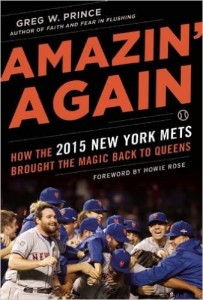 Learn, baby, learn…about the Mets and stuff. It was 1978 and, trust me, it was very on-point. There was even talk of a movie, albeit most of it between my friend Joel Lugo (who recently reminded me of the entire ninth-grade episode) and me.
The not-so-subtle subtext of my Saturday Night Fever parody was a good-natured ribbing of those who theoretically preferred a trip to the library over anything else in the world. I mean, c’mon, who would want to spend their Saturday afternoon in a library?
You will, I hope.
Everything that comes around goes around, or something like that, for this Saturday afternoon, Amazin’ Again Fever will burn like a disco inferno at the Queens Library’s Briarwood branch. That may be an overstatement, but the nice folks there have asked me to talk baseball in their building and I am looking forward to doing so at 3 PM, June 25.
You can find the Briarwood branch at 85-12 Main Street, accessible via the Briarwood (formerly Briarwood – Van Wyck Blvd.) stop of the E and F trains; the 168th St. exit off the Grand Central (turn left onto Main); and four bus lines that begin with the letter Q: 20A, 20B, 44 and 60. I’ll bring some books, I’ll share some thoughts, we’ll solve the Mets and we’ll be done in time for that evening’s 7:15 first pitch from Atlanta.
I hope you’ll join me. I can’t think of a better topic to discuss, indoors or out, on a Saturday afternoon.
For those of you in New Jersey who have asked for an Amazin’ appearance on your side of the Hudson, mark Thursday, July 28, 7 PM at Little City Books of Hoboken, on your calendars and other appropriate date-marking apps.
by Greg Prince on 20 June 2016 1:06 pm In this post-primary, pre-convention interregnum when we speak of presumptive nominees, I must confess I was nervous when the Mets were declared presumptive winners, perhaps sweepers, of the Atlanta Braves in advance of this past weekend’s series at Citi Field. The Braves have been remarkably bad in 2016. The Mets had been pretty good to occasionally very good. Yeah, how could we lose a set of three games to these bozos?
How presumptuous.
I can’t tell if Atlanta is building something formidable based on their having swept this trio of contests from the Mets. Maybe they’re better than we were led to believe. The Mets, based mostly on their recent sample of baseball, don’t appear to be particularly able at all.
It’s not so much the loss of three games to a last-place club as it was the pulselessness that was displayed one through eight from Friday to Sunday, particularly Sunday. The Mets’ trademark starting pitching was good enough to compete if not overwhelm in all three games, but the Mets’ starting hitting, save for a handful of swings, never really began.
Sunday dreadful Sunday was the worst, which is saying something after how Saturday night went down. You can accept with grace one loss to a rebuilding entity like the Braves. You can rationalize away a second loss defined by a third base coach’s ill-advised green light. But the third, for which your batters produced one hit and no other means of reaching base?
That’s not gonna get it done, if you’ll excuse my using technical terms. It’s not much of answer, but on Sunday, the Mets didn’t look like much of ballclub. The real victims were all the kids who were looking forward to the Mr. Met Dash. Without their heroes setting an example, these boys and girls were left completely clueless as to what one does when one encounters basepaths.
I heard “shakeup” mentioned in the postgame press conference. If possible, I’d treat the current roster like a snow globe and, after swapping out Kevin Plawecki for Travis d’Arnaud, send down any four guys and bring back any four guys who aren’t named Eric Campbell. There is a handful of Mets who are performing to expectations and several others who don’t seem to be doing so badly yet also seem to be doing nothing.
Fix that, would ya?
During Saturday night’s game on Fox, one of the announcers I didn’t want to hear referred to the Mets as unathletic. How could that be? I wondered. They’re athletes. I take it that “unathletic” was intended as a synonym for slow. They are slow…but they’re also a little creaky, they don’t proceed with fluidity, and they’re not exactly nimble on their feet.
Fandom often boils down to older, unathletic men expressing dissatisfaction with younger, athletic men for not being less like them. I can be slow, creaky and look pathetic on my own very well, thank you. The Mets went 1-for-28 versus Julio Teheran. I can honestly say I couldn’t have done a whole lot worse.
For all the mostly justified kvetching, the Mets carry the exact record they held after 68 games last year and remain in position for a Wild Card spot this year, but now it’s the second one and they’d be traveling to frigging Marlins Park to face elimination. You’d like to believe the statis will cease and instead of “remaining in position,” they inject themselves with some dynamism. I swear these aren’t terrible players, as long as one of them isn’t Campbell.
I’d also like to believe I’m a better fan than the Mets were players on Sunday. I’d like to think that if I’d been at the game, I would have tepidly applauded Teheran when he came to bat in the eighth. Appreciation for the other team’s starter’s excellent outing is a dying art, just like standing for the seventh-inning stretch (a timeless ritual that mystified my section last week). Though it’s difficult to comprehend that anybody can pitch worse than his record indicates against these Mets, Teheran had been throwing his heart out all year and had two wins to show for it. A giveaway cap can be tipped lightly in his direction.
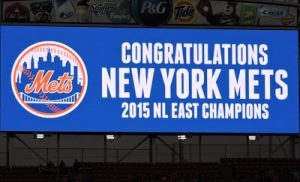 The Reds made a classy gesture last September. (Image courtesy of Studious Metsimus.) Granted, one-hitters are useless to have thrown at you, whereas no-hitters are historic. On Channel 11, given that Sunday was Father’s Day, we were shown the last pitch from June 21, 1964, Jim Bunning’s perfect game at Shea Stadium. Between Bob Murphy’s enthusiastic call of and the Mets fans’ supportive reaction to that 6-0 whitewashing, you understood a great performance had transpired and you might as well appreciate it. I thought the Mets should have acknowledged the no-hit successes of Chris Heston and Max Scherzer last season on the Citi Field scoreboard (they didn’t) and I thought posting “CONGRATULATIONS ROYALS” wouldn’t have been out of line at the end of the World Series, as painful as it was to come out on the short end of that little get-together.
The return of the Royals to Flushing this week will elicit several regrets, and the paucity of institutional sportsmanship demonstrated by Met management will be pretty far down the list, but if a championship is captured in your midst by a worthy opponent who isn’t from across town, it really wouldn’t hurt to give the ol’ “good game, good game” before turning out the lights. Watching the Cavaliers accept their NBA hardware Sunday night on the Warriors’ home court, I really had to hand it to Golden State fans who sat and absorbed the scene implicitly commemorating their team’s demise without wadding up their yellow t-shirts and firing them in the general direction of LeBron James. Admittedly, it’s a tough line to toe without tripping on your emotions.
Listen in as Mike Silva and I dissect a below-average weekend and recall the chaos of seasons past on the Talkin’ Mets podcast. I join Mike at around the 20:00 mark.
by Greg Prince on 19 June 2016 10:11 am Mets are down one to the allegedly lousy Braves in the bottom of the ninth with nobody out. Wilmer Flores is on first. James Loney has lashed a Jim Johnson pitch into the left-center gap. Flores is running. We probably have a few minutes until the situation resolves itself. I don’t want to say Wilmer is slow, but Mo Vaughn, Jason Phillips and a box turtle all just turned their heads to wish him well as they strolled by him.
While the Snickers people set up to film their next “Not Going Anywhere For Awhile?” commercial, I guess I have time to share some thoughts regarding today, Father’s Day. Our Father’s Day celebration, if that word can be used, was yesterday, which felt appropriate. I identify Saturday, its late afternoon and early evening, with my father more than any other part of the week. I think of how he and I would “go around the corner” to “take a haircut” at George’s Madison Avenue Barber Shop, which was conveniently located on Park Street, nowhere near Madison Avenue. Park Street in Long Beach was alternately known as Park Avenue, so I wondered why George didn’t just call it George’s Park Avenue Barber Shop. Either one would have communicated the classiness to which George seemed to be aspiring.
George didn’t cut my hair. Leo did. George had his chance. He freaked me out when I was two years old and taking what was apparently my first official haircut. George used that electric razor device on my burgeoning sideburns. George pinched me on the cheeks. I jumped out of the chair and ran in circles screaming and crying in objection to each act of aggression. That was it for me and George. Leo was given explicit instructions on my next visit.
“No machine,” I demanded. “No pinch on cheek.”
Leo played ball. I don’t know if his haircuts were Madison Avenue-worthy, but I put up with them. I think a lollipop might have been involved in quelling my anxieties. Over in the adjacent chair, Dad would take his haircut from George. He was a lot lower-maintenance in those days.
I don’t know why Dad would say “take a haircut”. The rest of the world would get a haircut. I said “get a haircut”. I didn’t get or take many haircuts. I was considered the family radical at an early age. Taking or getting a haircut seemed to be giving in to the system — plus the lollipop never made up for all those damn scratchy hairs down my neck and back. Also, I really wanted to let it grow long enough to effect a David Cassidy look. It never took.
But when there’d be haircuts, my dad and I would take them together. I’d chat as much as I had to with Leo, who wore glasses and spoke in a German accent. Dad would chat as much as he had to with George. Truth be told, neither one of us was much for chatting with barbers. If I had to wait my turn, I’d sit and thumb through magazines that had been sitting out since Leo didn’t need glasses. Sometimes the Saturday Newsday would be there, back when Saturday’s Newsday was essentially the Sunday Newsday, since Newsday didn’t yet publish on Sunday. I have a very clear memory of sitting in George’s and reading Newsday’s coverage of the Knicks’ instantly historic comeback victory over the Cincinnati Royals from the night before. The Knicks, trying to set a record for longest NBA winning streak, were down five by with sixteen seconds to go, yet prevailed. We thrilled to it on Channel 9 on Friday night, November 28, 1969, and here I was reliving it at the barber shop on Saturday afternoon.
I also remember that every time I had to use the bathroom at George’s, I’d see a calendar on the wall turned to the page marked JUNE 1968. The years would change, George’s calendar wouldn’t. I don’t remember there being any kind of racy picture that would make a barber reluctant to move on from it. As with the whole Madison/Park thing, I don’t think I ever asked.
How long the haircut visits would last I don’t know. They felt long. They probably weren’t. My current barber has me in and out in ten minutes if there are no other customers and he’s not too distracted by his phone. His magazines are old, too, but there’s usually a fairly recent Newsday lying around if I have to wait.
Haircut done, back and neck scratchy, there might be other errands awaiting my dad and me on Park Street. We might pick up his shirts from the dry cleaner. My father’s father was a dry cleaner, so I imagine he took that stuff pretty seriously. We might need some small grocery item from East End Dairy, which was later known as East End Deli, but I always called it East End Dairy. If my parents were going out on Saturday night, and they usually were, there might be a trip to pick up dinner for my sister and me at the Lido Deli, which did not serve dairy, because it was kosher.
None of this was exactly a ritual or a routine. Sometimes Suzan (then spelled as Susan) would be with us to get the two burgers and two French fries — which came in tiny brown paper bags like they sell you a can of Heineken in at Penn Station. At least once, Dad and I met my sister and my mother at the Associated, colloquially known in our house as Murray’s, for Murray the gonif, who earned the nickname out of accuracy for his business practices. We usually walked, since it was indeed around the corner. Or maybe we drove to Island Park or Oceanside to conduct our other affairs. Maybe we took the haircuts and just went home. We never talked about anything of substance. I learned no great life lessons, other than the kosher Lido Deli did not serve cheeseburgers.
A week consists of 168 hours. The one or two that constituted whatever it was I recall doing with my father on Saturday grow in stature like my hair tends to grow between haircuts, even to this day. At my mother’s urging, because she didn’t think Leo was a very good barber, my head would eventually be taken to others who were handier with a pair of scissors. Once they opened a McDonald’s in Long Beach, we didn’t need the Lido Deli. My father eventually opted for a different dry cleaner. Our Saturday trips to Park Street ceased.
I missed them without realizing it. They may have been the first element of my young life that I developed nostalgia for. On the Saturday prior to Father’s Day when I was sixteen, I went into the East End Dairy/Deli and had the bright idea to bring home a six-pack of Perrier. Perrier was a very chic beverage at the moment, Madison Avenue George’s kind of quaff, no doubt. My father had mentioned having it at some business lunch and deciding it lived up to the hype. That’s all I needed to hear to end my Father’s Day shopping. I gave my dad the Perrier and maybe a plastic lime filled with lime juice. He seemed to get a kick out of it and opened a bottle.
Five bottles sat in the back of the fridge undisturbed for the next decade, but I stand by my decision. A late Saturday afternoon in 1979 brought me back to an idealized late Saturday afternoon in 1969 or whenever. I could’ve found the Perrier at the Associated (albeit at Murray the gonif prices), but going into the East End Dairy for something vaguely exotic for my father is what hit the spot. My sense of who we had been as father and son bubbled up like naturally sourced sparkling water from my subconscious. Those Saturdays on Park Street, me and him, had already evaporated. I just wanted a taste.
Father’s Day never seemed like something my father particularly embraced. I don’t think he cared for the attention. I also have come to believe over the last year — as I have watched him withstand brain surgery, physical rehabilitation, cancer treatment, two or three bouts of pneumonia and a general diminishing of his being to the point where his ability to move and communicate are close to non-existent — that he has viewed the best part of his life as the part long before my sister and I came along. I don’t take that personally. He just obviously preferred being a kid.
Within a couple of days of his beginning to recover from the operation that removed his tumor last May, he began talking regularly about growing up in Jackson Heights, about his grandmother, about FDR. Some of the stories I’d heard before. Some were new to me. Over the months that followed, they’d elbow out the present. Lately he’s taken to speaking, when he does speak (softly), almost exclusively in Yiddish. Yiddish is all he spoke until he was four, according to family lore. He learned Yiddish from his grandmother. She was a great lady, he told me on multiple occasions last year and this; “It’s a shame you never knew her,” he lamented repeatedly.
Dad has been confounding longevity expectations for quite some time now. Since May of 2015, I’ve been ready for him to go at any minute. The minutes passed. He didn’t. He went downhill, but he didn’t cease. He is, despite being confined to a bed in a palliative-care facility, the Energizer bunny. He’s still going. Every trip I’ve made to see him since winter I more than half-expect to be my last. In March, I was pretty sure it was. I’d gone up to bring him my book, which he had been looking forward to seeing. He was, within the confines of his condition, pretty lucid, letting me know that he knew what was happening to him and that if I wanted to say goodbye, this would be a good time to do it.
He had gone sporadically melodramatic during various phases of his illnesses. “Say goodbye to me,” he’d wail. I think he was a victim of too many movies in which it appears people are about to die and then they die. It doesn’t work that way in real life, I have learned. But on this afternoon in March, he explained that he always regretted that he’d never had the chance to say goodbye to his mother, my grandmother (who I also never knew). He and my mother were out to dinner and came home to receive a message. His mother, who kept the books for the family dry cleaning store, suffered a stroke while working. She died immediately.
Now I finally got the subtext of “say goodbye to me” every time he didn’t want to get his blood pressure measured. All right, I figured, I better give him what he wants. He wants a goodbye scene. I gave it to him. It was simple but emotionally satisfying. I said what I needed to say, he heard what he wanted to hear and we watched the Mets lose a Spring Training game to the Red Sox.
Which, incidentally, bequeathed me one final baseball memory between us, thanks to rampant commercialism.
DAD: “Why does it say Nixon?”
ME: “Nixon?”
DAD: “It says Nixon there behind the batter.”
ME: “That’s Nikon. It’s an ad for the camera company.”
DAD: “Oh.”
There was peace and finality in that visit. There was a goodbye.
And then he kept living. Still going. There are no more conversations. There is virtually no English. His eyes don’t open much. Feeding him a fully puréed supper takes about as long as it’s taken Wilmer to round second on Loney’s extra base hit. But he still eats, and as long a person still eats, a person makes like the branded battery rabbit.
That meant one year after what we all assumed was our last Father’s Day with him, there was another Father’s Day with him. Stephanie and I opted to go see him yesterday because it was Saturday and Saturday is where I like seeing my father in my mind. We had a Father’s Day card sitting unused on a pile of papers — from one of those Junes when we each bought one, hence a leftover. It had Mickey Mouse on the front. I probably selected that one out of all the others at the CVS because I remembered being fascinated to learn that Mickey Mouse and my dad were born within a year of each other.
The printed message had something to do with his being the “No. 1” dad, as if the AP and UPI took a poll. I signed it with a little more emphasis than usual, and slipped it into the envelope, stopping to mark it “Dad,” and then realizing this is probably the last time I write that on a greeting card envelope.
But I probably thought that last year, too.
He wasn’t going to be able to read the card, let alone open an envelope, but it was Father’s Day and I still had a father. This is what we do. Assuming Perrier is not on his list of approved foods and beverages (I know where five bottles can be had cheap), we stopped at the Dollar Tree to pick up three balloons to brighten his room. We had brought a balloon for his birthday in January. It inevitably deflated, but nobody had the heart to toss it, so it had just remained tacked to his bulletin board, all saggy, these last five months. Time to bring festive back to balloons, we figured.
I went to the cashier to pay three dollars for three balloons (generic star-shaped balloons, because they’d run out of Father’s Day models), accidentally letting one slip out of my hand to the Dollar Tree ceiling. No personnel came forth with a ladder. So it became two balloons for two dollars. It’s the thought that counts.
We showed up in time for dinner. That’s the best hour to visit him. Or hours. It takes a while, just as it’s taken a while for Wilmer to reach third, for him to be fed. He’s as alert as he’ll ever be in the course of a day. When we arrived, his latest early-evening companion, a buoyant woman named Theresa, sang his praises.
“Charles is such a nice guy!” she testified. “He doesn’t call you names, he doesn’t hit you.” I’m pretty sure she meant he’s cooperative, because when you visit these places enough, just walking down the hallways you notice the residents not at their best, and with good reason. Yes, I said, my dad is a sweetheart. I wanted to say “you should have known him when,” but knowing him now, despite his lack of everything, told Theresa all she needed to know.
We presented the card, read it aloud and tacked it to the bulletin board that was crowded with cards from past occasions. We presented the two balloons, which Stephanie secured to the board as well. I opened my iPad and turned on Metromedia Radio for him. It is a recreation of the old WNEW-AM to which he listened regularly when I was growing up. In my youth, I both couldn’t stand it and came to adore it. The Internet version is positively Proustian, playing not just the standards and the big band numbers that defined the terrestrial WNEW, but the jingles and station IDs of yore. Stephanie, who works with the elderly, said music has a way of infiltrating the brain when nothing else does, even at this stage of life, so I keep tuning in faux AM Eleven Three Oh when we’re there and I keep hoping it makes an impression or at least sparks a little joy.
Me, I got mine when, after Theresa loudly announced that, “Charles, your son is here!” Suitably prodded, he opened one eye fully, the other eye a little, stared out and said, “Hi Greg.”
That was more than we got out of him on our last visit. That was all the English we heard from him yesterday. The melody lingered on, Stephanie now and then asking him if he recognized this artist or that. We’re almost certain he nodded when asked about Tony Bennett, his favorite singer of all time. Dad, I said, this is the station and the music you were always playing in the car and in the kitchen. I couldn’t wait to go up to my room and listen to my station and my music, but thanks to you, I really came to appreciate this, so thank you for that.
I saw evidence that suggested this got through as well, but the only sentiments he expressed vocally were for more water, or vaser. One Filipina health aide after another is getting to know Yiddish.
For a while, I did the lifting of cup and spoon and napkin to his lips. It’s never too late to bond, I suppose. Eventually, Theresa the professional took over, continually reminding him his son and daughter-in-law were there, continually informing us what a nice guy he is, how he never hits or calls names. On the fifth or sixth mention, I was tempted to add these skills to his LinkedIn profile. Given his small sips and what we’ll generously refer to as bites, I thought dinner would meander into breakfast, but Theresa had her ways and before we knew it, his plate was clean. He wasn’t what you’d characterize as highly engaged, but the lady swore that he was, in fact, quite excited to see us. His eyes were more open than she’d ever seen them and he wasn’t falling asleep mid-chew. This is the new normal for excitement.
We stayed a while after dinner. I had flipped the TV to Fox in hopes that a pregame show would be on, but the U.S. Open was in progress. I know nothing about golf, but I know this tournament always ends on Father’s Day. Every third Sunday evening in June, we’d all be waiting for a table at some restaurant near where he and Florence — his significant other of almost a quarter-century — lived and, over the bar, was the 18th hole. Golf and Father’s Day went together in my mind like Saturday and taking a haircut with my dad. My dad never cared for golf, but having it on in his room at least lent the concept that we were once again sort of going out for Father’s Day dinner a thin veneer of reality. We had brought sandwiches from a 7-Eleven, so it really did kind of work.
The golf didn’t put him to sleep. Making it to 87 with too many things to keep track of wrong with him took care of that. The WNEW tribute channel played in the background. I waited until the U.S. Open closed for the night and Steven Matz threw strike one to Chase d’Arnaud to depart. I kissed him goodbye on the same head that was shaved to facilitate the operation last year, the same one that was subject to radiation and chemotherapy…where at least in the back and down the sides, hair has been coming in plentiful and dark. If he were up for it, I’d say he and I should take a haircut next Saturday. I don’t really need one, but I’d go with him for the company.
Oh, there’s Wilmer Flores, coming very slowly around third. Teufel’s sending him? Really? Ender Inciarte, who’s been killing us all night, grabs the ball, relays to Aybar, Aybar throws home …yeah, Wilmer’s out by ten feet. Mets lose to the allegedly lousy Braves again.
Ah, whaddaya gonna do?
by Greg Prince on 18 June 2016 2:29 pm Once upon a time, the spring of 1969, to be precise, the New York Mets were in the market for a hitter. Sure, other GMs told their Met counterpart Johnny Murphy, we’ll give you somebody. Names like Joe Torre, Richie Allen, even Frank Robinson were floated. All it would cost the Mets was young starting pitching. The Mets were loaded with young starting pitching. They had Tom Seaver, Jerry Koosman, Nolan Ryan, Gary Gentry, Jim McAndrew, plus a golden left arm in the minors, Jon Matlack. Trades were discussed. Trades were rejected. The pitching was protected.
One young Met pitcher would be dispatched in 1969, righty Steve Renko. Steve had been in the Met system since 1965, chosen in the 24th round of the very first June amateur draft, and was struggling at Triple-A Tidewater. Murphy apparently didn’t mind giving him up, since what Renko — along with Kevin Collins, Jay Carden and Dave Colon — brought back from Montreal was the kind of bat the general manager had been seeking all along: a real power hitter. The man who came to New York on June 15, 1969, was Donn Clendenon. Four months and one day later, Clendenon was accepting a 1970 Dodge Charger, his reward for being voted World Series MVP.
That trade worked out. It would always work out. When Renko and the Expos defeated McAndrew and the Mets at Jarry Park on June 26, 1970, it worked out. When Renko started a game at Shea that July in which Montreal eventually topped the Mets, it worked out. When, in the September heat of the 1970 pennant race, Renko threw a complete game in Canada to beat Seaver and the Mets, it never stopped working out.
Trading Steve Renko to the Expos for Donn Clendenon was a major step toward the Mets winning a World Series…toward winning the 1969 World Series, an achievement that forever defines this franchise for the good. Renko pitched through 1983 and won 134 big league games, nine of them at the expense of the team that drafted and traded him. Yet there was never a second of regret at having dealt 24-year-old Steve Renko away. It gave the Mets Clendenon. It gave the Mets a championship.
Friday night, John Gant, 23, won his first major league decision, a very effective 5-1 victory for the Atlanta Braves over the New York Mets. Gant is a Brave because the Mets sent him and Robert Whalen south last summer to obtain Juan Uribe and Kelly Johnson. At the time, the Mets had plenty of young starting pitching in the majors and too many minor leaguers filling their bench. They had to have Uribe and Johnson to push forward in a highly competitive pennant race. Gant was a 21st-round Met pick in 2011, taken three rounds sooner than Renko. He was at Double-A Binghamton in 2015, posting numbers no more eye-popping than those registered by Renko as a 1969 Tide. Never having seen Gant (or Whalen), I had no opinion of their prospects when Sandy Alderson opted to ship them off to the foundering Braves.
Within weeks, it was clearly the right trade for its time. Uribe and Johnson were exactly what the Mets needed in the moment. The moment would extend into November. The Mets won a division title and league championship. How we think of the Mets, as a team that is supposed to win ballgames, was utterly altered by what they accomplished in 2015. We are in a different space because of what all the players who steered the Mets into August and September did, few any more vital to the cause than the two erstwhile Atlanta utilitymen who chipped in big hit after big hit. That pennant is forever.
Just keep that in mind should Gant drop another six-and-two-thirds innings of two-hit ball on the Mets in the near or distant future. And when they play Detroit later this season, please refer to all of the above should we face 23-year-old Michael Fulmer, he of the current 7-2 record, 2.43 ERA and just-snapped 33⅓-inning scoreless streak. Fulmer, as you are no doubt aware, was the Met pitching prospect dealt to the Tigers to acquire Yoenis Cespedes. Yoenis Cespedes was the biggest reason the Mets roared into their first postseason in nine years. Fulmer might do wonderful things for Detroit and terrible things to our psyche in the years ahead. If Gant’s allegory is Renko, Fulmer’s might be Matlack, the first-round pick who was in demand, except Alderson, unlike Murphy, let him go for the bat the Mets desperately needed. Matlack was destined for a sensational career, most of it with our team. Fulmer has begun his run in spectacular fashion away from us.
We got Cespedes for him. We got to the World Series for the first time in fifteen years. It was worth it. It always will be.
By sheer coincidence, I’ll be at the Briarwood branch of the Queens Library, Saturday, June 25 at 3 PM to discuss Amazin’ seasons past and present. Hope you’ll join me.
by Greg Prince on 17 June 2016 6:46 am I realized Bartolo Colon was the batter. I heard something about a ball hit into the gap. I put 40 and 2 together and zipped (in my own Bartolian fashion) from the radio in the kitchen to the television in the living room to bear witness to the breathtaking site — taking the breath of all involved, including Colon — of our immensely credentialed starting pitcher pulling into second with a double.
Wow, I said, that’s really something, though it wasn’t as something as it once might have seemed. We have seen Colon double. We have seen Colon homer. Granted, seeing Colon run each of the bases — taking third on a single that fell in front of Andrew McCutchen, tagging up and scoring on Yoenis Cespedes’s deep fly to right (I thought a couple of strong relays could have nailed him at the plate, but perhaps Gregory Polanco forgot who would be sprinting home) — was both a treat for the eyes and a dagger to the heart of the DH rationale. Yet the idea that Bart can contribute offensively is no longer absurd. Thus, it wasn’t the shock it might have been when he first became our cause.
We are not without the capacity to emit surprise. It was surprising that the second-inning hit-by-pitch that eventually sent Wilmer Flores out of Thursday night’s game versus the Pirates resulted, according to x-rays, in nothing more than a contusion. It was surprising to have Neil Walker and Michael Conforto back in the lineup. It was surprising to see the slumping Conforto (his dark forest now in its second solid month of bloom and gloom) homer directly after Walker. It was gratifying to watch Michael rob Jung Ho Kang of a run-scoring extra-base hit in the first, just as Curtis Granderson’s franchise-record 17th leadoff home run kept our cockles warm in the bottom of the inning. If you step back and realize Grandy has done more powerwise in approximately a season-and-a-half worth of leading off than any Met had done before him, his feat is kind of surprising. He’s a more accomplished home run hitter than those directly behind him in this particular procession — Reyes (16), Agee (8), Dykstra (8) — but I could swear Curtis only just got here.
That Colon would pitch well into the eighth, albeit after running strenuously in the third; and the Mets would homer thrice; and they’d withstand a bit of late-inning turbulence to hold on to defeat Pittsburgh, 6-4, was overall all very rewarding, but not that surprising. You shouldn’t get jaded, but when you follow your team closely, you do learn to detect patterns.
If you’ve been keeping tabs on the Mets long enough, you knew the news that came down Thursday regarding David Wright was on its way. Our Captain, after trying rest and rehab, went in for surgery on the herniated disk in his neck, confirming that his absence of a few weeks will extend into multiple months, possibly knocking out the remainder of 2016 and placing in question his Met future beyond.
Somewhere in the distant Met past, say before Colon and Granderson joined the club in 2014, the idea of losing David Wright for at least a hundred games would have been jarring and flooring. How do we get by without our Captain? It remains a valid question (especially after Flores had to exit), but not one that crash-lands from out of the blue. Unfortunately, we are skilled in David-deprivation. He missed much of 2015 with an ailment that has remained chronic and, pre-stenosis, had to absent himself for chunks of other seasons due to various maladies.
David Wright out for maybe the season, maybe longer, is not as surprising as a Bartolo Colon double that itself wasn’t totally surprising. That’s not an ideal state of affairs. But we get used to these things.
There is a temptation to fast-forward to whether David’s career is in jeopardy of being completely over. It’s a reasonable source of speculation, but can you imagine David Wright deciding, in so many words, ah screw it? Neither can I. He’ll give it his all because — and this isn’t a pang of romanticizing as much as it is a statement of fact — he’s a ballplayer. Playing ball is what he does. It doesn’t matter that his contract is lucrative and guaranteed. It doesn’t matter that he’s no doubt capable of spending his hopefully pain-free days pursuing other endeavors. He plays baseball. He has not voluntarily ceased doing so. Prior to the neck becoming too much of an obstacle to push through, he worked, by all accounts, as hard as he could so he could play. In his most recent (let’s not call it his last) game, he homered. He was hitting with power again. He was throwing better. Even physically compromised, 2016 David Wright presented a convincing facsimile of vintage David Wright.
I don’t picture David Wright, unless his post-surgery recovery literally kills him, not attempting to return to what he was doing before the pain overwhelmed him, what he has done since before any of us ever heard of him. Whether he’ll be able to succeed is a whole other issue, but for now, he’s on the disabled list, not the deceased list.
David is a helluva ballplayer. I speak in the present tense until further notice.
Not a career obituary by any means, but a touching appreciation — written before the surgery decision was announced — comes from James Schapiro of Shea Bridge Report. I recommend reading a gifted young writer paying tribute to the Met he’s grown up loving.
by Greg Prince on 16 June 2016 5:10 am You know you’re having a good night when you can get picky over what kind of mammoth win you’d like your team to post. For those of us who remained to the bottom of the ninth inning at Citi Field Wednesday night of an obviously settled affair — and why would you leave when your team has hung up 11 runs and 19 hits? — we picked one ending as preferred above all others: Noah Syndergaard throwing the final pitch.
Imagine that. Imagine Thor going the distance. You had to imagine it in advance of Wednesday night and, alas, you still have to imagine it. That sort of achievement, so prevalent in the heyday of Shea, has grown remarkably uncommon in the yard the Mets now call their own. A Met pitcher sticking around to bookend his own evening is a rarity anywhere, but it really gets your attention when you realize how little it’s happened at Citi. The 42 in the Rotunda dwarfs the number of complete games Mets pitchers have thrown in the ballpark’s eight-season history.
How many CGs for the homestanding NYMs since 2009? The answer lies not within the monument to Jackie Robinson, but is implied at the joint that grills burgers in the name of Keith Hernandez. The number is 17, or approximately 2.9% of the 595 regular-season home games the Mets have played since shuttering Shea. I’ve been to 218 of those games and witnessed nine completed by our starters, or roughly 4.1%. A person really has to hit his spot to see one these Flushing Routegoers in flight.
As endangered species go, they’re almost as rare as the Gunnison sage-grouse. My Citi Field complete game life list encompasses Livàn Hernandez and Nelson Figueroa in 2009; Jon Niese, Johan Santana and R.A. Dickey in 2010; Miguel Batista in 2011; Dickey in 2012; and Matt Harvey and Niese in 2013. Neither I nor any fan has seen one in ages.
Niese, a Pirate watching from the third base dugout as his old teammate thoroughly throttled his new teammates, holds the distinction of being the last Met to throw a home complete game. His came twenty days after Harvey’s, the same week Matt went on the shelf that eventually led to Tommy John surgery.
It’s probably not a coincidence that in a Met era defined by young, imposing starting pitchers, the current administration shies away from letting them complete their own business. It took four months of an absolutely dominant 2013, when Harvey was presumed healthy, before Terry Collins allowed his undisputed ace to go all the way (though there was an earlier nine-inning effort in game that went into extras). It wasn’t until the final game of 2015, the postseason edition, that we saw another Met — Harvey — given such a chance again…and that took quite a bit of histrionic lobbying on the part of the pitcher. Matt hasn’t come close to nine full innings since.
Jacob deGrom has never pitched a complete game. Steven Matz has never pitched a complete game. The only two of the past two years were from Zack Wheeler and Bartolo Colon, each in Miami. Wheeler is only now preparing to make minor league rehab starts. It seems safe to wager he will not be throwing any major league complete games for the Mets in 2016.
Colon better fits the profile of starters the Mets might let finish with limited qualms: he’s someone whose future they’re not immensely invested in. If Bart can get to a ninth inning, sure, knock yourself out. Dickey was a knuckleballer, so his length in any given game where he was rolling along was subject to effectively the same school of thought. Batista’s complete game versus Cincinnati on September 28, 2011, made total sense. It was the last game of the year, he was 40 and every Red’s back foot was planted squarely on the bus to the offseason. Before Collins, it wasn’t as if Jerry Manuel was handing out passes to the ninth, either. Hernandez and Figueroa (another Closing Day performance) were permitted to go extremely deep because what was there to lose in the club’s eyes? Same could be said for the August 2011 night journeyman Chris Capuano mysteriously mystified the Braves.
When a Niese or a Mike Pelfrey (in one of the eight Met CGs at Citi Field that I was not on hand to observe and applaud) got on a roll, they were just pretty good pitchers having very good nights, more power to them. Santana, his bouts of fragility notwithstanding, was from another time to begin with, when aces were aces and it was ludicrous to remove them from fierce competition. It’s fitting that Shea Stadium stayed vital to its very last game because of how far Johan went into its next-to-last game.
But the current Fab Four is treated with kid gloves and René Rivera’s mitt. Harvey appeared Olympian in 2013 and it was inferred he was indestructible, as long as he was handled with care. The Mets didn’t care to extend his innings any more than they had to. When he had a shutout going after eight against the Rockies on August 7 of his breakout year, and his pitch count wasn’t dizzyingly high, he couldn’t be denied. Not even a two-out line drive off his knee in the ninth would budge him. After subsequently having to miss the last month of ’13 and all of ’14 to have his right elbow repaired, you can imagine a helicopter being summoned to swoop in and remove him if he didn’t budge from the mound in a similar situation these days.
(Game Five of the World Series was different. It was Game Five of the World Series.)
Harvey remains the last righthander among Mets to throw a complete game at Citi Field, and that was nearly three years ago. Syndergaard, a towering figure even within the community of larger-than-life Met pitchers of 2016, had gone eight innings three times in his brief career prior to Wednesday, including one start at home last year. To look at Thor, whether standing or pitching, is to understand why he came to the majors with a Norse god nickname already attached. What could possibly hurt Thor? He has the powerful repertoire, the offbeat temperament, the fire of a thousand kilns, the physical stature…if this were 1916 or 1976 or maybe 1996, you would assume a substantial percentage of his 36 starts prior to Wednesday would have been complete games, not to mention shutouts.
In 2016, even with all his successes, both categories yielded zeroes on Thor’s ledger through June 8. But on this Wednesday, June 15, he was the one assigning nice, round nothings to just about every Pirate batter he faced. There was a leadoff single and then there was total silence, punctuated only by our cheers for his strikeouts (eleven, enough to keep Subway on its toes) and, not to go unnoticed, tons of Met hits.
You know how the Mets almost got no-hit on Tuesday night and we all assumed — because we retain absolutely no memory that what happens in our worst games isn’t necessarily destined to occur in all our games — that the Mets would never hit again? Consider our assumptions rent asunder. Every Met (except Syndergaard, somehow) hit and hit forcefully. Left fielder Kelly Johnson homered. Third baseman Wilmer Flores homered and drove in four. Rivera was as lethal at the plate as he was nurturing behind it, contributing three hits. Matt Reynolds showed signs of being ready to challenge Ichiro Suzuki for the title of most prolific hitter the world has ever seen.
It was exhilarating to watch the Met offense cut loose on a night the wrist of Michael Conforto, the back of Neil Walker and the thumb of Juan Lagares made each of them invisible. An early version of Collins’s lineup, before Lagares had to be scratched, listed Asdrubal Cabrera as his cleanup hitter. Cabrera has batted cleanup in his career — he socked 25 homers for Cleveland five years ago — but a Met shortstop in the four-hole was cognitively dissonant to the eye. Howard Johnson filled that dual role now and then in 1991, but he was Howard Johnson, 30/30 man extraordinaire and never quite the full-time shortstop. Flores batted cleanup as shortstop twice in 2015, during the injury-ravaged mangy mutt days of May and June, but Wilmer wasn’t retrofitted into a major league shortstop to get his glove in the game.
The only Met shortstop to bat cleanup in the starting lineup between HoJo and Wilmer? It wasn’t anyone you’d picture of as you scroll the shortstop spreadsheet of your mind. It wasn’t Jose Vizcaino or Rey Ordoñez or Mike Bordick or the incredibly available (if not overwhelmingly desirable) Jose Reyes. According to the Baseball-Reference Play Index, it was John Valentin, twice deployed by Bobby Valentine that way in 2002. The Baseball-Reference Play Index needs to come with smelling salts for those instances when information such as the Mets batting shortstop John Valentin cleanup twice knocks you out.
“Bobby is not looking for me to hit home runs or anything like that,” Valentin said the first time the unorthodox tactic was tried, making one wonder whether John opted for a white flag over a Louisville Slugger when he stepped in to face Darryl Kile.
Back in the makeshift present, Cabrera wound up batting second, recording two hits and scoring two runs. That’s what more or less everybody in the Met lineup did. With it adding up to eleven runs, you only noticed a little that the Mets made twelve outs with runners in scoring position and left ten men on base.
For that matter, you only noticed the eleven runs a little, because all your focus was on Noah Syndergaard. Over eight innings, he registered as many strikeouts as the Mets plated runners: eleven K’s to go with no walks and no runs. There were three Pirate singles scattered, one in the first, two in the sixth. By the sixth, when Syndergaard shrugged off the mild threat by fanning Andrew McCutchen looking for Strikeout No. 8, the Mets led, 7-0. There was no danger. There was only Thor, tossing what could be best described as a Thor-hitter.
Come the bottom of the eighth, Syndergaard batted, an excellent sign of what he’d be doing in the ninth. Sure enough, in the ninth, we got what we stayed for. We got Thor on the mound for another inning.
All he needed was three outs to add to his previous 24. If he could proceed in mussless, fussless fashion, we’d be telling each other on the way out that we had just seen Noah Syndergaard’s first complete game and Noah Syndergaard’s first shutout. We already talk of Thor so much we need new material.
We wanted it like he wanted it. We would have accepted simple groundouts or pop flies, though if it were put to a text poll, we would have entered “K” for another round of emphatic door-slamming, Pirate-pounding strikeouts. We wanted him to go out in blazes of glory and flourishes of phenomenal. We wanted Rivera cradling that last 97-MPH fastball, leaping to his feet and embracing his pitcher. We couldn’t wait to tweet that perfect-partnership image and hashtag it #Thorvera.
That would have been something, but it will have to be something for another game. Noah ventured into his very first ninth inning, but there was a leadoff double to John Jaso, a ground ball that advanced him to third, then a double to David Freese. There went the shutout and, with it, the eighteenth Met complete game in Citi Field history, not to mention the tenth I could have Logged. With opportunity eroded, Terry approached the mound and Thor departed it to a standing ovation. Jeurys Familia came on to protect a ten-run lead in what we shall refer to as a non-save situation. To service his own narrative properly, Jeurys gave up a difficult ground ball that Flores made a nice play on but threw away. It allowed Freese to score (how could Terry use him in a non-save situation?) and reduce the Mets’ lead to 11-2. That’s not terribly significant to report, except for the delight inherent in noting the Mets had a ninth-inning lead reduced to nine runs.
There it stayed. Familia got the next two outs. Syndergaard got the win, going a career-longest eight-and-one-third innings. One of these days we’ll see him go nine. Several of these days, you’d have to think.
|
|






