Faith and Fear in Flushing made its debut on Feb. 16, 2005, the brainchild of two longtime friends and lifelong Met fans.
Greg Prince discovered the Mets when he was 6, during the magical summer of 1969. He is a Long Island-based writer, editor and communications consultant. Contact him here.
Jason Fry is a Brooklyn writer whose first memories include his mom leaping up and down cheering for Rusty Staub. Check out his other writing here.
Got something to say? Leave a comment, or email us at faithandfear@gmail.com. (Sorry, but we have no interest in ads, sponsored content or guest posts.)
THAT’S IT! The Mets have made me so mad that I’m leaving the country!
OK, while I actually am leaving the country for six days in Iceland, the trip doesn’t actually have anything to do with the sad JV version of our team’s and their somnambulant performances of late.
Still, it won’t exactly break my heart to play a Get Out of Unfun Baseball Free card for nearly a week if it means I miss games like the weekend’s grisly crapfests against the Brewers. I won’t mourn that I didn’t see our starters’ faces fall if they dared make a mistake pitch or looked up at the scoreboard and saw they’re two runs behind. I won’t be sad to miss watching Mets run the bases like they’ve prepared with an hour of the dizzy bat race, or fielding like their gloves have been replaced by lawn darts, or trying to do whatever it is I dimly recall players wearing blue and orange are supposed to do when they swing a bat.
The starting lineup has been much reduced by injuries — the latest news is the revelation that Michael Conforto is struggling with cartilage damage in his wrist, which means he’ll have to go on the DL for a few weeks grimly plow along as if nothing’s wrong. Add in David Wright‘s herniated disk, Neil Walker‘s back, Travis d’Arnaud‘s shoulder, Lucas Duda‘s back and Juan Lagares‘s thumb and you’ve got 2/3 of a lineup replaced with Mayberry-Muno irregulars, whose effectiveness you may remember from last June’s unwatchable baseball.
Granted, last summer turned out pretty OK — there’s a book about that. The Mets came disturbingly close to getting no-hit by Jameson Taillon Tuesday night, but in 2015 they got no-hit twice — oddly, I was in the house both nights — and were still allowed to go to the World Series. Now as then, as long as they can ride their solid starting pitching they ought to be able to hang around all season, and there are three playoff slots available to teams that can do that.
But the highlight films sensibly reduce the Summer of Loathe to a montage before getting to the good stuff; nobody wants to lovingly recall fidgeting as Clayton Kershaw dissected a Triple-A lineup. Since that’s what we’re back to, I’m OK with skipping a week of it.
The Mets have played 38.3% of their allotted baseball games for 2016, which in and of itself is no magic number, but if you do the math and calculate that 38.3% of a pie has been consumed, you understand 61.7% of it remains. If you express 61.7% as a decimal figure, the kind you’d see in the standings, then you can picture .617.
And if you’ve spent your life aware of what the standings looked like at the close of the regular season in 1969 (and why wouldn’t you?), you know .617 adds up to 100 out of 162 games. That’s how many the Mets won in 1969, that’s how many are left in 2016.
So we find ourselves at a statistical milestone in this regular season, at least for those who find round numbers significant. We have the roundest of numbers awaiting us. The big one-oh-oh. One-hundred.
Sounds like a lot. But so did 162, and 38.3% of those have vanished into 34-28 air. As long as we’re counting fingers, toes, wins and losses, the Mets’ record with 100 games to go projects to 88-74 when there will be none to go. Sharp-eyed Mets fans who know their figures will recognize 88-74 as a record the Mets have achieved thrice in their existence. They finished 88-74 in an exhilarating 1997, repeated the feat in a less emotionally rewarding 1998 and compiled it all over again in a crushing 2007. In none of those seasons did they play a postseason game.
Ah, but each of those seasons was B2WC, Before the Second Wild Card, an institution that, if the season ended today (though why would it?), would serve as our bacon-saver. The Mets hold that second Wild Card, leading the Utley Dodgers by two games at present, trailing the Perennial Cardinals by a half-game for the National League’s first consolation prize. It’s all very temporary up there. If our plans had been panning out, we would be more readily comparing our mark to that of the Murpharious Nationals. At the moment, however, that’s verging on pointless. The Nationals are 4½ in front of the Mets, or as far out ahead as they were at any point last year, but they look way better and we look…
Who can tell?
The National League East of 2015, when there were 62 games played and 100 on tap, was a tale of two teams trying to get on track. The Mets were 33-29, one game worse than now, but one game better than the Nationals then. Come to think of it, when we reached 100 games done and 62 to go, the tale was still in effect. The net difference 38 games later was two games: the Mets were one behind the Nationals. That was at the beginning of the week when first everything that could go wrong did go wrong for the Mets and then everything that could go right in fact went right. (You know, trade called off; lead blown in the rain; different trade consummated; guy not traded hitting dramatic home run; main rival swept…helluva book out about it, I hear.)
We can call 62 games played a milestone. We can call 100 games played a milestone. We make those notations because 162 games, although they dwindle as nearly as quickly as the number of readily available Met players on any given Sunday, is as long a time as it is a short time. You look for signposts, for clues, for ways to stay engaged in what often penetrates our brain as an endless slog. 62 games down with a hundred to go is meaningful if we want it to be.
Baseball is beautiful, the season is what we crave when we don’t have it, but then we get to the predictably unpredictable portions where we’re flailing a bit. Like the road trip at whose end healthy bodies recede from view and all you can see is a lineup you didn’t envision a few weeks never mind a few months ago.
The highly unlikely starters of Game 62 from the perspective of Opening Night.
Batting cleanup, the second baseman Kelly Johnson.
Batting fifth, the first baseman James Loney.
We didn’t re-sign Kelly Johnson in the offseason, did we? What happened to Neil Walker? Loney…isn’t he with the, uh…not the Dodgers anymore. The Rays? Where’s Duda?
Reynolds made the team? No, he didn’t. Don’t tell me something went wrong with Cabrera. Hold up — Reynolds is batting second. And Johnson’s the cleanup hitter?!?!? Also, is Loney really that good that he’s our five-hole guy?
The less surprising but still not-quite-kosher starters of Game 62:
Terry must be giving Wright the day off. Flores must be doing OK. De Aza? Did Conforto need a day off the same day as Lagares? Plawecki getting some playing time is good, but maybe they should have found an experienced backup catcher for d’Arnaud.
Bonus unlikelihood of Game 62:
Dick Scott is managing? Who the hell is Dick Scott? Oh right, the bench coach. Wait, where did Geren go again?
Curtis Granderson led off and played right. Yoenis Cespedes was in center and holding down the three hole. Steven Matz pitched and batted ninth despite his ability to bat eighth, maybe seventh amid this bunch. Those were assumables worth assuming. You would have assumed Terry Collins would be in the dugout day in and day out. If you were told Terry Collins’s team was in possession of a playoff spot entering its 62nd game, you’d assume he’d still be the manager. He still is the manager, but on Sunday, he wasn’t feeling all that well and the Mets decided discretion is at least 61.7% of valor and they sent him to a hospital in Milwaukee (where he was deemed no worse than day-to-day, sort of like most of us).
OK, we understand why Scott was in for Collins. The rest we understand because we didn’t just arrive here in our spaceships from April 3. We know the Mets are without their catcher, first baseman and third baseman of record due to lengthy injury (though the catcher might not be injured forever, despite it appearing as if that’s exactly what he has been). We know the second baseman is aching in the back and that his Sunday replacement was reacquired because of the injury epidemic. It’s hard to remember so many days later that Johnson was fetched from Atlanta to fill in for Wright, but there are so many holes to fill on this Mets club right now that the next thing you’ll tell me is Kelly Johnson batted cleanup on Sunday.
Oh yeah, I already told you that.
The rest is just the usual Metsiness or, to be fair, anybodyness that can afflict any team during the long march from April to October. Juan Lagares was still healing in the thumb (and he eventually pinch-hit). Michael Conforto has a wrist issue (and is still slumping, including when he pinch-hit). Asdrubal Cabrera was simply taking a cue from Peter Gibbons in Office Space and opting not to take the call from Bill Lumbergh that said, Hello Asdrubal, what’s happening? I’m gonna need you to go ahead and come in on Sunday. We, uh, lost some people this week and we sorta need to play catchup.
Cabrera’s been working nights, weekends, practically every shift without a break since the season started. You couldn’t blame him if he’d voluntarily underwent hypnosis so as to instinctively tune out Lumbergh…I mean Collins…I mean Scott. Whoever was leaving those droning message on his machine, it didn’t matter. Eventually Cabrera entered Sunday’s game. Eventually the Mets, whoever constituted them, entered Sunday’s game. Their names showed up in the box score for the first six innings and their actions were mentioned on the radio, but there was no tangible evidence that they were participating in their ballgame at Milwaukee. The Brewers put the ball in play versus Matz, and they didn’t have to do much beyond that to generate runs. The Mets committed more errors (three) than they fielded regular starters (two). Zach Davies, who became a worthy Cy Young candidate yesterday if no other day, held the Mets hitless from one out in the first to three out in the sixth.
In the seventh, Davies returned to the mortal, allowed two hits and was replaced long enough to allow the Mets to scratch out a run courtesy of Almostandro De Aza, whose hallmark in 2016 has been his ability to almost gets hits, almost score runs and almost make catches. In the eighth, there was a stronger flurry of Met activity. Lagares, having convinced Miller Park security he really did play for one of the teams inside, doubled to lead off. Granderson, at last in that annual groove that lifts his batting average to .218, singled. The inning before, the Mets started with a double and a single but still needed two groundouts for one run. Lagares’s thumb, thank goodness, isn’t in his feet. He ran and he scored and the Mets closed it to 5-2. Following two-hole hitter Reynolds’s second strikeout, Cespedes doubled home Granderson. Now, at last, there was hitting and there was running and, either best or worst of all, there was hope.
Oh, sweet hope. You are the mother’s milk of the baseball season. Well, not literally. If the Mets could sell a beverage like that at Citi Field, they’d charge you eleven bucks for an eight-ounce container. But after six dreadful innings and one marginally rewarding inning, the Mets were still in this thing. Hope! Baseball! Yeah, baby! This is how we do it! We get our hopes up. We get by with a little hope from our Mets, we hope to get high — in the standings — with a little hope from our Mets.
Up next was the cleanup hitter, which suggests bad news for the Brewers. The cleanup hitter is, by definition, the most feared slugger in your lineup, or as the Mets called him for the afternoon, Kelly Johnson. All right, the Brewers probably had little fear, but Johnson is a professional hitter, or at least a professional player. We were anywhere between modestly sated to moderately thrilled to have restored him to the Met roster less than a week ago.
Forty-one players have left the Mets, played for another major league team, and returned to us. Johnson is the 41st. It’s not always a case of regret that brings Recidivist Mets back, but you can wish you still had the guy you didn’t mind giving up the first time. In December 1934, the New York Giants traded for center fielder George Davis nine months after trading him away. With Davis, the Giants won the 1933 World Series. Without him, manager Bill Terry cracked not so wise about the Brooklyn Dodgers, who relished playing proto-Marlin spoilers against them on the final weekend of ’34, costing the Giants any chance of repeating. Memphis Bill concluded his team was better with Davis than without him. “I made a mistake last spring,” he admitted, as recounted in Frank Graham’s essential Giants chronicle. “I had to see George play with another ballclub before I realized how good he was.”
The Mets had to see how bad they were as they tried to get by with Reynolds, Ty Kelly and Eric Campbell. They processed they were pretty grim, thus set out to salvage Johnson once more, leaving Akeel Morris as a non-refundable deposit. It didn’t matter that Johnson wasn’t batting more than Granderson for the last-place Braves. All that mattered was that when you viewed .215 Johnson in the context of unproven Reynolds and Kelly and a-little-too-proven Campbell, he wasn’t them. And, in limited action to date, he’s batted .444 for the Mets. He’s also awoken inside a defensive nightmare and ran the bases ludicrously on Friday night (though that sort of thing was going around).
Kelly Johnson still seems like a good addition or re-addition. But that didn’t mean he converted Cespedes from runner to run. Instead, he grounded to second, which was productive in the sense that it moved Yoenis to third, but now there were two out. Cabrera was summoned to bat for Loney, what with lefty Will Smith pitching. Reliable Asdrubal emerged from his hammock without complaint, battled Smith for nine pitches, and walked. First and third was our situation, which could totally raise your hope quotient. Johnson and Cabrera each did something not bad, yet the Mets were still waiting for something very good to happen. Where had we seen something like this before only to have the Mets not score?
From watching Mets baseball since we were wee lads and lasses. But that’s not the only thing we were used to. We were used to hope. And stitched into the tapestry of hope is faith in the new.
***
If everything is going great, we don’t need hope. When it’s not — and it wasn’t on Sunday until the eighth — we need to rely on something we don’t consider the reason we require hope, somebody who didn’t get us into this mess to begin with. We need somebody to come in and turn the beat around Vickie Sue Robinson-style. As 2016 has unfurled, that’s meant, at various very recent junctures, the likes of Matt Reynolds and Ty Kelly and James Loney and good old Kelly Johnson and did you notice Erik Goeddel was back from Vegas and rolling a perfect three outs in the seventh? The new or new-ish guy will fix a little piece of what’s dooming us and, before you know it, the rest of the roster will catch on and boy, we will be on our way!
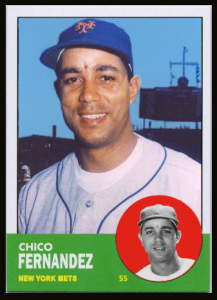
A new Met, some new hope (courtesy Mets Fantasy Cards).
In May of 1963, the motivation for that sort of Mets-ical thinking was the acquisition from the Tigers of Chico Fernandez. Studied through a long lens, he is neither the most accomplished of Met Fernandezes (Sid, Tony) nor famous of Met Chicos (Walker, Escuela). But he was new and therefore he embodied hope. He had to. I wasn’t watching or listening when he came to the Mets, having no TV or transistor in my crib at four months old, but I know how Mets fandom functions. Surely it didn’t get this way just when I came along.
I know the Mets fan whose team was in ninth place on May 8, 1963, the day the Mets swapped Larry Foss for Chico Fernandez, got excited that we now had a guy who a year earlier had belted 20 homers for Detroit, who two years earlier swiped home in a huge game against the Yankees. This was exactly what we needed, Chico Fernandez at shortstop. We couldn’t wait to see him. By the time we did, his good vibes infected the entire operation. The Mets were on a five-game winning streak, wafting to two games under .500 and into — get this — sixth place, only five games behind the front-running Giants, the same nemeses who had beaten us 17-4 a couple of days before our fortunes transformed.
Would wonders ever cease? Hell, wonders were only starting.
Chico joined the fun on May 11, pinch-hitting for Al Moran with two out in the bottom of the ninth at the Polo Grounds, the Mets trailing the Reds, 4-2. If Fernandez could get on, then Casey could send up a pinch-hitter for Ken MacKenzie, and then…well, that’s hope. We weren’t down to our last out. We had the potential tying run in the on-deck circle.
Fernandez struck out looking. So much for a sixth consecutive win. The Mets dropped to seventh place that Saturday, eighth in the first game of a doubleheader that Sunday. But Chico displayed versatility, leading off, starting at third base (the Mets’ eleventh third baseman in their very brief history) and moving to shortstop in one of Casey Stengel’s multiplayer repositionings.
Double-negatives be damned, we hadn’t seen nothing yet, because in that Sunday’s second game, all hell broke loose in the most heavenly and Metsian way possible. Larry Burright became Met 3B No. 12 in the fifth inning, Moran No. 13 in the ninth. The Mets were giving new meaning to “three men on third” on May 12, 1963…four, actually; Rod Kanehl had started the nightcap, but left not long after getting hit by a pitch with the bases loaded in the third. Never mind that bit of trivia for the moment, though. So much more was percolating. As Sunday grew later and later, the Mets led Cincinnati 5-0; were tied with them at six; forged ahead of them by five; fell behind them by one; and, ultimately, came up victors, 13-12. Fernandez drove in the all-important seventh and scored the just as vital ninth run.
The Mets were ready to get vertical. They traveled to Houston for a Monday night game on May 13 and Stengel assigned third base to rookie Ron Hunt, giving the Mets their fifth third baseman in little more than a day, their fourth new one in a nineteen-inning span and fourteenth overall in fewer than 200 games. It didn’t help. The Colt .45s won, 4-2. Another loss to the Colts, a win (Chico singling and scoring) and a flight to San Francisco ensued. The Giants were still in first. The Mets were clinging tightly to ninth.
The game of Thursday, May 16, 1963, began fairly typically for the Mets of that era. Willie Mays homered with his pitcher, Billy O’Dell, on base in the third. Giants up, 2-0. Joey Amalfitano hit a ball that second baseman Hunt couldn’t handle with runners on second and third. Giants up, 4-0. Cliff Cook pulled the Mets to within three when he led off the fifth with a homer. But Willie McCovey increased the home team lead to five when he launched a two-run shot off Met starter Jay Hook. It was 6-1, San Fran, and what were you gonna do?
You were gonna hope. Because Hunt led off the Met sixth with a home run. And, after two outs, Jim Hickman singled. He took second on a wild pitch while Cook batted, then scored when Cook singled. Up stepped Chico Fernandez, still the newest of Mets.
Fernandez buried a Digger O’Dell delivery over the Candlestick Park fence. The Mets, not so up and at ’em moments before, were now in this thing. The Mets went from down 6-1 to down 6-5. We had Chico Fernandez homering and the Mets roaring back and, in the bottom of the sixth, Tracy Stallard relieving Hook and keeping the Giants off the board. The Mets didn’t score in the top of the seventh, but Larry Bearnarth shut down San Francisco. The eighth beckoned.
With one out against young reliever Gaylord Perry, Hickman blasted a fly ball that, had it been left alone by the Candlestick wind, was judged likely to pull the Mets into a tie. Alas, the Candlestick wind was a fickle beast. Whereas, according to Leonard Koppett in the Times, it was minding its own business earlier, this time it kicked up enough to hold Hickman’s ball in the park. Still, it was high and deep and fell in after it ticked off Mays’s glove.
Hickman reached second. How about third? Mays made a hellacious throw there, but missed his target. Had Jim kept running, he could have had himself a triple. Except Jim didn’t keep running. By Koppett’s account, he had not run “at full speed in the first place. He settled for a comfortable double, just as nine players out of ten do in such circumstances.”
Willie Mays was probably the tenth player, but he couldn’t help us for another nine years. Nevertheless, there was hope that the Mets’ next two batters could bring Hickman home. Each of them had homered earlier. We didn’t need a homer. We needed any kind of hit in the right place. Instead, Cook lofted a flyout to right (a potential sacrifice had Hickman made it to third) and Fernandez struck out. The Mets went on to lose, 6-5. A day later, they’d dip down into tenth and last place, settling there for the bulk of the season. By the second week of July, the Mets demoted Cook to Buffalo and optioned Fernandez to Seattle, which was a Boston farm club, but you could do things like that with other teams’ minor league affiliates in those days.
Chico returned in September and holds two “last” distinctions in the distinguished history of the Polo Grounds. In the top of the ninth on September 18, 1963, he gobbled up a two-out grounder from Phillie pitcher Chris Short and fired it to first baseman Tim Harkness. It was the final defensive chance ever handled by a home team in Manhattan. In the bottom of the inning, with the Mets trailing, 5-1, Harkness flied out, but Kanehl, pinch-hitting for Norm Sherry, singled. Chico stepped up and singled as well. Now we had first and second. Ted Schreiber was announced as the pinch-hitter for Bearnarth. Should he get on, Dick Smith would come up as the tying run. The Mets could send out the ancient horseshoe with a win. Or at least keep it going with a tie. There was, in an expiring ballpark’s last scheduled inning, hope.
Schreiber grounded to Cookie Rojas, who tossed it to Bobby Wine, who threw it to Roy Sievers. Fernandez was out, the Mets had lost, the Polo Grounds was done. Two of them — Chico and the Mets — hit the road to finish 1963, grip on tenth place securely cemented. Chico Fernandez, owner of Upper Manhattan’s last base hit, would never play major league baseball after that season ended. He never hit another home run for the Mets after May 16. To this day, in addition to being the eleventh of 160 Met third basemen, he is the fifth member of the One Met Homer Only club, population currently 78. 2016 inductees include Met 3B No. 160 Ty Kelly, who is presently at liberty in Las Vegas; James Loney, who you’d like to believe carries only a temporary membership card; Bartolo Colon, which is a whole other miracle; and Almostandro De Aza. De Aza almost hit a second, in Pittsburgh, but it didn’t quite clear the highest wall they have.
Chico Fernandez died on Saturday at the age of 84. He came up as a Brooklyn Dodger in 1956 and kept playing baseball after being traded in 1964 from the Mets to the White Sox for Charley Smith (Met 3B No. 17 if you’re scoring at home; Hickman and Pumpsie Green also gave it a whirl in ’63). Chico would play in the minors, in Japan, in Mexico and, as late as 1968, back in American Triple-A. He didn’t give up. For eighteen professional seasons, he maintained the kind of hope he gave us for a week in May of 1963, an interval that I suppose amounts to a footnote relative to what he achieved in Detroit. The Cuban-born infielder made his mark as the Tigers’ first Latin player to start on a regular basis. His old Detroit teammates still speak fondly of the man whose given name was Humberto. His wife acknowledged on Ultimate Mets Database that he wasn’t particularly enthused to join our second-division ranks, but was careful to add, “He did love Met fans.”
We return a little of that love 53 years later by remembering that Chico Fernandez inspired a little hope in us during a ballgame which was enshrouded in hopelessness before he hit one out of Candlestick.
***
We paid quiet tribute on Sunday by investing similar hope in Wilmer Flores, a native of Venezuela and a permanent citizen of our hearts since last summer when he showed us he, too, loves Met fans. If Flores could get a hit at Miller Park…if he could bring home Cespedes from third in the eighth, then it would be 5-4. If he could manage the right kind of hit, maybe a long one or one that got by a Brewer glove the way balls had been eluding Met leather, it could be 5-5. And if Wilmer reprised the role that earned him Best Drama in a Pennant Race in 2015…reprise it versus his ghost team, the Brewers with the type of hit he inflicted on the Nationals…well, then we wouldn’t have been wasting our hope on this Sunday, would have we?
Wilmer did his part. He connected for a sinking line drive to left. When it fell in, it would indeed be 5-4. If it did something quirky — and wasn’t it already quirky that this game wasn’t effectively over? — it could be 5-5. There was hope in the air.
Unfortunately, there was left fielder Ryan Braun diving to the ground, making a pretty good catch. Braun caught a third out along with our whimsical wishes, leaving the score where it would wind up for permanent filing, Brewers 5 Mets 3.
Yet we cannot say we wasted our hope. We never do. It’s our greatest renewable resource. The only way we cease to make more of it is to stop hoping at all. We have 100 games to keep trying.
And I hope to see you in Greenpoint at WORD Bookstore (126 Franklin St.), Tuesday at 7 PM, where I’ll be joining Mets By The Numbers author Jon Springer and NBC Sports writer D.J. Short and discussing my book Amazin’ Again. There was a lot of hope in that volume, come to think of it.
If it wasn’t exactly déjà vu all over again, I was nonetheless struck, well before its outcome became obvious, by a near-certainty Saturday that the game I was watching was not going to be won by the Mets. This was before thousands of miles worth of home runs were blasted by Brewer batters off of Logan Verrett and Antonio Bastardo and preceded by Met batters’ insistence on stranding their brethren on base.
“Do the Mets,” I asked myself, “ever win the second-to-last game of a series they play in Milwaukee?” The answer, which I just got around to looking up, is, “No.”
Really, they don’t. I suppose the operative term should be they haven’t, not since 2008, anyway. From 2009 forward, inclusive of 2016, the Mets have come to Miller Park for eight series and, in the game before the last game of each series, they have gone back to the hotel with a loss.
I checked Ultimate Mets Database, which for the purposes of this hunch-driven narrow research served as Penultimate Mets Database. Penultimate Mets games in Milwaukee consistently go down as perennial defeats.
It’s happened in second games of three-game series.
It’s happened in third games of four-game series.
It’s happened on Saturdays.
It’s happened on weeknights.
It’s happened in walkoffs.
It’s happened in slugfests.
It’s happened to aces like Johan Santana.
It’s happened to journeymen like Shaun Marcum.
It’s happened eight times in a row now.
Just because it keeps happening doesn’t mean it had to keep happening. Unlike the Brewer bats, there is limited power in precedent. Most likely it’s just one of those things, but after seven consecutive episodes of such unhappy days, it’s tough to shake the sense that an eighth will be right back after these commercial messages.
Did it have to happen this time around? Depends where you stand on the spectrum between utter randomness and preordained destiny. Verrett pitched a spotless bottom of the first and Asdrubal Cabrera hit what seemed like a long two-run homer in the top of the second. The Mets were up, 2-0, and the Brewers, who absorbed the worst from Friday night’s dual debacle, were perhaps mired in a haze that would also smother the heretofore undetected not-quite-getaway day jinx. It certainly couldn’t hurt the Mets’ cause that they were facing Wily Peralta. Peralta entered Saturday with an ERA (6.79) measuring greater than the amount a person pays for an overpriced Nathan’s hot dog at Citi Field ($6.75).
That next sound you heard was that of pitches Verrett threw going for joyrides. Or perhaps they were screaming in agony. Either way, it wasn’t good from a Met perspective. Chris Carter hit one to the occupying 7 Line Army in left. Ryan Braun launched one last seen headed toward NATO headquarters in Brussels. To paraphrase Crash Davis, anything travels that far oughta have a damn warhead on it, don’t you think? Missiles were flying everywhere. Kirk Nieuwenhuis got in on the act in his way, which consisted of a double, a stolen base and a run scored. Even Peralta, who surely knows what a home run looks like from his vast experience giving them up, sent one deep into Braun territory.
Pitchers hitting home runs: not as much fun when the gopher is on the other foot.
Curtis Granderson kept the Mets viable with a homer of his own in the fifth, cosmetically cutting the Brewer lead to 5-3, but his signature blow Saturday was the leadoff triple that didn’t quite go out in the third. Terry Collins challenged the yellow-line vagaries of Miller Park’s right field fence but was rebuffed. You’d take an immediate tally, for sure, yet the consolation was Grandy on third with nobody out. He was gonna come home eventually, right?
The Mets will board a flight to New York after today’s game, so yes, Curtis Granderson will come home to wherever he lives during the baseball season. But in the immediate context of Saturday’s third inning, home was a concept not easily grasped. Grandy retreated to third when Michael Conforto lined out nearby and then was statistically stranded there after Yoenis Cespedes walked and Neil Walker grounded into a double play. Man on third, nobody out, nobody scores…what fun. Also, Walker’s apparently chronic bad back — the Met version of a fraternity pin — acted up and he had to leave. It’s either no big deal or an enormously big deal.
That, like most things in the Met universe, will be determined by a visit to a doctor, a surprisingly lengthy inactive stay on the active roster and then who knows? By the time we find out, it will likely be little remembered that the Mets lost their second-to-last game in Milwaukee, 7-4 (with Scooter Gennett and Braun mashing Bastardo). Perhaps the Mets will have captured their Sunday Miller finale and enjoy a cheery flight into LaGuardia. Perhaps whatever has plagued them physically, mentally and spiritually on this road trip — a clunky three-city tour during which they’ve nonetheless gone 5-4 — will dissipate when they return to Citi Field, where, at least until his next start, the price of a frank will list higher than the number of earned runs Wily Peralta allows every nine innings. In defeating the Mets, the otherwise beleaguered Brewer starter lowered his ERA to 6.68 while jacking his slugging percentage to .250, or just a little lower than the figure key Met pinch-hitter Alejandro De Aza (.279) is packing these days.
Maybe they can pack one last win in Milwaukee, too. You know, they’re 8-1 in their last nine Miller Park getaway games.
Come to WORD Bookstore in Greenpoint, Brooklyn, Tuesday night at 7 PM for an evening of Mets book talk. I’ll be joining Jon Springer of Mets By The Numbers and D.J. Short of NBC Sports. Full details here. Hope to see you there.
The eleventh inning was rolling around
The opposing offenses were making no sound
Boyer the Brewer was manning the mound
Blaine looked to the plate
As the hour grew late
Asdrubal Cabrera was the hitter he found
Cabrera commenced
To single to right
To all, perhaps
An Asdrubal good night?
Flores was the Met
Seen teeing off next
A double to left
Thus entered the text
Cabrera wasn’t swift enough
To bring the run home
These Mets, they don’t scurry;
They’re more prone to roam
Kelly Johnson, class of 2015
Reappeared as a Met, shipped north for ’16
Every year he alights in our midst an ex-Brave
Would his second debut be a game he could save?
Four balls went to Kelly
To load every base
On deck was a batter
They’d much rather face
Milwaukee preferred Plawecki
As most any sharp ballclub would
Plawecki fouled out in an instant
The kid’s not yet very good
Now stepped in Matt Reynolds —
On the depth chart he ranks twenty-five
Yet it was left to disposable Matthew
To attempt to keep Met hope alive
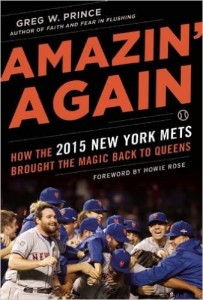
Amazin’ Again, my book that tells how the 2015 Mets brought the magic back to Queens, makes its Brooklyn debut this Tuesday night at 7 o’clock when I join my longtime friend and esteemed blolleague Jon Springer at WORD Bookstore in Greenpoint (126 Franklin St., convenient to the G train) for a Metsian discussion many digits in the making.
Amazin’ comes to Brooklyn.
Jon is the founder of MBTN.net, a.k.a. Mets By The Numbers, which also happens to be the book Jon will be talking about Tuesday. The all-new revised edition of one of the truly essential not to mention incredibly enjoyable Met histories — which Jon first co-authored with our fellow Met-loving writer, Matthew Silverman, in 2008 — will bring to light what every Met has worn in every game since 1962 and tell the stories behind the intersection of players and numbers. Jon pretty much invented the concept of using the Internet as a repository for timeless Mets information. Come to think of it, the book works well in that capacity, too.
Moderating our discussion on all matters Met, numerical and otherwise, will be D.J. Short, one of NBC Sports’ outstanding baseball scribes. We’ll delve into our writing, our team, the whole nine yards, or should I say innings. And when it’s over, we’ll probably seek out an establishment that will allow us to watch the conclusion of that night’s Mets-Pirates tilt (hopefully tilting in our favor by then).
Whether you reside in Brooklyn as Jon and D.J. do, you were born there as I was, or you just happen to want in on an Amazin’ Mets night from wherever you hail, by all means come on down to WORD.
(If you can’t make it Tuesday night, but still want a personalized, autographed copy of Amazin’ Again, you can order one here or make your way to the Queens Library in Briarwood on June 25, details here.)
Out in Milwaukee, the Mets played a baseball game that was quietly unsettling for a good chunk of the evening: Curtis Granderson led off with a home run and the Mets kept piling up base runners against a wild, ineffective Jimmy Nelson, but — in recent Metsian fashion — the protagonists failed to deliver the big inning that constantly seemed to be developing. At the seven-inning stretch it felt like it should be 8-0 Mets, but the lead was actually a skinny 2-0, which the Brewers promptly cut in half when old pal Kirk Nieuwenhuis came scampering home from second on a Hernan Perez ball that nearly drilled a hole in Neil Walker.
It looked for all the world like one of those games that quietly becomes a 3-2 loss while your attention wanders, but Kevin Plawecki threw out Perez trying to steal second (huh?) and then chipped in a two-run single in the eighth for some much-needed insurance. I dozed off at that point and woke to find Steve Gelbs chatting with Granderson. Granderson is philosophical and imperturbable most evenings, so I had to shake away the cobwebs to make sure Gelbs wasn’t asking something like, “Curtis, after a game like this do you ever ask yourself if the only sane response to a malign universe is nihilism?” Nope, they were chatting amiably about working on stuff and teammates, so I knew the Mets had won.
During the game, the booth and Twitter brought in other Mets-related dispatches: tonight was draft night, and the Mets signed a pair of Long Island kids: Boston College’s Justin Dunn (19th overall pick), who hails from Freeport; and UConn’s Anthony Kay (31st pick, as compensation for the Nats inking Daniel Murphy), a Stony Brook resident who went to Ward Melville, alma mater of Steven Matz. (Ward Melville’s also the high school I would have attended if we hadn’t decamped for Florida after ninth grade, not that anyone reading this should care.)
The baseball draft’s an odd thing — only the most devoted slice of the most devoted pay it more than cursory attention, because in all likelihood it will be two or three years before any of the new names push their way into our consciousness as potentially imminent Mets and three or four years before they appear on a big-league roster. And even then that’s an if — a lot can go wrong, from scouting errors to injuries and simple bad luck, to derail even a top pick.
Two first-round picks from the Alderson regime have become full-fledged Mets: Plawecki (2012’s 35th overall pick) and Michael Conforto (the 10th pick in 2014). Alderson’s initial first-round pick, 2011’s Brandon Nimmo, is hitting well at Las Vegas and has been bandied about as a callup; another pick from that year, Michael Fulmer, is doing well as a Tigers rookie. 2012 pick Gavin Cecchini is at Las Vegas, while Dominic Smith, chosen in 2013, is at Binghamton.
Over the next few days we’ll register the names of draftees from later rounds, looking over their capsule biographies and mini-scouting reports and then promptly forgetting them. A few of these young players will matter to us one day, becoming useful Mets. The crop will perhaps even yield a starting player or two. But most of the lower-drafted guys won’t matter at all. Joe Sheehan’s newsletter — which you should absolutely subscribe to if you want to be a smarter fan — made the point today that we don’t really understand the role of most minor-league players. We think of them as apprentices, competing for a handful of big-league prizes, but that’s not true. As Sheehan notes, a bit cruelly but accurately, “they’re not apprentices; they’re extras. They’re the guys walking in the background on a city street while two characters argue. The last 30 rounds of the draft are an open call to find people willing to provide a realistic atmosphere for the stars to practice their craft.”
That role isn’t destiny: extras do occasionally become leading men in either profession. Mike Piazza may be the most famous vanity pick in baseball history, rising from the 62nd round (and the 1,390th overall pick) to a date with Cooperstown. But top picks such as Dunn and Kay will get every opportunity to prove themselves and make the people who selected and paid them look smart; the guys chosen as New York-Penn League roster-fillers will have to convince a very long list of people that they were wrong in order to claw their way to a couple of days in the Show.
For now, though, we can dream of Justin Dunn trying to conquer his nerves on the Citi Field mound one day in 2020. We can imagine an older Steven Matz kidding newly arrived Anthony Kay about needing to drive in four in his debut. And we can hope that there’s some 2016 34th-round pick waiting to craft a tale that will remind us to believe in ourselves and never, ever give up. Being realistic about draft day doesn’t require us to be cynical about it. For now, all is possibility — and imagination is free.
The nearly 150-year-old “national pastime,” as baseball continues to bill itself despite indications of declining popularity relative to other sporting endeavors, still has some surprises lurking in its venerable bones, none more unpredictable than those the New York Mets unveiled to a largely disapproving audience at PNC Park Wednesday night.
The cast of the New York Mets has weathered attrition and defections (some more spiritually damaging and some less permanent than others) since their glorious Broadway run of last fall. Talent is evident in certain key roles, while others are filled by game but frankly overmatched journeymen performers. Recent stagings have brought into question the staying power of the entire enterprise, but June 2016 is hardly the first month and year when the Mets have been written off as a fabulous invalid taking its overdue final bow.
Sparkling scenery and classic costuming augured well for a sumptuous production. If nothing else, ticketholders could look past any impending Met shortcomings and admire the Pittsburgh-designed set. A bridge…a river…a skyline. PNC Park was, as always, dressed to the nines. Its on-field inhabitants, unfortunately, did not always live up to the atmosphere.
Noah Syndergaard, as the Mets’ starting pitcher, swung and missed at the hype that materialized ahead of his appearance on the banks of the Allegheny. It’s not that Mr. Syndergaard was fully ineffective in the lead role. To the contrary, the longer Mr. Syndergaard (or “Thor,” as the press agents prefer he be identified) stayed in the spotlight, the more comfortable he appeared. It was the time he required to reach his comfort zone that seemed to doom the Mets’ aspirations for the evening.
Mr. Syndergaaard’s antagonist, newcomer Jameson Taillon, may have also suffered from a case of overwrought advance notices. Mr. Taillon certainly showed promise, but has yet to express the verve and panache necessary to sustain an above-the-marquee presence so necessary in this star-driven box office era.
In a sense, Mets at Pirates was an understudy’s gala, with the unlikely character of the rookie third baseman, played by little-known Ty Kelly, rescuing the first act with a display of power clearly at odds with the script’s prevailing narrative arc. There was no hint that Mr. Kelly — whose name was familiar only to those whose Playbills were properly supplemented with squares of white paper alerting the audience to his existence — had such a forceful outburst in him, but proponents of baseball will always default to their pastime’s capacity to jar as explanation for such illogical turns of event.
Despite crowd-pleasing moments in the mold of Mr. Kelly’s brief showstopper, Mets at Pirates was plagued by potentially climactic scenes that fizzled prematurely. The worst offender stepped to the fore late in the third act in the “Runners on Base” number. Michael Conforto, a featured player of whom much is expected (but from whom little has been delivered recently), struck a blow for scintillating drama with his own version of what Mr. Kelly had brought forth earlier. The waters of the Allegheny had surely been roiled and the Mets were poised to make the most of it.
Or so the most basic tenets of scriptwriting would have it. Following Mr. Conforto’s curtain call-worthy swing for the fences, his castmates proceeded to stand on each visible base. An anxious orchestra section, forged into common cause with the patrons in the upper balcony, braced for decisive action. Yet literally nothing happened. The Mets slipped off the stage and into darkness, leaving all puzzled as to the purpose of the cumbersome buildup.
Another disappointment came in the form of the prodigal son character, convincingly if ineffectually portrayed by Neil Walker. Mr. Walker, a Pittsburgh native, was the focus of the spotlight for much of the evening, yet proved unequal to the attention. Perhaps a stage packed with less pressure (ironically, he has excelled in New York) will revive his suddenly flagging abilities.
Ultimately, the Mets will be the Mets, another of those shibboleths Metropolitan apologists rely upon to rationalize convoluted plots that are sorted almost neatly at the last possible juncture. Wednesday night it fell to Wilmer Flores, best remembered for his emotion-riddled summer stock performance in 2015, to create a path home. No “Tears of Joy” this time from Mr. Flores, another of those Mets who has unfortunately made his 2016 encore something more resembling a chore than a delight. Director Terry Collins nevertheless cobbled together a pedestrian resolution, that of an almost mundane pinch-hit bloop single. It may not have been an artistic triumph, but at least the bases didn’t go unloaded again.
After Mr. Flores fulfilled his obligation to Mr. Collins’s less than fresh vision, the final theatrical flourish belonged to the closer (a part reprised, per usual, by Jeurys Familia). The Met director doesn’t believe in simple endings, but after perhaps a bit too much kerfuffle on the part of the opposing Pirates, he and his cast did produce a happy one.
It may not have been what Pittsburgh wanted, but Mets aficionados couldn’t help but grudgingly offer their applause for a result that would inevitably read as bright and bouncy in the next morning’s box score.
Mets sucked, grounding out and then grounding out again and again and again and again and again and again and again and again and again and again and again and again and again and again and again and again and again and again. I’d tell you more about the first game but a judge ordered me not to. Then after a robust 25 minutes in which nothing bad happened, they sucked once more, striking out and then striking out again and again and again and again and again and again and again and again and again and again and again and again and again. I’m allowed to talk about that one but I’d prefer not to.
Times like this arrive now and again for fans of every team, like droughts do for farmers and wipeouts arrive for gamblers. Your baseball team isn’t getting hits and scoring runs, and while you’re no psychic it’s pretty obvious that they never will get hits and score runs again. Every time they are sent out to play a baseball game they will lose, until the current players grow old and are replaced by younger players who will also not win, and this is the way it will be forever and ever, opposite of amen.
That’s not true now just like it’s never been true before, but I know it feels that way, and if I can barely convince myself otherwise what chance do I have with you?
Having lived through these slow-motion blue-and-orange car crashes more than a few times, I’m going to give you some heretical advice: unless you work for the Mets or are a beat reporter or whichever one of us is on recap duty, do something else.
No, not forever. Jeez, it’s not that bad. Just for a night or two.
“But wait!” you say. “It’s not winter, so I have no idea what to do with myself from 7 pm until whenever!”
I know, I’ve struggled with that too. Some suggestions:
Take a baby step and watch other baseball, trying not to get obsessed about one particular score down there at the bottom of the screen. I’m an MLB.TV subscriber this year and that’s reminded me baseball’s awesome even when it’s not being awesome to you. When the Mets are finished doing whatever terrible thing they’re doing on a given night, I flip around from game to game until I go to bed or nothing’s left. Tonight I saw Sam Dyson escape a serious fix against the Astros, and Brian Dozier hammer a walkoff homer for the Twins. Now I’m listening to Vin Scully. He’s narrating a Rockies-Dodgers game with nothing particularly interesting about it, but I already feel a little better.
Read a book. Amazin’ Again, that’s a good one. Or possibly even something not baseball-related. Those books exist too.
Take your significant other to the movies. Turn off your phone (you monster), get a big popcorn and don’t worry about RISP (or the lack of them) for two hours.
Go for a walk. Or a drive. Look around at the world. Listen to the birds, the bugs, or both.
Go see a band. Don’t ask them to play the national anthem, “Meet the Mets,” “Take Me Out to the Ballgame,” “Lazy Mary,” “Piano Man” or the Kars-4-Kids song. Let them play whatever they want to play. Hum along if you’re so moved.
Tackle that chore you’ve been putting off. You’ll have a sense of accomplishment and won’t have created another task for yourself by putting a Mets-related fist through the drywall.
The Mets will do what they’re going to do whether you’re there or not. It’s hard to imagine, but it’s true. I went away last summer; the Mets didn’t wait around for me to get back. I’m going away again next week; they’ll soldier on.
The point is that you’re a fan, not an unfortunate who did something ill-advised that earned you an orange vest and three hours a night in the custody of SNY. You have an unlimited supply of GET OUT OF UNFUN BASEBALL FREE cards that you can play any time. This might be a good time to lay one down.
With a night or two away, you’ll feel better. And when you get back, who knows? Maybe things will be different.
We talk up great starting pitching, we crave great starting pitching, we built this Citi on great starting pitching, so when we are surrounded by extraordinary starting pitching, we are compelled to celebrate it…even if not all of it is necessarily Mets starting pitching.
The Mets took part in a fine game Sunday. The wrong part, but still. It was the kind of game we’ve been romanticizing for generations. Seaver and Gibson. Gooden and Tudor. Harvey and Fernandez.
Stylistically, you wouldn’t have minded both Harvey and Fernandez sticking around Sunday. For the sake of self-preservation, you were happy Matt maintained his roll from last Monday and you’d have been ecstatic had Jose gotten lost on his way to Marlins Park in the morning. But if you can allow yourself 1/162nd of non-result-oriented appreciation for baseball like it once in a while oughta be, you had to appreciate what the Miami starter was doing to the admittedly diluted Met lineup: no walks, four hits and fourteen definitive strikeouts, most of them captured on sliders so salivating that White Castle might want to borrow the recipe.
The Mets mounted one tiny semblance of a rally in Fernandez’s last inning when Michael Conforto and James Loney each singled with two out, Conforto actually going from first to third on Loney’s knock, something Met baserunners usually require two hits and/or an Uber to accomplish. Wilmer Flores, looking pretty good in the previous couple of games, was the last best hope against Fernandez. Alas, Fernandez’s final slider extinguished all hope.
If this had been one of those Clayton Kershaw 8-0 leads, it wouldn’t have been so scintillating, just shruggy. But Harvey held up his end, albeit with more contact. The Marlins didn’t do much when they connected, scoring their only run in the fifth when J.T. Realmuto grounded a ball up the middle that wasn’t trapped by a shift. It brought around Derek Dietrich, who had legitimately doubled.
That was it. Harvey, guided by the indispensable Rene Rivera, surrendered only two other singles and walked nobody while striking out four. Starters come away with wins for far lesser outings. Certainly Harvey, perpetually deprived of runs with which to work (he was given one in the last week), deserved no worse than an ND for his trouble. He and his team were edged was all.
The ungrudging 1-0 cap tip toward Fernandez, a Marlin so sublime that you have to assume he’ll go in the next fire sale, only extends through seven. David Phelps in the eighth and A.J. Ramos in the ninth did not have to go unscathed, but the Mets cobbled together nothing of substance against them. The Marlins didn’t dent Antonio Bastardo, for that matter. Everybody pitched well. Everybody fielded competently. Nobody walked anybody. Save for Ichiro Suzuki getting thrown out at second on a pickoff (on a play in which it looked like Asdrubal Cabrera absorbed another ding), nobody did anything particularly wrong. The pitching did almost everything right, the game hustled itself to conclusion in 2:17 and the souvenir we got to keep was a reminder of what a matchup between greatness and maybe getting back to greatness resembles.
Would have been better had we won. And if the starters had gone nine. And if Papelbon had fully blown a blowable save in Cincinnati. But you can’t have everything.
***
Time to plug:
• Father’s Day is less than two weeks away, so this would be an ideal moment to order a signed, inscribed copy of Amazin’ Again for the paternal figure in your life. Hell, buy it for your mom, yourself, whoever. Direct it anywhere a Mets fan likes to read.
• Tuesday night, 7 PM, June 14, you’ll want to come to WORD Bookstore in Greenpoint, Brooklyn, for a Metsian discussion featuring Internet pioneer Jon Springer (whose revised edition of Mets By The Numbers will be available to all attendees), D.J. Short of RotoWorld and myself, author of the aforementioned book about the reigning National League champions.
• Saturday afternoon, 3 PM, June 25, I’ll be bringing the Amazin’ Again roadshow to the Queens Library in Briarwood, with copies of the volume about how the 2015 Mets brought the magic back to that borough in tow.
• My thanks to Newy Scruggs for having me on his NBC Sports Radio show, Voices of the Game, last week. Visit the On Demand menu, click on Newy’s feed, scroll down to May 31, hour 3, and you can hear our conversation.
• Likewise, my deep appreciation to Pat Williams, legendary Orlando Magic architect and now host of a terrific radio show in Central Florida. I taped a lively interview with him recently and planned to tell you to listen to it this weekend, but I messed up the dates and it already aired. Apparently Met batters were not the only ones swinging and missing where baseball in the Sunshine State was concerned.
Let’s just make this clear: Saturday afternoon’s Mets-Marlins game was garbage.
The Mets put the leadoff man on in seven of the first eight innings (and eight of nine overall) but somehow managed to be down 3-2 with just five outs remaining. Bartolo Colon was crummy but mostly got away with it because the Marlins couldn’t get out of their own way; Hansel Robles was crummy and yet again did not get away with it.
And then there was the Wilmer Flores–Kevin Plawecki follies of the second inning: with the Mets down 1-0, the Marlins had the bases loaded with one out. Pitcher Justin Nicolino smacked a sharp grounder to Flores at third. Rather than go for the round-the-horn double play, Flores came home for the force. (He said later he didn’t have a good grip.) An understandably startled Plawecki caught the ball, but his foot was next to home plate rather than on it, as is recommended for force plays. Instead of being out of the inning, the Mets were down 2-0 and Terry Collins looked like a man sentenced to the rack.
Plawecki led off the third, which at least allowed him to escape extended tut-tutting from coaches, and seemed to have redeemed himself with a double … until he got picked off. Before rising and slinking away, Plawecki lowered the bill of his helmet in the dirt and lay there for a moment, perhaps contemplating the void. He then fanned in his next two at-bats, leaving three Mets on base and making me recall Anthony Recker having one of the worst nights I can recall for a catcher in this same hideous ballpark. Not exactly what Plawecki had in mind with Rene Rivera on the verge of snatching away his job.
But if the game wasn’t exactly the stuff of instructional videos, it was also a reminder that garbage baseball can still be kind of fun, the way mainlining Oreos by the glow of late-night TV can seem like a great idea at the time. The Marlins have problems of their own, and allowed their hapless opponents to hang around. In the bottom of the sixth, with runners on second and third and two out, Ichiro Suzuki lashed what seemed certain to be his 2,966th hit to left-center. It was going to be 5-2 Marlins … except Juan Lagares flung himself through the air, looking like a man making a racing dive into the pool, to snatch the ball before it could touch down. Inning over and dreariness averted, somehow.
In the eighth, with the Mets down 3-2, some players badly in need of pick-me-ups came through. Michael Conforto, who had spent the night determinedly ignoring the inside fastballs that have bedeviled him, fought through a tough at-bat and singled up the middle off David Phelps to bring home James Loney and tie the game. With Conforto on second and two out, Matt Reynolds lined Phelps’s first pitch over the head of Miguel Rojas for his first career RBI and a Mets lead.
All of that was fun — and the kind of fun the Mets will need more of to survive this current stretch. (Oh, and they somehow picked up another game on the Nats.) But this being Miami, there of course had to be a scare in the ninth and assorted annoyances at other times.
One of those annoyances was self-inflicted: is sending Jacob deGrom up to pinch-hit really wiser than keeping Rivera idle in case of an injury? Jake entertained himself, which I suppose is nice, but this seems like a case where the premium on the insurance is so high that one should just accept that life comes with risks. (Though given Plawecki’s night he might well have wound up eaten by piranhas leaping out of the Loria fish tank sometime in the 14th.)
The other annoyance is as I type no one’s quite sure how badly Lagares hurt his thumb on that heroic dive. He came out of the game, but further information wasn’t available because there’s no doctor on site at New Soilmaster. I assume this is just more evidence that Jeffrey Loria is a despicable cheapskate whose interests don’t extend to the basic duties expected of a major-league owner. And if that’s not the case I don’t really care, because Loria deserves such suspicions.
The Marlins are a deplorable shell game practiced on the decent people of Miami and all but designed to drive them away from the game, a travesty that Major League Baseball has aided and abetted for decades. Every commissioner can invoke the best interests of the game in taking action; a conservative reading of baseball’s best interests surely includes banishing Loria from any further association with the sport, up to and including wheedling change in a stadium parking lot.
My near-feral hatred for the Marlins (which, to be clear, has nothing to do with their long-suffering, shamefully disenfranchised fans) is well-known here (see other eruptions here and here), but every series against them seems to intensify it until seemingly innocent items of conversation bring up bile. For example, at one point, SNY’s trivia question was to identify the Marlins’ all-time wins leader.
The long answer: “I shall sort through the sordid history of this garish screw job disguised as a franchise and try to remember which starting pitcher was most capable before being sold off as part of a con artist’s cynical teardown.” And such mental gymnastics might or might not have yielded the name Ricky Nolasco.
The short answer: “Who gives a fuck?” Which, given all of the above and so much more, I contend is in fact correct.
Piazza: Catcher, Slugger, Icon, Star by Greg Prince is available from Amazon, Barnes & Noble and other online booksellers.
Amazin' Again: How the 2015 New York Mets Brought the Magic Back to Queens by Greg Prince is available from Amazon, Barnes & Noble and other online booksellers.
Volume I of The Happiest Recap: 50+ Years of the New York Mets As Told in 500+ Amazin' Wins by Greg Prince is available in print and for Kindle on Amazon.
Faith and Fear in Flushing: An Intense Personal History by Greg Prince (foreword by Jason Fry), is available from Amazon, Barnes & Noble and other online booksellers.