The blog for Mets fans
who like to read
ABOUT US

Faith and Fear in Flushing made its debut on Feb. 16, 2005, the brainchild of two longtime friends and lifelong Met fans.
Greg Prince discovered the Mets when he was 6, during the magical summer of 1969. He is a Long Island-based writer, editor and communications consultant. Contact him here.
Jason Fry is a Brooklyn writer whose first memories include his mom leaping up and down cheering for Rusty Staub. Check out his other writing here.
Got something to say? Leave a comment, or email us at faithandfear@gmail.com. (Sorry, but we have no interest in ads, sponsored content or guest posts.)
Need our RSS feed? It's here.
Visit our Facebook page, or drop by the personal pages for Greg and Jason.
Or follow us on Twitter: Here's Greg, and here's Jason.
|
by Greg Prince on 2 June 2016 10:03 am The Chicago White Sox were the sore thumb of my Logging for twenty seasons, ever since it was decided National League teams should play American League teams for something less than all the marbles. Whoever the junior circuit sent to Shea Stadium, I dutifully saw at least once, entering the encounter in the steno book that preserves all my essential information. For five seasons, this unsought subtask encompassed only members of the American League East, reflecting an antsy era when regionalism ruled Bud Selig’s misguided realignment visions. Eventually, scattered combatants from the West and Central were dispatched in our direction and I made it my business to witness their various cameo appearances and jot down those essential details. My long-term plan to capture all A.L. opponents encountered a glitch in 2008 when the Texas Rangers passed through town the same night as a biblical thunderstorm and left “Texas (A)” Logless even as the premises grew waterlogged. Rangers at Mets at Shea on the evening I alighted to fulfill my obsessive obligation was rained out, thus it took until 2014 and the construction of a whole other ballpark (something the Texas Rangers can appreciate) to accomplish their vital notation in my recordkeeping.
With the Rangers officially observed and added to my life list, the White Sox, like the proverbial cheese, stood alone. I’d seen them in Chicago, in Boston, in Anaheim and on television, but not in Flushing. They never visited Shea for Interleague purposes. They didn’t visit Citi Field until 2013, when a) I had a ticket to see them and b) I couldn’t use it. I missed Matt Harvey and Bobby Parnell one-hitting them over ten innings, as it happened, grumble grumble.
At last, the White Sox returned in 2016 and, in their final performance in our midst until maybe 2019, perhaps 2022, I got to see them up close and in person. Now I know what a White Sox at Mets game looks like.
Yippee.
My curiosity is forever sated. I don’t need to see the White Sox play the Mets again. After thirteen innings of the slowest-motion live action I could have ever imagined, leading to the wispiest of 2-1 losses, I don’t much need to see the Mets play again, but I suppose I’ll be back again soon. With any luck, the Mets as we thought we knew them will be, too.
Those defending National League champions — the ones who brought the “good times” back to Flushing, per Howie Rose’s preamble to the 1986 celebration (after which the Mets lost four of five) — are no longer with us. They’re not dead, I don’t think, but they’ve sure gone missing.
The Mets scored nine runs from Saturday through Wednesday versus the Dodgers and White Sox, the bulk of a homestand apparently devoted to proving the Mets wouldn’t have competed very well in the 1959 World Series. It feels as if we’ll find Cuppy before we come across any kind of offense. Only so much of the malaise can be attributed to Chase Utley, Clayton Kershaw, Eric Campbell and their own bullpen, to identify four recently cited culprits. The PhiL.A. thug, the second coming of Koufax and the coldest Soup since gazpacho were nowhere in evidence in the NYM-CHW finale, and the perennially untrustworthy relief corps can’t really be blamed for how the Mets went under, despite it having been a Met reliever, Logan Verrett, who gave up the key hit in the 13th, a double to White Sox reliever Matt Albers, a fellow who last reached base on May 23, 2007. That, incidentally, happened against the Giants, who still had a player named Barry Bonds, who was still ten homers behind Hank Aaron all-time when Albers most recently produced as much as a single. That’s a span of more than nine years, or approximately as long as it took the Mets and White Sox to get to the 13th inning Wednesday.
I exaggerate only slightly, though, in experiential terms, not at all. Snails snorted at the pace these two barely acquainted combatants played. The time of game was four hours and forty-one minutes, none of which any of us in attendance will ever get back. Granted, a beautiful afternoon at the ballpark spent in the company of a good friend — the ever gracious Garry Spector, who knew enough to exit after twelve, just ahead of Albers’s low-level Colon impression — is by no means something to regret. It’s just that the baseball was godawful and then kept getting worse.
And that was with encouraging pitching. Jacob deGrom closed in on brilliant, going seven and striking out ten — including pinch-hitter Jerry Sands, worth mentioning here only because I’m convinced every pack of baseball cards I bought in 1975 contained eight of him, never mind that he was born in 1987. The only damage he absorbed occurred via a disturbingly deep fly ball to Todd Frazier. The combination of deGrom and Rene Rivera seemed to click as well as Syndergaard-Rivera, Matz-Rivera and Harvey-Rivera. The staff ERA with Rene behind the plate is 1.91; it’s 3.20 for the team overall.
Can somebody be everybody’s personal catcher?
Rivera chipped in two singles and drove in the only Met run of the day. The Mets recorded one fewer extra-base hit than Albers. They did display a “GOOD EYE!” (as the leatherlung behind me never, ever tired of barking) on thirteen separate occasions for thirteen mostly useless walks. One of them, to mystery guest James Loney, set up a run. The other dozen amounted to a subliminal advertising campaign for naught (Naught — For When You’ve Decided Scoring is Overrated.). The Mets struck out twelve times and grounded into five double plays while leaving fourteen men on base. Rivera ended the futile day batting .188, which puts him in the upper echelon of the Met attack at the moment. Four Riveras and five Alberses would constitute a significant improvement over the kinds of alignments we’ve seen deployed of late.
I couldn’t tell if by not hitting whatsoever the Mets were paying tribute to the fourth anniversary of their only no-hitter or tipping their caps to the 110th anniversary of the first world champion White Sox, a.k.a. the Hitless Wonders of 1906. Or, with the centennial of the Black Sox scandal practically around the corner, it’s possible the Mets were purposely throwing the game. By the time we were in double-digit innings with still single-digit hits, Garry was remembering staying up all night and listening to Jerry Cram steer the Mets from the 17th to the 24th inning on September 11, 1974. That was the game they lost in 25, 4-3. Also wandering onto our conversational stage for a bow was another 1974 Met, the great Jonathan Trumpbour Matlack. Somewhere between BBs and GIDPs, we considered how dominant Matlack was that year and how it was to little avail. For example, during that same final month of ’74 when Cram kept the nocturnal Mets afloat with zero support, Jon lost decisions by scores of 2-1, 3-2, 2-1 and 3-2, the last of them in a ten-inning complete game effort. Matlack led the National League in all kinds of peripheral metrics that were unknown 42 years ago, yet finished 13-15 because too many of the defending National League champions for whom he pitched his heart out were always hurt and never hit.
If you could hear Garry and me over the leatherlung and his repeated, not altogether acccurate taunting of Alex Avila (“WHAT TEAM ARE YOU ON? YOUR FATHER TRADED YOU!”), you would have discerned the underlying theme of the day and our anxieties pretty clearly.
Yoenis Cespedes chose a game started by Miguel Gonzalez, a guy he scalds (6-for-13), to request a day off. He probably needed one, but the timing was unfortunate. Cespedes struck out as a pinch-hitter versus Nate Jones in the ninth. He had a hit on Monday and two the Tuesday before that but otherwise zilch over the last week. Michael Conforto played all thirteen innings, but his bat remained on hiatus, going 0-for-6 to extend his current dark period to 1-for-22. You know Cespedes will get hot. You figure Conforto will get hot. Afflicted by similar teamwide impotence in 2015, we traded for one and promoted the other and they provided quite the boost, you know.
Hard to argue, however, that riding the likes or Rivera, Loney and Ty Kelly (the world’s oldest raw rookie, judging by his CitiVision head shot) will be the Mets’ ticket out of the slumps. Curtis Granderson has yet to spark up, either. There were three or four really well-struck balls by the Mets Wednesday but, quite seriously, every one of them went foul. There’s no Duda, there’s not yet d’Arnaud, and who knows from David? Wednesday one through nine for the Mets resembled less a major league lineup than a death spiral. I really hope their attempts at reclamation projects don’t stop with Loney.
Not to lean too hard on precedent, but Ruben Tejada is at liberty, Kelly Johnson is surely as available as anybody on Atlanta’s fluctuating roster and I hear Marlon Byrd isn’t doing anything this summer.
Thank goodness for our starting pitching, unless it encounters that one bad inning as Steven Matz had Tuesday (or is pre-emptively removed by logic-deficient officials as Noah Syndergaard was Saturday). And though one resists handing them anything, you have to hand it to the Met relief corps for withstanding most every White Sock hitter not named Matt Albers. We sense Addison Reed is the kind of biological warfare timebomb that makes the espionage on The Americans tick, but so far he hasn’t exploded. Jeurys Familia is, for now, back from the cringe-inducing. Though the first sign of trouble for Antonio Bastardo provoked a mound visit that emitted the air of an intervention, the lefty survived. Jim Henderson’s right arm did not visibly dangle from his right shoulder after he replaced Bastardo. Hansel Robles had some trouble with a spike on the rubber and he couldn’t stick around very long, but if “a mild right ankle sprain” is worst thing that happens when he’s pitching, it’s a win. Jerry Blevins didn’t participate but seemed to assume he was being asked to, trotting in from the pen despite nobody asking him to; it was nice that he wanted to help.
Only Verrett, continually inserted into situations that would confound MacGyver, fell victim to attrition on Wednesday, and really, that was my fault. A.L. pitchers love to create offense in my presence. My Interleague fetish had me at Shea on the night in 2005 when Bartolo Colon, then of the Angels, conjured his first hit since 2002 and his last hit until 2014. It was why I had a perfectly good/awful view of Felix Hernandez’s grand slam off pre-Nohan Johan Santana in 2008. It was the reason I can say I saw Mariano Rivera drive in a run with a bases-loaded walk at Citi Field in 2009 (which, in turn, explains why I’ve refused to attend a Subway Series game ever since). The need to see the White Sox naturally put me in proximity to Albers’s bludgeoned double, which I have to admit was somewhat charming to take in later on replay — as always, eff the DH — but in real time represented misery heaped upon molasses.
Despite the accumulation of inertia and indignities, the Mets still had a chance to win the game or, if they were more sinister-minded, extend it in the bottom of the thirteenth. With two outs, Rivera walked. It was the twelfth of thirteen innings in which they placed a runner on base, an exercise clearly averting fruition, but it was something. It was a chance. Kevin Plawecki, the last New York Met position player available and a Las Vegas 51 the second Travis d’Isabled briefly masquerades as healthy, was then asked to pinch-hit. I would’ve asked Thor, but whatever. Earlier, Garry and I were fondly recalling the climax of that memorable series in Houston in 1998, the one that culminated in Mike Piazza homering off Billy Wagner in the ninth and Todd Hundley doing the same to Sean Bergman in the eleventh. Those were two catchers extricating victory from defeat’s jaws at the absolute most desperate moment. It was a pretty desperate day all around at Citi Field eighteen years later, and here were two catchers who could conceivably team up to craft their own portion of Met magic, something a pair of diehard fans…maybe even us…might be talking about in these stands circa 2034.
Instead, Plawecki grounded to third and I went home to ink “Chicago (A)” into my Log. The White Sox and I parted ways secure in the knowledge that we each got what we came for, albeit they more than me.
by Jason Fry on 1 June 2016 3:25 am Long night, short turnaround. Let’s rip the Band-Aid off, shall we?
In the bottom of the fifth, Steven Matz did something strange: he got his helmet and bat and headed for the on-deck circle, apparently all-business. Which was fine, except his spot in the order wasn’t up — it was several batters away. He wasn’t even close.
Matz was flagged down and returned to the bench, where he sheepishly endured a ribbing from his teammates. It all looked like great fun: the Mets were up 4-0 thanks to a pair of sac flies and another Neil Walker home run, Matz was cruising, and Mat Latos looked tired and ineffective and grumpy. It wasn’t quite a laugher, not yet, but the chuckling had begun.
Ready for the less-than-funny part? Matz never did get up to the plate. Latos retired the Mets 1-2-3, and when Matz went back out to the mound the proper procedure seemed to elude him there too. Jose Abreu reached on a misplay by new Met James Loney, whose familiar No. 28 called to mind Daniel Murphy‘s fielding misadventures but none of his hitting prowess. (One Twitter wag noted that Loney had been catlike at first base — if the baseball were a laser pointer.) Matz threw a slider to Todd Frazier, a strategy he’d tried all night and Frazier was wise to. Boom, and now it was 4-2 Mets. With two outs, mustachioed Tyler Saladino walked, stole second off an inattentive Matz and then promptly took third, where he was singled in by Dioner Navarro. It was 4-3, and just like that Matz’s night was over.
Jim Henderson held the White Sox at bay and gave way to Noah Syndergaard, getting his between-starts work in under the bright lights. Noah didn’t disappoint, rifling 100+ MPH pitches at the Chicagoans and flashing an ungodly slider and then, perhaps just for fun, a 92 MPH change-up that Frazier nearly lost his helmet flailing at. It was a great show, but just a cameo — Noah was there for an inning, next to be seen down in Miami.
Without him, well, things didn’t go so well. Hansel Robles took his place on the mound, walked Melky Cabrera and then threw a high fastball to Saladino that the young shortstop murderized for a 5-4 White Sox lead. More horrors followed, with Jerry Blevins failing to execute and Logan Verrett yielding an insurance run before the curtain finally came down. The stunned-looking Mets did nothing, and that was the ballgame.
I could cluck in sympathy with Robles’s sudden ineffectiveness (he’s basically naked when he located his too-straight fastball) and note that bullpens that are nearly automatic for a stretch are probably due for a dumpster-fire interlude. I could remind you that despite his gaudy career record and general air of pluck, Matz is still a young pitcher with some lessons to learn about predictability and focus. I could go back and craft some stirring lines to add to Syndergaard’s Saga.
But it’s late (or early, depending on when you read this), so let’s not. Rubber game tomorrow, matinee affair, Jacob de Grom on the mound. Let’s just move on and hope the Mets follow suit.
by Jason Fry on 31 May 2016 2:09 am Even in Little League I was a no-tool player: completely inept at hitting, catching and throwing. (I could run, but never had any reason to.) The only thing I could do, kind of, was play catcher.
To be sure, I couldn’t even do that. There was no stealing in our league and maybe one play at the plate per year. My only job was to corral pitches. Balls would hit my mitt, thud to the ground, roll underneath me and have to be fumbled out of the dust while the parents in their lawn chairs tried not to think how they’d actually rather be doing errands. Once I retrieved the ball, I’d generally short-hop the pitcher or wing it over his head.
But I did have one specific skill: I could steal pitches off the bored junior-high kids pressed into service as umps. I knew the strike zone with painfully geeky, precocious accuracy and would turn my mitt up, down or sideways as needed. Think of it as extremely primitive pitch-framing.
I was ferocious about defending this tiny bit of turf. It meant more time on the field, which I wanted desperately because I loved baseball even though I was beginning to suspect I’d never get better at it. It meant I got to wear all the cool gear and swagger out like a very scrawny warrior. And it meant I was involved in all the action, instead of standing in right field surreptitiously hunting for four-leaf clovers with my toe while praying to the baseball gods to send the ball anywhere else.
My affection for catchers has never gone away. They have a brutal job, playing a position that will a) destroy your speed and your mobility; b) injure you in small ways every day and periodically in large ones; c) force you to take the blame when pitchers can’t or don’t hold runners; d) require you to study hitters and outthink them; e) demand that you improvise as you figure out which pitches are AWOL; f) make you a critical communications link between the guys in the dugout and the guy on the mound; g) ask you to play both diplomat and lawyer with the umpire standing right behind you; and h) appoint you as the first responder when the pitcher gets that spooked-horse look and has to be coaxed, comforted or cajoled back into line.
Rene Rivera caught for the Mets on Memorial Day, but it was easy to overlook his role in the story. The attention was on Matt Harvey, who wasn’t banished to the bullpen or the DL or Vegas or Tartarus but sent back out to face the White Sox. He did so in front of a packed house that was familiar with his recent struggles (and his refusal to speak of them) and jittery to the point of panic about the recent deeds of Chase Utley, Adam Hamari and Jeurys Familia.
Harvey came out looking great. (Stuffwise, at least — the green camo and blue pinstripes made me remember having to pound on the side of a TV whose color was on the fritz.) The fastball was in the high 90s and moving, the change-up was down in the zone where it belonged, and the slider came and went but was effective enough of the time to be a weapon. Mark Simon and Riley Foreman note that for the day Harvey got a 27% miss rate with his fastball, compared with an average of 8% in his last three starts; he threw 10 change-ups that netted five outs and no baserunners, compared with the six change-ups that Nats converted into three hits, two of them home runs.
But we’d seen good early returns before, so we weren’t convinced: nervousness hovered over every pitch Harvey threw, and he looked grim and weary out there. Meanwhile, the Mets were doing nothing against Jose Quintana. Zero after zero hit the scoreboard, and we waited for something to break, fearing it would be Harvey.
In the fifth J.B. Shuck singled for the first Chicago hit and Brett Lawrie (whose extravagant approach to eyeblack suggests it be called cheekblack) lashed a ball to right — only to have first-base newcomer Wilmer Flores make a stumbling lunge to spear the drive and convert first-and-third, one out and stadiumwide moaning into inning over and rapturous cheers. In the seventh, Harvey allowed a leadoff walk to Adam Eaton and a single to Jose Abreu, with Melky Cabrera advancing both with a sac bunt. But Harvey got Todd Frazier to pop up and then coaxed Shuck to hit a hard one-hopper to Asdrubal Cabrera on his 87th and final pitch of the afternoon. The Mets had escaped, and Neil Walker led off the bottom of the inning with a long fly ball that was held up by the wet summer air until it reached the safety of the party deck.
Familia arrived in the ninth to protect a 1-0 lead, sending us all back out on the ledge … which is where this story comes back to Rivera.
Familia’s first couple of sinkers to Dioner Navarro were high, and you could see he was fighting himself out there, trying to force the ball to go where it was needed. Behind the plate, Rivera began directing traffic, signaling repeatedly for Familia to snap his wrist and putting down fingers like a man with all the faith in the world in the pitches he was summoning.
With the count at 3-2 on Navarro, Rivera marched out to the mound for a brief and emphatic conversation, then resumed his duties. Familia’s 3-2 sinker was a beauty that fanned Navarro. That seemed to free up whatever had been stuck: Familia started Eaton out with another good sinker, then got him to tap a 1-1 pitch back to the mound.
The Mets were one out away, and Familia got to an 0-2 count on Abreu. Which was when Rivera went back to the mound.
His mission: to explain why Familia should throw the slider instead of riding that rediscovered sinker. Familia complied and threw one that was low and outside, where it was meant to be. He then followed that up with a high fastball that Abreu awkwardly wrapped his bat beneath, not wanting to swing but getting pretzeled into doing so anyway.
Ballgame, and a huge exhalation for both Harvey and Familia. And, if you would, a respectful nod for the dirty, sweaty, weary guy behind the plate — the pitcher whisperer who’d helped them both get there.
by Jason Fry on 30 May 2016 12:42 am It’s an ancient baseball conundrum.
No, not “are sacrifice bunts mostly dumb or mostly super-dumb?” And not “is something wrong if you’re giving that many ABs to Eric Campbell?” I mean something even tougher to contemplate and more scarring to one’s inner fan: “would you rather lose meekly, or come back and then lose hideously?”
It was reunion weekend lots of places: the Mets welcomed the heroes of ’86 down from Orange and Blue Olympus to alight at Citi Field, while a bit farther north I was attending my 25th college reunion. Emerging from dinner Saturday night, I looked at my phone and felt my stomach knot up: why had Noah Syndergaard come out after 2.1 innings with no earned runs allowed? My immediate thought was an awful one — elbow ligament — meaning I was one of very few Mets fans who was relieved to learn of the farce that had taken place. (The news that Chase Utley had dropped five runs worth of homers on the Mets? That was less easy to turn into a positive.)
Sunday night, freshly unreunited, I was back on my couch, weary and dopey and ready for three hours of baseball that would explore whether the Mets could somehow dent the armor of Clayton Kershaw.
The answer: no, not really. Curtis Granderson doubled to lead off the game and was standing on third with one out, but Yoenis Cespedes struck out and Neil Walker did the same, and I wanted to fume about the Mets doing that way too much except, hey, it’s Clayton Kershaw. On the other side of the ledger, Bartolo Colon was pretty good, but he wasn’t quite Kershaw. Kershaw got nicked by an Asdrubal Cabrera fly ball just long enough and high enough to intersect the party deck and survive a perilous-looking umpire review, while Colon was touched up by despicable assassin Utley, vengeance-minded prodigal son Justin Turner and always-dangerous Adrian Gonzalez to leave the Mets in a 2-1 hole late.
The good news, if you squinted, was that Kershaw seemed to be tiring. His pitches were less sharp in the 7th, but overeager Met bats and a great sell job by A.J. Ellis on a ball fouled into the dirt got him out of that frame. In the eighth he was still Kershaw, but a Kershaw near the end of the line on a hot night: Kevin Plawecki singled, Campbell flied out after some lamentable attempted bunting, and pinch-hitter Michael Conforto hit the ball solidly, though straight to the center fielder. Finally, after 114 pitches, that was enough. Dave Roberts summoned the hulking Adam Liberatore, and Granderson hammered a 2-1 pitch to right-center.
You want too many emotions packed into too small a space? At first I thought Granderson had hit the ball over the fence. Then I thought Yasiel Puig had snagged it with a nifty running grab. Neither was the case — the ball eluded Puig, sending Plawecki home and Granderson all the way to third. Liberatore, taking a page from the Annoying Middle-Reliever Handbook, blew Cabrera away on three pitches, but the damage was done, the game was tied, Kershaw hadn’t beaten us, and hey, who knew?
So of course Jeurys Familia came in and was terrible yet again, completely unable to command his sinker. He somehow got Utley, shattering Chase’s implement of evil before it could be used against us. But he walked Corey Seager, then walked the not evil but definitely infuriating Turner, then surrendered a fatal single to Gonzalez.
I’m sure there will be lots of grumbling about Familia in non-save situations; until you show me a statistically rigorous examination of closers pitching in such outings, I’m going to shrug and say it’s One of Those Things. Relievers have runs of innings marred by bad luck/poor performance just like starters do, except relievers’ innings dribble out over a horrific week or two instead of taking up a couple of wasted evenings. That makes the whole ordeal feel longer and grimmer than it really is, and when it’s your closer who’s off the mark, victories careen into defeats and sympathy is harder to summon than it should be.
So yeah, anyway. We could have gone down meekly before the amazing machine that is Clayton Kershaw, muttered and shrugged and tried to move on. Instead we escaped Kershaw and promptly did ourselves in. It was cruel, but then baseball so often is.
by Greg Prince on 29 May 2016 8:22 am Adam Hamari, a relative stranger to our ongoing narrative since his arrival as a major league umpire in 2013, is now seared into our consciousness as a) the arbiter who arbitrarily deprived 42,000 ticketholders of the opportunity to watch and cheer Noah Syndergaard, premier starting pitcher for the New York Mets, and b) enabler of the easy-as-pie Los Angeles Dodgers victory that followed on the heels of Thor’s unmerited dismissal.
This is not how we want to get to know anybody better.
Thor threw a mile behind Chase Utley to begin the third inning, never remotely endangering the well-being of an opponent whose well-being is apparently indestructible. It was every bit as symbolic a pitch as the one Jesse Orosco tossed D.J. Carter before Saturday night’s game. It was meant to evoke an indelible image from an iconic autumn in Mets history. In Syndergaard’s case, it was to remind Utley that, hey, we remember you. You took out our shortstop in the 2015 playoffs, you broke his leg, you never served a suspension, your misdeed had yet to be even slightly avenged, so here’s this calling card in case you get any ideas that we forgot who you were. Utley, avatar of old-school right-wayness in the view of those whose fibulas weren’t broken by his 26th-degree assault on second base last October, didn’t require an interpreter. He got the message. By all accounts, he was waiting for it.
It was ball one. Generally you don’t want to see your starter go one-and-oh on anybody to begin an inning, but this was ball one for a good cause, and besides, Thor has fairly immaculate control (he insisted with a face as straight as his hair is long that this one simply got away from him). He could come back from one-and-oh.
No he couldn’t, it turned out, because he wasn’t allowed to. Enter Hamari, the focus of the action, the center of Saturday night in Flushing. That’s who we came to see. Not one of the elite pitchers of the moment at the top of his form. Not a revered group of ballplayers who brought enduring joy to a city. Adam Hamari, tyro with an itchy trigger finger, an attraction to the spotlight and no particular understanding of the sport he is paid to officiate.
Syndergaard? Gone. His manager? Also gone. Roars of approval emanated forth for both Thor and Terry Collins. They did what they had to do, each obliged to uphold the honor of their posts and the rituals of their trade. The skipper we didn’t necessarily need in the dugout. The pitcher we could have used on the mound. The umpire? He was supposed to issue a warning. Everybody knows that, just as Utley knew a pitch like that which Syndergaard unleashed was coming. Pitcher sends message, batter receives message, umpire warns, everybody moves on.
But now we don’t. We grudge and grudge some more. We despise Chase Utley. We despise Adam Hamari. We are robbed continually of resolution (we won the NLDS versus Utley’s Dodgers, but if that took care of everything, why was this still simmering seven-and-a-half months later?). Oh, and we see our Mets spanked, 9-1, as the villain in Dodger blue, facilitated by the villain in umpire blue, blasts two home runs, including a grand slam, off Met relievers in what eventually broke down into bullpen-by-committee batting practice. Logan Verrett couldn’t save us. “The Curly Shuffle” couldn’t save us. Only wisdom behind the plate could have helped, and that was not in abundance.
Perhaps Utley would have homered off Syndergaard. If he had, we would have hated that, too, but it would have been fairly and squarely achieved. Hamari flew into the ointment and smeared his nonsense all over the encounter. Thor was ejected before he had a chance to bat against his opposite number Kenta Maeda, the Dodger pitcher he homered off twice in Los Angeles. Would have been fun to have seen them go at it again. Maeda, incidentally, absorbed a Michael Conforto line drive off his pitching hand in the first inning. He was in obvious discomfort. When he indicated he was fine, we, Mets fans, applauded encouragingly, proving we don’t wish ill on 24 of 25 Dodgers.
We didn’t come for blood. We came for baseball. We came for Syndergaard vs. the Dodgers and we came to salute our champions, the 1986 Mets, a unit so strong and so enduring that even at their respective advanced ages, the lot of them were impervious to the rulings of Adam Hamari.
Hey, Hamari: Just try to eject the 1986 World Championship from Citi Field. Go climb the flag pole over Soda Pop Plaza. Shimmy along the Excelsior facade where the postseason emblems hang. Maraud your way through the museum. Spray paint the commemorative bricks. Do your worst, if you can sink any lower than you already did Saturday.
It won’t do you any good. The Mets are still the World Champions of 1986, a status we celebrated with all our heart and soul thirty years after the fact. The fact isn’t going anywhere. I’d like to believe Adam Hamari is taking a hike, but Angel Hernandez — every bit as synonymous with atrocious officiating as the 1986 Mets are with splendid baseball — is inept to the point of corrupt and he’s in his 23rd year on the job.
Good luck getting rid of a dismal umpire. All we can hope for is that Hamari’s insipid decision to rid a baseball game of its star attraction in the third inning doesn’t cost the Mets a playoff spot, the way it could be argued Hernandez’s midseason massive error in judgment cost the 1998 Mets.
Long memories here. 1998 didn’t work out and we readily identify a culprit (Hernandez called an extra-inning slide into home that Bobby Valentine correctly identified as “lousy” and “illegal” good and pure in Atlanta and immeasurably aided and abetted the cause of screwing us over). 1986 worked out gloriously and we continue to rise and applaud the victors when they re-enter our midst. Like the self-policing pitch that should muster no more than a don’t do that again, you have been warned, our reaction to our eternal champions is one of those things you know is coming.
This, unlike what happened in the third inning, did come and it was as delightful as we could have imagined.
“You guys have been around baseball a long time,” Terry said during his pregame press conference to a line of questioning seeking an answer as to what the pearl anniversary of the ’86 champs meant to him and his current edition. His point, proffered as diplomatically as possible, was to say it didn’t have a great deal to do with the present. He got why it was being asked, he labeled the upcoming ceremonies “a deserving night for those guys in ’86” and in general believes “these things are kind of cool,” but as for his players of today, “You could parade the ’86 Mets through our clubhouse” and his charges “would not know ten of ’em.”
That’s just the way it is, I seem to recall Bruce Hornsby mentioning a few hundred times in the same autumn that the ’86 Mets paraded through lower Manhattan and all of us knew all of them. Whippersnapper baseball players play in the present. They always have, respect for elders optional. When I asked one of Collins’s predecessors, Davey Johnson, about his impressions of all the Old Timers Days and commemorations he sat through as a player and manager, mostly he remembered that he and his contemporaries “never thought about being old…but that was just wishful thinking.”
I don’t know if Davey or his charges ever wished they’d be remembered and embraced forever, but if they did, Saturday night was evidence that wishes come true. The 1986 Mets are not and never going anywhere. We won’t let them. The reception we gave them at Citi Field in 2016 was every bit as committed as the one we offered at Shea Stadium in 2006. There is something chemical in the relationship between Mets fans and these particular Mets. 1969 warms the heart. 1986 sets it ablaze. Attribute it to a deeper trove of videotape, a more pronounced air of badassery (Koosman efficiently avenging Agee by plunking Santo notwithstanding), the gaudiness of its characters and its times, those ever sharp racing stripes, its 17-year edge in recency, but there’s a difference. We cherish 1969. We fucking love 1986.
We continued to do so Saturday night. I secured both a press credential and a ticket for the proceedings and deployed each to optimal effect. As a baseball writer, there were some things I wanted to try and learn up close, and it was valuable for me to attend the pregame media availability, which was roughly akin to the out-of-the-cornfield onslaught from Field Of Dreams. That’s how I got to listen to Terry, talk to Davey and chat briefly with a few of the ’86ers. It was a terrific opportunity and I thank the Mets for providing me entree.
But I’m not a baseball writer without being a baseball fan, so when 6:15 rolled around, I exited the press box and made my way to Promenade, just as I might have thirty years before to see the 1986 Mets, except then the highest you could go was called the Upper Deck and the Upper Deck could get way higher than Promenade. The 1986 Mets got you high every day, and I don’t care that there are obvious implications in that phrasing. Once you inhaled the ’86 season, the contact buzz is permanent.
I loved how they presented those Mets this time around. Not so much the enormous World Series trophy or the endless red carpet from center field (tacky enough that they could’ve been lyrics to “Get Metsmerized”). But the order in which our Mets were revealed was brilliant. Instead of counting up from scrubs to stars, emcee Howie Rose told a story. He started with “the architect,” Frank Cashen (represented by his bowtied son Greg) and, after Davey and a nod to coaches and trainers, he transitioned into an April-to-October retelling. Howard Johnson’s signature swing against St. Louis came in the season’s third week, so he was introduced early. Tim Teufel’s grand slam — from when only second basemen we liked homered with the bases loaded — happened in June, thus he walked out a little later. Randy Niemann, generously recalled for a spot start in August (which I watched from Section 46 or thereabouts), emerged in 2016 well after Ron Darling and Keith Hernandez. Dwight Gooden (the division clincher) preceded Danny Heep (World Series DH).
Nobody cued us that this was how they were going to bring the boys out. It was left for us to make sense of the unorthodox batting order. We got it. Terry could have been talking to the entire stadium when he said, “You guys have been around baseball a long time.” This was the epitome of team over individuals, something you don’t have to have been around baseball for all that long to understand is paramount. It doesn’t always add up in the team’s favor. Noah tried doing something for his team (and goodness knows we in Section 516 loved it), but his stab at vigilantism backfired. “I was not big on personal goals,” Davey told me when I asked him about the Mets’ retired numbers lacking a representative from among his accomplished personnel. I guess it was enough that “1986” is amply etched around the ballpark.
Howie kept reading, the champs kept coming and the juice was surely flowing. He brought us to Game Seven: Ray Knight, the go-ahead home run and MVP, home at last; Darryl Strawberry, producer of the insurance run that’s still going; and, because there’s no other way to accurately conclude 1986, Jesse Orosco. Jesse threw the final pitch past Marty Barrett then, just as he threw the ceremonial first pitch Saturday. He should have thrown it to Gary Carter, who clutched the last out of the last (make that most recent) world championship in Mets history, but fate made Gary’s appearance an impossibility. Not that you would have known it based on the group hug we offered his wife Sandy and his son D.J. His old manager was right in that pregame session when he said, “Kid is here as far I’m concerned.”
We felt the spirit. We cheered the pitch Orosco threw to the son of Kid. We also appreciated that as many stretched and loosened 2016 Mets who could be rounded up — led by Collins — paraded out of their dugout to greet the 1986 Mets once Howie introduced them all and they were lined up around the diamond. It’s quite possible the eternal world champs recognized as many as ten of the defending league champs.
“I don’t live in the past,” Davey said to me. Neither does baseball, but its weekend getaways there are something to behold.
View the entire 1986 ceremony here.
by Greg Prince on 28 May 2016 1:11 pm I gotta say, I am loving the 1986 vibe around our first-place Mets. True, it’s mostly a function of homecoming weekend (a concept I dared only dream of when Citi Field was no more than a branding exercise), but this wouldn’t work nearly as well without the Mets being in first place.
And did I mention the Mets are in first place? By an entire .004 over the Washington Nationals they are, gaining that decimalian advantage by not blowing Friday night’s game to the Los Angeles Dodgers or, more accurately, blowing it before blowing by them and grabbing it back.
That’s the teamwork that will make the dream work.
Twenty-four hours in advance of Jacob deGrom growing ever closer to resembling Jacob deGrom (seven three-hit, three-walk innings; one run, seven strikeouts, not bad at all in toto if not quite deGrominant in form); relative tween Julio Urias not being Fernando Valenzuela (yet); David Wright socking one deep to right center (talk about your throwbacks); Juan Lagares homering and driving in three (remember him?); and, after Jeurys Familia gave up a four-run lead, most of it to last October 10’s Worst Person in the World (closers in non-save situation ERA: a million-kajillion), Curtis Granderson reordering all narrative elements in a pleasing walkoff home run fashion (straight into Grandy’s Grove, formerly known as Utley’s Corner, a designation preferably applied to whatever spot in the visitors’ clubhouse Ol’ Chase will ball up into the fetal position after Noah Syndergaard finally takes care of him tonight), the 1986 Mets were dominating my thoughts much as Davey Johnson promised they’d dominate the N.L. East of their day.
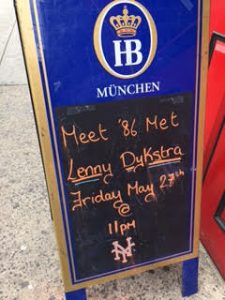 They’re always welcome back. That was the best part of 1986, the way the Mets conducted themselves as spring turned to summer and summer settled in and the Mets glided 20,000 leagues above the sea. I loved going to sleep with the Mets a dozen games ahead and waking up with them fifteen games ahead and reaching nightfall with them eighteen games ahead. You couldn’t unwillingly hum along to “Danger Zone” or “Who’s Johnny” or any of the hits of the year without the Mets picking up ground over the Cardinals or Expos or Phillies, whichever saps sat in the most inconsequential second place divisional play had ever seen. Of course that would all be Afterthought City thirty years later if not for what happened when the regular-season decks were cleared and the Mets proved themselves all over again versus Houston and Boston…which is when things got extraordinarily real.
The apex of human and Metsian existence came as October 25, 1986, tiptoed across midnight into October 26 and our beloved sports collective found itself on the edge of extinction. How close this came to disturbing reality was brought home Thursday night when WOR, bless its non-streaming soul, reaired Game Six of the 1986 World Series, just as it sounded over WHN (except with crummier fidelity, but never mind that right now). I’ve heard recordings of Bob Murphy and Gary Thorne calling the highlights countless times across three decades, but this was the first time I’d had the opportunity to listen as if it was happening live since Christmas Eve 1987, when an enterprising sports talk host on the new WFAN by the name of Howie Rose played it for us as a holiday gift.
It still holds up, not surprisingly. Murph was Murph, Thorne meshed beautifully with Bob and the content is Game Six of the 1986 World Series. If I wasn’t exactly on the edge of my seat in 2016, the ancient anxieties nonetheless reassembled as Dave Henderson took Rick Aguilera down the left field line, the Red Sox tacked on an additional run and — after Murphy announced “it’ll take a huge effort here” — neither Wally Backman nor Keith Hernandez could instigate an answering rally.
Two behind, two out, nobody on, the postseason about to go down and take the stillborn legacy of the 1986 Mets with it. There is no more WHN, no more Bob Murphy, no more Shea Stadium, no way a parachutist would sneak himself into heavily guarded airspace and I ain’t no 23-year-old no more, but the whole thing hung heavily in the balance anew nonetheless.
Then…well, you know. But even though you do know, geez. Y’know? Gary Carter singles. Kevin Mitchell singles. Ray Knight digs a hole (Murph: “now my friends, the New York Mets are down to their final strike”). Knight climbs straight up and out of it to drive in Kid and move World to third. Calvin Schiraldi is finally removed and John McNamara turns to Bob Stanley, and Bob Stanley crosses up Rich Gedman (or perhaps Rich Gedman just wasn’t agile enough to reach to his right; not our problem) and Mitchell crosses the plate with a tying run that is provisionally the most amazing thing that could have happened because at least it will get us to the eleventh inning, though Doug Sisk will be pitching and, well…
That’s neither here nor there in the granular there and then which felt like here and now on Thursday, because Mookie Wilson kept fighting off Stanley, and Stanley kept battling Mookie, and, at last, something was trickling.
A fair ball.
It got by Buckner.
Rounding third was Knight.
The Mets won the ballgame.
That’s about as calmly as I can replicate in the past tense what and how Murph reported what unfolded in an eyeblink. No need for the past tense where Game Six and 1986 are concerned, however. It is always with us. It is the milestone moment in franchise history and the best year a Mets team ever forged. It may not be the signature season of New York Mets baseball (1969 endures on that count), but the Mets were never greater and, no matter what they do in 2016 or any campaign down their long and winding road, never will be greater.
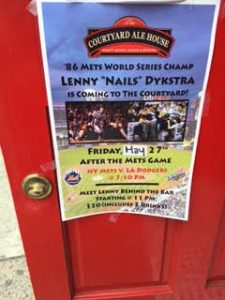 Yeah, even Lenny. The Mets were greatness incarnate in 1986. That’s why it’s so great to have them back this weekend. That’s why it’s so great that even a character of dubious distinction like Lenny Dykstra was slated to tend bar in Sunnyside Friday night after the Mets beat the Dodgers, 6-5, the same score by which the Mets beat the Red Sox in Game Six, the same score by which the Mets beat the Astros in Game Three, won by the man they call Nails, who ultimately gets a pass for everything because he hit one of the handful of walkoff home runs in Mets history to which all others must measure up.
Those throwback unis looked better against the Dodgers than they did against other comers so far this year. Maybe it had something to do with the starting pitcher’s litheness; Jake has the bod type/to rock the race stripe. Perhaps a night game is more natural milieu to stir memories of ’86, since most of those Mets were, to borrow a phrase from the book Roger Angell wrote with David Cone, night critters. However one processes it, 1986 is in the air, and as television voice of that generation Tim McCarver might put it, oh baby, I love it.
by Greg Prince on 25 May 2016 9:45 pm We now interrupt our collective, continuing Matt Harvey freakout to note Steven Matz is posting one of the best pitching seasons on the planet.
Yes, Steven Matz. Pay attention to him. Attention must be paid. Ought to be, at any rate.
I could see where you’d overlook him. Matz isn’t the most interesting member of the Met pitching staff. Matz isn’t even the most interesting member of his family. He’s surely no Grandpa Bert in the gesticulation department. Steven Matz may not even be as fascinating as the sandwich that’s named for Steven Matz. I haven’t had the sandwich, but it existed before Matz did in most of our consciousnesses, and I still find that fascinating.
None of this is intended to label Matz dull or boring. His demeanor is calming, his performance electric. We will not worry whether he speaks to the media after his starts. He will, but we won’t care what he has to say. He can leave colorful to his rotationmates.
Here’s what spoke volumes Wednesday afternoon in Washington: eight innings pitched, four hits, one walk, seven strikeouts, sixteen batters up and sixteen batters down during one expansive stretch of excellence and no runs allowed at all en route to a 2-0 victory against the first-place (by only half-a-game) archrival Nationals. Matz won his seventh consecutive start, the Mets took the series and, for a day or two, we can forget about Harvey’s travails.
Instead, we can dwell on Matz’s 7-1 record and 2.34 ERA that includes his awful first 2016 outing, one that feels as long ago as the 2013 prime of the Dark Knight. I’d look up how good Steven’s stats would be minus that uncharacteristic April drubbing, but really, how much better than 7-1, 2.34 ERA does a pitcher have to be to attract and maintain our notice?
(I just checked: 7-0, 1.13 ERA. Sweet Jerry Moses!)
We treat Harvey’s shortfalls as breaking news, yet Matz we view as less dog bites man than dog shuffles peaceably alongside man as they wait quietly at the light and cross at the green, not in between. It’s as if a pitcher who never loses is consigned to background noise. Really, Matz transcends “never loses”. In going 7-for-7, he matched a Met mark last mounted by Steve Trachsel in 2006. Trachsel in 2006 was no great shakes. He was luxuriously supported by a high-octane offense while pitching to a 4.43 ERA in his seven straight winning starts. He was OK, but, y’know…he was Steve Trachsel.
As Mets named Steven go, we’ve got the advanced model right here, right now in our star lefty. The latest deluxe feature to be added to the total Matz package is endurance. He’d never gone eight full innings before. To get there at Nationals Park, he had to go through a pinch-hitter named Bryce Harper. There were two out and one on in the eighth. Who were ya gonna call? Jerry Blevins? Yeah, maybe, but why not discern how much mettle the Met from Long Island is packing?
We did. Matz grounded Harper to Matt Reynolds at short and got out of the eighth. Jeurys Familia came on in the ninth, generated a few heebie-jeebies by surrendering back-to-back singles to start the inning, but then settled down to create his own slice of team history: 32 consecutive regular-season save opportunities successfully converted since the last instance he blew one (a rainy afternoon game against the Padres, it is vaguely recalled).
Other than those rare instances where a pitcher does all the hitting and all the hitting — Matz in his debut against the Reds, for example — it takes a village of Mets to raise a W. Familia contributed in Washington. So did David Wright with a first-inning solo homer off Tanner Roark. So did Reynolds, stepping in for a back-spasming Asdrubal Cabrera (the non-Cespedes, non-pitching MVP of this club to date) and collecting his first big league hit. Rene Rivera, as stealth an off-season acquisition as could be secretly imagined, delivered an enormous insurance run with his bat and cut down a potential threat with his gun for an arm when he threw out Michael Taylor trying to steal second in the third. Daniel Murphy also chipped in with a key error…oh wait, he’s with the other guys now, but he did help the Mets win.
I wouldn’t want to slight any Met or ex-Met who aided the greater good Wednesday, but I also don’t want to deflect too much of the spotlight from Matz, who deserves to bask in the glow of some serious accomplishments. Musslessly, fusslessly, professionally, he is consistently pitching at a level unattained by any of his rotationmates this season. Never mind the Dark Knight. Not even Thor the Norse God has unfurled quite the kind of roll the pride of Suffolk County is on.
Mind you, the Mets are in a race with the Nationals, not a contest with each other. We want every one of our golden boys to go to the mound every fifth day and never lose (including the onetime pacesetter who’s sort of out of fashion of late). But since one Met pitcher is living up to that description more than any other, let’s shove him front and center for a spell. For a refreshing change, let’s not be about Harvey who isn’t getting it done. Let’s be about Matz who is barely getting touched.
by Jason Fry on 25 May 2016 2:32 am I don’t know what’s wrong with Matt Harvey. Neither does Dan Warthen, or Terry Collins, or Sandy Alderson, or Kevin Plawecki, or Matt Harvey himself.
The weird thing is, suddenly that’s no longer as important as what happens next, which is that Matt Harvey be made to Go Away.
Not so long ago, Harvey had managed to navigate his way to a fairly happy ending after a tumultuous summer. He’d shut the door on his agent’s innings-limit controversy and brought the Mets to the brink of returning the World Series to Kansas City, with a puncher’s chance at riding Jacob deGrom and Noah Syndergaard to victory in seven games. It didn’t happen, but the blame went to Collins for letting his heart rule his head and Lucas Duda for a startled throw that went awry. The Mets were booted into winter, but Harvey had more than done his part to prevent that.
And now, just 10 starts after what looked like the final act of his redemption, he’s going to be exiled. His baseball Elba is to be determined. So’s the official reason for his being sent there. But it’s coming.
As with Monday’s game, Tuesday was a repeat engagement between pitchers: Harvey against Stephen Strasburg, tormented in better days at Citi by a spontaneous chant of “Har-vey’s bet-ter.” Strasburg was better at Citi last week, by a decent measure, and Tuesday night, alas, was no antimatter affair: Strasburg was better again.
Harvey had said the right things between starts, talking about fighting and not quitting, and in Tuesday’s early innings he looked OK — he even took a 1-0 lead into the fourth thanks to an Asdrubal Cabrera homer. After a couple of good plays were made behind him and a couple of flat pitches were popped up instead of driven out, I even dared myself to hope that the BABIP gods might be giving their whipping boy a break — perhaps a simple regression to the norm luckwise would get Harvey back on track.
But the early innings haven’t been in the problem this year. As if on cue, Harvey spit the bit in the fourth, and in depressing fashion: he threw a hovering change-up to Ryan Zimmerman that turned into a game-tying home run, then offered Anthony Rendon essentially the same ineffective pitch, with the same grim result. A fifth-inning sacrifice fly from Bryce Harper made it 3-1, and then Daniel Murphy simply demolished a flat fastball, hitting it on a line into the second deck in right field.
That made it 5-1, and Harvey’s night was officially a disaster — one he compounded by being absent for interrogation by the press corps a couple of hours later.
On that last point my sympathies lie more with Plawecki than with the scribes: the catcher had to follow a lousy night at the plate with helpless non-answers on behalf of a teammate, while the writers were handed free lighter fluid for their hot takes. Harvey ducking the firing squad has nothing to do with heart/grit/manitou/midichlorians or whatever other mystical substance Wednesday’s papers will insist he lacks — he has more or less the same amount of that as every other professional athlete, or he never would have reached this level. On the other hand, Harvey has now touched the same PR hot stove twice — and if he thinks the blister he got for his mumbling about innings limits in September was painful, the damage inflicted by Tuesday’s no-show will be worse.
Harvey has go somewhere in small measure to appease the mob but in larger measure to stop the machine that’s chewing him up, and that neither he nor anybody else can shut off right now. Maybe that place is the bullpen for side sessions and low-leverage assignments. Maybe it’s Port St. Lucie because of [insert vague ailment here]. Maybe it’s Las Vegas because everyone will be in a mood for truth-telling. I’m not sure it really matters or that I particularly care.
What I care more about is that we don’t know what part of the story we just read. Maybe it’s the bump in the road after the opening chapters, the setback that complicates the hero’s journey and forces him to learn something new about his quest and himself. That kind of story can end in triumph and adoration. That would be nice. Or maybe this is the fall into darkness closer to the end, the one where bad things happen to a character who turns out not to be the hero after all, but a supporting character undone by poor decisions or bad luck. I don’t particularly want to read that story, but you and I are the audience, not the narrator. All we can do is wait to discover what happens next, whether that’s in five days or 15 days or some date to be determined.
by Jason Fry on 24 May 2016 12:50 am Rain in the area, Gio Gonzalez and Bartolo Colon on the mound. One team scored seven. The other team scored one.
You remember, right? It was five days ago, just the other side of the Brewers Interregnum. Gio was masterful, except for a cannon shot lined into the stands by Yoenis Cespedes. Bartolo was not masterful. He walked more people than he typically does in a fortnight, the Mets didn’t hit, and by the middle innings the game was a fallen souffle that polite guests pretended didn’t exist.
With the Nationals now hosting, Monday’s first inning sure seemed like more of the same. The Mets put the first two runners on thanks to a Bryce Harper misplay on Curtis Granderson and an excuse-me pool shot up the third-base line by Juan Lagares. But then Gonzalez got David Wright to swing at a pitch that passed by his nose, got Cespedes to swing at a pitch that kicked up dirt six inches in front of the plate, Neil Walker grounded out to first and the Mets’ rally had fizzled.
Disheartening — and then in the bottom of the inning, Bartolo couldn’t corral the third out as Daniel Murphy and Ryan Zimmerman singled. Disheartening squared.
It was already 1-0 Bad Guys, and the discussion in the booth and on Twitter was about who’d play first with Lucas Duda felled by a stress fracture in the back for … well, let’s just say the foreseeable future, since this is the same injury that cost Wright 58 games in 2011. ( I don’t really get the mystery: unless the Mets are about to reacquire Kelly Johnson, Wilmer Flores will take over on Friday. Moving Wright across the diamond would be madness, as would forcing Michael Conforto or Walker to an unfamiliar position.)
Anyway, with all that swirling around us, we nearing compound-interest disheartening. A full-on Panic City sell-off hasn’t been seen in these parts since John Mayberry Jr. was batting cleanup, but it seemed somewhere between likely and inevitable.
Fortunately, it’s baseball. Traditionalists talk about fundamentals and instincts and red-light players and reaching down deep inside, but if they’re being honest they’ll tell you that on a given night nobody knows anything. Sabermetrics fans will talk small sample sizes and statistical noise and regressing to norms, but they’ll also tell you that on a given night nobody knows anything. Baseball is perverse, fickle and maddening, which is part of its charm.
In the top of the third, Gonzalez threw 22 pitches — not ideal for an inning, but by no means extraordinary. Twenty-two pitches often indicates nothing more than a spot of bother, perhaps a two-out walk after some stubborn fouls. Somehow, Gio threw those 22 pitches to eight batters. Two of them — Colon and Kevin Plawecki — saw five each, leading to an inning-starting K and an inning-ending groundout, respectively. Nobody else was waiting around: Granderson took the second pitch off his forearm, Lagares swatted the first one to right for a single, Wright hit the first one just over the glove of hairy annoyance Jayson Werth for a three-run homer, Cespedes singled on the third one, Walker singled on the first one, Asdrubal Cabrera hit the second one past Murphy for a run-scoring single, and Eric Campbell drove the second one to center field for a sac fly.
When things don’t go well, Gio has a grating habit of stalking around muttering to himself and casting his eyes heavenward, like a helicopter child whose instant affirmation is late. In that frame, though, no one could blame him — it was fluky crossed with ridiculous.
When the dust settled it was 5-1 Mets; in the fifth they added two more on back-to-back shots by Cespedes and Walker and the game had completed its weirdo transformation into the antimatter version of last Wednesday’s matchup.
Nobody paid much attention to anything else that happened, including the principals. In the bottom of the sixth, Zimmerman singled with two outs. With Anthony Rendon waiting on a 1-1 pitch, Zimmerman “broke” for second. You know how every bar has some doofus who assesses some lackluster performance on TV and insists that he could do that? Nine hundred ninety-nine times out of 1,000 that guy deserves the derision he never gets, but this was No. 1,000: Zimmerman took a walking lead that turned into a kind of shuffling jog and ended, uncontested, at second. Yes, doofus in the bar, you could have done that. Rendon, apparently mesmerized, watched strike two thud into Plawecki’s glove. Every one involved looked vaguely sheepish, particularly when Rendon then struck out a pitch later. Returning from break, the cameras supplied the missing piece of the puzzle: Colon had thrown the pitch from the windup because he’d forgotten Zimmerman was there.
Goofy, but it fit. Blowouts in tightly contested series are funny things, with a few taut early innings dissipating into lassitude better suited for a spring-training game. One team’s fans are sleepily content, the other team’s rooters are grumpily dismissive, but either way it’s footnote baseball that no one will remember. Well, until tomorrow, when you might be reminded that you can know everything that’s happened and still not have a clue what’s coming.
by Jason Fry on 22 May 2016 11:48 pm Greg and I divvy up recap duties by series — most often one series at a time, sometimes two or three. Usually we start by comparing schedules and subtracting evenings on which the world will interfere with baseball-centric life. Sometimes we put our hands up for a game because we’ll be in attendance.
And sometimes there are other factors. Before the Nats series, Greg raised his hand for Tuesday because he hadn’t chronicled “a Synderstaart” since our unrequested rematch with Kansas City.
Yes, Noah Syndergaard being on the mound is must-see TV and a happy-to-recap calendar item.
But not even Syndergaard can stand alone. He was phenomenal Sunday afternoon — 11 Ks, six singles, no walks, no earned runs — but perhaps the most impressive aspect of his performance was that he didn’t arrive with his usual arsenal. He wound up playing peekaboo with his pitches, his command coming and going in a perplexing manner. In the early innings the fastball was refusing to stick to the corners and the slider was off, so Syndergaard and Rene Rivera turned to improv, leaning on the curve and the change-up and coaxing the other two pitches along. That plan wouldn’t have succeeded last summer, but after a rough patch Syndergaard hit fast-forward on his 2015 pitching lessons, looking like a different pitcher in September and October. Today, the result of the Syndergaard-Rivera collaboration was a line most starters would kill to leave the park with.
Rivera did more than play co-strategist: in the seventh, he corralled a fastball in the dirt and gunned down Alex Presley on an ill-advised break for second with runners on first and third and no one out. Gifted an out, Syndergaard struck out Ramon Flores, got a ground ball from Aaron Hill and was home-free. Also chipping in was Syndergaard’s Upper East Side roommate Michael Conforto, whose first-inning home run extinguished a brief Brewer lead, and Asdrubal Cabrera, who lined a flat Chase Anderson curve over Hill’s head for the go-ahead run and a spot of insurance in the fourth.
The fly in the ointment? Not to be too Metsian, but it wasn’t that hard to spot: you’ll find a chronicle of all the scoring two sentences above. The Mets scored 11 runs in sweeping the Brewers, after scoring four in dropping two out of three to the Nats, nine in getting swept by the Rockies (and in Coors Field no less), 10 in four games split with the Dodgers, and 13 in a four-game split with the Padres. You have to go back one more series — the three-gamer against the wretched Braves — to find the last time the Mets averaged four runs a game.
That’s an unlikely formula for success against the Nats, whom the Mets will probably take on without Lucas Duda, leaving them deprived of Duda and Travis d’Arnaud and trying to figure out how to manage David Wright‘s woes. As for Syndergaard, he’s next scheduled to ply his trade on Saturday against the Dodgers. Must-see TV, of course — but what kind of performances will it follow?
|
|






