The blog for Mets fans
who like to read
ABOUT US
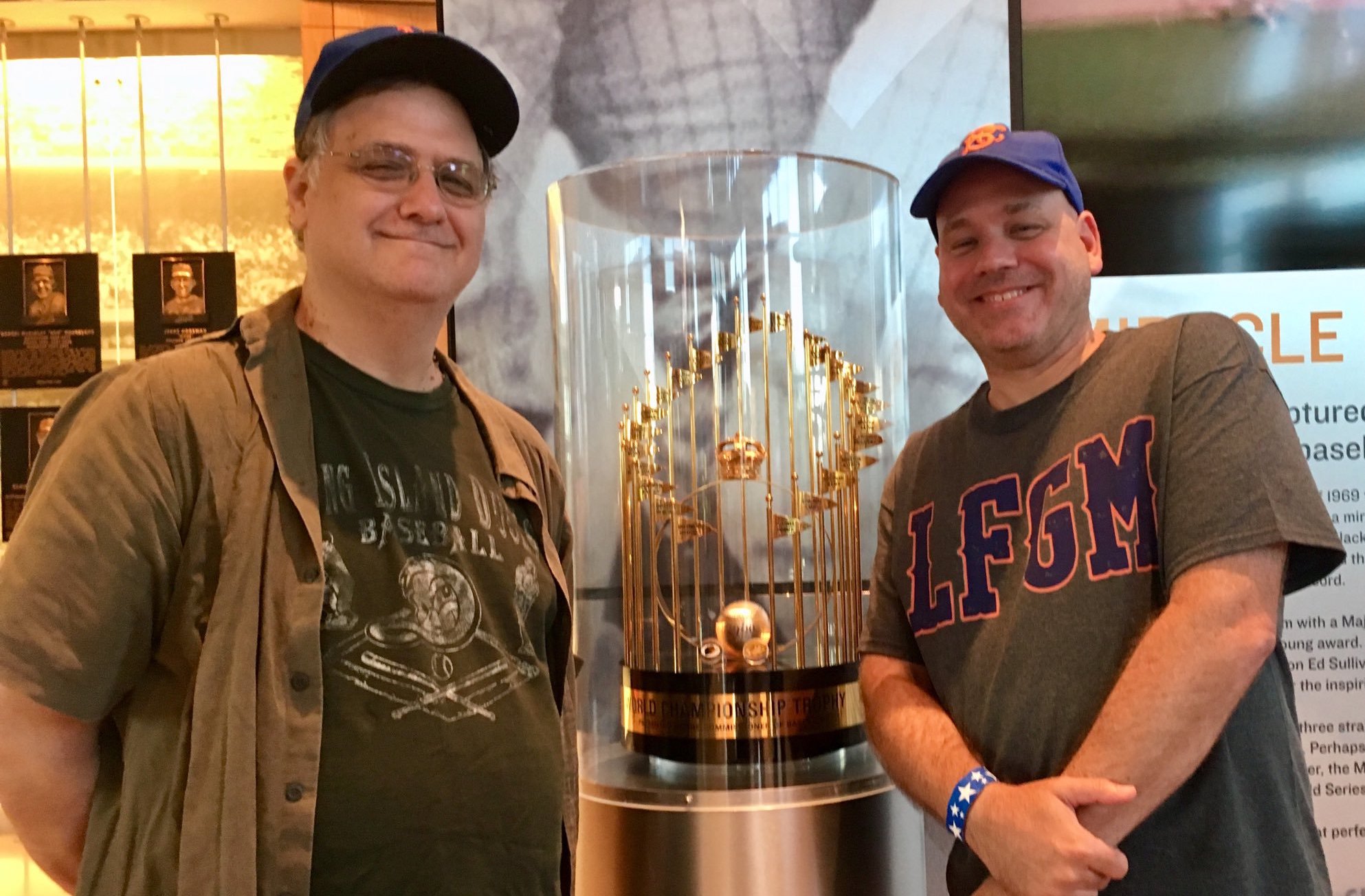
Faith and Fear in Flushing made its debut on Feb. 16, 2005, the brainchild of two longtime friends and lifelong Met fans.
Greg Prince discovered the Mets when he was 6, during the magical summer of 1969. He is a Long Island-based writer, editor and communications consultant. Contact him here.
Jason Fry is a Brooklyn writer whose first memories include his mom leaping up and down cheering for Rusty Staub. Check out his other writing here.
Got something to say? Leave a comment, or email us at faithandfear@gmail.com. (Sorry, but we have no interest in ads, sponsored content or guest posts.)
Need our RSS feed? It's here.
Visit our Facebook page, or drop by the personal pages for Greg and Jason.
Or follow us on Twitter: Here's Greg, and here's Jason.
|
by Jason Fry on 22 May 2016 11:48 pm Greg and I divvy up recap duties by series — most often one series at a time, sometimes two or three. Usually we start by comparing schedules and subtracting evenings on which the world will interfere with baseball-centric life. Sometimes we put our hands up for a game because we’ll be in attendance.
And sometimes there are other factors. Before the Nats series, Greg raised his hand for Tuesday because he hadn’t chronicled “a Synderstaart” since our unrequested rematch with Kansas City.
Yes, Noah Syndergaard being on the mound is must-see TV and a happy-to-recap calendar item.
But not even Syndergaard can stand alone. He was phenomenal Sunday afternoon — 11 Ks, six singles, no walks, no earned runs — but perhaps the most impressive aspect of his performance was that he didn’t arrive with his usual arsenal. He wound up playing peekaboo with his pitches, his command coming and going in a perplexing manner. In the early innings the fastball was refusing to stick to the corners and the slider was off, so Syndergaard and Rene Rivera turned to improv, leaning on the curve and the change-up and coaxing the other two pitches along. That plan wouldn’t have succeeded last summer, but after a rough patch Syndergaard hit fast-forward on his 2015 pitching lessons, looking like a different pitcher in September and October. Today, the result of the Syndergaard-Rivera collaboration was a line most starters would kill to leave the park with.
Rivera did more than play co-strategist: in the seventh, he corralled a fastball in the dirt and gunned down Alex Presley on an ill-advised break for second with runners on first and third and no one out. Gifted an out, Syndergaard struck out Ramon Flores, got a ground ball from Aaron Hill and was home-free. Also chipping in was Syndergaard’s Upper East Side roommate Michael Conforto, whose first-inning home run extinguished a brief Brewer lead, and Asdrubal Cabrera, who lined a flat Chase Anderson curve over Hill’s head for the go-ahead run and a spot of insurance in the fourth.
The fly in the ointment? Not to be too Metsian, but it wasn’t that hard to spot: you’ll find a chronicle of all the scoring two sentences above. The Mets scored 11 runs in sweeping the Brewers, after scoring four in dropping two out of three to the Nats, nine in getting swept by the Rockies (and in Coors Field no less), 10 in four games split with the Dodgers, and 13 in a four-game split with the Padres. You have to go back one more series — the three-gamer against the wretched Braves — to find the last time the Mets averaged four runs a game.
That’s an unlikely formula for success against the Nats, whom the Mets will probably take on without Lucas Duda, leaving them deprived of Duda and Travis d’Arnaud and trying to figure out how to manage David Wright‘s woes. As for Syndergaard, he’s next scheduled to ply his trade on Saturday against the Dodgers. Must-see TV, of course — but what kind of performances will it follow?
by Greg Prince on 22 May 2016 2:30 am Here’s a fun fact: May 21 isn’t May 20. Came as news to me on May 20 when I looked at two tickets for what I thought were that night’s Mets-Brewers game and realized they said May 21, a.k.a. the next day. So I’m not going tonight, it dawned on me. I’m supposed to go tomorrow.
Except independent of the acceptance of these May 21 tickets that I somehow convinced myself were for May 20, I had made dreaded Other Plans for May 21, plans I couldn’t and didn’t want to break any more than I wouldn’t think of not using these May 21 tickets, which were for a special occasion above and beyond a meeting of the Mets and Brewers (as if that isn’t special enough). Having considered my conundrum, I resorted to the only answer I could conjure.
TWO PLACES! ONE TIME!
That’s not my leitmotif. I’m barely a one place at one time type of fellow, unless the Mets are involved. In fact, the Mets are pretty much all the place I make time for. But ya gotta do what ya gotta do if ya wanna do more than one thing at once. (This message is brought to you by Schaefer, the one beer to have when you’re doing more things than one.)
Thing One/Place One Saturday was indeed the Mets, specifically Sharon and Kevin Chapman celebrating their wedding anniversary by graciously gathering a group of their friends — Stephanie and me included — on the left field party deck. They did this last year when the deck had a different corporate-sponsored name, but they did it on May 20, which provided the root cause of my confusion this year. In brief, we couldn’t make it at the last minute on May 20, 2015, and it’s kind of haunted me since then, so we were determined to get there on May 20, 2016…until I realized it was set for May 21, 2016.
I guess I’ve already mentioned that, but it does explain why for only four-and-a-half innings we enjoyed the hell out of that deck. I’d never been up there before. It’s truly a marvel.
• You walk among and can’t help posing with the retired numbers.
• You wonder where they’re gonna fit 31 — between 41 and 42 for its Metness or after 42 and SHEA for its chronology.
• You eat and drink pretty well, with beverages and substantial noshing part of the deal (told ya our hosts were gracious).
• You are on the edge of the staging area for the Stolen Base Challenge or whatever that charming promotion is where they bring a kid on the field to run down the left field line. Every kid runs his or her heart out and we all applaud in earnest. Keep doing that; ditch the fake car race.
• You view your left fielder very up close…and you cringe to realize just how much Michael Conforto is learning on the job. His best route to any ball is in the batter’s box, but as Floyd the Barber said of Opie Taylor, “He’s just a kid, Andy.”
• You count pigeons that congregate on the outfield grass. We counted six.
• You actually see, by leaning over slightly, every speck of fair territory in the ballpark, something I’ve never managed from even the most centrally located seats behind home plate. Everything looked different and fresher, as if we were seeing a whole new ballpark. Maybe the Texas Rangers should build one of these party decks and then they wouldn’t think they need a whole new ballpark.
• You are gobsmacked to realize you sit in what was once fair territory. I mean the seats and the walkway used to be in the flight path of a double high off the Great Wall of Flushing. Jason Bay’s career died somewhere beneath our seats. Now we relax with our complimentary pretzels and exchange random disparagements of T#m Gl@v!ne (Saturday’s gripe: consigning Super Joe McEwing to No. 11 upon the Atlantan’s uncalled for arrival in 2003).
Even with a few spritzes and sprinkles and Jacob deGrom not so sharp — bucket hats can protect you from only so many elements — this was the place to be for four-and-a-half innings. I’ll go out on a limb, or perhaps a deck, and say it was the place to be for the full nine, except we were in TWO PLACES! ONE TIME! mode and four-and-a-half innings were all we could allow ourselves. Thus, we bade our fellow deckers goodbye and reluctantly became civilians in the bottom of the fifth.
You know, those sad folks who aren’t at a Mets game, which is most of the world’s population, which is swell when you don’t have a party deck ticket in your pocket and a party deck wristband on your wrist. What kind of people leave not just a Mets game in the fifth inning but the party deck?
Stephanie and I did that, because we thought May 21 was going to be May 20 and therefore told our comedian friend Jeff that we’d love to come to his show in Manhattan Saturday evening. He lives down around Washington and doesn’t do many gigs up here and it wasn’t like we were going to a Mets game that overlapped with it or anything.
Whoops.
To clear up any lingering urban myths about my fandom being infallible, I have left Mets games early in my life, though probably not in the fifth. I’ve missed a couple of spectacular endings (foreshadowing!), too, but the important thing is that the spectacular ending occurs. Please, Mets, don’t hold off winning on our account.
I followed the action by app and transistor on the 7. I more or less heard Yoenis Cespedes homer to tie the game at four while we were pulling into Queensboro Plaza. What I caught was Howie Rose announcing a ball had been hit down the line, but had to wait a moment, through static, to ascertain that it had not gone foul and that the Mets had indeed knotted matters at four.
It was a good note on which to slide under the East River. Due respect to Craig Counsell’s troops, but trailing the Brewers is a bad look. Who are these guys? They have a Flores, but not the one they tried to trade for last summer. They have a Scooter, but not the one convicted in the leaking of the covert identity of a CIA agent. Sixteen percent of them are ex-Mets who nobody will ever go out of their way to reunite for Two Thousand Whenever Weekend.
DeGrom gave up four runs to these guys and the Mets didn’t score more than two against them before we left. Thank goodness for Cespedes, huh? Fourteen homers, 35 RBIs, .297/.378/.659, and we mostly notice when he doesn’t run out a dropped strike three. WOR’s fadeout on the 7 notwithstanding, I wasn’t surprised when Yoenis went deep in the sixth. It’s what he does. What’s surprising is that we have a guy whose exploits can be casually encompassed with a “that’s what he does”.
Also not surprising that my optimistic forecast of waiting until the fifth to depart Citi Field for Jeff’s comedy date on the West Side would result in an on-time arrival by us turned out to be misguided. Weekend transit did its pokey thing and deposited us at 51st and 8th in plenty of time to see lots of talented comics, but not the one we aimed for. Jeff’s set was over by the time we found him. Another performer might have been miffed. Jeff, having commandeered a stool in the corner of a sweaty alcove off the main stage, was simply shocked.
“You left a Mets game before it was over?”
Like I said, it has happened despite my preference that it never does. I excused myself from Shea in 2003 to make an Off-Broadway curtain and missed a Mike Piazza walkoff homer. Later that year I had a crazy notion of taking in part of a Mets game and part of a Cyclones game and missed the scoreboard announcement that Bob Murphy had decided to retire (and never made it to Coney Island besides). A year after that, I couldn’t stay beyond Victor Diaz puncturing the Cubs’ playoff hopes and therefore didn’t get to witness Craig Brazell letting all of Chicago’s air out. There have also been more mundane exits and less memorable final frames that have escaped my personal observation.
But that’s why they make radios and digital devices. And that’s why Saturday’s game against the Brewers never left me. Jeff, you see, is a Mets fan first, a comic second and everything else third through infinity. He didn’t much care that we missed his jokes in the city. He was touched that we set aside the baseball in Queens. Really, though, he was mostly interested in whether the Mets could complete their comeback over Milwaukee.
The logistics of what transpired next are a little hard to explain. Though Jeff was done, his wife was still in the crowd, seated somewhere Jeff couldn’t easily find her let alone give her the high sign to vamoose; another friend of his (and ours) was also too polite to ditch the show in progress. Mix in professional protocol that generally demands a comic stick around after doing his bit so as to stay in the club’s good graces, which is what Jeff was doing when we found him. Hence, instead of leaving the club and finding a bar or restaurant with a TV, we huddled in that sweaty alcove corner, tracked the game on our phones and watched the seamy underbelly of standup comedy unfold before our very eyes.
Due respect to everybody’s setups and punchlines, we got a show most of the ticketholders never get to see. We saw comics and club management snarl at each other. We heard “I’m being disrespected!” countered with “I’m gonna call the cops!” We listened to one hopeful tell no one in particular, “I just vomited.” We avoided being seated in the main room — and being saddled with two-drink minimums — by resorting to the clever retort, “We’re with Jeff.”
Amid all that, we clung to Addison Reed in the top of the eighth; wondered who Tyler Thornburg was in the bottom of the eighth (the subject of an ABC miniseries was my best guess); invested our faith in Jeurys Familia for the top of the ninth; and hoped like hell the Mets could win this in the bottom of the ninth almost as much as we hoped Jeff’s wife would finally notice the many LEAVE NOW texts Jeff was sending her (the text count was approaching Jake’s pitch count).
“How about a walkoff?” Jeff asked rhetorically, until he noticed who was up to start the Met ninth: Eric Campbell, in there not for his bat but because he’s in less discomfort these days than Lucas Duda. Jeff’s instinctive dismissal was a reasonable reaction after three years of Soup simmering at a very low boil. Campbell and huff, sure, but Eric breathed unlikely life into the Met attack with a leadoff single. Kevin Plawecki, almost as inspirational an offensive figure, walked. Matt Reynolds, rockin’ the MLB .000 since his long-anticipated elevation from Las Vegas, successfully sacrificed himself at the altar of conventional strategy to move the runners up ninety feet. Curtis Granderson, who homered in the first and nothing-muched the rest of the day, was intentionally walked.
Bases loaded. One out. Up next to potentially untie the game was David Wright. The very same David Wright who Jeff was seriously considering dropping from his fantasy team. That’s admittedly a matter of concern to Jeff and nobody else, but it was symbolic enough to model Wright writ large. Jeff loves David. He’s his favorite Met. He’s everybody’s favorite Met in some sense. Cripes, it wasn’t that long ago that he was the Mets.
Which is to say if we didn’t already love David Wright, it wouldn’t occur to us to embrace him given the trajectory of his career at the moment. But it’s not about the moment when it comes to us and the Mets. It’s about the long haul. David Wright is as long-haul a Met as they come. Wright’s appearance at the most crucial juncture of a game the Mets could really use may not fill you with confidence like it used to, but you can’t reject it out of hand. Whether you’re getting rained on at Citi Field, huddling in a sweaty comedy club alcove or taking in the action in drier conditions, you need to line up behind your Captain for that critical at-bat that’s destined to decide the difference between an immediate win and an indeterminate outcome.
If you can’t do that much, there are 29 other teams and myriad other amusements that might better suit your needs.
David Wright, who we know all too well, took three balls from Michael Blazek, who I wouldn’t know if he was headlining the eight o’clock show at the Comedy Cellar. Who are these Brewers? Then, for a veritable eternity, we stared at our screen for the next pitch.
What’s this? “In play, run(s),” it said. I knew what that meant, but it always takes an extra beat to sink in. Hey, David Wright did something that wasn’t striking out. He swung on three-and-oh. He got a hit. The Mets scored a run. Instead of it being 4-4, it’s 5-4.
They won! It’s over!
Stephanie and I weren’t at the game anymore, David may still be cut from Jeff’s fantasy team (he needed to generate a grand slam to acquire immunity), we still couldn’t find Jeff’s wife (though when we did, she told us about the Spring Training trip to St. Pete when she shared an elevator ride with Bob Apodaca), it was still sweaty in the alcove and it was pouring outside, but none of that was an issue. The Captain came through. He swung at ball four, we’d learn in a little while, but he connected. That was a David Wright walkoff hit like he’d produced eight times before. That was David Wright like the one we’d always relied on, like the one we still have to believe in.
Two places. One time. Not bad.
by Jason Fry on 21 May 2016 1:28 am Well, that’s better.
Steven Matz was superb, watching a Chris Carter home run in the first and then allowing next to nothing after that. The Mets, meanwhile, didn’t exactly light up Wily Peralta, but they did enough to win and chase the blues away, at least for a night.
We’ll return to those blues in a minute. (Of course we will, we’re Mets fans.) For now, though, Matz becomes a more and more interesting story. He’s 10-1 in 13 regular-season starts, a beginning that in a different era would have the Mets trying to craft him into a face of the franchise. Instead, he’s almost an afterthought. Which I suppose is understandable: He doesn’t have the star presence of Matt Harvey (or the reversed-polarity epic misery of his current predicament), the jaw-dropping arsenal of Noah Syndergaard, or the track record and TV-friendly locks of Jacob deGrom. Matz is underwhelming to look at, a kid from Long Island who looks a bit like Joe DiMaggio.
Except that kid from Long Island is 10-1. Sure, none of his Matz’s pitches is as lethal as what his moundmates possess, but they’re all pretty good and come with natural movement, he has pinpoint control, he’s left-handed, and he seems to think about what he’s doing out there on the mound. Which is a pretty impressive combination. On Friday afternoon Matz was part of the avalanche of Metsian panic, having been shelved with elbow pain; by late Friday evening he’d become the soothing balm we desperately needed.
Still, it was a respite, not a resurgence. The Mets still look like they’re holding the bats wrong-side up; Wily Peralta’s been a tomato can all season, one of the few guys who’d gladly switch stats with Harvey, and he hung in there into the sixth inning, undone only by a windblown Michael Conforto flyball that flopped into the party deck and left Conforto himself looking mildly startled. Take that away and … well, let’s be glad we don’t have to.
What would change this? A better showing from Harvey would help, obviously — and if you want some optimism, here are two pieces from smart folks suggesting Harvey’s woes may be symptoms of the oldest baseball malady of all, bad luck. More than that, though, some consistent hitting would sure help. The late April Mets could simply bash away their troubles at the plate; the May Mets have been more problem than solution with bats in their hands.
We’ll see — it’s a long season. (Perhaps you’ve heard.) It’s far from crazy to think the luck will even out, guys will seek their historic means, Lucas Duda will go on another of his bipolar baseball rampages, Travis d’Arnaud will return, Neil Walker will find a happy medium between hitting like John Buck and hitting like the other John Buck, and the Mets will find someone (Wilmer Flores?) to partner with David Wright as the captain negotiates uncharted spinal-stenosian territory. Perhaps some of those things will happen but not others. Perhaps none of it will. Sometimes that happens too.
But that’s for the future. For a night, Matz was crisp and the Mets hit enough and we could all exhale. For a night.
by Greg Prince on 20 May 2016 10:20 am The clot in his bladder. The load of innings in 2015. The lack of innings in Spring Training. The to-be-expected second year after Tommy John trajectory. The residual mental strain from trying to be The Man in the deciding game of the World Series and famously not succeeding. A general psychological breakdown. Something physically wrong they’re not telling us about. A reticence to come inside. An arm angle. A footing problem. An overall mechanical issue. Not loose enough. Needs to work harder. Needs to ease off. Needs a night on the town. Needs to miss a start. Needs to go down to the minors. Needs a less vocal agent. Could use a pinch between the cheek and gums. Restore the hubris. Embrace humility. Lose the nickname while you’re at it. Maybe a wee bit off the waistline, too.
No, I don’t know what’s wrong with Matt Harvey, but I do know he pitched dreadfully in a 9-1 loss to the Washington Nationals at Citi Field on Wednesday night, a big game that ceased to be a big game once Matt drowned in the third inning, the frame in which the Nats scored seven runs and inspired their superstar to utterances of mercy. Harvey was undermined by a couple of episodes of poor fielding (Asdrubal Cabrera blowing a transfer at short, Michael Conforto taking up jai-alai in left), but baserunners were everywhere on his account.
When Matt trudged away from the mound with two outs in the third, having just surrendered a two-run triple to a .123 hitter — thus burying the Mets eight feet under — with him went the last shred of reflexive confidence that he’ll figure it out, he’ll come around, he’ll be fine.
Matt Harvey is not fine. It’s absurd to believe he never will be again, but it’s not a given that he’s one start away. He’s filed nine outings in 2016. One was very good. A couple were good enough. Most have been not so shy of decent that you couldn’t talk yourself down from terribly alarmed to merely concerned. Last night’s was too brutal to dismiss as an aberration considering everything that preceded it.
Every nine innings he pitches, he gives up 5.77 earned runs, and he’s not packing any other metric that suggests there’s a hidden value the naked eye is missing. The naked eye observes a pitcher easily undressed by opposing hitters. “Body language” can be folly to translate, for it presumes a slouch isn’t just a slouch and minds can be easily read, but does Matt Harvey look like Matt Harvey to you?
And while we’re rhetorically asking pressing questions of the day, do the Mets look like anything? They were no help to their pitcher on Thursday, pooling six singles for a lone run. Stephen Strasburg may have been unhittable, but it’s hard to tell when the lineup he’s facing hasn’t been hitting. Strasburg, Gio Gonzalez, Max Scherzer and assorted National relievers limited the Mets to four runs in 26 innings. Their counterparts in Colorado, Los Angeles and San Diego were similarly effective. The Mets have scored 49 runs in their past 18 games. Even with the Greatest Rotation Ever pitching up to its advance notices, that’s a lot of non-support to overcome.
And the Greatest Rotation Ever hasn’t pitching up to its advance notices.
So little is clicking these days. Yoenis Cespedes is hitting the ball exceedingly hard. Everybody else is flying or striking out at alarming rates. When the prime highlight of two nights against your archrival is your bullpen keeping a 9-1 deficit 9-1, perhaps you’re mostly battling yourself — and losing.
Bring on the Brewers. Bring on the next 122 games. There’s three quarters of a season remaining and the Mets are still very much contenders. It only feels like the end is nigh.
by Jason Fry on 19 May 2016 11:54 am From the Better Late Than Never Department:
The best thing about Wednesday night’s tilt with the Nationals, from my admittedly parochial perspective? It was getting to talk baseball with my blog partner, something we hadn’t done since the Daniel Murphy Game last October and hadn’t really done then, since at the time we were too busy being anxious and then inconsolable.
Games in May are better for that, even if they’re against your division rivals. Games that resolve themselves as pretty clearly not going your way might even be best. So what if you’re at the ballpark and getting blown out — you’re still at the ballpark, and while the baseball unfolding before you may not be what you requested, the conversation will take you off to better games and better times, as well as equally bad games and times now made less painful by being long ago.
We talked the oddities of baseball cards, the misfortunes of Steve Chilcott, the pros and cons of various baseball-seat physiologies, middle relievers and their maddening unpredictability, guys who wore 29 and why Rick Reed was superstitious about that number, replay and its discontents, when Citi Field existed only as a theme-parkesque “experience” within Shea, the twists and turns of Met prehistory, club strategies for escaping the sight of unoccupied expensive seats on TV, and a whole lot more.
Wednesday night had other pleasures as well:
- the fairly amazing seats granted us by a kind host. They even came with shelter from the less-than-kind elements.
- the bolt struck by Yoenis Cespedes that was obviously a home run before it passed over Danny Espinosa‘s head.
- the long Daniel Murphy drive that looked exceedingly perilous off the bat but wound up in the glove of Juan Lagares, facing the outfield wall as if Murphy were his personal Vic Wertz.
- the Mets’ new Coca-Cola sign. I don’t mean because it trumpets the virtues of Coke products — that’s a matter of one’s personal tastes — but because it’s programmed to turn into an American flag, become an orange and blue lava lamp, display fireworks and do other hey-lookit-that stuff. Whether we like it or not, modern ballparks are crammed with high-tech stuff and marketing; it’s nice to see that pairing done well.
So what wasn’t so good about Wednesday night?
- watching Mets’ pitchers walk the ballpark, adding in a few hit batsmen for good measure. No, that wasn’t good at all. If you put Jayson Werth and Bryce Harper on nine times in 10 plate appearances, you’re lucky if the final score’s only 7-1.
- The Mets scoring just one run and David Wright looking worryingly ineffectual.
- Citi Field’s new car race, featuring a taxi cab, cop car, black car and ambulance. I may have gotten those slightly wrong, but who cares. This one’s too pathetic to even mock.
In other words, everything else. But that happens sometimes in baseball — which is why we have memories and conversations to sustain us until a better game.
by Greg Prince on 18 May 2016 6:07 am I particularly liked the part where Bryce Harper struck out. That I have to be more specific than that I also particularly like.
I’m referring to the top of the fourth, one out, nobody on, the Mets ahead of the Nationals, 2-0. Noah Syndergaard is one-two on the consensus best player in the National League and…frozen. Syndergaard painted the black a shade of ebony ice. Harper didn’t know what to do with the most perfectly placed inside pitch you’ll ever see, so he stood and he took it for strike three. It was only the second out of the fourth inning, only the fifth of an eventual ten K’s unleashed by the Met starter, but it was surely a victory within a victory.
Great pitching had stopped great hitting. The law of the jungle had prevailed.
Baseball was fun again Tuesday night, which should have made Harper happy as heck, given that he pointedly referred to the sport as “tired” in Spring Training. Coincidentally, the Mets looked tired on their recent road trip to nowhere, especially its last leg, which, of course, never happened. Then they arrived home and woke up, starting their day with a nutritious breakfast consisting of sublime pitching and solo home runs.
You know, the breakfast of defending league champions.
Syndergaard ate up the Nationals with a spoon so as to get every drop: seven innings (apparently the modern-day equivalent of nine), four singles, one double, no walks, no runs and let’s not forget those ten strikeouts, including two of Harper. The line of Thor outpaced that of Max Scherzer, who went not quite as deep and failed to keep within the confines of Citi Field two fly balls to right. One was the very first pitch he delivered to Curtis Granderson, who in turn delivered it beyond the reach of Harper, who might tower over the game, yet isn’t tall enough to catch everything socked in his general direction. Granderson spent the bottom of every inning in which he batted as a baserunner of some sort, a happenstance that in 2015 tended to serve as gateway to triumph. Come the third, Michael Conforto also sent a ball suitably out of fielding range, another splendid sign.
That gave Noah a two-run lead, an edge that held up without obvious muss or fuss the rest of the way. Addison Reed and Jeurys Familia each threw perfect innings to seal a much-needed 2-0 win, a definitive first blow in the projected 19-round battle for National League East supremacy. It’s a little early to be determining a division champ, but it’s never too soon to capture what feels from the outset like a very big game.
Scherzer struck out 20 Tigers in previous start. He struck out half as many Mets this time around. Subtract a few feet from Granderson’s and Conforto’s respective efforts, and perhaps this affair would have encroached into West Coast start time. Mad Max was almost as good as Thor, but not as good. Thor was both dominant and efficient and, as a result, the Mets were winners in two hours and thirty-two minutes. Even with pair of replay reviews mixed in — both from the Nationals, including one triggered despite their not having any challenges remaining (go figure) — it was a deliciously brisk evening.
Only one National made it as far as third base. Harper didn’t get on base at all. Friendly Ghost of October Past Daniel Murphy, the focus of some well-deserved appreciation upon his reintroduction to Flushing, blooped one single (beyond the reach of Neil Walker, appropriately enough) but was stranded alongside his .399 batting average in the on-deck circle as Harper grounded out to surprise third base starter Matt Reynolds to conclude the contest.
That the Mets could top their first-place rivals behind Syndergaard is no surprise. That they could defeat Scherzer while featuring Reynolds in his major league debut at third and good old Soup Campbell at first, well, that’s the Power of Thor, a scintillating blend of heat, location and savoir faire. His second strikeout of Harper, in the sixth, consisted of a sinker, a changeup and a backdoor slider; talk about putting the Mjölnir down. Someone who can outduel another elite ace and make you forget the stiff backs of David Wright and Lucas Duda can really inspire you. After he fanned Harper in the fourth, I was ready to don appropriate headgear and parade through Times Square.
But then I would have missed Noah’s next four innings, and why would I want do that?
Heartfelt thanks to all who came out to Turn of the Corkscrew Books & Wine on Monday night for a pulsating evening of Mets talk. When in the greater Rockville Centre area, I heartily suggest visiting the independent bookseller on North Park Avenue. They stock some fairly Amazin’ items.
by Greg Prince on 16 May 2016 9:06 am “What a miserable series.”
“What series?”
“The one the Mets just played in Denver.”
“It never happened.”
“What do you mean it never happened? We just watched all three games.”
“There weren’t any three games.”
“Of course there were. There was Friday night, when Matt Harvey’s self-doubt registered higher on the radar gun than his fastball.”
“There was no game Friday night.”
“Then there was Saturday night, when Logan Verrett got jobbed on a swinging strike that masqueraded as a foul tip and crumbled immediately thereafter.”
“There was no game Saturday night.”
“And then on Sunday afternoon, Jacob deGrom looked ordinary on the mound, Alejandro de Aza and Michael Conforto looked clueless in the field, Jim Henderson looked gassed in the seventh, the bats looked hollow, the manager looked beaten and the umps looked crooked when they called Juan Lagares out at a critical juncture even though he was a) not being tagged and b) staying in the baseline.”
“There was no game Sunday afternoon.”
“No game, huh? So you’re telling me the Mets didn’t give up a tenuous 3-2 lead and lose, 4-3, to get swept by the Rockies at Coors Field.”
“Get what where?”
“Swept at Coors Field! The Mets lost three to Colorado and four in a row overall to end a long and futile road trip that left them in third place behind the freaking Phillies, never mind the Nationals.”
“I don’t know what you’re talking about.”
“How could you not know? All weekend we watched and listened and fretted and moaned and…”
“None of that happened. This series never happened. Sunday’s game never happened. Coors Field never happened. Got me?”
“But the box score…”
“There is no box score.”
“And the standings…”
“There are no standings…”
“And the 19% discount promotion…”
“Look at me. Look in my eyes. Hear what I’m saying. It never happened. It never happened. Kapish?”
“Who?”
“Exactly.”
Redact the last three games from your consciousness and enjoy a much more pleasant evening tonight at Rockville Centre’s Turn of the Corkscrew Books & Wines, where I’ll be reading, discussing and signing Amazin’ Again, the story of a Mets season that most definitely DID happen.
by Jason Fry on 15 May 2016 1:16 am Now you listen to me! I want trading reopened right now. Get those brokers back in here! Turn those machines back on! Turn those machines back on!
That’s Mortimer Duke at the end of 1983’s Trading Places, after he realizes Louis Winthorpe III and Billy Ray Valentine have ruined him and his brother Randolph in revenge for a cruel and cynical experiment in social engineering. Mortimer’s command goes unheeded, of course. The machines won’t go back on any more than the genie’s going back in the bottle.
Other than not identifying with the bad guy, it’s pretty much the way I feel whenever an umpire has made a rotten, terrible, no-good, very bad call against my baseball team, one the entire world except him knows is wrong and that he will also know is wrong the second he looks at the replay, which will lead to a big fat lot of nothing because umpires getting lectured and disciplined is pretty much the only thing baseball still keeps secret.
Unless of course he already knows the call is wrong, in which case WHY DIDN’T HE ASK FOR HELP AUUGHGGHGGHHH THIS IS THE WORST THE ABSOLUTE WORST THE VERY WORST WORST WORST WORST.
That’s what Carlos Torres did to the Mets Saturday night. No, not rubber-armed, sometimes-effective and apparently ageless reliever Carlos Torres, but less-than-effective, still pretty young home-plate ump Carlos Torres.
With the Mets down 3-1 in the third, Logan Verrett fanned Tony Wolters with one out and the bases loaded, bringing pitcher Eddie Butler to the plate … oh wait. No, Carlos Torres ruled Wolters had foul-tipped the ball, when he quite clearly hadn’t. Torres didn’t get help, Terry Collins went ballistic, and soon thereafter Terry Collins was excused further attendance. Given an undeserved reprieve, Wolters clubbed a ball over Yoenis Cespedes‘s head for two runs; an out later Charlie Blackmon chipped in a two-run single of his own, and the Mets were looking at a big ugly crooked number.
Managers usually cool off enough to wax philosophical about these things after the game, but Collins was still hot: “It cost us the game. End of story.”
Wellllll. That’s loyal of Terry, but it’s not that simple.
When Joshua was about eight, I told him I was going to teach him an essential but unwritten rule of baseball, one that he would do well to accept, since it would let him avoid a fair number of churning stomachs and hours wasted moaning about injustice. Emily, by far the better parent, knew what was coming and tried to intervene, but I would not be deterred.
When you’re going horseshit, they fuck you.
I know, language. Sorry. But that gets at the essential, visceral truth far better than a more refined way of putting it.
When one’s caliber of play is subpar, the benefit of the doubt is generally not given.
Nuh-uh. It’s the first one.
Yeah, the Mets got saddled with four enemy runs they would have avoided if Torres had made the right call and Verrett had retired Butler. Yeah, they tried to come back only to wind up short. But they’ve been losing because the starting pitchers are practically outhitting the position players and fielders are coming up short or doing dopey things with depressing regularity. It’s a blueprint for losing plenty of games, with or without mistakes by umps.
The Mets look flat and tired and dispirited. Honestly, I can’t say I blame them. I’m flat and tired and dispirited by this road trip, and I’m not even on it. Seriously, I’ve been on multi-week trips covering different time zones, and by Day 10 I generally just want to be home staring at a familiar wall. And my job is to type and talk to people, not to play professional sports in front of 30,000 people and have to explain afterwards why I failed at something that’s really hard to begin with.
The Mets will be home late Sunday. They’ll actually get a day off Monday. Good. They better rest up, because then it’s six of nine against the Nationals. The first-place Nationals, who are eager to show the second-place Mets …
… oh wait. Nope, it’s the third-place Mets. You want trading places? Well we’ve traded places with the Phillies.
THE PHILLIES.
Now you listen to me! I want the ballpark reopened right now. Get those hitters back in here! Turn that scoreboard back on! Turn that scoreboard back on!
Oh yeah, that’s right. We already established that never works.
by Greg Prince on 14 May 2016 9:32 am There are moments when you sense things can’t get any better for your team. Those are moments that are both gratifying and terrifying.
Peak Mets, to dabble in the fashionable vernacular, may have been achieved early this past week. Bartolo Colon had homered on Saturday, his accomplishment stayed the toast of the town well into Monday. In between Colon going deep and the world remaining gaga, Matt Harvey slipped in his best start of 2016 versus the Padres, permitting the Mets to depart San Diego in first place for the first time all year. They alighted in Los Angeles, increased their winning streak to three behind Steven Matz, continued to fend off the pesky Nats and generally radiated invincibility. Even a loss Tuesday night couldn’t perceptibly lower my East-leading high.
No wonder, then, that when I was out early Wednesday evening, clad in a 2013 All-Star game t-shirt, having just spotted a leftover Monday Daily News with a back page banner attesting to Harvey’s Mother’s Day triumph at Petco Park, and was asked by a stranger, “How did the Mets do last night?” I reflexively answered, “They won.”
Then I retraced their steps and quickly corrected myself. “No, they didn’t win. They lost last night. Sorry about that. It was a late game.”
At which point I hoped it wasn’t too late for all of us, for I had the feeling I’d pulled a Howard Beale and meddled with the primal forces of nature. It was an innocent mistake born only of enthusiasm. Everything had been coming up Metsie for so long — not just the modest three-game winning streak snapped the night before, but the sustained buzz surrounding our sacred cause. We had one of the best teams in baseball, clearly the best team in New York. The Colon homer framed it beautifully. Consider that type of isolated incident in a single baseball game, the kind that gets and keeps everybody, not just the partisans, talking. In any year after 1995 and before 2015, if something like that happened in New York, it wouldn’t have happened to a Met. Sure, Mets did stuff, occasionally wonderful stuff, but it rarely gained traction outside our walled garden. Met moments were treated by consensus as fleeting curiosities to be consigned to the conversational cutout bin ASAP. Now?
Now they were a sensation. Now the Mets of large-scale characters and identifiable archetypes had taken over everything. The division. The city. The zeitgeist. There had been a pennant, but the pennant was six going on seven months old. This reached beyond that. We were in the second year of this. The Mets were what we’d been waiting seemingly forever for them to morph into.
I know I’d been waiting a veritable eternity to turn on the radio, flip around and hear three different DJs in the span of ten minutes, none of them on sports stations (and not all of them on contractually Met-friendly iHeart stations), kvell over something a Met did 48 hours prior. Bartolo homered Saturday. It was still the topic of choice Monday night. Not Monday morning, mind you, but Monday night. This was a couple of hours after — while running a few errands — I kept bumping into other people wearing Mets shirts or caps or jackets and being drawn into Mets dialogue. How about Colon? How about our team?
None of this shows up in the box score, except the one you diligently pore over in the mind, where you begin to picture a stage on which the Mets hardly ever lose…which is different from forgetting that the Mets lost the night before…which is what happened on Wednesday when I got the rather simple trivia question, “How did the Mets do last night?” wrong. (Some Beat The Booth contestant I’d make.)
I shouldn’t have said they won when they didn’t, I thought, and not just for the sake of accuracy. I can’t be awarding the Mets wins that are already in the loss column. I have overstepped the bounds of enthusiasm. I have put us all in dangerous territory here.
It was such an affront to baseball protocol that Noah Syndergaard went out that night, threw eight solid innings and smacked two home runs of his own (any DHs do all that?). Of course it was epic, almost Colonian. Nevertheless, I was a little uncomfortable waiting for that game to go final. I was on a train when Thor launched his second long ball and missed the play-by-play. When a friend texted me that he was going to bed since the night wasn’t going to get any better, I took that to mean, great, Noah must have given up five runs to the Dodgers. When I got to my car, turned on the game and heard Howie mention to Josh that “Walt” wasn’t necessarily the sweetest-dispositioned guy in the room, I figured he was filling L.A. time with some ancient Walter Alston anecdote. Then I deduced that the Walt in his story was Terrell and that my friend who texted me “can’t get any better” was letting me know a second pitcher homer had, like so many Los Angelenos before so many ninth innings, exited Chavez Ravine.
Yet the Mets didn’t romp. It was a close game. Nobody else drove in anything. The Mets kept leaving runners on base, Familia gave back a run in the ninth and a game in which the starting pitcher homered twice and knocked in four had to be gripped tightly to the end. On paper, that’s fine; a win is a win. But I was still wary from my misstep earlier. I’d forgotten the Mets had lost the night before when asked. I’d forgotten the Mets were capable of losing. The two home runs from Thor were almost too good to be true, and the good fortune (or Thortune) his swings wrought seemed too wonderful to last.
Next thing I’m hearing, Matz is gonna miss a start for precautionary elbow reasons and Syndergaard — the very same Syndergaard who was lighting up the radar gun in the eighth — had recently visited a doctor himself for an MRI on his moneymaker. Wilmer Flores was DL-bound with a hamstring issue and, for good measure, there was something about David Wright’s shoulder feeling sore. Oh, and had anyone else noticed that, except for the pitchers, nobody on the Mets was hitting much…or that Eric Campbell kept drifting into the starting lineup?
Clayton Kershaw was the temporary cure for my anxieties Thursday night in that, yes, the Mets looked feeble against him, but he’s Clayton Kershaw. That’s not a disturbing trend wrapping its paws around our potentially vulnerable neck. That’s Clayton Kershaw. Enough California adventure, I decided. Let’s just pack up this road show, do our stretching and wait for Coors Field to work its magic.
Friday night, Coors Field worked not at all for the Mets. Not a Unicorn or Uniclone in sight, just a dismal 5-2 defeat to Jon Gray, which is by no means an anagram for Clayton Kershaw. Gray won the first game of his career on Friday the Thirteenth after thirteen previous attempts at his maiden W. The promotion that offers 1% off ticket prices for every run the Mets tally on the Los Angeles-Denver leg of this trip is proving to be something short of a savings bonanza. They were 1-for-7 with runners in scoring position. At a ballpark built with runners on second and third, Kevin Plawecki (two-run double) and Michael Conforto (eventually wasted triple) produced two-thirds of the visitors’ extra-base power, and lest they vie too vigorously for Schaefer Player of the Game honors, each contributed an indifferent throw on the same extended sequence in the sixth, the inning that all but sealed the Mets’ fate. The sealant was fully applied a couple of batters later when Jerry Blevins, usually death on lefthanders, found one of his pitches brutally slain for a backbreaking double by lefty-swinging Charlie Blackmon.
Harvey, who was serviceable for the first five innings, had an OUT-OF-ORDER sign hung on him in the sixth. Nothing physical, just mechanical, it was ruled afterwards. Allowing for Coors Field being Coors Field, the five earned runs (including the inherited runner ushered in by Blevins) in five-and-two-thirds wasn’t exactly an atrocity, but it certainly wasn’t a signal for Kenny Mayne to bring Matt the finest meats and cheeses in all the land for a clubhouse feast. Harvey was in the pink on Mother’s Day. He had no luck on Friday the Thirteenth.
Remember when Harvey Day was occasion enough in its own right?
The Nationals won yet another in their apparently endless string of home games against some combination of the Marlins and Braves, so the first-place Mets became the second-place Mets. Thirty-five contests in, that’s of minimal concern, though I sure did like saying “first-place Mets” and knowing it was correct. I’m not even that worried about Harvey. There are instances when he strongly resembles the pitcher I think of when I wear that 2013 All-Star Game t-shirt, even if he started that affair three years ago and has pretty much removed himself from the guest list for 2016’s gala. I’ll go out on a limb and predict the Mets’ bats will heat up again soon, perhaps as soon as tonight in Denver.
But, just in case anybody asks, they lost last night. It would be presumptuous to suggest otherwise.
I do feel safe, however, in suggesting you join me at Turn of the Corkscrew Books & Wine in Rockville Centre, Monday night at seven, for a little baseball talk, featuring Amazin’ Again, my relatively anxiety-free book on the 2015 season.
by Greg Prince on 13 May 2016 1:07 pm Clayton Kershaw shutting down the Mets on almost no hits…where have we seen that before? Almost everywhere we’ve run into him, it seems, save for one buoyant October night, which attests to fine Met timing, and even then we barely touched his fresh-made turkey on nine-grain wheat with jalapeños, mustard and a little bit of vinegar. A little bit of vinegar was, in fact, all the Met lineup could muster Thursday night while enduring nine whole-grain innings of sliders, curves and effectively spotted fastballs. Every pitch Kershaw threw Thursday night in Los Angeles had mustard on it. After losing authoritatively, 5-0, all the Mets could do was tip their caps, gather their buns and move on to Colorado.
It was surely a familiar story, as Clayton Kershaw is essentially Sandy Koufax a few generations removed. I never saw Koufax pitch. Everybody who did will be sure to tell you they did. Koufax, who hasn’t pitched in 50 years, maintains that kind of cachet. So should Kershaw. It’s not thrilling to say we watched a master at work last night since his work was at odds with our preferred outcome, but we might as well own it. As those who filled the stands or turned on the set for Sandy’s starts in 1966 could attest, these things won’t present themselves for our collective witnessing forever.
If you need proof, consider the man who’s called his fair share of Kershaw’s 119 career victories and most if not all of Koufax’s 165. Vin Scully was in the booth for Clayton at Dodger Stadium just as he was for Sandy a half-century ago, just as he was for Sandy at Ebbets Field in 1955, just as he was for Sandy’s future teammates five years earlier. Scully is at 67 years and no longer counting in his major league broadcasting career. This, you no doubt know, is the last season in which Vin will be inviting baseball fans to pull up a chair alongside him.
Longevity linkage, which is so much fun to apply to the likes of Bartolo Colon (who found himself overshadowed versus Kershaw, which is a feat on multiple levels these days), is beside the point when invoking Scully. Vin was a legend before Bartolo ever saw the light of day. He’s got everybody beat in terms of service time. Retired players whose sons are players today debuted decades after Vin broke in. A retired player whose son is going into the Hall of Fame this summer was born just as Vin was concluding his first Dodger Spring Training. Our own beloved Bob Murphy, eternally the Voice of the Mets, was preparing for his first big league campaign in Baltimore when Vin had four seasons and a televised World Series under his belt.
Because this is the final season in which Vin Scully is calling Dodger games, he is graciously consenting to sit for interviews in which he reluctantly talks about himself. Both SNY and WOR recorded their own versions. Gary Cohen did the honors on TV, Howie Rose on radio (no disrespect to the sideline and pregame hosts, but who else would you send on this assignment?). Please listen to both. SNY’s is in two parts, and here; WOR’s is here. If you’ve never heard Scully reflect on Scully, you will be enchanted.
And if you have heard Scully on Scully — and chances are you have, at least a little — perhaps you will marvel as I did and always do when I hear him chatting outside of the context of a ballgame. After 67 years in baseball and 88 years on Earth, Vin has a tendency to tell what might be referred to as the same old stories. I think we would all do that if his stories were our stories. A person has his or her greatest hits, and even the most clever of inquisitors is going to veer to some fairly obvious questions in a limited time frame.
Here’s the thing, though. When you listen to Gary talk to Vin, then Howie talk to Vin, you would think Vin is receiving these perfectly fine questions for the first time in his long, illustrious life, because he answers them with such freshness. You don’t think he’s told the story of working college football from the roof of Fenway Park? The meeting with Branch Rickey? What he learned from Red Barber? Why he lets the crowd speak after an enormous home run? How the Koufax perfect game embellishment came about? His lack of rooting interest between the Mets and Red Sox in 1986 despite what their respective partisans might have believed? The advantages of working alone instead of with a partner?
Of course he has. He was asked more or less the same stuff in each Met interview, as he would be and has been in every interview with every outlet, yet somehow every time it’s as if he’s telling the story for the very first time. He’s full of wonder and awe that he’s gotten to do what he has done. There is not a hint of weariness in his replies. You have been kind enough to express curiosity about some facet of his experience, the least he can do is present a word picture as complete as the game Clayton Kershaw threw at the Mets.
It’s a gift, both what Vin Scully has been blessed with and what he’s shared with us. Perhaps I am particularly attentive to how he proffers it because I have come lately to appreciate the challenges inherent in telling the same stories freshly again and again.
In my comparatively limited case, the story is that of the 2015 National League champion Mets, the subject of my current book, Amazin’ Again. I’ve noticed a dichotomy between the types of interviews I’ve been invited to engage in since its release. If the host is a Mets fan and the setting is Mets-oriented, then I can speak in almost a coded language. I know the host and the audience will get what I mean if I make a reference to “the Kershaw game” from last July, for example, and I don’t have to explain too deeply the contextual significance of John Mayberry (whose major league slugger dad was born in 1949, the same year Scully got his big break in Boston) and Eric Campbell (who can’t hit Kershaw any better in 2016 than he could in 2015). We understand they batted fourth and fifth against the best pitcher in baseball and that the Mets needed to upgrade their offense if they intended to catch the Nationals let alone compete against Kershaw in a potential postseason matchup.
But when I find myself the subject of questioning for a broader readership, listenership or viewership, my role shifts from Mets fan talking to Mets fans to guy charged with explaining who the 2015 Mets were and what exactly they did. The chain of details you and I take for granted — strong start, injuries, teamwide slump, promising pitching, ups and downs, Gomez trade aborted, Upton homer in the rain, Cespedes, Flores and off we go — is not a given. The story I’m asked for is less the story of how the book came together or why I wrote certain passages the way I did and more the actual story in the book, a.k.a. a lot of tick-tock from last year.
That’s splendid. I love being asked anything about the Mets. But it also demands a certain amount of repetition, which, quite frankly, is something I rail against internally. I don’t want to tell the fellow on the phone in Orlando the same exact thing I told the fellow on the phone in Phoenix any more than I want to write the same exact blog post every other day. I feel I’m not giving the station in Orlando my best if all it’s getting is what Phoenix received last week. Never mind that the overlap between audiences is negligible to nil. Never mind that no matter how you tell it, Cespedes is still gonna be traded for on July 31 and Flores is gonna homer that night.
Part of this reluctance comes from the kind of reader, listener and viewer I am. I will consume every interview with somebody whose work I really revere. That person doesn’t know I’m taking in his or her thoughts for the six-dozenth time. He or she can’t be responsible for knowing I’ve heard that charming anecdote 71 times before. I don’t mind hearing it again, necessarily, but maybe there’s some heretofore unuttered nugget you could toss in for the obsessives like myself?
After 67 years of speaking through a microphone to untold millions, it’s probably enough Vin Scully can tell the exact same stories and make them sound as if he’d just broken the seal on them. They’re not talking points in Scully’s voice. They’re just what he has to say.
As for what I have to say, I’ll be at Turn of the Corkscrew Books & Wine in Rockville Centre on Long Island this Monday night, 7 o’clock, to discuss Amazin’ Again, the 2015 Mets and related subject matter. I’ll endeavor to deliver fresh, original material in this, my first appearance before an audience in practically my own backyard, but chances are I’ll tell you a few things you already know. Baseball stories and familiarity tend to gravitate toward each other in unrelenting fashion.
It’s not like you couldn’t have guessed Clayton Kershaw was going to do to do the Mets what he’s done to them so often in the past, but if you were awake, you probably tuned in anyway.
|
|