The blog for Mets fans
who like to read
ABOUT US

Faith and Fear in Flushing made its debut on Feb. 16, 2005, the brainchild of two longtime friends and lifelong Met fans.
Greg Prince discovered the Mets when he was 6, during the magical summer of 1969. He is a Long Island-based writer, editor and communications consultant. Contact him here.
Jason Fry is a Brooklyn writer whose first memories include his mom leaping up and down cheering for Rusty Staub. Check out his other writing here.
Got something to say? Leave a comment, or email us at faithandfear@gmail.com. (Sorry, but we have no interest in ads, sponsored content or guest posts.)
Need our RSS feed? It's here.
Visit our Facebook page, or drop by the personal pages for Greg and Jason.
Or follow us on Twitter: Here's Greg, and here's Jason.
|
by Greg Prince on 11 February 2014 3:13 pm I’m tempted to label this is a limited-time offer, SO ACT NOW, but actually, it’s an offer not limited by time. If it was, then it couldn’t be offered. But I’m gonna offer it.
You get to pick another Mets world championship for your collection. The catch is you have to pick it from the past, and you can choose only from the five seasons when they came close to being world champions — the five seasons when they went to the playoffs but didn’t go all the way.
On your say-so, they do go all the way. On your say-so, the Mets will have three world championships: 1969, 1986 and…
…that’s the question. Which one do you add to the wall, to the trophy case, to the flagpoles, to the media guide, to the family album? Which one, if you had to do it all over again — and by the parameters of this exercise, you do — would you pluck from the dustbin of disappointment and elevate to exalted?
Which retroactive world championship changes the course of Metropolitan events for not just the better but the best by your reckoning? Which one changes your life as a Mets fan for the best? What’s the one you’ve always wanted inverted? And why that one as opposed to the other ones?
Just to be clear, none of this dislodges 1969 or 1986. Everything you know about those two championship seasons stays exactly as is. It’s just that they now have a brother. And none of this necessarily affects 2014 and beyond. You don’t get to apply the third world championship to a future date. The Mets can still win another as soon as possible, but when they do, it will be their fourth.
Can’t help you with when that will be. I don’t do future.
You’re welcome to your ripple effect in that you can speculate as to how the Mets winning in this other year altered history, that perhaps winning that one time led to a string of successes…or somehow backfired and brought on dark times. Or you could decide that everything is as it’s always been…except now instead of the franchise narrative reading, “The Mets won the World Series twice,” it will be thrice.
The other rule is we deal in the relatively knowable. Everything that brought the Mets to the postseason series in question is as it was. If the Mets played a specific team in a particular World Series, that’s the team they retroactively defeat now. If the Mets played a specific team in a particular NLCS, that’s the team they retroactively defeat now — and then they go on to defeat the American League team that would’ve been waiting for them in the World Series that followed.
And to be clear, you have to choose. You can have only ONE historical do-over of this nature. Call it a Soler’s Choice.
Here are your Metropolitan candidates for cosmic reconstructive surgery.
1973
Instead of the Mets losing to the A’s in seven games, the Mets beat the A’s in the 1973 World Series. It could’ve very easily happened. In reality, all the Mets needed was one more win.
Maybe the ninth-inning rally that produced one run in Game Seven kept going and the Mets stormed from behind to upset the defending champions. Maybe Willie Mays came off the bench to hit for Wayne Garrett, tied the game with a three-run homer, it went to extras and Tug McGraw finished off the A’s one final time. Maybe the Mets led the whole way and Jon Matlack came out of the bullpen to relieve a tiring Tom Seaver in the bottom of the ninth after George Stone couldn’t quite close the deal the day before. Or maybe George Stone got the ball in Game Six and lived up to his 12-3 success of the regular season. Maybe Felix Millan got his glove down in Game One and Don Hahn found the warning track in Game Three and the Mets swept.
Doesn’t matter how they did it. The point is the Mets did it. The Mets won the 1973 World Series. What does it mean?
It means there is no “George Stone” decision to regret for 40 years and counting. It means Willie Mays went out on top and nobody much remembers that he fell down in center field in Game Two. It means a pair of World Series rings for Tom Seaver, Cleon Jones, Ed Kranepool and a whole bunch of 1969 & 1973 Mets. It means a championship for Rusty Staub, possibly (based on existing evidence) the World Series MVP award, maybe enough of a rise in his historical profile to merit him receiving serious Hall of Fame consideration.
It means 1969 and 1973 are a fully accredited tandem. It means nobody outside Metsopotamia doesn’t know “You Gotta Believe” isn’t a Mets thing. It means that whatever Tug does or doesn’t do for the Phillies down the road, he is primarily associated with the Mets, the team for whom he won two world championships. It means that when 2013 rolls around, the Mets don’t think about not reconvening the World Champion 1973 Mets so the fans give them the standing ovation they deserve.
It means there is no Oakland A’s dynasty as such. It means, perhaps, that Reggie Jackson enters free agentry as a less transcendent figure and perhaps doesn’t attract quite as much attention on the open market. Perhaps because he is not so glittering a star he signs with San Diego or Montreal (two teams with whom he negotiated in the fall of 1976). It means, maybe, that Catfish Hunter is a slightly less desirable commodity in 1974 when he suddenly becomes a free agent. It means, one could suppose, that the Yankees don’t necessarily sign either Jackson or Hunter and their position in New York in the late 1970s is altered.
Does it mean the Mets, winners of two world championships in five years, are differently positioned for the seasons after 1973? Do the defending world champion Mets upgrade for 1974 instead of proceeding with essentially the same cast of characters? Is Yogi Berra given more slack in 1975 because he managed the Mets to a world championship in 1973? Is Yogi still the manager by 1977? Does winning those two World Series change Seaver’s attitude toward remaining a Met? Are the Mets bigger spenders by then because they’ve continued their tradition of success?
And you — if you were around in 1973, would erasing the loss and replacing it with a win have meant everything? Would it have continued to mean everything? Would your life as a Mets fan be substantially better if you could point back to the 1973 world champion Mets? The pain you knew and have carried around with you from coming so close would be, now and forever, unadulterated pleasure. And if you weren’t around, based on everything you know, you’ve read and you’ve thought about, would you love more than anything to have the Mets have been world champions in 1969, 1973 and 1986?
How great would it be to have that one back and have it turn out right this time?
1988
Instead of the Mets losing to the Dodgers in seven games, the Mets beat the Dodgers in the 1988 National League Championship Series and then went on to defeat the A’s in the 1988 World Series. It could’ve very easily happened. In reality, all the Mets needed were five more wins.
Maybe the Mets get the best of Orel Hershiser while Ron Darling pitches a gem in Game Seven. Or buoyed by Dwight Gooden’s first career relief appearance, the Mets begin to peck away at Hershiser en route to pulling off a dramatic 7-6 comeback victory that sends them to the pennant. Or maybe it never goes seven. Maybe David Cone doesn’t sign up for a ghosted column in the Daily News and Bob Klapisch doesn’t attribute quotes about Jay Howell looking like a high school pitcher to him and Tommy Lasorda doesn’t fire up his players with such bulletin board material and the Mets leave Dodger Stadium with a 2-0 series lead. Maybe Gregg Jefferies doesn’t get hit by a batted ball while on the basepaths in Game Five.
Maybe Gooden doesn’t walk John Shelby to lead off the ninth inning of Game Four. Maybe when he does, Davey Johnson emerges from the dugout and signals with his left arm to the right field bullpen to bring in Randy Myers, whom Johnson had the foresight to have warming up entering the ninth. Or Myers started the ninth, retired Shelby and then the next batter, Mike Scioscia. Maybe Myers gets one more out besides and the Mets are on their way to dismantling the Dodgers, setting up the clash of the titans everybody anticipates against the A’s.
Doesn’t matter how they did it. The point is the Mets did it. The Mets won the 1988 World Series. What does it mean?
It means there is no “Mike Scioscia” in the Mets vernacular. It means there is no blanket dismissal of the late-’80s Mets as a dynasty that never happened. It means there are two world championships in three seasons. It means a pair of World Series rings for Gary Carter, Sid Fernandez, Mookie Wilson and a whole bunch of 1986 & 1988 Mets. It means Mackey Sasser and Kevin McReynolds, among others, are forever world champion Mets. It means Keith Hernandez and Ron Darling have an entirely different set of stories to tell as Met announcers two decades hence.
It means a comparison and contrast between 1986 and 1988 for years to come — which world championship team was better? Which ticker-tape parade was attended by more people? It means a reflexive roar goes up at Shea and later Citi when 1988 highlights are shown on the video screen. It means that in 2008, a day would’ve been set aside for the 20th anniversary celebration of the 1988 world champion Mets. It means that nearly every reference to the Mets of this era is accompanied by the phrase, “the team of the ’80s”.
It means Mike Scioscia is a vaguely recalled catcher from way back when. It means Kirk Gibson was that guy from the Tigers, wasn’t he? It means that for all of Tommy Lasorda’s bluster, he only won one World Series. It means Orel Hershiser had that sensational scoreless innings streak at the end of the 1988 regular season, but remember how he couldn’t stop the Mets when it mattered? (He was asked in 1999 about what it was like to join the team that broke his heart eleven Octobers earlier and he didn’t want to talk about it.)
Does it mean the Dodgers don’t hold quite the same attraction for free agent Darryl Strawberry in 1990 and the two-time world champion thus realizes he’s better off staying put in New York? Does it mean the Mets are more patient in 1989 and don’t trade Lenny Dykstra? Does Davey Johnson’s masterful managerial job from October 1988, when he outfoxed both Lasorda and Tony LaRussa, convince Frank Cashen once and for all that Davey deserves every benefit of the doubt going forward, even if there’s a rocky stretch now and then? Is Cone, who was such a big part of the world championship pitching staff of 1988, considered too valuable to deal away at the 1992 trading deadline? Do the Mets of 1989 and beyond, perhaps righted toward perennial contention, present Gooden with a more stable professional setting and curb his addictive tendencies? Do Gooden, Strawberry and Cone play out their careers as Mets and thus never wind up Yankees who, in turn, never quite put together all the pieces in 1996? Do Gooden and Cone pitch their no-hitters for the Mets?
And you — if you were around in 1988, would erasing the loss and replacing it with a win have meant everything? Would it have continued to mean everything? Would your life as a Mets fan be substantially better if you could point back to the 1988 world champion Mets? The pain you knew and have carried around with you from coming so close would be, now and forever, unadulterated pleasure. And if you weren’t around, based on everything you know, you’ve read and you’ve thought about, would you love more than anything to have the Mets have been world champions in 1969, 1986 and 1988?
How great would it be to have that one back and have it turn out right this time?
1999
Instead of the Mets losing to the Braves in six games, the Mets beat the Braves in the 1999 National League Championship Series and then went on to defeat the Yankees in the 1999 World Series. It could’ve very easily happened. In reality, all the Mets needed were six more wins.
Maybe Al Leiter pitches another game of his life on three days rest in Game Six, setting up Rick Reed for a triumph in Game Seven. Or after the Mets have fought valiantly back in Game Six, John Franco holds an 8-7 lead in the eighth, setting up Armando Benitez to save it in the ninth. Or Benitez preserves a 9-8 lead in the tenth to ensure Game Seven. Or Kenny Rogers works out of trouble in the eleventh, leading to a twelfth-inning or later Met victory. Then comes a Mets win in the seventh game, the National League pennant and a truckload of momentum that the Mets take back to Shea to start the 1999 World Series, momentum that carries through to a third world championship, the Mets’ first since 1986. Or the Mets won one, some, or all of the close games that started the NLCS and had an easy time with the Braves before taking care of the Yanks.
Doesn’t matter how they did it. The point is the Mets did it. The Mets won the 1999 World Series. What does it mean?
It means “Kenny Rogers” is that pitcher we picked up down the stretch drive who really solidified the staff. It means the Grand Slam Single isn’t a piece of team trivia but a hit that is instantly recognized by all baseball fans. It means Robin Ventura and Todd Pratt go on the MLB Network to recall their exploits in what are automatically considered two of the greatest games ever played…there’s probably an entire evening set aside to explore the 1999 Mets postseason. It means the game of hearts in which Rickey Henderson and Bobby Bonilla engaged during the sixth game at Turner Field becomes a charming anecdote in the tapestry of “it was just meant to be” 1999 recollections. It means Mike Piazza, Edgardo Alfonzo and John Franco have World Series rings. It means a career-defining achievement for someone like Turk Wendell, who becomes a transcendent Met folk hero on the order of Al Weis and Lenny Dykstra. It means Bobby Valentine joins Gil Hodges and Davey Johnson as Mets managers who won the World Series.
It means a ticker-tape parade that honors the Mets for the first time in thirteen years. It means Piazza is on the cover of every magazine from the last out of the World Series to the beginning of the new millennium. It means that when the Mets open the season in Japan in 2000, they are an international sensation. It means the New York Mets are the flagship team of baseball. It means the rush from behind in the Wild Card race to the championship of the world guarantees the 1999 Mets is embroidered securely into the Met narrative for eternity, that when 2009 rolls around, the Mets have to figure out how to best schedule their commemorations of the 40th anniversary of the 1969 world champion Mets and the 10th anniversary of the 1999 world champion Mets. It means, given the vagaries of how we view numbers, that the 1969 and 1999 Mets come up in conversation together all the time.
It means Turner Field is hallowed Met ground, because that’s where the Mets conquered the Braves in 1999. It means the Braves never made it back to a World Series after 1996. It means that the second team to win the World Series as a Wild Card reduced the long-term historical status of the Braves as perennial division champions even further. It means there was no late-’90s Yankee dynasty as such. It means the Yankees’ championships in 1996 and 1998 were overshadowed immediately, It means the Mets won the first Subway Series since 1956.
Does it mean the 1999 Mets were the beginning of a dynasty? Does it mean John Olerud couldn’t bear to leave, having been part of such a great team that was only going to get better? Does it mean that Ken Griffey couldn’t resist the trade the Mets had tentatively made to get him in the ensuing offseason and enthusiastically gave his approval? Does it mean the Mets boasted a lineup that included Piazza, Olerud and Griffey in the early 2000s? Does it mean the Mets didn’t trade for Mike Hampton and never attempted to replace Hampton with Kevin Appier and therefore couldn’t have traded Appier for Vaughn and there was no panicky winter devoted to securing big names who wouldn’t quite fit at Shea? Does it mean that Valentine, having beaten both the Braves and Yankees, earned the upper hand in his internal battles with Steve Phillips and wasn’t going anywhere for a very long time? Does it mean that the Mets, flush with World Series riches and a slew of new season-ticket subscribers, don’t care that they have to eat Bobby Bo’s contract and after giving him his World Series ring, they pay him what he is owed and never have to think about him again?
And you — if you were around in 1999, would erasing the loss and replacing it with a win have meant everything? Would it have continued to mean everything? Would your life as a Mets fan be substantially better if you could point back to the 1999 world champion Mets? The pain you knew and have carried around with you from coming so close would be, now and forever unadulterated pleasure. And if you weren’t around, based on everything you know, you’ve read and you’ve thought about, would you love more than anything to have the Mets have been world champions in 1969, 1986 and 1999?
How great would it be to have that one back and have it turn out right this time?
2000
Instead of the Mets losing to the Yankees in five games, the Mets beat the Yankees in the 2000 World Series. It could’ve very easily happened. In reality, all the Mets needed were three more wins.
Maybe Todd Zeile’s double to left in the sixth inning of Game One travels a few inches farther. Maybe Timo Perez runs hard all the way from first base. Maybe Todd Pratt breaks from third in the top of the ninth. Maybe Armando Benitez strikes out Paul O’Neill in the bottom of the ninth. Maybe Jose Vizcaino grounds out to end the twelfth. Maybe Roger Clemens is ejected in top of the first of Game Two. Maybe the Mets come all the way back on Mariano Rivera in that ninth inning. Maybe Mike Piazza gets to David Cone in Game Four. Maybe Al Leiter, who’s pitched like a Series MVP, comes out before his 142nd pitch of Game Five. Maybe Luis Sojo gets hit by a bus. Or maybe the 94-win Mets maintain their blistering pace of 12 wins in 14 games covering the end of the regular season and their playoff dismantling of the Giants and Cardinals and annihilate the 87-win Yankees who looked like no great shakes getting past the A’s in the ALDS and were in trouble early in the ALCS against the Mariners.
Doesn’t matter how they did it. The point is the Mets did it. The Mets won the 2000 World Series. What does it mean?
It means the Mets won the battle of New York. It means that in the long and glorious history of the New York Yankees, they have never beaten the New York Mets when it counted. It means the Mets got a ticker-tape parade in October 2000 and received keys to the city from a grin-and-bear-it Rudy Giuliani. It means that every Yankees fan you knew had to suck up whatever you said in the wake of your team beating their team in the World Series. It means the Yankees may have beaten the Giants and the Dodgers long ago, but they couldn’t overcome the Mets in the only modern Subway Series. It means the Yankee bandwagon of the late ’90s was stopped dead in its tracks and that next sound you heard was the roar of the engine on the Met bandwagon.
It means “Timo Perez” is that sparkplug who sent the Mets on their way to their third world championship and that “Armando Benitez” is synonymous with saving the big games. It means John Franco has much the same historical cachet as Tug McGraw and Jesse Orosco. It means that one slugger like Mike Piazza, one paragon of everyday excellence like Edgardo Alfonzo and a pair of portsiding aces like Mike Hampton and Al Leiter were enough to form the foundation of a world champion. It means Benny Agbayani, Jay Payton and Mike Bordick were part of the plucky corps that captured the Mets their first Series in 14 years. It means that Bobby Valentine outmanaged Dusty Baker, Tony La Russa and Joe Torre all in the same postseason. It means a case can be made that the 2000 world championship was the Mets’ greatest yet because it required three rather than merely two postseason series wins. It means 2010 was brightened immensely when the Mets gathered the 2000 world champion Mets at Citi Field for the first of what figured to be many reunions of that team that remains every bit as beloved as 1969’s and 1986’s…maybe more so given whom they had to beat to prevail.
It means Roger Clemens goes down in Yankee history as something of a dud not really worth trading David Wells for. It means that the Yankees, for all their money, aren’t necessarily the brightest option for free agent Mike Mussina. It means that for all their achievement to date, the Jeters, Williamses and Riveras could never truly own New York — at least not when they faced the Mets in the World Series. It means Torre has to tip his cap to Valentine. It means George Steinbrenner either doesn’t live another 10 years because he physically can’t bear to or he never lives down this defeat at the hands of the Mets in the 2000 World Series.
Does it mean Mike Piazza, world champion, is enough of a presence in baseball history to transcend all doubts and make the Hall of Fame within his first two years on the ballot? Does it mean nobody has to ask what cap Piazza wears on his plaque in Cooperstown when he’s inducted no later than 2014? Does it mean 31 is retired by the Mets? Does it mean Fonzie becomes the best player to have played his entire career as a Met when he retired, never having left the organization? Does their status as defending world champions in 2001 mean Valentine and the Mets throwing themselves into post-9/11 relief efforts was recognized as more than a footnote on that unfortunate page of municipal history? Do the 2001 Mets retain the services of Mike Hampton? Does it mean they and Alex Rodriguez couldn’t resist each other after 2000? And does it mean that the Mets, doing so well on and off the field, signed both A-Rod and Mussina? Does the Mets winning a world championship in black, orange and blue mean a permanent tri-color scheme because so many fans associate it with the franchise’s success? Did the Mets of 2001 dig deep into their winning experience and return to the playoffs? Did that run of success mean a firmer footing for when they were ready to promote young Jose Reyes and David Wright a couple of years later? Does it mean that they were managed in their salad days by Edgardo Alfonzo, who took over the job in a smooth transition of power when Bobby V was promoted to GM?
And you — if you were around in 2000, would erasing the loss and replacing it with a win have meant everything? Would it have continued to mean everything? Would your life as a Mets fan be substantially better if you could point back to the 2000 world champion Mets? The pain you knew and have carried around with you from coming so close would be, now and forever, unadulterated pleasure. And if you weren’t around, based on everything you know, you’ve read and you’ve thought about, would you love more than anything to have the Mets have been world champions in 1969, 1986 and 2000?
How great would it be to have that one back and have it turn out right this time?
2006
Instead of the Mets losing to the Cardinals in seven games, the Mets beat the Cardinals in the 2006 National League Championship Series and then went on to defeat the Tigers in the 2006 World Series. It could’ve very easily happened. In reality, all the Mets needed were five more wins.
Maybe Carlos Beltran fought off Adam Wainwright’s curveball and eventually walked to make it 3-2 in the bottom of the ninth of the seventh game and Carlos Delgado drove in the tying and winning runs. Maybe Aaron Heilman didn’t give up a home run to Yadier Molina in the top of the ninth. Maybe Jose Valentin and Endy Chavez delivered hits with the bases loaded in the bottom of the sixth. Maybe the Mets put more than one run on the board against Jeff Suppan in the first. Maybe the Game Seven victory over the Cardinals was all the Mets needed to propel them to a beatdown of the Tigers. Or maybe a seventh game was never necessary because Guillermo Mota and Billy Wagner held off the Cardinals in Game Two. Maybe Steve Trachsel didn’t fall apart in his final Met start in Game Three.
Doesn’t matter how they did it. The point is the Mets did it. The Mets won the 2006 World Series. What does it mean?
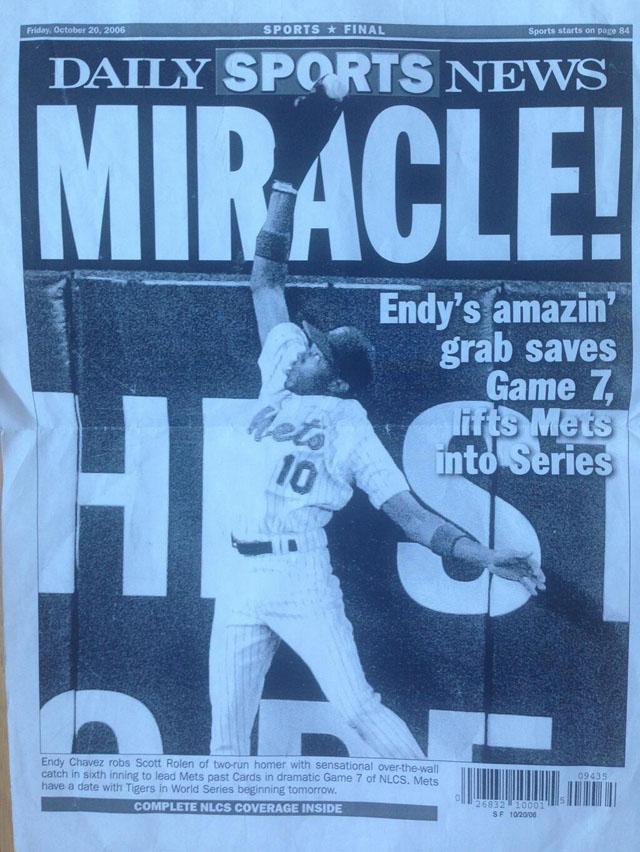
 Adam Rubin shared this just-in-case proof of the back page of the October 20, 2006, edition of the Daily News last week, evidence of how close alternate history came to being actual history. It means there is no “Beltran taking strike three,” and Carlos’s will to win is never seriously questioned. It means David Wright and Jose Reyes are world champions before either of them is 24 years old. It means Omar Minaya and Willie Randolph are confirmed as saviors and geniuses. It means Fred and Jeff Wilpon have led the Mets to the promised land without Nelson Doubleday. It means Billy Wagner, Paul Lo Duca and Carlos Delgado go down in Met history as the best trio of veteran acquisitions the Mets ever made in one offseason. It means there are no emotional qualifiers to apply to Endy Chavez’s catch. It means Oliver Perez and John Maine came out of nowhere to win World Series rings as Mets. It means Julio Franco emerged as a candidate for AARP’s person of the year. It means T#m Gl@v!ne never had to have his name typographically changed.
It means “2006” is in the conversation with “1969” and “1986,” and that 1986 and 2006 can’t help be linked as seasons when the Mets stood head and shoulders above the rest of baseball for seven Amazin’ months. It means that come 2016 you’re expecting some sort of dual celebration, maybe with appropriate pairs of world champion teammates — Delgado and Keith Hernandez, Wagner and Jesse Orosco — being introduced together. It means that a 20-year world championship drought was snapped. It means fans born in the 1980s and 1990s have a championship to savor. It means the dynasty talk heats up in earnest in Flushing. It means the “Jose-Jose-Jose!” song is sung on the steps of City Hall. It means the Mets are held up by Mayor Bloomberg as an example of the best New York can be. It means the Mets own New York as they haven’t for a generation. It means that as of 2014, only Mets fans under the age of 15 haven’t had a reasonable chance of fully experiencing a world championship in their lifetimes. It means that as of this moment, the Mets have gone no more than eight years since winning a World Series.
It means Tony La Russa has lost to the Mets twice in a pair of postseason showdowns. It means Yadier Molina is no more than an impressive defensive catcher. It means beating a team with Albert Pujols in the middle of its lineup wasn’t really that hard. It means baseball’s supposedly model franchise is looking at a quarter-century without having won the big one and that the “best fans in baseball” would have to dig deep to paint a big red smile over their bruised feelings. It means Jim Leyland has been avenged after he triumphed over the Mets as manager of the Pirates and Marlins. It means sticking it to Kenny Rogers in the World Series seven years after Kenny Rogers threw ball four to Andruw Jones.
Does it mean that the Mets find the wherewithal to repeat in 2007? Does it mean the Mets leave Shea Stadium on an indisputable high note in 2008? Does it mean Minaya and Randolph are forgiven their transient mistakes because these are the guys who won a World Series in just two years’ time? Does it mean Citi Field is the happiest place on earth in 2009 because it’s home of the Mets who are still at or near the top of their sport? Does it mean, somehow, that the entanglement that ensnares the Mets within the web woven by Bernie Madoff is somehow easier to slip out of? Does it mean Jose Reyes endures in a Mets uniform? Does it mean Carlos Beltran never leaves the franchise where he is embraced for having been the best player on the team that won it all? Does it mean that because perhaps there isn’t the same urgency to bolster the rotation after 2007 that the Mets never trade for Johan Santana and that after 52 seasons the Mets still don’t have a no-hitter? Does it mean that though the Mets might’ve been a joke for a couple of years early in the century that for the most part since the late 1990s they’ve been one of the best teams in baseball?
And you — if you were around in 2006, would erasing the loss and replacing it with a win have meant everything? Would it have continued to mean everything? Would your life as a Mets fan be substantially better if you could point back to the 2006 world champion Mets? The pain you knew and have carried around with you from coming so close would be, now and forever, unadulterated pleasure. And if you weren’t around, based on everything you know, you’ve read and you’ve thought about, would you love more than anything to have the Mets have been world champions in 1969, 1986 and 2006?
How great would it be to have that one back and have it turn out right this time?
***
There you have them:
• 1973 World Champion New York Mets
• 1988 World Champion New York Mets
• 1999 World Champion New York Mets
• 2000 World Champion New York Mets
• 2006 World Champion New York Mets
Choose one.
by Greg Prince on 10 February 2014 1:42 am Whatever scale of tribute they pursue, I trust the Mets to do right by Ralph Kiner in death. They did just fine by him in life.
Ralph Kiner was inducted into the Mets Hall of Fame, alongside Bob Murphy and Lindsey Nelson, in 1984, nine years after the team heartily toasted his induction as a (non-Met) player into Cooperstown. A plaque portraying his likeness has been hung in the Mets museum since it opened in 2010. In that same exhibit space, there is an interactive kiosk devoted to Mets announcers, with Lindsey, Bob and Ralph featured prominently.
The television broadcast booth at Shea Stadium was named for Ralph Kiner in 2002 and the designation was seamlessly transferred to the Citi Field press level. In 2003, Ralph and Murph were the subjects of a shared bobblehead that more or less resembled the men in question. The Mets threw a stupendous Ralph Kiner Night in 2007, attended by 51,742 and appreciated by the vast majority who witnessed it. Over the past decade-and-a-half, as his everyday presence diminished, Ralph was invited to throw out first pitches on outsize occasions, was given special on-field introductions and remained part of the Mets announcing corps on whatever basis he could contribute. It was good for the Mets, it was good for the last of the three original Mets announcers, it was fantastic for us.
The Mets clearly recognized the gem they had in Ralph Kiner and the 14-karat connection he forged with multiple generations of Mets fans. Management treated him as an heirloom rather than a relic and allowed him to shine to the very end. I doubt they’d do anything to dismantle his legacy now that he’s gone, and of course I hope they take every step possible to not just preserve it but embellish it.
Most importantly, though, they did right by him in life.
Since Ralph’s passing Thursday, I’ve seen the outpouring of affection and emotion encompass an impulse that has become common when a beloved figure leaves us, particularly in sports. The news barely sinks in before it is wondered what will be done to honor the individual we lost. Perhaps it’s a reflection of how we reflexively wish to keep the spirit of the departed alive for as many extra innings as we can that we are almost instantly moved to want to name, erect, emblazon, display and enshrine. Quiet remembrance amongst ourselves just never seems sufficient when public sadness overtakes us.
In the case of the Mets, the wondering tends to be laced with wariness. This is the Mets, the organization that generally has to be badgered into celebrating or sometimes simply acknowledging what they represent to the people who love them most — the Mets who seem to take perverse pride in not getting what their lore means to their fans. To put it kindly, when it comes to reveling in Metsiana, the Mets veer to the suffocatingly subtle.
Will the Mets wear a patch honoring the memory of Ralph Kiner in 2014? I’d book it. Will there be a ceremony to mark the totality of his 52 seasons as a Mets icon? On Opening Day, I’d assume. Will some segment of left field be officially dubbed Kiner’s Korner, as has been suggested by several bright people? I don’t know. I’d like that. You probably would, too. Will the Mets break their persistent boycott of statuary for, ideally, a substantial work of art that portrays Messrs. Kiner, Murphy and Nelson occupying the airwaves they made theirs forever more in 1962? Based on the Mets’ track record in such matters, I wouldn’t bet on it.
The Mets will probably be the Mets about it. Whatever they do will inevitably be tasteful, classy, heartfelt and somehow not quite perfect enough. That, I’ve come to realize, is how it can’t help but be.
But isn’t it the Mets’ job to make Met things perfect? Yes it is — which is why they will never come close to achieving and maintaining Met perfection. What is their job is our passion. We are going to care more than they do. It’s unavoidable. The caringest Met employee will not care about hundreds of Met details as much as tens of thousands of the caringest Mets fans care. They can only think about so many Met things in the course of a day. We never stop dwelling on Met things. When they get a Met thing right, they can take satisfaction in a job well done. We are never satisfied, because we know Met things can always be done better. They are paid to take care of Met things. It is our mission to perfect every Met thing that crosses our collective mind and it never occurs to us that there’s a reward beyond the perfection itself.
Not that we’d ever achieve perfection, because our process doesn’t allow it. We’d always have one more idea to put into action, one more flourish with which to adorn the tableau, one more “wouldn’t it be great if…?” morsel to make complete our feast of expression. I’ve rarely been in a conversation with fellow Mets fans that ends with one person putting forth a thought and everybody else concurring that the issue at hand has been solved. We’re not about solutions. We’re about taking issues to the next level.
Nevertheless, Metsopotamia’s insatiable appetite to achieve a state of Marvana should not be taken by the Mets as license to squirm out of their responsibility as tenders of the family jewels (so to speak). They can’t say, “ah, these fans, they’ll never be satisfied, just play ‘Sweet Caroline’ really loud and shoot a few more t-shirts at ’em.” They have to absorb our passion and our energy and spin it back to us in a manner that will take our breath away. They may not be able to do it this year with a proven major league shortstop — and they don’t necessarily have to do it with a statue of Ralph Kiner — but they’d be well-served to recognize what makes our souls hum and our pulses pound.
They should notice at times like these, when each and every one of us takes the death of someone most of us never met absolutely personally, that the Mets are more than a “brand” or a “product” to us…and we’re more than an “audience” or “customers” for what we continue to invest in from them. They should realize, if they haven’t already (and they probably haven’t), that we interpret Mets history as our history. It’s the history of the people who wear the team on their sleeve and in their heart as much as it’s any nine players who’ve taken the field on our behalf.
We — that is us and what the Mets mean to us — are no less intertwined than Ralph, Bob and Lindsey. Nobody’s building a statue to Mets fandom, either, but it ought to be evident how monumental it really is.
by Greg Prince on 6 February 2014 5:34 pm Y’know, I had just been thinking about Ralph Kiner. This was before the Super Bowl, when I read Edwin Pope of the Miami Herald wouldn’t be covering the game at MetLife Stadium. Pope, you see, had never missed a Super Bowl. The Super Bowl is still young enough so there are people who can be said to have been directly involved with all of them. The Roman numerals would keep accumulating: X…XX…XXX. Players and coaches and commissioners came and went, but a critical mass of those charged with reporting it to us would reappear year after year. By the IVth decade, however, the ranks of orginals and forevers began to thin noticeably. That’s just how the flipping of calendar pages works.
Every few Januarys in recent years, I’d come across an article about the group of writers who’d covered each and every one of pro football’s championships from 1967 forward and was about to cover another. Their numbers couldn’t help but dwindle as time went by. With Pope missing Super Bowl XLVIII, the corps was down to three, including, I learned last week, two from our vicinity: Jerry Izenberg and Dave Klein, both from New Jersey, and Jerry Green, out of Detroit.
Those guys and their constancy made me think of Ralph Kiner, specifically how Ralph Kiner, 53 years into the franchise’s history, was the only person you could be sure was affiliated with the New York Mets when they started and remained affiliated with them throughout. For the longest time growing up with the Mets, you’d hear this person or that person had been there from the beginning. It wasn’t all that unusual for a while. Then it became a badge of genuine longevity. Bob Mandt. Pete Flynn. Bob Murphy, quite obviously. And Ralph Kiner.
Retirements. Illnesses. Deaths. But Ralph Kiner was still a part of the Mets every year. He was 1962 and 1969, 1973 and 1986, 1999 and maybe a dozen day games right up to the very present. He was Ralph Kiner, voice of the New York Mets when they were new, when they were grand, when they were atrocious, when they were there no matter what. Ralph was there no matter what. Not like he used to be, maybe, but just enough so you didn’t have to imagine he wouldn’t be.
Nobody was more original. Nobody was more forever.
Ralph Kiner will not be dropping by the booth in 2014. I want to say he’s unavailable and leave it at that. It’s too tough to believe, even after he lived 91 years, that the Mets go on without him. There’s never been the Mets without Ralph Kiner calling their games or, per his more recent part-time role, interrupting them. The Ralph of whom we were treated to select innings in the SNY era was the dandiest of intermittent presences. He was a baseball sage who could address any element his partners steered his way, and in doing so, he transported his audience to bundle after bundle of games, years and personalities that nobody else was telling us about anymore. It was a gift he kept on giving, and knowing that the gifts wouldn’t always pile up under the baseball tree made them that much more precious when we were lucky enough to receive them.
Before SNY, before MSG, before FSNY and before SportsChannel usurped most of the function that Channel 9 served, he was Ralph Kiner, voice of the Mets. Ralph with Tim McCarver and Steve Zabriskie on TV. Ralph, of course, with Bob Murphy and Lindsey Nelson, switching between TV and radio for 17 fraternal-triplet seasons. Ralph with others along the way, too. And Ralph, quite naturally, with the star of the game coming up right after the game on Kiner’s Korner. But always Ralph.
Eternally Ralph.
Ralph Kiner, Gary Cohen once calculated, had to have dispensed more autographs than any man alive. Ralph Kiner, as far as I can fathom, enhanced the expertise and experience of more Mets fans than anybody who ever lived, maybe anybody who will ever live. Ralph played it straight, balls-and-strikeswise. Ralph danced among the malapropisms that, for an amiable stretch, became his unwitting signature. Ralph analyzed swings and held forth on hitting. Ralph told and retold stories. Ralph didn’t necessarily kiss and tell, but it was pretty clear fate puckered up when it saw him making his way from Southern California to Pittsburgh to, eventually, us.
Ralph embraced us and embellished our baseball-loving lives while he was here. His statistical standing among all-time power producers may have fallen when homers became commodities rather than events, but when it came to grace and class and style and solid-gold professionalism, Ralph Kiner never vacated his spot atop the charts.
Now and then it would be pointed out Ralph hit home runs at rates almost unmatched in the annals of slugging and was inducted into the Hall of Fame in recognition of his prodigious skills. It was almost like finding out your parents used to have this whole other life. “You mean you were somebody before I was born?” Oh, Ralph was somebody, all right. And he remained somebody, a whole other transcendent Met figure that seemed to materialize independent of what he accomplished as a Pirate, a Cub and an Indian.
He could’ve rested on the laurels of being Ralph Kiner and made hay that way. But instead of being impressed with himself, he transmitted the Mets to us first and foremost. He looked to the plate and described Richie Ashburn and Cleon Jones and Lee Mazzilli and Darryl Strawberry and Bobby Bonilla and Mike Piazza and David Wright. He peered out to the mound and let us know the situations facing Roger Craig and Jerry Koosman and Craig Swan and Dwight Gooden and David Cone and Al Leiter and Johan Santana. He processed the thinking of Casey Stengel and Gil Hodges and Yogi Berra and Joe Torre and Davey Johnson and Bobby Valentine and Terry Collins. He shared air time with Bob Murphy and Lindsey Nelson and Steve Albert and Art Shamsky and Lorn Brown and Tim McCarver and Steve Zabriskie and Fran Healy and Rusty Staub and Gary Thorne and Howie Rose and Ted Robinson and Dave O’Brien and Tom Seaver and Gary Cohen and Ron Darling and Keith Hernandez.
He interviewed every big star for generations or, more accurately, every big star got to be interviewed by him. He made every scrub with whom he crossed paths look and feel like a king for a day.
Because of what he did, how long he did it and how well he did it, Ralph Kiner, as much as anybody, made me the Mets fan that I am today and figure I always will be. I’m guessing he did something similar for you.
by Jason Fry on 6 February 2014 1:34 am Past
Here’s a sign of spring: The 2014 Topps cards are out.
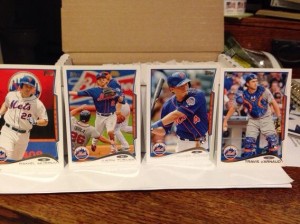 Let’s not go overboard: This isn’t the greatest set. The photography’s good again, but Topps has developed an unfortunate predilection for novelty shots, with far too many players romping with teammates (and often on dreaded horizontal cards), getting doused with Gatorade or showing off Oscar Gamblean coifs. The card design is boring and redundant — why a little ribbon displaying the team name when the logo’s already there? The strange numbering system in which players once ascended the rank of stardom from 5s to 10s to 50s to the coveted 100s is but a memory. And while I like the idea of adding WAR to the statistics on the back, it just seems like fuel for pointless Internet fights. Let’s not go overboard: This isn’t the greatest set. The photography’s good again, but Topps has developed an unfortunate predilection for novelty shots, with far too many players romping with teammates (and often on dreaded horizontal cards), getting doused with Gatorade or showing off Oscar Gamblean coifs. The card design is boring and redundant — why a little ribbon displaying the team name when the logo’s already there? The strange numbering system in which players once ascended the rank of stardom from 5s to 10s to 50s to the coveted 100s is but a memory. And while I like the idea of adding WAR to the statistics on the back, it just seems like fuel for pointless Internet fights.
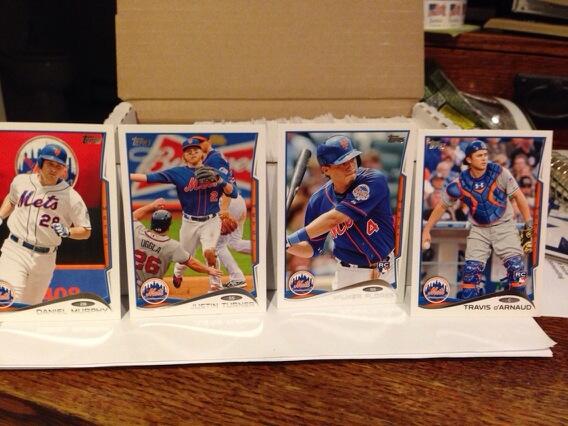
But in the dead of winter any sign of spring is welcome, and this one fixes thoughts happily on spring training and changes to The Holy Books. Of which there are four from the first series:
1) Travis d’Arnaud gets his first-ever big-league card, and it’s not bad. Added bonus: It replaces d’Arnaud’s 2013 Topps minor-league card, which Photoshopped him into being a Buffalo Bison. This is one team d’Arnaud never played for: Thanks to affiliation changes that one might expect Topps to keep track of, d’Arnaud pulled off the odd trick of playing for Las Vegas in 2012, getting traded and returning to Las Vegas in 2013.
2) Wilmer Flores gets a card. It bills him as a shortstop. Hrrm. We’ll see about that.
3) Daniel Murphy, long victimized by subpar cards, finally gets a winner in which he’s jogging around the bases with the Apple, um, tumescent behind him. Murph being Murph, he looks intense and mildly put upon. Great shot.
4) Justin Turner finally gets a decent Mets card, replacing some strange Japanese thing I picked up somewhere. Turner, you may recall, is now the newest member of the Los Angeles Dodgers, and it was apparently quite a while ago that he wouldn’t be a 2014 Met. In this case, Topps’ sloth is my gain. (Though I’d trade my 2013 Topps Update Shaun Marcum for never having to think about Shaun Marcum again.)
Present
I’m just going to say it: I don’t care if the Mets sign Stephen Drew or not.
PECOTA forecasts the Mets as once again a 74-win team. With Drew the Mets would net out as … a 75-win team.
PRINT THOSE SEASON TICKETS!
Now, I don’t take PECOTA as gospel. I’m not as pessimistic as it seems to be on either score, but the point is much the same: Drew is not the missing piece of the Mets’ championship puzzle. If Ruben Tejada’s lost it, Drew would make the Mets slightly better, but not in any way we’ll remember a couple of years from now. If Tejada’s annus horribilis was an exception, the two might be a wash. The Mets’ financial health remains an unresolved question, with their payroll still awful paltry compared with what one would expect from the National League’s New York team. But Drew isn’t going to settle that question, or likely any other that we care about. If the Mets projected as an 88-win team and had money to spend, I’d be lighting Twitter aflame screeching for the Mets to add Drew. But they’re not. The whole thing is pointless, and not worth talking about even by the low standards of the hot-stove league.
Future
Despite all that, I’ve been trying to get my arms around an emotion that I haven’t felt in quite a while.
I think it’s hope.
For the third year in a row, the Mets are poised to promote a prized young arm to the big-league rotation come mid-July. In fact, this year there are two intriguing pitchers who could get the call: Noah Syndergaard and Rafael Montero. Nothing is certain, but the team can reasonably expect to have Matt Harvey hurling thunderbolts once more in 2015. Bartolo Colon, Jon Niese and Dillon Gee are all capable or more than that. Zack Wheeler has tremendous talent. Jenrry Mejia and Jeurys Familia are rifle-armed young pitchers with big-league experience. Jacob deGrom ascended three minor-league levels last year and could develop into a Gee type starting this year.
Again, nothing is certain in baseball — and nothing is more uncertain than the health and development of pitchers. But with a little luck — which this franchise is certainly due for — the Mets could approach the trade deadline with a stockpile of TEN very interesting 2015 big-league starters. Teams that go into a season with four of those are generally considered to be worth paying attention to.
The Mets’ farm system has been rebuilt, but that restoration has come with a nagging question: Where are the young bats?
Perhaps the answer is that they’re in other teams’ organizations.
If things go right (and again, that’s not a small if), Sandy Alderson could deal two or three or more arms from that stockpile this summer for the bats everyone agrees the Mets need. If Sandy nets his usual high return, the Mets could report for duty in 2015 looking talented and dangerous. Maybe we could be talking about the difference between 88 and 90 wins, instead of 74 and 75.
And wouldn’t that be the stuff of wonderful emotions?
by Greg Prince on 5 February 2014 2:41 pm Kyle Farnsworth has been invited to Spring Training. Daisuke Matsuzaka has been invited to Spring Training. Taylor Teagarden conjures images of an idyllic spot where those who sew for a living might seek a civilized respite from the drudgery of cuffing trousers, but he’s actually a catcher and he, too, has been invited to Spring Training. So has Matt Clark, a perfectly random pair of first names that apparently amounts to a longtime minor league first baseman who was something of if not all the rage in Japan (if not Genoa City).
They may or may not be part of your 2014 New York Mets when things begin to fully matter, but for at least a spell in February and March, they’ll definitely enter our thoughts, for each of them has been invited to Spring Training.
“Invited to Spring Training” is one of those phrases that rolls off of tongues and into ears this time of year. It sounds so much better than “wintry mix,” for example. But what does it mean to be invited to Spring Training? Literally?
I get the basics. No more than 40 men can be on a 40-man roster, thus the category known as Non-Roster Invitees. You’re with the team via a relatively late deal, labeled “minor league” for bookkeeping purposes; Marlon Byrd and LaTroy Hawkins bought the Mets time by agreeing to that ultimately temporary classification a year ago. Most likely you carry the burden of proof, holding a lesser degree of job security and facing a regular season that’s inherently more to-be-determined than a plurality of your 40-man colleagues. The implication of “invited to Spring Training” can’t help but be that you’re on the “over” portion of the hill where your career arc is concerned. But that’s not always the case.
NRI is also the ticket for prospects who don’t figure to break camp with the big club. Three names familiar from last summer’s Futures Game — Brandon Nimmo, Noah Syndergaard and Rafael Montero — have made the same list as the aforementioned veterans, albeit from a less marginal entry point. Those just approaching the hill are invited to major league Spring Training for a brief taste of what figures to await them for real in springs to come. Unless somebody wows everybody, they’re headed back to the minor league complex in a matter of weeks.
With all that understood, what about the formal extending of the invitation? If you were on the team last year and maintain every reasonable certainty that you’re going to be on the team this year, I assume you know what to do and where to go. But when you’re “invited to Spring Training,” what are the logistics? I’d love to believe there’s a ritual to it, perhaps that some vestige within the Basic Agreement mandates a telegram be personally delivered to each and every Spring Training invitee. Or that teams literally send out invitations packed with RSVP cards and those thin squares of tissue paper that don’t seem to serve any earthly purpose.
Hey, maybe all these years I haven’t realized that those little sheets were redeemable for a tryout at shortstop.
It doesn’t actually seem to work that way, but I figure it’s gotta work some way. Late every August when I was a kid, an envelope would show up in the mail from the local school district. It was the harbinger of doom envelope telling me that on the Wednesday after Labor Day it was all about to end. A strange-sounding room number was listed and a bus pass was thrown in. If I wanted a ride to school, I’d damn well better be standing on the “N.W. Corner” of Neptune Boulevard. It provided an early lesson in geography. To this day, I envision my first-grade bus pass coordinates to gauge north from south and east from west.
Curiosity and the lack of actual baseball got the best of me, so I decided to try and find out the process behind being invited to Spring Training. Or at least extending the invitation. I bothered somebody who works for the Mets and asked, in essence, “How does this go down?” The person I asked was nice enough to walk me through it.
Alas, Western Union doesn’t ring anybody’s bell and invitations aren’t engraved (also, I don’t think there’s really such a place as a tailor tea garden). The whole business doesn’t differ all that much from any other baseball contract. The player’s agent and the ballclub work out the specific language. Once the player is in camp, he doesn’t wear a scarlet NRI to distinguish him from his 40-man roster peers. Same clubhouse for dressing, same clubhouse spread for noshing, same access to weights and measures; the trainers who condition seven-time All-Star David Wright condition the non-roster invitees with just as much care and effort.
Semantics aside, if you’ve been invited to big league camp, you’re a big-leaguer, fella. Contractual status and performance will combine to determine whether you’re still a big-leaguer come March 31, but in the meantime, enjoy it while it lasts.
One note of Spring Training caution comes from someone who knows of life as an NRI, former fringe reliever Dirk Hayhurst, the righty whose fame for writing about baseball exceeds his fame for pitching it. Though we all see reports of eye-popping big league salaries, players who earn them don’t start banking those stratospheric numbers until the season starts. And by no means is everybody invited to a big league camp guaranteed Freddie Freeman’s financial future. Thus, the Basic Agreement calls for a Spring Training allowance — meal money is the colloquialism you’ve probably heard all your life — but Hayhurst pointed out in 2012 that the then-prevailing figure of $140 per week had to go a long way.
Remember, you’re not getting paid during spring training. If you eat beyond your allowance, it’s on you. This says nothing of other investments you might want to make, like chewing tobacco (if you’re a mother reading this article, replace tobacco with bubble gum), alcohol (Gatorade), video games (video games) or poker buy-ins (charitable contributions).
May I humbly suggest that you invest in Tupperware. Sexy? No. Practical? Yes. You can bring home a lot of food from the field in those glorious plastic containers, especially if your organization cooks its meals on site. With meals taken care of, the meal money is yours.
The things we mere non-baseball playing mortals don’t think about, huh?
But I have been thinking about the envelope from the school district, and my source at the Mets says there is a major league equivalent. The team’s director of travel sends a packet of information to every player, from the long-timers to the first-timers. Unless you’ve spent previous springs in St. Lucie County, you’d need something to tell you which corner to stand on, so to speak. Wright likely knows his way around town. The Teagardens and Clarks (let alone the Grandersons and Colons) probably don’t.
No bus passes of which I’m aware in the packet, but it does include reporting dates, contacts for housing and hotels, where to turn if you want cable, places to dine (if you can afford to avoid the Tupperware for an evening), places to golf…a veritable Welcome Wagon brochure for the new seasonal resident. Makes sense. This isn’t fantasy camp. You’re a professional baseball player who’s just been transferred to Port St. Lucie on a corporate fact-finding mission. You and the team need to discover if you’re going to be heading to New York when the mission is over.
It’s a job. It’s an adventure. It’s an invitation to Spring Training. If you want to be a Met, I’m guessing you’re willing to overlook the lack of fancy tissue paper.
by Greg Prince on 31 January 2014 8:01 pm While the Wilpons unscrunch the large wad of cash they’ve allegedly found underneath their couch cushions, I await anxiously the start of the biggest sporting event to ever touch down in our humble Metropolitan Area. I refer of course to Queens hosting the World Series, time of first pitch as yet undetermined.
In the meantime, there’s Super Bowl XLVIII on Sunday, and that figures to make for a decent distraction as we wait and wait and wait for Opening Day LIII to kick off some eight weeks later.
Though the Mets and the Super Bowl debuted less than V years apart, I rarely think of them as being close enough in age to coexist as sporting siblings. The Original Mets were Mad Men season two; the inaugural Super Bowl was Mad Men season five. Stylistically, the gap stretches like the difference between radio spots for Secor Laxatives and a sleek print treatment for the Jaguar XKE.
The Mets were built on the dormant goodwill that remained from 1950s National League baseball in New York. Playing at the old Polo Grounds; guided by old Casey Stengel (the subject of a 2014 bobblehead, Faith and Fear in Flushing has delightedly learned); preserved primarily in old black & white archival footage; and stocked with players whose experience made their presence in the “Senior” Circuit most appropriate, the Mets were an enterprise that echoed yesterday before they could fully anticipate tomorrow.
You don’t have to have followed the evolution of Harry Crane’s haircuts to know the society of January 15, 1967, was cultural light years removed from that of April 11, 1962, which is probably why Cardinals 11 Mets 4 and Packers 35 Chiefs 10 don’t resonate as chronologically related. Yet it was only 57 months after the dawn of the Mets that the Super Bowl came rushing onto the greater athletic scene, never, ever to step out of bounds.
That first AFL-NFL World Championship Game was an event just dripping in what figured to come next, right down to the two jetpack-wearing performers who were launched skyward to signify just how much future was packed into this contest.
The super spectacle’s wow-factor Madison Avenue moniker was not yet codified, but “Super Bowl” was already being informally thrown around by the press. That the game was being played at all foretold of the day when professional football’s distinctions would be streamlined into a single merged entity, the spiritual equivalent of Ned Beatty’s “one vast and ecumenical holding company, for whom all men will work to serve a common profit, in which all men will hold a share of stock, all necessities provided, all anxieties tranquilized, all boredom amused” speech from Network. The National Football League’s showcase was immediately telecast in living color even if everybody’s set hadn’t yet caught up to the available technology. And the whole thing couldn’t have been more made for TV had it been produced by Sherwood Schwartz.
Perhaps the reason I can’t quite reconcile that the Mets and the Super Bowl are of just about the same vintage is the scale that separates them. The Mets may have made a couple of World Series before the Super Bowl had been played VIII times, but even with those express global implications, to us they were still the M-E-T-S of New York town. Of Flushing town. Of little ol’ Shea Stadium. They were ours. The Super Bowl, on the other hand, never didn’t seem ginormous. Life stopped for the Super Bowl almost from the get-go. By the time I saw my first, which was the IVth, it all but overwhelmed the screen. Minnesota was playing Kansas City in New Orleans, yet it mattered everywhere.
That the games were rarely good didn’t much deter anybody. The ’70s were lousy with low-scoring struggles that nonetheless managed to be largely noncompetitive. Regardless of quality, people tuned into those Super Bowls like they tuned into nothing else. The ’80s and ’90s were pockmarked by high-octane blowouts. People kept tuning in to Super Bowls. As the games improved in the new century it became fashionable to announce with equal parts irony and sincerity that one was watching only to check out the commercials…but watch is what almost everybody did and does. That’s not something that can always be said on behalf of our Metsies.
And now the Super Bowl has encroached upon the Mets’ general geography. It is here among us polished urban sophisticates when it is usually assigned to pleasant places in what we tend to graciously consider America’s countryside…which is to say everywhere else. I must admit I can’t fully grasp its presence on these shores.
New York has the Super Bowl. Gosh, that’s strange.
Technically, New Jersey has the Super Bowl and the Super Bowl has asked New York to allow its name to be used in the program. Or so it feels from here on the non-football side of the frigid Hudson. Several decades ago, the Felix sector of New York’s brain decided to tidy up its outer boroughs and store its messy pigskin accoutrements somewhere near Secaucus. The Oscar portion never even noticed they were moved across state lines. Yeah, the Jets shouldn’t have left Shea (nor should have the Mets), but as long as they and the Giants showed up televised every Sunday, we were fine.
And I imagine we’d be fine with the National Football League blessing a different ADI with its winter bacchanalia. New York didn’t really need the Super Bowl. I mean that less in the “New York has a million attributes and attractions, harumph” sense than “more tourists, more traffic…who needs it?” way we have of approaching every interloper who drops by. The dollars are always welcome, but the hassle never seems worth it.
You know who would appreciate this Super Bowl more than we do? Based on thirty-year-old personal experience, I’d say Tampa. The Super Bowl — or what it turned into by the time it reached adolescence — was made for Tampa.
Conveniently adjacent to the springtime home of the New York Mets in St. Petersburg, Tampa was the site of my college years and Super Bowl XVIII (we were both so young then). Though I was a relative newcomer to the vicinity, I figured out right away that nothing bigger had happened to Tampa than being told it was going to host The Big Game. The city’s founding in the 19th century probably ranked a distant second…maybe third, with the 1976 invention of the Tampa Bay Buccaneers lodged in between.
Forget economic impact, at least as measured by hotel bookings and restaurant reservations. Tampa — where “the good life gets better every day,” per the chamber of commerce’s unbiased early ’80s opinion — was just tickled to have its existence validated by an massive outside entity like the NFL. I had never lived in a less than wholly major market prior to my extended stay in Tampa. I was from New York, worldwide headquarters of self-esteem. I didn’t know what it meant for a city to crave “national recognition,” a commodity valued in the local media the way the legendary Gulf Coast pirate Jose Gaspar was said to have lusted for Tampa Bay’s treasures.
Tampans were so taken with the tall tales of Gaspar (no known relation to Rod) lavishing attention on its peninsula that in 1904 it instituted a Mardi Gras-ish festival called Gasparilla in his name. Every year, the city fathers sanctioned an “invasion” of Tampa by businessmen dressed as buccaneers, creating the annual highlight of the municipal social scene, at least until it was trumped by the Super Bowl’s initial West Central Florida appearance in January of 1984. No wonder the eventual home of the Bucs was only too happy be to be invaded by the NFL. The DNA of Tampa cries out to be trampled.
There was a chance it would be only half-trampled, but not a great one. On the eve of the 1983 football season, I watched a pair of co-anchors report on how much it would benefit Tampa to have two teams from somewhere else qualify for the Super Bowl because that would mean more money flowing into town. “I don’t care,” one chirped cheerily to the other. “I still want the Bucs to make it!”
Despite coming off three perennially unlikely playoff appearances in a four-year span, the 1983 Buccaneers courteously stepped aside with a 2-14 record, presumably to ensure the city’s merchants would benefit from the onslaught of visiting fans who would fly in to root on the Washington Redskins and Los Angeles Raiders. This was outstanding for Tampa’s psyche, too, because those conference champions were traditional powerhouses of the period, each of them having won a Super Bowl in recent seasons. If Tampa was good enough to open its arms to nationally recognized football franchises, then, gosh darn it, Tampa mattered!
The Super Bowl roared into my temporary hometown like a monorail salesman through Springfield and was gone to Brockway, Ogdenville and North Haverbrook just as quickly, leaving the purported good life to get better every day on its own steam. For all the life-changing dreams the region harbored in advance of Super Sunday 1984, what Super Bowl XVIII really wrought was:
• a glutted secondary market (tickets bearing the absurdly high face price of $60 were said to be going for five bucks apiece in the Tampa Stadium parking lot right around kickoff);
• a typical-for-the-era lopsided result (Raiders 38 Redskins 9, Marcus Allen trampling every Skin in sight);
• a few silver and black benches branded with the “Commitment To Excellence” motto — residual Raider glory left to linger at scattered HART bus stops long after Al Davis hightailed it back to California with the Vince Lombardi Trophy (Davis’s ego probably functioned more reliably than Hillsborough Area Regional Transit);
• a single Tampa-centric pregame feature on CBS (mostly Jimmy the Greek praising the charms of a good Ybor City cigar);
• and a desire by Tampa to be invaded repeatedly in the years to follow anyway. Tampa has been a Super host III more times, and it’s always giddily bidding for another. If you ever need to swing by Tampa and don’t want to arrive emptyhanded, a well-executed incursion always makes a nice gift.
Maybe it’s testament to the NFL’s knack for conferring legitimization that more than a decade before Jerry Maguire made it a catchphrase, Tampa practically swooned to the league, “You complete us.” The Super Bowl was all anybody talked about for weeks. Everybody felt like they were in on the festivities, which weren’t nearly as festive as they are these days. Where are the Redskins huddling? Did you see which Raiders were out being rowdy? Super Bowl stuff is on sale at Alberstons…I bought ten plastic cups for a dollar!
Why, I can even recall one normally blasé college student turning practically starstruck from his brush with a league official driving by in a Roman numeral-marked car. The guy was seeking the jury-rigged football facilities set up at one of the area’s prominent universities and the encounter left a Joe Jacoby-sized impression. “Wow,” the college kid would tell anybody who listened. “I was walking back from class and somebody from the NFL asked me directions to the soccer field!”
The easily impressed young scholar in question? That would be your not yet so blasé blogger. I may have effected a New Yorker’s detachment on the outside, but that didn’t necessarily mean I was as immune to Super Bowl fever as I’ve grown with age. New York might bundle up and barely blink at the thought of hosting The Big Game, but a Super Bowl was the biggest thing to ever happen to Tampa. And after a few years exposed to another city’s folkways, even a jaded New Yorker couldn’t help but turn into a bit of a Tampan.
by Greg Prince on 27 January 2014 2:09 am In the “seventh inning” of Ken Burns’s Baseball — the installment titled “The Capital of Baseball” — the viewer learns that New York was the epicenter of the universe in the 1950s, at least until two-thirds of the Metropolitan Pastime’s contingent was about to be packed up and shipped west. It’s within that portion of the documentary that Burns brought in John Turturro to voice the letter a concerned citizen wrote to Mayor Robert Wagner as the dastardly deeds were being done in 1957:
I am a man of very few words so I will come straight to the point. I voted for you. I pay your salary. I WANT THE DODGERS IN BROOKLYN. I don’t want any excuses from you or any of your men at the City Hall. I WANT THE DODGERS IN BROOKLYN and you can do it by building the sports center. You had better get it built or you’ll not get a vote from me.
Just as John Turturro channeled the sentiments of disgruntled Wagner voter R. Cucco twenty years ago, his same I-mean-business tone would suit my sentiments presently where the machinations of WOR and, apparently, the Mets themselves are concerned.
I am a man of sometimes many words but I will come straight to the point. I am a loyal consumer of your product. I WANT HOWIE ROSE AND JOSH LEWIN DESCRIBING IT TO ME ON RADIO. I don’t want any excuses from you or any of your people at Clear Channel. I WANT HOWIE AND JOSH BROADCASTING METS GAMES and you can do it by signing them to contracts for the 2014 season and many seasons beyond. You had better get it done or…
Oh, damn, this is where my 50,000 watts of Turturroan indignation turn to static because I am a consumer of your product and you SOBs (that’s Students of Broadcasting, I hope) probably assume a fan like me might raise a fuss over disagreeable details but will ultimately tune in when I need to hear the Mets on the radio because, well, I need to hear the Mets on the radio. You smugly believe that since I put up with Tom McCarthy for two years and Wayne Hagin for four more that you can, for reasons not at all understood by me, potentially replace an announcer I’ve come to enjoy and not pay a price for it.
The price is my goodwill, but perhaps that’s not dollars-and-sensical enough for you to care.
That’s too bad. If you don’t keep Howie and Josh together, I will view it and hear it as an abuse of my trust. It may not mean a thing to your pocketbook in the short term, because I can’t swear I’d ease my foot off the going-to-games gas pedal in any meaningful way or even resist the temptation of orange-and-blue merchandise if there’s a spiffy new item that catches my eye. Yet I will be genuinely pissed off. And I’ll remember it. And somewhere along the way, you’ll have whittled away at our team-fan relationship.
I only know what I read in Capital New York, but the pieces of the story that have emerged — that new flagship WOR wasn’t necessarily anxious to retain Howie Rose (perhaps because they believe putting a shiny 710 stamp on Met broadcasts supercedes Met listeners’ needs) and that Jeff Wilpon hasn’t rushed to secure Josh Lewin’s services (perhaps because Josh’s sparkling chemistry with Howie and his own quick wit elude the COO) — are, as they say in chin-stroking journalistic circles, troubling.
The Mets said they were going to WOR, but I look at Howie and Josh not confirmed to the world at large as the Mets broadcast team of record right now and well into the future, and I’m pretty sure WTF? is the real frequency over which ownership and its new radio partners are intent on transmitting.
by Greg Prince on 24 January 2014 3:09 am Earlier this week, Ron Davis put his proverbial fist through the Mets’ paper-thin veil of pretending they’re happy to have Ike Davis come down to St. Lucie and compete for the first base job. Ron, who was a successful major league reliever before becoming known to a later generation as Ike’s dad, made his points cogently and colorfully, whether you’re prone to agree with them or not.
Ron Davis thinks the Mets “screwed up” because they were so public about shopping Ike Davis and never got a deal done. Ron also expressed dismay with Citi Field’s impact on Ike’s production and stressed that his son should have no illusions about the nature of the business he’s chosen. The veteran of five major league teams resists sentimental attachments at the major league level. “My favorite team is the last one I played for,” he said, indicating Ike should be prepared to absorb the same lesson.
“I told him, ‘You’re like a piece of hamburger meat, just sitting there at the grocery store,’” Ron said before Tuesday night’s B.A.T. dinner. “‘And when you’re first put out there in that wrapper, you look real good — bright and red. And the older you get, you start getting tarnished, a little brownish, and people don’t pick you as much.’”
Davis the elder may be coming at the issue of Ike’s from perspectives both uniquely informed and totally biased, but good for him either way. Ron Davis doesn’t care about what’s best for the Mets. He cares about what’s best for his son. Whether his sharing his thoughts so candidly with the media helps Ike’s cause is another matter, but the man was surely speaking from the heart.
Can’t blame him for that, just like you couldn’t blame Mookie Wilson in October of 2006 for what some perceived as his crime against Metsdom, namely that he wore a Cardinal ski cap as he rooted for his son, Preston, in the World Series. The Mets’ archrivals during Mookie’s heyday were the Cardinals. The Mets’ archrivals the week before, during the NLCS, were the Cardinals. Mookie Wilson, a Met among Mets, didn’t care. Preston was playing for St. Louis, so Mookie pulled for St. Louis. Of course he did.
When Sandy Alomar, Sr., was a Met coach, he pulled down one of the commemorative Shea countdown numbers alongside his sons Roberto and Sandy, Jr., on Fathers Day. All three had been Mets, though one of them — Robbie — made a lasting impression in the wrong direction. As a non-Alomar in 2008, I wasn’t all that keen on Roberto Alomar being given any kind of Metsian honor. Yet somehow I don’t think Coach Sandy looked at the same person and saw a Met who seemed to tank upon his donning the orange, blue and black in 2002. He saw his son, period.
Hell, even über-Cub Randy Hundley was a Mets fan as long as Todd Hundley was a Met.
Blood (or adoption, in Mookie and Preston Wilson’s case) will always be thicker than the fabric the good folks at Stitches use to produce game-ready Mets uniforms. Ron Davis’s spiel is OK. Mookie Wilson’s distasteful ski cap was OK. Sandy Alomar’s choice of number-removing companion was OK. And by the way, my dad, who always asks me about the Mets even though it’s hard to imagine him caring less about them, is OK, too. I mention that because Thursday was his 85th birthday.
Quite a number. Quite a guy.
As long as we’re on father-son terrain — and because my dad reminded me “we” (that is my family before I was born) lived a block away from the Hodgeses in Brooklyn — I want to acknowledge how genuinely gracious it was of Gil Hodges, Jr., to join us at the Queens Baseball Convention for the presentation of the Gil Hodges Unforgettable Fire Award. Seeing as how this was the first QBC and there was no history behind this award, I appreciated that he took it on faith that our intentions were true. Not only did Gil show up to accept the award on behalf of his late father, he brought along his friend Art Shamsky, which overwhelmed the 7-year-old version of myself and was received pretty enthusiastically by the current iteration of yours truly.
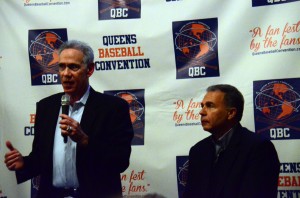 Art Shamsky (speaking) and Gil Hodges, Jr., at QBC 14. (Photograph by Sharon Chapman.) Even better, in my book, is that Gil checked with me the day before to make sure it was all right if Art came with him. What a menschy thing to do…y’know? I’m trying to imagine a scenario in which I refuse the presence of a 1969 Met at a Met event or, for that matter, any square footage I come across in my life. Despite my friend and QBC MC Jeff Hysen’s tongue-in-cheek suggestion that I tell him, “sorry, we only want bloggers and nerds at this thing,” I confirmed we’d be quite honored to have Art on hand. And we were.
MetsPolice has posted audio of this particular presentation on its site, but since we had a little problem with our microphones in the middle of it, I thought I’d print here my brief “official” remarks concerning the award. It also serves to underscore the place Gil’s father holds in our collective heart.
***
Our beloved New York Mets were conceived by Bill Shea, delivered by George Weiss, nurtured by Joan Payson and brought into the world by Casey Stengel. Those were all crucial figures in the development of what Casey called our Metsies and their role in our history shouldn’t be overlooked.
It was Gil Hodges, however, who raised the Mets into an entity of substance; who made them make themselves into something; who guided them into growing up sooner than anybody on the outside would have imagined; and who gave us forever after a touchstone we could always proudly come home to.
What Gil Hodges did for the Mets and for us as Mets fans was and is and always will be enormous.
Gil Hodges didn’t invent the Mets, but he did make them real.
You may think I’m referring solely to winning the 1969 World Series with a team that had never won even half of its games before, and yes, that’s part of it. But Gil Hodges, as Mets manager, transcends even that rightfully legendary accomplishment.
When you read the contemporary accounts from when Gil ran the Mets and you listen, decades later, to the players Gil led, you understand it has to be about more than simply charging forward from 61 wins to 73 wins and then to 100 wins plus seven more in the postseason. You sense the transformation he effected, on a franchise level and within the lives of dozens of individuals he touched directly. When you hear about who Gil was and what he did and how he treated others, you can feel his impact radiate outward to not just a ballclub that played above what was supposed to be its head, but to everyone who cared about that club and who identified with that club.
That’s a lot of people. That’s a lot of Mets fans, then and now. And that means everything to people like us.
There’s plenty more one could add about Gil Hodges, whether it’s his Hall of Fame-caliber playing career for Brooklyn, L.A. and the Original Mets; the home run records he set; the crucial role he played in winning the Dodgers their first world championship in 1955; the splendid job he did managing the Washington Senators; the valiant service he gave his country as a United States Marine in World War II; the impact he had on his community; and, of course, his family.
The only thing that seems to be missing when one endeavors to discuss Gil Hodges is a bad word, because nobody in or out of baseball seemed to have one to say about him.
It was a remarkable life Gil Hodges packed into not quite 48 years and it’s a remarkable legacy we celebrate today with our small token of appreciation for how he raised our team to be all it could be.
The Queens Baseball Convention is proud to inaugurate the Gil Hodges Unforgettable Fire Award, dedicated to the person whose memory eternally warms our hearts, brightens our spirits and lights our way. We plan to present this award annually to someone who casts a truly incandescent glow for us as Mets fans.
For the first one, we agreed there could be no better recipient than the man himself. Therefore, we are incredibly honored that joining us to accept this award is someone who carries on in the name of Gil Hodges and does that name proud.
Ladies and gentlemen, Gil Hodges, Jr.
***
Two recent podcast appearances you might enjoy: I join Desert Island Mets to discern whether The Baseball Encyclopedia qualifies as a bible of sorts (fair warning: I programmed the episode’s music); and the Rising Apple Report for a delightful digression into the Met coaching careers of Sheriff Robinson and Tom Nieto. Thanks to both shows for the thoughtful invitations and exchanges.
by Greg Prince on 21 January 2014 10:56 am Friend of FAFIF Matt Silverman reminds us it’s the time of the offseason to solicit entries for the Greg Spira Baseball Research Award. The award recognizes the “best published article or paper containing original baseball research by a person 30 years old or younger,” which represents an outstanding tribute to Spira, who dedicated much of his all too short life to discovery and dissemination within the sport he loved.
First prize is $1,000, with cash prizes awarded for second and third place as well. Full details on how to submit are here. The deadline for entry is February 15. Please look into it and tell anybody you might think would be interested about it. Thank you.
by Greg Prince on 19 January 2014 1:43 am Major League Baseball has been running a promotion called “Face of the Franchise,” which crossed my mind Saturday night after returning home from the first Queens Baseball Convention. In MLB’s Twitter-based contest, fans are being asked to choose a current player to visually represent each team and, ultimately, the entire sport.
Due respect to whomever this exercise eventually glorifies, this is silly where the Mets are concerned. The face of this franchise is that of its fans. And the face appeared to be enjoying itself at QBC. It smiled. It focused. It pondered. It moved up and down in a nodding fashion (which might be more of a head trait, but the face is in there somewhere). It was surely engaged by all that transpired around it.
 Two of many happy faces found at QBC 14. (Photo by Sharon Chapman.) We’d make for an ideal Mets visage, except for one logistical obstacle: you can’t really fit us all onto one face. Blame it on the individuality that pokes out from underneath our common-interest umbrella. We’re snowflaky that way. Even within the realm of our respective Mets fan identities, we are each a variation of the species.
Y’know what we’re not? A “fan base”. I’ve really come to dislike that term.
Never mind that it evokes political strategy, as in “playing to the base,” which always sounds very cynical. My distaste for the phrase comes from the implication that you can blob us together until you don’t have to bother distinguishing among us. It’s easier to dismiss prevailing concerns by pretending a mob is howling. “Sign a player? Lower a price? Convene a wintertime baseball event? Oh sure, that’s what the fan base wants.”
Send out all the surveys you can generate, cherry pick your feedback mechanisms or just draw your prefab conclusions. You won’t know what your so-called base of fans is about unless you’re fully among them. There may be majorities or pluralities in favor of this or that, but there’s rarely anything close to unanimity, save maybe for winning being considered preferable to losing…and I wouldn’t swear to that one, either.
Our distinctions are good things. They make us multifaceted instead of monolithic. That’s probably why the first QBC succeeded so absolutely completely. There was a little bit of everything for everybody. A lot of everything, actually. It was glorious not just for the triumph of choice, but for watching the choices being made. Not everybody wanted the same thing out of the day, or at least they didn’t behave as if they did.
Y’know the one thing I’m pretty sure we all wanted? To be at a gathering like this. Not every Mets fan might have chosen to spend one winter Saturday with hundreds of other Mets fans, but hundreds did. Once we were there, it seemed the overriding point was to revel in the existence of this unprecedented opportunity. Again, there was a lot of everything for everybody, yet the one item that didn’t formally appear in the QBC program but managed to emerge as Saturday’s common denominator was unfettered access to each other.
We were Mets fans embracing not just the chance to listen to former players, current broadcasters, dedicated historians and garrulous bloggers. We were confirming we’re still in this thing together; that January notwithstanding, we each maintain our unique place within our franchise’s face.
Consider confirmation achieved.
Sincere thanks to all who made Queens Baseball Convention 14 possible and equally sincere thanks to all who made Queens Baseball Convention 15 necessary.
|
|