The blog for Mets fans
who like to read
ABOUT US

Faith and Fear in Flushing made its debut on Feb. 16, 2005, the brainchild of two longtime friends and lifelong Met fans.
Greg Prince discovered the Mets when he was 6, during the magical summer of 1969. He is a Long Island-based writer, editor and communications consultant. Contact him here.
Jason Fry is a Brooklyn writer whose first memories include his mom leaping up and down cheering for Rusty Staub. Check out his other writing here.
Got something to say? Leave a comment, or email us at faithandfear@gmail.com. (Sorry, but we have no interest in ads, sponsored content or guest posts.)
Need our RSS feed? It's here.
Visit our Facebook page, or drop by the personal pages for Greg and Jason.
Or follow us on Twitter: Here's Greg, and here's Jason.
|
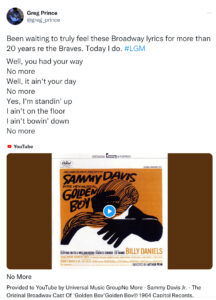
by Greg Prince on 1 October 2024 4:35 am Late on a Sunday night in 1975, I’m watching Sammy & Company on Channel 4 because I’m up, it’s on, and nothing else is. The Sammy in question is Sammy Davis, Jr. He’s done it all in show business and now he’s hosting this syndicated not quite talk show, not quite variety show. It’s got Sammy and he’s got company. That’s enough in the pre-cable days to keep a 12-year-old insomniac tuned in. On this episode I’m recalling, Sammy’s doing a number from a Broadway musical he was in a dozen years earlier, a show called Golden Boy. I’d never heard of Golden Boy until the moment he told us he was about to perform a song from it. The song, “This Is The Life,” makes an impression on me because one line grabs my attention:
Polaroid pictures, stereo sets, season box to see the Mets
Twenty-five years before I began keeping a file of Met mentions in the popular culture for my own edification and thirty-seven years before the first edition of Oscar’s Caps saw light, I made a mental note that there’s a song in a show that starred Sammy Davis and it has the Mets in it.
That information settled in the recesses of my brain, of no consequence in my life until September 1999, when, with the Mets bearing down on a playoff spot, “season box to see the Mets” bubbled to the surface of my 36-year-old consciousness, and I decided I needed to hear this song and have this song. Nascent file sharing and the application of something called MP3s surpassed my understanding. If I wanted a song, I bought the CD. I worked not far from a Barnes & Noble in Manhattan, a store whose soundtrack collection brimmed with the best of Broadway going back years. Yes, Golden Boy was there. Yes, I purchased it. Yes, I played “This Is The Life” quite often in the fall of 1999, a period when anything Metsian was welcome in my ears. I don’t think I gave the rest of the album more than a perfunctory listen.
In March of 2002, City Center’s Encores! series staged a concert version of Golden Boy. Hey, I more or less said to my wife, that’s the show with “season box to see the Mets” in it. We had seen and greatly enjoyed the very first Encores! production in 1994 (Fiorello!) but let our initial subscription wane. This seemed like a good excuse to return to the grand old theater on 55th Street. Alfonso Ribiero, Carlton from The Fresh Prince of Bel-Air, played Davis’s role. I was delighted to hear “This Is The Life” live and became aware of the rest of the soundtrack.
A couple of weeks later, the baseball season began, a season I was more in tune with than the Broadway season. The Mets’ first tour…I mean road trip took them to Atlanta. You know, Turner Field. This was April 2002. For five seasons the Mets had been visiting this facility and leaving it to scathing reviews. Actually, I suppose the Atlanta crowd applauded the Mets taking their bows there because it usually meant showstoppers from the Braves. Ever since September 1997, the Braves had been stopping the Mets’ show, crushing their hopes autumn after autumn. The Mets had never finished ahead of the Braves since Atlanta moved to the NL East. The Mets never definitively defeated the Braves when it absolutely mattered, especially in Georgia.
But this year, I told myself at 39, was going to be different. We’d just come through the offseason of Alomar and Vaughn, the reacquisitions of Cedeño and Burnitz. We were remade to finally get over that big, bad, Brave hump. On our first trip in, we took two out of three at the Ted, including one stunner when we scored nine in the ninth to not only break but smash a tie. We won that one, 11-2. A little over a week later, the Braves were up at Shea and jumped ahead, 6-1, by the third. Yet we scored five in the bottom of the seventh, forced extra innings, and, in the twelfth, my favorite position player ever, Edgardo Alfonzo, drove in Jay Payton with the winning run. Mets 7 Braves 6 on the scoreboard. Mets two-and-a-half-games ahead of the Braves in the standings. And resonating in my head, from the song I gained a new appreciation of at City Center during Spring Training, were lyrics I was convinced spoke to the moment at hand.
Well, you had your way
No more
Well, it ain’t your day
No more
Yes, I’m standin’ up
I ain’t on the floor
I ain’t bowin’ down
No more
This was my theme song for the 2002 I envisioned taking shape that April. It went on my stereo set and on my next compilation (or mix) tape and I played it clear to…
May, I guess. By June, the shape of 2002 had sagged. The Braves did what the Braves always did. They took over first place and won the division title. They didn’t break the Mets’ heart in September or October of 2002, because the 2002 Mets had no heart left come summer’s end. They finished last, 26½ games behind Atlanta.
So much for “No More”.
The season I was 43 was the first season since the season I was 27 that the Mets finished with a better record than the Braves. When I was 27, the Braves were in another division, and by the time I was 43, the Braves had been in the same division as the Mets since the season I was 31. The season I was 43 was 2006. The Mets had finally broken through to win the division. The Braves fell apart and ceased being the Mets’ primary rival. It was a stone groove to put the finishing touches on the destruction of the remnants of their NL East dynasty, but it was a sidebar at best. We enjoyed one year of absolute dominance over everybody in our immediate realm, then got entangled with the Phillies for a while. That tended not to end great. Soon, it was the Mets who fell apart while the Braves regrouped a little. By the time we briefly got it together again, the Braves were an absolute mess. By the time we came undone again, the Braves were on the upswing. From 2018 through 2023, it may as well have been 1995 through 2005 in the NL East, with the Braves winning every single year. Only once, in 2022, were we in their faces. That also didn’t end great.
This takes us to September of 2024, the season I’m 61, still caring about the thing I was caring about in 1975, the season I was 12, when “season box to see the Mets” and Golden Boy lodged themselves in my head, leading to September of 1999 and the CD and that fabulous fall when the Mets almost but not quite toppled the Braves and I was 36, leading to April of 2002 and “No More” scoring our ascent above Atlanta, except the ascent was aborted before I turned 40. Now I’m past 60, and the one thread, however frayed, I find myself clinging to for more than two decades is my reawakened desire to raise the volume on this song at the moment it is genuinely appropriate, when they’re no longer having their way, when it ain’t their day, when we ain’t on the floor no more.
Tuesday afternoon, September 24. The Mets are starting a three-game series at Truist Park. The Mets’ magic number to clinch a playoff spot is four. Two wins at Atlanta will do it. That’s the prize that deserves the eyes, but I’m also overwhelmed in the hours before game time at the possibility of us not only beating the Braves for our own benefit, but for the thrill of knocking them out of the playoff picture altogether. I don’t just want us in. I want them done.
This, I know, is a mistake. One of the tenets of my rooting is root for, not against. There are caveats and exceptions, as with all tenets, but I try to stay nominally pro, not anti, as a fan. Root for your own joy, not others’ suffering. Should they suffer because you achieved joy, that’s collateral damage. I can’t help it if others didn’t decide to root for the Mets when they were six years old as I did and then keep at it. I may need your team to lose to advance my cause, yet I shouldn’t go out of my way to wish you ill other than on as-needed basis.
Why not? Because I’m such a good soul? No. Because it never fucking works. Karma hates it, therefore I should avoid it. That’s why I knew it was a mistake to be carried away by my disdain for the Atlanta Braves, Atlanta Braves fans, and everything the Atlanta Braves have done to us since 1997, the first year we rose up to challenge for the recently implemented Wild Card, only to have the Braves smoke us that September. It happened again in September 1998, when we were closer and they annihilated us later; and in September 1999, when they grabbed back the division from us just as we were set to wrap our mitts around it and, in the process, sent us spiraling almost out of reach of the Wild Card; and in October 1999, when we forged one Amazin’ comeback after another only to have Kenny Rogers pitching to Andruw Jones with the bases loaded in the eleventh inning of a game we trailed 5-0, trailed 7-3, led 8-7, and led 9-8; and in September 2000, when what I just said about the 1999 divisional title applied essentially just the same, except we had a decent Wild Card cushion (the one year we got to the World Series, St. Louis took care of Atlanta for us); and in September 2001, specifically in the second Brian Jordan Game, which assured for eternity that Mike Piazza belting that First Game in New York After 9/11 home run would be viewed as an isolated swing rather than part of a larger baseball miracle.
All of that informs why I ached to wail No More in April of 2002. All of that, along with that series sweep at the close of September and dawn of October 2022, is why I hauled my Golden Boy CD out of its drawer and added it to my iTunes (I’m not that modern) and played the relevant portion repeatedly prior to the first Mets-Braves game in Atlanta in September 2024.
And you saw how that worked. The Mets lost and looked lost. Then it rained and rained and games were postponed and it was off to Milwaukee, where the Mets continued to lose and look lost. But then they won Sunday and found themselves tied with the Braves in the standings heading into the Monday doubleheader that was tacked onto the schedule after all that rain, and both teams needed to win at least one game. Whoever won the first game in Atlanta didn’t have to worry about the second game all that much. There’d be seeding and travel and whatever, but if you won the first game, you were golden, boy.
But if we won the first game and the second game, we’d be in and we’d knock the Braves all the way out of contention once and for all, or at least once and for all in 2024, while we moved on. Ooh, I really wanted both of those situations to become reality. Folks in Arizona probably didn’t care who won what game of the doubleheader as long as nobody won both. Folks in Arizona weren’t my problem.
The folks in Braves uniforms were. One in particular.
I went to a Mets-Braves game at Citi Field in late July. Starting for the Braves was some dude I’d never heard of named Spencer Schwellenbach. My first instinct was to ask “who?” My second instinct, a product of my earliest exposure to baseball, was to think “what an odd name for a baseball player, as the best baseball players have punchy names like Willie Mays or Johnny Bench or Tom Seaver, and whoever heard of somebody named Spencer Schwellenbach being any good?” My final instinct was to conclude I had just doomed the Mets that July day, because what the fuck does somebody’s name have to do with how good he is? Final score of the game where I learned who Spencer Schwellenbach was featured several runs for the Braves and none for the Mets. A rough approximation of that score recurred in Atlanta the night after the afternoon I played “No More” with too much gusto.
Would ya look at who was pitching for the Braves against the Mets in Game 161, the one with everything on the line? Yeah, I know that name all too well, Spencer Schwellenbach. Unsurprisingly, the pitcher I implicitly mocked for not having a baseball-worthy name shoved the baseball right past Met batters from the get-go. One silly little infield hit from Tyrone Taylor was the sum total of the Met offense for three innings. For two innings, Schwellenbach was matched zero-for-zero where it counted by Tylor Megill. Tylor wasn’t nearly perfect. He rarely is. But he’s been hanging in there since the June night in 2021 when he made his Met debut and I was at a ballgame for the first time since September of 2019. My last game before the pandemic was against the Braves, so long ago now that it’s jarring to remember Jerry Blevins pitched for them. My first game after the pandemic coincided with Megill’s entry into the bigs. I knew as much about him going in to that outing as I knew about Schwellenbach in July. Megill was facing the Braves, then, too. He didn’t personally beat them but he, you know, hung in there: 92 pitches, four-and-a-third innings. The Mets won in a pre-pitch clock slog of 3:42. We’d take that as an outcome in Monday’s opener.
Except Megill hanging in there usually means Megill has to negotiate trouble, and trouble doesn’t always wish to negotiate. Sometimes trouble insists on a display of brute force. A first-inning walk was quelled. Two singles in the second were released on their own recognizance. But a hit allowed to Michael Harris II (you mean there are II of him?) was followed by Ozzie Albies lining a home run over the left field wall, and oy, it’s 2-0 Braves, with Spencer Schwellenbach on the mound, and why must every game in Atlanta be like this?
No, I tell myself, don’t be like that. Even as Matt Olson singles with one out and Ramon Laureano singles with two out and Francisco Alvarez chases a passed ball with Travis d’Arnaud up, and really? Travis d’Arnaud? What did we do to deserve this? Besides give up on Travis d’Arnaud five minutes after he recovered from surgery?
The most vengeful of all the Old Friends™ is the last Brave you want to see up right now (unless it’s Albies or Olson or the second Harris, I suppose). Before a worst-case scenario could materialize, Tylor struck out Travis.
On a team where everybody’s done something to get us to the cusp of the playoffs, sometimes it takes a Megillage.
Megill settled down in the fourth and fifth. Schwellenbach was reached for a couple of singles in the fifth, but to no avail. His sixth couldn’t have been cleaner, either: seven pitches, three outs. The bottom of the sixth saw Megill ground out Jorge Soler for the first out. The next out, however, was of the park, as in out of Truist Park and into the Battery. Maybe what Laureano hit didn’t fly that far, but it was far enough to extend Atlanta’s lead to 3-0. Megill got two more batters, one more out, and a pat on the back for hanging in there. In the middle of the season, it would be a most admirable effort. With everything on the line, it wasn’t enough.
Huascar Brazoban finished Megill’s sixth by stranding Tylor’s baserunner. The Braves had left nine runners on base to this point. They could have had a much bigger lead than they’d built, but didn’t. That’s the essence of hanging in there. Would it matter if the Mets couldn’t get to the all-too-familiar Spencer Schwellenbach? That’s one rhetorical question right there. In the top of the seventh, ol’ Spence expended himself for nine pitches resulting in another three quick outs. Three-nothing didn’t look like it was gonna need much padding. Adam Ottavino’s participation in low-leverage competition seemed to have done him some good, as he kept the Braves from doing any upholstering of their advantage in the bottom of the seventh.
The eighth began with Schwellenbach working a one-and-two count to Taylor on his 84th through 86th pitch of the day. There was no reason to believe an out wasn’t imminent and that the eighth wouldn’t roll by as swiftly as most every Met inning had. Except Tyrone made himself sticky. He stuck around the batter’s box for a spell. More than a spell. Maybe Taylor was inspired by the Truist Park organist accompanying his stroll to the plate with the theme from The Andy Griffith Show. Uh-huh, just moseying, like Sheriff Andy Taylor did through Mayberry, especially on TBS all those years following Braves baseball on the superstation. Say, isn’t that Andy and Opie headin’ down to the fishin’ hole?
Our Taylor wasn’t much for fishing. He took a ball, kept himself alive with a couple of fouls, took another ball, fouled off three more and, on the eleventh pitch of the only stressful at-bat of Spencer Schwellenbach’s afternoon, lined a double into the left-center field gap. Spencer’s pitch count had risen all at once to 94, which set off alarm bells back at the courthouse. Sheriff Brian Snitker believed this was the time to take action. He apprehended the baseball from the right hand of the man who’d been spinning a gem and sent him for his own stroll.
Thanks, Snit — I thought this guy would never leave, and if he never left, we’d never score and we wouldn’t win Game One, and Game Two was also scheduled to take place in Atlanta, like most every horrible September/October game has been scheduled to take place in (or near) Atlanta since 1997. While I’m not to be mistaken for the supreme Met optimist, I’m thinking this can’t be real, can it? We’re not always going to lose like this in this place like we did in the previous place? Are we? I didn’t believe that coming into this doubleheader, just as I didn’t believe it six days before, just as I deep down didn’t believe it was loss accompli in 2022 or 2001 or whenever. But the evidence was mounting as long as Spencer Schwellenbach stayed on the hill.
He was removed from it. Joe Jimenez replaced him and, two pitches in, surrendered an RBI double to Alvarez. Shutout over. Invincibility punctured. An actual competitive ballgame loomed. Starling Marte pinch-hit for the offensively stunted Harrison Bader and singled, putting runners on the corners. Francisco Lindor comes up and resumes his bid for Comeback Player of the Year Within a Year. Lindor was out of the lineup for a couple of handfuls of games, but his absence felt endless, even when the Mets were winning. He’d come back in one piece on Sunday and helped engineer Sunday’s must win in Milwaukee. He didn’t make the All-Star team. He’s not gonna get MVP. Let’s give the man something.
Instead, Francisco gave us something: a single up the middle to score the other Francisco from third, and it was 3-2. This really was a competitive ballgame, in fact as much as theory. Jimenez, mandated by Manfred to throw to three batters, had done the absolute minimum. Snitker moved on from him to Raisel Iglesias, the Braves’ dynamite closer the Mets never hit. It’s not just us. He’s very good. Except on Monday, in the eighth, it was us. It was Jose Iglesias lining home Marte to tie the game at three; and it was Mark Vientos lofting a fly to center to bring home Lindor and provide the Mets a one-run lead; and it was our Iglesias stealing second; and it was Brandon Nimmo blasting to right the most dramatic home run any Met has ever struck late in a game when the Mets were on the verge of clinching a playoff berth.
As of that moment, anyway.
Oh, it was glorious. Nimmo frigging knew it was gone, and with it, the Braves’ chances were going, going…OK, everybody wants to get ahead of the Braves, but nobody wants to get ahead of themselves. Still, shouting and screaming (two distinct vocal expressions) wasn’t enough for me as the Mets led the Braves, 6-3, and Snit went to make another pitching change. Me, I dashed over to where my iPad was plugged into the wall, opened yet another new tab — I had probably 150 active — and called up the lyrics to my song. This was it. This was the day they were going to be undeniably relevant to not only our cause but the pending conclusion. We’d just hung six on the almighty Braves, we had only six outs to nail down and…I don’t know. I had to have the exact lyrics ready to copy and paste and post and tell the world, we had done it.
Then I sat back down, watched the Mets not score any further in the top of the eighth, tried not to believe I had just acted rashly by getting ahead of myself, and welcomed Phil Maton to the mound. He pitched Sunday, didn’t he? Does he usually pitch that often? Oh, he’s a pro and this, today, is what Carlos Mendoza charmingly calls big boy time. He’s gonna be fine.
He’s gonna hit Eli White, a defensive replacement to lead off the bottom of the eighth. That’s what he’s gonna do. And after getting one out, he’s gonna give up kind of a lucky hit to d’Arnaud (lucky for d’Arnaud, unlucky for us). Here comes Mendy. Maybe it was pushing it to ask Maton to pitch a second day in a row. Good thing Carlos has a contingency plan, no doubt one of our well-rested relievers who’s gonna steer us through the eighth.
Mendoza brought in Edwin Diaz, and I believe my reaction was “NO FUCKING WAY” or words to that effect, but definitely with “FUCKING” one of the words, and definitely not said as one might say when being presented with an item one had missed and assumed gone, but NO FUCKING WAY, it’s still here, thank you so much!
No, that’s not how I meant it. I did not want to see Edwin Diaz in the eighth inning. I was ready to see Edwin Diaz in the ninth inning. That seemed like plenty. It seemed appropriate. Closer closes. I’m by no means opposed to the closer getting a jump on the ninth in the eighth when circumstances dictate or suggest it’s the right course of action. After he pitched Sunday and struggled just enough to stoke antsiness while attaining three outs with a five-run lead, I doubted it was the right course of action. Mendoza knows his Mets better than I do (I don’t actually know them personally at all), but I’ve watched too many ballgames from Atlanta to not develop an opinion the manager didn’t ask for.
Edwin Diaz’s entire Met career flashes before my eyes every time the bullpen gate swings open these days. The promise of the great Mariner closer becoming ours at a contract-controllable stage of his burgeoning career, and all we had to give up of substance was our top minor league prospect; the absolute nightmare of his volunteering to pitch Home Run Derby in 2019, and I don’t mean at the All-Star festivities; the gradual construction of trust in the succeeding two seasons; the explosion of Sugarmania in 2022, which came with his own musician; the fucking WBC in 2023; all the mishegas this year that alternated with all the returning to form he had done when he wasn’t reminding us of 2019. Edwin’s better than a mixed bag, but you might want to open it up and inspect the contents before signing for what he’s about to deliver.
Too late for instant recriminations. We could have those later.
Diaz comes on and gets his first batter for the inning’s second out. What on earth was I stressing about? Relax, relax. I see Snitker is going to his bench for a pinch-hitter. Who’s up?
Jarred Kelenic. Say, you know that top minor league prospect we gave up to get Diaz? That’s him. You knew that, but here was a reminder in the flesh. We lived for a while with the simmering anxiety that Kelenic was going to grow up and become Mike Trout. That hasn’t happened, but it would be enough at this very moment for Kelenic to pull a d’Arnaud and Old Friend™ us to death. Technically, since Kelenic never played for the Mets, he’s not eligible for the Old Friend™ designation, but he can sure as hell do something to cause us regret.
Sure enough, he lines a ball past first base. It’s ticketed to scoot down the right field line, except Pete Alonso, our homegrown star, dives and snags it. Atta Bear, Pete! That’s a big-time defensive play and an inning-saver. Yessir, all Alonso has to do now is straighten up and toss to Diaz, covering at first.
Um, where the fuck is Diaz? Not in our picture, and SNY is pretty good at showing everybody who’s in a given play. Alas, Edwin is not present. Another camera reveals Diaz is standing on the mound as Kelenic crosses first base and White zips to third and d’Arnaud himself scores to trim the Mets’ lead to 6-4. Honestly, Edwin could be out in center field picking dandelions. Error of omission, Tim McCarver was fond of calling nonmoves like this.
Let’s all settle down. Edwin is pointing to his chest, the universal symbol for “my bad”. He knows he erred. His head is still in the game (mighty nice of it to join us). There’s still two out, we’re still up by two.
That’s not going to last. Whit Merrrifield, pinch-running for Kelenic, who I didn’t know is considered slow because I never got a chance to get to know him as a Met, steals second, because Diaz apparently studied holding runners on at the feet of Ottavino. It’s second and third with Harris II up. Harris could hit one here, couldn’t he? He doesn’t. He walks. It doesn’t feel like a victory. This loads the bases for Albies. Albies unloads the bases with a double past Nimmo in left. If you’re keeping a scorecard, it’s Braves 7 Mets 6.
I should be mad at Diaz for torching the eighth. I should be mad at Mendoza for bringing him in. I’m mad at myself for calling up those lyrics to “No More” when there was still more baseball to be played. I didn’t share them with anyone, just myself. That was a bridge too far. Karma noticed my hubristic preparations and let me know about it. I don’t know if you’ve heard, but karma’s a bitch.
With Raisel Iglesias having closed himself out of closing, Snitker turns to Pierce Johnson for the three outs that will clinch the Braves a playoff spot and leave the Mets needing to not get swept in Atlanta. I know as much about Pierce Johnson as I did Spencer Schwellenbach in July, but I make no judgments about his unusual first name for a baseball player. I have no time for that. Alvarez pops out on Johnson’s second pitch, and my only recourse now is to get up, rush to the still-charging iPad and close that tab with the lyrics. It’s probably too late to undo the damage I have done, but I’ve gotta try.
Except at the very instant within Marte’s plate appearance when I have one leg in the air and the other ready to follow, Starling singles to left, and I can’t get up now. I settle into the chair because maybe, just maybe, it has base hits in it. To move from it at this juncture would be folly. Karma’s giving me a second chance. Never mind the lyrics from Golden Boy. Our golden boy is coming up next.
I’m sitting probably in a shape approximating a pretzel at this point. I don’t want to move. Or, more accurately, I don’t want to move the wrong way and therefore screw with Francisco Lindor’s chances against Pierce Johnson. My arms are sort of over my face for a moment. I realize this is no way to watch Lindor bat because it keeps me from seeing. I also realize I am 61 years old, this is a Monday afternoon, and I’m worried about how I’m sitting in front of a television for how it could affect a baseball game many hundreds of miles away.
Isn’t being a baseball fan great? I spent the entire pregame portion of the day — what regular people would call morning — utterly absorbed by what could possibly go right or wrong in Atlanta and I never stopped to question my priorities. Is there anything else out there that makes you feel like this? I mean before it happens. Before it happens, it consumes you. While it’s happening, it threatens to eat you alive. Yet you sit there in whatever shape you’ve assumed and dare it to open wide and take a bite.
Yes, being a fan is great. And awful. But great. In any event, I wasn’t going to screw with Francisco Lindor’s chances against Pierce Johnson, because Pierce Johnson had no chance against Francisco Lindor. This is Francisco Lindor we’re talking about. We have learned in 2024, particularly in the healthy-ish parts of his September, that Francisco Lindor is to be spoken of in awe and hushed tones, the way Carl Yasztremski or George Brett or (forgive me) Chipper Jones were and are for what they did for their teams down stretches in their signature Septembers, months of clutch performances that catapulted them to the Hall of Fame.
I feel quite comfortable invoking some of the all-time greats here because Francisco Lindor blasted to center the most dramatic home run any Met has ever struck late in a game when the Mets were on the verge of clinching a playoff berth.
For all time.
Braves 7 Mets 6 transformed to Mets 8 Braves 7. The screaming competed with the shouting, each of which had to withstand the hooting and the hollering. Oh My God, and you don’t abbreviate it when it comes to Francisco Lindor in the ninth inning in Atlanta with everything on the line.
Yet would have a little insurance been to much to ask for after Lindor’s two-run homer of a lifetime? I mean, c’mon, this is Atlanta (Cobb County, but still), the same city or ADI where the Mets grabbed an 8-7 lead in the sixth game of the 1999 NLCS, only to…you know, Kenny Rogers. Turns out, despite all the GEICO and Progressive and Allstate commercials to which we’re subject throughout the season, a little insurance was too much to ask for. Mendoza would be turning a tenuous one-run lead over to…
You’re kidding. Diaz is going out there for the ninth. He threw, I’m estimating, a million pitches in the eighth. His psyche has to be scarred like he just saw the ghost of Kurt Suzuki. And he didn’t get off the mound when that was paramount. Diaz? Cripes, just get Benitez loose. They showed Ryne Stanek warming up in the bullpen. I can’t say I would trust my baseball life with Ryne Stanek and a one-run lead in the ninth inning in Atlanta with everything on the line, but I can tell you I wasn’t using my one phone call to keep Edwin Diaz in the game.
Which may be why they don’t give me access to the bullpen phone.
It was ride or die with Diaz. Is that too much hyperbole or not enough? There was little opportunity to mull the question during Matt Olson’s leadoff at-bat, because it was over in one pitch — one effective pitch that Olson popped to Lindor for the first out. OK, maybe this wasn’t a disaster in the making. White singled, then stole second. OK, maybe this is a disaster in the making. Laureano, with three hits on the day, struck out. Two outs, leaving it all up to d’Arnaud.
I was 70% leaning toward doom, 30% thinking it was too obvious. And it was. The latter, that is. Old Friend™ Travis did the right neighborly thing and grounded to Lindor, who threw to Alonso for the third out, and Oh My God, the New York Mets defeated the Atlanta Braves in Atlanta in September to make the playoffs. We were in. They were not. One game remained to determine their fate. It was now their must win. We didn’t know whether they’d win it or lose it (they won it; sorry, Arizona), but on this Monday, that was bookkeeping. Let Joey Lucchesi chruve as best he could, let Pete Alonso set foot in his 162nd game, and let the Champagne chill a little longer. It would be on ice waiting for our Mets to celebrate their myriad accomplishments, right after completing the greatest 2-4 road trip in human history.
They had done what they had to do, doing it where it seemed they’d never do anything like it. The 2024 Mets, who’d been charging uphill since the end of May, now and then slipping and sliding but always persevering and never giving up, were now atop the mountain they needed to scale. They made the playoffs for the eleventh time in their history. They did so from what could have been construed as hopelessly behind twice. Down 3-0, before rallying to lead, 6-3. Down 7-6, before winning, 8-7. After starting 22-33, they finished 89-73 and shattered the notion that destiny will deny them at every turn.
They beat the fucking Braves in fucking Atlanta when it fucking mattered most. So how do I celebrate after the shouting and screaming and hooting and hollering? I pick up my iPad, I go to the tab with my lyrics, I copy them, and…
…and every one of my tabs disappears. Every newspapers.com article I’d found since June but hadn’t had a chance to make use of. Every Baseball-Reference page I cued up for the purpose of delving into further. Every site that caught my fancy between pitches or games. They all just went poof.
Served me right for having gotten ahead of myself in the eighth. Karma, I hear ya, loud and clear.
Like the Mets from June on, I did a quick restart and moved forward. They’re going to Milwaukee for the Wild Card Series. I’ll join them spiritually eventually. Hours after we clinched, I’ve had Georgia on my mind the whole night through.
by Greg Prince on 30 September 2024 4:31 pm
by Greg Prince on 29 September 2024 8:04 pm The Mets live. You didn’t necessarily see that coming, did ya?
Maybe I did, maybe I didn’t. Hope for the best, expect the Mets is my credo. I expected the Mets to do their best on Sunday in Milwaukee. Whether that and concurrent events in Atlanta and Arizona would be enough to survive and then some for one more day was what I didn’t know.
It was. We won, beating the beastly Brewers, 5-0. David Peterson pitched the game of his and most people’s lives, going seven scoreless, striking out nine and allowing only an infield hit and three walks that proved harmless. Francisco Lindor played like a healthy version of himself. He was real and he was spectacular, homering, stealing twice, driving in two runs and moving like a frontline shortstop in the field. Neither his back nor that of Francisco Alvarez (2 RBIs) appeared to be an issue in the short term. And J.D. Martinez rose from the dead as well, notching two base hits and avoiding the ignominy of tying or passing Rey Ordoñez for longest ohfer in franchise history. Ordoñez was in there for his glove. Martinez has “hitter” inscribed in his job description, so him actually hitting is indeed a welcome sight.
The Mets flying to Atlanta to complete their series from last week with, oh, everything on the line is also something we should embrace. There’s no time to fear the Braves, their starting pitchers or the demonesque qualities of where they play. We’re 88-72. They’re 88-72. The Diamondbacks are 89-73. Tiebreakers being what they are, whoever wins Game One of Monday afternoon’s doubleheader is in the postseason. If that same team wins Game Two, Arizona is also in. A twinbill split sends the Snakes slithering off into the desert. A twinbill sweep buries the swept. All that really matters is the Mets post one W in this matinee. Two would be ideal for the fun of knocking out the Braves, but I’m trying to stay focused on the Mets punching their own ticket. I’m trying to forget issues like who might be rested enough to pitch any game beyond Monday and what kind of toll a surfeit of flying might entail on a team possibly pinging about the continent on no rest.
The Mets have to win a baseball game to keep playing baseball. Baseball like it oughta be, I’m tempted to say. We’ll see. We sure as hell will, won’t we?
by Greg Prince on 29 September 2024 11:54 am C’mon, Francisco. C’mon, Jose. C’mon, Mark. C’mon, the whole bunch of you, one through nine. It was no use. I called to them through the TV with encouragement by first name or nickname and, save for a single in the first and a double in the fifth, the personal touch was of no use. Nor was the Met lineup. It was useless against…how many Brewers pitchers? Six? Milwaukee used six pitchers, the essence of a team tuning up and staying sharp for the playoffs, a half-dozen different arms getting their work in, and the Mets managed two hits and didn’t put anybody on base between that double in the fifth and a walk in the ninth.
C’mon, Brandon. C’mon, Pete. C’mon, Starling. I didn’t think I had to seek each individual Met’s attention to convince the batting order’s components of the gravity of the situation facing them and, by extension, us. “Gravity of the situation” sounds rather geopolitical for our pastoral pastime, but c’mon f’reals. Two playoff spots. Three teams. Ours is one of them — and one of the two allegedly in control of its/our own destiny. The standings and tiebreakers say so. There is no elite. Just take your place in the driver’s seat. Win a game and things will start to be fine. They didn’t listen Tuesday. They didn’t listen Friday. They didn’t listen Saturday, and thus has resulted the world’s longest rain-interrupted three-game losing streak.
Francisco Lindor can’t pick up a ground ball without squeezing one of those flexible grabber sticks, the kind we got my mother when she couldn’t move well enough to get out of bed. Francisco Alvarez contracted back spasms between second base and third. Jose Iglesias, who gave us this summer’s dance floor smash, has been spotted limping. On the night the contemporary White Sox can be said to have “surpassed” the Original Mets, creaky DH J.D. Martinez extended his hitless streak to 0-for-35, worsting the longtime club record Don Zimmer set in 1962 when he went 0-for-34 before getting a hit and then traded to Cincinnati. Rey Ordoñez holds the franchise ohfer record with an 0-for-37 in 1997. Unlike J.D., he carried a glove and used it to great effect. I don’t mean to pick on any given stiff or slumping Met, however. Twenty-eight Joe Hardys are reverting to twenty-eight Joe Boyds right before our eyes. Yet, somehow, this team is still said to have its hands firmly on the wheel.
C’mon, Luis. C’mon, Harrison. C’mon, Luisangel. C’mon, Tyrone, who I could swear always comes through off the bench. C’mon Alvy, now that you’ve been deemed fit to pinch-hit. Pick up your feet. You got to move to the trick of the beat. More sniffing out opportunities. Less eliciting tears. You’re facing the Brewers in their already-clinched majesty, the nothing-to-play-for Brewers, other than spite and, maybe, galaxy-brained playoff planning. If Milwaukee can keep beating the Mets, then perhaps they can arrange to have the Mets stick around Milwaukee for a couple of more beatings in the Wild Card round. The joke could be on the Brewers, though. Should the Diamondbacks ever find their footing, the Mets might not be available to anybody, let alone Ramon De Jesus’s beloved Brew Crew, for additional beatings after Monday.
Yeesh, the most likely prize — should we snap out of our monumental malaise — is another set of ballgames at the Wisconsin ballpark where the Mets have won one series in the past ten years. A decade ago, Brandon Nimmo was ascending to Binghamton and Luisangel Acuña was presumably the best shortstop in his middle school. The invocation of years past contains limited application. But recent history suggests Milwaukee does seem like a less than ideal locale to seek Met wins.
Too bad. It’s where we are. There and Atlanta on Monday afternoon, possibly, but never mind contingency makeup doubleheaders in other horror houses. Focus on the game in front of you, whoever’s in the lineup Sunday. And focus on getting out the batter at the plate, David. I’ve attempted to urge along the starting pitchers and their reliever successors with the same one-to-one attention I’ve devoted to our offense these last three games. But have Sevy or Sean or Q (I’m on a first-initial basis with Quintana) listened? Not well. No starter has handed so much as a tie to a reliever since last Sunday night’s spine-tingling victory over Philadelphia, which I’m pretty sure happened a month ago. Some relief outings have gone better than others since we left Citi Field. None of them has been particularly impactful.
To all of the aforementioned Mets and your teammates, ya gotta remember whatever you did to get us here. I don’t mean slipping further into a hole here, but with a fingernail’s grasp of an honest-to-god playoff berth on the final scheduled day of 2024 here. I gave up on you countless times in April and May and, if we’re telling truths, beyond. You proved me wrong over and over. I grew determined to stick with you. I brushed off Tuesday at Truist as just one game when those tweeting around me were certain it was the second coming of 2022’s sputter to the finish line. No, no, I told myself and anybody who would listen. This team isn’t that team. This team isn’t the team that harpooned hope two months into the current campaign, either. This team is the team that rose from its own demise to thrill and delight us and pass every wanna-be Wild Card contender until it got close enough to one of the playoff spots that it could confidently place it in the Bagging Area at the CVS self-checkout. I scanned my Extra Care card. I followed the instructions on the PIN pad. I have no idea why I keep being told to wait for assistance.
Help came from the San Diego Padres Saturday night. We’d already lost, 6-0. Travis d’Arnaud and the Atlanta Braves had already…whaddaya think they did? If not for the Padres pasting a five-spot on the board in the top of the ninth at Chase Field, and Arizona producing exactly as many as hits as the Mets did, things would feel a lot worse heading into the final Sunday. They already feel abysmal.
Forget our feelings. Look at the standings. The Padres are in. The Braves are poised. The Diamondbacks’ winning percentage is .5465838. The Mets’ is .5471698. Arizona has one game left. We and Atlanta have one game apiece today and, in theory, two games against each other tomorrow. We defeated the Diamondbacks on August 29 to take the season series from them, which not only sparked a nine-game winning streak and set the stage for a (until very recently) superb September, but ensured no tiebreakers would fall in the Phoenicians’ favor. Yet the Snakes can still sneak past us if they remember how to win and we don’t.
So let’s remember how to win and then do that and then keep doing that for however long we have Mets baseball in 2024. OMG, after 159 games, I didn’t think I’d have to spell it out for you fellas.
by Jason Fry on 28 September 2024 12:35 am Yes, Ramon De Jesus’s umpire scorecard is going to be a thing to behold. (It’ll show up here if you want to torture yourself.) The most egregious missed call was, rather obviously, the ball four on Francisco Alvarez that was called strike three, turning a bases-loaded situation for the Mets into the end of an inning. But there were others — and Adrian Johnson got into the act at first base as well, punching out Mark Vientos on a checked swing that was on the check side of swing.
It was a total ump show, and yet another exhibit in the case for taking balls and strikes away from the umpires as soon as possible, because their mistakes turn the course of games all the time, sometimes in high-profile situations that everyone squawks about but more often in smaller but real ways you have to be a student of the game to note.
But that’s been true for a long time; the missed call against Alvarez isn’t any kind of tipping point. Meanwhile, it wasn’t De Jesus who robbed Sean Manaea‘s stuff of its bite, or who threw a 2-2 meatball to Rhys Hoskins (of course it was fucking Hoskins), or who let the Brewers run wild on the bases, or who let Brice Turang score a free run on a wild pitch, or who left a sinker in the middle of the plate where momentary Met Gary Sanchez could hit it halfway across Lake Michigan.
No, various Mets did all of those things — for the second game in a row (separated by two nights of MLB nonsense), they came out flat and were thoroughly outclassed by the opposition. And there were other problems, such as Francisco Lindor returning but looking like he couldn’t get much on throws to first, or Alvarez being felled by back spasms, or Jose Iglesias — one of the few Mets who’s kept hitting — taking a ball off his ankle.
(The Padres beat the Diamondbacks, so at least that’s something.)
The vagaries of the wild-card chase mean the Mets can’t be eliminated until Monday. But the way they’re playing right now, getting to play Monday is starting to feel like a poisoned chalice. Things can change, but they need to change in a hell of a hurry.
by Greg Prince on 26 September 2024 3:43 pm It’s the time of year when someone asks you how you are, and you tell them the Mets have been rained out not only today but tomorrow, and they have to get out of Atlanta, which is about to be hit by a hurricane, which you care about in the abstract as a human being, but all you’re really thinking about is it was known the hurricane was coming, and neither the Braves nor MLB activated any kind of contingency rescheduling or relocating, thus once the Mets get to Milwaukee, assuming they get to Milwaukee, they will still have three games against the NL Central champion Brewers who swept them at the very beginning of this season, and then they have to fly back to (hopefully intact) Atlanta to play a Monday afternoon doubleheader to decide everything, unless some combination of wins and losses among the Mets, the Braves, and the Diamondbacks over the weekend makes the doubleheader moot in terms of playoff qualification, though playoff seeding is a whole other packet of seeds, in which case the commissioner gets involved, assuming someone wakes him, and you’ve got to think about the pitching you’d have to use and how much effort is worth exerting in advance of a trip to maybe San Diego or back to Milwaukee, and that’s already assuming too much, because…
I mean, fine. I’m fine. How are you?
Who are we kidding? This is how we are. This transcends fine. This also brings to mind Marsellus Wallace’s response to boxer Butch in the denouement to the pawn shop scene in Pulp Fiction when asked if he is OK: “Naw, man. I’m pretty fuckin’ far from OK.” Ultimately, however, this is how we want to be when it’s this time of year.
We left New York with a two-game lead on Sunday night, and it’s Thursday afternoon, and we have a one-game lead, but it’s not that simple. It’s never that simple in the final week of September when leads and deficits regarding something everybody wants are this slim. If your team isn’t involved, it’s fun to sit back and observe the chaos. Fifty-two weeks ago, the Mets and Marlins played to the essence of inconclusiveness — the Marlins took a lead over the Mets in the top of the ninth right before the rains drenched Citi Field — and it remained unknown for days on end whether the Marlins, in a playoff race (no, really), would have to wing their way back to New York to finish a game that meant nothing of consequence to the Mets, who were about to fire their manager and had all but packed it in, anyway. No skin off our nose as fans whatever happened. Let the if-necessary chaos commence! It wasn’t and it didn’t, but generally if you have nothing to root for, you tend to root for whatever’s most interesting.
This season’s last lap is interesting enough. Holding off the Braves is challenge enough without inserting meteorology and Milwaukee into the middle of our series with them. Then again, if ever a team on a roll looked like it could use a quick reset after a single game, it might have been the Mets following Tuesday night’s loss to the Braves, when the Mets lived down to every fear we lug around in our backpack of anxieties. It was just one game versus the hundred or so that have seen them rise from the dead and to within a couple of steps of the postseason, but it happened where it happened, and that gets everybody antsy with a capital “A” presented in a font that’s given us nightmares since the capital of Georgia was Chipper City.
Ancient history, of course, but go tell that to your backpack of anxieties. Better yet, as George Clooney advised in Up in the Air, set that backpack on fire. It ain’t 1999 or 2022 — swell seasons except for the Atlanta angle — if we don’t want it to be. My historical precedent of choice this final week has to be 1973. Also ancient history, but when we remember everything, we oughta remember everything. The connective tissue is multiple rainouts messing with a pennant race and a rejiggered schedule extended out to the Monday after was supposed to be all she wrote on Sunday. The first-place Mets hung around soggy Chicago through an off day Thursday and postponements Friday and Saturday and didn’t make it to Wrigley to play until they were saddled with back-to-back doubleheaders. They split one on Sunday and, with their magic number down to one, took the opener on Monday, compelling “wet grounds” to be declared for the nightcap. Chaos was on the verge of reigning then, too — Pittsburgh was playing and losing its own makeup contest to the Padres at Three Rivers that Monday — but everything was deemed official once the Mets won the 161st game of their season. The similarity to 2024 is nobody saw the Mets coming in the summer of 1973, either. The difference, beyond the existence of Wild Cards, is when the Mets finished the regular season on a Monday fifty-one years ago, their first playoff game would be the following Saturday. A reasonably rested Tom Seaver beat the Cubs on October 1 and then faced the Reds on October 6.
Major League Baseball planned for exactly one off day between the end of this regular season and the beginning of this postseason. The Mets and Braves project to be busy Monday. Or not. Clinchings. Eliminations. Seedings. Weekend unknowns. We’ll see. We’ll sweat some of it, probably shouldn’t stress over some of the rest of it, including the time squeeze. In ’99, the Mets finished up with Pittsburgh at Shea on a Sunday afternoon, had no idea what Monday held when they jetted to Cincinnati on a hunch Sunday night (the Reds wound up winning their rain-delayed finale late), won a suddenly necessary play-in game Monday night, sprayed champagne, then flew off to Arizona to begin their first-ever NLDS by withstanding Randy Johnson and winning Game One Tuesday night. It can be done. The 1999 Mets had three Western road trips spanning mid-August to mid-September. They were travel-hardened. So are the 2024 Mets, who you’ll recall spent this August touching down in and taking off from cities all over the continent. They bonded on their June trip to London and came out better for it. I’m not worried about a kooky schedule getting the best of them.
I don’t worry about Milwaukee getting the best of them. That’s a good team, and Miller Park/Whatever It’s Called Now has been a low-key deathtrap for them when little is on the line, but we did clinch our ’22 berth there. I don’t put any stock in “the Brewers will have nothing to play for” in terms of playoff positioning, because that rarely seems to matter; the Mets will have something to play for, and it’s up to them to play well. I don’t even worry about the mythic curse Atlanta and neighboring Cobb County have on the Mets. We swallowed our one dose of bad mojo Tuesday and now, as a result of the rains, we are cleansed. The Mets have flown safely to Wisconsin. They will play. They will compete. I can’t definitively say they will win, but I’m not yammering on with nervous energy as a symptom of not thinking they will. And if they have to return to Atlanta, weather permitting, I anticipate an adrenaline rush like no other.
Yes, that’s how I am.
by Jason Fry on 24 September 2024 10:36 pm Fair warning that you’re not getting much of a recap. But then you didn’t get much of a game.
You’re not getting much of a recap because I want this game out of my brain as quickly as possible, and sulking about the outcome for an hour or three or six will neither help with that process nor make me feel any better.
The Mets? Luis Severino looked a little flat, the defense was sloppy at the wrong time, and the hitters did nothing early against Spencer Schwellenbach and then had not so much as an iota of luck against Schwellenbach, Joe Jimenez or Raisel Iglesias late. Meanwhile, the Braves took extra bases, made some eye-popping defensive plays and got some breaks. Seriously, Ramon Laureano had a ball glance off the barrel of his bat toward the hands before making slightly better contact further down, a double-tap that gave it just enough kinetic energy to clear the infield for an RBI single. Not sure I’ve ever seen that before, or that I ever want to see it again.
When something like that happens you get the feeling it’s not your night — and there were other unwelcome portents, such as Jose Iglesias starting off the game by getting hit by his own batted ball in fair territory. The Mets looked tight after months of playing loose and joyous ball — maybe the off-day wasn’t a good thing for them, though the fanbase certainly needed it after the emotional Ragnarok of Sunday night.
Until the Mets play again — and more on that in a moment — we will now endure an extended remix of Horrible Things Happening to the Mets in Atlanta in September. SNY gave that ball of sticky suck a push by showing us (in gloriously grainy standard definition) Jay Payton trying to advance to third against Andruw Jones with Mike Piazza on deck back in 1998, a reminder that the Mets’ unhappy history in Atlanta now covers two different millennia. You shouldn’t have, fellas — no really, you shouldn’t have.
I’m sad and annoyed and yes, I’m anxious — those are the Braves, after all, so hard to kill and now just a skinny game behind us. But for Chrissakes, let’s not human-centipede our ancient fan traumas into the players’ bloodstreams. Jay Payton is 51 years old; the majority of Tuesday night’s starting infield wasn’t even born when he slunk back to the dugout that night trying to think of a place to hide from Bobby Valentine.
2022 is a lot more recent, of course, and current Mets bear the scars of that one. But — and maybe this is just me bargaining with myself, the baseball gods and any other entity that’s listening — at the moment it feels different.
2022’s balloon got popped when Starling Marte got hit in the hand in Pittsburgh, and the washout against the Braves felt like the last sad sigh of escaping air. This year’s incarnation of the Mets has already been through hell and somehow survived. They’ve taken plenty of punches but popped back up after every one, smiling imperturbably like one of those blow-up bop clowns.
And now we get the added complication of the weather: Barring some meteorological miracle, no one is going to be playing baseball in Atlanta on Thursday. And the most optimistic way to describe Wednesday’s forecast is “not as bad as Thursday’s.” Why MLB isn’t packing both these teams onto a charter plane for Dallas or Cincinnati or some neutral site is beyond me, but then a lot of things MLB does these days are beyond me.
Anyway, the Mets got punched. But I get the feeling they’ll pop back up.
Hey, ya gotta believe, right?
by Greg Prince on 23 September 2024 12:50 pm The following is not to be construed as an endorsement of playing a regular-season baseball game on a Sunday night, particularly when that game was originally scheduled to be played on a Sunday afternoon, and it’s definitely not an endorsement of any television network that has purchased the contractual right to move this baseball game to a Sunday night for the right to air it, but in the hours and hours and hours leading up to first pitch Sunday, I found myself thinking the finale of the Mets-Phillies series in which we’d been engrossed since Thursday truly fit the bill of prime time fare. It deserved to be under the lights. It deserved to be offered to a national audience. It deserved vintage Al Michaels and Tim McCarver, too, but you can’t have everything.
Me, I couldn’t have the traditional communing-with-my-team experience that I derive annually from Closing Day at Citi Field, that last trip to the ballpark where I can sit back and take in the last home baseball of the year with wistfulness and reflection and the sense of hard-earned closure that comes with easing into what we think of as winter now that the season is behind us. It’s a big deal for me, and ESPN and the Mets conspired to take it away from me, each in their own way.
ESPN wanted programming. Eff them.
The Mets decided they wanted to keep playing baseball beyond late September and went about it in the most effective manner imaginable.
Bless them.
Thus, off I went on Sunday evening to Citi Field for the Mets’ final regularly scheduled home game of 2024, doing essentially the same thing I have done — usually on a Sunday afternoon — every non-pandemic year since 1995, thirty-one times in all since 1985. This certainly wasn’t the first instance Home Game 81 coincided with a given season’s TBD nature where its finality was concerned. I’ve been to Closing Days and Nights when playoff spots were still up for grabs, and Closing Days and Nights when playoff spots were already secure and we knew we’d see more of Flushing in the fall. This year’s version, however, felt so of its moment that it seemed superfluous to let my mind drift toward how all of this is on the verge of ending, if not today, then soon.
No, that was for other years. This year on this Closing Night was all about the now. All about the Mets continuing to win. All about the Mets improbably striding toward a postseason qualification that eluded the critical mass of predictions and projections as recently as, I swear, ten minutes before. All about the Mets attempting to not only beat the Phillies, but prevent the Phillies from congratulating one another heartily on the clinching of our division in our ballpark. I once left Shea Stadium an inning before the end of a Mets-Braves game in late September because the Braves were about to clinch the NL East in front of me. No thank you to that finality. But that wasn’t a Closing Night. I never leave early when Closing is in the game’s title. Honestly, though, the possibility of the Phillies’ reaping their spoils was a sidebar. The Mets had to win on Sunday night for their own purposes. If they didn’t, it didn’t really matter how happy whoever else was.
The Braves of 2024, who I keep hearing aren’t quite the Braves of years past, did a very vintage Braves thing Sunday afternoon and held off the Marlins. The Diamondbacks blew an enormous lead to the Brewers. Arizona’s standing concerned us very much. Milwaukee is a part of our immediate future and maybe a little more. The Padres were trailing the White Sox, but does anybody ever keep trailing the White Sox? Not this year. Shake all that up and roll it on the table and it meant the Mets would mathematically survive a loss to the Phillies with six games to go. They’d be no worse than one game ahead of Atlanta as three at Truist Park awaited, and they’d be a game behind Arizona, with whom they hold a tiebreaker. San Diego would be four up, but they seem peripheral to the conversation at this point…though “this point” this year has had a habit of giving way to whole new points.
The point here is Closing Night 2024 wasn’t as Must Win as some other Closing affairs for which I’ve sat on seat edges, but it needed to be won. The 2024 Mets hadn’t come as far as they had to lose a game like this.
I sure hoped somebody told Zack Wheeler that.
***
Having embodied the spirit of Carrie Underwood by waiting all day for Sunday night, Stephanie and I boarded a westbound 5:19, changed at Jamaica, got off at Woodside, and made the skip-stop 7 to Mets-Willets Point that was just pulling in upstairs. Final Sunday with my wife is a tradition that often overlaps with Closing Day. I warned her ESPN was getting its grubby hands on the start time and we’d be out late. She said fine. I also told her somebody was doing me a great favor and passing along admission for us, but because demand for the last regularly scheduled home game was higher than anticipated — Brandon Nimmo’s exhortations worked wonders — we wouldn’t be sitting where we usually sit at the end of the schedule, so no cover in case of rain (none in the forecast) and no retreating into club space for whatever reason (none materialized). She said fine again. She’s very fine that way.
So there we were, same old park, another Sunday. We tapped our toes on our brick outside, walked through security twice apiece and were welcomed to Citi Field for Fan Appreciation Weekend. The second walk through security was presumably our premium. Lines were everywhere, but we were early enough to take on a steadily snaking Shake Shack queue. I took great pleasure in appointing myself “NEXT!” monitor when those in front of me didn’t respond to the first open ordering slot. I tried the Chicken Shack. It took me back to Wendy’s on Fowler Avenue my freshman year at USF. Make of that what you will.
Our tickets were in 508, Row 8. The person who provided them was apologetic that a better spot wasn’t available. I couldn’t think of a place I’d rather have been than 508 Sunday night. Promenade has evolved into my jam over the years. As long as you’re not way up, the climb isn’t a chore. As long as you’re not way off to the sides, you can see almost everything you need to see (and there’s nowhere at Citi Field where you can see everything). Sunday night versus the first-place Phillies with our own playoff berth in sight meant the vast majority of our neighbors were focused on what was happening down below. That’s not always the case at any baseball game. Baseball took center stage Sunday night for every Mets fan around us, save maybe those trying to get in on the discounted hot dogs and pretzels that kept lines snaking on the concourse.
The venue’s A/V squad made sure we’d stay hyped up for nine innings. We didn’t need the help. A warning was posted pregame about flashing lights and strobes in case you’re sensitive. You know, you could just have a baseball game and not worry about bringing on seizures, but I suppose we’re past that as a sporting society. We didn’t need the hype, but here it came. Very loud. Very bright, except when it was very dark as prelude to it getting very bright. Even louder. If any of this made life more difficult for the Phillies, perhaps it was done for a good cause. People seemed to know to chant Let’s Go Mets on their own. We’re very practiced in our folkways.
***
We see Kyle Schwarber, we boo. We see Trea Turner, we boo just as much. We see Bryce Harper, we answer calls from pollsters to register our disapproval as soon as we’re done booing. Tylor Megill couldn’t have been in favor of facing this top of the order and the Phillies who followed, though, hey, look, Tylor Megill is pitching as big a game as the Mets have that isn’t in Atlanta in late September. To quote Lenny from That Thing You Do!, Skitch, how did we get here?
Megill got to the rotation because our Mets, for all their chronic coming through from June on, have four healthy, dependable starting pitchers, plus Tylor Megill, who’s healthy…and dependable? Yeah, pretty much. Still, the only statlike item available for obsessing on prior to a game is the pitching matchup. Tylor Megill versus Zack Wheeler. We showed up, anyway.
So did Megill. He shut down the Nationals with relative ease this past Tuesday. The Nationals wear uniforms trimmed in red, thus ending their resemblance to the Phillies. Megill struck out Schwarber to begin the proceedings Sunday night. It was an admirable achievement, never mind that Schwarber, when not homering, strikes out roughly once per plate appearance. Then Turner singles and advances to second on a wild pitch. Harper strikes out, which is as fun as it sounds. Alec Bohm, less fun, singles home Turner. Fun takes a breather. Megill gives up a single to Nick Castellanos and walks Alec Bohm. Fun excuses itself to exhale into a paper bag. With the bases loaded, J.T. Realmuto lines out deep to center, where Tyrone Taylor ends the top of the first with minimal damage done.
Then it’s time to encounter an Old Friend™, and we couldn’t be less pleased to renew acquaintances. Prior to Sunday night, the Mets in 2024 had pitched or hit against 38 former Mets. They saved the best/worst for last. Is there a better ex-Met active than Zack Wheeler? Could you think of a worse opponent to encounter en route to Atlanta? We somehow missed Zack in all the other Phillie series until now. Thanks for waiting for us.
Had Steve Cohen bought the Mets a year before he did, Zack Wheeler would still be a Met. Had everything else about this season played out as it had, everything about planning for the Braves series would have hinged on making sure Zack pitched against them for the Mets. Except everything else about this season would have played out differently, because we would have had Wheeler all year and we’d probably have been the ones on the verge of clinching a division title and yet another playoff berth. That’s how good Zack Wheeler has been for the Phillies since leaving the Mets. That’s how good Zack Wheeler has been in 2024. That’s how daunting it was to look down from 508 and watch Zack Wheeler work, throwing almost nothing but strikes and watching the Mets put up almost nothing but zeroes.
But enough spilled milk over the pitcher who got away just as he was getting the hang of pitching at an elite level. Zack Wheeler is a Phillie and he must be held in contempt. I know I held his ability to overcome a leadoff single to Jose Iglesias — 16-game hitting streak — in contempt. Wheeler didn’t even have the decency to feed Pete Alonso a gopher ball after we stood and applauded the Polar Bear in case he makes like Wheeler and moves on to other habitats once his contract is up. Pete knew a home run in that situation would have been beautiful. I wish he didn’t know that, that instead he’d just make some contact with Iglesias on first. Still, I joined in standing and saluting Pete’s six years as a Met and hope there will be a whole lot more. Obvious flaws at the plate notwithstanding, Pete inhabits his role as The Man on this team well. I don’t have the wherewithal to break in another The Man.
***
A bulletin arrived during the bottom of the second inning: Zack Wheeler is not infallible. I repeat, Zack Wheeler is not infallible. As if life was found on other planets, we were shocked to be presented evidence in the form of a two-out Mark Vientos double that was succeeded by a Tyrone Taylor RBI single to tie the score at one. Somewhere, Karl Ehrhardt brandished a sign reading TYRONE POWER. Luisangel Acuña then singled to continue the rally.
Then Zack Wheeler regained his infallibility to end it. But it was 1-1 after two. Bob Murphy usually saved “fasten your seat belts” for the ninth, but it was good advice for the many innings ahead. Tylor Megill was still on the mound, still working deep counts, but in the most resonant manifestation of OMG imaginable, he didn’t give up anything else. Six pitches to Turner before flying him out in the third, then seven pitches needed to strike out Harper and six more to get Bohm looking. If anybody could be said to have gotten out of a jam in a 1-2-3 inning, it was Tylor Megill.
The top of the fourth was messier: a single; a wild pitch; a walk…but no runs, either. It stayed 1-1 long enough for Megill to have thrown 83 pitches and give up only the one run. Carlos Mendoza, who loves to reference “traffic” on the bases, noticed the pileup of baserunners Tylor had somehow swerved and avoided and figured the rabbit’s foot in his pocket had generated its last ounce of luck. It was bullpen time at Citi Field in September in the fifth.
That’s lucky? It was good luck that Phil Maton was out there and super rested, having last pitched four days earlier. I’d kind of forgotten he existed. Mendy knew from Phil, and Phil knew how to get out Phillies. Six up and six down in the fifth and sixth, assisted by a diving Polar Bear who treated a would-be base hit like it was a salmon trying to escape upstream. Maton was a lifesaver versus a lineup with no hole in its middle. Meanwhile, Wheeler was breezing along, just like the breeze blowing in from right, a wind you definitely didn’t want to get your one long fly ball up in, because you’d really like your one long fly ball to suss out a path over a fence. Even great pitchers give up gophers unintentionally, I vaguely recall. It had been so long since I’d seen a pitcher like modern-day Zack Wheeler that I couldn’t remember if there was any solving them.
Brandon Nimmo has solutions. The Mets weren’t selling enough tickets despite every game being so vital and the team being so captivating? He shouted into Steve Gelbs’s mic the other night that we had to come out, and consecutive sellouts materialized Saturday and Sunday. This guy could move virtual paper. But he could move the mountain represented by his former teammate on the hill?
Brandon, the rare Met who we’ve watched come of age gradually and therefore not necessarily wondered where the time went, connected for a long and high fly to right. Would it be so long and so high to negotiate the wind and avert the grasp of a leaping Castellanos?
It would. Just barely. But it counted. Mets 2 Phillies 1 after six. In language the visiting fans would understand, it turned out Ivan Drago was human after all. Wheeler had been bloodied just enough. Just as the Mets have their destiny in their hands if they want to make the playoffs (though you instinctively wish they could hire somebody to ferry it for them), this game was now in their control. They had the lead. Never mind Wheeler. Just don’t give up any more runs, and you’ve got this.
Because that always works.
***
Jose Butto, another solid Met reliever I swear I’d forgotten about, pitched a perfect seventh. In the middle of the inning, we stood for “God Bless America” (still?), “Take Me Out to the Ball Game” and “Lazy Mary”. We were told then, and in the eighth when we sang along to Earth Wind & Fire in praise of the Twenty-First Night of September, and throughout the evening what great fans we are, that we’re the best in the world — even if we need a torrent of sound, an explosion of lights and an exhortation from Brandon Nimmo to hype us to capacity. And how about that Grimace, huh? In those moments of congratulations for being us, I felt like a bit of a fraud. In 2024, eight was the new ten for me. This was the first year since 1996 that I hadn’t been to double-digit Met games, so I was trying to get to only 4-4 in The Log, a far cry from those years when I was writing down the details of personal records like 23-21 (last year of Shea) and 26-10 (first year of Citi). I can’t say I missed the chronic going. I like my couch. I like my TV. I love my GKR and endure the ESPNs and such when so deprived. There’s something about the game-going experience that has passed me by ever so slightly. I want to watch the game and think about the game and connect with the game either in my head or via softly spoken running commentary that my wife nods at while on her iPad. You can thank me for being among the best fans in the world, but just know we’re not all the same.
The bottom of the seventh brought more Wheeler. Of course it did. I’d look up at the scoreboard intermittently to learn he’d thrown something like 82 pitches, 72 of them for strikes. I always wish there was no DH, but Sunday night I really wanted to see Zack Wheeler stand in the on-deck circle so we could confirm, uh-huh, yeah, they’re leaving him in to bat for himself. Those days are gone forever. Like good, old-fashioned National League baseball, I should just let them go. Zack actually walked Francisco Alvarez to lead off the seventh, but proceeded to chill our next three boys of summer to keep the game 2-1.
Those prone to seizures were about to be on their own. Lights and strobes and sounds. Edwin Diaz was entering. It’s a show they’ve honed to an audio/visual tee. Even I’m not curmudgeon enough to begrudge our closer his grand entrance on the cusp of the ninth inning.
But this was the eighth. Carlos was bringing in Edwin here. Made perfect sense. The top of the order was up. If you’re not going to keep Butto on the job (I wasn’t sure why you wouldn’t), you don’t save your saver for the usual saving slot. You get the game saved when you’re facing Schwarber, Turner and Harper.
Schwarber struck out several hours in advance of the sun rising in the east. One out. But pesky Turner singled and stole second, the latter predictable as Edwin Diaz isn’t about holding runners on. He was concentrating on Harper, and good thing he was. Harper struck out. Then Turner stole third. Sure, whatever. Just get the next guy, Bohm. Bohm was gotten on a grounder to Cool Hand Luisangel.
Diaz had done what he needed to do after retiring four batters to end Saturday’s game. I didn’t know who was going to pitch the ninth, but one inning at a time. And maybe with Wheeler out of there…Wheeler’s still in there? He went away after 2019. Why can’t he go away now? Fortunately, the closest thing Zack apparently has to Kryptonite, Iglesias, singled to lead off and that was it for the ex-Met. As he left, many of us stood to jeer. I stood to applaud a bit because my memory is not that of a goldfish, and then I waved my cap in his direction as if to say, go, keep going, get into the dugout.
Against Matt Strahm, Brandon Nimmo struck out, Pete Alonso (still getting applauded) grounded out, and slumping J.D. Martinez pinch-hit for Jesse Winker and finally answered what the “D” in his name stands for.
Darin Ruf. J.D. struck out.
OK, ninth inning. Um, who’s gonna pitch? Diaz? Really? I mean, yeah, you don’t remove your closer in the ninth inning of a one-run game with virtually everything on the line versus your first-place rival, et al, but four outs yesterday and you want six today? I know we have an off day Monday. So does Mendoza, I guess. What the hell, we already paid for trumpets.
The ninth does not go as smoothly as the eighth. One out is recorded quickly, but then Bryson Stott walks and steals second. Realmuto, who has a penchant for killing us in ninth innings I’m pretty sure, is about to strike out, but Stott is going to take third. Alvarez is going to throw. It’s going to be futile. Stott’s going to be safe. And the ball is going…where? Vientos isn’t quite there to catch it, so it hits the bag. And the ball is going…where? It bounces in such a way that Vientos can grab it before total disaster erupts. Stott can advance no further. From 508, it appears pretty lucky. On replay, I can see it was a fricking miracle.
Which is swell and on brand all that, but there’s still Stott on third and there’s about to be Brandon Marsh on first via four-pitch walk and the spawn of Roger Clemens is coming up. Oh, for crissake, have I really lived this long?
Yes, I have, and good thing I did. Edwin Diaz strikes out Kody Clemens, and the Mets have hung on, 2-1, and the Mets have returned to two games ahead of the Braves and into a tiebreaker-holding tie with the Diamondbacks and within five games of the Phillies, who have the tiebreaker for the division, and that’s just being silly at this point, but those em-ephers didn’t clinch, and that’s not nothin’. We have won this incredibly big game that also happened to be Closing Night, and I realize in the final moments after rising from my seat edge to cheer Diaz to his final strike that I’m just hitting my stride in 2024. I’m not a fraud. I am a fan. I do belong here. I’ve caught up to the game.
I’m in no rush to leave, which is fortunate, because the Promenade concourse is jammed like it was after Game Four of the 2015 World Series, which didn’t have a great result, but you like how I just slipped the idea of the Mets getting to the World Series in there? Without the scoreboard prompting us, we started up chants of Let’s Go Mets, we let them peter out, and we started them again. We peppered our LGMs with reminders to the minority in our midst that the Phillies suck, and there was no response that definitively countered our assertion. We got down the stairs eventually. We got onto the 7 Somewhat Express eventually. We stood at Woodside for a while. I kept hearing Let’s Go Mets, not only in my head, but a lot there, for sure. It continues to resonate the day after.
by Greg Prince on 22 September 2024 11:33 am By defeating Philadelphia on Saturday at Citi Field, the Mets elevated their win total to 86 while keeping their loss total at 69. Those are numbers a Mets fan likes to stare at as a playoff pursuit approaches its final turn. Invoking the two world championships in franchise history as a useful omen in the present carries a little extra power — à la Francisco Alvarez and Luisangel Acuña going deep off Ranger Suarez in the second inning — when the record of 86-69 is arrived at via victory. Twice before, a Mets team could claim 86-69, but got there after losing Game 155. Turned out falling to 86-69, as the 86-68 1998 Mets and 86-68 2008 Mets did, didn’t augur well for seasons on the brink.
By downing the Phils, 6-3, the 2024 Mets climbed to their set of magic numbers and continued to legitimize the idea that this year has a chance to be remembered in the same enchanted terms as 1969 and 1986. Is that getting too far ahead of ourselves when we’re only two games in front of the last Wild Card contender behind us with seven to play, three of them in Atlanta, where Met dreams in other hopeful late Septembers have gone to die or at least get badly battered? All my standard-issue omenizing and superstitioning aside, I don’t think so. What are we here for if not to keep rooting the Mets on? I can’t imagine this version of the Mets being done a week from today, and I refuse to imagine this version of the Mets simply tiptoeing in and out of October. Reality, as always, will tell the tale. Right now, the Mets are shaping reality to their needs quite nicely.
Listen, I’m a one-and-oh man. Go one-and-oh in our next one. That’s all I ever ask. A little boost from the out-of-town scoreboard is appreciated, but that lead of two games over the Braves allows for useful tunnel vision. We win, we’re good.
We won on Saturday. It was great. I’m tempted to call it a typical 2024 Mets win, though it feels as if wins in 2024 have thus far come in 86 different varieties. Given the time of the season and the caliber of the competition, this one might have been the most complete. The starting pitching of Sean Manaea was superb for seven innings before departing in the eighth. The closing of Edwin Diaz was on point for four essential outs. On defense, Brandon Nimmo reeled in a potentially troublesome Bryce Harper fly ball in the top of the seventh a half-step from the 358 sign in left. Nimmo was a two-way player, too, delivering the go-ahead-for-good RBI in the bottom of the inning and setting up always necessary insurance by stealing second before coming around to score on Alvarez’s second mighty blow of the game, a two-run double to put the Mets up, 6-2. The Phillies inched back — Potentially Troublesome should be stitched into their City Connect logo — but the Mets proved better all around, as they’ve been doing for so long against so many.
It might be time to trust the wins the Mets are putting in the books, posting in the standings, and injecting into our bloodstream. We’ve been too quick to trust losses as leading indicators. When the Mets don’t hit, there they are, being the Mets. They’ll never hit again. When the bullpen doesn’t shut down a rally, whaddaya expect? It’s the Met bullpen. Manaea, Diaz, Nimmo, and Alvarez have all stumbled through portions of 2024 to enough of an extent that we convinced ourselves their immediate failures defined them and their fortunes where this season was concerned. Same for almost every Met who swung and missed or turned around to watch a pitch sail over a fence once too often. Even as the wins began to outnumber the losses (we surpassed .500 to stay at 46-45), the losses leapt up and bit us right in the optimism. You Gotta Believe was a curio best observed wherever Citi Field hid the Mets Museum. You had to brace for something to eventually go wrong.
Yet here we are, with one Met after another picking up his teammates as needed, and the whole OMG bunch of them succeeding at a clip rendering invalid every playoff probability previously proffered. Mostly the team has just kept winning, as if that’s exactly what a capable bunch sets out to do every single day. The calendar declares it is officially autumn in New York, and you gotta love the ring of hearing it said the Mets of ’24 are 86 and 69.
by Jason Fry on 21 September 2024 12:38 am The good news? The Braves lost. And the Mets were so bad so early against the Phillies that all involved — players and fans alike — essentially moved on even before the game was over, cramming it into the memory hole and hurrying away.
Emily and I were at Citi Field, sitting in the front of the Promenade, and things looked fantastic for two innings. David Peterson was electric in the top of the first, pouring in strikes, and the Mets banked two runs on a Jose Iglesias homer followed by some weirdness and Philly misfortune. Peterson gave a run back in the top of the second, yes, but allowed only the one run after facing bases loaded and nobody out. That seemed encouraging at the time.
Nah, it was a mirage. Peterson got shellacked and was removed with two outs in the fourth and the Phils up 4-2 in favor of Adam Ottavino, a Carlos Mendoza move that didn’t work: Ottavino gave up an RBI single to Trea Turner, intentionally walked Bryce Harper, surrendered a trio of steals (!!!) and then served up an Alec Bohm three-run homer that made the rest of the game academic. The only out Ottavino got? It was a third strike on a pitch-clock violation. Ottavino was booed lustily as he departed, which struck me as a bit arbitrary: He was awful, yes, but Peterson hadn’t been much better and was allowed to slink off tactfully unnoticed, and later Huascar Brazoban was lousy but barely acknowledged as he trudged away.
Anyway, the Phillies lashed balls all over the place and stole bases and basically left the Mets spinning like tops. Bohm was in the middle of everything, and so was J.T. Realmuto and Nick Castellanos, and I dunno, it’s possible Darren Daulton and Greg Luzinski came in and doubled off a wall while I was getting a beer. Meanwhile the Mets launched one mid-innings uprising against Cristopher Sanchez, which ended with Pete Alonso getting himself out with one of those frantic I ALONE CAN FIX IT at-bats to which he sometimes falls prey. Honestly, it would have been kinder if he and his teammates hadn’t bothered.
The cheers that were heard after it was de facto over? They were for the Marlins — thanks to the digital era, the applause started even before the scoreboard affixed the F to MIA 4 ATL 3 — and for Eddy Alvarez, who pitched a scoreless ninth that included a strikeout of Weston Wilson. When a position player is cheered for being less terrible than his teammates who are actually paid to pitch, that’s a pretty good indication it wasn’t your night.
|
|






