The blog for Mets fans
who like to read
ABOUT US

Faith and Fear in Flushing made its debut on Feb. 16, 2005, the brainchild of two longtime friends and lifelong Met fans.
Greg Prince discovered the Mets when he was 6, during the magical summer of 1969. He is a Long Island-based writer, editor and communications consultant. Contact him here.
Jason Fry is a Brooklyn writer whose first memories include his mom leaping up and down cheering for Rusty Staub. Check out his other writing here.
Got something to say? Leave a comment, or email us at faithandfear@gmail.com. (Sorry, but we have no interest in ads, sponsored content or guest posts.)
Need our RSS feed? It's here.
Visit our Facebook page, or drop by the personal pages for Greg and Jason.
Or follow us on Twitter: Here's Greg, and here's Jason.
|
by Jason Fry on 20 September 2024 11:18 am I can feel it coming. Maybe it’ll be this year, or in five or in 10, but it’s a when and not an if: My physician will settle himself or herself on a stool, make sure I’m paying attention, and say the inevitable words.
Mr. Fry, you need to stop watching baseball.
There will be alternatives offered: read all about it the next morning, watch archive versions of the games, experience them after the fact in full-body VR, or who knows what. But the gist will be clear: This is too much stress for you, and you have to make a choice.
The 2024 season transformed from a shrug-your-shoulders disaster to a giddy rocket ride, but now it’s taken another turn. It’s late September, the Mets are throwing haymakers to secure a postseason berth, and that means while the games are still fun, they leave you holding your breath and gritting your teeth. We know the rest of the schedule by heart: nine games, three opponents, one off-day, soaring hopes and spiking worry.
With our recent tormenters from Philadelphia striding back into town I could feel all this long ahead of game time. I knew my mother would be feeling it too — we’ve moved firmly into the territory of postgame texts from the Whew! or F$#@! buckets — so I went over to her apartment to watch with her. (If you’re thinking about physicians referenced above, never fear: Ma long ago proved she’s made of sterner stuff than me.)
What followed was satisfying though also at least mildly terrifying: Luis Severino wasn’t quite as sharp as he’s been in recent outings, though he was pretty good, but Taijuan Walker wasn’t able to duplicate his good work from a relief outing against us in returning to the rotation.
The Mets struck first, with a line-drive home run to left from Mark Vientos followed four pitches later by an impressive opposite-field drive from Pete Alonso. But the Phils struck back in the third, tying the game on a majestic shot from Trea Turner — 436 feet into the second deck, the farthest I can recall Turner ever hitting a ball.
That tied the game, at least for all of a few minutes: Jose Iglesias singled to lead off the bottom of the third and Brandon Nimmo connected for his second homer in as many days, restoring the Mets’ two-run lead. A Brandon Marsh single in the fourth brought the Phils back within a run, but the Mets answered again in their half, with Francisco Alvarez absolutely destroying a Walker non-sinker. Before the ball cleared the infield I was up and thrusting my arms skyward in triumph, while Alvarez lingered to admire his work before beginning his knees-up show-pony strut around the bases.
(Side note: It amuses me to think of Alvarez blundering into a time machine, finding himself in the mid-90s, and being hit by approximately 45 pitches in his first week of ABs. I think the game is more fun because of home-run celebrations and better now that said displays don’t spark blood feuds, but I do sometimes shake my head at how much has changed.)
The Mets now led 7-3; it was 9-3 after Jose Ruiz offered Walker a conspicuous lack of relief. Had the hammer been brought down? No, not with too many innings left and the Phillies lineup still to be contended with. Danny Young faltered in the seventh, giving up a run and leaving Reed Garrett to contend with first and third, one out and Turner and Bryce Harper due up.
Garrett struck out Turner, but there’s death, there’s taxes and there’s Bryce Harper facing the Mets: Harper sent a disobedient splitter to the right-field gap and the Phils were within three with seven outs left to secure.
But once again, the Mets answered back in their half: This time it was Jose Alvarado on the mound, with Luisangel Acuna (our recent mini-MVP) tripling in Alvarez, who relied on momentum to get himself home after the fuel indicator hit E about 45 feet past third.
Honestly, there’s no better baum for a jittery baseball soul than an answering run (or three, or six, or an infinite number). When Alvarez flopped across the plate and called for an oxygen tank, the Mets had scored 10 runs for the third straight game — the first time they’ve done so in their history, though that seems hard to believe.
A four-run lead wasn’t quite large enough for my tastes (why not 40???), not with the carousel clicking back toward Kyle Schwarber and Turner and Harper. But Ryne Stanek navigated around minimal trouble in the eighth and Carlos Mendoza called on Edwin Diaz. Diaz has sometimes lacked a certain focus when it isn’t a save chance, but this night he looked locked, erasing Knothole Clemens on three pitches, fanning Schwarber and coaxing a harmless fly from Turner. That left Harper in the on-deck circle, which is a wise idea: I’m pretty sure a game-tying grand slam isn’t possible with nobody on base (though give Rob Manfred’s detestable nest of MBAs a few years to reconsider), but if anyone could engineer one against us, it’s Harper.
He couldn’t and didn’t and so the Mets had won — won on a night when the Braves and Diamondbacks wound up on top, and taken another day of the calendar. My heart will endure, at least for another day.
by Jason Fry on 19 September 2024 12:57 am There are seats up there in Citi Field below and a little beyond the retired numbers. I confess I never really registered that they were there before — I’m usually looking at those big pinstriped circles, with my mind’s eye off somewhere along memory lane.
Those seats have a lovely view, too — LaGuardia’s new Terminal C gleams across the last little stretch of Flushing Bay, and if you look a little to the left Manhattan is spread out before you like a bejweled fairy kingdom.
Oh, and if you turn around and look at a far-off green patch, you can just make out baseball players doing stuff.
I’d never been that high up in the Promenade, and it was a little like observing an ant farm. I can’t tell you the first thing about Jose Quintana‘s latest dominant effort; or about what Washington’s DJ Herz was throwing, first successfully and later not so much; or how accurate the home-plate ump was; or much of anything else. (I can tell you that the speakers attached to the Promenade roof work very well, allowing you to not only hear but also feel the players’ walk-up songs. Someone probably enjoys this.)
I was there on a work outing, which made me a little nervous — not because of my colleagues, of whom I’m fond, but because the last time we had one of these at Citi Field David Peterson was terrible and my agony in response was so conspicuous that it unsettled co-workers who didn’t think living and dying with each pitch was normal. (You know what? They’re not wrong.)
I did my best to be calmer this time, answering the occasional newbie question about baseball (“What’s the difference between the Mets and Yankees?” is kind of an enormous one) and offering a few factoids that I thought would be diverting but not scarily obsessive — I thought about explaining how the Mets’ colors are ultimately derived from a 16th century Dutch coat of arms but decided to keep it to myself — as well as some light analysis.
For instance, I said that this year the Mets had frequently done nothing much against a new pitcher the first time through the order but used the time to study him, discuss his repertoire in the dugout, and then unloaded on him the second time through the order.
As analysis this gets a raspberry — you may have recalled something I didn’t, namely that Herz had already faced the Mets twice this season. But it seemed wise come the fourth, when the Mets unleashed hell and fury on Herz and his fellow Nationals.
Ready? Walk to Brandon Nimmo, who was nearly decapitated by ball four. Pete Alonso single pulled to left. Tyrone Taylor double to left, with Alonso nearly lapping Nimmo after an uncharacteristically bad read by Brandon, winding up at third as Nimmo slid home just under the tag. Slump-buster of a single up the middle for Mark Vientos. Francisco Alvarez strikeout. Harrison Bader walk on four pitches. Luisangel Acuna RBI single through the 5.5 hole. Little parachute down the right-field line from Jose Iglesias, perfectly placed. Exit Herz, enter old friend Jacob Barnes. Line drive to right from Starling Marte to drive in two more. Back to Nimmo, who hammered a ball into the Nats’ bullpen to make it 9-0. Alonso and Taylor would then strike out, ending an inning that took just shy of 24 minutes. (I timed it watching the archive version, because who wouldn’t want to relive that?) The dots down there were doing wonderful things!
That was it from the Mets until Acuna added a solo homer to left in the eighth — early returns and all that, but I’m impressed not only by Acuna’s accomplishments but also by the fact that no moment has looked too big for him. And the Nats, of course, did nothing against Quintana, nor against Phil Maton or Huascar Brazoban.
When I’m at a game with newcomers to baseball I always find myself playing ambassador, hoping for the kind of barn burner that turns the curious into lifelong fans. I doubt this one converted anybody — basically there were 24 minutes of everything and two hours of nothing. Not an ideal distribution of events from an entertainment standpoint, perhaps, but I enjoyed it hugely. A nine-run inning will always work, even when it’s the work of little white ants.
by Greg Prince on 18 September 2024 1:29 am Agee and Aspromonte. Alfonzo and Agbayani. Alou (Moises) and Anderson (Marlon). The possibility that two Mets whose last names began with an ‘A’ could each produce an HR in the same game has intermittently existed over the decades. I have confirmed Bob Aspromonte and Tommie Agee indeed went deep in tandem on May 18, 1971, as did Fonzie and Benny on September 12, 2000. Alas, no such connection exists between the MA&MA boys listed above.
But THREE Mets whose last names begin with an ‘A’ doing the ultimate damage to baseballs in the very same game? Why, you’d need a proven slugger; a budding slugger; and maybe a rookie who we weren’t told is any kind of slugger. That combination could jump-start your offense in the time it would take to call AAA.
Meet Pete Alonso, Francisco Alvarez and Luisangel Acuña, the three A-list batters who could give the American Automobile Association a run for its money, while simultaneously putting a dent in the pitching staff of the Washington Nationals. On Tuesday night at Citi Field, each of the three took a different Nat over a fence.
What kind of grade do you suppose they deserved for that performance?
Pete Alonso has been a little inconsistent about raising Apples this year. Sure, he has 33 home runs, but…actually, 33 home runs is a lot, isn’t it? Hasn’t seemed like it. Maybe it’s all the chasing of low and outside pitches between home runs. No wonder that the goosebumps the Polar Bear gave us Tuesday were only partly homer-derived. He blooped the best-placed single you’re ever gonna see in right to drive in the runs that gave the Mets the lead in the third. It was as if Samson’s hair grew back all at once. Later there’d be a ringing double serving to preface his three-run dinger. Pete is locked in, one is tempted to say. Pete is back, one is tempted to add. Pete should never be anywhere else, one is tempted to decide. One probably oughta settle for simply luxuriating in Alonso’s three hits and five RBIs and hoping more of each will follow.
Francisco Alvarez has hidden his power most of 2024. Lately, though, POW! That home run that put away the Jays last Wednesday. The tater that helped mash the Phillies on Friday. And in this game, he launched one so high and so obviously gone that it took him a couple of seconds to commence his trot. Me, I’d start running right away, but I don’t know what it’s like to hit anything like that.
The ‘X’ factor among the ‘A’ team was Luisangel Acuña, whose game is allegedly more about slashing and speed. For Syracuse this year, he homered seven times. In no minor league campaign had he exceeded a dozen longballs. Well, in his fourth major league game, he blasted his first home run, which represents a pace of awesome. After going 3-for-4, including delivering the double that carried his first ribbie, Luisangel’s batting .455. That would certainly be a pace to keep up.
I must confess to time-shifted giddiness at having witnessed the exploits of Alonso, Alvarez and Acuña live and in person, as I was in Met-aphorical hand-sitting mode when those homers were hit, necessitated by my perspective from the Citi Field press box. No cheering there, you know. Just furtive signals of approval from this totally objective reporter as the Mets mounted their 10-1 rout of the Nationals. Ditto for my quiet appreciation of the solid six innings from starting pitcher Tylor Megill, who’s coming to remind me of another Met whose name began with an ‘A,’ Rick Aguilera. Aguilera (author of three home runs when men were men) was the fifth starter who pitched as well as any of his rotationmates in the latter stages of 1986. Aggie came in quite handy in the postseason.
Might Meggie, who we don’t call that? Might there be postseason baseball for the 2024 Mets, fifth starters and everybody else? Based on the out-of-town scoreboard, it shouldn’t be ruled out. Oh, don’t assume it, because to ass-ume might make Atlanta and Arizona angry, but, then again, who cares what they think? Agitate the A right off their respective logos if you like! They both lost on Tuesday. The Brave defeat drew the evening’s biggest cheer at Citi (the one time I really did have a hard time holding back on expressing my glee out loud). The Diamondbacks dropping their contest came later, but it might have been even more significant. While the Braves have fallen two behind us for the third and final Wild Card, the Snakes slipped into a tie for the second one with us…and we have the tiebreaker over them.
At this late hour, I’m now seeing the Astros — this ‘A’ theme is the gift that keeps on giving — have finished ahead of the Padres in their West Coast affair. Suddenly, we’re 2½ behind San Diego for Wild Card One, and we have a tiebreaker on them, too. I would have thought that asking all our adversaries to lose on the same night would be too much. But who would have thought to have asked for any of this?
by Greg Prince on 17 September 2024 11:41 am Has there ever been a Mets team that has had this much fun winning? Of course there’s been. From the first Mets team to post a winning record, in 1969, to the most recent Mets team prior to the current edition that did so, in 2022, they all had themselves a blast in the process of exceeding .500 and we vicariously vibed to the fun that seeped out of our screens and speakers as we skitched along for the joyride. Even the Mets teams we remember for being good enough only to let us down at the very end had to win more than they lost, indicating a cumulative net-surplus of fun was had by those doing plenty of if not necessarily quite enough winning. There’s a reason Durham Bulls righthander Ebby Calvin “Nuke” LaLaloosh was able to differentiate a given ballgame’s potential results so definitively:
“I love winning, man. I fucking love winning, you hear what I’m saying? Like it’s better than losing.”
The 2024 Mets are the latest testament to young Nuke’s hard-earned wisdom. After stumbling to a start of 0-5 and faceplanting to 22-33, the Mets at this moment are 82-68. You know your 162-game math. Whatever else happens in 2024, the Mets have secured a winning record. We’re mostly interested in whatever else happens. Nevertheless, it sure has been fun getting here.
The day the Mets won their 82nd game began with the unveiling of one purple seat amid acres of forest green to commemorate…Grimace? Yes, Grimace. Up on Carbonation Ridge, Row 6, Seat 12 is the Grimace Seat. Why 6/12? Because Grimace threw out a first pitch on June 12, which was when the Mets began a winning streak. I’m sure you’ll never forget where you were on that night, either.
Eight years ago, when Yoenis Cespedes became the first Met to reach the distant precincts of Promenade with a home run, an online petition drive launched to paint the seat where it landed neon green to match Yo’s trademark compression sleeve. It was a splendid idea conceived by splendid Mets fan Melanie Spector that unfortunately didn’t go remotely as far as the slugger’s drive. Likewise, some combination of orange and blue could have been used to single out the splashdown spots of a few other highly significant four-baggers in the very same facility. The first home run hit by a Met at Citi Field — by a fella named David Wright; the Tears of Joy home run off the bat of Wilmer Flores; the 53rd and rookie record-breaking home run from Pete Alonso: they all landed in easily identifiable seats. They could all be marked for posterity.
 Fun seat? Yet the only one that gets that treatment is one that’s basically a corporate tie-in in a part of the ballpark that’s blatantly a corporate tie-in. Perhaps you can sense my muted enthusiasm for the whole Grimace thing. Y’know what, though? Others seem to enjoy it, it stitched itself seamlessly into the storyline of a team on the rise, and other than the Hamburglar, Grimace harms no one. Have yourself a seat, whatever you are.
The next announcement from Flushing came from Francisco Lindor. His MRI is clean. That was a cause for genuine enthusiasm. The muting came in the next beat when he told reporters he still needed a few days of not playing. Magnetic Resonance Imaging only tells you if something’s wrong. It doesn’t cure it. It’s not surprising Lindor’s back requires a little more rest. But maybe they could have slid the man through a more magical tube?
Instead, the Mets had to rely on their Lindorless lineup to make magic, a tough go in the face of Jake Irvin, the pitcher the Mets didn’t hit on the Fourth of July in Washington and seemed no closer to solving Monday night in New York. Irvin Renewal is a very effective National policy, not so great for our local concerns. Fortunately, we had Sean Manaea, a buffer against offense since roughly the time it was decided Grimace is a wobbly Met talisman. Sean gave up a run in the fourth and in no other inning among the seven he pitched. With Irvin shutting the Mets down through seven, Manaea’s performance rated as mostly commendable, a little regrettable. You can’t give up one run when you’re facing Jake Irvin!
We’re totally reasonable in a playoff race.
The Mets’ best chance to score while trapped in the wilderness came in the fourth when they loaded the bases for Mark Vientos with two out. Vientos is the latest Met in one of those three-for-ever slumps. Yet you believe in Mark because Mark has made us believers. Here, in the fourth, he makes essential contact on what appears to be a swinging bunt. Lucky contact as well. More than a squib. Less than a roller. It bounces only so far down the third base line before preparing to die a hero. It’s gonna be an infield hit, provided a pouncing Irving doesn’t lay a hand on it, grab it, throw it, and beat Vientos to first. But with all the skill and time it would take to do that, there’s no way a major league baserunner isn’t going to reach the bag ahead of the throw.
Mark Simon of Sports Info Solutions offered this tidbit on Twitter/X after Vientos, in fact, was beaten by Irvin’s throw: “Mark Vientos was 4.83 seconds home to first on that slow roller that he was thrown out on — per Statcast. That’s slow. Wilmer Flores level slow. Bunch of backup catchers average about that going home to first.”
Vientos goes back to his position at third to start the top of the fifth. The Mets remain in a 1-0 hole until the eighth. Irvin remains on the mound for the Nats, just a touch too long, it seems, as Tyrone Taylor doubles to lead off and moves up to third on a groundout. Irvin exits. Derek Law replaces Irvin. Starling Marte replaces nine-hole hitter Eddy Palavers at the plate. Alvarez is starting at second because Jose Iglesias had to start at short because Mires don’t cure bad backs. Marte had been hurting, but he’s in there now. Alas, he doesn’t hurt Law when he grounds out and can’t bring home Taylor.
The lineup turns over, which for nearly four uninterrupted months meant Lindor would be up next and practically guaranteed something heroic. Instead, Iglesias is in the leadoff position. If you can’t have Lindor, you’ll take Iglesias. Unlike with Grimace, my enthusiasm for the “OMG” thing is never on mute. May it blare on a loop down the Canyon of Heroes not too many weeks from now. Getting ahead of myself here, so let’s get back to the bottom of the eighth. Taylor is on third. Two are out. Iglesias stings a ball off Law, literally. Law has to chase it behind the mound. He would have to make like Irving in order to lay a hand on it, grab it, throw, it and beat Iglesias to first. He doesn’t do any of that. Besides, Statcast says Jose’s home-to-first average speed is 4.16 seconds, best on the club, 18th-best in the majors. Taylor scores. Prepare an OMG seat if you like.
Imagine this is a September of yore when the rosters are overflowing with extra players, and extra innings can overflow into infinity. We don’t have those Septembers anymore. Teams get one additional position player on September 1 and you’re no doubt familiar with the runner who stands on second before anybody bats. The Mets and Nats do go the tenth, with all its guardrails against chaos sanitizing the game for our protection. Reed Garrett shuts down Washington, just as Jose Butto did in the eighth and Edwin Diaz did in the ninth. The Mets didn’t score in the ninth, either. Mark Vientos’s slump was still very much in effect, and he flied out to ensure at least one inning beyond regulation.
All this meant that our pokey third baseman was slated to reappear as the unearned runner to begin the bottom of the tenth. Except Carlos Mendoza has Statcast reports as well as eyes. Vientos is no Iglesias with the feet, so the manager inserts Harrison Bader as pinch-ghost runner. All the sense in the world there, except, let’s retrace our steps. Eddy Alvarez has been removed from the game, and Iglesias moved from short to second. Luisangel Acuña came in to play shortstop. Starling Marte stayed in as the right fielder after pinch-hitting, replacing Jesse Winker on defense. Now Vientos is out, and Bader is in, and did we mention Lindor’s status? If the Mets don’t score in the bottom of the tenth, the Mets have three infielders for four positions. Their only bench player left is catcher Luis Torrens, who has two games at second and two games at third in his past. Should something go terribly awry, then what? Maybe one of the pitchers started his life as a shortstop à la Jacob deGrom. Think Mendoza planned that far ahead?
Probably, but mostly he wanted to win in the tenth, which is a good thought. The Mets were due for something on the level of The Eduardo Escobar Game, I figured. Remember The Eduardo Escobar Game? It was September, two years ago, when the 2022 Mets had been (until September) having at least as much as fun as the 2024 Mets have been having since Grimace and OMG came to the fore. That game against the Marlins, on September 28, went to the tenth in a 4-4 tie. The four Met runs in regulation were all courtesy of Escobar: a two-run homer in the seventh; a two-run single in the eighth. In the tenth, same dopey rules then as now, saw Lindor materialize as the so-called free runner. Mark Canha lined out. Jeff McNeil was intentionally walked. Escobar singled to left. Lindor scored. Mets won, 5-4. Fun ensued.
That game crossed my mind as an excellent precedent for September 16, 2024, but also because of how fleeting some fun can be. It was the biggest game in our lives until the next one. The next one was in Atlanta. We’d be lacking for big games soon enough. But, man, was it and that whole year fun while the winning went on. Winning is fun, we were reminded by a former minor league phenom.
Throwing a surfeit of caution to the wind, Mendoza slotted Bader on second and instructed his minions to bring him home. Taylor couldn’t. He was intentionally passed. Francisco Alvarez couldn’t, but he made the best of his attempt, sending a fly ball so deep to right that, after it was caught, Bader could advance easily to third. So might have Vientos, but that’s hindsight. Marte was up again with a runner on third. This time, he’s this September’s Escobar, singling to left. Bader scores. Vientos would have scored. Daniel Vogelbach — who Buck Showalter once pinch-ran for with pitcher Mychal Givens — would have scored. We never did get to see Torrens play second, which Mendoza said would have been his eleventh-inning maneuver. I don’t mind sacrificing a curiosity in exchange for victory. The Mets won, 2-1, and, judging by the twin Gatorade baths dousing Iglesias and Marte, had oodles of fun doing it, just as we did experiencing it as fans.
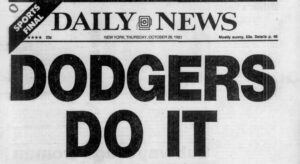 Fun result? Then the Dodgers’ thrashing of the Braves went final, and as I tried to remember the last time I was made this happy by an L.A. win (Game Six of the 1981 World Series, I believe), the Mets and their officially clinched winning record retook sole possession of the third Wild Card with twelve games to go and hopefully lots more fun to come.
by Jason Fry on 16 September 2024 6:08 am A couple of things I’ve finally figured out about pitchers in recent years of fandom:
- Their game logs are portraits of ebb and flow, and you assume the worst (or the best) at your peril. Jose Quintana looked like a prime candidate for “I’ll drive that guy to the airport myself” earlier this summer; his last four starts have been superb. Sean Manaea was kind of trundling along until he reworked his repertoire and became a mainstay. The list goes on.
- Pretty much every pitcher (and position player, for that matter) is hurt worse than you think pretty much all the time. Bob Ojeda‘s NYT article on pain remains the touchstone, an article every baseball fan should read and re-read that’s particularly bracing for its honesty given the usual soft omerta of baseball clubhouse talk. (You’ll never forget the distinction between “fine” and “OK.”) Yes, sometimes guys are hiding injuries they should admit to and so hurting the team, but such cases are the exception to a cruel rule: particularly by September, most everybody is dealing with maladies that would send you or me to urgent care but are just life for baseball players.
- The vast majority of pitchers aren’t Greg Maddux or Tom Seaver and miss their locations all the time. This is a feature, not a bug — having a baseball go exactly where you want it 58-odd feet from where you release it is really hard. Fortunately for pitchers, hitting a baseball is also really hard. Pitchers miss their locations all the time; other things that happen all the time are hitters guessing wrong and not swinging at hittable pitches, or not quite barreling them, or making solid contact but watching fielders do what fielders do.
Anyway, those three points were floating around in my nervous brain during and then after the Mets lost a 2-1 heartbreaker to the Phillies to drop the rubber game and the third of 16 games in their stand-or-fall end-of-season gantlet. (For those keeping score at home, which is all of us, we’re now at the 18.75% mark, the Padres and D-Backs won, and the Braves lost.)
I’m sure I’ve wanted to drive David Peterson to the airport myself a time or two; there have been long stretches of his Mets career where I’ve lumped him in with Tylor Megill and basically shrugged that he has good stuff but may not ever figure it out. He’s also been hurt quite a bit; during 2023 his health devolved from “fine” to “OK” to “you have a torn labrum in your hip and we need to fix it.” Peterson is now healthy (or at least back to “fine”) and on Sunday he was the best I’ve ever seen him, using all his pitches aggressively and steaming through an intimidating Phillies lineup.
Alas, Cristopher Sanchez was also pitching beautifully, yanking Mets hitters back and forth with his changeup and his fastball so that they were always fighting the last war. (Poor Mark Vientos‘ post-strikeout expression evolved from outraged to stoic to doomed and accepting.) Add a stiff wind pushing balls away from right field and you had a scoreless duel; watching a 0-0 game I sometimes wonder if the pitchers are on or if it’s more that the bats are lethargic, but this one was the real thing.
It was a wonderful baseball game, taut and crisp and carrying a riveted crowd along for the ride as the tension got cranked steadily higher; I just hoped that wouldn’t turn into an asterisk, the thing you grudgingly admit once you run out of steam lamenting a heartbreaking loss.
The Mets finally broke through in the eighth against Sanchez, as Tyrone Taylor lifted a ball to left field, sufficiently removed from the wind’s sphere of influence to land in the seats. The lead lasted approximately eight seconds, though: Peterson started the bottom of the eighth by surrendering consecutive doubles to the wonderfully named Weston Wilson and the pedestrianly named Buddy Kennedy, and just like that we were tied. As had happened in Saturday’s heartbreaker, the Mets were tied and looking at losing the lead with a runner on third and one out. Peterson completed his work by getting Kyle Schwarber to ground out; then Phil Maton did what Reed Garrett couldn’t on Saturday and got the Mets out of the eighth with the tie intact.
It was still tied in the bottom of the ninth with Edwin Diaz pitching, wearing 21 and no name in honor of Roberto Clemente. Francisco Lindor had done the same in what became a cameo, as he wisely removed himself after an inning of work showed his back wasn’t up to the task; yes, you can now officially worry.
Diaz struck out Bryce Harper and went to work on Nick Castellanos, with Francisco Alvarez looking particularly demonstrative behind the plate, emphasizing where he wanted Diaz to locate his pitches. I noticed that; I also noticed that Diaz kept putting the high fastball, the waste pitch meant to change a hitter’s eyeline, at the top of the strike zone instead of above it where Alvarez seemed to want it.
Castellanos managed to serve one of those not-high-enough fastballs to right for a one-out single; Diaz struck out Alec Bohm but paid no attention to the lead-footed Castellanos, who alertly swiped second as J.T. Realmuto came to the plate. Diaz threw two high-90s fastballs to Realmuto to get ahead 0-2 and Alvarez indicated he wanted the next one up and out of the strike zone — the pitch Diaz hadn’t been locating as desired all inning.
He didn’t locate this one either — the ball was where Realmuto could handle it, he smacked it to right-center, and the Mets had lost.
Wonderful baseball game; too bad about that asterisk.
by Greg Prince on 15 September 2024 11:04 am I decided to go into the hot take business on May 30. It wasn’t all that hot a take, actually. What I removed from the oven of projection and prediction seemed pretty obvious and therefore lukewarm as regarded a team with a record of 22-33 and a DFA-bound reliever who had just flung his glove into the stands. And he was one of our more reliable relievers.
The 2024 Mets now wallow eleven games under .500. A couple of days ago, I looked up incidences of Mets teams that had fallen double-digits below the break-even mark and still carved out a winning record by season’s end. It has happened three times in franchise history: 1973, 2001 and 2019. I offer that tidbit for nothing more than trivia’s sake, given that there’s no way this team is going to be the fourth edition of the Mets to bounce back from below. Likewise, I am no longer concerning myself with the National League playoff picture, multiple Wild Card berths notwithstanding. The Mets aren’t a part of that snapshot as June approaches and won’t be the rest of the way. As a guy who analyzes returns until he can call elections accurately on social media likes to say, I’ve seen enough. Four months remain to 2024. Get out of it what you like, or just get out and do something else.
I was hoping to mathematically clinch a full-throated Met-a Culpa Saturday. Looked good for a while. The Mets were up four runs over the Phillies. Qualms developed over that lead not being bigger — before bigger qualms took over, given that the lead was shrinking; then disappearing; then converting itself into an insurmountable deficit — but the larger point reigned as long as it could. I not only wrote that there was no way the 2024 Mets could post a winning record, I truly believed it. And I was so, so, so wrong. With a Mets win on Saturday, I could have just stood here in my wrongness and been wrong and gotten used to it…gladly.
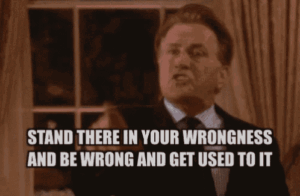 Gladly, Mr. President! I don’t want to say “the champagne is still on ice,” because champagne is for a very specific baseball-type occasion, so let’s say, if you can conjure a vision of a quadrennial political convention, the balloons are still netted up against the ceiling waiting for one state’s delegation or another to put the vote count over the top. We’re gonna need at least a 149th ballot, so to speak, in order to strike up the band and release those balloons. When we do win for the 82nd time this year, rest assured I’m orchestrating a massive balloon drop, even if it takes place only within the arena of my headspace.
Happy days have been here again since roughly the dawn of June. They haven’t precluded the occasional miserable interlude, but better to be massively disappointed for an afternoon in the midst of a September playoff chase than having been compelled before summer to get out and do something else.
 They’re coming, any day now… Admittedly, by the time they lost on Saturday to the Phillies by two a game they’d led by four, statistical niceties like the Mets clinching the franchise’s 28th winning record in its 63 years of existence had drifted relatively far from my mind. My primary thoughts, fueled by regret for what might have been, were best expressed via postgame screams into a pillow.
It was great to meet next-gen speedy shortstop Luisangel Acuña and his burgeoning promise, but not at the day-to-day expense of current-gen speedy shortstop (and so much more) Francisco Lindor’s back, not to mention unsurpassed everyday value.
It was great to see Starling Marte drive in three runs, but not to see him go to first base in pain when he took a pitch off the arm.
It was great to watch Luis Severino inhabit his starting pitching role with such gusto, but not when that included facilitating Bryce Harper’s monster exit from The Cage with two not-so-harmless home runs.
It was great, in retrospect, that none among Danny Young, Reed Garrett or Ryne Stanek detached his glove from his hand and proceeded to fling in Jorge Lopez-style disgust as each helped allow the Phillie comeback to complete its appointed rounds, but let’s face it: that’s a pretty low bar for greatness.
It was great that J.D. Martinez got ahold of one, but the greatness evaporated when Cal Stevenson — already a problem in this game — leapt and reeled it in before it could leave Citizens Bank Park.
It was great to imagine we’d maintain or lengthen our lead on the Braves instead of winding up the night in one of those ties that has something to do with flat feet.
Yeah, it was all great until it wasn’t. Nevertheless, I feel pretty confident that when all is said and done on this season, we’re gonna have a winning record. I feel no hesitation stemming from my usual concern for tempting the wrath of the whatever from high atop the thing to declare that achieving one more win in 2024 amounts to a formality. We’re 81-67 with fourteen to go. Eighty-two and something will happen. (Excuse me while I go outside, turn around three times and spit.)
I’m also confident that having a winning record is not what the saying and doing of what remains to this season is all about. We long ago moved on to higher stakes than breaking the .500 barrier, and with higher stakes come heightened emotions. No wonder the pillows around the house are trying not to make eye contact with me in September.
When I absolutely gave up on this team in late May, just before being presented several months of lessons regarding the jumping of guns and to conclusions, I was a little more specific in my dissolution of optimism beyond the current season and its lack of prospects (and I don’t mean Acuña). What got me when the 2024 Mets bottomed out was how low the on-field enterprise had plummeted since the headiest days of 2022, which was and still is the season before last, yet whose standard for regular-season success was rapidly growing ever more unreachable. Put aside that they needed to win at least one more game that year. They won 101 as was. Forgive a fan who thought they’d stay in that range for a while.
But then came dismal 2023 and the fetid first third of 2024, and on May 30, it struck me 2022 really was a one-year wonder, and when are we going to revel in a multimonth run like that again? The answer came: in the second and third thirds of 2024.
Who knew?
Carlos Mendoza informed reporters after Saturday’s 6-4 loss Marte was gonna get x-rayed for that HBP, an eerie reminder (as if we needed one) that when Starling got hit in the hand two Septembers ago, the 2022 boulder was nudged irretrievably downhill. Yet it’s not as if the injury bug has remained a respectable distance from our fortunes already No Jeff McNeil. No Dedniel Nuñez. No Paul Blackburn. Still waiting on resolution for Kodai Senga’s possible return. And are you more concerned about your back or Lindor’s? Also, though we have every reason to be satisfied with the starting pitching we’ve been getting, it’s strange how most of our 2022 rotation is suddenly up and about. Jacob deGrom emerged from exile to pitch Friday night for Texas, followed by Acuña trade bait Max Scherzer Saturday. We saw an overly effective Chris Bassitt just this week in Toronto. And wasn’t that Taijuan Walker halting our momentum from out of the pen in Philly? As if Harper and Stevenson needed the help.
Either way, 2022 and whatever it had going for it is long gone from the Met present. So, blessedly, is the way 2023 unraveled. Though several current players span several recent seasons, 2024, generally for better rather than worse, feels disconnected to its immediate predecessors, which shouldn’t be surprising. The 2022 campaign didn’t feel like it had much to do with 2021; and 2021 didn’t at all build on whatever we saw in 2020; and 2020 blew off course from the gathering head of steam that defined 2019; and 2019 had almost nothing in common with 2018; and 2018’s best blips shook off the stench of 2017, while its worst created their own distinct and overwhelming bad odor; and 2017 killed the momentum of 2016; and 2016, despite the momentum there at the end, gave us a different breed of Mets from 2015, the last time we went to a World Series, which we probably didn’t think was gonna be the last for what was then the foreseeable future.
Maybe it wasn’t wholly unreasonable to believe we could foresee the future. Up to a decade ago, it was easy to broadly classify eras of Mets history. Nuance notwithstanding, you’d get in a rut or you’d get on a roll and, as a fan, you adjusted expectations and aspirations accordingly. The first thirtysome years were almost Biblical in their feast/famine precision.
Seven losing seasons from 1962 to 1968.
Seven of eight winning seasons from 1969 to 1976.
Seven losing seasons from 1977 to 1983.
Seven winning seasons from 1984 to 1990.
Six losing seasons from 1991 to 1996.
Five winning seasons from 1997 to 2001.
Three losing seasons from 2002 to 2004.
Four winning seasons from 2005 to 2008.
Six losing seasons from 2009 to 2014.
The winning eras were preferable to the losing eras — welcome to Human Nature 101. Is it a stretch to suggest that the losing eras at least let you know where you stood? You stood somewhere south of the first division and you strove vicariously to make the climb upward. You lived for that year that would turn it around. When it got turned around, you felt secure in your belief that you and the Mets had arrived and were going to stick around for seasons to come. The winning eras offered their own challenges, but you had the baseline of 82 wins, probably more, taken care of…until the edge of the cliff arrived without notice and you and the Mets fell off it again. Still, it was fun while it lasted, and it usually lasted a decent interval.
Once we get that 82nd win of 2024, may it pave the way for many more wins in what’s left of this season this month and what will be tacked on to this season next month. And may the years that follow treat 2024’s 82+ wins as useful precedent rather than one-off aberration.
by Jason Fry on 13 September 2024 11:26 pm When they announce the next year’s baseball schedule I take a look, because how can’t you? But after a couple of glances — When’s the home opener? How many times do we go to the West Coast? — I go back to whatever I was doing. The dates are far off, you have no idea which teams will have made leaps forward or taken steps back, and everything’s just too theoretical for deep engagement.
Then the schedule becomes real, and if you find yourself with something to fight for in September, you pore over every remaining game, estimating and fussing and wondering and worrying.
The Mets reported for duty at Citizens Bank Park facing a gantlet: seven against the Phillies, interrupted by three with the Nats, then three with the Braves and three with the Brewers. Two first-place teams, the team the Mets are trying to hold off in the wild card, and a squad whose rebuild has accelerated.
Yikes! But it’s also true that as a baseball fan, the surest way to look foolish is to try to outguess the game.
The early innings of Friday night’s game were even more nerve-wracking than one would expect, given the stakes. The Phillies came out wearing their New Sweden on steroids City Connects (J.T. Realmuto‘s yellow catching gear made him look oddly like Bumblebee from the Transformers movies) and kept hammering balls delivered by Jose Quintana, only to see every drive except Bryce Harper‘s first-inning double find a Met glove. (Pete Alonso set the tone immediately with a jai alai capture of a laser beam from Kyle Schwarber that nearly tore his glove off.) Meanwhile, the Mets could do absolutely nothing against Aaron Nola, who got hitter after hitter to worry about his curveball and so left them gaping at the fastball.
Still, the Mets were driving Nola’s pitch count up, and that was enough to make you squint and hope a little. It was a relief when Jose Iglesias led off the fifth with a single — at least there went Nola’s no-no dreams. Tyrone Taylor followed with a single of his own and Nola went to work against Francisco Alvarez, whose ABs have been much better of late. Alvarez swung and missed at Nola’s first offering, a curve that got a little more plate than its deliverer would have liked. The second pitch was another curve, lower and inside and harder to square up in isolation, but Alvarez was now looking for a curve in that general area. He golfed the ball into the night, waving it fair and watching it rattle off the foul pole for a 3-0 Mets lead.
Jubilation, and the Mets weren’t done: After singles from Francisco Lindor and Mark Vientos, Brandon Nimmo hammered another Nola curve into the right-field stands for the second three-run shot of the inning. The Mets were up 6-0, Nola was exiting, and wasn’t baseball wonderful?
That was all Quintana needed as he cruised through seven innings, Harrison Bader added a three-run shot of his own (nine runs via three-run shots — Earl Weaver would have been delighted), and the Mets finished up taking their hacks against Roger Clemens‘ kid, the one named Knothole or Knitcap or some other stupid K word inflicted on him by his war-criminal father. There was a bit of fuss in the ninth as Alex Young ran into trouble and Lindor left early with what’s being called lower-back soreness; the former can be dismissed with a wave at the scoreboard, and we’ll worry about the latter when we’re told we have to.
Only the most deluded optimist would high-five madly at having survived 6.25% of the gantlet, but only the most determined pessimist would get so hung up on the remaining 93.75% that he’d refuse to enjoy the moment.
It’s baseball; don’t try to outguess it.
by Greg Prince on 12 September 2024 10:01 am So, what do I lead with when this no-hitter is over? Bob Moose in 1969? Max Scherzer in 2015? Proof that a no-hitter thrown at the Mets late in a season doesn’t necessarily preclude that season from having a successful (maybe Amazin’ly successful) postseason? That’s a tough sell. I know it’s true, but when the Mets have looked like they’ve looked for not only these eight innings when they’ve done literally nothing against Bowden Francis but for days on end, who wants to be the house optimist?
Should I compare it to Chris Heston in 2015? Yes, we did get no-hit twice en route to a pennant. The first one had more novelty to it, given that it was the first one we’d been smothered by in 22 years. We were also in the midst of a teamwide slump then, but that was in June, and the game was effectively out of reach, and the difference was that by the time it got to the ninth inning, I was kind of pulling for Chris Heston to finish the job, because what the hell, right? Maybe not right, but it’s where my head was on that night. That night, however, isn’t this afternoon. This afternoon in Toronto is in September. Nothing’s been clinched the way it was when Scherzer went medieval on our bats at the tail end of 2015. Resolution to the season isn’t far off the way it was when Heston rose from oblivion to stifle us in the promising, albeit pre-Cespedes portion of that year.
The Ed Halicki no-hitter from 1975? Not much relevance. Darryl Kile? That was a September, but the September of 1993, a year that had spiraled into hopelessness by May. Bill Stoneman’s in 1972 was also in Canada, but so what? Jim Bunning’s perfect game was historic, in its own category. Sandy Koufax was Sandy Koufax. Jim Maloney carried his into the eleventh. They say it wasn’t a no-hitter — thanks, Johnny Lewis — but I’ll bet it very much felt like one that night in 1965.
We have a few too many opposition no-hitters to reference. We don’t need another.
All we’ve got going for us after eight innings on Wednesday, September 11, 2024, where Bowden Francis’s no-hit bid is concerned is maybe he’s inherited some of that Dave Stieb come close for the Blue Jays but not get it energy. Also, the game’s not over with yet, but that feels like a technicality. The Mets allowed themselves to see all of six pitches in the eighth. The first two batters made outs after one pitch apiece. Is the bus to the airport idling so loudly that it’s distracting you fellows? I know Rogers Centre used to be called SkyDome, but do you have to sky out practically every at-bat? What a waste of Sean Manaea’s six-and-two-thirds of one-run ball, not to mention the credible relief we got from Reed Garrett and Danny Young. Maybe a 1-0 loss via no-hitter is the bottoming out this “attack” needs to get going in Philadelphia this weekend. No, I don’t know how getting no-hit would serve to jump-start the bats, but I’m grasping here. I’m going to have to write this disaster up. I need something.
About the only thing interesting left to not exactly root for but take in is hearing Keith Raad call the last out of a no-hitter. That was the main reason I rooted for Chris Heston in 2015. I wanted to hear Howie Rose do the honors, even if it was from the victimized side. Howie understood the responsibility that night. A no-hitter is a no-hitter. I think Keith gets it, too.
But that’s the smallest of consolations when we’re tied with the Braves for the final playoff spot, they play the Nationals tonight, and our schedule gets much harder after Toronto. Then again, Toronto hasn’t been easy. This is too much of a callback to the Angels series and the A’s series. Why are we playing all these allegedly crummy American League teams if we can’t take at least two out of three from all of them?
Who’s up to start the top of the ninth, anyway? Yeah, like that’s gonna matter.
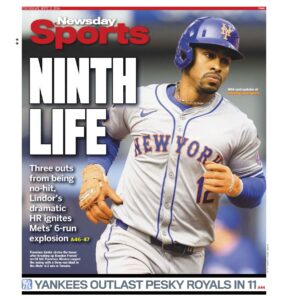 Spoiler alert: It did matter.
by Greg Prince on 11 September 2024 9:18 am “Welcome back to Mets Talk. Caller, you’re on.”
“Yeah, hi. The Mets have to do better than they did Tuesday night in Toronto.”
“You’re absolutely right. Thanks for calling. Our next caller…”
“Um, yeah, long-time listener, first-time caller.”
“Great. What would you like to talk about?”
“I’m really sorry the Mets lost, 6-2, to the Blue Jays.”
“Me, too. Thanks for calling. Next caller, whatcha got?”
“Yeah, David Peterson has to do better than he did last night.”
“He sure does. Been doing great of late, not so much most recently. Hopefully he gets back on the horse. Thanks for calling. Our next caller…”
“Hi, listen, Tylor Megill, who hasn’t been that good when he’s gotten his chances, was terrific Monday, but Peterson, who’s been so good, wasn’t the next night.”
“Funny how that goes. Thanks for calling. We’re talking calls. Here’s our next one.”
“Carlos Mendoza shook up the batting order a little bit, but it didn’t really work. Can you remember the last time the Mets got a big hit?”
“Certainly before they had two guys named Alvarez in the lineup. Thanks for the question. Next caller, you’re on.”
“Hi, I’m a big Mets fan and I have to say I’m disappointed at how they didn’t hit Chris Bassitt.”
“Bassitt sure quieted the already quiet Met bats and disappointed more than a few Mets fans. Bassitt’s definitely done both before. Thanks for calling. We have another call.”
“How are the Mets supposed to win if they’re practically all gonna be in a slump at the same time?”
“That’s a great question with no easy answers. No doubt the front office and the dugout brain trust are working on concepts of a plan to get off the offensive schneid. Appreciate the call. You’re next.”
“Hey, the Braves won while the Mets lost, which means we’re tied for the last Wild Card spot again.”
“Thanks for the update. Next caller.”
“Hello. I was wondering if there was anything more to say about a lousy game and not so great outcome.”
“Nope. Thanks for calling. We’ll be right back.”
For Mets talk that’s likely to be a little more scintillating, join me at the Levittown Public Library Thursday afternoon at 3:30 for a discussion focused on the joys of baseball — rooting, writing and reading. More information is here.
by Jason Fry on 9 September 2024 11:49 pm Baseball, I’ve long insisted, is humanity’s acme of artistic expression. But that’s not to say every game is a work of art.
Whatever that was that the Mets and Blue Jays foisted on us tonight would definitely not qualify. It was a mess, with Tylor Megill mowing down anonymous Blue Jay recruits (and a morose-looking Vladimir Guerrero Jr.) like a combine but then inexplicably leaving with 88 pitches on his odometer and a 1-0 lead. I dislike second guesses, but that counts as a first guess — Gary and Keith were wondering why Megill was taken out, as was I, as was you, as was everybody.
The decision immediately imploded as the Mets got a run of bad relief pitching: After recording an out Danny Young hit a guy and gave up a single, which led Carlos Mendoza to signal for Jose Butto. Recently Butto’s looked like he’s auditioning to return to starting, needing time to fine-tune his control regardless of whether or not time is available for him to do that. Butto fell behind and gave up a hit, leading to a mound visit in which Francisco Alvarez gave him the Full Lasorda, a mix of exhortation and can-do and stern warnings. It was an impressive Come to Jesus moment from a young catcher, but it also didn’t work: Butto hit the next guy to tie the game, then yielded a sacrifice fly to put the Mets behind.
(So of course he got the win. For the 845,093rd time, it’s an unfair game.)
(Edit: The above was based on SNY’s postgame screen, which was a placeholder; in fact the below-mentioned Ryne Stanek got the win, and properly so. Reset the Unfair Game counter to 845,092.)
The Blue Jays gagged up a game on Sunday against the Braves; tonight, wearing City Connects best described as Marlins North, they demonstrated admirable even-handedness in gagging up a game against us. I’ll leave the details smudgy to avoid further embarrassment for all involved, noting simply that the Mets got two runs on one hit, and the one hit was an oopsie cue-shot infield single. The rest was a slapstick farce of walks and errors and wild pitches and passed balls, best witnessed through the holes of a bag over one’s head regardless of your rooting interests. The winning run was scored by pinch-runner and former speed-skating medalist Eddy Alvarez, who replaced Pedro Reyes, whose own lone appearance also came as a pinch-runner. Should some waiver-wire guy named Delgado or Beltran wind up as a Met in the next few days, I’d advise them to rent and not buy.
Anyway, Ryne Stanek worked a blessedly blame-free eighth and Edwin Diaz came in for the ninth. Diaz’s final pitch was a fastball that Leo Jimenez whacked to right for what looked like a crushing walkoff homer, or at least it looked like that for 90% of its flight, until the ball’s momentum sagged and it came down in Starling Marte‘s glove in front of the fence. The Mets celebrated with the dazed smiles of a tour group that just exited a van that’s screeched to a stop inches from a ravine: Well, that’s a story to tell the grandkids!
Still, the ugly ones count just as much as the pretty ones, and right now each and every win is to be cherished and fussed over and smooched like a beauty-pageant winner arrived to take you for a spa weekend. Hello, aren’t you lovely and wasn’t that a delight? Smooch smooch smooch.
* * *
We’ve lost our fourth ’69 Met of the year with the death of Forever Met Ed Kranepool. Read Greg’s tribute — from our 2020 A Met for All Seasons series — here.
|
|






