The blog for Mets fans
who like to read
ABOUT US
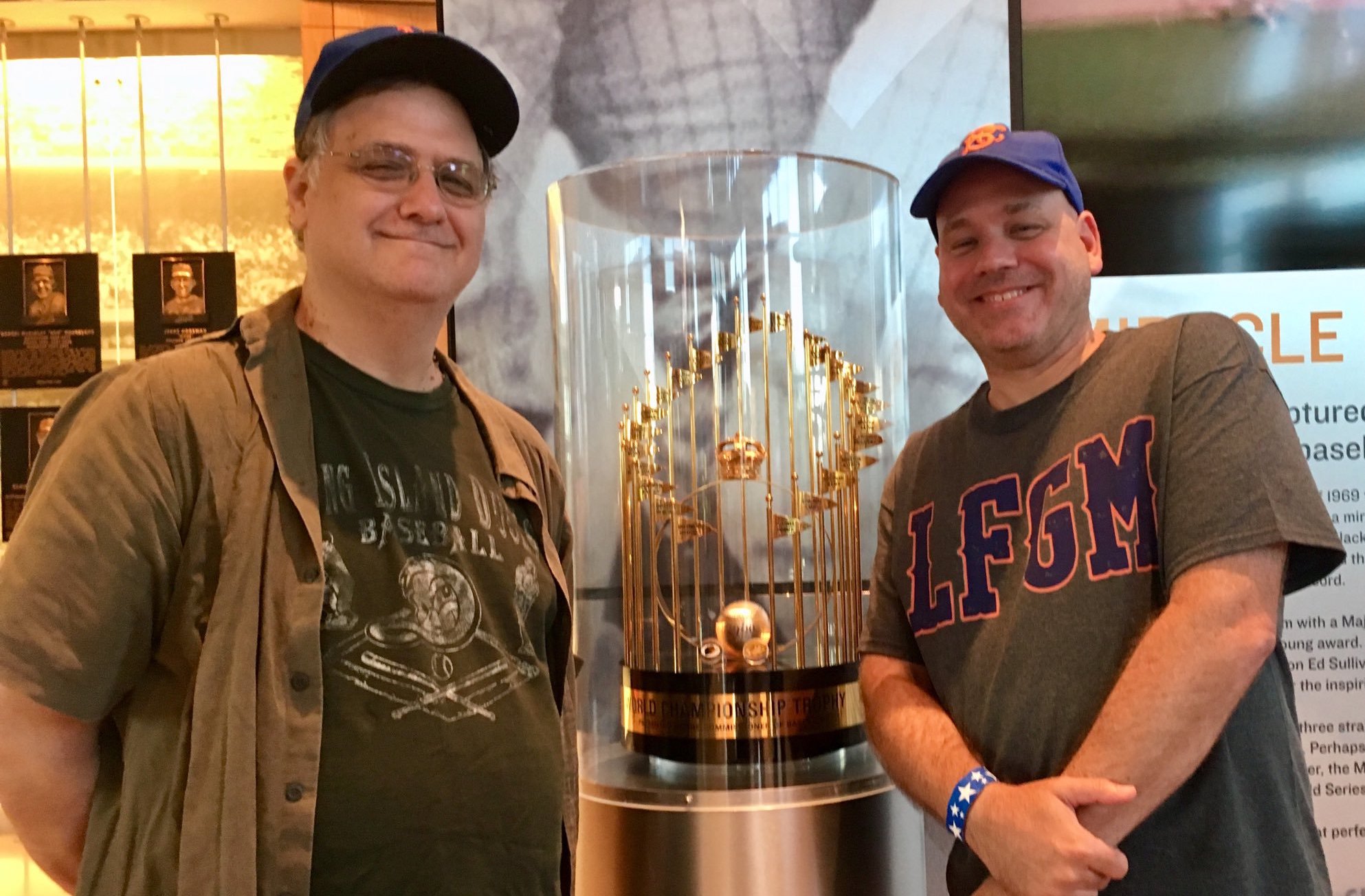
Faith and Fear in Flushing made its debut on Feb. 16, 2005, the brainchild of two longtime friends and lifelong Met fans.
Greg Prince discovered the Mets when he was 6, during the magical summer of 1969. He is a Long Island-based writer, editor and communications consultant. Contact him here.
Jason Fry is a Brooklyn writer whose first memories include his mom leaping up and down cheering for Rusty Staub. Check out his other writing here.
Got something to say? Leave a comment, or email us at faithandfear@gmail.com. (Sorry, but we have no interest in ads, sponsored content or guest posts.)
Need our RSS feed? It's here.
Visit our Facebook page, or drop by the personal pages for Greg and Jason.
Or follow us on Twitter: Here's Greg, and here's Jason.
|
by Jason Fry on 25 April 2013 1:59 am Even great baseball teams lose an annoying number of games.
The runaway-train teams — your ’86 Mets and ’98 Yankees and ’01 Mariners — are still going to lose 15 or 20 games that make you want to lie down in the road. Which means 45 to 60 hours of your time will be dedicated to an outcome you’ll look back on not at all fondly. Double that — at least — for more run-of-the-mill teams. And multiply it by some really horrible number for the bad ones. Even in the dream years, that’s a lot of baseball predestined to leave you enraged, devastated, bitter, surly, morose or just deeply annoyed.
From the perspective of non-fans, this is obviously insane. Why would anyone sign up to receive such slings and arrows? But if it’s too late for you — in other words, if you’re the kind of person who reads this blog — you accept it and even look forward to it. You don’t look forward to the pain of losing, exactly — that would be weird — but to the familiarity of losing. A bad loss in April aches, but it’s a lot better than the void of winter, during which one feels nothing at all. Plus, as I wrote Tuesday night, even a lousy baseball game will deliver moments of beauty or interest or curiosity to those who care to look. And very occasionally something remarkable happens, and the virtuous fan who sticks with a punishing game is rewarded.
This probably sounds like way too much to put on a game where the Mets were down two runs at worst and came back from a one-run deficit. And it is — this wasn’t one of those crazy affairs where the veterans are excused by the middle innings and watch in awe as the scrubeenies stage a ragtag revolution. But, well, you have to factor in a few things.
1) It was a Matt Harvey game, and those are already becoming events at Citi Field. There’s every indication that he really is that good, and the smart thing to do is get to the park when he’s pitching, before it becomes a very tough ticket. The latest manifestation of Harveyism brought me out to the park during a month when I regard night games as an excess of adventure. It also brought my blog brother (for the first Faith and Fear meetup of ’13), my wife, my father-in-law and a decent number of similarly intrigued fans, all of us with expectations somewhere between “high” and “completely unfair.” Harvey struck out seven over six innings in which he gave up three hits and walked one. Most pitchers would call a pretty good line, which it was. But it was mortal, and though it’s a terrible thing to say, we’re already used to more than that.
2) It was cold. Not Mets-in-Colorado cold, not Jackie Robinson Night cold, but cold — the kind that gets into your bones and refuses to leave. (I’ve been home for nearly two hours and I can still feel it.) Was I thrilled when the Mets forced extra innings? Of course I was. Would I have managed to get on with my life if they’d lost in regulation and I’d been able to cram into a nice warm subway car a little earlier and go the hell home? Forgive me, but yes. When it’s cold enough, getting to escape can reduce a tough loss from … well, from devastating to disappointing.
3) The Mets looked snakebit. It was one of those games that looks like it will be decided by a few plays wobbling this way instead of that way, only you’re pretty sure all the breaks will belong to the other guy. First the Dodgers scored a cheap first-inning run on two singles and a fielder’s choice just a bit too poky to be a double play. Then Jerry Hairston Jr. went airborne to take a double away from Ike Davis (showing signs of life), in an inning where Lucas Duda rammed a double of his own up the gap. (Hairston wasn’t done — more from him in a bit.) Most of all, Ted Lilly mesmerized the Mets hitters, as it seems rehabilitating junkballers always do. The big hit wasn’t there and wasn’t there and wasn’t there, until you were pretty sure it wasn’t going to arrive.
So, yeah — it was 3-2 heading to the bottom of the ninth, but it felt like about 7-2.
But there’s a reason I’m still writing and you’re (one hopes) still reading. Leading off, Mike Baxter hit a low liner to left that Carl Crawford misplayed twice, first letting the ball clank off the heel of his hand and then pursuing it so indifferently that Baxter raced for second, which was not a good idea but worked out. Ruben Tejada bunted Baxter to third as the tying run (how novel to applaud a Terry Collins bunt), setting the stage for Daniel Murphy, who no longer feels like a miscast work in progress but like a reliable regular. Murph worked a 2-0 count and then spun a low liner towards the third-base seats. Hairston, to our horror, nabbed it with a nifty backhand while ramming into the photo-box rail.
In a lot of parallel universes the game ended with Baxter trying to score on a 75-foot sac fly, only to be rounded up after a bit of fuss somewhere between third and home, like a cat being taken to the vet. In this one, happily, Baxter scampered a few feet down the line, then reconsidered and belly-flopped back into third. But with the Dodgers an out a way from victory, David Wright promptly rammed Brandon League’s first pitch for a game-tying single to right-center.
An inning later, John Buck (at the plate when Wright was caught stealing to end the ninth) led off with a single and Ike walked, setting up an endgame everyone in the park could see coming. Marlon Byrd sacrificed the runners to second and third (check) and the Dodgers intentionally walked Duda (check) to bring up Jordany Valdespin with the bases loaded. Except first Don Mattingly — who’d repeatedly spent an eternity in frostbite-inducing meetings at the mound — brought Luis Cruz in as a fifth infielder, which one normally sees in conjunction with a coach pitching.
I wasn’t all that happy with the match-up, and not just because I was frozen. Duda has made himself into a tough out, combining a discerning eye for the strike zone with prodigious power, whereas Jordany is equally capable of marvelous things that leave you dumbstruck and dumb things that you just marvel at. In the eighth, in fact, he’d come up with the tying run on third and two out and immediately tapped a weak grounder to first — a rather brainless at-bat, to say the least.
But this time things were different. Josh Wall wasn’t particularly sharp, and Valdespin patiently maneuvered him into a 2-1 count, then hammered a high fastball. The game was won, absent some blockheadedness on the basepaths (which seemed by no means impossible), but then it was gloriously won — Valdespin had hit it over the fence.
A great win, to be sure — on the subway back into the city I happily watched the highlight several times surrounded by beaming Mets fans. But the thought came to me immediately: Because of this game, I will keep watching years’ worth of games in which nothing good happens whatsoever.
And you know what? Right now that seems like a perfectly good trade to me.
by Jason Fry on 23 April 2013 11:46 pm Which of these seems less likely?
Scenario 1: Middle reliever Rob Carson steps in with nobody on and two men out for his first plate appearance in the major leagues. Sixty and a half feet away stands the Los Angeles Dodgers’ Clayton Kershaw, an assemblage of long limbs borrowed from a Hindu deity, stop-start motions filched from a wind-up toy, hellaciously good pitches ported over from hitters’ nightmares, and a beard grafted from the jawline of an Amish teen. Carson will get a close call in his favor and work out a walk, to Kershaw’s consternation. This will cost the perennial Cy Young candidate 24 more pitches and two runs, driving him from the game early and costing him both a win and some measure of his equilibrium.
Scenario 2: Mark Ellis, a 35-year-old with 99 home runs over 10 big-league seasons and the kind of career that’s serviceable with a bit of a shrug, goes 4-for-5 with two homers and a hard ground single that knocks Jon Niese from the game with a “leg contusion,” which is a fancy way of saying “bruise” except pitchers are precision machines who sometimes compensate for pain in one area of the body by subtly changing what they do with another part of the body, potentially leading to all sorts of trouble and MOTHER OF GOD DON’T YOU REMEMBER DIZZY DEAN HAD A TOE BROKEN IN 1937 AND HE CHANGED HIS MECHANICS AND HURT HIS ARM AND HUNG EM UP IN 1941 AND DIED IN 1974 UNDOUBTEDLY OF COMPLICATIONS AND NIESE WAS OUR ONLY RELIABLE STARTER OTHER THAN THE DIVINE MANIFESTATION OF HARVEYISM AND AUUUGGGGGHHHHHH WE ARE SO SCREWED. Hell, Mark Ellis had such a good day that A. J. Ellis hit a two-run double just because he had the same last name.
Both scenarios happened (more or less), which is why you don’t ever try to outthink baseball.
Once Josh Edgin finished his work, which one senses is soon to resume in Las Vegas, this one was a bare-bones feast even the diehards picked at halfheartedly. There were little bits of interest of course, like brand-new Met Juan Lagares showing off a sweet swing and collecting his first hit, and the intriguing motion of the Dodgers’ Paco Rodriguez, whose dice-shaking glove and delicate pivot of the hand behind him look like something from a “Karate Kid” training regimen.
There are always little rewards like those for sticking with a baseball game, and thank goodness — you need something to savor when all is lost, when two long shots have both wound up in the money and you’re shaking your head and smiling at the one but just shaking your head at the other.
by Greg Prince on 23 April 2013 3:56 pm As Mets fans, we hope our tentatively planned deluxe apartment in the National League East sky will be ready for occupancy in a couple of years. As New Yorkers who made it through Superstorm Sandy, we understand projecting living arrangements can become a precarious matter when nature intrudes in the rudest fashion possible. Almost six months after the storm left an enormous scar in our landscape, the rebuilding effort goes on, and like the one that involves Matt Harvey and other prospective prodigies, the Mets are playing a vital role.
Rebuilding Together NYC is a non-profit organization that provides repairs and modifications to low-income homeowners in the five boroughs. Its focus these days, not surprisingly, is on Sandy-impacted areas and, as such, Rebuilding Together NYC has partnered with the Mets on a special effort for this Saturday, April 27.
It will be Rebuilding Together NYC Day at Citi Field, held in conjunction with the Mets attempting to hammer the Phillies. A $55 ticket buys you a seat in Left Field Reserve, with a portion of the proceeds directed toward the group’s rebuilding efforts. If you’d like to cheer on the Mets and maybe cheer up your neighbors, consider the offer here.
***
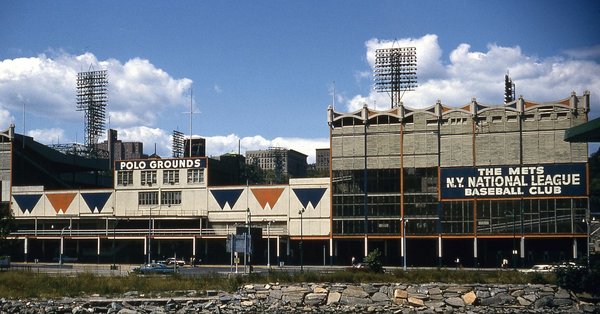
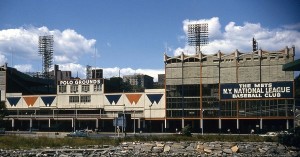 What home looked like 50 years ago. Rebuilding is often as much about preservation and restoration as it is rehabilitation or transformation, so another thumb up for the Mets taking part in a terrific episode of making New York whole again. The Mets, along with the Yankees, the Jets and two teams of Giants have chipped in to make passable once more the John T. Brush Stairway, the last physical connection remaining to the cradle of your New York Metropolitans.
The staircase — which connected the 1911 version of the Polo Grounds to the road above it on Coogan’s Bluff — was presented to the City of New York by the baseball Giants in memory of Brush, their then recently deceased owner, one hundred years ago this July. And one half-century ago this month, the Mets commenced their second season in that same staircase’s shadow; 1963 marked the last spring and summer the grand old ballpark would be filled with fun and frolic (not to mention 34 wins for the good guys). A year later, one week before Shea Stadium opened, the Polo Grounds succumbed to the wrecking ball. While a housing project rose, everything else came down…everything but the stairs, though those fell into terrible disrepair. You could still make out the dedication plaque that was etched into one of its landings if you were in the neighborhood, but climbing the steps could be hazardous to your health.
Recognizing the historical value of maintaining this piece of New York lore, each professional baseball and football team that at one time or another called the Polo Grounds home (along with Major League Baseball), was prevailed upon to contribute a generous sum and each came through. Other donations were solicited and the New York City Parks and Recreation Department — prodded by concerned parties like Gary Mintz and the New York Giants Preservation Society — undertook the restoration. Soon, the stairs will scalable, the plaque will be readable and the spirit of Casey Stengel will be gratified to learn that when it comes to preserving a significant municipal monument, some people here can play this game.
***
The Mets, of course, gave unexpected life to the Polo Grounds in 1962 and 1963. The place was considered done forever for baseball on September 29, 1957, when the Giants played their final game, against the Pirates. Since it was assumed nobody would need the diamond again, many of the relatively few on hand decided its contents were fair game.
Which brings us to a fellow named John Barr, who a little while back sent us this answer to a question worth asking: whatever happened to home plate that day? Barr, a Giants fan since 1947, knew and wrote about it.
Let’s let his reporting take it from here.
***
Ray Smith grew up in Linden, New Jersey, as a New York Baseball Giant fan.
“My Dad was a Dodger fan so I became a Giant fan,” Ray said. “My Dad always took me to Ebbets Field and the Polo Grounds to see one game a year at both parks between the Dodgers and my beloved Giants.”
Ray was fifteen years old when both the Dodger and Giant owners announced that 1957 would be the last year in New York City before the teams moved to Los Angeles and San Francisco.
“I was angry, upset and felt betrayed that my beloved Giants were leaving and felt that I had to attend the last game played by the Giants at the Polo Grounds on September 29 against the Pirates,” said the very mad Giant fan.
Young Ray Smith took a bus from Linden to the New York Port Authority and then the subway to the Polo Grounds. It was easy for a fifteen-year-old back in those days. He purchased a ticket in the lower deck between the dugout and first base.
“I had gone to many games at the Polo Grounds by myself and after the games I would run on the field and try to catch up with my heroes as they headed for the center field clubhouse,” Smith said. “Willie Mays was my favorite and it was a thrill to have him say anything to me.”
The Giants lost that game to the Pirates by a score of 9 to 1, only scoring that lonely run when Dusty Rhodes hit a sacrifice fly scoring Don Mueller from third base. Willie went 2-for-4, and Bobby Thomson, who had returned to the Giants, had one hit. The Giants that day only had a total of six hits. The Giants used a total of five pitchers while the Pirates only needed Bob Friend who wrapped up his 14th win. Johnny Antonelli took the loss, bringing his record to 12-18. The attendance was only 11,606.
“When the last out was made several fans jumped onto the field and were caught by the ushers,” he recalled. “I saw an opening between ushers and scampered onto the field, first and second base were guarded so I headed to the pitchers mound and tied to dig up the rubber to no avail, as it was too deep”
Ray then realized that home plate was the soul of the ballpark. Willie Mays had run over, slid across and thrown strikes to it from center field. If Ray couldn’t keep his Giants in New York then he wasn’t going to let them take home plate with them. It was there for the taking. The following events followed as remembered from September 29, 1957:
“I ran to home plate.
“There was a bunch of people standing around doing nothing.
“I took out my Boy Scout knife — that’s the truth — and started digging.
“Someone stepped on my hand closing the knife and giving me a big cut.
“I dug and dug and finally home plate was loose.
“The plate had five coarse-threaded metal inserts.
“While I was digging and tugging everyone stood around watching — no one helped.
“Then when I got it out they tried to grab it from me and all hell broke loose.
“One older kid grabbed it from me and I jumped on his back and when he tried to punch me I took it back.
“I then took off running as fast as I could.
“A photographer spotted me and asked me to pose for a picture with home plate as others tried to take it from me. That picture appeared on the front page of the now-defunct New York Mirror on September 30, 1957, entitled the ‘Last Steal’.
“After the picture was taken, I was home free and left by the centerfield exit with my prized possession.
“I’d had the crap beat out of me. My glasses were broken and long gone, my finger was bleeding, my shirt was ripped and I realized I had been in quite a fight to keep home plate.
“The next challenge was getting it back to Linden.
“I must have looked a little strange, a disheveled fifteen-year-old hanging onto what looked like a home plate.
“I couldn’t see without my glasses so I had to ask strangers to tell me when the subway stop arrived for the bus terminal.
“But I made it home with my treasured possession.”
Whatever happened to home plate after that, you might wonder. Well, Ray Smith joined the United States Air Force in June 1959 after graduating from Linden High School and served on active duty until 1981. Home plate traveled with him to assignments in Wichita, Kansas; Germany; Knoxville, Tennessee; Scott AFB, Illinois; Athens, Greece, Washington, DC; and Colorado.
“It didn’t accompany me to Vietnam”, he added. “It now occupies a place of honor in my house over looking the Rocky Mountains.”
***
Thanks to John (and Ray) for a reminder of what home means to us, whether it’s physical, spiritual or a plate to grab hold of. Again, if you’re looking to go to bear witness to Shaun Marcum’s first Met start on Saturday and want to help somebody who’s not a Phillie baserunner be safe at home, please check out Rebuilding Together NYC’s special day at the park.
by Greg Prince on 22 April 2013 9:52 am What a marvelously well-behaved afternoon the Mets provided those of us who filed into Citi Field on Sunday. Our Ron Darling bobbleheads awaited us in a pleasing stack; our fish tacos didn’t take any longer than the “few minutes” the notoriously pokey Catch of the Day promised; our shadow-situated seats were convincingly but not excessively chilled; and our pitching completely shut down a prospective division champion.
Dillon Gee finally lived up to his No. 3 starter potential, which was a gratifying sight. He’ll never be as electric as Matt Harvey (or as acoustic as Jon Niese), but we’ve seen him bulldog his way past batters and out of jams more often than not since late 2010. The guy who couldn’t do anything with the Phillies or the Rockies wasn’t Gee. The Gee who tamed the Nationals was more familiar and most welcome. Post-clot, expectations for Dillon are necessarily leavened with patience, which one can magnanimously draw upon when the pitcher has earned your faith and your team is still in the exploratory stage of its season.
Given Dillon’s ongoing quest to find the feel of competitively throwing every fifth day again, perhaps the 98 pitches he compiled across 5⅔ innings were as far as he needed to be pushed, particularly since the last 11 he delivered resulted in walks to Bryce Harper and Adam LaRoche. Ball four is sometimes the better part of valor where these two Met-killers are concerned, but I suppose it was reasonable to infer Gee was kind of losing it at that point. Nevertheless, my inner Ojeda was beseeching Terry Collins to let a young pitcher pull himself from his own quicksand and to break him and all Met starters who drift into trouble out of the habit of looking over their shoulders at the bullpen.
I also didn’t want to look at the bullpen because it rarely behaves marvelously well.
Gee’s 2-0 lead, built on a John Buck blast (I’m assuming he has now passed Johnny Bench and is bearing down on Carlton Fisk for most home runs in a career by a catcher) and a Mike Baxter sac fly, appeared ready for shredding. Did it matter who was coming in? Do you trust any reliever Collins brings in during any inning, particularly if you’d never been forced to think about him before this season? If Jerry Seinfeld was using his luxurious box Sunday, he would have asked as I’m certain we all have since the new fellas flew up here from St. Lucie, who are these people?
To date, they’re Mets relievers, which is a terrible thing to call any group of human beings, but if the epithet fits, by all means spew it. We’re used to it. We’re so used to Mets relievers, particularly of the nebulous “middle innings” variety, exacerbating shaky situations that it’s almost not worth memorizing their names and numbers. You figure they’ll all be delisted from our roster soon enough.
Hence, when Gee left and LaTroy Hawkins made his 880th major league appearance (his first occurred against Baltimore, when Cal Ripken was still behind Lou Gehrig on the consecutive games played list…but, surprisingly, not while Gehrig was still active), I prepared not so much for the worst but for the usual. It was Hawkins versus Ian Desmond. It could’ve been Hawkins vs. Ian McKellen. The point was it was another Met bullpen retread tasked with preventing an opponent’s rally from reaching fruition. How was that gonna work?
Quite well, it turned out. Hawkins struck out Desmond to end the sixth and the Nationals’ threat.
No, really, he did. And Brandon Lyon, who I thought was supposed to be the “setup man,” came on in the seventh and set down the Nats in order. And Scott Rice, whose fifteen minutes as a feelgood story elapsed weeks ago as he settled into the role of one more bullet in the Mets’ ongoing game of bullpen roulette (in which Aaron Laffey was Saturday’s unluckiest victim), put his left arm to extraordinary use, allowing two baserunners before making with his bread and butter, grounding Jayson Werth into a slick 6-4-3 double play, striking out the prodigy Harper — “Marty,” screams Doc Brown in the upcoming Back To The Met Future, “don’t let Bryce Harper’s parents meet!” — and leaving LaRoche to fester in the on-deck circle. Inning over, Mets lead in progress.
Finally, with the lead still 2-0 (because who needs more runs anyway?), it was Bobby Parnell in for the save, and am I crazy, or has Parnell actually become something akin to a dependable closer? I was going to say “lights-out closer,” but I figured that’s asking for trouble from the bullpen gods. However one measures Parnell’s effectiveness, it was in effect. The ashes of the Nats’ hopes scattered into the ninth-inning wind in order.
Big, bad Washington lined up Strasburg, Gonzalez and Zimmermann for a weekend in the outer boroughs and left losers of two of three. Succumbing to Harvey, as the rest of organized baseball is learning, is standard operating procedure. The Nats’ one win was a function of the Mets’ putrid relief pitching. But their second loss? It was a function of the Mets’ sublime relief pitching. It took four relievers working 3⅓ innings, which in a vacuum is too many doing too much on a given day given how many days there are in a season and how quickly it all adds up, but it worked. One day after even the say-no-evil Captain expressed his polite disgust at the Mets’ inability to hold an opponent in check, they did it. Hawkins, Lyon and Rice neutralized the Nationals, validating Gee’s effort and paving the way for Parnell.
Almost flawless relief pitching from the New York Mets…they should keep it on the Citi Field menu. It’s even better than the fish tacos.
by Jason Fry on 20 April 2013 8:08 pm A day after a downtrodden people gathered to bear witness to Harveyism and declare that henceforth its tenets shall be their faith, the less-exalted Jeremy Hefner took the hill for New York. The more you know about Hefner the more you root for him, but he’s not Matt Harvey, which isn’t any kind of insult. Like many starters who have come before him and many who will come after him, Hefner can be very effective if he has all his pitches working and can hit his location, but is generally ineffective at all if he doesn’t. In three of his four appearances this year, the latter’s been the case — and this time Hefner was up against Gio Gonzalez, who has a 20-win season on his resume and the Nats’ offense supporting him.
But what could easily been a post-Harvey hangover game turned more interesting than that. Hefner wasn’t great, but neither was Gonzalez — the Mets worked their usual patient at-bats, driving Gonzalez’s pitch count up and up with an assist from Gio himself. They harried him in the bottom of the fourth, putting up five two-out runs, with the most impressive at-bat probably Ruben Tejada seeing 10 pitches (one of which tore Kurt Suzuki’s glove off his hand) in working out a walk as a pinch-hitter.
Alas, with Hefner out early the Mets called on Aaron Laffey, who’s no Matt Harvey and no Jeremy Hefner either. Laffey got the first two, but then walked the hideous Jayson Werth, gave up a double to Bryce Harper and then served up a 1-2 pitch to Adam LaRoche, one of those guys who kills you without attracting his fair share of notice. LaRoche turned it into a three-run homer. Harvey is Harvey and Jon Niese has matured into a generally reliable pitcher, but the back of the Mets’ rotation is a mess, to put it charitably. Dillon Gee deserves more time and patience as he works back from an injury, but otherwise we’re left hoping Shaun Marcum gets here soon, after which the best-case scenario is that he’s Shaun Marcum.
After Laffey did what he did, the game turned into one of those long grinds, with teams poking at each other in search of a weakness. That turned out to be Josh Edgin. Edgin has not looked good so far this year, but he pitched a clean seventh (much-needed for him and for us), after which the Mets grabbed the lead on a Daniel Murphy hit (Murph was safe by an eyelash on an eyelash), a John Buck double and a Harper bobble that prevented Murph from being roadkill at the plate. But as before, the good feeling lasted about six seconds — Harper utterly demolished an Edgin delivery for his second homer of the day, and this one should have counted double: It re-entered the atmosphere above the Shea Bridge, and I’m pretty sure I saw a LaGuardia-bound 747, a communications satellite, a near-Earth asteroid and a dislodged chunk of the Bifrost Bridge plummet down in its wake.
The Mets looked like they had a chance in the ninth against a wild Rafael Soriano, but their lessons in admirable patience seemed to desert them when they were needed most. Justin Turner worked a 3-1 count, fouled back what might have been Ball 4 and wasn’t his pitch even if it weren’t, then lined out. Murph grounded out on a 3-1 pitch. David Wright worked out a walk — and Buck promptly tapped the first pitch to short.
So … yeah. Interesting game turned disappointing. You can lament that our current rotation is Harvey, Niese and a collective shrug, and you wouldn’t be wrong. You can wonder what’s wrong with Edgin, and ask if Sandy Alderson’s thoughts are turning to Pedro Feliciano or Robert Carson. You can wish the Mets had shown just a bit more of that wise restraint in pursuing errant baseballs at the end.
All of that would be true, but there’s such a thing as overthinking stuff. Bryce Harper is a star at 20, and if nothing goes amiss it’s absolutely terrifying to think what he’ll be at 25, and how many years he’ll stay that way. Let’s face it: If Buck had worked the count to 3-2 and blasted a double up the gap to score Wright and make it 7-7, Harper would have hit a third homer off Bobby Parnell or Scott Rice. The Nats version of this recap would be MOTHER OF GOD BRYCE HARPER IS FREAKING AWESOME, and that would be correct and hit all the truly important points.
by Greg Prince on 20 April 2013 5:21 am Harvey’s better. And we’re not so bad ourselves.
The pitcher you may have caught on TV, and if you can’t be John Buck, that’s not a bad way to catch him. Certainly you have the benefit of helpful camera angles, possibly pause and rewind buttons and all the concentration you care to muster. You could see for yourself Friday night as you’ve probably seen three times prior this season what a job Matt Harvey is doing of baffling hitters and promulgating victory.
But the phenomenon is something you really should have been a part of at Citi Field. It was something else. It was Harveysteria. It began in earnest Friday night and I don’t see any good reason for it to end.
Matt Harvey was promoted to the Mets late last July and made an immediate impression fully within reason. You know: rookie callup, got ya excited, backslid here and there, encapsulated those lessons about not being altogether over the moon too soon for his or your own good.
We can stop with that now.
I’m here to tell you to take the training wheels off your hopes and dreams. I’m here to tell you that in Matt Harvey’s first full season in the major leagues, you can project whatever you like onto this kid. I’m here to tell you to not take it easy. I’m here to tell you to go in hard.
Matt Harvey is why you become a baseball fan. Matt Harvey is why you ask somebody to take you to a baseball game when you’re a kid and why you keep going to baseball games when you’re a much older kid.
You know what Matt Harvey did from the mound. You know what Matt Harvey did to the Nationals. You know how Matt Harvey overshadowed Stephen Strasburg. But you couldn’t quite know, unless you were there, what Matt Harvey ignited at Citi Field Friday night.
He turned it on. He plugged it in. He lit up a fan base. He wired us for sound. He transformed a facility into a ballpark. He made Mets fans pay attention to a Mets game, for crissake. I’ve been going to that place for five seasons now and unless we were having the circumstances spelled out for us, we were never quite absorbed into the action as we were when Harvey outpitched Strasburg, overpowered Strasburg’s teammates and, when faced with his single moment of adversity, plum Harveyed up until adversity disappeared into the lingering fog.
There’s no fog enshrouding what Harvey accomplished, though. Yeah, seven innings, four hits, three walks, one run (somehow) and the three runners who boarded the bases in the seventh with nobody out and weren’t permitted to exit their stations until there were three out in the seventh.
Yet that wasn’t even the best part.
The best part was when Harvey wasn’t pitching, but watching. Ike Davis and Lucas Duda had taken to slugging, supporting their pitcher with a couple of extra runs on the off chance he’d need them. Ike and Lucas socked it to Strasburg, who hadn’t been sharp, but hadn’t been dented since the first. Strasburg was the co-attraction when the night started, and though he amounted to little more than a light mist in the face of Hurricane Harvey, he’d hung around in that way top pitchers do if you don’t knock them out ASAP. But now, with two home runs in the sixth to go with the two runs from the first, Strasburg was severely dented…the very same Strasburg who’d been hyped to the high heavens since his big league debut in 2010, the year the Mets quietly drafted a kid out of the University of North Carolina who, until Friday, had never made it to the same breath as the Washington sensation.
For three years, it’s been Strasburg, Strasburg, Strasburg. He was the Marcia Brady of the National League East. It’s tough to say Stephen Strasburg wasn’t chatworthy, but when there’s one pitcher in your division who’s on everybody’s lips and he’s not on your team; and when you’re convinced your pitcher has, by all recent objective measure, surpassed that other team’s pitcher; and when your team has taken what little it’s had to hang its hat on and traded it to Toronto — well, godammit, this is where we grab the mic and change the conversation.
There was no prompt on the scoreboard. There were no t-shirts distributed ahead of time. There was no social network behind it. There was just a chant rising from the seats, the seats that were being occupied for baseball instead of abandoned in search of Shack Burgers and frozen cocktails.
“HARVEY’S BETTER!”
Are they saying what I think they’re saying?
“HARVEY’S BETTER!”
Wait…have these people put that together themselves?
“HARVEY’S BETTER!”
Holy Tim Foli, they’re taunting Strasburg! They know what’s going on!
“HARVEY’S BETTER!”
By George Stone, I think they’ve got it!
If long-term health and contractual status hold out, there will be plenty of time and way more evidence provided to determine if, indeed, Matt Harvey is better than Stephen Strasburg or, heaven forefend, Stephen Strasburg is better than Matt Harvey. Matt Harvey will go up against other aces from other rivals, too. Matt Harvey will draw crowds and focus in an age when crowds are usually sparse and focus tends to be fractured. Matt Harvey will win and the Mets will be forced to follow if they care to keep up.
Inevitably, it will all be traced back to the “Harvey’s better” game, one of those nights destined to stay with those who were in on its ground floor. Mets fans from 2013 who have yet to be introduced will sit next to one another some night up the road and trade reminiscences as Mets fans do. They will feel each other out, who was where for what and so forth. If it’s the relatively near future, one of them will say “Harvey’s better,” and the other of them will know what it means. If it’s far off, there will be a prelude to set the scene, about this game I was at when Matt Harvey was in his first or second year, against the Nationals, and the sentence will be finished by a different voice: you mean the ‘Harvey’s better’ game? I was there, too!
Mention of Matt Harvey’s name of late eventually evokes another dozen names, all pitchers, all predecessors of his, mostly on the Mets, sometimes from elsewhere. If you’re an optimist, they’re great pitchers to whom you believe Harvey might measure up. If you’re less sanguine, you’re cataloguing pitchers who have shown Harvey’s kind of promise but experienced careers that limped off into mediocrity, injury-riddled or otherwise. Friday night, without necessarily meaning to, my companion (to whom I owe another round of thanks for an outstanding seat from which to watch what we hoped would be a duel but were delighted to see develop into a romp) and I rolled out our own series of names — some you’d guess, some you wouldn’t. Thing is, even as we bathed Harvey v. Strasburg in the glow of golden precedent, I was comforted that Matt is something new to us. He’s not the Next This or Another That. He’s Matt Harvey. We’ve never had one before.
And I swear I’ve never had Citi Field feel like the thriving home of the baseball team I care about before. When it comes to emotion and electricity, Citi Field has never had more than a temporary power surge run through it, certainly nothing organically generated. A no-hitter (now that we know what one is like) would be enormous in a parking lot — or a former parking lot, at that. That twentieth win revealed itself a one-off in the scheme of things once the twentieth-winner was shipped abroad. Batting titles, franchise records, the occasional walkoff win…here and gone, basically.
But Harvey besting Strasburg, on the heels of Harvey besting every comer who’s taken him on in 2013, with the crowd understanding intrinsically what it meant (while taking joyous note of events transpiring in the world outside the ballpark’s brick walls)…that’s not just a night to remember. That’s a night to build on.
by Jason Fry on 19 April 2013 12:02 am Remember when Matt Harvey nearly no-hit the Twins?
That was fun.
Since then, this is what we’ve had:
Sunday: Snowed out
Monday: Snowed out
Tuesday: Lose double-header
Wednesday: Snowed out
Thursday: Lose
And now here’s Matt Harvey on tap again. Well, except he’s facing a team that’s just a bit better than the Twins.
Oh, and it’s supposed to rain.
I assumed they would lose today, which was a combination of all the horrible things that had happened in the previous four days of baseball and the fact that I loathe Coors Field. Now that Soilmaster Stadium has been replaced by Loria’s Hallucinogenic Palace and Fraud Shop, it’s my least favorite place on the planet to see the Mets play baseball. Well, OK, there’s Hiram Bithorn, but if ill luck or Seligian chicanery ever take us back to that hellhole, I’m boycotting the whole affair.
The Mets have now played 71 games at Coors Field, which is 71 too many. Their record in the Airless Confines is 28-43, which is a good 20 games better than I would have figured. When the Mets are at Coors, they have a variety of ways to lose, and generally the suspense involves waiting to see which one they’ll select. There’s the horrifying blowout, with baseballs rocketing out of parks and relievers hiding in terror. There’s the messy suckfest, in which neither team can do anything right but you know the Mets will execute the final fatal pratfall. But the worst of them is what we might call the airlock game — the Mets get out to an early lead and seem to be playing something that resembles baseball, but then asphyxiation sets in. The scoring stops. The good at-bats stop. Sloppy play makes an appearance. More sloppy play commences. Rockies in rearview mirror are suddenly closer than they appear. And then you wait for them to lose, either suddenly but inevitably or thoroughly and inevitably.
Both ends of the Doubleheader from Hell were like that. So was this afternoon’s game.
When I start thinking that we’re 8-63 all time in a park, I generally take myself to Retrosheet in an effort to get my perspective back. But it didn’t work this evening. It just made me remember delights like these:
April 26, 1995: This was the first game in Coors Field history and the first after the strike, an 11-9 loss ended rather iconically by Dante Bichette’s home run in the 14th. What you may have forgotten (or suppressed) is that John Franco blew the save in the ninth, surrendering a two-out double to Larry Walker. Or that the Mets had the lead going to the bottom of the 14th, and with one out and Joe Girardi on first Andres Galarraga grounded to Tim Bogar. Instead of starting a game-ending double play, Bogar muffed it. The next hitter was Bichette.
April 27, 1995: The Mets took a 7-2 lead and gave the ball to Josias Manzanillo, who gave up five in the sixth. The walkoff loss was hung on Kevin Lomon, making his big-league debut as a Rule 5 pick from Atlanta. He surrendered a two-out single to today’s manager Walt Weiss, scoring future Met Jim Tatum. The Mets would send Lomon back to the Braves by Memorial Day, but he lives on thanks to the worst baseball card in The Holy Books, and possibly in the history of baseball cards.
April 11, 1996: Dave Mlicki gives up three singles and a grand slam to Larry Walker before recording an out. WHEEEE!
April 12, 1996: Down 6-2 in the ninth, the Mets fight back to 6-5 and have Jose Vizcaino on third and Edgardo Alfonzo on second with one out. Chris Jones is called out on strikes. Kevin Roberson walks. Bernard Gilkey strikes out.
July 23, 1996: Let’s play two! In the first game, the Mets fight back with six in the eighth to tie the game at 7-7. Doug Henry enters the game, and with one out in the ninth surrenders a single, a walk, a single, a walk (to the pitcher) and a walk-off single. In the nightcap, the Mets score six in the sixth, erasing a 7-0 deficit. Mlicki immediately gives up two runs, but the Mets go up 10-9 in the eighth. Enter Jerry DiPoto, who blows the lead. In the bottom of the 9th, Henry retires nobody for his second loss of the day: walk, double, intentional walk, walk-off single to Eric Young, father of current Rockies nemesis Eric Young.
July 24, 1996: The Mets tie the game with two in the eighth. In the bottom of the 10th, Paul Byrd walks Weiss, who moves to second on a sacrifice, then third on a groundout. The Mets put Galarraga on first via an intentional walk, then put Weiss on home via an unintentional single to Vinny Castilla.
May 6, 1997: The Mets blow a 4-0 lead, a 6-5 lead, pull within 11-10, lose 12-11. Apparently exhausted by this effort, they are then swept in August.
So … yeah. After three years of playing games at Coors Field, the Mets were 3-13. I don’t think I’ve ever recovered from that introduction to the place. The Mets were 7-5 over the next three seasons, but then the horror shows began again. In 2010 they lost three of four in May, the last three by an aggregate score of 26-6. They blew a 7-0 lead to lose 9-8 in May 2003. In July 2007 they were swept by a combined score of 34-12.
Or how about this one?
May 23, 2008: Billy Wagner surrenders a homer to Matt Holliday, and the save. Jose Reyes leads off the 10th with a double … and is picked off. Aaron Heilman loses it in the 13th, an inning that starts with him yielding a single to the pitcher.
Or the April 14, 2010 game where the Mets tied it in the ninth on a throwing error by Chris Iannetta, survived to extra innings, and then Jennry Mejia surrendered a leadoff homer to Iannetta?
Or the April 27, 2012 game in which Scott Hairston hit for the cycle … and the Rockies won 18-9? (Three words: Schwinden and Acosta.)
Or Tuesday? (Do you know what the Mets’ record in extra-inning games is at Coors Field? It’s 1-5. In one-run games, they’re 5-13.)
Or today?
Next time the Mets go to Denver, let’s play none.
by Greg Prince on 17 April 2013 6:07 am Please come to Denver
With the snowfall…
—Dave Loggins
Submitted for your approval…nah, scratch that. Who here would approve of anything the Mets did Tuesday night in the city that’s been their personal Twilight Zone for two decades? Not fans of the Mets. Certainly not fans of crisp, clean baseball. Perhaps fans of the Rockies, but honestly, those are 200 people who can go home and thaw at a glacial pace for all I care. That just leaves fans of the supernatural, since only a Rod Serling could imagine a doubleheader like that which the Mets and Rockies just played to horrifying conclusion.
Submitted for our disapproval, then: Baseball — the summer game. But some summers are slower to occur than others. Witness the summer of the fourth year of the second decade of the twenty-first century, a season nowhere in sight as a baseball team from the Northeastern United States travels across its continent into colder and colder climes until not only does summer disappear from the horizon but the current spring is reduced to a memory. Only winter goes on, into apparent eternity, a time and space best measured in…the Twinight Zone.
The Mets and Rockies played two baseball games in Denver. They were supposed to play one. Or were they supposed to play three? Who can remember anymore? It’s been snowing in Denver since the weekend. Or was it snowing in Minneapolis and then it snowed later in Denver? Impossible to keep track. The Mets played two games in Minnesota, both of them wins. They were supposed to play a third. It couldn’t be done. Colorado came next and, with it, more snow. A first game was postponed due to snowout, as if that’s a thing. Then there was one of those day-night doubleheaders, except the day got away because the Rockies, whose home is somewhere amid the Rockies — where it’s been to know to snow during the spring — were perplexed when it snowed on their ballfield as to how to remove the snow. So everybody grabbed a shovel.
State-of-the-art snow-removal technology at its finest, eh?
The snow was shoveled, the hoods were pulled up over the ears and it was “play ball!” at 5:10 PM Eastern, 3:10 PM Mountain, get here when you can get here and stay all you want because nobody’s coming anyway. The day-night doubleheader became a traditional twinight doubleheader (though the tradition of selling one ticket for two games in one night is admittedly the stuff of ancient civilizations), except technically you had to show another ticket or get another voucher so the Rockies wouldn’t have to give anybody back their money. Thus, I believe it was the world’s first single-admission split doubleheader.
In the first game, everybody wore 42, David Wright hit two home runs, Dillon Gee was alarmingly ineffective and nothing good came of any of it. The Mets lost, 8-4.
Nothing good came of the second game, but much more so. Whereas the opener was garden-variety lousy (save for wasting a pair of Captain jacks and the lessons attached to the proliferation of the Butch Huskey look), the nightcap was straight-out Serling. It was the Mets at Rockies so perfectly staged — which is to say too bizarre to be to easily digested, too real to be easily dismissed — that if you only glanced at it, you’d think it was the Rockies at Mets.
Because that’s what the Rockies wanted you to think. Except they got to keep the home team share of the gate…which wasn’t anything like the actual attendance…which is the kind of trickery the National League never used to pull until the founding of the Rockies and Marlins in 1993.
You know, because we see the Marlins approximately every two weeks and their owner is so relentlessly slimy, we tend to bristle more virulently over the misdeeds and shortcomings of the Miami franchise than any other in our midst. But the Rockies — to my thinking the National League’s most exotic road flower since the Astrodome stopped seeming wondrous and the Expos ceased to be — came along on the same 1993 plague train. Though I tend to maintain a default conceptual soft spot for those who have followed in our expansion footsteps, man, have the Rockies been a mostly nightmarish element in our existence for twenty years. Maybe “nightmare” is too strong. Not so much a bad dream but a weird dream, especially these trips to Denver. Especially this trip to Denver, which weirdly celebrates our complicity in bringing the Rockies to light.
That, of course, is why the Mets were wearing home uniforms at Coors Field in the second game Tuesday night, because the Mets were the hosts to the birth of the Rockies on April 5, 1993, a deceptively promising afternoon which I could imbue with sun-splashed nostalgia until inevitably getting to the crux of that inaugural Colorado season from a Flushing perspective. The Mets removed their uniforms’ racing stripes, added a tail to their wordmark and started the year 2-0 at Shea. I went to both games and was giddy with anticipation for what else 1993 would bring.
It all rolled downhill like a Colorado avalanche after that.
In the second week of the Rockies’ existence, the discomfortingly 2-3 Mets (already swept a weekend series by Art Howe’s allegedly underwhelming Astros in between bouts of right fielder Bobby Bonilla snarling geographically at reporter Bob Klapisch) visited Mile High Stadium, where they won two and lost one. That should’ve been a good sign, but somehow it wasn’t. The night games started at 9 o’clock Eastern, which had to have been some kind of first for the Mets. The enormous football stadium cast strange shadows, like out of the 1950s, at least on television. The Mets tried on new, not particularly flattering road uniforms for the first time. There was something off about the entire experience.
Our boys left town after David Nied defeated Dwight Gooden, which had to have been a typo, but was factually correct. Nied was the Zack Wheeler of his day, more or less, snatched from pitching-rich Atlanta in the 1992 expansion draft. He got hurt and never panned out. Gooden was Gooden, still capable of intricate surgery on occasion, including Opening Day, when he bested Nied and the newborns on four hits and no runs. After losing at Mile High, Gooden — who had been hit hard by Houston the day Bonilla informed Klapisch he was guiding tours of his home borough — was 1-2. The Mets were 4-4 and definitely not clicking. They came through Cincinnati at 6-5. They’d get to the end of the following week at home, 8-7.
And they’d never be over .500 again. The Mets’ record in 1993 ended up at 59-103, eight games worse than the Rockies, five games worse than the Marlins, thirteen games worse than the 1992 Mets who inspired Klapisch and John Harper to write a book in which that squad was portrayed as the “worst” value buy imaginable. If that was true, then this bunch was sub-worst. The 1993 Mets’ mark of 59-103 (achieved, if you can be said to achieve such a plateau, by winning their final six in a row) was the lowest posted by any Mets squad since 1965. It outworsted every one of those notorious Grant/de Roulet debacles Mets fans of my demographic wallow good-naturedly in now that we’re not living them any longer. It wasn’t remotely approached by the hapless Howe gang of a decade later let alone recent dispiriting Met editions.
Not only were those Mets spectacular underachievers — Pythagoras claims the 1993 Mets performed well enough to win 73 games, but I’m pretty sure Pythagoras was slamming ouzo when he made that calculation — they were boorish in the process. The threats of Bonilla were merely the tip of the ick-berg. Every big name acted the part of the bad seed. Everybody you never heard of deserves his hard-earned obscurity. Anthony Young didn’t deserve to lose a million consecutive decisions, but somebody on that collective of the damned was going to have to bear a heavy statistical burden that transcended mere futility. They were awful and they were ugly. One forlorn pitcher dropping the back 15 of an eventual 27 consecutive losses was the least of those Mets’ misdeeds.
Anyway, the 2013 Mets decided to play dressup per the Rockies’ request and slipped into their 1993 home uniforms at Coors Field. As you might have guessed by the above paragraphs, this caused some searing last-place flashbacks as soon as they showed off the Shea whites, the light pinstripes, the narrow lettering and that goddamn tail underneath “Mets”. It doesn’t take much to jolt me back into a time and space I haven’t occupied for decades. Seeing the Mets pretend it was 1993 transported me 20 years back in a way a contemporary game hasn’t taken me out of a moment since 2005, specifically the June night I saw the Mets wandering through the Oakland Coliseum and recovered all kinds of deeply repressed memories of losing the 1973 World Series.
This wasn’t worse, exactly, but it didn’t set a very helpful tone. Nor did the conditions so apparent on television. Gary Cohen concealed his contempt for the Mets having to play in 35-degree temperatures (plus wind chill of who knows what) thinly and elegantly. He and Keith Hernandez were dressed for a bitchy January morning’s wait for the 6:08 to Penn Station. Poor Kevin Burkhardt looked like the last kid whose mom forgot to pick him up from hockey practice. I don’t think our broadcasting knights were complaining about having to work in the cold. I think they were dismayed that the beautiful summer game of baseball is so crammed with unnecessary inventory — greetings from daily Interleague play! — that clearing eight inches of snow for two games on the eve of several more inches is considered sound strategy.
As enthusiastic as Colorado was in the temporary days of Mile High Stadium (a name Keith insists on using for the local club’s permanent home of now 19 seasons) and as gorgeous as Coors Field is, there’s never anything normal about playing the Rockies in Denver. First there was the elevation. Then there was the humidor. Always was the possibility of snow. They had to clear snow away for the first game ever played at Coors Field — a crushing Mets loss to open the 1995 season. They had to jury-rig day-night doubleheaders before they were fashionable because of freak storms and high demand — the Mets were swept one of those in 1996. Yet Tuesday night, perhaps because it came on the heels of Minnesota, tipped into “pushing it” territory. The mind raced as the nightcap plodded.
• Why are they really making the Mets play in such bitter cold everywhere they go?
• Why are they really making the Mets wear those 1993 home uniforms?
• Ohmigod, they’re going to relocate the Mets to Colorado, aren’t they?
• The New York Mets of Denver are going to lose 103 games again, aren’t they?
• Wait — does this mean we get CarGo and Tulowitzki here? Tell me more about this plot!
Such are the thoughts that swirl around when there’s snow present at one too many baseball games. I swear I got up a couple of times to look out the window to see how bad the storm looked here before I realized that the winter weather was happening two time zones away.
This was all very eerie, and the Mets’ leading by six runs didn’t much allay the spookiness, considering the eight runs they’d shoveled onto the board through the top of the fifth accumulated with all the force of a light dusting. Not that you won’t take eight runs, but the Mets’ provisional success seemed more a result of Jeff Francis’s inability to get the ball over than anything Collin Cowgill and Marlon Byrd were doing, even though Collin Cowgill and Marlon Byrd were doing swell jobs. The 8-2 lead also didn’t feel sturdy because for his second start in two, Aaron Laffey pitched like the guy on the wrong end of the score, never mind he never has to pay for his transparent mediocrity. Nevertheless, Laffey limped through four wobbly innings and was poised, you’d have figured, to give Terry Collins one more to position him — unless something crazy happened — for the win.
Several crazy things happened, starting with the removal of Aaron Laffey after four innings. Canceling Collins & Warthen’s Laff-In was a different twist on taking one for the team. In this case, Laffey saw his chance for his first Mets win taken away so he could come back four days hence to pitch against the demonstrably more dangerous Washington Nationals. So far in ’13, Laffey’s made his mistakes against Marlins and Rockies, orders where you can get away with being hittable for a while (apparently). But the Mets are so shallow in the starting pitching pool and so determined to not “start the clock” on Wheeler any sooner than they have to that they are confusing Aaron Laffey with Johan Santana. Johan Santana gave the Mets eight solid innings on the Tuesday of the final week of the 2008 season when a playoff spot was on the line and then brought him back, meniscus and all, to carry them as far as he could on the succeeding Saturday.
This will be the last time Aaron Laffey will be compared to Johan Santana, but before we leave the profane comparison, consider that was a September with everything on the line and Johan was our ace. This is April and the Mets, because of a doubleheader (or two, pending the next couple of days) are “forced” to preserve Aaron Laffey so he can be deployed on short rest. Not because he’s that splendid, but because he’s that here.
Laffey left after four, leaving the six-run lead in the hands of Josh Edgin, who worked with LaTroy Hawkins, Mike Baxter — his insertion in left so quiet it couldn’t be heard above the din of dozens — and the Rockies’ offense to make a game of it after all. By the end of the fifth, the Mets were up by two. And you knew…you knew…the Mets would not win by 8 to 6.
You just weren’t sure how that was going to happen or when the tipping point would come into view. While the Mets channeled the wrong part of Jackie Robinson’s legacy, opting to have the courage to not fight back, Scott Atchison (who has that Duke Snider quality of looking twice as old he already is) scaled the Rockies with ease in the sixth and nearly had them tumble onto his prematurely gray pate in the seventh, but deftly avoided a rockslide. The Mets held that 8-6 lead into the eighth, clear up to Brandon Lyon recording two quick outs and teasing the easiest of comebackers to the mound.
Oh, it only looked easy. Josh Rutledge’s tapper eluded Lyon and the Rockies readied to roar. In came Scott Rice — we’re really getting to know these fresh bullpen faces of 2013, aren’t we? — and against the shift went Carlos Gonzalez for his 43rd hit of the doubleheader, sending Rutledge to third. Exit Rice, enter Bobby Parnell, for whom luck is a rumor, unless it’s bad luck with just a touch of Anthony Young residue of design. For Parnell, it was not bothering to hold CarGo on first. There was no look over, there was an uncontested steal and there were suddenly tying runs on second and third. But then Parnell did what he was supposed to do, enticing Michael Cuddyer to hit a grounder to surehanded Ruben Tejada at short.
Well, he hit it to Ruben Tejada, at any rate. The surehanded version is AWOL this season. Ruben threw high and astray of first. The two runners scampered home (second base indeed represents scoring position) and it was, at last, 8-8.
You knew it would be. You didn’t know if that meant the Mets were altogether doomed as opposed to inconvenienced. There was no reason they couldn’t come back in the ninth after Parnell left it tied. With two outs, Baxter walked and the obviously bearded and deceptively dependable Justin Turner singled, bringing Tejada up. The redemption angle was juicy. It was also a mirage. Ruben flied out. A good Parnell ninth kept it tied. Come the tenth, a shaky Rafael Betancourt walked two Mets as Collins emptied his bench the way he’d emptied his bullpen — both Terry and Walt Weiss managed as if this was the seventh game of Spring Training — but Betancourt flied Wright to right to keep the Mets from a ninth run for the fifth consecutive inning.
With literal last resort Greg Burke pitching in the bottom of the tenth, Eric Young — who could have been Eric Old as this game languished well into a fifth hour — socked a ball to deep right that Byrd tracked down. Marlon prevented a triple, which is the kind of thing that can really lift a team in extra innings.
But not Byrd’s team. With two out, Burke walked Gonzalez, which nobody could complain about. Cuddyer hit a tricky grounder to Wright…a very tricky grounder. Wright couldn’t figure it out and it bounced into left field. The scorer couldn’t figure it out either, first assigning David an error, later changing it to a hit for Cuddyer. It should’ve been an error because it should’ve been handled. Then again, the Rockies should’ve been handled but rarely are. Gooden should’ve handled them on the first trip in to Denver in 1993 when Eric Young’s father, Eric Young, Sr., was Colorado’s leadoff hitter; more than 52,000 showed up at Mile High; and the Mets’ 5-3 loss was accomplished in a tidy 2:14.
They should’ve been handled 20 years later, but Gonzalez wound up on third base. Then he wound up across home plate once Burke allowed a game-losing single to Jordan Pacheco. Collins used just about everybody and just about everybody had a hand in letting the nightcap get away by the miserable score of 9-8. It’s a great score when it’s in your favor. Doubleheaders are fine affairs when you go 2-0. The Mets went 0-2. It took them 4:19 to lose the second game, 2:59 to lose the first one, 2:02 to wait for the snow to be shoveled and a half-hour to change from honoring 42 to evoking 1993. Everything took forever but it all looked dismal just the same.
Let this be the postscript: should you be worn out by the rigors of your team competing in a very exhausting doubleheader; if you’re distraught from having to pepper your existence with the chills and neuroses of baseball played a mile above sea level; if you crave the summer game but demand it full time and with no strings attached, there is a place where there is never a delay on account of weather, where balls do not require adjustment on account of the havoc nature wreaks on humidity. But unless you wish to relocate to a tropical non-paradise and make a business arrangement with a nefarious art dealer lacking in both taste and scruples, you will resign yourself to the occasional hectic April business trip your ballclub makes into the heart of the Rocky Mountains, a range detectable on digital maps uploaded for your planning pleasure — in the Twinight Zone.
by Greg Prince on 16 April 2013 1:09 am Jason Maoz of the Jewish Press recently published a heartfelt appreciation of all baseball has meant to him since the summer Tom Seaver (the Matt Harvey of his day, I hear) began to illuminate our landscape. Maoz has been a faithful Mets fan going back more than 45 years now, and as such, has never forgotten a particular kindness bestowed on him by a pitcher who proved mighty terrific in his own way one sparkling evening at Shea Stadium.
[J]ust as we were about to dejectedly make our way up to the cheap seats, a stubble-jawed player who’d been watching us from the edge of the infield walked over and said, “Hey, wait a sec, guys.”
And so it was that Daniel Vincent Frisella, a spot starter and reliever who, though having a fine season, would never quite fulfill his potential, spent the next ten minutes signing every yearbook, scorecard and baseball thrust in his face, chatting away as if he were an old friend of ours.
Danny Frisella was the righthanded complement to Tug McGraw in Gil Hodges’s 1971 bullpen. Together, they pitched more than 200 innings, struck out more than 200 batters and totaled 19 wins to go with 20 saves — while each reliever kept his earned run average below two. Like Gil and Tug, Danny is, sadly, long gone. Yet knowing the spirit of his deed lives on every bit as indelibly as his stats reassures one about…I don’t know…maybe it’s that the intersection of baseball and humanity makes for a ceaselessly fascinating boulevard; maybe it’s that bullpens are historically bastions of decency; maybe it’s just something nice to think about on a night when once again there was no game and not much else to be happy about. Take your pick. It’s a sweet story in a very thoughtful essay and I hope you read it here.
by Greg Prince on 13 April 2013 9:20 pm And God said, Let the frozen waters from the heaven be melted unto one place, and let the dry land appear: and it was so.
And God called the dry land Target Field; and the grouping together of the opponents he called Twins: and God saw that they weren’t so good.
And God said, Let Harvey bring forth heat, the arm yielding strikes, and the slider hitting spots after his fastball, which is a seed unto itself, upon the mitt of Buck: and it was so good.
And Target Field brought forth no hits in the bottoms of innings, and the arm yielded strike after strike, fastball and slider hitting spot after spot, the seed unto itself landing upon the mitt of Buck; we all saw it was so good.
And then the serpent that is Morneau; the temptation is to say he was the snake who spoiled paradise in the bottom of the seventh with two out when he turned unto a slider that did not hit its spot and did not land upon the mitt of Buck, but rather clanked off the pole of foul; yet Morneau cannot spoil that which is only now being created into something so sacred as the turn of the Metropolitan Rotation toward the next Day of Harvey.
And the afternoon of not quite the Second No-Hitter in the History of the New York Mets was the Third Day of Harvey of Twenty Thirteen.
And it was good.
|
|