The blog for Mets fans
who like to read
ABOUT US

Faith and Fear in Flushing made its debut on Feb. 16, 2005, the brainchild of two longtime friends and lifelong Met fans.
Greg Prince discovered the Mets when he was 6, during the magical summer of 1969. He is a Long Island-based writer, editor and communications consultant. Contact him here.
Jason Fry is a Brooklyn writer whose first memories include his mom leaping up and down cheering for Rusty Staub. Check out his other writing here.
Got something to say? Leave a comment, or email us at faithandfear@gmail.com. (Sorry, but we have no interest in ads, sponsored content or guest posts.)
Need our RSS feed? It's here.
Visit our Facebook page, or drop by the personal pages for Greg and Jason.
Or follow us on Twitter: Here's Greg, and here's Jason.
|
by Greg Prince on 17 November 2011 6:52 am Taking a brief pause from celebrating the Mets’ welcome decision to celebrate their heritage here to wish the Met of Mets, George Thomas Seaver, a happiest of birthdays. 41 is the new 67 today. We should all wear a commemorative patch.
Seaver, it was announced yesterday amid a flood of upbeat, non-field announcements, is the lead bobblehead of the five the Mets plan to give out next year, each one commemorating a different decade in Mets history (no foolin’). Aside from that being a most understandable and appropriate choice — even if they did a Seaver bobble in 2000 and even if Casey Stengel would be an even more apt subject for the fiftieth anniversary — it’s a reminder that Franchise players can come home again. Seaver has at least three times: in 1983, when he returned to pitch six years after somebody thought he should be traded; in 1987, three years after somebody pulled the clerical boner of the decade; and in 1999, after various post-retirement snits and slights were cleared away. At last check, Tom Seaver is a Mets Ambassador and legend-on-call when he’s not back in California getting his grape on.
As David Gates sang in a song that rode high on the charts as Tom Seaver participated in his first major league Spring Training that wasn’t conducted in blue and orange, baby, goodbye doesn’t mean forever. In March 1978, Seaver was a Red and the Mets were out of the Seaver business. They promoted Craig Swan and Pat Zachry and Nino Espiñosa as the kinds of pitchers you should be excited about. Life went on that way for an overly long and terribly unpleasant interval.
Then Tommy came marching home again (hurrah! hurrah!) and it was like he was never gone…three times. The Mets could sell shirts emblazoned with 41 on them, safe in the knowledge that they weren’t taking their eye off the marketing ball. They could fire up film clips from 1969 and 1973 and not inadvertently advertise that things were indisputably better when Tom Seaver wore their 41, and not somebody else’s. The memory of Seaver as Met merged forever more with the enduring reality of Seaver as Met. Today, on his 67th birthday, you can almost forget Seaver spent nearly nine of his twenty big league seasons as not a Met.
Something in which to take long-term comfort, perhaps, in case the closest thing the Mets have to a franchise player stops being a Met himself in the coming weeks.
I’ve heard it said by fans within my chronological demographic that “I survived Tom Seaver being traded, I can survive anything.” I can identify with that sentiment, yet I also wonder why I’d want to test Jose Reyes’s potential departure against the baseline for Worst Happenstance Imaginable in the realm of Mets exits. There’s only one Seaver, but that’s hardly the issue. Reyes isn’t Seaver. But he’s close enough. He’s as Seaver as we’ve had lately (David Wright notwithstanding). The Mets of 2012 without Reyes will be close enough to the Mets of 1978 without Seaver. They’ll still be the Mets, but less so. Putting aside the reconstruction of the small-f franchise and ever present financial considerations, it will be incredibly weird having the Mets and not having Jose Reyes on them.
I was 14 when Tom Seaver was traded. I survived and all that, but I’m still stunned that it happened. I had never known a Mets team without Tom Seaver. A Mets fan who is 14 now has never known a Mets team without Jose Reyes. I won’t speak to the potential stunnage of current 14-year-olds, but I can tell you that when the Mets played a marvelous montage of 1962-2011 highlights at their press conference yesterday and topped it off with all the players we can expect to see in their 50th Anniversary season, and there was no discernible sign of Jose Reyes anywhere, I was stunned. I all but knew there wouldn’t be any Jose as soon as the video started to roll, yet it was still still stunning. As stunning as it is, to me, that Tom Seaver, 67 today, was traded when he was 32 and I was 14.
But on the bright side, should Jose wind up elsewhere, there’s quite possibly a 75th anniversary bobblehead with his name and partial likeness on it come 2037. May Gold’s Horseradish and I live so long.
by Greg Prince on 16 November 2011 3:20 pm  To be uncommonly brief about it (and trust me, I plan to be more expansive on the topic in the very near future), congratulations to the New York Mets for getting it. They get that their 50th anniversary is a big deal, and they are making a big deal out of it. You can read the official details here and visit their dedicated site here, but for bringing Banner Day down from the attic, for offering up a literal handful of decade-themed bobbleheads and for working blue in their coming golden anniversary season, this historically minded Mets fan says way to go. To be uncommonly brief about it (and trust me, I plan to be more expansive on the topic in the very near future), congratulations to the New York Mets for getting it. They get that their 50th anniversary is a big deal, and they are making a big deal out of it. You can read the official details here and visit their dedicated site here, but for bringing Banner Day down from the attic, for offering up a literal handful of decade-themed bobbleheads and for working blue in their coming golden anniversary season, this historically minded Mets fan says way to go.
by Greg Prince on 14 November 2011 8:17 am I remember in the early ’40s, back there, when I was a kid working on the city desk in the Detroit Free Press. It was Sunday, four o’clock in the morning, somebody phoned in a story, and I had no way to check it out.
It was either print the biggest story of the century and beat every paper in the city by hours — or kill it. I was a gutsy kid, so I decided to print it.
You want to know what that story was? I’ll tell you what that story was. The Japanese had just bombed…San Diego.
—Lou Grant, “WJM Tries Harder,” The Mary Tyler Moore Show
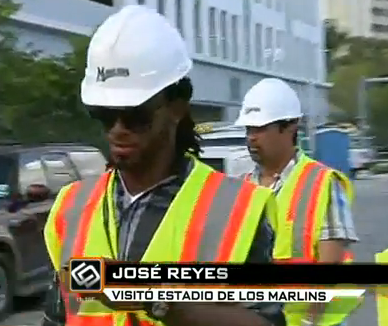
If Jose Reyes becomes a Miami Marlin, we’ll know for sure. We’ll know because multiple reliable sources will report it and we’ll know because you’ll hear me yowling in agony.
But until then, take with a pound of salt any breathless bulletins that exclusively confirm “a done deal,” considering Jose’s only just begun to shop his services — no matter what protective headgear he may don when visiting construction sites.
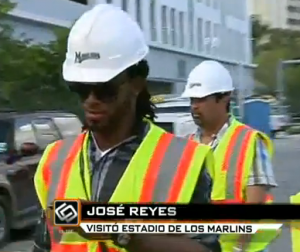 Caution: Falling Rumor Zone. Which doesn’t make this process and its array of unfavorable potential outcomes any less of a nightmare.
Thanks a lot, Wilpons.
by Greg Prince on 9 November 2011 5:42 am “I saw him play.”
“Yeah? What do you think?”
“He was the best. Run, hit, throw…he was the best.”
—Buck Weaver on Shoeless Joe Jackson, Eight Men Out
Listen, I’m supposed to present this award to you: Faith and Fear’s Most Valuable Met for 2011. It’s not a real award, so don’t clear space for it or anything. It’s just something I do every year to put a wrap on the season.
You won the award easy. You won it in June. Now and again it would occur to me that come November I’d have to compose an essay to make it “official,” if you will. I looked forward to it. I always look forward to doing Most Valuable Met, especially in the overall bad years, because it’s something positive to look back on.
I have to admit I’ve been waiting to present this “award” to you ever since I invented it in 2005. You were one of the “finalists” every year the first few years, but there was always someone who embodied the season just a little more. I considered it a great exercise in self-control that I didn’t give it to you in 2006. I wanted to, but Beltran had the big numbers, and since I’d been boosting him for league MVP, I thought I had to honor that.
But that was OK. It wasn’t really a thing in my mind back then. The first couple of MVMs were sort of off the cuff. I didn’t make a thing of it until 2008, really, and that one had to be Johan’s. You understand, I’m sure.
Then you disappeared for most of a year, and weren’t more than 80% yourself the next year. You weren’t really top of mind. You understand that, too, I’m sure.
Finally 2011. You owned it. You owned the heart of it. I can’t imagine your agent doesn’t have all kinds of statistics revealing just how much you accomplished this year and every year — and how much you’re likely to do in the years ahead — but I have to share what I divined anyway, courtesy of Baseball Reference.
From May 24 to July 2, you batted .413. Your OPS was 1.074. You scored 37 runs in 34 games. You collected 62 hits. You stole 13 bases. You tripled 9 times.
And you transcended your numbers. You ascended to that level where nobody wanted to miss a single thing you did on the field. For six weeks, you were the greatest show on turf. You managed to maintain that J. Pierrepont Finch grin of impetuous youth, yet there you were, unquestionably a man in full. You may have been the best Met not named Seaver or Gooden I ever saw. For one of those rare moments across a half-century in the sport, we had the best player in baseball.
Honestly, I don’t think we ever had a better position player over an extended period. I could rattle off a few names and dates, but that wouldn’t help anybody else’s case or dilute yours. Nobody was as exciting as you. Nobody started games the way you did and nobody kept them going the way you would. Nobody was a better advertisement for staying tuned and sticking to one’s seat. Whatever else your teammates were doing — and they did what they could — you were why I wanted to watch the Mets in 2011.
Who am I kidding? You were why I wanted to watch the Mets from 2003 on. You played with a division champion. You played with eight lost souls. It didn’t matter. In my soul, you were the draw for me. You hitting. You running. You not stopping. You until you were a blur…a happy and peppy and bursting with love of the game blur, blazing from home to third and then ninety feet more.
A blur…that was you and that was time, it now occurs to me. How did it get to be nine seasons so soon? How did you get to be our all-time leader in runs scored? How did you land suddenly second to indefatigable compiler Eddie Kranepool in hits? How did June 10, 2003, become more than eight years ago so fast?
This year your blur was epic. Then it receded into injury. Why that keeps happening I don’t know. I was envisioning a 2011 that was going to keep growing in stature until it was the stuff of legend. The year you broke Olerud’s record for batting average. The year you broke Lance’s record for hits. The year you made yourself inarguably indispensable to the fortunes of the franchise. You were going to create a masterpiece so dazzling that the commissioner would have been forced to invoke the “best interests of baseball” clause to keep you from going anywhere else, because how could the Mets — whatever their financial foibles — function without you?
You came back from the first hammy calamity, you groped to find your footing…and it happened again. Another injury. There went the blur. There went the fun. Your teammates had run out of gas by then and you weren’t around to fuel them anymore. So we just waited for you to return a second time, sort of like we did all through and then after 2009…a lot like we did all through and after 2004 and even 2003, come to think of it. A little like we had to do in spots during 2010.
I really wish you hadn’t missed all those games. You’d be ahead of Kranepool by now. More importantly, you’d have had no doubters in high places. You’d have been courted and signed for the long haul. You’d be the Met for life you couldn’t not be. There’d be no questions from a front office that didn’t know what it had in you when it got here. I could hear it in Alderson’s tone a year ago when they asked what he planned to do about his shortstop’s expiring contract. “Who? Him? We’ll see.”
Yeah, he saw. We all saw. We saw the upside. We were reminded of the outside — the trademark, toothsome explosion of joy you effortlessly evinced. You were still that kid from 2003 and 2005 and 2006 and 2007 before it kind of went to hell on you. Yet you were somehow more mature, too. You were 28: timeless and ageless. And, in the heart of 2011, you were as healthy as you were vibrant.
Except there’s a portrait of your hamstrings in a storage facility somewhere in Corona and those suckers got old fast. Hearing about them did, at any rate. Nobody here wanted to think about the parts of you that weren’t indestructible. We preferred your smile. Your flying dreadlocks. Your facefirst slide into whatever base came next. Your infectious clapping from the dugout. Your blur. Your June. All of that felt impervious to danger.
Your hamstrings were another story. They were a story we chose to put aside as you wrote a new lede in the final weeks of 2011. You weren’t in Olerud/One Dog territory anymore, but son of a gun, you were still the hittingest hitter in all the National League. You were leading in batting average. We all agreed to suspend our cynicism toward a statistic that proves more and more hollow the deeper one drills into it because, quite frankly, it was the neatest title any Met had ever pursued. It may not have been complex or sophisticated, but when we were growing up, it had it own baseball card and its own listing in the papers — the leaders every day, and everybody on Sunday. No Met had ever headed that listing. But you were going to.
And you did. You did it with an uncharacteristically klutzy flourish on the final day, but I’ve already pretended to forget about that. The point is you won the title. You were the National League Batting Champion of 2011. You hit .337 the year after you hit .282. You did it in less than ideal physical condition. You didn’t triple after July 21 (yet tied for the league lead with 16). You tried to steal only once between August 31 and September 22 (but still finished sixth in the N.L. with 39). Your legs…your business partners…didn’t cooperate, but you overcame.
Which brings us to the presentation of this award, usually a pleasant distraction from the gaping maw of November and the fact that the Mets tend to come up empty where real awards are concerned. Like I said, I was looking forward to this little annual ritual of mine, but honestly, it’s been difficult getting to this point. I can’t think of what you’ve done without thinking of what your next move might be, and whether the Mets will cooperate with you any more amenably than your legs did in the second half of the season. And, to be perfectly frank, I can’t swear to just how much cooperation in the form of a lucrative multiyear contract is reasonable.
If money were no object…never mind that fantasy. Money is an object, one that likely eludes the grasp of the owners of this franchise (thanks to their most infamous business partner). I don’t know how New York City became Kansas City, but it apparently has. Nobody really believes you’ll be back to defend your batting title or run out more triples or give us something we can’t take our eyes off in 2012 and beyond. I don’t really believe it anymore, though I’d be happy to be wrong very soon.
If they don’t sign you, there will be moments, perhaps lots of them, when it will make all the sense in the world, but there will be at least as many moments — unquantifiable yet emotionally tangible — when it will be the worst idea in the world. The thought of the Mets without you is why this award presentation has been difficult for me to pull off. I can’t even bring myself to inject your name into this discussion. It’s like if I put it out there, forces will align to take it away from me.
I didn’t become a Mets fan to endure indeterminate stretches of being less happy than I’ve been previously. I’ve put up with those inevitable downturns on principle; or out of loyalty; or maybe just because I have too many clothes featuring too many Mets logos to start over. But these days I’m having a tough time reconciling my diehard tendencies with the notion of the Mets plodding along without you. I don’t look forward to rooting for a Mets team that doesn’t have you. It wasn’t much fun doing it when you were on the DL, but at least then we knew you were coming back.
By the way, you can decide to take less money to stay here. That is if you like it as much in these parts and in this dead-end organization as you’ve indicated you do. I wouldn’t necessarily do it if I were in your position. I don’t plan on becoming one of those creepy fans who writes to 29 strange teams declaring he’s a free agent, but except for habit and a lifetime of devotion, I can’t think of a good, rational reason to get squarely behind this team if you’re not on it.
You, on the other hand, were the best, most rational such reason for nine seasons, especially last season. That’s why I’m going through the formality of informing you that you’re Faith and Fear’s Most Valuable Met for 2011, from when “valuable” didn’t need to be assessed with a dollar sign.
We experienced it for ourselves day after day. If we don’t experience it anymore, I am going to miss it too much for words.
FAITH AND FEAR’S PREVIOUS MOST VALUABLE METS
2005: Pedro Martinez
2006: Carlos Beltran
2007: David Wright
2008: Johan Santana
2009: Pedro Feliciano
2010: R.A. Dickey
Still to come: The Nikon Camera Player of the Year for 2011.
by Jason Fry on 3 November 2011 8:44 am For once the actual weather matched the spiritual forecast: A day after a thoroughly entertaining World Series that featured a Game 6 for the ages, the East Coast got walloped by a blast of snow, slush and mess. The mess is gone but it’s still cold, and on some essential level it will stay that way until mid-February or the beginning of March or Wednesday, April 4 or Thursday, April 5.
By the end of 2011 I was tired, and it wasn’t so bad to have the Mets go away for a little while. It had been a tiring conclusion to the season, and I think we all sense it will be a tiring off-season, full of dispiriting talk about Jose Reyes and payrolls and most likely a slow-dawning acceptance that the Mets’ salvation will need to either come from within or await a change in ownership. Yet during the league championship series I found myself wrestling with a different cross for us to bear.
I’m referring, of course, to the disfigurement of The Holy Books by horizontal baseball cards.
For the uninitiated: I have a trio of binders, long ago dubbed The Holy Books (THB) by Greg, that contain a baseball card for every Met on the all-time roster. They’re ordered by year, with a card for each player who made his Met debut: Tom Seaver is Class of ’67, Mike Piazza is Class of ’98, Jose Reyes is Class of ’03, etc. There are extra pages for the rosters of the two World Series winners, including managers, and one for the 1961 Expansion Draft. That includes the infamous Lee Walls, the only THB resident who neither played for nor managed the Mets.
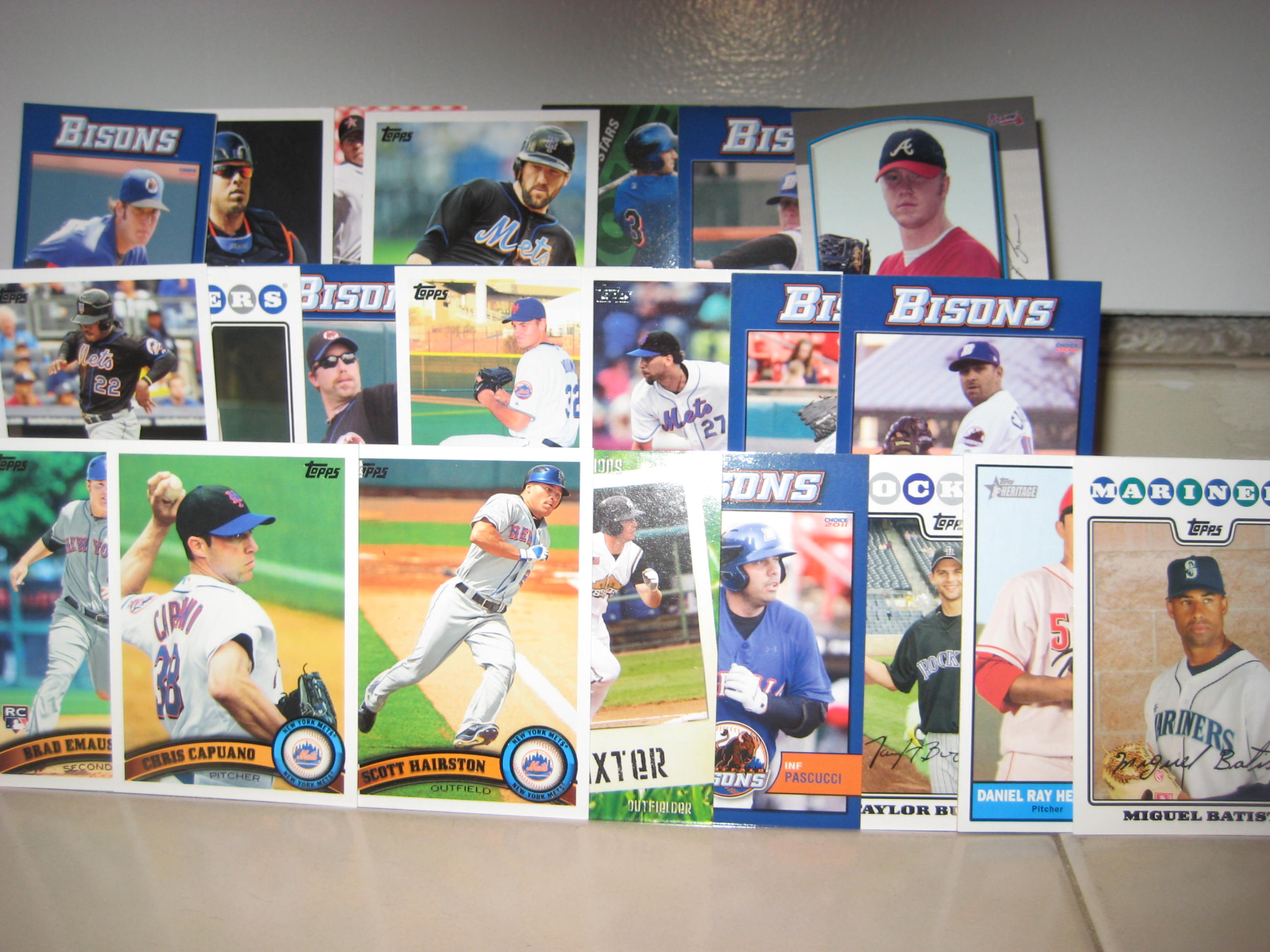
If a player gets a Topps card as a Met, I use that unless it’s truly horrible — Topps was here a decade before there were Mets, so they get to be the card of record. (Though now there’s an exception to this rule. Read on.) No Mets card by Topps? Then I look for a Bisons card, a non-Topps Mets card, a Topps non-Mets card, or anything else. Topps had a baseball-card monopoly until 1981, and minor-league cards only really began in the mid-1970s, so cup-of-coffee guys from before ’75 or so are tough. Companies such as TCMA and Renata Galasso made odd sets with players from the 1960s — the likes of Jim Bethke, Bob Moorhead and Dave Eilers are immortalized through their efforts. And a card dealer named Larry Fritsch put out sets of “One Year Winners” spotlighting blink-and-you-missed-them guys such as Ted Schreiber and Joe Moock.
Then there are the legendary Lost Nine — guys who never got a regulation-sized, acceptable card from anybody. Brian Ostrosser got a 1975 minor-league card that looks like a bad Xerox. Leon Brown has a terrible 1975 minor-league card and an oversized Omaha Royals card put out as a promotional set by the police department. Tommy Moore got a 1990 Senior League card as a 42-year-old with the Bradenton Explorers. Then we have Al Schmelz, Francisco Estrada, Lute Barnes, Bob Rauch, Greg Harts and Rich Puig. They have no cards whatsoever — the oddball 1991 Nobody Beats the Wiz cards are too undersized to work. (I no longer want to talk about Schmelz, the White Whale of my Metly Ahabing.) The Lost Nine are represented in THB by DIY cards I Photoshopped and had printed on cardstock, because I am insane.
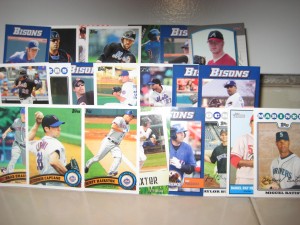 Not a horizontal in sight. During the season I scrutinize new card sets in hopes of finding a) better cards of established Mets; b) cards to stockpile for prospects who might make the Show; and most importantly c) a card for each new big-league Met. At season’s end, the new guys get added to the binders, to be studied now and then until February. When it’s time to pull old Topps cards of the spring-training invitees and start the cycle again.
Now, about those horizontals. Periodically card companies get cute and shake things up with a horizontal card to lend their sets a certain variety. I have always hated these and replaced them as quickly as possible. Yet sometimes no replacement emerges, and a horizontal sneaks into THB.
This started to bug me this year, when Topps gave Justin Turner a much-deserved update card and it turned out to be a horizontal. Turner already had a normal Mets card from Upper Deck, but I was still annoyed — and before I could stop myself I’d launched a horizontal witch hunt. Crummy horizontals for Robert Person and Carlos Baerga were simple to ditch in favor of vertical Mets cards; ditto for Topps non-Mets horizontals of Rich Rodriguez and Jim Tatum. More problematic were Pat Mahomes, Mike Remlinger, Tony Phillips, Manny Alexander and Rodney McCray, all of whom got horizontals for their lone Mets cards. On the JV front, Chris Carter and the immortal Andy Green have horizontal Buffalo Bison cards.
Out with all of them, I decided. Better Manny Alexander right side up in an Orioles uniform than sideways looking like he’s about to make an error while wearing a Mets ice-cream hat. It took me some web searching and a few PayPal transactions, but a week later the Mets horizontals were reduced to zero, and all was briefly better about the world. Except, perhaps, for having to know that you actually are the kind of person who buys three Rich Rodriguez cards and then agonizes over which one is the best.
Anyway, previous annals of the THB roll calls are here, here, here, here, here and here. And now welcome to the first class of the Alderson regime. Are they heralds of a better era, or standard bearers for the new austerity? Ask us in a few years.
Miguel Batista: A wily veteran with a largely improvised repertoire and an professorial bent, Batista is a published author whose oeuvre includes poetry, philosophy and thrillers. Unfortunately, baseball only permits one niche per team/fanbase for “intellectual player whose reading material doesn’t prominently feature pictures of naked women,” and R.A. Dickey has that slot filled. So we pretty much ignored Batista’s off-field interests. The man pitched a two-hitter on the final day of the season, but that was the day Jose Reyes won the batting title and Terry Collins flubbed his likely Mets farewell. So we pretty much ignored Batista’s superb on-field effort, too. Unfair, but sometimes life’s like that. Batista arrives in THB with a 2008 Topps card in which he is contemplative and a Mariner.
Mike Baxter: Baxter hails from not too far east of Citi Field, and attracted a big cheering section for his Mets debut. His first at-bat was a double, albeit one given a little help from Kyle Blanks’s incompetent outfield play, and sent his friends and family into near-Citi orbit. It’s a small memory from 2011, but a nice one — one that will linger even if Baxter does not. Baxter gets an oddly martial 2009 San Antonio Missions card.
Pedro Beato: Another local boy, Beato pitched well enough at times to justify his Rule 5 status but poorly enough at other times to remind you that he’d have been sent down if not for that status. Worth it as a medium-term investment, and deserves a place in our hearts for telling reporters he hated the Yankees instead of blathering about tradition or pinstripes or the quiet leadership of Derek Jeter. Series 2 Mets card.
Blaine Boyer: Former Brave got axed early in the season after a couple of not good outings. Being a journeyman middle reliever is like being a competitive skater, only you start out with a broken shoelace, indifferent judges and nobody particularly caring that the ice is thin and/or missing in spots all over the rink. Stuck, probably forever, with a 2001 Bowman card.
Taylor Buchholz: Buchholz went on the DL at the end of May with shoulder fatigue, but stayed there because he was battling depression. Not so long ago, the Mets’ reaction to Ryan Church sustaining a concussion was basically to tell him to man up; this year, faced with something that might have seemed more ephemeral, they did far better. Kudos to the Mets for understanding that depression is real and nothing to minimize or mock, and kudos to Buchholz for being forthright about what he was facing. In some small way, that will help people trying to deal with depression know they’re not alone and don’t need to feel ashamed, just as it will encourage people who still dismiss depression as weakness or malingering to think again. Here’s hoping Buchholz gets better; in one sense, the Mets already have. If you want a lighter note, well, Buchholz gets a 2009 Topps card in which he’s apparently about to get mugged by a mascot.
Tim Byrdak: Some of Sandy Alderson’s moves worked and some didn’t. This was one of the ones that did. Byrdak proved more than capable stepping into Pedro Feliciano’s role, earning himself a one-year extension, and showed signs of a personality by videobombing reporters’ stand-ups to amuse himself. 2009 Upper Deck card in which he’s an Astro pitching in front of a sea of empty seats.
Chis Capuano: One of Alderson’s two rolls of the post-injury dice at the back of the rotation, Capuano exceeded expectations, giving the Mets a mix of mostly serviceable starts. Granted, “serviceable” isn’t a particularly exuberant accolade. Lots of Capuano’s starts followed a predictable pattern: He’d look good early, then get nicked for an unlucky run or two, then crash and burn. In late August, though, he faced one over the minimum while fanning 13 Braves. Using the Bill James Game Score metric, it was the best pitching performance in the big leagues in 2011, the best Mets performance since David Cone eviscerated the Phillies at the end of 1991 and the equal of Tom Seaver in the Jimmy Qualls Game. (You probably won’t guess who’s No. 1 in club history, though he was mentioned in a recent Happy Recap.) Still, one game does not a season make. Capuano did better than might have been expected, but the idea of asking him for more in 2012 makes me cringe. Series 2 Mets card.
D.J. Carrasco: Early in the year I decided I liked D.J. Carrasco. He wore his socks high and his utilitarian, vaguely tragic face reminded me of Jesse Orosco’s. Plus he had the guts of a burglar, as I declared after he escaped one encounter with the Marlins. Subsequent outcomes suggested Carrasco in fact had the guts of a burglar who kept wearing highlighter yellow and breaking into houses while people were there. Oh, and he’s signed for another year. A middle reliever having a bad campaign isn’t the end of the world, but ouch. Carrasco got a 2011 Bisons card, which he thoroughly earned.
Brad Emaus: Named Opening Day second baseman after a frustrating spring training in which he was essentially the tallest midget, Emaus showed so little with bat or glove that Alderson sent him packing after just 14 games. It was a weirdly hasty execution, but the Mets came out OK: Daniel Murphy, Justin Turner and Ruben Tejada all played more than capably at second. A position where the Mets had next to nothing for the last several years now has a logjam of players, yet more proof that we’ll never figure out baseball. And this is probably the first time you’ve thought of Brad Emaus since May. Got a 2011 Topps Series 2 card despite being Rockies property by then.
Scott Hairston: If Emaus demonstrated impatience can be a virtue, Hairston served the more traditional role of demonstrating the opposite. He started abysmally, but finished the year as a useful bench guy and genuine pinch-hitting threat. Will probably move on for 2012, but did his job. 2011 Topps Update card.
Willie Harris: Deprived the Mets of approximately 462 late-inning comebacks while playing for the Braves and Nationals, making the addition of his glove for 2011 a no-brainer. Unaccountably, Harris then started the year showing little flair on defense, leading to an epidemic of moaning about how these things always happen to us. (But, seriously … it’s weird, isn’t it?) As with Hairston, Harris hung in there to have a pretty good second half. Could return and we’d probably welcome him back. 2011 Topps Update card.
Daniel Herrera: The principal PTBNL in K-Rod’s trade to Milwaukee, Herrera was about four feet tall, had a Muppetesque mop of hair and pulled his cap down so low that it was a week before you could verify he had eyes. And he didn’t want to be called Danny. All that was endearing; so was the fact that he pitched pretty effectively, admittedly in garbage-time conditions. 2010 Topps Heritage card on which he’s a Cincinnati Red.
Chin-Lung Hu: His early billing as a good-glove no-bat shortstop proved half-right. Some Topps Dodgers special-issue card I got God knows where.
Mike O’Connor: Former National qualified as a warm body, didn’t merit a September call-up, and filed for free agency. Will possibly catch on somewhere and elicit an “Oh yeah, I forgot about that guy…” sometime next summer. 2011 Bisons card.
Valentino Pascucci: Last seen in the final Expos game, Pascucci earned a trip back to the big leagues after being a folk hero for stats-minded fans in recent years at Buffalo. Resembled Andre the Giant’s character in The Princess Bride, with the caveat that Fezzik seemed faster. Struck a decisive blow in a late-September game in which it looked like R.A. Dickey would lose a 1-0 non-no-hitter to Cole Hamels. Fezzik’s no-doubter of a blast into the left-field seats put an end to that talk; in the replay you can see me standing and whooping in the background while my kid races (in vain) for the HR ball. Those are reasons enough to remember Big Papa fondly in the Fry house. Trivia: Was first Met to wear No. 15 after Carlos Beltran. I still think the number was reissued with shameful speed, but that’s not Pascucci’s fault. 2011 Bisons card.
Ronny Paulino: Backup catcher. Won some plaudits for keeping Mike Pelfrey semi-focused at times. Fainter praise would actually be invisible. Sorry, I really was trying, but hey, he was the backup catcher. The backup catcher is generally a wise old veteran who briefly earns raves for straightening out some spooked-horse starter, flirts with taking the starter’s job, then proves there’s a reason he’s a backup catcher and is soon replaced. Where have you gone, Todd Pratt? 2011 Topps Update card.
Jason Pridie: Decent fourth-outfielder type, capable enough as a bench player and defensive replacement. Stunned everybody with a shot most of the way up the Pepsi Porch one night in the dregs of an otherwise anonymous game. I wonder if he’ll ever do that again, or if he just hit it perfectly that one time. Either way, I bet it was fun and at odd moments for the rest of his life Pridie will remember that one and smile. 2011 Topps Update card.
Josh Satin: No, not Josh Stinson. Might have generated more excitement if he weren’t basically Daniel Murphy, a promising hitter with no position. Emily thought he desperately needed a significant other who’d convince him of the wisdom of trimming his eyebrows. His THB card is some weird Topps issue proudly noting that he’s a Single-A All-Star.
Chris Schwinden: Watching this lumpy, sweaty pitcher with awkward mechanics and indifferent stuff, it was all I could do to keep from screaming, “ISN’T IT OBVIOUS THIS GUY IS NOT A MAJOR-LEAGUER?!!!” There are so many reasons I should shut up, including the fact that I don’t look that good even by the low standards of guys who type all day and the fact that the last player I had this kind of caveman reaction to was Heath Bell. If Chris Schwinden would like to make me look stupid for the next decade, he’s welcome to do so. 2011 Bisons card.
Josh Stinson: No, not Josh Satin. Pitched pretty well before the return to the statistical mean knocked him for a loop. Given his recent arrival, both on Earth and in the big leagues, the jury should remain out for a couple of years. 2011 Bisons card.
Dale Thayer: Porny mustache deserves some kind of praise. And so: I praise your porny mustache, Dale Thayer. 2011 Bisons card.
Chris Young: Gigantic, affable Princeton grad thrived in the early going, spinning terrific games against the Pirates and Nats before holding the Phillies at bay for seven shut-out innings in Citizens Bank Park on May 1, leading to Kevin Burkhardt staring at Young’s clavicle while the pitcher smiled pleasantly and spoke into a mike above Burkhardt’s head. Unfortunately, it was Young’s last start of the year — shoulder woes wiped out the rest, and possibly his career. 2011 Topps Series 2 card.
by Greg Prince on 2 November 2011 11:53 am Welcome to the final installment of The Happiest Recap, a solid gold slate of New York Mets games culled from every schedule the Mets have ever played en route to this, their fiftieth year in baseball. We’ve created a dream season that concludes here with the “best” 162nd game in any Mets season and the “best” 163rd game in any Mets season, thus completing a schedule worthy of Bob Murphy coming back with the Happy Recap after this word from our sponsor on the WFAN Mets Radio Network.
GAME 162: October 3, 1999 — METS 2 Pirates 1
(Mets All-Time Game 162 Record: 20-18-1; Mets 1999 Record: 96-66)
The Mets held their destiny in their own hands. What a frightening thought.
Less than 24 hours earlier, the Mets’ chances of attaining their first postseason berth in eleven years was, by necessity, a collaborative effort. They needed help — not the same kind their emotionally overwrought fans needed, but a more decisive kind. They needed one of the teams playing their rivals for the National League Wild Card to come up big on their behalf. They needed either the Milwaukee Brewers or the Los Angeles Dodgers to win a game. The Brewers were taking on the Cincinnati Reds; the Dodgers were going up against the Astros. When Saturday, October 2, began, both the Reds and Dodgers led the Mets by a single game. That gap had to be trimmed by half if the Mets’ Saturday night contest versus Pittsburgh was going to mean much of anything.
One of the two Mets’ new bunch of best friends in the whole world did them the solid of the century as 1999 neared its close. The 73-86 Brewers, a National League outfit all of two years, rose up and smote the 95-65 Reds on Saturday, 10-6, making it two consecutive times that Cincinnati stumbled versus non-contending Milwaukee. The Brewers put the Reds away with seven third-inning runs, as 23-year-old rookie Kyle Peterson chalked up his fourth major league win.
The cheering in New York could be heard all the way back to Wisconsin.
Peterson’s more than serviceable 6.2 innings of work — backed by two RBIs apiece from Marquis Grissom, Jeff Cirillo, Jeromy Burnitz and Ronnie Belliard — constituted the greatest gift Milwaukee presented New York since it began shipping Miller High Life east. Though Kyle Peterson’s name never, ever comes up in any retelling of New York Mets history, his Saturday afternoon win at County Stadium stands as the most important out-of-town bulletin ever to go up on the Shea Stadium scoreboard.
There it was that Saturday night, a crisp CIN 6 MIL 10 for 36,878 to see and savor. Peterson and the Brewers had pulled the Mets to within snatching distance of Cincinnati’s now half-game Wild Card lead. While any and all help would be appreciated Sunday, it was no longer required. If the Mets could, per serious-sounding sports jargon, take care of business, they could not be stopped in their quest to extend their season. Everything they and their followers dreamed of was now within their grasp.
Welcome to invasion of the Wild Card snatchers. As long as they did their part and didn’t play like zombies, the Mets were on their way to the playoffs.
Which was the frightening part, since they were on their way to the playoffs two weeks earlier and proceeded to blow it like crazy with a seven-game losing streak that made every Mets fan a fatalist. But they righted themselves just enough — two wins in their past three games — to benefit from the moment that Cincinnati suddenly decided to cease being Red hot. Cincy had forged a six-game winning streak more or less concurrent with the Mets’ losing ways. They were in first place in the N.L. Central a few nights earlier. Everything was going their way.
And then it started turning in the other direction. The Astros passed the Reds for first. Then the Reds fell twice to the Brewers as the Mets beat the Pirates once and prepared to play them again. The hottest team in baseball went cold.
It was time for the Mets to take an ice pick to them, via Pittsburgh.
On Saturday night the Second of October, the Mets unleashed a lethal weapon upon the Pirates. His name was Rick Reed, and he pitched only the game of his life. Against the team for whom he began his major league career eleven years earlier (and for the team he beat in his 1-0 besting of Bobby Ojeda on ABC’s Monday Night Baseball), Reed propelled the Mets while his teammates scuffled to figure out Francisco Cordova. Through six scoreless innings, Reeder allowed only two hits while striking out nine Bucs. Cordova wriggled out of a bases-loaded jam in the second and kept the Mets off the board until the bottom of the sixth.
Then the Mets caught up with the opposing pitcher and gave their own all the support he’d need. Aided by two Pirate errors, the Mets scored a pair of runs, the first on Robin Ventura’s 119th run batted in of the year. Ice cold for two weeks, Ventura was now steaming toward the finish line, having homered the night before in advance of winning the game on his eleventh-inning walkoff single. Only Mike Piazza had more RBIs in any one Met season now, and that was OK, ’cause that season was 1999, and the more records the Mets set, the better.
Up 2-0, Reed resumed picking apart the team that gave up on him at the end of Spring Training 1992. The Pirates weren’t the only ones. The Royals, the Rangers and Reds all had him and dropped him. He fell into Bobby Valentine’s lap at Norfolk in 1996 and Bobby brought him to New York in 1997, the first time Reed — by then 32 — had made a team’s Opening Day roster. Soon enough he made everybody look shortsighted for passing on him as he compiled a 13-9 record with a 2.89 ERA and fabulous control for the resurgent ’97 Mets. A year later, he was a National League All-Star. A year after that, at its critical end, the game of his life continued. Rick breezed through the tops of the seventh and eighth, nursing his 2-0 lead toward the finish line.
The Mets finally made it a breathable Saturday night when they added five more runs to their line in the bottom of the eighth. Reed drove in the first two, Piazza the last two, on his 40th homer, to up his franchise-best RBI to 124. Thoroughly bolstered, Reed pitched the ninth to its logical conclusion: a leadoff single to Adrian Brown for the third Pittsburgh hit of the night, a Brown-out double play grounder courtesy of Al Martin, and Abraham Nuñez looking at the twelfth strikeout of the night.
It was a 7-0 win for Reeder and a tie in the Wild Card standings for the Mets.
“It’s pretty cool, I guess,” the master of both the Pirates and understatement said before upping the assessment. “It’s awesome. This is a chance for us to make the playoffs. I know this organization has wanted it for how many years and I know there’s a lot of guys in here that are wanting it, and I’m one of them.”
“DREAM ON!” blared the front page of Sunday’s Daily News, but not in a smart-alecky fashion. The dream that the Mets could overcome their long odds and land somewhere besides home for winter was a dream that was still on, as the sub-head explained:
“METS WIN, CAN CLINCH PLAYOFFS IN FINAL GAME TODAY”
“Right now,” Rick confirmed, “we have to win one more game.”
Reed’s prognosis was a little more on-the-money than the News’s. Yes, the Mets could clinch a playoff spot in their 162nd game of the season, their finale against the Pirates, but the end result was available to them only if the Brewers continued to serve as their wingmen. Should Milwaukee finally ease up on Cincinnati, there could be no clinch — but as long as the Mets win, there’d be a tomorrow, a 163rd game to determine the Wild Card in a head-to-head matchup at Cinergy Field in Cincinnati.
But that was a world away in the Mets’ concerns going into Sunday. They had to win right here, right now. They had to beat Pittsburgh one more time. A loss would leave their fate to others. No, that wouldn’t do. Their hand was at last on the wheel of their own destiny. It hadn’t worked for them when they spiraled into their nearly lethal seven-game losing streak and it wasn’t any help a year earlier when a five-game losing streak left them on the sidelines as the Cubs and Giants engaged in one of those so-called play-in games. Yet it was, all things considered, still their best option.
Win today, and no matter what happens, there’s another game in their immediate future.
If Cincinnati wins and Houston loses…never mind all that. Just win today. Just win today.
The last time the Mets made good on a playoff opportunity, their road to a second world title in three years ended at the hot, hot hands of Orel Hershiser, the MVP of the 1988 National League Championship Series. The Dodger righty, who had come into that postseason riding a mind-boggling streak of 59 scoreless innings, earned his first chunk of postseason hardware by snuffing out the Mets in the seventh game of a series that was supposed to be in the New York bag but almost never felt not destined to go L.A.’s way. Hershiser hadn’t been overly suffocating in his Game One and Game Three starts (both pulled out by the Mets), but his twelfth-inning appearance in Game Four, flying out Kevin McReynolds with the bases loaded to nail down a 5-4 win was as strong a signal as Mike Scioscia’s tying home run off Doc Gooden three innings earlier that this thing was turning toward the Dodgers.
Come Game Seven, it was all Hershiser all the time: five hits, two walks and not a single Met run. With two outs in the ninth, and the Dodgers ahead by six, Howard Johnson stood bone-still on a three-two pitch to end the night, the postseason and the Mets’ final shot at a World Series for more than a decade. Beatific Orel Hershiser (who found a moment to drop to a knee and thank the Lord before embracing his catcher Scioscia) had his fifth strikeout and the enmity of every Mets fan. He was Mike Scott. He was Bruce Hurst. He was worse, actually. Unlike those guys, who merely threatened to derail the 1986 Mets, Hershiser had actually ushered the Mets from the Promised Land.
It’s hard to decide what a crestfallen Mets loyalist would have decided would have been more unbelievable on the dark night of October 12, 1988: That the Mets wouldn’t make the playoffs for at least another eleven years or when the moment came to push them toward that elusive goal, the starting pitcher for the Mets would be 41-year-old Orel Hershiser, no longer a Cy Young or MVP candidate, but a most grizzled veteran (the oldest hurler in the N.L. in 1999, by two years over teammate John Franco) who had figured out how to win 13 games despite an ERA well over four.
His opponent in this very different October was a pitcher at a very different stage of his career. Kris Benson was completing his rookie campaign three years after being drafted No. 1 in the nation by the perennially high-drafting Pirates. In that same first round of 1996, other teams selected from among the likes of Braden Looper, Billy Koch, Mark Kotsay, Jake Westbrook, Travis Lee, Eric Chavez and R.A. Dickey; the Mets picked 13th and selected slugging high school outfielder Rob Stratton. The Pirates considered Benson the most attractive of all.
This rookie righty wasn’t quite at the developmental level of Tom Seaver in 1967 or Dwight Gooden in 1984, but Benson was giving the Pirates that currency of late ’90s pitching: innings. He’d thrown almost 190 of them entering Sunday, second on the staff to ace Jason Schmidt. His won-lost record (11-14) wasn’t quite as good as Hershiser’s (13-12), but his ERA was several ticks better (4.22 versus 4.66) and, besides, Hershiser was pitching for a contender. The Pirates were still a high-drafting outfit heading toward 2000. Kris had less to work with — and he had a future. He wouldn’t be 25 until November. The young stud vs. old pro storyline was irresistible.
And for what it was worth, Benson and Hershiser had crossed paths once before, on July 27, also at Shea. It was the instantly infamous Mercury Mets game, the night the Mets turned the clock forward to (if sponsor Century 21 was to be believed), 2021. The Mets and Pirates both wore absurd uniforms, though the Mets’ all-in approach (rebranding their home planet; Photoshopping Rickey Henderson’s DiamondVision photo so he’d sport three eyes) is what won the Mets a judgmental round of derision from all concerned. The still-pious Hershiser was among those who didn’t care for the gimmick. He hoped “the Man upstairs” wouldn’t be too unhappy with the vaguely demonic symbol on his cap, and he didn’t seem to be kidding.
In the middle of all that Veeckian wreckage, Kris Benson outpitched Orel Hershiser, defeating the Mets of Mercury, 5-1. If he wasn’t otherworldly, Benson’s first complete game in the majors served notice, perhaps, that he was the kind of pitcher the Mets wouldn’t want to encounter with everything on the line.
Too bad. It was October 3, and if the earthbound Mets intended to break the surly bonds of the regular season, they’d have to beat Benson and/or his bullpen. If Hershiser could summon the ghosts of 1988, all the better.
As had been the case for the first two-thirds of the first two games of this series, starting pitching eclipsed just about all hitters. Hershiser, coming off a beatdown versus the Braves (he lasted only a third-of-an-inning), wasn’t touching off any scoreless steaks in the first, as the Pirates built a run on a walk, a bunt, a steal and a Kevin Young single. But he tamped down what was left of the Pirate attack for the next four innings. Whether Benson was baffling or the Mets were extremely tight, the Mets stayed behind 1-0 until the fourth. A Young error allowed John Olerud to reach second as a leadoff runner and Darryl Hamilton drove him in to knot the score at one.
Benson and Hershiser engaged in their battle for the ages, so to speak, until the sixth when a one-out Martin double compelled Valentine to remove Orel for Dennis Cook. Hershiser may not have quite rekindled his devilish magic from 1988, but two hits and two walks over 5⅓ innings was about as perfect as Mets fans could hope for from the oldest pitcher in the league. Cook and Pat Mahomes combined to extricate the Mets from any problems in the top of the sixth.
In the bottom of the inning, the Mets challenged Benson. Ventura and Hamilton singled, and Rey Ordoñez walked to load the bases with two out. The best pinch-hitter Valentine had was a Matt Franco, and there was no better juncture to use him, with the pitcher’s spot up next. Alas, there was no worse result than when Franco popped foul to third baseman Aramis Ramirez.
The top of the seventh belonged to the Mets’ fourth pitcher of the day, Turk Wendell, who set down the Pirates in order. Benson was still on in the seventh when Rickey Henderson led off as Rickey Henderson had been doing regularly since 1979: by getting on base. Rickey lined a single to right, but in a concession to his 40-year-old calves (one of which was cramping), he was pulled for rookie pinch-runner Melvin Mora. Mora, whose favorite player during his Venezuelan childhood was the mercurial Henderson, had nowhere to run, however, as Benson flied out Edgardo Alfonzo and Olerud before striking out Piazza with what became his 120th and final pitch of the day.
Kris Benson had outlasted Orel Hershiser, as 24-year-olds will do to 41-year-olds, but he only pitched him to a draw: each man allowed one run and each man was leaving his business to be finished by others. Wendell remained the Mets’ pitcher in the eighth and he stayed tough, retiring the Bucs in order again. Jason Christiansen replaced Benson, and it’s hard to say if the Mets noticed the difference. They made two quick outs, drew some hope from a Benny Agbayani pinch-walk but then watched Ordoñez ground to first to end the inning.
On to the ninth, with the Mets and Pirates still tied, 1-1. In Houston, the Astros were in the midst of clinching their division, thus altogether removing themselves from the National League Wild Card equation. In Milwaukee, nothing was doing in any sense of the word. Rain fell on County Stadium. On a less contentious final Sunday afternoon of the schedule, the Brewers and Reds would shake hands and get a leg up on their hunting and fishing. But the Brewers would have to wait around because the game was going to mean everything to the Reds, no matter what the Mets did.
What the Mets were doing in the interim was continuing to hold off the Pirates, though that, like the entirety of their 1999 season, insisted on getting interesting. Turk retired his seventh and eighth consecutive batters before succumbing to Young, who lined a single to left. Valentine opted for his hardest thrower, Armando Benitez. As Armando got used to the mound, Young stole second. The batter, Warren Morris, was intentionally walked to put two on with two out. With a shot at giving the Pirates a lead that might have devastated the Mets’ post-October 3 plans, Ramirez struck out on four pitches.
Gene Lamont brought in Greg Hansell to pitch. Bobby Valentine sent up a wishful thought to hit. His name was Bobby Bonilla, having, all things considered, one of the worst seasons any Met had ever had. The .161 batting average and the four months since his last home run was the least of it. Bonilla was a Grade-D distraction all year long, pouting, sulking, bickering and in no way contributing to a team that was tied in the ninth inning of the 162nd game of a season in which it was tied for a playoff spot. Had Bonilla produced just a little more positively, the Mets might already be in the playoffs. But Bonilla was a net negative in 1999.
Yet there he was, the Mets’ first hope of potentially their last inning. He was once a superstar, the biggest name in the free agent winter of 1991, when the Mets, desperate to make a splash, threw a ton of money at him and he declared how much he had always wanted to be a Met. That was a long time ago. Bonilla had since wound his way through Baltimore, Florida and Los Angeles. He was a Met again only because the current general manager wanted to get rid of one onerous contract (Mel Rojas’s), so he accepted a different one. Bonilla plainly wasn’t worth it.
Wasn’t it about time he was? That was the sense 50,111 at Shea maintained as they did a veritable restart on the hard drives of their memories. Clearing away everything they knew about Bobby Bonilla’s futile 1999, they stood as one and applauded their former two-time All-Star in the hopes that he could take one big swing and create a game-ending scene that would make Kirk Gibson scoff in disbelief. Bobby Bo had authored 277 home runs since 1986. How about one more right now?
It was a great idea, but no. Bobby let ’er rip, but all that occurred was a grounder to first for the first out of the ninth. Most of Shea applauded the effort. That Bonilla could elicit any semblance of good feeling was pretty unbelievable by itself.
Maybe those good vibes were the kickstart karma required to push the Mets toward life after 162 games. Next thing Shea saw, Mora, the pinch-runner who stayed in the game and shifted at Valentine’s will from left to right and back to left, singled to right for the fifth hit of his major league career. Alfonzo, the club pro, also singled to right, sending Mora scooting to third. Olerud, whom nobody called the silent assassin but they could have, had to be intentionally walked here. Even if it meant Mike Piazza and his club record 124 RBIs were up next.
Lamont did what he had to do. He had Hansell pass Olerud and he replaced Hansell with Brad Clontz, a Met for barely more than a minute in 1998, but nevertheless a former Met who looked at his ex-mates on the precipice of playoff ascension and “wanted to beat them bad”. Chances are most in the finger-crossing, rally-capping crowd had probably forgotten him if they were ever aware of him at all. But one person in blue and orange was plenty Clontz-conscious.
“I played with him,” Mora reflected upon noticing his Tide teammate from the season before was warming up, “and I knew he would throw the ball at the dirt. I was thinking wild pitch because I knew he wasn’t going to throw nothing around the plate to Piazza.”
Ladies and gentlemen, meet the prophet Melvin Mora. Oh, here he comes now, as described by Gary Cohen:
Well, the hope for the Pirates is they get Piazza to hit a ground ball at an infielder who would be able to turn a double play and get through the inning.
The infield will play halfway. The outfield will play only as deep as they can throw, a fly ball will win the game, with Mora standing at third base.
Alfonzo at second, Olerud at first.
Piazza stands in, oh-for-four on the afternoon.
Clontz is ready to go, pitching off the stretch. DEALS to Piazza. Low and outside, IT GETS AWAY! ONTO THE SCREEN!
MORA SCORES! THE METS WIN IT! THE METS WIN IT!
Mora is MOBBED by his teammates as he crosses home plate! Brad Clontz BOUNCED the first pitch up onto the SCREEN! Melvin Mora scores the winning RUN! The Mets win in game number one-hundred sixty-TWO, and the Mets will play again in Nineteen Ninety-NINE!
The Mets win it their final turn at bat, they win it two to one on a WILD PITCH by BRAD CLONTZ, and they’re going crazy here at Shea!
All the Mets out on the field, exchanging HIGH-FIVES and hugs. The Mets have played a hundred and sixty-two GAMES, they now lead the Wild Card by a half-a-game, waiting on CINCINNATI, scheduled to play in Milwaukee, waiting for the raindrops to cease, and it may be a long night before we know where the Mets are going, Bob, but now we know they’re goin’ somewhere.
Indeed, as Gary told Bob Murphy, the journey of the 1999 Mets was continuing. Once the rain stopped, the Reds would play. No matter what they did, so would the Mets — either against Cincinnati Monday to determine the identity of the National League Wild Card night or in Arizona Tuesday night to take on the N.L. West champion Diamondbacks in the first game of the National League Division Series.
“When I touched home plate,” Mora related, “I just thought, ‘We’re going to be flying somewhere, but we’re gonna fly.’”
The Mets’ fate remained in their own hands. What an exhilarating thought.
ALSO QUITE HAPPY: On October 5, 1986, there was numerical beauty in everything the Mets touched. They defeated the Pirates, 9-0, at Shea to complete the regular season at 108-54: two wins for every loss, so much neater than, say, 107-55. The Mets had already surpassed the franchise record for most victories in one year when they beat the Bucs, 3-1, in Pittsburgh on September 26 to move their mark to 101-53. With 1969’s standard of 100-62 relegated to second place, everything else prior to the playoffs was gravy.
But what gravy. The Mets surged toward their NLCS date with Houston in 1986 style by winning their final five, nine of their last ten and 15 of 19 overall, dating back to September 16 in St. Louis, when they clinched a tie for the foregone conclusion that the next night became their third division title.
Not only was 108-54 imposing (no National League team had won as many since the 1975 Reds; no National League team had won more since the 1909 Pirates), but the 9-0 score by which they achieved their 108th triumph was appropriate. 9-0 is the score by which a forfeit is declared, and the entire senior circuit seemed to give up as soon as the Mets appeared in the other dugout 108 times in 1986. There was also a tinge of satisfaction that it was the Pirates going down to defeat versus the Mets for the 17th time in 18 games in ’86. The Pirates were a lousy team, going 64-98, but their similar cellar-dwelling in 1985 (57-104) hadn’t stopped them from beating the Mets eight of eighteen and putting a major crimp in that year’s Flushing postseason plans.
Not a problem in 1986, a year unlike any other for the Mets. First-year Pirate skipper Jim Leyland was actually mindful that the Mets were due at the Astrodome three days hence and removed his starter, Hipolito Peña, in the second inning because he didn’t like how high and tight the late-season callup was coming in on Mets batters. His last pitch hit Keith Hernandez in the back. Nudged to recall his sportsmanlike pitching change a quarter-century later by the Times’s George Vecsey, Leyland reasoned, “Shoot, they were going to Houston. I didn’t want to see them get hurt.”
The Mets didn’t go out of their way to run up the score on the poor Pirates, it’s just what they did in 1986. More numerical beauty could be found in how the Mets put up their nine runs: A three-run homer from Gary Carter in the first, a two-run homer from Ray Knight in the fourth, a grand slam off the mighty bat of Darryl Strawberry in the fifth. Straw’s slam shoved his RBI total over 90 for the year, while Carter’s blast tied him with Rusty Staub for most runs batted in by any Met, 105, in one season.
The pitching also seemed to follow a script. Ron Darling went five to qualify for one of the season’s easiest victories (his 15th) and Sid Fernandez worked the final four to tune up for the playoffs. In doing so, he earned his first (and only) major league save. With his final pitch, to Pirate third baseman Bobby Bonilla, Sid added one more exclamation point: his 200th strikeout, tying Dwight Gooden for the staff lead. And if Sid should be needed in relief in the upcoming postseason, the experience would come in handy.
The home crowd — which had pushed paid attendance for the year to a New York City record 2,767,601 — was overjoyed to finalize an immortal regular season at 108-54, even if its attention was focused on what awaited in Texas. A chant of “We want Houston!” went up around Shea, mirroring the Mets’ feelings exactly. But before they took off in search of the eight wins they’d need to make 1986 as indelible as it possibly could be, they stood in their dugout, watched a highlight montage on DiamondVision (set to Willie Nelson’s recording of “Wind Benath My Wings”) and tossed their caps to the nearby fans. Then blue and orange balloons were released over Queens, hinting at just how high the Mets were planning on soaring before their 1986 was over.
GAME 163: October 4, 1999 — Mets 5 REDS 0
(Mets All-Time Game 163 Record: 2-3; Mets 1999 Record: 97-66)
Cincinnati on a Monday night. No town ever looked so good to the New York Mets.
The Mets knew they were destined to play more baseball after Melvin Mora came duckwalking across home plate on Brad Clontz’s bases-loaded, ninth-inning wild pitch on Sunday. The 2-1 victory against Pittsburgh guaranteed them the National League Wild Card if the Reds lost in rainy Milwaukee or a one-game, regular-season playoff — also referred to as a “play-in” — if the Reds won.
Well, the Reds won. Their Sunday afternoon game became a Sunday night game in deference to the Wisconsin weather and the urgency of the outcome. Though attendance was listed as 55,992, based on tickets sold for what was supposed to be County Stadium’s final baseball game (a fatal construction accident at the adjacent Miller Park site in July extended the old ballpark’s tenure into 2000), the five-hour, forty-seven minute rain delay ensured this one would be played in front of friends and family…and then only really close friends and immediate family. Nevertheless, the ghostly gathering saw National League Player of the Month Greg Vaughn pop his 45th homer of the season and Pete Harnisch, a Met from 1995 to 1997 (and one of several veterans who had clashed with Bobby Valentine), pitch Cincinnati to a 7-1 win, raising their record to 96-66, same as the Mets.
The Reds salvaged their season same as the Mets. They would meet in the seventh specially arranged tiebreaker in National League history, the third in the divisional era and the second in two years to determine the N.L. Wild Card. The 1998 play-in game was one the Mets had dearly wanted a piece of, but their five-game losing streak shut them out and, if so inclined, they had to sit home and watch Steve Trachsel lead the Cubs past the Giants to grab the last remaining playoff spot in Game 163 — the same playoff spot for which the Mets led the pack after 157 games and sat in a three-way tie for after 160 games.
It was a brutal collapse in 1998, which is why the facsimile thereof in 1999 — the seven consecutive losses to the Braves and Phillies with less than two weeks to go — haunted Mets fans so. Their team had come surprisingly close to the Wild Card in 1997, finishing four games behind the one-year wonder Marlins. Enhanced with Mike Piazza in May of ’98, they seemed to have a clear shot at going further, but it boomeranged on them late. In 1999, the Mets were as close to being a powerhouse as any team not named the Braves or the Yankees, particularly once an earlier losing streak (eight in a row in late May and early June) was overcome.
The Mets played 65-30 ball in the heart of the season. They seemed perfectly capable of overtaking Atlanta in September, what with their airtight defensive infield — hailed on the cover of Sports Illustrated as potentially the best ever; their three hundred-RBI men (Piazza, Robin Ventura and Edgardo Alfonzo); their generally reliable and uncommonly deep bullpen; their pair of base-stealing specialists (franchise record-setter Roger Cedeño swiped 66, the old master Rickey Henderson pilfered 37) and a intangible sense, per the refrain of the Doors classic “L.A. Woman” that became their rallying cry, that their Mojo was Risin’.
Then it fell flat. The Braves buried their divisional aspirations and the Reds rolled past them. But on the final weekend, the tables turned, resulting in the current tie. It was thrilling to any Met partisan that they had gotten this far, but after the heartfelt postgame love-in at Shea that followed Mora’s scamper home, when the cheers and the hugs and the music played cathartically on, the fans and players alike arrived at a singular conclusion: the Mets hadn’t actually won anything yet.
“It felt a little weird,” admitted Al Leiter.
Leiter would be the one charged with making the Mets’ next celebration immediate and a little more traditional. He was Valentine’s starting pitcher for the only non-incidental Game 163 the Mets had ever been asked to play. It was framed as both a clinching game and an elimination game. Leiter would figure to have the biggest say among all Mets as to which one it would go into the books as.
But he’d have help, starting with the leadoff batter to end all leadoff batter discussions. Rickey Henderson had long ago established himself as the best the game had ever seen. At age 40, he was still leading — leading Mets regulars in batting average, leading Cedeño to become a better base stealer, now leading off the one-game playoff with a tone-setting single versus Cincy starter Steve Parris. In a matter of moments, he’d lead Alfonzo around the bases as Fonzie quieted 54,621 Red heads by belting his 27th home run of the season. The Mets struck first and held a 2-0 lead.
Leiter took the ball and ran with it like nobody had at Cincinnati’s stadium since Ickey Woods was in his shuffling glory. Pokey Reese led off with a walk but stayed glued to first as Al got Barry Larkin and Sean Casey on flies and Vaughn looking at a three-two pitch for the third out. Jeffrey Hammonds reached Leiter for a one-out single in the second, but Eddie Taubensee and Aaron Boone stranded him. In the top of the third, a two-out walk to Alfonzo and a double from John Olerud moved Jack McKeon to intentionally walk Piazza. The Reds’ skipper lifted Parris in favor of Denny Neagle, but Neagle did him no favors when he walked Ventura, giving the third baseman his 120th RBI of the season and Leiter a 3-0 lead with which to work.
Al was functioning on all cylinders: one walk but no hits in the home third, a perfect fourth. He sat down, and Henderson, who remained reserved on Sunday, since to his mind all the win over the Pirates guaranteed the Mets was a chance, momentarily replaced Leiter at center stage of the Mets’ crusade. Rickey made the most of his team’s chances by leading off and belting his twelfth homer of the year, the team’s 181st (only the 1987 squad had slugged more).
“This is my time of year,” Henderson declared. “This is Rickey time. And with Henderson Daylight Time in full effect, the Mets were up by four, as Leiter remained in his groove, retiring the Reds in order in the fifth.
One more Mets run was on tap, Alfonzo doubling home Rey Ordoñez from second in the sixth for his 108th run batted in. It was now 5-0. By the end of seven, it was still 5-0, with Leiter having set down 13 consecutive batters. That string was interrupted by a Taubensee walk, but Boone grounded into a double play directly thereafter. When pinch-hitter Mark Lewis grounded to Ordoñez for the final out of the eighth, Al Leiter, self-proclaimed lifelong Mets fan from Toms River, New Jersey, was pitching a one-hitter and had his team three outs from the postseason.
Lifelong Mets fans all over the Metropolitan Area braced for what seemed almost impossible a little more than 72 hours earlier, when the Mets were two out with three to play. They played their three, they won their three and they earned this game, their fourth. By winning it — by not blowing it — the lingering bitterness from 1998 would be washed away. The decade of the ’90s, most of it mired in sub-mediocrity, post-Buddy Harrelson, pre-Bobby V, would be validated as worthwhile. Connecticut native Valentine, who had never been to the playoffs in ten seasons as a player or in any of the eight years he managed the Texas Rangers, would finally set foot inside the business end of October (forty-eight years and one day after his future father-in-law, Ralph Branca, legendarily stepped out of it).
John Franco, who used to clip coupons from the side of Dairylea milk cartons in Bensonhurst so he could sit in the upper deck at Shea, would be a postseason participant for the first time in a major league career that wound back to 1984. Another Brooklynite who grew up rooting for the Mets, Shawon Dunston, was traded to the team in July and not only saw this game as punching his first playoff ticket since 1989, but looked at the lefty Leiter in Game 163 and had one overarching thought he was willing to express aloud later: “Jerry Koosman! Jerry Koosman! Jerry Koosman!” Like Kooz in the ’73 NLCS, Al was a super southpaw dominating the Reds when it mattered most.
This stuff stayed with you if you were a Mets fan. Of course everything stayed with you if you were a Mets fan. Too often what stuck most was the disappointment: stacks of it. But when you got something good in your sights…something as good as you had in your selective rearview mirror…it was eyes on the prize all the way. That’s why the next three outs mattered so Amazin’ly much.
That’s why yet one more Metophile born in Brooklyn, in the first Met calendar year of 1962 (a few months before Dunston first saw light in the same borough in 1963), would eventually devote an entire chapter to the 1999 stretch drive in a memoir that tracked the highs and lows of a life spent intertwined with the baseball team he loved for better or worse. It was that fan/author’s favorite Met span ever, the climax to his favorite Met season ever, and he’d seen ’em all since 1969.
“After two oxygen-deprived weeks and six anxiety-riddled months,” he wrote, “the Mets were finally, finally, finally going to do what they didn’t do the year before, what they didn’t do for a decade before that.
“They were going to make the playoffs.”
Al Leiter threw 110 pitches through eight innings. He hadn’t pitched a complete game all year. But this one was his to take to the 27th out unless there was severe trouble. He hit a bit of bump to start the ninth, as Reese tagged him for a leadoff double. Pokey took third on Larkin’s groundout to short. Casey then struck out. With one out to go, Leiter walked Vaughn. That brought up Dmitri Young, one way or another Al’s last batter. He got ahead of Young with strike one and then threw his 135th pitch of the night.
Enter, as he had been doing since 1962, Bob Murphy:
“Here’s the pitch…swung, lined hard, CAUGHT! The game is over! The Mets win it! They’re on their way to Arizona! A wicked line drive hit by Dmitri Young, caught by Edgardo Alfonzo, the game is over, the Mets have won the Wild Card in the National League.”
No Mets team ever needed a longer schedule to qualify for at least one more set of baseball games. Nobody nailed down their preliminary destiny earlier than the 1986 Mets, who clinched their postseason spot in Game 145. The 1973 Mets had taken the longest before now, having clinched their NLCS berth in Game 161. The 1999 Mets unintentionally outstretched them all. This bunch required an addendum, a 163rd game. But when they got it, they knew what to do with it.
They were going to make the playoffs. And they did make the playoffs.
Not a Mets fan alive, then or now, wouldn’t wait one extra game to be able to say that.
ALSO QUITE HAPPY: On September 30, 1979, the New York Mets beat the St. Louis Cardinals, 4-2, at Busch Stadium, ending their otherwise desultory last-place season with six consecutive wins, which allowed them to avoid the ignominy associated with losing 100 games. Their final record was 63-99, their worst in a dozen seasons.
Besides completing their third straight year in sixth place, two other lasts were embedded in Roy Lee Jackson’s first major league win (which was ensured when Elliott Maddox drove home Alex Treviño in the top of the ninth and Jeff Reardon recorded his second major league save). In the top of the seventh, Joe Torre removed starter John Pacella and pinch-hit for him with Ed Kranepool. Kranepool doubled off Bob Forsch to lead off the inning and then left for a pinch-runner, Gil Flores. Kranepool’s departure marked the final appearance in a playing career that began on September 22, 1962. Ed had been a part of every Mets team in its 18-year existence. Thirty-two years after that final swing, Kranepool remains the franchise leader in games played (1,853), plate appearances (5,997), at-bats (5,436) and hits (1,418 — 118 more than runner-up Jose Reyes through 2011). The double was Kranepool’s 90th pinch-hit, reflecting his late-career specialty. He stands 13 ahead of Rusty Staub for all-time Met leadership in that category.
The other last to come out of this Sunday in St. Louis was the end of the Payson era in Mets baseball. Mrs. Joan Whitney Payson was majority owner of the New York Mets from the time the National League awarded the expansion franchise to New York on October 17, 1960, until her death fifteen years later. Under her guidance, the Mets grew into a phenomenal attraction immediately as well as a two-time pennant-winner and 1969 World Champions. Mrs. Payson, an upbeat and popular figure during the club’s rise to prominence, was in poor health in her final years at the helm, and control of the team following her passing on October 4, 1975, fell first to chairman of the board M. Donald Grant and then, once Grant was ousted to overwhelming public acclamation, Mrs. Payson’s daughter, Lorinda de Roulet. In 1979, after her father, Charles Shipman Payson, indicated (without explicitly claiming) a desire to sell the franchise and not devote any of the family’s resources to it in the short-term, de Roulet, along with her daughters Bebe and Whitney, ran the ballclub on a shoestring.
The results were disastrous on and off the field. Whatever their intentions, the de Roulets were overmatched. The team ownership gene clearly skipped at least two generations from Mrs. Payson. With the Mets playing dismal baseball year after year — rotting from within by the mid-’70s and tumbling hopelessly downhill once Grant’s ill-tempered feud with Tom Seaver spurred the superstar’s trade to Cincinnati — the market spoke. The Mets, the darlings of New York at the outset of the decade, drew a bare 788,905 to Shea Stadium in 1979. The season is remembered by diehards as a total embarrassment, symbolized most pungently by the introduction of Mettle the Mule, the de Roulets’ idea of an adorable mascot, if no one else’s.
“The mule was housed in a stall beneath the stands behind home plate,” Jack Lang recalled in The New York Mets: Twenty-Five Years of Baseball Magic. “The groundskeepers, who had their quarters nearby, complained of the stench. Before every home game, Bebe de Roulet propped herself in a little sulky behind the mule and took a fast trip around the Shea Stadium warning track. She thought it was cute. What other people thought and said is better left unwritten.”
Come January 1980, the only family that had ever owned the Mets sold the team to a group fronted by Doubleday & Co. publishing heir Nelson Doubleday (a descendant of Abner Doubleday, credited in oft-repeated myth with inventing baseball) and New York real estate operator Fred Wilpon. Their mission was to prop back up to its feet a franchise that had lost 293 games since 1979, 1,908,574 paying customers since 1970 and just about all of the credibility it had built up when Mrs. Payson was alive and well.
The de Roulets, like Mettle, were gone from the Shea scene, but suffice it to say the bunch of them together left quite a mess behind
A FEW WORDS ON GAME 164 AND TIES
The Mets have played one Game 164 in their history. They lost it, 3-1, to the Phillies in 13 innings in the nightcap of a season-ending doubleheader at Shea Stadium on Sunday, October 3, 1965. The twinbill was necessitated by the season’s second tie game, which occurred the night before. Rob Gardner had gone 15 innings for the Mets, as did Philadelphia starter Chris Short, who struck out eighteen batters. Neither pitcher allowed a run. Nor did the Met and Phillie bullpens. After 18 innings, a Saturday night curfew was invoked and the 0-0 game — which was also the second half of a doubleheader — was declared a tie.
The Mets have played eight official games to a tie: one apiece in 1962, 1964, 1968 and 1979 (a game against the Pirates called on account of extreme Shea fog in the bottom of the eleventh with the score tied at three; Bill Robinson lost sight of a Joel Youngblood fly ball that fell in for a triple, precipitating the umpires’ decision), two in 1965 and one in both the first and second seasons of 1981. In all those cases, the games aren’t reflected in the team’s won-lost standings, but the players’ individual statistics, such as Gardner’s 15 shutout innings, counted. Because they did, rookie Rob’s ERA dropped from 6.92 to 3.21.
The 1964, 1965, 1968 and 1979 tie games were all made up at some point in the course of those seasons, explaining the existence of four of the five Game 163s the Mets have played — the other was the Mets-Reds tiebreaker of 1999 — as well as their sole Game 164.
The lateness in the season, the lack of any more scheduled games between the participants and the irrelevance (to put it mildly) of any potential outcome to the pennant race rendered the Mets-Colt .45s 7-7 eight-inning tie at Houston’s Colt Stadium on September 9, 1962, unmade up. The same set of factors applied to the Mets-Cubs 2-2 nine-inning Shea tie of October 1, 1981, not being replayed from the start. A 2-2 nine-inning tie on April 22, 1981, between the Mets and Pirates at Three Rivers Stadium, essentially fell victim to that summer’s players strike, as all action from that year’s “first season” was considered a closed matter once play resumed in August’s one-time-only “second season”.
A 2007 rule change mandated tie games suspended for weather or some extraordinary circumstance after five innings be picked up from the point where play stopped the next time the two teams meet. Only if no scheduled meetings remain between the two tied teams and only if a playoff spot is in question would a tie be declared and the game made up from scratch. With this regulatory revision in effect — instituted under the auspices of then MLB Rules Committee chairman Sandy Alderson — and curfews a relic of the past, the chances of the Mets being involved in another official tie seem remote…and the chance of there being another Game 163 (let alone Game 164) that isn’t a “play-in” affair appear even slimmer.
Thanks to FAFIF reader Larry Arnold for providing broadcast video from the game of October 5, 1986.
by Jason Fry on 1 November 2011 2:47 am So one thing we knew was coming has arrived: Citi Field will shrink next year. The old walls will still be there, but in front of them will be new ones — lower and closer to home plate. They’ll more or less be in the places you read they’d be in, creating dimensions that are more or less the same as Shea’s.
Oh, and they’ll be blue.
I came around to the idea of bringing in the fences a while ago, based on the psychological effect the current distances seem to have had on David Wright and Jason Bay. Have the dimensions been to blame for Wright’s decline from a deadly clutch hitter with a precocious control of the strike zone to an anxious free-swinger? I don’t know — maybe we should blame Matt Cain, or having to bear a greater share of the load in a lesser lineup, or ill chance, or something we know nothing about. But the numbers sure indicate something happened to Wright when his address changed, and the same thing goes for Bay.
Within a few weeks, Wright will most likely be the last marquee hitter standing in a Mets uniform, and he’s young enough to be restored as a pillar of the team. If bringing the fences in can undo his bad habits, that’s a worthwhile investment. Bay is around for two more years at $16 million, with the last of Omar Minaya’s absurd vesting options looming after that. The Mets are most likely stuck with him for three years, so it would be best if he were a useful player for those 500-odd games.
As for the effect on the pitchers, I’m not particularly worried. It’s not like Citi Field’s being turned into Citizens Bank North. It’ll more or less be Shea II, and Shea was a mild pitcher’s park. Is giving up more homers to opposing sluggers demoralizing? I’m sure it is. So is watching your own hitters slam balls that you figure will put runs on your account until those balls bounce or are caught.
So what’s the problem? It’s that, at least going by the Times’ story about the changes, the Mets seem torn between their sensible new approach to baseball and their old bad habits.
This probably won’t be a popular opinion, but I think it’s stupid to make the walls blue. Yes, the Mets screwed up a number of things about Citi Field. They treated their park as if team history were a subject to be avoided rather than celebrated, and they created terrible sightlines for too many seats. (They’ve done an admirable job fixing the first problem and what they can fixing the second.) The sad thing is those failings obscured a lot that the Mets got right. The Pepsi Porch is a great place from which to watch a game. The Shea Bridge is becoming a beloved landmark, as is the old Shea apple. I don’t use the rotunda as an entrance — way too crowded — but I enjoy leaving the park that way, looking around at the curve of the walls and the quotes from Jackie Robinson and the interlocking NYs on the gates. I love the configuration of the lights and the shape they make against the night sky. And I love the palette of Citi Field — the red bricks and the beige mortar and the green seats and the black walls.
Blue doesn’t work in that palette. It will make the new walls look like hasty additions. Yes, blue will remind veteran fans of Shea — but I suspect it will mostly remind them that Shea is gone. And the decision smacks of desperation, of a concession made to a mob bearing torches and pitchforks. That mob isn’t going to be appeased by the color of the walls — particularly not if on Opening Day their beloved shortstop is a Phillie, Brave, Marlin, Yankee, Brewer, Angel or something else.
Something else bugged me about the Times story. Sandy Alderson spoke wisely and matter-of-factly about hitters’ psychology and eliminating distractions, but Jeff Wilpon undid some of that good work by blaming Omar Minaya and his lieutenants for the park’s previous configuration, then telling reporters that he wasn’t trying to blame anyone, and any blame for the old dimensions (such blame being hypothetical of course) should go on his ledger. Taking responsibility is a bit more convincing when those just thrown under the bus aren’t still writhing in the background. I’d hoped the Wilpons would have learned this a couple of dozen self-inflicted PR disasters ago, but by now it seems that they never will.
Anyway, the new dimensions make sense. I hope they’ll help Wright and Bay, and I think they’ll create some intriguing new places from which to watch Mets games. I just wish the Mets hadn’t marred what does work about their new park, or given us the unwanted sideshow of their owners taking aim — as they always seem to — at their own feet.
by Greg Prince on 31 October 2011 3:46 pm On May 23, 1963, Gil Hodges took over the managerial reins of the lowly Washington Senators. On October 28, 2011, Tony La Russa guided the St. Louis Cardinals to a world championship. And in between, there was never a day that somebody who had managed, was managing or was destined to manage Tom Seaver wasn’t a major league manager.
Unless somebody makes a decision more surprising than La Russa did today in announcing his retirement, that streak ends on Opening Day 2012.
Seaver’s managers in the big leagues: Wes Westrum, Salty Parker, Hodges, Yogi Berra, Roy McMillan, Joe Frazier, Joe Torre, Sparky Anderson, John McNamara, Russ Nixon, George Bamberger, Frank Howard, La Russa, Jim Fregosi and McNamara a second time. Seven of those skippers are filling out lineup cards in the great beyond. Six of the others managed their last game between 1983 (Howard) and 2010 (Torre). La Russa was managing as of three days ago. He’d been managing almost without interruption since August 2, 1979, the day Thurman Munson died. In his first job, with the White Sox, he had the honor of filling in “Seaver” on his lineup card from 1984 until his forced departure in the midst of the 1986 season. Tom migrated to the Red Sox only a week before Tony landed in Oakland. Seaver’s career ended soon enough, but La Russa, no longer so obscure that Nipsey Russell couldn’t recognize him, kept going.
Theoretically (and I’d like to believe it happened), La Russa could tell his pitchers for the rest of the time he managed, “Well, I had Tom Seaver, and Tom Seaver put up with me…so if Tom Seaver could put up with me, so can you.” I didn’t really think of it this way until now, but it kind of kept Seaver’s active big league career alive from his last pitch for Boston in 1986 through Jason Motte’s last pitch last Friday.
Not that Seaver’s career isn’t immortal. And not that there’s not an asterisk floating about on the subject of Seaver managers and the current day. When Tom was still on the 40-man roster as a pitcher for the Mets in October of 1983, shortly after that season ended, the Mets elevated their Triple-A skipper Davey Johnson to lead them for 1984. For three months, Johnson was technically Seaver’s manager, though there were no games to manage at the time. Come January, there’d be a public relations fiasco to manage, but that was another matter altogether. The Mets let Seaver go to the White Sox, where he fell into the acquaintance of La Russa and — like Ron Darling in Oakland — found fodder to fondly recall as a broadcaster much later in life, when in the midst of calling Mets games, he’d now and then refer to his time with La Russa approvingly. It usually came up during Mets-Cardinals games, because there was La Russa in the opposing dugout, still managing, often winning.
One could stretch the asterisk to June of 1987 when Seaver put on a Mets uniform once more to test his 42-year-old body and see if it could help a pitching-strapped staff defend a world title that appeared to be slipping away from Met grasp. Davey was the manager then and even penciled in “Seaver” on an exhibition game lineup card at Norfolk. But Seaver got hit hard and gave up his comeback attempt soon after. On the other hand, the Washington Nationals have just officially picked up the option on the contract of their manager, Davey Johnson, for 2012. Davey can inspire his Nats with stories of having managed greats like Carter, Hernandez, Strawberry and Gooden, to name four, but he can’t really say he managed Tom Seaver.
For the first time since Tom Seaver threw a pitch in the major leagues in 1967, no manager can…though Frank Howard is still available.
by Greg Prince on 30 October 2011 7:58 pm Congratulations to the five Faith and Fear in Flushing readers who each won a copy of Baseball’s Greatest Games: 1986 World Series Game 6 from A&E Home Entertainment in association with MLB Productions. These five industrious fellows answered a quiz issued last Tuesday to coincide with the 25th anniversary of what was then indisputably the greatest World Series Game Six ever and, recent events notwithstanding, is still the greatest World Series Game Six ever (let Cardinal blogs blow the trumpets on behalf of the 2011 version, we’ll take Mookie and Buckner for eternity, thank you very much).
Our five winners came from five different states, which shows Metsopotamia spreads out far and wide: Tim Lowell of Texas, Matt Edwards of Connecticut, Anthony Liguori of North Carolina, David Hurwitz of New Jersey and Andre Tessier of good old Long Island, New York.
As for our 18 answers, since I was inspired by Game Five’s pitchers of record, both of them former Mets, I came up with the quiz theme on the fly and thus probably could have done a better job tightening the questions. A couple of times what seemed like wrong guesses were, in fact, perfectly accurate, just not what I was thinking. But since I couldn’t rightly say, “That’s right but it’s not what I was thinking,” the judges were compelled to be generous in their interpretations. Plus I could have been a little more careful with my stat-checking, which explains the two crossouts below…and I probably should have said, “Don’t use any answer more than once.”
So with that…
1) I’m the Original Met who became the first former Met to win a World Series game. Who am I?
Roger Craig, 1964 Cardinals.
2) I’m the Original Met who became the second third former Met to lose a World Series game. Who am I?
Bob L. Miller, 1971 Pirates.
3) I wasn’t an Original Met, but I was traded for one and wound up losing a World Series game the very same year that trade was made. Who am I?
Jack Lamabe, 1967 Cardinals, traded for Al Jackson.
4) I was a Met during three seasons when the Mets lost a combined 290 games, but don’t blame me: I lost only one two FOUR of them. I eventually hooked up with a world champion, but I lost a World Series game for them. Who am I?
Juan Berenguer, 1987 Twins; 1978-1980 Mets.
5) I pitched for the 1969 Mets, but my first World Series decision — a loss — occurred in the 1970s. Who am I?
Bob Johnson, 1971 Pirates.
6) I lost two games in the same World Series when I was a former Met, yet I’m pretty sure even those Mets fans who rooted for me when I had been a Met didn’t mind. Who am I?
Calvin Schiraldi, 1986 Red Sox (whose first loss just happened to be the game celebrated on the prize DVD).
7) I’m a former Met who lost two games in the same World Series in New York, but I couldn’t say for sure how most Mets fans felt about it since most Mets fans probably weren’t too happy about anything during that World Series. Who am I?
Pedro Martinez, 2009 Phillies.
8) I’m the only former Met to win a game and lose a game in the same World Series as a starter. Who am I?
Kevin Tapani, 1991 Twins.
9) I’m the only former Met to win a game in two different World Series. Who am I?
David Cone, 1996 and 1999 Yankees.
10) I’m the only former Met to lose a game in two different World Series. Who am I?
Alejandro Peña, 1991 and 1995 Braves.
11) I was traded to the Mets for the pitcher who would become the only former Met to lose a game in two different World Series. But my luck was better: I won a World Series game as a former Met. Who am I?
Tony Castillo, 1993 Blue Jays.
12) I’m the former Met who nailed down a playoff spot for my team by throwing the final pitch of our clincher at Shea Stadium. More than a decade later, however, I lost a World Series game. Who am I?
Jeff Reardon, 1992 Braves (eleven years after clinching the Expos’ second-season title at Shea in 1981).
13) I won the longest postseason game ever played at Shea Stadium, but more than a decade later, I lost a regulation World Series game. Who am I?
Octavio Dotel, 2011 Cardinals. (He was in the headline, so I figured this was kind of a gimme.)
14) I’m the only former Met to lose a World Series game in the same postseason in which I had earlier pitched against the Mets. Who am I?
Mike Remlinger, 1999 Braves.
15) I’m the only former Met to win a World Series game who also threw the final pitch for the Mets in a different postseason. Who am I?
Kenny Rogers, 2006 Tigers, better known to us as the man who threw the final, ill-fated pitch for bases-loaded ball four to end the 1999 NLCS unfavorably. (But I had to accept Rick Aguilera because he threw the final pitch for the Mets in the 1988 postseason…which caught me by surprise when it was pointed out to me, but facts is facts, he said ungramatically.)
16) I’m the only lefty former Met pitcher to win a game and lose a game in the same World Series. Who am I?
Tug McGraw, 1980 Phillies.
17) I was once a teammate of a former Mets pitcher who had won his only World Series ring when he was a Met. During my tenure as a former Mets pitcher myself, I won a game that gave that same former Mets pitcher with whom I was once a teammate a pretty good chance to win another World Series ring. Who am I?
Darren Oliver, 2011 Rangers. (I thought this would also be a gimme considering his name was in the headline and his relationship to 1969 World Champion Met Nolan Ryan — his teammate on the 1993 Rangers, his club’s owner during this year’s Fall Classic — was all but spelled out, but I had to accept Kevin Tapani as answer because he fit the description to a tee, having been Rick Aguilera’s teammate on the 1991 Twins when Aggie had only one World Series ring to his credit. By the way, Nolan Ryan still has only one World Series ring.)
18) I’m the only former righty Met pitcher to win a game and lose a game in relief in the same World Series. Who am I?
Rick Aguilera, 1991 Twins. (And the winner of the game celebrated on the prize DVD.)
by Greg Prince on 29 October 2011 2:28 pm The “we” and the “us” was not at all out of line, nevertheless I found it surprising how much Octavio Dotel engaged in first-person plural pronouns when interviewed after the St. Louis Cardinals won the 2011 World Series. He hasn’t been a Cardinal much longer than he’s been most anything else in the big leagues, but his champagne-soaked commemorative t-shirt and cap didn’t deceive. Dotel was and is, in fact, a World Champion St. Louis Cardinal.
So there’s that to like from the 6-2 win the Cardinals hung on the Rangers in Game Seven of the just-completed aptly named Fall Classic. And there’s a slew of players whose pre-tee gamewear couldn’t quite bring me down as much as my traditional personal antipathy for those two Redbirds perched on that yellow bat would suggest (even if the sight of so many sad Texas Rangers in one losing dugout kind of did). Unless you are brutally partisan, it was tough to find anything wrong with David Freese, the kid from St. Louis, winning the MVP for St. Louis. Shoot, he said that when he pitched in Little League, he wore No. 45 to honor Bob Gibson, whom he’d grown up reading about and hearing about…because he was a Cardinals fan being brought up in Cardinal country.
So there was that to like. There was the sheer unlikeliness of what the Cardinals achieved to applaud as well: mired in nowheresville at the end of August, they flapped their unflappable wings through September at a pace (23-9) that would have made Tug McGraw slap his glove against his thigh in approval 38 years earlier. There was their taking advantage of the Braves’ delicious collapse and there was their most welcome outclassing of the supposedly unbeatable Phillies. There was the best hitter maybe any of us has ever seen putting up the best individual World Series game any of us is bound to ever see, and there were two comebacks plus one walkoff for the ages squeezed into the most stunning, shocking and superlative Game Six any of us will ever see this side of October 25, 1986.
Amid my momentary uncharacteristic generosity toward everything Redbird, I even discovered a rationalization that allows me to implement a very temporary moratorium on my standing desire to watch Yadier Molina spontaneously combust. “Well,” I said to Stephanie as the cameras found our old nemesis in the middle of the celebratory scrum Friday night, “at least it’s not Jeter.”
And, at least a refugee from our half of the recently declared “best postseason series of all-time” has proactively earned a World Series ring a dozen years after we most fervently wished one on him and his two dozen then-teammates. That’s Dotel, of course. I can’t say “win one for Octavio” was exactly my rallying cry this October, but I was cheered when my friend Kevin brought to my attention that our long-ago rookie sensation had a shot at breaking a dry spell it never occurred to me existed. Until October 28, 2011, nobody from our mutually favorite Mets team had ever reached the promised land — won a World Series title, that is — since the night the ’99 Mets got driven down in old Dixie.
No, I said, that can’t be…until I looked it up and realized Kevin was absolutely correct. There was a handful of ringbearers who came to that team — Al Leiter, Dennis Cook and Bobby Bonilla from the 1997 Marlins (they could have kept Bonilla), Orel Hershiser from the 1988 Dodgers, Rickey Henderson from the 1989 A’s — but nobody who used losing to the Braves twelve years ago as a springboard to ultimate baseball reward. Until now, the only 1999 Postseason Met who played on a world champion after having been a 1999 Postseason Met was Cook, a 40-year-old member of the 2002 Angels, but one whose injury-interrupted season ousted him from the Halos’ playoff roster.
So, no, Cook did not really pitch his way to a post-’99 championship. Neither did Jason Isringhausen, who requires an asterisk on both ends of his eligibility for our discussion. Izzy was traded from the 1999 Mets (with Greg McMichael for Billy Taylor, oh boy) more than two months before that postseason commenced, and he was on the DL seven years later when the 2006 Cardinals earned their…well, we all know what they earned.
Dotel is, by all indications, the Last of the Met-hicans from the Wild Card bunch that gave us the four-game triumph over Arizona and the six-game heartbreak versus Atlanta; he, Izzy the eventual Oakland A and Melvin Mora were the only 1999 Mets active in 2011 — though Bonilla continues to receive meal money from the club. When Melvin was released by the Diamondbacks in June (perhaps as payback for throwing out Jay Bell at home in the eighth inning of what is otherwise known as the Todd Pratt game), that left Dotel alone to carry the torch from the ten games that lit up our lives twelve Octobers ago.
I wouldn’t have expected Octavio to be thinking about that October when he had this one to stay busy during. Besides, he’s been everywhere, man. It would be just about as easy to list the teams for whom he hasn’t pitched as it would to catalogue his many, many major league stops. Yet, as the enterprising and entertaining Pat Borzi let us know in the Times just after the Cards decked the Brewers to earn their World Series appointment, Dotel — traded to Houston in December 1999 with Roger Cedeño for Mike Hampton and Derek Bell — still hangs on to the bittersweet emotions of October 1999 at least a little.
Maybe more than Kevin and I do, even.
In Borzi’s article, Dotel revealed a surprising reservoir of resentment for how little he was used in the last NLCS of the last century. He didn’t pitch in Game Six, being passed over for the notorious Kenny Rogers (the previous 1999 Met to see World Series action, in 2006 for Detroit, against our chums from St. Louis) and wasn’t called on in the league championship series at all until the thirteenth inning of Game Five.
“What I remember about Game Five,” Dotel told Borzi regarding the three innings of one-run ball he threw to hold the fort in advance of Robin Ventura’s Grand Slam Single, “is I kept seeing pitchers coming out of the dugout, starting pitchers, and I was like, ‘What about me?’ At one point, I was like, ‘I’m not good? I’m not good enough to get in the game?’ That was the main thing. Then they decided, ‘Let’s lose the game. Let’s put in Doti.’ And then I won the game. I showed Bobby Valentine I could do it.” As for the series-ending eleventh inning of the sixth game, “nothing against Kenny,” he said, “but I think I was the right guy to come in in that situation.”
Only Dotel knows if he’s been stewing about 1999 all this time or whether Borzi’s inquiry got him going. Either way, one can understand the deep bone bruise of memory he might now and then have nursed in the ensuing decade and change. Dotel was 25 and on a team two games from the World Series. He wouldn’t get that close again until he actually made it at age 37 this year. I imagine 2011, when Octavio Dotel — a Cardinal since late July — can rightfully brandish all the “we” and “us” he wants, more than makes up for the chance he missed out on when he was much younger.
That’s the beauty and pain attached to watching the clinching/elimination game of a postseason sort itself out. Izzy plays on one world champion his entire career, but injury prevents him from participating. Mora never goes back to the playoffs, having been sent from the eventual pennant-winning Mets of 2000 to the never-contending Orioles (before winding his way to a Rockies team that strives for and misses the playoffs in September 2010 and a Diamondbacks team that heated up upon his departure in 2011). Rogers’s well-being none of us much cares about, I assume, but consider that his first World Series experience came as a 1996 Yankee, earning by participation one of those ballyhooed rings but otherwise imploding (two innings, five earned runs) and not getting another shot at earning a championship by succeeding until 2006. He’s brilliant in one World Series start at age 41, but this time his team, the Tigers, comes up short of a championship.
One never knows. Onetime Jorge Velandia trade bait Nelson Cruz tied the single-postseason home run record (8) this year and it didn’t propel him toward becoming a world champion — same as those whose shared record he tied: Barry Bonds, who never made it back to the postseason after his massive October of 2002; and Carlos Beltran, who didn’t get to the World Series when he was figuratively on fire in 2004 or when he had his moments in 2006. That fuc…I mean excellent catcher Molina is 29 and has already made four postseasons, been in three World Series and is, as of last night, a two-time world champion. A 28-year-old third baseman named David who could have been accurately described as obscure everywhere but St. Louis a couple of months ago is now a World Series MVP. A 28-year-old third baseman named David who could have been accurately described as a superstar in and out of New York a couple of years ago — and still might answer to that description, pending fence reconstruction in an otherwise deathly quiet ballpark this suddenly snowy autumn — has yet to play in a World Series.
Mike Piazza, Edgardo Alfonzo and ten other 1999 Postseason Mets went to the 2000 World Series but didn’t win. Shawon Dunston got back, as a sidekick of Bonds’s in San Francisco, but they fell one game short to the Angels in ’02. Cedeño got back, with the ’04 Cardinals, but those Birds got swept. Ventura never got back. Pratt never got back. John Olerud never got back. Rey Ordoñez never got back. Benny Agbayani never got back after 2000, though he helped Valentine’s Chiba Lotte Marines win the Japan Series title in 2005…which is pretty great, but it’s not the World Series.
Octavio Dotel was a 1999 Postseason Met and later an Astro, an Athletic, a Yankee, a Royal, a Brave, a White Sock, a Pirate, a Rockie, a Dodger, a Blue Jay and, at last, a World Champion as a 2011 St. Louis Cardinal. After thirteen big league seasons, he pitched five games in this World Series, and in Game Seven, he faced two batters, striking out Ian Kinsler and flying out Elvis Andrus to end the top of the seventh.
I’m sorry he didn’t get to do something like that as a 1999 Met, but I’m not sorry he got to show Bobby Valentine at last.
|
|