The blog for Mets fans
who like to read
ABOUT US

Faith and Fear in Flushing made its debut on Feb. 16, 2005, the brainchild of two longtime friends and lifelong Met fans.
Greg Prince discovered the Mets when he was 6, during the magical summer of 1969. He is a Long Island-based writer, editor and communications consultant. Contact him here.
Jason Fry is a Brooklyn writer whose first memories include his mom leaping up and down cheering for Rusty Staub. Check out his other writing here.
Got something to say? Leave a comment, or email us at faithandfear@gmail.com. (Sorry, but we have no interest in ads, sponsored content or guest posts.)
Need our RSS feed? It's here.
Visit our Facebook page, or drop by the personal pages for Greg and Jason.
Or follow us on Twitter: Here's Greg, and here's Jason.
|
by Greg Prince on 21 August 2011 4:37 am Stephanie and I spent Saturday with the Mets and with the Stems. The Mets are the Mets. The Stems are the opposite of the Mets, and they were embodied not by the victorious visiting Milwaukee Brewers but by two people who are the opposite of fans of the Mets.
Let’s call them Mr. and Mrs. Stem.
That doesn’t mean they’re Brewers fans or Phillies fans or, god forbid, something worse. They’re not Mets fans is the most accurate way to put it. It’s not a matter of preferring another team or rooting against the Mets. There’s just an antithetical relationship between them and the Mets as a concept. Thus, only one who is truly mad would endeavor to place the two parties in the same 42,000-seat room.
It so happens Stephanie and I are related to Mr. and Mrs. Stem. Mrs. Stem I’ve known since right around when I was born. She’s my sister. She married Mr. Stem almost thirty years ago. He’s my brother-in-law. They’re family…but they’re the Stems. I long ago understood and mostly accepted those facts. I don’t need my family to embrace the Mets. I have lots of people who will do that with me.
Still, there’s something strange to me that I’m so closely related to the Stems, yet they’re not particularly partial to the Mets. And the Stems are far too cognizant of my enmeshment with the Mets to steer fully clear of it. For example, take Mrs. Stem and her recurring comment and question since Citi Field opened in April 2009:
The comment: “I have to see the brick.”
The Stems gave us the brick — technically, a gift certificate for one — almost as soon as the Mets announced fans could commemorate themselves on the grounds outside the new ballpark. That’s the kind of thoughtful gesture the Stems have always made despite their antithetical positioning vis-à-vis the Mets. As the gesture reached fruition, I reported to Mrs. Stem what was etched onto the brick. I sent her pictures. I pointed out the replica I have at home. I described its positioning outside Citi Field as best I could. I didn’t really want a brick when Shea closed. I was grateful to have it when Citi opened.
Mrs. Stem was glad it worked out. “I have to see the brick,” she continued to mention in that way people have of really meaning to check out that new show that was cancelled three months ago.
The question: “How’s the food?”
As long as I can remember, no matter the occasion, the venue, the emotional overtones (business, pleasure, tragedy), Mrs. Stem wanted to know about the food.
What’d they give you? What’d they put out? They didn’t put out anything? That’s terrible! They should at least have given you a little something.
Mrs. Stem was vaguely aware that the Mets’ new ballpark was renowned for its food or its “food court”. She didn’t care about the seating angles that kept me from seeing left field. She wasn’t interested that there was no Mets memorabilia on display for a solid year. She never requested an evaluation of Pat Misch’s velocity. “How’s the food?” was the only question that ever came up.
Mr. Stem didn’t ask about the food. He tried it on his one visit, with his father and brother two years ago. He volunteered to wait out the line for Shake Shack (“overhyped”) for as many innings as he could on their behalf. For Mr. Stem, such a dreary assignment was better than watching baseball.
Whereas Mrs. Stem’s Mets-obliviousness is perfectly benign, Mr. Stem can’t help but leak hostility when the topic of the Mets floats by. Mr. Stem is fiercely opposed to them on a level that transcends what the rest of think of us as sports allegiances. It’s got nothing to do with liking this team and not liking that team.
Long ago if not so far away, Mr. Stem, who grew up in Flushing, was a Shea Stadium vendor. The experience did not endear him to baseball or, by natural extension, the Mets. By Mr. Stem’s reckoning, every game he ever worked meandered into endless extra innings; included a giveaway item with which menacing children attacked him; took place as part of an inevitable doubleheader; and dragged on before and/or after an infinite parade of banners.
Mr. Stem, despite his bedrock good nature and generally great humor, thoroughly and righteously detests baseball, yet in his own way he understands it keenly. He understands the Mets have woven into them a capacity to build you up, let you down and break your heart. He’s immune to its effects ever since he assumed his Shea post, but he recognizes what they will do to others.
Which he doesn’t particularly mind, but is thoughtful enough to occasionally warn me against. I can still hear his parting words as I dropped the Stems off at JFK before Game One of the 2000 World Series and they were leaving New York for Las Vegas the morning of the first Subway World Series in 44 years: “Don’t be too upset if they lose.” Then, without my asking, he put ten bucks on the Mets to win for me.
So those are the Stems. And I’m apparently one who is truly mad because I got it in me that it would be a fine thing to do to bring them to Citi Field as something of a belated anniversary/birthday outing (their anniversary is in May, his birthday is in June; I am methodical in my madness). They could witness the brick. They could sample the food. And — this was key — they didn’t have to pay a whit of attention or respect to that thing which obsesses me every night and day of my existence.
This was a brainstorm for me, or what qualifies as one in my brain. I picked a game in August that figured to have no resounding impact on a presumably disintegrated Met season. Mets-Brewers? Would I really mind not having all my attention fixed on the Mets and Brewers? There were no giveaways scheduled, so there’d be no flashbacks to Willie Mays Night or Bat Day or whatever promotions still haunt Mr. Stem decades after the fact (Mr. Stem has combined them into one hellacious evening of his souvenir stand barely withstanding a full-on projectile assault.) All in all, I thought this was something the Stems could enjoy without actually having to consider the baseball going on around them.
I was pleased with the idea, also, because it allowed me to test my theory that Citi Field was designed for people who aren’t baseball fans. And, in a dangerous nod to sentiment, I’d been wanting to share just a little bit of my obsession with those close to me who had otherwise rejected it. Well, not so much with Mr. Stem because he’d just as soon take a Louisville Slugger to the head than take in a ballgame, but more with Mrs. Stem. Mrs. Stem took me to my first two Mets wins. Never liked baseball but she took me anyway. She was in college then. What college kid wants to waste a Saturday with a little brother amid acres of obliviousness? I don’t know, but this one did it anyway.
There was a moment or two in the mid-2000s when Mrs. Stem proudly peppered a telephone conversation between us with words like “Pedro,” “Gl@v!ne” and “Omar”. This was when I was intermittently involved with Mets Weekly and I guess seeing your relative on TV is kind of cool. But there’s never been any retention of any Mets data for Mrs. Stem, or any noticeable residual affection for those Saturdays in 1974 and 1975 at Shea. But I remembered the act of her taking me there and I always wanted to touch it again. Never mind that the last game we took in at Shea, Fireworks Night 1998, was an epic, aesthetic disaster. Mrs. Stem is a fireworks freak, but was so overwhelmed by nine innings of public address system blare and whatever 50,000 souls were screaming about that she begged off from what was to her the main event. We bolted before the fireworks show ever started. (Plus John Franco blew a lead in the ninth, which sucked for everybody else in attendance.)
In September of 2008 I gave serious thought to inviting Mrs. Stem to one final Shea game — to the second-to-final Shea game. It would have been perfect to my thinking: a Saturday, just like those Saturdays when I was a kid. I counted up all the reasons it would be beautiful…then I counted the myriad counterreasons why she would have found it hellish: more noise, more crowds, more headaches and backaches, never mind the commute and never mind that there was zero chance either the significance of Shea’s closing or the Mets’ fighting for a playoff spot would mean anything at all to her. I never brought it up.
No, that was a stupid idea. This — August 2011, Milwaukee, an insistence that Mr. Stem could rail at whatever and whomever he liked and I wouldn’t mind, and that Mrs. Stem didn’t have to keep a scorecard, and it would feature a nice dinner in the Acela Club along with a veritable guided tour of the ballpark I don’t really love but I sure seem to know, starting with that brick…this was brilliant. Or so I decided.
They went for it, which kind of surprised me. I said you don’t have to, that we could take you to the movies or something else, but we captured their fancy just enough with the offer. It was almost as if they were touched we wanted to share this.
Almost.
Mr. Stem helpfully saved us a step and not a few bucks, peeling off his brother’s season tickets and parking pass for the day. I was thinking Excelsior because it more than any other section strikes me as detached from the game in progress, but Promenade Club Box would do nicely, and I wasn’t going to argue with us getting a ride from them. From there, though, it was our production.
We parked in Lot D, which I learned (because I’ve never driven to Citi Field) is the name of the lot where the Shea markers sit. I hustled over to third base to begin the tour. Stephanie — more of a Met maven than I’d ever dreamed she’d be — explained the significance: Shea Stadium, the bases, the field, the whole thing, right where we stand.
Mrs. Stem: That’s very nice.
Mr. Stem mock-kicks invisible dirt on third. “I earned that,” he said.
I led us to home plate. “Uh, you don’t have to show us every base,” I was told.
Next up, the brick. After 44 months, dating back to the presentation of the gift certificate, it was a little anticlimactic to show it off in its natural habitat. I’d already reported to Mrs. Stem what was etched onto the brick. I’d already sent her pictures. I’d already pointed out the replica I have at home. I’d already described its positioning outside Citi Field as best I could.
So there’s the brick.
Mrs. Stem: That’s very nice.
Mr. Stem: How many of these bricks say “Let’s Go Mets” on them anyway?
We went inside. There’d be stops in the museum (where I rediscovered Mrs. Stem had no idea who or what “Bill Buckner” was); peeks at various concessions (“What’s Mama’s of Corona?”); recountings of architectural details as I interpret them (Mrs. Stem wanted to know what the Shea Bridge did — “It gets you from here to there,” I said); and after pausing for the national anthem, we were up the escalator to our seats in 417 for baseball.
Which I wasn’t counting on. The last thing I intended to expose the Stems to was baseball. Seriously. I could watch baseball anytime with baseball fans. That wasn’t the mission here, not for nine innings it wasn’t. Mr. Stem’s wishful-thinking accelerated countdown of every out indicated the baseball at the baseball game — this Very Special Episode of a baseball game, that is — needed to be limited.
Luckily, I was on top of this. Two innings in, I got up and said OK, time for dinner. I had made reservations at the Acela Club for five o’clock, which was fast approaching. That would be the heart of our outing.
And it worked. Mr. and Mrs. Stem LOVED the Acela Club. They loved the food. They loved the air conditioning. They loved that it was situated above a baseball game yet required not even the feigning of acknowledgement that a baseball game was underway.
From the glimpses I took from our window seat (for which the Mets graciously apply a surcharge), it didn’t appear Chris Capuano was all that aware the game counted. So I wasn’t missing anything on the field. The Market Table awaited, the entrees were delivered, everybody was relaxed. There were many declarations from the Stems that this was the best baseball game they’d ever attended now that they could easily ignore the baseball game they were attending. Out in the stands, that would have gotten on my nerves. In the climate-controlled, plentifully portioned Acela Club…whatever.
We were good from the top of the third to the bottom of the seventh. If this was how the food was at Citi Field, there were no complaints from this crowd. We turned various shades of mellow (even as we wondered what the deal was with that fire they were showing on the monitor). A little well-meaning baseball talk filtered in and out. Mrs. Stem, grasping to put it all in perspective with one of those abrupt non-sequitur summations she tends to issue without warning, concluded, “This is a business of miracles.” l stared at her quizzically ’cause I didn’t know what the hell she was talking about. She said she was referring to the Mets…you know, the Miracle Mets. Yeah, sure, but at the time, the Mets were losing 7-1.
“If they come back to win, I’m using that as my headline,” I promised.
But I assumed they weren’t coming back to win, even as they finally began to assemble some baserunners as we left the Acela, even as they’d narrowed the gap to 7-3, then 7-4. I hoped for more but I wouldn’t get my hopes up. It was too distracting from my overall plan and, let’s face it, the Mets were still losing by several runs. But then, as we stood on the Excelsior level, Lucas Duda doubled in two more and suddenly we were down only one and I mentally returned to the baseball game.
Except I noticed Mrs. Stem held her hands over ears at the first legitimate explosion of noise all day. Ohmigod, I thought, it’s Fireworks Night 1998 all over again. So, calmly, I said let’s go — there’s a place over there called the Caesars Club where the noise won’t bother you.
No, I was assured, we could wait and see the conclusion of the bottom of the seventh as Jason Bay prepared to bat with the tying run on second. Besides, Mr. Stem predicted with not even a twinge of taunt or doubt — and without knowing Jason Bay from Thunder Bay — the Mets wouldn’t score anymore here.
And of course he was right. They build you up, they let you down, they break your heart. At least we got it out of the way.
I would have been satisfied with leaving after showing the Stems the Caesars Club (they were theoretically attracted to its comfort without quite understanding why something like it took up so much space at a ballpark) but Mr. Stem was trying his best to play ball, as it were. Let’s go back to our seats and watch the last two innings, he suggested.
But I had one more highlight on the tour as long as they were up for it: the Pepsi Porch. I figured it would give them a sweeping vista effect…and maybe we’d be able to see if that fire was still smoldering. We arrived up there in the top of the eighth just as Francisco Rodriguez was being announced into the game for the Brewers. I wasn’t surprised but a little put off by how heavily booed he was. I got that he was in the other uniform, but the guy held up his end of the bargain for the duration of his Met 2011. I applauded him, maybe out of habit, maybe out of sympathy.
Not that I particularly wanted him to succeed as I found a railing to lean against. What I wanted didn’t matter, however. K-Rod retired Paulino and Pridie and went to oh-and-two on Tejada. This is too bad, I said to Stephanie when she joined me. Mr. and Mrs. Stem were milling about somewhere, so as long as we were up there, we might as well watch Frankie throw ball one to Ruben. Then balls two, three and four. We had a baserunner.
Josh Thole was announced as the pinch-hitter and I allowed hope to take root again. “He caught Rodriguez,” I told Stephanie. “How can he not know exactly what he throws?” My (and Terry Collins’s) theory was right on the money. Josh ripped one to deep center and from the Porch it was clear Jerry Hairston, Jr., might catch it but probably wouldn’t.
He didn’t. We were tied.
I had no sympathy any longer for Francisco Rodriguez. He was just another Brewer now and all I wanted was for Angel Pagan to grill him the way the Acela chef grilled my salmon — exquisitely.
K-Rod had two quick strikes on Pagan, but Angel knew something. I could feel it. He was fouling them off, just missing. Frankie would melt. Frankie would too often melt. Why should he stop melting now just because he was no longer a Met?
And just like that, he melted. Pagan launched a fly ball that was coming right at us — not close enough for us to catch, mind you, but right at the Porch, just like he did last month in that Gary, Keith & Ron game.
It was…a homer! Angel Pagan homered! I literally jumped in the air. “I’ve never been happier” would be going a bit too far, but one doesn’t get as happy routinely as I got from Angel Pagan’s home run off Frankie Rodriguez and into the Pepsi Porch. It probably helped that Stephanie and I were standing on the Porch when its ascent and destination became thrillingly clear. It definitely helped that I had discounted the Mets in this game — that I had discounted the game altogether in deference to the good time I wanted to show the Stems, but now I had it all. We had our lovely dinner, we had our relaxation, we had our improbable comeback (just as Stephanie and I did after dining at the Acela last year) and I even had my headline, courtesy of Mrs. Stem.
“This is a business of miracles.”
I could see it, I could feel it, I was even reshuffling the standings for Game 125 of The Happiest Recap. How could this not be the best Game 125 the Mets had ever played? We were down 7-1 against a first-place club, we were dead again in 2011 and we sprung back to life as we had over and over in 2011. How was this not great?
Mr. Stem came over and mentioned the sun was bothering Mrs. Stem, can we go back to our seats soon?
Oh, right…them. Them and baseball. Them and the Steve Henderson home run 31 years ago when they were still dating and I was bouncing off the walls when the Mets converted a 6-0 deficit into a 7-6 victory and Mr. Stem throwing “who cares?” cold water on my teenage euphoria. Them and not being the least bit invested in the Mets’ 9-7 lead I was just jumping in the air about. The sun was a bit harsh. That was what they noticed.
Well, yeah. They’re the Stems.
On another day, this would have annoyed the spit out of me, stepping on my big Mets moment like that, but this wasn’t another day. It was the day I dedicated to showing them that good time, and I was surprisingly concerned with keeping that going to an unbitter end. I didn’t even wait for the final out of the eighth to say let’s go downstairs and watch the last three outs from behind some Field Level seats.
Though I was mentally kicking myself for assuming there’d be a last three outs accomplished so easily.
Mr. Stem knew better. Mr. Stem expressed a desire at day’s beginning for a quick 1-0 game but knew we’d get something like this because every game he ever had to be at went this way: the Mets would fall behind, the Mets would roar back, the Mets would give it all up, the Mets would not roar back again. Build you up, let you down, break your heart. He told me it was coming.
As if I couldn’t have calculated that for myself.
The first pitch Jason Isringhausen threw to Jonathan Lucroy to lead off the ninth was a ball. By no later than the fourth pitch, which raised the count to three-and-one, I knew he didn’t have it. Izzy looked so tired, so out of sorts. I tried to tell myself that he could find it, but I didn’t for a second believe it. Certainty that there’d be three quick outs crumbled into hope there’d be three outs without two runs. And hope didn’t stand a chance.
And if I wasn’t sure, Mr. Stem kept circling around to me to remind me that this is what they do. I have to stress he wasn’t taunting me personally and wasn’t taking any pleasure that I was presumably absorbing some pain. It was just that antithetical relationship to the Mets flaring up. He couldn’t help himself: the Stems and the Mets are natural adversaries. Mr. Stem knew who they were. He hadn’t voluntarily watched a pitch in decades, probably, but he knew. He knew and he was compelled to communicate it.
I am certain I didn’t need to hear it at that very moment, not with Izzy allergic to the strike zone, not with the bases getting loaded, not with Mark Kotsay walking to force in Lucroy to make it 9-8, not with nobody out, not with Collins coming out to bring in I had no idea who, not with Izzy being booed and me feeling like chiming in.
Still showing remarkable control, I calmly informed the Stems that we could go now, I’ve seen enough, I’m just running into the bathroom, I have my radio, I’ll listen to the end on the way to the car. It probably came as more melodramatic than I intended, but I meant it.
This was the inverse of the glorious Victor Diaz game of 2004, the one Diaz tied with a two-out, three-run homer in the ninth against LaTroy Hawkins of the Cubs, who were in a desperate playoff race with a week to go in the season. I was watching that one with a really wonderful, older Cubs fan who was still stinging from the Bartman incident a year earlier, and I had to leave as soon as that inning ended, even though extras were ahead. I had to go because I promised Stephanie I’d meet her in the city but really there was nothing left for me to do in that particular game. If the Cubs won in extra innings, I’d be miserable. If the Mets won in extra innings, I’d be jubilant, of course, but I’d feel really bad for the guy I was with. The circumstances were different against the Brewers, but the sense of “there’s nothing more I can do here” held, not with me trying to keep to my original intent of what the day was supposed to be.
It was supposed to be a pleasant day with family. It was supposed to be 7-1 Brewers. It was supposed to be the brick and the Acela. It wasn’t supposed to be me suppressing my instinct to be disgusted and dismayed, and not just from Jason Isringhausen. I didn’t want the lingering good vibes from dinner and from Pagan to be obliterated by whatever was about to happen. So I said let’s go, I’ll be right out of the bathroom.
Sixty seconds later, nobody had moved from where we were watching. Mr. Stem promised to put a cork in his Stemian impulses for the duration and implored us to stay through wherever the full nine innings took us (what a bizarro chain of events: I want to leave the Mets game and he wants to stay). Fine, I said.
Now it was in the hands of Manny Acosta — as if that was about to solve all our problems.
For a second, I believed. That second spanned Manny’s flying of Ryan Braun to right to Jason Pridie’s effective throw home. Maybe, just maybe Manny Acosta could…
No. He couldn’t. Prince Fielder tied the game on a ball Justin Turner couldn’t corral and Casey McGehee shot another one by him and it was 11-9 and there was no turning back from where this was going.
We hung around anyway. Mrs. Stem tried to boost the Mets by calling out, “C’mon Joe!” and then asking me if the Mets, in fact, had a player named Joe. Not presently, I said, but I thought it might work, so we Joe’d Wright and we Joe’d Duda in the bottom of the ninth, but by any name, they made outs. So, of course, did Bay.
Mr. Stem offered the least vindictive version of I told ya so I’d ever heard. It was just going to happen, he said. They added a twist by building a two-run lead to blow instead of just one, but it was the same as it ever was. If the Mets were two games from first place, I would have been a shambles. But I have no idea how far the Mets are from first anymore, so the disenchantment of losing 11-9 after winning 9-7 after losing 7-1 wore off surprisingly quickly.
It had been so pleasant from the third through the seventh. And it was electric in the eighth. Why let a lousy ninth spoil everything?
I swear, you’ll find yourself thinking the strangest things when you decide to mix the Mets with the Stems.
by Jason Fry on 20 August 2011 12:51 am Note: I started writing this in the Citi Field press box during the seventh inning, promising myself that if the Mets staged an improbable comeback I would groan and hit delete in honor of suffering beat writers everywhere.
“No cheering in the press box” is one of the oldest rule of sportswriting, and it’s one that I agree with, even if they do one day let us dwellers in mothers’ basements into those august precincts.
Which the Mets were kind enough to do tonight.
With Greg unfortunately unable to attend, I represented us at the Mets’ latest blogger event. As always, it was a lot of fun. We started by attending Terry Collins’ pregame press conference (which happens just a few steps from the Hodges entrance on the right-field side), watched batting practice from the margins of the field, then got a visit from R.A. Dickey, up close and personal. Having now stood three feet from the man, I’m reasonably certain that he now actually exists and is not a figment of bloggers’ collective imaginations.
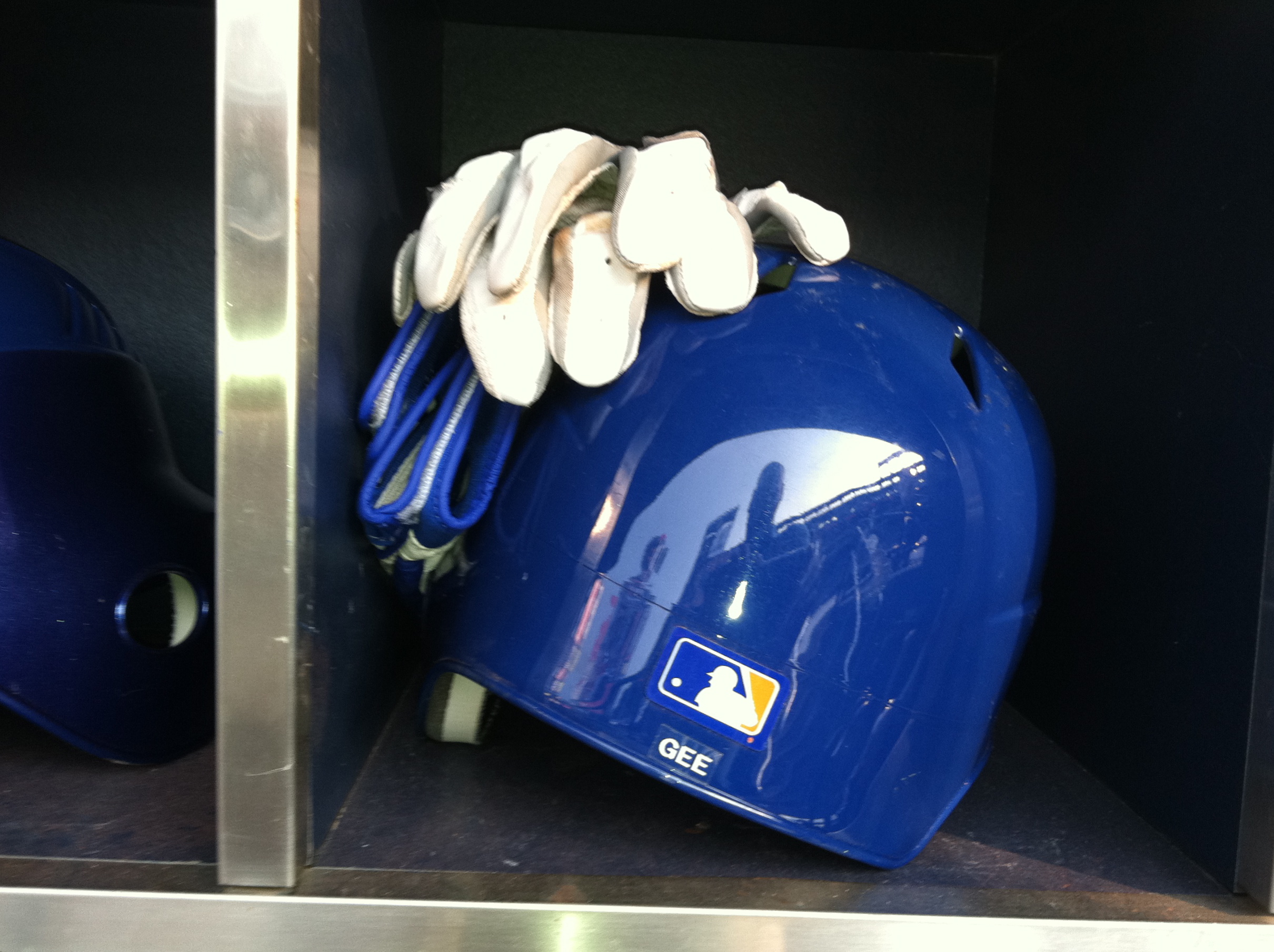
 Tools of the trade We asked him about climbing mountains in Africa, being on Twitter, writing a book with Wayne Coffey, the clubhouse this year and last year, his record and how he thinks he’s pitched, and a lot more, and he was invariably thoughtful. Where a lot of ballplayers (*cough* Jeter! *cough* Wright!) seem to have trained themselves not to be interesting, Dickey seems incapable of being dull. Above all else, he strikes you as comfortable in his own skin: He gently but firmly knocked aside a question about young players in garbage time not feeling the pressure of expectations, saying that any player in the major leagues arrives with such expectations; parsed what advanced stats say about his 2011 performance but said above all else he wants to win; and charmingly deflected a query about pitching into his 40s with the conclusion that he’ll be pitching Sunday at 1:10 pm. That’s a quick paraphrase of 10 minutes with a man who could hold your attention for 210 minutes at a time even without a baseball in his hand.
(In case you’re curious, I was content to soak it in instead of asking something myself. I figured anything I’d say would come out as GAAH I LOVE YOUR PITCHING AND I LIKE STAR WARS I EVEN WRITE BOOKS ABOUT IT!!! Which is why I stayed quiet. Longer, angstier explanation here.)
(Morning Update: Here’s video of the interview from On the Black.)
Then we went upstairs for a quick bite to eat, and the monsoons came. You could hear the thunder crashing outside and watch the red blob of terrible things devour the NYC area on the radar map, and so we sat there, Mets hosts and bloggers, and talked about the club and baseball and how we became fans and Shea and a whole lot else, and it was a pretty great way to spend a rain delay.
Finally, we went up to the press box, which is bigger than I’d noted — I’d half-jokingly asked if the beat writers would see our entry as the end of the world, but the press box is so big that our contingent was barely noticeable. After we’d sat up there a while, the rain finally stopped and one by one the beat writers opened the big windows between them and the stands. Outside, a surprisingly decent chunk of the crowd was still in attendance, perhaps because the 7 train was hors de deluge.
Games that start hours after you’ve given up on them can be a lot of fun, particularly when they have an outfielders-splashing-through-lakes, anything-goes quality. (I should note here that Citi Field seems to drain extremely well. No splashing visible.) Games that Mike Pelfrey pitches, on the other hand, are all too frequently not fun. It was the usual Bad Pelf outing, with lots of stalking around behind the mound and irritable swipes across his brow and walking people and getting lit up. I’ve said it before and will no doubt say it again, but I think it’s time for Big Pelf to become somebody else’s project. It doesn’t seem like a stretch to imagine a 2012 rotation of Niese, Dickey, Gee, Santana and X; there are a lot of Xs that could deliver Pelfrey production at a much smaller price.
There was one good thing about Pelfrey’s thorough awfulness, though: It ensured there was no chance one of us bloggers would violate the prohibition against cheering in the press box. Several nifty David Wright plays aside, there was nothing much to cheer for.
by Greg Prince on 19 August 2011 12:05 pm Welcome to The Happiest Recap, a solid gold slate of New York Mets games culled from every schedule the Mets have ever played en route to this, their fiftieth year in baseball. We’ve created a dream season that includes the “best” 118th game in any Mets season, the “best” 119th game in any Mets season, the “best” 120th game in any Mets season…and we keep going from there until we have a completed schedule worthy of Bob Murphy coming back with the Happy Recap after this word from our sponsor on the WFAN Mets Radio Network.
GAME 118: August 16, 1987 — Mets 23 CUBS 10
(Mets All-Time Game 118 Record: 26-22; Mets 1987 Record: 66-52)
The beginning of a period of heightened consciousness. An announcement of the forthcoming end of time as we knew it. A preparation to move from third-dimensional reality of space into fourth-dimensional reality of time. The initiation of a spiritual humanity factor.
All of the above was the New Age forecast for the Harmonic Convergence, scheduled to commence on Sunday, August 16, 1987. One description identified the date as the end of “the Hell cycle”. And coincidentally or otherwise, the Mets chose the very same day to score more runs than they ever did before or have since.
Met batters swung in harmony all game long and Met runners converged on home plate at Wrigley Field a franchise record 23 times.
If only the Hell cycle could have ended a little longer.
Were three Met runs in the top of the first a hint? Well, they were off a young, unaccomplished righty named Greg Maddux, but this was Wrigley, where a good stiff breeze makes runs as plentiful as Old Style. Even a 4-0 lead in the top of the third didn’t necessarily hint anything harmonic or historic was on tap. Darryl Strawberry knocked Maddux out of the box with a three-run homer in the fourth, so at 7-0 maybe it was worth leaning forward.
Then again, Ron Darling was pitching, and Ron Darling — whatever his skills — could from time to time demonstrate a knack for not being at his most effective with a lead. This was a pretty big lead, yet Darling found a way to be uncommonly ineffective pitching from ahead in the bottom of the fourth. A couple of walks set up a grand slam to Jody Davis, who was followed to the plate by Rafael Palmeiro. He homered, too. Now it was 7-5 and Darling wasn’t yet eligible for the win…assuming there was a win to be had.
His chances increased exponentially in the Mets’ fifth when Lenny Dykstra singled home one run and Keith Hernandez singled in two more to make it 10-5, Mets. Ronnie held the Cubs scoreless the bottom of the inning, and from there the Mets built as indestructible a lead as could be constructed in the old brick ballyard.
The sixth brought seven runs, highlighted by a two-RBI triple from Strawberry (playing with a sore hip, perhaps exacerbated from giving and receiving so many low-fives). That made it 17-5, and team records were blowing in the wind and toward Lake Michigan. When Mookie Wilson knocked in one and Lenny Dykstra went deep for two in the seventh, the Mets were up 20-5, tying their 1971 predecessors for most runs in a game. It was no more than a clerical detail to note Jesse Orosco, mopping up for Darling in the home seventh, allowed four more runs to the Cubs.
They were converging, too — just not as harmonically.
In the eighth, with Darryl on third (after his fourth hit of the day), Barry Lyons scratched out an infield single, plating Straw with the 21st Met run of the game and establishing a new franchise standard for offensive output. To make sure nobody would come along and tie or break it for the foreseeable future of heightened consciousness, Howard Johnson stepped up and homered to score Lyons and himself. That gave the Mets 23 runs.
Then, for the hell of it, Davey Johnson let reliever Jeff Innis pinch-hit for Orosco. He flied out.
The final wound up 23-10. Strawberry scored five and drove in five. Dykstra batted seven times and collected four hits. Hernandez had three hits and three runs. Darling scored twice. Seven different players accumulated at least two RBI. Jeff Innis pinch-hit, for crissake.
Consciousness may not have been heightened, time may not have ended and the remainder of the 1987 season (and everything thereafter) indicates the Hell cycle was just beginning in Metland. But for one day, on one number-laden horizontal line of the scoreboard, harmony ruled.
Twenty-three blessed times.
ALSO QUITE HAPPY: On August 19, 1969, one of the best pitchers of his generation shut out the Mets for 13⅓ innings and still couldn’t beat them. Juan Marichal may have been on his way to the Hall of Fame, but the ’69 Mets were are their way to a whole other plane.
Marichal was typically brilliant this Tuesday night at Shea, not allowing the Mets two baserunners in any one inning until the tenth and facing serious danger only through a fielding mishap in the twelfth, an episode that came to naught when Cleon Jones was thrown out at the plate. Gary Gentry was no piker, either, throwing ten scoreless frames. Tug McGraw took over in the eleventh, keeping the zeroes flowing, though you’d have to give an assist to his manager. With two out and nobody on in the top of the thirteenth, lethal lefty slugger Willie McCovey came up. Gil Hodges, truly protecting against the extra-base hit, convened a four-man outfield by moving third baseman Bobby Pfeil to the far left field corner and positioning Jones in the left-center power alley.
Hodges wasn’t concerned with Stretch singling and he couldn’t do much about him homering. But anything else that could be prevented the skipper was determined to prevent. And wouldn’t you know it, mighty Willie swung and belted a ball to the fence — not quite high enough to be gone maybe, but plenty deep enough to be trouble if only three men had been patrolling Shea’s outer pastures. Yet because Gil sent Cleon to left-center, it wasn’t trouble. It wasn’t easy, mind you: Jones had to leap and grab the ball backhanded, but he made the catch and got the Mets out of the inning.
The scoreless duel continued apace, Marichal setting down the next three Mets, McGraw retiring the next three Giants. Then, in the bottom of the fourteenth, after grounding Rod Gaspar back to the mound, Marichal finally proved human. He got a pitch up to Tommie Agee and Agee sent it where no outfielder — no matter how many you could have stuck out there — could stop it. Tommie’s homer into the left field bullpen shattered Marichal’s shutout and gave the Mets a 1-0 win for their fifth victory in a row.
It was that kind of year. It was getting to be, anyway.
GAME 119: August 16, 1988 — Mets 13 GIANTS 6
(Mets All-Time Game 119 Record: 24-24; Mets 1988 Record: 71-48)
That kid in class who finishes his work first and has to be told to sit quietly at his desk and read while everybody else plods on with their assignments? That was the Mets this Tuesday night at Candlestick Park.
Top of the first inning, please pick up your pencils…er, bats and begin.
Mookie Wilson: singles to left.
Atlee Hammaker: balks Mookie to second.
Tim Teufel: grounds out to short.
Keith Hernandez: singles to right, scores Mookie.
Darryl Strawberry: singles to right.
Candy Maldonado: throws poorly, allows Keith to go to third, Darryl to go to second.
Roger Craig: tells Atlee to walk Kevin McReynolds.
Kevin McReynolds: walks intentionally.
Gary Carter: singles to left, scores Keith.
Kevin Mitchell: makes error, lets Darryl score, lets Kevin and Gary move up a base each.
Howard Johnson: singles to right, scores Kevin.
Kevin Elster: singles to center, scores Gary.
Joe Price: relieves Atlee.
Dwight Gooden: strikes out.
Mookie Wilson: singles to center again, scores Howard.
Tim Teufel: doubles to center, scores Kevin and Mookie.
Keith Hernandez: pops up to left side of infield.
Robby Thompson: commits error on Keith’s popup, allows Tim to score.
Darryl Strawberry: flies to center.
Class, put down your bats. Does somebody want to come up to the board and show their work?
When the chalk dust settled, the Mets scored nine runs in top of the first inning on eight hits and three Giant errors. They set a team record for most runs scored in a first inning, and then they went out for the rest of the game and managed not to look completely bored as they beat the Giants, 13-6.
The Mets aced their assignment, all right.
Class dismissed.
ALSO QUITE HAPPY: On August 18, 2009, the Mets presumably called time before coming to bat in the bottom of the fourth at Citi Field so they could all run into their clubhouse and change into their hitting shoes. That had to be it, for what else could explain the dismal ’09 offense coming so alive all at once?
The Mets held themselves an old-fashioned hit parade in their Tuesday night hitting shoes. Here they came, marching about the bases, in stylish singles and doubles: Pagan, Castillo, Sheffield, Francoeur, Tatis, Santos, Hernandez (Anderson), Perez (Ollie), Castillo (again) and Sheffield (ditto). They stepped all over the Braves’ Derek Lowe and Kris Medlen for ten hits, the most hits the Mets have ever garnered in any one inning. The ten hits produced eight runs, accounting for most of the scoring in a 9-4 win over Atlanta.
Then the 2009 Mets turned back into pumpkins, as their hitting shoes proved to be nothing more than the fleeting glass slipper of fairy tales. Yet for one inning, they really did hit happily ever after.
GAME 120: August 16, 1999 — Mets 4 PADRES 3 (10)
(Mets All-Time Game 120 Record: 19-29; Mets 1999 Record: 73-47)
One of the freshest entries in the heartbreak sweepstakes better known as a Met bid for a no-hitter emerged this Monday night at Jack Murphy Stadium. Stepping onto the mound of ultimate disappointment was a contestant Mets fans were just getting to know, 25-year-old rookie Octavio Dotel, making only his ninth major league start. To date, Dotel had demonstrated what could kindly be called inconsistency, alternating brilliant and abysmal outings. His previous turn, against the Padres at Shea, had been unimpressive: 4⅓ innings, 4 hits, 5 walks, 5 earned runs.
Out in San Diego, however, he rediscovered his every-other-start magic. Octavio issued a one-out walk in the first to Tony Gwynn (and unleashed a wild pitch to move him to second), but then nothing. He was perfect the rest of the first and throughout the second, third, fourth, fifth and sixth. Mike Piazza and Rickey Henderson each reached Sterling Hitchcock for solo blasts. The Mets led the Padres 2-0, and neophyte Dotel — who had collected two more hits off Hitchcock than he’d surrendered to any Padre — was closing in on filling the longest-running void in Mets history.
He was nine outs away from pitching the first no-hitter any Met had ever thrown.
And that’s as close as he’d get. The no-hitter stayed intact for two batters in the seventh, but unfortunately for Dotel, both — Gwynn and John Vander Wal — walked. Two were on for Phil Nevin, a certifiable late 1990s Met-killer. Octavio worked him to three-and-two, but on the seventh pitch of the at-bat, literally everything that could go wrong did go wrong.
Nevin got a hit.
Nevin’s hit was a homer.
Nevin homer scored Gwynn, Vander Wall and Nevin.
The Mets were no longer nine outs from breaking the 38-year no-hitter jinx.
The Mets were no longer winning.
The Mets were now behind.
Other than that, Octavio Dotel was having a whale of a night.
Actually, the kid rebounded with remarkable poise, striking out Wally Joyner, grounding out Ben Davis and fanning Damian Jackson (his ninth K) to avoid further problems.
“The biggest thing is coming back and getting three outs,” said pitching coach Dave Wallace, “because he wasn’t able to do that a month ago. That’s a sign of learning and maturing.”
“That’s what puts stripes on his shoulders and proves he belongs,” agreed Bobby Valentine.
Which was fine and brave Met talk in a military town like San Diego, but heartbreak had already pulled rank and, oh by the way, the Mets’ lead was AWOL.
The Mets’ veterans, however, were not inordinately let down, no matter how crushed their youthful starter might have felt. Edgardo Alfonzo led off the top of the eighth by singling and John Olerud singled him to third. Piazza hit into one of his more effective ground ball double plays, a 4-6-3 that let Fonzie score and tie the game at three. Turk Wendell and Dennis Cook got the Mets to extras, where Fonzie made all the difference in the world when he belted the Mets’ third solo home run of the night to give them a 4-3 lead. Armando Benitez preserved it with a scoreless tenth.
Dotel would eventually go to the bullpen in 1999, to the Astros in 2000 and to ten more teams thereafter, most recently the Cardinals, for whom he is pitching in 2011 at the age of 37.
That no-hitter drought, approaching 50 years of age, is still going strong, too.
ALSO QUITE HAPPY: On August 17, 1964, Dennis Ribant brought to mind one of the great utterances in baseball history, one certainly in tune with Casey Stengel’s “Youth of America” movement. Ribant, 22, made his second big league start at Shea and dazzled the Pittsburgh Pirates. He retired the first eleven batters to face him this Monday night and let only one baserunner get as far as third. Aided by a pair of Charley Smith home runs, the wiry righty won going away, 5-0. Dennis dominated as no Met hurler before him dominated. His was the first complete game shutout to be delivered with double-digit strikeouts (10) in team history — and he didn’t walk a single Buc.
His performance came some 53 years after a 25-year-old second baseman playing for the New York National League team of yore exulted to none other than Damon Runyon that “it’s great to be young and a New York Giant.” That infielder who was so overjoyed to be playing under John McGraw at the Polo Grounds in 1911 — when Ol’ Case was still a busher for the Aurora Blues of the Class C Wisconsin-Illinois League — was Larry Doyle, a triples-hitting whiz in his day and still very much alive in 1964. Lee Allen of The Sporting News had caught up with Doyle the previous summer in upstate Saranac Lake, a town that liked Larry so much they had recently honored their “most noted citizen” by crowning him King of the Winter Carnival.
Doyle, no fool at the age of 76, told the Chamber of Commerce that if they wanted him to serve as king, they’d have to get him a queen. They took his royal demand seriously and imported that distaff avatar of aristocracy, Miss Rheingold of 1963, Loretta Ann Rissell. Miss Rheingold was pretty famous in those days, just as Rheingold was already known far and wide as the Extra Dry Beer of New York’s new National League team. Thus, Allen invoked Doyle’s “regal association” with Miss Rheingold and suggested it “would seem to give him kinship with the Mets, providing a strain of old blood for the New Breed.” Naturally, Lee was compelled to wonder of Larry, “What did he think of the Mets anyway?”
He asked him directly, and you have to love the literary license the Sporting News scribe took. Allen wrote, “You forget what he replied, you remember that he smiled and, surely, like all old Giants, he wished them well. It’s great to be old and a Met fan.”
by Greg Prince on 18 August 2011 5:28 pm The Mets may be out of the pennant race, but one Mets fan continues on a great run.
Our friend Sharon Chapman, who has raced many miles and raised many dollars for the Tug McGraw Foundation, wanted to let her fellow Metophiles know she is captaining Team McGraw’s crew as they take on the Rock ‘n’ Roll 10 K New York and would love any and all Mets fans to join her on the course Saturday, October 22. Registration info for the race is here and an application/waiver form to be part of Team McGraw is here (choose the “pick your own” option in the drag-down menu).
Here are the salient details for interested runners, from Sharon:
There’s only a $50 commitment, although obviously the more money that’s raised for the cause the better. After they submit the forms and fees, they will receive their welcome packets (including their team singlets) in the mail. On race day we will have a group photo, and the members will have the opportunity to be a part of the team and hang out with other Team McGraw members before and during the race.
The cause for which Sharon devotes so much time and energy is the Tug McGraw Foundation’s ongoing effort to fight brain cancer. The organization is focused on improving quality of life for patients while furthering research toward a cure. Tug McGraw, whose brilliant pitching and indefatigable spirit was so essential to the 1969 and 1973 Mets championship clubs, waged a courageous battle with brain cancer before succumbing to its deadly effects in 2004. In the midst of his personal tragedy, Tug established his Foundation so that others would stand a better chance to beat the disease. Those who work for the Foundation as well as those who run under its banner via Team McGraw are dedicated to making Tug’s vision a reality.
You can help a Mets fan help others by running the streets of New York in Tug’s memory. You can also play a significant role by contributing what you can here. As always, we appreciate your consideration.
by Jason Fry on 18 August 2011 3:06 am Ah, Garbage Time. Been a while.
(Theatrical sigh.)
Garbage Time is weird. Losing generally produces a dull ache instead of the sharp pain felt while you still dream of the postseason, but winning, weirdly, can be more fun. And I know why: When your team’s aiming at first place, or the wild card, or even just has a chance to pass the third-place team and then we’ll see, the joy of winning is followed all too swiftly by fretting about losing. What if we don’t win tomorrow? If only we’d won that game two days/a week/two months ago, we’d be a game closer! It’s great we’re in first, but it’s only 2.5 games — that could be gone in three lousy days!
A Garbage Time win means a lot less, but it comes with no such baggage. Your team won. You’re happy. The end.
Of course this game was weird anyway. I’ve fallen into the bizarre sleep habits that are a peril of being a freelance writer — on Tuesday night, for instance, I slept from about 10:30 at night until 2:30 in the morning, happily missing most of a horrid Mets game, worked through the dawn, collapsed around mid-morning and woke up groggily around noon. So a 6:35 p.m. start for a West Coast game was like being subjected to a dizzy-bat race, temporally speaking, even beyond Greg’s admonition that it’s always 3 a.m. in southern California. Wait, is it 10 at night again? Dinner time? 4 in the afternoon? What the hell time is it, and why is someone doing this to us?
That looked like what Dillon Gee was thinking after he was cuffed around in the first inning and stared in at Josh Thole with runners on second and third and one out. But Gee gathered himself and struck out Jesus Guzman, who plays against us like he’s the son of some baseball god, at least, and then got Orlando Hudson (who may be the friendliest man in baseball, judging from his greetings to any opponent in proximity and constant smiles) to ground out to escape dispiriting early harm. After that Gee was terrific, and lucky to boot — witness his third-inning behind-the-back grab of a hard grounder struck by Jason Bartlett. Ball in hand, Gee whirled and fired to second, and I had nightmare visions of Angel Pagan corralling the ball (or forgetting to do so), followed a few hours later by Terry Collins sounding exasperated as he said philosophical things. But no, Gee’s timing was perfect: Ruben Tejada arrived just as Gee’s throw did, for a very nice double play that made you think this just might be our day after all.
And why not? After all, David Wright had somehow pounded a three-run homer despite having to stare out at a pretty fair pitcher in Mat Latos while being mired in Mordorian shadows. (Lucas Duda would later try the same thing, only to be denied by the enormous, often awkward-looking Kyle Blanks. Essentially, Duda flied out to himself.) And then, the capper in the fourth: Wright speared Logan Forsythe’s apparent double, sprawling across the foul line, faked the throw to first and then darted to third, where he tagged out a disbelieving and one presumes deeply chagrined Cameron Maybin. (As Gary and Ron noted on the replay, Wright faked out San Diego third-base coach Glenn Hoffman, too.) Wright trotted off the field looking quietly pleased with himself, in possession of not only the third out but also Maybin’s lunch money, light-up yo-yo and the four-leaf clover he’d found in recess and pressed in a dictionary.
After that, there was the welcome, somewhat surprising sight of Manny Acosta preventing disaster in the seventh and the unwelcome, not particularly surprising sight of Ryota Igarashi doing his best to screw up the ninth. Fortunately, by then the Mets’ margin for error was unscrewupable — which was exactly the kind of game they and we could have used right about now, whatever the heck time that was.
by Greg Prince on 17 August 2011 8:30 am Usually when the Mets visit the Padres, even if it’s a good game — even if it’s a day game — it feels like it’s taking place at three in the morning. The Padres are the official team of the wee, small hours, no matter what the little and big hands say. Tuesday night’s game flew by at a brisk 2:31 yet it still dragged interminably.
That, though, had as much to do with the Mets losing 6-1 as it did San Diego’s insistence on being in San Diego. The wrong end of a 6-1 score leaves you with about as lame a loss as a team that’s out of it in the second half of August can muster, particularly when it’s against another team that’s out of it in the second half of August.
6-1 is not close enough to offer you glimpses of false hope or rout enough to allow you to write it off as just one of those things. You — our team — may have thrown yourself into every minute of that 2:31, but the numbers suggest you asked somebody to punch in for you.
6-1 means you’re stuck in second place in a two-team race for nine innings, just as you’re stuck being in some other place than one that’s vital to a playoff race once the game is over. You’re not going to win, you are going to lose, it’s not going to substantially matter either way.
But you still wish your team could have put up a better fight.
Faced with the intrinsically discouraging 6-1 portion of the schedule from here until the final series of the season (which is when we’ll suddenly realize how much we’re going to miss our team when it’s gone, thus every out will seem precious), we look for signs that somebody’s doing the right thing in terms of playing time. We want to glean that there is meaning to be had and experience to be gained. We want to believe the kid who didn’t get a long enough look from April until now is going to be allowed to use these barren weeks to plant a seed for the future. We want to believe our manager will wisely deploy his limited resources and cultivate a harvest for next year.
We want to win some games in the interim while we’re at it, but in the abstract we say that’s not our bottom line. We want a future to take root, even though we’ve been warned diligently all our lives not to read too much into what transpires in the Septembers of our years.
Should Terry Collins do whatever it takes to win any given game among the final forty? Hells yes. There is an indelible result to every baseball game at this level and it’s important enough for Tim Kurkjian to want to paste in a notebook (whether he physically does so or not anymore). These aren’t simulated games and this isn’t the Florida Instructional or Arizona Fall league. When somebody decides to refund me my ticket price or a portion of my cable bill, then the Mets have my blessing, paraphrasing Apu from The Simpsons in his Nye Mets phase, to take a relaxed attitude toward winning.
But that’s not the same as endorsing fealty to whatever hasn’t worked or isn’t working, and it’s certainly not a blanket endorsement of reflexively playing veterans over rookies…or rookies over veterans. Unless you’re committed to a Logan’s Run lineup in 2012, one assumes almost everybody on your active roster is vying for a place on the next Mets team. Thus, if one theoretical night out of forty Terry wants to see what Scott Hairston can do at second base, I won’t squawk; Scott Hairston is all of 31 years old, and if you could figure out a way to make him a touch more valuable in 2012 — like by keeping him the fudge out of right field — it might be worth considering bringing him back.
Or if the Mets are facing a lefty pitcher Ronny Paulino absolutely scalds (like Chris Capuano, against whom he’s 6-for-17…d’oh!), I can live with veteran Paulino getting a start in September even though I’d like to see Josh Thole learn to hang in there against lefties. You don’t have to display mindless adherence to The Percentages — absolutely give Thole some of those southpaw assignments — but by the same token you’d be a little derelict in your duties to not take advantage of your clearest opportunity to win.
Of course if you’re helming a team that’s well out of it by now, you don’t know what your clearest opportunities to win are, so by all means experiment. Throw Mike Pelfrey in relief as you did last night. That was a small joy to behold, and not just because it meant our exposure to Big Pelf would by definition be brief. Let’s get an idea about flexibility versus roles. Each of our five starters has tossed a bit of relief this season and pending late word that Pelf slipped on his ice in the clubhouse, no starter has suffered for relieving.
Whether it’s situational or out of curiosity, there’s nothing necessarily wrong with an inning here or there out of the bullpen for a starter. It used to take place routinely in baseball’s dark ages, before Tony La Russa enlightened us all and invented niches. And if you can figure out, without wrecking him prematurely, a way to let Pedro Beato start between now and September 28, go for it. Terry’s already talking about him trying it in winter ball. Do it in summer ball if you’re confident you can stretch him for five innings. Or truncate him for a ninth inning, even a third of a ninth inning — say the last third.
Save opportunities should be as up for grabs as anything — though if Jason Isringhausen has some fantastic, not necessarily ancient matchup history in his favor against a particular batter due up (the Braves’ Alex Gonzalez vs. Izzy: 1-for-11), let’s not blindly insist we must leave it to Beato or Parnell or whoever isn’t Isringhausen. We still want to get the wins that are within our grasp and we should use the tools that turn grasps into grips. But just your garden-variety save? All we are saying is give Pelf a chance…though Pedro or Bobby or Not Igarashi would probably be a better bet in that spot.
Mix and match. Use your judgment. Win as much as you can while not being afraid of the opposite fate. Anything should go, considering everything that’s come before hasn’t gotten us terribly far.
And keep the 6-1 losses to a minimum as best you can. Thanks.
by Greg Prince on 16 August 2011 12:30 pm Welcome to The Happiest Recap, a solid gold slate of New York Mets games culled from every schedule the Mets have ever played en route to this, their fiftieth year in baseball. We’ve created a dream season that includes the “best” 115th game in any Mets season, the “best” 116th game in any Mets season, the “best” 117th game in any Mets season…and we keep going from there until we have a completed schedule worthy of Bob Murphy coming back with the Happy Recap after this word from our sponsor on the WFAN Mets Radio Network.
GAME 115: August 12, 2000 — METS 3 Giants 2
(Mets All-Time Game 115 Record: 19-29; Mets 2000 Record: 68-47)
Benny Agbayani had given Mets fans so much since bursting onto the Shea scene in 1999. He’d given them hot streaks, clutch hits, even a wakeup call from Japan. He’d given them plenty
So what was one more item to the generous Hawaiian?
This Saturday night at Shea had started as a good night in the midst of a good month. Since returning from their traditional series of beatings at Turner Field in mid-July, the Mets had won 14 of 17, including their last three. Mike Hampton was keeping the Mets on their winning path, shutting out the Giants for the first three innings, long enough for Mike Bordick to pop his third home run since becoming a Met in a deadline deal two weeks earlier. All was well until in the fourth, when Jeff Kent doubled to lead off and Bordick’s bad throw allowed Ellis Burks to reach. A fielder’s choice grounder by Rich Aurilia moved each runner up a base, and Hampton filled the sacks when he hit J.T. Snow.
It was a bit of a jam for the lefty, but it could have been a lot worse had he not flied Met-killer Bobby Estalella to left field. It was a sacrifice fly, which would tie the game, but it was only one run and there was still plenty of game left..
But you know there wasn’t? A third out. The scoreboard knew it. The vast majority of 50,064 on hand knew it. The Giants knew it. Twenty-four of the Mets knew it.
The one Met who was caught unaware of the number of outs also happened to be the Met who caught Estalella’s fly for the second out. That was Mr. Agbayani, the Benny who never stopped to think before giving of himself.
The same Mr. Agbayani who never stopped to think before giving the ball to a fan in the stands…which you can’t do with two out and runners on base, because it allows the runners to advance two bases. Benny’s random act of kindness — he handed the ball to a seven-year-old kid sitting down the left field line — was functionally no different from overthrowing the cutoff man and landing the ball deep in Loge.
Kent had already scored on the fly. Now Burks was waved home from second and Snow was awarded third.
And the kid who thought he had been blessed by a good-hearted left fielder? Jake Burns of Bronxville was in for a surprise, because as suddenly as Benny handed him the horsehide, Agbayani — realizing the literal error of his ways — raced to the railing and poached it right back.
So Benny, in a blink, had committed an E-7; was directly responsible for a run; wore pineapple-sized egg on his face; and had acted as what seven-year-olds in less linguistically sensitive times would have called an Indian giver. (Though later in the game, Benny made sure a Met ballboy brought the boy a replacement for what he was compelled to repossess.)
“I looked at the scoreboard and I guess I saw the strike count instead of the outs,” was Benny’s explanation. In case he looked at the run count, the Giants now had more than the Mets.
Benny Agbayani was not having a very good top of the fourth. Or bottom of the fifth, for that matter; he struck out with the bases loaded to end that frame. But teammates pick teammates up. Hampton struck out Shawn Estes to end the San Francisco fourth, and Todd Zeile doubled home two runs in the seventh to give the Mets a 3-2 win that took the edge off Agbayani’s embarrassment. And on another Saturday night, less than two months later, Benny would bat against the Giants with the score tied in extra innings and all would be forgiven. Once he beat Aaron Fultz with a home run in Game Three of the 2000 NLDS, Benny’s Boner became just another delightful chapter in one of the Mets’ most lovable legends.
As for young Jake’s cameo in The Benny Agbayani Story, the seven-year-old, who at the moment the left fielder plucked the ball from his hand appeared stunned, was philosophical afterwards:
“It was weird.”
ALSO QUITE HAPPY: On August 13, 2010, the best story the Mets had come up with in years came close to rewriting franchise lore — and no one was better suited to find the words to describe nearly the first no-hitter in New York Mets history than R.A. Dickey.
The knuckleballer who emerged from as close to nowhere as any 35-year-old veteran could surprised Mets fans with both his pitching and his postgame quotes. A more eloquent player no one could recall. And a better knuckler the Mets had never seen coming from one of their own. Dickey was on top of his game this Friday night at Citi Field, dueling Cole Hamels 0-0 through five.
The Mets’ best chance to score was done in by the same video review system that had treated the Mets well in the recent past. Journeyman first baseman Mike Hessman, a lumbering slugger with more minor league home runs than anybody active, made a bid for his second big league blast of the year and seemed to have it in the bottom of the fifth. But after calling his high fly to the top of the enormous left field wall a home run, the umpires conferred and re-ruled Hessman’s shot a triple — an extra base hit that Mike was not running nearly hard enough to attain. The decision to split the baby, as it were, didn’t help the Mets, as Hessman remained stranded on third (and Hessman stayed stuck for the rest of his brief Met career on 1 HR, a minimally powerful distinction he shares with an eclectic group of Met position players that includes Jimmy Piersall, Rod Gaspar, Tim Foli, Frank Taveras, Tom Paciorek, Brett Butler and Alex Cora).
The dramatic focus returned to Dickey who was making the most of it after five-and-a-third innings. He had allowed only one Phillie to reach bases, and that was via a walk to ex-Met Wilson Valdez. Thus, R.A. was nearing no-hitter territory — or no-hitter watch territory, a space some Mets fans approach as soon as the other team’s leadoff hitter is retired. As inevitably happens to Met hurlers, Dickey did not reach the unreachable star. As had happened three times before in Met one-hitters, it was the opposing pitcher who broke up the no-hit attempt. Hamels was the batter who besmirched R.A. bottom line with a one-out single to right in the fifth. Had Jeff Francoeur been playing a little more shallow, he might have had a chance to nail Cole at first…and the names of successful hitting pitchers Chin Hui-Tsao, John Curtis and pre-Met Ray Sadecki could have remained in trivial mothballs.
But “if” is a word attached to many a would-be Met no-hitter.
Jimmy Rollins forced Hamels at second and no other Phillie got on all night. In the sixth, David Wright and Carlos Beltran paired doubles and gave Dickey all the offense he would need. When he flied Placido Polanco to right in the ninth, Dickey could claim the 35th one-hitter in Mets history, 1-0, one that saw Hamels valiantly go the distance, too, albeit in a losing cause.
All that was left after the 2:09 masterpiece was for the master craftsman to put his work in perspective:
“There’s definitely no woulda-shoulda. There’s, ‘Aw shucks, I wish that wouldn’t have happened.’ That’s probably the most satisfying thing about this night for me is that there’s no regret. I had an outing without regret, and you rarely can say that about an outing. There’s always one pitch that you didn’t execute right, or a sinker you didn’t get or a ball you left over the plate that got raked in the gap. There’s always a regret. This game is about how to handle regret, it really is. Tonight, man, I could have pitched into the wee hours.”
Imagine what he might have said had Francoeur thrown out Hamels.
GAME 116: August 14, 1979 — Mets 18 BRAVES 5
(Mets All-Time Game 116 Record: 18-30; Mets 1979 Record: 49-66)
It was a good night to be Lee Mazzilli. It wasn’t much of a night to be Dock Ellis. It wasn’t much of year to be the New York Mets, but then what does it say about the kind of evening the Atlanta Braves were enduring when their opposite numbers in the National League’s other cellar hung so many crooked numbers on them?
When the Atlanta Rhythm Section sang in the 1970s that “babies squawled as August crawled” and that “the dog days were scorchers — Southern torture” they may very well have had Fulton County Stadium in mind, particularly days that ended with two basement cousins, the sixth-place Braves and the sixth-place Mets, duking it out before 5,770 souls for whom a nice cool movie theater apparently wasn’t appealing. These were the dog days when Atlanta and New York combined to sit 41 games out of their respective firsts and when managers Bobby Cox and Joe Torre were not yet geniuses, just apprentices learning their craft in the least appealing jobs imaginable.
Torre’s job was more appealing than Cox’s on this Tuesday night. Mazzilli as much as any Met saw to that. Lee had been the best part of 1979 for every Mets fan, from his sizzling start (leading the league with a .462 average two weeks into the season) to his All-Star turn (a game-tying pinch-homer in the eighth, a game-winning RBI walk in the ninth — off Yankee Ron Guidry, no less) to his pinup style, form and good looks (inspiring the Mets to hold Lee Mazzilli Poster Day for which their glamorous centerfielder posed capless). The Mets didn’t cause much of a stir in ’79, but Mazz sparkled, no matter how big or small the stage, no matter how packed or empty the house.
He did it at Shea, where the Mets drew only 788,905 all season, so Fulton County (769,465) was no empty challenge in that regard.
In the first inning, in front of whoever cared to watch, Mazzilli struck a two-run homer to stake Ellis to an early 2-0 lead.
In the second, after a three-run double from Alex Treviño extended the Mets’ margin to 5-0, Mazz’s fielder’s choice grounder to first baseman Dale Murphy became an E-3 and led to Treviño scoring. And two batters later, when Ed Kranepool doubled, Mazzilli came around to make it 7-0.
Ellis gave up two solo homers in the Brave second, but the Mets got the runs back, with Lee playing part yet again: he had walked behind Frank Taveras (double) and Treviño single) and all three scored when right fielder Gary Matthews couldn’t deal cleanly with Richie Hebner’s single.
The Braves were down 10-2 in the middle of the third, and it should’ve been easy cruising from there for Ellis, acquired from Texas in mid-June for Mike Bruhert and Bob Myrick. But it wasn’t Dock’s night. He gave up a three-run homer to Bob Horner, cutting the Mets’ lead to 10-5 with two outs. After Murphy reached on Doug Flynn’s error, Torre was sufficiently unnerved and removed Ellis (in what turned out to be the final season of a twelve-year career) in favor of Andy Hassler, the other veteran pitcher the last-place club imported at the trading deadline. Hassler got out of the inning with no further Braves scoring.
But the Mets weren’t done. They put up two in the fourth without Mazzilli’s help, then another one in the fifth that Mazzilli made possible by tripling and scoring on Jose Cardenal’s single. The Mets led 13-5 after five and had tallied in every inning so far. Finally, they slowed down for a couple of innings, but took an emphatic curtain call in the eighth by scoring five more times. The last of the Met runs that crossed home plate — accounting for the 18-5 final — was carried by a young man from Brooklyn in an unusually tight gray polyester uniform.
By then, home plate was as familiar as the old neighborhood in Sheepshead Bay. Mazzilli scored five runs, tying the team record set a year earlier, also against Atlanta, by Lenny Randle. The 18 runs, meanwhile, represented the third-most ever scored by the Mets in one game to that point, and the most since they put 20 on the board in the same stadium versus the same team eight years earlier.
The Mets sure had some big nights against the Atlanta Braves in the 1970s. What a pity they couldn’t lure them into the same division and play them more often.
Or maybe not.
ALSO QUITE HAPPY: On August 14, 1993, the Mets weren’t going anywhere as a team — unless you count “down” — so youngsters with a pulse and some promise were welcome to make an impression. One Met with a long tenure ahead of him was granted his first opportunity to impress, while another Met who was just getting the hang of his craft inadvertently chose this Saturday night in Philadelphia to peak.
Different directions awaited starting pitcher Bobby Jones and starting shortstop Tim Bogar. Jones was being injected into the Mets’ rotation along with some high hopes. The 23-year-old righty was chosen in the supplemental phase of the first round of the 1991 amateur draft, compensation for losing Darryl Strawberry the offseason before. If that wasn’t pedigree pressure enough, Jones hailed from the city of Fresno, Calif., known by every sentient Mets fan as the hometown of one George Thomas Seaver.
Compensate for Darryl? Pitch like Tom? It was a lot to ask right out of the box, but Bobby showed he had something on the ball, going six in his first outing and surrendering only one earned run…though five in toto, thanks to miscues by Jeromy Burnitz in right and Bobby Bonilla (two) at third. But Bogar, a rookie infielder being given every chance to win the starting shortstop job, provided Jones with plenty of margin for Met errors by punching a pair of doubles, a three-run homer and, to top it off, an inside-the-park home run to account for the final run of a rare 9-5 Mets win.
Unfortunately, Bogar’s punctuation came back to put a period on the end of his 1993 season. By sliding into home headfirst, he tore ligaments in his left hand and was out for the rest of the year. While Jones became a Met pitching mainstay through 2000, Bogar was relegated to the bench when he returned in 1994 and spent the following three seasons pulling fill-in duty until he was traded to Milwaukee for Luis Lopez.
GAME 117: August 17, 1969 (2nd) — METS 3 Padres 2
(Mets All-Time Game 117 Record: 15-33; Mets 1969 Record: 66-51)
Some 84 miles north of Flushing, 3 Days of Peace & Music had been promised. At Shea Stadium, the draw was 4 Games of Pitching & Triumph. Both festivals delivered memorably.
The big story in New York this third weekend in August was taking place on Max Yasgur’s farm in upstate Bethel: the Woodstock Music and Art Fair, arguably the most extraordinary pop culture event ever staged. It began on Friday night and wound through mud, storm and traffic to Monday morning. By Sunday afternoon, 400,000 would be Age-of-Aquarians were encamped to listen to, among others, Joe Cocker, Country Joe and the Fish, Ten Years After and the Band.
Down in Flushing, the performers of note were Tom Seaver, Jim McAndrew, Jerry Koosman and Don Cardwell, and they were on the brink of creating a legend that, like Woodstock’s, would extend well into the 21st century. Just as there was nothing like Woodstock before Woodstock, the 1969 Mets as they were about to be understood were truly taking shape at the very same time.
The Mets of 1969 were already the best Mets team ever but by the middle of August, few were the hints that they were destined for transcendence. Since jarring the Cubs by taking four of six in two July series, the Mets had gone a very mortal 11-14, including six losses in six tries against Houston. Their young pitchers’ arms ached, their heads-up play diminished (as evidenced by Gil Hodges’s removal of Cleon Jones for not hustling after a ball in left field against the Astros) and their distance from first place lengthened. Heading into Woodstock weekend, the Mets had slipped into third place behind St. Louis and trailed Chicago by a daunting margin of 9½ games. On top of it all, the same rains that softened the ground at Yasgur’s Farm forced a postponement of the Mets’ Friday night opener versus the Padres. Thus, while the music played upstate (and the festival grew so memorably festive), the Mets would have to get in tune with back-to-back doubleheaders.
The concert got underway with more than a few hitches, but it fast took on a life of its own. The local Times Herald-Record headlined the affair a buffet of FREEDOM, POT, SKINNY-DIPPING, and that was after only the first night. As word from Woodstock reached the five boroughs, the tarp was being rolled up at Shea for Saturday’s twinbill. While Country Joe fired up the masses in Bethel, the Mets were fixin’ to sweep San Diego. Seaver fired a four-hit shutout in the opener, McAndrew and Tug McGraw combined on a four-hitter in the nightcap. The Mets won 2-0 and 2-1.
Sunday, while everybody at Woodstock was recovering from the Grateful Dead, Creedence Clearwater Revival, Janis Joplin, Sly & the Family Stone, the Who, the Jefferson Airplane all in a row — not to mention everything else (HIPPIES MIRED IN A SEA OF MUD, the Daily News blared) — the team that played a few IRT stops from Woodside prepared for their second consecutive doubleheader. Even better at this moment of unprecedented enthusiasm for free expression, it was Banner Day. After the opener, won 3-2 on a Jerry Koosman five-hitter, bedsheets unfurled in Flushing, a good 3,612 of them. The winning entry celebrated “One Small Step for Hodges, One Giant Leap for Met-kind,” reminding the 35,711 who skipped Woodstock that there was plenty going on among all worlds that summer.
The Mets, no squares, trotted out after the last of the fan banners breezed by with their annual placards of appreciation, spelling out for the fans that “You Turn Us On!”
So as not to disappoint those grooving on the Mets, the Amazins served notice they would not be dropping out of the pennant race anytime soon. Thirty-three year-old Don Cardwell, clearly not of the peace & love generation (he once grabbed Ron Swoboda’s love beads on a team flight and stuffed them in the trash; talk about a bad trip), spread good vibes nonetheless, giving up no runs while scattering eight hits over seven innings to hang tough in a scoreless duel with Clay Kirby. Cardwell finally received a little help from his friends once Buddy Harrelson tripled in two runs in the bottom of the seventh, and J.C. Martin, pinch-hitting for the pitcher, tacked on a sac fly. Though the Padres would manage a pair of runs off Cal Koonce and Ron Taylor, the Mets hung on to sweep their second doubleheader in two days with another 3-2 win, Cardwell’s first since the Fourth of July.
If it wasn’t exactly the “breakfast in bed for 400,000” Wavy Gravy and his Please Force were passing around, it was revelation enough for the crowd in Queens to chew on. The Mets who had stumbled through late July and early August were straightening up and about to fly right. By the time Jimi Hendrix was reinventing “The Star-Spangled Banner” early Monday morning in Bethel, the Mets had taken themselves higher in the N.L. East, flying over the Cardinals and edging to within eight games of the Cubs. Soon enough, they’d put the weight of a full-blown pennant race on Chicago — that four-game winning streak mounted at the expense of the Padres was on the verge of becoming a movement of Woodstock Nation proportions, at least in the standings.
And soon enough after that, an AP story would be written that described a pennant-clinching scene 84 miles south of Bethel:
Several hundred youngsters clustered in front of the Met dugout shouting “We’re No. 1” and gesturing with their fists in the air. A special corps of policemen kept the frantic fans out of the dugout as torn paper spewed down from the stands and a mini “Woodstock Pop Festival” set in on the infield.
Or as the Who put it between those doubleheader sweeps, “On the amazing journey, together you’ll ride.”
ALSO QUITE HAPPY: On August 20, 1985, a 20-year-old pitcher on the verge of his 20th win turned back the clock. Dwight Gooden was winning game after game, retiring batter after batter, yet the unbeatable Doctor K didn’t seem to be inspiring quite as many K’s to be hung from Shea Stadium’s K Korner as he was when he was a rookie just the year before. In 1984, Doc struck out 10 or more opponents at Shea on nine different occasions. Yet “only” three times to date in the 1985 season had the Doctor reached double-digits in strikeouts at home, the most coming when he fanned 13 Phillies in May. There was nothing wrong with him getting to 18-3 in slightly less spectacular fashion than expected — and it was all right that he saved some of his more prodigious strikeout nights for the road — but wouldn’t it be nice if the Doc of ’85 could strike ’em out at Shea the way he struck ’em out at Shea in ’84?
For one Tuesday night, the Doctor kept the K Korner very busy. Beginning with the final out of the top of the first — Joel Youngblood — and running through the second out of the top of the seventh — Ron Roenicke — Gooden was on a potential record pace. He had accumulated 14 strikeouts with seven outs to go. The 31,758 who gathered at Shea could sense history in the making. They knew Tom Seaver shared the all-time record for most K’s in a nine-inning game with 19. If they were going to allow anybody to break it, Gooden would be the one.
How much did they want the kid to get the record? So much so that when Dan Gladden sent a routine pop fly wide of first, not a few booed when Keith Hernandez opted to catch it instead of dropping it to allow the at-bat to continue. Mex’s insistence on fielding his position cost Doc a strikeout — what nerve!
If the Doctor was disappointed, he hid it well, shutting down the Giants the rest of the way for a 3-0 victory while settling for a “mere” 16 strikeouts. He was now one win shy of twenty and presenting convincing evidence that if he felt like it, he could challenge a big-time record anytime he wanted.
Nobody would have guessed as his 1985 kept elevating into a season like no other that Dwight Gooden would never strike out as many as 16 in one game again.
by Jason Fry on 16 August 2011 3:13 am If you spent the night renewing your membership in the Diehards’ Club by watching the Mets play extra innings against the Padres, you not only got to see a Mets win — you got ample opportunity to reflect on the team’s past, its future and (oh yeah) it’s glass-half-something present.
The accolades and the happy sentiment go to Jason Isringhausen for his 300th save, and fittingly so. As Mets productions generally are, it was a nail-biting affair: Izzy put runners on first and second after collecting the first out, the second out moved the winning run into scoring position as Ruben Tejada opted for the safe play at first rather than the dicier one at second (I thought that was wise — Tejada would had to flip the ball across his body with his momentum going the wrong way), and then Logan Forsythe cracked a liner at Tejada that he bobbled a Izzy aged visibly, Joe Boyd-style. Happily, Tejada bobbled it right in front of him, Tejada snatched up the ball and fired it to Lucas Duda for the win and the milestone.
I’ve waxed rhapsodic about Izzy before, but his story’s good enough for an extra round of appreciation. In 1995, a 22-year-old Isringhausen went 9-2 with a 2.81 ERA. If I’d told you after that he’d collect a grand total of 39 more wins by mid-August 2011, you’d have concluded that something was going to go badly wrong, and you’d have been correct. (And if I’d told you that Paul Wilson and Bill Pulsipher would collect 53 big-league wins between them … oh, let’s not.) Yet there was a Plan B — Izzy found himself as a closer for the A’s and Cardinals, though his 2006 injury did bring us Adam Wainwright. As he high-fived teammates tonight, you could see the purple C of the scar on the inside of the elbow: The kid who once hurt himself falling off motel balconies somehow found a way to persevere through not one but two Tommy John surgeries. Izzy looked like a long shot to even make the team in St. Lucie, let alone become its closer, but both things happened. It’s been wonderful to sit and cheer for the kind of story few prodigal sons get to write.
As for the Mets’ future, Brandon Nimmo signed on just before midnight for a cool $2.1 million. What does this mean? Ask us in 2014. I don’t know if Nimmo will have his number retired, raise our hopes for a few fitful years, or never make the bigs — there are too many Ryan Jaroncyks, Geoff Goetzes and Kirk Presleys in our history for any of us to assume anything close to the best. Honestly, at this point the dollar figure is the more hopeful sign — it’s over slot, as were the terms of a number of deals the Mets struck with their draftees, including $650,000 for 15th-round pick Phil Evans. After years of abiding by Bud Selig’s ludicrous slotting guidelines, making short-sighted, skinflint moves like the Billy Wagner salary dump and generally behaving like the Pirates East (except the Pirates outspent them), the Mets have finally approached a draft without unilaterally disarming themselves first.
As for the present, it was a scratch-and-claw affair, marked by some remarkably good Padres defense from Will Venable and Aaron Cunningham and Alberto Gonzalez and some typically Metsian bad luck, as Duda’s seventh-inning smash up the middle hit umpire Todd Tichenor, forcing David Wright to stay put. Fortunately, Duda had other at-bats, most notably the ball he utterly demolished in the second inning — Duda hit it so hard you could barely see it off the bat, and I half-imagined the fans 435 feet away would wind up showered by fragments of yarn and horsehide. Duda looks like he did last September, which is a good sign — as is Josh Thole turning in better at-bats and being rewarded with hits. Then there’s Terry Collins. Come garbage time last year, the Mets were too often a collection of the walking dead — those who possessed the ineffable quality of Veteran Leadership (TM) got at-bats while the kids sat on the bench and no one in the useless, rudderless front office told Jerry Manuel to put the club’s future ahead of his own. It’s garbage time again, but Collins knows Duda’s future lies in right field, and that he has to have time there. Just as he knows that Izzy reaching 305 or 306 saves is nowhere near as important as Bobby Parnell reaching 5 or 6.
The Mets’ past is worth celebrating, and their present is more fun than we would have thought. Now it’s time to work on their future.
* * *
Please consider a contribution to the Dana Brand Memorial Scholarship Fund, in memory of our blogging colleague and friend.
by Greg Prince on 15 August 2011 4:29 pm Joseph Fichtelberg, chairman of the English department at Hofstra University, has notified us of the establishment of a scholarship fund that honors the memory of the great Mets fan, blogger, author and friend Dana Brand:
***
It was less than three months ago that Dana Brand was taken from us. I worked with Dana for twenty years — a significant portion of his life — at Hofstra University, where Dana was a professor of English. I admired his wit, his humanity, his generosity, his optimism, his wisdom, his honesty, his passion for life. Anyone who read Dana’s books or his blog knows what I mean.
Last April, on his fiftieth Opening Day, Dana recalled listening to his first on a radio in his room. “In my mind, I often go back to that room and feel the skin of the radio, the smell of my mitt, and hear the voices…when I was seven, I had no concrete sense that there could even be such a thing as fifty years. I knew there had been cavemen and dinosaurs. I knew my parents were in their thirties, and my grandparents were in their sixties. That is all I knew about time.”
At Hofstra, we would like to keep Dana’s memory alive. We have established the Dana Brand Memorial Scholarship Fund in his honor, and we would be grateful for your contribution.
You can contribute in two ways — by check or online. Please send checks to
Meredith Celentano
Assistant Vice President for Development
102Q Hofstra Hall
Hempstead, NY 11549.
You may send online contributions to www.hofstra.edu/giving. Under “Gift Designation,” please specify the Dana Brand Memorial Scholarship Fund.
At the time of his death, Dana was organizing another Fiftieth Anniversary event — a Hofstra conference on the history of the Mets. That conference, to be held a little after Opening Day next April, will be dedicated to Dana and to the rich life he left us.
***
If you have further questions, please contact us via e-mail: faithandfear@gmail.com.
Also, Mets Brand, a collection of blogger remembrances of Dana Brand, is available as an e-book and paperback. Any proceeds from the sale of this title will be contributed to Pitch In For A Good Cause, an organization Dana supported enthusiastically.
by Greg Prince on 15 August 2011 4:56 am The Mets have lost five in a row, ten of thirteen. Those are trends we haven’t seen since the atrociousness of April. There was no sign the Mets would snap out of it then, but they did. There’s no sign the Mets will snap out of it now, and, given that no return date is set for Jose Reyes, they might not. But while I’m still gullible enough to believe the Mets aren’t, at heart, a 5-13 or 3-10 outfit, the players doing the losing should use this opportunity to lie to me, if only to get me through the black hole that is inevitably the San Diego series.
It doesn’t have to be a full-out prevarication in the realm of “we’re still in this thing” or “we’re not out of this thing yet.” Just a little something along the lines of “we go out there every day thinking we’re going to win and we try our best.” Say it with enough conviction — and back it up with an occasional win — and I’ll watch Petco After Dark much less forebodingly.
You want a player quote to rile you up? Never mind Pelf’s “unrealistic” comment. Try what Jason Bay said prior to the Diamondbacks series:
“This is a dangerous road trip. Given where we’re at in the season, it could be a defining moment.”
The beauty part, according to Andrew Keh of the Times, is this doomsaying occurred to Bay as the three-game sweep was just getting underway, before Arizona had won any of the three games they were about to win. It’s like Jason visualized the result and made it so.
Now only if he could will baseballs off his bat and over fences more often than a week here and a week there.
It’s not what the Mets say that’s killing them. It’s the myriad things they don’t do. I could catalogue them beyond “win,” but Jason Bay’s rah-rah “yup, we’re sure in trouble now” pep talk already has me rooting against the sunrise. It’s darkest before the dawn, you know — especially when Jason Bay is “standing in the outfield” realizing “the Mets could very well be experiencing the beginning of the end.”
That’s Keh’s paraphrasing, by the way, and it’s the most damning Met passage I’ve read in the Times in a while, recent inane peripheral taunts included. I’m not surprised Bay said it, though. He’s keen on admitting when things aren’t going well, or when he assumes they’re not going to get much better, like when he was asked about a long fly ball he hit that appeared headed for or perhaps over Citi Field’s unforgiving left field wall yet landed short of both. His response:
“You get used to it.”
Per Thomas McKean in 1776, surely we have managed to promote the gloomiest man on this continent to the middle of our lineup. Those quotes are the most deprrrressing accumulation of disaster, doom and despair in the entire annals of Metropolitan history.
To be clear, McKean was talking about General Washington’s letters from the front to the Continental Congress, but the conclusion the Delaware Scotsman reached regarding Washington matches mine where our British Columbian is concerned — Jason Bay would depress a hyena.
This may seem like random Baygoating, except during Sunday’s loss, Gary Cohen and Ron Darling were speculating on who from the current roster are shoo-ins to be here in 2012. Gary came up with only three names (to which Ron agreed in that way Ron has of agreeing with everything): David Wright, Jon Niese and the $66 Million Man, whose presence for next year seems guaranteed not by his recent hot streak having lifted his season’s slash lines to a rousing .248/.330/.363 but by his contract delivering unto him another 32 extra-large.
Good luck pawning what’s left of that deal off on the Brewers or Giants.
For the scratch involved, I’m well past demanding offensive value in kind. I’m just asking Bay pretend to seem upbeat about the next 42 games. Try, “This is a dangerous road trip FOR THE TEAMS WE’RE PLAYING. Given where we’re at in the season, this could be a defining moment OF VICTORY!”
Lie to me, Jason Bay. What’s the harm? You’re already accepting superstar sums of money under false pretenses.
|
|