The blog for Mets fans
who like to read
ABOUT US

Faith and Fear in Flushing made its debut on Feb. 16, 2005, the brainchild of two longtime friends and lifelong Met fans.
Greg Prince discovered the Mets when he was 6, during the magical summer of 1969. He is a Long Island-based writer, editor and communications consultant. Contact him here.
Jason Fry is a Brooklyn writer whose first memories include his mom leaping up and down cheering for Rusty Staub. Check out his other writing here.
Got something to say? Leave a comment, or email us at faithandfear@gmail.com. (Sorry, but we have no interest in ads, sponsored content or guest posts.)
Need our RSS feed? It's here.
Visit our Facebook page, or drop by the personal pages for Greg and Jason.
Or follow us on Twitter: Here's Greg, and here's Jason.
|
by Greg Prince on 9 June 2011 12:11 pm What are we as Mets fans but our collective sense of self? Or our sense of what we’re not? Consider the case of David, a man I encountered last summer for the first time through my friend Jeff at Citi Field when we, along with Jeff’s son Dylan, attended a Mets-Phillies game together.
David struck me as a really decent human being — plus he wore a Shea Stadium Final Season pin on his golf shirt. I liked him immediately. And he liked Citi Field enough to come back with his wife and two daughters a couple of weeks later to see the Mets play the Marlins. Describing a bottom-of-the-ninth rally that came up one hit shy, David wrote to Jeff, “I never felt so excited and hopeful, and in the next minute, ‘What happened?’ It got real quiet.”
This was in August. Come early September, Jeff sent me horrifying news: David was in Colorado, on vacation with his family, when he experienced a seizure. His wife took him to a hospital where he was told he had suffered an aneurysm and was diagnosed with a malignant brain tumor.
Stunning. Terrible. Blatantly unfair. David could not have appeared any healthier when we parted ways on the 7 Super Express in August. Now this. Just miserable, miserable news. Talk about real quiet.
But there was this slender blue and orange lining, as related by Jeff:
“When the Colorado doctor saw that he was from New York, he asked if he was a Yankees fan, and David, despite his condition and pain, objected and said that he was a Mets fan.”
Yeah, this is definitely a Mets fan we’re talking about. And he’s a Mets fan who, through resolve, treatment and some kind of faith, we’re still talking about very much in the present tense. That is to say I saw David at Citi Field in early May. He plans to drive his oldest daughter to college in August. He intends to run the New York City Marathon in November. He is, in the face of overwhelming odds, alive and — all things considered — relatively well.
I wouldn’t be sharing any of this with you except for the actions of another friend of David’s, a fellow I’ve never met named Roger Hess. Roger and David go back to first grade. Roger doesn’t just go back, though. He’s going forward with a helluva plan to go up. Next week, Roger will begin a climb up Denali, in Alaska. You might have learned its identity as Mt. McKinley not long after you were in first grade. Under any name, it’s the highest peak North America has to challenge any climber.
But Roger’s not just any climber. He, too, is a Mets fan. And what makes his climb not just impressive but beautiful is that he’s dedicating it to David, and to Tug McGraw, who was diagnosed in 2003 with the same kind of brain tumor David’s been fighting. As such, Roger is using his climb to — as our friend Sharon Chapman has with her distance running — raise funds for the Tug McGraw Foundation.
We’ve written a lot about Sharon’s efforts over the past couple of years, and in doing so alluded to the work the Tug McGraw Foundation does to fight brain cancer. Sometimes when you hear about another victim, such as Gary Carter, you’re left to wonder what all the work all the organizations like that add up to.
Well, I think David’s a good answer. David wasn’t necessarily supposed to make it to a Mets game in 2011. He wasn’t necessarily supposed to be able to look forward to that drive with his daughter. He wasn’t necessarily supposed to be able to train for a marathon. But here he is, because of resolve, treatment and some kind of faith…and because of the kinds of advances there have been in cancer research since Tug succumbed in 2004.
There’s no cure, but there is hope, and that is exciting. And as Mets fans, we know from hope. We hope for the best for Gary Carter as he gets treated for his brain tumors. We hope for the best for Roger Hess as he approaches base camp at Denali. We surely hope every day that our fellow Mets fan David meets all of his goals.
We hope, too, that if you can, you can contribute to Roger’s fundraising. We’ve asked you to help the Tug McGraw Foundation on more than one occasion, and many of you have. We ask again because there’s still more that needs to be done and David represents a sign that the Foundation’s kind of work does make a difference to many.
We also ask because we’re proud to be Mets fans because it means we’re on the same side as guys like David and Roger.
To support Roger Hess’s climb up Denali to raise funds for the Tug McGraw Foundation in honor of his friend David, who has fought so valiantly to beat his brain tumor, please visit here. Thank you.
by Greg Prince on 9 June 2011 6:42 am I liked the parts I watched, which is to say my splintered Wednesday night attention served me well for roughly 8½ innings. I was watching when Ruben Tejada slickened a tough grounder into a 4-3 double play. I was watching when Randy Wolf proved reassuringly human and balked for the first time ever (ever!). I was watching when Jose Reyes added a couple more cha-CHING!s to his initial negotiating session. I was watching when Big Pelf made like a stampeding elk to beat wispy Nyjer Morgan to first. And I was watching most heartily and happily when Ronny Paulino rediscovered the lost species known as the New York Mets Three-Run Home Run.
It was such an oddity that even Jason Bay emerged from his fainting couch to see what one looked like.
Yeah, those were the good parts. The bad parts I had the good timing to avoid as I immersed myself in reruns of Modern Family and the DVR’d season finale of South Park. I didn’t watch Prince Fielder take Mike Pelfrey on one of his patented bratwurst-powered thrill rides. I didn’t watch Pedro Beato implode and Jason Isringhausen get sucked into the very same vortex of bullpen futility. Whereas I had watched every one of the Mets’ six runs cross the plate, I managed to miss Milwaukee matching them.
But through the magic of the remote control, I got the gist as things moved along.
My keen sense of timing betrayed me when I flipped back to SNY for the bottom of the ninth. Responsible reporting demanded I monitor every pitch. Personal satisfaction suggests I should have stuck with The Daily Show. Hence, I watched a Bison too far, a.k.a. Dale Thayer, entrusted with a 6-6 tie. I watched Craig Counsell — whose every sighting since about 2004 compels me to ask, “Craig Counsell is still playing?” — single with one out. I watched Paulino get tangled up in Rickie Weeks’s strikeout but not tangled up enough to throw to second and earn an interference call that would have sent Counsell back to first.
I watched Thayer’s journeyman essence again and sensed imminent doom. I watched Morgan — as good an advertisement as has ever been for the well-placed purpose pitch — drive Thayer’s last delivery down the right field line to score Counsell. I watched Morgan hop, skip and jump like he’d just won the sausage race. I watched what was about to be an exhilarating 6-2 triumph dissolve into a miserable 7-6 defeat.
Then I flipped to Jon Stewart and tried to forget what I just saw.
by Jason Fry on 8 June 2011 2:07 am Over the years I’ve had the honor — and the anxiety — of introducing a few people to their first baseball game. While I’m sincere in my belief that baseball is the highest art form yet to spring from the human mind, not all baseball games are created equal. For someone’s first three hours of baseball, what you most want is a barnburner — ideally, a 6-5 affair with several lead changes, a few highwire acts, a great play or two, a managerial rhubarb, an odd play that has to be explained and a certain amount of bad blood and/or bitter history.
What you don’t want is a 4-1 or 3-0 yawnfest where you can’t decide if the starters are doing well in an underwhelming way or the hitters spent too much time out on the town and are playing like they’re underwater. For all its pleasures, baseball offers a fair number of games like that — if a season is an epic Russian novel, those are the parts where you skip over a lot of very long names and wait for something else to happen.
If you’re not going to get a barnburner, though, the next best thing would be a taut, well-played little affair — a game exactly like tonight’s.
Consider:
- It had great pitching from Chris Capuano and Shaun Marcum, not to mention a trio of beleaguered Mets relievers.
- Speaking of Capuano, how about that very fine stand-and-deliver moment against Ryan Braun with Rickie Weeks on second in the bottom of the fifth? Braun looked like he expected Capuano to pitch carefully to him, spotting corners, but Capuano came right after him, dismantling him on five pitches.
- It had superb defense from Jose Reyes, Ruben Tejada and most especially Carlos Gomez, whose Spider-Man catch denied Carlos Beltran what was either going to be a home run or a run-scoring double.
- It had a little history between Capuano’s return to Miller Park (he was warmly received) and former Met Go-Go greyhounding it out there in center field, to the dismay of his old mates.
- It had Prince Fielder hitting one to the moon and Jose off to the races.
- It had missed opportunities to mourn, and that added to the tension. Jose inexplicably came home standing and was tagged out, followed in short order by Gomez’s catch off Beltran. Yell at Jose to slide and kick Beltran’s line drive a foot higher and it would have been 5-1 Mets with the possibility of more to come.
Still, all ended very nicely. The Replace-Mets have won three straight and crept back to two games below .500, and if they keep playing like this pretty soon we’ll get excited and make fools of ourselves. But even if you’re not inclined to spin unlikely scenarios (let’s see — Wright and Ike return and are healthy, Bay regresses to the mean with a vengeance, Johan rides to the rescue, David Einhorn says how happy he is that his first appearance as new minority owner coincides with Jose Reyes’s extension, and Brandon Nimmo rises through the system to….), little gems like tonight’s are to be savored even in troubled seasons.
And somewhere out there, some foreign exchange student or visiting academic or overseas tourist in a bar was seeing baseball for the first time.
I bet she liked it.
by Greg Prince on 7 June 2011 2:59 pm Welcome to The Happiest Recap, a solid gold slate of New York Mets games culled from every schedule the Mets have ever played en route to this, their fiftieth year in baseball. We’ve created a dream season consisting of the “best” 55th game in any Mets season, the “best” 56th game in any Mets season, the “best” 57th game in any Mets season…and we keep going from there until we have a completed schedule worthy of Bob Murphy coming back with the Happy Recap after this word from our sponsor on the WFAN Mets Radio Network.
GAME 055: June 14, 1980 — METS 7 Giants 6
(Mets All-Time Game 055 Record: 25-24; Mets 1980 Record: 27-28)
An advertising campaign can only do so much if the product being sold is objectively judged subpar. But when public perception turns on the availability of fresh evidence, then you’re not just advertising. You’re telling the truth.
“The Magic Is Back” couldn’t have been farther from the truth when Della Femina, Travisano & Partners pitched it to the Mets as a slogan to lure fans back to deserted Shea Stadium as the 1980 season dawned. The Mets had been unquestionably unmagical across the three previous years, and there was no hocus-pocus performed on the roster that would convince any sane observer this year would be any different. What Della Femina was going for was more mood than substance. New owners had taken over the Mets. The Doubleday Publishing-backed group was going to levitate the franchise, not so much with sleight of hand but solid, down-to-earth rebuilding, led by an experienced and successful general manager, Frank Cashen.
But that would take a while. In the interim, Della Femina’s nostalgia-tinged ads suggested, the “New Mets” would at least feel improved…or feel like they would be trying to improve. The Magic, such as it was, was more about a sense of what could be than what actually was. It was about an ideal for Mets baseball, one whose precedent was set in 1969, one whose emotions were embedded in the sepia-toned pre-Mets era of 1950s New York.
One of the print ads used an image of a dejected Ralph Branca and said the New Mets and their magic were somehow “dedicated to the guys who cried when Thompson [sic] connected with Branca’s 0 and 1 pitch.” A New York Times advertising column noted, “Fred Wilpon, the new president of the team, approved the advertising for the team over the weekend.” A television spot, meanwhile, evoked the Mets’ eleven-year-old world championship through audio clips of the ’69 Series, but ran it over film of an empty, almost haunted contemporary Shea Stadium and mixed the sounds of triumph with an eerie, whistled version of “Take Me Out To The Ball Game.”
“The truth about the Mets is that they and their fans really want to win,” ad man Ron Travisano told the Times, though it’s interesting (and not just in hindsight) to note Wilpon signed off on this campaign without thinking to link his New Mets to a photo of a jubilant Bobby Thomson or relate them wholeheartedly to some moment of uplift and triumph. “You’ve got to make them believe they can win,” Della Femina, Travisano executive vice president Arnold Wechter said in the Times, but the Mets seemed to be sending mixed messages through their advertising.
They were much clearer about their intentions on the field once the 1980 season started. The New Mets apparently intended to hark back to the not so old Mets of 1977, 1978 and 1979, stumbling to a 9-18 mark and eliciting snide comments at every turn about the thudding lack of magic and patrons at Shea Stadium. When the Mets barely drew 2,000 for an afternoon game against Montreal in April, the Post delighted in printing a picture of a nearly empty ballpark under the headline, MAGIC GARDEN.
No kidding, the 1980 Mets weren’t very good or magical. But slowly, almost imperceptibly, their fortunes began to turn. On May 14 in Cincinnati, Craig Swan and Jeff Reardon surrendered a four-run lead to the Reds in the bottom of the ninth. Forced to extra innings, Jerry Morales singled home John Stearns with two out, and the Mets won 7-6 in ten. This was a turnabout from the night before when the Mets were demolished 15-4 as Ray Knight homered twice in one inning. That was the game that sent them to their 9-18 start. The Morales hit (and Reardon’s subsequent recovery) brought them to 10-18.
Not magic. Not yet, but a start. Something was happening with these cellar-dwelling Mets. For one, they escaped the cellar on May 21 when Pete Falcone beat the Astros at Shea, 5-1. Shortly thereafter, they experienced a week of almost uninterrupted success, taking six of seven games. On the eve of the season opener, Frank Cashen volunteered to the Times’s Dave Anderson that he agreed with his manager Joe Torre that, “I think this club could play .500 ball if everything goes right.” It was lip service in early April. As June got rolling, it was pure prophecy. After taking four straight from St. Louis and defending world champion Pittsburgh at Shea, the Mets crept to within three games of the break-even point. And when the Dodgers came to town, something more happened.
The Mets swept Los Angeles out of first place in the West. Two of the wins were of the one-run variety (one of those featuring bench-clearing hostilities touched off when Ron Cey took exception to a Pat Zachry knockdown pitch). The other was taken in ten innings when Mike Jorgensen, in his second term as a Met, blasted a two-out grand slam off L.A. reliever Rick Sutcliffe. With the sweep, the Mets had remade themselves into a fourth-place club, sitting just one game from a .500 record.
And one word was on everybody’s lips: Magic. Headlines now allowed that it might be real. Banner Day entries on June 8 extolled its properties. And Torre? He took it in stride when reporters asked if something a little otherworldly was going on at Shea:
“Magic? I’ve told you all before that’s just public relations. I don’t care what they do upstairs. If we keep playing like this, that’s all I care about.”
Improved fundamentals and dogged determination are fine in explaining why a terrible team with few prospects for improving suddenly improves, but a little romance doesn’t hurt. Fans, seeing the Magic advertising backed up by an unlikely reality on the field, suddenly remembered where Shea Stadium was. The final game of the Dodger series, for example, was an unscheduled makeup from a rainout earlier in the week, yet drew 19,501 — or almost 10 times as many people who showed up on April 16 to see the Mets and Expos. Torre didn’t mind that at all. “The fans help,” the manager said. “I haven’t seen crowds like this since I came in here with another club.”
At the same time, though, he wasn’t seeing a whole lot of power out of his charges. When Jorgensen launched that grand slam off Sutcliffe, it was only the Mets twelfth home run of 1980, an incredibly lightweight total for one-third of a season. Typical of their attack was the second inning of their June 6 win over the Pirates: 6 singles, 4 walks, 2 steals…and 8 runs. Steve Henderson, who was batting .340 through 54 games, yet had confined his slugging thus far to doubles and triples, dismissed the notion that this was a Met drawback.
“Home runs,” Hendu declared, “are overrated.”
On Saturday night, June 14, the Mets tested their offensive theories against John Montefusco and the Giants before 22,918 at Shea. If anything appeared provable, it was that maybe Mets Magic was overrated. The night before, on Friday the 13th, San Francisco lefty Vida Blue stopped the Dodger-sweepers cold, 3-1. “I didn’t encounter any Mets magic,” sniffed the former phenom. Montefusco was having just as easy a go of things. The Mets’ hit count versus the Count was easy to count through five innings. They had zero…which is just about what Mets starter Falcone had in the way of stuff. The Giants jumped the Brooklynite for four in the first (three on a Rennie Stennett home run) and another in the second before Torre pulled Pete in favor of rookie Mark Bomback. The man they called Boom-Boom — an unflattering reference to his penchant for surrendering the long ball — mostly tamed the Giants, but did give up an additional run in the fifth, deepening the Mets’ deficit to 6-0 by the time they batted in the home sixth.
The Mets guaranteed they’d avoid being no-hit when Doug Flynn led off with a single. They guaranteed they wouldn’t be shut out when Claudell Washington, acquired a week earlier from the White Sox for minor leaguer Jesse Anderson, in Cashen’s first trade, drove in Flynn from third to make it Giants 6 Mets 1. Doug had arrived on third after a one-out error by Stennett and a bunt base hit by Frank Taveras. That’s how the Mets were building runs in June 1980.
Ed Glynn replaced Bomback in the seventh and kept the Giants off the board for another two innings. In the bottom of the eighth, it was another Met rally of 1980 vintage. Lee Mazzilli singled to center. Frank Taveras scratched out an infield hit. A Washington grounder forced Frankie at second, but moved Mazz to third. Henderson hit one to short and beat the play at first as Lee scored. Another homerless uprising, another run. Giants 6 Mets 2. Jeff Reardon pitched a scoreless ninth, giving the Mets one last chance in the bottom of the inning.
With Greg Minton having replaced Montefusco, the Mets didn’t get off to an auspicious start when Elliott Maddox grounded out to shortstop Johnnie LeMaster. But Flynn bunted his way on. Another grounder to LeMaster, this one by Jose Cardenal, moved Flynn to second. Doug was in scoring position, but there were two out. Mazzilli singled up the middle to score Flynn and cut the Giants’ lead to three runs. Minton then walked Taveras before allowing a single to Washington (so new to the Mets that his No. 15 uniform conspicuously lacked his last name) that drove home Mazz. Suddenly, it was a 6-4 game.
Giants manager Dave Bristol had seen enough of Minton and brought in Allen Ripley, the former Red Sock. Ripley was essentially the sixth starter in Don Zimmer’s five-man rotation during the 1978 season when Boston held such a large lead in the American League East that Zimmer bemoaned having little opportunity to use the rookie righty. Despite some flashes of promise, Ripley was sent down midsummer and wasn’t around for the Sox’ epic collapse. After not impressing in the second half of ’79, Boston sold him to the Giants just before the 1980 season commenced. A 5-0 record at Phoenix of the Pacific Coast League won him a promotion to the big club in late May. Bristol had used him out of the bullpen three times in the previous three weeks before calling on him to face the next Met batter, Steve Henderson.
Henderson became a Met almost exactly three years before this game, on June 15, 1977. He had come over from Cincinnati with Flynn, Pat Zachry and Dan Norman in exchange for only the best player the Mets ever had, Tom Seaver. It was the Seaver trade as much as anything that depleted all remaining reserves of magic from Shea’s confines. The breach of faith in trading a pitcher known as The Franchise is what drove attendance to historic lows in the late ’70s, though the undeniably dismal play of the home team didn’t provide any great advertisement for rushing to Flushing. Nevertheless, there was no guilt by association for Henderson, who earned the admiration of Mets loyalists with an outstanding partial rookie campaign in ’77 (he finished second to Andre Dawson in N.L. Rookie of the Year balloting despite playing only 3½ months) and his all-around hustle. The fans may have still missed Tom Terrific, but neither that fact — nor Hendu’s complete and total lack of home runs through a third of the 1980 season (none since July 13, 1979) — stopped them from embracing Stevie Wonder.
Henderson, who had struck out three times against Montefusco before singling to LeMaster in the eighth, stepped in against Ripley. Ripley started him off with a curve, which fooled Steve for strike one. Hendu called time to gather his thoughts. He was looking fastball and berated himself for feeling “tight” and not concentrating properly.
Ripley gave him something to concentrate on: a fastball under his chin, one that knocked him off his stride, but focused his energies completely. “I try to keep my temper,” the left fielder said, “but when somebody does something like that to me, throwing too close, I sort of turn into a monster.”
Sort of? One can judge by the results just how monstrous Steve Henderson could get when two pitches later, on a 2-1 fastball, he unleashed the fury within.
Or was it Magic?
Bob Murphy, on WMCA:
“Steve Henderson takes a deep breath, trying to relax himself in a very tense spot. Ripley makes the one-second stop at the belt. And the pitch. And a high fly, to right field, it’s very deep, going back…it may go…”
Steve Albert, on Channel 9:
“It is going…it iiiissss…”
Murphy:
“HOME RUN!”
Albert:
“GONE! THE METS WIN! The Mets have won! Unbelievable!”
Murphy:
“The Mets have won the ballgame!”
Albert:
“What an incredible finish! The Mets win seven to six on a three-run homer with two out in the bottom of the ninth by Steve Henderson! Here’s another look, off Allen Ripley, to right-center field! And into the bullpen!”
“Listen to the crowd!” Murph would advise after a 21-second pause to let the mass ecstasy pour through the AM speakers.
“They’re carrying Steve Henderson off the field on their shoulders. Five runs in the last of the ninth inning. A three-run homer by Steve Henderson landing in the right field bullpen. The Mets defeat the Giants seven to six. They were behind six to nothing!”
Albert, delighted to note Henderson’s opposite-field home run was caught by reliever Tom Hausman, added that the Mets “have come from behind once again, for the seventh time on this homestand to win a ballgame!”
Noise still surrounded Murphy on the radio:
“Crowd clamoring for Steve Henderson! They’re demanding Henderson come out and take a bow! The crowd standing and clamoring. They want Steve Henderson. They want him to come out for a bow. Steve did not have a home run all year long. Playing in his forty-fifth ballgame of the year, two outs in the last of the ninth inning, the tying runs on first and second, the pitch by Allen Ripley, Henderson hit it, high into the air, deep to right field, it just kept carrying, over the right field wall and into the bullpen. The most dramatic win of the year for the amazing New York Mets. Yes, the Magic is Back.”
They stood. They clamored. “They’re waiting for Steve Henderson to come back out,” Albert reported as the WOR-TV cameras focused on the Mets’ dugout. “Fred Wilpon, the president, just went into the clubhouse. It is delirium, pandemonium…here he comes!”
Henderson, that was. Not Wilpon. The slugger took his curtain call, high-fiving the team president at its conclusion.
Albert:
“Another magical moment here at Shea Stadium.”
Thanks to Stevie Wonder, everything was alright, uptight, out of sight, just like that 2-1 fastball from Ripley.
“I knew it was out,” Henderson said after belting the Mets’ 13th home run of the season, “and I loved it.”
“The ones over the Pirates and Dodgers were nice,” Flynn appraised the recent run of dramatic wins, “but this one was unbelievable.” And as for the crowd and all their clamor, Torre said, “It’s really revving people up. Nobody left the park, even when they’re behind by six runs.”
Nobody left Saturday night, but seemingly everybody in town showed up Sunday afternoon. Mets Magic, after that 7-6 startler, was contagious. Because of ongoing stadium refurbishments, large chunks of seating were unavailable to potential paying customers. The homestand finale (a 3-0 loss to Bob Knepper) was played to a sellout crowd of “only” 44,910. So compelling were the Mets that management issued a public apology to the more than 6,000 people who had to be turned away from Shea’s gates because there were simply no more tickets to sell.
“We have a long way still to go,” Wilpon said, “but two months ago I never anticipated that we’d get the public’s attention to this degree.”
Fred must not have thought much of the very marketing campaign he OK’d, but after Steve Henderson’s walkoff wizardry, nobody dared bring suit against the Mets for false advertising.
ALSO QUITE HAPPY: On June 7, 1963, the old guy from Brooklyn transformed himself into a new hero in Manhattan. Such a role for prematurely gray, seventeen-season veteran outfielder Duke Snider would have been unimaginable as recently as six years earlier, but so would have been the Mets in 1957. The longtime Dodger star glimmered at the even longer-time home of the Giants, socking a one-out, bottom-of-the-ninth, three-run homer off Diomedes Olivo of the Cardinals to pull out a 3-2 Mets win at the raucous Polo Grounds. Prior to the ninth this Friday night, the Mets had collected only two hits against St. Louis starter Ron Taylor and appeared on their way to wasting a complete game effort from Al Jackson. But after retiring Jim Hickman to start the ninth, Taylor gave up a single to Frank Thomas (pinch-run for by Rod Kanehl) and walked Ron Hunt. Johnny Keane opted to replace Taylor with Olivo, whose work for the evening consisted of a passed ball that moved the baserunners up to second and third and the 399th home run of Snider’s illustrious, multiborough career.
GAME 056: June 12, 1979 — METS 12 Reds 6
(Mets All-Time Game 056 Record: 22-27; Mets 1979 Record: 23-32-1)
Onslaughts are tough to predict accurately in weather forecasting. You might know it’s going to snow, but who can say for sure how much will fall? It’s even more of a guessing game in baseball.
When will the Mets score ten runs in one inning? It’s a question that might not have been asked much in 1979, but it’s likely had one attempted to divine an answer, it would not have included “sometime this year”. These Mets would wind up third from last in the National League in team batting average; second from the bottom in home runs and runs scored; and playing 99 games when they didn’t score as many runs as their opponents, the worst sum in the N.L. by five losses. Except for stealing some bases when they managed to get to first to begin with, the 1979 Mets had just about nothing going for them as an offensive unit.
Yet the ’79 Mets answered that question about scoring ten runs in one inning by doing just than in the bottom of the sixth on an unassuming Tuesday night at Shea. It was an absolute onslaught — an avalanche for the ages.
And it was preceded by a pretty impressive rockslide in the top of the sixth. The Cincinnati Reds piled four runs on the ledger of hapless southpaw Pete Falcone and another on that of righty reliever Mike Scott to take a 5-2 lead. Cincy may not have any longer been home to the classic Big Red Machine by the tail end of the 1970s (Tony Perez and Pete Rose were gone, Johnny Bench and Joe Morgan weren’t playing), but with a lineup that included Davey Concepcion, Dan Driessen, Ray Knight and George Foster, they were still a pretty formidable force when they batted. Hence, the Reds scoring five runs in an inning was hardly unfathomable.
But the Mets responding with ten runs in an inning was. Yet it happened.
It really did.
Staked to a three-run lead, Reds starter Bill Bonham gave up a leadoff double to John Stearns and then walked Steve Henderson. Cincinnati skipper John McNamara removed Bonham in favor of Manny Sarmiento, which seemed the right move as Sarmiento induced Doug Flynn, a .215 batter entering the evening, to ground to Junior Kennedy at second. But a potential double ball play turned into an E-4, loading the bases. Sarmiento then walked pinch-hitter Ron Hodges to make the score Reds 5 Mets 3. Sergio Ferrer came in to run for Hodges and stood on first watching Joel Youngblood pop up to Kennedy for first out of the inning.
Still Reds 5 Mets 3. But not for long. Frank Taveras doubled to plate Henderson and Flynn and send Ferrer to third. It was 5-5. Lee Mazzilli, who drove in one of two New York first-inning runs (and began the night batting .343), was intentionally walked by McNamara’s latest relief solution, Dave Tomlin. Maybe another double play grounder would present itself and the Reds could get out of things with the score tied.
Didn’t happen. Richie Hebner singled in Ferrer and Taveras as Mazzilli zipped to third. Mets led 7-5. Willie Montañez flied to Foster in left, but Foster didn’t bother to catch the ball. Mazz raced home from third on what was scored a sacrifice fly and an error. Hebner went to second as Montañez took first. It was the Mets’ eighth run of the game and sixth run of the inning.
The Reds had batted around in the top of the sixth, and now the Mets had done the same. John Stearns came up for his second plate appearance of the frame, only to fly to Cesar Geronimo in center. Geronimo actually caught it. With two out and the end in sight, Tomlin reared back and fired to Henderson. Henderson fired back with a single to center. Hebner scored from second, Montañez ran to third. Mets 9 Reds 6.
Flynn, who had tripled in the fourth (but was left stranded) and hit the grounder Kennedy couldn’t handle earlier in the sixth, belted one to deep center. Geronimo, a four-time Gold Glove winner who had just come into the game this inning as defensive replacement for Paul Blair (who had won eight Gold Gloves as an Oriole), found himself out of position in right-center. He caught up with the ball, but couldn’t actually put it away. It fell in for an inside-the-park three-run home run, the first ITPHR by a Met at Shea since Ron Hunt turned the four-base trick in 1966.
The Mets cleared the bases as they scored their record-tying eighth, record-setting ninth and record-extending tenth runs of the inning. And they were still batting. Ferrer, the least-used player on the worst team in the league, rapped a Tomlin delivery down the third base line, and it looked like McNamara’s misery would continue into eternity — Channel 9 announcer Steve Albert marveled that “even little Sergio” was about to get a hit — but Knight made a nice diving stab and threw Ferrer out by less than a step at first.
Sergio Ferrer would finish 1979 batting .000 in seven at-bats and the New York Mets would finish 1979 seventeen games out of fifth place, but the ten-run sixth they posted en route to a 12-6 win over the Reds proved enduring. The Mets wouldn’t match it for 21 years and wouldn’t exceed it for 27. It also proved stunning to all involved.
“It’s amazing that no ball left the park during all that scoring in the sixth,” said George Foster, who hit a cosmetic conventional solo home run in the eighth inning. “But the Mets have a lot of singles hitters. They never emptied the bases [except for Flynn’s inside-the-parker], and they always had something going. It takes some wind out of you when a team does that to you, especially the Mets.”
Especially the 1979 Mets.
ALSO QUITE HAPPY: On June 2, 2011, Terry Collins was likely still fuming from the Mets’ inability to put away the Pittsburgh Pirates the night before. “I’m running out of ideas here,” the manager vented after a 2-0 seventh-inning lead crumbled into a ghastly 9-3 loss. “Do we play hard? Absolutely. That’s not the issue. The issue is not effort. That’s not it. It’s about execution. We have to add on some points when we get the lead. And I’m not looking for home runs. I’m looking for quality at-bats. We can’t make careless mistakes. We do. We give up at-bats. We can’t do that. We don’t have that kind of team.” He also didn’t have the kind of team that looked prepared to overcome the 7-0 hole starter Mike Pelfrey dug the Mets by the third inning of the next afternoon’s game.
Yet it turns out he did. That Thursday, despite injuries to Ike Davis and David Wright — and all kinds of ownership-related controversy swirling about Citi Field — the Mets came back. A three-run homer by Carlos Beltran (one of the players Fred Wilpon sideswiped in an ill-advised New Yorker interview) in the bottom of the third; four runs (on three hits, two walks, an error and a passed ball) in the home sixth; and a pair of scores (aided by a balk, a wild pitch, an intentional walk, three unintentional walks and a go-ahead sacrifice fly off the bat of Ruben Tejada) in the eighth erased Pelfrey’s self-inflicted damage and the lingering bad taste from Wednesday night’s loss.
Thus, a Thursday that began so drearily wound featuring the second-largest comeback in Mets history and a 9-8 victory over Pittsburgh. It marked the third time in a half-century of Mets baseball that the club had wiped out a margin of seven or more runs and the first time they had done so in eleven years. The winning pitcher was Jason Isringhausen, who had last tacked a “W” next to his already many-lettered name for the Mets in 1999. “You’ve got to play nine innings,” Pirate manager Clint Hurdle complained. “We weren’t able to do that. We scored early, they scored late. We weren’t able to answer them.” Must have been nice for Collins not to be the manager obligated to give that speech.
GAME 057: June 13, 1990 (2nd) — Mets 9 CUBS 6
(Mets All-Time Game 057 Record: 21-28; Mets 1990 Record: 29-28)
Wrigley Field isn’t Gold’s Gym, but the Mets flexed their muscles and gave their bats the most thorough of workouts during an extended iron-pumping session on the North Side of Chicago, one that encompassed two days, three games and 25 sets of bulging biceps. Certainly Met self-esteem had to grow when the team looked in the mirror and liked what it saw.
Under Davey Johnson, the 1990 Mets played roughly a quarter of the season like proverbial 98-lb. weaklings. Johnson was dismissed from his post after six generally muscular seasons because the contenders he was supposed to be training suddenly couldn’t hit (or pitch or field) their own weight. At 20-23, they were getting sand kicked in their face. Enter unto the manager’s office, someone who would never be mistaken for Charles Atlas: Bud Harrelson, 160 pounds soaking wet when he played. Diminutive in size, Harrelson nonetheless lifted the burden of pumping up the Mets onto his slender shoulders and the players soon discovered strength they had forgotten they possessed.
“The change was needed,” Ron Darling said. “Not because of Davey, but because a change was needed.” Good ballplayer logic there, but Darling explained further: “Buddy’s a real friend to the players. He defines your role better. With Davey, the guys had to figure it out for themselves. But the bottom line is winning. I still don’t know my own role, but I’m not going to argue with success.”
Following Johnson’s firing (which occurred despite his never guiding the Mets home any lower than second in six full seasons), Dave Magadan told Sports Illustrated, “We more or less had the attitude that we’re too talented, and the season’s too long, for us to give up after 50 games.” So the Mets stopped giving up. Once they got rolling under Harrelson, their play fell in line. “We don’t think there’s a team in the league that can beat us,” said Mackey Sasser.
Among those who tried and failed in June was the Cubs, defending National League East Champions on paper, but a team that spent a trio of contests in full retreat from the rampaging Mets. After Magadan drove in six runs to key a 19-8 whooping in the opener (and send previous first baseman Mike Marshall heading for the bench and, ultimately, the hills as the Mets jettisoned the grumpy, unproductive veteran), the Mets opened a windy Wednesday Windy City doubleheader by slotting nearly as many runs into Wrigley’s hand-operated scoreboard, good for a 15-10 pasting of the home team, with Howard Johnson’s top-of-the-ninth grand slam sounding the final note of the Cubs’ death knell.
Sadly for Chicago, they still had another game to play that day…and sadder still, it was against these same white-hot Mets.
The team that had such a hard time getting out of the gate in 1990 was now packed with bona fide closers. Clinging to a 4-3 lead heading to the ninth, the Mets poured it on once more. With Gregg Jefferies on first and two out, here came the visitors, as rude as could be to righty reliever Dean Wilkins. Daryl Boston doubled home Jefferies. Kevin Elster doubled home Boston. Orlando Mercado singled home Elster (it was the backup catcher’s third hit of the game). Harrelson sent up lefty Tom O’Malley to pinch-hit. Cubs skipper Don Zimmer countered with lefty Joe Kraemer. OK, said Buddy, try righty Mark Carreon on for size.
Carreon fit the Mets’ purposes just fine, belting a two-run homer to left and putting the Mets up 9-3. Some characteristically poor relief work by Jeff Musselman allowed the Cubs some meaningless tallies, but John Franco slammed the door for a 9-6 win, a doubleheader sweep and a series that played more like pinball than baseball for the Mets’ offense. In three wins, the Mets scored 43 runs while banging out 57 hits. The Mets batted in 27 innings and scored in 16 of them — totaling four or more runs in six of those frames. Even better, the Mets had won of eight of their last ten and leapt over the .500 mark for the first time in a month…and showed absolutely no signs of looking back.
“I don’t want the credit,” Harrelson said after the Mets put away their smoking bats. “I think it would have happened eventually. Maybe it happened sooner. Sooner than what? All right, sooner than if we hadn’t made a change and brought in somebody the players know.”
It was happening now, and with more than a run-and-a-half crossing the plate every inning in Chicago, that’s all that mattered to the 1990 Mets.
ALSO QUITE HAPPY: On June 9, 1963, the Mets couldn’t give away a ballgame no matter how they hard tried, so after a fashion, they just stopped trying. The Mets made four errors in this Sunday twinbill opener at the Polo Grounds, accounting for four unearned St. Louis runs in addition to three the Cardinals gained on their own steam. Mets fans (and pitchers) were used to watching their defense spring leaks, but they weren’t used to emerging from the flood of mistakes unscathed. Yet it happened. Despite three first-inning miscues (one on a pickoff attempt by starter Carlton Willey and two more by first baseman Cliff Cook) and a ninth inning boot by shortstop Chico Fernandez, the Mets prevailed over St. Loo, 8-7. It seems the Redbirds were no great shakes on fundamentals, either. With the game tied 5-5 in the bottom of the seventh, the visitors were kind enough to bestow upon the Metsies a bases-laded walk by Bob Humphreys, a bases-loaded error on a ground ball to first baseman Bill White and a bases-loaded wild pitch from Diomedes Olivo, who had replaced Humphreys after the aforementioned bases on balls. The Cardinals had the tying run on third and the go-ahead run on first in the ninth, but Galen Cisco grounded Julian Javier to third for the final out, and the 1963 Mets accepted their regifted win in their usual gracious fashion…by dropping the nightcap, 10-4.
Thanks to FAFIF reader LarryDC and old friend Mark Simon for providing video and audio, respectively, from the game of June 14, 1980.
by Jason Fry on 6 June 2011 1:56 am The Mets remain the confoundingest team in the world. Tonight they beat the Braves rather handily behind R.A. Dickey’s fluttering knucklers and Jose Reyes’s regular dose of high-octane awesomeness. They did so by scoring runs early and often against Tim Hudson — enough runs to withstand their own late-inning swoon, as Manny Acosta reminded us why he wound up on the discard pile and Frankie Rodriguez surrendered a home run to Diory Hernandez that looked like it had been launched by a cruise missile. K-Rod righted himself, ending things with Chipper Jones on deck, and so the Mets go on to Milwaukee after a 5-5 homestand that might have been 10-0 with better penwork and more offense.
So it goes: We’ve crept back to within three games of .500, which isn’t great but isn’t horrible, particularly considering David Wright and Ike Davis are sidelined. Here’s desperately hoping they’re not joined by Carlos Beltran, who crumpled in a heap after fouling a ball off his shin. X-rays were negative, but then they usually are with this team, and we know 2011 Mets who have wound up in the morgue after suffering injuries apparently less dramatic. The Buffalo Soldiers keep bobbing along, somehow afloat despite themselves. You give up on them and they come back to thrash the Pirates, or send Dillon Gee and Dickey out to throttle the Braves. You start believing in them and they gag up leads in the late innings or stop scoring runs or the owner says something horrifying or someone else exits with a minor injury that proves major. You could get whiplash just trying to keep up with your own expectations.
Sitting out behind the Great Wall of Flushing, it struck me that most of the fire has gone out of Mets-Braves. Tonight Bobby Valentine was up in the ESPN booth and Bobby Cox was home being cranky about something, and only Chipper remains to draw the boos. Still, it’s always fun to jump the Atlantans, and the Mets did so rather handily against Hudson.
As for Sunday night baseball, well, today’s game was supposed to be a 1:05 start, one I was going to go to with Joshua before ESPN snatched it away. That’s happened to my kid far too often over the years, and while he’s getting older and more accepting about the world disappointing him, it’s still a lousy thing to have happen to a boy. (I brought home a batting helmet for him, at least.) But when scheduled so as not to betray children, Sunday night baseball’s kind of cool: You know you’re the only game still rolling along, so you have baseball to yourself, the last show before the curtain closes. The crowd was pretty good given the schedule switcheroo, a boisterous bunch who chanted for Jose not to go away, for the Atlanta fans cheering Brian McCann’s homer to sit down and shut up already, and for good things in general and the celebration of them.
And it was a beautiful night, a little cool for early June but not cold. I attended with my friend John, a Citi Field newbie, who raved about the food (he was also a Shake Shack newbie) and the overall feel of the park. I found myself pointing that we couldn’t see the left fielder, and told him about how the Mets stuff had been missing for most of the first year, and then … and then I wondered what exactly I was doing. It was a beautiful night and the Mets were bashing out hits and we were having a good time, so why was I determined to run things down and weave a little Metsian black cloud above our heads?
So I stopped.
In the bottom of the fifth we took a tour, revisiting the Left Field Landing and walking across the Shea Bridge and up to the Promenade and stopping for a beer in the court atop the rotunda. I pointed out the Pepsi Porch, and we paused by the long exit ramp behind third base to take in a postcard-quality view of the Sound and the Manhattan skyline. It was a beautiful night, you could follow the game from TV to TV and screen to screen as you walked, and in no time we were back in our seats and the Mets had scored another run.
I suppose you could ask for more than that, but why on earth would you?
by Greg Prince on 5 June 2011 3:26 pm Before I forget, from Nathan’s cap night, a hot dog vendor showed up in our section in the top of the seventh. Kind of late, but not unheard of…though it seemed to me he was intent on being not heard. Softly he made his pitch:
“Hot dog, anyone? Hot dog, anyone?”
There were no takers. I don’t think anyone knew he was there.
Seventh-inning stretch arrives stealthily. Quick-moving 0-0 game combined with “Take Me Out To The Ball Game” duties being handed over to two Greek Heritage Night instrumentalists kept me from realizing we had arrived at our ritualistic juncture. When I saw Joe rise, I asked him if he needed me to get up so he could get by. No, he said, it’s time to stretch.
So it was.
We stretched, we sang of our desires to be taken out to where we already were (because the Greek fellas didn’t), we Lazy Mary’d, we monitored the flight of t-shirts, we sat down and then we enjoyed the hell out of the five-run bottom of the seventh and the ensuing shutdown half-inning that followed.
Bottom of the eighth rolls around, and guess who else does…on little cat feet.
“Hot dog, anyone? Hot dog, anyone?”
Anything can happen. A five-run lead is no guarantee of a happy ending. We’ve seen the Met bullpen ignite calamity and implode precipitously. But the Braves have only three outs left with which to wreak havoc. No matter how many unnecessary pitching changes Terry Collins will make in the top of the ninth (one), it’s unlikely we’re going to be here much longer. I don’t get overconfident but I was willing to allow myself confidence that a five-run cushion in the bottom of the eighth was going to prevent evening-extending discomfort in the top of the ninth.
In other words, none of us was going to need a hot dog to tide us over this — literally — late in the game.
And if we were going to be convinced otherwise, this guy…
“Hot dog, anyone? Hot dog, anyone?”
…wasn’t going to be the one to do it.
I grew up in Madison Square Garden enthralled by strolling cries of “BEEAH HEEAH! BEEAH HEEAH!” When I moved on to Shea, I loved being asked, in a bellowing fashion, “WHO’S DRINKIN’? WHO’S DRINKIN’?” even if my tastes ran more to “ICE COLD SODA! ICE COLD SODA!” As recently as last Saturday, a vocal vendor (a.k.a. “hospitality attendant”) marketed his wares so effectively — “HOT PRETZELS! THEY’RE HOT!” — that I topped off my Gold Glove supper with a salty $6.50 dessert.
Salesmanship is everything. It’s the difference between deciding, “Nah…” and “Yeah, OK.” Rarely have I needed what’s being sold. Only sometimes have I desperately wanted what’s being sold. But if I can be sold on the contents of those trays and bins, then buddy, you’re making your quota and collecting your commissions and getting out of your job what you put into it. We are a captive audience. All you need to do is captivate us.
“Hot dog, anyone? Hot dog, anyone?”
That’s not gonna do it. That, in fact, didn’t do it. Our introvert drew no more business and probably even fewer glances in the eighth than he did in the seventh.
Pedro Beato and Tim Byrdak set down the Braves in order of the top of the ninth. We all cheered and left. I wonder if the world’s least-suited hot dog vendor came back out to start the tenth.
by Greg Prince on 5 June 2011 4:08 am Day-night doubleheader Saturday. Day portion was somewhere in the middle of Connecticut. Nightcap was where it usually is.
Dana Brand’s family organized a public memorial to their husband/father/brother in Newtown, Conn., to which hundreds showed up. Where’s Newtown? Somewhere that adds to my admiration of Dana. He commuted daily to Hempstead from up there? He drove regularly to games in Flushing from there? Newtown, Conn., sits on the outskirts of a Metropolitan Area, I’m sure, yet I rather doubt it’s New York’s.
But somewhere in the middle of Connecticut is where the Brands put down roots, so that’s where the memorial was and that was where I was going to be no matter that getting there presented as many challenges as certain teams face lately holding seventh-inning leads. My sincere gratitude, then, to a thoughtful and convivial trio of Hofstra University colleagues of Dana’s for making room in their ride for a highway-challenged stranger. And my thanks to Sheila, Dana’s wife; Sonia, Dana’s daughter; and Stefanie and Jennifer, Dana’s sisters, for inviting me to say a few words on behalf of Mets bloggers everywhere regarding Dana’s essential place among us. I wouldn’t dare be presumptuous enough to suggest any one person can speak for a diverse community of chroniclers, but I doubt I’d receive any substantial flak for the conclusion I reached:
Given the angle from which he came to our subculture, Dana couldn’t help but be a little anthropological in his writing. “Who are these Mets fans and what is this Mets thing?” was a recurring theme of his. But being that he was present at the creation of the Mets and found himself immediately ensnared by the charms of the Mets, he subjected himself as much as anybody to his quest to understand this strange tribe of which he was a charter citizen. “What’s with me being a Mets fan and why does this Mets thing mean so much to me?” was just as constant a theme in his writing.
Dana could put distance between his heartfelt passion for the Mets and his intellectual curiosity about the Mets, yet he never, ever condescended regarding what the Mets meant: not to others, not to himself. That Dana was an accomplished academic — and the rest of us weren’t — meant nothing to him in this context. That Dana was a Mets fan who wished Carlos Beltran had connected off Adam Wainwright and won us a pennant meant everything to him — that and that there were so many in our blogging community who clung to those kinds of Metsian desires as deeply as he did; and that there were so many who joined him in aching to put those kinds of Metsian emotions into words; and that we all came back to the Mets with him, spring after spring, season after season, to love out loud alongside him.
Dana loved that. Dana loved being a Mets fan among Mets fans, a Mets blogger among Mets bloggers, a Mets writer writing for Mets readers. We loved that he loved it and we flat out loved him.
Like one of those long-running TV series that loses a singular cast member, the show will go on. We’ll still have our enjoyable episodes, we’ll still churn out quality entertainment, we’ll still present all the high drama and low comedy that New York Mets baseball has to offer. But I gotta tell ya: every one of us who remains in the cast will know something’s missing.
Yet thanks to our time with Dana Brand, we’ll also know something Amazin’, Amazin’, Amazin’ will always be with us.
What a splendid celebration of a rich life this memorial was, with friends, relations and comrades of Dana’s, going back to his childhood, testifying to his distinctiveness and his decency and his thousand other enchanting attributes. More than once I had to edit thoughts like, “I have to remember to send Dana Brand an e-mail about this — he’d really enjoying hearing all this stuff.” I’m pretty certain I wasn’t the only one in that frame of mind.
On the other hand, I think I was the only one determined to make a day-night of this particular event, with the second half unfolding at the other place I will probably repeatedly find myself thinking, “I wish Dana were here to take all this in.” I surely thought it on Thursday when the Mets came back from oblivion to beat the Pirates, and I thought it again Saturday night as Dillon Gee dueled Jair Jurrjens. I’d love to tell you I’d planned it this way, the Newtown Meeting House in the afternoon, the Flushing Meeting House in the evening, but the truth is the ticket for the game was secured before Dana’s passing. And at the risk of playing the “he would have wanted it this way” card, I didn’t think myself too terribly rude or callous to inform the fellas from Hofstra that, uh, I kind of need you to drop me off at Citi Field after we’re done in Connecticut.
They’re good guys, the Hofstra Three, and they did just as I requested, getting me down I-684, over the Whitestone and to the cusp of the left field parking lot gate by 6:50. It left just enough time for me to pass through security; absorb positive feedback from the wand man regarding the t-shirt I’d worn special to Newtown (“Shea Stadium — good old Shea Stadium!”); accept one of 25,000 complimentary festive orange (mostly) caps; load up on Daruma and Mama’s at World’s Fare; and land in my Section 404 seat next to old friend Joe just as Martin Prado was fouling off Gee’s first pitch.
It can be done, but I wouldn’t want to commute from Newtown, Conn., to Flushing, N.Y., as a matter of course. No wonder Dana grew a beard. Who had time to shave with all that driving?
 One good beard... Dana Brand’s beard came to mind in the bottom of the seventh, after Gee had pitched seven scoreless frames; after Alex Gonzalez made the kind of play on Jason Bay’s predictably routine grounder that the other Alex Gonzalez once made on a Miguel Cabrera grounder to make Steve Bartman unfairly infamous; after Josh Thole doubled; and after Ruben Tejada took one for the team. The bases were loaded, nobody was out and, in Gee’s place, Terry Collins called on Jason Pridie to pinch-hit.
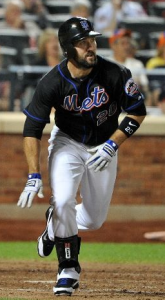 ...deserves another (and maybe a pinch-hit RBI). Pridie has a beard. Dana had a beard. Was it unfair to now play the “it sure would be appropriate…” card? A bearded Mets player should come through with a hirsute hit just because a revered Mets writer was spoken of in glowing terms approximately 69.2 miles to the north and east six or so hours earlier? Would it have been inappropriate had Tejada, instead of getting hit, gotten a hit? Would have I had to have checked Ruben’s high school transcripts to decide his literature curriculum would have met with Prof. Brand’s approval? You’ve got to be careful with this line of thinking. On the day we learned that our friend died, somebody on a board I frequent suggested it would be nice if the Mets could stage a comeback and win one for Dana. The Mets lost 9-3 to the Cubs.
An intense internal debate ensued over the ethics attached to invoking the spirit of the departed in order to gain a desired sporting result on this mortal coil and how dirty I should feel about really wanting exactly that to happen, but — unlike a pair of Metsian beards — it was cut mercifully short when Pridie lashed Jurrjens’s final pitch of the night into right to score Bay and put the Mets up 1-0. “Yeah! The guy with the beard did it!”
Is that so wrong?
Jurrjens exited. Scott Proctor entered. Jose Reyes tripled. Everybody scored. Scholarly beards gave way to flying dreadlocks. Mets up 4-0. The dreads flew home on Justin Turner’s bright red sac fly. 5-0 Mets. Between innings, the big screen played its classy Get Well Kid video for Gary Carter, the man who wore his perm as proudly as he did his chest protector. A spontaneous GA-REE CAR-TER! chant broke out in a distant section. And the Mets held on to shut out the Braves.
No, nothing wrong with that at all.
Dana Brand photo by Sharon Chapman.
by Jason Fry on 4 June 2011 12:27 am The little black cloud narrative of Mets fandom has been overdone in recent years — our team was one good swing away from the World Series in 2006 and played highly meaningful games on the last day of the season in 2007 and 2008, which the good people of Pittsburgh and Kansas City would take in a heartbeat. But games like tonight, sheesh. They’re inarguably bag-on-the-head stuff, and there have been far too many of them recently.
At ESPN New York, Adam Rubin passes along Elias’s grim note that the Mets have had the lead in the seventh or eighth inning in their last six home losses, setting a major-league record. It’s kind of a dopey record, one of those “sixth-place hitters on a daytime Tuesday” notes that rock-ribbed traditionalist fans used to mock before the advent of sabermetrics. What jumped out at me was that the Mets hadn’t scored more than three runs in any of those games when the roof began to sag: They’d scored three runs twice, two runs twice and one run twice. If you get to the seventh or eighth scoring that few runs, you’re going to lose your share, with when the other team scores their expected allotment more the stuff of detail than of tragedy. This is what happens when Ike Davis’s permitted activity is fishing and David Wright’s is lying in an MRI machine — injuries that have now followed the usual depressing Met trajectory from apparently minor to indefinite.
Tonight it was hard to point fingers at those we’d prefer to scapegoat, though it is true that Jason Bay did his usual nothing and Willie Harris struck out pathetically to end the game. (My question: Why was Harris pinch-hitting for Ruben Tejada, whom Terry Collins just praised for his discipline and improvement as a hitter?) This time, the key failures came from the players we’ve come to trust. Jason Isringhausen, one of the best stories of this weird season, walked a guy in a key spot. Jose Reyes, having perhaps his best season, let the grounder that would have ended the eighth roll under his glove to tie the game. And Francisco Rodriguez, a model citizen so far and pretty effective on the mound, was anything but in the ninth, giving up a homer to Eric Hinske and a two-run double to Freddie Freeman to cement the loss.
Painful, but of course it had to come with embarrassing ironies.
Reyes gagged up the difference-maker while being cheered on by passionate rooters who responded to the call to make this Don’t Trade Reyes Night. Bag.
K-Rod got credit for finishing a game even though what he did was more like killing one, moving him a step closer to his toxic $17.5 million option. Head.
Oh, and as an additional kick in the nuts, Sandy Alderson had to deliver the news that Wright will be inactive — as in doin’ nothin’, not as in not here — for another three weeks. Sandy cracked that David’s first game back might coincide with Johan Santana’s first start, which is the kind of line that’s better left to sarcastic/suicidal bloggers than it is coming from the general manager.
Yes, Jonathon Niese was wonderful — Niese continues to evolve into a complete pitcher, one you can imagine slotting in as a capable No. 2 starter if he keeps it up. But he’s not going to get far if his teammates continue to score a run every three innings.
None of us are.
by Greg Prince on 3 June 2011 11:30 am Welcome to The Happiest Recap, a solid gold slate of New York Mets games culled from every schedule the Mets have ever played en route to this, their fiftieth year in baseball. We’ve created a dream season consisting of the “best” 52nd game in any Mets season, the “best” 53rd game in any Mets season, the “best” 54th game in any Mets season…and we keep going from there until we have a completed schedule worthy of Bob Murphy coming back with the Happy Recap after this word from our sponsor on the WFAN Mets Radio Network.
GAME 052: June 4, 1976 — Mets 11 DODGERS 0
(Mets All-Time Game 052 Record: 25-25-1; Mets 1976 Record: 25-27)
Mighty…it’s almost too gentle a word to describe Dave Kingman at his mightiest. Might, as a noun, does seem more appropriately ensconced in Kingman’s considerable wheelhouse, but it’s a little too iffy if it’s taken here as an auxiliary verb. Dave Kingman might hit some of the longest home runs you’ll ever see. It’s too conditional. It gives you the sense it might not happen.
It was going to happen. Dave Kingman was going to use all his might and strike mighty blows and they were going to sail beyond any and all fences erected to contain him. It was a certainty. The only legitimate questions to ask were “how many?” and “when?”
On a Friday night at Dodger Stadium, he gave us his answers: a two-run homer off Burt Hooton in the fourth; a three-run homer off Burt Hooton in the fifth; a three-run homer off Al Downing in the seventh.
There. Just like that, on three first pitches, Dave Kingman homered three times and drove in eight runs. The former accomplishment tied a Mets record initially set by Jim Hickman in 1965. The latter set a Mets record which would stand for 32 seasons. Sky King’s 20 home runs through 52 games — five ahead of Mike Schmidt for the N.L. lead — threatened to shatter a few more marks before 1976 was over. Hack Wilson held the National League record with 56 roundtrippers struck in 1930, and he didn’t have 20 home runs until the Cubs had played 59 games.
“I don’t even want to think about that,” was how Kingman answered a question in 1976 about how many he might hit for the season. He also professed a lack of interest in the distance his dingers traveled: “What difference does it make how far they go? I’d just as soon hit a single that wins a ballgame.”
Kingman could always clout. It was hitting consistently that tended to flummox the slugger. Before lavishly supporting Tom Seaver’s three-hit, 11-0 shutout of the Dodgers, Dave had been encountering tough times at the plate. He was 1-for-17 in his previous four games, the worst of them being the most recent, an 0-for-5 performance that saw him strand runners in each of his plate appearances. “I halfway expected to be sitting this one out after the way I performed on our last homestand,” Kingman admitted. “I had a miserable week but, well, that’s baseball. These things happen very seldom and I’m going to enjoy it.”
These things wouldn’t happen so seldom in Kingman’s career, actually. His power would surge to the tune of three home runs in a single game four more times in the next eight years, though none of other explosions occurred on behalf of the Mets. One more did, however, happen while Kingman, as a Cub, was facing the Dodgers. That was in 1978, when Tommy Lasorda had succeeded Walt Alston as L.A. manager and the colorful skipper offered a few choice words to radio reporter Paul Olden, who innocently asked afterwards for Lasorda’s “opinion of Kingman’s performance”. “‘What is my opinion of his performance?’ How could you ask me a question like that, ‘What is my opinion of his performance?’” is about the only part of Lasorda’s answer that could go unbleeped.
Alston, two years earlier, kept characteristically quiet…as quiet as Kingman’s bat was loud and awe-inspiring.
ALSO QUITE HAPPY: On June 10, 1969, the Mets extended their team-record winning streak to eleven consecutive games, a mark that’s been matched three times since but never topped. This one was a 9-4 victory over the Giants at Candlestick Park featuring a two-homer, four-hit outburst from Tommie Agee and three RBIs from his Mobile, Ala., running mate Cleon Jones (now batting .351). Don Cardwell gave up five hits in pitching to one out in the ninth before giving way to Ron Taylor. The eleven-game winning streak erased any memory of the five-game losing streak that preceded it and made the excitement over the Mets simply reaching .500 in May seem like outdated news. The Mets, after all their streaking, were six games over the break-even point, seven games behind the Cubs and ensconced in second place, comfortably ahead of the Pirates and Cardinals.
GAME 053: June 9, 1964 (1st) — METS 6 Cubs 5 (12)
(Mets All-Time Game 053 Record: 24-26; Mets 1964 Record: 17-35-1)
When you say “long man,” you be sure to pronounce it “Larry Bearnarth.” That’s how Casey Stengel did it in the opener of a twinighter at Shea this Tuesday night. He said Bearnarth, and he kept saying it.
First, however, the Ol’ Perfesser said, “Al Jackson,” but Jackson’s pitching said he didn’t have it. Little Al faced seven batters in the opening inning at Shea; five of them reached base; three of them scored; three of them were on base when Stengel decided he’d seen enough. Jackson was pulled in favor of Bill Wakefield, who got the Mets out of the first trailing 3-0.
The Mets had their first big opportunity to get even and, perhaps, then some in the second, so once the Mets got two on with two out and Wakefield was due up, Stengel pinch-hit for him with Hot Rod Kanehl. Kanehl didn’t let him down, singling home two runs and taking second on the throw in from right field. Jim Hickman followed with another two-run single and now the Mets led 4-3.
In to pitch came Tom Sturdivant, who promptly lost Stengel’s confidence by surrendering a leadoff triple to Ron Santo, a run-scoring single to Ernie Banks and another single to Billy Cowan. That was enough Tom Sturdivant. Enter Bearnarth, making his first appearance since the infamous 23-inning loss to the Giants on Memorial Day. In that wacky May 31 affair, Larry gave Casey seven solid innings of shutout relief. His encore began in promising fashion, as a flyball, a grounder and a strikeout untangled Sturdivant’s mess.
At this point, the Mets had played three defensive innings and used four pitchers. A second game remained after this one, so if Stengel needed anything, it was length. And length became Larry’s middle name (though, for the record, Lawrence Bearnarth’s middle name was Donald). There’d be a hit batsman and a few walks, but Bearnarth gave up no hits from his entrance in the top of the third clear through to one out in tenth. That added up to seven-and-one-third hitless frames from the righty reliever, though it bears noting his streak was saved by Kanehl, who stayed in the game to play center and conjured an outfield catch-and-throw that served as an unknowing precursor to one Endy Chavez would make 42 years later.
Santo led off the seventh with a walk. Banks belted a Bearnarth pitch an alarming distance. What happened next is best described by Bob Murphy:
“Here’s the pitch on the way…a drive in the air to deep center, Kanehl a long way to go, way back, WAY back, against the wall — OH WHAT A CATCH! WHAT A CATCH, THE PLAY OF THE YEAR! HE MAY GET A DOUBLE PLAY! Ron Hunt has a relay throw to make…here it comes…DOUBLE PLAY!”
At that moment, Kanehl was the long man of long men on the Mets, but soon enough it was Bearnarth out there extending himself even more. Banks and Dick Bertell singled for the Cubs in the tenth, but nobody scored. Lou Brock singled in the eleventh, but he, too, was stranded. Finally, in the twelfth, in Bearnarth’s tenth inning of relief, the Cubs got to him, when Bertell singled home Santo. The Cubs led 5-4.
But not for long. In the bottom of the twelfth, Joe Christopher singled with one out and Charley Smith reached on shortstop Jimmy Stewart’s ground ball error. Bearnarth finally left the game for a pinch-hitter, Sammy Samuel. Samuel — facing Lindy McDaniel, who had just replaced Chicago starter Dick Ellsworth (who had gone 11⅓ innings) singled, sending Christopher home to tie the game at five. One intentional walk later, catcher Jesse Gonder made a winner of Bearnarth by singling to center. Charley Smith scored and the Mets prevailed 6-5 in twelve.
Larry Bearnarth’s ten innings of relief in one game established a Mets record that has never been matched. No Mets reliever, in fact, has come within two innings of Bearnarth’s length since June 9, 1964. That span includes the second game of that doubleheader, one which was lost 5-2 in regulation. The starter and loser for the Mets? Galen Cisco, who had set the record Bearnarth had broken when Cisco pitched nine relief innings in…yup, that 23-inning loss to San Francisco on Memorial Day. Galen pitched the 15th through the 23rd immediately after Larry pitched the 8th through the 14th.
The Mets might not have been very good in 1964, but they didn’t let opponents know that any sooner than they had to.
ALSO QUITE HAPPY: On June 4, 1988, the Mets made a habit of coming from behind every couple of innings when coming from behind was most essential to their in-game survival. The Cubs took a 4-3 lead on the Mets in the top of the ninth this Saturday at Shea when Manny Trillo singled in two runs off Roger McDowell. No worries: with two on, Gary Carter singled off Goose Gossage to tie the score. In the top of the eleventh, Terry Leach tried to keep it tied, but he was undermined when, with two out, Vance Law scored from third on an error by Howard Johnson, playing short. Facing a 5-4 deficit in the bottom of the inning, the Mets got Mookie Wilson to third with two out. Lenny Dykstra was down to his last strike when Cub reliever Mike Capel uncorked a wild pitch. It was 5-5, and the two teams were going to the twelfth. They made it to the bottom of the thirteenth, when Kevin McReynolds — who was known to like to beat it out of the clubhouse as soon as he could once a game was done — got tired of playing and blasted Capel’s first pitch of the inning for a game-ending home run, giving the Mets a 6-5 win.
GAME 054: June 10, 1986 — METS 8 Phillies 4 (11)
(Mets All-Time Game 054 Record: 22-27; Mets 1986 Record: 38-16)
To the 1986 Mets, nothing exceeded like excess. So why would anyone would think the most extravagant exceeders of them all would settle for something so mundane as a game-winning sacrifice fly?
After Gary Carter homered against Phillie reliever Steve Bedrosian to lead off the bottom of the eighth at Shea and forge a 4-4 tie (it was Carter’s second home run of the night), the two teams remained knotted until the bottom of the eleventh inning. Randy Lerch — who had pinch-hit for Bedrosian in this era of 24-man rosters — allowed a single to Ray Knight to start the frame. Rafael Santana’s grounder to the right side moved Ray to second. Davey Johnson sent Barry Lyons up to pinch-hit for reliever Roger McDowell. Phillie manager John Felske countered by intentionally walking the backup catcher in hopes of setting up a double play. Lerch didn’t aid the strategy when he walked Lenny Dykstra.
Now the bases were loaded with one out. All anyone could ask for was a simple fly ball. That’s all the Mets needed. Drive one deep enough so that Ray Knight could trot home from third.
There’d be a deep drive. And there’d be trotting. But it wouldn’t be simple.
Johnson called back second baseman Wally Backman and sent up his righthanded platoon partner Tim Teufel. Felske, having seen enough of lefty Lerch, replaced him with righty Tom Hume. There was a second base dynamic at play. Backman was a switch-hitter on paper, a lefty swinger for all intents and purposes. It was Wally’s failure to produce from the right side down the stretch in 1985 that motivated the Mets to acquire Teufel from the Twins the previous offseason, giving up former first-round draft pick Billy Beane in the process.
While Backman was thriving in the new arrangement, entering this Tuesday night affair hitting .313, Teufel was having a tough time adjusting to New York. He came into the evening’s action batting a most unMetslike .226. The night before, in a similar lefty-righty spot, Teufel pinch-hit for Backman with two out in the ninth with the winning run on second and was popped up by Don Carman. The Mets would lose in ten.
Now Teufel was planning on forgetting the night before and planning the tack he’d take against Hume. “I knew if I hit a ball up the middle,” Teuf said, “there was a chance they’d get two.” His goal, then, was distilled to its essence:
“I knew I had to get it in the air. He’s a sinkerball pitcher. I was just looking for something to lift.”
After taking two balls from Hume, Teufel swung — and the Mets would be the ones looking for something to lift: Teufel, perhaps on their shoulders. They didn’t go that far in their celebration, but they did their share of hootin’ ‘n’ hollerin’ when Teufel’s fly ball to left did more than score Knight. It scored Lyons, it scored Dykstra and it scored Teufel.
It was a walkoff, pinch-hit grand slam, the first by any Met since Steve Henderson launched one against the Cubs seven years earlier. It was also a great example of what the 1986 Mets were capable of. Ask for a fly ball, receive a fly ball that clears the right field wall to win yet another game, this one 8-4 in eleven innings.
The mid-’80s were considered an era of conspicuous consumption in certain circles in New York. For a baseball team that had just ensured itself an eight-game lead in the National League East, nobody in these parts wished for anything resembling humility or thrift.
ALSO QUITE HAPPY: On June 5, 1978, two teams headed in opposite directions stopped on their ultimate journeys to see how the other half lived. The Mets had surprised the doomsayers when they played quite competently right up to the middle of their Memorial Day doubleheader, with their record cresting at a very respectable 23-24 after beating St. Louis in the opener. Then they lost the nightcap, were one-hit by Silvio Martinez the next night, and their slide to 1978 oblivion was on. They entered this Monday night tilt at Shea against the defending National League champion Dodgers 24-29, losers of five of their previous six. The Dodgers, meanwhile, were struggling a bit, having lost four straight, but they were still the Dodgers — engaged in a three-way pennant race with the Giants and Reds in the Western Division, giving no indication they’d be anywhere but in a pennant race for the rest of the season. When they scored early and often off Mike Bruhert and Paul Siebert, and carried an 8-2 lead into the bottom of the fourth, all appeared predictable. But all bets were off from there, as Siebert, Dale Murray and Skip Lockwood held the Dodgers hitless the rest of the way, allowing the Mets to mount a seven-run comeback that culminated in the ninth inning, which the Mets started down 8-6. Tim Foli doubled home the tying runs off Terry Forster, and a typically dreadful throw to first from shortstop Bill Russell of Doug Flynn’s potential third-out grounder sailed past first baseman Steve Garvey. Russell’s error allowed Foli to hustle home from second to give the Mets a rousing 9-8 victory. The difference between the Mets’ and the Dodgers’ records at this point of the season was a mere 3½ games. When the season was over, L.A. would be 29 games better and on their way to a second consecutive World Series. The Mets would be last in the East for the second year in a row. But for one night in June, it was hard to tell exactly who was the big-time contender.
Thanks to Sharon and Kevin Chapman for providing digital audio from the game of June 9, 1964.
by Greg Prince on 2 June 2011 10:44 pm Call it hindsight of the sharpest degree, but I swear I had a feeling about today’s game when it was 7-0, and that feeling wasn’t all about the different vessels I considered packing Mike Pelfrey into and what destinations I would have liked him shipped. Well, that, too, but after Pequeño Pelf finished the third giving up only one run after surrendering thrice as many in the first and the second…I dunno, I just had this feeling that included the following elements:
• “All it takes is one big hit to close the gap.”
• “These are the Pirates and, due respect, this is just too good a setup for them.”
• “Does DHL have a long enough tube in which to cram Pelfrey, or would it be more cost-effective to shove him in a trunk and bring him to UPS?”
And as I’m sorting all that out at Citi Field, Citi Field suddenly becomes a fortuitous place to spend one’s Thursday afternoon. Three Mets who had been keeping the Mets relatively afloat these past few weeks — Reyes, Turner and Beltran — arranged for that gap-closing of which I pondered. 7-0 became 7-3, and in that fan logic I like to deploy when the Mets merit logic, you’re no longer coming back from down 7-0 if it’s 7-3.
It was 7-3. Teams don’t often come back from seven down, but coming back from four down isn’t so crazy.
Since Pelfrey couldn’t (legally) be sent anywhere against his will, I was perversely relieved to see he hadn’t been relieved despite his ostentatious hole-digging. Even his batting in the bottom of the third, before Jose, Justin and Carlos (especially Carlos) crafted the foundation of the comeback, heartened me. Terry heartened me Wednesday night with his tearing of 22 or 23 new ones, and from some very sweet seats, I was thinking that keeping Pelf in the game was an extension of that. No, we’re not going to write this one off. No, we’re not going to parade the relievers out here early. Yes, you big boy, you go out there and hold these Buccaneers at bay.
Michael had the perfect foil in the Pittsburgh Pirates. They just weren’t, I believed, ready for prime time, even if prime time was taking place in daytime and even if all that was at stake was taking three of four from the Mets at the beginning of June. I’m not in the business of looking down my nose at the Pittsburgh Pirates or devoting more than cursory notice to the Pittsburgh Pirates’ ship of state, but I know what it’s like to root for a team that’s been down so long that you’ll jump on any sign that it’s coming up for air.
I could see the Pirates fan version of myself — maybe the 17-year-old Pirates fan version of myself — getting way too excited by the 7-0 lead, by the newfound prowess at competing on the road, by the prospect of winning a four-game series, by rising so close to .500 to almost touch it. I recognize giddiness scratching and clawing to emerge from the closet of anxieties. I also recognize that there’s a reason giddiness gets stuck in that closet for so long.
So if the Mets were going to fall behind 7-0 to anybody, and were going to leave in the pitcher who shoved them behind 7-0, the Pirates, I sensed, were the team to do it against.
Besides, it wasn’t 7-0 anymore. It was 7-3. Pelfrey stiffened in the fourth and the fifth. He retired his last seven batters in a row. Normally, someone gives up seven runs, you’re not interested in seven extraneous batters. But I swear I didn’t think there was anything extraneous about collecting every out we could. If the Pirates were going to be unbeatable this afternoon, then why didn’t they add to their lead? And if they didn’t add to their lead, why couldn’t we reduce it further?
We get through the top of the sixth, Byrdak having replaced Pelfrey. Despite giving up Paul Maholm’s second hit of the day, Tim sets down the next three Bucs. What sign overrides the other: Mets pitching allows an .050 hitter two singles, or the .050 hitter not coming around the second time he’s on? Sounds silly, but I’m looking at the Pirates, having lived a charmed life against R.A. Dickey one night and Chris Capuano the next, not conjuring any more magic. Paul Maholm scoring some more…any Pirate scoring some more, and they’ve ensured it’s just not our day. But they stopped scoring, so the day was up for grabs.
Bottom of the sixth. Beltran, whose third-inning homer stung the Allied sign that fronts the Left Field Landing, launches another very long fly ball. It’s high, but it’s not high enough. It’s a double off a wall that if it was a less pretentiously high wall would have been another homer. “Fuck this fucking ballpark,” I said to Jason. This ballpark has been swallowing home runs and spitting them out as doubles when not turning them into 7s, 8s and 9s on scorecards. Fuck this fucking ballpark, maybe, but the Mets decided not to be so fucked by it for a change. Maybe that’s Terry’s tirade burning in their ears from Wednesday night. Maybe managerial anger is just one of those things we fans choose to read into.
Whatever. The Mets load the bases when Bay walks (he’d later be hit by a pitch; just standing still seems to turn Jason Bay into a useful offensive weapon) and an apparition faintly resembling little-used Nick Evans walks. Ruben Tejada, here for his defense and out of desperation, is the guy who has to get a base hit. There’s just no question that it’s on him. There are two outs. There is no rally without Tejada coming through. Tejada is supposed to be an improved hitter. He’s been getting hits, but they’re the kinds of hits mostly that the Pirates were getting against Capuano: not deep, kinda lucky. We need a real major league hit from a real major league hitter.
That’s my boy, Ruben, poking one to right, bringing home Beltran and Bay, and now we’re not overcoming a 7-0 deficit or a 7-3 deficit. We’re down 7-5 in the sixth inning. We have Tejada on first and Evans’s apparition on second. Teams obliterate two-run deficits with three-plus innings to go all the time. At once this is an extraordinary effort and just another game.
Clint Hurdle must not have been all that alarmed, because he kept Paul Maholm in. I don’t understand why. Whereas Pelfrey had stiffened, Maholm was crumbling. It wasn’t the first and second anymore. He wasn’t fooling hitters. He wasn’t fooling anybody. Perhaps Hurdle was examining the Mets’ bench and realized there were no opposing batters of the righthanded persuasion to take on his lefty. Scott Hairston had already been used. Terry had four lefties from which to choose to pinch-hit for Byrdak.
He chose Daniel Murphy. My third great hunch of the day — after “we’re not necessarily screwed” and “leaving Pelfrey in isn’t necessarily stupid” — overcame me. It’s lefty-lefty, this is supposed to represent a terrible disadvantage for the batter, but this is no run-of-the-mill lefty swinging. This is Daniel Murphy. That may not sound like much generally, but the point is Murphy isn’t a strict platoon player and he’s not usually a bench player. He faces lefties regularly. I didn’t have the splits in front of me, but I didn’t remember Daniel dissolving at the sight of a Paul Maholm as a rule.
I wanted Daniel Murphy up there. And I was rewarded when Murph shot a ball into the outfield and Great Nick Evans’ Ghost! scored. Young Ruben followed immediately when Matt Diaz (fucking Brave) overthrew his target.
Now it was 7-7. The Mets weren’t overcoming deficits anymore. The game was tied. You know those radio spots Howie is forced to read at contractual gunpoint about “safe and secure”? That’s how I feel about tie games when they’ve been trailing games. That’s how I felt when Rich Gedman couldn’t corral Bob Stanley’s alleged wild pitch and Kevin Mitchell pounded down the third base line to make it Mets 5 Red Sox 5. No matter what else happened, we weren’t losing anymore in the sixth game of the 1986 World Series. That’s how I felt when Todd Pratt walked with the bases loaded in the fifth game of the 1999 National League Championship Series. Mets 3 Braves 3, Ventura coming up.
We weren’t losing then. And we weren’t losing now. Safe and secure…aaahhh.
Was the rest inevitable? Is anything with the Mets? Could anything be inevitable when you’re compelled to sort out a scenario that, in the eighth, involves Willie Harris as a pinch-runner (would he get picked off first or steal second and get picked off there?), Chris Capuano as a pinch-bunter (over Thole, who was going to have to come in for Paulino, being allowed to hit away) and the world’s quietest balk? Oh, that balk. “What’s Willie Harris doing on second?” was what Jason and I asked each other and what everybody around us asked everybody else. Nobody seemed to know. I was slow on the draw with my radio, but I heard Howie mention “balk,” and that was all the explanation I needed. Jason attempted to boil it down further, but all I knew was Harris was on second, it was sanctioned by umpires, Capuano was giving way to Thole in the midst of an at-bat that didn’t carry as many strikes as we thought it did and we weren’t losing.
From there, we were gonna be all right. Harris got to third on a wild pitch (no, the Pirates were not ready for prime time), Tejada lifted a simple fly ball that’s not always so simple to lift, and we had the lead I envisioned us taking five innings earlier. Then we had a slightly larger lead, thanks to several walks.
9-7 Mets. I was aware this was conditionally the second-largest comeback in Mets history, tying what the Mets achieved in front of Jason and me on June 30, 2000, but I have to confess it felt nothing like that, save for immense satisfaction, of course. That night against Atlanta — lotsa walks, Fonzie’s two-RBI single, Piazza’s three-run crescendo off Kerry Ligtenberg — literally rocked the house. A weekday game I attended against the Cubs on May 17, 2007 — down 5-1 entering the ninth, up 6-5 in a matter of pitches — was emotionally explosive everywhere you looked. Those comebacks rocked Shea to its core. This comeback, in the place that came after Shea?
It was more methodical, so maybe that’s why Citi Field didn’t seem to shake. I was a little disappointed that the only ballpark we have wasn’t all aquiver over matching the second-largest comeback in Mets history. It was happy enough, but I swear the school groups made more noise in the first and second innings when they were simply clearing their lungs than the crowd that remained did as the Mets put the Pirates almost to bed in the eighth.
“Does this feel like we just came from down 7-0 to go ahead 9-7?” I asked Jason. He confirmed it did, and the scoreboard offered evidence. I knew we had, just as I believed we could…but I was missing the mass thrill that usually accompanies these things. Then again, I was grateful this was one of “these things,” and I was thrilled for that.
Besides, I said to Jason, if this somehow becomes a 10-9 loss, it will doubtlessly feel like we blew a 9-7 lead.
Blessedly, that contingency didn’t have to be broached. A 9-8 win, saved by Frankie Rodriguez, sufficed. The W went to Jason Isringhausen, as if he doesn’t have enough letters. It was the first time he was the Mets’ winning pitcher since June 8, 1999. His opponents then were the Blue Jays of Carlos Delgado, Chris Woodward and Tony Fernandez. His left fielder was Rickey Henderson. His immediate successor on the mound was Dennis Cook. His future lay elsewhere, his short-circuited Met past had long ago gained on him.
Izzy, however, had quite a present today with a scoreless eighth, as did Bobby Parnell with a scoreless seventh, as did all the Mets who didn’t lose just because it seemed so obvious they would. Instead, they won, which seemed so strangely possible to me despite its inarguable improbability.
I can’t tell you how nice it is to believe in your team for no good reason except that you do.
|
|