The blog for Mets fans
who like to read
ABOUT US

Faith and Fear in Flushing made its debut on Feb. 16, 2005, the brainchild of two longtime friends and lifelong Met fans.
Greg Prince discovered the Mets when he was 6, during the magical summer of 1969. He is a Long Island-based writer, editor and communications consultant. Contact him here.
Jason Fry is a Brooklyn writer whose first memories include his mom leaping up and down cheering for Rusty Staub. Check out his other writing here.
Got something to say? Leave a comment, or email us at faithandfear@gmail.com. (Sorry, but we have no interest in ads, sponsored content or guest posts.)
Need our RSS feed? It's here.
Visit our Facebook page, or drop by the personal pages for Greg and Jason.
Or follow us on Twitter: Here's Greg, and here's Jason.
|
by Greg Prince on 7 April 2011 8:19 pm Goodbye to the road. Goodbye to Whatever It’s Called Stadium in The Middle of Nowhere, Fla. Goodbye to that LandPhil where fly balls grow jet-packs in flight. Goodbye, for now, to Roy Halladay who doesn’t seem to mind pitching in that silly little bandbox. Goodbye to early evidence that we can hold our own against iffy teams but may be bound to take our lumps versus the more capable kind. Goodbye to all that.
Hello Dickey Field!
Home is going to look, sound and feel oh so good Friday. It’s only been two series since the season started, yet there’s also been a full Spring Training, an endless winter and a 2010 that wouldn’t exit stage left until Oliver Perez walked in its final run. Ollie loading the bases and then marching in one last National was a perfect capper to two years of live, streaming Met folderol. What a blue and orange period we have just lived through. Then again, there was a true saving grace to 2010, and it should be noted and cherished.
It introduced us to R.A. Dickey. Tomorrow he introduces Flushing to 2011.
This morning, I flipped WFAN on and was prepared to flip it off (so to speak) when I heard R.A. Dickey was going to be the guest in a little while. So I stayed tuned and wasn’t disappointed.
R.A. Dickey has never disappointed as a Met. He’s had a few subpar outings since we’ve gotten to know him, but we had no idea how impressive his par was going to be. Could have you imagined at this time last year that a) R.A. Dickey would be our Home Opener starter in 2011 and b) that would be a bigger enticement to attend than even a Mr. Met bobblehead?
I listened to Dickey in a way I never listen to, say, Ed Coleman. If I’m up on a Saturday morning staying awake against all odds as Richard Neer speculates, conjectures and drones (“maybe Santana thinks, ‘well, I’ve already got my contract and you know, I don’t have to rush back from rehab,’ so he takes it easy in Florida away from the watchful eyes of Terry Collins and Sandy Alderson…”), I’ll inevitably perk up when he tells me Eddie Coleman’s Mets report will come on after the 8:40 update. Great, I think, a full 15 minutes of Mets news, yet come 8:58, I realize I’ve instinctively tuned out everything Eddie is going to the trouble of telling me. Same thing, generally, when a FAN host teases the appearance of some stray Met. There’s always a jolt of anticipation — “Oh boy! Vance Wilson’s gonna be on with Sid Rosenberg!” — and then the words just dissipate into inanity on their way out of the speakers and I’ve forgotten whatever was said before the next 20/20.
But not R.A. Dickey. Never R.A. Dickey. R.A. Dickey remains, in his second year as ours, the E.F. Hutton of Metsopotamia. When R.A. Dickey talks, I listen. I listen for the verbiage (this morning he said “arrest” as in “stop” or “halt” when the rest of us would have stopped or halted at “stop” or “halt”); for the heart (he was practically massaging Mike Pelfrey’s brain after his teammate’s abysmal outing from the night before); for the compassion (how he got to know a woman suffering from Cystic Fibrosis, how she was going to meet him at the ballpark, how she passed away over the winter and how he met her family after the fact and invited them to a game as a tribute to her); for more verbiage (the knuckleball is a “chaotic” pitch); and for the sheer R.A. Dickeyness of the man.
A few years ago, we were amused and a little horrified to learn Keith Hernandez withstood a tornado as a minor leaguer by opting to run “outside into a gully”. This morning, I had a similar retroactive reaction to finding out that as a bored Triple-A pitcher who had made one too many visits to Omaha, R.A. Dickey decided to try and swim across the Missouri River…except being R.A. Dickey, he actually decided to try and “traverse” it. In case you’re wondering, the traversal wasn’t successful, but the pitcher survived the episode.
And now he’s about to bring us another installment in the adventures of The Most Interesting Man in the World. I thought somewhere along the way the novelty of R.A. Dickey would wear off, but it’s only intensified. But novelty is too trivial a classification for this one-of-a-kind wonder. He is an American original — and I rather doubt there are a whole lot of him in other countries.
One more thing I absolutely embrace about this guy is that as he was audibly thinking and then speaking on WFAN this morning, I began to picture him doing what we really like him to do. I pictured him on a sunny day, taking the mound, making his warmups, preparing his game plan and pitching for the New York Mets. And when I did, I pictured him doing so at Citi Field.
Natural portrayal to conjure, right? I suppose, yet as the image formed in my mind, I realized R.A. Dickey may be, in addition to everything else wonderful, the first genuine Citi Field Met of our time. Lots of Mets have worn one or more of the several home uniforms the Mets feature since 2009, but I don’t know that when I consider them, I consider them in their certified habitat. My connection to Shea Stadium is so stubborn that I don’t particularly want to think about David or Jose or any of the long-timers as playing home games anywhere else (not that there are many Mets who’ve made it from 2008 to now). Meanwhile, those who became Mets in the Citi Field era haven’t distinguished themselves quite enough to make me consider them all that much when they’re no longer right in front of me.
In the first two seasons of the place that’s been tough to call home, there have been passing fancies I can picture there and picture fondly in snapshot form: Gary Sheffield swatting his mercenary 500th homer; Omir Santos emerging from nowhere and touching cult hero status; Liván Hernandez completing what he started (once anyway); Cory Sullivan totally getting the born-to-triple dimensions of his temporary environs; the accidental closerhood of Hisanori Takahashi. There have also been a few Shea Mets who evolved into breakout acts in the new venue; Angel Pagan, Jon Niese and poor, abused Pedro Feliciano became much bigger deals in our world once Citi Field opened. And, of course, there are the youngsters — Davis, Thole, Tejada (I hope) — who have begun to make a mark on Citi bricks without ever having set foot inside an official Shea Stadium game.
But it’s R.A. Dickey I see when I want to close my eyes and see Citi Field at its idealized best. The sky is bright. The ballpark is full. The seats are occupied. The pinstripes are in effect. The Jane Jarvis recording of “Meet The Mets” fills the air. And the bearded righthander, wearing No. 43 with a verve and panache even Jim McAndrew couldn’t match, crosses the first base foul line, finds the rubber and seeks out his catcher.
I open my eyes. The home season is about to start. R.A. Dickey is about to start. Citi Field is about to start.
For keeps.
FAFIF readers: Save the date of April 21. Details coming Monday.
by Jason Fry on 6 April 2011 11:25 pm It’s an age-old fan question: Your team’s down seven runs, and not destined to win. Given this, how would you prefer them to exit stage final? Biting and scratching and clawing, even if all’s in vain? Or quickly and quietly, so as not to waste valuable pluck and luck? (Pluck and luck don’t actually work this way, of course, but there are no rationalists in baseball foxholes.)
The Mets died hard tonight, leaping out of the casket to all but tear the face off the Phillies before being clubbed back into submission in a curious, ultimately futile game. There were bad omens early — despite what happened Tuesday night, I moaned and groaned over Jose Reyes reaching third with nobody out and not scoring in the first, a missing run I kept coming back to as the night got weirder. Granted, for a while that lack looked merely cosmetic: Mike Pelfrey was horrible in about every way a pitcher can be horrible, from bad location to flat pitches to a truly original mental lapse in the field.
One of baseball’s many totally 100% all-true cliches is that if you pay attention, you’ll see something you never saw before. And most of the time I appreciate that. But not when the thing I don’t think I’ve ever seen before is a pitcher making a smart play under pressure as precursor to making a dumb play moments later. In the second, with one out and a runner on first and a fair number of horses already out of the barn, Joe Blanton popped a bunt up behind the mound. Pelfrey let it drop, leaving Pete Orr stranded a step off first. Great play — and one few fielders make in the heat of the moment, and fewer pitchers even try. Pelf had Orr dead to rights at second and was about to record an easy double play or at least replace Orr on first with Blanton, but before I could even bring my hands together to applaud, Pelfrey plucked the ball out of the grass and fired it to first … past Brad Emaus. I’d say I’d like to hear an explanation of that one — I guess Pelf thought going to first initially would let them get Orr in a rundown, which is too greedy — but in truth I’d rather expunge it from memory this instant. Orr would come around to score, and an inning later Pelf got no one out and wound up perched in the dugout looking like he needed smelling salts.
For that, the Mets did come all the way back, removing the hook from Pelfrey’s back with an Angel Pagan homer and then a barrage that chased Blanton in the fifth and dented Antonio Bastardo, who’d like to pre-emptively point out that Fry is Low Alemannic for “basement scribbler,” so shut up. If Bastardo continues to delve into etymology, perhaps he’ll emerge to tell us that, ironically, Rollins is derived from an archaic Dutch word meaning “stationary” — on multiple plays Jimmy displayed the approximate range of a stack of boxes being pushed over. Between that and Chase Utley’s injury and the fact that Raul Ibanez and Shane Victorino have the arms of Johnny Damon crossed with a boneless chicken, the Phillies had better hope their vaunted aces strike out guys in bushels.
One of the things about baseball that’s either comforting or galling is that over a large enough sample size it’s usually pretty fair — stuff evens out. In the bottom of the fifth, Blaine Boyer was victimized by a Victorino check-swing double, a little parachute by Placido Polanco that evaded Carlos Beltran by six inches or perhaps another three weeks of right-field experience, and a Ryan Howard grounder that Boyer deflected to land 20 feet in front of a horrified Emaus. Buzzards’ luck, to be sure, but an inning later Boyer was greeted by a Ben Francisco drive that might have landed in Portugal if it were summer. After that the Mets and Phils both seemed pretty spent, or all the randomness had already been squeezed out of the game, and things loped along to a tidy but unhappy conclusion.
The Mets fought back for seven runs. Wish they’d gotten that eighth run when it was there for the taking, that Pelf’s brain hadn’t unhooked itself when it did, that Boyer and Beltran had placed their gloves slightly differently, that Reyes’s fifth-inning drive had risen a bit farther as Ibanez staggered under it. But none of that happened, and so the Mets lost. If you shut this one off in disgust when it was 7-0 and did something else with your night, did you salvage the evening or miss out on something inspiring? You tell me.
by Greg Prince on 6 April 2011 2:40 am If I hadn’t recognized the onslaught of orange by sight, my posterior would have know that texture of plastic anywhere. It was a 100% genuine Shea Stadium seat, one of four aligned against the front window of the Pine Restaurant at the Holiday Inn LaGuardia on 114th Street. Positioned as it was, it meant that once I sat down in it — the first I time I experienced that reassuring rump sensation since 9/28/08 — my back was turned on Citi Field and I was facing straight ahead at a Shea Stadium Final Season crest nailed proudly over the Pine bar. If I turned my head a little up and to the left, I could comfortably, from the vantage of my Shea Stadium seat, watch a baseball game in which a Mets pitcher seemed to be reaching base far more effectively than the opposing batters attempting to hit him.
That Pine Restaurant is my kind of place. And that Chris Young is my kind of pitcher.
And hitter.
Good night there on the edge of Corona. The occasion was Matt Silverman’s Maple Street Press Mets Annual soirée, but a Mets pitcher getting two hits in one inning — and three overall while striking out seven Philadelphia Phillies — well, that’s cause for unbridled celebration. It may not have provided instant impetus for parade planning, what with 158 games remaining on my crisp, new 2011 pocket schedule, but 3-1 beats all but one of the alternatives, so let’s savor that.
 The new pocket schedules are here! Very good night there on the edge of Corona. Young’s two third-inning singles…one setting up five Met runs, the second driving in a sixth…represented the Ripley’s Believe It Or Not portion of the evening. The rest of the game was good, old-fashioned romp ‘n’ stomp. David Wright failed to bring home runners in the first but then atoned with four hits, two runs, two ribs, even a stolen base. Jose Reyes grabbed himself a bag, as did Angel Pagan. Ike Davis drove in a run somewhere in there. New fellers like Brad Emaus, Scott Hairston, D.J. Carrasco and Tim Byrdak continued to contribute as well.
And I got to sit in a Shea Stadium seat, so very close to where Shea Stadium used to smile back at me when the Holiday Inn was the Ramada and the Pine was Bobby V’s. Now Citi Field eyes me warily in the distance; I don’t think it was expecting me until Friday. Me and it will be fine by then. But last night was for sitting in the seats from the ballpark it displaced. I must say, they’re way more comfortable than I remember, but maybe that’s because there wasn’t a row in front of me and a row behind me and intrusive elbows on either side of me.
Also, at Shea, it was pot luck regarding the quality of my neighbors for a given game. Tuesday night, by contrast, I had the cream of the local blogging crop in my midst: the aforementioned genial Silverman; Jon Springer, the visionary who created Mets By The Numbers when the rest of us were picking out mouse pads; Paul Lukas of Uni Watch; Ed Leyro of Studious Metsimus; and The Coop, of practically everything (but primarily this site). We even had a visit from longtime print chronicler Andy Esposito, a byline familiar to anybody who’s ever maintained a subscription to New York Mets Inside Pitch.
Big-time Mets fans in a big-time Mets establishment watching a big-time Mets win over a big-time Mets foe and engaging in a rolling big-time Mets discussion, the contents of which seemed to revolve around all that has gone wrong for our favorite team these last few years. It was good to get it off our collective chest. It’s always good to get it off our collective chest. It never stays off for long, of course. That’s Mets fandom’s biorhythms in action. I’m not criticizing, mind you. I’m recognizing it for what it is. Had a psychic entered the bar while the Mets were scoring those six third-inning runs, she would have — despite the cheering of the news from Philadelphia — advised us, “There is much pain in this room.” And then she would have found my ass clinging to my orange seat and added, “I feel separation anxiety, as if there was something nearby that was taken from you and you are still not fully recovered.”
Maybe I would have ignored the psychic as I pulled for Chris Young to stay in long enough to go 4-for-4. Or maybe I would have gone on to my recurring rant, now in its 22nd record-breaking season, about how Randy Myers never should have been traded for John Franco…which, come to think of it, I did, even though the Mets were winning by plenty in the present.
Someday when I again run into one of those big-time Mets fans with whom I spent Tuesday night, we might be moved to remember that time we watched the Mets beat the Phillies at the Pine and Chris Young became the first Met pitcher to collect two hits in the same inning, but I have a hunch that will be far down the list of Met topics that occur to us organically. First we’ll remind each other of disappointments ancient and recent. Then we’ll implicitly congratulate ourselves for sticking with our guys anyway. Then maybe Chris Young, big-time hitter and pretty good pitcher for at least one start in Philadelphia, will arise as an example of how good it used to be, in 2011, when the Mets would beat Cole Hamels like a drum; and they’d get a winning streak going early in the year; and a whole bunch of savvy acquisitions would chip in; and Reyes and Wright and Beltran were still together; and, Hey, do you remember they had those seats from Shea? Yeah, right up against the window. God, it felt good to sit in those again, if only for a night.
I have a strong sense that encounters like those, much like the ones in which I engaged as if by second nature Tuesday night, are what I live for.
by Greg Prince on 5 April 2011 4:49 pm 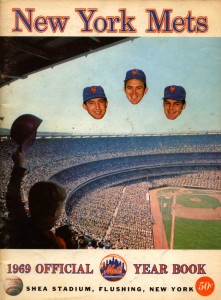 SNY is breaking out the good stuff, Thursday night at 6:30. It’s the return of Mets Yearbook, and the edition they’re opening is 1969. SNY is breaking out the good stuff, Thursday night at 6:30. It’s the return of Mets Yearbook, and the edition they’re opening is 1969.
Is there anything else you need to know? I don’t think so.
Image courtesy of kcmets.com.
by Greg Prince on 5 April 2011 9:40 am Welcome to The Happiest Recap, a solid gold slate of New York Mets games culled from every schedule the Mets have ever played en route to this, their fiftieth year in baseball. We’ve created a dream season consisting of the “best” first game in any Mets season, the “best” second game in any Mets season, the “best” third game in any Mets season…and we keep going from there until we have a completed schedule worthy of Bob Murphy coming back with the Happy Recap after this word from our sponsor on the WFAN Mets Radio Network.
Quick prologue in honor of the only “game number” that has its own universally recognized name. It needs no introduction. It is our introduction — and reintroduction — to the baseball season. It tells us it’s here, it’s real and, if we win, it’s especially spectacular.
There is no such thing as a bad Opening Day win; that is to say there’s no such thing as an Opening Day win that’s “worse” than any other. I guess that’s all self-evident, but there’s nothing run-of-the-mill about winning on Opening Day, even for a franchise that — 2011 notwithstanding — has almost trademarked the habit. There are no also-rans among Met Opening Day wins. Every Opening Day win is, at the moment it is achieved, the best win of the year.
It can go downhill from there, but there’s no way it can get much better.
You’ve waited all winter for Opening Day. You’ve invested every bit of symbolism in it that you can. If your team wins, this day will validate you. It will validate your offseason. It will tell you that whatever happened last year, if it was bad, is erased. It will tell you that whatever happened last year, if it was good, was merely prequel.
You can’t go wrong with an Opening Day win. They all provide the Happiest of Recaps. Yet in the spirit of what we’re constructing here, one must stand out as Happier than all the others.
GAME 001: April 9, 1985 — METS 6 Cardinals 5 (10)
(Mets All-Time Game 001 Record: 33-18; Mets 1985 Record: 1-0)
A rather famous baseball player came along in the 1980s and declared an intention to announce his presence with authority. His name was Ebby Calvin “Nuke” LaLoosh, hard-throwing righty phenom for the Durham Bulls. But obviously LaLoosh was cribbing from a more famous ballplayer who arrived in New York a few years earlier in the very same decade.
Gary Carter loomed as a game changer. He all but promised he’d be a game changer. After the Mets exchanged four young players of considerable promise to have him, he stood up at a press conference, pointed to his right ring finger and said he was saving it for a World Series rock.
How’s that for announcing one’s presence with authority?
It would become something of a teamwide tic for the mid-’80s Mets to let you know what they were going to do before they could possibly do it. Carter may have set the trend in December 1984. He definitely showed the Mets were set on being a team of their word in April 1985.
Gary Carter was a game changer before he ever played a game as a Met. He wasn’t imported à la George Foster to make the Mets respectable. The Mets respected themselves plenty in 1984. They won 90 games without the benefit of a massive offensive superstar. Foster wasn’t that anymore. Strawberry wasn’t that yet. Hernandez was wily and able and as clutch as they came, but he — and we — needed a companion piece. A massive offensive superstar…and then some. Gary Carter was that guy. He was the catcher in the National League since the sun set on Johnny Bench. Despite the wear and tear crouching and blocking wrought, he led the league in runs batted in as an Expo. He’d been around for ten years, and though Montreal was, by their own assessment, through as a contender, Carter wasn’t.
He was what the Mets needed. He landed at Shea and in the Mets fan imagination as that proverbial last piece of the puzzle. The puzzle had only been unveiled in ’84, but here we were, frenzied to finish it. Gary Carter made us view our team differently. Maybe for the first time ever, we entered the upcoming season looking at ourselves not as a contender, but as a favorite. As the favorite in the National League East. We had Hernandez, who wasn’t getting any dumber. We had Strawberry, who was only going to get better. We had Foster, who at least had stopped being altogether awful. And we had all that pitching — Gooden and Darling fronting the rotation, Orosco capping the bullpen. Look who was going to catch them! And look who was going to hit in the middle of all those other hitters!
Look! It’s Gary Carter! It’s the 1985 Mets! They’re going to kick ass! WE are going to kick ass!
This was a change to our thinking, and that itself was a game changer.
And then there was the first game Gary Carter changed, Opening Day, one packing as much anticipation as any in the half-century there have been Met seasons. Dwight Gooden pitching to Gary Carter. Gary Carter batting after Keith Hernandez and before Darryl Strawberry. How could we not win on a massive scale?
Yet it didn’t come so easy at first. The Opening Day on which Gary Carter put his right ring finger where his mouth was unfolded as a frozen slog. Vice President George Bush showed up at Shea for first-pitch duties, but it was too cold for Tampa native Gooden to get a good grip; he lasted into the seventh, leaving with a 5-2 lead. Foster (homer), Hernandez (a pair of RBI singles), fellow new acquisition Howard Johnson (bases-loaded walk) and shortstop Rafael Santana (run-scoring double) built the lead. With Gooden gone, Carter turned his attention to catching Doug Sisk. But Sisk, a weakening link as 1984 wound down, gave up a two-run single to Andy Van Slyke in the seventh.
It was 5-4. It grew colder. And then it turned positively icy. Sisk loaded the bases in the ninth. With two outs, he faced Jack Clark. Carter caught ball four. Tie game.
Gary Carter didn’t promise that.
The game moved to the bottom of the ninth. The Mets loaded the bases this time, but failed to score. It was extras, now. Tom Gorman came on to pitch, relieving Jesse Orosco, who had bailed out Doug Sisk. Gorman escaped the top of the tenth. To the bottom of the inning, then, where Neil Allen, a Met from 1979 to 1983, faced the man for whom he was traded, Keith Hernandez. It would be dramatic as anything if Hernandez (who reached Allen for a game-winning single the previous summer) could end this now-frigid game with one swing.
But Hernandez struck out.
Drama, however, didn’t. Allen vs. Carter would do fine.
“Welcome to New York, Gary Carter!” is how Channel 9 announcer Steve Zabriskie called it when the Kid’s game-winning home run soared over the left field fence. “That’s what he’s here for,” is how Hernandez described it in the clubhouse. The Mets had won 6-5, courtesy of the game changer. Carter, like the Mets, was 1-0 in 1985. Welcome to New York, indeed. Nobody had ever made himself at home so quickly at Shea Stadium.
One great ending is enough for one Opening Day, but there really was a beginning there at the end. Carter’s benediction seemed to charm the atmosphere around him, and the 1985 Mets would take the stage 161 more times and produce enough drama to match anything playing on Broadway. The only thing they couldn’t produce was quite enough wins to extend their run that fall.
Thus, they took a winter’s intermission, added a few more (if less massive) puzzle pieces and picked up just about where they left off in ’85 come ’86. With hindsight, you could say they created one almost unbroken two-year singular sensation of a season, lifting the curtain the night we learned Gary Carter became a Met, and taking their final and customary curtain call the night Gary Carter caught strike three to seal the 1986 World Series (and decorate his right ring finger).
That, young Nuke, is what it means to announce — and sustain — your presence with authority.
ALSO QUITE HAPPY: On April 5, 1983, Tom Seaver returns from Cincinnati exile, electrifies Shea Stadium and pitches six shutout innings as the Mets beat Steve Carlton and the Phillies, 2-0. The unlikely winning pitcher is rookie Doug Sisk. The hitting hero, soon to completely disappear from view, is right fielder Mike Howard. He drives in the winning run in the seventh and he never plays for the Mets again.
GAME 002: April 11, 1968 — Mets 4 DODGERS 0
(Mets All-Time Game 002 Record: 26-25; Mets 1968 Record: 1-1)
If we lose on Opening Day, there’s always tomorrow. Tomorrow is what the Mets depended on after every Opening Day that commenced their earliest campaigns, back when the only luck they had on Opening Day was typified by getting stuck in an elevator (as happened to many of them before their first Opening Day in 1962).
Ergo, you had to seek solace in the second game of the season, and the Mets really needed it in 1968. They came so close to breaking their first-game jinx in their seventh year. They had their first certified ace, Tom Seaver, starting his first Opening Day, in San Francisco, and he carried a 4-2 lead into the ninth. Alas, even Tom Seaver, sophomore deluxe, wasn’t impervious to whatever it is that kept the Mets from getting off on the good foot. Seaver came out with a lead. The Mets lost 5-4.
Which made Jerry Koosman’s emergence as the ultimate No. 2 starter in the second game of the 1968 season that much more crucial. Kooz had sipped his share of coffee during brief stints in 1967, but he had yet to make an impression in the win column. He, like the ’68 Mets, had something more in mind when they headed down the coast to Los Angeles to try and even their record.
Koosman was a revelation. The lefty from Appleton and Morris, Minn., went the distance, shutting out the Dodgers 4-0. New manager Gil Hodges considered taking the rookie out when he seemed to be tiring but explained afterwards, “When you see a kid still have that kind of stuff so late in the game, you know he’s got the ability to win up here.” Hodges proved a prophet, as Koosman’s victory was the first of 19 he’d collect in 1968 (still a team rookie record) and the first of 140 he’d garner as a Met (third-most behind Seaver and Dwight Gooden). And in what would become known as the Year of the Pitcher, Jerry Koosman stepping up and joining Tom Seaver atop the Mets’ rotation assured us we’d be able to use the plural — “pitchers” — for many years to come.
ALSO QUITE HAPPY: On April 8, 1978, Ed Kranepool, the man who’d been a Met in every Met season since the first, pinch-hits with one on and two out in the bottom of the ninth at Shea against Stan Bahnsen of Montreal, the Mets down by one. For the first and only time in his Mets-llustrious career, the Krane launches a walkoff homer, pulling out a 6-5 win for the suddenly 2-0 Mets.
GAME 003: April 10, 1969 — METS 4 Expos 2
(Mets All-Time Game 003 Record: 26-25; Mets 1969 Record: 2-1)
How often does a home run leave a mark that requires a full demolition crew to remove? We can think of one in particular whose aftermath you couldn’t help but notice nearly four decades after it occurred.
Tommie Agee crushed a Larry Jaster pitch in the second inning of the third game of the 1969 season.
Crushed it? Mashed it.
Mashed it? Pulverized it.
Whatever he did to it, two things were immediately apparent:
1) Tommie Agee was emerging from his miserable 1968 (.217-5-17) and setting the tone for a different kind of season for him, and hopefully the Mets, in 1969.
2) Tommie Agee had struck the first fair home run to ever land in the Upper Deck of Shea Stadium — and the first of two home runs on the day as the Mets captured their first series of the year.
Few were there to witness it, not even 9,000 on this April afternoon (when Gary Gentry made his major league debut), and nobody was sitting anywhere near where it smashed into way above left field. Yet everybody who was on hand swore it traveled to where no other ball had dared to soar. “That one today,” Ron Swoboda admired, “would have gone over the third fence and hit the bus in the parking lot if it hadn’t hit the seats.”
Funny Rocky put it that way, because other sluggers would go on to dent buses and the like, but never again in the life of Shea would a home run make it fair to the Upper Deck. If it wasn’t immediately clear how significant a wallop Agee unleashed that day, it came to be understood as something unmatched in the quarter-century to follow. Come 1994, at Mets Extra host Howie Rose’s urging, the Mets commemorated the approximate spot where Tommie’s homer touched down. A generation of Sheagoers would make pilgrimages up to Section 48 to check it out and gasp in awe. That marker — listing the batter’s name, his number and the date — stayed painted in place clear through to Shea’s demolition in 2008.
ALSO QUITE HAPPY: On April 17, 1966, Ron Swoboda walks with the bases loaded in the bottom of the ninth to allow the Mets to beat the Atlanta Braves 5-4. A Ken Boyer two-run double had tied matters for the home team in the eighth. By coming back late, the Mets raise their record to 2-1…the first time the Mets peek their heads above .500 in their brief history…and the last time they’ll do so until Tommie Agee’s power-packed third afternoon of 1969.
by Greg Prince on 4 April 2011 7:46 pm Nothing makes any Mets fan who spent significant time with Bob Murphy from 1962 through 2003 happier than a Happy Recap. When the Mets would win, Murph would promise the cheerful postgame particulars after this important word from whichever sponsor on the WFAN (or WHN or WMCA, et al) Mets Radio Network. The Happy Recap was simple and fulfilling: a few highlights, the line score and a reminder of when to tune in for the next game. What a great note on which to end any day or night of Mets baseball.
Ideally, every Mets game would contain such a coda. But as we learned as soon as 2011 started, that’s impossible. Play a regulation season, and experience shows we’re eligible for no fewer than 40 Happy Recaps but no more than 108. Thus, logic tells us you can’t have a Happy Recap every day.
Ah, but since when are we as Mets fans captive to logic?
To celebrate this, the fiftieth year of Mets baseball, Faith and Fear is proud to introduce to you The Happiest Recap, a solid gold slate of games from every schedule the Mets have ever played. Think of it as the “best” games in Mets history, but with a rigorous twist. Our version gives you the “best” first game the Mets have ever played in any season; “best” second game the Mets have ever played in any season; “best” third game the Mets have ever played in any season; “best” 28th game; “best” 109th game…you get the idea.
It’s not a countdown but a countahead. We commence with a carefully selected “best” Opening Day and work our way through our Met-iculously crafted season clear to an equally carefully selected “best” Closing Day. The beauty part is it all happened. These are not fantasies. These are games the Mets played between 1962 and 2010. What we’re doing is plucking them from their slots in their original seasons and planting them in our dream season.
Talk about a year to remember!
You’re probably brimming with questions right now, so I’ll make an effort to foresee them and answer them here.
I notice you put “best” in quotes. What’s that all about?
Excellent question. This speaks to subjectivity. Our idea of the “best” 35th game the Mets have ever played might differ with yours. Thus, we use the term “best” loosely. Consider it a catch-all for most memorable, most intriguing, most momentous, most symbolic, most noteworthy, most historic and such.
So how do you determine what’s “best,” or “most” where Mets games are concerned?
Informing construction of The Happiest Recap is a desire for diversity in victory. Walkoff wins are great, but nothing but walkoff wins would get a little repetitive. Same for no-hitter flirtations, dramatic comebacks, offensive explosions, record-setting affairs, endless marathons, key pennant race triumphs, milestone firsts and unforgettable lasts. So we’re looking to mix things up a bit. Believe me, there’s no shortage of fascinating Mets wins. Choosing for a particular game number (i.e. “Best Game No. 57”) was more often a challenge than not, which has made this an incredibly fun project to pursue. By the time this is over, I will have — and this is no exaggeration — examined closely every winning Mets box score in team history.
Is a “best” Mets game necessarily a win?
You’re darn tootin’. While there can be interesting baseball games in which the Mets participate but don’t prevail, the hell with that for celebratory purposes. This is nothing but Mets wins, from first game to final game.
Say, isn’t there already a book out like that? Isn’t this the same thing?
Indeed, there is a book out that offers a “perfect season,” part of a line of books from a sports publisher that uses “162-0” as its hook for multiple teams. They published books for the Red Sox, Twins and Yankees in 2010 and have added the Mets and Phillies this season. But no, this is NOT the same thing. Those books use a different format, choosing best games by date, not by game number.
The idea for The Happiest Recap was born in the depths of 2009 when I got to thinking a) that the 50th Mets season was on the horizon and b) about how everybody has an opinion on their favorite Mets Opening Day, but nobody ever says, “That was the best 44th game in Mets history!” It got me thinking, and that’s always dangerous.
Just to be clear, except for glancing at a few preview pages on Amazon, I haven’t read the 162-0 Mets book that was recently released, primarily because I don’t want to be unduly influenced by it. Perhaps when I’m done with The Happiest Recap I’ll check it out. A friend has gotten hold of it and tells me it’s very good, and I’m glad to hear it; all Mets books should be very good. But it’s got nothing to do with this project.
How come you’re doing this now? Why not wait until next year when the 50th anniversary celebration is official?
We’ll certainly have something going on here in 2012, but I began to focus on 2011 because it occurred to me that by this point on the team-space continuum, the Mets will have played fifty seasons already.
How so?
Perhaps you’re familiar with the anomaly of the 1981 split season.
We’re not all as old as you. Refresh our memory, please.
Very well. The 1981 season started like any other, until June 12, when a players strike was called and baseball halted for nearly two months. When a settlement was reached, the powers that be determined getting fans back to the ballpark would be tough enough without telling fans of teams that were lousy prior to June 12 (like the Mets) that they would essentially be playing out the string. So for the only time in modern baseball history, MLB wiped the slate clean, freezing the standings through June 11 as the “first season” of 1981, granting playoff spots to the teams that were in first place when the strike hit. They would play the winners of the “second season” in the first-ever divisional series round. Thus, when the Mets and Cubs returned to the action on August 10, 1981, they weren’t 17-34 New York and 15-37 Chicago — both teams, like all teams, were now 0-0.
How does this anomaly manifest itself in terms of The Happiest Recap?
Per how baseball functioned thirty years ago, each half-season from 1981 is treated here as an individual entity. So when we say “fifty seasons of Mets baseball have already taken place,” that’s what we mean. There were 105 Mets games played in 1981, but there was in no meaningful fashion a “75th” team game. For individual players, all 1981 stats were composite, but for the teams, it was really two discrete campaigns. (Just ask the Cincinnati Reds, who compiled the best record for the entire year but didn’t go to the playoffs because they didn’t have the best record in the first half or the second half.) To treat 1981 any other way would be historically inaccurate.
You’re blowing my mind a little.
Hang in there, you’re gonna be OK. The overall impact on what we’re doing isn’t huge, but it’s true to the contemporary competitive reality of the year in question. I’ve done my research on this and I lived through it. Trust me on this one. There were two 1981s — but just one of every other year, 1962 to 1980 and 1982 to 2010. Taken together, they add up to fifty seasons.
Anything else askew that we need to know?
You know how it’s said there are no ties in baseball? Well, that’s wrong. There are. Or at least there used to be. The Mets have played eight official games to a tie in their history, though none since good old 1981 (one in each half, as it happens). These were incidents of suspended games that had to be made up or weren’t made up. The rules seem to have rendered ties obsolete in recent years, but they did exist, so where they happened, we have to acknowledge them.
Meaning?
Meaning if the 25th game of a given season ended in a tie, it affects the game number going forward. Thus, if the Mets were 12-12 and then they tied, and then they won their next game, their record might have gone to 13-12, but that 13th win came in their 26th game. The tie went in the books. Again, ties are exceedingly rare in Mets history and they won’t make much of a difference in all of this, but I wanted to note that they were facts of baseball life. The bottom line effect is minimal.
How could you possibly leave out that game I love? It was the best!
I take it that’s a pre-emptive question, but I’ll address it anyway. There are games I love that I’ve found myself compelled to omit from The Happiest Recap. Sometimes a personal favorite just couldn’t withstand the historical competition. Furthermore, I wanted a diverse slate of games that reflects all kinds of wins in Mets history. Some will be instantly recognizable, some will jar your memory, some will be news to you, but they’ll all have some genuine Met meaning to them, I assure you. You’ll love every one of them as if you just witnessed it on Channel 9 or SNY, or on WABC or WNEW, or at Shea Stadium, the Polo Grounds or Citi Field.
The Polo Grounds? Citi Field? The Mets sucked in those places! They sucked a lot at Shea, too, but the Mets were total losers when they played at the Polo Grounds and they have been at Citi Field up to now. What gives?
What gives is even in the most grotesque of seasons, there is beauty to be savored. Therefore, an executive decision was made to include at least one game in The Happiest Recap from every Met season the Mets have ever played — kind of like every team being represented on the All-Star squad.
You mean to tell me there’s a “best” game from lousy years like 1965? 1979? 2003?
Yes, we make an allowance for a representative from every Mets season…including each half of 1981.
Any other allowances?
Our research is not 100% complete, but I would expect each National League opponent to be represented (on the losing side, of course). There’s not enough space to pick a game against every Interleague opponent, however.
Oh, but please tell me that you’re going to include…
Don’t worry. Wins against at least one Interleague opponent in particular were given every opportunity to make it onto our schedule.
Say, you just said your research isn’t complete. What happens if something unprecedented happens in 2011, a.k.a. the 51st season of Mets baseball?
By unprecedented, you could mean any number of things.
I mean the holy grail — what if the Mets finally throw a you-know-what in 2011?
We should only have such problems. Let’s leave it at that.
All right, you’ve whetted my appetite. When are we going to see this so-called Happiest Recap?
The plan is to bring it to you twice weekly, likely early in the week (Monday or Tuesday) and Friday (in lieu of the traditional Flashback Friday). They’ll come in virtual series of three: Games 1 through 3; Games 4 through 6; and so on, roughly shadowing the progress of the 2011 season, which we deeply hope will provide its own share of Happy Recaps.
As Bob Murphy himself would have urged as potential prelude to a Happy Recap, fasten your seatbelt.
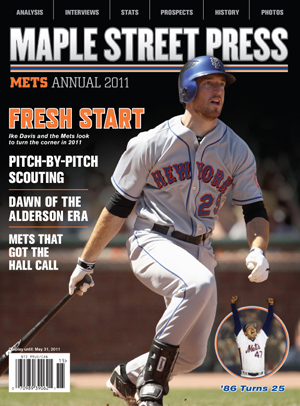
by Greg Prince on 4 April 2011 12:38 pm 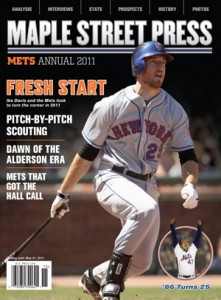 The Maple Street Press Mets Annual 2011 is party enough by itself, but now it comes with its very own shindig. Swing by the Pine Restaurant at the Holiday Inn LaGuardia, on 114th Street across the Grand Central from Citi Field (just around the corner from the 111th St. stop on the 7), Tuesday night, starting at six. Matt Silverman, co-editor of this truly indispensable publication, is hosting a one-of-a-kind Met Together which will include food and drink as well and fun and games…most compellingly, the Mets game from Philadelphia. Meet Matt, meet me, meet other editors of and contributors to Mets Annual, of which you can purchase copies at a special Amazin’ Tuesday rate of five bucks. The Maple Street Press Mets Annual 2011 is party enough by itself, but now it comes with its very own shindig. Swing by the Pine Restaurant at the Holiday Inn LaGuardia, on 114th Street across the Grand Central from Citi Field (just around the corner from the 111th St. stop on the 7), Tuesday night, starting at six. Matt Silverman, co-editor of this truly indispensable publication, is hosting a one-of-a-kind Met Together which will include food and drink as well and fun and games…most compellingly, the Mets game from Philadelphia. Meet Matt, meet me, meet other editors of and contributors to Mets Annual, of which you can purchase copies at a special Amazin’ Tuesday rate of five bucks.
That’s a bargain, though it’s well worth the $12.99 newsstand price when you see it on sale throughout the Metropolitan Area. Now in its fourth year, Mets Annual puts the Mets under a friendly yet discerning microscope and tells you everything you might want to know along with some things you hadn’t thought of but will be glad somebody did. There are profiles; there’s analysis, there’s the big club; there’s the opponents; there’s the minors; there’s blue and orange history by the bucketful and there’s a brigade of Mets-lovin’ authors who won’t let you down. I’m proud to be one of them.
So come on down and get your copy at the Pine and stick around to root on Chris Young as he stares down that puny Cole Hamels. All details here.
by Jason Fry on 3 April 2011 11:35 pm It’s a silly but time-honored part of being a fan to make far too much out of the first few games of the year.
So, Opening Night: The Mets looked anemic at bat, Mike Pelfrey scuffled on the mound and Josh Johnson was borderline unhittable. DOOM! WE WILL NEVER WIN A GAME, EVERY PITCHER IS GOING TO LOOK LIKE JOSH JOHNSON, AND THIS IS THE WORST YEAR EVER!
Second Night: K-Rod blew the save, and to Greg Dobbs of all irritating Mets villains, but the Mets somehow avoided their 183,289th Soilmaster Special, coming back coolly to deep-six the Marlins and transform a victory-turned-defeat back into a victory. JOY! WE ARE NOT ROLLING OVER AND DYING ANYMORE, INSTEAD WE ARE STRONG AND RESILIENT AND HEADED FOR BETTER THINGS!
It’s the perils of the small sample size and a winter of Metscentric neurons firing wildly in response to new stimuli: The Mets came into today a .500 team with exhausted fans. So today was a relief in multiple ways. First off it was a win, and on the road and in a rubber game, to name two situations the Mets didn’t particularly excel in last year. But more than that, it was a laugher, or if it didn’t quite reach that level of in-the-bagness, you could at least think of it as a chuckler. After an early-innings barrage, assisted by the Marlins doing just about everything possible to help themselves lose a game, the Mets stopped hitting and their relievers looked shaky for the most part. But they left Miami (and Florida, finally) unscathed and having not even been particularly rattled for the last nine innings.
R.A. Dickey was back, and that would have been grounds for celebration even if the final score had been different. Dickey is easy to caricature even while wishing him nothing but the best, what with his Bravehart faces in battle and the strangeness of knuckleballing in general and his being a genuine intellectual, a man who’s seemingly incapable of giving a dull answer to any question, whether it’s about a 3-2 pitch or having well-educated rotation mates or anything else. If Dickey didn’t exist, bloggers like us would have been tempted to invent him: This is a man who uses the word “autodidactic” in vaguely normal conversation, and unselfconsciously at that.
This is all wonderful, except for the danger of taking it too far, and turning Dickey into a parody out of an overabundance of affection, not malice. Dickey isn’t trying to be an intellectual or a media favorite or stand out in a clubhouse or anything else: He’s being himself, in a way that only those who are truly comfortable with who they are can manage to be. And though he understands that fans feel an affinity for knuckleballers as seeming closer to them in terms of ability, he’s diplomatic enough not to point out that in his case, this is an illusion. Dickey was drafted by the Rangers because he could throw a fastball in the 90s, something the vast majority of the human race could never dream of doing. He’s a cat-quick fielder, finishing his delivery in perfect fielding position and using his glove like a stinger to strike down hot grounders and line drives dreaming of the outfield. And he’s genuinely dangerous with a bat in his hands. Dickey’s postgame press conferences may sound like a blogger’s fever dream of athletes-cum-professors, but focusing on the last part of that combination tempts us to shortchange the first part.
Dickey wasn’t great, but he was as good as he needed to be. Chris Capuano looked shaky, but D.J. Carrasco came in with the bases loaded and bailed him out, erasing John Buck on a nifty inside fastball for his first and so far only enemy batter as a Met. Tim Byrdak and Taylor Buchholz (the 900th player to wear a Mets uniform, by the way) weren’t great either, but they were good enough, and we were off to Philadelphia.
Kudos to Terry Collins for having got everybody’s feet wet he possibly could before the Mets head to the cauldron of Citizens Bank: I was relieved to get my first look at Carrasco against Buck instead of, say, Ryan Howard with two on and two out in the eighth. (Carrasco also elicited my first triumphant yell of the year.) Beyond that, it’s a roll call of instant impressions that we should remember are most likely overreactions: Josh Thole and Ike Davis look like they’ve built on their successes down the stretch last year, Jose Reyes lashed some balls today and even took some pitches, Carlos Beltran’s bat looks fierce even if his right-field routes seem a bit tentative, and there isn’t a Met who appears as stone-gloved as Emilio Bonifacio, who really ought to be named Malemano in honor of whatever it was he was doing over there. And — extra credit — it was against the Marlins, whom I loathe and would much rather see contracted or moved to San Antonio and rebranded than given a new stadium. (It won’t make their owner less awful or make their useless fans more likely to show up.)
All of these instant impressions are true, or true enough. It’s also April 3rd, early enough that we can remember most every play and at-bat of this newborn season. We’re allowed to overreact, and given all that’s happened in the last few years, a happy overreaction might be just the thing for us. But we should remember that’s what we’re doing.
by Greg Prince on 3 April 2011 3:12 am Josh Thole loomed as Mr. Metaphor Saturday night, falling down rounding first and getting his eager ass tagged out on a throw-behind from Emilio Bonifacio to Gaby Sanchez in the seventh, then picking himself up, dusting himself off and lining the go-ahead single in the ninth. Turned out, however, Thole’s destiny was to serve as Mr. Microcosm, for he set the example the rest of his teammates followed immediately after his personal mistake and redemption.
Pick yourself up. Dust yourself off. Start all over again.
To have begun the season 0-2 would have been Just Two Games, and you’d uncomfortably shrug that off if the second loss was a reasonable (or unreasonable) facsimile of Friday night’s pfftfest. It appeared the air had gone out of the Mets early in their second game, with Jon Niese not quite out of his late 2010 rut. Was it going to be yet another night of eating Soilmaster dirt in beautiful Miami Gardens? An unappetizing prospect, but that’s what the revisable mantra is for:
Just One Game. Just Two Games. Just…
Just enough of that, thank you very much. Niese straightened and stiffened and turned stellar after that rough first inning, keeping the Mets’ deficit at two-nil until David Wright (a homer) and Ike Davis (an RBI double, with Carlos Beltran grinding it out from first to home) erased it altogether. Then came Thole, trying to push his pitcher into the win column when he rounded first on his sharp single down the line.
And there went Thole when Bonifacio got to the ball quicker than our well-meaning catcher could scramble back to the bag. Gads, that looked foreboding for the 2011 Mets.
Correction: It looked foreboding for the 2010 Mets. That kind of play, in which a baserunner stumbles, falls and is put out on his very own safety, tended to kill the 2010 (and 2009) Mets. Habit drew out of you a heavy sigh when you saw that. The Mets may not have been dead when Sanchez tagged out Thole, but their vital signs weren’t exactly splendid.
So more tests were conducted, and it turns out the Mets weren’t close to dead. They picked themselves up when, after Bobby Parnell showed he was all fire and no gasoline, Ike walked to lead off the ninth. Terry Collins — not afraid to overmanage — inserted Chin-lung Hu to pinch-run (what a critical mass of ooooooh when the camera picked up first base coach Mookie Wilson whispering in Hu’s ear). Duda (or Duuuuuuda) sort of sacrificed Hu to second. Brad Emaus willed him to third. Then Thole, Mr. Metaphor, singles to left, Hu trots home, the Mets lead 3-2, and we’re three outs from the first win of the season.
Then it started all over again. Two ghosts from the last two years got us tangled up in their imperfect spirits. Frankie Rodriguez, last seen familiarizing himself with the Queens County justice system, looked absolutely unhittable for one batter. Logan Morrison, such a feelgood story from Friday night when he homered and literally saluted his late dad (whom he lost over the winter), struck out helplessly. From a partisan viewpoint, that felt very good. But then 2010 oozed onto the screen. K-Rod found a way to allow a baserunner, via John Buck single. Time to practice anger management. Scott Cousins struck out. Not as convincingly as Morrison, but a strikeout’s a strikeout.
Two out, one on, the odds are in our favor, despite the combined specters of Frankie and Whatever It’s Called Stadium bringing out the worst in one’s memory from 2010. Now it was less about anger management than supervising one’s dread. Stop expecting the worst. It’s a new year. Rodriguez had a fantastic spring. The Marlins made 23 great catches in the outfield but they’re losing anyway. We can do this.
Bonifacio (or “fucking Bonifacio” as he’s known here) lines one to the right side. It’s not an easy play, but a fine first baseman like Ike gets to the ball and…oh, wait, Davis was pinch-run for and the first baseman is Daniel Murphy. Murphy’s comma was inscribed in the top of the ninth when he pinch-hit for Parnell. It was his first appearance in a Mets game since the end of 2009. It was nice to see him. It was less so, however, to reacquaint with him as a first baseman, where on his best days two years ago Murphy was severely adequate.
Murphy dives to no avail. Rodriguez is supposed to be K-Rod, not 3-1-Rod, but Ike likely dives to some avail and the game would very possibly be over. But Daniel’s not Davis and it’s not. The ball heads for right. Pinch-runner Brett Hayes roars to third. Now there are two on with the two out, and one of those who is on is ninety feet from home plate and anger and dread and any other miserable feeling you’d care to catalogue are plainly in evidence.
The next hitter is Greg Dobbs. The name was familiar from September 16, 2007, when the Mets nursed a 4½-game lead over the Phillies. The lead had been seven games three days earlier, then 6½, then 5½ and now the Mets are tied with the Phillies at Shea, 5-5 on a Sunday afternoon when Oliver Perez doesn’t have it. Top of the sixth and Guillermo Mota walks Pat Burrell. Ryan Howard reaches on a Luis Castillo error. Mota walks Aaron Rowand. Mota leaves and Jorge Sosa enters in a double-switch. Sosa walks Jayson Werth to give the Phillies a 6-5 lead. Charlie Manuel sends Dobbs up to pinch-hit for Wes Helms. And Dobbs launches one of those grand slams that is still going, both in terms of distance and impact.
It’s four seasons later, and here’s Dobbs again. No Perez, Mota, Castillo nor Sosa on the premises, but Frankie Rodriguez is enough. Dobbs lines one up the middle. Hayes scores. It’s 3-3. Rodriguez’s fantastic spring never happened. His conquest of his anger issues turns immaterial for those of us who are too shallow to care about what makes him tick. We’re the ones who are angry. The Mets always blow these games in the ninth inning at Joe Pro Player Land Shark Dolphins Sun Life Robbie Stadium. It’s 3-3. Bonifacio is on third. Dobbs is on first. How many more seconds before it’s at least 4-3 and the game is over?
Rodriguez walks Chris Coghlan to load the bases. Well, of course he does. Now Omar Infante is the batter and the script is obvious. Omar Infante is going to…
…pop up?
Yes! Yes! That’s all he does! Infante pops to Hu (in for Emaus) and we go to the tenth. Rumors of our demise are just that.
A week before Greg Dobbs chimed in as one of many 2007 Phillies to Ruin Everything — on September 9, to be precise — the Mets A/V Squad put together one of the most intriguing videos I ever saw run on DiamondVision. It featured a montage of all that went wrong at Citizens Bank Park at the very end of August when we were swept four games. When was the last time you saw any organization admit to its fans that things had very recently gone awry for their favorite team? Of course there was a happy ending to that video. The Mets go to Atlanta, then Cincinnati and win five of six. First they lost, then they won. See? Problem solved! That well-produced morality play sticks with me because of the lyrics to which those upbeat clips were set:
Pick yourself up. Dust yourself off. Start all over again.
The stretch drive into a ditch in 2007 guaranteed we’d never see that video again, but that was a long time ago now. This moment here is 2011, and in the top of the tenth, the 2011 Mets en masse pulled their own Josh Thole. Sure they stumbled, sure they fell, sure they looked like chumps. But it wasn’t over for them. Not by a long shot was it over.
With Hank Webb’s son Ryan pitching for the Marlins, Jose Reyes singles to lead off. Angel Pagan bunts Jose to second and himself to first (Greg Dobbs — not as clutch a third baseman as he is pinch-hitter). David lofts a fly ball to right that is tailing foul. All-purpose nemesis Emilio Bonifacio has been shifted to center, so it’s Cousins who’s trying to track it down. Does he ease up so he doesn’t create a sacrifice situation that sends Reyes to third with one out? Or does he just not have a good read on it and isn’t able to catch the darn thing that falls foul for strike two? I thought the latter, but apparently it was the former. Cousins’s athleticism was sound. His judgment, however, was rendered horrible when Wright, given new life, lashes a ball to center, scoring Reyes, sending Pagan to second. Mets lead again, 4-3. And then they lead more when, with two out, Willie Harris, facing Mike Dunn, doubles home Angel and David.
It’s 6-3 going to the bottom of the tenth and it would be cruel for the Mets to not finally net the Marlins in their misbegotten Fish tank. Rodriguez is out — Hairston pinch-hit for him once Harris landed on second (oh boy! more managing!) — so it’s up to Blaine Boyer…or Beardie as I’ve taken to calling him. Beardie kind of scruffs things up. Amid a pair of outs, there’s a Gaby Sanchez double and a Brett Hayes single, and it’s 6-4, and Cousins can potentially pick himself up with the bat after letting Wright’s ball fall not far from his glove. For the briefest of instances, I was sure he had, as he smoked Boyer’s last pitch up the middle. There’s going to be two on, and Mike Stanton is lurking somewhere and oh god, what now?
What now was Reyes being wonderfully positioned to stab Cousins’s hot grounder and race to second where he forced Hayes for the third out. And just like that, the Mets stopped being a lost cause in this new season.
They picked themselves up. They dusted themselves off. They’ve started all over again. A record of 1-1 never looked so perfect.
by Greg Prince on 2 April 2011 10:43 am Neither the world nor the season ended just because the Mets forgot that they never lose on Opening Day/Night. Still, the whole John Fogerty “beat the drum, hold the phone, the sun came out today” sensation usually associated with the first game of the year grew rather hollow once I realized what I was waiting for ever since last October 3 turned into Marlins 6 Mets 2, with Mike Pelfrey surrendering a 2010-style grand slam to John Buck while Josh Johnson was loosening up with six innings of highly effective long-tossing.
By the seventh, we were down to Mets By The Numbers rediscovery Duke of Iron beseeching the gods to give us a hit. Good god did we want a hit. Good god did we not want to get no-hit on Opening Night. Our sense of humor is only so nuanced. Willie Harris became the gods’ vessel for letting us off the hook by delivering us from purgatory with a line drive hustle double. From there, the Mets’ single inning of fighting back pumped much-needed air into my deflated inner tube of rooting. Alas, with a chance to turn a two-run rally into something extraordinary, Scott Hairston appeared as anxious as any impatient, insecure Mets fan. “We can’t go 0-1! I have to swing as hard as I can!” I’m sorry Hairston didn’t connect but I’m glad he appeared to care that much.
Though most of the Mets were distressingly ineffectual on their first night of their latest new era, we can take away a few positives: Pedro Beato was not bad; Brad Emaus was quite professional; Harris proved a nice addition (as a second-place hitter, no less); Terry Collins’s eyes remained fixed in his sockets despite having to discuss the disappointing result immediately thereafter; and look at Carlos Beltran — he can be, so it seems, right field.
Biggest positive: There will be a win, maybe as soon as tonight. There may even be a second win at some point. Keep beating the drum, keep your phone on vibrate and check out how sunny it is today. One-hundred sixty-one games remain.
|
|