The blog for Mets fans
who like to read
ABOUT US

Faith and Fear in Flushing made its debut on Feb. 16, 2005, the brainchild of two longtime friends and lifelong Met fans.
Greg Prince discovered the Mets when he was 6, during the magical summer of 1969. He is a Long Island-based writer, editor and communications consultant. Contact him here.
Jason Fry is a Brooklyn writer whose first memories include his mom leaping up and down cheering for Rusty Staub. Check out his other writing here.
Got something to say? Leave a comment, or email us at faithandfear@gmail.com. (Sorry, but we have no interest in ads, sponsored content or guest posts.)
Need our RSS feed? It's here.
Visit our Facebook page, or drop by the personal pages for Greg and Jason.
Or follow us on Twitter: Here's Greg, and here's Jason.
|
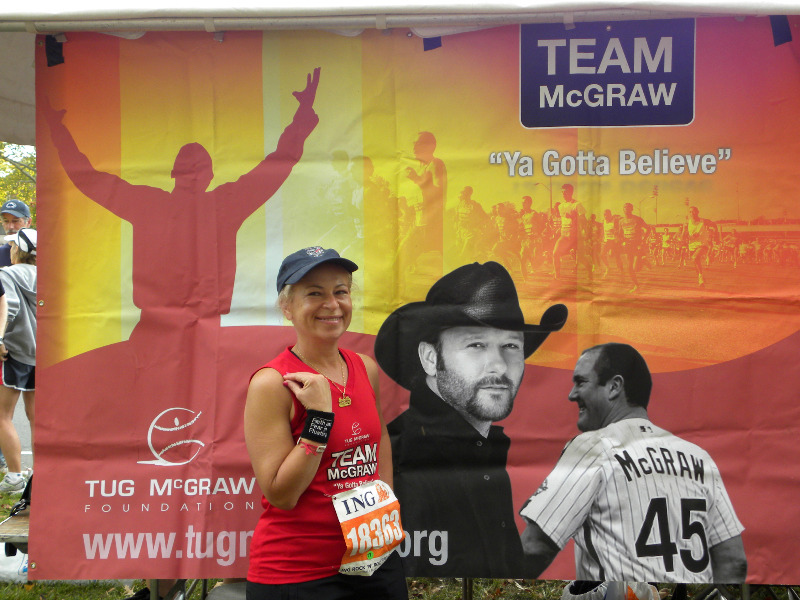
by Greg Prince on 4 November 2010 3:00 pm  Sharon bands together with FAFIF and Team McGraw.
Frank Edwin “Tug” McGraw
Pitcher 1965-1967, 1969-1974
The free-spirited closer whose catchphrase “Ya Gotta Believe” became the rallying cry for the Mets run to the 1973 World Series … The left hander saved 25 games and was an emotional leader in the clubhouse as the club captured its second National League pennant… A member of the 1969 World Series championship team … An All Star in 1972… Ranks among the Mets All-Time saves leaders with 86.
Inducted 1993
—Tug McGraw’s Mets Hall of Fame Plaque
The starting line is nigh for Sharon Chapman. In just three days, a year’s worth of preparation and training culminates in her 26.2-mile journey through the streets of New York.
Sharon, in case you’re just joining us, is running the New York City Marathon under the banner of Faith and Fear in Flushing…or running while wearing a wristband sporting our logo. We’re her official blog sponsor, and we couldn’t be prouder of her.
Aside from being flattered that she wanted to take a piece of the FAFIF Nation into battle with her, we are happy to report that her Marathon-linked fundraising for the Tug McGraw Foundation has drawn close to $6,000. That’s a total accumulated through the diligent work of Sharon (one of the most diligent people I’ve ever known) and the generosity of a lot of folks, including many of you.
On behalf of Sharon, Jason and myself, THANK YOU for caring enough to boost this great cause. We’ve gotten to the point of mentioning it almost in passing, but the Tug McGraw Foundation and its mission to combat the effects of brain cancer and provide a better life for those fighting their way through it is what this effort has been all about. We urge you to visit the Foundation’s Web site and read what they’re doing with contributions like yours. It’s impressive, it’s vital and — if you can lend it — it’s worthy of your support.
The touchstone for Sharon, for the staff of the Foundation and, I’d dare guess, for millions who have sought to chase a dream is Tug McGraw. He’s another figure we’ve gotten used to invoking by second nature. It’s no wonder. He hasn’t lived for six years, hasn’t played baseball for 26 years and hasn’t been a Met in 36 years, yet the spirit of Tug never leaves us — not if we’re Mets fans; not if we’re sports fans; not if we’re fans of not giving up.
It’s gotten to be a bit of a running (no pun intended) joke between Sharon and me as to whether the proper phrasing of Tug’s immortal rallying cry is “You Gotta Believe” or “Ya Gotta Believe,” yet either way you (or ya) look at it, it represents a powerful message. It said it all in 1973 for the Mets. It says it all every time we need it, whether we’re yearning for a hit, a strike or the ability to make it to the next mile.
Tug was such an inspirational figure and, at the same time, such a human being. He was a perfect figure for the Mets of the early ’70s: a little world-weary, a little overwrought by circumstances, a little uncertain of what lay ahead, a “flake” by his own reckoning…but ready to deal with anything through humor, grace and spectacular pitching when it really counted.
For Sharon, it counts this Sunday. We gotta believe she’s gonna go all the way.
If you’d like to contribute to Sharon Chapman’s run for the Tug McGraw Foundation and its fight against brain cancer, please do so here.
by Greg Prince on 4 November 2010 4:25 am Once upon a time, a five-year-old boy was pulled out of kindergarten by his dad to attend a weekday afternoon baseball game. It was his first baseball game, and it was the greatest baseball game in the world as far as he knew. Forty-five years later, he could recite the details lovingly — at least those details that would impress themselves upon a five-year-old’s brain…the kind of details that remain planted there forever.
It was the Mets and Pirates at beautiful Shea Stadium, September 29, 1965. It was sparsely attended, which wasn’t bad at all for a five-year-old boy, because fewer grown-ups meant you could get real close to your team. Why, your dad could snap Polaroid pictures of you and your brother with Mets players: you and Ron Hunt; you and Joe Christopher; you and Cleon Jones; you and a rookie shortstop just called up from Buffalo, a 21-year-old boy named Buddy Harrelson. You could sit close enough to first base so that your brother would grow quite amused that the coach who stood there while the Mets batted had a funny name: Yogi Berra. And your dad had room enough so he could “literally leap” over the first base railing and catch a foul ball.
Who won that game? Isn’t it obvious? It was the five-year-old boy.
His victory transcended mere National League standings. That game began a lifetime love affair with the home team. The kid grew up a Mets fan and, decades later, he found himself holding a job in which his actions impacted most other Mets fans. He got on the phone with a bunch of bloggers Thursday night to talk about his latest big decision.
The Mets have reset their ticket prices in advance of next year. Shake out all the particulars, and chances are you’ll pay less for admission to Citi Field in 2011 than you did in 2010 or 2009. It’s not as simple as an across-the-board cut — the very cheapest tickets are actually a dollar more than they had been — but the overall effect is to make prices lower and to make access to more sections of the ballpark more affordable more often.
Affordability is all relative. In 1965, a box seat at Shea Stadium to come see the 50-108 Mets become the 50-109 Mets (en route to becoming, by the end of the week and season, the 50-112 Mets) cost $3.50. A father could take two sons for $10.50, plus parking, snacks and, if he so chose, Polaroid film. The mere thrill of sitting in, standing at and leaping from those seats proved priceless and timeless to five-year-old Dave Howard, who is now the executive vice president of business operations for those very same New York Mets. At $3.50, a dad or a mom could pretty easily buy a thrill in 1965.
You don’t have to watch Mad Men to understand times have changed since 1965. Three dollars and fifty cents buys you maybe a small soda at a Mets game nowadays. A box seat in the neighborhood of where Razor Shines recently continued the Met tradition of memorable monikers among first base coaches is understandably going to cost a lot more than it did when Dave Howard was a kid. Why shouldn’t it? The average player salary 45 years ago was $14,341. Major League Baseball players in 2010 — the uniformed descendants of Hunt, Christopher, Jones and Harrelson — were paid, on average, nearly $3.3 million dollars for their services.
That’s only 230 times more than it was in 1965. Perhaps we are blessed, then, that tickets behind first base won’t cost $805 in 2011.
What will they cost? Ah, to comprehend that, you will require a jeweler’s eye loupe as you pore over the Mets seating and pricing chart, which still veers toward thoroughly complex. But it’s less like jewelry in that the segmentation that befuddled us in previous seasons has been replaced. No longer do Platinum, Gold, Silver and Bronze line up to the left of rockbottom Value on the Mets’ version of the periodic table of elements. Instead games that aren’t Value are labeled Marquee, Premium and Classic.
Much simpler, right? (We won’t get into how sections are still sliced and diced to within an inch of their lives, except to say there seem to be a few less delineations within the subsets.)
The best news to be discerned from the rebranding is that Value has become a much wider category. In 2010, Value was code for games the Mets might as well have marketed as Unattractive: Three weeknights in early April for the Marlins; three weeknights in early May for the Nationals; four weeknights in the middle of September for the Pirates — the same club that dealt five-year-old Dave Howard’s 1965 Mets a 4-2 defeat. Never mind that for the true Mets fan there is no such thing as an unattractive matchup. As long as the Mets are playing, we’ll be there.
If we can find a satisfactory ticket…that we feel we can afford…provided we think we’re not getting the shaft along the way. Winning more would help, too, but some of us aren’t that picky.
Just as the ticketing matrix is more complex than in 1965, so is our need state. The Mets recognized that after two increasingly empty years at Citi Field, the Value group required expanding. Thus, it now encompasses 30 dates — three times as many Mets games in 2011 will be sold by the Mets at their lowest price point, and not just the perceived worst of the worst. Essentially, the Mets stopped pretending there was something intrinsically more alluring about the Brewers on a Tuesday night in September than there is the Bucs on a Tuesday night in September, and they melted Bronze into Value.
I call that progress. I’m sure the Mets consider it a setback, less in the name of garnering more money (though that, too, I suppose) but because nobody could argue by September 2010 that the Mets were a solid buy. Howard told the Mets blogger conference call that on-field performance was “the most important factor” in determining the trajectory of ticket sales, which in turn helped determine the latest dip south in ticket prices. If the Mets had been in the playoffs the last two years, Howard said, “The tickets would have sold.”
But they weren’t and they didn’t, and now it’s time to move on. It’s time to move on to 2011 when every single Monday through Thursday game in April, May and June will be Value. A couple of Fridays in the first half of the season will carry that designation as well. Then it disappears until mid-September when it’s back seven more times.
The so-called Marquee games are the old Platinum, and those are the ones they’ll have no problem selling: Opening Day and the Subway Series. The Premium is what used to be Gold, while Classic is the ticket formerly known as Silver…except the Classic games on the first iteration of the schedule, as printed in a PDF of the 2011 ticket brochure, are actually colored bronze…and the Premium is silver…while Marquee appears gold.
Value, for the record, is still orange.
On Thursday afternoon June 2, you can see the Mets and Pirates play a Value date — $12 in Promenade Reserved.
On Friday night June 3, you can see the Mets and Braves play a Classic date — $20 in Promenade Reserved.
On Saturday night June 4, you can see the Mets and Braves play a Premium date — $28 in Promenade Reserved.
Just for fun, I’d bundle those three as the $60 Variety Pack and see if anybody finds the baseball noticeably different or better as the price rises day after day.
Howard spoke of “peak demand” as the reason summertime weekends will generally cost more than the rest of the grid. “Demand is greater on weekends,” he said. I couldn’t disagree with that, but it did make me wonder. The family of four that could get in the Rotunda door for $48 on Value Thursday (putting aside nettlesome convenience fees and such) is going to require $112 on Premium Saturday or Sunday. That’s a swing of $64 right there for the least expensive seats Citi Field has to offer.
To sit in pretty decent — not great but perfectly good — Promenade Infield seats, from which Citi Field’s unique geometry gives kids of all ages a better shot at seeing substantially more of the playing surface, you’ll pay $35 apiece on peak demand Saturdays and Sundays ($140 for our familial foursome). That’s $20 more than it costs on Value Thursday ($60) or, for that matter, $10 more than on Classic Wednesday ($100).
Johan Santana, Jason Bay, even Dillon Gee can look at those figures and call it tip money. People who want to take their entire family to a Mets game have to be selective.
I asked Howard about whether there’s a concern here about pricing out families by making the dates with the most family-appeal more expensive than everything that isn’t the opener or the Yankees. That’s how we got off on the subject of Dave Howard’s first Mets game, because this franchise, he said with conviction, is “founded on kids and family. It’s been a hallmark of the Mets from the very beginning.” From there, we were onto Ron Hunt and Joe Christopher and the wonders of September 1965.
Of course Dave Howard has a job to do, and his job includes helping the Mets maximize revenue. Though what Dave the former five-year-old remembered was charming as all get-out, Howard the current executive was politely frank in explaining people have choices to make within the realm of buying tickets. They can go on the weekend and dig a little deeper or they can go midweek (“off-peak demand”), assuming the whole family can make it.
Or, as was the case as 2010 wound down, they can go not at all. But Dave Howard and the Mets wouldn’t want that to be anybody’s default option, and the gist of their ticket announcement Thursday was to make all days of the week more appealing. Tickets in the tiers physically below and financially above Promenade have been reduced — not to bargain prices, but to slightly less unreasonable rates. Long-absent discounts on season tickets and partial season tickets have been implemented, with a break of 10% when you buy in bulk.
The partial plans are still being formulated. Howard couldn’t say for sure whether plans sold on the basis of Saturday games will, in fact, include every Saturday game or nothing but Saturday games. Nor has it been determined whether Promenade plan holders can gain access to one or more of the clubs (where, I didn’t get a chance to point out on the phone, they will likely spend more money).
Howard seemed most excited about touting the Amazin’ Mets Perks program. You buy full season tickets and pay for them in full by December 15, and you receive some serious goodies, and I don’t mean a Mike Piazza uniform pencil holder (or Headless Mike, as I referred to the 2002 partial plan premium). You’ll be on the field, you’ll be shagging flies, you’ll be taking BP, you’ll be dealing pinochle with Saul Katz…OK, I made the last one up, but you get the idea. If you’re laying down serious scratch seriously early, you’ll be taken care of.
What’s more, you become eligible for one of thirty different treats: schmoozing with the umps at home plate (if you get Angel Hernandez, you know what to do); sipping wine with Tom Seaver (or gulping — your call); receiving the jersey a player has just worn in a 2011 regular-season game (may it not be Oliver Perez’s for all that would imply about the 2011 regular season); and…well, it’s all good. If you’re willing to invest in 81 dates at Citi Field and pay for it up front, you’re entitled to a shot at this stuff.
One of the perks is dubbed the “Player Meet-And-Greet,” described in the ticket brochure as “Have a pre-game meet-and-greet with a current Mets player with a photo opportunity and a chance for items to be autographed.”
That’s a perk now? To think, in 1965, a five-year-old was able to get all that for $3.50 and get out of kindergarten for the day.
Want to know more? Check out the coverage from Mets Police (who’s been all over this ticket news for days) and Metsgrrl, who transcribed much of the conference call.
by Greg Prince on 2 November 2010 4:18 am The grizzled cabbie craned his neck out of the taxi window to survey the madhouse on Market Street. San Francisco’s busiest downtown boulevard, even on normal days, was teeming with thousands of jubilant Giant followers. Car horns were honking. Orange and black confetti was fluttering from the windows above. Strangers were shaking hands, then embracing. More than a few pedestrians were already drunk or headed in that general vicinity. The driver shook his head and proclaimed, “There hasn’t been anything like this since V-J Day.”
—David Plaut, Chasing October
Some years you just know the World Series was won by the right team. This was one of those years.
We won’t care about the San Francisco Giants come May 3 when they are the visitors at Citi Field. We didn’t care about them last May when they swung by to spend a weekend. I didn’t think I was looking at a team that within six months would be world champions when I saw Henry Blanco take Guillermo Mota deep to end a windy Saturday afternoon in breezy style. I didn’t think I was looking at anything more than a competitor for the Wild Card (if we fell much further behind the Braves in the East, that is) when I watched them take three in a row from the Mets in mid-July and Phil Cuzzi take one from them on our behalf before we continued along on our merry Pacific time zone death march.
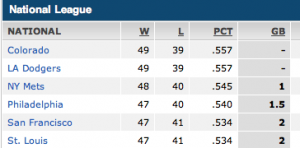 The Wild Card standings at the All-Star break...boy, was that a long time ago. Yet the 2010 Mets are ancient history and the 2010 Giants are the best team in the land. They are the right team to have earned that designation. They rolled over the Texas Rangers with methodical precision Monday night, as they did Sunday night, as they did in two of the three previous games of this World Series. Texas was the right team to win the American League pennant, but couldn’t have looked less capable of competing as their final Game Five outs slipped away. This was San Francisco’s stage, and they deserved to take the final bow.
Matt Cain, Madison Bumgarner and the increasingly legendary Tim Lincecum were the genuine article in this Series. They and their black-bearded closer give them an excellent chance of winning any three games they pitch. They figure to be pitching for quite a while and they figure to be pitching to Buster Posey, who figures to be hitting for quite a while. As for the rest of this championship roster, who the hell knows? It’s the kind of collection you look at in any Spring Training and, if it’s yours, you think, “Well, I dunno, maybe if they all get their act together and we get lucky and enough things go wrong for everybody else…”
Do these San Francisco Giants have the figurative legs to go with their literal arms? That’s a private matter for Giants fans to fret. We won’t care by next season. All that mattered was in October and the very beginning of November, they were 25 easy pieces. They fit. They gave us an outstanding show and provided pleasant company before we’d be forced to face the fact that once Brian Wilson fired his final fastball, the baseball season would be finished.
It was done by our parochial reckoning just over four weeks ago, maybe just over four months ago, back in Puerto Rico, back where Cody Ross was a nettlesome Marlin getting all up in our grill. It’s hard to recall through the crisp autumn air and the equally crisp pitching of young Lincecum, Bumgarner and Cain that the Mets were once a part of the same season whose champion was crowned only hours ago. All we’ve had lately are press conferences and speculation.
Yet it’s all the same game, the same one we leaned into when Pitchers & Catchers strapped on their gear in February; the same one we relished that bright April afternoon when Johan Santana reeled in Ross’s Marlins to start us off 1-0; the same one that left us more and more jaundiced as the Mets fell further and further from competence. It’s still baseball, still what we love. It’s why some of us — if not nearly enough of us, by Nielsen’s accounting — stick with this game long after our side has taken a seat.
We brush off our personal disappointment and we turn our attention to eight brand new teams. Some are total strangers to us, some are disgustingly familiar. Some are the San Francisco Giants of 2010, fuzzy figures from May and July who suddenly come into focus and remake their introduction to us. They become the reason we can cling the slightest bit to the summer before. They serve as our motivation to keep reading and keep watching and keep writing.
I’m a romantic about the World Series. I yearn for the World Series to loom as more super than any Super Bowl in the public imagination. I absorb jealously descriptions like that proffered by Roger Kahn in Memories of Summer as regarded the first Fall Classic he covered, in 1952:
Six hundred of the best and most popular sportswriters in the world would cover every inning of every game. The ranks included […] Vincent X. Flaherty of San Francisco. The closest major league stadium, Sportsman’s Park in St. Louis, stood 2,140 miles east of Flaherty’s home base, but the old World Series transcended geography. It was a front-page story across the country, especially exotic to people who lived thousands of miles away.
The World Series is no longer a national observance, not like that. NBC and the NFL garnered more viewers than Fox did with baseball. I knew they would, but I don’t get it. I don’t get sports fans who would choose run-of-the-mill football over championship baseball. I don’t get media that dismiss franchises based in San Francisco and next to Dallas as unready for prime time. I don’t get Mets fans who stepped around this postseason. I don’t get baseball fans who stepped around this postseason. If you love pitching (and who doesn’t?), you had to love these last four weeks. If you love endings that aren’t predestined, you had to love the Giants versus the Rangers as opposed to far grislier potential matchups. If you love baseball, you should love it as long as it’s there to be loved.
I’ve never been a San Francisco Giants fan, but I feel ridiculously good for those who are San Francisco Giants fans, at least the ones who weren’t obnoxious to a friend of mine who visited gorgeous Phone Company Park this year. I’ll brush those nitwits aside and consider instead my kind of fan. I always believe there is a version of me rooting for every team that’s gone too long without reward. The Giants who are redolent of dried champagne and are to be feted by parade and are to have their fingers measured for ring size…good for them, of course. They made it happen, I liked watching them ply their craft and all, but most of them will be people I root against next May 3.
The Giants fan version of me and of you…not the nasty ones, not the nouveau obnoxious, not the bandwagoneers, but those who wondered if this night would ever come…ohmigod, how can you not be thrilled for that Giants fan? That Giants fan who has his own war stories, who has his own tales of front office malfeasance and favorite players unfairly shipped away and Octobers that didn’t go nearly as swimmingly as this one.
On nights like these, I feel good for that fan, whoever he is.
I also feel sensational for a friend of mine whose love of the Giants dates to the Polo Grounds of Mel Ott. To use a phrase I heard a lot in college, Bill Kent is a trip. He’s the Gray Tornado, and there’s no stopping him. He’s wiry, he’s energetic, he’s got nearly 35 years on me and I wouldn’t bet against him outlasting me. Bill organized the New York Baseball Giants Nostalgia Society. It was founded out of the ashes of another group that was rendered dormant by lax management. There’s nothing lax about Bill. He got my phone number from the previous group, enticed me to a West Side warehouse on a hot July night in 2004 to eat terrible pizza and dine out on delectable stories of what it was like when there were New York Giants roaming the city.
There were maybe six of us sitting around a table under a buzzing fluorescent light that first evening. Then the warehouse became unavailable to us and Bill moved the meetings to a Chinese restaurant in Riverdale. Then an Italian restaurant across the street with a little more space because we kept attracting new members. It was word of mouth. Bill’s mouth mostly. Bill called and e-mailed and welcomed everybody who was interested in the Giants. New York Giants. San Francisco Giants. Anybody who might be Giants. If you wanted in, Bill wanted you. He still does.
We’ve lately met in a church annex in the Kingsbridge section of the Bronx. We are, I swear, turning into the modern equivalent of the Oldest Established Permanent Floating Crap Game in New York, except the only stakes are ten bucks for slightly better pizza than we ate in the West Side warehouse. Bill has taken to inviting guest speakers: authors, historians, bat boys who once handled Don Mueller’s lumber, whoever knows something the rest of might be fascinated to learn. They’re all good, but what I like best, still, are the stories from the guys (and dolls) who chip in their ten bucks, the guys who, between slices, let on casually about the time they met Bobby Thomson.
Most of those fellas were New York Giants fans who stuck by their first allegiance even if Horace Stoneham didn’t stick by them. They morphed into San Francisco Giants fans who never gave the New York Mets a second glance. Some are the National League loyalist sons (and daughters) of New York Giants fans who carried on the family tradition, also immune to Amazin’ charms. There are a few camp followers like myself who find the New York Giants irresistible and the gang’s stubborn San Francisco fealty harmless in the context of modestly improved pizza and ever excellent stories.
Once Nelson Cruz swung and missed to end Game Five, I thought of Bill and I thought of the rest of them. I felt as good for them as I did the San Francisco version of me.
Fifty-six years for my senior compatriots in the New York Baseball Giants Nostalgia Society. Fifty-two years for those out west who fell into a misplaced New York institution. Too many years for any San Franciscan who decided sometime after 1958 that the Giants were the thing for them, that this team would be one of the touchstones of their lives, just as the Mets are a touchstone of ours.
Any year now, they thought after losing the World Series in 1962.
Any year now, they thought after losing the NLCS in 1971.
Any year now, they thought after losing another NLCS in 1987.
Any year now, they thought after being swept and shaken but definitely not stirred by the Earthquake Series of 1989.
Any year now, they thought after losing a division series in 1997 and another one (yay!) in 2000 and a seven-game World Series that seemed so close to being won in six in 2002 and one more damn LDS in 2003.
Any year now…and that year is now. Every fan who’s waited through enough of the above (to say nothing of the acres of years that weren’t nearly as good) deserves one of these.
If we can’t have it, that is.
Already, the 2010 World Champion San Francisco Giants are, per Don DeLillo, falling indelibly into the past. We are parting company, no matter how pleasant it’s been. The next time I take a good look at Lincecum, Cain, Bumgarner, Wilson, Posey and whoever remains from their ad hoc roster of castoff conquerors, it will be May, they will be the other team, and I will hope they lose three straight in the beautiful borough of Queens, New York.
Until then, good for them.
by Greg Prince on 31 October 2010 10:37 am Nothing could be more terrifying on Halloween than coming into contact with ghosts of Mets Who Almost Were. Tonight, with however many leftover fun size Milky Ways you choose as your companions, you’ll have the opportunity to turn on your television (your actual television) and have the blue and orange scared out of you by one such ghostly image.
Meet Nelson Cruz — the latest in a very spooky subset of players who were taken from this Met-al coil before they could reach what appeared to be their earthly destination. Instead, they were rerouted to the great beyond.
Beyond the Mets, that is. And it turned out great for them in at least one of their Octobers to be named later.
Cruz, I’ve only just learned, previously resided in the Met minor league system. It was so long ago that it’s practically harrowing to consider. The Texas Rangers’ corner outfielder, who doubled to lead off the bottom of the second in Game Three and scored on Mitch Moreland’s decisive blow, developed in 2009, at age 28, into an All-Star. Despite injuries, he’s slugged 55 home runs over the past two seasons and is one of the main reasons Texas is in its first World Series.
Cruz’s journey to this moment began more than a decade ago, and it began as Met property. It was February 1998, and Nelson (presumably named for Lindsey Nelson) was just a kid from the Dominican Republic, all of 17 years old. As such, he began his professional career playing rookie ball in the Dominican Summer League.
How’d he do? I couldn’t tell you, since (befitting a spooky story on Halloween) no statistics seem to exist from that league and time. They might exist, but they were not published in the Mets media guides of the day and they do not show up on otherwise richly textured Web sites like Baseball Reference and Ultimate Mets Database.
Why, it’s almost a Halloween mystery.
Except for this: Steve Phillips was the general manager during Cruz’s Mets minor league tenure, from 1998 to 2000, and Phillips wasn’t particularly picky about which prospects he offered up in trade. As September 2000 approached, Phillips saw a need for another utility infielder, and he targeted, for some reason, Jorge Velandia of the Oakland Athletics. His counterpart, A’s GM Billy Beane, was happy to send him Velandia and accept that 20-year-old from Monte Cristi, D.R., as if he was doing his old pal Steve a favor.
To be fair, I don’t know for sure that it didn’t happen the other way around, that Beane didn’t approach Phillips about Cruz and Steve was so busy being suave and debonair around the office that he said, sure, whatever, gimme whoever ya want. Either way, it’s absolutely spooky! the way Jorge Velandia oozed ordinariness in four callups during three Met seasons and Nelson Cruz is these nights batting fifth for the American League champions.
BOO!
You can take that as what trick-or-treaters might say from behind their monster masks or what I’d say if I saw Steve Phillips crossing the street en route to his next sex addicts meeting.
To be fair again, it took Cruz nine years to fully blossom between Phillips’ distracted dismissal of him to his eventual All-Star appearance. The genius Beane, protégé of the god Alderson, gave up on him, too, as did the minds in Milwaukee. You’d have to be Captain Hindsight to bitterly blame the Mets for not holding onto Nelson Cruz much longer than they did.
Still, he’s in the World Series in 2010 and the Mets aren’t, even though the Mets signed him and commenced to nurture him once upon a time. Learning that he was in line to someday man left or right for the Mets…frankly, it torments the soul just a little.
This is not the first incident of an exiled Met prospect haunting our TVs as a postseason nears its conclusion. In fact, by my research (aided immeasurably by the aforementioned Baseball Reference), Cruz is the eleventh Halloween Hindsight Haunter — once our minor leaguer; dispatched from our ranks before he made the majors; and ghoulishly appearing in the World Series without ever having worn a Mets uniform.
BOO!
Who else sort of made the Mets look like great pumpkins in retrospect? Who else got to bob for World Series baubles while the Mets sat by the door wondering if anybody was going to ring their bell so they could get rid of those boxes of store-brand raisins they bought to give to the neighborhood kids who just as soon skip this door?
Hold someone dear close to you and meet the other…
Halloween Hindsight Haunters!
Paul Blair — No relation to Linda Blair from The Exorcist, but no doubt somebody under George Weiss’s command must have wished he could have exorcised the decision that left the future Gold Glove center fielder unprotected in the old minor league first-year draft. Blair spent his first pro season — the frightening annum known in Met lore as 1962 — with Class C Santa Barbara, where he batted a paltry .228. According to Mike Huber, writing for SABR’s Baseball Biography Project, Blair picked up the offensive pace in that offseason’s Florida Instructional League. It was apparently enough to impress the Baltimore Orioles, who plucked him from the Mets. Paul made himself at home in the Birds’ nest, holding down center at Memorial Stadium from 1965 to 1976, earning eight Gold Gloves and playing in four World Series with the O’s, and then two more with the Yankees. The Mets searched most of the 1960s for a suitable center fielder before scooping up Tommie Agee in 1968. You can’t say the Mets missed Blair in October 1969. All those other years, however…spooky!
Ed Figueroa — Signed by the Mets in 1966 at 17, the righty from Ciales, Puerto Rico, began to break through a year later, going 12-5 with an ERA of 2.05 for Class A Winter Haven. It all began to go wrong the year after that. He told the Daily News in 2008 that he was called to take a draft physical on his home island in 1968. The Mets advised him to take a week; Figueroa took three. “When you’re 18,” the retired pitcher reflected, “you don’t know what you’re doing.” He came back to Raleigh-Durham, hurt his arm and was released by the Mets in the middle of ’68. His next tour of duty was with the United States Marines in Vietnam. When he returned, Figueroa impressed a Giants scout. San Francisco eventually let him go to the Angels where he established himself as a solid big league starter. California packaged Ed with Mickey Rivers for Bobby Bonds in the 1975 offseason and Figueroa was soon enough pitching in the 1976 World Series for the Yankees, and again in 1978 after becoming the first Puerto Rican-born 20-game winner in major league history…spooky!
Jim Bibby — Bibby, who died of bone cancer this past February, fit the description of “big right hander” very nicely, listed as 6’5”, 235 (his brother, Henry, played basketball for the champion Knicks of 1972-73). The native North Carolinian entered pro ball in 1965 at age 20 with the Mets’ Appalachian League affiliate in Marion. Then it was off to Vietnam and the Army for a couple of years. He resumed his career at Raleigh-Durham in 1968, setting the stage for a promising ’69, when he struck out 180 batters in 197 innings between Double- and Triple-A (it earned him a September callup to Shea, but Gil Hodges never used him down the Miracle stretch). Back problems kept him out the entirety of 1970, but the next season, all at Tidewater, showed he was on his way: 15-6, 150 strikeouts in 176 innings. Among those Bibby impressed (especially considering he had his apprenticeship interrupted twice) were the St. Louis Cardinals. They acquired him as part of the eight-player deal that made Jim Beauchamp and Harry Parker Mets. Both of those fellows certainly helped New York to the ’73 pennant, though neither stayed Mets beyond 1975. Bibby, meanwhile, found his groove as a 19-game winner for the surprising Texas Rangers of 1974 and reached the World Series with the Pittsburgh Pirates in 1979. He pitched in the majors until 1984, 19 years after the Mets first signed him…spooky!
Ned Yost — A first-round pick in the secondary phase of the June 1974 amateur draft, Yost, a 19-year-old catcher from Northern California, worked his way up to Tidewater by 1977, but the Mets left him unprotected that December and he was snapped up by Milwaukee in the Rule 5 draft. He would become a backup receiver on the Brewers and find his moment in the World Series spotlight in 1982, catching the last two innings of a blowout loss in Game Six and walking in his only plate appearance. Noteworthy from a parochial perspective is the ex-Met farmhand caught two former Mets in those two innings: Doc Medich in the eighth and Dwight Bernard in the ninth…spooky!
Joe Klink — The lefty reliever out of Miami’s St. Thomas University was chosen in the 36th round of the 1983 draft and contributed mightily to the 1986 Mets’ championship drive by being included with Billy Beane and Bill Latham in the package that persuaded Minnesota to part with second baseman Tim Teufel. Four years after Teuf aided the Mets’ cause, Klink was one of Tony La Russa’s southpaws on call in Oakland. His lone World Series assignment in 1990 came as Game Three versus the Reds was disintegrating for the A’s. Klink came on to face Cincinnati first baseman Hal Morris in the fourth inning and walked him. La Russa, being La Russa, pulled Klink in favor of Gene Nelson. OK, not so spooky. But consider this: The Reds held on en route to sweeping the Alderson A’s — and on the mound for Cincy to get the last outs in three of their four wins, including the clincher, was 1987-1989 Mets closer Randy Myers, swapped the previous winter for John Franco…spooky in its own right!
Greg Olson — The Mets drafted the Minnesotan catcher in 1982, and Olson steadily worked his way up to Tidewater by 1988. With Gary Carter’s time about up in New York, you’d have thought Olson might be in line to compete for the imminent opening behind the Flushing plate. Instead, he was granted minor league free agency and signed with his home state Twins. After a cup of coffee up north, Greg was headed south, to Atlanta. His date with destiny was the 1991 World Series, when the worst-to-first Braves faced off with the similarly risen Twins in quite possibly the greatest World Series ever played. Olson caught all seven games of that epic…spooky!
Manny Lee — Three seasons as a Met minor league infielder earned the 19-year-old Dominican a trade to Houston in August 1984, one of three prospects who became Astros so Ray Knight could become a Met. Let’s not pretend this was horrifyingly spooky. Knight was the Most Valuable Player of the 1986 World Series for the Mets. Lee, however, served as starting shortstop for the 1992 champion Blue Jays, who had picked him up as a Rule 5 selection in December 1984. As a Jay, he participated in four postseasons, culminating with Canada’s first World Series. OK, maybe a little spooky!
Quilvio Veras — The Dominican second baseman signed with the Mets in the fall of 1989 (shortly after the birth of Ruben Tejada) and, at nineteen, began playing professionally the following spring. His journey would be familiar to anyone who watched the ascension of Mets minor leaguers in the early ’90s: Gulf Coast, Kingsport, Pittsfield, Columbia, Binghamton, Norfolk…but then Veras made a U-turn to Miami. The Mets traded him to the recently born Florida Marlins for toolsy outfielder Carl Everett on the eve of the 1995 season. Veras sped off and led the National League in stolen bases (as well as most times caught stealing). Two seasons later, he was a San Diego Padre, and one season after that, he was the starting second baseman in the 1998 World Series, albeit on the losing side. Seven years later, Everett won a World Series ring — as a member of the Chicago White Sox…spooky!
(Thanks to a sharp-eyed reader from the Crane Pool Forum for noticing the Q-omission of Veras in the Q-original version.)
Scott Kazmir — Eighteen-year-old first-round draft choice in 2002. Reportedly a little cockier than some veterans cared for by Spring Training 2004. A hard-throwing lefty with plenty of promise, but not as established as righthander Victor Zambrano of the Tampa Bay Devil Rays, which was presumed critical as the Mets flirted with Wild Card contention at the ’04 trade deadline. Kazmir was swapped for Zambrano. The Mets stopped flirting with contention. Zambrano stopped pitching for the Mets by May of 2006. Kazmir was starting Game One of the 2008 World Series for the Rays. So spooky! that the chain of events surrounding Kazmir’s trade made us toast the hiring of general manager Omar Minaya the way we have been celebrating the coronation of his successor.
A.J. Burnett — Drafted out of North Little Rock (AR) High School in 1995. Pitched his way to Class A Pittsfield by 1997. Then the righty found himself shipped to Florida to help net Marlin lefty Al Leiter. It was a great trade for the Mets, at least until Leiter (allegedly) began critiquing Kazmir’s clubhouse demeanor in 2004. Burnett’s pretty good career caught fire in 2008, just in time for free agent riches to come rolling his way via the Yankees. He pitched one outstanding game in the 2009 World Series. Nelson Cruz’s presence in the 2010 World Series indicates Burnett is absent this year. We’ll save the spooky! on this one.
Honorable mention in all this to a Tidewater Tide from 1979 who, by all indications, was never “Met property,” but rather on loan to the Mets’ Triple A affiliate from the Dodgers (a not altogether uncommon practice through baseball history). This infielder batted .264 as a teammate of Mookie Wilson and Hubie Brooks, among others. The Dodgers would thereafter trade him to the Twins, where he’d carve out a respectable playing career. When it was over, he’d try his hand at minor league coaching with the Tides for a couple of years, manage another Met farm club, the Capital City Bombers, for a couple more, and then coach another season in Norfolk. He’d eventually coach eleven seasons for the Oakland A’s and, at age 54, be given his first shot at managing in the big leagues. He maintains that initial job to this day.
Literally, to this day.
The manager of the American League champion Texas Rangers — filling out a World Series lineup card with Nelson Cruz’s name on it tonight — is someone who never wore a Mets uniform but spent six seasons (one playing, three coaching, two managing) gaining experience in the Met minor leagues: Ron Washington. Our new GM is in the midst of searching for the next Met manager, yet one who’s done one of the best jobs in baseball in 2010 cut his managerial teeth working in the Met organization.
Now THAT’S spooky!
by Greg Prince on 30 October 2010 7:44 pm Six NLCS and two World Series games later, there’s a National League team playing baseball on my television again. Everybody involved in making it disappear as long as it did is still a snake, but baseball is baseball, and I’m an American — easy to distract with flickering high-definition images of painted faces and soaring home runs.
Obviously the credit for settling this dispute should go to Sandy Alderson. Is there anything this man can’t do?
by Greg Prince on 29 October 2010 9:39 pm Our whole year builds up to these kinds of Fall Classic moments: we anticipate every move; we dissect every morsel of potential strategy; we hang on every word written and spoken in advance…and then, finally, the big event takes place.
For us Mets fans, offseason press conferences are our version of World Series games — except my cable system doesn’t hinder my ability to see them.
Sandy Alderson pitched Friday afternoon about as well as Matt Cain did Thursday night. Cain shut out the Rangers just as surely as I was shut out of watching him via traditional means. Alderson’s kind of pitching was different, but I found his start just about as stellar as Cain’s.
The bar was set a tad lower for Alderson than it was for the winning hurler in Game Two. Sandy’s mound was an offseason press conference. Talking a good game should be the easy part. That said, Alderson talked a very good game. “He talks a good game” is usually a putdown, but here’s it’s a compliment. The Mets haven’t talked a whole lot better than they’ve played the last couple of seasons. Talking a good game is all our new GM could do this Friday, and for October 29 when we haven’t had a Mets game since October 3, it’s all we needed from him.
As for Cain and the Giants, whether or not you’re able to see the World Series like a normal person, they might be telling us something interesting about our team, too.
When the World Series participants were set, it was noted approvingly that Michael Young was finally getting his big chance. Young’s been a Ranger since 2000. He was that guy whose first column of stats had been consistent his entire career — always TEX, never anything else — and one of those players who had played and played without ever having had his postseason ticket punched. No matter what team you root for in any given October, you always feel good for the Michael Youngs of baseball. He stuck with his team, he excelled in the shadows, now, at last, his day had come. Nobody has been a Texas Ranger longer, and from that perspective, nobody deserved a chance at World Series glory more than 34-year-old Michael Young.
Matt Cain, I was surprised to learn, is the closest thing the Giants have to Michael Young. Cain has been a Giant longer than any of his teammates, and he had never been to the playoffs before this year. Cain, 26, is far younger than Young and he’s only been on the Giants since August 29, 2005. You go back five years and two months before Cain began his current sublime postseason run and you’d find nobody from then who’s his World Series teammate now.
The Giants are being talked up as equal parts Cinderella and anomaly. They kind of came out of nowhere in 2010 — the Mets had a better record at the All-Star break — and much of their roster seems like it was thrown together on their last flight home from Colorado in September. There’s a sense of who are these guys? and how did they get here? to the team that’s two wins from bringing San Francisco its first World Series championship.
San Francisco’s answer to those questions are, as we speak, these guys are great and as long as they’re here, we don’t care. It’s a reasonable response given the Giants’ position at this juncture. They are a cache of live arms, a potential all-world catcher and, otherwise, whoever wandered in off the street. Or so it seems: Edgar Renteria, Juan Uribe, Cody Ross, Pat Burrell, Aubrey Huff…two wins from a world championship.
If I were a San Francisco Giants fan, I’d be ecstatic right now. If I were a New York Mets fan with the New York Mets up two games to none in the World Series, I’d be the same — no matter who was wearing our uniform or for how long he was wearing it.
We all know the line about “rooting for the laundry”. When I first heard it, I thought it was clever as the dickens. Having heard it regularly since before Matt Cain was a major leaguer, I find it tiresome and misleading. We do not, I believe, root for the laundry. We root for what the laundry represents to us.
Sandy Alderson has already paid homage to the Mets as an “iconic” franchise. He’s right. They’re certainly iconic to us. The uniform is iconic to us. The name “Mets” is iconic to us. We long ago decided it meant something significant to the point of sacred to us. We want it to look that way to everybody. We’re tired of being the oddballs.
Whoever ratchets up the cachet attached to “Mets” is going to be all right by us. Sandy Alderson, who on Friday said he wants to attain and maintain a “standard of excellence” for the Mets, is all right by us right now because he’s willingly taken on this imposing task in our name. For his name on a paycheck, sure, but indicating — through his press conference and the interviews he did later — that we are never far from his thoughts, because we are his business.
“An underlying loyalty” is what he described Mets fans maintaining when he was on with Mike Francesa. “A desire to get back there [to] enjoy the relationship,” is how he reads our mood as it pertains being lovers of this team. “Make it safe again for Mets fans to be overtly supportive and happy” is his take on his responsibility.
Alderson displays both an intrinsic understanding of people like us and maybe reads a few blogs between phone calls (he’s been known to talk to at least one of them). I think he nailed the Mets fan miasma that has developed in the wake of everything has gone wrong in the recent past. If, as part of his due diligence, he watched any single home game from September, he no doubt comprehended right away that Mets fans’ underlying loyalty has been severely shaken, that we were not enjoying the relationship and that our support, if not necessarily covert, wasn’t exactly enthusiastic.
How does Alderson go about reviving the more dormant aspects of our passion, those which have been dulled by two years of dismal sputtering on the heels of two years of dramatic letdown?
By winning, of course. Winning will make us all feel better. Winning will bring new iconicism to the uniform, to the franchise and to our self-esteem. Seats will not go unfilled when we’re winning. Enthusiasm won’t need to be cultivated. It will emerge and it will roar the way it once did in these parts.
And how does Alderson get us to that point?
That’s the more difficult question, and for all the broad strokes (and narrow beseechments) we are all willing to offer, the only person who is entrusted to answer it is Sandy Alderson. That’s why they’re paying the man. But if he doesn’t mind a touch of fan interference, I’d be willing to remove a potentially perceived obstacle from his thinking.
Explore every trade that makes sense to you and, if you are convinced in your role as our grand baseball poobah that it’s the right thing to do, trade anybody you feel you have to trade. Your job is improving the New York Mets. There are no sacred cows grazing in Citi Field. Not after 2010. Not after 2009.
This is not an endorsement of trading anybody in particular. This is an endorsement of following through on what Sandy said to Michael Kay after he finished with Francesa, namely that there are no untouchables, and while the Mets won’t necessarily be shopping anybody around, they’ll be willing to listen — he’ll be willing to listen.
If I have to listen to Mike Francesa and Michael Kay, Sandy Alderson can listen to other GMs propose trades. He is empowered to turn down those he finds absurd or unhelpful, but I’d advise him to keep an open mind where anybody and everybody is concerned.
Alderson’s hiring is supposed to act as a hedge against unwise ownership interference. I’d like to believe that if Sandy Alderson had been general manager when this month started, there wouldn’t have been a story like the one generated by Jeff Wilpon calling David Wright and assuring him he could disregard the COO’s uncomfortable answer to a question the previous day about the Mets’ hypothetical willingness to trade him.
“I can’t imagine it. But if you’re going to listen to the new GM and he’s going to tell you (it will) bring back five pieces or something, then I guess you have to listen. I’m not saying we’re going to do it, but you’d have to listen.”
Logic tells you the Mets will not be trading David Wright this offseason and that they probably shouldn’t be trading David Wright this offseason. The only reason I could see for trading David Wright — or anybody — would be to improve the Mets overall. That would mean you’d have to receive in return a player or a package more valuable than the player who’s your best and most valuable player and you’d have to figure out a way to effectively replace that best and most valuable player in doing so.
I doubt that realistic possibility exists. David Wright is an upper-echelon player. The Mets receive outstanding production from him year after year, his contract is not prohibitive and he is not yet 28. Of the many issues that need to be addressed on the 2011 Mets, third base is not one of them.
But you can’t rule anything out at this instant. You just can’t. If Sandy Alderson were to be bowled over by an offer for David Wright, I’d want Sandy Alderson to stop and think about it…hard. If he were thoroughly — and I mean absolutely — convinced that such an offer would transform the Mets for the unquestionably better in the short- and long-term, I’d be fine with him trading David Wright.
Or Jose Reyes. Or Johan Santana. Or Ike Davis. Or, in theory, anybody.
I don’t think those are the players the Mets should trade. I don’t think trading those players would help the Mets rebuild. I can see those players being a part of a Mets team that starts winning again. But I could not, in all good conscience, say no, nein, nyet to anything reasonable before it is suggested, and I would not want Sandy Alderson to rule out anybody as untouchable.
There can be no sacred cows on this team. There can be no deference to the concept of fan favorites or existing marquee names. I’m as sentimental a Mets fan as you’ll ever meet, but I don’t want roster decisions ruled by misplaced sentiment. When everything is allegedly on the table, I don’t want the COO calling a player and telling him, “I don’t mean you.”
It would be particularly sweet to see the Mets win the World Series with Jose Reyes and David Wright leading the charge. They’ve been here longer without interruption than anybody else. We watched them rise through the system, we treated their debuts as milestones, we burst with pride as they progressed from rookies to All-Stars and we cheer them still. All things being equal, I hope to be at Citi Field some sunny afternoon when their numbers are retired in honor of their brilliant Mets-only careers.
Yet you know would be even sweeter than seeing the Mets win the World Series with Jose Reyes and David Wright leading the charge? Seeing the Mets win the World Series…in the relatively near future.
If that were to happen with somebody who’s not David Wright playing third base or somebody who’s not Jose Reyes playing shortstop, we’d be cheering our hearts out for that third baseman or that shortstop, just as Giants fans are cheering full-throatedly for their relative newcomers. Wright, Reyes and Carlos Beltran have all been Mets longer than any current Giant has been a Giant (Pedro Feliciano, a Met from 2002 through 2004 and since 2006, spent 2005 in Japan). Reyes is one of my all-time favorite Mets. I’ve liked Beltran immensely ever since we signed him. I have high regard for Wright. Their endurance is not incidental. Injuries notwithstanding, they’ve been the best Mets going for the past six seasons. They each strike me as swell guys and great competitors.
But if Sandy Alderson determines the Mets can make the World Series in 2011 by recrafting his roster via trading any or all three of them…and we actually make the World Series…and are in a position to legitimately contend for it on a regular basis for the next several years thereafter because of such trades…
…then fine. Do it. Don’t get hung up on sacred cows or sacred cores. If Juan Uribe and Edgar Renteria were leading us to World Series victory right now from the left field side of the infield, I’d be telling you what swell guys and great competitors they are. If the longest-running Met on our World Series team dated back no further than 2007 acquisition Luis Castillo, I’d write 3,000 sentimental words praising his perseverance against all odds.
I’ll reiterate for those who may only see the words “trade” and “David Wright” in any of this: I don’t want the Mets to trade David Wright. I’m not advocating the Mets trade David Wright. I hope David Wright is at the heart of multiple Mets championship teams — him and Reyes and Santana and Davis and Beltran and a whole bunch of other Mets of whom I’m quite fond. But I simply do not want the Mets to not consider any and every possible avenue to improvement. They should reject any proposals they don’t like, but I just ask they keep an open mind and not feel beholden to preconceived notions of what can and can’t be done.
At a moment when Sandy Alderson looms as a bright, shiny, red button marked RESET, I’m an advocate only of can.
by Greg Prince on 28 October 2010 12:00 pm Welcome to a special midweek World Series edition of Flashback Friday: Take Me Out to 34 Ballparks, a celebration, critique and countdown of every major league ballpark one baseball fan has been fortunate enough to visit in a lifetime of going to ballgames.
BALLPARK: Fenway Park
HOME TEAM: Boston Red Sox
VISITS: 2
FIRST VISITED: July 30, 1985
CHRONOLOGY: 2nd of 34
RANKING: 7th of 34
I listened to lots of music on the radio growing up, and I couldn’t get enough of music videos when they came along. But for whatever reason, I had never been to what you’d call a big-time concert until I was a junior in college, when I saw Billy Joel perform at the Bayfront Center in St. Petersburg in March 1984. As if to make up for lost time, I started seeking out more arena shows: Elton John at the USF Sun Dome that November; Bruce Springsteen in Tallahassee in December; Hall & Oates, back under the Dome in Tampa come February of ’85. (Lost time, indeed: Conceivably, I could have seen all these artists a decade earlier.)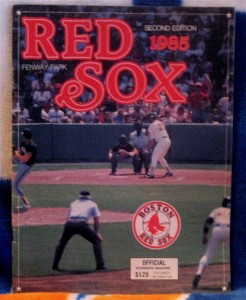
Whether the opening number was “Angry Young Man,” “Tiny Dancer,” “Born In The U.S.A.” or “Out Of Touch,” my reaction to the first note of the first song of the night was always essentially the same:
Ohmigod, I’m actually at one of these things. I’ve seen them on TV, but now it’s here, and I’m here — I know I should be concentrating on how the music sounds and all, but mostly I can’t get over how strange this is.
Fenway Park in July 1985 was my first away game, my first baseball road trip, the first time I walked through a baseball turnstile to see baseball players not wearing Mets uniforms.
I couldn’t get over how strange it was. Ultimately, like each of the concerts that preceded it, wonderful, but overwhelmingly strange at the start.
How could it not be? For a dozen years, going to a major league baseball game meant going to Shea Stadium. That was the only place I saw any professionals play until my freshman year at USF when I ventured across the Howard Frankland Bridge, from Tampa to St. Petersburg, to watch the Mets play the Dodgers in Spring Training. Not a lengthy journey, and technically a home game. I saw the Mets in Tampa a year later, at Al Lopez Stadium. They were the road team on that occasion (versus the Reds), but it was no road trip for me. Plus it was Spring Training. It didn’t count.
But the Red Sox? Fenway Park? In one day? That was the plan I made with my friend Joel and his co-worker Rich. Drive up for the game, see the game, drive home. That loomed as exotic a journey as the five-hour bus trip I took to see Springsteen seven months earlier. On that night, Bruce incorporated Freddy “Boom Boom” Cannon’s “Tallahassee Lassie” into his “Detroit Medley,” a first and last for the Boss, from what I understand.
Tallahassee by bus; round-trip between Long Beach and Boston and Long Beach in 19 hours; no chance in hell I’d do stuff like that today, but I was just out of college that summer. I was up for firsts, and couldn’t imagine they could possibly be lasts. I was 22…surely I’d drive a couple of hundred miles for a ballgame and back again. It seemed a perfectly reasonable thing to do.
The date we chose for Fenway was selected mostly for Joel’s and Rich’s ability to get time off from their job at Shell Creek Park, but also because the Red Sox would be playing the White Sox. Wouldn’t it be something, Joel suggested, if we got to see Tom Seaver pitch in Boston?
We got that something. We got Tom Seaver as the probable pitcher for the Chicago White Sox. Even better, Tom would be going for career win No. 299. It wasn’t 300, but he could set up 300 in New York the following Sunday if won in Boston that Tuesday.
ROAD TRIP!
We took the long way to Boston, across the Connecticut Turnpike, I-95, through Rhode Island. I think it made sense because Rich wanted to swing by some suburban mall (in Braintree, which I recognized as the home of John Adams) to say hi to some girl he knew. When you’re 22 and just out of college everything makes sense. It made sense to me, for example, that when I grew fed up with having to toss coins in honor-system toll booths every two or so miles in Connecticut, that I simply decided, at one point, not to…but slowed down and pantomimed throwing in my change in case anybody was watching.
My passengers were. “Nice fakeout on the toll,” they reminded me several times. It came up in conversation as late as 1990.
The stop at the mall skewed the distance and driving time, but we were doing all right in terms of getting to Fenway well in advance of first pitch. Only problem was — and I’ve since read this happens to everybody, including players just traded to Boston — how the hell do you get there? We turned off somewhere per Rand-McNally, but it was useless. We ended up on a road marked Fenway, but it didn’t seem to have anything to do with Fenway Park. Driving near our destination but never exactly approaching it…it made for a most futile and powerless feeling.
Our salvation was a Gulf station, manned by a crusty local who’d seen this movie before. We pulled in, I rolled down my window, and before I could say a word, the gentleman asked, “Fenway Park?” No doubt this was an occupational hazard.
We were pointed in the right direction, thank goodness, and now the only matter was parking. Shea, conveniently located off the Grand Central, was cleverly surrounded by asphalt. Fenway, then in its 74th season, was built before such concerns existed. Joel had done a little research and told me there was no parking, per se (how did we live before the Internet?). Thus, when we passed by somebody’s house fronted by a sign offering game parking in his yard for five bucks, we were relieved, if a little shocked.
Five bucks for parking? A car? Really?
I had been to Shea Stadium the night before, with my parents (my annual birthday present to my mother, a short-lived but sincerely embraced tradition by the recipient). We drove, we parked in a lot and we walked into the stadium. It was standard operating procedure for a Mets game. Fenway, though, was obviously not the kind of place you made a direct beeline for. First you found parking. Then you took your time getting acclimated. Joel, Rich and I walked around outside, taking in the neighborhood, the architecture, the everything that was supposed to make this worth the trip.
There was an outside. There was an outside to Shea, too — Joel and I usually did one lap around it per year — but this was a whole other ballgame. There were people out here. There was life out here. There was history out here. There was a radio station handing out Red Sox bumper stickers and painter’s caps with the team logo and their call letters (WAAF-FM). There was stuff being sold. Food, souvenirs, baseball stuff.
I’d heard about such things, but I’m not sure I believed it really happened anywhere. I thought maybe it was a contrivance for old-timey movies, the same way I never really believed people placed Christmas trees in their living rooms.
Fenway wasn’t exactly news to me. It was the star of the 1975 postseason, with the NBC announcers going on and on about the Green Monster as much as Luis Tiant and Fred Lynn. It was also the site of my greatest disappointment as a non-Mets fan, on October 2, 1978. With the Mets in remission that summer, I had really taken to the Red Sox as my American League team. An adjustable, mesh red-domed, navy-billed cap with the navy “B” from Boston was mysteriously available for purchase at the Herman’s Sporting Goods in Roosevelt Field and I badgered my mother for five bucks (the cost of Fenway parking seven years later) so I could buy it, wear it and express my offbeat but sincere allegiance to a team not from New York, for a team that was a rival to a team from New York.
Which, of course, was their primary appeal to me in 1978. The Red Sox were running away from the Yankees as ninth grade ended and I was giddy, even smug about it.
I was 15. I had no idea.
As tenth grade began, the once impenetrable Red Sox lead had been whittled to low single-digits. By the second week of school, the Red Sox had fallen into second place. This “favorite American League team” jazz was not as easy as it looked. Only vaguely aware of the tragic overtones that went with rooting for the Red Sox, I kept pulling for them to hang in there. Our high school was located on a bay and faced north. During my free period, I’d sit on a bench, stare out at the water and imagine sailing up to Boston, to Fenway, to cheer on my Sox. I knew less about the seas than I did the Sox, but it all struck me as more enticing than going back inside for trig.
The Red Sox gamely hung in and retied the Yankees on the final day of the 1978 season, setting up a one-game playoff at Fenway. I was as close to Boston as I was going to get that Monday: the Catskills. It was Rosh Hashanah and my parents decided we should take advantage of a special at the Raleigh Hotel. The last time I’d been there was October 1973: Games Six and Seven of the World Series. Back then my mother decided I’d done something so heinous — lied about packing a sports jacket I didn’t want to wear — that I didn’t deserve to watch the Mets play the A’s (punishments fitting crimes…not my mother’s strong suit). This time nobody was going to stop me from watching the Red Sox put away the Yankees, except…
…who else? My mother decided somewhere in the middle of perhaps the most intense baseball game ever played that she needed a glass of orange juice to take with some pill. In the Catskills, it’s almost always mealtime, but the game was taking place during one of the brief respites between eating. That meant I heard this from the adjoining room: “Greg, I called the kitchen for a glass of orange juice. Go pick it up for me, would you?”
I’m trying to watch the Red Sox game here, I grumbled to myself. Naturally, I stalled so I could watch more of it. The natives, just as naturally, grew restless. Before I could be told what a miserable human being I was for delaying the orange juice delivery, I had to get a move on.
Outfitted in my Sox cap, I head downstairs en route to the kitchen. To get there, I have to trudge through the lobby, where a projection TV has been set up, with rows of folding chairs. Every one is occupied by other ostensible Rosh Hashanah observers. What they’re observing is the same game I was trying to watch in my room. They’re rooting for the visiting team in Boston. One of them, a kid, notices me, and what I’m wearing.
“Look!” he says the assembled masses. “He’s a Red Sox fan!”
They turn. I respond with my retort of choice from when I was 15:
“FUCK OFF!”
I got the orange juice. Bucky Dent hit a home run. Reggie Jackson hit a home run. Lou Piniella didn’t lose a ball in the sun. Goose Gossage got Carl Yastrzemski to pop up to Graig Nettles. The Yankees won the American League Eastern Division title and were on their way to a second consecutive world championship. The Red Sox drifted from my immediate concerns.
I never returned to the Catskills, but I did keep the cap. I dug it out of proverbial mothballs for the trip to Boston. The Red Sox stopped wearing the red model after 1978 (can’t say as I blamed them) but it’s the only one I had; it was either that or the painter’s cap. It took seven years to make the voyage from Long Island to Fenway, I figured I should display whatever colors I could.
Even though I would be rooting against the home team that night. There was no question. The Red Sox were an old flame. The White Sox were Tom Seaver. Tom Seaver. Two-hundred ninety-eight wins. Tom wins tonight, and he can get 300 in New York. Wrong stadium, but as close as he can get, just as the Raleigh was as close as I could get to Fenway once upon a time.
After touring the exterior, we made our way inside Fenway and to our seats in short right. We all had the same reaction:
This place is small.
“It’s smaller than the field at Shell Creek,” Rich said. Shell Creek Park, his and Joel’s place of employ, was a Town of Hempstead park, home to softball games. My ill-fated attempt to organize a team out of our high school newspaper staff took place at Shell Creek Park. There was nothing big league about Shell Creek Park.
But Rich was right. It was smaller than Shell Creek. Felt smaller, at any rate. Definitely no match for Shea Stadium, the only frame of reference any of us had.
Size, however, wasn’t everything. Fenway Park didn’t need a parking lot or logical access or an extra 20,000 seats. We were young, but we were wise enough to get why this place was a big deal. Everything we’d seen on television was here in bright green: the Monster; the hand-operated scoreboard; all the bizarre angles. There were the Red Sox and the White Sox, in living color, so much closer than we were used to the teams being at Shea (closer, in proximity, to Shell Creek Park). And there was, in our midst for the first time since 1983, Tom Seaver.
Tom Seaver.
We may have lucked into a Tom Seaver start, but plenty of New Yorkers had planned for this night. There were lots of Mets caps in the crowd. Lots of people who were here only because Seaver was pitching. The Red Sox weren’t going anywhere in 1985 and didn’t sell out every night by any means. Tom helped them draw not quite 30,000 on a Tuesday — pretty close to capacity for Fenway, but it was possible for Mets fans to read the rotation tea leaves and, as we did, haul ass up to New England for this. It made the night unusually festive. Red Sox fans, White Sox fans, Mets fans…everybody applauded Seaver when he was announced.
You know when else everybody, or at least those in the know, applauded? When the Red Sox were at bat. Well, obviously, but I mean they clapped rhythmically as they built favorable ball-and-strike count. It was the same kind of clapping we did at Shea, except we did when our pitchers were pitching, not when our hitters were hitting. How strange…truly a precursor to John Travolta’s “it’s the little differences” riff in Pulp Fiction.
That’s the main thing I remember about the balance of what turned into Tom Seaver’s 299th career win: some incidental clapping. I was so gobsmacked by my surroundings that when not intoxicated by the presence of my favorite player of all-time and comforted by the sight of so many royal blue caps with orange NY’s, I was mostly comprehending what was going on. It was Billy Joel and Bruce Springsteen and all that all over again.
I’m actually at another ballpark watching two teams that aren’t the Mets play baseball. I’ve seen it, I’ve read about it, now I’m here. I can just do that…wow.
Now and then I managed to notice I was in the same room as a pretty decent pitching duel, Seaver vs. Oil Can Boyd. It wasn’t classic — each man gave up four runs — but they both stuck around in the DH league and went nine. I respectfully (if not rhythmically) applauded the Red Sox, but I saved my cheers for Seaver. I whooped it up for White Sox runs despite wearing a beaten up Red Sox cap. And, like much of the crowd, I was thrilled when Chicago cobbled together three runs in the top of the tenth. Tom was the pitcher of record and was in line for the victory. White Sox closer Juan Agosto made it a little sticky, giving up a run of his own, but when he induced a ground ball from Marty Barrett, the deed was done.
Tom Seaver won his 299th ballgame. When he came out to thank Agosto and his teammates, he received a hearty ovation from the Fenway faithful, particularly those of us whose faith in him stretched south to Shea and back toward 1969. I seem to recall Tom tipping his cap to us. Neither he nor I was wearing the cap we should have been wearing as he approached 300 wins, but if this was the best we could do, so be it.
Mixed in with my first road game was the last time I saw Tom pitch. He’d get No. 300 in the Bronx on Sunday. He’d be at Shea in October 1986, wearing a Red Sox uniform of all things, but thankfully inactive due to injury (Tom facing the Mets in the World Series…too strange to fully comprehend). His next return was June 1987, a brief stab at returning from exile to rescue the Mets’ aching pitching ranks. Seaver, who hadn’t thrown in competition since the previous September, didn’t have it anymore. At 42, No. 41 announced his retirement — at Shea. Finally, he was home.
Me, Rich and Joel, on the other hand, had a long journey to return from whence we started after the game of July 30, 1985. Our car was still where we parked it for five bucks, but driving away from Fenway was no easier than driving to it. Maybe I’ve been in worse traffic jams than I’ve been en route to the Mass Pike, but I can’t remember one. I do, however, remember being quite pleased when I noticed the bumper sticker on the car ahead of mine:
BAN THE DESIGNATED HITTER
Hey, I thought, this Boston’s all right for an American League town.
We’d had a great time, one made better when we tuned in WINS at :15 or :45 after an hour and learned Doc Gooden had shut out the Expos on five hits, striking out ten. By winning 2-0 at Shea, the Mets had stayed within three of St. Louis that night in 1985, a year when the Mets mattered more than anything to any of us. Maybe it was those priorities speaking, but as much as I enjoyed immersing myself in the Fenway Park experience, I can’t say I liked it better than being at Shea Stadium the night before…or anytime.
Fenway had quirks and tales and a buzz on the streets. Shea had the Mets. Shea won. I only had a list of two ballparks to that point, but Shea topped it. Without giving it much thought on the long drive home (if shorter than it had been on the way up — we avoided Rhode Island), Shea commenced that night serving as my ballpark standard. Every new ballpark I would see after Fenway, and there have been nearly three dozen, has to convince me I’d rather be there than at Shea watching the Mets. Fenway…storied as it was, special as it was…couldn’t do it in 1985. Not for me, it couldn’t.
Could it do it ever? I strove to find out fourteen years later.
***
My second trip, in late June of 1999, was undertaken so as to consider Fenway Park in the context of all I had seen since the end of July 1985. There was more than Shea to measure Fenway against. I had recently visited Bank One Ballpark in Phoenix, which was my 21st ballpark. It hadn’t existed in 1985. Nor had six of the other stadia I had seen in the previous five years. The ballpark world had changed dramatically. It used to be everything looked like the Vet. Now everybody tried to make everything feel, at least in theory, like Fenway.
How did the original hold up in this light?
Great, not surprisingly. It was still Fenway, but more so. What’s surprising — maybe even anachronistic — to recall was there was serious talk there might not be a Fenway all that much longer. So strong was the retro rush through the 1990s that charming old ballparks were presumed doomed, ready to be cleared away for charming new ballparks that evoked charming old parks and generated modern revenue streams.
 Fenway Park was limited in that regard. In 1999, even as it was celebrating its imminent hosting of the final All-Star Game of the century, the conventional wisdom had it that Fenway couldn’t possibly compete with those cash cows in Baltimore and Cleveland. The Red Sox, the thinking went, couldn’t hope to keep up with the rest of the league. History and tradition was nice, but 1912 was a mighty long time ago…and attendance that couldn’t squeak past 34,000 was uncomfortably small. Fenway Park was limited in that regard. In 1999, even as it was celebrating its imminent hosting of the final All-Star Game of the century, the conventional wisdom had it that Fenway couldn’t possibly compete with those cash cows in Baltimore and Cleveland. The Red Sox, the thinking went, couldn’t hope to keep up with the rest of the league. History and tradition was nice, but 1912 was a mighty long time ago…and attendance that couldn’t squeak past 34,000 was uncomfortably small.
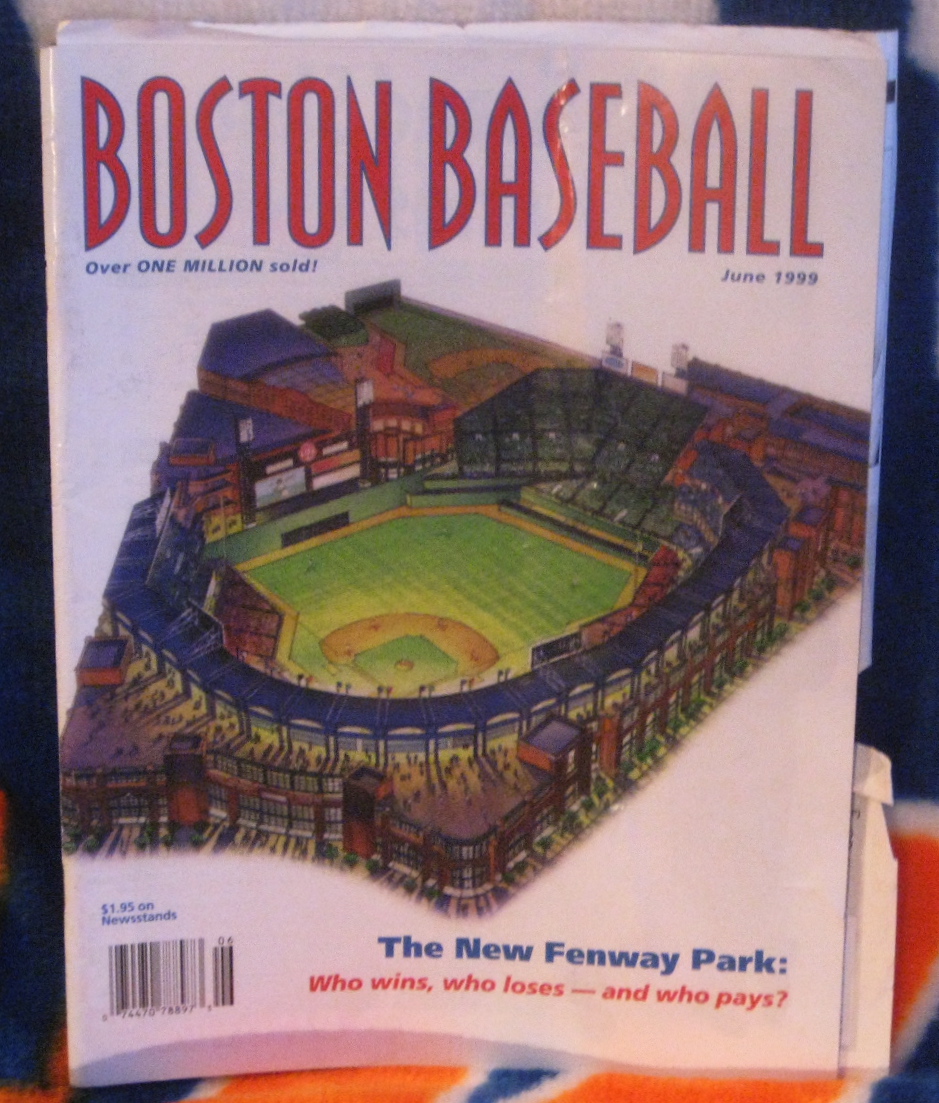
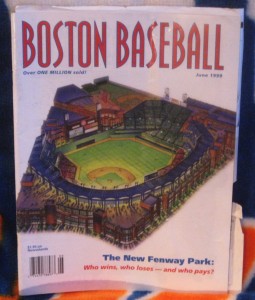
Management had begun to talk up forward progress and pricey amenities. A “new” Fenway model was being floated when Stephanie and I arrived in town. It was the cover story in Boston Baseball magazine, and it was seen by knowledgeable Red Sox watchers as “inevitable”.
What a difference a dozen years makes. Fenway, you may have noticed, hasn’t gone anywhere, except up in everybody’s esteem. Instead of a new ballpark, Red Sox fans got new owners, and they went about renovating Fenway around the edges, increasing its capacity in lucrative, relatively undisturbing ways since 2002: seats over the Green Monster; a new deck in right field; more dugout-level seating. They’re prime locations and they’ve fetched a pretty penny. Capacity has quietly crept toward 38,000, and the Red Sox have no problem filling every cramped seat.
Imagination kept Fenway from disappearing or becoming unrecognizable. If anything, it looks better than ever on television. The Red Sox have enjoyed perhaps their finest stretch as a franchise and their ballpark is at the heart of everything they do. Nobody in Boston any longer worries about keeping up with the Camdens.
But we didn’t know that when took Amtrak up to North Station to spend a steaming hot weekend eleven years ago. I was genuinely concerned I might not get another chance to see a game at Fenway, and that Stephanie never would.
If there was any indication that nothing is forever where teams and their venues are concerned, it came in a side trip we took the morning before our 1999 game. Staying at the Howard Johnson that was within walking distance of Fenway meant we were also within walking distance of the site of old Braves Field, on the campus of Boston University. With my ballpark fever running as high as the temperature that Saturday, we took off down Commonwealth Avenue to find exactly where the National League used to hold court in these parts. It wasn’t a difficult search — I recognized the old ticket office (turned campus police station) from pictures, determined which section of the current grandstand was a remnant from days of yore, and eventually came upon the plaque that commemorated the previous use for what was now known as Nickerson Field, home to BU Terriers athletics.
THE FANS OF NEW ENGLAND WILL NEVER FORGET THE EXPLOITS OF THEIR BRAVES
AND THE FOND MEMORIES ASSOCIATED WITH BRAVES FIELD
I couldn’t believe how close the two ballparks had been — about a mile-and-a-half. You didn’t have to stay at Howard Johnson to walk between Fenway Park and Braves Field…though history proved not many Bostonians ambled to the latter joint, vacated after the 1952 season (paid attendance for the Braves last year in Beantown: 281,278). I also couldn’t believe the chills I felt on this ridiculously hot day. I had read about the team that no longer played here, but their presence truly hit me as I stood on what had long been their grounds.
The Boston Braves and Braves Field existed…they were a part of the fabric of what baseball used to be…of, in a way, what New York National League baseball used to be, meaning Braves Field is a stitch in the tapestry of which our Mets heritage is comprised. Braves Field was where they played major league baseball for 48 seasons. This was where the Dodgers and Giants regularly headed by train for road trips…just like Stephanie and I had done the day before.
I stood by the plaque and I thought about a past that predated me. I thought about the Dodgers clinching their 1941 pennant, Brooklyn’s first in 21 years, at Braves Field. Afterwards, the Bums rode their southbound train with glee, but not without controversy. Dodger president Larry MacPhail wanted the train to pick him up at the 125th Street station in Harlem so he could be part of the raucous reception that awaited the team at Grand Central. But manager Leo Durocher ordered the train to keep rolling, whizzing right by MacPhail, who, in turn, fired Durocher. The dismissal was rescinded, but the legend lived on, conceived en route from Boston, because one-eighth of the National League used to live where I was standing.
My mind fast-forwarded a decade. By sweeping a Saturday and Sunday set from the Braves at Braves Field, the Giants built a half-game lead on the Dodgers on the last day of the season in 1951. Hence, it would be on another train streaking in the same direction from the same city where another National League team from New York toasted its September accomplishments. But the Giants (another Durocher squad) had to be a little more muted in their clinking of cups. They had to keep one ear open to the radio broadcast from Philadelphia and listen intently to hear if the Phillies could hold off the Dodgers at Shibe Park and give them the pennant outright. They couldn’t, and the three-game playoff that became known for The Shot Heard ’Round The World had to be scheduled. That’s what the New York Giants learned on their journey home from Boston.
Next, I absorbed the logistics of my surroundings. The Charles River was not much more than a long foul away from Nickerson Field, which made me think of Red Barber. Vin Scully once told a story of how Barber, broadcasting a crucial Dodger game at Braves Field, described in intricate detail a rainstorm that was bearing down second by second, pitch by pitch. It was the bottom of the fifth, meaning time was of the essence. The rain, in Scully’s recollection of Barber’s description, lumbered relentlessly across the Charles and closed in on the two teams trying to make official their late-summer maneuvers.
Finally, there were two out in the fifth, the Dodgers up by a run. Red had the raindrops hitting the outfield wall. Now he had the rain stretching across the outfield, all the while stressing that as soon as this storm hit, the game would be over.
Well, I forget who was up, and usually it would be expected that the batter would stall around the plate, trying to buy some time, but inexplicably, he swung at the pitch, a grounder to the shortstop, Red had the raindrops on the bill of Pee Wee Reese’s cap as he fielded the ball and he had the rain crossing the infield as Hodges caught the ball. And with that third out, he says, “And here comes the storm, and there will be no more baseball today.”
It was very quiet at Nickerson Field that Saturday morning, but if you listened closely, you could hear plenty.
It was not quiet at Fenway Park, however. Fenway Park was even more festive than I remembered it. We treated ourselves to an appetizer on Friday night, circling the perimeter of the park on foot while that evening’s game was getting underway. That was the beauty of Fenway — there was a baseball game inside, but outside, life percolated, and you could feel a part of both (though I don’t think they let you near the park without a ticket on a game day anymore). I relished pointing out to Stephanie, as we strolled Lansdowne Street, you hear that? You hear that music and that crowd? That’s right over there, right over this wall — can you believe it’s that simple?
Our game-picking was nearly as serendipitous in 1999 as it had been in 1985. I got the White Sox again, which was incidental. The real treat was the Red Sox were starting Pedro Martinez in the season when Pedro Martinez was lighting up the American League in general and Boston in particular. They loved Pedro up there, and no wonder: 13-2 with a 2.10 ERA entering that Saturday’s action. He only endeared himself more on Friday night by allowing his teammates to tape him to one of the dugout posts (my mouth hung open as we watched it on TV — look what they’re doing to their ace!) We were handed WEEI “K” cards out on Van Ness Street before the game, even those of us in Mets caps. We were happy to wave these thoughtfully provided Doc tributes.
Happiness was the order of the day at Fenway. In the bottom of the first, the White Sox’ James Baldwin (like Pedro, a future Met…but nothing like Pedro as a future Met) gave up three runs after three Red Sox batters and two more before he was removed with two out. Scott Eyre replaced Baldwin, but the Boston hits kept coming, cresting with a two-run homer off the bat of Nomar Garciaparra. By the time the inning was over, Pedro had been staked to an 11-0 lead.
Not much drama from there, so my attention turned back to Fenway itself. It was still a great place to watch a game, if not exactly spacious to sit while doing it. Intimate’s awesome for viewing baseball, maybe not as excellent for legroom and circulation of your lower limbs. For one day in June, no problem. For a lifetime, I could see why they thought about replacing an 87-year-old facility.
But I couldn’t see it for very long. The age of Fenway and all that is woven into its years is why it’s Fenway. You couldn’t dream this up in the 21st century. You couldn’t build this from scratch if you tried. It wasn’t comfortable, it wasn’t an easy navigation through the concourses, its major amenity was the installation of indoor plumbing…yet there was nothing wrong with any of it.
In 1996, just before they let him walk, Roger Clemens struck out 20 in a game for the Red Sox. Ten years before, he had done the exact same thing. I remember that in his next home start the Red Sox had erected a special marker on the outfield wall commemorating the 20 then and the 20 now. Clemens was long gone by 1999 (with Pedro in residence, nobody seemed to miss him), but you know what was just kind of leaning up in a spare corner under the stands where everybody could see it? That 20-20 sign from three years before. It wasn’t on display. Nobody was honoring then-Yankee Clemens. It was just that they had nowhere else to store it, so it just kind of sat there, out in the open.
I loved that. I also loved, to a point, the woman who sat in front of us as the Red Sox ran up the score. Pedro pitched five and was given the rest of the afternoon off. The home team kept hitting home runs: Nomar again, Stanley, Varitek. It was a rollicking day, clear to the pumping of “Dirty Water” by the Standells after the last out. Yet this lady, who could have been cast as an extra in Cheers if Cheers had been concerned with realism, was not satisfied, because batting second and playing third for the Red Sox was little-used utility infielder Lou Merloni. Lou entered the day batting .303 and exited it batting .324. He had doubled in the sixth, seventh and eighth runs in the first inning, his second of two hits in the frame. But then he struck out in the fourth and lined out to end the sixth.
Cue the lady who couldn’t have been from anywhere else but Boston (and might have been related to that guy from the Gulf station in 1985):
“Merloni is terrible! You gotta take him outta there! What are you doing playing Merloni! Merloni stinks! HE STINKS!”
I try not to engage agitated fans when they’re mid-agitation, but this was just too much. I leaned over (not very far — everybody’s pretty close together at Fenway) and said, hey, what’re you so upset about? The Red Sox are winning 17-1.
And you know what? She stopped, thought about it, smiled and replied, “Yeah, I guess you’re right!”
As was my decision to engineer this second trip north. As was the Red Sox’ decision to forget about replacing Fenway Park. As is any world in which this place perseveres against progress. It has its stubborn warts, I suppose (and I don’t mean the Lou Merloni lady), but we should all look that good and feel that right on the off chance any of us survives to nearly a hundred.
by Greg Prince on 28 October 2010 3:58 am The worst commissioner since Bowie Kuhn will probably be inducted into the Hall of Fame someday. It’s inevitable. Baseball loves to honor its emptiest suits. They did it for the hollow haberdashery inhabited by Bowie Kent Kuhn and they’ll do it for the incumbent do-nothing prop of ownership. Clear space in Cooperstown for a plaque with Allen Huber Selig’s name on the top. It’s coming eventually. Just make sure that there’s one line inscribed among all the others:
DIDN’T PARTICULARLY CARE WHO SAW THE 2010 WORLD SERIES.
It’s the truth. Selig doesn’t care. Major League Baseball, the entity he allegedly oversees, doesn’t care. If Bud and MLB did care, the telecasts of every World Series game would be readily available to every television home in America.
They are not.
Something’s wrong when the World Series, broadcast on what we used to call an over-the-air network — something you could watch by turning on any television in this country — isn’t accessible to every potential viewer. Residents of three million television households “serviced” by Cablevision turn on their televisions where the Fall Classic is supposed to beam and see nothing but a message telling them that Cablevision is angelic and Fox is dastardly. Fox, wherever they can transmit their message, is happy to tell you the exact opposite.
Bud Selig tells you nothing. The trustee of our national pastime, on the subject of three million television households not being able to view his sport’s crown jewel event…as mute as the button I’d be tempted to use on Joe Buck and Tim McCarver if given the option.
Which I haven’t been.
This cable or that satellite system not carrying this channel or that network is an old, ugly and recurring story. It pops up every few months somewhere and it occasionally digs its tentacles into our particular passion. There were the couple of months when Time Warner kept MSG from sending preseason and regular-season Mets games into NYC homes. There was a week or so at the dawn of the SNY age when I couldn’t see Spring Training on Cablevision. As 2006 rolled along, we received a steady stream of e-mails and comments from those who wanted to watch the Mets on their new cable channel but couldn’t because of carriage issues in outlying areas.
Pains in the necks those issues were. It was nonsense perpetrated in the name of grabbing us by our ankles and shaking more change from our pockets. It was inexcusable, but it was somehow par for the course. You start paying for television, you sign up to be periodically screwed — it’s counterintuitive, but we got used to it.
This, though? An over-the-air channel being kept off television? Literally not going out over the air and coming out through a screen? During the World Series?
Are you kidding me?
I know you are not.
Hardship is not having a place to sleep or dodging gunfire in Afghanistan. Let’s not confuse Channel 5’s temporary nonexistence with that. Bigger problems exist in this world as well as my life. This is not a hardship. What this is, however, is an insult. I pay, like the other three million Cablevision households affected by this billionaires’ impasse, plenty for programming. Some of it’s worth the tab, a lot of it isn’t. But Channel 5 is supposed to be Channel 5. Long before I had cable, I had Channel 5. We all had Channel 5.
Now we don’t. I’m told I can go spend 30 bucks on a digital converter and get Channel 5. That’s 30 bucks more than I used to have to spend to get Channel 5 — never mind what I’m spending to get all my channels. Signals were improved somewhere along the way so I can’t do what I used to when cable wasn’t around. I used to take a portable television, plug it in and watch Channel 5 (or 2 or 4 or whatever). I still have a portable television, but it doesn’t do anything except collect dust and, as I discovered Wednesday night, generate snow.
I don’t have the option of another provider, not where I live. It’s Cablevision or it’s read a lot more. Or it’s the $30 antenna and cancel everything else and make a bold statement. I’m not much for bold statements when there’s Mad Men. I like TV. I like to watch.
Bud Selig could make a bold statement. I’d like to watch that. Bud Selig could stand up and speak for his constituents: not the baseball owners, but the baseball fans, those of us within the three million who are messing around with radio (which is great when there’s Howie Rose and Gary Cohen circa 2005, not so great when it’s Jon Miller and Joe Morgan) and/or rubbing two electronic sticks together on our computers as if trying to receive a signal from twelve miles offshore.
Radio is radio, and it’s an honorable alternative — but it’s an alternative; the computer is the computer, and it’s a vital link to most of what I do (indeed, Cablevision is telling us we can subscribe to MLB’s online service and they’ll pay us back later when they get a chance) — but it’s also, all baseball-viewing things being equal, an alternative. The World Series is the World Series and we, as a nation — even as quaint phrases like “national pastime” lose resonance in the face of monster NFL ratings — deserve to be able to watch the World Series on television: without gadgets, without trickery, without tin foil, without having to think about it.
Has Bud Selig thought about it? Has Bud Selig thought about baseball’s showcase gleaming in the dark in three million Cablevision homes? Does Bud Selig remember the World Series is supposed to be the best advertisement baseball has, and that whatever shreds of community one nation can be said to compose coalesce mainly around extended national moments like the World Series? It’s not too far from a romantic vision to still maintain currency in 2010. The World Series continues to attract viewers year after year. It’s just that this year millions of potential viewers are being actively repelled.
Corporations will be corporations. It’s a cop-out, but it’s been proven true enough in this life. But what about baseball? Isn’t baseball supposed to be a little more than that? Isn’t the commissioner of baseball supposed to do a little more than endorse Fox’s checks and not otherwise rock the boat?
I don’t suppose Bud Selig can wave a magic wand and make the next three to six games of the World Series appear on my television and the televisions of three million of my neighbors. But he could do this: step up and say something. He could use the MLB Network as a bully pulpit and declare that he gives the slightest damn that a portion of his public is not getting to watch the World Series on television.
You, the loyal baseball fan, are my highest priority. That is why today I beseech representatives of the two companies to resolve their dispute. I humbly offer to mediate in the name of baseball and baseball fans everywhere. Our ability to deliver to you, our customer, the game you love is my paramount concern right now. I will maintain contact with each side and not rest until I have done all I can to make sure not a single American who owns a television goes without the opportunity to turn it on and enjoy the World Series, just as Americans have been able to do every autumn the World Series has been played since 1947.
Bud Selig should be raising hell, raising his voice, raising the volume on baseball’s indignation with Cablevision and Fox. Instead, Mute Button Bud says nothing. Instead, one of Mute Button Bud’s lieutenants is dispatched to assert that “Fox is in compliance with the contract” and “we recognize that it’s a commercial dispute between two private parties.”
Way to look after the brand. Way to satisfy your customers. Way to position your championship round as Not See TV.
It was marginally cute during the NLCS having to jump through hoops to find flickering images of the games. It’s not cute any longer. It’s an insult. As a Cablevision customer and a Fox viewer, I’m incredibly insulted the two private parties can’t settle their differences. But as a diehard baseball fan who relishes the World Series no matter the matchup, I’m severely let down by this commissioner who has shown me, after eighteen years as caretaker for this stubbornly great game, that he couldn’t care less about me or the members of three million households in the same predicament as me.
Thanks Bud.
by Greg Prince on 27 October 2010 1:53 am Sandy Alderson is reported far and wide as a done deal for Mets GM, likely to be announced as official on Friday.
Then what?
Why, he will whip this sad sack outfit into shape; imbue it with a perpetually winning, statistically driven philosophy; stock it with a finely calibrated mix of veterans and youngsters; fill out the rotation; add power to the lineup; teach a more aggressive form of sliding; jettison every bad contract lingering on his desk; do something about surly, disinterested concessions personnel at Citi Field besides adding to their ranks; communicate in cutting-edge fashion; and replace the dirt around home plate with pixie dust, thereby facilitating a rise in infield hits.
And then he’ll hire a great manager.
Well, Sandy Alderson hasn’t not done any of that yet, so dream away, Mets fans. If nothing else, our future isn’t necessarily our immediate past. Score one for next year.
by Greg Prince on 26 October 2010 6:48 pm We’re all aware that Nolan Ryan is taking part (albeit from very good seats in the stands) in his first World Series since 1969. But were you aware that if the Rangers prevail then he’ll be in an exclusive club of 1969 Mets alumni? How exclusive? So exclusive it doesn’t include Tom Seaver. Read all about it in my latest piece for the New York Times Bats blog, here.
|
|