The blog for Mets fans
who like to read
ABOUT US

Faith and Fear in Flushing made its debut on Feb. 16, 2005, the brainchild of two longtime friends and lifelong Met fans.
Greg Prince discovered the Mets when he was 6, during the magical summer of 1969. He is a Long Island-based writer, editor and communications consultant. Contact him here.
Jason Fry is a Brooklyn writer whose first memories include his mom leaping up and down cheering for Rusty Staub. Check out his other writing here.
Got something to say? Leave a comment, or email us at faithandfear@gmail.com. (Sorry, but we have no interest in ads, sponsored content or guest posts.)
Need our RSS feed? It's here.
Visit our Facebook page, or drop by the personal pages for Greg and Jason.
Or follow us on Twitter: Here's Greg, and here's Jason.
|
by Greg Prince on 11 June 2010 6:07 am This is no one-night stand
It’s a real occasion
Close your eyes and you’ll be there
It’s everything they say
The end of a perfect day
—Steely Dan
Ooh, wait! I’ve got another one! I know you guys are sick of me chiming in, but I can’t help it. Now that we’ve experienced the first no-hitter in Mets history and we’re seeing how many Met one-hitters we can name before we forget how we used to count Met one-hitters as if they were no-hitters because we didn’t have any no-hitters, I want to get them all on the table — especially the ones I went to.
Did I tell you I went to seven? Yeah, seven! My first Met win was a one-hitter: Jon Matlack against the Cardinals in 1974. The only hit was the St. Louis pitcher, John Curtis, in the third. It was too early in the game to notice a no-hitter had been broken up…or maybe just too early in my life going to Shea.
And I was at the Bobby Jones one-hitter against the Giants, the clincher in the 2000 NLDS. A Jeff Kent double in the fifth. I could never figure out whether I was upset over that not being a no-hitter or kind of relieved I didn’t have to worry about that aspect of the game since we were trying to win a series. Bobby worked carefully to a couple more hitters in that inning, issuing a couple of walks, but no more hits and no runs. He was perfect in the other eight innings. It was a perfect ending, no no-hitter or not.
Sometimes I forget I saw Shawn Estes one-hit the Brewers in 2002. Yes, Shawn Estes, the guy who didn’t hit Roger Clemens. That’s the only thing most Mets fans remember about him, but he prevailed in a pretty rare for its time duel against ex-Met Glendon Rusch in April 2002 in which both pitchers went the distance and the only thing that separated Shawn Estes from being remembered for something more than not hitting Roger Clemens’ ass was an Eric Young single to lead off the seventh. I can’t believe I tend to forget it as one of the best Met pitching performances I ever saw.
One of my one-hitters was kind of bogus: 2007, a five-inning affair. Shouldn’t even count, but it does. It was John Maine versus the Nationals. He gave up a leadoff single to Ronnie Belliard and nothing more. Then the sky gave up and deluged Shea. A rain-shortened one-hitter. To tell you the truth, I had to look it up to remember it was a one-hitter.
I didn’t have to look up John Maine’s other one-hitter I was at. Technically it wasn’t John Maine’s one-hitter. He shared it with two relievers you’ve probably forgotten about, Carlos Muñiz and Willie Collazo, but everybody instantly remembered it as the John Maine one-hitter. This was one of those one-hitters that stung because it wasn’t a no-hitter. We used to get really hung up on that before we got to experience our own no-hitter. It was, as Jerry Seinfeld put it in “The Contest,” part of our lifestyle…like shaving. Maine took a no-no into the eighth with two out. The opposing batter was some catcher you’d never heard of, less familiar than Carlos Muñiz and Willie Collazo combined. His hit wasn’t worthy of the word “hit”. We won 13-0. Maine struck out 14. There was a fight. We were tied for first with one game to go. Yet all anyone remembers was John Maine’s one-hitter that could have been a no-hitter except for some stupid Marlin nobody of a catcher named Paul Hoover who wouldn’t have even been playing if it hadn’t been for the fight that got their starting catcher Miguel Olivo thrown out.
I wonder if we’ll still remember that now that we have our no-hitter. I wonder if I’ll still remember any of my first six one-hitters the same way ever again. For example, will I recall at all my sixth, a combined one-hitter that started with Pedro Martinez going four, surrendering only a single to Brad Hawpe, then leaving with an injury? In came Muñiz, Heilman, Schoeneweis and Wagner. They gave up no hits. A five-man one-hitter. It fell somewhere between Maine’s five-inning one-hitter and Maine’s three-man one-hitter that was mostly Maine and some stupid Marlin on the seriousness scale.
We were always so serious about one-hitters before our first Met no-hitter. It probably started with the most famous of them all, the one that was more famous even than Bobby Jones against the Giants. That, of course, was Tom Seaver and Jimmy Qualls, July 9, 1969. It was the third one-hitter in Mets history, but it instantly became the flagship. You know about it. We all know about it. It’s got its own plaque outside Citi Field. Even Bobby Jones’s one-hitter that clinched a playoff series doesn’t have that.
No wonder it stands out: Twenty-five Cubs up, twenty-five Cubs down; Shea so packed that fans had to sit in the aisles; the Mets closing in on first place for the first time ever; Seaver young and perfect. Then Qualls singles. The Mets won — Tom quickly retired the next two batters — but something was definitely imperfect about this otherwise grand occasion. No wonder Nancy Seaver was in tears. Tom wanted to know, “What are you crying for? We won 4-0.”
But we know why. We know what got away, and we know that what we got instead, no matter how stupendous, was no substitute.
It was a one-hitter. It became our version of the no-hitter. It was our runner-up ribbon, our Miss Congeniality sash. It was the headline below the fold on the front page that announced we’d just been elected vice president.
It was a one-hitter. It wasn’t a no-hitter. It was the best we could do without doing the best we could do.
Some Met one-hitters were Quallsish in their heartbreak. Seaver had another of that ilk in 1972, going to the ninth again, one out away again, until Leron Lee broke it up for the Padres.
Others got away earlier but hung heavy in the air for years to come. In 1984, Dwight Gooden gave up an infield hit to Keith Moreland of the Cubs in the fifth and nothing else. A more sensible (or humane) official scorer would have found a way to charge Ray Knight with an error.
Still others gnawed at our nerves in real time with their sense of possibility that went ultimately unfulfilled. T#m Gl@v!ne, of all Mets, challenged the unchallengeable clear into the eighth inning in 2004 against the Rockies. I really didn’t want it to be him, the Manchurian Brave, to be the first Met to throw a no-hitter, but I wanted it to be somebody. Right around the instant I decided I would allow it to be Gl@v!ne, Gl@v!ne allowed a double to a Paul Hoover of a Rockie named Kit Pellow. Foiled again by the Manchurian Brave!
I wasn’t there for Qualls or Lee or Moreland or Pellow. I realize I told you I was at seven one-hitters yet recounted only six of them: Matlack, Jones, Estes, Maine in the rain, Maine with two relievers and Martinez with four relievers. Funny, I just realized that when I’m not at the game, I identify the game by the hitter who broke it up, but when I’m there, I call it by pitcher. Must have been a subconscious thing all those years before the first no-hitter in Mets history, me trying to burnish a fine game with the credentials of a great one. When there’s a no-hitter — as we now, at last, understand — there is no batter with whom to identify it. It’s all about the pitcher.
It was that way with the sixth one-hitter I attended, my first at Citi Field, in June 2010. The pitcher that night was Jon Niese, back when he was a third-year rookie. He’d been up briefly in ’08 and seemingly to stay in ’09, except he got hurt before he burned off his freshman status. He got hurt in 2010, too. Not badly and not for long, but long enough to make you wonder if he was somehow cursed. Sort of like the Mets seemed cursed to never throw a no-hitter.
The Mets and no-hitters…geez, I still can’t believe it. I still can’t believe how long we went without one just as much as I can’t believe we finally got one. Did you notice all those names I was tossing out there before? Seaver, Gooden, Matlack, Gl@v!ne even. I could go on. Almost every Mets pitcher of note threatened to pitch a no-hitter. Any Met who pitched one would have been of note. Some got real close and gave up more than one hit. Those hurt as much as the late one-hitters like Qualls and Lee and so on. The sum total of all those attempts that came undone weighed on us. We didn’t look at any game without considering it a chance to break the streak, to get off the schneid.
C’mon, you did it yourself, right? First hit our starter gave up, even if it was to the first batter, what’d ya say?
“There goes the no-hitter.”
“Not tonight.”
“Damn.”
It was like that on June 10, 2010 with Jon Niese. Niese got through two innings against the Padres. I didn’t even see the first inning because I got to the park a little late. But I saw the 0 on the scoreboard and then I saw him keep it that way after two. I was supposed to call somebody else who was at the game. Yet I wouldn’t, not while there was a 0 under the H of the Padres. Seven innings remained and I was already thinking in those terms.
Typical Mets fan, certainly in that period before we got to experience the first no-hitter in Mets history.
The Mets took a lead in the second that June night in 2010. That was a particularly welcome development since they hadn’t done a damn thing that afternoon. This was a makeup game grafted onto a scheduled game: what they referred to as a day-night doubleheader (never mind that a doubleheader sturdily implies two games for one admission). The Mets went down listless their last 22 batters during the day portion against Mat Latos. He and his relievers gave up two Met hits in toto. Thus, when we scored a run in the second inning of the night game, it felt huge.
And when we short-circuited our crackling offensive electricity by hitting into a triple play right after that first run scored, it felt…
I don’t know how it felt. I remember it couldn’t have looked more routine. Who hits into a 5-4-3 double play anyway? Ruben Tejada, that’s who. He was a rookie at the time (the Mets started five rookies in that game, including Niese). I don’t know if he did anything wrong except he hit it to the wrong place and nobody on the Mets was fast enough to do anything about it. It couldn’t have been better choreographed in the Padres’ favor had Gene Saks been directing Bill Mazeroski à la The Odd Couple.
That could have been a big story, I suppose. I had been to a game at Citi Field in 2009 when a triple play was the big story. It was an unassisted triple play, also hit into by a Met (Jeff Francoeur) and it ended the game. This wasn’t that dramatic. Or traumatic. It was just a ground ball that produced three outs in the second inning after we took a 1-0 lead. Not everything is a crisis, you know.
I don’t know that the triple play had anything to do with momentum, but the Padres’ leadoff batter in the third, Chris Denorfia, doubled off Niese. The murmurs commenced per usual.
“There goes the no-hitter.”
“Not tonight.”
“Damn.”
Oh well, I chimed in to myself, but now at least I don’t have to stay glued to my seat like I did for Maine at the end of 2007. I can make my phone call. I can visit my friend in Promenade. I can swing by Catch of the Day on the way back to my seat on Field Level. It’s not like it was going to be a no-hitter anyway.
Niese didn’t give up anything else in the top of the third. The Mets took a 3-0 lead in the bottom of the third. It was going to be just another game, just another of the 7,700-plus games to that point in which a Met did not pitch a no-hitter. It was going to be yet another reason that if I were going to Cooperstown the next day, I’d behave just as I did in August 1997. Back then, my wife and I eagerly inspected every inch of every exhibit save for one: the no-hitter exhibit. “There’s no reason for us to look at that,” I said without cracking the slightest smile. I didn’t get back to Cooperstown anytime soon after that, but my rule stood.
The fourth and fifth innings flew by as I temporarily abandoned my friend Kevin and made my rounds. The Mets were leading 3-0, but I wasn’t paying much attention. My few minutes of schmoozing in Promenade centered on the triple play and our general consensus that it was routine to the point of mundane. My visit to Catch of the Day, which moved a little slower than I would have liked, resulted in a crab cake sandwich and an order of Bayside Fries, but nothing else of substance on the field behind me. Still 3-0 Mets when I got back to my seat for the top of the sixth.
The evening proceeded securely but unremarkably. Kevin and I were a last-minute hookup that night. The tickets were a surprise and the game was, as I mentioned before, a makeup. We were happy to talk Mets this and Mets that, not all that engaged by the Mets right there in front of us. Niese continued to pitch well but the Mets had stopped scoring again. The only thing we really noticed was how deep the park was playing, how every fly ball that had the slightest chance of traveling seemed to lose interest well short of the warning track. It was frustrating when the Mets batted. it was less so when they didn’t.
Had Chris Denorfia not struck in the third — and I must confess I had forgotten the identity of the sole successful Padre hitter by the seventh — it would have been different. I would not have visited Promenade. I would not have bought a crab cake and Bayside Fries. I would not have followed it with Dibs, the ice cream treat I had to have because the Bayside Fries were spicier than I thought they’d be. Kevin and I would not have been dwelling on a home run Mike Piazza hit nine years earlier off Carlos Almanzar or another home run, by Mo Vaughn off David Wells a year after that. We would have been focused solely on the present and the absolutely immediate future: the very next pitch. There would have been uncomfortable silences and strained small talk about anything but what we were focusing on. Eliminate a double by Chris Denorfia and the night in questions would have been very different.
But Denorfia had doubled. The night was no different from all other Met nights to that point in that there would be no no-hitter. Yet something novel occurred to us as Jon Niese again set down the Padres in the eighth as he had in the seventh and the sixth and so on since Denorfia in the third.
Jon Niese was working on a one-hitter.
Can you work on a one-hitter? Can you run for vice president? Can you legitimately attempt to be the best you can be without actually being the best you can be?
We — me, my friend Kevin, everyone around us — decided you could. We decided Jon Niese, third-year rookie pitcher for the New York Mets, was doing just that. Or, to be completely correct about it, he needed the opportunity to do just that. Eight innings had gone by. The Mets still led 3-0. A three-run lead on the edge of the ninth inning usually meant one course of action by the manager in 2010: call the closer. It was a save situation. The Mets, like every team in baseball, paid a specialist handsomely to protect or at least not surrender three-run leads with one inning remaining.
But what fun would that have been? Sure Francisco Rodriguez might have come in and not given up a hit, but where would that have left us? It would have left us with Maine (+2) or Pedro (+4). Not terrible, but not nearly as satisfying as Niese and Niese alone. Jon Niese, little lefty born under the very best of signs — the calendar page read October 27, 1986 — had recently battled back from a slight leg injury to return to the rotation the week before. The leg was only an issue because the year before he tore something a lot worse. He was a tough little lefty. It would have been too tough to not let him start the ninth.
It would have been ridiculous not to. This was 2010, the reincarnation of the Year of the Pitcher. This was the year of the two perfect games, Dallas Braden and Roy Halladay, and the third perfect game that had been royally screwed by an umpire. That was the Armando Gallaraga perfect game, which happened just eight days earlier. Niese was pitching his one-hitter only four days after Ubaldo Jimenez, a no-hitter in his back pocket from April, had gone to 11-1, raising his ERA to 0.93. It had been barely 48 hours since Stephen Strasburg had struck out 14 while walking nobody in seven innings in his major league debut. Niese had struck out six but walked nobody in eight innings. He had thrown, Kevin informed me when I asked, 99 pitches. This was as close to the Year of the Pitcher as we were ever going to see…the Year of the Starting Pitcher. This was no time to reflexively go to a closer.
This was Jon Niese’s time.
Jerry Manuel agreed. The Mets agreed. The Mets did not trot out to their positions to start the ninth, not right away. Just Niese. It was the briefest of staggered entries, but it was fitting. We didn’t care who was going out to first, to short, to center. We just wanted to know who was pitching. We wanted to know it was Niese. And it was.
We approved. We stood and we applauded and we yelled some. A guy behind us yelled a lot. “NIESE! WE WANT NIESE!” We have him, I wanted to tell him if only to get him to stop shouting (I had such a headache), but he was right. We did want Niese. We wanted Niese to do what was routine in 1968, the original Year of the Pitcher. We wanted him to complete his own game. We wanted him to earn a shutout. We wanted him to get his one-hitter.
It could have been anybody sitting next to me in the ninth, I suppose, but I was glad it was my friend Kevin. We’d only known each other since 2007, only met each other in person in 2008 (at, of all games, the Pedro/Four Relievers one-hitter). The foundation of our friendship had been a shared longing for Shea Stadium to still exist and a parallel reluctance to embrace Citi Field. Our resistance was wearing down month by month where the latter was concerned, but our affection for the former remained steadfast. Sure, Shea didn’t have crab cake sandwiches — though it had more than its share of crabs — but it was Shea and all that implied to us. It was an old story by 2010, but it resonated.
And that’s probably why I remember this particular one-hitter at Citi Field so well, even now, even after we’ve finally attained that forever elusive first no-hitter in Mets history. I remember it well and I remember it fondly because it was only the second time I felt Shea at Citi. The first time was more of a goof. It was a blowout at the hands of the Giants in the lost year of 2009. A utility infielder named Andy Green was making his debut for us in the ninth inning when the Mets were trailing by nine runs. I instigated a wiseass chant of AND EEE GREEN! to greet him. My friends with me that night picked up on it. Then others scattered across our section joined in. Then it gained traction in a few other pockets of the park. Then Andy Green, suitably urged on, walked. We were triumphant in our Mets fandom — behind 10-1 en route to losing 10-1, but serving notice that we in the stands were still capable of finishing strong.
We finished strong that night in 2010 when Niese was working on the one-hitter. We — not just Kevin and me, but however many thousands were left at Citi Field — figured out something more than a complete game shutout was at stake for 23-year-old Jon Niese. It was a Met thing, just like it might have been at Shea, way back when Bob Murphy wasn’t simply stroking our egos by telling us we were the most knowledgeable fans in baseball. Anybody could know enough not to jinx a no-hitter. But who is determined to nurse a starting pitcher home for a one-hitter?
Mets fans, that’s who.
Lance Zawadzki grounded to Jose Reyes for the first out. Nick Hundley fouled to Ike Davis for the second out. Jerry Hairston popped a ball behind the plate. Rod Barajas, who also did a pretty fair job of nursing his starting pitcher home, went back and grabbed it in front of the screen.
Jon Niese had just pitched the 34th one-hitter in Mets history, the 24th complete game one-hitter of at least nine innings in Mets history, the seventh Mets one-hitter to which I had borne witness. It extended my personal-best winning streak of games attended to nine, for what that was worth, and it included the second triple play of my life. It was quite a little ball of statistics and distinctions, but what didn’t show up in either the boxscore or my Log was the feeling that washed over me after the last out.
I didn’t want to leave Citi Field. I wanted to stay and keep feeling what I felt for this moment, for this one-hitter, for this bit of Shea that had survived the move to Citi. Maybe it wasn’t a Shea thing anymore. Maybe it was just a Met thing. Maybe it was the first of many non-sardonic Citi things.
God, I wish it wasn’t called Citi Field. Every time I referred to it as just “Citi” in those first years, I felt I was doing somebody’s dirty corporate work for them, making a for-profit behemoth into something friendly and neighborly. But despite those t-shirts somebody was kind enough to send me in 2009, I never called it Shea. It was something else altogether. Sometimes, I decided after our night with Niese, it could be something good altogether.
On June 10, 2010, after the Jon Niese one-hitter, it was something phenomenal. I just wanted to stay, so I stayed. I applauded Niese as he came out to be interviewed. I was overjoyed when he was smacked in the face by a whipped cream pie via the mischievous hands of Angel Pagan (even though I found the pie thing rather hackneyed and pointless). I waited for the music bed they had taken to playing under game highlights at each of the victories I’d been coming to that May and June, “Uprising” by Muse. The lyrics to that song seem to urge us to rail against corporate behemoths, yet in a stadium carrying the name of one, it could come off as unironically buoyant.
We stayed as long as was feasible. There was a late summer calm to the air even though it was the second week in June. All the rain, I guess, had made the night as gentle as the Padre hitters had been against Niese. In late summer at a ballgame, even one relegated to mock-support of an AND EEE GREEN!, you really appreciate the fleeting nature of the happiness baseball can give you. You know it will be gone soon. In June 2010, however, it was too soon for that form of subtle surrender, yet who really knew? I wasn’t the only Mets fan with a fantastic Citi Field record. The Mets were the best home team in the majors at that point of 2010…and owned the fewest road wins in the National League. They’d be taking off after the game to try their luck in a couple of Interlague outposts. They had Johan Santana and Mike Pelfrey and now Jon Niese. They also had all sorts of question marks. They had nearly four months to figure it out. I had more season to hold onto than the weather indicated.
Yes, that was quite a one-hitter. I can’t say it was my favorite of those I attended. I mean, Bobby Jones, clinching game, NLDS….that’s gotta be No. 1. And in broader Met terms, nothing beats Seaver beating every Cub but Qualls. That was coming of age stuff, not just for The Franchise, but for the franchise.
But the Jon Niese one-hitter still feels very special to me as far as one-hitters went when one-hitters were as far as Met pitchers would go.
Now that the Mets have the first no-hitter in their history and I no longer have cause to avoid any exhibit in Cooperstown, I don’t know how one-hitters will endure in our memory. But I have a hunch if you ask me about it in a few years, no matter how many no-hitters Met pitchers go on to record, I’ll always be able to tell you what it was like to bear witness to Jon Niese’s.
by Jason Fry on 10 June 2010 10:17 pm Don’t worry folks, I’m just the amuse-bouche until Greg arrives with the main course.
Several times I’ve had the experience of bringing someone to the first baseball game they’ve ever seen, or at least paid any attention to. I find it nerve-wracking: You hope for a crackling game full of reversals and anxiety and perhaps a little bad feeling thrown in — years ago my parents had a German houseguest named Joachim, and his first game turned out to be this throwdown between the Mets and the Cardinals. Joachim started the game baffled by everything that was going on and not sure what he was signing up for, and ended it whooping and hollering with the rest of us. (He’s been referenced in these parts before.) That’s what you hope for, while knowing it probably won’t be what you get.
What you really don’t want is a game like today’s matinee — the baseball equivalent of a lizard on a rock. Joshua and I were there in great seats behind the Padres dugout courtesy of a kind benefactor, and everything was lovely. We ran into Faith and Fear reader Chris and his son Alexander on the train and had a grand time discussing all things Mets. We toured the Hall of Fame and museum for the first time (yeah, I know — I’m a bad fan) and Joshua read the entire Mets timeline, perhaps sensing that there was no way his impatient father would rush him through this self-appointed task. We had hot dogs and French fries and lemonade and Taqueria and a beer (mine, not the kid’s, seeing how this isn’t Philadelphia) and Joshua capped his afternoon by eating a Sno-Cone the size of his fist, after which I wondered if he might need to be Tased for the protection of those around us.
Everything was great, except for what was happening out there on the field.
Johan Santana wasn’t sharp and spent his time stomping around looking annoyed. Mat Latos and his supporting cast were superb: We saw Met after Met rear up in dismay after strike three, with the only variable whether we were looking at said Met’s front or back. Other than Henry Blanco’s jolt of a home run and a couple of nifty double plays started by Alex Cora and David Wright, it was a snoozer. (Though all four balls struck by Jason Bay were hit on the screws — he might have had two home runs in a bandbox.) I assume Jesus Feliciano will remember this game (he got a nice hand from the knowledgeable fans in attendance), but give me two months and I’ll have trouble.
But before we move on to the main event, two quick things.
While foraging for hot dogs Joshua and I ran across a guy wearing a dazed smile and a well-loved Chicago Blackhawks jersey, collecting attaboys and high-fives and back pats from random stranger after random stranger as he made his way through the concourse. Unless you’re a geologist, 49 years is a fricking long time — and it must have seemed infinitely longer after the Blackhawks turned into the NHL’s North Korea. Congratulations to them and their fans, and here’s a Hang in there, baby for every loyalist of a downtrodden cause. Your dazed smile awaits you somewhere in the future, and it will beam ever brighter for these dark days.
As I left Citi Field with a child whose exhaustion and sugar intake had him speaking in tongues, I thought to myself, If only every game like this could be the first half of a day-night doubleheader. And with that, it’s Greg’s turn.
by Greg Prince on 10 June 2010 2:40 am Stephen Strasburg is baseball’s best pitcher. Not just now, but forever. I know it’s true because he pitched seven sensational innings Tuesday night and Bob Costas’s drool seeped through my television screen while it happened. As Strasburg struck out fourteen Pirates in seven innings, Costas all but dug up the late Walter Johnson just for the purpose of burying him again. The Big Train was great, Costas solemnly informed us, but he can move on now.
Strasburg was definitely enthralling. Costas could be forgiven his rhetorical excesses in speculating that the kid who had yet to win one game was destined to sit someday on a historical par with Johnson — Washington’s previous pitching legend, with 417 victories but one fewer appearance on MLB Network than Strasburg. Strasburg, who walked nobody and gave up only four hits, struck out the final seven batters he faced in his debut. He threw better and harder as it got later and later. I temporarily forgot (or tried to forget) that the day will come when he’s trying to replicate such a performance against the Mets up to six times a year. Instead, I reveled in and rooted for this display of astonishing ability. I didn’t want him to come out after seven. I wanted him to go nine as much as I wanted Mike Pelfrey to go nine Tuesday night. I didn’t realize that if Jim Riggleman left him in, he had a genuine chance to break Tom Seaver’s consecutive strikeout record of ten.
Of course he would have broken it. He’s already better than Walter Johnson. He must be better than Tom Seaver, too.
We’ll see what Stephen Strasburg becomes whether we want to or not. We’ll see if he’s a Seaver and, because it wouldn’t be fair to anybody, hope he’s not a Leary. Being a Strasburg looks pretty good for now. We as baseball fans, even if we’re not Nationals fans — and we’re not — are entitled to anticipate if not exactly project what he might do.
As Mets fans we’re expert at that sort of thing. We’ve had our youngsters and we’ve spoken for their futures before they had much chance to cobble together a present. The litany that constitutes the Youth of America, dating back to Casey Stengel’s touting of 17-year-old Ed Kranepool, is unnecessary to unspool, but it just so happened that one of the young Mets we marked for success not that long ago was on the scene for Stephen Strasburg’s coming out party. And since he was at Nationals Park instead of Citi Field, I guess that tells us what became of his future Metwise.
Lastings Milledge was Strasburg’s first strikeout as well as his third hit allowed. He was batting third for Pittsburgh. Batting third is pretty good. Pittsburgh isn’t. Lastings Milledge is 25. I’d hate to tell any 25-year-old his future has been decided. But Lastings’ future surely isn’t what it used to be.
We thought we knew what Lastings Milledge was going to be. Few of us wanted to err on anything but the side of optimism. He came up wearing No. 44. Mets By The Numbers hoped he’d be assigned 6. David Wright wore 5. Jose Reyes wore 7. Wouldn’t it be great if our three homegrown stars lined up numerically? I thought so, which is probably why I remember that.
I remember the weeks of Lastings Milledge, next big thing. I remember we were able to call him up because there was no way, no how we could trade him, not even for Manny Ramirez (though I couldn’t tell you whether that was ever a real possibility). I remember he came up wearing a wooden cross large enough to scare off vampires and made a throw from right to third that cut down a Diamondback. I remember his first home run was a cause célèbre, not only because it was the first home run hit by our hottest prospect, and not only because it tied a game for us in extra innings, but because Lastings Milledge reached out and touched the hands of the fans who reached out for him as he trotted back to his position in the game he personally extended. I thought it was the coolest thing I’d ever heard of or seen on a baseball field. But it turned out to be a serious breach of protocol. Word went out from the village elders: You just don’t do that, Lastings.
Lastings had to act contrite for breaking the unwritten rule that you don’t appear to acknowledge the fans. The whole non-issue made for a fantastic couple of days of WFAN fodder. Then Lastings Milledge gave us different fodder: a triple, a homer, three runs batted in and another big throw, this time nailing a Dodger at second from left to secure the first win of what would become an eight-game winning streak that would all but nail down our division by the middle of June. He had taken off his immense cross, but his arm was still a sight to see. Everything about Lastings was a sight to see…and a sight to foresee. After he played a key role in dismantling the Dodgers, I allowed myself to foresee his future:
He was going to the Hall of Fame.
I was half-kidding when I suggested after eight games that he was going to be “recreating the game as we will know it in the 21st century,” but I think I might have been half-serious. The game that sent me over the edge in not just believing the hype but advancing it was played in Los Angeles, late at night, so maybe I was just groggy. I know wanted to believe it. I wanted an outfielder who could hit; hit with power; run; run for years to come; throw; throw off sparks; catch; and catch lightning in a bottle. I wanted Lastings Milledge to be that ten-tool player.
He came up a little short. He came to the park a little late at the end of that particular road trip in Philadelphia. Everything had gone so well for Lastings and the Mets — 9-1, putting away the East — and yet there was this slight discordant note. Lastings Milledge didn’t show up on time. It couldn’t be ignored. It wasn’t ignored. By the end of the season, the Mets having clinched with only stray contributions from their game-changing outfielder, a sign appeared above his locker, admonishing him to “Know your place, rook.”
Should have known then it was never going to work out for Lastings Milledge with the Mets. Should have known it the following season when he went into the hip hop business and rapped some lyrics a little less uplifting than, say “Don’t Sweat The Technique”. Should have known it at the end of that season when Lastings enjoyed maybe the best game of his Met career — 3-for-5, two home runs in support of the John Maine near no-hitter that kept the Mets alive on the final weekend of 2007 — but the facet of his performance that was examined in-depth was the expert and extravagant handshaking exhibition he conducted with Jose Reyes. Seems nobody cared for Lastings Milledge and hand gestures.
Lastings Milledge, despite being the future of the Mets, wasn’t long for the Mets. Two months removed from his two homers and his fleeting happiness, he was a Washington National, swapped south for the depressing Ryan Church and the morose Brian Schneider. That he was batting against and not on behalf of Stephen Strasburg the other night indicates it didn’t go so swell for him in D.C., either.
Milledge’s two-and-a-third seasons since leaving the Mets haven’t given anybody tangible cause to regret his absence from Flushing. He was a No. 1 pick who didn’t pan out for us and hasn’t panned out for anybody. He’s played for three teams in five years and it would be hard to argue the sum total of what he’s produced on the baseball field is any better than what he produced in the recording studio when he lent his voice to “Bend Ya Knees.”
Except I’m still enthralled by those early hits of Lastings, his throws, his high-fives, his promise that never seemed to get its big chance to become fulfilled in New York. It took Mike Pelfrey a while, but he’s done it. It took Heath Bell a while and a continental transplant, but he’s done it. Lastings Milledge hasn’t done it. He did not fit snugly between Wright and Reyes as a homegrown Met icon of the modern age. He is not here with them and Ike Davis and perhaps Ruben Tejada to form an under-30 system-produced Met nucleus for the half-decade ahead. In what may very well already be the post-Carlos Beltran era, it is Angel Pagan who has bloomed late but definitely blossomed as the outfielder in this picture. He’s a homegrown Met not yet 29 years old. He looks good in center. He sounds good after games. I watched Pagan and Bay and Francoeur all do their clubhouse interviews after the comeback win over the Marlins on Sunday and I realized how much I like our outfield as a unit and as individuals. They’re not perfect, they’re not particularly consistent, but they sure are likable.
But I was going to love Lastings Milledge. I was going to thrill to Lastings Milledge. A part of me remains oblivious to the immaturity that doomed him as a Met and the .264/.326/.388 that hasn’t distinguished him as a major leaguer. Part of me, now and again, wishes he had made it with us. On June 7, 2006, Lastings Milledge was tripling, homering and throwing out Nomar Garciaparra at second base. Exactly four years and one day later, he was one of nine mostly anonymous Pirates striking out against somebody else’s big hope for the future. The game has moved on to Stephen Strasburg, one month shy of 23 and slated for greatness.
Lastings Milledge looked so good there in spots in 2006. He was 21 then. He’s 25 now.
by Jason Fry on 9 June 2010 12:18 am Between all-purpose busyness and an awesome, awesomely exhausting wedding in Braves country, I’d missed my Mets, whose recent admirable gaffing of Marlins had been relegated to condensed games peered at blearily on At Bat. So it was a relief to find myself pottering around my own kitchen with the Mets on at a normal time — though less of a relief to remember that their opponent would once again be the Padres, recent winners of two of three in West Kamchatka and a team that’s awfully good in a minimalist way: Adrian Gonzalez + Stingy Starting Pitching + A Deft Bullpen + Ecksteinness + Heath Bell Still Being Pissed Off About Everything = Much Tougher Than You Keep Thinking.
But the rules say you have to play whomever shows up, and so Joshua and I settled in to watch the Mets try to find their way to safety. One of the many joys of fatherhood is getting to be half of my son’s nightly tutorial in baseball (I was flying solo, but Emily had a rock-solid alibi — she was at Citi Field), and when I came back from some interminable stage of ferrying recycling to the curb he reported disapprovingly that Jose Reyes hadn’t worked the count to a single ball yet. Other topics covered included why it was bad that the Padres were putting the ball in the air against Mike Pelfrey in the first, why it was immensely heartening that Pelf then cruised through the second on three groundball outs, why we accepted physical errors but deplored mental ones and what the difference was, and why the blandly action-figure-featured Clayton Richard getting the inside pitch called a strike was a big advantage. (Tonight’s new term for Joshua: “the black.”)
I get the sense that “settling in” is also a good description of where we collectively stand with this latest incarnation of our team. It’s now the beginning of June, by which time teams hope to have shed the unlucky and the ill-fitting and the failed gambles and the too old and the too young after shuffling through them in April and May. And the Mets have mostly done that, for which they deserve praise alongside my inevitable grumblings that they could have done much of this work more rigorously in March.
As fans, we too have our shuffling to do in the spring, and by June we have tried on various predictions and characterizations and certainties, and are now starting to be used to our team, and less likely to be surprised by what a given week brings.
- For openers, the Mets are better than I thought they’d be, and seem likely to be more of a factor in the National League East than I’d expected.
- Between Wright and Francoeur and Bay they are streaky to an almost surreal degree.
- Their starting pitching is a mess, but an interesting mess: Johan has returned with his Johanness not only intact but enhanced, Pelf has pushed his way to the front of any line Johan isn’t in, and everything else is spaghetti at the wall. But get a noodle or two to stick and call front offices with fading hopes, and who knows?
- Stop me if you’ve heard this one, but they’re really good at home and confoundingly awful on the road.
- For all our recent pain and frustration, they’re fun.
And when it’s early June and you’ve gotten used to leaving the windows open at night and having a lot of time between leaving work and the fall of dark, fun’s enough. You can start getting anxious when the daylight is dwindling and you have to remember to shut the windows again at bedtime.
As for the game, well, it was a classic. Big Pelf used to just refer to the fact that Mike Pelfrey is tall, but now it means a lot more than that. He didn’t have his best stuff, but he had a big park and a big strike zone and he went to work with those advantages in mind. And when Wright’s arm and Reyes’s glove betrayed him on the same dreadful play, leaving Scott Hairston on second with one out in the ninth, he took matters into his own hands. Must I do this myself? Very well, it seems I must. All right then. Here is strike three for you, Nick Hundley, and here is a 1-3 putout for you, Max Venable, and now I am going to the dugout to think good thoughts. The Mike Pelfrey of 2009 would have elicited our sympathy, but also our sense of imminent doom. The 2010 model just rubbed up a new ball and got on with it.
Big Pelf’s offense, on the other hand, was engaged in a hands-on experiment in determining to a micron how far you had to hit a ball to get it to count as a Citi Field home run. Reyes sited his experiment exactly atop the Great Wall of Flushing, requiring a subterranean dash for three of the umpires. If you want a reason replay will be expanded beyond home runs soon enough, it has nothing to do with justice for poor Armando Galarraga. Rather, it’s that most everybody in the park now has replay — except the umpires. Even if your glimpse of SNY is from a section away, if you know the rhythms of baseball broadcasts you can tell by where the Coors Freeze Cam stops whether the guy was out or safe. (And if this is too advanced, just listen for whether those near a set are booing.) Fast-forward the tape a year to when we have in-park WiFi bringing crystal-clear replays to an ever-greater number of smartphones and tablets, and the technological pressure will be inevitable. Once the umps ascertained what everybody else had already learned, Jose got to finish his trot and on we went.
From a Mets-centric point of view, Angel Pagan’s experiment was less successful but deserved praise for its ambition. Pagan picked the odd notch of Citi Field required because of the cramped street grid outside the park a fetish for quirkiness, and hit his line drive a few microns short of topping the orange line. Pagan, to his credit, was running and not spectating, and so wound up on third and was allowed to stay there after miscellaneous squabbling and discussion. (Pagan’s emergence as a very good ballplayer in all aspects of the game is one of the year’s best stories, and hopefully will create an interesting problem for the Mets before the summer’s over.) I briefly hoped Jason Bay might get to write the happy ending, but was not to be, and so on we went again.
Ike Davis might get a worse grade than you’re inclined to give out for his experiment, because Ike didn’t determine the exact dimensions of the playing field with any great degree of confidence. Ginormous Blast That Nearly Hits Bridge > Orange Line, but we all knew that. Though let’s be fair: Perhaps Ike was trying to measure something else, such as whether a hanging splitter launched on that particular arc will land north or south of Montauk. In which case let’s say his experiment is off to a promising start, and acknowledge that it brought tonight’s affair to a most satisfying finish.
by Greg Prince on 8 June 2010 6:27 am With the seventh pick in the first round of Major League Baseball’s First-Year Player Draft, the New York Mets selected…some kid.
I wish him well. I wish to see him on the Mets before too long. Until then, Matt Harvey — RHP, UNC — is just a name to me, no more guaranteed of success than any of his first-pick Met predecessors. This young man could be Darryl Strawberry or Doc Gooden or Mike Pelfrey. Or he could be Steve Chilcott or Kirk Presley or Ryan Jaroncyk. They were names. Some resonate for the right reasons. Others are a badge of discouragement to Mets fans. Their failures to become more than being known as first-round Mets picks who didn’t come close to what we call “making it” probably bothers them a whole lot more than it bothers us.
The only picks, beyond the rare megahyped prospects, whose names mean anything when they come up in the draft are the ones whose fathers played in the big leagues. For example, on the MLB Network crawl Monday night, I noticed the name “Delino DeShields, Jr.,” chosen No. 8 overall by the Houston Astros. That’s Delino DeShields’ kid, I quickly concluded. Delino DeShields came up with the Expos in 1990 in the aftermath of one of their periodic purges of veteran salaries. It was the rookie year for Larry Walker and Marquis Grissom, too. The youth movement was supposed to doom Montreal to last place. Instead, they finished a strong third, winning 85 games, six behind the second-place Mets. DeShields, Walker and Grissom formed the nucleus of the Expos team that challenged the Pirates and the Phillies for the N.L. East title in 1992 and 1993, respectively. Then DeShields was traded to the Dodgers for young Pedro Martinez and Montreal became the best team in baseball for one star-crossed, strike-stricken year.
None of this has much to do with Delino DeShields, Jr., but that’s what I thought of when he was drafted by the Astros, because I don’t know a damn thing about the kid. I remember his father, and I cannot believe that the father has a kid who was just drafted by a big-league team. Didn’t Delino DeShields just come up to the Expos? How is it possible that he has a son likely en route to Greeneville, Tenn., and rookie ball? Wasn’t Delino DeShields a rookie himself twenty minutes, not twenty years ago? What do you mean he hasn’t played in the majors since 2002? And that Grissom retired in 2005, same year as Walker? What do you mean the Expos aren’t loaded with up-and-comers anymore? Come to think of it, whatever happened to the Montreal Expos?
Time’s flight isn’t news. The first-year draft is, supposedly, but I won’t know what any of it means until the players chosen begin to appear in the majors or prove conspicuous by their eventual absence. All I’ll know until then is the names, and the only names that will mean anything to me are the names that go back a generation.
That was the case on a June night in 1987 when I was listening, per usual, to Mets Extra on WHN prior to the Mets’ late game in Los Angeles. Howie Rose told us our first pick was Chris Donnels, a third baseman from Loyola Marymount, also in L.A. I’d never heard of Chris Donnels, and I’d only hear of him sparingly in the years to come. Donnels was a part-time player as a Met in 1991 and 1992 before he was lost in the expansion draft to the Florida Marlins. What I mostly remember about him is I saw him hit two home runs for the St. Lucie Mets versus the Baseball City Royals (in Haines City, Fla., home of the short-lived Boardwalk and Baseball theme park). That and my friend Joe believed he strongly resembled Ike Godsey, keeper of the general store on The Waltons.
The most amazing aspect of Chris Donnels’ big league career is it ended in 1995, reignited in 2000 and continued through 2002, like he was the second coming of Minnie Minoso, activated from retirement solely for promotional purposes. His AWOL period wasn’t that mysterious — he went to Japan, as big leaguers sometimes do. But they don’t usually return and play again in our big leagues. Chris Donnels did. He kept playing in the minors through 2004, two years after Delino DeShields hung ’em up. I’m more surprised Chris Donnels was still playing professionally six years ago than I am Delino DeShields hasn’t played in eight — or that there’s a Delino DeShields, Jr., old enough to soon sign a professional contract.
But I digress. Back to that night in 1987, or actually the next night, if I recall correctly. It was definitely in June, and it was definitely on Mets Extra because WFAN didn’t exist yet and the only place you were going to hear Howie Rose was on Mets Extra. Mets Extra, as Burt Lancaster said of the Atlantic Ocean in Atlantic City, was somethin’ then — you should have heard Mets Extra in those days. It ran for 75 minutes before every Mets game and 75 minutes after every Mets game. It was Howie Rose unplugged, bringing us every possible Met angle, every important baseball story. It was Howie Rose at his finest. I yearn for Howie Rose to spend 2½ hours with me every night on either side of Bob Murphy and Gary Thorne.
Anyway, it’s June and the draft has taken place as Rose, always the reporter even as host, is going to bring us an interview not with Chris Donnels, the 24th overall pick in the draft, but with the kid who went first in the draft, chosen by the Seattle Mariners.
His name was Ken Griffey, Jr.
Easy name to notice, right? Ken Griffey was a familiar name. There was no Ken Griffey, Sr., at the time as far as the average baseball fan was concerned, just Ken Griffey: long a Red, for a spell a Yankee, at that moment a Brave. Griffey, Jr., was his son. He was obviously well thought of or he wouldn’t have gone No. 1 in the draft…I guess. I mean Shawn Abner went No. 1 in the draft, selected by the Mets three years earlier. As of 1987, the No. 1 pick in the nation from 1984 was still a prospect. He wasn’t our prospect anymore; we’d traded him with Kevin Mitchell to get Kevin McReynolds the previous winter. (It was a trade you could call Kevin-sent.) Shawn Abner hadn’t made it yet, but he probably would, it was assumed. You made assumptions on behalf of overall No. 1 picks. Ken Griffey, Jr., had done nothing more than play high school ball in Cincinnati and apparently impress the scouts of the Seattle Mariners. It was assumed he’d make it. He was bigger news than Abner was in ’84 or B.J. Surhoff was as first pick in ’85 or Jeff King was as first pick in ’86. They all had talent. Griffey had a name.
So Rose got him on Mets Extra. He congratulated the kid, not yet 18, on his status as the first draft pick in the nation. Griffey, Jr., mumbled some thanks. Rose asked him a few questions about how it felt and whether he was excited and his dad’s reaction. Griffey, Jr., mumbled some more. It was early June. Classes, finals and graduation were barely over. This, I thought, was a kid on the phone, not just by age, but by demeanor. If a kid like this called Mets Extra and mumbled like that, Howie Rose’s producer would have hung up on him.
That was the last I heard from or thought of Ken Griffey, Jr., for a while. Why would I keep up with a Seattle Mariner minor leaguer? The Seattle Mariners were baseball’s lost battalion, playing in the majors’ saddest outpost, regularly posting baseball’s grimmest results. The Mariners were in their eleventh season in 1987. They’d yet to achieve a winning record. They finished fourth once when they lost only 86 times. That was their high-water mark, 76-86. Their best player then, 1982, was Bill Caudill, a relief pitcher. The only reason I remember Caudill is because he dressed up as Sherlock Holmes one Saturday afternoon for the NBC Game of the Week pregame show and pretended to be searching the Kingdome clubhouse for saves. The Mariners of Bill Caudill found themselves seven games over .500 in early July, just three games behind Kansas City for the American League West lead. The Mets, who had been bad as long as the Mariners had been alive and didn’t have hilarious relievers wearing trenchcoats and carrying magnifying glasses, were seven below and 8½ out. I swear to god I was jealous of the Seattle Mariners for a solid week.
That didn’t last. Nothing good ever lasted for the Seattle Mariners. They’d be back in last in 1983, losing over a hundred games. They hit the basement again in 1986, seventh in a seven-team division for the fourth time in ten seasons of Mariners baseball. They’d have finished last more often except they had the good fortune to dwell at the bottom of the same A.L. West as Charlie Finley’s dismantled Oakland A’s, who were a more depressing version of the M. Donald Wrecked Mets of the same period. The Mariners were terrible but couldn’t even gain traction as most pitiable. The A’s in those latter-day M.C. Hammer years were more embarrassing. The M’s expansion brethren the Blue Jays were more futile — they always finished last — and a bit more preposterous. What might have been worst for the Mariners was the way they finished last, in non-consecutive years. There’d be a last-place finish, there’d be a sixth-place ray of hope, then reality would rise up and smack them down again.
Seattle was nearly 700 miles removed from its closest big league neighbor. Back east, more than half of their games were reported in the morning papers as “(n.)” — night, too late for this edition…as if anybody was really making like Bill Caudill and searching high and low for the M’s score. The Mariners didn’t exist except as obscure and unsuccessful. They needed all the help they could get. They theoretically got in the form of high draft picks. Finish low, draft high. That’s the rule.
But it didn’t help. The Mariners’ first overall No. 1 pick came in 1979. They used it to select Al Chambers, an outfielder who would come up in 1983 and be done by 1985 after 57 big league games. The Mariners picked first in the nation again in 1981. They selected pitcher Mike Moore. Moore gave them a ton of innings, one obviously outstanding season (17-10 in ’85), another that deserved to look better (9-15 in ’88 but with the fourth-best WHIP in the American League) and absolutely nothing to show for it from a team perspective. The Mariners finished last for the fifth time since 1977 in 1988. Moore filed for free agency, fled to Oakland and won two games in the earthquake World Series of 1989, including the clincher.
The A’s had rejuvenated by 1988 The Blue Jays had become a powerhouse by 1988. Everybody except the Cleveland Indians had taken a legitimate run at success since the year the Mariners were born. It had to look bleak in Seattle. It always looked bleak in the Kingdome, according to those who had bothered to buy a ticket and sit inside. Seattle was such a lovely city. Its baseball stadium and baseball team couldn’t have been less so.
Then came 1989 and Ken Griffey, Jr., the No. 1 draft pick from 1987, having developed from mumbling high school kid to the subject of a lot of excited talk. Griffey was mentioned quite a bit his rookie year, buzzed about more than any Mariner had ever been, even Bill Caudill. It was mostly talk from where I sat. I was on the East Coast, focused on the Eastern Division of the National League, the A.L. West was diametrically opposed to my line of sight. The only thing I was aware of as regarded the Seattle Mariners in 1989 was we were close to trading them Howard Johnson and Sid Fernandez to get Mark Langston. The trade never happened. Seattle dealt their lefty ace to the Expos for a younger southpaw, Randy Johnson. Langston was hyped as the difference-maker in a pennant race, but it didn’t work out. He was let go after that year ended, paving the way for the Montreal youth movement that unveiled to the world the likes of Larry Walker and Marquis Grissom and Delino DeShields, Sr.
Griffey was hyped, too. Not enough to win Rookie of the Year (that went to Oriole reliever Gregg Olson) but enough to mark him as something more than a name. There was still curiosity about the name, however. His dad, Griffey, Sr., as he was becoming known, was still playing. By 1990, it was a huge deal that the father, 40, signed with Seattle to play with the son, 20. They homered in the same game in September.
The Mariners lost that night. They had losing records during the first two years of Ken Griffey, Jr. Fourteen years of Mariners baseball never produced as many as 79 wins. But Junior, as he was now routinely identified, was a great distraction and building block. The 1991 Mariners compiled a winning record. It was only 83 wins, and it was only good for fifth place, but it was something. Griffey was also something, racking up 100 RBI for the first time, elected to the All-Star team for the second time, earning a Gold Glove and a Silver Slugger in the process. And as he was rapidly becoming the darling of baseball lovers who managed to find out about him despite his being stranded in Seattle, he broke through on the most transcendent level possible.
On February 20, 1992, Ken Griffey, Jr. portrayed himself on an episode of The Simpsons.
The Simpsons first saw light as animated shorts on The Tracey Ullman Show when Griffey was a senior at Moeller High in Cincinnati. They got their first big break, their Christmas special, the December after Junior placed third in A.L. ROY voting. Each was a phenomenon in the early ’90s, one of those things you just had to tell your friends to watch. Ken Griffey, Jr., and The Simpsons were made for each other.
The episode in which they came together was “Homer at the Bat,” the one where the Springfield Nuclear Power Plant softball team shifts into high gear. Mr. Burns, refusing to take any chances by relying on his worker drones, hires a band of ringers to ensure victory over bitter rival Shelbyville. In order of major league debut, they were:
SS — Ozzie Smith
C — Mike Scioscia
2B — Steve Sax
3B — Wade Boggs
1B — Don Mattingly
RF — Darryl Strawberry
P — Roger Clemens
LF — Jose Canseco
CF — Ken Griffey, Jr.
Alas, each member of Mr. Burns’ “beloved ringers” befalls some obstacle or cartoon tragedy that doesn’t allow him to compete…all except for Darryl, whom Burns removes despite his having gone 9-for-9 with nine home runs because Shelbyville has brought in a southpaw to face him. “It’s called playing the percentages,” the skip informs Straw. Junior, meanwhile, is out of action from an overdose of the nerve tonic Mr. Burns prescribed. Seems it did a number on the kid’s head. It’s all recounted in Terry Cashman’s classic tale:
We’re talkin’ softball…
From Maine to San Diego.
Talkin’ softball…
Mattingly and Canseco.
Ken Griffey’s grotesquely swollen jaw.
Steve Sax and his run-in with the law.
We’re talkin’ Homer… Ozzie and the Straw.
It’s hard to know whether there was a Simpsons softball curse, but it is worth noting that none of Mr. Burns’ ringers ended 1992 on a team that finished with a winning record. The Mariners were back in last, even though the only thing that swelled for Griffey in real life his power: 27 home runs, 103 runs batted in. If anything else great came of that season in Seattle, it was how they would use the No. 1 pick in the draft they were granted for finishing so badly. With the first pick in the nation in June 1993, the Mariners selected shortstop Alex Rodriguez. That same year, Randy Johnson’s potential became performance (19-8, 308 strikeouts). He entered the All-Star Game at Camden Yards in the third inning and backed John Kruk about ten feet off the plate, lefty vs. lefty (playing the percentages, you know). Legends were taking shape in Mariners uniforms, but one had a head start on the rest. In the All-Star home run hitting contest, Ken Griffey, Jr., launched a ball that soared past the Camden outfield grandstand, remained aloft over Eutaw Street and bounced off the otherwise unreachable B&O Warehouse.
By year’s end, Griffey would hit 45 home runs that counted. The next year, before the same strike that would strip the Expos of their best chance ever at a pennant, Griffey had put 40 home runs in the books by the second week of August.
It was official: Ken Griffey, Jr., was now bigger than The Simpsons.
More would happen for Griffey and the Mariners, most notably their instantly legendary Refuse to Lose drive to the A.L. West title in 1995, featuring Junior’s return from a gruesome wrist injury, a one-game playoff stifling applied by Johnson to the choking California Angels, and then the five-game exercise in breath-holding better known as the American League Division Series between the Mariners and Yankees. It wasn’t settled until the eleventh inning of the fifth game, when Edgar Martinez doubled home Joey Cora with the tying run and Junior Griffey — sliding past Jim Leyritz — with the winning run. Seattle and the Mariners and the kid had all grown up at once. A city fell in love with its team and voted to fund it a new ballpark.
There’s more one could say about Ken Griffey, Jr., from there, but I’m not the one to say all that much of it. I was riveted by that playoff series and his All-Star appearances and the SportsCenter highlights of his unbelievable catches in center fields all over the A.L., but the distance from here to Seattle generally limited my view of Griffey on a nightly basis. He became big business for baseball at a time when all the big stars came from other sports, but that didn’t matter all that much to me. Those were just commercials. He was also at the core of the baseball card boom, but I wasn’t a collector anymore, so if you said “Junior: mint” to me, I’d assume you meant candy, not Upper Deck.
I was too old to look up to Ken Griffey, Jr., but I was intermittently fascinated by him. As I recall his Seattle days — sketchily, partially, curiously — he strikes me as the last megastar surrounded by at least a veneer of mystique. That he peaked at such an incredibly high level before every single play was readily available for download likens him in my mind to Ted Williams or Stan Musial or someone similarly exalted from the newsreel age. If you didn’t live in a place where you could see them regularly, you saw them hardly at all. We weren’t quite that in the dark here in New York in the 1990s, but as a National League fan in the days before Interleague play made everybody that much more accessible, Griffey was off my daily radar. By not being overexposed to him, I was undersaturated by him — but by no means unappreciative of him.
Ken Griffey never came to Shea Stadium as a Mariner. He almost came there as a Met, however. That, too, carries a touch of mystique. When Junior’s contract was going to be up in Seattle and he was going to be too much to afford, the Mariners tried to trade him back east, closer to his family in Orlando. New York was closer to Florida than Washington state. A deal was reportedly on the table in December 1999: Armando Benitez, Octavio Dotel and Roger Cedeño for Ken Griffey, Jr. Sounded tantalizing to me. Not so much to Griffey, who says he wasn’t given ample opportunity to consider such a life-changing move. Like HoJo and Sid for Langston, this deal with the Mariners died. (Apparently the only notable M we were ever destined to receive was J.J. Putz.)
When we finally saw Griffey at Shea, he was a Red, the way his dad had been. After years of reflexively cheering visiting icons — McGwire, Sosa, Ripken — we mostly booed Ken Griffey for turning us down. When the ninth inning of his first game in Flushing came down to Griffey vs. Benitez, Armando was our guy. He struck out Junior with the tying run on first. We cheered our closer. We booed their superstar.
That’ll teach him to not be one of us.
Junior the Red was never Junior the Mariner except for his seeming elusive to me. He was in our time zone, but not our division. He was injured a lot. The Reds would come to Queens, he wasn’t with the team. I’d go to Cincinnati, he’d be scratched from the lineup. When he did show his face, we’d still boo, but more out of ritual than ire. After a while, I’m pretty sure we forgot why we were booing. On his last trip in, Mother’s Day 2008, we didn’t boo at all.
The kid, 40, finished up in Seattle last week. His manager announced his retirement for him. Junior didn’t sound like he much felt like talking to Howie Rose when he was drafted into the professional ranks; I take it he didn’t feel like talking as he was leaving. That’s OK if he was a little grumpy on the way out. He smiled plenty for 22 seasons, certainly the first batch of them. He made others smile as well. The instant obits for his career were like something they would have trotted out for Musial or Williams. He was this era’s kid bidding his fans adieu without, as of yet, tipping his cap. But surely had been the Man in one sense or another from 1989 to 2010. The relatively ineffectual Red years were glossed over. The recent report that he was napping in the Mariner clubhouse when he was needed for pinch-hitting was consigned to a footnote. Nobody brought up that stale chestnut about a player who doesn’t win a ring not really being that great. Ken Griffey, Jr., breathed life into one of the deadest franchises in modern baseball history. He doesn’t get a ring for that, but he ought to get a medal.
His individual statistics would need no embellishment in a more innocent age, but Griffey’s 630 home runs positively glow in contrast to the tarnished numbers of the few players who could be considered peers among his contemporaries. Thank you, everybody seemed to say, for not being one of those guys. Thank you for not doing what those guys did. Thank you for — as far as we can tell — never attempting to enhance your performance with anything stronger than Mr. Burns’ nerve tonic.
When the head of the last active Springfield Nuclear Power Plant ringer swelled grotesquely, at least we knew it was a cartoon.
What was it like to get literally if temporarily close to Ken Griffey, Jr. as he was becoming baseball’s most celebrated player? Find out from Dave Murray at Mets Guy in Michigan.
by Greg Prince on 7 June 2010 1:28 pm Welcome to a special Monday edition of Flashback Friday: Take Me Out to 34 Ballparks, a celebration, critique and countdown of every major league ballpark one baseball fan has been fortunate enough to visit in a lifetime of going to ballgames.
BALLPARK: Bank One Ballpark
LATER KNOWN AS: Chase Field
HOME TEAM: Arizona Diamondbacks
VISITS: 1
VISITED: May 8, 1999
CHRONOLOGY: 21st of 34
RANKING: 22nd of 34
Bank One Ballpark ran hot and cold. Literally. It was hot outside. I learned it could be hot inside. In deference to that possibility, sitting and watching a midday ballgame in the desert could be a little chilly — literally and figuratively.
To say the BOB left me cold would be stretching my reservations. It was certainly a marvel and perhaps still is. As with SkyDome upon its arrival onto the major league landscape, marveling was half the point of going to a game there. It was the second park that could routinely open and close its roof. That Toronto had the first of those contraptions in the major leagues didn’t make Arizona any less novel. Or impressive.
Impressive is what the BOB had going for it above all else when I visited in 1999 to cheer for the Mets far from home. A little too impressive, somehow. Or, as Mr. Burns judged Martin Prince’s actual power-producing entry in the children’s nuclear power plant model contest, “Too cold and sterile. Where’s the heart?”
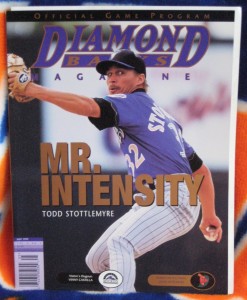 I didn’t much question the need for the retractable roof that would be closed for the game ahead, not after the brief walk from the street where my transplanted friend Joel — who, along with his also-transplanted brother Anthony, was hosting me, Larry and Fred for a fairly impromptu reunion that weekend — had parked. You didn’t want to be outside in Phoenix in the middle of the day. We made all kinds of “…but it’s a dry heat” jokes to amuse each other on the stroll from the car to the BOB, but never mind the dry. There was heat. I didn’t much question the need for the retractable roof that would be closed for the game ahead, not after the brief walk from the street where my transplanted friend Joel — who, along with his also-transplanted brother Anthony, was hosting me, Larry and Fred for a fairly impromptu reunion that weekend — had parked. You didn’t want to be outside in Phoenix in the middle of the day. We made all kinds of “…but it’s a dry heat” jokes to amuse each other on the stroll from the car to the BOB, but never mind the dry. There was heat.
Plenty of heat surrounded the Diamondbacks in their early days. They were designed to be as model a baseball franchise as any that ever drew breath in the expansion age. No lovable losing for them. Except for having managed the Yankees previously, D-Back generalissimo Buck Showalter bore no resemblance to Casey Stengel. Casey invented the Mets from an identity standpoint. Attempting to invent them from a baseball standpoint would have been useless in light of the expansion rules of 1961-62. Back then, the existing owners took the newbies’ money and cheerfully let them poke around their refuse pile, hiding anybody who could be described as remotely useful. You don’t lose 120 games without a little help from your supposed friends. Thus, Casey Stengel wasn’t just talking crazy when he went on and on about his Amazin’, Amazin’, Amazin’ Mets. He needed to distract New York from the reality of those first Mets clubs. In doing so, he shaped them into a phenomenon that transcended infrequent wins and myriad losses.
Showalter, on the other hand, was going to reinvent baseball in the desert as quickly as he could. He was a detail-obsessed genius whose fingerprints were all over the Diamondbacks from their conception. That included Bank One Ballpark, which was going to be as impressive as Showalter was considered after helping to revive the Yankees in the early ’90s and bringing them to the brink of their next dynasty. Fired by the not yet lovable George Steinbrenner for daring to not win that team’s first playoff series in fourteen years, Arizona grabbed him the second he became available and gave him incredible lead time (hired on November 15, 1995 for a team that wouldn’t play its first game until March 31, 1998) to craft the Diamondbacks in his own image. He was said to be on top of everything from the high-priced free agents owner Jerry Colangelo would sign — an option not available to George Weiss in 1962 — to the nouvelle purple and teal palette that became the official team colors to the throwback-style dirt path that ran between the batter’s box and the pitcher’s mound.
I think of the hype around Showalter and his alleged penchant for perfection when I think of visiting Bank One Ballpark. Showalter, remember, was the guy who threw a controlled fit because Ken Griffey, Jr., took batting practice with his cap backwards. Baseball loved Junior showing childlike enthusiasm for the game. Showalter frowned that the direction of Griffey cap wasn’t to code. Predictably, there was nothing backwards about the BOB. The BOB was all about looking forward. Even the name, when you broke it down, implied an irresistible force that was on the march and gaining steam.
Oh, BOB was a cheerful enough nickname — not unlike Buck — but Bank One Ballpark hinted at where we were going with our professional playgrounds. There had been Wrigley and Busch and most recently Coors and Turner, but even as they doubled as billboards for brands, they were gum and beer and cable television, products designed to make you enjoy yourself. Tropicana Field, baptized for baseball the same year as the BOB, connoted something sunny, juicy and, for St. Petersburg, local. Utilities and high-tech, meanwhile, had already infiltrated stadium entrances, but fans patronizing clumsy conceits like Cinergy Field and Qualcomm Stadium and 3Com Park knew better. The could continue to call their homes Riverfront or the Murph or the Stick, just as they always had.
With Bank One Ballpark, however, there was no mistaking the corporate coldness right there on the birth certificate. These weren’t naming rights you could ignore. This was Bank One Ballpark from the beginning. And, what pray tell, did Bank One have to do with Phoenix or Arizona? At least Edison International, temporary rights holder in Anaheim starting in 1997, was from California. So was Qualcomm. 3Com wasn’t, but Silicon Valley was and you could make the leap from there to San Francisco (not that I ever knew precisely what 3Com was, did or made). Bank One had nothing explicitly to do with where the Ballpark that answered to its name was built. It was a financial institution seeking regional brand awareness and penetration. Or something like that.
From the outside, the BOB looked like no other ballpark. It wasn’t round or boxy. It resembled an airplane hangar. When I was a kid being dragged to visit doctors or relatives in Brooklyn, we’d drive from Long Beach, through the Rockaways and over the Marine Parkway Bridge (later amended to Marine Parkway-Gil Hodges Memorial Bridge) where Flatbush Avenue begins and pass Floyd Bennett Field, New York’s first municipal airport. It had a series of eight no longer used airplane hangars. The BOB looked like an enormous version of those. As we got closer to it, we were greeted, I vaguely recall through the heat, by some cutesy baseball-themed sculptures. I guess that was so you didn’t mistake the facility for an airplane hangar.
There was a tension between the modernism necessary to execute a retractable-roofed stadium in the middle of a burgeoning downtown and the desire to at least partially ride the retro wave that had been in ballpark vogue since Camden Yards opened six years prior (thus, that pretentious dirt path). It was sort of like the desire to have a unique Arizona feel to the scene — accented by those garish teal and purple uniforms on which Showalter signed off — while accepting megabucks to plaster the rootless Bank One logo all over the place. It continued indoors, which featured, among many other attractions/distractions, a Hall of Fame exhibit, on loan from Cooperstown. The Diamondbacks had existed for little more than a year to this point, but they were trying to steep themselves in baseball history, just as the sculptures outside tried to give fans a cue as to what awaited them inside. That type of touch could have been taken as truly tradition-friendly or it could have been interpreted as a overly marketing-driven. It was probably somewhere in between.
The one thing you heard about beyond everything else in the buzz over the BOB when it debuted in 1998 was the swimming pool in right field. The Bank One name may not have screamed “Valley of the Sun!” but a pool sure did in a suburban backyard sense. Hot out? Take a dip! It was said to be inspired by the shower Bill Veeck installed behind the bleachers at old Comiskey Park. Except the shower was democratic — you’d step right in and cool off — and this was a showy party suite; a manufactured quirk to go with the angles carved into the outfield fence and the shadows that crept through the adjustable outfield windows. It was an attempt at what the D-Back marketing department no doubt filed under Fun.
I’m a little cynical in recalling the BOB’s straining to have heart, but fun is fun, upper-case or otherwise. Of course it was fun getting together with my three best friends from high school. Joel had moved to Phoenix in 1993 and seemed very settled there, even if it was a little unsettling to discover he had morphed into something of a Diamondbacks fan. Too much time away from New York might do that to a fellow, I suppose, particularly when team-following technology was still getting up to speed (no blogs!). Matt Franco homered in a rare left field start, and Joel rather sheepishly admitted he had no idea who Matt Franco was. Later he seemed genuinely conflicted as the Diamondbacks provoked a John Franco meltdown. I’m pretty sure he came around by the time our great new reliever Armando Benitez came in to slam the door and earn his first Met save.
It was fun, too, having actual lunch at the ballpark. Back at Shea, there was the Diamond Club which was forever off limits to the likes of us (though nine years later, at our farewell visit in Flushing, Fred saw the name of the exclusive Met hideaway on our tickets and asked if that’s where we go for “the lap dances”), but nothing else that involved sitting. The BOB, however, featured a T.G.I. Friday’s that overlooked the outfield. It was more democratic than the pool. Anybody could sit there, eat there and drink there (or spill a tall glass of iced tea on Larry’s shorts there as I did) and you could conceivably watch baseball from there. All we took in at T.G.I. was BP, and the food was nothing you couldn’t get in literally a thousand locations, but as with so much about the BOB, you were compelled to embrace the novelty.
Perhaps innovation would be a better word. It was innovative to install a pool in right field. It was innovative to mesh purple and teal in an atmosphere whose prevailing mood — indoors on such a bright day — was vaguely gray. It was innovative to station ushers with signs requesting you wait for an at-bat to be completed before getting up from or returning to your seat. Courtesy was certainly an innovation none of us on holiday from Shea could quite grasp (which is probably why we cut in front of a line of patiently waiting Arizonans and grabbed the first empty table we saw at T.G.I. Friday’s). Temperature control was another innovative stab for which the Diamondbacks deserve more credit than scorn, though I wasn’t too impressed by it when, amid walking the surprisingly drab concourse, I noticed I was actually cold.
Yes, Fred agreed, in his customary way with words, “it’s a little brisk in here.”
But our minds were changed after the final out. Joel insisted we hang at our seats for a couple of minutes as others were doing. It wasn’t for courtesy’s sake. It was to marvel. When the game ended, the BOB rolled back its roof. Unlike SkyDome, this ceiling opened in less time than it took for Matt Franco work out a walk (or John Franco to allow one). Unlike every other park in which baseball was played indoors, this one contained what we used to call natural grass. In the aftermath of the failed Astroturf revolution, that still seemed pretty retro. It was definitely innovative. Naturally, the natural grass needed sunlight. Necessity was the mother of invention for this deluxe sardine can lid.
As a literal fanfare played over the P.A., the roof retracted. The Arizona sun came at us like a Randy Johnson fastball: high, hard and sending you ducking for cover. It didn’t take five seconds for the BOB to turn from brisk to broiling.
“And that,” Joel reminded us, “is why you have a roof here.”
***
POSTSCRIPT: The Mets came back to the BOB that October, splitting two Division Series games en route to winning the LDS at Shea. Still, it’s pretty impressive, no matter the resources or rules applied, that a second-year expansion team won a division title. Buck Showalter may have possessed a certain genius for franchise-building, but it wasn’t the long-tolerated type. Jerry Colangelo dismissed him after the 2000 season, which netted Arizona a mere 85 wins and no playoff spot. Under the lower-key Bob Brenly, the 2001 Diamondbacks, in their fourth year of existence, won one of the greatest World Series ever played, a seven-game affair versus the New York Yankees during which every Mets fan I knew and then some became a Diamondbacks diehard for the duration; I still have a t-shirt proclaiming that Fall Classic’s classic result. Joel probably would have been extra incredibly stoked by Arizona’s achievement, except he moved to Northern California in 2000, never adopting the A’s or Giants as more than local curiosities, and rejuvenating himself as a well-informed Mets fan. Bank One Ballpark, via the magic of corporate machinations, has been known as Chase Field since 2005. The Mets won 13 consecutive games there from 2004 to 2007, whatever it was called. It is currently one of eight ballparks that carry the name of a financial or insurance concern. The D-Backs no longer wear teal or purple, but the roof still works, the Friday’s is still open and the pool is still available for groups of up to 35.
by Greg Prince on 6 June 2010 9:01 pm This would be a good time to be a drive-time disc jockey in medium-sized city with a persecution complex. If I were, I’d be working under the radio name of Resentful in the Morning, and I’d stir up my listeners to join me in a natural disdain for our local baseball team’s archrivals, whom I would cleverly refer to as the Florida Morons. Actually, I would have started on Friday, in anticipation of their weekend visit, announcing the phone number of their hotel. Hey, I’d say, why don’t we give Fredi “GONER”-zalez a jingle and welcome him to our town where we know how to play baseball?
“Here’s the number,” I’d say. “Dial it and give that ol’ GONER a real Resentful wakeup call!”
Then you’d hear my sidekick ring a cowbell and echo my sentiments that “We’re gonna make Fredi a GONER by Sunday!” To punctuate the point, we’d play “Freddie’s Dead” by Curtis Mayfield three times before the next newscast.
Of course Friday night I’d be hosting a Florida Moron Fish Fry in the stadium parking lot. You bring a dead fish and we’ll gut it on the air, because that’s what we’re gonna do to those Florida Morons for the next three games. Every Resentful in the Morning listener wearing a t-shirt with the station logo would then be issued his or very own Resentful in the Morning set of Hanley Wipes because we are going to WIPE THE FLOOR WITH HANLEY RAMIREZ!
It would actually be a roll of toilet paper from Walmart because this is a mid-market station and we don’t have much of a promotional budget, but we make up for the lack of resources with community spirit. Thus, when Hanley Ramirez comes to bat, my sidekick would be sure to remind our Resentful listeners to unspool those limited-edition Hanley Wipes and LET HIM KNOW WHAT WE THINK OF THE BIGGEST MORON OF THEM ALL!
Then we’d blare “Freddie’s Dead” three or four times as we fried more fish.
Come Monday, after we crowed about having swept the Morons, particularly the way they let a big lead get away on Sunday, we’d call that disc jockey in Miami with whom we’d made a big bet on Friday. He has to send us a hundred coconuts, not only because we in our medium-sized city think that’s all they’ve got in Florida but because, as my sidekick likes to say in between ringing his cowbell, MORONS DON’T HAVE NO BRAINS IN THEIR COCONUTS! We’d then laugh hysterically and play “Freddie’s Dead” as we kicked off our WHEN’S FREDI GONNA BE GONE? countdown.
After the traffic report, we’d give our third caller — third because we just won all three games against our archrivals — the honor of joining the Resentful in the Morning team at the biggest post office in town this afternoon as we mail all those fish guts from the Fish Fry to Hanley Ramirez, care of them dang stupid Florida Morons.
Yeah, if I were a drive-time disc jockey in a medium-sized city with a persecution complex, that’s how I’d do it. But since I’m not, I think I’ll accept these three Mets wins over the Marlins with quiet dignity.
by Greg Prince on 6 June 2010 4:02 pm Jeff Francoeur’s three-run home run off the Marlins’ Tim Wood in the seventh inning of today’s game not only tied the score, but it created a three-way tie for the all-time Citi Field slugging lead. That was Frenchy’s seventh ball to have soared above the Citi walls (4 last year, 3 this year), giving him as many there as Daniel Murphy and David Wright.
I previously neglected to mention Francoeur in considering who might soon rank first in this all-important category. A glaring oversight on my part, and boy am I glad I just had reason to look it up.
(Fernando Tatis has 6, but after a pinch-walk, that total’s not getting any higher as of Sunday afternoon.)
by Greg Prince on 6 June 2010 3:29 am Jonathon Niese endured. Ike Davis awoke. David Wright served the main course to one lucky Acela Club patron. The Florida Marlins learned that no one — and I mean no one — comes into our house and pushes us around (hubris not applicable on final days of seasons). And while all this was going on, per Steve Zabriskie as the division was clinched in 1986, a certain inevitabiity became a reality.
What do you think the following names had in common prior to Saturday’s win?
• Mel Ott
• Mickey Mantle
• Duke Snider
• Bernie Williams
• Darryl Strawberry
• Mark Teixeira
• Tim Jordan
• Daniel Murphy
If you said none of the above was going to help the 2010 Mets one little bit (save possibly for some motivational speaking), you’d get partial credit. But there is a more specific answer: each of the aforementioned players stood as the home team home run king of a different New York ballpark that’s been used for major league baseball since 1900.
Stood…or stands? I suppose the present tense is applicable, though in the case of one of these men, he’s suddenly got company.
Did I say suddenly? More like it’s about time!
Did you see that shot David hit? Where it landed, under the Amtrak sign? How it bounced into somebody’s $15 dish of mousse? I made up the last part, but it did rattle around up there among the high rollers (in whose ranks I dined…once). That was as emphatic a Met home run as Citi Field has seen in its eight months of action.
Not that it’s seen very many Met home runs emphatic or otherwise since opening on April 13, 2009. The first Met home run was lined that night to left by Mr. Wright. It figured to be the first of many off David’s bat in the history of the brand new ballpark.
Define many. Your definition probably exceeds what Wright produced last year home or away. David didn’t even lead his team in home runs. Nor did he lead his stadium.
That honor belonged to his teammate, Daniel Murphy, which no doubt surprised everyone, Murphy included. In 2008, the last year of alleged pitcher’s park Shea Stadium, David swatted 33 home runs overall, 21 at Shea. During his two months as a rookie sensation the same season, Daniel homered twice, once at Shea. In the minors two years ago, he hit 13. There was nothing in his background to suggest he would become any ballpark’s all-time home run leader.
There was little to suggest it would happen even in the limited sample provided over the course of six months. Daniel himself waited a while to get on the Citi board, and when he did, it was not clear he actually had. His very first Citi Field home run was the condiment that barely skimmed the infamous white and yellow Subway Sandwich sign on May 27. Four umpires got together, caucused over video and sent up a puff of white smoke to indicate Murph’s home run order was indeed good to go.
Throughout 2009, as sluggers named Sheffield, Delgado and Beltran fell by the wayside and Wright simply stalled, it was left to Murphy to carry the home run load for his team. It was a light load, to be sure. The ’09 Mets hadn’t heard about power to the people, let alone power to any particular field. They hit 95 homers overall (down from 172 in ’08, plummeting to the franchise’s lowest power ebb since 1992), with 49 of them at Citi Field (versus 95 at Shea the year before). On a team that ostensibly featured sluggers whose career tater totals flash impressive numbers like 509, 473, 273 and now 150, it fell to a kid who has 14 lifetime home runs to lead the way.
Daniel Murphy sextupled his 2008 sum in 2009. He hit 12 home runs, the lowest total to lead the Mets since the unplugged power trio of Steve Henderson, John Stearns and John Milner each pounded a dozen to lead the legendarily wretched 1977 Mets. His split was 5 on the road, 7 at home. Fittingly, the last Met home run of 2009 belonged to Daniel, struck the final Friday night of the season, making sure the 2009 Mets would not trail the 1977 Mets in something besides wins and not trading Tom Seaver.
Y’know, I truly loved each of those guys in his time, but I swear only a Mets fan could breathe a sigh of relief that somebody had matched Steve Henderson, John Stearns and John Milner in anything.
I’d been thinking about Daniel Murphy in the past week. There hasn’t been much occasion to do so in 2010. As you know, he was days away from starting the season at first base — tutored by Keith Hernandez and everything — when his right knee took a wrong turn in a Spring Training rundown. There went April and May.
Murph, for all his documented 2009 shortcomings, would have been a damn sight better than Mike Jacobs at first. Of course he also would have been a damn sight worse than Ike Davis, who made us forget Jacobs this year at least as fast as Carlos Delgado made us forget him in 2006. Meanwhile, we more or less collectively forgot about Murphy. Now and then we’d get an update from Injury Land, that spa where the Mets hide their lame and halting for indeterminate periods of time best measured with glaciers (Kelvim Escobar is said to have sent a postcard, but I don’t know if it ever arrived).
Somewhere along the way, probably while we were trying on I LIKE IKE t-shirts, Daniel Murphy recovered from that nasty medial collateral ligament sprain. He played in some Extended Spring Training Games — is there another team on Earth that can extend Spring Training like the Mets? — and, when pronounced fit, transitioned from injured major leaguer to healthy minor leaguer. Murph was handed a plane ticket to Buffalo and a second baseman’s glove. Last year’s first baseman who didn’t homer enough for a corner infielder (even if he homered more than everybody else around him) was going to work on becoming a middle infielder with pretty good pop.
That was until the other night when he turned a double play for Buffalo and absorbed a dirty Syracuse slide to that very same right knee. Some busher named Leonard Davis took Murph out for the season.
What can you say on our erstwhile left fielder/first baseman’s behalf at this point beyond “ouch” and “hope you get better…again”?
Daniel Murphy’s 2008 hinted at promise, which, naturally, led the Mets (and not a few Mets fans) to imagine he’d be a two-strike, line drive machine for the next ten years. He struggled in left field to start 2009, found some solace at first base, but didn’t hit to anybody’s great satisfaction. His world has now fallen apart three times in 2010: the injury in March, Davis getting called up in April and the cheap slide of June. But before Saturday, he still had one thing going for him besides a surfeit of green MURPHY 28 gear presumably priced to move in the Clubhouse Shops — he still had the Citi Field home run record all to himself.
Not to make Daniel Murphy any more miserable than he must be, but it wasn’t exactly to his credit that he gripped it as long as he did. He didn’t play as a Met these past two months, yet that seventh Citi Field home run he launched to right last October 2 had withstood all challenges through this June 4.
“What challenges?” you might be wondering. Gary Sheffield faded into the Flushing mists with 5 Citi Field home runs on his ledger of 509 lifetime. Carlos Delgado is gone, presumably stuck forever on 3 CF HRs out of 473 in a career he still hasn’t officially called quits. Beltran? You mean the latest apparition to reportedly alight amid the fog of Extended Spring Training? Let’s see him extend his Citi Field total of 3 home runs (273 total) before we believe it will ever happen. The only Met who was really pushing Murphy’s record of 7 at Citi of late was Rod Barajas, who has struck 5 of his team-leading 11 at home.
David Wright? If every day were Opening Day, he’d be The Thing That Ate Citi Field. He hit that home run against the Padres to kick off 2009. He hit another in the first home game of 2010 versus the Marlins. In between, he smacked a grand total of 4. After Opening Day this year and before Saturday afternoon, he hit zero. Did plenty of homering on the road, but dimensions and walls and goodness knows what else continued to hold him back at the place where’s he’s at least as big as life, if not bigger.
That was until the third inning, against Nate Robertson, when no wall, no dimension, no pressure, no beaning, no nothing could hold David Wright back. Finally, his second home-cooked home run of the year, his seventh ever in the still reasonably new ballpark (and his 150th overall).
David Wright has tied Daniel Murphy for most career home runs at Citi Field. Y’know, I truly hope Murph heals and finds a place to play somewhere in this sport, but I swear only a Mets fan could breathe a sigh of relief that somebody had matched Daniel Murphy in anything.
David could take the lead at anytime now. Or Rodney Allen Rip ’Em could feel frisky and grab it for a while. Ike has sent 3 out of the Citi and has shown signs more readable than “Subway” that he could go deep fairly often. (For all you cynics out there, Chase Utley leads the opposition with 4.) We don’t know who’s going to own this record when it grows more substantive, but when we learn his identity, we’ll be placing that Met alongside some true New York baseball royalty.
Who hit the most home runs at the Polo Grounds? That would be Hall of Famer and all-time good guy Mel Ott, with 323. Add in the 25 he slugged at Ebbets Field, and you’re talking about the man who literally swatted the most shots within the five boroughs of New York City.
Who hit the most home runs at the first pre-renovation Yankee Stadium? Mickey Mantle, 266, or seven more than the Babe for whom that House was built. Remember, Ruth played three fence-busting seasons at the Polo Grounds before Yankee Stadium opened (yet still managed 85 goners from 1920 to 1922, good enough for eighth most at Coogan’s Bluff).
Who hit the most home runs hit at Ebbets Field? Who else but the Duke of Flatbush? Edwin “Duke” Snider landed 175 baseballs onto Bedford Avenue and adjacent thoroughfares. Snider nosed out his future Met teammate Gil Hodges by three dingers to lead all Bums for homers hit at home.
Who hit the most home runs at renovated Yankee Stadium? Bernie Williams, 143. The Yankees don’t recognize the 1976 park as a different structure from the 1923 model, but look at the pictures. It was, in all practicality, a new ballpark, and the Yankee who had an edge when it came to homers there was their latter-day center fielder.
Who hit the most home runs at Shea Stadium? Darryl Strawberry, of course, with 127. All but four of them were crushed in a good cause. Three came as a visiting Dodger in 1991. One was launched on behalf of the other New York team when they were seeking temporary refuge from their crumbling renovated stadium in 1998 and played a single home game in Queens. Even through Darryl’s unfortunate disguise a dozen years ago, Shea’s Apple instinctively recognized its native Strawberry from the good old days of 1983 to 1990.
Who has hit the most home runs at new Yankee Stadium? Who can tell the way balls have flown out of the Anti-Citi? A quick peek of the homer logs shows the pinstriped leader to date there is Mark Teixeira, with 27, three ahead of Alex Rodriguez, who missed the first month of 2009 when the wind tunnel was particularly active in the Bronx. Hunch: A-Rod passes M-Tex before too long.
Who hit the most home runs at Washington Park? Surely you didn’t think we’d forget the pre-Ebbets home of the Dodgers/Superbas. Brooklyn played ball at this third version of Washington Park from 1898 through 1912, back when the ball was as dead as the Marlins were Saturday, yet ye olde trolley-dodging fans had occasion to cheer a Tim Jordan roundtripper 17 times. Technically, Jordan shares Washington Park home run honors with Jimmy Sheckard, who also homered there 17 times. But we’re leaning toward Jordan here since all of his Washington Park home runs were walloped for the Superbas/Dodgers while Sheckard hit 1 home run in Brooklyn for the Cubs and hit 6 others in Washington Park before 1900. As you probably know, 19th century rules specified that any batter who lined a ball off any nearby possum was automatically awarded four bases. And the possum.
• Who has hit the most home runs at Citi Field? Through the game of June 5, 2010, Daniel Murphy of the New York Mets and David Wright of the New York Mets, a paltry 7 apiece. Barring a horrendous act of nature, David will hit more there in a Mets uniform, hopefully as soon as June 6, 2010.
I’m afraid I have no idea whether Daniel will ever get another swing as a Met, home or away.
by Greg Prince on 5 June 2010 5:45 am Frankie Rodriguez made a good pitch. David Wright made a great pickup and throw. Ike Davis made a fine scoop. But Hanley Ramirez made everything easier on the Mets by taking his sweet time for the first third of his trip down the first base line.
We appreciate it, Hanley. We know you’re capable of doing great damage to us, and you could have contributed to your criminally talented rap sheet by beating out that funky almost-foul bouncer you hit off Frankie with two out in the ninth, the tying run on third and the go-ahead run on second. The whole inning was something out of a John Franco nightmare: an infield hit, a walk, a wild pitch, now the best hitter on the other team coming up to change the complexion of what had been a quietly promising night. You didn’t have to hit it long or hard, Hanley. You just had to hit it where they weren’t.
And run. You also had to do that, too.
It’s not optional. Running really helps you negotiate 90 feet in a most efficient manner. Ninety feet hustled can alter history, as we learned this week. Even if you don’t hit the ball 90 feet, you can still cause trouble running that far. You could have made the whole night for naught Metwise with a decent 90-foot sprint. We wouldn’t have been able to revel wholeheartedly in the decreasingly surprising good work of R.A. Dickey, the astoundingly surprising great work of Elmer Dessens, the cyclically scorching bat of Jeff Francoeur, the pleasant re-emergence of Ruben Tejada, the welcome disappearance of Gary Matthews, Jr., or the heartening sight of Frankie’s right arm still attached to his right shoulder. We would instead be gnashing our teeth and gnawing at our knuckles, not praising R.A.’s. We’d have had a 4-4 tie, go-ahead run at third, a world of spit raining down on Frankie’s head…
But no, we had a third out and a nice win. Appreciate it, pal. You be sure to take it easy.
Like anybody has to tell you that.
|
|