The blog for Mets fans
who like to read
ABOUT US

Faith and Fear in Flushing made its debut on Feb. 16, 2005, the brainchild of two longtime friends and lifelong Met fans.
Greg Prince discovered the Mets when he was 6, during the magical summer of 1969. He is a Long Island-based writer, editor and communications consultant. Contact him here.
Jason Fry is a Brooklyn writer whose first memories include his mom leaping up and down cheering for Rusty Staub. Check out his other writing here.
Got something to say? Leave a comment, or email us at faithandfear@gmail.com. (Sorry, but we have no interest in ads, sponsored content or guest posts.)
Need our RSS feed? It's here.
Visit our Facebook page, or drop by the personal pages for Greg and Jason.
Or follow us on Twitter: Here's Greg, and here's Jason.
|
by Greg Prince on 21 September 2025 10:05 am Having had them imposed on the game we love for only four seasons, we National League fans remain mostly unfamiliar with the behavior of designated hitters during games. We know they come to bat once per order, but unlike their teammates in the lineup, they disappear from our view and our thoughts until they stroll to the plate again. Most DHs, according to my sources (you can do your own research), hang back in usually restricted areas behind the dugout. The word their guild has put out is they’re in the batting cage, swinging away, staying loose, preparing to unleash one mighty swing. In fact, they’re usually playing solitaire, or checking their messages, or filing their nails. A few considerate ones arrange a postgame snack for the guys who’ve played hard in the field all day. David Ortiz was legendary for that, blending sweet and savory flavors that tasted just right, whether the Red Sox had won or lost.
Like any self-respecting designated hitter, Daylen Lile was going about his personal business in the clubhouse of the last-place Washington Nationals early Saturday evening, in his case catching up on his reading — the massive works of Rick Perlstein have been his seasonlong project — when he felt a tap on his shoulder. He figured Miguel Cairo had sent one of his coaches in to remind him he was scheduled to hit in the top of the eleventh. Daylen Lile didn’t need to be reminded by one of the manager’s lieutenants. DHs come equipped with a special pager that vibrates to alert them to their appointments, similar to what restaurants hand patrons when their table is ready. Like the iPads on the bench, it’s a dedicated MLB technology.
The tap, however, did not come from a Nationals coach. It was a figure in a faded orange and blue golf shirt who addressed the visiting DH.
“Daylen Lile?”
“Yes?”
“I require your help.”
Daylen Lile thought this was a misunderstanding. “You must want one of the clubhouse kids. I’m a ballplayer with the other team. Well, I’m a designated hitter. It’s like a ballplayer, but I only play half-ball.”
“No,” the figure said. “I know who you are, and I know what you do. You’re the one I need.”
Daylen Lile slipped a bookmark into his massive copy of The Invisible Bridge and stood up. He was confused.
“What do you want from me?”
“Daylen Lile, I am Destiny.”
“Destiny? Like that’s your name? Isn’t that more a girl’s name? I mean no judgments, man…”
“Destiny is just an identifier I introduce myself with so a ballplayer, even a designated hitter like you, can understand me completely. Consider me, Destiny, something akin to a state of mind.”
“What do you mean?”
“Daylen Lile, I am the Destiny that has been in the Mets’ own hands all season, and I am thisclose to slipping out.”
Daylen Lile wasn’t any clearer on what was going on.
“Look, Mr. Destiny…”
“No need for formality. You can just call me Destiny. Call me Des if you like.”
“Destiny, I don’t even know if you’re supposed to be in here during a game. I only get to be in here during a game because I’m a DH and half the time I serve no purpose.”
“Daylen Lile, you are to serve a great purpose to baseball in the coming minutes. You might even say it is your destiny.”
Daylen Lile looked around. No other Nats personnel or Mets staff was in sight. He saw no choice but to listen.
“Daylen Lile, I am the Destiny that has been in the Mets’ own hands all season…”
“Yeah, you said that.”
“And now I shall continue to say it. The New York Mets have treated me with utter disdain.”
Daylen Lile didn’t have any fewer questions as a result of this explanation.
“If you’re in the Mets’ own hands, Destiny, what are you doing in here right now?”
“Major League Baseball instructs clubs to put their destiny aside once a game starts, so I snuck over from across the way hoping to find you. And now I have found you to ask you to do me a favor — a solid, if you will.”
“What’s that?”
“Get me out of the Mets’ own hands.”
“Huh?”
“I don’t want to be in the Mets’ own hands anymore. At first, I was willing to go along with them happily. I have had a good relationship with the Mets historically, at least in small spurts. These current Mets are not a bad bunch of guys and they’re not a bad bunch of ballplayers.”
“I can see that. We usually have trouble with them, especially up here.”
“Fine, fine gentlemen, really. But when it comes to me being in their own hands, they are clumsy, they are mindless, and it is clear to me that they just don’t care about what their destiny will be.”
“Well, yeah, I guess they have had a tough couple of months, and certainly today’s game…”
Destiny slapped its forehead. “Oh, Daylen Lile, if you only knew. The record the Mets have had since the middle of June! The recurring seven-game losing streaks! The sense that ‘everything’s gonna be fine now’ when they win a couple, the constant refrains of ‘we know we’re better than this’ when they don’t, excusing themselves because the ‘other team’ has good players, too.”
“You know, other teams do have good players,” Daylen Lile interjected. “I mean our record might not show it, but we have good players.”
“Of course you do, Daylen Lile, but does your team have Juan Soto?”
“We used to, I think.”
“Do you have Pete Alonso and Francisco Lindor?”
“OK, I get your point. I guess that is a good team they have over there, or at least they have some big-name players. It’s not surprising that they might go to the playoffs this year.”
“Might? MIGHT?”
Daylen Lile didn’t mean to upset Destiny but apparently had. “Did you know this same New York Mets club your Washington Nationals are playing at this very moment used to lead this division.”
Daylen Lile couldn’t remember back that far, but it was true. Once upon a time, the Mets were comfortably ahead of the Philadelphia Phillies, the same Philadelphia Phillies who clinched the National League East earlier in the week with little stress.
“And, Daylen Lile,” Destiny continued. “Did you know that the teams that have taken turns closing in on the Mets for the third — not the first, not the second, but the third — Wild Card were once each so distant in the Mets’ rearview mirror that no Mets fan except for the most paranoid among them bothered to monitor the scores of their games?”
This was news to Daylen Lile, who played for a team so far out of contention that he had to confess he didn’t exactly know who was where in the standings. As a designated hitter, he tried not to bother himself with the details of a baseball season, but he had thought he’d heard some of the players who play the field saying something about the Cincinnati Reds, the Arizona Diamondbacks, and the San Francisco Giants apparently gaining ground on the New York Mets lately. And when he was in the dugout, Daylen Lile had noticed the Mets not playing a very crisp game this very Saturday.
“Oh, Daylen Lile,” Destiny implored. “Consider what has gone on around you only today.”
“Yeah, we’re playing ’em tough!”
“Young Daylen Lile! I’m talking about the Mets! Their wild pitches!. Their errors! Their wasting of another fine effort from young Nolan McLean! Their failure to generate a single run until the eighth inning! Their tying the game in the ninth but failing to win it when they had the bases loaded and one out! Daylen Lile, how many times this season do you suppose the Mets have entered a ninth inning trailing and came back to win?”
Daylen shrugged. “Gotta be a few, right? That’s a good ballclub, and besides, everybody lucks into one of those now and then.”
“NEVER, DAYLEN LILE! NEVER HATH THE 2025 NEW YORK METS COME BACK TO WIN A BASEBALL GAME IN WHICH THEY HAVE TRAILED THEIR OPPOSITION AS THEY ENTERED THE NINTH INNING!”
Daylen Lile could see this was a big deal to Destiny. “It was right there for the taking in the bottom of the ninth,” Destiny detailed. “Mendoza was being uncommonly aggressive. Pinch-hitting his backup catcher because he saw a better matchup. Pinch-running for his backup catcher when that worked. Getting lucky when Lindor was hit, but not hit too much. Soto placing the ball perfectly. Siri…”
With that there was a female voice audible in the Washington Nationals clubhouse.
“Yes, I’m Siri. What can I help you with today/”
“HUSH SIRI, I WASN’T ADDRESSING YOU!” Destiny demanded of the Artificial Intelligence application that only wished to assist. “Sorry, Daylen Lile. Jose Siri has played so little this year, that the devices at Citi Field still think we’re asking for the other Siri when we invoke the little-used outfielder. Anyway, where was I?”
“Um, Soto placed the ball perfectly…”
“Yes, thank you, Daylen Lile. Juan Soto singled, Jose…you know his last name…dashes home from second, the game is tied, the Mets have runners on second and first, then Lindor and Soto execute a double-steal, Alonso is intentionally walked. How did they not win it then and there?”
“Our pitcher is pretty good.”
“Daylen Lile, your pitcher is not the point. The point is I am Destiny, I have been in the Mets’ own hands throughout this endless season of dismay and disappointment and downright disgust, and the Mets still don’t know how to deploy me. Nimmo strikes out! Marte strikes out! They don’t win in the ninth! Even with the inane automatic runner and getting away with what was probably batter’s interference in the tenth inning, they couldn’t score!”
“Listen, I feel ya, Destiny. But I’m still not sure what this has to do with me.”
“Daylen Lile, you are due up second in the top of the eleventh inning.”
“I know. Hitting against Diaz is gonna be tough.”
“Daylen Lile, you will not hit against Edwin Diaz.”
“Miggy’s taking me out? But I’m slashing better than eight-hundred!”
“No, Daylen Lile, you remain in the game. Carlos Mendoza has taken out Edwin Diaz.”
“What? But that dude threw only…couldn’t have been too many pitches.”
“Edwin Diaz threw only seven pitches in the tenth inning.”
“He was nasty, from what I could tell on the monitors in here when I looked up from my book. Did he pitch last night or something? You can’t overuse your closer, you know.”
“He got up in the bullpen briefly. That will be Carlos Mendoza’s excuse eventually.”
“You can tell the future, Destiny?”
“I can tell what Carlos Mendoza is going to say. He says the same things all the time. And I can tell you now that you will face Tyler Rogers in the eleventh inning.”
“Rogers isn’t bad.”
“Daylen Lile, this is not a matter of one reliever being adequate on a given day. This is about a journey in which I, Destiny, would gladly be with the Mets if the Mets would have me, I mean REALLY have me and embrace me as theirs. But they mishandle me so. I want nothing more to do with them.”
“Did you bet on the Reds or something? I keep noticing commercials where a lady in a bubble bath says you can do that.”
“This is not about the ‘Reds,’ Daylen Lile. The Reds are only a vessel for what is due the Mets for how they have approached 2025, for how they have shamed me while all but letting me go of their own volition.”
“Fine. I’m gonna hit against Rogers. What am I supposed to do.?”
“It is your destiny, Daylen Lile.”
“Huh?”
“Swing hard, Daylen Lile. A runner will be on base. Swing hard, Daylen Lile. Be bold, and mighty forces will come to your aid.”
“Am I gonna hit one out of the park?”
“You don’t have to, Daylen Lile. Just hit it to deep center, and your destiny will take care of itself. Someday, The Daylen Lile Game will be spoken of in varying tones up and down the Northeast Corridor.”
“Um, OK.” Daylen Lile felt his DH pager vibrate, so he grabbed his batting gloves and prepared to return to the visitors’ dugout. “One thing, though, Destiny…”
“Yes, Daylen Lile?”
“Even if I do what you say I am destined to do in the top of the eleventh, the Mets will have a chance to bat in the bottom of the inning. We already used our best reliever for two innings. Isn’t it possible that my teammates in the field won’t stop them from winning?”
“Daylen Lile, how long have you been in the league?”
“I’m a rookie.”
“Oh, Daylen Lile. You have much to learn in the way of the New York Mets and their conduct within seasons like 2025. Now just go out there and help release me from the Mets’ own hands. I am Destiny, and at the rate they are going, I cannot be there for them much longer.”
by Jason Fry on 20 September 2025 8:57 am Defiance isn’t really in our wheelhouse as Mets fans.
Hope? Sure. The sunny version sometimes, though generally that’s only seen in the abstract. Stubborn, scared, trampled but still inexhaustible hope? Now we’re talking — whenever Tug McGraw‘s famous YA GOTTA BELIEVE is invoked, I hear not just the hope but also the desperation — the burden being carried by GOTTA. (To say nothing of the snark — McGraw was totally mocking the highly mockable M. Donald Grant, and despite later mythmaking, at the beginning that’s all he was doing.)
But hey, we contain multitudes. Sometimes defiance gets its day.
In the top of the third Monday night against the Nats, the Mets turned in the kind of inning that contributed to their long post-June swoon. Brandon Sproat started off taking aim at his own foot, walking Paul DeJong and throwing away a little swinging bunt by Jorge Alfaro, with DeJong scoring after Juan Soto didn’t show particular interest in backing up the play. That tied the game, but just wait: CJ Abrams doubled to bring home Alfaro; Josh Bell hit a drive to left-center that hit Jose Siri in the glove and popped out, scoring Abrams; and someone named Daylen Lile hit a single to center that Siri approached with the kind of route generally taken by foraging rodents or bees. That scored Bell, and everything Siri did from that point on was generously doused in boos by the Citi Field faithful.
(Poor Siri. I mean, he’ll now almost certainly lose his half-job to Tyrone Taylor, just spotted rehabbing at Syracuse, and that’s not unjust. But up until now he was the Met whom fans would probably forget on a Sporcle quiz, and by the middle innings he’d thoroughly failed to do the only things he was on the roster to do and being forgotten would have felt like bliss. Also: It’s not good when something happens in center field that makes you pine for Cedric Mullins.)
4-1 Nats, and on Bluesky I offered a digital boooo but added this: “Fuck them, we’re still gonna win.”
Not as t-shirt worthy as YA GOTTA BELIEVE, but you roll with what the dice give you.
Part of my defiance was the Mets have been hitting and the Nats’ pitching has been execrable. Part of it was that the Nats were also having a burn-the-tape game on defense, with poor Dylan Crews playing every ball in his vicinity like it was a live grenade. And part of it, I suppose, was that the season’s down to a week and change, so why not spit in the eye of fate?
The Mets took a run off the Nats’ lead in the bottom of the third, aided by some more shaky defense, then unleashed hell in the fourth, with the culmination a three-run homer from Soto to dead center. I’m closing up the house in Maine, so I bounded around the living room hollering FUCK YOU! over and over again, with no neighbors to bother except possibly a querulous chipmunk or two. (Squeaky little voice emerges from a burrow: “It’s sleepy time … actually fuck you!”)
A shaky Huascar Brazoban outing aside, that fourth inning killed the Nats, a young team whose tank looks like it’s on E despite innings left to travel. Brooks Raley cleaned up for Brazoban, Ryne Stanek looked good, Tyler Rogers looked great, and Ryan Helsley had an honest-to-goodness solid inning, a 1-2-3 inning with no asterisk needed for line drives or other red flags. Chris Devenski had some trouble finishing up, but by then I’d obeyed the chipmunks and was out cold on the couch, so all was well from my perspective.
The Reds won, reshuffling the deck of wild-card pursuers to move ahead of the Diamondbacks (who lost), the fading Giants (ditto) and the at this point mostly theoretical Cardinals (who won). We’ll keep an eye on all that of course, but if the Mets keep winning — or just win enough — all should be well, or well enough to move on to the next existential fan crisis.
Eh, that sounded a little mealy-mouthed. Will work on getting back to defiance before the afternoon game.
by Greg Prince on 19 September 2025 11:30 am There was a midweek day game peeking out at me from behind a corner. That’s usually how I peek in at midweek day games. The TV in my office isn’t something I can watch full-on directly from my desk; thanks to the modern-enough set’s placement inside an ancient, undersized “entertainment center,” I can only be so entertained while I’m working. It’s probably better that way. When 1:10 PM rolls around, even if the Mets are playing, I’m usually supposed to be engaged by what’s on this screen, not distracted by what’s on that screen.
Yet once in a great while, you have to leave behind both screens and see what’s going on from whence the images are emanating. That is to say that for the first time in a couple of seasons, I allowed myself a midweek afternoon game in person.
In September, no less. This September, which isn’t just any September, because no September is just any September when something is riding on the outcome of every game, whatever day it’s scheduled, whatever time it starts. In other Septembers, it’s almost a badge of honor, however perverse, to engage in your team’s evaporation from sight. “You’re gonna go see the Mets today? Why? They’re out of it!” In those Septembers, the horizon is barren. You’ll miss baseball when it’s gone, you’re pretty sure, but you won’t miss this team that’s playing out the string.
In this September, the 2025 Mets of right now are still figuring out what tableau will fill their immediate horizon — emptiness or October. Every game all year counts the same. These games in late September suddenly count more than anything else. Hence, what could have been one last fun detour from the everyday mundane became what we within our obsession call important.
I don’t know if the kid on the platform at Jamaica understood the Wild Card implications of the Mets and Padres at 1:10 on a Thursday afternoon. He just knew his dad was taking him to a game when other kids’ dads weren’t doing the same for them. The kid, 5 or 6 years old at most, wore a jersey that said deGROM 48 on the back. The dad wore HERNANDEZ 17. As we awaited the connection at Woodside, the dad asked my advice regarding the next transfer. Would I be on the LIRR that takes you to Mets-Willets Point, or the 7 that takes you to essentially the same place? I recommended the 7 in this case, given the wait time for the Port Washington train whose stop near Citi Field is convenient only if it gets you there for first pitch. The next one of those wouldn’t.
When this game loomed on the calendar, and my friend Jeff told me he was coming up from the DC area and suggested we get together for it, the LIRR’s availability took center stage. There was talk of an engineers strike starting on September 18. How the hell do I get to a game without the LIRR? I studied bus routes and road maps, and wondered if I was capable of driving to a ballgame for the first time in twenty years. But then the LIRR issues were submitted to some sort of panel in Washington, and if there’s going to be a strike, it won’t be this season. The trains, as they say, are being made to run on time, or as close as the LIRR ever gets to it. Either way, I told the dad that he and his kid were better off taking the 7. The dad asked if they could follow me. I said sure. It’s just a flight of stairs here and a flight of stairs there, but I don’t mind being my fellow Mets fans’ pregame commuting security blanket.
The kid, I noticed, was making like the midweek day game itself, peeking out from behind a corner, specifically one of the pillars on the platform on Jamaica, while his dad and I spoke. He seemed more excited than wary of his day at the ballpark, but a stranger is a stranger and a kid is a kid.
“Is this his first game?” I asked the dad.
“No, not his first, but it’s our first ‘just the boys’ game,” meaning him and his son. The dad delighted in telling me of his scheme. He snuck out to the car and left the deGrom jersey inside. Then, when the kid got in the vehicle and saw the jersey, Dad informed him, “You’re not going to school today.” The kid had been asking all season to go to a game. His wish was coming true. The dad’s dad did this for him once, surprising him with sanctioned truancy at Shea Stadium, and now it was his turn. The dad loved the story so much, he repeated it to a pair of young women who wandered by a moment later.
Me, I got chills just thinking about it. My dad never pulled me out of school to take me to a game — we weren’t “boys,” exactly — but he got me home from a serendipitously arranged eye doctor appointment the morning of October 16, 1969, so I could see clearly the conclusion to Game Five of the World Series. Oh yeah, I’d lead these boys up that first flight of stairs at Woodside, wait for them to get their OMNY cards, wait for them to tap themselves through the turnstiles, and then lead them up that second flight of stairs until they were on the same 7 train as me. That kid was going to go a Mets game on Thursday if I had any small thing to do with it.
Getting to and inside the ballpark for a day game is a string of small things, from clearing one’s own decks, to divining and achieving transit connections, to negotiating the entrance labyrinth (security plucking and confiscating my sealed 20-ounce bottle of diet carbonated beverage product in May appears to have been a one-time affront to my soft drink sensibilities, as it and I were left alone this time) to deciding whether, in a day when everything’s a little rushed, if I have a minute to stop off at a lineless concession en route to the seats. It was past one o’clock. I wanted to make first pitch, but I didn’t want to greet Jeff emptyhanded. Plus, you know, it’s a ballgame. “Two hot dogs, two pretzels, please.” I can miss a batter. I prefer not to miss lunch.
When I met up with Jeff, I quickly sat down so nobody behind us would have to strain to clearly see Jonah Tong working to Padres batters. Sounds unremarkable, right? You’d think. In the next half-inning or the half-inning after that, somebody in the row in front of us decided that rather than swiftly finding his seat, he’d greet his friend who rose to meet him with a good, lengthy standing conversation. Jeff first, then I, requested a lowering of their bodies into their chairs so we could witness the hitting and the pitching down below. The late arriver among the two of them gave us two backwards flicks of his right wrist, the not necessarily universal symbol for “just give us a sec, OK?” It was rather rude, but it did gift us a handy gesture to activate every time he walked by us the rest of the day.
Pete Alonso’s own gesture involves swinging a bat mightily and sending a ball far. One-nothing in the bottom of the first. Tong’s right hand in the top of third was busy putting Fernando Tatis in scoring position via a single, an errant pickoff, and a wild pitch. Tatis came home on a Luis Arraez sac fly, facilitated by a ragged throw from Brandon Nimmo. The next sound you heard was Manny Machado whiffing on strike three for the third out and Jeff and me applauding heartily.
In the bottom of the third, something approximating a Met attack gets underway versus Randy Vasquez. The lately useful Cedric Mullins singles. Francisco Lindor singles to right. Mullins races to third. Lindor trails to second. Tatis believes he’s going to nab Lindor at second. He does not. Juan Soto makes the most of a groundout. He makes it into his 100th RBI of the season, scoring Mullins and pushing Lindor to third. Pete’s gesture is limited to a silent thank you toward Vasquez for a full-count walk. Nimmo is about to come up with runners on first and third and a chance to make us forget about that throw.
“How many runs do they get out of this?” Jeff asked me. “Zero, one, two, or three?”
I was thinking zero, but I said two to be optimistic.
We got three. Nimmo homered. We were up, 5-1, and to the extent Mets fans can relax in September of 2025, we almost did. Jonah apparently did. That one silver-platter run he served up to the Padres in the third stayed lonely. Whatever loss of confidence in his fastball that overcame him the previous Friday was restored in the interim. Tong went five and positioned his team and himself for a win. He positioned us to leave our seats with enough faith that the lead would still be there when returned.
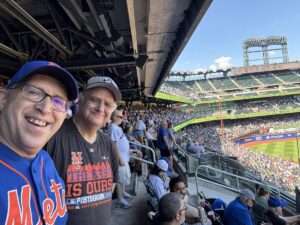 A couple of the boys, peeking around one of the corners at Citi Field and seeing a Mets win. Why get up from a game going well? Because somebody asked me to. About ten minutes after Jeff told me he’d be getting us tickets to this game, I heard from another good friend, Matt, that he had come into a pair for September 18, and would I like to join him? Couldn’t be in two seats at once, but we could say hi. Matt suggested the Shea Bridge for a stop ‘n’ chat. It was a real throwback. In the early days of Citi Field, when nobody knew anywhere else to go, it was “let’s meet on the bridge” in some appointed inning. I’ve mostly stopped doing that in recent years partly because now Citi Field is as familiar as the back of my dismissive wrist-flicking hand, partly because my fascination with getting up midgame and walking around has faded. That was the one thing I immediately embraced about Citi when I wasn’t resenting it for not being Shea, that you could meet somebody and stand somewhere and follow the game and not have people unleash their own trademark gestures at you.
One thing I’d forgotten about Shea Bridge during a midweek day game is, if it’s not bitter cold, it’s unbearably hot. Ah yes, the many climates of Citi Field. Where Jeff and I sat, in Greg-endorsed 326, we reveled in shade and comfort, wrist-flicking jerk notwithstanding. On the bridge, the sun beat down on us like that Twilight Zone episode where there are two suns. The meeting with Matt was delightful and, by unanimous consent, brief.
It was the kind of day when five splendid innings from the starter — this starter in particular — would bring about no regrets that it wasn’t six or more. Tong recovered so nicely from his prior meltdown, it was like it never happened. He struck out eight Padres before Carlos Mendoza opted to trust his bullpen. What choice did we have but to trust those relievers, too? Tyler Rogers in the sixth, Brooks Raley in the seventh, Gregory Soto (who got dinged but not dented by balls hit at him) in the eighth, and, with the lead up to 6-1, Edwin Diaz in the ninth to close it. The “Narco” entrance doesn’t really hit as hard in daytime as it does at night, but Alonso and Nimmo had hit hard, and Diaz didn’t take anything off his pitches, no matter what time it was. It was a one-two-three save in everything but name, a win for the boys in orange and blue, whether they wore their own names down on the field or were the father and son cosplaying hooky as Hernandez and deGrom on the train.
Jeff and I flicked our wrists and high-fived before finding our own respective trains, his the LIRR back to Penn Station en route to Amtrak, mine the 7 to Woodside for the 4:24 eastbound. I encountered a later-in-life version of my friend from the Jamaica platform on my brief ride west. There was a guy, probably a little older than me, wearing a contemporary road jersey stitched with AGEE 20 on the back. I complimented him on his choice of player. “My favorite,” he said. He was part of a group of other men of a certain age. Midweek day games seem to bring out such crews en masse. This one was in a good mood after the Mets’ 6-1 victory and all its playoff chase implications, even the one Padres fan in their tribe. His role was to absorb good-natured ribbing over his choice of team, which he did with a smile. Boys being boys, regardless of age, their self-imposed mission was to decide whether they wanted to make the same train I was aiming for at Woodside, or if they wanted to extend their good times at a bar in Woodside. Something about me on Thursday emitted “he looks like he knows where he’s going” vibes, because like the dad asking about the 7 train, they looked to me for advice.
“How far to Woodside?”
“Two stops.”
“Are there bars in Woodside?”
“There’s nothing BUT bars in Woodside.”
“We’ll just follow you.”
I wasn’t going to take them to Donovan’s, but staircases were my specialty, so I shrugged, “sure,” and didn’t flick my wrist at any of them. When we landed at Woodside, the Agee guy found his way down the stairs and into the station on his own. The others were behind me last I looked. I reached the concourse level and nodded at the Agee guy. The other fellas had not yet emerged from the crowd. Or maybe they spied a bar through a window and bolted down the back staircase to 61st St.
“Hey,” the Agee guy asked me. “Where did they go?”
I shrugged again. The game was over and I had the 4:24 to catch.
by Jason Fry on 17 September 2025 11:27 pm Here’s a sign of progress: The Mets lost, and I wasn’t mad at them.
Last week? I was incensed to an unhealthy degree by everything they did wrong, waiting with teeth bared for them to shoot themselves in the foot again. But Wednesday night? Yes, David Peterson gave up a grand slam to turn a 2-2 tie into a 6-2 Padres lead that would prove insurmountable, and no, Peterson shouldn’t do things like that. But he gave it up to Manny Machado, who’s an awfully good player and an even better one with the bases loaded.
Even down by four, the Mets kept scratching and clawing, working good at-bats against a parade of San Diego relievers — and coming within a whisker or two of pulling out an unlikely victory.
Whatever else you say about it, that was a deeply weird baseball game.
Dom Hamel escaped the first-ever run put on his big-league ledger when Luis Arraez got thrown out at second a moment before Elias Diaz‘s foot touched home plate — and Diaz had broken it down because Machado, who thinks everything is best done cool and casual, indicated he should ease up. (Congratulations to Hamel on escaping ectoplasm as a Mets ghost — and for becoming the Mets’ MLB-record 46th pitcher used this year. I’ll contain my excitement about the record, though, because cycling arms on and off the roster is the new normal and you can bet someone will use 47 pitchers next year.)
Francisco Alvarez got the Mets within two runs by driving a ball off the very top of the orange padding in right-center, a ball that bounced straight up before coming back, Dave Augustine-style, to Fernando Tatis Jr. The umps conferred and ruled it a home run, for reasons best left unexplored if you’re a Met fan, because I still have no idea what it hit that wasn’t orange padding or how the umpires determined that.
Then there was Juan Soto, who came up as the tying run in the seventh against Mason Miller, who really probably could throw a ball through a wall if he chose to. Miller got ahead of Soto 1-2 on a trio of fastballs all north of 100 MPH, changed Soto’s eye line with a slider below the zone, and then went back to the gas. That’s a time-honored way of getting anybody out, but Soto isn’t anybody: He whistled the ball down the left-field line, two or three inches on the wrong side of the foul pole. (Miller, undeterred, came back with a perfectly placed slider on the outside of the zone to fan Soto, then got Pete Alonso on an all-slider diet. Dude is good.)
And oh that ninth inning: Brett Baty turned in a very solid AB against Padres closer Robert Suarez, rapping a leadoff single on the seventh pitch. Alvarez, who looked compromised by his various busted fingers, made an out, as did Mark Vientos, pinch-hitting for Cedric Mullins. (A bit of an odd decision: Vientos couldn’t tie the game and is much slower than Mullins.) Francisco Lindor worked a walk to give Soto another chance to tie the game, and Soto turned Suarez’s fifth pitch into a bullet up the middle — one that, alas, Suarez corralled with some combination of glove, hand and midsection.
That’s a loss — an unfortunate one, to be sure, but not one where the Mets let the roof cave in on them or seemed to sleepwalk through the proceedings. They pushed and pushed in a game that felt like it gave us everything — well, everything except the W.
by Jason Fry on 17 September 2025 12:03 am Did any fanbase need a laugher more than we did?
OK, maybe Tuesday night wasn’t exactly a laugher — call it a chuckler, perhaps — but a five-run first and a pair of homers in the second took away a lot of the tension, allowing us to monitor the “piggyback” experiment that saw Sean Manaea take over for Clay Holmes with relative dispassion. (And it went pretty well!)
Facing Michael King — like Holmes a Yankee reliever turned starter for someone else — in the bottom of the first, the Mets singled four straight times to take a 1-0 lead. Mark Vientos (who hit in buzzard’s luck all night) then spanked a ball right back to King, kicking off a 1-2-3 double play that seemed like it might scuttle hopes for a big inning. But not so fast: Jeff McNeil doubled in two and Brett Baty crashed a homer into Carbonation Ridge for a 5-0 lead. An inning later, Francisco Lindor homered off King and Pete Alonso absolutely annihilated a baseball, sending it into the rarely explored second deck above the Great Wall of Flushing.
The Padres poked at the Mets with a pair of solo shots off Holmes and another one off Manaea, but the game never felt particularly in doubt, and after three months of pretty much nothing but doubt, that felt pretty good.
* * *
Emily and I briefly interrupted cheering on the Mets to switch over to Milb.tv, where the Brooklyn Cyclones were playing for the South Atlantic League title in Spartanburg, S.C., against the rather amazingly monikered Hub City Spartanburgers. The Cyclones won, 2-1, and are league champs.
It was an odd year for the Cyclones: They crushed the Sally League’s northern division in the first half with a 46-20 record, then went 26-39 in the second half. That first half was largely engineered by guys who moved on to Binghamton (which also has its eyes on a title), but it gave their successors a playoff berth, and they played beautifully when it mattered, going on a 4-0 run against Greensboro and Hub City for a title. Flags fly forever; here’s to seeing a new one fluttering over Coney Island next year.
by Jason Fry on 15 September 2025 12:36 pm We’re all exhausted, so let’s hurry through the first seven or so innings of Sunday’s desperate affair against the Rangers: A young pitcher was great, the Mets hit a little though not a lot, Carlos Mendoza made an understandable though anxiety-provoking move to get aforementioned young pitcher out amid early signs that the roof might be weakening, and none of it mattered because normally at least moderately reliable members of the bullpen blew the lead.
That was the script on Saturday and on Sunday too, with only the names changing Mad Libs style. On Saturday it was Brandon Sproat (blameless young starter); Pete Alonso, Francisco Lindor and Juan Soto (fitful sources of offense); and Tyler Rogers and Edwin Diaz (blowers of lead). On Sunday it was Nolan McLean (blameless young starter); Francisco Alvarez, Soto and Brandon Nimmo (sources of fitful offense); and Brooks Raley and Reed Garrett (blowers of lead).
On Saturday the game sputtered from 2-0 Mets to 2-2 to 3-2 Rangers; on Sunday we got the same descent from 2-0 Mets to 2-2, and if you didn’t see 3-2 Rangers coming, well, I guess you’re lucky to have been in a coma for the last eight games, and perhaps since mid-June.
And the Mets tried their damnedest to engineer a ninth straight loss: In the ninth, Diaz immediately hung a slider to Kyle Higashioka to give the Rangers a leadoff baserunner, with pinch-runner Ezequiel Duran piercing through the usual Diaz Maginot line to steal second and then getting bunted to third by the pesty Cody Freeman. Disaster was at hand, but equally pesty Josh Smith lined a ball straight into Lindor’s glove and Duran was trapped off third. Double play, and the Mets had survived.
That felt like deliverance, except nothing feels like deliverance when you’ve lost eight straight and 999,999 out of a million, or whatever the post-June 13 record is now. Again, going back to Saturday, hadn’t the Mets seemed to catch an enormous break when hefty wrecking ball Rowdy Tellez saw a lead-grabbing double take a right-turn bounce into the stands, allowing Diaz to escape the eighth with the game merely tied? That reprieve lasted all of an inning, so the jubilation on Sunday was understandably muted.
(Incidentally: Was this weekend’s timely hitting and smooth fielding from the dismissed-as-Vogelbachian Tellez an indication that I haven’t appreciated his contributions as a player, or a symptom of the kind of things that happen when you’re losing 999,999 out of a million? Show your work, class.)
The Mets did nothing in the bottom of the ninth, though Cedric Mullins did record a single (not a misprint!), and so the game was handed off to Ryne Stanek for the 10th, with Smith beamed down to second base from Rob Manfred’s brain. Smith promptly scooted over to third on a flyout, after which Stanek couldn’t seem to decide whether he wanted to pitch to Joc Pederson or not, eventually walking him. I’d say I didn’t want to face Pederson with the Rangers another fly ball away from grabbing the lead, but I didn’t want to face anybody at that point.
But Stanek then changed speeds and location with textbook execution against Adolis Garcia, fanning him on a slider in the dirt. That brought Tellez to the plate, because of course it did … and he hit a harmless pop-up to Mark Vientos, because baseball loves when you try to outguess it. Stanek stormed off the mound shaking his mane and screaming, and this time it didn’t seem like even the slightest overreaction.
Lindor headed for second as the Stupid Runner Dreamed Up by People Who Don’t Like Baseball, with Soto and Alonso on tap and the Rangers turning to someone named Luis Curvelo. Curvelo eyed Soto and sensibly sent him to first with four imaginary pitches, giving us the answer to the oh-so-modern trivia question of “How can someone be the first pitcher in an inning and face runners on first and second without having thrown a pitch?”
We were in a baseball situation where the Mets could win the game in an assortment of ways, including ones that didn’t feature another hit. It’s one of those scenarios that’s interesting and delightful on a sleepy summer afternoon when you’re not gasping for your postseason life, which meant on Sunday it was the furthest thing from interesting or delightful.
In a vain effort to keep my anxiety in check I started riffling mentally through the possibilities as Alonso took a slider that nicked the bottom of the opposite edge of the plate for strike one (not ideal but fine) and then spat on a bait pitch lower and farther outside and meant to entice him into expanding the zone and putting himself in a hole (a good sign).
I reshuffled the deck of possibilities: fly ball deep enough for Lindor to take third; little squibber of a fielder’s choice that moves the runners up; double play but Lindor moves to third; single that loads the bases; Curvelo holds onto one too long for an HBP…
As I was cataloging, Curvelo went to the sinker, leaving one in the middle of the plate.
Oh yeah, Pete could also hit one over the fucking fence. That would work too.
After the game, the narrative was about Alonso once again saving the Mets’ season, which was probably unavoidable but struck me as a little overheated. That was October and this is trying to get there; there are still an alarming number of days left on the calendar, a series of tough opponents, and the weight of that post-June 13 record still pressing down.
The Mets survived; until Tuesday let’s settle for describing it that way. But hey, at this point survival would be strategy enough.
by Greg Prince on 14 September 2025 12:07 pm The fans try so hard. I can say that as an observer rather than as a participant on Saturday, sitting as I was in the zone of detached decorum known as Citi Field’s press box. I couldn’t react, except in my head, to every entreaty from the A/V squad that urged the crowd to keep urging on the Mets. All day the call and response was effective in that the sound system and video board called for cheers and the cheers materialized. When you’re watching or listening from home, you might question your engagement, never mind your sanity. Your team has lost seven in a row. Your team is almost actively eschewing a playoff spot. Your team is doing its version of its best to overcome a one-run deficit that materialized after your team had very recently led by two; it would have been so much easier to have continued leading, but that is no longer here nor there. It is your team and you have opted to be in their midst. You 41,000 or so are on hand to enjoy and, when enjoyment becomes less accessible, engage.
“Let’s Go Mets!” and associated noises considered helpful to the home-team cause rose as requested. They might have arisen, anyway. The fans are familiar with the chant. They invented it in 1962 at the Polo Grounds. They kept it going in good times and less good times, both of which permeated Shea Stadium prior to its closing in 2008 and Citi Field since it opened in 2009. The undercard to Saturday’s game was a friendly clash between Team Shea and Team Citi in the Mets Alumni Classic, a stylized version of Old Timers Day. Old times weren’t so old when you realized more than half of the alumni were Mets at Citi Field or had returned as opponents to Citi Field. Even those whose career splits are exclusive to Shea didn’t go back as far as Shea itself did. A handful from Team Shea played in the majors in the 1980s. A bunch more showed up at Shea in the 1990s. That’s apparently not recent, somewhat to my dismay. I’ve lodged an unofficial protest that the 1990s can now be accurately classified as relatively ancient. We’ll see how that goes.
No doubt many among the 41,000 or so were on hand specifically to enjoy the Alumni Classic. I know I was in the press box for that reason. Who wouldn’t want a chance to see dozens of former Mets put on Met uniforms? Who wouldn’t want to see how gray in the beard complements the white of the unis? Who wouldn’t want to be reminded that the Mets in the past quarter-century have provided a base of operations to several superstars and strings of supersubs, all meshing enough so that they may have lost ballgames but never our faith? We rooted for all those guys. Quietly, I continued on Saturday to root for those guys. No rooting aloud where I sat, but we all had a good laugh when a pop fly Josh Thole should have had fell in on the infield in the mini-game the older fellas played and the official scorer got on his mic and announced, with a wink in his voice, “E-2.”
Josh Thole is an older fella now. He’s a whole lot younger than I am, but we know how baseball works. The kids become veterans, and the veterans become old-timers, and we at heart stay kids, even if we were 46 when we first saw Josh Thole catch. One night in 2012, Josh Thole did all he was supposed to, as did Mike Baxter, as did Johan Santana, and one afternoon in 2025, we were glad to see them again in the same place that they combined on the no-hitter we had dreamed of since we’d really been kids. There was a lot of that kind of confluence with the alumni present. Prior to the game, a few answered questions about what it was like in the good times — which for a few of them referred to most of 2006 — and the less good times — which meant 2007 for those same guys. Funny how the shortfalls of September 2007 would come up inside Met walls in September 2025.
Jose Reyes, Carlos Beltran, and Carlos Delgado all lived beyond September 2007. They seemed happy to be back representing Team Shea. They seemed enamored of being with one another and mingling with the others on the press conference podium: Curtis Granderson, Benny Agbayani, Ike Davis. Loosening up on the field were the likes of Mike Piazza and Kelly Johnson and Pedro Martinez and Kevin Plawecki and R.A. Dickey and Jay Payton and Matt Harvey and Rey Ordoñez and Bartolo Colon and Josh Satin. Even if they weren’t all teammates back in the day (or technically today, given the Shea vs. Citi motif), they were all Mets once and they were all Mets now. Some won awards. Some won pennants. Some never exactly excelled nor moved the needle in the standings. Everybody was applauded, including former managers Jerry Manuel, Terry Collins, Willie Randolph, and Bobby Valentine, each of whom was told at some point to clean out his office at Shea or Citi. Festivities of this nature are an opportunity to remember the best and only the best of those who relished putting on a Mets uniform again.
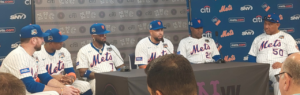 “Don’t collapse.” Still, hard not to look at a few of those guys who didn’t hold onto an in-the-bag division title in 2007 and not think of that. Those who collapsed as Mets got up as people and expressed empathy for the Mets who are unwittingly in the process of repeating their history. Each among Jose and the Carloses preached positivity, a one-day-at-a-time approach, and playing hard. If only advising made it so, but athletes of all vintage thrive on steadiness and confidence. The Alumni Classic game itself didn’t necessarily exemplify the hard-playing ethos (Edgardo Alfonzo is beyond the age of diving for grounders to third), but fun is fun and this was fun. I saw Rick Reed pitch to Juan Lagares. If I were ranking surreal scenarios, this would lead the league.
Sixty-three years since “Let’s Go Mets” was first emphatically suggested across the bleachers, the box seats, and the grandstand where the franchise first cleared its throat, those three little Team Polo words inevitably come up on their own at Mets games, because it feels good to say and it feels like a contribution to make happen what we want to happen. We can’t hit, hit with power, run, throw, or catch — nor can the Mets when it matters most this month, you are tempted to add — but we can chant with purpose and shout with encouragement. It’s not the sort of thing you do at home. But you’re not home. You’re in a ballpark where noise is made intentionally. You want the Mets to make noise not synthetically but actually.
In the bottom of the ninth, you want Juan Soto to touch home. He’s on third, having done his job very well his last couple of at-bats. The Mets had led, 1-0, since the fifth, when Francisco Lindor’s friskiness on the basepaths blended beautifully with some Texas Ranger clumsiness on a ball Pete Alonso had lifted to the not very deep outfield (“E-4 on the throw” was announced with a straight voice). The Mets hadn’t won a 1-0 game since July of 2024. Mets fans would have settled for that modern rarity. Brandon Sproat did all he could do give it to them. In his first Citi Field start, Sproat exhibited nothing but command. Seventy pitches, all but seventeen of them for strikes over six innings. You could have seen him keep doing what he was doing and have plenty to cheer organically about.
But Sproat was removed after six (something was muttered about his velocity dropping), and the 1-0 lead was passed to Brooks Raley for safe keeping in the seventh, then expanded upon by Soto when he homered toward College Point Blvd. in the bottom of the inning. Nobody who has watched every game Juan Soto has played as a Met would term his day-to-day performance spectacular, but an examination of his productivity belies impressions. That home run was his fortieth of the season, accomplished the same week he ran past thirty in the stolen base department. In 2025, Juan Soto messed around and got a 40/30. Just another year at the office.
Soto’s blast made it Mets 2 Rangers 0. The best efforts of Tyler Rogers and Edwin Diaz, combined with some not great moments from others stationed away from the mound, didn’t prevent making it Rangers 3 Mets 2 by the bottom of the ninth. That’s where things stood in the ninth when Soto came up with one out and singled. Yes, Juan was doing his job very well his last couple of at-bats. Ronny Mauricio did his job extremely well in his one and only at-bat, which came with two outs. Gathering dust most days, Ronny was pulled from the shadows to pinch-hit. He lined a single to right. Soto, who usually uses his deceptive speed to steal, dashed from first to third, carrying with him the winning run if he could be driven a final ninety feet. And if Mauricio could get an uncommon jump, and Brandon Nimmo could lash the ball somewhere that would let Ronny get on his horse, well, that’s what all the cheering was for. The call was for noise. The response was absolute. Everybody being urged to urge on the Mets urged on the Mets.
Nimmo no doubt understood the urgency and attempted to respond in kind. Brandon’s played in front of Mets crowds longer than any contemporary Met, not to mention a lot of those Classic alumni. His Met tenure exceeds those of Fonzie, Mike, and Al Leiter, to name three Mets Hall of Famers who had soaked in their share of applause hours before. He’s been on the right side of myriad Let’s Go Mets chants, the programmed kind and the spontaneous kind.
Saturday, when he struck out with the tying run on third and winning run on first, he heard boos. Nobody told the fans to boo. They figured it out for themselves. The Mets had just lost their eighth in a row. They had, for a few hours (until the Dodgers crushed the Giants), lost their fingertip grip on the final Wild Card slot. They had transformed a beautiful day at the ballpark into yet another chapter in their ongoing horror story.
 A true-life story. The fans try so hard. Ultimately, however, they can only respond to what they see, not what they are told.
by Greg Prince on 13 September 2025 10:07 am Jacob deGrom versus Jonah Tong. The Jonah Tong of the past versus the Jacob DeGrom of the future. The Met pitching prospect who excelled amid a glittering class of his promising peers versus the Met pitching prospect at the outset of a journey he’s pursuing alongside those possessing arms full of potential like his.
It was too good to be true. It really was.
The Jacob deGrom we knew and loved and were forsaken by when the money was too good to pass up elsewhere returned to Citi Field Friday night, and Jacob came home with a vengeance. Actually, Jake went about his business as he usually did as a Met. He was elegant, he was efficient, he walked off the mound with nothing to regret on his end. The only difference from the deGrom we savored as ours from 2014 to 2022, besides the TEXAS on his chest, is he’d had eight runs scored on his behalf by his teammates.
The Jonah Tong with whom we’ve just commenced to acquaint ourselves and we wish to embrace as part of the solution to all that ails us was the collateral damage in deGrom’s homecoming. He’d looked so ready to rock against the Marlins and Reds. He did rock in those starts, one a win, one a loss, but both revelations in their own manner. Friday night revealed a 22-year-old pitcher, no matter how highly rated for what it is believed he can do, is sometimes simply a 22-year-old kid who has a ways to go.
The Rangers were immune to Tong’s talents. One struck out against him. One flied out. The other seven reached base. He faced all nine only once. Two walks preceded four two-out hits, two before and two after another walk. It didn’t feel as if balls were being whacked unmercifully, but it did feel like the pitcher was. None of it felt good. You wanted to see Tong take a breath, find his poise, assert his authority. You would have settled for a line drive finding a glove, anything to get him out of the first inning. Instead, the first inning went on without him. He threw forty pitches. Twenty of them were balls. Six batters crossed the plate. The night that began with visions of a transcendent pitching duel didn’t get to the bottom of the first before it was over.
If I’d let myself, I could have teared up watching deGrom get loose as a Texas Ranger inside Citi Field. This shouldn’t have been happening. For all the business reasons I accepted three Decembers ago, it killed me to see this century’s Seaver pitch against us rather than for us. But a game was about to be played, and I wanted deGrom’s team to lose, so I didn’t bother with tears. And as Tong sunk in the quicksand that enveloped him, I could feel another tear or two developing, indicative of emotions that don’t materialize as a matter of course when the Mets routinely fall behind. I felt so bad for the kid. He was flailing and groping, and as batter after batter got the best of him, it was clearly crushing him and me. But a game was in progress. No time for tears.
 When the game was over, my eyes were dry. Sadness isn’t coming to the fore when it comes to watching the 2025 Mets let a playoff spot get away. After falling behind, 6-0, they didn’t dent deGrom until the third, compiling three runs, which would have been fantastic had it not merely halved their deficit and if they weren’t up against a guy who was in no mood to give up anything more. Sure enough, deGrom pitched the fourth through seventh like Jesus Luzardo pitched the second through eighth the night before in Philadelphia. The Mets are in the habit of getting nothing going. Friday it was twelve up and twelve down after the Mets crept to within 6-3. When the game was over, my eyes were dry. Sadness isn’t coming to the fore when it comes to watching the 2025 Mets let a playoff spot get away. After falling behind, 6-0, they didn’t dent deGrom until the third, compiling three runs, which would have been fantastic had it not merely halved their deficit and if they weren’t up against a guy who was in no mood to give up anything more. Sure enough, deGrom pitched the fourth through seventh like Jesus Luzardo pitched the second through eighth the night before in Philadelphia. The Mets are in the habit of getting nothing going. Friday it was twelve up and twelve down after the Mets crept to within 6-3.
Tong’s two-thirds of an inning was just sad. Everything else about the Mets this evening was embarrassing. Huascar Brazoban failed to promptly cover first base on a grounder to Pete Alonso in the second. By the time Brazoban scurried to the bag — too late to beat a hustling Jake Burger — Alonso flung the ball in the general direction of his pitcher’s face before it landed in the dugout. Burger wound up on second, which was the least worst aspect of that sequence. In the fourth, Jeff McNeil got called out on a borderline strike three and couldn’t resist to drop some magic words in the direction of home plate ump Scott Barry, who heard them and ejected him. In the seventh, with Gregory Soto on and needing by law to face a third batter, Bruce Bochy sent up a righthanded pinch-hitter, Dylan Moore, to torment Carlos Mendoza. Moore blasted a two-run homer off lefty Soto to provide deGrom the kind of cushion he rarely had in Queens. Up 8-3, the visiting starter finished his seven innings with minimal fuss. The Ranger bullpen went similarly unbothered, and Jake emerged as the winning pitcher at Citi Field
It doesn’t show up in the box score, but the Mets’ A/V squad could have let deGrom’s initial trot to the mound where he earned his two Cy Youngs go unaccompanied by whatever idiotic DJ prattle they insist on inflicting on their crowd for a few seconds. Not to honor Jake — they played him a thanks-for-the-memories video at 6:45 — but to give the people who show up to Mets games with a sense of what’s come before a moment to take in what they’re seeing. Six runs off Tong had warped the vibe, but it was still Jacob deGrom pitching at Citi Field for the first time in three years. SNY withheld commercials so the home viewers could soak it in. All we got was some shouting and throbbing, the essence of inane dronery.
If the sole blemish of the evening was aesthetic, we could laugh it off. Gallows giggles would be welcome at this point. The Mets have lost seven in a row, a sum that should sound familiar, given that the Mets have done that twice before in 2025. Know a lot of playoff teams losing seven in a row repeatedly? After watching Tong have little more success composing himself before reporters than he did against batters, I stayed up to see if the Dodgers could do us a favor and beat the Giants. I’m not programmed to root for L.A. against San Fran, but this wasn’t about them. Soon, it will not be about us. Just as I nodded off, Patrick Bailey launched a tenth-inning grand slam at Oracle Park, and the Giants moved to within a half-game of the Mets for the final Wild Card. The Reds, who hold the tiebreaker over us, lost, at least, though I can’t imagine we’ll be in any position where such minutia will matter to postseason schedulemakers.
Tong, no less promising than he was before Friday, will hopefully process what happened to him for the better and certainly pitch another day, presumably soon. (Also, Kodai Senga produced positive results at Syracuse, so maybe he’ll be back to pick up slack.) Brandon Sproat today, Nolan McLean tomorrow. I seem to be implying there are still some things to look forward to. There are, in the sense that we’re still Mets fans and we can still relish young pitchers coming along, even if not every one of them comes along all at once. As far as what it means to an unforeseen sizzling “pennant race,” you’ve gotta be kidding. I’m past attempting to solve “they’re too good to play this bad” puzzles. They’re not good. Those who constitute the everyday lineup have shown no signs of succeeding meaningfully as a collective, and as individual performances go, honestly, who cares? I like an upbeat statistic as much as any fan, but I can’t remember the last time any hit or home run or stolen base made any kind of tangible difference to the Mets’ fortunes. The pitchers who aren’t the kids are just as culpable for where we are.
It’s not a good team, and they’re not in a good situation. The part where we say they “yet somehow, they’re still in playoff position” figures to turn inoperative imminently, and we won’t need to ask how it’s possible that a team this good can be this bad. It’s not a team that’s that good. Fourteen games remain to change that answer. Breath will not be held in advance of that happening.
by Greg Prince on 12 September 2025 3:20 pm What a spectacular top of the first inning in Philadelphia Thursday night! And what a moving eight innings of respectful silence in the top halves of each frame that followed.
That was pretty much that where the current Mets were concerned in their sixth consecutive loss. Thus, let us turn our attention to Mets of yore. As Saturday at Citi Field will feature the Alumni Classic (a mini-Old Timers Day), it seems a fine time to issue our wholly arbitrary Mets Alumni Power Rankings.
1. Harrison Bader
I’ve only paid close attention to Harrison Bader when he was a Met in 2024 and when he’s played against the Mets in 2025. When he played for the Mets in 2024, Bader was an endearing character and a spry defensive asset. Also, he showed himself the speediest of Jewish Mets ever, certainly the most productive on the basepaths. Bader stole 17 bases in 2024, his one and only year among us. Every other Met with some “Chosen People” pedigree (14, including pitchers) combined to grab 25 bags in toto. This was one of those things I tracked out of a certain degree of cultural pride; I was a pretty plodding Jew when I attempted to run from first to second in my youth, and it gave me nachas to see someone who wasn’t. As 2024 wore on, however, Bader stopped stealing many bases because he stopped reaching base. Tyrone Taylor took over center field on a full-time basis, elbowing Bader to enthusiastic benchwarmer, and when he moved on to Minnesota in the offseason, I don’t recall a rending of orange and blue garments. In 2025, in April as a benign Twin and this month as a vengeful Phillie, Bader slashed .528/.564/.778 over nine games. Bader transcends Met-kiiler Old Friend™ status. He’s Travis d’Arnaud times Daniel Murphy to the power of that time Wayne Garrett took Tom Seaver deep. Kyle Schwarber may have hit 50 home runs this season and Jesus Luzardo may have proven himself capable of mowing down 22 batters in a row (I forget against which team), but given how the Phillies have surged since acquiring Bader, I can’t imagine Harrison isn’t their MVP. Honestly, I don’t want to imagine a whole lot about the Phillies, as I’ve seen them enough in real life. On the plus side, Bader attempted three stolen bases against the Mets this season and was successful only once.
2. Jacob deGrom
Tucked away in Texas, Jacob deGrom wasn’t likely to come back to haunt us unless we crossed paths with him in the World Series…is what I would have guessed when he bolted Flushing for Arlington in December 2022. Silly me, I forgot (or try to forget) about Interleague play, but even with that pox on our schedule, what were the odds we’d face the most accomplished Met pitcher of the past quarter-century in the September of his renaissance season with a whole lot on the line? Cash in your ticket if you said they were viable. Jake, who takes on one of the future versions of himself in Jonah Tong tonight, has thrown 155.2 innings, more than in any year since 2019, and carries an ERA of 2.78, which is absurdly high compared to what he was doing for us at the peak of his deGreatness (1.94 from ’18 through ’21), but good enough for fourth in the AL. Yeah, Jake is back in every sense of the word. We’ll see if the Mets have figured out how to score when he’s on the Citi Field mound.
3. Jim Marshall
Jim Marshall was the oldest living Met ever until he passed away last Sunday at 94 years and a few months old. He drew a bit of attention as his final birthday approached in May, with the Mets joining with the Diamondbacks to present Jim with a jersey prior to one of their games at Chase Field, which the Arizona resident was fortunately able to attend. Jim made a Met jersey game-used on April 11, 1962, and lived longer thereafter than anybody else on the visitors’ side of the box score to tell about it, which is to say nobody is left from that inaugural contest in franchise history — and only six 1962 Mets are still with us. Marshall never betrayed any bitterness over the Mets letting him go early amid the remarkable story they were writing, trading him within a month of the team’s debut. Nor did he shy from sharing with a smile his status as the first Met ever booed by the home crowd (folks trekking to the Polo Grounds for the Manhattan opener were not pleased to find him rather than Gil Hodges in the starting lineup, Hodges’s balky knee not being their problem). In June, when Howie Kussoy of the Post caught up with the handful of Original and Original-ish Mets he could track down, Jim had this to say for the likes of us: “It was a special place, a special time. It was unlike anywhere else I had ever been. They treated us great. Everyone was so enthusiastic. I could never forget all that.”
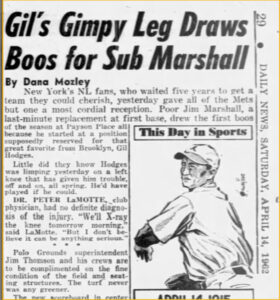 4. Jim Bethke 4. Jim Bethke
Sometimes word about an old Met leaving us doesn’t seep out for a few months or even a few years. In the case of Jim Bethke, word of his death in June made the rounds only this past week. To call the 1946-born Bethke an “old” Met is counterintuitive, as he remains and almost surely will remain the youngest pitcher in Mets history. (The next pitcher after him to debut for the Mets: their oldest, Warren Spahn.) The first Baby Boomer to play as a Met made the team out of Spring Training in 1965 less than six months after his 18th birthday and pitched the final inning on Opening Day. Jim had two wins and no losses in front of him in ’65, his only year in the bigs. Roster machinations landed him in the minors (sound familiar?) and he never made it back. Eventually, Bethke’s life proceeded on a different track. He hooked up with Union Pacific and, according to his obituary, worked “diligently” as an engineer.
5. Ed Kranepool
Bethke may have been the youngest of Met pitchers, but only Ed Kranepool could have claimed to have played for the Mets as a 17-year-old. Only Ed Kranepool could have claimed a lot of things Metwise, and they all would have been accurate. We just passed the one-year anniversary of Ed’s death, and I realized, as I was putting Bethke’s youth into Met-historical context, that it felt good to think about Ed Kranepool again, if only for a minute. Ed was so much a part of the larger Met narrative, that during the 45 years he lived as a Met alumnus, he leaped to mind as a matter of course, just as he was regularly interviewed for his reflections on 1962 or 1969 or any number of Met themes. Even in those years when he engaged in a cold war with previous ownership, he was always around the ballpark or making appearances in the area, never not, in his way, the Met among Mets. I miss that presence.
6. Art Shamsky
For as long as he’s making himself available, I appreciate Art Shamsky’s presence. Art didn’t come up as a Met, didn’t wind down his career as a Met, and was a member of the Mets for only four seasons, yet he has emerged over time as the face of the 1969 Mets. Art lives in New York, understands the media (having worked in it himself) and clearly relishes his role as primary griot for the Miracle of Miracles. SNY aired a documentary about Canyon of Heroes parades the other night, one I clicked off after the processions of 1969 and 1986 were dutifully covered. Bearing witness to all of that confetti from 56 years before were three Mets who knew what it felt like to have it fall on their heads: Art, Ron Swoboda, and Duffy Dyer. Dyer was a surprise, Swoboda less so, Shamsky not at all. He’s always out front, reminding the generation who experienced it how wonderful it all was and convincing the generations who didn’t see it that it was really something. His latest book, Mets Stories I Only Tell My Friends, co-authored by my friend Matthew Silverman, serves a similar purpose. This volume, unlike his previous two, isn’t completely focused on 1969, but it’s obviously the center of the action. Though the title hints at a certain salaciousness, it’s all good, clean fun, with nothing racier than the night Art and Ken Boswell broke curfew and hoped Gil Hodges wouldn’t find out about it. The book follows Art into broadcasting as well as his foray into managing in the quickly defunct Israel Baseball League; in case you’re wondering, Art stole four bases in his four years as a Met.
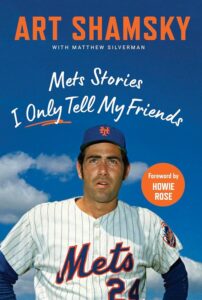 7. Ike Davis 7. Ike Davis
Also in case you’re wondering, the holder of the Jewish Met stolen base record prior to Harrison Bader was noted non-speedster Ike Davis, with seven between 2010 and 2014. I seem to recall Keith Hernandez referring to his heir at first base as a truck horse, but stick around long enough, you’ll get your opportunities to run. Ike surpassed Elliott Maddox, who swiped six, as he eclipsed Shamsky’s four. Kevin Pillar got on the board with four bags in 2021. David Newhan had two in 2007. Norm Sherry, Shawn Green, and Josh Satin each had one. Ike and Josh will be among those back for the Alumni Classic, which is beautiful, as it is knowing so many from the 2010s and 2000s will be on hand despite many of them not being parts of teams that ring bells the way 1969 does when Art Shamsky brings up that singular season. Heck, I don’t even mind that what we’ll call the Ike Davis Era is now distant enough to qualify as quite a while ago. Time has unmatched speed from first to home.
8. Todd Zeile
Several Mets alumni who were here in September 2001 were at a firehouse in September 2025. If it’s late summer, there are Mets or former Mets visiting firefighters, letting them know the Mets as an organization will never lose sight of their devotion to their city. This week, it was Todd Zeile, Al Leiter, John Franco, and their manager Bobby Valentine doing the honors. It’s been 24 years since the attacks of September 11th. The memory of those who were lost, especially those who were lost trying to keep others from being lost, can’t be honored enough. The Mets continually make good on their pledge to Never Forget. Zeile sticks out among his similarly dedicated teammates to me because, à la Shamsky, he wasn’t really a Met for that long. We had him in 2000 and 2001 and got him back in 2004. He famously played for seemingly everybody in his sixteen-season career. He came up with the Cardinals. But he has made himself a Met beyond all else, whether it’s as go-to spokesman for the Subway Series Mets or someone who will always share, when asked, what it was like to be a Met in those tragic weeks of September 2001. It helps that he landed at SNY as the lead postgame analyst, where I think he’s made himself essential to the Met-viewing experience. He’s as honest as he can be within reason in criticizing the Mets when they deserve it (he came pretty close to cursing after they lost their sixth in a row) and he wears his Metsiness pretty close to his sleeve when they win, which is something they need to do more of. As a Met and a Met broadcaster, Todd as persuaded me he is more than someone who just passed through. He’s one of us.
 9. Benny Agbayani 9. Benny Agbayani
Benny Agbayani will be among the returning Mets alumni this weekend. Like Al Leiter, he has a son playing professional baseball. Bruin Agbayani is in the Twins organization after being drafted just this year. Maybe because Al was on the major league scene long before Benny, or because nearly everybody in his family has made a name in baseball, the fact the team the Mets will be playing this weekend includes somebody named Jack Leiter doesn’t faze me. Yet the idea that Benny Agbayani’s kid is working his way up the minors seems shocking. Didn’t Benny just show up here late in the 1990s and exhibit legendary amounts of Hawaiian punch? Weren’t we just serenading him as Be-NEE? Wasn’t that…holy crap, that was more than 25 years ago. Anyway, you can catch the doings of Benny and Bruin and, for that matter, Bobby V via Tim Britton in The Athletic here. But try not to toss the article to a fan in the stands as soon you catch it.
Power rankings should probably contain ten entries, but given what the Mets have been doing lately, coming up short seems appropriate.
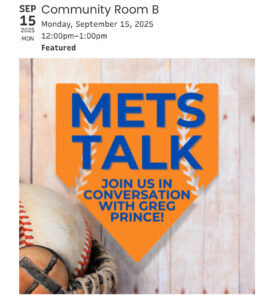 If you find yourself in the vicinity of Levittown on Long Island this Monday, September 15, at noon, drop on by the Levittown Public Library for some Mets talk with yours truly. Information here. If you find yourself in the vicinity of Levittown on Long Island this Monday, September 15, at noon, drop on by the Levittown Public Library for some Mets talk with yours truly. Information here.
by Jason Fry on 10 September 2025 9:47 pm For a little while Wednesday night the Mets played non-embarrassing baseball. Which isn’t to say they were leading — they weren’t — but that they weren’t being beaten as badly as seemed likely at first.
Clay Holmes pitched OK-adjacent, giving up two runs in the first but escaping far worse harm, and hung in there until the fifth, when he gave up a single and a run-scoring double, departing with the Mets down 3-1.
Enter Gregory Soto, who simultaneously has been quietly terrible and in the top half of the Mets’ trade-deadline acquisitions in terms of performance, which tells you all you need to know about how the trade deadline has turned out. Soto immediately allowed the inherited runner to score, escaped the fifth without further harm, and then fell apart in the sixth, putting the game out of reach.
To dwell further on the nightly failures of this increasingly woebegotten team would verge on sadism: The Mets are now 31-46 since June 13, the fourth-worst team in the majors, and the real story of this year increasingly is about the nearly three months in which we’ve tried to convince ourselves that they somehow aren’t the team we’ve been watching fall flat all summer. It’s pointless to scoreboard-watch and worry about a specific team on their heels in the wild-card hunt; as the SNY crew noted, if they don’t start winning games, someone is going to catch them.
A couple of miscellaneous notes before we put a merciful bow on this one:
One culprit noted in the Mets’ summer swoon was their apparent passivity on fastballs. For a while the Mets seemed to have flipped the script on that, hunting fastballs and rejuvenating their offense (the pitching failed at the same time, alas). But now they look befuddled by fastballs again. To be fair, Ranger Suarez and Cristopher Sanchez have pitched two beautiful games and would have been tough opponents against anybody. But the Mets were particularly hapless Wednesday night against Sanchez’s sinker. How did this lesson get unlearned?
Tuesday night saw Sean Manaea display some bad body language coming off the mound, followed by Carlos Mendoza hustling him into the tunnel for what seems to have been a firm talking-to. Which led to a long conversation in the booth Wednesday night about confidence and fight and a lot of other baseball stuff — a conversation I found deeply annoying.
Look, Manaea’s body language really was terrible, Mendoza really did haul him off by his ear, and he really did pitch better after that. But do you honestly believe Manaea’s nightmare of a year is due to a lack of confidence or fight? Or is it more likely that his struggles are because he has a loose body in his elbow? Isn’t it far more likely, in fact, that the injury is most of the problem?
Write this down: During some dull homestand next June or July, Manaea will quietly admit to Anthony DiComo or one of the Athletic beat guys that he couldn’t finish his pitches properly because of the elbow in 2025 but thought he could fight through it, or some variation of that.
Which is so much more interesting than this Just So story about confidence and fight: If you’re an injured player, what is your responsibility to your club? Where’s the line between gutting through it because you’re a gamer and admitting you’re too compromised to help your team win? That’s an old story for athletes — the most honest take on it I can recall is from Bobby Ojeda — and it’s one that Keith Hernandez and Ron Darling know perfectly well. That’s the story I would have liked to hear and could have learned from, instead of an empty one I’ve heard innumerable times that’s never taught me anything.
|
|






