The blog for Mets fans
who like to read
ABOUT US

Faith and Fear in Flushing made its debut on Feb. 16, 2005, the brainchild of two longtime friends and lifelong Met fans.
Greg Prince discovered the Mets when he was 6, during the magical summer of 1969. He is a Long Island-based writer, editor and communications consultant. Contact him here.
Jason Fry is a Brooklyn writer whose first memories include his mom leaping up and down cheering for Rusty Staub. Check out his other writing here.
Got something to say? Leave a comment, or email us at faithandfear@gmail.com. (Sorry, but we have no interest in ads, sponsored content or guest posts.)
Need our RSS feed? It's here.
Visit our Facebook page, or drop by the personal pages for Greg and Jason.
Or follow us on Twitter: Here's Greg, and here's Jason.
|
by Greg Prince on 18 April 2010 6:05 pm Winning in 20 innings by using 24 Mets who accumulated 9 hits despite batting against 2 Cardinal position players for the last 3 of those innings has generated some truly deep thinking among our readers, as evidenced by our unusually busy (for a Sunday) comments section and in-box. It’s great stuff, particularly the following, an e-mail to Faith and Fear from one Ben Nathan.
Surely there can be only one.
***
Dear Greg and Jason:
I’m a 16 year old diehard reader whom you’ve never met, but I want to share with you a couple of connections I made with last night’s game:
The first is that the game bore a striking resemblance to World War I. Both were epic monstrosities that robbed every witness and participant of his livelihood.
Both ended on account of utter fatigue.
Both began with promises of glory (Johan Santana vs. “The War to End All Wars”) and ended with shattered illusions (Mets’ failure to score vs. Felipe Lopez/Trench Warfare).
Both affairs were finally mitigated by a young, goofy upstart arriving upon the scene to bail out his misbegotten elders (Big Pelf/U.S.A.).
And finally, Jerry Manuel is Woodrow Wilson, a well-meaning intellectual who is nonetheless completely aloof and ineffectual.
My second connection comes in the form of a paraphrased quote from Hemingway’s The Old Man and the Sea:
But The Mets are not made for defeat.
The Mets can be destroyed but not defeated.
Thanks, and here’s to nine (nine!) innings of peace at 8 PM.
Faithfully yours,
Benjamin Joshua Nathan
***
Lost here in the, uh, excitement of the multiple innings Saturday night was the no-hitter thrown versus the Braves by Ubaldo Jimenez of the Rockies. Colorado has a no-hitter. We don’t. If you had told me on April 5, 1993, as their ragtag ballclub took the field for the very first time at Shea Stadium that they’d have a no-hitter before we did, I wouldn’t have believed you.
If you told me they’d have a no-hitter before we would play another 20-inning game, I might not have believed you either.
Never mind that they’d be in the playoffs (1995) before we would return to them (1999).
Last night, incidentally, was the first time the Braves were no-hit since Randy Johnson pitched a perfect game against them in 2004. On that very night, at virtually the precise moment Johnson was striking out Eddie Perez for his 27th consecutive out, Cliff Floyd was driving home Karim Garcia in a 5-4 walkoff win against Jason Isringhausen of the — who else? — the Cardinals. Nice symmetry, I’d say.
***
Prior to last night, the longest game the Mets had won was 19 innings, which happened twice. The most famous of them was the second one, clearly the most insane game the Mets ever played, Mets 16 Braves 13, July 4 and 5, 1985, which we memorialized here for all its rain-soaked and endless glory on its 20th anniversary.
Less instantly recalled is the first Met 19-inning win, played at Los Angeles on May 24 and 25, 1973. The Mets trailed 3-1 before a run-scoring Buddy Harrelson double in the 7th and a George Theodore RBI single in the eighth off 1969 Orioles reliever Pete Richert, the guy who gave up J.C. Martin’s extraordinarily well-placed bunt that won Game Four. That made it 3-3 for quite a while.
Much as the 19-inning game of 1985 was started by ace Doc Gooden and the 20-inning game of 2010 was started by ace Johan Santana, the 19-inning game of 1973 was started by ace Tom Seaver, proving it always helps to have your ace going in the literally big games. Tom pitched 6 so-so innings, however — don’t tell him 3 earned runs in 6 innings pitched is a “quality start” — and it was the Mets bullpen that ensured history that night and morning (game over at 4:47 AM EDT) by delivering 13 scoreless frames. George Stone’s first Met decision came that night, from having pitched innings 13 through 18, scattering 4 hits and 2 walks, twice inducing L.A. into stranding the potential winning Dodger run at third.
If only George Stone had been the subject of a much-needed managerial decision in the same state later that same year, but never mind that right now.
In the middle of the cascade of bullpen heroes registering bullpen zeroes stood Tug McGraw, who pitched from the 8th through the 12th. He walked 5 and surrendered 4 hits, but he allowed no runs and kept the game going into the wee small hours. Tug even managed a 10th-inning, two-out single off fellow screwballer Jim Brewer and advanced to second on an error by shortstop Bill Russell. With three Dodger runners cut down at home, his night wasn’t neat — Tug’s 1973 wouldn’t be for several more months — but, along with Phil Hennigan in the 7th and Stone during his six innings, it kept the Mets in the game long enough to score 4 runs in the top of the 19th, Rusty Staub, Ken Boswell and Ed Kranepool driving them in. Jim McAndrew picked up the save with a scoreless bottom of the 19th.
As with last night in St. Louis, that night (and morning) in Los Angeles was a full team effort, but I wanted to underscore Tug’s role since today, April 18, was the date in 1965 when Tug McGraw first pitched for the New York Mets. Manager Casey Stengel inserted him in the eighth inning of the fifth game of the season, the Mets trailing the Giants at Shea 4-1. Relieving Jack Fisher (who had just relieved Al Jackson), Tug came on with the bases loaded and one out to face pinch-hitter and future Hall of Famer Orlando Cepeda.
Tug got Cepeda looking on strikes and then opposing pitcher (and future Met teammate) Bob Shaw to ground out to second baseman Bobby Klaus. With that, Frank Edwin McGraw was a big leaguer…a big leaguer who had gotten the Mets out of a bases-loaded jam. Stengel pinch-hit Billy Cowan for him in the bottom of the eighth, and the Mets wound up losing 4-1, but McGraw had officially made the first of the many marks he would make as a Met.
 Finishing exactly 45 years after No. 45 started. It’s exactly 45 years since No. 45 first took the mound for the Mets. And on the day after the Mets secured their first marathon win that ever ran longer than the 19-inning victory of 1973, our friend Sharon Chapman — who is diligently raising funds for the Tug McGraw Foundation to help fight brain cancer and other terrible diseases — ran the Rutgers Half Marathon in just over two hours and thirty minutes (or 6 innings in modern baseball terms).
Congratulations to Sharon, whose wrist was banded appropriately for the occasion. If you’d like to contribute to the outstanding cause of the Tug McGraw Foundation, please visit Sharon’s fundraising site here.
by Greg Prince on 18 April 2010 1:08 am Tim McCarver called it a classic. The Baseball Tonight crawl called it a classic. Yet don’t mistake long for excellent. That was not a classic. It was certifiably long, the final result was immensely preferable to the alternative, and there were certainly aspects of it to like and even treasure, but that 20-inning Mets win we just witnessed was no classic.
It was something, though. It was futile for the longest time and then it was astoundingly absurd. I suppose, too, that it was survival of somewhere between the fittest and the dimmest, though I’m not sure that either unit was fit for battle by the end. I do know they were both kind of dim.
How do the Cardinals attempt to sacrifice a baseball game that counts? And how do the Mets almost not let them?
Gosh, this feels like wet blanket patrol. I mean let’s have some whooping and hollering to celebrate the only game the Mets have ever won past the 19th inning. Let’s hear it for all kinds of folks, starting with the starting pitcher Johan Santana (9 K’s in 7 shutout innings…duh, of course they were shutout innings) and flowing through every reliever except the really well-compensated one. You gotta give it up to Mike Pelfrey for coming out of the bullpen as well having the nerve to rock the world’s worst rally cap (inside out, Big Pelf, not sideways — don’t let Mex see the video). You gotta give it up to Alex Cora, almost never a first baseman but making a dynamite foul ball dive as a first baseman. Luis Castillo either executed the best tag or the best fake tag in the history of 19th innings. Jeff Francoeur and Jose Reyes could not have been more productive as 0-for-7 hitters.
And yet I feel dirty from the final three innings. I feel dirty because Tony LaRussa, know-it-all Artie Ziff to our squad of befuddled Ralph Wiggums, stopped using pitchers and started using fielders. Well, to be technically correct about it, he used a pitcher in left, but a shortstop and then a center fielder to pitch. That’s what you do when you’re losing 13-2 or it’s the last day of the season and you promised Jose Oquendo he could play all nine positions. But no, Tony LaRussa was serious as death. He sent out Felipe Lopez to pitch the 18th and Joe Mather to pitch the 19th and, when one materialized, the 20th.
It didn’t work, it wasn’t going to work, but it almost worked. And that’s why I feel dirty, because WHAT THE HELL WERE THE METS DOING SWINGING AT ANYTHING FELIPE LOPEZ AND JOE MATHER THREW AT THEM? They turned the farcical into the nearly tragicomic. It wasn’t surreal because nobody could have dreamed up the scenario of Lopez, the grand slam hitter from Friday, pitching to Raul Valdes, the grand slam pitcher from Friday. Valdes gets on and then gets thrown out trying to stretch an infield single that was thrown away into a double. I’m sitting on the couch yelling at Valdes for getting caught. It doesn’t even occur to me that this is Raul Valdes who probably hasn’t touched first base since he was six, and the whole irony of Lopez as the guy who slammed Valdes the night before is lost on me.
This isn’t supposed to happen quite this way. Marathon games are supposed to be wild, but they’re not supposed to be this…let’s say bogus. Forty-third inning? OK, pitch infielders when you have nobody left. Score is 28-28? Pitch the batboy. But it was nothing-nothing and LaRussa had pitchers left. He had Kyle Lohse (unless he pulled an Ankiel and changed his line of work when I wasn’t looking). He had Brad Penny. Are the Mets so not worth his time that he was just throwing whoever had a minimum of one arm out there?
And like I said, it nearly worked. The Mets couldn’t score off Felipe Bleeping Lopez and were lucky to scratch out a run with a sac fly in the 19th off Joe Bleeping Mather. Then, finally, the real deal, Frankie Rodriguez, fresh from warming up every inning since the 10th, probably, in to put the damn thing to bed. But this game was too cranky to be put down that easily. Ryan Ludwick tried his best to help the Mets by attempting to steal with nobody out while Pujols was batting (he also tried — and succeeded at — getting thrown out at home in the 16th), but Rodriguez couldn’t stand a hint of prosperity, and next thing ya know, Pujols (walked so often earlier that I could swear he had morphed into Barry Bonds) does what Pujols does, and he’s on second, and then, thanks to Lohse (natch), he’s on third. And then Yadier Molina drives him home.
Of course he does. Yadier Molina’s waiting in the weeds for us since October 19, 2006. “GET THE FUCK OFF THE COVER OF MY BOOK,” I told him, but at last look, he’s still there (and available in paperback with an all new epilogue, FYI).
Does any of this sound like a classic? Does it sound like a classic that we got to the 20th inning and Joe Mather was still pitching (I loved how Stephanie, who has very selective retention of baseball detail, recognized him immediately as Joe Mather from the inning before, as if Joe Mather was now literally a household name). Once again, the Mets couldn’t just stand around with their bats on their shoulders and dare Joe Bleeping Mather to throw strikes. They got it in their heads that the Cardinals had just reactivated Bruce Sutter from the Hall of Fame. Whatever; they manufactured one more run, turned their fate over to Mike Pelfrey and made a winning pitcher of Frankie Rodriguez — the only Met who gave up anything all day and night.
Omar Minaya can rest easy. The Mets have taken one of three.
Listen, I’m thrilled we get to update the Metsian annals where incredibly long regular-season games are concerned. Move over, Ed Sudol, C.B. Bucknor is now a marathon man behind home plate just like you were three unbelievable times. Move over, Ron Darling, Pelfrey is now the most recent starter to close when nobody else possibly could have. All the ghosts of Hank Webb and Les Rohr and Galen Cisco can go back to sleep. You pitchers who lost the 25th, 24th and 23rd inning affairs can doff your caps to K-Rod, somehow. He won what you guys couldn’t. Tom Gorman, someday you can bump into Messrs. Lopez and Mather and ask how they didn’t manage to give up a home run to Rick Camp. The 20-inning Mets-Cardinals game of April 17, 2010 will now be deservedly woven into the kind of legend and myth the Mets used to weave for hours on end every few years.
It will be legend. It will be myth. But it wasn’t a classic.
More epic coverage here from ESPN New York’s Mark Simon. Mr. Simon also queries Jason, me and a few other Metheads on less happy outcomes here.
by Jason Fry on 17 April 2010 12:33 am I suppose what I’ll remember from this game is the look of anguish on Raul Valdes’s face as he watched his curveball not curve.
Or, rather, it did curve — very gently, so as to offer itself politely to Felipe Lopez’s bat and thereby begin its long trip to a final destination beyond the left-field fence. Grand slam, Cards up by three, Oliver Perez’s singularly unlikely masterpiece ruined. The Mets held Albert Pujols in check, but boy did his supporting cast do a number on them.
Maybe if Ollie can repeat that surprising performance consistently we’ll see this as the beginning of hope instead of as a doubly cruel tease — a duel evaporated and a comeback turned aside. (From the Cardinals’ side, justice was served for Chris Carpenter, gone after a scintillating performance but still the pitcher of record when Lopez struck his blow.) More likely, we’ll remember this one as yet another reason to question Jerry’s use of the bullpen. Pedro Feliciano was laid low with a stomach bug, but wouldn’t it have been better to see Ryota Igarashi — who’s had a long record of success in Japan — than the iffy Fernando Nieve and Valdes, a 32-year-old rookie recently the property of Tabasco? The game was on the line right there, and Nieve and Valdes failed in spectacular fashion.
And before we get too excited about the bullpen, most of its early success has come during garbage time. The relievers have made four appearances in games where the Mets were up by a run or tied, and the only successful outing has been Hisanori Takahasi’s second appearance. The other three appearances saw Takahashi, Jenrry Mejia and now Valdes give up fatal home runs.
I could unearth positives. Yes, there was Ollie — what an odd turnabout to be hoping the Mets live up to Ollie’s fine work — and some nifty plays by David Wright, and contributions from the so-far underwhelming Frank Catalanotto, Gary Matthews Jr. and Mike Jacobs. But the Mets blew the lead in excruciating fashion and then failed to regain it in excruciating fashion. I have trouble extracting any kind of moral victory from that.
by Greg Prince on 16 April 2010 4:46 pm Welcome to Flashback Friday: Take Me Out to 34 Ballparks, a celebration, critique and countdown of every major league ballpark one baseball fan has been fortunate enough to visit in a lifetime of going to ballgames.
BALLPARK: Minute Maid Park
HOME TEAM: Houston Astros
VISITS: 1
VISITED: September 22, 2003
CHRONOLOGY: 27th of 34
RANKING: 28th of 34
Call me Madonna circa “This Used To Be My Playground,” because Minute Maid Park was sort of my place to play.
Once, anyway. For a few hours. And I had to share.
It certainly provided a different perspective on ballpark matters. Everywhere else I’d gone, I was clearly a spectator. Not at Minute Maid. I was a participant. I was a player — a player for a moment.
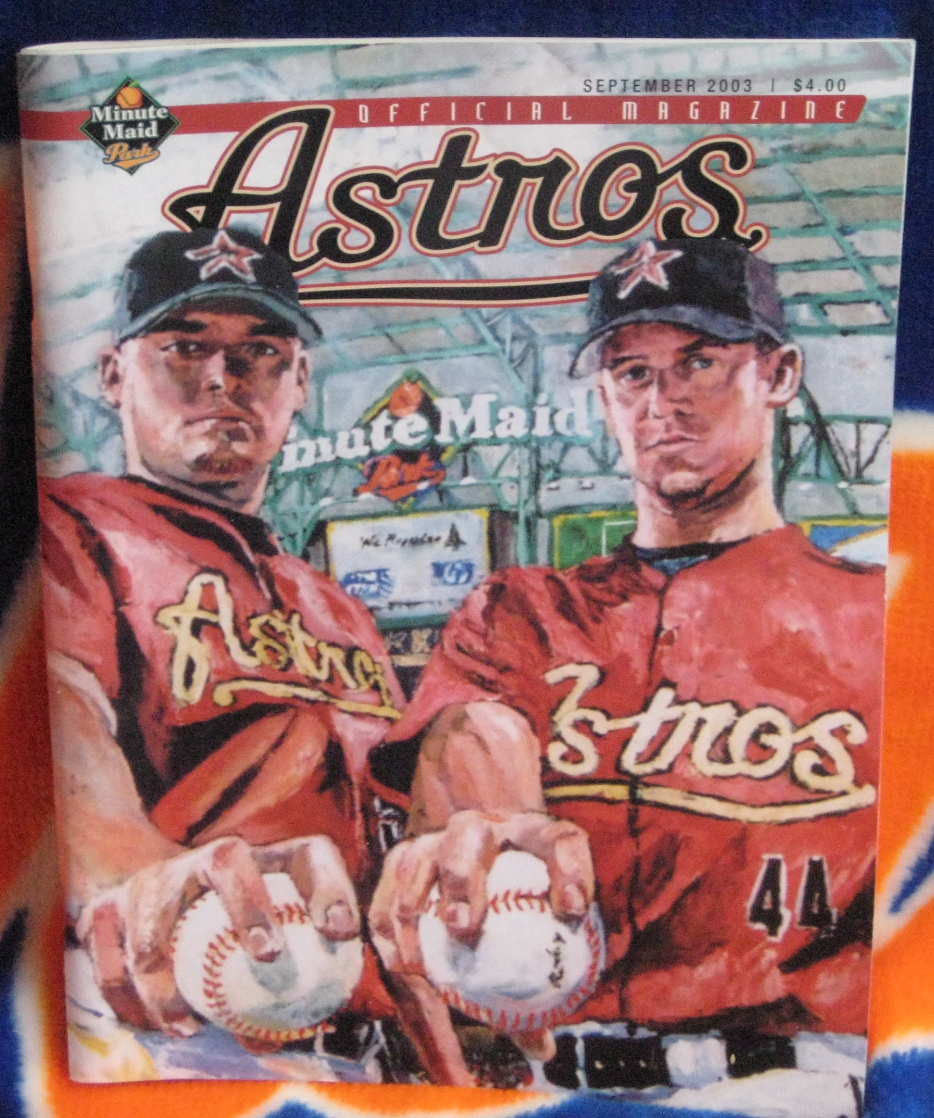
Not an Astro, mind you, but I was on the home team. I worked for a diversified company owned by the same guy who owned (and continues to own) the Astros. I was editor of a new magazine that was holding an industry conference in Houston. Our draw was less the conference than the venue. Wrapped around the rather routine business sessions would be two events at Minute Maid Park. The second, on a Monday night, would be the Astros playing the Giants. The first, the night before, would be us playing on the field.
Membership in Team Drayton McLane would seem to have had its advantages.
To be fair, if you and your friends had the scratch, you could have rented out Minute Maid Park for an evening of hospitality and batting practice. When calling one of our sister subsidiaries, if I was put on hold, a recording let me know Minute Maid Park was available for affairs, for groups from four to 40,000. We had somewhere over a hundred at our conclave and, as I learned, we were charged like anybody else. I don’t even think we got a family discount.
Whatever the price of admission, I remember running around the field of Minute Maid Park, and that was pretty effing awesome.
I mostly roamed the outfield, particularly that dopey Tal’s Hill which is just as dopey (if not more so) in person as it is on TV. I took one round of BP, which I did with unathletic reticence, quickly forgetting everything I ever learned in gym class about standing in against pitching, even mechanized pitching. I inspected the out-of-town scoreboard from behind its slats. I sat in the visitors’ dugout trying to reload my camera in the dying days of film as a first option. I used the visitors’ dugout bathroom (just inside the runway to the visitors’ clubhouse), same place Mike Piazza might have relieved himself. I was well past my playing days in 2003, but I loved the idea that I could play. I loved the access to a major league field.
What I didn’t love, ultimately, was Minute Maid Park when I came back the next night as a mere spectator. Perhaps it was the being brought down to earth through the open roof effect. Not 24 hours earlier, this had been my playground; now I had to go find my seat like a schnook. But I don’t think that was it. Minute Maid Park just struck a wrong chord for me from the moment I approached it, even when I was going in with my glove on.
It’s in a part of Houston that, at least back then, contained nothing else with a pulse. Maybe a bar or two, but it felt plopped in as if to develop or redevelop downtown. I liked the idea of a converted train station, but it didn’t give off a ballpark feel from the outside. Nobody who worked there seemed particularly friendly (come to think of it, there were a lot of unfriendly people who worked for Mr. McLane). It was kitschy without being fun. Maybe it was an improvement on the Astrodome, which I never visited, but it was the first retro park I saw that I really didn’t much enjoy.
A few mitigating factors may have worked against me besides not being allowed to run around on Tal’s Hill during Monday’s game. Our seats, on a party deck to accommodate our conference group, were close to dead center. As I would learn years later at Citi Field, center field is not an ideal vantage point to take in a ballgame. Also, I was technically working. It wasn’t a tough assignment, schmoozing with our guests and such, but it wasn’t just an evening at the ol’ ballyard. Finally, I had a nagging headache that had been simmering since late afternoon. What I couldn’t have realized was the headache was the first symptom of what would explode into full-blown acute bronchitis by week’s end, a condition that may as well have been walking pneumonia.
The professional aspect of the trip — I gave a well-received presentation Monday afternoon — was also the unforeseen high point of my tenure with the magazine. McLane’s apparatchiks began to pick apart our personnel and screw with our structure, and within seven months, I was no longer part of the family. But I couldn’t have known that, either. I just knew I had a headache as I entered the ballpark and being there made it worse.
Perhaps out of corporate loyalty or my desire to really like the place where I romped the night before, I walked the perimeter pregame in a newly purchased Astros cap. I got a kick out of the ideas informing Minute Maid. I liked the Conoco Home Run Pump set up there in “awl” country to keep track of Astro home runs. I saw the rail car full of oranges and liked that they made the best of the shotgun marriage between Union Station heritage and Minute Maid sponsorship (after it could no longer be Enron Field). The touches and flourishes were good ideas, but the mélange of them resulted in a bit too much of a mélange. Here’s everything, Minute Maid seemed to shout. Isn’t it great?
Shortly after the game began, during one of the early between-inning breaks, our attention was directed to the big screen above us in center to show us the best of the games Friday night…high school football games. The Astros were in a race for the N.L. Central title with the Cubs — a Scotch-taped sign touting playoff tickets was affixed to a window outside (with no lines) — but this was the real action in Texas. That’s when it occurred to me what Minute Maid Park was at heart:
A baseball stadium for people who like football more than baseball.
At some point after the seventh-inning stretch (when we sang along to “Deep In The Heart Of Texas”), I slipped away from the conference group, and explored some more. Unlike at Shea, I was able to walk freely on the Field Level and positioned myself on the first concourse directly behind home plate. I could see mere rows away the back of Drayton McLane’s head. Quickly I called my wife and told her to find the Astros and Giants on Extra Innings. She couldn’t see me, but she could see him. She was looking at his front, I was looking at his back. It was almost like being at the game together with the owner.
Oh yes, the game. The Astros really needed it, clinging to a half-game lead over Chicago. They almost had it, too, having gone ahead in the fourth inning when Marquis Grissom couldn’t handle Tal’s Stupid Hill and Richard Hidalgo’s ball went for a triple (we had a fine view of that from center). San Francisco tied it in the seventh off Octavio Dotel. In the ninth, Astro closer Billy Wagner gave up a single to son of Astro legend Jose Cruz and then consecutive home runs to Pedro Feliz and Ray Durham. The Giants led by a field goal and fell successfully on the ball in the bottom of the ninth. Final: Giants 6 Astros 3, a flat-footed tie with the Cubs for the division.
I’d been at Shea in sickening situations like this but had never been at an alien ballpark when a non-Mets pennant race scenario unraveled. At Shea, we would have let out a terrible schrei, Yiddish for yell. At Minute Maid, they didn’t know from schrei (or, I’m guessing, Yiddish). Oh, there was some booing of Wagner, but when it was all over, everybody filed out peaceably. I couldn’t fathom it. Boy, was this an alien ballpark. Or maybe it was just that there was still time to catch the Broncos and Raiders on Monday Night Football.
The next day, as the conference ended, my throat beginning to trouble me. By Thursday, the Astros were out of sight, out of mind and I was back home at Schrei Stadium, my health be damned, to say goodbye to Bob Murphy. By Saturday, however, I watched with a bit of sadness as the Astros were officially eliminated from contention. The Fox cameras found Drayton McLane and he looked more glum than his customers. In that family sense, I felt bad for him — like grimacing in sympathy for your very rich uncle.
During the offseason, Roger Clemens resurfaced from his brief retirement to announce he’d pitch for Houston. Just after the 2004 season started, six years ago this very week, I was let go by McLane’s people; we had poor advertising sales, which wasn’t my department, but whaddaya gonna do? Having been invited out of the family, I couldn’t have been happier the following October when the Red Sox and Cardinals saved me from having to endure a Yankees-Astros World Series.
I had been a player — a player for a moment. That moment’s long over now, though, and that place in Houston is no longer my playground. It’s Minute Maid Park.
Rusty Staub used to be an Astro as well as a Met. Read about a Grand sighting of everybody’s favorite Orange on Loge 13.
by Jason Fry on 15 April 2010 10:40 pm It’s often this way when you’re furious with someone you love: Irritation boils up into anger and anger explodes into rage, but then the rage consumes its fuel and you’re left feeling tired and vaguely sick and wish you could just fast-forward to whatever point will allow you to start over.
So it was with the hapless, badly led, star-crossed 2010 Mets as they brought their 2-6 season into their third game in Denver: I hadn’t changed my mind about any of the things that are wrong, but I couldn’t stand to spend any more time dwelling on them. The Mets would play and I would watch and listen and we’d see how things went.
Luckily, a couple of things were stacked in their favor even before the game began.
There’s always a brief lift from the day game that caps a series and sees your team off to another city and another opponent — they’re moving on, for better or worse, and so are you. Similarly, there’s something about a midweek matinee with spring still stretching its legs: The physical season and the baseball season are both new enough that you’re not yet used to the idea of either, and so they feel like gifts. And for me, personally, there was the added wrinkle of the first game that I’d have to keep up with catch-as-catch-can, with the second half followed through quick glances and surreptitious Gameday watching during errands and the FAN in one ear while walking home with the kid.
 Whoa, we're about to plow into Miguel Olivo. I love that aspect of weekday matinees, too: From beneath my headphones I watch other people scurrying around on their errands and see how few of them have a game to keep them company, and I thank my parents and good fortune for having brought me to the Church of Baseball. I don’t think I’ve ever felt truly lonely with a game in my ear — I’ve been sad and irritated and enraged and anxious and hopeful and very occasionally smug and triumphant, but never lonely. How could you be, with the announcers and the players and the fans right there with you?
Not that any of this would have been much help if the Mets had been awful and/or lunkheaded once again. And, hey, they did have their moments: The top of the third was a particular farce, with an incredulous David Wright watching baserunners disappear in front of him until he was alone and the logical thing to do was wave at a rare Jorge De La Rosa strike and disappear himself. But this time the dopey moments were comic relief, thanks to Mike Pelfrey.
Big Pelf was horrible in spring training, like every other starter handed a rotation spot just for showing up in St. Lucie, but he’s been awfully good so far. There’s the new splitter, a renewed dedication to pitching inside, a certain measure of meanness that’s been lacking, and so far a lack of, well, Big Pelf moments. Pelfrey isn’t a flake in the Tug/Turk tradition, but he’s certifiably eccentric — this is a guy, let’s remember, who last year tipped his pitches by wandering around on the mound muttering the name of the pitch he was about to throw. I sometimes wonder what it would be like to take a few minutes and see the world through Mike Pelfrey’s eyes. Would it be revelatory? Amusing? Terrifying? I don’t know, but I bet it would be interesting. (For one thing, most people would look a lot smaller.)
At least for today, things looked pretty good from that perspective. And so for the next 21 hours, some is forgiven.
by Greg Prince on 15 April 2010 10:33 am “This is Country Time lemonade mix. There’s never been anything close to a lemon in it, I swear!”
—Kid from Shelbyville, “Lemon of Troy,” The Simpsons
Upset that the Mets don’t have a plan? Please. The Mets have never had anything close to a plan in them.
I swear.
It would be too easy to say “plan” is a four-letter word to the Mets. I’d say it’s a no-letter word, given that the Mets plan nothing where baseball is concerned. Nothing from nothing, as Billy Preston advised us in 1974, leaves nothing. And you gotta have something if you plan to win again in our lifetimes.
By win again, I mean a title, though at this point I’d settle for a game.
Wednesday night, the Mets seemed close to snapping their losing streak that has now reached four but feels like forty. When the brainlessness of Mike Jacobs and the carelessness of Jose Reyes combined to let pitcher Aaron Cook score from third with two out and give the Rockies a 5-3 lead in the fourth, I braced for the worst. I braced for 2009 because that was a play straight out of last year.
What had kept my spirits from sinking through the wan homestand was that even though the Mets were losing, it was standard-issue losing. It wasn’t the fall down in left, don’t touch third, I GOT IT! I GOT IT! I don’t got it ineptitude that defined the previous season. It was a teamwide LOB slump that was bound to turn and mediocre starting pitching that could be attributed to arms still loosening (if you believe in the arm fairy). They didn’t look great, but they didn’t appear irretrievably irredeemable.
Then came the third inning Tuesday night, the Rockies leading 3-0, Maine struggling but surviving. Clint Barmes bounces one hard to the pitcher. The pitcher knocks it down. Alas, the bouncer knocks the pitcher down at the same time. The pitcher crawls, lunges, grabs and throws the ball somewhere toward Fort Collins. Two runs score to make it 5-0 and, six pitches/two Smiths later, it’s 8-0.
Seven games into 2010, and the Mets recalled 2009 from their Hades farm club. To make room on the roster, they designated immediate hope for assignment.
Of course the Mets would go on to lose 11-3 and look every bit the 2-5 team they were becoming. There was even a Dodger Stadium-style outfield interlude in the eighth. Last year it was Beltran and Pagan so successfully calling each other off Xavier Paul’s fly ball to deep left center that Paul wound up on second. Tuesday night, with Pagan in center and Bay in left, there was a replay of sorts, with the Jason the kind Canadian and Angel the polite Puerto Rican each practicing international diplomacy on Miguel Olivo’s similarly placed fly.
Sir, I would not deny you the pleasure of catching…
No, my good man, I cannot possibly allow myself to overstep…
Forgive my interruption, but truly that ball belongs to…
Now I will risk terrible uncouthness and interrupt you to say, really, I want you to have…
Olivo wound up on second. He didn’t score, but the point was made. The Mets sucked this year as they sucked last year. And the point was underscored again last night when Jacobs didn’t think to look Cook back to third and Reyes didn’t think to look up from not quite tagging out Dexter Fowler (who wasn’t too bright, either, but he’s Colorado’s problem) at second. While Mike and Jose weren’t thinking, Aaron was crossing the plate with the fifth Rockie run. It was 5-3 and I fully expected the floodgates to not so much open as come unhinged.
When they didn’t — when it remained 5-3 under the auspices of the Mets’ suspiciously effective bullpen — I began to have a feeling we weren’t quite dead. This was a game the 2009 Mets would have thrown away by the sixth or so inning. But Valdes bailed out Niese, Nieve bailed out himself, and two non-’09 Mets, Bay and Barajas, built themselves a run in the seventh. Feliciano was felicitous in the eighth, setting the stage for the top of the ninth when the Mets were the beneficiaries, not the instigators, of some shoddy defense. Gary Matthews was hilariously credited with an infield hit; he took off for second and wound up on third when Chris Ianetta’s throw just kept going. Luis Castillo brought Matthews home with a fly ball.
Igarashi kept things tied through nine, the fifth consecutive scoreless inning posted by Met pitching dating back to Niese’s last. When Jacobs launched a deep fly to right through that thin Coors Field air, it seemed the tables had finally and definitively turned in the 2010 Mets’ favor. Except the ball hit the high scoreboard, which was fine, and Jacobs had broken into a home run trot, which wasn’t. He stood on second with one out when he could have been standing on third.
Advantage Rockies — and 2009 Mets.
Everything after that was fairly predictable. Our best hitter, Francoeur, would be walked to set up a double play. In the midst of Barajas batting, Tatis was sent in to pinch-run for Jacobs. Tatis’s talents are limited, but I’d take his bat over his feet. Barajas grounds out, Tatis is on third, Francouer is on second and Cora comes up. Cora could have pinch-run and Tatis could have hit. Instead, Jerry Manuel went the characteristically unorthodox route.
It didn’t work. Nothing ever works. Cora hit a soft liner to second to end the threat. Ianetta made up for his lousy throw against Matthews by ending the game by taking Jenrry Mejia to school. As we learned long ago from ex-Rockie ace Mike Hampton, Denver has awesome schools.
So it’s 2009 again. Or maybe it’s 1992, the last time the Mets lurched to a 2-6 start. That season turned out so well that it was immortalized in its very own book, The Worst Team Money Could Buy, co-authored by John Harper, who continues to write for the Daily News and has, in today’s paper, a story on how Joel Piñeiro — 1 ER in 7 IP against the Yankees yesterday — sure would have liked to have been a Met, but said the Mets’ approach toward obtaining his services was “just weird”. Joel would have liked a million dollars more than the Mets were offering (an annual sum less than that currently being deposited in Kelvim Escobar’s account) but they never really got their act together. Like the man said, weird.
Was Piñeiro the answer? Were any of the free agent pitchers the Mets passed on answers? I don’t know, since I’m just a fan, but it’s obvious Omar Minaya and his merry band of talent evaluators didn’t know, either. They didn’t have an idea, and from a distance, it appears they didn’t have a plan.
Because they never have a plan. The Mets never have anything close to a plan. The Mets just take shots at players and hope some of them work out. This isn’t hyperbole. This is how the Mets have operated for more than a decade. Sometimes the pants-seat method pays off — fire sale Marlins, Quadruple-A journeymen finding themselves, high-priced free agents whose first year as Mets are their last years as topline stars. It’s great when the dice are rolled and come up sevens and elevens. It’s not so great when the Mets throw whatever at the wall and nothing sticks.
Not much is sticking at the moment. Jeff Francoeur wasn’t a plan, he was a division rival’s project, yet thus far the project has developed into something sturdy. Rod Barajas wasn’t a plan. He was approximately the third catcher, after Bengie Molina and Yorvit Torrealba, the Mets tried to convince to come aboard, and they seem to have found the charm. The various relievers who’ve not made us regret their innings weren’t a plan. They were inventory, to use of one of those charming Mets front office words for when they’re stockpiling and hoping to not run out of arms.
When things work out, nobody really questions how they came to be. Nobody cared in the late ’90s that Al Leiter and Dennis Cook weren’t the result of charts, graphs and scouting; we were just happy to scoop them up when Wayne Huizenga was going out of business. Nobody except hard asses with Players Association cards in their fat wallets cared that Rick Reed came out of nowhere in 1997. We were just thrilled that he chose to arrive as a Met. When Pedro Martinez in 2005 and Billy Wagner in 2006 did their best work immediately, not a lot of us wondered and worried about the years that remained on their pacts.
But when things don’t work, everything is up for grabs and under the microscope. That’s reasonable. We don’t have wins, so we want answers. If we have answers but not wins, we’ll want heads. That’s also reasonable. We’re not in this to be or fully satisfied by process or more than temporarily distracted by potential. We want to be 6-2, not 2-6. If we’re 2-6, we want a hint that we won’t be 4-12 before long. When we’re 2-6, we can’t believe we won’t be 2-160.
Ideally we’d like some long-range telescope that can see past whatever morass has semi-conditioned us to accept 2010 as a regrettable holding action against the promise of 2011, but in the Age of Minaya, there is no next year, just more of last year. And the year before that.
How the Mets nearly won the National League East or a Wild Card spot in 2008 continues to defy understanding. We had five great players — Reyes, Wright, Beltran, Delgado and Santana — playing great, and a cast of thousands slipping through Shea’s last set of revolving doors. I bring this up not just for hits and giggles but because I noticed something recently among one of the many Met lists I keep.
Every year there are players who make their major league debut as Mets. They are what an online acquaintance calls Born A Met. Conversely, every year there are players who play their last major league games as Mets. They are what this same gentleman calls Died A Met (died in the Jim Bouton sense of the word from the April 14, 1969 entry in Ball Four: “I died tonight. I got sent to Vancouver.”). This happens on every team every year, nothing unusual in that. Every player is going to debut somewhere, every player is going to stop playing somewhere, though that’s usually a trickier proposition. Few players take Ripkenesque farewell tours. They play until nobody wants them.
The thing I noticed in retrospect about the 2008 Mets is — pending any unforeseen comebacks — twelve different players played their last major league games in our uniform (not counting two youngsters, Eddie Kunz and Carlos Muniz, who were up in ’08 and are still in our system but haven’t been on the Mets since). None of them, from what I could tell, was bowing out gracefully. They were hanging on and, if somebody else would have had them, they’d still be hanging. Some are still doing so in minor, independent and foreign leagues. But two years later, twelve of them have been out of the major leagues for more than a full season and don’t show tangible signs of making it back
That’s a lot of players taking their last halting lap on the same team, a lot of players nobody wanted after we had them. As many players Died A Met in 2008 as Died A Met in 1963. That indicates the Mets of two years ago grasped at a lot of spare parts to fill in when they got desperate. They got desperate a lot in 2008, which is what they’ve been fairly often in the Minaya Era. (We can’t determine for sure yet all who Died A Met in 2009 as some not presently active aren’t technically prohibitively done.) It implies this is the way they’ve been doing business and it’s the way they still think.
In case you’re wondering, these were the 2008 Mets (besides Kunz and Muñiz, who still have a conceivable shot at returning) who haven’t been major leaguers since they were 2008 Mets:
• Brady Clark
• Gustavo Molina*
• Matt Wise
• Abraham Nuñez
• Raul Casanova
• Moises Alou
• Trot Nixon
• Tony Armas, Jr.
• Chris Aguila
• Brandon Knight
• Ricardo Rincon
• Damion Easley
Individually, Alou was supposed to be the starting left fielder, but age and injury took him out. Easley inherited second base for a spell, but age and injury took him out. The rest were essentially a series of stopgap moves. Collectively, the dozen Mets who nobody else has placed on a major league roster since totaled a 2008 WAR (Wins Above Replacement) rating of -1.0. That’s roughly a quarter of your players — the Mets used 50 in 2008 — who were statistically disposable at best.
That’s not a plan. That’s the scrap heap come to life. That’s bad luck as the residue of lack of design. That’s hoping for the best and expecting nothing in particular. That’s not even accounting for journeymen like Argenis Reyes and Ramon Martinez and Robinson Cancel whose journeys would continue with the 2009 Mets. Even as we understand injuries take a toll and spit happens and all of that, the Mets under Minaya have constructed the planet’s busiest space shuttle. They shuttle used players in and out, and a lot of space is taken up in the process.
That’s the background. The foreground is the annual splashy winter signing: Santana prior to ’08, Rodriguez in advance of ’09, Jason Bay for 2010. They and the “core” pieces in the Metropolitan collection give us reason to believe the Mets can be pretty good. Most of the background players — truly “extras” in the Ricky Gervais sense — ensure we probably won’t be.
Is it early? Is it not early? It almost doesn’t matter, ’cause it’s almost always like this.
*Molina returned to the majors in 2010 with the injury-plagued, catching-strapped Red Sox.
by Jason Fry on 14 April 2010 1:09 am The Mets are 2-5, and Gary Cohen’s advice is not to jump off bridges. It’s early, after all.
I agree nobody should be jumping off bridges. (Ever.) But when you think about the problems afflicting the Mets, they’ve been obvious a lot longer than seven games.
* Gary Matthews Jr. and Mike Jacobs have shown themselves as clearly inferior players to (respectively) Angel Pagan and, well, anybody over the small sample size of seven games. But Mets fans didn’t start saying that — or questioning how the Mets construct rosters — in the last seven games. Fans have been saying it since approximately midwinter. Judging by the cherry blossoms and the daffodils up and down my street, midwinter was a while ago. These are not early concerns.
* Concerns about the starting pitching haven’t exactly been limited to the first seven games of the season. John Maine was horrible tonight, but then he was horrible all spring and not so good the last two seasons. Oliver Perez was bad in his first start, awful all spring and mind-bogglingly terrible last year — the first year of the three-year, $36 million contract Omar Minaya gave him in the face of determined counteroffers from … somebody. These concerns existed this winter, when Joel Pineiro seemed to want to pitch for the Mets and the Mets reportedly couldn’t simultaneously manage signing Jason Bay and picking up the phone to express interest in him. These concerns existed last month, when Nelson Figueroa — a useful swing starter who’d had a good spring and was out of options — was let go in favor of guys who’d had bad springs, weren’t suited to duty as swing starters, and had options remaining. These concerns existed last month, when Jenrry Mejia was anointed a short man despite no record of success above the Florida State League, sidetracking his development as a starter. These aren’t early concerns either.
* Surveying tonight’s wreckage, Keith Hernandez talked about Plan B. But the epitaph of the Minaya regime should be the stubborn absence of a Plan B. Plan B for the shaky starting rotation? It’s in Anaheim, Philadelphia, and miscast in the bullpen. (At least Pat Misch is still around. Oh my God, I actually just typed that.) Plan B for backing up the varsity? That’s been a concern since Jose Valentin failed to bottle lightning twice in a row and Moises Alou was first felled by the impact of an errant raindrop. Plan Bs are apparently false hustle, a category that also covers remembering your ace had elbow problems in spring training, correctly judging the market for gregarious but useless middle infielders and taking steps to avoid looking like a fool by publicly spouting bizarre conspiracy theories about the motives of beat writers. No, concerns about Omar Minaya’s ability to do his job have been around a lot longer than seven games.
* The job security of Minaya and Jerry Manuel is a hot topic seven games into the season — every fan who called Gary and Keith tonight asked some variant of “When do they get fired?” But calls for their heads from fed-up fans are not new, and neither is the obvious lack of enthusiasm for them in the owners’ suite. The Wilpons, one hopes, are not having early concerns about whether it’s finally time to clean house. Because we’re far beyond that point.
Did I just say it’s time for Omar and Jerry to get pink-slipped? Yes I did. Are we just seven games into the 2010 season? Yes we are. But I would not say I have early concerns. I’ve been concerned since last summer, when the Mets turned a season of bad luck into a pitiful farce. My concerns intensified in the offseason, when Minaya and his lieutenants operated without the slightest evidence that they were following a coherent plan. My concerns became impossible to ignore in spring training amid bizarre roster decisions and apparently willful ignorance that the starting pitching was a disaster in the making. The first seven games of the season have been just the latest bead on a depressingly long string.
It’s just seven games into the season, but it’s not too early for someone with the last name Wilpon to say enough’s enough.
If anything, one wonders if it’s too late.
by Greg Prince on 13 April 2010 2:47 pm Say — or should I say hey — you know who was a really good baseball player? Willie Mays.
You probably knew that already, but you’ll really know it if you read Willie Mays: The Life, The Legend by James Hirsch. You’ll know a ton by the time you float through its 560 pages of text. You will, I’m certain, feel what Brad Hamilton meant in the “no shirt, no shoes, no dice” scene from Fast Times At Ridgemont High when he instructed Spicoli and his stoner buds, “Learn it. Know it. Live it.” Even if you’re fairly familiar with the Willie Mays story (as I was going into this book), you’ll likely be astonished by at least three iotas of information per chapter, stuff that transcends his 660 home runs, his 1,903 runs batted in, his 3,283 hits, his 2,062 runs, his two MVP awards, his 12 Gold Gloves and his 24 All-Star selections.
Willie Mays was the last of the big-time barnstormers.
Willie Mays positioned his teammates from center field.
Willie Mays tended to a bloodied John Roseboro after his own pitcher, Juan Marichal, took a bat to his head, thereby defusing one of modern baseball’s ugliest confrontations.
Willie Mays received multiple standing ovations from the Ebbets Field crowd in his last game before reporting to the army despite being the enemy.
Willie Mays cleared the basepaths for trail runners like he was a fullback, deking relay men and bowling over catchers in the process while the guy behind him inevitably moved up 90 feet.
Willie Mays’s respective last at-bats in the 1962 regulation season, pennant playoff and World Series produced crucial hits each time he swung.
Willie Mays played in 150 or more games in more consecutive seasons than anyone, including Cal Ripken.
Willie Mays gave a kid in San Francisco a ride to the ballpark simply because the kid rang his doorbell.
Willie Mays said “hey” a lot but never said “say hey,” except on a record.
America could hardly get enough of Willie Mays for 22 seasons. I couldn’t get enough of Willie Mays for 560 pages, though Hirsch gave me a lot. If Willie Mays is not the most incisive of personality studies, it is an absolute first-rate biography of a baseball career set against the backdrop of a couple of baseball and generational eras. It is highly recommended to any baseball fan who thinks being absorbed deep within one of the game’s golden legends constitutes the most delightful road trip possible.
Still, I’d like to get more Willie Mays, and I know where I’d like to get it. I’d like a generous helping at Citi Field, home of the last team for which Willie Mays played, situated in the city Willie Mays made his own when he first rounded first and took off for immortality. If Hirsch’s book makes anything implicitly clear, it’s that New York’s National League ballpark must commemorate the career of New York’s greatest National League ballplayer.
That’s not Hirsch’s stated agenda, but it is mine.
Citi Field is much improved in the history department in 2010. To that I say wonderful. The banners, the bricks, the museum…it’s as if they’ve opened Mets Stadium after a year spent killing time at a neutral site. Sincere applause from this heretofore critical corner for those efforts.
But more can always be done, and I’d like to start with something for Willie Mays at Citi Field. It’s not so much that Willie Mays deserves it. It’s that we deserve it.
“New York was home,” Hirsch writes of Mays’ attitude when word broke that Horace Stoneham was planning on moving the Giants to San Francisco. “Everything was familiar; the fans loved him. He didn’t particularly want to say good-bye to New York, and New York certainly didn’t ant to say good-bye to him.”
Willie Mays is our legacy. San Francisco — which was reluctant to accept an East Coast import as its own — celebrates him in retirement, but it was New York that embraced him from the moment he appeared on the horizon in 1951 and it was New York that welcomed him back when a historic wrong was righted in 1972. The feeling was mutual. Mays, upon his trade to the Mets:
“This is like coming back to paradise.”
It wasn’t overstatement given the depth of feeling Willie generated as a Giant between ’51 and ’57 and maintained as a visitor from ’62 onward. It wasn’t out of the norm when the St. Francis Monastery of Manhattan’s recorded telephone message — “Your Good Word for Today” was “New York has reason to rejoice these days. Willie Mays has returned. There is some heart in professional sports.”
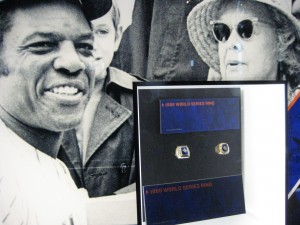 Willie and Joan, two jewels in our crown. The heart wanted what the heart wanted, particularly Joan Payson’s heart. Mrs. Payson made Mays II happen. She was the minority Giants stakeholder who voted (through her bag man, M. Donald Grant) to keep the team, like its centerfielder, where it belonged, in New York. She was the Met owner who was happy to fund a new franchise in part because it meant Willie Mays would come around nine times a year. She tried to buy the Giants from Horace Stoneham. She tried to buy Willie Mays from Horace Stoneham. On May 11, 1972, she succeeded.
And on May 14, 1972, it paid dividends when Willie Mays adjusted headgear adorned with an NY for the first time since September 29, 1957 and hit what turned out to be a game-winning home run. He did it, strictly speaking, for New York, as in for the New York Mets. But he also did it, not so metaphorically, for New York as well.
We, as in New York, loved Willie Mays all along. The Giants fans of the early ’50s recognized immediately they’d been granted a gift from the gods when he came up from Minneapolis. The Dodger fans throughout the ’50s cheered his genius for the game they loved even if he played of the team they hated. In July 1961, nine months before the Mets existed, Yankee Stadium hosted an exhibition between the Yankees and the San Francisco Giants. The game didn’t count except in the hearts of “Giant-starved New Yorkers,” as Charles Einstein put it. More than 47,000 parishioners showed up, and “they rocked and tottered and shouted and stamped and sang. It was joy and love and welcome, and you never heard a cascade of sound quite like it.”
“New York,” Mays said later, “hadn’t forgotten me.”
New York would take every opportunity to remember Willie Mays when he began returning regularly in 1962 — “The center field turf at the Polo Grounds looks normal this weekend for the first time in almost five years,” wrote Arthur Daley in the Times upon San Francisco’s first trip in. Old Giants fans, old Dodgers fans and new Mets fans all embraced him. The Mets held a night for him in the Polo Grounds on May 3, 1963, when Bill Shea publicly asked, before an appreciative crowd, “We want to know, Mr. Stoneham, Horace Stoneham, president of the Giants — when are you going to give us back our Willie Mays?”
The answer was nine years later. Willie Mays’ homecoming was as storybook as it could get, No. 24 for the Mets homering against the Giants at Shea to win on Mother’s Day 1972. No mother was any happier than the big mama of the Mets, Joan Payson. It had been a decadelong quest of her to put Mays into A-Mays-in’. When the Mets were forming, Payson still owned 9 percent of the Giants, valued at $680,000, and she had to sell it. According to Hirsch, she offered it to Stoneham free and clear of financial compensation. All he had to give her, for her new ballclub, was his center fielder.
Willie Mays for 9 percent of the Giants…it would have been a steal for Payson, but Stoneham didn’t go for it. It took until ’72 to make the dream a reality. Of course Willie wasn’t the Willie he was in ’62 by then (which is why all it took was pitcher Charlie Williams and a reported sum in excess of $100,000, though Stoneham claimed he never took any of Payson’s money; he just wanted Willie to be “taken care of”). His superstar emeritus status, however, hadn’t diminished one bit, which is why Willie Mays becoming a New York Met was and remains one of the most mindblowing midseason trades in Mets history.
He played well, too. He was 41 years old yet helped the Mets reel off eleven consecutive wins that May, putting New York six games ahead of the field in the N.L. East. Murray Kempton described a sequence of events from May 18 in which Mays, having walked, confused Expo fielders into a flurry of bad throws that resulted in two runs, each “the unique possession of Willie Mays, who had hit nothing except one tipped foul.”
Eventually injuries took their toll on the roster and age slowed down an overworked Willie, yet Mays was no charity case in ’72. No Met put up a better on-base percentage and he was second on the club in batting average and slugging percentage. Plus he was Willie Mays. Wrote Jeff Greenfield at year’s end, “Willie Mays is reminding New York of our own best moments, and our own best hopes.”
The trade of Williams for Mays was no mere agate type transaction and this was no mere spare first baseman/outfielder. Willie Mays as a New York Met was, in every sense of the word, a big deal.
Hirsch explores 1973 as well as 1972, which was the proverbial double-edged sword of Mays’ Met tenure. On one hand, Mays could be prickly (to put it mildly) at this advanced stage of his career and a handful for Yogi Berra, who didn’t particularly crave having him around at the owner’s behest. Willie hit .211, which reads like blasphemy. On the other hand, he was Willie Mays, he knew more about baseball than anybody around, and he shared with grateful teammates. Tom Seaver told Hirsch Mays conferred with him on where he wanted him playing depending on who was batting and how he’d be pitching to him — and that no other position player ever did that.
Willie Mays’ final Met season might have gone down as a footnote to his 1972 return, except the 1973 Mets were destined to live on in memory. The Mets gave him a night at Shea, September 25 in honor of his impending retirement. A sellout crowd developed something in its eye for a very long time, no more so than when Willie gave his valedictory:
I see these kids over here, and I see how these kids are fighting for themselves, and to me it says one thing: Willie, say good-bye to America.
With that, Shea erupted and the Mets fought for their pennant. They got the divisional half of it within the week. With Willie taking a very mighty swing in Game Five of the NLCS against the Reds, delivering a key run and scoring another, they secured the rest. Proper editing would make that the last scene of Willie Mays’ career, but the World Series he played a role in securing would result in some pretty gory bonus footage. He played center, the sun field, in Oakland and he was no kid, Say Hey or otherwise, out there. Mays fell down, balls fell in and a simpleminded summation was born. Whenever a great athlete started showing his age, it became easy enough to write him off with, “What a shame it is when a star hangs on too long. Look at Willie Mays in the 1973 World Series.”
Yes, look at Willie Mays in the 1973 World Series. Look at who drove in the eventual go-ahead run in Game Two: Willie Mays. Look at who capped off a 22-year career the way he began it, as the center fielder for a miraculous New York National League pennant winner. Look at an all-time great who gave millions the thrill of being on their team even if he was at the end of the line.
Mays and the Mets were supposed to ride off into the sunset together after 1973. Willie maintained a coaching position in retirement, but his responsibilities were ill-defined and once Mrs. Payson was out of the picture, good old M. Donald Grant began spitefully insisting tabs be kept on Willie’s comings and goings. Mays outlasted Grant, however, and when Willie was voted into the Hall of Fame in 1979, he was supported by a Met contingent in Cooperstown.
Commissioner Bowie Kuhn, as was his habit throughout the ’70s, stepped in to ruin things. Willie had taken a rather ceremonial job with Bally’s of Atlantic City, mainly playing golf with high rollers. Kuhn ordered Mays to quit at once or lose his coaching job. Willie needed the Bally’s gig, so he stepped away from baseball. Nevertheless, the new Doubleday-led ownership group continued to have Willie back for Old Timers Days in the early ’80s, and Mays was always introduced last at Shea, always garnering the biggest hand.
Then, as was the case in 1957, he disappeared to the West Coast. The San Francisco Giants got around to retiring his number in 1983 and brought him back into their fold once Bowie Kuhn’s successor, Peter Ueberroth, lifted the nonsensical ban on Mays (and Mickey Mantle). Peter Magowan, who saved the Giants for San Francisco when they were nearly moved to St. Petersburg, gave Willie Mays a lifetime contract to serve as Willie Mays…as if there could be a higher calling.
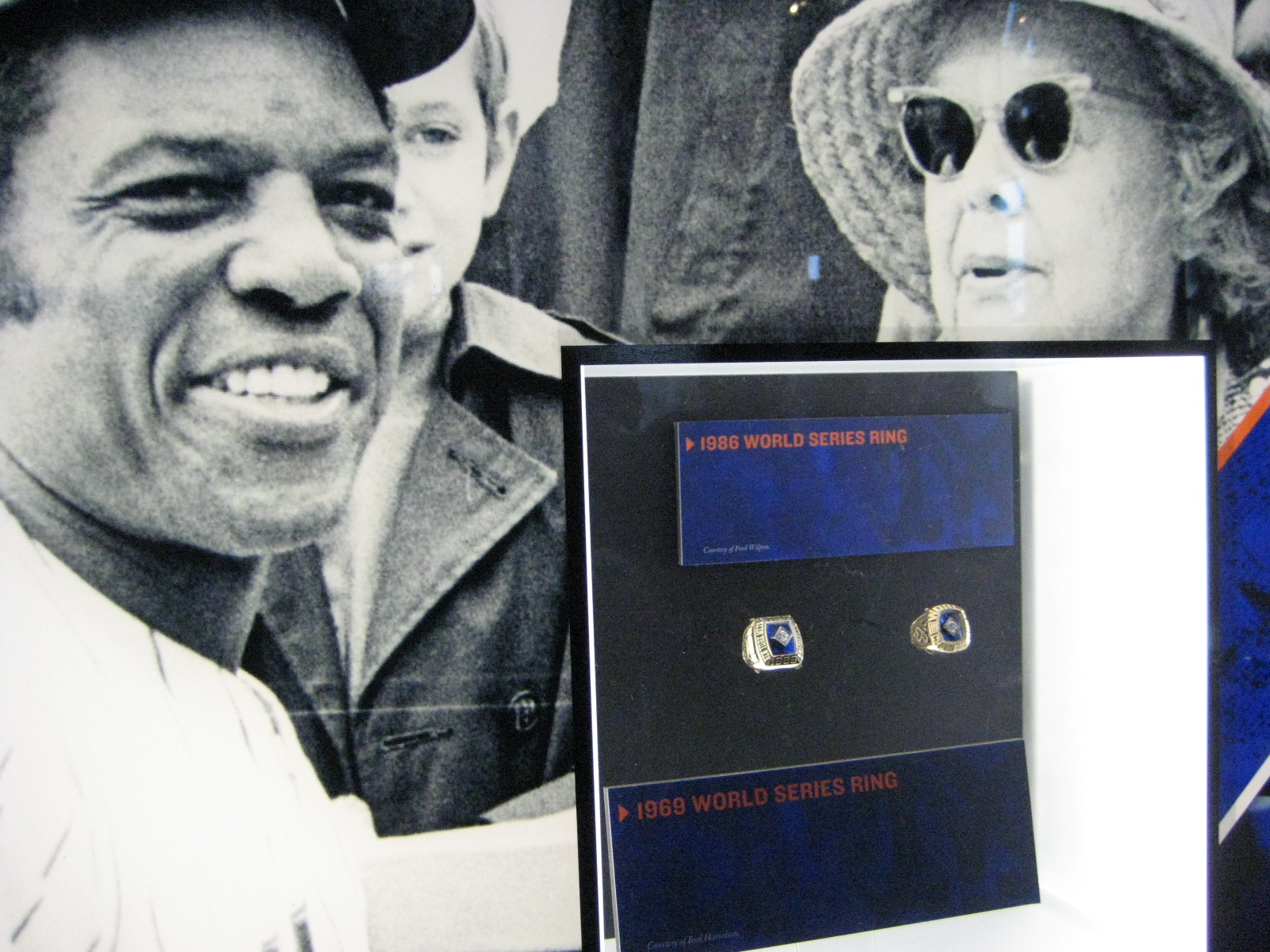
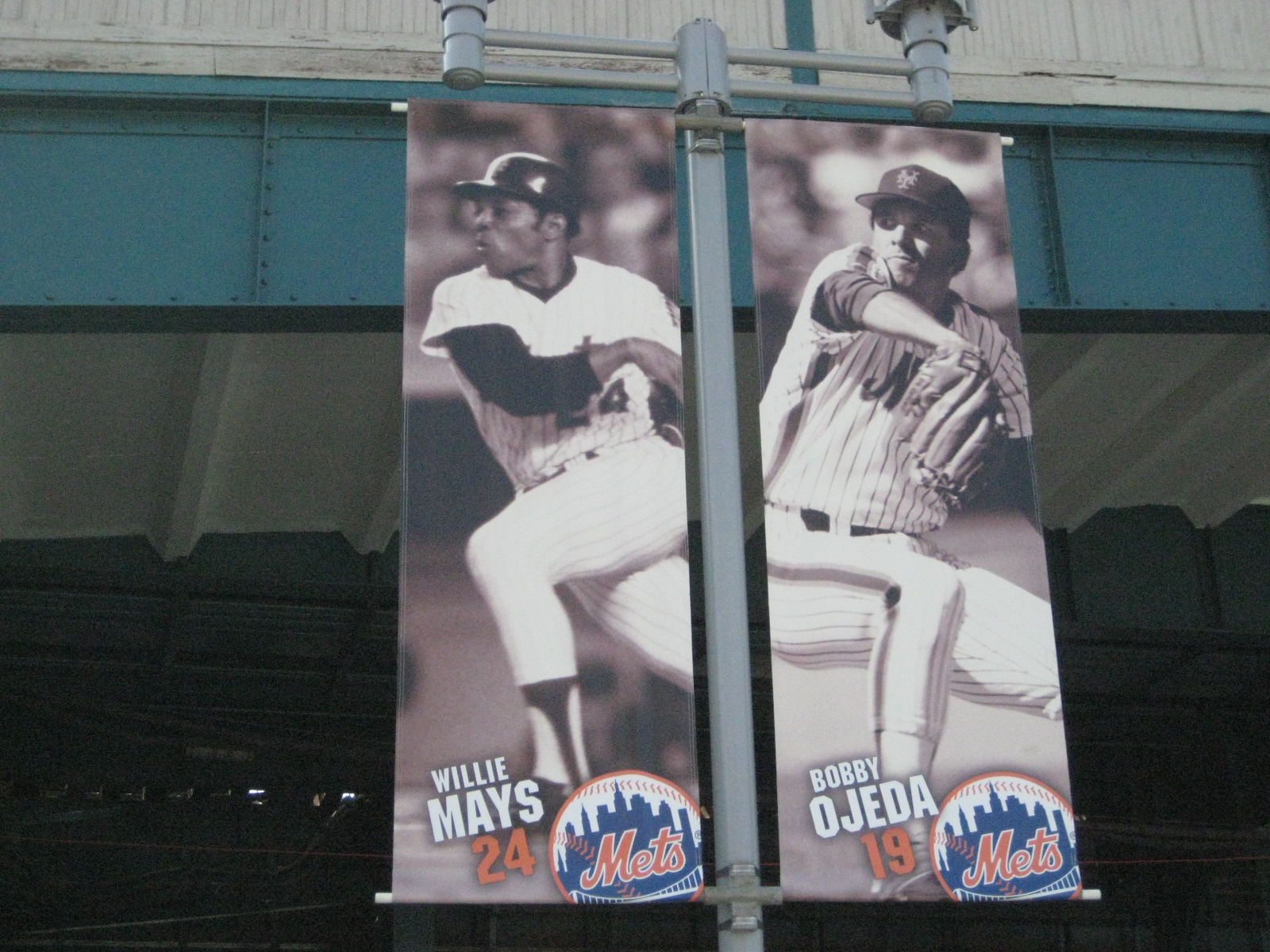
The Mets-Mays connection has been understated over the past 25 years. He has returned to where he finished up twice that I can recall, in July 2000 when the Mets commemorated their 10 Greatest Moments (Willie was given a discrete introduction as part of the ’73 Mets) and when they Shea’d Goodbye in 2008. Willie, in a Mets batting practice cap, came out third-from-last, just after Darryl and Doc, just before Mike and Tom. He was received enthusiastically both times. In St. Lucie, there are three thoroughfares named for Met legends: Tom Seaver Curve, Gil Hodges Road and Willie Mays Drive. In Mets Plaza, if you come down the back stairs from the 7 train, the first two player banners on the first lamp post you encounter portray Bobby Ojeda and Willie Mays. In the montage of images that fill the Mets Hall of Fame, there’s one very nice one of Willie Mays chatting with Joan Payson. His 1973 Topps card has been spotted on the Field Level alongside Jerry Koosman’s, Bud Harrelson’s and those of other beloved Mets.
And of course No. 24 almost never makes it out of mothballs. Kelvin Torve famously wore it for a few minutes in 1990 until an outcry ensued and Rickey Henderson, not too shabby a player himself, donned it as a player and coach.
I’m not going to advocate here for the retirement of Willie Mays’s number by the Mets. Oh, I think it should have happened years ago, and that if Lindsey Nelson had announced on Willie Mays Night in 1973 that no Met would ever wear it again, New York would have nodded and roared. But given how emotional the issue of number retirement is, particularly among this notoriously insecure fanbase (What about Mike? What about Keith? We can’t multitask!), I don’t see it happening. The vague non-retirement retirement of Willie Mays’ number carries its own cachet at this point anyway.
I am, however, here to advocate for something to be done to honor Willie Mays at Citi Field. A real honor, not just an incidental “he played here, too” type of thing. There’s no shame in sharing a lamp post with Bobby Ojeda, but the Willie Mays who electrified New York in the 1950s, glowed on every occasion here in the 1960s and absolutely lit up the Metropolis’s face in the 1970s deserves something more.
 Bobby gets to spend lots of time with Willie. Give us a day when we can hang out with the Say Hey Kid. We who love and appreciate the breadth and depth of New York National League baseball deserve something more.
I have a few ideas.
The Say Hey Concourse. Center field was Willie’s address at the Polo Grounds and Shea Stadium. Let’s rename the area behind center at Citi for the man who defined it. All you need is a sign, a few pictures from ’51 to ’57 and ’72 to ’73 and you’d have a marvelous bracket to complement the Jackie Robinson Rotunda. The great Dodger at one entrance, the great Giant/Met at another. The tradition of New York National League baseball spoken loud clear from front to back. Talk about strength up the middle. And if you’ve ever stood out there and tried to have a conversation while music is blasting and burgers are cooking, you know you pretty much have to say “HEY!” to have any kind of conversation.
The Catch Installation. As you can read in detail here, artist Thom Ross created an incredible five-piece monument to one of the greatest catches in New York postseason history (right up there with Endy in left and Rocky in right) and it needs a permanent home. What better place than where National League baseball continues to be played in New York? Given the dimensions of the Citi Field outfield, what better statement to make than honoring on our premises The Catch Willie Mays made in a park — the one where the Mets were born — a mere Triborough Bridge away? The San Francisco Giants are having a Catch bobblehead day this year. Let’s do them four better and show that The Catch was no kitsch.
(And while we’re at it, let’s restore the Tommie Agee home run marker high above left field. Like Mays’ 1954 run, catch and throw off Vic Wertz, the only fair shot to the Upper Deck at Shea deserves to live on even if its environs were torn down.)
Willie Mays Day. The Mets gave him a night in the Polo Grounds. The Mets gave him a night at Shea Stadium. Let’s complete the trifecta. Let’s have a day for him next month, the afternoon of May 9, three days after Willie Mays turns 79. Why then? It’s the Giants at Mets, and it’s Mother’s Day. What an opportunity to recall both Mays and Mrs. Payson. There’s no other promotion scheduled, so let’s do it. Let’s reach out ASAP to the Mays camp. Make a contribution to the Say Hey Foundation, Willie’s cause for kids. Promote the book (an authorized biography) on the scoreboard that weekend. Make this happen. The Mets have really elevated their historical game in Citi Field’s second season. Take it higher. Bring in the greatest ballplayer most people who saw Willie Mays will swear they ever saw.
In 1999, the Mets held a night for Hank Aaron, who played against the Mets. They held a night for Ted Williams, who retired before the Mets ever played. There was no good reason for either but they were both lovely gestures in the spirit of love for baseball. Ralph Kiner got a night three years ago for no other specific occasion than it was an excellent idea to pay tribute to Ralph Kiner. The timing of Willie Mays Day to coincide with Mother’s Day and the Giants coming is helpful, as is the release of the book, but there’s no reason needed to do this beyond he’s Willie Mays, he defined New York baseball and he was and is one of ours.
Willie Mays said “hey” to this city nearly sixty years ago and to this franchise almost forty years ago. Let’s say it back one more time.
by Jason Fry on 12 April 2010 8:00 am On Saturday Emily and I were watching the game upstairs with my visiting parents, while Joshua was downstairs looking at the TV in our bedroom. (I don’t remember why this came about — he wasn’t being punished or anything. Unless you count watching the Mets as punishment, which right now I’d have trouble disputing.)
So Rod Barajas smacks his liner to left, Willie Harris dives for it, and Willie Harris being Willie Harris, it winds up nestled safely in his glove. We all groan, and I let a couple of obscenities fly. For obscure reasons involving this digital thingamabob and that digital doohickey, the downstairs TV is a couple of seconds behind the upstairs one. As shock and anger give way to grumpiness, we hear a little moan from downstairs. A minute later Emily finds Joshua lying on our bed completely still, head mashed into the covers.
Yeah, it was that kind of loss.
When the kid came upstairs, I asked him if he remembered the first time he saw Willie Harris in a game. He shook his head, and I reminded him: You were four years old. You and I went to Shea. It was really hot. The Mets fell behind against the Braves and came almost all the way back in the ninth, and Carlos Delgado hit one over the fence — and one of the Braves caught it.
“I remember that!” he chirped.
“You know who that Brave was?” I asked. “It was Willie Harris.”
When my kid is really interested in something he kind of looks at you for a moment and then gets quiet and stays that way. So it was on Saturday. I could see the wheels spinning around in there: Willie Harris isn’t a Brave anymore but a National and Carlos Delgado is gone and I’m a lot older but Willie Harris is still killing us. (I didn’t even tell him about Ryan Church.)
Fast-forward a day, and Emily and I are glumly watching the Mets finish mailing it in against that tomato can Livan Hernandez and the Zimmerman-less Nats. K-Rod nails Harris in the elbow and we watch the vaguely amusing, vaguely embarrassing semi-near-brawl — until Joshua realizes who the batter is and starts howling for blood. The kid is screaming at him for sticking his elbow in, for not getting out of the way, for saying mean things to K-Rod … basically, for being Willie Harris.
We hope our shared fandom will bring our children joy, and sometimes it does. But in making our kids into fans we’re also asking them to stick their innocent fingers into emotional light sockets over and over again. We’re signing them up for 60 days of disappointment a year even when things go swimmingly. It’s really kind of sick — sick to put our children through it, and sick to be not so secretly proud when they arrive at each new station of the fandom cross.
My kid now has his first Spike Owen, his debut Robby Thompson, his initial Brian Jordan. And he’ll never forget him. He’ll be in his late twenties and notice Willie Harris is the Diamondbacks’ third-base coach and his significant other will be left to wonder why the sight of some old coach pulling on one ear has provoked her beloved to spluttering rage. And then he’ll text me and maybe I’ll apologize for having done this to him. Though it’s more likely that I’ll laugh, and we’ll both hope that some Diamondback smashes a hard liner that catches Willie Harris in the seat of the pants. And then does so again.
by Greg Prince on 11 April 2010 7:13 pm I wonder how many Ollie Perez starts Johan Santana would have to make to have me look at him in anything but awe. Even after he gave up five runs in five innings Sunday, when I saw him giving postgame interviews, all I could think was, “There’s the man who threw a three-hit shutout on three days’ rest with everything on the line the second-to-last day of 2008.” And I reflexively swooned.
We Mets fans might hold grudges, but we also cling to goodwill for quite a long time if given anything at all to which to cling. Of course Johan has given us some very nice days since 9/27/08, including last Monday, so his benefit of the doubt is heftier than anybody else’s on the team. He might give up another grand slam like the one he gave up to Josh Willingham en route to an inarguably dispiriting defeat, but I’ll never give up the image of him being The Man against the Marlins when it counted most.
The rest of this team has a shorter leash. Jeff Francoeur is surely lengthening his — what an arm, and what a lousy 90 feet of baserunning from Adam Dunn in the third; Mike Jacobs finally earned a link in the chain for the first time in almost five years (he always did hit well at home in losses to the Nationals on Sundays); and never let it be said Raul Valdes has ever done anything wrong in a Mets uniform, but overall this was a cheerless game at the end of an erratic homestand, to put it kindly.
Baseball being baseball, the 2-4 Mets are not far removed from being the 4-2 Mets. Tatis is a little quicker or shrewder Wednesday night, and that’s a win. Barajas is schooled in the dangers of hitting it to Harris Saturday, and that’s a win. If that’s the case, we’re talking about a team that either clubs teams to death (as the Mets did Monday and Friday) or one that never says die and finds ways to win.
Sadly, they didn’t find ways to win the games they lost and they have died four times, if indeed a team can be said to have encountered death after six games. By the one-third measurement discussed here recently, the Mets have won one game they were going to win (Opening Day), lost two games they were going to lose (today and Thursday, because how are you supposed to touch the likes of Livàn Hernandez and Burke Badenhop?) and are 1-2 in those games that determine your season, slotting the Pelfrey game, which was 2-2 entering the seventh, in this category. It’s an inexact science, but based on what we’ve watched, 1-2-1-2 reads about right.
There are some encouraging signs around this team. Jeff Francoeur is a six-game superstar to date, and that’s on top of his solid second half last year. Rod Barajas has demonstrated a pulse, a bat and a presence behind the plate. The unknown quantities comprising the bulk of the bullpen — Igarashi, Takahashi, Nieve, Mejia and now Valdes — have acquitted themselves mostly well. Frankie Rodriguez saw fit through those awesome goggles to answer Willie Harris’s yapping (if he wanted to hit you, he would have found your back, not your inside elbow) and I only wish the minor kerfuffle that ensued would have found heretofore yappy Brian Bruney taking one from K-Rod. A few other Mets have played fine to dandy for moments or stretches, and that is fine as well as dandy.
On the other hand, whatever the starting pitching occasionally has going for it, length has not been among its attributes. No starter has seen the seventh from the mound. One can accept that the first time through the rotation if one isn’t too demanding, but now we go to Coors Field, where bullpens tend to get leaned on, and Busch Stadium, where Mt. Pujols looms in the distance. Our lineup in any given deficit situation has been a disheartening exercise in anticipation. Depending on the daily configuration — which is to say whether Francoeur is batting fifth or sixth — you take a deep breath and hope something happens with the batters who are best described as “…and the rest” à la the Professor and Mary Ann before the Professor and Mary Ann earned their own ID in the The Ballad of Gilligan’s Isle.
Best news? Six goes into 162 27 times. The first 1/27th of the schedule has not been optimal. Yet it’s the last 26/27ths where the stories of seasons are told.
|
|