The blog for Mets fans
who like to read
ABOUT US

Faith and Fear in Flushing made its debut on Feb. 16, 2005, the brainchild of two longtime friends and lifelong Met fans.
Greg Prince discovered the Mets when he was 6, during the magical summer of 1969. He is a Long Island-based writer, editor and communications consultant. Contact him here.
Jason Fry is a Brooklyn writer whose first memories include his mom leaping up and down cheering for Rusty Staub. Check out his other writing here.
Got something to say? Leave a comment, or email us at faithandfear@gmail.com. (Sorry, but we have no interest in ads, sponsored content or guest posts.)
Need our RSS feed? It's here.
Visit our Facebook page, or drop by the personal pages for Greg and Jason.
Or follow us on Twitter: Here's Greg, and here's Jason.
|
by Greg Prince on 19 March 2010 11:24 pm Welcome to Flashback Friday: Take Me Out to 34 Ballparks, a celebration, critique and countdown of every major league ballpark one baseball fan has been fortunate enough to visit in a lifetime of going to ballgames.
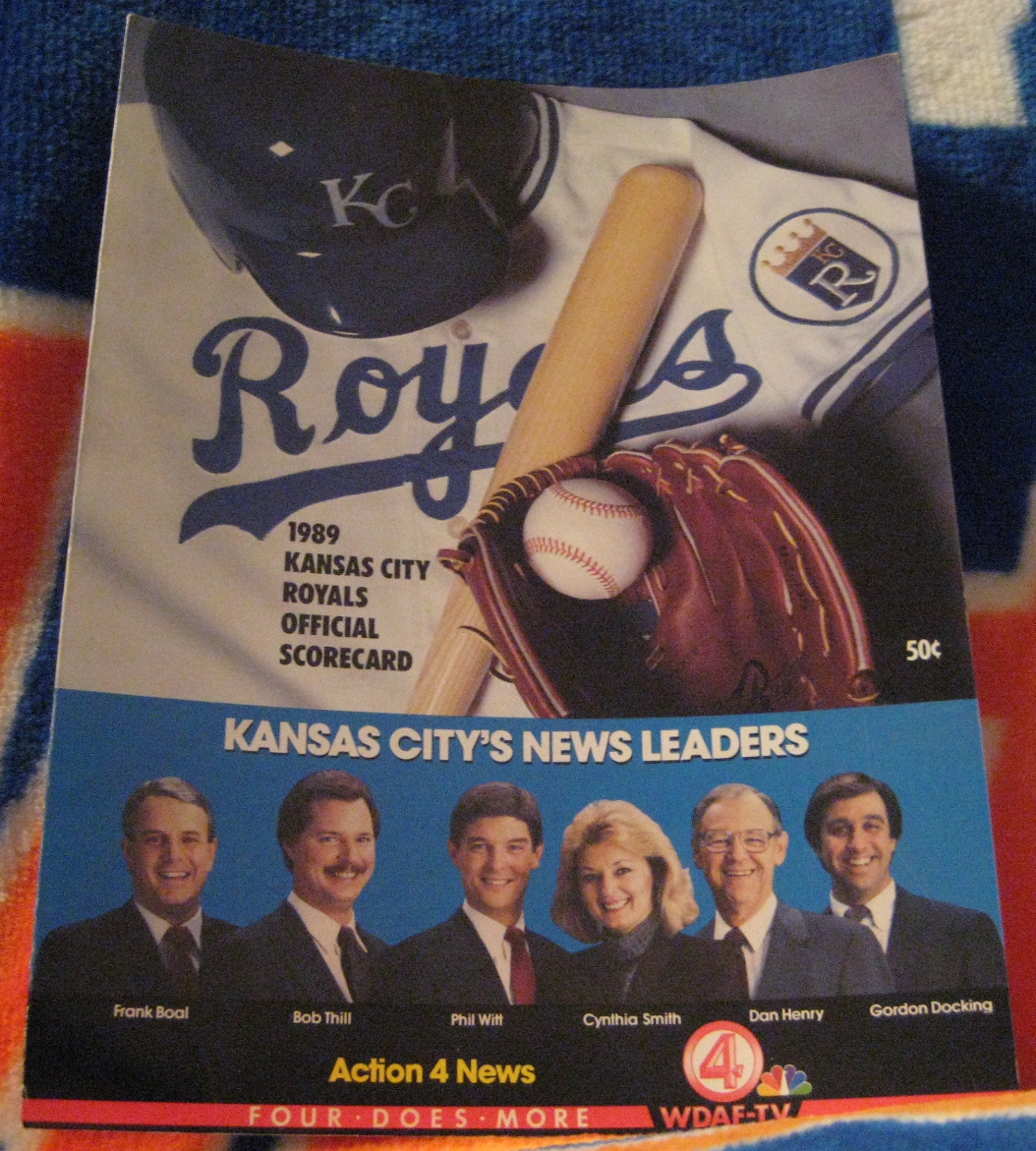
BALLPARK: Royals Stadium
LATER KNOWN AS: Kauffman Stadium
HOME TEAM: Kansas City Royals
VISITS: 1
VISITED: August 11, 1989
CHRONOLOGY: 7th of 34
RANKING: 32nd of 34
This is it? This is the big deal? This is the baseball-only ballpark that everybody’s been raving about since it opened in 1973? This is the place I just had to see?
What a disappointment.
Thirty-four ballparks I’ve been to, and I’d say Royals Stadium, as it was called until mid-1993 when it was renamed for owner Ewing Kauffman, was the only one that felt like an out-and-out letdown. I didn’t expect much from Olympic Stadium. I had no expectations for Jack Murphy Stadium. Royals Stadium was different. Royals Stadium was always different, at least when it was a one-of-a-kind major league edifice.
It wasn’t multipurpose when everything was multipurpose. It had fountains beyond the outfield wall when there was usually nothing beyond anything. It was a dedicated park for a dedicated team, a team of which I’d grown fond from a distance for dedicating itself to battling and eventually beating the team I really wanted to lose.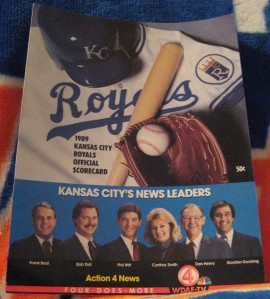
Rooting for the Royals was a rite of autumn when I was in junior high and high school. Four times from 1976 to 1980, the ALCS put down stakes in Kansas City — the playoffs and the Yankees. What the Orioles or Red Sox couldn’t do in the regular season I had hoped the Royals could take care of before things got out of hand. KC did what appeared to be its best, taking the first three of those 3-of-5 championship series to five games, five games and four games, never quite stopping the Pinstriped Cur, but usually slowing it down in entertaining fashion. Finally, October 1980, and a three-game sweep for Kansas City. If you listen closely, you can still hear George Brett’s death blow home run off Goose Gossage traveling to its third solar system. It felt really good, speaking as a totally impartial observer.
And those Royals Stadium fountains. On TV, always with the fountains spouting that water between innings. So classy — just like the Royals themselves. The Royals, in case you weren’t alive or sentient three decades ago, were once a model franchise. They grew their own stars, they kept together their team, they contended every year and they attracted large crowds. They were the small-market success story of their time, except nobody used that phrase. On a level playing field, the Royals prevailed more than most.
When I got to Kansas City in the summer of ’89, the Royals were in their coda period of being that franchise, spending much of the summer in a three-way dogfight with California and eventual A.L. West champion Oakland. They’d finish with 92 victories, more than they garnered when winning their only world championship in 1985, more than in any season since their first pennant season in 1980. They drew 2.47 million to Royals Stadium, their most ever.
They drew me from a long ways away one night in August.
You don’t just show up in Kansas City from Long Island. You plan for something like this. If you can, you plan on somebody else’s dime — legitimately, of course. Five months before game night, I had begun a new job that, to my delight, gave me two legitimate reasons to be in the general vicinity of Kansas City in August…if you count Tulsa and Wichita as right next door. Which they’re not, but you take what you can get when you’re starting from 1,112 miles to the north and the east.
I should point out there was a little more than the Royals and a multitiered business trip involved in my thinking 21 years ago. My lovely wife, who was then my lovely long-distance college-student girlfriend, has her roots in Kansas. Back then, her equally lovely grandmother lived in the town of Augusta, outside of Wichita. A visit by Stephanie, then living in North Fort Myers (Florida) to Grandma was tentatively on the docket for summer. Thus, we put our itineraries together.
If you can see her in the second week of August, I schemed, then I can come out there and see you and meet Grandma, because there’s a meeting of the National Conference of State Legislatures — which addressed municipal solid waste issues, a reasonably big deal to my magazine’s readership — in Tulsa. Tulsa’s 130 miles from Wichita, but that was a chip shot compared to our usual separation (Long Beach to North Fort Myers: 1,070 miles). And then, I added, there’s some research firm outside Kansas City whose principals we can drop by to interview and photograph — they did a study on recycling I wrote about, so it was a real story, not just a lame excuse to spend the weekend upon the Great Plains — and, gosh, as long as we’re right there, the Royals will be home that Friday night.
So to sum up, Stephanie would fly from Fort Myers via St. Louis to Wichita. I would fly from JFK via St. Louis to Tulsa. Then I’d drive from Tulsa…no, check that, I’d have to fly, since car rental return fees across state lines were exorbitant. So I was flying from JFK to St. Louis to Tulsa, staying in Tulsa to cover the NLCS conference there — with a detour to Muskogee to visit with a soft drink bottler (the magazine I worked for loved profiles of soft drink bottlers) — and then flying from Tulsa to Wichita. I’d drive from Wichita to Augusta and then, the next day, Stephanie and I would light out for Overland Park, Kansas, home of the suddenly exciting research firm. When we were done with all that, we, like the Toronto Blue Jays, would visit Royals Stadium.
This was a lot to go through just to attend a baseball game without paying for the airfare. But what’s the point of, well, anything if it can’t lead you to a ballpark?
A few recollections of my extended pregame warmup:
• I arrived in Tulsa late on a Tuesday night. The National Conference of State Legislatures was as big a draw there as the Royals were in KC. The car rental place had two vehicles left for me to choose from. One was a stick shift, which I couldn’t drive. One was a minivan, which was taller than anything I’d ever driven. Future bloggers couldn’t be choosers. I went with the minivan.
• Once I adjusted to the minivan, it wasn’t strange at all driving it the 46 miles to Muskogee. And it wasn’t strange, either, that I was in the same town Merle Haggard rhapsodized over as “a place where even squares can have a ball.”
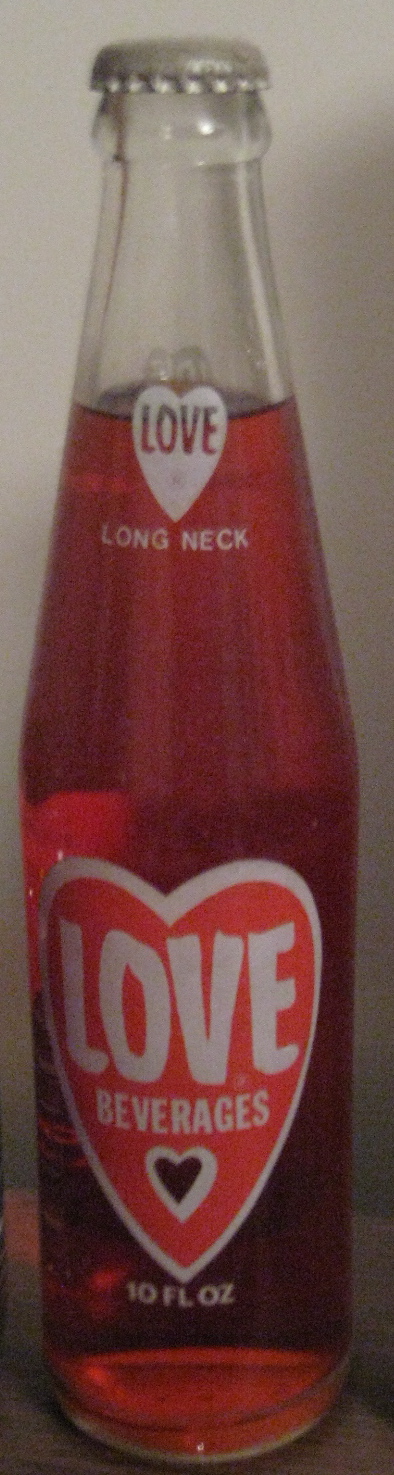
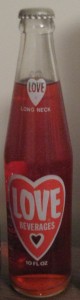 • The company I visited, in addition to being aligned with a couple of major national brands, made its own soda (or “pop”): Love Beverages. Because I loved beverages, the GM was kind enough to weigh me down with a half-dozen ornate bottles. No problem finding space for them in the minivan, but I did a lousy job of shipping them back to the office. Several broke in transit, but I still have one, displayed not ten feet from where I sit at this very moment. • The company I visited, in addition to being aligned with a couple of major national brands, made its own soda (or “pop”): Love Beverages. Because I loved beverages, the GM was kind enough to weigh me down with a half-dozen ornate bottles. No problem finding space for them in the minivan, but I did a lousy job of shipping them back to the office. Several broke in transit, but I still have one, displayed not ten feet from where I sit at this very moment.
• When I returned to my motel in Tulsa, I flipped on CNN Headline News and learned Gary Carter went 4-for-4 at the Vet while I was off getting some Love. It raised his average all the way to .152, but for one scorching afternoon in Philly, the Kid could still swing it.
• The next afternoon, I set off alarms at Tulsa airport security because I attempted to board my flight to Wichita with a pair of box cutters. I had purchased it at a Builders Square as part of my feeble bottle-packing efforts. Security told me I could keep the box cutters but I’d have to take the blade out. I told them they could keep the whole thing (like I knew how to put a new blade in anything). Twelve years, one month and one day later was the next time I heard about an airplane, box cutters and security — which, sadly, wasn’t so vigilant on September 11, 2001.
• The flight from Tulsa to Wichita, with a stop in Parsons, was harrowing. It was on a prop plane, the only time I’ve ever been on one of those. We bounced the entire journey. The stop in Parsons (Kansas, in case you were wondering) was essentially a drop-by in a field. I don’t think anybody got on or off. I clutched my copy of The Boys of Summer tightly and kept my eyes glued to Roger Kahn’s prose until I could make it to the Wichita airport in one frazzled piece.
• After a night at Grandma’s (where I slept on the fold-out couch), Stephanie and I took off on our 153-mile journey from Augusta to Overland Park. We showed up at the research firm, me the reporter, Stephanie as my “photographer”. It must have seemed a bit much to our interview subjects, considering their relationship to the industry I covered was peripheral at best. One of the principals kept asking, “Why are you here?” Hey, I wanted to answer, any publicity is good publicity. It wasn’t until the professional portion of our meeting was over that I mentioned our evening plans included Royals Stadium, but I didn’t let on that that was why we were there.
• Overland Park had (and still has, I just confirmed) a Steak ‘n’ Shake, my favorite dining option in the world. I fell in love with Steak ‘n’ Shake in Tampa when I was a college freshman and being reunited with the Double Steakburger With Cheese Platter was almost as sweet as being reunited with my girlfriend. Almost.
• Kansas City, Kansas seemed just as good an option to find a place to stay as Kansas City, Missouri, even though the Royals played in the latter. Maybe we just found it first. In any event, we spotted a Holiday Inn in a gritty part of town and checked in. Strikes me as odd that I put so much thought into this trip ahead of time and then just winged it on a hotel room.
I’d say I went to a lot of trouble to get to Royals Stadium, but how can it be trouble when there’s baseball at the end of the Yellow Brick Road? Still, it was a lot of motion, and for that much motion, I would have liked to have been overly impressed.
Overland Park overly impressed by having a Steak ‘n’ Shake. Royals Stadium didn’t impress at all. It sat in a parking lot off I-70, same road the Cardinals took en route to losing the ’85 World Series. It kept company with Arrowhead Stadium, home of the Chiefs. Just dump all your stadiums in one place, I thought — how convenient.
Paid attendance Friday night was over 40,000. The Royals were hot stuff to Kansans, Missourians and maybe Oklahomans. It was a long walk through the lot to the park. Then there were ramps that looked like the ones they had at Giants Stadium and Joe Robbie Stadium. They dominated the landscape. Shea had ramps but they didn’t jut out the way these did. I was surprised at just how distracting the banks of ramps were. They kept the Chiefs in a separate facility, but this didn’t feel all that “baseball-only”. I guess when I heard “baseball-only,” I thought of Fenway and Wrigley.
This was a multipurpose stadium in soul if not practicality. The artificial turf (replaced by grass in 1995) didn’t help. The schlep up to the top rows of the upper deck — I’d bought the seats in June, but the Royals were very popular — was frustrating, too. The Royals monarchical scoreboard was unique, but the fountain’s charms wore off quickly. Middle of the second: fountains spew water. Top of the third: fountains spew water. By the fourth, we got it.
We felt far from the action and, despite sitting in on a battle of two highly regarded pitchers — Bret Saberhagen for the Royals, Mike Flanagan for the Jays — were generally disengaged from the competition in question. This was the second time in two months that I’d been to a game that offered me no clear rooting interest. We were willing to loan ourselves out to the locals for the evening despite coming in with no allegiances (although Grandma had mentioned the night before something about having seen the Kansas City Athletics way back when), but I found myself unmoved by the Royals. And I liked Royals fans a lot more when they were rooting against the Yankees on TV. In the abstract, they were good, solid citizens. In the row behind us, they were confounding.
We overheard a father and his two sons. The younger son, at some point in the middle innings, inquired of his pop (not “soda”), “Dad, can we make a bat?”
I knew what the answer would be. I mean I knew it had to be some G-rated, Middle American variation on “What are you, a schmuck? You don’t make bats. Hillerich & Bradsby makes bats. Why, I oughta…” But maybe I was projecting, because that’s not what the dad said at all. No, he indulged what I considered to be the stupidest question I ever heard at a ballpark.
“Well, son, we could do that. We’d have to get a piece of lumber and put in a vise and…”
YOU’VE GOT TO BE KIDDING ME! YOU’RE NOT GOING TO MAKE A BAT!
Or are you? Builders Square and its line of box cutters pretty much befuddled me, but maybe out here in the heartland they really did this kind of woodwork for kicks. Maybe they make bats in their garages. Maybe Royals Fan, Jr. went home and crafted his very own Wonderboy.
But I doubt it.
The Royals chased Flanagan in the eighth and scored a bunch of runs off Duane Ward. The home crowd was properly appreciative. I was surprisingly bored. Thousands of miles in every direction just to get here and I said to Stephanie, “Wanna get out of here?” She wasn’t exactly campaigning to see Saberhagen get the complete game. On the way to the massive parking lot, I remembered one other thing that supposedly set Royals Stadium apart from all other ballparks. They sold baseball cards there. They had kiosks. As we wound down our ramps, I thought I saw one. I did.
But it wasn’t all that great, so we resumed our long march to the car. I obligatorily put the ninth inning on the radio and heard Saberhagen figuratively do what we had geographically done to share this evening with him — go the distance — and then it was back to the other Kansas City for Pizza Hut and trying to sleep through a ruckus outside our window. Like I said, we were in the gritty part of Kansas City, Kansas.
Saturday morning, before heading west to Grandma in August, we crossed state lines once more to see the Truman Library in Independence, stopping beforehand at a Denny’s on the other side of the Interstate from Royals Stadium. From I-70 you could see the WORLD CHAMPIONS 1985 designation still proudly displayed behind the KCR crest that served as scoreboard. We had the Grand Slam Breakfast, which seemed a perfect complement to our baseball experience. If the ballpark were a 24-hour chain restaurant instead of a ballpark, I imagined it would serve relatively agreeable food that you could find anywhere off any highway. A few exits after the fact, you might remember the food. You might remember the fountains. Or you might remember overhearing some preposterous conversation about making your own bat. Soon enough we bade goodbye to the Denny’s of the American League.
It was no Steak ‘n’ Shake. It was Royals Stadium.
Caryn Rose of Metsgrrl fame has seen a few ballparks in her time and offers up her own assessments and photographs at Down The Line. Check it out here.
Jeff Wilpon recently built a ballpark and generally knows how to get things done. See what he’s up to here.
And don’t forget AMAZIN’ TUESDAY returns to Two Boots Tavern on the Lower East Side, March 23 at 7:00 PM. Details here.
by Greg Prince on 18 March 2010 7:44 am In Willie Mays: The Life, The Legend by James Hirsch (which I’m about 130 pages from finishing, which is too bad, because I don’t want it to end), Willie tells a pack of reporters inquiring about the Giants’ pennant chances during Spring Training of 1961, “There’s a feel in the air.” One of his confidantes in the press corps asked Willie why he trotted out a line he used every spring.
“Well, there is a feel in the air.”
“That’s what you said last year.”
“Was a feel in the air last year.”
“And the year before.”
“Feel in the air then, too.”
“Matter of fact, you think this way every year around this time.”
“I know it,” Mays said.
Mays’ confidante, Charlie Einstein, then suggested he might have done the unwitting reporter who took “feel in the air” as gospel a favor and explained that he always said it.
Willie told Charlie, “He only asked about this year.”
The Giants did not win the pennant in 1961. The Mets aren’t exactly a favorite to win much in 2010, but I have to tell you I feel a feel in the air, and I wouldn’t have said so last year or the year before.
This doesn’t have to do with finishing in what they used to call the first division. This doesn’t have to do with finishing anywhere at all. This is about a fresh start. I realize there may be a few too many stale slices of bread in the bag to necessarily avoid becoming toast once the season begins, but I sort of don’t care.
Just as I didn’t care that we were nominal favorites the last two Marches when I felt mostly dread about what lay ahead.
Perhaps the first sustained taste of spring in the Long Island atmosphere is doing it. Perhaps it’s that every time I turn my figurative antenna toward Port St. Lucie it’s pulling in images of Mejia and Davis and Martinez and a flock of kids. I don’t generally have a lot of faith in Met youth or those who tend to it, but the time has come to reach out and touch faith. The can’t-misses in our midst haven’t missed yet. There’s always 2012 or some future date to recall what disappointments those highly hoped upon rookies of 2010 became. I’m not there yet. I’m loving Jenrry and Ike and, to a certain extent (though he didn’t seem altogether sound during our exposure to him in toxic 2009) Fernando. Even if none of them is on the Opening Day roster, I’m loving that they’re around.
Should they be on the Opening Day roster, any of them? My default response is set on “don’t rush them,” whoever “them” happen to be, but this March, I am so ready to move on from how the Mets usually put together a team that I wouldn’t mind if each brought a note from his parents and joined on us on this six-month field trip. Of course I worry about Jerry Manuel overusing Mejia (there’s nothing more dangerous than a desperate manager with a new toy) or Davis hitting .189 in April or F-Mart falling down in center and throwing to the wrong base once he gets up, but I also worry that if they are sent out of our sight, worse things will happen. Nobody seems to have risen to the majors from our minors in the past five years without being scathed somewhere along the way. I don’t know what my babysitting would do for them, but I’d feel better, somehow, if I could keep an eye on them.
Whether they’ll be here when the season starts is almost immaterial to me. They’re here now. They’ve made it the first spring in ages in which I don’t feel we’re going through the motions. These kids make me watch these games. That whole bit about “we’ll be sick of watching exhibitions”? It hasn’t happened yet. I welcome extended glances at the likes Jenrry Mejia and Ike Davis and Fernando Martinez.
I also welcome those stories about how Jeff Francoeur and Jason Bay are Solid Clubhouse Presences who are Taking The Pressure Off David Wright. Those attributes won’t matter if they’re not hitting, but for now, those are fine qualities to find in teammates. Who exactly was taking the pressure off anybody, particularly David, on this team before?
Francoeur and Bay are reminding me a bit of Robin Ventura and Todd Zeile being the answer men to the beat guys while Mike Piazza quietly went about the business of being fabulous one decade ago. We’ve had veterans around David, but not guys who seemed to enjoy being spokesmen (or who could manage to smile while doing it). I’m well aware of the perceived and actual shortcomings of Francoeur and Bay as players — performance speaks loudest of all — but as of March 18, they’ve not failed at anything they’ve done as Mets. They, like the kids, have made this a sunnier spring.
No, I don’t know who’s going to pitch effectively behind Santana. I really liked what I saw out of Hisanori Takahashi the other day. Perhaps it’s the novelty, but I’d welcome him into the rotation ahead of guys whose upsides we know or those whose upsides don’t strike me as too terribly tall. That, again, could be the spring talking, but in Takahashi, we may have actually stumbled upon the Japanese starting pitcher who doesn’t disappoint us. Meanwhile, Pelfrey pitched well yesterday and talked even better: “I think one day I’d like to become an actual pitcher.” I like the self-awareness. I like location more. Maybe he’s hinting at an upside that will finally measure up to his height.
These are scattered impressions and selective ones at that. The starting shortstop is still in two-to-eight week purgatory. The five-tool center fielder is blocks away from Home Depot. Ollie Perez remains an international man of mystery. A DP combo of Alex Cora and Luis Castillo conjures visions of white balls skittering onto green grass. The same people who run the organization haven’t surrendered the keys, which means the ride will certainly have its share of bumps again and the brakes may not work properly and the floor mats might get stuck underneath the gas pedal. But it’s not March 2008 when I couldn’t get past September 2007. And it’s not March 2009 when I couldn’t get past September 2008.
It’s March 2010. There’s a feel in the air, and this time it doesn’t feel like acid rain.
Come one, come all to the first AMAZIN’ TUESDAY of 2010, March 23, 7 PM, at Two Boots Tavern on the Lower East Side, as we read aloud, rally around and try to raise a few bucks for the Tug McGraw Foundation. Details here.
by Greg Prince on 17 March 2010 4:36 am It’s St. Patrick’s Day today, which was an annual favorite of the great Met — and Phillie — relief pitcher Tug McGraw. With a name like McGraw, perhaps it was inevitable.
“I made an effort to get back to Clearwater each spring even after I retired from the Phillies,” McGraw said in his memoir Ya Gotta Believe! (written with Don Yaeger), “because the people there, like me, love to celebrate St. Patty’s Day.” There would be a Major League Baseball Players Alumni Association old timers game, a party to benefit the Children’s Hospital in nearby St. Pete and, not surprisingly, beer.
Tug planned to make it to the March 17 celebration in 2003, but he encountered an unwanted detour. On March 12, he first experienced the symptoms that turned out to be the brain tumor he’d fight for the next ten months before dying in January 2004. Seven years later, work to make lives better for those enduring similar ordeals go on in his name at the Tug McGraw Foundation.
Faith and Fear reader Sharon Chapman has devoted herself to raising funds for the Foundation while training to run in the New York City Marathon with Team McGraw. She gives her feet a chance to test the Manhattan pavement this Sunday by participating in the New York City Half Marathon. When she crosses the finish line downtown, she will be wearing her Faith and Fear in Flushing wristband in a nod to the community of Mets fans who are supporting her and Tug’s cause.
We are delighted to be playing a small part in Sharon’s quest on Tug’s behalf, and this Tuesday, we will be dedicating our first AMAZIN’ TUESDAY of 2010 to pitching in. Come to Two Boots Tavern on the Lower East Side, 7 PM, for our recurring reading and rally series and buy a signed copy of the newly released paperback edition of Faith and Fear in Flushing: An Intense Personal History of the New York Mets — featuring an epilogue that covers the first season at Citi Field — for $10; all proceeds will be directed, via Sharon, to the Tug McGraw Foundation.
Jon Springer of Mets By The Numbers and I are also happy to welcome our special guests, Edward Hoyt, who wrote with depth and feeling about the 1969 Mets in The Miracle Has Landed; and Frank Messina, author of Full Count, a moving and inspiring collection of Mets poetry. Sharon will be on hand, too, to tell us how the Half Marathon went and what’s next for her and Team McGraw.
And, per a great tradition established by Two Boots proprietor Phil Hartman, bring a Mets baseball card for a free beer. The pizza’s pretty good, too.
Celebrate Tug McGraw, celebrate Believing, celebrate your Mets fandom, celebrate a late St. Patrick’s Day, celebrate the approach of Opening Day. Join us March 23, 7 PM, for AMAZIN’ TUESDAY. Two Boots Tavern is located at 384 Grand St., between Norfolk and Suffolk. You can take the F to Delancey; the J, M or Z to Essex; or the B or D to Grand. Phone: 212/228-8685.
Learn more about Sharon Chapman’s run for Tug here. Find out more about the Tug McGraw Foundation’s mission here. And, if you’d like, you can support the effort here.
I’ve been honored to have received wonderful reviews from around the Metsosphere for Faith and Fear in Flushing: An Intense Personal History of the New York Mets. The latest, from the relentlessly logical Mike Steffanos of Mike’s Mets, makes me particularly proud.
And speaking of great Mets synonymous with St. Patrick’s Day, visit Eddie Kranepool Society and read all about Bob Murphy’s nomination for induction into the Irish American Baseball Hall of Fame at Foley’s NY Pub & Restaurant. Tug McGraw is a charter member.
Finally, because it’s quite enlightening, get the scoop from the top at Jeff Wilpon’s Video Blog. Betcha didn’t know what updates are in store for Mets uniforms this year!
by Jason Fry on 15 March 2010 4:50 pm Today I made up my mind: I was going to nip and tuck some assignments and duties and to-dos and do something I’ve done too little of this spring. Namely, I was going to watch my team play some baseball.
My team didn’t disappoint — a walk-off home run is always fun, even if it doesn’t really count because there’s a gale force wind howling out to right and, um, it doesn’t really count. I was happy to see K-Rod on the mound again (and agree the goggles make him look more intimidating, even though that may make Keith Hernandez burn down my house) and Chris Carter at the plate and get a look at Ruben Tejada and just generally happy to watch guys with METS across their chests play baseball. I was even happy to watch Luis Castillo hit a 26-hopper slightly to the left of the shortstop for 110 feet worth of single.
I was happy. But I was also forcing myself to be happy. LOOK! SPRING TRAINING! YAY! SAY YAY! IT’S EVEN DAYLIGHT SAVINGS TIME AGAIN! BE HAPPY! HAPPY, DAMN IT!
Part of that is the usual mid-March malaise — the dead-arm periods and reassignment of guys who weren’t going to make the team anyway and moaning about how long April is taking to arrive and wondering which of the three or four spring combatants we’ll get slightly more sick of today. (I never want to see the Cardinals again, despite being neutral about most all of them except the thuggish Brad Penny and the eternally irritating Tony LaRussa. I can’t say the same about the Marlins only because I loathe the teal-clad welfare queens of MLB on general principles, and repeated exposure just makes me twitch a bit more.)
That part’s familiar. But the other part of the malaise isn’t. It comes from having the calendar turn to 2010 and immediately getting months 13, 14 and 15 of 2009. And that’s the part I can’t shake. Sunshine and palm trees and numbers in the 70s usually help with not talking about the past, but not this year. The past is all too present.
I shouldn’t say this given that the majority of Mets are still able-bodied, but you would have been hard-pressed to program a more-depressing offseason for this team so far. Jason Bay aside, the Mets front office spent the winter stumbling around as if they were confused, broke or both. If they weren’t bidding against themselves for eminently replaceable players, they were failing to even pick up the phone to contact guys they were supposedly interested in. (Even with Castillo parked at second, this rotation would look so better with Joel Pineiro in it.) The Mets then managed to get in an embarrassingly public feud with Carlos Beltran, an episode that made it obvious that the team’s own players don’t trust it to handle injuries. And now, the usual buzzard’s luck: If I’d told you last November that Jose Reyes and Frankie Rodriguez would be shelved by a thyroid condition and pinkeye, respectively, you’d have laughed and taken me to task for such broad satire. Yeah right! And then Jeff Francoeur will go on the DL with river blindness!
Seriously, can you think of an offseason more perfectly designed to keep the horror of 2009 fresh and keep us from the park in droves? I guess it could be worse if Ray Ramirez stabbed David Wright with an icepick, but that aside, our worst-case scenario is alive and kicking. And hey, it’s not even St. Patrick’s Day. When the Mets ticket people call with their cheerful scripts, I just talk about the economy and the kid. It seems kinder than calling attention to the utter disaster in the making.
I’m trying. I really am. I’m trying to focus on the “2” part of 2-to-8 weeks and not the “8.” I’m trying to remember that Angel Pagan was pretty good last year and Fernando Martinez looks older and wiser. I’m trying to remind myself that Oliver Perez is inthebestshapeofhislife and Johan looks healthy and if our luck evens out we’ll be rolling 7s and 11s until the felt’s worn off the tables. I’m trying to channel the Faith and ignore the Fear.
But it’s hard. Even on days that end with walk-off home runs and Tony LaRussa looking more sour than usual, it’s hard.
by Greg Prince on 15 March 2010 4:33 am Rod Barajas is getting the treatment a Wise Veteran Catcher usually gets in Spring Training when he’s new on the team. He’s leading by example and changing the tone and offering guidance, which is exactly what we want to read this time of year after having just experience that type of year last year. He’s the “adjunct professor of catching,” according to David Waldstein of the Times, leading daily tutorials for the benefit of his brothers in shinguards. Mets take a bus across the state only to get rained out? It wasn’t for naught, Barajas told Waldstein:
“We got to talk and have fun and get to know each other. We watched The Hangover and laughed together.”
We fans love stuff like that. If the Mets get off to a fast start in 2010, we’ll be falling all over ourselves praising The New Togetherness and how Rod Barajas, all head and heart (if not, by the looks of him, wheels), played a major role in eradicating the isolation of 2009, by teaching, by talking and by DVD selection.
Though if the Mets suck, nobody will remember any of that.
Thing about Barajas is whatever he does, he’s probably going to have do it right away. He signed a one-year contract as an obvious stopgap measure. Nobody else (and there were plenty of bodies around when camp started) was deemed suitable for starting behind the plate more than now and then or, in Josh Thole’s case, now. Rod Barajas could ingratiate himself to the organization and stick around, but he seems destined, if he and we are lucky, for six-month rental. Thus, this is shaping up as the Year of Rod Barajas.
Literally.
Barajas is the most obvious candidate to join an unintentionally exclusive club, that of the New York Mets who have been One-Year Wonders. They are Mets players who meet the following criteria:
• On the active roster for exactly one calendar season and, if applicable, postseason
• Never off the active roster while the Mets are playing baseball
• No Disabled List trips
• No being sent down to the minors
• No military reserve duty (for when that was an issue)
• No being a Met in any prior year
• No being a Met in any succeeding year
For Barajas to join the club, he’d have to hold steady as a Met from April 5 through October 3 through, theoretically, whenever the Mets finish their playoff and World Series run (from our mouth to Rod’s ear). He gets put on the shelf, it doesn’t count. He gets released or traded, it doesn’t count. He sticks around in 2011, it doesn’t count.
If Barajas fulfills the terms of his contract to a tee and never signs another one, then he’s a member of a most eclectic order in Met history. Only 41 Mets have qualified as One-Year Wonders in 48 Met years. Some of them distinguished themselves quite memorably. A few of them veer more to notoriety than notable accomplishment. Unless you were around in their particular years, a few more you’ll probably be familiarizing yourself with here for the first time. Some you’ll surely remember. Some you’ve completely forgotten.
The first One-Year Wonder dates to Year One, 1962, and he was a most legendary Original Met: Richie Ashburn. He was the first Met to come to bat; the first Met to hit .300; the first Met to make an All-Star team; the first Met voted team MVP (most valuable player on the worst club imaginable); the first teammate to convince Marv Throneberry to be Marvelous rather than morose; and the first Met to understand the notion of quitting while ahead. Whitey retired after 1962 and became the sixth Met to be inducted into the Hall of Fame.
But he wasn’t the only One-Year Wonder to gain that honor. Ashburn was preceded into Cooperstown by a second-year One-Year Wonder, Duke Snider, the Mets second-ever All-Star. Duke’s single-season stay as a Met, however, wasn’t quite as stellar as Richie’s, or at least not as relatively rosy. True, Duke came back to New York (albeit one borough over from where he made his mark), launched the 400th home run of his career as a Met as well as a walkoff blast for his 399th — and, as all viewers of Mets Yearbook: 1963 know by now, he was given a night at the Polo Grounds. But Snider’s Met tenure wasn’t what he wants to be remembered for. He finished the season 38, gray, out of shape and, the Duke would likely agree, out of sorts. Visiting the SNY booth in advance of one of Shea’s Jackie Robinson tributes a few years ago, Snider was happy to recall his Brooklyn teammate but took a pass on remembering his one year as a Met. It wasn’t even the end of the line for Snider, as the classic Brooklyn Dodger hooked on with the (gasp!) San Francisco Giants for one more go-round in ’64.
There were loads of Brooklyn Dodgers on those early Mets, yet, until Willie Mays was brought home in 1972, former New York Giants shareholder and original Met owner Joan Payson employed only one pre-1962 Polo Grounds denizen as an active player. He was Eddie Bressoud (rhymes with “et tu?”), a One-Year Wonder from 1966. Unlike Snider and Gil Hodges or, to a lesser extent, Clem Labine and Don Zimmer, the lone New York Giant to play as a New York Met in the 1960s arrived with no nostalgic overtones. But that didn’t stop him from making a little history for his new New York club. Eddie’s 10 home runs in his one year as a Met were the most by an Amazin’ shortstop until Jose Reyes slugged 19 in 2006.
1966 was quite a year for One-Year Wonders, as Bressoud had company behind him and in front of him on the diamond. Billy Murphy played 41 games in center, 84 games in all for manager Wes Westrum. Lefty Bill Hepler pitched in with 37 appearances (34 in relief). Both Bills came due in ’66 because they were each Rule 5 draftees in December ’65, Murphy from the Yankees, Hepler from the Senators. Rule 5 means you stay even if you don’t play — and if you don’t stay on the drafting team’s major league roster, you are obligated to be offered back to your old team for a pittance. Whatever talent the Bills had, each was young and each wasn’t ready, not even for the 95-loss 1966 Mets (who were, by far, the best team in Mets history to that point). Neither would be back in ’67 on the Mets’ or any other Major League roster.
Rule 5 explains the presence of several One-Year Wonders, including 1967 catcher John Sullivan, 1967 outfielder (and emergency catcher) Tommie Reynolds and 1991 southpaw fire hazard Doug Simons. Their lack of production presumably explains why there was no second Met year for any of them, though they each resurfaced in other venues.
Hard to explain, however, why neither Bill Wakefield nor Randy Tate ever got a second big league look from anybody else. Righty Wakefield was a One-Year Wonder and workhorse for Casey Stengel in 1964. His 62 appearances (58 out of the pen) established a Met pitching record that stood for 13 seasons. They’re also the most by any pitcher who spent no more than a single year in the majors. Tate, also a righthander — and nearly the first Met to throw a no-hitter — was the fourth starter behind three pretty fair arms in 1975: Tom Seaver, Jon Matlack and Jerry Koosman. Wakefield pitched two more years in the Met system before leaving the game. Tate gave pitching three more years, hanging ’em up in 1978. For his trouble, Wakefield, along with 1964 teammate Steve Dillon, was tabbed to throw out a first ball at Citi Field last July (once the Daily News nudged the Mets enough). Tate, meanwhile, remains an object of fascination for obsessive Mets bloggers of a certain age.
It’s hard to think of Tommy Davis, the outfielder who was the embodiment of the phrase “well-traveled ballplayer,” as a One-Year Wonder. Davis’s distinguished career encompassed parts of 18 seasons and stops with 10 different clubs. One of his postings, however, was all of 1967 with the Mets. Davis made the most of his season in the sun, leading the Mets in almost every offensive category and earning, as a tenth-place Met, an eighth-place National League MVP vote.
The Brooklyn native was the kind of guy you’d have wanted the Mets to have kept a little longer, but he went away in a good cause, traded to the White Sox with Jack Fisher for a couple of Miracle workers to be, Tommie Agee and Al Weis. As Agee and Weis acclimated themselves to New York, they played alongside lefty reliever and One-Year Wonder Billy Short, one of the handful of mainstay 1968 Mets (34 appearances) manager Gil Hodges and GM Johnny Murphy decided they could do without as they set their strategy for 1969.
While it seems that the lesser-accomplished Mets teams are the squads that generally harbor One-Year Wonders — infielder Felix Mantilla of the 40-120 1962 Mets; catcher Norm Sherry of the 51-111 1963 Mets; and outfielder George Altman of the 53-109 1964 Mets, to name three — OYWs have dotted a few Met postseasons. None did so with more impact than the Most Valuable Player of the 2000 National League Championship Series, Mike Hampton. Mike was money in clinching the pennant on a three-hit shutout of the Cardinals, which is appropriate, since it was money that made him a Met in the first place. He had one year left on his Houston contract, and the Astros’ thrifty owner, Drayton McLane, had no intention of re-signing him.
The Mets attempted to secure Hampton’s services beyond 2000, but the lefty’s legendary fealty to excellence in education led him to Denver…and Steve Phillips to take a break from his sex addiction to sign Kevin Appier to a bloated four-year, $42 million contract. That Appier pitched for the Mets only in 2001 hints at how that worked out.
Hampton was preceded as a postseason One-Year Wonder by Orel Hershiser in 1999. Anybody with any memory of 1988 knows Orel’s gutty innings against Atlanta in the NLCS led the league in irony. In 2006, two relievers who solidified a reliable bullpen were One-Year Wonders clear through to third week in October: righty submariner Chad Bradford and lefty long man Darren Oliver. Oliver’s six innings in relief of the ultimately useless Steve Trachsel in Game Three of the ’06 NLCS was a particular lifesaver. Both men were unsung components of a division champion. One wonders what might have happened after 2006 had GM Omar Minaya whistled Oliver’s and Bradford’s tune a little longer.
Instead, Minaya hummed a few bars of righty journeyman Aaron Sele, a One-Year Wonder whose fault the collapse of 2007 wasn’t — but who didn’t contribute any answers across 34 mostly uninspiring relief appearances. His blueprint for inconsequential Metdom was perfected four years earlier by Jay Bell. Bell, like Sele, had been a two-time All-Star but was far removed from that stature when he incongruously finished up as a Met. Bell’s One-Year Wonder year was 2003, a 66-95 debacle that while not defined by Jay’s .181 average in 72 games wasn’t exactly enhanced by it either.
Three other One-Year Wonders made their One Year their last year as well: third baseman Bob Aspromonte, 1971 — the last Brooklyn Dodger in the majors; pinch-hitter Mike Cubbage, 1981 — seven-game manager at the end of 1991; and infielder John Valentin, 2002 — of whom I have to confess I didn’t fully realize wasn’t the same guy as Jose Valentin until we got one and then the other.
At the conclusion of 1976, it appeared Mickey Lolich would fall into the retirement subcategory of One-Year Wonders, but Lolich fooled us. Instead of leaving baseball, he just left the Mets. After sitting his doughnut-making ass out in 1977, Lolich resurfaced as a Padre for two bonus seasons. And to think, all he cost us was Rusty Staub.
Some One-Year Wonders were conceived as solutions for long-running problems. Instead they became short-term headaches. Aspromonte, for example, was supposed to solve third base. He didn’t. Nor did the third baseman before him, Joe Foy, who throughout 1970 gave the Mets every reason to regret trading Amos Otis to land him. At the other end of the decade, third base was still a problem, so the Mets acquired the eager-to-please Richie Hebner in 1979. Foy and Hebner were more One-Year Poxes than Wonders, but we don’t have a separate category for those.
We do have a separate category for Lost Boys Found — Met minor leaguers who had to leave the organization to become major leaguers but then got a second chance to be real, live Mets. Two LBFs became OYWs: outfielder Jerry Morales in 1980 and infielder Fernando Viña in 1994. They both played in seasons when One-Year Wonders were on the prowl at Shea.
No Met pitcher won more games in 1980 than righty Mark Bomback, though Bomback’s total was 10, which takes the edge off win leadership, and his 191 hits allowed in 162.2 innings didn’t exactly represent a hallmark of triumph. In 1994, utility infielder Luis Rivera spent one full season as a Met, though he might deserve an asterisk, since 1994 ended abruptly when the players struck on August 12. Rivera was used so infrequently (7 appearances in 52 games from June 21 to August 10), that it’s wholly plausible he might not have lasted as a Met into September. Then again, grudge-holding manager Dallas Green could bury a player pretty deeply without ever removing him from the roster, so we’ll consider Rivera legit.
Several One-Year Wonders did a pretty nice job and, in hindsight, were just as well on their way before a second year could besmirch the our vague positive impressions of them. Desi Relaford was an all-around valuable utilityman in 2001 and managed to throw a beautiful inning of relief against the Padres in an otherwise dispiriting twelve-run loss; Mark Guthrie ran counter to two nettlesome Met trends by getting lefthanded batters out as a Met lefty specialist and by being any good at all as a 2002 Met; Tony Clark popped 16 homers in 2003 as a part-time first baseman but truly connected when he gallantly ripped the 00 off his uniform in deference to Mr. Met; and Brent Mayne forever became a Prince household name when the Daily News ran a Sunday piece detailing how the backup catcher of 1996 regularly rode the 7 train to Shea and other trains elsewhere around the city. To this day, I say “Brent Mayne” to my wife, she says, “The guy who took the subway.”
And, nowadays, the guy who writes a pretty good blog.
Dwight Eisenhower famously said of his vice president in 1960, when asked what major policy idea GOP presidential nominee Richard Nixon had contributed to his administration, “If you give me a week, I might think of one.” Well, I’ve had 32 years, and I’m stumped when it comes to telling you anything Tom Grieve did as a spare Met outfielder in 1978 other than endure as a One-Year Wonder. But I can tell you that he spent quality time on the bench next to another of Joe Torre’s generally untapped reserves and they became fast friends. Seven years later, Grieve was general manager in Texas and gave his old buddy his first managing job. So on some level, we have Tom Grieve to thank for the best parts of the late ’90s and early ’00s…a.k.a. the Bobby Valentine era.
On the other hand, we have nothing for which to thank 1975 One-Year Wonder Gene Clines as far as I can tell. Clines was going to bring the Met outfield and offense much-needed speed. After one season (4 stolen bases, 4 times caught), he sped out of town. And we owe even less gratitude to 1989 One-Year Wonder righty reliever Don Aase, who gave up the killing blow of his year, a top-of-the-ninth, season-altering home run to the Dodgers’ Willie Randolph on August 20. If it’s not as remembered or reviled as Terry Pendleton in 1987 or Mike Scioscia in 1988, it’s because even Mets fans can only remember and revile so much.
We’ve penciled in Rod Barajas as our best bet to be our next One-Year Wonder — or the first One-Year Wonder since the already exceedingly forgettable Jeremy Reed in 2009. He’s the guy who, while attempting to man an unfamiliar position, made one of the worst plays of last year, yet it wasn’t even the worst play of the game in question. Barajas will not want to have a season like Reed’s, specifically as it pertains to his manager’s deployment of him. Reed played in 126 games in ’09 but started in only 24 of them, or about 19%. From what I can tell, no Met who has ever played in that many games in a season has been a starter so rarely. Considering how few consistently healthy outfielders Jerry Manuel had at his disposal, it’s very strange that Reed was almost strictly limited to second-line duty. He wasn’t a pinch-hitter deluxe and there was no immobile slugger in front of him who regularly merited a spot in the lineup, complete with his own defensive caddy. The more I think about it, the less it says about Reed’s 2009 (which was fairly indifferent) and the more it hints at how Manuel tends to write off his personnel.
The template Barajas is most likely to follow was that crafted by Rick Cerone during his One-Year Wonder-ful stay as catcher in 1991. Cerone was, à la Barajas, the grizzled backstop who would instill the Mets with that certain something. Truth be told, Cerone, who turned 37 that May, didn’t instill a whole helluva lot during his 90 games receiving and pinch-hitting, but he did have one shining moment.
It was August 21, a twinight doubleheader against the Cardinals at Shea. In the preceding months, the Mets had altogether stopped being the Mets as we had known them, falling from contention with a thud. They spiraled from 53-38 to 57-60 and looked worse than their 4-22 record indicated. They made it 4-23 by dropping the opener of that twinbill. At last, in the nightcap, the Mets poured on six runs in the seventh and took an 8-0 lead on St. Louis. Pitcher Willie Fraser, who had just surrendered in succession an intentional walk; an RBI single; a three-run homer; and a solo homer, took out his frustrations on the next Met batter, Howard Johnson. HoJo was hit and made a move toward the mound. But that’s all it was: a move — a feint. Just like the 1991 Mets, it appeared HoJo might do something but, in reality, was content to settle for nothing.
Not Rick Cerone. As captured by Bob Klapisch and John Harper in The Worst Team Money Could Buy:
Rick Cerone…sprinted out of the dugout. […] Now here he came, racing toward the mound, with both teams in pursuit. Cerone wasn’t particularly big or strong, but he was so angry that when Pedro Guerrero stepped in front of him, Cerone bowled him over. He reached Fraser and connected with at least one good punch before disappearing in a sea of players. “Had to do it,” Cerone would say later. Sometimes you just have to do it. We’ve just lost eleven games, we’re finally winning one, and some guy is going to throw at our best player? You can’t let that happen.”
One good and purposeful punch…a pretty decent metaphor for a One-Year Wonder.
***
In case some names have occurred to you with the thought that surely they should be included in this categorization…
• Derek Bell, who came to the Mets in the same Astro-nomical salary dump as Mike Hampton, was on the roster all of 2000 but suffered an injury during the NLDS and was removed for the NLCS and World Series. By having a longer year than most Mets, he missed out on One-Year Wonder status.
• What do Mark Bradley (1983), Dick Schofield (1992) and Doug Linton (1994) have in common? They were added to the roster very early in their Met seasons and persevered the rest of the way, but were not here on Opening Day. No One Year Wonder-ing for them.
• There are Mets who make it out of Spring Training but at some point are redirected to the minors before bouncing back up, and alas, away once their season ends. A few examples of this phenomenon: Mike Bruhert (1978), Paul Wilson (1996), Satoru Komiyama (2002) and David Newhan (2007).
• Kevin Mitchell’s seven games as a September 1984 callup disqualified him from becoming the only World Champion One-Year Wonder after he was traded for our own good in the wake of his helping us win the 1986 World Series. (He is, however, a Comma Met in good standing — a Met whose years played cannot be properly punctuated with only an en dash…but that’s another category for another time.)
• As we learned in 2009, the Disabled List can be a killer, not just of Met seasons but of One-Year Wonder status. J.J. Putz, Gary Sheffield and Tim Redding will each forever be associated with the 2009 Mets (until you forget them completely), but none is a One-Year Wonder because all were removed from the active roster at some point. Others whom you may associate with a given year but spent time on the DL: Miguel Cairo (2005); Doug Mientkiewicz (2005); Kurt Abbott (2000); Bill Spiers (1995); Pete Smith (1994); Mike Draper (1993); Bill Pecota (1992) and the not quite One-Year Wonder granddaddy of them all, Elio Chacon (1962).
• To learn about Mets who make One-Year Wonders look like Ed Kranepool in terms of Met longevity, I recommend a visit to Moonlight Graham Mets, which is devoted to profiling Mets who played in only one game as Mets.
Yes, there is somebody else out there who thinks a lot about this type of stuff.
by Greg Prince on 14 March 2010 4:52 pm Wonderful profile from Brian Costa of the Star-Ledger on the more than humble background of dream closer (or perhaps starter) Jenrry Mejia:
Six years ago, Jenrry Mejia did not own a glove. He did not have a bat. He had no use for a ball.
The tools of his trade were a brush, a piece of cloth and a container of shoe polish. That was all Mejia needed when he left his house in Santo Domingo each morning and walked 30 minutes to the downtown cafe where he made his living.
On an island where baseball is like a religion, Mejia preferred shining shoes for 300 pesos a day, the equivalent of about $8.
Jenrry Mejia may appear to be The Natural reincarnated, but he didn’t start playing ball until he was 15 years old, a mere five years ago. There was no money in baseball when he was kid. He had to shine shoes to make a living.
Mejia grew up in a neighborhood called Herrera, near what was once Santo Domingo’s primary airport. He lived with his parents and his younger brother.
“Mucho pobre” is how Mejia described the area. Very poor.
Mejia started shining shoes when he was 11. He didn’t necessarily enjoy the work, but he took pride in earning money when other kids he knew were picking pockets.
“I didn’t want to steal,” he said.
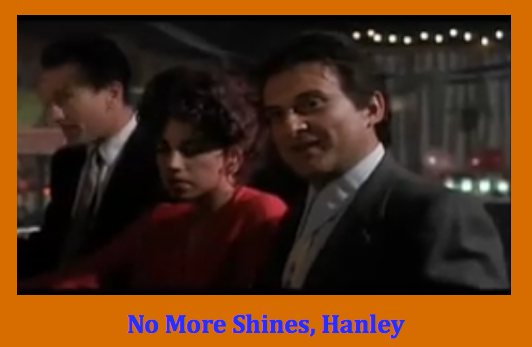
He may not and maybe should not make the Mets as soon as I want him to — which is right this very minute — but he’ll be earning plenty before long if all goes right with our world (for a change). And when it does, and our good fella is facing, say, the Marlins, I look forward to him delivering a salient message to the first big Fish he sees.
by Greg Prince on 13 March 2010 4:35 pm This talk of Jenrry Mejia starting the season as the setup man for K-Rod is ridiculous. If the season starts today, Mejia’s my closer.
Oh, if talent only made it so.
It won’t happen that way, but Jenrry is looking inevitable. It will take a bad case of evitablity — or yet another wave of Prevention & Recovery — to keep him off this team, assuming the way Mejia’s pitches move isn’t a mirage. Only an OutKast among Mets wouldn’t say, “I like the way they move.”
I sure hope I’m not seeing Julio Machado or Josias Manzanillo or Ju-ever out there when I look at Jenrry Mejia. I penciled those fellows in as oughta-be closers in their day based on larger samples. Alas, their day never really came. Jenrry Mejia Day is coming, though, and April 5 is as good a date as any to hold it.
Frankie Rodriguez needs to work the pink out of his eye. Let him set up Mejia like he set up Troy Percival long ago, back when K-Rod was unhittable (back when K-Rod was Jen-Mej). Let Parnell work the seventh. Let Sean Green park cars.
by Greg Prince on 12 March 2010 8:00 pm Welcome to Flashback Friday: Take Me Out to 34 Ballparks, a celebration, critique and countdown of every major league ballpark one baseball fan has been fortunate enough to visit in a lifetime of going to ballgames.
BALLPARK: Jack Murphy Stadium
LATER KNOWN AS: Qualcomm Stadium
HOME TEAM: San Diego Padres
VISITS: 1
VISITED: June 20, 1996
CHRONOLOGY: 16th of 34
RANKING: 33rd of 34
I think it would be pleasant to go to a public park, find something to eat, watch some guys play ball and maybe wander around a bit. It was pleasant, actually. Stephanie and I did that at Jack Murphy Stadium.
Pleasant beats unpleasant every time. But pleasant’s not the same thing as big league, and there was something about seeing a Padres game in their original home that felt less than major. It wasn’t bad — pleasant can’t be bad — but it didn’t fill me with anything approaching awe.
Did I mention the pleasant factor was off the charts?
In my travels, I’ve had my expectations unmet and I’ve had my expectations exceeded. At the Murph (which it was still called in 1996, thankfully), I had few expectations. I’d had only one strong image of the place from all those years of staying up late to watch the Mets on the unglamorous stop of their West Coast road trips. It was the night in 1986 when Kevin McReynolds, then a Padre, was batting and he fouled a ball straight back into a square cutout in the backstop. I think it was there for a camera, but it appeared empty, much like the Murph all those late nights. Channel 9 played the disappearing foul over and over again to much McCarver and Zabriskie laughter. McReynolds remained stoic, hinting at the vibrant personality he’d bring to the Mets a year later.
Jack Murphy Stadium was that black, square-shaped hole to me. A mystery, and not one on which I’d expended much concentration as soon as the Mets would leave town. When I formed a squishy goal of someday seeing every major league ballpark, I wondered what on earth I’d be doing in San Diego to get Jack Murphy taken care of. It would have to be part of something bigger.
And it was. The previous December, as an all-encompassing birthday/holiday present to Stephanie and me, my sister and brother-in-law thoughtfully favored us with some of their frequent-flier miles and use of their Los Angeles-area apartment (a.k.a. their de facto West Coast office). They even threw in a few gift certificates to some local restaurants. Truly they are sweethearts that way. Natch, as non-fans, they’d been camping out in Southern California a few times a year for several years by then, and it’s fair to say they never particularly noticed there were three baseball teams operating in the general vicinity.
For us, that was the attraction. It never even occurred to them that was the only reason we graciously accepted their generous gesture. I mean, really, is there something else to do in Southern California?
I studied schedules, found a week when the Angels, the Padres and Dodgers would all be home and put in for vacation time. We flew out in the middle of June for the only reason I can think of spending more than a couple of days anywhere: to visit three ballparks.
San Diego was the middle of the itinerary, a Thursday afternoon against the Cubs. We started out from L.A. in the morning, in unusually fine driving fettle. It looked a little dreary on the way down. Rain in San Diego? Unpossible, as Ralph Wiggum would affirm. That was the notorious Marine Layer we were facing. Ralph Kiner — who is no Ralph Wiggum — informed us that was a staple of San Diego existence, and that it burns off by noon.
Ralph Kiner, former GM of the old Pacific Coast League Padres, was absolutely right. It was sunny and warm in Mission Valley. The stadium was kind of tucked away, but we found it with little ordeal. Security said I couldn’t keep my bottle of water, an accessory I’d begun to carry as a matter of course. I grumbled but dutifully tossed it. Concessions said they couldn’t rustle up a program. I grumbled some more, as I always bought a program in a new ballpark. There were a couple of glitches, but we were in the place with the square hole.
Per usual, I was wearing my Mets cap, which drew the attention of an usher who said something mildly disparaging but harmless, like “Mets? Why?” I explained we were New Yorkers on a baseball tour, that we had been in Anaheim the day before. “It would be nice if the Cowboy could win one of these years,” the usher volunteered. Nice of him to worry about Gene Autry, I thought. Nothing, he said, was going well for the Padres. Indeed, San Diego had gotten off to a fast start in 1996, but losing had set in: the Pads had lost 15 of its last 17 as a 6½-game lead in the West had become fourth place, two games out. Same old Padres.
But it was all new to us. I feigned concern to the usher and we went about our usual stance of rooting for the home team as long as it had no adverse impact on the Mets.
There was some color to the Padres now, and it wasn’t the drab brown that had been their trademark in the McReynolds days. They had a guy walking around dressed as a Friar, and we cheered his appearance. A couple more guys wore skinhead wigs to approximate Wally Joyner’s pate. Wally World had taken his act down the coast in ’96 and was batting .321 before his recent injury (which coincided with the 2-15 skid). We cheered for them, too. We got behind Tony Gwynn (.326 at the start of play) and Rickey Henderson (16 steals in his first year as a National Leaguer) and Chris Gomez (someone I kind of adopted a few years earlier in Toronto, but I’ll save that for the SkyDome entry). We were temp Padre fans.
It was all good fun. After a while, though, it just fell…flat. You know, like watching Kevin McReynolds for too long. Palm Trees had recently been potted over the outfield fence, which was the one architectural distinction to the venue. After a while, you stared at the palm trees and they seemed out of place at a baseball game. That’s when it began to feel like a public park. That’s when we decided to get up and seek out a snack bar.
I’d prepared for this trip as I usually did, with a ballpark guide of some sort. The one I had in 1996 said you’ve gotta try the fish tacos at Jack Murphy Stadium, they’re a local specialty. I try to do the When In Rome things, so off we went in search of fish tacos.
To reel in fish tacos, you went to a special stand, Rubio’s. You could buy ’em and bring ’em back to your seats, but there was a patio full of tables and chairs at which you could enjoy ’em. I’d read about that in the guide book as well. It was rather unorthodox to be at a baseball game and sit somewhere that wasn’t facing the field — the tables and chairs offered a view of the parking lot, with monitors for game action — but we tried it. I didn’t care for not watching the game. And I didn’t really like fish tacos.
Back at our seats, I noticed two more things I’d never before seen at a ballgame. One was a pitch count on the scoreboard. Very big letters and numbers telling us just how many balls and strikes Tim Worrell, Jaime Navarro and the relievers who succeeded them had thrown. At first I was mesmerized. Then I was distracted. I could live without knowing pitch counts.
The other thing was the out-of-town scoreboard which, during the latter stages of the game, began posting notes about the Mets’ game in Cincinnati. The hell with the Padres and Cubs. What were the Mets doing? It wasn’t the first time I eyed an out-of-town scoreboard to keep up with the Mets, but it was the first time I had done so at three time zones’ remove. I was so incredibly confused. The Mets are playing a night game, but it’s bright and sunny and the middle of the afternoon here in San Diego. It’s 4 o’clock? How can that be, when my internal alarm is set to Met Standard? And why won’t they tell me anything beyond the fact that Bobby Jones is facing Dave Burba?
My attention wandered to the banks of the Ohio River, but we still rooted for the Padres, but with less and less conviction. Joynerless and punchless, the locals didn’t score until the eighth, pulling to 3-2 on an eighth-inning two-run blast by pinch-hitter Marc Newfield. The Friar and the Joyners and we applauded heartily. Gwynn led off the bottom of the ninth with a single, stirring things further, but the Cubs brought in that crazy Turk Wendell and he retired the final three Padres. Chicago held on 3-2. San Diego had lost 16 of 18.
We filed out, counterintuitively bought a program by the exit, got in our rental car, checked into the nearby Holiday Inn, grabbed some Chinese Food at the strip mall next door and sprung for The Birdcage on hotel pay-per-view. Next day, we visited the world-famous San Diego Zoo and, in the immortal words of Lobo, motored stately into big L.A.
It was all very pleasant. It was Jack Murphy Stadium.
by Greg Prince on 11 March 2010 3:39 pm Jose Reyes is not running. He’s not swinging. He’s not fielding or throwing. He’s not functioning as a baseball player. We understand today he’s resting. With any luck, he’s healing.
But he’s a Met, so I wouldn’t go that far.
Reyes’s thyroid condition has sidelined him for a truly Metsian prognosis of two to eight weeks. Nobody is sidelined from two to eight weeks. Nobody is projected as out from doing anything — not just playing — within a range of 14 days to 56 days. What this means, I’m going to guess, is nobody really knows what exactly is wrong with Jose Reyes or, more pertinently, what it will take to get him back to being a fulltime Met.
Right now, he’s a ghost, hovering over this organization. He and Carlos Beltran, both still on the roster, neither by any means active, each allegedly en route at some point. When 2009 became 2010, we were told this team would be better than the team before it because we’d have, once again, two of our three indispensable men in the lineup every day. “Don’t count on it,” the little Met voice in my head said. “Don’t necessarily count on guys who played 81 games and 36 games the season before.” I wasn’t ready to count on anybody who missed significant time due to injury, including Santana, Niese, Nieve, whoever. In Beltran’s case, it was the knee then, it’s the knee now. In Reyes’s case, nobody could have seen the thyroid coming. We were worried about hamstrings. The hammies are supposedly fine. The thyroid?
The thyroid?
My mother had a thyroid condition. I don’t think it was overactive; quite the opposite, actually. Reyes is a damn sight more athletic than most people’s moms (and dads). Jose Reyes is as athletic a Met as we’ve ever seen. We look forward to seeing him again, on the run, turning the DP, lashing one into the gap that was theoretically created for him. We look forward to him being as healthy a human being as he can be and, because we’re Mets fans, we’d like that to translate into a permanent return that begins to shape up 14 days from now rather than 56…or never.
In the meantime, I looked at the early innings of today’s exhibition game. Cora was at short, just like a lot of last year. Pagan was in the outifield, just like a lot of last year. Castillo…to be fair, he’s supposed to be at second this year, but he reminded me of 2009, too. It was raining and it was 2009 on SNY. Then the rain got to be too much and they put a tarp on the field and the 1963 Yearbook on the air. It cheered me up. That team won 51 games and was a signpost of progress relative to 1962. Then the rain ended, and 2010 is back on the screen, and it’s just minor league scrubs per Spring Training usual, yet I can’t escape the sense that 2009 is in the clubhouse, getting ready for Opening Day.
It’s a lot closer than Jose Reyes is right now.
by Greg Prince on 10 March 2010 6:20 pm What are you doing Sunday, March 21 and Saturday, March 27? You ought to be getting to better know New York’s baseball heritage. And you can, thanks to our friend historian Peter Laskowich starting up his truly marvelous tours once more.
As we’ve mentioned on several occasions, Peter will bring you directly into the DNA of New York with intertwined journeys into its baseball and into its history. You show up, you take a walk, you take a train — and you end up going places you didn’t know exist.
It’s well worth the time (a few hours that fly by) and the investment (25 bucks — a fair price in general and a bargain by Citi Field standards) to learn where we came from as New York baseball fans and Mets fans.
Peter is an engaging educator and excellent companion (and a Mets fan from the New Breed days). “Tour guide” does not do him justice. He will take you on a tour all right, but it goes beyond “…and on your right, you see a bridge.”
You will see a bridge. And you will see where it leads. And you will follow the trails beyond that. You will understand as you never have before why things are where they are and how they are. You’ll get a good bit of why answered as well.
You’re a Mets fan. You read Faith and Fear. I know you’re ball-curious. Feed that curiosity. Get together with Peter Laskowich over the course of a couple of weekends — the 21st in Brooklyn, the 27th in Manhattan. You’ll be glad you did.
Visit New York Dynamic for more information.
|
|

 • The company I visited, in addition to being aligned with a couple of major national brands, made its own soda (or “pop”): Love Beverages. Because I loved beverages, the GM was kind enough to weigh me down with a half-dozen ornate bottles. No problem finding space for them in the minivan, but I did a lousy job of shipping them back to the office. Several broke in transit, but I still have one, displayed not ten feet from where I sit at this very moment.