The blog for Mets fans
who like to read
ABOUT US

Faith and Fear in Flushing made its debut on Feb. 16, 2005, the brainchild of two longtime friends and lifelong Met fans.
Greg Prince discovered the Mets when he was 6, during the magical summer of 1969. He is a Long Island-based writer, editor and communications consultant. Contact him here.
Jason Fry is a Brooklyn writer whose first memories include his mom leaping up and down cheering for Rusty Staub. Check out his other writing here.
Got something to say? Leave a comment, or email us at faithandfear@gmail.com. (Sorry, but we have no interest in ads, sponsored content or guest posts.)
Need our RSS feed? It's here.
Visit our Facebook page, or drop by the personal pages for Greg and Jason.
Or follow us on Twitter: Here's Greg, and here's Jason.
|
by Jason Fry on 9 August 2023 10:57 pm Oh, how quickly things can change.
Who’d even heard of Phil Bickford 10 days ago? And yet tonight there I was cheering energetically for Bickford to get out of a straitjacket against the Cubs and give the Mets a win — in a rubber game, no less.
I could say I was on the edge of my seat, but honestly I wasn’t — these games are too low-stakes for that level of emotional commitment. Still, I certainly wanted the Mets to win, and there was a pleasure in watching the various machinations aimed at ensuring they would.
Like Adam Ottavino getting excused on a night he clearly didn’t have it, which surprised Ottavino more than anyone else keeping track of events. Though shame on the Citi Field faithful for booing. I’ve never been against booing, but what’s the point of it now? The next game that matters will be in fucking April, so why do that? Ottavino’s struggled for some time when asked to appear in back-to-back games, and he actually wants to be part of the solution, so give the man a pass.
With Ottavino gone and Brooks Raley apparently unavailable, the game was in the hands of Bickford, a shaggy ex-Dodger about whom I confess I know very little. It was quickly apparent that Bickford didn’t have a reliable breaking pitch or the ability to work low in the strike zone, which was a bit worrisome: Changing eye levels only goes so far when you’re throwing nothing but high fastballs.
But Bickford got Christopher Morel on a pitch right in the middle of the plate, one I guarantee Morel will still be thinking about long after you’ve closed your browser window. He then went to work on Ian Happ, with a key assist from Francisco Alvarez, who kept the pitch clock from running down by throwing up his hands and racing out to the mound before time expired. That kept the count a pitcher’s 1-2 instead of a neutral 2-2.
Alvarez reminds me of Rene Rivera, which is an enormous compliment. I loved Rivera for his skill as a pitcher whisperer, coaxing and sometimes bullying balky hurlers across the finish line. Alvarez has a lot of that in him, except Rivera was a veteran nearing his mid-30s, and Alvarez is barely old enough for a legal drink. I’ll be happy when this season has ended, but in the meantime getting to watch Alvarez continue to grow will be a nice fringe benefit.
David Peterson, Abraham Almonte, Grant Hartwig, Josh Walker, Phil Bickford. Maybe it’s not the cast we imagined cheering for when Justin Verlander and Max Scherzer stood atop the rotation, but it’s the cast we have. And for one night, the outcome was worthy of applause.
by Greg Prince on 9 August 2023 2:33 am Some are like summer
Coming back every year
Got your baby
Got your blanket
Got your bucket of beer
I break into a grin
From ear to ear
And suddenly
It’s perfectly clear
That’s why I’m here
—James Taylor
The 2023 Mets have assured themselves they will not be the statistical equal of the 2022 Mets, having notched their 62nd loss Tuesday night the season after they didn’t lose more than 61.
Oh well. I think we knew that was a given.
The 2023 Mets are chasing history, albeit in the wrong direction. By notching their 62nd loss of the season, they have fallen never mind however many games behind whoever holds the final Wild Card slot at the moment. They lag 22 games behind the pace of the 2022 Mets at the 2022 Mets’ very same juncture. After 113 games a year ago, the Mets’ record was 73-40. Currently, it is 51-62. The worst dropoff the Mets have ever experienced year-versus-year for an entire season was 22 games, from 1976’s deceptively encouraging 86-76 to 1977’s Seaver-stripped 64-98. If These Mets don’t win 79 of their scheduled 162 games — and it seems quite likely These Mets will not — that means they will have tumbled at least 23 games in one year, a new franchise mark for a fall from grace.
Oh well. I think we know that is a given.
Any more good news from the Department of Sunshine & Lollipops? Hell yes. I went to the game Tuesday night and didn’t much stress the outcome. Early on, I thought it would follow the pattern set the night before, when the Mets blasted the Cubs, 11-2. My evidence was an RBI double Pete Alonso walloped to deepest center field that first scored Jeff McNeil and then scored Pete Alonso because, lo and behold, that wasn’t deepest center field — that was the black backdrop just above and beyond deepest center field. The EnormoVision replay beaming in concert with the crew chief review made it so clear that the double wasn’t the correct call that Pete was circling third base before an umpire circled a finger to signal home run. I was almost disappointed Pete whacked No. 34. It was kind of pleasant to see him drive home a run with something other than a dinger.
Uptown problems, am I right? We were off to a 2-0 lead in the bottom of the first, and there was no telling how much more we’d strafe Chicago starter Jameson Taillon. I remembered Taillon’s first start in the majors. It came for the Pirates against us in 2016. Like Pete Alonso, Ty Kelly homered off him. It sticks with me because I wrote a theater review of the evening, treating the Mets at PNC Park as if it were an out-of-town opening. You watch a lot of Mets and you write a lot of Mets, you always look for a new Mets angle.
For Tuesday night, I resort to a hardy perennial: The Ryder and Rob Chasin Game, a.k.a. the Bar Mitzvah Game, also a.k.a. the Bar Mitzvah of the Bar Mitzvah Game. Faith and Fear completists will perhaps recall that in 2009 my wife and I were invited to a Bar Mitzvah of a Mets fan who had just read my book about being a Mets fan. We all study for the haftorah in our own way. The Bar Mitzvah celebration would take place at still new Citi Field in the offseason. How could Stephanie and I say no?
One summer later, the celebration continued. Ryder, 13, and dad Rob asked us to join them at Citi Field for the reason the joint was constructed, an actual ballgame. How could Stephanie and I say no? That was a Tuesday night in August of 2010. Every August that Citi Field has been open to spectators since then, always on a Tuesday night (“my favorite Tuesday of the year,” Rob ranks it), we keep the celebration going. It’s 13 years since August of 2010. As Ryder pointed out to me, the Bar Mitzvah Game is itself eligible to read from the haftorah.
The Bar Mitzvah Game’s attendees aren’t necessarily very good at reading the Mets. That 2-0 lead, defended ably by Carlos Carrasco, did not mature the way Ryder did. Ryder was a kid in middle school when I met him. He’s an accomplished content creator now, held back temporarily only by a Writers Guild of America strike he’s dutybound to honor. He’s still a Mets fan. Nothing holds that back, though he admitted he skipped last week’s 0-6 road trip that wound through Kansas City, Baltimore and Purgatory. “I envy you,” I told him. We spent nine innings immersed in Met talk, occasionally pausing to check in on the Mets building upon their first two runs (which they didn’t) and Carrasco doing his best over five innings to make it stand up (which he did but couldn’t). The Cubs eventually tied the score versus Cookie and went ahead off Drew Smith. Taillon seemed to pitch forever. It was only seven innings. Seemed longer.
The Mets did a little threatening in the eighth — two on — and the ninth — Lindor leading off with a single. The threats proved idle. Alonso lined to deep right for the first out of the ninth, leaving Lindor on first and bringing up Daniel Vogelbach. Ryder and I had been moments earlier bemoaning the stubborn presence of Vogelbach on the 2023 Mets’ roster. In August of 2022, Vogey was the right hitter at the right time for a contender, even if he usually required a pinch-runner to complete his rounds. In August of 2023, we don’t celebrate his designated bat any longer. There’s no Terrance Gore, no Tim Locastro to steer his additional 270 feet from first to home should Vogelbach somehow accomplish the first 90 feet. There is Abraham Almonte, the 34-year-old callup we saw make his Met debut, but Almonte is no pinch-runner. For These Mets, Almonte was Tuesday’s starting right fielder.
Buck Showalter, having made all the moves a four-man bench will allow, left us wondering who would pinch-run for Vogelbach in a best-case scenario. Our best-case scenario was Vogelbach walking. Daniel saved us and Buck the trouble of remembering if anybody was left to take his place on the basepaths by grounding to Cub closer Adbert Alzolay. Alzolay turned and fired to Dansby Swanson to force Lindor at second. Swanson relayed to Jeimer Candelario at first. He could have sent the ball via Parcel Post. Vogelbach jogged with the resignation of a weary commuter who knew he wasn’t gonna make that train pulling out of the station regardless of how hard he ran after it, so why even bother?
With the third out and the Cubs’ 3-2 win complete, a young man in a PIAZZA 31 jersey two rows below us took his Mets cap and flung it to the ground in absolute disgust. The fact that he was wearing what I would guess was an authentic vintage garment handed down to him made it all the more poignant, because that fellow in 2023 might as well have been me in 1998. In my case, I threw a half-filled soft drink bottle at a wall in the Loge concourse at Shea. Despite having the actual PIAZZA 31 in their lineup, the Mets had just lost an agonizingly frustrating affair to the Expos, the sort of game the 1998 Mets specialized in losing en route to barely missing out on the playoffs. Merengue Night was overtaking the ballpark where my hopes and dreams had been dented yet again. Of course I had to throw something. Of course I couldn’t take it anymore. Of course I took it some more. I’m still taking it. But at this stage of 2023, I’m beyond throwing things, except a few well-observed barbs in print toward Daniel Vogelbach.
And with that, the Bar Mitzvah Game’s Bar Mitzvah had drawn to a close. Rob and Ryder and Stephanie and I had all agreed it was a shame the Mets couldn’t win one for us, but we also agreed it didn’t much matter this year or, really, any years among the thirteen we’ve been doing this. “If we came here to see the Mets win,” I said before we adjourned our minyan until next August, “we would have stopped coming a long time ago.”
by Jason Fry on 8 August 2023 8:55 am Baseball is a sport of long-term truths that fight their way out of short-term noise, so the Mets winning a rain-interrupted laugher over the Cubs was only a surprise from an emotional standpoint: It had been pretty obvious to us loyal diehards doughty faithful pathetic masochists that they would never win another game in 2023, and were only an even bet to score any additional runs.
But somehow they did, thanks to a monster night from Pete Alonso, who clubbed a pair of homers and drove in six, and a pretty good one from Kodai Senga, whose ghost fork entrapped its fair share of Cubs.
Absent from the proceedings was Starling Marte, felled by the groin we were all told had been surgically repaired, and Brett Baty, who’s a more interesting case. Baty was sent down in a bid to arrest the deterioration that’s been evident in both his offense and his defense, and admitted in his exit interview that the game had become a little fast for him.
Having watched Baty’s season curdle firsthand, it was hard to disagree with excusing him for a bit, despite the Mets’ fortunes having evaporated. It’s true that the rest of the season’s to-do list is topped by “valuable experience for young players” and it’s also true that what Baty has to learn is best taught at the big-league level. But one size doesn’t fit all, and the only things Baty has learned over the last month is that progress can be interrupted by frustrating reversals and failing in public is miserable. Neither strikes me as lessons one needs to have hammered into one’s skull over and over again. Baty will be back, hopefully having caught his breath and refilled his reservoirs of confidence a bit, and then we’ll see.
The Mets won, which was of course something to take pleasure in; we also got the little moments that make baseball strange and beautiful and occasionally funny, the ones that are there to value even in the lousiest games of a humdrum season.
Take the way the top of the fifth ended: With two out Nico Hoerner and Ian Happ singled. Clay Bellinger then dropped a little dunker down the left field line, which fell in and brought Hoerner home. Happ came into third standing, stumbled past the base and fell down, and was tagged out by Danny Mendick. (Who’d later hit a three-run homer — hey, he’d want it in to be included in the recap.)
Anyway, that last out is kind of hilarious on replay: Happ, finding himself on the wrong side of third base, twists his body back toward it, fingers stretching for the corner of the bag. But there’s Mendick, and between Happ’s fingertips and the base is another fingertip’s worth of space, one that can’t be filled. Happ realizes the gap is there and going to remain there and slumps onto his back, hands to his head, staring up into the darkness above Citi Field and thinking about what he’s done — and, perhaps, wondering if it would be possible for him to just remain there undisturbed for a while. Or at least for someone else to bring out his glove, so he doesn’t have to go back in the dugout and accept pitying back slaps or polite silence.
A small moment in an inconsequential game, but it made me smile. Baseball can do that for you, even when so much has gone awry.
by Greg Prince on 6 August 2023 8:29 pm Jose Quintana came highly recommended on Angi when you were looking for a gardener. He wasn’t necessarily the best, but he was very good. So you contacted him. Jose informed you he’d be very happy to help you with all your gardening needs, except he had to tend to a medical situation before he could tend to your lawn, but if you could wait a few months, he’d be sure to come by. Yes, you said, and you wrote down the appointment, and Jose wrote down the appointment.
Except you forgot all about Jose and, when the spring and the first part of summer weren’t what you were expecting, and your lawn looked beyond repair, and you had all your grass pulled in favor of a makeshift rock garden while he was recuperating from whatever ailed him. Thus, when Jose, who it turned out was very diligent, kept his word and rang your bell, you didn’t really have the job for him that you agreed on.
“Um,” you were forced to improvise, “how are you in terms of working with a bunch of rocks?”
Jose’s a total pro. Sure, you don’t have the fancy lawn you had when you hired him, but a deal’s a deal. Jose now looks after your rocks approximately every five days and does a damn fine job of it.
They’re still rocks, of course.
In the world we know, Mr. Quintana was supposed to be a solid No. 3 starter for a pennant contender that no longer exists. It barely existed once he showed up for work shortly after the All-Star break. It’s nothing but dust now. Yet Jose is pretty much the pitcher the Mets signed last December. He’ll give your team every chance to win. If your team is These Mets, every chance will not be put to any use.
In Baltimore on Sunday, Quintana gave the Mets six terrific innings, leaving with two runners on in the seventh and trailing, 1-0. Had Rafael Ortega timed a dive better in center, Jose would not have allowed a triple that set up the lone run, which scored when Mark Vientos didn’t execute better on a grounder to third. Journeyman Ortega’s not supposed to be here at all and young Vientos is gaining some of that valuable experience for which early-arriving ass ends of seasons are made. One run in six innings. Who could ask for anything more?
The bottom of the seventh began when Old Friend™ James McCann decided nobody wearing a Mets uniform should be safe from his scorn. McCann doubled off Quintana. Ryan McKenna — one of approximately 18 Orioles named Ryan — singled McCann to third. Quintana left the mound after 92 pitches, climbed into his truck and waved goodbye, planning to see the Mets and their rocks in five or six days. Trevor Gott entered the scene and made only the mistake of allowing an Oriole to make contact. Ryan O’Hearn (see?) grounded to Danny Mendick at second. Mendick could have thrown home. McCann all but dared him to throw home, decelerating for a rundown that never developed, because Mendick passed on the potential out at home to get the all-important out at second.
That was the second Baltimore run and the ballgame. Actually, the first Baltimore run was the ballgame, because the Mets basically asked Quintana to carry the load of rocks himself. They didn’t hit for him. They didn’t field for him or his successor, thus a second earned run landed on Jose’s ledger. And the rest of the day wasn’t tangibly different. Orioles win, 2-0. Orioles sweep the Mets. Mets lose their sixth in a row.
In a parallel universe, in which…
• Steve Cohen entered the clubhouse in a slightly soggy half-zip two Thursday nights ago during the rain delay, expressed to the assembled damp players that he and wife Alex still maintain all the confidence in the world in you boys, now go get ’em when they take that tarp off;
• David Robertson warmed anew (up-downs be damned) and retired the Nationals in advance of several save opportunities to come;
• Tommy Pham and Mark Canha filled in capably for Brandon Nimmo and Starling Marte on the road trip ahead;
• Max Scherzer and Justin Verlander took their scheduled turns against Interleague competition, leaving David Peterson in the bullpen and Tylor Megill at Syracuse;
• and instead of going 0-6 in Kansas City and Baltimore, the 2023 Mets went maybe 3-3, probably 2-4, probably not whatever it would have taken to make us convince one another We Gotta Believe.
Though there’s no telling. The once dead Cubs have moved into a playoff position. The terminally underachieving Padres have charged toward if not completely into the fray. The Mets couldn’t have been the next also-ran to suddenly start achieving and let us dream a little dream of October and give us something to build off from there?
They couldn’t have been as bad as they’ve been since Robertson was traded and everybody who remained once the others were traded took that transaction as the whitest of flags, but, to be fair, they weren’t supposed to be as bad as they had been before management gave up on the season. The players who were left and the players who took the place the of the players who departed may simply be following suit. If they haven’t intentionally surrendered, they have failed to bring the verve or the nerve or whatever the hell it is major leaguers are supposed to have that allows them to compete at the highest level, whether it’s against a last-place outfit like KC or a high-flying unit like those O’s. Maybe everybody’s truly trying their best. Maybe nobody’s truly capable of succeeding. That’s the universe we inhabit, even if it’s the one we’ve been instructed to look past. Look instead at that lush-lawned universe slated to emerge in two or three years. Be sure to stay alive and well until 2025, 2026 at the latest. Just we wait.
There’s a new world comin’
And it’s just around the bend
It worked before. Maybe it’ll work again.
In our current space-time continuum, Jose Quintana, hopefully enjoying a hard-earned cold one, puts his feet up and wonders why those people asked him to do this job. He really thought he’d be working a lush lawn and maybe learn something from a couple of legendary gardeners with whom he’d barely shaken hands before they took off in their own much fancier trucks. “Ah, whatever,” he concludes. “Summer will be over before we know it.”
by Jason Fry on 5 August 2023 11:09 pm There’s a post to be written about how the rest of the season is a chance for David Peterson and Tylor Megill — your last two Mets starters down in Baltimore — to show they belong in the starting rotation, to demonstrate that they’re more than just fill-ins for now-traded Hall of Famers, to add a new dotted line to their Family Circus plot of wanderings between prospect and suspect.
And you know what? The Athletic just wrote it. You should go read it.
I’m not going to write my own because a) it would be duplicative and b) it would depress me. The Mets lost, as they’ve done routinely of late and seem likely to do routinely in the future. They’ve been reduced to the role of Generic Opponent, a sparring partner for good teams with something to play for. That’s quite a fall from World Series contender, the status they were handed by prognosticators in February and March and finally surrendered in June.
Quite a fall. It happens, and honestly I’m glad it can happen, because baseball would be a lot less interesting without Cinderella teams and wicked stepsisters getting their comeuppance — which is, let’s face it, is what our outsized payroll and underwhelming results mean we are. What rankles is finding myself left to wander the wreckage for two more months, compelled to remain by duty and habit and a stubborn love of both baseball and — despite it all — my dumb, deeply dysfunctional team.
Being stuck in this slow-motion train wreck rankles. It will continue to rankle. And so you can expect eruptions of pique, retreats into nostalgia (nailed by Don DeLillo as “a product of dissatisfaction and rage”) and occasional refusals to engage whatsoever. And nights like this one, where I let those getting paid to chronicle disappointments do the heavy lifting.
by Jason Fry on 4 August 2023 11:04 pm James McCann destroyed the team that sent him away, going 3 for 3 with 5 RBIs and even stealing a base.
That’s the headline, but the punchline comes courtesy of our Metsmerized buddy Mike Mayer: Only two catchers have ever had at least 3 hits, 5 RBIs, a walk and a steal in a game against the Mets. McCann is one; the other is …
(wait for it)
(waaaaait for it)
… Travis d’Arnaud.
Ouch!
McCann had help, not just from the young-gun Orioles in their mod black City Connect unis, but also from the Mets’ bullpen and defense, which fell apart in an ugly four-run bottom of the sixth that erased the Mets’ just-completed rally to tie things up. Starling Marte was the chief offender in the slapstick, though perhaps his defense was hampered by the giant fork sticking out of his back, the one that’s been visible all season and that we’ve shied away from talking about.
If you’d like to dwell on the faintest silver of linings, David Peterson looked OK and Josh Walker pitched well after a nightmarish week. And Camden Yards gave Buck Showalter a long, warm ovation, which was nice.
Take your silver linings where you find them for the rest of the year, and never mind how faint, as the Mets are bad and look shell-shocked on top of that. The shell shock will presumably pass; good luck with the whole not being bad thing. Instead, here’s to seeing what Francisco Alvarez can do to the rookie catcher record books, if Brett Baty can let his talent flow and push through a period in which he looks tired and dispirited, and if Mark Vientos actually gets to pay and does something with the opportunity.
Beyond that? Sure, it’d be nice to see some players who’ve had miserable seasons revert to their means, but those feel less like causes for celebration than bids for mollification.
My other suggestion is to watch good young teams with something to play for. Look no further than the Orioles, who’ve arrived quicker than they expected and are playing with verve, dash and the high step of guys who know they’re rolling with house money. We’ve been there and remember how much fun it can be; one day, believe it or not, we’ll be back there and delight in experiencing it again.
One day, but not for a while. There’s too much season left, all of it to be played under a white flag, and it’s going to be rough. Be kind to yourself and your fellow Mets fans, and we’ll find our way through to better days.
by Greg Prince on 4 August 2023 12:08 pm Every season includes mathematical milestones that take me by surprise when I look up and notice them. Has this much of the season already flown by? It usually starts at the 16-game mark. We’re barely two weeks removed from Opening Day and, bam, 10% of the season has disappeared. We do this only fifteen more times and it’s over. Twenty games. Twenty-five games. A quarter. The halfway point. It melts away so fast.
Somewhere on the journey, the WHOOSH! slows down. By nature or specific circumstances, you realize everything is running right on time. Wow, this is the same season we were playing at the end of March. The ballological clock ticks with accuracy you couldn’t have fathomed mere months before.
We have now reached the two-thirds mark of this season, 108 games played, 54 games to go. If the last three games in Kansas City are any indicator, the last third of the 2023 season is going to run looong. We should know better than to wish away baseball, because as soon as we do, we’ll be counting down to Pitchers & Catchers, but if ever a season deserved to be nudged toward the door…
Let’s not kid ourselves. We’ve had lots of those. Lots. But this one has made quite a spectacle of putting on its coat, grabbing whatever it still has from when it arrived, and announcing it really ought to get going.
The Mets are in the midst of something of a nostalgia tour. With their trip to Baltimore, they will have dropped by, in their last four road series, four of the five locales where they contested World Series as the visiting team, with “locales” standing in for ballparks since two of the parks (Memorial Stadium and the renovated version of Yankee Stadium) where we carried the National League flag into battle are no more in existence than the pennant-contending 2023 Mets. Interleague has diminished the cachet of the so-called World Series rematches that used to make trips to Fenway Park or the Oakland Coliseum a little more intriguing. Revisiting Kaufman Stadium for now the third time since 2015 elicited almost nothing wistful on my end. Salvador Perez is still lumbering to first base, but otherwise that crew is gone. Besides, there’s nothing about the current Royals or current Mets that suggests Fall Classic.
Though for three days, KC played like champs. Then again, look who they were playing.
The Thursday afternoon finale to one of the most outright depressing recent-vintage three-game sets I can recall wound up with a 9-2 defeat to a team that, judging solely by how they throttled the Mets, could have kept pace with the Willie Wilson- or Alcides Escobar-fueled successes of years past. Bobby Witt, Jr., is the real deal, and he was not alone out there. Of course we don’t care that much about the Royals now that we’re done being trampled by them. We didn’t care at all about them before we got there. That’s Interleague play for ya: three days of convincing yourself to get worked up over an opponent, and then erasing them from your brain until next year.
It’s hard enough to get worked up over who we’re still nominally rooting for. What did the Mets give us to support as the shock of the trade deadline overhaul wore off and the one-third of a season that threatens to redefine near-term misery kicked in? Carlos Carrasco pitched gamely for six innings, holding the Royals to three runs and maybe earning a feelgood seat for a quality start. Buck Showalter left him in to begin the seventh because any inning not given over to middle relief on this team is a small victory unto itself. Carrasco gave up two hits; was visited by Jeremy Hefner; and, imbued by the wisdom of the pitching coach, proceeded to have his very next delivery blasted over the right field wall by Drew Waters. That a ballpark embellished by a fountain display would have Waters make a splash seemed appropriate. That the Mets would be down by six en route to several more seemed inevitable.
It’s easy to pick on guys we’ve never heard of when they suddenly appear in our uniform. I did it after Wednesday’s game when presented the likes of Jonathan Araúz as my starting second baseman. Is it the fault of a professional baseball player who entered 2023 with nearly 200 big league plate appearances that I don’t know him from a hole in the head? I apparently saw him play on television in 2020; it’s on his permanent record that he competed against the Mets in two games inside an empty Fenway right after the pandemic mini-slate got underway. In the fourth inning Thursday, Araúz grabbed a sinking liner and turned into a heady double play. All right, now Jonathan isn’t just a strange name. He’s done something. He’s a Met.
Four innings later, Araúz undermined a 5-4 putout when he received a throw from Brett Baty in the neighborhood of second base. The baserunner he thought he’d forced was initially called out, but the Royals, using eyes, challenged and got it overturned (the umpire must have not been in the vicinity of the neighborhood). It wasn’t one of those plays they had to show from myriad angles to determine if the fielder’s foot was off the bag. The fielder’s foot might as well have been on the bus to Syracuse.
Yeah, he’s a Met.
At that point, the Royals were ahead, 8-0, which is to say it didn’t matter a whole hill of beans that Araúz made one of the more unforced errors a fielder can make — he took his foot off the bag to make the catch and never put it back on before relaying without results to first — but, man, when the season’s rapidly racing down the tubes, you don’t need to give it a shove and you don’t need to produce a play that serves to encapsulate how bad things are going.
Then again, you could forget about Araúz’s blunder pretty quickly, because once the Mets were down by eight, Buck was bringing in infielder-outfielder Danny Mendick to pitch. Danny Mendick was considered something of a get when we signed him in the offseason, a capable utilityman available after rehabbing from ACL surgery. The resource-laden Mets could stash an actual major leaguer at Triple-A, let him play his way back into shape and then come up to be a weapon off the bench for the postseason push sure to come.
Not sure to come: pitcher Danny Mendick. Also not sure to come: the Mets utterly unspooling while playing out the string with a full third of a season to go. For the record, Mendick allowed a runner he inherited from Josh Walker to score and gave up a couple of long fly balls, but otherwise wasn’t Royally strafed. Also for the record, Mendick didn’t perform any worse from the mound than Walker, who at least on Thursday didn’t balk any winning runs home before throwing a single pitch as he did on Tuesday.
Francisco Lindor prevented the Mets from being shut out by finally coming through with a runner on base in the ninth. His Estée Lauder home run couldn’t have been more cosmetic. The final might have wound up 9-2, but if ever a series-sweeping score deserved to go into the books at 9-0, it was this one. Spiritually, these Mets have forfeited.
by Greg Prince on 3 August 2023 12:41 pm The Original Mets were stocked primarily by a legendarily threadbare expansion draft that left the Mets capable of winning one of every four games they’d play in their first year. With a full season’s experience under their collective belt, the Slightly Less Original Mets took the field for their second year and won eleven more times while losing on nine fewer occasions. From 1962 to 1963, the club’s improvement was glacial, but at least all rainouts were made up and pesky ties were averted.
Not good enough for what even the miserly National League would call progress. Sporting gentlemen that they were, the owners of the eight established clubs deigned to conduct a “special draft” for the benefit of both the Mets and their expansion counterpart Houston Colt .45s. The Colt .45s posted consecutive 96-loss seasons, an introduction which must have struck the 91-231 Mets as aspirational, but couldn’t be considered by any barometer other than comparison to what was going on in New York successful. Every existing pre-’62 team made available at least four players that the Mets or Colts could have for the low, low price of $30,000 each; the generous Reds put five guys up for grabs. Holding drafts was a handy way to shake loose unwanted personnel from your organization, and taking money from newbies was always welcome.
In October of 1961, the Mets and the Colts had no choice but to play along. In October of 1963, toughened by two years of getting beaten up by their elders, the junior franchises mostly said thanks, but no thanks. All of three players went in the special draft. The Mets, winning the coin toss, chose first and selected first base prospect Bill Haas from the Dodgers. In the Daily News, Dick Young judged Haas “the exciting pick,” in that “at least nothing is known of him, and he has a distinction uncommon” among those left by the curb for the taking: “He has not failed in the majors. He has not had the chance yet.”
Nor would he get that opportunity with the Mets. Twenty-year-old Haas, despite having blasted 57 homers out west in various Dodger outposts across two minor league campaigns and being a “big one” in terms of build, would not bust out in the Met system and would never see the majors. Houston’s lone selection already had. He was Claude Raymond, a reliever with ample experience as a Milwaukee Brave reliever. As usual, the Colts outlucked the Mets, with Raymond emerging as pretty darn effective for four seasons in Texas, peaking in 1966 by collecting 16 unofficial saves — they weren’t a recognized stat until ’69 — and making the All-Star team for the renamed Astros. The Braves, having moved to Atlanta and learned their lesson, traded for Raymond in 1967, holding onto him for two years until they could do him the favor of his life and send him to yet another new National League team, the Montreal Expos. The Expos’ 1969 record of 52-110 was of a piece with those the Mets and Colts put up in 1962, but what did Claude care? He was from Quebec, and he was pitching in the province where no other player naturally spoke the same language as the home team’s fans (though Le Grand Orange, Rusty Staub, made it his business to eventually learn French). Raymond would remain associated with the franchise, as a broadcaster and coach, almost without interruption until there ceased to be Montreal Expos in 2004.
 Even the Sporting News couldn’t feign excitement, and it was the Bible of Baseball. The final pick of the 1963 special draft, made by the Mets, didn’t have quite the same bilingual ramifications, but all told, it worked out pretty well. The Mets plucked five-year veteran Jack Fisher from the Giants, who themselves had traded with the Orioles to get him a year earlier. His claim to fame to that point was surrendering Roger Maris’s 60th home run of 1961. Wes Westrum, who had just been hired away from San Francisco to assist Casey Stengel, vouched for the 24-year-old selectee: “Fisher can be a good pitcher,” which in 1963, passed for a trustworthy scouting report. By April, Fisher was throwing the very first pitch in Shea Stadium history, “a strike on the outside corner” to the Pirates’ Dick Schofield, per Bob Murphy. In 1965, Jack started 36 games, still the franchise record for a single year. Tom Seaver tied the mark three times; unless you have the scoop on trends in starting pitcher usage reversing themselves, nobody will ever surpass the Fisher standard. The robust righty logged more than 900 innings in four seasons, piling up more than his share of losses (a Met pitcher’s occupational hazard for the bulk of the 1960s) and then was packaged with Tommy Davis to acquire Tommie Agee and Al Weis from the White Sox.
Given Agee’s and Weis’s respective contributions to capturing the 1969 world championship, credit George Weiss for playing the long game with the 1963 special draft. At the time, however, the Mets’ president wasn’t impressed with the entire enterprise. “The other names” on the list, Weiss judged, “were not any considerable improvement over what we have. They are not worth using up roster spaces that might better be used in the regular draft, and in trades this winter.” If you can’t offer up talent superior to that a 51-111 ballclub already claims, there might not be much point to tossing any more coins.
That was the last time any league conducted a roster enhancement exercise specifically intended to bolster Met personnel until the other day. The 2023 trade deadline wasn’t billed as a special draft and it wasn’t sanctioned solely or even partly for the betterment of the Metropolitan Baseball Club of New York, Inc., but you look at the results, and it’s hard to not think we just witnessed the Steve Cohen Supplemental Draft.
This one was for the Mets, and nobody else, not even Houston. Well, the Houstons were involved, as were their cross-state rivals in Arlington. You could include the operations in Miami, Milwaukee, Phoenix and Anaheim in the equation as well, though the Mets’ business with the organizations based in those places seemed fairly usual for this time of year: a guy not in long-term Met plans exchanged for a kid or more who may very well be soon enough. This is not to dismiss who we got for David Robertson, mensch among men Mark Canha, Tommy Pham or Dominic Leone (or what each individual gave us), but it was trading Justin Verlander to the Astros three days after trading Max Scherzer to the Rangers that made this a special draft. This was the draft with an entry fee only Cohen’s cash considerations could have covered once he nodded “uh-huh” to picking up so many millions of what is owed Scherzer and Verlander despite neither Max nor Justin any longer pitching for the Mets. Prices have gone up since 1963.
The names Marco Vargas, Ronald Hernandez, Luisangel Acuña, Justin Jarvis, Drew Gilbert, Ryan Clifford, Jeremiah Jackson and Jeremy Rodriguez might each individually carry singular meaning down the road. Collectively, they stand to outdo Bill Haas and Jack Fisher as special draft classes go, and that’s with Fisher having thrown all those innings. They have way more potential than the 22 fellas the Mets selected in October of 1961 did by October of 1961. No offense to the blessed memories of Hobie Landrith and Don Zimmer and everybody else the National League served up on a tarnished platter to the true Baby Mets. NL owners from Los Angeles to Philadelphia weren’t exposing who they were exposing to New York because they thought the Mets could use some promising young players. A few were relatively youthful and a couple crafted representative careers beyond 1962, but the crop didn’t contain much cream, and it’s not like Joan Payson could simply take out her checkbook and make monetary magic.
Steve Cohen can. It doesn’t always conjure a winning record. Witness 2023, when the payroll everybody loves to cite added up to a sub-.500 record by late July and little chance it was going to pay any competitive dividends. Thus, the special draft we just saw. Steve went out and got himself his very own prospect class, the way a few above-it-all baseball owners used to before the amateur draft was instituted in 1965. The idea of the June draft was to level the playing field so the teams with all the money and the scouting and the money and the glamour and the pinstripes and the money couldn’t just go out and sign everybody they wanted. A team like the Mets, who were wallowing in their fourth basement season, could now have a great chance to improve if they selected wisely and nurtured carefully.
Nearly sixty years later, that’s sometimes worked and sometimes hasn’t. What the Mets really needed come 2023 was an advantage over everybody else, which karma kind of owed them after the 1961 expansion draft. Perhaps that was karma spotted sitting at Steve’s table at 21 the other afternoon. I picture him at his booth, separated from the merely wealthy by a velvet rope, the maître d’ bringing him a telephone and Monsieur Cohen directing Billy Eppler, “no, I want TWO top-five prospects from the Astros — tell ’em that’s the penalty for finishing so far ahead of us in ’62…yeah, I call THAT the Cohen Tax!”
No, it probably didn’t happen that way, but it’s hard not to be romantic about baseball.
 Mets owner Steve Cohen announces he has purchased the municipality of Kansas City, Mo., and plans to use it as a pied-à-terre. In the reality of the moment, the Mets, carefully supplemented for all the years ahead when Max Scherzer and Justin Verlander are putting up their feet while polishing their Hall of Fame induction speeches, are currently stripped down to their shorts. It shouldn’t feel that way, given the several legitimate star types the Mets continue to employ, but in Kansas City Wednesday night, the operative word was yeesh. Seven, eight and nine in the Met batting order were second baseman Jonathan Arauz, center fielder Rafael Ortega and left fielder Danny Mendick. Their presence as one-third of a lineup in a major league game that counted drove me to examine the box score of July 23, 2015, the night of the notorious SOS — Save Our Season — lineup Terry Collins sent out to face Clayton Kershaw. That was the offensive attack that featured John Mayberry (.170/.235/.330) batting cleanup and Eric Campbell (.179/.305/.283) protecting him in the five-hole. The Mets were shut out on three hits, and, with the implicit cry for help having been heeded, the days ahead would bring Michael Conforto, Kelly Johnson, Juan Uribe and, ultimately, Yoenis Cespedes to Flushing. Season saved. Trade deadlines were so much more fun back then.
Thing is, despite immediately thinking of the world’s worst lineup when looking at Arauz, Ortega and Mendick, the lower portion of the Mets’ order eight years ago wasn’t so bad. Lucas Duda batted sixth. Juan Lagares batted seventh. Granted, dreamy Anthony Recker wasn’t exactly scalding the ball in the eighth slot (.130/.266/.241 entering that evening’s action) and the Bartolo Colon who had yet to homer batted ninth. But Colon was diligently working on his power stroke, and as with George Weiss, the long game would prove he knew what he was doing.
Arauz. Ortega. Mendick. Reed Garrett and Phil Bickford jogging in from the bullpen for good measure. These are the Mets — along with the more familiar Kodai Senga (5.2 literally muddy innings), Francisco Lindor (0-for-4 while leaving seven runners on base) and Mark Vientos (failing to score from second on Arauz’s surprise base hit after sliding somewhere behind rather than into home plate) — who lost to the Royals in Kansas City, 4-0. The Royals are essentially this year’s version of the 1962 Houston Colt .45s, until this week barely better than the nearly abandoned Oakland Athletics. The 1962 Mets lost 13 of 16 to the 1962 Colts, plus the one rainout and the one tie. The 2023 Mets have lost two in a row to the 2023 Royals. I’m sure there’s no connection. The 1962 Mets had more players one was likely to have heard of.
Buck Showalter brushes off questions about injuries or other misfortune with, “Nobody feels sorry for us.” I imagine there’s plenty of gleeful hand-rubbing around baseball over the Mets having fallen from the upper echelon of expectations. Steve Cohen signs whoever he wants. Steve Cohen converts whoever he signed who he no longer wants into his own personal supplemental draft. Steve Cohen flies into Kansas City, sits in the dugout between losses to the Royals, reminds reporters that the pre-Arauz/Ortega/Bickford Mets “had shown no consistency” and reiterates that “hope is not a strategy”. His summation of the Mets trade deadline activity didn’t exactly indicate the sentiments of a chastened gazillionaire:
We thought we got a great return for the people that we traded. We weren’t sure that was going to happen. I would’ve kept the players it if turned out it was going to be a mediocre return. It turned out that it’s a moment in time where other clubs are thinking very short-term, and I was thinking more intermediate and long-term. I was able to take advantage of that.
The process was breathtaking. The results are a while from occurring. In the interim, all those other general managers who sent the Mets top prospects believe they strengthened their teams to win the World Series this year. No more than one of them can be right, and it’s quite possible none of them will be. Then the intermediate and long term will kick in and the Mets’ supplemental draft class, along with the regular one from June, will continue to develop, and, unlike these games in Kansas City and the rest of this year, we’ll have something to look forward to.
Advantage Cohen? Money talks, but time has a way of telling.
National League Town has a way of telling the Mets’ trade deadline story, too. Listen in here.
by Jason Fry on 2 August 2023 12:51 am Some days can’t possibly be summed up by one post. So consider this one just the start of a conversation that kicks off tonight but will go on in some form for years.
The Mets traded pretty much everybody. Justin Verlander went back to the Astros, where — as I semi-seriously predicted — he’ll now face off with the Rangers’ Max Scherzer for a division title. Tommy Pham went to the Diamondbacks. Dominic Leone, not even the 20th guy on the roster I thought anyone would want, was shipped off to the Angels.
We all thought the Mets were going to merely tinker with their plan to spend big on free agency in the short term until their farm system was rebuilt. We thought that meant keeping guys on 2024 contracts and supplementing them with more short-term mercenaries. Instead, the Mets decided to use the money already spent on those high-priced free agents to, in effect, buy prospects, accelerating the farm rebuild in ways the draft doesn’t allow.
It’s interesting, bordering on audacious — where most ballclubs (and hell, most people) have trouble accepting the idea of sunk costs and admitting mistakes, Steve Cohen just shrugs. It’s a gambit that may launch a thousand business-of-baseball seminars.
Remember that term: business of baseball. We’ll come back to that in a minute.
What was already an earthquake of a trading deadline came with an additional tremblor courtesy of Scherzer’s account of his conversations with Billy Eppler and Cohen. Scherzer said, essentially, that he was told the Mets now saw 2024 as a retooling year and 2025-26 as their next window of contention, meaning they wouldn’t be shopping for top free agents.
I have no reason to doubt Scherzer, who’s shown himself to be financially and strategically astute and has always struck me as honest, sometimes to a fault. So that leave two possible explanations for the gap between Eppler’s talk about this not being a liquidation and the focus turning to 2025-26.
The first is that Eppler soft-pedaled what 2024 will look like competitively and Scherzer spilled the beans. And hey, that’s possible.
But I think the second explanation is more interesting. I have no inside knowledge whatsoever, but I wouldn’t be shocked if it went something like this: With 2023 a disaster, the Mets decide to go beyond just trading the free agents to be and listen to offers on Scherzer, who no longer looks like much of a reliable commodity anyway. That process crystallizes Cohen’s thinking about what’s happened and the best path forward, and he does what a smart, unsentimental hedge-fund guy does: He concludes the current plan isn’t working, pivots to a new one, and wastes no time seeing it executed, because what’s the point of waiting?
The speed of that takes most everybody by surprise, including Scherzer and a bunch of his soon-to-be ex-teammates and Eppler. This isn’t how baseball franchises are run — though maybe it should be.
(Sticking with the Athletic — if you don’t subscribe, you really should — Will Sammon sees Eppler as the prime architect of all this. He’d know better than me, but I dunno — it feels more like Cohen’s mind at work.)
Whoever’s hand was on the tiller, we wind up back with the business of baseball, and the other part of this conversation.
The new plan strikes me as smart. (Hell, I thought the previous plan was smart — it just didn’t work out.) But that will be cold comfort for the rest of the year, when a bunch of dudes cosplaying as Mets lose a bunch of games, and it will cold comfort next year, when the Mets will likely be a team with a bunch of pieces bolted on and assessed and repositioned and tossed away — a team that we’ll all know is waiting to become something that it isn’t yet.
The business of baseball stuff will be cold comfort on nights like Tuesday, in which someone named Rafael Ortega played for the Mets at 8:10 pm, 40 minutes after I learned Rafael Ortega was Met property. The Mets and Royals, 2015 World Series opponents turned thoroughly irrelevant outfits, played a long game that was alternately torpid and sloppy, with the Mets taking a 6-4 lead in the 10th on a Francisco Alvarez homer, immediately surrendering that lead when closer by default Brooks Raley reported for duty without a decent slider, and then —
— oh God do we have to?
I suppose we do. The Royals loaded the bases and with two out the just-recalled Josh Walker was entrusted with getting the Mets to an 11th inning. Walker somehow took the mound without a pitch com; Alvarez tapped his ear and started to come out to address the lack; Walker went to step off but got his foot stuck in a hole on the mound; and the umpires called a balk that brought in the winning run.
Yes, that’s right: The Mets lost on a walk-off balk. A walk-off balk committed by a pitcher who didn’t throw a single pitch. That really happened — it’s not some LOLMets meme invented by a spiteful person to test the limits of credulity.
It really happened. It was embarrassing and infuriating and amusing in a bleak way and most of all it was deeply stupid.
One day it’s possible that we’ll talk about the 2023 trade deadline and admire how what the Mets did taught a generation of baseball fans the value of not being sentimental. That day may even come pretty soon. But until then, I fear, there will be a lot of days that will be embarrassing and infuriating and deeply stupid.
by Greg Prince on 31 July 2023 12:21 pm Having ten days earlier properly commemorated the 50th anniversary of making Flushing my recurring personal destination, I opened my second half-century of going to Mets games Sunday afternoon by taking a left field Promenade Box eye’s view of The Great Justin Verlander proving effective enough to a) quell the Washington Nationals by a score of 5-2, and b) restore a grain of dignity to the entire New York Mets enterprise after the actions of the night before. The night before, the Mets on the field shambled to an 11-6 loss that would have been embarrassing had this season been capable of any longer generating on-field embarrassment…though it’s not like many will remember the night before for the loss on the field.
Saturday night, the Mets traded The Great Max Scherzer to Texas for, technically, a highly rated prospect, but mostly to put a bizarre relationship behind them. Whether Luisangel Acuña emerges as one of the great time-release trade deadline gets or ultimately has us coupling his name with Dilson Herrera (rather than Luisangel’s older brother), the key to the deal, beyond the involvement of lots of money, was the sense that something was over. What it was I’m not quite sure.
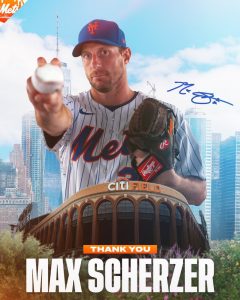 Scher, why not? If the Max Scherzer Appreciation Society had a Metropolitan Area chapter, I wasn’t its president, and I neglected to remit any dues. For a while I felt I felt a tad guilty that I never exactly vibed with Max as a Met. I welcomed his arrival as one would have been silly not to, and I definitely didn’t feel the orange and blue was disgraced by his presence in the colors. This was Max Scherzer, multiple Cy Young winner, world champion, competitor of competitors, and he wanted to be a Met! Or he took the Mets’ owner’s megabucks, but he could have gotten paid handsomely by anybody. Scherzer stood as a validating figure on the eve of the 2021-22 lockout. This is a serious team that attracts serious players with serious money. This could be some kind of era we’re heading into.
It was. It just didn’t last as long as we might have liked. We should probably learn to expect that.
The Scherzer who merits generous dollops of appreciation, no matter how it ended, flickered in and out of sight. Some starts were markedly better than others. Some streams of his consciouness were more agreeable than others. He took care of his minor league teammates when on injury rehab assignments. He hosted impromptu graduate seminars for his fellow starters after he took a dugout seat upon completing his best sets of innings. That was in 2022. As Steve Gelbs noted Saturday night (and I had been thinking in the days before), Scherzer U. seemed to have shut down in 2023. Maybe the old professor didn’t feel he had any lessons to share once his outings stopped earning high grades.
The Scherzer who positioned himself to go unmissed was the one who didn’t come through in the two biggest games he pitched as a Met. That’s a pretty transactional way to process a future Hall of Famer, but Max was here for the bottom line, and so are we sometimes. What bugged me more than his sliders flying over fences versus the Braves and Padres was his insistence, after the latter occasion, that he’d figured out what he’d done wrong and it was gonna be or would have been fine in the next playoff start that never came, as if it were that easy (which it wouldn’t be when 2023, the pitch clock and sweat and rosin came along). A friend of mine remarked Scherzer’s Met stay replicated T#m Gl@v!ne’s. Nah, I replied, retaining my utter disdain for the Manchurian Brave ever donning Met duds — at least Gl@v!ne won a couple of playoff games.
Now and then, Scherzer would conduct his postgame media scrums while wearing his Mets cap, yet as hard as I’d stare into the TV and want to see Max Scherzer, co-ace of the New York Mets, he came across as Pedro Borbon in the aftermath of the Pete Rose-Buddy Harrelson brawl. Borbon was the Reds reliever who got into it with Buzz Capra, and was in such a rage when it was over, that he mindlessly picked up and put on a Mets cap (before realizing his faux pas and taking a bite out of it). Free agency has made player/team identities far more malleable, but some guys can make the hats and the jerseys fit better than other guys. Scherzer always looked like he should be wearing one of those obviously fake uniforms in a commercial whose sponsor hires the player but can’t license his accoutrement. A script “Max” across his chest would have fit Scherzer perfectly.
When Max told reporters, after a refreshingly splendid start Friday night, that the deletion of David Robertson from the Mets’ plans meant he needed to have “a conversation” with those determining the construction of the roster, that should have been a signal that a Lyft had been summoned. During the winter, Kevin Durant nodded upstairs in a similar direction when the Nets rid themselves of mercurial (to put it too kindly) Kyrie Irving. Shorn of Irving and reunited with Spencer Dinwiddie, the Nets were going to be a more pleasant bunch to live and die with, but probably not an immediate title contender. The fan in me thought maybe Durant would internalize the challenge of leading a different, pluckier kind of squad, and…nah, KD wanted to chase another ring ASAP. One of the best players I ever rooted for on a regular basis couldn’t bail fast enough. Now I root for Mikail Bridges and Cam Johnson, the guys the Nets got from Phoenix for Durant. Fandom goes on like that.
 If you listen in, you probably won’t hear any mention of the fans. Fandom went on Sunday minus Scherzer, who the Mets were reportedly in the process of trying to move to Arlington anyway before Max cleared his throat, but still with Verlander. Whether Verlander is here by Tuesday at 6 PM is part of the remains-to-be-scenery that serves as backdrop to the trade deadline runup. Four months ago, conventional wisdom wouldn’t have dreamed the Mets and the trade deadline would have anything more to do with one another than the fetching of some bench or bullpen reinforcement for the drive to October. The drive to October now clearly has a U-Haul trailer hitched to the Porsche. A dozen teams will go to the postseason. Maybe Verlander will pitch for one of them. On Sunday, as my LIRR train pulled into Jamaica, a voice called out, “anyone know if Verlander’s been traded yet?” It wasn’t asked with the tone of someone rushing to Flushing to wish Justin a bon voyage.
When I stepped onto Mets Plaza Sunday afternoon, I half-expected to be overcome by the aroma of season tickets burning in the adjacent parking lot. That’s what Giants fans infamously did in the Meadowlands to express their disgust as 1978, the 15th year of continuously lousy football, wound down. In virtual corners of Metsopotamia, we’ve been holding bonfires since April, lighting them on our keyboards rather than with matches. In real life, you’re not going to see people show up at Citi Field on a bright, sunny Sunday to set fire to their season tickets. For one thing, are season tickets even flammable anymore? Wouldn’t you have to set your phone ablaze to register your protest these days? For another, if you’ve trekked to a Mets game, no matter what the Mets didn’t build and how they’re compelled to disassemble it, you’re not there to register a protest. You’re voting in favor of baseball.
It was a beautiful day for a ballgame, all those pesky rain delays from the past week having led to clear skies and cooler temperatures. The Promenade Box location I chose averted the beating sun from the second through the ninth inning. Save for an audible grumble directed at a Daniel Vogelbach groundout, I heard no boos while seated Sunday. When the NOISE METER was activated, I heard nothing neither my friend Mark nor I was saying, but that sort of interruption was held to a blessed minimum. If the crowd GOT LOUD, it was to convey enthusiasm for Francisco Lindor homering and collecting three hits; for Jeff McNeil legging out a triple; for Pete Alonso knocking in two runs; for Omar Narvaez knocking in one; and for Met for the rest of his contractual days or until his conversation with the front office/ownership has its intended effect Justin Verlander.
The prevailing “thrilled to be here even if Max apparently wasn’t” mood enabled us to enable the Mets. If the Mets didn’t make us regret our mood, all the better. I learned twice in 1999, once in September and once in October, that no matter how mad “everybody” is at the Mets — in those cases for having lost in piercing fashion the days and nights before and thereby endangering the thread-hanging season — most everybody who actually attends the game will give the Mets the benefit of the doubt before the game starts. The two episodes I’m thinking of involved the 1999 Braves as opponents. Of course we cheered our heads off for those Mets despite cursing out those same Mets on our way to Shea. If you couldn’t bring yourself to root for those Mets against those Braves, you might as well have burned your tickets.
JV has continued to traverse his comeback from ordinary to extraordinary, definitely tilting in the desired direction Sunday. If five-and-a-third innings of one-run ball versus the one team in the division certifiably worse than yours isn’t a Cooperstown signifier, Verlander did that thing a person loves to see from a starting pitcher. He worked out of trouble in the first (one run) and got stronger as the day went on. The Mets hit Old Friend™ Trevor Williams enough to give Justin breathing room, and when Verlander left the mound in favor of David Peterson, most of us rose to applaud the starter. Maybe it was for the five-and-a-third; maybe it was for the 250th career win that three-and-two-thirds of adequate relief would secure; maybe it really was for a Justin-case fare-thee-well now that we were in an even better mood.
Much as I was excited at the beginning of July when I realized I was going to see the Justin Verlander pitch in person, Mark was similarly delighted when he checked the probables a few days earlier. As we shared in this rare treat of witnessing a 249-game winner striving to reach an even more exalted plane, we got to talking about Great Pitchers We Have Seen and found ourselves not watching Verlander all that closely. Mark and I don’t meander from the action when we go to football games together. Football games demand your attention. Baseball games gently suggest we invoke “ancient names out of thin air,” to use Mark’s phrase. Soon enough, the phones we didn’t burn were out, and we were scrolling the list of the 200+ Win Club.
Mark, whose baseball fandom goes back to the waning days of the Giants calling the Polo Grounds home and the Dodgers hosting visitors at Ebbets Field (even if his grandfather refused to take him to Brooklyn), personally witnessed a lot of the greats and damn goods. Mark saw Warren Spahn pitch for the Mets (before Spahn, like Scherzer, made it known he couldn’t take the losing anymore). Mark is pretty sure he saw Billy Pierce pitch for the White Sox against the Yankees. Luis Tiant? Check. Steve Carlton? Absolutely. Mark wasn’t as certain if he ever saw Juan Marichal, though we both claimed Gaylord Perry. I got my glimpses of Frank Tanana in a Mets uniform. Mark had plenty of looks at Bob Gibson; I hope he ducked. He didn’t see Pedro Martinez, he doesn’t think, but I sure did. Our Seaver sightings culminated in No. 299 at Fenway (me) and No. 300 in the wrong New York stadium (Mark). Neither of us caught Max Scherzer pitching for the Mets, but together we saw him toy with our side as a Nat in 2016.
And so on and so on. There was Justin Verlander doing his thing very well in a Mets uniform, but we didn’t direct the bulk of our concentration toward him, or Peterson, Adam Ottavino and Brooks Raley preserving that thing he did. We went to a game and talked about other games. We talked about the Mets as much in the abstract as we did in concrete terms. As Mark will in lesser Met seasons, he tries to discern that one good push that will somehow inject them into the race. Neither of us really believes it’s a possibility right now, but Mark measured the distance from .500 (five games) and I appraised the overall strength of the current Wild Card contenders (“none of them is that great”) and concluded absolutely nothing that would truly ignite our dormant optimism. But it really was a beautiful day for a ballgame.
On the train ride home, I caught up on Verlander’s desire for a Scherzerian conversation about the club’s trajectory and whether he sees himself as a part of the “repurposing” Billy Eppler has begun talking up after studying hard for the euphemism portion of the SAT. I honestly don’t blame employees for flexing their empowerment muscles, even if there’s a piece of me that wishes everybody first and foremost felt they were a part of our team. It is our team, you know, even if we don’t compose it or own it. We’re the only ones who care about it ’til death do us part. That gets overlooked in the trade deadline conversations. Scherzer and Verlander aren’t going to bring up the fans. Eppler and Cohen aren’t going to bring up the fans. It is left to the fans to bring up the fans, but all the fans want, mostly, is a team whose season will extend deep into October.
That would be swell, but you know what I find myself wanting most? I want an era of Mets baseball. A very good era of Mets baseball. I want to feel as if everything isn’t going to change just because 6 PM Tuesday is fast approaching. I want to get to an offseason and not click refresh incessantly in search of the next multiple Cy Young winner being satisfied enough with an enormous monetary offer to model our clothes for the cameras. I’d like trades that aren’t clever in theory though we’ll have to wait for history’s final verdict, but trades that fill the lone need we have immediately because, except for that one missing piece, we have everything we need in this era. I want to know my team and experience my team and not have to acquaint myself with a wholly new version of my team just when I’ve gotten to know the one I thought was gonna stick around for a while.
Plus they should be very good. It’s obviously not a dealbreaker, but if I’m having a conversation and I’m listing my needs, that would be near the top. But stability — not to be confused with stagnation — would be most ideal. When the Mets were stumbling in June and the manager was making some questionable bullpen decisions, a murmur of FIRE BUCK began to be heard over the noise meters. Such resolution was never a serious possibility in the moment, but man, did I not want to hear it in any case, less out of personal loyalty to or affection for Showalter, but because, geez, haven’t we done this already? Haven’t we cycled through hapless managers and yearned for a steady hand attached to a mind that seemed to know what it was doing more often than not? Didn’t 2022 land us in that place to stay, at least for a few years? Are we really ready, I asked myself, to toss Buck Showalter overboard because it’s been a weird year and a horrid month? And wasn’t Steve Cohen supposed to represent the end of all this?
Maybe 2024, if Buck’s still here and the floundering continues unabated, will indicate the hair-trigger types had the right instinct, so why did we wait? Or maybe 2024 will shake out the insipidness that has enveloped Mets baseball in 2023 and we’ll have returned to the right track, led by Lindor who’s gonna be here for years, and Nimmo who’s gonna be here for years, and McNeil who’s gonna be here for some years, and Alonso, unless he has a conversation with somebody in which he shares his long-term doubts and free agency desires. Sometimes Lindor overswings or Nimmo slumps and I calculate how much of their probably immovable contracts (though never say never with Uncle Steve) are left, but generally, it’s nice to know some guys aren’t going anywhere. We finally got a beautiful team to cheer toward a World Series in 2015, and the gutsy 2016 bunch who strove to a Wild Card was already tangibly different. I reveled in the hot finish to 2019, thinking we were young and set for years to come, and the years came, and much of the core of that team was steadily peeled away
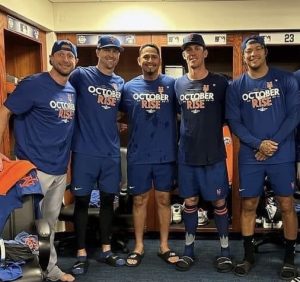 The Fab Five, before they broke up. The 2022 Mets of exactly one year ago were the team I was prepared to grow a little older with. I’ve aged plenty watching the 2023 Mets, but I recognize them less and less. As the Max Clock ticked, I thought not only of those dugout seminars that were no longer in session, but of a clubhouse picture that circulated after the Mets clinched their playoff spot in Milwaukee. The starting rotation of Scherzer, deGrom, Carrasco, Bassitt and Walker came together and posed as one. It could have been the Beatles on the roof of Apple Corps, never again to publicly get back to where they once belonged.
If Scherzer had to go, he had to go. If Verlander has to go, he has to go. As I’ve entered my second half-century of game-going, it’s apparent I’m not going anywhere besides 41 Seaver Way. More than ever, I appreciate the company of those friends and those Mets who also wish to stick around for a while.
|
|






