The blog for Mets fans
who like to read
ABOUT US
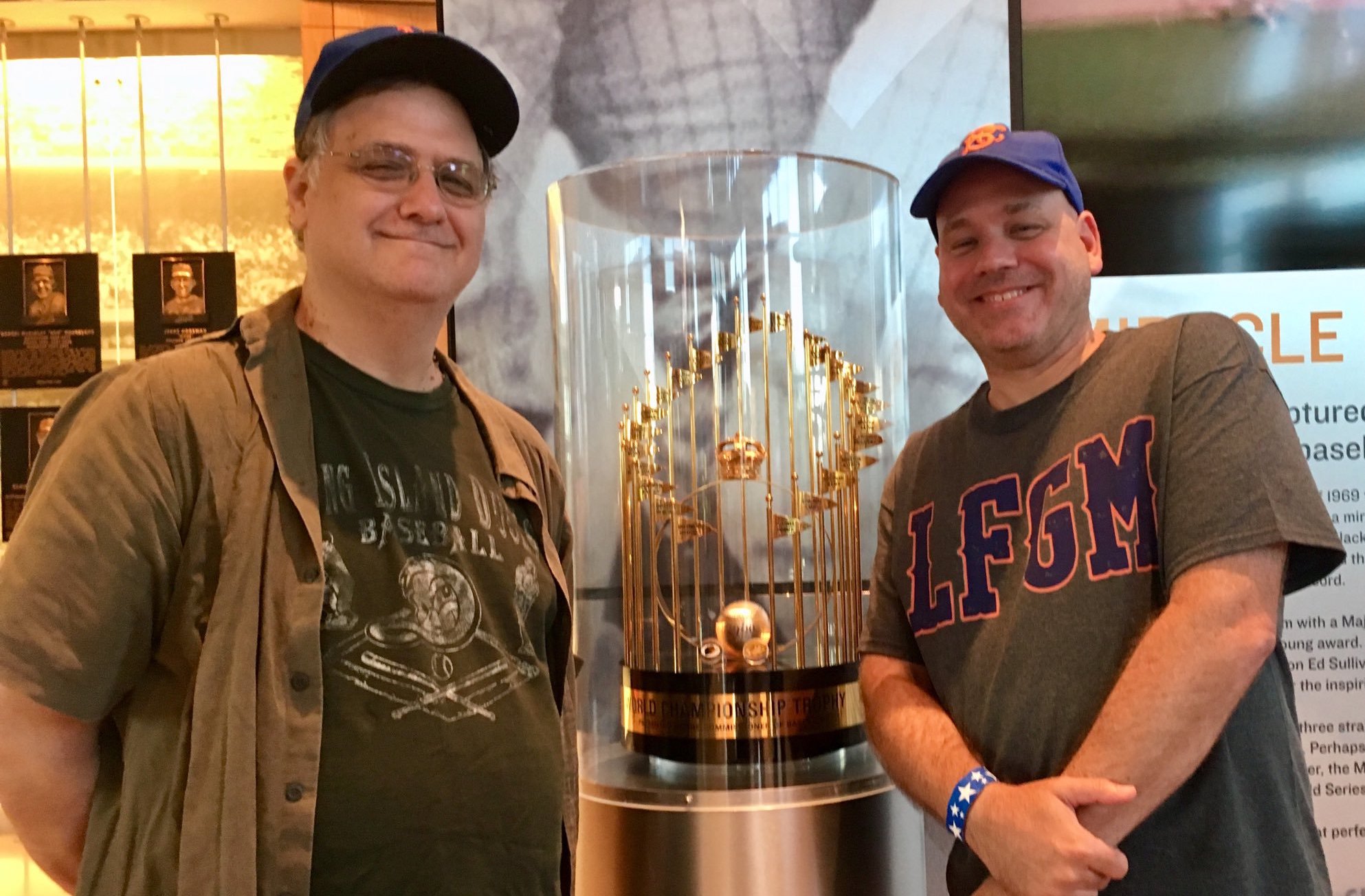
Faith and Fear in Flushing made its debut on Feb. 16, 2005, the brainchild of two longtime friends and lifelong Met fans.
Greg Prince discovered the Mets when he was 6, during the magical summer of 1969. He is a Long Island-based writer, editor and communications consultant. Contact him here.
Jason Fry is a Brooklyn writer whose first memories include his mom leaping up and down cheering for Rusty Staub. Check out his other writing here.
Got something to say? Leave a comment, or email us at faithandfear@gmail.com. (Sorry, but we have no interest in ads, sponsored content or guest posts.)
Need our RSS feed? It's here.
Visit our Facebook page, or drop by the personal pages for Greg and Jason.
Or follow us on Twitter: Here's Greg, and here's Jason.
|
by Jason Fry on 11 April 2023 11:14 pm Try to remember that Francisco Alvarez is all of 21.
The kid was the last out of Tuesday night’s game against the Padres, batting with the tying run on second. He was facing Josh Hader, whose wildness had gotten him into trouble that inning but arguably served him well against Alvarez. Hader threw two balls to Alvarez, the second one forcing him backwards into the dirt, then got two swinging strikes on fastballs at the top of the zone and above it, with Alvarez clearly overeager on both. The kid laid off the next pitch, which was juuuuust a bit outside — but which set up the fatal seventh pitch. That one followed the opposite trajectory, boring in on Alvarez’s hands. It was a ball, but that wasn’t apparent until after the fact — in the moment, it wasn’t a pitch anyone could take, or that anyone could hit. It tied up Alvarez for strike three and the ballgame.
Sigh.
Alvarez has things to learn, and those are the kind of ABs that count as tough teachers. If you want to put that on him, well, I guess that’s your privilege. Things that shouldn’t be put on Alvarez include the Mets’ inability to cash in early opportunities, or Dennis Santana surrendering a home run to Xander Bogaerts that should be conking some unfortunate in Portugal on the noggin right about now. Those missteps and the woulda shoulda coulda of that ninth-inning mutterfest put this one in the category of “games I’d like to never think about again, thanks,” though we’ll put an asterisk on David Peterson for pitching quite well against a deadly Padres lineup, at least until Manny Machado prevailed in a hard-fought battle that tipped a tight game in San Diego’s direction.
There was also the presence of David Weathers, who was a Met about 19 minutes ago, or so my brain told me when I recognized him chatting with Steve Gelbs. Nope, Weathers’ Mets tenure somehow ended 19 years ago after two and a half pretty solid seasons for terrible Mets clubs; he was there watching his son Ryan ply the family trade against his old club.
Yes, David Weathers has a kid who’s a big-league pitcher. (BTW, the Padres’ Brent Honeywell is a cousin of momentary Met Mike Marshall — the cerebral pitcher turned kinesiologist, not the annoying first baseman — because of course he is.) We’ll blink our eyes and Francisco Alvarez will have an impossibly grown-up kid of his own, maybe even one billed as a can’t-miss prospect. Maybe even one we’ll watch as he learns that even can’t-miss prospects have to take a few lumps on their way up Mount Ballyhoo.
by Greg Prince on 11 April 2023 11:44 am Six months and one day after it would have done the most good, the Mets beat the Padres at Citi Field. It didn’t tie up last October’s National League Wild Card Series at two apiece, because that was a best-of-three set. Noted baseball analyst Carole King says it’s too late, baby, to do anything about our first postseason series loss to a National League rival in sixteen years other than lick what’s left of our wounds and move on.
Implicit in this framing is the San Diego Padres are now a National League rival of the Mets in something more than cataloguing. From 1969 to 2021, they were as close to incidental in our scheme of things as a team could be. We were rarely good at the same time — the Mets and Padres had winning records in the same season only eight times prior to 2022, the last of those overlapping fifteen years prior. There’d be an occasionally memorable encounter in a Mets-Padres game, because baseball doesn’t ask for ID when it’s arranging ten consecutive strikeouts, or an 8-2-5 DP to complete a road trip, but prior to October 7, 2022, did a Mets fan ever “get up” for a Padres game beyond stirring from a disco nap for those held late at night on the Coast?
Now we and they have a different level of history. It may fade over time the way no Mets-Diamondbacks rivalry took root despite the heat of the 1999 NLDS, when we enjoyed sticking it to that smarmy Buck Showalter from Arizona. Remnants of a grudge may endure, as it seems to versus the Dodgers, a team I can’t look at when they play the Mets and not see Utley U Buttley, never mind that UUB is long gone from L.A. My guess is the sight of those brown-and-yellow duds that no detergent can quite satisfactorily clean will trigger flashbacks for a few years. I couldn’t look at them Monday night without remembering how I didn’t want to look at them (or baseball) ever again once the NLWCS was over. But that’s over, just as the 2006 NLCS stopped actively stinging eventually (even if it still hurts when one is moved to dwell on it). That was the last full postseason series we lost in October to another National League team; the L to SF in 2016 was just one game, barely enough time to build situational enmity. The schedulemakers cleverly had us in St. Louis to start the 2007 season. We swept the Cardinals. It was gratifying in the moment. It was also too late, baby.
But it was a new year. They all are. This one hasn’t mirrored 2022 from a dynamite start aspect. When we’ve looked good, we’ve looked all right. When we’ve looked lost, we’ve lost. We were a .500 club after ten games entering Monday night. Then we looked swell for nine innings and stuck it to the Padres in a way we didn’t much when it counted. Or counted more.
This right here counts very much, given that last year is last year and this year is just gaining traction. This right here, this 2023 season, will take all the boost it can get. Max Scherzer spent five innings boosting the Mets in their eleventh game of the current campaign, albeit via a bunch of full-count duels with Padre batters, but none that erupted into Padre runs. Sure, Max went to three balls on some of these guys, but also to two strikes. He still knows how to navigate those waters.
Maybe more mood-elevating than Max’s one hit and no runs in the face of three walks and 97 pitches; the four Met relievers who kept the Padres from scoring over the following four innings; and those two gasp-inducing dribblers — a bunt from Luis Guillorme, a tapper from Tomás Nido — that teased foul territory only to stay firmly fair, were the two two-out doubles lashed two ways that each plated two runs. That was Met offense coming to life without homers and without Marlins. Jeff McNeil’s to right in the third (off finally vanquished Metropolitan tormentor Yu Darvish) and Francisco Lindor’s to left in the seventh felt like something a team capable of producing offense produces.
The pair of swings may have added up to the first adrenaline rush of the young season. Maybe it was because they had nothing to do with new rules. The doubles weren’t about bigger bases, pickoff-throw limitations and steals that seem somehow stage-mothered into ubiquity (run into the spotlight, darling — show the director how swift you are!) or shiftless defense or the pitch clock on its face. They were two solid extra-base hits down the line when the Mets needed them, with two runners taking off to make the most of them en route to a 5-0 triumph sealed in 2:38, but who noticed the time of game? Until last night, the jury-rigged faster-paced contests didn’t necessarily seem more interesting than the ones they were intended to supplant. They just seemed over sooner. Maybe all of us, including the players, needed to get into the season a wee bit further to shake off the self-consciousness of what baseball is or is supposed to be now.
It helped that the Mets won. It always helps that the Mets win, but even the Mets wins since they lost to the Padres in three haven’t seemed all that vibrant. A slight sense of revenge achieved doesn’t hurt, either, even if it can’t do anything about last October. Anything it does to push us toward this October, however, is mightily appreciated.
by Jason Fry on 10 April 2023 8:23 am Sunday was another at least mildly notable first for the still-young 2023 season, and unfortunately I’m not referring to the sophomore-year debut of Francisco Alvarez. Our catcher of the future went one for four, with the one a dunker of an RBI single, while making some good throws to second and one bad one. One of the good ones would have counted as a caught stealing except Rob Manfred and his less than merry band of MBAs tinkered with the replay rules as well as more important things, leaving with the Mets without sufficient time to determine that a challenge would have been fruitful. The bad one went on the books as the Mets’ first error of 2023, an inevitability that still led to muttering.
But Alvarez’s performance isn’t the first under discussion here; rather, it was that Sunday’s game was the first of the season that left you thinking that there must have been a better use of your now-vanished afternoon. It was a slog, wandering spiritually between annoying and dismaying, with the Mets not truly out of it until the seventh but never giving you much of a hint that they were about to get back into it.
The biggest issue — assuming Starling Marte suffered nothing more than a neck strain in a collision at third — was Carlos Carrasco being terrible for a second straight start. This time out Carrasco had no problems with the pitch clock or recuperation between innings; rather, it was that his key pitches were MIA. His slider kept ambling into the middle of the strike zone, he had no feel for the splitter, and the fastball was missing a couple of ticks of much-needed velocity. To no one’s surprise he got lit up; the big blows were homers from Bryan De La Cruz and Garrett Cooper, but pretty much every Marlin ball put in play was hit hard. Carrasco is an innings eater, not an ace, but there’s eating innings and there’s making such a mess at the table that everyone else abandons the meal in disgust.
Still, an important reminder. It’s natural as fans to ascribe every win to the home nine’s diligent preparation and oorah gumption while chalking up every loss to those same players’ blundering and moral failures. It’s also nonsense. The other guys are trying too, and sometimes it works out better for them than it does for the protagonists. The Marlins played much tighter defense than we’ve seen from them of late and got the big hits when they needed them; the Mets collected nine hits but their sequencing was garbage, which is more bad luck than anything else. It happens, and while it’s not the best way to spend an early spring afternoon, a Just So story that makes more out of it than that is just compounding time wasted.
The Mets will now somehow not see the Marlins again until September, which seems like a relief in that the Marlins are horrible but might not be ideal for the W-L record given that the Marlins are horrible. Instead, the Mets will now entertain the Padres, which definitely feels like a case of Too Soon, right down to a repeat of the ill-fated Game 1 matchup between Max Scherzer and Yu Darvish. That’s not quite as cruel as the Mets having to open the 2016 season against the Royals, perhaps the unhappiest bit of scheduling roulette I can recall from nearly a half-century of fandom, but it definitely counts as a party for which you’d have preferred not to receive an invitation.
by Greg Prince on 9 April 2023 2:36 am Someday, perhaps, there will be another Kodai who plays for the New York Mets. I’d like to think that soon there will be a son of Mets fans, and his parents will name him for the righthander who left the Miami Marlins mostly spooked in his first two outings in the United States, the second of them his Citi Field debut. By my script, that kid, not only yet to be named but yet to be born, will show off a live arm, learn the ghost fork and be up with the team he grew up rooting for within the quarter-century.
Or we could just take everything one game at a time and appreciate the results wrought by the only Kodai currently in the Mets’ world. That would be Kodai Senga, 30-year-old MLB rookie who’s been around, if not around these parts until very recently. Shed of whatever nerves plagued him when he took the mound in Miami, Senga controlled Miami’s offensive aspirations long enough for the first five innings Saturday. The Mets provided him a run in the first (bases-loaded walk) and two more in the fifth (Pete Alonso homering, a blessedly daily occurrence). The Marlins got to Kodai for one run in the sixth (Jazz Chisholm going deep), but Senga outlasted his gas tank to complete the inning and exit in triumph.
Knowing he’ll be back to do what he does again is a comforting thought.
The bullpen diddled around a bit, but their foibles were minimal and cushioned besides when Eduardo Escobar finally hit into some good luck, which is to say an area beyond the left field fence. Maybe there’s a Metropolitan Area infant out there whose birth certificate just got filled in as Eduardo rather than Brett.
A 5-2 win awaited at day’s end for Kodai Senga and the Mets, a day that started with the sad news that Hobie Landrith had died at age 93. Hobie was the first major leaguer the Mets ever drafted, the first Hobie to ever play for the Mets and, as of this writing, the only Hobie to play for the Mets. That’ll make a feller an Original for a long time.
Hobie Landrith’s role in Met lore is pretty much Amazin’ 101, not just his status as the player picked before any other among those National Leaguers made available to George Weiss and Casey Stengel, but Casey’s explanation for taking a veteran receiver with limited pop and little in the way of glitter — no All-Star selections since reaching the bigs in 1950 as a defense-first catcher, never a sniff of the postseason. There are variations of the quotation, but I’ll go with the one Dave Bagdade used in his comprehensive survey on the 1962 Mets, A Year in Mudville:
”Ya gotta start with a catcher, ’cause if you don’t, you’ll have all passed balls, and you’re gonna be chasing the ball back to the screen all day.”
As Dave notes, “Speculation persists that Stengel’s comment was his way of poking fun at such an exciting first pick.”
However Casey meant it, the rationalization stuck, and it is Landrith who became embroidered in the upper tier of the legend of the Original Mets, just as it was Landrith who arrived first on every budding Mets fan’s depth chart in the fall of 1961. Come that first game in St. Louis six months later, it was Landrith who was the first to crouch behind home plate on our behalf. Let the record show that while his pitchers gave up seven earned runs that night, Hobie did not allow a single passed ball.
It bears mentioning that Landrith — the first of seven catchers Casey would employ in 1962 and the only one to live long enough to see the franchise turn sixty — batted lefthanded. A lefthanded-hitting catcher is something of a rarity. Omar Narvaez is the 25th lefty-swinging backstop the Mets have ever used. Only a few had much longevity as Mets. Hobie was on the roster for less than two months. He’s still twelfth among lefty-hitting Mets catchers all-time in RBIs. Two of the runs he drove in were on a game-winning home run off a lefty pitcher…a lefty pitcher named Warren Spahn. Eyewitness reports confirm the walkoff wallop was a pop fly that took advantage of the Polo Grounds’ inviting right field dimensions. It’s a two-run homer in the box score.
 The great Spahn bowed his head because he knew that he’d been beat by a lefty-swinging, defense-first catcher. Hobie’s third of three passed balls as a Met came in his final game as a Met, when he was already identified as the player named later in the May 9 trade for Marvelous Marv Throneberry, whose own Met legend was fast gaining steam. “Later” was officially June 6, when the Mets and Orioles agreed that Hobie would be the payment for the first baseman Baltimore had sent New York, yet there Landrith was in the Mets’ lineup in Philadelphia. The Daily News, in reminding its readers that Weiss had given the impression Throneberry’s acquisition was a straight cash deal yet was suddenly sending Hobie south, said the club president “deals in ballplayers and half-truths”.
Landrith probably chuckled mordantly at the description if he had the chance to read it en route to the O’s. “What a piece of work he was,” Hobie told This Great Game, frustrated decades later that the Mets, despite drafting him ahead of everybody, were determined to pay him less than he was getting from the Giants the year before. “I mean, if you’re the first pick, you figure you should make at least the same as you did the year before, right? […] The man was cold, cold, cold, and I didn’t enjoy that at all.”
Stengel seemed to be a different matter. Hobie liked Casey well enough to cite him fondly long after the Polo Grounds converted to that big ballyard in the sky. Listening to an interview Mark Rosenmann of Sportstalk NY conducted with Landrith in 2020, recalling how Stengel’s advice helped him navigate a tough situation behind the plate when he was catching for Gil Hodges in Washington in 1963, his last year in the majors, warmed my heart. Same for when Jay Horwitz told me in 2019 how much it meant to Hobie when Jay, new in his alumni relations role, reached out to our first catcher and was told, essentially, nobody from the Mets had been in touch with him since 1962.
Think about that: the first pick in the expansion draft, referenced at least a half-dozen times a year by Met announcers via the “passed balls” anecdote, and he’d fallen off the organization’s radar. It says something about Horwitz’s efforts to reconnect to an otherwise lost generation of retired players that it was the Mets, one of seven different teams for whom Hobie caught, who announced the news of Landrith’s passing.
Although I was barely in utero when the catcher in question was playing the bulk of his 23 games as a Met, Hobie Landrith impacted my historical consciousness beyond simply providing a shorthand explanation for why a team needs a catcher.
In October of 2006, when local media was seeking every angle possible for its coverage of the Mets as they headed for the NLCS, I remember reading an article from the Star-Ledger in which their reporter visited Landrith in California to see what the de facto first Met had to say about his alma mater’s latest burst of success. This was during that vast interval when the Mets didn’t call and didn’t write, which was mentioned in the article. At the time, I guess I was surprised there’d been no contact, but I think I was more shocked that Hobie Landrith was alive, well and conscious of the contemporary Mets. He’d existed in a such a defined nutshell — picked first; passed balls — that to me he was more a character from ancient Mets history than an actual person who a) used to play the game; b) was capable of commenting on it; and c) continued to live his life.
To this day, I know of no other Hobies in or out of baseball, so comprehending that the only one who was ever a Met was not only still with us, but still paying attention to the Mets (despite the Mets not paying attention to him) took me an extra beat. The more I thought about it after I found out he died, the more I realized what amounts to my ongoing determination to not gloss over any Met, particularly those Mets who predated my personal awareness of the team, and to try to learn something about the ones I missed or didn’t remember well so maybe I could pass something from their experiences along to whoever reads or listens to me, stems from that specific sense of you mean those guys in those stories are actually walking around? with which the Star-Ledger piece hit me. Some 1962 Mets had been on the scene as a matter of baseball course or were caught up with on “where are they now?” occasion, but others had all but vanished from public view, or at least my slice of it. Hobie Landrith was one of those.
I’ve been trying to make up for it ever since.
by Jason Fry on 8 April 2023 8:39 am Because it’s too early for more complex assessments, so far the Mets new season is a stark either-or: They’re either beating up on the Marlins or getting walloped by the Brewers.
Monday through Wednesday saw our gray-clad lads off under the roof in Wisconsin, where they spent two days looking gobsmacked while Bernie Brewer went down his slide about 50,000 times and then played a semblance of baseball but got walked off, proving that baseball is pain. The Mets then got rained out of their home opener before returning to New York, which wound up being hilarious because a) Thursday turned out to be perfect for afternoon baseball and b) nobody particularly minded because they’d played so badly that a day of sitting quietly and thinking about what they’d done seemed like a good idea.
Anyhow, the Mets got back to it on Friday (a colder, windier day than Thursday, because LOL), finally at home in the friendly, somewhat-reconfigured confines of Citi Field. The Mets have a new scoreboard, which you may have noticed because it’s smack in the middle of the ballpark and the approximate size of Hoover Dam. Not to mention that it is of course super state-of-the-art 4K — seeing it for the first time on the SNY broadcast, I had to convince myself I wasn’t looking at a video insert the truck had plopped atop the broadcast feed for some odd reason.
Seriously — to resurrect a 70s baseball joke, two-thirds of the Earth is covered by water and the other third is covered by our new scoreboard. Do Steve and Alex Cohen hang out in their suite on off-days and use it as the ultimate home-theater flex? What would it be like to watch Partridge Family reruns on this thing, or use it to play Call of Duty?
There are other tweaks to the ballpark, most notably that the right-field wall has been brought closer to accommodate a speakeasy that I’ll undoubtedly never get to enter. It will take some time to assess the import of that change, though I bet David Wright has already shaken his head and sighed while no one was looking. The lesser season commemorations have been consolidated rather intelligently (standalone WILD CARD WINNER banners are just sad), Bob Murphy gets his due up among the retired numbers and other tips of the collective cap, and the out-of-town scoreboard is no longer a tire fire. I’m sure there are other things I’ve missed, but they’ll wait for an actual visit.
(A visit that better coincide with a win after I suffered the indignity of going 0-for-2022, including the two postseason games we lost, but that’s another post.)
The Mets were playing the Marlins again, and they sure looked like the not-ready-for-prime-time Marlins we saw down in Miami. Edward Cabrera once again walked the ballpark, a dissolution that was equal parts due to ground-out Met at-bats and of his own making, while Huascar Brazoban let in a run by spectating on the mound as Daniel Vogelbach continental-drifted his way to first on a grounder to the infield. The Marlins were serially inattentive to details during Don Mattingly‘s tenure and look no better at the little things with Skip Schumaker at the helm, which tells you that you can’t blame the problem entirely on roster churn and young players. I should be happy about that, since Marlin mistakes mean Met benefits, but it galls me to see the best game in the world played so badly — errors and mischance are part of the sport, but my God, you can always cover first.
At least nothing terrible involved Jazz Chisholm Jr. for three hours. I suppose that’s what passes for progress in Miami.
On the Mets’ side of the ledger things were mostly good. Tylor Megill pitched well in his second straight matchup against Cabrera, apparently surviving a bullet off the foot, though I haven’t checked the news this morning and it’s entirely possible Megill is now in a leg cast and/or iron lung.* The Mets took a worryingly long time to break through, with Cabrera’s final line showing an improbable 2.2 IP, 7 BBs, 85 pitches thrown and … zero hits, but once they did the reversion to the mean was savage, marked by homers from Starling Marte, Francisco Lindor and Pete Alonso; Brandon Nimmo scampering happily to first a whole bunch; and hey, a Vogelbach infield hit has to count for something on the fan Bingo card. Dennis Santana gave up a three-run homer late and Eduardo Escobar heard boos from a crowd waiting with Baty’ed breath**, but when you win 9-3 you can overlook a few blemishes.
The Mets will be back at it Saturday, with Kodai Senga once again facing Trevor Rogers and perhaps Francisco Alvarez getting the nod behind the plate. Alvarez is now wearing 4, which is a nice bit of novelty even if 50 struck me as better suited for his broad back. As for Rogers, his middle name is J’Daniel, for which I can find no explanation, and his cousin is the loathsome Cody Ross, which isn’t his fault but is surely worth a boo or two. Perhaps the scoreboard will give those of you in attendance a 4K explanation of “J’Daniel,” with each letter the height of a brownstone in Carroll Gardens; failing that, I hope you get to see a win in 1080p, or however many pixels it is that real life offers. Should the experience of mere human vision leave you feeling dowdy and without, I bet you’ll be able to find our new scoreboard.
* I checked, he’s fine
** this one deserves an apology
by Jason Fry on 5 April 2023 9:33 pm I mean, sometimes it’s joy. A lot of times it’s joy, in fact.
But sometimes it isn’t.
Take, for instance, Wednesday afternoon in Milwaukee, which certainly did not count as joy.
I guess you could make a case that it was better than losing 10-zip on Monday, and superior to losing 9-0 on Tuesday. On Wednesday the Mets a) scored actual runs; b) scored six of them, in fact; c) held a lead, an aspect of baseball we’d forgotten existed for a while there; and d) actually held two of those mysterious things called leads.
None of which mattered in the end, as Garrett Mitchell — who’d just been foiled in attempting to bunt his way aboard, for Chrissakes — smacked an errant Adam Ottavino frisbee into the right-field seats for a walkoff 7-6 Brewers win.
Pain. On so many levels.
The pain of losing to start off the ninth without recording an out, which shouldn’t feel worse but somehow does — like getting walked off in the eighth with an asterisk. Nobody tell Rob Manfred or that will somehow be a thing by Memorial Day.
The pain of a three-game sweep, which is never fun even when you’re not outscored by nearly three touchdowns.
The pain of seeing a long streak of being .500 or better go by the boards.
The pain of getting steamrolled by a team that could do no wrong right after having your way with lesser competition, with all the discombobulation to one’s self-image and creeping existential doubt that brought with it.
The pain of confronting that oldest and bitterest of baseball questions: If your team’s fated to lose, would you prefer that they lose meekly and pitifully from the jump, or horribly and tragically at the very end? (There is no right answer. In fact, there is no answer. To this, or anything else.)
The Mets lost, and it was pain. Pain watching David Peterson walk the ballpark and Drew Smith report for duty to discover the mound was so fucked up nobody could do anything from it. Pain handling Corbin Burnes just fine only to have it not matter. Pain feeling like the outcome was preordained even after storming back to take a 6-4 lead on the second of two Pete Alonso homers. This was the kind of game where you shove yourself into the mud face-first, like a doughboy getting shelled in a trench, and pray that you’ll find yourself alive when the bombs stop gouging the earth while doubting you’ll be so lucky.
The Mets are already rained out for their home opener, a development that elicited a sigh of relief from me, because this is definitely a team that could use a day not playing baseball or, more accurately, not attempting the kind of baseball-adjacent activities that have been inflicted on us the last three days.
Being glad your team isn’t playing when baseball just returned to being part of the daily routine? Yep. Like I said: pain.
by Greg Prince on 5 April 2023 9:51 am Having recently conferred “visiting scholar” status upon one Maxwell Martin Scherzer, a righthander who earned his doctorate in pitching long ago, I’ll leave it to the old professor himself to figure out what the hell is wrong with him. If it’s not physical (he says he’s fine), not mental (he won’t use the pitch clock as an excuse), or not chronological (although 38 is 38, he was also 38 when he set down the Brewers last September in his playoff-clinching start), we’ll have to depend on Max and those assigned to coach around him to deduce what has gotten into him and how to get it out of him. “I’ve just got to pitch better,” the professor said in Milwaukee on Tuesday night after he couldn’t have pitched much worse.
Maybe it is physical (not every pitcher comes clean or immediately realizes something’s awry), or is mental (the pitch clock is screwing with literally every experienced player’s routines), or is chronological (38 is definitely 38, and he was 38 in October when he couldn’t withstand the Braves and was shot out of a cannon by the Padres in October). Whatever it is, he’s just got to pitch better. That’s a lot chase-cutting when you’re dealing with a human being who may have who-knows-what going on in his arm or his head or the rest of him. But when your current starting rotation consists of ellipses (Peterson and Megill are going to…); a question mark (how alarmed should we be by the drop in Carrasco’s velocity?); and a slash (Senga was spectacular in his first start/Senga will likely require an adjustment period regardless of his spectacular first start), you have to count on somebody to bring the exclamation point. The Mets signed Max Scherzer because he’s always been Max Scherzer! For almost all of 2022 when he was available to pitch, he was emphatically Max Scherzer!
At whatever Miller Park is now called on Tuesday, the exclamation points were proffered by Rowdy Tellez, Brian Anderson and Garrett Mitchell, three Brewers striking three homers in a row, setting off indoor fireworks (cough, cough) and donning their home run cheeseheads in celebration. It was enough to make a Mets fan lactose-intolerant. Before the sixth inning, Scherzer had overcome a two-run first to settle in competitively versus Wade Miley in a 2-0 staredown. In the sixth, it all went up in smoke for the Mets’ ace.
Worst. Smokeshow. Ever.
Following a walk, Max would be replaced by Denyi Reyes, who replaced Tommy Hunter on the roster. Hunter went on the IL with back spasms, a malady that may plague Mets pitchers as they attempt to carry a team that doesn’t score whatsoever. Reyes got the Mets out of the sixth. In the seventh, with Brooks Raley on, America’s Dairyland stirred to life again, with a three-run homer from Anderson and another solo job by Mitchell. That added up to a final score of 9-0 in favor of the Sausage Kings north of Chicago. The “9” was lavish in light of the “0,” a digit you might remember from the Mets’ 10-0 loss the day before. The Mets intermittently hit the ball hard and had a couple of balls fall in. They also batted into a couple of double plays and left eight runners on base. The defense was pretty sound, except for the inability of Messrs. Canha, Nimmo and Marte to leap high enough to reel in what their pitchers were allowing to be cast out.
Elsewhere in the Metropolitan system, Brett Baty’s thumb came up sore during his game in Syracuse. The youngster, dispatched to Triple-A to improve his fielding, had cultivated an OPS of 1.338 in four games down on the farm before the thumb on which he had surgery in the offseason acted up. Seems appropriate that this would happen to the Met prospect best positioned to respond to a potential SOS. Right now, a Met who could pound the ball consistently would stick out like Brett’s sore thumb.
by Greg Prince on 4 April 2023 9:12 am Carlos Carrasco appeared forlorn, first on the mound, more so in the clubhouse when reporters asked him about his declining velocity, his difficulties adjusting to the timer and everything else that had gone wrong. Tommy Hunter had no choice but to wear a hit-eating grin when the camera found him at his lowest. The pitching pair who just didn’t have it do have in common the same earned run average: 11.25 in 2023. Luis Guillorme’s pitching was effective, but the conditions were in effect to have Luis Guillorme pitch, thus any emotion beyond stoicism would have been a bad look. Then again, a bad look would have matched the tenor of the game the Mets had just lost in Milwaukee, 10-0.
In college basketball terms, Monday afternoon’s debacle was as decisive a loss as national champion UConn pinned on runner-up San Diego State, except at least the Aztecs managed to score. The Mets’ pitching shortfall was the most glaring aspect of the matinee — eight walks, a pitch clock that moved too fast for Carrasco, a fastball that traveled too slow from Carrasco — but that zero on the Mets’ side of 10-0 sat there like a bagel on the road to Passover. You shouldn’t have one around, yet somebody needs to digest it or otherwise get rid of it before we can move on.
The offense never leavened. Three hits. Deceptively quick baserunner Daniel Vogelbach was not quick enough to stretch a single into a double back when it was still a ballgame. Heady Mark Canha was caught staring at the video board for helpful data (vainly searching for the previous pitch’s velocity, something hitters do) two seconds too long, which means a strike if you’re not in the box set to hit in a jif in 2023. Guillorme, after his franchise-most third career outing as not a pitcher pitching, came up to bat in the top of the ninth, which was the most remarkable moment the Mets’ lineup manufactured solely because Luis the infielder had pitched in the bottom of the eighth. Use a position player to pitch, you no longer get to use a DH. Thus, for the first time since the ordained demise of what was left of authenticity in baseball, a Mets pitcher could be said to have hit, if not successfully, as Luis lined out to end the damn thing. That contemporary curiosity, along with sparingly used Tim Locastro managing to get himself hit for a third time four plate appearances into his season (he leads the NL in HBPs), stood as the highlight of the day.
Unless you were the Brewers, in which case the day was nothing but a highlight. Unaligned, I’d say it’s nice to see a team opening its home season give its fans a win. I’m not unaligned and I was hoping the pregame tailgate would be all Brewervolk would have to remember fondly. They got more. They got a third-inning lead, a fourth-inning increase and fifth-inning explosion, cresting with a grand slam surrendered by Hunter to rookie infielder Brice Turang, whose career dates back to last Thursday. No, kid, it’s not always this easy.
The final score rang an atonal bell. Didn’t the Mets lose a Home Opener of their own, 10-0? Indeed, they did, 39 years ago. The 1984 Mets had opened eyes with a 6-3 start on the road and 46,000 at Shea was excited to greet their conquering heroes. Then the Montreal Expos excised all the excitement from Flushing, with a run in the first, a run in the third, another four in the fourth and four to rub it in in the eighth. Most of the damage was done to rookie Ron Darling, not enjoying a Brice Turang coming-out type of afternoon (except for coming out before the fifth). The biggest swing belonged to then-foe Gary Carter, the enviable All-Star catcher who delivered what we would now refer to a Turangian blast, a.k.a. a grand slam home run.
Two Home Openers, two 10-0 losses for the Mets, two four-ribbie four-baggers. Two? Do I hear three? Afraid I do. In April of 2003, after their own season-starting odyssey, the Expos, long after anybody expected them to be any trouble, began their home schedule at Hiram Bithorn Stadium in San Juan. Maybe Montreal’s odyssey wasn’t exactly over. This was during that dark period when the Expos were at sea and were assigned to play a segment of their home schedule on an island far from Quebec. Farther from Montreal than Prince Edward Island, even. By MLB’s reckoning, Puerto Rico served as the site of the Expos’ Home Opener.
By the scoreboard’s reckoning, it was another 10-0 loss for the Mets, with another grand slam allowed, this one thrown by comeback-trailing David Cone and walloped by left fielder Brad Wilkerson. Also homering for Montreal/San Juan was catcher Brian Schneider, who would eventually move on to the Mets like his Expos backstop predecessor Carter. The 2023 Mets have a former Brewers catcher already in Omar Narvaez. Narvaez has hit one career home run against the Mets, in 2021. It was in Milwaukee. It wasn’t a Home Opener. The Mets won.
Narvaez is hitting .300 as a Met. Before Monday, he was hitting .429. Drops and spikes of that nature will happen when the season is young enough to rattle your stats if not your nerves. Before Monday, Brice Turang had one career RBI. After Monday, he’s tied for sixth in the National League with five. Before Monday, Tommy Hunter had a pristine ERA of 0.00. Before Monday, the Mets had absorbed only one loss, a 2-1 affair irritating enough to mentally seek that one pitch or swing that might have turned it around. On Monday, they lost decisively. They lost, 10-0, and all you could do was shrug it off and, if you were so inclined, go to Baseball-Reference and look up how often you and they had experienced that score before. It’s one of those scores you figure has been inflicted on your team rarely enough to not require the deepest of searches.
The Mets are in their 62nd season. They’ve lost, 10-0, on thirteen occasions. Three of those have been Home Openers for one team or another. Another was in a team’s second home game of the year, at actual Montreal (not San Juan) in 2001. It was Steve Trachsel’s Met debut. Steve was known for pitching slowly, but he was in a hole pretty fast. “Steve Trackmeet” I wanted to call him because as soon as he started throwing, the Expos were off to the races. Another was also in April, to the Pirates. I was there that night in 1981. The scoreboard went dark for a spell. The Mets had already given up five runs and would give up five more without crossing the plate themselves. Under the circumstances, the scoreboard was more courteous than the usher who chased my friend and me out of seats we dared to slip down to with few outs remaining and even fewer in attendance.
Each previous 10-0 Mets loss in April could be rationalized away with “It’s early.” So can this one.
by Jason Fry on 3 April 2023 12:04 am Forty-two pitches into his Mets debut, Kodai Senga was in trouble.
Our Japanese import, a feel-good story across that far bigger pond for rising from developmental player (the closest equivalent is “low-A cannon fodder”) to three-time All-Star with five rings, had needed 36 pitches just to get through the first against the Marlins: A single, an RBI double, a walk and another walk preceded a pair of strikeouts and a sharp line drive corralled by Starling Marte. Senga had a 2-1 lead because Trevor Rogers was being tortured by the Mets and by his own defense, but to say things looked dicey was to understate it. Senga was clearly nervous, which was playing havoc with his location, threatening to send a whole line of dominos toppling in ways not to our liking.
Things didn’t start off much better in the second, as Senga began by walking Jacob Stallings — the third guy he’d walked in the first eight batters faced. The next batter was Joey Wendle, and this time ball one was automatic — a pitch-clock violation, of all things. (It’s not visible in the ESPN play by play, but trust me, it happened.)
You didn’t have to be a scarred and calloused Metsian doomsayer to imagine what might happen next: another rough inning, an early departure with the Mets now down 4-2 or 5-2, and lots of shots of Senga trying to look stoic in the dugout but mostly just looking glum. After the game Buck Showalter would be calm and philosophical, teammates would say the right things, and Senga would offer some variation on it being good to get the first one out of the way and how he’d be making adjustments and that of course what he was most looking forward to was taking the ball again in five days’ time.
Except that wasn’t what happened at all.
Having given Wendle a free ball one, Senga sent a fastball through the lower reaches of the strike zone to even the count. Another fastball clipped the bottom of the zone to put him up 1-2. Next came the ghost fork or the splitter, depending on how romantic one feels about naming Senga’s much-hyped out pitch. Wendle slapped it harmlessly to center for an out. Two pitches later, Senga coaxed a double-play ball to retire the seemingly unretireable Luis Arraez and he was out of the inning. Out of the inning and, as it turned out, home free. He worked into the sixth, baffling the Marlins with ghost forks and fastballs and sweepers, with the lone blemish an Arraez single in the fifth. Eighty-eight pitches, just one run allowed, and no reason for Showalter to have to be placid and soothing? That will work.
Senga was only half of the Mets’ story, though. The other half was Tommy Pham, who was 3-for-4 with three RBIs, two of them on a fifth-inning homer off whatever that white corporate structure out there is beyond the Soilmaster Stadium fence. Pham has a genetic condition called keratoconus, in which the collagen in the cornea thins and can develop a vision-impairing bulge. (Amazing the ailments one learns about as a Mets fan — if it ain’t Valley fever it’s spinal stenosis.) Pham has dealt with the condition since 2008; on Friday he got new contact lenses from his Florida-based eye doctor, praising the results as “way different in a good way.”
Pham is the 2023 Met I feel like I know the least about — when he arrived as a fourth outfielder/potential piece of the DH puzzle, my recollection of him was a blur of long-ago Cardinals moments, slapping Joc Pederson over fantasy football and a reputation for being, shall we say, a little edgy. That last part may be true, though I came away from this 2018 Sports Illustrated feature about Pham thinking that a) he’s a complicated cat in an interesting way; and b) some of that running hot seems pretty understandable. If Pham has a run of performances like Sunday’s, we’ll all know a lot more about keratoconus and perhaps even find ourselves advocates for finding reasons to slap Joc Pederson — nothing like winning to make you see things way different.
The rest of it? Jazz Chisholm Jr. made another horrific misplay in center, making you wonder (and not for the first time) if setting up their best player to fail wasn’t exactly the greatest plan, even by Miami Marlins standards. Avisail Garcia, meanwhile, managed to get himself called out on a pitch-clock violation and looked at a third-strike fastball down the middle from Stephen Nogosek when the fastball was rather obviously the only pitch Nogosek was able to throw for a strike. That kind of serial dopiness has been a Marlins fixture in recent years, an unwelcome distraction for a franchise that too often can’t seem to get out of its own way. Marlins fans deserve better — I’ve always felt for them despite being steadfast in my belief that their team is a not particularly funny nihilistic joke — but in the zero-sum game of baseball, we’ll of course take every mistake our opponents care to make.
A last observation, one I’ll count as pencilled in for now: In theory I don’t mind the idea of baseball games not routinely zooming past three hours in duration, but so far the pitch clock has thrown off my own rhythms as a fan in ways I find disconcerting. Decades of fandom have given me a pretty sound sense of how long routine things take, letting me know — for instance — how many seconds it’ll take a hitter who just fouled a mistake pitch straight back to spin out of the box, collect himself, exhale, kick at the dirt a little and then return to duty. But now I need to recalibrate all that. I watched the end of Saturday’s game in a bar with no sound and missed Francisco Lindor‘s double — not because I wasn’t paying attention, but because my internal clock was off.
I’m sure I’ll get used to this, and probably sooner than I think, but right now it’s left me pretty unhappy. Rob Manfred and his merry band of consultants have decried many baseball changes of relatively recent vintage, but it strikes me as a rich irony that their answer to these supposedly ruinous changes has been a blizzard of changes to things a lot more fundamental, including basics of the game I would have thought sacrosanct.
by Greg Prince on 2 April 2023 5:13 am Is it too soon to say we’re living in a golden age of Mets baseball? How about one that is thus far untarnished?
By winning in Miami on Saturday behind Tylor Megill (starting in place of Justin Verlander), Mark Canha (homering like he’s Pete Alonso) and a bullpen cast of thousands (none of them presented by Kwikset), the Mets upped their record to 2-1. Unless you’re contesting a best-of-three playoff series, that’s a pretty inconclusive sample size, but had the Mets lost and fallen to 1-2, well, we would’ve been 1-2, a record easily recognized as under .500.
In case you’ve forgotten, you don’t wanna fall there.
If you’ve forgotten, it’s because it’s been a while. From Game 1 to Game 162 of 2022, we were never below .500. We were never as low as .500. It was the third regular season in Mets history when the ballclub could boast day-in, day-out of a record that was nothing but winning. That may not be what a ballclub boasts about first and foremost — the other Mets teams to achieve 162 consecutive daily winning records did it in 1985 and 2007, and neither of them gets the slightest banner shoutout above right field in Promenade — yet the rarity can’t help but get a curious fan’s attention.
You can have a really good ballclub, the best the franchise has ever had, yet it doesn’t mean that particular ballclub can ask the DJ to spin “All We Do Is Win”. Witness the 2-3 Mets of 1986, who stumbled a few feet out of the gate. True, they picked themselves up, dusted themselves off, started all over again, and never stopped. But 2-3 was 2-3. They are forever champions, but they weren’t forever winning. The first week or two is most treacherous for the team that wishes to never feel statistically inadequate. All it takes is 0-1, 1-2, 2-3, and there goes your non-losing record.
There’s plenty of time to straighten out. The not how you start/how you finish quotient hasn’t yet been disproven for long-term purposes. But who wants to spend even a day under .500? Who wants to look in the mirror of the standings and see doubt staring them back in the face? You knew the 2-3 Mets of 1986 were better than that. Except for their record. And if their record reflected who they were, how the hell was this happening? How the hell do you know 2-3 won’t become 2-4 or that 2-4 won’t become something that plunges until it lands south of 81-81? No matter that you know better, Panic Citi can seem particularly inviting in the inaugural days of a new season.
Thirty-seven years ago, an eleven-game winning streak commenced, and you know the rest, but that very brief stumble dents 1986’s historical stature within the context of this particular feature. This particular feature is devoted to Mets teams that have maintained a daily record of .500 or better across season lines for more than 162 consecutive games. At the moment — for the last 165 moments, actually — we’ve been rooting for one of them. Never as low as .500 last year. Thus far this year, not a day under .500 (albeit across three games). Suddenly, we modern Mets fans are enjoying an era that ranks eighth when measured by Not Losing Streak.
The top seven? Aren’t you glad you asked?
1. September 24, 2005 to April 5, 2008: 337 Games
Try to forget that somewhere in the midst of this run, a third strike was taken to end an NLCS (we’re not counting postseason) and a seven-game lead evaporated with seventeen games to play (you have to be doing pretty well to have a lead to blow late). The Mets rose to 77-77 at the tail end of a season of playing footsie with .500 for the bulk of Willie Randolph’s first year as manager. They were never any “worse” than 1-1 in his second year. They never even dipped to .500 in his third year. After a 2-2 start to 2008, Rando’s Commandoes slipped and slid a bit too much to slough off the finish in ’07 as just one of those horrific things. Willie tried to remain calm, reasoning to reporters he’d been a winner all his life. For the heart of his Met tenure, if you’re not a stickler for details, he wasn’t wrong.
2. April 4, 1984 to April 13, 1986: 327 Games
Davey Johnson’s Mets traveled to Cincinnati for the traditional National League opener and indicated their tradition of not competing — just as they hadn’t under Joe Frazier, Joe Torre, George Bamberger and Frank Howard between 1977 and 1983 — might proceed unabated. They got stomped by the Reds, fell to 0-1, and gave little hint that 1984 would be materially different from the preceding seven years of famine. But they won their second game. And their third game. And kept winning through their seventh game. And, with Davey’s confidence infecting every Met in sight, they never had a losing record at any juncture of 1984 after Opening Day. And they never descended to .500 after starting 1985 5-0. And two wins to kick off 1986 seemed to augur 162-0 was realistic. Two losses occurred. Then a third. That was the 2-3. We already know they picked up on the “And…” theme thereafter. But there was a hiccup. The best cure is holding your breath and waiting for the season to unfurl in earnest.
3. May 10, 1997 to September 27, 1998: 289 Games
Bobby Valentine inherited a crummy team in August of 1996 and they stayed quite crummy in early 1997. Bobby V needed a few weeks to fully shake the crumbs away in his first full season at the helm (he did run a restaurant, after all, so he understood something about busing tables). The franchise weighed down by a daily record that gurgled under .500 almost without pause from August 1991 to April 1997 learned to love Valentine’s days. The romance could be stormy, but the relationship proved mutually beneficial. One weekend in St. Louis, we hit .500 and snuck above it before leaving town. We wouldn’t look below the break-even point for the rest of that year or the whole of the next year, including the portion of 1998 that predated the acquisition of Mike Piazza. Piazza would lift Bobby V’s Mets to another strata. Not high enough to grab a Wild Card that was within reach in September, but learning to elevate fully has been known to take time.
4. June 13, 1970 to August 13, 1971: 221 Games
The defending world champions could not be stopped! Oh wait, they could. It didn’t make sense to watch the infallible 1969 Mets turn into the ordinary 1970 Mets, yet there they were, during the first third of their title defense, legitimately scuffling, not taking off from their .500 plateau until 29-29 became 30-29. Not that they really rose high above it the rest of the way, but at least Mets fans weren’t left thinking 1969 was altogether a dream. Gil Hodges had his club readier to contend as 1971 got rolling, though that group, too, eventually sputtered, if not until summer. Neither the ’70 nor ’71 editions matched the magic of ’69, but they did confirm the Mets now existed as a consistently reliable enterprise rather than a one-year wonder. Your expectations might not be validated every season, but you knew you weren’t deluded to have expectations.
4. June 13, 1990 to August 15, 1991: 221 Games
When Bud Harrleson took over for Davey Johnson, the Mets might as well have been wearing one of those t-shirts Bart Simpson was making so popular: Underachiever and Proud of It. Maybe not a lot of Met pride, but definitely far too much not living up to the talent in the room. Harrelson, who studied under Hodges two decades before, seemed to bring out the best in his Mets as Gil had brought out the best in Buddy & Co. The right manager at the right time spurred the Mets to a surge that had them blow past .500 and duel the Pirates almost to the wire. Come 1991, they kept up their end of the bargain as best as they could until the remnants of their post-1986 powerhouse flickered and went dark.
6. April 18, 1986 to May 8, 1987: 183 Games
The part where the Mets cease being 2-3 and commence to going 108-54 pretty much explains the 1986 portion of this stretch. In 1987, the Mets appeared sluggish, but despite some noticeable absences from the previous October (no Doc until June, no McDowell until May, no Mitchell or Knight at all), their innate awesomeness kept them no worse than treading won-lost water for more than a month. They were bound to take a dip below .500. The shock of a team that could do no wrong going somewhat awry was rough to reckon. We remember the 1987 Mets for not coming through in September. If we think back to how they limped along early, it’s a miracle they made it to September. The innate awesomeness remained evident. It just wasn’t enough to carry the day, let alone the year.
7. April 21, 1972 to May 5, 1973: 177 Games
Before Yogi Berra added an extra layer to his legend by leading the Mets from nowhere to the World Series — also before Yogi wore the onus of not starting George Stone in Game Six of that Fall Classic — he faced an impossible task. He had to follow Gil Hodges directly after Gil Hodges died. He did a helluva job, getting the Mets over .500 to stay almost immediately in 1972, not letting them fall under .500 despite the injuries that piled up, and pushing them successfully into the next season, where they looked fine until they didn’t…until they did, of course.
8. April 7, 2022 to Present: 165 Games and Preferably Counting Into Perpetuity
One assumes Buck Showalter, if he’s aware of it, isn’t particularly impressed by this streak of never having let his Met team settle below .500 for even a day during his tenure. Buck is always looking ahead. Or so it looks from here. Still, not bad having a non-losing record “forever” in Flushing, with “forever” a perilous eternity if the Mets don’t win today, Sunday, because if they don’t, they’ll have to win in Milwaukee on Monday, or the streak ends at 166 games…which Buck won’t care about, because he understands that what gets remembered most is not a 22-23 record on June 1, 1969, or a 2-3 record on April 14, 1986. The 2023 season won’t be distinguished by a brief interval in April. The 2023 season is built to endure. Nevertheless, even as early as the first week of April, it’s really nice to not lose more than you win.
So keep that up please.
|
|