The blog for Mets fans
who like to read
ABOUT US
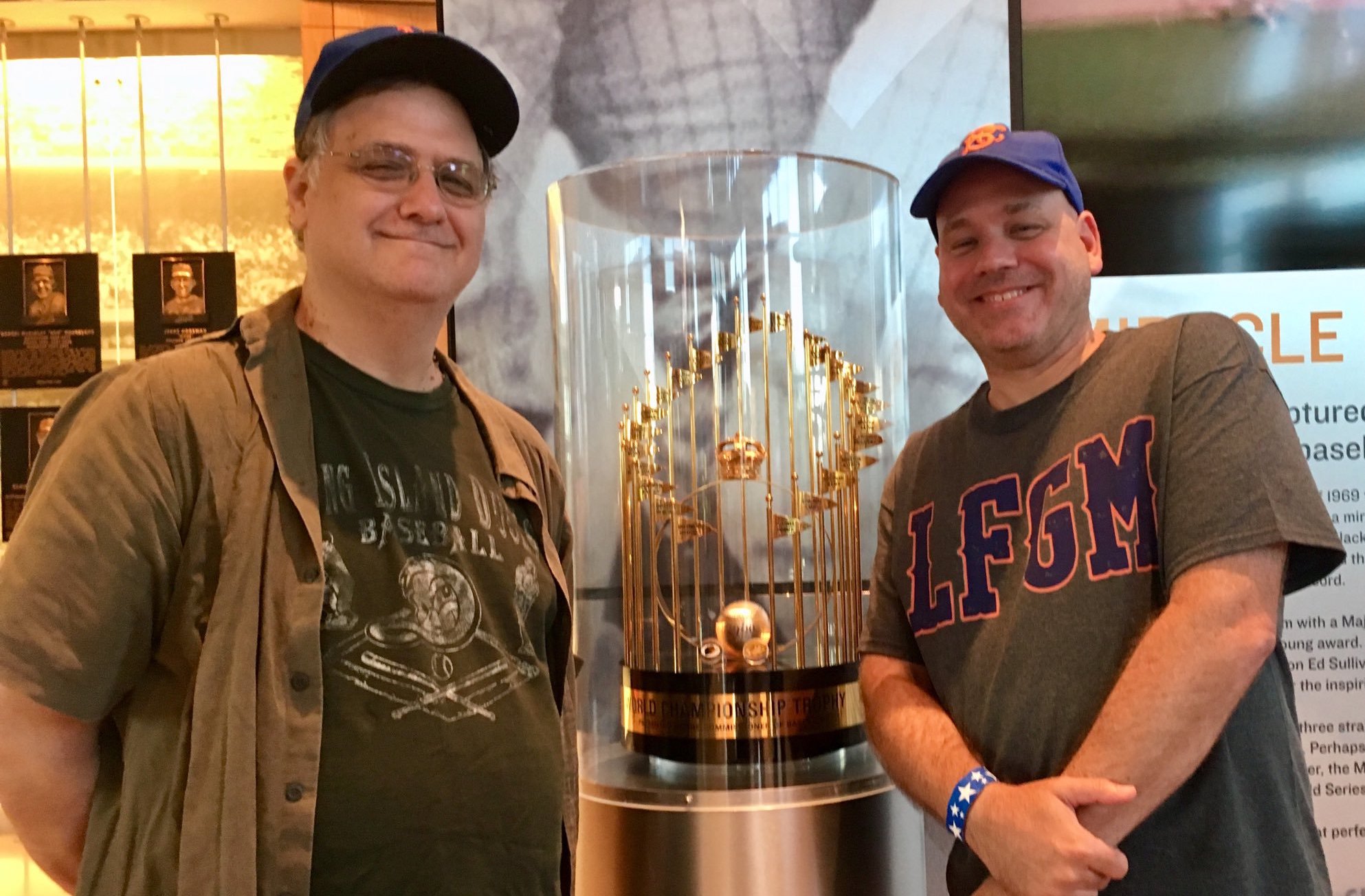
Faith and Fear in Flushing made its debut on Feb. 16, 2005, the brainchild of two longtime friends and lifelong Met fans.
Greg Prince discovered the Mets when he was 6, during the magical summer of 1969. He is a Long Island-based writer, editor and communications consultant. Contact him here.
Jason Fry is a Brooklyn writer whose first memories include his mom leaping up and down cheering for Rusty Staub. Check out his other writing here.
Got something to say? Leave a comment, or email us at faithandfear@gmail.com. (Sorry, but we have no interest in ads, sponsored content or guest posts.)
Need our RSS feed? It's here.
Visit our Facebook page, or drop by the personal pages for Greg and Jason.
Or follow us on Twitter: Here's Greg, and here's Jason.
|
by Greg Prince on 1 April 2023 10:43 am Just a reminder that while we wait for Edwin Diaz to rehabilitate from his WBC celebration injury, next weekend brings the first of fourteen Klassik Kloser Saturdays, Presented by Kwikset, the Official Provider of Deadbolts, Knobs and Handlesets of the New York Mets. That’s a mouthful, but closing out games in 2023 will likely require an armful.
As much confidence as David Peterson earned on Opening Day and Adam Ottavino might inspire based on what he accomplished last year, the Mets recognized the ninth inning as the “turnkey to success” and concluded “there’s no substitute for experience” (forgive me for invoking the sponsor’s press release lingo), so in addition to using whichever veterans Buck Showalter, Jeremy Hefner and Dom Chiti deem ready to go the other six days of the week, the manager and his pitching coaches will now have at their disposal, during the latter stages of Saturday home games, one reliever from the franchise’s “ya gotta believable” past.
It seems the idea was planted in the fan demand to bring back Old Timers Day, so if any leads get away on any home Saturdays this season, blame people like me who thought reviving a great tradition was a win-win. Let’s hope it’s a win-save. Steve Cohen heard the people call for Old Timers Day and saw us flock to Citi Field to cheer the alumni in action. For us in the stands, it was an overdue celebration of history. For Cohen, unbeknownst to the 42,000 or so in attendance, the affair doubled as a laboratory of sorts. He saw how warmly the old players were received and couldn’t help but be impressed by how flexible many of them still were. “Spry,” Cohen says in the press release, “didn’t begin to describe it.”
Thus, at Cohen’s direction, Billy Eppler and the medical staff, in conjunction with the Mets’ partners at the Hospital for Special Surgery, forged a new sports physiology and training unit called Metropolitan Transformation, and, for the past few months, all concerned have worked to return to baseball shape a plethora of previous Mets relievers, with some of the same “revolutionary” research not incidentally being applied to Diaz’s knee — speaking of Klassik Klosers and their state-of-the-art body parts. That we’ll have Klassik Klosers taking on some of the ninths that would have belonged to Edwin is fortuitous timing, but given who owns the New York Mets, you also get the sense that luck is the residue of design here. One way (or spelling) or another, we were gonna have Klassik Klosers at Citi Field on Saturdays this year.
Being that this is a Steve Cohen-driven initiative, these aren’t Quadruple-A hangers-on or even standouts from the independent leagues. These are genuine Met closers and their ilk. True, you gotta wonder if they’re up for it after so many years of idleness was interrupted by a sole Old Timers bow, but “it’s just one inning,” Buck said the other day, “and it gives Hef and Dom and the rest of our people some options we didn’t think we had. If they sign the waivers and their families are OK with it, we’re gonna support them as best we can.” Showalter pointed to some of his old favorites from Baltimore the Mets have signed, like Tommy Hunter, who threw a pair of zeroes Friday night, and preached the virtues of familiarity. “You know what you’re getting with these guys, and they know how to get batters out. I’m not asking anybody for ID. It’s not like I’m serving them drinks. I’ll do that after the game if that’s what they want.”
One is tempted to make a crack about Geritol being the beverage of choice in the Met clubhouse, but glass houses prevent a fan who’s about as old as the franchise for which he roots from throwing zingers.
Because Cohen is funneling so many luxury tax dollars to the other MLB owners, he saw opportunity where others might have viewed only penalty. To the principal owner, the so-called “Cohen tax” presented a negotiation position. All right, he essentially said, you want me to enrich your coffers, I want something for my investment. The genius might have been in framing it as a pilot program from which eventually all thirty franchises might benefit. The Mets will be the first to do Klassik Klosers, but don’t be surprised if you see other teams try it…if their owners can figure out how to make it work the way Cohen has. Hell, by the time they catch up to Steve’s thinking, you can bet — probably at a casino he will get built in the parking lot — he’ll have brainstormed something else even more, shall we say, Amazin’.
Much like with second games of doubleheaders, the Mets will get a “27th man” roster exemption in order to activate their Klassik Kloser every home Saturday. Their opponent will get the same, but can only call up somebody already on their 40-man. Fair? Cohen paid for the privilege of bending the rules to his will. And, let’s keep in mind, if it doesn’t work, the visiting team stands to benefit by putting runs on the enormous Citi Field scoreboard (as they will from their share of gate receipts, as this is already apparently proving quite a seat-filler). With all the new rules coming and out of baseball, it’s no wonder this little number got slipped in to scant notice.
The potential drawback, at least for 2023, is if a Klassik Kloser is particularly successful on a given Saturday, Buck and his minions can’t suddenly lean on him come Monday or even the next Saturday. There is one dedicated Klassik Kloser per the Basic Agreement codicil that enables Klassik Kloser Saturdays, Presented by Kwikset, the Official Provider of Deadbolts, Knobs and Handlesets of the New York Mets. He can’t be used in more than one game during this season; that clause might be revisited next season. I’m not sure if the Klassik Kloser can go in two games should there be a doubleheader on a Saturday — when you’d be dealing with a “28th man” — but how often do you see Buck use a pitcher in two consecutive games on two consecutive days? And in case you’re curious, yes, the three-batter rule applies, though no, none of the Klassik Klosers will enter to Timmy Trumpet. In fact, Cohen has hired famed White Sox organist Nancy Faust to play appropriate ditties for when the Kwikset-secured bullpen door swings open, including “Don’t Say You Don’t Remember”; “Yesterday Once More” and, not surprisingly, “Old Days”.
One interesting element from a historical perspective is if a Klassik Kloser is already on the Hall of Fame ballot, this will not affect his candidacy vis-à-vis the standard five-year wait. You might not have gotten the full relief pitcher buy-in to this notion had certain relievers thought this might backfire. But, really, there’s been loads of enthusiasm. These guys loved the late-inning spotlight in their day, and they sure didn’t mind the attention on Old Timers Day last August or, for that matter, Amazin’ Day last weekend.
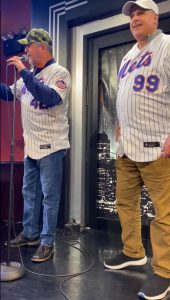 As Amazin’ Day showed, McDowell and Wendell are still at home in the New York spotlight. I’ll admit to a touch of skepticism when I first heard about Klassik Kloser Saturdays, Presented by Kwikset, the Official Provider of Deadbolts, Knobs and Handlesets of the New York Mets, not because I have anything against Kwikset’s fine products or the Kwikset ad patches set to replace the skyline logo on the Mets’ jersey sleeves, but because, let’s face it, not every relief pitcher was a closer when he was active the first time, and it appears they’re trying to pass off a couple of middlemen as if they were firemen. Ah, maybe that’s picking nits at this point. The upside is we get a fresh arm, bionically (or however they do it) engineered to compete anew while making the most of a storehouse of knowledge devoted to retiring batters. I mean retiring them in a game. The uplifting part of all this is the implicit message that “retirement” doesn’t have to be permanent. Life is long. Who wants to stop doing what one wants to do if one can still do it?
The bottom line from the viewpoint of a Mets fan on a Saturday when the club is home is if you buy a ticket to a Saturday game this season, you stand an excellent chance of enjoying relief pitching like it used to be, perhaps relief pitching like it oughta be. Below is the schedule the Mets will announce to the rest of the media on Monday, with all the usual “subject to change/competitive discretion/certain restrictions/no refunds” caveats. Hat tip to alumni director Jay Horwitz for getting us the information in advance and getting these more or less beloved once and future Mets warming up in the pen.
APR 8 vs MIA
John Franco — Well, who else? He’s the Mets’ all-time leader in saves and, you have may have heard, he’s from Brooklyn.
APR 29 vs ATL
Steve Dillon — Dillon pitched before anybody thought in terms of closing, and he was never relied on to do what a Franco did. But did you see Steve at Old Timers Day? At 79, he was in about as good a shape as any pitcher, even backing up home plate on one play. Plus he’s local. I love giving him a shot in this role.
MAY 6 vs COL
Jenrry Mejia — Lifetime bans aren’t what they’re used to be. Call it the Klassik Kloser Redemption Tour. His buddy Familia hooked on in Oakland. Maybe Jenrry has one more comeback beyond this one in him. They might wanna run a test before sending him in, however.
MAY 20 vs CLE
Bobby Parnell — Dude is only 38. And his beard is younger than that.
JUN 3 vs TOR
Billy Wagner — Nice subliminal advertisement for Billy’s HOF chances to have him be the Klassik Kloser on Mets Hall of Fame Day. BBWAA, pay attention to what the lefty still has and always had: heart.
JUN 17 vs STL
Neil Allen — How do you like this for timing? It will be the fortieth anniversary plus two days of the day Allen was sent to the Cardinals for, oh, who was it again? Why, No. 17, as in June 17, come see the reliever who was crafting a pretty good career as a Met reliever before Keith Hernandez became magically available. Hopefully Whitey Herzog will be tuning in from somewhere.
JUL 1 vs SFG
Armando Benitez — I almost think something more is up here, because, as we’ve all been told ad nauseam that July 1 is Bobby Bonilla Day, and we’ve heard Steve Cohen wants to make a real Day of it at Citi Field, presenting Bobby Bo with an oversized check to pay him off what he’s otherwise owed through 2035, and what better grace note for an unlikely homecoming than to bring in as Kloser one of the best righties the Mets have ever featured in ninth innings…and one of the shall we say most polarizing. That’s a nice way of saying Armando’s been gone 20 years and the wounds from his intermittent (cough) missteps are still fresh. But if we’re maybe going to welcome back Bonilla, why not Benitez? Fun fact: the last time Armando pitched in Flushing, he was giving up a game-winning home run to Carlos Delgado while with this July 1’s special guests, the San Francisco Giants.
JUL 15 vs LAD
Jesse Orosco — Alert the FAA! A glove could be falling from the sky somewhere near LaGuardia! Or Jesse could just use a new one. He did pitch for about a hundred years after recording the final out of the 1986 World Series, so we can assume somebody spotted him a new one. (We’ll try to forget Orosco also pitched for those Dodgers, in the 1988 NLCS, and simply enjoy him trying to beat L.A. in 2023.)
JUL 29 vs WAS
Jason Isringhausen — Intriguing choice, as Izzy’s reign as primary Met back-end pen man was brief, just long enough to collect the requisite saves to allow Jason to make it to his 300th in 2011. We think of the young Isringhausen, who was a starter as he set out on what became a long journey in 1995. Izzy’s appearance is scheduled to occur one day shy of the 28th anniversary of his first major league win, itself saved by John Franco. Circle of life, eh?
AUG 12 vs ATL
Randy Myers — I love this on two counts. 1) RANDALL K! The K didn’t stand for Kloser in New York long enough for my taste (no offense, Johnny). 2) If the Mets were looking for a reliever who had no shudder-inducing history versus the Braves, I’m thinking they found their man. The Braves weren’t the Braves as we know them when Randy Myers was getting pumped. No flashbacks, just heat.
AUG 26 vs LAA
Francisco Rodriguez — I’m glad hard feelings have softened. Maybe they already did when K-Rod came back after his “incident” in 2010 to pitch for several more months in 2011. Soon he’d be traded to avoid paying him what he might have been worth (not that we had many games to save in those vesting option/post-Madoff days) and Frankie disappeared from the Met consciousness. Having him come back versus the team he came up with shows somebody is paying attention.
SEP 2 VS SEA
Skip Lockwood — The former Seattle Pilot (is there a current one?) will be in town to show his timeless stuff versus the Seattle Mariners. Lockwood, a heck of an author, by the by, locked down plenty of ballgames for the Mets between 1975 and 1979. I wouldn’t Skip this outing.
SEP 16 vs CIN
Roger McDowell — Watch your feet, Wayne Kirby. Roger had a way with a book of matches and first base coaches’ shoes. I wonder if the Reds’ institutional memory will be disturbed to see the pitcher who snuffed Cincy out as both a reliever and a right fielder on July 22, 1986?
SEP 30 vs PHI
Turk Wendell — A bit of an off choice to Klose out Klassik Klosers? Only in that Turk was the setup guy for Franco, then Benitez before being traded to the Phillies in 2001. But who better among those available to slam the final rosin bag on the first iteration of this innovation? Mr. Wendell is still a popular figure among Mets fans, as gauged by the reaction he drew on Amazin’ Day, and if Steve Cohen is conscious of anything, it’s pleasing a crowd. Also, if a playoff spot is still on the line when September ends, trusting Turk will be second nature.
Oh, should the Met starter on one of these Klassik Kloser Saturdays have a complete game going into the ninth…ha! You almost had me there. We know as sure as we know today’s date that expecting a Met pitcher will be left in to throw nine innings in 2023 amounts to utter foolishness. You’re gonna believe a Met might throw a complete game this year?
Seriously, don’t be so gullible.
by Jason Fry on 31 March 2023 10:58 pm This is the time of firsts, of course. First appearances for Mets old and new. First hits, home runs, stolen bases and, alas, first errors and strikeouts and big chances not converted. First wins — the Mets took care of that category Thursday afternoon — and, nowadays, new additions to the menagerie such as first pitch-clock violations, for and against.
The opening frames of a season move slowly in the beginning — slowly even with men in blue newly deputized to finger-wag baserunners back to their stations and demand split-second decisions on replay challenges. (None of these things particularly needed hurrying along, but my invitation to serve as a consultant for MLB apparently got lost in the mail.) There’s a brief time when you can hold every pitch of the young season in your head at once, followed by a somewhat longer stretch where you can at least recall every AB. We’ve moved beyond both of those as things start accelerating, but for a while we’ll be able remember every game, down to the scores. For a while, but not forever — within a couple of weeks the games will start to blur, and then so will the series, and soon enough our reaction to a mention of some March/April storyline will be belated recognition — “oh yeah, that’s right, I remember that game.”
This happens every year, and I navigate the experience with the odd mix of familiarity and mildly peevish surprise you get when doing something you haven’t done for a full turn around the sun. But in one respect I’m in midseason form already: Friday night’s game was a definite reminder that I hate the Marlins.
Friday night’s game at Tacky Political Grift Park (or whatever it’s called these days, as something tells me I might not be remembering that quite right) had “annoying fucking loss to the annoying fucking Marlins” written all over it from the jump, when the Mets didn’t get a safe call challenging Brandon Nimmo‘s supposed out at first. There were Marlins making plays they had no business making, most notably Jorge Soler out in right field screwing up his pursuit of a Pete Alonso drive just enough to turn it into a spectacular play and later, at a critical moment, making a more authentically fine shoestring grab to rob Starling Marte. Soler also put the Marlins on top with a solo shot off David Peterson, who looked like he was always about to implode but kept staggering out of trouble.
Peterson got help from some nifty/lucky defense on the Mets’ side of the ledger: In the bottom of the first Alonso turned a hot shot down the line from serial Mets torturer Jean Segura into a double play — fortunate, as Garrett Cooper then wound up on third courtesy of a muff by Marte transmuted by hometown scoring into a triple. Peterson escaped, but that was when I started muttering, thinking about how it could easily be 2-0 Marlins with a runner on third and nobody out and Soilmaster Stadium (of course, that’s what it’s called!) about to drop a bucket of teal on the Mets’ fortunes for approximately the 67,000th time since this misbegotten franchise was inflicted on baseball.
Peterson escaped that mess and wriggled free again in the fifth, when Cooper hit a ball off Alonso’s glove only to have Jeff McNeil alertly run it down behind Pete and make a heave home that was both desperate and accurate, plucked by Tomas Nido in time to tag out Jon Berti. But the Mets couldn’t make up that one skinny run, not against an impressive Jesus Luzardo or against relievers JT Chargois or Dylan Floro — though Floro only escaped a blown save in the eighth through Soler’s robbery of Marte. In the bottom of the eighth John Curtiss made his Mets debut a year after a campaign spent rehabbing a torn UCL and pitched pretty well … if we’re not counting a shot into the right-field stands by Jazz Chisholm Jr., which unfortunately even this year’s much-modded rules say we do indeed have to count.
A pause to remind us all that it’s useful to see things from the other guy’s perspective, even if the other guy is wearing a hallucinatory teal belt and is part of the worst collective entity in the history of athletic competition: Chisholm has had a miserable first two days in center field, making misplays each night and looking like he’s playing on skates even when things aren’t going awry. But the guy can hit; given what he’s gone through so far in this young season, his high-stepping post-homer tour of the bases was thoroughly earned.
Thoroughly earned and, as it turned out, enough to beat the Mets: Alonso homered off A.J. Puk in the ninth, but it felt more like another twist of the knife than a gallant attempt at a comeback. Baseball has returned and I’m heartily glad, just as I’m excited to see what the new season will bring. But one thing it’s already brought is an unwelcome reminder that there are Marlins in the world, Ruining Everything™️, as Marlins so often do.
by Greg Prince on 31 March 2023 2:29 am Baseball’s nothing without poetic license, whether or not Rob Manfred wishes to notarize said document. The Commissioner is intent on engineering a game built for speed. Get it over with already yet seemed the Manfred mandate for Opening Day. Start the pitch timer, throw the ball, quit yer lollygagging. It sounds reasonable in concept. It felt forced in practice. So I don’t know if the elapsed time of the Opening Day contest in Miami between the Mets and Marlins of 2:42 would meet with the heartiest of official approval, considering Time of Game in various other venues Thursday measured 2:38, 2:33, 2:32, 2:30, 2:21 and 2:14, but when you step back and realize 2:42 adds up to 162 minutes accumulated in service to the resolution of the first of 162 games, well, how can you not get a numerical chill?
It helps when your team wins. Our team won: 5-3 to be exact. And, at the risk of having my poetic license revoked, what’s the diff how long a Mets win takes as long as it’s a Mets win? As long as it’s a Mets Opening Day win? The Mets, you might reflexively note, ALWAYS win on Opening Day regardless of length or site. Having soaked in a fourteen-inning Opening Day triumph on this very date 25 years ago, I’m tempted to believe the former, but my fealty to accuracy at the expense of burnishing Metropolitan mythology compels me to report that until 2023, the Mets were more futile than not when beginning a year in Florida. The Mets thrice previously visited the Marlins to lead off their campaign, in 1999, 2008 and 2011, and won only the middle game, Johan Santana’s debut. One-hundred sixty-two minutes devoted to defeating these Fish in their own pond to go 1-0 should be treasured…as if we’d take anything about beating the Marlins in any facility on any day for granted.
If you listened closely to the ambient noise on Thursday, you could hear the pitch clock tick. Things moved so swiftly for the first five innings that I was convinced the entire aim of a baseball game is to complete it as quickly as possible. You’d think a matchup pitting Max Scherzer and Sandy Alcantara would be ripe for savoring, yet you can’t gripe when two such polished pitchers are brisk in their approach, no matter that their pace is nudged along by an obtrusive digital countdown. It only felt like the goal of the game was to end it so people who find baseball a drag will be less bothered that it lasts as long as it does. Over those five innings, though, despite the dual mound presence of reigning Cy Young awardee Alcantara and three-time recipient Scherzer, the personages were overshadowed by the pace. Wasn’t it great how fast the thing for which waited all winter to finally get here was escaping into the ether with uncommon alacrity?
Yeah, we guess.
The only run registered across those first five frames was generated by foot. In the best tradition of the Reyes Run and the Rickey Run, we were treated to the Vogelrun. Daniel Vogelbach turned a walk into a score by darting from first to third on Omar Narvaez’s single to right, and third to home on Brandon Nimmo’s sufficiently deep fly to left. I don’t know if the slightly large bases abetted Vogey’s deceptive nimble nature. Perhaps every little inch helps.
Alcantara vs. Scherzer would have loomed as fascinating without somebody constantly resetting a counter and demanding something happen in 20 seconds or not happen at all. The last time before 2023 that the Mets faced a starter on the Opening Day directly after that starter collected a Cy was forty years before, at Shea Stadium in 1983. The opponent on that occasion was Steve Carlton, bested by a Met team led by prodigal immortal Tom Seaver. Plenty of Cys and sighs in evidence that afternoon.
Scherzer had an intriguing precedent going for him as well. Max was the “enemy” on Opening Day 2015, and now he was our guy. Had that ever happened before? Why, yes, once. In 2001, the Mets played their first game of the year at Atlanta. The starter for the Braves was T#m Gl@v!ne. In two years’ time, said lefty would switch sides for a fee and be the Mets’ Opening Day starter, an assignment he’d assume three of the next four Openers.
Excuse me while I wash my fingers out with soap for typing up any link between the mostly revered Scherzer and the mostly reviled Gl@v!ne. Then again, I have to confess that when I first saw Scherzer loosening up in St. Lucie following the lockout the Spring before this one, I involuntarily formulated an unpleasant thought:
“I hope this guy isn’t another Gl@v!ne.”
I wasn’t thinking a surefire Hall of Famer who will help the Mets to a postseason and polish his lifetime totals in the process, or, for that matter, someone who might implode at the absolute worst moment after gaining our trust, but a professional who, for all his credentials and maturity, emits the impression that his affiliation with this thing we love is strictly business.
Say, it appears I’m violating the spirit of the pitch clock by stepping off and pursuing a tangent. If that’s the case I might as well use my one timeout and backtrack to an admittedly ancient grudge…
At first I couldn’t stand T#m Gl@v!ne being on my team because he had been such a goddamn Brave for so long, and nobody who was a Brave a little before or a little after the turn of the millennium was someone a Mets fan was prepared to embrace unconditionally. In retrospect, what I really couldn’t stand about Gl@v!ne being on my team was the way he deigned to be a Met. Never just was a Met. Wore the uniform for five seasons, threw the ball for a thousand innings, took a hike the second it was contractually permissible, didn’t let the door hit him in the ass on the way out. It’s been twenty years since his arrival, more than fifteen since his departure. In between, once I got over my aversion to his innate Atlantaness but before the whole “disappointed, not devastated” debacle, I decided to accept him as one of ours. He wore the uniform. He threw the ball. That’s usually all it takes.
I still regret disregarding my Bravedar.
Scherzer, as ’22 progressed, did not put me in mind of Gl@v!ne whatsoever. Scherzer’s Nationals were never the blood rival Gl@v!ne’s Braves were; Max even had the decency to wait until after we clinched a division title to no-hit us in 2015. He came over to our side after a detour to Los Angeles and provided no reason for regret. Yet as ’23 commenced, I looked at Scherzer anew and still didn’t see “a Met” by instinct. Wears the uniform. Throws the ball. But in the sense of being “ours,” I just don’t feel it. You might dismiss this emphasis on feelings versus data, but I’ve already renewed my poetic license where baseball is concerned. I can only care about what I feel. On Thursday, I began my 55th season as a Mets fan. You don’t last 55 seasons without of lot of caring and a lot of feeling.
My feeling on Scherzer isn’t that he’s a mercenary in the Gl@v!nian mode but something more akin to a visiting scholar. Has his tenure. Opted for a change of scenery (and more than a little pocket change). Likes our campus well enough. Visited the school book store. Bought a couple of sweatshirts. Figures to someday look back on his years in Flushing with a degree of fondness. But we’ll never be his alma mater. As best as I can frame it, Max Scherzer is the Professor Kingsfield of our pennant chase. Our younger and less-accomplished hurlers teach themselves the strike zone, but Scherzer, à la John Houseman’s indelible crusty mentor, trains their minds. They join the staff with a skull full of mush, they enter the rotation thinking like a pitcher.
That’s pretty valuable if not wholly warm and fuzzy. Max is great to have on the Mets. I’m just not convinced he is a Met. Or maybe he’s going to help redefine what it means to be a Met despite me never shaking the notion that he’s almost an alien presence in our midst. I should add that I’m coming to terms with the idea that I’m dealing with abandonment issues where the previous Met ace is concerned, thus I imagine I’m a little wary about getting attached to any Met ace.
Oh, the last guy. I was convinced the last guy was a Met in the Seaver mold, except unlike Tom, the last guy was never going to wear anything but a Mets uniform. That ship sailed for absolute certain on Thursday while Scherzer and Alcantara were busy zipping along for five innings. That ship docked deep in the heart of Texas in December. Its passenger disembarked and put on his Rangers uniform for competitive purposes. I tried not to pay mind to who was pitching against the Phillies in Arlington, for the first time not pitching for the Mets after never pitching for anybody but the Mets.
But I noticed.
Let the record show I now live in a world where Alec Bohm takes Jacob deGrom deep and I greet the news with the sort of fiendish snicker that canine sidekick Muttley would generate when ill fate overtook the most aptly named of drivers on Wacky Races, Dick Dastardly. I also live in a world where if microwaving something for approximately 45 or 50 seconds doesn’t require exactitude, I still set the timer to :48 because the last nine seasons made me adore the sight of that number. There are a lot of unresolved pitching feelings I’m sorting these days, and we’ve played only one game.
The game! That’s right! I’m supposed to be writing about the game. So where was I?
Right, Scherzer vs. Alcantara in the accelerated present, Major League Baseball ushering in the pitch clock era as if we’ve been doing it wrong for the prior 54 or however many seasons we’ve been caring and feeling. We wanted a less schleppy game. Less stepping off. Less stepping out. Fewer commercials (cue Muttley). We hoped it would occur organically, just as we hoped more clever hitters might confound stultifying shifts.
Preaching the taking of the season one game at a time has been a personal mission for a majority of my now 55 seasons on the beat. So maybe I need to take my own advice and take this 55th season one game at a time. The clocked pitching hasn’t had three Mets game’s worth of hours to settle in. Give it, you know, time. If Manfred’s OK with that.
The sixth inning was Opening Day’s artistic salvation, which is to say I tuned into a pitch clock and a baseball game broke out. The bats were broken out just enough to get things percolating. I love a pitchers’ duel. I also love when the hitters duel back. In the top of the sixth, action found its footing. With one out, Alcantara walked Nimmo (the third of four bases on balls Sandy would issue). Starling Marte singled to converted center fielder Jazz Chisholm. Nimmo took a cue from Vogelbach and headed for third. Chisholm’s throw to third was unsuccessful enough to allow Marte to take second. The runners’ placement came in very handy when Francisco Lindor’s fly to Chisholm drove in Brandon and moved up Starling.
One more not exactly intentional walk, to Pete Alonso, followed. The corners were occupied for champion of batting Jeff McNeil. On a foul ball, Pete ran to second, then didn’t exactly hustle back to first in advance of Alcantara’s next pitch. A little game within the game tactic, the runner giving the batter an extra instant to hone his edge. Nothing unusual there.
Until 2023, that is. This year, what Alonso did elicits a penalty, because if Pete gets in the way of the clock being the star of the game, then the game isn’t moving fast enough to be over with so it can be over with, an ethos that would have fried the brain and shattered the zen of former Mets manager Lawrence Peter Berra; it’s not like William Nathaniel Showalter accepted the ruling in good humor. A strike was assessed on McNeil. Buck demanded a cogent explanation. Yogi, a classic bad ball hitter in his playing days, never had to take a strike because the runner on first’s less than zesty motion in the wake of a foul ball dissatisfied a home plate umpire probably just trying to keep up with the sport’s prevailing zeitgeist.
“Most of the strikes I had called on me,” Berra never said but probably would have, “were pitched.”
What a mess…is what one might have said had Squirrel not harnessed the bad vibes and turned them glorious with a single to the first base side of the middle that even a 2022-style shift might not have corralled. Marte trotted home rapidly enough to not irk Larry Vanover, and it was 3-0. Sandy the Cy was done for the day and Max the Sage had a cushion.
Funny thing about some cushions, especially the ones stuffed with down. They can lose their fluff in a hurry, and all you’re left with is a bunch of feathers on the floor. Scherzer, fairly untouchable for five innings, felt the slimy gills of the Marlins all over his stuff in the bottom of the sixth. Jacob Stallings doubled — you’d figure a player with “STALL” stitched on his back would be banned from an enterprise that fancies itself souped up. One out later, Luis Arraez doubled him home to cut Max’s advantage to 3-1. One out after that, a fastball to Garrett Cooper became a home run for Garrett Cooper. The battle of hardware holders morphed into a draw, with Scherzer and Alcantara each having given up three runs.
The combined storylines of the Cy corps and the clock cops faded in the seventh as the relatively familiar mechanics of bullpen vs. bullpen took shape. The Marlins brought out Tanner Scott. Scott’s appearance was to the liking of the following fellows:
• Eduardo Escobar, who singled with one out.
• Narvaez, who walked.
• Nimmo, who sloughed off barely playing during Spring Training, by connecting for a double past miscast center fielder Chisholm.
Jazz used to be a second baseman. Every Marlin used to be a second baseman, yet for all the rule-tinkering, you can still use only one Marlin at second base. While Chisholm chased Brandon’s ball toward the outer reaches of whatever Marlins Park insists on calling itself now, Escobar had no problem scoring and Narvaez modeled no hesitation despite personifying the slow-footed catcher archetype. Omar brought home Brandon’s third RBI all the way from first, and the Mets were up, 5-3.
The bottoms of the seventh, eighth and ninth belonged to, respectively, Drew Smith, Brooks Raley and David Robertson. I don’t mean they pitched those innings for the Mets. I mean they owned those innings and the Marlin batters who attempted to rally. The trio with brio gave up among them one hit while striking out six. The save went to Robertson. The doubts allayed were a credit to all of them. Drew was strong early last year, then injured, then not quite reliable. Raley’s a newcomer, but in emerging as the pen’s resident lefty, indicated he’s a worthy heir to a role previously inhabited by the likes of Feliciano, Byrdak and Loup. The southpaw didn’t pitch in a single exhibition game and couldn’t have looked sharper when the real thing rolled around; remind me of that next Spring when I’m tempted to put stock in a single slice of Grapefruit League scouting. As for Robertson, it was a save situation and his name wasn’t Edwin Diaz, yet that didn’t stop the veteran from doing what he’s done plenty in his own past.
The game didn’t get away toward or at the end.
Some game will.
But we’ll take it one game at a time.
The game moved along agreeably enough.
Some game won’t.
But we’ll take it one game at a time.
The game saw nobody get hurt
Alas, somebody was already hurt before the game started.
Still, we’ll take it one game at a time.
Justin Verlander, speaking of visiting scholar types whose ultimate Metsiness is TBD, pivoted from probable pitcher for both Saturday and next week’s Home Opener (there’s a reason they’re termed “probable”) to a spot on the injured list alongside Diaz, Jose Quintana and four other Met pitchers nobody was necessarily counting on in advance of the season and I won’t list them because, damn, seven pitchers on the injured list? That’ll teach us to count on anybody in advance of anything. Verlander’s situation is, we’re told, less serious than those that have beset Edwin and Jose, pitchers — like Justin — we were definitely counting on. Verlander’s issue is a teres major strain.
“Teres” means “what makes you think I have a degree in anatomy?” “Major” shouldn’t be construed as literal, given that Justin insists he could pitch with it if the playoffs were at hand. “Strain” is never good, but this one is apparently not the worst. Tylor Megill will sub in for Verlander as he subbed in for deGrom last year on Opening Night, pending any further body parts crossing our lips.
by Greg Prince on 29 March 2023 12:34 pm The doubt’s benefit will not be getting its projected workout, as Darin Ruf is no longer part of the Mets’ plans at the outset of the 2023 season. Ruf was designated for assignment on Monday. His assignment prior to that decision was to overcome universal skepticism wrought by contributing next to nothing in his two months as a Met last year and providing even less indication that anything better was in the cards this year. Ruf did not complete the assignment. He wasn’t hitting a lick in exhibition games. Buck Showalter swore Ruf was really socking that ball, hitting those home runs over the wall on some unspecified back field of St. Lucie. Somewhere, Casey Stengel winked.
I was prepared to give Ruf the benefit of the doubt based mostly on it being a new year and Darin not seeming like a bad sort from a distance (also on thinking nobody expected a damn thing out of Ray Knight in 1986 after his own Ruf as hell 1985), but goodwill born of a clean slate needs to be filled in with stats before long. Until he started to produce, if he ever did, Ruf was mostly in line to be our scapegoat. Every team has one, merited or otherwise. Even the good teams have one. At no juncture does a roster of 26 individuals have everybody accomplishing at peak efficiency. If we had 25 Mets going to the All-Star Game and Ruf was the one who wasn’t, Ruf would hear about how he was dragging us down. Fans need a target, best of times, worst of times, baseball times. Somebody else will carry the burden after the first pitch is thrown Thursday. Somebody will go 0-for-4 or 0-for-8 or suddenly be saddled with a fielding percentage below 1.000 at the worst possible instant. Somebody’s ERA will be U-G-L-Y after an outing or two. Stuck in DFA limbo, Darin Ruf will be considering his future, perhaps convinced he should have been given the benefit of the doubt in reality rather than theory. Maybe he’ll be thinking, “I really got hold of that one pitch in that ‘B’ game.” Maybe he’ll keep up on his old team, notice who screwed up, and think, “I’m glad that’s not me.”
 Congratulations 1969 Cardinals, it’s in the bag. I’m glad the Mets are not a whole bunch of other teams. I detest season’s eve projections and predictions as nonsensical exercises in faux prescience — eleven of thirteen Daily News sportswriters were sure the Cardinals would repeat as NL champs in 1969; all of them agreed the 1969 Mets would not finish first — but a general sense is fine to harbor. My general sense is we have a good team that can win a lot of games and therefore win a championship. Can, not necessarily will. None of this is meant to come across as a revelation. Of course the Mets are supposed to be good in 2023. That’s what the Mets are designed to be every year in the Steve Cohen Era. In the Steve Cohen Era, the Mets don’t cling to their scapegoats and wait for the benefit of the doubt to kick in. The scapegoats are DFA’d, their contracts are paid off, and their space is taken by someone deemed more likely to contribute. In the Mets’ case, it will be Tim Locastro, a different kind of player — here to run on the bases and in the outfield rather than be expected to hit — but that jibes with the ethos of the Buck Showalter Era (so many Eras!). Buck looks for every little edge. He and the front office brain trust have deemed Locastro edgy enough to make enough of a difference in a given inning or game. One inning can add up to a win, one game can add up to a title.
I’m not looking that far ahead. I try real hard not to. In 2022, I was convinced by June the division title was in the bag and spent the next four months straining to avoid entertaining contrary possibilities. No division title appeared in October and the Mets didn’t make the most out of their fallback position. The long offseason after the short postseason seemed devoted to making the most out of the next 162 games (not every team operates that way). We, which is to say Cohen, made certain that almost every Met considered essential to winning 101 games last year stuck around unless one really, really wanted to leave, then additions were made. Maybe not every addition that was desired, but there was one that looms as enormous and a few that can be seen as potentially very helpful.
New Mets for Opening Day 2023 unless lightning strikes before 4:10 PM Thursday: Justin Verlander (he’s the enormous addition); David Robertson (bigger than we realized); Kodai Senga; Brooks Raley; John Curtiss; Omar Narvaez; Tommy Pham; the aforementioned Locastro; and Spring acquisition Dennis Santana. Santana is a pitcher we got from the Twins. The last time we got a pitcher named Santana from the Twins, it was an enormous deal. It worked out well.
That other Santana, you might recall, pitched the Mets’ first no-hitter eleven years ago. On Tuesday night, SNY showed the Mets’ second no-hitter, thrown last April by, in order, Tylor Megill; Drew Smith; Joely Rodriguez; Seth Lugo; and Edwin Diaz. Rodriguez and Lugo have moved on. Diaz is infamously on the IL. Megill, last year’s surprise Opening Night starter, is ticketed for Syracuse. Just like that, only one-fifth of our very recent no-hit corps is not around as the succeeding season opens. Neither is that no-hitter’s catcher James McCann (who absorbed some of the scapegoating that managed to elude Ruf). Ten years ago, the season after the first Mets no-hitter opened with neither Johan Santana nor Josh Thole — one injured, one traded — anywhere in sight, save for Mets Classics.
I’m not sure if this indicates pitchers and catchers who want to stick around in Flushing should avoid making the best kind of regular-season batterymate history, or it’s another example of time circling the bases at its own pace. Last week I noticed another recent pickup, Dylan Bundy, warming up wearing No. 67. Seth Lugo was No. 67 forever. He made No. 67 more than a Spring Training number. Now it belongs to Dylan Bundy. That is baseball. I also just saw that Daniel Murphy, an authentic Mets Old-Timer in 2022, has opted to traverse the comeback trail in Central Islip with the Long Island Ducks. He’ll be a teammate of Ruben Tejada, a couple of 2015 National League champions trying to keep going in the Atlantic League in 2023. Murphy turns 38 on Saturday. He thinks there’s a chance he can still hit like he did eight Octobers ago. That, too, is baseball.
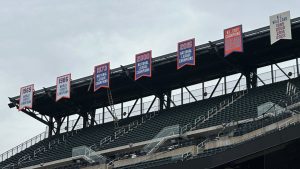 Looking forward to further realignment above right field, but not taking it for granted. The Mets, meanwhile, are Rufless and ready for the new season, a season slated to start truly on time for the first time since 2019. May the start adhere to its schedule and the season encompass one Amazin’ Days after another en route to an indisputably Amazin’ Year à la those that have occurred periodically in our past. The Mets have updated the postseason banner procession above Citi Field’s right field promenade so it acknowledges first the franchise’s two world championships (the first of them from 1969, as later editions of the Daily News would confirm), then its three National League pennants (the last of them clinched when Daniel Murphy was 30 and on a roll), then all six division championships listed on one placard, then the four Wild Cards listed on another, with 2022 receiving its due therein. Seven banners covering ten Amazin’ appearances in October, not all equal in stature, but varying degrees of achievement fairly noted. Even in the Steve Cohen Era, landing in the postseason six months hence is the most you can ask hope for before April.
• First place would be swellest.
• A playoff berth might have to suffice.
• Just get there and then do something with it.
Pete Alonso has mentioned how the heightened stakes of the WBC will have him ready for this October. I’m glad he’s confident. I’m confident. But worry about March 30 versus the Marlins in Miami first and take it from there, Pete…and everybody else. Never take for granted a seventh month will be affixed to a baseball season, no matter what you’re projecting or predicting on the eve of the first month.
For the season about to be in progress, an enormous scoreboard has been installed at Citi Field to post all the zeros imported ace Verlander and incumbent ace Max Scherzer will post, along with the hits and runs that will be registered by the home team as balls fly over the right field fence that’s been pulled in to create space for that fancy “speakeasy” with the fancier price tag. If you can’t afford the membership fee to the Cadillac Club at Payson’s, there is now an eatery/drinkery called the K Korner setting up shop as the in-house saloon where all are welcome to invest and imbibe. Old-timers among the fans recognize the K Korner as a Shea homage. Old-enough timers may reflexively refer to the K Korner’s spot as McFadden’s, which hasn’t operated in several years, except as an injection point for vaccines. Citi Field is entering its fifteenth season. It’s old enough to have old-timers. Remember those impossible to reach black fences? Remember the Ebbets Club? Remember when the Wilpons owned the team and probably wouldn’t pay a Darin Ruf to simply go away?
Time just slid into home and is coming up to bat again.
It’s daybreak on a new baseball season at National League Town.
by Greg Prince on 21 March 2023 8:39 pm The Mets are opening a “speakeasy” out in right field. I think Prohibition has been over roughly 90 years, so I’m not sure why one would need to know a secret password to get in, but why quibble with a concept, especially when the name of this high rollers club is intended as an homage to someone who has long merited an homage at Citi Field?
Welcome to The Cadillac Club at Payson’s. Or welcome to the news that it exists unless you are one of its “25-30 members” and get to fill one of its “only 100 seats,” per the press release announcing its debut. I assume I’ll have a great chance to see it when Steve Gelbs leads SNY viewers on a guided tour. Otherwise, I’ll just have to be happy that Joan Payson’s name graces something that sounds pretty sweet. Joan Payson bought us a National League franchise that’s still here. The least the Mets could do is acknowledge her more strongly than they have. If an automotive sponsor has to be involved, so be it. I’m guessing Mrs. Payson rode to Shea in something more than a compact.
Getting to see and think about Mrs. Payson inevitably takes a historically minded Mets fan back to the beginning of the ballclub, when the principal owner gave her blessing to George Weiss’s plan to bring in familiar figures with whom fans were likely to identify in “I know who that is!” sense. Experience wasn’t lacking. Consider the very first lineup the Mets sported in St. Louis, 61 years ago this April 11:
Ashburn CF (first MLB game 1948)
Mantilla SS (1956)
Neal 2B (1956)
Thomas LF (1951)
Bell RF (1950)
Hodges 1B (1943)
Zimmer 3B (1954)
Landrith C (1950)
Craig P (1955)
Pretty seasoned for a first season. Not a single career among the starting nine began later than 1956. The Original Mets had been around. Wear and tear was implied when players were made available by the other NL enterprises for drafting, signing or trading purposes. Two of the Mets who got the team going, Ashburn and Hodges, are in the Hall of Fame today. But by 1962, many of those guys were already playing like museum pieces.
Another living, breathing icon in uniform, Casey Stengel, understood the veteran lineup would get him only so far. Casey didn’t wish to be underestimated because he was managing in his seventies back when that was considered irrefutably ancient, but he also understood the value of new blood pumping through the Metropolitan veins. Thus Ol’ Case devoted much of his March every March he managed the Mets touting the future in the figures he dubbed the Youth of America. If it was Spring, it was time to look ahead to the prospects who were going to make the Mets sooner or later and make the Mets’ prospects better as soon as possible.
It’s Spring. Sussing out and talking up the Youth of America is still what we do. Granted, we’re coming off a better season than Casey ever helmed in orange and blue, but we can’t be blamed for peeking around the corner of what we’ve already experienced, especially if we have up-and-comers coming up. It’s been a pretty promising month for getting a taste of those who’ve been ripening on the farm.
Mark Vientos has notched eleven RBIs. Ronny Mauricio, before being sent down, bopped four highlight-quality homers. Brett Baty, getting lots of time at third, is batting .342. Francisco Alvarez, not quite healthy when camp started, has slighter numbers, but we can then say, as we say when the veterans are stuck on the Interstate at this juncture of the calendar, it’s only Spring Training. He’s still Francisco Alvarez. He’s still highly touted. The Mets have catchers and at least half a designated hitter. Alvarez can wait.
They can all wait beyond March 30, 2023, in my instinctive judgment. Get really good at fielding or not striking out or whatever it is ya gotta work on. The kids have time. We have time. I think we do. We certainly have experience, if not far too much of it à la 1962.
Let’s write out a pretend but not altogether hypothetical lineup that we might actually see on Opening Day if Brandon Nimmo’s heart of hearts and knee and ankle are all on the same page…
Nimmo CF (first MLB game 2016)
Marte RF (2012)
Lindor SS (2015)
Alonso 1B (2019)
McNeil 2B (2018)
Canha LF (2015)
Vogelbach DH (2016)
Escobar 3B (2011)
Nido C (2017)
That’s the lineup from the last time the Mets played a non-exhibition game — the quiet denouement of last season’s Wild Card Series — and it didn’t generate much offense (one hit), but it was only the playoffs. The sample size from the rest of 2022 was a little bigger, and I’m willing to ride with the guys who hit most (if not all) of last year.
To a point. The kids are coming with the idea that they’ll budge their way into not-so-hypothetical lineups. They’ll alight when the moment is right. New blood. Budding careers. Sooner, later, eventually.
***
In the realm of experience, if you were sentient and a New Yorker on May 8, 1970, you were able to experience a sports moment you will never forget. Willis Reed was hurt. Really hurt. Basketball tends to require the use of two legs. Willis could depend on maybe one. He played Game Seven of the NBA Finals anyway. Got cortisone injected and went for it when nobody was certain he would. I was seven years old. I couldn’t believe Willis wouldn’t play. I’d just spent my first full season of engagement in any team’s fortunes believing in Willis Reed — the center, the Captain — and not believing any opponent could stop him.
Not that I thought in terms of just Willis Reed. Red Holzman didn’t align his Knicks around a single player. We had Frazier and Barnett, DeBusschere and Bradley, the Minutemen (Russell, Stallworth, Riordan) and, in stray minutes, Bowman, Hosket, May and Warren. But Willis was in the middle of it. He was the MVP of everything. He was the leader on the floor and in the locker room. From October of 1969 (after the ticker tape had been swept from Lower Broadway) to May, I was obsessed with Those Knicks like I’d never be obsessed with the Knicks or any non-Mets team again. My parents had season tickets. Some my father used for business. Some I guess he sold. Some games they went to and cheered wildly. They took my sister and me to a few games at the Garden, including one in the playoffs. What a place to be when you’re seven! They had taken us to the circus there as well. I preferred the Knicks. We listened to the home games we didn’t attend on the radio with dinner, my introduction to the velvet vocals of Brooklyn’s own Marv Albert. Road games were on Channel 9. I watched those, even the late night ones on the West Coast, even if it was a school night. Did my mother mind my staying up past midnight for basketball? Who do you think I was watching with? I didn’t get enough sleep, but I got through first grade all right.
Willis Reed, who I kept reading wasn’t really as tall as the 6’ 10” at which he was listed, was revered in our house as a giant. A friendly giant. A fierce center and a good man. The whole crew, straight through to Red’s trusty sidekick trainer Danny Whelan, felt like mishpacha — extended family, but more interesting than our cousins. Sixty wins in an 82-game schedule. The Bullets series, with Willis withstanding Wes Unseld in seven, was a lesson in confident tension. The Bullets were good, but they were from Baltimore, and I’d already seen the Orioles get taken down by the Mets and was up to speed on what happened between the Jets and the Colts. The Bucks series, which we won in five amounted to a coming out party postponed (sorry, Alcindor, not yet). Here came the glamorous Lakers of Wilt Chamberlain and Jerry West and Elgin Baylor with everything on the line. That trio was as imposing as anything. But we were led by Willis Reed, at least until Game Five and an injury that should have made handling Wilt impossible. Holzman had other notions. He wouldn’t have been the coach he was if he didn’t know how to adjust. He deployed DeBusschere, the prototype of a power forward, to stay on the Stilt, and it worked. The Knicks took a 3-2 lead. The next game, the Knicks missed Willis like crazy. Thus, Game Seven.
We hung on bulletins indicating whether Willis was going to be well enough to take the court that fateful Friday night. My mother had to talk me down from my high anxiety that this wonderful team we had watched race to a 23-1 start in the fall might somehow not be the champions. If the Lakers win, she suggested, they’ll have deserved it. They’re a good team, too. All the advice my mother tried to impart to me in the next twenty years of her life, and those are the words of wisdom that I return to most often. When the Mets or any team I root hard for faces a big game, I try to remind myself that there’s another team on the other side, and they are not to be disregarded. It doesn’t always soothe me.
Mostly, I believed Willis was going to play, because Willis seemed incapable of letting us down. Sure enough, Marv told us as we started dinner (home game, therefore blacked out locally, and my father chose not to invest in finals tickets), “Here comes Willis Reed!” Willis would play, Willis would start, Willis would sink two jumpers — on one good leg — and the Knicks were about to revert to form, which is to say the Knicks who won eighteen in a row in October and November. With Clyde turning in the most low-key immortal performance in any Game Seven ever (just 36 points and 19 assists), the Knicks quashed the Lakers. Willis didn’t have to do much more than show up. The game felt won the instant his presence was announced. He and that team were destiny personified.
Those Knicks would just miss making the finals the next spring; go the championship round and lose to the Lakers the spring after that; and then take one more trophy the next spring, in 1973. My parents dropped the season tickets in 1970-71 and 1971-72, but signed up all over again for 1972-73. I got to go to a bunch of games during the regular season and a game in every round that year, including the finals. I was at the Garden for the legendary double-OT Easter Sunday win over the Celtics. It was legend before it was over. My father pounded a tile out of the ceiling over our seats. I’d be telling that story forever after.
There was one more go-round for Those Knicks, but it was obvious to all — including this by now experienced eleven-year-old — that they didn’t have much left. The Celtics took care of them pretty easily in the conference finals. Willis, who had trouble staying in one piece after the first championship, retired. So did DeBusschere and Jerry Lucas, who, like Earl Monroe, brought shimmering individual credentials to Holzman’s Knicks and blended in beautifully. I remained a Knicks fan in the sense that I didn’t become a fan of any other NBA team — the Nets were still in the ABA — but I never cared as much as I did when Willis stood tall in the middle of everything, gradually reducing my rooting interest to sporadic, then non-existent. Something in my heart of hearts told me accept no substitutes.
But, boy, did I love Those Knicks and did I love Willis Reed and did I love sharing him and them with my mom and dad. I read the statistics in the paper, and got that Willis was great. But Dad filled me in on what made Willis great beyond points scored and how Willis made everybody around him better. So did Clyde. So did DeBusschere and Bradley and Barnett and everybody else. That’s the kind of basketball Holzman preached. That’s the kind of team it was. When I learned on Tuesday that Willis Reed died at the age of 80, I at the age of 60 understood it. The seven-year-old version of me only believes that Willis is there when we need him.
by Greg Prince on 20 March 2023 5:17 pm Brandon Nimmo is “week to week” with whatever he did to his right knee and ankle this past Friday night in yet another game that counted only as much you wish it to. The Mets termed it a low-grade sprain. Nimmo, newly signed for eight years, isn’t interested in timetables or diagnoses that indicate anything less than “leading off and playing center field, number nine, Brandon Nimmo” will echo throughout formerly Marlins Park on Thursday March 30 and everywhere else clear to the end of 2030. He’s got “a best-case scenario” going for him, he’s convinced, despite the slide into second that had him limping off the field and all of us dragging a hand down our collective face following the second OMG/WTF moment in about 48 hours. He’s respectfully dismissing the company line Billy Eppler delivered and is instead taking it “day to day,” insisting he felt better Sunday than he did Saturday. He’s consulting with his “heart of hearts” and believing he’ll be “ready for Opening Day,” or at least is “not ruling anything out right now”.
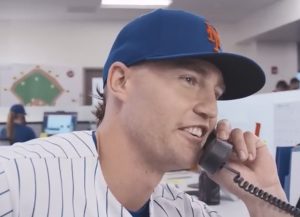 Grin and bear another injury. For such conditional silver lining mining of the clouds over Port St. Lucie, pending, of course, what the doctors have to say on the matter, Brandon Nimmo is my co-player of the year before it begins, sharing never-too-soon honors with Edwin Diaz, who told Eppler in the dark hour the Mets weren’t expecting to arrive on March 15, “Don’t worry. This is going to be fine.” Once the year begins, we’ll start fresh, but that type of attitude registers as a welcome antidote to whatever the rest of us are thinking every time anything befalls a Met…or any time anything might possibly befall a Met. When it was reported in passing on social media over the weekend that Max Scherzer would be hosting a “crawfish boil” for his teammates (I put the event in quotes lest you think I have any idea what a crawfish boil is), I’d say approximately every third Mets fan comment posted in response veered to wondering how many starts Scherzer would miss from burning his tongue on main dish.
Is March a little too early for Pessimism, Skepticism, Cynicism and Fatalism — the Four Horsemen of the Metspocalyspe — to be out and about? With Steve Cohen sending a veritable TLC staff to Diaz’s house to make sure his recovery proceeds apace and, more to the point, capable of doing and willing to do whatever it takes to not let a couple of injuries to a couple of crucial players derail the projected Mets Express? With shreds of evidence suggesting maybe Edwin won’t necessarily be out all of 2023? Perhaps it’s just the painkillers talking when “a person close to Diaz” tells The Athletic, “There is some optimism” on behalf of Edwin’s surgically repaired patellar tendon (and the rest of Sugar) returning to action while there’s still some championship baseball to be contested. I wouldn’t take that to whichever gambling consortium will be carpetbombing its commercials all over Mets telecasts, but it’s a pleasant enough thought. You lose Diaz for the foreseeable future, and Nimmo for an unspecified number of weeks, and Quintana to a tough break that will have him out several months, and whoever else has already been sidelined or will be sidelined in the course of Metsian events, you welcome coming up with whatever it takes to fend off Pessimism, Skepticism, Cynicism and Fatalism. It’s probably the last two that had Scherzer getting too close to the boiling crawfish.
Nimmo, it should be noted, sustained his injury in a Spring Training game. There was no celebrating, just kind of a crummy slide. Yet he and Diaz are both out for a spell or more. Quintana had a lesion on his rib. Sorry it was there. Glad they found it. Thrilled it was benign. All kinds of hell will appear at every turn for a baseball player and a baseball team preparing for the season ahead. Sometimes you’re luckier than hell. Pete Alonso had a serious car accident on his way to camp last March. “A close experience with death,” he called it then. He walked away physically unscathed. Sometimes you catch a break despite another driver running a red light. Sometimes you tear a patellar tendon because somebody’s happy you won what you consider a big game. Sometimes you’re just trying to get from first to second. Never mind bubble wrap. Let’s ask Cohen to get us the best possible players and simply put them on display in the Jackie Robinson Rotunda for us to admire, relatively certain nothing terrible will happen to them if they promise to not budge. The second anybody begins to move a muscle is when we brace for the worst.
That strain of anxiety stems from a shall we say checkered past that ran, then limped through last week. This week we go on. Next week the season starts, without Diaz, without Quintana, probably without Nimmo, Brandon’s heart of hearts notwithstanding. All the Mets won’t be ready to go, though there will be a full complement of Mets, a few unexpected when we began shaping expectations about this year, but that will happen (which is why preseason expectations are best formed out of the most malleable clay available). I hope to unconditionally release those Four Horsemen of the Metspocalypse from of our system by Opening Day, or at least reassign them to crawfish cleanup duty at Max’s place.
by Jason Fry on 17 March 2023 1:00 pm Three thoughts on the Mets being unexpectedly and horrifically shorn of Edwin Diaz for the 2023 season:
1) Joe Sheehan got some grief on Twitter for saying that the loss of a “one-inning reliever” was “a bee sting, not an axe blow,” and while I wouldn’t have put it that way — losing Diaz is being stung by the whole goddamn nest at minimum — I do see his point. The Mets arguably have six stars/superstars: Pete Alonso, Francisco Lindor, Jeff McNeil, Max Scherzer, Justin Verlander and Diaz. If I told you that you had to lose one of those six for the entirety of 2023, whom would you choose? You’d hem and haw and look for a loophole of course, what with being a good person and all, but I bet once you were convinced there wasn’t another way out you’d pick Diaz, which is what Sheehan was pointing out. The Mets have added a lot of depth to their bullpen in the offseason and the gap between a good closer and a great one doesn’t strike me as that big when measured over a full season. The Mets will be a lot less fun without the lights going down and the strains of Timmy Trumpet starting up, but I’m not convinced they’ll be an order of magnitude worse.
2) I hate the WBC, OK? I hate it because I can barely tolerate spring training even without shipping off most of the players I know and forcing them to wear uniforms that look like interns designed them, and that was true before anyone important to me got hurt. I think ballplayers who are Mets ought to be Mets all the way (cue the Leonard Bernstein score), and when they’re not actively being Mets they should sit quietly and think about how to be better Mets. But I’m also aware that this is insane. Diaz didn’t blow out an elbow because he was overamped pitching for Puerto Rico in March; he blew out a knee because he’s human and the world is imperfect and shit happened. Gavin Lux just tore his ACL and is out for the season, an injury suffered in the kind of meaningless spring-training game our current situation tempts us to proclaim as invariably harmless. To bring the topic back to closers, in 2012 Mariano Rivera blew out a knee and missed the bulk of a season while shagging flies in the outfield during batting practice. (Believe it or not, bad shit also happens to that local team from that jumped-up beer league.) Ballplayers get hurt, sometimes badly, because they iron shirts while wearing them and stick forks in their eyes and get hungry at night in Miami and have nightmares about spiders and decide early October is an excellent time to trim the hedges. Shit happens, and I’m sorry if that’s not a cogent philosophy, but it’s a lot more accurate guide to life than most anything cogent philosophers have offered us in 3,000-odd years of trying.
3) Imagine for a moment that Diaz had been injured in March 2020, before [all that] happened. Good people would have immediately expressed that it was a terrible shame; people who needed to be reminded that they’re good would have snarked about addition by subtraction before the better angels of their nature tapped them, perhaps a little demonstratively, on the shoulder; and bad people would have said the things that bad people always say. Suffice it to say the reaction would have been different. Instead, the curtailed, artificial 2020 season was the start of Diaz’s rebirth in New York. It was the tentative, fanless start that led to a better 2021 and then the yearlong celebration that was 2022. Back in 2020 we were all ready to drive Diaz to the airport ourselves in exchange for a warm body and a bunch of sunflower seeds; now we’re in sackcloth and ashes over his impending absence. That’s a reminder, when we desperately need one, that being a Mets fan does not actually mean trudging along with a hissing and spitting black rain cloud over one’s head 24-7-. Good things do happen to us, redemption stories are sometimes written, and there really are second acts in Metsian lives. Let’s remember that as we’re mourning this blow.
Let’s remember that, and reflect that we have a lot deeper bullpen than in a year when we won 100 games, and think about how even a bunch of bee stings aren’t fun but usually aren’t fatal.
And if we can hold all that in our heads, why not go a step further?
Fuck it, let’s win it all anyway.
by Greg Prince on 16 March 2023 6:28 pm Prescience wasn’t required to sense it might happen and obliviousness didn’t necessarily obscure your senses if you were reveling in what was going on before it happened. I was between the top and the bottom of the ninth inning of the final game contested within Pool D of the World Baseball Classic, Puerto Rico playing the Dominican Republic Wednesday night. Puerto Rico had Edwin Diaz coming into pitch to preserve a three-run lead for the team representing his homeland. My affinity for Edwin Diaz has nothing to do with the fact that he’s a Puerto Rican and everything to do with the fact that he’s a New York Met. Since 2019, I have hoped Edwin Diaz would nail down saves. Since 2021, I have believed Edwin Diaz would nail down saves. In 2022, confidence morphed into certainty, with his entrance into any given game accompanied by scintillating ceremony underscoring just what a lock he had become. Diaz’s saves weren’t merely competitive necessities. They were events. They were reasons to almost not mind being ahead by three runs rather than four.
It’s outstanding that Diaz is about to pitch an inning even if it isn’t for the Mets, I decided Wednesday night, as long as he doesn’t get hurt. I thought this the way I might instinctively plan my journey on the edge of a crosswalk if no cars are coming in either direction, looking left, looking right, keeping alert to the possibility that a vehicle might appear from almost out of nowhere, and being ready to act accordingly in case it does. I’ve made it safely across every crosswalk I’ve ever encountered by routinely preparing for the worst.
Diaz came into the game for Team Puerto Rico, making me a Team Puerto Rico fan. The PA system at the ballpark in Miami blared his music during commercial break, but the producers of the broadcast airing the game understood they wouldn’t be getting the most out of an Edwin Diaz appearance if they didn’t indulge a version of the hubbub that exalts his entrance at Citi Field. Returned from the commercial, they showed him trotting in to “Narco,” and how excited it gets his fans, in this case those waving flags for Puerto Rico, but also any stray Mets fans who happened to be on hand, or, I suppose, fans of ritual and excellence.
No ritual is better in the contemporary game than Sugar coming in as Timmy Trumpet blows his horn. No reliever is better than Edwin Diaz, home or away. The announcers said as much. They talked about Diaz the way non-Mets announcers not long ago trumpeted Jacob deGrom or non-Nets announcers went on about Kevin Durant or, decades earlier, network voices describing NFL games emphasized no defensive player on the field was better, perhaps in the history of professional football, than Lawrence Taylor of the New York Giants. The Nets of the ABA weren’t on national television all that much, but when they were, such singular praise was heaped on Dr. J, Julius Erving, the way it was on TV and magazine covers and every kind of media extant when Dr. K, Dwight Gooden, and Tom Terrific, Tom Seaver, reigned supreme. When you root for a team and the consensus out there that one of your guys is the best at what he does, it delivers a chill straight up your spine. The good kind.
Seaver died in 2020; I’m still getting over it. Gooden tested positive for cocaine in 1987; I’m still getting over that, too. Erving had to be sold to Philadelphia to allow the Nets to finance their way into the NBA 47 years ago; I’ll let you know when I’m over that. LT’s long since retired. KD’s in Phoenix. DeGrom is a Texas Ranger. Wednesday night, I could still count Diaz in the realm of greatness I could call my own. His impact might not have been the same as those others, his presence in games limited to very specific innings on very specific occasions, but he has shot into their sphere. After 2022, he wasn’t part of the debate of who was best at his position. There was no serious debate. When it came to closers, there was Edwin Diaz and there was everybody else.
I was hyped up on “Narco”. I was hyped up on Team Puerto Rico vanquishing its regional rival, never mind that I had nothing against Team Dominican Republic. PR had Diaz, DR didn’t. I was hyped up on Diaz laying down a 1-2-3 ninth. Just don’t get hurt, and this will be a kick. Not a Mets kick, exactly, and not a game in the standings that mean anything to me, but a pretty good kick for the middle of March. But, needless to day, just don’t get hurt. That kind of kick we can do without.
Edwin and his unhittable slider recorded two quick strikeouts, needing only four pitches to retire Ketel Marte, seven to take care of Jean Segura. The third batter, Teoscar Hernandez, hung in there a little longer. Coaxed three balls out of Diaz, though one implied the home plate umpire could use an eye exam. Fouled off three in a row at one point. I was growing just a touch antsy, less from support of my momentary favorite WBC team and more wondering if everything was all right with Diaz. He doesn’t usually need this many pitches. Is he laboring? Then I reminded myself this was one at-bat in a non-Mets game, he was pitching with a lead, he had two outs and stop worrying, nothing unusual is going on here as long as he doesn’t get hurt.
On the tenth pitch of the at-bat, the twenty-first of the half-inning, Diaz froze Hernandez. Strike three. Out three. Reflexively I clapped the resounding clap of satisfaction. Edwin Diaz just sealed a win. I always clap for that. That it wasn’t for the Mets and that it wasn’t in a game that I’m conditioned to consider one that counts was irrelevant to my surge of adrenaline. It’s like the man himself said in the Super Bowl commercial when he confirmed that order for New York Mets tickets: Yes! The closer!
 There won’t be any Sugar answering on the bullpen phone, but somebody will pitch ninth innings. That was fun while it lasted, which is to say until I blinked. I and nobody else had any idea that if you didn’t clap for Edwin Diaz nailing down a save on Wednesday night, you weren’t going to clap for Edwin Diaz nailing down a save for a mighty long time. Because as soon as I unblinked, the announcers were saying something about Diaz being down on the ground amid the Team Puerto Rico celebration and something about him not getting up, and all I could hear after that was myself repeating one word over and over:
“WHAT? WHAT? WHAT?”
Entering Spring Training of 2023, I couldn’t imagine Edwin Diaz not nailing down saves for the New York Mets. My imagination is about to get a workout, and the chill up my spine isn’t pleasant whatsoever.
If you don’t know by now — and if you don’t, I envy you — Edwin Diaz tore his right patellar tendon in the aftermath of Puerto Rico’s victory over the Dominican Republic. Or is that Pyrrhic victory? If what happened to Diaz could have happened to anybody in that situation, the situation could have only happened in baseball in the middle of March if it happens in the WBC, because baseball success doesn’t usually spur celebration this time of year. One supposes an injury from which a player drops to the ground and can’t rise on his own power could happen turning this way or that, or crossing the street, or finishing stretching, or standing up awkwardly in his rented condo. But it happened in the WBC.
The sublime Tom Verducci wrote a column for Sports Illustrated Thursday morning, after Diaz’s injury became apparent but before his prognosis was announced, declaring, “The people who don’t like the World Baseball Classic generally fall into two buckets: general managers, who are paid to worry, and those who don’t truly love baseball” before lecturing his readers that, despite the mishap that we were about to learn had knocked Diaz out of regulation play for the season ahead, the WBC is great and fun and beneficial for baseball. Had Verducci been on assignment in Dallas on November 22, 1963, perhaps he would have filed copy the next day dismissing the concerns of a shocked nation and instructing us we shouldn’t be down on the beauty and majesty inherent in open-air presidential motorcades just because one was rudely interrupted.
The WBC, right until Team Puerto Rico’s celebration commenced, bordered on delightful when consumed in a vacuum. I was watching on and off. I was interested on and off. If Diaz (or Lindor or Escobar) wasn’t playing, I was more off than on, but I kept tabs. It surely wasn’t essential viewing. Not to me, not to Mets fans with no emotional skin in the game. The WBC is here every few Springs. You can curse its existence, but you can’t curse it out of existence. If nobody showed up to play in it or tuned in to watch it or paid their respective currency to wave a flag at it, maybe it would go away. But it’s here.
Diaz isn’t. There won’t be any trumpets blowing come this Opening Day or any day with Mets baseball in 2023. The torn patellar tendon timeline suggests eight months of recovery await. Unless the World Series is rained out a whole bunch, that means “get well, Edwin,” is all the cheering we can do for him. As for the fate of our potential presence deep into the next postseason, the realistic goal of the Mets who signed Diaz as soon as they could once last season ended, the Mets will still play nine-inning games, will still have leads of between one and three runs in some of those games’ ninth innings and will still need a pitcher to pitch those ninth innings. Somebody among the professionals employed by the New York Mets, currently or eventually, will emerge. He may not be “the closer,” but that will be the job at hand. Somebody’s music will play, some iteration of ceremony will materialize, some saves will be put in the books, some save opportunities will go awry. The Mets’ particular superpower of making their fans as sure as fans can be that we’re absolutely gonna hold on to win a close game will not be activated. Outs, however, will happen.
Uncertainty, too, but that’s baseball.
Take your mind off Edwin Diaz’s torn right patellar tendon with a new episode of National League Town. It’s about some good things that have come along in baseball through the years. I don’t believe the WBC is mentioned.
by Greg Prince on 14 March 2023 7:03 pm It’s mid-March. Spring Training is entrenched until it’s not. Games that don’t matter are the norm until they’re not. If a game is accessible on TV, great. If it’s not, well, it’d be cooler if it was, but, really, no biggie. Players of whom you’d barely heard a month ago are your constants until they fall off your radar for a while or perhaps for good. Something called the World Baseball Classic temporarily enchants or irritates you until it disappears from your consciousness for at least a quadrennium. Back in the Grapefruit League, if a game is tied after nine innings, there won’t be a runner automatically placed on second. Everybody will simply go home or go to dinner. It’s enough to make you shrug.
Spring Training hums along, give or take a finger or forearm or something else that suddenly feels off. If nobody gets hurt, nobody will complain too volubly. During the six months that commence in a couple of weeks, baseball is everything. During the month that follows, postseason baseball, if we’re lucky, is everything and more. Then come the months of preparatory activity for the next six-, ideally seven-month period of everythingness, even if those months when we’re waiting for that — November, December and January — we define mostly by baseball’s void. Those are the months when we shuffle through departures and arrivals and hang our tongues out in anticipation of mid-February, which we convince ourselves will certify baseball’s return. Baseball indeed comes back then, but more as a hint than a fact. It’s just more preparatory activity, except sporadically televised and with uniforms. By the time we get to mid-March, where we are currently, it’s been a month of that and the low hum has set in as if it’s here to stay. The low hum is not enough if you want more, and of course you want more. You start to think about such-and-such date in a couple of weeks and realize there’ll be a game that day that matters without qualification, and it better be on TV. Of course you want that.
But the low hum is enough for now, if not much longer. We have hit the spot when we can sense the actual return materializing beyond the horizon. The WBC will be over and forgotten. The transitory figures will resume their journeys peripheral to our view. A few innings for the starters will become most of the innings. The pitchers’ pitch counts will rise, as will the stakes for those still trying to impress. The injuries will be healed or, like Jose Quintana’s, registered on the injured list, a chronicling we’ll have to take seriously because Opening Day and its Opening Day roster will cease to be theoretical. Then again, the Opening Day roster is the roster for just one day.
In 1975, the Mets conducted an entire Spring Training and exhibition schedule in service to carefully inking rather than penciling in every player who would fill every conceivable role in advance of their Opener, at home, on April 8. Yet the club flew from Florida to New York and discovered that one of the injuries they hoped would heal, that pertaining to Cleon Jones’s right knee and affecting his calf, wasn’t all the way recovered. Cleon, a Met since 1963, would be retroactively placed on what was then known as the DL, meaning the Mets would start the season one brick shy of a full 25-player load. They’d thus need an extra Met ASAP, ideally an outfielder who could swing from the right side. It shouldn’t have taken a nationwide talent search to fill the role. They just conducted that entire Spring Training and exhibition schedule. What’s the point of the Grapefruit League if you can’t pluck one of those players who was about to plummet from your radar and place him on your roster?
As if everything is always that simple. After a month of diligent Florida maneuvering, the Mets considered what they’d seen at or proximate to Al Lang Field and turned their attention west to what had recently occurred in the foreign land known the Cactus League, hiring a player who excelled in Arizona; a player who had been playing against them as long as Cleon Jones had been playing for them; a player who just the other year was part of a successful effort to prevent a world championship from becoming theirs.
 He helped the A’s over the Mets, but Alou would be forgiven. Before the 1975 baseball season was one week old, the Mets welcomed onto their roster Jesus Alou, most recently of the Oakland A’s. We saw him as an A in 1973, during the World Series we almost won, Alou having delivered a couple of key hits in the ALCS to help vault the Kelly Green, Wedding Gown White and Fort Knox Gold (Charlie Finley’s phrasing) into that Fall Classic. We’d seen Alou throughout his career in the National League, dating back to his debut on September 10, 1963, at the Polo Grounds, four days before Cleon himself broke in. Alous were not uncommon sights in the NL, as the Giants had corned the market on all three of them. Felipe had been up with San Francisco since 1958, Matty since 1960. If you became a baseball fan in the seasons that followed Jesus joining his brothers, you were acutely aware that in the sport you chose, there were inevitably three strikes, three outs and three Alous.
Once they were all ensconced within his realm, manager Alvin Dark couldn’t resist introducing them as a trio, pinch-hitting Jesus and Matty directly ahead of Felipe’s spot in the batting order in the eighth inning of their loss to the Mets — “it was like an old vaudeville telephone gag,” observed Harry Jupiter in the San Francisco Examiner — and later inserting each of them as one-third of his outfield for spells in three September blowout wins. This meant sitting Willie Mays, an act Giant skippers habitually resisted if a game’s outcome was in doubt. The last time Alou-Alou-Alou constituted the SF outfield was September 22, with the Mets visiting Candlestick and losing by eleven. Alou ended the game by catching Chico Fernandez’s fly to right.
To be specific, that was Jesus Alou, playing right, while Matty manned left and Felipe patrolled center. For a few weeks, you had to specify your Alous and their positions. In the ensuing offseason, Felipe would be traded to Milwaukee, and two winters later, Matty would be sent to Pittsburgh. Jesus, however, established himself as the Giants’ right fielder in 1964. According to the back of the 1967 Topps card where I made his acquaintance, “the San Francisco brass feels that Jesus has even more potential than his two brothers now in the majors,” though unlike Felipe (three times) and Matty (twice), Jesus never made an All-Star team. He did hit as high as .298 over a full season for the Giants, not bad for a) a converted pitcher and b) “the baby” of the family, which is how I saw him identified in an article when I was a kid and found it kind of curious that a grown man was referred to as a baby. I was also pretty taken by the youngest Alou’s first name. The first Jesus, any pronunciation, I ever knew of was Alou.
 Baby Jesus? The Giants may have harbored all three Alous, but they also eventually let go of all three Alous. Jesus was exposed in the 1968 expansion draft and selected by Montreal. Montreal opted to include Jesus in a trade they had no idea would be the most consequential of 1969, the one that shipped Donn Clendenon to Houston for Rusty Staub. The consequence rippled from Clendenon’s refusal to go to Texas, which meant Donn was still hanging around in Quebec in June, perfect timing for the Mets to take off the Expos’ hands the veteran slugger who’d become their World Series MVP four months thereafter — and let us not overlook the foreshadowing inherent in mentioning Rusty Staub. None of that was of consequence to the youngest Alou, who would top .300 twice as an Astro and appeal to Oakland as a veteran pickup in 1973. Those A’s were always adding experience on the fly en route to crafting their surprisingly sturdy dynasty, chronically antsy owner Charlie Finley happy to make short-term deals and not have to pay anybody too much for too long. (Ex-Met Art Shamsky was a briefly a cog on the World Series-bound A’s of 1972.) Alou would play a pivotal role in ’73, stepping in to take over right field late in the season when Reggie Jackson encountered a hamstring injury and allowing Jackson to shift to center when Bill North got hurt shortly before the postseason. His contribution kept him with the A’s as they achieved their threepeat in 1974.
Come the spring of ’75, Jesus possessed two World Series rings but no guarantee he’d continue with the defending world champions despite hitting .586 against Cactus League pitching. Finley’s A’s relished speed in the form of pinch-running specialists. They already famously retained the services of Herb Washington, who literally did nothing but run for Oakland. They were now intent on adding the ultimately less-celebrated Don Hopkins to replicate Washington’s core competency. More speed off the bench meant less space for existing lumber. In other words, goodbye Jesus.
That amounted to a welcome development on the other side of the country, because the Mets had been keeping an eye on Alou. Bob Scheffing, who had been replaced as GM in the offseason, was scouting Arizona and believed in Jesus. Scheffing had a disciple in his successor as general manager, Joe McDonald, and Joe made Jesus an offer. Alou had thought about playing in Japan, where middle brother Matty had alighted with the intent of hitting for average and being compensated well for it, but this Dominican native decided he preferred playing ball in North America.
“We’ve made no promises,” McDonald said upon announcing the acquisition of Alou. “He knows he can be released again. We want him to pinch-hit.” Alou, in turn, was motivated: “I do not want to lose two jobs in a month-and-a-half. All I need is a batting practice or two, and I’m ready.” Jesus, the 32-year-old baby brother in baseball’s most famous troika of siblings since the DiMaggios, had been around, and didn’t require extensive preparation beyond knowing when the bus left for the ballpark. The veteran noted with pride to Daily News reporter Augie Borgi, “I have not missed a bus in seventeen years.”
Despite no Mets fan who diligently tracked Spring Training 1975 making out prospective rosters with the name “Alou” included, the career .279 hitter was suddenly one of ours as of the new season’s second series, in Pittsburgh, and he made his Met debut in the club’s seventh game, at St. Louis. He was a known quantity from a distance, if no more than a contingency ‘x’ factor plopped atop our meticulously considered personnel scheming and dreaming. Maybe we’d get a kick out of finally having an Alou on our side after taking on one or the other let alone all three at once for so long. As fans, we could make no promises, either.
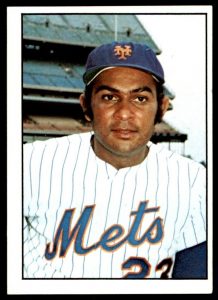 Pretty special as our pinch-hitting specialist. At some point, whatever thoughts McDonald might have maintained about Jesus’s tenuous grip on permanence dissolved. Ours, too. Alou, the first Met World Series opponent determined to make it up to us by joining our side, lasted the entire year and did exactly what the Mets signed him to do. They needed a pinch-hitter? They got someone who established himself as a true specialist. The righty came through time and again, going 14-for-40 for a .350 average as a pinch-hitter. With Ed Kranepool starting more than anticipated, Alou emerged as manager Yogi Berra’s primary pinch-hitter — Roy McMillan’s, too, once the first base coach replaced Berra. Not only did Alou outlast his first Met manager, he endured longer that season than Cleon Jones, who didn’t return from his springtime injury until late May, only to be released ignominiously in July. Alou’s solid ’75 in a niche capacity, not to mention amid a whirlwind of organizational turmoil, earned Jesus a Spring Training spot in 1976. Alas, a visa problem delayed his reporting to St. Petersburg (if only he could have hopped a bus from the DR) and the Grapefruit League success of another, younger pinch-hitting candidate — lefty Bruce Boisclair — resulted in the veteran’s release.
“Jesus is a nice fellow,” said new manager Joe Frazier, echoing what people throughout baseball thought of Alou, “But when [injured] Mike Vail comes back, we need the spot. We have kids with options. You can understand our position.” Alou had been around and got it. He pulled back from playing for a couple of years, but wasn’t done. Jesus returned to action with the Astros in 1978 and 1979. Baseball’s quintessential kid brother played until he was 37 and stayed in the game long after, most notably as Dominican Republic scouting director in this century for the Red Sox, to say nothing of his uncle-ing Mets reliever Mel Rojas (1997-1998), Mets outfielder Moises Alou (2007-2008) and Mets manager Luis Rojas (2020-2021). Jesus Alou, who died last week a little shy of his 81st birthday, lived a long and distinguished baseball life, a year of it as a Met, the entirety of it as one-third of an even more exclusive club.
Unless you were in the outfield for San Francisco on September 15, 17 or 22 of 1963. In that case, everybody you saw was just another Alou.
by Greg Prince on 12 March 2023 11:49 pm As we dim the lights and illuminate our memories, we ask you to direct your attention to the video board for a very special presentation as we unspool our annual montage saluting the Mets who have left us — in the baseball sense — since last Spring.
___
CARLOS JAVIER CORREA
Prospective Third Baseman
Pending Physical
Your team’s owner goes out and secures who he’s secured — let’s continue to pencil in Carlos Correa until notified something’s really wrong with his leg or his negotiations — to go with keeping who he’s kept and you owe it to yourself to look forward to Spring Training. You can’t buy a pennant, but you can certainly shop aggressively for one.
—December 27, 2022
(Reportedly signed with Mets, 12/21/2022; reportedly signed with Twins, 1/10/2023)
___
DEVEN SOMER MARRERO
Infielder
August 15, 2022 – September 10, 2022
A glimpse at the in-progress box score while fast-forwarding past commercials revealed a plot twist I hadn’t seen coming in Atlanta. Not the tally itself, now 13-1, but the participants. There was a catcher making his Met debut, Michael Perez. There was a shortstop making his Met debut, Deven Marrero. And, not altogether unpredictably yet still good for a WHA???, there was a pitcher making his Met debut, Darin Ruf. I missed the three up and three down Ruf recorded in the bottom of the seventh, which means I also missed the first instance of Perez (catching ball one) and Marrero (picking up a grounder en route to the second out) etching themselves into the annals as Mets No. 1,171 and 1,172, respectively. Ruf was already inscribed as Met No. 1,170 from his standard-issue hitting duties, but now he was the fifteenth position player in Mets history to pitch, marking the eighteenth instance in all of a Met position player toeing the rubber. Better Call Saul got paused.
—August 16, 2022
(Free agent, 10/9/2022; currently unsigned)
___
ALEXANDER “Alex” CLAUDIO
Relief Pitcher
September 7, 2022 – September 14, 2022
By the time he handed matters over to a cobweb-gathering Adam Ottavino and the fresh, violent left arm of Alex Claudio, the old wives’ tale of the Mets never scoring for Jake had gone upstairs to bed, at least for another five or six days. The Mets notched 17 hits, six of them doubles, none of them homers.
—September 8, 2022
(Free agent, 10/9/2022; signed with Brewers, 1/3/2023)
___
THOMAS MATHEW SZAPUCKI
Pitcher
June 30, 2021 – May 25, 2022
You couldn’t do much worse for Met pitching in any year than what the Mets got Wednesday from Peterson, Reid-Foley and, sad to say, Szapucki. Thomas neither pitched particularly well nor fielded his position with aplomb. The first Brave to score on the rookie’s watch came home when a potential rundown imploded because Szapucki didn’t think to pursue the dead-to-rights Dansby Swanson between third and home. That runner was inherited from Reid-Foley. The rest that scored between the time Szapucki escaped the fourth down, 11-2, and before succeeding pitcher Albert Almora, Jr. (you read that right) surrendered a three-run bomb to Ozzie Albies, which was posted to Thomas’s ledger. Luis Rojas had hoped to ride his spanking new southpaw clear to the end of the horror show. As a minor league starter, Szapucki was positioned to give the Mets length. But in the ninth, it was fair to infer he was feeling kinda seasick as the crowd called out for more.
—July 1, 2021
(Traded to Giants, 8/2/2022)
___
JOHNESHWY ALI FARGAS
Outfielder
May 17, 2021 – May 24, 2021
Did ya see how the bottom of the ninth between the Mets and Marlins began on Saturday? Jesus Aguilar lined a ball into the gap between center and right. It would take two kinds of Tommie Agee efforts to reel it in: the kind where Agee dove to rob Paul Blair and the kind where Agee hung on in his webbing to rob Elrod Hendricks. Those were two of the most stupendous catches in World Series history. Amid stakes admittedly a few hundred notches lower, Johneshwy Fargas incorporated the most breathtaking aspects of each to nab from Aguilar a leadoff double and, as Smith did minutes earlier, keep the score knotted at one. Running and diving and gaining proximity to the ball would have been impressive as hell. The ball ticking off the top of Johneshwy’s glove would have been reluctantly understandable. But, nope, Fargas was gonna have his scoop and lick it, too. As so-called ice cream cone catches go, this one melted in your mouth and made your eyes water with joy.
—May 22, 2021
(Released by Mets, 8/14/2022; currently unsigned)
___
YOLMER CARLOS SANCHEZ
Infielder
August 20, 2022 – August 25, 2022
It gets instinctively edgy in South Philadelphia when the ninth inning rolls around. The most elite of relievers wasn’t about to simply shoo away the dephlated Phillies. You could take all the precautions — gloveman Sanchez was in for Baty as the 183rd third baseman in Mets history — but you couldn’t avoid trouble. You just had to contain it.
—August 22, 2022
(Free agent, 10/11/2022; signed with Braves, 1/24/2023)
___
ROY EMILIO “R.J.” ALVAREZ
Relief Pitcher
August 16, 2022
Not R.A. Dickey and not Francisco Alvarez and not Robert Gsellman, though he kind of looked like him.
—January 29, 2023
(Free agent, 10/9/2022; currently unsigned)
___
ENDER DAVID INCIARTE
Outfielder
June 28, 2022 – July 13, 2022
As if Met defense could use the help — we’ll never turn down assistance — the club signed Ender Inciarte to a minor league contract. Inciarte now has a chance to become the Willie Harris of his day. Willie Harris, you’ll recall, took extra-base hits of all variety away from Met batters in the 2000s. Then he became a Met in 2011, not having the same impact for the Mets that he had against the Mets, but he was a pleasant enough veteran presence for a non-contending team. Inciarte used to rob us blind in the 2010s. Here’s Ender’s chance to make it up to us.
—June 20, 2022
(Free agent, 7/18/2022; currently unsigned)
___
YENNSY MANUEL DIAZ
Relief Pitcher
May 23, 2021 – September 13, 2021
Lugo sat for good after his one inning. Luis Rojas via Dave Jauss went to Yennsy Diaz to start the tenth of a 1-1 must-win game versus the Los Angeles Dodgers, with a runner automatically on second because that’s how Rob Manfred likes it. This Diaz hasn’t pitched enough in tight situations to make us nervous. This Diaz not having pitched all that much in tight situations is what made us nervous. No offense, Yennsy, but we know Seth Lugo. He’s not infallible, but we carry forth images of Six-Out Seth Lugo having gotten us through second innings with aplomb. We only knew in the tenth that Diaz wasn’t Lugo, and that it wouldn’t take much to score the Manfred on second. It didn’t.
—August 15, 2021
(Released, 08/08/2022; signed with Sultanes de Monterrey (Mexican League), 2/20/2023)
___
SAMUEL THOMAS HUNTER “Sam” CLAY
Relief Pitcher
August 20, 2022
Saturday brought three Met debuts […] with Clay joining R.J. Alvarez as a recent escapee from Met ghost status.
—August 21, 2022
(Free agent, 11/10/2022; signed with Diamondbacks, 12/12/2022)
___
MATTHEW WILLIAM “Matt” REYNOLDS
Infielder
May 27, 2016 – October 1, 2017
April 16, 2022
While we were deprived from December until March of major baseball doings, the Mets slipped minor league contracts to good old Matt Reynolds, the infielder who showed up to watch the 2015 postseason, then fill in quite a bit in 2016 and 2017 […] We love us some Recidivist Mets (the thus far 53 who’ve come, gone and come back, from Frank Lary in 1965 to Wilfredo Tovar last year), even if love, almost invariably, is less sweet the second time around.
—March 17, 2022
(Selected off waivers by Reds, 4/24/2022)
___
JORDAN MICHAEL MICHIRU YAMAMOTO
Pitcher
May 5, 2021 – May 23, 2021
Jordan Yamamoto (who seems like a really nice guy) had a rough second inning, featuring a couple of misplays he had a hand in, and five runs crossed the plate against him. He also has a sore shoulder. All of the above is enough to make a pitcher at least the No. 4 starter on the New York Mets this week. The Marlins let him go.
—May 23, 2021
(Free agent, 11/10/2022; signed with Dodgers, 1/24/2023)
___
ROBERT JOHN “Rob” ZASTRYZNY
Relief Pitcher
August 20, 2022
Zastryzny avoid[ed] ectoplasm as a 27th man, which may or may not be easier than navigating the heart of the Phillie order.
—August 21, 2022
(Selected off waivers by Angels, 8/25/2022)
___
TRAVIS ALLAN BLANKENHORN
Utilityman
June 2, 2021 – July 22, 2022
So many Smiths on this team. But only one Travis Blankenhorn, your roster replacement for Francisco Lindor. Batting in the top of the fourth for Smith — Drew — with two on, Travis, who’d almost hit one out on Saturday night, removed all doubt and hit one more than out on Sunday afternoon. It wasn’t just over the fence. It departed the entire PNC Park physical plant and flew into the Allegheny River. The breach of the initial barrier ensured a three-run homer, the first round-tripper of Blankenhorn’s career. Launching it so far that it departed dry land, well, that was just darn impressive. Most impressive was the Mets now trailed by two. Not six, not five, but two. If the Mets came back to win this game, which even Joe Namath wouldn’t have guaranteed, we’d have an anecdote to reference for the many times in our future when things would appear hopeless.
—July 19, 2022
(Free agent, 11/10/2022; signed with Nationals, 12/14/2022)
___
COLIN SCOTT HOLDERMAN
Relief Pitcher
May 15, 2022 – July 16, 2022
The only Met pitcher who escaped with a zero where it counted was the only Met pitcher we didn’t know would be in our sights when Sunday dawned. Colin Holderman, who planted himself on the organizational radar with a nifty Spring Training, replaced Tylor Megill on the roster when it was announced Megill was dealing with some right biceps inflammation, which is one of those maladies a fan repeats calmly while thinking, “WHAT?” […] Holderman held ’em in the top of the ninth.
—May 16, 2022
(Traded to Pirates, 7/22/2022)
___
ROBINSON JOSE CANO
Second Baseman
March 28, 2019 – April 29, 2022
Robinson Cano may yet escape the conversation he’s been assigned to since it became apparent the rest of the National League East wasn’t prioritizing the coming and getting of us. Because he has (deep breath) another four years on his contract, we don’t know for sure that Robbie is necessarily the stuff of Foy, Fregosi and the others who populate our cabal of eternal regret. On the other hand, he’s definitely, within the Mets Media Guide Page 394 context, of a caliber equal to Carter and Strawberry, Reyes and Beltran, Cespedes twice and Nieuwenhuis inexplicably. Y’know, Joe Foy once went 5-for-5 as a Met, driving in five runs and homering twice — the second time in the tenth inning — to beat the Giants at Candlestick Park. It doesn’t come up often when Foy’s name stirs in Met lore, but it did happen, just like that night Robinson Cano socked three home runs to crush the Padres.
—July 24, 2019
(Free agent, 5/8/2022; signed with Padres, 5/13/2022)
___
TRAVIS PAUL JANKOWSKI
Outfielder
April 7, 2022 – July 27, 2022
Travis Jankowski took over for Canha at first and took off when Jeff McNeil laced a pitch down the right-field line. Jankowski flew around second and steamed into the neighborhood of third, the precinct of the so far famously aggressive Joey Cora. Cora held him — which made me gasp in dismay, though the replay showed that to have been a good decision.
—April 26, 2022
(Free agent, 11/10/2022; signed with Rangers, 1/27/2023)
___
NATHAN CHARLES “Nate” FISHER
Relief Pitcher
August 21, 2022
If Fisher is returned to a farm club Upstate soon, it will be for roster crunch reasons only. We’ve seen how callup relievers who get used to what is considered excess are sent down the next day in favor of a fresher arm. Fisher was indeed used to an extent beyond what was probably projected. He pitched the fifth. He pitched the sixth before it was delayed by rain. He pitched the sixth after play resumed. He pitched the seventh. Nate Fisher not only ate innings and recorded outs, he permitted no runs in his major league debut. Oh, and he was out of baseball and working in the financial services industry not too long ago. (Shades of Todd Pratt managing a Domino’s between backup catching gigs.) Fortunately, the Mets made a wise Fisher investment when they signed the lefty in the offseason.
—August 22, 2022
(Free agent, 11/10/2022; signed with White Sox, 11/15/2022)
___
CHASEN DEAN SHREVE
Relief Pitcher
July 27, 2020 – September 27, 2020
April 10, 2022 – July 2, 2022
Carrasco gave way to Chasen Shreve, whose general effectiveness this season surely had a YA GOTTA BE SHREVE t-shirt on some clever entrepreneur’s drawing board. The garments went on backorder once Julio Rodriguez went deep (torpedoing the A-CHASEN METS iteration as well).
—May 16, 2022
(Released, 7/8/2022; signed with Yankees, 8/27/2022)
___
TYLER WESLEY NAQUIN
Outfielder
July 30, 2022 – October 5, 2022
Tyler Naquin is the first Met since Craig Paquette to have “qu” in the middle of his last name, the fourth overall. Jose Oquendo and Al Pedrique were the others. Tyler Naquin is better off with this nugget as his calling card rather than any of his statistics from down the stretch.
—December 29, 2022
(Free agent, 11/6/2022; signed with Brewers, 2/21/2023)
___
YOAN LOPEZ (Leyva)
Relief Pitcher
April 27, 2022 – August 6, 2022
Yoan Lopez came up and in on Nolan Arenado in the eighth inning of Wednesday afternoon’s almost incidental Mets loss to the Cardinals. Like what Shawn Estes threw in the greater geographic vicinity of Roger Clemens’s backside twenty years ago, Lopez’s pitch didn’t touch the batter he was facing. Unlike with Estes, Lopez’s pitch did what it was supposed to. It transmitted a message. We’ll see if anybody receives it.
—April 28, 2022
(Sold to Yomiuri Giants, 12/20/2022)
___
JACOB HUBERT “Jake” REED
Relief Pitcher
August 15, 2021 – July 7, 2022
We were halfway home after the lidlifter, a 3-1 success that felt in peril intermittently but never fell away. Trevor Williams upended my recently stated lack of faith by giving the Mets four shutout innings. Jake Reed walked a tightrope in the fifth, but somehow maintained a zero-laden toegrip. The Mets’ three runs, gathered in the second and third, held up. Nolan Arenado, villain from the Battle of Busch, was booed a lot. Yadier Molina was booed by me. I attempted to give him a “nice career, guy” round of applause as his retirement finally looms, but I still can’t stand him for 2006.
—May 18, 2022
(Selected off waivers by Dodgers, 7/13/2022)
___
MIGUEL ANGEL CASTRO
Relief Pitcher
September 2, 2020 – October 2, 2021
The bullpen always gets involved. When the bullpen gets involved, we get a little unhinged. Maybe more than a little. The bullpen is why 8-4 wasn’t fully convincing. Mind you, none among Miguel Castro in the seventh (3 hits, 1 run); Trevor May in the eighth (2 hits, no runs) and Jeurys Famila in the ninth (2 hits, 1 walk, 2 runs if only 1 earned) actually let the game slip into genuine danger. Perceptual danger, perhaps, which is enough agita for us at present. You can’t blame our collective psyche for sensing trauma when there’s barely trouble. Castro was a well being gone to two straight games — was it one game too many?
—April 7, 2021
(Traded to Yankees, 4/2/2022)
___
TERRANCE JAMAR GORE
Outfielder
September 1, 2022 – October 8, 2022
The Mets led, 5-3. They tried to add to it in the home eighth by pinch-hitting Vogelbach, who walked, then pinch-running latest Met and professional speedster Terrance Gore, who stole. Vogelbach and Gore could constitute a two-headed monster in this month of expanded rosters, though to size them up, they might be better described as Vogelbach-Plus.
—September 1, 2022
(Free agent, 11/10/2022; currently unsigned)
___
PATRICK ALAN MAZEIKA
Catcher
May 5, 2021 – July 31, 2022
[T]he bench was down to Mazeika and pitchers. Were he certifiably healthy, I would’ve opted for pinch-hitter Jacob deGrom. Mazeika had never had a major league hit, but he’d only made one major league out before. You never know if Patrick Mazeika can drive home a decisive run until you let him try. Luis let him try. Mazeika had himself a fierce AB. A couple of balls. A couple of foul balls. He would not go quietly. On the fifth pitch he saw from Crichton, he did one of the better things he could do. He put it in play and not directly at anybody. It went about, oh, maybe twenty feet, but Crichton’s attempt to field and throw it was about as successful as Lindor’s when McNeil got in Lindor’s way. The pitcher’s scoop to his catcher was off-target and Alonso, who isn’t much of a runner, scampered home. Pete’s a swell scamperer. For a moment, it was pure shirt-ripping joy at Citi Field. It was Patrick Mazeika, who was promoted twice last season, only to be sent back down without as much as a Hietpas helping of action, bare-chested and jubilant. He was an alternate site All-Star, a taxi squad sitter, an almost chimeric figure in hipsterish glasses and substantial beard. Now he was a walkoff RBI hero, same as Cabrera in 2016 in the heat of the last successful Met playoff push (“OUTTA HERE! OUTTA HERE!”); same as Shane Spencer in 2004 (who beat the Yankees on a similarly slight base hit); same as Esix Snead in 2002 (who also chose a game-ending swing — a homer — to record his first major league run batted in); same as Todd Pratt in the clinching game of the 1999 NLDS (the backup catcher protagonist the last time the Mets beat the Diamondbacks in ten innings at home).
—May 8, 2021
(Selected off waivers by Giants, 8/21/2022)
___
ADONIS MEDINA (Del Rosario)
Relief Pitcher
April 23, 2022 – September 3, 2022
Now Adonis had to deal with a runner ninety feet from tying things again, with the daunting task of Trea Turner awaiting him. Seriously, how do the Dodgers ever lose? This way: Nido’s mitt makes contact with Turner’s bat, resulting in catchers’ interference, which Dave Roberts argues for when it’s not immediately called. It peskily places the potential winning run on first, but also takes the bat out of Trea’s hands, which is the one place the Mets didn’t want to see it anyway. Turner takes off for second. Nobody minds that Nido doesn’t throw through. The task at hand is getting out Smith, he who homered to begin the eighth. Is it only the tenth? It feels like this game and this series have both been going on for a week or more. Maybe it’s the time difference. Medina didn’t check his watch. He listened for his PitchCom signal from his catcher — how modern — and brought his sinker to bear on one-and-two, striking out Smith. That made it three outs and the save of a 5-4 win that was always in grasp yet loomed as elusive.
—June 6, 2022
(Free agent, 11/10/2022; signed with Brewers, 12/5/2022)
___
MYCHAL ANTONIO GIVENS
Relief Pitcher
August 3, 2022 – October 9, 2022
A little prior to six o’clock, there was a ceremonial first pitch. A bit closer to six o’clock, there was a second ceremonial first pitch. And with six o’clock fast approaching, there was a third ceremonial first pitch. Since they were all ceremonial, we’ll let their eerily similar numerical designations slide. The fourth first pitch was delivered by Mychal Givens, who’d been gone so long, Buck Showalter apparently forgot that Givens is a reliever rather than a starter. Or, more likely, the skipper figured an inning as an opener was good practice for whatever Mychal might contribute in the days ahead now that he’s recovered from his secret IL ailment. The theme of Closing Day turned Closing Night seemed to be “why not?”
—October 6, 2022
(Free agent, 11/9/2022; signed with Orioles, 12/19/2022)
___
JAMES THOMAS McCANN
Catcher
April 5, 2021 – October 7, 2021
On the first pitch Diaz threw Blackmon, Story lit out for second. Cringing replaced confidence back in New York. Great, they have a runner in scoring position was my initial reaction, brewed with only the most natural ingredients of Rocky Mountain water, Moravian barley and Mets fan anxiety born of perennially porous defense. But what’s this in my mug? It’s James McCann — @McCannon33 to his tweeps — rising and throwing and gunning to second. And it’s Francisco Lindor, swiftly covering, catching and tagging. In a blink, Story is out and the game is over. A couple of extra blinks are required partly because replay review has to be fired up and partly because we are rubbing our eyes from a touch of disbelief. Yup, he’s out, and yup, we won a defensive struggle. We have a defensive lineup. We have gloves and players who know how to use them. And we finished off our Sunday on a play that rarely finishes off any Met day.
—April 19, 2021
(Traded to Orioles, 12/21/2022)
___
TREVOR JOSEPH MAY
Relief Pitcher
April 5, 2021 – October 9, 2022
Trevor May succeeded Lugo, resembling the May we heard so much about in his pre-Met incarnation (a little like Diaz the Mariner needing time to find a holistic comfort level in New York, perhaps). Trevor notched two Ks, then didn’t falter when Kyle Schwarber lifted a ball to center. It was caught by Brandon Nimmo, leaving the score Mets 1 Phillies 0. That’s also where Nola left it when he completed his eighth inning of almost spotless work. It occurred to me that if all went well, I’d just seen a complete game thrown by a pitcher on the losing side. We just needed all to go well.
—August 14, 2022
(Free agent, 11/6/2022; signed with A’s, 12/16/2022)
___
NICHOLAS RAYMOND “Nick” PLUMMER
Outfielder
April 15, 2022 – June 19, 2022
Despite Joe Girardi having aligned his Phillie defense into its victory formation, inserting Roman Quinn in center and moving starting center fielder Odubel Herrera to right to replace slugger and provisional star of the game Nick Castellanos, the Mets found their way into the proverbial end zone, leaning on heretofore unknown Nick Plummer to go deep. Plummer connected for his first major league hit and home run off Phillie closer Corey Knebel, as the leadoff blast, soaring decisively inside the right field foul pole and landing on the soft drink-sponsored porch, dramatically tied the back-and-forth Sunday night affair at four apiece. The proverbial whole new ballgame headed for extra innings once Knebel escaped further damage.
—May 30, 2022
(Free agent, 11/10/2022; signed with Reds, 2/4/2023)
___
JOELY RODRIGUEZ (Sanchez)
Relief Pitcher
April 9, 2022 – October 5, 2022
Joely had his moment, his biggest as a Met, even bigger than his contribution to the combined no-hitter, which was fun as hell, but not essential. Sustaining the Mets’ 5-2 lead between deGrom’s departure and the sounding of Edwin Diaz’s trumpets was critical. Not as critical as most everybody is toward Rodriguez’s continued endurance as a 2022 Met, but almost as critical. What happened? Only good. Rodriguez ended the sixth with a groundout of Olson, a lefty taking care of a lefty. If that was it for Joely’s day, even Ice Cube would say Sunday was a good day. But Buck kept leaning on Rodriguez. Austin Riley’s leadoff single to start the seventh could have been a bad sign, but data from the next six batters indicate it represented a false positive. Joely got pinch-hitter Acuña to fly out. Then he struck out William Contreras and Robbie Grossman. In the eighth, the lefty remained on. Ozuna swung to no avail at Rodriguez’s changeups. Same for personification of a kick in the shins Michael Harris. Adrianza made contact, but only to ground to Luis Guillorme at third. That’s two-and-a-third innings of scoreless relief from Joely Rodriguez, or the bullpen equivalent of Jacob deGrom going nine or Rob Gardner going fifteen. It was the middle relief stint of the year. It probably buys Rodriguez at least 24 hours of goodwill before the sight of him warming in the pen reflexively gives everybody hives.
—August 8, 2022
(Free agent, 11/6/2022; signed with Red Sox, 11/23/2022)
___
CHRISTOPHER MICHAEL “Chris” BASSITT
Starting Pitcher
April 9, 2022 – October 9, 2022
Do you savor sound starting pitching? How could you not embrace Chris Bassitt’s eight frames of zeroes? Appreciate redemption stories? You got Bassitt shaking off the recent uncharacteristic difficulties that had dogged him for a few starts. A fan of personal growth, are you? Bassitt explained after the game that he had failed to connect with his catchers, so he spent the prior week really getting to know Tomás Nido. Their newfound simpatico was apparent in the bottom line: no runs, three hits, one walk and a locked-in Chris. I’ve noticed Bassitt bounces off the mound after every strikeout or perceived third strike, whether it’s called or not. Like every time. I get the idea that Bassitt, even for a starting pitcher, likes his routine the way he likes his routine. Not everybody can be a Flexible Fred if he’s gonna be his best. Remember how Max Scherzer zoned in on his warmup process to such an extent that he left a Japanese diplomat standing off to the side of the mound, depriving the visitor of ceremonial first pitch honors? That’s starting pitchers for ya, sometimes. For Bassitt to take off his blinders and discern why everything wasn’t bouncing his way the way he himself bounces off the mound showed a pitcher getting the most out of his thoughts as well as his arm. Good for him. Good for Nido meeting him halfway or however much of the distance was necessary so they could constitute a team within a team. Mostly, good for us.
—June 15, 2022
(Free agent, 11/7/2022; signed with Blue Jays, 12/12/2022)
___
TREVOR ANTHONY WILLIAMS
Pitcher
August 12, 2021 – October 5, 2022
The Mets were up, 6-4, on Brandon’s bolt from the blue. We were definitely on the sunny side of the tight rope. Could eighth-inning specialist du nuit Trevor Williams keep us leaning toward life rather than the funeral pyre? Drew Smith was on the IL. Seth Lugo gave more than inning of himself in the last Subway Series thriller. Ottavino gave his all in the seventh. Holderman’s in Indianapolis. Williams? Why not? Eleven pitches. Three outs. Good call.
—July 30, 2022
(Free agent, 11/6/2022; signed with Nationals, 12/9/2022)
___
TAIJUAN EMMANUEL WALKER
Starting Pitcher
April 8, 2021 – October 4, 2022
No. 99, Taijuan Walker, pitched well. Less well than No. 45, Zack Wheeler, who used to work here. Less long than Walker wished. Tai went five. He could’ve gone six. Luis Rojas and the spreadsheets somebody sends him said he couldn’t. Bye Tai. Bye that additional inning of starting pitching that, by domino effect, might have prevented two bullpen runs and therefore made the ultimate difference. Or maybe Rojas, Jeremy Hefner and whoever presses “send” are right, and we just want to blame somebody. Walker finds a way to give up runs, too. This is the part where it must be noted that it didn’t really matter which Met pitched when because hardly any Met hit at critical junctures.
—September 18, 2021
(Free agent, 11/7/2022; signed with Phillies, 12/6/2022)
___
JONATHAN GREGORY “J.D.” DAVIS
Third Baseman-Left Fielder-Designated Hitter
March 30, 2019 – August 1, 2022
If it had to take nine pitches, so be it. And so it was. The ninth pitch. It was laced into the left field corner and it bounced over the orange line to signify ground-rule double, except somewhere between first and second, J.D.’s teammates were inhabited by the spirit of Todd Pratt c. 1999 and reduced Davis’s game-winning shot to a ground-rule single. But who cared about bookkeeping when the operative phrase there was “game-winning”? Indeed, Conforto scored the run that made the final tally Mets 4 Indians 3 and sent Davis immediately into the market for a new uniform top. I’m sure Michael, having had the shirt ripped jubilantly from his back two Fridays before, has some recommendations. Sometimes I get the feeling this is some other team we’re watching, specifically one whose highlights pervade MLB Network and associated digital platforms with its indefatigable nature and founts of talent. Since when do we have somebody like J.D. Davis and have him be ostensibly a supporting player?
—August 22, 2019
(Traded to Giants, 8/2/2022)
___
JACOB SETH LUGO
Pitcher
July 1, 2016 – October 9, 2022
Robinson may have inadvertently performed a public service by not beating out the double play, because had Mickey eyeballed a multitude of Metsies on the basepaths, he probably would have pinch-hit for Lugo. And honestly, what kind of idiot would do that with three outs to secure in the bottom of the ninth? Mickey, nobody’s fool too often in the course of a must-have game, let Seth bat for himself. It didn’t weigh too heavily on the course of events what our irreplaceable reliever might do in his first plate appearance of 2019, but it certainly crossed my mind that one fine evening in 2017, Seth Lugo hit a home run. Seth Lugo did not hit a home run at Coors Field on Wednesday afternoon, but he did line a very useful single into center field, scoring McNeil from first to increase the Mets’ lead to 7-4 and sprinkling the daily recommended amount of magic over this entire enterprise to make it feel as if destiny was not about to depart Denver without the Mets aboard its bus. C’mon, we need a little narrative in our life. We also needed three outs to have life. We had Seth Lugo and a three-run lead, so confidence wasn’t the problem it usually is.
—September 19, 2019
(Free agent, 11/6/2022; signed with Padres, 12/19/2022)
___
DOMINIC DAVID RENE “Dom” SMITH
First Baseman-Outfielder
August 11, 2017 – July 16, 2022
I’m not what you’d call religious, but I can be spiritual, and oh my god, after Dom Smith belted a three-run homer in the eleventh inning at Citi Field on Sunday, minutes after the Atlanta Braves had buried the New York Mets one final time in 2019, I saw the light.
—September 30, 2019
(Free agent, 11/18/2022; signed with Nationals, 1/3/2023)
***
And finally, for the Met who left us who merits more than a clip, a montage of his own…
___
JACOB ANTHONY deGROM
Starting Pitcher
May 15, 2014 – October 8, 2022
Gazed upon with Collector’s Cups half full, these are the days of Jacob deGrom and Rafael Montero, which produced two days of good sidebar news in a pair of senses. One, of course, is that two reasonably highly touted rookie pitchers were promoted and matched their hype, at least on an introductory basis. DeGrom exceeded it, actually, doing everything he could to win his debut. Not only did he throw seven innings and give up but one run — the product of shaky defense, mostly — but the kid ended the notorious hitless-by-pitchers streak at last. Jacob singled in the third and somewhere, I’d like to believe, Tom Seaver stood on first base snapping his warmup jacket shut as he looked to Eddie Yost to see if the hit-and-run was on. DeGrom also laid down a beautiful bunt, proving the young man was born under the sign of Chub Feeney…or at least the former National League president’s signature on a Spalding baseball.
—May 16, 2014
Summer and Jacob deGrom’s first big league win each arrived in good stead on Saturday. Summer, as the artificial-lemonade commercials used to tell us, is only here a short while. DeGrom, one hopes, will stick around so long that the length of his career will rival the length of his locks. Paradoxically, time of game for Jacob deGrom’s entry into the legion of Winning Pitchers was 2:38, much quicker than baseball usually takes in this century. That means one of the shortest games of the season occurred on the longest day of the year. Though we can all agree the crediting of individual wins isn’t the definitive metric by which to measure a pitcher’s effectiveness, a win is a win is a win. A win lasts forever. When young Jacob accepted a stream of congratulations from his teammates after the decision he’d been waiting his entire life went final, it wasn’t for improving his FIP.
—June 22, 2014
By the top of the ninth Sunday, while Pedro, Craig Biggio, John Smoltz and Randy Johnson ere soaking in their well-deserved adulation, I was decidedly going less than wild for what was becoming of a 2-0 Mets lead. It had been, to that moment, a beautiful day, the kind of day you tell people about down the road, that day Jacob deGrom not only outpitched his fellow All-Star Zack Greinke but personally drove in the run that halted Greinke’s consecutive scoreless innings streak. Usually “scoreless” and the Mets go hand-in-hand, but not like that. If you wanted a fastball that could cut glass…“y’know, razor sharp,” as Mark Wahlberg as Eddie Adams turning into Dirk Diggler would’ve put it…Jacob deGrom was your man. He was so bright and so sharp and so powerful for seven-and-two-thirds innings. Greinke was mostly Greinke, but that didn’t mean so much when we had deGrom, even if deGrom wasn’t permitted to display quite the extraordinary length that made Dirk Diggler famous in Boogie Nights. Jacob came out after his 113th pitch, following a performance that encompassed eight strikeouts, no runs, two hits and two walks.
—July 27, 2015
On the list of obstacles starter and winner Jacob deGrom needed to overcome, the Phillie offense placed fourth, behind 1) wanting to be on hand to accept the impending delivery of his first child, lest UPS leave it with a neighbor; 2) a lat muscle that tightened up after six innings of five-hit, no-walk, six-strikeout ball, but was described as not serious because slight Met aches are never anything to worry about, no siree, Bob; and 3) arctic conditions that made the 48 on Jake’s jersey an aspirational figure, once you factored in the wind chill. The Phillies, by comparison, were something you could confidently leave in the baby’s crib and not worry that any harm would come. They are, at this stage of their development, child’s play.
—April 9, 2016
When he signed with the Braves, Dickey could have entered nuisance territory, but New York and Atlanta have avoided reigniting their ancient rivalry. I’d reckon if a Mets fan had to grudgingly allow any ex-Met to prevail over the current Mets (give or take a Bartolo Colon), it would be R.A. Dickey. That is unless Dickey had the ill-timed fortune of facing Jacob deGrom, once considered an ace among aces, now indisputably the only ace in town. Jacob’s in his fourth season, and has rarely been any less than the second-best pitcher the Mets are packing. This year he’s been the best from start to almost finish. Rumors to the contrary, there is no Noah Syndergaard — he who is ours because Dickey was sent to Canada — on the active roster. Harvey wears a jersey with his last name on the back, but is otherwise unrecognizable from his brightest Dark Knight days. Nobody else answering to the description of ace, actual or potential, lurks within what can be referred to loosely as the Mets rotation. No Steven Matz. No Zack Wheeler. No, it’s just Jacob deGrom, and on Saturday night, it was Jacob deGrom going for his 15th win. Sorry, R.A. Our heart necessarily belonged to Jake. As did the ballgame, an easy win for the pitcher who came to the Mets with little fanfare and delivered big results. That description would apply to R.A. in his time, too, but that time was a while ago. There’s so little contemporary for Mets fans to get jazzed for. We had to be jazzed for Jacob going seven, giving up only one run and cruising to a 7-3 victory. Against a more randomly slotted Mets starter, we might have looked the other way and permitted ourselves a round of applause for Robert Allen had he shut down the 2017 Mets as he so often shut down the Mets’ 2012 opponents. But deGrom isn’t random. DeGrom is our reigning righthander of record.
—September 17, 2017
When a season of overall disappointment winds down, we Mets fans who seek out nights like Jacob deGrom’s final start can’t say what the next season will bring for the team, but we can isolate what has been most special about the season somehow still in progress, expressing our appreciation forcefully and reveling in it jubilantly. No question we’d go last night. No wonder we stood and applauded as long as we could. No wonder we remained giddy as we departed, arrival of that anticipated rain be damned. As with Jake getting batters out, it’s just what we do, it’s just how we are.
—September 27, 2018
Contrary to published reports, Frank Sinatra does not have a cold. He’s never been healthier. To clarify, I don’t mean the Frank Sinatra, but the closest thing contemporary baseball has to him. This iteration of Sinatra, whose right arm almost never delivers a false note, takes his particular stage every fifth day. Or night. Night and day, he is the one. The range. The phrasing. The elegance. The ability to make every number, from 48 to 1.70, his. You want more numbers to support this assertion that Jacob deGrom pitches like Frank Sinatra sang? Try a career-high 14 strikeouts in seven innings versus the Marlins on Wednesday night following 10 in six innings the last time he performed. Try 13 scoreless innings in these two starts (both victories) as an apropos encore to the way he ended his 2018 tour. Try 26 consecutive quality starts, tying a major league record that previously belonged solely to a legend named Bob Gibson. Try a 1.55 ERA over those 26 outings. Try 237 strikeouts in 185⅔ innings during this span, versus 34 walks. Try a 1.55 ERA from May 18, 2018, through April 3, 2019. It’s been a very good year. Every number is Jacob deGrom’s, and music would be nowhere without mathematics, but how about just sitting back and soaking him in? An evening with Jacob deGrom might as well be a night on the town with Frank Sinatra and friends providing the soundtrack. Tony Bennett, Mel Tormé, Sarah Vaughan…Jake is a pitcher straight out of the Great American Songbook.
—April 4, 2019
We watched Jacob dominate the Dodgers in the Mets’ first postseason game in nine years in 2015 and, four games later, we watched him persevere with lesser stuff and keep his and our team alive so they and we could win that Division Series and progress toward a World Series. We’ve seen Jacob deGrom regularly pitch brilliantly without support, suck up a plethora of undeserved NDs and Ls, and pitch brilliantly some more. We’ve seen him brandish every tool we associate with the most talented of position players. Jacob can, within reason, hit; hit with power; run; field; and, oh yes, he can throw. Four-seamers, sliders, changeups…he throws them all and he throws them to the dandiest of effect. Among the cohort of Met pitching prospects in which we used to lump him when we thought to lump him at all, he’s either outlasted or outclassed every one of his contemporaries. At the risk of once again incurring the wrath of the evil eye (kinehora!), he may be the first Met pitcher since Seaver neither encumbered nor defined by discernible flaws. We’re not swearing he’ll be spectacular, superb and scintillating without pause for the rest of his career. But we will testify that he’s been pretty much all that the entire time we’ve seen him in the 2010s. Jacob deGrom may have filtered into our consciousness through nothing more auspicious than a side entrance, but he’s where we start when we think about the Mets these days, and he’s where we finish when we think about the Mets in this decade.
—December 24, 2019
On August 28, 2015, in a game between the Mets and Red Sox at Citi Field, Mets ace Matt Harvey allowed only two hits over six innings, but Red Sox catcher Blake Swihart (2-for-4) ultimately upstaged his brilliance with an inside-the-park home run off reliever Carlos Torres. The ball actually left the park, but was mysteriously ruled to have done otherwise. Either way, the Mets wound up losing a game it felt like they should have won. On July 29, 2020, in a game between the Mets and Red Sox at Citi Field, Mets ace Jacob deGrom allowed only three hits over six innings, but Red Sox catcher Christian Vazquez ultimately upstaged his brilliance with a home run off reliever Seth Lugo. The ball was definitely out of the park, but earlier, deGrom had Mitch Moreland struck out, yet his pitch was mysteriously ruled a ball, and after that at-bat continued, Moreland snapped deGrom’s long-running scoreless streak. Either way, the Mets wound up losing a game it felt like they should have won. On too many nights to mention, deGrom deserved better than a no-decision in a game the Mets went on to lose. On July 29, 2020, deGrom deserved better than a no-decision, and the Mets went on to lose.
—July 30, 2020
The Nats came to bat 29 times at Citi Field against deGrom. They collected two hits, didn’t otherwise reach base, struck out fifteen times and never scored. Come to think of it, they were overmatched as well by deGrom the hitter. Jacob went 2-for-4 at the plate; broke a scoreless tie by driving in the only run he’d need; and scored two others, presumably to keep his legs limber. DeGrom the .545-average hitter — wisely slotted in the eight-hole Friday — is a delicious side dish: a testament to a competitor’s determination to be skilled at all facets of his craft and a counterpoint to all the folderol about the desirability of the DH on a team that lately has more bats than gloves. But that, like Brandon Nimmo’s oh-by-the-way homer and four-RBI night, was served up merely to complement the 6-0 Mets win. The main course consisted of Jacob deGrom the 0.31-ERA pitcher throwing what appeared to be the most effortless 15-strikeout shutout in human history. No doubt he invested effort in his outing. There’s preparation of a physical and mental nature. There’s work in the bullpen. There’s data from the analytics department. There are discussions with catchers and coaches. There is an inherent degree of exertion that comes with releasing from one’s right hand 109 pitches — 84 of them strikes — across nine innings. Yet he makes it look so damn easy.
—April 24, 2021
Eating at our seats whatever we could grab from the shortest available line outprioritized missing any bit of the starting pitcher warming up to Lynyrd Skynyrd. The starting pitcher. He came with the price of admission. He’s always worth it. He’s worth balancing a Cubano and a fistful of napkins on your lap. Jacob deGrom faced his first batter and did not strike him out. That made the first batter an anomaly, because after Oneil Cruz doubled to lead off the game, deGrom struck out essentially every Pirate in creation. Ryan Reynolds. Rodolfo Castro. Rennie Stennett. Cal Mitchell. Ke’Bryan Hayes. Arky Vaughan. Zack Collins. Sammy Khalifa. Jason Delay. Jason Thompson. Jack Suwinski. Mike Easler. Greg Allen. Lloyd Waner. Paul Waner. John Wehner. It was one big blur of black and gold and K. From one on and nobody out to begin the first through the end of the top of the fifth, Jacob deGrom faced fifteen Pirates and struck out thirteen of them. He and Tomás Nido were having themselves a fine game of catch. It was our privilege to bask in the breeze Jake instigated.
—September 19, 2022
The opt-out is out there. Jake’s been the greatest pitcher in the world for a long time while wearing No. 48, but this offseason he’ll be looking out for No. 1, and I don’t mean Jeff McNeil. The balance between never wanting to see Jake in any uniform but the Mets variety and figuring out his future value past his current age of 34 (he’s older now than David Wright was in the 2015 postseason, and David Wright in the 2015 postseason seemed positively venerable) is a balance to be struck when there’s no more Mets baseball to be played in 2022. At least a few innings remained when Jake exited after six in Game Two.
—October 9, 2022
Emotionally, which is where fandom comes in, I know I would cringe hard at Jacob deGrom buttoning another jersey over his shirt and tie and announcing that, though he’ll always cherish the memories he has as a Met, he and his family are grateful for this opportunity with this new team in this new city and he can’t wait to get out there and pitch for these great fans. It’s as likely to happen that way as it’s not.
—February 17, 2019
(Jacob deGrom filed for free agency on November 7, 2022; he signed with the Texas Rangers on December 2, 2022.)
|
|