The blog for Mets fans
who like to read
ABOUT US

Faith and Fear in Flushing made its debut on Feb. 16, 2005, the brainchild of two longtime friends and lifelong Met fans.
Greg Prince discovered the Mets when he was 6, during the magical summer of 1969. He is a Long Island-based writer, editor and communications consultant. Contact him here.
Jason Fry is a Brooklyn writer whose first memories include his mom leaping up and down cheering for Rusty Staub. Check out his other writing here.
Got something to say? Leave a comment, or email us at faithandfear@gmail.com. (Sorry, but we have no interest in ads, sponsored content or guest posts.)
Need our RSS feed? It's here.
Visit our Facebook page, or drop by the personal pages for Greg and Jason.
Or follow us on Twitter: Here's Greg, and here's Jason.
|
by Jason Fry on 2 October 2022 10:58 pm Something I do when making real-world decisions is ask, “what’s the worst thing that could happen?” and then adjusting my plans as needed. (“I could get hit by a car that I won’t know is coming around that corner” = maybe don’t do that, while “the weather means the flight’s canceled and I get there in the morning instead of tonight” = don’t stress about it overmuch.)
Well, what just finished happening in Atlanta was, in fact, the worst thing that could happen, and it sucked. The Mets lost all three games, the NL East lead, the NL East tiebreaker, and barring the kind of derailment that hasn’t happened to the Braves since late May, the division.
Like I said, it sucked.
Lining up two aces and a demi-ace didn’t work, as all three failed to deliver the kind of shutdown performance you’d hoped for. (Which is not the same as the kind of shutdown performance that’s guaranteed, let alone that you’re entitled to.) More damagingly, the Mets’ bats were AWOL when really needed, doing almost zip with runners in scoring position — once again, this team really, really misses Starling Marte.
Meanwhile, the Braves did what they’ve done since Memorial Day; hats off to them, however reluctantly, for doing it. Add Dansby Swanson and Matt Olson to the lengthy roster of Met killers, and could someone please tell Travis d’Arnaud that we all hate Jeff Wilpon too, and that’s enough already? I could break down Sunday night’s game beyond that, but I don’t particularly want to and I doubt you want me to either.’
It sucked, and the Mets go home to play three with the Nats (weather permitting, which is its own little bit of irony) watch the Braves clinch at some point and, I dunno, have some sort of sour, perfunctory celebration of Plan B. It’s about as bittersweet an ending to a ~100-win season as I can imagine, one I have no doubt will leave me muttering and clenching my jaw all the way to Friday.
Ah, but there’s the thing: Friday.
The Mets are going to be part of the playoffs. They will play games beyond No. 162 — even if they somehow lose all three against the Nats and we all greet them with boos in their Game 163.
Does that take any of the sting out of “what’s the worst thing that could happen?”
It doesn’t right now, not even a little bit. It won’t when the Braves clinch. It won’t while we’re muttering about failures against the Nats, whether those failures are momentary and ephemeral or conspicuous and decisive.
But come Friday? I think it should. Because the playing field will be reset, the goals will be new and what happened before won’t matter.
Yes, we’ll have a harder road through the playoffs on paper. But I recall looking at a soft September schedule and tallying up likely Ws and Ls, and look how that worked out. No, we won’t be able to line up our top pitchers and have them all rested the way we wanted. But we just lined up our top pitchers, and look how that worked out. And I’m not convinced that rust won’t be a bigger factor than rest — just ask the 2015 Mets about those days off between the Cubs and the Royals.
On Friday everything resets. Focus on that, and not on what might have been. And try not to spend the week letting the gap drive you crazy.
by Greg Prince on 2 October 2022 12:12 pm Using a bookmark is usually a very effective method of keeping your place while reading. No “I was reading this really interesting book, but I seem to have lost my place, whatever will I do?” laments are necessary when you properly employ a bookmark. If you don’t insist on something fancy with a tassel, access to a bookmark requires no additional purchases. Nearly any thin household item that fits decisively but unobtrusively between pages should do the trick. For example, if you’re not planning on ginning up a game of rummy anytime soon, you can pick a card, any card, from a handy deck and, presto, you’ve got a bookmark!
Warning, though: The aces in your deck don’t automatically help you keep your place any better than anything else you use.
For the last two nights, Jacob deGrom and Max Scherzer pitched well enough to propel their team to victory. At the same juncture, they didn’t pitch well enough to unquestionably tilt the hand they held in their team’s favor. We know they’re aces their entire careers. On consecutive nights, they could’ve been mistaken for a pair of threes. Had they been available, you could have slotted, I don’t know, Mike Pelfrey and Dillon Gee in their stead and gotten roughly the same results.
Thing is, when you unseal your deck, deGrom and Scherzer aren’t supposed to look like Pelfrey and Gee or any perfectly decent pitchers from whom you’d be satisfied by three or four runs given up in five or six innings. They’re aces. Aces oughta be most adept at holding your place when your place is first and your opponent has designs on it.
Aces like they oughta be aren’t always what you wind up dealing.
One night after deGrom (6 IP, 3 ER, all on Brave home runs in a 5-2 loss) couldn’t do quite enough to help the Mets keep first place to themselves, Scherzer (5.2 IP, 4 ER, three on Brave home runs in a 4-2 loss) couldn’t do quite enough to allow the Mets to maintain any of it. In the aftermath of deGrom and Scherzer being Pelfrey and Gee — and the players who batted on their behalf bringing early-2010s energy to the table — the Mets have indeed lost their place. The heretofore first-place Mets are presently the second-place Mets.
Not lethal at this very late stage of the season. Not ideal, either, but hardly the end of relevant competitive pursuits. The Mets will play the Braves one more time, and the opportunity remains to:
a) win that meeting tonight;
b) in the process of winning tonight, tie for first place once more;
c) in the process of winning tonight and tying for first place once more, claim the division tiebreaker over Atlanta, thanks to what would be a 10-9 season series advantage;
d) defeat last-place Washington as often over the succeeding three dates as the Braves defeat the Marlins (doing it, not just saying it);
e) finish in first place;
f) exhale;
g) proceed to the Division Series without installing along their potential championship path an additional obstacle called the Wild Card Series, an exercise in which losing two games out of three would be lethal, thus you might as well avoid the extra steps and possible pitfalls inherent in that unforeseen detour if you can.
Should all of those absolutely conceivable events unfold, order up a clinching pizza and pour yourself a nice glass of bubbly. You’ve won the NL East. That’s something to toast and a fitting reward for a long season that, until very recently, has been extremely worthy of celebrating.
And if it doesn’t? If the second-place Mets remain the second-place Mets and go to the playoffs as the top-seeded Wild Card and commence postseason activity several days sooner than desired? Grab a slice and a sip anyway, for the answer lies within the question. The Mets will be in the playoffs. They’ll have to deal with a best-of-three against a quality team capable of knocking them off and out — at the moment, San Diego — and if that’s the draw of the cards between tonight and Wednesday evening, well, the Mets will be ensconced within a playoff structure that has been generously widened to allow for losing first place, provided you haven’t dropped it with a resounding thud and won sufficiently before a little too much ill-timed losing set in.
That’s not just the postseason the Mets are going to regardless of what happens in one more game at Atlanta and three versus Washington at Citi Field. That’s a whole new season, or a series of highly condensed ones. Close to a hundred wins and (hopefully) counting earns you at least that much these days: a chance to extend your winning ways or a chance to freshen up from your visit to the doldrums. Twelve teams out of thirty will be in the playoffs. Eighteen teams won’t. Even if they don’t shake off this sudden fascination with landing in second place, the Mets belong to the party of the first part.
Party like it’s 1999, like it could be 1969. It surely beats moping like it’s 1979.
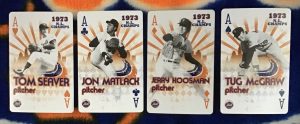 Having more than two aces can help you find your place again. What card do the Mets have up their sleeves to optimize the remainder of their journey? I do believe I see another ace. The name “Chris Bassitt” doesn’t shimmer from a distance the way “Jacob deGrom” and “Max Scherzer” do when they top the GAME TONITE marquee, but if the pitching half of my season came down to just one Met starter in 2022, and I pulled a Bassitt from the deck, I wouldn’t have the slightest inclination to throw it back. I do believe Chris has been the stealth ace of this team from April through September. Righty rather than lefty, I nonetheless get a strong Bobby Ojeda vibe from him. The Mets went 4-0 in postseason games started by Bobby O in 1986. Twice he was masterful. Twice he mastered the challenge of not letting a Game Six get away when it very well could have slipped into oblivion. Gooden, Darling and Fernandez all had All-Star accolades attached to their names headed into October of 1986. Ojeda, who didn’t, was the guy I wanted out there most.
(Bobby Ojeda and a problem with a finger on the eve of another postseason and its disturbing historical parallel to the current status of Starling Marte constitute a different thread for a different day. Not gonna pull on that one right now.)
DeGrom isn’t done because he didn’t outduel Max Fried on Friday night. Scherzer isn’t done because he didn’t outduel Kyle Wright on Saturday night. The Mets aren’t done because they didn’t touch the Brave bullpen enough on Friday or at all on Saturday. This ace talk can be a little simplistic. But aces do get your attention even if they don’t always hold your place.
On to the next pair. Chris Bassitt has the ball tonight. So does Charlie Morton. They’re both pitchers you’d assign a value of no less than jack, queen or king on any given day. Bassitt will have to be better than Morton. Met relievers will have to be better than Brave relievers. Met hitters will have to stir from their stupor. Have faith that these Mets — they of the “98” under W and an indelible “x” or “y” alongside their name depending on where you study your standings — can ace this test. I don’t know that they will, but they can. Faith, like the common household object you might use as a bookmark, is already something you have within easy reach. Don’t give up on it or these Mets. Don’t be overwhelmed by doubt. This is neither the time nor the place.
by Jason Fry on 1 October 2022 12:32 pm It’s a measure of how spoiled we’ve been: Jacob deGrom looks mortal (and for a second start in a row, no less) and we’re all scratching our heads as if God has repealed physics and things are falling up and sticking to ceilings.
DeGrom was better than he was in his confoundingly disastrous Oakland start, and he seemed to find his way in the middle innings, regaining control of the back-foot slider that had been annoyingly AWOL and looking more himself before a blood blister ended his night a little early. (Let’s not worry about that last part until it’s obvious we have to.) But he was still mortal, surrendering consecutive homers to Austin Riley and Matt Olson on pitches left in the middle of the plate, which isn’t a wise strategy against any team and a particularly poor one against an aggressive, powerful lineup like Atlanta’s. (DeGrom surrendered a third homer to Dansby Swanson, but that one was more cap tip than head shake, as it came on a change-up low in the strike zone that Swanson simply went down and got.)
That’s the analysis, but it’s missing the obvious context: Jake was facing the Braves with six games left to go and a division title in the balance, so “seemed to find his way in the middle innings” isn’t the headline. The headline is more like WOE! DOOM! @$#@*$@!!!!
The Mets lost, because deGrom wasn’t immortal and because Tylor Megill made things worse and because their hitters were stymied by Max Fried and a parade of Atlanta relievers. They made a little noise in the ninth, which either made you feel not better enough or added insult to injury, depending on your temperament. They lost and we’re now tied all over again. (It’s been noted before, but once again for posterity: The Mets really, really miss Starling Marte.)
The other storyline of the night was wunderkind Francisco Alvarez being summoned from driving home after Syracuse’s season to take over righty DH duties, with Darin Ruf put on the IL with a neck strain one suspects would prove elusive if investigated by a physician not employed by a baseball team. (Don’t miss Greg’s wonderful curtain-raiser tying Alvarez to another player you’ve heard of.)
I’m always excited to see a Brooklyn Cyclone make the big leagues, but this debut arrived festooned with extra bunting: I was watching Alvarez and fellow Cyclone Brett Baty ply their trade on Coney Island just last year, and they’re still very sharp in my memory. Alvarez in particular struck me when I was watching the Cyclones last summer: He plays with a joyous aggression and swagger that naturally draws your eye to him. (Plus he’s got really fast hands and sends balls a long way.)
Alvarez got frankly undressed in his final at-bat, undone by Kenley Jansen cutters as many, many big leaguers of various tenures have been undone before him. But he looked like he belonged in his other three plate appearances, hitting balls hard though without positive outcomes and in general not seeming overawed by his new surroundings. And there was the sight of his parents in the stands: his Dad beaming but rigid with tension and obviously dying a little inside with every pitch, while his Mom was a portrait of the same emotions expressed in the opposite way, yelling encouragement out of the stands while holding an oversized ballpark can of Miller Lite. The sight of them made me applaud and laugh out loud, feeling lucky to witness a little down payment on all that lies ahead for their son.
The Mets lost a game we really, really didn’t want them to lose, and that was the stuff of muttering. (And a result that stung enough that I wanted to put a night’s sleep between me and it before this recap.) But stay off the well-worn Met fan ledge, folks: Tonight Max Scherzer takes the mound. That would be the same Max Scherzer who would crawl across a mile of broken glass if it were between him and a win, and who knows perfectly well that he was paid an ocean liner full of money to take command of games exactly like tonight’s.
That’s no guarantee of anything — baseball doesn’t work that way — but if I could pick the scenario I want after losing that first game, it would be exactly the one that we’re getting. Trust in Max, keep hope alive, and maybe fortify yourself with an extra Miller Lite.
by Greg Prince on 30 September 2022 4:30 pm Willie Mays showed up at the ballpark this week. It doesn’t matter which ballpark, but for the record, it was Oracle Park in San Francisco, convenient in that Willie lives near San Francisco, appropriate because for those privileged to be in his presence, he is baseball’s oracle. Willie has been a regular at Giant games since the club that traded him to the Mets in the 1970s had the good sense to bring him back in retirement in the 1980s and sign him to a lifetime contract in the 1990s. His duties? Be Willie Mays. He was gonna be that, anyway. If you’re the world’s greatest living ballplayer, you might as well do it at the ballpark.
A few years ago I met a Giant reliever who had joined San Fran the previous offseason. What amazed him more than anything about his new team was fairly regular access to Willie Mays. Willie just showed up at whatever the ballpark was called then and made himself available to the players, the coaches, anybody who was around the team. Same thing in Spring Training. Willie knows he’s Willie. Willie knows what he offers. Willie offers it to those who ask, provided he can deliver it. Before the pandemic, it was easier for him. It was easier for everybody.
John Shea, the San Francisco Chronicle sportswriter whose beat includes keeping up on Willie Mays, reported that the Say Hey Kid’s trip to the ballpark the other day was his first since last year; and there weren’t too many last year; and last year wasn’t ideal, either, considering the COVID restrictions that were still in place. Maybe this year isn’t the most ideal, with Willie continuing to rehabilitate from hip surgery. No. 24 is 91. It wouldn’t be easy under any circumstance, but from reading Shea’s story, one gets the idea that the best thing in the world for Willie Mays is to be in the best place in his world. “I came to see the guys, not to cause any excitement,” Willie said, presumably cognizant that he is a carrier. The Giants maintain a room off their clubhouse that is reserved for Willie’s visits. He’s there to talk baseball, then and now. Per Shea, that’s what he did this week.
“I miss all you guys,” Willie told his assembling court of admirers. “I never missed so many games in my life.” He also read the room accurately and honestly. The Giants didn’t come close to repeating their division championship season of a year ago. “You guys need some help, man,” he told the players. According to Shea, “The players laughed and didn’t disagree.”
Even a team that is still vying for a division title this late in the year might need a little help. The other team that retired No. 24 in Mays’s honor pretty clearly understands that. That team, the New York Mets, is making a move a touch reminiscent of what their National League predecessors in town, the New York Giants, did 71 years earlier. They’re calling up the best player they can.
The 1951 Giants didn’t wait for the end of September. By the end of September, the 1951 Giants were tied with the 1951 Dodgers for first place and facing an unprecedented best-of-three playoff for the National League crown, winding down an incredible race that saw New York chase down Brooklyn from 13½ out in the middle of August. The 1951 Giants likely wouldn’t have gotten within spritzing distance of the 1951 Dodgers had they not made their biggest move possible on May 24 and brought up Willie Mays from Minneapolis to start in center the next day in Philadelphia. Willie had been batting .477 for the Millers. The Giants took out an ad in the Minneapolis Tribune practically apologizing for promoting a highly promising baseball player from the second-highest level of organized baseball to the highest.
No apologies necessary to the folks of Minneapolis in 1951, none necessary to anybody in Syracuse in 2022. The S-Mets are done for the year, and for all we know, they’ll get a longer look at the system’s top-ranked prospect in 2023. There are only six games left in the regular season still in progress. Who knows what they’ll prove regarding the newest bona fide New York Met, Francisco Alvarez?
But, within the context of the six games that remain and however many games follow in the postseason, aren’t you just dying to find out?
Willie was 20 when he was called up, as Francisco is now. As Monte Irvin said when he reflected on Giant personnel maneuvers of the early 1950s four decades later, “What the hell do you care how old he is as long as he can play?” Irvin wasn’t talking about the Giants promoting Mays in 1951. He was remembering that New York wouldn’t bring up Ray Dandridge, then 36, to play third base despite Dandridge being in the midst of his second of three consecutive .300+ seasons at Triple-A. Lest you think this was a case of a player plateauing in the high minors and the big club thinking he couldn’t handle tough pitching, Dandridge had torn up the Negro National League long before 1950. Yeah, now we’re getting to the crux of the matter. Horace Stoneham, like many a major league owner, may have been willing to integrate his ballclub, but not to excess. One or two or three Black players might be fine. No sense overdoing it, though — heaven forbid a team bolster its ranks with the best players possible regardless of race. Hell, when the Giants brought up Mays in ’51, they cleared roster space by sending down Artie Wilson, an infielder of color. Dandridge, like Mays (and unlike Stoneham), is in the Hall of Fame today. He never played an inning in what we used to think of exclusively as the major leagues.
Baseball has always had its prejudices. The most blatant sort, the kind that that directly affected Wilson and Dandridge, has hopefully melted away; the arc of the moral universe bending toward justice and all that. Others, like those based on age, will probably always be with us, on either end of the spectrum. Being 36 in and of itself, as Irvin said, shouldn’t deleteriously impact the evaluation of a player as long as he can play. Darin Ruf is 36. Darin Ruf was playing pretty well a few months ago for the San Francisco Giants. After a replacement-level career in Philadelphia, Ruf bloomed into a veritable superstar in the KBO after turning 30, blasting 86 home runs across three seasons from 2017 through 2019, driving in more than 100 runs in each campaign.
I suspect “good in Korea” might be baseball code for “I’ve got a girlfriend in Canada,” but Ruf appeared to be a real enough deal. His numbers as a Giant were more than decent in the mini 2020 season and downright valuable in 2021, contributing tangibly to the out-of-nowhere 107 wins San Fran compiled a year ago. Sadly, Ruf has personally returned to nowhere since the Mets traded for him in early August, giving up J.D. Davis and three others to get him. When Mays was in the Giant clubhouse this week, he greeted Davis by asking him how many home runs he’d hit this year. When J.D. told him 11 (7 since leaving New York), Willie — author of 660 himself — generously appraised, “That’s not bad.”
Willie Mays would probably be too polite to tell Darin Ruf what he thinks of Ruf’s home run total as a Met, given that it is zero. Then again, he’s not above diagnosing a team that needs help. And you don’t have to be Willie Mays to realize that when you have a player whose primary job is to hit lefthanded pitching and that player is not hitting any pitching whatsoever, help needs to be summoned.
Help is on its way in the form of Alvarez, who might have gotten a call earlier had he not been so gosh darn young. Just as 36-year-olds aren’t necessarily going to get the benefit of the doubt (even in a sport that has traditionally fetishized Veteran Presence), someone as young as Mays in 1951 or Alvarez in 2022 is going to be handled with care, maybe so much that you’ll keep hands off until they’re old enough to legally drink. The Mets haven’t brought up many 20-year-olds of late. The last Met younger than Alvarez to break in was Dilson Herrera in the latter stages of 2014. The Mets weren’t going anywhere at that moment. You used to be able to expand your roster nice and wide to get glimpses of kids you really wanted to see if you felt compelled to wait through the meat of the season. These days rosters expand only from 26 to 28. Not a lot of room for glimpsing’s sake.
The September callup Alvarez puts me in mind of is Gregg Jefferies. Jefferies famously arrived for good in August of ’88, hit his way into the everyday lineup, and made himself unbenchable by the playoffs. But I’m thinking of the taste we got of Jefferies in 1987, in a September pinch-hitting role amid a divisional battle versus the dreaded Cardinals along the lines of the current one against the Braves, except a) we’re in first place instead of second; and b) neither the Mets nor Braves go home when one among them doesn’t finish first. Gregg was a lad of barely 20 and as highly touted as any Met minor leaguer there’s ever been, save for Darryl Strawberry. Davey Johnson brought his new toy along slowly in ’87 — six plate appearances, good for three hits — before unleashing him on a fully suspecting world a year later. Jefferies lived up to every ounce of hype until he didn’t.
Alvarez in the hours and days marking his debut at Truist Park won’t have time to meet all the hype that surrounds him. A few hits this weekend and next week would be lovely for starters. He’s MLB’s No. 1-ranked prospect, not just in the Met system, but everybody’s system. He’s rated an elite hitter, not a bad catcher, but he’s not here to catch just yet. Tonight he’ll be in the lineup batting seventh as DH against lefty Max Fried. Darin Ruf has been moved to the IL with what’s described as a neck strain, something no pitcher experienced as a result of Darin the Met taking him deep. Intermittently, I’ve wondered if Ruf is injured. I’ve wondered the same about James McCann, somebody else who should eventually see his playing time reduced by the rise of Francisco Alvarez. No way can these guys be this bad unless they’re hurting, I sometimes remind myself, but only sometimes, because I’m too busy being annoyed at how little they’re hitting to seek an explanation. I can be a real fan that way.
Right now, we seek results. We seek them from an extremely confident kid who may or may not be ready, but we are. Just being no worse than Ruf and Mark Vientos have been in the righty DH slot will be a step up. Atlanta is always bringing up kids, and they all seem to burst onto the scene as veritable superstars. The Mets brought up Brett Baty in Atlanta in August and he did a little bursting before getting hurt enough to not play anymore. They brought up Vientos a few weeks ago as Ruf was proving himself not an immediate answer. Vientos has thus far struck out so often that he’s left me wondering how his name isn’t spelled with a K. But he’ll likely have better days. He’s certainly eligible to. He, like Baty, is only 22.
The Mets brought up Jay Payton, as esteemed a position player prospect as they nurtured in the 1990s, in September of 1998. A college man hindered by injuries as he climbed the minor league ladder, Payton wasn’t what you’d call a kid in baseball terms. He debuted at 25. Bobby Valentine inserted him as a pinch-runner on a Friday night the last weekend of the season in Atlanta. The game was must-win. Payton got himself thrown out attempting to advance from first to third in the eighth inning. The Mets lost and would go on to get swept and eliminated. Jay would have better days. He couldn’t have had a worse one.
Regardless of what it looks like when the Braves elevate yet another phenom, hardly anybody makes it to the majors fully formed. Willie Mays’s first dozen at-bats in Philadelphia generated a dozen outs. Willie doubted himself. Leo Durocher stuck with him. Willie homered off Warren Spahn (of the Braves) his first time up at the Polo Grounds. It still took time to gain traction, but Willie eventually got the hang of it all. He started every game in center from May 25 forward, won the National League Rookie of the Year Award, and played in the 1951 World Series after the Giants took two out of three from the Dodgers.
Willie was given time. We’ll give Francisco time. Six games at the moment. More later. Francisco Alvarez is the first Met born in the 21st century. The future has arrived. It always does.
by Greg Prince on 29 September 2022 2:35 am When last we were being clever about Metropolitan math, right around the beginning of this month, the Mets had just taken two out of three from the Dodgers, constituting their 30th series win of the season against 8 series losses and 3 series ties. Up ahead on the schedule were cushions, marshmallows and Milwaukee. Competition was hardly stiff.
Yet somehow the Mets were. That supple offense, good for the timely hit and the invigorating comeback, was lost in the summer wind. The certain something that defined 2022’s savoir faire — its intangible effervescence — suffered a case of the ordinaries. Reservations were made for October, though they seemed almost incidental to the reservations we were gathering about our team throughout September.
Then, just before September boarded a plane for parts definitely hostile and weather potentially treacherous, two beautiful sights crossed our radar.
1) A legit 2022 Met-style victory
2) Our math’s integrity
Winning or at least not losing series remains the thing. It’s been the thing since April found its footing. It’s the thing as September, henceforth to be known as the Month of Eduardo Escobar, moves on. For even as September veered a bit to the blahs, the Mets continued to…to what?
To win or at least not lose series. Not all of them, but a majority of them. Between September 2 and September 28, they played eight series. They won five. They lost two. And they tied one, the one that was most important because it was the most recent. It also, as it dramatically concluded, turned into the sweetest.
The Mets won their final series played fully within the confines of September, 1-1. A tie on paper, a win in the soul. A win because losing both games to the Miami Marlins prior to taking on the Atlanta Braves would have been spiritually if not statistically deadly. But it wouldn’t have looked good in the standings, either.
After Tuesday night, when Pete Alonso hit a three-run homer and nobody else did anything or enough to prevent a loss to the freaking Fish, Wednesday night appeared ticketed for the same general destination. Next stop: Nowheresville. Taijuan Walker, while not terrible, was not untouchable, and this was a night that called for a Met starter to be all but perfect, because the Met batters were all but invisible. As of the seventh-inning stretch, the Mets trailed, 4-0. Down in Washington, the Braves didn’t lead the Nationals, but it could be assumed that status was fleeting. Every Brave highlight aired since June has featured a spry lad decked out in yellow elbow armor whacking a home run versus the Nationals. It could be inferred that every game the Braves play is nothing but some rookie called up from Savannah or Marietta or wherever the Braves cultivate their rookies strapping a protective yellow pad to whichever arm faces the pitcher’s mound and then taking the opposing pitcher deep. And the pitcher is always a National, because that’s the only team the Braves have played since June.
Or so it seems.
The Braves actually weren’t leading the Nationals, but that was barely a sidebar at Citi Field until the bottom of the seventh, when following a Jeff McNeil single, Eduardo Escobar homered. As it happened, Escobar’s blast exploded maybe seconds after Aaron Judge’s in Toronto. I wasn’t caught up in the significance of Judge’s. I do know Escobar’s shook the Mets and their fans out of their collective stupor — and what could be a bigger New York baseball story than that?
With the so-so pitching from Walker and Seth Lugo complete, the Mets’ bullpen got serious. Adam Ottavino set down the Marlins in order in the eighth. Eduardo Escobar, not a pitcher, but if he was, he’d be the one I’d want out there in the late innings these days, tied the game in the home half of the frame, singling in Brandon Nimmo and Pete Alonso, each of whom (like Mark Canha) had walked. Nobody but one Met was hitting much. The one Met who did the hitting was carrying the team and smiling while doing so.
Has any Met looked any happier on a going basis than Eduardo Escobar? Maybe Brandon Nimmo, that wonderful Wyoming weirdo who came out of the womb grinning and hasn’t been told he can glower if the mood hits him. Escobar has looked a little glum from time to time, in sync with his performance the first five or so months of his Met career. If he wasn’t slumping, he was injured. Yet if given the slightest opening, we’d see him beam. He was on a first-place team, supporting his teammates and they, along with their manager, supported him. I don’t know if I’ve heard a Met as universally talked up by other Mets as I heard everybody vouch for Eduardo Escobar’s warm and winning ways as a human being. The implicit message from everybody was just wait — Eduardo’s a great guy and not at all a bad ballplayer.
It’s a little like what we heard about Edwin Diaz for a couple of years while Edwin the pitcher who we watched unravel defied any kind of faith. Yet Edwin was named National League Reliever of the Month in the three months directly preceding September, and the only thing holding him back from making it four straight is he’s pitched to maybe four batters since August. A few more, actually, but the Mets haven’t been all that involved in close games let alone save situations. Buck Showalter probably would have sent Diaz to the hill in lopsided affairs just for the exercise if he didn’t fear wearing him out “getting his work in” the night before he really, really needed him.
Buck used Edwin in a fairly hopeless cause Tuesday night. Got his work in. Fortunately, that one inning didn’t exhaust him for Wednesday, because Wednesday, Buck really, really needed Edwin to keep the Marlins from swimming back onto the scoreboard in the top of the ninth. Facing three batters and striking each of them out didn’t seem to tire Diaz too badly in his second consecutive night of action.
The bottom of the ninth had Met magic brewing. Tomás Nido walloped a ball over Bryan De La Cruz’s head in center. Anytime a Met catcher doesn’t pop up, it qualifies as a wallop, but this one was really belted, all the way to the ball. Nido trucked into second with one out, and immediately trucked to the dugout in favor of Legs Diamond, a.k.a. Terrance Gore. Gore is practically a free runner in regulation. All the Mets had to do was nudge him slightly toward third and you knew he was gonna score the winning run.
Only problem was Escobar was not due up immediately in the ninth. Despite a walk to Brandon Nimmo that brought up two-hole hitter Pete Alonso with a golden opportunity awaiting the NL RBI leader, Pete struck out. A still shimmering chance sat for Francisco Lindor’s taking. Lindor, alas, popped up like a Met catcher.
We were going to the tenth. We were going to Drew Smith. That used to sound like a good deal. After Wednesday night, it might again. Smith receded from circle of trust to perimeter of shakiness before taking his act to the injured list. His comeback since resuming active duty has been tenuous. In the tenth, however, it was like he never left April. Three up for Drew, three down for Drew.
Could we finally win this in the tenth? Could we finally take advantage of the unlikeliest Washington outcome since the Chicago Tribune reported Harry Truman wouldn’t be taking a second oath of office? Those early-edition BRAVES DEFEAT NATS headlines we printed in our heads proved premature and ultimately inaccurate. The Nats won in ten. Now all the Mets had to do was the same, and they’d regain sole occupancy of first place in the NL East.
Lindor magically appeared on second base before the inning began. Crazy how that keeps happening when games go to extras. Canha, batting cleanup (don’t ya miss the lineup certainty that reigned when Starling Marte’s finger was hale and hearty?) couldn’t get Lindor home, but maybe McNeil could. Except Don Mattingly, entering his final week as Marlin manager, didn’t want to let one of the National League’s leading batters beat him, and intentionally walked Jeff to set up a possible double play. Sound strategy, unless the next batter up is the one guy who’s been killing you since the seventh inning and killing most everybody all month.
Maybe there’s a reason Don Mattingly is entering his final week as Marlin manager. Walking McNeil meant pitching to Escobar. Pitching to Escobar meant Escobar singling to left. Lindor was off and scampering. Perhaps an on-target throw would have nailed Francisco and sort of vindicated Donnie About to Be Out of Baseball. But the throw was wide of home, Lindor scored, Escobar had driven in his fifth run of the game and tthe alone-in-first-place Mets had won, 5-4.
They needed that. They really needed that. Not only so they’d forge a tie in their two-game series. Not only so they’d raise their season’s worth of series record to 35-10-4. Not only so they’d lead the Braves by a game as showdown weekend approaches. They needed a win like this to remind themselves and maybe/definitely us that they can win these types of games. Winning any type of game is splendid, but winning a game from behind, with verve and panache and never saying die is the mark of a team you believe can do anything when everything is on the line. Guess what — everything is on the line. The division title pretty much hangs in the balance this weekend, rainy nights in Georgia pending, and if it’s not settled by Sunday, there’s the matter of the Mets playing the Nationals (who we’ll stop temporarily appreciating) and the Braves playing the Marlins (who we’ll temporarily stop despising) Monday through Wednesday.
What needs to happen in the next six games is what’s happened for most of the past six months. The Mets need to win series. Win at least two out of three from the Braves, and the Mets not only have a slightly larger lead than they have now, but they have that season-series tiebreaker you might have heard about. Then win at least two out of three from the Nationals, and, no matter what the yellow-armored Braves inflict on the Marlins, that lands us a first-round bye and another shipment of t-shirts, this batch identifying the Mets as division champs. There’s some other math that can get us where we want to be — two of three over the Braves would necessitate simply not being swept by the Nats — but why mess with a winning formula? From here on out, just win series. It’s gotten us this far.
Two out of three. Two out of three. Earn a breather.
Three out of five. Four out of seven. Four out of seven.
Do the math. Winning every series that remains can get us as far as we wish to go.
Meanwhile, National League Town is ready to morph into playoff mode. What is playoff mode? Listen here and find out.
by Jason Fry on 27 September 2022 11:19 pm Carlos Carrasco was bad, inexplicable Mets punching bag Pablo Lopez was good, the Marlins were pesky even by their loathsome standards and the Mets lost a game that had a queasy, out-of-sorts feeling to it from the get-go. And yes, down in D.C. the Braves smacked the crap out of the Nats, and so now we have a tie atop the National League East — one that feels like it’s for all the marbles even though it’s really just for the prettiest marbles and the right to a few idle days to play with them in peace and quiet, seeing how both New York (NL) and Atlanta are going to the playoffs.
The Marlins showing up at the tail end of a season and ruining everything? Wow, imagine that.
Which was your least favorite part of this game? Was it the wild pitch that brought in the Marlins’ second run while fans were still finding their seats? The little poke by someone with the ridiculous name JJ Bleday that carried over Tyler Naquin‘s head and tucked itself into Utleyville to give Miami a 4-0 lead? Or the third consecutive fastball called for by James McCann on an 0-2 count with Jacob Stallings at the plate, the one Trevor Williams left middle-middle and Stalling lashed into right-center to turn the Marlins’ one-run lead back into a three-run lead?
Honestly, it was all pretty disgusting. The Mets tried to fight back, but only got within two runs, with their last tally coming when Richard Bleier was called for three balks in the same at-bat, something I’m pretty sure I’ve never seen before and honestly never want to see again, as baseball would be unwatchable instead of just occasionally turtle-paced. (And, really, it’s not like Jeff McNeil was being pinned at first by Bleier’s trickery.)
Even a horrific baseball game has its pleasures, of course. There was Pete Alonso‘s terrific AB against Lopez, the one that culminated in a change-up golfed into the left-field seats that briefly made us all believe. There was Jerry Blevins filling in for Keith Hernandez on SNY and doing a frankly sensational job, offering commentary that was warm, funny, generous and rich on insights — a terrific debut that I hope is a down payment on a larger role for him. There was the prime seat occupied AGAIN by the creepypasta woman doing viral marketing for a horror movie I refuse to name — an unwelcome sight transformed when Mr. Met was suddenly occupying the same seat and of course wearing a fixed, suddenly deadpan expression of his own. And though you didn’t see it on SNY, there was my kid playing charades with Mr. and Mrs. Met after a chance encounter in one of the tunnels, with Mr. Met pantomiming admiration for my kid’s massive nimbus of teenaged hair and my kid pantomiming his thanks. (His mother and I learned of this encounter via our phones, as we were on the couch at home — Emily because she’d had late-afternoon plans, and me because I’ve been banned from Citi Field on suspicion of being a jinx.)
But would I have traded those nice moments for a different distribution of runs? Of course I would have. The Mets and Braves are all tied up with seven to play and a hurricane about to have its say about when and where they’ll meet, as if this showdown needed an additional jolt of tension. Dread is loose in the land, in far too many guises, and let’s all link arms and assure each other that we’ll make it through this dim, anxious valley to whatever precinct of the autumnal promised land is reserved for us.
by Greg Prince on 26 September 2022 2:59 pm Those graphing skills you may have retained from geometry class will finally come in handy if you are yearning to illustrate the upward trajectory of the Mets’ single-season runs batted in record.
1962: 94 — Frank Thomas
1970: 97 — Donn Clendenon
1975: 105 — Rusty Staub; tied by Gary Carter in 1986
1990: 108 — Darryl Strawberry
1991: 117 — Howard Johnson; tied by Bernard Gilkey in 1996
1999: 124 — Mike Piazza; tied by David Wright in 2008
Each of those totals loomed as singularly impressive until somebody surpassed it (even if somebody matched it). They’re still impressive in and of themselves. Whatever limitations the run batted in might encompass as an indicator of overall offensive production, we still know a high number of runs batted in when we see it. We intrinsically understand that a number must be pretty high if nobody comes along and posts a higher one for quite a while despite every batter’s literal best-case scenario — and therefore every batter’s deep-seated goal when he comes to the plate (even those just trying to get on base) — being that a run scores as a direct result of what he does while batting.
We never in the course of a game think, “I wish our team hadn’t just scored another run.” Everybody who isn’t the opposing pitcher or among those invested in that opposing pitcher’s team’s cause is thrilled to see a run batted in. Advanced though modern statistics may be, the RBI perseveres as aspirational in every game, good or bad, in every season, good or bad. Geez, Thomas’s 94 RBIs on the 1962 Mets are more than twice as many games as the outfit for whom he was driving them in won. A supercut of Frank’s at-bats could have constituted a pretty complete team highlight film in living black and white.
Thomas held the Met RBI record for eight years, Clendenon for five, Rusty for fifteen (four shared with Carter), Straw for one, and Hojo for eight (three shared with Gilkey) until Mike put it out of reach of all but one Met (David) for the next 23 years. It had been ages since somebody smashed or pulled up alongside the Mets runs batted in barrier.
But now we and the Mets Record Book are living in the Age of Alonso, and in the Age of Alonso, we’re gonna need a taller sheet of graph paper.
The most urgent takeaway from Sunday in Oakland was the 13-4 thumping the Mets laid on the A’s. Unless we’re overthinking draft order, we never wish our team hadn’t just won another game. This isn’t a year for draft order thinking. This is a year when every win matters and, as Monty Python might suggest, every run is sacred. There was no saving any of it for tomorrow, currently today. Today’s an off day anyway.
Sunday was largely taken care of in the bottom of every inning Max Scherzer pitched (the first six, with one run allowed) but destined to be defined in the top of the fourth. The Mets already led, 3-0, thanks to a rare RBI from Tyler Naquin and two increasingly common ribbies from Eduardo Escobar. It represented a promising start, but the Mets weren’t finished. They couldn’t be. The Mets led Saturday, 3-0. It didn’t keep. Sunday they added on, first via Francisco Lindor doubling with two runners on (no mean RBI machine himself, Francisco the shortstop’s season sum stands at 103), then Pete Alonso homering with Lindor on second. That gave Pete 125 RBIs, or the most runs any Met had ever driven in within the confines of a single season. More than Piazza in ’99 and Wright in ’08. More than the standard that had stood for so long that a person suspected it was forever unbreakable.
But not as many as Alonso would have by the end of Sunday, specifically after the three-run double he lashed into the right field corner in the eighth turned an 8-1 laugher into an 11-1 howler. Pete Alonso now held a brand new Mets single-season runs batted in record of 128. Chances are that record will rise more than once between tomorrow night and the end of business on October 5.
There is no such thing as too many runs, regardless of lead, regardless of opponent. The Mariners’ 11-2 lead at Kansas City on Sunday became the Royals’ 13-12 victory. The Mets lead the National League East by 1½ games. Alonso leads the NL RBI race by 16. I had to look up the latter standings. I’m not sure I realized Pete was still ahead of all National League batters — Paul Goldschmidt is a distant second — in what has become his signature category in 2022. I don’t spend a waking moment not cognizant of where the Mets stand relative to the Braves. The Mets are barely ahead of Atlanta after 154 games on the shoulders of at least a couple of dozen fellas making the most out of their orange-and-blue opportunities. The strongest of those shoulders belong to the regular first baseman, intermittent DH and tolerable pitchman (he’s more convincing anticipating a delivery of pancakes than he is sneaking up on Nathan in the front seat) we call the Polar Bear and we call when we need a run batted in.
Over the next eight games, we will be pulling hard for the Mets to pull away from the Braves. That’s the prize that counts most, at least until after October 5. Pete putting further distance between himself and everybody else who drives in National League runners for a living, not to mention anybody who ever drove in Met runners before, will amount to a powerful bonus.
by Greg Prince on 25 September 2022 3:44 am “Gary Apple back in our New York studio, following the Worst Game Ever, as the Mets lose, 10-4, to the Oakland Athletics, though mentioning just the score and the opponent doesn’t do it justice, does it, Todd Zeile?”
“No, the score only hints at the awfulness of the entire sorry episode, Gary. That’s why I have to give everybody in this game and everything about this game my Zeile of Disapproval. My Zeile of Dismay and Zeile of Disdain, too.”
“It’s harsh, but merited. We’re going to go live now to the visitors’ clubhouse at Ring Central Coliseum in Oakland to Steve Gelbs. Steve, you weren’t even scheduled to be on the West Coast today, but instead of preparing to host our Jets pre- and postgame shows tomorrow, you flew out for this.”
“That’s right, Gary. For this historic occasion, SNY spared no expense, and we have live coverage of the celebration.”
“On the monitor, it’s clear the tenor of this celebration has a different tenor than the one the Mets participated in last Monday after clinching a spot in the upcoming postseason. That was more of a muted affair, whereas I see the champagne is flowing after this Worst Game Ever.”
“That’s right, Gary. The champagne is, of course, flat and off-brand, much like the effort it is celebrating.”
“And the t-shirts we see the players wearing, the ones that read ‘THE WORST’?”
“Irregular and a bad fit.”
“Under the circumstances, that’s appropriate. I see you have a special guest, Steve.”
“Thank you, Gary. We are joined here in the visitors’ clubhouse by Mets president Sandy Alderson. Sandy, this has to be a special feeling for you.”
“It is, Steve. These are the two franchises with which I’m most associated, and finding myself watching the Worst Game Ever from the perspective of somebody who had a role in building the losing team after my history with the winning team, knowing that the losing team is actually a winning team most days, and that the winning team is a consistent losing team, gives me a particular sense of pride.”
“Sandy, you’ve been on the wrong end of a lot of losses for both the A’s and the Mets. You were the general manager when Kirk Gibson hit his legendary home run off Dennis Eckersley in the 1988 World Series, and Mets fans can name any number of stinging defeats from your two tenures in New York. What made this one the Worst Game Ever?”
“I think there were a certain number of variables present in this game that you simply don’t see every day. You had arguably the best pitcher in the sport, Jacob deGrom, appearing totally clueless. Jacob was followed by one reliever after another who couldn’t record outs before giving up runs. You had the Met defense breaking down at critical junctures. You had the dimensions of the ballpark here playing a role. You had the elements, at least one of them in the form of a bright midday sky, also making themselves felt. You had the Met offense coming to a dead halt after a while, with every ball it hit hard somehow finding a glove, and every potential rally snuffed, and this was against a team that analytics suggest is notoriously incapable defensively.”
“And you’re considered the godfather of ‘Moneyball’. Sandy, even with all of that going sideways, was there something else, something intangible that pushed this loss into the Worst Game Ever column?”
“Well, you can’t ignore the expectations. I think our fans, whether they were here or watching from home or wherever they were following, had this game listed as a win if not before it was played, then probably after Jacob was staked to an early three-nothing lead. There is a level of disbelief that can be reached, even in an industry where it’s not uncommon for a so-called lesser team to beat an ostensibly better team, where you’re convinced there’s no way something can go wrong. I think today we proved everything can go wrong.”
“The final from Philadelphia, where the Braves won and trimmed the Mets’ lead in the National League East to a game-and-a-half, would seem to underscore that assessment. Sandy, final question: you’re transitioning soon from your role as team president to that of special advisor to Steve and Alex Cohen and the Mets’ senior leadership. Can you give us an idea of the kind of advice you’ll be providing?”
“There’s a degree of discretion when you serve in an advisory role, and every situation needs to be treated as its own challenge, so I don’t know that there’s a one-size-fits-all answer to your question, but in broad terms, I would strongly advise not playing any more games like the one we saw today.”
“Thank you, Sandy. We now talk to somebody who had a big part to play in the Worst Game Ever. Darin Ruf, owner of a .427 OPS as a Met, what’s it like to receive LVP honors?”
“I didn’t see it coming.”
“That could describe most any ball hit in your direction in right field.”
“It was a team effort, Steve. I may have the hardware here…”
“Which I see just fell apart in your hands.”
“…but it wasn’t just me. Maybe I’ve just become the most visible reason for our team losing.”
“Least valuable, most visible?”
“None of us really could see the ball well or hold onto it for very long, and after the second inning, none of us could make anything happen when it came to getting us back in the game. I don’t want to take all the credit. Together, we were all Least Valuable. If it were up to me, I’d divide this award 28 ways and give a little bit to each guy here.”
“The award is not made very well, so you may have that opportunity. Darin, you haven’t been hitting much, you don’t run well and your experience in the field hasn’t been fruitful. How have you managed to put all that together for the Mets since coming over from the Giants for J.D. Davis and three minor leaguers?”
“Y’know, it’s funny. When I was across the Bay with San Francisco, I got to meet Willie Mays, and they say Willie wasn’t only the epitome of a five-tool player, but when you factored in his baseball intelligence, he was really a six-tool player. When he and I met, I realized that between the two of us, we had six tools.”
“Thank you, Darin. I’ll let you get back to the celebration with your teammates. Like you said, you were all a big part of what we saw today. Meanwhile, we have another couple of special guests in the clubhouse here, Sun and Space. Sun, you’ve been around practically forever, even longer than Albert Pujols has been hitting home runs. Darin Ruf just mentioned the great Willie Mays. Older baseball fans remember Willie’s last game in center for the Mets, right here in the Oakland Coliseum, and all the problems he had fighting you. Did today bring back any of those memories?”
“Oh, absolutely, Steve. I hope people who instantly invoke Willie’s difficulties that afternoon in 1973 as some kind of evidence that he shouldn’t have still been playing baseball at his age will realize that when I’m over the outfield in a day game here, especially when it’s fall, nobody, regardless of age, should be playing baseball.”
“You do make things difficult, Sun. As do you, Space. You had one of the most expansive days we’ve seen this year.”
“Great day, Steve. I don’t get the opportunity to inflict a whole lot of foul territory on too many teams anymore, but here in Oakland, I really get to roam, just like since the place opened in 1968.”
“True, few ballparks are built in this era with so much space for so many balls to fall in and for so many players to fall down like they have here, and the Mets, who are used to comparatively tiny slices of foul territory at Citi Field, definitely didn’t look comfortable dealing with what you had going today.”
“I’m wide open, Steve. It’s a great feeling.”
“Thanks, guys. We are now joined by two others who helped write the story of today’s game, Projection and Anticipation. Projection, you had everybody thinking that with Jacob deGrom on the mound and Pete Alonso having crushed a two-run homer after Francisco Lindor drove in his hundredth run on the season that there was absolutely no way the Mets could lose. And even after those four runs Jake gave up in the first, once Mark Vientos crushed his first big league homer, it had to seem there was no way the Mets could lose. But maybe you had different ideas?”
“Honestly, Steve, I had no idea. You gotta remember: I’m Projection. I just project what figures to be ahead, and I figured the Mets would stay ahead and be ahead, and it sure looked like it.”
“It’s the little things that make a bad game the Worst Game Ever. Anticipation, I think it’s fair to say you were really looking forward to this game, Jake on the hill against a last-place team and the playoffs on the horizon, almost too perfect a setup for a Saturday afternoon.”
“What can I say, Steve? I tend to look forward and look ahead. It’s what I do. Yet for all that looking ahead, sometimes I can’t see what’s coming.”
“A green and yellow freight train, apparently, in the form of the underestimated Oakland A’s, underestimated today at least, and a deGrom performance it’s safe to say nobody was anticipating. Jake lasted all of four innings and for the first time in more than three years gave up more than three runs. He just didn’t look sharp at all.”
“I didn’t see that coming.”
“One of your buddies at the end of the bench might have had a different idea. Come up here, Karma. Karma, you don’t always figure into the outcome of a given baseball game, but you seemed plenty invested in seeing the Mets lose the way they did today.”
“That’s right, Steve. I haven’t had the opportunity to contribute much lately, but I stayed loose, stayed ready and I saw I had an opening to make a difference, however slight, when I got word that somebody expressed a few unkind thoughts about Yogi Berra a couple of hours before first pitch.”
“Yogi of course managed the Mets in this very stadium in the 1973 World Series, where the Mets lost Games Six and Seven to a very talented Oakland A’s team, a Series some Mets fans to this day believe hinged on Yogi not starting George Stone in one of those games.”
“That’s correct. I went back a long way with Yogi. He may not have been the best manager in the world, but you’ll recall he was considered very lucky in his day, almost a human rabbit’s foot, and maybe it wasn’t the best idea to call out Yogi — I think the phrase was ‘shambling ignoramus’ — when the team you’re rooting for is in a pennant race and every game counts and you need all the help you can get. It’s something like those old margarine commercials where ‘it’s not nice to fool Mother Nature’ and suddenly there’s thunder and lightning.”
“In other words, bad Karma?”
“I’ve got access to a bulletin board and I’ve got a Ziploc bag full of thumb tacks if you know what I mean. Look, I don’t wanna take too much credit. Like Darin Ruf said, everybody in this room had something to do with today being the Worst Game Ever. But deGrom getting whacked around like that? McNeil slipping in left? All those problems the Mets had chasing foul balls? The A’s nabbing almost everything in sight? Let’s just say that even though Yogi’s been gone a while, he still has some friends among the higher-ups at Big Karma — and that his wife’s name was Carmen. Think about that, Steve.”
“We will, Karma, though maybe not until after we talk to our next guest. Angel Hernandez, we didn’t expect to find you in the losing clubhouse. To what do we and our viewers owe the pleasure?”
“Steve, I heard you were covering the aftermath of the Worst Game Ever, and you know the old expression: when something in baseball is considered the Worst, Angel Hernandez must be lurking somewhere.”
“Sure enough, you were the home plate umpire today, and it looked as if Jacob deGrom was a little unhappy with some of your calls.”
“Every pitcher is unhappy with my calls, Steve. Every batter is unhappy with my calls. Every manager is unhappy with my calls and, really, everybody is unhappy to see me. You’re probably not too happy seeing me standing here next to you.”
“I have to admit, Angel, it is taking all my self-control to not wretch in your mere presence. But I haven’t been myself since that sausage race in Milwaukee.”
“I saw that, Steve. I’d say that was the best, but I wouldn’t know anything about that.”
“I don’t suppose you would. Thank you, Angel Hernandez.”
“Funny, people only say that when I’m leaving.”
“We’re leaving, too. Back to you guys in the studio.”
by Jason Fry on 24 September 2022 1:56 pm To get us rolling, a sample of my strongly held opinions that make people either smile politely until I shut up or quietly back away from me when they think I’m not noticing:
- The American League is a jumped-up beer league, the National League should never have agreed to treat it as an equal, and John McGraw is a hero for standing against the tide and refusing to sully titles his team had already earned with an unnecessary exhibition against some upstart alien outfit.
- If February/March and October exhibitions against said beer league are accepted as a vaguely necessary evil, National League teams at least shouldn’t besmirch their regular-season schedules with further intrusions. Let alone swap league affiliations like poker chips when it suits someone.
- Yogi Berra‘s public persona as a cuddly gnome beloved by fans of baseball and language alike is a con that approaches Verbal Kint/Keyser Söze levels. Berra was a shambling ignoramus whose overthinking (not that he was a whiz at the regular variety) cost the Mets the ’73 World Series against the A’s. (Pointless exhibition games, perhaps, but you still ought to win them.) Berra also should never have been named Mets manager when Gil Hodges died. The job should have gone to Whitey Herzog, the architect of the ’69 Miracle Mets, and by making the wrong decision the Mets short-circuited what could have/should have been a dynasty.
- People paid to take part in guerrilla marketing for horror movies should be ejected from seats in which they’re a distraction for viewers watching at home, or at least they shouldn’t be spotlighted by regional sports networks whose trucks are full of people who take justifiable pride in being masters of their craft and so ought to know better.
(OK, that last one’s a new addition to my pantheon of grumpiness, and also probably not particularly controversial.)
This is an odd way of getting to my point, which is that the Mets playing the Oakland A’s will always feel strange. Friday night’s game was only the 24th against Oakland that counted — the first, played back in 2005, sent Greg back into childhood memories that weren’t particularly pleasant. (That post was also one of the early markers that our oddball blog would become something a little different than most baseball destinations, but that’s a whole nother post.)
Combine the West Coast with the American League and one’s first through fifth reactions to “Mets at A’s” will be something along the lines of, “Was this trip really necessary?” Particularly when said trip comes inexplicably in the season’s final sprint. A Mets-A’s evening tilt in May or June? I suppose, if we must. But when the rest of the schedule fits on a single easy-to-read SNY graphic, it’s bizarre. At least this weird part of the season comes sprinkled with off-days, which every team could use at this point and a team with its collective pedal on the floor trying to stay ahead of a relentless pursuer could use even more.
Ah, about that relentless pursuer. I was busy and didn’t get to catch up on what was happening in Philadelphia until shortly before game time, then needed a moment to process that the scoreboard did indeed say PHI 9 ATL 0. So the Mets had an opportunity all but secured when they took the field in cavernous Whatever It’s Called Now Coliseum against a thoroughly anonymous A’s team — looking at the enemy lineup, I recognized Stephen Vogt, though I doubt I could pick Vogt out of a police lineup and I had to double-check the ph/v thing.
Granted, I’m not sure I could have picked Chris Bassitt or Mark Canha out of a police lineup when they became Mets in the offseason. (American League + West Coast again.) Their homecoming was a little connective tissue at least, not that it registered much with the crowd, though there are a number of caveats there: a) a lot of visiting Mets fans; b) not a lot of A’s fans hardy enough to care about a lost season; and c) the fans in the Coliseum are so far from the field that you barely register them, unless of course they’re wearing highlighter-yellow shirts and creepypasta expressions.
Ah, the Coliseum. My one visit there left me with respect for A’s fans, a cheerfully ragtag bunch who’ve armored themselves with ironic detachment above a stubborn bedrock faith, and rage at MLB for how it’s treated this franchise and its fans. Here’s a sample from my writeup, which gets even more vicious from there: “[T]he O.co struck me as a Mad Max version of Shea. Instead of Shea/Citi’s tangle of chop shops and unpaved streets and rumbling els, you get caged walkways leading over industrial yards. Eventually, the caged walkways dump you in the vicinity of an ugly gray concrete pile that rises from a weird hill of xeroscaped dirt, which you search for entrances a la Tomb of Horrors.”
I wrote that eight years ago; the stadium’s still there and the A’s are still imprisoned in it, victimized by the twin plagues of sewer backups and piously vaporous statements about their future from MLB. One of these plagues is a nauseating health hazard; the other features shit coming out of drains. A’s ownership has been campaigning for a new stadium at Jack London Square, an odyssey that’s melded corporate blackmail with the toxic NIMBYism of the Bay Area Eloi, while playing a showily indiscreet game of footsie with Las Vegas. Given that baseball is now engaged in constant frottage with the disgraceful sports-betting industrial complex, I’d bet that the A’s head for Vegas. That will be another example of MLB defining deviancy down and rightly unleash a flood of outraged commentary, but not enough of it will be about the fanbase and city that deserved better.
Jesus Fucking Christ, 900 words that read like the kind of screed you’d normally find wrapped around a brick and we haven’t even gotten to the game yet! What is wrong with you today, Fry?
I dunno, but you’re right, there was a game in here somewhere. Alrighty then. Bassitt was his usual indomitable self, picking from his Saberhagenesque arsenal of pitching and sending balls plateward with the ax-thrower motion I find more and more delightful each time I study it. Brandon Nimmo looked thankfully none the worse for Milwaukee wear (though Starling Marte remains distressingly far from returning), Eduardo Escobar hit his first-ever grand slam, Jeff McNeil and Mark Vientos added to the barrage, Drew Smith followed his disastrous return in Milwaukee with a clean inning, and even Darin Ruf got a hit.
The A’s deserve better and I’m angry at a host of entities that have done them wrong, but once the game starts baseball is a zero-sum endeavor, which means no mercy and no quarter. The Mets offered neither, moving to two and a half games up on the Braves Phillies (ed: Jesus) and reducing their magic number to nine. I doubt we’ll make a big show of that countdown in these posts, as you’ll find a season chronicled in our archives where zero never arrived, but the number exists and is in single digits, so pretending otherwise seems like taking it a bit far.
Anyway, it’s nine. Hopefully the Mets and whoever’s playing Atlanta will swiftly reduce it further, leaving us to delve into the new math involving tiebreakers and how a game between the two teams entangled in magic-number computations can reduce a magic number by three instead of two, which is the way mathematics worked until MLB screwed that up too.
Deviancy defined down, once again. I’m telling you, it all started with agreeing to admit the American League exists.
by Greg Prince on 23 September 2022 2:47 pm How is it possible Maury Wills stole only 22 bases at Shea Stadium?
In watching a montage of the thievery that made him famous, it seemed every third clip was Maury swiping second at Shea. That probably owes to the Mets recording and preserving on film more of their game footage than those franchises outside media capitals. When you see highlights of baseball greats from the 1960s and 1970s, you see mostly postseason games, All-Star Games and Mets games. There were only so many baseball greats in Mets uniforms then, so it’s often those in road grays or powder blues who are featured throwing strikes, hitting bombs or running wild.
Maury Wills, who died this week a little shy of his 90th birthday, ran wild. He stole bases literally like nobody before him and he stole bases so that everybody who came after him followed in his footsteps…if they could keep up. Few have.
Wills, shortstop mostly for the Los Angeles Dodgers between 1959 and 1972, was known best for stealing 104 bases in 1962. He was known as a more complete player than that, but like Roger Maris socking 61 home runs in 1961, it was his instant identifier. Those Dodgers of the early ’60s were as much about Maury Wills on the run as they were Sandy Koufax and Don Drysdale on the mound. Being in a media capital themselves, they were as recognizable as any baseball players in America.
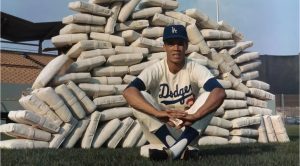
You couldn’t watch Wills, even in the latter stages of his career, which is when I saw him, and not be amazed that he had piled up triple digits in a category where that seemed unfathomable. A photographer once posed him in front of 104 bases. That picture made the rounds quite a bit when Wills was still taking second on hapless batteries. Gaping at the image made his accomplishment only more incomprehensible to me. (Rooting for the generally lead-footed Mets, who never had anybody steal more than 31 bases during their first fifteen seasons, only added to my awe.)
 Lou Brock broke Wills’s record in 1974. By then Wills was part of the NBC Game of the Week crew. I saw him wearing his headset while taking part in an Old Timers game at Shea. The Cardinals were the Mets’ opponent that Saturday. Lou and Maury posed together. Brock was already chasing down Wills, eventually totaling 118 bases on the season. It was immense and impressive, just as Rickey Henderson’s astounding 130 bags in 1982 would be, yet like Maris’s 61, Wills’s 104 somehow looms larger as a single-season record than the greater quantities that succeeded it. Lou Brock broke Wills’s record in 1974. By then Wills was part of the NBC Game of the Week crew. I saw him wearing his headset while taking part in an Old Timers game at Shea. The Cardinals were the Mets’ opponent that Saturday. Lou and Maury posed together. Brock was already chasing down Wills, eventually totaling 118 bases on the season. It was immense and impressive, just as Rickey Henderson’s astounding 130 bags in 1982 would be, yet like Maris’s 61, Wills’s 104 somehow looms larger as a single-season record than the greater quantities that succeeded it.
He broke a hundred before anybody. He broke a record that was set by Ty Cobb. He broke a record that had stood since 1915. He woke up an entire sport’s dormant skill set. One shouldn’t say “nobody” stole bases en masse in the decade before Wills came along, but it was practically a lost art. Maury made the basepaths a canvas few were used to seeing. That method of gunning by running, personified at the high end by the likes of Wills, Brock, Henderson and Tim Raines and injecting the game as a whole with hold-onto-your-hat excitement, would take off and not slow down until the 1990s.
Lest we think of Maury Wills as someone who only took from the Mets (54 steals overall), the man attempted to give something back to us. In the Spring of 1993, at the invitation of his old Dodger teammate and current Met manager Jeff Torborg, Wills put on a Mets uniform and served as baserunning instructor for a few weeks in Port St. Lucie. The Mets were thought to have the makings of a potential baserunning machine — they already had Vince Coleman, Howard Johnson and Ryan Thompson and had just added Tony Fernandez — and how could they not benefit from a master class? Not only did Maury steal like crazy, he was a state-of-the-art bunter. “I can’t make them faster,” Wills said, “but I can get them from first to third, across the plate from second.”
That all the expert coaching in the world couldn’t help the preternaturally doomed 1993 Mets get to first base let alone out of last place was hardly Wills’s doing. Maury tried to enhance Vince’s toolkit in particular. Coleman had outdistanced Wills’s 104 SBs three times in St. Louis, where the artificial turf helped him find his way on base. On Shea’s natural grass, Coleman had to try to rev up his offense on his own. “It’s a miracle he’s done what he has without bunting,” Wills said of his primary pupil. They worked together in camp, Vince showed a modicum of acumen, but…well, it was Vince Coleman on the Mets. It wasn’t a bad idea, though. In 1965, the club had hired track and field legend Jesse Owens to coach baserunners in Spring. At least with Maury Wills, they had a ballplayer.
The same could be said of the Dodgers all those years.
***How is it possible Ted Schreiber didn’t get more of a shot with the 1963 Mets?
That’s something Ted Schreiber allowed himself to wonder in the years following 1963, his only year as a Met, his only year as a big leaguer. “To this day,” he admitted to author Bill Ryczek in the 2008 book The Amazin’ Mets, 1962-1969, “I don’t know how much ability I had.” Ted played on a club that wasn’t exactly lighting the National League ablaze, and you’d guess any youngster with a glove and a clue would have been welcome to show his stuff. Schreiber, 24, was an infielder the Mets went out of their way to acquire, drafting him as a minor leaguer from the Red Sox the previous winter. The previous summer, they’d lost 120 games. Any newcomer should have figured to get a long look, especially one who grew up a relatively short drive from the Polo Grounds.
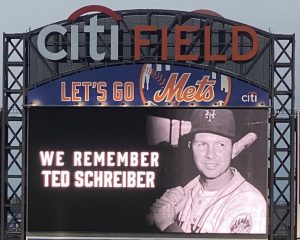
Brooklyn native (as such, a contemporary of Joe Torre and Bob Aspromonte) and St. John’s alumnus Ted Schreiber, who passed away at age 84 on September 8, should have been right at home on the Mets. Johnny Murphy, who ran scouting, knew Schreiber from the time they shared in the Boston organization. Murphy convinced George Weiss to grab the infielder with the first pick in the Rule 5 draft. Sheriff Robinson, in the ’70s the Mets’ first base coach but in 1963 one of their minor league skippers, had Ted when he ran the Allentown affiliate for the Red Sox. His impression: “Great scrapper. Good power to right-center. Adequate speed. Good arm. Very cocky.” Sounds like a boy straight outta Brooklyn in the 1950s. The Mets got the man they wanted, but maybe not the man their main man — Casey Stengel — wanted. Schreiber had a hunch he just wasn’t Stengel’s guy and, as a result, found himself overlooked early in the season and later, after he was recalled from Buffalo. Only 39 games in the majors, only 55 times to bat.
Aside from him and his manager not necessarily being on the same page, there was the issue of a lack of pages in New York. As a hometown kid, Ted had the savvy to believe he could be a cause for newspapers looking for a good story. Except in the Spring of 1963, the newspapers went on strike, so whatever the James Madison High grad had to offer in the way of colorful copy wound up theoretical. Then there was the issue of not having “a rabbi,” as Schreiber put it, no coach looking out for him the way he noticed Cookie Lavagetto taking Larry Burright under his wing or Solly Hemus mentoring eventual Rookie of the Year runner-up Ron Hunt. All he craved was more of a chance on a club that was losing 111 games with him mostly on the bench — and, as Ted would recall for his SABR biography in the 2000s, “where I was positioned, I needed a long bat if I was going to get a hit.”
 Nevertheless, when Ted saw action in September, history would show it was momentous. On the eleventh of that month, with the San Francisco Giants visiting their old haunts, Schreiber entered the game for defense at third base in the top of the ninth inning and Al Jackson protecting a 4-2 lead. The first batter of the inning, Jim Davenport, grounded to Ted, who threw to Tim Harkness for the first out. With two outs, San Fran second baseman Ernie Bowman stepped up, the last obstacle left between Jackson and a complete game victory. Like Davenport, Bowman grounded to third. Like before, Schreiber fielded the ball and threw it to Harkness. Bowman was out. The Mets had won. Nevertheless, when Ted saw action in September, history would show it was momentous. On the eleventh of that month, with the San Francisco Giants visiting their old haunts, Schreiber entered the game for defense at third base in the top of the ninth inning and Al Jackson protecting a 4-2 lead. The first batter of the inning, Jim Davenport, grounded to Ted, who threw to Tim Harkness for the first out. With two outs, San Fran second baseman Ernie Bowman stepped up, the last obstacle left between Jackson and a complete game victory. Like Davenport, Bowman grounded to third. Like before, Schreiber fielded the ball and threw it to Harkness. Bowman was out. The Mets had won.
It was the final game the home team ever won at the Polo Grounds. We’re talking about a ballpark that dated to 1911 (four years before Ty Cobb stole his 96 bases) and a site, Coogan’s Hollow, that had been hosting big league baseball since 1889. Generations of New York Giants fans had ascended to the Bluff above or out to the Ninth Avenue El buoyed by triumph. It didn’t happen too often for Mets fans. When it happened one last time, it was sealed by Ted Schreiber.
The 1963 Mets being the 1963 Mets meant that the last game they won at home wasn’t close to being the last game they played at home. The Mets had seven games left at the Polo Grounds on that homestand after September 11. They lost all seven (including the major league debut of Cleon Jones). On September 18, the Mets pulled down the shades on the matron of the majors for good with a 5-1 defeat at the hands of the Phillies. The last batter? Ted Schreiber, who grounded into a double play that the batter would remember as a ball second baseman and future Met coach Cookie Rojas “made a great play on”.
Schreiber’s last game in the majors came on September 29, at Houston, the season-ender, also a loss. Brand new Shea Stadium beckoned for the Mets, but 1964 would find Ted back in the minors, where he felt he had proved himself by 1963, long after signing with the Sox in 1958. From the Mets system, he’d go to the Orioles’, where he wouldn’t get the call to Baltimore but would provide one more Metsian footnote: at Rochester, he’d take the roster spot of a rising infielder and future manager. We’d come to know him as Davey Johnson.
Ted did not pursue lifer status in baseball. He completed his degree at St. John’s and instead took up teaching. It may have been the role for which he was meant. Visit his Ultimate Mets Database Page, click on the Fan Memories header and learn what he meant to students who remembered him decades after crossing paths with him. You might even say he became their rabbi.
***How lucky was Joan Hodges?
In the end, one supposes, lucky to have lived to almost 96 years of age. Longevity in and of itself isn’t the point when we think about how long Joan lived, a lifetime that lasted until September 17, 2022. The point for all of us cheering her and her cause on from the sidelines was that Mrs. Hodges would get to see her husband, Mr. Hodges, inducted into the National Baseball Hall of Fame.
We watched Joan Hodges get her hopes up and then have reality let her down for some fifty years, and that was after reality dealt her and her family a crushing blow. Some luck. A heart attack took her husband Gil two days before he was to turn 48. We lost the manager who led us to a World Series title and respectability all at once. She lost the love of her life. Her children lost their father. Whatever else they would do, Joan, son Gil Jr. and daughters Irene and Cindy would make it their business to see Gil get his due.
So we got to know Joan to an extent that we considered her an essential member of our baseball family. We saw her solemnly accept Gil’s jersey from GM Bob Scheffing when No. 14 was retired in 1973. We saw her at anniversary celebrations of the 1969 Mets. We saw her whenever there was an event commemorating the franchise’s proudest milestones, because pride in the Mets didn’t really enter the picture until Gil Hodges took over as manager. Joan represented Gil for as long as health would allow her. The kids, long adults by the 21st century, would, too, but it was Joan we instantly recognized on TV, in interviews, at Shea. Joan was always gracious, always classy, always selfless. She was making the appearances she did on behalf of a man who’d been gone since 1972. We never forgot Gil Hodges. Maybe it’s because we have a strong memory. Maybe it’s because Joan Hodges wouldn’t let us.
One suspects had Gil lived he wouldn’t have said one word on his own behalf for the Hall of Fame. That’s not who he was. But he was a Hall of Famer, and Joan knew it, the kids knew it, we knew it. It took a half-century to convince those who could do something about it. As the decades went by and Gil went unelected, we couldn’t help but wonder if Gil’s day would ever come, and if it was gonna come, would the woman to whom it meant more than anything be around to see it?
We got our answer on December 5, 2021. The most revered manager the Mets ever had in Queens, the ballast of the powerhouse Dodger lineup in Brooklyn, a first baseman who by all accounts could’ve given Keith Hernandez defensive tips, was chosen for Cooperstown, scheduled for induction in the summer ahead. By this point, with their mom not up for traveling, one of the kids would have to head Upstate and accept. But Joan, still living in the Borough of Churches all these years later, still keeping the candle lit for her love and her cause, would be able to watch it on TV. Whatever was on her mind in her final weeks, she could think of her husband as a Hall of Famer and know it wasn’t only her thinking it.
Though many of us came to picture Joan as the vigilant widow, smiling through perennial disappointment, after she passed, I went to YouTube to see her in a different context. It was the best context in the world: October 16, 1969, Mets 5, Orioles 3 on the scoreboard, Mets 4 Orioles 1 in the Series. Lindsey Nelson’s on assignment for NBC interviewing anybody and everybody. Before he can direct his attention to the players, he is compelled to exchange words with balding, clubby men in suits far less colorful than his own. Then, like a blast of Retsyn from a freshly popped Certs, appears a lady in a green-and-white checkered coat with fur-lined collar, formidable dark red coif, and eyes protected from flying champagne by shades stylish for any era. She could very well be one of my mother’s friends from the beauty parlor.
 “Here’s Mrs. Gil Hodges,” Lindsey informs the viewing audience. “Hello, Joan. He was here,” he tells her in case she just happened to be wandering by in search of her spouse. “Here’s Mrs. Gil Hodges,” Lindsey informs the viewing audience. “Hello, Joan. He was here,” he tells her in case she just happened to be wandering by in search of her spouse.
“Lindsey, oh I just can’t believe it!” is her high-pitched response. “It’s been a year of miracles, and it’s marvelous, really, really marvelous!”
And then Joan Hodges moves on, presumably finding her husband so they can share this greatest of moments together. You’d like to believe that somewhere they’re sharing it still.
National League Town remembers Mr. Wills, Mr. Schreiber, Mrs. Hodges and Mr. John Stearns on its current episode. You can listen to it here.
|
|






