The blog for Mets fans
who like to read
ABOUT US

Faith and Fear in Flushing made its debut on Feb. 16, 2005, the brainchild of two longtime friends and lifelong Met fans.
Greg Prince discovered the Mets when he was 6, during the magical summer of 1969. He is a Long Island-based writer, editor and communications consultant. Contact him here.
Jason Fry is a Brooklyn writer whose first memories include his mom leaping up and down cheering for Rusty Staub. Check out his other writing here.
Got something to say? Leave a comment, or email us at faithandfear@gmail.com. (Sorry, but we have no interest in ads, sponsored content or guest posts.)
Need our RSS feed? It's here.
Visit our Facebook page, or drop by the personal pages for Greg and Jason.
Or follow us on Twitter: Here's Greg, and here's Jason.
|
by Greg Prince on 26 October 2021 1:40 pm But — I said to myself — I want to get in. This is a World Series opener. I’d never seen one. There is nothing in baseball equal to it…
—Arnold Hano, A Day in the Bleachers
Maybe you’ve heard the old saying, “If you keep letting the Braves make the playoffs, sooner or later a pennant is gonna fall their way.” Alas, it is true. They earned postseason entry a dozen times between 2000 and 2020 yet went home before the World Series. Because the last World Series they made was at our expense, it had been satisfying ever since to watch them depart the stage with their tomahawk between their legs no later than the NLCS.
So much for satisfaction. The Atlanta Braves are the National league champions. Our champions, so to speak. Yeech, of course. But it was bound to happen eventually. The reason I didn’t think it had much chance of happening this year, as late as late July, was they were missing Ronald Acuña, Jr., and they were missing Mike Soroka. No best player. No best pitcher. While I never fully rule out a mathematical contender, it didn’t seem likely to me they’d step up, never mind step over us. No Acuña. No Soroka. Little chance.
I kept leaning on that, sort of like I leaned on the Cubs couldn’t win the NL East in 1984 because they were the Cubs who hadn’t won anything since 1945, or the Nationals couldn’t storm through the 2019 postseason because the Nationals had never won a single postseason series before 2019. The Braves lost eight consecutive NLDSes between 2002 and 2019 plus the inaugural NL Wild Card Game in 2012. They also coughed up a playoff berth down the stretch in 2011 and crumbled like a Drake’s coffee cake in September 2014. All of that would have been enough for an instinctual advertisement for not believing in them in October 2021 — that and the blowing a 3-1 lead to the Dodgers in the 2020 NLCS — but I wasn’t even going there in July. In July, they were without Acuña and Soroka. Being in shouting distance of first place in the East wasn’t going to do them much good if they were missing a couple of their primary vocal chords.
The Braves got themselves a larynx transplant via a fistful of trades that brought them Adam Duvall, Jorge Soler and Eddie Rosario, who in NLCS play proved a latter-day Eddie Perez. As sometimes happens, the team trailing in late July becomes a somewhat different team by early August. We kind of remember that being our case six suddenly going on seven years ago. It’s more fun when it happens for us than for somebody we go from leading to trailing. On July 28, the night Michael Conforto gunned down Abraham Almonte at home plate to secure a save for Edwin Diaz, the first-place Mets led the third-place Braves by five games. The Braves beat the Mets the next night and the trade deadline the next day.
By August 14, the Braves were slightly ahead of the Mets. By August 21, the Braves were farther ahead of the Mets than the Mets had been ahead of the Braves before those transformative trades. While we kept straining to glimpse glints of daylight as the California darkness descended upon us, the Braves’ immediate future turned so bright they should’ve worn shades. Atlanta (or wherever they play) finished 6½ ahead of the Phillies in second and 11½ ahead of us in third. That the Braves of Travis d’Arnaud and Guillermo Heredia won a mere 88 games didn’t matter. They were a division champion. Now they’re a league champion, having brushed aside the 106-win Dodgers like they were the 77-win Mets. The cauldron that is the National League East apparently toughened them up good.
I don’t hate the Braves like I hated them in 1999, the last time they went to the World Series. It would be physically impossible to hate the Braves like I hated them in 1999 or 2000 or up to the late-July weekend in 2006 when we definitively ended their divisional dynasty. After that, the Braves receded from archrivalry. Hate became dislike, sometimes deep, sometime de facto. It was, as noted, satisfying to see them fall short. It wasn’t life or death.
It still isn’t. They beat the Brewers in this year’s NLDS, and it didn’t particularly bother me, probably because I was preoccupied by the Giants and Dodgers. Then they took on L.A., and I didn’t really have a side. I don’t like either team as a rule. My contemporary dislike for the Dodgers traces mostly to the presence of Chase Utley on the basepaths in 2015. Utley hasn’t been a Dodger since 2018, but as long as there remain active players in Dodger uniforms who gave Utley an approving pat on the ass for taking out Ruben Tejada at second, he’s still spiritually one of them and they are essentially one of him.
Nevertheless, I didn’t life-or-death the Dodgers’ demise in the NLCS because that would have entailed getting behind the Braves, and being behind the Braves — from a standings perspective — was something I’d experienced too lately for comfort. And I couldn’t life-or-death the Braves’ demise because, yeesh, Utley. So I let it play out and found myself not wholly unhappy that the Braves of d’Arnaud and Heredia were heading to the World Series and at least a little delighted the Dodgers weren’t, though I think had their series gone in the opposite direction, I would have come out of it in a similar mood. The Dodgers of Albert Pujols (who I could swear was already inducted into the Hall of Fame) would have seemed admirable. The Braves would have been done, which is forever satisfying.
Either way, I watched. I’m not one of those Mets fans who ducks out on the postseason when the Mets aren’t anywhere near it. You don’t have to be absorbed by a Metless postseason like it’s 1986, but you shouldn’t take a bow for taking a pass. You’re entitled to sit on your high horse or apathetic alpaca, but I can’t endorse your celebration of not watching or not caring. I’m also not one of those Mets fans who replaces “Meteor” for “Mets” in LGM at every unpleasant October turn. Yankees-Phillies in 2009 was meteorworthy. Yankees-Braves in 1999 was meteorworthy. Perhaps you spot a throughline. Dodgers-Braves was good, survivable baseball. Even if it had been lousy baseball, it was postseason baseball. It was baseball. Come back to me in no more than ten days and tell me that’s not worth something. (Come back in December and you might really be jonesing.)
Over in the American League, I would have preferred the Red Sox as champion, but got the Astros. With the most recent 30 for 30 still playing in my head, the best part of the 2021 ALCS may have been it wasn’t a rematch of the 1986 World Series. It certainly wasn’t life or death for me. I got my life-or-death out of the way in the AL Wild Card Game. Everything after that among Boston, Tampa Bay, the South Side of Chicago and Houston was Not the Yankees, which is all I can ever ask out of the American League.
Granted, the Astros have an elephant in the video room, and one can’t watch them for more than a couple of pitches without remembering they were nefariously identifying the pitches to win a World Series not too many years ago. The Astros, however, are pretty good at being chameleons. They were the Colt .45s at birth. They were baseball avatars of the Space Age with their next chosen identity. They settled in and blandly occupied the Astrodome during the Eighth Wonder’s first decade, rarely being abysmal, never being spectacular, usually thwarting the Mets. They dressed in horizontal rainbow stripes and at least looked exciting. They rose up in spurts, threatening our Once Upon a Time in Queens fairy tale at their peak. Then they ditched the rainbow stripes; disappeared from the top of their division; ditched the residual rainbow accents; changed divisions; and eventually succeeded on a consistent basis, albeit with relatively few noticing.
The Astros kept going to the playoffs in the late ’90s and early ’00s with barely a lick of readiness for prime time. Or perceived readiness. They went 0-for-4 in NLDSes when they started making them almost annually and went almost unseen even as they got the hang of October. For those who miss the golden days of afternoon World Series contests, consider the Braves and Astros met in the NLDS five times between 1997 and 2005, and they were almost exclusively a matinee attraction: 16 day games in 19 dates. ESPN, Fox and whoever else was involved back then would have preferred to show a test pattern in prime time than spotlight the best baseball the Sunbelt had to offer.
Toward the end of the Killer B’s run, the Astros of Bagwell, Biggio and import Beltran — playing on the site of an old train station and dropping the Space Age motif from everything but their name — neared the World Series in 2004, losing the NLCS to the Cardinals in seven. Then, with Carlos B. ensconced in Flushing, they reached the World Series in 2005, only to be swept out of it by the White Sox from the American League. Eight years later, after intentionally falling through the competitive floor, they were in the American League. A couple of blinks later, their process of losing a ton morphed into winning a lot, then winning it all in 2017. It was a great story until details emerged rendering it considerably less great.
Yet here they are in the World Series in their latest incarnation, America’s Anti-Team. The Astros’ roster has mostly turned over since ’17, but the cream of their crop remains and they haven’t missed a single postseason since winning it all, no matter how they won it. Their manager is possibly the most sympathetic figure in all of baseball, Dusty Baker. Baker wasn’t a part of the Astros’ analytical process nor on hand for the surfeit of strategically aimed cameras and voluble trash cans. He’s the lifer who came up under the wing of Henry Aaron and paid more than a half-century’s worth of dues, winning almost everything with almost everybody, save for a World Series ring from the helm of the dugout. Maybe the only feelgood story that comes close to Baker’s is that of his Fall Classic counterpart Brian Snitker, an organization man in the best sense of the phrase. The Braves gave their mostly unknown minor league fixture a shot in 2016 and aren’t they glad they did? Snit has guided Atlanta to four consecutive postseasons, inspiring love and loyalty along the way. And he’s done it in a Braves uniform, for goodness sake.
I adore a postseason when a team I don’t follow comes along and sweeps me up on its journey. This hasn’t been one of those postseasons, and as this postseason pulls to within four to seven games of a conclusion, I don’t have a pennant-winning dog in its ultimate fight. I’m just looking to be optimally entertained and fleetingly engaged. Don’t tell the fans of the remaining playoff teams. It’s life or death to them.
There’s plenty to root against if that’s your jam. There’s something to root for if you let yourself. There’s the pair of teams that survived the gauntlet of a full season and the heat that gets turned up in October. The Braves and the Astros have played some wonderful baseball to get here. It’s wonderful that baseball is still being played. Hell yeah, I’m gonna tune in. This World Series may pit two teams we’re not crazy about, but it’s the World Series. It belongs to us all.
by Greg Prince on 15 October 2021 4:20 pm Other than Wild Card Games, the 2016 National League version in particular, I don’t recall watching a postseason showdown and thinking it absolutely needed to continue beyond its agreed upon parameters. But I have now.
The Dodgers just defeated the Giants in five, but five wasn’t enough. It was the Dodgers in too soon. This National League Division Series needed to be allowed to go seven games, perhaps nine. Perhaps nineteen. It also needed to be allowed to complete its fifth and deciding contest instead of having an umpire end it at least one pitch prior to its organic conclusion. I’m not saying this as a Giants sympathizer or a Dodgers disdainer. I’m saying it as a baseball fan.
I’m not sure what you do about the Giants and Dodgers being done head-to-head before we get to seven-game territory. The two fiercest rivals in baseball history made the mistake of being the two best teams in baseball this year while combating one another in the same division. The one that didn’t win the NL West won a Wild Card and then a Wild Card Game. The team with the best record in a given league automatically plays the Wild Card winner. That’s how you get the 107-55 Giants squaring off against the 106-56 Dodgers in what amounted to the sport’s quarterfinal.
Reseed? You could do that, in which case L.A. would have played Milwaukee, and San Fran would have taken on Atlanta, and then, had form held, you’d have the Giants and Dodger for the pennant. Except would have form held? Form didn’t hold in the other NLDS, where 88-win Atlanta subdued 95-win Milwaukee. Form didn’t hold in one of the ALDSes, where the AL East champion Rays (100-62) fell to the Wild Card Red Sox (92-70). The first rule of postseason is you never know, and that’s for the series and games that are actually played. The second rule of postseason is you can only imagine, but you do so at your own risk.
Unless you haven’t wondered once or twice what would happen had Carlos Beltran swung.
It never occurred to me that reseeding was necessary in baseball. It doesn’t now occur to me it’s necessary, unless it’s narrowly defined. Should a league’s Wild Card a) complete its regular season with more than 105 wins and b) maintain with its division’s champion a historic rivalry that dates back a century or longer…
Discerning a path to facilitate the behemoth Dodgers and the powerhouse Giants playing for as many marbles as is conceivable is a noble goal. But the slight chance that you’ll get this scenario again probably doesn’t merit overhauling an otherwise decently designed system. Five-game LDSes are generally a substantial enough appetizer to seven-game LCSes. Wild Cards aren’t division winners, with all that implies about the value of the 162-game season. The 2015 Mets (90-72) maintained home field advantage over the 2015 Cubs (97-65) because the Mets won their division and the Cubs didn’t. We would have treasured a hypothetical seventh game taking place at Citi Field rather than Wrigley Field.
Of course the Mets of six Octobers ago swept the Cubs for the National League championship and I don’t remember thinking four games wasn’t the perfect length.
Before leagues were cleaved into divisions, you didn’t have postseasons. The National League did wind up in a couple of noteworthy ties in 1951 and 1962, you have may been reminded recently, and that brought the Giants and Dodgers into bonus conflict, with three-game tiebreakers to determine pennants. Each of those emergency series went three, each went to the wire, and each went to the Giants on the Third of October. In the era of two divisions per league, when East champs faced West champs, you couldn’t have a Dodger-Giant postseason series, seeing as how each rival sat in the same division. This period, 1969 through 1993, also coincided with me, born not long after October 3, 1962, growing up and growing ever more fascinated by the collision of October 3, 1951. I didn’t dream of a Giant-Dodger postseason meetup because the mechanism didn’t exist.
Then came realignment, three divisions, a Wild Card, and possibility. Yet the Dodgers and Giants, who’d intermittently battle it out for the NL West crown, didn’t land in the same postseason until 2014 and then again in (grrr) 2016. Yet they missed each other each time, one or the other succumbing in an LDS against somebody who wasn’t their ancient foe, leaving us close-but-cigarless to a best-of-seven LCS. When we got to 2021 and a five-game series pitting this year’s New York-rooted National League West titleholder versus the Brooklyn-born victor from this year’s National League Wild Card Game — where they overcame the disgustingly not to mention bafflingly extant Wainwright/Molina combo — I didn’t think five games was better than nothing. I thought these five games would be better than anything (well, any Met thing).
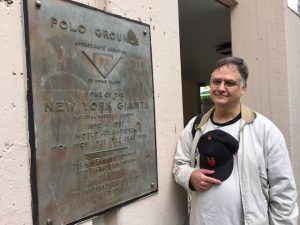 October 3, 2021: The author takes a quick jaunt uptown to pay homage to some orange-tinged roots. And it was, even if it came up two games shy of a best-of-seven, even if the side where my affinity is planted won only two games of five. Because my immersion in New York Baseball Giants culture is deep and because I was a gleeful October tourist for the San Francisco Giants’ ride to World Series glory three times in the 2010s, I thought I’d take a five-game loss to the Dodgers to heart. But SF-LA, it turns out, was less my affair than my sidepiece. I was into it because of what it represented to baseball. These two teams co-existed fiercely in the same league and city for generations; pulled up stakes (eternal BOO!! on both of them for that); relocated to polar-opposite towns in the same state on the other end of the country; feuded across millennia as divisionmates; and finally wound up in a regularly scheduled playoff round.
How could you not want that go the limit? How could you not want the limit to be unlimited? Games One and Three were exquisite manifestations of 2021 Giant execution, with shades of what made San Fran so magical in 2010, 2012 and 2014. Logan Webb pitched like he could’ve lined up among Bumgarner, Lincecum and Cain. Buster Posey busted out his opposite-field whooping stick. Brandon Crawford leapt as if the second coming of Buddy Harrelson in the Channel 9 opening montage of yore. They were spine-tingling in their excellence. Meanwhile, Games Two and Four attested to the enormity of L.A.’s winning ways and how they’d practically perfected the methodology that had brought them eight consecutive division flags, three recent pennants and last year’s world championship. They are as fully loaded and decadent as really awesome potato skins. The Giants posted their victories by scores of 4-0 and 1-0. The Dodgers took theirs by tallies of 9-2 and 7-2. After four games of the NLDS, counting everything the two teams had done that counted, this was where they stood:
SF 109-57
LA 109-58
You wanted a fifth game. Then a sixth and seventh game. And then, if they didn’t mind, Games Eight through Infinity, at least until it was time for the mere mortals to gather for Pitchers & Catchers.
But we settled for a fifth game, in San Francisco, and, yes, what a fifth game it was. The Dodgers threw an opener and a bridge guy in advance of unleashing their 20-game winner as bulksman. The Giants stuck with the fella who pitched them to a series lead in the first game. Everybody’s pitching strategy was essentially sound through five, as nobody within the cohort of Corey Knebel, Brusdar Gaterol, Jose Urias and Logan Webb gave up a run. The Dodgers’ intrinsic Dodgerness broke through in the top of the sixth. Mookie Betts — whose absence from the Red Sox hasn’t prevented them from advancing to the ALCS, but, even still, who lets go of Betts? — singled. It looked like it might be a double, but Mookie was cautious. Besides, why risk getting thrown at second when you can steal it on the next pitch? With Betts on second, Corey Seager, last year’s World Series MVP (almost every Dodger has a major award in his past), doubled him home. The tie was broken. The ice was broken. The plot was thick.
To this do-or-die stew, add the unlikely thickening agent of Darin Ruf. Darin Ruf is a name familiar to Mets fans mostly from conflation with Cameron Rupp on the mid-2010s Phillies. Needless to say, Ruf wasn’t appearing in any postseason action for Philadelphia as the last decade wore on. Ruf left the City of Brotherly Love and its perennial futility to improve his game in Korea. He slugged 96 home runs for the Samsung Lions over three seasons in pre-pandemic KBO, when nobody in the US was tuning in. He returned to the States in 2020, to a Giants team there was little reason to notice. In 2021, for a ballclub that won nearly two-thirds of its games, Ruf played 117 times, put up an OPS+ of 143 and, in the sixth inning of the deciding game of a League Division Series versus the Dodgers, swatted a three-two pitch from Urias 452 feet, beyond Oracle Park’s center field wall.
Three innings of regulation remained, which set in as a damn shame. Webb’s final frame of pitching kept it 1-1. Blake Treinen’s entry in the bottom of the seventh did the same. A Dodger threat off Tyler Rogers in the top of the eighth — two singles sandwiched inside two outs — was snuffed by nasty if previously unheralded San Fran closer Camilo Doval. “Nasty if previously unheralded” pretty much describes the 2021 Giants in toto. Los Angeles closer since forever Kenley Jansen took care of business in order in the bottom of the eighth.
In the ninth inning, the Dodgers got to Doval. One Dodger in particular got to the getting — Justin Turner. Naturally Justin Turner. With Clayton Kershaw sidelined, Justin Turner is the longest-running, non-bullpen postseason constant of the L.A. would-be dynasty. They’ve definitely been dynastic in the West since 2013. Turner arrived at Chavez Ravine in 2014. We’re vaguely aware of where he played the handful of seasons before he emerged as a key cog, then a star for that divisional dynamo. Every autumn, the leaves turn colors and Justin Turner appears on TV. That, along with flaming red hair that seems to get redder with age, is probably why we can never quite forget our erstwhile benchwarmer.
Justin Turner you noticed in Game Five because he managed to get himself hit by Camilo Doval pitch with one out in the ninth. Didn’t you just know he’d come around to score in a matter of batters? You remember Justin Turner Met Utilityman becoming Justin Turner Dodger Constant, so that’s a rhetorical question. It would fall to Cody Bellinger to drive Justin in, from second after a Gavin Lux single had moved Turner up a base. Cody Bellinger this season batted .165. Cody Bellinger was the 2017 National League Rookie of the Year and 2019 National League Most Valuable Player. All these decorated Dodgers inevitably live up to their trophies.
We for whom the orange and blue DNA runs more to orange didn’t think it could end this way. Somewhere in that home dugout had to be a Bobby Thomson. A break had to go the Giants’ way to set up something that would swipe that 2-1 L.A. lead right back, something that would push at least one run across and keep the NLDS matchup of a lifetime alive. Sure enough, with one out, it was Justin Turner getting involved again. This time, it was ex-Met Justin Turner bobbling a grounder from Kris Bryant, the E-5 placing a runner on first. LaMonte Wade, Jr., stepped up to pinch-hit. Wade is known as Late Night LaMonte, and not from hosting an 11:30 PM talk show. LaMonte Wade, Jr., if you hadn’t been devoting yourself to Giant doings all year (and I surely wasn’t) is a ninth-inning savant. In 24 ninth-inning plate appearances in 2021, Wade batted a typographically correct .565. Of course you’d invest faith in Late Night LaMonte, no matter who the Dodgers had pitching.
Except did we mention the Dodgers had Max Scherzer pitching? Max Scherzer’s résumé not only speaks for itself, but it just keeps talking. He was a starter moonlighting as a do-or-die closer, but Max Scherzer wasn’t going to be easy to fit with goat horns in the classic style of Ralph Branca (himself, à la Julio Urias, a onetime 20-game winner for the Dodgers). Max is not an easily scalable mountain in any season — even in his fourteenth — in any inning — even in Wade’s.
LaMonte took Scherzer deep but foul in the course of his at-bat, but ultimately got rung up on strikes. With two out, then, the Giants’ season came to rest on the shoulders of Wilmer Flores.
Naturally Wilmer Flores. You want to chat ninth-inning avatars, you have to invoke the player who conjured walkoff RBIs as a Met ten separate times. Four were in the ninth inning. Six came in extras. If you were rooting for Wilmer — and who among us, regardless of temporary alignment, wasn’t? — you knew the moment was holding out its fist for a bump from the man for whom it was made. Alas, you also probably learned, as Wilmer readied to transport his Met magic to another sphere, that Flores had never done a darn thing against Scherzer. He was 0-for-17 lifetime. This, though, loomed as the time of Wilmer’s life. This was Tears of Joy Redux incubating. Different context, momentous vibes. This was a shot waiting to be heard, seen and consumed around the world.
Or waiting just to keep the ninth inning going. To get on base. To get it to Evan Longoria. Something, Wilmer. Anything. Eighteenth time’s the charm…maybe.
Wilmer takes a slider for strike one. He fouls off a fastball for strike two. Max Scherzer, he of the three Cy Youngs as a Tiger and National and spotless record down the stretch as a Dodger, delivers another slider. It’s low. it’s away. It’s clearly off the plate. Flores begins to swing but checks before he goes around.
This is what has happened. It is not, however, what is seen by home plate umpire Doug Eddings, who isn’t certain enough to call ball one, so, at catcher Will Smith’s behest, Eddings confers on appeal, from ninety or so feet away, with first base umpire Gabe Morales.
Morales raises his right fist to indicate strike three, game over, series over. A dog raising his leg would have had the same effect on the resolution of this NLDS.
Game Five ended on about as bad a judgment call as you would have refused to imagine. Flores should have still been up, one-and-two, Bryant still the runner on first, Longoria on deck. Who knows what would have happened had the combined judgment of Eddings and Morales hewed to reality? It’s quite possible our beloved Wilmer Flores — who struck out looking to complete with a whimper the 2015 World Series (we were behind by five runs to the Royals, so it’s not as iconic as Beltran looking in 2006) — might have gone down on strikes one pitch later. Or it’s possible, because he had a bat in his hands and he’s Wilmer Flores, that he finally connects safely off Max Scherzer.
We’ll never know, which is too bad. We should have found out, which makes it worse. Highly questionable calls can be a part of the most compelling of games, which is the worst. Don Denkinger. Jim Joyce. Gabe Morales. It’s not a roster an umpire wants to join.
The Giants take their 107 wins home without a single postseason round captured. The Dodgers fly to Georgia to continue on as overqualified Wild Card versus the Eastern Davison flagbearer Braves in the NLCS. Somehow, two tiers of playoffs remain. Somehow, the Dodgers and Giants settled only the championship of each other. If five games in their private cauldron drained the Dodgers of energy and purpose, the Braves might yet take the pennant. For now, though, the Braves seem immaterial in the wake of Giants-Dodgers — and Scrappy Wild Card Los Angeles Fights On Toward World Series Berth doesn’t seem like a viable narrative.
The 2021 Dodgers endure. The 2021 Giants expire. It is not an illegitimate outcome. Sudden death just came a beat too soon was all.
by Greg Prince on 6 October 2021 2:27 am The 2021 Mets are behind us. The 2021 postseason is ahead of us. As baseball fans, let’s enjoy that. Let’s enjoy the top-notch baseball teams we’re going to see, starting tonight, when the Dodgers host the Cardinals in the National League Wild Card Game, the winner of which will take on the Giants, whose 107-55 record is the best over 162 games of any NL club since 1986 (ahem). A Giants-Dodgers NLDS would be lit — lit! — but you can’t overlook the Cardinals and their recent 17-game winning streak.
The other Division Series in the senior circuit should be pretty good, too, featuring a team that used to live in Milwaukee versus the team that took its place. Braves. Brewers. Brace yourselves for a bruiser.
Over in the AL, America’s Team the Astros returns to the October stage, perhaps motivating boatloads (or should we say garbage scows) of the unaffiliated to pull for the White Sox, the class of the Central. The managerial matchup is literally one for the ages: Dusty Baker versus Tony La Russa. Both men have had their critics, but dudes who last as long as they have must know a few things.
Tampa Bay is the one-seed in the junior bracket. As ever, they loom as an inscrutable opponent, forever leaving you wondering how they keep doing it. The next team to have to unravel that mystery will be the Boston Red Sox, the American League Wild Card representative in their LDS.
Let’s see…one, two…five, six…eight, nine…yup, that’s it. Nine teams in the MLB postseason starting tonight.
I didn’t leave anybody out, did I?
by Greg Prince on 5 October 2021 1:37 am The Mets’ announcement that they would not retain their manager should have constituted a five-alarm bulletin. Wire machines across the city should have shaken. Daytime programming should have been interrupted. This is traditionally head-of-state transfer-of-power stuff. The helicopter is on the south lawn. San Clemente awaits. Somebody grab a bible and swear in our next presumably fearless leader to preserve, protect and defend the sovereignty of 41 Seaver Way.
Except it didn’t feel that way at all Monday when Metsopotamia learned via tweet (certainly not on Facebook) that the Mets would, not unexpectedly, decline the option on Luis Rojas’s contract. Dry corporate language for bloodless times. Sandy Alderson issued a statement of gratitude before acknowledging “a change is needed at this time”. Rojas’s cordial response was helpfully embedded in the very next paragraph. No spouting off to favored beat guys at the contemporary equivalent of Toots Shor’s for this deposed manager. He could even return to the Mets in some “yet to be determined capacity” if he chooses, per the release.
Maybe it’s because of the professionalism of the process that the end of the Rojas run (222 games managed, 119 games lost) landed as almost agate type, rating a line above so-and-so being activated from the 60-day IL. Or maybe it’s because we’ve been through so many of these kinds of announcements of late that they’ve lost their ability to stir even the most engaged of Mets fan souls. In about four years’ time we’ve witnessed the offing, by whichever euphemism was handy, of Terry Collins, Mickey Callaway, Carlos Beltran and now Rojas. We also watched Sandy Alderson step aside as general manager in the middle of 2018 for health reasons; an ad hoc front office structure fade away a few months later; Brodie Van Wagenen make a splash in the fall of 2018; Brodie Van Wagenen’s splash transform into a puddle by the fall of 2020; Alderson re-emerge as Mets president; would-be whiz kid Jared Porter not reach Opening Day; Zack Scott go on administrative leave in his first and presumably only interim season handling what had been Porter’s GM job; and, oh yeah, the team go through the machinations of being sold, not sold, then finally sold. You can only stop the presses so many times before the presses shrug.
We used to name eras for managers. Except nominally, I’m guessing we won’t be doing so for Luis Rojas, pilot of the New York Mets across one short season and one practically endless slog. There was undeniably a Stengel Era; a Hodges era; a Johnson era; a Valentine era. I’ve occasionally referred to the Art Howe Era, probably ironically, but not without belief those 2003 and 2004 teams were Howeish to their core.
Because COVID protocols continued to limit most media-player interaction to virtual, it was hard to divine if the Mets of 2020 and 2021 bore the indelible stamp of Rojas. Nobody’s ears reached the clubhouse to be whispered in. Nobody reported with regularity on what One Met Said or had the chance to make close-up observations and inferences. We who pay attention from the outside heard just about everything uttered for public consumption as it was broadcast by the TV and radio rightsholders, while little else appeared to be passed along privately. Nobody’s gripes were recounted juicily if anonymously. There were few surprises filling out the game stories.
If any Met didn’t love Luis Rojas, that Met didn’t mention it over Zoom. If any Met didn’t love anything — besides not being relentlessly cheered as the club slid from first to third in the National League East — that Met didn’t let on. The bulk of the postgame talk was about how positive everybody remained, lose or win (mostly lose after a while), and how everybody was thrilled to be a teammate of everybody else.
A happy clubhouse. A content clubhouse. Come October, a dark clubhouse.
Was the complacent tenor of the team the doing of the manager? It’s difficult to tell. Maybe it’s irrelevant now that Rojas is no longer the manager. My sense is Luis pursued his responsibilities as directed by whatever internal consortium decides how a ballclub is to be managed these days. The year before he took over for the trash-canned Beltran, Rojas was the nebulously titled quality control coach, liaising between the c-suite and the bench, and probably one of the people who weighed in on how the Mets should be managed in a given situation and/or generally speaking. Being promoted to manager likely didn’t empower him to act solely from instinct.
You will read no 1969 retrospective without being reminded every five pages that Gil Hodges’s leadership was that season’s true MVP. When you watched Once Upon a Time in Queens, you understood anew that Davey Johnson framed the 1986 “we’re gonna dominate” attitude we continue to idealize. Bobby V was Bobby V and we never forgot it between 1996 and 2002. Yet we’ve been informed for close to twenty years — roughly since Valentine’s swashbuckling style fell out of fashion in Flushing — to forget our romantic image of what a manger is or does. Alderson was a modern hero in Moneyball (the book) for calling out the antiquity of the skipper as Leader of Men. Nope, Sandy told Michael Lewis, the field manager is essentially a middle manager, an apparatchik to whom “the fate of the organization” should not be left. When Rojas entered the family business in the mid-2000s, he surely knew which way the wind was blowing. He might have aspired to be as admired a manager as his dad was. He likely discerned that earning admiration within the industry as it evolved from Felipe Alou’s heyday wasn’t going to stem from being a singular figure.
Luis Rojas indeed never gave the impression he was a lone wolf. He matured as a minor league manager in what had become a collaborative enterprise. Sure enough, nearly every decision he explained for two years was delivered as something “we” decided. I never thought he was deflecting responsibility for what didn’t work or being modest about what did. He had coaches by the fistful surrounding him and an expanding analytics department besides. The manager is one among “we” these days. I doubt Rojas chafed at carrying out instructions rather than being trusted to his own devices. His rise through the ranks indicates he fit baseball’s prevailing ethos.
Whatever portion of the most recent Mets manager’s job it was to relieve a starter or implement a hit-and-run, it was, by all indications, less than the share of mind he gave over to taking the temperature of the room. Keeping talent happy and hopefully productive seems to be what a major league manager is hired to do. Winning may not have topped the list of Career Objectives Luis presented when he interviewed for the role he held. The Mets of 2020 and 2021 appeared to be enjoying themselves, if nothing else. They rarely appeared bothered by their collective shortcomings. Everything was about “just trying to stay positive” when it wasn’t about disseminating playful (and maybe not so playful) hand gestures.
I honestly don’t know how much emphasis Luis Rojas placed on winning when addressing his troops. I don’t know how much troop-addressing a manager really does. I assume the idea of baseball players as “troops” is hopelessly outmoded, but it’s language we’re used to. Did Rojas try to fire up his charges? Or did maintaining an even keel supersede all emotional concerns? This is the man who said managing late in the season required no change in approach from managing early in the season. The arc of the season — and the Mets’ fortunes as it careened toward its end — suggested otherwise.
Those who claim to be somewhat in the know praise Rojas as a “good baseball man”. Does anybody get ostracized as a terrible baseball man? I take it to mean a good baseball man in 2021 doesn’t make enemies and communicates effectively within the realm of saying what people up the collaborative chain wish to be said. I used to think being a good baseball man meant teaching a light-hitting middle infielder how to bunt for a base hit when the third baseman is playing back. Maybe Luis did that, too. While I wasn’t sorry to learn he won’t be the Mets manager in 2022, I took no particular glee in his dismissal from the dugout. If he agrees to be reassigned within the organization, that’s fine. He’s not a pox on the Mets. He just wasn’t the right individual to guide or motivate a group that underachieved during his two seasons at what we still call the helm, no matter that the helm probably doesn’t exactly exist.
The Mets will name a new head of baseball operations. The baseball operations executive, with input from Alderson, Steve Cohen and whoever else gets listened to, will choose a manager. The business of state will resume. We’ll just try to stay positive.
by Greg Prince on 4 October 2021 2:41 pm Late in Sunday’s season finale at Atlanta, Gary Cohen mentioned Braves pitchers had faced two over the minimum. When the 162nd game of 2021 concluded, that count had held. There’d been 29 Mets up and, with the assistance of a couple of double plays, 27 Mets down.
Barely above the minimum similarly described the year of Mets baseball of which we willingly partook. Barely above the minimum synchronized with the mood the Mets had wrought as a rule between the first pitch of the season’s first game and loss, 5-3 at Citizens Bank Park on April 5 (Kevin Pillar took ball one at 7:05 PM), and the last out of the season’s last game and loss, 5-0, at Truist Park on October 3 (Francisco Lindor grounded out, third to first, at 5:47 PM). The hours, days, weeks and months burrowed from one end of the schedule to the other. Flashes of excitement and episodes of intrigue spiced our daily lives, but mostly these Mets went on and on until there was nowhere left for them to go.
I’d call the final afternoon an anticlimax, but there was little climactic about the afternoons and evenings that preceded it. The Mets boosted their record to ten games over .500 on June 16 after winning 14 of their previous 19. It was a pretty satisfying spurt, but it never felt as if the Mets were riding a wave of unstoppable momentum. The Mets led the National League East by five games on June 26. Leading the pack was certainly preferable to being stuck in its middle, but it never felt as if the Mets were preparing to leave those who trailed them in a cloud of dust. They held a good record until they didn’t. They held first place until they didn’t. They finished eight games under .500, falling five games behind the runner-up Phillies and 11½ in back of the yet again division champion Braves.
Continued exposure to these Mets over at least the final two months of this season, maybe all six months of it, renders these results utterly unsurprising. When the club was performing small miracles, it was via the wizardry of understudies to the original Bench Mob. Well, we reasoned, if we can stay aloft on the wings of the Mazeikas, McKinneys and Maybins, just wait until the REAL Mets come back! The Real Mets trickled into the lineup as summer heated up and the Real Mets wilted. Mind you, the C-team that kept us going was not sustainable as a unit. I developed one of those “you know who my favorite player is right now?” crushes on Jose Peraza for a couple of weeks, but Jose Peraza hit .204.
When the stretch of not believing how much we’d gotten out of the contingency corps was over, we drifted toward not believing how little we were getting out of the main cast. So much of August and September, for me, became about inspecting the batting order and wondering how the hell we were doing this badly. Isn’t Conforto better than this? Isn’t Lindor better than this? Isn’t McNeil? And so on. Average out all you could possibly have hoped to have gotten from the backups and the backups’ backups; add in all you didn’t get from the front-facing Mets; and toss in the usual bout of groping for an identity at the season’s start (we were 9-11 as of April 30), and a final record of 77-85 resembles something barely above the minimum you could have expected.
I just looked up the vaunted PECOTA projections for this season. Its formula pegged the 2021 Mets as finishing first, with a record of 96-66. I’m almost done laughing about it myself. Knowing what we know now, what addled algorithm, no matter how catchy its acronym, picks this team to go 96-66? Knowing what we knew then, why did we think these Mets resembled anybody eligible to be playing beyond October 3?
Plummeting 18 games from your high-water mark and 16½ games in the standings tends to disappoint. But it didn’t devastate, exactly, did it? That’s because, as I personally began to come to grips with in early August, these Mets were never that good to begin with, with the beginning of “begin with” dating to our hopes being raised by an invigorating second half of 2019. That team’s core was this team’s core, except this team’s core was enhanced by the presence of Francisco Lindor and, later, Javy Baez. This team’s core, however, delivered next to nothing down the stretch. There were a few bodice-rippers, so to speak, when the walkoffs were wild, the jerseys came off and the stimulation shot through the ceiling for a day or two. But then it was back to the doldrums of what the Mets have been since baseball came out of COVID hibernation in July of 2020.
The Mets weren’t much good last year, when Fred Wilpon owned them and Brodie Van Wagenen ran them. In case you’ve forgotten, they weren’t much good before that thrilling finishing kick in 2019 propelled them to a winning record and the shores of Wild Card contention under the dugout stewardship of Mickey Callaway. Come to think of it, they were mostly godawful in 2018, which is relevant in 2021 because Callaway’s first campaign — when the previous Sandy Alderson-helmed regime was winding down — landed at 77-85, just as Luis Rojas’s legitimate first (and only) full year did on Sunday. The Mets played only 60 games in Rojas’s initial go-round; he and they managed to finish eight games under in 2020, too.
77-85.
86-76.
26-34.
77-85.
In a span of four seasons, we’ve gone nowhere fast. Managers changed. General managers of a permanent, interim and de facto nature cycled through. Ownership was transferred to an entity sporting deeper pockets. Players streamed in. Players streamed out. But there was that core of players that began to coalesce a little in ’18 and seemed to forge something genuine in ’19. You look at it, you still wonder how the hell it did so badly in ’20 and ’21. Maybe it’s because the core was, in fact, never that good to begin with.
Oh, also Jacob deGrom missed the second half of this season. That will take the starch out of your PECOTA not to mention dim your prospects every fifth day. It will also inevitably tumble dominoes upon the four days between would-be deGrom starts. Let’s not overlook the absence of the world’s greatest pitcher in explaining why preseason expectations missed being Met by a long shot. Maybe deGrom’s stable health and presumed continued brilliance would have lifted the Mets higher than 77-85 and third place. Maybe? Probably. How high it could have lifted them, however, cannot be pinpointed. But even while Jake was still striking out most comers, the Mets were already slipping from their modestly impressive peak.
When you can’t convince yourself that even Jacob deGrom could have saved your season, your season probably wasn’t capable of being saved.
___
So that wasn’t as much fun as we wished it to be. Except for it being Mets baseball and all that implies to Us. Not to Them. To Them, which is to say not Us, Mets baseball is likely something to dismiss lightly. To Them, Mets baseball must appear to be a perennial exercise in mediocrity, punctuated by spates of embarrassment. If the They who make up Them haven’t laughed at Us lately, it’s probably because They’ve forgotten about Us altogether.
The hell with Them, of course. We’re not here for Them. We’re here for Us. We’re here for each other, Mets fans for Mets fans. We understand the mediocrity. We understand the embarrassment. It’s Ours. We are compelled to own it if not endorse it. We advocate for a time it no longer defines the going state of affairs.
But the downside isn’t why We’re here. And maybe the upside is too conceptual at the moment to say that’s why We’re here. We’re here for Mets baseball. The constancy. The familiarity. The occasional shocks to the system. The commonality of it to Us. This is what We do. If it wasn’t, We wouldn’t softly mourn the passing of another season, even it was quite obviously a season that needed to go away ASAP.
Faith and Fear is Flushing is what we here do. Jason and I have blogged seventeen seasons of Mets baseball. As a point of comparison, Lindsey Nelson announced seventeen seasons of Mets baseball. Lindsey Nelson was a part of the Mets forever. Still is. Yet seventeen seasons was it for him.
Seventeen seasons sounded like a lot when Lindsey left for San Francisco. It sounds like a lot to me right now, but for someone who has just completed chronicling the same baseball team through every series it has played through seventeen seasons, it really doesn’t seem to have taken that long. I sat down in the spot where I’m sitting as we speak and started typing on February 16, 2005. I haven’t stopped since. Except to, you know, watch the games.
This is what I do, and I wouldn’t have it any other way. I don’t know that I would know how to have it any other way. Bob Murphy broadcast the Mets for 42 seasons, Ralph Kiner for 52. They probably would have understood where I’m coming from.
Nelson noted in his memoir that the last bunch of Mets he covered, the 1978 Mets, weren’t very good — they finished last, with a record of 66-96 — “but I had done their games when they had played worse.” For him, it was just time to move on. Me, I’ve written about and rooted for the Mets in far more morose years than this one. Better ones, too. I’m not going to say it doesn’t matter how they do. I’d be loads happier speculating about the Mets’ postseason chances today than I am simply saying goodbye to another sub-.500 regular season. But I’m here no matter what. So, yeah, maybe it doesn’t matter.
I suspect on some level, no matter how you huff and puff about how you can’t take this team anymore, you feel the same. You’re here, after all. You’ve made yourself an essential part of Mets baseball, same as I have. There is no “Mets baseball” without Us. We’re not the ones who leave the runners on base, but We continue to take the shortfalls to heart. We’re not the ones who go on the injured list, but We ache for any Met who ails. Our voices rising in support or occasional derision of the players doesn’t go unnoticed. They tried to have Mets baseball without Us in attendance in 2020. It was as dreary as it was silent.
Somehow in the lingering aftermath of a pandemic, We got all 162 games of Mets baseball in this year. More of the games let Us down than lifted Us up, but as Lindsey and I already said, what else is new?
We had 162 chances to be Mets fans, 162 instances of not knowing at first pitch what We would discover by last out.
We had Us through travesties of truncated doubleheaders and inanely executed extra-inning affairs in which a guaranteed runner on second base did not necessarily guarantee a runner would cross home plate.
We had Us with Quadruple-A substitutes lighting up the scoreboard and marquee names flickering like bulbs in dire need of replacement.
We had Jacob deGrom start only three games more for Us than Rich Hill did; no more often for Us than David Peterson did; and three games fewer for Us than Tylor Megill did.
We also had Us ready to root no matter who pitched, or who didn’t; who scored or who didn’t; or how long it took to discern if We were gonna win or We were gonna lose.
In the case of this blog, we had us ready to write. And we had you, a part of us, ready to read.
Mets baseball doesn’t always work optimally or function logically, but We do have this and I have you. It’s no small thing to me.
Thank you for the seventeenth season. Thank you for all of them.
by Jason Fry on 3 October 2021 11:52 am Saturday night’s penultimate Mets game of 2021 had a little moment near the end that will swiftly be forgotten, given the meaninglessness of the contest. Which is only natural. But if things had been different — if, say, the Mets had avoided their August swan dive and been playing for a postseason berth — that little moment would have discussed and remembered and bemoaned for years to come.
The prelude: Carlos Carrasco started and for once wasn’t cuffed around in the first inning. This time, however, he was battered in the middle innings. It’s a shame: Carrasco arrived in New York with expectations that he’d be a rotation mainstay and a fan favorite, but instead he was hurt and then he was bad and we never really got to know him beyond the indignities that first innings brought him. That needn’t be the end of his Mets story, but it sure wasn’t the beginning anyone wanted.
Down 5-0, the Mets fought back to 6-3 going to the top of the ninth, and then things got interesting. James McCann doubled, moving to third on a wild pitch after Luis Guillorme lined out. Kevin Pillar tripled him in, then came in himself on an RBI single by Brandon Nimmo. Hello, the Mets were down by only a run with the tying run on first and one out.
Francisco Lindor — who’d collected his 1,000th hit a little earlier — hit a deep but not actually dangerous fly to center for the second out. Enter Jacob Webb, who walked Michael Conforto, moving Nimmo to second and putting the tying run in scoring position with Pete Alonso at the plate.
And then that little moment happened: Webb spiked his first pitch to Alonso into the dirt, moving the runners to second and third. Now the go-ahead run was in scoring position too.
And so Alonso was intentionally walked, loading the bases and bringing Jonathan Villar to the plate instead.
Webb’s game plan against Villar was both obvious and effective: Show him the fastball, then tease him with changeups right below the strike zone. It’s easy to say, “So don’t swing at those,” except none of us is Villar trying, in a split-second, to tell pitches apart that are designed to look the same. Villar swung over two changeups, took one for a ball that was probably a strike, and hit a little tapper to second for the ballgame.
Two on, two out, Alonso at the plate, and a wild pitch moves the runners up. That’s good! Except wait, it isn’t. In fact it was the furthest thing from good, bringing a less dangerous hitter to the plate and turning Alonso into a helpless observer. A little thing in a game not destined to be remembered, but pennant races have turned on similarly little things in more high-profile games. And what’s a baseball season, except a big sprawling collection of mostly little things?
by Jason Fry on 2 October 2021 1:18 pm The Atlanta Braves are going to the playoffs, which meant on Friday night the Mets faced a lineup that featured a handful of Atlanta’s young frontline players but not its older ones — a sop to hangover recovery times, perhaps. That made the game meaningless multiple times over, with no chance for the Mets to play spoiler or otherwise do anything of note beyond our own parochial circles.
But to quote noted baseball aficionado Bilbo Baggins, it is no bad thing to celebrate a simple life. The Mets were playing, with only two more days left on which you can say that. And they played the kind of encouraging game one wishes they’d played more often in 2021.
Sure, never trust what you see in April or September, with October grafted on to the second half of that statement. But there are mild exceptions. For instance, Tylor Megill has looked spent in recent weeks, no sin for a pitcher who wasn’t on the Mets’ radar screen for 2021 and was pushed far beyond his allotted innings, with the league given a chance to size him up and start punishing him. That’s a lot of alibis available for the taking, but Megill was great on Friday night, pitching aggressively and even chipping in a long double.
And he got support, most notably from Pete Alonso and Brandon Nimmo. Alonso was relentlessly upbeat even as the Mets’ season crumbled, shrugging off the grumbling and mockery that came his way for that. But his walk kept pace with the talk, as he’s kept socking hits off and over walls and working tirelessly on his defense. Alonso recently insisted he sees himself as a potential Gold Glover at first, and while that strikes me as something of a reach, it’s preferable to a player offhandedly agreeing that adequacy is about his limit. Nimmo, meanwhile, clubbed two homers, motored around the bases with his usual pep (another source of occasional mockery in the past) and got about as close to a smile as one can on a sub-.500 team from which much more was expected.
The Mets won, a young pitcher dug in and showed us something, and his teammates looked on point doing the same. Sure, we’d hoped for more at stake on this final weekend. But the simple life has its pleasures too. Here’s to them.
by Greg Prince on 1 October 2021 6:03 am Four days earlier, I came home from a stadium sunburned. That’s how recently it felt like summer, even if it was technically already autumn on the calendar, even if for an afternoon I had moved on as many American sports fans do post-summer, to the NFL. The sun singed me in Section 144 at MetLife, where I’d forgotten that Ol’ Sol is capable of taking dead aim at the right side of one’s face and neck before the local gridders can be mathematically eliminated from playoff contention. But it had been a while since I consented to venture to the Meadowlands while baseball was still in progress.
Sunday’s final was Falcons 17 Giants 14. Also, Brewers 8 Mets 4. And for what it’s worth, Islanders 4 Rangers 0. That last score wasn’t worth anything, actually, as it was preseason hockey, but hockey was already knocking on the door. I noticed the ice freezing beneath our feet because after I returned from the Giants loss via NJ Transit to Penn Station, and with some time to kill before I could take the LIRR home, I stepped back into the sunlight outside Penn Station (my first exposure to Manhattan since January 2020). I took a walk up Seventh Ave. and down 33rd St. with my radio in my ear, because, well, the Mets were playing. Never mind that the Mets were losing and had been losing for weeks and they were in Milwaukee playing a so-called meaningless game. Do you think I believe the Mets play meaningless games?
So I’m in my Giants garb; I’m listening to the Mets game; and entering my peripheral vision are folks in Rangers sweaters and Islanders sweaters streaming into the Garden. I’ve got a sunburn. It’s football season. It’s almost hockey season. But baseball — the summer game — hasn’t left me yet.
Four days later, however, it was getting set to take off. My sunburn, treated with moisturizing lotion, had all but faded. I was headed to Citi Field for Closing Night in a blue hoodie emblazoned with the promise that THE PENNANT WILL RISE. It did rise. The hoodie is from 2015. Its logo wasn’t renewable. A hoodie, I thought, will do the trick for the thirtieth night of September. We’ve had such beautiful weather lately. I know it’s Flushing in the fall, but the temperature appeared agreeable on my phone and it’s still early fall, isn’t it?
Not in Section 518 at Citi, where I’d forgotten that seasons change of their own volition. It wasn’t freaking cold. But it was chilly. It was chilly enough so that if the blue hoodie was a starting pitcher, it would need a jacket warming up behind it by the third. Too bad my bullpen full of warmer jackets was left cooling its heels in a closet on Long Island.
I didn’t really need the symbolism, but there it was. It was indisputably fall in Promenade. Nevertheless, what a heartwarming destination. It was indeed Closing Night, the darker-complexioned sibling of Closing Day. Officially, it was only the Home Closer, for three pointless (if not meaningless) games await in Atlanta, where a division has been blessedly clinched, ensuring we won’t serve as fodder for a Brave celebration or, somehow worse, act as spoilers on behalf of the Phillies. Finality will come this Sunday. The home version arrived on a Thursday.
Readers of this space know I maintain a whole shtick about going to Closing Day, an annual tradition planted in my head over the past quarter-century. It started in 1995. It paused only in 2020, when everything about going to ballgames paused. I watched last year’s final home game on television because there was no entry permitted for fans. The spell didn’t break, but I think some of the starch escaped my determination to be on the scene. I mean I wasn’t not going to go to Closing Night, but I did feel a bit perfunctory about it.
Until I arrived, underdressed and all. Then I knew I was in the right place at the right time. Lightly populated Promenade was where I had to be. Game 81 was when I had to be there. Except for a half-inning in the company of my fellow Closing Day aficionado Kevin Connell, who gets the Mets like nobody I know gets the Mets and understood the necessity of carrying a raccoon coat just in case it got cold, I soloed. That was also the right call. My wife is my +1 for Closing Day when it’s on a Sunday. Stephanie indeed joined me for the Final Sunday (it’s earned Upper Case status in our abode) a couple of Sundays ago. Thursday would be Neil Diamond territory and I’d be what I am — a solitary fan.
Going to a game by myself sometimes works, sometimes doesn’t. Sometimes I dive into my earbuds for Howie and partner. Howie, as you know, isn’t on the air as this season ends. No offense to Wayne and Ed, but Closing Night with any other voice wasn’t gonna do it. I kept my radio off for nine innings. Really, I didn’t need narration. I felt this game in my bones. Sort of like the chill from the breeze blowing in from Flushing Bay. It was my purest Mets baseball experience since I don’t know when.
I attended eleven games in 2021. The first ten turned out to be practice for the eleventh. From June 23 through September 19, I never quite shook off that it was a little weird being at the ballpark after 2020. Maybe it was because I didn’t get there until June 23 and had to really think about whether it was where I wanted to be after not being in a crowd since earliest 2020. My June 23 return to Excelsior with my wife was, in fact, sublime. Same for our Final Sunday on September 19.
In between, there was a magnificent late-July homestand that encompassed three scintillating wins earned by a run apiece — 5-4 over Toronto; 2-1 over Atlanta; 5-4 over Cincinnati — made better because the aforementioned Kevin and the savvy Mark Simon were a part of them (I’ll forgive Kevin and Mark for each independently convincing me the Mets were a surefire playoff team). I saw, from the press box, Jon Matlack, Ron Darling and Edgardo Alfonzo inducted into the Mets Hall of Fame and Jerry Koosman have No. 36 retired. I spent a veritable rainout laughing with the Chasins and not terribly minding losses because during them I sat once next to Rob Emproto and once next to Dan Gold. I withstood a seven-inning defeat in a cushy seat adjacent to Brian Sokoloff and brushed the L off my shoulders. I watched one inning one night with the Chapmans, long enough to bump fists after a Kevin Pillar homer. I got a pregame reunion with world traveler Jason Fry of Faith and Fear in Flushing. I reveled in some solid “hi, how do ya do?” with an array of friendly faces besides.
What I’m saying is I was thrilled to be at Citi Field those previous ten times and more than thrilled to share my Mets experience as I was privileged to. Yet none of it quite hit the spot until I hit the spot of Closing Night. The spot required more coverage than I’d realized, and my hitting of it apparently needed more reps in the cage. I once asked Ike Davis what he meant when he said he’d lost “the rhythm of the game” after being out most of a season. Nearly a decade later, I think I get it.
I found my rhythm of the game on Closing Night. Walking into that Rotunda. Paying homage to Mr. Seaver in the Museum after gladly flashing my proof of vaccination. Browsing for 25%-off bargains in the team store. Jumping on the Pat LaFrieda line because it was short. Grabbing a vacated picnic table upstairs and not dripping any of the delightful steak sandwich on me. Having my choice of seats in Row 6 and choosing Seat 6, secure that nobody was going to ask me to move. Kibbitzing lightly with a mother and young son who wanted to know if “the coaches are better than the players,” which was actually a pretty good question from the kid. “It’s not that they’re better, but they’re older and have been around and can teach them things,” was my adequate answer.
I had plenty of clapping room, so I clapped a lot. I wasn’t going to bother anybody by yelling, so I yelled a lot. I yelled for the Mets, not at the Mets. I grumbled a little in isolated pockets of frustration, but I was mostly Chamber of Commerce supportive of the home team. I was all about getting Rich Hill a win. I didn’t know Rich Hill from a hill in the head when he showed up from Tampa Bay. I don’t know if I know him substantially better now, but I thought if you get twelve starts with a team, you deserve a win by your twelfth start. (I think that’s how the Subway Sub Club card worked.)
We got Rich Hill enough of a lead so he could bat in the bottom of the fourth. That was no incidental detail. Rich Hill, starting pitcher for the New York Mets, went up to the plate, because it was his turn in the batting order. We may never pass this way again, what with the designated hitter stretching in some cosmos-disturbing National League on-deck circle. Hill might have been pinch-hit for had James McCann not doubled in a pair of runs to furnish Rich a 5-3 lead. McCann has had, I believe, six hits all year, but every one of them has been enormous.
Hill bunted and sacrificed McCann to second, just as NL hurlers have been asked to do for all but one of the past 145 years, or since Rich Hill was a lad. He had done his pitcherly duty, and I leapt to my feet to applaud. Then, armed with a 6-3 lead, he went out to work the fifth, throw his “69 MPH UNKNOWN” (by the scoreboard’s reckoning) and qualify for the decision. He preserved that lead — his lead — and left as the pitcher of record on the winning side. I stood and applauded again. Like autumn’s chill, a generosity of spirit pervaded the air.
A fan who can get sentimental for a pitcher who’s trucked onto the lot for all of two months and likely won’t be seen again in these parts is surely gonna go over the top for a franchise-level player who’s given us seven seasons yet may not be invited back for an eighth. Bubbling under the rest of the Closing Night proceedings — the LaFrieda indulgence (I went back for midgame steak frites); the McCann clutchitude; the Alonso explosion (two homers, one off a catcher, a third robbed by a center fielder); the Lindor grand slam; the relievers bringing relief; the hearty singing or clapping along to everything Citi’s A/V squad offered up (very much including “Piano Man”) — was the knowledge that this was Michael Conforto’s last home game.
Last home game of his current contract? Or last home game as a New York Met? They wouldn’t tell us in advance. On the Season 46 finale of SNL, Cecily Strong and Pete Davidson each had a farewell showcase and soaked in years’ worth of applause. They’ll both be back this weekend for Season 47. You never know unless you do know. For David Wright three Septembers ago, we knew. For Edgardo Alfonzo in 2002, we didn’t know. For Jose Reyes in 2011, we didn’t know. I was at what became the final home games for Fonzie and Jose (though Jose would have a second act later). I knew their contracts were up. I knew there was a chance they’d be leaving. But I didn’t really think it would happen.
No, you never know unless you do know. Hence, you can’t dismiss the possibility you won’t see Michael Conforto in a Mets uniform again until Old Timers Day 2035, when the 20th anniversary of the 2015 Mets who Raised the Pennant will be saluted at the Cohen Dome. I applauded Conforto all night, for everything, beyond the three hits, the two RBIs and the shoestring catch, though by the shoestring catch in the ninth, everybody was on the Conforto trail. Michael understood what was up. I couldn’t see him be emotional from where I sat, but I definitely heard it listening to him on the postgame show.
How the hell is it seven seasons that Michael Conforto has been a Met? How the hell is it something I started doing one, two, three Closing Days in a row is now up to twenty-six consecutive (asterisk for 2020 implied)? How is it this season, which has dragged and dragged until it can drag no more, is done with home games and about to be done with all games? How is it one solitary resounding 12-3 victory over the crummy Marlins can briefly preempt all sound judgment over the larger almost-as-recent sample size of dismal Mets baseball? Or did I really believe what I was saying to anybody who’d listen as I departed Promenade, that “we’ll get ’em next year!”?
In 2019, the Never Day Die Mets finished the season on an incredible note, per Gary Cohen by way of Dom Smith. Tonight, the 2021 clinically dead Mets will return to their motions. I’m not expecting the season-sealing series at Truist Park to be particularly pretty let alone potentially portentous of getting ’em next year. The Mets were 75-83 before Closing Night. They’re 76-83 following Closing Night. Yet for one last time, in the aftermath of a summer when they lost their footing, I was there for them and they were there for me, all for the fees-included price of $10.52 on StubHub, plus whatever I funneled toward the LaFrieda organization for situational sustenance.
I had a whale of a time for a few hours, I transcended the unsubtle hint that autumn is upon us, and I managed to be upbeat rather than depressed about this thing of ours. Cripes, I sang out loud in public. Whatever the Mets do or don’t do in the offseason to redirect their competitive arc wasn’t going to hinge on somebody in the counting house gleefully wrapping their mitts around my ten-and-a-half bucks, villainously twirling a mustache, and only then extending Luis Rojas indefinitely, therefore condemning us to another five years of mediocrity. Call me a “sucker,” if you must; somebody in the comments section did the other day when I mentioned I looked forward to going to this game. I call myself glad I went.
Inevitably, there was the Super Express to catch in order to ensure making the 11:20 at Woodside, so I didn’t linger at Seat 6 in Row 6 as long as I might have on a more leisurely Closing Day. Yet I didn’t want to step away for winter without…something. I wasn’t sure what would suffice, but in the moment, I chose, inside the Rotunda, a few feet short of the exit, to pause; turn around; and wave my Superstripe cap (purchased on those very premises, July 12, 2009, and still going strong) up toward Field Level, the field, Promenade, the Mets…the Mets experience. My Mets experience, I suppose. Eleven games there this season. Two-hundred eighty-seven regular-season games since Citi Field opened. Four-hundred two regular-season games at Shea before Shea closed. Forty-eight seasons of going to Mets games. Four seasons prior to 1973 when I would have embraced going but was too young to instigate game-going agency. One season when a pandemic decided none of us could attend.
Getting back to the ballpark. Hoping for the best. Sometimes getting a taste. Not giving up. Not letting go. Ten times wonderful. Eleventh time the absolute charm.
Yeah, I think that’s worth tipping a cap to.
by Jason Fry on 30 September 2021 12:30 am I finally got to the point I wish I could hurry along to in bad Mets seasons: the moment where the disappointment and anger drain away, I’m just sad things didn’t go better, and I remember that I should try to enjoy what little season is left.
On Wednesday night Emily and I used the last two ticket vouchers I had left over from one the summer’s many rainouts, which the Mets rather decently allowed to be exchanged for much better seats than the ones I lost out on that night. So we sat somewhere new to me — down the left field line, not far beyond the pole where the protective netting ends — to watch the Mets tangle with their age-old, endlessly frustrating nemeses the Miami Marlins.
(By the way, I don’t particularly recommend that swath of seats. They aren’t angled quite correctly and the rise between rows feels smaller than it is elsewhere, meaning a lot more craning your neck to look around inattentive/rude/large people’s heads in front of you so you can actually see the batter.)
Despite my equanimity about what’s become of the season, the night didn’t go particularly well. First off, we were surrounded by a crowd that was amazingly uninterested in the fact that there was a baseball game in their midst — they were busy talking over each other, corralling wayward children, standing up to get drinks, not sitting down after getting drinks, taking selfies, looking at their phones, talking about what they’d seen on their phones, talking about getting more drinks, standing around dotting i’s and crossing t’s about the getting more drinks process … you get the idea. To check if I was exaggerating — which I’ll admit happens now and again — sometime in the third inning I asked Emily to look around and locate someone who was actually paying attention to the game, and she couldn’t.
Granted, it was the Mets and Marlins with garbage time upon them, so the stakes weren’t particularly high. Still, Taijuan Walker was out there pitching a very fine game, with all of his pitches working in ways they mostly haven’t in the season’s second half, and Michael Conforto broke the stalemate with a missile of a home run into the center-field seats, 469 feet away — the longest home run hit by a Met in 2021, we were told. Bryan de la Cruz didn’t even bother turning around after Conforto made contact; Conforto bashed forearms with Pete Alonso and beamed in a way he hadn’t in some time. Some of our neighbors even took brief notice.
Walker soldiered on into the eighth and gave way to Seth Lugo, one of too many Mets to go from asset to liability in 2021. Lugo surrendered a run-scoring double to cut the Mets’ lead to 2-1, struck out pinch-hitter Nick Fortes, and then gave up a little parachute single over the infield to Miguel Rojas that scored two, erasing the Mets’ lead and Walker’s chance for a win. Rojas was tagged out trying to advance to second; as the Mets trudged off the field “Piano Man” started to play, and if I didn’t already detest that song, well, that juxtaposition probably would have done the trick.
It was 3-2, but it felt like 30-2, and that was the way my final in-person look at the 2021 Mets ended. Still, it was a crisp and clear fall night, there was Mister Softee with blue and orange sprinkles, we got Seinfeld shirts, and there was even baseball in the middle of all that — even if most of our seatmates seemed at best peripherally aware of that last fact. The baseball part didn’t go the way I would have wanted it to, but hey, welcome to the 2021 Mets season. Given the brewing labor war, I have no idea when I’ll see the Mets again, or what the team will look like when I do. But I’ll be glad when I do.
Maybe they’ll even win.
by Greg Prince on 29 September 2021 1:07 pm Wayne Randazzo wasn’t wrong Tuesday when he outlined ways baseball could speed up its action. Specifically, he preached adoption of a pitch clock like that used in the minors to get games moving faster and, ultimately, over faster. But his partner du jour, Lee Mazzilli, wasn’t wrong, either, when he asked Wayne in apparent sincerity, “What, are you in a hurry to leave the ballpark?”
Wayne’s cause was aesthetic — a breezier pace, not necessarily a quicker vamoose — and like every fan who has been lulled to the point of nodding off by torpid half-innings that refuse to end, I, too, would prefer a crisper game. Yet I also thought, yeah, I’m kind of with Mazz, at least in spirit. What’s the rush here? Where are we going? Winter? I don’t need to get to winter one pitch sooner than I have to.
It’s the final week of the season. This is not the time to duck away from the ballpark or the ballgame, however one might consume it. Patting ourselves on the back for taking a pass on the Mets on a given day or night has had its utility. We don’t like how they’ve played and how they’ve lost, and we’ve registered our discontent. The Mets haven’t deserved our undivided attention. Duly noted.
But as of Tuesday, seven games remained in the current season. Two were about to be played. The first of them threw its first untimed pitch at 4:10. It was not convenient. Maybe that’s what made it appealing. Baseball sneaks onto our schedule without asking whether it’s a good fit for us. If inclined, we make it work. I was inclined.
The late-September midweek makeup doubleheader is a helluva thing. It was clearly never intended to occur. Much of 2021 was clearly never intended to occur. The Mets have intermittently unanticipatedly cooled their heels going back to the season’s start, the three-game series in Washington that was positive-tested out. Those were games that had to be made up somewhere along the way. Same for a snowout here, a torrent of rainouts there, whatever else went awry meteorologically. There’ve been more Met doubleheaders this season than in any season since 1979, and that was in the era when doubleheaders were occasionally scheduled on purpose. We’ve played 14 in ’21 — 15, really, when you include the continuation of the April 11 suspended game that effectively functioned as half of an August 31 separate-admission twinbill.
Doubleheaders shouldn’t require two admissions. Also, doubleheaders shouldn’t lop off two innings per half. Someone who I trust to keep track mentioned on Twitter that two of the Mets’ 28 official doubleheader games went nine innings, while another four went eight. Plus the night portion of that August 31 configuration went seven. So by my count, we’re owed 50 innings of Mets baseball. And not the crappy kind that sent us all scurrying to other activities.
Tell ya what, Mets, you come back on some nice fall weekend when we’ve forgotten that we couldn’t stand you most of September, bring some Marlins or Nationals or whoever, and play two full games for one low-price admission, and we’ll put aside our overwhelming distaste for how you disappeared from the top of the standings and descended deep below .500.
No? You’re not gonna do that? Well, then we’ll just enjoy that helluva thing we got out of you on Tuesday afternoon and Tuesday night. It was actually pretty good. It had baseball we didn’t originally plan for, and it included a pitcher we totally didn’t plan for. Maybe on some depth chart with some optimistic timeline we thought we’d see Noah Syndergaard pitching in regular rotation for the 2021 Mets. We gave up on that idea by the All-Star break he was supposed to be back right after. I gave up the idea altogether just as a matter of course. I knew he’d been rehabbing. I knew he’d put on his uniform and threw off a mound and faced minor leaguers. I also knew these were the Mets.
But out of nowhere, at 1:38 PM on Tuesday, an innocent-looking e-mail appeared in my inbox. It was headlined “09.28 – NYM Roster Moves”. Oh, who’s hurt now? was my instinctive reaction. Ah, but for the first time in a very long time, it was a roster move capable of making a Mets fan’s heart skip a beat.
“RHP Noah Syndergaard has been reinstated from the 60-Day IL and will serve as the team’s 29th man. He will start the second game of today’s doubleheader.”
No. 29 in your bookkeeping, No. 34 on your scorecard, and the No. 1 reason to be beyond excited as a late-September midweek makeup doubleheader — between the Mets and the Marlins — approached. THOR IS BACK! CAN YOU BELIEVE IT!?!?!?!? THOR! A REAL MET! A MET I DON’T FEEL I’M MERELY PUTTING UP WITH BUT A MET I KNOW! I MEAN REALLY KNOW! A MET FROM 2015 AND 2016 WHO HASN’T DONE ANYTHING WRONG LATELY!
I spent about half an hour of what had been a productive afternoon running around like Ed Grimley imagining what it would be like to meet Pat Sajak. That’s how excited I was by the news that RHP Noah Syndergaard had been reinstated from the 60-Day IL, would serve as the team’s 29th man, and start the second game of the day’s doubleheader.
I swear, it doesn’t take much.
First, the first game of the seven-inning doubleheader, started by Marcus Stroman, as I’m pretty certain all first games of seven-inning doubleheaders have been. Five-foot-seven Marcus Stroman starting all these short games…nah, I’m not gonna go there. Height, you may have heard, doesn’t measure heart, and no Met starting pitcher has stood taller than Stro in 2021. Jacob deGrom was state-of-the-art for half-a-season, but has been absent for the other half — and will sadly remain so. Taijuan Walker was a substitute All-Star, yet is now a first-team opposite of an All-Star. Tylor Megill, who joined us in June, ceased to be a stealth Rookie of the Year candidate as the year grew long. Rich Hill, who joined us in July, has hung in there, which on this team is pretty good. Carlos Carrasco (first-inning ERA: 14.73) needs to join games already in progress.
But Marcus Stroman hasn’t strayed from starting just about every fifth day and has almost never not provided winning pitching. The winning hasn’t always been there — he pitches for the Mets — but 33 starts adding up to 179 innings in 2021…those are impressive measurements. The man’s ERA is two ticks above 3. The victory total is double-digit at last. You know how it goes with pitcher wins these days. Marcus Stroman has been more than a 10-13 pitcher. (Also, he stole a base, which didn’t lead anywhere, but, whoa!)
Tuesday, he was a winning pitcher, nurturing a lead for five innings and handing it off to sometimes reliable Seth Lugo and trustworthy again Edwin Diaz for the 5-2 decision. Brandon Nimmo tripled to tie Pete Alonso for the team lead in a category Pete Alonso should not have been leading. Francisco Lindor homered for the eighth time in September; three of those came in one game against the Yankees (he had us at “against the Yankees”). Javy Baez connected for two more hits and made one of his slick tags to nail a stolen base attempt. The sharp throw was from Tomás Nido. It’s hard to notice anybody else when Javy Baez is involved.
The Mets guaranteed they wouldn’t be swept. Fifteen doubleheaders, actual and de facto, and the Mets were never swept in 2021. Lone games must’ve been the problem. And games that were supposed to go nine innings. It’s nice to know there was something these Mets were good at.
The nightcap brought forth Thor. THOR! THOR IS BACK! CAN YOU BELIEVE IT!?!?!? Oh, wait, I already did that. Anyway, Noah Syndergaard ambled out of the bullpen, just as he did with regularity for five seasons, most recently two years minus a day earlier. That was the final game of 2019. We didn’t know it would be the final game of Thor for what felt like forever.
Noah climbed up on the mound, toed the rubber, threw a fastball, put a strike on the scoreboard and proceeded however briefly to keep doing that. He threw ten pitches in one inning. He struck out his first two Marlins and got the third on a groundout. Noah Syndergaard had become a 2021 Met at last. We won’t hold it against him. If anything, it makes us love him a little bit more. I mean, seriously — he came back to be a part of this.
This went back to being a struggle between mediocrities. No Cardinals surging. No Brewers clinching. Just the Marlins being no better than the Mets for seven innings, but, unfortunately and unsurprisingly, no worse. The 1-1 game exceeded regulation. It went into an eighth inning and came out of it tied. We got a ninth inning, just like the people partaking of regular games do. In the bottom of the ninth, with Javy Baez on second, we scored Javy Baez. Javy was on second because Rob Manfred put him there. Alonso grounded him to third. James McCann’s nubber, mishandled by Marlins, enabled his scamper home for the 2-1 Met win and doubleheader sweep. Really, though, Javy Baez kind of scored himself. Like I said, it’s hard to notice anybody else when Javy Baez is involved.
The older saying, about not trusting what you see in April or September, may not have as much validity to it as it once did. The September part, at any rate. We don’t expand rosters the way we used to, so the games of September are pretty standard. The Mets were, you’ll vaguely recall, playing for their playoff lives for about half of the month. Baez was producing then. He’s producing now. He’s been the best player the Mets have had in the final month of the season. Granted, there hasn’t been much competition, but since his return from the IL and whatever he did to shake off his habit of swinging at everything, he’s been everything you could have dreamed of, minus the public relations for a couple of days (and we have a company for that now).
What I’m saying is — deep breath — I kind of want free agent Javy Baez back. I also definitely want Noah Syndergaard back in 2022, because one September inning is not enough of a hello to determined whether we should say goodbye. And Long Island’s Own Marcus Stroman, whose 33 starts aren’t a lock to be replicated by a single starter. Sign him. And throw a qualifying offer at Michael Conforto, who I swear was on the verge of superstardom twelve or thirteen months ago.
Mind you, if somebody can produce a plan in which the Mets aren’t entertaining us in late September only by breaking a losing streak, then bring in other guys and I’ll love them and decide I can’t live without them. I wasn’t expecting to feel anything remotely akin to love for any Met before Tuesday. Maybe Jake in absentia. For everybody else, presence had made the heart grow bitter.
Ah, I don’t know. Five games remain. Twilight of the season. Twilight doubleheader. Twilight of the god of thunder, Thor, too? Of that guy who makes ungodly plays? Of that guy who sells his own line of merch on the side? Of the eternally slumping right fielder we’re sure is a helluva player even if he hasn’t been much of one in 2021? Too much to think about right now.
We had two games in one day. We had two wins. We had our 156th and 157th game find their lines in the books, meaning we finally caught up from all the postponements. We had a touch of Syndergaard. We had Lee Mazzilli standing in fierce opposition to leaving the ballpark. What, with five games left I’m not gonna listen to Lee Mazzilli?
|
|






