The blog for Mets fans
who like to read
ABOUT US

Faith and Fear in Flushing made its debut on Feb. 16, 2005, the brainchild of two longtime friends and lifelong Met fans.
Greg Prince discovered the Mets when he was 6, during the magical summer of 1969. He is a Long Island-based writer, editor and communications consultant. Contact him here.
Jason Fry is a Brooklyn writer whose first memories include his mom leaping up and down cheering for Rusty Staub. Check out his other writing here.
Got something to say? Leave a comment, or email us at faithandfear@gmail.com. (Sorry, but we have no interest in ads, sponsored content or guest posts.)
Need our RSS feed? It's here.
Visit our Facebook page, or drop by the personal pages for Greg and Jason.
Or follow us on Twitter: Here's Greg, and here's Jason.
|
by Greg Prince on 26 August 2025 12:17 pm Some nights, you just know. On Monday night, I just knew the Mets were headed to defeat as they fell behind almost immediately, which is to say some nights, you just think you know.
I thought and knew it didn’t look good as Kodai Senga endured his customary first-inning struggles, and not even the redoubtable glove of Tyrone Taylor, installed in center a day after it might have done the most good, could catch up to Trea Turner’s sinking liner that became a triple. Kyle Schwarber, with a well-placed grounder rather than a characteristic out-of-sight homer, turned that into a 1-0 lead, and in the top of the third at Citi Field, the Phillies were finding more ways to nettle the scuffling Senga. With two out, Alec Bohm singled home two runs. The next batter, Brandon Marsh, doubled into the right field corner. Juan Soto didn’t handle it cleanly, and in the scoreboard of my mind, I’d already revised the tally to Philadelphia 4 New York 0, the Mets drifting into divisional oblivion and holding on for dear Wild Card life.
Except Bohm, who could have easily scored, was held up at third by his coach, Dusty Wathan. Did I have any idea who the third base coach of the Philadelphia Phillies was before his hand went up? Absolutely not, because as we established a few weeks ago, you don’t notice most coaches, not even your own, until they do something that results in an out or a missed opportunity. It was only the third inning, but Wathan and the Phillies had just done Kodai a massive favor. They refrained from taking a run that was right there in front of them. Such gentlemen!
At that moment, or maybe the moment Senga flied out Max Kepler to end the inning and strand Bohm where Wathan halted his progress, I just knew (or perhaps thought hard) that the Phillies would regret it. Sure enough — and there isn’t a lot of “sure enough” to the 2025 Mets — the Mets rose from down 0-3 to, bit by bit, tie, lead, and squash the Phils, rendering Cristopher Sanchez’s early dominance into a footnote. The final score wound up New York 13 Philadelphia 3. I didn’t know the Mets would win by a ton. I didn’t know the Phillies’ lumber would fall into slumber, not at all touching five Met relievers over five innings. I sure as hell didn’t know that in the visitors’ fifth, Bohm would have problems with a parabolic microphone’s positioning, tucked as it was in the lower right corner of the center field batter’s eye…or, to be honest, that the thing that looks like a miniature satellite dish is called a parabolic microphone. The umps ordered the item moved, a process that required fourteen minutes, all so the next batter, Marsh, could have an unobstructed line of sight to ground out on the very next pitch Jose Castillo was finally permitted to throw. Castillo became the pitcher of record once the Mets took a 4-3 lead in the bottom of the fifth. The pouring on of Met runs assured he’d be credited with his first major league win in seven years, a wait that I suppose made fourteen minutes of standing around and staying warm tolerable.
Oh, you could tolerate these Mets every night if you could get them on a regular basis. Mark Vientos and Jeff McNeil are still steaming at the plate. Luis Torrens knocked in five runs. Taylor didn’t catch that Turner triple, but he did collect three hits, walk once, and never make you think, “Gee, I’m glad the Mets went out and traded for Cedric Mullins.” While Reed Garrett went on the IL, thus explaining Castillo’s sudden presence, all the more or less regulars who’d been nursing aches and pains were back in the lineup, and even Francisco Alvarez took some BP. Not that Alvy’s availability was a press concerning after Torrens went deep to hoist the Mets’ run total into double-digit territory.
All problems were not solved Monday night, but the Mets who win ballgames proved preferable to the Mets who lose ballgames. They’re the same team, but we so want to believe the version that scores thirteen unanswered runs isn’t the same version whose starting pitcher couldn’t make it out of the fifth, nor the same version whose Biggest Three — Lindor, Soto, Alonso — goes 2-for-14 amid an offensive onslaught. More than enough cylinders were firing in Flushing. We may not get many nights when the engine purrs exactly as we wish. We’ll certainly take the games when more goes right than wrong.
After Sunday’s grumbly affair, I stumbled into something of a state of Met Zen. Win ballgames and make the playoffs was my new mantra. And if the Mets don’t win the ballgames it will take to make the playoffs, then it won’t happen, can’t worry about what I can’t control. It’s probably as healthy an attitude as a Mets fan can take given how this team has played, never mind that much of the fun of being a fan is thinking you or your actions possess a wisp of control over the actions of others that you decided long ago would define your mood on a going basis. Then they roused to life Monday, overcame their shortcomings, and blew away the team in front of them in the NL East standings. Win ballgames and make the playoffs still made sense to me, but now I was less at peace about letting it be should the alternative come to pass. If you can win a ballgame like that, why can’t you win ballgames more often than you do? Huh? HUH?
So much for Met Zen.
by Jason Fry on 25 August 2025 7:43 am It’s a basic rule that you cannot, in fact, win ’em all.
It’s also a common error as a baseball fan to forget this bedrock truth.
It sure felt like the Mets would win ’em all, or at least this next quantum in the set, when Mark Vientos blasted an early two-run homer off Bryce Elder to give David Peterson and the Mets a lead Sunday afternoon.
Surely the Mets would pour it on as they had the last two days, tormenting various Atlanta relievers and leaving us to wonder where, exactly, this exceptional play had been for much of the summer.
Surely Vientos — the most essential Met for the rest of the season — would stay on his recent heater for the rest of the year, lengthening the lineup as he did in 2024.
Surely Peterson would keep being the rock of the rotation, taking pressure off a still-evolving bullpen and maybe even inspiring his fellow starters.
Which delivered us to the doorstep of another common fan error: mistaking a short distance for a clear view.
This topsy-turvy, stop-start Mets season has been bad for not only our mental health but also our predictive powers, as the Mets have been reliable only when it comes to being confounding.
And so it was again: A ninth-inning flurry notwithstanding, the Mets stopped hitting. Peterson got into the sixth but found the last out elusive, departing having lost the lead. The relief faltered, with Gregory Soto hitting Vidal Brujan and giving up a two-run single to Jurickson Profar, long ago the subject of near-constant Mets trade gossip and now one of those guys who’s quietly been around forever and turns up each season on a new team. The defense didn’t get it done, as Profar’s single plopped down in front of Cedric Mullins and spurred questions about why, exactly, he was playing center instead of Tyrone Taylor.
Would Taylor have made the catch? That’s a three-in-the-morning question in a season that’s been full of them, no doubt with more to come. He didn’t, in answer to the larger question the Mets didn’t, and rather than make ourselves crazier perhaps we should draw a curtain on this one with a shrug and remind each other that you cannot, in fact, win ’em all.
by Greg Prince on 24 August 2025 11:25 am Clay Holmes pitched into the seventh inning Saturday night and pitched well. Just three hits and two walks allowed. If Clay wasn’t showing the transcendent stuff of Nolan McLean from Friday night, he came close enough; going deep and being effective must be contagious. Relievers Gregory Soto, Tyler Rogers, and Edwin Diaz stoked no tension in their two-and-two thirds. It’s only fair to shout out the bullpen when the bullpen isn’t making us scream.
Many a Met defended well Saturday night. Tyrone Taylor, whose presence in center field could be described as sorely missed once you were reminded what presence he has, did to Michael Harris what Ron Swoboda did to Brooks Robinson in diving, backhand, you gotta be kidding me, he actually caught it? fashion. Lesser stakes than 1969, similar degree of difficulty. Brett Baty was Brooks-ish with the glove on a couple of potentially tricky plays in the vicinity of third base. And Starling Marte, not your everyday left fielder, made the kind of throw home to gobble up Nacho Alvarez that you’ll take every day of the week and twice on a Saturday night.
Marte was one of several Mets who smacked the stitches off of baseballs during this same festival of Met capability. Starling homered. Pete Alonso homered. Jeff McNeil and Mark Vientos homered twice apiece. That’s a lot of homers, which explains why the Mets scored a lot of runs in their resounding 9-2 victory at Truist Park.
So there’s no doubt, that’s their resounding 9-2 victory at Truist Park over the Braves, which made the entire effort a spectacular Saturday night, for though we are huffing and puffing to keep up with the Phillies (who we trail by six) and attempting to fend off the Reds (who we lead by two-and-a-half), it is the Braves among all National League opponents I most enjoy watching flail. Until Rob Manfred gets his grubby hands on realignment, this is my default all-things-being-equal selection, and it’s possible I’ll stick with it should Atlanta move to some mythical Selig Conference South. The Braves aren’t anywhere near a playoff race as August grows late, yet I still instinctively prefer their losses to those of anybody else in our realm, as long as those losses a) aren’t against the Yankees — hey, I never asked for Interleague play — and b) don’t screw anything up for us…and even in the latter case, specifically as regards their upcoming series against the Phillies, I will have to overcome my hard-earned, deeply ingrained antipathetic instincts toward Atlanta to remember I should want them to win.
When this season began, it seemed essential that the Mets beat out the Braves. As this season has proceeded, the Mets leading the Braves has proven incidental to our larger ambitions. But after the bulk of these past three decades, don’t think it’s not also a delicious bonus.
In the Seventies, I would have said the Cubs were the intramural rival I always wanted to see lose, regardless of won-lost column reverberations. In the Eighties, my NL East wrath transferred to the Cardinals. For too long since, my active — sometimes simmering, sometimes boiling — animus has been directed at the Braves. The Phillies have risen and fallen and risen again to the top of our five-team ranks. The Nationals held divisional sway somewhere in between. I’ve mostly wanted those teams to lose when I’ve needed those teams to lose. It was situational. But I always want the Braves to lose, need hardly being a necessity. It’s been personal.
Envious, spiteful, bitter resentment got my goat and kept tight hold of it? Sure! I don’t believe I must gin up a healthier reason for disdain in a sports sense. They won more than we did over and over again, often in our faces and at our direct expense. That’s plenty reason for grudge maintenance in my book. Everything else is details.
Having established themselves as Beasts of the West in the early 1990s, the Atlanta Braves entered the National League East in 1994 and were solidly in second place the night the lights went out on baseball. They probably weren’t going to catch the Montreal Expos of questionably sainted memory to win the division (they trailed them by six games as of the strike), but you wouldn’t have put it past them. They were certainly in pretty good shape for the brand new Wild Card. The Braves were the Braves even then, which has meant one thing to Mets fans ever since: we were compelled to look up at them.
When the strike was settled in 1995, the Braves went about winning the East. They did the same thing in 1996. Rinse and repeat clear through to 2005. By definition, they finished ahead of everybody in the division for eleven consecutive years, “everybody” encompassing the Mets. Going back to ’94, they’d finished ahead of us all dozen seasons we’d been jumbled together in company with them, Philly, Florida, and Montreal/Washington. A few of those years we finished close enough to them that not finishing ahead of them produced pain that still resounds in the soul. So, yeah, I like when the Braves lose.
Over the three years following 2005, we finished ahead of them, hallelujah. Once it came with tangible reward, the 2006 NL East title, won in a one-team race. The Braves were not a factor. In 2007 and 2008, we infamously did not win the division, falling short late, but at least we didn’t fall short to the Braves. Not that falling short to whom we fell short was much of a consolation prize in the moment, but for our purposes at this moment, it was something. It was the last time for another seven years that the Mets finished ahead of the Braves.
From 2009 through 2014, the retooled Braves — capturing one division title and two Wild Cards — had their moments. The Mets had few, none that included finishing ahead of the Braves. Our crowning standings-related achievement came at the end of that final season, in ’14, when we tied the Braves for second place. They weren’t close to first, which is to say we weren’t close to first, but at least we didn’t have to look up at them. Perhaps looking across at them, with our identical 79-83 records impressing nobody who wasn’t paying close attention, set the stage for our accomplishments in 2015 and 2016. We went to the playoffs twice and they disappeared from the contending map. The Mets came in ahead of the Braves in each of those years. Those are what are known in Met circles as good years. Rare years, but good years.
And that’s been it since we’ve shared a sector. The Mets have finished in front of the Braves exactly five times between 1994 and 2024. There was that self-esteem tie in 2014, plus two other knottings with actual implications, in 2022 and 2024. In 2022, we each won 101 games, but they won the division (their fifth of six straight) on a newly invoked tiebreaker. That rather sucked. In 2024, we each won 89 games and they were rewarded with a higher seed in the same postseason to which we both gained entry. It will be recalled we stunned the Braves in Game 161 to get what we needed, so we convinced ourselves to not much care if they beat us in Game 162 to get what they needed, which they did. But then they disappeared without a Wild Card Series trace and we enjoyed one of those rides of a lifetime runs (we’ve had several) for a couple of weeks. That rather ruled.
I don’t know if our experientially different doubleheader on September 30, 2024, set the stage for what lay ahead, but while we’ve been up and down and are hopefully on our way back up in 2025, they’ve been nothing but down. You wouldn’t necessarily know it from the previous three series the Mets have played versus the Braves this year, but the Braves have been down as hell, and I am so there for it. After Saturday night’s 9-2 romp north of Atlanta, which came on the heels of Friday’s 12-7 thumping, we have built an eleven-game lead over them. The Miami Marlins are a buffer between us and them. It’s a beautiful thing not actively worrying about what the Braves are doing or seethingly resenting what the Braves are doing. I’ve been absolutely loving what the Braves are doing. The Braves are losing like they haven’t lost in ages. They are losing so much that, barring a catastrophe of epic proportions on our side (we’ve had several) and a 33-game resurrection for which scriptures would require rewriting on their side, we will finish ahead of them. At the close of 2025, we will look down on the Braves the way we did in 2006, 2007, 2008, 2015, and 2016 and no other time in modern National League East history.
As manager of the defending league champion New York Giants, Bill Terry needled the downtrodden Dodgers by asking reporters if Brooklyn was still in the league, and lived to regret it when the Dodgers pulled together enough gumption to become spoilers of the Giants’ pennant chances at the end of 1934. Bums skipper Chuck Dressen declared in the summer of 1951, “the Giants is dead,” yet it was his Dodgers who died at the hand of those Giants come the afternoon of October 3. It’s always dangerous for rivals to cackle too soon over the fate of rivals. We have one game left versus Atlanta. It is today. It would be handy to win. It won’t make or break us either way. We’ve lost in dumb and inexplicable fashion to too many other teams to attribute any pending Met demise to the last National League team we traditionally wish to rile up.
For once, I’m throwing caution to the winds of Windy Hill, risking overcharging the Battery, and choosing to conveniently forget that during the sixth game of the 1999 National League Championship Series I spent innings in my Long Island living room singing hosannas to Joneses named Andruw and Larry so they would let their guard down some 900 miles away (because in addition to their top-tier baseball skills, they apparently possessed excellent hearing). The 2025 Braves are headed to their competitive grave, and I’ll be damned if I don’t take at least one moment to figuratively dance on it. Come on, baby, let’s do the Twist, do the Hustle, do whatever dances young people do in the twenty-first century. Just be sure to do it wherever the Braves are buried, which is currently a very distant fourth place in the NL East.
by Greg Prince on 23 August 2025 12:25 pm The Mets in their entire history have as many wins by the score of 12-7 as Nolan McLean has wins by any score in his week-old career. The franchise required 64 seasons and a leaky bullpen to post a second win of exactly this kind, while each milestone for their newest starting pitcher appears to be the briefest of stopping-off points before he accomplishes bigger and better things. When the Mets beat the Yankees, 12-7, on May 13, 2014, it represented a Unicorn Score, a score by which they’ve won once and only once. When McLean beat the Braves, 12-7, on August 22, 2025, it indicated we might be looking at a someone tantamount to a pitching unicorn.
At the very least, we haven’t seen too many like him lately.
Thrashing the Braves Friday by five, in a game they led by ten (and could have led by more, it felt), is the immediate reward the Mets receive for hitting as we initially assumed they would this year. Twenty-one hits in all, with everybody in the starting lineup — including your heretofore feeble Taylor, Mullins, and Senger types — coming alive. Brett Baty remains vibrant as a slugging second baseman, adding four hits to his ledger, which is one more than Tyrone Taylor and Cedric Mulllns each recorded. Baty’s production gets less surprising every day. Taylor and Mullins doing anything is a shock, but we’ll take it. Hayden Senger had never driven in a run on a base hit before this game in Atlanta. Friday he drove in three with two base hits. Based on everything they’ve given us in the way of offense, you’d have assumed nothing from any of the 7-8-9 hitters. Conversely, you’d have assumed at the outset of 2025 that a monster Met night would definitely include Juan Soto probably homering, getting three hits, walking twice, and driving in four. We got that, too.
It’s very nice to have bashed the Braves, especially as they chose one of our visits to parade out their 1995 champions, one of whom was T#m Gl@v!ne. It would have been even nicer to have not let the Braves of the moment score five late runs, two off Reed Garrett, three more off Ryan Helsley in their respective mop-up stints. Edwin Diaz actually had to get loose in the ninth. Let’s hope this doesn’t sideline him for the weekend. Regardless, the Mets won, 12-7; cloned their heretofore Unicorn Score from 2014; in the process created the eleventh Uniclone Score in their history (a score by which they’ve won twice and only twice); and picked up a game on both the Phillies, if you’re feeling optimistic, and the Reds, if you’re being realistic.
And none of that was what you’d identify as the biggest development of the night. The biggest development of the night was Nolan McLean going seven innings. “Nolan McLean” is not a new age spelling for David Peterson, though if Nolan McLean continues to pitch as he has through his first two major league starts, it is indeed a new age for the New York Mets.
Too soon for that kind of horizon scanning? I’ve spent too much time this year staring into increasingly gaping Met abysses. Hell, I’ve spent too much time tracking scores of Cincinnati Reds games. I don’t know what will come of the rest of 2025. But, boy, do I want to see where this McLean kid takes us now and later.
I ended Friday night’s hybrid consumption of the Mets and Braves (Apple TV+ video, audio courtesy of Raad & McCarthy) in the mood to overreact to the instant success of Nolan McLean. I look at him in the course of a game, not only in command on the mound, but confident on the bench while his teammates bat. There’s something different about this rookie. Matt Harvey-level different. Matt Harvey, the previous Met to strike out 15 or more while giving up two or fewer earned runs in his first two major league outings, showed up with no question in his mind that he belonged in the bigs. He could overwhelm you with his certitude. I still thrill to his response after his second start, versus Tim Lincecum and the Giants. This came five days after he’d mowed down the Diamondbacks. It didn’t go as well in San Francisco, but it wasn’t bad. Matt gave up two earned runs over six-plus. Asked about it afterwards, he said (paraphrasing here) he was disappointed in himself, that his job is to give up no runs every time he goes out there.
I can still feel myself squealing in ecstasy at that attitude, even as I recall thinking it might not be a realistic standard he was setting for himself. Still, there’s something spectacularly elevating about a pitcher who comes up and not only pitches like he was born to do so, but knows it. Nolan, whose brand of intensity seems far more relaxed than Harvey’s, didn’t say anything quite so bold after his dynamic start Friday night, but, damn, I could just tell that he knew why he was here. To go at least seven innings. To give up no more than two runs. To strike out seven and walk nobody. To leave no doubt that he’d join Peterson atop lonely Mount Length.
What I really loved, besides the results, was his answer about pitching in front of Hall of Famers like Maddux and Smoltz plus the one who pitched in our uniform for five seasons but never fully stopped being one of theirs. McLean grew up a Braves fan. Nobody’s perfect, but we’ll forgive his roots. I’ve heard all kinds of promising young pitchers asked all kinds of ancillary questions after starts early in their careers. They are usually not equipped to discuss much beyond that they felt good tonight and that their catcher called a great game. Even the really good pitchers at this stage offer bland responses when queried about anything that’s a little outside their line of sight. They may not be deer, but the headlights can be bright and inquisitive. They were just called up to New York a day or a week or two ago. I’ve learned not to expect easy give and take in those postgame media scrums. It’s not what they’ve trained for.
McLean actually answered the question about the Brave legends with ease, with a smile, with detail, with complete sentences. When he was asked about if he was so focused on the game ahead that maybe he didn’t notice the ceremonies, he said, in so many words, nah, I wanted to watch, that was really cool (again, he grew up in North Carolina). He even answered the inevitable Chipper Jones question with something to actually say (he’d met him and he’s a swell guy).
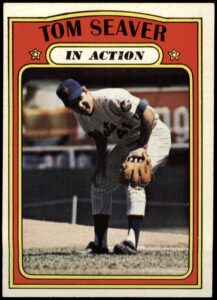 A fan sees what a fan sees. I know this isn’t box score material, but it made me feel so much better about McLean’s immediate prospects, and I already felt fantastic about them. Maybe because I just finished reading Art Shamsky’s latest book, which included a mention of Tom Seaver being “the ray of hope on a team that had lost 101 games” his rookie year and smashing the club’s “lovable losers” image, that I immediately connected Tom Terrific to Nolan Natural. Maybe someday they’ll talk about Nolan McLean that way, that THIS righty came up to the Mets in 2025, and it began to change everything. Then I remembered the 2025 Mets, for all their unlovable foibles, aren’t on pace to lose 101 games; Tom Seaver, whether for impact or performance, is a helluva bar; and Nolan McLean has thrown exactly twelve-and-one-third major league innings.
But I told you I was in the mood to overreact.
by Greg Prince on 22 August 2025 12:58 am Midway through Thursday afternoon’s Mets-Nationals game, about the time I suspected Washington’s overcoming of New York’s lead was not going to be reversible, I remembered the Nationals used to be the Expos. It’s not as if I’d wholly forgotten from whence the Nationals moved following the 2004 season, it’s just that the Quebec connection long ago faded from contemporary concern. For the first year after the Expos had become the Nats, I considered them a hybrid: the Natspos. Montreal had been such a permanent part of the Metscape from the moment I’d begun paying attention to baseball, it was difficult to not sense their presence despite the new surroundings to which they’d moved and the new identity they’d assumed. But that was mostly 2005. Soon enough, the Nationals were the Nationals, and the Expos seemed an ancient franchise from another era.
On Thursday, the Natspos lived. The Nationals of 2025 seemed to morph into the Expos of any number of years when the Mets verged on indisputable excellence and the Expos weren’t supposed to present much of a challenge, yet did. Years like 1985. Years like 1987. Years like 1990. Years like 1998. Years when a few more wins against the Expos probably would have pushed the Mets into playoffs they wound up missing. Those Mets would have accepted a few more wins against any National League opponent to get where they needed to go, but in the moment, it was inevitably the Expos who served as particular pain in the ass. The Nationals did something similar in September 2007, to name another infamous year, but they didn’t come off as quite so, shall we say, Exponential about it (whereas the 2007 — and 2008 — Marlins did).
Well, it’s 2025, and whoever that team is that plays home games in a city that seems to have bigger problems than headquartering a last-place ballclub certainly rose up and overcame the team that came to town likely thinking it was getting a break in its schedule. The last-place Nationals took two of three from the contending Mets. I’ll leave it to the Washington faithful to decide how badly they needed this boost to their self-esteem. The Mets had more practical aspirations. They needed to take this series to firmly establish they had regathered their momentum.
They didn’t and they haven’t.
Nationals Park, as lightly populated as Olympic Stadium in its final seasons of MLB benign neglect, saw the Mets take an early lead and build on it, much as a playoff team does when facing a cellar-dweller. Per the standings, the Mets are a playoff team. It seems impossible to fathom that after watching the Mets for the past two-plus months, but if the season ended today…oh, don’t you wish? No point in pushing it. With 35 games remaining, the season appears on track to finish before you know it, and not a moment later.
The Mets were up, 3-0, once. There was a leadoff home run from Francisco Lindor, a record-setter for that sort of first-inning thing, and there was a third-inning homer from Starling Marte. Lindor’s couldn’t help but be solo, and Marte’s came with the bases empty and two out. Something about all Met scoring in a given early inning generally makes me uneasy, but one swing equaling one run isn’t really a bad deal. In the first and the third, each fella who swung for the fences made the most his respective opportunity at the instant he went deep.
The top of the fourth was a different story. The top of the fourth bulged with opportunity. The bottom of the order was coming through as best the bottom of our order can. Brett Baty, who’s been hot, singled with one out. Tyrone Taylor, who was playing only because Brandon Nimmo’s neck prevents him from admiring the Washington Monument, walked. Taylor reaching base is any capacity is as surprising as Taylor reaching the field. Cedric Mulllns, who was brought in to be some sort of improvement over Taylor, singled to right, and we had the bases loaded. Opportunity!
Hayden Senger, in for the bruised and battered Luis Torrens, who’s in there most games for the bruised and battered Francisco Alvarez, delivered about all you could ask of your Quadruple-A backup catcher. He flied to deep enough center to score Baty from third and move Taylor up from second. Senger entered his at-bat with no major league runs batted in. Now he had one. If you saw or heard it, you saw or heard something unprecedented in the life of Hayden Senger. It wasn’t a gamebreaker, but it wasn’t unproductive.
The bottom of the order did all it could. It cobbled together one run. The order turned over. Lindor, he who hit his eighth leadoff home run of the season in the first, and singled to start the third (before getting thrown trying to steal second), had a shot at putting this game if not out of reach of the Nationals, then beyond their easy grasp. It was a time to bury the team in last place a little further.
But Lindor grounded to third. The rally produced nothing else. On the surface, that shouldn’t have been overly concerning, because the Mets are, per the standings, a playoff team, and the Nationals are last, and Sean Manaea was tossing a shutout as if Sean Manaea had never stopped being the Sean Manaea of the second half of 2024. His first three innings were a strikeout-laden breeze. I went to a game in the first half of 2024 when Manaea piled up strikeouts but gave up too many runs for those to matter. He came a long way after last year’s All-Star break. He became the kind of pitcher we didn’t want to go without when he tested free agency. He became the pitcher whose absence we’d regret when he went on the IL in Spring Training.
Now he was more back than he’d been in any start since his mid-July return. Three innings of zeroes and little sweat. The bottom of the fourth, with that three-run lead in place, grew a little troublesome, but resulted in just one National run. A 3-1 edge; Manaea more or less cruising; Mets still the team with the playoff-qualifying record; the Nats still super out of it in the NL East. What else could you want to wind down a late Thursday afternoon?
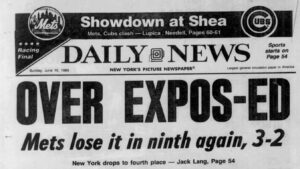 I wanted to relax, but then the Exponess of the situation kicked in. The Mets walked a couple of times in the fifth, but didn’t do anything with those runners. The Nats came up in their half of the fifth, and they chipped away. A leadoff single. A bunt to Pete Alonso that Pete threw to second, which didn’t register an out. Manaea hit CJ Abrams. The bases were loaded. Paul DeJong was up. Paul DeJong, who killed the Mets two series per year as a Cardinal, has found his true calling as a division rival. Here he lifted a sacrifice fly. It was 3-2, Mets. Then another walk to reload the bases, Manaea up to 91 pitches. Geez, that happened fast. I wanted to relax, but then the Exponess of the situation kicked in. The Mets walked a couple of times in the fifth, but didn’t do anything with those runners. The Nats came up in their half of the fifth, and they chipped away. A leadoff single. A bunt to Pete Alonso that Pete threw to second, which didn’t register an out. Manaea hit CJ Abrams. The bases were loaded. Paul DeJong was up. Paul DeJong, who killed the Mets two series per year as a Cardinal, has found his true calling as a division rival. Here he lifted a sacrifice fly. It was 3-2, Mets. Then another walk to reload the bases, Manaea up to 91 pitches. Geez, that happened fast.
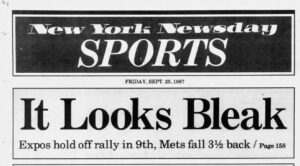 Sean goes out, extending into veritable perpetuity the unfathomable nobody but David Peterson going six streak. In comes Tyler Rogers, who was obtained to lock down seventh innings. It’s the fifth. He’s going to throw sinkers and, somehow, you know they’re not going to sink as he wants them. One, to Riley Adams, sinks into center, where Mullins picks it up and throws it back in to instigate a rundown after two Nats score. Rogers and Mullins collaborating on a futile sequence seems appropriate. They were each acquired as theoretical upgrades. With them on board, things have remained solidly in quicksand. Sean goes out, extending into veritable perpetuity the unfathomable nobody but David Peterson going six streak. In comes Tyler Rogers, who was obtained to lock down seventh innings. It’s the fifth. He’s going to throw sinkers and, somehow, you know they’re not going to sink as he wants them. One, to Riley Adams, sinks into center, where Mullins picks it up and throws it back in to instigate a rundown after two Nats score. Rogers and Mullins collaborating on a futile sequence seems appropriate. They were each acquired as theoretical upgrades. With them on board, things have remained solidly in quicksand.
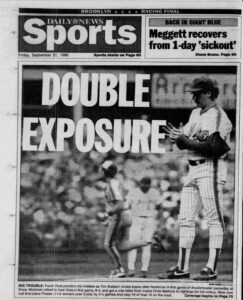 Washington leads, 4-3. Montreal, determinedly and understandably uninterested in this game as it is determinedly and understandably uninterested in every Nationals game, nonetheless feels something tingle. They don’t know why. It is as if some phantom municipal limb has come to life via a distantly familiar sensation. It’s kind of pleasant. It’s almost Expolike, the city thinks for a moment, but no, that can’t be. We haven’t had that spirit here since 2004. Washington leads, 4-3. Montreal, determinedly and understandably uninterested in this game as it is determinedly and understandably uninterested in every Nationals game, nonetheless feels something tingle. They don’t know why. It is as if some phantom municipal limb has come to life via a distantly familiar sensation. It’s kind of pleasant. It’s almost Expolike, the city thinks for a moment, but no, that can’t be. We haven’t had that spirit here since 2004.
 Perhaps I’m projecting. Perhaps I’m projecting.
In the bottom of the sixth, after the generation of further offense has ceased to interest the Mets, Rogers continues pitching, and the Mets continue sinking. Mullin comes close to catching what turns into an RBI single, the way Rogers comes close to getting out of jams. The game gets a little less close at Nats 5 Mets 3, Expos haunting the spectral premises. Who’s that in the on-deck circle — Rondell White? Tim Wallach? Boots Day?
We could pretend through the tops of the seventh and eighth that maybe we could string a couple of hits together and grab our lead back, but we were only borrowing the lead to begin with. And, to string hits together, you’d have to start with one. In the bottom of the eighth, Ryne Stanek, who’s maintained Syndergaardian flow beneath his cap if not vintage Thor command around the plate, comes in to, among other items, shake James Wood out of his deep slump. Wood’s three-run homer thrusts the Nats ahead, 9-3, and ensures any hits the Mets suddenly collect in the ninth will make only for sumptuous box score window dressing (window dressing for Low-Leverage Barbie’s Dream House sold separately). With two out and nobody on, Lindor records his third hit of the game; each progressively less impactful than the one before it. Juan Soto completes the day doing what some Met has to do in order to place a cherry atop it. Juan strikes out.
The Mets have now won three of their last five, which is the most charitable/perverse interpretation of their recent trendline. The Mets have also lost 16 of 21, a more accurate assessment of their plummeting pattern. They lead Cincinnati by a half-game for a Wild Card spot that clearly wants nothing to do with the Mets, much as we, their chronic fans, too often want nothing to do with them, either (yet here we are, enmeshed in their foibles as the true co-dependents we insist on being). If momentum is to be regathered, the garnering will have to begin with the ball slated to fire from the right hand of Nolan McLean Friday night. Momentum, you have surely heard, is only as good as the next day’s starting pitcher, which 2025 experience tells us is the worst thing you can be told as a Mets fan four of every five nights. If David Peterson is your next day’s starting pitcher, you instinctively make room on that table where you stick everything in the likely event momentum will arrive by 10 PM the next business day. If anybody else starts, you don’t disturb all your crap that’s otherwise gathering dust. McLean’s first start, however, indicated that equation might change. Still, he’s making only his second start, so how much you want weigh him down with expectations is up to you. Expecting anything consistent out of the Met lineup — anything positive — is its own fool’s errand.
At least we don’t have to withstand the ghosts of the Expos this weekend. What a relief! Now to check to see where the Mets road trip sends them next, while I take this large swig of water…
by Jason Fry on 21 August 2025 8:18 am A day after a near-perfect game, the Mets looked once again lacking in all too familiar ways: Kodai Senga was mediocre, and the offense’s comeback stalled when Cedric Mullins couldn’t hit a medium-depth fly ball, beginning a maddening streak of futility against the Nationals’ terrible bullpen.
(Before we move on, though, let’s note Brett Baty‘s majestic homer, struck though it was in defeat. Watching the replay, I told my kid “I didn’t think Baty had 455 feet in him,” to which the kid replied, “I don’t think Baty thought he had 455 feet in him.)
We missed the first two-thirds of Mets-Nats, for a defensible reason: We were at Portland’s Hadlock Field to watch the Sea Dogs take on the Binghamton Rumble Ponies in a clash of the Red Sox’ and Mets’ Double-A clubs. This look at the future seemed to have lost some of its juice a few days ago, when the Mets promoted Jett Williams, Ryan Clifford, Carson Benge and Jonah Tong to Syracuse.
But we had a fine time anyway, and not just because hey, it was baseball on a summer night. Binghamton’s R.J. Gordon took a no-hitter into the seventh, the Rumble Ponies got a laser-beam homer from Jacob Reimer and a ringing double from A.J. Ewing (who has a Winkeresque swagger certain to get under opponents’ skin), and the entire game saw eye-opening defense, with center fielders Nick Morabito (Binghamton) and Allan Castro (Portland) putting on a show and Portland third baseman Ahbram Liendo vacuuming up anything in his neighborhood.
The Rumble Ponies won, even if the parent Mets did not, and it was a welcome reminder that the future is always edging a little closer, bringing new players and stories into view.
by Jason Fry on 20 August 2025 8:47 am OK, not that kind of perfect game. You probably would have heard about it by now.
But the Mets — because, if there even is a “because,” baseball season is about ebbs and flows, and the sport is essentially and elementally maddening and perverse — played a game Tuesday night that was pretty much near perfect, from the starting pitching and a spot of relief to the hitting and baserunning and the defense.
Yes, the same Mets who staggered through the summer with problematic dominoes falling and seemingly every game containing some land mine you knew was destined to go off under an orange and blue foot. Why? See above.
None of that angst was needed against the Nats. David Peterson — who uncharacteristically collapsed against the Braves last time out — was electric against Washington, commanding all of his pitches and carving up the Nats, with poor James Wood looking particularly helpless. (Wood is in one of those downturns that comes with the cat and mouse of pitchers adjusting to young hitters and vice versa; it’s all part of a hitter’s progression but still no fun to be in.)
The sixth inning was the most impressive, to me: After surrendering a leadoff double, Peterson fanned Brady House on three changeups at the bottom of the zone, only to get tagged for a Jacob Young single on a non-sinker that moved runners up to first and third. No worries: Peterson tormented Wood with sinkers and sliders, fanning him with one low and away that he couldn’t touch, then got CJ Abrams to hit a harmless fly ball to center. Inning over, minor threat dispensed with; Peterson wound up going eight with just one run surrendered.
On the other side of the ball, the Mets went ham on poor Jake Irvin and a parade of relievers, with homers from Mark Vientos, Brett Baty, Juan Soto and Jeff McNeil — a power display that was particularly welcome amid word that Francisco Alvarez sprained the UCL in his thumb and will sit idle for about two weeks, then see if he can play through pain the rest of the way. It’s no secret that Vientos is key to the rest of this confounding season, but also potentially notable is that Luis Torrens looked better than he has in some time, hitting in tough luck before collecting an eighth-inning double.
A quartet of home runs generally speaks for itself, but the most reassuring AB was the one that started the scoring: In the third, with one out and runners on first and second, Brandon Nimmo worked the count to 3-1 against Irvin. Irvin left a fastball in the middle of the plate, but Nimmo was looking for a ball he could drive instead of a walk, and he drove this one over the infield, scoring Francisco Lindor and sending Soto to third — and then hurried into second when the Nats indulged in a little fantastical thinking and tried to nab Soto at third. Controlled aggression at the plate, followed by alert baserunning? That will work.
Was everything perfect in Met Land? No, of course not — Pete Alonso looked lost at the plate and Lindor struck out three times. But a good offense can withstand a couple of cylinders misfiring; on this night, the Mets were every bit the good offense we’ve constantly heard about but only witnessed in fits and starts. That will work too.
by Greg Prince on 18 August 2025 10:49 pm Some Met folklore a fan accepts without wondering about beyond what he’s already picked up. A bit of Metsiana that’s been with me for more than fifty years concerns some activity that preceded Game Four of the 1969 World Series. I picked up on it in 1971, a little late, but forgive me, I was only six when it happened. I was eight when I first read The Perfect Game, Tom Seaver’s first autobiography, written with Dick Schaap. On page 46 of my dog-eared paperback edition, Tom/Dick wrote about a pamphlet being handed out outside Shea Stadium on October 15, just as Tom was preparing to pitch. The pamphlet regarded Seaver and his opposition to the Vietnam War, a conflict that had been raging for years by the fall of 1969 and was still going on when I got my hands on the book.
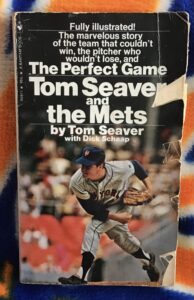 The kicker was that while Seaver counted himself anti-war at a time when the country was torn apart by the issue, he hadn’t sanctioned the pamphlet that was being distributed. More to the point that Wednesday — Moratorium Day across America — he didn’t want to be distracted from his task at hand, not even when so many millions of Americans would be actively protesting America’s involvement in Vietnam. A friend of mine who was attending Brandeis University then, college basketball author Mark Mehler, ranks “marching against war in October ’69 in Boston, with a radio playing Game Four glued to my ear, the Mets on the side of the angels” as one of the highlights of his longtime if intermittent Mets fandom. When he shared his list in 2015, Mark also wished to make clear to me that Seaver hardly proceeded as if he was distracted: “Your boy pitched great that day.” The kicker was that while Seaver counted himself anti-war at a time when the country was torn apart by the issue, he hadn’t sanctioned the pamphlet that was being distributed. More to the point that Wednesday — Moratorium Day across America — he didn’t want to be distracted from his task at hand, not even when so many millions of Americans would be actively protesting America’s involvement in Vietnam. A friend of mine who was attending Brandeis University then, college basketball author Mark Mehler, ranks “marching against war in October ’69 in Boston, with a radio playing Game Four glued to my ear, the Mets on the side of the angels” as one of the highlights of his longtime if intermittent Mets fandom. When he shared his list in 2015, Mark also wished to make clear to me that Seaver hardly proceeded as if he was distracted: “Your boy pitched great that day.”
Tom’s ten-inning victory over the Orioles speaks for itself. Moratorium Day’s effectiveness in impacting US policy toward Vietnam is its own topic. I recently found myself watching a 2023 episode of PBS’s documentary series American Experience that delved into those protests a great deal. In the film The Movement and the “Madman,” one clip was devoted to the “STOP WAR” message skywritten over Shea Stadium that very day. Superimposed on the screen was Seaver’s then-provocative quote — “If the Mets can win the World Series, then we can get out of Vietnam.” Knowing what I knew, I wasn’t surprised to see it.
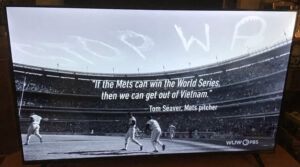 But I only knew so much, a few anecdotes here and there, and, of course, a box score reflecting that the Mets were closing in on a world championship. What I never knew — what I don’t think I’d ever seen — were the full contents of that pamphlet that briefly got Tom’s goat in Flushing before he turned his full attention to taming the Birds from Baltimore. But I only knew so much, a few anecdotes here and there, and, of course, a box score reflecting that the Mets were closing in on a world championship. What I never knew — what I don’t think I’d ever seen — were the full contents of that pamphlet that briefly got Tom’s goat in Flushing before he turned his full attention to taming the Birds from Baltimore.
That’s where A.M. Gittlitz comes in.
A.M. Gittlitz is a writer who contacted me a couple of years ago to tell me he was working on a book called Metropolitans: New York Baseball, Class Struggle, and the People’s Team, which sounded absolutely fascinating to me. A.M.’s publisher, Astra House Press, describes the forthcoming work as “a wide-reaching, revolutionary narrative history of the Team of Destiny that takes us from their 19th century inception to their 1962 resurrection to the present day,” which makes me only more anticipant of its full, multigenerational story. A.M. and I met at the 2023 Queens Baseball Convention, where he picked my brain (such as it is), and have stayed in touch since, occasionally exchanging nuggets that might be of interest to one another. Not long ago, A.M. was kind enough to send along an image of that actual pamphlet, something he’d come across in his voluminous research. My reaction was to be wowed. So that’s what Tom was talking about in The Perfect Game.
A.M. asked me if I’d like him to write something about it for Faith and Fear. Absolutely, I said. Apparently we share an affinity not just for the Mets, but for getting deep into our subject matter, as the article A.M. put together for us deals with far more than the pamphlet, with staggering amounts of backstory, dozens of details that have been lost to time until now, and a blend of perspective and context that feels as relevant in 2025 as it would have in 1969.
I’m delighted he’s bringing it to us here now.
***Mets Fans for Peace
By A.M. Gittlitz
The Summer of Love. Stonewall. The Moon landing. Woodstock. And…the Mets?
In the grand pantheon of 1969’s defining moments, the Miracle Mets’ championship victory seems like it should be a non-sequitur footnote among the decade’s seismic cultural upheavals. Yet this perceived incongruity masks a deeper truth: the Mets were not merely witnesses to the Aquarian Age’s revolutionary currents, but participants, both sculpted by and influential to the era’s most radical transformations.
The 1969 pamphlet Mets Fans for Peace — now available online for the first time courtesy of the New York Historical — captures the zenith of the extraordinary convergence between America’s notoriously apolitical pastime and its riotous, Technicolor counterculture.
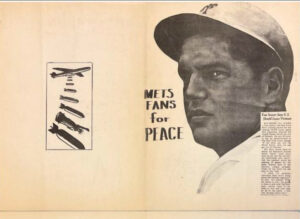 The playful zine, published by beatnik publishing house Grove Press to be distributed before Game Four of the World Series at Shea, includes screeds against the war in Vietnam, a comparison of the World Series to the “Chicago 8” trial, a call to sing “Give Peace a Chance” after the National Anthem, and even a blank page for autographs. On its cover is the Mets’ starting pitcher that day, Tom Seaver, squinting defiantly as a third-world revolutionary guerrilla in his batting helmet, alongside his recent public declaration that: “If the Mets can win the World Series, then we can get out of Vietnam.” The playful zine, published by beatnik publishing house Grove Press to be distributed before Game Four of the World Series at Shea, includes screeds against the war in Vietnam, a comparison of the World Series to the “Chicago 8” trial, a call to sing “Give Peace a Chance” after the National Anthem, and even a blank page for autographs. On its cover is the Mets’ starting pitcher that day, Tom Seaver, squinting defiantly as a third-world revolutionary guerrilla in his batting helmet, alongside his recent public declaration that: “If the Mets can win the World Series, then we can get out of Vietnam.”
Such a public statement from any White athlete was virtually unheard of in baseball then, and sadly now as well. Jackie Robinson had denounced Paul Robeson at a House Un-American Activities Committee hearing twenty years prior for making such statements, and US runners Tommie Smith and John Carlos were banned from the Olympics for their “violent” gesture of accepting their ’68 gold and bronze medals with fists raised high for Black liberation. How did the sport Jimmy Breslin described as entering the decade with “all the speed of a Sunday afternoon picnic, and the hipness of a Civil War reenactment,” a sport the commissioner’s office demanded be a “world apart” during the riots of ’68, suddenly find itself in the midst of the action during its championship series?
PROLOGUE TO THE PAMPHLET
The answer goes back to two simultaneous camps of what President Kennedy and Casey Stengel each lovingly dubbed the Youth of America in the spring of 1962.
The first was at United Auto Workers’ retreat in Port Huron, Mich. where a few dozen college kids calling themselves the Students for a Democratic Society (SDS) issued a declaration of a second American Revolution that would peacefully end the Cold War, seize the means of production for an autonomous working class, and break spectacular politics in favor of dynamic political communities on local levels.
The second was in St. Petersburg, Fla., where the Mets — a team branded as the Brooklyn Dodgers and New York Giants recombined for a new generation in comic book saturation — held their inaugural Spring Training. In the months and years that followed, the Mets became known as the “people’s team,” an image popularized by beatnik journalists who hyped their unruly, underdog youth fans filling the Polo Grounds with homemade placards, fan clubs, and chants as the “New Breed.” Simultaneously, the ranks of SDS swelled, with their Port Huron statement widely considered the foundational document of the American “New Left”.
New Breed and New Left continued a parallel dance through the decade. The Mets were the offspring of New Deal-era blue-collar Dodger progressivism, with a flashy pop-art aesthetic, beatnik-like rambling manager, and an overmatched young journeyman roster whose players weren’t above hanging out in the coffee houses of West Village bohemia; reliever Ken MacKenzie, nicknamed “Mr. Peepers” for his scholarly thick-rimmed glasses, even moved there. “We’d walk around and see all the art shows, drop in the coffee shops or just watch the people,” the only pitcher to sport a winning record among Original Mets said. “We liked the people down there. Everybody was open-minded. That’s the way we like to operate.”
In 1964, Cleon Jones and Elio Chacon, at that point minor leaguers (Jones on the way up, Chacon trying to hang on) participated in the Civil Rights Movement with a sit-in against a segregated North Florida restaurant. When police arrived, Jones informed them about the recently-passed Civil Rights Act’s ban on racial discrimination for employment and public accommodation. The players were promptly served. When they returned the next night, the waitress again ignored them. Jones invoked Federal Law to management again, and she was fired on the spot. They returned again the next night to find the waitress rehired and apologetic. From then on, Jones wrote in his 2022 memoir, it was their favorite place to eat in Jacksonville.
The same year, much of the New Breed moved on to the New Left by supporting the “Freedom Summer” campaign of registering Black voters in the South. Among them were Mickey Schwerner and Andrew Goodman, who moved from Queens to Meridian, Miss., to set up a movement base. In the early summer the two set out with 21-year-old local activist James Chaney to investigate the burning of a Black church nearby. Tailed by sheriffs and Klansmen seeking the “Jewboy with the beard and the bright blue New York Mets baseball cap,” the three were abducted, tortured, and executed.
The violent repression of the Civil Rights Movement, along with the growing scandal of the War in Vietnam, radicalized millions of youth in the years that followed. Thousands left the suburbs and made their way toward urban bohemia, where cheap rent in crowded crash pad communes birthed the Sixties’ culture of public concerts, free meals, and free love. Among them, you might say, was Tom Seaver. The pitching prospect followed in the footsteps of his beatnik older brother, Charles Seaver, who had moved to Greenwich Village at the dawn of the decade and become a sculptor, social worker, and social justice activist. Charles inspired Tom’s taste in rock, folk, and modern literature, as well as his non-conformist path toward his own artistic calling. The pitcher’s mound, Tom said, was “one of the few places left where a person like myself can show his individuality.”
Seaver chiseled 170 strikeouts during his debut 1967 season with a 2.76 ERA, won Rookie of the Year, and established himself at the head of a strong young pitching crop, which included Jerry Koosman, Nolan Ryan, and Tug McGraw, as the cellar-dwelling franchise’s first homegrown star. The Mets, skippered by preternaturally bland Wes Westrum, nevertheless finished last, as they had done almost without fail since 1962.
Tom Seaver was never content with being a “lovable loser” — and neither was much of the New Left. As the Mets’ new manager for 1968, Gil Hodges, went about transforming the residue of Stengel’s Amazins into a competitive team, mass mobilizations, cultural happenings, and riots spread coast to coast demanding peace, equality, and racial justice.
When Dr. Martin Luther King, Jr., was assassinated on April 4, 1968, shortly before Opening Day, the Mets were among the teams to join what amounted to the first sportwide wildcat strike to honor the civil rights leader’s memory and not play on the day of his funeral, a job action led by Pirates Roberto Clemente and Donn Clendenon, among others. In the wake of Robert F. Kennedy’s June 6 death at the hands of yet another assassin, the Mets, in California, again voted to take another respectful pause from their schedule, especially since the slain presidential candidate had represented New York in the US Senate. This time they were one of few teams to, essentially, stand up for sitting out on the day of RFK’s funeral, June 8.
Commissioner William Eckert demanded the Mets’ pay docked to compensate for the revenue the San Francisco Giants would miss by postponing and having to host a doubleheader to make up the game later in the season (on the same August weekend when the Mets and Giants happened to be also making up the postponed game that coincided with King’s funeral). Hodges sided with his team, and the game was postponed. Kennedy’s press secretary Frank Mankiewicz sent telegrams to the team thanking them for not putting “box office receipts ahead of national mourning”.
By lending his support to the effort, Hodges showed his players that beneath his hardboiled affect, he had their back. The moment of mutual trust served to separate the contemporary Mets from the Westrum-era doldrums, and, coincidence or not, they won eight of twelve games after leaving Candlestick Park. By late June, the Mets had ascended to the middle of the NL standings, flirting with a .500 winning percentage — easily the best position they had ever achieved midseason. The New Breed fans who had drifted away post-Stengel, the pure baseball enthusiasts and the leftists alike, noticed the Mets’ political transformation as well. In July, a group of young Communist Mets fans stormed the offices of the New York Post (not yet under the ownership of Rupert Murdoch) demanding Jimmy Breslin retract a column that criticized the Party. When Post editor James Wechsler confronted the group during its sit-in, he argued their support for a team run by the old-school and conservative Catholic Hodges proved Breslin’s point. “Much to his dismay,” Hodges biographer Mort Zachter wrote, “the Communists strongly defended Hodges.”
Similar politicization emerged in far more radical fashion elsewhere in sports that year, often involving some of the greats of the time. Heavyweight champ Muhammad Ali, a convert to the Nation of Islam, stoically faced jail time for his refusal to be drafted. In October, premier UCLA basketball player Lew Alcindor — who would change his name to Kareem Abdul-Jabbar by the early 1970s — boycotted the Olympics in Mexico City, where the aforementioned runners made their courageous and controversial show of solidarity. While these actions paved the way for other athletes to be more vocal, the baseball diamond saw little equivalence beyond the reactions to the funerals for King and Kennedy. The Black ballplayers who had emerged as both baseball’s top stars and its political vanguard rejected the revolutionary politics and interventionism of the New Left and Black nationalism. Curt Flood, Bob Gibson, Bill White, Willie Mays, and other players had all met with such groups, and came away preferring the Robinson path of interracial struggle in the workplace. “Sounds as if Black power would be White power backwards,” Gibson said. “That wouldn’t be much improvement.”
In the long run, their choice protected baseball’s “world apart” delusion and its taboo on players speaking their mind. But it had also protected the Black ballplayers from scandal, making it easier for them push the radical labor politics of Dr. King in common struggle with their conservative White co-workers, and ultimately turning the Major League Baseball Players Association into one of the strongest unions in the country.
THE SEASON OF THE PAMPHLET
When the MLBPA organized its first strike before the 1969 season, the Mets broke ranks despite GM Johnny Murphy’s promise not to punish the holdouts. Many players viewed their franchise as a uniquely pro-worker “family operation,” lovingly calling owner Joan Payson “Ma Payson” and Murphy “Grandma”. Defying union president Marvin Miller, Seaver and Jerry Grote organized their own spring conditioning camp. Though it took a while for the Mets to climb above .500 to stay in 1969 (47 games), it could be argued the club came together early and benefited as a result. The labor dispute was resolved in favor of the players, and Seaver’s 14-3 launch propelled the Mets to easily their best midseason record yet.
Sensing the franchise’s first winning season was finally at hand, Johnny Murphy traded four prospects to Montreal for slugger Donn Clendenon, the same first baseman who worked with Clemente to honor King. The veteran brought intellectual leadership along with a skilled bat. Clendenon played for the semi-pro Atlanta Black Crackers under Negro League stars and befriended Dr. King at Morehouse College. After twelve frustrating years in the Pittsburgh organization (he wasn’t promoted to the bigs until 1961, the year after Bill Mazeroski lifted the Bucs to a world championship), Clendenon briefly retired rather than play for the Astros, to whom he’d been traded in January by the Expos, who had selected him in the previous October’s expansion draft. Clendenon wanted no part of Houston manager Harry Walker — brother of anti-Robinson hate-strike leader Dixie Walker — but reluctantly returned to baseball amid swirling pressures. Houston’s owner, Roy Hofheinz, threatened to buy Clendenon’s offseason employer, Scripto, the pen company where the in-limbo ballplayer held an executive position, and close off his off-field career option.
The first baseman never did become an Astro, as new commissioner Bowie Kuhn lobbied for resolution among all parties, and Clendenon returned to the Expos for the new season. This might have been better than winding up in Houston, but it seemed to guarantee he’d spend yet another summer going nowhere in the standings, given Montreal was on its way to 110 losses in its first year. The June 15 trade to the second-place Mets, a month before his 34th birthday, suddenly granted him one final shot at October glory.
For the rest of the season, as Seaver, Clendenon and all the Mets chased the frontrunning Cubs, “Shea Stadium took on a carnival-like atmosphere,” in the words of Art Shamsky. There was a proliferation of confetti, banners, and fireworks rivaling the Central Park be-ins and free rock festivals. It was the new Haight-Ashbury or St. Mark’s Place, the latest cosmic center of the Sixties. Messianic signs, afros, and puffs of marijuana smoke dotted the stands, with dropouts outside loitering like Deadheads begging for a free-ticket miracle. Even as the Mets cooled off in July, their broadcasts became the de facto soundtrack of taxi rides, delis, and bars. “No one had seen that kind of midsummer fever in the city since the old Giants-Dodgers bloodlettings, fifteen or twenty years back,” Roger Angell wrote. The New York Times weighed the return of Metsomania against the Apollo 11 moon mission: “A bartender was asked whether his customers were more interested in the Mets or the astronauts. ‘The Mets, of course,’ he said. ‘Aren’t you?’”
They were revolutionary stand-ins for some and a helpful topic of conversation for those attempting to reach beyond the leftist subculture to working-class squares for others. “Politics should be as exciting as the New York Mets,” Yippie founder Jerry Rubin wrote in his 1969 manifesto Do It!. “People are always asking us, ‘What’s your program?’ I hand them a Mets scorecard.”
For The Man, however, they were a distracting tool of neutralization. After two summers of rage so arsonous that the political class, from City Hall to the Pentagon, had been drawing up plans for widespread counterinsurgency, the summer of ’69 unfolded as an unlikely optimistic benchmark of the ending decade. There were race riots in York, Pa.; tenant riots against evictions in Harlem; and the weekend-long queer riot outside the Stonewall Inn in Greenwich Village — but some within the establishment credited the Mets with the failure for these revolts to spread as they had in previous years. “We calmed that damn town down,” pitcher Gary Gentry claimed. “I remember getting all the ‘attaboys’ and ‘thank yous’ from our city and state officials, as well as Governor Nelson Rockefeller and Mayor John Lindsay. You know, I don’t think we knew what we were doing when we were doing it, but after it was over, I heard a lot about how we turned the town around.”
As the Mets continued their underdog surge, many revolutionaries found The Movement terminally devolving into a performative blame game among a proliferation of bizarre teams. That summer’s SDS convention at the Chicago Coliseum took on the doomed atmosphere of Wrigley Field’s home clubhouse, its ’62 New Left treatise now decisively lost in a snakepit of factional polemics. The SDS died at the convention’s end, in a volley of rival Stalinists chanting “Ho! Ho! Ho Chi Minh!” and “Mao! Mao! Mao Tse-tung!” at one another. The last SDSers left in disgust during the shouting match, with one New York Trotskyist cadre, the Larouchites, answering them: “Let’s! Let’s! Let’s Go Mets!”
The height of Shea’s frenzy arrived with the return of the Cubs in the second week of September. Their nine-and-a-half game lead over New York — which started to shrink on August 15 as Chicago lost at San Francisco, in harmonic convergence with the beginning of the Woodstock Music and Art Fair, an event that drew more than 400,000 peace & love pilgrims to Max Yasgur’s farm, 84 miles north of Flushing (where the regional rains that postponed a Friday night Mets-Padres game didn’t stop the mud in Bethel from growing legendary) — now whittled to two-and-a-half. The stadium swelled far past capacity, thanks to thousands of fans cashing in free tickets handed out as a promotion for Borden Milk before the season. In the top of the first, on-deck hitter Ron Santo noticed the massive energy in the crowd, even louder than it had been in July. “‘Oh man, we’re fucked now,’” Cubs batboy Jim Flood recalled him saying. “And that’s when I saw the cat.”
Legend had it that dozens of Flushing’s feral felines had made Shea’s netherworld their home since 1964, giving the locker rooms, late-’70s reliever Skip Lockwood recalled, the “musty smell of a summer cottage”. Perhaps the noise had roused the feline from its lair, or perhaps he had been smuggled in and set loose as a Yippie or Stengelian prank. Either way, the black cat, an archetypal symbol of black magic and proletarian sabotage, now ran free through foul territory, fearlessly crossing Santo toward the dugout to glare directly at the Cubs’ crashing manager. “Somebody get that fucking cat out of here!” Leo Durocher yelled. Then, as if the symbolism had not been obvious enough, “the frightened feline,” Richard Dozer reported in the Chicago Tribune, “reversed his course and dashed under the stands to safety on the other side, next to the Mets’ dugout.”
“The whole thing was bizarre!” Shamsky exclaimed in print more than a half-a-century later.
The Mets’ divisional clinch on September 24 unleashed unprecedented mayhem at Shea. Future broadcaster Howie Rose and friends abandoned their Upper Deck seats, planning to storm the field, only to discover every aisle packed with kids harboring identical schemes. When the Cardinals’ Joe Torre grounded into a double play to put the franchise’s thus far greatest victory in the books, Rose, 15, charged onto the field with approximately 20,000 other fans in a spontaneous celebration that overwhelmed some 300 helpless policemen. Leonard Koppett captured the moment’s primal energy: “They poured out of the stands like deranged lemmings, like the mob attacking the Bastille, like barbarians scaling the walls of ancient Rome.” Links of fence, seat slats, and even the American flag became trophies. Later that night, about 100 fans returned chanting, “Shea belongs to the people!”
The Mets proceeded to the very first National League Championship Series against the Atlanta Braves. Hank Aaron was characteristically remarkable in Game One, homering off Seaver to put the Braves up, 5-4, in seventh. The Mets answered back in the eighth with a five-run rally that won the game and steered New York toward a series sweep. Per the description of an Associated Press reporter, when the pennant was decided in Queens, “a mini ‘Woodstock Pop Festival’ set in on the infield.”
“[N]othing was going to stop them,” Aaron wrote in his 1991 memoir. “One of my teammates, Tony Gonzalez, said that we ought to send the Mets to Vietnam and let them win the war.” It’s possible Cuban ex-pat Gonzalez made this remark knowing some on the Mets did want the war to end, as the rest of the country soon found out. “I think it’s perfectly ridiculous what we’re doing about the Vietnam situation,” Tom Seaver told United Press International the day before starting Game One of the World Series. “If the Mets can win the World Series, then we can get out of Vietnam.” The Times republished the story the next day under the headline, “Tom Seaver Says U.S. Should Leave Vietnam”.
Seaver’s statement was suggested by the Moratorium Day Committee, a left-liberal coalition planning a mass and mainstream nationwide march against the war on October 15, supported by “heartland” institutions like churches and small businesses, along with moderate politicians. Some in the coalition were radicals disturbed by the growing backlash against the Yippie and Black Panther-dominated countercultural protests of previous years, including the protest’s New York organizer, Charles Seaver.
While the Seaver brothers may not have been fully politically aligned, the two agreed the war had to end — a possibility that once seemed about as likely as the Seaver’s start in Game Four of the World Series the same day. Outside of New York, consensus suggested that the Mets stood no chance of actually winning the World Series. “[A] meeting of the Incomparables against the Improbables,” is how Joe Trimble previewed it for Daily News readers the day before the Amazin’ Mets took on the big, bad Birds. Sportswriters nationwide considered the 100-win Mets’ 109-win Baltimore Oriole opponents the best team since the mythic ’61 Yankees, and the AL champs’ star outfielder Frank Robinson charitably predicted the best-of-seven series would last only five. Oddsmakers in Las Vegas installed the O’s as 8-5 favorites…though that was the same bunch that decided at the season’s outset that the 1969 Mets were 100-1 underdogs to win their pennant.
After the Mets lost the first game in Baltimore, 4-1, Clendenon, one of the few veterans on the youngest team in baseball, called a players-only meeting. “Gentlemen, trust me,” he announced. “We are going to kick their asses for the rest of the series.” He had seen in the sparse and dispassionate crowd at Baltimore’s Memorial Stadium that afternoon what their otherwise powerful opponents lacked — something akin to the Beach Boys’ “good vibrations” or Jim Morrison’s Mojo, a confidence that everything will supernaturally go your way. All summer long, umpire calls, bounces, weather, and nearly every other chance element of the game seemed to carom in the Mets’ favor, leading Seaver to declare in a fit of Aquarian mysticism that “God lives in New York.” Or at least, as he answered NBC analyst Sandy Koufax when the lefty pitching deity asked him whether God was in fact a Met, “No, but He’s got an apartment” in town.
Rationalist Clendenon asserted a less mystical path to victory. Since his acquisition and the early-July Cubs series that put the 1969 Mets on the contending map, the people of New York and their team had worked as a singular unit at Shea. Their volume and energy inspired the team to put more balls in play, where what looked like “lucky breaks” were often the bobbles or missed calls of intimidated umpires and thrown-off opponents. If the Mets could win the next game in Baltimore, Clendenon promised, they could use that home field advantage to win it all in New York.
With battle plans drawn, the Mets’ amorphous and egalitarian platoons unleashed their ambush. They narrowly took Game Two, 2-1 on a ninth-inning single by light-hitting Al Weis. Two days later at Shea, Agee led off Game Three with a home run against future Hall of Famer Jim Palmer, and would go on to save five runs via a pair of daring outfield catches. Winning, 5-0, the Mets took the lead in their asymmetric war. “You know what somebody told me?” bullpen coach Joe Pignatano asked rhetorically afterwards. “God is a Met fan.”
Then came Game Four and Moratorium Day. Reliever Tug McGraw arrived to the ballpark to find a young cadre fanned out around Shea distributing literature and holding signs. One read: BOMB THE ORIOLES — NOT THE PEASANTS!
He strolled over and grabbed their pamphlet titled METS FANS for PEACE. McGraw proceeded to the clubhouse and handed it to the ace with a smile. “You really say this?”
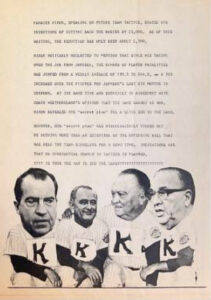 But Seaver, already on edge ahead of his start, took a glance at the pamphlet and threw it out. Its return address revealed it had not originated from his brother’s respectable Moratorium Day committee, but the far more radical “Chicago Conspiracy” — the defendants, including Yippies Abbie Hoffman and Jerry Rubin, and Black Panther Bobby Seale, charged with orchestrating the riots that overwhelmed the 1968 Democratic Convention in Chicago. “There’s NO way to know exactly who did this handiwork,” Sixties countercultural historian Pat Thomas told me, “but it’s certainly a Yippie-type thing. And the fact that there’s an address for the Chicago 8 defense fund […] means that’s truly connected to Jerry or Abbie in some fashion!” But Seaver, already on edge ahead of his start, took a glance at the pamphlet and threw it out. Its return address revealed it had not originated from his brother’s respectable Moratorium Day committee, but the far more radical “Chicago Conspiracy” — the defendants, including Yippies Abbie Hoffman and Jerry Rubin, and Black Panther Bobby Seale, charged with orchestrating the riots that overwhelmed the 1968 Democratic Convention in Chicago. “There’s NO way to know exactly who did this handiwork,” Sixties countercultural historian Pat Thomas told me, “but it’s certainly a Yippie-type thing. And the fact that there’s an address for the Chicago 8 defense fund […] means that’s truly connected to Jerry or Abbie in some fashion!”
Feeling himself the latest victim of the Yippies’ notorious pranks, Seaver regretted ever having made his comment about Vietnam. While Seaver did end up buying a small ad in the New Years’ Eve edition of the Times requesting a “prayer for peace” (“can’t argue with that,” Ron Swoboda reasoned in his 2019 memoir), he rarely talked publicly about politics again.
Anti-war Mayor Lindsay — who was attempting to ride the Mets’ coattails in what appeared to be a long shot re-election bid — also got cold feet before the game. He had ordered all flags on city buildings, including Shea, flown at half-mast in recognition of Moratorium Day’s mission. In response, the US Merchant Marine Academy band and war-wounded veterans scheduled to take the field for the anthem said they would boycott. When the police indicated they might strike as well, Kuhn called Lindsay. Worried an unprotected Shea could become the next Woodstock, Seaver took the field for “The Star-Spangled Banner” with the flag flying high, and a noticeable number of fans defiantly seated.
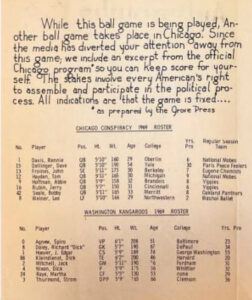 Seaver went on to pitch all ten innings of the 2-1 win, a game best remembered for Swoboda’s improbable robbery of Brooks Robinson in right field and J.C. Martin’s conveniently placed wrist creating the Oriole error that led to the winning run (along with Clendenon blasting the second of his MVP-earning three homers). A statement by the Chicago Conspiracy published in the East Village Other, the New York counterculture’s paper of record, hailed the victory: “TOM SEAVER: WE WANT YOU TO KNOW OF OUR CONTINUED SUPPORT OF THE N.Y. METS IN THEIR BATTLE WITH THE AGGRESSORS FROM THE AMERIKAN LEAGUE … POWER TO THE N.Y. METS! Seaver went on to pitch all ten innings of the 2-1 win, a game best remembered for Swoboda’s improbable robbery of Brooks Robinson in right field and J.C. Martin’s conveniently placed wrist creating the Oriole error that led to the winning run (along with Clendenon blasting the second of his MVP-earning three homers). A statement by the Chicago Conspiracy published in the East Village Other, the New York counterculture’s paper of record, hailed the victory: “TOM SEAVER: WE WANT YOU TO KNOW OF OUR CONTINUED SUPPORT OF THE N.Y. METS IN THEIR BATTLE WITH THE AGGRESSORS FROM THE AMERIKAN LEAGUE … POWER TO THE N.Y. METS!
The world championship miracle was completed at Shea the next afternoon. A few days later, a million filled the Canyon of Heroes waving orange pennants and cheering the Mets as they had the returned moonwalkers two months prior. “It was like V-J Day in New York,” author Bill Ryczek wrote decades later. “Confetti rained down from office windows. Strangers hugged each other on the street. Church bells rang […] The Yankees had won twenty World Series titles, but not once had they been given a ticker-tape parade,” certainly none directly on the heels of a Fall Classic victory.
EPILOGUE TO THE PAMPHLET
The 1969 Mets had done all they could do to inspire or perhaps distract their metropolis. “If the Mets, with their reputation as beloved fools, could win a World Series in only their eighth season,” George Vecsey posited, “why anything could happen — the Vietnam War could end; cancer could be cured; the races could learn to live together; poverty could be erased. Anything.” Vecsey, however, wrote that for Inside Sports in 1979, knowing full well that for all the 1969 Mets could do, they could do only so much.
The Vietnam War would expand and drag on. American troops weren’t withdrawn until early 1973, and the overall conflict didn’t end for more than two years beyond that. During the 1970s, the left continued to fracture, and New York City and its Mets each crumbled under the respective austerity regimes of the state’s Emergency Financial Control Board (NYC) and stock trader M. Donald Grant (NYM). In 1979, six years after McGraw convinced Shea skeptics that “You Gotta Believe!” and two years after Grant demolished belief by dispatching Seaver to Cincinnati, the rapidly aging municipal stadium couldn’t have presented a bleaker tableau, as the Mets failed to draw 800,000 fans and lost nearly 100 games. Still, the place sparked to joy one Saturday afternoon in July when a majority of the 1969 Mets reunited to toast their tenth anniversary, reminding anybody who maintained emotional investment in the franchise that better days were possible.
 In 1980, new owners Nelson Doubleday and Fred Wilpon branded their distressed property, one that cost them a then-record $21.1 million to take over from Mrs. Payson’s heirs, the People’s Team; the phrase was emblazoned on the cover of the official yearbook. While this iteration of the Amazins had a ways to go competitively, management made what it could of the residual goodwill that lingered from the Metsies’ initial glory days. When an ad campaign promised “The Magic is Back,” it referred not to on-field exploits but the emotions National League baseball in New York once upon a time evoked. Sure enough, strands of the Metsian spirit that first saw light in ’62 and illuminated the city in ’69 have made themselves visible intermittently ever since. Witness the party-punk attitude of the ‘86 championship team; the Mojo Risin’ rallying cry of 1999; the black-clad run to the 2000 Subway Series; and the unifying scenes of the Mets’ game against the rival Braves on September 21, 2001, serving as New York’s first mass gathering after the World Trade Center attacks. Attitudinally, the Mets’ vibes-infused romp to and within the 2024 playoffs at Citi Field echoed the sounds of the Polo Grounds and Shea Stadium at their most raucous. In 1980, new owners Nelson Doubleday and Fred Wilpon branded their distressed property, one that cost them a then-record $21.1 million to take over from Mrs. Payson’s heirs, the People’s Team; the phrase was emblazoned on the cover of the official yearbook. While this iteration of the Amazins had a ways to go competitively, management made what it could of the residual goodwill that lingered from the Metsies’ initial glory days. When an ad campaign promised “The Magic is Back,” it referred not to on-field exploits but the emotions National League baseball in New York once upon a time evoked. Sure enough, strands of the Metsian spirit that first saw light in ’62 and illuminated the city in ’69 have made themselves visible intermittently ever since. Witness the party-punk attitude of the ‘86 championship team; the Mojo Risin’ rallying cry of 1999; the black-clad run to the 2000 Subway Series; and the unifying scenes of the Mets’ game against the rival Braves on September 21, 2001, serving as New York’s first mass gathering after the World Trade Center attacks. Attitudinally, the Mets’ vibes-infused romp to and within the 2024 playoffs at Citi Field echoed the sounds of the Polo Grounds and Shea Stadium at their most raucous.
Substantively, the larger Met story has diverged from the one that could be told convincingly at the end of the Sixties. For example, in a tacit turn toward post-9/11 jingoism, the Mets’ organization effectively (and I’d say sadly) disavowed any remnants of their anti-war past. Their institutionalization of the seventh-inning ritual singalong of “God Bless America” — processed widely as a pro-war song since World War I — remained a staple of the game-going experience long after the initially popular War on Terror descended into a torturous quagmire. It wasn’t just the Mets, of course. Most every team embraced Irving Berlin’s composition well past the prevailing mood of overwhelming sadness and patriotic fervor that informed the final weeks of the 2001 season, whether it continued to be played daily or was performed weekly.
One high-profile player, however, then wearing the uniform of MLB’s only non-US team, resisted taking part. He chose instead to remain in the dugout during the playing of the song, as the US conducted military operations not just in Afghanistan (which were a direct response to the terrorist attacks that stunned New York), but, as of March 2003, in Iraq.
“I don’t [stand] because I don’t believe it’s right,” outspoken Puerto Rican slugger Carlos Delgado, then with the Toronto Blue Jays, explained in 2004, a year when he was booed at Yankee Stadium for his stance. “I don’t believe in the war. […] I think it’s the stupidest war ever. […] We have more people dead now, after the war, than during the war. You’ve been looking for weapons of mass destruction. Where are they at?”
After Delgado was traded from the Florida Marlins to the Mets in advance of the 2006 season, management, prioritizing a show of solid support for US troops overseas, mandated their new first baseman stand with the rest of his teammates for the now entrenched Sunday singing, and Delgado complied, wishing to “not put myself in front of the team. The Mets have a policy that everybody should stand for ‘God Bless America,’ and I will be there. I will not cause any distractions to the ballclub.” Delgado wound up contributing 38 home runs and 114 runs batted in to a division-winner, and as long as he kept hitting, his association with not standing for a ritual he didn’t care for faded as a hot-button talk radio issue.
A touch of New Left/New Breed energy returned to the Met sphere during the veritable “bubble season” of 2020, the year when, in deference to the COVID-19 pandemic, only cardboard cutouts attended baseball games. After the late-August police shooting of Jacob Blake, a Black man, in Kenosha, Wisc., a wildcat strike spread throughout the NBA and permeated MLB. The Mets’ lone prominent African-American player, Dom Smith, took a knee during the national anthem on August 26 — following former San Francisco 49ers quarterback Colin Kaepernick’s preferred mode of racial injustice protest from 2016 — while his teammates all stood. “I think the most difficult part is to see people still don’t care,” Smith said through postgame tears that night. “For this to just continuously happen, it just shows the hate in people’s heart…and that just sucks, you know? Black men in America, it’s not easy…”
The next day, Smith helped organize a choreographed walkout of the Mets’ home game versus the Marlins, with the visitors to Citi Field fully on board. New York outfielder Michael Conforto and Miami shortstop Miguel Rojas, the ballclubs’, respective player representatives, collaborated on the details. The evening of August 27 was laced with symbolism that included a 42-second moment of silence intended to invoke the impact of Jackie Robinson, and a Black Lives Matter shirt left on home plate, a gesture intended to make a meaningful statement inside an empty ballpark.
Like Seaver’s speaking out against the Vietnam War more than five decades earlier, Smith’s actions came in the context of a reasonably popular mass movement — the protests that rose in response to the death of another Black man, George Floyd, at the hands of a Minneapolis police officer. It can be inferred that the players of the modern era will be far more likely to speak their mind regarding contemporary issues, which today include genocidal war and saber-rattling overseas, and the horrifying repression of migrant workers, women, queers, and dissidents at home, if they feel they are in step with mass movements and therefore shielded from standing (or kneeling) all alone. Another politicized moment of Mets greatness on the scale of ‘69, then, may be up to us — we the fans who stand up for our principles as we see necessary. The stories of Delgado and Kaepernick, each of whom courted levels of ostracization for going against the established grain in this century’s first quarter, indicate how dangerous it can be for an athlete to speak out otherwise.
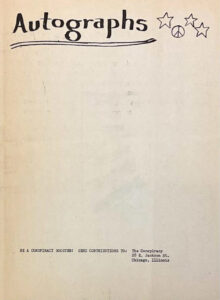
by Jason Fry on 17 August 2025 11:35 pm I remembered that the Mets had taken part in the Little League Classic before, though in my recollection they’d been walloped by the Phillies, which is further evidence that this woeful baseball summer has been bad for my mental health: In fact, back in 2018 it was the Mets who did the walloping.
Maybe it was that I was remembering the dopey softball uniforms they wore back then, complete with not trying very hard player nicknames such as NIMMS and VARGY. Aesthetics definitely took the L back in 2018, even if the Mets did not.
This time around, the Mets were in their classic pinstripes (for a home game in the middle of Pennsylvania, which has got to be a first) while the Mariners were in perfectly tolerable green and gray. Various Mets and Mariners slid down the hill at Williamsport’s Lamabe Stadium atop cardboard sleds, talked baseball with Little Leaguers, and generally conducted themselves admirably before commencing a relatively genial version of hostilities at night.
We got to see some of the pregame pomp, marveling at the teeny tiny stands and the suburban houses tucked beyond the outfield fence. But then it was off to a fancy family dinner, the runup to spending tomorrow wandering around Acadia National Park.
Put three Mets fans at a dinner, though, and they’ll get curious — and forgive each other some peeking at Gameday. Our peeks kept yielding the kind of good news we haven’t been used to of late: There were the Mets actually enjoying good sequencing, with four straight hits and a sac fly transmuted into a three-run second, and against George Kirby no less. There was Clay Holmes, surviving a fourth inning and even pitching a fifth. There was Mark Vientos, the most notable missing piece in this strange season, connecting for a three-run homer that both he and we badly needed.
Maybe we shouldn’t watch more often, I thought to myself.
We got back to the hotel with the Mets up four and Ryan Helsley in the game, which was at least a blinking yellow light on the vibes display. But Helsley wasn’t terrible; both he and fellow underwhelming acquisition Tyler Rogers made their way through minor to moderate trouble to secure a victory. The only sour note on an otherwise heartening evening was Francisco Alvarez jamming a thumb at second on a double; he’s bound to New York for an MRI.
With the game concluded, the Mets and Mariners stayed with the Little League theme by lining up to shake hands after the game. Did they say “good game, good game, good game” in that “grownups told us we had to” monotone I remember from my own childhood? Oh, let’s assume they did.
It really was a good game, at least for us. Kinda makes me wanna slide down a nearby hill.
by Greg Prince on 17 August 2025 2:50 pm You might grab a nap. You might grab a shower. You might grab one of your top prospects and send him to the mound in front of the home folks to make his major league debut and watch him succeed. There are plenty of ways to feel refreshed. The Nolan McLean version proved most effective Saturday. I watched that kid pitch and field and comport himself and, my goodness, did I have a new outlook on life. Five-and-a-third innings in which no runs were given up and potential trouble was wriggled from as if it was something to be brushed aside rather than crumble down upon you can do that for a fan.
 Can’t wait for another juicy bite. McLean didn’t overwhelm Cal Raleigh and the Seattle Mariners as much as he withstood whatever could have gotten the best of him while they batted. Inconsistent umpiring didn’t bother him — four walks weren’t great, but eight strikeouts made those seem less concerning. A liner up the middle with the bases loaded didn’t bother him — that’s where his fielding, via a behind-the-back grab of Julio Rodriguez’s scorcher that the rookie calmly transformed into a 1-4-3 double play, came in. Removal in the top of the sixth with one out, despite having allowed only two hits, didn’t quite sit right with him, per his postgame comments, but you could sense as he walked off the mound to robust applause that he knew he’d be back. Why wouldn’t he? Nolan’s incredibly encouraging effort, along with mighty contributions from Francisco Lindor at the bat, Brett Baty on the basepaths, Pete Alonso when his 100th RBI beckoned, and Gregory Soto and Edwin Diaz as they combined to effectively shut down Seattle the rest of the way, added up to a 3-1 Met triumph. McLean may as well have unsealed a bottle of Mennen Skin Bracer and splashed it on the faces of millions of Mets fans.
Thanks. We needed that.
Now and then through McLean’s maiden voyage, names would be dropped into the telecast, identifying predecessors in premiering prominently with whom Nolan had something in common. Dick Rusteck got a shoutout. Dick Rusteck, time has all but forgotten, is the only Met to begin his career by tossing a shutout, doing so versus the Reds in 1966. Soon after, he had arm problems, and you’ve never otherwise heard Dick Rusteck mentioned in any other context. But those nine innings are nine innings for the ages. Bill Denehy struck out eight Phillies the first time he faced big leaguers, the same week Tom Seaver did the same. Seaver is Seaver. Denehy, who passed away in June, is known best as the guy who kept Tom company on their shared 1967 rookie card, unless he’s known better as the compensation the Mets sent the Washington Senators so they could hire Gil Hodges to manage. But those eight strikeouts, same total McLean accumulated versus the Mariners, live on as evidence of one of the most impressive first starts ever among Mets.
Rusteck, Denehy, and Seaver all did what they did to get things going at Shea Stadium. Steven Matz had to wait until Citi Field was open to toe his first MLB rubber, starting the nightcap of a de facto doubleheader in 2015. The first game completed the previous day’s suspended action and went seven looooooong innings on its own steam. The second game was all Matz, all the time: pitched until there were two out in the eighth, giving up only two runs, driving in four (because that’s how we rolled in the National League), briefly turning his cheering Grandpa Bert into a cult figure. Steven Matz’s record after that start was 1-0. No other Mets starting pitcher commencing his tenure at Citi Field could claim such a mark for another decade. Nolan McLean is the one.
Well, I don’t know if he’s the one the way we wish every rookie getting the ball for the very first time ahead of a game’s very first pitch becomes another Tom Seaver. There’s a reason we hold Tom Seaver as our ideal. There was only one of him. Still, it’s not bad when a pitcher becomes, say, a Steven Matz, who continues to ply his craft today, relieving for the Boston Red Sox. Matz came up in an era when starting pitchers made major league debuts for the New York Mets, and the event wasn’t just the start but the anticipation. Matt Harvey in 2012, donning his Dark Knight cape and striking out eleven in Phoenix; Zack Wheeler in 2013, grinding his way to a win in Atlanta (all the best to his right shoulder, irrespective of who he’s with now); Rafael Montero and Jacob deGrom on consecutive nights in New York in 2014, each dropping strong hints of what was possible; Noah Syndergaard in 2015, bringing to bear an apt nickname and an undeniable presence in Chicago; then Steven doing everything right that late afternoon in Flushing. Matz, Thor, Jake, and Matt each pitched in the World Series for the Mets in 2015. Wheeler and Montero worked in the 2022 Fall Classic, neither for the Mets, but narratives can’t have everything.
In August of 2025, we have a fresh new starting pitcher who appeared poised and capable and came along at a moment when the Mets had sagged beyond belief. Entering Saturday, the Mets had lost 14 of 16. Throughout 2025, when things got a little desperate in the starting pitching department, the Mets tried everything that wasn’t a fresh new starting pitcher appearing poised and capable. Other than Blade Tidwell — touted to a degree, but admittedly short of fully ready — we went with relievers and retreads. Lotta retreads. I sat in on one of David Stearns’s media sessions in early July, one that happened to coincide with one of those junctures when the Mets learned they’d developed a hole in their rotation and had to fill it quick; in this case, it was an injury to Paul Blackburn roiling best laid plans. Stearns, a master of saying nothing for public consumption when he doesn’t wish to speak his thinking aloud yet somehow sounding thoughtful while doing so, used a phrase that stuck with me: runway.
Here, courtesy of SNY’s online coverage, are the president of baseball operation’s two full quotes on the subject.
1) “I think from a developmental standpoint we prefer — again, it’s not always possible — but we prefer and I’ve seen over my career that it’s often beneficial for pitchers who you expect to pitch in your rotation for years to come to have a little bit of runway when they break into the major leagues. It’s not easy to come up here and perform right away. Sometimes it takes two, three, four, five starts to get your feet under yourself at the major league level, and I think allowing a pitcher, especially a top prospect pitcher, to have that runway can be helpful sometimes, both from a physical and a psychological standpoint. There’s also the reality of a baseball season that you have to get through, so you don’t always get to follow the perfect path.”
2) “The clear downside to giving someone the ball and having them not have a good outing, a short start, whatever it is, is you put your major league team in a hole. So step one is we’d like to avoid that outcome. For the individual player’s development, you never know. I’m certain there are pitching prospects and prospects in general who will handle that just fine, and there are others who it probably impacts a little bit more, and trying to figure out which is which can be difficult. It’s also perfectly possible that you call someone up, they give you five good innings, and then go back down and continue their development. I’m certainly aware of all of these outcomes, and we’re sorting through it.”
The Mets wound up using reliever Justin Hagenman as an opener to fill in for Blackburn, and Hagenman did a decent job en route to a stirring victory. It was an intermediate answer, but not a solution. If it was a solution, Justin Hagenman would be starting every fifth day for the New York Mets. The Mets brain trust, no doubt having more data at their fingertips than we have within our entire bodies of knowledge, purposely avoided the possible solution that has sat under their collective nose all season. Not so much McLean, per se, but the pitchers they’ve been developing, pitchers who, presumably, are being developed to take on major league hitters and win major league games pretty soon. Until Saturday, Nolan McLean was just a name to those of us who don’t pore over the prospect lists daily. Brandon Sproat and Jonah Tong still are. Yet runways don’t have to be straight paths. Baseball isn’t LaGuardia.
Kudos for looking out for youngsters’ physical and psychological well-being as they climb the ladder toward the top of their profession. Phooey on treating actual major league games as disposable by rolling the dice on pitchers who you don’t necessarily believe can compete with the hitters they’re facing. So much of the Met approach leading up to this stretch that would have already sunk them had not so many playoff spots been made available has revolved around starting guys for whom there are few reasonable expectations of success and crossing fingers that they’d exceed them. They got lucky once in a while. That luck (like their patience with experienced fringe starters) seems to have run out.
Luck as the residue of design needs a shot of confidence to activate it. The Mets looked confident Saturday. McLean looked confident. Baty rounding third looked confident that he’d score on Lindor’s third-inning double into the right field corner. Citi Field had been regional headquarters for tentativeness in tight situations. A team constructed to not have to question itself wasn’t computing and wasn’t competing. Suddenly it looked like it knew what it had to do in order to prevail. Just one game, but the season is comprised of 162 of those. Win enough just-one-games, and pretty soon you’ve won the ton you need to proceed further.
Nolan McLean didn’t come up with the (justified) hype of a Harvey, but there was definitely more excitement surrounding his debut than which was attached to Seth Lugo’s. I bring up Lugo, who made nine mostly low-leverage relief appearances before getting a chance to start in the summer of 2016, because he intersected with opportunity. The Mets nine years ago were following a trajectory a bit like the one that’s emerged in 2025. On July 7, they stood nine games above .500. By August 19, they were two below, having gone 13-24 in the interim. It was good way to almost completely slip from playoff contention.
Short of starting pitching, Terry Collins turned to Lugo. Lugo, in his second start, won. This was two nights after Robert Gsellman, another Met minor leaguer on nobody’s savior scorecard, notched his first win. Soon both were in the rotation. Almost every Met starter on whom hopes had been hung was injured as that August turned to September. The Mets had almost no choice but to give two rookies who were showing a bit of promise the ball on a regular basis. The other choice was flail about with whoever they could pluck off the nearest scrap heap. They chose the two kids. The two kids were instrumental in boosting the Mets out of the doldrums. The club went 27-13 after bottoming out at 60-62 and won a Wild Card. By the day they clinched, they — and we — brimmed with confidence.
A lot of things have to coalesce to effect a genuine surge. One of them can be a pitcher you planned to use next year. Maybe another one or two can be as well.
|
|






