The blog for Mets fans
who like to read
ABOUT US

Faith and Fear in Flushing made its debut on Feb. 16, 2005, the brainchild of two longtime friends and lifelong Met fans.
Greg Prince discovered the Mets when he was 6, during the magical summer of 1969. He is a Long Island-based writer, editor and communications consultant. Contact him here.
Jason Fry is a Brooklyn writer whose first memories include his mom leaping up and down cheering for Rusty Staub. Check out his other writing here.
Got something to say? Leave a comment, or email us at faithandfear@gmail.com. (Sorry, but we have no interest in ads, sponsored content or guest posts.)
Need our RSS feed? It's here.
Visit our Facebook page, or drop by the personal pages for Greg and Jason.
Or follow us on Twitter: Here's Greg, and here's Jason.
|
by Greg Prince on 6 September 2025 3:02 pm One of the benefits of paying very close attention to one specific entity for a very long time is you pick up on trends that might be apparent to you and only you. One of the benefits of having a platform like this is the opportunity to remark upon those trends.
Here’s my picked-up-on trend of the moment: The Mets are almost unbeatable at Great American Ball Park in September. Having sensed that trend as play began Friday night and having examined the annual annals to confirm my sense allowed me to pretty much relax, even when Friday night’s Mets-Reds game turned utterly unrelaxing.
Great American Ball Park opened in 2003. The Mets made their first September visit there in 2007, then returned in 2013, 2014, 2015, 2016, and 2019. Their composite won-lost mark on the banks of the Ohio in the final month of those specific seasons? A cool 15-4, including a division-clincher in 2015 and Pete Alonso’s 50th home run as a rookie in 2019. Six series versus the Reds inside this month within the walls of this venue, six series wins.
If you could pick your spot for a three-game set, you’d pick this spot in Cincinnati at this time of year. I believe the American Broadcasting Company laid it all out in the late summer of 1971 as it urged viewers to tune into its network when fall arrived for swell new shows (most of them soon to be cancelled) along with familiar fun fare like Friday night staples The Brady Bunch, The Partridge Family, and, ever close to this blog’s heart, The Odd Couple.
Come this September
This is the place to be
Hey there, remember
This is the place to be
ABC then, GABP now. Friday nights then, Friday nights now. C’mon get happy, indeed.
The Reds come with the locale where the Mets are almost unbeatable this time of year, so you’d have to pick them as your opponent. But why wouldn’t you? The Reds are the team to whom the Mets have dealt all that September beating since 2007. Plus, until this week, this series loomed as an opportunity to shake off once and for all our nearest nemesis for the third and last Wild Card. The Reds, by dint of their erratic play, seemed to have shaken themselves off, falling behind the Giants as the contender we have to worry about at least a little. The trend I’ve picked up on where the Giants are concerned is their historical penchant for sneaking into or back into pennant races they seemed all but eliminated from with weeks to go.
1951: 6 out on September 13; the Giants win the pennant on October 3
1962: 4 out on September 20; the Giants win another pennant on October 3
1982: 9 out on September 3; 1 out on September 30 (they fall short of the NL West title but manage to knock off their archrivals the Dodgers, the same team they chased down and passed in ’51 and ’62, on…October 3)
1998: 4 out of the Wild Card on September 20; qualified on September 27 for a Wild Card play-in game versus the Cubs (not pictured: the New York Mets, who led both the Cubs and the Giants with a week to go)
2010: 6½ behind the Padres for the division title on August 25; the Giants not only zoomed past San Diego and kept their other Southern California foes from the postseason by beating them on the schedule’s final day (October 3, naturally), but they went on to win the franchise’s first World Series as the San Francisco Giants
Giant spurts spanning nearly sixty years probably have nothing to do with the standings fifteen years past the last example, but it’s September, and if we’re thinking about playing in October, we are advised to take every possible relevant data point into consideration.
Like David Peterson being due for a good outing, which he gave us for a while on Friday night. His first couple of innings were ground ball heaven. In the meantime, the Mets were getting on base and hitting behind runners and advancing on the basepaths and doing everything so well that in the first, when Brandon Nimmo was robbed of a three-run homer at the center field wall, they still got a run out of it on a sac fly and put up three runs in all.
It was a great night at Great American Ball Park. Everybody else could look at the scoreboard and figure that out once Mark Vientos whacked a homer nobody was robbing to make it 4-0 in the top of the third. I knew it was a great night because it was September in Cincinnati and the Mets were visiting.
Then Peterson reverted to his recent sample size in the third and the fourth, and by the time he was lifted in the sixth, the Mets lead was down to 5-4. The bullpen parade was underway, commencing with grand marshal Ryne Stanek. Low-Leverage Barbie is asked to get out of a two-on, one-out jam. That’s a lot of leverage for those flowing golden locks. Ryne strikes out his first batter, walks his second, and, son of a gun, strikes out his third with the bases loaded, inning over. Low-Leverage Barbie’s Dream House — Pleasant Surprises Sold Separately.
The Mets stopped hitting in any meaningful fashion after Vientos’s aforementioned dinger, but the lineup Carlos Mendoza could lean on was that of his relievers. Brooks Raley in the seventh: three Reds up, three Reds down. Tyler Rogers: four Reds up, none of them scoring. Ryan Helsley: resting up, thank goodness. This got us to the bottom of the ninth, the Mets still ahead, 5-4, and their closer on to cleanly settle matters once and for all.
Edwin Diaz hadn’t been notified of the Mets’ lording it over the realm of the Reds. Edwin Diaz gave up a single, a walk, and another walk before getting an out. Edwin Diaz also gave up a shoe at some point. If it were Helsley, the shoe would have come off the way Charlie Brown’s pants and shirt went flying as line drives whizzed past the mound. In Edwin’s case, it was a faulty bit of sporting goods, a cleat coming off a spike (or a spike coming off a cleat). Either way, in the midst of facing Elly De La Cruz, he was delivered a new pair. We would never accuse Edwin of not already having a pair.
Properly laced up, and unpenalized by pitch clock codes that presumably don’t delineate shoe-changing protocol, Diaz struck out De La Cruz in two shoes different from those he wore when he struck out Noelvi Marte. Both of those K’s were etched with the bases loaded. The bases were still loaded. It was still 5-4. It was still Edwin Diaz. It was still Great American Ball Park. So many constants to take comfort in. So many situations that could tip into a hellish finish at any second. Diaz is the best. Diaz is the worst. Edwin’s brother, the former All-Star Red reliever Alexis, is suddenly available now that the Dodgers have DFA’d him, and it’s been suggested the Mets take a look at him. My reaction was no thanks, we already have two Diazes — the one who creates messes and the one who pulls out of them.
On Friday night, with two men out and three men on, nowhere to look but inside, the preferable Edwin Diaz proved he can be The Man, responding to self-imposed pressure by grounding Gavin Lux to an area between first and second patrolled by Luisangel Acuña. Definitely the right guy to hit it to, as it took some dashing to corral the ball and sling it to first. Covering first on such a play should be the pitcher. We’ve seen Edwin be that pitcher on that play and proceed to enjoy his view of first base when he’s supposed to be rushing toward it. This time, he was where he needed to be, just like the Mets were where they needed to be. Diaz made the putout and sealed the win. The Mets won again in Cincinnati in September.
 Ever see anything like it? In the Great American Ball Park sense, yes. The Mets are 16-4 in September there. But getting out of this last jam as they did? That actually did happen once, in the past decade. On July 19, 2016, Jeurys Familia, who could be a couple of different closers at once himself, loaded the bases with a one-run lead at Wrigley Field in the bottom of the ninth before recording an out. Somehow, Jeurys wriggled altogether free of harm and the Mets prevailed by the same 2-1 score they clutched when he entered (as we clutched our chests). Once Familia successfully Houdinied, Elias Sports Bureau noted it was the first time the Mets held on to win a game after leading by one run in the bottom of the ninth or later after the opponent loaded the bases with nobody out. Ever see anything like it? In the Great American Ball Park sense, yes. The Mets are 16-4 in September there. But getting out of this last jam as they did? That actually did happen once, in the past decade. On July 19, 2016, Jeurys Familia, who could be a couple of different closers at once himself, loaded the bases with a one-run lead at Wrigley Field in the bottom of the ninth before recording an out. Somehow, Jeurys wriggled altogether free of harm and the Mets prevailed by the same 2-1 score they clutched when he entered (as we clutched our chests). Once Familia successfully Houdinied, Elias Sports Bureau noted it was the first time the Mets held on to win a game after leading by one run in the bottom of the ninth or later after the opponent loaded the bases with nobody out.
Now it’s happened twice, but this time with a changing of shoes on the mound.
Dust settled and footwear difficulties resolved, the Mets extended their lead over the reeling Reds to six games, which is fine, but the Giants continue to sneak along and are four back of us and the Padres. The Padres? How did they get into this part of the postseason scenario? By losing a lot lately, apparently. The NL Wild Card situation stays fluid, as do the Mets’ starting pitching plans. Kodai Senga is in the minors, instructed to get his forking stuff in order before coming back. On Sunday, Brandon Sproat will be up to attempt to triplicate the charms that were Nolan McLean’s and Jonah Tong’s respective debuts. First time was a charm. Second time was a charm. Are we pushing our luck with a third time? Senga has imploded. Manaea’s barely any better. Peterson won but struggled. And Clay Holmes has limitations. Bring up the new kid and see if he can throw strikes like the other two.
McLean. Sproat. Tong. Generation MST3K could have us in orbit. Or in Cincinnati, which in September, as we’ve established, is the place to be.
***Cincinnati is also where, on April 2, 1984, Davey Johnson managed his first Mets game; where, on May 29, 1990, Davey Johnson was let go before he could manage one more Mets game; and where, on July 22, 1986, Davey Johnson managed what he called in its aftermath “the strangest game I’ve ever been involved in,” the one whose chef’s kiss of craziness was Davey shuffling Jesse Orosco and Roger McDowell between the pitcher’s mound and the outfield, all while Gary Carter played third base. “Even stranger than Atlanta,” Davey assessed, referring to the 16-13, 19-inning, 3:55 AM ending from about a year earlier. This one finished with a more pedestrian 6-3 final in a comparatively civilized fourteen innings, but Jesse and Roger alternated in the outfield, Gary was the relay man on a 3-5-4 double play, and, because of a big-time brawl innings earlier, “I’m out of pitchers, and I’m out of extra players.”
Now, sadly, we’re out of Davey Johnsons. Davey died Friday in Florida at 82. There was only one of him.
Davey Johnson managed his share of strange games with the Mets from 1984 to 1990, wherever their itinerary took them. He managed the most wins and the biggest share of winning games any manager ever racked up for the Mets. He managed the winningest season the Mets have ever mounted, only the second that ever ended with the Mets winning the final game of the World Series.
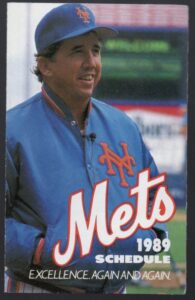 He was Davey Johnson, manager of your New York Mets. Knowing he was running things in the dugout equaled one less thing to worry about as a Mets fan. Not once, not even when Frank Cashen sent him home from Cincy in the wake of a sluggish start to his seventh season at the helm, did I think Davey wasn’t the right guy for the job he held. When Davey was our manager, we were in good hands, confident hands, informed hands. There were the Mets before Davey Johnson. They hadn’t gotten anywhere near a legitimate pennant race in ages. There were the Mets during Davey Johnson. They were in a pennant race every single year he held the job. The Mets after Davey Johnson sagged in due order. The man was a difference-maker of the highest order. Believed in himself. Believed in his players. We believed along with him. He was Davey Johnson, manager of your New York Mets. Knowing he was running things in the dugout equaled one less thing to worry about as a Mets fan. Not once, not even when Frank Cashen sent him home from Cincy in the wake of a sluggish start to his seventh season at the helm, did I think Davey wasn’t the right guy for the job he held. When Davey was our manager, we were in good hands, confident hands, informed hands. There were the Mets before Davey Johnson. They hadn’t gotten anywhere near a legitimate pennant race in ages. There were the Mets during Davey Johnson. They were in a pennant race every single year he held the job. The Mets after Davey Johnson sagged in due order. The man was a difference-maker of the highest order. Believed in himself. Believed in his players. We believed along with him.
Davey was introduced to the media as the new Met manager not in New York but in Philadelphia. It was an off day during the 1983 World Series. Philadelphia was close enough to New York. The Mets weren’t close to the World Series. Not even close to thinking about the World Series or any of those barriers they’d have to clear to get there. It makes sense, however, that Johnson would field reporters’ questions at the World Series. He was gonna get us there quicker than we would have guessed.
Three years later, after a shocking 90-win season, an exhilarating 98-win season, and the dream season that encompassed 108 wins (always loads of wins in the Johnson era), the Mets were in the World Series. They were almost out of it on the night of Game Six. Davey’s Mets, despite a questionable call or two on the skipper’s part, snatched victory and revealed what a glass jaw defeat really had. When Ray Knight crossed home plate, everybody stormed from the Met dugout to congratulate him. Davey was right in the middle of that scrum. I somehow had the presence of mind to notice the manager among his players in one of those situations where you inevitably see the manager hang back with his coaches. Not this time. This was too big, and Davey was too smart to not recognize this was something to react to viscerally. This was two out and nobody on and the Mets down two and the World Series threatening to slip to Boston and even DiamondVision giving up, congratulating those Red Sox on coming to Queens and ending their legendary 68-year drought.
But, nope. Carter singles. Mitchell singles. Knight singles. Stanley throws a wild pitch. Mookie makes contact. Buckner doesn’t. You know what happened by heart, but until then, nothing like it had happened, not even to the Mets. Davey had a new champion among strange games he was involved in. Two nights later, he had a world champion, and the Red Sox’ drought would grow 18 years more legendary.
Having led us to a parade and a ring and all that spectacular stuff we’d been parched for since 1969, Davey ascended to the pinnacle of Mets Managing. He had done what only Gil Hodges had done. If it was easy to do again, we could mention a third name, but we can’t, because it’s not. Had gambling interests advertised during ballgames in 1987 and 1988, I would have bet Johnson’s Mets would have done once or twice more what they’d done in 1986. Davey’s Mets stayed close and came close. The only cigar was lit in ’86. It still glows in memory. Davey’s pledge to dominate from Spring Training through the Fall Classic was made good on. Of course you’re gonna pass out cigars. So what if a dynasty wasn’t born? For one year, the Mets were never better. For one year, there was no manager like Davey Johnson. For the best parts of seven years, there was no Met manager like Davey Johnson.
For other clubs — including good ol’ Cincinnati — Davey did some serious winning as a manager, just as he did for Baltimore as a player (or have you forgotten who was up in the ninth against Koosman in Game Five?). If he hadn’t won a World Series for us, he’d be somebody you’d remember if you were a baseball fan. Hit 43 home runs alongside Henry Aaron in Atlanta in 1973. Hit 26 home runs alongside Sadaharu Oh in Tokyo in 1976. Got the last base hit Sandy Koufax ever gave up, a single in the sixth inning of the second game of the 1966 World Series, where Davey earned his first title. Did his first skippering with the Miami Amigos in a long-forgotten circuit called the Inter-American League (he had them ten games in front when the league folded after three months of operation) before reuniting with his old Baltimore GM Cashen in the Met organization. Worked his way up our minor leagues as a manager. Crossed paths with an instructor named Cleon Jones, who caught a ball of Johnson’s that didn’t go for a hit in a World Series. Led Jackson to a Texas League championship. Led Tidewater to the International League and overall Triple-A championship. Grew well-acquainted with the abilities of some rising stars as they soared with him. Landed in New York, let it be known he knew mathematics and used a computer. In 1984, he might as well have been from the future. The future was now at Shea Stadium and first would soon be the place to be.
Davey Johnson’s immediate predecessor as Met manager was Frank Howard. The managers who followed him in rapid succession were Bud Harrelson, Mike Cubbage, and Jeff Torborg. They, like Davey, all played baseball in the 1970s, when I was a kid. They’ve all passed away in the past two years, when I’m less and less surprised that players from my childhood and managers from the earlier parts of my adulthood depart the scene. I knew Davey had been battling health issues for a few years, so this news wasn’t particularly shocking, which didn’t keep it from being sort of stunning, because he’s Davey Johnson. He managed Rusty Staub, who started playing in the majors in 1963. He managed Bryce Harper, whose contract says he’ll be playing in the majors in 2031. He was in and out of the game for decades once the Mets decided they didn’t need him any longer, not exactly a baseball lifer, but, oh, what a baseball life.
His, I mean — but ours, too, thanks in large part to him.
by Greg Prince on 4 September 2025 10:32 am “Until you’ve been beside a man,” Detroit’s own Bob Seger wailed mournfully, “you don’t know what he wants.” And until you have a high-profile reliever on your team, you don’t know what he is. For the Cardinals, Ryan Helsley was lights out. For the Mets, he turns them off on his own team.
Had Helsley done his job perfectly Wednesday afternoon and nothing else about the game he entered at Comerica Park had been different from what it was, the Mets would have still lost, albeit by fewer runs. But Helsley did not do his job perfectly. He came into the seventh inning of a one-run game — Tigers 3 Mets 2 — and proceeded to give up a leadoff single, a walk, then a three-run homer to Kerry Carpenter. The one-run game became a four-run game. Even a little less imperfect keeps the Mets conceivably close. The Helsleyfied margin effectively put the game out of reach.
Cue Mr. Seger and “Shame On The Moon” again: When nothing comes easy, old nightmares are real. Newish nightmares, too. Ryan Helsley has been pitching for the Mets since August 1. Many bad dreams. No light at the end of his tunnel.
Around the time Ryan was dyin’ on Comerica’s hill, word spread that the Mariners — a contender for the postseason just like us — had plucked Jose Castillo from the waiver pile we tossed him on in one of our myriad reliever-roulette transfers. Pardon the simplistic approach to this equation, but in 15.1 innings as a Met this season, Castillo compiled an ERA of 2.35. In Helsley’s eleven innings in orange and blue, his ERA is a black and blue 11.45. I looked at other metrics as well, but none is any kinder to the guy who’s still here vis-à-vis the guy who isn’t. Castillo and Helsley don’t present an apples-to-apples comparison. One’s a lefty, one’s a righty; one’s a quintessential journeyman, one’s got a genuine track record that includes All-Star selections and Cy Young votes; one cost essentially nothing when he was signed to limited notice in the offseason, one was framed as a major get obtained in exchange for three minor leaguers, two of whom are considered viable prospects.
I know the answer, but as I took in the spectacle of the thus far disastrous Helsley continuing to give up runs, and absorbed the ticker-level news that the generally useful Castillo had slipped away to Seattle, I wondered to myself, “Why couldn’t we have just kept the one who usually pitched OK and dumped this guy?”
It’s September. No time for scapegoats. Wednesday’s was a team-effort 6-2 loss, starting with Clay Holmes having about as Clay Holmes an outing as Clay Holmes could have. He battled. He lost. That seems to be the ceiling for what a Mets starter can achieve when he can claim more than a few weeks of experience. Stranded a runner in the first. Nicked for a run in the second. Retired the side in order in the third. Worked out of trouble in the fourth. Departed in the fifth with two out and two on after 85 pitches. The runners he bequeathed to Gregory Soto advanced on a wild pitch and scored on a hot shot past short.
G. Soto hasn’t been as stupefyingly unreliable as Helsley, but the lights tend to stay on for hitters when he pitches. Tyler Rogers has had his moments, but not enough to make any Mets fan count lucky stars on behalf of his presence. Jeff McNeil is back to being in center sometimes because suddenly revived Tyrone Taylor strained his hammy and Cedric Mullins has proven, to be kind about it, disposable. What David Stearns shook free from sellers may constitute the least helpful headline haul the Mets have ever brought in on the eve of August. Nobody among Helsley, Soto, Rogers, and Mullins was an acquisition on the level of Yoenis Cespedes, but they weren’t supposed to collectively replicate the impact of John Thomson, Jason Middlebrook, Steve Reed, and Mark Little. Do you remember how those guys came in and helped us compete for the 2002 Wild Card?
Exactly.
The lineup Juan Soto says goes “bananas” with runners in scoring position forgot to swing by the produce section Wednesday afternoon. They faced some good pitching, from Casey Mize over the first five to Old Friend™ and bona fide big league survivor Rafael Montero in the ninth, yet there were legitimate opportunities for the Mets against those pros and their compadres, hardly enough cashed in. If it wasn’t September, you might shrug and say, hey, two out of three from a first-place club, hardly a bad series. But it is September. It’s in our fan contract that we are permitted to gripe this late in the schedule when a sweep isn’t completed and flatness permeates a matinee — and whoa, were the Mets flat as they ended their series in Detroit.
Flat also describes the club’s status regarding its playoff positioning. After 100 games of the current season, the Mets were four games clear of a Wild Card. The division title was our primary aspiration then, so checking our fallback options seemed superfluous. They’ve played 40 games since, gone 19-21 in that span, and are…four games clear of a Wild Card. So much for putting distance between themselves and supposedly lesser competition. The team not quite on their heels or tails, yet a little too visible in their rearview mirror, is now San Francisco. The Giants’ front office gave up at the deadline. They gave us Tyler Rogers (in exchange for three able-bodied players). Those who take the field for them have kept trying, however, thus the Giants have passed the Reds, who are five behind the Mets as our boys prepare to partake of, or perhaps avoid, Cincinnati’s world-famous Skyline Chili this weekend.
Some Septembers you’d be thrilled that the Mets had built a four-game postseason cushion with slightly more than three weeks to go. Thrilling does not really capture the sensation around these Mets. Nor does sensational. I think they’re capable. I find them likable. They just don’t strike me as anything special. Eleven previous times the Mets have made the playoffs, and on all eleven occasions, I was convinced I was rooting for a team on a mission, or a team of destiny, or a team that had done something wonderful just to get where they were regardless of where they were going or, ultimately, where they wound up. September, I presume, is Latin for “subject to change,” so the Mets can get special in a hurry. Or they can stay capable, likable, and a tad too ordinary to inspire.
I’m aware they very recently won games by mounting impressive offensive onslaughts, and that losing, 6-2, is not necessarily a leading indicator of who they are, but neither was winning by consecutive scores of 10-8 and 12-5, any more than losing the two previous games they lost, which were by scores of 11-8 and 5-1. There are no leading indicators where the Mets are concerned, certainly not on a going basis. If Nolan McLean pitches, you’re excited. If Jonah Tong (or Brandon Sproat) pitches, you’re curious. If anybody else starts, you’re gripping the arms of your chair. Whoever relieves, you’re probably not the picture of confidence. If the lineup’s banana stand is open for business, well, you know what they say in Orange County: there’s always money in the banana stand. Score a lot, you’re likely to win. Score not much, you’ll likely hope neither the Reds nor Giants catch and/or maintain fire. They’re not that great, either, the operative word here being “either”.
The Mets have played 140 games and gave up the ghost on being great some time ago. What’s great for them, mostly, is each league’s playoff bracket is built to encompass six teams. Once in, bursts of greatness are required to stick around. A special team can produce those. A capable team too often verging on ordinary would be advised to do the same the rest of September, if only to confirm its reservation for October.
by Jason Fry on 3 September 2025 8:13 am Hey, why don’t they make the whole pitching staff out of Nolan McLean?
Statistically, McLean’s start Tuesday night against the Tigers was the least of the four he’s made so far in his very young career. But it might have been the most impressive for all that. McLean reported for duty having trouble landing his curveball and sweeper, with a pair of first-inning walks and RBI singles yielding two Tiger runs and more trouble at hand in the second — and all this came against a Detroit team that’s spent the season feasting on the American League.
But McLean figured it out, riding the sinker and changeup until he could harness his disobedient breaking stuff: Those two first-inning runs were all he allowed in six innings of work. Meanwhile, the Mets ambushed Sawyer Gipson-Long and his lawyerly moniker (a sawyer is actually a sawmill worker, but shh, nobody likes a pedant) the second time through the batting order, with the key blow a three-run shot off the foul pole from Luis Torrens.
They then poured it on against Chris Paddack, who a seeming eternity ago was a Padre and self-described competition for Pete Alonso in the race to be National League Rookie of the Year. That didn’t happen in 2019 and Paddack absorbed a fearful beating Tuesday night, getting an uncomfortable up-close look at the entire Mets lineup in one endless, dreadful two-thirds of an inning: Juan Soto homer, Alonso homer (his second of the night), Brandon Nimmo single, Mark Vientos double, Jeff McNeil single, a fielder’s choice from poor luckless Cedric Mullins, Torrens single, Brett Baty single, Francisco Lindor sacrifice fly, Soto single, and finally permission to be excused further indignities.
(Paddack took the L aesthetically too, wearing an unadorned, pale beige glove that reminded me of uncooked chicken. It was nauseating to look at and offended me; judging from the box score, the Mets took exception too.)
If Monday night was about the Mets outhitting their mistakes, Tuesday was just an out and out beatdown, with the lone blemish Kevin Herget tiring shy of a three-inning save and Ryne Stanek needing a few moments to get his bearings. The results didn’t entirely banish my bad Detroit memories: If I close my eyes I can still see Bobby Higginson going ham on the Mets at Tiger Stadium, or summon up the first uneasy tendrils of suspicion that Justin Verlander was not, in fact, going to lead us back to the promised land alongside fellow former Tiger Max Scherzer.
But 12-5 will make you feel better about a lot of things — the immediate future, the standings, and even a long-ago slight or two.
by Jason Fry on 2 September 2025 8:15 am Before the Labor Day matinee against the Tigers, a friend asked me an alarming question: Who are the Mets’ starters for a playoff series?
Kodai Senga? He’s been awful since returning from injury and Carlos Mendoza didn’t exactly offer a ringing, unambiguous vote of confidence about him remaining in the rotation. David Peterson? Bad start has followed bad start has followed bad start. Clay Holmes? Better of late but in uncharted territory as far as innings pitched, which we saw catch up to multiple Mets pitchers against the Dodgers in October. Sean Manaea? He hasn’t looked right all year, and has gone from “good early but ran out of gas” to “not good at all,” as was demonstrated against the Tigers.
Imagine a wild-card rotation of, say, Nolan McLean, Jonah Tong and Holmes. Or McLean, Holmes and the endless possibilities of Tylor Megill. Hell, call up Brandon Sproat and go all raw rookies.
Seriously, what are the Mets going to do?
One answer would be to outhit their mistakes, which is what they did Monday against the Tigers on a gorgeous day at Comerica Park. Juan Soto led the way, blasting a grand slam that ended Charlie Morton‘s day (and saved Brett Baty and Francisco Lindor from fannish tut-tutting about not delivering gimme runs) and then adding a two-run triple. The Mets got enough to overcome Manaea and not so great bullpen work from Gregory Soto, Ryne Stanek and walking disaster Ryan Helsley (who was at least yanked quickly this time).
Fortunately Edwin Diaz was up to the task, and the Mets didn’t so much win as survive. Not the most elegant strategy, but hey, whatever works. I have my doubts it will work when there’s bunting and clueless national TV crews on hand … but I also have my doubts it will work for the rest of September. Let’s worry about the problem at hand, shall we?
by Greg Prince on 1 September 2025 2:25 am The trumpeter who scores the postgame scurry to the 7 on Mets Plaza made an interesting musical choice in the minutes following the fresh 5-1 loss the Marlins had inflicted upon the Mets inside Citi Field. He played “Auld Lang Syne,” a number usually reserved for December 31 rather than August 31. I wondered if the wistful tune struck him as appropriate as we were bidding goodbye to summer on this late Sunday afternoon, or because the Mets have been dropping the ball with such force that they might be called on to re-enact their core incompetency in Times Square come New Year’s Eve.
Or maybe the trumpeter knows only so many songs and this was one of them. What the hell, the Mets played four games versus Miami as August ended, and they won only one of them. Not Sunday’s certainly. They took on Sandy Alcantara, and Sandy Alcantara reminded us he is still Sandy Alcantara, even if Kodai Senga resembled nothing remotely akin to Kodai Senga. We have our images of previously successful starting pitchers. Senga of the second half of 2025 is not to be mistaken for the Senga of yore…and his yore wasn’t that long ago.
The Met of the game was clearly Brandon Waddell. He’s been a Met multiple times this year but wasn’t the day before. He was called up to replace Chris Devenski, who could have said the exact same thing about his perpetually slippery job status 24 hours prior. Chris did a heckuva job in reclamation relief on Saturday, just as Brandon did on Sunday. One assumes that even with roster expansion Monday, Waddell will be optioned to cool his heels and rest his arm alongside Devenski in Syracuse. One wonders why it’s inevitably the relievers who “rescue” the bullpen who are sent down rather than the imploded starters they relieve. One wonders a lot with this club and should probably assume nothing.
Despite encompassing a couple of massive milestone moments — Alonso slugging his way past Strawberry; McLean and Tong emerging in our midst— the month that just ended cannot be considered splendid. Au revoir, then, to the last wisps of summer in Flushing, and welcome to September and the clean slate it promises. Don’t muck it up with too much Augustitude, if you don’t mind, Mets. All the months of this season have blurred into a kind of high-functioning futility that somehow still has this team in pretty decent position to make the playoffs. They’re trying to fall out before fall officially hits, but they’re really not that bad. They’re really not that good, either.
They are, on a record-to-record basis through 137 games, exactly what the Mets of a year ago were: 73-64. That would be neither here nor there, except for knowing that this marks the first interval of the schedule since the 2025 Mets were 0-1 that they’ve posted exactly as many wins and losses as their immediate predecessors. And that would be no big whoop, except the 2024 Mets molded themselves into spunky upstarts who captured a playoff berth and all of our hearts, while the 2025 Mets were supposed to skip the spunk and act as juggernauts from March onward. The last edition famously started 22-33 before turning it around. It’s “famous” rather than infamous because of what happened after 22-33. The contemporary bunch infamously started 45-24 before seeking new depths. Infamy can still be chased from the 2025 narrative, but suddenly it’s September and the rewrite desk is working on a tight deadline.
At this precise juncture of 2024, the Mets had won four consecutive games and were about to win five more. If the current squad doesn’t go undefeated from today through Saturday, the 2024 Mets will pass them. I understand that’s not who the 2025 Mets are competing with in the actual standings, but it indicates something’s historically awry — perhaps that ever since our juggernaut got towed in the middle of June, we haven’t been able to free it from the impound lot for more than a spin.
I make it my business to track things like Mets’ records after 137 games of every season they’ve ever played, which made me the ideal companion Sunday for Mark Simon, with whom I take in a game annually. Mark’s something of a baseball renaissance man, with his latest credit being the profiling of the broadcasting McCarthys, Tom and Pat, for a Tri-State Area college alumni magazine. But if you want to know my super-seamhead friend for anything, know him as the reigning SABR trivia champion, a title he wrested in Texas this summer. He didn’t wear the belt to Citi Field. He didn’t have to.
Our Mets-Marlins game was different from the one with which the other 43,300 on hand were burdened. In the top of the third inning, we dug into our quizzing satchels and pulled out the questions that we would deploy to preoccupy each other until shortly before the seventh-inning stretch. The first question could have been, “What baseball game, already in progress, will require a lengthy distraction?” We would have accepted, “this one”; “the Mets-Marlins game of August 31, 2025”; or “what Mets game lately doesn’t?” That gimme aside, the object of our trivia challenge isn’t to stump one another, but tease out answers nobody should know by dropping hints that nobody should grasp.
But we do.
Here’s a highly selective partial honor roll of past Mets who came up in the course of our questioning and answering:
Dave Mlicki — but not for the first thing you think of when you think of Dave Mlicki.
Joel Youngblood — but not for the “one thing” everybody associates with Joel Youngblood.
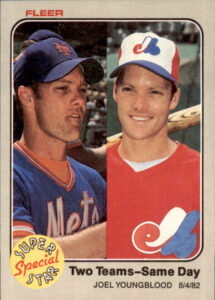 No, not that. Doc Medich — the pitcher identified via the clue that was essentially “he was a Met for no reason”.
Rick Cerone — the catcher identified via the clue that was essentially “he hit a dramatic home run once,” though the question had nothing to do with his being a catcher or hitting a home run.
Kevin Bass — the outfielder identified via the clue that was specifically “mimicry”.
Jim Hickman — who was answered by our seat neighbor who drifted into enjoying our game more than he was the one the Mets were losing to the Marlins. Maybe they should have lent us one of Alec Bohm’s parabolic mics and let more of the stadium eavesdrop.
Batista — this is a trick answer, derived from each of us having seen, in different parts of the ballpark before we met up, a guy wearing a jersey that read BATISTA 14 on the back, and as each of us knows, Miguel Batista sure as hell didn’t wear 14 when he pitched for the Mets in 2011 and 2012. We made a pact to stop Mr. BATISTA 14 if we ran into him on the way out and ask what’s up with that? (Alas, neither of us saw him again.)
Jay Bruce —my “how soon they forget” Met.
Bobby Parnell — Mark’s “how soon they forget” Met, though to be fair, Parnell isn’t quite as recent as Bruce.
Robinson Chirinos — not technically a correct answer, but his inclusion as an addendum to a series of correct answers seemed to tickle Mark more than any other name that came up all day.
We do some version of this every year, and it always tickles both of us no end. Between dealing questions, hints, and answers, we do manage to intermittently look up at the game in front of us. Its ability to tickle varies. The non-quizzing portion of Sunday’s game didn’t inspire much tickle on the current Met front. Moral of the story? Always pack your quizzing satchel, whatever the month.
by Greg Prince on 31 August 2025 11:10 am My whole life as a sports fan, I’ve seen teams seek “Wild Card” spots in playoffs and understood Wild Card to mean “not a division winner,” without ever really stopping to think of the term’s implication away from sports. To be certain I had it straight, I went to the dictionary (well, a dictionary site) so I could cite the definition of wild card accurately. It is “an unknown or unpredictable factor”.
Based on what the good folks at merriam-webster.com have to say about the matter, the New York Mets loom as the ideal wild card for the forthcoming postseason, because I can’t think of another contender whose actions from one game to the next answer so precisely to their dictionary definition. You never know what the Mets will do in the course of nine innings — even when you acknowledge that you never know what any team will do in the course of nine innings — and you’d be courting frustration if you attempted to predict it. Inning to inning, there’s no telling who the Mets will be or what the Mets will do. Within an individual inning, the outcome is beyond anyone’s educated guess.
If MLB were to give out Wild Card spots based on capriciousness, the Mets would be a lock. They give out Wild Card spots based on best records among non-division leaders. The Mets aren’t a lock, but even after losing the kind of game on Saturday it appeared they’d come back to win after appearing certain to lose, they appear to be in solid shape, five games up on the Reds for the final playoff berth. The Reds — who have three with us next weekend and a tough schedule in general — have been their own kind of meh lately and therefore haven’t been able to close in on the Met brand of meh. At the rate Cincy is going, they might fall behind any of three National League clubs that sold at the trade deadline. If you can’t beat out towel-throwers, you might not have what it takes to stay in the ring.
Appearances are in the eye of the beholder, however, for the Mets always appear to be something different. Saturday’s comedown followed romping on Friday; falling flat on Thursday; emphatically shutting out the team they’re chasing and effecting a series sweep on Wednesday; a thriller of a win on Tuesday; a romp on Monday; epitomizing not quite enough Sunday, a break-it-open-late thumping the night before; an all-around stomping that would have been more fully enjoyable had the bullpen not given away a bunch of runs toward the end the night before that; and failing to be competitive versus a last-place team the afternoon before that. Go back a little further, through splitting the first two in Washington and taking the last two from Seattle, and you have losing 14 of 16, which came after winning seven in a row, which came after a 7-6 stretch that surrounded the All-Star break, which seemed to lift them from a 3-14 descent, which negated a 15-3 surge, which we thought erased a 2-6 stumble, which took the edge off going 5-1, which made us think going 2-5 in the seven games prior was an aberration.
The aberration may have been the 19-6 spurt the Mets ran off on the heels of their sluggish 2-3 start to the season. At that point, on April 29, they were 21-9. Playing .700 ball figured to be unsustainable, but they looked good enough to do great things. Their few losses in that period seemed accidental, as if only they would focus just a little harder, they could go mostly undefeated from there to eternity.
Baseball seasons last longer than that when the winning isn’t reliable, and the Mets, despite sitting five clear of a playoff spot and ten above break-even, can’t be counted on to ride any form of consistency. Banking those wins early provided the foundation for the indecisiveness they’ve chosen since. Win a few? Lose a few? Lose a few more? No, wait, we like winning…we think… It may not be as conscious as all that, but it might as well be. It would at least explain why from April 30 through August 30, they’ve gone 52-54.
There are reasons within results, of course. There are reasons they lost, 11-8, to the Marlins on Saturday. The first reason was their most reliable starting pitcher over the course of 2025, All-Star David Peterson, couldn’t get outs when he needed them in the first and third innings, the latter a frame he didn’t escape. The second reason was the fixation Met defense has developed with fumbling. Perhaps they watched too much NFL preseason, but Mets with gloves the last few nights proceed as if those items on their hands are merely fashion accessories. The third reason, if we fast-forward toward the final third of the game, centered on an inability to hit with runners in scoring position, a discipline at which the Mets were suddenly excelling until they weren’t.
In between the bad parts — the falling behind, 5-0; the falling behind again, 8-2; the not completing the storming from behind once it got to 8-8 — there was swell stuff. There was Juan Soto giving off bargain vibes. Homered twice. Stole twice. Walked twice. Also ran the bases not brilliantly early, but you don’t necessarily wish to ding a 35/25 man for his imperfections. Mark Vietnos remained on fire, going deep for the sixth time in his last eight games. Francisco Lindor led off the home first with one of his keynote specialties as well. The Mets have been a home run juggernaut in August. They’ve never hit more in a calendar month, a span in which they are 11-16 with one game to go.
After Peterson all but took them out of Saturday’s game, yeoman reliever Chris Devenski and ageless lefty Brooks Raley combined with a mighty offense to get them back in it. Then Tyler Rogers made life a little more difficult, but Gregory Soto held firm. Except by then, the offense had gone back into sleep mode at the absolute worst time (runner on third, nobody out in the seventh) and never woke up. Edwin Diaz couldn’t keep it razor-close in the top of the ninth, and Cedric Mullins couldn’t extend a potential tying rally in the bottom of the ninth.
The Mets transcend streakiness. They’re not riding a rollercoaster as much as getting on and off it at every turn. One inning they’ve got their problems licked, the next inning they’re getting licked by the likes of the Marlins. This is a team that can scare and defeat any team it sees on its way to or in October, just as it can lose a series at any moment to any also-ran and not have it feel like a fluke or “just one of those things” that happens when you play 162 games. They’ve played 136 games to date. They have yet to offer a coherent vision of who they are.
But they have gone 9-5 in their last 14, which indicates they are capable of not giving up their five-game lead for the last playoff spot, and suggests that should they land in the playoffs, they can go 13-9 should they earn the opportunity to play every possible game presented to them. A curated 13-9 wins them a championship, but they can’t mount flash-mob losing streaks, because there will be no coming back from them. Two out of three in the NLWCS. Three out of five in the NLDS. Four out of seven in the NLCS and WS. It’s too soon to ladle out all that alphabet soup, but this is, somehow, a championship contender.
First, go 1-0 today and start fresh tomorrow. They’re always starting fresh the next day, as if they have no idea how they did what they did yesterday. I certainly don’t.
by Jason Fry on 30 August 2025 12:43 pm On the day Jonah Tong was born — Thursday, June 19, 2003 — the Mets lost 5-1 to the Marlins at Soilmaster Stadium. Mike Bacsik gave up an early three-run homer to Mike Lowell, things got worse in the fifth, and a dreary game eventually expired. I’m sure I was watching and also glad I don’t remember wasting that particular two and a half hours of my life.
The win let the Marlins leap-frog the Mets, leaving them last in the NL East. The Marlins would keep leap-frogging, finish with 91 wins and a wild-card slot, and eventually defeat the Yankees in the World Series, for which I’m grudgingly grateful. I still have a Yankees’ 2003 World Series champs shirt, intercepted between some warehouse and a no doubt now-shuttered foreign-aid program, and wear it proudly when invited to Yankee Stadium.
The 2003 Mets? Yeesh. That was the club of Roberto Alomar, of Vance Wilson and Jason Phillips and the Mets’ A/V staff assembling their highlights to “Hold On” by Wilson Phillips (getit?), of getting swept by the Yankees in humiliating fashion, of nepo baby brother Mike Glavine getting his first and last big-league hit the day the season mercifully came to an end. Faith and Fear in Flushing didn’t exist yet and that’s for the best, because I’m not sure we would have made it through chronicling 2003.
Tong grew up in Ontario, learned his craft under the tutelage of his father — complete with mechanics that look Xeroxed from Tim Lincecum‘s — and was drafted by the Mets in 2022. In 2023 he struck out seemingly half the world in the low minors but walked the other half of the world. But things improved in 2024 after he added a Tyler Glasnow-esque slider to his repertoire, and accelerated this year thanks to a much-refined changeup. That brought Tong from Binghamton to a toe touch with Syracuse and then on Friday night to Citi Field.
After we watched Nolan McLean decimate the Phillies on Wednesday, Jordan realized Tong’s debut was imminent and reasonably inexpensive seats were available on StubHub … hey, why not? (By the way, my kid is somehow eight months older than Jonah Tong … how the hell do these things happen?) So we abandoned a trio of Brooklyn Cyclones tickets to see a recent-vintage Brooklyn Cyclone instead.
What we got was a circus, and — if you looked closely — a promising MLB debut at the center of all the nutty stuff spinning around it.
As is often the case when you’ve attended a game in-person, I can’t tell you anything about Tong’s stuff, mechanics, or location that you couldn’t describe far better if you were watching on TV: He was a little figure in black from our vantage point down the left-field line deep in the 100s. What I can tell you is that the crowd was a friendly force behind him, greeting his arrival rapturously, exploding for his first strikeout, and standing in delight when he navigated a fifth inning made harder by his own stone-gloved teammates. (What is up with that, and could it please stop?)
The crowd knew Tong was only going five, they knew his escalating pitch count was putting even that goal in jeopardy despite the score, and they became a many-voiced rugby scrum fighting to keep Carlos Mendoza in the dugout and push Tong through the last few pitches he needed. It was Mets fandom at its informed, passionate bordering on mildly crazy best, and it was fun to be a part of it.
The circus part? That was more than mildly crazy.
The Mets jumped Eury Perez — a pretty capable young pitcher in his own right — for five in the first, courtesy of homers from Juan Soto and Brandon Nimmo. The outburst, while welcome, meant Tong sat in the dugout for nearly half an hour, not easy given any pitcher making his debut already has to contend with the sag in adrenaline after a first frame. The Mets then mauled recent-vintage teammate Tyler Zuber for seven in the second, another welcome explosion of run support that was necessarily paired with another half-hour of idleness for Tong. Somewhere Mike Pelfrey was smiling, while Jacob deGrom perhaps frowned and allowed himself a brief shake of the head. Asked about the up-downs later, a Gatorade-drenched Tong showed a precocious knack for postgame-interview diplomacy over candor, saying with a smile that he’ll never complain about run support.
(A personal aside: An oddity of my recent Mets viewing has been that I’d never seen Pete Alonso go deep. That came with an asterisk, however; Greg — who’d know — says he was with me when the Polar Bear homered, though he allowed that said round-tripper required replay review. It was nice to finally witness an unambiguous Alonso homer, complete with Marlins right fielder Joey Wiemer caroming off the Cadillac Club’s chain-link fence for some reason.)
With Tong departed and the Mets up 12-4, the game got truly weird.
I got an in-person look at Ryan Helsley‘s “Hells Bells” intro, an orgy of high camp that would be tut-tutted at as too on the nose if it were part of an Eastbound & Down bit. How has it not occurred to someone with the Mets — starting with Helsley — that the A/V team might want to cool it for the foreseeable future? Helsley put up a clean inning, but don’t be fooled: He left too many pitches in the middle of the plate and was bailed out by Marlins missing pitches and some solid defense.
Come the eighth inning and things got truly ridiculous: The Marlins sent second baseman Javier Sanoja to the mound to get hammered, with Luis Torrens‘ three-run drive just inside the left-field pole giving every member of the starting lineup a hit. The Mets countered by sending Torrens out there for the ninth with a 19-5 lead; after Torrens gave up back-to-back homers, a single and an RBI triple, Mendoza popped out of the dugout, perhaps wiping some egg off his face, to summon Ryne Stanek.
(Would you like to be the reliever called upon after a position player? No, you would not.)
At this point, we all had the equivalent of an ice-cream headache: The game had gone on far too long and degenerated from joyous to mildly diverting to embarrassing. Because baseball is endlessly perverse, Stanek looked better than he had in weeks, needing just eight pitches to fan Eric Wagaman and Wiemer and send the Mets into the dugout with a 19-9 win while baseball brains (led by Greg, whom I emailed as soon as I got to the subway) pored over the first-times and assorted oddities.
Such as the most runs the Mets had ever scored in a home game. Such as a unicorn score — the Mets had never won by a 19-9 margin. (The 17-3 final line for Pelfrey’s debut was also a unicorn score, BTW.) Such as Torrens becoming the first Mets position player to toe the rubber in a win.
Years from now, it’ll be interesting to see what we remember from Tong’s debut. Maybe it will be that ungodly curve and riding fastball, now familiar qualities that we were then seeing for the first time. Maybe it will be the weird cameos from guys we think of as wearing other uniforms. (“Oof, Ryan Helsley — boy did that not work out.”) Maybe it will be the zaniness of everything else that transpired on a lovely summer night at Citi Field.
For now, though, I think it will be a bit of a relief to see what David Peterson and Edward Cabrera get up to in a few hours. Let’s play a normal one, OK fellas?
by Greg Prince on 29 August 2025 8:17 am The carnival left town and the circus arrived hot on its heels. From fun and festive and knocking down the Phillies to win valuable prizes, to foolish and floundering and getting spritzed by the Marlins, your New York Mets stumbled to a 7-4 loss Thursday night.
Three-run defeat? Seemed like more.
Three errors committed? Seemed like a lot more.
Multiple chances to get back to a lead or tie? Couldn’t have done less with them.
Only one night after the rotation’s cool older brother (in demeanor if not age) Nolan McLean served as ringmaster for a Met jamboree of momentum and vibes, capping off a three-game sweep and picking up three games on first place? Everything going great couldn’t have seemed less recent once the Mets opted to play their version of kickball rather than baseball, kicking the ball hither and yon, allowing five unearned runs. But it really was only a difference of 24 hours between all going right and fundamentals going to hell. Every night is a new story. Recurring similarities are incidental and perhaps accidental.
 Already a coming attraction. Just one game? Yes. It’s always just one game. This team defies trends and trajectories. Best to buckle up for the next just one game. It will feature the major league debut of Jonah Tong. Tong, 22, wasn’t expected in New York this quickly. Based on performance and need, it appears he won’t take the mound a moment too soon.
Throw a tent over the last one. Clear the field for the next one. Back to fun. Back to festive. Back to baseball rather than kickball.
by Jason Fry on 28 August 2025 3:26 am “My Girl” you know about — the singalong that accompanies Francisco Lindor‘s ABs is a new tradition that’s all the sweeter for its organic origins and the Mets having sense enough to stay out of the way.
But the crowd at Citi Field wasn’t satisfied with augmenting the Temptations. They did the honors on “Take Me Out to the Ballgame,” accompanied by Muppets as it was Sesame Street Night. They sang rapturously along with “Dancing Queen,” the winner of the karaoke contest. They even burst detectably into song when a bit of the Killers’ “Mr. Brightside” popped up between innings.
And they sang the praises of Nolan McLean — toward the end of his eye-opening performance, of course, but also from the very beginning of his labors. They clapped in a rising cadence when McLean got to two strikes. They cried out in disappointment when a close call didn’t go his way. And they roared when he dispatched yet another Phillie batter, either via strikeout (six of them) or a sharp play made behind him.
I’ll spare you a scouting report from the 300 level beyond what I saw as part of the boisterous crowd: McLean filling up the strike zone and changing speeds with a maturity far beyond what his decidedly short resume would suggest. It was remarkable to see hitters of the caliber of Trea Turner, Kyle Schwarber and Bryce Harper rearing up in the batter’s box, frustrated by their inability to figure McLean out — Turner and Harper were both sufficiently befuddled that their bats wound up helicoptering away from the plate, perhaps in wooden surrender. And McLean’s pitch count kept us doing double takes — only in the last couple of innings did it climb to expected levels, as he tired and lost a little precision and zip.
Only a little, though — McLean’s eighth had the crowd in a frenzy, trying to will him through the frame after crybaby Alec Bohm singled with nobody out and Max Kepler moved him to third with a single of his own. They roared when Juan Soto caught a Nick Castellanos fly and uncorked a missile to the plate, keeping Bohm at third tete-a-teteing with Dusty Wathan. They roared again when Bryson Stott flied out to left and Brandon Nimmo let fly with a Thou Shalt Not throw of his own. And they exploded when Harrison Bader hit a little tapper to McLean, who tossed it to Pete Alonso at first to complete eight innings of stellar work.
(BTW, Stott’s walkup music in Philly is the earworm “AOK” by Tai Verdes, and you could hear Phillies fans singing it for him during his ABs. Like I said, a musical night!)
By the eighth the anxiety had left the stadium, letting us cheer McLean for his own sake. The Mets put together three runs in the third with five straight hits off old friend Taijuan Walker, added another in the fifth on a Mark Vientos RBI single, and made things academic in the seventh when Vientos hit a bolt of a home run off Tanner Banks.
Citi Field has been a house of horrors for the Phils — they’ve now lost their last 10 here — and the Mets did them no favors by playing one of their better games of the season: The defense was crisp, with Alonso starting a nifty 3-6-3 double play in the second and Jeff McNeil making a leaping grab above the fence in center, and the hitters looked loose and aggressive all night.
A three-game sweep, a rookie on top of the world, and one of the best crowds I’ve even been a part of at Citi Field. Kind of makes you want to burst into song all over again.
by Jason Fry on 27 August 2025 8:17 am “Show a little faith! There’s magic in the night!”
That’s one of Bruce Springsteen’s best-known exhortations, a commandment for wavering lovers, teetering dreamers and yes, fans of oddly underwhelming baseball fans. But until Tuesday night, it had largely fallen flat where the 2025 Mets were concerned.
Until Tuesday night, but not forever.
Game two of the seven-game, two-city Ragnarok starring this year’s Mets and the Phillies started off borrowing narrative pieces of recent vintage.
For openers (a tactic the Mets have tried, mostly to little effect), there was a Met starter looking good early and then winding up on the side of the road awaiting a tow: In this case it was Sean Manaea, who looked better than he had all year pitching aggressively and mixing in his mostly absent change to excellent effect, only to falter in the fifth, chased from the game by a two-out Trea Turner single. Enter Gregory Soto, whom one may damn with faint praise as the best of the Mets’ deadline acquisitions so far; Soto threw a wild pitch, walked Kyle Schwarber and then watched helplessly as Bryce Harper served a sinker over the infield for a 2-0 Phillies lead.
The Mets then borrowed a page from Monday night’s book. Jesus Luzardo had bent a little in the early innings but not broken, holding the Mets at bay while making no secret of his pique at perceived enemies including Juan Soto and young home-plate umpire Willie Traynor. The bottom of the fifth, though, started off in a way that demanded the pique be self-directed: Ahead 0-2 on Luis Torrens, Luzardo gave the Mets a gift by hitting their catcher in the foot.
Luzardo then imploded, surrendering a single to Francisco Lindor, an RBI single to Soto (with Lindor scampering to third and Soto to second on an ill-advised throw in the vague vicinity of home by old friend Harrison Bader), and walking Starling Marte — or, as Luzardo saw it, striking out Marte on two consecutive four-seamers that ticked the strike zone to the satisfaction of everyone except Traynor.
Exit Luzardo, with some parting words that earned him a post-removal ejection from Traynor and a mildly hilarious double unavailability for the rest of the game, enter Orion Kerkering, AKA the Ryan Helsley of the Phillies. When the Mets first saw Kerkering a couple of years ago, I appraised his fearsome fastball and evil slider and thought, “My God, this guy is going to torture us for years.” But something has gone amiss with Kerkering since then, or at least it has when he faces the Mets. He had no feel for the sweeper, and was undone by a ringing double from Pete Alonso, an RBI single following a long AB from Mark Vientos, and a sac fly from Brandon Nimmo.
Just like that it was 5-2 Mets, and the only problem was the Mets had to figure out how to secure 12 outs.
Maybe they’d keep following Monday night’s script, getting perfect relief while pouring on the runs? Nope, guess again: Huascar Brazoban couldn’t command any of his pitches and surrendered a run to bring the Phillies within two; meanwhile, the Mets offense browned out. Tyler Rogers worked a fuss-free seventh (a good sign) but when the eighth rolled around Carlos Mendoza turned, to my horror, to Helsley.
What, exactly, is wrong with Helsley? The Mets think he’s tipping his pitches; amateur observers who watch closely have noted that his fastball, while intimidating, is pretty much wrinkle-free. All I know is that he’s arrived and looked like the bastard child of Rich Rodriguez and Mike Maddux, and that Mendoza continues to stubbornly follow David Stearns’ blueprint by insisting Helsley is the bridge to Edwin Diaz and not a collapsed span lying in a river full of upside-down cars. Helsley actually fanned Alec Bohm, to the delight of Mets fans who tormented Monday night’s crybaby with signs about parabolic mikes and even some ingenious ginned-up lookalikes. (Bohm was 2 for 4, though, so doesn’t seem to have been particularly bothered.) But Helsley then walked Nick Castellanos (mysteriously replaced with an annoying clone who could actually play defense) and offered Bader a middle-middle four-seamer which the former Met lashed into the left-field stands to tie the game.
Helsley was left in to walk Bryson Stott before Mendoza finally decided the experiment had failed again and removed him in favor of Edwin Diaz. Such situations haven’t always showcased Diaz’s strengths, to put it diplomatically, but this time out he turned in his best performance of the year. He studiously ignored Stott as he stole second and then third (yikes), but fanned Brandon Marsh and Turner to keep the game tied, then kept Schwarber, Harper and J.T. Realmuto at bay in an electric ninth.
That led to the Mets digging in against Jhoan Duran, he of the 100+ MPH heater and deadly 98 MPH splitter. But it wasn’t a night for hulking relievers with intimidating arsenals, apparently: The bottom of the ninth was fast and furious, thoroughly unexpected and utterly wonderful.
Marte spanked Duran’s second pitch to center for a single. Alonso hooked his third pitch past Turner for another single. Up came Brett Baty, with Duran putting aside the splitter and trying to get Baty out on 100+ at the top of the strike zone. In his postgame interview, Nimmo showed both a discerning eye and admirable leadership by reminding the jubilant crowd how that’s a spot where a young guy can try to do too much and praising Baty for resisting the urge and just trying to make contact.
Which Baty did … barely. He dropped a little parachute over the infield, a nightmare for both the Philadelphia defenders and New York base runners. Marte and Alonso arrived safely at the next bases, Baty took first, and Nimmo rifled a 2-0 fastball through the infield for a Mets win. As it turned out, Duran never so much as recorded an out.
Show a little faith indeed — but remember that magic follows its own stubborn timetable.
|
|






