The blog for Mets fans
who like to read
ABOUT US

Faith and Fear in Flushing made its debut on Feb. 16, 2005, the brainchild of two longtime friends and lifelong Met fans.
Greg Prince discovered the Mets when he was 6, during the magical summer of 1969. He is a Long Island-based writer, editor and communications consultant. Contact him here.
Jason Fry is a Brooklyn writer whose first memories include his mom leaping up and down cheering for Rusty Staub. Check out his other writing here.
Got something to say? Leave a comment, or email us at faithandfear@gmail.com. (Sorry, but we have no interest in ads, sponsored content or guest posts.)
Need our RSS feed? It's here.
Visit our Facebook page, or drop by the personal pages for Greg and Jason.
Or follow us on Twitter: Here's Greg, and here's Jason.
|
by Greg Prince on 3 March 2021 9:15 pm Welcome to the tenth chapter of Faith and Fear’s historical countdown of the The Top 100 Mets of the 2000s. A full introduction to what we’re doing is available here. These are the more or less best Mets we rooted for as Mets fans during the decade FAFIF came to be. In honor of the 16th anniversary of our February 16, 2005, founding, we thought it would be fun (or at least not too painful) to revisit these guys and recall a little something about them.
10. STEVE TRACHSEL, 2001-2006
Slowly, he turned…actually, the pitcher most identified with inflicting a pace-of-play problem on modern baseball didn’t move so slowly when it came to turning around the trajectory of his Mets tenure. True, Steve Trachsel commenced his six-year stay in Flushing torpidly and terribly in 2001, with an ERA topping 8 after eight starts. But that was only the beginning, and, in the spirit of Bobby Jones a year earlier, the veteran righty agreed to go to Triple-A to figure out what was wrong with him and get it fixed. The Norfolk Miracle Cure went 2-for-2, because once Steve came back, he was a legitimate major league pitcher again. As the seasons went on, yeah, some games felt like seasons unto themselves, but that was more about reputation than irrevocable (believe it or not, Steve’s final start of ’01 was a complete game shutout of Pittsburgh that took only 2:12). Trachsel wasn’t necessarily the slowest worker in the world, but he might have been the most dependable starting pitcher the Mets had over a long stretch of a decade when not every edition of the club’s rotation was what it was cracked up to be. As the only Met righty to record double-digit wins more than twice in the 2000s — he did it five times — Trachsel made a pair of no-hit bids in 2003, the year he went 16-10 for a 66-95 club. Steve held forth with the Mets through five playoffless seasons, enduring long enough as their staff stalwart so that when it came time to clinch the 2006 NL East flag, he recorded the win that made it official.
9. JOHAN SANTANA, 2008-2009
Also a Met in 2010 & 2012; missed 2011 & 2013 due to injury; No. 16 Met of the 2010s
Knowing what we do about the abrupt end to his MLB career, it is not quite accurate to say Johan Santana got better with age. Yet in his first Met season of 2008 — when he led the National League in earned run average, was second in strikeouts and finished third in voting for what would have been his third Cy Young — the southpaw superstar acquired to much fanfare from Minnesota definitely got better and better as his age 29 campaign progressed. By the time he was the oldest he’d be in any game that year, he was absolutely unconquerable. Good thing, too, because the Mets needed somebody who wouldn’t bow to pressure, let alone opposing batters. On September 27, in Game 161, with, oh, everything riding on his Santana’s final scheduled start, Johan hauled the Mets to the edge of the finish line, keeping them alive in a Wild Card race that was otherwise ready to slip away. He went nine innings; he shut out the Marlins on three hits; he did it on only one good knee; he did it on only three days’ rest; and he did it by himself, which is to say he gave the bullpen a much, much, much-needed breather. It turned out to be the last game the Mets ever won at Shea Stadium, but hardly the only game of note Johan threw at the old ballpark in his 16-7 season there, let alone the one being built in its parking lot. Santana would make the 2009 All-Star team and go on to give Citi Field some very memorable moments (one in particular on June 1, 2012) before throwing his last big league pitch at the age of 33.
8. EDGARDO ALFONZO, 2000-2002
Also a Met from 1995-1999
Edgardo Alfonzo reached something of a state of sanctifiction by 2000. Everybody who appreciated how good he was became convinced that nobody quite appreciated just how good he was. That’s how a player winds up tagged as “underrated” as if that’s his given first name. Underrated Edgardo Alfonzo shook off the remnants of his best-kept secret status by midseason when he was named an NL All-Star second baseman for the first time at a point when he was midway through his third all-around sensational season. When the regular year was over, Fonzie had posted a .967 OPS, a figure that simply could not be ignored. When the postseason commenced, Edgardo was all over October. His two-run homer in the top of the ninth inning of Game Two against the Giants provided the necessary breathing room the Mets would ultimately require to win in ten. His RBI double in the bottom of the eighth inning of Game Three of the same NLDS enabled the Mets to grind until they’d win in thirteen. His .444 NLCS, featuring a team-leading eight hits, paved the way to the Mets’ fourth World Series. One of the true team men in Mets history, Fonzie willingly shifted from second base back to third following the 2001 season to make room for Robbie Alomar (he had moved from third to second in 1999 when Robin Ventura came aboard). While Alomar sputtered, Fonzie rebounded from an off ’01 to hit .308 in 2002, which proved to be his final year as a Met. Upon leaving for San Francisco as a free agent, Alfonzo took out ads atop yellow cabs in Manhattan letting Mets fans know that “FONZIE ♥ NY.” After eight seasons riding along with Edgardo, the feeling from Mets fans was mutual.
7. CARLOS DELGADO, 2006-2009
When the moment arrives to get serious about contending for a championship, Carlos Delgado is the kind of player you add to your team. Technically, Carlos Delgado is the exact player you add to your team if you’re the Mets on the cusp of 2006. After failing to lure him as a free agent for 2005, the Mets pulled off a trade with the Marlins to bring in their second big-batted Carlos, and it made all the difference in the division, as the Delgado-driven Mets improved from 83 to 97 wins and the ’06 title. Carlos D.’s numbers in that championship seasons were powerfully good: 38 home runs and 114 runs batted in, with his 9 and 20 in those departments in April serving notice on the rest of the National League that this coming year was gonna be the Mets’ year. In his first postseason game, to open the 2006 NLDS, Delgado made up for all the lost time he had finishing out of the money in Toronto and Miami, going 4-for-5 with a game-tying homer in the fourth inning and a tiebreaking single in the seventh inning. Overall, the first baseman was a .351 hitter in the National League playoffs. Though the Mets fell short of October in 2008, it was Delgado who elevated them from their midseason doldrums and into serious contention during Shea’s last months. From June 29 (when he drove in a franchise record nine runs to filet the Yankees on a beautiful Bronx afternoon) through September 24 (when he launched a grand slam off the Cubs’ Carlos Zambrano in Queens), Carlos played in 80 games, socking 27 homers, notching 79 ribbies and batting .317, perhaps the most scorching half-seasons’s worth of slugging any Met ever inflicted on opposing pitchers. Honestly, when Delgado was in one his grooves, you almost felt sorry for whoever was trying to get him out.
6. PEDRO MARTINEZ, 2005-2008
Every fifth day when he was available, Shea Stadium was Pedro Martinez’s world. The rest of us were just grateful to be buying a ticket to live in it. Though it could be argued the Mets signed the three-time Cy Young winner primarily to make a statement about wishing to be taken seriously in their market, Pedro had more than just his name left in the tank at age 33. Every one of his first-season starts at Shea turned into an event just by his participation, beginning with his home debut before 55,351 enraptured souls. Martinez went 15-8 with a 2.82 ERA and lifted the 2005 Mets to legitimate playoff contention by September. He was having the same impact as 2006 got underway (his second All-Star season as a Met), but injuries began to wear away at his availability, which really hurt when it was learned he wouldn’t be able to compete in the postseason. Pedro’s absences inevitably made the heart grow fonder. Each of the Hall of Fame-bound righty’s five starts in September 2007, taken within the context of innings-limiting precautions after a layoff of nearly a year, kept the Mets as viable as they could manage to be as they ostensibly tried to not miss the playoffs. Goodness knows his return to the Shea mound on September 9 was treated by the 51,847 on hand as a veritable second coming. Martinez didn’t have much left in his last year as a Met, but on September 25, 2008, he gave the fans braving a rainy night in a pennant race all he had left: six solid frames and a tip of his cap to practically every section of the ballpark when he was removed in the seventh. The Pedro Martinez era was over. It was something to behold.
5. AL LEITER, 2000-2004
Also a Met from 1998-1999
The story should have been allowed to write itself to its logical not to mention sentimental conclusion. Al Leiter was going to pitch a complete nine innings in the fifth game of the 2000 World Series, the final Fall Classic showdown that would ever be contested at Shea. His pitch count had blown past a hundred, but Leiter couldn’t be lifted. This was his game, and — just as whenever he pitched for his childhood team — these were his Mets. Al had struck out the first two batters he faced in the ninth. He’d probably struck out the side, but a dubious call by home plate ump Tim McClelland let the third plate appearance of the inning continue, and it became a walk, which was followed by a hit, which was followed by a ground ball single that transformed a nailbiting 2-2 tie into a yawning 4-2 deficit. After 142 pitches, Al Leiter finally had to leave the mound. Sadly, the World Series was minutes from ending in the other team’s favor, Al’s almost glorious 8⅔ innings notwithstanding. The lefty from Jersey had given the Mets his all, as he inevitably did in seven Met seasons and a pair of Met postseasons. Leiter won 16 games for the 2000 NL champs and 15 more for the NL East cellar-dwellers of 2003. Wherever the Mets were going to finish, Al was going to keep going until somebody appeared in his midst to tell him it was, at last, time for him to go.
4. CARLOS BELTRAN, 2005-2009
Also a Met from 2010-2011; No. 29 Met of the 2010s
What do you get when you go out and sign perhaps the best player in baseball? If nothing goes wrong, you get perhaps the best player in baseball. For a three-season span, from 2006 to 2008, Carlos Beltran was determined to erase “perhaps” from the description of his status in the game. He’d established himself as a Royal, put himself at the top of the free agent wish list after exploding all over the postseason for the 2004 Astros, and then accepted a lucrative contract offer from the Mets ahead of 2005. That first year was the embodiment of the phrase “couldn’t get untracked”. But 2006 was a new year, and for Beltran, it was downright MVP-caliber. Forty-one home runs. One-hundred sixteen runs batted in. One hundred twenty-seven runs scored. Gold Glove defense in center field. Nobody ever used a mulligan to such spectacular effect. Nobody remembered 2005 as Beltran led the Mets into the 2006 postseason. Some would forget the 2006 regular season after Beltran ended the NLCS with a bat on his shoulder, but 2007 and 2008 simply brought more magnificent production. The power numbers remained high. The speed — 48 steals and only five times caught — percolated. As for fielding, grab a gander at that sprint and catch up Tal’s Hill in Houston in the fourteenth inning of a game he wasn’t ready to let expire. As for clutch, go check which Met drove in the final walkoff run and socked the last home run in the life of Shea Stadium. Beltran was a .344 hitter in September of 2008, He knocked in 27 runs in September of 2007. The Mets may have collapsed ignominiously both months. Carlos stood tall. That he once stood and gauged an unhittable curveball as something other than a strike to swing at hardly defines his seven seasons as a Met. His being selected an All-Star five times and voted to the franchise’s fiftieth-anniversary team gets much closer to the heart of the matter. No perhaps about it. Beltran is one of the best players the Mets ever had.
3. JOSE REYES, 2003-2009
Also a Met from 2010-2011 & 2016-2018; No. 15 Met of the 2010s
He was so young. That’s the first thing you knew about Jose Reyes when he was promoted from Double-A Binghamton one day before his twentieth birthday. There’d been nine teenage Mets before Jose came along in June of 2003, though none in nearly twenty years. There’ve been none in the suddenly nearly twenty years since, giving credence to that cliché about when they made this guy, they broke the mold. Or maybe the mold broke because young Jose was so anxious to burst out of it. His speed had been advertised in advance. His power introduced itself ASAP, via a grand slam on his very first road trip in the majors. Hamstring difficulties notwithstanding, Jose Reyes’s career as the best all-around shortstop the Mets ever had was off and running as soon as he was properly loosened up. From 2005 through 2008 — still a veritable kid — Jose Reyes lit up the National League like nobody else. Certainly he performed as no Met before him did. Four years in a row of double-digit triples. Three years in a row of triple-digit runs scored. A new record for home runs by a Met shortstop. A new record for most stolen bases by any Met in a season and eventually a career, leading the league three times in bags swiped. Most emblematic was the leadoff excitement Jose generated, the announcement of his name to start the bottom of the first getting the crowd going in a chorus of “Jo-sé-Jo-sé-Jo-SÉ!!!” anticipation. He couldn’t run forever. He couldn’t hit forever. He couldn’t maintain that grin of impetuous youth forever. But when he was at the top of that order, at the top of his game, no Met could top what he meant to his team.
Still to come: The No. 2 and No. 1 Mets of the 2000s
by Greg Prince on 2 March 2021 7:08 pm Welcome to the ninth chapter of Faith and Fear’s historical countdown of the The Top 100 Mets of the 2000s. A full introduction to what we’re doing is available here. These are the more or less best Mets we rooted for as Mets fans during the decade FAFIF came to be. In honor of the 16th anniversary of our February 16, 2005, founding, we thought it would be fun (or at least not too painful) to revisit these guys and recall a little something about them.
20. ROBIN VENTURA, 2000-2001
Also a Met in 1999
19. TODD ZEILE, 2000-2001; 2004
When you stuck around to listen to the postgame show or you read the game stories closely in the next day’s papers, the Mets who’d win the pennant in 2000 and try desperately if belatedly to defend it in 2001 seemed like they were led mainly by two veterans who made it their business to stand tall before cameras, microphones and notepads and answer questions about what went right or went wrong. Whether it was conscious or not, Robin Ventura and Todd Zeile made those Mets their team. Ventura in 2000 was coming off perhaps the most impactful debut any free agent ever made in orange and blue, culminating in the Grand Slam Single, another third base Gold Glove and significant 1999 NL MVP support. Robin’s numbers were down a year later, but he still made his impact felt, particularly in what is otherwise remembered as The Bobby Jones Game, when he put the Mets on the board right away with a first-inning two-run home run, all the runs the home team would need to clinch the NLDS. Zeile’s entree into Metsdom was tougher, as he was replacing the beloved not to mention productive John Olerud across the diamond from Ventura at first base. Todd wasn’t John, but he’d certainly been around, and as 2000 wore on, his grittiness, blended with the occasional big hit, showed itself to be a true asset. In the NLCS and World Series combined, Zeile hit .385 and served as the media’s go-to guy after every contest. In New York, that’s not an incidental skill. Both men proudly wore service agency caps in action down the stretch in 2001, and both would tip their hats meaningfully as they approached their respective big league exits in 2004. For Robin, that meant receiving a standing Flushing ovation in a Dodger uniform after he clocked the penultimate grand slam of his career, against the Mets. For Todd, back at Shea in his feelgood encore season, it was a veritable Ted Williams adieu-bidding on the final day of the year, when he put a period on his retirement announcement with a too-good-to-be-true home run in his farewell swing.
18. PAUL LO DUCA, 2006-2007
The Mets didn’t officially have a captain in 2006, but you couldn’t tell that to readers of Sports Illustrated who learned from a summertime cover that former Dodger and Marlin catcher Paul Lo Duca was now revered in New York as “Captain Red Ass,” leading the “intrepid Mets” to a prohibitive National League East lead. What made Lo Duca’s performance most impressive in ’06, besides his hitting .318 and being elected the NL’s starting backstop in the All-Star Game, was that he was succeeding another former Dodger and Marlin catcher at Shea, and not missing a beat. Taking over for Mike Piazza was the definition of “tough act to follow,” but Lo Duca assumed his role with élan, right down to his use of “Stayin’ Alive” as his toe-tapping walkup music. And for all Piazza accomplished in a Mets uniform, not even Mike ever tagged out two baserunners on one play in a playoff game. But Paul did, against L.A. in the NLDS, uncorking a roar as loud as any his predecessor ever elicited. For the record, Lo Duca became the sixth Met catcher to be named an All-Star. Since Paul left, no Met catcher has followed in his stellar footsteps.
17. BILLY WAGNER, 2006-2009
When at his best, Billy Wagner was the reason the modern ninth inning was created. In Houston, batters were as good as struck out the instant Wagner entered a game. For three seasons in his absolute prime (1997-1999), the lefty struck out more than 14 batters for every nine innings he pitched, while pitching more than 200 innings in all. Billy was young and fresh then. He was older and wearing quite a bit of mileage when he signed with the Mets prior to 2006, but the experienced version the Mets got for their millions was regularly money in the ninth inning. Billy racked up 40 saves in 2006, passing 300 for his career and setting a Met mark for southpaw relievers. Appropriately, he threw the final pitch on the night the Mets clinched the East and then in each game of the club’s sweep of the Dodgers in the NLDS. Before leaving New York in 2009, he became the fourth Met reliever to notch a hundred saves.
16. CLIFF FLOYD, 2003-2006
Cliff Floyd spent two frustrating, injury-curtailed years in New York before bemoaning the lack of light at the end of the tunnel. In his third season, the left fielder took it upon himself to personify the light. Shea Stadium grew exponentially brighter as a result. In 2005, Cliff was a veritable monster versus all comers, slamming 34 homers and driving in 98 runs while mentoring youngster David Wright and taking some of the offensive load off pressing newcomer Carlos Beltran. Injuries would nag him anew in 2006, but the big hits he contributed to the club’s romp through the regular season — not to mention a heckuva Division Series (a .444 strafing of Dodger pitching) — is not to be underestimated in the scheme of all things Floyd.
15. BENNY AGBAYANI, 2000-2001
Also a Met from 1998-1999
Who better to turn a baseball century halfway around the world than a player who grew up five time zones from where he became a local hero? In the set of baseball games that ushered in the 2000s, so early that April hadn’t even arrived, the pride of Honolulu became the toast of Tokyo when he belted a game-winning grand slam for the New York Mets the first time MLB sanctioned a regular-season series outside of North America. It was barely past dawn back in Queens when Benny went deep, so it can be said nobody ever made Mets fans rise and shine like ol’ No. 50. Japan may be where Agbayani’s 2000 story began, but it had legs well beyond his twisting of the international date line. Take that Saturday night in August when he gave a kid in the stands at Shea a baseball, which was awfully swell of him, except, uh, Benny, the ball was still in play, and, oh dear, a run just scored because of your well-intentioned faux pas. But the Mets won that game against the Giants and not too many weeks later, on another Saturday night with San Francisco in town, Agbayani knew exactly what to do with a baseball: he launched it far over the left field fence in the thirteenth inning of NLDS Game Three, bringing the Mets to the brink of a series victory. Speaking of episodes that let the dogs out, it was none other than Benny Agbayani who drove in the winning run in Game Three of the 2000 World Series, the first Mets World Series win in fourteen years and the last for another fifteen.
14. RICK REED, 2000-2001
Also a Met from 1997-1999
When Rick Reed broke through in the late ’90s, it became fashionable to refer to the righty as Maddux Lite, a sincere compliment given the esteem in which Greg Maddux was held. Indeed, Reed, like Maddux, didn’t depend on a fuming fastball to get batters out. He had subtler stuff, but could produce overpowering results just the same. Thing is, by 2000, there was no need to frame Reeder as anything but Rick Reed. One of the league’s top control pitchers (sixth in K/BB ratio), Reeder steered the Mets through two of their vital October engagements in formidable fashion. He kept the club even with the Giants in the third game of the NLDS and did the same versus the Yankees in Game Three of the World Series, each eventually going down as a momentous Met win. Rick continued to work his Reedness into 2001, earning his second All-Star berth, or two more than anybody expected when he showed up at Shea without portfolio in 1997.
13. ENDY CHAVEZ, 2006-2008
As viewed through an analytic lens, Scott Rolen has a legitimate Hall of Fame case, but it does seem to need a little extra elaborating every winter because, frankly, “future Hall of Famer Scott Rolen” wasn’t exactly a phrase that permeated baseball during the heart of the third baseman’s career. Imagine if the defensive whiz and consistent hitter, who’d performed very well in the 2004 NLCS, had one more transcendent postseason moment to his credit. Imagine Scott Rolen had cracked the home run that won the St. Louis Cardinals the pennant. With that kind of hook, perhaps Rolen would be closer to Cooperstown election, maybe even already certified for enshrinement. Ah, but Scott Rolen doesn’t have that one punctuating highlight on his lifetime reel because of a Met left fielder who very definitely does— and it came at Scott Rolen’s expense. Endy Chavez was playing left field in Game Seven of the 2006 NLCS mostly because Cliff Floyd was too banged-up to fill his usual position, but really, with all due respect to Cliff, there was nobody you’d rather have had out there with everything on the line than Endy. The Mets’ fourth outfielder had enjoyed a breakout year in a supporting role, filling in ably across Shea’s pasture while batting .306 in 133 games. With the eyes of a baseball nation transfixed on Flushing, Chavez was thrust into a starring role. It was the bottom of the sixth, the score was tied at one, there was one out, and Jim Edmonds had just walked. Oliver Perez was on the mound, Scott Rolen was at bat. The pitcher delivered. So did the hitter. Rolen rocketed a ball that appeared destined to land in the visitors’ bullpen. Except left fielder Endy Chavez got a move on, got back to the fence and…why don’t we just let Gary Cohen remind us what happened? “Fastball, hit in the air to left field, that’s deep, back goes Chavez, back near the wall, leaping, a-a-and…HE MADE THE CATCH! HE TOOK A HOME RUN AWAY FROM ROLEN! TRYING TO GET BACK TO FIRST, EDMONDS — HE’S DOUBLED OFF! AND THE INNING IS OVER!” So would be Game Seven three innings later, and not in the way Mets fans wished, but the memory of “THE PLAY OF THE YEAR, THE PLAY MAYBE OF THE FRANCHISE HISTORY” would never dissolve.
12. JOHN FRANCO, 2000-2001; 2003-2004
Missed 2002 due to injury; also a Met from 1990-1999
It took what amounted to a demotion to raise the level of affection Metsopotamia felt for the pitcher who’d been among them practically forever. All but six of John Franco’s 424 saves, the most ever by a lefthanded reliever, came before 2000, but it was after the turn of the century when this son of Bensonhurst’s ability to come through in the clutch reached an apex of appreciation among Mets fans. No, John wasn’t the closer anymore, but he still got in games in late innings and at large moments. None in his career matched the tableau of Game Two of the 2000 NLDS, with the Mets up by a run in the bottom of the tenth at Pac Bell Park. A runner is on first, two are out and Barry Bonds is at the plate. On a three-two changeup, the most dangerous hitter of his generation — perhaps the most dangerous hitter of any generation — is frozen. Johnny’s changeup, a trademark borderline strike, did the trick. After a decade of high drama in pursuit of what seemed like routine saves, Franco could take the deepest bow of his Met career. But the boy from New York City still had a few acts left, including winning Game Three of the Subway Series ahead and being the man to close out the Mets’ first game after September 11 a year later, in Pittsburgh. Franco’s orange Department of Sanitation t-shirt, worn nightly in tribute to his late dad, somehow felt extra visible that month.
11. ARMANDO BENITEZ, 2000-2003
Also a Met in 1999
Was Armando Benitez a perceptual victim of his own success? The primary victims Benitez left in his wake, not a few Mets fans would argue, were their own psyches. Transforming crucial ninths into misadventure and heartache became an occupational hazard for the hardest-throwing of Met relievers. Yet to get to those ginormous moments when the ball landed in Armando’s sizable right hand in September and October, the Mets had to ride Benitez’s back all season long, and he brought the Mets of the Bobby Valentine era where they needed to be time and time again. In 2000, his 41 saves set a franchise record. In 2001, he elevated his own mark to 43. Armando put an end to the back-and-forth of NLCS Game Two at St. Louis in 2000 and slammed the door on the defending world champions in the third game of the World Series, a destination the Mets would not have reached without his contributions to their cause. For better more often than worse, the early 2000s wouldn’t have been the early 2000s without Benitez’s fingerprints all over them.
by Greg Prince on 1 March 2021 10:39 pm The Mets lost their first exhibition game on Monday afternoon, but they won a ton of goodwill Monday morning by unveiling the patch they will wear on their uniforms throughout 2021 in memory of Tom Seaver. The homage presents the retired-number disc that hangs in the left field rafters at Citi Field in miniature: 41 in orange and blue, set against Met pinstripes. It’s literally a small thing, but it’s tastefully and heartfully done. Last September, in the wake of the sad news of Seaver’s passing, the Mets went with a white number on a black patch, matching the mood of a month and a year no Mets fan minded coming to a quick end.
This iteration of 41 looks Terrific, which couldn’t be any more Franchise-appropriate.
Another Met pitcher, who threw for Casey Stengel in 1962 and 1964, passed away recently. He won’t get a patch. From what I can tell, Willard Hunter wouldn’t have expected let alone particularly wanted one. Nor would have the longtime Nebraskan, who died February 3, cared had he known he was the trickiest third-of-an-answer to a straightforward Mets trivia question. There was nothing inherently tricky about his presence in the answer, actually. He was just the one I was slowest to get.
The question was posed to me by Mark Simon, who you might know as a maestro of metrics for Sports Info Solutions and, before that, one of the aces dealing data for ESPN Stats & Info. Secretly in the mid-2000s he blogged about games the Mets won via walkoff hits and such, along with other Mets minutiae. The blog wasn’t secret, but his identity as its author was supposed to be. If you knew the blog and you knew Mark, there was no way you couldn’t have gotten whose blog it was in one guess.
On a Friday night in Flushing long ago, Mark and I sat down for a game together. His way of saying hello was to ask me to name the three Met pitchers who’d won both ends of a doubleheader. The third pitcher to turn the double-trick was easy: Jesse Orosco, July 31, 1983. Maybe it wasn’t easy per se, but it was easy for me. July 31, 1983 was an intensely memorable Mets doubleheader sweep for Mets fans of that era. It’s the one that ended with Mookie Wilson scoring from second base on a groundout in the twelfth inning. The first game also went twelve. And it was Banner Day. Both games being won by the same pitcher — our only All-Star that season — made it too perfect to forget.
The first was Craig Anderson, in 1962. That one-two stayed with me from some previous recitation of the question in question. Craig Anderson lost his next nineteen decisions after winning the two games of May 12 — each on a Mets walkoff, Mark would want you to know — establishing a wrong-way record that would stand until Anthony Young came along in 1993. You tend to remember when somebody who mostly lost won twice in a day.
The second pitcher who made up that tricky third of the answer? I had to think about that. Then I had to accept a couple of hints. Mark took pity on me and told me the pitcher’s first name began with a “W,” which seems appropriate for a fella who collected a pair of them at once. Eventually I whittled it down to Willard. Not Willard Hershberger, I thought out loud (Reds catcher Willard Hershberger was the poor soul who took his own life in the midst of the 1940 season)…oh, I know: Willard Hunter!
That might have been the last time any Mets fan added an exclamation point to lefty reliever Willard Hunter, whose 5.06 ERA in 68 games as a Met may have unleashed less effusive punctuation in real time. Though I didn’t know the man, I somehow don’t think he would have minded not being the cause of Mets fan excitement after a while. I make this presumption about Mr. Hunter’s post-career state of mind based mostly on this “where are they now?” note published in Janet Paskin’s entertaining 2004 book Tales From the 1962 New York Mets Dugout:
After baseball, Hunter went on to work in computers. Now retired and living in Nebraska, he doesn’t talk about the Mets. He put his brief stint as a major league baseball player behind him.
“He was famous at one time,” his wife said, “And now he doesn’t want to be noticed by anybody.”
That’s a valid choice. Hunter’s final major league appearance came in 1964. Four decades later, a reporter tried to track him down to ask what it was like to be part of the worst team in baseball history. The man demurred. Still, after prowling about for a little more information to complement the one piece of trivia I had on him, I infer that he must have been courteous to the fans who knew of him from baseball. I saw his autograph pop up here and there, at least once signed with “best wishes”. Agreeing to sign to fill out somebody’s collection means a lot to completists. Adding a pleasant greeting is just good manners.
Then again, maybe not saying much was always part of his lifestyle. Willard’s 1964 teammate Bill Wakefield told Bill Ryczek, author of The Amazin’ Mets: 1962-1969, about a game Hunter organized to pass the time in the bullpen. “We tried to see how long we could go without talking,” Wakefield said in Ryczek’s essential 2008 book. “We all put a couple of dollars in the pot and whoever talked was out.” This proto-version of Seinfeld’s “The Contest” could lead to a little confusion, like the time a Met right fielder came running to make a catch of a foul pop nearing the stands in Crosley Field and the relievers remained mum rather than shout “LOOK OUT!” or give any kind of direction, which is what the guys in a bullpen situated in foul territory were supposed to do.
“He looked at us and said, ‘What the hell’s wrong with you guys? Can’t you talk?’” Wakefield remembered. “We just looked at him.”
You had to look at Hunter with admiration at the end of a long Sunday afternoon at Shea on August 23, 1964. As it was on Orosco’s pleasure-doubler in 1983, it was Banner Day, the second in Mets history. Naturally, with a big parade divided the twinbill. The opener versus the Cubs had been a pitchers’ duel, with Galen Cisco scattering four hits over eight innings and giving up just one run. Chicago starter Bob Buhl would go beyond regulation, as the affair required an extra inning. The lidlifting festivities weren’t decided until Ed Kranepool singled with the bases loaded off Lee Gregory. Buhl took the loss despite going nine-and-a-third.
The winning pitcher in the 2-1 final, after a clean two-thirds in the top of the tenth, was Willard Hunter. The winning banner among the 1,031 streaming through the center field gate read “EXTREMISM IN DEFENSE OF THE METS IS NO VICE,” a play on the Barry Goldwater message that lost the Arizona senator 44 states and the District of Columbia.
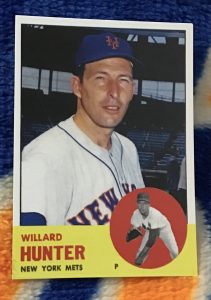 One day, two wins, not bad! The Mets, on the other hand, were about to win their day in landslide, capturing the nightcap in the bottom of the ninth, 5-4, on another bases-loaded single, Charley Smith delivering the deciding RBI off Don Elston. And who should be the pitcher of record? Willard Hunter once more, having hurled a scoreless top of the ninth to keep the game knotted at four. You’d have to call the half-inning that followed Hunter’s heroics pretty stubborn, as the Mets seemed in no rush to win despite the Cubs’ determination to lose.
Bobby Klaus led off with a single. Ron Hunt bunted him to second. Klaus took third on a wild pitch. Joey Amalfitano, nominally managing the Cubs as part of its infamous college of coaches, directed Elston to intentionally walk Joe Christopher. Then he ordered George Altman walked. No way the Mets couldn’t win now, except Jim Hickman popped up. Smith then lined a ball into left-center, ensuring Hunter’s name would live alongside Anderson’s and, eventually, Orosco’s.
Seeking a contemporary angle about Hunter’s dual feat of strength — what was being said in ’64 — taught me a couple of things:
1) Willard Hunter wasn’t necessarily referred to as Willard Hunter on his most productive professional day. Red Foley referred to him as “Hawk Hunter” in the Daily News. Frank Litsky in the Times called him “Bill Hunter,” as does the roster in a 1964 program I happen to have handy. Maybe he invented that game about not talking because he got tired of responding to so many first names.
2) None of the next-day coverage I could access, nor what awaited a couple of Saturdays later in the Sporting News, made a whole lot of hullabaloo over Hunter being the winning pitcher twice in one day. Just the fact that the 1964 Mets were hot, having won seven of eight, seemed to overwhelm the gentlemen of the press.
On one hand, barely noting the winning pitcher’s accomplishment is understandable, in that the winning pitcher totaled just an inning-and-two-thirds of work (while Cisco got bupkes for his eight almost spotless innings). These days we scoff if anybody makes too much of pitcher wins.
On the other hand, Willard “Bill” “Hawk” Hunter won two games in one day! Most of us don’t win anything on any day. Maybe if the media had known no Met would do it again for nineteen years and then nothing like it would happen for another thirteen years after that, when John Franco saved a first game and won a second game versus the Pirates on July 30, 1996, and then there’d be nothing even like that by a Mets pitcher from 1996 through the first season of the third decade of the 21st century, when doubleheaders were never scheduled in advance; Banner Day was a gauzy memory; and if two games were reluctantly played in one day, they were allotted no more than seven innings apiece (with extra innings bastardized by a runner starting each half-frame on second base)…maybe if the media had known all that, Willard Hunter would have garnered headlines rather than agate type.
C’mon, people of 1964, get excited — Willard Hunter won two games in one day!
Well, I’m excited in retrospect. Willard’s pair of W’s, which constituted half of his career total, leapt to mind a couple of nights ago when I learned the pitcher had passed away in early February at age 85. That unfortunate update to the all-time Mets mortality table is what caused me to try to learn a little more about a man who was apparently fine with you not knowing any more than his baseball record revealed. The obituary posted by the Omaha funeral home that handled his services mentioned his wife, his children, grandchildren and great-grandchildren, but nothing about baseball. Perhaps Hunter viewed those as his biggest wins, even if they were accumulated in a span longer than a single afternoon.
by Greg Prince on 28 February 2021 11:11 pm “Sure we’ll be better. How in hell could we be worse?”
As Spring Training prognostications coming off losing seasons go, no Met ever nailed it any better than Roger Craig did in 1963. Following a grand total of 40 wins in 1962, a pledge to not make that inaugural year look good by comparison was all a Mets fan could ask to hear. Of course the Mets are coming off only 26 wins in 2020, so the Mets of 2021 could just crib Craig and be done with it when somebody asks them about the season ahead. Just playing a full-sized season probably gets them more than 26 wins.
But they have their own thoughts.
• “For now, it’s great for me to just come in and be able to get my feet wet, meet the guys, see everybody again.”
• “The lineup from top to bottom is pretty incredible.”
• “Ultimately, the team goal is to win the World Series. The pieces we added, it’s going to be a huge plus.”
Those sanguine sentiments — from, respectively, Michael Conforto, Jeff McNeil and Jacob deGrom — will suffice for building enthusiasm among all us Whos back in Whoville grasping for reasons to believe in general and the Mets in particular. It’s the happy horsespit springs are made of. The lineup does project as potentially sensational. The Mets who weren’t Mets last year probably can’t be worse than the Mets who were Mets last year, though let’s not make that a challenge. And just seeing everybody again is not to be underestimated.
 This man knew how to set our sights. Seeing, hearing and experiencing the Mets from Port St. Lucie always makes for a splendid dose of dopamine, at least until the novelty fades a minute later. Yet we might come back around for a second injection of good spring vibes this March, provided we can get an appointment. It’s been winter for about a year now. Actual winter since December, winter in the baseball soul since October, but really just one long barren season of dismay since those moments in March of ’20 when we began to understand a pandemic was moving in and, other than taking precautions to personally ward it off, there was nothing we could do to shoo it away altogether.
Spring Training was going on then, perfectly normal in its comforting meaninglessness: games that didn’t count featuring players in cognitively dissonant numbers while the mind wandered to previous springs prologuing previous seasons. It was all working as it was supposed to, until it all stopped.
Not just Spring Training. Not just baseball.
There was a long-ass lull. There was a second version of Spring Training called Summer Camp. There was a hastily arranged mini-campaign consisting of 60 contests when winning 40 games made you not the ’62 Mets but a postseason favorite. There were two-dimensional figures sitting in the seats high-rollers normally use to look down at their phones while the games they pay a bundle to see live are in progress, though during the World Series, some people were allowed to enter a ballpark that was home to neither league champion. Watching the 2020 World Series highlight film on MLB Network the other night reminded me that after a while it almost began to feel like baseball last year.
But not that much. What begins for the Mets this week — the games that don’t count featuring the players in cognitively dissonant numbers while the mind wanders to previous springs prologuing previous seasons…this will feel more like baseball if nothing much goes awry. We no longer assume it won’t and we build in wiggle room via phrasing like “nothing much”. To count on nothing at all going awry seems like another dare fate doesn’t need to hear.
It’s the runup to a new year, one with vaccines and a little more knowledge than we collectively held in our heads last March. It’s a year about to include Mets on a field on the east coast of Florida with the idea that about a month later they’ll be on a field in the borough of Queens and maybe everybody watching them won’t be corrugated. I don’t know with any degree of certainty how our lineup will produce, where our record will end up or what our championship chances are. But sure we’ll be better. How in hell could we be worse?
by Greg Prince on 27 February 2021 5:52 pm Welcome to the eighth chapter of Faith and Fear’s historical countdown of the The Top 100 Mets of the 2000s. A full introduction to what we’re doing is available here. These are the more or less best Mets we rooted for as Mets fans during the decade FAFIF came to be. In honor of the 16th anniversary of our February 16, 2005, founding, we thought it would be fun (or at least not too painful) to revisit these guys and recall a little something about them.
30. JOSE VALENTIN, 2006-2007
The Mets might have viewed Jose Valentin as a square peg, but the round hole they had at second base had begun to ostentatiously gape. Driven to try anything there, they inserted the veteran they viewed mostly as a pinch-hitter. To the surprise of depth chart trackers everywhere, the player projected well behind several other second base candidates in March was ensconced as the Mets’ starting second baseman before May ended. By trusting a second Jose in the middle of their infield, the Mets received production and professionalism, peaking on September 18, when Valentin launched a pair of homers to help the Mets clinch their first division title since 1988. “Other” Jose-Jose-Jose popped eighteen homers during the regular season and drove in five more runs during the NLCS.
29. LENNY HARRIS, 2000-2001
Also a Met in 1998
28. JOE McEWING, 2000-2004
A bench is only strong as the players who understand that though they might sit on it for innings on end, that moment when they are told to get off it could be as important as any in the game. Mets bench strength was sturdy in the early 2000s whenever Bobby Valentine pointed to Lenny Harris or Joe McEwing. On October 6, 2001, Harris’s talent for hitting in a pinch was cause for Shea celebration as he recorded the 151st pinch-hit of his career. Tina Turner (“simply the best”) wafted over the speakers and Lenny’s teammates surrounded him at first base to commemorate the breaking of Manny Mota’s specialist record. Super Joe’s milestone seemed to be every at-bat he took against Randy Johnson. While his career average wasn’t really 1.000 versus the Big Unit, McEwing made a habit of connecting for big hits with the future Hall of Famer on the mound. Less glamorous but more essential for each Met was the versatility the extraordinarily likable pair gave Bobby V. In 2000, Lenny played first, second, third, left and right, DH’d in Interleague competition, and pinch-hit 45 times after his June reacquisition from Arizona. During that same pennant-winning year, Joe was all over the infield and outfield as needed. In his five seasons as a Met, McEwing pinch-ran 56 times, the most by any player in franchise history.
27. GLENDON RUSCH, 2000-2001
Also a Met in 1999
When nobody was looking, Glendon Rusch snuck into a rotation honing itself for a second consecutive playoff run. Rusch was around a little in 1999, but hardly enough to have a spot locked up for 2000. Yet the lefty earned a shot in mid-April, threw eight innings of four-hit ball at Pittsburgh, and kept coming back for more. By season’s end, Rusch had started thirty times and won eleven games, combining with Al Leiter and Mike Hampton to give the Mets their strongest lefty-leaning starting staff since the halcyon days of Koosman, Matlack and Stone. Assigned to the bullpen for the postseason, the unsung southpaw provided as much relief as Bobby Valentine could have hoped for, throwing 8⅓ innings in all and registering an ERA of 1.08. Most noteworthy were Glendon’s three stabilizing shutout innings in the 10-6 NLCS Game Four slugfest that otherwise shook Shea. The sedation of St. Louis resulted in Rusch’s only career postseason win.
26. BOBBY J. JONES, 2000
Also a Met from 1993-1999
The second-best pitcher to ever come out of Fresno produced the best postseason start ever crafted by a pitcher to come out of Fresno, even if usually reliable Bobby Jones was never going to be mistaken for immortal Tom Seaver. In 2000, it was all he could do to be the best Met pitcher named Bobby Jones. The Mets had a new lefty reliever that year who went by the same handle — Bobby M. Jones from Jersey. For a while, Bobby J. Jones from Cali wasn’t technically a 2000 Met. So unable to get batters out, the eight-year veteran agreed to accept a demotion to Norfolk to sort himself out. Returning from Triple-A at in midseason, the old Bobby Jones morphed into the old Bobby Jones again. Given his first opportunity to pitch in the playoffs in Game Four of the NLDS, he evolved into practically another Seaver, nurturing a gem of a shutout: one hit, two walks, utter mastery. That it also happened to clinch the Division Series didn’t hurt its instant legend. None other than Bob Murphy judged over WFAN that “the Mets have never had a better ballgame pitched in their thirty-nine year history than this game pitched by Bobby Jones.”
25. PEDRO FELICIANO, 2002-2004; 2006-2009
Also a Met in 2010 and 2013; No. 41 Met of the 2010s
If there was a dangerous lefthanded batter intent on doing damage to the Mets at a critical juncture in the latter innings of any game in the late 2000s, chances are Pedro Feliciano would magically appear sixty feet and six inches from him. Beginning in 2006, Feliciano never pitched in fewer than 64 games a year in any year over a five-year span. In 2008 and 2009, Pedro led the National League in appearances and set a Met record in that department twice (he’d do it again in 2010, raising the still-unmatched franchise mark to 90). To underscore his particular role and the value he brought to it, consider Feliciano’s success versus one of the batters he was retained to retire. Pedro battled the Phillies’ lethal lefty slugger Ryan Howard nineteen separate times across the final two seasons of the decade. He walked him twice. He never gave up a hit. The Phillies may have won the NL East war in those years, but head-to-head, Pedro was not readily conquered.
24. TURK WENDELL, 2000-2001
Also a Met from 1997-1999
George Mikan was retired from basketball. Mark Gastineau was retired from football. Wayne Gretzky was recently retired from hockey. But baseball’s signature No. 99 continued doing his thing as the century that began immediately after 1999 got in gear. The endlessly colorful Turk Wendell was still sporting that necklace of teeth he’d personally obtained from other species. He was still slamming the rosin bag as prelude to facing batters. And he was still steering the Mets safely through the latter innings of tight ballgames. In 2000, Turk pitched 77 times in the regular season — registering seventeen holds for the league champs — and six more games in the postseason. During the Mets’ critical Game Three victory over the Yankees in the World Series, Wendell came on in the seventh and struck out his first two batters, keeping the game tied long enough to hand it off to Dennis Cook, who handed it off to John Franco, who, after the Mets broke the tie, handed it off for shall we say save keeping to Armando Benitez. That sequence serves as a reminder of how much the Bobby V Mets relied on their bullpen and how often Turk acted as its anchor. Like the unusually high uniform number, the neckwear and the bit with the bag, Wendell coming through in the clutch was a trademark characteristic.
23. T#M GL@V!NE, 2003-2007
Except for workspace in which to reach his goal of a 300th win, T#m Gl@v!ne didn’t really need the New York Mets. Very much an Atlanta Brave icon, Gl@v!ne was romanced by the Wilpons prior to the 2003 season and accepted an attractive free agent offer to change NL East addresses. Gl@v!ne was used to pitching deep into October, while the Mets of that moment were clearly on a downswing that not even a two-time Cy Young winner was likely to reverse. During his first season at Shea, the would-be ace appeared out of his element pitching for a last-place outfit. He upped his game the next season, joining Mike Piazza to compose the Mets’ All-Star delegation (he’d be chosen again two years later). Eventually T#m settled in for what felt like the long haul, serving as the lone known, dependable quantity as the 2006 playoffs got underway. Indeed, Gl@v!ne, at age 40, won a game apiece in each series the Mets contested. Returning for 2007 with the 300 milestone in sight, the lefty achieved his aspiration on August 5 in Chicago. A week later, the Mets gave him his very own day, emceed by fellow 300 club member Tom Seaver. The fans who’d never warmed to him now applauded him heartily. T#m Gl@v!ne might be remembered fondly — might be remembered as “Tom Glavine,” even — had his Met story ended there, but the 2007 season had some miles left in it. By September they revealed themselves nothing but bad road when the eventual Hall of Famer pitched. In his final three starts, when he was needed to be at his best, Gl@v!ne fell far from it, posting a 14.81 ERA in what became three Met losses. In Game 162, with the Mets and Phillies tied for first and the Wild Card out of reach, T#m took on the Marlins in an absolute must-win…and didn’t, lasting only a third-of-an-inning while being charged with seven earned runs. That balls weren’t necessarily hit terribly hard off him was obscured in the aftermath of the 8-1 loss that finished off a 5-12 Met collapse when Gl@v!ne admitted that while he was “disappointed” by his performance, he was by no means “devastated”. The pitcher of record’s sentiments hardly matched the mood that permeated Flushing on September 30, 2007. Nevertheless, it would be the last thing the pitcher said as a Met and represents the epitaph for his five intermittently effective years in New York.
22. MIKE HAMPTON, 2000
Mike Hampton was acquired by the Mets ahead of the 2000 season for one very specific reason: to pitch the Mets into the World Series. The club that missed its desired October destination by two NLCS wins in 1999 needed somebody stellar to provide it the extra yardage for which its fans so desperately yearned, and Hampton — who was not beyond wearing a football helmet in the dugout — was deemed the man to carry the Mets the rest of the way. While he didn’t match the 22 wins he notched for Houston in ’99, Hampton eventually found his groove, pitching to a 2.39 ERA over his final dozen regular-season starts. Mike had helped the Mets to a Wild Card, but his prime directive was to get them to the World Series. In the 2000 National League Championship Series, the southpaw checked that most enormous box in a most impressive fashion. In NLCS Game One at St. Louis, Mike threw seven shutout innings en route to a 6-2 Mets win. In NLCS Game Five at Shea, Mike completely suffocated the Cardinals, tossing a three-hit shutout that ended in champagne showers. The Mets had won the pennant and Mike Hampton was voted the Championship Series MVP. With the final year of the contract he brought over from the Astros expired, he departed as a free agent after the World Series, accepting copious amounts of money to change uniforms, as athletes will…and identifying other factors as compelling him to make the switch in apparel, as athletes also will.
21. JAY PAYTON, 2000-2002
Also a Met from 1998-1999
Tom Petty never declared a favorite Met, but Jay Payton might have fit Tom’s bill, as one of the franchise’s most promising prospects of the ’90s exemplified Petty’s theory about the waiting being the hardest part. Drafted in the supplemental portion of 1994’s first round, injuries got in the way of Payton’s rise through the system, and the center fielder didn’t make the Mets for good until 2000. When he did, it took him some time to claim a regular role — center field didn’t become his alone until early June — but when he did, he broke only the hearts of the opposition. There were catches against walls that Spider-Man would have envied. There were seventeen homers, including one that won an extra-inning game versus Milwaukee in September, just as perennial late-season doubts were creeping into the Metropolitan conversation. There was a third-place finish in NL Rookie of the Year voting. And when things got as real could be, with the Mets having given up a ninth-inning lead to the Giants in the second game of the NLDS, there was Payton singling in Darryl Hamilton from second to recapture the upper hand for the Mets, enabling them to tie their set in San Francisco. Jay would hit safely in all five intracity World Series games, crowning his only Fall Classic appearance with a ninth-inning, three-run homer off Mariano Rivera, the only home run the usually untouchable closer surrendered across 36⅓ career World Series innings.
by Greg Prince on 26 February 2021 2:42 pm Welcome to the seventh chapter of Faith and Fear’s historical countdown of the The Top 100 Mets of the 2000s. A full introduction to what we’re doing is available here. These are the more or less best Mets we rooted for as Mets fans during the decade FAFIF came to be. In honor of the 16th anniversary of our February 16, 2005, founding, we thought it would be fun (or at least not too painful) to revisit these guys and recall a little something about them.
40. DEREK BELL, 2000
For a while there, the throw-in to the preceding offseason’s biggest deal turned out to be its biggest star. The Mets had to take the last year of Derek Bell’s contract off Houston’s hands if they wanted the real target of their affections, 1999 Cy Young runner-up Mike Hampton. The Astros’ presumed $5 million burden became the Mets’ April pleasure. By the end of a full month of baseball in 2000, Derek was slashing .385/.449/.567 and vaulting the Mets to a start nearly as smoldering, while the pitcher the Mets craved far more struggled to acclimate to New York. The right fielder was also the better story, what with him living on a yacht docked at a Hudson River marina. As he explained to Sports Illustrated, “Why chill on land when you can float in style?” But the summer months saw Bell’s bat drift out to sea, and an injury in the first game of the playoffs that sidelined the slump-ridden veteran for the rest of October didn’t tangibly throw the Mets off course. By the time the 2000 pennant flew high over Shea Stadium, Derek’s ship had very much sailed.
39. AARON HEILMAN, 2003-2008
The Mets never quite knew what they had in Aaron Heilman. His status as the club’s first pick of the 2001 draft out of Notre Dame suggests they thought they had a star in the making. Aaron’s elevation to the starting rotation in 2003 showed he had a ways to go before consistently retiring big league batters. When he threw a complete game one-hitter against the Marlins in April 2005, it could be inferred that Heilman had at last arrived. Yet soon enough, the righty was a staple of Willie Randolph’s bullpen, where for the rest of the year he thrived, even taking over the closer’s role by season’s end. But that was temporary, as he was shifted back to setup duty for 2006, and his effectiveness there no doubt helped the Mets build an impenetrable fort around their divisional lead. Perhaps regular-season workload (74 games) caught up to him in the playoffs. When Aaron was trusted to preserve a ninth-inning 1-1 Game Seven tie versus St. Louis in the NLCS, the faith placed in him shattered. Pieces of it were last seen flying over Shea’s left field fence, off Yadier Molina’s bat. The two-run homer Heilman allowed in that tensest of clutch situations was the difference between a pennant and a nice try, and try as he might in the two seasons that followed — and lord knows he tried, pitching roughly every other day in 2007 and 2008 — Aaron Heilman could never put it back together as a Met.
38. TODD PRATT, 2000-2001
Also a Met from 1997-1999
What do you do for an encore to the episode you’ll be known for the rest of your life? In the case of the man called Tank, you just keep rolling. Todd Pratt had made himself the patron saint of Met backup catchers when he socked the NLDS-winning homer that eliminated Arizona in 1999. In 2000, with his role secure, Todd continued to prepare for whatever might arise as Mike Piazza’s understudy. When the star went down as a result of a most horrific plot twist — Roger Clemens’s July 8 beaning in the Bronx — Tank stepped into the spotlight as he had the previous autumn. Back at Shea on July 9, when the Mets absolutely, positively needed to beat the Yankees, it was Pratt catching a 2-0 shutout and practically manufacturing the insurance run by himself via walk, advance on a bunt, advance on a wild pitch and a dash home on a fly ball. When he started in 2000, Tank hit better than .300. Just before he departed in a July 2001 trade, the catcher gave his about-to-be old team something to remember him by: a home run, off former Met Robert Person, in his final Met at-bat, a curious bookend to the home run he hit in first Met at-bat, off future Met Al Leiter, four years earlier.
37. ORLANDO HERNANDEZ, 2006-2007
For a team that was fairly secure in its first-place perch for six months, the 2006 Mets never seemed to have enough starting pitching to get them to the next series. Yet when they traded for Orlando Hernandez, that particular concern tangibly diminished. Acquired from the Diamondbacks in late May, the Cuban righty everybody referred to as El Duque baffled batters by blending speeds like nobody else in the majors (“Bugs Bunny curveball,” anyone?) and gave the Mets’ rotation a degree of stability it had been clearly lacking. After he racked up nine victories over the final four months of the season, the Mets looked forward to taking advantage of the veteran’s legendary October savvy; Duque had won his first eight career postseason decisions, a streak snapped by the 2000 Mets despite Hernandez notching a dozen strikeouts against them in Game Three of the World Series. Unfortunately, what El Duque could do in the home colors at Shea when the lights shone brightest was never discovered. Orlando suffered a calf strain prior to the start of the NLDS and wouldn’t be ready to pitch again until the World Series…a destination at which the Duque-deprived Mets never arrived.
36. TSUYOSHI SHINJO, 2001; 2003
If Tsuyoshi Shinjo wasn’t necessarily born to be a Met, his hair was dyed for life in Flushing. Yes, that was orange underneath his cap, a shade accessorized by his same appropriately colored wristbands and general fluorescent flair for the game. The former Hanshin Tiger became the toast of Shea in his initial appearance at the old ballpark, the 2001 Home Opener, when the right fielder blasted his first North American homer. The love affair burned brightly throughout the otherwise dispiriting first half, climaxing on May 20 when Shinjo’s walkoff RBI single spawned one of the most appropriate back page headlines of the decade, courtesy of the Daily News: “SHINJOY”.
35. OLIVER PEREZ, 2006-2009
Also a Met in 2010
34. JOHN MAINE, 2006-2009
Also a Met in 2010
Teams with their sights set squarely on the World Series generally have a pretty good idea who will constitute half of their postseason rotation well in advance of October. In 2006, the Mets went with a couple of barely known hands in the hopes they’d get hot at exactly the right instant. John Maine was the seeming afterthought in the deal that sent Kris Benson to Baltimore (with Jorge Julio the alleged “get”), but when holes opened on the staff, Maine commenced to filling one. The largely unheralded righty shut out the Astros on July 21 and placed himself on the fringes of the postseason consideration map. At the time, the Pirates harbored a talented if erratic lefty toiling away on the shores of the Three Rivers. His name was Oliver Perez. Ten days after Maine’s four-hitter, the two pitchers were Met teammates, with Perez’s acquisition considered secondary to supplementing the bullpen via the return of Roberto Hernandez. Ollie was viewed as a project for the future, though when he threw a shutout, versus the Braves on September 6, it was possible to believe the future was closer than expected. A month later, with veterans Pedro Martinez and Orlando Hernandez physically unavailable to pitch, the youngsters were thrust into the playoffs. Maine started the first game of the NLDS and twice more in the NLCS. Perez was given the ball in must-win Games Four and Seven of the Championship Series. Both acquitted themselves well enough to a) keep the Mets’ World Series dream aloft to the best of their abilities; and b) earn spots in the 2007 rotation. Given full seasons to show their stuff, Maine and Perez proved long-term finds, each of them winning 15 games for a club that would need every last win it could get. Injuries ended John’s major league ride in his early thirties. Ollie’s is still going, less than six months shy of his fortieth birthday.
33. FRANCISCO RODRIGUEZ, 2009
Also a Met from 2010-2011; No. 42 Met of the 2010s
Trouble with the bullpen? Sure, you could fix what’s in there, or you could go for a complete overhaul and theoretically have the whole thing come out like new. After the massive relief implosion that sucked September 2008 into oblivion, GM Omar Minaya didn’t mess around at the margins. Instead, he brought in the closer who’d just set the major league record for most saves in a season, Francisco Rodriguez of the Los Angeles Angels of Anaheim. K-Rod didn’t have to match the 62 saves he’d notched out west, but being the last pitcher standing at the end of as many games as conceivable would be splendid. For a while, Minaya’s vision was razor sharp. Frankie converted his first sixteen save opportunities and was logically named to his fourth All-Star team. The second half of 2009, with the Mets’ hopes to contend long gone, wasn’t as kind to Rodriguez, yet he still finished up with 35 saves, a long drop from the mark he set out west, but the most to that point by any righty Met closer not named Armando Benitez.
32. MIKE CAMERON, 2004-2005
Entering 2004, the Mets talked up speed and defense, having just signed as a free agent a player who embodied both. “CATCH THE ENERGY” was the slogan of the moment, and Mike Cameron its veritable spokesmodel. Cameron was a gifted center fielder, a basestealing threat, a dependable power threat and an refreshingly personable presence on a team whose profile could use some raising. The first impression he made, sitting atop the Mets’ dugout roof to sign autographs and engage fans prior to the Home Opener, certified his crowd appeal. The thirty homers he socked, along with the 22 bags he swiped and the many breathtaking plays he made from his post in shallow center confirmed Mike’s addition as a net Met positive. Yet whatever Cameron injected into the Mets’ bloodstream wasn’t viewed as vital enough in the big picture to hinder new Mets management from pursuing another center fielder — one younger, more talented and embodying the next come-on. The 2005 slogan, “THE NEW METS,” seemed like true advertising because, to the shock and delight of Metsopotamia, the club signed Carlos Beltran, the prize of his free agent class. Suddenly, Cameron was a right fielder and, ultimately, superfluous to the Mets’ plans. Though he made some spectacular catches in right, the image that serves as metaphor for Mike’s final Met season was him down on the ground after running headfirst into Beltran as each man dove for a sinking liner in San Diego. Both outfielders had to be ferried to the clubhouse by cart. Beltran would return to action in short order. Cameron never played for the Mets again.
31. XAVIER NADY, 2006
As a significant piece in what was turning into a magnificent puzzle, Xavier Nady fit the 2006 Mets beautifully. Unlike Mike Cameron, for whom he was traded, Nady was a willing right fielder. Within a lineup stacked with offense, he slipped quietly into the sixth or seventh slot most days and was content to take his shot at knocking in the runners who always seemed to be on base. His welcome to New York could not have gone any smoother, with a 4-for-4 performance on Opening Day and an average hovering in the neighborhood of .290 by mid-May. Though Xavier cooled off after a while, it seemed right field was a given as long as it was in Nady’s hands. Alas, come late July, the Mets judged it essential to remove the job and, for that matter, his uniform from his grasp, reluctantly trading their steady contributor to the Pirates for urgently needed pitching depth. Giving something to get something is a fair exchange. But as life without Xavier Nady reminded us, it can also be a real drag.
by Greg Prince on 25 February 2021 11:22 am Welcome to the sixth chapter of Faith and Fear’s historical countdown of the The Top 100 Mets of the 2000s. A full introduction to what we’re doing is available here. These are the more or less best Mets we rooted for as Mets fans during the decade FAFIF came to be. In honor of the 16th anniversary of our February 16, 2005, founding, we thought it would be fun (or at least not too painful) to revisit these guys and recall a little something about them.
50. MELVIN MORA, 2000
Also a Met in 1999
49. MIKE BORDICK, 2000
48. REY ORDOÑEZ, 2000-2002
Also a Met from 1996-1999
What had six legs, three gloves and rarely quite as much stick as you’d prefer? The shortstop position for the 2000 National League champion New York Mets. When the baseball decade began on the other side of the world, Rey Ordoñez was riding a 100-game errorless streak from 1999. He went one more game in Japan before committing a fielding faux pas, perhaps a sign of things to come for a 2000 that never got untracked in North America. In late May, the three-time Gold Glover was knocked out for the season with a broken arm. Rey’d be back for the two seasons that followed, but in the meantime, the Mets tentatively placed their World Series aspirations in the mitts of supersub Melvin Mora. Melvin could play many positions — and hit — but shortstop became a bit of an adventure. Too nervous to let 1999’s postseason comet settle in to handle routine grounders (and stymied in their quest to acquire Cincinnati’s Barry Larkin), the front office traded Mora to Baltimore for Mike Bordick, a presumed sure thing coming off his first All-Star selection. Mike started at Shea with a bang, homering in his initial Met at-bat, and was steady enough at short, but the veteran sputtered as the season morphed into the postseason. Worse for him and his team, Bordick played with a broken hand in the 2000 World Series after having it fractured by a pitch from Cardinal reliever Mike James in the first game of the NLCS. In the ninth inning of the last game of the Fall Classic, the Mets shortstop was none of the above. Instead, Bobby Valentine turned to reserve Kurt Abbott, who did not get to the final fair ball hit by a Yankee, Luis Sojo’s decisive proverbial 38-hopper, the one that broke a 2-2 tie and millions of Mets fans’ hearts.
47. CHRIS WOODWARD, 2005-2006
Hey baby, who’s your handyman? With apologies to Jimmy Jones and James Taylor, each of whom went to No. 2 on Billboard’s Hot 100 by assuming the identity of a fella who could do it all, Mets fans in the middle of the 2000s understood the role to be assumed by Chris Woodward. Wearing No. 4 all over the diamond for New York after parts of six seasons patrolling the infield in Toronto, Woody took a shine to his new surroundings in 2005, expanding his versatile portfolio to include the outfield. In his second career game in left — the same day Pedro Martinez made his home debut and Al Leiter his Shea return, all in front of a sellout crowd — Chris leapt to rob Luis Castillo in the eighth inning; turned the unlikely catch into a 7-4-3 DP; and set the stage for that afternoon’s dramatic Met walkoff triumph. Woodward’s at-bats were inevitably accompanied by Dire Straits’ “Sultans of Swing,” which proved appropriate, as three times in two Met campaigns Chris swung and reigned with the game-ending RBI.
46. MARLON ANDERSON, 2005; 2007-2009
One wouldn’t wish to burst the bubble of any of the other Mets who’ve turned the trick, but no hitter/runner ever generated inside-the-park home run excitement the way Marlon Anderson did on Saturday night, June 11, 2005. First, Marlon was coming off the bench cold, though he generally didn’t mind that circumstance, as he’d produce 18 pinch-hits in ’05. Second, it was the ninth inning, the Mets trailed by a run, there was one out, nobody was on, and he was facing one of the premier closers in baseball, young fireballing Francisco Rodriguez of the Angels; he’d seen K-Rod only once before, striking out in 2003. Third, when Anderson made contact, sending a ball to right-center field at Shea Stadium, the fielders converging were five-time Gold Glover Steve Finley and future Hall of Famer Vladimir Guerrero, strongly implying somebody was bound to catch it. Except the Gold Glove center fielder kicked the ball and it got by the future Hall of Famer in right, and humble Marlon Anderson motored like he’d never motored before and, to give us a fourth reason this was about to become the most exciting inside-the-park home run in New York Mets history, he was blowing a bubble as he ran. Who does that? Anderson, apparently. The PHITPHR bubble never burst, as Marlon slid ahead of the tag from Los Angeles of Anaheim catcher Jose Molina to tie a game the Mets would go on to win in eleven.
45. RICK WHITE, 2000-2001
Even the sturdiest bullpens can use a little reinforcement along the 162-game journey toward October. With the Mets harboring postseason aspirations, they realized one extra arm could make an enormous difference, specifically the right arm belonging to Rick White. The erstwhile Devil Ray arrived ahead of the July 31 trade deadline and got right to work, notching a win in his first appearance and pitching twenty times in his new uniform en route to the playoffs. Once Rick got to October, Bobby Valentine relied on him in the biggest of spots, the twelfth and thirteenth innings of pivotal NLDS Game Three versus the Giants. White threw two scoreless frames, keeping the score knotted at two, long enough for Benny Agbayani to step up and let the dogs out.
44. BRADEN LOOPER, 2004-2005
Whatever there was to save in 2004, Braden Looper saved most of it. The ex-Marlin stepped up as Met closer, preserving wins 29 times for a club that was victorious in only 71 attempts. His longest outing of the year didn’t involve a save, but it might have been his most impressive: three innings at San Francisco that positioned the Mets to hang on and eventually beat the Giants, 11-9, in twelve. Looper threw two ground ball double plays on a day when just looking at Barry Bonds seemed to put runs on the board for the home team. Braden added 28 saves for an improved Mets team in 2005, though wasn’t quite as effective, pitching with an inflamed right shoulder (and not mentioning it publicly) for most of six months.
43. MIKE PELFREY, 2006-2009
Also a Met from 2010-2012; No. 38 Met of the 2010s
The arsenal belonging to the tall righty from Wichita State University proved a bit of a shocker when it turned out to not include a fastball whose hardness matched its progenitor’s height, but 6’-7” Mike Pelfrey had others ways to get batters out. The Mets trusted their top draft choice from 2005 would tower over hitters as soon as he got the chance. Pelfrey didn’t disappoint in his major league debut, five innings of three-run ball over the Marlins on July 8, 2006, with the Mets plating seventeen runs on his behalf. Big Pelf, as he was inevitably called, began to put it together in earnest in September of 2007 winning three decisions before the walls fell in on the Mets’ divisional lead. Mike established himself to stay in 2008, starting 32 games and winning thirteen of them. When Shea Stadium gave way to Citi Field, it was Mike Pelfrey who threw the new ballpark’s first regulation pitch, a called strike to Padres center fielder Jody Gerut. Alas, the park’s third pitch was socked by Gerut for Citi’s first homer, but Pelf dug in and kept firing for the Mets through 2012 and in the majors until 2017. He has since returned to Wichita State, coaching the next crop of Shocker hurlers, tall, short and otherwise.
42. DESI RELAFORD, 2001
In the course of three batters, Desi Relaford turned himself into a Met folk hero. It was the ninth inning at Shea, with San Diego in town. Relaford struck out Jose Nuñez swinging and then elicited fly balls to center out of Bubba Trammell and Adam Riggs. What a cause for celebration it was. Was a division clinched? A Wild Card grabbed? Ground gained in a hot pennant chase? No, the Mets were losing by a dozen runs and would lose by a dozen runs, but Mets fans could forget for the moment what a miserable May night their lads were experiencing because Desi Relaford looked great coming out of the bullpen, getting his fastball up into the 90s when he did. Desi, you see, was an infielder. He’d never pitched in the majors before and he never would again. Given the state of the Mets bullpen as 2001 wore on, perhaps he should have.
41. MOISES ALOU, 2007-2008
When he stayed in one piece in his eighteenth and nineteenth major league seasons, Moises Alou was a Met sight to behold, particularly during one scalding thirty-game stretch. Indeed, when the veteran whose approach and production inspired invocation of the phrase “professional hitter” managed to remain upright, it was opposing pitchers who felt pain. From August 23 to September 26 in 2007, Moises got at least one base hit in each of the thirty games that he took an official at-bat (in the one game he played in that span when he didn’t, he pinch-walked, keeping his streak alive). The numbers Alou etched were staggering: 48 hits, a .403 batting average and a 1.034 OPS. The digits read as exponentially more impressive when one factors in the Mets’ immersion in a divisional derby with the Phillies, a tango they didn’t think was on their dance card when New York held a seven-game lead with seventeen to play on September 12…but never mind what was happening to the team. Appreciate that a 41-year-old pro’s pro who’d missed more than two months with a quad injury rose above the Met morass, pounding hit after hit game after game with the season increasingly on the line. Alou’s hitting streak grew into the longest in Mets history, a status it maintains to this day.
by Greg Prince on 24 February 2021 9:56 am Welcome to the fifth chapter of Faith and Fear’s historical countdown of the The Top 100 Mets of the 2000s. A full introduction to what we’re doing is available here. These are the more or less best Mets we rooted for as Mets fans during the decade FAFIF came to be. In honor of the 16th anniversary of our February 16, 2005, founding, we thought it would be fun (or at least not too painful) to revisit these guys and recall a little something about them.
60. DANIEL MURPHY, 2008-2009
Also a Met from 2011-2015; missed 2010 due to injury; No. 3 Met of the 2010s
The bat made itself known first. Within days of Daniel Murphy’s August 2, 2008, promotion, the 23-year-old was delivering one base hit for every out. Hit .500, even for a brief spell, and nobody will ask too many questions about your glove. The hot start, executed in a playoff race, sizzled enough to get Murph to season’s end with a .313 average and a leg up on a starting job for 2009. Left field didn’t quite work out, but Daniel made himself too useful to bench. With Carlos Delgado out for the year, Murphy emerged as the Mets’ starting first baseman and their leading slugger. True, that amounted to only a dozen home runs, but Citi Field was new, big and otherwise unconquerable to what healthy Met vets roamed its daunting expanses. Murph, his bat and a lockerful of gloves would be back to make Met history in the decade ahead.
59. TIMO PEREZ, 2000-2003
What a promising regular-season debut for Timo Perez! The September 2000 callup’s speed was eye-opening, as the Phillies discovered that same month, when the rookie zipped around Veterans Stadium’s bases for an inside-the-parker, his first homer in the big leagues. What a National League Division Series for Timo Perez! After Derek Bell exited with an ankle sprain, the kid from the Dominican Republic stepped in as the new starting right fielder, driving in some very big runs in Games Two and Three to help beat the Giants. Oh, and what a National League Championship Series for Timo Perez! A year removed from hitting .174 for the Hiroshima Toyo Carp of the Japan Central League, Timo put his stamp all over the Mets’ pennant drive, scoring eight runs in the five-game victory over St. Louis. Nope, there’s no way you can’t say Timoniel Perez didn’t play an enormous role in revving the Mets’ engine and catalyzing their trip to the World Series. And if you don’t run Timo’s story any harder than that into the fall of 2000, you’ll remember Perez’s contributions very fondly.
58. DARRYL HAMILTON, 2000-2001
Also a Met in 1999
Scoffing at the intangibles attached to veteran presence became fashionable as the 2000s grew older and more cynical, but when the decade was young, you could sit back and appreciate the value in a player who’d been around. Witness 35-year-old Darryl Hamilton in the 2000 National League Division Series versus the Giants, specifically in Game Two when the dozen-season major leaguer came off the bench in the tenth inning with two out and nobody on in a tie game at Pac Bell Park and lashed a double off tough reliever Felix Rodriguez. A moment later Darryl crossed the plate with the go-ahead run that held up to knot the series at one. How’d he do that? You don’t play a long time without learning a few things.
57. DENNIS COOK, 2000-2001
Also a Met from 1998-1999
Bobby Valentine didn’t hesitate to go to his prime lefty specialist for the two seasons the 1990s wore down, which might explain why that same southpaw appeared a little worn down himself as the next century got underway, yet Dennis Cook never stopped throwing his heart out for the Mets. Sixty-eight appearances in the pennant-winning season of 2000 and 43 more until he was traded to the Phillies in July of 2001 illustrate how much Bobby Valentine continued to rely on him. And let’s not forget October 2000: 17 batters faced, no earned runs on his ledger.
56. PEDRO ASTACIO, 2002-2003
55. KEVIN APPIER, 2001
Getting an established starter is one of those ideas that always comes off as agreeable in the offseason. It’s even better when it seems to work in the season ahead. Pedro Astacio was the epitome of rotation stability during the sunnier moments of 2002. The NL veteran went 5-1 in his first six outings, highlighted by an April 27 no-hit bid that lasted into the seventh inning against Milwaukee. A week later, with Pedro pitching, the first-place Mets rose to seven games above .500. The Mets leveled off from there, but Astacio gave his new team a dozen professional wins in all, second on the club behind Al Leiter. A spot was open on the Mets’ staff for 2002 because 2001 stalwart Kevin Appier had been traded to Anaheim for Mo Vaughn. Whatever Vaughn could do for the lineup, the 200+ innings Appier produced for the rotation (most among ’01 Mets) would require serious replacing. The former Royal stalwart made 33 starts, won 11 games and went 6-0 in the final third of the season as the Mets made a late lunge at the NL East title.
54. TY WIGGINTON, 2002-2004
The next big thing for Mets fans in 2004 would become one of the biggest things the Mets ever had: third baseman David Wright. But the thing to remember is though David’s debut was heavily anticipated, the guy he’d necessarily replace wasn’t so bad himself. For parts of three seasons, Ty Wigginton became one of the more satisfying Mets to pull for, especially in 2003. With much falling apart around him, Wiggy dug in, taking hold of the third base job after Norihiro Nakamura backed out a deal to come from Japan to New York. In 156 games, Ty totaled 146 hits and eked his way into NL Rookie of the Year voting. Though Wright’s promotion loomed tantalizingly on the horizon in July 2004, Wigginton never let up, no matter that his days were clearly numbered. Over Independence Day weekend, in the Shea portion of that year’s Subway Series, Ty’s bat totally wigged out: 6-for-12 with three homers and six RBIs as the Mets swept the three-game set. By month’s end, Wright had taken over third for the foreseeable future and Wigginton was packed for Pittsburgh. Ty’s major league career would last until 2013 and include an All-Star appearance for Baltimore.
53. DUANER SANCHEZ, 2006; 2008
Missed 2007 due to injury
Once upon a time, relief pitching was an indisputable Met strength. It’s hard to fathom, but it was true during the first four months of the 2006 season. The Mets ran and hid from the National League East, and it was the members of their late-innings corps that made certain nobody would catch them. Leading the charge out of the gate was ex-Dodger Duaner Sanchez, whose first 15 outings encompassed 21 innings and zero runs allowed. The Mets’ record in that span was a crisp 13-2. Sanchez’s spectacular season continued until late July when a late-night cab ride in Miami went awry and the pitcher wound up out for the year. The team’s divisional lead was secure, but in Duaner’s absence, the Mets’ uncharacteristic back-end strength was noticeably sapped.
52. ROBERTO HERNANDEZ, 2005; 2006
In longevity terms, you’d call him a warhorse, clomping his way toward a thousand major league appearances. When you watched the 2005 Mets, you saw him as the pitching staff’s workhorse, taking the ball more than any of the club’s relievers. At some point, you realized that when Roberto Hernandez trotted in from the bullpen, the club might be feeling its oats pretty soon. An unsung acquisition in the offseason that the Mets signed Pedro Martinez and Carlos Beltran, righty Roberto became Willie Randolph’s rock of a setup man, pitching 67 times and winning eight games. Though Hernandez left after one season as a free agent, the Mets would grab him back for the 2006 stretch drive, when he’d answer 22 more calls to the bullpen plus three more during the postseason.
51. JULIO FRANCO, 2006-2007
How old was Julio Franco? That felt like it should be answered with a punch line when the 1982 Phillie (who’d played with Tug McGraw, who’d played for Casey Stengel, who’d played for John McGraw) landed on the Mets at age 47, but the veteran’s bat and leadership skills were no joke as the Mets made 2006 a year to remember. Franco was the man who convinced Carlos Beltran to take a curtain call during the season’s first week, immediately changing the tenor of the fans’ relationship with their highly paid superstar. Franco was also a man who appeared intermittently ageless when he got a chance to play, such as when he became the oldest player to homer in a major league game, on April 20 at San Diego. He even stole six bases in ’06 and another couple in ’07. The funny thing about when you produce is nobody asks to see your birth certificate.
by Greg Prince on 23 February 2021 1:24 am When the word “designated” enters the clubhouse conversation, ballplayers must get a little glum. If you’re told you’re a designated hitter, it means your glove is deemed superfluous. If you’re told you’re designated for assignment, it means the entirety of you is deemed superfluous. Until somebody declares different, the NL reverts to a DH-free zone in 2021 (CBA be praised), but DFAs remain a perennial and more than a little cruel tool in sorting out personnel.
WTF’s the deal with DFAs? Major League Baseball helpfully explains, “Clubs may utilize this option to clear a spot on the 40-man roster — typically with the intention of adding a newly acquired player (via trade or free agency), a Minor Leaguer or a player being activated from the 60-day injured list,” meaning “people we think are more important than you at the moment…yeah, we’re gonna need you to come in early and clean out your locker.”
Let’s revisit the fine print regarding designation for assignment, per MLB:
• You’re off the 40-man (by the by, if 25-man rosters are now 26-man rosters, why aren’t 40-man rosters now 41-man rosters?).
• You have seven days to be traded or placed on irrevocable outright waivers, which sounds even colder than being designated for assignment.
• If another team claims you off waivers, your new team may really want you, but they may also want to option you to the minor leagues, which they can do if they don’t necessarily want you within an arm’s reach of desire. Congratulations, and welcome back to limbo.
• If you clear waivers, you can be sent to the minor leagues without ever leaving the organization that already told you their lives are at least marginally better without you…or you can be released, which is great if you’ve been in prison, a mixed bag if you liked knowing you knowing you were a gainfully employed professional baseball player.
• With requisite service time or previous outrighting behind you, you can say, in essence, “DFA me? DFA you!” to your old team and declare yourself a free agent, implicitly telling 29 other teams, “Come and get me!” Then, of course, you have to hope somebody will.
When you’re the player who’s been designated for assignment, what are you to think? You’re the sweater that doesn’t quite fit any longer, and we don’t necessarily want to get rid of you, but we do need to make room for a nicer sweater. Maybe somebody else wants you. But if they don’t, we’ll put you in another drawer, with the sweaters we’re not as likely to wear, but hey, you never know. If we get really chilly, we might poke around and pull you out.
The busy-beaver Mets front office has designated four players for assignment recently. Where are they now?
When the Mets signed motivational speaker and defensive specialist Albert Almora, Jr., they designated Corey Oswalt for assignment. What’s that saying about Corey Oswalt? He’s the sweater nobody else wants. Corey Oswalt cleared waivers and was outrighted to Triple-A. Corey Oswalt’s been optioned to Triple-A ten separate times since 2018. He should check his contract to make sure the Mets haven’t legally changed his name to Corey OswAAAlt.
When the Mets swung their portion of a three-way deal to acquire speedy outfield prospect Khalil Lee from Kansas City for flotsam and jetsam from the Steven Matz swap (Matzam?) Josh Winckowski, they designated Ali Sanchez for assignment. Somebody in St. Louis wanted Sanchez, a young catcher who seemed to play the last five innings of every Spring Training game since Clover Park was Digital Domain Dome. It was probably Yadier Molina, wishing to personally train a successor in Met torment (like Yadier Molina will ever go away). The Cardinals officially traded cash to the Mets for Sanchez. That used to be reported as “the Mets sold Sanchez to the Cardinals,” but in 2021 it’s hard to imagine anybody being comfortable about announcing they’d just sold somebody to somebody else.
When the Mets signed Jonathan Villar with the obvious intent of engineering hilarious cases of mistaken identity with Kevin Pillar, they designated Brad Brach for assignment. Due respect to all the other “grew up as a Mets fan” feelgood stories who’ve worn the orange and blue, but Brad Brach really grew up as a Mets fan, so much so that he attended Game Three of the 2015 World Series and considered David Wright’s home run one of his greatest baseball thrills. Me, too, except by 2015, Brad Brach had been pitching in the big leagues since 2011. So he was one of us, and now he was literally one of us, depending on how much of a stickler you are about applying third-person plural to fans of teams. Then one day in the Spring of 2021, he wasn’t one of the us he/we rooted for. Brad cleared waivers and got released. He’s since signed with Kansas City, which was probably something he wasn’t anticipating that October night six years ago when the last team he wanted to be of help to was the Royals.
When the Mets signed Kevin Pillar, they designated Guillermo Heredia for assignment. Guillermo’s DFA is still in progress, having happened on Sunday and this is only Tuesday. The Mets made their 1999 marketing slogan, “Are You Ready?” In 2021, “Are you Heredia? You are? Luis wants to see you” hasn’t been nearly as appealing a come-on. You can’t blame Guillermo if he sensed the grim reaper approaching and cried, “DON’T DESIGNATE ME, BRO!” Heredia struck the attention-paying fan from last September as a useful outfielder. Pillar struck those who make the decisions these days as a somewhat more useful outfielder.
The late, great Bill Withers probably wasn’t thinking about DFAs when he sang, “You just keep on usin’ me until you use me up,” but when the designations for assignment start flying, ain’t no sunshine when you’re gone. Unless you’re Corey Oswalt. Then you’ll probably be flying in from Syracuse sooner rather than later.
by Greg Prince on 22 February 2021 10:06 pm Welcome to the fourth chapter of Faith and Fear’s historical countdown of the The Top 100 Mets of the 2000s. A full introduction to what we’re doing is available here. These are the more or less best Mets we rooted for as Mets fans during the decade FAFIF came to be. In honor of the 16th anniversary of our February 16, 2005, founding, we thought it would be fun (or at least not too painful) to revisit these guys and recall a little something about them.
70. VANCE WILSON, 2000-2004
Also a Met in 1999
69. JASON PHILLIPS, 2001-2004
Break glass in case of emergency, but pray the glass stays pristine. For the Mets of the early 2000s, any day when Mike Piazza wasn’t available could constitute a crisis, as three months without their superstar catcher could pretty much shut their offensive world down. From the middle of May until the middle of August in 2003, Piazza was out with a nastily torn right groin. The result could’ve been enough broken glass at Shea to keep Annie Lennox walking from here to Astoria. Sweeping in to sweep up the debris were two catchers intent on keeping Art Howe’s Mikeless ship from altogether capsizing. Vance Wilson was a defensive catcher who normally couldn’t catch enough reps behind the plate to establish himself as a fulltime receiver because, well, Piazza. But Piazza’s bad ’03 break was a decent one for Vance, netting the future Hall of Famer’s caddy a career-high 72 starts and a personal-best eight homers. Jason Phillips stood up from squatting behind both Mike and Vance that same season to take the first base starts Mo Vaughn left behind when chronic knee pain absented the slugger altogether. In more than 400 at-bats, the goggled one proved nearly a .300 hitter in 2003, good enough to earn him de facto starting catcher status in 2004 when Piazza toted his mitt over to first base. Mind you, there was no substantive substitute for the greatest-hitting catcher of all time, but when you had Wilson/Phillips, you could hold on for one more day.
68. KAZ MATSUI, 2004-2006
Something was lost in translation. Kaz Matsui was a highly regarded shortstop in Japan. The Mets decided they absolutely had to have him in 2004, never mind that the one budding star they’d introduced in 2003 was shortstop Jose Reyes. The Mets signed Matsui, shifted Reyes to second, and waited for middle-infield magic to happen. It never did, mostly because Kaz wasn’t the cause for excitement in America that he’d been back home. Diving for balls simply wasn’t something he’d done a Seibu Lion, and it showed in the National League. He also couldn’t stay healthy consistently, and that, too, tried patience within the not-always-reasonable precincts of the Mets fan community. By 2005, Matsui was assigned second, which improved shortstop at once (becoming Jose’s dominion again), but Kaz continued to be plagued by injuries, slumps and a general level of discomfort he could never shake. Still, he did display speed; could get hot; and had the strangest knack for whacking the very first pitch he saw in every season he was a Met for a home run, one of them an inside-the-parker. If only he’d led off and left town for twelve months, Kaz Matsui would go down as a legend rather than a cautionary tale.
67. DAMION EASLEY, 2007-2008
No Mets fan would argue that every Met in 2007 and 2008 didn’t deserve a trip to the postseason, but if you were willing to look past the uniform, there was one Met you had to root hardest for to reach October. After fifteen seasons of service in other outposts, Easley found himself a 37-year-old veteran missing one appearance in an otherwise honorable career: not one single second in postseason play. Damion joined the Mets following their 2006 playoff run, ready to back up at almost any position and ride the Flushing wave into autumn. The former AL All-Star did his part well enough, knocking in the occasional big run and filling in steadily, particularly at second base. But the team he joined was not the team it became, and after near-misses (to put it kindly) in September 2007 and September 2008, Damion Easley finished his career with 1,706 regular-season games played and zero in the postseason, at the time the most for any player whose career included the Wild Card era.
66. GARY SHEFFIELD, 2009
Sooner or later, it had to happen. When your uncle is Dwight Gooden, when your profession is baseball and when your talent is undeniable, your destiny says you will land on the New York Mets. Mostly it was the Doc connection that always made Gary Sheffield loom as a hypothetical Met trade target. He had played for seven other franchises over 21 seasons until the storyline got its inevitable final paragraph, with Sheff signing as a Met on the eve of the opening of Citi Field in 2009. The Mets were a little short in the outfield, so the 40-year-old found a temporary home in left. Almost as soon as he got to Queens, Gary hit the 500th home run of his illustrious career, making him the first to reach that high a milestone in a Met uniform. It also meant he’d joined Doc’s old teammate Rusty Staub in the palmful of players who’d homered before turning 20 and after turning twice that. He’d keep up his powerful ways for a few months before aging into retirement.
65. BRUCE CHEN, 2001-2002
The eyes of a city were upon a newcomer the night of September 21, 2001. The Mets were facing the Braves in the first baseball game New York was hosting since the terrorist attacks of ten days before. Was it too soon? It couldn’t be for Bruce Chen, whose job it was to throw that Friday’s first pitch and resume the path to municipal normality. The ex-Brave, acquired from the Phillies in July, did his part splendidly, giving up no earned runs over seven tense innings, setting the stage for Mike Piazza’s bat to take care of the drama and catharsis in the eighth.
64. LASTINGS MILLEDGE, 2006-2007
Reach out and touch Lastings Milledge. If you sat in the first row of the right field stands on the Sunday afternoon the Mets’ first-round draft pick from 2003 hit his first major league home run, you had an excellent chance of personally making contact. In the bottom of the tenth inning on June 4, 2006, with a runner on and the Mets trailing by two runs, Lastings went deep to tie the Giants and extend the action. Jogging back to his position, he exchanged casual high-fives with any fan who wanted them. A baseball generation or so later, he’d likely be marketed as the kind of player the sport desperately needed. Back then, before anybody thought to celebrate let alone retweet a bat flip, the old guard (manager Willie Randolph especially) tut-tutted. Perhaps if Milledge had hit and hustled more consistently, he would have been welcomed more heartily into the fraternity. Later in 2006, Lastings would be greeted by a sign at his locker that warned him to “KNOW YOUR PLACE, ROOK.” When his place was in the starting lineup, he could demonstrate why he was drafted so high, but any chance Lastings would put all of his tools together in New York was short-circuited following the 2007 campaign when he was traded to Washington for Ryan Church and Brian Schneider.
63. RAMON CASTRO, 2005-2009
The easing out of a legend is never easy, though the process that edged Mike Piazza toward the Shea Stadium exit in the final year of Mike’s long-term contract seemed a little less upsetting that it could have been on those days Piazza’s position was in the capable hands of Ramon Castro. Putting down targets to the approval of new Met ace Pedro Martinez, Castro made himself indispensable to the hopes of the 2005 Mets, getting into almost a hundred games and blasting off Ugueth Urbina the season’s most important home run, a three-run job that vaulted the Mets over the Phillies on August 30, moving New York to within a half-game of the NL Wild Card. September contender aspirations at Shea soon disintegrated, but Castro cemented his role as the Mets’ main backup catcher for the next several seasons of wire-to-wire contention.
62. PAT MAHOMES, 2000
Also a Met in 1999
Pat Mahomes was a long-relief revelation during his first season as a Met in 1999. Come 2000, his role would expand to see the veteran start five times, including a brilliant 5⅔-inning outing in which he gave up only two singles and no runs to the Dodgers en route to a 1-0 victory that became the Mets’ eighth straight win. But maybe what Mahomes should most be admired for from 2000 was his prescience in bringing his namesake son to Shea to shag flies during the postseason. Young Patrick, then five, was photographed warming up alongside Mahomes’s staffmate Mike Hampton in the leadup to World Series action. It’s a picture that would circulate widely and give Mets fans pride some twenty years later as Patrick grew up to lead the Kansas City Chiefs to an NFL championship in Super Bowl LIV.
61. DARREN OLIVER, 2006
If the Mets’ collective back wasn’t against the wall, it wasn’t too many inches from cold concrete when one Met stepped up to, as the saying goes, take one for the team. In Game Three of the 2006 NLCS, the club had fallen disturbingly behind the Cardinals in the third inning. Darren Oliver, who’d been the long man for Willie Randolph all year, entered in the second inning. He’d stay on the mound through the seventh, allowing no earned runs in his six innings of work, preserving the rest of the Mets’ pen so they could rest and be ready for the must-win games that lay ahead.
|
|






