The blog for Mets fans
who like to read
ABOUT US

Faith and Fear in Flushing made its debut on Feb. 16, 2005, the brainchild of two longtime friends and lifelong Met fans.
Greg Prince discovered the Mets when he was 6, during the magical summer of 1969. He is a Long Island-based writer, editor and communications consultant. Contact him here.
Jason Fry is a Brooklyn writer whose first memories include his mom leaping up and down cheering for Rusty Staub. Check out his other writing here.
Got something to say? Leave a comment, or email us at faithandfear@gmail.com. (Sorry, but we have no interest in ads, sponsored content or guest posts.)
Need our RSS feed? It's here.
Visit our Facebook page, or drop by the personal pages for Greg and Jason.
Or follow us on Twitter: Here's Greg, and here's Jason.
|
by Greg Prince on 4 April 2021 5:45 pm The Mets are about to begin their season and we Mets fans are about to begin it with them. I know we thought we’d be three games deep into this new year by now, but better late than never.
What will 2021 bring? In terms of wins and losses, we’ll see. In terms of what stays with each of us over the long haul, probably a lot more than we realize. Everybody processes these seasons personally and continually. I’m pretty sure two of the main reasons we keep coming back is for what it connects us to in the past and for what it will connect us to in the future. I got a renewed sense of that eternal baseball truth from a message sent our way recently by a lifelong Mets fan named Stephanie Pianto. She’d recorded some thoughts a while back about her fandom, specifically as it pertained to the relationship she treasured with her late father Salvatore. I asked if she’d permit us to publish them and she was kind enough to agree.
For everybody who’s loved the Mets…and for everybody’s who’s loved loving the Mets with somebody else who’s loved the Mets…we proudly share Stephanie’s essay.
***
Baseball starts again soon with a meaning that changed for me four years ago. That season, the 2017 season, began with the death of my father directly after Opening Day weekend. It was the first year I made the leap to becoming a season ticket holder for the first and, as it turned out so far, only time. That decision was made the previous September when the Mets were heading into the postseason for the second year in a row. It was also around then I made the decision to move out on my own and for the first time live completely independently without a significant other or spouse; no kids, no siblings, no parents. That season ticket included access to the 2016 postseason plus every Sunday home game and a few other choice games during the next season. I could see far into the future a life where I spent every spring and summer Sunday at Citi Field in rain or shine.
You see, my love of baseball was a gift that had been handed down to me by my father and my cousin. I felt a part of something when we talked ball. It especially cemented a bond between me and my father — a bond that included carpentry, auto mechanics and bar life. A little blonde petite girl I was, but to him I was “his boy,” being the oldest of two daughters. So, feeling a great sense of accomplishment, I plunked down my $1,500 to sit amongst the diehards and the naysayers and truly become a part of the season ticket universe. At 54 years old, it was a sort of retirement in my mind.
October 2016 came around and the Mets blew their one-chance Wild Card game, ending that season as they had almost every other season: defeated (though I did keep my ultimately unused World Series tickets and the box they came in). Yet I couldn’t be totally let down, because I was graduating to a new identity, as a season ticket holder — with a VIP card and everything come April! Trade talks and rumors abounded just like every year, but it held a new significance now, as if I were on the payroll or the board of directors or something. I had arrived at a point in life where I could say I was in control of my destiny and part of that destiny was spending as much time as I wanted to watching the Mets from my own personal reserved seat. It was exhilarating.
But we all know how life is.
Crushing news came that winter when my father was diagnosed with stage 4 pancreatic cancer. Baseball really wasn’t on my mind at this time, and I began to summon up the fortitude for the most difficult role I’d yet to play, to be the hand of strength and guidance to my dad. He was “my boy” now.
Cancer is a terrible disease. I’m sure I don’t need to go into detail. Everyone has been around someone who has suffered its pitiless, marauding rampage. Watching my father become a helpless child, sometimes calling out for his deceased mother in his sleep and at other times trying to defy the strict bounds that the disease had placed on his freedom, made me realize how much I don’t have control over anything. I kept a poker face so I could keep him from reading the fear in my heart, telling him next summer I’m going to bring him to one of the games. I navigated him through well-wishing friends and relatives with their miracle cures and their sometimes obvious grief when they came to visit him toward the end and saw his obviously withering life. Everyone’s intentions were pure, but there was no simple way to accept death’s inevitable knocking on the door.
In the spring of 2017 my sister and I held his hands on his hospice bed as his pulse and breath halted. We let him leave this earthly realm to hopefully reunite with the loved ones he had been dreaming about every night toward the end.
So, now my story turns back to baseball and why it means so much to me.
***
The Mets’ opening weekend of 2017 was the last weekend my father was in his home, the last time I spent with him in his nest, surrounded by our memories. I forfeited going to every game that weekend except for Opening Day because that was the tie he and I shared. He was proud of me, “his boy,” going to the stadium all by myself, something he himself had done in his youth, and carrying on the tradition of something we loved together. Growing up, I idolized my dad. He was always the “coolest” guy and had a lot of that Italian swagger. He grew up in Brooklyn and Queens and was originally a Dodgers fan but adopted the Mets since they played right in his backyard (and he would never, never be a Yankees fan). From as far back as I can remember, wherever he was was where I wanted to be. On Saturdays and Sundays when I was growing up in the 1960s, that meant our Long Island home, when he was right in front of the TV with my uncle and my grandfather watching the Mets on Channel 9.
My two cousins Tom and Barbara, who were older than me, and I loved to sit around with the old guys and listen to their animated critique of every player, every play and every umpire’s decision. One minute they’d be calling everyone a bum, and then in another minute they’d be jumping up out of their seats in the den and beaming with joy at the incredible talent and good judgment of the whole lot of them. It was funny to hear the nicknames or attributes my father and uncle would come up with. For instance, Eddie Kranepool “runs like a baby elephant” (sorry Eddie, if you’re reading this, we love you and you’re a treasure). Or, overemphasizing the vowels in “Cleooooooon Jones” when he’d make a great catch or deliver a run. But we never touched Seaver or Koosman. Those guys were always given the utmost respect.
In the 1970s there was no chance I’d ever get to play baseball on a team, being female. And softball was out of the question. Nevertheless, I would spend hours talking technique with my dad and he’d give me pointers on how to judge a strike as he lobbed ’em in slowly to me on the front lawn. He even taught me to throw righty because as a lefty I would catch the ball in my left hand and drop my mitt to throw the ball. He said you can’t do that, so pick which hand you’re gonna do what with. I have to say I had a pretty good arm, and when I played catch with the neighborhood kids, they were impressed at how hard I could throw…and with considerable accuracy!
Even after I had moved out of the house and married in the 1980s, the phones would immediately be ringing between me, my dad and cousin when the Mets scored a run or made a stupid play. No matter where we were, we were always connected if there was a game on. If any of us was fortunate enough to be at a game, we’d call each other from the stadium and report on what was going on in the crowd.
So when I left from his house that Opening Day four years ago to get on the LIRR and head for Flushing, I was taking my dad with me in spirit because I knew how helpless he felt being bedridden at that point.
And I did something else which I knew was meaningful to him. I wore my cousin’s 1980s-era royal blue satin jacket with the embroidered Mets logo to the game. My cousin Tommy, one of our original gang of weekend warriors, was my first baseball hero, playing TriVillage Little League in Huntington at shortstop when we were kids. He was the “catch” partner to my father and me whenever we constituted a trio. Tommy had passed away at the age of 33 from cancer. After his death in 1993, I didn’t watch baseball for a very long time. For years. It wasn’t the same knowing he wasn’t also watching from somewhere and calling with updates on the score or to tell me to put the game on because they have a rally going. It wasn’t until I was dating a guy who was a Mets fan and started taking me to games in 2010 that I began to get back on the horse. By 2017 it was my duty to show my dad that things will go on. Things will be remembered. He will be remembered.
Baseball definitely hasn’t stopped for me without my dad as it did when my cousin Tommy died, even though I’ve moved away from the immediate Metropolitan Area and haven’t been back to Citi Field since the year I had those season tickets. I still watch and listen to the games (sometimes with my two-year-old grandson who has a particular leaning to the colors of orange and blue). My dad left an indelible stamp on me. I still celebrate every strikeout, every error and every home run as testimony to our enduring love.
To my daddy, and to baseball.
by Greg Prince on 2 April 2021 6:13 pm The pencil manufacturers of America have been enjoying boom times these past two baseball seasons, what with the folly of penning in ink anything that hasn’t happened yet becoming ever more evident. Or have you seen the Mets open the past two baseball seasons as originally scheduled?
Last year is last year, but this year’s still got a little too much 2020 juice to it, what with an entire series of baseball games — merely the ones the Mets were going to use to open 2021 — postponed by positive COVID-19 tests among unidentified Washington Nationals. You hope everybody concerned is healthy. You wish there was a viable alternative to shutting everything down. A year ago was worse. A year ago we waited four months rather than four days. A year from now figures to be better. A year from now vaccinations figure to have taken hold. For the moment, contact tracing’s gotta do its thing, even if it dares to dampen our weekend.
So instead of marking down the dandy Opening Night pitching matchup of deGrom vs. Scherzer in your scorebook Thursday night and then proceeding with best laid Metsian plans Saturday and Sunday, our season won’t come until Monday night in Philadelphia, Jake still listed as probable pitcher (“probable” proving a very viable word) for us, Matt Moore doing the honors for the Phillies, though it’s unlikely the Phillies will feel particularly honored. They’ve already opened their season. For them, the Mets’ first game will be just another Monday night at the office. Hopefully the Mets will be festive enough for both clubs. Also, Matt Moore isn’t Max Scherzer, which is not a putdown of Matt Moore nor a troll of the baseball gods. Two different pitchers is all.
• Max Scherzer, a righty, is one of the best to ever oppose the Mets on Opening Day or any day, as his vintage 17-strikeout no-hitter attests.
• Lefty Matt Moore’s career ERA is over four-and-a-half and the Mets have spanked him each of the three times they’ve faced him.
• Scherzer’s been a Nat in our side since 2015.
• Moore pitched in Japan in 2020.
• Scherzer’s very likely going to the Hall of Fame.
• Moore can buy a ticket.
But one steamy night in 2013 they were teammates in different uniforms. Scherzer of the Tigers started, Moore of the Rays relieved. Neither gave up a run. That was the All-Star Game at Citi Field. Matt Harvey started for the National League. He’s of the Orioles now. Time drags when you don’t have the series of games you think you have but otherwise flies, eh?
After deGrom vs. Moore, Marcus Stroman and David Peterson are slated to go at Citizens Bank on Tuesday and Wednesday before ol’ No. 99 Taijuan Walker starts the National League season in New York on Thursday. But these days that’s getting way ahead of ourselves. Let’s get to Monday. Let’s get to Philadelphia. Let’s get the ball into the business hand of Jacob deGrom.
And let’s keep an eraser handy, just in case.
by Greg Prince on 1 April 2021 11:52 am A lifetime spent staring at the Mets’ skyline logo inevitably draws the eye to the bridge in the foreground. As the franchise’s official explanation details, the span “symbolizes that the Mets, in bringing National League baseball back to New York, represent all five boroughs.” It’s a helluva Met-aphor, and fairly close to geographically accurate from a Flushing-honed perspective. There are bridges that will carry a person between Queens and the Bronx, Queens and Manhattan, and Queens and Brooklyn (including the Kosciuszko Bridge, a.k.a. the Mientkiewicz). Getting from Queens to Staten Island by bridge, however, is like getting the Moderna or Pfizer vaccine: it’s gonna take you a couple of shots.
 The eye inevitably meets the bridge. Yet thanks to the Mets’ decision to play part of their schedule on (in?) Staten Island this season, you might say Queens and Staten Island will be like Johnson & Johnson. If anything, they’ve grown closer. Or as the old saying goes, you’re gonna win a third of your games, you’re gonna lose a third of your games and some games you’re gonna play somewhere you’ve never played before…maybe even Staten Island.
The convenience factor is selective, but after a year-plus of our lives being upended by COVID-19, I guess it’s not too much of an imposition to have approximately one-sixth of all Mets home games played in (on?) Staten Island until further notice. It’s great news for the Mets fans on, in or near Staten Island. I’m not one of them, but I’m not all the way home in terms of being fully vaccinated, either, so it won’t really matter to me personally. Except that it’s the Mets doing it, so of course it’s personal, if only from a distance.
Make that Francisco Lindor and the Mets doing it. Still can’t get over that deal, even with E-ZPass.
Given that New York City and New York State have expressed concerns about maintaining vaccination momentum at supersites like the one established at Citi Field, I understand why authorities don’t want to take such an ideal locale totally off their map. And Major League Baseball, despite the danger the Rangers may be courting in Texas, is right to be legitimately concerned about sanitization in its facilities. Having close to 10,000 Mets fans not in the building about once per homestand certainly won’t hurt the greater good.
Thus we’ve received the joint announcement that home Saturdays will be known in 2021 as Staturdays with the Mets, Presented by Statcast, Powered by Google Cloud. Each Saturday game the Mets host this season — or at least until vaccination penetration reaches that elusive herd immunity level — will take place not at Citi Field but at Richmond County Bank Ballpark at St. George. (Props to the financial institutions for working out the naming rights niceties.) The first time the Mets ferry to Staten Island will be a week from Saturday, on April 10 at 1:10 PM vs. the Marlins. The rest will be day games, too, either at ten after one or ten after four, depending on whether Fox intrudes. Otherwise the Staturdays with the Mets, Presented by Statcast, Powered by Google Cloud games will air on WPIX, Channel 11 in New York and stream, unsurprisingly, via Google Cloud. It’s unclear whether Gary, Keith, Ron or Steve Gelbs will travel with the team or conduct their business from the Citi Field booth or SNY studios.
Per the regulations put in place for public safety, I won’t be going to a game for a while. Maybe a while longer depending on my own comfort level with crowds. Not that the crowds in (on?) Staten Island will be that voluminous. Density is another story. Capacity at the former minor league ballpark is normally 7,171, but normal remains up for grabs. The Mets are capping SI tickets sold to 5,010, which is, appropriately enough this time of year, quite the Easter egg, as 5,010 represents 69.86% of RCBB@SG capacity.
Nice touch, Mets, as, in theory, is the mandate that all fans attending games on (in?) Staten Island must wear Mets-branded masks, even if they must be purchased cashlessly directly outside the ballpark. The Mets are masking their mandate as an anti-COVID measure, citing studies that show bringing previously purchased masks across bodies of water limits their effectiveness. One of the professional curmudgeons at the Post called it the Staten Island Stimulus, and not approvingly. Whatever. Staten Island residents who show three forms of ID will be exempt from having to buy new masks directly from the Mets, but will, of course, still have to wear a Mets-branded face covering. Just as at Citi Field the rest of the week, fans will also have to show proof of a negative COVID test or full vaccination.
Knowing Governor Cuomo and Mayor de Blasio shared concerns about altogether diminishing Citi Field’s efficacy for vaccinations (about the only thing they share, it seems), Steve Cohen volunteered the Mets to move out of Queens on what amounts to a bi-weekly basis. It may not be as community-minded as it sounds, however. The city and state are each going to give the Mets special “financial considerations,” reminding us that Steve Cohen didn’t get to be Steve Cohen just on Twitter charm. And goodness knows Rob Manfred, whose “Minor Your Own Business” program was going over like a lead balloon, was no doubt pleased to find an otherwise vacant baseball factory up and running again. Should you choose to be a cynic, this can also be framed as a dry run of sorts for the proposed proposed Tampa Bay-Montreal arrangement, though the Mets are at least staying in the same city not to mention country. With Cohen being so accommodating, word is the commissioner is ready to exempt a certain baseball team from certain luxury tax thresholds for having, well, played ball. More incentive to pay Messrs. Conforto, Syndergaard and Stroman what they want, I’d like to believe, though — Mr. Lindor’s compensation notwithstanding — that may be not how Steve Cohen got to be Steve Cohen, either.
The Staturdays with the Mets, Presented by Statcast, Powered by Google Cloud task force was led by Staten Island borough president James Oddo, a huge Mets fan, and recently appointed board of directors member Chris Christie, a former Metropolitan Area governor who Cohen cited as “having special expertise in places many people, including Mets fans, reach by bridge, whether it’s the Verrazzano-Narrows, the Bayonne, the Goethals or the Outerbridge Crossing.” It’s unclear whose idea it was to temporarily rename exit ramps off those bridges Lindor Extensions, but, again, nice touch. Former owner and current board chairman emeritus Fred Wilpon was also cited by the new owner for his input on the intermittent relocation, which figures. Wilpon clearly remembers the Brooklyn Dodgers playing select home games at Roosevelt Stadium in Jersey City before bolting the Tri-State altogether for Los Angeles. The irony may be lost on Fred, but he and his son recently cashed a pretty big check from Steve, so the gain may be his, too. (Geez, I hope this isn’t a stalking horse for a new ballpark far from Flushing. That would be a bridge too far.)
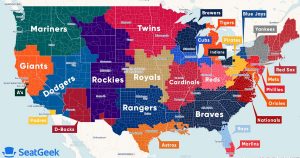 Let’s get a little more orange going around here. Listen, I wasn’t exactly painting my WELCOME CHRIS CHRISTIE placard for Banner Day — coming to Staten Island on June 12 when the Mets play the Padres, incidentally — when Cohen brought the ex-gov shall we say aboard. I could almost hear M. Donald Grant cackling devilishly that this was one board member he’d be proud to chair. Yet, honestly, this Staten Island outreach, whoever hatched it and whoever’s executing it, isn’t a bad idea, not for a franchise whose own logo is explicitly about bridging gaps. Perhaps you saw the Seatgeek map tweeted recently, the one breaking down MLB loyalties by county across the continental United States. The Mets definitely have Nassau (yay!) and Queens (natch). I had to squint to make out if we have Brooklyn, too. Let’s say we did. That’s the extent of extant orange on the East Coast. If we have to fight this fandom battle one borough at a time, so be it. Taking over the former home of the Staten Island Single-A Whatchamacallits and converting Richmond County to orange/blue figures to go a long way in spreading the Metropolitan Gospel. Today, Staturdays with the Mets, Presented by Statcast, Powered by Google Cloud.
Tomorrow? Hopefully back to Queens full-time, but maybe with some traffic heading eastbound. You’d have to ask Christie.
Historically minded Mets fans can’t help but feel a tingle amid all this because we know about the rich Richmond history of the Mets name. Maybe not the Mets since 1962, but the Mets of 1886 and 1887 for sure. Those would be the New York Metropolitans of the American Association, spiritual forebears to our very own Amazins. As Bill Lamb outlined in the essential David Krell-edited book New York Mets in Popular Culture, the Mets of those bygone days “had their moment, highlighted by the capture of an American Association pennant. That achievement notwithstanding, the Mets were mostly an afterthought to the Metropolitan Exhibition Company.”
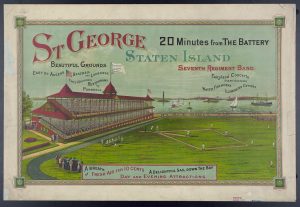 Home again, you might say. Those Mets, like our Mets, started in Manhattan, but unlike our Mets they had no permanent home awaiting them in Flushing Meadows. Instead, when things went awry uptown, those AA Mets vamoosed downtown and across Upper New York Bay to take up residence at the St. George Cricket Grounds. The AA Mets had been a powerhouse when they were based primarily at the oldest of several sites known as the Polo Grounds, going 75-32 in 1884, led by righthanded starters Tim Keefe and Jack Lynch. Each hurler won 37 games, preemptively using all the run support Met ace righties would need for the rest of time. Two years later, as ownership got tangled up in a bundle of conflicting interests, and with the National League’s former New York Gothams gaining traction as the Giants and essentially taking over the territory, the Mets sort of beat it out of town.
Sort of, because the Mets moved from Manhattan to Staten Island. This was before 1898, meaning Staten Island wasn’t officially part of Greater New York, but it was close enough. The Mets, however, weren’t close to the force they’d been. Situated in the future freestanding borough, the American Association Mets pretty much floated out to sea. As Lamb notes, playing outside the borders of what was then considered NYC left them uncovered by the media of the age. What there was to track wasn’t particularly uplifting. The 1886 Mets went 53-82 and finished seventh in the AA. In ’87, their record dipped to 44-89. The Metropolitans came, the Metropolitans went. The St. George Cricket Grounds hosted them for a total of 125 games. In 1889, the Giants briefly set up camp while another Polo Grounds was under construction, playing ball on the Island for 23 games.
So it’s been a while since major league ball had its moment in Richmond County. But that day is coming back. That day will be Staturdays with the Mets, Presented by Statcast, Powered by Google Cloud. Even if all it provides is a port in the remnants of a quarantine storm (another Staten Island echo from the distant past), it’s a legitimate historical bridge to the 19th century. And let us not forget that before the NHL skated to Long Island, one of the names that competed with “just plain Mets” to be what the National League expansion team of the 1960s would be called was the Islanders, a nod to the fact that the Mets would settle on (not in) Long Island. In a slightly westward prism, that little nugget can be seen as setting the stage for this heretofore unseen return to semi-ancestral Metsian roots.
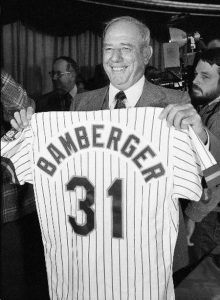 All in the Staten Island family. You can’t say the Mets aren’t planning on making the most of this promotionally and maybe sentimentally. The family of late manager George Bamberger, a Staten Island native, will present a replica of the traditional Shea-delivered floral horseshoe at the Staturdays with the Mets, Presented by Statcast, Powered by Google Cloud opener on the tenth. Relatives of the late Larry Bearnarth, a graduate of St. Peter’s Boys High School, are also expected at some point. Jack Egbert, the only Met player known to have been born on (let’s say “on” already) Staten Island, will be throwing out the first pitch, and I understand celebrity Mets fan Judd Apatow will be bringing cast members of his 2020 comedy The King of Staten Island for some crossover event. The only thing wrong with that otherwise excellent movie was Bill Burr taking Pete Davidson to a Staten Island Yankees game. Maybe they can digitally edit the next version of the Blu-ray to fix that. Among the necessary upgrades to RCBB@SG itself will be installation of a strikeout board that will notch “HelloFresh Kills” of opposing batters, with every “Kill” punctuated by the PA blasting the refrain to Carly Simon’s “Let the River Run” from Working Girl, a film whose protagonist, it will be remembered, commuted daily on a certain ferry.
Come, the new Jerusalem, indeed. To paraphrase Richard Rodgers and Lorenz Hart, we’ve taken as home boroughs Manhattan, Queens and, now, Staten Island. And let’s not forget Brooklyn, home of the Cyclones and our 2020-2021 alternate site. All told, that’s pretty nifty bridgework.
It’s exciting enough that the Mets have secured the services of Francisco Lindor for the ten years after this one. It’s exciting enough that the Mets are planning on playing a full season this year after what we’ve been through the last year. As for the Staten Island part of the plan, you could be tempted to write it off as utter foolishness. But read the calendar. It’s Opening Day almost everywhere. Anything goes — even the Mets to parts previously unknown.
by Greg Prince on 31 March 2021 11:47 pm Multiple sources are reporting the Mets and Francisco Lindor have agreed on a ten-year extension worth $341 million, meaning the all-world shortstop will remain in orange, blue and occasionally black through 2031, or Steve Cohen will be paying him off handsomely to go away after a while.
Just floating the worst-case scenario to ensure it never happens. Because my words are just that powerful.
Let’s get giddy over this. We were giddy to trade for Lindor. We’re giddy to keep Lindor. Imagine what it will be like to actually root for Lindor as a Met doing something besides smiling and negotiating. Happily, we get to do that Thursday night and a whole lot more nights and days over the decade ahead.
I really like the “41” part in $341 million. If Lindor says it was important that be in there because he understands how much the number means to Mets fans, I’ll love that he’s here even more. But I can probably love that he’s here plenty even without explicit Seaverian acknowledgment.
I also love that Steve Cohen is here. Know any other recent Met owners who would have gotten this done? Hell, I love that we’re all here, us and Francisco and the rest of the gang. Opening Night awaits. The Francisco Lindor Mets await. The 2021 season will feature them any hour now.
We were gonna root for the Mets anyway, and now they include Francisco Lindor for the long haul. What a bargain!
by Greg Prince on 29 March 2021 9:26 pm With Spring Training having concluded Monday following a .500 result (3-3 vs. the Cardinals) and a .500 exhibition record (11-11-2), we offer a hearty Faith and Fear welcome to the all-but-official ten about-to-be new Mets of 2021, each of whom appears slated for inclusion on the Opening Day 26-man roster. Mind you, speaking conditionally is a symptom of living in uncertain times.
Jacob Barnes
Trevor May
James McCann
Francisco Lindor, ideally for years to come
Joey Lucchesi
Aaron Loup
Albert Almora, Jr.
Jonathan Villar, hamstring willing
Taijuan Walker
Kevin Pillar
Your blank slates beckon to be filled with Amazin’ accomplishments. We can’t wait to write about all the great things you’re about to do. Occasionally in black, even.
Looking forward? You betcha!
Looking behind? That, too.
This annual interval on the calendar when we get caught between the Spring and New York City provides us a golden orange & blue opportunity, per Academy tradition, to remember fondly or otherwise those Mets who have — in the baseball sense — left us in the past year.
Cue the montage…
___
BRODIE VAN WAGENEN
Executive Vice President & General Manager
October 29, 2018 – November 6, 2020
But no. “Come get us.” I don’t know if front offices in Atlanta, Philadelphia and Washington reverberated with giggles or were too busy preparing their own rosters to notice the Brodie bluster, but if you’ll excuse a fan for thinking like a fan, somehow I’ll bet the Baseball Gods heard. You know their Karma Council took note. They’re worse than Joe Torre when it comes to handing out fines. Brodie, my man. We embrace confidence in winter. We appreciate positivity when it’s merited — and you were making moves that we could process as positive. But we didn’t need to be overly impressed when simply impressed would do, and we absolutely shudder at the thought of karma being disturbed. Think of it as the oral equivalent of Jacob Rhame throwing high and tight at Rhys Hoskins. Do it once, swell. Do it twice, you’re asking for a 900-foot home run in retaliation. Karma’s not known as a sweetheart.
—June 18, 2019
(Relieved of duties, 11/6/2020; joined Roc Nation Sports as chief operating officer, 1/27/2021)
___
JED CARLSON LOWRIE
Pinch-Hitter
September 7, 2019 – September 29, 2019
Mr. L began our session by telling me he had “that dream again,” his very specific variation on the dream in which a person shows up for the final exam and realizes they haven’t been to class all semester. In Mr. L’s case, it’s what he calls “the baseball dream”. It’s not the first time Mr. L has discussed “the baseball dream” with me in therapy, but it had a different twist today. As usual, it starts with Mr. L wandering around in a mostly empty baseball stadium in winter. He says it’s sort of familiar to him, but not a place he knows intimately In the dream, he again refers to “an agent” who was supposed to be “my agent,” except in “the baseball dream,” the agent is now an authority figure inviting him to join a new baseball team. At first, Mr. L is happy for the invitation.
—September 8, 2019
(Free agent, 10/28/2020; signed with A’s, 2/10/2021)
___
ARIEL BOLIVAR JURADO
Starting Pitcher
September 1, 2020
Perhaps someday I’ll find myself engaged in conversation with Ariel Jurado. We’ll likely talk about his baseball career; how it brought him to the Mets; and the challenges he endured, particularly that night in Baltimore in 2020 when, in the process of becoming the franchise’s 1,107th player overall and that season’s tenth Met starting pitcher 36 games into a 60-game campaign, he experienced what Wayne Randazzo termed a “bloodbath”: six hits allowed his first time through the Oriole order, punctuated by a three-run homer from Renato Nuñez. Or maybe we’ll gloss over that part and focus on his final two innings, for after giving up five runs in the first and second, Jurado gave up no runs in the third and fourth. True, it still calculated to an 11.25 ERA and the Mets were en route to a 9-5 defeat, their fifth consecutive loss, but I’d like to think that tact is the better part of discretion. Hopefully, in this hypothetical scenario, Ariel and I will find happier topics to talk about.
(Free agent, 12/2/2020; currently unsigned)
___
RYAN THOMAS CORDELL
Outfielder
July 27, 2020 – September 27, 2020
Over and over we grow used to baseball that isn’t quite the baseball we are whetting our appetite for less than four weeks from today. It’s the baseball with possible stalemates instead of decisive outcomes. It’s the baseball whose broadcast availabilities are piecemeal depending on your subscription choices. It’s the baseball played predominantly under the sun rather than the lights. It’s getting the hang of things on Piazza Drive as prelude to life on Seaver Way. Mostly, it’s numbers and names. The names that we know will be the names we’ll summer with. For two innings, generally speaking, it’s McNeil, Alonso, Conforto, what have you. For the next seven (no extras), it’s vague familiarity that fills in with increased exposure to Mets who’ve never been Mets in the official sense, may never be Mets in the official sense, but are Mets in late February and, presumably, a while in March. I don’t much know them yet, so until they make a lasting impression, they are who I decide they are. They’re Quinn Brodey, a small-town New England operator with an accent to match in the latest Ben Affleck passion project. He can pahk his cah with the best of ’em and doesn’t even use Smaht Park. They’re Ryan Cordell, a cross between Rydell High from Grease and Cordell Hull from FDR’s cabinet. Ryan and the outfield go together like rama lama lama ka dinga da dinga dong.
—February 28, 2020
(Free agent, 10/28/2020; currently unsigned)
___
JAMES BRIAN DOZIER
Infielder
July 30, 2020 – August 14, 2020
In the eighth, the Mets began to rally a bit. Amed Rosario, shortstop of future past, doubled. Brian Dozier, a Met I will be trying to convince you was once a Met by 2022, was granted an iffy walk on a three-and-two count. Then Jeff McNeil comes up and lines a ball above the second baseman’s head, and… NO! IT WAS CAUGHT! DAMN IT! Nice play, though.
—August 8, 2020
(Released, 8/23/2020; retired, 2/18/2021)
___
ANDREW WALKER LOCKETT
Pitcher
June 20, 2019 – August 28, 2020
I’d formed one impression of Walker Lockett during his 2019 cameo appearances — if Walker Lockett had been around when the annual baseball writers hot stove dinner included musical skits, Dick Young or Phil Pepe or somebody of that vintage would have penned this ditty, to the tune of “Love and Marriage”:
Walker Lockett
Walker Lockett
Every pitch he throws
Becomes a rocket
—September 30, 2019
(Selected off waivers by Mariners, 9/1/2020)
___
TODD BRIAN FRAZIER
Third Baseman
March 29, 2018 – September 29, 2019
September 2, 2020 – September 27, 2020
There was a shadow over home plate not long after the 3:07 PM start in Buffalo on Sunday, but the minor league park there doesn’t have multiple tiers, so the effect of the shadow was negligible. As is the feeling that the Mets are still in it. Sometimes it seems the only commonality between the Mets of this September and last September is an overreliance on Todd Frazier.
—September 14, 2020
(Free agent 10/28/2020; signed with Pirates, 2/19/2021)
___
ALI MIGUEL SANCHEZ
Catcher
August 10, 2020 – September 1, 2020
This, therefore, is what 2020 has come to. Seventeen games in, we’ve had a position player pitch, yet our National League franchise hasn’t had a pitcher hit. Guillorme’s catcher was Ali Sanchez, who came in to relieve subdued birthday celebrant Wilson Ramos when the score was a million to nothing or whatever it was by then. Sanchez became the fifteenth new Met of the year, which is almost as many runs as the Washingtonians walloped. We doff our mask to Met No. 1,106 for coming into our world under the bleakest of circumstances and presumably coming back for more.
—August 11, 2020
(Sold to Cardinals, 2/12/2021)
___
HUNTER DREW STRICKLAND
Relief Pitcher
July 25, 2020 – August 31, 2020
Reliever Hunter Strickland was a Met (fourth club in three years) and, for all we know, might be again. His ERA in three appearances ballooned to 11.57, which will make you an ex-anything awfully quick. Strickland is currently off the 40-man roster but at the Alternate Site in Brooklyn. That’s where relievers with 11.57 ERAs are sent to consider the error of the their ways.
—August 9, 2020
(Free agent, 10/15/2020; signed with Rays, 2/8/2021)
___
JACOB SHAWN “Jake” MARISNICK
Outfielder
July 24, 2020 – September 18, 2020
This is what they’re putting out there as a playoff contender of sorts in September? This is what gets somebody like Jake Marisnick, who helped the Houston Astros win Rob Manfred’s memorial piece of tin in 2017, to say, “this team’s too good to not make the playoffs”? He said that two nights ago, after the Mets were blitzed by the Orioles, 11-2, the day after the Mets coughed up a comeback to the Phillies, 9-8. The 2020 Mets remind me of what Whitey Herzog said about the Mets coming into 1986 off a pair of bridesmaid finishes: “They think they won the last two years, anyway.” The Mets haven’t lacked for outward displays of confidence. They’ve lacked for wins.
—September 10, 2020
(Free agent, 10/28/2020; signed with Cubs, 2/20/2021)
___
TYLER MORRIS BASHLOR
Relief Pitcher
June 25, 2018 – September 29, 2019
So went the Mets’ chances to be unstoppable once Tyler Bashlor entered the proceedings. I guess Mickey Callaway wasn’t intent on winning that eighth game in a row. The Mets won nine in a row under Mickey Callaway at the outset of his managerial tenure and see where it got them. Bashlor has good stuff, I’m pretty sure, but it’s rarely been deployed in the service of getting outs in non-playoff chasing circumstances. It doesn’t accomplish much in potentially headier times, either. Tyler commenced his outing by giving up a long fly ball that PNC Park held; followed it up with two singles; and climaxed his appearance by releasing a gopher into the atmosphere. First it made contact with the bat of Starling Marte. Then it was never seen again.
—August 3, 2019
(Sold to Pirates, 8/1/2020)
___
EDUARDO MICHELLE NUÑEZ
Infielder
July 25, 2020 – July 26, 2020
The Mets didn’t respond in kind. They, too, got to have an automatic runner on second, and he indeed scored, but nobody else did, which made the final 5-3 for not us. Hard to miss in the bottom of the tenth, amid a tease of a rally, was erstwhile pinch-runner Eduardo Nuñez serving as designated hitter after Luis Rojas had him take Yoenis Cespedes’s place on the basepaths in the eighth. The burst of speed seemed clever then. In the tenth, with the bases loaded and the situation Cespy-made, Yo’s bat was severely missed. Then again, the DH is an abomination, so maybe karma reaps what we sow.
—July 26, 2020
(Free agent, 10/28/2020; currently unsigned
UPDATE: Signed with Fubon Guardians of Chinese Professional Baseball League, 4/7/2021)
___
JACOB ALAN RHAME
Relief Pitcher
September 2, 2017 – August 3, 2019
Rhame may just have residual vertigo from all the times he’s been down and up in 2018. Standard-issue option action aside, Jacob has three times out of five been the Mets’ choice for 26th man on those occasions when the roster temporarily expanded because of makeup doubleheaders and the like. In other words, when it’s Rhame, it’s poured.
—September 5, 2018
(Selected off waivers by Angels, 7/8/2020)
___
BILLY R. HAMILTON
Outfielder
August 5, 2020 – September 3, 2020
For eight pitches, it mattered to me that Jeff McNeil reached base. On the eighth pitch, Jeff McNeil took ball four. At that instant, I was convinced the Mets would win. Before I could fully weigh the detrimental impact of my unspoken thoughts on the course of events in an athletic contest taking place on my television, Billy Hamilton came in to pinch-run for McNeil. Before Chapman could fully process the danger Hamilton’s two legs encompassed to the work of his left arm, Billy was off to second base. Because Chapman threw to first base as Hamilton ran, it can be said, technically, that the pitcher had the runner picked off first. But, no, not really, because Hamilton — whose already indefatigable speed seemed kicked up a notch by the presence of 42, twice Billy’s usual 21, on his back — was pretty easily safe. He was now a runner in scoring position. Most nights, having one of those doesn’t fill a Mets fan’s confidence coffers. But this night was different from most other nights.
—August 29, 2020
(Selected off waivers by Cubs, 9/7/2020; has since signed with White Sox)
___
JUAN OSVALDO LAGARES
Center Fielder
April 23, 2013 – September 29, 2019
August 25, 2020 – August 26, 2020
In the top of the sixthish, the lone semi-convincing Met threat of the nightcap went awry when pinch-runner Juan Lagares — oh, Juan Lagares is back (and wearing No. 87) — was doubled off first base; Luis Guillorme’s sizzling liner was caught by Miami first baseman Lewin Diaz with Juan on his way to second. Diaz was much closer to first base by then, so, yeah, double play.
—August 26, 2020
(Free agent, 8/31/2020; signed with Angels, 2/6/2021)
___
CHASEN DEAN SHREVE
Relief Pitcher
July 27, 2020 – September 27, 2020
Score one for dependability, predictability and well-ingrained habit. On Monday night, score seven for the Mets versus only four for the Red Sox, resulting in our second win of the thus far four-game season. Michael Conforto homered at Fenway Park. So did Pete Alonso. So did Dom Smith. Michael Wacha registered five innings’ worth of outs. Seth Lugo retired the final four batters. Chasen Shreve acquitted himself adequately in middle relief. Jeurys Familia did not, but little harm was done. Not bad for late July, eh?
—July 28, 2020
(Free agent, 12/2/2020; signed with Pirates, 2/7/2021)
___
GUILLERMO HEREDIA (Molina)
Outfielder
September 21, 2020 – September 27, 2020
Guillermo Heredia played center for the Mets Monday, having been called up to replace Jake Marisnick, who has a tight hamstring, and then inserted for Conforto, who also has a tight hamstring. A good, loose hamstring goes a long way in getting a person into the Mets lineup these dwindling days of 2020.
—September 22, 2020
(Selected off waivers by Braves, 2/24/2021)
___
ERASMO JOSE RAMIREZ
Relief Pitcher
September 7, 2020 – September 27, 2020
Each of the previous twenty-three Unicorn Scores in Mets history that has thus far gone uncloned was registered in a ballpark […] with an implied sense of MLB permanence. This one, at Sahlen Field, happened where the Mets will likely never play again after this series. And it included the first Met save credited for the questionably strenuous preservation of a lead of as many as 17 runs. Such a perfectly regulation save was assigned Friday to the ledger of the newest Met (No. 1,110), Erasmo Ramirez. Erasmo indeed came on in relief, indeed went the final three and indeed didn’t surrender the inflated advantage he was assigned to protect. That’s a save in any season, even if nobody ever conceived of a Met reliever saving that large a lead. Way to go, Erasmo — if you’re gonna make history, you might as well make it count like nothing that’s ever been counted before.
—September 13, 2020
(Free agent, 10/28/2020; signed with Tigers 1/19/2021)
___
WILLIAM JARED HUGHES
Relief Pitcher
August 3, 2020 – September 27, 2020
It’s the middle of February at the beginning of July. We’re talking camp. We’re talking a veritable plethora of non-roster pickups. Now loosening limbs under the auspices of the Metropolitan Baseball Club of New York are several fellows who span the familiarity spectrum from very to vaguely: Melky Cabrera, Gordon Beckham, Hunter Strickland, Jared Hughes. If this were the middle of February, we’d know what to make of the odd veteran signing. Now we are assuming this bunch will add depth to our 60-player pool, a phrase that didn’t exist the last time baseball went camping.
—July 2, 2020
(Free agent, 10/28/2020; retired, 2/14/2021)
___
ROBINSON DAVID CHIRINOS
Catcher
September 3, 2020 – September 27, 2020
Somewhere post-Hessman, I made my list. There were lists begun before it. There’ve been lists begun since. Every Mets game is an excuse to update at least a couple of them. Some baseball fans referred to the 2020 regular season as a distraction from worrying about the effects of the pandemic or facing up to existential threats to representative democracy. Me, I had the opportunity to note, among myriad other occurrences, that on September 23 — one night after Heredia took Curtiss deep and one night before Chirinos took Corbin deep — the Mets’ record landed at 25-31. And? And it was the FIRST time the Mets ever sported a record of 25-31 after 56 games…if one can be said to sport a record of 25-31. It’s more something an obsessive type types quickly, clicks close on and keeps mostly to himself. But then I opened it just now and shared it with you here on the remote chance you might find it interesting.
—September 28, 2020
(Free agent, 10/28/2020; signed with Yankees, 2/15/2021)
___
MICHAEL JOSEPH WACHA
Starting Pitcher
July 27, 2020 – September 23, 2020
Thus, when Closing Night 2020 rolled around, it was just another game to watch at home. None of the emotions attendant to a final visit to the ballpark. None of that sense that this is the last time I’m getting on the LIRR to change at Jamaica for Woodside…this is the last time I’m getting on the 7 to Flushing…this is the last time I stop by my brick, the last time I get felt up by security, the last time somebody hands me a nick-nack, the last time… There were no last times like the last 25 times to be had. There were the Mets and Rays, in living color, courtesy of SNY and me paying my cable bill. There was Michael Wacha looking kind of promising for a while until the promise broke.
—September 24, 2020
(Free agent, 10/28/2020; signed with Rays, 12/18/2020)
___
BRAD BRACH
Relief Pitcher
August 11, 2019 – September 27, 2020
The Nationals, like the Mets and every Wild Card wannabe, have their flaws, but between the genuine talent (Rendon, Soto), the certified Met-killing (Suzuki) and now Cabrera imagining the need to get even, they have enough of a critical mass to make a Mets fan antsy. Good thing, then, that Mickey Callaway was able to turn to a Mets fan who clearly recognized what was going on, namely his second reliever, Brad Brach. Brach is a Mets fan from way back. Not one of those locally sourced “I rooted for the New York teams as a kid” diplomatic-answerers who doesn’t want to piss off his new fans by admitting he didn’t care or preferred another nearby team, but somebody who, had he not been preoccupied getting outs for other staffs in recent years, would have recognized Kurt Suzuki kills us. Brad from Freehold put his Mets fan instinct to good use and flied out Brian Dozier to get us out of the sixth still tied.
—August 12, 2019
(Released, 2/16/2021; signed with Royals, 2/22/2021)
___
RENÉ RIVERA
Catcher
April 30, 2016 – August 16, 2017
August 25, 2019 – July 29, 2020
Against the Rockies in the Mets’ series finale, Noah Syndergaard perhaps put too much faith in the powers of a personal catcher. Despite the residual simpatico Noah feels for René Rivera’s core skill set from their splendid 2016 together, the Syndergaard who faced Colorado wasn’t markedly better than the Syndergaard who faced Los Angeles five days earlier or the Syndergaard who took on Philadelphia five days before that, both times with Wilson Ramos behind the plate. Those previous starts loomed as dead-letter days in the history of the 2019 Mets, each of them among the myriad losses that buried us for good (with probably a couple more death blows in between). This Syndergaard start — 5.2 IP, 10 H, 4 ER, 2 BB, 4 SB — was similarly grabbing the shovel from the garage and commencing to dig.
—September 19, 2019
(Free agent, 10/28/2020; currently unsigned
UPDATE: Signed with Cleveland, 4/14/2021)
___
ANDRÉS ALFONSO GIMÉNEZ
Infielder
July 24, 2020 – September 26, 2020
Necessarily tossed overboard in the general direction of Lake Erie were two members in good standing of the SS Mets, two Mets SSes. One was the future not very long ago. One was the future literally last week. Today they are ex-Mets. You make this trade seven days out of every seven, Amed Rosario and Andrés Giménez plus minor leaguers Isaiah Green and Josh Wolf for Lindor and Carrasco, but you don’t do it without an ounce of sentimental regret. I’ll miss Rosario and Giménez like I missed Neil Allen, Hubie Brooks and the package of potential and heritage represented by Preston Wilson (Mookie’s lad). I felt bad that they were no longer Mets. I felt great that Keith Hernandez, Gary Carter and Mike Piazza arrived because they departed. Which is to say I got over their respective departures.
—January 11, 2021
(Traded to Cleveland, 1/7/2021)
___
PAUL STANTON SEWALD
Relief Pitcher
April 8, 2017 – July 26, 2020
The two were about to leave the room, when a dazed Paul Sewald wandered in. He’d never seen this room before, but there were lots of things the third-year Met had never seen. After having been the losing pitcher fourteen times but never the opposite, not even once, since the Mets first promoted him in 2017, Paul was enjoying a new sensation of his own. By pitching a scoreless top of the eleventh, Sewald was in line to be the winning pitcher should the Mets score. Once Nimmo drew the bases-loaded walk that brought Amed Rosario home from third, Paul got the win. “Guys! Guys!” Sewald asked Wheeler and Horwitz excitedly. “Did ya see? I’m a winning pitcher — a winning pitcher at last. I’m one and fourteen, but I got one! I finally got one!” The starter and the alumni affairs chief smiled and nodded, telling the heretofore hapless reliever how happy they were for him. “I was beginning to think this would never happen,” Paul confided. “But it has. Finally.”
—September 25, 2019
(Free agent, 12/2/2020; signed with Mariners, 1/7/2021)
___
JUSTIN JAMES WILSON
Relief Pitcher
March 30, 2019 – September 24, 2020
Teams build bullpens on the foundation of a core belief that starting pitchers can’t be pushed beyond so many total pitches and so many stressful innings. Well, teams try to build such bullpens. The Mets tried. I swear they did. What they wound up with instead was a coupla guys. The coupla guys, Justin Wilson and Seth Lugo, have held the bullpen together essentially by themselves for weeks, most recently the night before. On Saturday, it was deGrom for seven, Lugo for one, Wilson for one. It worked perfectly. Now Callaway would ask it — them — to work perfectly again on no nights’ rest. It didn’t work.
—September 16, 2019
(Free agent, 10/28/2020; signed with Yankees, 2/15/2021)
___
FREDERICK ALFRED “Rick” PORCELLO
Starting Pitcher
July 26, 2020 – September 26, 2020
One night this abbreviated season, I got in the car after my weekly grocery-shopping trip, turned on the game, discovered it was another Porcello start going quickly awry, and muttered some pretty nasty thoughts aloud in the direction of a fella who couldn’t hear me. But on Saturday night, after the sweep in D.C. was complete and the Mets dangled one game above finishing in a last-place tie, Rick Porcello took it upon himself to basically apologize for how crummy he and the rest of Mets played in 2020. It was enough to almost make me take back my previous grumblings. “I’m sorry we couldn’t have done better for you, and given you something to watch during the postseason,” the righty said, noting that he was happy he could at least be a part of giving us folks at home a distraction from all that swirls about us. “I wish I could’ve done better for this ballclub. Unfortunately, we’re out of time. I gave it my all and it wasn’t good enough for us.” Rick concluded by adding, “I love the Mets, I’ve always loved the Mets since I was a kid.” It would figure that someone who realized a lifelong dream of playing for “a team I grew up cheering for” would know exactly what to say to us, a cohort that surely includes him.
—September 27, 2020
(Free agent, 10/28/2020; currently unsigned)
___
WILSON ABRAHAM RAMOS
Catcher
March 29, 2019 – September 27, 2020
For a solid month of 2019 — August 3 to September 3 — Wilson Ramos played in 26 games for the Mets and hit in every one of them. The hitting streak was the best by any Met in the 2010s (second only to Moises Alou’s thirty in franchise annals), and it couldn’t have come at a better moment. The Mets were making a bid for the postseason, and their mostly everyday catcher was batting .430 and slugging .590 as they strove. That span included four games in which Wilson came off the bench to extend the streak or, more accurately, help his team maintain its momentum. You can also factor into his monumental achievement that by August, a catcher is bound to be physically run down at any age; Ramos turned 32 on August 10. Oh, and don’t overlook that not every pitcher appreciated this catcher’s defensive abilities, and by September word leaked that at least one batterymate (Noah Syndergaard) was asking for someone else to handle his workload. Another, however (Jacob deGrom), clinched a Cy Young Award by tossing three scoreless seven-inning starts, each with Wilson behind the plate. By 2019’s end, Ramos completed his first season as a Met with 141 games played and a .288 batting average. Catch that, why don’t you?
—December 11, 2019
(Free agent, 10/28/2020; signed with Tigers, 1/26/2021)
___
GERMAN AMED ROSARIO
Shortstop
August 1, 2017 – September 27, 2020
We’ll leave that for the future, unknown though it may be, and concentrate in the present on the half-inning of our most recent past. The tenth inning. The one against the Indians. The one Amed Rosario, the shortstop who bloomed into a second-half superstar as soon as the ink was dry on the organizational plan to convert him into a last-ditch center fielder, led off with a double to center. Since the beginning of June, Rosario is a .500 hitter. Since August 1, Amed is batting a thousand. I could look up what the numbers actually are, but I’m comfortable with the hyperbole.
—August 22, 2019
(Traded to Cleveland, 1/7/2021)
___
STEVEN JAKOB MATZ
Starting Pitcher
June 28, 2015 – September 27, 2020
He’s a happening. He’s a happening because he brought 130 friends and family from Suffolk County and because he’s been working his way back from Tommy John so long that the general manager who drafted him was Omar Minaya and because his favorite adolescent baseball memory involves Endy Chavez and he’s 24 yet looks 14 and he knows to professionally tip his cap when thunderously applauded and he lived up to every expectation we had for him and he built new expectations along the way and he exceeded those. We who were grumpy from a lack of offense even after Duda’s growth charts flapped victoriously roared without reservation for Steven Matz. We were holding out for a hero. We received a folk hero. He’s proof, as if we needed any more, that the designated hitter rule belongs on the ash heap of history. If, say, Cuddyer as hypothetical DH had gone 3-for-3, we might be curious what kind of hallucinogenics they were using at Blue Smoke, but we wouldn’t otherwise be terribly moved beyond vague approval. But Matz going 3-for-3? The pitcher? Never mind the Colon sideshow. This is a pitcher not just helping his own cause. This is a pitcher defining the cause. Let other pitchers pray for run support. Matz answered everybody’s prayers before they could be formulated.
—June 29, 2015
(Traded to Blue Jays, 1/27/2021)
___
YOENIS CESPEDES (Milanes)
Outfielder
August 1, 2015 – August 2, 2020
Without Cespedes in the lineup, they kept winning and were plenty imposing. With Cespedes, where between one and eight in their standard lineup is the letup for the opposing pitcher? Mike Broadway picked a very bad night to be an understudy to Jake Peavy. Cespedes, though…what a star. In a ten-pitch span dating to the previous Friday in Atlanta, Cespedes came to the plate five times, took six swings, delivered four hits, totaled twelve bases and drove in eleven runs. And that was all while letting a debilitating bruise heal. Amid the twelve-run inning and eventual 13-1 win, Yoenis set two Met records of his own: most RBIs by one batter in one inning (six); and most consecutive games with at least one extra-base hit (nine). The Mets he surpassed in these respective realms were Butch Huskey and Ty Wigginton. I liked Butch Huskey and Ty Wigginton just fine in their day. The days Yoenis Cespedes and these Mets are giving us, though? Every day is Christmas. And every night is New Year’s Eve.
—April 30, 2016
(Placed on restricted list, 8/1/2020; free agent 10/28/2020; currently unsigned)
___
FRED WILPON
Chairman of the Board & Chief Executive Officer
January 24, 1980 – November 6, 2020
[A]nother theme the self-inflicted media onslaught emphasized was the owner of the Mets loves being owner of the Mets. Take it from perennially reliable source Steve Phillips: “I know how important the team is to the Wilpon family.” Yet, for what little it’s worth in the big picture, I don’t necessarily equate that with loving the Mets. I’ve never gotten the feeling Fred Wilpon does, not in the way those of us who don’t get to shove blueprints at an architect and tell him to shut up and just rebuild Ebbets Field do. I’m sure he loves the Mets as a property, and that there’s more to the Mets to him than there is to this or that building in Manhattan, but I also get the feeling his acumen was most acute in tending to inanimate objects.
—May 25, 2011
(Sold franchise to Steve Cohen, 11/6/2020; retains 5% ownership share and serves as chairman emeritus)
by Greg Prince on 25 March 2021 9:51 pm Certain Mets seem to come up semi-regularly in this space. Not necessarily from being great and, I’d like to think, not from my being cute or ironic. Certain Mets just hover in my baseball subconscious and briefly but habitually waft above the rest.
Randy Tate was a certain Met. He pitched for the Mets in 1975. Not before. Not after. I hadn’t heard anything about him in the minor leagues ahead of his major league debut. He appeared at Shea that April, spent the summer, and didn’t pitch there again after that September. Or anywhere else in the bigs. It never occurred to me to strenuously wonder where he went. I figured the Mets had their reasons for elevating Randy Tate when they did and for going in a different direction when they did.
But in 1975, the season I was 12, which is a prime age for forming impressions and attachments, Randy Tate was the Mets’ fourth starter. The rotation was Seaver, Matlack, Koosman, Tate and whoever else was handy. I was already attached to Seaver, Matlack and Koosman. I was impressed that Tate could hang with them.
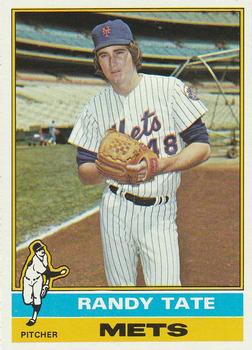 Randy Tate spent a summer in distinguished company. Randy Tate may not have been in a class with the three pitchers he followed, but for a year he was in their league. Once in a while, he was what you meant when you talked about Met pitching depth. I went to Old Timers Day in late June. Casey Stengel came out in a Roman-style chariot and greeted us, his eternal subjects. Rookie Randy Tate pitched. I watched the Ol’ Perfesser — Casey was 84 — wave, and I watched the latest example of the Youth of America — Randy was 22 — take care of the Phillies for a couple of innings. Then the rains came down and my sister, who was kind enough to bring me in the first place, insisted on leaving, not quite buying my explanation that sometimes it stops raining, a grounds crew dries the field and the teams pick up where they left off. The game resumed while we were on the LIRR to Penn Station, where we’d take another train back to Long Beach. We came home to find Randy Tate on Kiner’s Korner. The rookie had just claimed his first complete game victory.
That was the last time Casey Stengel made an appearance at Shea Stadium. It was also the last time I saw Randy Tate pitch there.
Old Timers Day isn’t what most former 12-year-olds and thereabouts from 1975 Metsopotamia remember Randy Tate for. We go almost immediately to Monday night, August 4, when Randy was going to pitch the first no-hitter in New York Mets history. No kidding, this was gonna be it. Fourteen seasons of Mets baseball and it was already an albatross that we had no no-no. That stupid bird was gonna fly away that night. I could feel it. Bob Murphy could feel it. I listened while in the bathtub. That afternoon my mother took me to the dermatologist in search of relief for the nagging psoriasis on my right knee. The doctor gave me a bottle of tar. Or something with tar in it. Add it to your bath, he said. It had a very strong aroma. I swear I can still smell it, just as I can still hear Murph narrating Tate’s total and complete domination of the Montreal Expos.
The no-hit bid lasted into the top of the eighth. Leadoff hitter Jose Morales struck out, Randy’s dozenth K. We were up, three-nothing. Could this be the night? This had to be the night. I wasn’t a naïve 12-year-old Mets fan, mind you. I’d been at Mets fandom since I was six. No Ned in the third reader as Casey would have said. I wanted to believe Randy Tate would get it done, that our lives wouldn’t be defined by not having a no-hitter for another who knew how many years. This wasn’t Seaver or Matlack or Koosman. This was Randy Tate. This was so crazy it might work.
Except Jim Lyttle, the ex-Yankee, singled to break up the no-hitter, five outs from glory. Murph said the fans at Shea were giving Tate a standing ovation. I hung tight in the tub. The next four batters were all future Mets and three of them destroyed the remnants of the dream I dared to dream for the current Mets. Pepe Mangual walked. Jim Dwyer struck out — Randy’s thirteenth — but Gary Carter singled in Lyttle to end the shutout, and Mike Jorgensen, a former Met as well as a future Met, launched a three-run homer that in retrospect was inevitable. I could hear the heartbreak in Murph’s voice. I could feel the heartbreak while soaking in that slimy black water. Yogi Berra let the kid finish the eighth. Today a rookie who was en route to striking out thirteen over eight wouldn’t see the sixth inning
Tate took the 4-3 loss. I never used the tar concoction again. It was really pretty disgusting.
The next day, Berra managed his last two games for the Mets, a doubleheader sweep, each a seven-zip whitewashing from the Expos. Yogi was fired the day after. Within two months, Casey and Mrs. Payson were gone. And though he couldn’t have known it for sure, Randy Tate was finished as a Met, his career line frozen at 5-13, a 4.45 ERA and 99 batters struck out in 26 games, 23 of them starts. He didn’t immediately leave the organization, instead spending two more years in our minors, pitching for Tidewater in ’76 and Lynchburg in ’77. There’d be an additional season of pro ball in the Pittsburgh chain. After that, you have to visit Tate’s Ultimate Mets Database fan memories page, which is thick with talk of the near no-hitter and the turns his life took in Alabama after baseball.
When I learned tonight through Facebook that Randy Tate, 68, had died from COVID complications, it was again raining on Old Timers Day; it was again tar-drenched in the bathtub; it was again 1975 when a righthander who wasn’t Jacob deGrom wore No. 48 for the Mets and a 12-year-old was thrilled to root for him, even if the 12-year-old knew he’d be forever dismayed that Jim Lyttle broke up what should’ve been the first no-hitter in New York Mets history. Or the second after Seaver got Qualls six years earlier.
With certain Mets, that feeling never goes away.
by Greg Prince on 18 March 2021 4:16 pm One of the rites of Spring is being reminded all in baseball is not as it sounds. For example, sometimes you hear about pitchers going through “dead arm,” and your instinct is to freak out because dead surely sounds like an irreversible condition. But then you’re told, no, “dead arm” is a temporary malady, don’t worry, the arm will come back to life, which it inevitably does. A “sore arm,” which you’d figure is just sore, like you might be after a little too much snow-shoveling or vaccine-getting, is much worse than a dead arm. Unless it, too, is a passing panic, though don’t get a baseball person started on a sore elbow, which is worse than a sore arm, even though an elbow is a component of an arm.
Carlos Carrasco hasn’t pitched in exhibition competition yet this Spring because of elbow soreness. That’s alarming but not an alarm. Carrasco has had elbow soreness before, especially this time of year, and it hasn’t thrown a roadblock into his pitching. Yet it has pushed his timetable back and, though Luis Rojas says his elbow coming along, his right hamstring has been strained, thus it appears unlikely he’ll be ready for Opening Day. (Update: the hamstring has been diagnosed as torn, so Carlos will be a spectator for a while.)
But ready for what on Opening Day? All Carlos would be asked to do on Opening Day is jog to a foul line at Nationals Park and be introduced to a slight murmur of discontent. Jacob deGrom will (knock every piece of wood you have within reach) pitch the Opener for the Mets. Carrasco’s presence on April 1 would be comforting and completist, but from a box score standpoint, unnecessary, unless Cookie is more of a pinch-hitting threat than we’ve been led to believe.
If you’re depth-charting the rotation, you begin with deGrom, then move on somewhat reluctantly to everybody who isn’t deGrom. Ideally, Long Island’s Own Marcus Stroman likely starts the second game, a fully unsore Carrasco is third, and Taijuan Walker is fourth. Or Walker is third. Or Carrasco, hypothetically healthy, is second. Or Walker is second and Stroman, ol No. 0, is third or fourth; how particular can Marcus be about a number if he picked to adorn his uniform a digit synonymous with nothing?
Though certain guys align in certain places in your sports-loving mind, it doesn’t much matter in a vacuum who pitches when after the first game. It doesn’t really matter for the first game except symbolically, though the symbolism of your ace being front and center as a new season begins shouldn’t be underestimated.
What/who we’re leaving out here is someone connected to another rite of Spring: the battle for the fifth starter. There’s almost always “the battle for the fifth starter,” which in the grand sweep of history falls somewhere between the Battle of Gettysburg and the Battle of the Network Stars. Most years the nominal fifth spot in the rotation is open. Once in a while the Mets are so established in their starting pitching that they perceive themselves to be all set, such as when the Mets rolled out Syndergaard, deGrom, Wheeler, Matz and Harvey in sequence in April of 2018…which lasted two entire turns. When you’re sure you’re all set is when you discover you’re not.
The way baseball commences its action — with built-in off days to protect against bad weather in most places; bad weather beyond Opening Day a frequent possibility; and every team that has a legitimate ace wanting to get the most out of its legitimate ace, — generates a related phrase: “They won’t need a fifth starter until…” The Mets have a fifth game on April 6, but if they decide getting the most out of deGrom is paramount and thus use him five days after Opening Day, they won’t need a fifth starter until April 7, the sixth game of the year. Unless it rains in an inconvenient fashion, in which case all bets are off (if, in fact, anybody bets on the identity of fifth starters).
The Mets have three acknowledged fifth-starter candidates in David Peterson, Joey Lucchesi and Jordan Yamamoto. In the unlikelihood Carrasco comes back very soon, he’ll be on track to be the fifth starter the Mets use in 2021 but not exactly “the fifth starter”. Carrasco’s credentials imply he is too highly valued to be “the fifth starter”. “The fifth starter” is a designation in a way being the second, third or fourth starter isn’t. Sort of like we have leadoff hitters and cleanup hitters but nobody really makes much of the batter lurking in the six-hole.
Baseball teams largely went along without fifth starters for a century. The old four-man rotation lingers in the baseball subconscious as an extended “when men were men” moment of inner toughness to which we quit aspiring in our quest to keep arms from deadness and soreness. At some point, the Mets and everybody else will meander into a debate about having six starters. That’s not based on an appraisal of personnel. It’s just what happens every year. You have more than five starters and you worry. You have fewer than five starters and you grow apoplectic, even in this age when relievers starting games for an inning is considered clever. A fifth starter should be the “just right” in a Goldilocks context. Instead, perhaps because of our vestigial reverence for the biggest of the big fours (the ’71 Orioles, the ’93 Braves, the ’11 Phillies), fifth starters are cast into the role that Benjamin Franklin envisioned for the vice president of the United States — “His Superfluous Excellency” — rather than treated as equitably vested 20% partners in any given rotation.
Fifth starters tend to have their utility lopped off come postseason. Remember what the Mets, innovators in the religion of four days’ rest under Gil Hodges and Rube Walker, have always done with their fifth starters in their playoff years? They’ve assigned them to the relief duty. In ’69 we used only three starters. In ’73, George Stone, the fourth starter of his day, got only one start, and you know it wasn’t in the World Series. Rick Aguilera’s robust second half in 1986 (9-4, 2.64 ERA from July 12 forward after a horrid first three months) drew him a seat in the bullpen. Bobby Ojeda’s hedge-trimming made the fifth-starter point moot two years later. Orel Hershiser, Glendon Rusch and Bartolo Colon each went the Aguilera route in their respective postseason Met years of 1999, 2000 and 2015. The Mets barely had four starters to get them through October 2006 and only one postseason game altogether in 2016.
We should be so lucky to have fifth-starter issues in the 2021 postseason. We don’t know if we’ll have our very own postseason this year. We’re reasonably confident we’ll have a “this year,” however — and have it with people! Eventually we’ll have “the fifth starter”. As for who will be our plain old fifth starter, which is to say the fifth starting pitcher the Mets use in a season, that will be up to the elements, injuries and array of unknowables one encounters in trying to deduce too much in advance.
The Mets have played what we’ll call fifty-nine discrete seasons, counting the two 1981s individually. Twenty-three of those seasons incorporated five starting pitchers in the first five games. No off days or contingencies came into play, just one starter after another toeing rubbers and taking aim. It sounds so normal you’d think it was the norm. Recently it kind of has been, with seven of the past twelve fifth games being started by a fifth starter (if not “the fifth starter”). Just last year, which was abnormal as a year could be in every other respect, David Peterson made his season and career debut in 2020’s fifth game, following Messrs. deGrom, Matz, Porcello and Wacha, and that was without making the delayed Opening Day roster. With respect to his current battle with Yamamoto and Lucchesi, you can say Peterson should have an edge from being a seasoned fifth starter already.
Jason Vargas was 2019’s 5/5 man, though if you called him that in the clubhouse, he might threaten to “knock you the fuck out, bro.” Dillon Gee was the fifth starter in the fifth game of 2012 and 2015. In between, in 2014, he was the Opening Day starter, leaving Gee to ponder status whiplash. Hopefully Jay Horwitz got him in touch with Craig Swan, whose Opening Day starts in 1979 and 1980 were bracketed by fifth-game first starts in 1978 and 1982.
Two of your odder-appearing chronological fifth starters to start fifth games were pitchers you automatically associate with starting much sooner. Both cases speak to how injuries and the healing they necessitate can rearrange best-laid plans. In 1992, Dwight Gooden, who started eight Openers as a Met, was coming back from arthroscopic shoulder surgery and needed the extra few days to physically ready himself. Al Leiter, who threw the first Met pitch of 1999, 2001 and 2002, got pushed back after being hit in the head by a line drive toward the end of Spring Training 2004 (during a game in which the Mets and Marlins combined for 34 runs, so we can assume there were lots of line drives). Instead of being that season’s third starter as slated, he waited in line behind not only T#m Gl@v!ne and Steve Trachsel, but emergency starter Dan Wheeler (in for late scratch Scott Erickson) and rookie Tyler Yates. I don’t know about you, but I’d take Leiter ahead of both of those guys. Ahead of Gl@v!ne and Trachsel, too.
Bill Denehy was the first Mets fifth starter to start a fifth game, in 1967. The righty would take seven more starts at Wes Westrum’s discretion before being sent as compensation to the Washington Senators for Westrum’s full-time successor, five-man rotation evangelizer Gil Hodges in the following offseason. Hodges himself used a chronological fifth starter, Don Cardwell, in the fifth Mets game of 1969, a year without a built-in off day following Opening Day.
Given the opportunity to get extra starts out of Tom Seaver early in the 1968, 1970 and 1971 seasons, Hodges didn’t hesitate to push back everybody in sight. The Mets didn’t use a fifth starter in 1968 until their tenth game, when a doubleheader provided a spot for Al Jackson. In 1971, it was classic swingman Ray Sadecki getting his first starting shot also in the tenth game. Cast into a similar “not so fast…” role, fireballer Nolan Ryan had to wait until the ninth game of 1970, April 18, to be the Mets’ fifth starter. Was it worth the wait? Ryan pitched a one-hitter and struck out fifteen, the latter figure poised to stand as the single-game franchise record for fewer than a hundred hours. On April 22, Seaver famously struck out nineteen San Diego Padres, including the last ten in a row. Less famous, but eye-popping to our modern pupils is that the Padre game was the Mets’ thirteenth of the 1970 season, and Seaver was already making his fourth start. (I dare Rojas to try that with deGrom.)
The first fifth starter in Mets history, which is to say the fifth starter the Mets ever used, was Bob Miller…Bob L. Miller, to be exact. Casey Stengel waited until the Mets’ eighth game to get Bob L. Miller into the mix. They were 0-7 and when the manager turned to the righty, after which they were 0-8 and the righty was 0-1. The Mets didn’t have lefty Bob G. Miller to confuse matters until May. Bob G. Miller made no starts. Bob L. Miller made 21 starts in all, fourth-most among the 1962 Mets. He lost that first start and twelve games total that year, neglecting to win until the inaugural season’s final weekend, allowing him to take a 1-12 record to his next stop of Los Angeles, where the now-Dodger won ten games in 1963, thus giving Bob L. Miller every reason to tell the Mets, “It wasn’t me, it was you.”
Sometimes the pitcher who serves as your fifth starter of a given year is a gem yearning to be noticed.
• The 1997 Mets, at 1-3 on their pauseless opening West Coast swing, had nothing to lose when Bobby Valentine handed the ball to journeyman righty Rick Reed. Reed pitched seven scoreless innings and proceeded to install himself as invaluable to the starting rotation for a half-decade to come.
• The second-season Mets of August 1981 were six games deep into their reactivated schedule when they turned for fifth-starter purposes to a 27-year-old longtime minor league submariner who’d been promoted only after the strike. Thus began in earnest the major league career of Terry Leach, who’d rescue the Mets basically every fifth day six years later.
• The fifth starter of 1995 had to wait ten games for his first chance. What did Dave Mlicki do against the Reds on May 6 of this strike-delayed year? He did fine (though his bullpen blew a huge lead), but we don’t recognize Mlicki for how he started in 1995. We recognize Mlicki for how he started one night in 1997, throwing a shutout in the very first Subway Series game, and we don’t let him buy his own drinks for that very reason.
• Fifth starter Harry Parker didn’t get a look from Yogi Berra until the seventh game of 1973. Though his Met future would wind up in the bullpen, it was a good short-term future to begin, as Harry that day won the first of his eight games for the eventual National League champs.
• Unexpectedly deprived of Bill Pulsipher’s services, the 1996 Mets fished around for another starter before coming up with righty Mark Clark of Cleveland on the eve of the new season. The suddenly acquired fifth starter, used to start the campaign’s fifth game, Clark became Dallas Green’s most dependable arm from any direction in ’96, winning fourteen games and recording an ERA under 3.50, the only Met starter to keep his leading indicator so low.
• Mark Bomback had to wait until the dozenth game of 1980 to become Joe Torre’s fifth starter. When 1980 was over, Mark Bomback stood as Joe Torre’s only double-digit winner.
On the other hand, Bill Latham was the fifth starter used in 1985 (the sixth game); he’d have one win on the year and be gone by the next year. Aaron Laffey was the fifth starter used in 2013 (the seventh game); he’d have no decisions and be gone by the next month. Not every fifth starter story is uplifting. But at least Latham and Laffey were chosen before too long. You know who wasn’t? For that answer, we go to the extreme end of the “they won’t need a fifth starter until…” spectrum. It was 1975, the first of six times to date that the Mets went more than ten games before deciding they needed a fifth starter. Berra, as would anybody who could, leaned heavily on Seaver, Jon Matlack and Jerry Koosman. The power trio took fifteen of the season’s first eighteen starts. The three others went to rookie Randy Tate.
Not until the nineteenth game of the year did Yogi opt for a fifth starter, Hank Webb. Righty Webb was regularly talked up, certainly by unbiased Met source Bob Murphy, as a comer in the Seaver mode. His future proved a little more Tate-ish. Tate’s only season in the majors was ’75. Webb at least had sipped coffee during the three previous campaigns, but he didn’t make the Mets to stay until he was given the ball on May 3, 1975, or twenty-five days after Seaver got the season going. Hank etched versus the Expos what we now reflexively refer to as a quality start: seven innings pitched, two earned runs allowed. Pretty good for someone who wasn’t Tom Seaver. Not good enough for a win that day (Woodie Fryman one-hit the Mets), but good enough for Berra to remember Webb’s name. Yogi gave him seven starts total. Yogi’s successor, Roy McMillan, gave Hank eight more. The composite result was a respectable 7-6 record. Alas, under Joe Frazier, Webb was stashed in the bullpen before being sent back to Tidewater. The year after that, Webb was a Dodger for a spell, a Triple-A Albuquerque Duke for much longer.
Let’s go out on a more hopeful note, even if the 1987 Mets didn’t think they’d need hope. The defending world champions were planning to pick up where the 1986 Mets left off, particularly in their rotation. The 1986 Mets had starting pitching so strong that you’ll remember from above Rick Aguilera was deemed unneeded to start in the 1986 postseason. Ah, but just when you’re sure of something, something else come along. On April 1, 1987, less than a week before Opening Day, it was Dwight Gooden’s positive drug test. No, the fates were not kind to the 1987 Mets (save for the opportunity to go 11-1 fate furnished Leach), but at least the schedule gave them a break. Davey Johnson didn’t need a fifth starter until the eighteenth game of the year, and when he finally needed a fifth starter behind Ojeda, Darling, Fernandez and Aggie, he was able to call on merely the steal of the Spring, righthander David Cone. We got Coney in late March for Ed Hearn, and while we’d adored Hearn’s backing up of Gary Carter in 1986, we were told we were receiving in exchange for a caddying catcher a genuine prospect who’d make the pitching-rich Mets pitching-richer.
In his first major league start, against the Astros on April 27, 1987, young Cone lasted five innings and was charged with ten runs, seven earned. Hank Webb could have given Davey a better showing that night…and by then Hank hadn’t pitched professionally since 1979 (for the Miami Amigos of the Inter-American League, where his manager was the very same Johnson). Our hubris kept getting the best of us in 1987. That and everything else. It was a little much to expect this Cone kid to come out of almost nowhere and be the second coming of Gooden, Darling or anybody else.
Of course we know that one start every nineteen games wasn’t Cone’s destiny. By September, he’d be in the rotation full-time. In 1988, he’d win twenty games and be on his way to all kinds of accolades, not to mention a career that would carry into the twenty-first century, when much has changed about pitching. Yet we still check to see how long our team can go without turning to a fifth starter, even when we understand that someday that fifth starter might turn into David Cone.
by Greg Prince on 12 March 2021 4:38 pm On March 11, 2020, as the world was grinding to a halt, I tuned in for the final minutes of the Knicks and Hawks on MSG, essentially the last game in town. I sucked up every remaining bounce of the basketball, understanding that there was about to be no more action of its kind televised into my living room or any room for who knew how long.
On March 11, 2021, as the world continued to come out of its COVID coma, I looked in on my alma mater, the University of South Florida Bulls, playing its first-round conference tournament game versus Temple. It was a noon start in front of an almost entirely empty arena. The setting was a public health precaution, though that’s also suggests my alma mater’s neutral-site crowd appeal. As for the early tipoff, the Bulls have to bull their way into prime time.
USF built a big lead it almost blew. This is roughly every other USF basketball game I’ve watched since graduating a very long time ago. The other half is USF not having a lead at all. That’s not entirely true, of course. I exaggerate because I root. Rooting is about being convinced your team will someday win but being more convinced that day isn’t today, or in this case, yesterday. But despite trying their damnedest to blow that big lead, the Bulls didn’t. They won by a bucket. I mean we won by a bucket. That’s my pronoun when it comes to my teams. I was pretty excited by the win, and then got back to concentrating on other things.
Later, after President Biden spoke to the nation about vaccinations gathering momentum and maybe our country accelerating its return to what we still consider normality, I tuned to the Islanders and Devils. I don’t think I’ve watched more than a few stray minutes of hockey since hockey decided it was safe to drop its pucks again, but I was curious to hear how Nassau Coliseum sounded with a thousand or so fans — health care professionals thanked for their service — reacting to professional sports, the first time the Uniondale barn opened a few of its front doors this season. It was a sound that a TV viewer dares to miss, as long as everybody in the building stays safely distant. Health care professionals probably didn’t need to be reminded to take care.
The Islanders were winning by four. Then they were winning by two, and I wondered what kind of horrible luck I was bringing them. Yet they held on, allowing them to raise their sticks to a chorus of YES-YES-YES-YES, which is the sweetest sound to come out of Long Island since Debbie Gibson first hit the charts.
I turned from the end of the Islanders to the conclusion of the Nets. I’ve been watching the Nets regularly if not religiously. That’s been the case since they moved back to geographic Long Island (OK, Brooklyn) in 2012. The Nets are enough a part of our winter nights that Stephanie knows from Ian Eagle, which is to say he’s not just some sports announcer to her often sports-indifferent ears. He’s part of our extended TV family the way Gary, Keith and Ron are, the way the Belchers from Bob’s Burgers are. The entire Nets telecast is. I’ve lately caught Stephanie blurting out “threeball!” and Googling Kevin Durant. When the NBA delayed its season, it didn’t occur to me to miss the NBA. The NBA is one of those things that seems to go on without the Nets as essential workers.
Ah, but the Nets of today are not the Nets I’ve stuck with never less than nominally since the demise of the ABA. The Nets of today are a superteam, in form and function. It’s shocking to me that when I watch them, I almost expect them to win, like I expected the Mets and Giants to win in 1986. I get nervous thinking like that. I still wait for every Nets lead to dissipate, but I’m doing it with less and less conviction. The Nets of Harden and Irving and, when he’s healthy, Durant, are not the Nets of impending doom, at least not to themselves necessarily. The Nets beat the Celtics going away.
Hopped up on sports satisfaction, I flipped to the final of the women’s conference tournament featuring my alma mater. The Lady Brahmans, as they were known in my day, were the No. 1 seed. They won the regular-season crown. It frankly surprised me that I was aware of this. It didn’t occur to me this happened only because UConn moved back to the Big East, but we’ll take it. USF built an enormous lead over archrival UCF, then went ice cold. This is the basketball I’m used to from the men’s team and the Nets. I tried not to descend into my usual lead-blowing snit. The more I watched, the more I saw college students who looked tired. Why were they playing so late at night, even in Central Time? Other than for television, I guess I just answered my own question.
The USF Bulls in women’s basketball are better than I’ve come to expect from USF Bulls in general. They didn’t fully blow their lead and they are now American Athletic Conference champions. This was one of those moments, like when the men’s team qualifies for the NIT or the USF football team wins a minor bowl game, I sort of want to don my green-and-gold hoodie, run into the street and celebrate in a socially distanced crowd, except nobody — nobody — in my New York suburbs, too far from Tampa geography ever seems to be watching USF. I’ve at least done the hoodie part while running errands after a big win, and nope, nothing. This makes sense, because USF’s big wins are way up the cable dial and USF is not anywhere around where I am. Hell, you wouldn’t find them in South Florida. There’s a reason they’re referred to as South Florida despite being located in the west central portion of their state, but it’s stupid, so I’ll skip it. I did see on social media that within their home region this victory was greeted under the umbrella of the #ChampaBay hashtag, which I have to say is even more stupid than the story behind South Florida not being in South Florida.
Oh, and the Mets won last night, in, as it happens, South Florida. It didn’t count, of course, and it wasn’t televised, and all I witnessed of it were tweeted clips of Jacob deGrom throwing an unhittable strike, Pete Alonso swatting a long home run and Albert Almora, Jr., making a difficult catch. Because this took place in West Palm Beach rather than Port St. Lucie, SNY was incapable of transmitting it. Perhaps they don’t have an extension cord long enough to reach down I-95.
Had it been televised, I might not have watched or thought about anything else. Had it been a regular-season affair, I might not have noticed anything else. It was just Spring Training, but it must be very effective training. Anything that readies deGrom, Alonso and everybody else for success, well, just keep doing that.
It was silly to feel sports-deprived a year ago. Once their absence sunk in, I can’t say I felt that way very much. The virus and how to avoid it was the only game in town. People staying alive was what mattered. Sports not being on TV was ancillary damage. When it trickled back in summer, it seemed unimportant to have it. Even when the Nets and Islanders played bubble playoffs. Even when the Mets played games that counted.
Yet here, last night, was sports again, not exactly in all its glory, surely not as it appeared more than a year ago, but it was entrenched in my life again, it was stoking my less harmful tribal instincts, it fulfilling my sense of identity and, I suppose, it was giving me something to be into and be happy about.
This afternoon, the Bulls had their next game in the men’s tournament. They built a big lead and blew it, losing by one. I was pretty pissed for about an hour. That’s also part of watching sports. Some days are better for having sports. Some days you forget that.
by Greg Prince on 9 March 2021 1:15 pm Here in one place, after ten years from more than eleven years ago and eleven installments, is Faith and Fear’s countdown of The Top 100 Mets of the 2000s, with links to each of the writeups. (An introduction to the series is available here).
Nos. 100-91
100. Luis Castillo
99. Fernando Nieve
98. Cory Sullivan
97. Roberto Alomar
96. Anderson Hernandez
95. Nelson Figueroa
94. David Cone
93. Shawn Estes
92. Eric Valent
91. Robinson Cancel
Nos. 90-81
90. Carlos Gomez
89. Nick Evans
88. Brian Stokes
87. Luis Ayala
86. Mark Guthrie
85. Kris Benson
84. Mo Vaughn
83. Esix Snead
82. Omir Santos
81. Fernando Tatis
Nos. 80-71
80. Jeff Francoeur
79. Ryan Church
78. Bubba Trammell
77. Angel Pagan
76. Dae-Sung Koo
75. Shawn Green
74. Jae Seo
73. Richard Hidalgo
72. Victor Diaz
71. Mike Jacobs
Nos. 70-61
70. Vance Wilson
69. Jason Phillips
68. Kaz Matsui
67. Damion Easley
66. Gary Sheffield
65. Bruce Chen
64. Lastings Milledge
63. Ramon Castro
62. Pat Mahomes
61. Darren Oliver
Nos. 60-51
60. Daniel Murphy
59. Timo Perez
58. Darryl Hamilton
57. Dennis Cook
56. Pedro Astacio
55. Kevin Appier
54. Ty Wigginton
53. Duaner Sanchez
52. Roberto Hernandez
51. Julio Franco
Nos. 50-41
50. Rey Ordoñez
49. Melvin Mora
48. Mike Bordick
47. Chris Woodward
46. Marlon Anderson
45. Rick White
44. Braden Looper
43. Mike Pelfrey
42. Desi Relaford
41. Moises Alou
Nos. 40-31
40. Derek Bell
39. Aaron Heilman
38. Todd Pratt
37. Orlando Hernandez
36. Tsuyoshi Shinjo
35. Oliver Perez
34. John Maine
33. Francisco Rodriguez
32. Mike Cameron
31. Xavier Nady
Nos. 30-21
30. Jose Valentin
29. Lenny Harris
28. Joe McEwing
27. Glendon Rusch
26. Bobby J. Jones
25. Pedro Feliciano
24. Turk Wendell
23. T#m Gl@v!ne
22. Mike Hampton
21. Jay Payton
Nos. 20-11
20. Robin Ventura
19. Todd Zeile
18. Paul Lo Duca
17. Billy Wagner
16. Cliff Floyd
15. Benny Agbayani
14. Rick Reed
13. Endy Chavez
12. John Franco
11. Armando Benitez
Nos. 10-3
10. Steve Trachsel
9. Johan Santana
8. Edgardo Alfonzo
7. Carlos Delgado
6. Pedro Martinez
5. Al Leiter
4. Carlos Beltran
3. Jose Reyes
Nos. 2-1
2. David Wright
1. Mike Piazza
by Greg Prince on 8 March 2021 3:29 pm Welcome to the final chapter of Faith and Fear’s historical countdown of the The Top 100 Mets of the 2000s. A full introduction to what we’ve been doing is available here. These are the more or less best Mets we rooted for as Mets fans during the decade FAFIF came to be. In honor of the 16th anniversary of our February 16, 2005, founding, we thought it would be fun (or at least not too painful) to revisit these guys and recall a little something about them.
Today, given our Mets of the 2000s at No. 2 and No. 1, we recall more than a little.
 One era coming, one era going, two eras merging. 2. DAVID WRIGHT, 2004-2009
Also a Met from 2010-2016 & in 2018; missed 2017 due to injury; No. 2 Mets of the 2010s
1. MIKE PIAZZA, 2000-2005
Also a Met from 1998-1999
You can almost see an older David Wright, the version we settled in with during the 2010s, in the role of Randall “Pink” Floyd, quarterback and easygoing big man on campus at Lee High School in Texas in the spring of 1976 in Richard Linklater’s 1993 film Dazed and Confused. Everybody from every clique at Lee likes Randy. Nobody doesn’t like him. No wonder, especially when we see him take under his wing incoming freshman (and Tim Lincecum hairalike) Mitch Kramer. Kramer’s had a bad last day of eighth grade, absorbing the paddling that’s tradition in their neck of the woods from the high school juniors whose ascent to seniordom they mark by leaving marks on unlucky ninth-graders in waiting. When nobody else is around, Randy bucks up Mitch, letting him know, in so many words, that this is just how their high school world turns; that not every newly minted senior at Lee is a jerk; that Mitch is hardly the first freshman to absorb a licking; and that if he acts as if none of the paddling of the swollen ass with paddles bothers him, everything will soon be swell.
“Put some ice on it,” QB1 advises. “After that, there’s nothing a few beers won’t take care of.” Why, Randy himself suffered a freshman beating he recalls as “vicious. Had some pretty cool seniors, though. Like, they’d beat the hell out of you and then get you drunk, that sort of thing.”
In his 2020 memoir The Captain, co-written with Anthony DiComo, Wright lets us know that when he was promoted to the Mets in July 2004, he had some pretty cool seniors. Never mind that he’d been a first-round draft pick (compensation in 2001 for Mike Hampton’s free agent departure to Colorado) nor that he’d just been showcased in MLB’s Futures Game. Mets fans couldn’t wait to step (W)right up and greet their projected next savior from Triple-A, who was clearly on the fast track after tearing up Double-A that same season, batting a combined .341 between Binghamton and Norfolk. Wright, 21, intrinsically knew better than to put any stock in his reputation preceding him to New York. In the high school hierarchy of big league baseball, he was just another frosh: Dave and confused. He admits he didn’t have a clue regarding “what to wear, how to behave, how not to embarrass myself.
“Luckily, the clubhouse had a significant veteran presence to help me figure it all out.”
For a team keen to build around Wright and 2003’s similarly hyped callup Jose Reyes, the 2004 Mets, particularly when things weren’t going swimmingly, could have been mistaken as a storehouse for museum pieces. Cool seniors? Seniors for sure. Sixteen different Mets who played for the club the same year David came up were in at least their tenth major league season. A few had cycled out before his July 21 arrival, but the third base prospect wasn’t kidding about a significant veteran presence. Five of the teammates he joined were in the midst of careers that dated to the 1980s. Eldest statesman John Franco had thrown his first major league pitch twenty years earlier. He’d been around so long that he’d twice faced his current manager, 57-year-old Art Howe.
David couldn’t have been more nervous or, in his wide-eyed way, any happier to learn from so many upper classmen. Joe McEwing (a relative neophyte as Met vets went, with a mere seven or so years of service time) took Wright to Foley’s in Manhattan to celebrate his first game in Queens and then bought him “a nice pair of shoes”. Cliff Floyd footed the bill for the rookie’s suits. They did more than feed and clothe him. They told him how to be in his new surroundings. Franco was quicker with advice than he was with a fastball by then. T#m Gl@v!ne pulled him aside to tell him “you get it,” which David took to mean, “I was respectful to both the clubhouse veterans and the game itself.”
David Wright was already being written up in the New York papers as the future face of a perpetually beleaguered franchise, a status that meant everything to those of us in Mezzanine if not so much in that clubhouse. Looking out for him was all well, good and heartwarming, but he wasn’t exempt from rookie hazing. No paddles. Nothing unseemly (at least not as recorded in his book), but stuff designed to let him know a freshman, no matter how highly he’s touted, is still a freshman. David lapped it up: “I tried to show the guys that I could be one of them — that they could rib me or try to embarrass me, and I could take it all in stride.” The institutionalized teasing included a vet-sanctioned decree that the rook take the mic in the bus and at karaoke bars on road trips and sing, à la Alan Alda as George Plimpton in Paper Lion or the new driver in those old Schaefer Beer commercials.
It was all in good fun, but that didn’t make it any less intimidating. Mike Piazza always sat in the first seat with his big, hulking frame, meaning I’d have to brush his shoulder to get by him. As I sang, he would stare at me with that Piazza scowl I was used to seeing on television.
The words coming out of my mouth might have been Whitney Houston lyrics, but inside, I was thinking: Man, I’m serenading Mike Piazza right now.
Mike Piazza’s shoulders represented a broad boulevard for David Wright to traverse. In the book, David recalls spying Mike “sitting alone at his locker, staring at the ground with a dejected look on his face”. Perhaps with his karaoke performances in mind, David attempted to channel Paul McCartney — take a sad Mike and make it better. Lightheartedly, David began to massage the superstar’s shoulders, cajoling him to tell him, jock to jock, what was bothering him.
“Mike, you all right, buddy?”
“Mike, what’s wrong?”
“Mike, everything okay?”
The popular rookie found the one veteran apparently immune to his innocent charms, admitting, “I was just a happy-go-lucky twenty-one-year-old pestering Mike Piazza, when all he wanted was a few minutes of alone time. Looking back, I’m just fortunate he didn’t punch me in the face.”
***Though our well-honed Met instinct reflexively places them in eras discrete from one another — each inherently attached to different dramas, different triumphs and different heartbreaks — two within the small handful of position players with a claim on having been the greatest in franchise history overlapped, and they did it right in our lap right here. The 2004 Mets who had featured Mike Piazza in his seventh Queens season, fourteenth overall, and David Wright for a little more than two months were the Mets who unwittingly served as the precursor chemical for the blog you’re reading today. Of course Piazza was an instigator of Mets fandom in so many ways from May 23, 1998, forward, so why not this online chronicle, founded on February 16, 2005, and continuing at this address sixteen springs later? I doubt there’s a Faith and Fear without the Bobby Valentine years. I doubt there’s enduring reverence for the Bobby Valentine years without Mike Piazza.
By 2004, the Bobby Valentine years and their endless sense of urgency were two years behind us, replaced by the Art Howe interregnum, the tepid nature of which suggests maybe you shouldn’t always name eras for managers. By 2004, as much as one could sit and rue the passing of better years (a recurring pastime for me in the days of Howe), the Mets fan who was determined to keep going as a Mets fan looked ahead as much as he looked behind. Foremost, we collectively looked to David Wright, a bright young face added to the aging Mets roster that July like a crisp twenty direct from the ATM into your wallet of wrinkled ones.
The record shows David Wright of the immediate and distant future and Mike Piazza mostly of the rapidly receding past started in the same Met lineup 134 times in 2004 and 2005. Six times they homered in the same game. Mike and David weren’t exactly ships that passed in the Met night. A season-and-a-half on the same roster, in the same clubhouse, sharing more than a hundred box scores is not a cup of coffee. It’s at least a couple of thermoses’ worth. You’d think it would be good for a platonic shoulder rub between consenting workplace proximity associates.
We came into this series, The Top 100 Mets of the 2000s, to commemorate the spot in franchise history where we as Faith and Fear came along. Half of the 2000s were done. Half of the 2000s awaited us. There was a little Piazza in our immediate future. There was a load of Wright to come, in the decade already in progress and the one after that. For a moment, as we began, they were together.
Mike’s team.
David’s team.
Our team.
***The same All-Star festivities that included David at the Futures Game also encompassed Mike starting for the National League, catching Roger Clemens (!) at Minute Maid Park. Within a week of the midsummer break ending, the future was clubhousing alongside the present, the latter of whom was slipping inexorably into the Met past. If Piazza was given to moments seeking splendid isolation, you couldn’t blame him. He was elected NL catcher by the fans that year — he’d broken the record for most home runs by a backstop in May — but the management of the franchise he’d been fronting since 1998 had decided he was a first baseman. Neither Mike’s body nor soul was fully on board with the decision.
He tried. He always tried. Lest you forget, Mike Piazza was a 62nd-round draft choice who made himself into the greatest hitter who ever caught, and a catcher of whom he didn’t wish it said was behind the plate solely for his bat. You know who could tell you how hard Mike Piazza worked to remain a viable major league catcher long past the point anybody was going to question his place in the game? David Wright. On the Amazin’ But True podcast last July, David recalled for Jake Brown and Nelson Figueroa that at nineteen in Port St. Lucie, while he was doing his required early-morning work on the minor league side of camp during his very first Spring Training, “I look over, on one of the fields that the major league team used, and Mike Piazza is out there. He’s already solidified himself as probably the greatest-hitting catcher of all time, Hall of Famer, icon, and he’s back there working on his catching and his throwing at like 7:30 in the morning. It just opened my eyes up to, not only is this guy one of the best to ever do it, but he’s constantly working, even though he’s got this résumé.”
The lesson of hard work and wanting to get better always stayed with David. The need to sharpen his continually doubted catching skills remained with Mike. David’s first professional camp was 2002, placing his recollection within six months of Mike’s signature professional moment, the home run he hit at Shea Stadium on September 21, 2001. If anybody could’ve been said to have earned a defensive breather at that stage of his career, it was the man who made New York forget its troubles, if only for an instant, by swinging his bat and brightening a Metropolis’s mood.
Not Mike’s style. Nor was first base, as he acknowledged in his own memoir Long Shot (written with Lonnie Wheeler). “I was a bad first baseman, the Mets didn’t want me to catch, and the whole situation was beating me up,” Mike remembered in his 2013 book. “In short, I was a mess.” Piazza dates his realization to August 6 in St. Louis. David had been up with the Mets for a couple of weeks by then. On August 5, in Milwaukee, the new third baseman had broken out in a big way, knocking in six runs, which remained his career high across fourteen seasons. The kid was beginning to feel his oats. The vet found his appetite diminishing. This specific intersection of Wright and Piazza as summer wound down in 2004 probably wasn’t the best time for anybody to be administering unsolicited shoulder rubs.
***When 2005 began, the new manager, Willie Randolph, had both men at his disposal. On Opening Day, Randolph batted Piazza cleanup and penciled him in as catcher. First base was over. If nothing else, Randolph respected what Piazza had meant to the Mets since May 23, 1998. Although the mileage on Mike had piled up, we weren’t so chronologically removed from his halcyon Met days. From 2000 through 2002, Mike — “The Monster” of the period’s only postseason — whacked 109 homers, plenty of them dripping with drama. There was the first home game after 9/11, of course. There was the liner to left that capped the comeback from down, 8-1, to the Braves to remarkably yet somehow inevitably put the Mets up, 11-8. There was the uncaging of The Monster, slashing at a characteristically scary rate of .302/.403/.642 against the Giants, Cardinals and Yankees in October 2000. There were the ritual Subway Series spankings of Clemens, the most recent of them in 2002 (Shawn Estes might have missed the Rocket’s rear end, but Mike showed Roger how a bat could be more effective than a paddle). There was the Sunday night Carlos Almanzar might as well have been Roger Clemens, an intracity affair Mike won by the longest of longballs.
There was the way he went out with a gruesome-looking groin injury in May 2003 and returned in August with a five-RBI night to show us all what we’d been missing. There was the surpassing of Carlton Fisk one night in May 2004 and an eleventh-inning walkoff home run the very next night. There was a little extra sticking it to Clemens that same month by way of homering off Houston closer Octavio Dotel to cost Clemens what would’ve been his eighth win of the season without a loss. The All-Star battery probably had a good laugh over that later in the season.
Looking back, Clemens is just fortunate Mike didn’t punch him in the face.
So maybe Mike wasn’t yukking it up once he was situated at first base in ’04, and maybe the big homers were noticeably fewer and farther between once he got to ’05, but there was no chance Willie Randolph wasn’t going to bat him cleanup on Opening Day. He was Mike Piazza. The Mets had gone out and hired a megastar in Carlos Beltran and a legend in Pedro Martinez. Yet it was still Mike Piazza’s team as the 2000s commenced their second half.
And on Mike Piazza’s team, when 2005 began, David Wright batted seventh, between Doug Mientkiewicz and Eric Valent. That was Randolph’s idea. Willie played eighteen major league seasons. He got his first taste on a Pittsburgh team led by Willie Stargell. He apprenticed a little north of Shea in the midst of Munson, Nettles and Piniella. Reggie Jackson came along a year later. Willie Randolph grew up among veterans’ veterans. Wright was gonna be the face of the franchise? Fine. He could face his first full season from the bottom third of the order.
As 2005 went on, there was no keeping a good man down. David batted no lower than fifth from July 16 forward. Conversely, there was no turning back time. Piazza, thirty-six years old, ceased to be the everyday cleanup hitter by early May. After July 5, he didn’t bat cleanup at all, save for his final game as a Met, assigned as a final token of Randolph’s respect.
Mike was the Met of Mets when the Mets went to their only World Series of the 2000s. Mike was the Met who graced the cover of pocket schedules, lest you forget who you couldn’t wait to see. Mike was the Met your otherwise baseball-clueless relations knew and politely asked you about (I say from experience). Many contributed to the Mets cashing in on that pennant at the beginning of the decade. It was Mike Piazza who was counted on to deposit all that Met potential in the bank.
Just as Mike Piazza didn’t have to do all that much to cement his place in Mets history after what he did in 2000 and 2001 — he was already in everything but name Faith and Fear in Flushing’s Tom Seaver Met of the Decade for the 2000s before strapping on the gear once more and working out so assiduously in the Spring of 2002 — there was little he could do to detract from his legacy by 2005. The greatest-hitting catcher barely batted over .250, but he could still remind you why he was the one Met all of Metsopotamia rallied around for so long. There was a spasm of power in July featuring five homers and seventeen ribbies in fourteen starts. There were sentimental fireworks lighting the September sky: another five home runs detonated across thirteen games as his seven-year contract neared its end. There was that final Sunday afternoon, Game 162, all of Shea standing and applauding for a seven-minute seventh-inning stretch while Mike sheepishly took a curtain call nobody but maybe he wanted to end.
The Mets’ 2000s had four years to go, but it was permanently enshrined as Mike Piazza’s decade.
***Most of the ten-season men who’d populated the Met clubhouse when David Wright arrived in 2004 were gone by the end of 2005, a symptom of veteranhood. Steve Trachsel and Cliff Floyd stayed through 2006, T#m Gl@v!ne through 2007. But for preternaturally respectful, still young David Wright, there were always more veterans from whom to learn. Beltran and Martinez. Delgado and Lo Duca. Wagner and Alou and Santana and so on. Many a big offseason splash was made as the Mets tried to first shake off the doldrums that defined the Mets David joined, then rise beyond their ensuing plateaus. At their best, in ’06, they went to the very end of the NLCS. When they leveled off in ’07 and ’08, they fell with final thuds. But you couldn’t say they didn’t plan to go all the way, not with the high-profile players they kept importing.
Yet in a crowd of legitimately credentialed superstars and alongside his fellow gold dust twin Reyes, David Wright stood out. He may not have sought the spotlight, but when it drifted in is direction, he never ducked it. On the Mets, it needed him more than he needed it. The Mets needed him to be in it. Facing all the media, answering all the questions, growing almost overnight into the veteran others looked to was all part of the work he accepted, in a way no different from those drills he did in St. Lucie in his first minor league Spring, except these responsibilities tended to come late at night, after games, after losses especially.
By 2006, with the slot vacant since John Franco’s exit, David Wright was talked about as the next captain of the New York Mets. He was twenty-three at the time and it was a little absurd to imagine a player entering his second full season being anointed a leader of men who’d been accomplishing spectacular big league feats while David was in high school (or in the case of Julio Franco, nursery school). David still liked to talk, with a smile, about having toted Cliff Floyd’s luggage on road trips. He’d taken Carlos Beltran’s invitation to work out with him in ’05 as an implied command. If David Wright was going to lead, he’d do it quietly and he’d take any title that came with it later. Much later.
The leading on the field, however, was in evidence from the get-go, when all those 2004 veterans were in residence. His rookie year was brief but impactful: fourteen home runs and forty runs batted in over 69 games that spurred nice dreams of what 2005 and beyond would bring. It brought satisfying consistency of the highest order.
2005: 160 G, 27 HR, 102 RBI, 99 R, 17 SB, .306 BA, .912 OPS
2006: 154 G, 26 HR, 116 RBI, 96 R, 20 SB, .311 BA, .912 OPS
2007: 160 G, 30 HR, 107 RBI, 113 R, 34 SB, .325 BA, .963 OPS
2008: 160 G, 33 HR, 124 RBI, 115 R, 15 SB, .302 BA, .924 OPS
Also a Met-ric ton of 5s in the stands at Shea, quite likely on the same backs that a few years earlier sported 31s.
Funny thing was you didn’t really get hung up on David Wright’s superb statistics once they became a part of the Sheascape. He didn’t lead the league in any glamour category. He didn’t blow any previous Met hero’s cherished single-season records out of the press guide. He won a pair of Silver Sluggers and a pair of Gold Gloves (the latter after striving strenuously to rein in his scattershot arm) and finished as high as fourth in MVP balloting, but his debut and development was practically businesslike, as if he was supposed to simply burst from the gate and routinely produce at an across-the-board pace no homegrown Met had ever approached before.
We knew Mike Piazza had hit as high as .362 for the Dodgers, catching. We knew that as a superstar kind of figure. Was David Wright a superstar? To us, absolutely. But on sight, on contact, on the larger MLB map? He was recognized. He was respected. He was one of those players you sensed would someday be looked back on as a little underappreciated in precincts where the emotional mail isn’t addressed to the 11368 ZIP Code. We’re looking back now and the sense remains.
Maybe it was because Wright was doing it in the company of the flashier Reyes, the fully formed Beltran and the dangerous Delgado that his numbers sort of blended into the greater whole. Maybe it was because the point of David Wright seemed to be less about hitting a lot of homers and scoring a lot of runs and mixing in the occasional highlight grab and more about being David Wright.
David Wright was all of twenty-three the season after Piazza left, yet David Wright immediately morphed into the media’s go-to guy, certainly among Met position players. It might have had something to do with language. For Reyes, Beltran and Delgado, English was their second (players from other countries regularly carrying on conversations in a tongue not native to them for publication and broadcast is one of the less appreciated facets of their abilities). David was raised on the mainland, and that’s fine as far as it goes, but what he mainly spoke was responsibility. He was fluent in earnestness, accommodation and availability. He understood that reporters who sought him out were doing a job on behalf of the fans who cared why the Mets lost or won tonight. If you ever read “Wright left the clubhouse before the media entered,” you could safely assume the safety of his spine hung in the balance. Otherwise he stood up straight and he spoke as requested.
He also signed autographs by the dozens, visited hospitals and firehouses to offer the cheer he knew his presence connoted, and smiled at the sight of kids who were growing up idolizing him as he grew up in Virginia idolizing Norfolk Tides. David Wright wasn’t too good to be true. He was true and good, truly so good that it was easy to wander into wondering why he wasn’t maybe a little better; a little more “clutch” (five walkoffs on his Shea ledger notwithstanding); a little more able to lift the Mets in their direst hours of ’06, ’07 and ’08. How could he leave that runner on third?
On September 28, 2008, David led off the bottom of the ninth of the final game of the year, the final game of Shea Stadium’s forty-five years. A win was absolutely essential if the Mets wished to participate in the postseason a year after a September collapse one couldn’t imagine ever having to live through again, yet here was a rough facsimile at hand fifty-two weeks later. The Mets were down by two. Wright worked a full count against the Marlins’ Matt Lindstrom before popping up for the first out. By sound, a hefty plurality of Shea booed the batter on his way back to the dugout.
That may have been the only time David Wright was vocally disapproved by a critical mass of Mets fans. Given the tensions of the moment, it would be almost understandable if it weren’t absolutely disgusting to recall. Booing David Wright didn’t help the succeeding batters mount the daunting deficit or get the team into the playoffs.
For all we know, it cursed David Wright on his way out of Shea Stadium.
***David Wright hit the first Citi Field home run on May 19, 2007. This wasn’t out of Citi Field. More like into Citi Field, from home plate at Shea while its successor facility was being built. It was a bomb far past dead center and clear into the pile of bricks beginning to take shape, launched versus the Yankees’ Mike Myers. The shot, estimated at 460 feet, may have been uncommonly long for Wright, but the righty batter was capable of hitting balls over any portion of good old symmetrical Shea Stadium.
The successor facility was a different story. David realized that in 2008, when it was still under construction. As he recounts in The Captain, he and two rookies (Daniel Murphy and Nick Evans) were invited to take a few practice cuts as the new field started to resemble a real park. A little sample of the “state-of-the-art” Met promotional announcements promised to the people of tomorrow. Yet swing as the by now three-time All-Star might, Wright noticed something was amiss.
“Nothing was going over the fence.”
Part and parcel of David’s brilliance in his first five major league seasons was opposite-field power. But Citi was a field opposite Shea’s in design. It was drawn up as asymmetrical to make it, in Jeff Wilpon’s warped thinking, more charming. There’d be more triple opportunities for Jose Reyes, and don’t Mets fans love when Jose triples? What there wouldn’t be were the usual quantity of home runs for David Wright, and home runs get fans’ engines revving, too. To be fair, there wouldn’t be many homers for any Met in 2009. Wright did christen the Mets’ 2009 home season with a drive over the skyscraping left field fence in the fifth inning of their first game at Citi, but the power party petered out soon after. At Shea in ’08, David batted .336 and went deep 21 times. At Citi in ’09, the average dropped below .300 and the homer total plunged to five.
Also, in August, he got hit in the head by a Matt Cain fastball, leaving him more dazed and confused than he cared to admit. Their star third baseman being concussed, coming back too soon, wearing a comically oversized batting helmet for additional protection and finding himself gun-shy at the plate for the rest of the year would be an apt metaphor for the Mets’ inaugural season at Citi Field, but 2009 was weighted with sufficient enough injury-riddled symbolism by the time David went down.
***Wright got up in 2010, but that’s for another decade. For our purposes, we’ll note that when a retired Mike Piazza returned for his Mets Hall of Fame induction at the end of 2013, the catcher for his ceremonial first pitch was the captain of the Mets, David Wright. By then, David was ensconced as the Met of Mets. Maybe not so famous that your baseball-clueless relations knew who he was (I also say from experience), but surely the guiding star of our journey. Beltran was a Cardinal, Reyes a Blue Jay, Santana on the DL. The veterans to whom Wright instinctively deferred at Shea were done with baseball. David was the perennial focal point of a team that often played as if it didn’t have much point. They’d lost 88 games in 2012. They’d lost another 88 prior to Piazza coming around on the last day of 2013. David and Mike looked comfortable together, just as David had with Tom Seaver when The Franchise threw out the All-Star Game’s first pitch to The Captain in July. Wright had a knack for handling Hall of Famers.
Mike didn’t much dwell on David in his bracingly honest (grievance-airing) memoir. Every reference to Wright was positive. “Showed the stuff of a star,” Piazza said of the kid’s debut; “a terrific young and appealing young player”; “came into his own as a big-time player” in 2005; “the man in waiting” by the time Mike’s contract was up. It doesn’t sound like Mike was ever gonna punch David in the face. Those rejected shoulder-friendly overtures probably didn’t mean as much to the sagging veteran with the as it did to the eager rookie who was just trying to be friendly.
David wasn’t in any condition to catch anybody or anything by July 2016, the month Mike was inducted into Cooperstown and had his 31 raised to the rafters in Queens on consecutive weekends. Wright’s season ended in May when a literal pain in his neck became too much to play through. The neck bone’s connection to the spine bone began to pull the curtain down on David’s by then twelve-year-old major league career. Whether he ever fielded another ground ball or took another swing (and lord knows he would try), his legacy as a Met and in baseball was secure.
No Met had more hits. No Met scored more runs. And no senior was cooler.
A reminder appeared just last week, during this, the second Spring of the 2020s, via a profile of one of many teammates David Wright guided toward the mature phase of their career. Ken Rosenthal wrote in the Athletic about Justin Turner, veteran leader of the defending world champion Los Angeles Dodgers, himself now recognized as a wise old hand of the game (when he’s not risking a spread of COVID-19 in a fit of trophy-cradling giddiness). One episode from Justin’s Met tenure, now a decade old, came to light, involving a game-costing defensive miscue Turner wasn’t anxious to own up to.
After the game, Turner drifted from the training room to the weight room to the food room, seeking to avoid reporters. He had settled in a sauna when Wright found him and asked what he was doing.
“I don’t want to go talk to those guys,” Turner said. “I’m going to get buried.”
“Look, you’ve helped us win way more games than you’ve lost us,” Wright replied. “The best thing to do in these situations is go out there and tell these guys exactly what happened. If you don’t tell them what happened, they’re going to write whatever the heck they want and assume whatever they want.”
With that, Wright escorted Turner into the clubhouse and stood by his side as he answered questions. Turner recalls experiencing great relief when the interview session was over, and to this day he tells Dodgers teammates the story, using it as a lesson in accountability and responsibility.
Wright’s guidance in that moment is something Turner says he will never forget. And as he became more established with the Dodgers, he also emerged as a model teammate, particularly with the way he regularly demonstrated concern for others.
David’s 2018 comeback, such as it was, was hard-earned. It was spread over two games, brief enough so that you’d think you could have ordered it as a gift for your Mets fan friend over Cameo. He pinch-hit one night, played a few innings the next night. Mostly he said a proper goodbye to Flushing, something hardly any player ever got to do.
One of the few who came close — having taken seven minutes’ worth of slightly embarrassed center-of-attention bows in 2005 before moving on to San Diego — understood what he’d be going through ahead of time and tweeted his sentiments from his account @mikepiazza31.
“Wish David Wright nothing but the best. A Great Player and class act.”
That small handful of position players with a claim on having been the greatest in franchise history can relate to one another that way.
FAITH AND FEAR’S PREVIOUSLY NAMED TOM SEAVER MET OF THE DECADE
2010s: Jacob deGrom
|
|






