The blog for Mets fans
who like to read
ABOUT US

Faith and Fear in Flushing made its debut on Feb. 16, 2005, the brainchild of two longtime friends and lifelong Met fans.
Greg Prince discovered the Mets when he was 6, during the magical summer of 1969. He is a Long Island-based writer, editor and communications consultant. Contact him here.
Jason Fry is a Brooklyn writer whose first memories include his mom leaping up and down cheering for Rusty Staub. Check out his other writing here.
Got something to say? Leave a comment, or email us at faithandfear@gmail.com. (Sorry, but we have no interest in ads, sponsored content or guest posts.)
Need our RSS feed? It's here.
Visit our Facebook page, or drop by the personal pages for Greg and Jason.
Or follow us on Twitter: Here's Greg, and here's Jason.
|
by Jason Fry on 3 July 2025 8:00 am You know it’s bad when you’re relieved your team isn’t playing.
After getting curb-stomped by the 100-loss Pirates, the Mets didn’t play baseball Monday and that felt like a respite. Then they got rained out Tuesday and that felt like a gift. One could be forgiven for thinking, “Maybe they’ll be rained out for the rest of the year and both they and we can take this opportunity to reconsider our recent life choices.”
But the weather cleared, as it eventually does. The vast majority of us kept watching, as was probably inevitable. And so the Mets went back to work for a Wednesday day-night doubleheader against the Brewers.
The day part, which I listened to via a vaguely clandestine earbud while at work, went about as well as the last couple of weeks have gone. There was a sweet moment when the fans applauded Pete Alonso‘s RBI single with what sounded like empathetic delight; no one takes failure more personally than Alonso, who turns into a Margaret Keane waif during his achingly morose trudges back to the dugout.
That gave the Mets a 2-1 lead, but it wasn’t nearly enough. Reed Garrett reported for duty in the sixth and it didn’t go well: two middle-middle cutters spanked for hits, a robot-umps-now assisted walk, and a Joey Ortiz grand slam. That wasn’t ideal, to say the least, but let’s pause, shovels in hand, before burying Garrett: The Mets’ offensive output on the day consisted of a pair of singles and an HBP, and honestly, converting that into two runs was a near-miracle.
Emily and her dad met up for the night portion of the doubleheader while I was volunteering on the water for Brooklyn Bridge Park’s kayak program. My absence seemed like a wise choice with the Mets set to face Brewers phenom Jacob Misiorowski, whom I wouldn’t have been able to pick out of a police lineup but whose approximate scouting report I’d absorbed through box-score osmosis: stands eight-foot-two, fastball tops 130 MPH, slider comes in at 105 MPH, known to literally eat enemy batters if displeased.
So it was a record-scratch moment when I got off the water, fired up MLB At Bat and saw Mets 5, Brewers 0. Wait, what?
Let this be your latest reminder that baseball makes no sense. Misiorowski had started off his career by winning three straight against the Cardinals, Twins and Pirates but came crashing down to earth with two outs in the second inning against the now-lowly Mets: walk, walk, weird little squibber that Brice Turang couldn’t corral, Brandon Nimmo grand slam … followed, five pitches later, by a Francisco Lindor home run.
Yes, Nimmo and Lindor got flipped in the batting order; given the power of ballclub superstititons and recency bias, we’ll see if that was truly only a one-day thing. (Lindor also got voted onto the National League starting squad for the All-Star Game, an accolade he locked up last October.)
The Mets threatened to give the game back: Blade Tidwell ran out of gas in the sixth and the Brewers clawed their way back to within two runs. Milwaukee then brought the tying run to the plate in the eighth against Edwin Diaz, sending several thousand Mets fans under their couches. But Diaz came back from a 2-0 count, mixing up sliders and fastballs to freeze Jake Bauers, then punched out the Brewers 1-2-3 in the ninth.
Does one really rejoice over splitting a doubleheader with the Brewers in early July? If you’ve been through what we have of late, you better believe you do.
by Jason Fry on 30 June 2025 8:19 am So the Mets had another team meeting … and things got worse.
Worse as in 12-1, worse as in out of it by the top of the second, worse as in Travis Jankowski finished up on the mound (before seeing a 2025 Mets AB, no less). Frankie Montas was terrible, the relievers who followed him weren’t much better, Oneil Cruz destroyed two baseballs, and the Mets’ ABs were wan and lacking conviction. It was terrible and endless, concluding with the Mets not only swept by a 100-loss team but defeated by a combined reckoning of 30-4, the most lopsided series defeat in team history.
The lovable, terrible Mets of Jimmy Breslin chronicles? Never beaten this badly. The in-denial North Korea Mets of the first years after Messersmith and McNally? Never beaten this badly. The not so lovable, exquisitely terrible Mets of the Alomar/Phillips era? Never beaten this badly.
And, I must confess, it broke me.
Being a fan in enemy territory means minding your Ps and Qs — you mute your unhappiness, similar to how criticism of the president used to be on hold when he was overseas. But as Montas trudged off the field after the first something came unglued in me and I began booing vociferously, pausing only to scream “HAVE ANOTHER TEAM MEETING!”
I’m a little embarrassed … but only a little. Sometimes you can’t take any more. The last such eruption I can remember came after Braden Looper was incompetent for the fourth or fifth straight appearance; I booed Looper so loudly that I felt something in my throat give way and was reduced to a whisper for a few days.
The Mets are off today, and few teams have needed an off-day more. It will be interesting to see what happens in response to the weekend’s debacle. Maybe nothing — more stoic “such is life” stemwinders from Carlos Mendoza or Francisco Lindor or David Stearns. Maybe a roster shuffle — luckless relievers out, new luckless relievers in. Or maybe it will be decided that a head or two must roll — if I’m Eric Chavez or Jeremy Barnes, I’d be a little nervous every time my phone buzzes.
Should such a thing happen? Don’t ask me that right now — as attested above, I’m a little too PO’ed to see things clearly.
* * *
Baseball aside, Emily and I had a lovely visit to Pittsburgh and PNC. The first time I saw PNC, I was seeing a lot of new ballparks and wrestling with the question of how to weigh the view from parks in assessing them. My caveat about PNC, as stated at the time, was that the Pirates didn’t build the view of the Pittsburgh skyline, so why fall to the earth praising it?
I’ve rejected that idea since then — siting is part of the design process, and there are plenty of parks that do nothing with lovely views. (Looking at you, Nationals Park.) But my other (mild) criticism of PNC remains: For a park hosting a team called the Pirates, it’s strangely light on pirate-themed stuff. There are watering holes called the Crow’s Nest and Skull Bar, but they’re just names. Three cannons sound when an enemy better gets struck out, but it’s just a graphic on the video board.
PNC needs a big dumb pirate ship, like the Tampa Bay Buccaneers have at Raymond James. You could put it above the spiral ramp in left field, which is currently topped by an unadorned steel trellis of sorts. Have it fire actual cannon blasts (just smoke, you maniacs) after strikeouts, raise flags and launch fusillades after home runs, and hoist the Jolly Roger after wins. The Crow’s Nest should have shrouds and sails and cutlasses; the Skull Bar should have treasure chests and parrots and old maps. PNC is lovely, but it’s also weirdly subtle. You’re the Pirates! Go all in!
* * *
At the beginning of May I started a new dumb tradition: Every month I try to spot all 30 MLB caps in the wild. (T-shirts and what-not count, provided they’re adorning a person and not, say, on a shelf in a clubhouse store). I found 29 out of 30 clubs in May, with only the Texas Rangers escaping me, and so started over in June — with nine days in Europe making this go-round a little more challenging.
On Sunday Emily and I circled PNC a couple of times before the game started, looking for the three remaining caps I needed: the Brewers, Rays and Rockies. I found a Brewers cap relatively quickly (paired, oddly, with a Toledo Mud Hens jersey), then spotted a Rays t-shirt in an outfield bar.
That was 29 of 30, but a Rockies sighting seemed highly unlikely: Who would wear the gear of an 18-win team while several time zones away and attending a Mets-Pirates game? At least the Rays and Brewers are having good years.
But hey, keep hope alive: As we neared our seats, an older gentleman walked by wearing not only a Rockies cap but also a jaunty Hawaiian-themed Rockies shirt. That meant 30 of 30 for June, and earned the passing fan a salute from me: It’s hard to be Mile or High or Die given what the Rockies are enduring this year, but one man was up to the challenge. Respect!
by Jason Fry on 29 June 2025 9:41 am Honestly the rain delay was the best part.
The Mets led 1-0 in the top of the second on Saturday and were at least mildly threatening to lead by more, with Mark Vientos at the plate against the Pirates’ Bailey Falter, two outs and runners on first and second.
Then the skies opened up. It would be 89 minutes before Vientos could resume his AB, this time against Braxton Ashcraft. Vientos struck out; the Mets sent Paul Blackburn back out to the hill and he gave up five straight singles. Exit Blackburn, enter Jose Butto; by the time the inning was over the Pirates had a 3-1 lead.
Emily and I spent the rain delay wandering PNC Park, which upon a repeat viewing lives up to its reputation as one of baseball’s best parks. There’s the journey to and from the park over the Roberto Clemente bridge, the dazzling view of the Pittsburgh skyline across the Allegheny River, and the statues of notable Pirates outside; these attractions have made PNC famous, and with good reason.
But there are also ample areas in which to stroll and gather and even hide from a downpour, and the people who run PNC Park have a welcome laissez-faire attitude toward what you get up to. Emily and I were looking for a spot offering shelter from the rain but also exposure to a cooling breeze, and at one point sought refuse in a semi-closed-off nook next to a Pittsburgh police officer, used to house trash bins and a booth for the Pirates’ kids club. I waited for someone to tell us we couldn’t be there, but that was years of conditioning from Shea and Citi Field — no one so much as batted an eye.
The Pirates fans and Pittsburghers in general proved good hosts on Saturday: The fans at PNC accepted an invasion of Mets fans (many gathered, like us, by the 7 Line) with cheerful grousing at worst; the folks at the flagship Primanti Bros. managed to stay friendly despite New Yorkers’ ignorance of all the sandwich shop’s decades-old routines.
(PNC had a pregame moment of silence for Dave Parker, the legendary Bucs slugger who died just a month from induction at Cooperstown; about half the crowd hadn’t heard of the Cobra’s death, and the shock and grief in the park were palpable.)
Post rain delay, the Mets’ sorely taxed bullpen performed admirably, or at least it did so initially, with Brandon Waddell and Reed Garrett following Butto to the hill and keeping the Pirates at bay. Meanwhile the Mets continued being annoyingly peaceable at the plate, but did draw within one run on a Brandon Nimmo RBI single; in the seventh Nimmo came within a whisker of tying the game, driving a ball to the left-field fence but not off it or over it.
But in the eighth, everything fell apart. Earlier this season Huascar Brazoban looked like he’d figured out how to trust his stuff and throw strikes, chalking up a win for the Mets’ pitching development corps. But Brazoban has given back all those gains in recent weeks, and once again looks like the chronically wild, saucer-eyed reliever the Mets acquired last summer. Brazoban was terrible and newcomer Colin Poche was worse in his Mets debut; Poche arrived with an ERA of 11.42 and somehow left with an ERA of 12.54, which is both hard to do and not advisable. (He also has annoying baseball cards to track down for The Holy Books, which isn’t his fault but … actually who cares, I’m going to blame him for that too.)
When the Mets finished ducking and covering it was 9-2 Pirates, not much of an improvement on Friday’s debacle and proof, I suppose, that baseball offers multiple roads to disaster. The Mets then held a postgame players’ meeting, something they’d resisted during this depressing swoon until it all apparently became too much Saturday.
I’m normally cynical about players’ meetings, but hey, last year’s get-together did coincide with a turning point, when the Mets were far worse in the standings and seemingly far more of a hopeless case. Will the 2025 Mets now also import fast-food mascots and vague-wattage digital-meme celebrities? Encourage Brett Baty or Ronny Mauricio to try their hands at Latin pop songs? Hey, whatever works — because right now nothing is working.
* * *
A postscript: An oddity of my baseball fandom is that I’ve never come away from an MLB game with a baseball. None secured off a foul at the plate, no home runs, nothing tossed into the stands by a fielder or a bullpen catcher.
I’ve come close a number of times, and the problem is that I just don’t react. Balls have bounced in front of me, whizzed past me, spun at my feet — all for naught. Emily, witnessing a ball nearly take out our child while in my arms, exclaimed “for God’s sake give me that baby!”
It’s become A Thing, but Saturday at PNC took it to another level. After the bottom of the first, a Met flipped the last out into the stands, over the net. I was busy taking a picture of the Pirate Parrot for some fucking reason; the Mets fan next to me was looking at his phone. The ball stuck between our shoulders, somehow not hitting either of us in the face and attracting no apparent notice from anyone in front of us.
The next-door fan looked at me; I looked at him; he took the ball. I now feel safe in saying that I will never wind up with a ball at an MLB game — and that this is not an injustice.
by Greg Prince on 28 June 2025 1:31 pm I hope SNY, having sat Jose Reyes in the studio co-anchor chair next to Gary Apple this weekend, never gives our old shortstop any “how to be on TV” lessons, because he’s wonderful as is. On the postgame show Friday night, following the Mets’ 9-1 loss in Pittsburgh, Apple asked Reyes about falling victim to Mitch Keller, a pitcher who came into the game on a ten-game losing streak. Jose’s answer was, in essence, that when he was a player, he and his teammates would be licking their chops to face a pitcher doing so badly. No “every athlete is elite and can compete on any given day” or “Keller is really a much better pitcher than his numbers would indicate” rationalizing. Jose’s message, if I heard it correctly, was the Mets had no business getting shut down by somebody dragging a 1-10 record around.
The same would go for losing to the Pirates, the team that had been 32-50. They’re now 33-50. Against the Mets, they appeared transposed and transformed. The Mets? Behind their heretofore most reliable starter David Peterson, they appeared adrift. The only saving grace to their performance was Blade Tidwell returning from the minors to take Griffin Canning’s place after Canning went down with what has been diagnosed as a ruptured left Achilles and pick up all the innings Peterson couldn’t finish. Blade (3.1 IP, 4 ER) wasn’t any more effective than David (4.2 IP, 5 ER), but he kept the bullpen, including fresh callup Colin Poche, rested. This team always needs fresh bullpen, same as it can use fresh perspectives like those Reyes offered.
The freshest thing in the world on April 23, 1962, was a 9-1 Mets game in Pittsburgh. It was the first win the Mets ever had. Yes, the Mets were once capable of dropping the Pirates by the same score they had dropped on them Friday night. One would guess the 10-0 Pirates of yore, and anybody covering that game for Bucco-coded media, licked their chops aplenty as the sight of the 0-9 Mets. The 0-9 Mets loomed as one big Mitch Keller. The 1962 Pirates had no business getting shut down by some team dragging an 0-9 record around.
But they did, slipping to 10-1 as the Mets rose to 1-9, and even though they managed a dollop of revenge sixty-three years later by flipping the score back on us, it will always stand as the first positive milestone in franchise history. We’ll take a milestone over a millstone any day. And we’ll use any excuse to invoke 1962 if we can. We’d rather do it because “wow, the 2025 sure didn’t play like the 1962 Mets on Friday,” but we’ll take what we can get.
Selective interpretation of results notwithstanding, the 2025 Mets, at 48-35, are a better team through 83 games than the 1962 Mets were through nine or even ten games. Other than occasionally posting an evocative score, the 2025/1962 comparisons should be scant. Yet there is one thing the first and most recent editions of this ballclub have in common:
Really excellent names.
Here in 2025, we have or have had…
One Genesis (beginning anew with the Pirates now)
One Luisangel
One Dedniel
One Huascar
One Tylor
One Minter
One Winker
One Zuber
An Azocar
An Adcock
A Devenski
A Jankowski
A Senga
A Senger
A Stanek
A Kranick (wherefore art thou Joe Panik?)
A Siri who hasn’t answered any queries since early April
Blade Tidwell
Dicky Lovelady (sadly opting for free agency following his humorless designation for assignment)
And, hanging by the bullpen telephone, one call away, Colin Poche
Back in 1962, we had…
One Roadblock
One Choo Choo
One Hot Rod
One Marvelous Marv
One Throneberry (double-dipping, but we’ll allow it)
One Butterball (Bob Botz, cut in Spring Training, but we’ll also allow it)
Two Bob Millers (one known internally as Nelson, neither known as Butterball)
Two Sammys (one a Taylor, one a Drake)
Two Craigs (one whose last name came first, one who was vice-versa)
Elio Evaristo Chacon
Edward Emil Kranepool
Christopher John Cannizzaro
Clement Walter Labine
Donald William Zimmer, a.k.a. Zip, Zim, and Popeye
(Bill “Spaceman” Lee hung “The Gerbil” on Don Zimmer later)
Myron Nathan Ginsberg, better known as Joe
Joseph Benjamin Pignatano, eventually known as Piggy
And, best of all, Vinegar Bend Mizell, whose given name was Wilmer David Mizell, but Baseball-Reference doesn’t even bother with that — he’s Vinegar Bend in their listings, because if you’ve got a Vinegar Bend Mizell on top of a Sherman “Roadblock” Jones, a Clarence “Choo Choo” Coleman, a Roderick “Hot Rod” Kanehl, and a Marvelous Marvin Eugene Throneberry (M.E.T.), hiding it would earn you a demerit.
Oh, and the 1962 Mets had John DeMerit. DeMerit, the 19th Met overall, is still around, one of seven survivors from that first inimitably Marvelous season. Let the 2025 Mets rack up 9-1 scores in the wrong direction. Let the 2025 Rockies rack up immeasurable losses. We have the Originals. We always will.
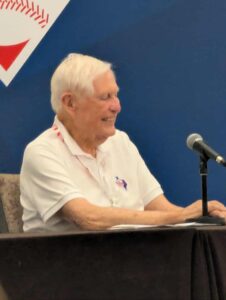 Herrscher from 1962 holds court in 2025 (photo courtesy of Dirk Lammers). DeMerit is joined on the Mets Alumni active roster — if not the itinerary for this September’s Mets Alumni Classic Game — by Rick Herrscherr, who’s been holding court this weekend at the national SABR convention in Dallas; Cliff Cook; Jim Marshall; Craig Anderson; Galen Cisco; and Jay Hook. Howie Kussoy recently caught up with most of these fellas in a terrific story in the Post. These fellas have been telling terrific stories since 1962. The tenor can’t help but have changed with the passage of time.
“We’re at that age, so many have passed away,” Hook, the winning pitcher in that 9-1 decision of so many April 23s ago, reflected. Jay went the distance then, just as he’s going the distance these days. “After the pope passed away, we were watching TV and they were saying the pope was born in December 1936. I turned to my wife and said, ‘Hey, I was born in November 1936.’”
In 1962, that made you practically a kid. In 2025, that makes you, well, someone with quite a memory to mine. Kussoy asked Cisco what it was all like to be one among that first batch of New York Mets.
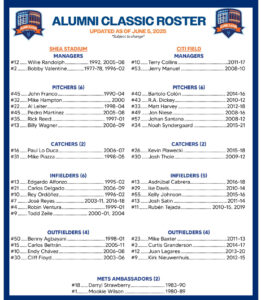 The Mets Alumni Classic will have team Shea Stadium face off versus Team Citi Field. What’s left of Team Polo Grounds wins simply by sticking around. “It was the perfect time for a new club to step in because they were hungry for National League baseball again,” the pitcher said. “They were such great fans. They loved their Mets. Whenever we’d win a game, the fans would go nuts. They didn’t expect you to win two of three. If you got one, they were satisfied.”
Our expectations have risen since. But win today, and we’ll be satisfied until tomorrow.
by Jason Fry on 27 June 2025 12:15 am Is this glass half-empty or half-full? Griffin Canning left early with an ankle injury, one that looked innocuous on the field but decidedly less so when Canning had to be helped to the dugout. (It appears to be an Achilles injury, which would quite likely be season-ending.) But even as dark clouds gathered overhead, the Mets then dominated the Braves to earn a split and go back into first place courtesy of the Astros’ daytime victory over the Phillies.
Good day, or bad day?
If you want to delay your answer pending MRI results, that’s perfectly understandable. But for me, this split felt like a sweep — a big exhalation for a team and a fanbase that felt like it was strangling.
Canning departed in the third inning of a scoreless game in which he matched up with Grant Holmes, a rotini-haired hurler who looks like Kenny Powers with a primo hair-product endorsement. The portents weren’t great as an overworked revolving-door Mets bullpen tried to pick up where Canning had left off, with Austin Warren first to the hill … and against Ronald Acuna Jr. no less.
But youneverknow, to quote a noted baseball philosopher’s favorite word. Warren only needed two pitches to dispatch Acuna, and then hung around for another two innings, during which he gave up only a single to Marcell Ozuna. The baton then got passed to Dedniel Nunez, who looked gratifyingly like his 2024 self — you could see Nunez’s confidence rising higher and higher as he marched through the Atlanta hitters. Six up, six down and then it was Ryne Stanek‘s turn — and Stanek, too, looked better than he has in some time. Last up was Edwin Diaz, who allowed a solitary annoyance single before closing things out. On the day, Mets pitchers allowed just a trio of singles and nary a walk — not bad for any game, let alone one involving an early emergency and called audibles the rest of the way.
The hitters showed signs of life, too, led by three hits from Pete Alonso. Alonso chipped in an RBI single, but the big blow was a two-out, two-run single from Jeff McNeil on the first pitch from Dylan Dodd in the seventh. Dodd’s name on the back of his uniform looks weirdly like 0000 unless you look closely; guess the Braves could use a font coach.
McNeil’s hit turned a 2-0 Mets lead into 4-0, and I felt at peace for the first time in what’s felt like ages. It felt like the Mets had shaken off whatever this recent bad dream has been, remembering the value of timely hitting and solid pitching and postgame group kicks.
No explanation for wearing road uniforms at home — footage of that one will be a puzzler years from now — but we’ll let it slide.
by Greg Prince on 26 June 2025 1:49 pm “Does anyone still wear a hat?” Elaine Stritch was known to ask. If anyone does — and I know it’s done at Citi Field — I hope hats have been held onto tightly, for the Mets won a ballgame in their ballpark Wednesday night. Surprising, I know.
The Mets, losers of 10 of their previous 11, looked liked their old selves, the selves who’d won 45 of 69 ahead of the skid that commenced nearly two weeks ago and paused only once. Now, they’ve won one of one. Now, overall, they’ve won of 47 of 81, which is to say they are 47-34 after 81 games, which is also to say we have reached the halfway point of the 2025 baseball season.
How the hell did that happen? Wasn’t it just March 27, the Mets in Houston, the new year getting underway? Where did it go? It went to some of the highest Met heights in recent memory before plunging back toward the middle. The heights were too high to let a even a severe two-week dip dent the record too badly, though I suppose there’s still time.
There’s always time. It’s the thing that flies.
Fortunately, there are also still the Mets of the current campaign, the Mets who were, I’m pretty sure, too good to continue spiraling. Living in every season at once as I do, the way the Mets have played versus the Braves and Phillies in particular has sent me back four years to 2021. Remember 2021? I’m gonna guess, despite its relative recency, not much. It’s one of those seasons that evaporated from common Met discourse as soon as it was over. Luis Rojas was the manager. Several people were the general manager (one of them signed James McCann; another of them traded Pete Crow-Armstrong). Marcus Stroman was the rotation’s rock. Miguel Castro saw more action out of the pen than anybody. The Bench Mob — Villar and Pillar; Peraza and Mazeika, Prancer and Vixen — constituted the collective toast of the town for an eyeblink. Things looked good for a while before things looked dicey. Then things went simultaneously west and south.
As of August 12, the 2021 Mets sat in a tie for first place with a record of 60-55. Their next four series encompassed two apiece versus the Dodgers and Giants, a pair of clubs en route to crashing the 100-win mark. You know why L.A. and San Fran won 106 and 107 games, respectively? Because they had the good sense to schedule the Mets. Between August 13 and August 26, they combined to play the Mets 13 games and beat them 11 times. When the carnage was over, so, effectively, was the Mets’ shot at reaching the playoffs.
Ancient four-year-old history, except the contemporary Mets, after losing three of three to the Rays at home; going to Atlanta and losing three of three; going to Philadelphia and losing two of three; and coming home and losing their first two against the Braves, gave me unwanted flashbacks to that not-so-golden interregnum of Jake Reed and Chance Sisco. We’re good as long as we don’t play good teams? Playing good teams is what torpedoed us in ’21.
It’s not ’21 anymore. We have Francisco Lindor and Pete Alonso and Edwin Diaz and Brandon Nimmo and Jeff McNeil and David Peterson now. We had them then, too, but it’s much different in ’25. I’m sure of that.
Pretty sure.
True, we’ve cycled through our share of Dicky Loveladys, Tyler Zubers, and, as of Wednesday, Jonathan Pintaros — 30 pitchers in all this season, plus a designated hitter who threw a scoreless inning — but we also have Juan Soto in ’25. We’re slated to have him in years I can’t guarantee will arrive in a world-teetering-perilously-on-the-precipice-of-extinction sense, but we’ll worry about those years should they get here. We have the Soto we craved in December, the Soto I remember looking at during that first series in Houston, when he was exchanging a few words with Jose Siri in the Daikin Park outfield after one of them had called off the other on a fly ball, and thinking, “Wow, he’s actually a Met, not just a stunning acquisition who shows up at press conferences and swings for sizzle reels, but the guy in right who communicates with the guy in center for our team, just like any Met would.” Except he was Juan Soto, celebrity baseball player I wasn’t yet used to being a Met.
I’m not a hundred percent certain I’m used to it yet, but I’ll take what he’s gotten in the habit of giving us when swinging in real life, a real life that includes two swings like those Soto put on two Brave pitches last night. Juan homered twice for the 27th time in his career, or more than anybody ever has before the age of 27. When Soto was with other teams, we’d hear of such youthful exploits and at most nod toward his excellence. Yeah, that Soto is quite a hitter. What’s that got to do with us? Apparently, everything. Based on his output of June 2025, when Juan Soto of the New York Mets has scalded like the temperature and passed the previously unassailable Polar Bear for the club’s home run lead, Juan Soto being a New York Mets is a condition a Mets fan could and should get used to.
Soto’s two home runs accounted for two runs batted in. Ronny Mauricio’s one home run, one of three hits for the kid who seems to be warming to major league competition, accounted for one run batted in. All three Met homers were spectacular to watch soar into the sweat-soaked night, but they were, when you got right down to it, solo home runs. The beauty of the Mets finally beating the Braves Wednesday was that four other runs scored as a result of other hitting outcomes: two runs on sac flies, two runs on singles. Five runs in all scored in the home fourth, as if the Mets just found out about this new thing called keeping the line moving.
Run prevention also came in handy. McNeil, never a center field for more than a minute until this year, robbed Marcell Ozuna of a home run in the first inning. Clay Holmes, the starter from March 27 and every five or six days since, continued in what had been a novel role for him, going five and allowing only one run. You’d like more length from your starter, even if you have to keep reminding yourself Holmes is a starter like McNeil is a center fielder — just lately. Though you’d always like more length from your starter, you’ll accept as something for your starter-length troubles scoreless innings from Brandon Waddell, Jose Butto, and Ryne Stanek. You’ll even give Pintaro a pass for not quite shutting the door in the ninth inning when tasked with protecting a six-run lead. It was his first-ever big league appearance, and things never got too out of hand. He was even thoughtful enough to create a save opportunity (four-run lead, two men on, potential tying run in the on-deck circle) for Diaz, who efficiently cashed it in by recording one quick out.
The 7-3 win by the triumphant team that makes you forget how bad they look when they lose (just as when they’re losing 10 of 11 they make you forget how good they look when they win) was gratifying especially from a big-picture perspective. The 47-34 record they hold at the season’s halfway point is damn fine. Practically, it’s good enough to have them a half-game out of first in the present. Historically, it’s the same mark the 1969 Mets and 1984 Mets held after 81 games, and we know those live on as transcendent years in the common Met discourse. I’ll try to ignore that the 1991 Mets were also 47-34, yet finished 77-84, having experienced their own 2021-style plunge but worse in the second half (a 4-23 stretch ended not only their division title hopes but destroyed what remained of the most successful era the franchise has ever known).
However other Met years have shaken out, 47-34 after 81 games remains damn fine. Still, the way we were going this year, when we were 45-24 two weeks ago, I figured we’d have touched if not passed 50 wins by now.
OK, I assumed we’d have touched if not passed 50 wins by now.
OK, I assumed we’d have passed 50 wins and be waaay ahead in first place, no sweat.
Alas, there’s been a lot of perspiration in these parts these past few days.
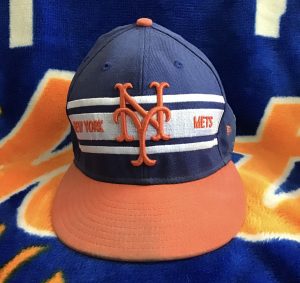 Get a grip… As for time flying, let me redirect your attention to Clay Holmes’s mound opponent in the 81st game of 2025. The Braves’ starter Wednesday night was Didier Fuentes. Didier Fuentes is a young man. How young? Didier Fuentes was born on June 17, 2005. On June 17, 2005, this blog was busy commemorating the 10th anniversary of Bill Pulsipher’s June 17, 1995, major league debut, a 7-3 defeat at the hands of Houston, an event that is a touchstone in the development of Faith and Fear in Flushing. It’s the game for which Jason and I first met in person, outside Gate D at Shea Stadium. We were online friends for a year prior, now we were friends for real. Not quite 10 years later, on February 16, 2005, we started a blog about the Mets, a blog that is still going more than 20 years later.
And, we have learned, four months and a day after we started this blog, a baby was born in Colombia, and that baby has grown up to pitch against the Mets — and lose to them by the same score Bill Pulsipher lost to the Astros in front of Jason and me exactly ten years prior to the day that baby was born.
That baby, now 20-year-old Didier Fuentes, is the first major leaguer younger than Faith and Fear in Flushing. That’s a youthful exploit not even Juan Soto can claim. Living in every season at once as I do, I shouldn’t be shocked at how time’s flight path maps out directly overhead. But, oh baby, this piece of information would have me holding onto my hat if I wore one anywhere outside of Citi Field.
by Greg Prince on 25 June 2025 3:16 am I was hanging out with Frankie Montas Tuesday night, though not as soon I’d planned. Thank the Long Island Rail Road and its “signal problems” and “scattered delays” for making sure I wouldn’t see the veteran’s first pitches as a Met. If I didn’t see his first pitches, I wondered if I’d see any, based on the dismal numbers associated with Montas’s rehab tuneups. The stats suggested his engine wasn’t quite revving. What would happen first: my series of trains depositing me at Citi Field or Frankie making his way to the showers, and not because of the allure a nice, cool shower held on a hot evening like this?
Frankie Montas’s first inning as a Met I heard through the one working earbud of my trusty pocket radio while on the 7 from Woodside. He got out of it.
Frankie Montas’s second inning as a Met I heard on the Mets Plaza loudspeakers. I wasn’t focused on whatever he had gotten into, but he got out of that, too.
Frankie Montas’s third inning I saw on the large monitor that keeps Promenade food courters apprised of the game inside. The starting pitcher emerged unscathed, or at least unscored upon.
Me and my seat got together for the fourth and fifth. Frankie was still on the mound and still getting Braves out. Frankie Montas wound up pitching five innings, and by the time he was no longer pitching, the Mets had scored three off Spencer Strider. They appeared clutch on his behalf, like the team we remember before they were overtaken by their current skid. Montas, the man I was late and, to be honest, hesitant to see, was suddenly the best starting pitcher the Mets had, based on recent results, his own and those of his rotationmates.
I was hanging out with Dicky Lovelady Tuesday night, though not after things with some other Met relievers had gone awry. Dicky Lovelady is a Met reliever, by the way. So are Huascar Brazoban, Jose Castillo, and Reed Garrett. They shared the sixth inning, the inning after Montas fired his eightieth and final pitch. I wished my trains had moved faster. I wished our starter had lasted longer. None among Brazoban, Castillo, or Garrett is what you’d have called Montasian on Tuesday night. They combined to give up five runs to Atlanta in the top of the sixth. It was a long half-inning. It was still light out when Brazoban came on. It was dark when Garrett finally ended it. Very dark.
 Darkness descends on Citi Field. A lot of it. But then we had Dicky Lovelady, and if you can’t enjoy the first Met outing of Dicky Lovelady, you probably shouldn’t be sitting in 94-degree heat watching him. Dicky, a journeyman lefty who officially goes by Richard but prefers you call him Dicky, cooled off the Braves in the seventh, setting them down 1-2-3. More Dicky Lovelady was the only thing I wanted in the eighth. The Mets were still losing, 5-3, and by the time Dicky was pulled in favor of Dedniel Nuñez — the first Dedniel-for-Dicky exchange in franchise history — the Mets were losing, 6-3. By the time Dedniel finished Dicky’s second inning, the Mets were losing, 7-3. The night air wasn’t substantially cooler, and the front office remained dissatisfied enough with its relief pitching that it was planning to call up another new arm, that belonging to righty Jonathan Pintaro, whose 2025 experience to date has topped out at Double-A. Everybody comes. Everybody goes. The bullpen is neither stable nor reliable. I don’t know who goes down to make room for Jonathan Pintaro.
In case it’s Dicky Lovelady, at least I got to see Dicky Lovelady pitch for the New York Mets. If the bullpen has done anything well of late, it’s make the all-time Met roster read interesting.
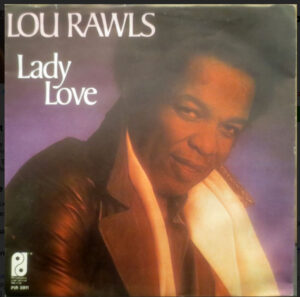 Mr. Lovelady, your warmup music is waiting. I was hanging out with my friend Kevin Tuesday night. Under optimal circumstances, the hanging would have commenced an hour or more before first pitch, but optimal circumstances on the part of the LIRR and me were hard to come by, so we met on the plaza with Montas taking care of the second inning; went through security (which didn’t search my bag for the sealed 20-ounce bottle of diet cola I didn’t bring after my last staredown with them); and hustled up to Promenade. The hustle took several detours until we decided, ah, let’s get some of those messy steak frites from Pat LaFrieda and eat them at one of those picnic tables while we keep an eye on the action on the large food court monitor. I hadn’t done that in the middle of a game for a long time. I hadn’t been this late for a game in a long time.
The hanging out was on. It’s always the highlight of Kevin’s and my annual Mets-Braves game, because our Mets-Braves games tend to be short on highlights from a Mets perspective. This one at least had Frankie Montas surprising everybody with his effectiveness, Dicky Lovelady gratifying us with his presence, and one of those “maybe they’ll pull it out in the ninth” rallies that I egg on with roughly a quarter sincerity. The other three-quarters of me is thinking about what train I’ll be able to get at Woodside, provided signal problems and scattered delays have been solved. Win or lose, I could hang out with Kevin all night. But catching a train is catching a train.
The rally held promise. It even produced a run, driven in by Ronny Mauricio, who might as well make himself useful between strikeouts. The tying run came to the plate in the person of Francisco Lindor. That’s the person you’d ask to tie the game. We would have settled for Lindor simply continuing the rally and the game, given that there were two out. Get on and let Brandon Nimmo win it. Or Nimmo can keep things going after Lindor and we can have Juan Soto win it. Soto scored our first run. Jeff McNeil drove him in with a sac fly. Brett Baty drove in the other two way back in the fourth. Those were heady times. By the ninth, we’d forgotten the Mets were capable of scoring three runs in a single inning, at least until they got baserunners on and Lindor up with their deficit trimmed to three.
Lindor grounded out. The Mets lost, 7-4. It was their hundredth loss in their last 101 games, or felt like it. But I watched it with Kevin, which is always a treat. Every game we go to encompasses every season the Mets have played, essentially. We make a lot of detours while in our seats. But we couldn’t make the Mets win.
After parting ways with Kevin on the 7 at Woodside, I found myself hanging out with Tom. Tom was as much a stranger to me Tuesday night as Dicky Lovelady had been. At least I’d heard of Dicky Lovelady. Tom was a guy waiting on the LIRR platform at Woodside for the Babylon line train, same train I was waiting for. He noticed my game bag, the one with the Shea Stadium Final Season logo and told me he went to Shea as a kid. Well, yeah, I thought, we all went to Shea as a kid. Kids today go to Citi Field. I rode in on the slow trains with bunches of kids — teens, technically — who know Shea only as history if they’re aware of it at all. Kevin and I take time at every one of our game to romanticize Shea. We agreed at this game we’ll never feel that kind of romantic about Citi Field, but that’s OK. The kids on my train (when they’re not loudly consumed by picking parlays on FanDuel) will have that privilege when they are older.
Before I could join Tom in a Shea reverie, he changed the subject to a player he remembered as a kid playing there: Rey Ordoñez. Tom had been a shortstop as a kid. Played it in school, all the way up to college. He’s 40, still rather athletic. Said he “used to” really follow the Mets, but it seemed to me he knew his contemporary stuff. I asked him if he thought we were gonna pull out of this tailspin. Athlete that he is, he said, yeah, there’s 162 games, everybody overreacts. I know that deep down, but I also reach places deeper down where “it’s a long season” logic encounters signal problems.
But we didn’t really stay on the contemporary Mets. We stayed on shortstops. I said Rey was the greatest I ever saw in the field. “Couldn’t hit,” but boy could he field. Tom brought up Ozzie Smith, though he admitted he didn’t see that much of him. Was also really impressed by Rafael Furcal, particularly his arm. I threw in Omar Vizquel as another defender who took grounders and breath away. I got the sense that Tom walks around with a lot of baseball in his subconscious and doesn’t necessarily get to share it with those he comes across in his daily life. One night, some guy is carrying a bag that has a logo from a long-ago ballpark, and Tom is off to the memory races.
We talked shortstops. We talked greatest hitters we’ve ever seen. I’m older, so I’ve seen more of them. Tom relates to their skills, so he understands better than I do what it took for Barry Bonds, “steroids or no steroids,” to lay off any pitch he didn’t like. I threw out some names. Tom threw out some names. Eventually we were onto pitchers. Our train had come. Discovering that our eastbound stops were a town apart, we sat together and kept the conversation going, better than the Mets kept their ninth-inning rally going. Some tangent led him to tell me he once golfed with Tim Teufel. He produced a picture on his phone of the two of them together. Outstanding human being, Tom said of Tim.
Tom’s stop preceded mine. Before he departed, we shook hands and, for the first time, exchanged names. “Tom.” “Greg.” Our names, rather than those of major league legends Seaver and Maddux. A brief hang between erstwhile strangers, but one bulging with baseball, a subject that will familiarize people on the way home from a game in a hurry. You could do worse in the wake of yet another loss to Atlanta.
by Jason Fry on 23 June 2025 11:10 pm Does it count as progress if the Mets lose but it’s merely discouraging and not actively humiliating?
Monday night’s game was more drab and disheartening baseball. Paul Blackburn was lucky not to get driven from the game down six or seven, as he got help from Braves baserunning mistakes and atom balls that found Met gloves. The relievers were solid and helped the Mets hang around, but they could do little against Spencer Schwellenbach, pitching with admirable efficiency on a brutally hot night.
The game was bookended by two Juan Soto ABs — the first in the sixth, the second in the eighth. In the sixth, Soto roped a Schwellenbach sinker into the left-center seats for a two-run homer that brought the Mets within one. In the eighth, Brian Snitker summoned Dylan Lee to face Soto after Raisel Iglesias got into two-out trouble, giving up singles to Francisco Lindor and Brandon Nimmo. Soto fought Lee through eight pitches, all but one of them sliders. The seventh in the sequence was a fastball, one Soto was somehow able to speed up his bat enough to foul off. But the eighth was another slider, perfectly placed by Lee at the bottom of the zone. Soto swung over it, the inning was over and so, essentially, was the game.
But it would be insane to pin this on Soto, AKA the entirety of the night’s offense. What happened in the fifth inning, the frame before Soto’s homer? The Mets went down 1-2-3. How about the seventh inning, the one between those bookend ABs? The Mets went down 1-2-3. And the ninth? The Mets went down 1-2-3.
It’s almost like there’s a theme at work.
In this dreary 10-game stretch the Mets have scored a grand total of 30 runs — and that includes their 11-run uprising against the Phillies. Toss that one out and they’ve put up 19 runs in nine games. I may not be a sabermetrician, but that seems suboptimal. Not to mention unwatchable.
by Jason Fry on 23 June 2025 8:38 am Ebbs and flows, flows and ebbs. A baseball season is filled with them — stretches in which a band of players watch everything they touch turn into Ws and others in which their incompetence is so bafflingly chronic that you half-believe it’s deliberate. Those who have played the game will always have a leg up in understanding that these ebbs and flows just happen and all one can do is endure them, probably because the wins and losses are part of the larger, unchanging routines that surround them. The players are riding the bus from the team hotel and taking infield and BP and going over enemy hitters and they see every day that everything is much the same, except for the glorious or tragic outcomes that emerge. And of course their pre- and postgame assessments are 80% cliches about one day at a time and not getting too high or low — the alternative would be staring into an existential abyss.
Which I suppose is why the baseball gods created bloggers.
If one must experience a long, maddening baseball ebb, I do highly recommend spending it sylphing around Umbria and Lisbon, with 95% of the horrors happening offstage while one sleeps off another night of rich meals and too much wine. The clock limited my encounters with the Mets to the occasional late-night glance at Gameday, followed by early-morning dismay and seeing what Greg had to say about the latest sad event. (Thanks partner — you definitely got a lot more/lot less than bargained for, depending how once sees these things.) Wait what, you’ve got to be kidding me, lather rinse repeat. The end of the losing streak was particularly welcome not just for the obvious reasons but also because for once I didn’t sleep through a fusillade of narrative-flipping enemy runs.
Emily and I landed at JFK at the end of the first inning Sunday, and our various travel snafus coincided with various disasters down in Philadelphia, witnessed via MLB Audio. David Peterson imploded while our plane was trundling around distant runways waiting for our gate to clear; just the sound of the contact made by Edmundo Sosa was enough to send my chin plummeting onto my breastbone. Nothing much good happened while Emily and I were waiting in a concourse-long line to reach Passport Control and be welcomed back to our native shores. Before our Lyft cleared JFK’s galaxy of access roads, the Mets had lost.
That’s a lot of waiting around unaccompanied by anything resembling good news. The game was drab and bad, with just a few things of note:
Francisco Alvarez has finally been sent down, which struck me as merciful. It’s been a season-long parade of horrors for Alvarez, with a broken hamate bone seeming to derail his efforts to refine his approach as a hitter, which leaked into his defense, and even the happy tidings of parenthood feeling like another ball to be juggled while in an increasingly cold sweat. Let’s wish Alvarez well and remember that he’s still just 23, with plenty of time.
Tyler Zuber made his debut, elbowing past the legendary Don Zimmer to occupy the coveted spot reserved for Mets All-Time Roster caboose and paving the way for the publication of the tome From Aardsma to Zuber: Middle Relievers Who Don’t Remember You Either. I’ve had an old Topps Heritage Zuber in waiting since Zuber’s acquisition at last summer’s trade deadline and just got a 2025 Syracuse Mets card for him, so at least in The Holy Books everything’s coming up Zuber.
Keith Raad did a good job as a solo radio act, a la Vin Scully: He was bright, engaged and cheerful even amid dolorous Mets-related doings. If only he’d been given events we’d want chronicled, let alone revisited.
Francisco Lindor homered but the Mets didn’t win, putting an end to a quirky 28-game streak that was one shy of the big-league record held by Carl Furillo and the 1951-53 Brooklyn Dodgers. Lindor homering is certainly still a good idea, regardless of its accuracy as a portent, and I suggest he keep doing that. Maybe I’ll even be here for the next few!
by Greg Prince on 22 June 2025 6:41 am The Mets went only 2-for-7 with runners in scoring position Saturday night in Philadelphia, and their starting pitcher had to be pulled with one on and nobody out in the sixth, suggesting two overly familiar ingredients had been stirred into the pot for an eighth consecutive serving of futility stew. Fortunately, the Mets were experimenting with a different recipe, one that calls for seven home runs, each their own rather than the opposition’s.
Nobody was on base for any of them, but nobody had to be.
Thanks to a lot of slugging — a lot — the Mets broke their seven-game losing streak, thwacking the Phillies. The final score rang a bell, and I don’t mean Liberty, for 11-4 was the score of the very first Mets game ever. That night, April 11, 1962, in St. Louis, the Mets had the four. The comparison would therefore fizzle if not for this game in 2025 also feeling like it was presenting us with the first line on an otherwise clean slate. One game and a lifetime to come then, one game and a whole season of (we hope) renewed promise ahead now.
Goodbye, at last, to the doom and gloom associated with dropping seven in a row. It’s as if those blahs and blues were never here. Hello, once again, to first place in the National League East. Maybe someday we’ll be noting, “by stopping their seven-game losing streak, the Mets moved into a first-place tie,” the way we marvel that the Mets dually accomplished reaching .500 and taking first on the same night in September 1973. Of course that was September. This is June. This is lots of games to go. This is reacting to a one-week downturn in the middle of a season that had been practically nothing but ups until very recently.
Was it overreacting? When you live through (and blog through) seven consecutive losses, there is no overreaction. Losing always sucks. Losing times seven sucks seven times as much. But it sure is nice to have a previously woven cushion to fall back on. That’s what the 45-24 was for; a superb start can withstand a sudden sag. So now we’re 46-31, which looks spectacular, especially if you conveniently overlook the 0-7 it encompasses.
For now, let’s just enjoy 1-0 by way of 11-4. Let’s enjoy the enormity of seven convincingly blasted Met home runs and the oddity that each of them was a solo home run, not to mention three of them having been hit in succession. If you’re not gonna produce consistently with runners on base, then make every bases-empty hit count. Hit every bases-empty ball out of the park. How do you win if all your home runs are solo jobs?
Volume! Volume! Volume!
Juan Soto twice. Brandon Nimmo twice. Jared Young and Francisco Alvarez once each. And, perhaps most comforting, Francisco Lindor once. Lindor, he who continues to play through a broken toe, had been slumping more than any Met, which is an achievement unto itself. But our de facto captain got going on Saturday, not only with a homer — when Lindor homers, the Mets win — but a double that nearly went out of Citizens Bank, struck far enough away from home plate that it scored the two runners on base. Come to think of it, as awesome as Soto’s shots to the seats were, his two-run icing-on-the-cake single in the eighth, capping his 4-for-5 night, may have been most gratifying. This was Juan being the Juan we didn’t have to dream of when he was signed last December, because Juan’s reality was enough. The Juan of most nights in 2025, even the Juan who’d gotten himself untracked, hadn’t been otherworldly. This fella doin’ his thing in Philadelphia was the Juan we signed, the Juan who makes pitchers pay for running deep counts and/or letting runners on base ahead of him, whether he proceeds to plant their pitches on distant planets or simply where fielders ain’t. Seven other runs were driven in by four other Mets, but Juan being Juan was what we’d been waiting for.
Soto’s first hit was off a changeup, the seventh pitch of the at-bat.
Soto’s second hit was off a four-seamer, the seventh pitch of the at-bat.
Soto’s third hit was off a curveball, the seventh pitch of the at-bat.
Soto’s fourth hit was off a splitter, the sixth pitch of the at-bat.
On Saturday afternoon, as something of a break between turning down the sound on Apple TV+ Friday night and turning down the sound on Fox Saturday night (and ESPN2 tonight, no doubt), I saw a matinee performance of Real Women Have Curves. I enjoyed my Broadway detour a great deal, almost as much as I enjoyed seeing, via Soto’s swings, that real sluggers hit curves and everything else.
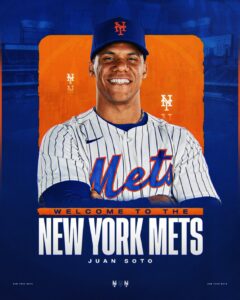 Hey, he’s really here! The seven Met home runs were breathtaking, especially when Lindor, Nimmo, and Soto back-to-back-to-backed a trio in the third. The additional runs via non-homers were reassuring. The jolt of resilience, missing throughout the losing streak, was a reminder that a good team is never out of a game in which it is behind, and that the Mets are a good team. They were actually down, 3-1, after two innings. The top of our order mashing those three consecutive dingers was resilient as hell.
Griffin Canning was adequate enough for the task at hand. He was supported by what amounted to an oodle of runs, thus the four he allowed through five (plus the leadoff single he gave up in the sixth), didn’t cause inordinate stress. Two essential Met relievers, Huascar Brazoban and Ryne Stanek, returned to form, no letting the lead they were charged with protecting get reduced. And one of the Syracuse shuttlers did fine for himself. I’m just sorry it wasn’t the Syracuse shuttler I wanted to see.
Nothing against Chris Devenski, who pitched a scoreless ninth. Devenski deserves something beyond frequent flyer mileage for the way he spaces out his major league appearances. He’s pitched three times for the Mets this year: on April 30; on May 31; and June 21. But the space I had reserved in my heart once I learned who else was recalled Saturday (as Blade Tidwell and Justin Garza were thanked for their service with a demotion to Triple-A) went unfilled.
The Mets have brought up Tyler Zuber! Other than Tyler Zuber’s family, I don’t know if anybody else is bringing an exclamation point to bear over this news, but it’s big news to me. Once Zuber gets in a game, he becomes, as detailed here last summer, the alphabetical last Met in franchise history, bumping Don Zimmer to next-to-last. This has been a development more than 63 years in the making. It literally goes back to that first game, on April 11, 1962, when Casey Stengel wrote “Zimmer” on his lineup card, and no manager after him could go any deeper in the alphabet. The opportunity was there Saturday night for Carlos Mendoza to not only move his team back into first, but to move one of his players into last…which I’m sure Zuber is used to from teachers taking attendance. Alas, we settled for Chris Devenski meeting his monthly quota. And the Mets moving back into first place.
We’ll settle for such resolution to a lengthy losing streak any day, no matter what channel it’s on.
|
|






