The blog for Mets fans
who like to read
ABOUT US
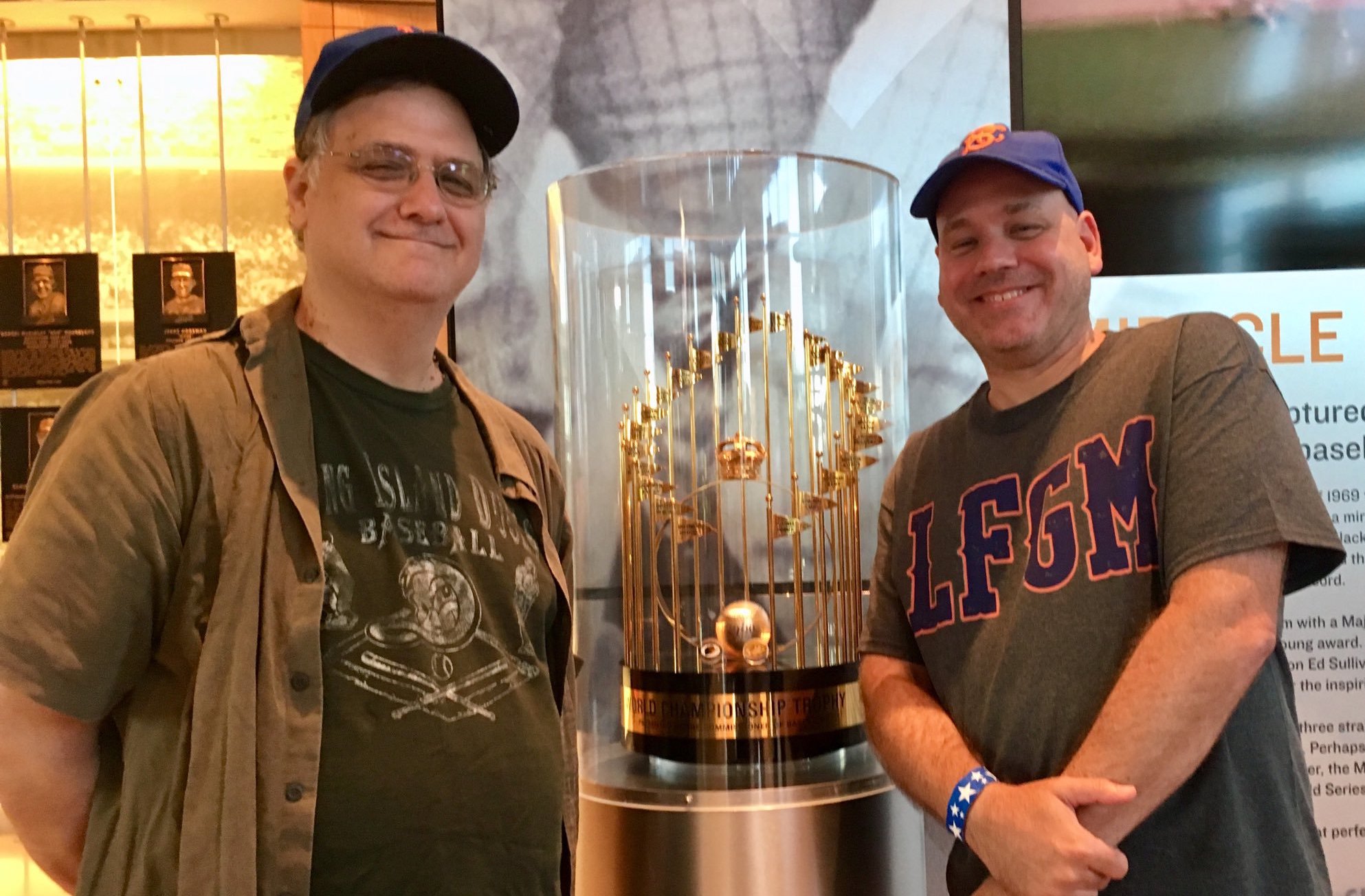
Faith and Fear in Flushing made its debut on Feb. 16, 2005, the brainchild of two longtime friends and lifelong Met fans.
Greg Prince discovered the Mets when he was 6, during the magical summer of 1969. He is a Long Island-based writer, editor and communications consultant. Contact him here.
Jason Fry is a Brooklyn writer whose first memories include his mom leaping up and down cheering for Rusty Staub. Check out his other writing here.
Got something to say? Leave a comment, or email us at faithandfear@gmail.com. (Sorry, but we have no interest in ads, sponsored content or guest posts.)
Need our RSS feed? It's here.
Visit our Facebook page, or drop by the personal pages for Greg and Jason.
Or follow us on Twitter: Here's Greg, and here's Jason.
|
by Greg Prince on 18 May 2025 3:39 pm Who could or would be happy that the Mets beat the Yankees in the Bronx on Saturday? Us, obviously. The Mets beating the Yankees is a thing for us. We’re Mets fans. We like when the Mets beat anybody. We especially like the Mets beating the Yankees.
We like Griffin Canning, he of the 2.47 ERA, continuing to start games the Mets win; it’s probably not a coincidence that that happens. Griffin gave up only two solo home runs (one that could have been featured in one of those SNY salutes to local little leagues) over five-and-a-third.
We like Huascar Brazoban bailing out Canning from his spot of trouble in the sixth and then taking care of that inning and the next one. Brazoban’s in that splendid middle relief zone where his praises are sung after each effective outing, yet because of the nature of his role, we tell each other he’s unsung.
We like Juan Soto, baserunner, a character we didn’t know Steve Cohen was paying for. When the opposition isn’t paying attention — turning their back to him, you might say — Juan swipes a bag. It’s like something out of Daniel Murphy’s sack of invisible tricks. Saturday, as he stood on second following Pete Alonso’s RBI single in the fourth, Juan thought it would be better to stand on third. He was right, for soon, after he stole third, he was able to run home on Mark Vientos’s sac fly to left.
We like Reed Garrett, the Met whose face-camouflaging beard complemented that otherwise atonal Armed Forces Weekend cap, squirming from a jam like he holds a grudge against Smucker’s. Walk the leadoff hitter in the eighth? Get a double play grounder. Load the bases by sandwiching a double around two more walks? End the inning by eliciting a lineout from DJ LeMaheieu (who hit that fly ball earlier that cleared the backyard fence in shortest right).
We like the good eye from Luis Torrens, who knew enough to take ball four in the top of the ninth, and the good sense from Carlos Mendoza to pinch-run Luisangel Acuña. After Acuña makes his way to third, he scores on a not terribly deep fly ball Francisco Lindor lifts to left field, giving the Mets a 3-2 lead. Luisangel’s baserunning isn’t stealth à la Soto’s. It’s understood he’s to be noticed on the basepaths, yet his ability still carries the potential for delightful surprise. We like that, too.
Oh, and we really like Edwin Diaz when he’s not in hang on, Sloopy! mode. Charged with protecting a one-run lead in the bottom of the ninth, there was little sense of screwing around. A strikeout on a full count to Austin Wells. A lineout of Ben Rice. And then, just that Aaron Judge fella. The Mets-inclined viewer would be grateful for anything that wasn’t a tying home runs Edwin works Aaron to three-and-two before blowing a fastball by the swinging superstar.
We like Mets 3 Yankees 2 on a Saturday afternoon. A lot.
Who else might like it?
I’d like to think Jim Marshall might like the Mets having beaten the Yankees on Saturday afternoon. Jim Marshall is the oldest-living Met. On May 25, Jim is scheduled to celebrate his 94th birthday. Something about being born in May seems to agree with Met longevity. Yogi Berra, who made his birth necessary on May 12, 1925, lived to 90. Willie Mays, who first said “hey” on May 6, 1931, made it to 93. Marshall didn’t have their careers, but he was in the lineup for the very first New York Mets game, on April 11, 1962, and he is the sole survivor from the night the franchise came kicking and screaming into the National League (Cards 11 Mets 4). When the Mets were in Phoenix a couple of weeks ago, the Diamondbacks facilitated an on-field celebration of Jim’s status as the Oldest Living Met. As Marshall, who has lived a helluva baseball life, said to Bob Nightengale in an engaging USA Today profile, he always dreamed of “being No. 1. Well, I finally made it.”
I’d like to think Ralph Kiner might have liked the Mets beating the Yankees on Saturday afternoon. Of course he would have. Ralph was in the booth for that very first Mets game and so many more. He was in the Channel 9 booth alongside Tim McCarver and Gary Thorne for the first regular-season Mets-Yankees game in 1997, and he sounded pretty stoked at the way Dave Mlicki was shoving that magical Monday night. Ralph’s spirit was in if not on the air this past week when the Pirates were in town, and the Mets arranged a meeting between Ralph’s son Scott and their somewhat distant relation Isiah Kiner-Falefa. It was all too perfect not to happen. Kiner-Falefa, now Pittsburgh’s shortstop, had been to exactly one randomly chosen Mets game as a kid, in 2007. It was Ralph Kiner Night, and the kicker was the youngster had no idea such a ceremony was going to take place when he showed up at Shea that Saturday. Or was the kicker that Kiner-Falefa made like Kiner on Monday and homered for the first time all year, in the same ballpark where Ralph’s name and microphone hangs from the rafters, shortly after his family reunion with Scott, whom he’d never met until it happened in Flushing? The Mets won that game, permitting a Mets fan to gin up enough grace to actually enjoy Kiner-Falefa’s unlikely trip around the bases in retrospect…once that Mets win went final.
I’d like to think that if it got his attention, Jim Gosger might have liked the Mets beating the Yankees on Saturday afternoon, though the 83-year-old former outfielder could be forgiven for having another sporting event filling his focus. Gosger, who played bit parts for the 1969 and 1973 Mets, okayed the use of his name for a racehorse that was running in the Preakness. It’s a sweet story, told in detail here, but the bottom line is that Gosger the horse, who went off with long odds, finished in the money at Pimlico, coming in second to Journalism. Journalism tells sweet stories in detail, too. The detail that stays with Mets fans in modern times regarding Gosger the ballplayer is that in 2019, at Citi Field’s fiftieth-anniversary celebration of the Miracle Mets, Gosger was honored in the club’s In Memoriam reel. Jim was quite surprised, given that he was alive and well and living in Michigan. Still is.
I’d like to think one of Gosger’s 1969 teammates liked the Mets beating the Yankees on Saturday afternoon, and based on recent evidence, I’m guessing it totally got his attention. On the podcast called The Terry Collins Show, co-host John Arezzi conducted a blessedly long interview with 80-year-old Ron Swoboda. Ron wasn’t promoting anything except stories of his time playing for Gil Hodges and his time before that playing for Casey Stengel and anything Arezzi asked him about. Swoboda, as ever, was deep and thoughtful and generous with his reflections. The discussion was recorded very early this season, which you can tell, because Rocky offered observations about every Mets game he’d been watching down in New Orleans, which seemed to be all of them. You love knowing a Met (who played a little for the Yankees) is still so attached to the Mets. You love hearing the excitement of a kid from 1966 who grew up rooting for Swoboda getting to talk to him at length. Arezzi with Swoboda is a treat for the ears on your favorite podcast platform, and is available for watching on YouTube.
If he wasn’t preoccupied by ramping up for his umpteenth major league comeback, I’d like to think Rich Hill liked the Mets beating the Yankees on Saturday afternoon. Rich Hill was a Met in 2021, which means he played with a few of the Mets who helped beat the Yankees, which is all well and good for the record, but I hold Hill in esteem for emerging at this late date as the LASPSA: Longest Ago Shea Player Still Active. As noted last September, when he had just pitched in relief for the Red Sox at Citi Field, Rich Hill took the mound at Shea for the Cubs in 2005. Clayton Kershaw is off the IL for the Dodgers; he pitched at Shea in 2008. Max Scherzer is on the IL for the Blue Jays; he pitched at Shea in 2008. But Hill, whose 45-year-old left arm just signed a minor league deal with the Royals, has them both bested in terms of longevity Sheawise and earthwise. Rich was born before either of those future Hall of Famers and not only pitched in our old ballpark before either of them, he did so when there wasn’t as much a stake in the ground for the ballpark that would replace Shea. Judging by Kansas City trusting in his timelessness, there’s no replacing Rich Hill on the major league radar.
If he took a glance at the out-of-town scoreboard, I’d like to think Jacob deGrom like the Mets beating the Yankees on Saturday afternoon. DeGrom, suddenly verging on his 37th birthday, is actually healthy again and pitching like he’s always pitching when physically unencumbered. This past Thursday, he dueled Hunter Brown of the Astros, topping him, 1-0. Jake went eight for the Rangers win in Arlington. Brown also went eight, which gave him a complete game loss, something you hardly see anymore. MLB Network was showing this game, which I didn’t necessarily plan to watch, but I turned it on in the sixth, with the sound down, and found myself absorbed by deGrom being deGrom again. Struck out seven, walked one, scattered five hits, made me think of 2018 through 2021 when Jacob deGrom of the New York Mets was the best pitcher on the planet, and he was lucky if his teammates gave him as much as one run to work with. It suddenly became very important to me on May 15, 2025, that deGrom get this 1-0 win for Texas, a little like on the night of May 14, 1996, when I rooted for the Yankees to prevail for the first and only time in my life, because that was Dwight Gooden on the mound for them throwing a no-hitter. I have nothing against the Texas Rangers, not even them luring deGrom away with a contract not even Steve Cohen was of a mind to match, so this presented no inherent conflict of interests. If anything, it reminded me of what we had when we had deGrom. It seems long ago enough now that I could probably convince myself Jake pitched for us at Shea, maybe against Rich Hill.
Finally, I know Brooklyn’s own Mike Lecolant would have liked the Mets beating the Yankees on Saturday afternoon. Mike was a big Mets fan, albeit with the asterisk that he didn’t quite despise the Yankees the way most of us do. I went to one game with Mike, a fabulous night in 2019, when he explained his family had rooting interests that spanned the boroughs, so while he was a Mets fan the way I was a Mets fan, he simply wasn’t the same kind of Yankee-hater. He even cherished a childhood memory connected to his favorite Yankee, Carlos May. Carlos May — why Carlos May? If I remember correctly, he was taken to Bat Day at the Stadium, and that’s whose model bat Mike was handed. He could be a loyal guy that way.
 Mike Lecolant, a terrific Mets voice. Mike was someone I knew from being on a podcast he hosted alongside two other really good guys, Sam Maxwell and Rich Sparago. I was essentially their go-to guest when they couldn’t find anybody else, and we always had a good time. Mike got three of the four of us together on a Saturday night six years ago for a game at Citi Field through a connection I had no idea he had. Mike was related to the Cora brothers, as in Alex and Joey Cora. Alex played for the Mets in 2009 and 2010 and went on to manage the Red Sox to a world championship. Joey, also an experienced MLB player, became a respected third base coach, eventually for the Mets under Buck Showalter. In 2019, this Cora was with the Pirates, and the Pirates were on the schedule for us. Joey offered Mike tickets in the visitors’ family section, and Mike invited me to join him. I said yes.
It was a great night of Mets baseball and Mets baseball talk. I learned about the Cora connection. I learned about the Carlos May connection. I learned Mike was a warm human being beyond the persona he offered as a podcaster. On those pre-Zoom conference calls, he addressed every topic in full paragraphs, with genuine authority. Not a know-it-all, just somebody who would give whatever he was asked real thought, and then express his belief without equivocation. He was always willing to listen to differing opinions and respond respectfully — he shifted seamlessly from monologue to dialogue — but I admired that he had what he was going to say figured out and could express it without any hint of artifice. Mike the podcaster didn’t put on.
On our Saturday night at Citi Field, Mike the Mets fan who didn’t despise the Yankees was plenty easygoing, a pleasure to spend nine innings in the company of. I told him I was sort of in awe of the voice he presented. He was shocked that anybody noticed. He swore he wasn’t aware he was doing anything special. I’m glad I could communicate to him that communicating Mets and baseball thoughts to others with authenticity and élan was a gift in our world, and that I appreciated the way he went about delivering that part of himself. I could say the same for his writing, which he pursued under the guise of the Brooklyn Trolley Blogger. Mike covered the waterfront of New York sports, past and present, and he wrote on the Web like he talked on the pod. Check out his tribute to his youthful idolizing of Tom Seaver. If you thought you’d read everything there was to read about how a Mets fan might miss Tom Terrific nearly five years ago, you’ll find out you still maintain untapped emotions.
As Mike wrote in September of 2020, “Time has no mercy. We know this well. We’re just never ready for news like this. It needs a moment to sink in, then in rushes the heartbreaking sense of loss.” That was Mike Lecolant on Tom Seaver. It also described what it was like for me to learn that Mike Lecolant died earlier this month at age 58. I suppose I knew it was coming. Mike contacted me on the eve of the 2022 season to tell me had been diagnosed with ALS. He wasn’t telling me out of any sense of self-pity, but because now, while he had time and was still able to do some things, he had a few questions about researching a baseball topic close to his heart and maybe putting together a book. I offered a few thoughts, and he thanked me. I’d be on A Metsian Podcast with him a couple more times after that. His literal voice was still strong the first time, not so much the last time.
When Sam let me know of Mike Lecolant’s passing on May 7, it wasn’t surprising, but it still packed a punch. Knowing it was coming didn’t soften the blow. But knowing Mike through his felicity with the spoken word and the written word, not to mention quite a few friendly words between us, was a blessing. I’m happy the Mets beat the Yankees on Saturday afternoon. I’m happy I knew Mike Lecolant. I’m happy Mike Lecolant found room in his heart for both Tom Seaver of the Mets and Carlos May of the Yankees. Any time is a good time to count various blessings.
by Jason Fry on 16 May 2025 11:19 pm Tylor Megill looked Niesean Friday night against the Yankees. If you know me and/or are a long-time reader, you know that’s pretty close to a deadly insult.
Megill suffered some bad luck along the way to giving up four earned runs in 2 2/3 laborious innings in the Bronx: In the fatal third inning (which took an interminable 27 minutes that felt like 27 days), Clay Bellinger hit a little roller that was too slow for Mark Vientos to turn into an out, followed by a Sotoesque (Luis, not Juan) billion-hopper up the middle by Paul Goldschmidt that brought in the first two enemy runs. But it wasn’t all bad luck: Megill also walked five guys, including the first and last Yankees he faced. And most damningly, nothing he throw seemed to have conviction behind it. To my admittedly annoyed eyes, he kind of trudged around while bad things happened, waiting for someone to tell him he was excused.
Disappointing, to say the least — Megill had looked like he’d figured something out and was finally harnessing his considerable talent, famously telling Jeremy Hefner in spring training to opt for tough love: “If I was pitching like shit, I wanted him to yell at me.” Tonight, he looked like Niese, the Alibi Ike of the 2010s Mets, who never met a bit of bad luck he couldn’t make into an excuse for why he’d fallen apart. (By the way, did you know Niese is only 38?)
Anyway, Megill pitched like shit and so hopefully Hefner will do as he was directed down in Port St. Lucie.
The rest of the game wasn’t particularly worth noting: With the Yankees out to a big lead and the Mets continuing to look flat, both teams pretty much went through the motions the rest of the way. And the Mets do look flat all of a sudden: I was at Wednesday night’s soggy sleepwalk and was so disgusted that I left after five, which I don’t think I’ve done since a 1999 debacle that saw Matt Franco take the mound. I’ll put up with dreary conditions and I’ll put up with dreary baseball, but it turns out I won’t put up with both.
Back to Friday, when much was made of Yankee fans booing Juan Soto in his return to the Bronx. But that struck me as performative New York sports opera, a fan molehill that the usual sports-talk grifters will make into a mountain. The Mets’ teensy moral victory was forcing Aaron Boone to call on closer Luke Weaver, which happened after Yerry De Los Santos pitched timidly with a five-run lead. Keith Hernandez and Ron Darling were disgusted with De Los Santos, and they weren’t wrong; I bet Boone wasn’t particularly pleased either. Maybe those Weaver pitches that shouldn’t have been needed will come into play during the rest of the series, but that seems like cold comfort now.
Oh, and everybody was forced to wear dumb-looking hats for Armed Forces Day Weekend. I don’t know how a day can also be a weekend, and I also don’t know how looking terrible shows support for a worthy cause. But now I’m making my own mountains out of molehills. That’s what happens when you’ve been forced to spend the evening thinking about Jon Niese.
by Greg Prince on 15 May 2025 2:49 pm If you were curious as to what a 2025 New York Mets lineup that doesn’t feature Juan Soto would have looked like, you got a glimpse Wednesday night at Citi Field. Carlos Mendoza rested his right fielder, the fellow who’s batted second every game since Opening Day, the guy who — whether he’s raking or not — changes the complexion of the top of the Met order by his mere presence. Just a night off, the manager said, followed by a teamwide off day, followed by the road portion of the Subway Series, where Juan will be greeted loudly if not universally warmly. One full game sat approximately every quarter-of-a-season seems reasonable. Only Felix Millan in 1975 and Pete Alonso in 2024 never missed a Mets game. Heck, even the immortal Chris Majkowski, who produced 5,010 consecutive broadcasts from August 1993 to just the other day, is briefly sidelined from the Audacy Mets radio booth.
Sitting Soto didn’t seem helpful to the immediate goal of sweeping the Pirates, but in a long season, everybody merits a breather and, more importantly, everybody who usually sits needs to play now and then. Plus, if we can be a bit haughty about it, you shouldn’t have to deploy your entire “A” team to beat the Buccos. Pittsburgh entered Wednesday’s action at 14-29, on their second manager of the year. We were 28-15, sporting the best record in all of baseball, tied with the Tigers and a half-game better than the Dodgers. Most relevantly, we were three up on the second-place Phillies in our division. If you were ever tempted to gently lift a pinky toe from the gas pedal, this was a prime opportunity.
Jose Azocar played in Soto’s stead. Jose Azocar almost never plays, unless it’s to run for a less speedy Met. I don’t think this upfront substitution was entirely the reason the Mets didn’t win one game on one rainy night in May, but I wouldn’t do this again if I could help it. Nothing against Azocar. Good teams need pinch-runners, and pinch-runners oughta test the rest of their skill sets against live competition so they stay fresh for when called on to be complete players. Someday, you might need Azocar to do something besides stretch his legs.
Maybe do it in left or center field next time, though.
Wednesday, without Juan, the Mets lost, 4-0. It wasn’t as simple as going Sotoless, nor should the defeat be directly attributed to Azocar. Jose trapped rather than caught a ball in right; got picked off after drawing a walk; and flied out with the bases loaded to end the only genuine Met threat of the night, but he’s not the one who made the ball slicker than preferred for Clay Holmes, and he’s not the one who may have squeezed Holmes on balls and strikes, and he’s not the only one who didn’t drive in any Mets.
It was an uncommonly blah 2025 Mets game. Sitting out any further dwelling on it seems the wise move.
by Greg Prince on 14 May 2025 2:18 pm The 1986 Mets were so good that they couldn’t be stopped by a ball landing in a glove; the ball staying in the glove; and the glove and the ball being tossed as one to record a putout against them. All of that happened when Keith Hernandez grounded a ball back to Giants pitcher Terry Mulholland. Mulholland, then a rookie, simply could not extract that little white devil from his brown leather. Thinking fast, he took the whole package and threw to it first baseman Bob Brenly. It was legal. It was effective. Hernandez was out.
Mulholland: “I tried three times to get the ball out of my glove. Finally, in desperation, I just threw it.”
Hernandez: “That was a first for me.”
Davey Johnson added that he thought about arguing the call with first base ump Ed Montague, “but I didn’t know what to argue about. I figured the play was funny enough without me arguing.”
We could laugh about it after it happened, at Shea Stadium, on September 3, 1986, because a) the Mets were already ahead of the Giants when the play took place (up 2-0 in the third); b) the Mets added a run in the very inning the play took place; c) the Mets went on to win the game by a score of 4-2; and d) the Mets were in first place by twenty games. Baseball bloopers in which your team is the one getting blooped can be amusing when they don’t hurt whatsoever.
The 2025 Mets are good enough right now that they weren’t stopped Tuesday night at Citi Field by a ball whooshing through a glove. The ball was hit by an opponent. The glove belonged to one of their own players. The slo-mo replay confirmed it was worse, or at least more embarrassing, than it appeared. It extended an inning that should have been over, led to a starting pitcher who deserved better departing before he could finish the job at hand, and set up a run that turned a Met lead into a Met-Pirate tie.
Yet it didn’t stop them from winning. Its This Week in Baseball worthiness would probably tickle our fancy if the glove had been attached to a fielder on any other team. It was less hilarious that it happened to Mark Vientos.
Ah, Vietnos. Hard as he works to tame the position made infamous by “79 Men on Third” (the count has since reached 191), he’s in there for his bat to begin with. It’s quite often a helluva bat. His defense, however, had already taken one ding in this game — his chest, specifically, when a hard grounder banged off it and into left. Hot shot, damp night, weird double; nothing is declared an error, anymore. That was in the third inning. Kodai Senga got out of it. We were up, 1-0, thanks to Juan Soto (single; steal) and Brandon Nimmo (double) in the first. It would be a bruise for Mark and hardly a black mark against anybody in the course of an evening let alone a season. Hell, he got an assist on the play that ended the inning two batters later, handling a grounder that did not assault him so much.
Vientos wouldn’t be so lucky in the sixth when he encountered something else that sizzled. This ground ball, struck by Jared Triolo, with Alexander Carnario on first and two out, was ripe for backhanding. Observed in real time, it looked like it ticked off Mark’s glove. Several balls have been ticking off several gloves in this series. Just one of those weeks, perhaps.
But, no, this was beyond an ordinary oopsie. What the ball actually did was scoot directly through the webbing of Vientos’s eyecatchingly colorful leather. Seriously, it is a very attractive piece of fielding equipment the man models, replete with robin’s egg blue base and pop-art bursts (“POW!” “BAM!”) that might have made Pittsburgh’s own Andy Warhol proud. It certainly lives up to the proprietor’s nickname inscribed on its back: Swaggy V.
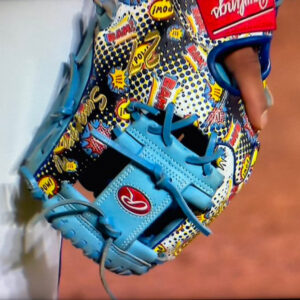 Swagginess it does have. The webbing was a different story. Yet, as slow-motion replay indicated, it had a veritable hole in it, the result of loose webbing. You can’t play third base with a glove like that on your left hand, no matter how gorgeous. You can try, but the evidence indicates it isn’t a good idea. Triolo chased Canario to third with what turned into a double.
The glove that could be seen through had done its damage. Senga should have been out of the inning, but was instead removed after 102 pitches with runners on second and third. To that juncture, the ghost-forker had nursed a 1-0 lead through 102 pitches. Two walks from his successor, Reed Garrett, proceeded to load the bases and then tie the game. The longtime baseball watcher’s inclination was empathy for the starting pitcher, but Senga’s instinct was to pat Vientos on the back as he departed the mound.
Coincidentally, David Wright, the franchise’s premier third baseman, happened to be on the premises Tuesday night, and before the game he was asked about the emerging dynamic between Vientos, who earned third base from the way he swung his stick last year, and Brett Baty, who’s earning a second look by dint of his own offensive upsurge of his late. Of course David, who has only good things to say about everybody, cheered them both on: “I know Mark’s off to kind of a slow start, but Brett’s picked him up. And if Brett gets in a little rut, Mark will be right there to pick him up.”
The Captain knows from picking up. Baty, who was playing second, batted in the seventh and made sure we could mostly forget about the adventures of the glove of Swaggy V by lining an opposite-field homer to torpedo Pirate starter Mitch Keller. It clanged off the iron fence that fronts the party area, ensuring the rainy night wouldn’t feel remotely funereal. The game ended with Baty moved over to third, Luisangel Acuña (who’s recently dipped his toe into the ever-roiling waters of third base) at second, and Vientos on the bench. Mark’s glove’s webbing had been tightened by clubhouse personnel following the sixth, but now it and he were left to watch Acuña make a nifty play on the final ground ball Edwin Diaz threw to ensure a 2-1 win, exemplary defense sealing all leaks and forgiving all residual sins.
After Brett exploded at the plate over the weekend, Mark — whose own power exploits from last October remain fresh in the mind’s eye — was asked if he’d be willing to become more of a designated hitter if it meant inserting Baty’s hot bat in the lineup. Baty’s an adequate second baseman, but third was always what he was supposed to play. And Acuña’s clearly a superb second baseman on the rise, somebody whose glove you really want to see out there most innings. Mark’s answer was succinct.
“Absolutely.”
That subject matter will likely intensify as conversational fodder after Baty’s long and timely hit became the main focus of cheerful postgame chatter Tuesday night. Carlos Mendoza saw a former prospect who had teetered on the edge of Met extinction becoming a potential fixture in Flushing. “Every player’s different,” the manager observed. “For Baty, I’m just finally glad that he’s settling in.” Senga, through his interpreter, expressed delight at what he saw after exiting, especially since Brett is on his side: “If he was an opposing hitter, I think any pitcher would not like to face him at this point.” Brett himself didn’t want to delve too deeply into his hot streak. “I’ve always thought I’m capable of doing whatever I want to accomplish in this game,” the slugger of the moment philosophized. “I’m just having some success right now, and it’s nice.”
Within the realm of the Bill Gallo cartoon universe, we had ourselves a hero and didn’t need to fit any first-place Met for goat horns. Still, it was difficult to forget the image of the ball that zipped through Vientos’s glove. From his vantage point, Mendoza said, “it happened so fast, I didn’t know what happened. Somebody told me it went through the webbing, and I was like, ‘Man, tough break there.’”
Make sure the webbing’s good and fixed, and maybe we can laugh about it in, say, six months.
by Jason Fry on 12 May 2025 11:50 pm The Mets won a misbegotten mess of a game against the Pirates Monday night, a contest simultaneously wonderful and awful, with eerily parallel mistakes ahead of a Mets closing kick that left you asking, “Wasn’t there an easier way to get here?”
Nothing seemed all that stange in the early innings, as David Peterson (excellent) dueled Paul Skenes (not otherworldly but also excellent) to a near-draw. Skenes surrendered one run on exchange-places doubles by Brandon Nimmo and Jeff McNeil; Peterson surrendered one on a solo shot by Isiah Kiner-Falefa and another when Jared Triolo scored off Jose Butto, with the run going on Peterson’s account because he was the guy who’d walked him.
Triolo’s seventh-inning trip around the bases was a strange one: walk, steal, advance on a disengagement violation (AKA Butto not getting him on a third pickoff attempt), score on a fielder’s choice. But at least he came all the way around: In the fifth, Triolo was on second with two outs when Ke’Bryan Hayes hit a grounder that glanced off Brett Baty‘s glove and spun its way across the outfield grass, one of those hideous little plays that kills us at Soilmaster Stadium every other season. Triolo, though, came a little ways around third, hesitated and allowed the Mets to regroup, then was stranded a batter later.
The bottom of the seventh was a weird mirror image. Pirates reliever Caleb Ferguson hit pinch-hitter Tyrone Taylor (who’s always in the middle of everything) in the foot, sending him to first. Taylor stole second, arriving just ahead of a strong throw from Henry Davis, then took third on an infield single from Luisangel Acuna, with Acuna’s margin between safe and out at first maybe a tenth of an inch.
Francisco Lindor struck out, but Juan Soto hit a strange cue-shot grounder to first to bring home Taylor with the tying run. Next came Pete Alonso, who hit a grounder off the glove of Hayes that wound up spinning on the outfield grass. Yes, the same Hayes who’d hit the grounder off fellow third baseman Baty’s glove. Like Triolo, Acuna hesitated briefly after rounding third, but was quickly reminded of his scampering duties by Mike Sarbaugh and hurried homeward, with Nimmo lying on his belly as a visual cue to slide.
Acuna slid. If Davis had taken the throw on the third-base side of the plate he’d have had Acuna dead to rights, but he ceded the plate. If Acuna had slid straight into the plate he’d have been obviously safe, but he slid to the right of it, reaching for it with his fingertips instead. Acuna’s margin between safe and out at the plate? Pretty much the same as it had been at first.
The Mets had the lead and kept it when Nimmo bailed out Dedniel Nunez in the eighth, leaping above the left-field fence to take a home run away from Joey Bart. But then the ninth arrived and the game degenerated into a slapstick farce.
With Edwin Diaz having worked back-to-back games, Huascar Brazoban was tapped to secure the save. That would have been amazing when Brazoban arrived last summer, saucer-eyed and jelly-legged from Marlins PTSD; now it seemed reasonable, a testament to Brazoban’s resurrection by the coaching staff and his own hard work.
Brazoban gave up a leadoff single to March Met Alexander Canario, but coaxed a grounder from Triolo — a hot shot, but straight into Lindor’s glove as prelude to a 6-4-3 double play … except it banked off Lindor’s glove and everyone was safe. Davis bunted the runners to second and third, and Hayes hit a hot shot to Acuna, who was perfectly positioned to cut down the runner at plate and leave the Mets an out from victory … except the ball banked off Acuna’s glove, everyone was safe and the game was tied.
After a pep talk from Carlos Mendoza, which I presume was some more optimistic variation of “keep doing the thing that should be working but isn’t,” Brazoban got another grounder from Bryan Reynolds. It was against the drawn-in infield, a much more difficult chance than the two balls Met infielders had muffed, but McNeil was able to start the double play, because baseball.
In the ninth, against David Bednar, Acuna struck out trying to hit a ball to Mars and Bednar got a grounder up the middle from Lindor … which ticked off the top of second base and went through Kiner-Falefa’s legs. Soto scorched a single to right-center that sent Lindor to third, and Alonso turned in the kind of AB we wound have found miraculous in 2023 or 2024 but are now starting to take for granted. Alonso refused to expand the strike zone, worked the count to 3-1 and got a middle-middle four-seamer from Bednar that he sent into the outfield. It was obvious the moment it left the bat that it was deep enough to score Lindor and win the game; it was and it did.
It’s not often that a reliever blows the save, vultures a win and you nod and sagely declare that justice has been done. But that’s what happened. The Mets had won, and while there was probably a easier way to get there, the hard way will do.
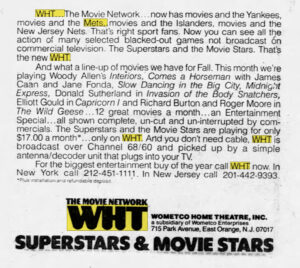
by Greg Prince on 12 May 2025 1:15 am I burrowed inside my television early Sunday afternoon, and there it was: Roku, right where I left it. I hadn’t watched it much since last summer when I installed it so I could take in a desultory Mets-Marlins affair because MLB told me it was the only way I could see it. Streaming a game via Roku reminds me of the Mets (and a few other local sports franchises) getting involved with Wometco Home Theatre in the very late 1970s. Some otherwise untelecast games were on this new thing called SportsChannel, for which you needed cable, and not everybody in the New York Metropolitan Area was sufficiently wired. But if you sprang for the monthly fee of seventeen bucks, you could get a box for Wometco, or WHT, which picked up some of those SportsChannel games along with films that had not long before been in movie houses. You turned on your TV, clicked over to UHF, dialed up to Channel 68 — more familiar as The Uncle Floyd Show’s base of operations — and there, apparently, WHT was. I say “apparently,” because we weren’t spending to unscramble the Channel 68 signal with a box. I liked the idea that the 1979 Mets were hiding somewhere behind an uncooperative vertical hold, but if a game wasn’t on Channel 9, I listened to it on WMCA.
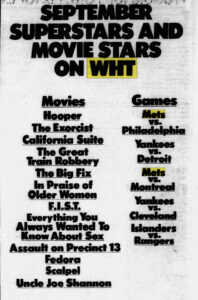 Putting the Met in Wometco. Unless the Mets decide to give out Lee Mazzilli posters soon, I believe this will be the last time anything about this club in 2025 takes me back to 1979. That was an infamously miserable Met year. This year, except for needing modern-day Wometco to witness every pitch, seems to be the opposite. No infamy orbits these Mets, and you have to take yourself to a truly ultra high frequency to tune in any misery.
A quarter-season in, these Mets strike me as very much their own thing. They don’t remind me all that much of any of their predecessors, certainly not the enormously dreadful ones and not even the mighty successful ones. This team feels built to win without making too much of a daily whoop about it. They’re enjoying the winning they’re doing and they’re not thrown off course when the occasional loss interrupts their victorious train of thought.
Perhaps I’m projecting. I can edge into angst when runners are abandoned on base and sink into a funk after a defeat, but my psychological foundation may be as solid as it’s ever been where the Mets are concerned. I’m on a steady high, overjoyed that they’re this good while not surprised that they’re this good. How good is “this good”? Their record of 26-15 speaks for itself, but I keep coming back to eight of their losses being by one run and four others being by two runs. It’s not inconceivable that a few more big hits sprinkled about their schedule would have this team in the stratosphere rather than just first place. Maybe they’ll regret not driving in those runs when they had the chance. But I don’t think this team is going to come down with a case of the if-onlys or be about regret as it takes on its next three quarters.
 Roku is only the latest example of the Mets intermittently hiding inside your television. On Sunday, on Roku, with Gary Cohen behind one mic and SNY director John DeMarsico calling the literal shots, it felt like our version of 2025 out there. It was closer than we would have liked, because what we really like is a double-digit lead in any inning. We were ahead of the Cubs, 1-0, for quite a while, because Luis Torrens is an RBI triple kind of catcher and because the pitcher he was catching (before Luis took a foul ball where even auteur DeMarsico doesn’t have a camera stationed) is an advertisement for whatever alchemy the Met Pitching Lab is churning out. Griffin Canning was his usual spotless self until Pete Crow-Armstrong launched a solo homer onto Carbonation Ridge in the top of the sixth. You can maintain regret for PC-A not being NYM five years after we drafted him, but not that’s not regret to be aimed at anything our front office has done lately. Mostly, you can raise a sparkling soft drink to a presumed fringe starter yet again giving the Mets what has become a Canning kind of outing over six innings. Crow-Armstrong’s one-run ice cube, on whatever beverage-branded plaza it landed, was all Griffin gave up.
And then we got the run right back in the bottom of the sixth, when the Mets third baseman kept doing what the Mets third baseman had been doing all weekend. Sunday the Mets third baseman was righty-swinging Mark Vientos, looking like the Mark Vientos who we previously judged was the the Mark Vientos. Lefty Brett Baty sat despite the three home runs he socked Friday and Saturday, because Carlos Mendoza deals from a deck of capable players and is determined to get everybody in and going as a given situation suggests. The Cubs threw a lefty, Matthew Boyd. Third baseman Vientos hit him 375 feet to left field.
Chicago evened the score at two in the top of the seventh off Reed Garrett, and that could have been trouble. But it wasn’t. The home eighth gave us Francisco Lindor leading off and breaking the 2-2 tie. No bloop, all blast. Lindor didn’t come through in the ninth on Saturday night. He made it his mission to compensate for that shortfall Sunday afternoon. That’s not a dreamy fan’s fanfic inference. That’s what he said after Sunday’s game. Lindor’s good enough so he can decide something like that and make it happen. The Mets have a few guys you suspect can put their minds to their bats and deliver as desired.
Pete Alonso doubled. Vientos singled him in to give the next reliever some breathing room. Jose Azocar came in to pinch-run, which imminently tickled me, because Azocar’s assignment was as stressless as imaginable once Brandon Nimmo became the third Met to homer on the day, the second to do so in the eighth. My amusement that Azocar was now a pinch-trotter was soon supplanted by a slight chill a flashback to a fairly recent event gave me. The event was from more than seven months ago, but it carries that “it feels like yesterday” quality still.
At Mets 6 Cubs 2 in the eighth on Sunday, Gary didn’t invoke the phrase he sort of used for another two-run Nimmo home run that provided the Mets a seemingly safe eighth-inning advantage, yet I heard myself utter it out loud as Brandon followed Jose around the bases:
“Brandon Nimmo puts the hammer down!”
That co-opted description originated in the top of the eighth last September 30 in Atlanta. Relistening to it a dozen times since, I notice Gary edits himself midcall, from almost saying “the hammer,” to actually saying “a hammer,” as if he knows the 6-3 lead the Mets have taken over the Braves isn’t going to be the final score. As we were about to learn, it wasn’t. The Braves stormed back to plate four off of Edwin Diaz in the bottom of that eighth before Francisco Lindor did his own storming when the Mets were up in the top of the ninth, putting us in front, 8-7, and ultimately pushing us toward the playoffs.
It’s a season later, but if I see Nimmo and Lindor each homering in the late innings like they did that quasi-sudden death Monday, I’m conditioned for confidence. I saw them do it on Sunday, in a game that was merely the 41st of 162, on some channel I forget exists when the Mets aren’t playing within its streaming confines. On May 11, 2025, I was comfortable with the notion that “the” hammer had been put down by Brandon. The 2025 Mets are their own definitive thing, and I usually respond to what they’re doing in the here and now. Yet 2024’s levitated regular-season ending — its in-the-moment conditionality notwithstanding — clearly set me up to instinctively look for the best in this current edition’s personnel. Even in Edwin, even if I reflexively ad-libbed lyrics to the melodic refrain of “Narco” after Gary’s analyst du jour Joe Girardi mentioned amid the trumpets blaring that at 6-2 in the ninth, it wasn’t a save situation.
“just end the game…just end the game…just end the game…just end the ga-a-a-a-ame!”
Diaz must have been listening, because he treated the four-run lead as something that required urgent preservation, and three quick outs later, that 6-2 lead became a 6-2 win, and this year’s particular strain of joy splashed at me and flowed through me and stayed in me. Wherever Rob Manfred insists on stashing the Mets on any given Sunday, I’m glad I can track them down. They’re too good a show to miss.
by Greg Prince on 11 May 2025 6:27 am For Cubs fans, Saturday night centered on the successful major league debut of hot pitching prospect Cade Horton. We saw for ourselves what the heat was all about, as Cade made Citi Field hay of just about every Met batter for four innings (the second through fifth) except for one, our own hot prospect of 2022, perhaps our reborn contributor for 2025.
The budding career of Brett Baty, the Mets’ No. 1 draft pick of 2019 — the one who didn’t get away between 2018’s Jarred Kelenic and 2020’s Pete Crow-Armstrong — can’t be said to have fully imploded, but his extended big league trial surely experienced a failure to launch. Brett’s enjoyed good moments here and there across the past three seasons, but they’ve been interspersed with disappointment, whether injury- or performance-related. Last year’s Opening Day third baseman went to the trouble of learning a new position, only to become the odd man out in a roster squeeze.
Rosters have a way of opening up. After Jesse Winker strained his oblique last weekend, Opening Day second baseman Baty came back from Syracuse. This weekend, he’s the starting third baseman again, at least for a couple of days. Mark Vientos, who seemed to have put a stranglehold around the eternal slippery eel of Met defensive positions with his otherworldly 2024 postseason, rode the bench Friday and DH’d Saturday, perhaps a sign that an incandescent October doesn’t necessarily carry over to the following April and May. It’s just two days in which Mark has ceded his usual assignment. But what a two-day stretch it’s been for Baty.
Friday night, Brett smacked one of four Met home runs. When four Mets homer and all of the Mets cruise to victory, one homer doesn’t necessarily stick out. Saturday night, against bulk guy Horton in the fourth inning and Cubs setup man Julian Merryweather in the eighth, Baty went noticeably deep. Two runners were on in the fourth, one was on in the eighth. Baty took Horton to right-center and Merryweather to left. There was no doubt regarding either shot’s destination. Both home runs brought the Mets close, each trimming their deficit to one. Unfortunately, no other New York batter brought much to the plate, and the Mets lost, 6-5.
One more one-run loss (we’re 8-8 in that Rorschach category) generates its own burst of frustration, but the game’s outcome can be somewhat overlooked in light of Baty demonstrating that his potential hasn’t withered away at the ripe old age of 25. No player who excels when his team has been humbled can evince excess happiness in postgame interviews, but you couldn’t miss the glint of satisfaction in Baty’s response when he told a reporter, “I like hittin’ the ball hard. I’ve been hittin’ the ball hard.” Sometimes hard hittin’ doesn’t produce base hits because opponents’ gloves can create hard luck. Sometimes hard-hit balls leave the yard a couple of times. Sometimes the player who does that hittin’ keeps on playin’. If he’s the only one hittin’, how could he be sittin’?
Every Met year leaves behind names as it goes along. By the time 2024 turned magical via the wizardry of Vientos & Co., you’d have been forgiven for forgetting that Baty was the Opening Day third baseman. This season, when Jeff McNeil healed and Luisangel Acuña emerged, a more versatile Baty became newly extraneous, demoted, and invisible. His wasn’t the only name penned in disappearing ink. A.J. Minter and Danny Young are out for the season after having been part and parcel of an effective bullpen. Hayden Senger, who made the most of an unexpected opportunity, is back in the minors because clubs in the majors rarely carry three catchers. Now and then we’ll hear an update on Winker’s oblique or Jose Siri’s fractured tibia. Those fellas were contributors to the Mets as they got going in earnest, but, as Yogi Berra might have opined, until they return, they’re not here…which is what Baty wasn’t until he suddenly was. Good teams survive the deletion of names from their everyday plans. Good teams prove they have depth. Good teams sort among viable options. Brett Baty may be turning himself into one once more.
by Jason Fry on 10 May 2025 10:06 am Hey Mets fans? Which National League teams do you hate?
The most common answer is that we hate — in the operatic sports pantomime sense of the word, you understand — the Braves and the Phillies. This is the way of the world, as those two teams are our principal antagonists in the National League East. But it’s never really resonated with me.
The Phillies are an interesting case — we’ve shared a division with them since 1969, but it’s only relatively recently that both teams have been good enough at the same time for any friction to be generated. That’s a historical quirk on which both Mets and Phillies fans can weigh in, with befuddlement on both sides; for me the Braves are of more note.
To be sure: I am not a fan of the Braves. Last year’s end-of-season showdown with them is one of the great cathartic moments of Met history, an exorcism of innumerable terrors. And it doesn’t take much to get me muttering about Chipper and Bobby Cox, or about John Rocker and T@m Fucking Gl@v!ne.
But these are adult dramas; when I was a kid the Braves were in the NL West, which never made any sense but was how baseball geography worked. Most of the time they were over there doing what they did, and you wanted to beat them when you had to (as the Mets did in the first-ever NLCS) but normally they were a problem for the Giants and/or Dodgers to solve. Hate the Braves? Whatever for?
As a kid I hated the Cardinals and the Cubs, most particularly the latter. I’d grown up on a steady diet of anti-Cubs lore: Leo the Lip, Ron Santo‘s heel-clicking, the black cat. And when I returned to the fold of Mets fandom, it was just in time to see the Cubs of Gary Matthews and Jody Davis and Rick Sutcliffe throw the ’84 Mets down off the mountain they’d not quite finished climbing.
Hating the Cubs, if you were a Mets fan, was as natural as breathing — even if newer generations of Met fans understandably found it a little odd. Weren’t they a problem for the Cardinals and/or Brewers to solve? Hate the Cubs? Whatever for?
These days, in truth, those fires are a little banked. The Mets, one may recall, beat the Cubs as badly in the 2015 NLCS as one baseball team can beat another one: The Cubs never so much as led in a single inning. (It turned out OK for them a year later.) These days you can depend on at least one wind’s-blowing-out donnybrook at Wrigley a summer and an influx of Cubs fans to Citi Field that puts your teeth on edge, but those are mere embers of a once-burning rivalry.
Still, embers can rekindle with just a little puff of breath. The Cubs marched into Citi Field (wearing impeccable road unis, by the way) Friday night to meet the Mets and a big, raucous crowd, with conditions chilly and blustery in a way that almost felt like October, and I felt something atavistic stirring in my Mets-fan soul: Warning! Danger! Intruders!
Which the Mets seemed to sense too. After Clay Holmes put down the Cubs 1-2-3, Lindor sent an 0-2 pitch from Jameson Taillon — the same Jameson Taillon the Mets never seem to square up — out to Carbonation Ridge, sending fans who’d just finished crooning “My Girl” into a renewed frenzy. (We’ll save further thoughts about Lindor and his music for another day.)
It was a welcome opening blow; pretty soon the rout was on. Brett Baty homered. So did Jeff McNeil, whom I realize is almost unrecognizable in those rare moments nothing displeases him and he can just smile. Next came Juan Soto, who annihilated a baseball so thoroughly that patrons out in the distant Citi Pavillon reached up quizzically as little squiggles of yarn and scraps of cowhide fluttered down from the heavens.
Meanwhile, Holmes looked as good as he has in a Mets uniform, muscling the Cubs aside with the exception of Kyle Tucker‘s solo shot. And some of the Cubs’ wounds were self-inflicted: Normally sure-handed Dansby Swanson gifted the Mets two runs by rushing the back end of a double play when he had time to set himself for the throw.
There was a bit of drama in the eighth, but it was all internal Mets stuff: After a debacle-ous debut in the desert, Dedniel Nunez was sent back out to not blow a five-run lead. Nunez started out well, fanning Swanson on three strikes and so reducing his season ERA below infinity. But he walked the next two Cubs and you could see his confidence ebb, and here came Tucker to the plate to try and make the game interesting when what we wanted was 15 minutes of boredom followed by overnight contentment.
Nunez’s control kept flickering on and off against Tucker, who couldn’t square him up (possibly because he had no idea where the ball was headed) but also wouldn’t go away. Until he fouled a slider straight up behind home plate. Deliverance! Francisco Alvarez made a little circle as the winds pushed the ball this way and that above his head, but you felt the fluttering in your stomach even before the ball ticked off Alvarez’s mitt to give Tucker new life.
This was remarkable cruelty even in a sport that specializes in it. But baseball is also very good at false hope: Nunez threw his best slider of the inning, one that Tucker swung through, after which Carlos Mendoza wisely went out to remove Nunez on a high note in favor of Reed Garrett. The Cub threat came to naught and a few minutes later the Mets had won.
If you’re a Cubs fan, you walked away muttering about plays not quite made by a normally capable defensive team, or about how in the world 12 of the Mets’ 13 hits came with two strikes. (The lone exception: McNeil’s first-pitch homer.) Most likely that was just the usual baseball being baseball zaniness that gets visited on some team every night … or maybe there’s something more to it.
 Maybe this wasn’t a good idea. You probably know by now that Leo XIV, nee the Chicago-born Robert Francis Prevost, is not only the first American-born pope but also a baseball fan. The Cubs greeted this news with a gesture made perhaps in jest but perhaps in blithe assumption, the kind of thing that older brother teams in shared cities tend to do.
Not so fast Cubs: Even before Internet sleuths found the future pope in the crowd during Fox’s broadcast of the 2005 World Series, clad in classic White Sox regalia, his brother John had put the question of his Chicago fandom to definitive rest: “He was never, ever a Cubs fan. So I don’t know where that came from. He was always a Sox fan.”
If you’re a baseball fan, you get the significance of that added “ever” — it’s shorthand for no way in … well, yeah.
So Leo XIV is most likely the first pontiff able to wax enthusiastic about Scott Podsednik and explain in non-generalizations that yes, Jesus loves A.J. Pierzynski too. I’m not Catholic and in fact not religious at all, but I find this thoroughly unexpected development thoroughly delightful. And hey, right now the White Sox can use as many friends in high places as they could get. (Should he attend another World Series, Leo XIV will probably be easier to spot on TV.)
As for the Cubs, well, I don’t remember anything in the Bible about laying false claim to the allegiance of God’s representative on Earth, but it still doesn’t seem like a good idea. A certain number of Hail Marys might be advisable; I’m no theologian, but maybe one for each enemy two-strike hit would be a start.
by Greg Prince on 8 May 2025 11:07 am On Jay Horwitz’s Amazin’ Conversations podcast this week, Jay reminisces with the SNY booth trio in this, their twentieth year on the mic. The host eventually retells the story of how he first met future color analyst Keith Hernandez…or attempted to meet him.
JAY: In June of ’83, Frank Cashen calls me. “Jay, we traded for an All-Star and MVP, but he hates New York. What are you gonna do?” I said, “Frank, I’m gonna go to Montreal airport, pick him up in the biggest white limo we can, and I’ll soften him.” So I go to the wrong gate.
KEITH: Yes, you did.
JAY: I went to the wrong gate.
KEITH: I went to baggage claim.
JAY: No Jay, no limo.
KEITH: Crickets. So I got a cab.
Moral: when somebody fails to pick you up, it stays with you.
Conversely, whether it’s someone you work with, someone you live with, or someone you hired, little in life is as satisfying as seeing someone come into view to make like Keith Hernandez in the clutch and pick you up. Watching from a nearly transcontinental distance, I know I got very excited to see several different Mets standing in what is known as scoring position get picked up in Phoenix over the course of Wednesday afternoon. For all the Mets had been doing right most of this still young season, it felt like that relatively simple task was going unfulfilled for too long, at least on this road trip.
But in the late innings of the Mets’ Chase Field finale, the picking up commenced in earnest.
Luis Torrens is standing on third in the seventh — Luisangel Acuña picks him up with a single!
Acuña is standing on second in the seventh — Jeff McNeil picks him up with a triple!
Jose Azocar is standing on second in the ninth — Francisco Lindor picks him up with a double and brings Tyrone Taylor, who’d been on first base, along for the ride! Of course he does, because Francisco is always doing something extra.
Lindor then finds his way to third — and he gets picked up by a Juan Soto sacrifice fly!
 No need to get fancy when a base hit or sac fly will do. Soto had already given lifts to a pair of pitches for solo homers, so when you add together all the pulling up to the curb, opening of doors, and dropping off at the plate, you had seven Met runs, a total easily outdistancing the one the Diamondbacks managed. Snappy Met defense (featuring Torrens firing a bullet to Lindor to cut down a thieving Corbin Carroll in the first; and Taylor, Lindor, and Torrens combining on a seamless 8-6-2 putout of Eugenio Suarez in the second) compensated for some Kodai Senga wildness, en route to the ol’ Ghost Forker straightening himself out to transport six scoreless innings. Toss in three frames from the Effective Relief Committee (Members Kranick, Brazoban & Stanek presiding), and you had a six-run win and a happy flight east.
You also had the all-important tying of the now-concluded season series between the Mets and D’Backs. Three for them, three for us. This is all-important in case a playoff berth comes down to these two clubs holding identical records. Actually, there is no telling whether that’s going to be all-important this year, but it turned out to be all-important last year. Last year was last year, but these things live on in your consciousness until something more relevant replaces them. By late September, not having conceded a tiebreaking edge to this one given opponent will likely have receded to the back of our collective statistical mind. Maybe we’ll be far beyond the need to break a tie with anybody. Or we’ll be entangled with some less Snaky rival. Or — though I don’t believe this will be the case, as long as we continue to drive in runs that are begging to be driven in — the postseason for others in the highly competitive National League will be the offseason for us. Shudder at that last possibility.
At the moment, winning the last game against Arizona and splitting six overall with them is as much a pick-me-up as any RBI of an RISP.
by Jason Fry on 7 May 2025 8:09 am 9:40 pm starts are to be regarded with suspicion even when the baseball they produce goes well — surely one could be doing something more worthwhile with one’s time, starting with sleeping.
And when the baseball produced goes badly, as it did Tuesday night? Then one feels like the guy from the old gambler’s adage, looking around the table wondering who the sucker is.
The Mets played butterfingered, uninspiring baseball against the Diamondbacks, with Mark Vientos, Francisco Alvarez and Tyrone Taylor (of all people) undermining David Peterson with misplays and Zac Gallen throttling the hitters for the second time inside a week — the Mets scored their lone run on a bases-loaded walk against Gallen, failing to do further damage when Starling Marte was punched out on three pitches in a depressingly futile AB.
Perhaps the best news was what didn’t happen: Brandon Nimmo came up favoring his knee in the fourth inning and talked Carlos Mendoza into letting him stay out there, though Nimmo looked like less than himself the rest of the way. The same could be said of the rest of his teammates; look back to the D.C. series and the Mets are officially scuffling, with their ledger featuring a split and two dropped series with an afternoon rubber game ahead.
Maybe scuffling was to be expected, given the tough stretch of calendar; the Mets haven’t had an off-day since April 24 and have been ground up by injuries, travel and what may be no more than the usual statistical bumps and bruises of what we’re constantly reminded is a long season. Come to think of it, early May is usually about the time that particular lesson smacks us in the collective face. It’s a long season; few things bring that home more than a dishwater drab game in which you realize, too late, that none of the other people at the table is the sucker. Maybe I should have gone to bed, you think as your money vanishes into other people’s pockets, never to be seen again.
|
|