The blog for Mets fans
who like to read
ABOUT US

Faith and Fear in Flushing made its debut on Feb. 16, 2005, the brainchild of two longtime friends and lifelong Met fans.
Greg Prince discovered the Mets when he was 6, during the magical summer of 1969. He is a Long Island-based writer, editor and communications consultant. Contact him here.
Jason Fry is a Brooklyn writer whose first memories include his mom leaping up and down cheering for Rusty Staub. Check out his other writing here.
Got something to say? Leave a comment, or email us at faithandfear@gmail.com. (Sorry, but we have no interest in ads, sponsored content or guest posts.)
Need our RSS feed? It's here.
Visit our Facebook page, or drop by the personal pages for Greg and Jason.
Or follow us on Twitter: Here's Greg, and here's Jason.
|
by Greg Prince on 1 October 2016 9:44 pm Mr. 1973, you can come in now. It’s time for you to meet your grandseason. His name is 2016. Do you see the resemblance? Yes, right there, it’s in his trajectory. Pick him up. Hold him. Have a gander at his late August. Normally for a bouncing baby playoff team, it would be much higher. But on 2016 here, it was set much lower. Uh-huh, just like on you.
Don’t be alarmed, though. That’s nothing to worry about. You of all seasons should know. You had a very low late August, but you turned out Amazin’. So has 2016. Look closer. Look at his September. Yes, it’s way up there, just like yours. I don’t think there’s been anybody in your family since you were born to have quite the kind of trajectory that you can trace upward so sharply from late August to the end of September to…yup, he has the exact same October 1 as you do. A Game 161 clinch and everything.
You gotta believe he’s incredibly healthy. I can show you reams of data you wouldn’t immediately grasp, but all you have to know is this key set of numbers: 27-12 from August 20 forward. For you, it was 21-8 from August 31 on. Like you, he had to pass through a very narrow canal of possibility, but we can see in hindsight that as long as you both kept pushing, everything was going to be fine.
He showed up just in time, as if he knew the gestation period wasn’t over until it was over.
I know you adore all the playoff seasons that came after you, but I can’t blame you for thinking this one is particularly special. Everybody fretted you weren’t going to make it, and I guess it’s fair to say there were some concerns about 2016 getting this far. Yet here we are, at the same stage of life, and we have every reason to kvell.
His arms? Frankly, I don’t think they’re quite as robust as yours, but sometimes you can’t tell at first glance. We took an MRI as a precaution…yes, we do that a lot these days. Anyway, in that space where you had a Seaver, a Koosman and a Matlack, we don’t see very much similar in him beyond the Thor. But don’t worry. They’ve done studies recently, and they’ve found a Lugo and a Gsellman can provide nearly as strong a foundation. And the Colon on this one is very durable. It can process innings sort of like the Stone that was never properly extracted from your system did for a while, assuming that it’s managed wisely and not ignored. It’s 43 years later, so we know a lot more about these things than they did back then.
I think what makes this youngster very special is his heart. You and I know where he gets it from, huh? Oh, and the guts. No, that’s not a sanctioned medical term, but you’re in all those scientific journals for the same reason he ought to be someday. Go ahead, place your finger in his palm. He Tugs at it. A kid like this should be able to handle anything. Doesn’t recoil, doesn’t give up. That indicates the presence of heart and guts not every season has.
The DNA suggests his hair could be a little Rust-colored eventually, but for now it seems to be coming in platinum blonde. Nature can be wild that way.
He leans a little to the left like you did. The shortstop, the third baseman and the left fielder are his dominant traits, kind of like yours when we examined your stretch run, except he generates far more power from that side. Those positions make all the difference for him, just like they did for you. I don’t know that his backstop is as sturdy as yours, but he’s blessed with a very resilient back end in his bullpen. Where you had one essential reliever, he has several. Why is that? Stretch runs simply didn’t require as much relief when you were born, but seasons come out differently today. Attribute it to evolution.
Oh, I almost forgot to mention that he was nearly born without an optimally functioning Bruce. It wouldn’t have necessarily harmed him, but having a good one, if I may use a technical term, surely couldn’t hurt. All in all, 2016 is made up of a lot of parts that are easy to take for granted: a Loney, a Rivera, another Rivera, a Granderson…put them all together and you find yourself hugging an absolutely beautiful playoff season. Just another miracle brought into this world when we could definitely use one.
Would you get a load of that? He’s making a little fist, as if he’s going to be ready for anything or anybody who stands in his path in the coming days. Another family trait. It’s too soon to project much about where he’ll go from here, other than he can go home on Wednesday, but he’s definitely got the autumnal gene.
We’re as excited as you are to welcome 2016 to the postseason, Mr. 1973. We’ve been waiting for another one like you for a long time. But we better let him get a little rest now. Pretty soon he’s gonna have to say hello to America.
by Jason Fry on 1 October 2016 3:06 am The 2016 New York Mets will play a 163rd game.
We know that much, even as we’re desperate to know more.
The Mets beat a lifeless-looking Phillie team on an odd night at Citizens Bank Park, with a brisk, chilly wind knocking down anything hit to center or right. In the early going Ryan Howard tried to hit one out and failed, as did Lucas Duda. When behemoths like that come up short, you realize a different game is afoot.
Fortunately, the Mets have diversified their offensive portfolio in recent weeks. In the fourth, after three innings of working Alec Asher into hitters’ counts with nothing to show for it, they broke through with four straight singles by Yoenis Cespedes, Curtis Granderson, Jay Bruce and T.J. Rivera for a 2-1 lead. Add in a home run by Bruce and some late-inning slapstick and five runs was more than enough to support Robert Gsellman, who turned in six innings of fine work before handing the ball off to Fernando Salas, Addison Reed and Jeurys Familia.
Extra credit goes to Granderson, who ran down Jimmy Paredes‘s drive at the center-field fence in the sixth, squelching the Phils’ best bet to come back in the game. And a tip of the hat to the baseball gods for whatever that was in the eighth. With runners on the corners and one out, Cespedes hit a pop into the wind behind first, above Howard’s head. The breeze didn’t drag the ball very far away from Howard, but by now he’s become a sessile fielder, and it was enough. The ball just missed plunking a retreating Jose Reyes in the helmet and caromed off first base. A befuddled Cespedes wound up on first, a wide-eyed Reyes was forced at second, but meanwhile Alejandro De Aza was scooting home for a run. No one in the booth could recall such a play in their collective decades of experience; from the expressions on the faces of Reyes and Cespedes, it was new to them too. Come to the park and you really might see something you’ve never seen before.
Before we move ahead to ponder a rather important weekend, let’s stop for a moment and appreciate the key personnel behind what would have been a ho-hum win if not for the intersection of the calendar and the standings.
- If you’d heard of Gsellman before his big-league debut in late August, you’re probably also named Gsellman. If Jacob deGrom is Snoopy, the bulkier, shaggier Gsellman is Spike — a real-life version of GEICO’s mistaken-identity gag. But he’s not a cameo character anymore: he’s got a plus fastball and good breaking stuff, throws strikes and doesn’t scare. That’s a remarkable discovery at any time, let alone when the Mets needed it the most.
- The offensive star was Bruce, whom you may recall being pinch-hit for by Eric Campbell and unable to put his hand over his heart for the national anthem without someone booing him. No, not at some painful-to-recall but now distant time earlier this summer. That happened last week.
- The key defensive play was turned in by Granderson, whose reassignment to center field was greeted with a collective gulp, given the mileage on his 35-year-old legs and the small-caliber bore of his arm. I’m not quite sure how, but he’s been fine. Hell, he’s been pretty darn good.
- Supporting roles were played by Reyes, Salas, T.J. Rivera and De Aza. Taking them one by one, that’s a guy released by Colorado and free for the taking, a guy who’d been toiling anonymously in the Angels’ pen, an undrafted free agent turned minor-league batting champ, and a spare-part outfielder any of us would have gladly driven to the airport to be rid of in June.
And yet this band of irregulars, deployed in ever-shifting combinations through Terry Collins audibles, not only beat the Phillies but has the Mets guaranteed of playing extra baseball this year.
So who do we play and when? We can’t answer that one, not with the Mets, Giants and Cardinals stacked up like 86-, 85- and 84-win airplanes trying to land on a runway with two spots. We could play the Giants, play the Cardinals, or watch as those two teams play each other in a play-in game for the play-in game. We could play in San Francisco, in St. Louis, or at Citi Field. We could even join a modern barnstorming campaign to break a three-way tie, a spectacle that would end with the surviving team staggering into Chicago and activating its bat boy to pitch against the Cubs.
(Hey, if that’s the way forward, we’ll take it.)
But right now we know one thing the Giants and Cardinals don’t — we’re getting a 163rd game. After the dismay of August, I won’t call that a miracle — we only bring that word out for once-in-a-generation events — but it sure is amazin’.
by Greg Prince on 30 September 2016 9:04 am The forces of good were temporarily foiled Thursday night in St. Louis by Yadier Molina and dunderheaded officiating. Like havoc wreaked by rain on the late-September schedule, hardy perennials are hard to avoid.
The Cardinals and Reds were locked in a 3-3 tie in the bottom of the ninth. The Cards had Matt Carpenter on first with two out. Molina, who is a hero in his native Hades, lashed a double to deep left, where it took a hop over the wall, bounced off an advertising sign set several feet behind and above the fence, and then caromed back onto the field, meaning Carpenter had to stop at third…in a just world that abides by the concept of ground rules. Instead, Bill Miller’s umpiring crew responded to an onlooker’s apparent suggestion of “hey, look over here!” and they all missed what was fairly visible to the television-viewing audience. Reds left fielder Adam Duvall dutifully played the ball and threw it in to the infield; it wasn’t up to him to decide he was enabling a ground-rule double to go uncalled. Carpenter kept running because nobody told him not to. He slid across the plate and was called safe. The Cardinals jumped up and down, showered each other with liquids and picked up a half-game in the Wild Card standings, freezing the idle Mets’ magical numeral at 2.
During my sole summer of watching professional wrestling, I was regularly flummoxed by referees who somehow missed illegal moves and foreign objects that inevitably affected the outcomes of matches. I was twelve then, yet could plainly delineate one blown call after another. I gave up on wrestling. I stuck with baseball. Baseball continued blowing calls, but not every night and, eventually, not very often for keeps once video replay review was implemented. It’s a cumbersome process, but it usually makes up for the proliferation of human error that has come to define major league umpiring in the second decade of the twenty-first century.
It didn’t work this time, either. As the Cardinals celebrated, Bryan Price was ultimately declared to have fatally dawdled. Every game in September takes approximately three eternities and forty forevers, but because Price wasn’t up the dugout steps and waving his arms like a madman in an instant, Miller assumed the Reds weren’t concerned with the final score. It turned out the Reds’ manager was gathering his wits and evidence before demanding justice in a noisy pool hall. By the precise second he emerged to flag down an umpire — any umpire — all the umpires had vamoosed.
Because baseball is such a stickler for keeping a snappy pace, Price was supposed to have signaled his intent to challenge within ten seconds, or challenged within thirty seconds, or, because the call on the field ended the game, make his displeasure known simultaneous to the manifestation of the event that displeased him. He didn’t do that, by Miller’s reckoning. Miller, as crew chief, could have instigated his own review since it was the ninth inning, but he was too busy a) glancing at Price not staring forcefully enough at him; and b) skedaddling from sight in the company of his colleagues, most notably Scott Barry, the third base umpire who blew the ground-rule call in the first place.
If this were the 1925 World Series, when Sam Rice of the Washington Senators may have or may have not caught a ball while diving into a friendly crowd, the mystery would be the stuff of enduring legend. In the playoff chase of 2016, we have solutions to clear up confusion. We have the thing with the headsets and the angles and the definitive call. They would have used it in 1925 had it been available. They found a way not to do in 2016. Ah, progress.
Had the correct call been made, and Carpenter been halted at third, perhaps Stephen Piscotty, the next Cardinal due up, would have driven in the winning run. Or Piscotty would have been walked, leaving it up to Kolten Wong. Wong might have ended the game, or the Reds might have wriggled out of the jam and into extra innings. Hypotheticals can’t be rewound and reviewed. What stands (unless somebody files a protest and the protest is upheld, which all seems pretty unimaginable at this point) is the Cardinals were credited with a win they didn’t win, and therefore stand two games behind the Mets and one game behind the Giants, who also unfortunately, if legitimately, won on Thursday night.
Bottom line where our Met myopia is concerned: the same combination of Met wins and Cardinal losses adding to two that we looked forward to as play began Thursday night remains our math here on Friday. We win and they lose and we’ve got a Wild Card. Who we play and where we play would remain up in the air (the groundless ground-rule double episode has mostly been addressed as a detriment only to the Giants, as if the Mets are leisurely lounging about their penthouse apartment complacently awaiting a telegram containing their October itinerary), but making the postseason would be accomplished and, oh by the way, what an accomplishment…once it’s accomplished…if it’s accomplished.
It must be accomplished before conditional language is altered.
Scoreboard watching behooves us, but the scoreboard of primary interest is the one at Citizens Bank Park. If the Mets keep winning in Philadelphia, we are free of worry where wild scenarios are concerned. Win twice and we’re in on our own. We also clinch home field regardless of impending opponent, thanks to the Cardinals’ resulting inability to catch us — we’d have 87 wins, they can attain no more than 86 — and the head-to-head edge we hold over the Giants. A little help from our new friends the Pirates (in St. Louis) and Dodgers (at San Francisco) will be much appreciated, but the Mets can handle this themselves, weather permitting.
It might very well rain. It rained hard enough in Detroit on Thursday afternoon to postpone — not exactly cancel — a critical Tigers-Indians matchup. It rained hard enough in Pittsburgh on Thursday night to suspend — and officially tie — a relatively superfluous Pirates-Cubs game. You rarely see postponements of contests with playoff implications at this stage of the season (Cleveland would return to Detroit on Monday if the American League Wild Card hangs in the balance) and you basically never see ties anymore (it takes a last scheduled meeting, ceaseless precipitation and no playoff implications to not pick up a suspended game). The last sanctioned tie in MLB came eleven years ago. The Mets haven’t played one to inconclusion since the ass end of 1981. Rain can do crazy things that lax umpires can only daydream of while not following the flights of balls that bounce over walls and back onto fields of play.
Rain, for example, tends to move from west to east. If you’re following the bouncing cloud, you can track its path from Detroit to Pittsburgh to Philadelphia and draw your own conclusion. The Mets and Phillies will almost certainly play as much baseball as they are scheduled to this weekend, but they may have to wait out steady showers and puzzle out vexing pitching decisions to do so. It’s not the ideal setup in advance of potential playoff rotation alignment, but that’s a problem we should be overjoyed to contemplate. Not every team playing this time of year is burdened by such concerns. The Phillies aren’t. The heretofore defending world champion Kansas City Royals (despite their implacably relentless nature) no longer are. And somebody else whose identity escapes me also qualifies in this realm. Local team, other league…
Oh yes, now I remember.
I know there are more pressing matters on our rainy radar, but a moment of Sheadenfreude should always be taken to observe Elimination Day when it rolls around. Call me a sentimentalist, but a grand old tradition marking an indisputably cheerful annual event shouldn’t be allowed to pass without a word of thanksgiving. In these modern times, Elimination Day may not be as relevant as it once was, but let us never forget those autumns when it never came, and therefore count the one additional blessing with which we were bestowed when the Baltimore Orioles beat the Toronto Blue Jays Thursday night and officially eliminated from postseason contention the New York Yankees.
Consider it counted. Now on to counting bigger and even better things.
by Jason Fry on 29 September 2016 2:24 am Wednesday night’s win over the Marlins was full of encouraging signs for the Mets, and left me feeling something I’ve rarely felt in a tight race’s last few days: a sense of calm.
Seth Lugo looked shaky early, struggling to command his pitches and reminding us that for all his meritorious service, he’s written an out-of-nowhere story that makes Jacob deGrom‘s ascent look like a sure thing. Lugo didn’t pitch well in any role in Las Vegas (though, to be fair, that’s about the last place you want to depend on a curveball) and various metrics, most notably his FIP and home run rate, suggest an unwelcome regression to the mean lies ahead.
But you know what? Come April, Lugo can regress all the way back to the Pacific Coast League — what’s important is he didn’t do it Wednesday night. He got rocked by a Martin Prado homer in the bottom of the first for a 2-0 deficit, but fanned Jeff Mathis with two men on to limit the damage. The Mets responded immediately, with T.J. Rivera doubling and James Loney hitting a high arcing drive that came down just above Giancarlo Stanton‘s station craning his neck at the right-field fence.
Lugo was in trouble again in the third, facing Stanton with one out and runners on first and second. He got squeezed on a 1-2 curve, though the ball broke so sharply it seemed to fool Rene Rivera as well as home-plate ump Bill Welke. Unlucky, but then Lugo got lucky on 2-2, running a fastball just outside enough to sap Stanton’s power. He popped it up; Lugo went to a 3-1 count on hulking Met nemesis Justin Bour, but got him to ground to second for a fairly gigantic whew.
The Marlins seemed spent after that, for which no person with an ounce of compassion could blame them. Meanwhile, the Mets were getting in gear. Jose Reyes doubled Lugo in to take the lead in the fourth and then Jay Bruce — yes, that Jay Bruce — drove a ball over the wall for insurance. Lugo, Hansel Robles, Fernando Salas, Addison Reed and Jeurys Familia kept Miami at bay, and the Mets had won.
The Mets had won, and a little while later the Reds beat the Cardinals by a skinny run, surviving a leadoff triple in the ninth. And a little while after that the Rockies survived a scary ninth of their own to beat the Giants. Those aren’t the ingredients for a 163rd game quite yet, but the recipe’s become pretty simple: if the Mets win two in Philadelphia they’re guaranteed at least one night of extra baseball. (Yes, a three-way tie is still possible, but I’m not going to worry about it because my head would explode.)
I doubt I’ll be calm when I’m checking the out-of-town scores Thursday night, or while doing anything this weekend. But Wednesday night I was — I even lapsed into couchbound inattention for an inning or two, as if this were a pleasant evening in May. The difference: I was letting myself daydream about Lucas Duda looking revived and Curtis Granderson whacking balls from line to line and Bruce having escaped the back of the milk carton and T.J. Rivera continuing to get his Murph on and hey, if we get past next Wednesday maybe we could make some noise….
Normally I’d yank myself back to the beginning of that chain of hypotheticals, but this time, I let my mind keep wandering happily for a bit. I’ve lived through seasons in which magic numbers shrank to a certain point but no further, becoming tragic digits. I know that still might be. But, to steal a note from Mike Vaccaro, since their resurrection began on Aug. 20 the Mets have made up 8 games on St. Louis, 9 1/2 on San Francisco and 10 on the Pirates. And all that while pitchers and position players vanished from active duty at a rate normally seen in epidemics. Those are already pretty magic numbers, regardless of the outcome.
So I’ll sit back and enjoy it until the lights come up and it’s time to go, whether that’s after Game 162, 163 or — because you never know — Game 182. It’s part of being a fan to fret and sigh and see grim portents everywhere, but we have to also allow ourselves to imagine things going right.
by Greg Prince on 28 September 2016 8:17 am The Mets are 84-74. They have never, in the history of the franchise, been 84-74 before. There is no inherent significance to having achieved this statistical milestone. It’s simply something I deduced after staring at their record for a moment.
To have ever been 84-74, the Mets would have — in the segments of their past that were less than illustrious but more than intolerable — had to have ended a season with between 84 and 88 wins.
They’ve never ended with 84.
They’ve never ended with 85.
They’ve ended 86-76 once, in 1976, but after 158 games were 86-72, on their second of five consecutive losses that took a bit of the shine off an otherwise rousing finishing kick (34-16 in their previous 50) that was, sadly, a harbinger of absolutely nothing where the immediate future was concerned.
They’ve ended 87-75 once, in 1989, but after 158 games were 83-75, letting down everybody in sight before sweeping a four-game series in Pittsburgh to make the year look better than it felt.
They’ve ended 88-74 three times. Once, in 1997, it couldn’t have been sweeter; twice, in 1998 and 2007, it couldn’t have been more sour, proving perhaps that numbers are only numbers until they are cast into context. The 1997 team was a scrappy unit that rose from the depths of a theretofore dismal decade and delighted us diehards with provisional progress that promised even better days ahead. The 1998 and 2007 teams crafted and carried expectations that wound up crushing them in their respective final weeks. 1997’s quiet ascension is rarely broadly invoked despite the invigorating leap forward it encompassed. 1998’s fast fade lingers a little louder in the collective subconscious, though ultimately its generational pain was eased by the rewarding seasons that lay directly ahead of it. Historically, it was consigned to also-collapsed status by the next 88-74 season to come along. 2007 endures as a legend of the genre.
What binds the three 88-74 finishes in Mets history, for our current observational purposes, is none of them occurred after an 84-74 pit stop. I clearly remember how each of those years’ final four games played out: 3-1 in ’97, 0-4 (80% of an 0-5 free fall) in ’98, 1-3 in ’07. Because I know how those endings unspooled and can do a little Base 162 arithmetic, I know no Mets team that could have been 84-74 ever was 84-74.
And? And I guess it goes to show that when you get to this juncture of a very long season, you realize that though the vast majority of games are put in the books, it’s the palmful yet to be played that can still define what the season was and how it will be recalled.
After 158 games of 1976, 1989 and 1997, all that was left to be determined was which numbers would be written in ink. Those Mets’ seasons were already defined as whatever they were. Their spurts of contention, whether illusory or exhilarating, were over. But after 158 games of 1998 and 2007 — plus a few other years when the records may have been markedly different but the stakes at hand were essentially the same — we didn’t know what we had and required the entire schedule to play out.
Which returns us to our present 84-74 circumstances, elevated from 83-74 following a rollicking Tuesday night victory in Miami. The Mets beat the Marlins, 12-1, pitching wonderfully and hitting spectacularly. Noah Syndergaard was back on the hill and strepless as could be for six innings: no walks, five hits, eight strikeouts. Jay Bruce’s bat, recently thawed from cold storage, continued to scald. He landed a two-run homer in Dee Gordon territory in the second and whacked everything with authority all night. Yoenis Cespedes, whose slumps last only as long as it takes to realize they’re occurring, launched a ball past the adorably garish monstrosity in center (no, not you, Christian Yelich) and presumably sculpted a hole in the ozone layer with his third-inning missile into space.
Yo’s blast made the score 4-1, where it stayed stuck for much of the evening, but like a 158-game record in the midst of a 162-game season, it was bound to change. After hitting into a bit of bad luck here and there, the Mets plowed through another National League East bullpen in the late innings, adding five runs in the eighth and three in the ninth. The most encouraging contributions were elicited from Lucas Duda, 2-for-3 with three RBIs and perhaps emerging as the starting first baseman he used to be before four months of injury inactivity, and Juan Lagares, a barely distinguishable speck on the DL radar who is suddenly revealing he can not only run, catch and throw, but swing. Juan chipped in a tack-on sacrifice fly that would rate zero mention, except Juan and his surgically repaired thumb ligaments weren’t supposed to be able to grip a stick of lumber for any purpose larger than bunting.
In the words of Curt Gowdy from the 1969 World Series highlight film, “Some bunt.” No, Lagares in Game 158 at Marlins Park didn’t go yard like Dave McNally (let alone Donn Clendenon or Al Weis) in Game Five at Shea Stadium, but just the thought that he might be a capable righthanded bat in the four games ahead…and any games beyond that…is a small miracle unto itself. Duda, too. Didn’t see either of them coming, or coming back, but that’s been the Mets’ way in 2016. After this chronically decimated team took the last two of four in San Francisco in August to put them at exactly .500, the goal — in my head, at any rate — was win every series. Do that, and they could conceivably compete for a playoff slot. Given how they’d performed most of the summer, that kind of output would be a miracle.
Twelve series remained, ten with three games, two with four. My aspiration for them was therefore a 26-12 record over their final 38 games, which would land them at 88-74. In 1997, 1998 and 2007, that was enough to book passage directly into the offseason. It wouldn’t have done them any good in 1976 or 1989, either. But this is the age of the Second Wild Card. 88-74 looked pretty solid from the vantage point of 62-62 considering where all other prospective foes stood five weeks ago.
Here we are, 84-74, with not quite every series thus far taken, but enough contests captured in the interim to catapult the Mets into a slim yet stubborn lead for the First Wild Card: a half-game ahead of the Giants, a game-and-half better than the Cardinals. Each contender scored twelve runs on Tuesday and each put pressure on the others. The Mets may have to win 88 games to ensure playing more than 162. It’s possible a slightly lesser number will take care of business, but that’s not desirable to consider. We need every available win just as we need every available body. We need Duda. We need Lagares. We need Bruce and Cespedes and tonight’s starting pitcher Seth Lugo. We could use Wilmer Flores, but probably won’t be able to, which is why noticing Juan’s refreshed skill set provided such a pleasant revelation. We will definitely need Thor again, maybe this Sunday, maybe next Wednesday. We may need a starting pitcher between Sunday and Wednesday if things shake out weirdly enough.
We need the Mets to excel over their final four games, the four games that will define what kind of story we will eventually tell about 2016. I’m hesitant to put a precise number on it, but 88-74 certainly sounds like a happy ending.
by Jason Fry on 27 September 2016 2:40 am I knew Monday night’s game against the Marlins would be emotionally wrenching. I think we all did.
But I wasn’t prepared for just how tough it would be, and how tough it kept being.
There was the sight of every Marlin wearing Jose Fernandez‘s No. 16, and the knowledge that it would never be worn again.
There was the sound of “Take Me Out to the Ballgame” as a grieving farewell, something I know my mind will come back to again and again on carefree summer days.
There were the red eyes and stricken faces of Martin Prado and Giancarlo Stanton, just minutes before game time.
There was tracking Yoenis Cespedes as the Mets and Marlins came together to exchange pregame hugs and back pats, and seeing how hard he was holding on to each opponent.
And there was the sight of the Marlins surrounding the mound where Fernandez had done so many amazing things, and the reminder that all of that was done, irrevocably ended in an unlucky second in the night.
Last week I called the Cespedes our-walkoff-turned-their-walkoff as cruel as baseball gets, and that was correct as far as sports go. But what a monster of a qualifying statement. That was a game and a pennant race. This was a young man killed at 24, a son and grandson gone in a blink, a father-to-be who’ll never see his child. There’s no comparison between the two, none at all. Watching the Marlins during the remembrances of their teammate and friend, I wondered how they could possibly play — how anyone could. Throwing ourselves into sports is grand fun — and sometimes its opposite — but what happened off Miami Beach in the early hours of Sunday morning was cruelty and tragedy in the true senses of those words, and it was devastating to see them transposed to the baseball diamond, where we get to obsess over the pretend versions.
If you’ve read us for a while you know that I’m not a fan of the Marlins’ ownership or their off-the-field personnel, to understate the case considerably. But they handled the unimaginable with grace, to use that word in the nearly-forgotten sense for which it was intended. So too did the Mets and the SNY crew. The open grief on the faces and in the voices of Gary, Keith and Ron was almost too intimate, and it was a relief — for us and I suspect for them as well — that they let the first minutes of the game speak for themselves. These weren’t things to talk over; for long TV stretches they simply let them be.
But unwelcome though it was, there was another aspect to Monday night’s game: within the parameters of baseball, however silly and ephemeral they might be, this was a game the Mets desperately needed. At first I felt queasy about this double vision, then I simply accepted that I wouldn’t be free of it and did the best I could.
It was astonishing seeing Dee Gordon, a baseball whippet with zero home runs on his 2016 resume, lash a Bartolo Colon fastball into the second deck, as if he’d become a quadruple-sized Stanton. As a Mets fan I winced — 1-0 Them. A moment later I was applauding, as a baseball fan and as a person, and wished I could help carry a crying Gordon around the bases and back to the embrace of his teammates.
And then I went back to wincing — with plenty to wince about. Colon didn’t have it at all, as sometimes happens to him — he was throwing in the mid-80s and everything was getting walloped. Terry Collins has had a quick hook in recent weeks, hauling starters off the mound without consideration of wins or their psyches or anything else. But he left Colon in. He let him hit in the third despite the Mets being in a 5-0 hole, an inning that ended with Cespedes looking at a borderline called third strike and leaving two runners on base. Colon faced three batters after that, surrendering a hit, surviving a rocket liner from Stanton and then yielding Justin Bour‘s triple. Only then did he come out.
Down 7-0, the Mets did little against a succession of Marlins relievers. Cespedes popped up with a chance to make it a game again; Lucas Duda got caught looking. The game, understandably, became an exhausted trudge for both teams, and wound up a 7-3 loss. The Mets are now half a game up on the idle Giants, and had to find solace in the Reds trouncing the Cardinals. Some folks noted that they didn’t mind the Mets losing this one, and I appreciate the sentiment. Applaud it, even. But I couldn’t second it: there’s no such thing as a game you don’t mind losing with six left and a postseason berth in the balance.
But accepting that you feel that way isn’t the same as letting it blind you to bigger things. As the Marlins gathered at the mound again, this time to leave their caps behind, my mind went back to the last batter Colon had faced — and then further back, to a game 15 years gone. I was in the stands with Greg and Emily on Sept. 21, 2001, when Mike Piazza‘s drive into the night transformed a shocked, tentative crowd into a bunch of cheering loons — the first moment in which we felt allowed to celebrate a little thing like it was a big thing.
Colon’s final pitch on Monday night was a flat fastball that Bour hammered into right-center, just under the glove of a tumbling Jay Bruce. Bour is a massive hulk of a man — perfectly named, really — and he careened around the bases and did a belly flop in the dirt in the vicinity of third, bouncing hard into the base. Then, finding himself safely in possession of his first career triple, he popped up and flexed at his teammates, who grinned and yelled and flexed back.
I realized that on the Monday night we all thought was coming, Jose Fernandez would have seen the ball get past Bruce, sprung to the top of the dugout railing, and hung over it so he had the best seat in the house. He would have been not just cheering Bour but also bouncing up and down, practically levitating with delight, with that million-watt smile attracting every eye in the park. I knew I would have hated that Justin Bour of all people had tripled, but wound up smiling at how much Fernandez loved it — like he seemed to love every moment in which he was part of the game he played with such irrepressible, contagious joy.
For that moment, on this shocked and sorrowful Monday night, the game had helped. It hadn’t fixed anything — nothing like that can ever be fixed — but it had allowed Bour and his teammates and their fans to let go, giving them permission to lose themselves in something small and silly. Small and silly — it’s just baseball, after all — but joyous and real for all that.
by Greg Prince on 26 September 2016 11:31 am 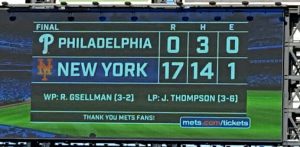 A Unicorn romps around Flushing. Sunday was ostensibly Closing Day at Citi Field. More like Door Left Ajar Day, I suppose. On paper — the glossy, accordion-foldable kind that fits easily in your pocket — it was what it sometimes is. September 25 versus the Phillies was definitely the final scheduled home game of the season, yet some Closing Days are less, shall we say, “Closey” than others.
Closing Day connoisseurs like myself have been blessed in recent regular seasons by Met years that end in Flushing. From 2004 to 2015, ten of twelve Game 162s have coincided with Home Game 81. Putting aside playoff action when we’ve been so lucky, only 2006 and 2012 had scheduled business to be taken care of elsewhere once the gates were shuttered at Shea or Citi. In 2006, we knew we’d be back in a flash, so the sense of “that’s it” on Closing Night a decade ago was nonexistent. In 2012, the overriding goal of R.A. Dickey’s twentieth win was reached on the last home date, and since nothing much else was on the line thereafter, the road trip that remained bordered on — to quote the most literate of pitchers — inconsequential.
The rest of our previous dozen Closing Days had been tinged by reflection and defined to a certain extent by their finality. 2015 had a postseason grafted onto it, but Closing Day, October 4, stood apart as its own occasion. Maybe it was the nip in the air, maybe it was the 90th win, maybe it was the lap around the track the managers, the coaches and all the players took upon the conclusion of the game. We knew we’d witnessed a season finale of sorts, even with a flight to L.A. on the horizon.
A year later, not so much. I went through the rituals of Closing Day, as I have every Closing Day since 1995 (twenty-two in a row for me personally, twenty-four in all), and they were fulfilling enough despite the shortfall of finality. Stephanie accompanied me as she has to every Sunday closer since 2008 — the weekday goodbyes of 2011 and 2012 she had to skip — and we swung by the traditional last-day Chapman tailgate in Lot E, an annually warm affair no matter the vagaries of the Flushing Bay breeze. We accepted our next-year magnets, we took our usual last looks around, we soaked in the scenery that we can’t count on seeing again any time soon, we lingered at our seats when the game was over, we took our sweet time meandering out of the stadium…but we didn’t want to believe this was it.
Not conceptually, but literally. There are six games to go that will determine if Citi Field hosts more baseball in 2016. I believe we would all agree that the place needs more baseball. One game on October 5 if possible, another game on October 10 absolutely, one beyond it on October 11 if necessary, and then, if we can beat the Cubs…
Ah, looking ahead, an instinct I nervously attempt to foul back into the crowd, because you have to take everything one game at a time, but the idea this week is to take as many of the six in front of us that are attainable, ward off at least one of the two teams directly behind us and move forward. With such a pressing agenda, dedicated reflection on the home season that is now technically complete might get in my eyes.
Though it wouldn’t have been the only thing Sunday. Even though the Mets didn’t quite imbue the day with its customary strong dose of Auld Lang Syne, the emotions were there if you left yourself vulnerable to them. Jose Fernandez’s death was known to us for all of four hours when we were asked for a moment of silence in his memory. Usually these gestures happen days, weeks, maybe winter months after whoever has passed has passed. If you’re moved, you’re moved to remember. Here, I must tell you, I was moved to tears.
Truth be known, I can cry quite readily if quietly on Closing Day, even when closure is elusive, even if the scoreboard is jubilant. Geez, this may be the longest a fan of a team that romped to a 17-0 win in the midst of a searing pennant race has ever gone without mentioning that his team romped to a 17-0 win in the midst of a searing pennant race.
So let us note Sunday’s final was Mets 17 Phillies 0 and that combined with subsequent Giant and Cardinal defeats, the Mets’ chances of playing and perhaps hosting at least one playoff game improved substantially. As the runs piled high and handsome, and half-games added themselves provisionally to the most critical column of the Wild Card standings, I can happily report my melancholy took a breather.
Because how can you not get giddy over a 17-0 win?
For those of you who track such sightings, yes, 17-0 is indeed a Unicorn Score, a result we define as a score by which nobody has ever seen the Mets win before or again. Again is hard to tell, considering this just happened — but anybody who can recall the exotic creatures who emerged in the Rocky Mountains on August 21 and 22 of 2015 can attest that a Unicorn doesn’t necessarily have to wait very long to be cloned.
Early in the game, while Robert Gsellman (7 IP, plus some seriously effective bunting) was on the verge of rescuing the Met relief corps from itself, the bats seemed to consist more of slumber than lumber. There were a ton of baserunners, if not enough of them crossing home plate for comfort. We didn’t know in advance that would one would suffice. After the angst that accompanied so many tight-as-a-tick contests on this homestand, I was just waiting for this game to be broken open beyond Philadelphia repair. A run in the second, a couple in the fourth, three in the fifth…6-0 seemed like a safe enough lead, but I was like my cat Hozzie when his internal clock insists it’s time to be fed again despite having just been fed. I simply wanted MEOW! And by MEOW, I mean more.
Consider me sated and purring. The game wasn’t broken open. It was smashed into a million little pieces, each one of them a glittering jewel. Five runs in the seventh. Six runs in the eighth. A blue and orange Unicorn hoofing it around the bases without pause. Certainly the Phillies didn’t seem capable of stopping the wildlife traffic at hand. The Mets had never shut out anybody by more than fourteen runs. Once the pinball machine tilted at 15-0, I maintained only two concerns.
1) Don’t give up a run in the ninth, because there is a 15-1 score in the Met past, and Uniclones (if not bred on the spot) aren’t as much fun as Unicorns.
2) Don’t get the Phillies riled up, because the last three games of the season will be at Citizens Bank Park, and we may very well need to win the lot of them. If anything, the Mets seemed almost embarrassed by their bounty, so I don’t think they unduly stoked any dormant competitive fires.
The reflex reaction of “save some of that for tomorrow” was pointless. The Mets generated 44 runs in four games (somehow losing one of them). When the faucet inevitably turns off, it’s not like we can go back and grab a bucket from Sunday. I enjoyed the output. I enjoyed Closing Day despite the lack of closure it encompassed. I anticipate, albeit with fingers crossed and no guarantee available, additional baseball in our ballpark. I said merely “so long” on Sunday. “Goodbye” is best left for some other day.
by Greg Prince on 26 September 2016 8:16 am Under the format that’s been in place since 2001, you usually play your division rivals nineteen times a season. As a result, you become intimately familiar with them. When the Mets play somebody from the National League Central or West or American League, it’s almost as if we’re welcoming or visiting special guest stars. You don’t particularly want to go up against Clayton Kershaw or Madison Bumgarner if you’re interested in winning, but there’s also a sense of occasion to it. When you see the same team over and over, however, niceties go out the window. It doesn’t matter that you are presented with an up-close-and-personal view of one of the best pitchers in the game. You got that in April and again in June. You don’t need it in September.
The only thing better than besting the best players your rival has to offer is not having to best them at all. Tell us we don’t have to see them. We wish no ill, just preoccupation.
You know these rivals too well. You develop an allergy to their skills. Freddie Freeman should take a longer paternity leave. Ryan Howard should contemplate early retirement. Might Bryce Harper be so kind as to continue slumping for an additional three games? From the Marlins in this decade, among the relatively ordinary players who acquire the powers of superpests simply by donning their uniforms in order to wreak havoc against us, we can identify two characters who we were sure existed to instigate Met gloom. One, the slugger Giancarlo Stanton; the other, the ace Jose Fernandez.
In the first five Met-Marlin series of 2016, we saw Fernandez four times. It was plenty, we thought. Then we heard the Marlin rotation has been shuffled just enough to generously offer us a fifth encounter, scheduled for tonight in Miami. Something about getting him an extra day of rest because of the 111 pitches he threw versus Washington last Tuesday. Yeah, sure. Fernandez was slotted to pitch against Atlanta Sunday, but Atlanta’s in last place and the Mets are in a Wild Card race. Miami’s playoff aspirations are all but mathematically done, but apparently their desire to mess with ours wasn’t. It’s what rivals do to each other if they get the chance.
The fretting began well before we were finished our weekend engagement with Philadelphia. Gotta win on Sunday, we said to ourselves Saturday, because come Monday, we are being presented with an obstacle. Haven’t we had enough obstacles already? We’re trying to win a Wild Card while pitching one emergency starter after another. Now we have to attempt to hit against an ace who is as elite as they come.
Eight times — four in 2013, four in 2016 (much of 2014 and 2015 were given over to Tommy John surgery and rehab) — the Mets faced Jose Fernandez. They won two of his starts once they nicked the Marlin bullpen, but they never actually defeated him. The Mets barely touched him: 47 innings, 7 runs. In the middle of a season, during the immense portion when you rationalize that you’re going to lose ‘x’ number of games anyway, all you can do if you want to maintain 162 games’ worth of sanity is graciously if grudgingly tip your cap to an ace of his stature and results of his doing.
That’s for June and April. This is September. A season is winding down with a chance that it won’t end so soon. All we really care about is that chance. We’re simultaneously trying to will our team to victory and wish competitive ill on their fellow contenders in distant cities. We need the Mets to win, the Giants to lose, the Cardinals to lose. The last thing we think we want to hear is that the blankety-blank Marlins have taken steps to throw at the Mets the pitcher who rarely loses to anyone and never loses to the Mets.
That’s what you think is the last thing you want to hear.
The rearrangement of Miami’s rotation to place Jose Fernandez on the mound Monday night seemed like one of those cruel tricks the universe plays against our team. That’s how we see the universe, especially in a pennant race. Then we found out why the Mets won’t face Jose Fernandez, and we were reminded what cruel really is. Fernandez, we learned Sunday morning, had been killed in a boating accident. A 24-year-old person, along with two other people we’d never heard of because they weren’t famous, was gone.
We knew who he was because he was a baseball player who played against our favorite team on a regular basis, and because he played baseball better than almost everybody else in his profession, and perhaps because he played it exuding more joy than anybody else we saw. He was on our minds because he was going to play against the Mets two games from where we sat. Get by the Phillies, then deal with Fernandez. You could chalk it up as a loss in advance if you were so inclined (even in late September, you have to remind yourself that winning them all is almost never an option), or you could gird for the challenge and tell yourself, well, if the Mets want to play for a championship, they ought to prove they can win against one of the best there is.
They might have been up for the challenge. Or Jose Fernandez might have been too much for them and they would had to have regrouped the next night. In baseball, there’s always supposed to be a tomorrow.
Those truisms we reflexively apply to our sport don’t necessarily translate to the world around them. Everything we thought we needed to know about Jose Fernandez dissipated Sunday morning. Instead of thinking about him in the context of a rival, we paused to contemplate him as a human being — an incredibly formidable one at that. Not many of us ever encountered the obstacles he braced for repeatedly and overcame definitively. Not many of us spread as much happiness by dint of personality as he did. Not many of us touched in such a positive and lasting manner virtually everybody he came across in a life that loomed as boundless. His talent is what we knew because his talent is what we saw. That would be formidable enough for most people.
The Mets won’t face Jose Fernandez tonight in Miami. That’s supposed to read as good news. Instead, it’s the worst news possible. In baseball, we have divisions. In humanity, sometimes we step back and unite.
by Jason Fry on 25 September 2016 2:14 am The standings do not recognize moral victories. A 2-0 perfect game counts the same as some hideous crapfest against a second-division opponent that you win 9-6 despite walking the ballpark. The same goes for losses — the manager turning over the buffet after sending the backup catcher to the mound doesn’t mean the defeat was hideous enough to cost you an extra half-game.
But Saturday night’s depressing, aggravating, ludicrous, exciting, fun, absurd and ultimately tragic loss was about as close as you can get to a moral victory. It won’t help in the standings — the Mets start Sunday tied with the Giants and a half-game in front of the Cardinals — but it does earn an asterisk, at least on this blog.
It also strikes me as a miniature version of the 2016 season. Which we’ll come back to in a bit.
The game defied description, but I’ll try: Sean Gilmartin was bad and so was Rafael Montero, with their combined efforts putting the Mets in a 10-0 hole. Shame on the shitty Mets fans who booed Gilmartin, pressed into service after a month in which he didn’t throw 20 pitches in any appearance — there’s another New York team that’s a better fit for their likes. I hope those fans left, because once Terry Collins wisely sat down the varsity to save them for Sunday, weird things started happening.
A division of Met relievers sent into battle held the Phillies at bay, and the Las Vegas 51s started making some noise. It was 10-4, which is still lipstick-on-a-pig territory, but then it was 10-6, which is when you catch yourself thinking the pig has some good qualities, and then … well, let’s not pursue that metaphor any further. Once the Mets were within four it was fun — the Phillies looked like they were trying to wake up from a nightmare, while the Mets looked like they were determined to keep dreaming.
Baseball tugs you in different directions — towards the cool logic of statistics and then towards the hot rush of fan enthusiasm. The latter is often a funhouse mirror for assessing the former — it’s what we’re looking into when we think we spy hot hands, players being due, clutch, grit, karma, destiny and all the other intangibles we like to argue about. With that in mind, our pals at Amazin’ Avenue end each game recap with a graph of both teams’ Win Probability (it’s courtesy of FanGraphs) and the chart for this game is instructive.
It shows that the Mets’ chances of winning Saturday night bottomed out at 0.2 percent after Asdrubal Cabrera grounded into a fourth-inning double play and barely budged from there until the uprising began. In the ninth, with Michael Conforto on first and Eric Campbell on second and the Mets trailing 10-8, the chance of a Mets victory had risen dramatically, ascending all the way to … 17.5 percent.
Those aren’t wise betting odds, but it sure didn’t feel that way to me, not with Lucas Duda looming at the plate with one out and the tying run on first. Hell, I could practically see it — Michael Mariot would get into a count where he’d need to throw a fastball, and he’d try to put one on Duda’s knee, except the ball would drift just slightly towards the center, ending up exactly where Duda likes it. Duda would golf the ball on an arc, his eyes coming up and his mouth opening as he tracked it into the night. The ball would wind up in Utleyville, maybe clattering off the pole that Lucas just missed the other night, or crashing into the facing above it. In play, run(s), as At Bat likes to say, which would mean 11-10 Mets, and we’d know that my God, anything is possible.
When that didn’t happen, my confidence was only moderately shaken. Because hadn’t Travis d’Arnaud found his way to the right place through an 11-pitch at-bat? If d’Arnaud connected the ball would head for left-center and wind up in the Party Deck, maybe hitting off the railing above the head of Roman Quinn, and we’d just hope that Travis wouldn’t shatter a tibia jumping on home plate or go on the DL with sunflower seeds in his ear canal or suffer some other Extremely Travis d’Arnaud Calamity.
And if those two stalwarts couldn’t quite manage that level of heroics, why, Gavin Cecchini was behind d’Arnaud! Cecchini and I were tied in the career hits column when he entered the game in the fifth, but since then he’d doubled twice, ascending the ladder of our affections from Oh Yeah That Guy to Comforting and Reliable Presence. (Yeah, it was that kind of game.)
Alas, this is where the dream ended. We all awoke, Duda popped up and TdA hit a little bouncer to Mariot. Pumpkins again.
But still, wasn’t it fun?
And hasn’t this year wound up being fun?
The Mets were essentially down 10-zip in August: below .500 with an All-Star team worth of DL residents. They then went insane, vaulting to a tie atop the wild-card ranks despite having player after player snatched away — no Neil Walker, no Jacob deGrom, no Steven Matz, no Wilmer Flores. Now there are seven games to go over eight days, and somehow this band of stepbrothers has something to play for and nothing whatsoever to lose.
If they fall short next week, I’ll be disappointed but look back on 2016 as a year whose finishing kick was a rollicking good time, a county fair every night. And if they do make it to a 163rd game, I’ll enjoy whatever that means, whether it’s one extra day of baseball with a disappointing ending or a championship that will launch a million columns bitching about wild cards.
Think of these last seven games as the ninth. There are 51s coming up and guys who haven’t panned out and guys who just got back and guys we’ve quit on and then embraced, and of course Bartolo Colon. And maybe, just maybe, they have a rally in them — because haven’t they come this far?
Here’s to cheering them on.
by Greg Prince on 24 September 2016 11:31 am Met pinstripes are magical. Put any player in them and they perform wondrous feats. Players you’d all but forgotten about. Players you’d barely heard of before. Players on whose backs it would not occur to you to pursue a postseason berth. They’re all here, whoever they are, and they’re wearing Mets uniforms in the service of winning Mets games when every Mets game might as well be a Mets season in miniature. Eight one-game seasons remain.
These New York Mets of Matt Harvey and David Wright…no, that’s not it.
These New York Mets of Jacob deGrom and Neil Walker…no, not them, either.
These New York Mets of Jon Niese and Justin Ruggiano…uh-uh.
Can we at least say “these New York Mets of Noah Syndergaard, a.k.a. the formidable Thor, the lone stud who has remained stalwartly studly from April to September, with his mighty thunderbolt of a right arm…?”
Don’t be silly. Of course we can’t. Syndergaard’s got the strep. He’s been scratched for tonight. Rest up, Norse horse. We will need to ride you at some point. I’m not so enchanted by magical Met threads that I believe we can put them on anybody who wasn’t leading the league in RBIs for Cincinnati and succeed as if nobody valuable has dropped like a fly (or a fly ball off the glove of Luis Cas…nah, too soon).
The folk trio you’ve seen during all those PBS pledge drives, Sean, Gil and Martin, will pitch in Thor’s place tonight. Correction: It’s Sean Gilmartin. You may remember him from such 2015 highlight film outtakes as Rule 5 Rules! and If You Send Me Down, You’ll Never See Me Again. In a normal year, whatever a normal year is in Flushing, Sean would be that last pitcher you can’t quite remember is filling out the obscure end of the bullpen. In this abnormal month, Sean is a veritable celebrity, considering the Q (or “Who?”) ratings of his reliever colleagues.
Gilmartin’s making a start tonight, but ultimately he will probably not throw alone. Gabriel Ynoa made a start last night. If Gilmartin was projected as No. 18 on the Mets starting pitcher depth chart when they broke camp, Ynoa was 18A. Nowadays, the starting pitcher depth chart is good for cleaning Dan Warthen’s glasses. Ynoa didn’t so much start against the Phillies on Friday as throw two so-so innings of relief in the first and second. He gave up two runs and five hits, but the important thing is he gave the Mets length — reliever length — and got them to the third.
From there, the pitching got a little sitcommy, one ancillary character after another entering the main set only to exit moments later. Edit in smash cuts, lay down a music bed and sweeten with canned laughter, and it would make for a solid evening of prime time entertainment to have on in the background while you’re doing something else.
Except this is late-September pennant race baseball and you’re trotting out Ynoa, Logan Verrett, Josh Smoker, Erik Goeddel and Josh Edgin instead of one fully formed Steven Matz (Friday night’s projected starter, if you can remember as far back as Thursday afternoon). Some of these chronic fill-ins were more effective than others. None was in danger of being spun off into his own series. It was more Full House than TGIF.
But because Met pinstripes are so flattering and turn almost every bit player into a star, it didn’t matter all that much. When the Phillies pitched, the Mets hit. Travis d’Arnaud, who is occasionally confused for his brother Travis, who used to be a rising-star catcher for the Mets, came out of offensive retirement to lash a run-scoring double in the second. Terry Collins was so stunned that he immediately pinch-hit for Ynoa even though there were at least seven innings to go.
To be fair, removing an ineffective emergency starter early when there was a chance to put runs on the board would have been stunning behavior for this manager a week or two ago. That was mid-September. This is almost late September. Anything goes. Anything but Jay Bruce’s name on the lineup card, that is.
The Mets and their secret ally Jeremy Hellickson shifted into whichever gear makes you go moderately faster in the fifth. The game was slogging along and would take 3:40 to play, but clocks, like roster limits, are immaterial this time of year. There were singles and walks and runs and a Met lead and, after Hellickson could help us no longer and he was replaced by some other dude on the Phillies, a three-run homer from…
Michael Conforto? We still have him? Yeah, I guess we do. Conforto lives and hits and is only whatever young age he is and he’s probably still toting his talent around and if it’s bursting out of him like it did at this juncture last year, well, watch out world…and get the eff out of the way, Jay.
The Mets were up by four until they were up by two until they were up by five, which is where it ended. The bullpen parade was halted when Hansel Robles took control of the final two-and-two-thirds innings like the calm, wily veteran he is. Juan Lagares, last seen supplanting Collin Cowgill and elbowing Rick Ankiel, laid down a pretty bunt and ran down a sinking line drive. Lucas Duda got a hit. Ty Kelly and Matt Reynolds were in there somewhere. Asdrubal Cabrera, our indefatigable Weeble of a shortstop, wobbled but didn’t fall down (keep Thor and his strep the fudge away from him). Even Eric Campbell drove in a run. Also, Eric Campbell requests we stop prefacing our compliments of his accomplishments with “even”.
From a mosh pit of Mets arose a messy 10-5 victory one night after a 9-8 triumph for the ages. For nine games prior to Thursday, the Mets wrung 24 runs outs of their barely damp washcloth. Now they’re raining runs until they’re not. It seems to go in cycles. Meanwhile, the state of the, if you’ll excuse the quaint expression, rotation — the one so abundant in talent that we were planning on telling Bartolo Colon to grab some pine, big fella, healthy and robust Zack Wheeler is here to take your place — seems to have been foreseen in General George Washington’s final dispatch from 1776: “I begin to notice that many of us are lads under fifteen and old men, none of whom can truly be called starting pitchers.”
I’d say Thor will presumably recover from his strep throat, but I don’t want to seem presumptuous. On Thursday, when Matz was ruled unavailable, I was going to write something to the effect of “remember when learning you’d lost a starting pitcher seemed like a big deal?” But I thought better of tempting the baseball gods into doing something to Syndergaard. I apologize for even thinking it.
Nevertheless, we got by on Friday and we’ll attempt to get by on Saturday and for the seven mini-seasons beyond that remain. Because the roster is nearly if not quite a surfeit, we have the multitude of limbs and other body parts to make up for personnel shortfalls. Every game really is a season unto itself. Emerge a champion from each of these microcampaigns, gain a chance to legitimately contend for the one enormous title off in the distance. Based on what we’re seeing, this is how it’s gonna have to play out — subject to change, since we’re always seeing something we haven’t seen before.
It’s all very ad hoc, very improvised. Hell, it’s practically improvisation.
“How about you, sir? Give me a pitcher, a hitter and a situation.”
“Um, Gabriel Ynoa, Michael Conforto, and the Mets are trying to win the Wild Card.”
“OK, that’s a good one. Let’s see… ‘I’m Gabriel Ynoa, and I’m making my second start in the bigs…and I’m Michael Conforto and I’ve basically disappeared from view since April…we’re gonna help the Mets gain ground on September 23!’ And…scene.”
“Oh, very good. Ha, yeah. It’s like you were really in a pennant race or something. Hmmm…”
Is this any way to get to October? The Mets are a game up on San Francisco, a game-and-a-half ahead of St. Louis, so the answer is a definitive maybe.
|
|






