Faith and Fear in Flushing made its debut on Feb. 16, 2005, the brainchild of two longtime friends and lifelong Met fans.
Greg Prince discovered the Mets when he was 6, during the magical summer of 1969. He is a Long Island-based writer, editor and communications consultant. Contact him here.
Jason Fry is a Brooklyn writer whose first memories include his mom leaping up and down cheering for Rusty Staub. Check out his other writing here.
Got something to say? Leave a comment, or email us at faithandfear@gmail.com. (Sorry, but we have no interest in ads, sponsored content or guest posts.)
Every paean to the beauty of baseball dies somewhere above the vast acreage of the Petco Park outfield, not unlike the fate that awaited every fly ball the Mets hit from the first until the seventh inning Thursday night. Unkind dimensions, marine layer, jet lag, Met lag, not to mention shifts up the wazoo and the starter who wasn’t ours pitching like our starter was supposed to pitch…it was San Diego after dark, and that’s never beautiful.
But it was late. That’s the key. That’s what makes the whole package brutal. To watch the first game of a West Coast trip, we adjust our internal clocks and struggle against the external ones. It was a losing battle all around, especially aesthetically. It almost always is when we commence these California journeys in San (yawn) Diego.
The Mets lost, 5-3, unless you consider it a moral victory that they were not no-hit when such an outcome appeared a distinct possibility. In that case, count the Mets a winner; your standings must be a sight to behold. The final score reflects a brief scare put into Padre hearts in the ninth — Curtis Granderson solo homer, Yoenis Cespedes two-run shot — but, really, this was over not long after 10 o’clock Eastern.
Jacob deGrom slogged through five innings, surrendering eight hits, a walk and three runs. It was a little reminiscent of how he began the last game he started in the Golden State, which was only Game Five of the NLDS. Jake didn’t look swell from jump that night, but he hung in like nobody’s business, fended off the Dodgers for six and handed the ball to Noah Syndergaard with a precarious 3-2 lead that Thor and Jeurys Familia kept intact and shipped home for a date with the Cubs.
Now that was beautiful. This wasn’t. This was deGrom groping for answers most the 86 pitches he was active. He said afterwards he thinks he detected a flaw in his delivery, and if he has and he can correct it, well, we’ll all let our hair down in Jacobian style. As with Matt Harvey the other night, this performance can be categorized, if you squint hard, as a top-notch starter lacking good stuff keeping his team in the game to no avail, given that his offense supported him not at all.
That’s a mighty tight squint right there, but it was just one game. It was almost the one game of a lifetime for Colin Rea and the Padres franchise, however, as the 25-year-old righty I like to call “who?” carried San Diego’s potential first no-hitter twenty outs deep. By the time Yo broke it up with a shift-shattering single in the seventh, the Pads were up by five and a Mets fan really had to convince himself that the deficit wasn’t insurmountable. Otherwise, as long as we were staying awake and the Mets were going nowhere, maybe witnessing somebody else’s history wouldn’t be such a bad show. Cespedes saved us from absorbing that indignity and no-hitter maven Dirk Lammers from having to revise an already published manuscript.
Rea — throwing to Lucifer in the flesh Derek Norris (8-for-8 versus us since That Day In The Rain) — was better than deGrom and better than anybody who batted against him, but, at the risk of being a sleepy, sore loser, he wasn’t as unhittable as the box score through 6⅔ IP would indicate. Grandy was robbed right down to his freshly self-laundered socks by juggling Jon Jay in center in the third and a Lucas Duda grounder was gobbled up by third baseman Brett Wallace when he was stationed to the right of second in the fifth. The Mets were at least as luckless as they were clueless en route to almost going hitless and definitely winding up winless.
You can deduct all the style points you like, but it doesn’t change anything on the scoreboard. Props to Rea for taking a shutout into the ninth, however he arrived there. But kiddo, when you get pulled after coming relatively close to what no pitcher on your team had ever done, and you’re walking back to your dugout, tip your cap to the fans standing and applauding. Don’t they teach this stuff anymore? Or does the lack of experience starters in this century have at concluding what they have begun — 104 professional starts for Rea, zero complete games — make learning such niceties superfluous?
It’s something to think about until midnight tonight, or whenever the next game on this already stupid trip gets underway.
OTHER THINGS TO OCCUPY YOUR TIME WHILE YOU WAIT AND WAIT FOR FIRST PITCH FROM SAN (YAWN) DIEGO:
• Order a lovingly personalized and signed copy of Amazin’ Again, my book on the 2015 Mets that includes a chapter on That Day In The Rain and several more on all the good things that mysteriously followed.
• Listen to a riveting Mets conversation between me and host J.B. on The Happy Recap Radio Show. Tune in for the blatant promotion, stay for the dozens of digressions (including first word on my next book).
• Plan to join me at Turn of the Corkscrew Books & Wine in Rockville Centre — my first Long Island appearance on behalf of Amazin’ Again — Monday night, May 16, at 7 PM, an evening the Mets are off and an hour that decent people are awake to fully enjoy baseball talk.
• Wish the great New York Giant, New York Met and American treasure Willie Mays a happy 85th birthday. Willie Mays is 85. Geez. You can’t Say Hey enough…y’know?
Some Mets fans find Matt Harvey too chilly and self-involved to embrace wholeheartedly. But maybe they’d feel more charitable if they considered Tuesday and Wednesday’s games together.
On Tuesday Harvey wasn’t great — the velocity was missing and the mechanics were uncertain, as they’ve been for three confounding months. But the Mets also did nothing to support him at the plate. Even on this blog it shouldn’t be all about us — Matt Wisler was really good, an early warning that the Braves will emerge from their teardown/flight to suburbia to threaten anew — but Harvey’s been through this before.
Late last June, Harvey pitched six innings and allowed just a single earned run against the Reds in a rain-suspended game. The Mets got the win the next day, but Harvey did not — and ESPN New York noted it was the 14th time in 51 career games that Harvey had allowed no more than one run in six innings or more but been denied a W. That was the worst such luck in the last century, but amazingly, Harvey’s luck actually got worse: he started 14 more games in 2015 and suffered that fate again in four of them. And that’s not even counting a five-inning start in which he held the Yankees to one hit and wound up with nothing but a pat on the back.
Run support? The Mets scored a skinny 2.3 runs a game for Harvey in 2012 and 3.65 a game for him in 2013, making him 64th in MLB in the latter season. In 2015 Harvey enjoyed the best run support of his career — 4.41 per game, good for 26th in MLB and second on the Mets behind inveterate whiner Jon Niese. But this year Harvey’s back down to 3.50 runs per game, tied for 73rd among starters.
Perhaps his oft-cited 27-22 career record is more forgivable now?
Steven Matz, on the other hand, knows about runs. He rather famously drove in four of them in his debut — the same debut that was delayed while the Mets finished up the suspended contest in which they’d given Harvey rather minimal help. That’s certainly one way to ensure decent run support, but Matz’s teammates have generally done their part. In 2015 the Mets scored 5.67 runs a game for their newly arrived hurler; this year they’ve upped that to 6.00, leaving Matz sharing the fifth-best such mark with … Jon Niese.
(Niese, by the way, has thanked his new teammates by posting a 5.94 ERA. I’m no whiz at sabermetrics, but I believe that’s statistical proof he’s a dick.)
Anyway, on Tuesday there was a whole lot of Matt Wisler, not enough of Matt Harvey and absolutely zero from the Mets. They looked chilled and frustrated, making Mets fan wonder if a matinee the next day was such a good idea. So of course Matz took the mound in a frigid drizzle and the Mets went out and clobbered Jhoulys Chacin like it was an August night, hitting a trio of two-run homers (Rene Rivera, driving in Wilmer Flores; Asdrubal Cabrera, bringing home Curtis Granderson; and Lucas Duda, piggybacking Yoenis Cespedes) and then following that with a Duda solo shot and a Flores run-scoring double. Eight runs in Matz’s column, which was eight more than Harvey got and a lot more than Matz needed. He allowed hits to Chacin and Erick Aybar, hit Freddie Freeman, and that was it. Every other Brave wound up walking back to the dugout in bafflement.
I don’t have a conclusion about any of this except that baseball is random and weird, sometimes in cruel ways. And hey, Matz probably feels like the baseball gods owe him a couple after forcing him to begin his pro career with two years of rehab. Matz might have become an answer to a trivia question, the local boy who was shot from the sky a second after launch; instead he’s traded that cruel beginning for a grandpa who’s become a meme, a share of pennant money and a bright future. And run support. That always helps too.
Tuesday was Harvey Day, though you could have been excused for identifying it as simply Tuesday. Matt Harvey, as has been the case most of his six starts this season, pitched well enough to not lose had he been facing the 2016-to-date version of himself. Unfortunately, he was up against Matt Wisler, and Wisler’s been a mother throughout his brief career against the Mets, never more so than Tuesday, when he one-hit them over eight innings.
If you could have had your choice of Matts last night, and you chose Harvey, you would have lost, just as the Mets did, 3-0. But why wouldn’t you choose Harvey? He’s been the ideal choice almost every night since Harvey Day became a thing.
Our Matt will have his Day again, but it’s a tough find on the calendar at present. Breaking stuff lacks bite. Velocity is off. Trademark poise of yore goes missing in tight spots. Good thing calendars have pages that turn.
Dan Warthen hasn’t yet produced an answer for Matt’s trending 2-4, 4.76 woes. Warthen’s an expert, and if he doesn’t seriously know, then I don’t seriously know. But that won’t stop me from offering a cartoon solution that I’m sure you’ll agree will be of no help at all.
Or it might be exactly what turns him around.
Perhaps instead of treating Harvey as the Dark Knight, we need to look at him as Popeye (who is underrated as superheroes go). When Popeye was in trouble, what did he turn to? Spinach. A couple of cans down the gullet when his back was against the wall, and next thing you knew, the ol’ salt’s biceps were shaped like battleships, his fists were suddenly anvils and nobody (not Bluto, not Brutus, not Freddie Freaking Freeman) stood a chance of besting him.
As much as we know about Matt, including his bathroom habits, it is not on record how he reacts to spinach. Yet according to extensive research — mainly rereading this Men’s Journalprofile from 2013 a few minutes ago — his most dominant period of pitching coincided with his most public enjoyment of potent potables. Matt himself revealed a familial fondness for “dirty martinis and music […] we get the booze going, and the music starts playing.” If that was his training method, it paid off, because right around that time he started the All-Star Game. Talk about your sweet music! Then he condemned the story, not long after which he was diagnosed with a bad elbow.
Perhaps if he hadn’t turned so shy about how he liked to bend it (responsibly and with moderation, of course), it would have been fine.
Harvey has spent the past couple of years convincing us how committed he is to his craft. In the postgame scrum last night, he reiterated how hard he’s been working and how hard he’s going to keep working. Nelson Figueroa observed that the pressure may be getting to Matt, because it sounded as if he’s become someone who, instead of playing ball, is working ball, and that, SNY’s analyst indicated, can be counterproductive.
So let’s make baseball fun again for Matt Harvey. Next time he finds himself down three runs in the sixth, Erick Aybar on second, Mallex Smith on first, his pitch count busting into triple digits, his skipper skedaddling from the dugout to remove him in favor of Hansel Robles, instead of giving him the hook, give him what he really needs. Send Olive Oyl (or whichever high-fashion model is currently the apple of his eye) to the mound with a bottle of Absolut in one hand and a bottle of vermouth in the other, outfit Kevin Plawecki’s chest protector with a chilled cocktail shaker and…well, if the same principle rescued Popeye, imagine what it could do for Batman.
Or Harvey could just watch some tape, confer with Warthen, adjust his mechanics and try his best his next time through the rotation. That might do the trick, too. I honestly have no idea.
There has to be a Met fan out there who got stuck with an uncooperative schedule and plopped down on the couch or in the stands after the first inning.
Sorry pal — you missed a lot.
You missed David Wright walloping a pitch over the Great Wall of Flushing, followed two batters later by Yoenis Cespedes unloading, followed by Lucas Duda hitting a tracer off the face of whatever they’re calling the Pepsi Porch now. Boom boom boom — 16 pitches, three home runs, and poor Mike Foltynewicz was stuck out there worrying that the next batter might leave him lying on his back surrounded by clothing like Charlie Brown.
Hokusai might have been inspired to paint Three Views of Met Fury, as every home run was different: Wright’s was a majestically clubbed rain-bringer, Cespedes’s an almost perfect mathematical arc ending in the stands, and Duda’s one of his signature inside-out line drives, less a parabola than a straight line between bat and whatever it dented.
That was pretty much it if your tastes ran to offense, but the pitching side offered more subtle pleasures, as it belonged to Bartolo Colon.
If the Mets were transformed into the world’s greatest rock ‘n’ roll band, Bartolo would be Charlie Watts, keeping time with a bemused smirk as his flashier bandmates strutted and preened in the spotlight. He’s imperturbable when things go badly and calm to the point of bland when things go well. You get the impression he’s not particularly thrilled by the raucous applause that greets his dislodged helmets and thunderous routes to cover first, but he’s willing to shrug it off. Let those who only see that much feel they got their money’s worth; he’ll be putting on a quietly amazing display for those who know what to look for.
Colon threw 99 pitches Monday; 92 of them were fastballs. (Tip to SNY’s Nelson Figueroa for the postgame note.) Granted, with Bartolo a fastball is less a single pitch than an ongoing improvisation for speed, movement and location. But still, 92 out of 99? That’s crazy — in an era of specialization and expanding arsenals, Colon succeeds with a basic formula that long-gone generations of pitchers would greet with a nod. (So too with recently departed ones — Monday’s victory was Colon’s 220th, pushing him past Pedro Martinez to become the second-winningest Dominican starter.)
There’s a story about Cy Young I assume is apocryphal but worth telling anyway. Some painfully young reporter came up to him after a loss and started asking questions that were clearly stretching for gravitas and meaning, causing a weary Young to give the kid the side eye and harrumph, “Son, I’ve lost more games than you’ve seen.”
If Colon hasn’t heard that one, I imagine he’d appreciate it. He’s started 472 big-league games, which means he’s seen everything baseball can do to a pitcher: losing 1-0 despite unhittable stuff, winning 11-6 with nothing, seeing games barfed away on errors or sabotaged by bad luck, falling into a win because of the other team’s misfortune or lousy weather, and so on. And yeah, he’s undoubtedly seen teammates beat the tar out of some newcomer so he winds up batting in the first and then cruises through however many innings his body allows.
You can’t surprise him any longer, so he goes out and pitches, sizing up the opposing lineup, trying out what he has, and then tinkering from there. Colon knows sometimes his assortment of fastballs will be disobedient and drift over the fat part of the plate, leading to bad things. He knows even punchless teams can cluster hits and walk away with a victory — just as he knows they’re more likely to scatter them and wind up with nothing. By now he’s seen it all, even if you haven’t. Your mouth may be hanging open in disbelief, but Bartolo’s reaction will probably be a blink-and-you-missed-it smile or a little shrug — ohright, this again. And then he’ll get on with it, like he has so many times before.
One of the first things we learn as kids is that you can’t win ’em all. We know this, and when we’re disappointed to realize it really is true, we remind ourselves that it wouldn’t actually be fun to win ’em all.
From a fan’s perspective, rooting for a team on a crazy roll isn’t really so different than rooting for one that can’t get out of its own way — we confuse very recent history with eternal destiny.
When your team’s losing daily, you get hypersensitive to players’ body language and random portents and umpire bias and everything up to and including monsters under the bed. It’s self-evident that they will never, ever win again, that such a thing is in fact impossible. If they’re up 9-3 with two out in the ninth, a meteor will hit the stadium or the Rapture will occur. Something will happen, and only a damn fool would bet against it. Until finally they win a game and it’s not a big deal and you feel kind of sheepish about the whole thing.
Winning’s like that too. Well, except it’s a lot more fun. We’re down 3-0? Ah, no biggie. The late rally will just make it more dramatic. They’re just missing pitches, or balls aren’t quite falling in, but another time through the order and the reversion to the mean will be sweet, just you wait and see. Until finally they lose a game and it’s happened and you don’t really want to discuss how an hour ago you were so smugly unperturbed.
That’s pretty much how Sunday’s soggy, chilly matinee with San Francisco went. Noah Syndergaard was pitching just fine and obviously a little bump was no big deal … until he was out of the game and Hansel Robles had sent inherited runners home and then he’d lost. Michael Conforto was going to wreak havoc like he does every at-bat until he was striking out and flying out on the first pitch and then he’d taken an oh-for. The Mets were going to come back and win until they’d made that impossible by losing.
It happens. Afterwards, I found myself thinking — as I do more and more — about how many baseball games turn on something very small.
No, not Ron Kulpa’s called third strike on Asdrubal Cabrera, though that was pretty, well, sight-deficient. I’m thinking about Bruce Bochy sending Buster Posey from first with one out in the fourth. If Posey doesn’t break, Brandon Belt’s one-hop grounder to Neil Walker is a sure-fire double-play. Instead, Posey was already steaming into second, causing Walker to momentarily eye Matt Duffy coming home with the first run and then reluctantly take the out at first. With one more out to get, Syndergaard threw Hunter Pence a fastball that hit 98 but had too much plate; Pence blasted it into the seats above the Mo Zone. More stuff happened, including the call that deserved an umpire’s mea kulpa, but essentially that was it.
Look, good call by Bochy — he’s got those rings for a reason. But as with most baseball narratives, most successes and failures are Just So Stories, ruled on after the fact. If Belt hits a liner to Juan Lagares in right, it’s a different kind of double play and someone out there is grumbling about Bochy trying to force things instead of trusting a disciplined team of hitters and the left arm of Madison Bumgarner.
Games get won even when your team appears star-crossed, just like games get lost even when you’re reveling in being bulletproof. You could look it up. Next time I’m feeling hopeless or overly buoyant, I’ll try to remind myself to do that.
You have to love a team whose prospective greatest-hitting homegrown player ever has just tied an offensive record set by somebody from its toddler stages.
What am I saying? You already do.
Toward the end of a week defined by a streak, if not streakiness, we learned that when Michael Conforto doubled in the second inning at Citi Field on Saturday, his sixth game in a row with a two-base hit, he had matched a Met feat previously accomplished only by Joe Christopher, who doubled in both games of a doubleheader on August 14, 1964, and then each of the next four days.
Joe Christopher, who was plucked in the 1961 expansion draft from the Pirates, began as a Met on May 21, 1962, and hasn’t been a Met since October 3, 1965, maintains a share of a line in the Mets record book as of the morning of May 1, 2016. Of course he does. The Mets, no matter the heights to which they rise, will always have those humble beginnings at their core. It’s reassuring to know traces of them continue to show up even in bountiful eras like the one in which we presently gratefully reside.
Joe was the 35th player to play as a Met. With René Rivera making his debut behind the plate Saturday, we’re up to 1,013 overall. We’re 978 players beyond Joe Christopher, yet Joe Christopher still comes up in milestone statistical conversation.
Granted, “most consecutive games, double,” isn’t one of those records MLB Network breaks into regularly scheduled programming to track, but nevertheless, it’s something. It’s something that a Met from more than fifty years ago did something of a positive nature that no Met who followed him had done until this moment in time.
Which we can refer to in all good conscience as Michael Conforto’s time.
Conforto has six games in a row with a double, while the Mets have eight games in a row with a win. It’s probably not coincidental, though it helps to have capable company. When Christopher strung together the first three of his half-dozen contests with a double, the Mets were in the midst of losing their sixth, seventh and eighth out of their previous nine games. Then they got as hot as the 1964 Mets would ever get and won their next three — Christopher tripled twice and homered in addition to doubling on August 18 — and two more besides. Five consecutive wins represented a Met best, tying a mark set in May 1963, and allowing the Mets to pick up a game on the league-leading Phillies.
After winning five in a row, Joe Christopher’s 1964 Mets stood 35½ out. Thirty-six in the loss column.
The Mets completed their third season of existence with their traditional ironclad grip on tenth place entirely intact. Winning those five in a row pushed them to a spirited 42 games below .500 en route to a 53-109 finish, so you can’t put too much stock into what Joementum meant to them. Christopher, though, enjoyed a season that stands out as one of the prettiest fingers among the Mets’ annual fistfuls of sore thumbs. His OPS of .826 was tops among all Met regulars in their pre-1969 history, a period generally dismissed as prehistoric. A person who wasn’t around then is often left with the impression that the only things the Mets produced in those days, besides losses, were anecdotes. But even the 1,732,597 who filled brand new Shea Stadium in 1964 were looking for something beyond 23-inning losses and perfect-game victimization. In Joe Christopher, they got a .300-hitting right fielder on whose encouraging performance they could hang their proverbial hat until better days came along.
Better days are here again. Conforto days. It hasn’t really taken 52 years to upgrade from Christopher to Conforto. There have been some fine times in between. Yet when you think about a hitter coming up through the Met system and sending a charge through a Met crowd by his mere presence, there hasn’t been that much to think about over the past half-century.
It’s a familiar refrain to anybody who’s paid attention. When it comes to developing outstanding young hitters, the Mets sure have developed some outstanding young pitchers. For the first two decades, the answer to “who’s the best homegrown hitter the Mets ever produced and held onto for more than a minute?” was Cleon Jones. Then, for the next two decades, it was decidedly Darryl Strawberry. Ultimately, David Wright pre-empted all comers. You couldn’t not mention Jose Reyes and you wouldn’t want to forget Edgardo Alfonzo and you were entitled to rattle off a few others who suited your personal preferences on the road from Ed Kranepool to Daniel Murphy…but it wasn’t going to take long to make a list, and our list wasn’t likely to interact with larger lists that took into account great homegrown hitters from all organizations.
Before long, our list might begin and end with Conforto, and that version of the list might grow tentacles that reach into the wider-ranging baseball consciousness. Imagine a discussion of homegrown Met hitters who get talked about not just as the best of Mets but the best around. Conforto could conceivably enter the Mets in that kind of conversation, a dialogue where a Met voice has been conspicuously lacking pretty much forever. Journeying home from Saturday’s 6-5 win over the Giants — one the Mets wouldn’t let be pried from their possession any more than I would dream of letting go of my hard-earned Syndergaarden gnome — I caught sight on Twitter of a stat that floored me.
Michael Conforto’s first 77 games in the big leagues have been more productive than either Mike Trout’s or Bryce Harper’s.
Conforto: .298 BA, 13 HR, 44 RBI, 25 doubles
Trout: .285 BA, 10 HR, 38 RBI, 15 doubles
Harper: .268 BA, 9 HR, 29 RBI, 16 doubles
When Joe Christopher broke into the big leagues with the Pirates in 1959, 77 games equaled exactly half-a-season. Today, it’s a little less. So we’re looking through the prism of virtually no time at all. That said, since it was 2012 and not 1959 when Trout and Harper came up, I can remember quite clearly each of them being raised to a pedestal above all young players, a perch where each has stood ever since, both by reputation and achievement.
Therefore, it’s not crazy to begin to think of Conforto, who was a first-round draft pick (thus pre-empting flash-in-the-pan anxieties), as having a shot at sticking around such rarefied air, no more than it’s ludicrous to see the Mets’ recent fortunes as indicative of how the rest of their campaign is going to play out. To ever so slightly twist a lyric from the late, lamented Prince (who wrote “Manic Monday” for the Bangles under the pseudonym Christopher, don’tcha know), sometimes it shows in April. Just because it’s early doesn’t mean it’s wrong.
It’s early for the Mets, but Messrs. April land inside May as baseball’s scaldingest team and perhaps its most fully realized competitive enterprise. When your most glaring shortfall on a given Saturday is a dependence on a journeyman backup catcher to handle one of your full deck of aces, yet you still fend off a perfectly worthy opponent, the second month of your season looms as promising as the first ended.
Jacob deGrom wasn’t super sharp, but he bore down when he had to and overcame a bit of shaky corner infield defense. Outfield legs were at least as reliable as those from the bullpen, and together they supported deGrom’s six solid enough innings. As for the offense, Neil Walker’s reign of April concluded in fitting fashion when he singled in the first two runs in the first off San Francisco loser Matt Cain; Wilmer Flores made up for his fill-in yip at third with a yippee! of a tack-on homer in the sixth; and Conforto — clearly the people’s choice, as gauged by the reactions of a majority of the Citi Field record 44,666 who were on hand for 15,000 gnomes and 2016 Mets — did everything else.
We seem to be embracing Conforto like we’re loving the comparably mythic Noah Syndergaard. Two hours before first pitch, the lines for Thor’s likeness stretched way the hell up the subway staircase and around every corner in sight. Working on a tip from a trusted source, I took my chances with the McFadden’s queue and was — after a wait that would shock Shake Shack — gnomefully rewarded. I like my gnome a lot. I like far less the grubby mindset that limits the distribution of a prized promotional item because its purveyors know it will lure you to their facility ridiculously early and get you (probably) to buy more stuff than you would otherwise once you’re finally through the gate.
I also wasn’t thrilled to be standing in characteristic minding-my-own-business mode behind a particularly nasty, admittedly inebriated lass who tried, through the haze of her apparently epic schnapps consumption, to pick a hockey fight with me (not an actual hockey fight, just some edgy Rangers-Islanders banter…which she has plenty of time to indulge in, what with her team no longer involved in the playoffs). I didn’t want to get into it with a girl barely eligible to be served by the bro-iest sports bar on 126th Street. I was old enough to be her father. I was old enough to be everybody’s father at McFadden’s. I’m old enough to be Michael Conforto’s father and wonder if I can retroactively adopt him and maybe deposit his checks into our family account.
Michael, who’s like a son to me but I’m delighted to share joint custody alongside all Mets fans, singled as part of the initial Met rally. He doubled to increase the Met margin to 4-0 in the second. And he went deep over the right field fence in the fifth to give deGrom some welcome breathing room. That left him a triple shy of the cycle, which maybe put his 4/30/2016 performance a notch below the 8/18/1964 output of Christopher (who lacked only a single, or the foresight to stop at first on one of his triples, in his quest to cycle), yet it was enough to wind down the first April of the young man’s major league career at .365/.442/.676. Conforto leads the National League in doubles with eleven and is third in OPS at 1.118. He was interviewed by Steve Gelbs on the field, over CitiVision, as SNY’s star of the game. We roared in approval at his video visage and then, suitably stoked, thundered down the stairs from Promenade chanting LET’S GO METS!!! the entire trip to Field Level.
For my money, the star of the game was any fan who paid his or her way into the ballpark, didn’t receive a gnome, yet LGM’d with gusto because his or her adoration for the home team trumps trinket allocation’s attendant cynicism every day of the week. Then again, Mets-lovers have always given, regardless of how many games the objects of their affection were taking. “I really enjoyed the fans at Shea Stadium,” Joe Christopher told author Bill Ryczek in the mid-2000s. “The people in the right field section used to cheer me all the time. They gave me presents.”
A memory like that is a pretty good gift, no matter what side of the transaction you’re on. And gnome or gnot, the Mets of today are 15-7, which actually sounds a little light until you recall the 2-5 start which, technically, also happened in April. But we were so much older then. We’re younger than that now. We’re certainly better.
If not for the pesky creakiness that plagued us in Kansas City and most of the first homestand, we’d be in the standings stratosphere rather than a half-game to the rear of the uncooperative Washington Nationals (in a division where, by the way, every team that isn’t Atlanta holds a winning record). Also, we might have broken the Met mark for most wins in April, which is sixteen, compiled twice before. When I read that the 2016 Mets trailed the eventually 97-65 2006 Mets by one April win, I was encouraged for what lies ahead. When I read the other edition to boast a sweet sixteen was the 2002 Mets, a squad fated to crumble to 75-86, I determined that they then — and certainly not us now — were the aberration.
You can project anything you want with five months to go and who knows how many years of Conforto potentially doing what no homegrown Met hitter before him has done. Go ahead, dream. Just because it hasn’t happened yet doesn’t mean it won’t.
You didn’t necessarily have to be there. You could glean just fine far from Citi Field what 12 runs in one inning looked like, felt like, even smelled like. It smelled like victory, of course.
But if you were fortunate enough to be at Citi Field on Friday night, you learned something that I doubt came through on television, radio or any outlet’s gamecast. You learned April 29 is the new New Year’s Eve.
What the hell am I talking about? Besides the fact that runs were streaming over Flushing like confetti above Times Square four months ago?
See, there was this between-innings timewaster that ran on the video board when the score was still all zeroes. The lovely Alexa of Branden & Alexa fame wrangled a seated fan to play Mets Jeopardy. She told the gentlemen that to win valuable prizes, he was going to have to answer a question, presumably in the form of a question, and that it had something to do with the letters “N” and “Y”. At this point, she promised, Neil Walker was going to come on the screen and help him out with a clue.
Onto the screen flashed no image whatsoever of Neil Walker. Instead, we saw this:
“WHAT IS NEW YEAR’S EVE?”
No clue. Just cluelessness. The contestant did not hide his confusion. The host, deprived of the clip that was supposed to get her from Point A to Point C, tried to plow ahead as if nothing was askew. Neil Walker, nine April home runs to his credit, had other fish to fry, perhaps a couple of pitchers to fillet; we can’t blame Neil Walker for anything these days. Nevertheless, the entire sponsored enterprise was in jeopardy of imploding.
Yet the show must go on. Somebody paid for it. Alexa kept calm and pretended this was the plan, asking the fellow to give his best guess despite not having been asked a specific question. Plainly befuddled, he went with, “Uh…what is New Year’s Eve?”
Yup, that was the answer. It was right there, displayed in dead-on balls accurate fashion that would have made Mona Lisa Vito proud. You couldn’t miss it, even if you couldn’t quite discern how it emerged without proper context. Maybe the Citi Field A/V squad decided cutting to the chase would guarantee a winning entrant. It reminded me of the time my seventh-grade English teacher was conducting a spelling test and, upon reading aloud a word, some wiseacre asked, “Can you spell it for us?” Reflexively, she did.
Everybody got that one right.
If you weren’t at Citi Field on Friday, you missed all this. But because I was there and my dear friend Jeff was there, and we tried and failed to comprehend how a simple game show conceit fell apart upon exposure to artificial light, a shtick was born. When Neil Walker came up in the bottom of the second and bunted for a base hit, we yelled, “NEW YEAR’S EVE!” And when Neil Walker batted again in the third, we repeated ourselves: “NEW YEAR’S EVE!”
When Walker missed a tenth April home run by a few eyelashes, settling for his first Met double and seventeenth Met RBI, we intensified the repetition of our catchphrase du nuit. “NEW YEAR’S EVE! NEW YEAR’S EVE!”
How perfect it would be, we decided, to make Neil Walker’s signature CitiVision graphic neither a cartoon ballplayer kneeling in prayer nor one going out for a stroll, but simply the “WHAT IS NEW YEAR’S EVE?” bullet that fired too soon. From now until whenever he leaves as a free agent, it would be his — and our — personal version of the Rally Monkey.
By this point it was Mets 4 Giants 0, what with Curtis Granderson and David Wright having started the bottom of the third with consecutive walks off Jake Peavy; Michael Conforto doubling in Grandy; and the presumably fit-as-a-fiddle Yoenis Cespedes returning from most of a week sidelined to single and bring home the Captain and the Prodigy. Lucas Duda walked directly thereafter — as did Bruce Bochy, albeit from the third base dugout to the mound.
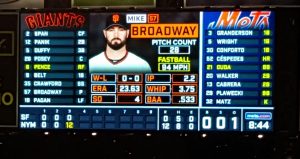
Peavy pitched as if it really was New Year’s Eve, departing with the starter’s version of a blistering hangover, his ERA rising from 6.86 to 8.61. In came Mike Broadway and, with him, the hip hooray and ballyhoo of a New York Met rockin’ eve just gettin’ rollin’.
No lullaby for Broadway, only an extended nightmare that commenced with the third pitch he threw to Asdrubal Cabrera. It became a double, the inning’s third, and it plated Lucas and Neil. Five pitches later, Kevin Plawecki was walked. First and second, nobody out, a 6-0 lead, and it suddenly dawned on us there was more transpiring before us than just another Met offensive onslaught. Everybody had come up, one through eight, and everybody had gotten on. Steven Matz was about to bat. By any measure, the Mets were batting around and then some.
And they were still just getting rolling. Because Terry Collins veers toward being no fun, he ordered Matz to bunt, as if Matz can’t hit, as if Broadway couldn’t be hit. In any event, Matz couldn’t bunt and struck out. The party paused for an instant.
Then it was back to lampshades on heads. Curtis drove a ball to deep right that, like Walker’s, looked like it would be traveling over a fence. Instead, it descended in front of the No Zone (as in No Homers Allowed). Hunter Pence made a play on it.
A very bad play. The Giants’ Sign Man dropped a catchable ball. It was marked a single. Asdrubal scored, Kevin stopped at second. It was 7-0. Then David singled to load the bases and young Michael singled to push the margin to 8-0. The pace was a little too station-to-station for my tastes, to be honest. Then again, when it stayed 7-0 for more than a minute, I asked Jeff, in all seriousness, “How disappointing would it be if all we got out of this inning was seven runs?”
Man, these are some crazy times we live in.
Broadway was still pitching for San Francisco. Bochy didn’t guide his team to three world championships in five years rescuing lost causes. The reliever’s next task was to face Cespedes with the bases loaded. For anyone with a working knowledge of the Met record book, the setup was ideal. The most runs the Mets had ever scored in an inning was eleven. With one swing, that standard could be smashed, and who was more capable of swinging and smashing than Yoenis? I had seen it for myself three nights earlier when he came off the bench against Cincinnati after several days of inactivity and cranked a three-run pinch-homer to left to turn around a game, extend a winning streak and, for all we know, redefine a season.
At 8-0, there was no longer a remotely reasonable claim to be made on disappointment. And if you were gonna prevail upon the fates to give you exactly what you wanted, shouldn’t you save that sweetest taboo for a spot where you really need the biggest of bangs? To ask Yoenis Cespedes to do what I wanted him to do might have amounted to using up one of a limited quantity of karmic favors, and for what?
For a record?
For flair?
For fun?
It was raining just enough to be bothersome, but not so much that I had to be such a wet blanket about wanting what I could barely bring myself to utter out loud. Yoenis Cespedes didn’t re-sign with the Mets so we could dream medium. Besides, Bryce Harper insists baseball be made fun again. Who has been more fun since last August than Yo? What has been more fun since the middle of this month than rooting for these Mets?
Ah, screw it, I thought in silence. Hit a grand slam, Yoenis. Give us our record twelve-run inning.
“You got it, pal!” I’m pretty sure I heard him holler over the crack of his bat that sent Broadway’s first pitch in the general direction of the Great White Way. It was indeed a grand slam. It was indeed 12-0, Mets. All twelve had indeed scored in this, the longest third inning in the history of humankind.
Talk about your valuable prizes.
Yup, it was very New Year’s Evelike up in Promenade at this point, but I’d temporarily forgotten Jeff’s and my refrain from Mets Jeopardy and instead remembered all our old and new acquaintances down on the field with a single word…a single number, to be dead-on balls accurate about it.
I typed it twelve times, but I might’ve shouted it twenty-four. I honestly couldn’t believe the Mets had just scored twelve runs in an inning for the first time in their history. It wasn’t as if I’d been dreaming since July 16, 2006, of surpassing the eleven runs that scored in the top of the sixth that night at Wrigley Field, just as the Mets tallying eleven within the span of three outs was a going concern once ten became the number to beat in the bottom of sixth at Shea Stadium on June 12, 1979. But when these milestones approach, the desire to reach out and grab them grows overwhelming.
Just as the Mets have, huh? Without Cespedes in the lineup, they kept winning and were plenty imposing. With Cespedes, where between one and eight in their standard lineup is the letup for the opposing pitcher? Mike Broadway picked a very bad night to be an understudy to Jake Peavy.
Cespedes, though…what a star. In a ten-pitch span dating to the previous Friday in Atlanta, Cespedes came to the plate five times, took six swings, delivered four hits, totaled twelve bases and drove in eleven runs. And that was all while letting a debilitating bruise heal. Amid the twelve-run inning and eventual 13-1 win, Yoenis set two Met records of his own: most RBIs by one batter in one inning (six); and most consecutive games with at least one extra-base hit (nine). The Mets he surpassed in these respective realms were Butch Huskey and Ty Wigginton. I liked Butch Huskey and Ty Wigginton just fine in their day. The days Yoenis Cespedes and these Mets are giving us, though?
The only thing missing from Wednesday night’s game was Keith Hernandez requesting that someone put a tent on the circus.
This is not a blueprint for constructing a satisfying baseball game: a seemingly much reduced Matt Harvey giving up a home run to Zack Cozart on the fourth pitch thrown, followed by Ivan De Jesus smacking the seventh pitch thrown off of Harvey’s derriere, followed a bit later by Lucas Duda dropping a ball in a rundown to force his pitcher to get another out.
That doesn’t sound fun at all, and yet we came to the end of the first inning and found ourselves feeling hopeful. Yes, it was 1-0 Reds. But it was only 1-0 Reds. And despite the fireworks and fumbles, Harvey’s fastball was coming in around 95 and 96, not the 92 or 93 of his dispiriting outings in Cleveland and Atlanta. He’d struck out Joey Votto, Eugenio Suarez and Devin Mesoraco and walked away more nicked than cut.
And then the circus truly got rolling. With two out in the bottom of the first and Alejandro De Aza on second, Lucas Duda hit an arcing drive to left fielder Scott Schebler. It hit Schebler in the glove, which is normally what a fielder wants, but it didn’t stay there, falling to the grass instead for a free run. The Mets then capitalized further, with a Neil Walker single driving home Duda for a 2-1 lead. Schebler, by the way, has the presumably unconscious habit of flipping his mouthguard around nonstop, which was fine until it fell out of his mouth while he was at bat in the sixth. When the SNY cameras returned to Schebler, I hoped the mouthguard would be missing, tucked in a pocket until it could be rinsed off, while pretty much knowing that … yecch. That’s the kind of thing that gets your mother to email you disapprovingly.
Poor Schebler wasn’t alone, at least in terms of non-mouthguard-related miscues. Walker made an error of his own, Asdrubal Cabrera corraled a ball but couldn’t unload it, David Wright was awarded first base on catcher’s interference … MY WORD, to return to The Quotations of Chairman Keith. As the errors mounted all you could do was hang on, with no sense of how this one was going to unfold. Granted, no one ever knows how a game is going to unfold, but a decent amount of time you can guess — unless chaos is erupting everywhere at regular intervals, in which case you just shrug and try to imagine what wacky thing might happen next.
What happened was the undermanned Reds (no Jay Bruce, no Brandon Phillips, a discombobulated Votto) tried to fight back but couldn’t, thanks to three rather delightful Metsian storylines.
The first was Harvey, whose location wasn’t perfect (and whose bunting was very far from it), but who kept his velocity and seemed to gain a better feel for his slider and change-up as the game rolled along. Harvey’s 102nd pitch, to finish the sixth inning and his night, was a 97 MPH fastball — very good news indeed.
Storyline No. 2 to enjoy was the continuing rampage of Neil Walker, whose ninth home run of the still-young season tied Dave Kingman, Carlos Delgado and John Buck for most Met home runs in April. That company doesn’t guarantee anything — Buck, you may recall, followed his nine home runs in a blazing April 2013 with a grand total of six more over the next four months, a display so impressive that the Mets made him a throw-in in the Marlon Byrd trade with the Pirates. But for now, dare to dream: rather than compare Walker with dearly departed Daniel Murphy, let’s measure him against Bryce Harper, his co-leader atop the NL HR leaderboard. (Yeah, I know. We’re daring to dream, remember?)
Our third storyline concerned Michael Conforto, who for the first two hours of Wednesday’s game looked like the overanxious young player he’s never been. Conforto struck out looking in the first with De Aza on second, fouled out meekly in the bottom of the second with the bases loaded, and stranded two more runners with a groundout in the fourth. If you were keeping score at home, that was six seven runners left idle in three un-Conforto-like at-bats. Oh ye of little faith: In the sixth, against Blake Wood, Conforto got two more runners dropped on his ledger and responded by roping a double to left-center to give the Mets a sorely needed cushion. If we can go back to dreaming, a generation spent watching Conforto and Noah Syndergaard in blue and orange sounds pretty swell.
So the Mets won — that’s their sixth straight, their 11th in 13 contests, and the mighty Nationals are just a skinny game north of us in the standings. Jump to conclusions and you set yourself up for a fall, but this could be fun.
Sometimes you just have a feeling. Sometimes you just know — no matter how long the odds, how deep the deficit, how frustrating the evening has been — that when it’s all over, your team is going to come through for you.
I knew no such thing Tuesday night. I can’t even say I had a feeling, because feeling fell victim to the brutal right field corner cold. The last feeling I’d had came before I left for the game, and that feeling was I could probably get away without extreme winter-style layering, that it’s late April and it’s not gonna be that bad.
It was. It was that bad. It’s late April on the shores of Flushing Bay. It’s always that bad. So I got that wrong and I shivered in service to cheering on the Mets. Actually, I didn’t do much cheering for six-and-a-half innings. It was more like I sat in severe judgment, arms folded, staring bullets at the futile proceedings in front of me. I wasn’t being judgmental. I was just trying to stay warm.
I was failing. As were the Mets. They were losing to the Reds, 3-0, in ways that told you it wasn’t going to happen for them. One fly ball after another went nowhere except into the gloves of Cincinnati outfielders. There was a surfeit of drifting back and making the catch, except for that one instant when Spiteful Billy Hamilton flew through the air with the greatest of unease to rob Kevin Plawecki. It was the most difficult of five putouts for Hamilton, who definitively transformed center field into the room where Met hits didn’t happen.
The tone may have been set in the bottom of the first when Curtis Granderson’s leadoff HBP morphed into a two-out pickoff with cleanup hitter Michael Conforto at the plate. Or perhaps my buddy Rob and I should have known what we were in for when we were caught in a veritable rundown at the turnstiles as our print-at-home tickets, perilously light on ink, refused to scan.
It’s true: there’s no more difficult ticket in New York right now than one that will get you in to see Hamilton.
Dutifully and politely, one green-jacketed specialist after another attempted to register our respective 12-digit bar codes. I know they’re 12 digits because we spent several minutes squinting and cooperatively reading the characters aloud to a person who attempted to enter them into a handheld device (worst…Verizon…promotion…ever). Was that an ‘8’ or a ‘9’ between the ‘J’ and the ‘E’? It didn’t matter, since neither one of them computed. When nothing would produce a satisfying BEEP!, uncommon common sense eventually and blessedly prevailed.
“Ah, just go ahead.”
It was the same thing the Mets said to the Reds in the third when ad hoc first baseman Wilmer Flores couldn’t make a play on Hamilton and it led to a run off Bartolo Colon. It was emphasized in the fourth when, despite new starting catcher Plawecki gunning down a baserunner (a feat the since-DL’d d’Arnaud couldn’t accomplish the night before), the Reds added two more runs on Ivan DeJesus’s two-run homer into the candy-coated left-center field deck. De Jesus was batting .083 prior to that swing off of Colon, or .083 higher than Colon. It was that kind of night.
The Mets stayed three runs behind, a manageable margin in theory, an impossible distance in the reality we were experiencing. The Reds had the most runs, the cold had the iciest grip and the Mets were generators of exactly one hit through five innings, a harmless three through six. Brandon Finnegan, except for being robbed of an RBI on a nifty Walker-to-Cabrera double play that saved yeoman reliever Logan Verrett’s frigid bacon, could do no wrong.
The kid southpaw (nearly as junior to Bartolo as De Jesus, Jr., is to Ivan, Sr.) began to lose his grip on the game with one out in the seventh. Juan Lagares walked. Plawecki singled. You couldn’t exactly blame young Brandon. I don’t know how anybody gripped anything in those conditions.
With the two runners on, Bryan Price trudged out to the mound and called to order a conference that lasted approximately as long as the one attended by Roosevelt, Churchill and Stalin at Yalta in 1945. OK, maybe it didn’t go on for a week, but when the temperature is dropping, the wind is whipping and you’re secretly counting the outs until you can head for warmth, managers really need to stop strategizing between the white lines as if the fate of the postwar world rests on their gravest of decisions.
Price decided to leave Finnegan in for a 107th pitch, his last as it happened. Not so coincidentally, it was the first to be seen by Yoenis Cespedes since last week. Cespedes, nursing his bruised right leg and not necessarily anticipated to participate, appeared as a pinch-hitter and no worse for his bruise.
That 107th pitch of Finnegan’s, however, was maliciously battered.
Yo produced a laser of a line drive that…what’d it do? It slammed off of something. The blue left field wall for a double to score Lagares and make it 3-1? That would have been terrific. But, no, it did more than that. It rose high enough to crash into the black backdrop above it — the notorious Great Wall of Flushing — confirming it was, in fact, a three-run homer that tied the game.
The Mets had tied the game! For six-and-a-half innings it was incredibly cold and the Mets had absolutely no chance, according to holders of tickets that held not nearly enough ink. Now?
Now we weren’t really that cold. It could have been mistaken for just as warm as that June night in 2000 when Mike Piazza did something similarly striking to a first pitch. That game felt hopeless for hours on end, too. Then, with one crushing blow, it couldn’t have been any more hopeful. Mike had finished rallying the Mets from down 8-1 to lead 11-8 against their archrivals the Braves that night. This wasn’t precisely that, but what Yoenis did, emerging from the deep freeze of injured inactivity and unfolding all the arms in the vicinity until they were raised high in the chill air…it was crowd-pleasing enough to have been conceived by Lin-Manuel Miranda.
Finnegan could begin again in his next start. His immediate successor, Tony Cingrani, enjoyed far less success than Brandon had prior to his having gotten undressed by Cespedes. Cingrani gave up a triple to the ever-hustlin’ Granderson and, one out later, the decisive single to David Wright, who works what’s left of his back off for every base hit at this achy stage of his distinguished career. “Every day it sucks getting ready for the game,” one of our town’s clutchest Captains would testify later. “But I enjoy playing the game.” One assumes he enjoyed playing this game more than most.
I didn’t enjoy sitting through it whatsoever, not until I did, at which point arctic had given way to cathartic. By then, the Mets were up, 4-3, with Addison Reed and Jeurys Familia handling the lead efficiently and permanently. The last out came at the expense of Reds right fielder Tyler Holt, an unknown quantity to Rob and me, but an apparently notorious figure to our sectionmates dozens of rows below, for they had started a “HOLT YOU SUCK!” chant that was as mysterious as it was unrelenting. The whole stadium picked up on it with two out in the ninth. Holt, whatever his perceived crime, couldn’t possibly suck any more than what David has to go through in order to persevere through spinal stenosis, but we all do what we have to do in order to stay warm until we can contribute to victory.
It was a triumph I did not see coming. That scanner was better at making out our digits than I was at discerning our chances. Even preternaturally wise diehard Rob admitted, through the icicles dangling from his extremities, “I was ready to bag it” before Cespedes turned the night around. We had no sense that the Mets were going to come back and dramatically win their fifth game in a row. The sensation we received as a result (augmented in parking lot traffic when we listened to Bryce Harper make the last out versus Philadelphia via MLB At Bat) is one of those moments that does not show up in the box score.
Whenever I come across an article that endeavors to project with as much certainty as can be legitimately garnered what is going to happen in baseball — a season, a series, a game, a potential encounter between a particular pitcher and hitter — I make like a squirrelly baserunner and do my best to evade its contents, lest it tag me with too much speculative data. I like information in advance as much as the next fan, but there’s something to be said for never knowing before you can possibly know…and not pretending that you can.
So, yes, sometimes you do just have a feeling. Sometimes you do just know — no matter how long the odds, how deep the deficit, how frustrating the evening has been — that when it’s all over, your team is going to come through for you. Yet I knew no such thing Tuesday night. All I had in the way of knowledge was knowing that once in a while something you don’t see coming arrives regardless of your lack of vision. In this case, the element of surprise made what the Mets delivered quite the unforeseen delight.
Everything is a small sample size if you want it to be. Nothing proves anything until it does. After 20 games of 2015, when the Mets were 15-5 and led the last-place Nationals by eight lengths, it indicated they were gonna run away with the National League East — but it proved nothing. After 102 games of the same season, when the Mets were 52-50 and trailed the first-place Nationals by three, it indicated the Mets were in for a dogfight — but it proved nothing.
After 162 contests, the Mets had won their division by seven games over the Nationals. That proved something, at least until Game One of the NLDS, at which point you could throw away all the regular-season records because they didn’t mean a damn thing. As long as you’re still playing, every game is scheduled at the historic Proving Grounds.
In this context, eighteen games is but a drop in the baseball bucket. One-hundred forty-four games remain in 2016 and are capable of negating anything that came before them. Plus, the Department of Rational Thought requires I reiterate that it’s still early. Yet eighteen games is a sample size. It is one-ninth of the schedule, and we know how ninecentric baseball can be, particularly in the only league that plays the game correctly. Though the season just started nine minutes ago, look at it this way: if you take how many games we’ve already seen and do the same amount eight more times, we’ve got 162.
Geez, that went fast.
We’re not there yet, but we’re somewhere. We’ve eked into standings territory. It’s OK to look and take them a touch seriously. I mean, why not? It’s what we’re going to be doing for the next five months and change with any luck. So let’s see where we are after Monday night’s 5-3 victory over the Reds at Citi Field.
11-7
Second place in the N.L. East.
Three games behind Washington.
First in the Wild Card race.
One game ahead of Pittsburgh for home field.
One-and-a-half games ahead of St. Louis and Arizona for a playoff spot.
Granted, “if the season ended today” talk is ridiculous (and depressing) on the morning of April 26, but there appear to be some reasonable indicators in the standings. Today’s playoff participants would be us, the Nats, the Bucs, the Cubs and the Dodgers, with the D-Backs and Redbirds hovering directly to the rear. No projected non-contenders in there. The only perceived good National League team not above .500 is San Francisco, and they’re 10-11, a scant 2½ behind L.A.
It’s early, but it’s not so early anymore that we can’t begin crafting a few impressions of what this team of ours is like besides fairly hot (9-2 since starting 2-5).
We can pitch, which isn’t a surprise. The question is can we pitch the lights out of every ballpark every night or do we simply have better than average arms doing better than average things? The latter isn’t bad, but we hunger for all-time validation. It’s what was on the preseason menu. Monday night, Noah Syndergaard, one of the handful of best pitchers in the world in April, didn’t flirt with perfection. It was, I have to admit, a bit disappointing. We’re at that stage with Thor that when he hasn’t retired 18 of 19, something seems Thor-oughly off. Runners got on against Noah. They also stole at will. Somehow Cincy tied the game while he was the pitcher of record.
How dare this happen! Or it shows that when things go a little wrong for Thor, the sky mostly stays aloft. The kid (which he still is, last I checked) lasted six-and-two-thirds, was charged with three runs, walked nobody and struck out nine. That’s not too bad, even if your name is Noah Syndergaard.
Not a single Met has thrown a perfect game in 2016, but hardly any of their starters has pitched us out of a chance to win yet. Let’s go with that for now as a trend and take it on faith that everybody in this rotation is going to have a good night almost every night. We should survive quite nicely.
Whereas the pitching strongly resembles the strength of 2015 (give or take an ace or two still working out some bugs), the hitting is diverging from its predecessor. The biggest difference between now and then is Michael Conforto, certified No. 3 hitter and perhaps the best addition to the lineup. Conforto is not new, but, like Thor, he has evolved and developed and is a threat to do whatever it takes in a given situation. He hits. He hits with power. He hits to the opposite field. He hits the ball hard. He’s really quite the find. I worried too much would be put on him entering his first full season. I was haunted by the ghost of sure thing Gregg Jefferies and how 1989, his first full season, came crashing down on him and us. Early but solid impressions say Conforto ain’t Jefferies — and Jefferies had himself a pretty good career after a fashion.
The other upgrade to the power-packed assemblage of bats is Neil Walker. Neil is on pace to hit 72 home runs, and if the wind is blowing out, watch out Barry Bonds! “On pace” silliness notwithstanding, you have to love this guy’s April and feel confident that he’ll stay steady if not spectacular as his Month of Living John Buck-ily turns to May. He seems to know what he’s doing up there and out there.
And, yes, I said upgrade. No offense to the second baseman he succeeded. I’ll take my chances with steady.
The Mets as a whole pound the bejeesus out of the ball when they must. That’s how they won against the Reds, with Conforto, Lucas Duda and Walker each going very deep. It makes a nervous person overlook the leaving runners on base when not homering. It also allows five bases stolen against Thor and Travis d’Arnaud to go for happy naught, though you can’t be happy five bases were stolen on the catcher of the present/future. Word eventually came around that Travis is experiencing some shoulder discomfort. Like Yoenis Cespedes’s right leg needing draining and sitting (and the continued uncertainty over David Wright’s durability), that’s a cause for concern, with 144 games to go.
We can’t see all that’s ahead of us, but we’ve seen enough to feel OK. Better than OK, actually. That feels fine for now.
Piazza: Catcher, Slugger, Icon, Star by Greg Prince is available from Amazon, Barnes & Noble and other online booksellers.
Amazin' Again: How the 2015 New York Mets Brought the Magic Back to Queens by Greg Prince is available from Amazon, Barnes & Noble and other online booksellers.
Volume I of The Happiest Recap: 50+ Years of the New York Mets As Told in 500+ Amazin' Wins by Greg Prince is available in print and for Kindle on Amazon.
Faith and Fear in Flushing: An Intense Personal History by Greg Prince (foreword by Jason Fry), is available from Amazon, Barnes & Noble and other online booksellers.