The blog for Mets fans
who like to read
ABOUT US

Faith and Fear in Flushing made its debut on Feb. 16, 2005, the brainchild of two longtime friends and lifelong Met fans.
Greg Prince discovered the Mets when he was 6, during the magical summer of 1969. He is a Long Island-based writer, editor and communications consultant. Contact him here.
Jason Fry is a Brooklyn writer whose first memories include his mom leaping up and down cheering for Rusty Staub. Check out his other writing here.
Got something to say? Leave a comment, or email us at faithandfear@gmail.com. (Sorry, but we have no interest in ads, sponsored content or guest posts.)
Need our RSS feed? It's here.
Visit our Facebook page, or drop by the personal pages for Greg and Jason.
Or follow us on Twitter: Here's Greg, and here's Jason.
|
by Jason Fry on 29 July 2024 11:58 pm So that was certainly a palate cleanser.
The thud made by the back half of the series against the Braves left me fretting: that the Mets were about to topple into one of their periodic team slumps, that their starters would routinely implode in the middle innings, that new bullpen acquisitions would flame out, that … oh, insert another half-dozen bad things here.
Was that an overreaction to a two-game losing streak from a team that’s been at the pinnacle of baseball for the better part of two months? Of course it was. Was such fretting surprising given that the Mets are in an actual pennant race, nouveau baseball wild-card asterisks notwithstanding? Also yes. Living and dying with a temporary assemblage of 26 young millionaires dressed in bizarre livery is what we do, and though it’s self-evidently ridiculous, I wouldn’t have it any other way.
But there I was, frowning and muttering as the Mets started their half of the fourth inning down 1-0 to the Twins and once-upon-a-time Mets farmhand Simeon Woods Richardson. Yes, Jose Quintana had kept the Mets in the game, limiting the damage to a single run in the first and using his curveball to befuddle the Twins. But the Mets weren’t hitting, as was their recent pattern, and I could sense a little black cloud forming above my head.
Little did I know that the Mets were about to hit Woods Richardson and the Twins like a tornado.
Pete Alonso got it started with a bolt of a homer off the facing of the second deck in left; he ended the inning by striking out. In between, eight non-Alonso Mets batted and the team put up six runs.
It was so much fun that in the sixth they sent 11 men to the plate and scored five more runs. The seventh saw eight Mets bat and four runs score. All 11 guys to appear in the batting order on the night collected hits, including substitutes Tyrone Taylor (who added a superb, homer-robbing catch) and Ben Gamel. Alonso is still chasing offspeed stuff out of the zone but hitting balls with authority again. Brandon Nimmo put together the kind of solid ABs we’ve missed seeing. Luis Torrens filled in nicely for Francisco Alvarez, whose shoulder is sore.
By the end of the game the questions had turned outright farcical: Why does Carlos Santana wear his uniform pants so they look like a sufragette-era woman’s bathing costume? If you shuffled the Twins’ and Marlins’ helmets, would players on either team notice? Can pinstripes on the road be classified as a capital offense? Did Gary really just bait Keith into railing about technology? Is Matt Wallner going to get proper credit for being the Twins’ most effective pitcher of the night? Did Jose Butto just record the least stressful save in baseball history?
These are the kind of questions that get batted around as laughers saunter to their inevitable — and oh so welcome — conclusion.
by Jason Fry on 29 July 2024 8:28 am I suppose every good party is followed by a helluva hangover.
The Mets drew within half a game of the Braves with an unlikely victory Thursday night, passed them in the standings with an absolute beatdown on Friday … and then reality set in. Saturday was Spencer Schwellenbach muzzling them, whoever he was. And Sunday … well.
Sunday started off as a carbon copy of Saturday’s game, as David Peterson looked unbeatable early and then very beatable in the middle innings. But it came with the added frustration of the Mets forgetting how to hit with runners in scoring position.
Francisco Lindor led off the first with a single … and was erased on a double play.
Pete Alonso led off the second with a double … and was still there after a lineout and a pair of Ks.
Tyrone Taylor led off the third with a double … and managed to get to third, but no further.
Leadoff doubles are gimme runs — a ground ball behind the runner and a deep enough flyout and you’ve got a run without the benefit of another hit. Though “another hit” is always a good strategy.
The Mets couldn’t manage either, until the fifth. Already down 4-0, Taylor led off with another double. This time, Ben Gamel bucked the trend with a single, with Taylor sent home instead of held at third. Aggressive, but Ramon Laureano hadn’t made a play all weekend. Guess what? He made this one, throwing Taylor out at home and making it crystal-clear that this wasn’t going to be our day.
And indeed it wasn’t. Ryne Stanek‘s debut … you know what, let’s draw a discreet curtain across it as a welcome gift for the second-newest Met. Jesse Winker made his debut, as well, and didn’t give up any runs (yay!) but then that’s because he was pinch-hitting and struck out (oh). Not that sending Winker to the mound could have made things much worse.
And so the Mets wound up back where they started before their long weekend’s adventure, older and perhaps warier. They look a little different now; they’ll probably look a little more different by the end of the week. They could use another starter and one gets the feeling they’ll secure one.
They could also use a time machine, should David Stearns find one on blocks in a rival executive’s front yard.
by Greg Prince on 28 July 2024 11:08 am The Mets’ return to Mercury went about as well as the maiden voyage 25 years ago. On July 27, 1999, New York’s National League franchise garbed up as from the planet closest to the sun and got burned, competitively and aesthetically. They lost to the Pirates that night and looked like…let’s say not Mets. Not of this Earth, certainly. Orel Hershiser started and resented the get-up. Rickey Henderson didn’t dig being portrayed as an alien life form when he glanced at Shea Stadium’s prehistoric big screen. Mercury Mets jokes ensued for much of the next quarter-century. If you knew, you cringed.
But you live long enough, everything initially reviled turns fondly recalled. Thus, this second Mercurial trip, albeit one taken around the edges. The Mets gave out PIAZZA 31 shirts, not in orange and blue; or orange, blue and black; or even concrete gray and 7 train purple, but in the onyx and silver tones of Mercury. The players didn’t wear such tops, but their City Connects served futuristic enough. The EnormoVision and its handmaiden ribbon boards were all in on “Mercury” playing Atlanta. Three-eye and green-face imagery was everywhere.
I embrace the idea of the Mets embracing every silly aspect of their history, but some curios are purely of their time. Mercury Mets was a spectacular attempt to invent something evocative of 2021 in 1999. In 2024, you could rekindle only so much of that Mercury magic. Thinking about it the morning after, it hits me now on the level of the Mets redoing their scoreboard in 2019 to make it look like Shea’s in 1969 when they celebrated the fiftieth anniversary of our first championship. Good thought. Nice try. But some heavens you can only ascend toward once.
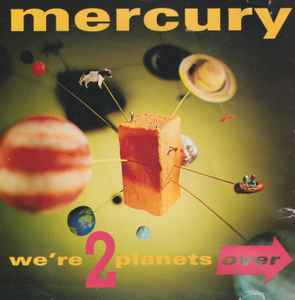 The Met offense seemed stranded on Uranus. Alas, the New York/NYC/Mercury Mets — whatever they wore, however they identify — never got off the launching pad on Saturday. Facing none of the big Brave starters of yesteryear or this year, they flailed helplessly against Spencer Schwellenbach. In space, nobody hears you swing and miss. The Mets K’d eleven times against the Braves righty, thrice more against their relievers. Tylor Megill, who’s orbited the lower end of our rotation since the universe was created, pitched lights out for three-and-two-thirds, then was sucked into a black hole of gopher balls. Expectations shouldn’t have been too high. Tylor was supposed to be no more than the sixth starter in a fresh alignment helmed by a fully recovered Kodai Senga as we defended our hard-earned spot atop the Wild Card standings. Ah, plans. We’ll see Senga no sooner than October, should we see October.
The Mets lost, 4-0, snapping a five-game winning streak and falling to a precarious though perfectly viable third place in the consolation prize stakes. On the sunny side, they were kind enough to not rudely interrupt my friend Kevin from Flushing and I as we sat in 520 and enjoyed a nine-inning tangent about most everything baseball-related except the game playing out in front of us. Our team couldn’t distract us with runs, and I kept referring to John Rocker as John Smoltz (someday I’ll call Spencer Schwellenbach Spencer Strider) . Not a lot of crispness in the air, but at least the air wasn’t terribly humid. Change is in the Metropolitan forecast, however. Reliever Ryne Stanek has arrived from Seattle, perhaps partially compensating for however many heretofore relied-upon bullpen arms are currently on the IL, and Jesse Winker is winging his way from Washington, sent here by the Nationals Saturday night in exchange for pitching prospect Tyler Stuart. Winker is quite familiar with the folks in Flushing.
Might as well make yourself at home, Jesse. It’s the year of Grimace; the year of Max the so-called Rally Pimp; the year of Glizzy Iggy, that sparkly dog who nibbles on hot dogs in the stands; the year of Jose Iglesias, that journeyman second baseman who produces hits that show up in box scores and Billboard; the year the Mercury Mets took another bow; the year the term “en suite” infiltrated a baseball broadcast; the year we were absolutely dead and buried; the year we burst from six feed under to lead (for at least a day) the Wild Card race. And it’s not even August. Jesse Winker, the closest thing we have to a professional wrestling heel in the 2020s, is one of us for the duration of the playoff chase? Of course he is. Bizarreness always merits a place in our world.
by Jason Fry on 27 July 2024 12:17 pm I’d like the bottom of the third inning from Friday night’s game bottled, if you please.
Seriously, that was a high ABV brew to settle even the most high-strung Mets fan’s nerves. Down 2-0 against Charlie Morton — one of the few remaining big leaguers with sufficient tenure to have appeared at Shea — the Mets loaded the bases with nobody out on an Austin Riley error, a HBP and a walk. That brought up J.D. Martinez, who smacked Morton’s 3-1 offering to right, in the vicinity of Adam Duvall, the warning track and the fence.
The ball carried just far enough, touching down atop the orange line and bouncing onto the roof of the Cadillac Club, where it was greeted with appropriate jubilation. The Mets led 4-2, and they were just getting warm. Pete Alonso grounded out, but Jeff McNeil doubled and Mark Vientos drove a curve lacking curvature into the Party Deck. After a Jose Iglesias groundout, Francisco Alvarez crushed one off the facing of the second deck in left. One way to tell a home run is a no-doubter? You hear the contact on the radio — as Emily and I did while navigating the Major Deegan — and crow, “That’s gone!”
The Mets led 7-2, and Citi Field was in full cry, as a big crowd promised fireworks got them a couple of hours early. That included me and Emily, grinning like fools in our seats as Howie Rose and Keith Raad described jubilant Mets high-fiving and disconsolate Braves trudging about.
We knew full well that a win would mean passing the Braves in the standings and so claiming the first wild card — a singularly unlikely turn of events given that the 2024 Mets looked ready for the knacker’s yard on Memorial Day while the Braves were, well, the Braves.
As Alvarez high-stepped it around the bases, you better believe I was thinking about that, as well as decades’ worth of slights and insults and misfortunes, from Brian Jordan ruining everything and Bobby Cox sending up relievers as pinch-hitters because it was funny to innumerable abysmal reversals at Turner Field and White Flight Stadium to the horrific conclusion of 2022 and “tie, you lose” and Ramon Laureano shoulder-checking Alvarez Thursday night. (Nice catch buddy!)
I’d like to say I rendered that into some stemwinder delivered on I-87, but my reaction wasn’t anything that highbrow. No, I kept thinking, Fuck you fuck you fuck you fuck you fuck you, ad infinitum.
We didn’t know it, but the garden party was about to get crashed by skunks. Kodai Senga had settled in after an early Duvall homer and looked borderline untouchable in the fourth and fifth. Riley opened the sixth — a rarely visited land for Mets starters — with a pop-up above the mound. Alonso caught it, but nobody was watching that: They were fixated on Senga, who’d grabbed at his leg in vacating so the infielders could do their work and was now lying on the ground.
Senga walked off more or less unassisted, which may or may not be good news but certainly isn’t bad news; an MRI should give us a better idea whether he’ll be out a couple of weeks or a couple of months. Let’s hope for the former, obviously, but I won’t crawl out a high window if it’s the latter: The Mets climbed 99.03% of this mountain without him, after all.
Senga gave way to Eric Orze, whose MLB debut in Pittsburgh ended without his having recorded an out; Orze’s second bite at the apple also started poorly as the loathsome Marcell Ozuna crushed a homer off of him and then took about a week to round the bases. (Hey you: Look at the scoreboard.)
Orze’s misfortunes had me flashing back to Lino Urdaneta, an agate-type 2007 Mets transaction who arrived with an asterisk. Urdaneta had debuted three years earlier for the Tigers, giving up six earned runs without recording an out, and then spent two seasons in the minors while sporting a big-league ERA of infinity. Urdaneta was brought up to the Mets in May, replacing the less than immortal Chan Ho Park, and pitched in two games before getting sent back down. His time as a Met wasn’t particularly impressive: three batters retired, two hits and an earned run allowed, but it did lower his career ERA to 63.00, where it will sit forevermore.
Back in the present, Orze walked Matt Olson, marking the fifth big-league hitter he’d faced without retiring anybody. But the worm was turning: Travis d’Arnaud flied out to right, and having experienced the joys of getting outs Orze indulged himself, recording four more of them in completing his two innings of work. His career ERA now stands at 21.60, not ideal but at least finite.
Orze arrived as part of a roster shuffle that also saw Dedniel Nunez going on the IL, Adrian Houser and Shintaro Fujinami getting DFA’ed and Ryne Stanek being acquired from the Mariners.
Stanek throws hard, doesn’t always throw accurately and gives up his share of home runs, which in modern baseball parlance means he’s … a guy, more or less. He has a decent postseason track record, which is the kind of intangible talked up a lot around the trading deadline but that I doubt means anything. When the season started Adam Ottavino was considered a stalwart we were lucky to have but he’s now greeted with knocking on wood and celestial beseeching; Nunez was thought of as Triple-A depth on Opening Day and his absence now feels like a body blow.
That’s a lot of words to restate a baseball truism we don’t like to acknowledge: No one knows anything.
The Mets have come this far, and to say it’s been quite a ride is understating it rather dramatically. I’m not quite sure how they’ve managed it, and have no idea where they’ll wind up, but right now it’s exhilarating. Just don’t look down.
by Greg Prince on 26 July 2024 11:24 am One out from another inning on this, the eve of the Summer Olympics. The Mets had handed out pickleball paddles to lucky ticketholders when the night began, though I don’t think pickleball is an Olympic sport. I don’t think baseball is an Olympic sport this year, either, but that’s OK. We’re not going for the gold. First Wild Card isn’t even the bronze, but baseball has chosen to be not so choosy. Everybody gets a medal? Not quite, but the top six finishers in each league do get a ribbon. And despite having no designs on taking any bows when the year started, it turns out we really want one.
That’s for much later. The only finish line we can worry about in the present is the finish line of this game. We’d like it to materialize magically with us rushing through its tape before we use up our next out. Good luck to us getting there, for we are that one out from pushing our luck into the eleventh. One out from having to do more than we’ve already done, which is withstand vintage Chris Sale; escape a replay review that probably shouldn’t have gone our way but did; extract zeroes from our perpetually beleaguered bullpen; and defuse a botched squeeze play in which one throw was a little high and one catcher was bumped a little hard. One out from wondering whether we could bring Francisco Lindor back to the plate ASAP, because without Francisco Lindor, we would haven’t made into the tenth inning, the inning currently in agonizing progress. Lindor homered with a man on in the third. That was the extent of our scoring. The Braves scratched out one run in the second, another in the fifth. That was the extent of their scoring. Statistically, we’d been as close to beating the Braves as we’d been to losing to the Braves. Emotionally, a matter of time before the Braves did something dastardly to us was on the clock.
Then with that one out remaining, Jeff McNeil, the Met who hadn’t hit most of the first half and the Met who’d started hitting like crazy since the All-Star break — and the only Met not named Francisco Lindor to have recorded a hit all of Thursday night — gets ahold of one.
Maybe “gets ahold of one” overstates the case. Jeff has, however, struck a long-ish, high-ish fly ball toward the right field corner.
Is it long enough to…no, it’s not that long.
Yet it is high, so it hangs up there a while.
Not a pop fly, by any means. Kind of a rainbow, an arc, a parabola. This is no time for SAT synonym prep. The only meaning we want out of his ball is it landing fair, out of the grasp of a Brave’s glove. Should it cooperate with our wishes, it will facilitate our ghost runner, Jose Iglesias, scampering home from second with the winning run.
Win in ten, here and now.
Don’t play eleven, when who knows what could go wrong?
Discover that pot of gold (or gold Wild Card medals) awaiting at the end of that rainbow, if everything I’ve ever learned about rainbows in cartoons is accurate.
The ball’s not deep enough to leave Citi Field, but it’s not obvious it’s going to be caught. You watch the ball at first. Then you watch to see if a fielder is going to be there to meet it. The right fielder, Ramon Laureano, starts coming into view. He’s racing over from right-center. We will track no leg of any relay from the Parisian Olympiad with the intensity with which we are viewing this race.
Laureano had just entered the center of our consciousness a half-inning ago, in the midst of that botched squeeze play. Laureano was the ghost runner who’d moved up to third. Jarred Kelenic, speaking of beings that might haunt, was at bat. The ex-Met prospect could have made us once and for all totally regret our trade of his potential, receipt of Edwin Diaz notwithstanding, with one well-placed hit. Instead, Kelenic showed bunt. Not exactly a squeeze play. More like a squeeze play ploy. But delineate the difference to Laureano, who broke for home. Francisco Alvarez sized up the situation and threw to third when there was no contact on the part of Kelenic. A little above third, I thought, but Mark Vientos grabbed the fling before it could sail into the outfield and effected a successful rundown. Alvarez absorbed a brusque shouldering from Laureano. Like any commuter shoving onto the 7 as the doors are closing, Francisco did not take kindly to it.
An inning earlier, a Brave baserunner also came close to causing trouble in the vicinity of third base. That was Whit Merrifield, the pinch-runner who had stolen second (despite an accurate zip from Alvarez) and now sought an encore. This time, Francisco had him dead to rights at third. Vientos caught the throw, put down his glove and, crap, did Merrifield get his hand on the bag before Mark made a tag? Mark wasn’t particularly aggressive with the leather there. Fortunately, the umpire was too impressed with the throw beating the runner to call the runner safe. The Braves challenged the call. The replay proved a little too inconclusive for the judges back in Manhattan. Honestly, it looked like Merrifield pulled a headfirst slide version of that Michael Phelps half-stroke move from the 2008 Olympics, the only specific Olympics moment — certainly the only one involving swimming — that’s ever sprung to mind for me in the midst of a tenth inning of a baseball game. Bottom line: the call stands and the Braves are all wet.
 Phelps was safe. Merrifield was out. As Mets fans, we fret instinctively at the sight of the tomahawk, the aura of the Atlantans, and the reality of a pitcher like Sale (7.1 IP, 2 H, 1 BB, 9 SO, just that 2-R HR to Lindor) too much to notice, hey, those bleepers aren’t accomplishing anything offensively, either. Luis Severino engineered another not terribly efficient (95 pitches over five-plus) outing that still proved reasonably effective (two earned runs), if not as long as we’d have liked. The Braves didn’t take advantage of Luis, and they sure as hell couldn’t touch secret weapon Jose Butto. He won’t be a secret much longer. Three innings pitched, nine batters faced, no runners on base. Butto aces the math portion of his examination.
Diaz got us a bit nervous in the ninth, but there was that out call at third that stood, which diminished the residual anxiety associated with Edwin’s leadoff walk to Eddie Rosario (which was why Merrifield on base to begin with). Phil Maton doesn’t have enough equity in orange and blue to not get us immediately nervous in the tenth, what with the automatic runner nonsense hovering overhead and him being a Met reliever, but that squeeze/not squeeze only served to squeeze the Braves out of a chance at scoring. We didn’t do anything against any Brave reliever between Sale leaving in the eighth and McNeil’s at-bat in the tenth.
Prior to newly redubbed Happy Jeff taking his best shot, we did have Iglesias trotting out to second to start the bottom of the tenth because Rob Manfred said so, and we did have Pete Alonso trotting to first because Brian Snitker said so. J.D. Martinez had struck out between the intentional ghosting and intentional walking. Vientos had struck out directly after. Almost ten full innings of waiting for the dam to burst or have it burst all over us.
Hey, wasn’t there something about a long-ish, high-ish fly ball a few paragraphs ago?
Yes, there was.
Whatever happened with that?
Ah, let’s see…
Laureano sprinted as best he could.
The ball began its dive, a little shy of the right field corner.
It was going to be fair, it appeared.
But where it would land?
A tad behind Ramon Laureano, it turned out.
Dude won his race, in that he sprinted right by the darn sphere — and the darn sphere fell in.
Hot damn!
Iglesias indeed scampered home, crowning the Mets 3-2 winners, shoving the Mets a hot breath from the Braves’ standing atop the Wild Card leaderboard, and extending our Amazins’ string of triumphs to four.
Let Paris have its opening ceremonies. Let the games continue in Flushing.
by Greg Prince on 25 July 2024 10:33 am The first wave of excitement crested Wednesday night with the completion of the Subway Series sweep, both this week’s and this year’s. Of course it was exciting. It was Mets 12 Yankees 3, with five home runs for the visitors who made themselves at home inside the surprisingly friendly confines of Yankee Stadium. Two for team category leader Francisco Lindor (21), one apiece for current team runner-up Pete Alonso (20); Mark Vientos (13); and Tyrone Taylor (6). Taylor collected three hits overall and made a swell diving catch in center besides. Sean Manaea could have been more efficient and lasted longer — he needed to be bailed out at the 4⅔-inning mark following his 103rd pitch, a ball four that loaded the bases when the score was still kind of close — but the bullpen came through when the bullpen had to come through, starting with Adam Ottavino doing the bailing out of Manaea, and continuing with our two Young guys, Danny and Alex, combining to post three scoreless.
I watch every Mets-Yankees game braced for the worst. When Lindor went deep for the second time, depositing a three-run shot somewhere in the Bronx night to make it 11-2 in the eighth, I unclenched completely. When the game went final, the excitement washed over me. The Empire State Building was lit in orange and blue and so was I.
The second and more telling wave of excitement gathered momentum on this, the morning after.
Yes, I could hear myself think, we swept the Yankees. That’s always great. How could it not be great? I hear they’re not as good a team as they were when the year began, but they are who they are, and we are conditioned to fear and loathe them. No fear after going 4-0 in ’24. Loathing is always in style.
Hence, take that, Gerrit Cole, Cy Young winner we can’t pound enough for my taste. Take that, Juan Soto, mercenary who’s apparently selling something called Fig Urine on August 9, if the sign behind home plate these last two nights was to be understood at first glance (oh, it’s a Juan Soto FIGURINE giveaway…never mind). Take that, Aaron Judge, whose walks are victories for the pitcher walking him, and all ya got out of ours were walks on Tuesday and a hit-by-pitch Wednesday. Take that, the rest of you in your alleged collective slump, no doubt playing possum just to get innocent folks like me overconfident. Take that, you pinstriped hordes who sure do find the exits early when the competitive heat is on (kudos to ESPN for posting a camera outside The Stadium to record the voluminous in-game foot traffic). Get your asses back inside and take your medicine! Oh, it really is great to sweep them.
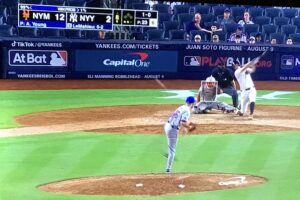 What’s all this fuss about Juan Soto selling Fig Urine on August 9? The thinking continued. But that’s over. The Braves are coming in for four. This is an important series. We’re a game-and-a-half behind the Braves for the first Wild Card. I might rue doing these calculations if this weekend turns sour, but if we take three of four…no, don’t go there, not yet. They’ve had their problems lately, but they’re the Braves, just as the problems-have-lately Yankees are…yeesh, I hate to admit this out loud in my head…the Yankees. Some teams you just HAVE to beat, regardless of circumstances. The Braves fucked us over in 2022, and the Braves have been fucking us over since late in the last century, and there’s never enough payback where they’re concerned. Yet we have to look forward, not back. We want to edge closer to the Braves. Catching the Braves and passing the Braves comes if and when it comes. We need to establish some distance between us and everybody who’s chasing us. Look forward, but not too far ahead. One game at a time, like Bobby V tried to drill into our heads. Tonight’s game is the most important game of the year, ’cause it’s the next one we play.
And then, as the first-light thinking proceeded, it dawned on me what was truly going on.
Holy Joe McEwing, I’m actually excited about this team, these Mets, without irony, without cynicism.
I’m actually waking up thinking about them and their chances. I did not see this coming in April. In April, Tyrone Taylor hit a long fly ball in Cincinnati that just missed going out, and I didn’t quite mind because I didn’t want to be told Tyrone Taylor was some kind of undervalued gem only a genius like David Stearns knew enough to pluck from Milwaukee when he’s probably just another outfielder and this 2024 edition of the Mets shapes up as just another team filled with a bunch of Tyrone Taylor-type castoffs, and if there’s one thing I’ve come to detest on a going basis besides the Yankees and the Braves, it’s Met mediocrity being oversold as something brimming with promise. Last night I watched Tyrone Taylor being interviewed postgame, going on about how much he appreciated the Mets fans who filled significant acreage of Yankee Stadium’s seating, and I said to the screen, “That’s my guy!”
I did not see this coming in May. They were so dreadful in May, almost a parody of a bad team. They couldn’t have been as bad as they were in May, but how did that mean they’d get good in June? And don’t tell me “team meeting” and “Grimace”.
As much of a roll as they got on in June, I did not see this coming then, either, except that maybe they’d keep things interesting into August. I wasn’t totally sold on them as recently as this past weekend when they seemed so so-so in Miami. But they’ve kept this up for quite a while now, and they have some really good players who really embrace winning and each other, and that’s gotta be worth something. They didn’t lean on enduring a delayed flight out of Florida as an excuse for exhaustion and therefore losing. They just went out there on limited shuteye, held tight in one game against the Yankees, and then kicked their asses in the next game.
Five games over! Last year, on the Sunday just after they traded Scherzer and just before they traded Verlander, they crept to five games under and I wondered if maybe they weren’t done as at least a fringe contender. No, they traded Verlander and they were done. They never got back to as few as five games under. That was last year, a million years ago. They’re not done now. They’re the opposite of done. They’re in the second Wild Card spot! A real shot at rising higher! Good lord, I’ve got chills just realizing how much I can’t believe this is all happening.
I know the ultimate goal of a baseball fan is supposed to be seeing his or her or their team win the World Series. Mine, I relearned this morning, is to feel like this.
by Jason Fry on 24 July 2024 12:25 am Plan A, in all likelihood, was not to have Jake Diekman face Juan Soto and Aaron Judge with the Mets clinging to a smidge of a one-run lead. You could hear that judgment in Gary Cohen’s voice as WPIX went to the break before the bottom of the ninth at Yankee Stadium. You probably heard it expressed by someone on your own couch, or from a neighboring barstool, or from a friendly Mets fan or philosophically inclined Yankee fan if you were at the stadium in the Bronx.
But there was so much that led to that pass. This was a classic game, with riveting confrontations, agonizing near-misses, intriguing connections and plenty of strategy to chew over. And yes, I would have said so even if the outcome had been different, though I’d have offered that assessment with a lot less pleasure.
Jose Quintana was craftily maddening for the Mets, knowing exactly which Yankee hitters he didn’t want to face and which ones he did. In the former category went Judge, whom Quintana walked in the first, third and fifth; in the latter category you found poor J.D. Davis, whom Quintana struck out twice and once coaxed to hit into a double play, ending all three innings in which Judge had been bypassed. (By the way, it will never not be startling to see Judge make Pete Alonso, a fairly sizable human being, look like a polar-bear cub.) Five walks in five innings doesn’t look ideal in the box score, but it was an essential component of Quintana’s plan, one he executed to near-perfection.
The Mets cuffed Luis Gil around when the two teams met in June, but Gil has been a lot better since then, largely because Luis Severino took him aside for slider instruction. Severino, you may recall, wears our uniform; Ron Darling sounded both amused and exasperated when he suggested that lesson would have been better delivered in the offseason.
The Mets tied the game at 1-1 when Gil tired in the fifth, hitting Francisco Lindor with the bases loaded, then went on top when Jeff McNeil homered off Michael Tonkin, who’d pitched pretty well as a Yankee after his double DFA with the Mets. McNeil’s eight-pitch AB against Tonkin was a clinic, with four foul balls, one of them the merest whisper of contact to keep McNeil alive and waiting for Tonkin to make a mistake, which he finally did.
That AB was a classic; in a lot of others, though, the Mets looked like the same aggravating bunch we saw in Miami, failing again and again to land a knockout blow. The fifth inning yielded just one run in part because McNeil misread a Tyrone Taylor drive off the fence that should have scored him and sent Luis Torrens to third; later in the inning, Brandon Nimmo just missed a grand slam and then looked out of sorts in striking out. The eighth saw Torrens and Taylor strike out with runners on second and third, though it’s only fair to note that Luke Weaver‘s change-up was nigh unhittable; the ninth saw Lindor strike out after a DJ LeMahieu error put Harrison Bader on second with nobody out, after which Bader tried to break early for third and was out by approximately the length of a 4 train.
Meanwhile, the Mets’ relievers mostly held the fort with both Jose Butto and Edwin Diaz unavailable. (And let’s note here that aircraft problems in Miami meant the players didn’t get to bed until 6:30 am or so if they were lucky.) Adam Ottavino allowed a sixth-inning run to let the Yankees creep within a run at 3-2 but was bailed out by newcomer Alex Young, whose arrival unfortunately came about because Christian Scott has a sprained UCL and is on the 15-day IL, with the 380-day IL an all too possible outcome. Dedniel Nunez started the seventh with an error and a wild pitch, but struck out Soto (yes, it can be done), walked Judge intentionally and then got Ben Rice to fly out deeply but harmlessly to end a wonderful/terrifying eight-pitch battle between talented rookies, followed by a groundout from Anthony Volpe. Phil Maton worked a scoreless eighth, but a walk scrambled Carlos Mendoza‘s likely plan to have Maton start the ninth and hand things over to Diekman.
Nope, it was Diekman all the way. He got Trent Grisham to fly deep to center, then walked Soto on four pitches. Up came Judge with the game in the balance and Yankee Stadium in full cry. Judge! Who has 35 homers and 89 RBI and it’s not yet August! Diekman surprised him with a fastball down the middle, followed that with a changeup off the plate, then doubled up on the change, which got a lot of plate but Judge fouled off. Diekman went back to the fastball, putting one inside on Judge’s hands. Then he doubled up on that, throwing probably his best pitch as a Met: 96 on the inside edge to lock up Judge for strike three.
That left Rice as the Yankees’ last hope, and I had visions of a terrible anticlimax, in which Diekman lost the strike zone or left a sweeper where Rice could give it a ride. Diekman got two strikes to start, which only made me more nervous about how much a reversal could hurt; two balls didn’t exactly help me find my center. You could see Diekman looking for the key to the lock and the pitch that would finish off Rice; the kid fouled off the fastball, then the sweeper, and then finally smacked a fastball to McNeil, and just like that the Mets had won.
They’d won by sending Diekman up against two of the mightiest hitters on the planet. Just like I’m sure they drew it up.
by Jason Fry on 22 July 2024 10:37 pm Monday night’s game against the always delightful Marlins in always delightful New Soilmaster Stadium unfolded as your recapper and family made their way from coastal Maine to an ancient inn outside of Boston, and the game kept morphing and changing shape along with our situation and surroundings.
While we were bombing down 95 south of Portland it was anonymous and a little dull: The Mets laid into Yonny Chirinos, with a seemingly resurgent Jeff McNeil connecting for an early two-run homer, Francisco Lindor hitting the first of two on the night and Jose Iglesias not connecting but getting connected with, giving the Mets a 5-1 lead via a bases-loaded HBP.
We missed some of that while eating dinner in Kittery; my kid conveyed the at times slapstick doings via Gameday updates, accompanied by shakes of the head at the indignities involved. The Marlins were up to typical Marlins things, which is to say they were not fielding balls as one ought to or throwing them as one ought to or sometimes both. The Mets were also doing recently Metsian things, though, never quite landing the big blow and letting the Marlins hang around being detestable, which always makes you worry that they’ll transit over to being Detestable.
(Seriously, the other night I asked, “Why would a benevolent God allow there to be Marlins?” and I wasn’t entirely trying to be funny.)
The Mets increased their lead to three runs courtesy of Lindor as we exited 95 and headed through the Massachusetts night on our way to Sudbury and the Wayside Inn, which has been around in one form or another since the late 1600s and is widely reputed to be haunted, but it’s OK because the ghost is my third cousin eight times removed. (No, seriously, she is.)
They were doing construction on the old Boston Post Road, which meant a detour off into the dark, with Google Maps trying to catch up with where we were and where we needed to be. That was about the time Edwin Diaz came in for the save, and pretty soon I was a lot more worried about Marlins going bump in the night than whatever scare the lonely spirit of my cousin might bring to some hapless traveler. The car twisted and turned down increasingly unlikely roads as Diaz, having secured one out, gave up a single and then a walk and then made an awfully casual throw on a grounder to the pitcher that didn’t get anybody.
The bases were loaded, the tying run was a double away from scoring, and Josh Bell was at the plate. We were fumbling through the darkness and so was Diaz, and it wasn’t entirely clear if any of us were going to reach our destination.
But then Diaz got Bell to ground out (making the score 6-4 but who cared) and got Jake Burger (so many detestable Marlins!) to pop a ball up, and a few minutes after that a winding ribbon of barely two lanes merged with the Boston Post Road and there was the Wayside Inn, a literal light in the darkness.
Whews all around. Should my ghostly cousin appear and seem bent on spectral mischief, I think I’ll say boo right back. Hey, if it works on Marlins, why not try it elsewhere?
by Jason Fry on 21 July 2024 10:57 pm “Why is Howie talking about LBJ? I wonder if that means … oh.”
It was quite a way to find out about the latest election-year earthquake, with the news delivered via MLB Audio a second after we tuned in while scooting around midcoast Maine with friends on the final day of this year’s summer residency. Discovering and then discussing the particulars squeezed out close attention to the game for a while, but a lifetime of listening to baseball has made me pretty good at assembling a narrative from little bits and pieces, so I registered that a Luis Torrens sacrifice fly had given the Mets a 1-0 lead after a couple of hits and some crummy Marlins defense.
Half an inning later, the narrative twist introduced by Jazz Chisholm Jr. was all too clear: a Christian Scott slider redirected into the stands for a 3-1 Marlin lead. After the game, there was some interesting discussion about Scott being undone by a couple of pitches a game, that his full-count slider to Chisholm wasn’t a hanger but a well-located pitch that would usually have resulted in an out, and that maybe Scott’s aggressive approach to hitters had needed a little modification in what Carlos Mendoza called “a teachable moment.”
Like I said, interesting — all those yes buts and on the other hands make for a good lively baseball debate, and it’s certainly been a year to note the significance of debates. But it would be nicer to discuss Scott having recorded an actual win than to speculate on all the wins we’re assured are in his future. In the present, though the Mets were only down by two, so far in the second half a two-run lead has seemed like it’s lugging a zero along behind it.
J.D. Martinez got the Mets within one in the fifth but Jake Burger restored the deficit in the seventh, and you could feel the air coming out of the balloon. Or judging from the sound, maybe it was a whoopee cushion — the late innings of this one were not exactly a showcase for the majesty of baseball. Balks, throws back to the pitcher gone awry, a cringe-worthy steal attempt and rundown, and the suspicion that replay review back in New York was being conducted while doing Whip-Its. In the ninth the Mets went down on a pair of Ks sandwiched around a flyout, and they have one more to play at New Soilmaster than any sane Mets fan would want to find on the schedule.
Will that game feature Howie Rose once again pressed into the role of town crier to announce world-shaking events? I suppose we’ll know tomorrow night. Will the Mets remember how to hit and/or the Marlins discover how to field? Same advice applies.
by Greg Prince on 20 July 2024 9:08 pm There’s a lot of disinformation circulating out there regarding current events. We would like to use this platform to help you sort out reality from fiction in one area of interest.
MYTH: The Mets always lose to the Marlins.
FACT: The Mets occasionally lose to the Marlins. They also occasionally beat the Marlins.
MYTH: The Mets never win at the Marlins’ soulless ballpark, whatever it’s called.
FACT: The Mets occasionally win at the Marlins’ soulless ballpark, an edifice officially known as the Marlsoleum.
MYTH: The Mets left a small village on base in Saturday’s game at the Marlsoleum.
FACT: Small villages usually have a population greater than 10, which is how many runners the Mets left on base Saturday.
MYTH: The Mets can’t win if they’re going to leave 10 runners on base.
FACT: Although it is quite challenging to win a baseball game in which 10 runners are left on base, the Mets did win Saturday’s game.
MYTH: The Mets can’t win if they’re going to score only run.
FACT: The Mets scored one run on Saturday and won.
MYTH: No team can win if it scores only one run.
FACT A team can win by a score of 1-0.
MYTH: Scoring one run allows no room for error.
FACT: The Mets committed one error, yet won, 1-0.
MYTH: The Mets never take advantage of scoring opportunities.
FACT: In the fourth inning on Saturday, the Mets loaded the bases and proceeded to score one run on Francisco Alvarez’s well-placed fielder’s choice ground ball.
MYTH: Met starting pitching always exits early.
FACT: Saturday’s Met starter, Luis Severino, lasted six innings.
MYTH: Luis Severino will look good for a while but eventually crack.
FACT: Severino gave up no runs while stranding six runners.
MYTH: The Mets’ bullpen will inevitably find a way to blow it.
FACT: Jose Butto, Dedniel Nuñez and Edwin Diaz each threw a scoreless inning. Among them, they stranded four runners.
MYTH: Nobody leaves as many runners on base as the Mets.
FACT: Both the Mets and the Marlins left 10 runners on base Saturday.
MYTH: Everything is home runs today.
FACT: No home runs were hit in this game.
MYTH: You just don’t see low-scoring games anymore.
FACT: The Mets won on Saturday, defeating the Marlins, 1-0. It was their first 1-0 victory over anybody in 2024, but it does happen now and then. It just did.
MYTH: Mets fans can’t believe when good things happen to and/or for the Mets.
FACT: For the most part, this is factual.
|
|






