The blog for Mets fans
who like to read
ABOUT US

Faith and Fear in Flushing made its debut on Feb. 16, 2005, the brainchild of two longtime friends and lifelong Met fans.
Greg Prince discovered the Mets when he was 6, during the magical summer of 1969. He is a Long Island-based writer, editor and communications consultant. Contact him here.
Jason Fry is a Brooklyn writer whose first memories include his mom leaping up and down cheering for Rusty Staub. Check out his other writing here.
Got something to say? Leave a comment, or email us at faithandfear@gmail.com. (Sorry, but we have no interest in ads, sponsored content or guest posts.)
Need our RSS feed? It's here.
Visit our Facebook page, or drop by the personal pages for Greg and Jason.
Or follow us on Twitter: Here's Greg, and here's Jason.
|
by Greg Prince on 6 December 2010 11:33 am Reality isn’t everybody’s cup of tea, but it eventually gets the best of us all, baseball teams included. After reality overtook the New York Mets as decisively as the Phillies, Braves and Marlins have since the last time the Mets contended, it seems as if the Mets themselves have finally gotten select doses of reality.
In light of the net progress represented by their ongoing eye-opening, Faith and Fear in Flushing chooses as its Nikon Camera Player of the Year — the award bestowed to the entity or concept that best symbolizes the year in Metsdom — Realization.
This, the Mets organization has acknowledged through their actions in a series of telling if not necessarily connected situations, is what’s going on around us…we may as well realize it, deal with it and move on.
The temptation is to say it took them long enough. It’s tempting because it is accurate. At the end of the 2009 season, the Mets transmitted every impression they were insular and out of touch with the circumstances that were defining their reality. They didn’t seem to hear their fan base; they didn’t seem to notice the standings; they seemed intent on existing in their own diminishing state of being.
They’ve changed their approach on several fronts, surely for the better in some cases, hopefully for the best in terms of what we can’t yet fully measure. All told, the Mets may have slowly U-turned toward a happier destiny.
There’s a long way to go before Metropolitan nirvana fully materializes, but it’s better to be heading incrementally in that direction than floating helplessly away from it.
Following are six instances in 2010 — presented in chronological order — in which our baseball team stopped doing what it had been doing to its undeniable detriment and took a different tack after realizing there was no winning in staying the course.
1) The Mets Hall of Fame & Museum Opens
If opening a new stadium with the barest of nods to the team-in-residence’s past was a boneheaded move (compounded by the overwhelming de facto homage to another team altogether), the Mets’ rectification of that original sin stands as Citi Field’s play of the year. The Mets Hall of Fame & Museum is everything a Mets fan and baseball fan could ask for. It shines an accurate light on the franchise’s colorful and textured history; it tells a complete (if mostly success-skewed) story to visitors in easily digestible chapters; it offers lessons remedial and advanced to fans of all Met-knowledge levels; and it puts anybody showing up for a Mets game in a great mood for the day or night at hand.
There might be a bit too much space devoted to selling high-end Objets d’art (what’s with the pricey decadent batting helmets?) and it’s a little obnoxious that you have to bull your way through almost all of the team store to exit, but those logistics don’t detract from the overall presentation. Impartation of information has never felt sunnier. The Mets, in this space, have rarely come across warmer.
In the same vein, the eight-year absence of Mets Hall of Fame selection and induction came to an end in 2010, and what a welcome sight it was to see four new members of the Hall receive the recognition they long ago deserved. Darryl Strawberry, Dwight Gooden, Davey Johnson and Frank Cashen formed a formidable class and were the exact right group to kickstart what will hopefully be an ongoing tradition in the summers to come.
2) Ike Davis Replaces Mike Jacobs
Perhaps it was inevitable. Perhaps it was just a paper move, keeping top prospect Ike Davis, who had earned the starting first base job in St. Lucie, at Triple-A to start the season. Limit the kid’s service time, maintain control of him longer: that’s how these things are explained.
But what a message the Mets sent by trying to kill time at first with an over-the-hill Mike Jacobs for two full weeks of the 2010 season. That position was supposed to be Daniel Murphy’s for the short term (a questionable enough decision considering Davis emerged as the clear choice in Spring Training), but Murphy got hurt and the Mets turned to Jacobs to begin the season, a period in which the Mets went 4-8. Six starts at first for Jacobs, five for Fernando Tatis, one for the instantly forgettable Frank Catalanotto (in which the pride of Smithtown mysteriously batted cleanup)…all while Davis was tearing up the International League, with an OPS of 1.136 in his first ten games.
Ike sparked the Mets upon his April 19 recall, helping to key a 10-1 run and a rise into first-half contention that was unimaginable with Jacobs soaking up plate appearances. If the Mets didn’t maintain the 39-24 pace of Davis’s first two months in the majors, his presence at least provided him his necessary big-league baptism and the rest of us a chance to hope. Neither was insignificant.
The Mets were caught a little in-between in the first half of the season. If 2010 was going to be a year devoted to rebuilding, then there was no reason to not give Davis every possible shot to succeed. If 2010 was going to be viewed as a genuine opportunity to compete, there was nothing about sticking with Jacobs (or Tatis) that was going to help that cause. There was little to recommend Mike Jacobs, and it took the Mets not months but weeks to figure that out.
It took a little longer to give up on the viability of Gary Matthews, and then a few others who didn’t fit into sharp long-term planning, but the Jacobs/Davis tangle was the most vexing to sit through and the most satisfying to watch get sorted. Ike’s promotion and Mike’s designation for assignment was a bellwether for Met progress.
3) Mets Reach Out to Bloggers
Admittedly this is a boutique concern within the greater universe of Mets priorities, and certainly something of more specific interest to the likes of yours truly than to all Mets-lovers, but I wouldn’t undersell its significance. What are we Mets bloggers except fans who channel their passion with constancy, intensity and an audience? Very few of us make any kind of living from wielding this particular megaphone. We express ourselves about the Mets because we care too much not to. You read us and interact accordingly for the same basic reason.
Those who write these blogs and those who read them form a critical mass of what in marketing are called heavy users. The loosely knit blogging community — which very much encompasses the reader population (you there on the other side of this screen included) — are the Mets fans who are going to watch the most Mets games, who are going to attend the most Mets games, who are likely to invest in the most Mets stuff and are most readily going to offer their opinions, their applause and their criticism of everything about the Mets.
Somewhere in the past year, the Mets picked up on what had become a thriving segment of the media that covers their product. We started our blog in 2005. It wasn’t until 2008 that we learned anybody associated with the Mets knew (or acknowledged) we existed. It wasn’t until 2010 that anybody tapped us on the shoulder in an official capacity. By traditional media standards, it wasn’t much: press releases e-mailed to us; limited credentials issued to cover batting practice a couple of times; and the assurance that if we had a question, somebody somewhere would try to answer it. This would be no big deal to the guy at the Times or the News or ESPN New York. It was a huge deal to us, because we are not traditional media. We’re fans. None of us, I suspect, started our blogs as an entrée to working for the Times or the News or ESPN. We do it because we’re into the Mets in ways that transcend professional niceties like a paycheck. We’re into the Mets in ways that beat reporters probably couldn’t fathom while trying to meet their deadlines.
The relationship between our community and the Mets organization is a work-in-progress on both ends. I’d like to think because there is a relationship that I’m learning a few things that will inform what I write and that you’re a little better served as a result. But that’s the detached media analyst in me speaking. The fan in me thinks it’s cool I got to go on the field a couple of times, got to interview a couple of players, got to write about the experience because it was something different. But the thing is I’m still a fan. I don’t really want to have “sources” and cultivate “access”. I like that the Mets reached out to me and about a dozen of my blolleagues — talk to us, you’re talking to every Mets fan who reads our work. I suppose the same equation goes for talking to beat reporters, but with us, the proverbial middleman is eliminated. We process what we see, hear and learn as fans. Otherwise, because it’s not our job, we wouldn’t be doing it.
It couldn’t hurt, I’m almost certain.
4) Omar Minaya and Jerry Manuel Are Shown the Door
This was the most obvious manifestation of the realizations that defined 2010. The general manager whose machinations had once led an organization to the cusp of greatness was no longer receiving the benefit of the doubt. The manager whose teams’ shortcomings didn’t all necessarily land on his shoulders was allocated, at last, a good share of blame for all that had gone wrong on his watch.
Nobody was making much of a brief for retaining Minaya or Manuel for 2011. But few were banging the drums on their behalf after 2009, and they received full votes of confidence from ownership. To be fair (even though I had no desire to see either of them again after the disaster of ’09), it wasn’t out of the question that they couldn’t have joined forces to revive the franchise’s fortunes in 2010. They were given the opportunity. Revival didn’t occur. They were removed. It had to be done, and it was done.
That’s not always how it goes with the Mets. Let’s be glad this time it was.
5) Mets Recalibrate Ticket Prices
While the new general manager took off on his lengthy search for a new manager, the Mets went to great pains to announce they were cutting ticket prices. Some ticket prices, not all ticket prices. Some they’d be raising, but not that much. Others would be reclassified for a better buy. It may not have presented a perfect solution for everybody’s pocketbook or desires, but it was, I believe, a huge moment for the organization. It was when humility was penciled into the starting lineup as hubris was sent to the bench.
For two seasons of Citi Field, the Mets have positioned their ballpark as something we are lucky that they let us enjoy. They’ve priced their tickets accordingly. When it sunk in that the park was good, not great, and that the team was bad, not good, the tickets went largely unsold and/or unused. Facing a season in which competitive aspirations will likely be modest, the Mets realized their inventory needed to be moved in a more realistic manner. So the pricing came down…in many cases.
I don’t expect 2011’s marketing theme to be “We’re Not Very Good, But Come Out Anyway.” I understand there’s probably a segment of fans that just as soon have their hopes raised in December rather than have their immediate future honestly portrayed. But the Mets did the right and realistic thing by inching away from that overbearing vibe of We’re Great, Everything We Do Is Great, Give Us Your Money In Vast Quantities Immediately. It didn’t work. It hasn’t worked since 2006. It’s taken until 2010 to admit it wasn’t working. What matters is it’s been admitted.
They’ve improved the pricing. They seem intent on genuinely improving the product. The business will follow. Offering a better ballclub is a far more promising proposition than strongly implying we have one and you’re the idiots for not grasping it.
6) Sandy Alderson Sets the Stage for 2011
Hisanori Takahashi’s versatility as a starter, a middle reliever and a closer was the brightest pitching surprise of 2010 this side of R.A. Dickey. Pedro Feliciano’s been the pitching equivalent of a theater’s ghost light — always on. Chris Carter showed signs of developing into a lefty pinch-hitter deluxe in the dependable mold of Kranepool, Staub and Harris. Sean Green is still young, still live-armed and turned in some very decent outings toward season’s end. And John Maine started the last postseason win the Mets ever celebrated.
They all had something to recommend them for 2011, yet they’ve all been let go by Sandy Alderson since he became the head of baseball operations for the New York Mets. What’s more, Alderson has declared that two of the roster’s cornerstone players entering next year, Dickey and Jose Reyes, will not be approached for contract extensions in the coming months. And, oh yes, don’t expect any big-name, big-money signings any time soon.
You know what? Great. Not because I don’t want good players on the Mets, or players I like to stay with the Mets, but because Sandy Alderson deserves every chance to ascertain what this team needs. If it means saying goodbye to one of the staples of Met life in Feliciano because Alderson doesn’t want to commit too many years to his well-worn pitching arm; or not being swayed to an expensive, multiyear commitment to Takahashi based on a relatively small sample; or writing off one of the good guys in Carter because maybe we can do better than a one-dimensional batter taking up 1/25th of the roster; or not nailing down a careerlong agreement with my favorite player in Reyes because who knows if we’ve seen the best of Jose, I can live with that.
The Mets need more whole than parts. There have been some nice parts who played some nice games these past few years, but it hasn’t added up to anything positive along the Mets’ bottom line. Similarly, I was juiced to welcome Jason Bay last winter and Francisco Rodriguez the winter before that, but I don’t always have to have a new toy for Christmas (especially considering how quickly both of those items turned defective).
It’s not thrilling to think of the Mets in terms of budgets and financial maneuverability, but it is their reality for 2011. Constructing an optimal jettison strategy for Luis Castillo and Oliver Perez is part of the Mets’ agenda. I’d be happier if Alderson would simply make them disappear this instant, but there is logic to getting them to Spring Training and seeing what they can do and who they might entice. If this sounds like a double-standard…we’d be steaming at Omar for not dumping them once and for all…that’s OK, too. Omar expended his benefit of the doubt. Sandy’s has only just begun.
This isn’t a perpetual bargain with the current powers that be, mind you. If everything a year from now amounts to poor-mouthing and rationalizing and cutting ties with beloved figures, and it all come out as some mutated form of Moneyball executed for saving’s sake, then Alderson & Co. will be held to the same standards as Minaya’s or any other regime. For now, though, the new front office represents the most crucial Met realization: that what came before wasn’t making the Mets better and that it’s time to try something else that stands a chance of doing exactly that.
It’s as if Realpolitik has replaced magical thinking.
FAITH AND FEAR’S PREVIOUS
NIKON CAMERA PLAYERS OF THE YEAR
2005: The WFAN broadcast team of Gary Cohen and Howie Rose
2006: Shea Stadium
2007: Uncertainty
2008: The 162-Game Schedule
2009: Two Hands
RELATED ARTICLES WORTH YOUR TIME
A behind-the-scenes tour of the Mets Hall of Fame, by Bleacher/Report’s Ash Marshall, here.
A happy season-ending interaction with one of the departed Mets, by Susan Laney Spector of Perfect Pitch, here.
An outstanding take on why sports teams have to take sports bloggers seriously, by one of the best sports bloggers I know, here.
by Greg Prince on 3 December 2010 10:40 am Welcome to Flashback Friday: Take Me Out to 34 Ballparks, a celebration, critique and countdown of every major league ballpark one baseball fan has been fortunate enough to visit in a lifetime of going to ballgames.
BALLPARK: Tiger Stadium
HOME TEAM: Detroit Tigers
VISITS: 1
VISITED: June 30, 1997
CHRONOLOGY: 19th of 34
RANKING: 3rd of 34
Across from Tiger Stadium, Mr. Smallwood stops at a liquor store owned, he says, by his brother-in-law, a little Fort Knox of steel mesh and heavy bullet-proof glass. Across the avenue the big stadium hulks up white and lifeless. A message on its marquee says simply, “Sorry Folks. Have a Good One.”
—Frank Bascombe, The Sportswriter, by Richard Ford
In April 1988, the Tiger Stadium Fan Club literally gathered around its ballpark to give it a 1,200-person group hug. The occasion was the stadium’s 76th birthday, but the impetus was preservation to ensure it would enjoy many more. The Tiger Stadium Fan Club existed to keep Tiger Stadium from being replaced, torn down and banished to memory.
After visiting the object of their affection nine years later, I could completely understand their mission. Had they wanted to re-enact the scene in 1997, I would not have let go of Tiger Stadium, either. I would have gladly inserted myself within a human chain to keep it alive as long as it could stand. And you might have had to have pried me away from it with a court order and then some.
I am not nor have I ever been a Detroit Tigers fan. But count me as a spiritual member of any organization dedicated to Tiger Stadium. I would have hugged her had it occurred to me as feasible. For what it’s worth, I kissed her goodbye on my way out.
Literally.
Tiger Stadium. Sweet, embraceable you. I guess all we had was a one-night stand, but you still bring a smile to my face and a pang to my heart. It was all I could do to see you once, before it was decided you had to go. I’m sure glad I got there just in time.
***
Statistically speaking, my date with Tiger Stadium was the 203rd-to-last game in its 88-season history, so there was a little time left, but not enough. That I knew. I didn’t know all that much about Tiger Stadium otherwise, except that if I was ever going to see it before it let the cats out, I’d have to haul ass and bone up, in that order.
The hauling, as was so often the case over the course of a decade-and-a-half, was facilitated by my vocation as a beverage magazine writer. In the summer of 1997, Stephanie was a newly graduated MSW — she had taken two years from her social work career to get a degree in social work so she could be officially called a social worker (go figure). Our ballpark trips, hence, tended to be more finagled than planned during that period, and finagling ballpark trips through work had become a finely honed practice for me.
First step: Find a sanctioned reason to be in Detroit.
Had I written for a car magazine, that would have been simple, except I know little about cars and can barely stand to drive. There were, nonetheless, a couple of decent beverage prospects in the Detroit metro area, but they themselves weren’t enough to merit a full-blown professional visit. That’s where the city of Milwaukee came in.
Miller Brewing was hosting a press event on a Thursday and Friday. That was totally sanctionable. I volunteered my services to cover it and then let it be known in the office that there were some outstanding companies to visit in nearby Detroit if I stayed the weekend in the Midwest. How nearby is Detroit to Milwaukee? I have no idea, but I was operating on the New Yorker’s View of the World and knew my editor would do the same.
And, though I didn’t mention this loudly where I worked, 25 other New Yorkers were heading to Motown. This was the first year of Interleague play, and the genius schedulemakers gave the world the matchup for which it had no idea it had been panting: the Mets of the National League East versus the Tigers then of the American League East.
The agenda was set:
• Fly to Milwaukee Thursday afternoon.
• Listen attentively to Miller Thursday night and all day Friday.
• Fly rude Northwest Airlines to Detroit Saturday.
• Visit with a Troy, Mich.-based juice company Monday afternoon.
• Spend quality time with a downtown Detroit craft brewer Tuesday morning.
• Fly home right after.
And since we’re in the vicinity anyway, it would be a shame to pass up the Mets and Tigers at the legendary corner of Michigan and Trumbull Monday night, right? And since I was traveling on official editorial business, I could purchase an extra LGA-MKE-DTW-LGA ticket for Stephanie on my own dime without it being too much of a burden. I’d also pick up the Mets-Tigers tickets, sport that I am.
That, my friends, was a plan.
***
The Brewers were on the road during our brief Wisconsin stay (which normally I would have held against Miller, but I’d already seen County Stadium), yet suffice it to say that once my work there was done, Brewtown served its purpose as the viaduct through which we’d reach our key destination without my piling up bills or burning off precious vacation time. We arrived in Detroit on Saturday, rented a car — despite my driving hiccups, I didn’t see how I could alight in the Motor City and not handle a Ford — and set up camp in adjacent Dearborn.
As part of our non-beverage/non-baseball weekend interlude, we hit a local mall and it was there, at Waldenbooks, that I started to bone up in earnest. Other than a few bullet points, I did not consider myself adequately informed about the Tigers or Tiger Stadium, so I purchased several volumes to bring me up to speed. I don’t do this in every city, but with the team having been around so long and the park being around not much longer, I decided I owed both that much.
Beyond exploring the exploits of Tigers from Ty to Trammell, most of what I took away from my crash course of reading put me off a bit despite the trouble I went to find my way to Detroit. I had a vague idea about riots thirty years before and the urban blight accelerated in its wake, but my self-imposed homework got me a little nervous in the present day.
From Detroit Tigers: Club and Community, 1945-1995 by Patrick Harrigan:
• “Local television shows made crime their lead story, day after day, night after night. One could easily conclude that everyone in Detroit was either a criminal or victim and that anyone venturing into the city from suburban havens did so at extreme risk.”
• “Violence increased in the stands and around Tiger Stadium as well. […] The image of Detroit was that of a violent city. Each episode seemed to confirm that imagine in the popular mind.”
• “[T]he notion of Tiger Stadium as an unsafe place to visit became part of the mythology surrounding Detroit.”
Um, I wondered, they don’t still have riots around here, do they? I needn’t have worried about being mobbed or looted my one night at Tiger Stadium (and it wasn’t like a World Series celebration was about to go awry), but the despair that had wracked the city since the 1960s was still very much in evidence. You couldn’t avoid it if you looked around even a little.
Too much sociology for one baseball fan seeking out one baseball game.
***
Monday, as scheduled, we showed up somewhere off 16 Mile Road in Troy, at the juice company offices, me as reporter, Stephanie, per earlier jury-rigged journeys, as photographer. (“A small outfit like us rating a reporter and a photographer? My goodness!”) The interview, the pictures and the lunch — seafood and a good bit of it — was successful enough, though just after we parted ways with our subject, it began to storm. For the first time in my life, I saw lightning strike a utility pole transformer. Damn thing was practically eviscerated on the spot.
I hoped it wasn’t an omen for Monday night.
***
The skies calmed and the only thing it was raining when we arrived at Tiger Stadium was a surprising dose of familiarity.
“You’re Mets fans? WE’RE Mets fans! Mets are doin’ great, right? They’re not gonna lose another game all year!”
The first people we ran into after parking in a lot across Michigan Avenue from the ballpark were, as they helpfully identified themselves, Mets fans. A couple of college-age or thereabouts kids, probably at the same stage of their lives that I was the first time I journeyed to Fenway. Their enthusiasm was understandable, as this was 1997, the year the Bobby Valentine Mets broke free of their predecessors’ stubborn misery and insinuated themselves into Wild Card contention. I was pretty pumped up about them myself, if not quite as optimistic that they’d finish 128-34.
Surely the Mets were an attraction for us on this trip. I witnessed their first-ever Interleague game, versus the Red Sox, seventeen days earlier at Shea and I was still high from taking in, on Channel 9, their rousing Subway Series victory two weeks ago — Dave Mlicki Night in the Bronx. The Interleague curiosity tour continued here.
But when I turned around and saw where the Mets would be playing…this bright, white baseball fortress that had withstood all that progress had thrown its way for generations…I have to admit that my Mets, smack in the middle of what had already developed into one of my all-time favorite Met seasons, took a back seat in my priorities. For the next several hours I’d be all about Tiger Stadium.
Figuratively and literally.
***
Corktown, as the neighborhood there had long been known, didn’t appear to be much of a neighborhood anymore. A Tiger game was in the offing, yet there was almost nothing going on around it. The drive in from Dearborn had revealed the same — closed stores, vacant buildings, bad times more stubborn than Bud Harrelson’s, Jeff Torborg’s and Dallas Green’s Mets combined had provided. Even the roads, which you’d intuitively figure would be among the best in the nation given the prevalence of the auto industry, were, given the depleted tax base, the worst I’d ever traversed.
But again, enough with the sociology. Focus — historic ballpark right in front of you.
***
Tiger Stadium was built in 1912 as Navin Field. It became Briggs Stadium in 1935 and wasn’t Tiger Stadium until 1961. It was still here, still where the Tigers played baseball. This was 1997…stunning to consider there was a straight line that led back to 1912. For that matter, they’d been playing baseball at this corner since 1896, at Bennett Park…even more stunning. There was a plaque down Trumbull Avenue hailing Ty Cobb — Greatest Tiger of All; A Genius in Spikes. Ty Cobb doesn’t get such good PR these days, but he did hit .368 as a Tiger from 1905 to 1926 (before finishing up as a Philadelphia Athletic and lowering his lifetime average a couple of points after a couple of years). The Cobb plaque was installed in 1963. Just the plaque had been up longer than all of Shea Stadium.
Ty Cobb played here. Hank Greenberg, of whom Ralph Kiner always spoke so fondly, played here. Hundreds and hundreds of Tigers I’d never heard of, and hundreds more I had, played here. The Tigers would play here tonight. They’d play the Mets.
As I comprehended those realities, there appeared every likelihood Ty Cobb’s old ballpark would hit .400 for me.
***
There is a recurring if fleeting slight note of discord in my marriage concerning starting times of baseball games we are to attend together. Let’s say there’s one for which we hold tickets and the first pitch is scheduled for a little past 7 o’clock. I’ll be asked by my wife when we’re going to leave for the ballpark. Well, I’ll say, I’d like to get there around six…
“Six? Why so early?”
“Because I want to get there.”
Sound logic, right?
For Tiger Stadium, this undercurrent of patience-testing was suspended from the marital conversation. Stephanie got why we were in Detroit, and it wasn’t for juice in the afternoon and beer the next morning. Arriving early was endorsed heartily. Part of it was forged by a mutual desire to not get lost on the way to the middle of this particular city (though tooling straight east on Michigan Avenue from Dearborn made that impossible), but most of it was an understanding that if you only get one night inside Tiger Stadium, you make it count.
I saw a game at Tiger Stadium, but it was secondary to what I saw at Tiger Stadium before the game began. I saw Tiger Stadium, as much of it as I could. Every pregame minute was precious to me, so I wrapped myself up in every one of them. I was so very antsy to explore, Stephanie didn’t even try to keep up. She suggested I take the camera and go off into the Tiger wilds, as it were.
***
This must have been what was on the other side of Ray Kinsella’s corn in Field of Dreams. Not an ideal analogy, since Ray had a letter-perfect baseball diamond in full view of his house, but the deeper I delved into Tiger Stadium — strolling from our lower-level seats on the third base side all the way around toward right — the more I felt I was onto something that only a few lucky spirits could see.
This wasn’t Detroit. This was heaven. This really was. This was a 1912 ballpark coming to life for a 1997 ballgame. This was green grass and blue paint and blue seats and orange seats (though not as many as the blue and not as orange as Shea’s) coalescing beneath a milky white sky. It wasn’t raining but it never fully cleared up, which was all right. Late-day, late-June sun was unnecessary. Tiger Stadium deserved the majesty an unthreatening overcast sky lent it.
We stayed dry, but we were drenched in mood. In those precious minutes before the game, Tiger Stadium was solemn and dignified. Its posts and girders had seen it all, even if they blocked who knows how many fans from seeing everything. Nobody would ever build a ballpark with precisely these kinds of obstructions today, but they made perfect sense here. The posts held up the upper deck, and the upper deck was right on top of the lower deck. Everybody was leaning into the field.
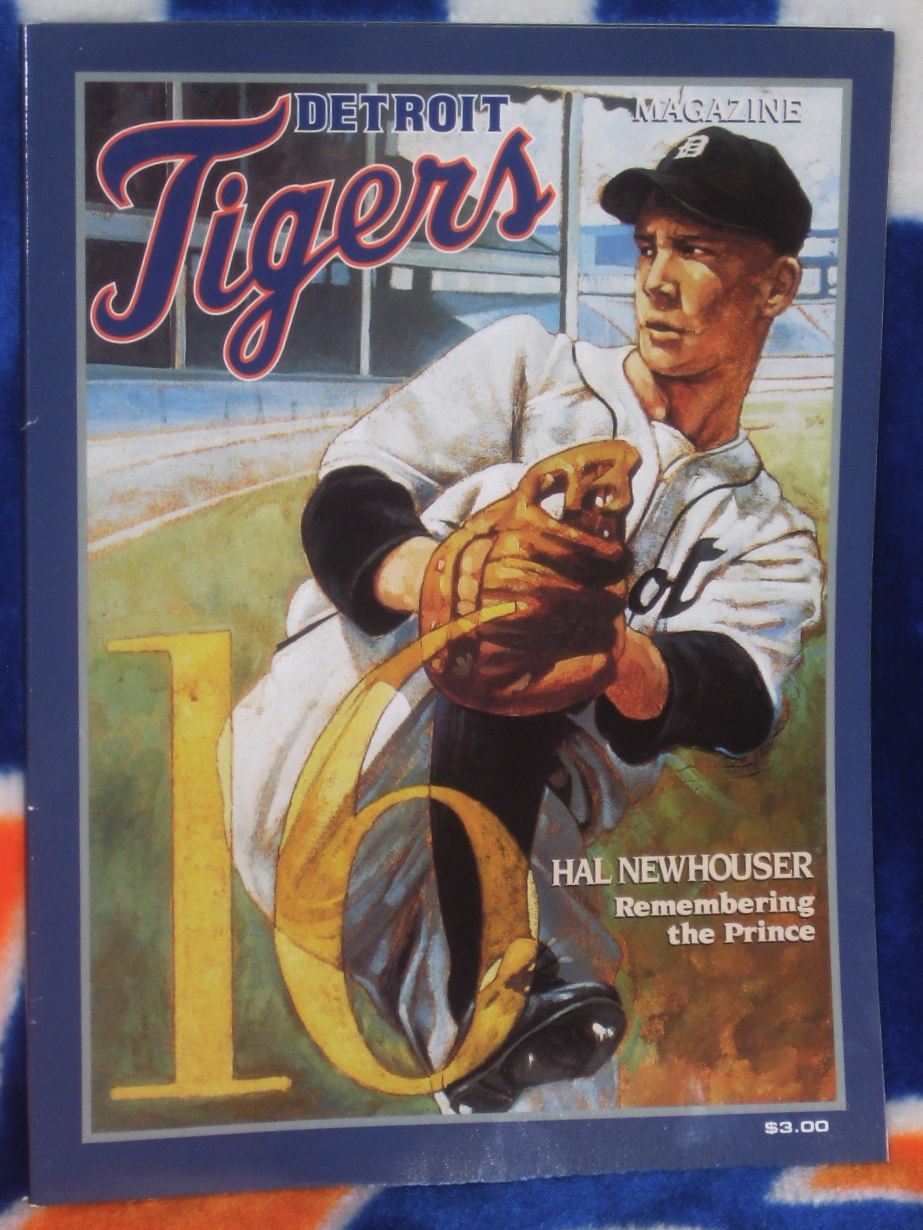
Nothing about Tiger Stadium needed to be a rumor. That famous porch in right field loomed near enough to pat you on the back. Those light towers…I remembered Reggie Jackson smashing a ball off one of the transformers in the ’71 All-Star Game — the National League was practically eviscerated on the spot. The retired number signs may have been recent, but two of the three honorees were ancient. Kaline, 6, I remember from my childhood (I was quite proud of myself at eleven years old for noticing Al Kaline was both a Detroit Tiger and a battery type); Gehringer (2) and Greenberg (5) were names from Baseball Digest mostly. This is where they played. Later in the summer of 1997, the Tigers were going to get around to retiring 16 for Hal Newhouser, a.k.a. Prince Hal.
Hal Newhouser was from the war years and just after. My baseball-averse father (who probably asked “why so early?”) was dragged by his father (who probably answered “because I want to get there”) to Yankee Stadium on Memorial Day 1945 for a doubleheader between the Yankees and the Tigers and saw Hal Newhouser pitch the second game. My father sat shvitzing and presumably unimpressed among 70,906 that day and drank, he told me, more sarsaparilla than he would ultimately care for in an effort to keep cool. That became, by choice, his last baseball game at Yankee Stadium.
Yankee Stadium from 1945 was barely the same Yankee Stadium when Dave Mlicki held forth in 1997, yet the Briggs Stadium to which Prince Hal Newhouser came home after the Tigers’ extended eastern swing that May and June was still exactly where Prince Hal Newhouser’s old club played ball five-plus decades later. And I was inside it, slurping up its muted ambiance, its twilight dignity and its reassuring blues like it was ice-cold sarsaparilla on the hottest Memorial Day in memory.
***
Oh, and then there were the Mets in their blue NEW YORK warmup jerseys. I was so busy and happy snapping pictures of the roof and the beams and all that cobalt shading that the Mets wandering around for batting practice almost escaped my notice. But at Tiger Stadium, everything is in reach…even your favorite team wandering far from home.
First Met I see: pitching coach Bob Apodaca, schlepping an equipment bag. I click. Next: red hot ace Bobby Jones, 12-4 and due at next week’s All-Star game in Cleveland. He’s one of the few recognizable Mets on our stealth contenders, so he draws a cluster of autograph-seekers. I click anyway. Not a great shot.
Backing off from Jonesmania, I wander a little more and another Met trudges down the right field line toward the diamond undisturbed. I recognize him. He’s Cory Lidle, dependable rookie reliever and emergency spot starter. I saw him start eight days ago at Shea against the Pirates. He wasn’t good at it, but the Mets won, so I think nothing but good thoughts of Cory Lidle.
There’s him and there’s me and there’s nobody else within thirty yards of us (at least nobody else who’s interested in a rookie reliever with a low profile). So I hustle down through the grandstand and disturb him near the railing in short right.
“Cory! Cory! Can I get a picture?”
Cory Lidle shrugged. Looked like he could have done without it, but he stopped and stood in place. I wouldn’t say he posed. I snapped.
“Thanks! Thanks! Great pitching, man! Great pitching!”
“Thanks.”
He seemed slightly but sincerely appreciative. It was all I could have asked for.
Cory Lidle returned to his trudging. I floated just a little higher.
***
When I got back to our seats, I couldn’t shut up about what I saw. I got such great pictures! I got the right field porch! And the retired numbers! And those poles! And Bob Apodaca! And Bobby Jones, though not so good! AND I TALKED TO CORY LIDLE!
I was, for the record, 34 years old, but I had never approached a Met prior to a Mets game before, let alone gotten an up-close and personal portrait.
Ohmigod, this place is great! Isn’t it great?!
Stephanie liked it plenty. She did a little looking around while I was gone and was glad I liked it so much, but what she’d really like right about now, as BP was ending and the grounds crew was manicuring and what crowd there would be — barely 15,000 (Interleague fever mysteriously subsiding) — was filling in, was something to eat. I volunteered to get it. It was a chance to see more of the place.
I stood in a concession line in the relatively new Tiger Plaza that aligned with Michigan Avenue while the national anthem played, which made me a little self-conscious. Instinctively, I took off my cap. Nobody else did, so I put it back on. Seems if you can’t see the flagpole in center filed, you’re not really obligated to acknowledge the bombs bursting in air, et al. Once I ordered and paid for our dinner (I opted for pizza given my gastrointestinal issues with hot dogs in those days…and given that you couldn’t miss Little Caesars at Tiger Stadium since the Little Caesars mogul owned the team), I hustled back to our seats. I didn’t want to miss a minute more of staring at that field.
My rush was so pronounced, that I accidentally kicked a neighbor’s frozen rum punch concoction out of its cup and onto the ground. I was profusely apologetic — more so than necessary, probably, because I was wearing a Mets cap and I didn’t want to draw too much ire from those violent home team fans. No violence occurred, but I did race back to the concourse to buy the man a fresh punch.
***
The game was not a good one from the perspective of Mets fans who traveled from New York through Milwaukee to attend. The Tigers scored two off Mark Clark in the first and never looked back. Tiger starter Justin Thompson toyed with the suddenly tame Mets. Detroit’s lead stretched to 5-0 by the fifth and was blown open with five more in the sixth.
I can’t say I didn’t mind or didn’t care. The Mets had entered the night two behind the Marlins for the Wild Card lead and we were about to lose ground. Yet let’s just say if you’re going to watch your team go down in flames, doing so at a gorgeous 85-year-old ballpark against an opponent for whom you hold absolutely no animus — and from whose fans none flows toward you and your cap — this is the ideal situation for it.
So we were losing 10-0. So what? There’d be other Mets games. This was it for us and Tiger Stadium. This place…it was a place. It was of Detroit, of course, yet it could have been in its own city on the map. Tiger Stadium was too substantial to be so close to defunctitude. It was bigger than its generational peers, surely more hulking than darling Wrigley and lyric Fenway, but it was no less precious.
How could this place where we were watching a baseball game as fans had watched baseball games for 85 seasons previous to this one not be that place any longer?
***
With the score out of hand, we decided to do a bit of mutual exploring upstairs. Let’s see what it looks like from there. It looked great as night fell on the upper deck. It seemed more exciting up there, too. Probably had something to do with the home run that was launched off Joe Crawford during our cameo. A standing ovation ensued, which struck me as a pretty intense reaction for taking the game from 10-0 to 12-0. I was so not paying attention to the events on the field that I hadn’t noticed the home run was hit by Bobby Higginson, and that it was his third of the night. Higginson would score four runs in all and collect seven RBI, including a grand slam that also somehow evaded my scorn. The Tigers would roar to a 14-0 victory over the Mets.
Like I said, so what?
***
We ducked out a little ahead of the crowd, in the eighth, not because of the Mets’ deficit and not because we were bored with the ballpark. Driving at night is even worse for me than driving in daylight, and the idea of having to navigate a rental car in a jumble of exiting vehicles made me even more tense than usual, so I wanted to beat the traffic not for convenience sake, but for my own easily rattled nerves.
I walked out of Tiger Stadium for the last time. We had just met and now I’d be leaving. Talk about a whirlwind romance — three hours and then I’m hitting the pavement…wham, bam, thank you Bobby Higginson. I had been a stranger in these parts at six o’clock. It wasn’t much after nine now, yet I was already signed up, at least mentally, as a lifelong member of the Tiger Stadium Fan Club.
Sweet, embraceable Tiger Stadium…I could have hugged her, I really could have, but I was about 1,199 spiritual brethren shy of executing it effectively, thus I opted for the next best display of affection: my lips to my three middle right fingers, my three middle right fingers to her regal ivory exterior. Goodbye, old girl, I told her in tones low enough so as not to be heard by anyone, not even Stephanie. I’m glad we got to meet.
***
The Tigers swept the Mets that week, finished out 1997, 1998 and 1999 at Tiger Stadium and then put the building and 6,873 regular-season games played there behind them. They moved to one of those modern retro palaces that’s attractive enough on television but broke my heart every time I saw video of it for its first five years. The Tiger organization made noises about how it needed what became known as Comerica Park to be competitive. In their fourth season there, the Tigers lost 119 games.
I shouldn’t tell other teams or towns their business, but how do you just walk away from Tiger Stadium? Whatever its antiquities, whatever challenges its location presented, it survived 88 seasons, and it thrived whenever its ballclub provided a show worthy of its setting. I still can’t get over how something so beautiful became so abandoned. Tiger Stadium stood unoccupied for a decade before they got around to tearing it down. Now and again there’d be a picture of it all by its lonesome — no game today, no game tonight, no game tomorrow — and I wondered what the hell was wrong with everybody.
What does it say about a country that as a matter of course turns its back on its Tiger Stadiums? How is it that you have something so perfect for baseball, yet baseball people couldn’t figure out how to brand it like it was Fenway or Wrigley, so they just moved out and took up residence in a structure that, whatever its bells, whistles and whatnot, might as well have been called Generica Park?
One of these years we’ll get out there again and check out Comerica and I imagine it’ll be lovely. Yet I’ll never go to Tiger Stadium again. Nobody will.
I still can’t get over that.
Another irreplaceable Michigan treasure, Dave Murray, presents another installment of the Topps 60 Greatest Cards of All Time, Nos. 20-11, here.
by Greg Prince on 2 December 2010 12:56 pm Blame my predilection for allowing particular dates to stick to my brain for knowing this, but it was twenty years ago tomorrow — December 3, 1990 — that I last typed anything more substantive than a mailing address on an electric typewriter.
Not just any typewriter, but the Brother model I was given by my sister as a high school graduation present. I lugged it to college and, much to the consternation of various roommates and dormitory neighbors, clack-clack-clacked my way to a Bachelor of Arts in Mass Communications, with a minor in History. When four years were up, I lugged it back home and took up my professional writing career on it. I’d type my stories and Express Mail them to editors or slip them into a briefcase and drop them off at magazine offices in the city or on Long Island. My copy was marked up (not too harshly, I hope) and passed along to typesetters. That’s the way it was done.
Then it wasn’t. I’d occasionally be asked to drop by this or that publication and write my story on-site on one of their computers. It would really help, I was told. Oh sure, I said, no problem. Then I transitioned from freelancing to a staff job, where, except for addressing the occasional envelope (because nobody could ever figure out how to work that with the printer), we did everything on our desktop computers…first a Cado (from which I once watched the words on my screen literally blow up, with smoke rising from the monitor), then, as if to finally get with modernity, a Mac.
By then, the Brother typewriter wasn’t called on much, except if I was home from the job, sick or something, and I wanted to get some work done. I did not own a computer yet, so it was clack or nothing. Twenty years ago tomorrow, a combination of car trouble and encroaching illness kept me on the couch. But I had this story that had to go to our art department the next day, so as long as I had my notes with me, I set up my old typewriter on my even older typewriter stand (inherited from my father’s office once he gave up the space) and typed my piece. Next day, I was back in the office and typed it again on the computer.
That was it for my Brother. It was back in its case, cord detached, placed aside the typewriter stand which we used for our phone and answering machine in our first apartment. When we moved, we repurposed the typewriter stand in our new kitchen as the staging area for our toaster oven, while the typewriter slid into a dark corner in a back room that we never used for much beyond storage. Fast-forward a dozen years, when it was time to move again, and one of the last items whose destiny was left for me to decide was the Brother.
The typewriter stand was on the curb. The toaster oven had long ago heated its final pot pie. Our last answering machine was giving way to voice mail. We owned a computer. I stared at the typewriter for a minute. I thought of what it meant to me, how it ushered me into adulthood as much as any single inanimate object could. I contemplated where it took me and why it had been the ideal graduation gift 23 years earlier.
Then I threw it out. What the hell was I going to do with an electric typewriter in the 21st century? If I ran into a computer problem, I could type on this…and then what? Mail the piece of paper to the Internet? It just lost its utility. Time marched on. Something that was a key part of what I had attempted and achieved no longer had a place in my life.
In that spirit, good luck John Maine.
by Greg Prince on 1 December 2010 12:50 pm “Operator, please connect me with 1982,” Randy Travis yodeled on a country hit in 1986. “I need to make apologies for what I didn’t do.” I think it’s fair to say Randy Travis wasn’t a Mets fan, for in 1986, nobody wanted to make a call to the season that crumbled so definitively four years earlier.
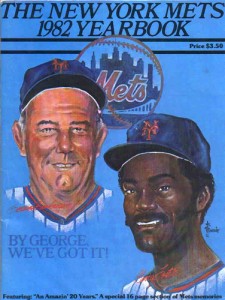 But maybe Randy was just channeling the spirit of seasons gone by or believed the Mets — en route to 108 wins and then some — might agree to make amends for wasting our time and sapping our goodwill in 1982 with a forlorn manager, a depleted slugger and a hopelessly downward trajectory. The 1982 Mets looked like comers for two months, cresting at 27-21 (second place, 3½ behind the Cardinals), and then fell with velocity that would have made Pete Falcone envious, all way to 65-97 (sixth place, 27 games behind the Cardinals). But maybe Randy was just channeling the spirit of seasons gone by or believed the Mets — en route to 108 wins and then some — might agree to make amends for wasting our time and sapping our goodwill in 1982 with a forlorn manager, a depleted slugger and a hopelessly downward trajectory. The 1982 Mets looked like comers for two months, cresting at 27-21 (second place, 3½ behind the Cardinals), and then fell with velocity that would have made Pete Falcone envious, all way to 65-97 (sixth place, 27 games behind the Cardinals).
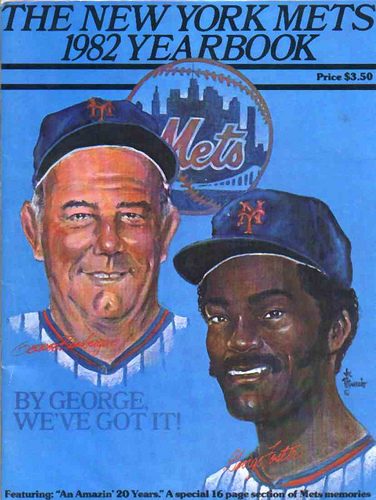
Let’s hope that when SNY debuts Mets Yearbook: 1982 Thursday night at 7:30, we learn the propagandists of 28 years ago were positively Travisesque in conjuring instant nostalgia for what I recall as one of the five most depressing Met seasons through which I’ve ever persevered. 1982 was the year I finally understood that the rebuilding program on which I pinned my hopes from 1977 through 1981 was at best unsuccessful and at worst a fraud. George Bamberger didn’t help. George Foster didn’t help. George Washington couldn’t have helped.
I cannot tell a lie: By George, we sucked.
Operator, I might have implored the cosmic baseball switchboard had I reached out to it in 1982, can you at least connect me with 1984? I’ve been trying to dial a winning season forever, and I just keep getting put on hold.
Image courtesy of “Mario Mendoza…HOF lock” at Baseball-Fever.
by Greg Prince on 29 November 2010 1:27 pm Some players talk a good game. Only one in recent memory, however, has shown a knack for articulating an extraordinary postgame.
R.A. Dickey is Faith and Fear in Flushing’s Most Valuable Met for 2010. He earned consideration through his pitching. He clinched the award the minute he cleared his throat.
The knuckleballer nobody saw coming saved the Mets’ season twice. First, he arrived with little fanfare from the scrap heap, via Buffalo, and sealed shut a gaping hole in the starting rotation. Then, after every outing, he casually opened his mouth and explained his thinking.
There are times I swear I would want to buy a ticket to Citi Field just to watch R.A. Dickey think. But I’d be sure to record the game just to make certain I didn’t miss anything he said afterwards.
You need an R.A. Dickey in a year like 2010 for several reasons. First and foremost, you need his numbers every bit as much as his words:
• The 19 quality starts in 26 attempts;
• The National League’s seventh-best earned run average of 2.84;
• The 3.4 WAR that bettered that of all his teammates, save for Angel Pagan, Johan Santana and David Wright;
• The 1.187 WHIP that was the best compiled by any Met righthanded starter since Orlando Hernandez in 2007;
• And the signature 1-0 one-hitter versus Cole Hamels (who recorded the lone safety) and Philadelphia on August 13, achieved in the Mets’ first dual complete nine-inning game since 2005 — and the first in which a Met had prevailed since Shawn Estes bested Glendon Rusch and the Brewers (also a one-hitter, also by a 1-0 score) in 2002.
Second, you can always use the element of surprise. Three healthy Johan Santanas and a couple of unspoiled Dwight Goodens may be ideal but there’s something exhilarating about receiving unexpected contributions from a starting pitcher who wasn’t penciled in for anything by anybody.
No Mets fan who lived through the travails of 1987 wasn’t uplifted to the point of levitated by sidewinder Terry Leach. Leach was a bullpen afterthought when that season commenced. He was its savior when things got hot: 12 midseason Leach starts, 10 midseason Mets wins.
A decade later, journeyman-epitome Rick Reed, tainted in the judgment of some for his participation in 1995 Spring Training replacement games with the Reds, shook off his overstated association with one strike and proceeded to regularly throw strike one. By the end of 1997, Reeder was known for his sub-3.00 ERA and his going, on average, roughly 6.2 innings between bases on balls.
But Leach had been around the Mets on and off since 1981. And Reed, though labor-relations infamy may have washed him out of the bigs for a spell, was at least a vaguely familiar sight, having pitched for the Mets’ then-archrivals, the Pirates, from 1988 to 1991 (including a 1-0 gem in his big league debut versus Bobby Ojeda). R.A. Dickey was almost nobody to the average Mets fan. There was one brief starting encounter, in 2008, an Interleague matchup between those nonfoes, the Mets and Mariners. Dickey threw seven splendid shutout innings, but from a parochial standpoint, the story was Oliver Perez getting lit up early and often en route to an 11-0 Seattle thrashing.
Two years later, when Perez needed replacing and Dickey was the designated substitute, we still didn’t know all that much about R.A. beyond he had a knuckleball; he didn’t have an ulnar collateral ligament, which is what made his mastery of the knuckler a must; and he didn’t stick around Spring Training very long before being assigned to minor league camp on March 15, three weeks before Opening Day. He next appeared on our radar in late April when he tossed a one-hitter for the Triple-A Bisons. Not just any one-hitter, either: He surrendered a leadoff single to Durham’s Fernando Perez and was then perfect the rest of the way. He faced 27 more Bulls and tamed every one of them.
It was his game that raised eyebrows and antennae among the keenest of Met-watchers — “That was the most dominating performance I’ve ever seen,” Bison manager Ken Oberkfell told the Buffalo News — but what we really should have been scouting were Dickey’s quotes afterwards.
“Life is not without that sense of irony,” the almost perfect pitcher elaborated to News reporter Mike Harrington. “To not have that ligament as a conventional pitcher really allowed me to be resilient. it’s that much more as a knuckleballer because I’m operating out there at 75 percent. If I’m at 100 percent, I’m going to be throwing the ball all over the place. I pick my times to really try to hump it up and throw a really filthy, hard nasty one. The rest of the time, I just want to feel like I’m playing catch with it, taking spin off the baseball and manipulate the baseball like I want to do.”
Which brings us to third reason why R.A. Dickey is Most Valuable, especially in 2010.
Read that quote again. Look at the phrases the winning pitcher brought to bear: “sense of irony”; “conventional pitcher”; “resilient”; “hump it up and throw a really filthy, hard nasty one”; “manipulate”. Dickey showed as much control of the language as he did the baseball that night in Buffalo, and demonstrated a repertoire of English that transcended any notion of him as a one-trick pitcher of complete sentences.
Has anybody else mixed a philosophical musing about life with pointed jockspeak like that? Anybody else sound as comfortable blending SAT prep with humping it up? Anybody?
I’ve never heard another player talk like R.A. Dickey. I’ve heard players talk more than R.A. Dickey, and I’ve heard players talk louder than R.A. Dickey and I’ve been impressed listening to any number of Mets over the years address their craft, but R.A. Dickey on the subject of anything he was asked about in 2010 — the subject didn’t have to be R.A. Dickey — was spellbinding. The pitching, from his Met debut on May 19 to his relief cameo on October 2, was generally sublime (which is why we paid attention to what he was saying in the first place). But the reflecting…that’s what proved truly award-worthy in our eyes and to our ears.
The Mets humped it up for spells in the first half of 2010, but by the time their West Coast wanderings were over in late July, so was their season. We were left with a bunch of not unlikable earnest guys haplessly attempting to reason away the latest hard nasty slump. Combine that with the standard quota of bad-apple incidents and the usual contretemps that surround this team, and we as hardcore, hang-on-every pitch/syllable fans, needed something to look forward to and feel good about.
As things developed, our icon became someone who would likely never end sentences with prepositions like “to” or “about”.
R.A. Dickey, we learned as the year went along, did not major in pitching all his life. He studied English at the University of Tennessee and took it very seriously, as was conveyed in one enchanting profile after another. Writers covering the Mets seemed to love covering R.A. Dickey. I once read that the New York “literati” of the 1960s were enamored of the Dallas Cowboys’ wide receiver Peter Gent because he struck them as a kindred spirit, an inference proven out by the publication of Gent’s football novel North Dallas Forty in 1973.
Dickey became this season’s Gent — our most well-spoken gent. As Jeff Roberts put it in the Record after another R.A. “W” in September, “Dickey, 35, looks more like an English professor than a major leaguer. He is working toward a degree in literature after studying English at the University of Tennessee before getting drafted in 1996.” There was also something in Roberts’ story (and several others) about the rare find in Dickey’s locker, items no other Met or baseball player apparently exhibited:
The small library sits on the top shelf of R.A. Dickey’s locker, nine books neatly lined up by size.
There’s a dictionary, a thesaurus, Life of Pi and A Year With C.S. Lewis.
Not just books, but literature having nothing to do with sports. Books aren’t exactly a common sight in the Mets’ clubhouse. Just as Dickey’s story isn’t exactly typical for most major league pitchers.
The description was eventually followed, much as ligament follows collateral follows ulnar, by one of those priceless, self-aware R.A. Dickey quotes:
“My journey has been such that I cannot take anything for granted,” Dickey said in his Tennessee accent. “That’s my story. Other guys have a different story, but my story is that I need to live in the moment as much as possible and work on living the next five minutes as well.”
I can’t blame Roberts or any of the other writers covering the Mets for going to the Dickey well at the drop of a knuckleball. They work with the language, and Dickey clearly respects the language. He reads the language. He speaks the language with grace and style — and he indeed possesses the most charming of accents.
If my job was to interview Mets, I, too, would seek out R.A. Dickey ever chance I got. In fact, when asked by the Mets communications folks on Blogger Night II if there was any Met in particular with whom I’d like five minutes, I requested an audience with R.A. Dickey. (Alas, he was unavailable, though Chris Carter did nicely, per his particular talent, in a pinch.)
We’ve already printed some statistics relevant to Dickey’s fine pitching. What would be more appropriate, considering what it is we really cherish about this guy, is to go to his greatest hits…each of them of the spoken-word variety. Read on and ask yourself if you’ve ever heard any Met — or any athlete — consistently express himself so gloriously.
For that matter, how many people, whatever their calling, speak this well?
• After his first win, an 8-0 triumph over the Phillies on May 25: “I feel like I’m 27 in knuckleball years because I started throwing it in ’05. It’s been a nice journey for me with this pitch.”
• After his second win, a 10-4 decision over the Brewers on May 30: “Before, if I had a poor knuckleball, I really would desert it. With who I am now as a pitcher, I don’t desert it. I think with the pitch that I throw, I probably have to prove myself more than most, because people want to see that it’s a trustworthy pitch.”
• After his third win, 4-3 over the Marlins on June 4: “There are little mechanical nuances that you have to really be able to feel. It’s a lot like a golf swing. It has been an evolution, and it’s slowly getting better and better. I don’t ever feel like I’m entitled to anything. That sense of entitlement will really get you in trouble. So I just try to stay humble and do the work I need to do.”
• After his fourth win, when he beat the Orioles 5-1 on June 11, specifically addressing the impact of his starting first games of series and potentially disturbing the opposition with his unusual pitch: “I don’t know. I think, if anything, it will screw them up. I surely don’t think it will help them for the next two days. If that’s the hypothesis, now we have a series to see if it works — to prove it out.”
• After getting off to a 5-0 start by defeating the Indians 6-4 on June 17 — and downplaying his personal achievement: “I hate giving you the SportsCenter answer, but I’m much more interested in how we fare collectively. But it’s nice. It’s better than starting 0-5.”
• On his traveling with a catcher’s mitt designed specially for handling the vagaries of the knuckler: “I feel a little dorky, like a field goal kicker carrying around a tee. This glove has a personality of its own. It will be broken in when it’s ready.”
• After going eight innings in a 5-0 win over the Tigers on June 23 and raising his record to 6-0 — regarding Jerry Manuel’s confidence in him: “I don’t pitch for other people, I pitch for me. It’s what I enjoy doing. I’m passionate about it and I have been fortunate to have been given the gift to do it. So I appreciate Jerry’s encouragement, but I don’t necessarily pitch for his approval.”
• On the unexpected nature of his success: “It doesn’t feel surreal. I feel like this is something I’ve been capable of doing. I felt like if I put in the hard work and committed to the journey, eventually it was going to yield some fruit. I’m excited it yielded this ripe a fruit. But it doesn’t feel like a dream.”
• After being undermined by his defense in his first loss, an eventual 10-3 pasting by the Marlins in San Juan on June 28: “Sometimes that’s the way the ball bounces — literally.”
• After outpitching Stephen Strasburg in a game the Mets’ bullpen eventually gave up 6-5 to the Nationals on July 3: “It was kind of anticlimactic. Not that he’s not very good. He’s good. But I felt like the ball was going to be invisible. I actually saw it.”
• On the impact the winds of AT&T Park may have had on his knuckleball: “Inconsequential.”
• After arguing to no avail with Manuel when the manager came to the mound to remove him when it appeared he injured himself while engaged in a pitchers’ duel the Mets would go on to lose to the Dodgers 1-0 on July 25: “It seemed like he was giving me a chance, but maybe my argument wasn’t compelling enough. I don’t know. But I definitely felt the compulsion to plead my case, and I did. On that small comebacker, with the pitcher running, I felt like I could afford to treat it a little more gingerly than I otherwise would. But I think that probably alarmed the powers that be.”
• After pitching into the ninth and earning his first win in a month, 4-0 over the Cardinals, July 29, following a tough Mets loss the night before: “We lost a heartbreaker yesterday. The propensity is to pout about it or mope about it. You really saw the character of this team today.”
• On convincing the remaining skeptics that he was for real: “There’s a lot of guys probably saying, ‘When is the horseshoe going to drop?’ And that’s OK with me.”
• After struggling to find his grip amid oppressive humidity in Atlanta but ultimately prevailing 3-2 on August 3: “Oh man, it was just straight guerrilla warfare tonight. I used every trick I knew out there.”
• After his knuckleball proved ineffective against the Phillies in a 6-5 loss on August 8: “It was kind of tumbling in there. It didn’t get that extra little wiggle that I’m used to getting.”
• After he blanked the Phils on one hit — allowed to opposing pitcher Hamels — on August 13: “There’s definitely no woulda-shoulda. There’s, ‘Aw shucks, I wish that wouldn’t have happened.’ That’s probably the most satisfying thing about this night for me is that there’s no regret. I had an outing without regret, and you rarely can say that about an outing. There’s always one pitch that you didn’t execute right, or a sinker you didn’t get or a ball you left over the plate that got raked in the gap. There’s always a regret. This game is about how to handle regret, it really is. Tonight, man, I could have pitched into the wee hours.”
• After the Mets came back to beat the Marlins 6-5 on August 24 despite his giving up a lead-changing three-run homer to Gaby Sanchez: “It’s just sad. You pitch your heart out and then one swing changes the culture of what’s going on in the moment. But I’m glad we won.”
• After an impressive 5-1 victory over the Marlins on August 29 when he scattered six hits over seven-plus innings: “I’m hopeful that for the rest of my career, the anomaly will be the bad outing. It’s nice to be on the same stat page, so to speak, but I don’t give it a lot of thought.”
• On his previously stated desire to serve as a ball man for the U.S. Open in the face of learning the tennis people don’t allow facial hair on those serving in that position (in a text message to David Waldstein of the Times): “I would prefer that they embrace me with beard. Especially for $7.75 an hour.”
• After an otherwise good day in which he bested Liván Hernandez and the Nationals 3-2 on September 8, addressing a baserunning ploy that went awry: “I got a little bit frisky. I don’t know how old Liván is, but I know he’s old enough to bait somebody. I’m older, too, so I was figuring, ‘Is he really arguing [with the umpire] or is baiting me here?’ I was affirmed that he was baiting me once I got out at third base. That was a terrible play. I was just trying to make something happen.”
• On his restrained but unmistakable criticism of teammates who didn’t join the Mets who visited injured veterans at Walter Reed Army Medical Center: “I’m a 35-year-old man with three kids, so I feel like what I say with a pure heart, I don’t have to apologize for it.”
• After his knuckleball baffled the Pirates in a 9-1 complete game victory on September 14: “It had some severe movement. That thing, especially with wind in your face, if you throw that thing slowly, it can move in four, five different directions.”
• After a 3-2 loss to the Phillies on September 24 when the big story was the questionable takeout slide Chase Utley aimed at second baseman Ruben Tejada: “If you deem as a team that it’s a dirty play then you should take action. Absolutely, you’ve got to protect your teammates, for one, and you’ve got to show the other team that you’re not going to roll over for them and let them step on your neck. That’s just part of the game, any game at this level. You don’t want to ever be a team that has the reputation that you can be kicked around and you’re going to go into the dugout after the game with your tail between your legs.”
• After his well-received final appearance of the season, an unforeseen relief stint in a 7-2 win over the Nationals on October 2 when Manuel chose him over bullpen refugee Perez: “Sure, you hurt for Ollie. You do. He’s had a tough year as far as the things that have happened with him and to him, and the things that he’s been asked to do and the way he’s handled it has been painted a certain way. I feel for him. But, at the same time, as a professional, I’ve got a job to do, regardless of his feelings. So I’ve got to compartmentalize that. But he’s my teammate and I’m for him.”
• On Manuel’s suggestion that he might bring him back in the season’s final game just to receive another round of applause from the appreciative Citi Field crowd: “If I had my druthers, that was an ovation enough.”
We have our druthers, and we stand in salute to 2010’s most unexpected and consequential gift to Mets fans.
A big tip of the cap to those reporters whose notebooks and recorders took down every most valuable syllable R.A. Dickey uttered in 2010.
FAITH AND FEAR’S PREVIOUS MOST VALUABLE METS
2005: Pedro Martinez
2006: Carlos Beltran
2007: David Wright
2008: Johan Santana
2009: Pedro Feliciano
Still to come: The Nikon Camera Player of the Year for 2010.
by Greg Prince on 26 November 2010 3:27 am Welcome to Flashback Friday: Take Me Out to 34 Ballparks, a celebration, critique and countdown of every major league ballpark one baseball fan has been fortunate enough to visit in a lifetime of going to ballgames.
BALLPARK: PNC Park
HOME TEAM: Pittsburgh Pirates
VISITS: 1
VISITED: July 20, 2002
CHRONOLOGY: 25th of 34
RANKING: 4th of 34
One of the best episodes ever of Cheers concluded with John Cleese as sardonic Dr. Simon Finch-Royce opening a hotel window and shouting to the city below:
Hear this, world! The rest of you can stop getting married now — it’s been done to perfection!
Fed up with Diane Chambers’s constant door-knocking and reassurance-seeking, Cleese’s character was being quite sarcastic. I, however, am not. I could easily to go to such a hotel window and exclaim the exact same sentiment to all those mulling or building a baseball facility after PNC Park. Per Dr. Finch-Royce, I’d exhort, “Envy them, Great American; envy them, Citizens Bank; for you shall never be as cozy as it!”
It was, in fact, from a hotel window overlooking Pittsburgh that I would have guaranteed PNC Park would be a total epoch-shattering success, and, like the good doctor, I would have staked my ballpark-loving life on it.
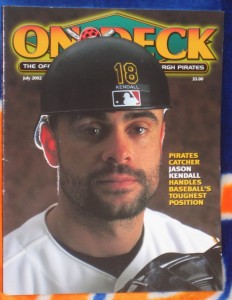 PNC Park was the moment a decade of throwback ballpark construction was leading up to. There were breakthroughs before, there was innovation en route, but the culmination of the phenomenon that began in the early 1990s reached its peak with the opening and blossoming of PNC. It must have. I can’t imagine any newer place ever being better. PNC Park was the moment a decade of throwback ballpark construction was leading up to. There were breakthroughs before, there was innovation en route, but the culmination of the phenomenon that began in the early 1990s reached its peak with the opening and blossoming of PNC. It must have. I can’t imagine any newer place ever being better.
I’ve seen nine ballparks for the first time since I was in Pittsburgh, all of them, except resuscitated RFK Stadium, as new as or newer than PNC. None of them came close to matching it for its intimacy, for its warmth, for its originality, for its sense of purpose, for its oneness with its surroundings….none of them.
Except that other teams in other cities need a place to play, I’m with John Cleese’s Cheers character, or at least channeling him: You can stop building ballparks now, baseball. It’s been done to perfection.
And I might have said that without ever leaving my hotel room, which played a huge role in forming my perspective on the matter. Stephanie and I stayed at the Renaissance, a name that probably means nothing to you. It meant nothing to me until I did a little checking in the planning of our trip to Pittsburgh and discovered the Renaissance was that boxy building that appeared in every panoramic shot of PNC. You know how your eye is drawn to the Roberto Clemente Bridge? If you follow it across the Allegheny River, away from the ballpark, you can see that building at its foot. It’s the one with the arch cut out in the middle.
That’s the Renaissance. That’s where we stayed. That’s where everybody should stay when they go to Pittsburgh, provided you get the room we got by dumb luck. Ours was on the tenth floor, tucked into the archway at an angle that allowed us to take in almost everything PNC had to offer without ever having to leave our accommodations.
Of course we wouldn’t stay glued to our window. Of course the idea was to get in the elevator, press down, walk through the lobby, hit the street, cross the bridge (just steps away from the Renaissance) and go inside PNC Park (just steps away from the Clemente). Of course we did that. But I swear we almost didn’t have to.
PNC Park from the hotel across the Roberto Clemente Bridge gave me a better experience than most ballparks do from their upper decks. It was like a super skybox suite that couldn’t be replicated at any ballpark no matter how many marketing wizards put their heads together to charge you for it. Our tenth-floor room offered hotel-like amenities (because it was a hotel); an incredible perch on the action; and the giddiness that came with sensing you were getting something for nothing. Well, not for nothing — the room cost whatever the room cost, but it wasn’t part of some extravagant Baseball Glimpse package, and nobody was hyping it to you. You just went to the window, you opened the window and you were practically inside PNC Park.
No kidding. We bought tickets for the Saturday night game but the Friday night game, as taken in from the tenth floor window could have counted as our first PNC affair. Hell, we actually stretched and sang along to “Take Me Out To The Ball Game” with the crowd from our room. They might not have heard us, but we could hear them.
***
I had never been to Pittsburgh before this pilgrimage and knew next to nothing non-baseball about it except for the confluence of the Three Rivers (the Allegheny and the Monongahela forming the mighty Ohio, and even this I knew from Ralph Kiner) and that it used to be sooty. A good friend in college was from the area and we had a running joke about how it dark it was during the day there because of all the smokestacks — it was funny because he assured me it was no longer true.
The sky was perfectly clear when we landed on Friday afternoon and the city was lovely. It struck me as one of America’s great undiscovered gems except I’m sure many millions of people before me had discovered it. It wasn’t just PNC Park, though I have to say that was the gem among the rivers. My first glimpse was on the shuttle in from the airport. It was breathtaking. Had I any real feel for how momentous it was, I would have jotted down the exact time I first laid eyes on it.
One of the dozens of great things about PNC Park is how indigenous it appears to the terrain, as if it grew along the banks of those rivers. Surely it existed when Fort Duquesne was established in 1754 and the city grew up around it, right? Though I know this to be inaccurate, it doesn’t seem cockeyed to imagine. PNC’s limestone exterior is nestled so comfortably into its space that it doesn’t look like it was built. It looks like it occurred organically.
And that bridge. Swear to Honus Wagner that the first time I saw PNC on television, when the Mets were playing the first exhibition games there in March 2001, I assumed the Roberto Clemente Bridge was some kind of golden walkway dreamt up by a clever architect to make the whole scene seem a little more, I don’t know, Pittsburghey…a design house’s complement to the black light standards and steel motif. Silly me — it was an actual bridge: the Sixth Street Bridge, unveiled in 1928 and brilliantly renamed in 1998 to dovetail with the construction of the ballpark
PNC syncs perfectly to its environs and it never lets you forget it’s the home of the Pirates (said with a straight face, skipping any and all cheap shots about the long string of sub-.500 seasons that has grown only more endless since I was there). The Clemente Bridge. The Clemente statue. The wall that’s 21 feet high for Clemente. Honoring Wagner and Stargell and Kiner (at least his hands) and lately Mazeroski with statuary. Loads of player banners. Loads of oversized Topps cards — not hidden away, not doled out grudgingly, mind you, but readily accessible and proudly displayed. Pittsburgh’s Negro League tradition got its due, too.
Some of this, the parts dotting the PNC exterior, we caught before we went to our official game on Saturday. After we checked in at the Renaissance and enjoyed an excellent Cuban restaurant next door, we walked across the Clemente (navigable by car and foot most of the time, limited to pedestrians before, during and after games) to explore. Two seasons into its existence, I’d salivated over PNC on TV but up close, even out for a stroll, it was even more astounding. Every inch of the place, every inch around the place, the sidling easy by the river as if intrinsic to the Western Pennsylvania ecosystem.
It wasn’t exactly PNCville around the ballpark, but there was enough in the way of sports bar action for those seeking it, and you were only a Clemente’s amble away from the edge of downtown if you sought food and drink that way. I also had no idea — remember, we were Pittsburgh tyros — there was something of an artsy section of the city adjacent to the ballpark. We wandered into the Andy Warhol Museum for a little non-baseball culture. I had no idea Andy Warhol was born in Pittsburgh. They later named the Seventh Street Bridge after him. I wonder if it and the Roberto Clemente Bridge ever have a catch. Or hit each other pop flies.
We inspected a bit of downtown Pittsburgh later but it was all prelude to our super skybox suite on the tenth floor. Having gathered takeout from a deli down the block, we headed for the hotel while ticketholders made their way across the Roberto (sad pecking order sign: Steelers t-shirts sold on Sixth Street before the Pirates game — football training camp was open and, as that Friday’s Post-Gazette explained, that meant Pittsburgh’s baseball season was over). Stationed at our window — windows, actually; one for each of us — we watched a pretty decent trickle of humanity stream over the river in advance of first pitch. We turned on KDKA for play-by-play but were served just as well by the voice of Pirate public address announcer Tim DeBacco. When he asked the 23,812 in attendance to rise for the national anthem, 23,814 of us stood.
Yes, we were that close. Except for losing a slice of right field, we could pretty much see everything that went on in the game, and aided by the broadcast team, we became honorary big fans of journeymen outfielders Adam Hyzdu (3-for-5 featuring a fifth-inning grand slam) and Rob Mackowiak (a two-run pinch-hit blast in the seventh). If Bob Prince’s partner Rosey Rosewell had still been calling Buccos games in 2002 and had bellowed his trademark home run call of “open the window, Aunt Minnie, here it comes!” we would have been ready.
Our windows were open. We sat by them, feet up, beverages handy, taking in a real, live baseball game without having to be at a real, live baseball game. It was akin to the Wrigley rooftops, I suppose, except no gouging was involved. We really did stand for “The Star-Spangled Banner,” we really did stretch in the seventh and we really did offer cheers for the home team as they defeated the Cardinals, 12-9. And we were blown away by what happened when the sun went down. PNC Park’s lights reminded me straight up of those old-time illustrations of Fenway Park or Crosley Field, the ones reproduced on postage stamps that had been issued a year before. In those iterations, the ballparks in question appeared to be bathed by light, as if by a cosmic shower head. That’s what happened here — but there was something even better! Set against the hills off in the distance (who knew Pittsburgh had hills?), PNC, from our angle, looked almost to have been carved into a bluff…like the Polo Grounds, for goodness sake.
Nearly thirty years of going to ballgames at this point in my life and I’d never had the Polo Grounds evoked. Technically speaking, we didn’t go to this game, but from the tenth floor of the Renaissance, it was close enough.
Experientially speaking, it was very close. We still had an actual game to attend the next night, and you could be damn sure we were going to attend the hell out of it. Still, the hotel window game is the one we recall most fondly when we recall our trip to Pittsburgh.
***
Saturday brought yet one more dimension to bear: a special guest star joining Stephanie and me. The date was July 20, relevant in that July 20 is the birthday of my Chicago-based friend Jeff (hero of the unforgettable Mets-Cubs Friday doubleheader of four years earlier). Jeff’s a fine family man — lovely wife, two bright children, including a daughter I induced with all manner of Metsabilia, when she was three or so, to adore Mr. Met — but he had mentioned every summer since we’d been corresponding that when July 20 rolled around, he did whatever the hell he wanted. Well, I suggested some months earlier, July 20 will be a Saturday, and Stephanie and I are thinking about going to Pittsburgh, and since it’s sort of halfway between New York and Chicago, and since this is your birthday and you do whatever the hell you want on your birthday…
No more needed to be said. Jeff put some frequent flier miles to good use and we agreed to rendezvous in the hours ahead of that night’s game. It’s one of those things I always thought sounded like a superb idea, meeting somebody in a city where neither of us lived just for baseball, but it was the first time I’d ever done it.
And, per the vibe that accompanied the weekend, it was superb.
Stephanie and I did a little more local sightseeing early, took a train ride (who knew Pittsburgh had trains?) and, as planned, we met Jeff in our lobby. He was staying a few blocks away without a ballpark view, but we dragged him up to our room so I could show him our catbird seat window and breathlessly describe what the previous evening had been like and looked like. He agreed it was sublime, perhaps just to get me to shut up about it already.
The three of us made good use of the Roberto Clemente Bridge, fitting enough in that Roberto Clemente was one of Jeff’s baseball heroes growing up. We each took turns posing with ol’ Bob’s statue and toured a bit of the riverfront. Jeff occasionally gazed through his trusty binoculars in search of aviary happenings. As a dedicated birder, Jeff keeps a “life list” of every species he’s spotted. He also, like me, keeps a log of every ballpark he’s visited.
I enjoy reading Jeff’s words on birds, but the obsessive language we share is ballparks, and the fact that we were seeing a ballpark new to us together for the first time added yet another layer of depth to the weekend. By the time we recrossed the Clemente for dinner at a very nice Italian restaurant downtown, we were deep in ballpark talk, trading stories and opinions the way we might have traded cards if we had grown up in the same place at the same time (though Jeff wouldn’t have traded me his Bob Clemente unless he had at least quadruples). Our dialogue probably wasn’t anything we hadn’t sent each other by e-mail in the previous half-dozen years, but for one evening the conversation was plucked from captivity and set free to roam into tangents, digressions and asides to say nothing of anticipation for what loomed directly ahead.
God, I enjoyed that.
***
Back across Roberto one more time, back to Pittsburgh’s North Shore to physically inhabit PNC Park. You’d almost think that after all the buildup and euphoria, the actual experience of going and being inside couldn’t help but be a bit of a letdown.
It was nothing of the sort. It was what all the walking and talking was leading to. And it couldn’t have been better.
For me to love a ballpark more (or at least rate it higher) than Shea, there has to be one instant very early in my immersion inside it when, without my brain doing anything proactive, my mouth drops open and forms nothing more than a quiet ohmigod. Wrigley had that. PNC definitely had that. It came after we emerged from the concourse and inhaled our first full view of the PNC Park vista.
Ohmigod.
Some parks, like Wrigley, aren’t quite done justice by television, even though they look great on TV. Some parks, like Fenway, are enhanced by television beyond their already high standards. PNC pulled off a double play worthy of Groat and Mazeroski. It had sucked me in from the moment I saw it on the tube, but in truly living color, my crush went hi-def.
Everything. Everything about it was incredible. There’s the downtown skyline. There’s our hotel in the foreground. (I can make out our window! We watched from there last night!) There’s the bridge. There’s the river. There’s the greenery beyond the green fence. There’s the ironwork and the seating and the ramps. Oh, it just blended so beautifully. The only thing I didn’t care for was the green batter’s eye as it got a little in the way of everything else, but I guess the batter did have to see the ball…so OK, it can stay.
Nothing that occurred during the game, taken in from splendid seats maybe 20 rows behind home plate, could have made me love PNC any more deeply than I did at that first internal sight. But nothing made me love it any less, either. The Pirates’ gamenight presentation (save, maybe, for a dopey Photoshopping of what celebrities would look like with mullets) was first-class. For example, the sound system was perfect. It’s an odd thing to remember, but because so many are ear-splitting, I noticed the acoustics were just right. Jason Kendall’s at-bat music — the “guess who’s back…back again” refrain from Eminem — was so sharp and so clear that I think it’s the reason “Without Me” soon became my favorite song of 2002.
We got a big kick out of the pierogi race, an amiable knockoff off of the sausage derby in Milwaukee. Would have loved to have tried a pierogi, or anything they were cooking behind us, but we were still full from dinner. Impressive concessions, if just to sniff. Impressive two-story team store. One of the pierogi magnets — Sauerkraut Saul — sticks in my office to this day and Stephanie still wears her Pirates-Mets First Game Ever shirt (deeply discounted from the year before) around the house.
Too often you watch a game from Pittsburgh on SNY and you see thousands of empty seats. But on this Saturday night, the Cardinals helped generate a near sellout of 35,000 (capacity is about 38,000, which sounded a bit small when I first heard it, yet felt just right when I was amid it). The offensive fireworks from the evening before continued, especially from our man Hyzdu, who contributed three hits, a pair of three-run dingers and seven RBI. Bucs blew away St. Louis, 15-6. It was a joyous night for people who came to root for the home team, not just applaud the home park. It got only better in the minutes after the final out when we tracked the baserunners and outs on the informative and attractive out-of-town scoreboard and confirmed the Mets held on to win in Cincinnati — yet another reason to cheer.
I could have kept cheering for PNC Park, lousy name and all. If I ever became prosperous, I decided, I’d buy season tickets here, never mind that I lived far from Pittsburgh. If I could afford it, I’d fly in on weekends and whenever else I could, just to sit here and watch baseball in the perfect setting. Maybe I could work out something to reserve that room in the Renaissance. Or, I thought, maybe I should just cut out the 332 miles and move here. That neighborhood around the Warhol seemed pretty nice…
I wasn’t moving to Pittsburgh and I wasn’t hauling ass for any more Pirates games, but boy was I smitten. And I still am, despite more recent associations with PNC Park as the place where late-inning Mets leads come to die agonizing deaths. Despite the often frustrating results and general malaise that surround every Mets-Pirates game, I could do with more Met visits to PNC just to ogle it more often on the telly. I’m not the only Mets fan who’s noticed it, either. When Citi Field was still in the drawing board phase, there was a quote from Jeff Wilpon expressing his admiration for PNC Park and how it, as much as Ebbets Field, was a model for what the Mets would build. Shortly after Citi opened, Wilpon cited PNC as inspiration for the finished product.
Good taste on Jeff’s part. I don’t see a damn thing that’s similar between the two other than size and steel — theirs is open and airy everywhere; ours continues to deal me bouts of claustrophobia — but I don’t hold that against Citi Field. No way anything built since PNC Park could match PNC Park.
It’s just too perfect.
***
The question you steadfast ballpark countdown trackers may be wondering isn’t, “If you love PNC Park so much, why don’t you marry it?” (which is easy to answer: Stephanie got to me first, and I believe marriage among a man, a woman and a ballpark is illegal in both New York and Pennsylvania), but rather, “If you love PNC Park so much, how could it possibly be only No. 4 on your life list?”
That’s a great question you haven’t asked, and I’ve certainly mulled it since July 20, 2002, when Jeff and I discussed our respective rankings on our final trek across the Clemente, back toward our respective lodgings. Jeff said he was ready to slot it above anything he’d ever seen. I did not argue the point with him, as there seemed no place better to experience a ballgame — of that I’m convinced.
Nevertheless, I guess I’d have to say a trio of other great ballparks got to me first and I’m extremely loyal and not a little sentimental about such relationships. Thus, the final three installments in this series will delve into the intense emotional attachments I formed for a trio of PNC predecessors, but honestly, if you’re looking for a good baseball time, you’ll never find a greater one than the one you’ll find out Roberto’s way.
Another countdown you should by all means monitor is being conducted by Dave Murray, who takes us through the Mets Guy In Michigan‘s version of the Topps 60 Greatest Cards of All Time. Naturally, they’re all Mets cards. He’s so far taken care of 60-51; 50-41; 40-31; and 30-21, and made a couple of detours for the sake of equal time and topicality. Dave might trade you an extra Bob Clemente, but good luck prying away his twentieth Mets Maulers.
by Greg Prince on 24 November 2010 12:20 am Either set your recording devices before embarking on the busiest travel/patdown day of the year or hurry back from wherever you’re spending the holiday, and for the love of Mike Bruhert be sure to get your bargain-hunting done early. SNY is running a SEVEN-HOUR MARATHON of Mets Yearbook, every one the network has produced, from 3 o’clock Friday afternoon to 10 o’clock Friday night.
The fourteen installments will run in chronological order. Brief teaser and refresher on contents:
1963: The Polo Grounds closes. Shea Stadium nears. Mets prospects agree the Mets are a good place for a youngster to find quick advancement. Casey Stengel is still talking.
1965: Casey finishes talking and hangs them up. Mets are still the Expressway to the Big Leagues. The winter caravan that remains a Mets tradition to this day (cough, cough!) winds its way deep into Long Island.
1966: Mets leave the basement and rise all the way to the boiler room. Ron Swoboda hits a mighty homer. Jacksonville Sun ace Tom Seaver looms as a possibility for ’67.
1967: Guess who made it up from Jacksonville.
1968: Jerry Koosman thinks to himself before the Home Opener. Buddy Harrelson tells Little Leaguers about The Good Lord. Gil wants you to know he’s doing fine.
1971: The Mets don’t hit, but they sure can pitch and give away batting helmets. Ralph Kiner instructs Ken Singleton so adeptly Montreal can’t wait to take him off our hands.
1972: Rusty! Willie! And sadness for Gil. But fine promotional dates, too.
1973: Edited to exclude NLCS and World Series footage (either for time or rights fees), but you can’t go wrong with a fresh dose of You Gotta Believe!
1975: Dave Kingman has personality. Mike Vail has star written all over him. Joe Frazier takes the reins for next year promising he’s not an evil devil (or am I confusing him with somebody else)?
1976: One helluva Bicentennial celebration in Flushing. Seriously. Stephanie saw the red, white and blue pageantry (like a million balloons) and decided it was more impressive than the final ceremonies at Shea. More festive anyway.
1978: In case you’re wondering if anybody can make stars out of Doug Flynn and Craig Swan, the answer is yes.
1980: The film starts with the hiring of a whip-smart, universally admired general manager and ends with a lot of talk about how great newly acquired Dave Roberts will be in 1981. Draw precedent-related conclusions at your own risk.
1984: The Mets stop sucking, and for 28 minutes, the message is essentially just that. Gary Carter shows up at the end to declare he’s saving his right ring finger for his World Series bauble, and son of a gun, he made good on it.
1988: Roger McDowell screws around with a camcorder, not nearly as entertaining as it must have sounded in those Mets Can Do No Wrong (except in the playoffs) days. Otherwise, Mets can do no wrong.
And there’s like a thousand more highlights from these highlight films that will, appropriately enough, be the highlight of your Thanksgiving weekend, whether you’ve never seen Mets Yearbook before, whether you’ve missed a few or whether you’ve dropped everything every time you flip by SNY and see it’s Dairylea Day yet again.
Watch it, record it, ignore everything else in deference to it. You’ve been suitably notified.
by Greg Prince on 23 November 2010 2:32 pm Clearly the Terry Collins era should be sponsored by an energy drink. Let’s hope it’s not Four Loko.
I watched our new manager’s literally bouncy introductory press conference and came away with one overwhelming impression: “This dude is into it.” If he was worried about being identified as laconic, I think he’s got that licked. A little vigor won’t be a bad thing for the Mets, though when he’s setting positive examples by running through walls, he should only remember to ease up before storming into 126th Street traffic.
While he bounced, Terry (we’re on a first-name basis already) said all the right things. Of course he said all the right things. If he used the occasion of his coronation to say the wrong things, then we’d really be in Blackout in a Can territory. There were some clichés about pitching and teaching. He handled the now requisite limited-perspective question about Chinese ballplayers skillfully (given his WBC experience, he is the right person to ask). He complimented the young Mets as some of the most polite fellers he’s ever had the pleasure of encountering on the diamond. He indicated he’ll communicate better than he did during his infamous stint with the Angels. And, in that vein, he declared he’s not the devil.
Didn’t seem devilish, though as Albert Brooks suggested in Broadcast News, the devil probably won’t have a long, red, pointy tail; rather he’ll look like William Hurt. Terry Collins doesn’t look like William Hurt, which is neither here nor there except to note that when you stick a baseball jersey over a suited 61-year-old man and top him with a baseball cap, it’s hard to concentrate on anything he’s saying, even about polite young Mets, talented Asian ballplayers or his non-devilish tendencies. All you can think is, ”Why do they make these guys wear suits if they’re going to pose them in jerseys?” and “Connie Mack had the right idea about eschewing the uniform when he was managing the Philadelphia A’s.”
The ritual of the offseason press conference seems to be evolving before and away from our eyes. The only non-broadcast reporter who asked anything for the cameras was the Chinese Media Net lady. All the usual wise guy print suspects (if you read the beat writers’ Tweets, you know what I mean) remained silent until they conducted their own mini press conference after Collins left the podium. Not being on-site for this event, I assume this arrangement is beneficial for the working media, though it makes for pretty deadly TV. I’m far more interested in hearing what Adam Rubin and David Waldstein — to name two dedicated Mets reporters — might tease out of Collins than listening to Russ Salzberg make certain Russ Salzberg’s voice is properly recorded for Russ Salzberg’s sportscast tonight.
Sandy Alderson spent valuable face time with Kevin Burkhardt for the benefit of those of us in the SNY audience. He is surely a different breed of cat from every general manager I’ve experienced in my Met lifetime. Everybody since Bob Scheffing — even lugubrious Steve Phillips — seemed like a Baseball Man. Alderson no doubt knows his baseball, but in his standup he mostly came off as a CEO who pencils you in for fifteen professional, reasonably substantive minutes and will forget about you before he’s onto his next meeting. He looks like he handles people in a way Omar Minaya never could have had he wanted. Definitely gave me the impression he has better things to do than talk to Kevin Burkhardt. It’s the same sensation I’ve gotten from interviewing corporate titans who have definitely given me the impression they had better things to do than talk to me.
Like any savvy bigwig, Sandy indeed has loads of pressing business on his plate. He’s got to fill out that coaching staff (HoJo’s gone) and tend to the bullpen (Valdes is a Cardinal and Feliciano will be offered arbitration) and, if we’re fortunate, work a miracle or two. Collins, meanwhile, can lose the suit, adjust his cap, tuck in his No. 10 jersey — chosen to honor erstwhile Met nemesis Jim Leyland though it’s eerily reminiscent of deep-seated Met nightmare Jeff Torborg — and bounce toward the east coast of Florida with a spring in his step.
Traditionally when I watch the Mets in official newsmaking mode, I find myself somewhere between inconsolable and queasy when it’s over. Today I’m modestly energized and unusually undisgusted. This could very well represent progress.
by Jason Fry on 23 November 2010 9:06 am Is Terry Collins well-organized? Or too intense?
Amid that rather pointless (for now) debate, I found this article by Adam Rubin at ESPN New York reassuring, with the likes of Josh Thole, Nick Evans and Dillon Gee saying pretty much exactly what you’d hope would be said.
There was just one small problem. If you haven’t read the article, click it and read it and see if you can find where you get worried. Go on. I’ll wait.
OK. For me at least, it was right here:
The Mets had a longstanding policy in which minor league players had to wear their pants legs high, like the old-time players did to expose their stirrups. Collins fought to have that policy ended.
“He battled for all of the players,” Thole said. “He went to [chief operating officer] Jeff [Wilpon], and had meeting after meeting with Jeff, just to try to get that rule changed — just to say, ‘Go out and relax and enjoy yourself when you play.’ “
He had meeting after meeting with Jeff, just to get a rule about stirrups changed?
Next time the Mets protest that Jeff Wilpon is treated unfairly and portrayed incorrectly, I’d like them to explain how Josh Thole — who seems smart enough not to consciously slag the owner in the press — had that wrong. Because that sure seems like pointless ticky-tacky micromanagement, like hamstringing decision-making, like the kind of thing that would make an organization sclerotic and dysfunctional and ridiculed by the rest of the sport. It sure seems to fit with a lot of stories we’ve been told are unfair.
I wrote yesterday that regarding Terry Collins, we ought to admit that people can learn and change. I also wrote that one of the heartening things about the arrival of the Alderson regime is that Sandy Alderson is too old, too well-paid and has too many better things to do to take shit from Jeff Wilpon.
I didn’t elaborate on it then, but that was actually meant as a left-handed compliment to the Wilpons. Because they have to know that about Sandy Alderson too. And if they know that and accept it, that’s a sign that they too are learning and changing — or at least know they have to. For which I applaud them, sincerely and without the usual helping of bloggy snark.
But we’ve heard this before. We heard about full autonomy back in the days when we albatrosses we were shedding were Bobby Bonilla and Eddie Murray. Unfortunately, we’re still talking about it now.
Here’s devoutly hoping that the Wilpons will actually get out of the way of the smart new baseball-operations folks that they were wise to hire. If they do that, I firmly believe the Mets are headed for becoming the kind of organization they and we have always wanted to be a part of.
But if they don’t, we will be back at this pass before too long — maybe in three years, or five, but too soon. And instead of being the National League equivalent of the Boston Red Sox, we’ll be the senior-circuit version of the Baltimore Orioles — whose fans know their problems start so high up the ladder that the time to solve them will be measured in generations.
Please no. I’ve survived Tom Seaver being traded and M. Donald Grant making the team the North Korea of the free-agent era and the deRoulets and Bobby Bo and Robby Alomar and being beaten by the Yankees and three late-season collapses. But that might really be the thing that broke my heart.
by Greg Prince on 22 November 2010 1:30 pm Somebody thinks Terry Collins is exactly what the New York Mets need in 2011 and 2012. Fine. Let’s see what he’s got.
Managerial choices don’t reveal themselves as brilliant or idiotic in the fall that they’re made. It’s in the fall that comes after the first spring and the first summer that we are able to say anything definitive about them, and surely that rule extends to the choice the Mets are set to announce.
Everybody can mine unflattering anecdotes from Collins’ past just as they can list glowing endorsements of his abilities. Everybody can compare his situation to managers with similar career trajectories and everybody who so chooses can take the logical step — or make the leap of faith — that if Sandy Alderson & Co. are as good as they are cracked up to be, then Terry Collins will turn out to be the right decision.
I had no problem that it took what felt like an eternity (but really only 23 days from Alderson’s official appointment to Sunday’s conclusive “multiple sources are reporting…” round of leaks) to land on Collins Avenue. It was an important hire, even if you buy into the role of the manager being relatively insignificant in the scheme of franchise success. The manager is still one of the primary faces of the franchise. The manager is still the person who meets with the assembled media twice daily throughout the season. No matter what system is put in place above him, the manager is still the one making the calls on which individual games will hinge.
When somebody bunts or doesn’t bunt or swings away and doesn’t deliver, the camera will find the manager in the dugout and we will reflexively think about and talk about the manager. When the ladies and gentlemen of the press seek out a key player after a loss, it won’t be the vice president of player development and amateur scouting whose moves will come up in conversation. When that player is quoted immediately thereafter, it won’t be the special assistant to the general manager who will exchange sideways glances with that player if the quotes are less than flattering. It won’t be anybody but the manager in and around the clubhouse day after day. It won’t be anybody but the manager who inspires analysis and impatience when things are going poorly and even when they’re going pretty well.
I’m glad Alderson’s crew worked thoroughly and diligently on this high-profile assignment even if I still can’t quite believe that a veritable nationwide talent search came down to essentially Terry Collins and Bob Melvin. But it did, Collins was the choice, and after absorbing his introductory press conference tomorrow, I plan to stop thinking about it and him until Port St. Lucie is open for business. For nearly two months, the entirety of the Mets’ operation has been devoted to eliminating a general manager and a manager; finding a general manager; surrounding the general manager with trusted aides; and finding a manager.
This is not why I watch baseball.
I am concerned about what actions Alderson and DePodesta and Ricciardi and Collins take in terms of the results they yield, but I shall no longer dwell on these individuals as the focal point of the New York Mets’ offseason. To use Matt Artus’s phrase from Always Amazin’, I contracted managerial fatigue by last week. It was a akin to the general manager malaise I felt as October wore on. Again, these were crucial decisions in determining the direction and possibly fate of my favorite baseball team, but it wasn’t baseball.
Thus, whether or not I think Terry Collins’s history of high-strung martinet tendencies indicates he looms as a disaster waiting to happen when he’s exposed continuously to the New York spotlight is irrelevant in shaping my view of him from the press conference onward. Terry Collins is the manager of my favorite baseball team and I want him to be the best manager he can be, I want him to be the best manager of all managers, and I will root for him to succeed immediately and enduringly.
I’ll lean on Alderson to do what needs to be done and Collins to take it from there because that’s what they’re here for. Then I’ll return to wondering who’s going to pitch in rotation with Mike Pelfrey, R.A. Dickey and Jon Niese while Johan Santana is out (and, for that matter, when he’s back); whether Jason Bay can rebound from both his scary concussion and his frightening mediocrity; if Ruben Tejada can ever hit like he can already field; if Daniel Murphy might carve himself a niche on this club; if Carlos Beltran has a hellacious salary drive in him; if one solid campaign out of Angel Pagan guarantees solid campaigns are his norm; if Francisco Rodriguez can resume being a closer or is yet another irredeemable albatross whose salary and persona must be shed at once; if Jose Reyes will be a Met for life or just one more year; and everything else that’s supposed to preoccupy baseball fans as November turns toward December, and a new year and another season emerge over the horizon.
Because that’s what we’re here for.
|
|