The blog for Mets fans
who like to read
ABOUT US
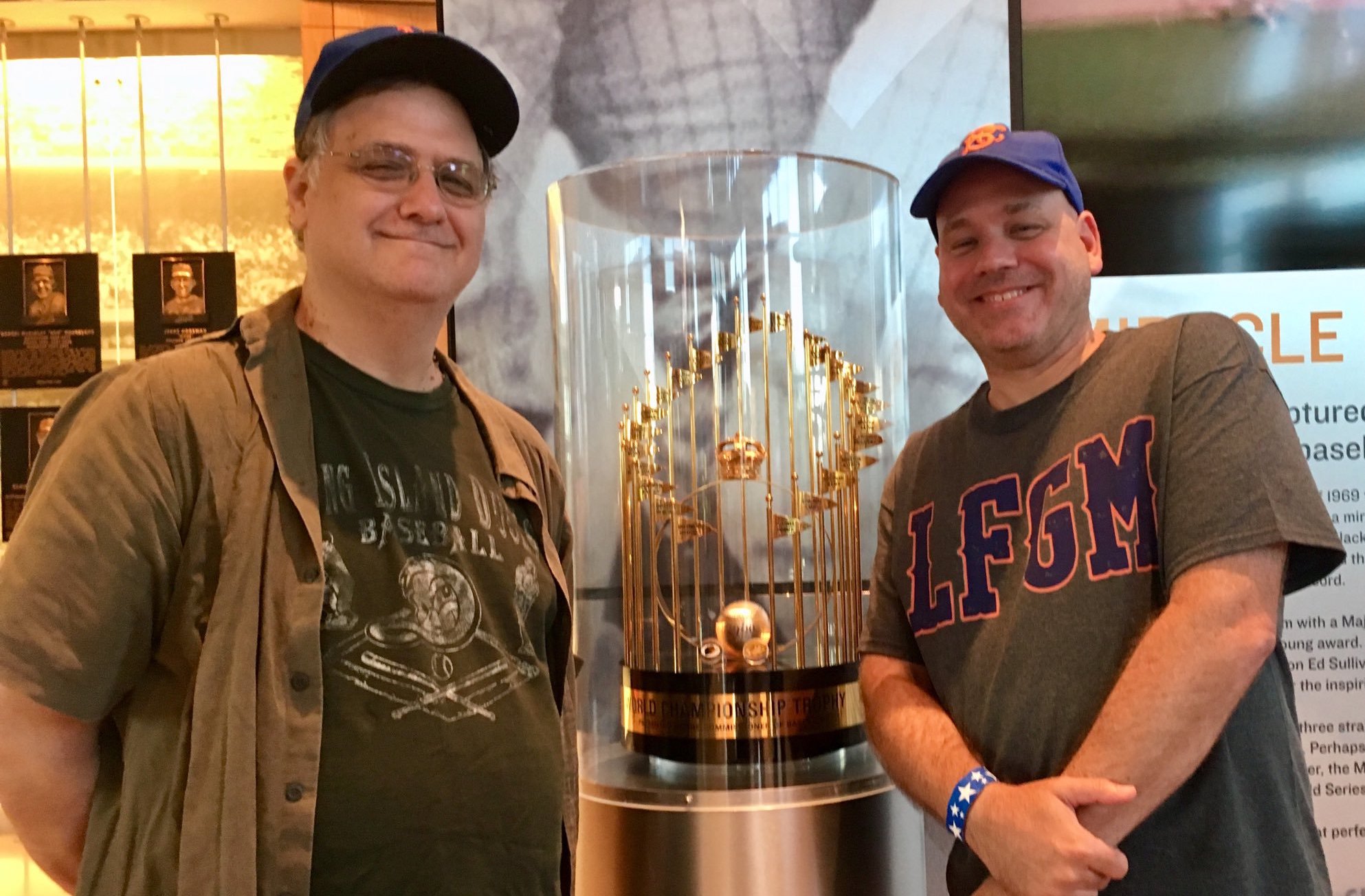
Faith and Fear in Flushing made its debut on Feb. 16, 2005, the brainchild of two longtime friends and lifelong Met fans.
Greg Prince discovered the Mets when he was 6, during the magical summer of 1969. He is a Long Island-based writer, editor and communications consultant. Contact him here.
Jason Fry is a Brooklyn writer whose first memories include his mom leaping up and down cheering for Rusty Staub. Check out his other writing here.
Got something to say? Leave a comment, or email us at faithandfear@gmail.com. (Sorry, but we have no interest in ads, sponsored content or guest posts.)
Need our RSS feed? It's here.
Visit our Facebook page, or drop by the personal pages for Greg and Jason.
Or follow us on Twitter: Here's Greg, and here's Jason.
|
by Greg Prince on 21 December 2010 11:05 pm Perhaps it’s this miserable cold I’ve contracted and can’t divest myself of, or it’s the impending winter solstice (you mean it’s still fall?) but something overwhelming has occurred to me this evening:
I don’t care what the Mets are doing at the moment.
I will care. Of course I’ll care, but for now, I’ve run out of care. I don’t care who they’re looking at to fill out the rotation or to play second. I don’t care about trade rumors or how much budget they have to tinker with. I don’t care how poorly they frame themselves or present themselves or what kind of ticket deals they’re offering.
I’ve OD’d on year-round Mets coverage, my own included. It used to be if you came across a baseball brief in the fourth week of December, no matter how brief, no matter what it was about (but especially if it was about your team), you felt blessed. “They’ve extended their affiliate agreement with Visalia? WOW!” Now we grow antsy if there’s “no news” about the Mets on a given day.
Of course there’s no news. It’s the fourth week of December. If it was news, it would have happened by now. Or if it’s going to be news, it will happen eventually. Either way, the season will begin when it’s supposed to begin, not a tick sooner. Maybe if a boffo free agent were still prowling the open market, I could buy into the chronic curiosity, but there’s nobody out there worth losing a minute’s thought over on December 21 or December 22. You’re going to hit refresh for the latest word or lack thereof on Chris Young? Or Jeff Francis? Or Freddy Garcia?
Don’t. Winter is nature’s way of telling you not to give a fig sometimes.
by Jason Fry on 19 December 2010 5:33 pm It’s not yet the Baseball Equinox — though I’m eagerly awaiting word from Greg that we’re finally closer to new baseball than we are to old. But nonetheless, in the last couple of days I’ve felt a quickening somewhere in my blue-and-orange soul.
 Spring's coming. Promise. And it has nothing to do with our front office. Just having Sandy Alderson on the payroll is grounds for celebration, as is having him make smart hires and calmly explain to everybody from Mike Francesa to panicky Mets fans what is and isn’t happening, and that there’s a plan that’s being stuck to. (And hey, getting to talk to the man himself is certainly a welcome new experience.) Still, even the wisest doings of men in jackets and ties can only do so much.
This was different.
And welcome, as I was beginning to worry a bit.
After the 2010 season mercifully expired with Oliver Perez and a bunch of Jerry Manuel Veteran Leaders (TM) taking up space at Citi Field, I didn’t particularly want to think about my misbegotten baseball team for a while. The Giants and Rangers offered a welcome diversion, but then — as always happens — baseball was over and it was winter.
For a while filling my days wasn’t a problem: I was insanely, frighteningly busy in a medium-term freelance gig I’d taken, and I was trying to finish a book that had been squeezed into night-owl hours but whose deadline hadn’t moved. It was about the most tired I’d ever been — I registered the departures of Omar and Jerry and the arrivals of Sandy and J.P. and DePo with what approval I could muster, but mostly I just stayed tired.
And then when I got my breath back a bit, it was clear that the Mets weren’t going to be making big headlines. No Cliff Lees or Zack Greinkes or even Orlando Hudsons were going to be showing up to awkwardly button a jersey over a shirt and tie (seriously, this looks ridiculous) and say can-do things. No, it was Paulino and Carrasco time. I’ve watched the Knicks a bit, with what started as a professional duty turning into a genuine rooting interest. (Perhaps sensing the arrival of a Mets fan, they’ve now stopped winning.) Today I checked in on the Giants, decided to watch them finish off the Eagles, and found myself profoundly grateful that I didn’t really care as Tom Coughlin’s bunch gagged horribly. No offense meant to the Knicks and Giants (or the Jets, Nets, Rangers, Isles, Devils and anybody else), but the more I reallocate my portfolio of Sports Caring, the more I realize that for me there’s baseball and there’s everything else.
So what lifted my spirits? Baseball cards. Yes, in December.
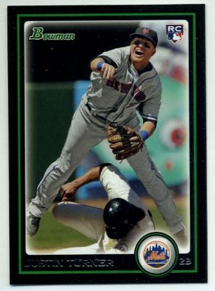
Topps just released 2010 Bowman Draft Picks, news that I greeted with the kind of enthusiasm appropriate for a minor card set purporting to belong to a year that’s over. But then I noticed that Justin Turner had a card — Justin Turner who’d gone into The Holy Books with an evocative but inappropriate Norfolk Tides card from his time as an Oriole. Cool, I thought (becoming one of at least five or six people on the planet to do so), now I have a Justin Turner Mets card.
And hey, Topps made a Matt Harvey card — better get two of those, in case Harvey makes the big club. And ditto for potential future catcher/backup/trade bait/minor-league washout/who? Blake Forsythe. Thinking of Harvey made me think of Alderson’s announcement that the Mets would no longer abide by Bud Selig’s ridiculous slot criteria in the draft. Thinking about Turner made me think about Daniel Murphy and Ruben Tejada and Luis Castillo and Brad Emaus and a second-base competition in Port St. Lucie.
And that was a pure baseball thought — it wasn’t about the front office or cards or payrolls or draft picks. It wasn’t about being mad at Omar Minaya, or wondering about 2012. It was a brief vision of dirt and grass and sunshine, the pops of balls in gloves and the thunk of spring-training contact before little crowds.
Not so far away, I thought. And then, finally: That will be nice.
by Greg Prince on 18 December 2010 1:36 am Welcome to a special weekend edition of Flashback Friday: Take Me Out to 34 Ballparks, a celebration, critique and countdown of every major league ballpark one baseball fan has been fortunate enough to visit in a lifetime of going to ballgames.
BALLPARK: Oriole Park at Camden Yards
HOME TEAM: Baltimore Orioles
VISITS: 7, plus a tour
FIRST VISITED: April 26, 1994
CHRONOLOGY: 10th of 34
RANKING: 2nd of 34
Best ballgame you can go to? All things being equal, the one you sneak away to. Say a Tuesday afternoon. That’s daytime. That’s midweek. That’s when nobody’s supposed to be at a ballgame, yet somehow you show up and everybody’s there. Or not that many are there. But at least you’re there, if you’ve done your sneaking correctly.
If you do your sneaking to the right ballpark, it stays with you forever.
***
My right ballpark, when considered in every context possible, is not an unvarnished success story. Its unveiling foreshadowed or perhaps confirmed for us as sports fans some unfortunate facts of life. It plowed under and paved over aspects of the fan experience that used to be instantly accessible to us. In its wake, imitation would become the sincerest form of flattery — and if you imitate anything enough, the sensation attached to the original tends to flatten out around the facsimiles’ edges.
Oriole Park at Camden Yards, entering its twentieth season, can be seen as having left a few pockmarks within the greater ballpark psyche. But when viewed through the prism of a shockingly hot Tuesday afternoon in its third season, it was too good to be true.
Yet it was true.
***
First person I knew of to experience Camden Yards filed a glowing report:
Here’s the park at last — a low red brick façade, broken by archways. It faces on Camden Street for a distance, then bends away, paralleling the third-base line, toward home. Steel vertical beams, set back above the street wall, rise to a narrow green sunroof along the upper deck. Above that are light towers and flags (the flags stirring a bit), yet my eye, I notice, does not climb upward as this stadium draws closer but follows it horizontally, arch to arch. No dome here, no beetling concrete cyclotron over our heads. This is a pavilion — a park, right here in the city.
Goodness, how my special correspondent whetted my appetite to follow in his footsteps through downtown Baltimore. Never mind that this fellow wrote of a game that hadn’t taken place in a ballpark that was still being built. And make what you will of the identity of my guru in this matter: Roger Angell, writing in the New Yorker in the spring of 1990. Angell may have invented the circumstances, but he knew what was coming two years hence. The Orioles were building a ballpark like no other.
Or like every ballpark mythically used to be built. Either way, it promised to be different and I had never been so enticed by something that had yet to exist. It would take two years for Oriole Park at Camden Yards to open, and two years beyond that for my first of several pilgrimages. That’s four years of waiting and wanting.
The anticipation was worth every salivating second.
***
You don’t need to be Roger Angell to know the game changed once Camden Yards broke the seal on its wrought iron gates.
What game? Every game.
 Look around your ballpark, Mets fans. Look around each and every ballpark that’s opened or been renovated since 1992. There is an element of Oriole Park at Camden Yards evident everywhere, from Cleveland and Arlington (1994) all the way through Minneapolis (2010). If there’s not a direct architectural aping, it’s a sense of striving for what OP@CY accomplished so brilliantly. When you see a ballpark trying to incorporate some or all of the innate qualities we instinctively associate with the ideal baseball stadium — urban; intimate; old-timey — you’re looking at the coast-to-coast legacy of Camden Yards. Look around your ballpark, Mets fans. Look around each and every ballpark that’s opened or been renovated since 1992. There is an element of Oriole Park at Camden Yards evident everywhere, from Cleveland and Arlington (1994) all the way through Minneapolis (2010). If there’s not a direct architectural aping, it’s a sense of striving for what OP@CY accomplished so brilliantly. When you see a ballpark trying to incorporate some or all of the innate qualities we instinctively associate with the ideal baseball stadium — urban; intimate; old-timey — you’re looking at the coast-to-coast legacy of Camden Yards.
No ballpark, with the possible exception of steel & concrete pioneer Shibe Park, has had as pervasive and positive an impact on the baseball landscape as Oriole Park at Camden Yards. It hasn’t been twenty years since its first game, but we can probably add enduring to that list, too. Everything is going to resemble or imply the influence of Camden Yards for at least the next couple of generations (though I can’t wait to hear from the first post-Camden occupant who insists, “We can’t realistically compete in an outmoded 1990s/2000s facility.”)
The r-word eventually has to be broached in this discussion, because it has become something of an insult. When Camden Yards introduced it to our vocabulary, however, “retro” was not at all a bad thing, not when one considered what was being reached back to…and what was being reached over.
Camden Yards sounded the death knell for the multipurpose stadium. It absolutely killed circularity. No more round and pound. No more plopping down spaceships and laying in carpet. No more enormity. A lot less distance. An intangible feel for the game.
Some of Camden’s descendants have probably outdone Camden for nailing the retro ethic. That’s reasonable — somebody starts something, others pick up on it and hopefully improve it. Some of those who have come along in Camden’s wake, however, have missed the target. They’ve made retro come off as a little stale and a little same. The Veterans Stadium/Three Rivers/Riverfront crowd was labeled cookie-cutter. You get to enough of the newer ballparks, and there seems to be a bit of Pillsbury to their essence, too.
The prevailing wind may not be ideal, but it’s almost never awful. The game changed for the better, thanks to Camden Yards. Twenty-nine imitators would dull the overall effect, but it beats the pre-Camden world in which most of us grew up.
There was everything before Oriole Park at Camden Yards, and there is everything after. We didn’t need retrospect or hindsight to figure it out, either. One look at Camden Yards, and we had to know that everything we understood about going to a baseball game was up for grabs.
The old ballpark was dead. Long live the new ballpark.
And long live its endless warehouse as well.
***
By the spring of 1994, I could wait no longer. I had read Angell. I had watched highlights of its first actual game on April 6, 1992, from the Delta Shuttle departure lounge at National Airport in Washington. It was a local story for them. Lucky stiffs — Baltimore was so close. Standing around outside Shea on a Sunday morning in June 1993 (the day Anthony Young would make the wrong kind of history for the Mets) and waiting for Gate C to open, I purchased that year’s All-Star Game program. They didn’t usually sell it and I never would have bought it except the All-Star Game was going to be at Camden Yards, meaning the program was all about Camden Yards. My appetite was whetted more. Diagrams! They have diagrams from their planning! And pictures!
Same summer, I bought a book called Ballpark: Camden Yards and the Building of an American Dream, by Peter Richmond. It wasn’t hagiographic, but with its detailed reporting on how OP@CY came to be, it did nothing to cool my smoldering Oriole desire. Stephanie and I took our vacation in Toronto in ’93, but as our heads craned and our eyes squinted at SkyDome, my heart remained set on Camden.
It was all hearts and flowers for Camden Yards those first couple of years, with sellouts the rule. The only Orioles fan I actually knew was presumably in the crowd plenty. His name was Bob, someone I’d gotten to know professionally in D.C. I was so excited when that New Yorker article came out, I faxed it to him immediately. He appreciated the idea of the new park, he said, but Memorial Stadium is such a great place to watch a ballgame — had I ever been there? I had not.
Well, he said, you’ve got to go. It’s really special.
I never got to Memorial Stadium. Never gave it much thought. Memorial Stadium was a staple of postseasons when I was a kid — it was where the Mets played 40% of their first World Series — but it never did anything for me on TV. I wouldn’t have minded seeing it, but it was never a priority.
Camden was. A void the size of its warehouse was growing in my soul the longer I had to wait.
***
Washington would be my salvation. Something was always going on in Washington that I could cover, particularly in spring. Part of my beverage magazine beat was trade associations, most of which were headquartered in our nation’s capital (near the people who made the laws, so they could be convinced to make fewer of them). I checked the calendar and sure enough, the group that looked out for beer wholesalers’ interests was getting together in late April. I was covering their meeting in 1992, the day Camden commenced to being.
And would ya look at who else was getting together at the same time? The Orioles and the Athletics, just a little up the road in Baltimore. As impossible as it was billed to score a pair of tickets to an O’s game, maybe just one ticket wouldn’t be that difficult…
It wasn’t. I called Ticketmaster and, yup, a single could be had for Tuesday afternoon, the 26th. Pick it up at Will Call.
A Tuesday afternoon. Daytime. Midweek. Camden Yards. Me. There.
Sentences failed me, but the words were coalescing. I could do this! I could really go to Camden Yards!
I bought the ticket and then quickly reminded my editor that those beer wholesalers are having their legislative conference on the 25th, a Monday, and I better get down to Washington…yeah, the 25th and the, uh, 26th. Yup, I have to be out of the office on the 26th, no doubt about it. Big doings.
Very big doings.
***
Maybe it was because our magazine was based relatively close to LaGuardia, but the Delta Shuttle was my regular mode of transportation when I was D.C.-bound. Amtrak would become a part of my thinking in later years. For now, my challenge was weaving together a magnificent tapestry of logistics that involved air travel (and, you know, covering that meeting).
This is how it went down:
• Monday afternoon, fly to D.C.
• Monday evening, check in at hotel, cover reception.
• Tuesday morning, cab it to meeting, cab it back to hotel.
• Later Tuesday morning, check out of hotel, take the famed Washington Metro to Union Station.
• Check bag into coin-operated locker (which I don’t think they have anymore, but these were more innocent times).
• Purchase round-trip ticket for the MARC — Maryland Area Regional Commuter — train on the…get this…Camden Line.
• Contain excitement while boarding train.
There was a train that promised to roll you from Washington to not just Baltimore, but to Camden Yards itself. Made sense — the site for the ballpark had been a hub of activity for the B&O Railroad in the 19th century. President Lincoln’s body made a stop there as part of his long, sad procession home to Illinois in 1865. The warehouse that so dominated every image of Camden Yards was the B&O Warehouse. Longest building on the East Coast, it was described (impressive, if not exactly one of those distinctions you’d ever thought about before).
I took the LIRR to Shea regularly back in New York, so it wasn’t a terribly mysterious process, the train to the game thing, yet I was wandering into completely foreign territory as a commuter…it was like I was infiltrating somebody else’s routine. I rather relished that.
And a train, the old-time conveyance connected to baseball’s past, connecting me to the ballpark that promised to evoke sepia-toned nostalgia in living red-brick color. Wow. Washington was reasonably close to Baltimore, but the ride was scheduled to take an hour — not exactly Arlo Guthrie’s “City of New Orleans” down the spine of middle America, but definitely putting me in mind of it.
The sons of Pullman porters
And the sons of engineers
Ride their fathers’ magic carpets
Made of steel
Yes, a magic carpet this MARC train. This, I knew, is how you make your maiden voyage to Oriole Park at Camden Yards.
***
The conductor sings his song again — or blares out his apparently time-tested shtick in which he warns all daytripping Washingtonians that when it comes to drinking, the passengers will please refrain. Ain’t NO alcohol allowed as we glide into Maryland. That includes everything distributed by my long-ditched beer-wholesaling buddies (spending their glorious Tuesday lobbying legislators back on Capitol Hill) and anything stronger than cough syrup. To punctuate his reading of the riot act, the conductor’s got a closer that could give Lee Smith a run for his money:
“NO MAI-TAIS! NO YOUR-TAIS!”
Maybe the issue of imbibing came up on previous MARC runs, but not ours. We weren’t brimming with booze, or all that many people, even. A Tuesday afternoon. Daytime. Midweek. Not everybody was ditching his Inside-the-Beltway responsibilities. I wasn’t ditching mine, either. I was simply detouring before returning to them. And I was totally enjoying the ride.
“No Mai-Tais. No your-tais.” I’ll bet the conductor was really proud of that.
***
When your MARC train pulls into the last stop on the Camden Line — Camden Station — you are deposited behind the B&O Warehouse. Up top, it has a message painted in white and orange letters:
WELCOME TO
ORIOLE PARK
at
CAMDEN YARDS
Y’know what, though? Until I did a search to confirm what it said, I swear I remembered it saying this:
WELCOME HOME
It may as well have. I stepped off the train at Camden Yards, and I felt as home as I’ve ever felt in a place I’d never been before.
I was at the ballpark. The only ballpark I could imagine.
***
“They got it right,” I heard myself tell myself. “They got it right.” The previous several years in which I read ballpark books and stared at ballpark illustrations and collected the postcards issued by an art house that specialized in ballpark prints…it was all leading to this journey, to this moment, to this ballpark.
“They got it right.” I don’t know how many times I whispered it. I don’t believe I ever stopped thinking it the entire day.
I began thinking it the second I got off the train. I kept thinking it as I soaked in the warehouse (the one the architects originally wanted to tear down; dopes) and the gorgeous, gorgeous brick façade of the park itself. Bricks have become a cliché when we talk about the retro style, but it was new to me in 1994 and new as a defining characteristic to all of baseball in the modern era.
They got it right!
The Will Call window required more I.D. than I was used to. I’m surprised I didn’t have to produce a birth certificate. Gentleman who requested my consumer credentials explained, “Tickets are so hard to come by, we have to make sure.” I didn’t have a problem with that. I didn’t have a problem standing in a relatively long line to have my ticket torn. I wasn’t thrilled when, because I didn’t know my way around, I was barked at by an usherette who told me I was in the wrong line (the short one) for the escalator (to the fancier seats), and that I needed to get in the right line (the long one) for the Terrace level (the less fancy seats), but I more or less let it go (except that I remember it more than sixteen years later).
Did I mention they got Oriole Park at Camden Yards right? That even with the slightly overdone name — does anybody who isn’t paid to actually call it Oriole Park? — and the implied (or not so subtly explicit) sense of class separation, that it was just the right place to be on that Tuesday afternoon? That the Baltimore skyline, accented by the Bromo Seltzer tower, complemented the Baltimore ballpark as if somebody took everything into account? That there was milling and teeming on the street between the park and the warehouse that was somehow part of the ballpark but was also a city street? Eutaw Street…they incorporated it into the footprint. Co-oped it during game hours, but it was open the rest of the time to pedestrians, just like the team store in the warehouse.
There was a team store in the warehouse! Of course there was, why wouldn’t there be, but again, this seemed revolutionary for my pre-Camden mentality. All the interesting food stands and beer stands and Boog’s Barbecue — why had not this been thought of before? Or if it had been thought of, why was it not executed anywhere else?
And how about that field? The angles of the outfield wall! And the ads for Coca-Cola and Budweiser that could have been from the first part of the century! And people….people, everywhere. People happy to have snuck away from wherever they were supposed to be on the sunniest Tuesday afternoon in the history of sunny Tuesday afternoons.
My seat, in short right, was not bad. Not bad at all, especially in light of demand. Camden Yards was where everybody wanted to be, yet I could be in not the worst seat in the house. Did this house have a worst seat? I looked all over the place: the sea of green seats; the thousand and one perfect touches (the end of each row, for example, incorporated the 1890s Baltimore Orioles logo into its grillwork); and the green grass (not a detail to be taken for granted while the Vet, et al, still stood); and the way you could see the bullpens (they weren’t hidden like I was used to); and this marriage of urban setting and National Pastime…
Christ, it’s like they thought of everything.
***
The home team won that Tuesday. Would’ve been wrong for them not to. Arthur Rhodes (not yet ageless) threw a complete game victory. Brady Anderson launched two home runs. I got up for long stretches — nice folks from West Virginia agreed to watch my shoulder bag for me so I wouldn’t have to schlep it everywhere — to explore and take pictures. It was the most photogenic ballpark ever built, I was sure. I went midgame to that team store. Dropped quite a few bucks in there. Had to try a crab cake sandwich. A few more bucks. Had to try views from Boog’s patio. The O’s-A’s result wasn’t of paramount concern to me, but I was able to follow it in the men’s room, where they piped in Jon Miller’s WBAL play-by-play.
They did think of everything!
The Orioles drew 47,565 that day. It was announced we had teamed to set a new Camden Yards weekday afternoon attendance record. Good for us! Good for us being smart enough, clever enough, highly prioritized enough to be the 47,565 who composed this crowd. You had to hand it to us — we had great taste in ballparks.
***
The southbound MARC would be out behind the warehouse after the game. It wouldn’t glide toward Union Station until a half-hour after the last pitch, the timetable said, but my commuter instinct kicked in and I exited the park in the eighth just to be sure. I still had an hourlong trip to Washington, the fetching of my luggage in that locker and then the jumping on a Metro to National Airport. My car was sitting in the Delta Shuttle lot at LaGuardia, so flying was back on my agenda.
I wasn’t damning the roundabout logistics, however. I got a good eight innings in. And I was warm all over. It was a blissful summer’s day in late April. I couldn’t have asked for more, except for the trains and planes to do their thing, and that they did.
It was all good as Baltimore disappeared behind my MARC. I was so sated from Camden Yards. It was so worth the wait and so worth the planning. I had no tangible complaints and not a regret in the world, not after spending that Tuesday afternoon at a place I’d all but dreamed of for four years.
***
The spell broke after I landed at LaGuardia, after I got my car, after I began driving home on the Grand Central. Heading east, en route to the Whitestone Expressway, I saw a real downer.
I saw Shea Stadium. It was where my team would be playing the San Diego Padres that night, and it wasn’t Camden Yards.
Everything changed after Tuesday afternoon in Baltimore. I had now seen what a ballpark could be, and it had made me way less appreciative of the charms of Shea. I had thought about turning off the Grand Central on the way home for the novelty of two games in two parks in one day, but I’m glad I didn’t. I probably would have resented Shea’s very existence. As it was, I was back out there the following Sunday, and all I could notice was how low and cramped and dark everything seemed inside. Camden was so bright and airy and hopeful. Shea was just relentlessly Shea.
In the wake of April 26, 1994, that wasn’t a compliment.
***
Once you’ve been to Camden Yards, the only ballpark you want to see next is Camden Yards. Circumstances conspired nicely on my behalf for the next five years and allowed me at least one visit per year through the end of the decade.
The first time, in May of ’95, was on the heels of another Washington beer wholesalers conference. The Orioles weren’t home, but they gave tours, so that — and the presence of yet another in a series of conveniently located craft brewers (I seemed to have one in every Major League city) — was a good enough excuse for an excursion. Stephanie was with me on this outing, which thrilled me because she’d been listening to me rave about Camden Yards for a solid year, starting with the night I returned from LaGuardia, trying to put the sight of Shea out of my mind. Now she’d get to see for herself why I was making such a fuss.
Stephanie was sold. I was re-sold. Even if the official tour guide version of Camden Yards was a little off (ours didn’t seem to know local boy Babe Ruth began his professional career pitching for the minor league Baltimore Orioles in 1914) and even if they seemed a little too anxious to show us one of their pricey suites we’d never be leasing, it was fantastic. We got to go on the field and in the dugout…of Camden Bleeping Yards! I learned the area beyond the outfield where ivy was sprouting overlooked a sod farm. When they needed to replace some grass, they would have it right where they needed it.
The sod farm at Camden Yards, I decided, was where I wanted at least half my ashes scattered. I think I still do.
We stayed overnight at the Holiday Inn one couldn’t help but pick out in the backdrop of all the ballpark pictures; it was the round building that seemed a little out of place, built (probably) in the ’60s when modernity was doing its number on stadium construction. But it was within walking distance of OP@CY (an AOLism, FYI) and it gave a great return view. Throughout the night, I’d get out of bed and open the curtain just to stare at Camden Yards. Just to make sure it didn’t disappear.
***
The following summer produced yet another urgent visit to the same craft brewer, one that would mesh with an Orioles home game. By then, my old Long Beach friend Fred was established as a researcher for Johns Hopkins and, not insignificantly, could regularly lay his hands on the lab’s season tickets. He suggested Stephanie and I come down for a Friday night game, and before the invitation was out of his mouth, we were in town.
Our first night game at Camden Yards. Still great. Don’t get me wrong, it was Camden Yards. Anytime was a good time. But, I dunno, it was a little less special. The Orioles were having a playoff season, and they were playing the Indians, who were in juggernaut mode. Good game on paper, but it took place mostly in the stratosphere. Home runs were being whacked left and right. Seven dingers, 23 runs total, 33 hits (offense in 1996; go figure). Camden Yards had been transformed into the frenzied confines, with 46,751 — to use a Fredism — going nuts.
It was exciting, to a point. And then it was numbing. And then it was too loud. Every Oriole home run was greeted by the Quad City DJ’s smash hit from that summer:
Come on ride the train!
(Woo-woo!)
Hey ride it…
This train was noisier than my MARC train from 1994. Everything about Camden Yards was noisier than from 1994. It was practically ear-splitting.
It didn’t need to be.
***
Fred was the right Baltimorean in the right place again in 1997 when the Mets were suddenly on the Orioles’ schedule. I couldn’t miss their first appearance in the vicinity since 1969, and Fred grabbed these Friday tickets for us. John Franco gave up the decisive hit to Cal Ripken in the twelfth; I discovered the best ballpark going wasn’t so great when your team loses there. I returned the next day solo and sat in a non-Hopkins seat for big Mets win, which was swell as all get-out, though I determined that seats up in the left field nosebleeds at Camden Yards aren’t all that intimate. The Mets swung through Charm City again in ’98, so I joined Fred again. It was all good until a torrential rain brought the tarp down on the field. This time I found out Camden Yards isn’t the best at handling tens of thousands of wet fans seeking dryness at the same time.
***
The Orioles’ brief run as an American League East contender halted in 1998 and has yet to reignite. Two trips to OP@CY since the Birds flew competitively south lessened the frenzy in their midst. Both of these drop-bys — 1999 versus the Twins; 2006 against the Athletics — restored a little dignity to Camden Yards in my judgment, though I imagine diehard Orioles fans would trade peace and quiet for another ride on the winning train. By now I wasn’t capable of being surprised by Camden, I didn’t think, but as it mellowed into adolescence, its grace was still extraordinary. You came at it or through it at just the right spot, and your breath was still taken away. They built it right and they built it in the right place.
I was also surprised that by 2006 it felt ever so slightly out-of-date. Not retro — aged. By then I’d been to the Camden 2.0’s, if you will: Pac Bell and PNC in particular. They were newer, they were more compact and efficient and they may have been prettier.
But they weren’t first. Camden owns that into eternity.
***
There’s a less wonderful legacy Camden Yards has given us, though I’m reluctant to bring it up considering how much beauty it enveloped me in that Tuesday in 1994. With Camden in operation, there was a clear message that the ballpark was not really designed any longer for spur-of-the-moment, cheap dates. The Orioles didn’t invent sports as business but their ballpark showed the industry that even the most sparkling setting for the grand old game could double as a cash register.
Everything at Camden Yards cost more than it seemed to cost at Shea. You weren’t dutybound to buy it, but who wants to not try that crab cake or take home that Camden Green sweatshirt? I’ve always been grateful for the warehouse gift shop employee who advised Stephanie and me on our 1995 tour to buy the batteries we needed for our camera at a nearby CVS where it would be significantly less expensive. It was a very standup thing to do that I couldn’t and can’t imagine a Mets “sales associate” doing if there were a CVS on 126th Street…but why did a package of batteries have to carry such an insane markup in the first place? Why did everything have to make you gulp before you bought it? On a larger scale, why was everybody so crazy about suites? They were the excuse every team owner threw around to bully some fiscally wary municipality into making with the helping hand — ’cause if ya don’t, we might find another city that will.
Camden Yards nailed the feel of a mythic ballpark in such exquisite fashion, that it seemed cruelly ironic that it also made baseball a less and less essential part of going to a baseball game. I was delighted to prowl the premises in 1994, and it was nice to have somewhere to take a walk with Stephanie when she got a bit restless by the fifth or sixth inning in 1996. Yet the more time I spent away from my seat was the less time I spent watching Cal Ripken or Chris Hoiles or any Oriole. Not that I cared about the Orioles, but I noticed I wasn’t alone in wandering the concourses and all. Orioles fans weren’t watching the Orioles 100% intently.
If it could happen there, it could happen anywhere. And it did as more Camdens, with more distractions and more amenities replaced the spartan stadia we were now rejecting en masse.
***
In 1979, when nobody was expecting it, the Orioles raced out to a big lead in their division and held it all year. Memorial Stadium quaked, and nobody set it to rocking more than Wild Bill Hagy, a Baltimore cab driver who gained national fame that autumn leading the postseason crowds through his widely memorable gesticulations. Hagy was, Jonathan Yardley wrote in Sports Illustrated a year later, “the high priest of the Summer of ’79”:
He wore rather scruffy clothes, a very large cowboy hat, a full beard and a most prepossessing beer belly. After the crowd of 40,000 greeted him enthusiastically, he did something that completely baffled me: he contorted his ample body into a semaphore and physically spelled out O-R-I-O-L-E-S while the crowd obediently shouted out each letter.
Given Wild Bill’s esteemed place in Oriole lore, I was saddened when I read a quote from him during the O’s first couple of years at Camden, before I got there. You’d figure the ballpark that got it right would be ideal for the man who literally spelled out what it meant to be a fan of the team that played there. But it was not so. Hagy’s opinion of Camden Yards was, “At Memorial Stadium, it was ‘ain’t the beer cold?’ [Oriole announcer Chuck Thompson’s catchphrase]. At Camden Yards, it’s ‘isn’t the Chablis chilled?’”
It wasn’t my fight, but I couldn’t imagine, based on my poring over pictures and periodicals, that there was anything an Orioles fan wouldn’t love about Camden Yards. Hagy must be a loon, I decided. But in the midst of my OP@CY reverie on that first Tuesday afternoon, I now and then peeked up toward left field, the corresponding spot to where Hagy held court at Memorial Stadium, and I kind of got it. I got that maybe something innocent is lost within the just-so nature of a place that’s too good to be true.
I still get it.
***
In the spring of 1991, a year after all anybody had to go on were architects’ sketches and Roger Angell’s imagination, Camden Yards was literally coming together. The local reaction was not one universal set of oohs and aahs. As preserved in Peter Richmond’s Ballpark, John Steadman of the Baltimore Sun, the town’s iconic columnist, dismissed the whole retro concept as it was taking shape for real:
As incredulous as it seems, Baltimore is the only city in America that is actually trying to create an old stadium. If it’s being built to look old and rundown, we already have one of those…
Unfair as Steadman’s advance assessment reads, building a “retro” ballpark to replace an allegedly outdated ballpark was a pretty counterintuitive equation. It worked — it worked great — but you can’t blame the Hagys and his less famous acolytes if they felt a little left out and bewildered by a process that abandoned a sentimental favorite that had served the Orioles for 38 seasons (most of them splendid).
So why the hell did the Memorial Stadiums of the world have to be vacated? And by invoking Memorial Stadium, what I’m really getting at…what I suppose I’m always getting at…is why the hell did Shea Stadium have to go?
Whatever unkind thoughts I kindled of Shea on that drive home in 1994 wore off once it became apparent we would be, at last, getting our version of Camden Yards. Except it was clear to me it wouldn’t be Camden Yards, or Pac Bell Park, or PNC Park. We’d be getting one of the late-period knockoffs that was making retro look tired. We’d be picking up on a revolutionary 1992 concept just in time for Opening Day 2009.
On the other hand, I was fine with authentically old and rundown. We already had one of those.
The situations in Baltimore and Queens were not exactly analogous when it came to swapping out used for new. Memorial Stadium and Camden Yards resided in different parts of town. Memorial was a true neighborhood park; houses were just up the block. Camden rose downtown — an urbanologist’s ideal, perhaps, but maybe away from the Birds’ hardcore fan base. Still, there were genuine fears in Baltimore that the Orioles might move to Washington if they weren’t provided a new publicly funded nest. It was framed as urgent that Memorial Stadium be traded in for Camden Yards. That the aesthetic result was smashing generally went unchallenged.
The Mets in their last decade at Shea never threatened to leave New York and nobody seriously suggested they would. They didn’t leave Flushing, for that matter. But they did leave not just 45 seasons of memories for Acuras and Range Rovers to park upon but also a facility with loads of affordable seats. Shea wasn’t intimate, but you could get in there many nights for five bucks as late as the late 2000s. It could get costly, too, but costly wasn’t your only option, whereas Shea’s successor dares you to not spend money. (In a recession, as it happens.)
I went to baseball games in an unamenable, multipurpose horseshoe for 36 years, and there was no doubt we were all there for the baseball. I’ve been going to baseball games amid quirky outfield fences and kitschy bridges and sponsored porches for two years and I sometimes forget to watch the game.
The food’s unquestionably better at Citi Field. I’m still waiting for everything else that matters to me to catch up.
***
Not being an Orioles fan, I wouldn’t try to speak to their deep-seated yearnings or residual resentments, so I did the next best thing. I sought out my Orioles fan acquaintance from twenty years ago, Bob, the guy I knew from beverage circles. I told him I’ve been doing this countdown of ballparks throughout 2010, and that Camden Yards is way up high on my list, yet his 1990 endorsement of Memorial Stadium had stuck with me for two decades. Considering how much I still missed Shea, it had gained resonance.
What I wanted to know from Bob was, was Memorial Stadium still a factor in his thoughts? Could Camden ever erase the hold Memorial had on him? And (though I didn’t put it to him this way), would I ever get over Shea and really and truly take to Citi?
After Bob expressed his astonishment that I’d remember a stray conversation from twenty years earlier (and threw in a good-natured “boo on you” for the Mets sticking it to the O’s in 1969), he was kind enough to update his Baltimore ballpark thoughts for me.
Yes, he loved Memorial Stadium. Yes, it was the greatest day of his life when he was seven years old and entered it for the first time: “walking through that tunnel, people milling by, vendors hawking their wares, the green field” — it was its own kind of miracle on 33rd Street. And then the Orioles got good, followed by great. He idolized Brooks Robinson and Frank Robinson and Jim Palmer. Why wouldn’t an Orioles fan of Bob’s vintage cherish Memorial Stadium?
“It was a magical place,” Bob attested, “because of the people who played there and the experiences you had there. The Wild Bill Hagys of the world, up in Section 34 spelling out ‘Orioles’ in a half-drunken stupor — and obviously the Colt games. It was a great place.”
The story didn’t end shielded in sainted recollection, however:
“Camden Yards gets built, and a few years pass and Memorial Stadium is still sitting there,” weeds popping up where opposing hitters once did, but now, as Bob put it, Baltimore “steals” the Cleveland Browns. They become the Ravens and will eventually get a new stadium of their own, practically next to Camden Yards. But until then, for a couple of years, “everybody gets to go back to Memorial Stadium.”
And?
“It was a dump.”
Bob didn’t love the Memorial Stadium of his youth any less, but there was no going back, no matter who was playing there temporarily. “It fell into disrepair,” he said of the Ravens’ 1996-97 stay. “We had gotten used to Camden Yards: spacious concourses, toilets working, sightlines. When we went back to Memorial Stadium, we had to sit on a metal bench.”
He and his Colt-deprived ilk coped uncomplainingly with the inconveniences. “After thirteen years [without football], we didn’t care,” Bob insisted. “We were happy there was a new team in town. But Memorial Stadium seemed a lot smaller, a lot colder. Not what you remember as a child and even as an adult.
“That was Memorial Stadium.”
This lifetime loyal Orioles fan loves Camden Yards for all the reasons one would suspect: the “real sense of history”; the “certain ambiance woven in”; the attention to detail, including the creation of a color now officially known as Camden Green. Yet Bob acknowledged without much lobbying on my part that something was lost in the “transition” from Memorial Stadium.
“It became a cause célèbre,” Bob recalled of Camden’s novelty phase. “A lot of Washington influence: George Will, James Carville — much more button-down. It wasn’t as raucous, not as many ‘true baseball fans.’”
Memorial Stadium in its Hagyan heyday, he said, was where you could “walk in and plunk down five bucks and go sit in the upper deck and swill your own beer.” There were no suites there. At Camden Yards, especially when it was a scene (and when the Orioles were winning), it felt more like one big “corporate party,” where beer was darn expensive and for “cab drivers in cowboy hats, it was a brave new world.”
A box seat at Memorial Stadium, Bob said, was $3.25. These days, a game for two parents and two kids, “even if you don’t get the greatest seats,” is going to approach “a couple hundred bucks.” It’s a different atmosphere, with a different focus thanks to all the distractions, but Bob affirms — thirteen consecutive losing seasons notwithstanding — “it’s still a lot of fun.”
***
Thanks Bob for the insights only an Orioles fan of your texture could share.
Thanks O’s, for getting it right — you did more good than harm with your marvelous ballpark, no matter the brave new world of commerce and caste you may not have intended to unleash on the rest of us.
Thanks beer wholesalers. You have great products and fantastic timing.
Thanks MARC. No train ever took me to a better place or a brighter Tuesday.
And thanks, as ever, Roger Angell, for leading me to Baltimore via your Camden Yards of the mind:
The warning track makes four angled bends within the foul poles — a tough proposition for the outfielders. I gauge the different distances and then glance back at the right-field pole, just to my left. This is a hitters’ park, especially if you bat left. “Let’s grab another beer,” one of my companions says, but I linger a moment, savoring the sunshine and the look of the triple-decked, old-green stands all around, just now beginning to fill up, and the bunting hanging from the front of the mezzanine. This is a fans’ park, I think. They’ve done it at last.
by Greg Prince on 16 December 2010 9:43 am Bob Feller, as fast and as good as any pitcher who ever lived, never stopped sharing his immortality, right up until his death yesterday, at age 92. With no advance hype, Bob showed up at Shea Stadium on Ralph Kiner Night three years ago. Bob Feller was inducted into the Hall of Fame the year the Mets began playing baseball, in 1962. He had nothing to do with the Mets, ever, but he and Ralph were both 1955 Cleveland Indians, to say nothing of barnstorming buddies and eternal teammates on the All-World All-Stars (home games in Cooperstown, natch). Feller and Kiner materialized on the grass in Flushing to wave to us mere mortals in the 21st century. Bob may have been there to pay tribute to his friend Ralph, but the honor was all ours.
Joe Posnanski’s gem of a remembrance is making the rounds today, and by all means read it, but don’t limit yourself. Frank Deford crafted a marvelous profile of the lion in endless summer in 2005, and it, too, deserves your attention. Feller was 86 then, and the fastest pitcher ever showed no signs of slowing down.
This passage alone is worth the price of admission:
This is important: He never signs in black ink, only in blue. “Blue is the American League color, black the National League,” he explains with definitude, as, indeed, he makes most statements. “Ninety-nine percent of the people don’t know that.” Yes, what exactly accounts for that difference, the black and the blue? Well, Feller explains, when he first came up in the ’30s, the two leagues had different balls. The National League’s ball’s laces were black intertwined with the red, the American’s blue and red. Besides Feller, what man alive remembers that? But that is why, when Rapid Robert autographs, it is invariably in blue ink. (If you have an authentic Feller in black ink, it would be like a philatelist having a misprinted postage stamp.) And this is how he signs his name:
Best wishes,
Bob Feller
H O F ’62
To that point, Deford noted in the black ink of Sports Illustrated, Rapid Robert Feller had been a Hall of Famer longer than any Hall of Famer alive. He would go on to sign off on his H O F distinction for 48 years — that was on top of the 44 years he’d already lived before being officially certified One for the Ages.
Best wishes, Bob Feller. Best wishes, indeed.
by Greg Prince on 15 December 2010 4:59 pm Looking back, you could see that as the last moment when the sports business was at human scale, a club where everybody knew who was who.
—Richard Ben Cramer, Joe DiMaggio: The Hero’s Life
Why wouldn’t you want to be around baseball in December? It’s so much better than everything else December has to offer.
Tuesday, December 14, offered biting winds, stubborn patches of snow and a fistful of Mets whose job for a couple of hours consisted of
1) Handing out gifts to kids.
2) Dispensing thoughts to writers.
That’s what I call a good Tuesday in December.
The Mets held their annual holiday party for children yesterday, the event best known specifically for Anna Benson giving new meaning to the word “elf” in December 2005 and, more generally, presaging some form of eventual doom for most every Met who dresses up as Santa Claus (like Kris Benson, traded to Baltimore in January 2006). As part of the Mets Bloggers Perceived Legitimacy Tour, I accepted an invitation to cover the festivities at Citi Field. I took it to mean there’d be some standing around and watching David Wright’s lap covered in tots, if not Anna Benson.
It was more than that. Spiritually, it was a lift. It was December and baseball people prowled the baseball premises as if it was June. I was on the 7 to Mets-Willets Point, a trip I don’t make as a rule after (early) October. I walked in the VIP entrance dubbed “Seaver” and couldn’t help but feel terrific.
Directed vaguely toward the Acela Club from an unusual starting point — hang a left, there’s an elevator somewhere — I rose to the Excelsior level and attempted to rise to the occasion. I opened the door to the swanky establishment that’s usually expertly guarded, and there was everybody…as much everybody as a baseball fan needed for a hint that this was no ordinary winter’s day in a deep and dark December. There was Marty Noble from mlb.com; Steve Popper from the Record; Andy “Speedo” Martino from the News; ESPN’s Adam Rubin in the lobby, but not lobbying anybody; Ed Coleman and Sweeny Murti from WFAN (Murti was on assignment for MLB Network); Channel 4’s Bruce Beck; Channel 11’s Lolita Lopez…
And that was just the media, or the people most people wouldn’t notice. I was there in blogging form, being even less noticeable, I suppose. I found my Mets contact, who told me what my kind and I would be doing for the rest of the day: not standing around watching kids gets presents, but standing around waiting for the players. We were Group Three — the bloggers (me; Steve Keane of The Eddie Kranepool Society; Matt Artus of Always Amazin’; Rob Castellano of Amazin’ Avenue (with his brother Mike working the video camera); and Jim Mancari from Mets Merized Online). My Mets contact didn’t call us Group Three, but that’s what we were. The Mets who would talk would rotate from Group One (print and radio) to Group Two (TV) to us, when they got to us.
So there’d be some waiting around, but not without a purpose.
As David Kringled and Ike Davis, Carlos Beltran Jason Bay elved — and while Mr. Met silently absorbed the children’s’ cheers — we waited behind a black curtain in the area of the Acela you can press your nose to if you’re in the Left Field Landing. The print people were fed Collins, the TV cameras Alderson. Then vice-versa. We had each other, along with an outstanding view of the field, which was glazed in frost, its cushiest home plate seats blanketed by a tarp. Baseball wasn’t out there Tuesday. It was in here.
After a few minutes that went on forever, we were presented with the jolly man all dressed in red and brimming with good tidings. No, not a stray elf, but the twentieth manager of the New York Mets.
That stuff you heard about Terry Collins being full of energy? It’s an understatement. If Terry Collins could have been safely drilled by British Petroleum, the Gulf of Mexico would be a cleaner body of water today. Terry Collins is all the energy source you could ever need.
He wore a holiday red shirt with a decorative tie to match. Given that Cliff Lee was in the air if not the room, somebody couldn’t help but kidding Terry that he was wearing Phillies’ colors.
Terry Collins refuted that instantly, on the off chance somebody meant it. It’s not Phillies red, he said. It’s Christmas red. It was selected pre-Lee. Terry Collins was not just energetic. He was prepared. And he had answers.
Terry Collins wasn’t scared of Cliff Lee and the Phillies, at least not exclusively. The Braves? They have daunting pitching, too, but nobody here is scared. Collins told us he’d address the past with his players — they’d had some collapses here, he knew — but it’s a “brand new day” in Flushing,
The brand new day the day before brought the naming of several brand new coaches, so I asked Terry how he would work with them, specifically, what does a manager delegate and what does he take upon himself? I like to ask questions about things in plain sight that nobody ever usually takes the time to explain, and Terry was happy to explain that he and his coaches are all in this together, and that if somebody sees something that isn’t necessarily his department, he’s gonna say something.
I don’t doubt Terry Collins knows his baseball or that he’s been waiting for a do-over off his awful Angels experience (which he brought up, indirectly, invoking names like Gary DiSarcina to illustrate injury epidemics that your opponents don’t feel sorry for you over), and goodness knows he’s got the energy…but listening to Terry Collins seemed surprisingly familiar to me despite having never met the man before. Then it hit me: Terry Collins is every peppy entrepreneur I ever interviewed at a trade show. I’d have a list of booths to cover, and now and then I’d get someone who really believed in his product. This is the best ready-to-drink tea on the market! This will have the finest distribution any new product could possibly have! We are pumped!
There’s worse things than having an entrepreneurial manager selling you on his team. Or himself.
I might have followed up about coaches, as I was wondering how much input a new manager has on staffing, especially in the brand new world in which this front office has a reputation for knowing what’s best, but Mets PR came by to cover Terry’s red shirt in a COLLINS 10 jersey and he was whisked away to pitch his wares elsewhere. Instantly, he was replaced in our midst by Sandy Alderson.
Maybe it was the bloggers conference call the previous Friday or his hour-plus with Mike Francesa Monday or that he has literally become the face of Amazin’/Alderson Avenue, but I’ve gotten very used to Sandy Alderson being around as Mets GM. In almost no time, he’s come to fit like a comfortable pair of shoes — no, make that a comfortable vest, like the vest Sandy seems to always wear when not manning a podium. Sandy was vested again Tuesday. Tanned, vested and ready, you might say (except for no particular sign of a tan).
It isn’t just the vest that makes Sandy an easy fit. He seems like a normal person. Omar didn’t. Steve Phillips didn’t. They always seemed to be performing when interviewed (granted, I made this judgment from a distance). Jim Duquette didn’t seem abnormal, but he also didn’t seem altogether at ease with talking to total strangers about the details of his profession. Alderson, in the early going, has. We were strangers and we wanted details, and he didn’t have to struggle to provide them. It was like we were talking to a person who didn’t mind talking back.
With Lee’s signing still haunting the proceedings, there was a question about pitching, and Sandy reiterated some points from the other night about looking for pitching, and how he figured there’d be better stock available later than now. Then he elaborated in a way I don’t think Minaya or Duquette or Phillips would have. The Mets, Alderson explained, would have to be “passive-aggressive” though they’d like to be “aggressive-aggressive”. He then likened the process to car-shopping, and how you test-drive a model, but sooner or later, you have to decide whether you’re actually going to buy.
For the first time in a lifetime spent monitoring the activities of Met general managers, I really got a sense of what must go through your head/gut when you’re making those decisions. I hated having to buy a car so much, I’m still driving a model purchased from before Brett Favre began his just-ended starting streak (unlike Favre, it can still go). Baseball players cost more than cars. And it’s not your money. The Mets wouldn’t be buying a Leemobile, but it was quite a commitment to sign a pitcher, I realized.
The pitching conversation masquerading as car talk revved my motor, so I asked a pitching question. What, I wanted to know, was the deal, with GMs who say they’re going to look for a “fifth starter”? Omar always said that and it drove me crazy. Thus, putting aside the Mets’ need to be contingency-oriented/passive-aggressive because there’s relatively little time remaining before Spring Training (I tend to overqualify my questions in the hope my interview subject won’t feel compelled to answer them twice), I wondered in as pleasant a way as possible whether this wasn’t just cheap loser talk for the most barely passable pitcher on the market and how do you build a rotation under optimal circumstances while avoiding “fifth-starter types”?
I ask questions like those in other businesses and I usually get a long stare followed by “I’m not totally sure I understand what you’re asking…” but Sandy compressed whatever confusion I may have elicited into a couple of seconds and flowed right into an answer. Yes, he smiled, that’s become “almost a cliché” among general managers; he’s had “two or three” clubs mention their desire for a “fifth starter” lately and that it’s basically code for not wanting to trade prospects to get a pitcher. On a broader philosophical spectrum, Sandy says he’s not likely to identify pitchers numerically as a 1, 2, 3, 4 or 5 starter.
None of this means that the Mets won’t wind up with the most barely passable pitcher they can find, but I appreciated having a little GMspeak broken down for me. “So that’s what they mean when they say ‘we’re looking for a fifth starter…wow.” Another baseball fog had lifted inside my head.
One other nugget I noticed from Sandy: To a question about the emphasis the Mets might or might not put on speed, he noted “we” led the league in stolen bases last year. When Collins mentioned collapses, it was “they”. Neither of them was here for the situation in question, but it was a good lesson: Take ownership of the positive, don’t touch the negative.
Half-nugget from within the speed dialogue: Jose Reyes, according to Sandy, ought to get his on-base percentage up.
Alderson got whisked, and we started getting players. First up, Ike Davis, whom I had no idea how much I missed. Except in passing, I hadn’t thought a lot about Ike Davis since October 3. He was a name on a projected lineup for two months. Now, if only in civvies (draped by DAVIS 29), he was a Met again. A Met in the flesh, no more than three feet from me.
In December — a better month than it’s given credit for being.
How about Cliff Lee? Ike’s “not nervous” at having to face the most newsworthy lefty in the game.
How about Terry Collins? Doesn’t really know him, looks forward to playing for him, but he’s totally into his old Buffalo manager, Ken Oberkfell, coming aboard as bench coach. A great guy, says Ike — he has an “old-school mentality” (Ike’s 23; what wouldn’t be old school to him?).
Second base? This was my question because in my heart of hearts I want Ruben Tejada playing on Ike’s right come Opening Day. The sensible thing is to wish Tejada more seasoning, like a steak, but the best part of 2010 to me was watching those two sizzling before the season commenced to fizzling. I wasn’t seeking an endorsement of new-school Ruben (who turned 21 recently) but some insight on what a first baseman thinks of having so many different second basemen nearby. Ike has less than a year of service time, yet he’s already lined up alongside six different second basemen and more are supposed to be on the way. So Ike, does it matter?
To my mild surprise, it does, at least to Davis. “Every person plays it with a different character,” he said. Some are “quiet”. Some are “vocal”. If Ike had his druthers, he’d play next to a vocal second baseman. He likes the communication.
I never knew that was a consideration, though I can infer which under-contract second baseman seems a little too quiet.
Ike is not too quiet nor is he too loud. He’s just right (if not Wright). After five or six minutes of being part of a multi-blogger chat with him, I remembered my appraisal of him from midseason. I fell in baseball-love with this kid early on for how, like Sandy Alderson’s vest, he seemed to fit so perfectly. He was the rookie who was slapping and clapping and seemed seamlessly in the middle of things. At the time I noticed it, he was hitting up a storm, so who wouldn’t be happy? But on TV and from the stands, I got a sense of cool about the kid — not Arthur Fonzarelli aaaayyyy (talk about an old-school reference), but self-assuredness. I loved watching Ike Davis. I liked talking to Ike Davis. I will relish his return to a full Mets uniform in a couple of months.
Then he was gone and replaced by Carlos Beltran, and I must confess that if there was one Met who gave me a couple of seconds’ pause, as in OMG, CB RIGHT HERE!!!!, it was this one. Internally, I wasn’t cool at all that this was Carlos Beltran entering our ad hoc baseball circle. I was dumbfounded…CARLOS BELTRAN IS GOING TO TALK TO US! I was even impressed that Carlos Beltran’s mole showed up. I never noticed the mole until the smart-ass set pointed it out some years ago, but once you’re aware of it, you stay aware of it.
This also crossed my mind: I watched a Mets winter event much like this one not quite six years ago — introducing their new star center fielder — and I was struck that Carlos Beltran was a good-looking man, perhaps the best-looking Met I’d ever seen. It’s not a distinction I’d ever personally tracked, but not only were we getting power and speed and defense in January 2005…we were getting handsome.
Not that there’s anything wrong with that.
Beltran’s mole. Beltran’s style. Beltran’s All-Star appearances and Silver Sluggers and Gold Gloves and all that glittered until he was injured in 2009. As I came back to earth and decided he’s a Met like Ike and everybody else here, I could think of only one thing to ask:
“How are you feeling?”
A player’s been hurt, that’s what you ask. Years ago I read A Player For A Moment, a great book by John Hough, Jr., a writer who was a Red Sox fan masquerading as a Red Sox reporter. This was before there were blogs, so it was even weirder for him then it was for us yesterday. The Red Sox manager, John McNamara, had no real use for him — or all that much for the regular writers. But one subject could always break the ice.
“What can I do for you, gentlemen?” he says softly.
“What the news on Crawford?” someone says.
These sessions almost always begin with a medical question. McNamara doesn’t mind medical questions, and it’s a way to get him talking, to get the conversation off the ground without ticking him off.
“Crawford’s on the DL,” McNamara says graciously. “He said he felt something like fire in his elbow when he threw in Seattle. He threw a slider, I think it was.”
Everyone scribbles. Some hold their thin notebooks in the cup of their palm; others bend down with their notebooks laid against their thighs.
“What the word on Stanley?” someone asks.
“Stanley’s throwing normal. He’s fine.”
Everyone takes it down, and after this cordial beginning silence shoulders up between the manager and his audience.
I thought of that exchange as Beltran answered how he was doing by telling us he was “doing good,” that he’s “not 100%” but he’s “better” than he was last year. He’s training hard, and it’s a good sign his knee is holding up.
Carlos was friendly while telling us this, but I figured this is one of the two things he’s been asked about all day — his health when it comes to playing ball, and whether he and the Mets are figuratively playing ball. The last GM did not distinguish himself when word came down about Beltran’s unauthorized surgery last winter. Wrapped within everyone’s curiosity about his relations with the organization that owes him one more whopping sum for one more season is where his knees are going to patrol: center as they always have, or right as might (might) make sense.
Two responses, delivered without rancor and amid confirming he’ll do what’s best for the team:
1) “I’m the center fielder of the New York Mets, I haven’t heard anything different.”
2) “I’m an employee of the New York Mets.”
There was a question about his running game maybe returning with the health of his knee. He’s not 22 anymore, he said.
Carlos Beltran isn’t yet 34. He’s still good-looking, but after six seasons of a seven-year contract, he seems so much older.
Next, Jason Bay, whose first question also had to be about health. To be honest, I’d almost forgotten about Jason Bay being a Met. He was concussed in July, a victim of the Dodger Stadium left field bullpen gate, and, in that “he’s day-to-day” world of Met injuries, was never seen again in 2010. When our PR contact mentioned “Ike and Carlos and Jason” would be here, I had to wrack my non-concussed brain.
Jason? Jason Who?
Good to be reminded of Jason Bay on Tuesday. We asked him if his head was back on straight. He’s over what ailed him, he said. All better now — hasn’t felt any aftereffects since September. The recovery was slow because they told him if he had headaches, stay away from the ballpark. He had a headache throughout August. It was bad enough to keep him from playing with his kids, let alone his teammates. I inquired into what approach he’d take toward left field walls, if that’s going to be different in light of his miserable experience, and he said it can’t be. It’s all “instinct” chasing fly balls. It’s not like a hamstring with which you can, theoretically, be careful. A ball needs to be chased and caught.
I hope that level head of his remains undisturbed not just because he’s a big part of any Met offense that’s going to be generated in 2011 (“it’s not about me hitting home runs, it’s about us winning games”) but because he issued the line of the day. Steve Keane asked about media and pressure and listed all the potential noisemakers in a player’s life — TV, print, blogs…at which point Jason interrupted him.
“You guys consider yourselves media?”
Jason Bay made me laugh.
On the other hand, David Wright, still dressed as Santa (sans hat), made me think. I’ve been rolling my eyes for years at the David-addiction everybody who is considered media seems to have. Based on available evidence (what I read and what I watch), the beat guys must stream straight to David’s locker after every game. And the Daveotronic 5000, by my reckoning, spewed quotes for every occasion. He wasn’t painfully bland about it, but he was just so…ubiquitous. I’ve wished for years somebody else could take the weight off David’s postgame shoulders. I thought they had assembled an ideal crew for that task last year, but Bay went out, Barajas and Francoeur were traded and by season’s end, it was David not so much against the world but left alone to cope with it.
Our final ten minutes, spent with David Wright, made me think that if I had a job that demanded I gather quotes from Mets, of course I’d go to this guy’s locker. David dripped niceness yesterday. He could have been dripping sweat from the Santa Claus outfit, since he’d been wearing it quite a while, but I’m pretty sure it was niceness. He’d been answering questions for kids on the other side of the curtain, he’d been answering questions for (undisputed) media in other clusters, now he was with us. And he didn’t break stride. We, who could do nothing for him, received the same kind of treatment he gave everybody.
Steve Garvey was said to be like that, but it was also discovered nice Steve Garvey was at least a bit of an act. Gary Carter was said to be like that, but Gary Carter, when you listened between the lines, transcended niceness into relentless self-promotion. My first-hand evidence is scant (it’s all from yesterday, sprinkled with here-and-there anecdotes I’ve picked up over the years), but I’d say David Wright seems genuinely nice.
That’s not a small thing, whatever outfit you’re in.
We had to ask Wright about the Phillies and Cliff Lee. He affirmed they’re good. We had to ask about Terry Collins and Sandy Alderson. He praised Terry’s “passion” and Sandy’s “vision”. I had to ask what it’s like to be on his third regime-change, having lived through Art to Willie, then Willie to Jerry, now Jerry to Terry.
“Four,” he said (nicely). “I was here for Art Howe.”
I didn’t argue the semantics between regimes and regime-changes, but that charmed me. Don’t forget Art Howe.
(As if we could.)
He mentioned feeling bad that good people lost their jobs because the team didn’t do well. When asked about Howard Johnson no longer being hitting coach, he doubled down on the sentiment: that HoJo meant a lot to his career. It wasn’t said with bitterness, but he wasn’t so quick to simply brush aside one coach for the other.
Somewhere as he talked, he mentioned “seven years,” as in seven years a Met, soon to be eight. Young David Wright was now in-his-prime David Wright. David Wright had indeed been here since Art Howe. He had indeed been here for the lousy Mets, the improving Mets, the super Mets, the devastatingly disappointing Mets, the deteriorating Mets and, sadly, the lousy Mets again. Nevertheless, here was the third baseman who halted forever the Mets Third Basemen Count (it’s 143 now, but nobody actively tracks it); the hitter who regularly drives in more than a hundred runs annually; the Met who will, 270 safeties from now, have more base hits than any Met in the half-century that there have been New York Mets. By first persevering and then excelling, David Wright has edged toward becoming one of the best Mets ever.
I asked him if he had any thoughts about being two seasons away, “God willing,” from the hit record.
He laughed as if I’d asked if he would like to spend more time on the bench. The record, held since 1976 by Ed Kranepool, is not on his radar. He never looks at his stats on the “JumboTron,” he said. Seriously — it was practically the craziest thing he’d ever heard!
So I reframed the question: You said yourself “seven years,” which is a long time, and you’re “one of the best players we’ve ever had here” (as I used first-person plural, I was quite gratified to not consider myself media). In so many words, I was asking, do you understand your place in the history of this organization?
First, he thanked me in a real taken-aback way that I (some dude off the street, for all he knew) would tell him he was one of the best Mets ever. And he did say “sometimes you have to pinch yourself” that you’re mentioned among all-time greats, including players he grew up idolizing himself as a Mets fan. But he made clear that he’s kind of “pessimistic” about his performance, that he dwells more on the hits he doesn’t get than the ones he does (which truly makes him a Mets fan).
He could have left it at that, but he kept going, referring to “unfinished business” for the team. He hasn’t won “anything” in his time here (though he did acknowledge the 2006 division title in passing), so there’s not that much to enjoy for him, no matter his personal accolades. The city, he judged, is not impressed by “individual performances,” and he didn’t blame them at all. At that moment, I could imagine him jumping into a cab, heading to LaGuardia and hopping a plane to St. Lucie, all without shedding his Father Christmas get-up.
I can see why the Mets ask David Wright to play Santa Claus. Nobody seems better suited to give of himself.
A manager, a general manager, four key players — the Mets gave us plenty. A year ago they wouldn’t have given us the time of day, but as Terry Collins said, it’s a brand new day. As I wound my way out of the Seaver gate and back to my mundane non-baseball existence down the 7 tracks, I was reminded by the wind off Flushing Bay that Tuesday was also a too damn cold day.
But you can’t have everything in the middle of December. Otherwise what would Santa do with himself come the 25th?
by Greg Prince on 14 December 2010 9:48 am Before heading out in short order to the Mets’ holiday party where I will eat their sweetmeats and drink their wine — part of the organization’s alleged co-opting of my judgment and objectivity — I need to digest this Cliff Lee news.
Oh, that did not go down easy.
Whenever it was that the Nationals laid a Washington Monument-high stack of cash at Jayson Werth’s doorstep, I told a friend, well, at least the Yankees didn’t get him. My buddy reminded me that (contract excesses aside) having one of the better hitters in baseball remain in your division to torment your pitchers nineteen times a year wasn’t really a preferable alternative. Yeah, I suppose, I said…but at least the Yankees didn’t get him.
I told myself the same about Lee when I first heard he was going to the Phillies last night. Then I nodded off. When I woke up, I realized Cliff Lee will be pitching for the Phillies in the same rotation as Roy Halladay, Roy Oswalt, Cole Hamels, Grover Cleveland Alexander, Jim Konstanty and that computer-generated extra Roy Halladay they’re going to pick up at the trading deadline in exchange for Joe Blanton.
Man, that’s a deep rotation.
Advocate for fair play that I consider myself, I’m still reflexively thrilled Cliff Lee didn’t take the mint and scurry to the Bronx despite Hal Steinbrenner’s promise to spit money at his wife. There’s something life-affirming that not every ballplayer yearns to be a Mark Teixeira-type robot fueled by millions upon zillions of Steinbucks. Not that Lee will be sweating mortgage payments in King of Prussia or wherever Philadelphia royalty holes up, but he took less than he was offered by the Empire to go where he presumably enjoyed himself the season before last. That, if you ignore the downside for us, is moderately admirable.
What kind of man enjoys being a Phillie is a whole other matter, but at least the Yankees didn’t get him.
It’s bad news for the Mets in that the merry band of Phillie moundsmen will account for the vast majority of nineteen starts against the swingin’ Hudge Heads. The good news, once the Yankees not getting him is factored out, hinges on petty thoughts about age and injury and overwhelming long-term commitments to unpredictable human body parts like arms and backs.
Really, there’s no tangible good news for 2011 except that 2012 will follow it. That’s the entirety of the Sandy Alderson appeal, that the Mets will be reconfigured for competitiveness a mere 163 games from now. Larding on megacontracts this offseason while the clock ticked stubbornly slowly on Perez and Castillo and even our beloved Beltran was not really a viable option. If we were one star pitcher away from meaningful games in April and other months, we wouldn’t have needed a new GM. The last guy knew how to throw multiple years and multiple millions at free agents. It didn’t work.
The overall effect of watching other teams wheel and deal at the Winter Meetings while ours sat back in what appeared droll amusement was to make me think we as Mets fans were being sent to bed without supper. The Aldersonian approach (before he conference-called sweet nothings into my ear) had me emotionally uneasy even if it struck me as logically sound. Sandy and his boys were an occupying force with their we’re new here, but we know what’s best for you demeanor. Others greeted them as liberators. I wasn’t so anxious to make with the rose petals.
Yet I’m honestly convinced what they’re doing — and not doing — is the correct course of action (or inaction). 2011 may be something of a lost cause, but it was probably going to be anyway. Waiting it out and clearing the books of massive commitments to the aged, infirm and inept while laying the groundwork to move forward and invest…it’s exciting. You just can’t put it on the cover of a pocket schedule. What’s the marketing theme going to be for this year: STAY HUNGRY?
I was revisiting one of my favorite gripes late last season for another friend, kvetching about Omar Minaya’s tendency to scour the bargain bin for “fifth starters,” as if the games put on the shoulders of his endless stream of Liván Hernandezes and Tim Reddings and Pat Misches were worth less in the standings than those entrusted to Johan Santana. My retroactive solution was we should’ve beefed up the pitching following 2008 by going after CC Sabathia. It would have been worth it.
Then how about Cliff Lee? my friend asked. It was the same principle, yet it didn’t sound right entering 2011. The Mets before 2009 seemed the right piece away from not just contending but winning. The Mets after 2010 seemed a mess that no single personnel infusion could help measurably, unless it was a general manager who wasn’t going to behave like Omar Minaya.
That we’ve got. Lee we don’t.
The Mets with $20+ million annually devoted to Lee for the next five, six, seven years…who knows what it would have wrought here? It wasn’t going to happen, it didn’t happen, it’s not happening. This year we’ll match Lee, Halladay, Hamels, Oswalt and Whoever with…not those guys. I keep trying to see a 2011 downside for the Phillies, like they won’t mesh, or their egos will get in the way, but then I remember it’s baseball, not basketball. They’ve already meshed in various combinations. They’re going to mesh fine.
Mesh vs. Misch. I know whose chances I like best in the short-term.
Long-term? All I can think about are those stories of the elderly Red Sox fans who hung on through the 2004 postseason, warding off the Great Beyond in a sustained effort to experience, at last, what had eluded them and their Nation since 1918. Not until the Sox won the World Series could they, per New England’s own Andy Dufresne, get busy dying.
STAY HUNGRY is one possible theme for 2011, though KEEP YOURSELF ALIVE might be more apt. Or LIVE THROUGH THIS, with the implicit promise that IT GETS BETTER.
It has to, eventually. I mean, c’mon, at least the Yankees didn’t get Cliff Lee.
by Greg Prince on 13 December 2010 3:00 pm Dave Hudgens has been named the Mets’ new hitting coach. Here, based on precedent, is how his tenure with the Mets will go.
Early in Spring Training, Hudgens will be the subject of a half-dozen positive profiles, each of which will focus on one of the more exotic elements of his experience (say, managing in Caracas) and will spotlight a key component of his philosophy, such as, “The first pitch is everything.” During this introductory phase, we will learn about some unique Hudgens drill, like having the hitter swing twice at the same pitch so the hitter gets a feel for which swing is the correct one. Terry Collins will vouch for how hard Hudgens works — “He’s tireless.” David Wright will second that — while not denigrating his good friend Howard Johnson, Wright will call Hudgens “a breath of fresh air” and mention how he’s really discovering things he never realized about his own approach now that “D-Hud” is here.
A week or so later, maybe after games start, some Met who struggled in 2010 will discover Hudgens is the tonic for what ails him. Jason Bay, perhaps, will admit he was clueless his first year in Flushing and that the dimensions of Citi Field “played with his head” (which will give everybody an obvious peg because of his concussion), but now D-Hud has worked with him to get him to “stay inside himself,” and it’s really bearing fruit. Hudgens will address Bay’s comments with nods to “confidence” and “having a game plan”. Wright will reiterate what a “terrific teacher” this coach is, and how it’s great that he gathers the middle-of-the-order hitters together for bull sessions and side bets once the rest of the team disperses. Wright will laugh that he always winds up paying off.
The season will start and we won’t hear another word about Hudgens until the Mets are shut out in consecutive games and go a week without scoring more than three runs in any one contest. The rumbling will begin that maybe Hudgens isn’t the right man for the job, but a frustrated Collins will assert that “nobody works harder than Dave” and a distraught Wright will second that testimony, placing the blame on himself. “It’s not D-Hud’s fault that I can’t get in a groove,” the third baseman will repeat on his way to the cage for extra swings the day after he left the bases loaded in the ninth inning.
The Mets will start hitting at some point. They’ll score an average of seven runs per game for five games in a row. The writers will each produce a “Hudgens’s philosophy is working” story. The coach will attribute the recent success to the time it takes for his “first pitch” message to get through. Bay, winning N.L. Player of the Week honors, will give all the credit to Hudgens. Collins will compliment the coach’s work ethic. Wright will be all smiles.
Then nobody will mention Dave Hudgens for the longest time until the next extended teamwide slump, sometime near the All-Star break. Callers to WFAN — half of whom will pronounce his name “Huggins” — will insist Hudgens has to go, that the Mets should hire somebody who understands that Citi Field is a big ballpark, that he has Bay all screwed up, that Wright looks nothing like he did when he was hitting to the opposite field earlier in the season. Mike Francesa will tell Collins he hates to have to ask again, but Terry, what about Dave? Collins will insist, as he did the week before (except more snippily), that nobody works harder than Dave Hudgens, that everybody here is working hard, and we’re gonna get through this, and “the buck stops with me.” That night on Mets Extra, Ed Coleman will be even more apologetic in his questioning as he asks Collins the same questions about Hudgens. Ed will mention three different times that the All-Star break “can’t come soon enough for this club.”
The Mets will hit well coming out of the break, and everybody will forget about Dave Hudgens…until they remember him the next time the Mets stop hitting. And this will go on until the offseason, when Dave Hudgens is reassigned within the organization and Darryl Strawberry is named his replacement. “I can’t wait to work with Straw,” Wright will affirm. “Nothing against D-Hud, but Darryl’s really done it at the big-league level.” Manager Ken Oberkfell will heartily attest to Darryl’s “outstanding” work ethic.
by Greg Prince on 11 December 2010 12:34 am See, Don? This is the way to behave.
—Roger Sterling
I once had to transcribe a lengthy interview with a top executive in the industry I covered. He concluded just about every answer to just about every question with a sentence that began, “At the end of the day…” The deeper into the tape I got, the more he said it.
Boy, did I wish that day would end as soon as possible.
After listening to that interview, I tended to pick up on the use of that phrase. I noticed a lot of high-powered people sprinkled it into their conversation, like a tic they couldn’t help. When he made his maiden appearance before the New York media in later October, Sandy Alderson revealed himself to be an “At the end of the day…” practitioner. Not as relentlessly as my transcription subject from years ago, but enough so it got my attention.
Six weeks later, at the literal end of the day, I got to hear what else Sandy Alderson has a penchant for saying.
It had to be at the end of the day because Sandy was speaking via conference call with a gaggle of Mets bloggers. With very few exceptions, the Mets blogger doesn’t make any kind of living from blogging the Mets. The Mets blogger’s day is filled with other professional commitments. Thus, the best time to gather us around the ol’ speakerphone is…at the end of the day.
Irony of ironies, we are at the beginning of a whole new day where Sandy Alderson and the Mets are concerned. If it hadn’t been obvious enough to observe it from a distance, it became happily apparent to the non-traditional media who were invited to take part in this forty-minute Q&A session.
How new is this day? For the Mets? For all who devote their concern to the Mets?
It’s very new. Not only were we never granted this opportunity when the last general manager held office, it never occurred to me that we might. If it didn’t occur to me, it’s hard to believe anybody in Flushing was thinking about it.
While the Mets’ systemic blogger outreach efforts predate the coming of Alderson, this Friday night session with writers who work day jobs was a stupendous leap forward for all concerned. It was big for us, naturally, as Jason and I and about a dozen other bloggers aren’t used to getting time with our team’s GM, but it was also big for the way the Mets do things now. They are led by a person who takes everything and everybody into account. He takes the media into account as part of the overall landscape that is within his purview as the head of Met baseball operations — and he counts the likes of us as media.
Yet it is also my impression (fed by his responses during the call) that he will not be steered to do what he doesn’t want to do by the media. Alderson understands New York is upholstered by back pages and that sports talk radio can drown out the horns on yellow cabs. This guy is clearly ready to communicate with the media hordes, but he gives no indication that he cares about appeasing them. I don’t sense Sandy Alderson will do whatever it takes to grab a back page or quell a loudmouth with a mic just because it’s December and there’s a lot of noise around town about how this guy…he’s not doing anything!
When that stuff starts showing up in the standings, maybe it will make a difference to Alderson. Until then, Sandy seems content to explain himself as clearly as possible and let the rest of us figure it out for ourselves.
Oh, and unless I missed it, I’m pretty sure he didn’t say “At the end of the day…” more than once.
***
Now, some impressions from Faith and Fear’s own Jason Fry:
Sandy Alderson is good at this stuff, but for me to say that demands further explanation, because I could describe someone like that and mean either of two very different things. I could mean “good at this stuff” as in “smooth and on message, talking a good game but not actually saying anything that would make waves.” Or I could mean “good at this stuff” as in “demonstrated a knack for being truthful and diplomatic, informative and also on message at the same time.”
Happily, when I say Alderson’s good at this stuff, I mean the latter.
Was there some news? Yes. The Mets have picked their slate of coaches, haven’t announced them yet because of administrative issues, and will probably have something to say Monday or Tuesday. As for the draft, he said that “I do believe we’ll be over slot, maybe more than occasionally. I think that a big-market club such as the Mets can only dominate through a successful player-development system. Nobody can sign 25 players for $150 million over six or seven years. We need to take advantage of our resources in all areas of player acquisition, including amateur scouting.”
(Huge, heartfelt hurrah there.)
Were any of the bits of news intentionally tossed our way to throw the bloggers a bone? No, or at least it didn’t feel that way. (And having been on both ends of such cynical exercises, I’d like to think I’d know.) We had a conversation. That conversation touched on a few areas where matters had progressed to the point that there was news, or Alderson’s discussion of his philosophy was sufficiently removed from the previous Mets’ status quo that it amounted to news.
And he was candid, at one point remarking dryly that most GMs don’t have to find an equipment manager when they arrive.
We each got a question, with no pre-screening. When it was my turn, I asked Alderson what his impressions of New York fans (I meant to specify Mets fans — oh well) were before taking the job, and how they’d changed since his arrival. I chose that question for two reasons. First of all and most importantly, I genuinely wanted to know — I’ve always been interested in what players and front office folks know of fans’ lives and moods, and how much attention they pay to those things. Second, I admit I was curious to see what Alderson would do with a question that in my day job might get derided as a softball. His answer was interesting.
He said (as recorded in the comprehensive Amazin’ Avenue transcript):
“I think my impressions as an outside observer have been confirmed largely. Passionate fans. Loyal, passionate — baseball is important to them. I think New York is a baseball town and I’m really happy about that. That imposes certain obligations and some demands. Fans are very knowledgeable, but that keeps us on our toes. Ultimately that’s a good thing. I haven’t walked around the concourse during a game yet— I haven’t seen any fruits and vegetables — I’m sure that first-hand contact will become even more real when the season starts.
New York fans haven’t disappointed me yet, I know they’re passionate about their teams, particularly baseball teams. And that’s one of the things that drives us. We want the fans to be proud of the organization. That’s going to come from winning, that’s going to come from winning the right way, ultimately.”
He answered it, giving it as much weight as meatier questions about Moneyball or the amateur draft or how you audit an organization. He was entertaining in doing so. And then he brought it back to his plan for the organization.
And this was Alderson on talking with bloggers:
“I’m very familiar with the blogosphere and understand how it makes connections with fans. The various platforms for communication these days are different, more varied. People are going to form their own opinions, you all will form your own opinions, but at least if you’ve heard from me you’ll be able to do it on the basis of direct communication rather than something indirect or second-hand. I don’t mind spending the time. I think that’s part of what one buys into here in New York. In a sense, you guys probably reflect the most passionate elements of the fan base. If I’m right about that, it’s probably as important, or more important, to be in contact with you all than it is with any of the rest of the media.”
Beyond making the chosen audience pretty happy, that’s a succinct, smart summation of why bloggers are important and their perspective is valuable. His answer gave us credit (not that spending forty minutes with us and treating our questions seriously and respectfully didn’t do that already) but was also upfront about why the time spent is a valuable investment for the team.
Looking back at these thoughts, they seem dreadfully meta. I suppose that was inevitable: I think it’s fair to say that most of us on the call were simultaneously interested in taking the new GM’s measure and in understanding how this ongoing experiment with the Mets providing us access will unfold. Both the questions we asked and the impressions we gathered reflect that.
It’s also true that considering Omar Minaya’s handful of infamous flameouts before microphones, we’ve become keenly interested in how well the new GM handles communications on a tactical level. But I hope the transcript demonstrates that this was an enjoyable, interesting conversation in its own right. From the evidence, it would be a treat to talk baseball with Sandy Alderson in June or July as well, when we’re used to him and on-field matters are uppermost in all our minds. I’m pretty confident that would be candid, interesting, wide-ranging conversation too.
Here’s looking forward to it.
***
To what Jason said, I’ll add that as this wasn’t a call driven by a single news event, the questions from we telephonically assembled bloggers varied in specifics, but were of essentially two natures:
1) The construction of this Mets team/organization.
2) Us.
Can you blame us for the second? Nobody else asks about us — and by us, I mean the spectrum that includes Sandy’s thoughts on and reactions to New York fans, New York media, New York pressures and, yes, New York Mets bloggers. When we’re on our tenth conference call with the general manager of the New York Mets, I’ll bet we don’t ask Sandy Alderson, “So…whaddaya think about us?”
Which we didn’t, exactly, though I have to admit I kind of thought there’d be more of that. I thought of the episode of The Simpsons in which there’s a closeup of a ham radio and, in some foreign tongue (as relayed by subtitles), the voice on the other end uses his ham radio to transmit the following urgent message:
“I have a ham radio.”
Bloggers can be like that, especially when we’re brought together as “bloggers”. This was a novel experience — but not, based on Sandy’s demeanor, a novelty. We were worth forty minutes at the end of his day because he gets what we do, incorporating “the most passionate elements of the fan base” and acknowledging continual contact with us (given our role as conduit for Mets fans) as something at least as important as it will be with the rest of the media.
He could be buttering our popcorn, but I doubt it. Sandy Alderson doesn’t sound like a man bent on flattery or BS. The Mets never seemed much interested in flattering its bloggers, but BS they generally had for everybody under the previous regime. Sandy does not come off as having a lot of time for that. He comes from the reality-based community. Frankly, it takes some getting used to the idea that he and his kind are taking up residence among the Metsopotomians.
As for his other media/fan views:
• He’ll be on with Mike Francesa next week. If you haven’t been listening to Francesa, good for you. If you’re a Mets fan who can’t help yourself, you know Francesa’s been banging the “where’s the big news at?” drum pretty hard of late. Without calling Francesa a bloviating dope, Alderson expressed surprise that any Mets fans — generally a “sophisticated” bunch — would be “disappointed” by the club’s low-key approach these last few weeks considering it’s all well in line with what he’s been saying about the direction that would be taken for 2011.
• At the same time, he understands the disappointment of the past few years, and knows that the “near-term” support he feels he has from Mets fans will likely melt away with a poor start to the season.
• Communicating with media is much a part of his responsibilities as finding another pitcher or three: “It’s important they hear my point of view.” All the “platforms and outlets” in New York need to be serviced. Balancing the need to give individual beat reporters access versus promoting an atmosphere in which he isn’t seen as displaying “favoritism” is an issue. Managing the time, he allowed, is his challenge.
Turning to baseball:
• The Mets will not be operated “on a shoestring,” though this is a “difficult period” to negotiate given the contracts he’s inherited.
• The pitching market figures to grow more attractive as it gets later, and Alderson believes there will be better arms available to the Mets then as opposed to now.
• To a question posed by yours truly, regarding how confident he could be about judging and ultimately parting ways with certain players given his limited familiarity with the organization’s personnel to date, Alderson was surprisingly frank (at least according to the blogger who posed the question). Non-tendered Sean Green had injury issues and “did not pitch as well as expected”; non-tendered Chris Carter is a “limited player” who “can’t play center field” and is “not a great defensive player”; letting him go permits the Mets to “improve ourselves and clear a roster spot”. Free agent Pedro Feliciano, having rejected arbitration, is “still in the marketplace, but considering what he’s going to make,” letting him go was a “relatively easy decision.
• Alderson was satisfied there was enough insight among his lieutenants J.P. Ricciardi and Paul DePodesta, new scout Roy Smith and those who were around before they all showed up to make those calls not terribly vexing. The “lack of organizational knowledge,” however, may have shown up in “preparing for the Rule 5 draft,” in which the Mets lost pitching prospect Elvin Ramirez to the Nationals..
• I snuck in a followup about the emotion of telling a player he’s no longer part of a team. Is it easier if you’re new to this job? Does it get more difficult as you get to know the players? Or is it all strictly business? Sandy said it’s not that cold, and that he tries to maintain a “professional but friendly relationship” with his players. It can’t become “misleading” or “send the wrong message”. (Much of Alderson’s job, it seems, is predicated on avoiding the perception of favoritism, whether it’s toward reporters or outfielders.)
• We should look for a more consistent approach, minors to majors, in the Mets organization.
• “You don’t typically have to come in as general manager and hire a new equipment manager.” The Charlie Samuels scandal may be yet another embarrassment to the Mets, but it’s not Alderson’s.
The last question our GM received regarded his Marine experience and how it’s impacted him. “Be aggressive, with good judgment,” Sandy summed it, and if that’s the way he runs the Mets, that’s not a bad way to be at the end or beginning of any day.
***
Thanks to the Mets media relations staff for setting this up.
Thanks to every single blogging associate of ours who was a part of this. Every question — media, baseball, personal — was insightful and each yielded a revealing Alderson answer.
Many of our blolleagues have posted transcripts and/or writeups of the entire session. We encourage you to check them out:
• Always Amazin’
• Amazin’ Avenue
• Eddie Kranepool Society
• MetsBlog
• Metsgrrl
• Mets Merized Online
• Mets Today
• Mets Police
• NY Baseball Digest
• On The Black
• Optimistic Mets Fan
You get your turn to Ask Sandy on a mets.com Webcast on Monday. Learn more about it here.
by Greg Prince on 10 December 2010 5:36 pm I’ve got a new piece up at the Times‘s Bats blog concerning a stealth Met icon. Learn about Pedro Feliciano’s place in Mets — and baseball — history by clicking here.
by Greg Prince on 9 December 2010 2:04 pm My sister gave me the news thirty years ago this morning: John Lennon was murdered last night. My first thought was the next thing Suzan said:
“Now they’ll never get back together.”
Lennon’s assassination (which always sounded strange, in that politicians got “assassinated,” but what else could you call it?) was one of those events that just grew sadder and sadder as the week went on. The more it sunk in, the sadder it got. It grew beyond the realization that the Beatles reunion which I’d always vaguely hoped for was now out of the question. There would definitively be no more Beatles except for what they left behind, just as there would be no more John Lennon.
He had a hit on the radio in the weeks before, “(Just Like) Starting Over”. Now it was everywhere. Every solo record, every Beatles record filled the airwaves. Thousands flocked to the Dakota, the building in Manhattan where he lived and where he died at the hands of a disturbed individual whose name it hurts to type. They held candles and they sang in unison. They just kept coming, trying, I guess, to make him live in the best way they knew how.
In the week that unfolded, everything was John Lennon, the musician and the man. My relatively modest appreciation of his catalogue and my understanding of his legacy was deepened. It couldn’t help but be. Lennon was the lead story on every newscast, in every newspaper. It seems in the days after his assassination I heard every song John Lennon ever wrote and learned everything about him. I didn’t realize, until it was reported and repeated again and again, what a personal and professional milestone his new album — his and Yoko Ono’s, Double Fantasy — was supposed to be. Up to that morning when Suzan told me what happened, it was just another album whose name Casey Kasem might have mentioned during American Top 40. I honestly never noticed Lennon hadn’t recorded or released any new material in the previous half-decade. I never wondered what he was up to. That he had a new single out didn’t seem any stranger than Paul McCartney climbing the charts at a given moment in time.
Now that everything about John Lennon was coming at us in a torrent — he turned his life around; he had a young son; he was feeling optimistic about the future — it was worse than simply shaking your head over the untimely death of somebody whose songs you liked. The more you heard them, the more the cruel irony gnawed at you. “Give Peace A Chance”…the first time I heard it was less than two months before. It was used in a short-lived Broadway play we saw for my Survey of Drama class, Division Street. The play was about the death of ’60s idealism, and “Give Peace A Chance” was used in an almost taunting manner, with the modern-day pragmatists telling the hangers-on from another era to get over it and get going and stop already with hopelessly outmoded sloganeering.
That was in the middle of October, and I had no idea it was a John Lennon song. Now it played constantly, with unmistakable authorship and overtones. The man who stood for peace — who stayed in bed for peace, as the archival footage showed — had been shot to death.
I hear “Give Peace A Chance” now and I think of that week in December 1980. I hear “Imagine” or “Instant Karma” or “Strawberry Fields Forever” or “I Am The Walrus,” and I am transported to that last month when I was 17, the last year that I was in high school. I hear “(Just Like) Starting Over,” and I remember an instant when I walked down the hall, past the girls’ bathroom. Plain as day, I could hear a radio blaring from within:
Our life together
Is so precious together
We have grown
We have grown
Thirty years ago this week, for the worst reason fathomable, John Lennon was everywhere.
***
I’ve seen it several times and I might have seen it last night had I watched more of the thirtieth-anniversary coverage of John Lennon’s assassination. It was one of those things that jumps out from the background of a bigger picture if you’re so inclined to detect it.
The scene is the Dakota. The candlelight vigil is well underway. One woman catches my eye. She’s carrying some flowers, along with a newspaper — the Daily News. It must be from the night he was shot, because after it happened, the front and back pages were all about Lennon. This back page wasn’t.
I don’t remember the exact headline but if you noticed the newspaper, you couldn’t help but catch the key words:
Yanks Mets Dave
And the other New York story of December 1980 came flooding back to me. The Mets were trying to sign Dave Winfield.
***
Nelson Doubleday and Fred Wilpon took control of the Mets in January. They hired Frank Cashen in February. There was no time to meaningfully rebuild or even tweak the major league roster for 1980. Playing the hand they were dealt, the Mets strengthened their advertising (“The Magic Is Back”) and their facility (new seats and an outfield paint job at Shea) and otherwise tried to get by on patience, goodwill and whatever Mark Bomback’s right arm could get them. It worked for a while — the Mets flirted with .500 into mid-August — before a lack of depth and talent doomed them to their usual dispiriting finish: fifth place, 67 wins, 95 losses.
It was relative progress from the late 1970s, but it wasn’t going to sate anybody for long. These new owners and their highly regarded GM were going to have to make the kind of moves from which their predecessors had shied as either a matter of conviction or penuriousness. No more Grant, no more McDonald, not more de Roulets. From now on, the Mets would have to operate like the New York franchise in the National League was supposed to.
They would have to substantially improve their product, and they’d have to spend to do it. They’d have to go after free agents…they’d have to go after the big fish of the 1980-81 offseason.
They’d have to go after Dave Winfield.
***
There were teams that seriously considered free agents and then there were the Mets. That was our big-market franchise in advance of 1977, 1978, 1979 and 1980. While others relied (or perhaps overrelied) on the injection of stars into their lineup or rotation, the Mets kept their hands in their pockets for the first four years that teams could sign standout players from the open market. The Yankees nabbed Reggie Jackson and then inked Goose Gossage. The Phillies solidified their ranks with Pete Rose. The Astros brought Texas-born Nolan Ryan home. Those were the prize catches of the first four “re-entry drafts,” as they were known. There were loads of other big names that went to lots of other teams.
But not to the Mets. The Mets reeled in two guppies, both in the 1977-78 class: infielder/outfielder Elliott Maddox and middle reliever Tom Hausman. Each contributed to the midseason surge of 1980, but the bottom line was still 67-95 and most every expense spared when it came to getting with how the last quarter of the 20th century would function.
Attendance was up in 1980; it couldn’t help but rebound from the final year of de Roulet disrepair in 1979, when it was a shameful 788,905. Still, rising to not quite 1.2 million could hardly be called a victory in New York, not for a franchise that a decade earlier drew almost 2.7 million, not when the other franchise in town was drawing better than 2.6 million. The goodwill and the patience was expiring (and Bomback was about to be traded). Doubleday and Wilpon could not afford to not spend. Certainly they had to shop like they meant it. And there was no way they could ignore Dave Winfield.
Dave Winfield had an off year in 1980 — 20 home runs, 87 runs batted in, .276 batting average, 89 runs scored, 23 stolen bases and every one of 162 games played — yet he would have easily been the best player on the Mets. He was quite obviously the best player on the Padres. In 1979, he may have been the best player in all of baseball: 34 HR, 118 RBI, a .953 OPS, even if nobody knew what that was at the time. Winfield was that rare baseball player who could do everything, offensively and defensively. When managers and coaches began voting him Gold Gloves in 1979, it wasn’t out of habit. It was because no outfielder got to more balls, caught more balls and threw balls with more authority. He was 6’ 6” tall, yet he could fly. He was imposing. He was accomplished. And when he became a free agent in the fall of 1980, he was only 29.
The best player on the 1980 Mets? Dave Winfield would have been the best player the Mets ever had. Of course they had to go after him.
***
“We are prepared to do whatever is necessary to be a contender,” Wilpon told the Times’s Murray Chass in July, before names of prospective free agents could be officially bandied about. “If a free agent is available — if our baseball people determine that that is a person we need and want — the Met organization will go after that free agent.”
Come November, Winfield was the Mets’ No. 1 target. He would be their first pick in the re-entry draft (a formality under the rules of the day) and someone they set to courting as soon as they could. With the process just getting underway, Cashen graciously penned a fairly lighthearted piece for the Times describing the serious business of waving an almost blank check at an enormously athletic young man:
Look but don’t touch. Express interest but don’t mention money. Somehow, in the proceedings that followed, it was difficult to know who would buy and who would sell. A stranger to the mix would be puzzled but no less than the participants.
A ballplayer once described it best: Visiting with ownership prior to the draft is like spending an evening with a beautiful and willing woman and never mentioning love.
The courting was on in earnest, with Doubleday’s and Wilpon’s baseball people giving it their all. Cashen would, over the course of his 12-season tenure as Met GM, become known as someone who eschewed free agency, but in the fall of 1980, he was, by necessity, up for anything.
The question was always before me: Would the Mets be active in the re-entry draft?
The re-entry draft, I was to say then and repeat it so often during the summer, was one of several ways open to a general manager to rebuild a ball club. The improvement of your young players is one, replacement from a budding farm system still another. Judicious trading would help and, of course, there was that comparatively new spectacle — the re-entry draft.
No one of these can be ignored, I said, quickly pointing out that when you have finished last three years in a row, you cannot ignore any of the avenues open to improve the team.
***
The Mets tried. They really tried. They offered what Cashen termed “the highest money package ever made to a player”. It was reported as $12 million over eight years, though Winfield claimed, “Money is not the overriding factor.” Big Dave’s San Diego teams had failed to contend since he came to the majors in 1973 (including 1977, when they invested in big-name free agents Rollie Fingers and Gene Tenace). The Mets were instructed they’d have to show signs of putting together a better team that they previously fielded for Winfield to want to join.
“I was stifled,” Winfield told the Associated Press before deciding where to play in 1981 and the years beyond. “Rarely did I come to bat with men on base. Pitchers always could pitch around me.”
The 1980 Mets had, infamously, totaled 61 home runs among them. Ten of them had been struck by Claudell Washington in a little more than half-a-season, and those had gone unexpectedly out the door to Atlanta in November. Claudell, himself a free agent, was assumed safely in the fold for ’81. He wasn’t, and he hadn’t yet been replaced. All the Mets could offer Winfield in lieu of a platform for imminent winning was New York and an immense paycheck.
Another team could give him that and a lot more. Dave Winfield signed with the defending American League East champion Yankees: ten years for an eventual (thanks to cost-of-living increases) $23 million.
The Mets tried, but maybe they were never going to succeed at this particular contest. “Steinbrenner is determined not to let the Mets grab Winfield from under his nose,” a source said before the free agent’s final decision was made. In those years, George’s nose — particularly when connected to his wallet — was a most formidable obstacle.
***
Cashen didn’t wind up empty-handed when it came to decorated San Diego Padres. On December 15, 1980, the same day Winfield agreed to his record pact with the Yankees (and three days after utilityman Bob Bailor had been acquired from Toronto), the Mets sent John Pacella and Jose Moreno to the Padres for former Cy Young award winner Randy Jones. Jones hadn’t been anything close to a top pitcher since 1976, the year the southpaw edged Jerry Koosman for honors as the best hurler in the National League. The next day, Cashen, addressing what he saw as a glaring Met weakness — “a team without character in its left-handed pinch-hitting” — signed former Met Rusty Staub as a free agent. He then added another layer of depth to the bench with another experienced lefty pinch-hitter, free agent Mike Cubbage. After the new year, Cashen signed his third free agent, and another lefty pitcher to go along with Jones, veteran Dave Roberts.
Some new bodies, same old team. Cashen couldn’t be done restructuring. So as Spring Training was getting underway, he sent June 14, 1980 walkoff hero Steve Henderson to the Cubs for another recidivist Met, Dave Kingman. Kingman had hit 48 home runs in 1979, but just 18 in an injury-shortened 1980. Plus he was the same Dave Kingman who was known for resisting the urge to be charming when he was last a New York Met, in 1977.
Almost none of it helped. The Mets were 17-34 when the 1981 players strike shut down baseball for eight weeks. Then, with a clean slate — the one-time-only “second season” — Cashen’s moves still didn’t help that much. Version 2.0 of the 1981 Mets demi-contended into September but ultimately fell out of the mini-race and went 24-28. Kingman hit home runs. Staub lined pinch-hits. Bailor filled in nicely. The Mets were still going nowhere.
Meanwhile, Dave Winfield was going to the playoffs and ultimately the World Series with the Yankees. He would hit hardly at all in the Bombers’ Fall Classic loss to the Dodgers and later be dubbed by his employer as clutchless Mr. May.
The Mets could have used a player who excelled in any month.
***
It’s tempting to wonder what might have happened had Winfield seen past the money and the bluster thrown around by George Steinbrenner and opted to become the building block of a potential Met powerhouse. Kingman probably wouldn’t have come back and George Foster would have been passed up in 1982, but Winfield in one corner and a young Darryl Strawberry — with less pressure on his inexperienced shoulders — in another, with Cashen’s minor leagues bearing fruit all over the diamond…is the Mets’ development accelerated? Do free agents look better to Cashen? Does he still trade for Hernandez? For Carter? Is there more than one World Series in the 1980s Mets future?
You can’t say, but we do know the Mets won one more World Series during the span that Winfield was under contract to the Yankees than Winfield did. We also know Doubleday and Wilpon never hired small-time fixers to gather dirt on their star players. George Steinbrenner’s engagement of Howie Spira to help incriminate Dave Winfield (who was suing Steinbrenner over a $300,000 payment to his foundation), got “The Boss” suspended from baseball in the early 1990s. While Winfield sought refuge with the California Angels — en route to winning a World Series with the Blue Jays, registering his 3,000th hit with the Twins and wearing a Padres cap on his inevitable Hall of Fame plaque — the Yankees constructed a new championship era without George’s input.
It might be more intriguing to wonder what might have happened to the Yankees had Dave Winfield gone to the Mets. Maybe Steinbrenner never develops a detrimental obsession with making a superstar look bad; maybe he’s never suspended; maybe their dynasty of the 1990s never takes root.
We’ll never know.
***
It’s thirty years since the Mets tried to buy their way up in the standings. There were no takers for what they were selling. Foster, a year later, would accept their money (through a swap with the Reds), and it didn’t work that well, but it was seen as an important first step toward Met respectability. In the first half of the ’80s, Cashen went at team-building through the other methods he outlined in the Times: a few of his young players began to blossom; more came up through the farm system; and still more were brought on board via judicious trade. In his November 1980 article, Cashen promised one way or another, “The Mets are coming. The Mets are coming.” When the Mets finally arrived as a champion-in-full six years later, big-money free agency was not a factor.
And now? There are no big-money free agents coming the Mets’ way in December 2010. They’ve signed their share in the past half-dozen years to mixed results. Whatever individual successes free agency has yielded them, the composite box score shows the Mets’ player acquisition strategy has left the franchise uncomfortably distant from legitimate contention.
So this December, we as Mets fans behave counterintuitively. In 1980, coming off a season in which our team finished next to last, we were dying for our owners to throw a few bucks around. Today, in a similar position, we don’t mind that they don’t. In fact, we prefer it. Jayson Werth goes for big money. The Mets don’t bite. Carl Crawford signs a huge contract. The Mets aren’t involved. Cliff Lee remains available. The Mets don’t look, don’t touch and don’t express interest. We cheer on Sandy Alderson as he doesn’t spend. We nod at D.J. Carrasco and Ronny Paulino and Boof Bonser and whatever the Rule 5 draft shakes out, and we don’t say boo.
The Mets weren’t materially better in 1981 than they were in 1980. Our patience and our goodwill was stretched a little further. We rooted for Dave Roberts and Randy Jones instead of John Pacella and Mark Bomback, and we hoped that whatever it was Frank Cashen was working on long-term paid off soon enough.
What will April to October of 2011 bring? We don’t yet know, just as we don’t know if 2011 will serve as the bumpy on-ramp to a smoother ride for 2012 and thereafter. But in these very cold final days of 2010, I can’t say it’s terribly exciting to live through yet another December when the Mets are detectable only in the background.
|
|