With the afternoon action on the South Side of Chicago complete, your baseball team is first among its peers.

One small step for Mets...
Let’s see if we can’t, as with our clothes to our skin, make this stick.
 
Faith and Fear in Flushing made its debut on Feb. 16, 2005, the brainchild of two longtime friends and lifelong Met fans. Greg Prince discovered the Mets when he was 6, during the magical summer of 1969. He is a Long Island-based writer, editor and communications consultant. Contact him here. Jason Fry is a Brooklyn writer whose first memories include his mom leaping up and down cheering for Rusty Staub. Check out his other writing here. Got something to say? Leave a comment, or email us at faithandfear@gmail.com. (Sorry, but we have no interest in ads, sponsored content or guest posts.) Need our RSS feed? It's here. Visit our Facebook page, or drop by the personal pages for Greg and Jason. Or follow us on Twitter: Here's Greg, and here's Jason. |
With the afternoon action on the South Side of Chicago complete, your baseball team is first among its peers. One small step for Mets... Let’s see if we can’t, as with our clothes to our skin, make this stick. I got a story I really wanna tell Apologies to Bo Diddley, but too late: I repurposed that for our intrepid knuckleballer weeks ago, and have since expanded it to include any Met or related figure who does something worthwhile, to the (waning) amusement of my son and the (waxing) annoyance of my wife. David Wright is a GUNSLINGER. Jose Reyes is a GUNSLINGER. Ike Davis is a GUNSLINGER. Gary Cohen is a GUNSLINGER. Mr. Met is a GUNSLINGER. It’s fun the first time you do it, stupid the next nine or 10 times, and then fun again after that, so straight on to infinity. These are the kind of goofball things you do when you’re in one of those marvelous I’m happy/My team is playing well virtuous circles, bits of doggerel you use to punctuate good moments and stick with because they seem to be working and who knows, maybe your doing them is adding to the luck. (Jason Fry is a GUNSLINGER! Hey, why not?) After that brief hiccup against the vile Yankees, it’s been back to business against the Tigers, who have looked mildly befuddled, and perhaps not just because they’re busy wondering what on earth they have to do with the New York Mets. There was poor Jay Sborz last night, brought into a second-and-third-with-nobody-out situation that could make anyone short of breath, only it was his major-league debut and it was a disaster. There was Phil Coke tonight, looking very 70s porn star with his orange facial hair, baffling Ike Davis for two strikes but then throwing one that got too much plate, allowing Ike to extend his long arms and whip it into right-center for breathing room. There were the rest of the Tigers watching Jose Reyes cause trouble all over the bases. Gunslingers everywhere! And there was Dickey, spotless except for whatever he did to be denied a shot at the complete game. (A knuckleballer can’t throw more than 97 pitches with a five-run lead? Really, Jerry?) Dickey has climbed the optimal curve for journeyman acquisitions: He battled hard enough to get us to root for him, became a nice surprise, became a nicer surprise and got us intrigued, and now has us expecting good things from him as a matter of course. (Other Met hurlers to go 6-0 in their first seven starts? That would be nobody.) Now, it’s up to us to remember that not even the optimal journeyman curve proceeds in an unbroken arc to Cooperstown. Dickey will lose a game one of these days. (No! Really!) He’ll serve up knuckleballs that don’t knuckle, and they’ll get hit ungodly distances, and we’ll have to remember that baseball’s like that for everybody sometimes — and even more so for knuckleballers, who can only dispatch their pitches plateward and hope they wind up somewhere safe, like paratroopers leaping out into the night. Those of us watching on TV instead of from the seats mostly missed whatever the Mets were doing to sort of but not really make fun of Lady Gaga, a promotion I’ll choose to call drily witty instead of kind of half-assed since we’re 11 games over .500. Instead we got Jerry Seinfeld spending the middle innings in the SNY booth with Gary and Keith. Seinfeld was genial and amusing, particularly while skewering the various commercials we’re all sick of, and gently but firmly steered the conversation away from his namesake show (save for Keith’s famous cameo) and back to the Mets whenever possible. His best line, in response to a jab from Keith for coming to about 30 games a year: “How often are you here?” He reminisced about Tommie Agee as the Mets’ Willie Mays (though points to Keith for risking sacrilege by observing that Agee must have had a bad read on his famous snow-cone catch), about Gil Hodges’s tip-toe walk from the dugout to the mound, about Endy Chavez’s catch, about how much he likes the 2010 team, and he got Keith and Gary to reveal their favorite Mets and favorite Mets moments. (Gary’s were Buddy Harrelson and Strawberry hitting the Busch Stadium clock in 1985.) I’m always startled when celebrities turn out to be Mets fans. I assume they’re Yankee fans, which is probably a combination of seeing the entire Fox fall lineup scrunched into field level at Yankee Stadium every damn October in the late 1990s and some form of subconscious class envy. I don’t pay much attention to these things (because who gives a shit), but watching the Mets every night has taught me that there’s Seinfeld, and Chris Rock, and Matthew Broderick, and back in the day there was Glenn Close and Richard Nixon, which I found baffling not for political reasons but because he was from California and 49 when the Mets came into existence, and then there was Pearl Bailey on the old highlight tapes, who I wouldn’t know was a celebrity except I knew she was a Mets fan. I’m pretty much an anti-magnet when it comes to New York celebrity sightings, but the two that stick in mind do so because they were celebrity Mets fans. Not long after the 2000 World Series, I was walking on 18th Street and passed by a dour-looking Tim Robbins, striding along with his head down. I resisted the urge to thank him for being a Mets fan, which I like to think would have at least been novel as such street encounters go. Then there was the day, when Joshua was one or two, when a man walking towards us down around the West Village tugged slightly at the bill of his cap and gave us a small smile. I realized after a puzzled moment that it was Jon Stewart, and figured the cap tug and smile was his way of acknowledging fans and short-circuiting potential conversations so he could get on with his life. That struck me as clever but also slightly calculating: After all, he’d done it before I’d noticed who he was. Then I realized that wasn’t it at all, and felt like an asshole. Stewart was wearing a Mets cap. I was wearing a Mets cap. Joshua was wearing a (rather small) Mets cap. He’d saluted us as comrades in an underdog endeavor. Ever since that encounter, the Daily Show host can do no wrong in my book. Because (wait for it) Jon Stewart is a GUNSLINGER.
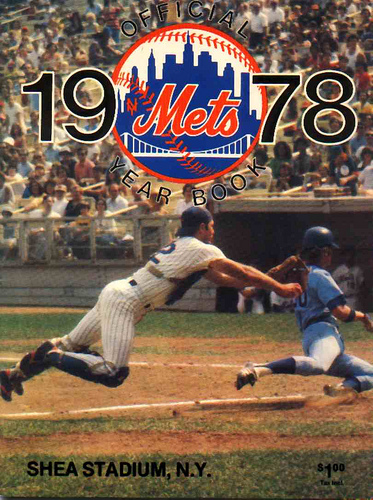
I don’t get to sit anywhere I want and I don’t have access to everything there is, but otherwise I’ve been a first-class passenger at Citi Field for the past ten games I’ve attended. When it comes to baseball, I get just about anything I could possibly want. • If I want a personal-best ten-game winning streak, I get that. I got that Tuesday night. I’m three games beyond my previous high and four over anything I ever achieved at Shea. • If I want the Mets to score more runs than they ever have in a game I’ve attended, I get that. Three times — 1995 vs. the Rockies, 2000 vs. the Diamondbacks and 2008 vs. the Nationals — the home team at Shea put a big 13 on the board. Tuesday night, there were 14 scored on my behalf. • If I want the biggest Met half-inning I’ve ever witnessed, I get that. As best as I can tell, my previous high came in the seven-run bottom of the eighth of the 2007 Home Opener. That mark became the old mark in the bottom of the third on June 22, 2010…which also had to be the longest half-inning of all time, considering it was well underway when a 58-minute rain delay interrupted it. But you’ll wait through a little (or a lot of) rain when it means the Mets will return in an hour and bat around after a run had scored and runners stood on second and third. [Ed. Note: In the euphoria of Tuesday night, I somehow forgot I was on hand for a not altogether unmemorable TEN-RUN INNING on June 30, 2000, something I’ve written about extensively and rank as one of the TEN GREATEST GAMES I ever attended. So while the Mets scoring eight runs in the third was wonderful, it was not a personal record.] It was that kind of night in this kind of season. It’s been an unbelievable stretch for The Log II, which has known the kind of success its predecessor could only have dreamed of and little of the frustration that marked The Log’s developmental years. It’s not just the ten consecutive W’s that have made 2010 at Citi Field A+ territory. Just about every one of those wins has come from a game you can identify by shorthand, the kind of game I have a hunch the eternally aware Mets fan will understand a year or five from now: Ike Davis’s debut; Ike Davis’s first home run; the Sunday night when it rained so much that they had to call it in the sixth and offered ticketholders an exchange for one of six games in June… Hey, that became this game! I was some nice person’s guest on April 25 and was ready to return my ticket his way so he could make the exchange but I was told, no, you go ahead and take both. The choices were San Diego and Detroit. For novelty’s sake, I went with the Tigers (American idiocy objections notwithstanding). I chose the Tuesday game because Stephanie is off Tuesdays, which means I don’t have to worry about not picking her up at the station because I’ve already taken off for Mets-Willets Point. Funny thing is the tickets I exchanged from April, which were perfectly lovely Left Field Reserved seats, received a makeover in the mail and became brilliant Caesars Club seats, a few rows in front of the press box, a couple of sections to the third base side of home. When I mentioned this to Stephanie, she basically invited herself to join me…which is something I’ve been waiting for her to do for 23 or so years. The lure of the Logezzanine level is so strong that it transcended her longstanding aversion to being out past her bedtime on a work night She even arranged to go in a little later this morning because she wanted to see the Mets last night! It’s been that kind of season at Citi Field for me. It would have been a pity to break a historic winning streak Tuesday, so the pity was held in abeyance. It would have been a pity to have tossed out a 3-0 lead on account of rain, so the rain, rain went away. It would have been a pity to have left those runners from the third on second and third, so the Mets brought them and a whole bunch more like them across the plate once the basepaths dried. No pity at Citi for us. When precipitation occurs, I will readily admit the new joint kicks the ass of Beloved Shea, where not being drenched and not being crushed were mutually exclusive options. This was the first full-fledged rain delay I’d hung in for as a normal person, so to speak, at Citi Field. There was an endless delay the second-to-last game of last season, but I was part of the Gary, Keith and Ron event, and we were in the Bullpen Plaza/Citi Field Basement for the duration (plus, overcome by melancholy, I bolted before the tarp was removed). I didn’t wait out any of the Sunday night delay in April because by the looks of things, it was going to be a called game as soon as it could be (and it was). Tuesday night, we put in our 58 minutes mainly by moving about. The Caesars level, particularly its club, was a little too busy to allow unfettered standing around. We tried our luck on Field Level, ducking into World’s Fare for a Mama’s cupcake and then seeking out a spot to split it in semi-solitude. After bulldozing through a Shea-ish pedestrian traffic slog, we settled along what I guess you could call the Rotunda Terrace, above Mr. Robinson’s grand staircase, leaning against a brick pillar and trading bites of our mint chocolate chip delight. It was surprisingly uncrowded considering the Rotunda is supposed to be the central gathering spot for Mets fans. Maybe it had been earlier. The only truly sour note of the delay was when we decided to go to the main team store via the Museum. The thrill that there’s an actual Hall of Fame at the Mets’ ballpark has yet to dissipate but I’ve been in there four or five times, so I’m no longer in the wide-eyed gawking phase when I visit. I just wanted to take a quick glimpse to see if anything had changed since it opened (it hasn’t), which made the appearance of a partition between us and the door a little annoying when we attempted to enter. The annoyance factor ratcheted up when the burgundy-shirted guard told us we’d have to wait for the “crowd” to thin out before he could let us in. “What crowd?” I asked incredulously (which is usually how one is compelled to ask anything of a Met employee). “There’s no crowd!” There really wasn’t. There were fans to be seen through the glass, and I’m glad there were, but no fire marshal was going to have to be summoned. A couple of dozen people milling ain’t no crowd. Perhaps sensing my growing unease, the guard volunteered that the game would restart at 9:10 PM. That defused the brief but palpable sense of tension. “You didn’t come to the game to look at this,” he said of the museum. “You came for the game.” Interesting sales tack. But it worked. We browsed the Hall and the store, met a swell FAFIF reader (but aren’t they all?) and were back in our seats for the rest of the third somewhere between Barajas being hit and Francoeur being hit. That was the last hitting any Tiger would be doing for many minutes. Once the Mets are up 10-0, you know what I’m thinking? Besides “let’s not get overconfident here”? I’m thinking that if this isn’t blown, and I’m up to ten in a row, have the Mets used up all their immediate runs in advance of tomorrow when I’m due back here? Will the streak, only nine until this thing is an official ballgame, be stranded at ten because tonight was so delicious and I got greedy wanting more runs, more everything? That’s the Mets fan mindset at work. That’s the experience of a man with a Log whose first page reflects 18 losses in 25 games between 1973 and 1982 and whose lifetime Shea record right up until that first 13-run outburst against Colorado on July 14, 1995, wallowed at a soggy 38-51. I’ve been on a fifteen-year roll ever since (227-147, encompassing all Shea, Citi and postseason that have counted), but I’ve never shaken the feeling that it can all end at any given second. It’s why I take no win for granted and why I continue to take my single 2010 loss — effing Willie Harris — rock-hard even if its memory should have been obliterated by now. I have seen so much this year. I have seen the Mets sweep the first single-admission doubleheader in Citi Field history. I have seen the Mets celebrate their first extra-inning, walkoff home run. I have seen the Mets turn a 6-2 deficit in the middle of the eighth into an 8-6 triumph by the top of the ninth. I have seen a Goose Egg Sweep begin to take shape, a one-hitter trump a triple play, Angel Pagan bid for a cycle, Jose Reyes return from purgatory, Ike Davis land on his head, and some strangers from Detroit pound the baseball for two innings to no avail because when it got to 11-6 last night and it began to feel a little too close for comfort, the Mets stuffed an extra three runs in their already formidable cushion and shooed the Tigers off the furniture for the balance of the evening. I have now seen 14 runs scored by the Mets against the Tigers at Citi Field. In 1997, I saw 14 runs scored against the Mets by the Tigers at Tiger Stadium, the memorable ballpark whose right field grandstand inspired the Pepsi Porch. It sure was good to return the favor and make a grand offensive stand of our own, lack of home team home runs costing us nothing but an apple-rise or two. Fourteen runs. An eight-run inning. Ten consecutive wins. Sweet potato fries in the Caesars Club before the game. Kevin James gleefully throwing out the first pitch and not wearing an “I NOW PRONOUNCE YOU CHUCK AND LARRY” cap. Tom Seaver materializing in the fourth when our former Marine joined another former Marine during the always beautiful Veteran of the Game salute (we got a good look at Tom, but not as good as some people got). Rain that fell hard but ceased soon enough. As fine a Tuesday night as one could order if one could order Tuesday nights custom-made. Wednesday night will be Promenade, much further from the press box, which is where an even bigger celebrity Mets fan than James, Jerry Seinfeld, will be special-guest analyzing alongside Keith Hernandez and Gary Cohen. We’ll get foam fingers and exhortations to vote David Wright onto the All-Star team and endless sales pitches about the cheap and fantastic tickets we can purchase via mets.com (while “convenience fees” go unmentioned) and another drive-by Tigers sighting. Stephanie’s 5-0 lifetime Citi Field record will be safe as she’ll be sitting this one out. My personal-best ten-game winning streak, however, will be squarely on the line. But that’s OK, because that’s exactly where a winning streak belongs.  10 comments - (Comments closed) | | 10 comments - (Comments closed) | |  Print This Post | Print This Post |  2010 Mets, Citi Field, Jerry Seinfeld, Records, Tigers, Winning Streaks 2010 Mets, Citi Field, Jerry Seinfeld, Records, Tigers, Winning Streaks I’ve been dying to see the Mets play the Tigers in Flushing since a little before 8:00 PM on Saturday, October 14, 2006. Magglio Ordoñez had just hit a three-run homer to clinch a four-game sweep of the American League Championship Series in Detroit. We were minutes from commencing Game Three of the NLCS in St. Louis, Steve Trachsel vs. some pitcher who didn’t let down his team the way Steve Trachsel let down the Mets at the one moment in his six endless years as a Met when he was really needed. The Mets would soon be behind 2-1 in their showdown for all the National League marbles and the next four games precluded all thoughts of Detroit. Those nights would instead be devoted to the Mets scuffling to tie the Cardinals, which they did twice, and pass them, which they never did. After seven games, the 2006 Tigers became somebody else’s opponent in the World Series. Somebody else’s victim, to be accurate. It wasn’t too much of a stretch, after the Cardinals had edged out the Mets for the pennant and went on to roll through that Fall Classic, to imagine the Mets would have done essentially the same thing. If Trachsel or Beltran or whomever you like to blame on a given day had come through a little more/at all, tonight would be not just a reasonably attractive Interleague matchup. It would be a most pleasant reminder of how we participated in and presumably won the 2006 World Series. But it’s not that. It’s just a reasonably attractive Interleague matchup, about as attractive as one of these idiotic manufactured contests can be. I’ve been dying to see the Mets play the Tigers in Flushing for nearly four years, yes, but not in June 2010. I’ve been dying to see the Mets play the Tigers in October 2006. That ship having long ago sailed doesn’t change that stubborn desire. I have nothing against the Tigers until 7:10 PM and will have nothing against them once they pack their striped baggage and leave town. I had nothing against the Orioles or Indians last week, either. For three days, however, I had my game face on and wished them concentrated doses of ill. Come Friday, I’ll hope we can make life miserable for the Twins in triplicate. By Monday, they can go back to being one big happy family. I don’t care about the Twins or the Indians or the Orioles or the Tigers save for the rare Octobers when they are our actual or prospective opponents. It’s odd that I am compelled to feign caring about them this month. I’ll be out at Citi Field tonight caring deeply that the Tigers endure a bad series of baseball games. I’ll do the same tomorrow night. I like going to see the Mets, no matter who they’re playing. The opponent is rarely the attraction, but there’s usually a reassuring zero-sum gain to the scheduling. If the Mets are playing a National League team, it’s good if we win and it’s good if that other squad loses. The win and the loss make sense together. It could conceivably equal the difference between the Mets capturing a playoff spot and sitting home watching others compete (conceivably). A Met win will always be fine. A Tiger loss means not a darn thing to me. Fourteen seasons of Interleague play, counting what we’ve already seen and what lies ahead, and it still doesn’t add up. Interleague play in October 2006…that would have made all the sense in the World. I’d take it in October 2010, too. The Tigers are having a pretty good year. Maybe we can use the next three nights for scouting purposes. You never know. I thought I knew in October 2006. I didn’t. *** 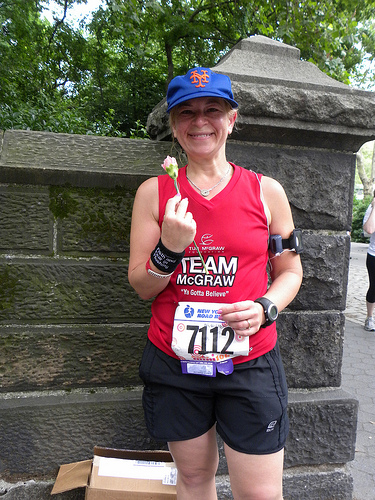 Sharon Chapman and the FAFIF wristband after her most recent NYC Marathon tuneup, the New York Mini 10K in Central Park. Thanks to all those who participated in our Make a Donation/Get a Book promotion earlier this month. Your great response helped push Sharon Chapman’s New York City Marathon run for the Tug McGraw Foundation significantly closer to its fundraising goal. All books have been signed and sent out, and I hope you enjoy yours if you were kind and generous enough to take part. Learn more about Sharon’s efforts with Team McGraw here. Contribute to the cause if you can here. And if you’re interested in reading the paperback edition of Faith and Fear in Flushing: An Intense Personal History of the New York Mets, well gosh, by all means check it out here or here. 10 comments - (Comments closed) | | Print This Post | 2006 Mets, 2006 NLCS, Faith and Fear Book, Interleague Play, Nagging Regret, Sharon Chapman's Marathon Run, Steve Trachsel, Tigers, Tug McGraw You know what they say about taking lemons and making lemonade? Or whatever it is chickens leave behind and turning it into chicken salad? Well, I’m guessing you’ll know exactly what that’s all about tonight at 6:30 when SNY debuts Mets Yearbook: 1978, wherein a two-game improvement from 1977’s 64-98 disaster will likely be hailed as earthshaking progress, and Willie Montañez’s prancing around the bases will be framed as more entertaining than Grease, Animal House and The Eyes of Laura Mars combined. I haven’t seen the ’78 highlight film since ’79, but if I’m not mistaken, the San Diego Chicken’s visit to Shea is featured prominently. Chicken salad all around! If you can’t scoop up your serving tonight, set your contraptions to record it Tuesday afternoon at 1:00. By the way, 1978 was also the year the phrase “drink the Kool-Aid” came to be. I mention that because I believed the 66-96 Mets were indeed an avatar of earthshaking progress, at least for the first couple of months of that eventually depressing season. Kool-Aid, lemonade…when you’re 15 years old and the Mets are flirting with .500 on Memorial Day, you’ll drink anything and swear it’s refreshing. Image courtesy of “Mario Mendoza…HOF lock” at Baseball-Fever. Not so long ago, the Mets losing two in a row was something that happened at least twice a week, and three times if the week were particularly unlucky. Now, it’s vaguely shocking. Waitaminute, we lost? But we’re great! We didn’t come back? Our starting pitching wasn’t dominant? Everything didn’t turn out OK? In truth, Johan Santana wasn’t bad — though there are more disturbing signs at the margins of his aura. Take, for instance, his declining ability to put hitters away after recording two strikes, as discussed by Mark Simon of ESPN New York. The Yankees’ four-run third inning didn’t exactly feature a barrage of hits: There was a clean single, an infield hit, a bunt the defense turned into a baserunner, and then Mark Teixeira’s drive bouncing atop the outfield wall just above Jason Bay’s glove and vanishing into the stands for a grand slam. Yet, for all that, there’s the definite feeling that Santana has descended Mount Olympus to take up residence in its loftier foothills. The fastball is not what it was, the change-up’s location has decayed in reliability, and that makes him a different pitcher. A very good pitcher, make no mistake, but not the same pitcher. Such is the road every power pitcher must travel, and Johan’s smarts and will argue that he will make the transition just fine. But such changes aren’t immediate. This process will take more trial and error, and we have to live with that — and admit that it’s not sacrilege to ask whether the ace of the Mets’ staff, the guy you’d want in that happily imaginary one game to determine the fate of the world, might now be not Johan Santana but Mike Pelfrey. Anyway, Mark Teixeira hit a grand slam, the Mets did absolutely nothing against C. C. Sabathia, and 2010’s Subway Series ended in a 3-3 draw. Thank God that’s over, and we can get back to … oh, fuck, more interleague play. Time for the Mets to renew their savage, age-old rivalry with the Detroit Tigers and Minnesota Twins! Sigh. On the bright side, the Mets did finally send Jenrry Mejia down to Binghamton so he can do what he should have started doing at the end of March — namely, put more notches in his belt as a starter. All praise to the Mets for finally maximizing the value of their full roster or at least getting close to that goal; continued pointed questions about why it took the Mets until nearly the summer solstice to get right what no shortage of observers had been suggesting since the equinox. Sticking with the bright side, the Brooklyn Cyclones took two out of three from the Staten Island Yankees to kick off their 10th campaign and Wally Backman’s return to the managerial ranks. Emily and Joshua and I were in attendance last night, having watched Joshua’s Little League team lose its season finale and the Mets lose their game to the Yankees. Happily, the Cyclones broke the streak, beating the Yankees with help from approximately 12,000 Yankee errors. Less happily, the newly christened MCU Park was a mess in a way we’ve never seen it in 10 years of taking in Cyclones games: Numerous concession stands ran out of hot dogs in the early innings and nearly everything else by the end, communication was nonexistent, and the team couldn’t even manage the t-shirt toss the first time around. Going to the Cyclones is such a reliable joy of summer that one is left devoutly insisting this was Opening Night jitters, or the stress of a record crowd — nearly 10,000 filled the park Saturday night. Here’s hoping. 6 comments - (Comments closed) | | Print This Post | Brooklyn Cyclones, Jenrry Mejia, Johan Santana, Omar Minaya, Subway Series, Yankees If I were a baseball player on a baseball team that had just won eight in a row and twelve of thirteen, I’d want that feeling to last forever. In fact, I’d make it last as long as I could by not swinging at the very first pitch I saw in a game that could conceivably extend my team’s winning ways to nine in a row and thirteen of fourteen. But I’m not a baseball player. David Wright is. Jason Bay is. They’re both highly decorated baseball players, each generously compensated, both considered outstanding. So they probably have their reasons for SWINGING AT THE FIRST PITCH THEY SAW from Phil Hughes in the crucial sixth inning of the Saturday matinee that pulled the rug out from under what have been unmitigated good times. I’ve never faced Phil Hughes. It probably looks different from the vantage point of the batter’s box than it does through the center field camera on my nice, comfy couch. And first pitches don’t necessarily equal take. Angel Pagan turned a first pitch from Joba Chamberlain into a ringing double in the eighth. Yet I can’t understand why Wright — directly after Hughes lost a ten-pitch battle on a single to Pagan — and Bay — following a six-pitch walk to Ike Davis that included a wild pitch that let Pagan dash to second — each swung at the very first pitch a pitcher conceivably on the ropes delivered. Could those first pitches have been the pitches Wright and Bay could have driven? Anything’s possible, but a lifetime of watching baseball (exclusively from comfy couches and the like) tells me you don’t help a pitcher out, certainly not a good pitcher who may be having his moment of letdown. Make Hughes get you out would have been my advice to David Wright, just as “Make Wright #1” is the Mets’ advice to us. We’re Gaga For Wright even without the Wright Finger, but I have a sense that All-Star starter or not, David is re-entering one of his dark forests. His double play grounder Friday night in the ninth, leaving Manuel in the Valdes/K-Rod lurch, was a bad sign. The first-pitch popup to Cano in the sixth today was a worse sign. David can have an off-ish day or two, but I haven’t liked his approach lately (says the couch coach). Bay? Jesus, he’s been quite ungood, hasn’t he? There is so much to like about his approach in the field — where he’s a far better defender than advertised — and down the line, where he never not runs out a ball — but boy is he lost at the plate. Reaching at that outside pitch from Hughes with two on and one out and a genuine chance to do damage…worst at-bat of the year by any Met. Bay taps it to Kevin Russo, it’s an easy 5-4-3 DP, hustle or not, and that was basically it for the day and the streak. Earlier, Jeff Francouer had flied out on a first pitch. Big deal, he’s Jeff Francouer. Later, Alex Cora flied out on a first pitch. Same deal, he’s Alex Cora. I’ve come to expect more thoughtful plate appearances by Wright and Bay. We didn’t get them, which is why we are temporarily grounded after sitting on a cloud most of the past two weeks. Darn. Mike Pelfrey wasn’t overly comfortable and it showed. But he gave us the Art Howe special and battled. Jose Reyes wasn’t overly popular in the Bronx — if you boo Jose Reyes, you’re booing happiness — and that was all to the good. Alas, Reyes’s two homers equaled our entire offensive output. Maybe this was one of those mythical “not gonna win” games, but I didn’t think it was. We had a legit shot in the sixth. We had Hughes back on his toes. He withstood the assault. Wright and Bay made it easier for him. That’s baseball sometimes. Not going 9-0 overall, 8-0 on a road trip and 13-1 and 20-5 is a problem I wasn’t anticipating a month or so ago. The Mets have been playing so exceptionally well that I’ve come to think their winning isn’t all that exceptional. I’m moving into taking it as the norm territory. The new normal may need some work as might our expectations. That, too, is baseball. In the meantime, winning twelve of thirteen between June 4 and June 18 represents the second time in 2010 that the Mets have put up at least a 10-1 stretch and the 39th time in franchise history they’ve gone at least 9-1. They’ve never posted a losing record in a season when they’ve done it twice. Not posting a losing record this year would have struck me as a fine goal not long ago. This evening, even after a tough loss, I want and almost expect more than that. I want and almost expect more extended winning ways. I want the Mets to pass the Braves. I want the Mets to keep this marvelous thing of theirs going. I want to expect it. First place, not first pitch. Try to keep that straight, fellas. 3 comments - (Comments closed) | | Print This Post | David Wright, Jason Bay, Jose Reyes, Phil Hughes, Team History, Winning Streaks The Mets couldn’t win on the road. Then they couldn’t win on the road unless they were playing the dregs of the junior circuit. Then … then shut up already. Up in the Bronx (technically a road game) the Mets played with confidence and swagger and every other intangible you might want to believe in. And if your taste runs to the more quantifiable, they got superb pitching, sharp defense and just enough hitting to win a 4-0 game that might have felt a lot closer than the final score, but goes down on the happy side of the ledger. Before moving to a recitation of kudos and hosannas, let’s stop to enjoy the work of Hisanori Takahashi. Early in the game, I was trying to teach Joshua about the strategy of pitching, how you have to change speeds and eye levels and make hitters move their feet. It’s a new concept for the kid, not so much because he’s seven but because he’s still at the stage of Little League in which coaches pitch, meaning he’s never faced a pitcher who’s trying to get him out. (He looked mildly distressed but mostly intrigued by the news that hitters sometimes peek at where the catcher’s setting up, it’s not formally against the rules, but it will get you hit in the back by a fastball.) Unfortunately, Joshua was in bed by the fifth inning, so he missed a rather nifty pitching clinic in miniature: Vs. the Wily Veteran Jorge Posada
Vs. the Effortlessly Annoying Francisco Cervelli
Vs. the Young and Overeager Chad Huffman
Vs. the More-Dangerous-Than-I-Remember-He-Is Brett Gardner
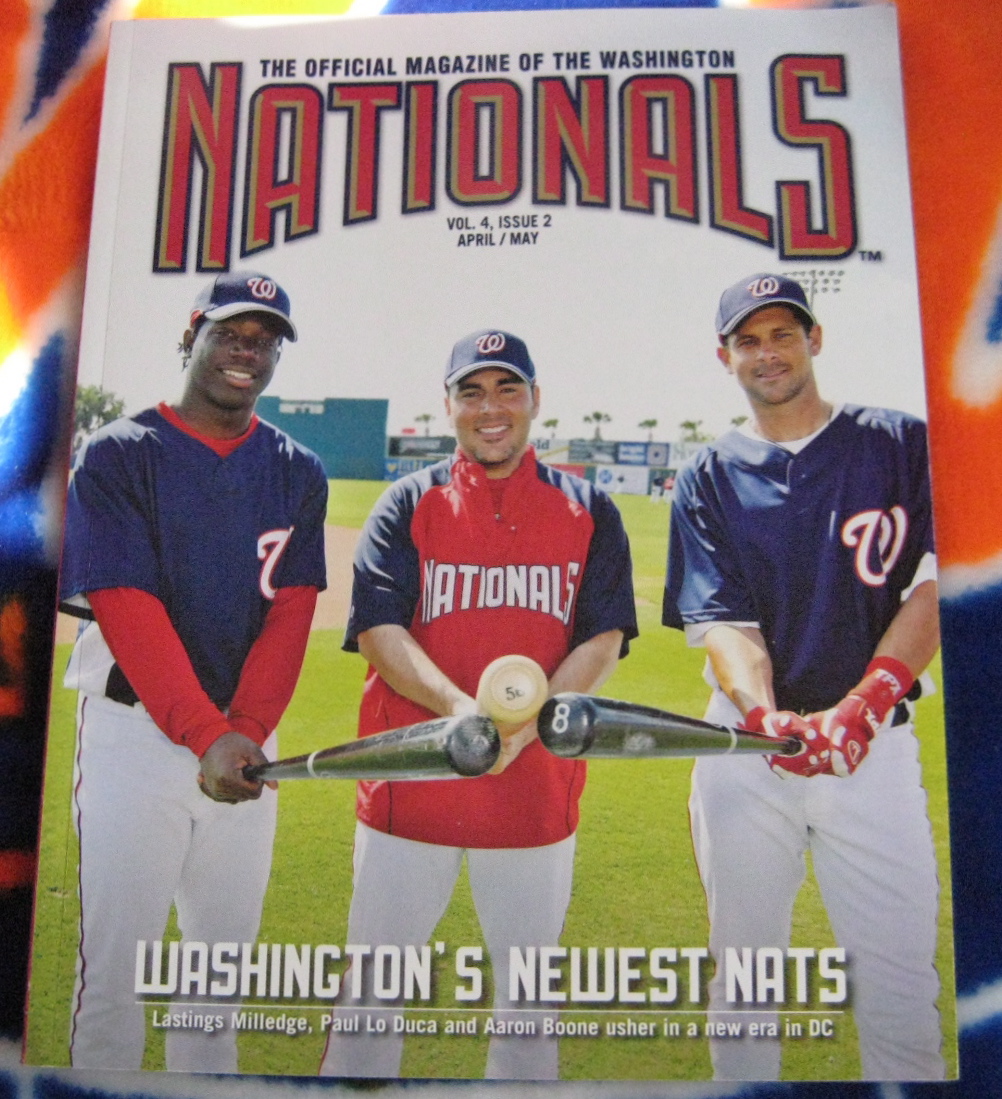
Not a perfect inning, but a smart one. In and out, up and down, fast and slow, knees locking and turning to jelly. Very nice to see. Takahashi wasn’t the only Met deserving laurels, though. How about David Wright’s do-or-die, bare-handed grab of that Baltimore chop by Posada in the sixth with the bases loaded and two out? That ball seemed like it would hang in the air forever, but Wright snatched it cleanly, remembered an old catcher was running, and gave Ike Davis a good throw to escape disaster. Speaking of which, how about Wright’s nifty hook slide and passing graze of the pointy end of home plate in the first, which had the added benefit of making Cervelli mad? How about Pedro Feliciano’s yeoman work in the seventh and eighth? I cringe when Feliciano is left in for righties to get an extended look at his sliders, but he was marvelous tonight, with the highlight watching Alex Rodriguez glumly head for the dugout even before Mike Reilly raised his hand on a called strike three. (Though honestly, who else did you want to see to face the righties? Igarashi? Nieve? My answer would be “whomever finally replaces Jenrry Mejia,” but that answer’s not admissible just yet.) How about Jose Reyes bunting badly enough that Jerry Manuel was forced to discard a bad idea, allowing Jose Jose Jose to rip a double into the corner and nearly tear his own arms off with wild-eyed applause at second? (Cervelli is annoying, Reyes is naturally exuberant, and my judgments are refreshingly disinterested and unbiased.) How about Angel Pagan, whose reputation for dopiness ought to be long since replaced by his reputation for being money in the clutch? How about K-Rod, scaring the crap out of us as usual before wriggling past Derek Jeter and Nick Swisher? How about the baseball gods, for once again asking a Met to stagger beneath a drifting 27th out, but deciding that scenario was too awful to trot out twice? How about the Brooklyn Cyclones, for kicking off their season and Wally Backman’s return with a 5-3 win over the larval Yankees on Staten Island? How about all the Mets fans who got to celebrate in enemy territory? How about 14 hours of bliss before the roller coaster hits the top of the hill again? How about those Mets, anyway? 12 comments - (Comments closed) | | Print This Post | David Wright, Francisco Cervelli, Hisanori Takahashi, Jose Reyes, Pedro Feliciano, Subway Series, Yankees MATCHUP: Us at Them, 7:05 PM Friday; 1:05 PM Saturday; 1:05 PM Sunday. KEYS TO THE SERIES: Fuck Them. Let’s Go Mets. Not necessarily in that order. Welcome to Flashback Friday: Take Me Out to 34 Ballparks, a celebration, critique and countdown of every major league ballpark one baseball fan has been fortunate enough to visit in a lifetime of going to ballgames. BALLPARK: Nationals Park Nationals Park struck me as a reasonably attractive, small-scale, low-key, modest success when I visited it in its infancy two years ago, less kitschy than Cincinnati’s entrant among the postmodern ballpark set, not as intriguing as some other 21st century structures I’ve seen. Perhaps the best thing about being at a game there was not having to watch a game from there on TV, as the camera angles they give the visiting broadcast crew are laughably dizzying. I was on the field level and I saw pretty well, save for any time anybody stood up. As it happened, I wasn’t looking that closely at the Mets playing the Nats that night. I was looking ahead to what it would be like sitting in a new park of my own a year down the road. Citi Field was bearing down on Shea Stadium in April 2008 and I was increasingly uncomfortable about what the future held for me. I tried to take a few cues from Nationals Park, which could only tell me so much about an entirely different place yet might tell me something. I was surprised how much it told me at that moment of arrival on April 3, 2009, when I came up the First Base escalator for the Mets-Red Sox exhibition, stared out at the field from behind the first section of seats I encountered in deep right and thought, “Geez, this is just like Philadelphia and Washington.” That was probably the last time the desperately needed successor to RFK Stadium re-entered my consciousness except for when I’m trying to watch a telecast from there, and then I’m mostly concerned about not contracting video vertigo. I try to avoid coming into Citi from first or third most of the time. It keeps me from thinking I’m perpetually attending an away game. But I was attending an away game in D.C., and I filed a detailed report soon after. It is offered below. *** An out-of-town tryout used to be a staple of the theater. It was where producers ran their musicals up the flagpole to see what was saluted and what sagged in the breeze before fixing up the rough patches, packing up the trunks and transporting the whole shooting match to the Great White Way. Like those barnstorming tours that wound their way from Spring Training north to Opening Day, you don’t get out-of-town tryouts much in the theater anymore. The audiences for these Broadway-bound previews were generally in the Northeast, not far from New York, yet worlds away: Philly, Boston, Baltimo’, as the itinerary went in Kiss Me Kate. New Haven, too. Washington? Not so much as far as I know. Yet last week, I felt I was privy to a dry run of sorts: Another ballpark op’nin’, another show — one season before the spotlight will be beamed directly onto the Great Blue & Orange Way. Of course I wanted to go to Nationals Park because it was there. Every Major League ballpark I’ve seen (and I’ve seen 32 now) is Everest to me. And of course I wanted to go because the Mets would be playing. But there was a little extra curiosity factored into my D.C. travel plans. The Nats would be playing their eighth home game ever in their new digs. Though I’d been to a few stadia in their first season, I’d never shown up this early in the life of a park. Thus, I wanted to get a sense, just under one year from the curtain rising on Citi Field, what an almost pristine ballpark feels like. It feels pretty good, in its out-of-town way. Ya gotta load up any assessment you make of a ballpark as a visiting fan with a suitcase of asterisks. It’s different for you because you’re there tonight and you’re leaving tomorrow. Even if you plan on returning, it’s not home, not yours. Even if the place has still got that new park smell, yours aren’t the nostrils that are unclogged after breathing in the stale air of its predecessor. The diehard Washington Nationals fan, however rare and relatively novice, is the one who just escaped from RFK. It may take that creature months to detect any drawbacks in anything that isn’t the Federal Baseball Penitentiary. Nationals Park offers much nicer surroundings. The now-reabandoned RFKFBp was any port in a storm for the post-Expos. It was the Hooverville of the National League East. It was Olympic Stadium without the élan. Anything that succeeded RFK — with the possible exception of the Days Inn where I bunked for the night — would have been an improvement. It was instructive to wander the concourses of Nationals Park, to gaze at the shiny seats and scoreboard, to try to figure out why they put stuff where they did and wonder what it will be like next year when it’s us getting the lay of our own land. With Citi Field far along, I don’t know that the Mets are looking for cues from their divisional rival. They could do worse than to borrow generously from their DiamondVision or NationalVision or whatever it’s called. It’s huge and it’s clear. They could also note what the Nats missed, like a permanent tracker of what the batter did in his last at-bat(s). With so much high-def hardware at work, there should be relevant data always at the ready, not just Marlon Anderson’s height. My friend Jeff and I sat in some very fine what we’ll call field level seats in short left last Wednesday night, pretty comparable to where I was eight nights earlier at Shea. There is definitely something to be said for seats that are tilted toward home plate. There is also something to be said for sloping the steps in such a way that once somebody stands up in your midst (to buy a hot dog, to sell a beer, to mindlessly stare), you the seated are not blocked from the action. Mild-mannered Jeff rightly morphed into a bear as backs and shoulders and heads kept us from seeing a damn thing. Given the genuine obstacle to line of sight this non-action represented, I’m guessing getting up constantly is a cherished local tradition. New rule: If you have a rookie pitcher setting the world on figurative fire [ed. note: nope, I didn’t foresee the emergence of Stephen Strasburg two years hence], stand and clap. If it’s the third inning and nothing’s going on but a 2-1 count, sit the fudge down. Perhaps the “tennis seating” decorum I’ve seen employed in other places (even Philadelphia), where you are momentarily kept from returning to your seat while baseball is in progress, should be de rigueur. Given the price of a ticket, you should be entitled to see as much of it as you (or Jeff) paid for. Not that Nationals fans, even the one who lobbed a snide junkball about the high Met payroll (which explained why we won, according to him), struck me as rude. I’m not sure I saw a whole lot of Nationals fans, at least relative to the ton of outlanders who descended on Washington last week. If there is one tradition that trailed the Expos to their final resting spot, it was that we, as in the Metropolitan we, were everywhere. No tension because of the crowd composition, at least not from where I sat and craned. No booing of Mets by Mets fans for a change (we’re all in this together when we congregate elsewhere). No escalating drunken bravado on a Wednesday night à la what reports suggest has become the norm in certain slices of Citizens Bank. The Nats didn’t come close to selling out their eighth game ever in their new park and that was with a generous helping of us on board. As some have been known to suggest in the seat of government regarding other invasions, they should be greeting Mets fans with flowers and chocolates. If they did, however, would they know where to find them? While Nationals Park did give lie to half of the old bromide that Washington is a city of southern efficiency and northern charm (I liked the line of golf-shirted greeters who profusely thanked us for coming), it doesn’t appear that all the kinks have been ironed out. Concessions still seemed a bit overwhelmed, even without an SRO audience. The dreaded taking of the bottlecap, which I thought was a Shea-only pre-emptive punishment, was exercised at one stand, but not at another. Uncertainty of how to work all the levers extended to more visible facets of the operation as well. When Duaner Sanchez entered the game, the massive scoreboard identified him as UNKNOWN. Innings earlier, Angel Pagan, No. 16 on the Mets, was billed as Jay Payton, No. 16 on the Orioles — there was even a picture of our 2000 centerfielder in his Bird garb to complete the illusion that the Mets might win a pennant this year. (Payton was in the system, Jeff inferred, because the Nats played the O’s in an exhibition game, one of those dress rehearsals intended to, yup, iron the kinks out before the ballgames count.) Anybody could make if not those mistakes then something like them. Shea was several decades old when its board ops declared Jason Phillips’ first Major League hit belonged to Vance Wilson. It was even older when it randomly assigned Pedro Martinez’s 3,000th strikeout a year ahead of time and to nobody in particular. At Shea, it’s quirky. At a brand new facility, it’s time for another run-through. For Citi Field, it’s a cautionary tale to really think through everything (like where to not mount a mile-high home plate camera), really test everything and really teach everybody how to use everything. It’s perverse fun to nitpick — even Natpick — but there was a lot to like about the new place. It’s easy as hell to get to by Metro, which, in turn, is always easy as hell to navigate. Nationals Park is one block from the Navy Yard station which is already more efficiently coordinated after a game than the 44-year-old Willets Point-Shea Stadium stop. There are nice if not expansive nods to Washington baseball history around the main concourse and, let’s face it, there’s not all that much Washington baseball history to show off. The Nats even tip their caps to greats of the game from other cities (perhaps they understand much of their trade will come from elsewhere). Though you have to be pretty high up to notice the Capitol dome and such, the cherry blossoms planted above the outfield are a phenomenal District touch. Balls don’t seem to fly out of this joint any more than they did RFK, so the saplings are probably safe from falling objects. The Nats skipped the bricks and the overwrought homages to a mythic baseball past. The clean, well-lighted, modern approach was refreshing even if red brick can serve as an effective Pavlovian cue to get fields-of-dreamy about one’s surroundings. You don’t always, however, need to be enveloped by a manufactured past. That said, there was something about Nationals Park that made it feel — and this isn’t intended to come out as derisive as it will — like a very nice and very large Grapefruit League park. It wasn’t sterile as much as not yet defined, not yet lived in. Maybe after eight games, it’s not supposed to be. Nationals Park may not be the coziest bed & breakfast of ballparks, but it’s at least a reasonably functional Marriott. It’s very much worth a visit (though you should probably ante up for a reasonably functional Marriott if you’re staying over and eschew the Days Inn of Silver Spring, Md.; trust me on this one). The Mets will be back in August if it’s the Mets you want to see. I’d suggest seeing it before they sell the naming rights because, honestly, the best part of this particular ballpark relative to those I’ve visited in the past half-decade or so was the lack of a suffocating corporate presence. No kidding. I realized as I loped about before the game how nice it was to not be reminded every six feet that some great financial institution or fine American brewer was bringing me this baseball game. That may sound like projected carping over World Class Citi Field, and maybe it is a little, but the way I noticed there was no corporation sponsoring everything is the way I used to notice when there was one. Know what I mean? It used to be strange to see a company name plastered all over the place. Now we accept it as a part of doing business like we accept so much of everything in this world. For a night, corporate naming rights weren’t a fact of ballpark life and it was a surprisingly welcome sight to not see. As for trying to discern, pesky aesthetics aside, what our nights and days will be like as we edge closer to our new stage, you cross your fingers and you hold your heart that it will be worth the hype and worth the wait and worth the sacrifice of what many of us adore and are instinctively reluctant to let go. What will it be like when the new ballpark isn’t someone else’s, but ours? Duaner Sanchez’s mysterious D.C. identity notwithstanding, that is the great unknown. |

Piazza: Catcher, Slugger, Icon, Star by Greg Prince is available from Amazon, Barnes & Noble and other online booksellers. 
Amazin' Again: How the 2015 New York Mets Brought the Magic Back to Queens by Greg Prince is available from Amazon, Barnes & Noble and other online booksellers. 
Volume I of The Happiest Recap: 50+ Years of the New York Mets As Told in 500+ Amazin' Wins by Greg Prince is available in print and for Kindle on Amazon. 
Faith and Fear in Flushing: An Intense Personal History by Greg Prince (foreword by Jason Fry), is available from Amazon, Barnes & Noble and other online booksellers. |
|
Copyright © 2026 Faith and Fear in Flushing - All Rights Reserved |
||