The blog for Mets fans
who like to read
ABOUT US

Faith and Fear in Flushing made its debut on Feb. 16, 2005, the brainchild of two longtime friends and lifelong Met fans.
Greg Prince discovered the Mets when he was 6, during the magical summer of 1969. He is a Long Island-based writer, editor and communications consultant. Contact him here.
Jason Fry is a Brooklyn writer whose first memories include his mom leaping up and down cheering for Rusty Staub. Check out his other writing here.
Got something to say? Leave a comment, or email us at faithandfear@gmail.com. (Sorry, but we have no interest in ads, sponsored content or guest posts.)
Need our RSS feed? It's here.
Visit our Facebook page, or drop by the personal pages for Greg and Jason.
Or follow us on Twitter: Here's Greg, and here's Jason.
|
by Greg Prince on 6 June 2010 9:01 pm This would be a good time to be a drive-time disc jockey in medium-sized city with a persecution complex. If I were, I’d be working under the radio name of Resentful in the Morning, and I’d stir up my listeners to join me in a natural disdain for our local baseball team’s archrivals, whom I would cleverly refer to as the Florida Morons. Actually, I would have started on Friday, in anticipation of their weekend visit, announcing the phone number of their hotel. Hey, I’d say, why don’t we give Fredi “GONER”-zalez a jingle and welcome him to our town where we know how to play baseball?
“Here’s the number,” I’d say. “Dial it and give that ol’ GONER a real Resentful wakeup call!”
Then you’d hear my sidekick ring a cowbell and echo my sentiments that “We’re gonna make Fredi a GONER by Sunday!” To punctuate the point, we’d play “Freddie’s Dead” by Curtis Mayfield three times before the next newscast.
Of course Friday night I’d be hosting a Florida Moron Fish Fry in the stadium parking lot. You bring a dead fish and we’ll gut it on the air, because that’s what we’re gonna do to those Florida Morons for the next three games. Every Resentful in the Morning listener wearing a t-shirt with the station logo would then be issued his or very own Resentful in the Morning set of Hanley Wipes because we are going to WIPE THE FLOOR WITH HANLEY RAMIREZ!
It would actually be a roll of toilet paper from Walmart because this is a mid-market station and we don’t have much of a promotional budget, but we make up for the lack of resources with community spirit. Thus, when Hanley Ramirez comes to bat, my sidekick would be sure to remind our Resentful listeners to unspool those limited-edition Hanley Wipes and LET HIM KNOW WHAT WE THINK OF THE BIGGEST MORON OF THEM ALL!
Then we’d blare “Freddie’s Dead” three or four times as we fried more fish.
Come Monday, after we crowed about having swept the Morons, particularly the way they let a big lead get away on Sunday, we’d call that disc jockey in Miami with whom we’d made a big bet on Friday. He has to send us a hundred coconuts, not only because we in our medium-sized city think that’s all they’ve got in Florida but because, as my sidekick likes to say in between ringing his cowbell, MORONS DON’T HAVE NO BRAINS IN THEIR COCONUTS! We’d then laugh hysterically and play “Freddie’s Dead” as we kicked off our WHEN’S FREDI GONNA BE GONE? countdown.
After the traffic report, we’d give our third caller — third because we just won all three games against our archrivals — the honor of joining the Resentful in the Morning team at the biggest post office in town this afternoon as we mail all those fish guts from the Fish Fry to Hanley Ramirez, care of them dang stupid Florida Morons.
Yeah, if I were a drive-time disc jockey in a medium-sized city with a persecution complex, that’s how I’d do it. But since I’m not, I think I’ll accept these three Mets wins over the Marlins with quiet dignity.
by Greg Prince on 6 June 2010 4:02 pm Jeff Francoeur’s three-run home run off the Marlins’ Tim Wood in the seventh inning of today’s game not only tied the score, but it created a three-way tie for the all-time Citi Field slugging lead. That was Frenchy’s seventh ball to have soared above the Citi walls (4 last year, 3 this year), giving him as many there as Daniel Murphy and David Wright.
I previously neglected to mention Francoeur in considering who might soon rank first in this all-important category. A glaring oversight on my part, and boy am I glad I just had reason to look it up.
(Fernando Tatis has 6, but after a pinch-walk, that total’s not getting any higher as of Sunday afternoon.)
by Greg Prince on 6 June 2010 3:29 am Jonathon Niese endured. Ike Davis awoke. David Wright served the main course to one lucky Acela Club patron. The Florida Marlins learned that no one — and I mean no one — comes into our house and pushes us around (hubris not applicable on final days of seasons). And while all this was going on, per Steve Zabriskie as the division was clinched in 1986, a certain inevitabiity became a reality.
What do you think the following names had in common prior to Saturday’s win?
• Mel Ott
• Mickey Mantle
• Duke Snider
• Bernie Williams
• Darryl Strawberry
• Mark Teixeira
• Tim Jordan
• Daniel Murphy
If you said none of the above was going to help the 2010 Mets one little bit (save possibly for some motivational speaking), you’d get partial credit. But there is a more specific answer: each of the aforementioned players stood as the home team home run king of a different New York ballpark that’s been used for major league baseball since 1900.
Stood…or stands? I suppose the present tense is applicable, though in the case of one of these men, he’s suddenly got company.
Did I say suddenly? More like it’s about time!
Did you see that shot David hit? Where it landed, under the Amtrak sign? How it bounced into somebody’s $15 dish of mousse? I made up the last part, but it did rattle around up there among the high rollers (in whose ranks I dined…once). That was as emphatic a Met home run as Citi Field has seen in its eight months of action.
Not that it’s seen very many Met home runs emphatic or otherwise since opening on April 13, 2009. The first Met home run was lined that night to left by Mr. Wright. It figured to be the first of many off David’s bat in the history of the brand new ballpark.
Define many. Your definition probably exceeds what Wright produced last year home or away. David didn’t even lead his team in home runs. Nor did he lead his stadium.
That honor belonged to his teammate, Daniel Murphy, which no doubt surprised everyone, Murphy included. In 2008, the last year of alleged pitcher’s park Shea Stadium, David swatted 33 home runs overall, 21 at Shea. During his two months as a rookie sensation the same season, Daniel homered twice, once at Shea. In the minors two years ago, he hit 13. There was nothing in his background to suggest he would become any ballpark’s all-time home run leader.
There was little to suggest it would happen even in the limited sample provided over the course of six months. Daniel himself waited a while to get on the Citi board, and when he did, it was not clear he actually had. His very first Citi Field home run was the condiment that barely skimmed the infamous white and yellow Subway Sandwich sign on May 27. Four umpires got together, caucused over video and sent up a puff of white smoke to indicate Murph’s home run order was indeed good to go.
Throughout 2009, as sluggers named Sheffield, Delgado and Beltran fell by the wayside and Wright simply stalled, it was left to Murphy to carry the home run load for his team. It was a light load, to be sure. The ’09 Mets hadn’t heard about power to the people, let alone power to any particular field. They hit 95 homers overall (down from 172 in ’08, plummeting to the franchise’s lowest power ebb since 1992), with 49 of them at Citi Field (versus 95 at Shea the year before). On a team that ostensibly featured sluggers whose career tater totals flash impressive numbers like 509, 473, 273 and now 150, it fell to a kid who has 14 lifetime home runs to lead the way.
Daniel Murphy sextupled his 2008 sum in 2009. He hit 12 home runs, the lowest total to lead the Mets since the unplugged power trio of Steve Henderson, John Stearns and John Milner each pounded a dozen to lead the legendarily wretched 1977 Mets. His split was 5 on the road, 7 at home. Fittingly, the last Met home run of 2009 belonged to Daniel, struck the final Friday night of the season, making sure the 2009 Mets would not trail the 1977 Mets in something besides wins and not trading Tom Seaver.
Y’know, I truly loved each of those guys in his time, but I swear only a Mets fan could breathe a sigh of relief that somebody had matched Steve Henderson, John Stearns and John Milner in anything.
I’d been thinking about Daniel Murphy in the past week. There hasn’t been much occasion to do so in 2010. As you know, he was days away from starting the season at first base — tutored by Keith Hernandez and everything — when his right knee took a wrong turn in a Spring Training rundown. There went April and May.
Murph, for all his documented 2009 shortcomings, would have been a damn sight better than Mike Jacobs at first. Of course he also would have been a damn sight worse than Ike Davis, who made us forget Jacobs this year at least as fast as Carlos Delgado made us forget him in 2006. Meanwhile, we more or less collectively forgot about Murphy. Now and then we’d get an update from Injury Land, that spa where the Mets hide their lame and halting for indeterminate periods of time best measured with glaciers (Kelvim Escobar is said to have sent a postcard, but I don’t know if it ever arrived).
Somewhere along the way, probably while we were trying on I LIKE IKE t-shirts, Daniel Murphy recovered from that nasty medial collateral ligament sprain. He played in some Extended Spring Training Games — is there another team on Earth that can extend Spring Training like the Mets? — and, when pronounced fit, transitioned from injured major leaguer to healthy minor leaguer. Murph was handed a plane ticket to Buffalo and a second baseman’s glove. Last year’s first baseman who didn’t homer enough for a corner infielder (even if he homered more than everybody else around him) was going to work on becoming a middle infielder with pretty good pop.
That was until the other night when he turned a double play for Buffalo and absorbed a dirty Syracuse slide to that very same right knee. Some busher named Leonard Davis took Murph out for the season.
What can you say on our erstwhile left fielder/first baseman’s behalf at this point beyond “ouch” and “hope you get better…again”?
Daniel Murphy’s 2008 hinted at promise, which, naturally, led the Mets (and not a few Mets fans) to imagine he’d be a two-strike, line drive machine for the next ten years. He struggled in left field to start 2009, found some solace at first base, but didn’t hit to anybody’s great satisfaction. His world has now fallen apart three times in 2010: the injury in March, Davis getting called up in April and the cheap slide of June. But before Saturday, he still had one thing going for him besides a surfeit of green MURPHY 28 gear presumably priced to move in the Clubhouse Shops — he still had the Citi Field home run record all to himself.
Not to make Daniel Murphy any more miserable than he must be, but it wasn’t exactly to his credit that he gripped it as long as he did. He didn’t play as a Met these past two months, yet that seventh Citi Field home run he launched to right last October 2 had withstood all challenges through this June 4.
“What challenges?” you might be wondering. Gary Sheffield faded into the Flushing mists with 5 Citi Field home runs on his ledger of 509 lifetime. Carlos Delgado is gone, presumably stuck forever on 3 CF HRs out of 473 in a career he still hasn’t officially called quits. Beltran? You mean the latest apparition to reportedly alight amid the fog of Extended Spring Training? Let’s see him extend his Citi Field total of 3 home runs (273 total) before we believe it will ever happen. The only Met who was really pushing Murphy’s record of 7 at Citi of late was Rod Barajas, who has struck 5 of his team-leading 11 at home.
David Wright? If every day were Opening Day, he’d be The Thing That Ate Citi Field. He hit that home run against the Padres to kick off 2009. He hit another in the first home game of 2010 versus the Marlins. In between, he smacked a grand total of 4. After Opening Day this year and before Saturday afternoon, he hit zero. Did plenty of homering on the road, but dimensions and walls and goodness knows what else continued to hold him back at the place where’s he’s at least as big as life, if not bigger.
That was until the third inning, against Nate Robertson, when no wall, no dimension, no pressure, no beaning, no nothing could hold David Wright back. Finally, his second home-cooked home run of the year, his seventh ever in the still reasonably new ballpark (and his 150th overall).
David Wright has tied Daniel Murphy for most career home runs at Citi Field. Y’know, I truly hope Murph heals and finds a place to play somewhere in this sport, but I swear only a Mets fan could breathe a sigh of relief that somebody had matched Daniel Murphy in anything.
David could take the lead at anytime now. Or Rodney Allen Rip ’Em could feel frisky and grab it for a while. Ike has sent 3 out of the Citi and has shown signs more readable than “Subway” that he could go deep fairly often. (For all you cynics out there, Chase Utley leads the opposition with 4.) We don’t know who’s going to own this record when it grows more substantive, but when we learn his identity, we’ll be placing that Met alongside some true New York baseball royalty.
Who hit the most home runs at the Polo Grounds? That would be Hall of Famer and all-time good guy Mel Ott, with 323. Add in the 25 he slugged at Ebbets Field, and you’re talking about the man who literally swatted the most shots within the five boroughs of New York City.
Who hit the most home runs at the first pre-renovation Yankee Stadium? Mickey Mantle, 266, or seven more than the Babe for whom that House was built. Remember, Ruth played three fence-busting seasons at the Polo Grounds before Yankee Stadium opened (yet still managed 85 goners from 1920 to 1922, good enough for eighth most at Coogan’s Bluff).
Who hit the most home runs hit at Ebbets Field? Who else but the Duke of Flatbush? Edwin “Duke” Snider landed 175 baseballs onto Bedford Avenue and adjacent thoroughfares. Snider nosed out his future Met teammate Gil Hodges by three dingers to lead all Bums for homers hit at home.
Who hit the most home runs at renovated Yankee Stadium? Bernie Williams, 143. The Yankees don’t recognize the 1976 park as a different structure from the 1923 model, but look at the pictures. It was, in all practicality, a new ballpark, and the Yankee who had an edge when it came to homers there was their latter-day center fielder.
Who hit the most home runs at Shea Stadium? Darryl Strawberry, of course, with 127. All but four of them were crushed in a good cause. Three came as a visiting Dodger in 1991. One was launched on behalf of the other New York team when they were seeking temporary refuge from their crumbling renovated stadium in 1998 and played a single home game in Queens. Even through Darryl’s unfortunate disguise a dozen years ago, Shea’s Apple instinctively recognized its native Strawberry from the good old days of 1983 to 1990.
Who has hit the most home runs at new Yankee Stadium? Who can tell the way balls have flown out of the Anti-Citi? A quick peek of the homer logs shows the pinstriped leader to date there is Mark Teixeira, with 27, three ahead of Alex Rodriguez, who missed the first month of 2009 when the wind tunnel was particularly active in the Bronx. Hunch: A-Rod passes M-Tex before too long.
Who hit the most home runs at Washington Park? Surely you didn’t think we’d forget the pre-Ebbets home of the Dodgers/Superbas. Brooklyn played ball at this third version of Washington Park from 1898 through 1912, back when the ball was as dead as the Marlins were Saturday, yet ye olde trolley-dodging fans had occasion to cheer a Tim Jordan roundtripper 17 times. Technically, Jordan shares Washington Park home run honors with Jimmy Sheckard, who also homered there 17 times. But we’re leaning toward Jordan here since all of his Washington Park home runs were walloped for the Superbas/Dodgers while Sheckard hit 1 home run in Brooklyn for the Cubs and hit 6 others in Washington Park before 1900. As you probably know, 19th century rules specified that any batter who lined a ball off any nearby possum was automatically awarded four bases. And the possum.
• Who has hit the most home runs at Citi Field? Through the game of June 5, 2010, Daniel Murphy of the New York Mets and David Wright of the New York Mets, a paltry 7 apiece. Barring a horrendous act of nature, David will hit more there in a Mets uniform, hopefully as soon as June 6, 2010.
I’m afraid I have no idea whether Daniel will ever get another swing as a Met, home or away.
by Greg Prince on 5 June 2010 5:45 am Frankie Rodriguez made a good pitch. David Wright made a great pickup and throw. Ike Davis made a fine scoop. But Hanley Ramirez made everything easier on the Mets by taking his sweet time for the first third of his trip down the first base line.
We appreciate it, Hanley. We know you’re capable of doing great damage to us, and you could have contributed to your criminally talented rap sheet by beating out that funky almost-foul bouncer you hit off Frankie with two out in the ninth, the tying run on third and the go-ahead run on second. The whole inning was something out of a John Franco nightmare: an infield hit, a walk, a wild pitch, now the best hitter on the other team coming up to change the complexion of what had been a quietly promising night. You didn’t have to hit it long or hard, Hanley. You just had to hit it where they weren’t.
And run. You also had to do that, too.
It’s not optional. Running really helps you negotiate 90 feet in a most efficient manner. Ninety feet hustled can alter history, as we learned this week. Even if you don’t hit the ball 90 feet, you can still cause trouble running that far. You could have made the whole night for naught Metwise with a decent 90-foot sprint. We wouldn’t have been able to revel wholeheartedly in the decreasingly surprising good work of R.A. Dickey, the astoundingly surprising great work of Elmer Dessens, the cyclically scorching bat of Jeff Francoeur, the pleasant re-emergence of Ruben Tejada, the welcome disappearance of Gary Matthews, Jr., or the heartening sight of Frankie’s right arm still attached to his right shoulder. We would instead be gnashing our teeth and gnawing at our knuckles, not praising R.A.’s. We’d have had a 4-4 tie, go-ahead run at third, a world of spit raining down on Frankie’s head…
But no, we had a third out and a nice win. Appreciate it, pal. You be sure to take it easy.
Like anybody has to tell you that.
by Greg Prince on 4 June 2010 10:54 am It’s said often. It’s repeated here. It’s taken as something approaching gospel:
In the course of a season, a baseball team is going to win a third of its games no matter what it does and lose a third of its games no matter what it does — it’s the other third of its games that determines the success of that baseball team’s season.
Y’know what? Hogwash.
We are now at the exact one-third mark of the 2010 season, the Mets having played 54 of their scheduled 162 games and compiled a record of 27-27. I have been tracking every game the Mets have played thus far specifically to determine, to the best of my “fanalytical” abilities, whether the one-third formula has held over the first third. If it has, the Mets should have won 18 games without a doubt as to their outcome, lost 18 games without a doubt as to their outcome and gone 9-9 in the other 18 that are determining their season.
Yet it hasn’t worked that way, according to a little something I cooked up called the DTI or Determining Third Index. I have sought to identify, on a going basis, the nature of each Met result. I watch the game, I consider its ebb and flow and I slot it under one of four headings:
• Games the Mets were going to win no matter what anybody did.
• Games the Mets were going to lose no matter what anybody did.
• Wins that are determining the Mets’ season.
• Losses that are determining the Mets’ season.
Like I said, the Mets’ DTI record should be, if the one-third formula is accurate, 18-18/9-9. But it’s not. Instead, it’s 12-12/15-15. So, based on these findings through 54 games, please revise the familiar bromide to read as such:
In the course of a season, a baseball team is going to win 22.2% of its games no matter what it does and lose 22.2% of its games no matter what it does — it’s the other 55.6% of its games that determines the success of the 2010 Mets’ season.
I have no idea how typical the 2010 Mets’ experience is in context. They are not the 1962 Mets (40-120) who most emphatically did not win a third of their games in any form and they are not the 2001 Mariners (116-46) who won more than seven-tenths of their games. They’re not an outlier. If anything, as a .500 team, they should be a perfect testing ground for the one-third formula. But how they’ve gotten to .500 indicates to me far more than one-third of their games have been up for grabs.
Of course you might wonder what the bromide-coiners meant when they came up with the part about “going to” win or lose. I take it to mean that there are games that you just know your team isn’t going to blow or isn’t going to capture. Baseball-Reference can tell you all about Win Expectancy and Win Probability, but your gut — and probably your heart — can pretty well gauge how a Mets game is going. Likewise, your head can tell you if it takes off definitively in another direction or if it hasn’t made itself clear where it might wind up. To me, that’s the so-called “other third,” or, per my tracking of the DTI, the other 55.6%.
Mind you, this is an on-the-ground, middle-of-the-action way of looking at it. This is not an after-the-fact exercise. We’re not going back to a game from early in what turned to be a glorious championship season and marking it as a turning point. Ditto for not deciding, in retrospect, that we all should have known the lousy season just completed was going to hell when this or that game didn’t go our way. It also can’t possibly take into account that on a particular day, the starting pitcher was messing around in the bullpen, found a new grip and began to figure out what he was doing wrong all these years. He got shelled that day, but later on, playing a hunch, he used the grip and led the team down the stretch. That would determine your season, I suppose — as would maybe the left fielder’s biorhythms suddenly spiraling awesomely upward — but how would we know any of that from watching?
Also, let’s consider the phrase “determine your season”. If you’re already going nowhere but home on the last day of the schedule, what difference does a taut, tense game that enters the bottom of the ninth 1-1 make to your bottom line? But put that game at the end of 1999, and, as Felix Unger might say, it makes a great deal of difference. By the same token, an uncompetitive 8-1 loss in which your starter lasts only a third of an inning on the last day of the season definitely sounds like one of those you’re “going to lose” affairs. Yet, if it happens at the end of 2007, with a playoff spot sitting squarely on the line, then I’d say it just determined (and devastated) your season.
There are many variables to consider in examining the one-third bromide. This 54-game examination is simply an exercise that mixes educated observation with well-honed hunches of the “Oh well, we weren’t going to win today anyway” or “Dude, that was in the bag all the way” nature. It’s also leavened with a Mets fan’s feel for the game. You know, holding a lead but somehow knowing it’s not safe, staying close but understanding intrinsically we were doomed or even (as hard as this may be to fathom coming off the most recent road trip) having a sense that we were never out of it, no matter the early deficit.
Don’t use any of this in Vegas, but feel free to take it as you will, particularly the next time anyone starts to tell you about destiny, determination and thirds of seasons.
Following is a breakdown of the first third of this season by DTI, with select examples of the four kinds of games the Mets have played and how they’ve played them.
GAMES THE METS WERE GOING TO WIN: 12
The Mets started the season with one of these, a 7-1 handling of the Marlins by Johan Santana. I suppose he could have gotten locked in the John that morning, but otherwise that was the kind of game you just knew was a W in the making as it unfolded. Likewise, when the Mets went to Philadelphia on a roll, Barajas hit a couple of home runs and Niese cruised — that seemed fairly predestined, too. Maybe you couldn’t have seen R.A. Dickey and Hisanori Takahashi coming in a universal sense, but their shutouts over the Phillies on the last homestand, 8-0 and 5-0, respectively, felt pretty much in the bag all the way (dude). Though the final score was close — 4-2 — I had almost no doubt the Mets would win Mike Pelfrey’s start in San Diego this week once they got him a few runs. Ike Davis brought too much good karma to his major league debut on April 19 for the Mets to be denied, and they weren’t. Four nights later, John Maine had to leave early and Frankie Rodriguez made us hold our breath late, but the Braves barely showed up (misreading infield fly rules, et al), so that was one is slotted as one the Mets were going to win no matter what.
GAMES THE METS WERE GOING TO LOSE: 12
Blowouts of the unfriendly kind go here, such as Roy Halladay’s 10-0 whitewashing in Philadelphia or the next night when Johan gave up 10 earned runs. When none of your pitchers is the least bit effective — even if you’re losing only 6-4 in the middle of the game — you just know you’re going to lose…which is what happened the other night when Padres 18 Mets 6 went final. But it’s not only really bad pitching. The first week of the season, when the Mets couldn’t touch the generally vincible Burke Badenhop, that’s a game that wasn’t going to be ours, never mind the 3-1 score. When Pudge Rodriguez goes 4-for-4 and the Mets strike out 11 times, you know the Nationals have an edge far greater than a 3-2 tally (or anything a Ford commercial is selling) would indicate. Most obvious sign things aren’t going your way? When your speedy centerfielder hits an inside-the-park home run and starts a triple play, yet you never much see any chance of winning. That’s when what could have been the Angel Pagan Game become just another one the Mets were going to lose no matter what.
THE WINS DETERMINING THE METS’ SEASON: 15
A numbing 20-inning game in which you outlast the Cardinals should determine something other than you’re not going out for a while. A soaking 6-inning game when you sneak away with 1-0 decision should determine something other than your lack of dryness. Dingers dinged in the ninth inning or later by power-packing catchers go here, as do six-run eighth-inning rallies that are put to undeniably good use. But this isn’t all rousing comebacks and tests of endurance. On the first Friday night of the season, the Mets beat the Nationals, 8-2. That’s here, both because it was 2-2 in the seventh and because Mike Pelfrey seemed on the verge of melting down early yet didn’t (and hasn’t he gone a long way toward determining wins thus far?). The 4-0 victory the Mets posted somewhat handily over the Cubs on April 20 looks fairly routine on the surface, but it required Jose Reyes finding his legs (first triple since returning from the DL) and Fernando Tatis finding his pinch-hitting stroke (two-run, eighth-inning homer) — it also turned out to be the beginning of a beautiful homestand, though we couldn’t have known then. When Raul Valdes throws five relief innings once John Maine is pulled after one batter…when K-Rod fans A-Rod to end it…when a 3-0 lead is gripped tightly enough to become the finale in a Goose Egg Sweep…those are wins that seem to be determining the Mets’ season.
THE LOSSES DETERMINING THE METS’ SEASON: 15
You’re down 6-1, you’re in the process of making it 6-all, yet somewhere in there Fernando Tatis doesn’t score on a passed ball that doesn’t pass very far…discouraging sign en route to a 7-6 loss. Willie Harris dives and robs you of your dignity as well as a walkoff win…also not a good omen in a 4-3 defeat. Names like Chris Ianetta, Laynce Nix, Orlando Cabrera and Adrian Gonzalez take on nasty connotations with last at-bat swings for the fences…you get the idea. These games are the daggers in your schedule, though they stab at you from different angles. Oliver Perez might pitch a very good game only to have Felipe Lopez hit a grand slam off Raul Valdes; you might withstand Tim Lincecum and a whipping wind but you can’t overcome Oliver Perez’s seven walks in fewer than four innings; David Wright might strand a tying run in the top of the ninth and throw away the winning run in the bottom of the ninth; Yovani Gallardo might last just a little longer than Johan Santana. Everybody from Adam Wainwright (complete game win despite trailing 3-0 the night after his team lost in 20 innings) to Roger Bernadina (2 home runs and a Harrisesque catch) to Fernando Nieve (walkoff wild pitch) is culpable in losses that seem to be determining in the Mets’ season.
There’s admittedly a good bit of touch and feel to all this. Maybe it was folly to think the Mets could beat Adam Wainwright with John Maine on April 18, but we did lead 3-0 in the fifth, and it was tied 3-3 in the eighth. Maybe it’s not giving Big Pelf big enough credit to think he wasn’t going to beat Washington on April 9, but at the time, we couldn’t be sure he wasn’t last year’s model. Maybe we shouldn’t have doubted the Mets’ ability to fend off the Yankees when they led their Sunday night clash 6-1 and held on 6-4. Maybe the Mets losing by two to the Marlins on May 15 implies strongly it wasn’t fait accompli that they’d lose just because Maine walked the first four Fish he saw…but your gut knew it was (as did your heart).
And maybe the second third of the season will show us this all smoothes out, that there will be fewer nailbiters and heartbreakers and more clear-cut results. Maybe after 108 games, we’ll see a ratio that hews closer to the mythical one-third formula. I’ll continue to keep track and let you know in a couple of months, but I am fairly confident that I’ve discovered a new bromide:
“In the course of a season, a baseball team is going to win a third of its games no matter what it does and lose a third of its games no matter what it does — it’s the other third of its games that determines the success of that baseball team’s season” is hogwash baseball people came up with to absolve themselves of responsibility when their baseball team loses lousily.
***
The next third of this season promises one brand new benefit, courtesy of a great new blog called Hope is the Best of Things, authored by former ace ESPN researcher Mark Kelly. The Shawshank reference alone should be enough to draw you in, but be sure to stay for the sports.
by Greg Prince on 3 June 2010 2:50 am Johan Santana used everything he could and kept the opposition off the board. The Mets didn’t score enough for him. Francisco Rodriguez made a tough situation even more difficult and blew a potential save. The Mets stopped scoring altogether in extra innings. Somebody on the other team hit a walkoff grand slam. The Mets lost a series set anywhere but Citi Field.
I suppose I could delve into a few of the distinguishing details that made Wednesday evening’s disturbing loss at Petco Park different from other disturbing losses in other teams’ ballparks in 2010, such as…
• Santana’s heroic struggle to maintain command for seven shutout innings;
• Rodriguez’s failure to hold Tony Gwynn in the ninth;
• the pox that is David Eckstein in all seasons;
• the sweet Bay-to-Wright-to-Blanco relay that cut down Eckstein at the plate, presenting us with a couple of innings of false hope;
• Rodriguez remaining in the game in the tenth and not giving up the tie (but mostly his remaining in the game; I still like Frankie, but I didn’t need to see any more of him);
• Valdes and Wright combining on a heady play to cut down Gwynn at third
• and Valdes proving helpless/useless from there
…but I’ll take a pass on the Mets for the moment. To be honest, I wasn’t paying that much attention to them for a couple of innings and I think you can guess why. Like everybody else with a remote control, I turned to indispensable MLB Network to watch the end of the third perfect game baseball has produced in the past month. And, like you, I saw it.
Only one interested party didn’t.
Eighty-eight spotless pitches say Armando Galarraga of the Detroit Tigers was as perfect as a pitcher could be, no less so than Dallas Braden of the A’s on May 9 or Roy Halladay of the Phillies on May 29. Like pregnant, there are no degrees of perfect; you just are. But circumstances leave me thinking Galarraga was perfect and then some. He threw a 28-out perfect game, making his accomplishment just a little more impressive than what Braden and Halladay did. Furthermore, Galarraga was equally on target after the game, handling every question regarding somebody else’s imperfection with the perfect blend of respect, regret and humanity. He didn’t spit, he didn’t cry, he didn’t kick, but he was clearly disappointed, right up to the edge of devastated. It was perfect the way Armando Galarraga went from superhuman to intensely human.
A lot was said in the aftermath of Jim Joyce’s proffering of The Worst Call Ever about the human element and how it’s part and parcel of the game, even a perfect game rendered jaw-droppingly otherwise. Following the fiftieth or sixtieth utterance of said cliché, it began to sound to me like they were talking about the human elephant. The human elephant in the room, of course, is Joyce. The final out of what was in everything but indelible ink the 21st perfect game in major league history is currently residing in the pocket of this red-faced man in blue. Everybody on TV immediately closed ranks around one of their friends from the industry. Everybody’s instinct was to say that Jim Joyce is a great guy and a great ump. Also, that Jim Joyce is human, and you can’t ignore the human elephant.
Sure you can. We have machines for that now. It’s called instant replay. It’s used on borderline home runs. It’s worked fine. It would have worked Wednesday night in Detroit. The whole world knows Jim Joyce blew the call. Jim Joyce, great guy that he is, admits he blew the call. He feels terrible. Galarraga feels terrible. Jim Leyland — who vouched for Jim Joyce minutes after getting in his face — feels terrible. Tigers fans feel terrible. Baseball fans feel terrible. It’s the most enormous case of whaddayagonnado? since Don Denkinger handed the Royals a stay of execution in the sixth game of the 1985 World Series when he magically turned the first out of the bottom of the ninth inning into a leadoff, rally-sparking single. I’d have felt worse about that one, except it screwed over the Cardinals, and I yearned more in 1985 for the screwing over of the Cardinals than I did for a correct call.
Back then, whaddayagonnado? was a rhetorical question. Denkinger blew the call and ruled Jorge Orta safe and Kansas City scored two runs and cost St. Louis a title. Today, however, we have precedent for an answer to whaddayagonnado? It’s multiple-camera instant replay. We know what actually happened in our homes. Why shouldn’t the umpires be let in on the secret? The way they are when a home run ruling is in doubt? The human elephant should be the players — a player making a bad throw, for example — not the parameters set up to determine the success of their play. No matter how great a guy and ump Jim Joyce may be, there is no reason to not officially second-guess him. The cameras are in place. The technology is in place. The rationale, after Armando Galarraga was compelled to pitch to a 28th Cleveland Indian batter, couldn’t be more firmly in place. Enough with the backslapping nonsense that dates to the 19th century. It’s 2010. We know how to rectify bad calls. What are we waiting for?
(For that matter, why should Bud Selig wait to do the right thing? An interesting take on precedent and sportsmanship from someone who does his homework here.)
If anybody looks perfect in all this besides Armando Galarraga, it is the guy who forced Jim Joyce’s errant hands. Jason Donald of the Indians was no human elephant running from home to first. The reason there was a possibility of a bad call was because there was a close play. There was a close play because Jason Donald took nothing for granted. The Indians weren’t making life particularly difficult for Galarraga before Donald’s third at-bat. Twenty-six Tribe batters entertained all of eighty pitches in their benign quest to bring Galarraga to the brink of history. Donald, the ninth-place hitter, hit the 83rd pitch from Galarraga to Miguel Cabrera at first — who knew Miguel Cabrera cared whether his team won or lost ballgames? — and the race was on.
You might say in that situation everybody’s going to run hard and try their best. I’d like to think so. But this is Major League Baseball, where players regularly treat running hard as optional. In the eighth, in what was shaping up as a perfect game against his team, Russell Branyan jogged to first to end the inning on a grounder to second. It wasn’t the same as the grounder Donald hit, but since when is there an excuse to jog with less than three outs? Come the ninth with two out, Donald sprinted. Cabrera grabbed, pivoted and threw. Galarraga hustled and covered.
Joyce blew it.
Fine. We know that. Even Donald, for all his Ecksteinian vinegar, seemed to know that. He held his helmeted head in disbelief that he was called safe. Jason Donald was almost Rupert Pupkin doing his stand-up in King of Comedy, the part in which he recounts his miserable childhood and how his school made beating him up part of the curriculum:
There was this one kid, poor kid. He was afraid of me. I used to tell him, “Hit me, hit me. What’s the matter with you? Don’t you want to graduate?”
C’mon, Jason Donald just had to be telepathically communicating to Jim Joyce. Call me out. Save yourself this epitaph. Save yourself this embarrassment. Save baseball from yourself. I swear that’s what Donald was trying to tell Joyce when he grabbed his helmet, but he couldn’t get through. Jim Leyland was already on the line.
So now Donald is the least-loved baserunner in Cleveland Indians history since Willie Mays Hayes mouthed off on Opening Day in Major League. Nobody wants to see him on first. Nobody wants to see any more of this game. This game should be over. This game was perfect. But, per Joyce, the game must go on. It continues for five more pitches, the last of them grounded by Trevor Crowe to Brandon Inge, who throws to Miguel Cabrera without incident. It’s a one-hitter for Armando Galarraga. Put it, if you must, in the books. Could you blame the Comerica crowd for booing a shutout victory?
Yet there was something else that caught my eye in the seconds before a contingent of discontented Tigers descended on Jim Joyce to register their hard-earned protests. It was Jason Donald. As Inge was throwing to Cabrera, Donald was heading for home, which made me wonder one thing:
What was Jason Donald doing on third?
It didn’t come up in the Tiger telecast, because who could think of anything but Armando Galarraga being robbed of his perfect game by Jim Joyce, but Jason Donald kept playing baseball. While Crowe took strike one, Donald took off for second. It was scored defensive indifference. With the count one-and-one, Donald took off for third. It was also scored defensive indifference. Galarraga wasn’t holding him on, so he took his bases. It was 3-0 Detroit, there were two out in the ninth, the game hadn’t taken close to two hours to arrive on the cusp of its likely finish line, yet Cleveland was technically alive. You’re always alive as long as you have ups, and Jim Joyce gave Cleveland at least one extra up.
The Indians proved as recently as Saturday, when they were down 10-5 to the Yankees in the seventh inning, that being alive has its benefits. That day, David Robertson hit Crowe to lead off the seventh. With one out, Crowe took off for second — not defensive indifference, but not the sort of thing that figured to make a great deal of difference in the outcome. If you’re going to try to steal second trailing by five, sniffed Michael Kay on YES, you had better make it.
Crowe made it. Austin Kearns singled him home to make it 10-6. Before long, Joba Chamberlain replaced David Robertson and it was 10-9, Yankees. Lou Marson was on second and Matt LaPorta was on third. Up stepped rookie shortstop and ninth-place hitter Jason Donald. He doubled them both home to give Cleveland an 11-10 lead. They went on to win, 13-11.
Like I said, you never know what will happen when you’ve got ups. Jason Donald, a big leaguer only since May 18, figured that out Saturday — probably before. He was handed first base on Wednesday, but he took second and third. Who knew what might happen? Who knew Galarraga wouldn’t give up a legitimate hit from there or that Joyce wouldn’t gift the Indians more chances? Donald didn’t, and it’s to his credit he didn’t decide that he did.
It makes no never-mind to anybody’s bottom line. The score stayed 3-0, Detroit, and defensive indifference doesn’t go on a baserunner’s permanent record. All anybody will remember about Jason Donald in this perfect game was that they saw him beaten to the bag by at least half a step, just as they will remember that Armando Galarraga retired 28 consecutive batters when the first 27 should have been sufficient — and that Jim Joyce may be considered a great guy, but on the only night anybody ever noticed him, he was a disaster as an umpire. It won’t be long recalled that amid the tremors unleashed by the worst call in a generation Jason Donald kept on running.
The human elephant, unlike its jungle counterpart, has a rather selective memory.
***
Today, incidentally, is the 78th anniversary of Lou Gehrig homering four times in the same game. This rare and remarkable feat received little notice because on the very same day, John McGraw, announced his retirement from the New York Giants in his 31st season of managing them. Retirements of legends could overshadow rare and remarkable feats then. Nowadays? Not so much.
***
Make a donation, get a book: details here. (And thanks to those who already have.)
by Greg Prince on 2 June 2010 3:39 pm Father’s Day is coming up! Graduation Day is coming up! Any day is coming up! You don’t really need an occasion, but in deference to Dads & Grads being a perennial theme of June, we are making a special offer to Faith and Fear in Flushing readers.
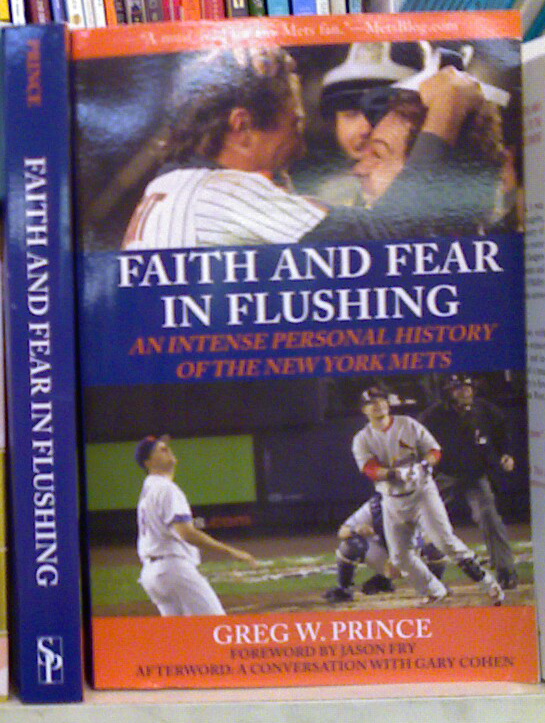
Between now and June 13, if you make a donation of $15 to Sharon Chapman’s Tug McGraw Foundation fundraising effort, you will receive a personally inscribed and autographed copy of the newly released paperback edition of Faith and Fear in Flushing: An Intense Personal History of the New York Mets to give as a gift to your dad, to your grad, to yourself or to anybody you like.
This is a limited-time and limited-quantity offer, so please act now. You make the donation here and you will be contacted for confirmation of all details regarding where you want it sent and how you want it made out; if you’d prefer it unsigned, that’s all right, too. We cover shipping and handling and will get it out to you in a timely manner.
Why are we doing this? A few reasons:
1) Faith and Fear in Flushing is the official blog sponsor of Sharon Chapman’s New York City Marathon Run for the Tug McGraw Foundation. You can read all about Sharon’s motivation and preparation here, but in a nutshell, she has dedicated herself to the Marathon and to Tug, and we enthusiastically support her efforts.
2) The Tug McGraw Foundation is an outstanding organization dedicated to fighting the deadly disease of brain cancer, with an emphasis on improving quality of life for those battling the scourge of a tumor. You can learn more about the Foundation’s exemplary work here.
3) We believe Tug McGraw remains, more than 35 years since his trade to Philadelphia and six years since his untimely passing from brain cancer, the embodiment of the spirit of everything that we stand for as Mets fans: not giving up, not giving in, not taking ourselves unnecessarily seriously. Faith and Fear ranked Tug McGraw the Seventh-Greatest Met of the First Forty Years, an appraisal based as much on who he was and what he means to us as how he pitched. He pitched, not incidentally, very well.
4) Faith and Fear in Flushing: An Intense Personal History of the New York Mets is the story of one Mets fan and all Mets fans. It’s our story. Recently, Shannon Shark of Mets Police described it as “a Mets fan walking you through the history of the Mets from a personal standpoint.” I like that. And I think any Mets fan — your dad, your grad, yourself, whoever you know who bleeds orange and blue — will like this book. It takes you from the birth of the Mets and the concomitant conception of the author clear through to the final day of Shea Stadium and — exclusive to the paperback edition — the first year of Citi Field. All the highs, all the lows, all the in-betweens are in there. You’ll recognize yourself as much as you’ll get to know me and connect to your own Met soul.
We hope you take advantage of this limited-time, limited-quantity offer. Again, please click here to make your $15 donation to this incredibly worthy cause. Once it goes through, you’ll receive an e-mail and the wheels (or feet) will be put in motion to get you the book.
It will be our honor if you take us up on this. Thank you.
by Jason Fry on 2 June 2010 2:06 am At the risk of antagonizing tedious radio hosts, I’m proud of Mike Pelfrey too.
Perhaps that’s OK with Mike Francesa, since I’m 15 years older than Big Pelf. (Not that I give a shit.) I’m proud of Pelf for the same reasons I suspect Matt Cerrone was: Pelf has spent his entire professional career as a Met and, after a decidedly awkward adolescence, appears to have become a star. It’s great to see.
Stardom for Pelf didn’t seem particularly likely not so long ago. There was the game against the Giants in which he telegraphed his pitches through the rather straightforward method of stomping around on the mound muttering what he was going to throw. There were all the times he let an inning get away from him and wandered around behind the rubber fidgeting and plucking at his cap and generally being cranky until his catcher and/or his infielders and/or his pitching coach had to go out there and settle him down, like a horse whose eyes have rolled back in his head. Pelfrey wasn’t just a plus-sized bag of eccentricities — he was the baseball equivalent of the guy in your office whom you kept an eye on because you figured he’d show up with an arsenal the day after his downsizing. Below the neck, his sinker seemed disinclined to sink and his college-baseball coach crabbed on the air that his velocity had disappeared. Oh, and Tom Seaver thought he was dumb. (Often merely a synonym for not Tom Seaver, but still.) Yes, there was a statistical case to be made that the biggest change wasn’t Pelfrey himself but the fact that he was stuck in front of Daniel Murphy and Luis Castillo and a grab bag of impostor shortstops, but on some level I think we resisted believing that, because we’d seen so much twitching and grousing and strange behavior and ineffective pitching that we were no longer inclined to give Pelf the benefit of the doubt.
Tonight there was none of that: It was groundouts and strikeouts, that diving splitter and heavy sinker leaving the Padres looking like they were trying to lift bocce balls over the infield. Pelfrey was 110 pitches worth of wonderful — and with the exception of one horror show in Philadelphia (aided and abetted by a couple of balls that just eluded Jose Reyes and Alex Cora), he’s been wonderful all year, emerging as not just a credible starter but a solid complement to Johan Santana. (After which God knows, but let’s stick to the subject at hand.) He’s a homegrown Met made good, after a long stretch in which he seemed to be breaking bad. Damn right I’m proud of him.
Francisco Rodriguez, on the other hand, seems to have been put on this earth to give me agita. I’ve never much liked K-Rod. His ripcord mechanics leave him in horrible fielding position, his histrionics are irritating, he does stupid things (witness that pickoff attempt with two outs in the ninth), and of course there’s his history of high-profile gag jobs. (Tell me you weren’t waiting for a game-winning home run. I was.) There are a few elite closers, and then there are guys who pitch the ninth and do what plenty of other guys with two good pitches could do about as well. Frankie’s the latter; too bad he’s being paid like the former.
But he survived and so did we, in this ballpark where the Mets always seem to succumb to disaster in the middle of the night. (Nice place, though.) I’ll take it.
by Greg Prince on 1 June 2010 8:49 am “Now, Leo, most of us are just hearing the news. And I don’t like to be the first one to say it, but I’m gonna. I think the President has got to strongly consider not running for re-election.”
“You think you’re the first one to say it?”
“Leo…”
“You are, at minimum, the 35th in the last two hours.”
—Leo McGarry, barely tolerating party bigwigs who think they’re telling him something he hasn’t already heard, The West Wing
With all due respect to Rod Barajas, I greeted no home run Monday night with more relish than that hit by Chase Headley of the San Diego Padres in the bottom of the seventh inning. And it’s not because Barajas hit his in the top of the sixth while I was briefly snoozing.
Headley’s bomb over the distant center field fence of Petco Park should have been a loud and resounding wakeup call to everybody who has any kind of say in the Oliver Perez Affair. There shouldn’t be an Oliver Perez Affair, but there is, and it is corrosive. Sadly, the only people who can do anything to limit the corrosion are Oliver Perez; his agent, Scott Boras; and whoever it is who makes painful personnel decisions regarding overpriced, underperforming dolts who weigh down the New York Mets’ active roster by dint of their absurd contracts and inscrutable motives.
The Mets were losing 16-6 when Chase Headley homered, so the outcome of Monday night was no longer in doubt. Really, the outcome was never in doubt by my sense for these things. The Mets usually find a way to look irredeemably bad for at least one night of any San Diego stay and I had a hunch their first night would be their worst night (if it wasn’t, then we’re all in trouble). Even taking the time difference into account, we’d waited too long on a Monday holiday for a game. After five hours of ducking in an out of the Mets Yearbook marathon — ducking in and out only because I’d already immersed myself in each and every episode multiple times before — the prospect that a pregame show and a game still awaited felt surprisingly onerous. I’d already cheered for the 1963 Mets, the 1966 Mets, the 1968 Mets and so on, clear up through the 1988 Mets. By 9:30 I had little left for the 2010 Mets.
Which put me in the company of Hisanori Takahashi, among others.
Hard to get down on Hisanori Takashi for at last being the selection within that box of chocolates from which you never know what you’re going to get. Following weeks of electrifying long relief work and two shimmering starts, Takahashi was that awful chewy thing you can’t get out of your teeth. Damn imperfect box of chocolates. His four innings left us in a 6-1 cavity, and though we began to climb out — I nodded off at 6-4 — I had the sense we’d be pushed right back in. Hence, when I woke up and found Raul Valdes hadn’t held the fort and Ryota Igarashi was actively surrendering it, I wasn’t too sore. It’s the Padres. They are the personification of what Forrest Gump’s momma advised him. You have no idea from 3,000 miles east who is in their box of chocolates. Chirs Denorfia? Oscar Salazar? Luis Durango?
Doesn’t matter who they are, You just know that if you have too many of them after midnight, they’re bad for you.
It’s undoubtedly going to be a bad night. It was 6-4 for a couple of minutes before you fell asleep. When you woke up it was 10-6. As you degroggified yourself, it was inexorably becoming 12-, then 15-, then 16-6. You have inferred through your haze that it wasn’t the bullpen’s night any more than it was Takahashi’s. You try to think of the last time the Mets went to San Diego and did anything but suck and assume it’s been a while. Indeed, according to Baseball-Reference, the Mets haven’t split a series there since 2006, haven’t won a series there since 2002, have won only four series there since 1991 and last swept a series there in 1988. You decide, despite having already written off the previous ugly loss on this road trip as Just One of Things, that you’re going to be sophisticated about this. Takahashi & Co. just didn’t have it. Several of our pitchers and a whole host of those Padres are essentially unknown quantities, and sometimes such a combination results in mass quantities of runs for the wrong guys.
Yes, it was all going to be very sophisticated, until I saw Oliver Perez trot in from the Met bullpen to rescue Igarashi in the sixth. Then it all became very coarse and not a little Schadenfreudish toward fucking Ollie, his fucking agent and the fucking idiotic organization that handed him the keys to a perpetual printing press that produces million-dollars bills and is equipped with no off switch.
Oliver Perez was, for a time, one of my favorite pitchers on the New York Mets. That time has passed. Ollie’s time on the Mets has passed in every conceivable way except contractually. Contractually, Ollie is a Met through the 2011 season. Ollie gets to dress in a Mets uniform every day until then, whether there is a need or a constituency for it. There is neither right now. Ollie is as 12th man on the pitching staff/25th man on the roster as it gets. Ollie is 20,000 leagues under Elmer Dessens and Gary Matthews, Jr., at this point in his checkered career. Ollie is who is used by Jerry Manuel when there is one out in the sixth and the Mets are down by nine.
That, apparently, is when Ollie Perez and Scott Boras think Ollie can work out whatever’s been plaguing him for a season-and-a-third. That, apparently, is when Oliver Perez has a chance to revert to the 2007 and 2008 form that earned him the $36 million he is in the process of collecting through 2011. Perez and Boras have to root for the Mets to fall behind by nearly double-digits so Perez can take the mound and ratchet up his velocity and hone his command and find himself. That, apparently, is the plan Perez and Boras have for curing Ollie’s ills. Ollie can’t go to St. Lucie or Buffalo. The Mets, in deference to Ollie’s veteran status, can’t make him, and he ain’t gonna volunteer.
Team Ollie has apparently convinced itself that its client is more highly decorated than Bobby Jones and Steve Trachsel, two former All-Stars who were failing as Mets and accepted temporary minor league assignments en route to recapturing credible major league form. Jones went down to Norfolk in 2000 useless and returned a reliable starter who threw a one-hitter to nail down a Met playoff series. Trachsel went down to Norfolk in 2001 worse than useless and returned a reliable starter who persevered as a staple of Met rotations clear through 2006 when he pitched their only division-clincher of the past two decades. Jones and Trachsel could have said no to the Mets’ suggestion that they seek a cure for whatever was ailing them somewhere besides the major league roster. They, like Perez, had the service time to say no, and they, too, were going to get paid no matter where they went. But they had the wherewithal to say yes. They helped themselves and they helped their club.
Oliver Perez is helping nobody. There is not a Mets fan to whom this is news. There is not a Mets player to whom this is news. Every Met decisionmaker from Jeff Wilpon to Omar Minaya to Jerry Manuel (if he indeed gets to weigh in on personnel matters) knows Oliver Perez is nothing more than a useless lump of goo right now. An expensive lump, to be sure, but one whose meter gets fed no matter how much goo he has turned into. He could be trying to reshape his goo-like career into that of a serviceable starting pitcher again, but his braintrust says otherwise. It says, No, Ollie, you’re a major leaguer. Your contract says you are, so just stay put. You refuse that temporary assignment that might make you useful to somebody — the Mets, another team, yourself. You just sit in the bullpen for days on end and wait for the Mets to fall hopelessly behind so your manager will feel inserting you into a game can’t do anybody too much tangible harm.
This is a latter-day bonus baby throwing a tantrum. In days of yore, bonus babies — hot and heavily compensated prospects of the Stephen Strasburg variety — had to be carried on major league rosters or the team that signed them risked losing them. It’s how an underripe Sandy Koufax survived on the 1955 and 1956 Brooklyn Dodgers despite Walter Alston choosing to use him only 28 times in two years. Bonus babies couldn’t be sent down. Baseball realized eventually this was folly and the rule was changed. The rule that allows Baby Ollie to prohibitively resist minor league assignment relates to his experience, not his lack of it. He’s been a major leaguer for more than five years. He doesn’t have to go anywhere he doesn’t want to go. Neither did Jones. Neither did Trachsel. But they did. They (and their agents) understood they weren’t getting any better sucking up roster space with the Mets, not if their manager, Bobby Valentine, wasn’t going use them in any meaningful capacity.
Ollie Perez made fourteen starts in 2009 before his season ended, murkily, on the Disabled List. He wasn’t what you’d objectively call good in more than five of them. He made seven starts before being pulled from the rotation in 2010, and was undeniably dreadful in five of them. His ERA as a starter over the past two years is 6.53. Perez has now made four relief appearances in which he has faced a total of 26 batters. Thirteen of them have reached base via hit (7), walk (5) or hit by pitch (1). He was getting worse and worse as a starter. He isn’t getting any better as a reliever. He won’t consent to a professional intervention. And he gets paid regardless.
I’d love to be the one to tell you something different from what you’ve already figured out for yourself. But my conclusion is likely the same as yours:
Let Oliver Perez go collect his enormous fucking paychecks somewhere else.
by Greg Prince on 31 May 2010 12:00 pm Welcome to a special Monday holiday edition of Flashback Friday: Take Me Out to 34 Ballparks, a celebration, critique and countdown of every major league ballpark one baseball fan has been fortunate enough to visit in a lifetime of going to ballgames.
BALLPARK: Anaheim Stadium
LATER KNOWN AS: Angel Stadium
HOME TEAM: California Angels
VISITS: 1
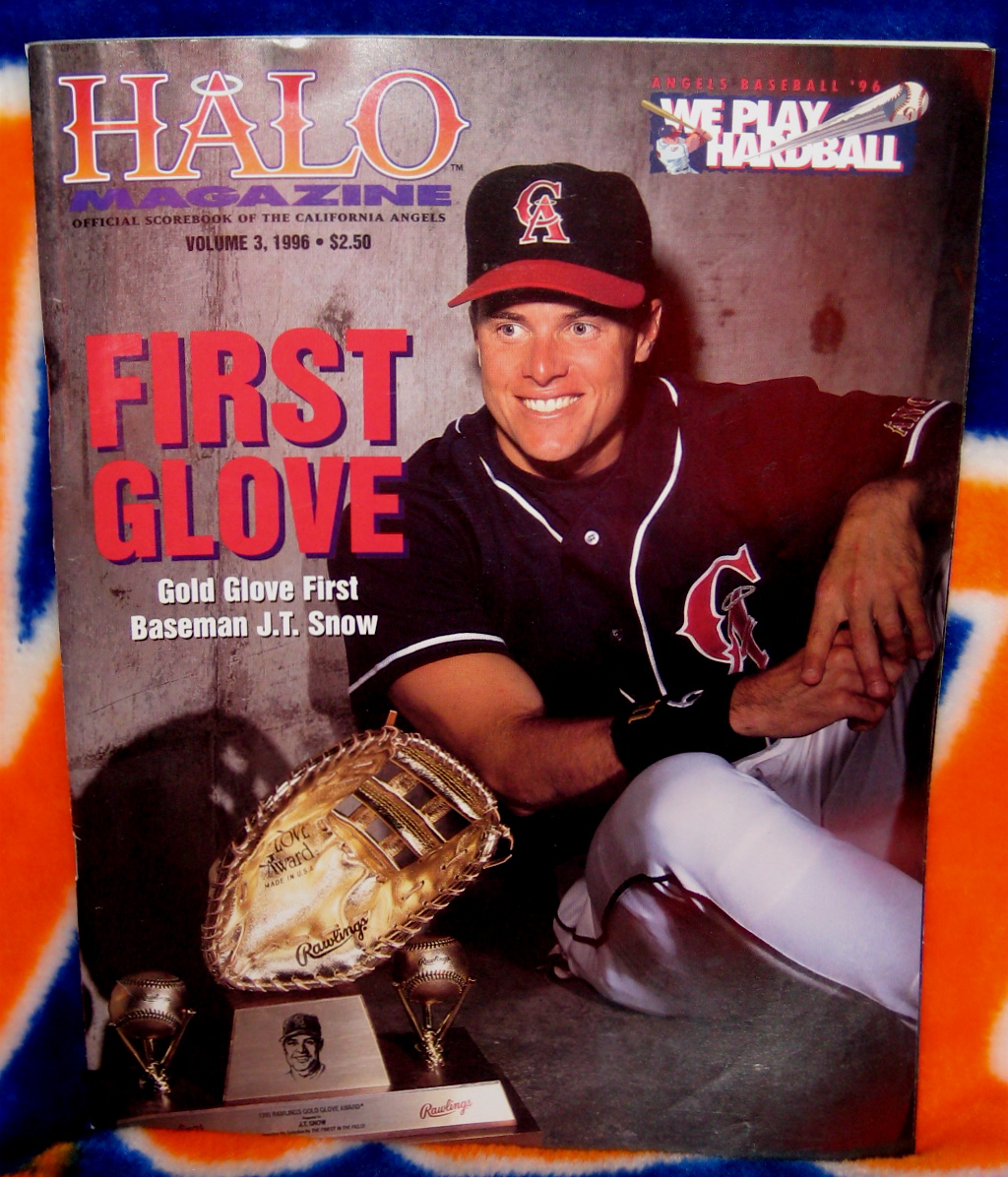
VISITED: June 19, 1996
CHRONOLOGY: 15th of 34
RANKING: 23rd of 34
The Mets are playing tonight in San Diego. They’ll have no problem getting where they’re going literally if not competitively. It’s easy enough to get around Southern California if you’ve got a team bus or are comfortable behind the wheel of a rental car.
The last time I was in that neck of the woods — about 90 minutes north of San Diego — was all about my comfort levels: a comfort level in getting there and a comfort level while sitting there.
Attaining a comfort level en route to Anaheim Stadium was no mean feat for your correspondent. This was 1996, Year Two of my ongoing struggle with driving, a skill I attained in high school and maintained without incident for the next fourteen years. Then, one night at the age of 31, I lost my feel for the road the way Steve Blass lost the plate. Beginning in 1995, every attempt I’ve made at driving on a highway in particular has been fraught with anxiety.
Which is why I’ve been a loyal customer of the Long Island Rail Road when it comes to going to Shea Stadium and its successor facility since 1995.
To put it simply, you can accelerate without thinking about it. I can’t. You are secure in the knowledge that if you tap the brake, you will slow down. I am not. I am a mess behind the wheel. I haven’t attempted to drive any significant distance on a highway since 2001; just imagining it makes me dizzy. These days I’m barely Rain Man, who at least was confident driving slow on the driveway. But I was still giving it my best shot in 1996.
I had to. There was baseball at stake. Baseball adjacent to a very busy freeway. Freeways require driving. It’s Southern California. Of course there’s going to be driving.
This was the trip graciously provided by my sister and her husband, wherein they handed us their West Coast condo/office for a week and said have fun. We chose the third week of June as our time, keyed to the Angels on Wednesday, the Padres on Thursday and the Dodgers on Saturday. Their place was closer to the Dodgers than the other two, but this was my only realistic shot at knocking off all three teams at once. I don’t get out to Anaheim, San Diego and Los Angeles much otherwise.
The driving came along slowly. We flew in on a Sunday, rented a sturdy American compact car and mapped out a secondary-road route from the airport to their apartment. Monday was devoted to getting my car legs within the general vicinity, including Marina Del Rey, Santa Monica and Venice Beach; it included a parking ticket, but it otherwise proved to me that I could drive a little around L.A. Tuesday was the first true challenge of the trip: Universal Studios (such tourists). I could only negotiate so much of the way on Santa Monica Boulevard. A freeway would have to be involved at some point. Maybe it was special effects, but I made it. I didn’t like it. I felt the world was passing me by at 70 miles per hour — I have a hard time believing that’s considered slow for pitching — but I made it. I made it in broad daylight. Universal Studios was hardly worth the hassle, but it was good practice.
We left the theme park at twilight. Driving at night was a whole other anxiety-riddled can of worms. I still fear driving at night, even locally. I also hate driving in the rain, but seems it never rains in Southern California. Leaving Universal, I mapped out a freeway-free route. It took us over through some streets that sounded familiar from the L.A. Riots of four years earlier, but I felt safer there than I would have on the 101.
Now it’s Wednesday morning, the morning of our Angel matinee at Anaheim Stadium, an hour south of our base of operations. There’s no network of streets I’ve heard of where I can chug along at my own middling speed. There’s no Orange County Rail Road of which I’m aware. There’s no threading the needle on bus routes. It’s the land of the automobile. I’ve got to be like every other American on vacation and get with the program. So off to I-5, the Santa Ana Freeway I guided us.
Deep breath…
You know what they have more of than anything in Southern California? Lanes. There must have been six, eight on each side of the Santa Ana. Every single one of them had cars. Going fast. Very fast. And then there was me in my rental, trying to keep up in my own plodding, brake-tapping way. Stephanie was supportive, both orally and sensually. That is to say, I often grabbed at her. When nobody’s in the passenger seat, I grab the shoulder restraint. When there’s a passenger, I grab the passenger. I grabbed at her left shirt sleeve a lot. Her lap, too. Sometimes her shoulder. When it gets too fast and I breathe too quickly and my palms are wet and the antiperspirant I rolled on starts dripping down my side, I need something to hold onto.
This was me on the Santa Ana Freeway: greasy, grabby, palpitating…all for the Angels and White Sox.
Then something happened. Or didn’t happen. Nothing happened, I guess. Or something kicked in. Maybe halfway down the Santa Ana, the panicking ceased. I drove. I drove like I did before 1995, drove like it was no big deal. Since my plunge into epic despair, I’d had moments where I shook off the anxiety attacks, and maybe this was one of those. However it worked, I was glad it did. The exit for Anaheim Stadium was at hand.
The comfort of driving came hard. The comfort of the Big A came easy. And there was one overriding reason for it: I could have sworn I had been there before.
Why? Because it was Shea! Anaheim Stadium was a thinly veiled, West Coast version of Shea Stadium. It couldn’t have been more like Shea had it had an apple and an airport over the outfield fence.
This was Anaheim Stadium before gentrification. You see it on TV today and you see a Disneyfied ballpark-style attraction now known as Angel Stadium. But back then, it was Shea West. It was enormous and it could be used for a multitude of purposes. Sound like any stadium you once knew? That alone may not be specific enough to evoke Flushing in Anaheim, but it definitely had the feel. Anaheim had grass, like Shea. Anaheim was from the ’60s, like Shea. Anaheim had that sense of being somewhere not altogether where you imagined it might be. Shea was New York, but it was, in terms of access to anything that wasn’t inside the stadium itself, in the middle of nowhere. Anaheim wasn’t L.A. — and L.A. definitely isn’t “of Anaheim” — but you shrugged if you were from back east and figured you were close enough.
Anaheim Stadium was the closest thing to Shea Stadium I ever experienced without a 7 train. I’m not surprised that I liked it as much as I did, and perhaps it’s telling that when stripped of all personal and Met association, I didn’t find much else distinctive about pre-renovation Anaheim Stadium. Maybe that’s how people who had no attachment to Shea saw Shea. Maybe that’s why few who aren’t Mets fans (and plenty who are) never mention Shea among their favorite stadia. Maybe it was just Queens’ version of Anaheim to them.
To me, for a couple of hours, Anaheim was home away from home, and I liked it fine. I liked our field level (or Field Level) seats plenty. Stephanie wasn’t too happy that our proximity to the plate also meant proximity to the sun, but she endured it as long as her Scandinavian features could stand it. The whole presentation did seem a bit more show-bizzy than what I was used to, though I don’t mean Danny Kaye at Dodger Stadium show-bizzy. The Angels, just ahead of their sale to Disney, did seem to value entertainment more than the Mets. They had a cheerleading squad atop the first base dugout — nothing over-the-top, but nothing you’d see in Flushing. They were the first team I could recall trumpeting each home team at-bat with a specific slice of recorded music. It seemed innovative at the time.
Anaheim was also the first place I heard (or maybe it was just the first place I noticed) fans beseeching the umpire as “Blue,” as in “Aw, c’mon, Blue! That was a strike!” Whoever whined it at the home plate ump deserved extra credit for accuracy once he realized the American League crew was, in fact, not wearing blue.
“Aw, c’mon, Blue! That was a strike! I mean Red.”
Speaking of red, that’s what Stephanie was wary of growing in the sun, so I agreed to seek some shade. We took a walk through the Big A’s Shealike concourse for relief and ran into Southpaw. Southpaw was the Angels’ mascot of the moment. Seemed fairly generic, but somewhere in a photo album, there is a picture of me with Southpaw, a big, furry…I dunno…bear, let’s say. Southpaw was no Mr. Met, but he kept his bear suit well laundered, a fact we might have taken for granted had we not later that week visited the San Diego Zoo. The San Diego Zoo had a guy in a lion costume. I gotta tell ya: that lion costume could have used a good dry cleaning.
Anaheim Stadium ushers, unlike their Shea brethren, didn’t get all up in your business if you wanted to change seats, particularly to nominally less enticing seats. At Stephanie’s request, we abandoned our sunsplashed locale and settled in the right field boxes, which were enveloped by shadows late in what was becoming an Angel blowout. She took another picture of me there, without Southpaw. I’m in a Mets cap, something resembling Shea is behind me and I’m all smiles. When we showed our vacation pictures to my brother-in-law, he said, “There’s Greg in baseball nirvana.”
I think it’s heaven, not nirvana, that has Angels, but as with Anaheim and Shea, the spiritual difference was negligible. I was indeed at peace situated at the Big A that afternoon. In ways that transcend cliché, I was overwhelmingly happy to be there.
Be there? Hell, I was just happy to get there.
|
|