The blog for Mets fans
who like to read
ABOUT US

Faith and Fear in Flushing made its debut on Feb. 16, 2005, the brainchild of two longtime friends and lifelong Met fans.
Greg Prince discovered the Mets when he was 6, during the magical summer of 1969. He is a Long Island-based writer, editor and communications consultant. Contact him here.
Jason Fry is a Brooklyn writer whose first memories include his mom leaping up and down cheering for Rusty Staub. Check out his other writing here.
Got something to say? Leave a comment, or email us at faithandfear@gmail.com. (Sorry, but we have no interest in ads, sponsored content or guest posts.)
Need our RSS feed? It's here.
Visit our Facebook page, or drop by the personal pages for Greg and Jason.
Or follow us on Twitter: Here's Greg, and here's Jason.
|
by Greg Prince on 5 January 2024 9:04 am When Oscar Madison, our avatar of Mets in the Popular Culture, is sloppy, dog bites man. When Oscar Madison attempts to be neat, the fault lies not in our stars, but in ourselves (Shakespeare). In the Odd Couple episode “Cleanliness is Next to Impossible,” Oscar is unwittingly hypnotized to Felix Unger levels of fussiness. Only when Felix — who has arranged for the hypnosis as a favor to Oscar, albeit without Oscar’s awareness that he’d be put under while dining with a woman he wishes to impress — inadvertently snaps his fingers and breaks the hypnotic spell does Oscar revert to form and start grabbing at the evening’s hors d’oeuvres and stuffing them in his mouth.
“Oh boy! Midget hot dogs!”
In other words, man bites dog.
 Oscar going against type, no matter how dependably funny, is bound to be hilarious because we know and love Oscar the slob: from the Mets cap atop his head to the mismatched shoes upon his feat. Likewise, finicky Felix taking on an Oscar-like characteristic has to be a scream. The gold standard of this personality swap, as anybody who celebrates New Year’s Day because it means Channel 55 in New York is running the Odd Couple marathon could tell you, is “I Gotta Be Me,” during which the roommates agree to act as each sees the other. In Felix’s case, that means he’s wearing the Mets cap. Less pronounced vis-à-vis the role-reversal trope is the episode “Felix the Horse Player,” when Felix finally sees what attracts Oscar to gambling and proceeds to become obsessed with doings at the track. Oscar going against type, no matter how dependably funny, is bound to be hilarious because we know and love Oscar the slob: from the Mets cap atop his head to the mismatched shoes upon his feat. Likewise, finicky Felix taking on an Oscar-like characteristic has to be a scream. The gold standard of this personality swap, as anybody who celebrates New Year’s Day because it means Channel 55 in New York is running the Odd Couple marathon could tell you, is “I Gotta Be Me,” during which the roommates agree to act as each sees the other. In Felix’s case, that means he’s wearing the Mets cap. Less pronounced vis-à-vis the role-reversal trope is the episode “Felix the Horse Player,” when Felix finally sees what attracts Oscar to gambling and proceeds to become obsessed with doings at the track.
Felix is convinced Oscar’s hot streak, enabled by tips he’s receiving from exercise rider Harry Tallman (Tallman is too short to be a jockey) is permanent and jumps on the betting train. Of course he turns obsessed and insufferable, even when Oscar tries to warn him away from betting it all on a horse called Yellow Angel, of whom Harry has advised, “I didn’t ride him, but he looks real good.”
FELIX: Yellow Angel in the third, it’s a sure thing.
OSCAR: No, no, I didn’t hear Harry say ‘sure thing’.
Natch, that wasn’t gonna stop Felix, who put aside “five dollars for socks” and indeed bet it all. It’s a sitcom, so you know Yellow Angel in the third wasn’t a sure thing.
Also, this is the Oscar’s Caps, our twelfth annual survey of the intersection of the Mets and pop culture, so you probably know we’re galloping somewhere with this…though not as swiftly as Yellow Angel approached the finish line (where the thoroughbred lost by “two lousy inches,” also known as a nose). Oscar cautioning Felix against interpreting “looks real good” as “a sure thing” sure sounds like an allegory for the 2023 Mets, but never mind them for now. I’m thinking about this very feature and all the information that goes into building it.
For example, if there’s a new movie titled Somewhere in Queens, chances are real good that I’m going to find out organically that it contains some Mets content. Yet I count five different friends of FAFIF who reached out to this blog to make certain we had on the record the following:
The trailer for the 2023 Ray Romano vehicle Somewhere in Queens included a man in a SANTANA 57 Mets t-shirt. When the movie was released, theatergoers indeed saw the shirt as well as prime signifiers that the movie is indeed set in Queens: a Mets cap, several small Mets pennants, a drive past Citi Field and an invocation of “Ya Gotta Believe”.
It was no sure thing I was going to know any of that. So thank you to everybody who dropped me a line to confirm that the Oscar’s Caps wouldn’t miss a Met trick in 2023. Same for all the other data that trickled in throughout the year, both for new stuff and old stuff that resurfaced. A person needs to consume a lot of popular culture to detect tinges of Metsiana, and no one person can be Endy Chavez and catch it all. Oscar’s Caps is particularly bountiful this edition because so many Mets fans are on constant high alert for shades of orange and blue showing up in unanticipated places.
When we first unveiled Oscar’s Caps at the end of 2012, we were thinking mostly in terms of TV, film, music, stage, works of fiction. In the ensuing years, we’ve experienced some mission creep. A Mets cap or a Mets jacket or a Mets reference seeps into non-sports real life where you wouldn’t expect to find it, we make a note of that as well. To not do so would go against type.
Thus, in addition to Somewhere in Queens dressing to fit its name, we have from the year past — and many years past — a slew of Amazin’ examples of Mets in the Pop Culture to add to our endless cataloguing.
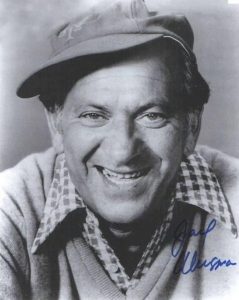
***Jack Klugman as Henry Willows — we think we know him from another role — and John Stamos as Matt Willows drive by Shea Stadium on You Again?, Season 2, Episode 6 (“The Lush Life”), aired on NBC, November 12, 1986.
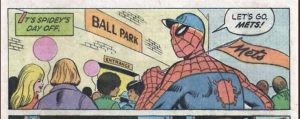
In Spidey Super Stories #8, the May 1975 issue, comic readers find Spider-Man going to Shea Stadium and wielding a Mets pennant as he shouts “Let’s Go Mets!” on what is framed as “Spidey’s day off,” firmly establishing our title character as a Mets fan. Alas, there’s no rest for a superhero as Spidey encounters The Wall, which is a villain you definitely wouldn’t want an outfielder running into let alone Spider-Man; in this story, it’s The Wall that runs into a Mets outfielder. Ouch! Spider-Man leaps into action, but ultimately, Spidey and The Wall are ejected from the field of play by the umpire, because baseball rules says only players can take the field.
A framed Pete Alonso jersey-style crewneck sweatshirt has guest-starred on Diners, Drive-Ins and Dives on Food Network, which is to say it could be seen on the wall at Brooklyn’s Pies ‘n’ Thighs in an episode that aired on January 20, 2023. (It’s their sweatshirt that’s graced by ALONSO 20.)

Battle of The Bats —
Mets stick it to Cubs
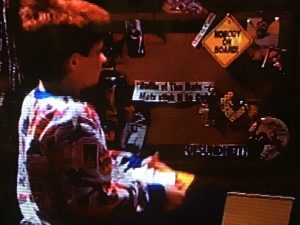
—Tabloid newspaper headline tacked to Josh’s friend’s Billy’s bedroom bulletin board in Big, 1988
In the video for the Arcángel and Bad Bunny single “La Jumpa,” released in late 2022, Bad Bunny makes several appearances in a highly detailed long-sleeved shirt celebrating the Mets. The franchise’s home ballparks and world champions appear listed on the respective sleeves while NEW YORK and NY are prominent on the front.

***Oscar’s Caps doesn’t subscribe to a surfeit of streamers, but a cap must be tipped toward what Hulu seems to be doing to promote the greater good.
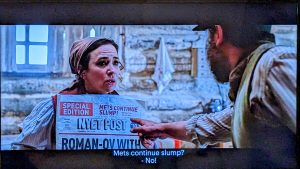
• In the first episode of Hulu’s 2023 History of the World, Part II, in a segment on the Russian Revolution (Fiddler on the Roof-style), a copy of the Nyet Post carries the front page teaser, “METS CONTINUE SLUMP!”
• In the 2023 Hulu series Up Here, Miguel (Carlos Valdes) wears a vintage 1986 National League East champions shirt.

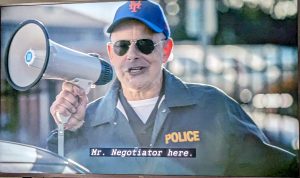
• On Hulu’s This Fool, “Clyde & Clyde, Parts 1 and 2” (Season 2, 2023), Rob Corddry, playing a cop in Los Angeles, puts on a Mets cap to convince a criminal he has just flown in from New York.
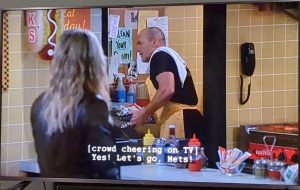
• And on Hulu’s How I Met Your Father, Season 2, Episode 13 (2023), Sophie may have spotted her father in the hot dog shop, watching a ballgame and cheering “Let’s Go Mets!” sparking an epiphany on Sophie’s part that she knows so little about the man who might be her father, thus scaring her off from confronting him with the possibility that they are indeed father and daughter. Another character says, regarding the man’s Mets fandom and the possible family ties, “That’s a brutal legacy to live with.” Come Episode 18, as she has dinner with the parents who supposedly haven’t seen each other since conceiving her. Sophie, in an effort to make her Mets fan father happy, asks the harpist she’s hired if she knows any songs about the Mets. ”I went to Juilliard,” is the harpist’s response.
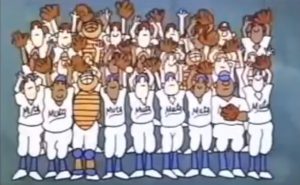
***When ABC celebrated the 50th anniversary of Schoolhouse Rock! on February 1, 2023, viewers were reminded that the very first educational vignette the revered Saturday morning series showed, on January 6, 1973, “Three Is a Magic Number,” featured an animated baseball team wearing uniforms that say “Mets” to get across the lesson that “3 X 9 is 27.”
Spotted on the PIX11 Morning News in New York on February 6, 2023: Dancing with the Stars mainstay Val Chmerkovskiy in a Mets cap as he gave reporter Ben Aaron a few pointers.
“The theater with Miss Davenport, or the Mets against the Dodgers at the stadium?”
“How do we feel about that?”
“We suggest the Mets against the Dodgers, sir.”
—Gentleman’s gentleman Mr. French (Sebastian Cabot) helping gentleman Bill Davis (Brian Keith) arrange his social calendar in the series premiere of Family Affair on CBS, September 12, 1966
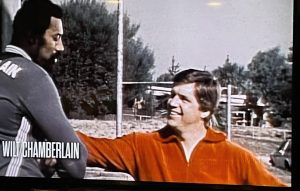
In the first episode of 2023’s Bill Russell: Legend documentary series on Netflix, viewers were treated to a glimpse of Tom Seaver chatting up Wilt Chamberlain. Tom Terrific interviewed Wilt the Stilt when Tom hosted Greatest Sports Legends in the late 1970s.
***From the non-explicit Mets pop culture sighting department:
In production in 2023: the movie You Gotta Believe, the story of a Little League team and not Tug McGraw’s rallying cry for the 1973 Mets.
“Teamwork makes the dream work.”
—Roman Roy echoing New York’s Dream Team’s 1986 hit song (“We got the teamwork to make the dream work…”), “Let’s Go Mets” in the series finale of Succession, “With Open Eyes” (Season 4, Episode 10), May 28, 2023
***On the game show 25 Words or Less, aired in early 2023, a contestant had to guess “Yankees,” and among the clues given — in the interest of economizing words — was “Baseball; not Mets…”
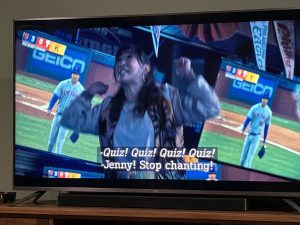
In Quiz Lady (2023), Jenny (Sandra Oh) wants a Philadelphia bar to switch its TVs away from the Mets and Phillies to the game show her sister Anne (real life Mets fan Awkwafina) watches regularly, a program called Can’t Stop the Quiz. In the televisions in the background of the scene, Taijuan Walker is pitching for the Mets at Citizens Bank Park with a 3-0 lead on April 11, 2022.
Speaking of game/quiz shows, this is Jeopardy!:
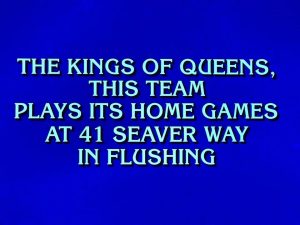
• “The kings of Queens, this team plays its home games at 41 Seaver Way in Flushing” was a clue on Jeopardy on February 16, 2023. When the contestant answered correctly, host Ken Jennings added, “Go Mets.”
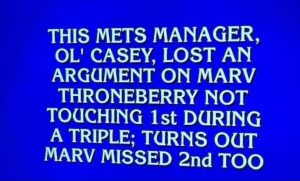
• On the April 14, 2023, episode of Jeopardy, the following clue was offered: “This Mets manager, Ol’ Casey, lost an argument on Marv Throneberry not touching 1st during a triple; turns out Marv missed 2nd too.”
• On Jeopardy, May 10, 2023, contestant Sam Buttrey said he was a Mets season ticket holder who sold his ticket to Game Six of the 1986 World Series because he didn’t want to see them lose (but he did go to Game Seven).
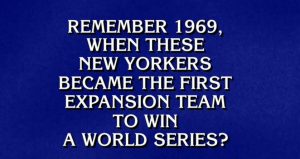
• “Remember 1969, when these New Yorkers became the first expansion team to win a World Series?”
—$200 clue in the Remember Baseball category on Jeopardy, June 23, 2023
• On October 16, 2023, the 54th anniversary of the 1969 Mets winning the World Series, the Double Jeopardy answer on Jeopardy was “1969: Ed Kranepool, Bud Harrelson & Tom Seaver…What an Amazin’ Team”. (Category: “In the Baseball Team’s Lineup”)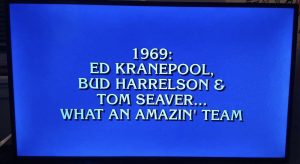
***You know who else besides Oscar Madison wears a Mets cap well? Mr. Met! And Mrs. Met!
Newark mayor Ras Baraka wore a Mr. Met cap while being interviewed on a local baseball field by an Eyewitness News Reporter (WABC-TV, Channel 7), May 5, 2023.

According to Stephen Colbert on The Late Show of January 19, 2023, Rep. George Santos’s claim that he used to attend the Met Gala was another lie from the Congressman — and that the only Met Gala that would want Santos might be the Mr. Met Gala.
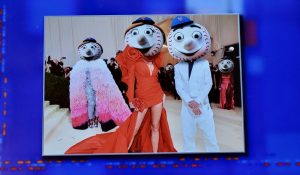
On the March 2, 2023, The Late Show with Stephen Colbert, the host expressed shock that a woman wearing a DeSantis t-shirt in a Florida diner on a Fox News segment told the reporter she was “either/or” when it came to Trump or DeSantis in 2024. “Either/or?” Colbert asked in mock shock. “You’re wearing a Ron DeSantis t-shirt. That’s like Mr. Met saying, “Go Mets! Or Yankees. I’m not really into baseball. This,” gesturing toward where Mr. Met’s large baseball-shaped head would be, “is just an unrelated medical condition.”
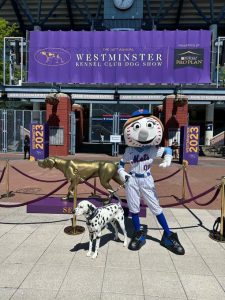
With the Westminster Dog Show’s 10th Anniversary Masters Agility Finals taking place at Arthur Ashe Stadium, just across the boardwalk from Citi Field on the first weekend of May 2023, you might have expected a Met presence, and had you, you would have been “ARF!”…make that right. Mrs. Met indeed welcomed the stylish pooches to the neighborhood. According to one witness taking in Fox Sports’ coverage of the proceedings, “There was a scene toward the end where Mrs. Met was shown bending down and petting one of the dogs, giving lots of love to her canine friend. Well, good for her, and I guess she might have walked there since it’s very close to her Mets team’s home stadium. Apparently, the dog was not freaked out by her disproportionately large head.”
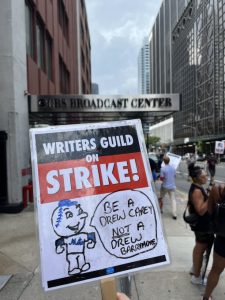
On September 11, 2023, a drawing of Mr. Met was spotted on a Writers Guild of America picket line sign, outside the CBS New York facility where Drew Barrymore’s talk show was briefly being produced sans union writers, with a comic balloon expressing the mascot’s pro-WGA sentiments: “Be a Drew Carey, NOT a Drew Barrymore.” (Mr. Met could not be reached for comment.) Earlier, on August 8, Al Jean walked the WGA line in Manhattan while wearing an alternate-version Mets cap (white outline around the orange NY).
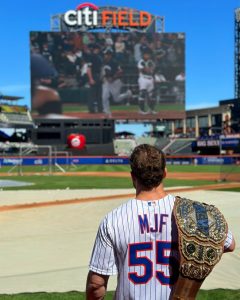
All Elite Wrestling (AEW) world champion Maxwell Jacob Friedman hyped his upcoming Grand Slam title defense at Arthur Ashe Stadium in September by visiting Citi Field in his personalized No. 55 jersey and reminding Mets fans he has always been one of them — with his bona fides showing most effectively when, during his interview with ballpark hosts Emily Reppert and Mike Janela, he praised Mr. Met as the only mascot that matters and called Chase Utley “a schmuck” (as if attendees didn’t already know that).
A September 2023 CNN news story that featured baseball mascots led anchor Jim Sciutto to let viewers know “Mr. Met is much better” than Screech the Bald Eagle from the Nationals (as if viewers didn’t already know that).
***The Hallmark Channel isn’t usually a stop on the Oscar’s Caps route, but we’re always willing to take a detour. From Hearts in the Game a Hallmark Original that first aired on April 29, 2023, we have…hoo-boy, what don’t we have?

Let’s start with the Mets cap on the driver’s side dashboard of a parked SUV on a busy street in Manhattan, or, given that it’s the Hallmark Channel, Vancouver as Manhattan.
Fred is the driver.
Jax is the assistant to Hazel, the person who is being driven and, at the moment, waited for.
Jax and Fred discuss a “big announcement” from Strike Zone Weekly — it looks like the New York Mets have “officially lost their minds” as rumors spread that they are signing pitcher non grata Diego Vasquez.
Who is Diego Vasquez? Exposition tells us, “The league’s top pitcher was dropped last season for freezing on the mound in the ninth inning of Game Seven of the World Series, and Vasquez still won’t comment on why. In our humble baseball opinion, this could be Vasquez’s last chance at pitching professionally.”
FRED: I don’t know what the Mets are thinkin’. A guy that freezes like that is not New York Mets material. We are a team that cares about tradition, loyalty!
JAX: He’s one of the best pitchers Major League Baseball has ever seen. Vasquez holds the record for the most no-hitters in baseball history, and that’s exactly what our Mets need, Fredo!
FRED: I sure hope the Mets know what they’re doin’, ’cause they’re bettin’ the entire franchise on Diego Vasquez.
JAX: That’s the beauty of baseball — the theatrics, the heart, the soul!
Soon we hear from Mark Gold, Vasquez’s agent, giving the straight skinny to the would-be Amazin’:
“We’re gettin’ pressure from the GM to make sure you look good. The New York Mets club doesn’t really trust you yet. The Mets won’t make it official until we start to see some good press.”
The aforementioned Hazel is a PR wizard who has a chance to take on Vasquez as a client (and maybe more?). Hazel is reticent, but Jax is insistent:
“You could change the fate of baseball, the fate of the New York Mets, and as a diehard Mets fan, I can tell you that if we ever wanna win, the New York Mets must commit to Diego Vasquez, you must commit to Diego Vasquez.”
Hazel and Diego do get together, professionally, but there are twists and turns on the road to getting the pitcher that “good press” the Mets demand before they dare sign the holder of the record for most no-hitters in baseball history. An article Hazel has planned for Hudson & Park magazine appears to be off. She has to break the news to Jax.
HAZEL: How would you feel if I did the right thing, but that [means] the New York Mets may never win again.
JAX: If it means your happiness, I would literally love nothing more in the world, Hazel.
HAZEL: Even over the Mets?
JAX: Even over the Mets, which is hard.
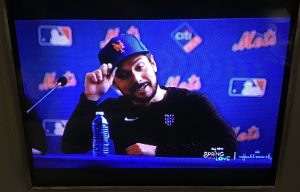
Hallmark’s imprint ensures Hazel and Diego get together more than professionally. We are eventually transported to “New York City Months Later,” indicated by the exterior of Citi Field from the air and a closeup of the ballpark’s logo. Inside, Diego is at a press conference table set up in front of Mets, MLB and Citi Field logos. Vasquez sits in a blue Mets cap with black long sleeved shirt that has the blue NY logo. He fields a reporter’s question:
“Mr. Vasquez, what a comeback. A no-hitter in your first professional game back. How do you feel?”
“I feel great, I feel really great.”
When asked in a razor-sharp followup, after it’s been acknowledged that it’s been quite a year, “how are you liking New York?” Vasquez minces no words:
“It feels like home, it really does.”
Congratulations to the New York Mets on their third no-hitter.
***The Simpsons, Season 34, Episode 19; April 30, 2023; “Write Off This Episode” starts with a sports gambling commercial in which Coach Jim “Jimmy” Jimmerson tells viewers, “In the sport of sports betting, you’ve gotta sport bet responsibly,” and on a blackboard, one of Jimmerson’s 3 Simple Rules to follow is “Mets, Jets and Nets = Debts”.
On the Season Three premiere of Comedy Central’s Awkwafina is Nora from Queens (April 26, 2023), Nora’s dad Wally buys coffee at a coffee cart operated by a guy wearing a Mets cap.
“I want a contract that guarantees me an expense account, stock options, 22 weeks vacation, a company car, a box at Shea Stadium, a percentage of the gross, total creative freedom, transplant insurance, and a no-cut clause.”
—Nathan (Stan Gottlieb) listing his demands to stay at the newly named Truth and Soul advertising agency, Putney Swope, 1969
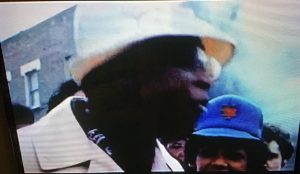
In the 2022 documentary “The Princess,” archival footage contrasting British civil unrest with the nation’s excitement over the 1981 engagement of Charles and Diana includes a person in a Mets cap smiling incongruously next to an aggrieved woman shouting into a microphone, “Our children are suffering!”
“What do you think about him?”
“Who?”
“Gil Hodges. I mean, can you explain to me how anybody in their right mind would get rid of Gil Hodges?”
“Well, I suppose that’s all in the point of view.”
“Precisely, absolutely. You’ve got a good mind, young man, an extremely good mind.”
“Thank you.”
“It’s the top of the sixth. The Giants are leading the Mets, six to two.”
“Excuse me a minute. He’s out.”
“Who?”
“Gil Hodges.”
—Exchange between shopkeeper Sadie (Doro Merande) and customer/television writer Julius (Jack Weston) in a bookstore, where a radio is playing a ballgame that the announcer has said is already in the bottom of the sixth. Indeed Gil Hodges is batting (and Jack Sanford is pitching) after Willie Mays has made a basket catch…in The Twilight Zone, “The Bard” (Season 4, Episode 18), first aired May 23, 1963, the very day Hodges was traded by the Mets to the Washington Senators to become their manager
In a May 25, 2023 NBC Nightly News report on the struggles facing America’s Chinatowns, New York’s historic community was represented by Cory Ng, proprietor of the Potluck Club restaurant, with Ng, in turn, choosing to rep the Mets in his nationally telecast interview with correspondent Vicky Nguyen. Cory wore a black Mets cap with the 2000 Subway Series logo on the side as he explained how important preserving the culture of Chinatown is to him.

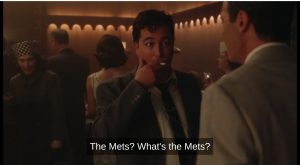
In The Marvelous Mrs. Maisel, Season 5, Episode 3, “Typos and Torsos” (2023), we are transported to Toots Shor’s in 1961, where fictional talk show host Gordon Ford and actual sportswriter Jimmy Breslin are having a chat in which Breslin tells Ford that New York is a baseball town.
BRESLIN: The Pirates are gonna repeat. It’s not what I want, but it’s what’s gonna happen.
FORD: No, it’s gonna be the Yankees.
BRESLIN: Without Stengel?
FORD: Good riddance to Stengel. Don’t quote me on that.
BRESLIN: Word is he’s talking to the Mets.
FORD: The Mets? What’s the Mets?
Breslin proceeds to laugh, perhaps knowing it will be up to him (and Stengel) to define them in 1962.
***More than a few cross words were spoken about the Mets in 2023. And more than a few New York Times crossword puzzles were filled in with Metsian answers.
April 19, 2023 NYT Crossword, 5 Down: ____ Field (Shea Stadium successor) — four letters … CITI
April 22, 2023 NYT Crossword, 65 Across: Piazza, for one — five letters … EXMET
April 30, 2023 NYT Crossword, 30 Down: New York’s ____ Field — four letters … CITI
May 14, 2023 NYT Crossword, 79 Down: Queens Players — four letters … METS
May 25, 2023 NYT Crossword, 57 Down: National League expansion team of 1962 — four letters … METS
June 11, 2023 NYT Crossword, 14 Down: Team seen in Queens in brief — six letters … NYMETS
June 18, 2023 NYT Crossword, 5 Across: Citi Field mascot — five letters … MRMET
August 14, 2023 NYT Crossword, 69 Across: Citi Field team — four letters … METS
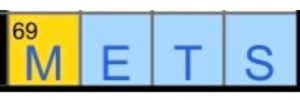
November 7, 2023 NYT Crossword, 1 Across: N.L. East team for which Tom Seaver pitched — four letters … METS
November 16, 2023 NYT Crossword, 16 Across: N.L. East team — four letters… METS
December 12, 2023 NYT Crossword, 68 Across: Baseball’s Alonso or Rose — four letters … PETE
December 17, 2023 NYT Crossword, 77 Across: Former M.L.B. left-handed pitchers Jackson and Leiter — three letters … ALS
For those who ventured beyond the long-established wordplay on nytimes.com, on October 5, 2023, the New York Times Connections game, in which players attempt to thread sixteen given words into four groups of four, “MET” went with “ANGEL,” “CUB” and “RED” in the category “M.L.B. Team Member”. (“NAT” was another choice, but that was an answer within the category “Insect Homophones”).
Yet if you were looking to stay up to date on your favorite baseball team, or any baseball team, the Times ceased being the paper for you by September, when it altogether dropped the sports section that was already a shadow of its former self. Between Opening Day and the All-Star break of 2023, a search of nytimes.com for articles containing “Mets” and “Showalter,” a decent indicator of day-to-day reporting on one of the paper’s ostensible hometown teams, turned up in all of 14 articles despite manager Buck Showalter’s Mets having played 90 games to that point while making plenty of news. Although the New York Times had long ceased daily coverage of its hometown National League team by 2023, they did manage to find their own Amazin’ angles in their non-sports reporting.
Since the Times was no longer a newspaper that covered sports, it seems Oscar’s Capsworthy to note how they got the Mets into the paper, beyond four-letter clues.
On June 27, 2023, the Times visited with drag king/actor Murray Hill as he received the star treatment at Citi Field on Pride Night. “I’m a sports guy,” Hill said, even though he referred to the ballpark as “Mets Stadium”.
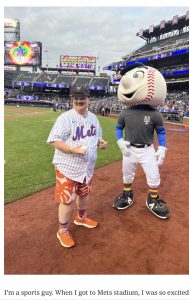
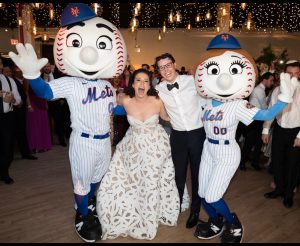
In the Mini-Vows section on June 30, 2023, NYT readers got to know Elan David Cooperman and Sydney Marissa Berger, portrayed as a sports-mad couple who reached a crossroads before they could take the biggest step of all:
“Ms. Berger had grown up in a split household: Her mother rooted for the Yankees, while her father was a Mets fan. Out of loyalty to both parents, she had never picked a side. On their first date, Mr. Cooperman, a diehard Mets fan, told Ms. Berger that ‘if this is going to go deep, you’re going to have take a side.’ She went all-in for the Mets,” as evidenced by the presence of “two special guests joining the party: Mr. and Mrs. Met, the official mascots of the New York baseball team, strutting into the celebration. ‘When they came in, our jaws dropped to the floor,’ Mr. Cooperman said.”
Come July 6, 2023, Op-Ed columnist David Brooks devoted one of his pieces to musing about his Mets fandom: “I’ve lived my fan life in a state of irrational anticipation.” Four days later, it turned out any fan of any team would be irrational to anticipate the Times sports section being part of the paper much longer, as the so-called Paper of Record announced it was disbanding its sports department, explaining it would lean on the NYT-owned (and non-union) Athletic — where at least national baseball columnist Tyler Kepner was able to transfer his talents — for “coverage of teams and games”. The Athletic does a helluva job. But so did the Times in its heyday.
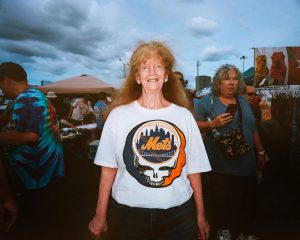
While the Times no longer seemed too interested in sending its own reporters out to Citi Field to track the ups and downs of the Mets, plenty of photos from the ballpark were published on July 14, including one of a woman in a bootleg t-shirt that combined the Mets logo with that of a timeless band, to illustrate a story on the final tour of Dead & Company, which had stopped over in Flushing a few weeks earlier.
Following the implosion wrought by the 2023 trade deadline, Times music writer and Mets fan Lindsay Zoladz on August 4 offered subscribers to The Amplifier newsletter “a (sad) playlist for the 2023 New York Mets,” fifteen songs ranging from the obvious to the obscure, explaining, “As any librettist or opera composer knows, some tragedies are so grand that they must be expressed in music.” Selections included Peggy Lee’s “Big Spender” for Steve Cohen; “Come Back From San Francisco” by The Magnetic Fields, dedicated to former Mets Michael Conforto, J.D. Davis and Wilmer Flores; “June Is As Cold As December,” an Everly Brothers track recalling the month when the Mets fell out of contention; and “New York Groove,” Ace Frehley’s jam that scored the increasingly rare home team win at Citi Field.
In that spirit, a quick playlist of our own, in memory of the sports section of the Times from when it was truly in the New York groove:
“The announcement this week that the New York Times comes as the kind of shock you get when you turn a corner and a longtime store or restaurant or building is gone; even if you haven’t been there in years, it takes a moment to wrap your head around a world without it. I grew up a sports fan in a New York Times household. In the ’70s and ’80s this meant waiting days for box scores to appear. Everything about the sports section reinforced the idea that sports really wasn’t that important in relation to the rest of the paper, or the world. I always got the sense that this was grown-ups writing about sports for grown-ups. A serious and un-fun paper with no comics or pulp, it seemed fitting to me that they had a columnist named Ira.”
—Alex Belth, Esquire
“I think it’s important, when talking about the Times sports section, to talk about the unique place sports has within that particular paper over the years. It’s almost like Times sportswriters worked for what the country’s most essential newspaper considered to be its least essential section. This is what the paper thought, right? […] At one point in history, it seems weird now, the New York Times was a New York newspaper. It was being read by people across the country, but it was also like, ‘We have local teams here we need to cover.’ That’s the base function of any sports page, covering the local teams. So they did that for a while. Slowly they pulled away from that, probably as they became a national paper and the world was really changing, and said, ‘OK, what if we don’t have to cover the Yankees and the Mets every day?’ Remember, New York has tons of sports teams, so in order to do that, it’s just a lot of manpower. ‘What if we become a more nationalized section?’ […] It felt like it was programmed for people that were reading the rest of the Times to come over, ‘and here’s a sports feature that’s going to interest you, but it’s not going to be something that’s gonna be a sportsy sports piece that you’re not gonna care about.’ I just don’t know how many of those people exist.”
—Bryan Curtis, The Press Box podcast
“As Times writers and editors, we had to be better than everyone, not just because our readers expected it, but also because our disapproving bosses were always lurking. I remember my welcome lunch when I was hired in 2003, a group of new hires invited to then-publisher Arthur Sulzberger’s office. As he asked all the others about their careers and their interests and what they hoped to accomplish, his only question for me was how I thought the Giants might do that season. My spot at the bottom of the Times totem pole might as well have been monogrammed, but at least my introduction to it came with a nice salad. The dilemma that predated me, and lasted beyond my departure in 2014, was never solved. No one ever figured out how to keep everyone happy: sports fans who wanted all the details, the daily grind of games and practices and melodramas; and a set of bosses who couldn’t care less about any of that. For years, we gamely did both: covered the sports as sports people expected and also wrote huge, award-winning pieces and series and covered big, tough topics like the concussion plague, the Boston Marathon bombing and all the other big social issues that always end up intersecting with sports.”
—Lynn Zinser, Editor & Publisher
“From my standpoint, this has been coming on for a long time, since people stopped reading newspapers – a terrible trend for swaths of the country that no longer have the information to cope with government and business and health issues. When I see once-great papers like the Louisville Courier-Journal get Gannetized, my heart breaks. The sports sections were particularly vulnerable. While I was still working, valued colleagues, particularly sports columnists, began to be disappeared, sometimes en masse. Fortunately, the New York Times made a lot of good decisions — a web presence, color in the paper, and more valuable news and information about health and safety and cooking. Perhaps the best business decision was to use the sparkling printing plant in College Point, Queens, to print other newspapers. The Times now prints 60 papers, from dailies to weeklies, news and ethnic. That pays some bills around the paper. Since I retired at the end of 2011, the Times has flourished around the country and around the world, using other print plants. However, deadlines had to conform, with available press time, which ultimately meant the Times had to stop covering games — Mets games, Yankee games, Giants games, Jets games, etc. To its credit, this great paper continued to report and comment about the major issues in sports — brain concussions, how money was made and spent, gender issues, racial issues. Inevitably, the excitement over the ‘local’ teams was lost. I felt the absence of emotion. Readers felt it. […] Readers feel there is a hole in their lives. I can tell you about my sense of loss of the Sports Department — once a bustling clubhouse of colleagues, specialists, who schmoozed and kibitzed across their specific skills. They formed a team.”
—George Vecsey
***On Saturday Night Live, April 1, 2023, in the Please Don’t Destroy Street Eats video, Martin Herlihy as “Tabby Cat” wears a Mets cap as part of a crew of three overconfident, clueless post-college guys who visit a jerk chicken store in Jamaica and a (mispronounced) bodega in the Bronx in their quest to get a taste of real New York food.

Two other appropriate SNL fashion statements:
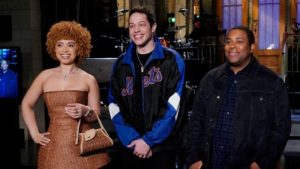
• Host Pete Davidson wore a Mets jacket when he appeared in promotional spots for the 2023-24 season premiere of Saturday Night Live (Season 49).
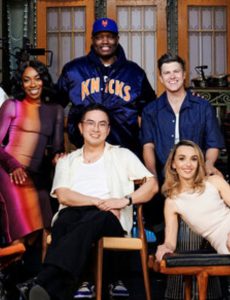
• In the official Saturday Night Live cast photo for Season 49 (2023-24), Michael Che, holding down the center spot in the back row, wears a Mets cap (along with a Knicks jacket).
From when the Mets were at their most fashionable, in his first appearance as “Mr. Subliminal” — the recurring sketch in which almost imperceptible hints regarding what he wanted or wanted thought were dropped into conversation — Kevin Nealon several times quickly mentioned “Mets tickets” to his boss, played by Jon Lovitz, on the Season 12 premiere of Saturday Night Live. Not surprisingly, Lovitz gave Nealon Mets tickets. Also not surprising: this episode aired October 11, 1986, hours after Lenny Dykstra’s walkoff two-run homer gave the Mets a two-one lead in their NLCS versus the Astros, making an even hotter commodity out of Mets tickets (even if there was little subliminal to Dykstra’s persona).
Saturday night, especially on NBC, inevitably leads to Sunday morning, especially on CBS:
• On CBS Sunday Morning, March 12, 2023, in advance of that night’s Academy Awards presentation, Josh Seftel, director of Stranger of the Gate, nominated in the Best Documentary Short category, spoke with his mother about his chances of winning an Oscar. She reminded her son that an award would be a “feather in your cap,” but that “you’ve already got the cap.” When he asked her, “What kind of cap is it?” she replied, “baseball cap,” with a picture of Josh in a Mets cap appearing to end the segment. (Josh’s film did not win).

• “One man has a rich, fulfilling life, and the other is a dad.”
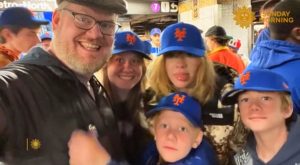
—Comedian Jim Gaffigan’s Father’s Day essay on CBS Sunday Morning, June 18, 2023, illustrating his own dad life with a picture of himself with his children all in Mets caps at what appears to be the Grand Central 7 station, presumably going to or coming from a Mets game (Gaffigan is smiling; the kids are…not quite).
The legacy of David Letterman is shared by the Eye and the Peacock. Here’s a Metsian taste from each of the great man’s after-dark programs:
On March 31, 2011, on the eve of Opening Day, Chris Rock visited The Late Show with David Letterman to bemoan how cash-strapped the Mets were in the wake of the Bernie Madoff mess. “My team’s broke, Dave,” the comedian told the host. “Some teams don’t have a cleanup hitter, some teams don’t have a closer or a good pitcher. My team has no money, Dave.” When Letterman asked Rock if he had season tickets, Rock replied, “They don’t have tickets no more, Dave. No more tickets — tickets cost money, they’re on paper, they have no paper, Dave. You show up and a dog licks your hand, then you show the spit and they let you in. This year, second base is a manhole cover, Dave. Between every inning, they use the other team’s gloves. No catcher’s mask this year. They just get an ugly guy. The Yankees got Bat Day. The Mets got Bring a Bat Day. ‘Here ya go, Jose Reyes. My daddy gave me this for Christmas. Maybe you can use this.’ It’s gonna be some year.” (The Mets would go 77-85 in 2011, their first season under Terry Collins.)
“Why is it so hot in here?”
“Because the Mets won.”
“So this building is on the same circuit as Shea Stadium?”
—Exchange between David Letterman and an offstage voice, Late Night, October 14, 1986, following the Mets’ 2-1 victory over the Astros in Game Five of the NLCS
***Oscar’s Caps admires unlikely entities doing their best to understand the Mets. We’d place John Wilson, the host of HBO’s How To with John Wilson, squarely in that category. In “How to Watch the Game” on How To with John Wilson, Season 3, Episode 4 (August 18, 2023), John — very much not a sports fan — receives an email from the PR department at Citi Field inviting him to a game toward the tail end of the 2022 season.
Even though the email is directed to “Josh” Wilson, John accepts.
To make sure he fits in, he stops by a Times Square souvenir shop to purchase a Mets cap; as he buys it, he confirms that it is indeed a Mets cap.
For research, he looks up the Mets’ Baseball-Reference page and scrolls through some other material, including the Posts’s Mike Piazza “I’M NOT GAY” back page from 2002.
When he arrives at the ballpark for “quality time at Citi Field,” he’s is very much a stranger in a strange land, and that strange land is deluged by rain. He passes a couple of college-age fans — one whose shirt bears Greek fraternity letters — and asks, “What do you think’s gonna happen?” The answer: “Mets gonna lose.” John’s reply, “Ah, shit.”
Viewers see Citi Field personnel wiping down the fanciest seats (John seems to think this happens throughout the ballpark whenever it rains; it doesn’t) and John’s camera shows us another staff member wearing an ALCOHOL COMPLIANCE jacket, which John takes to mean he “makes sure people drink enough alcohol”.
We’re also treated to a glimpse inside the media dining room, where John marvels that there’s a meat loaf large enough to feed all “the male photographers”.
Eventually, the show’s host bumps into loyal Mets fan and Citi Field fixture Pin Man, Nicholas Giampietro, who invites John to his house once the game is rained out. Pin Man — whose jersey identifies him by nickname and is festooned with pins — graciously pulls out his ’86 Mets video tape A Year to Remember to bring John up to speed on Mets history.
In one final admission of unfamiliarity with his subject matter, John asks Pin Man, “Was the ’86 team a good team?”
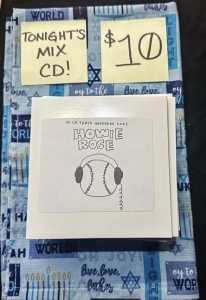
***Oscar’s Caps admires likely entities continuing to be Metsie as hell. On December 8, 2023, for the second night of Yo La Tengo’s 2023 annual run of Hanukkah shows at the Bowery Ballroom, the guest mix CD provided to raise funds for charity (in this case Doctors Without Borders) was compiled by Howie Rose, with the music therein a collection of songs from Mott the Hoople. No explanation is needed in these quarters what legend Yo La Tengo named themselves for (but maybe a certain “news” outlet requires a quick refresher on which Frank Thomas is which Frank Thomas).
Right up there with YLT and Oscar Madison’s cap itself is the most cornucopic of post-Odd Couple Mets pop culture content, Seinfeld. If there’s a sure thing in our world, it’s that every Mets fan reading this knows about the Keith Hernandez episode. Yet there’s always more to learn about any subject.
• On May 5, 2023, Noah Gittell on defector.com examined Seinfeld’s unwelcome shift in baseball focus from the Mets to another New York baseball team, noting not only most of the Mets-intensive plots (most notably “The Boyfriend” with Keith Hernandez), but how “whenever possible, Seinfeld incorporated Mets imagery into the show. In ‘The Busboy’ (June 2, 1991), the title character has a Mets banner above his bed. ‘The Alternate Side’ (December 4, 1991) opens with George wearing a Mets cap, complaining about Jerry’s being stolen, as they return to Jerry’s apartment. We can presume that they were on their way to Shea Stadium.” Gittell bemoaned that once George got a job as assistant to the traveling secretary fro the Yankees, “the Mets virtually disappeared from the show, while their cross-town rivals became fully integrated into the group’s weekly hijinks.”
• Come August 23, 2023, New York magazine’s Vulture section included a Q&A between Devon Ivie and Keith Hernandez in which “Keith Hernandez Answers Every Question We have About Seinfeld,” with Keith revealing, “I’ve only watched the episode a couple of times. I have a hard time watching it, so I haven’t in several years. […] I feel like it’s embarrassing to me. I don’t think I did that great a job.” Keith also forgives George Costanza for joining the dark side: “It’s all part of creativity and comedy. They had to think about all the episodes. The writers had to come up with different storylines every week. It’s a lot of pressure.”
Keith’s a very understanding person.
***“Casey Stengel doesn’t have half the problems I have.”
—Charlie Brown, upon discovering Snoopy is standing at his position asleep, May 28, 1964 (with the Mets off to another terrible start)
“NEW CANAAN, CT—Sources familiar with the man’s role in his child’s life confirmed to reporters Monday that local dad Marcus Weir’s parenting strategy is solely focused on ensuring his son doesn’t become a New York Yankees fan. Beginning shortly after his son Miles’ birth nine years ago, Weir reportedly concentrated the entirety of his fatherly influence on making the boy a supporter of any sports team besides the Yankees, a project he initiated by acquiring several Mets onesies in his son’s infancy.”
—From the Onion, “Dad’s Entire Parenting Strategy Just Ensuring Son Doesn’t Become Yankees Fan,” May 27, 2023
At the very end of the June 9, 2023, episode of The Prestige TV Podcast (a Ringer production), in which host Sean Fennessey interviewed star and creator Bill Hader regarding the series finale of Barry, Hader blurted out, “Go Mets!” presumably as a friendly nod to Fennessey’s fandom. Sean’s response was, “That’s just mean.” Fennessey, on Twitter, referred to Hader’s remark as trolling; Hader is an excellent actor, so perhaps “Go Mets!” wasn’t as sincere as one wished to believe it sounded. Though the podcast episode was taped in advance, it dropped shortly after the Mets were swept by the Braves in Atlanta, the last game of the series lost, 13-10, in ten innings.
“If you don’t have a philosophy, you turn into the Mets, and I’m a lifelong Mets fan.”
—Brendan Sweeney, KUOW-FM, a public radio station in Washington state, describing for the Nieman Journalism Lab in a November 2023 article the challenges his medium faces; in the words of author Ben Brock Johnson, Sweeney added, “The Mets survive via the largesse of a wealthy benefactor, but don’t have a lot of pennants.”
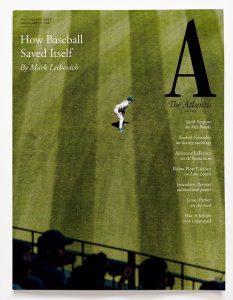
A distant shot of Mark Canha playing left field at Citi Field graces the cover of the July/August 2023 issue of The Atlantic, illustrating Mark Leibovich’s cover story, “Moneyball Broke Baseball,” about the implementation of the pitch clock.
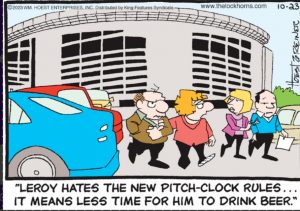
On October 23, 2023, in the single-panel comic strip The Lockhorns, Loretta Lockhorn informs another couple that grumpy-looking Leroy Lockhorn “hates the new pitch-clock rules…it means less time for him to drink beer,” and she does so in the parking lot of a gray edifice that is very much modeled on the dear departed Shea Stadium, a mere fifteen years since it last hosted a ballgame.
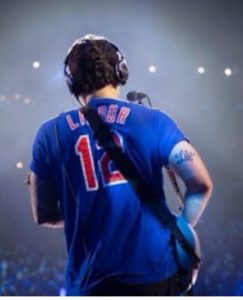
John Mayer wore a LINDOR 12 Mets shirt as he performed with Dead & Company at Citi Field on June 22, 2023, with Francisco Lindor and wife Katia Reguero Lindor in attendance, tweeting the next day, “I’ll never forget those two NYC plays at @citifield,” identifying as his “Series MVPS: @lindor12bc for his friendship and hospitality, and the @mets organization for taking such wonderful care of me and one of their biggest fans: my dad.” Father and son showed off their vintage Cooperstown Collection Mets jackets in said tweet.
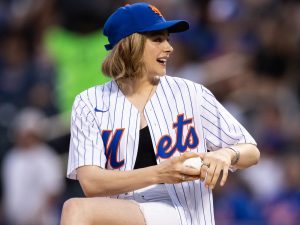
Actress Chloë Grace Moretz throwing out the first pitch at Citi Field on August 7, 2023, prior to that night’s Mets-Cubs game, earned notice as one of “The Best Celebrity Wellness Instagrams of the Week” by SELF magazine later in the month.
Among the many talking heads in the 2023 HBO documentary Albert Brooks: Defending My Life, only Judd Apatow thought to wear a Mets t-shirt (featuring a prominent orange NY) as he shared his thoughts with director Rob Reiner.

Sadly, the world of Mets pop culture lost one of its implicit advocates in the past year, as Young Capone, a rapper who performed while wearing a Mets cap, died in August 2023 after having been reported missing for several weeks. He was only 35.
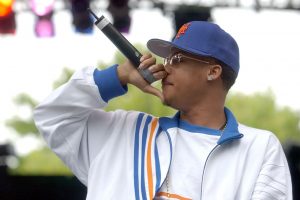
***In the first episode of the second season of the Netflix series Atypical (2018), Doug, portrayed by Michael Rapaport — before he showed up on SNY between every half-inning to promote Mike’s Amazing Mustard — is shown in a flashback to 2004, during which he wears a Mets cap.
At the Congressional Hispanic Caucus Institute (CHCI) Leadership Conference in September 2023, Vice President Kamala Harris shared a stage with Mets superfan John Leguizamo…and Leguizamo represented as he so often does, wearing a Mets cap for the occasion.

In the 2014 documentary Advanced Style, one of the Manhattan-based fashion icons profiled, Tziporah Salamon, jokes to her doorman, “Coco Chanel would never be taking the subway,” while she brandishes a Metrocard…but not just any Metrocard. Ms. Salamon is holding a Metrocard with a Mets logo printed on its underside, plainly discernible to the viewer, assuming the viewer is forever on the lookout for even the most incidental Met sightings in the popular culture.
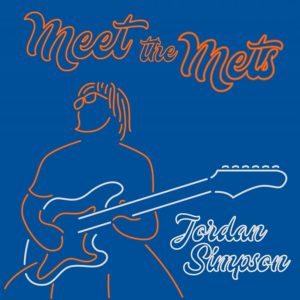
Enchanting iterations of “Meet the Mets” are a staple of every season, good or bad. In 2023, Jordan Simpson dropped his jazzy version, accompanied by a Spotify video in which he shows off not just his musical talents, but an impressive array of Mets jerseys.
In the 2023 installment of the PBS series American Masters on Jerry Brown (“The Disruptor”), a clip from Brown’s 1992 presidential campaign reveals one fellow in a Mets cap. Much as the 1992 Mets failed to attain their goal, Brown did not win that year’s New York primary.
In 2023, the same year he learned the Mets would retire his number in a Citi Field ceremony the following season, Darryl Strawberry was featured in the documentary, The Saint of Second Chances, the story of Mike Veeck. Their paths crossed in St. Paul in the mid-1990s when Darryl revived his then-dormant baseball career by playing in the Northern League for the unaffiliated Saints, run by Veeck.
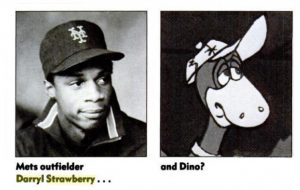
Before the Strawman was in need of the a second chance, the December 1987 issue of Spy magazine, splashed its popular “Separated at Birth” feature on its cover, with two subjects suggested as sharing DNA Darryl Strawberry (in Mets cap and jacket) and Dino from the Flintstones (in a non-team baseball cap). The resemblance was striking.
Vincent D’Onofrio as Steve Cohen wears a Mets cap in Dumb Money, 2023’s cinematic telling of the GameStop caper.
The ubiquitous GEICO Gecko stands at home plate and speaks into a microphone (ostensibly to tell a joke that is drowned out by a flyover) at what is clearly a CGI’d version of Citi Field in an insurance commercial that ran on national telecasts during the 2023 postseason.
A TMZ Live correspondent wore a Los Mets cap (made by The 7 Line) on camera on November 16, 2023.
In the 2001 time-travel romcom “Kate and Leopold,” the actor brother of Meg Ryan’s character (Kate McKay) is watching a Mets game, with Mike Piazza at bat. The brother, Charlie, played by Breckin Meyer, starts calling the action using different accents. When Mike hits a home run, the brother describes it in an Indian accent similar to that of Apu from The Simpsons (itself considered culturally insensitive in later years, even if it is a creation of celebrity Mets fan Hank Azaria…and Apu’s favorite squadron is the Nygh Mets). In addition to game footage, the moviegoing audience was treated to a glimpse of a framed poster featuring the Mets skyline logo and several of the 1969 Mets — their heads floating in circles — above the words LET’S GO METS as it appeared in the apartment of Liev Schreiber’s character (Stuart Besser, Kate’s ex).
On October 15, 1978, a Mets pennant was visible in a sketch performed by Bob Hope and Steve Martin (as ballpark vendors) on Bob Hope’s All-Star Comedy Salute to the 75th Anniversary of the World Series on NBC, as close as the 1978 Mets were getting to the World Series.

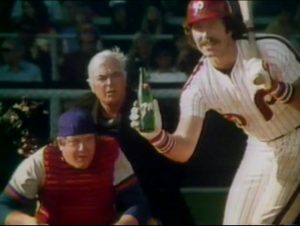
The 1980 “America’s Turning 7 Up!” commercial that starred three National League East superstars — the Cubs’ Bruce Sutter, the Pirates’ Dave Parker and the Phillies’ Mike Schmidt — also included, essentially as a prop in the Schmidt segment, a forlorn catcher whose jersey’s blue and orange trimming around its short sleeves very much suggested a Met backstop helpless to stop his division rival from a) tapping on home plate with his bat to produce a bottle of the sponsor’s product on demand and b) whacking another home run.
***As a guest of Adam Schein’s on SiriusXM’s Mad Dog Radio on May 24, 2023, new Jets quarterback Aaron Rodgers said he got an idea of how “special” winning a championship in New York would feel like from watching 2021’s Once Upon a Time in Queens, the four-part 30 for 30 documentary that revisited the exploits of the 1986 Mets. The 39-year-old Rodgers mentioned having been a Kevin Mitchell fan growing up in Northern California.
Aaron Rodgers was going to be a big deal in New York in 2023, remember that? Well, maybe in 2024. If you’re not necessarily looking forward to that guy, you can look forward to the following flowing from the pens of a couple of true orange-and-blue storytellers:
• May 2024 will see the release of the novel Curveball, which will follow lefty hurler Jess Singer, who author Eric Goodman explains “will start the year at Syracuse, but make it to Flushing after the Super Two deadline”. Curveball is the sequel to the 1991 book In Days of Awe, which introduced readers to Jewish Joe Singer, “a pitcher for an unnamed National League team in Queens”. Goodman, in case you haven’t inferred, describes himself as a “lifelong Mets fan” who “grew up in Brooklyn and saw them play at the Polo Grounds”.
• The new year will also be graced by the release of the sixth Mike Stoneman thriller, Double Takedown, set in September of 2023. When the title detective “turns on the TV to watch the Mets game,” author and diehard Kevin Chapman warns readers, “it isn’t pretty.”
We look forward to those books, and we also anticipate seeing, reading, hearing and discovering Mets Pop Culture that has yet to see light and Mets Pop Culture that emerges from dark corners of the collective consciousness. Again, enormous thanks to everybody who helps keep Oscar’s Caps current and comprehensive.
by Greg Prince on 31 December 2023 1:59 pm In one of those Faith and Fear traditions known only to me, I like to present a list as long as Eric Hillman’s left arm when my birthday falls on a Sunday. Since we’ve been doing FAFIF, my birthday has fallen on a Sunday twice, in 2006 and 2017. Today is the third time. I’m keeping my obscure tradition alive by presenting the first portion of a list I’ve been nurturing for several years.
These are MY FAVORITE MET SEASONS, FROM LEAST FAVORITE TO MOST FAVORITE, 1969-PRESENT. Such a list itself wouldn’t be too long if it was just the list: 55 seasons that I’ve been watching the Mets, 55 lines on the list, done and dusted, go watch the ball drop. Of course a simple list with no expanding on the subject matter wouldn’t be any Sunday birthday fun for me. Being expansive about the Mets is what’s gotten me to 61 in as good a mood as I can be.
Creating a commentary-laden list that goes from least favorite to most favorite rides a somewhat predictable arc in my thinking. If I were to start with No. 55, the Met season I liked least from a personal perspective, I’d be very down on No. 55, and stay down for the first wave of the countdown because, you know, they’re my least favorites. “This went wrong, that went wrong, what a year, yeech.” It’s understandable. When you love a team the way we do, you really hate when things go badly for them and that’s gonna come through in any retelling.
I want to be in a good mood at the outset of 61. So here’s how I’ve decided to proceed. For the first dozen entries on the list of MY FAVORITE MET SEASONS, FROM LEAST FAVORITE TO MOST FAVORITE, 1969-PRESENT, I’m devoting myself to Something I Liked In Seasons I Didn’t. One distinct memory apiece from those dismal dozen when I can remember feeling pretty good in some way about and during a lousy Mets year. It was a bit of a challenge finding something nice to say about those Met circumstances that had little to recommend them when they were being lived, but that made taking it on more fun for me to put together. (This, you’ll note, is how I have fun.) I also tried my best to come up with material I haven’t used here before or at least haven’t delved into in quite the same manner. Apologies for any long lost redundancies. Apologies, too, for briefly transporting you to seasons you might wish remain lost. For me, “least favorite” implies some strain of favoring, however slight it might be.
Bob Murphy continually reminded us baseball is a game of redeeming features. Every season has those. That’s what this segment of this countdown is all about.
I’m limiting myself today to one glass-half-full anecdote for twelve mostly empty seasons. The seasons that are more favored will be counted down in a different style in upcoming posts. That’s the plan, anyway. I’m a tad pokey about following through on these multipart series ideas of mine, but we’re getting the least-favorite seasons out of the way right here, right now. It can’t help but get sunnier in the new year.
***55. 1977
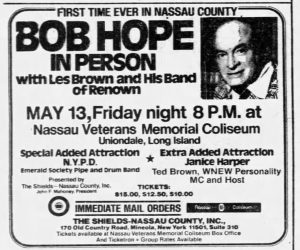
Bolstered by the magic of twi-night doubleheaders, the Mets played 29 games on Fridays in the year they a) traded Tom Seaver on June 15; b) determined the National League East cellar would make a nice long-term rental; and c) left few positive impressions in their wake. They lost 21 of those particular dates, including nine in a row spanning May 20 to July 1, indicating maybe Friday wasn’t destined to be their lucky day of the week whether they held onto The Franchise or not. Yet my clearest memory of any Friday game from 1977 comes from a win: Friday the 13th of May. My friend’s father had come into a boatload of tickets for a Bob Hope show at the Nassau Coliseum that night and was quite generous with his windfall, inviting my parents and me to join a rather large party to watch the ageless comedian ply his craft. I remember one Hope joke: President Carter has reached out to fill the White House with advisers from the north, south, east and west…of Georgia. I also remember the lot of us going out for ice cream at the Apollo Diner in East Meadow afterwards. So I didn’t see the game, but I recall getting home in time for Kiner’s Korner, from which I learned Dave Kingman had homered and the Mets had topped the Dodgers at Shea, 3-0. Sky King had been in a mood all season — he’d be traded the same night as Seaver — but here he was, performing his Dave Kingman core competency, hitting a “long, towering two-run homer,” per Steve Jacobson’s description in Newsday, two batters after Lenny Randle sent his first Met dinger over the 396 mark in left-center. “An accident,” the good-natured newly acquired infielder called his shot. “My quota is about one a year.” Randle made some nice plays at second, as did contingency third baseman Jerry Grote at his temporary position. Jon Matlack threw a seven-hit shutout to quell the Dodgers, who entered the evening at 24-6. Conversely, the Mets had won once in the past dozen days; they hadn’t even led in a game since the previous Sunday. Before Jon beat L.A., the Mets were 10-19. A few days earlier, the lefty revealed to Joe Durso of the Times that he was “fed up” with how the Mets were going about their business on and off the field. Kingman’s reaction to his eighth homer of the year (and second-to-last before he became a San Diego Padre)? “I don’t care anymore. I just play my game.” The Mets hadn’t exactly turned their frown upside down, yet this game got played to a pleasing decision for a change. Ralph had bona fide home team highlights to share and the 1977 Mets provided me with a wisp of optimism that these guys might pull themselves together rather than continue to completely fall apart. They didn’t, but for a minute I could be convinced otherwise. Thanks for the memory?
54. 2003
“I hated the Dodgers with that love that only hatred can understand,” is how Stephen Jay Gould summarized being a Giants fan in 1951 on Ken Burns’s Baseball in 1994. I’ve mulled that sentence over for nearly thirty years, and I still don’t know what it means, but I’ve always liked the way it sounded. Perhaps that also fits how I viewed the Mets in 2003. They replaced Bobby Valentine with Art Howe. They let my favorite player, Edgardo Alfonzo, walk. They dumped my wife’s favorite player, Rey Ordoñez. They imported T#m Gl@v!ne from the Braves and Mike Stanton from the Yankees. They created the first Mets team that I pretty much hated in advance, albeit with a hatred informed by love. Or something like that. It was as unlovable an edition as I had encountered in all my years of being a Mets fan, but I was still a Mets fan, regardless that I couldn’t stand these Mets. I still cheered for various Mets. Sometimes they were wearing other uniforms. On June 6, the Seattle Mariners came to town, which meant John Olerud was coming to town, which meant I would be at Shea Stadium to let John Olerud how much I missed him. I was almost as irritated with the Mets letting Oly go in December 1999 as I was with their making the same decision vis-à-vis Fonzie three winters later, but those Mets had too much going for them to seriously test my ardor. In 2003, I’d already rooted for an ex-Met over a current Met once, when Jesse Orosco filled in as closer for the Padres on May 9 and his chance to notch a save at Shea — something he’d done most memorably one October night versus the Red Sox — meant he’d have to retire Roberto Alomar. I already didn’t like Alomar. I was watching from home. It was an easy call. C’mon, Jesse. Orosco struck out Alomar with two on and two out. I clapped for the pitcher. The Mets lost? So what? 1986 took a curtain call, something 2003 would never be asked to do. Four weeks later, though, my fondness for Olerud and all he’d meant from ’97 through ’99, couldn’t quite break through another ninth inning. This time I was at the game. It didn’t matter that I loved Oly and I was past the end of my rope with Armando Benitez. Armando was protecting a one-run lead with two out and a runner on first. He was as capable of blowing it as he was of saving it. A Met win wasn’t going to mean anything in the scheme of 2003. John worked a three-two count. Of course he did. He was beautiful that way. Benitez was agita personified. The Mets deserved to have John Olerud, in his first trip back to Flushing since he advanced unmolested from second to third once the Grand Slam Single departed the park, remind them of who they felt fine about replacing with Todd Zeile. Yet, I couldn’t do it. I couldn’t root for one of my favorite Mets to stick a pin in the world’s largest Armando Benitez voodoo doll, not as long as he was a Seattle Mariner in my midst. Benitez struck out Olerud. I approved. It was the approval only disdain can understand. Or something like that.
53. 2002
My dismay for the 2002 Mets wasn’t set in stone ahead of time as it would be in 2003, but it was inevitable. Bad mix of personalities, bad results the rule by May, a total disaster by September. Still, on September 21, a Saturday night at Shea — and I’m not a huge fan of going to Saturday night games to begin with — I’d forgotten how disgusted I had become with the 2002 Mets over the previous five-and-a-half months once the Mets forced extra innings versus the Expos. Did I say “forced”? More like the Mets walked through the door to the tenth Montreal held open for them in the bottom of the ninth. Sure, the Mets had first and third, but with two out, Brady Clark grounded to two-time Gold Glove winner Andres Galarraga at first. All Galarraga had to do was throw accurately to second to end the game, 3-2, in favor of Les ’Spos, but Andres’s last Gold Glove came in 1990. His errant fling into left field furnished the Mets with the tying run. Come the eleventh (after Armando Benitez held up his end of the bargain with two scoreless frames), Joe McEwing absorbed a hit-by-pitch with one out, Roger Cedeño drew a base-on-balls with two out, and Esix Snead, the kind of player for whom garishly expanded rosters were conceived, belted a three-run homer to win it. Esix had been on the club since September 3, primarily to pinch-run. He entered this game as a pinch-runner in the eighth and was picked off. In the tenth, he delivered a leadoff single for his first hit in the major leagues, but was stranded at second. Snead left no doubt in the eleventh. “It’s pretty exhilarating,” the rookie said, expressing a sentiment nobody around the Mets had any cause to otherwise articulate of late. A week remained in the season. The Mets were going nowhere and they were doing it in front of almost nobody. But as soon as Snead went deep to right, those of us who’d stuck around to the non-bitter end had detoured into a September to Remember. I was jumping around like House of Pain was back on the charts, high-fiving my pal Joe over and over and truly believing there was no better place to be on a Saturday night than Shea Stadium at the tail end of a last-place campaign. Hot damn, I was at The Esix Snead Game.

52. 1992
They weren’t yet dubbed The Worst Team Money Could Buy, but had you told the bulk of Mets fans by June 1992 that a book bearing that title would be out the following April and it would be about this team that was repeatedly frustrating us, we wouldn’t have blinked. Ah, but before it was abundantly clear what a debacle we were bearing witness to, there was Daryl Boston’s shirt and the ball that landed inside it. It was the sunny afternoon of April 23, a Thursday matinee at Shea. I wasn’t there, but I was close enough, sitting at my desk in Great Neck with the radio on, enjoying one of those day games that feels as if it’s never gonna end, now and then sharing updates with co-workers who cared and co-workers who didn’t. Bret Saberhagen pitched nine scoreless innings. Alas, so did a combination of two Cardinal pitchers, which meant extras were at hand. The eleventh was to be our downfall, if you assumed two singles and a walk to the opposing lineup with nobody out augured the worst. Assume nothing — Dave Magadan made two swell plays at third base and St. Louis couldn’t score. Still zip-zip, all the way to the bottom of the thirteenth, when the Mets loaded the bases, bringing up Boston. Redbirds reliever Juan Agosto managed to land a one-two pitch inside the loose-fitting jersey of the batter. It went onto your scorecard as HBP and RBI. Daryl plucked the ball out of his clothes and handed it to the umpire. Mets 1 Cardinals 0 in a shade under four workday hours. Some kind of omen for the season ahead, the listener at his desk thought before starting to spread the news throughout the office. It was no kind of omen, actually, but it was April, and the team for which he rooted seemed to be worth whatever they were being paid.
51. 1993
If ever a team inspired a fan to agree with McDonald’s that we deserved a break today, it was the 1993 Mets, whose rousing 12-2 victory over the Reds in Cincinnati on Wednesday August 18 raised their seventh-place record to 42-78, a mere nine games behind sixth-place Florida, a team that hadn’t existed before the current season. The Mets had a travel day Thursday, then a scheduled off day Friday before resuming their schedule in Colorado on Saturday evening with a twi-nighter against the NL’s other expansion team. No baseball planned for Friday was odd but explicable. The Denver Broncos had a preseason game at Mile High Stadium, so the Rockies had to work around the venue’s primary tenant’s priorities while Coors Field was under construction. Being left alone by the 1993 Mets sounded heavenly. I filled my Thursday evening void by tuning into the staticky Phillies’ broadcast on 1210 AM (Lenny Dykstra’s bunch had a certain appeal), and I was musing that if I absolutely had to, I guess I could go on as a baseball fan without the Mets if I had a strong enough antenna. Then Friday came, and the godawful Mets remained in absentia, and so help me, I missed them. Not that team and its toxicity, just the day-to-day Metsiness of what a season is supposed to give us, even in the moldy basement of a season like the one in progress. The 1993 Mets returned to action Saturday and lost twice to this other team that hadn’t existed before the current season. Everything was still lousy. Everything was all right again.
50. 1979
On one hand, there was a final dress rehearsal. The Long Beach High School production of Li’l Abner would have its world premiere on Friday night, April 6, featuring for one scene yours truly in the key (from an expository sense) role of Senator Jack S. Phogbound. But the Thursday afternoon before, directly following eighth and final period, we would run it through one time as if we were going on stage in front of an actual audience…which we were, courtesy of a group of seniors — actuarial rather than high school — bused in from a local nursing home. The show went great, and our cast was brimming with confidence ahead of Opening Night. The only fly in the ointment was the final dress rehearsal conflicted with the curtain rising on the 1979 Mets season in Chicago. Alas, in order to deliver my briefest of solos (of all the very/ordinary/most unloved/unnecessary/places on this earth…), I had to miss the first pitch from Wrigley and the initial innings of the new year as well. Thankfully, I was home in time for the ninth. The Mets had a 10-3 lead, built largely on Richie Hebner’s four-hit, four-RBI debut. They always won on Opening Day, right? The Cubs, however, stirred and made it 10-6 with a runner on when Joe Torre went to his 21-year-old rookie out of the pen, Jesse Orosco, the player to be named later from the Jerry Koosman trade. Our callow southpaw, wearing No. 61 without a name on his back (all his teammates were properly identified), would have to face one of the most dependably dangerous lefty swingers in the league: Bill Buckner, a .323 hitter the year before. This was a game that couldn’t get away, and it didn’t. Orosco induced Buckner to fly to right, and the Mets were perfect in 1979. As, I daresay, was Li’l Abner on Friday night. Saturday night’s show, however, lacked that certain something, but that was OK, I guess, considering it was our Closing Night. Besides, the Mets won Saturday afternoon. We were 2-0. Hebner was batting .556. I never performed in another musical again. The 1979 Mets, about to lose 99 games, might have considered taking a cue from the ol’ Senator here.
49. 1982
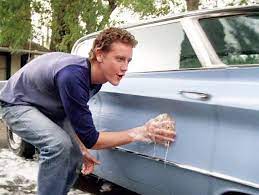
I was a car washin’ college man on a Sunday afternoon, making like Judge Reinhold as Brad Hamilton in Fast Times at Ridgemont High in the driveway of our house a couple of weeks before I was due back on campus. Determined to take care of my burnt orange 1981 Corolla (or, more likely, nagged into it by my mother), I had the hose, I had the bucket, I even had a fresh tin of Turtle Wax, a product I thought existed only as a consolation prize on Let’s Make a Deal. Whereas Brad scrubbed his “Cruising Vessel” to the strains of “Raised on the Radio” by a group called Ravyns, I went about cleaning my baby with WMCA on in the background. I was raised on the radio for Mets games if Channel 9 wasn’t televising them. Bob Murphy was exclusive to radio as of 1982, joined by newcomer Steve LaMar. In the first game of the doubleheader of August 15, Murph and his freshman partner kept me effervescent as I rinsed the bubbly water off my “Orange Flame”. The Mets took a lead in the fourth. Ed Lynch pitched serviceably for seven. When Jesse Orosco struggled in the ninth, George Bamberger called on Pat Zachry with the bases loaded. Pat worked out of Jesse’s jam and notched his only Met save. The Mets had started the season in promising fashion, rising to six games above .500 on Memorial Day. They proceeded to fall out of contention with a thud, but they did just beat the almost as lousy as them Cubs, and maybe, despite a 50-65 record, they could recover some momentum for the stretch drive. At the very least, maybe they could sweep this twinbill and make a move on respectability. But they lost the nightcap, then all nine games of their near-West road trip through Cincinnati, Atlanta and Houston, mounting a losing streak that would remain unabated as I made my own stretch drive from Long Island to Tampa to begin my sophomore year at the University of South Florida. After three days of classes, the Mets’ season victory total stayed stuck on 50. Their defeat total was up to 80. They executed a fifteen-game skid that washed away the residual vibes of not just 1982’s flashy start, but all that “Magic” stuff from ’80 and ’81. But, man, didn’t Bob Murphy sound great while I washed my car?
48. 2009
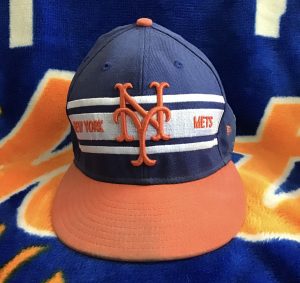
What could go wrong did go wrong Metwise in the first year of Citi Field, a place I found myself resenting more with every visit. I was still mourning the passing of beloved Shea Stadium, and the team inhabiting its successor facility wasn’t distracting me with great play. I’ll say this for the new joint: it had superb food and was brimming with retail. That may not have jibed with purist instincts (“it’s more like a mall,” was a common refrain), but inside the sprawling team store within the Jackie Robinson Rotunda, there was a cap that caught my eye. It was a modern take on the late 1970s “Superstripe” model. The Superstripe caps were regularly advertised in Baseball Digest and other indispensable periodicals of the day. They were produced for all teams in all major sports, including the Mets, and I had a Mets version. There was no mistaking what team it represented as their name was spelled out amid the striping. A white mesh back, adjustable sizing, not particularly well made, but I appreciated that it was made at all, seeing as how the print ads never spotlighted the Mets. Three decades later, the Sunday before the All-Star break, the cap beckoned to me as I browsed pregame. I tried to ignore its siren song of nostalgia for my youth, as it was kind of pricey (what wasn’t at Citi Field in 2009?), but I couldn’t get it out of my mind. Come the seventh-inning stretch, I slipped away from Promenade, tromped down those endless flights of stairs that were no aesthetic match for Shea’s ramps and made my purchase. The 2009 version of the Superstripe cap was a quality item. Almost too well made, but it was objectively better than my long-gone 1978 cap. The back was blue. The bill was orange. It was fitted. The “NY” in the middle of “NEW YORK” and “METS” was prominent enough to be discerned coming down the block. It became my game cap of record for the next decade, the one I took the most relish in grabbing as I headed out to catch my westbound train. I still wear it to Citi Field once or twice a year. I don’t resent the not so new ballpark any longer. I got my favorite cap there.
47. 2023
The most recent spate of Met misery didn’t prevent me from finding my way to Flushing on thirteen separate occasions, sometimes as something approximating working press, sometimes on a solo mission of the soul, but mostly to meet up with a really good friend. As these meetups begat more meetups, despite the Mets having given up the ghost of competing for a playoff berth, it occurred to me that this person I was having a good time sitting next to would also make a splendid lunch or dinner companion, and we could have very well done that today or tonight. Yet I knew this — going to see the Mets, even the 2023 Mets — was better. I wasn’t watching the game as closely as I would have had I been focused on it at home, but how closely did this team need to be watched? And me and whoever, we weren’t face to face much in the course of the couple of hours we were together, because we were looking at the Mets rather than each other, but we could hear each other fine, at least when the Citi Field A/V squad wasn’t urging everybody to GET LOUD. “A hot dog just doesn’t taste right without a ballgame in front of it,” Charlie Brown once declared. I’d add friendship tastes even better with a ballgame in front of it.

46. 2017
The Mets won the pennant in 2015, returned to the playoffs in 2016 and got off to a roaring start in 2017. All they had to do was keep roaring, and everything was going to be fantastic. The last legitimate roar came from the bat of Travis d’Arnaud on April 13, when our catcher conked Adam Conley with a sixteenth-inning leadoff homer at Marlins Park to give the Mets a 9-8 lead, an edge the skyward-pointer himself, Hansel Robles, preserved in the bottom of the frame. It was a long night (5:38), one that I snoozed through a bit of, but I woke up in time to see it won. The Mets, on a five-game winning streak, were 7-3. The bad Marlin juju we bake into our expectations hadn’t derailed them. Marcell Ozuna’s grand slam off Robert Gsellman way back in the first inning hadn’t buried them. They came right back with four runs in the top of the second, two in the top of third and one more in the top of the fifth. Yoenis Cespedes hit two out of that Miami monstrosity. Gsellman and Josh Edgin didn’t maintain the lead, but Michael Conforto got it back for us in the eighth. Then eight more innings, or as many as were required to get to 9-8 on the scoreboard and 7-3 in the standings. This was both sincerely appreciated and reasonably anticipated. The Mets of 2015 and 2016 and now 2017 were the payoff for all those dismal years of muddling in place. I truly believed we were ensconced in a legitimate era of Met success. The Mets lost ten of their next eleven, twenty of their next twenty-nine and finished 70-92. They’ve swerved in and out of eras every few months since that night in April of 2017. That’s the era I wish had kept going. It felt like a pretty good place to put down roots.
45. 1974
The kid’s name was Hal. His last name began with a P. I can’t quite remember what it was. It doesn’t matter. To me, he was Hal with the wristbands. This was during day camp in Oceanside, in July of a year when the Mets would definitively not repeat their success of 1973, and on the night before, Hal had gone to the Mets game. He mentioned it casually. Or maybe he announced his presence with authority. Whatever he didn’t say was there on his wrists. He was wearing Mets wristbands, acquired at Shea Stadium the night before, when he was at the game. I wasn’t so much envious of Hal with the wristbands — certainly not for the wristbands themselves — but I admired like hell his off-hours activity. As of that July day in 1974, I had been to two Mets games, once via the day camp I attended the previous summer, once with my older sister and a friend of hers a few Saturday afternoons prior. They were extremely special occasions that had to be carefully planned, either by enrolling at a camp or perusing the schedule and agreeing on a date. Yet here was Hal with his wristbands casually confirming he went to see the Mets on a weeknight. I’d heard of such things, the idea that somebody would decide to go to a game and just go. I don’t know how the decision was executed in Hal’s household, yet as far as I could tell, it was no big deal, wristbands or no wristbands. “I went to the game last night” was something I now wanted to be able to say like it was something I actually did. Eventually I would. I wouldn’t walk around the next day with any goddamn wristbands on. C’mon, Hal. Act like you’ve been there before.
44. 2020
In September, when I hadn’t been on a train except for the briefest of local hops since February, I considered boarding the LIRR and taking it to Woodside just like I would in any September, then switching for the 7 to Mets-Willets Point, also a familiar maneuver. I was going to get off the elevated line, walk downstairs, find a bench or lean against a post and turn my radio on to listen to the Mets play the Rays a few hundred feet away. I couldn’t go into Citi Field, as no fan could go into Citi Field while a pandemic was in progress and no vaccine for it was available. I understood I couldn’t go inside a ballpark. I watched the action on TV once it started up in late July, the very essence of better than nothing. Nothing was the attendance at every game, unless you counted those eerie corrugated cutouts, which I didn’t. Still, on September 23, I debated with myself the necessity to get as close as I could to the final home game of the regular season because I always went to the final home game of the regular season. I had an active 25-year Closing Day streak, dating from 1995 forward. It would necessarily hit pause in 2020, but shouldn’t I do something to spiritually keep it going? I ended up not acting on the impulse, safety being the better part of whatever while COVID lurked behind every corner. I picked up the Closing Day streak the next season and have kept it going ever since; it comes with a semi-colon now (1995-2019; 2021-Present). Once in a while, I picture myself taking that 2020 trip for the streak’s sake. It was a silly notion, but not inconceivable to a fan like me.
The final regularly scheduled edition of National League Town is available for your listening pleasure on Spotify and other podcast platforms. Pop it on, as the people who say things like that like to say.
by Greg Prince on 24 December 2023 9:57 am I don’t observe Christmas in the ecclesiastical sense, but I’ve watched a lot of Christmas episodes of sitcoms, both live-action and animated, so I understand assisting Santa Claus when asked is necessarily a good thing. Every year around this time, I hear that a reindeer with a nose visible in fog went down in history for lending a hand (or hoof). Thus, when Santa got in touch with me about a week ago and asked me to help right a few historical Met wrongs, of course I listened.
Santa let me know he was going over some old correspondence, and mixed into the letters he’d received from children far and wide was a folder filled with printouts of National League Rookie of the Year balloting results from 1962 to the present. The man in the red suit told me he was astounded at some of the names he didn’t see on those lists, specifically the Met rookies who never got any attention when it came time for the Baseball Writers Association of America to honor a given year’s freshmen. It seems Santa watches a lot of baseball during his summer vacations and figured more Mets would have received more support for ROY awards than they have.
Mind you, Santa isn’t endorsing greed. He’s quite aware that six Mets — Tom Seaver, Jon Matlack, Darryl Strawberry, Dwight Gooden, Jacob deGrom and Pete Alonso — have won the Rookie of the Year award, and four others — Ron Hunt, Jerry Koosman, Steve Henderson and Kodai Senga— finished a respectable second. He knows, too, that the balloting has been dotted by Met comers from Cleon Jones in 1966 to Andrés Giménez in 2020 receiving at least token support, which itself represents a nice little reward for a player who’s just made the major league scene. Santa is also hip to the historical reality that the BBWAA has conducted ranked voting for ROY only since 1980. Before that, writers would fill in just one name as their Rookie of the Year choice, reducing the opportunity to dispense a “nice first season there, young feller” consolation point or two to nearly nil.
Yet Santa is all about who’s been nice; naughty, too, but he’s trying to maintain an upbeat attitude in these turbulent times. He hates to think kids who tried their best and did rather well didn’t get a little official recognition for their efforts. That’s when Santa reached out to me via Zoom.
Blogger, with your Stathead
Subscription up to date
Won’t you assign some down-ballot points
Before it’s too late?
“Seriously,” Santa continued, “I’d like to get them distributed by Christmas Eve to ensure that they’ll be hung by the chimney with care. Surely you’ve heard that old chestnut.”
My December 24 looked clear, so I told him OK. Santa was asking simply that I arrange for some stocking stuffers…a point here, a point there for the Met rookies of yore who surely deserved to be mentioned on at least one ballot. I asked if I needed to do deep dives to discern who is most deserving; whether I should relitigate the rookie campaigns of multiple National Leaguers who perhaps shouldn’t have gotten votes Mets rookies could have gotten; might I have to take into account how careers unfolded with decades of hindsight at my disposal; and if this exercise would benefit from calibration of candidacies vis-à-vis other forms of rookie recognition from the likes of Topps, Baseball Digest or the Sporting News, which in their day were kind of a big deal.
“Use your judgment,” Santa replied. “Be as statistical or as anecdotal as you like. I trust you to use your head and your heart and arrive at reasonable conclusions.” Bolstered by the confidence Santa Claus expressed, I was ready to take on the task with so much holiday cheer that you could have spread the excess across the tray of Christmas cookies baked in the getting-to-know-you scene of whichever movie the Hallmark Channel is airing at this very moment. Still, as St. Nick was about to log off Zoom and get back to loading his sleigh to beat the holiday travel rush, I had to throw one more question at him.
“Santa? How come you didn’t deliver Yoshinobu Yamamoto to Flushing? You would have made a whole lot of kids from 1 to 92 happy if you had.”
The connection went dead at that point for some reason. Oh well. I can’t worry about that now. I have to stuff some stockings. A dozen is a good figure, I figure. I seem to recall something about twelve days of this particular holiday, and I can’t imagine too many fireplaces are grand enough to hang more stockings than that.
But into which erstwhile Met rookies’ stockings should I be stuffing the ballot socks, so to speak? To use the modern noun-as-verb parlance, I’m going to “gift” a point to the dozen Mets listed below — six pitchers, six position players. I’m not suggesting they were robbed of the Rookie of the Year award. Rather, I’m giving them the simple shoutout they deserved all along.
Oh, look! Twelve stockings belonging to first-year Mets have indeed been hung by the chimney with care! It’s a Christmas miracle!
GARY GENTRY, 1969
Did I mention Santa was particularly mystified that a pitcher for the National League East champions who was trusted by Gil Hodges to start 35 times — including the division-clincher in which the righty shut out the Cardinals — was completely overlooked by the 24 writers who voted for Rookie of the Year? And that from a distance of 54 years, the NL rookie class that did attract votes doesn’t seem to have been all that impressive in their neophyte stage? How do 13 wins for the 1969 Mets not make a dent? These elections have nothing to do with postseason performance, but the Mets won both of Gentry’s starts in the playoffs and World Series.
A 1969 National League Rookie of the Year runner-up vote has been stuffed in Gary’s stocking.
FRANCISCO ALVAREZ, 2023
We’re shooting straight to the present for this present. Francisco Alvarez belted 25 home runs and began mastering his craft behind the plate almost immediately after he was called up ahead of schedule. The pitchers, including the crusty veterans, praised him to the high heavens. Word even reached the North Pole, where Santa has been appreciating the hard offseason work Alvarez has been putting in to get even better as a sophomore.
A 2023 National League Rookie of the Year runner-up vote has been stuffed in Francisco’s stocking.
DAVID WRIGHT, 2004
The 21-year-old Virginian wasn’t summoned to Queens until late July. You know who else wasn’t promoted to the majors until late July? A first baseman named Willie McCovey, in 1959. McCovey whacked 13 homers and drove in 38 runs in 219 plate appearances and was awarded Rookie of the Year unanimously. Operating from the opposite corner of the infield early in the next century, David’s power numbers were as eye-popping as Stretch’s: 14 home runs and 40 ribbies in fewer than 300 PAs. Wright gave every indication a beautiful career was off and running from the get-go, and every moment from 2005 confirmed our initial faith.
A 2004 National League Rookie of the Year runner-up vote has been stuffed in David’s stocking.
TSUYOSHI SHINJO, 2001
A cult hero with credentials! Two walkoff hits! Sacrificed one of his quads to beat out a double play grounder and set up Mike Piazza for one of the longest blasts in latter-day Shea history on a Sunday night in the Subway Series! Inspired the Daily News to splash SHINJOY across the back page! Took the orange in orange and blue to heart by modeling it in his hair! You can’t ignore a major league first year like this one.
A 2001 National League Rookie of the Year runner-up vote has been stuffed in Tsuyoshi’s stocking.
DILLON GEE, 2011
Overlooked in his time, this kid knew how to get outs as soon as he came up to the bigs in September of 2010, breaking in with five no-hit innings at Washington. In his first full year, for a team that was lighting nobody’s world on fire, Gee won 13 games, or as many Gentry notched pitching for a much more competitive Met outfit. Proved a stopper at Atlanta in April when he halted the club’s seven-game losing streak. Proved enduring when, in his final September start, he foiled the powerhouse Phillies. The Braves missed the playoffs by one game, while 102-win Philadelphia, shorn of its inevitability, fell in the first round back when that sort of thing rarely happened to an odds-on pennant favorite
A 2011 National League Rookie of the Year runner-up vote has been stuffed in Dillon’s stocking.
MARK BOMBACK, 1980
The surprise rock of a rotation that was an essential part of making Mets fans believe in Magic for a few months. Peaked at 9-3 in August, before the whole team kind of went poof. On a staff ostensibly led by veterans Swan, Zachry and Burris, it was Bomback who led all pitchers in victories, the only Met hurler to reach double-digits in that then critical department.
A 1980 National League Rookie of the Year runner-up vote has been stuffed in Mark’s stocking.
RICK AGUILERA, 1985
An underappreciated component of the most compelling wire-to-wire pennant drive in franchise history. Aguilera came up minus fanfare in the middle of June and was soon constituting a fifth of a youthful rotation headed by Gooden, Darling and Fernandez. Had a knack for shining amid potential Metsian messes. Who won the night after the Mets were steamrolled, 26-7, at the Vet? Who chose the night after the 19-inning game at Fulton County to throw his first career complete game? Whose starting pitching set the stage for five Met victories in September, when every win was crucial?
A 1985 National League Rookie of the Year runner-up vote has been stuffed in Rick’s stocking.
RICO BROGNA, 1994
As long as they were giving out what amounted to short-season awards in strike-curtailed 1994, BBWAA members should have looked a lot more closely at the first baseman who rose to the majors in June and started lighting the NL on fire: a .351 average highlighted by seven long balls. If writers were hip to OPS+ nearly thirty years ago, they would have been gobsmacked by the kid from Connecticut posting a 158 in that category. It’s not Brogna’s fault baseball ended on August 11.
A 1994 National League Rookie of the Year runner-up vote has been stuffed in Rico’s stocking.
RON SWOBODA, 1965
Dynamite power-hitting first half, featuring fifteen dingers. He tailed off in the second half, but c’mon. This is 1965, the Mets’ fourth year of heretofore futile existence, and Swoboda is showing the league the Mets can produce somebody productive. This Youth of America talk may really be something more than Casey Stengel prattling on.
A 1965 National League Rookie of the Year runner-up vote has been stuffed in Ron’s stocking.
DOUG SISK, 1983
Anybody here want to follow Tom Seaver to the mound on the afternoon Tom Seaver has executed the most emotional homecoming in Shea Stadium history? You there, the reliever we called up for an audition last September — yeah, you. Here, take the ball, maintain Tom’s shutout and keep a lineup crammed with likely future Hall of Famers off the board while we try to make like Hanover and manufacture a run or two. Nice way to start your first full season if you can get it, and Sisk got it, picking up the win over the Pete Rose/Joe Morgan/Tony Perez/Mike Schmidt Phillies in relief of Seaver on Opening Day and going on to form a meaningful third of one of the franchise’s most formidable bullpen trios ever. That was Sisk succeeding the traded Neil Allen as the Mets’ main righty in relief, nailing down 11 saves and operating in sync with frontline closer Jesse Orosco and dependable lefty Carlos Diaz as they protected leads and held forts all season long.
A 1983 National League Rookie of the Year runner-up vote has been stuffed in Doug’s stocking.
SETH LUGO, 2016
Lugo was snuck into the bullpen at the outset of July and mopped up intermittently as the Mets slipped and slid on the periphery of contention. With almost every starting pitcher injured and not a lot of alternatives at hand, Terry Collins inserted the righty whose spin rate was off the charts into the rotation in late August, and by some Amazin’ coincidence, the Mets rocketed into the Wild Card race, eventually taking command of it. From August 25 through September 28, Lugo made seven starts, and the Mets won each and every one of those games. The starter’s record in that span: 5-0 with a 2.45 ERA, all compiled amid genuine pennant chase pressure.
A 2016 National League Rookie of the Year runner-up vote has been stuffed in Seth’s stocking.
BENNY AGBAYANI, 1999
In his first twenty-seven games as a 1999 Met, between May 11 and June 13, Agbayani blasted ten homers and pretty much created the OPS metric. The unheralded outfielder’s on-base average plus slugging percentage measured 1.338 in that first golden month-plus. The Hawaiian Punch graphic that began to grace the Shea scoreboard was quite literal. As the 1999 Mets were morphing into the 1999 Mets — dripping with drama, crammed with charisma and shining with stars — there was a period where you couldn’t help but think of them as Benny and the Mets. And even when the youngster cooled off some, he was still an important part of all that was going on, right through Game Six of the NLCS, when he scored the final Mets run of the millennium.
A 1999 National League Rookie of the Year runner-up vote has been stuffed in Benny’s stocking.
Two more votes are cast here as well: 1) for a wider fireplace mantel that would allow for the hanging of some more stockings into which retroactive Rookie of the Year votes would be stuffed on behalf of other worthy Met kids who took a bit of our breath away right away; 2) and for you, dear reader, to experience true (if Yamamotoless) joy the rest of this holiday season, the rest of this offseason, and all the seasons ahead.
by Greg Prince on 21 December 2023 4:09 pm Although baseball has already conducted its winter meetings, winter insists on meeting the rest of us this evening at 10:47 PM Eastern Standard Time. We wish a scintillating solstice to all, yet we’ve got a bigger milestone to mark before the month is out.
That’s right: the Baseball Equinox is nigh! At 3:26 AM EST on Saturday, December 30, 2023, we will sit exactly between the final out of the 2023 Mets season and the scheduled first pitch of the 2024 Mets season. That’s 89 days, 9 hours and 44 minutes after Phillies shortstop Edmundo Sosa caught Pete Alonso’s two-out, ninth-inning pop fly to shallow left last October 1, and 89 days, 9 hours and 44 minutes before you’d figure Kodai Senga throws his first ghost fork to whatever leadoff hitter David Stearns hasn’t liberated from the Brewers by this March 28. Incumbent ace Senga is a best guess for Opening Day starter at Citi Field, but it’s only a guess. So much can happen and occasionally does. For example, you wouldn’t have hazarded a pre-Equinox projection that Tylor Megill rather than Jacob deGrom or Max Scherzer was going to be our Opening Night pitcher in Washington in 2022, nor that the Opener three years running from 2020 through 2022 would be postponed, once from a pandemic, once because too many of the Mets’ opponents tested positive for COVID, and once when a lockout took its sweet time unlocking itself.
If life in this decade has taught us anything, it’s that presumption can occupy too much roster space of the mind. If the Mets in this decade have taught us anything, it’s to presume nothing. The calculation of the Baseball Equinox is offered as a public service to make the coming of Spring a little more visible a little sooner, but whatever might happen on the far side of the BE is not to be written in indelible ink until it actually happens.
We also happen to have completed 40% of this decade’s baseball seasons, which isn’t any kind of a milestone, exactly, but it’s got me thinking about the Mets and the 2020s. Decades don’t usually get anybody’s attention unless one is winding down and the next one is looming. But why wait for the last gasps of 2029 to get a handle on this one?
From a Mets perspective, it could use a boost.
The four seasons of the 2020s to date have had one thing in common: none of them has felt great in the months that followed them. Three encompassed losing records; two saw first place slip away; the lone campaign that seemed to be rolling merrily along faded in frustration. We entered the 2020s with lofty expectations, failed to meet them, reset our sights even higher a couple of times, and fell to earth successively harder
Even if we allow that decades are arbitrary chronological constructs, this one has been dismal four Met years in…which is pretty much par for the Met course in terms of how our decades commence. Let’s give the first four Met years of the 1960s and their relentless 100+ losses per annum a break, given that for Met purposes the 1960s didn’t get going until 1962, and we were starting from scratch (making how the 1960s ended in Flushing even more remarkable). And let’s acknowledge that 1970 through 1973 represented a reasonably competent above-.500 quadrennium whose culmination, You Gotta Believe, couldn’t have been much more thrilling.
Since Wayne Garrett popped to Bert Campaneris to end the 1973 World Series, we haven’t been able to string together a strong four-year start to any Met decade. From 1980 through 2023, the Mets have contested twenty seasons that have ended in the numbers 0, 1, 2 or 3 — or 21, if we take the split seasons of 1981 into account. The Mets posted a winning record in four of them. There was one pennant in there, in 2000; one additional playoff spot, in 2022; one end-of-an-era shortfall, in 1990; and one that we’ll call, considering its September’s circumstances, a nice try, in 2001.
The early 1990s completely got away after 1990, with 1991 a cavalcade of misery a Mets fan couldn’t have imagined would be surpassed not once but twice over the next two years. The residual good vibes of 2000 all but disappeared until late in the 2001 season, at which point it was probably asking too much of the Mets to see to fruition their attempt at coming to their city’s emotional rescue — after which, 2002 was essentially 1992 redux, and 2003 was its own kind of pits.
And those were the decades, besides this one, that had at least one decent year within their four.
When I think of what might become of the 2020s, I try to remind myself that the 1980s went 0-for-4/0-for-5 out of the gate, yet when we think of the Mets of the 1980s, we don’t think at all about how bad the Mets of 1980, both 1981s, 1982 and 1983 were. The Mets of the 1980s as they exist in the popular imagination materialized nearly fully formed in 1984 and rode high right up to the doorstep of the 1990s. The Met version of the 1980s was the era that was ending when the 1990 Mets made one last charge at glory. It never occurred to us until August of 1991 that Excellence Again and Again, as the marketing theme went, wasn’t going to be a perpetual way of life, and it probably didn’t sink in until May of 1993 that a fan should take nothing for granted, certainly not an era’s ability to self-renew and extend itself indefinitely.
Decades are too long to wholly reflect the quality of a baseball franchise. Ten years leaves ample room for ups to overtake downs and vice-versa. If you invoke the Mets of the 1970s, you won’t evoke warm fuzzies for the best parts of 1970 through 1973. The decadesque definition of the ten years in progress fifty years ago got swallowed up by the rest of the 1970s, especially the Grant’s Tomb motif of its final three seasons. If a person wishes to define a team’s decade as “good” or “bad,” making a judgment 40% of the way in is why they put erasers on pencils.
Our 1990s plodded along until they could pull themselves up by their bootstraps circa 1997, and proceeded to give us a most compelling final act by 1999, though I don’t know whether the Mets of the 1990s stand more for the explosion wrought by the Grand Slam Single or the explosion wrought by Vince Coleman’s taste for parking lot firecrackers. The Mets who were withering at mid-decade in the 2000s discovered new life in the second half of what people insist on calling the Aughts (I preferred Ohs), but the life oozed right out of the party by 2009. As for the 2010s…
Ah, the Mets of the 2010s, the last decade before this one. That’s the one I find myself thinking about most vis-à-vis the 2020s, and not just because of adjacency. In dwelling on the early 2010s recently, I came to label the period when we were getting used to Citi Field the Hump Years. This was after the brief glory of 2006 morphed into the lingering bitterness from the collapses of 2007 and 2008, the culture shock of having Shea’d Goodbye, and the entire Metsian enterprise being hamstrung by the Madoff Affair — and before 2015 tickled our sadly neglected fancy. Rooting for non-winning Mets clubs through 2010, 2011, 2012, 2013 and 2014, we persevered in hopes that some year soon, we would get over the hump. The hump cast a mighty long shadow on our enthusiasm. Glints of happy distractions might speckle the landscape now and then, but the collective benefits from an intermittent array of individual accomplishments didn’t feel like it was making the slightest dent in that goddamn hump.
Yet we got over it, or around it, or did something indicating meaningful success had at last been achieved come October of 2015, and things got happy and stayed fairly happy for a year or two. Then they got largely unhappy for a couple of years. Then, in the latter stages of 2019, they verged on happy when we no longer dared expect happiness.
Then the 2010s were over and the 2020s were here and, as we approach the Baseball Equinox that precedes this decade’s fifth season, I’m in a Met headspace that feels familiar from ten or so years ago. I feel like we’re behind another hump, which was an object I would have presumed was consigned to my rearview mirror rather than my front windshield had I permitted myself to make presumptions.
2020 was sixty games in empty ballparks that I sort of wish hadn’t been bothered with. The Mets went 26-34.
2021 had the Mets in first place from May until August with the Mets hardly ever feeling like a first-place or playoff team. The Mets went 77-85.
2022 wiped away every scintilla of ennui from the previous two years as — under the guidance of a real manager and through the resources of a real owner — we romped to a tremendous start and built a monumental lead. We not only felt like a first-place team, we were a first-place team. But the Braves were as well, except more so, and the part where we went to the playoffs as a 101-61 Wild Card only rubbed it in more that we didn’t win our division. As a result, I have about as much affection for our participation in the 2022 postseason as I do for the sixty games in empty ballparks from 2020. Still, 101-61 wasn’t chopped liver, despite the pâté September and October turned into.
2023 disintegrated on contact. The real manager didn’t make it out in one piece. The real owner is still fine-tuning. The closer we get to 2024, the less it feels like the fun parts of 2022 ever happened. The Mets went 75-87. Spread it on a cracker.
The presence of Steve Cohen still gives me hope that humps can be scaled, traversed and ground to dust. The presence of David Stearns I will trust is a long-term positive in an endeavor where the terms seem shorter and shorter. I’m not invested in the new manager as of yet, but sure, why not him? A few core players and a couple of the youngsters form my contemporary rock; at least I have them. Everything and everybody else seems up for grabs. I’d like to be more stoked that once we pass 3:26 AM EST on December 30, we will be closer to the next season than the last season, but I’m nowhere near worked up over the coming of the next season. Fortunately, the next season has next season and the seasons after that to definitively alter my outlook.
The penultimate episode of National League Town for 2023 revisits 1973, because who the hell wants to revisit 2023?
by Greg Prince on 16 December 2023 6:20 pm You might know Ken MacKenzie was the only Met pitcher to post a winning record in 1962. As calling-card facts go, it is distinctive and enduring and, within the context of a team that inspired its beat writers to track what Leonard Koppett dubbed the “neggie” or negative statistic (like the Mets’ failure to win a single game on any Thursday), unusually upbeat. Less commonly referenced is that Ken was also the only Met pitcher to post a winning record in 1963, a year during which he was traded, and that no Met pitcher who remained or emerged in 1964 posted a winning record. For three seasons, Ken MacKenzie provided the only concrete evidence that the Mets could win more than they lost.
Few are the Original Mets who symbolize winning in orange and blue, but you can’t take away from Kenneth Purvis MacKenzie his distinction, nor would have Ken, who passed away Thursday at age 89, downplayed his association with our tribe. If you trailed a vehicle tooling around the Tri-State Area with a Connecticut plate reading 62 MET in recent years, you were following in the tracks put down by the automobile of Ken MacKenzie.
One day after stocking the prospective Original Mets with 22 personnel possibilities from the 1961 expansion draft, George Weiss returned to his shopping and purchased Ken’s contract from the Milwaukee Braves. The lefty reliever became a member of Casey Stengel’s very first pitching staff, the one that broke camp in St. Petersburg, flew to St. Louis to begin the franchise’s official existence, and came home to the Polo Grounds to reinstate National League baseball in New York. Ken’s Met debut occurred on April 15, 1962, the club’s fourth game ever. Curiously, the native of Gore Bay, Ontario, was the second Canadian in Mets history. Ray Daviault, who pitched in the Home Opener on April 13, hailed from Quebec.
The Mets reserved two spots for pitchers from the Great White North, yet they were heading south at a precipitous rate. The Mets’ first nine games resulted in nine losses. MacKenzie worked in three of those, though he steered clear of any deleterious decisions himself until May 4, when he took the L in a 6-5 defeat at Philadelphia. But Ken’s days would come.
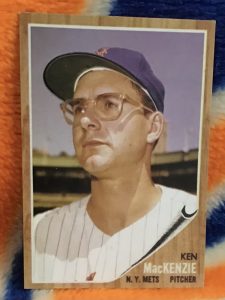 Ken’s calling card was unique for New York in 1962. The first of them arrived May 19 in Milwaukee, versus the team that sold him to the Mets. Ken let the Braves know he remembered them by throwing a pair of scoreless innings that culminated in retiring Hank Aaron on a grounder to short. The Mets were behind, 5-2, when MacKenzie entered, and he hadn’t extended their deficit a whit in the sixth and seventh. Holding the fort can be fortuitous, and so it was this Saturday in Cream City. Another ex-Brave, Frank Thomas, tripled to lead off the visitors’ eighth. A rally commenced. Down 5-4, Stengel pinch-hit Richie Ashburn for Ken. Whitey came through with a single. Charlie Neal crossed the plate. The game was tied. Jim Hickman then batted with one out and delivered a sac fly to score Rod Kanehl. Ken MacKenzie was the pitcher of record on the long side. Craig Anderson nailed the final six outs.
The Mets were 10-19, or 10-10 since losing those first nine. Ken MacKenzie was 1-1. Having tasted variations of .500, Kenny and the Mets the very next day decided they wanted more out of life. Being the Mets, they’d have to struggle for it. They trailed the Braves, 5-1, at County Stadium in the seventh when MacKenzie came in once more. The seventh inning on May 20 reflected his success of the day before, with Ken striking out Aaron again. The Mets trimmed the Braves’ lead in the eighth to two runs and stuck with their lefty in the bottom of the inning. Ken did not give up a run. In the top of the ninth, Casey again pinch-hit Ashburn for MacKenzie. Ashburn again singled, sparking a four-run uprising that vaulted the Mets into a 7-5 lead. Anderson again came on to protect what Ken had constructed. This time it wouldn’t be easy for Craig, as Hammerin’ Hank doubled home his brother Tommie, but the Mets held on to win the first game of this Sunday doubleheader, 7-6, and they’d grab the nightcap as well.
The Mets were in the midst of their very first three-game winning streak, and Ken MacKenzie was 2-1. “The darlings of New York — an odd-lot collection of expendables,” reported Bob Green of the Associated Press, “suddenly are the hottest team in baseball.” The relief pitching Stengel was getting from Ken, among others, was proving a “thorough-going pleasure,” according to Dick Young in the Daily News. For the briefest of instances, despite Green’s assessment that “there is still an air of the Keystone Cops about this crew that lost nine straight at the start of the season — they flounder about and sometimes run into each other,” it appeared the 1962 Mets would have to be taken somewhat seriously. They’d won nine of their previous twelve games and led two teams (Houston and Chicago) in the standings. “Somehow,” the man from the AP marveled, “Stengel, the old master manipulator, has them winning.”
Well, that didn’t last. A seventeen-game losing streak awaited as soon as the Mets left Milwaukee, and tenth place was a sure thing by the end of May, yet Ken MacKenzie was destined to make his mark in the other direction. On July 2 in San Francisco, Ken rescued Anderson for a change, setting down the Giants in order in the seventh inning after Craig turned a 4-1 Met lead (built at Juan Marichal’s expense, no less) into a 5-4 Met deficit. Another savvy pinch-hitting choice by Casey the master manipulator — this time Rod Kanehl reaching on an error as he batted for MacKenzie — contributed to a four-run eighth that provided the Mets the winning margin in an 8-5 triumph. Ken’s record was raised to 3-3.
The next victory in the MacKenzie collection was a doozy. Four innings of relief were punctuated by Ken himself singling in Joe Christopher to give the Mets a 9-6 lead, an insurance run that proved vital in what turned into a 9-8 final. With his arm and his bat, MacKenzie could now claim a 4-3 record.
Casey tried his lucky lefty as a starter in a Polo Grounds doubleheader on August 18. Not much luck for Ken in that capacity, and he’d be 4-4 by the time that game versus the Cardinals was over. Yet one more decision was in the offing as 1962 rolled on. The day that distinguishes MacKenzie among all Mets pitchers until 1965 (when Jim Bethke, Darrell Sutherland Dick Selma all finished over .500) is August 22, a home date versus the Giants. A home date versus the Giants in 1962 was no matter of playing out the string. San Fran was charging hard to catch up to L.A. at the top of the NL standings. And even if neither the Giants nor Dodgers was battling for a pennant, Mets fans remembered who left their town high and dry in 1957. “Every close Mets’ game against the Giants or Dodgers,” Stan Isaacs wrote in Newsday at the time, was tantamount to “another version of the ‘little World Series.’”
In this classic of the genre that drew 33,569 paying customers, the Mets led the Giants by three heading to the eighth. Alas, what Isaacs termed “the creeping dread of catastrophe” was also in attendance beneath Coogan’s Bluff. Bob L. Miller had handled the former neighborhood residents for seven innings, but Bob was burdened by an 0-10 record, and the Mets were 31-95 entering this particular Wednesday night, which is to say Met catastrophe didn’t necessarily creep in on little cat feet. Miller issued a pair of walks to start the eighth, then secured a groundout, then faced Willie Mays.
Facing Willie Mays didn’t often end fabulously for a pitcher, as Miller could attest after allowing an RBI single to the Say Hey Kid. The Giants were now down by two, they had two on and Orlando Cepeda due up. Miller time was over. MacKenzie time was at hand. Ken was a lefty, and Cepeda was a dangerous righty, but Casey had his reasons, all of them tied to his faith in the Canadian southpaw.
”He gets those righties out better than lefties and now he’s getting the lefties out. That man is getting close to being a big league player. I mean just because you’re playing for us don’t mean you’re a big leaguer, but he’s getting there.”
Which is great, except Cepeda singled to center to score Chuck Hiller and move Mays up to third, from whence Willie came home when the next batter, Felipe Alou, grounded out. The game was knotted at four. Bob Miller’s shot at getting his first win was erased by MacKenzie’s not so hot outing.
If Ken couldn’t preserve a win for his beleaguered teammate, he could at least make it up to the rest of the team. Stengel had MacKenzie bat for himself to lead off the home eighth. He made contact, which is so much better than striking out, because you never know what will happen when you put the ball in play. In this case, an error happened, charged to Giant second baseman Hiller. MacKenzie was on first, carrying the potential go-ahead run. Its potential grew in possibility when Casey replaced Ken on the basepaths with Joe Christopher. The Ol’ Perfesser called on pinch-runners 86 times in 1962, still the most in any season in Mets history. “With a chance to go ahead, Stengel operated like the master he is,” Isaacs observed. “He still makes the masterful moves with the Mets, but the boys just don’t ‘execute’.”
On the night of August 22, they did. Richie Ashburn drew a walk to advance Christopher to second, and Neal singled to drive speedy Joe home with the lead run. Up 5-4, and not taking an opportunity to beat a contender (or anybody) lightly, Stengel inserted Roger Craig to pitch the ninth. Roger Craig was the ace of the starting rotation in 1962, but what exactly was Casey gonna save him for that was bigger than this? Roger indeed notched the save…with defensive help from none other than Marv Throneberry at first. Following Jose Pagan’s leadoff single, Marvelous Marv made a nifty stab on a sharp grounder off the bat of Willie McCovey and started a clutch 3-6-3 double play that set the stage for the final out.
Isaacs, ever ready to interpret the deeper meaning of Mets baseball in its infancy, heard “a grown man in the upper right field stands blurt, ‘Oh boy, we saw the Mets beat the Giants,’” illustrating that “for people who are with it, these Met games are an experience over and above the mere pleasure of watching baseball. Grown men at Yankee games or My Fair Lady or Little Orchestra recitals don’t come away with the gleam in the eye of the man who exulted at the good fortune of having seen the Mets beat the Giants for the fourth time in seventeen games.”
Amid the enthusiasm attached to such an outcome, MacKenzie’s won-lost mark rising to 5-4 might not have seemed a particularly big deal. let alone rated an “oh boy”. Even in 1962, when pitchers were judged mainly by their accumulations of Ws and Ls, it was understood relievers sometimes happened to benefit from right place/right time syndrome to record their victories, particularly when a pitcher left a game trailing or tied after giving up key runs himself. Sometimes the pitcher on the hook sat back and enjoyed the fruits of his team’s offense making everything better and him a winner. “Vultured” is how those wins tend to be described. But it’s a long season, and teammates do pick up for teammates. This team was on its way to losing three times more often than it won, yet one pitcher on this team was the pitcher of record nine times and came away with one more win than loss on his ledger. If it was that easy to achieve, some other 1962 Met would have achieved something like it. None did.
Five-and-four was the record Ken MacKenzie would keep for the rest of 1962, and that’s the record by which he’d be recognized into baseball eternity. The 3-1 he cobbled together in 1963 would be less invoked as a piece of trivia, but, yeah, no other pitcher in the Mets’ second year had a winning record, either. Ken showed enough as a “big league player” to attract the interest of the contending Cardinals in the summer of 1963. St. Louis swapped Ed Bauta to the Mets to acquire MacKenzie while they were visiting New York. Ken had worn 19 as a Met. It was immediately issued to Ed. The pitchers themselves traded warmup jackets, with Ken shedding blue nylon in favor of red.
But Ken’s license plate nearly sixty years later didn’t read 63 CARD. He clearly relished his connection to that first bunch of Mets, and if being known as the guy who won for a team that made losing an art form was what people chose to remember, it beat being known as just another pitcher who lost a lot…or being mostly forgotten. He nodded along for decades when his other calling card, his status as the so-called “lowest-paid member of the Yale class of 1956,” was brought up to him. Going into professional baseball wasn’t a path to riches for an Ivy Leaguer or any leaguer back then. Embroidered within the legend of the first Yalie to pitch for the Mets (Ron Darling being the second) was Stengel’s advice to bear down against tough batters like he was facing “the Harvards”. Per MacKenzie, who would coach at his alma mater after retiring from baseball, that was no stray tossed-off trifle of Stengelese. Ken actually pitched very well against Yale’s archrivals, and MacKenzie said Casey knew that, much as Casey had a knack for knowing something about everything.
MacKenzie threw his first pitch in the majors for the Braves in 1960 and his last for the Astros in 1965. His tenure left him about a month shy of qualifying for the major league pension, and as a Yale alumnus not necessarily in the same league financially with classmates who pursued other endeavors, he put out feelers to his old teams in 1969, when he was 35, to see if there’d be room for him on the September roster in order to accumulate the requisite days he needed. He also checked in with the expansion Expos, given that they were ensconced in Montreal; he was Canadian by birth; and their enterprise was run by John McHale, who remembered him from their days together in Milwaukee, pre-Mets. McHale, operating a team that was going nowhere, brought Ken on board to finish out his career as an active pitcher. He threw only batting practice, but he earned his pension. He also had a pretty good seat for what had been unthinkable seven years earlier when he came into Shea Stadium with the Expos on September 10 and watched the Mets surge into first place. In 1962 and 1963, MacKenzie was the only Met with a winning record. In September of 1969, the Mets as a whole hardly ever lost. Despite wearing the uniform of the Expos, MacKenzie admitted to Isaacs he was quite happy for their opponents’ upturn in the standings. “I’ve always thought of the Mets as my team,” Ken said.
For the rest of Ken’s life, that sense of identity was clear, and not just if you saw his car. MacKenzie remained a generous sharer of stories about the Original Mets whenever he was asked to recall those days, a gift that grows in value when you realize there are only nine living Mets among the 45 who played for our team in 1962. They were just anecdotes, but they were the kinds of anecdotes that would otherwise disappear from the baseball discourse if he didn’t tell them. Pregame hands of bridge in which Ken and his pal Hot Rod Kanehl competed against two future Hall of Famers, Gil Hodges and Duke Snider. An unexpected compliment from batting coach Rogers Hornsby that “‘you’re not a bad hitter, you put the bat on the ball.’ And usually, he didn’t talk to anybody.” Ken would confirm, as best he could as the details blended into Met mythology, the old favorites about Yale, and going 5-4 when everybody else was going 35-116 combined. Historical retellings are ultimately copies of copies of copies once the source material is no longer within our grasp. Here was a primary source, still telling it like it was.
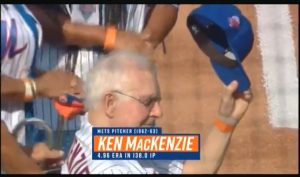 First to win more than he lost, first to be introduced 60 years later. When the Mets performed their biggest mitzvah as a franchise and invited back 65 of their alumni for a blowout sixtieth-anniversary celebration at Citi Field in 2022, the first Met returnee Howie Rose introduced was Ken MacKenzie. Ken had helped promote the revival of Old Timers Day all year, joining Jay Horwitz’s podcast over Zoom and granting a lengthy interview to the Hartford Courant. When the big day approached in late August, Jay later revealed, Ken checked himself out of the hospital to make sure he’d be there. He had to be wheeled to the foul line, but this Original Met wasn’t gonna miss this occasion.
A grown man in the upper left field stands that afternoon didn’t blurt anything in the moment, but he did applaud heartily, thinking to himself, in so many words, “Oh boy, I’m seeing the first Met to post a winning record.” There were, that grown man is certain, more than a few gleams in more than a few eyes when Ken’s name was called.
by Greg Prince on 13 December 2023 6:29 pm Aren’t we supposed to be immune to developing brand new sympathy pains for injured Mets players in December? Mets players aren’t supposed to get injured this time of year unless it’s something like what happened to Tug McGraw in the winter following the Miracle Mets’ world championship of 1969. In his 1974 memoir Screwball, Tug came clean on an ankle he twisted and reported to the club as the result of slipping on some ice while taking out the garbage. The injury was actually sustained as a result of tobogganing in snowy Syosset with Ron Swoboda, the two teammates sharing one toboggan. One of their rides didn’t go as planned, with Ron landing on top of Tug when it was over. Swoboda was OK. McGraw wasn’t.
“I had to sign my contract for the next season — it had just been mailed out by the Mets,” Tug remembered, “and I sure as hell didn’t want to tell them what happened, at least not how it happened. Especially since they thought we were nuts in the first place.” Thus, the cover story, which the Mets shrugged off as a hazard of bad luck and cold climes. Slipping on ice on Long Island is not uncommon (as I can vouch). Tug made it back to start the 1970 season and saved the Mets’ very first Opening Day win.
What befell Ronny Mauricio this past weekend while playing winter ball had the same luck component to it, though the weather was warmer. A baseball player got hurt playing baseball. That will happen. That it happened not for the Mets or a Mets affiliate but for Tigres del Licey in LIDOM competition…well, that, too, will happen. Mauricio tore the ACL in his right knee as he began to take off toward second base from first as a baserunner. He went down less than halfway toward his destination.
Ronny was honing his craft and the Mets were well aware of what he was up to. No whiff of scandal, not even WBC recriminations à la Edwin Diaz. As if that matters now. The injury will require surgery plus a recovery period that will prevent Ronny’s presence on the Opening Day roster or any Met roster for quite a while. This is a shame on several levels. Ronny’s been a Met prospect since approximately the year Swoboda was traded to Montreal, or so it seems. He’s only 22, but was signed at 16 and has ranked among Baseball America’s Top 100 up-and-comers since 2019. We got our first glimpse at his obvious offensive talent last September. A shortstop blocked by Francisco Lindor for the foreseeable future, Mauricio played a swift second base when he came up, a less sure third, the latter a spot that has no obvious Met occupant at the moment. Ronny will contend for neither position as 2024 gets going.
Sympathy abounds, of course, even if we were hoping to save it for the kid’s first slump.
by Greg Prince on 11 December 2023 5:59 pm I count fourteen players with major league experience the Mets have picked up in the past month or so. I feel I recognize five, maybe six of the names. I’ve probably seen a few others as Met opponents but forgotten them. A generous portrayal of their collective appeal would be they provide our team with depth.
Absolutely none of these names is exciting, but I’ll take it on faith that their presence in Spring Training on major or minor league contracts is necessary. Following the crummy 2023 season, the Mets shook out from their roster a bunch of players fans of other teams might not recognize. Depth replaces depth. Depth is what you call the players whose presence amounts to a dearth of excitement.
We are in the museum gift shop phase of the offseason. I love going to museums. I recoil at the sight of their gift shops, however, because once you’ve toured the museum, you are vulnerable to books and posters and whatever other tchotchkes the gift shop is offering for a fee. It’s all stuff that’s neat, but it’s also stuff for which you hadn’t any need or desire before you showed up at the museum. You still don’t have the need for it, but the desire can be overwhelming. “Can I really leave here without this thing, now that I know the backstory of this thing?” I try to confine my purchases to a refrigerator magnet and otherwise keep my hands in my pockets.
 “I just gotta have this pitcher!” I didn’t know I desired Yoshinobu Yamamoto for the Mets until the Hot Stove tour guide mesmerized us with tales of the sensational pitcher. He’s thrown how many no-hitters? He’s won how many Japanese Cy Young equivalents? He’s only how old? His repertoire is how enticing? I was modestly aware of Yamamoto during the season, but now he’s the talk of the offseason, and I’d very much like him for the Mets’ collection…I mean rotation. His name permeates every 2024 Mets thought I’ve had lately, though such exclusivity is a little misleading. Other than the reports surrounding Steve Cohen and David Stearns flying to Japan to pitch the pitcher on pitching for the Mets, I haven’t much thought about anything specific pertaining to the upcoming season since the last one went away. Fourteen players with major league experience picked up, zero sparks given off. I can’t remember the last time I was less revved up for late March in mid-December.
Unless we get Yamamoto, who I have to have, the way I had to have Carlos Correa once it was clear we were getting Carlos Correa last December. We ultimately didn’t, but it was a pretty exciting thing to think we did, best deals sometimes being the ones you don’t make notwithstanding. We’re not quite in Correa to the Mets territory yet, let alone Ohtani to the Jays. Ohtani to the Jays was so much in the atmosphere that a Canadian front pushing down from Ontario was evident on weather apps all over North America. Except Shohei Ohtani signed with the Dodgers (boy, did he ever). I’m figuring Jays fans are a lot sadder about not getting their man than I’ll be if we don’t get our man. Unless Yamamoto’s flight into LaGuardia is tracked by reputable sources. Then all emotional bets are off.
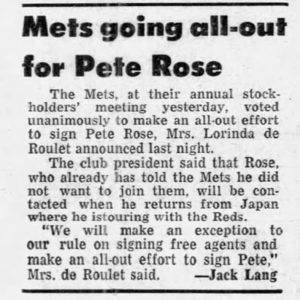 Spoiler alert: Mets did not get their man. I’ve been focused enough on Yamamoto to the Mets that I never devoted a byte of bandwidth to considering Ohtani to the Mets, other than knowing it wasn’t absolutely beyond the realm of possibility. With Steve Cohen, the Mets emerging as the choice of a player who winds up commanding $700 million over ten years is never beyond the realm of possibility. I know we’ve signed our share of glamour pusses in recent winters, but deep down, I view free agency as an excuse for stars the caliber of Reggie Jackson and Pete Rose to laugh off our feelers, instinctively flashing back to when baseball’s open market was very new and the Mets were acting very old. In the 1979 free agent re-entry draft, the system under which teams had to select negotiating rights to players, the Mets tossed their names in on mid-level availabilities Rennie Stennett, Rudy May, Bruce Kison, Greg Gross, Don Stanhouse, Rowland Office, Jim Wohlford and Roy White. None of those fellas was flattered enough by the attention to be swayed toward Shea. If memory serves, one of them huffed that if he wanted to play in New York, why would he ever choose the Mets? That’s what winter used to be like around here. It’s my version of insisting we walked to school through two feet of snow.
We’ve come a long way, baby, albeit in theory this offseason. Sometimes just being mentioned in the fifth paragraph as a place a player like Ohtani could go is tantamount to a fleeting Hot Stove moral victory. Those times are when you’re thinking to yourself, “Look how much we saved that can now go toward Yamamoto.” Meanwhile, Yamamoto has flown to the U.S. and is said to be talking with multiple teams on both coasts. His price is no doubt being driven up, but the gift shop isn’t closed until it’s closed.
by Greg Prince on 8 December 2023 4:02 pm Met offense is moping along as Met offense has made a habit of doing since its founding in 1962. Then amid the mopery emerges some genuine hope in the form of a Triple-A outfielder who brings to New York a bat loaded with hits, making things a little less mopey, at least for a spell. Mike Vail is the most extreme example of this phenomenon, D.J. Stewart the most recent.
Joe Hicks, who died on December 2, stands out as the first.
Hicks was called up to the Mets from Buffalo shortly after the All-Star break in 1963. The Mets finished the first half on a ten-game losing streak and began the second half by losing five more. All help was welcome. All help began to make a difference on July 15 when, in Hicks’s third start as a Met, Joe doubles in a run in his first at-bat. Two batters later, pitcher Carl Willey launches a grand slam. Hicks will also single a run home in the fourth and single once more besides. Three hits, two runs, and the Mets are 14-5 winners over the Colt .45s in the opener of a doubleheader at home. Losing streak over. Hot streak begun.
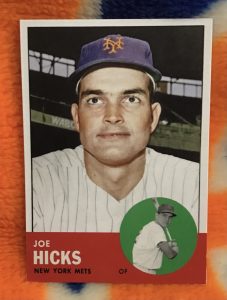 More for Hicks than the Mets, really, but for a few days, the team and the callup complement one another brilliantly. The Mets are still new, but their new center fielder isn’t exactly a fresh face. Fresh to New York, but climbing the rungs of professional baseball since 1953, with major league experience tucked under his belt since 1959. He didn’t stick with the White Sox (despite a few hits in the September they clinched their first pennant in forty years) and he wasn’t deemed a keeper in Washington (after giving the expansion Senators 102 games in ’62). A stint in the army surely didn’t help him gather the momentum that might have kept him on a clearer path to the bigs. After the Mets have purchased his contract and sent him to Buffalo to commence 1963, he is listed as a 30-year-old whose career major league batting average measures .218. More for Hicks than the Mets, really, but for a few days, the team and the callup complement one another brilliantly. The Mets are still new, but their new center fielder isn’t exactly a fresh face. Fresh to New York, but climbing the rungs of professional baseball since 1953, with major league experience tucked under his belt since 1959. He didn’t stick with the White Sox (despite a few hits in the September they clinched their first pennant in forty years) and he wasn’t deemed a keeper in Washington (after giving the expansion Senators 102 games in ’62). A stint in the army surely didn’t help him gather the momentum that might have kept him on a clearer path to the bigs. After the Mets have purchased his contract and sent him to Buffalo to commence 1963, he is listed as a 30-year-old whose career major league batting average measures .218.
What was it they said in Hamilton? In New York, you can be a new man. For lefty-swinging Joe Hicks, the Polo Grounds was the room where a change of identity happened. In mid-July back in ’63, Hicks isn’t a Quadruple-A straggler. He’s the hitter the Mets have been waiting for all year, maybe since they were born, never mind that they’re only in the second year of their existence. A fifteen-game losing streak will age any franchise.
On July 16, Hicks goes 3-for-4 with a homer. The Mets beat Houston, 4-3.
On July 17, Hicks goes 2-for-6 with another homer, this one a walkoff dinger versus the imperfect man himself, Don Larsen. The Mets defeat San Francisco in eleven, 9-7.
On July 18, Hicks goes 3-for-5, and, yup, he sends his third ball out of the old yard. The Mets fall to the Giants, 6-5, but Joe is now a .419 batter against National League pitching, with nine ribbies on his ledger less than a week after his Met debut (when he was struck out as a pinch-hitter by Sandy Koufax). He was hitting .320 in the International League. Maybe the higher he got, the better he was bound to get. Red Foley in the Daily News declared the journeyman “off to the finest start any Met has ever enjoyed.”
“Why did you deprive Hicks of a chance at the batting title by bringing him up so late?” a reporter asked Casey Stengel as Joe began providing sizzle and steak to a lineup more used to famine. Usually it was the manager who delivered the laugh lines. In this case, Casey chuckled and then turned serious for a change: “I’ll tell you something abut that nice kid. He’s had a tough time making it and he worked hard to get back up here.” Stengel, who could have brought Hicks north to start the season, admitted after the home run that beat Larsen, “I began to wonder where this ballplayer had been all my life.”
Right here, Joe might have told the manager who’d seen a lot of ballplayers in his time. “All I ask is that I get a chance to play often to keep in stride,” Hicks said with modesty becoming someone who’d waited so long for such an opportunity. “You can’t stay sharp by sitting on the bench.”
Joe played more often than not for the rest of 1963. He didn’t maintain his .400 average, nor anything resembling a blistering pace. There’d be no more home runs the rest of July, only one in August and one in September. His last circuit clout was the final homer hit by a lefty in the history of the Polo Grounds, a ballpark that had seen about as many ballplayers in its time as Stengel had in his. Hicks’s stroke seemed tailor-made for the bathtub beneath Coogan’s Bluff. At the Polo Grounds, Joe slashed .333/.379/.580. On the road it wasn’t anything close to that. What he might do at brand new Shea Stadium would remain a matter for speculation, for the Mets sent him back to Buffalo to start 1964 and they never recalled him. Joe Hicks’s entire Mets career was 56 games in 1963, highlighted by one scalding week to get it going. He played at Triple-A for three seasons before giving up on pro ball in 1966.
Which left some 57 years for a heckuva life beyond the minors and majors. His obituary, published in Charlottesville, Va., the area where he spent most of his days, said he was 91, born in 1932. His baseball records always pegged him as a year younger. In a business where age dictated a number of personnel decisions, it was probably beneficial for him that the Mets thought they had a 30-year-old phenom on their hands as opposed to a feller who was just breaking through at 31. Either way, Ol’ Case referring to Joe as a “kid” was all relative.
The statlines were only selectively kind to Hicks, but you can’t say baseball and Joe didn’t go together well. For one thing, it was during winter ball in Nicaragua in the offseason following 1958 that he met and married his wife of more than six decades. For another, he became a top-flight umpire in Virginia, eventually recognized by the commonwealth for his extensive work with amateurs in baseball, softball and volleyball. Charlottesville Parks and Recreation benefited from his expertise and sportsmanship when he served the department as its longtime director of athletics. “A down to earth person with a kind heart and gentle soul,” his obit reads. Some things don’t show up in the box score. Some things don’t have to.
by Greg Prince on 5 December 2023 3:44 pm A dozen years ago, after some dabbling on ancestry.com, I connected with a same-last-name relative living on the West Coast. She wasn’t exactly distant or long lost, but I’d had only the vaguest notion of her existence, and I don’t think that she’d ever heard of me. Stephanie and I met her and a friend for dinner when she was in town to visit some other Princes with whom nobody on our side of the divide was currently in touch. It was quite a kick hearing somebody mention people I knew of, however slightly I knew of them, as if an authentic connection existed, even if it was basically by default. Everybody was very friendly to one another for an evening…and that was pretty much that for this briefest of Prince family reunions.
On Saturday afternoon, I took part in a different yet similar familial coming together. No offense to my cousin from 2011, but this one I felt more deeply, lack of bloodlines be damned.
Saturday at the Sheraton in Flushing was Queens Baseball Convention day, a highlight of the offseason calendar for the past decade. QBC is a Hot Stove miracle pulled off by a bunch of people, led by primary organizers Keith Blacknick and Dan Twohig, who bleed orange and blue and give their sweat and tears to the endeavor as well. Every offseason, I wander into a venue that they’ve transformed into a winter wonderland for Mets fans, which is to say it’s full of Mets talk and Mets stuff and Mets vibes and Mets personalities (Billy Wagner, Cliff Floyd and Terry Collins topped the bill this year) and, of course, more Mets fans. It’s easy enough to remember QBC is coming up while not wholly appreciating that this thing doesn’t happen without so many folks making it happen.
I show up every year to help present an award named for Gil Hodges. The award was conceived back when Gil was being unjustly ignored for the Hall of Fame. Then Gil was voted into Cooperstown. QBC still gives out the award, because Gil is still Gil and the sentiment behind showing appreciation for unforgettable members of the Mets family glows on.
 This year’s version of the Gil Hodges Unforgettable Fire Award was dedicated to the mom of our clan, Joan Whitney Payson. I’d prefer to refer to her from here on out as Mrs. Payson, because it doesn’t feel right or respectful to call her “Joan” or “Payson”. She was Mrs. Payson in life (1903-1975) and is Mrs. Payson for all time, and not in that unctuous way reporters refer only to sports franchise owners and nobody else in earshot as “Mr. So-and-So”. If we’re all going to be super formal and call one another by title, fine. If we’re not, it’s a bit much to “Mister” up the owner just because they’re the owner. Nelson and Fred; Fred and Jeff and Saul; Steve and Alex. They were or are people, just like you and me, even if people who can own sports franchises may have access to a different level of resources than you or I. This year’s version of the Gil Hodges Unforgettable Fire Award was dedicated to the mom of our clan, Joan Whitney Payson. I’d prefer to refer to her from here on out as Mrs. Payson, because it doesn’t feel right or respectful to call her “Joan” or “Payson”. She was Mrs. Payson in life (1903-1975) and is Mrs. Payson for all time, and not in that unctuous way reporters refer only to sports franchise owners and nobody else in earshot as “Mr. So-and-So”. If we’re all going to be super formal and call one another by title, fine. If we’re not, it’s a bit much to “Mister” up the owner just because they’re the owner. Nelson and Fred; Fred and Jeff and Saul; Steve and Alex. They were or are people, just like you and me, even if people who can own sports franchises may have access to a different level of resources than you or I.
But Mrs. Payson was Mrs. Payson, and the chance to take a few minutes at QBC to illuminate her story in the middle of winter for a roomful of Mets fans who relish a little Mets history is one I don’t forget to appreciate. Through this platform over the years, I’ve had the opportunity to offer some insights on Gil Hodges, Ed Charles, Tom Seaver and several other leading lights of the Mets family. Given that Mrs. Payson hasn’t necessarily been top of Mets fan mind since her passing from the scene, I loved that Keith and Dan wanted to bring this woman’s legacy center stage.
I also loved that accepting the award on behalf of Mrs. Payson were some very warm people named Payson and de Roulet…and that I got to meet them and talk to them and realize that their family may not own the Mets any longer, but the Mets never truly left their family. These relations weren’t long lost and they weren’t distant. Spending quality time with Mrs. Payson’s daughter-in-law Joanne brought me back to that dinner with my cousin. She knew the stories people like me grew up on. She sprinkled names into conversation that until Saturday were only anecdotal to me. She made clear the Mets still meant something in their family’s lives, and that this little honor from QBC wasn’t incidental. In their own way, they’d been waiting for the Mets to care about Mrs. Payson. Never mind that it’s been 48 years since she died or nearly 44 years since the family got out of the baseball business. This was bigger than business to them.
You aren’t related to the woman who brought the Mets to life without that life remaining embedded in your life. These members of the Payson family tree clearly value that bond. The modern-day Mets seem to understand it. Not only did they co-name a high-rollers speakeasy for her down the right field line at Citi Field at the outset of 2023 — Joanne laughed when I brought up that branding, reminding me of Mrs. Payson’s patronage of Toots Shor’s place — but a representative of current Mets ownership, Josh Cohen, son of Steve and Alex, accompanied the Payson/de Roulet contingent to QBC. You could almost hear a circle being squared.
Daniel de Roulet, Mrs. Payson’s great-grandson, officially accepted the Gil Hodges award. Joan (he can call her that) would have been very happy to have received this token of everybody’s esteem, he said, but the real award for her and those standing in for her on this day was the presence all these years later of so many Mets fans, still caring so much about this team it was her pleasure to put into operation.
That he made sure to wear an orange sweater over a blue shirt for the occasion made his words resonate that much more.
The following are the remarks I delivered at QBC Saturday. Here’s to the woman who provided the baseball team that inspires us to this day.
***We’re gathered here today to remember two people at the heart of the beginnings of our favorite baseball team, the New York Mets.
When the Mets first took the field in St. Louis, on April 11, 1962, their first baseman was Gil Hodges. He hit the Mets’ first home run that night, one of 370 in his magnificent career. Seven-and-a-half years later to the day, Gil was managing the Mets in their first World Series game in Baltimore. Within a week, he would be known forever more as the manager of the 1969 world champions, just as we know him now and forever as Baseball Hall of Famer Gil Hodges.
We are today, as we’ve been for a decade, monumentally proud to present an award in his name, the Gil Hodges Unforgettable Fire Award, to those members of the Met family who, like Gil, have warmed our hearts, brightened our spirits, and continued to light our way, and we remain incredibly appreciative that the Hodges family has blessed this endeavor. Gil Hodges Jr. joined us when the Queens Baseball Convention began in January of 2014, and Irene Hodges was thoughtful enough to spend some time with us here last December. They both represent their dad’s legacy so wonderfully.
There was little chance that if you were going to start a new National League baseball team in New York in 1962 that you wouldn’t find a spot for Gil Hodges. He’d been a Brooklyn Dodgers player since the 1940s, a Brooklyn Dodgers icon since the 1950s and a New York favorite for all time when some team from Los Angeles made him available in the 1961 expansion draft. Gil was on the verge of turning 38, but he still had some pop in his bat and no prospective Met could have loomed as more popular for a team that was still a blank slate. In fact, the first Met who was ever booed, during the introduction of the starting lineups at the Home Opener two days after Gil hit that first home run in St. Louis, was Jim Marshall. Marshall was a late injury replacement for Hodges, whose knee was acting up. Nothing personal against Jim, but the fans who trekked to Upper Manhattan on a chilly, damp day wanted to see the hero they remembered from Flatbush — and not just the old Dodgers fans in the crowd.
Said one former follower of the New York Giants on the eve of that first Mets game at the Polo Grounds regarding the presence of Gil Hodges, “It’s wonderful to be rooting for him after hating him for so many years.” Spoken like a true Giants fan. Spoken like a true baseball fan. Spoken like someone we can call the very first Mets fan.
Of course she was the first Mets fan. She more or less started the Mets.
And that’s the other person from the beginnings of our favorite baseball team whose memory we honor today, presenting the Gil Hodges Unforgettable Fire Award to the family of Mrs. Joan Whitney Payson, the founding owner of the New York Mets.
 As important as a few other figures in Mets lore are to the foundation of our franchise — Bill Shea, the attorney who started working the phones the minute the Dodgers and Giants left town because he knew New York wouldn’t be whole again until it was back in the National League; Branch Rickey, who placed his reputation behind the Continental League gambit that paved the way for National League expansion; George Weiss, the club’s shall we say president of baseball operations, stocking a roster under less than generous circumstances and playing for time with familiar faces until a farm system could take root; and Casey Stengel, the most familiar face of all, with a persona the public could embrace while forgiving the new team’s competitive shortfalls — you can’t say anybody was MORE important to getting this thing we love off the ground than Mrs. Payson. As important as a few other figures in Mets lore are to the foundation of our franchise — Bill Shea, the attorney who started working the phones the minute the Dodgers and Giants left town because he knew New York wouldn’t be whole again until it was back in the National League; Branch Rickey, who placed his reputation behind the Continental League gambit that paved the way for National League expansion; George Weiss, the club’s shall we say president of baseball operations, stocking a roster under less than generous circumstances and playing for time with familiar faces until a farm system could take root; and Casey Stengel, the most familiar face of all, with a persona the public could embrace while forgiving the new team’s competitive shortfalls — you can’t say anybody was MORE important to getting this thing we love off the ground than Mrs. Payson.
Quick question, please answer with a show of hands: how many people here would own the New York Mets if they could?
Quick followup: how many of you are in a position to make that happen?
Happily, Mrs. Payson had the ability to own a baseball team, and more critically, she had the desire to own one. She’d already owned a small piece of one, the ballclub she called her own from a heart-and-soul standpoint, the aforementioned New York Giants. That was no bloodless investment, either. “My mother used to take me to the Polo Grounds when I was a little girl,” she once reflected, “and I almost feel as if I’d grown up there.” Her childhood baseball home was vacated when the Giants moved to San Francisco — she was the only member of their ownership group to vote against it — so she did something productive about it.
This baseball-loving lady, in conjunction with the gentlemen mentioned above, started the New York Mets. After all, she told a reporter, “once you’re a National Leaguer, you’re always a National Leaguer.” This new bunch of National Leaguers whose existence as a unit Mrs. Payson made possible played at the Polo Grounds for two years while Shea Stadium was being built, and they caught on fast with old Giants fans, old Dodgers fans and the New Breed of Mets fans who found their spiritual home in whichever borough the Mets set up shop.
Sitting adjacent to the home team’s dugout, always keeping score and usually wearing a colorful hat you could make out from the Mezzanine, was the woman who didn’t need to own the team to adore it as she did. Not that ownership didn’t have its privileges. If she wasn’t at the game, she made sure the game came to her. The summer the Mets shocked the world and first contended for first place, in 1969, there was one TV station in Maine that aired Mets games under a special arrangement with a local seasonal resident. Guess who had a house in Maine.
Seven years earlier, when the Mets were new and only the flair and volume of their losing was shocking, Mrs. Payson traveled to Europe in-season. She left instructions to be wired the results of the games so she could keep up. The results in 1962 could be a little depressing, so she amended her guidance: please wire only when the Mets win. Let’s just say the transatlantic cables grew cold.
Mrs. Payson didn’t seek out attention as owner of a major league baseball club. It may not have fit her personality and it may not have fit the times. “I think I’m some kind of a vice president or something,” she demurred when asked about her role. Even at what would qualify as an owner’s most glorious moment, the acceptance of the Commissioner’s Trophy, in 1969, she stood before NBC’s cameras in the victorious post-World Series clubhouse only long enough to graciously accept congratulations. The extent of her remarks was to call out to her manager, Gil Hodges, to be careful and not trip on the temporary platform the network had built. Good to her word, she was still rooting for Gil.
At any moment, Mrs. Payson had every right to step into the spotlight, but left the daily operation of the franchise to others. Professional sports was an old boys’ network and perhaps she was content to mostly sit in her box seat, fill out her scorecard and cheer her team on. Still, she was no disinterested party. I’ve often wondered, had she lived beyond 1975, what Mrs. Payson would have done when free agency came along in 1976. We already know she spent a decade trying to pry loose from the Giants her favorite player from the Polo Grounds, Willie Mays, offering Horace Stoneham whatever it took in terms of cash to acquire his contract while Willie was in his prime. She finally got her man, albeit once he was at the tail end of his brilliant career. Willie Mays’s No. 24 hangs in the Citi Field rafters as testament not only to Willie’s unbreakable link to National League baseball in New York, but as a reminder of Mrs. Payson’s dedication, perseverance and fandom.
She was the woman who brought National League baseball back to New York, and she was the woman who brought the greatest National League baseball player back to New York. Pretty good accomplishments amid a crusty old boys’ network. If anyone harbored any doubts she could hold her own in a locker room atmosphere, I refer you to the team dinner she attended during the club’s first Spring Training. According to left fielder Frank Thomas, Mrs. Payson ordered herself a steak. When asked how she wanted it prepared, she said, “Just cut off its horns, wipe its ass and bring it out.”
Conversely, there was a distinctive touch Mrs. Payson brought to ownership that might have been absent from other hands. In her last year at the helm of the club, shortly before she passed away, there was a brief note in the Sporting News, informing readers that “sterling silver baby cups from Tiffany’s were sent by Mrs. Joan Payson to Bob Apodaca, Jon Matlack and Randy Tate, all of whom became daddies within the last year.” When you read that, you knew Mrs. Payson had nurtured an operation where “bring your kiddies/bring your wife” really meant something.
“Why do people fuss over me?” Mrs. Payson once asked. “I’m not important.” We’d respectfully disagree. Mrs. Payson was the first woman to own, on her own steam, a big-time professional sports franchise. That alone is pretty impressive. That it was the New York Mets, and considering what the New York Mets became in their first eight years — both an immediately beloved institution and the champions of the world — Mrs. Payson’s impact shouldn’t be understated. She gave us the Mets.
The least we can do as Mets fans at a Mets fanfest is say thank you and present her with the Gil Hodges Unforgettable Fire Award.
by Greg Prince on 30 November 2023 9:08 am Of all the key offseason hires approved by Steve Cohen, I haven’t seen the name Florian Cloud de Bounevialle O’Malley Armstrong appointed as Senior Vice President, Strategic Planning, or whatever title would imply a person has been brought in to help the Mets figure out what to do next. No wonder she’s not in Flushing, given the personal mission statement this individual issued twenty years ago and how it clashes with the way the Mets went about their baseball business this year.
The would-be Met executive in question is a British singer better known by her stage name Dido, the same Dido who had a decent-sized hit in 2003 called “White Flag,” an anthem dedicated to not giving up.
I will go down with this ship
And I won’t put my hands up and surrender
There will be no white flag above my door
Dido was singing about a romance, but her message can apply to any difficult situation. The song — which went to No. 1 in several countries and reached the Top Five on Billboard’s Adult Contemporary chart in America — isn’t thematically unusual in pop annals. “Don’t Give Up On Us” by David Soul topped the Hot 100 in 1977; “Hang On In There Baby” by Johnny Bristol went Top Ten in 1974 and happens to rank as my nineteenth-favorite song of “All-Time”. The 1985 Mets’ highlight video (film was passé in the MTV era) aired by SportsChannel during nearly every rain delay in 1986 was titled “No Surrender,” with Bruce Springsteen’s track off the Born in the U.S.A. album one of many apt tunes licensed for inclusion (if not into perpetuity, as the video’s soundtrack was hacked beyond aural recognition when revived by SNY as Mets Yearbook: 1985). Those Mets whose exploits Springsteen serenaded dueled the Cardinals down to the final weekend. No retreat, baby. No surrender.
Yet it is Dido’s ditty that comes to mind in the wake of 2023 because of the phrase inserted in the chorus. The white flag is an ancient, enduring and potent symbol of giving up, and giving up is such an odious notion within the human condition. There are more nuanced meanings available, however. In recent centuries, according to the History Channel website, “the white flag has become an internationally recognized symbol not only for surrender but also for the wish to initiate ceasefires and conduct battlefield negotiations. Medieval heralds carried white wands and standards to distinguish themselves from combatants, and Civil War soldiers waved white flags of truce before collecting their wounded.” When you look at the white flag less as a communiqué of capitulation and more in the realm of saying, à la Eric Cartman, “screw you guys, we’re going home,” then you can rationalize the value of a white flag once you’ve concluded you don’t have the wherewithal to even pretend to compete any longer.
For 2023, Faith and Fear in Flushing chooses as its Nikon Camera Player of the Year — an award presented to the entity or concept that best symbolizes, illustrates or transcends the year in Metsdom — The White Flag. By the middle of a campaign that was going nowhere, the Mets arrived at the realization that the most sensible way to play out their season was to find the first door leading to the future and give up on any pretense of contention.
In the words of Quick Draw McGraw Snagglepuss, exit stage 2024.
 Between just before midnight on July 27 and just before 6 PM on Deadline Day, August 1, the New York Mets traded from their roster six veteran players. Five were exactly the kinds of players any team would want on their roster if that team was serious about making a run for a playoff spot, which is, in theory, the idea at the heart of any baseball season. Offed in the 112-hour selling period were a quality closer, two professional hitters and two starting pitchers universally described as future Hall of Famers. Each of those players the Mets no longer saw any need to keep around was placed in a good home, which is to say on a team with its eyes on October. Indeed, each of the teams acquiring one of these Mets played beyond the regular season. Between just before midnight on July 27 and just before 6 PM on Deadline Day, August 1, the New York Mets traded from their roster six veteran players. Five were exactly the kinds of players any team would want on their roster if that team was serious about making a run for a playoff spot, which is, in theory, the idea at the heart of any baseball season. Offed in the 112-hour selling period were a quality closer, two professional hitters and two starting pitchers universally described as future Hall of Famers. Each of those players the Mets no longer saw any need to keep around was placed in a good home, which is to say on a team with its eyes on October. Indeed, each of the teams acquiring one of these Mets played beyond the regular season.
The Miami Marlins traded for David Robertson, the quality closer. They made it to the Wild Card round.
The Milwaukee Brewers traded for Mark Canha, one of the professional hitters. They won their division.
The Arizona Diamondbacks traded for Tommy Pham, the other professional hitter. They won the National League pennant.
The Houston Astros traded for Justin Verlander, owner of three Cy Young Awards. They went to the League Championship Series.
The Texas Rangers traded for Max Scherzer, whose trophy case also houses a trio of Cy Youngs. They won the World Series.
Imagine having all these postseason pieces alongside a passel of other capable and accomplished players, including a few very much in their prime, all on one team. Then imagine looking at that team as a whole.
It looks better in the anticipatory imagination than it did on the field for the first four months of the 2023 season. The New York Mets already tried that cast. Scherzer and Verlander and Pham and Canha and Robertson and Alonso and Lindor and McNeil and Senga and Nimmo and Ottavino and Raley and an injection of youth from Alvarez and Baty and Vientos. A person planning to watch that collection of talent every day as of Opening Day couldn’t wait to see what they’d do together.
A person who actually watched that collection of talent every day from Opening Day until July 27 couldn’t stand to look at them any longer. A lot of people, actually — a lot of people who were Mets fans with high hopes at the outset of 2023 and a lot of people who had virtually no hope by the second half of the season.
Myself I’d count as no longer one of the truly hopeful by the night of June 8, once the Mets had been swept by the Braves in Atlanta. “Swept” doesn’t really do what the Braves did to the Mets justice. In each of three games at Truist Park, the Mets took a lead. In each of those three games, the Braves overcame the Mets’ lead. The series finale served as the most stark example of the chasm that had developed between these two franchises in the eight months since they each finished with 101 wins in 2022. The Mets hit three home runs; scored in five separate innings; and took or held a lead during every inning between the second and the ninth.
The Braves won in ten, 13-10.
A result of this nature in another season would have launched me into a rage or sent me spiraling into despair. This result in this season liberated me. As of June 8, when the Mets fell 8½ games behind the Braves, I was freed of the expectations that hadn’t matched the reality of the Mets for 63 games. This was no longer 2022. This was no longer Mets vs. Braves for the duration. The 2023 Mets had played with lethargy rather than urgency in April and May. June was starting no better. The Braves were still the Braves. Huzzah, I decided on June 8, I no longer have to take this team seriously as a National League East contender. After the way the Mets let the division title slip from their grasp in 2022, it was a perverse relief not to validate their presumed powerhouse status. Presumption evaporated on June 8. The Mets’ chance to catch the Braves evaporated with it.
But I didn’t think they would altogether disappear from the Wild Card race. And I don’t know if they ever did altogether disappear from the Wild Card race, even as June maintained its rancid pace — they’d ended June 1 at 30-27 and awoke July 1 at 36-46. That June swoon sure resembles a disappearing act. Yet the world in which fans of my vintage learned baseball, wherein your team was either fighting for first place or was languishing no place, had evolved into one dripping with consolation prizes. One Wild Card became two. Two Wild Cards became three. With three Wild Cards up for grabs, you have to be absolutely awful to be prohibitively out of it at the dawn of July. When the Mets completed compiling their nineteenth loss in their previous twenty-five contests, they sat ten games from the nearest Wild Card. Not a promising position from which to launch a highly improbable comeback, but not an absolutely impossible scenario, certainly not when you considered…
a) Roughly half a season remained.
b) The Wild Card scramble encompassed a slew of flawed entrants.
c) It was the fiftieth anniversary of 1973.
From July 1 through July 7, the Mets won six in a row. Verlander won a game and looked great doing it (7 IP, 0 ER). Scherzer won a game, regardless of how he looked (6 IP, 4 ER). Senga and Robertson teamed up on a four-hitter, striking out thirteen between them, winning and saving the Mets to victory once Alvarez (homer) and Canha (triple) provided some ninth-inning firepower. The 42-46 Mets were now 6½ games from the Wild Card. Fluidity was the fuel of conditional optimism. So many teams were fewer than double-digits from the final playoff berth. So many weeks were still on the schedule. So many Mets seemed to be coming alive. So, why couldn’t the Mets transform lethargy into energy?
I don’t know. But they didn’t. They lost their final two games before the All-Star break, their first two after the All-Star break, traded off some wins and losses for the better part of the next two weeks and entered the night of July 27 seven games under .500 and 7½ from a Wild Card. With a little over two months to go, they were running in place.
Steve Cohen saw the same team every Mets fan had in 2023, the one that looked imposing in March, the one that had marched into a miasma by late July, less the fog of war than a fog of bore. At the same stage in 1973, the Met record was worse (44-57 then vs. 47-54 now) and the distance from a playoff spot was three games farther away, and if you wished to hang your hat on You Gotta Believe, you were welcome to. But there’s a reason a season like 1973 lives on in legend: because it doesn’t happen every year.
Cohen discerned 1973 wasn’t going to happen in 2023, so he signed off on the trading of Robertson on the 27th; Scherzer on the 29th; Canha on the 31st; and Verlander and Pham and, for good measure, journeyman reliever Dominic Leone (to the then still aspirational Angels) on the First of August. Leone was the Mike Phillips-for-Joel Youngblood transaction of this Deadline Day. Robertson, Canha and Pham felt like standard-issue selloffs, veterans going somewhere else as a towel was being thrown in. A team that planned to contend over the final 61 games wouldn’t let go of its closer, even if he was a contingency closer, and wouldn’t have dispatched two bats that had been through the wars unless there was an obvious replacement in the wings (there wasn’t). But at the risk of diminishing the significance of the trades of Robertson, Canha and Pham, it was Scherzer on a Saturday night and Verlander on the succeeding Tuesday afternoon that made the deadline experience a full-blown Anti-Dido.
The White Flag was soaring above Citi Field, roughly where a 2023 pennant might have flown. Not only were Verlander, who had found his footing after an injury, and Scherzer, whose season hadn’t been quite so encouraging but he still carried that “knows how to win” cachet to the mound, were big names. They were tethered to big contracts. Not long, but hefty. How are you going to trade superstars of their caliber without picking up a ton of the ton they were owed?
You are going to be Steve Cohen is how. You are going to display a healthy impatience for how things are going, pick up the contractual tab in order to pry loose the best available prospects and determine that the preferable course of action is to lean into next season and the seasons after that, no matter how discouraging these half-dozen trades could have been interpreted in the context of this season. You interpret the trades instead as a necessary reset and bring back minor leaguers labeled legitimate prospects, executing what one self-styled wag referred to as the Steve Cohen Supplemental Draft. Suddenly, your farm system is restocked. Suddenly, a longshot playoff bid that has vanished is forgotten. Suddenly, you’ve heard of Luisangel Acuña and Drew Gilbert and Ryan Clifford and a bunch of other fresh faces nowhere near ready in the moment, but the hell with the moment. There are moments to come.
With their white flag, the Mets initiated a competitive ceasefire and conducted what amounted to battlefield negotiations with the general managers of organizations that were still out there fighting. They distinguished themselves from combatants by playing whoever they had handy and collected more than their share of wounds amid some grisly box scores. Mostly, they got through the season. They never effectively replaced Verlander and Scherzer (they are future Hall of Famers), but it’s not like we had really gotten attached to them as Mets. The starting pitching without them, led skillfully by Senga, performed with consistent competence down what in other seasons we would have labeled the stretch. Robertson wasn’t missed that much because there weren’t many save opportunities. DJ Stewart in right was enough of a revelation to erase cornermen Canha and Pham from our collective consciousness until perhaps we noticed them participating in the playoffs. Ronny Mauricio came up, flashed some of the ability we’d been told he’d been honing, and reminded us what fun it is to welcome genuine comers to the big leagues.
The Mets finished a little more below .500 (75-87) than they were when they began to make their trades, nine games from the third Wild Card slot, which is to say that for all their temporary tanking, they didn’t plunge significantly deeper into the abyss than they already had. Seven-and-a-half out when they commenced dealing. Nine out long after the dealing was done. They were a reflection of the squishy blob that represented the middle tier of their league. The postseason made room for a pair of 84-78 clubs in Miami and Arizona; Arizona made its way to the World Series. The 1973 Mets qualified at 82-79, albeit by capturing first place. Different times.
Still, one is permitted to squint in the rearview back to late July and make out a scenario in which those five players who helped five different contenders confirm their playoff reservations stayed with the Mets and were of similar use to our team, which wasn’t really in it, but not totally out of it, and played better than .500 ball — 22-21 — over their final 43 games despite the white flag having been definitively waved. Maybe 22-21 becomes 27-16 if we still have those guys we traded… and certain other teams don’t have some of those guys we traded…and because we didn’t wave the white flag, we don’t display post-deadline symptoms of shell shock (like that 0-6 road trip before we more or less straightened ourselves out)…and a few other things happen…and luck is finally on our side…and You Gotta Believe! But then you remember what everything looked like when we landed in late July and how you likely weren’t saying to yourself, “I just know we’re going to ride Verlander, Scherzer, Robertson, Canha and Pham in conjunction with everybody else here to a pennant.”
Whether the Mets of the fairly near future, elevated by the prospects received in exchange for raising the white flag in 2023, are in for a tangibly better ride is a component of the remains-to-be-scenery. It’s almost as if we can’t know what will happen until it actually happens. Or know what might have happened when it didn’t happen.
FAITH AND FEAR’S PREVIOUS NIKON CAMERA PLAYERS OF THE YEAR
1980: The Magic*
2005: The WFAN broadcast team of Gary Cohen and Howie Rose
2006: Shea Stadium
2007: Uncertainty
2008: The 162-Game Schedule
2009: Two Hands
2010: Realization
2011: Commitment
2012: No-Hitter Nomenclature
2013: Harvey Days
2014: The Dudafly Effect
2015: Precedent — Or The Lack Thereof
2016: The Home Run
2017: The Disabled List
2018: The Last Days of David Wright
2019: Our Kids
2020: Distance (Nikon Mini)
2021: Trajectories
2022: Something Short of Satisfaction
*Manufacturers Hanover Trust Player of the Year
National League Town is the Mets podcast that takes controversial stands like “David Wright oughta get a bunch of Hall of Fame votes!” Listen for elaboration here.
|
|






