The blog for Mets fans
who like to read
ABOUT US

Faith and Fear in Flushing made its debut on Feb. 16, 2005, the brainchild of two longtime friends and lifelong Met fans.
Greg Prince discovered the Mets when he was 6, during the magical summer of 1969. He is a Long Island-based writer, editor and communications consultant. Contact him here.
Jason Fry is a Brooklyn writer whose first memories include his mom leaping up and down cheering for Rusty Staub. Check out his other writing here.
Got something to say? Leave a comment, or email us at faithandfear@gmail.com. (Sorry, but we have no interest in ads, sponsored content or guest posts.)
Need our RSS feed? It's here.
Visit our Facebook page, or drop by the personal pages for Greg and Jason.
Or follow us on Twitter: Here's Greg, and here's Jason.
|
by Jason Fry on 30 August 2025 12:43 pm On the day Jonah Tong was born — Thursday, June 19, 2003 — the Mets lost 5-1 to the Marlins at Soilmaster Stadium. Mike Bacsik gave up an early three-run homer to Mike Lowell, things got worse in the fifth, and a dreary game eventually expired. I’m sure I was watching and also glad I don’t remember wasting that particular two and a half hours of my life.
The win let the Marlins leap-frog the Mets, leaving them last in the NL East. The Marlins would keep leap-frogging, finish with 91 wins and a wild-card slot, and eventually defeat the Yankees in the World Series, for which I’m grudgingly grateful. I still have a Yankees’ 2003 World Series champs shirt, intercepted between some warehouse and a no doubt now-shuttered foreign-aid program, and wear it proudly when invited to Yankee Stadium.
The 2003 Mets? Yeesh. That was the club of Roberto Alomar, of Vance Wilson and Jason Phillips and the Mets’ A/V staff assembling their highlights to “Hold On” by Wilson Phillips (getit?), of getting swept by the Yankees in humiliating fashion, of nepo baby brother Mike Glavine getting his first and last big-league hit the day the season mercifully came to an end. Faith and Fear in Flushing didn’t exist yet and that’s for the best, because I’m not sure we would have made it through chronicling 2003.
Tong grew up in Ontario, learned his craft under the tutelage of his father — complete with mechanics that look Xeroxed from Tim Lincecum‘s — and was drafted by the Mets in 2022. In 2023 he struck out seemingly half the world in the low minors but walked the other half of the world. But things improved in 2024 after he added a Tyler Glasnow-esque slider to his repertoire, and accelerated this year thanks to a much-refined changeup. That brought Tong from Binghamton to a toe touch with Syracuse and then on Friday night to Citi Field.
After we watched Nolan McLean decimate the Phillies on Wednesday, Jordan realized Tong’s debut was imminent and reasonably inexpensive seats were available on StubHub … hey, why not? (By the way, my kid is somehow eight months older than Jonah Tong … how the hell do these things happen?) So we abandoned a trio of Brooklyn Cyclones tickets to see a recent-vintage Brooklyn Cyclone instead.
What we got was a circus, and — if you looked closely — a promising MLB debut at the center of all the nutty stuff spinning around it.
As is often the case when you’ve attended a game in-person, I can’t tell you anything about Tong’s stuff, mechanics, or location that you couldn’t describe far better if you were watching on TV: He was a little figure in black from our vantage point down the left-field line deep in the 100s. What I can tell you is that the crowd was a friendly force behind him, greeting his arrival rapturously, exploding for his first strikeout, and standing in delight when he navigated a fifth inning made harder by his own stone-gloved teammates. (What is up with that, and could it please stop?)
The crowd knew Tong was only going five, they knew his escalating pitch count was putting even that goal in jeopardy despite the score, and they became a many-voiced rugby scrum fighting to keep Carlos Mendoza in the dugout and push Tong through the last few pitches he needed. It was Mets fandom at its informed, passionate bordering on mildly crazy best, and it was fun to be a part of it.
The circus part? That was more than mildly crazy.
The Mets jumped Eury Perez — a pretty capable young pitcher in his own right — for five in the first, courtesy of homers from Juan Soto and Brandon Nimmo. The outburst, while welcome, meant Tong sat in the dugout for nearly half an hour, not easy given any pitcher making his debut already has to contend with the sag in adrenaline after a first frame. The Mets then mauled recent-vintage teammate Tyler Zuber for seven in the second, another welcome explosion of run support that was necessarily paired with another half-hour of idleness for Tong. Somewhere Mike Pelfrey was smiling, while Jacob deGrom perhaps frowned and allowed himself a brief shake of the head. Asked about the up-downs later, a Gatorade-drenched Tong showed a precocious knack for postgame-interview diplomacy over candor, saying with a smile that he’ll never complain about run support.
(A personal aside: An oddity of my recent Mets viewing has been that I’d never seen Pete Alonso go deep. That came with an asterisk, however; Greg — who’d know — says he was with me when the Polar Bear homered, though he allowed that said round-tripper required replay review. It was nice to finally witness an unambiguous Alonso homer, complete with Marlins right fielder Joey Wiemer caroming off the Cadillac Club’s chain-link fence for some reason.)
With Tong departed and the Mets up 12-4, the game got truly weird.
I got an in-person look at Ryan Helsley‘s “Hells Bells” intro, an orgy of high camp that would be tut-tutted at as too on the nose if it were part of an Eastbound & Down bit. How has it not occurred to someone with the Mets — starting with Helsley — that the A/V team might want to cool it for the foreseeable future? Helsley put up a clean inning, but don’t be fooled: He left too many pitches in the middle of the plate and was bailed out by Marlins missing pitches and some solid defense.
Come the eighth inning and things got truly ridiculous: The Marlins sent second baseman Javier Sanoja to the mound to get hammered, with Luis Torrens‘ three-run drive just inside the left-field pole giving every member of the starting lineup a hit. The Mets countered by sending Torrens out there for the ninth with a 19-5 lead; after Torrens gave up back-to-back homers, a single and an RBI triple, Mendoza popped out of the dugout, perhaps wiping some egg off his face, to summon Ryne Stanek.
(Would you like to be the reliever called upon after a position player? No, you would not.)
At this point, we all had the equivalent of an ice-cream headache: The game had gone on far too long and degenerated from joyous to mildly diverting to embarrassing. Because baseball is endlessly perverse, Stanek looked better than he had in weeks, needing just eight pitches to fan Eric Wagaman and Wiemer and send the Mets into the dugout with a 19-9 win while baseball brains (led by Greg, whom I emailed as soon as I got to the subway) pored over the first-times and assorted oddities.
Such as the most runs the Mets had ever scored in a home game. Such as a unicorn score — the Mets had never won by a 19-9 margin. (The 17-3 final line for Pelfrey’s debut was also a unicorn score, BTW.) Such as Torrens becoming the first Mets position player to toe the rubber in a win.
Years from now, it’ll be interesting to see what we remember from Tong’s debut. Maybe it will be that ungodly curve and riding fastball, now familiar qualities that we were then seeing for the first time. Maybe it will be the weird cameos from guys we think of as wearing other uniforms. (“Oof, Ryan Helsley — boy did that not work out.”) Maybe it will be the zaniness of everything else that transpired on a lovely summer night at Citi Field.
For now, though, I think it will be a bit of a relief to see what David Peterson and Edward Cabrera get up to in a few hours. Let’s play a normal one, OK fellas?
by Greg Prince on 29 August 2025 8:17 am The carnival left town and the circus arrived hot on its heels. From fun and festive and knocking down the Phillies to win valuable prizes, to foolish and floundering and getting spritzed by the Marlins, your New York Mets stumbled to a 7-4 loss Thursday night.
Three-run defeat? Seemed like more.
Three errors committed? Seemed like a lot more.
Multiple chances to get back to a lead or tie? Couldn’t have done less with them.
Only one night after the rotation’s cool older brother (in demeanor if not age) Nolan McLean served as ringmaster for a Met jamboree of momentum and vibes, capping off a three-game sweep and picking up three games on first place? Everything going great couldn’t have seemed less recent once the Mets opted to play their version of kickball rather than baseball, kicking the ball hither and yon, allowing five unearned runs. But it really was only a difference of 24 hours between all going right and fundamentals going to hell. Every night is a new story. Recurring similarities are incidental and perhaps accidental.
 Already a coming attraction. Just one game? Yes. It’s always just one game. This team defies trends and trajectories. Best to buckle up for the next just one game. It will feature the major league debut of Jonah Tong. Tong, 22, wasn’t expected in New York this quickly. Based on performance and need, it appears he won’t take the mound a moment too soon.
Throw a tent over the last one. Clear the field for the next one. Back to fun. Back to festive. Back to baseball rather than kickball.
by Jason Fry on 28 August 2025 3:26 am “My Girl” you know about — the singalong that accompanies Francisco Lindor‘s ABs is a new tradition that’s all the sweeter for its organic origins and the Mets having sense enough to stay out of the way.
But the crowd at Citi Field wasn’t satisfied with augmenting the Temptations. They did the honors on “Take Me Out to the Ballgame,” accompanied by Muppets as it was Sesame Street Night. They sang rapturously along with “Dancing Queen,” the winner of the karaoke contest. They even burst detectably into song when a bit of the Killers’ “Mr. Brightside” popped up between innings.
And they sang the praises of Nolan McLean — toward the end of his eye-opening performance, of course, but also from the very beginning of his labors. They clapped in a rising cadence when McLean got to two strikes. They cried out in disappointment when a close call didn’t go his way. And they roared when he dispatched yet another Phillie batter, either via strikeout (six of them) or a sharp play made behind him.
I’ll spare you a scouting report from the 300 level beyond what I saw as part of the boisterous crowd: McLean filling up the strike zone and changing speeds with a maturity far beyond what his decidedly short resume would suggest. It was remarkable to see hitters of the caliber of Trea Turner, Kyle Schwarber and Bryce Harper rearing up in the batter’s box, frustrated by their inability to figure McLean out — Turner and Harper were both sufficiently befuddled that their bats wound up helicoptering away from the plate, perhaps in wooden surrender. And McLean’s pitch count kept us doing double takes — only in the last couple of innings did it climb to expected levels, as he tired and lost a little precision and zip.
Only a little, though — McLean’s eighth had the crowd in a frenzy, trying to will him through the frame after crybaby Alec Bohm singled with nobody out and Max Kepler moved him to third with a single of his own. They roared when Juan Soto caught a Nick Castellanos fly and uncorked a missile to the plate, keeping Bohm at third tete-a-teteing with Dusty Wathan. They roared again when Bryson Stott flied out to left and Brandon Nimmo let fly with a Thou Shalt Not throw of his own. And they exploded when Harrison Bader hit a little tapper to McLean, who tossed it to Pete Alonso at first to complete eight innings of stellar work.
(BTW, Stott’s walkup music in Philly is the earworm “AOK” by Tai Verdes, and you could hear Phillies fans singing it for him during his ABs. Like I said, a musical night!)
By the eighth the anxiety had left the stadium, letting us cheer McLean for his own sake. The Mets put together three runs in the third with five straight hits off old friend Taijuan Walker, added another in the fifth on a Mark Vientos RBI single, and made things academic in the seventh when Vientos hit a bolt of a home run off Tanner Banks.
Citi Field has been a house of horrors for the Phils — they’ve now lost their last 10 here — and the Mets did them no favors by playing one of their better games of the season: The defense was crisp, with Alonso starting a nifty 3-6-3 double play in the second and Jeff McNeil making a leaping grab above the fence in center, and the hitters looked loose and aggressive all night.
A three-game sweep, a rookie on top of the world, and one of the best crowds I’ve even been a part of at Citi Field. Kind of makes you want to burst into song all over again.
by Jason Fry on 27 August 2025 8:17 am “Show a little faith! There’s magic in the night!”
That’s one of Bruce Springsteen’s best-known exhortations, a commandment for wavering lovers, teetering dreamers and yes, fans of oddly underwhelming baseball fans. But until Tuesday night, it had largely fallen flat where the 2025 Mets were concerned.
Until Tuesday night, but not forever.
Game two of the seven-game, two-city Ragnarok starring this year’s Mets and the Phillies started off borrowing narrative pieces of recent vintage.
For openers (a tactic the Mets have tried, mostly to little effect), there was a Met starter looking good early and then winding up on the side of the road awaiting a tow: In this case it was Sean Manaea, who looked better than he had all year pitching aggressively and mixing in his mostly absent change to excellent effect, only to falter in the fifth, chased from the game by a two-out Trea Turner single. Enter Gregory Soto, whom one may damn with faint praise as the best of the Mets’ deadline acquisitions so far; Soto threw a wild pitch, walked Kyle Schwarber and then watched helplessly as Bryce Harper served a sinker over the infield for a 2-0 Phillies lead.
The Mets then borrowed a page from Monday night’s book. Jesus Luzardo had bent a little in the early innings but not broken, holding the Mets at bay while making no secret of his pique at perceived enemies including Juan Soto and young home-plate umpire Willie Traynor. The bottom of the fifth, though, started off in a way that demanded the pique be self-directed: Ahead 0-2 on Luis Torrens, Luzardo gave the Mets a gift by hitting their catcher in the foot.
Luzardo then imploded, surrendering a single to Francisco Lindor, an RBI single to Soto (with Lindor scampering to third and Soto to second on an ill-advised throw in the vague vicinity of home by old friend Harrison Bader), and walking Starling Marte — or, as Luzardo saw it, striking out Marte on two consecutive four-seamers that ticked the strike zone to the satisfaction of everyone except Traynor.
Exit Luzardo, with some parting words that earned him a post-removal ejection from Traynor and a mildly hilarious double unavailability for the rest of the game, enter Orion Kerkering, AKA the Ryan Helsley of the Phillies. When the Mets first saw Kerkering a couple of years ago, I appraised his fearsome fastball and evil slider and thought, “My God, this guy is going to torture us for years.” But something has gone amiss with Kerkering since then, or at least it has when he faces the Mets. He had no feel for the sweeper, and was undone by a ringing double from Pete Alonso, an RBI single following a long AB from Mark Vientos, and a sac fly from Brandon Nimmo.
Just like that it was 5-2 Mets, and the only problem was the Mets had to figure out how to secure 12 outs.
Maybe they’d keep following Monday night’s script, getting perfect relief while pouring on the runs? Nope, guess again: Huascar Brazoban couldn’t command any of his pitches and surrendered a run to bring the Phillies within two; meanwhile, the Mets offense browned out. Tyler Rogers worked a fuss-free seventh (a good sign) but when the eighth rolled around Carlos Mendoza turned, to my horror, to Helsley.
What, exactly, is wrong with Helsley? The Mets think he’s tipping his pitches; amateur observers who watch closely have noted that his fastball, while intimidating, is pretty much wrinkle-free. All I know is that he’s arrived and looked like the bastard child of Rich Rodriguez and Mike Maddux, and that Mendoza continues to stubbornly follow David Stearns’ blueprint by insisting Helsley is the bridge to Edwin Diaz and not a collapsed span lying in a river full of upside-down cars. Helsley actually fanned Alec Bohm, to the delight of Mets fans who tormented Monday night’s crybaby with signs about parabolic mikes and even some ingenious ginned-up lookalikes. (Bohm was 2 for 4, though, so doesn’t seem to have been particularly bothered.) But Helsley then walked Nick Castellanos (mysteriously replaced with an annoying clone who could actually play defense) and offered Bader a middle-middle four-seamer which the former Met lashed into the left-field stands to tie the game.
Helsley was left in to walk Bryson Stott before Mendoza finally decided the experiment had failed again and removed him in favor of Edwin Diaz. Such situations haven’t always showcased Diaz’s strengths, to put it diplomatically, but this time out he turned in his best performance of the year. He studiously ignored Stott as he stole second and then third (yikes), but fanned Brandon Marsh and Turner to keep the game tied, then kept Schwarber, Harper and J.T. Realmuto at bay in an electric ninth.
That led to the Mets digging in against Jhoan Duran, he of the 100+ MPH heater and deadly 98 MPH splitter. But it wasn’t a night for hulking relievers with intimidating arsenals, apparently: The bottom of the ninth was fast and furious, thoroughly unexpected and utterly wonderful.
Marte spanked Duran’s second pitch to center for a single. Alonso hooked his third pitch past Turner for another single. Up came Brett Baty, with Duran putting aside the splitter and trying to get Baty out on 100+ at the top of the strike zone. In his postgame interview, Nimmo showed both a discerning eye and admirable leadership by reminding the jubilant crowd how that’s a spot where a young guy can try to do too much and praising Baty for resisting the urge and just trying to make contact.
Which Baty did … barely. He dropped a little parachute over the infield, a nightmare for both the Philadelphia defenders and New York base runners. Marte and Alonso arrived safely at the next bases, Baty took first, and Nimmo rifled a 2-0 fastball through the infield for a Mets win. As it turned out, Duran never so much as recorded an out.
Show a little faith indeed — but remember that magic follows its own stubborn timetable.
by Greg Prince on 26 August 2025 12:17 pm Some nights, you just know. On Monday night, I just knew the Mets were headed to defeat as they fell behind almost immediately, which is to say some nights, you just think you know.
I thought and knew it didn’t look good as Kodai Senga endured his customary first-inning struggles, and not even the redoubtable glove of Tyrone Taylor, installed in center a day after it might have done the most good, could catch up to Trea Turner’s sinking liner that became a triple. Kyle Schwarber, with a well-placed grounder rather than a characteristic out-of-sight homer, turned that into a 1-0 lead, and in the top of the third at Citi Field, the Phillies were finding more ways to nettle the scuffling Senga. With two out, Alec Bohm singled home two runs. The next batter, Brandon Marsh, doubled into the right field corner. Juan Soto didn’t handle it cleanly, and in the scoreboard of my mind, I’d already revised the tally to Philadelphia 4 New York 0, the Mets drifting into divisional oblivion and holding on for dear Wild Card life.
Except Bohm, who could have easily scored, was held up at third by his coach, Dusty Wathan. Did I have any idea who the third base coach of the Philadelphia Phillies was before his hand went up? Absolutely not, because as we established a few weeks ago, you don’t notice most coaches, not even your own, until they do something that results in an out or a missed opportunity. It was only the third inning, but Wathan and the Phillies had just done Kodai a massive favor. They refrained from taking a run that was right there in front of them. Such gentlemen!
At that moment, or maybe the moment Senga flied out Max Kepler to end the inning and strand Bohm where Wathan halted his progress, I just knew (or perhaps thought hard) that the Phillies would regret it. Sure enough — and there isn’t a lot of “sure enough” to the 2025 Mets — the Mets rose from down 0-3 to, bit by bit, tie, lead, and squash the Phils, rendering Cristopher Sanchez’s early dominance into a footnote. The final score wound up New York 13 Philadelphia 3. I didn’t know the Mets would win by a ton. I didn’t know the Phillies’ lumber would fall into slumber, not at all touching five Met relievers over five innings. I sure as hell didn’t know that in the visitors’ fifth, Bohm would have problems with a parabolic microphone’s positioning, tucked as it was in the lower right corner of the center field batter’s eye…or, to be honest, that the thing that looks like a miniature satellite dish is called a parabolic microphone. The umps ordered the item moved, a process that required fourteen minutes, all so the next batter, Marsh, could have an unobstructed line of sight to ground out on the very next pitch Jose Castillo was finally permitted to throw. Castillo became the pitcher of record once the Mets took a 4-3 lead in the bottom of the fifth. The pouring on of Met runs assured he’d be credited with his first major league win in seven years, a wait that I suppose made fourteen minutes of standing around and staying warm tolerable.
Oh, you could tolerate these Mets every night if you could get them on a regular basis. Mark Vientos and Jeff McNeil are still steaming at the plate. Luis Torrens knocked in five runs. Taylor didn’t catch that Turner triple, but he did collect three hits, walk once, and never make you think, “Gee, I’m glad the Mets went out and traded for Cedric Mullins.” While Reed Garrett went on the IL, thus explaining Castillo’s sudden presence, all the more or less regulars who’d been nursing aches and pains were back in the lineup, and even Francisco Alvarez took some BP. Not that Alvy’s availability was a press concerning after Torrens went deep to hoist the Mets’ run total into double-digit territory.
All problems were not solved Monday night, but the Mets who win ballgames proved preferable to the Mets who lose ballgames. They’re the same team, but we so want to believe the version that scores thirteen unanswered runs isn’t the same version whose starting pitcher couldn’t make it out of the fifth, nor the same version whose Biggest Three — Lindor, Soto, Alonso — goes 2-for-14 amid an offensive onslaught. More than enough cylinders were firing in Flushing. We may not get many nights when the engine purrs exactly as we wish. We’ll certainly take the games when more goes right than wrong.
After Sunday’s grumbly affair, I stumbled into something of a state of Met Zen. Win ballgames and make the playoffs was my new mantra. And if the Mets don’t win the ballgames it will take to make the playoffs, then it won’t happen, can’t worry about what I can’t control. It’s probably as healthy an attitude as a Mets fan can take given how this team has played, never mind that much of the fun of being a fan is thinking you or your actions possess a wisp of control over the actions of others that you decided long ago would define your mood on a going basis. Then they roused to life Monday, overcame their shortcomings, and blew away the team in front of them in the NL East standings. Win ballgames and make the playoffs still made sense to me, but now I was less at peace about letting it be should the alternative come to pass. If you can win a ballgame like that, why can’t you win ballgames more often than you do? Huh? HUH?
So much for Met Zen.
by Jason Fry on 25 August 2025 7:43 am It’s a basic rule that you cannot, in fact, win ’em all.
It’s also a common error as a baseball fan to forget this bedrock truth.
It sure felt like the Mets would win ’em all, or at least this next quantum in the set, when Mark Vientos blasted an early two-run homer off Bryce Elder to give David Peterson and the Mets a lead Sunday afternoon.
Surely the Mets would pour it on as they had the last two days, tormenting various Atlanta relievers and leaving us to wonder where, exactly, this exceptional play had been for much of the summer.
Surely Vientos — the most essential Met for the rest of the season — would stay on his recent heater for the rest of the year, lengthening the lineup as he did in 2024.
Surely Peterson would keep being the rock of the rotation, taking pressure off a still-evolving bullpen and maybe even inspiring his fellow starters.
Which delivered us to the doorstep of another common fan error: mistaking a short distance for a clear view.
This topsy-turvy, stop-start Mets season has been bad for not only our mental health but also our predictive powers, as the Mets have been reliable only when it comes to being confounding.
And so it was again: A ninth-inning flurry notwithstanding, the Mets stopped hitting. Peterson got into the sixth but found the last out elusive, departing having lost the lead. The relief faltered, with Gregory Soto hitting Vidal Brujan and giving up a two-run single to Jurickson Profar, long ago the subject of near-constant Mets trade gossip and now one of those guys who’s quietly been around forever and turns up each season on a new team. The defense didn’t get it done, as Profar’s single plopped down in front of Cedric Mullins and spurred questions about why, exactly, he was playing center instead of Tyrone Taylor.
Would Taylor have made the catch? That’s a three-in-the-morning question in a season that’s been full of them, no doubt with more to come. He didn’t, in answer to the larger question the Mets didn’t, and rather than make ourselves crazier perhaps we should draw a curtain on this one with a shrug and remind each other that you cannot, in fact, win ’em all.
by Greg Prince on 24 August 2025 11:25 am Clay Holmes pitched into the seventh inning Saturday night and pitched well. Just three hits and two walks allowed. If Clay wasn’t showing the transcendent stuff of Nolan McLean from Friday night, he came close enough; going deep and being effective must be contagious. Relievers Gregory Soto, Tyler Rogers, and Edwin Diaz stoked no tension in their two-and-two thirds. It’s only fair to shout out the bullpen when the bullpen isn’t making us scream.
Many a Met defended well Saturday night. Tyrone Taylor, whose presence in center field could be described as sorely missed once you were reminded what presence he has, did to Michael Harris what Ron Swoboda did to Brooks Robinson in diving, backhand, you gotta be kidding me, he actually caught it? fashion. Lesser stakes than 1969, similar degree of difficulty. Brett Baty was Brooks-ish with the glove on a couple of potentially tricky plays in the vicinity of third base. And Starling Marte, not your everyday left fielder, made the kind of throw home to gobble up Nacho Alvarez that you’ll take every day of the week and twice on a Saturday night.
Marte was one of several Mets who smacked the stitches off of baseballs during this same festival of Met capability. Starling homered. Pete Alonso homered. Jeff McNeil and Mark Vientos homered twice apiece. That’s a lot of homers, which explains why the Mets scored a lot of runs in their resounding 9-2 victory at Truist Park.
So there’s no doubt, that’s their resounding 9-2 victory at Truist Park over the Braves, which made the entire effort a spectacular Saturday night, for though we are huffing and puffing to keep up with the Phillies (who we trail by six) and attempting to fend off the Reds (who we lead by two-and-a-half), it is the Braves among all National League opponents I most enjoy watching flail. Until Rob Manfred gets his grubby hands on realignment, this is my default all-things-being-equal selection, and it’s possible I’ll stick with it should Atlanta move to some mythical Selig Conference South. The Braves aren’t anywhere near a playoff race as August grows late, yet I still instinctively prefer their losses to those of anybody else in our realm, as long as those losses a) aren’t against the Yankees — hey, I never asked for Interleague play — and b) don’t screw anything up for us…and even in the latter case, specifically as regards their upcoming series against the Phillies, I will have to overcome my hard-earned, deeply ingrained antipathetic instincts toward Atlanta to remember I should want them to win.
When this season began, it seemed essential that the Mets beat out the Braves. As this season has proceeded, the Mets leading the Braves has proven incidental to our larger ambitions. But after the bulk of these past three decades, don’t think it’s not also a delicious bonus.
In the Seventies, I would have said the Cubs were the intramural rival I always wanted to see lose, regardless of won-lost column reverberations. In the Eighties, my NL East wrath transferred to the Cardinals. For too long since, my active — sometimes simmering, sometimes boiling — animus has been directed at the Braves. The Phillies have risen and fallen and risen again to the top of our five-team ranks. The Nationals held divisional sway somewhere in between. I’ve mostly wanted those teams to lose when I’ve needed those teams to lose. It was situational. But I always want the Braves to lose, need hardly being a necessity. It’s been personal.
Envious, spiteful, bitter resentment got my goat and kept tight hold of it? Sure! I don’t believe I must gin up a healthier reason for disdain in a sports sense. They won more than we did over and over again, often in our faces and at our direct expense. That’s plenty reason for grudge maintenance in my book. Everything else is details.
Having established themselves as Beasts of the West in the early 1990s, the Atlanta Braves entered the National League East in 1994 and were solidly in second place the night the lights went out on baseball. They probably weren’t going to catch the Montreal Expos of questionably sainted memory to win the division (they trailed them by six games as of the strike), but you wouldn’t have put it past them. They were certainly in pretty good shape for the brand new Wild Card. The Braves were the Braves even then, which has meant one thing to Mets fans ever since: we were compelled to look up at them.
When the strike was settled in 1995, the Braves went about winning the East. They did the same thing in 1996. Rinse and repeat clear through to 2005. By definition, they finished ahead of everybody in the division for eleven consecutive years, “everybody” encompassing the Mets. Going back to ’94, they’d finished ahead of us all dozen seasons we’d been jumbled together in company with them, Philly, Florida, and Montreal/Washington. A few of those years we finished close enough to them that not finishing ahead of them produced pain that still resounds in the soul. So, yeah, I like when the Braves lose.
Over the three years following 2005, we finished ahead of them, hallelujah. Once it came with tangible reward, the 2006 NL East title, won in a one-team race. The Braves were not a factor. In 2007 and 2008, we infamously did not win the division, falling short late, but at least we didn’t fall short to the Braves. Not that falling short to whom we fell short was much of a consolation prize in the moment, but for our purposes at this moment, it was something. It was the last time for another seven years that the Mets finished ahead of the Braves.
From 2009 through 2014, the retooled Braves — capturing one division title and two Wild Cards — had their moments. The Mets had few, none that included finishing ahead of the Braves. Our crowning standings-related achievement came at the end of that final season, in ’14, when we tied the Braves for second place. They weren’t close to first, which is to say we weren’t close to first, but at least we didn’t have to look up at them. Perhaps looking across at them, with our identical 79-83 records impressing nobody who wasn’t paying close attention, set the stage for our accomplishments in 2015 and 2016. We went to the playoffs twice and they disappeared from the contending map. The Mets came in ahead of the Braves in each of those years. Those are what are known in Met circles as good years. Rare years, but good years.
And that’s been it since we’ve shared a sector. The Mets have finished in front of the Braves exactly five times between 1994 and 2024. There was that self-esteem tie in 2014, plus two other knottings with actual implications, in 2022 and 2024. In 2022, we each won 101 games, but they won the division (their fifth of six straight) on a newly invoked tiebreaker. That rather sucked. In 2024, we each won 89 games and they were rewarded with a higher seed in the same postseason to which we both gained entry. It will be recalled we stunned the Braves in Game 161 to get what we needed, so we convinced ourselves to not much care if they beat us in Game 162 to get what they needed, which they did. But then they disappeared without a Wild Card Series trace and we enjoyed one of those rides of a lifetime runs (we’ve had several) for a couple of weeks. That rather ruled.
I don’t know if our experientially different doubleheader on September 30, 2024, set the stage for what lay ahead, but while we’ve been up and down and are hopefully on our way back up in 2025, they’ve been nothing but down. You wouldn’t necessarily know it from the previous three series the Mets have played versus the Braves this year, but the Braves have been down as hell, and I am so there for it. After Saturday night’s 9-2 romp north of Atlanta, which came on the heels of Friday’s 12-7 thumping, we have built an eleven-game lead over them. The Miami Marlins are a buffer between us and them. It’s a beautiful thing not actively worrying about what the Braves are doing or seethingly resenting what the Braves are doing. I’ve been absolutely loving what the Braves are doing. The Braves are losing like they haven’t lost in ages. They are losing so much that, barring a catastrophe of epic proportions on our side (we’ve had several) and a 33-game resurrection for which scriptures would require rewriting on their side, we will finish ahead of them. At the close of 2025, we will look down on the Braves the way we did in 2006, 2007, 2008, 2015, and 2016 and no other time in modern National League East history.
As manager of the defending league champion New York Giants, Bill Terry needled the downtrodden Dodgers by asking reporters if Brooklyn was still in the league, and lived to regret it when the Dodgers pulled together enough gumption to become spoilers of the Giants’ pennant chances at the end of 1934. Bums skipper Chuck Dressen declared in the summer of 1951, “the Giants is dead,” yet it was his Dodgers who died at the hand of those Giants come the afternoon of October 3. It’s always dangerous for rivals to cackle too soon over the fate of rivals. We have one game left versus Atlanta. It is today. It would be handy to win. It won’t make or break us either way. We’ve lost in dumb and inexplicable fashion to too many other teams to attribute any pending Met demise to the last National League team we traditionally wish to rile up.
For once, I’m throwing caution to the winds of Windy Hill, risking overcharging the Battery, and choosing to conveniently forget that during the sixth game of the 1999 National League Championship Series I spent innings in my Long Island living room singing hosannas to Joneses named Andruw and Larry so they would let their guard down some 900 miles away (because in addition to their top-tier baseball skills, they apparently possessed excellent hearing). The 2025 Braves are headed to their competitive grave, and I’ll be damned if I don’t take at least one moment to figuratively dance on it. Come on, baby, let’s do the Twist, do the Hustle, do whatever dances young people do in the twenty-first century. Just be sure to do it wherever the Braves are buried, which is currently a very distant fourth place in the NL East.
by Greg Prince on 23 August 2025 12:25 pm The Mets in their entire history have as many wins by the score of 12-7 as Nolan McLean has wins by any score in his week-old career. The franchise required 64 seasons and a leaky bullpen to post a second win of exactly this kind, while each milestone for their newest starting pitcher appears to be the briefest of stopping-off points before he accomplishes bigger and better things. When the Mets beat the Yankees, 12-7, on May 13, 2014, it represented a Unicorn Score, a score by which they’ve won once and only once. When McLean beat the Braves, 12-7, on August 22, 2025, it indicated we might be looking at a someone tantamount to a pitching unicorn.
At the very least, we haven’t seen too many like him lately.
Thrashing the Braves Friday by five, in a game they led by ten (and could have led by more, it felt), is the immediate reward the Mets receive for hitting as we initially assumed they would this year. Twenty-one hits in all, with everybody in the starting lineup — including your heretofore feeble Taylor, Mullins, and Senger types — coming alive. Brett Baty remains vibrant as a slugging second baseman, adding four hits to his ledger, which is one more than Tyrone Taylor and Cedric Mulllns each recorded. Baty’s production gets less surprising every day. Taylor and Mullins doing anything is a shock, but we’ll take it. Hayden Senger had never driven in a run on a base hit before this game in Atlanta. Friday he drove in three with two base hits. Based on everything they’ve given us in the way of offense, you’d have assumed nothing from any of the 7-8-9 hitters. Conversely, you’d have assumed at the outset of 2025 that a monster Met night would definitely include Juan Soto probably homering, getting three hits, walking twice, and driving in four. We got that, too.
It’s very nice to have bashed the Braves, especially as they chose one of our visits to parade out their 1995 champions, one of whom was T#m Gl@v!ne. It would have been even nicer to have not let the Braves of the moment score five late runs, two off Reed Garrett, three more off Ryan Helsley in their respective mop-up stints. Edwin Diaz actually had to get loose in the ninth. Let’s hope this doesn’t sideline him for the weekend. Regardless, the Mets won, 12-7; cloned their heretofore Unicorn Score from 2014; in the process created the eleventh Uniclone Score in their history (a score by which they’ve won twice and only twice); and picked up a game on both the Phillies, if you’re feeling optimistic, and the Reds, if you’re being realistic.
And none of that was what you’d identify as the biggest development of the night. The biggest development of the night was Nolan McLean going seven innings. “Nolan McLean” is not a new age spelling for David Peterson, though if Nolan McLean continues to pitch as he has through his first two major league starts, it is indeed a new age for the New York Mets.
Too soon for that kind of horizon scanning? I’ve spent too much time this year staring into increasingly gaping Met abysses. Hell, I’ve spent too much time tracking scores of Cincinnati Reds games. I don’t know what will come of the rest of 2025. But, boy, do I want to see where this McLean kid takes us now and later.
I ended Friday night’s hybrid consumption of the Mets and Braves (Apple TV+ video, audio courtesy of Raad & McCarthy) in the mood to overreact to the instant success of Nolan McLean. I look at him in the course of a game, not only in command on the mound, but confident on the bench while his teammates bat. There’s something different about this rookie. Matt Harvey-level different. Matt Harvey, the previous Met to strike out 15 or more while giving up two or fewer earned runs in his first two major league outings, showed up with no question in his mind that he belonged in the bigs. He could overwhelm you with his certitude. I still thrill to his response after his second start, versus Tim Lincecum and the Giants. This came five days after he’d mowed down the Diamondbacks. It didn’t go as well in San Francisco, but it wasn’t bad. Matt gave up two earned runs over six-plus. Asked about it afterwards, he said (paraphrasing here) he was disappointed in himself, that his job is to give up no runs every time he goes out there.
I can still feel myself squealing in ecstasy at that attitude, even as I recall thinking it might not be a realistic standard he was setting for himself. Still, there’s something spectacularly elevating about a pitcher who comes up and not only pitches like he was born to do so, but knows it. Nolan, whose brand of intensity seems far more relaxed than Harvey’s, didn’t say anything quite so bold after his dynamic start Friday night, but, damn, I could just tell that he knew why he was here. To go at least seven innings. To give up no more than two runs. To strike out seven and walk nobody. To leave no doubt that he’d join Peterson atop lonely Mount Length.
What I really loved, besides the results, was his answer about pitching in front of Hall of Famers like Maddux and Smoltz plus the one who pitched in our uniform for five seasons but never fully stopped being one of theirs. McLean grew up a Braves fan. Nobody’s perfect, but we’ll forgive his roots. I’ve heard all kinds of promising young pitchers asked all kinds of ancillary questions after starts early in their careers. They are usually not equipped to discuss much beyond that they felt good tonight and that their catcher called a great game. Even the really good pitchers at this stage offer bland responses when queried about anything that’s a little outside their line of sight. They may not be deer, but the headlights can be bright and inquisitive. They were just called up to New York a day or a week or two ago. I’ve learned not to expect easy give and take in those postgame media scrums. It’s not what they’ve trained for.
McLean actually answered the question about the Brave legends with ease, with a smile, with detail, with complete sentences. When he was asked about if he was so focused on the game ahead that maybe he didn’t notice the ceremonies, he said, in so many words, nah, I wanted to watch, that was really cool (again, he grew up in North Carolina). He even answered the inevitable Chipper Jones question with something to actually say (he’d met him and he’s a swell guy).
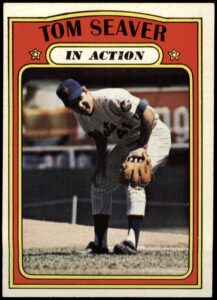 A fan sees what a fan sees. I know this isn’t box score material, but it made me feel so much better about McLean’s immediate prospects, and I already felt fantastic about them. Maybe because I just finished reading Art Shamsky’s latest book, which included a mention of Tom Seaver being “the ray of hope on a team that had lost 101 games” his rookie year and smashing the club’s “lovable losers” image, that I immediately connected Tom Terrific to Nolan Natural. Maybe someday they’ll talk about Nolan McLean that way, that THIS righty came up to the Mets in 2025, and it began to change everything. Then I remembered the 2025 Mets, for all their unlovable foibles, aren’t on pace to lose 101 games; Tom Seaver, whether for impact or performance, is a helluva bar; and Nolan McLean has thrown exactly twelve-and-one-third major league innings.
But I told you I was in the mood to overreact.
by Greg Prince on 22 August 2025 12:58 am Midway through Thursday afternoon’s Mets-Nationals game, about the time I suspected Washington’s overcoming of New York’s lead was not going to be reversible, I remembered the Nationals used to be the Expos. It’s not as if I’d wholly forgotten from whence the Nationals moved following the 2004 season, it’s just that the Quebec connection long ago faded from contemporary concern. For the first year after the Expos had become the Nats, I considered them a hybrid: the Natspos. Montreal had been such a permanent part of the Metscape from the moment I’d begun paying attention to baseball, it was difficult to not sense their presence despite the new surroundings to which they’d moved and the new identity they’d assumed. But that was mostly 2005. Soon enough, the Nationals were the Nationals, and the Expos seemed an ancient franchise from another era.
On Thursday, the Natspos lived. The Nationals of 2025 seemed to morph into the Expos of any number of years when the Mets verged on indisputable excellence and the Expos weren’t supposed to present much of a challenge, yet did. Years like 1985. Years like 1987. Years like 1990. Years like 1998. Years when a few more wins against the Expos probably would have pushed the Mets into playoffs they wound up missing. Those Mets would have accepted a few more wins against any National League opponent to get where they needed to go, but in the moment, it was inevitably the Expos who served as particular pain in the ass. The Nationals did something similar in September 2007, to name another infamous year, but they didn’t come off as quite so, shall we say, Exponential about it (whereas the 2007 — and 2008 — Marlins did).
Well, it’s 2025, and whoever that team is that plays home games in a city that seems to have bigger problems than headquartering a last-place ballclub certainly rose up and overcame the team that came to town likely thinking it was getting a break in its schedule. The last-place Nationals took two of three from the contending Mets. I’ll leave it to the Washington faithful to decide how badly they needed this boost to their self-esteem. The Mets had more practical aspirations. They needed to take this series to firmly establish they had regathered their momentum.
They didn’t and they haven’t.
Nationals Park, as lightly populated as Olympic Stadium in its final seasons of MLB benign neglect, saw the Mets take an early lead and build on it, much as a playoff team does when facing a cellar-dweller. Per the standings, the Mets are a playoff team. It seems impossible to fathom that after watching the Mets for the past two-plus months, but if the season ended today…oh, don’t you wish? No point in pushing it. With 35 games remaining, the season appears on track to finish before you know it, and not a moment later.
The Mets were up, 3-0, once. There was a leadoff home run from Francisco Lindor, a record-setter for that sort of first-inning thing, and there was a third-inning homer from Starling Marte. Lindor’s couldn’t help but be solo, and Marte’s came with the bases empty and two out. Something about all Met scoring in a given early inning generally makes me uneasy, but one swing equaling one run isn’t really a bad deal. In the first and the third, each fella who swung for the fences made the most his respective opportunity at the instant he went deep.
The top of the fourth was a different story. The top of the fourth bulged with opportunity. The bottom of the order was coming through as best the bottom of our order can. Brett Baty, who’s been hot, singled with one out. Tyrone Taylor, who was playing only because Brandon Nimmo’s neck prevents him from admiring the Washington Monument, walked. Taylor reaching base is any capacity is as surprising as Taylor reaching the field. Cedric Mulllns, who was brought in to be some sort of improvement over Taylor, singled to right, and we had the bases loaded. Opportunity!
Hayden Senger, in for the bruised and battered Luis Torrens, who’s in there most games for the bruised and battered Francisco Alvarez, delivered about all you could ask of your Quadruple-A backup catcher. He flied to deep enough center to score Baty from third and move Taylor up from second. Senger entered his at-bat with no major league runs batted in. Now he had one. If you saw or heard it, you saw or heard something unprecedented in the life of Hayden Senger. It wasn’t a gamebreaker, but it wasn’t unproductive.
The bottom of the order did all it could. It cobbled together one run. The order turned over. Lindor, he who hit his eighth leadoff home run of the season in the first, and singled to start the third (before getting thrown trying to steal second), had a shot at putting this game if not out of reach of the Nationals, then beyond their easy grasp. It was a time to bury the team in last place a little further.
But Lindor grounded to third. The rally produced nothing else. On the surface, that shouldn’t have been overly concerning, because the Mets are, per the standings, a playoff team, and the Nationals are last, and Sean Manaea was tossing a shutout as if Sean Manaea had never stopped being the Sean Manaea of the second half of 2024. His first three innings were a strikeout-laden breeze. I went to a game in the first half of 2024 when Manaea piled up strikeouts but gave up too many runs for those to matter. He came a long way after last year’s All-Star break. He became the kind of pitcher we didn’t want to go without when he tested free agency. He became the pitcher whose absence we’d regret when he went on the IL in Spring Training.
Now he was more back than he’d been in any start since his mid-July return. Three innings of zeroes and little sweat. The bottom of the fourth, with that three-run lead in place, grew a little troublesome, but resulted in just one National run. A 3-1 edge; Manaea more or less cruising; Mets still the team with the playoff-qualifying record; the Nats still super out of it in the NL East. What else could you want to wind down a late Thursday afternoon?
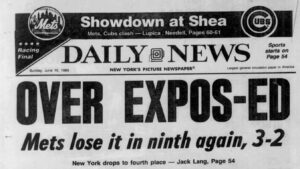 I wanted to relax, but then the Exponess of the situation kicked in. The Mets walked a couple of times in the fifth, but didn’t do anything with those runners. The Nats came up in their half of the fifth, and they chipped away. A leadoff single. A bunt to Pete Alonso that Pete threw to second, which didn’t register an out. Manaea hit CJ Abrams. The bases were loaded. Paul DeJong was up. Paul DeJong, who killed the Mets two series per year as a Cardinal, has found his true calling as a division rival. Here he lifted a sacrifice fly. It was 3-2, Mets. Then another walk to reload the bases, Manaea up to 91 pitches. Geez, that happened fast. I wanted to relax, but then the Exponess of the situation kicked in. The Mets walked a couple of times in the fifth, but didn’t do anything with those runners. The Nats came up in their half of the fifth, and they chipped away. A leadoff single. A bunt to Pete Alonso that Pete threw to second, which didn’t register an out. Manaea hit CJ Abrams. The bases were loaded. Paul DeJong was up. Paul DeJong, who killed the Mets two series per year as a Cardinal, has found his true calling as a division rival. Here he lifted a sacrifice fly. It was 3-2, Mets. Then another walk to reload the bases, Manaea up to 91 pitches. Geez, that happened fast.
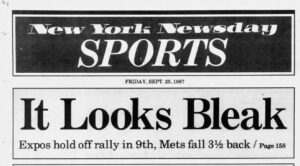 Sean goes out, extending into veritable perpetuity the unfathomable nobody but David Peterson going six streak. In comes Tyler Rogers, who was obtained to lock down seventh innings. It’s the fifth. He’s going to throw sinkers and, somehow, you know they’re not going to sink as he wants them. One, to Riley Adams, sinks into center, where Mullins picks it up and throws it back in to instigate a rundown after two Nats score. Rogers and Mullins collaborating on a futile sequence seems appropriate. They were each acquired as theoretical upgrades. With them on board, things have remained solidly in quicksand. Sean goes out, extending into veritable perpetuity the unfathomable nobody but David Peterson going six streak. In comes Tyler Rogers, who was obtained to lock down seventh innings. It’s the fifth. He’s going to throw sinkers and, somehow, you know they’re not going to sink as he wants them. One, to Riley Adams, sinks into center, where Mullins picks it up and throws it back in to instigate a rundown after two Nats score. Rogers and Mullins collaborating on a futile sequence seems appropriate. They were each acquired as theoretical upgrades. With them on board, things have remained solidly in quicksand.
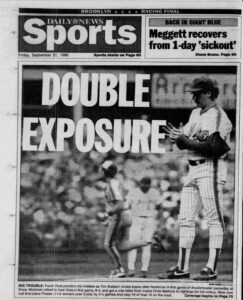 Washington leads, 4-3. Montreal, determinedly and understandably uninterested in this game as it is determinedly and understandably uninterested in every Nationals game, nonetheless feels something tingle. They don’t know why. It is as if some phantom municipal limb has come to life via a distantly familiar sensation. It’s kind of pleasant. It’s almost Expolike, the city thinks for a moment, but no, that can’t be. We haven’t had that spirit here since 2004. Washington leads, 4-3. Montreal, determinedly and understandably uninterested in this game as it is determinedly and understandably uninterested in every Nationals game, nonetheless feels something tingle. They don’t know why. It is as if some phantom municipal limb has come to life via a distantly familiar sensation. It’s kind of pleasant. It’s almost Expolike, the city thinks for a moment, but no, that can’t be. We haven’t had that spirit here since 2004.
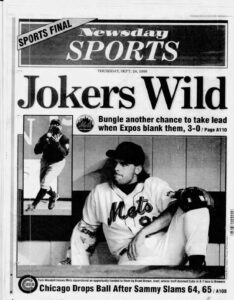 Perhaps I’m projecting. Perhaps I’m projecting.
In the bottom of the sixth, after the generation of further offense has ceased to interest the Mets, Rogers continues pitching, and the Mets continue sinking. Mullin comes close to catching what turns into an RBI single, the way Rogers comes close to getting out of jams. The game gets a little less close at Nats 5 Mets 3, Expos haunting the spectral premises. Who’s that in the on-deck circle — Rondell White? Tim Wallach? Boots Day?
We could pretend through the tops of the seventh and eighth that maybe we could string a couple of hits together and grab our lead back, but we were only borrowing the lead to begin with. And, to string hits together, you’d have to start with one. In the bottom of the eighth, Ryne Stanek, who’s maintained Syndergaardian flow beneath his cap if not vintage Thor command around the plate, comes in to, among other items, shake James Wood out of his deep slump. Wood’s three-run homer thrusts the Nats ahead, 9-3, and ensures any hits the Mets suddenly collect in the ninth will make only for sumptuous box score window dressing (window dressing for Low-Leverage Barbie’s Dream House sold separately). With two out and nobody on, Lindor records his third hit of the game; each progressively less impactful than the one before it. Juan Soto completes the day doing what some Met has to do in order to place a cherry atop it. Juan strikes out.
The Mets have now won three of their last five, which is the most charitable/perverse interpretation of their recent trendline. The Mets have also lost 16 of 21, a more accurate assessment of their plummeting pattern. They lead Cincinnati by a half-game for a Wild Card spot that clearly wants nothing to do with the Mets, much as we, their chronic fans, too often want nothing to do with them, either (yet here we are, enmeshed in their foibles as the true co-dependents we insist on being). If momentum is to be regathered, the garnering will have to begin with the ball slated to fire from the right hand of Nolan McLean Friday night. Momentum, you have surely heard, is only as good as the next day’s starting pitcher, which 2025 experience tells us is the worst thing you can be told as a Mets fan four of every five nights. If David Peterson is your next day’s starting pitcher, you instinctively make room on that table where you stick everything in the likely event momentum will arrive by 10 PM the next business day. If anybody else starts, you don’t disturb all your crap that’s otherwise gathering dust. McLean’s first start, however, indicated that equation might change. Still, he’s making only his second start, so how much you want weigh him down with expectations is up to you. Expecting anything consistent out of the Met lineup — anything positive — is its own fool’s errand.
At least we don’t have to withstand the ghosts of the Expos this weekend. What a relief! Now to check to see where the Mets road trip sends them next, while I take this large swig of water…
by Jason Fry on 21 August 2025 8:18 am A day after a near-perfect game, the Mets looked once again lacking in all too familiar ways: Kodai Senga was mediocre, and the offense’s comeback stalled when Cedric Mullins couldn’t hit a medium-depth fly ball, beginning a maddening streak of futility against the Nationals’ terrible bullpen.
(Before we move on, though, let’s note Brett Baty‘s majestic homer, struck though it was in defeat. Watching the replay, I told my kid “I didn’t think Baty had 455 feet in him,” to which the kid replied, “I don’t think Baty thought he had 455 feet in him.)
We missed the first two-thirds of Mets-Nats, for a defensible reason: We were at Portland’s Hadlock Field to watch the Sea Dogs take on the Binghamton Rumble Ponies in a clash of the Red Sox’ and Mets’ Double-A clubs. This look at the future seemed to have lost some of its juice a few days ago, when the Mets promoted Jett Williams, Ryan Clifford, Carson Benge and Jonah Tong to Syracuse.
But we had a fine time anyway, and not just because hey, it was baseball on a summer night. Binghamton’s R.J. Gordon took a no-hitter into the seventh, the Rumble Ponies got a laser-beam homer from Jacob Reimer and a ringing double from A.J. Ewing (who has a Winkeresque swagger certain to get under opponents’ skin), and the entire game saw eye-opening defense, with center fielders Nick Morabito (Binghamton) and Allan Castro (Portland) putting on a show and Portland third baseman Ahbram Liendo vacuuming up anything in his neighborhood.
The Rumble Ponies won, even if the parent Mets did not, and it was a welcome reminder that the future is always edging a little closer, bringing new players and stories into view.
|
|






