The blog for Mets fans
who like to read
ABOUT US

Faith and Fear in Flushing made its debut on Feb. 16, 2005, the brainchild of two longtime friends and lifelong Met fans.
Greg Prince discovered the Mets when he was 6, during the magical summer of 1969. He is a Long Island-based writer, editor and communications consultant. Contact him here.
Jason Fry is a Brooklyn writer whose first memories include his mom leaping up and down cheering for Rusty Staub. Check out his other writing here.
Got something to say? Leave a comment, or email us at faithandfear@gmail.com. (Sorry, but we have no interest in ads, sponsored content or guest posts.)
Need our RSS feed? It's here.
Visit our Facebook page, or drop by the personal pages for Greg and Jason.
Or follow us on Twitter: Here's Greg, and here's Jason.
|
by Jason Fry on 31 May 2023 11:19 pm The first half of Wednesday’s game burbled vaguely out of my phone from a waterproof pouch around my neck: It was Opening Day for kayak season, so first I was sitting in a boat off a Brooklyn Bridge Park pier making sure people didn’t drown or do anything dopey and then I was hauling racks of boats around and helping put things away. During all this, I registered that some Phillie had homered off Carlos Carrasco, that Carrasco otherwise sounded like he was doing pretty well, and then I noticed that PHI 1 NYM 0 had become PHI 1 NYM 2. Some quick poking at my phone revealed that Mark Canha was the man to thank; a few minutes after I got home, salty and tired but pleased to have been back on the water, Canha roped a two-run single off Aaron Nola to make the score PHI 1 NYM 4 — which was how things ended about an hour later.
I spent that hour appreciating Carrasco and the veteran Met relievers who succeeded him, as well as the sparkling defense turned in by Francisco Lindor and Brett Baty. There’s a lot to unpack in that one sentence, isn’t there?
For openers, while plenty of things haven’t worked out in this weirdo season, the defense has been spectacular. Lindor and Brandon Nimmo have elevated their already impressive games, and Baty and Francisco Alvarez have matured as defenders almost literally before our eyes. In the seventh, Brooks Raley fanned Brandon Marsh (who looks like he’s been living under a bridge like a troll from a storybook) and Edmundo Sosa but was nicked for singles by Knothole Clemens* and Bryson Stott. That brought Trea Turner to the plate as the tying run — the same Trea Turner who’s having an inexplicably horrible year but is still Trea Turner, so God help anyone and everyone in his way when his offense reverts to the mean.
Turner smacked a ground ball to Baty’s backhand — the kind of play where a third baseman has to gather himself and set his feet before putting everything he possibly has behind the throw. Two problems presented themselves at this juncture: a) Trea Turner is fucking fast; and b) that’s the kind of play where young players can get lost in that moment of self-gathering, so you instinctively cover your eyes.
Baty gunned Turner down, no sweat — the kind of play I’m not sure he makes in mid-April, let alone last year. But he’s put in the work, turning repetition into muscle memory, just as his fellow Baby Met Alvarez has.
Baty’s nice play aside, it wasn’t a night for the junior Mets. No, this one belonged to the more grizzled members of the roster, including two whose names have primarily elicited sighs of late. Carrasco has now authored two superb starts in a row, lowering his ERA from north of 8 to north of 5, and that’s definitely progress even if it points to the need for more. Canha is front and center in the ranks of the Milk Carton gang whose bats have gone missing, but driving in all four in a win is definitely a way to make grumpy fans like me say that yes, in fact, I have seen you. The future may belong to Baty and Alvarez, but it hasn’t arrived quite yet. Seeing more of the 2022 vintage Canha and Carrasco — not to mention Starling Marte and Daniel Vogelbach — would certainly help our cause until it does.
* OK, I guess I need to explain this. (Fair warning: It’s not worth it.) One of the many things that I loathed about Roger Clemens, besides his being a PED-addled Neanderthal headhunter, was that he gave all of his children names starting with K, because that’s the kind of thing dim self-aggrandizing assholes do. Confronted with an unwelcome reminder of Clemens’ existence in the form of a young Phillie, I flashed back to how we used to make up unlikely K child names to fill out the Clemens family roster: Kerosene, Kumquat and Koyaanisqatsi are three I remember particularly fondly. But I decided to call whatever child this is Knothole, just to increase the degree of difficulty. And because “knothole” is an intrinsically funny word. So be it: He’s Knothole Clemens, and his dad’s a dushbag.
by Jason Fry on 31 May 2023 12:59 am The Mets’ losing streak is over — and so, as it happens, is mine.
I went 0 for 2022. Every time I attended a Mets game they lost the damn thing, including two playoff games. The only time they won a game for which I held a ticket was Closing Day, and I bailed out of that one before first pitch because I didn’t think first pitch was going to happen. Coincidence? My suggested I was a jinx and by the time I saw the offseason smash into us I wasn’t sure that was wrong.
Well I’m not a jinx, or maybe I was but putting the calendar in the recycling also did away with whatever hoodoo was afflicting me. All I know is I was back at Citi Field on a spring evening that went from crisp to slightly chilly and I got to see the Mets play crisp baseball. That had been lacking of late too.
I can’t tell you much of anything about the game — I was in the front row and way down the left-field line courtesy of my road-tripping friends Mary and William and their kids. (Who also attended a Yankee game and got a ball from Aaron Judge — that’s a pretty good NYC visit.) I’d never sat in those particular seats, and they offered a perspective that was interesting but repeatedly confounded my sense of balls’ trajectory. I could tell Kodai Senga was really good, and that Ranger Suarez was too. More than that, however, I can’t really say — if I needed the up-close details, I’d ask one of you. The game’s about the crowd and experiencing something collectively, emotions rising and falling based on what’s happening at the center. If you want to hone in on the finer points, watch on TV.
I may no longer be a jinx, but my timing isn’t back to All-Star caliber. I was away from my post when Brandon Nimmo made his glorious catch and when Francisco Lindor smacked a home run to put the Mets up 1-0. The Nimmo play revealed an oddity: I heard the crowd’s alarm and so hurried to one of the monitors behind a section in time to see Nimmo find the fence and leap — and while he was still airborne the crowd gasped and cheered — actual life, it seems, is about a third of a second ahead of the A/V system.
The monitors are bigger and brighter and there are more of them. That’s an improvement, as is the fact that the audio feed of the game is now ubiquitous. Once, I confess, I would have sneered at that or at least shrugged, muttering something about priorities. I’m older and calmer now. People get hungry, need to go to the bathroom, have kids with one or both of those needs, or just want a drink. It’s a kindness to ensure they can attend to those duties without losing track of the game. Speaking of drinks, it was a reasonably big crowd but I was able to secure beers (and a decent one at that) without sacrificing multiple half-innings to the quest. There seem to be more choices, and more people ensuring you don’t regret those choices because they eat up a good chunk of the experience you’ve paid to miss.
(One of those people was my beer vendor, encountered while Lindor was doing wonderful things. When I asked for a bag of Cracker Jack he pointed out somewhat gravely that he had Cracker Jill. I shrugged, which prompted him to grumble that “they’ve changed the Bible, too.” Being me, I couldn’t let that go by unchallenged. “They’ve been changing the Bible as long as it’s been around,” I said, and if it hadn’t been 1-0 I would have rattled on about the ambiguity of Hebrew and centuries of fights about Greek and Latin and the evolution of the English Bible and all the heretics that spawned, because obviously that’s the conversation one ought to have at a Mets game. Incidentally Cracker Jill is exactly the same and perhaps a better bet because you know you aren’t getting a bag that’s been in a storeroom since the Carter administration.)
Oh, and yes, the new scoreboard is the size of a small moon. Seriously, the thing’s insane. It’s a little like your first glimpse of HD in that it seems realer than real and you have to tear your eyes away from it, reminding yourself that the actual game is the smaller thing with little people and dimmer lighting.
That actual game went well Tuesday night — it was one of those taut games that you watch with a tinge of vague resentment, a cranky fan’s lament of “Why can’t you do things like this every night?” The answer is because baseball’s difficult and maddeningly random, but the record now shows that the Mets have done praiseworthy things ever so slightly more often than they’ve done things that make you mutter imprecations. That made for a nice night, as did finding that Citi Field was right where I’d left it — and that the Mets could actually do praiseworthy things despite my presence.
by Greg Prince on 29 May 2023 9:58 am One-third of a season. Fifty-four games played. Twenty-seven wins. Twenty-seven losses. Each quantity seems well-earned. They’ve been as good as they’ve looked when they’ve won and as bad as they’ve looked when they’ve lost. They’re having two separate seasons in one. The Mets are the epitome of mediocrity.
Befitting the finale of a series played a mile high in the air, the Mets reached new heights in their signature category Sunday. Ten runs scored! Eleven runs allowed! That offense looked sumptuous. That pitching and defense was repulsive, except it forgot to repel the Rockies. After plastering Austin Gomber for six runs in the top of the fourth inning, the Mets held a formidable 6-2 lead, emblematic of what kind of team they are when they’re winning. Tommy Pham, Eduardo Escobar and especially Czar of the Three-Run Homer Francisco Alvarez all delivered like DoorDash. They overcame an early deficit and asserted Met inevitability. Never mind the Coors Field Game™ the night before. It’s only a Coors Field Game™ when Colorado wins. The Mets were making this a Mets game. Two out of three. Break-even trip. Happy flight. Go home and maintain momentum versus the defending league champion Phillies.
Except this is a mediocre team, and its mediocre starting pitcher Tylor Megill, out of whom you get some pretty good games and some pretty bad games, veered toward the latter, loading the bases and courting doom in the bottom of the fourth. Doom arrived by way of a sinking Ryan McMahon line drive that eluded Starling Marte in center field. Marte was getting his first Met start to the left of right. He’s an accomplished center fielder but also a little out of practice when it comes to something other than the corners. As the liner was sinking, all I could think was, “Nimmo would get to this.” Usual center fielder Brandon was the DH Sunday. Everybody can’t play everywhere they’re most suited daily, I guess. McMahon’s ball falls in, all three baserunners score, and though the Mets are still leading, the game is getting ready to get away. It’s 6-6 once the fourth and Megill’s start are over. It’s 11-6 after Stephen Nogosek has made the least of whatever PitchCom signals Alvarez has sent him in the fifth. The Mets either valiantly fought back to make an 11-10 game of it or were just Coors Fielding the rest of their Sunday away. It was a Coors Field™ Game, after all. The Rockies won, so we can safely say that.
The Mets lost two out of three to a team not considered a contender right after losing two out of three to another team not considered a contender. Their record has settled in at 27-27. After 34 games, they were 17-17. Twenty games later, they’ve won enough and lost enough to make the most of their two simultaneous seasons, being a helluva good team while winning those 27 and hellishly the opposite while losing those 27. Throughout the bumpier segments of what is technically just one season, I’ve heard Memorial Day invoked repeatedly as a potential inflection point. Don’t worry that they’ve just lost and keep losing. Where they are on Memorial Day will give us a much truer idea of how good they really are. When the Mets are off to a flying start, nobody says wait until Memorial Day for their inevitable descent. This year’s calendar-circling struck me as a time-buying exercise to quell the doubts of both the chronically impatient and uncomfortably observant.
Hey, I’m all for time-buying. Who when not having progressed as desired hasn’t wanted more time to prove themselves? Just give me another week or two… Well, it’s Memorial Day and all we know is the Mets have won 27 and lost 27, so feel free to decide that the real inflection point is the Fourth of July or the All-Star Break or September 1. There’s an enormous jumble of teams within reach of the six-seed in the National League Wild Card race/slog. Nobody — not the Cubs, not the Rockies, not the Mets — is out of it. The Mets are a half-game from it. If they have a good week, they clutch it. If they have a bad week, they’re probably still not that far from it. Remember: it’s only Memorial Day.
Thus, if you want to be all realpolitik about 2023 and dismiss the bulk of 162 games as packing peanuts for the handful that will effectively determine postseason eligibility, go ahead. Maybe that’s how it will shake out. Maybe a crummy 2-4 road trip won’t add up to much by October 1. The Mets are playing at an 81-81 pace. A couple of very good weeks down the line can propel a team like this to 87-75, the stuff of also-rans in more merit-driven times, enough to get a random OK team on a hot streak like the Phillies into the playoffs in the current system in 2022. Our team was tearing it up after 54 games last year. We were 35-19. It was awesome. It continued being awesome when we continued the process of winning 101 games, even if that total wasn’t quite enough to clinch the division title. But what’s a division title when the team ultimately capturing the NL flag is a division rival that finished fourteen games behind your awesome record?
When the Phillies won the pennant in 2022, it didn’t feel flukish. It just felt like this — the sixth-best record serving as viable passage past teams with five better records and into the World Series — is the way it can fairly easily be now. If it is, that can be us. It’s not guaranteed we will do that, but it’s Memorial Day and we are 27-27. The season to date still hasn’t told us enough about these Mets other than 108 games remain and they seem capable of winning much more than they have…and seem equally capable of slogging along as they have.
It’s Memorial Day and the Mets aren’t playing today. That should feel like more of shame than it does, baseball having ancestral claim to national holidays in spring and summer — with doubleheaders, even. Honestly, I’m not sorry these Mets aren’t playing today. They play plenty. I seek them out every day they play, yet I don’t need to see them do what they what they’ve been doing this season every single day of my life, even if spring is presently becoming summer and Mets baseball has always been the essential element of both of those seasons for me. I don’t usually feel like I could use a holiday from the Mets. Today might be that day.
by Jason Fry on 28 May 2023 11:25 am Even in this age of humidors, Coors Field still produces games like Saturday night’s, with hits raining down like artillery, big leads proving smaller than they look on paper, a starting pitcher who’s been effective elsewhere left gasping for air, and relievers sawing the bullpen phone off the wall and hiding in that weird little alpine meadow in hopes of escaping their fate.
Honestly, that could be the recap: It’s Coorstown, where they play a game descended not from rounders and other gentle diversions invented on English town greens but from Calvinball, a dizziness generator dreamed up by a chaos-minded child and a stuffed tiger. It’s Coorstown, and for your own sanity you should have a short memory about what befalls you there.
Still, I’ll evade my own advice like a ball up the Coorstown gap for a couple of notes about whatever that was Saturday night.
First off, kudos to Justin Verlander, who got strafed but then hung around, somewhat sparing his bullpen and maybe keeping a horse or two on the right side of the barn doors. Not an outing for Verlander to treasure — in hindsight, his good career numbers in Coorstown should have been accompanied by ominous minor key music — but things could have been a lot worse.
The Rockies’ City Connect jerseys are pretty damn good. Every couple of weeks I catch sight of a team wearing its newfangled alts (which, to be clear, are primarily intended to facilitate the redistribution of income from fans’ pockets to the already bulging ones of Nike and MLB) and I get to worrying about what the Mets will do when their City Connect time comes. Something timid and dull? Something that makes you wish they’d opted for timid and dull? The best City Connects are true alts, departures from a team’s established identity that still tap into something about the city and/or the franchise. They’re interesting what-ifs instead of a slight variant of something already in the team closet. Rather than coming up with Purple 1A unis, the Rockies thought about it, used Colorado’s iconic green license plates as a starting point, and came up with something that’s clearly says Colorado but in a way that hasn’t been said before. (Additional credit because “thought about it” has not exactly been what comes to mind when you review the work of the current Rockies regime.) If you want to go down this rabbit hole, ESPN recently ranked the so-far-unveiled City Connects; my highest marks would go to the Rockies, Marlins, Nats, Red Sox, Padres and Giants, with sad shakes of the head for the Royals, Cubs, Braves and Willy Wonka Blueberries Dodgers.
Reluctant points to Colorado’s Nolan Jones, who had the kind of game Friday that makes you avert your eyes in pity, yet was right back in there a night later and punished the Mets, playing a key role in his club’s victory. That’s not an easy thing for even some veterans; it can be doubly difficult for a player who’s still yet to record his 100th AB.
Two members of the Mets’ HAVE YOU SEEN ME? milk-carton gang actually acquitted themselves well, with Starling Marte chipping in a briefly decisive hit and Mark Canha looking more like his 2022 self at the plate. And in even more positive news, Mark Vientos actually got to start and performed as if being affixed to various benches hadn’t fazed him. Vientos needs to play, an annoyingly large number of Mets Proven Veterans™ have demonstrated no particular evidence that they need to play, and it’s high time to make this next transition.
One transition that is gloriously complete is from various misfit-toys catchers to Francisco Alvarez. I’ve banged on about Alvarez since seeing him up close as a Brooklyn Cyclone, and Saturday night’s game was a showcase for why. Alvarez plays baseball greedily, as if it’s the sweetest air and he wants to gulp down as much of it as possible. (Not a bad idea given the altitude of Coorstown.) You can see it in the little things: his emphatic gesturing to faltering pitchers, the way he uses everything from his setup behind the plate to his framing skills to massage location, and even the way he snaps a hand back for a new ball from the umpire. Alvarez draws eyes to him no matter what he’s doing on the field, playing with what’s definitely swagger but is more than that — there’s a joy and hunger to what he does that even non-Met fans will come to appreciate very quickly. He’s also hungry to learn: Yes, he short-circuited an inning by paying more attention to celebratory gestures than hanging onto the bag after an unlikely triple, resulting in a painful out. Not an unheard of growing pain for a young player, except I’d put $100 down on Alvarez never making that mistake again. Two ABs later, he came up with two on and two out and demolished a curve that Brent Suter left in an ill-advised place for a 435-foot game-tying homer. If you thought his exuberance might be dimmed even a fraction of a watt by his earlier mistake, well, you haven’t watched Francisco Alvarez.
by Jason Fry on 27 May 2023 12:22 am The Rockies has somehow now been around for 30 years. I was at their first-ever game, which they lost to the Mets at Shea. I watched them beat the Mets behind Dante Bichette in extras at Coors Field’s christening. Since then I’ve seen the Mets play at Coors far too often for my liking. I’ve seen them pound various Rockies incarnations by scores that feel more suited to football; I’ve seen them suffer the same indignities. I’ve marveled at the waterfalls and the conifers in the bullpen, I’ve grimaced at the likes of Todd Helton and Larry Walker, I’ve nodded at that the purple line of seats and Dinger’s antics. And regardless of the score, I’ve braced myself for the moment when the baseball train cars jump the rails and any semblance of a normal game winds up jackknifed and on fire in a ravine.
That’s the Coors Field experience, changed only at the margins by humidors and experiments with ground-ball pitching staffs and all the other tweaks and twerks that have been tried since the Clinton administration. It’s an experience that instills a certain wariness which no score can make completely go away. If the Mets are up six in the middle innings during a Coors Field matinee, you regard the normally welcome three-inning baseball nap with trepidation, because you know you might wake up down two. Same thing with some late-night affair you’re tempted to shut off because the Mets are down five — you might wake up in the morning and be annoyed with yourself when it turns out they won by three.
It can be fun; I’m just not sure, even after all these years, that it fully counts as baseball.
What was most notable about Friday night’s game against the Rockies, I suppose, was what didn’t happen. The Rockies don’t look completely ready for prime time this season but didn’t implode. Max Scherzer has had a, well, rocky season so far but didn’t collapse. Dicey situations abounded in the late innings but the Mets somehow kept the roof intact over their own heads. It was like the trope of the detective noting that the dog didn’t bark, except it turned out nobody got murdered.
Scherzer looked much more like Scherzer than he has in most 2023 games (I’ll note here that I never actually saw him pitch against the Guardians), despite not having enough air around his pitches: He was sweaty and perturbed and his mien middlingly psychopathic, which is to say he was the Scherzer we feared as an opponent and were overjoyed to welcome to our side. For me what’s most fun about Scherzer is he’s about the least balletic Hall of Fame pitcher I can imagine: You’ve seen a hundred slow-motion collages of classic power pitchers rocking and coiling and firing, the graceful movement of their long arms and legs accompanied by elegiac music that makes you want to sigh at a sunset. Footage of Scherzer would never fit in one of those: His mechanics are violent and abrupt, like a machine that looks always on the brink of flying apart. He’d somehow never won a game at Coors, but he has now, giving up a solo homer and nothing else and delivering a performance it’s safe to say both he and the Mete needed.
On the offensive side the Mets let a golden opportunity go by in the third, as Pete Alonso and Brett Baty struck out with the bases loaded, but they did enough elsewhere: Brandon Nimmo was on base five times, Francisco Lindor drove in four, Baty collected two hits. You wondered if it would be enough in the ninth, as Brooks Raley didn’t have it and Eduardo Escobar made what looked like a potential dagger of an error at third behind hastily summoned Adam Ottavino. But the Rockies did the Mets an enormous favor when Colorado newcomer Nolan Jones strayed too far past second on Escobar’s boot, giving the Mets a critical second out and leaving Ottavino to face Mike Moustakas, that once-upon-a-time ruiner of nice things, as the tying run/last hope.
Ottavino hasn’t had the best year so far, but he knows how to pitch at Coors and he goes about his business with a certain fatalism perfectly suited to a middle reliever with a sometimes unreliable breaking stuff, whether or not said reliever pitches at an unwise altitude. Ottavino regarded Moustakos with his usual Eeyore expression, got to work, and erased him with an unhittable cutter. The dog hadn’t barked, hijinks hadn’t ensued, and the Mets had emerged not just alive but also victorious.
by Greg Prince on 26 May 2023 12:14 pm Saddled with the understanding that your team is not going to win them all, the best a fan can hope for is an optimal sorting out of the order of inevitable losses. Take the Mets-Cubs series just completed. After competing on a stratospheric high, as the Mets did on their last homestand, they were, because they are human, due for one night of flatness. They plunged back toward terra firma in their first game at Wrigley. Fine. Get it out of the way. Not necessarily scheduled to come next was one of those “tip your hat to the opposing starter” games. They are scattered across any given season, even in this era when starters infrequently stick around to earn such a salute. You wish for them to be few. You prefer they don’t come after the flat games. Alas, the second game at Wrigley became the cap-tipper, as Marcus Stroman threw myriad ground balls that the Met lineup obligingly hit to Cub infielders. If the Mets were grudgingly tipping their caps, Stroman all but threw his in the air Mary Tyler Moore-style after completing his eight suffocating innings. That’s his business. Next time don’t give him the opportunity. This time, tip your cap and move on.
Whatever other kinds of losses is bound to occur over an assortment of 162 games, the one you didn’t want after the first two in Chicago was any kind. That’s the sweep loss, the loss that shows you’re at least temporarily lost, perhaps farblondzhet, which is Yiddish for lost, but so much worse, especially if you’d ever heard my mother drop it into conversation. It’s bad to lose three in a row at any juncture (see the Mets leaving Milwaukee and Detroit emptyhanded). It’s really bad to implicitly announce that all those good vibes from winning five in a row, each in dramatic and satisfying fashion, are now expired. The Mets will lose another game in 2023. They couldn’t do it at the end of their stay at Wrigley.
And they didn’t. Two losses in three games is nothing to text home about, but it’s far more than 33.333% better than what loomed as the alternative entering Thursday night. Behind Carlos Carrasco, the Mets stomped the Cubs, 10-1. In these disturbing DH times, Carrasco had nothing to do with the 10, but was largely responsible for the 1. That’s no small detail. Carrasco has been easy to overlook since he became a Met in 2021. He came over in a trade that was never going to be labeled the Carlos Carrasco Trade, because it was all about getting Francisco Lindor. He didn’t pitch in his first year as a Met until the second half of the season, and most of what one remembers is a string of implosive first innings. He was more dependable in 2022 — 15 wins! — but he also seemed to go unnoticed by those of us who tend to notice everything. We noticed he was left off the postseason roster and also noticed nobody strenuously objected.
Carlos missed some time in 2022, then missed a bunch more after an uninspiring beginning to his 2023. His first start, last Friday night, against his old team, didn’t summon many echoes of his Cleveland glory. When he allowed a game-tying home run to Dansby Swanson in the bottom of the first Thursday, here we seemed to be going again.
Then Cookie found his path back to success and we happily followed. Over six-and-two-thirds, Swanson’s solo shot was the only real damage generated against Carrasco, and we’ve seen enough of Swanson as a Brave to accept whatever he does to the Mets as a cost of doing business. No other Cub bothered him too badly, even in the third, when Chicago loaded the bases and threatened to reduce what had become a three-run Met lead. Happily, Cookie teased a harmless grounder out of Mike Tauchman, and that was it for Cubbie mischief. By the bottom of the seventh, when Carlos exited, the Mets were up by six, and Pete Alonso had widened his lead on the 1980 Mets in the home run column. Pete now has 19 through 51 games; the Mets, at the same juncture of their intermittently Magical season, had 11. There are many entities Pete will be outhomering as he goes along.
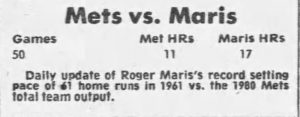 Move over, Maris. Alonso’s the one overpowering the 1980 Mets now. By the ninth, a catcher was pitching for the Cubs, and even Marcus Stroman was probably sitting quietly. The Mets were about to seal a 10-1 win that raised their record to 26-25 at the expense of the Cubs, who were falling to 22-27. That the team with the overall better record and greater expectations had gone 1-2 against a lesser opponent didn’t much matter. In July of 1969, Leo Durocher, whose overwhelmingly favored first-place Cubs had just salvaged the finale of a three-game set against the upstart yet still second-place Mets at Shea (the series that featured Don Young not corralling fly balls and Jimmy Qualls delivering a lonely single), was asked if those were the real Cubs who had just laid a 6-2 beating on the Mets.
“This wasn’t the real Cubs,” the skipper who eschewed excursions to the UN on his trips back to New York sniffed. “It was the real Mets.”
We’ll see about that in a few months, 1969 Leo, but never mind 54 years ago right now. With the Cubs safely ensconced in the NL Central and not presently any more of a factor in the Wild Card derby than anybody else, I’m not worried if “now pitching, the catcher, Tucker Barnhart… represents the real Cubs (though let it be noted Barnhart threw a scoreless frame). I don’t know if I’m convinced the team that executed all facets of baseball as if it knows what it’s doing is the real Mets, but I’m willing to accept it as prima facie evidence, mainly because I’m in the mood to be in a good mood.
Alonso’s towering home run total has me in a good mood. Jeff McNeil’s three hits have me in a good mood. The four consecutive two-out singles that built the Mets’ lead in the third inning — from Jeff, Pete, Brett Baty and Starling Marte — have me in a great mood. Baty was in the middle of a bunch of scoring, whether from the position of batter or baserunner. I love his and his fellow youngster Francisco Alvarez’s confidence out there. Why shouldn’t they be confident? Baty is the starting third baseman on a major league team with legitimate postseason aspirations; he’s nudged a competent professional named Eduardo Escobar to a utility role. Alvarez? He’s the starting catcher on the same team. Gary Sanchez, an idea that might have been worth trying out in a practical sense if there was no better option behind the plate or in the lineup, was designated for assignment Thursday. By the time he got a few reps in 2023, the position he played belonged to the much younger man. Tomás Nido is back in good optic health, and Omar Narvaez will squeeze into the picture soon, but they, too, need to get in line to the rear of Francisco Alvarez for crouches.
At last Friday’s 10-9 barnburner (seriously, you could see the barn smoldering all the way from Astoria), it was clear we as fans have moved on to Baty, Alvarez and, when we get glimpses, Mark Vientos, with Ronny Mauricio on deck in the emerging imagination. Succession, whether planned or organic, is occurring, and it’s working more than it isn’t. There was much joy in the crowd whenever the Mets were storming back versus the Guardians, but the sound the crowd made for the kids boomed stronger than anything generated on behalf of any other Mets, even Pete with the grand slam. There’s something about living with the names of prospects circulating in your subconscious until they have ascended to your field of vision and then proving they deserve a chance to maintain that front-and-center spot right before your eyes. Nido’s seeing better, thankfully, but the de facto starting catcher from 2022 didn’t need eye inserts to read the writing on the organizational wall as it’s developed in 2023. “I’m just ready to help in whatever they need me to,” Tomás graciously said prior to a game where he’d be asked to perform his own mopup duty, catching the ninth so Alvarez could rest up with a nine-run lead. Since rising to the majors in 2017, Nido has probably repeated some version of that sentiment in deference to starting Met catchers from Travis d’Arnaud to James McCann (to Narvaez). This time, it sounds like more than lip service from a good teammate. This time feels like Alvarez time.
But let’s not eschew experience altogether. Let’s circle back to Carrasco, and who waits to pitch next. As in the Cleveland series, we’re looking at Carlos, Max Scherzer and Justin Verlander in succession. That’s Carrasco with 105 career wins, Scherzer with 204 and Verlander with 246. If their presence doesn’t viscerally stir our Mets fan souls the way the core of younger rotations did, that may be our DNA talking. Seaver to Syndergaaard and so many live arms in between, all of them confounding hitters and rising to prominence…that’s how we see ourselves winding up when we look in the mirror. At the moment, however, we glimpse success that’s already occurred and desire it to be replicated. On this staff, at least half the time, pending five/six-man rotational iterations, we’re relying on credentials rather than potential.
When Max takes the hill tonight and Justin follows him on Saturday (pending all the things that can upend probable-pitchers probability), it will mark the 64th time in franchise history that the Mets have trotted out three consecutive starters with at least 100 wins in their respective back pockets. The 63rd time was last weekend. Before that, you had to return to the halcyon days of Pedro Martinez, T#m Gl@v!ne and Steve Trachsel, specifically May 20-23, 2006. We’ll call them halcyon since the ’06 Mets had already taken over first place for good and the Mets’ trio of venerable starters had a great deal to do with their astounding break from the gate. Six times in April of May of 2006, those three village of Flushing elders pitched in succession, stabilizing an element of the Mets that would become modestly, then glaringly unglued as the year continued. Soon, we’d be cycling through journeymen and neophytes, just yearning for five healthy arms, albeit from that first-place perch.
There’s been plenty of splendid pitching since the first third of the 2006 season, but for seventeen seasons until 2023, there were never three 100+ game winners staring in a row (discounting youngsters potentially or eventually on their way to triple-digits, à la Nolan Ryan and the total of 324 earned mostly after his first 29 as a Met). Before 2006, for a few years, it had been a fairly common phenomenon. Pedro, T#m and Steve did it on five occasions down the stretch in the renaissance campaign of 2005 (Trachsel was out until August). In 2004, the wizened trio in residence was Gl@v!ne, Trachsel and future Mets Hall of Famer Al Leiter. They pitched in succession 21 times in 2004. All that winning in their past…and 71 wins in all for the 2004 Mets. Sometimes experience isn’t everything. Or were you not watching in 2003? That was the year when not only did you have Leiter-Trachsel-Gl@v!ne in succession eight times after Steve posted No. 100 on August 7, but you had the only instance in Metropolitan annals of four consecutive 100+ game-winners going consecutively. From April 20 through April 24, Art Howe called on T#m Gl@v!ne, David Cone (in his brief Recidivist Met stint), Al Leiter and Pedro Astacio (before his shoulder gave out). Trachsel was a few months from notching his 100th win. The Mets were lousy with pitchers who’d been winning practically forever. Also, the Mets were lousy, finishing 66-95, but you can’t say their starting pitchers didn’t know how to win.
Funny how that works. Before 2003, the previous season featuring three 100+ game-winners working in succession was 1993. That was the year the Mets lost 103 games, despite ten times throwing at opponents Dwight Gooden, Frank Tanana and Bret Saberhagen. No matter what order Jeff Torborg and Dallas Green threw them, the fates seemed to throw it all back in the Mets’ faces. Still, pretty good backs of baseball cards with which to console ourselves.
The first and only other year when the Mets had a trio so specifically distinguished was otherwise middling 1976. Eleven times, Joe Frazier was able to deploy Tom Seaver, Jerry Koosman and Mickey Lolich in one order or another, but definitely consecutively. The first of those threesomes unfolded between April 21 and 24, the last of them September 8 to 11. Koosman broke the 20-win barrier in ’76, Seaver pitched well enough to go there had the offense supported him (it didn’t, so he didn’t), and Lolich, whose sole New York legacy is the muttering about trading Rusty Staub his name tends to inspire, had one of those classic “pitched better than his record indicated” years. Lolich won eight games in thirty starts as a 1976 Met. We used to get pretty hung up on pitcher wins. Now we point to peripherals for a truer assessment of performance. But wins, if a pitcher can get them, are fun. Carrasco winning on Thursday night in Chicago was fun. Scherzer and Verlander helping the Mets do the same in Denver will be fun, too.
May the real Mets of 2023 be real fun. We could use it more than once every three games.
National League Town offers a view from late-spring turnarounds past, a look at a game from inside the Citi Field press box, and enough staring at a tall stack of pancakes to fill your day off. Give the pod a listen.
by Jason Fry on 24 May 2023 11:01 pm After five days of electric baseball, the Mets once again look like someone pulled the plug out of the wall.
At least — and those are never good words to see up high in a recap — this time they didn’t look flat enough to slip under a door, the way they did in the opener against the Cubs. They just couldn’t do anything with Marcus Stroman, a Met I was fond of before he turned prickly and strange, or perhaps was revealed to have been that way all along. Whatever you think of Stroman, he had it all working on Wednesday night. Met after Met pounded balls into the ground to be hoovered up by Cub infielders, with Stroman himself turning a lickety-split double play that reminded you he’d come by his Gold Glove honestly. He put more than a little mustard on a play or two and clearly revelled in taking it to his old team — and that’s fine, baseball needn’t be played like it’s being played by a convention of stoics gathered in a library reading room.
The Mets’ highlights? There was exactly one: Francisco Alvarez socking a line drive through the Wrigley winds into the bleachers and giving the Mets a brief-lived 2-0 lead. Starling Marte showed some signs of life with a determined walk, I suppose, but that feels like awfully faint praise. The bullpen was good after Drew Smith. Other than that? Pete Alonso made a horrid baserunning blunder, while Kodai Senga‘s accomplishment was merely being beaten instead of getting trucked. The game ended with the Mets trudging away sporting creased brows, faraway looks and a .500 record.
What’s to be done? Maybe move on from the back-of-the-milk carton trio of Marte, Daniel Vogelbach and Mark Canha, who’ve been plaintively asking HAVE YOU SEEN ME? all season with June coming up fast? Give more ABs to Mark Vientos? See if Ronny Mauricio‘s ready for the next stage? Wait for this weird-ass Dr. Jekyll of a team to turn back into Mr. Hyde? (Or is that the other way around?) Get special dispensation to stop playing at Wrigley, which has inexplicably been a house of horrors for years now? Do nothing and simply hang on for dear life while plummeting down chutes and zipping up ladders in a season that’s been determinedly, almost defiantly unpredictable?
They could win the next one, I guess. (The Cubs are sending out a starter with an ERA north of 8 … but then so are the Mets.) Winning always helps.
by Greg Prince on 24 May 2023 2:34 pm The 2023 Mets were expected to do big things. For the first 43 games of this season, they resisted those expectations. Then came last week: Games 44 through 48, each won by one run, each won after at some point trailing; each won as affirmation that the expectations were merited; each furnishing evidence that sometimes an experienced team needs not so much a youth movement as it does a youth shove. By Game 49, Tuesday night in Chicago, I was ready to accept a clunker. Tuesday night in Chicago, the Mets clunked. It will happen from time to time, even to a club that’s lately had you looking up rather than feeling down.
The 1980 Mets were expected to do nothing. For the first 27 games of their season, they resembled those expectations. Then, for another 18 games, they improved in fits and starts, showing just enough progress on their good nights to leave you deciding the bad nights were no worse than exceptions to the new rule. In Game 45, Pat Zachry and Neil Allen together dueled Jim Kaat of the Cardinals for nine innings at Shea. Kaat was 41 at the time. He scattered six hits and gave up no runs before extras kicked in. Zachry had a two-hit shutout going over seven before giving way to a pinch-hitter. Neil Allen took over and retired his first six Redbirds. Alas, Ken Reitz led off the tenth with a homer, Kaat returned to the mound with a 1-0 lead, withstood a Doug Flynn infield single, and went all the way for the win.
Seventeen-year-old me was prone to processing this sort of outcome as evidence of progress rather than a serious setback. Sure enough, my faith in my 19-26 Mets was about to be rewarded with one of the best week-and-change periods I’ve ever experienced as a fan. It wasn’t just that the Mets went on to win eight of their next ten, it was how they did it. This was the year of the Magic is Back advertising and the week and change ahead turned the wishful thinking motto from punchline to way of life.
The Mets were in the midst of a long homestand. The Cardinals would be followed into town by the defending world champion Pirates, the perennially dangerous Dodgers, and their northern neighbors the Giants. In each of these series, starting with the last game against St. Louis — Game 46 — and running through the middle game against San Francisco — Game 55 — the Mets would stun an opponent by scoring the winning run in their final turn at bat. We didn’t say “walkoff” then, but that’s what was going on: four walkoff wins amid eight wins overall. The Mets kept walking it off, in 21st century parlance, each such finale more stunning than the one before, right through the last one, which still ranks as one of the most stunning results in Metropolitan annals.
That, on June 14, 1980, was the Steve Henderson Game, referenced and remarked upon myriad times since the inception of this blog in 2005. The Mets trailed, 4-0, before ever coming to bat that Saturday night. They were behind, 6-0, when it became an official game. It was 6-2 going to bottom of the ninth. There were two outs and Flynn on second when Lee Mazzilli stepped in versus Giant closer Greg Minton. Mazz singled Flynn home. Frank Taveras walked. New acquisition Claudell Washington drove in Lee, moving Frankie to second. San Fran skipper Dave Bristol removed Minton and brought in Allen Ripley. Ripley’s first batter was Steve Henderson. He was also his last. Henderson crushed a three-run homer over the right field fence, into the Mets’ bullpen, directly to Tom Hausman’s glove. The Mets won, 7-6. The crowd, which wasn’t going anywhere once it absorbed what it had just witnessed, and Henderson, who had retreated to the clubhouse after accepting his teammates’ congratulations, together pretty much invented the Shea Stadium curtain call on the spot. Everybody just kept cheering. They wouldn’t leave until Hendu re-emerged to acknowledge their appreciation. Mets fans who were 17 in 1980 still get chills reliving it in 2023.
A week earlier, when those Mets were getting the hang of upsetting apple carts, their manager, Joe Torre, was dismissive of the leitmotif of the moment: “Magic?” he scoffed to reporters. “I’ve told you all before that’s just public relations.” Now, with Henderson having juiced everybody in attendance to levels of frenzy not felt in Flushing since 1973, Joe from Brooklyn allowed, “It’s really revving people up. Nobody left the park, even when they’re behind by six runs.” Indeed, the next day, nobody could stay away from the park. Not only did the Mets sell every available seat, they had to turn away approximately 6,000 potential customers.
That’s what it’s like when your team picks the right moment to come together and define itself for the better. I’m partial to it happening right around this spot on the schedule, more or less where we are and where we’ve just been in 2023.
In 1969, it was Game 42, coinciding with late-May/early June trip in from the California teams, one being the expansion Padres, the other two being those expatriate New Yorkers, the Giants and Dodgers, who had bullied the actual baby Mets on the reg since 1962. The Mets winning dramatically and consistently against anybody to pull themselves over .500 for good would have been uplifting. That the Mets rocketed toward the heavens at the expense of that pair of tormentors (who’d abandoned nearby boroughs, to boot) made the elevation exponentially sweeter. An eleven-game winning streak and so much more was about to unfurl.
In 1990, the Mets sagged so much for 47 games that it cost the only manager since Gil Hodges to lead them to a world championship his job. Davey Johnson was shown the door at 20-22. Bud Harrelson took over and wasn’t doing a whole lot better guiding what was supposed to be a perennial contender until the eleventh inning of Game 48, when a benchwarmer named Tom O’Malley (batting .091) took Expos reliever Dale Mohorcic over Shea’s center field fence. It was as if the Mets of the 1980s materialized for a curtain call, back in a pennant race on the cusp of what shaped up as one more glorious — or at least quasi-glorious — summer. The team that had been 21-26 entering play on June 5 would be 48-31 coming out of the All-Star break.
In 1980, it was Game 46 when everything beautiful and Magical kicked in. In 2023, it was Game 44. May becoming June. Spring becoming summer. Warm enough to sleep with the window open. Cool enough to keep the air conditioning off. You wake up to a soft breeze, and you’re excited about the Mets, and it will take more than one bump in the road to jar you from the journey to which you’ve emotionally committed.
Yet you won’t win them all. Game 49 in Chicago in 2023 provided a fresh batch of proof. It was a splendid night for Cubs, mostly. For a journeyman starter named Drew Smyly, who threw five smooth innings to climb to 5-1, with an ERA under three. For a former Met pitching prospect named Michael Fulmer. We traded Fulmer for Yoenis Cespedes in 2015 and it was totally worth it, even when the kid we sent to Detroit won the AL Rookie of the Year in 2016 and made the All-Star team in 2017 and seemed to grip a future that would have fit in with what had penciled in for deGrom, Syndergaard, et al., before injuries led him to his role as a 2023 mopup man…which is what he was consigned to filling when at last facing his original organization for the first time. Michael pitched a scoreless ninth in defense of a five-run lead. And for a breakout slugger named Christopher Morel, who seems partial to drawing cat whiskers on his face with eye black. Morel played 113 games as a rookie in 2022 and socked 16 homers. He’s been up with the big club in 2023 for a dozen games and, against Stephen Nogosek on Tuesday night, blasted his ninth home run of the year. Produce like that for a few more dozen games, and you can open for Kiss.
To take nothing away from Morel or Seiya Suzuki or Matt Mervis (the latter two of whom homered off Met starter and loser Tylor Megill), the bat that shouted out loudest in this game belonged to Pete Alonso. It’s not so much that his fourth-inning home run off Smyly cut the Cubs’ lead to 4-1, or that the shot traveled 434 feet from home plate and several rows up into Wrigley Field’s left-center field bleachers, or even that Pete had now increased his major league-leading total to 18, a pace that places him en route to 60. When Pete burst onto the scene in 2019, I tracked his rate vis-à-vis the Met home run record carefully. He shattered that baby (41, established by Todd Hundley in 1996 and equaled by Carlos Beltran in 2006) with little sweat expended and raised it to 53. Once my giddiness from his rookie campaign settled down, I figured that would be the last time I tracked Pete’s homers for season record comparisons, because yo, no way was he going to hit that many again. But for the hell of it, I just looked up when Pete hit his 18th in ’19. It was Game 55, or six games later than this year.
Yet even that’s not the Pete pace I’m thinking of today. What’s really got my attention is that those Magical 1980 Mets, notorious for their power-eschewing offense, didn’t hit their eighteenth home run — I mean collectively — until their 63rd game of the season, and it required the acquisition of Claudell Washington in June, and Washington hitting three home runs on June 22, to get them that many that late in the season. Holy crap, Pete is outhomering the entirety of the 1980 Mets, who, the Daily News enjoyed reminding its readers that summer, were having a hard time matching Roger Maris’s rate from his 61 in ’61; the joke was on them — the 1980 Mets hit exactly 61 home runs.
Steve Henderson’s home run in Game 55, on June 14, was the Mets’ thirteenth and his first of the season. He’d been batting for average (.340), but was a little shy on a particular variety of extra-base hit. That was OK, Steve assured the media. “Home runs,” he said, “are overrated.”
Except when they catapult you from behind and make you recall fondly what eventually crashed into a 67-95 record, which is how the Mets finished 1980, but details, details. I don’t know what the ultimate details of 2023 will be. I do know that despite losing, 7-2, in Chicago and snapping their sensational five-game winning streak achieved at Citi Field, the tenor of this season has been altered for the better. I can’t swear something won’t definitively detract from this current mood over the next 113 games, but what the Mets did versus the Rays and the Guardians and how they did it is likely gonna stay with me when somebody someday mentions this year. I primarily remember 1980 not for the 95 losses in all nor for the frankly pathetic sum of 61 home runs from April until October — nor even for the rather flat performance the Mets turned in during Game 56 in front of a sold-out Shea on June 15, losing, 3-0 to Bob Knepper and the Giants, which is what Game 49 Tuesday night at Wrigley evoked within the realm of raucousness pressing pause. I remember the Magic of the week and change before that loss, never mind the losses to come. I remember the change. I swear, 43 years later, it’s still rattling around in the pockets of my Mets consciousness.
***Even if my fellow veterans of the Magic is Back week and change remember the Steve Henderson Game as if it was yesterday, and even if they nod in recognition of the sellout the next day, they might not be able to identify instantly how that particular seminal series got underway. We had just swept the Dodgers like we were Magic and, as Olivia Newton-John would assure Top 40 listeners in the months ahead, if you were Magic, then nothing could stand in your way. Alas, there was a Giants lefty who absolutely did, putting an end to our four-game winning streak of the moment. His name was Vida Blue.
You don’t forget a name like Vida Blue, and you don’t forget a pitcher like Vida Blue. The only Vida Blues I’m aware of were Vida and his father, Vida, Sr. I read up on Vida voraciously when I was nine years old because I followed his ascent breathlessly when I was eight. The lefty for Oakland so mesmerized fans of all ages in 1971, that a paperback book was commissioned for 1972. It was called Vida, written by Richard Deming. Its cover price was 95 cents. I don’t know how much it was listed for when I came across it at a school sale in third grade, shortly after it was published. I do know I snapped it up and read it immediately. It is because of Vida, I know that the phenom who went 24-8 with an ERA of 1.82 was a junior. I know from Vida that Vida, Jr., lost Vida, Sr., in high school.
Vida ran up the porch steps whistling. the front door opened and the whistle died when he saw his mother standing there with his sisters and his brother crowded behind her. He came to a dead halt.
After a moment he said quietly, “Dad?”
Sallie Blue nodded, her eyes brimming with tears.
“Dead?” he asked.
She nodded again, and now the tears began to flow. Then she was sobbing against his shoulder and he was patting her back as though he were the parent and she the child.
“Now, Junior, you’re the man of the house,” she said through her tears.
Broke my heart to read that when I was nine. Breaks my heart to revisit it again. When Vida, Jr., died earlier this month at the age of 73, not long after he’d taken the field in Oakland for a 50th-anniversary reunion of the 1973 world champs during the Mets’ visit there, I remembered that scene, as well as another from the paperback (a book I regrettably discarded in my late twenties but have again today, thanks to the thoughtfulness of a friend who replaced it for me in my early fifties). By this stage in Blue’s story, the southpaw is levitating toward the top of the baseball world, maybe the world at large, and A’s owner Charlie O. Finley comes to him with what Finley has convinced himself is a brilliant idea.
He suggested that Vida have his name changed legally to Vida True Blue, and they would then thereafter use his middle name.
“We’ll take the name Blue off your uniform and have them use True,” Finley said. “And I’ll tell the broadcast boys to call you True Blue.”
As a nine-year-old baseball fan, I was aware of Charlie Finley and wasn’t impressed. This anecdote sealed my disdain. “The broadcast boys…” Yeesh. Vida, Jr., explained to Finley that he was honoring his father’s memory every time he pitched (eventually pitching with VIDA on the back of his jersey rather than BLUE). Finley didn’t push the matter, but did have the Coliseum scoreboard announce before Vida’s next start that “True Blue” would be pitching soon, get your tickets today. Vida got the owner to stop with the shenanigans, “polite” about it, according to Deming, but “quite definite. He did not want to be called True Blue, ever. This time Finley dropped the idea permanently.” Later, according to the author, Vida asked teammates, “If he think it’s such a great name, why doesn’t he call himself True O. Finley?”
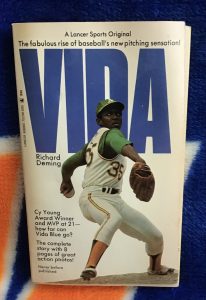 Some things just stay with you. Maybe that exchange is why, when the Mets played the A’s in the 1973 World Series, I was all for beating Ken Holtzman and Catfish Hunter, but didn’t take any extra relish in doing damage to Vida Blue. Not that I minded that we won his two starts, in Games Two and Five, but Vida Blue was one of a kind in 1971, and that sort of currency, like a home run in the first third of an otherwise woebegone season, will maintain its place in a person’s heart. When the A’s traded Blue to the Giants in 1978, I was excited to see the lefty make the All-Star team in the National League the way he’d made it three times in the AL and would make it twice more in the NL, including 1980. I wasn’t too happy Blue stanched our Magic momentum on June 13, 1980, defeating the Mets, 3-1 — nor did I care for his postgame quote after he bested Ray Burris that “I didn’t encounter any Mets magic” on Hendu’s Eve — but he was still Vida Blue, the one and only, and here he was, still pitching well when I was 17 after dominating baseball when I was eight. That’s more than half a lifetime at that age.
My final memory of Vida Blue as an active player comes from five years later, right around this time of year in 1985. I was 22. He was 35 and in his second go-round with the Giants, but seemed ancient after an arrest and suspension for cocaine possession sidelined him for all of 1984. The Mets were at Candlestick Park on May 30, Game 52. Doc Gooden was on the mound, just entering that phase of ’85 when he’d be both unbeatable and untouchable. Marty Noble of Newsday, who recognized an angle when he saw one sitting on the opposing team’s bench, sought out Blue to comment on what Gooden was doing. Dwight had just gone the distance, allowing only a run and six hits while striking out fourteen in the Mets’ 2-1 victory over the already hapless Giants.
“Impressive, very impressive.,” Blue said. “The strikeouts were something. What did he have? Fourteen? That’s a lot. But the thing that really impressed me is when he got them — right when it counted most. He closed the door on us when we had a chance in the sixth.”
Yes, in the sixth, Dwight was very much Doc. San Francisco had runners on second and third, with nobody out. But Gooden simply set to operating, popping up ex-Met Gary Rajsich, then striking out Jeffrey Leonard and Chris Brown to get out of what passed for a jam.
“That was the way I used to pitch,” Blue said with touches of whimsy and envy in his tone. “I wasn’t thinking about it much until that situation came up. but I watched him and he tuned up when he had to. That’s what I used to do.”
Blue would finish his big league career in 1986 with 209 wins, never quite the 1971 version of Vida again, but Doc, with an even more phenomenal line to his signature season, was never quite as much Doc again after 1985. How do you stay at the top of the world? If the answer was attainable, it would be permanently crowded up there. Doc’s win over Vida’s team put his record at 7-3, with his ERA dipping to 1.79. You couldn’t be sure 24-4 and 1.53 was where Gooden was headed, but maybe it took one to know one. In talking to Noble at the end of May 1985, Blue labeled his own 1971 “my Gooden year. I had games like this that year.”
That statement was absolutely True.
***Faith and Fear in Flushing has been made aware of a great initiative afoot that can only be described as civic engagement in its finest, purest form: the circulation of an online petition insisting Francisco Alvarez — “barring a huge erosion in his offensive production” — not be sent down to solve any supposed logjam of catchers once Omar Narvaez and Tomás Nido return from the injured list. Should this cause sit close to your heart, please visit the petition’s page and consider signing. As its argument asserts, “Roster flexibility is nice, but winning games is better.”
by Jason Fry on 22 May 2023 4:28 pm I was in Boston this weekend for my niece’s med-school graduation, which meant the Mets took a back seat to family doings. But not much of a back seat, seeing how it was me and all — the Mets went about their business in my ear, via GameDay and my watch face, on my phone in a ceremonial tent, and finally right there on an honest-to-goodness TV as I urged them to hurry.
Friday night’s game was the most catch as can catch — I was dining solo when a friend couldn’t make it last minute, and confined myself to a couple of peeks at the score while at the restaurant, with those couple of peeks suggesting I might have picked the right game to miss. But after dinner I put on MLB Audio and let Howie and Keith narrate for me from down around my hip. (Forgot my damn AirPods.) I heard Brett Baty homer to make things a little closer (following the lead of fellow Baby Met Francisco Alvarez), then heard Dominic Leone get into trouble and Stephen Nogosek seem to get out of it — except I’d turned off the game to catch up with my brother-in-law and his sister and when I looked at my phone again, the roof had caved in on Nogosek, with the Mets’ two-run deficit having doubled to four.
Except then the next peek showed that 7-3 had somehow become 7-7. For the 10th I propped my phone up and let GameDay do its thing, which was to bring grim and apparently fatal tidings, followed by miraculously good ones. Mark Vientos! Eduardo Escobar! Alvarez! Brandon Nimmo! And then Francisco Lindor, that former Cleveland baseball ambassador, now spreading the good news about the game in a new town. The Mets had won, I allowed myself a few boozy fist pumps, and then hoped I had enough battery life left to get a Lyft. (Nah, but it was a nice night, so I walked and thought good thoughts about the Mets.)
Saturday’s washout left me as your double chronicler for Sunday, an uncertain business given that Sunday was Graduation Day. The first half of the game went by largely without me, though a couple of phone peeks were enough to reveal the sigh-of-relief news that Max Scherzer was pitching well. I was sitting in the tent when GameDay offered grimmer tidings: Adam Ottavino had spat the bit, allowing a 3-0 Met lead to become a 4-3 grumblethon.
Which was when I remembered that I could watch MLB.tv since I was out of the Mets’ blackout zone. We were still in the milling around/parents awkwardly marking saved seats portion of Graduation Day, so why not? I was watching using my cell signal, so the video was variable to say the least: crystal-clear one moment, like looking through the murkiest pixel fog the next. (Plus I had no sound — forgot the damn AirPods again.) The video was in one of its fogged-in periods at the critical moment, but I’ve watched enough baseball to learn the visual language of production trucks: A blocky Starling Marte swung, the pitcher looked up through the blurriness, the camera switched to a wide shot of the outfield wall, and I stomped my feet happily in the grass. David Robertson came on, worked around a spot of bother and the game ended with a harmless fly to Marte — just in time, as it happened, for the pomp and circumstance to begin.
The second game begins with a confession: I don’t much like any of the changes to baseball instituted by Rob Manfred and his merry band of MBAs, ranking them somewhere on the spectrum between unnecessary and insulting to reason. But I was looking back and forth from the Mets’ scheduled start time to the 9:20 boarding time for my flight back to New York and wondering if I might be able to pull this off. The game wouldn’t be over by the time I got on the plane, but when you added the time needed for passengers to screw up stowing their luggage and get told to put away their laptops and if I accidentally on purpose ignored the Airplane Mode announcement … well, it was possible I’d hear the final out before wheels up and so not spend the flight in a state of anticipation and ridiculous hunting for auguries. (Do those scudding clouds look a little like Nimmo diving for a ball? What does that mean?)
I listened at first, feeling for Howie when the inevitable happened and he transposed the names belonging to Justin Verlander and Shane Bieber to suggest a certain pop star had a new career. (S. Bieber is certainly handsome enough to be a teen idol, so why not?) I heard the sound made by Jose Ramirez’s bat connecting with a ball in the first inning and so wasn’t particularly surprised by word that said ball had landed basically on Mars. But after that Verlander was brisk and relentless, sending Guardians away from the plate after the briefest of interactions.
The problem was that Bieber was also brisk and relentless — here was an old-fashioned duel of aces, and never mind the bigger bases and limited disengagements and not allowing fielders to play where charts tell them makes sense to play. The game was half-done by the time I settled into the Delta Sky Club and asked the bartender if he could turn on ESPN.
I was just in time to see Lindor get the Mets even with a golf shot of a homer, and from there I let the game unfold visually across the room without sound. The Mets had tied it, with Verlander going eight innings — a sight both wonderful and unexpected given his new team’s rotation woes.
Tied it, but my boarding time had gone from “still a ways away” to “awfully soon now.” Then Alvarez singled off Bieber — our fireplug catcher seems to be in the middle of everything, doesn’t he? — and turned into Marte, who in rapid succession survived a near-pickoff and then scampered to third on a little cue shot through the infield by Lindor. Jeff McNeil brought Marte home on a sac fly, with Brooks Raley coming in for the save — and my 9:20 boarding time now just a few minutes away.
Raley turned a nifty play to spoil Steven Kwan’s bunt attempt, and on just a single pitch, no less — I thanked him for both. But then he hit Amed Rosario, bringing up Ramirez and his by now lengthy track record of damage. It was 9:18. My boarding time was in peril, but larger things were too.
Ramirez hit the second pitch of the AB — and just the fifth of the inning — directly at Lindor for the old tailor-made 6-4-3 double play. The Mets had won in a little more than two hours, which I’ll grudgingly note might of had something to do with Manfredball. I grabbed my bags and walked downstairs and straight onto the plane with a certain spring in my step.
And why not? The Mets, seemingly dead after following their three-week brownout with an opening loss to the Rays, have now won five straight, all of them one-run decisions. They’ve done it thanks to precocious play from the celebrated Baby Mets but also with contributions from wise old heads — it was Alonso and Lindor and Marte and Scherzer and Verlander who came up big against the Guardians.
I don’t know what it portends — this season has been decidedly peculiar, with the Mets either looking unstoppable or unbearable. But all of a sudden they look once again like the team that was so much fun in the spring and summer of 2022. GameDay graphics, audio burbling away in my pocket, murky cell video, an actual television — if they keep playing like this, I’ll find a way to accompany them.
by Greg Prince on 20 May 2023 6:23 am In the spirit of the Baseball Writers Association of America members with whom I rubbed or at least grazed elbows Friday night, I humbly submit my ballot for Most Valuable Angle from the 10-9 ten-inning Mets win over the Guardians.
1) MY PRESENCE IN THE CITI FIELD PRESS BOX
This first-place vote may seem like the height of self-absorption, but a) blogging is foremost a first-person medium; and b) the Mets are 7-0 when I cover a ballgame from the Citi Field press box (high-rolling craps players have gotten less for their money from gorgeous good-luck charms they pay to blow on dice). More pertinently, the Mets win some of their craziest bleeping games when I’m wearing a credential around my neck rather than my heart on my sleeve. Rule No. 1 of the press box is there is no cheering, not even by a member of the media whose medium is all about advocating for the cause of the home team. I’m a seasoned pro when it comes to tamping down my rah-rah impulses, having taken those aforementioned crazy bleeping games in remarkable stride, at least until the credential came off my neck and the shouts emerged from my larynx.
2) INTERLEAGUE IS DEAD
I was Working Press for a night because I had an idea or two I wished to pursue, among them the notion that what was once conceived as a novel avenue toward boosting fan interest in the course of a long season is now so commonplace that it doesn’t matter. Seven National League clubs played seven American League clubs on Friday. Same as Wednesday. It’s not “Interleague Week,” the way it was introduced to us in 1997. Every week has a bunch of matchups between NL and AL, creating a wallpaper effect. Maybe the intracity showdowns are still big news. Maybe the chance to see Shohei Ohtani in, I don’t know, Cincinnati, is a godsend to Reds fans. Otherwise, we’re in NFL/NBA/NHL territory wherein team from this conference plays team from that conference and it’s business as usual. Thus, I wanted to get credentialed for the opener of this Mets-Guardians series so I could ask Buck Showalter, a manager whose dugout experience predates Interleague play, if the onslaught of 29 different opponents across the schedule presents new challenges to his preparation (and we all understand how critical preparation is to Buck). I asked, and he gave me a really good, really detailed answer around 4:30 Friday afternoon that doesn’t seem all that relevant given the events transpiring around 10 o’clock Friday night, but he confirmed my suspicion. Buck admitted, “I don’t even think about it anymore” whether it’s an NL team or an AL team next on the Mets slate, and credited “the advance people” for being on top of such a plethora of potentially unknown quantities. Despite it fading into the background as Friday’s festivities went along, this angle gets my second-place vote because it tickled my curiosity enough to get me to the ballpark and on assignment.
3) SILENT NO MORE
The other angle that lured me to Citi Field Friday night was the appearance of the leading light of the Silent Generation Mets. Those were the 2020 Mets who weren’t Mets before or after the short but depressing pandemic year, meaning they never knew what it was like to play as Mets in front of fleshed-out Mets fans. All the likes of Billy Hamilton, Jake Marisnick, Guillermo Heredia, Hunter Strickland and Erasmo Ramirez knew from were cardboard cutouts. I mention those Mets of recent, quiet vintage, because they have at least come back to Citi Field as former Mets. None made much of an impact in 2020, so none really drew a rousing ovation in ’21 or ’22. Ah, but Andrés Giménez was a veritable force as a 2020 Met, the youngest kid on the roster making a name for himself and his future. Andrés played in 26 of 30 home games as a heady infielder on the rise, even rating a smidge of Rookie of the Year support in the succeeding offseason’s BBWAA balloting. Then he was traded before a single fan who might have applauded for him while watching him on television could do it in person. I thought it would be instructive to see and feel Giménez immersed in an authentic Flushing din. Let’s say he now knows what Citi Field really sounds like.
4) YESTERDAY’S FUTURE
Giménez was traded in a package that included the Met shortstop he was in the process of making superfluous, Amed Rosario. Rosario was the breakout star of our dreams way back in 2017. That long? Or is it only that long? We know how we are about demanding a hot prospect be granted his immediate promotion; we didn’t just invent that impulse this year. Rosario’s installation on the active roster was a happening. The Mets followed up with Rosario-themed giveaways. As he progressed, you couldn’t picture our future without Amed. Then one day he was deleted from our present. It warms my heart to report Rosario, like Giménez, received tangible applause when the starting lineups were announced Friday night. More a trickle than a flood, but neither of them was treated like an American League stranger (no video, though). After Rosario’s first-inning hit, a sing-song chant of “Jose! Jose! Jose!” went up. Could it be the crowd remembered Rosario as protégé to Reyes and was making a meta-comment on the circle of Met life? No, it was just some Cleveland supporters excited to see Jose Ramirez come bat next. Guardians groupies would find a lot to get vocal about in the minutes ahead.
 Always a giant matchup. 5) ECHOES OF 1954
The “Cleveland” wasn’t the Indians, the “New York” wasn’t the Giants, and the Polo Grounds is a housing project in 2023, but geographically if not in precise name, we had a World Series rematch on our hands: CLE (AL) at NY (NL). One last glint of sepia-toned romanticism to frame the Mets-Guardians matchup in the glow of memories forged when Willie Mays made The Catch, Dusty Rhodes delivered The Pinch-Hits and the National League champions upset the supposedly unbeatable junior circuit behemoth in four straight. Random Interleague matchup? We had a tradition to uphold! Or, perhaps, just a third consecutive game to win in the midst of what had been, until very recently, a morbid May. “Still,” Arnold Hano wrote in A Day in the Bleachers, the book that made the 1954 Fall Classic a true classic, “I’m not an American League fan. All I know about the Indians is what I have read about them in the papers.” During my night in the press box, I noticed the official scoresheet listed the Mets’ foes for the evening as the “Cleveladn” Guardians. I feared word would get down to the visitors’ dugout and Terry Francona would use the typo as motivation.
6) HE DIDN’T GET HIS MEN
Carlos Carrasco, off the injured list, replicated Sal Maglie in one respect. Both the Giants’ starter from Game One of the 1954 World Series and the Mets starter in the first of three games set for this weekend (weather permitting) gave up first-inning runs. In that respect, Maglie would have fit in nicely with the 2023 Met rotation. Maglie — “the Barber” — got nicked for two runs out of the gate, then shut down Cleveland through seven. Carrasco — Cookie — didn’t compensate for his early crumbles so effectively. Carlos had the Mets trailing, 4-0, after two and 5-0 after he completed his night’s work after five. We could only hope our bullpen had enough Don Liddle and Marv Grissom to it should the Mets’ bats mount any kind of comeback.
7) BABIES COME BACK
Five fine innings from Cal Quantrill (even better than what Bob Lemon posted to open Game One in ’54), combined with the five runs Carrasco gave up, were too much for the Mets to handle…or would have been, before the Mets commenced to reinvent themselves as full of spit and vinegar — and adamant about never saying die. These Mets aren’t your grandfather’s Mets. Or your father’s. Or your older brother’s. Or yours from Monday or Tuesday. These are the Mets who got it together on Wednesday, kept it together on Thursday and gave no indication they didn’t plan to keep it rolling on Friday. How? With an infusion of blood so young it could get a base hit for two different teams in two different cities off two Hall of Fame pitchers on the same day. Francisco Alvarez, 21, went high and deep in the bottom of the fifth. Nobody was on base, but the run Alvarez drove in didn’t stay lonely for long, as former kid who still plays like one Jeff McNeil drove in another run. It was 5-2 heading to sixth — and 5-3 heading out of it, thanks to Brett Baty, 23, homering to lead off the home half of the inning. Climbing out of holes is suddenly a Met skill set. Toddlers love to climb, right?
8) NOTHING POLARIZING ABOUT IT
Having generated such a thoughtful response from Buck pregame, I wondered if I could ask him a followup in the seventh: “What’s this debilitating fascination you have with Dominic Leone?” Leone, who hasn’t inspired an iota of confidence during his Met tenure to date, got bailed out by his defense in the sixth. He responded to his good fortune by loading the bases in the seventh. Stephen Nogosek was the next safety net. It almost worked, too. Rosario lined to center, but Nimmo (who’d performed a little Maysian magic on a Wertzian drive from Giménez) caught it and fired home. Baserunner Will Brennan found himself trapped in a rundown. Alvarez threw to Baty, who chased Brennan toward the plate before tagging him out. In the books, that’s an 8-2-5 double play. That’s the stuff of Dykstra to Gibbons to Hojo, speaking of New York (NL) teams to have won it all. Alas, Nogosek wouldn’t eradicate what was left of Leone’s mess, and the Guardians took a 7-3 lead to the bottom of the seventh. Pete Alonso then took that lead and turned it to dust. Grand slam!!!! Four runs!!!! Tie game!!!! (Exclamation points abound here because in the press box, remember, no cheering.)
9) PITCHING AND DEFENSE
So Leone and Nogosek weren’t the Liddle and Grissom of their day. Liddle threw the pitch that Vic Wertz blasted to most distant center only to have Mays track it down; Grissom was the pitcher Leo Durocher brought in after him, with legend having it that Liddle told Grissom as he vacated the mound, “Well, I got my man.” Most importantly, the two Giant relievers from 69 years ago didn’t allow Cleveland to add on to their two runs. That’s the kind of performance the Mets needed ASAP. It’s what they got just as quickly from Adam Ottavino in the eighth — no baserunners, which was great, because an Ottavino baserunner is an automatic Ottavino basestealer — and David Robertson in the ninth. Robertson in particular was assisted by fancy fielding, with McNeil robbing Steven Kwan, and Alonso squelching a base hit bid by Ramirez. The two pitchers doing their best to add up to one Edwin Diaz were half of the reason the game was heading to extras. The other half? The Mets didn’t score in the eighth or ninth, either.
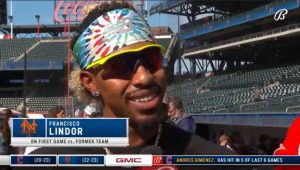 Lindor in the middle of everything, including me (in windbreaker over the shortstop’s left shoulder). 10) THE DRAMATIC RATHER THAN TRAUMATIC CONCLUSION
Drew Smith took a step outside the bullpen circle of trust, giving up a two-run homer to Gabriel Arias (after Rob Manfred put a Guardian on second) in the top of the tenth to almost certainly make the night an exercise in highs and lows that would land with a thud on a low. Unless you were nutty enough to foresee a nutty conclusion to what had been a fairly nutty game through nine-and-a-half. I was sitting in the same press box I was sitting in when Alonso tore off Michael Conforto’s shirt after Conforto and Todd Frazier tore the roof off the Citi sucker in 2019; when Joey Votto hit a ball off the top of the outfield wall rather than over it on the night 1973 Met stalwart Jon Matlack was inducted into the team Hall of Fame in 2021; and when the Marlins threw all the goodwill they could at the Mets and away from each other on Keith Herrnandez’s number retirement day in 2022. Those were all highlights of unfathomable walkoff wins. How on earth could you expect the Mets to match those kinds of heroics?
• First, you call Rob Manfred and ask for a runner on second, and magically appears Brett Baty.
• Then, you cope with the presence of Emmanuel Clase, the American League’s answer to Edwin Diaz in 2022.
• Then, you send up your Most Valuable Met from 2022, Starling Marte, but it’s a new year, and Marte flies out to right. At least it’s enough to move Baty to third.
• Then, you make with the spit and vinegar again, via the third of the Citi Kids, as I’d taken to calling them in my head. Mark Vientos, 23 and DH’ing (we’ll overlook what a miserable role that is to inflict on a veritable child), singles Baty home. It is 9-8. By never saying die, death is averted.
• Eduardo Escobar comes into pinch-run, no slight detail. The Mets have not had their pinch-running specialist Tim Locastro for weeks and won’t have him for more weeks (thumb problems while on rehab). Escobar, the displaced veteran, carves out a niche as the base thief of record. He steals second, setting up a marvelous opportunity for pinch-hitter Daniel Vogelbach.
• Yeah, right. Vogelbach strikes out.
• But here comes Alvarez! Except Alvarez, after two pitches, is in an oh-two hole at the plate, and up in the press box, Mr. They Never Lose With Me Here unplugs his tablet from the handy outlet of which he’s been availing himself all night because this reporter knows it’s a lost cause and maybe he can get a jump on the commute home if he starts to pack up before the inevitable becomes a reality.
• And, I swear, as soon as the charger’s prongs were detached from the electrical socket, Alvarez socked the next pitch he saw into left, scoring Escobar with the tying run. The detached observer up in the press box plugged his tablet back in.
• Nimmo grounds near but not to Rosario. Amed doesn’t have enough time to nab the ball and Brandon, meaning it’s first and third.
• After Buck’s presser and before settling into my press box seat, I took a trip out onto the field. You can do that when you have the right credential around your neck. Between the reporters and the photographers and the various guests the Mets welcome and the perk-enjoying season ticket “members,” there may be more spectators surrounding the field during batting practice in Flushing than there are in the stands during games in Oakland. Even this ad hoc crowd was bigger than any Giménez saw when he was a Met. One fellow amid all this activity stood out. He’s got the hair for it, the bandana for it, and the charisma for it. Francisco Lindor attracted attention, whether he strove for it or not. He stopped to give an interview for Cleveland’s pregame show. He stopped to greet families who couldn’t believe the Mets’ shortstop was not only talking to them but smiling at them. He invited two children to come see “my office,” meaning the clubhouse, and whisked them on a whirlwind tour. Lindor was already doing it all and first pitch was still two hours away. As focused as I was on Rosario and Giménez coming home, it was a much bigger deal for the Guardians and their fans/press corps that they’d be facing the players they sent to New York: Carrasco and, especially, Lindor.
• Lindor was a big deal in Cleveland for a reason and is a big deal in New York for a comparable reason. The man comes through. Even after interrupting his pregame preparation to accommodate everybody. Even while having to wear an olive drab cap that doesn’t go with his dyed curls (or anybody’s natural ones), let alone black jersey. Even when the Mets appeared in various states of dead and desperate.
• The erstwhile Clevelander turned on the nightlife in Queens, singling home Alvarez — who Francisco labeled one of the “Baby Mets” with the winning run. I like Citi Kids as a moniker (I’m already seeing the poster in my head), but the important thing is we’re test-driving adorable names because we’re so excited about these adorable young players and their adorable elders. Together, the generations made it Mets 10 Guardians 9 in ten. Two nights after Mets 9 Rays 8 in ten. Sandwiching Mets 3 Rays 2 in nine. All one-run wins are not created equal, but each of these one-run wins has been huge in its own right, and this version takes its place in the pantheon of press box EXTRA! EXTRA! READ ALL ABOUT IT! special editions, the kicker coming from both out on the field, where “L.A. Woman” blared like it was 1999 (followed by “Takin’ Care of Business” evoking 2006) and back in the Excelsior concourse where, whenever somebody opened a rear door, you could hear LET’S GO METS!!! rumble down the steps from Promenade.
So yeah. A good night to cover a ballgame.
|
|






